Chicago Tribune, by Paul F. Salopek
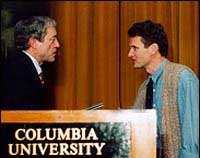
Columbia University President, George Rupp (left), presents Paul F. Salopek with the Pulitzer Prize for Explanatory Reporting.
Winning Work
Controversial genetic quest is unlocking secrets of the human
By Paul Salopek
Tribune Foreign Correspondent
UNIVERSITY PARK, Pa.-- In a beat-up refrigerator humming away in his laboratory storeroom, Ken Weiss is storing vials of human blood: the largest gene pool left of a tribe of people inexorably vanishing from the Earth
The insides of the freezer, not much different from ones used by many people to store groceries, hold the DNA of 12,000 Yanomamo Indians, a fierce Amazonian tribe that lives in Brazil near the watershed of the Orinoco River. The blood samples were collected by anthropologists a generation ago, and there are now more vials in the nondescript room at Pennsylvania State University where Weiss is a researcher than there are Yanomamos still alive
Like many remote populations, the Yanomamo have been ravaged by Western diseases and, in this case, the shotguns of invading gold prospectors. Their rain forest home is scarred by airstrips and mines. Of a population numbering in the tens of thousands at the turn of the century, fewer than 10,000 remain.
So it is that Weiss' storehouse has become one obscure if vivid example of a genetic quest so vast, controversial and unprecedented that even those who know of its existence can't agree on its principal goal.
It is the Human Genome Diversity Project, a title that has proved confusing because it is so close to the more famous Human Genome Project that is mapping the entire code of human DNA.
By contrast, the Human Genome Diversity Project, over five years and at a cost of $25 million, calls on geneticists at universities worldwide to collect 10,000 blood samples from at least 400 ethnic groups ranging from Afghans to Apaches, from Basques to African Bushmen.
In short, it is the first genetic survey of humankind, a painstaking portrait of how and why members of the human species duplicate or differ from one another.
Weiss is the North American coordinator of the project, which is awaiting approval by the National Academy of Sciences, a step that would open it to government funding and increase its public profile. If approved as expected this summer, the project would serve as an official institutional umbrella for research that has been going on unofficially for decades by a scattered group of scientists and commercial researchers.
Which human tissue samples will come under the project's aegis--those of the Yonomamo included--is just one of the complicated ethical and logistical questions that will have to be resolved.
To some, the project is a scramble to salvage the fading biodiversity of our species--a genetic inheritance that shrinks with the demise of every tribe such as the Yanomamo. Moreover, by collecting and comparing the the DNA from the far-flung populations, scientists say they will at last be able to sketch a global family tree and "read" the tale of human evolution, how our ancestors populated the Earth.
Still others call the diversity project a medical bonanza that, by exploring why some groups resist certain diseases, might lead to breakthroughs in the treatments of ailments ranging from Alzheimer's disease to diabetes.
But it is the project's revelations about race that promise to rattle our perceptions of identity the most and ignite debate in classrooms, taverns and homes across the world.
Indeed, the father of the project, Luigi Luca Cavalli-Sforza, an eminent Stanford University professor who has slogged the globe collecting blood samples from Italian villages to sweltering rain forests, has received an incongruous trickle of hate mail:
How dare Cavalli-Sforza suggest, the obscenity-spattered missives read, that our notions of race are irrelevant and that groups such as blacks and whites--or anybody else for that matter--are basically the same.
"Outward appearances tell almost nothing about our roots--the shapes of our noses, the color of our skins change with climate," said Cavalli-Sforza, a reserved, silver-haired academic with an elegant Mediterranean accent, impatiently waving off the racist attacks. "It's our genes that tell our story best."
Meanwhile, a vocal, angry minority see the project as something altogether different: a cultural ripoff, or at least a callous abuse of aboriginal rights.
As the debate escalates, the vast store of human tissue that Cavalli-Sforza and others have collected will be carefully cultured in labs so that the cells live on for decades--a biotech process called "immortalization." In a final, Dr. Strangelovian twist, the cell lines--a cross-section of humanity kept alive in petri dishes--would be stored in genetic repositories around the world.
Some of the preliminary findings have proved controversial:
- After analyzing thousands of DNA samples collected in smaller studies, experts are amazed at the genetic unity that binds our diverse, polyglot species. Any two people, regardless of geography or ethnicity, share at least 99.99 percent of their genetic makeups--a deep sameness that makes a mockery of racist ideologies such as Nazism.
- Paradoxically, the minuscule .01 percent of our genome that does make people different doesn't shake out along visible racial lines. Instead, some 85 percent of human genetic diversity occurs within ethnic groups, not between them. The traits that so polarize our culture--the shade of our skin, the shape of an eye, hair texture--actually hide a dazzling and unexpected molecular tapestry that reflects our true origins. The European gene pool, for example, carries the story of where its members came from--and where they later migrated. It is a swirl of 35 percent African genes and 65 percent Asian genes.
- In a development that enthralls medical researchers, a global genetic survey will tap the "healthy genes" locked away in the nuclei of different ethnic groups. With the marvels of genetic medicine, disease resistance unique to one population might soon be shared by all.
"This project is going to infuriate bigots," declared Kenneth Kidd a project planner at Yale University. "It peels away our cultural bias with molecular data."
Yet if experts such as Kidd and Cavalli-Sforza hold up the diversity project as a humanist's dream come true, there are doubters--and not all of them are irrational hate mongers.
Some anthropologists think the project has been oversold and say that the black box of human identity cannot be unlocked with DNA alone.
Ethicists, meanwhile, worry that in a decade obsessed with the hot-button issues of genes and race, the results of the survey, no matter how high-minded, will inevitably stoke the fires of intolerance. Studies showing that some Asiatic populations lack a so-called "novelty-seeking" gene has been seized upon by racists to explain why Asians supposedly favor predictable, authoritarian regimes over the free-wheeling quirkiness of democracy.
Others fear that the project's treasure-trove of genetic data could fall into the hands of unscrupulous governments bent on developing racially targeted "genetic bombs."
As the gigantic scale of the survey begins to lumber into the public eye, a growing number of aboriginal groups, who are the main if not exclusive target of the study, see the project as simply another form of high-tech exploitation--scientists arrogantly using tribes as guinea pigs while offering nothing tangible in return.
"It's biocolonialism, plain and simple," said Jeanette Armstrong, a member of Canada's Okanagan Nation. "First, they take our land, then they take our culture and now they want our genes."
© 1997, Chicago Tribune
Saving the markers
By Paul Salopek
Tribune Foreign Correspondent
"We're going to have some amazing stories to tell."
Writing an impassioned open letter in the journal Genomics, the researchers warned that if the story of our species is embedded within the genes of living populations, then "the gate to preserve these clues is closing rapidly."
Why?
In essence, scientists can't reconstruct our family tree if there are no branches: The small, isolated populations that make the best subjects for diversity research are slowly disappearing.
Five centuries of European colonization, anthropologists say, have snuffed out countless small ethnic groups through disease, intermarriage and outright genocide.
Today, mass culture is rapidly steamrolling much of the diversity that remains--most of it clustered within the DNA of tribal minorities whose gene pools offer clear glimpses back to Paleolithic times. With the lure of pop culture and vast migrations to urban melting pots, the subtle palette of humanity is being muddled by assimilation--and with it the picture of our past.
A thumbnail measure of this homogenizing trend is the death of the world's languages, which are loosely associated with genetic distinctness. By one estimate, fully 90 percent of the 5,000 tongues that are still used--most of them spoken by tribal peoples--will vanish within the next century.
That, scientists hope, is where the diversity project comes in.
"The idea is to have colleagues on each continent sample the populations that wish to cooperate and then pool the data globally," said Cavalli-Sforza, a principal author of the 1991 call to arms and one of the intellectual fathers of the global gene survey. "Nobody gets rich off of this, nobody oppresses anyone. It's a shared, open resource for all humanity."
How, exactly, would Cavalli-Sforza's DNA survey offer a window into history?
Inside each one of our cells lie coiled the 3 billion nucleotides--or molecular rungs--that make up the spiral ladder of DNA, the blueprint of life. During the course of evolution, random and mostly harmless flaws called mutations accumulate in the ladder, and it is this record of glitches that allows scientists to track our ancestry--much as a unique surname can be traced through time by genealogists.
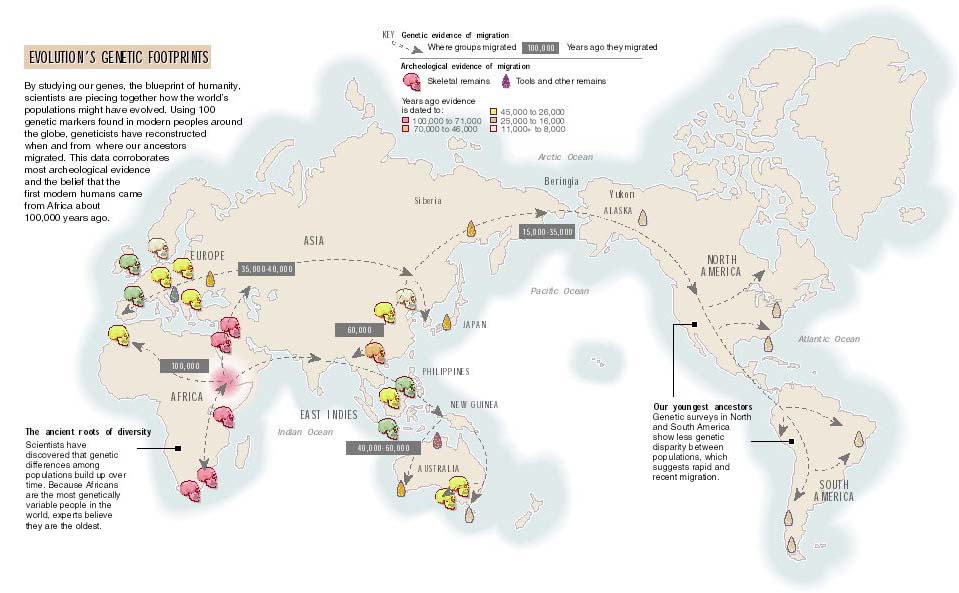
First, geneticists identify the most stable of these mutations, called gene markers, in populations around the world. Archeological evidence is then marshaled to date the ancestry of the peoples who carry those markers. By merging both sets of data, scientists can bring to light unexpected connections between peoples.
DNA markers associated with Middle Eastern peoples, for example, have been discovered in a clear south-to-north gradient across Europe. They are the faint molecular footprints, experts say, of prehistoric farmers who brought agriculture to Europe from Asia Minor thousands of years ago--genetic echoes that linger in the DNA of French businessmen and German housewives.
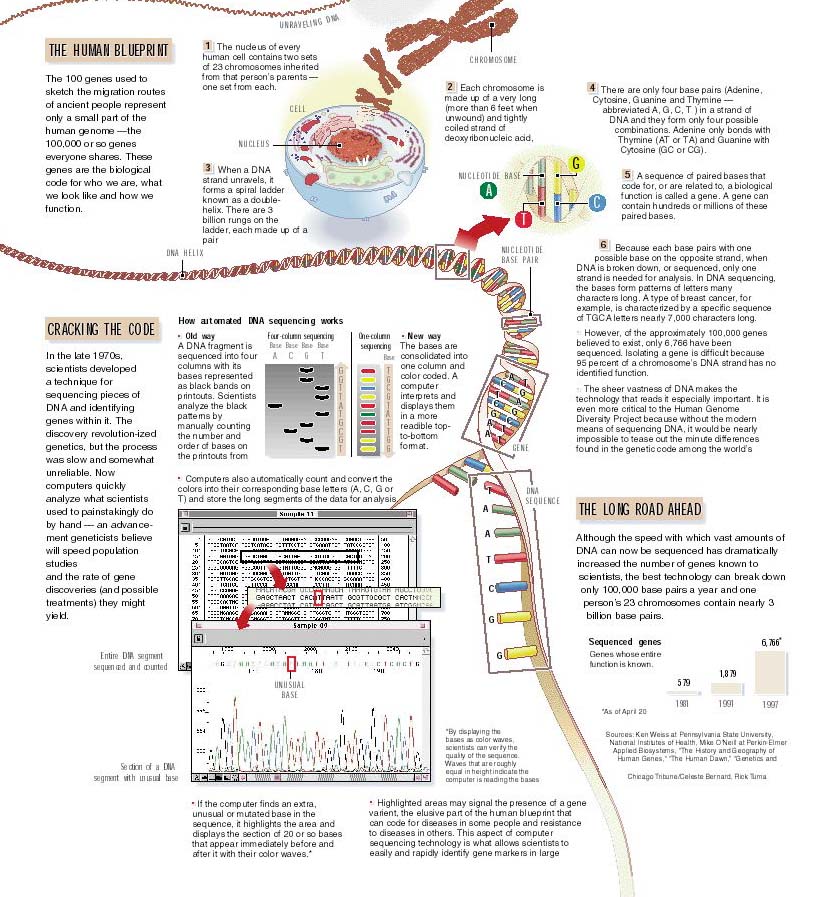
Mapping markers, though, tells only half of the human story. Scientists also are working to perfect "genetic clocks" that measure the mutation rates in DNA to time when our ancestors last diverged and went their separate ways.
With both of these tools, the entire pageant of human history lies waiting to be read in every drop of blood or in the root of a hair or in a scraping of cells from a cheek.
Here is a sampler of some recent "genography" discoveries:
- A comparison of gene markers worldwide supports the Out of Africa theory of human evolution, which holds that modern humans first migrated out of Africa barely 100,000 years ago--an evolutionary blink of the eye--during which most racial features emerged. Because Africans' genetic roots penetrate at least another 100,000 years deeper into the soil of Africa, they have had more time to diverge genetically than other populations. Far from being a monolithic race, Africans are the most genetically varied peoples.
- The DNA of Native Americans, whose genes reveal hidden links with an ancient homeland somewhere near Mongolia, indicates that the famed Bering Straits crossing occurred between 15,000 and 30,000 years ago, far earlier than archeological evidence suggests. DNA testing on both sides of the waterway also hints at reverse migrations of Native Americans back into Siberia, findings supported by linguistics.
- In Europe, DNA tells us that the Basques are the oldest residents of that continent, with a lineage that stretches back 30,000 years to Cro-Magnon man. At the other end of the time line, Finns appear to be among the youngest Europeans: Their genes traveled north with a small band of Middle Eastern people as recently as 4,000 years ago. Settling in the forests of sun-deprived Scandinavia, they quickly lost their ancestors' coppery complexions.
- Genetic surveys in Japan debunk the widely held notion that the Japanese are a single, unvarying ethnic group. Markers on the male Y chromosome show that the island-nation's populace are an admixture of two ancient tribal peoples whose homelands lie near Mongolia and the Korean Peninsula.
While these discoveries have intriguing implications for people fascinated with roots, they can still smack of musty academia--the stuff of faculty lounge debates.
But the awesome power of DNA technology is changing that, thrusting even the dimmest episodes of history into the realm of daily life, making them immediate and personal as never before.
One example is Michael Hammer, a young geneticist at the University of Arizona. He made headlines recently by showing that the DNA of Cohanim--the Jewish priesthood whose duties are passed strictly from father to son--is indeed genetically distinct from the rest of the Jewish population.
Hammer's discovery has sent shivers of unease through some ultra-orthodox Jewish communities. What if--priests are asking--we don't carry Cohanim gene markers?
Even more remarkably, Hammer hopes with additional sampling to track the entire lineage back 3,300 years to Aaron, the brother of Moses who founded the priestly caste.
"A decade ago, we started with maybe 100 good genetic markers, but now we have thousands," said Hammer, a soft-spoken researcher who is as casual in black jeans and silver earring as Cavalli-Sforza is aristocratic. "The picture of who we are becomes clearer all the time."
Dreamily, Hammer ticked off some other major quests of diversity research: reconstructing the human diasporas that settled Polynesia, plumbing the roots of India's caste populations and digging back through the double helix to find the ancient homelands of African-Americans.
Noting that scores of molecular sleuths are turning up markers faster than journals can publish them, Hammer added puckishly, "We're going to have some amazing stories to tell."
Actually, with cutting-edge technology that automatically replicates and sequences vast chunks of DNA at speeds unimaginable even five years ago, the number of markers waiting to be discovered could theoretically mushroom into the millions.
The upshot?
With that astonishing degree of resolution, any two people--Swede, Tibetan, Navajo or Tutsi--could trace their lineages back to a shared ancestor, whether 5,000 or 50,000 years ago.
© 1997, Chicago Tribune
Tribal uproar
By Paul Salopek
Tribune Foreign Correspondent
Unfortunately, it is exactly such genealogical wizardry that has sucked the diversity project--and, by extension, all genetic surveying--into a widening maelstrom of political and religious controversy.
The almost magical ability of science to peek through the keyhole of history, potentially debunking long-cherished beliefs about heritage and identity, is an unsettling prospect for even the most worldly of people. But for many of the tribes that are being asked to participate in the massive study, the idea can seem soul killing.
"I don't need somebody to look at my genes. I have my own origin stories," said Nilo Cayuqueo, a Mapuche Indian from Argentina and the director of the Abya Yala Fund, an indigenous organization in Oakland that opposes the diversity project on philosophical grounds.
A member of Argentina's small remnant of 50,000 Indians, Cayuqueo said that gene hunters had already marched through the Mapuche's dusty cinder block villages, drawing blood that ended up at U.S. universities. He angrily denounced them, despite their best intentions, as the latest in a long line of outsiders coming to chip away at eroded native cultures and cosmologies.
"Imagine the arrogance of coming in and giving tribal people a machete or 15 bucks for their blood, then telling them, 'Well, you're from so-and-so place 1,000 years ago,' " he said. "Who are they to tell us where we came from? Don't they understand that's sacrilegious?"
The architects of the diversity project insist that the global survey would never happen that way.
"You don't just parachute in with some syringes," said John Moore, a University of Florida anthropologist who is helping design the sampling effort. "You invest time with people, you build relationships, you respect local beliefs."
Moore says that new ethics protocols would require scientists to explain why blood is being collected and obtain letters of informed consent. Contracts also would guarantee that the ownership of the DNA remains with the donors.
"What people don't realize is that this research will continue with or without the project," he said. "With the project, we can address sensitive issues in an organized way. Without it, the scattershot collecting goes on."
Moore is betting--like most scientists--that officials at the National Academy of Sciences will agree, thus opening the door to funding from agencies such as the National Science Foundation and the National Institutes of Health.
Still, the huge size of the project and the fact that it was planned essentially without public input has alienated many of the very people whose DNA it hopes to preserve.
In 1992 when project anthropologists hammered out a tentative list of populations to be sampled--a boggling roster of minority cultures that included Sherpas, Apaches, Tuaregs and the last six members of Chile's Ona Indians among 700 other groups--the response from the international indigenous community was at first disbelief and then outrage.
The World Council of Indigenous Peoples promptly called on its members to boycott the DNA survey, accusing the scientists of being more interested in rescuing exotic genes than people. The notion of warehousing humanity in gene banks, they said, was ghoulish. The $2,500 cost of maintaining each of the 10,000 cell lines, they added, could be much better spent on health clinics or schools in tribal areas.
Since then, in fiery manifestos and Internet postings, native activists from the Philippines to Peru have jumped on the bandwagon, pounding the project as "immoral," "illegal," and, in a supreme irony for diversity scientists, "racist."
"The (project scientists) might be big brains, but when it comes to public relations, they're clueless," said Craig Benjamin of Cultural Survival-Canada, a native-rights group monitoring the stormy debate. "A lot of tribal groups were shocked to see their names on that list because absolutely nobody had been consulted."
Of all the hostility stirred up by the project, nothing stings researchers more than the dire rumors that their data could somehow be harnessed for weapons research.
Though scientifically improbable, the allegation gathered steam last May when a well-publicized U.S. Army workshop on 21st Century warfare included a "genetically targeted superpathogen" in its arsenal.
Such news drives diversity project scientists nuts. They insist that the macabre notion of genetic weapons ignores the double enigma of human variation--that we are far too identical and our tiny genetic differences are far too independent of ethnicity--to make a racial bomb work.
"That just betrays the activists' own paranoia and racism," said exasperated project geneticist Kidd. "There is no particular 'race gene' for a genetic weapon to zero in on. The whole idea is ludicrous."
Other diversity researchers, however, empathize with the fear, noting that tribal peoples have been the victims of biological warfare dating to the days when the U.S. cavalry began handing out measles-infected blankets to Plains Indians. Troubled by the protests, the scientists promise to broaden the sampling to include larger human populations.
"In retrospect, we made a big mistake early on by overemphasizing endangered cultures to build up public interest," Weiss said. "Now, everybody forgets that we want to test all sorts of populations--even big groups like the Han Chinese."
So far, the activists aren't buying it. In September, they picketed a Montreal genetics conference where project planners stumped for their grand vision: to create genetic life rafts for the sinking Titanic of human variation.
About 30 protesters, many of whom were not indigenous, stood outside on a chilly sidewalk and waved placards that taunted, "Check Your Ethics At the Door."
© 1997, Chicago Tribune
Scientific doubters
By Paul Salopek
Tribune Foreign Correspondent
The trump card in the debate is that the gene pools that hold many of the answers are evaporating.
As if the complaints from tribal-rights groups weren't enough, the herculean effort to unlock the rainbow of human diversity also has taken some lumps from closer quarters.
Some anthropologists assert that the diversity project's reliance on building family trees with DNA markers is a crude way to measure human history, much less capture so nuanced and fluid a notion as race.
A better metaphor for tracking our biological identity, they argue, is to trace a braided river that splits and rejoins and splits again, often erasing its genetic channel over the meandering course of eons. In other words, they say it probably can't be done.
"I'm sorry, but I think this project is half-baked," said Jonathan Marks, a biological anthropologist at Yale and one of the most vocal scientific critics of the sampling effort. "The leaders are first-rate geneticists who happen to have a folk knowledge of anthropology. They're still asking questions like, 'How close are the Irish related to the French?' These are things most people stopped asking in the 19th Century. What's French anyway? That's a cultural precept, not a biological one.
"Frankly, I think they're naive," Marks added tartly. "It reminds me of a bunch of teenagers trying to build a cyclotron in their back yard."
Undaunted, project supporters reply that any confusion about "Frenchness" or "Irishness" is exactly what a global DNA survey will clear up once and for all by neatly unbraiding the knotty rope of culture and biology.
The trump card in the debate is that the gene pools that hold many of the answers are evaporating.
"You can nit-pick about methodology for years, but in the end, it comes down to having this one opportunity to take a genetic snapshot of the world," Weiss said. "Do we do it or don't we?
"We're scientists, not politicians," he said, invoking a mantra repeated by all bringers of knowledge, from the first who harnessed fire to the splitters of the atom. "But at least we can lay the biological information out on the table. People can see it out there."
Watching a graduate student isolate the DNA from the Yanomamo samples and drip it into small capsules, Weiss observed wistfully that the primordial chain of molecules that makes us all so fundamentally alike and yet profoundly unique is transparent and without color--that in its purest form, the stuff of life is always absolutely clear.
© 1997, Chicago Tribune
Cures possible, but groups worry about exploitation
By Paul Salopek
Tribune Foreign Correspondent
It was supposed to be a simple bargain--an honest if somewhat bizarre deal struck between one of the last Stone Age peoples and the most technologically advanced society.
Soon after the Hagahai emerged from the cloud forests of Papua New Guinea in the late 1980s and made their first contact with the outside world, anthropologists stumbled across a remarkable secret flowing in the tribesmen's blood.
The Hagahai, who have harvested yams and hunted wild boar along the remote Yuat River for millenniums, carried a rare virus in their white blood cells. It was a pathogen similar to ones that cause leukemia, but it did not harm the tribesmen.
American scientists wanted to understand why, so they made the tribe a quiet offer: Let the U.S. government patent their cells in exchange for half of the royalties from any breakthroughs in leukemia research derived from their blood.
The Hagahai, who by then were familiar with money, agreed. After donating a few test tubes of blood to the National Institutes of Health in Bethesda, Md., they promptly went back to stalking wild game.
If the story of U.S. Patent No. 5,397,696--for a DNA sequence dubbed "Papua New Guinea human T-lymphotropic virus (PNG-1)"--had ended there, it probably wouldn't rank as a footnote in the dazzling saga of the genetic revolution in the 1990s.
But the tale of the 1995 Hagahai patent and its bitter aftermath is far from forgotten in scientific circles. Instead, it has become the defining morality fable for one of the most intriguing and highly controversial new frontiers in human biology: the hunt for genetic cures in the DNA of small ethnic groups.
Buoyed by technical advances that make massive DNA testing economically feasible and spurred by the realization that humanity's genetic diversity is yielding to cultural assimilation day by day, researchers are scrambling to the most secluded corners of the Earth, hoping to tap the "healthy genes" embedded in the nuclei of the Cherokee, the Amish, Solomon Islanders, the Hagahai and others.
So far, the strange quest has fired the imagination of individual academic researchers and big biomedical companies. Probably the most compelling proposal on the horizon is the Human Genome Diversity Project, a plan put forth by a loose coalition of international geneticists to collect and preserve the DNA from 400 human populations and ethnic groups.
If funding is approved by Congress after a recommendation by the National Academy of Sciences, the diversity project could officially begin gene sampling this year, adding to a store of samples collected without government involvement.
"We've always known the strength of any species lies in its diversity," said Victor McKusick, a pioneering population geneticist at Johns Hopkins University who supports the global DNA-sampling effort. "Now, we're finally beginning to put those differences to useful work. These are truly exciting times."
To some, the case of the Hagahai genes proves otherwise.
When news of the New Guinea patent spread, howls of outrage sounded from human-rights groups.
Is human tissue, they asked, just another natural resource like timber or gold? If so, what government has the right to poach on a foreign country's genetic heritage?
Charges of "biopiracy" echoed in news reports across the Pacific. News releases declared that the United States had done the unthinkable and "patented itself a foreign citizen." Rattled by the publicity, Papua New Guinean officials summoned the U.S. ambassador for an explanation. The anthropologist who brokered the deal was hauled off a flight at Port Moresby, the Papua New Guinean capital, and interrogated like a spy.
What the Hagahai made of the fracas is not recorded. The NIH, however, was stunned: Though the blood still remains frozen in its freezers, it quietly dropped its claim on the intellectual property rights to the tribesmen's cells and the research is largely dormant.
© 1997, Chicago Tribune
Unique traits
By Paul Salopek
Tribune Foreign Correspondent
Flaps over patenting biological material, especially DNA, are not new, but they are growing louder as science reaches out across the human family tree to pluck at exotic genes that could form the basis of new and expensive drugs.
The thrust of such "diversity research" has gathered momentum only in the last decade as experts began unraveling the biological mysteries of race and ethnicity. Along the way, they have discovered that different human populations have evolved unique resistances or susceptibilities to common diseases.
The key lies hidden within the 3 billion nucleotides of DNA within each of our cells that code for who we are, what we look like and how we function.
Though the similarity in all ethnic groups' DNA is boggling--all our blueprints differ on average by just one nucleotide in every 10,000--enough minute differences can accumulate over the generations to impart subtle advantages in warding off infections and illnesses. In effect, natural selection has thousands of such complex experiments running in diverse human populations all the time.
"We basically let Mother Nature do our work for us," said Georgia Dunston, a Howard University geneticist who has helped plan the gene survey proposed by the diversity project. "Why waste years of research trying to come up with cures from scratch? Evolution tells us that there are groups out there whose genes have been tinkering with ways to fight disease since day one."
How do beneficial genes settle out in different ethnic groups?
Scientists credit three elusive forces of evolution: time, isolation and group size.
It is difficult for unique traits to gain a foothold within large, dynamic populations, geneticists say, because they can be easily swamped or diluted by the constant influx and outflow of genes, the swirling of genetic tides.
Only in smaller, more stable populations--especially ones where oceans, deserts or mountains minimize outmarriage--can the subtlest genetic ticks become accentuated and magnified. In these cases, a positive mutation, such as one that imparts a tougher immune response, can percolate widely through the gene pool within a few thousand years.
The sort of biological solitude required for such differentiation, experts note, is increasingly rare in today's cosmopolitan world.
"You can't really go gene hunting in Chicago," said Alan Shuldiner, a geneticist at the University of Maryland who recently uncovered genes associated with obesity in Native American tribes. "There's so much intermixing and so much environmental variability that the job would be a nightmare. That's why remote populations make perfect laboratories."
One human experiment that has become legendary among geneticists is the village of Limone Sul Garda in Italy.
The medieval village, perched on a lake, was untouched by Italy's road system until the 1950s. Its gene pool remained largely unrippled by outside gene flow until that time. Researchers have discovered to their amazement that the residents, though they eat the same rich foods as neighbors, suffer almost no heart disease.
Geneticists have now isolated a peculiar mutation--thought to have first appeared randomly in a resident in the 1700s--in the villagers' DNA called the A-1 Milano gene, a localized oddity that appears to gird them against the ravages of atherosclerosis, or hardening of the arteries--one of the most common diseases in the industrialized world.
"You can imagine the sort of therapeutic potential discoveries like these have," said Robert Farrell, a professor of human genetics at the University of Pittsburgh who is studying diabetes and hypertension in different population groups. "That town has been combed by dozens of researchers looking for ways to translate whatever that gene does into some sort of synthetic drug. The payback would be amazing."
Yet it isn't just unique resistances to illness that diversity researchers are homing in on. Tight-knit human groups that suffer unusually high rates of inherited ailments also have caught the eye of gene hunters because they set the stage for mapping and understanding the workings of complex disease genes.
The granddaddy of all such population-specific disease studies involves the Pima Indians of Arizona and late-onset diabetes.
A desert people whose genes have adapted over the centuries to a lean, hunter-gatherer existence, the Pimas have been riddled by health problems associated with the switch to processed foods and a more sedentary lifestyle. The 6,000-member tribe suffers the highest diabetes rate of any ethnic group in the world. For 30 years, researchers at the NIH have been tracing Pimas' genealogies and drawing their blood, trying to crack the genetic underpinnings of a disease that afflicts millions worldwide.
"We'd really like to see some breakthroughs," said Viella Johnson, director of the hospital in Sacaton, the Pimas' tribal headquarters an hour drive east of Phoenix. "We've got families where half the people in them are diabetes patients. It's a plague."
In the brave new world of diversity research, places such as Sacaton--with its adobe huts melting into the Sonoran Desert and its dogs curled on a lonely main street--are becoming the unlikely new capitals of disease research.
So are the battered trailers and tents of Israel's Bedouin, who are being studied for clues to obesity and certain inherited forms of deafness. So are the small towns of Canada's Quebecois, who are the subjects of a quest for the genetic underpinnings of manic depression. And so are the remote villages of the Arhuacan Indians of Colombia's rugged Santa Marta Mountains, who, like the Hagahai, play host to a type of virus associated with leukemia and AIDS.
"The irony of all this is that by focusing our attention on the white European populations that can afford advanced medical care . . . we've been missing the boat on genetic variation for a long time," said Roger Rosenberg, a University of Texas researcher who is studying Oklahoma's Cherokees for their remarkable resistance to Alzheimer's disease, a fatal degeneration of the nervous system.
"This is a whole new frontier."
If there were any doubts about the promise of such research, one need only follow the rainbow of human diversity down to the pot of biomedical gold--an economic reality that is triggering the most volatile debates over the commercialization of DNA from small and often poor populations.
Big pharmaceutical companies are quietly sinking millions of dollars into the sort of massive DNA surveying that purely anthropological proposals such as the diversity project have been pushing for years.
The stakes, even at this early stage, are tantalizing:
- Multiple sclerosis researchers supported by Genethon, a French biomedical firm, have discovered a remote population on Reunion Island in the Indian Ocean that seems to be immune from the crippling effects of the illness, even though they carry the disease genes. A "protective" genetic factor might be in play and, if ever isolated, could lead to lucrative new drugs for millions of MS sufferers.
- Asthma experts are testing a hotbed of bronchial disease on Tristan da Cunha island in the South Atlantic, where a third of the roughly 300 interrelated farmers suffer from the ailment. The California firm Sequana Therapies has signed a $70 million deal with Boehringer Ingelheim, a German pharmaceutical company, to help find the Tristanians' disease genes and develop a broad-scale genetic therapy from them. Sequana expects to announce the discovery of its first asthma-related gene as soon as next year, one of the first tangible returns from diversity research.
- In a breathtaking gene hunt that will dwarf the diversity project, the international biomedical company Genset signed a deal last year to sift China's 1.2 billion citizens for mutations that might have beneficial health effects. The company will focus on China's remote rural populations and its 40-plus minority groups. The value of the contract, like that of an unexplored mining lease, is incalculable but likely immense.
Which is why indigenous-rights advocates are crying foul.
"You've got this potentially lucrative traffic in human DNA zipping from lab to lab across the world and none of it benefits the donors," said Edward Hammond, an activist with the Canada-based Rural Advancement Fund International, or RAFI, a group concerned with biodiversity and tribal property rights. "There's just this huge potential for exploitation."
© 1997, Chicago Tribune
Ethics Questions
By Paul Salopek
Tribune Foreign Correspondent
It was RAFI that led the charge against the patenting of the Hagahai's cell line in 1995. The tiny organization, with a staff of about a half-dozen, has gone on to earn the wrath of academics and industrial geneticists for its David-and-Goliath campaign against diversity research.
According to RAFI and a shifting coalition of other indigenous groups, the expanding hunt for cures locked within the nuclei of the isolated peoples is an unsavory replay of an earlier genetic safari to the Third World.
In the 1970s, big agribusiness firms raided equatorial countries for lucrative crop hybrids that, with a bit of genetic engineering, later earned billions in profits--cash that rarely trickled back to the impoverished farmers who raised the strains initially, Hammond said.
"Today," he said, "the crop is human beings."
Declarations such as these have sent alarm bells ringing around the world, especially in the ethnically diverse nations of Asia. India, which launched its human-diversity project this year, takes the threat of "bioprospecting" seriously enough to declare its citizens' DNA a national treasure. Blood samples can't leave the country.
Meanwhile, RAFI's bioengineering crusade marches on, pushing for a ban on the patenting of human DNA, demanding that companies share profits with the populations who offer their genes for commercial research and lobbying the United Nations to regulate the burgeoning "human-tissue trade."
Medical-industry spokesmen dismiss such demands as wishful thinking. Without patents on DNA, they say, few businesses would invest in the research necessary to develop genetic cures.
"Do I have some theological objection to individuals participating in and benefiting from the economic upside of such research? No," said Kevin Kinsella, president of Sequana Therapies. "But the picture is far more complex than that. Gene discovery is just the first step in a 1,000-mile journey to find a therapy. It's a process that costs us millions and takes years of work. So how much does somebody who gets his arm pricked deserve?"
Kinsella noted angrily that the Tristan da Cunha islanders who are participating in his company's asthma studies are not "natives running around in grass skirts" but the descendants of British colonists. In exchange for the islanders' blood, he said, his company has promised to give back free drugs developed from the research.
Still, even those scientists who are most enthralled by the wondrous medicine cabinet opened by the foibles of human genetic variation say that serious moral questions will take years.
When a researcher walks tired and dusty into a village with his bag of syringes, who does he ask for permission to collect a population's DNA? The individual donor? The group's religious or political leader? Who owns a peoples'--not a person's--DNA?
And, more important, how can scientists possibly obtain informed consent--as is required by most governments--when they can't explain the profound repercussions of genetic testing to preliterate cultures?
"These are untested waters," said Dunston, the diversity project planner. "Scientists have to start by learning to treat people like people, not scientific subjects. After all, this whole exploration is about sharing what makes us human--scientists are truly part of the experiment in this case."
Dunston described one of the more serendipitous discoveries of diversity research that convinced her of its ultimate righteousness:
In seeking organ donors for African-Americans, doctors have found that in some cases tissue from whites is a closer match than tissue from other African-Americans.
The reason? African populations are so ancient that they have diverged into the most genetically variable peoples. Hence, the differences between two African-Americans could be greater than those between a white and an African-American, vivid proof that skin color can mask DNA affinities.
"It would be a shame to lose such insights to fears about commercialization of DNA," she said, worrying aloud that the diversity project, whose aim is pure science, is being sullied by the profit-driven motives of pharmaceutical companies. "This is medicine helping tear down old ways of thinking about race."
But some, especially those caught in the middle of the gene hunters, remain deeply ambivalent.
For Pennsylvania's Amish community, whose religious strictures against outmarriage have kept their gene pool unclouded for almost three centuries, the issue boils down to accountability and respect for the sense of ownership kindled by DNA.
"They came, they took blood, they made promises and they never reappeared," said Rebecca Huyard, a medical administrator in Strasburg, Pa., who remembers how disease researchers from Johns Hopkins University collected hundreds of genetic samples among the farming folk of Lancaster County in the 1970s and 1980s.
"Eventually, people here got fed up with it. They wondered where their blood was going. It was, after all, our blood, our DNA."
Huyard, who is Amish, said she and her devout, buggy-riding neighbors fear that their molecular inheritance--the building blocks of their biological identity--has somehow slipped beyond their control. She hoped that Amish DNA samples weren't being shared without the donors' knowledge. She also bemoaned the lack of awareness about a momentous scientific quest that, however noble, is speeding ahead almost without public debate.
"Now, we don't trust any of them anymore," Huyard said. She added that if diversity researchers showed up again in the silo-studded hills of Amish country, they probably would be turned away politely but firmly at farm doors.
What she didn't know was that several biotech firms have acquired Amish DNA and are interrogating it for clues to everything from Alzheimer's disease to diabetes. That Amish DNA, frozen and cultured in petri dishes, sits alongside thousands of other human cell lines in laboratories and refrigerators around the world.
© 1997, Chicago Tribune
Biography
Paul F. Salopek joined the metropolitan staff of the Chicago Tribune in January, 1996. He is a general assignment reporter who has written in-depth articles on immigration, the environment and urban affairs.
Prior to joining the Tribune, he worked as a writer for theNational Geographic for three years, and wrote the October, 1995, cover story on Africa's mountain gorillas. Before that, he reported on U.S.-Mexico border issues for the El Paso (TX) Times. In 1990 he was Gannett News Service bureau chief in Mexico City.
Salopek began his journalism career in 1985 when his motorcycle broke down in Roswell, New Mexico, and he took a police reporting job at the local newspaper to earn repair money. Since then he has covered conflicts in Central America, New Guinea and the Balkans.
Outside of journalism, Salopek has worked off and on as a commercial fisherman, most recently with the scallop fleet out of New Bedford, Massachusetts, in 1991.
Salopek received an undergraduate degree in environmental biology from the University of California at Santa Barbara in 1984.
He was born Feb. 9, 1962, in Barstow, CA, and raised in central Mexico. Salopek and his wife, painter Linda Lynch, live in the Fulton Market district of Chicago.