Chicago Tribune, by Staff
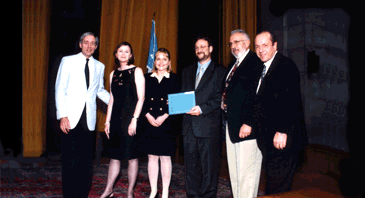
Columbia University President George Rupp (left) presents (left to right) Louise Kiernan, Melissa Deegan, Jon Hilkevitch, John Schmeltzer and Bob Fila, of the Chicago Tribune, with the 2001 Pulitzer Prize for Explanatory Reporting.
Winning Work
A storm gathers
How September 11 exposed the weaknesses of the nation's air travel system
By Louise Kiernan
Tribune Staff Writer
The air smells like stale hamburgers and unbrushed teeth.
It smells like cold coffee, like sour beer. It smells like exhaustion.
The air smells as if it has been inhaled and exhaled by too many people for far too long and they are breathing it still, snoring and snuffling, sighing and murmuring as they sprawl about O'Hare International Airport like refugees from some invisible war.
Everywhere you look there are bodies. Stretched along tables and the conveyor belts of x-ray machines. Curled up on baggage carousels, slumped against walls and draped along benches. There are people slung out on the floor, their faces inches away from swinging feet, and people draped around one another like sculpture, trying to find comfort in the curve of a shoulder or bend of a back.
Some feign or force themselves into sleep, shutting out the fluorescent lights, the blare of "Monday Night Football" on television sets they can't turn off, the incessant beep of motorized carts. Others stare, glassy-eyed, at lightning flickering against the dark, rain-spattered windows, thinking about meetings unmet, vacations postponed and children who went to bed unkissed.
There are almost 6,000 people at O'Hare tonight. They are all supposed to be somewhere else.
They are stuck here instead, in an airport that once prided itself on being the world's busiest and now is notorious for making more of its passengers late than any other airport in the country.
In many ways, the transformation of O'Hare from sleek symbol of the jet age to the bus station of the skies parallels the changes in air transportation itself: from fine china and travel suits to foil-packed peanuts and cutoffs, dirty diapers jammed into seat pockets and security guards stationed behind the customer service desk.
Almost 700 million passengers now fly each year and the system, already outdated and inefficient, can barely handle the load. Some days, like this one, it breaks down altogether.
The people who have seen this hellish slumber party before, who have seen the rows of squeaking, city-issued green cots and the undersize blankets, the overflowing trash cans and stopped-up toilets, have a name for nights like tonight.
They call it Camp O'Hare.
Camp O'Hare usually opens when there is too much snow, too much lightning -- just too much weather -- for planes to fly in and out. When, like today, a pair of thunderstorms chase each other across the Midwest like children trampling through a flower bed.
These storms are the worst in a summer of bad weather, two furious squalls that, by some freak occurrence, slam into the airport with only breaths of calm in between.
There could hardly be an unluckier day to try to fly into or out of O'Hare than Monday, Sept. 11, but there is more than the weather to blame.
Like the leaks in the airport's roof, the problems in the air travel system may remain unnoticed until the rain hits, but once the storms arrive, these flaws make the gridlock and misery much worse than they have to be.
On Sept. 11, the airlines have scheduled almost 2,700 flights, more than O'Hare could comfortably handle even if it were, in aviation parlance, a perfect "blue-sky" day.
The way these airlines send their flights around the country, by routing large numbers of passengers through "hub" airports and then on to their destinations, can quickly collapse under the pressure of even small delays.
O'Hare itself is inefficient and overburdened, but any attempt to expand it or build a new airport to bear some of the load is stymied by sandbox politics. A hostile stalemate between Chicago's mayor, Richard M. Daley, who wants to keep his administration's grip on O'Hare's revenue, and suburban politicians, who are vehemently opposed to expansion, blocks serious debate on any solution.
Although most passengers know little, if anything, about these issues, they bear the brunt of their effects. They're the ones who miss their cousin's wedding or grandfather's funeral because of delays that worsen each year, who stand helpless as a gate agent walks off the job for lunch even though 100 stranded passengers wait in line.
They're the ones sleeping on the floor tonight.
Before the evening's uneasy sleep settles over the airport, there will be fury and tears and a cacophony of cellular phones transmitting, like some Greek chorus, lamentations and curses. There will be one huge miscalculation and countless small decisions that send hundreds of passengers astray. There will be acts of clout and acts of kindness and pilots who guide their planes, by instinct and skill, through roiling black skies.
It all begins well before dawn, at the very onset of the day, when the loudest noises in the terminals are the distant hum of a vacuum cleaner and the occasional click of a flight attendant's heels.
Already, the earliest flight out of O'Hare has been canceled because of mechanical problems and one of its passengers, a lawyer, learns he will be late for his first day of work. A gate agent stands in her stocking feet, manicured fingers flying over a computer keyboard, frantic at 5 a.m. because she knows she has just 15 minutes to punch in gate numbers before the day's first passengers arrive and demand her attention.
The radar screens in the airport's control tower show a clump of thunderstorms hovering over the northern tip of Lake Michigan. They look like nothing more than daubs of paint.
Outside, dawn warms the sky to a muted blue.
In the war room: A guessing game
The room where Janice Collier works is big and dim and hushed. The walls are lined with giant screens, just like every movie version of a war room since "Dr. Strangelove," except that the battles depicted here are fought between planes and the weather.
If there is a center to the web of air travel that spans the United States every day, it is in this room in Herndon, Va., where the Federal Aviation Administration runs its air traffic control system command center.
Nicknamed, in typical FAA-speak, "Flow Control," this facility opened six years ago in an effort to improve the movement of planes throughout the country.
Every day, Flow Control's specialists track the nation's 23,000 or so commercial flights, watching for the first signs of delays or other problems. In response, they may send planes on different routes or limit how many can arrive at or depart from certain airports.
Sometimes, these decisions seem arbitrary and illogical to passengers and airlines alike. Today will be no exception.
But at 5 a.m., as Collier, an air traffic controller and weather specialist for 25 years, wraps up her stint on the night shift, there isn't much to do.
There are only a handful of planes in the air. She has spent most of the night watching the weather, tracking a modest cluster of showers just west of Cincinnati, wisps of feathery clouds forming over the Dakotas and rain drifting across Texas.
She points to the band of thunderstorms over Lake Michigan, still more than 300 miles north of O'Hare.
"It's supposed to be gone by midday," she says.
The other FAA weather specialists she talks to during a predawn conference call agree. So, when Collier types the weather briefing that will be distributed to the FAA control centers and major airlines, she writes that the storm is expected to move into eastern Canada during the morning.
Despite all the science -- the Doppler radars, the water vapor sensing systems -- the job of predicting how weather will affect air travel still comes down to a guessing game. Collier and her colleagues have made their guess. Almost everyone else will make the same call.
Two hours later, at 6:15 a.m. CDT, Flow Control convenes the first in a series of teleconferences it conducts each day with FAA centers and representatives of the major airlines around the country. More than 20 groups of people gather around speakerphones in rooms that, like Flow Control, consist mostly of computer monitors and giant television screens. All of them have copies of the day's weather briefing.
By now, problems have cropped up like small brush fires. In the northeast, low cloud ceilings and fog have slowed the morning rush. Detroit is limiting the arrival of planes because of fog. Houston has showers east of the field.
At O'Hare, low clouds prompt controllers to limit the number of planes arriving to 72 an hour from the ideal rate of 100.
Because the slowdown will create a backlog of planes waiting to land, the FAA calls what is known as a Level 1 ground stop, telling flights headed to Chicago from airports in an area stretching from Pittsburgh to Kansas City they can't take off.
Air traffic controllers also space planes farther apart in the air than usual, both for safety and to reduce the volume of traffic.
Throughout the morning, the ground stops and other limits will click on and off at O'Hare like traffic lights turning from green to red, slowly increasing backups.
As the conference call wraps up, United Airlines flight dispatch manager Ron Smith walks away from the telephone at the company's operations control center in Elk Grove Township, coffee mug in hand. He's shaking his head.
"You worry about our future in air travel," he says, "when a little weather system like this can affect us so bad."
Smith's complaint is part of a familiar tug-of-war between the airlines and the FAA, which not only manages how planes move from place to place but also bears responsibility for every aspect of air travel from the color of rip cords in hot-air balloons to how many bailing buckets planes should have in their life rafts.
The airlines complain the federal agency is too conservative in its assessment of the weather, creating delays by slowing down traffic when it isn't necessary, a decision that costs them money in wasted fuel and late flights. The FAA, which points to its strong safety record, thinks the airlines overestimate what the system can handle.
By 7:30 a.m., with the ground stop and other weather problems limiting arrivals and departures in the northeast, Smith knows that at least 100 of the 888 United flights scheduled into and out of O'Hare today will be delayed.
The thunderstorms still hover over Lake Michigan, but hardly anyone seems worried that they haven't started to move away yet.
In another room at United headquarters, weather operations manager Garry Hinds, a pair of reading glasses dangling from his neck, studies his computer monitor.
"Even if it does come our way," he says, "I don't see this storm hitting Chicago until 8 or 9 p.m. It's very slow-moving."
All-purpose O'Hare: Blue-sky blues
You can attend mass at O'Hare International Airport. You can get a massage, play a game of pool, rent a laptop, get your broken ankle X-rayed, buy a suitcase or a set of Michael Jordan-endorsed golf balls, or take your children to see a life-size model of a Brachiosaurus. You can do almost anything you can do in any small city in the United States.
But what most of the 180,000 people who pass through the airport's four terminals every day want to do is leave.
That is why, at 10 a.m., Erik Madsen, a stocky man who works as a supermarket manager, stands in his sandals and socks and points quizzically at the window behind United Gate B22.
The window shows blue sky. It does not show the plane that is supposed to take him, his wife, Tonya, and their 7-month-old son, Jacob, home to Ft. Wayne, Ind.
The first flight the Madsen family was supposed to take, as they made their way home from a family visit in Denver, was canceled because of mechanical problems. Now, this one, which the gate agent told Madsen just 15 minutes ago would leave on time, has been canceled, too, because of the weather.
Madsen gestures at the cloudless sky and planes taxiing down the runway.
Weather?
It's only small aircraft that can't take off, the gate agent tells him.
But the Madsens' plane is still in Ft. Wayne, officials at United headquarters will say that morning. It can't leave because the ground stop to O'Hare is back on.
This brief encounter at the gate is just one of thousands of similar exchanges that will take place this day, but it illustrates one of the most widespread and frustrating problems with air travel: misinformation.
Many passengers believe that airline employees routinely lie to them about the reasons for delays and cancellations, a charge the airlines deny. But airlines acknowledge that outdated technology and poor communication sometimes leave gate agents with incorrect or incomplete information.
On this day, people waiting for a plane from London will be assured it has landed when, in fact, it is sitting on a taxiway in Toronto.
Passengers waiting to board a flight to London will be told it is being canceled because of mechanical problems when there is nothing wrong with the plane except that it is needed for people whose flight to Stockholm was diverted to Cleveland because of bad weather.
The view of blue skies is deceptive, too. Bit by bit, everything is beginning to clog. The on-again, off-again ground stops and other flight restrictions have created delays that now top 60 minutes.
Flow Control has begun rerouting planes to avoid the bad weather and, like cars being detoured from a highway to side roads, these planes create traffic problems of their own, interfering with flights on the alternate routes and slowing down the whole system.
Even worse, the storms over Lake Michigan, instead of heading north to Canada, are beginning to slip back toward Chicago.
No one can control the weather, but the airlines have helped create the conditions that are about to make the skittering series of delays tumble into an avalanche.
Flight schedules generally operate according to the demands of coveted business travelers and are organized like a typical workday: bunched together at the beginning and end of a 9-to-5 shift, with another rush at lunchtime called the "noon balloon."
Between noon and 1 p.m., 103 planes are supposed to land at O'Hare. Forty-two are scheduled to take off. The next hour: 83 arrivals and 105 departures.
On each of these planes are passengers who must disembark and, within a matter of minutes, catch connecting flights. This is the crux of the hub-and-spoke system, which is how most major airlines organize their flights, and it all depends upon these orchestrated waves of arrivals and departures, with passengers moving from plane to plane in precisely timed increments. A few false steps send the entire dance into disarray.
Even under the best of circumstances, it would be tough for all of these flights to arrive and leave on time. One hundred landings an hour are about all the airport can currently handle. But, because of the mounting delays,the airlines already are considering canceling flights just to catch up on their schedules.
At the gate, Erik Madsen tries to decide whether he and his family should take their chances on the next flight to Ft. Wayne, which is supposed to leave at 1:55 p.m.
If they rent a car now, they can make the 3½-hour trip in time for Tonya to punch in for her 3 p.m. shift at Domino's Pizza.
"No thanks," he tells the gate agent, glancing at his watch. They'll try driving.
They gather up Jacob, the diaper bag and the assorted toys and books and walk more than half a mile back to Terminal 3 to pick up the voucher they'll need to be reimbursed for the flight.
Tonya wonders if they have enough money left on their credit card to rent a car.
"Let's find out," Erik says as he pushes the stroller to the lower level.
He patiently waits in line at the only rental car company that has available vehicles -- Dollar Rent-a-Car -- but when he reaches the counter, he discovers there is no drop-off point in Ft. Wayne.
As Tonya calls her boss, Jacob starts to chew on his bib and cry. Erik takes off his cap and runs his fingers through his hair, the only visible sign that his nerves are beginning to fray.
They have to wait for the plane.
From the tower: Big Mike's cargo
At 11 a.m., the planes waiting to take off from O'Hare line up on the taxiways like a flock of geese preparing to fly south.
At this moment, however, no one is going anywhere fast. As the thunderstorms approach O'Hare, the routes west begin to jam. Already, one of the airport's westbound routes has been shut down and two others are using far greater separations between planes than usual.
Passengers who choose to while away the wait by listening to the control tower's chatter instead of the pop-music channel on their airplane-issued headphones could hear a curious exchange that suggests old-fashioned Chicago clout can roll out a red carpet, even on a runway.
The flight in question is United 43 to Honolulu, whose passengers include the occupants of seats 25A and B, newlyweds Michael and Tracie Cicero, about to embark on their two-week honeymoon to Hawaii.
The Ciceros, who are both 26 and live in Glendale Heights, have never been on a plane. They don't quite know what to expect and they certainly don't expect that, because of a conversation they will never hear, they may be the reason their plane gets to take off ahead of 37 others.
While those planes are arranged in neat lines near the two open departure runways, the United DC-10 waits by itself, next to a runway being used for arrivals because this particular runway is the only one long enough for it to use for takeoff. The plane is waiting for a gap that would allow it to leave.
Then, about 11:15, a message comes from the control tower for Flight 43.A controller wants to pass along congratulations to a newlywed couple on board. The message is from a supervisor who is not on duty. He is a friend of the groom's boss.
"Big Mike says to say hello there from the tower here," the controller says, suppressing a laugh.
The pilot responds, with great enthusiasm. "All right. Big Mike. All right."
Several minutes later, another controller broadcasts this message. "United 43.
One arrival and you'll go. ... Evidently, you have, uh, important cargo,I just found out."
The plane is told to taxi into position, and after a short series of unrelated radio exchanges, the pilot radios that he's ready for takeoff. "You have 43 heavy," he says, using the term to describe a large plane. Then, he adds this: "It helps to know Big Mike."
Another controller turns his attention to the other planes waiting to leave O'Hare, telling them they won't be going anywhere soon. "You can go ahead and shut down," he instructs the pilots. "There's quite heavy delays going westbound."
Later, the FAA will say that an unexpected gap in arrivals, not preferential treatment, allowed United Flight 43 to take off first, even though to the other stalled pilots, it may have seemed otherwise.
Aboard the DC-10, the Ciceros remain unaware that anyone knows they are newlyweds until, halfway through the flight, a bottle of chardonnay and box of Eli's turtle cheesecake arrive at their seats.
Attached to the cake is an anonymous note. "Mike and Tracie," it reads, "Happy Honeymoon."
At least one other passenger gets special treatment Monday. This time, the "important cargo" is so important the FAA won't publicly release his name and all visitors are asked to leave the control tower during communication with the plane.
The blue-and-white Boeing 757 sits alone in the former military area of the airport, surrounded by beefy men wearing suits and earpieces. When it prepares to leave, no other planes are allowed to land or take off.
And Vice President Al Gore, fresh from an appearance on "The Oprah Winfrey Show," takes off in Air Force Two, precisely as scheduled, at 12:05 p.m.
Decision in Dallas: The Cancelator strikes
At the American Airlines main operations center in Dallas one desk usually sits empty.
That seat is for the person who cancels flights. The person nicknamed the Cancelator. The Vacation Buster, some joke.
No one wants to be the Cancelator. The Cancelator's name goes into the computer where other employees can see it, so they know exactly who is responsible for the lines of angry passengers.
By 1 p.m., tension surrounds the chair. It's clear someone will be sitting there soon.
The room's radar screens are filled with planes holding around O'Hare, making small circles and squiggles around the same stretches of airspace, over and over.
Then, at 1:32 p.m., Flow Control in Herndon, Va., stops all flights for O'Hare bound from anywhere in the United States.
Rich Milligan, a slight man with glasses, is the least busy of the six operations coordinators and the logical choice to take the Cancelator's chair. So, at 1:38 p.m., six minutes after the first raindrops are reported in the Chicago area, he slides without a word in front of the computer and clicks open the "Hub Cancellation Planner" software.
Normally, he can pick and choose the flights to cancel. He looks for flights that aren't full, for those carrying passengers who can take later flights. He avoids international flights. The purpose is twofold: minimize the inconvenience to passengers and maximize the profits to the airline. International flights are the biggest moneymakers.
Not all of these planes, however, will be stopped. Some have left their gates and won't be asked to turn back for now, although most are stuck on taxiways because of the existing delays. But, with the click of a computer mouse,the rest will show cancel signs at airports across the country and thousands of passengers will watch their days turn upside-down without a clue how it happened.
Milligan knows that, because of what he is about to do, a salesman may not close the deal he needs to reach a quota or that grandparents will be absent for the first hours of their grandchild's life. But he remains calm and matter-of-fact.
"This is pretty much the way it's got to be," he says.
At this point, there aren't many choices. Flights scheduled to stop in Chicago on their way, say, from New York to Los Angeles, could skip Chicago altogether. Or the airlines could try flying planes around the storms or divert them to other destinations. But those alternatives, the airlines say, could create more disruption than they prevent.
"Are you sure you want to cancel all flights?" the computer asks, issuing an electronic prompt that echoes a passenger's plaintive protest.
Milligan clicks "Yes."
Almost 1,000 miles away, at United's headquarters in Elk Grove Township,workers prepare to take the same step. Shift manager Robert Choroszy stands and walks toward a desk of four controllers.
Begin canceling flights, he tells them.
"We are going to cancel 15 percent from 4 p.m. to 8 p.m.," he says calmly and walks back behind his desk.
A few minutes later, based on a computer analysis, he raises the figure to 17 percent: 62 flights.
At 2:10, the Madsens, standing near their gate, anxiously scan the monitor, and, almost on cue, United 5870 disappears from the screen.
"That's it. I'm going home," says fellow passenger Denny DeJesu, snapping shut his briefcase in disgust. An employee benefits consultant with a company in Itasca, he was supposed to deliver a presentation. He decides he'll just cobble something together by fax and speakerphone.
The Madsens can't leave. They have to get back home to Ft. Wayne. And, unlike the business travelers who start to line the stools at Wolfgang Puck, devouring $8 pizzas, they don't have the money to while away a delay.
They're worried about the extra $8 that parking their car another day at the Ft. Wayne airport will cost them.
"If I did my job this way," Erik mutters, "I wouldn't have one."
Watching the weather: 'Hell is upon us'
On the radar screens, the thunderstorms slide across the country in silence, creeping toward O'Hare.
But, on the ground, they stampede like a posse of drunken cowboys, slamming up to the airport in a swirl of gusts that will top 47 m.p.h. and dump 2½ inches of rain on Chicago in an hour.
The first warning of their arrival is the wind, which begins, just before 1 p.m., to whip around erratically.
In O'Hare's air traffic tower, a 260-foot-tall, glass and steel tube at the airport's center, the volume of the constant chatter suddenly rises. The controllers pace the room, their headsets still attached to cords, blurting out strings of letters and numbers that tell the planes where to go.
They have to "turn the airport," switching which runways will be used for arrivals and departures so planes can take off and land into the wind.
"Let's keep moving, guys," one controller calls out to the pilots, herding planes from one spot to another. "Keep the line tight and keep it moving. ... United 8114, I need you to catch up with the group."
Another controller jumps out of his chair and walks across the room to make sure he can see one of his planes land, striding past the industrial-size bottle of generic aspirin, its lid off, which always sits near the coffee machine.
The day's weather complicates the situation, but the problem with the airport's seven runways is permanent. There aren't enough of them. And they intersect, which means planes must take turns coming in or going out, aggravating delays.
Then, a high-pitched horn starts to blare. It's a wind-shear alarm, warning of a sudden shift in wind direction that can sneak up behind an 80,000-pound plane and, as if it were flicking it with a finger, flip the aircraft into the ground. In the 1970s and '80s, before technology could detect wind shear, it caused several fatal crashes.
"United 687, wind-shear alert," a controller calmly advises one of his planes.
"Roger," the pilot replies. "United 687 is going around."
The plane breaks off its approach and circles back up into the sky, as do at least four others. Soon, other flights, farther from the airfield, realize the storm will arrive before they do and begin asking for help diverting to other airports. Planes can't fly through thunderstorms because lightning can burn holes through the fuselage and turbulence can injure passengers or even cause a pilot to lose control.
On the airfield outside Terminal 3, Kurt Schluter, who runs ground operations at nine of American Airlines' gates, stands near a cluster of empty baggage carts.
"Get ready to batten down the hatches," he says into his hand-held radio.
Workers connect the baggage carts together so they don't roll away in the high winds and hook tow bars to the airplanes so ground crews can move them as soon as possible after the storm lifts.
At United headquarters, weather forecaster Garry Hinds turns away from the computer screens. He walks to the window and watches as rain begins to sprinkle the cars below. "We thought it would take much longer to get here, but we missed it," he says, returning to his desk. "The plan did not work out."
Because everyone misjudged the storm, the airlines missed their chance to plan cancellations early. Now, they will have to do what they hate to do more than almost a a anything else: divert planes to other airports.
It's not just the inconvenience to the passengers they're worried about.Diverting flights puts planes and crews in places they aren't supposed to be, which costs money in wasted fuel and wasted wages, and then the airlines have to figure out how to get them back where they belong for the next flights.
On O'Hare's north side, Bill Lonergan, who manages this airfield for the city's Aviation Department, which runs operations at Chicago's three airports, stands on a grassy berm. Wind whips his airport badge and tie around his neck.
He came out here to meet with wildlife biologists who remove wild birds from the area so they won't fly into planes and cause damage or an accident.
Before he left his office this morning, he pulled up a local weather forecast on his computer and saw storms teetering northwest of Chicago. Thinking,like almost everyone else, they would move farther north, he concluded the weather didn't "look that bad."
Now, he sees clouds the color of charcoal swallow the sky. Gusty cool winds cut swaths through the blanket of heat.
He shuts the door to his car, his tie still flipped over his shoulder, and turns to two co-workers in the back seat.
He says, "Hell is upon us."
Reported by Tribune staff and written by Louise Kiernan.
© 2000, Chicago Tribune
At a standstill
"How are you folks even running an airline?" he exclaims to the ticket agent, clenching his fist and launching an invective that seems to voice the mounting frustration of the day.
It is 2:35 p.m. and the planes at O'Hare are wavering shadows, barely visible through the walls of rain. Gusts ripple the water on the ground.
On American Flight 2013 to Orange County, Calif., which has been sitting on a taxiway for almost three hours, silent passengers peer out the lozenge-shaped windows while "I Love Lucy" reruns drone on the televisions overhead. In Terminal 1, water drips from the ceiling over Gate C27, pooling on the vinyl chairs below.
A gate agent looks up at the crash of thunder. "The angels are up there bowling," she says.
From the window of the American Airlines operations tower at O'Hare, where about 20 people coordinate the arrival and departure of the company's planes, comes a shout.
"Oh, did you see that?"
As everyone turns, another bolt of lightning snakes out of the dark clouds to the west.
"You saw lightning? Was it cloud to ground?" Dennis Quinn, the afternoon ramp manager, asks the employee next to him, who saw the strike.
She nods. He looks at the lightning monitor on the computer behind him and sees that a strike has hit the airport, dead center on the screen.
Within a matter of minutes, lightning will hit almost 150 more times in a 30-mile radius. One strike knocks out the airport radar that air traffic controllers use to see planes within a 55-mile circle of O'Hare, forcing the use of a backup system.
"Ladies and gentlemen, we are going to suspend the operation immediately," Quinn announces to the room.
He walks to the back of the tower and flips a switch that activates yellow strobe lights atop the tower. American Airlines has shut down.
The decision is, in one sense, symbolic; nothing is coming into or leaving O'Hare at this point, anyway. But it will protect the airline's outdoor workers, who must now come inside. And it is, more than anything else, an admission of defeat.
Quinn shakes his head. In the next 50 minutes, 3,369 passengers are supposed to arrive and leave on American planes. Then comes the evening rush.
"If you're going to have a thunderstorm come in and hurt you the worst, it's now," he says. "The flying day is destroyed at this point."
This would come as news to the people on the 60-some planes now jammed into almost every available space at the airfield: lined up on the taxiways, tucked behind the maintenance hangars and clustered around the water-retention pond known as Lake O'Hare.
These thousands of people still hope to get out of Chicago. They walk up and down the narrow aisles of their planes, trade paperback thrillers, play computer solitaire until their batteries run out and, if they are in first class, indulge in a few free drinks. Most of them remain calm and resigned. The weather, they think, tells them all they need to know.
What they don't know is that the airlines boarded them on the planes and will keep them there waiting, knowing there is very little chance they will leave in another hour, or even two.
Most of the airport's 171 gates are empty now, but the planes won't turn back because the airlines don't want to risk losing their place in line for takeoff when the weather clears.
Eventually, many of these flights will leave, but it will take some a painfully long time.
One American flight will wait four hours before it finally leaves for Kansas City, a delay so long that, as one official points out, the plane could have made two round trips in good weather.
Two United non-stops to Tokyo, among the airline's highest-profile and most profitable flights, also will sit on the taxiway for almost four hours, attracting the attention of United's chairman and chief executive, James Goodwin.
"You're not supposed to say that," he tells the workers who inform him of the delay, as he paces next to their desks in the operations center, hands in his pockets. "You're not supposed to say that."
If you live in a small city, there are many places in the United States you can't get to without going through Chicago because O'Hare is a major hub for the world's two largest airlines, United and American.
The hub-and-spoke system, which the airlines instituted in the early 1980s, is the main reason that someone who lives in, say, Duluth, Minn., can get to San Francisco at all. But it is also the reason that when O'Hare comes to a standstill, passengers throughout the country suffer.
Now, a half-dozen flights bound for Chicago are diverted to Denver where a pair of businesswomen decides to deal with the indefinite delay by retiring to the bar to make "contacts."
In Atlanta, two stranded co-workers sit on the floor, playing cards with a "Georgia Peach" deck they picked up in the terminal gift store.
In St. Louis, a nun fingers her rosary beads as she waits at a TWA gate, as serene as a statue amid the crumpled napkins, newspapers, grease-stained pizza box and half-full Starbucks cup littering the seats and floor around her.
"I think next time I'll fly Southwest," she says softly. "They seem to be more reliable."
Midway Airport, which Southwest Airlines uses to fly into and out of Chicago, also shuts down because of the storm and, in fact, will be under a national ground stop for all but 107 minutes of the next eight hours.
But, overall, the smaller airlines there, including Southwest, fare better today, largely because they don't use the hub-and-spoke system. They fly point to point, back and forth from one city to another, almost like a bus route.
In New York's LaGuardia Airport, the intercom crackles at Gate C9.
"May I have your attention please? May I have your attention please?" booms a voice. "United 667 has been canceled."
Some of the would-be passengers on the flight to Chicago, bunched into narrow rows of metal-framed seats, groan and throw their hands in the air.
Bob DeRosier, a tall, thin man in a green polo shirt, leaps from his chair and bounds toward the ticket counter.
"How are you folks even running an airline?" he exclaims to the ticket agent, clenching his fist and launching an invective that seems to voice the mounting frustration of the day.
"I can't believe you people. You have got to be kidding. Listen, I've had four flights in a row canceled by you people. The only thing that is going to teach you a lesson is when you go out of business."
The agent looks down and keeps typing at her computer, trying to rebook him on another flight.
"I can't believe this," he continues, shaking his head slowly. "I can't believe this."
Pilot Alan Sowell, who stands nearby waiting for his own flight, tries to placate him.
"It's been a rough summer, sir, I understand," the pilot says. He is referring to the season's record numbers of delays and cancellations, which were caused by bad weather and a labor dispute involving the refusal of United pilots to work overtime.
"But I wouldn't want to jeopardize myself or my passengers by trying to land in a thunderstorm."
"It's never you guys," replies the 45-year-old DeRosier, a banker from Schaumburg. "Don't you see? It's always something else, someone else's fault. Maybe it is the weather here, but the point is, you guys have lost all credibility. I feel no empathy or sympathy for anyone at United Airlines. You've delayed me enough."
"But sir," Sowell responds, "jumping up and down doesn't do anything to relieve the situation."
But, like much of what passengers are told today, this statement isn't strictly true. Passengers who complain about delays and cancellations sometimes get better service and more compensation than those who don't.
Three hours later, a United manager insists that a gate agent make room for two passengers on another flight to Chicago.
"Is that for the Irate?" the agent asks, apparently referring to DeRosier.
The manager doesn't respond. "I need two seats," he says. "Get them."
He subsequently escorts DeRosier and his daughter to the plane. Earlier, they had been told there wasn't room for them on the flight.
Stuck on C Concourse: A diaper dilemma
As thunder echoes outside Terminal 1, Betsy Moghadam wheels her double stroller the entire length of the C Concourse and back again. Past the luggage store. Past the sushi bar. Past the Cinnabon stand.
Her 2-year-old daughter, Macey, colors contentedly in the stroller's front seat. Four-month-old Mark plays with a set of colored rings in the back.
Sunday night, in her family's new home in Portland, Ore., Moghadam had packed her bags with the precision of someone planning a full-scale military assault -- or a two-week visit to Grandma's house in Buffalo.
Two black suitcases, one blue diaper bag, one brown canvas carryall, one playpen, one car seat and the double stroller. In her carry-on bag, six diapers for Mark and three for Macey.
That was almost 18 hours, one connection, one canceled flight and one indefinite delay ago.
Traveling alone with two young children is hard enough when the schedule proceeds like clockwork, but a delay or two can spin the experience into a nightmare.
Already, Moghadam had to drop out of the line at the customer service counter so she could nurse Mark.
She decided not to switch airlines because it would mean leaving behind her luggage, with all the children's clothes and assorted gear.
It's as if the stroller, rolling along the floor, skates along the surface of a barely frozen pond. How much longer until Macey decides she's had enough? How many more diapers does she have left?
For now, though, the children remain calm and Moghadam pushes on, hopeful that her 2:58 p.m. flight will leave on time.
She rolls past the Cinnabon stand again.
I should pick up a few boxes of cinnamon rolls before the flight leaves, she says to herself. My mother will love them.
Aboard Flight 882: Running the gantlet
The pilot has a choice.
Either United Flight 882 from Tokyo to Chicago sits where it is, on the taxiway in Omaha, and 288 people spend the night in their seats, or he somehow finds a way through the storm-studded sky to O'Hare.
Ed Hopkins, a 35-year United veteran one flight shy of retirement, got his passengers within an hour of O'Hare before he had to divert to Omaha because there wasn't enough fuel left to hold in the air until the thunderstorms passed.
Now, he can't let the passengers off the plane because international flights can only disembark at airports that have U.S. customs agents.
After two hours at the gate and another two hours on the taxiway, Flight 882 has run smack into a deadline. If the plane doesn't take off within 30 minutes, Hopkins, his co-pilot and the flight's two relief pilots will hit the 19.5-hour limit their union contract allows them to remain on-duty.
All over the country, flight crews face variations of the same predicament, sitting on stranded planes or at crowded gates, helplessly watching their time run out. American Flight 2013, for instance, will wait for almost 5½ hours at O'Hare before its passengers are sent back into the terminal because the crew has, as they put it, "gone illegal."
United's dispatch center in Elk Grove Township calls the air traffic controllers who run the Omaha airspace to try to get the plane out. An offer is made: The 747 can leave as a "pathfinder," which means it will have to pick its way through the storm using the plane's radar instead of guidance from the FAA.
In the plane, Hopkins will be able to see the weather on his radar equipment, but he won't see other planes very well. Because almost no one else is in the air, Hopkins decides it's safe to head up.
The thunderstorms are too intense for the plane to fly over, so Hopkins must fly around them, guiding the 232-foot jetliner through the fissures of calm air.There is some turbulence, but not much. What the passengers would remember about the flight are the four hours on the ground in Omaha, not the 60-some minutes in the air. The plane lands at O'Hare at 9:15 p.m.
Seven minutes later, the FAA once again tells every flight scheduled to leave anywhere in the country for O'Hare to stay on the ground.
Instant community: Fellow travelers
On any given day at O'Hare, a Buddhist monk might share a bench with a Baptist minister, a CEO may wait at Starbucks next to a factory worker.
Or an accountant from Boston might cross paths with a stripper from North Carolina.
He is in a pinstriped suit. She is wearing a pink leotard and floral pants, tall, buxom and the winner of, among other distinctions, the Best Butt title in the Miss Nude Massachusetts contest.
They are both without their luggage, and, as they discover while chatting in line to try to recover it, both are trying to get to Milwaukee. Twenty-six-year-old Peter Pellegrino plans to look at the accounting records of a company being purchased by one of his clients. Jami Lydolph, who uses the professional name Lucy L'Vette, has an 8 p.m. performance at a club called On the Border.
It does not take long for them to reach an agreement. Why not share the cost of a rental car? She goes to get the vehicle. He waits for the bags.
"I've only had about one or two hours of billable time today," Pellegrino says, the trace of a grin stretching his lips, "but it's been a productive day for me. A real productive day."
An avenue of escape: The road to Ft. Wayne
Speaking in low, tense voices, arms crossed, Erik and Tonya Madsen try to decide what to do while Jacob fusses in his stroller. There are no more flights to Ft. Wayne today.
After trekking back to the American gate yet again, they are told that since all the flights are grounded because of the weather, the airline can't offer any reimbursement, although the gate agent does hand over $20 worth of food vouchers. With a flourish, Erik produces the tickets from the family's first flight, which was canceled because of "mechanical problems."
That's the magic phrase. Airlines usually won't provide free hotel rooms for people stranded by weather-related delays, but they will pay when the problem is deemed the airline's fault. Now, the Madsens are eligible for a free room at the Days Inn in Elgin.
Then, the Madsens will have to return Tuesday morning for a 7:30 flight to Ft. Wayne.
"That one's going to go for sure," the agent tells them.
So, pushing Jacob in his stroller, Tonya and Erik stand in another line to reclaim their luggage so they can take it to the hotel.
There, another passenger tells them that American has chartered a bus for Ft. Wayne, which is about to leave.
In the family's four trips between the United and American gates, covering a distance that now totals 2.6 miles, not including their detours to baggage claim and elsewhere, no one has conveyed this piece of information to them.
Abandoning their bags, they race to the parking lot -- diaper bag flying behind them, the baby's blanket flapping off Tonya's shoulder -- and board the bus. It leaves less than a minute later, at 6:08 p.m., pulling away from the curb beneath rainy skies.
The Madsens will arrive in Ft. Wayne at 10:15 p.m., having exhausted 12 hours to make a trip that usually would have taken 45 minutes. The 7:30 a.m. Tuesday flight the gate agent assured them would leave will be canceled.
As the Madsens make their escape, the airport's radar screens show a horseshoe of weather beginning to choke O'Hare. A second line of thunderstorms, which, at dawn, appeared as nothing more than a wispy pair of clouds over Montana, has steamrolled into a solid wall of thunder, lightning and stinging rain.
The only way in or out now is from the south. Trying to push all the backed-up planes in and out of that opening is like squeezing the Eisenhower Expressway to a single lane at rush hour. More ground stops have slowed arrivals again, and now the airlines and air traffic controllers know they have two hours at most before the airport shuts down again.
The airlines aren't focusing on today's passengers anymore. They're thinking about the people who need to fly tomorrow. The storms sent dozens of flights to places they're not supposed to be and the airlines need to get these diverted planes, their passengers and flight crews back in place if they have any chance of recovering from today's disaster.
At United's headquarters, a supervisor orders $700 of pizza. At American's operations center in Dallas, a supervisor throws in the towel. "If it's not a diversion," he tells his workers, "cancel it."
© 2000, Chicago Tribune
Camp O'Hare
A similar sense of resignation settles over the passengers. A middle-school teacher waiting for her daughter, who is stranded in Indianapolis, grades papers at a folding table. One passenger pulls out his guitar and begins practicing Christmas carols.
"Chestnuts roasting on an open fire," he sings quietly, as the people around him stare listlessly into the distance. "Jack Frost nipping at your nose...."
Out of the acres of exhaustion, a few tempers still flare. A gate agent braces for an onslaught of passengers from Providence, who, if and when they arrive, will learn their connections have been canceled.
"Scream to your heart's content," she says, almost as if she is rehearsing her response. "I know you're screaming about American Airlines. There's not a damn thing I can do about it."
A man paces in Terminal 2. "I don't carry a gun, but if I did I would've shot somebody by now," he shouts. A few people steal glances at him before taking a step away.
"It was an hour-and-a-half thunderstorm," he bellows. "For an hour-and-a-half thunderstorm, why should I spend the night in Chicago?"
It's not just the first thunderstorm that's keeping him in Chicago; it's the one that hasn't arrived yet. Bad weather now rings the airport, squeezing it shut. From 9 to 10 p.m., only 19 planes will leave O'Hare.
Strangely enough, the passengers who know they're spending the night in Chicago are fortunate. They can at least try to find a hotel room. The dozens of others who sit patiently, watching their flights get pushed back from 6:15 to 8 to 9:30 to 11:20 before they are canceled are the ones who will find themselves out of luck.
Betsy Moghadam sits at Gate C25, her burgundy shirt stained with Italian salad dressing and dribbles of breast milk. After 16 hours at O'Hare, she has run out of diapers and is using airport-issued one-size-fits-all extras that don't fit her 2-year-old daughter or her 4-month-old son.
Nearby, three United flight attendants, waiting for five hours for their own flight to Denver, trade war stories. Suddenly, one of them, Maureen Donoher, a tall woman with short, brown hair and big, gold earrings, looks up and sees Moghadam.
What a nightmare this must be for her, she thinks.
She walks over.
Can I lend a hand? she asks.
The flight attendant scoops Mark into her arms.
Moghadam watches, smiling wearily.
For the first time since she arrived at the airport, the 37-year-old mother feels that someone with the airline cares about her plight. But it is not enough to alleviate the mounting tension she feels.
Macey starts to roll around on the dirty floor. There's only so much waiting a toddler can stand. Is the plane really going to leave? Is she going to have to spend the night?
"I'm not flying United anymore, I'll tell you that," she says to no one in particular.
Donoher knows that, despite the announcements that flights will resume soon, the chances of Moghadam getting to Buffalo tonight are slim. She walks behind the counter to talk with the gate agent. She knows that the airline generally doesn't offer free accommodations to passengers stranded by weather, but tonight, she thinks, isn't a night for corporate policy.
Airlines use a caste system that largely functions according to economics: The passengers who pay the most get the best treatment. After all, a last-minute, first-class ticket to Tokyo can cost as much as $11,000, and the airlines want to keep the executives who pay those fares as happy as they can.
Tonight, some people on canceled flights will receive vouchers worth $300 while others just get food coupons that will buy a couple of hamburgers. Members of the airlines' private clubs will have employees at their disposal to rebook canceled flights while coach-class passengers stand in lines that stretch the length of several gates. Betsy Moghadam now has her own advocate.
We have to get this woman a hotel room, Donoher tells the gate agent. The agent tells her all the hotels near the airport are full. Let's keep looking, Donoher answers.
A few feet away, another passenger, Duane Stewart, leans against the wall. He had promised his two daughters he would be home in time to tuck them in bed. Now, he calls on his cellular phone to say good night.
Like everyone else, he is tired and angry. He looks at the commotion surrounding Moghadam, at the crayons and toys strewn around the floor at her feet. He takes a long, heavy breath.
"My problems are small," he says.
Back in the tower: Finding a way out
Outside the windows of the O'Hare control tower, the blinking lights of the idled planes flash like giant fireflies.
Word comes that one of them, a Tokyo-bound Japan Airlines 747, is willing to become a pathfinder to see if there's a way to steer around the approaching storm. If a pathfinder can thread a new route, perhaps other planes will be able to follow.
The controllers, who mostly sit idle now, watch as the plane, so large that it seems to hang still in the air, takes off.
Someone picks up a pair of binoculars and passes them around. They watch until it disappears from sight; then they turn to the green glow of the radar screens.
They see the blinking dot surge north, but then dodge northeast, seeking a path through calm air. Then west, southwest, northwest, making an "S" on the screen.
Then, it's out of view, on its way to Japan.
Not much later, the storm arrives and slams shut the door behind it. Like a massive, twisting snake, the squalls stretch from Muskegon, Mich., to Topeka, Kan., and top out at 50,000 feet above the ground.
At 9:22 p.m. the FAA calls another nationwide ground stop to O'Hare. Thirty minutes later, the second storm of the day sits right on top of O'Hare. More than three dozen bolts of lightning strike the airfield within a matter of six minutes.
The flashes outside the terminal windows dash any slim hopes passengers had of leaving.
One man makes his way to the front of a line to rebook a flight for the early morning. The gate agent tells him there are no hotel rooms to be found.
"Where am I supposed to spend the night?" he asks.
"Camp O'Hare," the airline employee responds.
Around him, the airport has transformed itself.
The luckier passengers are lined up on city-issued, drab-green cots set up in lines like an Army barracks.
While the makeshift dormitories doze beneath dimmed lights, other passengers curl up wherever they can. One man sleeps on four chairs he has lined up in front of a Starbucks stand; others are crammed under the escalators, on baggage carousels and beneath banks of pay phones.
Even the Chicago Children Museum's "Kids on the Fly" playground is serving as a hotel tonight. Eric Oveson, a welder from Duluth, Minn., has settled down with his family near the Cargo Treasure Hunt, a series of large, wooden boxes designed to teach children about the "unusual and fascinating stuff that travels to O'Hare daily."
Tonight, the cargo is the Oveson family, who have converted the play equipment into a temporary home. Eric has laid down a blanket on the spongy rubber floor, while his wife, Cammy, sleeps next to him. In one of the boxes, their 8-month-old son, Riley, rests, seemingly oblivious to the unusual surroundings. Three-year-old Clayton rustles beside him.
"Some cleaning guy came by and told us we need to leave, they've got to clean this place," Eric Oveson says. "I said no."
Other people have laid claim to the inside of the Fantasy Helicopter, the top of the Air Traffic Control Tower and the Luggage Station. Inside the purple fiberglass Cargo Plane, Tom and Lisa Firsching are trying to sleep in the cockpit. To fit inside the child-size area, Lisa curls slightly on her side, while Tom lies on his back, his feet up on the instrument panel.
"This is nothing," he says, pointing to the more spacious "cargo" area of the plane behind him, where another passenger sleeps. "The guy in first class back there has it good."
Even luckier is Betsy Moghadam, who, thanks to the flight attendant's intervention, is on her way to a corner suite at the Swissotel downtown.
She and her children don't have clean clothes, pajamas or toothbrushes, but they will have somewhere to sleep. And sleep is what Moghadam does, after consuming a room-service pizza and half a beer ($28 on her own tab). She is too tired to take a shower.
At the airport, someone -- maybe some punchy airline workers, maybe some mischievous kids -- has commandeered the public address system in Terminal 1.
"Good night," a voice booms.
Then, a few moments later, "Waassuup!"
A haven at B Concourse: McDonald's last call
The crowd outside the McDonald's on the B Concourse is hungry and restless.
It's 20 minutes past the 11 p.m. closing time, but two dozen people are still waiting in line, and they do not greet news of the restaurant's impending shutdown well.
Most of the airport's restaurants and food stands already have closed for the night, leaving many of the 5,800 people stranded overnight holding food vouchers that are virtually worthless until the morning.
"It was a terrible day," exclaims one passenger. "I come here and I can't even get a flipping hamburger!"
Anthony Cole, the restaurant's 24-year-old manager, sympathizes with the travelers, but it has been a long day for his employees too. Some are students who must get up early for classes tomorrow. Others, like Cole, who lives on the South Side, face long commutes home on public transportation. And he knows that if he stays open to serve the people who wait, still more will join the line and the restaurant will never close.
"I don't have any more burgers," he tells the customers.
He tries to direct the customers to the C Concourse, where he thinks another McDonald's may still be open.
He points to the escalators that take people there. But they won't leave.
Finally, he gives up. He scoops up the leftover Big Macs, Chicken McNuggets and double cheeseburgers destined for the trash and throws them on the counter.
The people in line pounce on the food.
Next come the french fries, which are snatched up just as fast, some by people who have already grabbed sandwiches. There is no sharing, no attempt to distribute the food fairly. The people at the back are left empty-handed and they wander off, disconsolately, in hopes of finding food elsewhere.
The restaurant's security gate is half-shut when Bess Urban wanders up. She and three others are trying to get from Denver to Manchester, N.H. When she hears the restaurant is closed, she is crushed.
Her friend, Margot Johnston, repeatedly asks if there is something -- anything -- to eat or drink.
Cole, his shirt hanging out, scoops up the last fries from a bin. He hands them to another employee, Sammie King, who passes the fries to Urban.
She looks as though she might cry.
"You are such an angel," she says.
The last arrival: Stranded at Gate B3
On through the night, through the periodic flashes of lightning, through the cleaning crews carefully maneuvering their brooms around the people sleeping on the ground, passengers continue to straggle in and out of the airport.
The last departure of the night, a United flight to Baltimore, takes off just after 3 a.m., about 45 minutes after the pilot and crew arrive at the gate to the cheers and claps of those waiting at the gate. One passenger carries his sleeping daughter in his arms. A bus full of American Airlines passengers arrives about the same time from Des Moines.
All in all, United and American, which account for 83 percent of the traffic at O'Hare, each will cancel about 40 percent of their flights there on Sept. 11. Midway's dominant carrier, Southwest, cancels or eliminates the Chicago portion of 23 out of 242 flights, or just 9 percent.
Late into the night, one plane still soars through the air, making its way to O'Hare.
The final arrival of Monday night pulls into Gate B3 at 4:33 a.m. Tuesday, more than five hours late because it was diverted to Tennessee on its way from Washington, D.C., to Chicago.
Ground crews rush out to meet the plane and unload the baggage, but there are no United Airlines employees at the gate to connect the walkway to the plane's door.
So it sits there.
In the waiting area, a man in a suit is sacked out on three airline pillows next to a sign that gives the acceptable dimensions for carry-on luggage. A few feet away, two young backpackers have unrolled their sleeping bags and are dozing despite the drone of a CNN broadcaster's voice from an overhead television.
The whine of the plane rouses a gray-haired couple, who fold up their airplane blankets, pack up their belongings and move on. But there is still no sign of a United Airlines employee.
By 4:45 the baggage has been unloaded. The pilots peer out the cockpit window. Still nothing.
Three minutes later, a United employee walks to the gate, picking up his pace when he sees the plane outside. After gaining access to the walkway, he slowly maneuvers the accordion-like end of the ramp to the plane.
More than 20 minutes after the plane pulls up, the walkway is connected and the passengers unload.
They trickle out, faces drawn and shoulders sagging beneath the weight of their bags, picking their way past a man asleep on the floor, huddled beneath the jacket of his suit.
Camp O'Hare, Day 2: The morning after
After a brief respite as uneasy and restless as the dozing of the passengers on the phalanxes of creaking cots, O'Hare slowly comes back to life.
Men push carts full of bundled newspapers through the crowded concourses. Workers stack up the cots. Dazed travelers stir under blankets as jazz music begins to blare from the loudspeakers.
A line forms behind the six men standing at the sinks inside the men's restroom near Gate C24.
One brushes his teeth. Another attempts to shave, even though the motion-detector sink keeps shutting off the water. Others wash their faces, trying to rinse away the night's grime.
The two trash cans are nearly full. The two paper towel dispensers are empty.
"No paper towels?" one man asks in disgust, wringing the water off his hands, his face still dripping.
"By 5 o'clock, you think they could have at least got us some paper towels."
He shakes his hands and walks out of the bathroom, past a sign that says: "How are our restrooms? Please call..." Lines start to build at the gates too.
© 2000, Chicago Tribune
"Oh, honey. Wasn't it awful?'
"I don't care if you have to pull somebody off that plane," she says.
Outside, the skies are blue and planes take off from the airport's runways with the regularity of a ticking clock, chasing their shadows across the ground as they lift into the air.
The airlines and the FAA already have convened their first teleconference of the day. At his gleaming cherry conference table, Peter Salmon, who manages the control tower at O'Hare, steels himself for a harsh assessment of Monday's performance. It will take the airlines until Wednesday to sort their schedules back to normal.
As he imagines the coming criticism, he remembers the previous morning's conference, when he asked about the storms north of Chicago and was told they would clear up.
"We banked on the information we were given and it sealed our fate," he says, sighing.
Everyone seems to hold their breath as Ron Haggarty, the representative from United Airlines, who is not known for his tact, takes the line. But he is uncharacteristically brief and charitable.
"Overall, it was as good of an operation as it could've been in light of the weather," he says. "So we're OK with it. Good job."
But in the terminal, Betsy Moghadam is wearing the same shirt, pushing her children in the same stroller past the same stores, and, it seems, reliving the same nightmare as yesterday.
She arrived at 10:15 this morning only to discover that her flight -- the third one she has tried to take to Buffalo since 5 a.m. the previous day -- has been delayed. Not only that, the United gate agent tells her, there aren't three seats together, which she needs because she is traveling with an infant and a 2-year-old. Finally, after almost 30 hours in Chicago, she breaks down.
Leaning against the customer service counter, she closes her eyes and rakes her hands through her unwashed hair. She is so frustrated, so tired of telling and retelling her story that she can barely speak in coherent sentences. Tears fill her eyes.
"I don't care if you have to pull somebody off that plane," she says.
The agent says there's nothing she can do and hands Moghadam a $100 voucher to fly United as well as a care package with soap, shampoo and a toothbrush, all of which would have been of more use last night.
As Moghadam walks away, a passenger tells her there is another United flight to Buffalo -- one that isn't listed on the screen and that the agent didn't tell her about. She decides to call the airline on her own and walks to a pay telephone.
That flight does exist, she is told, and she and her children can sit together. Minutes later, she picks up her boarding passes for the flight.
If all goes well, she'll leave at 2:58 p.m.
Using the last of her food vouchers, Moghadam buys some cinnamon rolls for her mother, and at 2:45 p.m., 32 hours after she was originally supposed to leave Chicago, she prepares to board a plane at Gate C4.
But as Moghadam pushes her double stroller toward the door of the plane, she hits a bump and tips it over. Four-month-old Mark flops out and smacks his head against the floor.
He howls. The family's bags scatter. The boxes of cinnamon rolls tumble to the ground. Here she is, a few feet from deliverance, and she isn't sure she should leave.
"Oh my God, what if he has a head injury?" she asks. Still, she gathers up her belongings. The other passengers make their way around her, without offering to help.
The plane takes off as soon as it hits the runway. Macey gazes silently out the window. Mark is quiet, too, and Moghadam, worried about the bump on his head, begins to cry.
"I probably should have had it checked out, but I wanted to get on this flight," she says, wiping tears from her eyes. A flight attendant with a son of her own tries to reassure Moghadam that Mark will be fine, as, indeed, it turns out he is.
Macey takes out her Pooh coloring book. She tears the paper coating off a crayon.
Moghadam sits back in her seat, exhausted and frustrated but elated that she is finally in the air.
Macey unbuckles her seat belt and stands up.
To entertain her, Moghadam starts to sing.
"Old MacDonald had a farm, E-I-E-I-O," she begins softly.
They lland at 5:21 p.m., Buffalo time, and Moghadam's mother, Carol Barnes is waiting at the gate, holding a bouquet of white carnations and two drooping balloons. "You're Awesome!" reads one.
When they finally appear, with Macey holding her mother's hand as she pushes Mark in the stroller, Barnes puts her hand over her mouth and cries.
"Oh, my baby," Barnes says, opening her arms to give her daughter a kiss. "Oh, honey. Wasn't it awful?"
They embrace, both crying. The two women walk away, arm in arm.
She has arrived.
© 2000, Chicago Tribune
By Andrew Zajac and Robert Manor
Tribune Staff Writers
When United Airlines CEO James Goodwin needed to get to Hawaii recently, he reserved a seat on one of his company's jets bound for Honolulu from O'Hare International Airport. But at the last minute, he reconsidered and boarded another plane -- one belonging to archrival American Airlines.
Goodwin wouldn't say why he switched planes -- and airlines -- but who could blame him if he were gun-shy?
Last summer, United's pilots, angered by the pace of contract talks and Goodwin's failure to consult with them about his planned purchase of US Airways, refused to work overtime, triggering flight cancellations that stranded hundreds of thousands of passengers in airline terminals across the country.
The slowdown, coupled with a summer travel season peppered by unusually violent weather, led Goodwin to briefly consider shutting down United entirely.And even though United and the pilots eventually settled their dispute, unrest among mechanics now is being blamed for delays by the airline as the busy holiday season approaches.
Even under optimal conditions of clear skies and peaceful labor relations, the air travel network, constrained by an overburdened system of traffic control and resistance to airport expansion, barely functions during peak periods. Throw in storms and labor unrest, and it teeters on the edge of collapse.
Although United isn't always as bad as it was last summer, it is never very good when measured by performance standards such as flight promptness, lost baggage and customer satisfaction. The growth of the Elk Grove Township corporation into the world's largest airline has masked a culture of inconsistent corporate leadership and confrontational labor relations unusual even for an industry in which employment strife is a defining characteristic.
With its 20 percent share of the domestic airline market and its dominance in key cities such as Chicago, Denver and San Francisco, United's flaws ripple through the modern transportation system with unparalleled impact, wreaking havoc at airports across the country.
At O'Hare, for example, United is by far the biggest carrier, controlling almost half of the airfield's 2,700 daily arrivals and departures. Troubles at the nation's second-busiest airport, from frequent weather delays to runway congestion, have compounded United's struggle to serve its customers.
These challenges are magnified by unhappy employees. United's most important labor pool -- its pilots -- has been alienated by the company's highly touted Employee Stock Ownership Plan, which has foundered with depressed stock prices. And United's mechanics and flight attendants are engaged in bitter negotiations with the company.
Add it up and you have an airline that, despite its dominance and reach, is hemmed in by its size and history and fails to do the little things that make customers happy; that gains more gates at airports even as it loses more luggage; that can get you to a remote hideaway in Europe or Asia but just might strand you overnight on an uncomfortable bench in Des Moines.
United officials have declined to explain why Goodwin switched flights to Hawaii: He could have been concerned about possible delays, resentment among employees or he could have been simply checking out the competition. What is readily apparent is that Goodwin's troubles aren't over and his every move is being scrutinized.
"A year ago he met with analysts and basically delivered the message that happy employees make happy customers make happy shareholders," said Sam Buttrick, an airline analyst with PaineWebber. "At this juncture we are kind of 0 for 3," he said. "The stock is selling at a 52-week low, the morale is low and the customers have been treated to the worst major airline operation ever."
The bottom line: An experiment falters
For a brief time in the mid-1990s, United not only was making money, it was satisfying both passengers and employees. Management and labor seemingly had found a way to improve the company and its responsiveness to passengers.
The upswing coincided with the early days of United's breathtakingly ambitious ESOP, which asked pilots, mechanics and certain other workers to take pay cuts in exchange for stock. In 1994, employees agreed to concessions worth $4.9 billion -- at least 15 percent in wages and other compensation for most participants -- to stabilize United's finances and provide job security in the wake of a recession during which the company had lost $1.3 billion in just three years.
The employees received about 55 percent of the stock in United's holding company, UAL Corp., in a gradual distribution that ended this year. United's new employee-owners also received three of 12 seats on the airline's board of directors, giving them a voice in strategic corporate decision-making, including selection of a CEO.
Most important, the ESOP was supposed to transform labor-management strife into mutual trust while boosting performance and profits. United pulled time clocks out of its repair facilities. Instead of supervisors telling workers how to prepare a plane for takeoff, employees determined for themselves the best way to do the job. The company extended free travel benefits to employees and relaxed its dress code.
It spent tens of millions of dollars for training, flying in personnel from around the world to its Elk Grove Township headquarters to preach "Mission United," the new gospel of improved customer service.
"We had so many cultural-change meetings it was unbelievable," said former United President John Edwardson.
Initially, the ESOP worked just as planned.
The new spirit of comity lifted United's on-time performance. In the first year of the ESOP, the carrier jumped from ninth place to fourth in on-time arrivals nationwide. It was United's best showing ever.
"We had a lot more cooperation between the pilots, flight attendants, mechanics and ground crew," said David Lippard, a United A320 pilot. "We were all kind of trying to pull together because we had stock."
But the goodwill didn't last.
Employees grew irritated because they could see their sacrifices translate into an upswing in United's stock price but weren't allowed to cash in. Under ESOP rules, workers can't sell their shares until they retire or leave the company, meaning they couldn't pocket profits when the price of the stock soared. Now their shares are trading near a 52-week low.
Referring to his United stock, Lippard said: "That's my retirement. As an investment, it's been a failure."
In the end, neither United's unions nor its management had the staying power to last the five to 10 years both sides figured were needed to overhaul the corporate culture. The ESOP's most ardent management champion, CEO Gerald Greenwald, retired in July 1999.
His replacement, Goodwin, is the company's fifth CEO in the last 15 years. The turnover at the top has contributed to a corporate identity crisis, with Goodwin's predecessors -- Richard Ferris, Frank Olson, Stephen Wolf and Greenwald -- each offering different visions for the airline.
Ferris, who joined the airline from the hotel industry, tried to turn United into a travel services company by buying the Hertz car rental agency and Hilton International. Olson, a former car rental exec, was interim CEO for six months in 1987. Wolf upgraded United's aging fleet but was intent on lowering costs by lopping off jobs and outsourcing services such as food preparation.
The zigzagging flight plans at United contrast with the stability of leadership at rival American Airlines, where Robert Crandall was CEO for 13 years before retiring in 1998.
Crandall was a controversial figure, waging fierce battles with unions and regulators. But he also was a decisive leader who gave his airline a long-term focus on efficiency and profit. He oversaw innovations, including frequent-flier programs and efficient routing, and American over the last decade has usually outperformed United both on the balance sheet and in service surveys.
United is respected by its rivals for its size, though not necessarily for its nimbleness or creativity.
"It was a great big airline characterized by an inability to make decisions fast," said one former airline industry senior executive, who now consults for the airlines. "They were successful.... But we never really felt that United was on the leading edge of anything."
The proposed merger: Getting things done
The irony of United's labor woes is that the unions helped Goodwin become CEO and then helped make his job almost impossible. Of course, the unions say Goodwin's problems are mostly of his own making.
Goodwin, 56, was named CEO in July 1999 in part because the pilots' and machinists' representatives on United's board made it clear they would not support the only other finalist for the job, former General Motors executive Louis Hughes.
Goodwin's most dramatic move as CEO -- the proposed $11 billion purchase of US Airways -- was a stunner both in scope and timing. The deal would be the largest airline merger in history.
From the perspective of route maps and schedules, the merger makes perfect sense. It would enable United to increase its business in the places it is weakest: the Eastern and Southern U.S, as well as trans-Atlantic European routes.
But Goodwin's move on US Airways in May came before he had consolidated his role as boss inside the airline by concluding the crucial labor contract with pilots, mechanics and other union workers.
He hadn't consulted with pilots ahead of time, although they owned a quarter of the airline. And, in previous flirtations with other airlines, management had made sure the pilots union was kept informed.
The proposed merger only added to the resentment among United's pilots, who feared losing seniority perks to the US Airways pilots.
"To an airline pilot, seniority is everything," observed Capt. Herb Hunter, spokesman for the United unit of the Air Line Pilots Association. Seniority determines how much money pilots make, the planes and routes they fly, even the size of their pensions and their days off.
Its business stagnant, Virginia-based US Airways has hired few new cockpit crews in recent years. Its 5,000 pilots tend to be senior to United's 10,000-plus pilots and so could be eligible for the best assignments in a combined company.
Goodwin, who declined to be interviewed by the Tribune but supplied written responses to questions, brushed aside any notion that he should have nailed down a pilot contract before making the US Airways deal.
"Modern business moves at the speed of light, particularly a competitive business like the airline industry. This was a strategic move. ... It is a tremendous opportunity ... which needs to be acted upon quickly," he wrote.
Goodwin contends he was blindsided by the slowdown tactics of pilots and machinists. "We were initially caught off guard when some of our employees chose to take actions that disrupted our operations," he told Chicago business leaders in September.
But indicators of brewing militance had been clear since at least October 1999, when Frederick Dubinsky, a 747 captain from Cleveland, was elected to head United ALPA.
Dubinsky led the union during the late 1980s and early 1990s, earning the nickname Mad Dog for his hard-nosed approach to union affairs.
"He's not the guy you want at a cocktail party," said Brad Bartholomew, a pilot and consultant on airline labor issues. "But if you want to get a job done, you bring him in."
Dubinsky made no secret of his goal: negotiate an enormous pay hike to make United pilots the best paid in the industry by their contract's April 12 renewal date. Both Goodwin and former CEO Greenwald repeatedly promised an easy and lucrative contract to reward the company's pilots for their ESOP concessions.
But the April deadline passed and Goodwin threw down a wild card when he announced the US Airways merger. With the United pilots seething, a work slowdown began in earnest.
Federal law makes it difficult for pilots to strike. But pilots do not have to strike to inflict pain on management -- and on passengers. In 1999, for instance, American Airlines pilots repeatedly called in sick during a labor dispute, disrupting travel throughout the country.
United's wretched summertime performance also was a testament to the unusual clout pilots have among unionized workers. Like all airlines, United counts on pilots to fly extra hours during the summer, when air travel is at a peak. But after the merger was announced, pilots invoked their contract right to turn down extra work. The pilots' refusal to accept overtime forced United's hand. Overtime for pilots is not the lengthy, eye-glazing extra shift the term connotes in many jobs. Generally, it means an extra day or two of flying per month -- the difference between a monthly schedule of about 78 hours versus the contract maximum of 85 hours.
An organized effort to refuse overtime would have been illegal, and United pilots interviewed by the Tribune insisted there was no formal plan to turn down extra flying. "It's by word of mouth, that's all it is," said one pilot.
During the dispute, the pilots also called in sick more often than normal, according to United, and employed a variety of work-by-the-book tactics to knock the airline even further off schedule.
Pilots can upset schedules with maneuvers as simple as taxiing more slowly or taking longer to brake a flight upon landing. As the ultimate safety authority of a plane -- it doesn't fly if the captain doesn't deem it airworthy -- a pilot can demand repair of inconsequential items before consenting to take off.United's pilots union denies there was any coordinated effort to sabotage flight schedules.
Between a stormy summer and uncooperative pilots, United canceled more than 23,000 flights from May until the end of August, according to the airline. In the months before the slowdown, 73 percent of United's flights landed on time, only a little worse than the industry average of 77 percent. By August, only 43 percent of United's flights were landing on time, compared with an industry average of 70 percent.
Once the scale of disruption became apparent, Goodwin asserted in his written responses to the Tribune, United was "highly aggressive ... and acted very decisively" in canceling future flights.
But, he conceded, "we regret not anticipating the problems slightly faster."
As United grew increasingly unable to deliver people to their destinations, Goodwin considered the ultimate step.
"In hindsight, I guess we could have shut down the entire airline and spared everyone the trauma," Goodwin said in public comments in September. "Trust me -- we thought about doing just that."
United's day-to-day operations began returning to normal only after Aug. 26, when pilots agreed to a 4-year contract with raises approaching a total of 40 percent. Pilots fought for the big increase because they had only had two raises since making ESOP concessions in 1994.
Now United's mechanics and flight attendants also want to see hefty raises, raising the specter of more labor strife for the airline and more headaches for passengers.
Negotiations with mechanics already have turned testy, with mechanics refusing to work overtime, and flight attendants have been holding informational pickets seeking to force an early reopening of their contract. The flight attendants have threatened to disrupt the airline if their demands for a 30 percent raise aren't met.
On Friday, a federal judge ordered the airline's mechanics to refrain from any slowdown tactics, which United blames for recent flight cancellations.
Elsewhere, pilots at American Airlines, Delta Air Lines and Continental Airlines, the No. 2, 3 and 5 carriers, are looking for rich contracts that will vault them past their United counterparts. Mechanics at Northwest Airlines, the fourth-largest carrier, are asking for raises in excess of 100 percent.
An upward spiral of wages at all these airlines would placate the unions but would almost certainly translate into higher ticket prices for consumers, who already have borne the heaviest burden of air travel.
Extreme circumstances: Too many bumps
There are many sins for an airline. Delivering passengers late. Bumping them from a flight. Stranding them overnight in an airport.
But among the worst is imprisoning.
On Christmas Eve 1997, a heavy snowstorm forced seven United flights bound for O'Hare to divert to Milwaukee. Many of the 800 passengers spent hours trapped in planes on taxiways in Milwaukee -- an extreme example of the many ways United has disappointed its customers.
Two deicing trucks broke down. A tractor sent to pull an aircraft to a gate couldn't get traction on ice. There weren't enough employees to bring a jetway to a plane.
United personnel repeatedly gave inaccurate information to pilots and would not let them use other airlines' gates to deplane passengers.
Onboard one of the planes, Flight 1536, any holiday spirit surrendered to anger, then despair.
"We ran out of food," passenger David Zerler wrote to the airline. "We ran out of something to drink, except for alcoholic beverages. The bathrooms became unusable. Still we sat on the runway."
A flight attendant began weeping. A man faked a heart attack in the hope the plane would be moved to a gate. It wasn't. Paramedics evacuated him from the plane.
Even when planes finally made it to gates, United bungled some more, handing out vouchers to booked-up hotels, according to some passengers.
The captain of one flight angrily denounced his airline's performance.
"I feel that United Airlines is fully responsible for ruining Christmas for a large number of passengers," said Capt. Gunnar Palm in a report on the evening. "It is no longer an acceptable way of doing business to have the attitude that 'this happens to the other airlines also."'
But that was pretty much the attitude of United's lawyers when the 168 passengers on Flight 1536 filed a class-action suit for their distress.
"The plaintiff should accept the events ... for what they are: A bump in life's road, the likes of which we all must endure from time to time," lawyers wrote in court papers trying to have the case dismissed.
United settled the suit last month by giving each passenger $500 in cash, plus a $500 travel voucher, to go with $200 vouchers initially handed out. At the time of the settlement, a United spokesman said the airline had improved its procedures to ensure that detoured passengers would receive better treatment.
The circumstances of the Milwaukee flights are admittedly unusual. But the company's dismissive reaction to the suit meshes with the perception that, for United, might makes right, said Kevin Mitchell of the Business Travel Coalition, a group that advocates for corporate fliers.
"Whether it's travelers or travel managers, the airline many times comes off as arrogant, very quick to use its power," said Mitchell.
At the very least, the Milwaukee episode documented a lack of preparation that helps make the airline a service laggard.
"Admittedly from all involved, there was not a coordinated plan ... to effectively handle all of the extraordinary problems, both controllable and uncontrollable, which hit the station that evening," Goodwin, then senior vice president for North American operations, wrote in response to Capt. Palm's report.
United faces a much greater potential liability in a suit filed after this summer's "bump in the road." Lawyers for two passengers who brought the suit say it could encompass thousands of people stranded by United flight cancellations last summer.
United isn't the only airline that struggles when there is bad weather or labor strife. But it rarely excels even when there are no major disruptions.
The U.S. Department of Transportation ranks United last in annual on-time statistics over the last 14 years.The Airline Quality Rating 2000, published by Wichita State University and the University of Nebraska/Omaha, ranked United last among the 10 major airlines last year, after considering such measures as bumped passengers, complaints from passengers and mishandled baggage.
United officials know the airline must make amends to its customers for its poor performance over the summer. "We need to regain the trust of the traveling public," John Kiker, vice president of worldwide communications, recently told employees in a company newsletter.
The airline has increased the time set aside to prepare planes for takeoff and to reach their destinations. It also has increased the amount of connection time between United and United Express flights to 40 minutes from 30, meaning passengers are less likely to miss a flight.
"These actions alone will introduce a larger dose of reality into our schedules, reflecting the unpredictability of the world in which we operate. In addition, we're further increasing the number of spare aircraft on hand," Goodwin said.
The company is investing millions of dollars to improve its handling of baggage. For example, he said, the airline is equipping employees with hand-held scanners to make it easier to check and trace luggage. Recently, the airline hired 176 new workers to speed transfer of luggage at O'Hare.
Goodwin said United already has improved some aspects of customer service, such as its on-time performance, but has been undermined by bad weather and outdated methods of air-traffic control.
"So all of our gains in fixing what we can fix in our own operations have been more than wiped out by circumstances out of our direct control," he said publicly in September.
Though its service can be ham-fisted, United has been remarkably adroit in pursuing strategic goals with legislators and regulators. For example, United waged a successful campaign to land lucrative rights for flights to Japan and, more recently, won immunity from antitrust laws to form an alliance with the German carrier Lufthansa.Now the airline faces the formidable task of winning regulatory approval of its US Airways merger. Federal officials and lawmakers are displeased by United's summer debacle and are wary of decreasing competition in the airline industry.
Still, airlines usually recover from such setbacks. Industry observers say customers will put up with sloppy service because there are few options. The nation's seven largest airlines face little competition from each other in the 10 airports at which they base their largest operations.
Among those airports, only O'Hare can be considered competitive. Even at O'Hare, however, the jousting is limited to only two carriers, United and American Airlines, which together control 83 percent of the market.
"Given the absence of alternatives, the business traveler doesn't really have a choice," said Paul Dempsey, a professor of transportation law at the University of Denver and a board member of Frontier Airlines.
At O'Hare, United and American often fly similar routes at similar times for almost identical fares. For example, both airlines run hourly flights to New York's LaGuardia Airport, plus additional flights to nearby Newark, N.J., between 6 a.m. and 7 p.m., for a total of 48 flights.
These flights are so frequent in part because business travelers want convenience and are willing to pay full fares. According to calculations by the Tribune, it costs United only $80.48 to fly one passenger to LaGuardia from O'Hare, but earlier this month the airline was charging as much as $689.50 for a one-way ticket.
Although United's dominance at its hub airports gives it a leg up in attracting customers, the location of those airports can hurt the chances of its passengers getting to their destination on time.
O'Hare, the airline's biggest hub, is chronically overcrowded and frequently suffers from severe weather. American Airlines, with the third-best on-time record among airlines, has a major presence at O'Hare, but its home base, Dallas-Ft. Worth, has milder weather.
United also has a major presence in San Francisco, which is frequently socked in by fog and low clouds. In addition to challenging weather, both San Francisco and Chicago have crossing runways, a less efficient configuration than the parallel runways found at newer airports like those in Dallas and Atlanta, home to United rival Delta.
But at least some of United's wounds seem self-inflicted.
United and other airlines at times deliberately schedule more departure flights from O'Hare than the airport, which has seven runways, can physically handle.
On some days in September, United scheduled 11 flights to depart O'Hare at 9 a.m. With other airlines scheduled for departures at the same time, a total of 20 planes were to take to the air at the same time -- an impossibility that guarantees delays. American Airlines now acknowledges that overscheduling has been a problem.
But United spokesman Joe Hopkins denied that this bunching of flights amounts to overscheduling. "We schedule when the customer wants to go," Hopkins said. "It's a system that works pretty well."
Tribune staff writers John Schmeltzer and Alex Rodriguez contributed to this article.
© 2000, Chicago Tribune
By Evan Osnos
Tribune Staff Writer
The pilot's announcement had the ring of truth. The US Airways flight sitting on the tarmac in Washington, D.C., would be delayed because of "Y2K testing."
But on May 23, 1999, Jane Garvey, the federal government's top airline regulator, happened to be sitting in the coach section of the plane, and she hadn't heard a word about Y2K testing.
Garvey, head of the Federal Aviation Administration, dialed her office on a seat-back phone and confirmed there was no testing that day anywhere.
Minutes later, Garvey's call trickled down to airport officials, and the plane scooted to the runway for takeoff.
Garvey never received a clear explanation, aides say; the airline still has no answers. But she can now say she was denied the single commodity travelers are demanding more than ever: the truth.
Often accidentally, but sometimes deliberately, airlines give customers inaccurate, incomplete or inconsistent information. It begins before they ever buy a ticket -- with unevenly defined "on-time arrival" formulas that muddy performance comparisons -- and persists after they return home, with different airlines setting different times to start the clock for the industry's commitment to return lost luggage within 24 hours.
In between, gate agents boldly tell stranded coach passengers no hotel rooms are available during bad weather, when in fact hundreds are earmarked for those who have paid premium ticket prices or complain enough.
Only now that delays and cancellations have grown dramatically are many travelers beginning to resent the caste system that dispenses these perks.
But when things go wrong, all classes share a common feeling: frustration at not being told the truth.
The U.S. Department of Transportation inspector general's office has a long list of examples that confirm travelers' suspicions that they are often misled: Airlines routinely blame delays and cancellations on air traffic controllers, when the real cause is bad weather, mechanical problems or crew shortages.
Departure screens frequently list flights as on time when, moments before a scheduled takeoff, there is no plane at the gate.
In some cases, airlines know hours in advance that a flight will be delayed but don't tell passengers until they are on the taxiway.
Airline officials maintain the misrepresentations are not deliberate. They blame their old technology for leaving agents misinformed and an overburdened air traffic control system that tangles flight schedules faster than they can explain them to the public.
To find the weak link in the chain of air travel information -- where hasty excuses grow and credibility withers -- watch Denver-based United Airlines customer service agent Carlos Ojeda.
On Sept. 11, a stormy day that paralyzed O'Hare International Airport, Ojeda stood face-to-face with passengers from the longest-delayed departure of the day. His United computer system could provide only a simple message: "airport conditions" had delayed an inbound plane from O'Hare that was slated to become an outbound flight from Denver.
Ojeda knew the plane was in Kansas City but did not know if it would arrive in time for the outbound flight.
Another plane might be swapped, but only the "zone control" workers in an unseen control center would know. Until they told him, passengers lined up and his only answer could be: "I don't know."
"That's the point where it all falls apart," said David Stempler, president of the Air Travelers Association. "When the information does not get to the people on the ground, they either say things that are no longer true, or things that they believe to be true. And often they're not."
Frequent travelers like Michael Faber are more willing to bear inconvenience than deception.
In April, the Warren, Ohio, resident says, a Continental Airlines gate agent told him his Cleveland-to-Nashville flight was canceled for mechanical reasons. But the mechanical problems were on another plane. Faber actually watched the plane he was supposed to be on leave with different passengers bound for St. Louis.
Continental had taken Faber's plane, which was functioning perfectly but was underbooked, and used it to accommodate the St. Louis passengers.
In hindsight, the gate agent should have told Faber which plane suffered problems, said Continental spokeswoman Julie Gardner.
"We believe our procedures for communicating are highly effective, but miscommunication can occasionally occur," Gardner said. "Unfortunately, this is what happened in this case."
Faber, who filed an official complaint with the U.S. Department of Transportation, is unimpressed with the explanation. "The thing I kept telling them was, 'Just be upfront and tell people what happened,'" he said.
Even as complaints about delays and cancellations have surged -- the Department of Transportation recorded 72 percent more complaints in the first six months of this year than the same period in 1999 -- resources for enforcing federal consumer protection laws regarding the airlines have been halved over the last 15 years.
The ranks of attorneys in the Transportation Department charged with enforcement have dwindled from 40 to 17 since 1985.
The cancellation or delay of one flight affects all its passengers -- but not equally.
When a problem due to mechanical troubles, crew shortages or some other fault of the airline occurs, most carriers will compensate all customers, coach to first-class, with free hotel rooms, transportation and meals.
But when a plane is delayed or canceled because of weather, airlines do more for their highest-paying customers. The dominant airlines at O'Hare -- United and American Airlines -- together reserve 250 hotel rooms a night in the Chicago area, dispensing most of them to premium passengers, while those with economy-class tickets bed down on benches and baggage carousels.
When delays foul certain KLM flights from O'Hare, business-class travelers are ushered to a nearby lounge and offered first choice of alternative connections. Coach customers queue up at desks back in the terminal.
Such consideration for those paying top dollar date to the early days of commercial travel. But the gap between the classes has widened over the last decade, industry analysts say, because airlines rely increasingly on business travelers, who are willing to shell out full fares.
United has announced its coach sections will now include several rows with up to an extra 6 inches of legroom, earmarked for the most frequent fliers or those willing to pay more. But the airline may have gone too far in distinguishing among classes of passengers, said Evergreen, Colo.-based aviation consultant Michael Boyd.
"Now you have Economy Plus and what I would call 'Economy Pig,'" Boyd said. "With first class, people expect that, but now they are clearly denying people the room to stretch out their legs just because they didn't pay enough."
Tribune staff writers Alex Rodriguez and John Chase contributed to this report.
© 2000, Chicago Tribune
By Andrew Martin and Laurie Cohen
Tribune Staff Writers
The parochial and petty politics that have turned O'Hare International Airport into a treasure-trove for concessionaires and contractors also are at the heart of why the transportation hub is a quagmire of delays, hassles and heartaches.
The political self-interests that have gotten in the way of expanding the world's second-busiest airport -- or building a new airfield -- are quietly on display in the vaulted corridors of the United Airlines terminal.
Buy a carton of cigarettes at the duty-free shop and some of your money finds its way into the pockets of Jeremiah Joyce, who has been one of Mayor Richard Daley's key political strategists.
Need a book or a magazine to pass the time? The airport's bookseller, W.H. Smith, has paid for political advice from mayoral pal Oscar D'Angelo, and its partners include Grace Barry and Barbara Burrell, friends of the mayor's wife.
Satisfy a sweet tooth and you're patronizing the candy shop partially owned by Rev. Clay Evans and Elzie Higginbottom, both influential supporters of the mayor in the African-American community.
Now, take a look at the passengers killing time because of delays or sleeping on rollaway cots because of cancellations. They're where they are because of politics too.
The hidden motives that determine everything from contracts to projections for growth at O'Hare have created an airport that works for the politicians, their friends and the airport's two major airlines, but not for the public.
Political wheeling and dealing at the airport extends to the debate over new runways and a new airport, though with much higher stakes and a wider impact on the tens of thousands of passengers traveling through O'Hare each day.
Daley seems determined to protect the cookie jar of jobs, concessions, contracts and economic largesse that is O'Hare. His administration, the Tribune has found, has manipulated statistics to downplay the need for a new airport near the Will County town of Peotone. At the same time, Daley has benefited from a friendly Clinton administration, which has stalled the Peotone proposal.
Opposing him are a Republican governor and other politicians trying to transform a soybean field in Peotone into another major airport that almost certainly would alleviate some gridlock and would placate constituents who live on the edge of O'Hare and are weary of airport noise and pollution.
At a time when other parts of the country are achieving political compromises to facilitate a surging number of air travelers with new runways and airports, the stalemate in Illinois is especially vexing.
U.S. Sen. John McCain (R-Ariz.) in September blamed local political squabbling for sacrificing the interests of the entire Chicago region and the nation.
"I say pox on all of them," McCain said recently in an interview. "Chicago is one of the most gridlocked places in America and a critical transportation hub. We can't get O'Hare expanded, and we can't build another airport. And those are the only two options."
Political deal-making: The airport that clout built
O'Hare has been inexorably linked with politics and the Daleys since the day the airport -- formerly a military airfield and orchard -- opened in 1955. Its transformation into an aviation crossroads provides a lesson in Machiavellian politics and lucrative deal-making.
The late Mayor Richard J. Daley was instrumental in breaking a long impasse between the city and the airlines, which had been reluctant to move from Midway Airport, then the nation's busiest, and cover the costs of a new airport
Daley also resolved the sticky issue of how the City of Chicago could control an airport outside its borders. The solution: The city annexed 5 miles of Higgins Road, creating a controversial "O'Hare corridor" that linked the city with its new airport.
From the start, O'Hare was used by City Hall as a means to reward political allies. Richard J. Daley's administration, for instance, gave the right to sell flight insurance to a company that had hired Daley's City Council floor leader, Thomas Keane, and it handed millions of dollars in construction work to another company that employed Keane.
Since then, as annual flights have grown to about 900,000 and City Hall has received vastly more money to spend at the airport, the basic formula at O'Hare hasn't changed much.
O'Hare's budget for the coming year is $511 million, which is paid for by airline landing fees, terminal rentals, concession charges and parking revenues -- though not by property taxes. Another $506 million is set aside for construction projects, paid for by bond issues, federal grants and a passenger ticket tax.
O'Hare helps Daley at election time. Airport vendors, concessionaires and other businesses tied to O'Hare -- and their executives and lobbyists -- donated about $360,000 to Daley's campaign in an 18-month period beginning in July 1998. Daley was re-elected in February 1999.
And Daley's political machine, as well as his loyalists and friends, benefits from the jobs at O'Hare. Due to the length of Daley's tenure, he has hired nearly 60 percent of the 1,900 employees who work for the city's Department of Aviation, which manages O'Hare, Midway and Meigs Field, according to a Tribune review of payroll records.
His administration has hired campaign workers and the sons, wives, nephews and brothers of City Hall insiders. For instance, the city employed the son of Cook County Sheriff Michael Sheahan, also named Michael Sheahan, in 1992. A campaign worker for Daley, the younger Sheahan is now the $65,000-a-year coordinator of security projects at O'Hare and Midway.
The city also brought in the brother of Ald. Patrick Levar (45th), who heads the City Council's Aviation Committee. Hired in 1990, Michael Levar is now a $77,500 supervisor of construction and maintenance at O'Hare.
Dominic Longo, a longtime Democratic operative who was convicted of vote fraud in 1984, was hired to supervise truck drivers at the airport one year after Daley was elected in 1989. He was moved to another city department five years later amid allegations that he had sold jobs and pressured workers to buy tickets to campaign events for Daley and others. Longo has denied the charges.
But the money paid for salaries is a fraction of the dollars paid to contractors for everything from engineering and architecture to snow removal. For example, the Aviation Department has contracts with 29 architectural and engineering firms totaling $356 million, $36 million worth of contracts for snow-melting and removal, and $660,000 for seasonal decorations.
Landrum & Brown, the city's longtime aviation planning consultant, provides a case study in how politics and contracts mingle at O'Hare.
The Cincinnati-based firm, which is now paid $12 million a year and has played a crucial role in the city's efforts to block Peotone, operated on the same no-bid city contract from 1968 to 1995, when it got another no-bid deal.
Besides donating to the mayor's campaign and charities overseen by Daley's wife, the firm hired Oscar D'Angelo as its political adviser shortly after Daley took office. It also has handed subcontracts to companies owned by Daley allies. Former campaign manager Carolyn Grisko helps with public relations, Democratic fundraiser Niranjah Shah does engineering work, and Chicago Housing Authority Chairwoman Sharon Gist Gilliam is a computer consultant.
United Airlines has used a similar formula. The biggest airline at O'Hare, United relies on the city for long-term, exclusive gate leases.
Besides donating hundreds of thousands of dollars to city-sponsored events, charities favored by the Daleys and political campaigns, United has hired the mayor's younger brother and his former chief of staff as lobbyists.
William Daley lobbied for United before he became U.S. secretary of commerce in the Clinton administration, and Gery Chico, now chairman of the Chicago school board, lobbies for United at City Hall.
A long battle: The fight for a third airport
Given the success of O'Hare -- as an important hub in the nation's air traffic system, as an economic engine and as a source of patronage and contracts -- it's not surprising that both Daleys wanted new airports, so long as they were subject to mayoral control.
But the push for a third airport has always bogged down in politics, statistical sleight of hand and mixed signals from Washington, D.C.
In the late 1960s, the elder Daley proposed building a major jetport on landfill in Lake Michigan, an idea that never flew because of cost and environmental concerns.
The idea of a third airport didn't gather steam again until the mid-1980s, when state officials were looking for sites for a third airport to relieve O'Hare, on the orders of the Federal Aviation Administration. The sites considered were in rural areas south of Chicago, including Peotone.
City officials had publicly argued that O'Hare and Midway could handle the region's aviation growth. But, privately, consultants were urging city officials to immediately find a Chicago site for a third airport so they wouldn't lose out to the suburbs.
A suburban airport probably would be controlled by a regional authority consisting of state officials, local lawmakers and, perhaps, Daley appointees.
In 1990, Daley dropped a bombshell, announcing plans for a $5 billion new airport at Lake Calumet on the city's Southeast Side.
The mayor argued that the new airport would take pressure off O'Hare and appease the northwest suburbs that were opposed to O'Hare expansion. He proposed to pay for the airport with a new $3 passenger ticket tax that Chicago Democrats pushed through Congress.
But the Lake Calumet proposal immediately hit turbulence because of concerns over its spiraling costs and resistance from South Siders who didn't want Midway shuttered. The airport plan fell apart after Republicans helped kill it in the state Senate in summer 1992, and Daley abandoned the idea.
By focusing attention on Lake Calumet, the city "succeeded again in preventing [the state] from making any meaningful progress towards developing a new airport in a suburban location," Landrum & Brown President Jeff Thomas wrote in a memo to city officials.
"Thus the city has conducted a protracted but successful guerrilla war against the state forces that would usurp control of the city's airports."
It also left Daley with a huge new pot of money, the passenger ticket tax, which has funneled more than $600 million into the city's coffers since it was passed by Congress in 1990. The city has spent the money on runway resurfacing, terminal upgrades and consultants' fees, but not on new runways or a new airport.
Lake Calumet was dead, but the battle for Peotone was just beginning. At the end of President George Bush's tenure, in 1992, the FAA approved $2 million to start the planning process for building an airport in Peotone.
But after President Clinton took office with some key campaign help from the Daley family, the Peotone proposal ground to a virtual standstill in Washington.
Under the Clinton administration, some of the mayor's staffers assumed key positions in the U.S. Department of Transportation and the FAA with oversight over new airports. For instance, Susan Kurland, former chief counsel for the city's Department of Aviation, was an associate administrator for airports for the FAA from 1996 to 1999.
Catherine Lang, a former assistant commissioner in the Department of Aviation, is now director of the FAA's Office of Airport Planning and Programming, which oversees the passenger ticket tax and approval for new airport projects. And Frank Kruesi, Daley's first chief of policy, was assistant secretary in the U.S. Department of Transportation from 1993 to 1997. He now heads the Chicago Transit Authority.
Daley and other Illinois Democrats also played a key role in the appointment of Clinton's first FAA administrator, David Hinson, former head of Midway Airlines.
A few months after Hinson's appointment, the Clinton administration pulled planning funds for the Peotone study, citing a lack of "regional consensus."
Illinois Transportation Secretary Kirk Brown -- who handles the push for a Peotone airport under Gov. George Ryan, a Republican -- recalled that Hinson told him he had favored Peotone but would "have to consult with the mayor" before he proceeded with the airport plan.
Hinson, in an interview, said he didn't remember that conversation with the mayor, though he recalled that Daley objected to a Peotone airport.
Four years later, while Kurland oversaw the program, the FAA quietly pulled the Peotone airport proposal off a list of planned airport projects eligible for federal funding. The Peotone project had been on the planning list since 1986.
Republican leaders maintain the Daley administration has used its influence in Washington to block airport approval.
"It's the mayor through his political influence," said state Senate President James "Pate" Philip. "He's been able to stop it.''
The FAA denies that politics have affected its decisions on Peotone, and Kurland declined to comment.
Contributing to the lack of progress toward a Peotone airfield was fierce opposition from United and American Airlines, which dominate O'Hare and vowed not to use a third airport.
In 1995, United spearheaded a "Kill Peotone" campaign that included a letter from 16 airline executives to then-Gov. Jim Edgar voicing their displeasure, according to records.
American also sent a representative to Downstate chambers of commerce to recruit allies in its opposition to Peotone. The airline also has urged its employees who live in the northwest suburbs to press local officials to drop out of the Suburban O'Hare Commission, a coalition of suburbs that staunchly oppose O'Hare expansion.
The status quo benefits the airlines because they control 85 percent of the flights at O'Hare and, without a new airport, none of the other large carriers has an entree into the Chicago market.
But, once again, passengers are the losers in this economic equation. Many studies, including those by the U.S. General Accounting Office, have shown that passengers pay substantially more at airports dominated by one or two major airlines.
Statistical shell game: Ups and downs
The City of Chicago's political success in holding off a Peotone airport can also be traced to a powerful tool: questionable statistics.
For years, Chicago officials have engaged in a statistical shell game to mask the need for a new airport and to hide O'Hare's capacity woes.
As Jay Franke, Daley's first aviation commissioner, said in an interview, "Forecasts are generally made to order." Franke was ousted in 1992.
In the debate over airports, the key numbers are forecasts of how many passengers are expected to fly out of an airport. By comparing predicted demand to an airport's capacity -- how many flights an airport can handle without excessive delays -- airport officials try to determine whether a new runway or a new airport is needed.
Forecasts by City Hall's own aviation consultants have repeatedly indicated since 1980 that O'Hare is running out of room. But this became a problem when Peotone emerged as the leading option.
City officials have used a grab bag of tricks to fix the problem. They have changed the formula for devising forecasts and tossed aside forecasts that didn't match their arguments.
And they have insisted that O'Hare can handle more flights because of anticipated improvements in air traffic control that haven't yet materialized, records show.
For example, a 1993 forecast by Landrum & Brown showed that O'Hare would be out of capacity in two years.
"If this is the case, then why build anything at all except a new airport?" wrote Doug Trezise, another city consultant, in a 1993 memo to Chicago aviation officials.
The solution was simple: Change the formula.
The original calculation was based on how many passengers would use O'Hare if enough runways were built to meet the demand. City officials asked Landrum & Brown to base the new forecast on how many passengers would use O'Hare given its existing capacity.
The resulting numbers were much more palatable.
The numbers game continued two years later. Landrum & Brown came out with new forecasts that were uncomfortably close to predictions that state officials were using to tout the need for Peotone. But this presented a problem for the city.
"Clearly, the similarities between the L&B numbers and those developed by the [state's consultants] will make it more difficult for the city to debate the third-airport issue on the basis of demand forecasts," consultant Ramon Ricondo wrote in a 1995 letter to a top aviation official.
The Daley administration didn't change its position. It simply chose not to release the 1995 forecasts, the Tribune learned from court records.
Then, in 1998, the Daley administration pulled its best statistical stunt yet, again with the help of Landrum & Brown.
The consultants finally delivered a forecast that the city could not only live with but trumpet. The new figures were 25 percent lower than the previous prediction.
The forecasting change was made possible, in part, by careful manipulation of the numbers. Landrum & Brown plugged a population forecast into its formula that was lower than many other population estimates.
The lower number -- which called for the Chicago area's population to grow at about half the rate of previous years -- had the effect of dampening the aviation forecast.
Where Landrum & Brown had forecast 61 million passengers for the year 2015 in its 1995 study, it now predicted only 46 million passengers in its revised forecast. (Last year, about 36.3 million passengers boarded planes at O'Hare.)
"A realistic forecast proves a new rural airport is not necessary for the region," Landrum & Brown concluded in a summary of its findings.
Though it's too soon to say if Landrum & Brown's prediction is off the mark, one thing is certain: The population number it used was far too low. Already, the population in the Chicago region has exceeded the forecast for 2007 that Landrum & Brown used for its study, according to estimates by the U.S. Census Bureau.
"What L&B did was just go looking for low numbers," said Suhail al Chalabi, a state aviation consultant. "Nobody has used numbers this low before."
Officials at Landrum & Brown declined to comment.
Despite some misgivings, the FAA accepted the city's low forecasts for O'Hare, even though its forecasts show that the number of passengers at O'Hare will grow twice as fast in the next 15 years as the city predicts.
"The problem is one of political intrusion into the technical process," U.S. Rep. Jesse Jackson Jr. (D-Ill.) wrote in a Sept. 20 letter to Transportation Secretary Rodney Slater. "Mayor Daley has argued that there is no need for new runways, not at O'Hare and definitely not in the south suburbs.
"He has made sure the statistics agree," wrote Jackson, who believes a Peotone airport would help his district. "The aviation planning process in Chicago, once a national model, is being corrupted and is truly a technical disgrace."
Changing positions
Running from runways
The latest position out of City Hall is that it won't stand in the way of Peotone -- "They can go build it," the mayor now says -- and that new runways at O'Hare are unnecessary.
The Daley administration now says it can meet demand at O'Hare through a 3.2 billion building program called World Gateway that is under review by the AA. It calls for new terminals, parking spaces and expanded light-rail service.
It does not call for new runways, and city officials contend O'Hare has sufficient capacity through 2012. Officials, however, decline to say exactly how any planes the airport can handle, and some experts think O'Hare is out of room now.
"On the whole, the system works awfully well," Aviation Commissioner Thomas Walker said in a recent interview. "We will have to get used to the occasional inconveniences."
Though it might be logical for the city to lobby heavily for additional runways at O'Hare, it would be bad politics.
If Daley were to argue for a new runway, his Republican foes likely would pounce on that as evidence that a new airport in Peotone is needed.
Also, the Republicans hold all the cards when it comes to O'Hare expansion. Final approval for new runways rests with the governor's office, and a Republican has been governor since 1977.
To make room for the runway, Daley would have to use the city's condemnation powers to take a significant chunk of Bensenville, a leader in the efforts to block an expansion of O'Hare. Among the properties the city would bulldoze are the Garden Horseshoe neighborhood -- home of more than 2,000 people -- as well as 28 businesses, a cemetery near St. John's Catholic Church and a water tower.
While Daley remains noncommittal on runways, his longtime supporters in the business community now say they are crucial to the future of O'Hare and the local economy. United Airlines and the Civic Committee of the Commercial Club of Chicago, an influential business group, say there is an immediate need for a new runway at O'Hare.
The Republican opposition to new O'Hare runways has been staunch. With political power bases in the airport's shadows, Philip, U.S. Rep. Henry Hyde (R-Ill.) and state Atty. Gen. Jim Ryan have fought on behalf of constituents who don't want jet noise to increase in their communities.
A suburban airport, which is supported by Gov. George Ryan and other key Republicans, also would give Republicans access to the aviation jobs and contracts that Daley now solely controls.
While Chicago remains mired in political gridlock, mayors and other governmental officials across the nation have risked political capital to increase capacity at their airports.
Since 1995, relatively little airport expansion took place nationally -- a total of four new runways, five runway extensions and one runway reconstruction at nine of the 27 hub airports.
However, over the next eight years, the pace of construction will triple. Seventeen of the hubs are building or have plans for 17 new runways, 12 extensions and one reconstruction, all to be completed by 2008.
One important reason for the shift into high gear is that the opposition of neighboring municipalities to airport expansion is now being blunted or overridden. For decades, complaints about noise and pollution have kept airport expansion projects in check.
But increasingly, court officials and legislators are deciding those concerns are outweighed by the importance of the air traffic system to the U.S. economy and the needs of millions of air travelers.
"Virtually every other major airport in the country has added or is adding ground capacity," said R. Eden Martin, president of the Civic Committee of the Commercial Club of Chicago, whose members include the major airlines and which has opposed a major airport in Peotone.
"Why don't we do in Chicago what an enlightened airline industry, business community and political leadership was able to do in Atlanta?" Martin said.
In Atlanta, city, regional and state leaders came together in support of a new runway at Hartsfield International Airport, which is now outdistancing O'Hare as the world's busiest airport. Yet, in winning expansion, Hartsfield had one huge advantage over O'Hare: Partisan politics was never an issue because nearly all major political players in Atlanta and Georgia are Democrats.
Even so, negotiations took nearly a decade, and it wasn't until late last year that a key compromise was reached with College Park, a municipality that borders the airport and will be truncated by the new runway. The town got money to move a convention center and develop hotels, office buildings and car rental facilities. In return, it will lose 100 businesses and the homes of 2,500 people to demolition.
That's the same sort of price that Bridgeton, a middle-class suburb of St. Louis, is going to pay because of plans to expand Lambert-St. Louis International Airport.
Unlike College Park, Bridgeton has been in court, fighting the plans that would level six schools, at least two parks, six churches, 75 businesses and nearly 2,000 homes. But, in April, the Missouri Court of Appeals overruled the municipality's objections to the expansion, concluding, "The substantial benefits conferred by the operation of the airport on the public clearly outweigh the interest of Bridgeton. The expansion of Lambert Airport is essential to its survival."
Among the 27 hub airports in the U.S., O'Hare is the only one that hasn't built a new runway and has no plans to do so.
Former Gov. Edgar, a Republican who participated in the airport feud during his eight years in office, now says the time has come to forget politics and address a critical issue for the region.
"There's a good case for a new runway at O'Hare," Edgar said. "There's a good case for a new airport in the south suburbs. The longer we wait, the more acute the problem is going to be."
Staff writers Patrick T. Reardon and Dahleen Glanton contributed to this report.
© 2000, Chicago Tribune
By Patrick T. Reardon
Tribune Staff Writer
Mayor Richard M. Daley maintains that the chronic delays and cancellations at O'Hare International Airport have "nothing to do with runways."
But, based on studies by airport experts, that position is difficult to defend.
The main cause of delays at O'Hare is the airport's inability to accommodate as many arriving flights in bad weather as it can in good -- a problem directly tied to runways.
O'Hare employs seven runways to handle about 2,500 to 2,700 flights a day. But because nearly all of the runways intersect one or more of the others, the airport is severely limited when visibility is poor because of rain, snow or low clouds.
At those times, to avoid collisions, planes are permitted to land at O'Hare on only two runways that don't intersect, usually two that run parallel.
That would change, though, with the construction of a single new runway along the southern edge of the airport, as Daley's consultants have repeatedly told him over the past decade.
"A new runway will solve the fundamental delay problem at O'Hare by allowing the airport to conduct three independent arrival streams during poor weather as it does in good weather today," Cincinnati-based Landrum & Brown wrote in a 1995 memorandum to the city, obtained by the Tribune.
One or two new runways would allow the airport to eliminate most of those delays and make possible additional landings and takeoffs.
Based on a variety of estimates from experts over the past decade, one new runway, at a minimum, would permit 85,000 additional flights a year, or about 233 a day, a 9 percent increase in operations.
Two new runways, according to the most optimistic estimate, would allow 450,000 more flights annually, or about 1,232 more a day, an increase of nearly 50 percent in capacity.
With Midway Airport already near capacity as well, and unable to handle larger jets, another possible way to relieve local congestion is a third airport. Both Daley and his father, the late Mayor Richard J. Daley, have supported a third airport within the city's borders, but the only proposal now on the table puts the site in rural Peotone, beyond the south suburbs.
Peotone has the backing of many state Republicans, including Gov. George Ryan.
"Peotone is all the hope we've got over the short term to get some capacity relief for the region," said Illinois Transportation Secretary Kirk Brown, Ryan's point man on Peotone. "The airport we've proposed is not going to be a hub for five, 10, maybe 20 years. But it can be built quickly and provide point-to-point service, relieving some of the congestion at O'Hare."
To gain political support from local officials and approval from the Federal Aviation Administration, state officials have been scaling back their construction plans for Peotone.
Originally envisioned as a six-runway airport that could board 7 million passengers and handle 298,000 flights a year, it is now being promoted as a one-runway airport that would grow as demand increases.
State officials now propose that Peotone could board about 1 million passengers in the first year and run about 66,000 flights.
Further muddling the debate over Peotone is the history of newly built, slightly remote airfields in the shadow of dominant airports.
For instance, MidAmerica Airport in Mascoutah, Ill., 24 miles of east of St. Louis, has been all but dormant since 1998. Mirabel, the airport that was built 35 miles northwest of Montreal in 1975, has been such a white elephant that, for a time, it displayed a white elephant on its logo.
On the other hand, Stansted Airport, 30 miles northeast of London, opened by Queen Elizabeth II in 1991, is now handling 11 million passengers a year -- with no ill effects on London's other two airports, Heathrow and Gatwick.
© 2000, Chicago Tribune
Common sense, leadership lacking as delays mount
By Jon Hilkevitch, John Schmeltzer and Alex Rodriguez
Tribune Staff Writers
When Stacey Jones and his family were booked on a 5 p.m. United Airlines flight from O'Hare International Airport to New York last week, they didn't think they were buying a lottery ticket.
But in a way, they were.
Even in perfect weather, that flight arrives on time at LaGuardia Airport just once every five tries, according to federal statistics.
That's because of the impossible mathematics of overscheduling: The airlines have booked 37 flights, including the Joneses', to depart in a period, when, at best, just 25 planes can take off in that much time.
"It's frustrating," said Jones, a 43-year-old architect who already had weathered one flight cancellation, due to mechanical problems, earlier in the day. The airlines "make out like it's your problem," he said, as his 5-year-old daughter, Samantha, bored and restless, squirmed on the floor.
"But why should we have to deal with it?"
Every day thousands of passengers like the Joneses are doomed to delays, even before they leave for the airport. As the well-traveled know, the time stamped on the ticket is not an ironclad guarantee, but more a game of chance.
The Joneses were lucky -- their 5 p.m. flight was only 42 minutes late. It could have been -- and often is -- a lot worse.
Finding fault in a system that even on good days seems poised to collapse is not hard. Neither is finding solutions. The airlines, the Federal Aviation Administration and local politicians all could play a part to relieve gridlock.
Take overscheduling. In their ceaseless quest to stake out bigger slices of the market, airlines jam runways with too many flights, tipping the commercial aviation system toward chaos, punishing hundreds of thousands of air travelers and costing American companies and passengers more than $2 billion a year in lost time and revenue.
Airlines could ease congestion by scaling back bloated schedules that give passengers a choice of, for instance, 17 morning flights to Minneapolis from O'Hare.
Airlines could use larger jets to combine flights. Instead, they have ordered record numbers of small 50-seat jets to pack their schedules.
Then there's the matter of building more runways -- and airports. They could provide relief, but across the nation and particularly in the Chicago area, local politics and anti-noise activists have effectively stranded blueprints on the drawing board.
The federal government could restrict the number of flights at the nation's busiest airports. Instead, Congress is lifting those curbs, inviting even greater gridlock.
That has driven some local airport authorities to step in and impose flight caps, despite questions about whether the law allows them to do so.
Modernizing air traffic control could help, but so far the FAA has bungled those projects, squandering billions of dollars. That has prompted calls to wrest responsibility for air traffic control from the FAA and hand it over to the private sector.
Last year, U.S. airline passengers had a one in four likelihood of booking a flight that would be canceled or delayed. This year, the odds are even higher. One of every three flights to major U.S. airports arrived late this summer. At O'Hare, the figure was one in two.
Next year, those delays will grow even worse, industry executives and experts predict.
Imagine, then, what delays could be like at the end of this decade, when the number of passengers is expected to rocket to 1 billion from the current 670 million.
"And the scary part is," said Robert Crandall, retired chairman of American Airlines, "there's no light at the end of the tunnel.
A grand ballet: Hub bottlenecks
Crandall, a slight, wiry man with a high-pitched voice, has attained cultlike status as patriarch of U.S. commercial aviation. When he talks, the industry listens.
It was Crandall's idea for a new way of routing planes that, together with the industry's deregulation in 1978, made flying so wildly popular. Instead of the previous city-to-city scheduling approach, Crandall envisioned a grand ballet in which waves of planes flying from smaller cities would descend on major airports to disgorge connecting passengers, who would then sprint to larger planes waiting to fly to other major airports.
The small planes would then loop back to the smaller cities, collecting and redistributing passengers in much the same way that city transit buses shuttle commuters to and from downtown train stations.
The new routing method came to be called the hub-and-spoke system because, on a map, the patterns look like wheels, with the key major airports functioning as the hubs and the routes to smaller airports as the spokes. Built around 27 key hub airports that act as switching stations, the system gave airlines great flexibility in deploying planes and crews.
Just as railroads in the 19th Century put trading centers such as Chicago on the world map, economic benefits quickly piled up for regions that developed hub airports. San Francisco became a hub, as did Atlanta. O'Hare became the hub of two airlines: United and American.
The hubs, which represent only a tiny portion of the 600 commercial airports in the U.S., handle 56 percent of all passenger flights -- with O'Hare and Atlanta each representing 5 percent of the national total.
As a result of Crandall's vision, thousands of daily flights have been added over the past two decades, fares have been cut by 40 percent in inflation-adjusted dollars, and the yearly number of travelers has soared.
But by cramming too many flights into airports, the airlines have turned these switching stations into bottlenecks. Glutted with flights, hubs operate at the edge of gridlock, even in the best of weather.
Like departures, O'Hare can handle no more than 25 arrivals every quarter-hour, according to the FAA. Yet on Nov. 3, 43 arrivals were scheduled between 12:30 and 12:44 p.m., according to a Tribune analysis of flight schedules.
On other days during peak periods, the airlines had scheduled twice as many arrivals as the airport could handle.
For years, airline executives denied that they overschedule. Then, last summer, Donald J. Carty, the tall, button-down chairman and CEO of American Airlines, broke ranks, admitting that overscheduling was routine. Appearing before a Senate subcommittee, he argued that the industry has no choice: "No one is willing to disarm unilaterally."
Drawing the line: A congestion crisis
The U.S. commercial air travel system faced its first congestion crisis in the 1960s. Federal limits on the number of flights were imposed at four key airports -- O'Hare, LaGuardia, New York's John F. Kennedy International and Washington's Ronald Reagan-National, then known as National.
In the early 1980s, airports again were feeling the capacity crunch, and some of the same solutions discussed now were on the table then. The airlines, granted limited antitrust immunity by the Department of Transportation to negotiate their flight plans, agreed to divvy up the day's schedule to reduce the head-to-head flights. There also was an industrywide move toward larger aircraft and an acknowledgement that airports needed more runways to handle the rising number of flights and passengers.
The relief didn't last long. Itching to capitalize on the burgeoning demand for frequent service, the carriers soon reverted to old habits, cramming runways with more flights than airports could handle.
And little was done to build new runways, mainly because of local opposition. Since 1991, only six runways have been added at the nation's hub airports, far below the demand created by the explosion of flights. Now, however, a growing bipartisan chorus is beginning to insist that parochial politics should not stifle improvements that serve the greater good of air travelers.
Even so, there is a recognition that simply building more runways could backfire.
"The feeling here is, if you increase the infrastructure, airlines will just fill the schedule, and we'll have just as many delays," said Peter Thorner, an officer with the San Francisco Boardsailing Association, a group trying to block a proposed expansion of the city's airport into San Francisco Bay. In Georgia, U.S. Sen. Max Cleland, a veteran Democratic lawmaker, said, "It's obvious that, at some point, like interstate highways, you won't be able to build enough runways."
Building new runways isn't the only way to manage congestion. Government can cap the number of flights airlines operate.
Before deregulation, the Civil Aeronautics Board governed all aspects of commercial aviation, setting schedules, determining fares, even assigning airlines to particular airports. But, ever since, airline executives, not airport or FAA officials, have decided how many flights an airport is going to handle and at what times of day.
LaGuardia is moving to take back some of that power. The airport already had been handling about 1,000 flights a day -- and suffering rising delays -- when, because of the lifting of federal limits last spring, airlines asked to add 600 new landings and takeoffs.
LaGuardia refused. "The airport cannot possibly handle it," said Al Graser, deputy director of the Port Authority of New York and New Jersey, which operates the airport.
So LaGuardia thumbed its nose at Congress and on Oct. 1 banned any more flights during morning and evening rush hours. The airlines, however, are continuing to add operations -- expected to reach 300 new flights daily by Jan. 1 -- outside the rush periods.
Worried that LaGuardia's ban won't be enough to reduce delays, and citing safety concerns, the FAA now believes Congress' efforts to lift flight limits completely is unwise. It plans to augment the airport's flight moratorium with a broader ban that would cap additional flights between 7 a.m. to 10 p.m. beginning Jan. 1.
Cutthroat competition: Low-cost carriers
Airlines are intensely competitive. They're also intensely wary of any intrusion onto their turf, especially the no-frills, cheap-fares kind offered by low-cost carriers.
Last year, U.S. Atty. Gen. Janet Reno sued American Airlines, claiming it tried to drive Vanguard Airlines and two other budget carriers from its hub at Dallas-Ft. Worth International Airport by saturating the market with flights and slashing fares.
In 1995, Vanguard tried to establish a beachhead in Dallas-Ft. Worth by offering three daily round trips to Kansas City. American responded by slashing its average one-way fare for that route from $108 to $80 to match those charged by Vanguard, and adding six flights to the eight it already ran.
Later that year, when Vanguard abandoned its service to Kansas City,
American immediately reduced its own. American also raised its one-way fares to as much as $147 -- a 36 percent increase over the price before Vanguard entered the market.
Justice Department lawyers contend American violated antitrust laws because it knew the moves against Vanguard would lose money in the short term. The mission all along, according to internal American documents obtained by federal investigators, was "to drive [Vanguard] from the market."
The case is pending. In a statement issued after the suit was filed, American vehemently denied violating antitrust laws, saying it is "confident that its actions in Dallas-Ft. Worth will prove to be nothing more than those of any tough competitor in a highly competitive industry."
Competition can get so fierce that airlines are willing to fly half-empty planes -- adding to congestion -- rather than cede a city, or even a share of a city's business, to a competitor.
Even though most planes operating between O'Hare and other hubs are packed with passengers, those feeding in and out of the airport from smaller fields are usually much emptier.
Consider that, on a recent Tuesday, only 42 percent of the seats on the five United flights from Des Moines to O'Hare were filled. Its competitor, American Eagle, was only slightly more successful with its six Des Moines-O'Hare flights, selling 46 percent of the seats.
Another tactic airlines use to defend market share is to book two relatively small planes for the same destination only a few minutes apart, rather than offer a single large plane. If the planes aren't filled, the strategy may cost them money in the short run, but it still keeps competing airlines from gaining a foothold on those routes.
Northwest Airlines regularly schedules flights between its Minneapolis and Detroit hubs within minutes of each other. Some are even dispatched at the same time. For instance, at 1:10 p.m. each day, the airline flies two 190-seat jets to Detroit from Minneapolis. Those flights could be combined into a single 446-seat Boeing 747.
FAA officials predict that airlines will continue adding aircraft, especially the new 50-seat regional jets, in record numbers.
Of course, flights with only a relative handful of passengers or flights using smaller jets take up just as much runway space and require just as much air traffic control attention as a fully packed 747 carrying as many as 550 people.
"Sure, we know we are adding to the congestion," said John Hotard, an American spokesman. But the multitude of flights is "bottom-line justifiable. Major airlines put a lot of effort into focus groups, and the focus groups say the most important element they look at is scheduling, which includes frequency, and then they look at price."
Maybe Hotard should talk to Christiane Koppel.
The 34-year-old marketing specialist from Connecticut spent a frustrating day last week traveling to Arkansas through O'Hare and then trying to get back home. She found herself stuck at O'Hare, facing her third flight delay of the day.
"Frequent service is important to me," she said, "but I would rather the airlines not advertise as much frequency if it means the flights that are scheduled actually do leave on time. I'd rather have a reliable schedule than one that is hyped up."
Eventually, Koppel's American flight to LaGuardia took off and got her back to New York -- more than an hour behind schedule.
Squandered opportunities: FAA's abysmal record
For years, the nation has looked to the FAA for help in fending off gridlock. And for just as long, the agency's track record has been defined by missed deadlines, wasted billions -- and failure.
In March, the agency trumpeted an FAA-airline industry plan to accommodate the growing legions of flights by streamlining air traffic control operations. By early summer, it was clear the plan had collapsed.
The agency's 18-year-long effort to modernize air traffic control has been just as abysmal. The FAA spent hundreds of millions of dollars on computer gadgetry it later realized it didn't need or couldn't afford to install. It dizzied the contractor, IBM, with more than 300 changes to a single project -- some as simple as a new screen color for display monitors.
About $1.5 billion has been squandered, auditors said, because of "overambitious plans by both the FAA and [IBM], poor FAA oversight of [IBM's] performance in developing software, and the FAA's indecisiveness about requirements." As a result, deadlines were pushed back years, just as demand for flights was ratcheting up.
The agency's gaffes have helped fuel calls for the privatization of air traffic control. Sixteen countries have taken that step, including Canada, South Africa, Germany, Ireland, New Zealand, Portugal and Switzerland.
Proponents argue that because privatized air traffic control would be funded by airline-paid user fees and not Congress, the revenue needed to beef up manpower and technology would rise with demand.
The controllers vehemently oppose privatization, warning that privately controlled air traffic would place the bottom line ahead of safety.
"You wouldn't contract out the U.S. Marines for the very same reason," said John Carr, president of the National Air Traffic Controllers Association, the controllers union.
But would the Marines throw a wrench into the works the way the controllers did this summer? During an ongoing labor dispute with FAA management Chicago-area controllers in July deliberately slowed the flow of planes into O'Hare. The job action delayed thousands of passengers in Chicago and across the nation. The FAA disciplined 15 controllers. Still, the episode was embarrassing for the FAA; the agency was unaware controllers had caused the slowdown until the Tribune reported it in July.
Targeting angry fliers: A 'hub-and-hope' cure
The major airlines' dismal performance is giving rise to new competition from other air transport services and regional airports.
An hour's drive from Manhattan in New York's Hudson Valley, Stewart International Airport is at the forefront of an intriguing trend in commercial aviation: attracting disenchanted fliers by offering a profusion of charter jet services from a regional airport.
Targeting angry consumers trying to avoid the congestion associated with LaGuardia, Kennedy or Newark International, Stewart launched a new marketing campaign this year: "All of the convenience, none of the hassle."
Charter flights are growing by double-digit rates each year. In addition to the typical corporate charter jets, some entrepreneurs have carved out new markets to meet the demands of frustrated travelers by selling single seats aboard small planes bound for popular destinations.
So far, the major airlines haven't reacted to charter jets because they're not seen as a threat just yet.
Business jets have the best safety record in aviation, according to experts although charter service has drawbacks: Seats generally are more expensive than economy tickets and difficult to reschedule at a moment's notice.
Sitting in first class on a recent United Airlines flight from Chicago to New York City, software executive Gregory Brown said his next series of flight reservations almost certainly will go through a charter company. Brown, the chairman and CEO of Micromuse Inc., who says he flies four days a week, complained that his travel this year has been riddled with delays and cancellations, resulting in countless wasted hours on the company clock.
"It's just the indifference of the major airlines," Brown said. "They're acting like monopolies that own the sky."
At Chicago's Midway Airport, entrepreneur Matt Andersson launched Indigo air service in August, offering daily flights to New Jersey's Teterboro Airport, 7 miles outside New York City. Indigo charges $629 per flight for eight to 10 passengers, who ride in soft leather swivel chairs on midsize jets.
Andersson is hoping to attract customers with prices more reasonable than charter services. That $629 per ticket is on par with walk-up prices for coach class and far less than first-class fares on commercial airlines, Andersson noted.
"Domestic flying is becoming more untenable because of this 'hub-and-hope method," Andersson said, sarcastically referring to the major airlines hub-and-spoke system. "We're targeting travelers who value their time more than the major airlines do."
Tribune staff writers Dahleen Glanton, Dan Mihalopoulos, William Neikirk, E.A. Torriero, Rogers Worthington, Jeff Zeleny, David Mendell and Patrick T. Reardon contributed to this report.
© 2000, Chicago Tribune
By Gary Washburn
Tribune Staff Writer
Mayor Richard Daley on Tuesday scoffed at suggestions that petty politics and inaction by City Hall have contributed to mounting flight delays at O'Hare International Airport, contending that the causes of delays have been out of his hands.
Labor problems, the failure of the federal government to solve air traffic control problems and even the Deity have combined this year to vex air travelers, Daley said.
"I am not out there talking to the mechanics," he said sarcastically. "I am sorry. I did not talk to the flight attendants. I did not talk to the airline pilots. I didn't talk to the FAA. I didn't talk to God about the weather. I'm sorry. I don't do those things.
"Those are real issues," the mayor declared.
"Gateway to Gridlock," a Tribune series, has reported on problems at O'Hare that have delayed and frustrated thousands of passengers this year and threaten to extend poor service far into the future.
Daley has refused to seek new runways at O'Hare to expand the airport's capacity. The Tribuneseries also described how his administration has sought to throw a wrench into construction of an airport near the Will County town of Peotone -- and outside of Daley's political control
The Tribune reported Tuesday that the Daley administration has manipulated statistics and cashed in on its clout in Washington to protect O'Hare's economic largesse and its lucrative jobs, contracts and concessions, many of which have gone to friends, political allies and campaign contributors of the mayor's.
For instance, city consultants changed or threw out forecasts that supported the need for a third airport near Peotone. Meanwhile, the Clinton administration, indebted to Daley for crucial campaign help, has stalled the Peotone proposal, which requires federal approval.
Daley on Tuesday denied that the city's consultants cooked the numbers to mute calls for a new south suburban airport.
"Everybody has talked about Peotone for 10 or 15 years," he told reporters. "I said, 'Go ahead and build it.'"
Daley also denied that three former aides who later assumed senior positions in the U.S. Department of Transportation and the Federal Aviation Administration threw obstacles in the path of the Peotone proposal. Susan Kurland, former general counsel for Daley's Department of Aviation, oversaw the FAA's list of planned construction projects eligible for federal funding at a time when Peotone was pulled off the list.
The proposed Peotone airfield had been on the list since 1986.
"No," he said. "Just go build it. I have been telling people to go build it. But so far, no one wants to build it."
The mayor said that Midway will handle part of the metropolitan area's aviation growth when a federal inspection facility opens in the Southwest Side field's new terminal, which now is under construction.
"Midway is going to have international flights," he said. "We are going to have Immigration out there. It is going to totally change. It is going to take a lot of business away from O'Hare field."
But the Tribune series reported that Midway is already near capacity and is unable to handle jumbo jets because its runways are too short.
© 2000, Chicago Tribune