The Wall Street Journal, by Staff
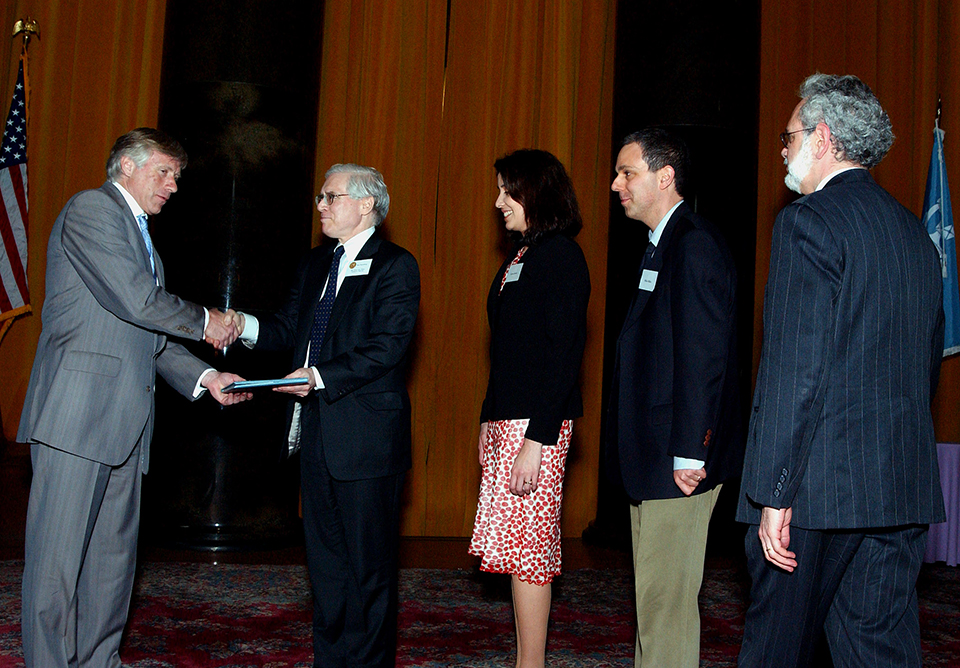
Columbia University President Lee C. Bollinger (left) presents Daniel Hertzberg, Geeta Anand, Mike Miller and David Wessel of The Wall Street Journal with the 2003 Pulitzer Prize in Explanatory Reporting.
Winning Work
Why the Bad Guys Of the Boardroom Emerged en Masse
The Stock Bubble Magnified Shifts in Business Mores While Watchdogs Napped
Galbraith Explains the 'Bezzle'
By David Wessel
Every decade has king-size corporate villains. In the 1970s, Robert Vesco was indicted for looting the Investors Overseas Services mutual funds. In the 1980s, arbitrageur Ivan Boesky and junk-bond inventor Michael Milken went to jail.
But the scope and scale of the corporate transgressions of the late 1990s, now coming to light, exceed anything the U.S. has witnessed since the years preceding the Great Depression.
Enron Corp.'s top executives reaped hundreds of millions as the company collapsed. Arthur Andersen LLP, Enron's auditor, was convicted last week of obstructing justice. Tyco International Ltd.'s lionized chief executive is charged with tax evasion and accused of secret pay deals with underlings. Cable giant Adelphia Communications Corp. admitted inflating numbers and making undisclosed loans to its major shareholders. Xerox Corp. paid a $10 million fine for overstating revenues. Dynegy and CMS Energy Corp. simultaneously bought and sold electricity in transactions with no point other than pumping up trading volumes. Merrill Lynch & Co. paid $100 million to settle New York state charges that analysts misled investors, and other Wall Street firms are now under scrutiny.
"I've never seen anything of this magnitude with companies this large," says Henry McKinnell, 59, chief executive of pharmaceutical maker Pfizer Inc.
Why is so much corporate venality surfacing now? Is there more of it, or is more attention being paid? Did a few executives lose their ethical moorings in the exuberance of the 1990s? Or did a few notorious offenders break rules that many others merely bent? Is the entire system of corporate governance and regulation flawed? Or was the system abused by a few cleverly diabolical executives who deserve, as Treasury Secretary Paul O'Neill puts it, "to hang ... from the very highest branches?"
The answer, put simply: A stock-market bubble magnified changes in business mores and brought trends that had been building for years to a climax. The victims: the very shareholders the executives were supposed to be serving.
One culprit was stock options, which gave executives huge incentives to boost near-term share prices regardless of long-term consequences. No CEO pay package seemed to strike any board of directors as too big.
These incentives helped turn the widely practiced art of earnings management -- making sure profits meet or barely exceed Wall Street expectations -- into a gross distortion of reality at some companies. And the institutions that were created to check such abuses failed. The remnants of a professional ethos in accounting, law and securities analysis gave way to getting the maximum revenue per partner. The auditor's signature on a corporate report didn't testify that the report was an accurate snapshot, says Mr. O'Neill. He says it too often meant only that a company had "cooked the books to generally accepted standards."
The current sordid chapter in the history of American business opened on Aug. 14 last year when Jeffrey Skilling quit as chief executive of Enron Corp., an unmistakable sign that all was not well inside one of the country's most-admired corporations.
Enron is "the private sector's Watergate," says John Coffee, a Columbia University securities-law professor. Although not all politicians were crooks, Watergate bred a virulent cynicism about government among the public, the press and even some politicians. That cynicism persists 30 years after the White House-blessed burglary of the Democratic National Committee's office.
Enron and all that followed threaten to do the same to American business. "I have had a lot of e-mail from shareholders who seem to have gone off the deep end and think all corporate executives are crooks and all accountants are sheep, just as some think all Catholic priests are pedophiles," says mutual-fund manager James Gipson of Clipper Fund. "None of those statements are true."
Measuring the volume of corporate skullduggery precisely is difficult. The SEC opened 570 investigations last year. That's more than in any of the previous 10 years -- but just 10 more than in 1994. More than 150 companies restated their earnings in each of the past three years, an acknowledgment that they had misinformed investors. That's more than triple the levels of the early 1990s, but represents only one of every 100 publicly traded companies.
One view, a staple of speeches by chief executives and government officials, underscores that only a small fraction of companies and executives stand accused of wrongdoing. It's the "a few bad apples" analysis. Treasury Secretary O'Neill, former chief executive of Alcoa Inc., talks of "a very small number compared to all the enterprises out there."
Pfizer's Mr. McKinnell, who serves as vice chairman of the Business Roundtable's corporate-governance task force, cautions against generalizing from "eight or 10 companies who allegedly behaved in ways that are incomprehensible . . . and deserve what they're getting." Securities and Exchange Commission Chairman Harvey Pitt, who has been practicing securities law in and out of government for 35 years, chides business reporters by recalling how the reporting of muckraking journalist Lincoln Steffens created a "crime wave" in the 1890s at a time when the actual number of crimes was falling.
For this camp, the smart response is to punish the miscreants severely and tinker with the parts of the system that are broken, taking care to avoid hasty changes with unintended consequences. "Things aren't as broken as they appear to be," says Mr. McKinnell.
But there's another view: The headline-making cases are symptoms of a broader disease, not exceptions, and a regulatory apparatus that isn't up to the challenge. "A few bad apples? Looks like we've got the whole peck here," says retired federal judge Stanley Sporkin, the SEC's enforcement chief in the 1970s. "Everybody did this," says economic historian Peter Temin of the Massachusetts Institute of Technology. "The people who got in trouble are those who are most at the edge. Enron didn't get caught. Enron got so far out on the edge that it fell off."
To this camp, the reasonable response is broader legislation and tougher regulation on the scale of the 1930s laws that created the SEC and the modern regulatory regime.
The "irrational exuberance" so famously flagged in 1996 is an essential part of explaining the 1990s. When the man who coined the term, Federal Reserve Chairman Alan Greenspan, talks informally with business and other groups, he says the greediness of human beings didn't increase in the 1990s. What increased, he says, were the number of opportunities to satisfy that greed. The run-up in stock prices meant there was more to grab.
Revelation and outrage always follow the bursting of a bubble. The cycle is immutable. "At any given time there exists an inventory of undiscovered embezzlement," economist John Kenneth Galbraith wrote in "The Great Crash of 1929." "This inventory -- it should perhaps be called the bezzle -- amounts at any moment to many millions of dollars. . . . In good times people are relaxed, trusting and money is plentiful. But even though money is plentiful, there are always many people who need more."
Mr. Galbraith continues: "Under these circumstances the rate of embezzlement grows, the rate of discovery falls off, and bezzle increases rapidly. In depression all this is reversed. Money is watched with a narrow, suspicious eye. The man who handles it is assumed to be dishonest until he proves himself otherwise. Audits are penetrating and meticulous. Commercial morality is enormously improved. The bezzle shrinks."
Mr. Gipson, the mutual-fund manager, says, "There is a tendency during boom times for even honest people to shift their moral compasses, and there is a belief that everyone else is doing it. It's when the music stops, if you will and the scrutiny goes up that the over-the-top cases become apparent."
Stock options were supposed to solve a problem of the past: entrenched corporate management that wasn't serving shareholders -- the indictment that corporate raiders made with such ferocity in the 1980s. "Today, management has no stake in the company," raider Gordon Gekko says in his speech to shareholders in the 1987 movie "Wall Street." "Where does Mr. Cromwell [the CEO] put his million-dollar salary? Not in Teldar stock. He owns less than 1%. You own the company. That's right, you, the stockholders. You are being royally screwed over by these bureaucrats with their steak luncheons, hunting and fishing trips, their corporate jets and golden parachutes."
The solution, widely embraced in American business, was to use stock options to link executives' and shareholders' interests. It sounded reasonable: Executives would benefit if they managed companies in a way that lifted share prices.
It didn't work as intended. A soaring stock market rewarded executives not for good strategic management, but for riding the roller coaster. And when the stock price dipped below the exercise price -- essentially making the options worthless -- some companies simply revised the terms or, in Wall Street jargon, "reloaded" them.
Even worse, the incentives to do almost anything to increase the stock price were huge. And the incentives weren't to increase profits and share prices over a decade or two, but rather to increase profits -- never mind if they have to be restated later -- just long enough for executives to cash out, often without ever risking any of their own money to buy shares in the first place.
Stock options, Mr. Pitt says, were "a device that was supposed to align shareholder and manager interests -- and actually `disaligned' them." Not all executives were swayed, of course, but an ill-designed compensation system pushed them in the wrong direction.
Of course, corporate executives aren't supposed to be monarchs. All sorts of checks and balances have been established during the past century: accountants, lawyers, securities analysts, investment bankers, audit committees, regulators, even the press.
None of the abuses that have been exposed in the past 10 months were committed by chief executives who worked alone to steal shareholders' money. "In every one of these cases," says Mr. Sporkin, the former SEC chief, "you have professional assistance."
This exposes one of the problems that have plagued corporate capitalism since its inception. "When the laws or regulations fail to protect investors, corporate insiders -- whether managers or owners -- tend to expropriate," economists Gene D'Avoilio, Efi Gildor and Andrei Shleifer asserted in a paper they presented at a Federal Reserve Bank of Kansas City conference last summer.
Perhaps the rules were inadequate; that's still being debated. But there is little debate about the failure of the professionals who are supposed to see that rules are obeyed and executives are honest. The decay of professionalism -- and codes of ethics that distinguished a profession from a job -- intensified in the 1990s, but it didn't begin then. Reflecting on his 23 years in corporate management, Mr. O'Neill recalls a parade of Wall Street professionals who came to his office with plans for "new and exotic" financial maneuvers to reduce his company's tax bill or report debt levels in ways "not clearly prohibited by the tax code or law," but not designed to illuminate corporate operations, either. "They get," he says, "into an ethical vacuum space."
The shortcomings of accounting firms are now well exposed. The duplicity of some highly paid Wall Street analysts is documented in internal e-mails that are now public. The acquiescence of the lawyers inside Enron and Tyco, as well as the readiness of lawyers to clear increasingly aggressive corporate tax shelters for other companies, is readily apparent.
This disturbing pattern is the biggest reason why the abuses of the 1990s can't easily be dismissed as the fault of a few flawed human beings. "The professional gatekeepers were greatly compromised by finding they could make tremendous profits by deferring to management," says Columbia's Mr. Coffee.
But not one of the instances of egregious abuse of shareholder interest could have occurred if the CEO had simply said, "No!"
The climate made it commonplace. The incentives were perverse. The watchdogs were sleeping. But not every company did it. What distinguishes those that did from those that didn't?
Mr. Gipson, the mutual-fund manager, divides offenders into two classes: the "confirmed crooks" who deliberately and willfully ripped off shareholders, and the "morally marginal who went right up to the line of acceptable behavior" and then "when the line was moved found themselves on the other side." Treasury Secretary O'Neill makes a similar point: "A little lie leads to ever bigger ones in lots of cases without a recognition on the part of the perpetrator that they ever told a lie, even when it gets grotesque. They say, 'If only I had another 12 months...'"
At Harvard Business School, the citadel of corporate management, the faculty uses case studies of heroes and villains in an effort to inoculate students against the temptations they will inevitably confront. "Maybe," says a member of that faculty, Richard Tedlow, "we ought to think about CEOs and other managers as fully formed human beings, not as people who focus on one variable and who check their personalities at the coat rack. Some of what was going on was people doing exactly what the incentives suggest that they do: Give me a lot of stock options, and I'll make the stock go up.
"But something is missing," he adds. "Life is lived on a slippery slope. It takes a person of character to know what lines you don't cross. That part of the equation of corporate management hasn't had the emphasis it should have had in the last decade or two."
The excesses of the 1920s and the spectacular crash of the stock market in 1929 led to the creation of modern financial regulation, from bank-deposit insurance to the ban on insider trades, in 1933 and 1934. Despite the obvious parallels, this is a different time. The U.S. is not in an economic depression, nor does George W. Bush see himself as Franklin Delano Roosevelt's heir. The debate over how to repair the system is just beginning to take form; this week saw competing legislative and SEC proposals to tighten oversight of accountants.
The nature and dimensions of the reforms depend on factors that aren't knowable. How many more Enrons and Tycos remain unreported? How swiftly will corporations, boards of directors, the New York Stock Exchange, the National Association of Securities Dealers and other self-regulatory organizations move to reassure investors? And, most important of all, how much longer will the stock market languish?
Corporate Accountability: A parade of big companies face serious questions about their business practices.
Company: Adelphia
Issue: Whether it failed to properly disclose
$3.1 billion in loans and guarantees to its founder's
family.
Percent Change In Share Price Since 1/14/00*: -99.75%
Company: CMS Energy
Issue: Disclosed it overstated revenue in 2000 and 2001
by including artificial `round trip' energy trades.
Percent Change In Share Price Since 1/14/00*: -56.78
Company: Computer Associates
Issue: Whether it artificially inflated revenue and
improperly rewarded top executives.
Percent Change In Share Price Since 1/14/00*: -73.58
Company: Dynegy
Issue: Whether its `Project Alpha' transactions served
primarily to cut taxes and artificially increase cash flow.
Percent Change In Share Price Since 1/14/00*: -64.97
Company: Enron
Issue: Admitted it improperly inflated earnings and hid
debt through business partnerships.
Percent Change In Share Price Since 1/14/00*: -99.80
Company: Global Crossing
Issue: Whether it sold its telecom capacity in a way
that artificially boosted its 2001 cash revenue.
Percent Change In Share Price Since 1/14/00*: -99.87
Company: Halliburton
Issue: Whether it improperly recorded revenue from
cost overruns on big construction jobs.
Percent Change In Share Price Since 1/14/00*: -56.51
Company: ImClone Systems
Issue: Former CEO Samuel Waksal charged with insider
trading.
Percent Change In Share Price Since 1/14/00*: -52.34
Company: Kmart
Issue: Says the SEC is investigating its accounting
and other practices. The company investigated whether
it improperly accounted for vendor allowances,
and since changed its practice.
Percent Change In Share Price Since 1/14/00*: -91.02
Company: Lucent Technologies
Issue: Adjusted fiscal 2000 revenues by $679 million,
spurring SEC investigation. Agency also investigating
whether vendor-financing played an improper role in
its sales.
Percent Change In Share Price Since 1/14/00*: -93.39
Company: MicroStrategy
Issue: Settled without admitting wrongdoing an SEC
suit accusing it of backdating sales contracts to
meet quarterly financial estimates, among other
improper revenue-recognition practices.
Percent Change In Share Price Since 1/14/00*: -99.07
Company: Network Associates
Issue: Whether it hid expenses and overstated
revenue from 1998 to 2000.
Percent Change In Share Price Since 1/14/00*: -28.25
Company: PNC Financial Services
Issue: Restated its 2001 results by $155 million
after regulators raised concerns about how PNC
accounted for a transfer of loans.
Percent Change In Share Price Since 1/14/00*: +15.61
Company: Qwest Communications
Issue: Whether it inflated revenue for 2000 and 2001
through capacity swaps and equipment sales.
Percent Change In Share Price Since 1/14/00*: -88.35
Company: Reliant Resources
Issue: Admitted it inflated revenue by counting
artificial `round trip' energy trades.
Percent Change In Share Price Since 1/14/00*: N.A.
Company: Tyco International
Issue: Whether it improperly created `cookie jar'
reserves that were supposed to cover merger costs
but instead were drawn on to boost profits; and
whether it improperly `spring-loaded' earnings
from acquisitions by accelerating their pre-merger
outlays.
Percent Change In Share Price Since 1/14/00*: -55.15
Company: WorldCom
Issue: Whether it used questionable methods to book
sales, classify assets and account for debts it couldn't
collect.
Percent Change In Share Price Since 1/14/00*: -96.60
Company: Xerox
Issue: Fined $10 million without admitting or denying
wrongdoing for inflating revenue and profits from 1997
to 2000 by including future payments on existing contracts.
Percent Change In Share Price Since 1/14/00*: -67.53
Sources: WSJ research; WSJ Market Data Group
*Date the Dow Jones Industrial Average hit its all-time high
© 2002, Dow Jones & Company
Deadbeat CEOs Plague Firms As Economy and Markets Roil
Directors Approved Loans While Good Times Rolled; Now Margin Calls Loom
Haggling Over a Land Rover
By Joann S. Lublin and Jared Sandberg
Like many successful chief executives, Alexander E. Benton enjoyed the good life. There was the $4 million estate on more than six acres near Santa Barbara, complete with Pacific views, pool, formal garden and a wine cellar. In Carmel, Calif., he and his wife had another home, valued at about $1.7 million. Then there was a house in Ventura, which sat on an 8,712 square-foot lot. Mr. Benton, head of Benton Oil & Gas Co., had his pick of six cars, including a 1963 Jaguar and a 1964 Porsche, two other sports cars and a Land Rover. He owned 15 antique watches and fine art valued in the thousands of dollars.
Much of Mr. Benton's luxury acquisition spree was funded with debt, and when it came to shopping for credit he found some pretty easygoing loan officers. They were Benton Oil's directors, and over nearly five years, they extended him roughly $6.6 million in loans.
It turned out that Mr. Benton wasn't a very good credit risk. The loans were secured by his company stock and options. When oil prices dropped in the late 1990s, so did Benton Oil's share price. By the summer of 1999, the balance owed on the loans exceeded the collateral's value. The directors demanded early repayment and ultimately ousted him.
Mr. Benton, 59 years old, now lives in a rented London flat and doesn't own a single car. He has earned the dubious distinction of being the first head of a public company in recent memory to file for bankruptcy over his corporate IOUs. He officially emerged from bankruptcy after a court hearing in Santa Barbara yesterday. That will enable directors to soon figure out how much of the company's money they'll recoup.
"It was a no-win game," says now-retired director Bruce M. McIntyre, about the succession of loans he and fellow board members approved for Mr. Benton. "With 20-20 hindsight, we should not have done it." As the economy has faltered, directors of many companies have found themselves saddled with problem loans to CEOs that not too long ago seemed innocuous. A look inside the boardroom as these loans were greenlighted shows just how willing directors were to cede power to their CEOs while the good times rolled. Ignoring the possibility of an economic downturn, they rarely held their CEOs accountable for the loans, and kept handing out more easy money.
It was only after the market began its decline that directors realized they'd signed a devil's pact. Demanding repayment, it turned out, could backfire on the company: Executives might be forced to dump their company shares in an already fragile market. Or they might face public financial ruin. On top of generous salaries and bonuses, not to mention stock options and restricted shares, chief executives in recent years have received a stunning array of benefits. These often included free financial planning, home-security systems, generous life-insurance policies, lifetime pensions, chauffeur-driven cars and postretirement use of company planes, cars, offices and secretaries.
But the hundreds of millions of dollars in loans outstanding to corporate chieftains rank among the most potentially problematic of those perks. They represent a massive outpouring of money from company coffers. Executive officers at 89 of 350 major U.S. public companies owed their employers almost $256 million last year, according to an analysis of a sample of proxy statements by Mercer Human Resource Consulting. And that doesn't include the staggering $408 million that WorldCom Inc. lent to former chief Bernard J. Ebbers, who has become sort of a poster boy of unpaid CEO debt.
Companies earn interest on executive loans -- but often not very much. Many offer advantageous interest rates. Mr. Ebbers, for example, was paying only 2.32% interest as of late April. President Bush received two low-interest loans from Harken Energy Corp. in 1986 and 1988, when he was a consultant to the company and a director. He signed corporate-oversight legislation Tuesday banning many executive loans. Moreover, many loans aren't being repaid. That's a problem that won't immediately be solved by the new law. And with the stock market bouncing wildly around, the problem could get even worse -- and more unpredictable -- because CEOs are facing margin calls and are financially pressed as portfolio values fluctuate. Meanwhile, corporate boards often simply forgive loans. At the 350 firms examined by Mercer, 10 companies forgave a total of $8,630,397 in loans during 2001.
The practice of lending executives money turned into "mutual blackmail," according to Judith Fischer, managing director of Executive Compensation Advisory Services, a consulting firm in Alexandria, Va. Companies often expect a CEO to own lots of shares, she notes. In return, executives insist that "you have to give me the money to buy them," despite their lofty compensation. When an executive later runs into trouble repaying those loans, directors worry about damaging the company's reputation.
In recent times, some boards have had to step in with a second or third set of loans to bail out executives who hit the financial skids. Now-bankrupt Global Crossing Ltd., pummeled by the telecom industry's collapse, created a loan-guarantee plan for top officers in the spring of 2001. The executives were facing what the fiber-optic company in an internal memo called "embarrassing and financially disadvantageous" stock sales as a result of margin calls when its stock price dropped. (In a margin call, a lender seeks additional cash or stock to back a personal loan secured by shares when the value of those shares falls.)
Safeguard Scientifics Inc., in Wayne, Pa., lent Warren V. "Pete" Musser, its founder and former CEO, $26.5 million in May 2001 to repay his margin loans at several brokerage firms, according to its latest proxy. He had received a previous loan and loan guarantee, and already had sold most of his company stock to pay off margin calls. Mr. Musser stepped down as CEO in April 2001, and still owed the Internet incubator $25 million as of the end of last year.
Advanced Lighting Technologies Inc., of Solon, Ohio, has lent money several times to CEO Wayne Hellman, and keeps postponing the biggest loan's due date. He owed the lighting products maker $13 million as of June 30, 2001, according to the company's latest proxy statement. Since then, however, the company has lent him another $1 million to reduce his existing margin loans. In January, the company extended his loan's maturity until mid-2007.
How did directors turn their companies into cash machines for their senior officers? A look at margin-call bailouts for the heads of Benton Oil, Stamps.com Inc. and WorldCom, offers some clues:
Benton Oil
Born in Russia and trained as a geophysicist in the U.S., Mr. Benton founded his Carpinteria, Calif., oil-and-gas exploration business in 1988. At first the company did well, developing the first Russian oil field funded with foreign investment.
So it was against an optimistic backdrop that Benton Oil directors, two of whom were old friends of Mr. Benton, agreed to assist him financially. When Mr. Benton wanted to buy a Santa Barbara house for $1.8 million in 1993, his $165,000 salary was too small to qualify him for a mortgage. "I asked the board, `Do you want me to sell shares or give me a loan?'" Mr. Benton recalls.
The directors' answer was a $300,000 loan guarantee on Dec. 31, 1993, and a loan of $800,000 at the prime interest rate plus one percentage point in early 1994, proxy statements show. Less than two years later, Mr. Benton spent six months trying to sell his residence in a depressed real-estate market. Finally, the board proposed that the company buy the house, according to Mr. Benton. "I never would have thought of it in my wildest dreams," he says. The company's $1.73 million purchase let him finish repaying his loan and loan guarantee. Benton Oil sold the home at a $230,000 loss in 1996.
Dropping oil prices soon depressed Benton Oil's stock price, prompting margin calls on a J.P. Morgan Securities account backed by Mr. Benton's company shares. He gave directors a choice. He could cover his margin call by selling Benton Oil shares, or they could lend him more money. "Every time I would get a margin call, I would go to the board and they would approve a loan," he says. The board lent him money 15 more times between January 1997 and October 1998, bankruptcy-court filings show.
Board members felt they had little choice. They worried that "it would be unsettling on the market" if Mr. Benton sold his 600,000-share stake, explains Mr. McIntyre, the former director and a retired oil-and-gas industry executive. "We didn't want the company run by an entrepreneur who had no [financial] interest in what happens," he says. Plus he feared that Mr. Benton might quit if he sold a lot of shares. By the summer of 1999, the protracted share slump prompted directors to insist that Mr. Benton immediately repay his $5.7 million debt, which had been due Nov. 30.
Garrett Garrettson, then a board member and a high-school pal of Mr. Benton's, tried unsuccessfully to persuade his fellow directors to forgive the debt so that the CEO could avoid the humiliation of bankruptcy. "The board called the note because the largest investors would be very upset if we let the situation go on," he says. Within weeks, the board fired Mr. Benton because of the company's woes. At that point, the initially unsecured loans exceeded the value of the collateral -- composed of his shares and 1.8 million then-worthless options.
"I had known Alex for a long time and I had to tell him that we were firing him," Mr. Garrettson says. "It was very painful to watch."
Mr. Benton's emergence from bankruptcy also proved painful. Protracted wrangling went on between the company, Mr. Benton and his estranged third wife, Nikki, who didn't learn about the debt until after their separation, according to a person familiar with the bankruptcy. Benton Oil finally agreed it wouldn't seek proceeds from the couple's sale of certain assets, such as the Carmel home and a 1997 Land Rover. But the compromise means stockholders probably will recover less than Mr. Benton's outstanding $5.8 million debt. Benton Oil's new management in late May changed the company's name to Harvest Natural Resources Inc. "We want to put the past behind us," says Steven W. Tholen, chief financial officer.
Stamps.com
At one time, Stamps.com was a hot Internet start-up selling stamps online. John Payne had expanded the Santa Monica company into shipping services and was 16 months into his tenure as CEO when he bought 187,000 shares for about $6 million in February 2000. To make the purchase, Mr. Payne used a margin account backed by his 1.47 million Stamps.com shares, a stake of nearly 3%. At that point, he says, "a good part of my net worth was tied up in Stamps shares."
By April 2000, the Stamps.com share price was sinking along with the Nasdaq Stock Market. As the Internet bubble was bursting, Mr. Payne's Salomon Smith Barney broker issued a margin call. Mr. Payne thinks he could have met the call by selling 350,000 shares. In retrospect, he wishes he had.
After a board debate, directors concluded that "it was the best thing for shareholders if a big slug of shares didn't come on the market," recalls Mr. Payne, 46. Directors guaranteed his margin account with a credit line secured by his Stamps .com shares and other assets. "You don't want to have your CEO not owning any stock in the company because he had to sell them to meet a margin call," says G. Bradford Jones, a board member.
Once directors approved the Payne guarantee, "there wasn't a lot of discussion of `what if'" because "everyone had a lot of faith in the future of the company," says Mr. Jones, a partner at Los Angeles venture-capital firm Redpoint Ventures. "We may have made the wrong decision," he continues. "In hindsight, it didn't benefit the company."
Mr. Payne, his finance chief and controller resigned six months later, in October. By then, Stamps.com shares had dropped to $2.72, down from $16 the previous April 28. Since then, the company has shrunk to 70 employees from 550.
As part of Mr. Payne's exit package, Stamps.com paid the $6.5 million due on his margin account. He agreed to repay the company $6.6 million plus interest by June 30, 2001, but the share price remained depressed. Despite some payments, he missed the deadline and went into default. "I didn't have the cash to pay it," says Mr. Payne, who in 2001 joined Day Interactive Holding AG, a Swiss software company, as CEO. He left that post in April.
Stamps.com directors decided against forcing Mr. Payne into bankruptcy because then "we wouldn't collect all the money," Mr. Jones recalls. Kenneth McBride, the company's current chief executive, adds that the company "waited because we were trying to resolve it with cash payments to handle the shortfall" on the value of the 1.1 million shares, owned by Mr. Payne, that the company held under lien. Stamps.com divulged Mr. Payne's default in a footnote to a financial statement in March 2002. It wasn't mentioned in its proxy statement a month later. After inquiries from The Wall Street Journal, the company said it was an oversight and amended the proxy. This spring, Mr. Payne informed his former company that he held an additional almost-300,000 shares of Stamp.com stock. He turned his shares over to Stamps.com in mid-May. By then the company's share price had rebounded to $4.87, and the value of the stock was enough to repay the roughly $7 million debt, according to Mr. McBride.
Mr. Payne attributes his belated disclosure of the lump of stock to "many other distractions on all fronts."
Mr. McBride says he has learned a valuable lesson: "It doesn't make sense for the company to get intertwined with an executive's personal finances."
WorldCom
Like the company Mr. Ebbers created and expanded into a global telecommunications empire, the debt that ultimately contributed to the 60-year-old executive's downfall started small. He took out loans from Bank of America Corp., also a WorldCom lender, for his private investments during the late 1990s and used his company stock as collateral.
In late 2000, WorldCom's stock price fell, and Mr. Ebbers had to come up with more collateral. He agreed to sell about three million WorldCom shares to cover a margin call. The stock then dropped 8%. WorldCom's directors began to worry about what would happen if Mr. Ebbers kept selling stock. They discussed the possibility that the price of WorldCom stock would drop on news that Mr. Ebbers was dumping his shares, according to several board members. Directors also were concerned that if Mr. Ebbers continued to sell his shares it would wipe him out financially and leave him without a stake in the company he ran.
Directors Stiles A. Kellet Jr. and Max E. Bobbitt began negotiating with Mr. Ebbers. They struck an agreement for WorldCom to guarantee as much as $100 million of the Bank of America debt he used to fund his private investments, which included extensive timber and other operations. They also agreed to lend him up to another $100 million in late 2000 to help him cover a margin call. The guarantee and loan grew over time. Both directors declined to be interviewed.
The deal was approved by the board without much discussion, according to people familiar with the decision. For one thing, directors understood from documents produced by Mr. Ebbers that he had shares and assets valued at more than $500 million. But they also didn't believe that the price of WorldCom stock would ever dive as devastatingly as it did from its peak of $64 a share. "That thought never entered our minds," says one board member.
But the price did plunge below $10 a share, prompting WorldCom in February 2002 to pay Bank America $198.7 million to cover loans it had guaranteed. Meanwhile investors grew angry that Mr. Ebbers's personal pickle had become their problem.
The persistent slump in WorldCom's share price made its loans to Mr. Ebbers riskier. Messrs. Kellett and Bobbitt started negotiating for additional collateral in late February. Their talks focused on Mr. Ebbers's 500,000-acre ranch in British Columbia, a Florida yacht-building business and his timber holdings, which included 460,000 acres of land acquired for $400 million. That timber business ended up as part of the additional collateral for the loans, which were paid off by the company in Februrary and had helped him buy the timberland in the first place.
The two directors "were increasingly embarrassed because they thought they would get blamed for the loan," says a person familiar with the matter.They also were frustrated because talks were dragging on longer than expected. Most of his properties already had liens on them by other lenders who had helped fund his various businesses, and those mortgage holders needed to approve second mortgages.
By the spring, Mr. Ebbers was increasingly distracted by the need to cope with his massive debt, which by then had become part of a broader Securities and Exchange Commission investigation. "He was possibly going to lose everything he had worked for," a WorldCom board member says. "That fear had to be weighing heavily on him."
On April 26, Messrs. Kellett and Bobbitt met with five fellow outside directors. Most were unhappy that Mr. Ebbers had lost credibility with Wall Street, but they also felt that the controversy over the massive loans was spinning out of control.
That evening, Mr. Bobbitt and Mr. Kellett called Mr. Ebbers on his cordless phone as he sat on the front porch of Oak Hill Farm, his mansion in Brookhaven, Miss. They asked him to resign. Afterward, the directors consolidated Mr. Ebbers's loans into a single, five-year loan, postponing his first $25 million payment until next year. Mr. Ebbers declines to discuss his situation. WorldCom filed for bankruptcy protection last month. That means that Mr. Ebbers may face creditors less friendly than his former board. WorldCom's creditors or the bankruptcy court could demand accelerated repayment of Mr. Ebbers's $408 million debt, and the proceedings are sure to keep his borrowing in the spotlight.
Executive Debt
A survey of major U.S. industrial and service companies making loans to their executive officers
Total
Companies Stock Purchase Loans Home Purchase Loans Other
1998 64 29 31 16
1999 79 43 33 19
2000 90 49 38 23
2001 89 56 33 23
*Proxy-statement analysis of 350 companies with at least $1 billion in annual revenue; sample varies slightly each year due to takeovers or other corporate changes
Note: In each fiscal year, the sum of all categories exceeds the total number of companies because some extended more than one kind of loan.
Source: Mercer Human Resource Consulting, New York
© 2002, Dow Jones & Company
Well-Hidden Perk Means Big Money For Top Executives
Deferred-Compensation Plans Add to Company Liability But Are Poorly Disclosed
Top Hats, Haircuts and Enron
By Ellen E. Schultz and Theo Francis
Last year, John R. Stafford, chairman of pharmaceutical giant Wyeth, earned $1.8 million in salary. He also was awarded a $1.97 million bonus, restricted stock valued at $724,283 and 630,000 stock options. That much shareholders can learn from glancing at the company's proxy. But buried in footnotes are clues that Mr. Stafford, 64 years old, is entitled to another pot of money worth millions of dollars. He participates in a retirement program that allows executives to set aside, pretax, as much as 100% of their cash compensation. Wyeth guarantees them a 10% return on their deferred pay.
How valuable is that?
Last year Wyeth paid Mr. Stafford $3.8 million in interest on a deferred-compensation account valued at $37.75 million, according to calculations based on information in the company's public filings. On top of that Wyeth gave him an additional $47,700 in matching contributions.
Super-sized salaries, sweetheart loans and generous stock options have come under fire as corruption scandals have prompted heavy scrutiny of executive compensation. But lurking behind those benefits is another goody swelling the pay packages of top executives. With hefty infusions of cash from their employers, senior officials at many large companies are accumulating big sums in their deferred-compensation accounts. It adds up to a massive, ever-ballooning and in most cases unknowable corporate liability.
All this means that the lawmakers and corporate compensation watchdogs who have railed against what they consider to be bloated executive pay in recent months have largely overlooked one of the biggest sources of executive compensation, worth a total of tens of millions of dollars to top officers.
"It's the untold story of executive compensation," says Judith Fischer, managing director at Executive Compensation Advisory Services, an Alexandria, Va., consulting firm. "You can't see how big it is, you can't see how it's growing. You can't see what the total value to the executive is."
On the surface, it looks pretty routine. The deferred-compensation programs appear to be nothing more than savings plans that let executives reap the tax advantages of deferring some of their pretax pay. There is, however, a crucial twist or two that makes these plans especially rich. Employees typically are allowed to put no more than 10% of their pretax pay into 401(k) retirement plans. But top executives enrolled in these souped-up plans usually can sock away all of their salary and bonuses.
Then the company makes a contribution, sometimes a percentage of what the executive kicks in, and frequently guarantees a rate of return that continues to be paid even after the executive retires. Those rates vary company to company, but they are often higher than what investors make in the stock market even in good economic times. So while many employees recently have seen the value of their retirement accounts wither, executives who have put off taking big chunks of income are sitting pretty.
Among the companies with generous plans are Xerox Corp., Walgreen Co., Lucent Technologies Inc., AT&T Corp. and Diebold Inc., all of which guarantee senior executives above-market annual returns, currently defined by the Securities and Exchange Commission as interest of more than 5.89% a year.
For the most part, public filings only hint at a company's total price tag for deferred compensation, and the tidbits are buried in footnotes and oblique language. Companies are required to disclose only a piece of what they promise executives -- but not their total annual contributions or even how many employees participate in the plan. Just to estimate how much an executive is getting often requires access to a company's filings going back years. Publications distributed by at least two federal agencies also are necessary to fit together the puzzle pieces. It's beyond the experience, and certainly the patience, of most shareholders.
Fuzzy disclosure by U.S. companies is entirely legal. Still, incomplete information can stymie the efforts of shareholders, regulators or anyone else trying to calculate an executive's full compensation. It also can keep them from being able to understand deferred compensation's impact on a company's bottom line. An examination of hundreds of public filings by The Wall Street Journal found that vague disclosure of deferred-compensation plans is pervasive.
Deferred-pay programs, often called top-hat plans, have been around for decades. A big push to beef them up came in 1994, when Congress enacted a law intended to rein in the cost to taxpayers of runaway executive pay. The law barred companies from taking a tax deduction on compensation in excess of $1 million a year for any currently employed individual. So companies encouraged executives to postpone taking the amount of their pay in excess of $1 million until after they left the company or retired. Company contributions into individual top-hat accounts are usually many times larger than what they put into regular 401(k) retirement plans of rank-and-file employees. Electronic Data Systems Corp., for instance, made a $355,078 contribution into the deferred-compensation account of Chief Executive Richard H. Brown in 2001, according to the company's proxy. Mr. Brown deferred $300,000 of his $1.5 salary and $1.2 million of his $7 million bonus.
Ralph Larsen, former chief executive of Johnson & Johnson, from 1999 to 2001 received $5.2 million in company contributions to his deferred-compensation account, on top of $8.9 million in salary and bonus, according to the company's latest proxy. Mr. Larsen's account would have an estimated value of $33.3 million when he retires, the proxy notes. Both companies declined to discuss their deferred-compensation plans.
For shareholders, understanding contributions can be confusing because companies use so many methods of calculating them, and then disclose little about their methodology. At some companies, contributions are awarded at the discretion of the board. Other companies have formulas for determining contributions. When Sears, Roebuck & Co. executives postpone taking bonuses and long-term incentive pay, they get a contribution equal to 20% of the amount deferred. If Boise Cascade Corp. executives agree to put their deferred pay into company stock, they get a 25% matching contribution. Both companies say the contributions help retain executives.
Companies also increasingly are offering executives guaranteed rates of return. The approximately 200 executives in Boise Cascade's plan receive interest payments equal to 130% of Moody's average corporate yield, that comes to about 8.9% today. Harrah's Entertainment Inc.'s plan has provided 12% to 13% returns in recent years. Halliburton Co. paid an average of 9.8% on deferrals last year. AT&T pays a minimum rate of 2% above the yield on a 10-year Treasury note, or about 7% last year. AT&T provides above-market returns in order "to be competitive with other major corporations and their compensation policies," according to a spokesman.
Another beneficiary of above-market interest is Richard J. Meelia, chief executive of Tyco International Ltd.'s health-care unit. He was paid $624,519 in salary last year, a $7.6 million bonus and deferred $6 million of his compensation, according to the company's proxy statement. The company says executive accounts recently received interest of about 9.1% a year. At that rate Mr. Meelia, 53, can expect to accumulate more than $8 million in interest over the next 10 years, even if he defers no more of his income.
In another flourish recently added to some plans, companies permit executives to defer gains from exercising stock options, swelling the size of the accounts. At Sears, which started doing so in 1999, the gains earn returns based on the performance of Sears stock. The treatment of stock-option gains varies at other companies. Some make matching contributions or grant above-market interest on deferred stock-option gains.
"The exponential growth in compensation being deferred is being jacked up by the ability to defer gains on stock options," says Ms. Fischer, the compensation consultant.
Many companies have more than one kind of top-hat plan. Less elite varieties, often known as "mirror" or "make up" plans, simply are meant to supplement 401(k) plans, which allow workers to defer some salary and receive company contributions.
Tax laws limit the amount of money employees can annually contribute to 401(k) retirement plans. The idea was to prevent retirement programs from favoring highly paid employees. Companies use the make-up plans to sidestep that rule, by allowing executives to set aside additional money.
Kmart Corp., for example, lets most of its highly paid employees put up to 10% of their pay into 401(k) plans. But a Kmart executive earning $200,000 can't put 10% of his pay into his 401(k) because the law limits the amount an individual can contribute to $11,000, if the employee is under 50, or $12,000, if he or she is 50 or older. The executive, however, can make additional payments into a deferred-compensation plan to bring him up to the full $20,000, or 10%, of his pay.
Meanwhile, the highest-paid executives at Kmart can defer 100% of their salaries, as well as stock, restricted stock and stock-option gains. These executives are entitled to a company match of up to 3% of their salary, plus discretionary awards by the board's compensation committee "for any reason whatsoever," according to the plan, which is attached to the back of the company's annual financial report filed with the SEC in 1999. They can earn a rate of five percentage points above 10-year Treasury notes, or currently about 8.6%.
Company filings show that in 2000 Kmart credited Floyd Hall, its 64-year-old former chief, with $207,763 in interest on his deferred compensation, plus $385,354 in company contributions to his retirement and deferral accounts. Mr. Hall said in an interview that from 1996 through 2000, he deferred a total of $4.47 million of his compensation and received a total of $1.09 million from Kmart in company contributions and interest. The pay he deferred was compensation that Kmart would otherwise not have been able to deduct from its taxes that year, Mr. Hall said.
Deferred-compensation plans differ from 401(k) plans in another significant respect. An employee's 401(k) account is kept in his or her name and is segregated in a special account that the company can't dip into. Although participants in top-hat plans have accounts, they really are just bookkeeping devices, IOUs to the executives from their companies.
The plans are set up this way, because in order not to be taxed, the executive cannot actually have the money in his name. So even if the company tucks some of the money away in a trust, which some do in order to cover their liabilities, the money still is kept in the company's name. Because they hold on to the money, companies sometimes argue that they benefit from top-hat plans. Kmart's arrangement, says Mr. Hall, was "very well thought through" because it allowed the company to use the money. The company "could have borrowed it cheaper," Mr. Hall acknowledges, but employers have to provide a "sweetener" to executives who otherwise could invest their money elsewhere and potentially get a higher return.
Wal-Mart Stores Inc. uses its deferred compensation "for capital expenditures, for growth and reinvesting in the business," says spokesman Jay Allen. Deferred-compensation programs, he adds, are a necessary recruiting tool. "We're the largest company in the world, and we need to attract and retain a senior management team that reflects that," he says.
A spokesman for Walgreen says its deferred-compensation plan, which grants above-market interest, "helps tie the individual to the company. It builds loyalty to the company." In fact, some companies allow executives to keep interest payments or matching contributions only if they stay put for typically three to five years.
Top-hat plans amount to a huge and ever-growing liability that is rarely well disclosed to shareholders. But some companies dismiss the importance of their deferred-compensation liability by pointing to assets they have set aside to offset the obligation, often in a trust. Tyco, for one, notes that it has set aside assets in a trust to cover its deferred-compensation program liabilities of $175 million. "The fair value of these assets exceeds the plan's liabilities," says Tyco spokesman Gary Holmes.
But even when companies set aside money to pay their deferred-compensation costs -- and they are not required to do so -- they usually are not obligated to use it for that purpose. Also, they may not have set aside enough to account for the cost of company contributions and compounded annual interest over the course of many years, says an SEC official who declined to be named. "It isn't a neutral on the balance sheet," he says. "It's a tremendously large obligation."
Back in 1992, the SEC beefed up disclosure rules for executive pay and perks, and companies began disclosing the annual cost of plane rides, financial planning and moving costs -- entitlements worth tens of thousands of dollars for some executives.
Deferred compensation, which can be worth millions a year to executives, was dealt with only in passing by the new rules. Companies are required to report only guaranteed above-market interest paid annually into the accounts of the five highest-paid executives. They are not required to disclose interest paid below that rate or any gains pegged to stock funds, hedge funds or other investments with fluctuating returns. Such investments, of course, may have lost money recently.
And although companies are required by the SEC to disclose agreements with senior management, which includes deferred-compensation plans, some don't. Tyco, for example, hasn't filed its deferral plan. Mr. Holmes, the company's spokesman, says the company's new management is reviewing its disclosure practices. David D. Glass, the chairman of the executive committee of Wal-Mart's board, earned $400,163 in above-market interest on his deferral account last fiscal year, according to the company's proxy. The company did not have to disclose the additional interest that was paid at market rates. Mr. Glass also received a company contribution of $113,432.
For shareholders, this all means that deciphering deferred-compensation programs, and calculating who is getting how much, can border on the impossible.
To figure out how much GE paid into retired Chief Executive John F. Welch Jr.'s deferred compensation plan in 2001, for example, it helps to have handy the company's proxy, attachment 10(x) to its annual financial report, the IRS's Revenue Ruling 2001-58, a copy of SEC Regulation S-K, Item 402(b)(2)(iii)(C) and, of course, a calculator.
Mr. Welch, 66, who retired in September 2001, earned $3.4 million in salary and $12.7 million in bonus that year. GE's proxy filing doesn't say how much of his compensation he deferred. It does, however, note that the company paid him $1.25 million in above-market interest. In the attachment to its annual financial report, GE notes that it paid top executives 12% interest on their 2001 deferred salary. Using those figures, plus the market interest rate for December 2001 of 6.08% -- Regulation S-K defines market-rate interest as up to 120% of the rate published monthly in the IRS publication -- investors could calculate that Mr. Welch received another $1.3 million in market-rate interest. The proxy also states that GE made a $340,375 contribution to Mr. Welch's retirement and deferred compensation plans, although it doesn't fully explain how the company arrived at that figure. It all adds up to an additional $2.87 million, or 17.8%, of Mr. Welch's 2001 cash compensation. And that's an estimate.
GE declined to comment on Mr. Welch's deferred compensation.
Divining the total price tag for a company's deferred-compensation plan can be equally frustrating. Companies are not required to disclose it and so investors cannot see how the cost is growing. Often companies lump it into more general liability categories on their balance sheets. Verizon Communications Inc. includes it in the figure for the cost of pensions for rank-and-file employees. GE includes it in the "other liabilities" line.
David Frail, a GE spokesman, says the company's liability for its deferred-compensation plans is $2.4 billion. He says that the company does not disclose the number in its public filings because the amount is not significant. "Frankly, it's relatively small for a company with half a trillion dollars in assets," he said in an e-mail.
Sometimes, even companies have trouble figuring out their own tabs for deferred compensation. Halliburton spokeswoman Wendy Hall said in an e-mail that the "total liability" for the Halliburton Elective Deferral Plan was $53.4 million as of the end of June 2002. But that figure doesn't tell the whole story because it does not take into account future interest costs to the company. What's more, Halliburton has other deferred-compensation plans, including some inherited through mergers, Ms. Hall subsequently said. She added that the total liability for the company's entire deferred-compensation program is "not publicly disclosed information."
For most executives, the one potential drawback to socking away large sums in top-hat plans is that if a company becomes insolvent, they may have to get in line with other creditors. But executives have some protection against this problem because they have fairly easy access to their money.
Tax law dictates that employees must pay a 10% penalty if they make early withdrawals from their 401(k) plans. But when it comes to deferred compensation, the IRS only says that executives must have "substantial limitations or restrictions" on their ability to get the cash.
As a result, companies are free to determine the penalties for early withdrawal themselves. Many companies do impose penalties, also known as haircuts, of 10% or in the case of Verizon and some other companies 6%. But some companies impose no penalties, so long as, when making the deferral, the executive notifies the company when he or she will take out the money. Both Kmart and Merrill Lynch & Co. allow executives to defer compensation for as little as one year, according to their plans.
Some companies also design their plans so that if there is a change in corporate control or the company hits the skids financially, they will either pay out the money to executives or guarantee it, except in the case of a bankruptcy. Under the terms of Halliburton's deferred-compensation plan, for example, the company is required to automatically turn over account balances to executives within 45 days if the company's credit-rating were to fall below investment grade.
Enron Corp. had about 285 executives enrolled in its deferred-compensation program and had accumulated roughly $220 million in related liabilities by the time it filed for bankruptcy-court protection last Dec. 2. One of Enron's plans guaranteed executives a minimum 12% return on deferrals.
The company allowed executives to take money out of their deferral accounts by paying a 10% penalty on the money withdrawn. In the year before the bankruptcy filing, about 140 executives with the title of managing director or above deferred nearly $28 million of their pay. About three dozen of those executives withdrew a combined $32 million from their accounts in the same period, bankruptcy-court documents show. Among the executives who withdrew funds was Mark Frevert, former chairman and chief executive of Enron Wholesale Services. During the 12 months before Enron filed for bankruptcy, Mr. Frevert deferred $3.4 million of his pay, but he withdrew $6.4 million from the account he had accumulated over time. Mr. Frevert's attorney, J.C. Nickens, confirms the withdrawals but adds that his client "ended up losing a lot. He put . . . a lot of money into that particular vehicle because it was advantageous, obviously, and because he believed in the company."
How Executive Accounts Grow
A sampling of interest and other contributions made to the deferred compensation accounts of senior corporate officers in 2001. This doesn't include the portion of interest paid at market rate, currently 5.9%, because companies are required to publicly disclose only interest that is above market rate.
Company Executive Above-Market Interest Paid Company Contributions
Ball George Sissel $410,113 $20,000
Halliburton David Lesar $66,195 $457,980
McKesson John Hammergren $73,810 $131,117
Reliant Resources Steve Letbetter $54,915 $259,919
Tyco Dennis Kozlowski $219,543 $397,450
Wal-Mart David Glass $400,163 $113,432
Wyeth John Stafford $1,215,448 $47,700
Source: company filings
Many Happy Returns
Assuming an executive defers $500,000 annually, here's what an account would be worth at the end of 10 years and what it would ultimately be worth if the executive retired at that point and withdrew all of it in equal payments.
COMPANY: GE
ANNUAL PAYMENTS IN RETIREMENT:* 20
COMPANY CONTRIBUTION: 3.5%
INTEREST:** 12.0%
ACCOUNT IN 10 YEARS (Millions): $10.2
TOTAL VALUE IN RETIREMENT (Millions): $24.3
COMPANY: Kmart
ANNUAL PAYMENTS IN RETIREMENT: 20
COMPANY CONTRIBUTION: 3.0***
INTEREST: 8.6
ACCOUNT IN 10 YEARS (Millions): 8.3
TOTAL VALUE IN RETIREMENT (Millions): $16.3
COMPANY: Hilton
ANNUAL PAYMENTS IN RETIREMENT: 20
COMPANY CONTRIBUTION: 5.0
INTEREST: 7.0****
ACCOUNT IN 10 YEARS (Millions): 7.8
TOTAL VALUE IN RETIREMENT (Millions): $13.7
COMPANY: Halliburton
ANNUAL PAYMENTS IN RETIREMENT: 10
COMPANY CONTRIBUTION: 0
INTEREST: 9.8
ACCOUNT IN 10 YEARS (Millions): 8.7
TOTAL VALUE IN RETIREMENT (Millions): $12.7
COMPANY: IBM
ANNUAL PAYMENTS IN RETIREMENT: 10
COMPANY CONTRIBUTION: 3.0
INTEREST: 7.0****
ACCOUNT IN 10 YEARS (Millions): 7.6
TOTAL VALUE IN RETIREMENT (Millions): $10.1
*Maximum number of years to withdraw money
**Most recently available rate; interest continues to accrue in retirement.
***Doesn't earn above-market interest.
****Rate isn't guaranteed and will fluctuate according to investment mix. 7% is an estimate.
Source: SEC filings
© 2002, Dow Jones & Company
Did Washington Help Set Stage For Current Business Turmoil?
Seeking Growth, Policy Makers Made Free Markets Freer, Shot Down the Naysayers
Inside 5 Momentous Decisions
By Jacob M. Schlesinger
Mr. Volcker remained hesitant, but most of his colleagues thought it was time to free the markets from the restraints of Glass-Steagall.
On an unseasonably warm February morning in 1987, three bank executives squared off against the Federal Reserve board in a crowded hearing room in Washington, D.C. Their mission was to persuade the Fed to start tearing down the half-century-old regulatory walls between the business of banking and the business of selling stocks and bonds.
Paul Volcker, the Fed's gruff chairman, was leery. He worried that easing the limits set by the Glass-Steagall Act of 1933 posed dangers: lenders recklessly lowering loan standards in pursuit of lucrative public offerings; banks marketing bad loans to an unsuspecting public.
Thomas Theobald, then vice chairman of Citicorp, countered that three "outside checks" on corporate misconduct had emerged since the financial shenanigans of the Roaring Twenties had led to Glass-Steagall. He cited "a very effective" Securities and Exchange Commission, knowledgeable investors, and "very sophisticated" rating agencies, according to a tape of the hearing.
Mr. Volcker remained hesitant, but most of his colleagues thought it was time to free the markets from the restraints of Glass-Steagall.
The erosion of that landmark law was one of many steps that added up to a free-market sweep of Washington over the past quarter-century. Policy makers transferred onto the shoulders of investors more of the responsibility for steering financial markets and policing wrongdoing. Republicans and Democrats joined forces to loosen federal control over crucial economic sectors. Along with banking, they unshackled telecommunications and energy.
From the 1930s to the 1970s, Washington embraced an ever-greater role for the federal government. But the economic stagnation of the 1970s convinced politicians in both parties that the pendulum had swung too far. By the decade's end, Democrat Jimmy Carter launched the modern deregulation movement by freeing up the airline and trucking industries. His successor, Ronald Reagan, even more enthusiastically embraced the wisdom of markets over bureaucrats.
The reforms, the officials believed, would unleash innovation and raise living standards. Those good things did happen. Deregulation and low interest rates spurred a burst of technological investment that accelerated the growth of the economy and slashed the unemployment rate. But the savviest policy makers knew they were making a choice "between economic growth with associated potential instability, and a more civil . . . way of life with a lower standard of living," as current Fed Chairman Alan Greenspan recently put it.
Now, with corporate corruption on the upswing and the stock market on the downswing, the trade-offs are all too apparent. Deciding not to meddle, the Fed let the stock-market bubble expand and pop to devastating effect. The Telecommunications Act of 1996 cleared the way for highfliers such as WorldCom Inc., which imploded after the biggest accounting fraud ever. The airline industry, having never really learned to cope with deregulation, slid into a series of slumps including a particularly devastating one now.
The decision in the 1990s not to regulate the arcane financial instruments known as over-the-counter derivatives made it tougher to uncover accounting tricks favored by Enron Corp. And it is now obvious that investors, and the stock analysts who advised them, weren't up to the task of making sure that corporate executives kept their priorities and books straight.
In short, it's clear in hindsight that the marketplace's own "checks," touted by Mr. Theobald 15 years ago, weren't enough to prevent the upheaval roiling the business world today.
Blame for business's recent troubles has been assigned to everyone from greedy executives to naive investors. But there were singular moments when Washington also made decisions with serious consequences. Here are five:
Chipping at Regulation
The morning that Mr. Volcker played host to Mr. Theobald and his fellow executives from J.P. Morgan & Co. and Bankers Trust New York Corp. was a bit of a landmark. It was only the third time in the secretive Fed's 74-year history that it had held a public hearing with outside witnesses. The bankers were seeking permission to sell certain securities. They weren't asking to sell stocks, just municipal bonds, commercial paper and securities backed by mortgages and credit-card receipts. Still, their pleas carried great symbolic value because they represented an assault on Glass-Steagall. The triumvirate of bankers faced the five Fed governors across a large oval table, their lawyers and lobbyists watching from behind.
Mr. Volcker, the Fed chairman, brandished a copy of a 1934 letter to shareholders from the chairman of the National City Bank of New York, Citicorp's predecessor. In his rumbling voice, he read: "I personally believe the bank should be free from any connections, either directly or in any way, which might be taken by the public to indicate a relation with any investment banking house."
Why then, Mr. Volcker asked, was the lender back in Washington begging for permission to sell securities? "The world has changed a hell of a lot," Mr. Theobald responded.
"But the law hasn't," Mr. Volcker barked. Citicorp was portraying its petition as so "innocuous," so "sensible," that "we don't have to worry a bit," Mr. Volcker complained. "But I guess I worry a little bit."
Having tamed the double-digit inflation that plagued the late 1970s, the cigar-puffing Mr. Volcker was one of Washington's towering figures. A former undersecretary of the Treasury during the Nixon administration, he was appointed to his Fed post by President Carter. A Democrat, when it came to regulation, he was a pragmatic believer. But President Reagan had surrounded him on the Fed board with free-marketeers. One of the Reagan appointees, Martha Seger, spoke up, challenging the logic of Glass-Steagall. "I don't think farm banks in Iowa or Michigan went under because they were underwriting or speculating in securities," she said.
"Thank you," Mr. Theobald interjected.
J.P. Morgan president Dennis Weatherstone explained that rapid market changes were putting banks at a "competitive disadvantage." Their clients were expecting new types of credit "they can readily get from our investment bank competitors," he said.
Nearly three months later, the Fed governors reconvened, this time in private, to vote. Though Mr. Volcker acknowledged the law was obsolete, he continued to fight. If a subsidiary was to be allowed to sell securities, it should have a name separate from the bank, he said. And in any case, he argued, it was the job of Congress to be making such important changes. The Fed's board approved the bankers' application 3-2, with Mr. Volcker voting against, according to minutes of the meeting.
That summer, the Reagan administration appointed Mr. Greenspan to succeed Mr. Volcker. The new chairman, a campaign adviser to Mr. Reagan in 1980, continued to chip away at the walls between banking and investment banking, and in 1997, banks were given permission to acquire securities firms outright. By the time Congress repealed Glass-Steagall in 1999, the law was pretty much obsolete anyway.
J.P. Morgan Chase & Co. and Citigroup, Citicorp's successor, were free to both lend money and underwrite securities for Enron, WorldCom and others, and they aggressively did so as they pushed to create diversified financial behemoths. But now the banks face questions about whether they extended risky loans in order to chase lucrative investment-banking deals with borrowers. J.P. Morgan said yesterday that it was forced to take a charge in the third quarter of $834 million for loans, largely to telecom and cable firms. Citigroup and J.P. Morgan also have been sued by WorldCom investors alleging that they had a conflict of interest in lending money to the company and selling its bonds.
"The real problems have revolved around either bookkeeping or dodgy off-balance-sheet deals, all of which had nothing to do with the repeal of Glass-Steagall," says Mr. Theobald, now at a Chicago private-equity firm.
Mr. Volcker, 75, heads a global accounting-reform panel. He thinks the changes to Glass-Steagall, though inevitable, came without sufficient deliberation by policy makers. "Markets are absolutely indispensable," he says. "But I don't think they are God."
Starving the SEC
In May 1994, SEC Chairman Arthur Levitt told a congressional panel that he "would walk on hot coals" for a larger, more stable source of funds for his agency. Since the early 1980s, he told legislators, the value of public offerings had jumped nearly 1,800%, while the SEC staff had grown just 31%.
But Mr. Levitt's budget campaign faltered, thanks to a clash between two fiery lawmakers with very different ideas about the role of market regulators.
Mr. Levitt's idea was to fund the SEC with fees paid by companies registering stock offerings. At the time, the SEC simply collected the fees and shipped the money -- an amount double the agency's annual budget -- off to the Treasury.
Mr. Levitt had an ally in Rep. John Dingell. The veteran Democrat had inherited his Detroit-area seat from his father, an ardent New Dealer who backed the creation of the SEC in 1934. The year before Mr. Levitt offered to do his coal walk, the younger Mr. Dingell had pushed a bill through the House that would have allowed the SEC to keep more of its fees. But it had stalled in the Senate.
This time, he tried an entirely different tack. Mr. Dingell persuaded the House to pass a bill cutting the SEC budget for 1995 to $59 million from about $270 million in 1994. He wanted senators to believe that unless the SEC was allowed to keep its fees, it would go belly up.
But Mr. Dingell hadn't factored Sen. Phil Gramm into his strategy. "Don't threaten me," the Texas Republican warned when asked about Mr. Dingell's ploy. "I may take you up on your offer."
A conservative economist with a deep skepticism of government, Mr. Gramm had spent the 1980s on the front lines of the war against federal spending. "Unless the waters are crimson with the blood of investors, I don't want you embarking on any regulatory flights of fancy," Mr. Gramm once told Mr. Levitt, according to a new book by Mr. Levitt.
Mr. Gramm thought self-funding would make the SEC too powerful. He dismissed the idea that it was starved for funds, writing to colleagues that with "a 145% growth in SEC funding since 1986," the SEC's budget "has grown faster than inflation, faster than the U.S. economy, faster even than the federal budget." Throughout the summer, Messrs. Dingell and Gramm played parliamentary chicken with the SEC budget. The new fiscal year began Oct. 1 without full funding. At the SEC, Mr. Levitt curbed travel and scaled back inspections.
Ten days later, Congress put the agency back in business with an appropriation of $297 million -- a 12% increase.
But Mr. Levitt and Mr. Dingell's victory was shallow and short-lived. Though the SEC had gotten more money, the self-funding notion was dead, leaving the agency at Congress's mercy. A month later, the Republicans won control over Congress, and Mr. Gramm took over the Senate committee setting SEC funding. In 1995, Mr. Gramm won his committee's approval for a 20% funding reduction in the SEC's budget.
Ultimately, he didn't have his way and the budget wasn't cut. Still, his counter-offensive changed the way Washington viewed Wall Street's overseer.
From fiscal 1995 to 1998, the SEC's work force and budget stayed about constant, adjusted only for inflation. In 1997, Mr. Levitt sarcastically noted to a House panel that SEC funding was below that of the Sportfish Restoration program, but lawmakers didn't nibble.
During those years, the number of corporate SEC filings grew 28%. Investor complaints rose 20%. The value of initial public offerings rose by a factor of 12. The agency cut back on reviewing financial filings, examining just 11.9% of the statements filed in 1998, down from 18.5% in 1995. It conducted its last thorough review of Enron's books in 1997.
It took the WorldCom bomb to revive Washington's backing of the SEC. In July, Congress authorized a 69% budget increase. But with the overall budget frozen in Congressional gridlock, the agency has only gotten a fraction of its new funding -- and may have to cut its expenses to pay for the new accounting oversight board Congress created.
Mr. Gramm, who is leaving the Senate to join the big Swiss investment bank UBS Warburg as a vice chairman, hasn't changed his mind. With self-funding, "you would lose accountability," he said recently.
Ramping Up Telecom
"How'd you like that telecom act?" a senator asked Reed Hundt, head of the Federal Communications Commission, shortly after it became law in early 1996.
"I've studied it a lot," Mr. Hundt said.
"Then you know we put everything in there," the senator said, laughing, and "then we put its opposite in." The Senator slapped Mr. Hundt on the shoulder and walked away, according to the former FCC chairman's memoirs.
In spirit, the sprawling Telecommunications Act of 1996 discarded the pro-regulation philosophy of the 1934 Communications Act, which had treated the telephone industry as a monopoly. Just as the breakup of AT&T Corp. had created competition in the long-distance business, the new act aimed to unshackle local markets, giving consumers cheaper phone, video and computer services.
But Congress worried that overnight deregulation would let the regional Bells smother new rivals. It instructed Mr. Hundt to spend six months writing a whole new web of rules governing the $100 billion market.
At the FCC's aging eight-story headquarters near Georgetown, staffers spent months swapping complex economic models and arguing endlessly over the meaning of the word "cost." Lobbyists and telecom executives besieged the FCC with nearly 1,300 visits, phone calls and letters, as well as filings totaling 17,000 pages.
A wisecracking antitrust lawyer who went to prep school with Al Gore and law school with Bill Clinton, Mr. Hundt liked to joke that his appointment to the FCC was "just a coincidence. The truth is that I got the job because I have the same birthday as Alexander Graham Bell."
But Mr. Hundt, who believed that telecom needed a good shake-up to stir competition, had serious adversaries in Mr. Bell's namesakes. That spring, Bell Atlantic Corp., which serviced Washington, bused FCC staffers to its Baltimore switching facility to demonstrate the technical difficulties of opening its network to new competitors, a tour that included opening manhole covers to reveal the complex tangle of underground cables that would somehow have to be unbundled.
Long-distance carriers, meanwhile, encouraged Mr. Hundt to stand his ground so they could go head-to-head with the Bells and capture a piece of the big business of serving local customers. In June, Bernard Ebbers, president of long-distance provider WorldCom, spent two days prowling the FCC's halls making his case. The new rules, he wrote to Mr. Hundt, were "so important to WorldCom and the future of telecommunications competition."
On Aug. 8, 1996, the FCC released its 682-page "interconnection order" setting the rules for opening local markets and tilting the playing field toward telecom upstarts. Weeks later at a press conference, Mr. Ebbers announced WorldCom's $14.4 billion acquisition of MFS Communications Co., an innovative Nebraska local service provider that had swallowed UUNet, an Internet pioneer. The acquisition, Mr. Ebbers said, had been "encouraged" by the new telecom law and the "absolutely fabulous" FCC rules.
It was precisely what Mr. Hundt had hoped for. "Within three years, there were 6,000 Internet providers, 250 new competing local telephone companies, a half-dozen new long-distance companies, dozens of new equipment vendors," he wrote in "You Say You Want a Revolution," published in 2000.
Yet opening the telecom market to competition turned out to be a painful process. In the past two years, telecom stock prices have plummeted. WorldCom's bankruptcy filing in July was only the most recent of two dozen by publicly traded telecom firms this year. Accounting scandals have bloomed at WorldCom, Qwest Communications International Inc., Global Crossing Ltd., and Adelphia Communications Corp.
In the wake of the debacle, there has been plenty of finger pointing. The Bells insist that Mr. Hundt's rules made it too easy to enter the market, causing severe overcapacity. Announcing a round of 11,000 layoffs last month, Texas-based SBC Communications cited "regulations that force us to sell our product below cost." Telecom upstarts blame the Bells for sabotaging deregulation with yet-to-be-resolved court fights.
Mr. Hundt makes no apologies. Now a consultant at McKinsey & Co., he brandishes graphs showing how telecom's share of the economy has grown as consumer prices have plunged. "The 1996 telecom act produced the greatest consumer benefit of any law within a generation," he says. "I'm happy to claim whatever credit I can get."
The Fed: Party On
As Fed members took turns giving their assessments of the economy at their September 1996 meeting, most focused on their fears of impending inflation. Lawrence Lindsey, at 42 the board's youngest member, had something different on his mind: soaring stock prices.
"Last night, one of the TV news magazines had a story about people who won the megabucks lotteries, millions of dollars -- and ruined their lives," he said, according to a transcript of the meeting. "The TV show reminded me that we have been having a string of what appears to be good luck. . . . Our luck may be running out."
With the bull market shifting into high gear, and the Dow Jones Industrial Average poised to break 6000, Mr. Lindsey fretted that Wall Street had developed "a gambler's curse." He thought the Fed should consider reining in the market. Popping the bubble might have unpleasant effects on the economy, he acknowledged, but "I think it is far better that we do so while the bubble still resembles surface froth."
Most officials ignored Mr. Lindsey's views of what he called the "economic party." But after a coffee break, Mr. Greenspan agreed it was a problem "we should keep an eye on." Still, he worried aloud that the Fed's limited options for damping the market -- raising interest rates or making it harder for investors to borrow by raising margin requirements -- would cause a recession. The Fed didn't end up raising rates that day.
Partly encouraged by the Fed's inaction, the Dow kept marching upward. It crossed 6300 the day before the Fed reconvened on Nov. 13. By then, more members were concerned. Thomas Melzer, president of the Federal Reserve Bank of St. Louis, talked of "speculative excesses" and wondered if "by moving now, we might be able to avoid a bigger accident." Still, they left interest rates alone.
At an American Enterprise Institute dinner three weeks later, Mr. Greenspan used carefully chosen words to raise the question of whether "irrational exuberance" was boosting stock prices. Wall Street took note. With traders worried that the Fed would try to drive down shares, the Dow industrials fell 145 points before recovering some losses by the close. Investors bitterly complained that Mr. Greenspan had overstepped his role in criticizing the market.
A few board members congratulated Mr. Greenspan at the Fed's December meeting for taking some air out of the bubble. Mr. Lindsey, however, remained skeptical that a single speech would do the trick. "I think that . . . 1997 is going to be a very good year for irrational exuberance," he said.
Mr. Greenspan replied, "I will make another speech." His colleagues laughed.
The Fed never did openly target the stock market. And Mr. Greenspan never gave a speech forcefully declaring that he thought shares were overvalued. Though the Fed did end up raising rates -- once in 1997 and throughout 1999 and early 2000 -- the central bank explained the moves as an attempt to pre-empt inflation, not curb stocks. Mr. Greenspan's respect for market forces made him reticent about second-guessing investors, "many of whom are highly knowledgeable about the prospects for the specific companies," he said in 1999 at the Fed's retreat in Jackson Hole, Wyo.
When Mr. Greenspan returned to Jackson Hole this past August, the Dow had retreated some 3000 points, or 26%, from its January 2000 high of 11723. He defended his earlier decisions, arguing that pricking the bubble might have caused a recession. Meanwhile, the plunge in stock prices has contributed mightily to the current U.S. economic slump.
Mr. Lindsey left the Fed in early 1997 and, a year later, sold all of his personal stock holdings, he said in a 1999 speech. Now an economic adviser to President Bush, he says it's too early to tell whether leaving the bubble alone was the right choice: "Economic historians will be debating this issue for decades to come."
Bullying Brooksley Born
Meetings of the President's Working Group on Financial Markets, formed in the wake of the 1987 stock-market crash, were usually staid, scripted affairs.
Not so on April 21, 1998. A crowd of regulators watched in silence as Robert Rubin stared across the table in the Treasury Department's ornate conference room at Brooksley Born, head of the Commodity Futures Trading Commission. Mr. Rubin, President Clinton's venerated Treasury Secretary, curtly informed her that she had no right to pursue her plan to explore whether more regulation was needed of the market for over-the-counter derivatives.
Mr. Greenspan, sitting to Ms. Born's right, chimed in with a warning that she risked disrupting U.S. capital markets.
Messrs. Rubin and Greenspan were used to getting their way, but Ms. Born didn't flinch. The career litigator declared that, as head of an independent agency, she could go right ahead. "It was really unpleasant," says one attendee.
Ms. Born's thinking made her the odd person out among the others in the room. The value of the OTC derivatives market had grown fivefold to $29 trillion in the six years since regulators had last considered regulating the financial instruments. They derive their value from price shifts in underlying assets, such as the interest on a bond, the value of a currency or the price of a barrel of oil. Multinational corporations, for example, use derivatives as a hedge, to protect themselves against sudden swings in the value of the dollar.
Mr. Rubin was a former co-chairman of Goldman, Sachs & Co. whose major political achievements included making Wall Street and business executives comfortable with Democrats and persuading President Clinton to balance the federal budget. He took seriously Wall Street's complaints that even the threat of regulation could void pending transactions. Mr. Greenspan believed that innovative derivatives were making the economy more efficient by providing companies with a hedge against financial fluctuations.
And yet Ms. Born worried that leaving derivatives unregulated also carried huge risks. Over-the-counter derivatives were traded directly between companies, away from regulated futures exchanges. Because they weren't subject to rules that applied to other securities, little was disclosed about the transactions. That made it easier for traders to take big risks, or fraudulently manipulate deals. Derivatives had contributed to some spectacular blowups, including the bankruptcy of Orange County, Calif., and the demise of 233-year-old Barings PLC, which went belly up in 1995 after a rogue trader lost $1 billion in unauthorized derivatives trades.
In early May, Treasury and Fed officials circulated word to worried financial lobbyists that they had persuaded Ms. Born to back down. They were mistaken. Just days later, the CFTC released a "concept release" raising 75 questions about the way the OTC derivatives market was regulated. Treasury and the Fed received no advance notice.
The CFTC paper didn't propose new regulation. It just suggested that it might be needed. But that was enough to make Messrs. Rubin and Greenspan fear that the market would be destabilized if people read the paper to mean that derivatives had been sold illegally. Within hours, joined by SEC Chairman Levitt, they rushed out a statement saying they had "grave concerns" about the study.
Wall Street went into lobbying overdrive, as leading derivatives underwriters such as J.P. Morgan, heavy derivatives users like Enron, and nearly a dozen financial trade groups pleaded with the Fed and Treasury to stop Ms. Born. They then asked Congress to block the study.
In late July, Mr. Greenspan told the House Banking Committee that Ms. Born was trying to pick a fight with the capital markets. "If somebody says to me, `I'm contemplating punching you in the nose,' I don't presume that that is a wholly neutral statement," he said.
Ms. Born, sitting at the table with Mr. Greenspan, said he had distorted her plan. She explained that she was merely asking, "Do you think you need a punch in the nose?" "You don't intend to punch Dr. Greenspan in the nose, do you Ms. Born?" New York Democratic Rep. John LaFalce asked.
Even a financial meltdown that fall, triggered by bad derivatives bets made by the Long-Term Capital Management hedge fund, didn't help Ms. Born's cause. A month after the Fed brokered a bailout of LTCM, Congress passed a six-month moratorium on proposing or adopting derivatives regulation that lasted until Ms. Born's term expired. In late 2000, Congress passed a bill stating that OTC derivatives in most cases weren't subject to regulation.
Enron used derivatives to mask balance-sheet problems. Revelations that rival energy traders used derivatives for similar controversial transactions have prompted investors to lose confidence in the largely unregulated energy-trading sector, causing a loss of some $200 billion in the market value of a dozen energy companies over the past year. Congress now is considering a bill to tighten oversight of energy derivatives.
Ms. Born, these days practicing law in Washington, says that if she had succeeded four years ago, regulators would have been more likely "to detect misuse of derivatives by entities such as Enron." But Mr. Greenspan still believes in the value of an unregulated derivatives market. Those instruments, he said in a speech in September, "have effectively spread losses from defaults by Enron, Global Crossing" and others, cushioning the blow to the economy. "So far," he insisted, "so good."
© 2002, Dow Jones & Company
As Market Bubble Neared End, Bogus Swaps Provided a Lift
Some $15 Billion in Barter Padded Financial Results In Telecom, Web, Energy
Andersen's Must-Read Memo
By Dennis K. Berman, Julia Angwin and Chip Cummins
It was 10 p.m. on a Friday, 50 hours before Qwest Communications International Inc. was due to close the books on its third quarter of 2001. Chief Operating Officer Afshin Mohebbi sat down in his 52nd floor office at the telephone giant's Denver headquarters and tapped out a desperate e-mail to his top salesmen. The subject line: "Help!!!!!!!!!"
Mr. Mohebbi was alarmed because a series of sweet deals he urgently needed weren't working out. The plan was for Qwest to swap connections to its phone network for connections to other companies' networks. Phone companies had been making trades like that for years, but lately there was a twist: Both companies would book revenue from these transactions -- inflating their financial results even though they were actually swapping assets of equal value.
But Qwest couldn't quite make these latest swaps work. It had agreed to buy $231 million in access to telecom networks. But the companies on the other side of the table had committed to spend less than $100 million with Qwest. The company was going to have to squeeze more money out of the deals if it was going to meet the projections it had given Wall Street.
"What happened to the creativity of this company and its employees?" Mr. Mohebbi wrote in his e-mail. "Let's not have a disaster now."
In the end, disaster did strike. Ten months later, Qwest's new chief executive, Richard Notebaert, soberly read a script during a Monday morning conference call with press and stock analysts. He announced that the company's swaps had violated accounting rules. The company later said it would restate $950 million in revenue, erasing the deals in a stroke from the company's prior results.
When the business history of the past decade is written, perhaps nothing will sum up the outrageous financial scheming of the era as well as the frenzied swapping that marked its final years. Internet companies such as Homestore Inc. milked revenue from complex advertising exchanges with other dot-coms in ultimately worthless deals. In Houston, equal amounts of energy were pushed back and forth between companies. The beauty of the deals, from the perspective of the participants, was that everyone walked away with roughly the same amount of revenue to put on their books.
But the swaps rage turned out to be no bargain for investors. The bad deals contributed to an epidemic of artificially inflated revenue. In many cases, swaps slipped through legal loopholes left in place by regulators who had failed to keep pace with the ever-changing dealmaking of ever-changing industries. The unraveling of those back-scratching arrangements helped usher in the market collapse and led to the realization by investors that the highest-flying industries of the boom era -- telecom, energy, the Internet -- were built in part on a combustible mix of wishful thinking and deceit.
Bogus swaps added up to a far bigger piece of American commerce than is widely recognized. The amount of restated revenue from bad swaps totals more than $15 billion since 1999, according to an analysis by The Wall Street Journal. That number is especially significant since investors focused on revenue in new industries that often had little earnings to show for themselves. Investigators are still trying to figure out whether Enron Corp. conducted illegal reciprocal energy trades, dubbed wash trades by regulators. Swaps were used by at least 20 public companies. Some, including AOL Time Warner Inc., CMS Energy Corp. and Global Crossing Ltd., the onetime telecom highflier now in bankruptcy proceedings, are under federal investigation.
It's no accident that the swaps frenzy sprung up in industries with newfangled, intangible products. After all, putting a price tag on online ads, energy or telecom-transmission contracts, and moving them back and forth, is a lot trickier than dealing with a fleet of trucks or a cement plant. Swaps essentially involved "manipulating an abstraction," says Andrew Lipman, a telecom attorney in Washington. "These swaps morphed into devices to satisfy the God of quarterly performance."
Along the way, the reciprocal deals became an accepted part of a business culture obsessed with revenue growth. "If we're one of their big customers, we expect them to be one of our big customers," Robert Pittman, then co-chief operating officer of AOL's America Online unit, said in an interview last year. One AOL executive even approached the operator of subsidiary Time Inc.'s cafeteria about buying online ads in return for AOL's continued business. The company, Compass Group North America, declined.
And while Wall Street types are now griping that they were deceived by these arrangements, until recently they were applauding swap deals and the companies that favored them. In a research report in 2001, a Goldman Sachs telecom analyst downplayed Global Crossing's collapsing stock price. He wrote that the company's swaps "make sense, they are a normal part of operations. . . . the accounting is correct." The company filed for Chapter 11 protection in January.
Swaps have been around since Old Testament days, when Joseph traded food for the horses and donkeys of hungry Egyptians. When it comes to business history, the practice has been less noble. In the 1980s, corrupt savings and loans traded real estate back and forth at increasingly overblown prices. This was known as trading "a dead horse for a dead cow."
The telecom industry for decades got around the expense of building fiber-optic lines by exchanging access to each other's networks, known in telecom lingo as trading capacity. Each year starting in 1975 at the Global Traffic Meeting in Washington, a club of about 200 telecom officials made deals to exchange millions of minutes of voice traffic. Those deals were legal and companies usually didn't record revenue from the trades.
Everything changed when the industry was deregulated, starting in the mid-1990s. Telecom companies bloomed, laying miles of new fiber. By late 2000 it became obvious that there was nowhere near enough customer demand to use up all the capacity.
"Everyone was scratching their heads about how to make the numbers," recalls Derek Gill, a former vice president at 360networks, which filed for bankruptcy in June 2001. A Canadian telecom builder, 360networks held what salespeople dubbed "stoke the fire" meetings, another former 360networks employee says. They stood up before top executives and listed closed deals and sales prospects. People who didn't deliver their quotas "were considered failures," adds Mr. Gill. "I talked to my friends across the industry and no one was selling."
That's when swaps began to take on an entirely new motive: adding revenue onto quarterly financial results. Facing mounting pressure in late 2000 and early 2001, telecoms turned each other into their best customers. It was an industry in which competing executives were already close. They had worked and played together at events such as the annual meeting of the Pacific Telecommunications Council in Honolulu, which featured fireworks and a bare-chested, drum-banging Hawaiian dance troupe.
Global Crossing had a cozy relationship with Qwest. In 1999 and 2000, they bought assets from one another that their engineers had requested to meet specific needs. By 2001, Global Crossing began doing deals to acquire what it might need in the future. It started booking revenue from the deals in 2000.
Qwest began booking revenue from swaps in 1999. A spokesman says that the company is cooperating with various federal investigations. An attorney for Mr. Mohebbi, who is leaving his chief operating officer post at Qwest this month, says his client didn't encourage employees to break any rules.
Global Crossing sales executives reviewed lists of the company's purchases of access from other telecoms and then pressed those companies to reciprocate by buying access from Global Crossing, a former official says. The company's dealmaking moved at such a furious pace that an internal memo in July 2001 noted that "unfortunately, little is known about what we actually acquired in past deals."
"The buzz was that when we saw an announcement for $300 million or $500 million, we thought it was b-s-," says John Shaban, an executive director at Emergia USA, a subsidiary of Spain's Telefonica S.A. "The first question was, is it a swap? If it was, who cares?"
At companies such as Global Crossing and 360networks, a lot of folks cared. In March 2001, 14 officials from the two companies convened at the offices of Simpson, Thacher & Bartlett, Global Crossing's New York law firm, to try to make an unwieldy deal work.
The idea was for Global Crossing to exchange $150 million of its capacity between Asia and San Francisco for $200 million of 360networks' capacity linking the U.S and Europe. Both sides would book revenue. But because Global Crossing was getting less revenue, 360networks tentatively agreed that on a subsequent deal it would spend more with Global Crossing, according to an e-mail written by a Global Crossing executive. Less than a year before, the companies had signed a $180 million swaps agreement over late-night pizza. This time around, the dealmaking was not so relaxed. "There was a subtext of desperation," says a person who attended the two-day session. The rationale for the deal, he says was "to make sure you met your numbers." The companies, he says, were essentially working backward -- with a revenue figure in mind first.
Global Crossing worried that 360networks soon would file for bankruptcy-court protection. Simpson Thacher told Global Crossing, its client, that if that happened, a judge might deny the company its ownership rights to the capacity it was trying to secure.
Over the phone from the West Coast, 360 CEO Greg Maffei encouraged his New York team to close the deal, despite Global Crossing's concerns, people familiar with the matter said. A spokesperson for 360 declined to comment. The company recently emerged from bankruptcy-court protection.
But Global Crossing also had an incentive to go forward. If the deal didn't close, the company would not be able to meet the projections it made to Wall Street. In a conference call the day before the quarter ended, the executive committee of Global Crossing's board approved the deal.
In an e-mail exchange about a month later, Global Crossing executives discussed whether the company and 360 should swap back the same capacity they had just sold each other. That never happened. And neither company ever used any of the capacity, according to filings in Global Crossing's bankruptcy. The company declined to comment but has said in the past that all its swaps had clear business purposes.
Back in the old days, say seven years ago, the asset exchanges Global Crossing was pursuing would have produced nary a blip on the the company's financials. The exchanges of assets would have essentially canceled each other out.
But by 2000, Global Crossing had embraced a new accounting treatment for swaps that allowed it to book what it sold as revenue. Moreover, it booked what it bought as a capital expense, which doesn't show up in the operating results scrutinized by telecom analysts. The trick was to make sure that the two companies exchanged separate cash payments for each transaction.
The arrangement was the brainchild of Arthur Andersen's Professional Standards Group, developed in response to a flood of questions from telecoms. "They were much more operations- and marketing-focused than accounting-focused," recalls an Andersen official. "They needed help."
Arthur Andersen accountants began advising clients to employ the new treatment by late 2000. Several months later it was included in an update of an Andersen white paper on telecom issues that was written in such dense accounting jargon that a member of Qwest's audit committee wrote in an e-mail, "I highly recommend it as a sedative."
Nevertheless, it became a must-read in the telecom world. Eager to attract new clients, Andersen began making presentations explaining its accounting interpretation to telecoms. "They had this product. It almost was a cookbook recipe," says an attorney who sat in on Andersen's hourlong Powerpoint presentation. Andersen spokesman Patrick Dorton calls that characterization incorrect and says it reflects a "lack of understanding about subjective accounting standards."
Some Andersen officials were wary about the white paper. The Andersen team auditing Qwest wrote eight reports to the company's chief financial officer and audit committee between 2000 and 2002 that among other things detailed the team members' worries about the accounting treatment of swaps. In a presentation to Qwest's audit committee on Oct. 24, 2001, the Andersen auditors described Qwest's swap accounting as "maximum risk," according to minutes of the meeting. Still, the auditors and the company's management signed off on Qwest's financial statements for 2000 and 2001.
Mr. Dorton, the Andersen spokesman, says the auditors' advice was "entirely consistent with the white paper." He added that because Qwest was founded as a construction company specializing in laying fiber, and not strictly a telecom, only portions of the paper were relevant.
Andersen officials say their firm was issuing opinions at a time when there was no real guidance from accounting-standards groups or the SEC on telecom accounting. In August the SEC finally barred telecom swaps that create revenue.
For revenue-hungry dot-coms, boosting financials through round-trip deals was common. For a while it was even legal. The commodity most often traded back and forth was online advertisements. Many companies swapped the ads and booked revenue on the deals even though not a penny changed hands.
When iVillage Inc., a Web site aimed at women, went public in 1999, it disclosed that 20% of its revenue came from round-trip trades of advertising. That year, 8% of Yahoo Inc.'s revenue came from advertising trades.
But by year's end, it became harder for Internet start-ups to use round-trip deals to generate revenue. That's because the Financial Accounting Standards Board got wind of the practice and issued tough guidelines. It warned that booking advertising-swap deals as revenue "may lead to overstated revenues and artificially inflated market capitalization." Henceforth it had to be disclosed as "barter revenues."
That didn't deter Homestore Inc. executive vice president Peter Tafeen from searching for ways to make round-trips work. Known within the company as "the Piranha,"Mr. Tafeen began hunting for solutions with Eric Keller, an America Online executive, says a person familiar with the federal criminal investigation of Homestore, an online real-estate company. The California State Teachers' Retirement System has sued Homestore, AOL and Mr. Tafeen in federal court in Los Angeles.
According to that civil suit, Mr. Tafeen in March 2001 outlined his plans to Homestore's chief financial officer, who has since pleaded guilty to criminal charges. Mr. Tafeen told the official that he and Mr. Keller had plans for triangular deals that would help make up for a projected $15 million shortfall in the company's quarterly revenue goal, according to the suit. Mr. Tafeen allegedly said that the deals would be structured so that auditors would not discover their true nature.
Lawyers familiar with the criminal probe say that the two men used tiny software companies as cash conduits between the two larger companies. Typically in these deals, Homestore would buy products from a third company, which would then buy ads on America Online, according to those lawyers. America Online would share the revenue with Homestore. Prosecutors are scrutinizing 16 transactions involving America Online and Homestore, the lawyers say.
Mr. Keller has been fired from America Online and did not return phone calls. Robert Charles Friese, a lawyer for Mr. Tafeen, said transactions his client worked on had legitimate business purposes. Homestore and AOL declined to comment.
FinanCenter Inc., a small firm in Tucson, Ariz., had pitched its software to Homestore in late 1999 without success. Two years later, it got a call from Homestore vice president Bruce Cornelius. At first, Homestore expressed interest in licensing FinanCenter's Web-based financial planning software. But in June, Mr. Cornelius, who has left Homestore, began pushing the smaller company to enter into an unusual arrangement, according to former FinanCenter executives.
Homestore wanted to pay $3.75 million for software valued at only $750,000. Then it wanted FinanCenter to spend $3 million buying ads on AOL, according to the former FinanCenter executives. Mr. Cornelius declined to comment.
Darryl Reed, then a FinanCenter vice president, says he wasn't completely against the America Online twist, but he wanted it in the contract and the money placed in escrow. Homestore balked.
"It was odd that the money was passing through us," says Andria Poe, a former FinanCenter manager, who at one point opened the company's office for a 3 a.m. meeting during a week of frenzied negotiations. The FinanCenter team worried that the company might be on the hook for a $3.75 million refund, so Homestore promised to put liability limits into the contract. But Ms. Poe rejected that, fearing that the clauses wouldn't stand up in court. She was also put off by Homestore's desire to backdate the contract. Finally, FinanCenter president e-mailed Homestore. "The truth be known we'd prefer to just license you the tools for the $750k that we had originally planned," he wrote. Homestore didn't respond and FinanCenter walked away from the deal.
Other small companies accepted similar proposals from Homestore, including PurchasePro.com Inc. and Classmates Online Inc., according to the civil suit. A Classmates spokesman says his company's transactions with Homestore were valid from its perspective. PurchasePro.com declined to comment. Round-trip deals allowed Homestore to inflate revenue by $46 million in 2001, according to prosecutors. Homestore has restated a total of $164.4 million of revenue for 2000 and 2001. In September, three former executives pleaded guilty to accounting fraud and agreed to cooperate with prosecutors.
With Enron so far ahead of the pack, many of its energy-trading competitors were eager to find ways to catch up. For some, round-trip trades were the answer. They simply traded equal amounts of natural gas or electricity at the same time, for the same price. Then they cited the artificially boosted trading volumes and revenue in press releases and prospectuses touting their trading businesses.
For CMS Energy, a relatively small trader, increasing volume was central to its goal of building the reputation of its trading floor. At the end of 2001, Power Markets Week, a trade publication, ranked CMS Energy 21st in terms of power sales in North America, still way behind top-ranked Enron. But most of CMS Energy's trades of 148.2 million megawatt hours of power during 2000 and 2001 weren't real. The company made $5.2 billion of meaningless swap transactions.
Wash trades proliferated in the energy business because the new wholesale energy markets are largely unregulated. Commodity exchanges have rules barring the deals, but they don't apply on off-exchange or over-the-counter energy markets. After lobbying by energy companies such as Enron, legislation passed in 2000 exempted from oversight most trading in over-the-counter energy markets. Federal energy and financial regulators have jurisdiction in somes cases of wrongdoing and are probing wash trades.
In May, Reliant Resources Inc. disclosed that about $6.4 billion in trades executed between 1999 and 2001 were wash transactions. Duke Energy Corp. in August disclosed that it had conducted 89 wash trades, amounting to $217 million in revenue, in 2001 and 2002.
It turned out that 28 of those trades were executed on a little watched online energy market, the IntercontinentalExchange. ICE, as it is known, was founded in 2000, but it suddenly became more popular with energy traders after the collapse of Enron and its online exchange last year. Based in Atlanta, ICE is owned by 13 primary shareholders that include Duke, Goldman Sachs Group Inc., Morgan Stanley, and BP PLC.
For owners, there was an incentive to boost volumes on the exchange. People familiar with ICE agreements say that companies could earn equity by pledging to conduct a set volume of trades on the exchange, and that energy-trading owners could boost their stake by increasing volume. Volume statistics also were heavily used in ICE's marketing efforts.
Duke last summer fired two employees after an internal review of its wash trades and has reorganized its trading operations. A spokeswoman said Duke encouraged traders to use ICE but didn't condone wash trades. She said that Duke's equity stake wasn't affected by the wash trades.
A shareholders suit filed last month in Houston against El Paso Corp., another ICE owner, alleges that executives offered a monthly bonus of $10,000 to the trader who executed the most deals on ICE. The suit, citing El Paso trading logs, lists six wash trades that El Paso allegedly conducted on ICE. A spokesman says El Paso didn't make wash trades.
An ICE spokesman said that ICE has implemented procedures to weed out wash trades and believes they made up a small percentage of volume.
Still, some of those trades have gotten through. On Sept. 21, 2001, ICE sponsored a fund-raiser, in which a day's commissions would go to victims of the Sept. 11 attacks. About $1 million was raised. But some of the volume was phony. Traders for American Electric Power Co., an ICE co-owner, executed three sets of wash trades with El Paso and Aquila Inc. on ICE that day, according to filings the company made with regulators. An AEP spokesman said the trades were made without top managers' approval.
When Swaps Go Bad
Telecom, Internet and energy companies have had to restate or amend revenues from improper swap deals.
COMPANY: CMS Energy
RESTATED OR AMENDED REVENUE (millions): $5,200*
PERIOD: 2000-2001
COMPANY: EnCana
RESTATED OR AMENDED REVENUE (millions): 724**
PERIOD: 2001
COMPANY: Global Crossing
RESTATED OR AMENDED REVENUE (millions): 1,200**
PERIOD: 2000-2001
COMPANY: Homestore
RESTATED OR AMENDED REVENUE (millions): 46
PERIOD: First 9 months in 2001
COMPANY: Qwest
RESTATED OR AMENDED REVENUE (millions): 950
PERIOD: 2000-2001
COMPANY: Reliant Resources
RESTATED OR AMENDED REVENUE (millions): 6,390
PERIOD: 1999-2001
COMPANY: Versatel Telecom
RESTATED OR AMENDED REVENUE (millions): 23****
PERIOD: 2001
* Has restated some of this total, intends to restate remainder.
** Has amended revenue but hasn't restated past results.
*** Based on "cash revenues," a nonstandard accounting measure.
**** Hasn't restated but said it may.
Sources: the companies
Great Moments in the History of Swaps
-- Old Testament, Genesis 47
As adviser to Pharaoh, Joseph trades food for horses, donkeys and land of famished Egyptians. He later lets them use the land in exchange for 20% tax.
-- 1626
According to legend, Peter Minuit, an agent for the Dutch West India Company, swaps wampum beads, metal knives and wool blankets for island of Manhattan.
-- 1980s
During savings and loan scandals, land speculators swap property back and forth at increasingly inflated values. They call it "swapping a dead horse for a dead cow."
-- 1992
A trader at commodities firm Mitsubishi creates false profits by repeatedly buying and selling mispriced wheat contracts at Minneapolis Grain Exchange.
-- 1998
In a $1 billion deal, Williams Communications and Winstar Communications trade long-distance and local telecom access. This is widely regarded as the deal that starts the telecom swapping craze.
-- 2001
CMS Energy and Dynegy simultaneously execute two sets of massive electricity trades worth $1.7 billion on Dynegy's online trading platform. They cancel each other out, but boost trading volumes on the platform.
© 2002, Dow Jones & Company
How Tyco's CEO Enriched Himself
Mr. Kozlowski, Ex-Chief, Got Secret Loans, Spent Firm's Cash as His Own
A $6,000 Shower Curtain
By Mark Maremont and Laurie P. Cohen
In 1998, L. Dennis Kozlowski, then chief executive of Tyco International Ltd., moved into a new home in Boca Raton, Fla.: a 15,000-square-foot, Mediterranean-style, waterfront mansion complete with pool, tennis court and fountain.
Although Mr. Kozlowski was one of America's best-paid corporate executives, he didn't have to reach into his own pocket to finance the lavish spread. Instead, he paid for it with a $19 million, no-interest loan from Tyco.
Two years ago, Tyco quietly forgave the entire loan as part of a "special bonus" program, according to people familiar with the company. To cover Mr. Kozlowski's income taxes on the forgiven loan, these people say, the company kicked in an extra $13 million. Not a penny of these deals was disclosed to Tyco shareholders.
Mr. Kozlowski, who had been one of the most celebrated chief executives in the U.S., resigned on June 2 -- the day before the Manhattan district attorney charged him with evading more than $1 million in New York state sales taxes on his purchases of art. Mr. Kozlowski, 55 years old, has pleaded not guilty to those charges.
But according to people investigating the company, Mr. Kozlowski's questionable activities at Tyco went well beyond tax evasion. For a period of at least five years, while publicly claiming devotion to high standards of corporate governance, Mr. Kozlowski regularly reached into Tyco coffers to finance his extravagant lifestyle and polish his image. All told, it appears that more than $135 million in Tyco funds went to benefit Kozlowski, largely in forgiven loans and company payments for real estate, charitable donations and personal expenses.
Among the biggest items, which until now haven't come to light: Tyco secretly wiped clean another $25 million in loans to Mr. Kozlowski in 1999, according to people familiar with the company. More than $11 million of Tyco's cash paid for antiques, art and other fancy furnishings in Mr. Kozlowski's New York apartment, including a $6,000 gold-and-burgundy floral patterned shower curtain. The huge decorating bill came on top of the $18 million Tyco paid for the Fifth Avenue duplex, which Tyco considered a corporate apartment.
Then, last summer, Tyco picked up half the tab for a $2.1 million junket to the Italian island of Sardinia, people familiar with the company say. The central event of the weeklong extravaganza was a 40th birthday party for Mr. Kozlowski's wife, Karen, complete with a performance by singer Jimmy Buffett.
Tyco, a huge conglomerate with interests ranging from disposable diapers to undersea fiber-optic cables, itself is under investigation by the Manhattan district attorney and the Securities and Exchange Commission, and the U.S. Attorney in New Hampshire has made inquiries, people familiar with the probes say. The company may face SEC charges that it didn't disclose the true compensation levels for Mr. Kozlowski and other executives. And there may be additional charges against Mr. Kozlowski: One avenue being explored by the Manhattan district attorney is whether the former Tyco chief failed to pay New York state and city income tax on some of his compensation, including the company apartment and forgiven loans. After Mr. Kozlowski's departure, Tyco's board launched its own investigation into the executive's activities, and hired attorney David Boies to lead it.
Hubris and Greed
The allegations against Mr. Kozlowski follow a wave of disclosures of CEO hubris and greed. Like other top executives who have come under fire in recent weeks, Mr. Kozlowski allegedly took advantage of the 1990s boom to help himself to a smorgasbord of financial rewards -- from undisclosed loans to fat options grants to a giant salary -- in order to transfer massive sums of wealth to himself at the expense of shareholders. But Mr. Kozlowski's brazen use of a public company as his personal cash machine looms as a particularly egregious case.
Before he stepped down, Mr. Kozlowski had been hailed by Wall Street as a management guru who cracked the secret of running a successful, lean conglomerate. At their peak early last year, Tyco shares had soared more than 14-fold from when Mr. Kozlowski took the helm a decade ago. That image began to crumble when Tyco's aggressive accounting practices were first questioned more than two years ago. Although Tyco's stock has rebounded slightly in recent weeks, it is still down nearly 80% since the start of this year amid questions about the company's liquidity and heavy debt load, and the management turmoil surrounding Mr. Kozlowski's abrupt departure. Tyco's stock closed yesterday at $12.76, up 17 cents in 4 p.m. composite trading on the New York Stock Exchange.
Tyco says it remains a strong company, with valuable assets and operations that will produce more than $2.5 billion in free cash flow in the current fiscal year ending Sept. 30. Walter Montgomery, a Tyco spokesman, says that "nothing uncovered to date could be considered to be material to the company's financials."
A person speaking on Mr. Kozlowski's behalf vehemently disputes that Mr. Kozlowski misspent Tyco funds for personal benefit or that he knows of any forgiven loans. This person says Mr. Kozlowski entrusted his financial interactions with Tyco -- including his loans -- to company employees, and assumes they accounted for his finances accurately. This person also says Tyco is holding all of Mr. Kozlowski's personal financial records and that he is unable to recall details of many transactions without them. For instance, this person says, the Sardinia trip was timed to coincide with a Tyco subsidiary's board meeting at the same resort, and that Mr. Kozlowski told subordinates he was responsible for all the non-Tyco expenses associated with the trip and assumes the subordinates allocated them properly.
People familiar with the company say Tyco believes Mr. Kozlowski owes the company more than $75 million -- mostly from forgiven loans that were never authorized by directors and $19 million in loans that were outstanding when Mr. Kozlowski left the company. For his part, the person speaking for Mr. Kozlowski claims that Tyco owes him "tens of millions" of dollars in deferred compensation. The person speaking for Mr. Kozlowski says Tyco may be exaggerating his past financial dealings to avoid paying him.
Mr. Kozlowski was known for spending his own time and money on worthy causes. But he was also very generous with Tyco's money, donating tens of millions of corporate dollars to charities he favored -- often getting credit in his own name rather than Tyco's. A Maine private school attended by his daughters got $1.7 million in Tyco money for its Kozlowski Athletic Center, while his alma mater, New Jersey's Seton Hall University, received a $5 million Tyco pledge for Kozlowski Hall.
Meanwhile, as Mr. Kozlowski publicly boasted about Tyco's lean corporate overhead, he quietly put his doctor and fitness trainer on the Tyco payroll, as well as a yachting expert whose duties included helping Mr. Kozlowski build a 150-foot sailboat. Once, the Tyco chief met a chef he liked and had Tyco hire him. Two new executive dining rooms were opened to feature the chef's creations.
The person speaking for Mr. Kozlowski says the trainer and doctor were hired as part of a corporate wellness program, and the chef and corporate dining rooms were added to cut costs and improve efficiency, as many executives were ordering in costly meals or leaving the office to eat.
The revelations of apparent out-of-control spending raise new questions about oversight by Tyco's board, which is packed with insiders and directors who had questionable financial dealings of their own with the company. One of those inside directors, Tyco Chief Financial Officer Mark Swartz, received $16 million in forgiven real-estate loans and related taxes as part of the 2000 special bonus, according to people familiar with the company. Mr. Swartz didn't return calls seeking comment.
Mr. Montgomery, the Tyco spokesman, says the Tyco board "was not aware of expenditures that would have required disclosure at the time they were made. When the directors became aware, they took immediate action." Responding to why Tyco never disclosed the "special bonus" program that forgave relocation loans to Mr. Kozlowski and other top executives and allocated money to cover personal taxes, Mr. Montgomery says the Tyco board didn't learn about the program until the internal investigation, which began in June.
As part of its post-Kozlowski revamping, Tyco this month hired a new chief executive, former Motorola Inc. executive Edward Breen. Last week, Mr. Breen took his first tough action to clean house, forcing out Mr. Swartz as chief financial officer after negotiating a drastically reduced severance package. Yesterday, Mr. Breen hired another outsider to fill a new post, senior vice president of corporate governance. Tyco also announced it had added a new independent director, John A. Krol, the former chairman and chief executive of DuPont Co.
When Mr. Kozlowski took the helm at Tyco in 1992, extravagant spending was taboo. The conglomerate was generating $3 billion in annual sales from such mundane products as sprinklers and packaging materials. It was run from a modest, two-story structure in Exeter, N.H. Corporate costs, which included salaries for its three dozen staffers, amounted to only $14 million a year.
Mr. Kozlowski's predecessor, John F. Fort, was so thrifty that he drove a Pontiac that didn't have air-conditioning, recalls John Armacost, a retired Tyco vice president. One of Mr. Fort's first acts as chief executive was to ground the company's fleet of aircraft. Under Mr. Fort, there was no corporate dining room, and employees were forbidden from taking each other out on the company tab. "Dennis was a big spender," Mr. Armacost says. "John wasn't."
Mr. Kozlowski, who grew up in a working-class neighborhood in Newark, N.J., as the son of a police detective, quickly developed a taste for personal luxuries.
He became a keen yachtsman and later bought a rare 1930s racing sailboat, Endeavour. Other forms of recreation included piloting his own helicopter and riding his Harley-Davidson motorcycles.
Around the time that Mr. Kozlowski took the reins at Tyco, his marriage to his first wife, Angie, was falling apart. He soon took up with Karen Mayo, a tall, athletic blonde who was then a waitress at Ron's Beach House, a waterfront restaurant on the New Hampshire coast and frequent gathering spot for Tyco executives. Ms. Mayo's second marriage, to a lobsterman, ended in divorce in 1991.
At Tyco, Mr. Kozlowski was determined to make the company-often confused in those days with a toy-maker of the same name-into an international powerhouse. The already-acquisitive company stepped up its buying binge, and by mid-1997, revenue had more than doubled under his tenure. That year, Tyco did its biggest deal ever, a $6.6 billion merger with Bermuda-registered ADT Ltd., the world's leading provider of security alarms. The merger was structured as an ADT takeover of Tyco, so that the surviving company could stay in tax-friendly Bermuda. Tyco became one of the first big U.S. companies to register itself as officially based offshore to save on U.S. taxes.
The merger brought with it a huge pay raise for Mr. Kozlowski-even as he publicly pronounced his distaste for runaway executive pay. In an April 1997, interview in The Wall Street Journal, Mr. Kozlowski praised Tyco's strict pay-for-performance compensation program. "Options are a free ride ... a way to earn megabucks in a bull market," Mr. Kozlowski said in response to a question about why he had never received options from Tyco. Several months later, just after the ADT deal closed in July, Mr. Kozlowski received 3.3 million options, according to company filings.
The person speaking for Mr. Kozlowski says the new Tyco board, which included ADT representatives, preferred the options plan, and says Mr. Kozlowski turned in some of his unvested restricted shares in exchange for the options package.
Mr. Kozlowski also pocketed $9.3 million in pay in the first three months after the ADT deal closed, filings show. His pay rose to about $24 million in fiscal 1998-plus another $41 million in options gains. Tyco then added a rich retirement program for Mr. Kozlowski that currently guarantees him at least $4.1 million a year for life after age 65. A huge life-insurance policy was also executed for his benefit. All told, Mr. Kozlowski reaped more than $400 million in salary, stock grants and gains from the sale of stock options during the past four years, according to the company's proxy filings.
Despite this rich pay package, people familiar with the company say Mr. Kozlowski abused a Tyco corporate loan program set up to help executives pay taxes on their restricted-stock awards. Restricted stock awards trigger taxes when they vest-even if the employee doesn't sell the shares. To encourage employees to hold onto their restricted stock, many companies lend them money at low interest to pay taxes due. But people familiar with the company say Mr. Kozlowski treated the program as if it were a charge account, routinely paying bills such as those for the expensive artwork that figures in the tax-evasion case. He repaid most of the loans at a later date, either by turning in restricted stock he had been granted, or by exercising options and signing over the stock to Tyco.
At one point in fiscal 1999, Tyco's regulatory filings show, Mr. Kozlowski owed the company $52.7 million under the stock-loan program. By the end of that year, the remaining loan balance was zero. Although Mr. Kozlowski repaid some of that sum, people familiar with the company say $25 million in loans to the Tyco chief were simply wiped off the books at Mr. Kozlowski's direction in fiscal 1999, again without board approval. These people say there is no evidence that Tyco included the forgiveness of the $25 million in Mr. Kozlowski's W-2 tax form, a matter that could pose additional tax problems for Mr. Kozlowski.
'No Knowledge'
The person speaking for Mr. Kozlowski says he has "no knowledge" of any $25 million loan forgiveness in fiscal 1999, again saying the former CEO assumes subordinates followed his instructions to pay off all his loans at the end of each year with some of his restricted stock or other compensation. The former Tyco chief relied "upon the company for accurate records," this person says.
The 1997 ADT merger had another selling point for Mr. Kozlowski: ADT operated out of Boca Raton, Fla., a place where he and Ms. Mayo enjoyed spending time. Months after the deal closed, Tyco quietly moved its executive offices from Exeter to Boca Raton, shifting 44 people including top executives, secretaries and even the company doctor and fitness trainer. Each was offered 15-year relocation loans from Tyco to buy new houses, generally with zero interest and no payments due for the first five years.
The 10-story Boca Raton office was a long way from the squat Exeter building. In Florida, executive-floor staffers could special-order breakfasts delivered to their desks on china. On Fridays, a masseur came around to soothe away stresses. By this year, some 80% of Tyco's headquarters staff worked in Boca Raton.
But the company continued to claim in regulatory filings that the modest New Hampshire offices were its U.S. operating headquarters. Mr. Kozlowski was quoted in a Business Week cover story last year extolling the virtues of spartan offices. "If you build an elaborate headquarters, people are tempted to spend a lot of time there and it becomes really unproductive," he said.
While Mr. Kozlowski and Ms. Mayo waited for their Tyco-financed, Boca Raton mansion to be built, they lived in a $2.5 million waterfront house that Tyco bought from ADT's former chief, Michael A. Ashcroft-a Tyco board member-a transaction now being probed by prosecutors. Since the mid-'90s, Mr. Kozlowski has bought fancy houses in Nantucket, New Hampshire and Colorado, and spent time at posh country clubs and traveling on Tyco's growing jet fleet. Mr. Kozlowski's first marriage officially ended in 2000; he married Ms. Mayo last year.
Mr. Kozlowski's $19 million relocation loan for the Boca Raton house was forgiven long before he had to repay it. In fiscal 2000, Tyco offered up the "special bonus" program-approved by Mr. Kozlowski -under which he and some other loan recipients saw their borrowings wiped off the books, people investigating the company say. Tyco also covered taxes due on the forgiven loans, which were recorded as income to the loan recipients. The special bonus program amounted to nearly $100 million in total, of which Mr. Kozlowski received about one-third. The bonus plan seemed to have been treated as a secret inside the company. Staffers were required to sign written agreements not to disclose the size of their "bonuses," even to each other, according to a person close to the situation.
The person speaking for Mr. Kozlowski says he gave subordinates instructions to "clean up" all his loans at the end of every year by applying his bonus and other pay to offset those loans. Mr. Kozlowski was "busy running the company, not sitting around looking at people's relocations," this person says.
In Boca Raton, Mr. Kozlowski and Ms. Mayo made big contributions to local charities, gaining favorable coverage in the news and society pages of the well-read Palm Beach Post. Mr. Kozlowski put a local public-relations executive named Barry Epstein on a Tyco retainer for 18 months. "I represented Dennis personally," Mr. Epstein says. "I reported to him and guided him on community involvement." Of the donations, Mr. Epstein adds, "most money was Tyco's" and not the CEO's personal funds.
The person speaking for Mr. Kozlowski says his dealings with Mr. Epstein were limited, and Mr. Epstein did not represent him personally. Tyco gave $3 million to a local hospital and $500,000 to an arts center. The company also became one of the largest contributors to the local United Way; United Way of America honored Mr. Kozlowski himself as a "million-dollar giver," even though most of the money donated to the group was Tyco's.
In Nantucket, where the couple spent summers, Mr. Kozlowski joined the board of the Nantucket Historical Association, which hosts an annual antique auction that is one of summer's prime social events. He soon became a major backer of a new building the group was planning. The group's 2000 annual report lists "Mr. L. Dennis Kozlowski and Ms. Karen Lee Mayo" as donors of between $2 million and $5 million. But people familiar with the matter say Tyco itself paid $2 million to the Nantucket historical group. It's unclear if Mr. Kozlowski and Ms. Mayo added to that sum.
Jean Grimmer, director of development at the Nantucket Historical Association, says Mr. Kozlowski personally signed the financial pledge. "Who put up the money? I don't have that detail," she says.
In 1996, Mr. Kozlowski became president of the board of trustees at Berwick Academy, in South Berwick, Maine, after his daughters left the school, which is located not far from Tyco's original New Hampshire base. He quickly agreed to put up $1.5 million for a new gymnasium if the school raised a similar amount, says Richard W. Ridgway, the school's headmaster. When the project ran a bit over budget, Mr. Kozlowski kicked in the extra $200,000. Students and faculty informally refer to the building, dedicated in 1997, as the "Koz Plex."
Although several Berwick trustees say they thought the donation came from Mr. Kozlowski personally, Mr. Ridgway -- after checking -- says the school's records show the entire $1.7 million came from Tyco. Why, then, did Berwick name the structure after Mr. Kozlowski and not Tyco? "We never really thought of the money as separate from Dennis," Mr. Ridgway says.
The person speaking for Mr. Kozlowski says Tyco had longstanding ties with Berwick, believing that the seacoast area near Exeter needed a high-quality private school to help lure executives to Tyco. This person says Mr. Kozlowski doesn't recall the exact amount donated for the Koz Plex, but believes both he and Tyco evenly shared in the giving as part of a Tyco matching-gift program.
Mr. Kozlowski reserved the biggest Tyco sums for Seton Hall University, in South Orange, N.J., from which he graduated in 1968. Five years ago, Mr. Kozlowski pledged a $5 million "naming gift" for a classroom building then under construction at the university, according to people familiar with the company. The pledge was to be paid out in five annual installments, and four of the payments have been made with money from Tyco's coffers, these people say.
When the six-story Kozlowski Hall was dedicated in 1997, the university's chancellor extolled Mr. Kozlowski's "generosity and dedication," according to an account in the student newspaper. Kozlowski Hall, the chancellor added, "will bear his family name, and so for many decades, and perhaps centuries to come his dedication will be known."
Seton Hall declines to comment. Robina Schepp, a university spokeswoman, would say only that "Dennis Kozlowski has been a donor and Tyco has also been a donor."
The person speaking for Mr. Kozlowski says the former CEO personally pledged $10 million to Seton Hall over a 12-year period and believed the building was named based on his long-standing close involvement in the school, not for a particular gift.
The blurring of lines between Tyco's interests and Mr. Kozlowski's extended to one of Mr. Kozlowski's favorite hobbies. To compete effectively in round-the-world yacht races that cost millions, Tyco hired Michael Castania, an Australian yachting expert, and installed him in an office in Boca Raton. Mr. Castania helped lead Team Tyco to a fourth-place finish in the prestigious Volvo Challenge race in June. Mr. Castania also assisted with construction of an aluminum-hulled sailboat that Mr. Kozlowski was having built in Connecticut.
Mr. Castania defends the Team Tyco project, saying it helped bring together employees of the global company, as Tyco would host events for workers in various overseas locations as the race came into harbor. As for Mr. Kozlowski's new boat, Mr. Castania says he was involved "only on a consulting basis," but declines to provide further details. Mr. Castania says he joined Tyco as a full-time employee in 1996. The person close to Mr. Kozlowski says the former Tyco chief paid a portion of Mr. Castania's salary and expenses for any personal work he did.
A few years ago, Mr. Kozlowski started spending more time in New York, where the company's mergers specialists and lawyers were based. Tyco traded its formerly modest offices there for sumptuously decorated space in a tony midtown building and bought the Fifth Avenue duplex for Mr. Kozlowski.
To furnish the apartment, the company hired a Nantucket decorator, Wendy Valliere, who was a personal friend of the Kozlowskis and had decorated some of the couple's other properties. Her firm's tab for furnishings and decoration totaled about $7.5 million, according to people familiar with the company. Nearly $4 million was spent on other furnishings and art.
The person speaking for Mr. Kozlowski says $11 million "sounds awfully high," adding that the former Tyco chief recalls telling Tyco's top real-estate executive to keep the budget "within a few million." The bills, this person says, went to Tyco, and Mr. Kozlowski didn't personally approve any of them.
Ms. Valliere says the $7.5 million figure for her bills is "too high," but declines to specify another number. The decorating job, she adds, was "so mid-range compared to what a lot of people do."
John Hechinger and Laura Johannes contributed to this article.
On the Company's Tab
Under Dennis Kozlowski's leadership, the line between Tyco's funds and the chief executive's personal money was blurred
-- REAL ESTATE
Rye, N.H.: Home bought in 1996 for $875,000. Company funds may have been used and repaid. Nantucket, Mass.: Home bought in 1997 for $5 million. Company funds may have been used and repaid. Boca Raton, Fla.: Estate assembled between 1997 and 2001 for $13.5 million. $19 million loan helped finance property and construction; later forgiven by Tyco. Boca Raton, Fla.: Home bought by Tyco in 1997 for $2.5 million, used while estate was being built. New York: Corporate apartment bought in 2000 for $18 million. More than $11 million in Tyco funds spent on furnishings.
-- ART
Paintings: Collection worth $13.1 million, some paid for with Tyco funds.
-- CHARITY
1996: Tyco donates $1.7 million toward Kozlowski Athletic Complex for school attended by Mr. Kozlowski's daughters. 1997: Tyco pledges $5 million for building at Mr. Kozlowski's alma mater, Seton Hall. 1992-2002: Tyco directed more than $35 million to Mr. Kozlowski's favorite charities.
-- ENTERTAINMENT
2001: Company meeting and birthday party for Mr. Kozlowski's wife on Italian island of Sardinia. Tyco picks up half of the $2.1 million tab.
-- HOBBIES
Team Tyco racing yachts: Owned by company and used for competition. Yacht: 130-foot racing yacht, bought in 2000. Mr. Kozlowski financed the boat with his own money though investigators are looking into whether some of its upkeep may have been paid by Tyco.
Tyco's Timeline
-- 1960: Tyco founded as a research lab, later moves into telecom cabling.
-- 1968: Dennis Kozlowski graduates from Seton Hall University.
-- 1976: Tyco hires Mr. Kozlowski.
-- 1992: Mr. Kozlowski named CEO of Tyco.
-- 1997: Tyco merges with Bermuda-based ADT, whose operations base is in Boca Raton, Fla.
-- 1998: Tyco moves 44 people from its Exeter, N.H. headquarters to Boca Raton, giving them 15-year relocation loans that carried little or no interest.
-- 1999: Tyco secretly wipes clean $25 million in company loans to Mr. Kozlowski.
-- 2000: Tyco offers "special bonus" program -- approved by Mr. Kozlowski -- under which he and ther relocation loan recipients had borrowings forgiven, and received additional money to cover the taxes on the bonus, which was recorded as income.
-- 2001: Tyco picks up half the tab for a $2.1 million junket to the Italian island of Sardinia. The weeklong trip is planned to celebrate the 40th birthday of Mr. Kozlowski's wife, though a Tyco subsidiary's board meeting is held afterwards.
-- 2002: Mr. Kozlowski borrows $19 million from a company loan program intended for the payment of taxes on restricted stock grants. Money remains unreimbursed.
Mr. Kozlowski indicted in June on charges that he evaded more than $1 million in New York state income taxes on the purchase of $13 million in art. Some of those purchases were paid for by Tyco.
© 2002, Dow Jones & Company
How Three Unlikely Sleuths Discovered Fraud at WorldCom
Company's Own Employees Sniffed Out Cryptic Clues And Followed Hunches
Ms. Cooper Says No to Her Boss
By Susan Pulliam and Deborah Solomon
CLINTON, Miss. -- Sitting in his cubicle at WorldCom Inc. headquarters one afternoon in May, Gene Morse stared at an accounting entry for $500 million in computer expenses. He couldn't find any invoices or documentation to back up the stunning number.
"Oh my God," he muttered to himself. The auditor immediately took his discovery to his boss, Cynthia Cooper, the company's vice president of internal audit. "Keep going," Mr. Morse says she told him. A series of obscure tips last spring had led Ms. Cooper and Mr. Morse to suspect that their employer was cooking its books. Armed with accounting skills and determination, Ms. Cooper and her team set off on their own to figure out whether their hunch was correct. Often working late at night to avoid detection by their bosses, they combed through hundreds of thousands of accounting entries, crashing the company's computers in the process.
By June 23, they had unearthed $3.8 billion in misallocated expenses and phony accounting entries. It all added up to an accounting fraud, acknowledged by the company, that turned out to be the largest in corporate history. Their discoveries sent WorldCom into bankruptcy, left thousands of their colleagues without jobs and roiled the stock market.
At a time when dishonesty at the top of U.S. companies is dominating public attention, Ms. Cooper and her team are a case of middle managers who took their commitment to financial reporting to extraordinary lengths. As she pursued the trail of fraud, Ms. Cooper time and again was obstructed by fellow employees, some of whom disapproved of WorldCom's accounting methods but were unwilling to contradict their bosses or thwart the company's goals.
WorldCom is under investigation by the Justice Department and the Securities and Exchange Commission. Scott Sullivan, WorldCom's former chief financial officer and Ms. Cooper's boss, has been indicted. He has denied any wrongdoing. Four other officers have pleaded guilty and are cooperating with prosecutors. Federal investigators are still probing whether Bernard J. Ebbers, the company's former chief executive, knew about the accounting improprieties. Since the initial discoveries, WorldCom's accounting misdeeds have grown to $7 billion.
Behind the tale of accounting chicanery lies the untold detective story of three young internal auditors, who temperamentally didn't fit into WorldCom's well-known cowboy culture. Ms. Cooper, 38 years old, headed a department of 24 auditors and support staffers, many of whom viewed her as quiet but strongwilled. She grew up in a modest neighborhood near WorldCom's headquarters and had spent nearly a decade working at the company, rising through its ranks. She declined to be interviewed for this story. Mr. Morse, 41, was known for his ability to use technology to ferret out information. The third member of the team was Glyn Smith, 34, a senior manager under Ms. Cooper. In his spare time he taught Sunday school, took photographs and bicycled. His mom had taught him and Ms. Cooper accounting at Clinton High School.
Frightened that they would be fired if their superiors found out what they were up to, the gumshoes worked in secret. Even so, their initial discrete inquiries were stonewalled. Arthur Andersen, WorldCom's outside auditor, refused to respond to some of Ms. Cooper's questions and told her that the firm had approved some of the accounting methods she questioned. At another critical juncture in the trio's investigation, Mr. Sullivan, then the company's CFO, asked Ms. Cooper to delay her investigation until the following quarter. She refused.
Ms. Cooper's first inkling that something big was amiss at WorldCom came in March 2002. John Stupka, the head of WorldCom's wireless business, paid her a visit. He was angry because he was about to lose $400 million he had specifically set aside in the third quarter of 2001, according to two people familiar with the meeting. His plan had been to use the money to make up for shortfalls if customers didn't pay their bills, a common occurrence in the wireless business. It was a well-accepted accounting device.
But Mr. Sullivan decided instead to take the $400 million away from Mr. Stupka's division and use it to boost WorldCom's income. Mr. Stupka was unhappy because without the money, his unit would likely have to report a large loss in the next quarter.
Mr. Stupka's group already had complained to two Arthur Andersen auditors, Melvin Dick and Kenny Avery. They had sided with Mr. Sullivan, according to federal investigators.
But Mr. Stupka and Ms. Cooper thought the decision smelled funny, although not obviously improper. Under accounting rules, if a company knows it is not going to collect on a debt, it has to set up a reserve to cover it in order to avoid reflecting on its books too high a value for that business. That was exactly what Mr. Stupka had done. Mr. Stupka declined to comment.
Ms. Cooper decided to raise the issue again with Andersen. But when she called the firm, Mr. Avery brushed her off and made it clear that he took orders only from Mr. Sullivan, according to the investigators. Mr. Avery and Mr. Dick declined to comment. Patrick Dorton, a spokesman for Andersen, said his firm thought that the $400 million wireless reserve was not necessary.
"That was like putting a red flag in front of a bull," says Mr. Morse. "She came back to me and said, `Go dig.'"
Some internal auditors would have left it at that and moved on. After all, both the company's chief financial officer and its outside accountants had signed off on the decision. But that was not Ms. Cooper's style. One favorite pastime among the auditors who reported to her was applying the labels of the Myers-Briggs & Keirsey personality test to their fellow staffers. Ms. Cooper was categorized as an INTJ -- introspective, intuitive, a thinker and judgmental. "INTJs," according to the test criteria, are "natural leaders" and "strong-willed," representing less than 1% of the population.
And so Ms. Cooper decided to appeal the decision. As head of auditing, it was her responsibility to bring sensitive issues to the audit committee of WorldCom's board. She brought the reserves question to the attention of the committee's head, Max Bobbitt. At a committee meeting at the company's Washington offices on March 6, she and Mr. Sullivan presented their cases, according to minutes from the meeting. Mr. Sullivan backed down, according to people familiar with his decision.
The next day he tracked down Ms. Cooper. Unable to reach her immediately, Mr. Sullivan called her husband, a stay-at-home dad to their two daughters, to get her cellphone number. He finally caught up with her at the hair salon. In the future, she was not to interfere in Mr. Stupka's business, Mr. Sullivan warned, according to people familiar with the reserves question.
The confrontations put Ms. Cooper in a sticky position. Mr. Sullivan was her immediate supervisor. Plus, her vague discomfort with the way WorldCom was handling its accounting led her into areas that were not normally her bailiwick. Although her department did a small amount of financial auditing, it primarily performed operational audits, consisting of measuring the performance of WorldCom's units and making sure the proper spending controls were in place. The bulk of the company's financial auditing was left to Arthur Andersen. But neither of those things dissuaded Ms. Cooper from following her nose to the root of the ill-defined problem.
On March 7, a day after Ms. Cooper had visited with the audit committee, the SEC surprised the company with a "Request for Information." While WorldCom's closest competitors, including AT&T Corp., were suffering from a telecom rout and losing money throughout 2001, WorldCom continued to report a profit. That had attracted the attention of regulators at the SEC, who thought WorldCom's numbers looked suspicious.
But investigators had grown frustrated as they combed through public filings looking for evidence of wrongdoing, according to people familiar with the inquiry. So they asked to see data on everything from sales commissions to communications with analysts.
Concerned about why the SEC was sniffing around, Ms. Cooper directed her group to start collecting information in order to comply with the request.
She also was growing concerned about another looming problem. Andersen was under fire for its role in the Enron case, which soon would lead to the accounting firm's indictment. It was clear that WorldCom would have to retain new outside auditors.
Ms. Cooper set off on an unusual course. Her own department would simply take on a role that no one at Worldcom had assigned it. The troubles at Enron and Andersen were enough to warrant a second look at the company's financials, she explained to Mr. Morse one evening as they walked out to WorldCom's parking lot. Her plan: her department would start doing financial audits, looking at the reliability and integrity of the financial information the company was reporting publicly.
It was a major decision, which would necessitate a lot more work for Ms. Cooper and her staffers. Still, Ms. Cooper took on financial auditing without asking permission from Mr. Sullivan, her boss, according to investigators and a person familiar with Ms. Cooper's decision.
"We could see a strain in her face," recalls her mother, Patsy Ferrell, about that time period. "She didn't look happy. We knew she was working late and some of the other people were working late. We would call and say, `Can we bring some sandwiches?' and her father would bring them sandwiches." Several weeks later, Mr. Smith, a manager under Ms. Cooper, received a curious e-mail from Mark Abide, based in Richardson, Texas, who was in charge of keeping the books for the company's property, plants and equipment.
Mr. Abide had attached to his May 21 e-mail a local newspaper article about a former employee in WorldCom's Texas office who had been fired after he raised questions about a minor accounting matter involving capital expenditures. "This is worth looking into from an audit perspective," Mr. Abide wrote. Mr. Smith, who declined to be interviewed, forwarded the e-mail to Ms. Cooper, according to investigators and a lawyer involved in the case.
The e-mail piqued Ms. Cooper's interest. As part of their initial foray into financial auditing, Ms. Cooper and her team had already stumbled on to the issue of capital expenditures, a subject that would prove to be crucial to their quest.
The team had run into an inexplicable $2 billion that the company said in public disclosures had been spent on capital expenditures during the first three quarters of 2001. But they found that the money had never been authorized for capital spending.
Capital costs, such as equipment, property and other major purchases, can be depreciated over long periods of time. In many cases, companies spread those costs over years. Operating costs such as salaries, benefits and rent are subtracted from income on a quarterly basis, and so they have an immediate impact on profits.
Ms. Cooper and her team were beginning to suspect what was up with the mysterious $2 billion entry: It might actually represent operating costs shifted to capital expenditure accounts -- a stealthy maneuver that would make the company look vastly more profitable.
When Ms. Cooper and Mr. Smith asked Sanjeev Sethi, a director of financial planning, about the curious adjustment, he told them it was "prepaid capacity," a term they had never heard before. Further inquires led them to understand that prepaid capacity was a capital expenditure. But when they asked what it meant, Mr. Sethi told them to ask David Myers, the company's controller, according to Mr. Morse and a person familiar with Ms. Cooper's situation. Mr. Sethi did not return phone calls.
Ms. Cooper and Mr. Smith opted instead to call Mr. Abide, who had pointed out a capital expenditures problem in his e-mail. When they asked him about "prepaid capacity," he too answered very cryptically, explaining that those entries had come from Buford Yates, WorldCom's director of general accounting. While perusing records looking for accounting irregularities later that same day, May 28, Mr. Morse made the big discovery of the $500 million in undocumented computer expenses. They also were logged as a capital expenditure. "This stinks," Mr. Morse recalls thinking to himself. He immediately went to Ms. Cooper to tell her what he'd found. She called a meeting of her department. "I knew it was a horrific thing and she did too, right off the bat," says Mr. Morse.
Several days later, Ms. Cooper and Mr. Smith met to try to make sense of their growing list of clues. Particularly puzzling were the cryptic comments made by Mr. Sethi and Mr. Abide. Finally the two auditors came up with a plan of action to test their sense that when it came to the booking of capital expenditures, something was very wrong at WorldCom. Ms. Cooper would send Mr. Smith an e-mail saying she wanted to know more about prepaid capacity as soon as possible, and asking how much harder they should press Mr. Sethi. They would copy Mr. Myers on the e-mail.
Mr. Myers shot back an e-mail. Mr. Sethi should be working for him and did not have time to devote to Ms. Cooper's inquiries, he wrote. Ms. Cooper had been stonewalled yet again.
Ms. Cooper and Mr. Smith didn't know it, but they had stumbled onto evidence that some executives were keeping two sets of numbers for the then-$36 billion company, one of them fraudulent.
By 2000, WorldCom had started to rely on aggressive accounting to blur the true picture of its badly sagging business. A vicious price war in the long-distance market had ravaged profit margins in the consumer and business divisions. Mr. Sullivan had tried to respond by moving around reserves, according to his indictment. But by 2001 it wasn't enough to keep the company afloat.
And so Mr. Sullivan began instructing Mr. Myers to take line costs, fees paid to lease portions of other companies' telephone networks, out of operating-expense accounts where they belonged and tuck them into capital accounts, according to Mr. Sullivan's indictment.
It was a definite accounting no-no, but it meant that the costs did not hit the company's bottom line -- at least in the version of the books that were publicly scrutinized. Although some staffers objected, the scheme progressed for the next five quarters.
Ms. Cooper, Mr. Smith and Mr. Morse didn't know this. They only knew that accounting entries had been hopscotching inexplicably around WorldCom's balance sheets and that nobody wanted to talk about it. To put all the pieces together, they would need to plumb the depths of WorldCom's computerized accounting systems.
Full access to the computer system was a privilege that normally had to be granted by Mr. Sullivan. But Mr. Morse, a bit of a techie, had recently figured out a way around that problem.
Without explaining what he was up to, Mr. Morse had asked Jerry Lilly, a senior manager in WorldCom's information technology department, for better access to the company's accounting journal entries. Mr. Lilly was testing a new software program and gave Mr. Morse permission to road test the system, too. The beauty of the new system, from Mr. Morse's perspective, was that it enabled him to scrutinize the debit and credit sides of transactions. By clicking on a number for an expense on a spreadsheet, he could follow it back to the original journal entry -- such as an invoice for a purchase or expense report submitted by an employee, to see how it had been justified.
Sifting through the data for answers to still-vague questions about capital expenditures amounted to a frustrating task, Mr. Morse says. He combed through an account labeled "intercompany accounts receivables," which contained 350,000 transactions per month. But when he downloaded the giant set of data, he slowed down the servers that held the company's accounting data. That prompted the IT staff to begin deleting his requests because they were clogging and crashing the system.
Mr. Morse began working at night, when there was less demand on the servers, to avoid having his work shut down by the IT department. During the day, he retreated to the audit library -- a windowless, 12-by-12 room piled with files from previous projects and tucked away in the audit department -- to avoid arousing suspicion.
By the first week of June, Mr. Morse had turned up a total of $2 billion in questionable accounting entries, he says.
Having found the evidence they were looking for, the sleuths were suddenly faced with how serious the implications of their endeavor really were.
Mr. Morse grew increasingly concerned that others in the company would discover what he had learned and try to destroy the evidence, he says. With his own money, he went out and bought a CD burner and copied all the incriminating data onto a CD-Rom. He told no one outside of internal audit what he had found. Mr. Morse even kept his wife, Lynda, in the dark. Each night, he'd bring home documents he was studying. He instructed his wife not to touch his briefcase. His wife thought the usually gregarious father of three looked drained.
Ms. Cooper had begun confiding in her parents, with whom she was especially close. Without going into detail, she told her mother that she was worried about what her team was finding, and that it was definitely a very big deal, according to a person close to Ms. Cooper.
Meanwhile, Mr. Sullivan began to ask questions about what Ms. Cooper's team was up to. One day the finance chief approached Mr. Morse in the company cafeteria. When Mr. Morse saw him coming, he froze. The auditor had only spoken to Mr. Sullivan twice during his five-year tenure at WorldCom.
"What are you working on?" Mr. Morse later recalled Mr. Sullivan demanding. Mr. Morse looked at his shoes. "International capital expenditures," he says he replied, referring to a separate, and less-threatening auditing project. He quickly walked away
Days later, on June 11, Ms. Cooper got an unexpected phone call from Mr. Sullivan. He told her that he would have some time later in the day, and invited her to come by and tell him what her department was up to, according to a person familiar with Ms. Cooper's situation.
That afternoon, Ms. Cooper, Mr. Smith and another auditor arrived at Mr. Sullivan's office. They talked about pending promotions and other administrative matters, according to lawyers involved in the case. As the meeting was breaking up, Ms. Cooper turned to Mr. Smith and suggested that he tell Mr. Sullivan what he was working on. It was meant to seem like a casual comment. In fact, the two auditors had planned it out beforehand, so that they could gauge Mr. Sullivan's reaction, according to a person familiar with Ms. Cooper's situation.
Mr. Smith briefly described the audit, without going into the explosive material they already had found. Mr. Sullivan urged them to delay the audit until after the third quarter, saying there were problems he planned to take care of with a write-down, according to several people familiar with the meeting. Ms. Cooper replied that no, the audit would continue. Mr. Sullivan didn't respond, and the meeting ended in a stalemate.
Concerned now that Mr. Sullivan might try to cover up the accounting improprieties, Ms. Cooper and Mr. Smith appealed to Mr. Bobbitt, the head of WorldCom's audit committee. Mr. Bobbitt had to travel to Mississippi from his home in Florida for a board meeting scheduled for June 14, so the day before he met with Ms. Cooper and Mr. Smith at a Hampton Inn in Clinton.
The two auditors told Mr. Bobbitt what they had found. He asked Ms. Cooper to contact KPMG, the company's new outside auditors, and brief them on what was happening. Mr. Bobbitt did not raise Ms. Cooper's suspicions at the board meeting the next day, according to a document WorldCom later submitted to the SEC. James Sharpe, Mr. Bobbitt's lawyer, declined to comment.
Farrell Malone, the KPMG partner in charge of the WorldCom account, urged Ms. Cooper to make sure she was right.
On June 17, Ms. Cooper's team began a series of informal confrontations meant to convince themselves that there was no legal explanation for the accounting entries.
That morning, Ms. Cooper and Mr. Smith went to the office of Betty Vinson, director of management reporting, and asked her for documentation to support the capital-expense-accounting entries. Ms. Vinson told the two that she had made many of the entries but did not have any support for them, according to an internal memo prepared by Ms. Cooper and Mr. Smith. Ms. Vinson's lawyer did not return phone calls. Next they walked a few feet to Mr. Yates's office. He said he was not familiar with the entries and referred Ms. Cooper and Mr. Smith to Mr. Myers.
The duo then paid a call on Mr. Myers. When confronted, he admitted that he knew the accounting treatment was wrong, according to the memo. Mr. Myers said that he could go back and construct support for the entries but that he wasn't going to do that. Ms. Cooper then asked if there were any accounting standards to support the way the expenses were treated, according to the memo, which was later made public by a Congressional committee.
Mr. Myers answered that there were none. He said that the entries should not have been made, but that once it had started, it was hard to stop.
Mr. Smith asked how Mr. Myers planned to explain it all to the SEC. Mr. Myers replied that he hoped it wouldn't come to that, according to the memo.
An hour or so later, Ms. Cooper returned to her department to brief Mr. Morse and her other auditors. "They have no support," she told them, according to Mr. Morse.
It was clear to Ms. Cooper's team that their findings would be devastating for the company, and the prospect of going before the board with their evidence was sobering. They worried about whether their revelations would result in layoffs and obsessed about whether they were jumping to unwarranted conclusions that their colleagues at WorldCom were committing fraud. Plus, they feared that they would somehow end up being blamed for the mess. Ms. Cooper's staffers began to notice that she was losing weight. Mr. Morse's wife noticed he was preoccupied and short tempered.
During the third week in June, Mr. Smith called his mother, who was vacationing in Albuquerque, according to a person familiar with the conversation. Without providing specifics, he told her that he was about to take actions at WorldCom that were not going to make people happy. He asked his mother, Ms. Cooper's former high school accounting teacher, to remember him in her prayers and to pray for him to be strong. Ms. Cooper prepared for several meetings with the audit committee. At one, on June 20, Mr. Sullivan was scheduled to defend himself.
One evening, as Ms. Cooper worked late with accountants from KPMG, she suddenly dropped her head into her arms on the conference-room table. Mr. Malone of KPMG led her onto a balcony, put his arm around her and showed her the sunset, according to a person familiar with the meeting.
Ms. Cooper, Mr. Smith and Mr. Malone headed to Washington to brief the board's audit committee. At the meeting on Thursday, June 20, Mr. Malone described the transfer of line costs to capital accounts and told the audit committee that, in his view, the transfers didn't comply with generally accepted accounting principles, according to a document WorldCom later submitted to the SEC.
Mr. Sullivan tried to give an explanation for the accounting adjustments but asked for more time to support the line-cost transfers. The committee gave Mr. Sullivan the weekend to explain himself. He got to work constructing what he called a white paper that argued that the accounting treatments he used were proper, according to the document.
It didn't work. On June 24, the audit committee told Mr. Sullivan and Mr. Myers they would be terminated if they didn't resign before the board meeting the next day. Mr. Sullivan refused and was fired. Mr. Myers resigned.
The next evening, WorldCom stunned Wall Street with an announcement that it had inflated profits by $3.8 billion over the previous five quarters.
Afterward, Ms. Cooper drove to her parents' house, which was near WorldCom's headquarters. She sat down at the dining-room table without saying anything, says Ms. Ferrell, her mother. "She was deeply, deeply pained. She was grief stricken that it was true and that all these people would feel the consequences of having gone astray," Ms. Ferrell says. "We were all so proud of WorldCom and it's just been the saddest, most tragic thing."
Mr. Morse worked late that night, and his wife phoned after she watched the news. The anchors were calling the company World-Con, she reported. Did he know anything about it
The SEC on June 26 slapped the company with a civil fraud suit, and trading of WorldCom's stock was halted. Ultimately the company was delisted by the Nasdaq Stock Market.
Mr. Sullivan is preparing to go to trial. "We will demonstrate at the appropriate time that a number of the negative points that WorldCom's internal auditors have recently suggested about Mr. Sullivan are not accurate," says Irvin Nathan, a lawyer for Mr. Sullivan. "The fact is that he was always supportive of internal audit and was instrumental in the promotion of Cynthia Cooper and securing resources for her staff."
Mr. Myers, Mr. Yates, Ms. Vinson and Troy Normand, the director of legal entity accounting, have all pleaded guilty to securities fraud and a variety of other charges. David Schertler, an attorney for Mr. Yates, says that while his client pleaded guilty, "all the evidence would suggest he was acting under the orders of supervisors."
Ms. Cooper and her team have continued to work at WorldCom's Clinton headquarters and are responding to requests related to the various investigations of the company. Ms. Cooper, Mr. Smith and Mr. Morse have been interviewed by FBI agents in connection with the Justice Department's investigation.
Some WorldCom employees have told the auditors that they wish they had left the accounting issues alone.
Hunting Down Fraud
-- March: Cynthia Cooper, vice president of internal audit, hears that CFO Scott Sullivan has used reserves to boost profits.
-- March 6: Ms. Cooper alerts audit committee. Mr. Sullivan backs down.
-- May 28: An auditor uncovers $500 million in fraudulent computer expenses.
-- June 17: Ms. Cooper confronts other WorldCom officials about the accounting problems.
-- June 20: She presents findings to WorldCom's board. Mr. Sullivan is later fired.
-- June 25: WorldCom announces it inflated its profits by $3.8 billion over previous five quarters. ---
© 2002, Dow Jones & Company
In Waksal's Past: Repeated Ousters
At Four Prestigious Labs, ImClone Founder Faced Questions About Work
A Powerful Gift of Persuasion
By Geeta Anand
Past supervisors say Samuel Waksal was pushed out of a series of research positions after questions arose about his work.
In the world of biotechnology, where sterling scientific credentials are critical to winning investor confidence, Samuel Waksal' s bona fides seemed impeccable: a string of research positions at such prestigious institutions as Stanford and Tufts universities and the National Cancer Institute. His decade-long academic career lent credibility to ImClone Systems Inc., the biotechnology company he founded in 1985, and to the dozen other scientific ventures he says he has helped start since then.
Missing from Dr. Waksal ' s official resume is that he was pushed out of each of those research institutions for what former supervisors and others say was misleading and, in one case, falsified scientific work. ImClone's board forced him out of the company in May because of directors' increasing anxiety about his truthfulness and legal problems, according to people close to the board.
Once celebrated as a brilliant immunologist on the verge of launching a revolutionary cancer treatment, Dr. Waksal, 55 years old, stands accused by federal prosecutors of insider trading, his career seemingly in ruins. In December, when he learned regulators would soon turn away his company's cancer-drug application, he allegedly tipped off family members who owned ImClone stock and tried to sell his own shares. One of Dr. Waksal ' s high-profile friends, home-products executive Martha Stewart, is also under investigation for her sale of ImClone stock in December. Dr. Waksal faces additional charges of perjury, obstruction of justice and bank fraud.
Dr. Waksal has pleaded not guilty and denied all of the allegations. His lawyers have portrayed him as "an accomplished scientist and researcher" who is the victim of circumstantial evidence. The lawyers are negotiating with prosecutors over a potential plea deal that would include a prison term of fewer than the seven to 10 years that the government initially threatened and leniency for his family.
After repeated attempts were made to obtain comment from Dr. Waksal for this article, a spokesman said yesterday he was unavailable. ImClone's stock price has fallen to less than $9 a share from more than $75 in December, just before Dr. Waksal ' s world began to fall apart. And the trials of ImClone's cancer drug Erbitux -- the object of intense hope by legions of cancer patients -- are now in disarray.
Dr. Waksal says in his resume that he has published more than 50 scientific papers over the years. But by many accounts, his rise in academia and industry stemmed from an unusual ability to talk conceptually about cutting-edge science and an uncanny power of persuasion.
"Every 100 years, someone like him is born," says Robert Schwartz, a hematologist who supervised Dr. Waksal at Tufts University School of Medicine in the late 1970s and now is a deputy editor of the New England Journal of Medicine. "He's a very persuasive person who can convince you of anything," Dr. Schwartz adds. "Within five minutes, you're begging him to work for you."
That Dr. Waksal was able to land a series of prestigious positions, despite his dubious record, illustrates a broader problem: Tainted scientists can move from job to job without bosses taking aggressive action to derail them. The fear is that a researcher tarred by a negative job review will sue for defamation, says William Terry, former head of the immunology branch of the National Cancer Institute at the National Institutes of Health. He hired Dr. Waksal for a temporary research position in 1975 and later decided not to retain him. "Institutionally, we're under the gun to do no more than give [a prospective future employer] the most basic information. It sets up a situation where the bad eggs can move from one place to another with great facility."
Born in Paris to parents who were Holocaust survivors, Dr. Waksal moved with his family in the early 1950s to Dayton, Ohio, where his father went into the scrap-metal business. Young Sam excelled academically, married his high-school sweetheart and went to college and graduate school at Ohio State University.
Even as a graduate student in immunobiology in the early 1970s, he caught the attention of top researchers. "We were all struck by the extremely bright graduate student," says Irv Weissman, a Stanford professor who met Waksal during a visit to the Ohio State lab where the younger man worked. In 1974, after a brief stint as a post-doctoral fellow at a scientific institute in Israel, Dr. Waksal landed a choice job at Stanford University, with Dr. Weissman's help.
At Stanford, Dr. Waksal worked in the lab of Leonard Herzenberg, a prominent scientist who invented a widely used machine for analyzing and sorting blood cells. Dr. Herzenberg recalls his employee as "an absolute charmer" who at first struck him as having "a great scientific mind. Sam is absolutely brilliant."
But after a series of strange events, Dr. Herzenberg and his scientist wife, Lee, concluded that the young researcher had misled them. Soon after arriving, Dr. Waksal boasted that for research purposes he had obtained a supply of difficult-to-produce antibodies, which are proteins that fight foreign matter in the body. Dr. Waksal said he got the antibodies from the lab of another well-known scientist, Edward Boyse of the Sloan-Kettering Institute, in New York.
Dr. Herzenberg says he asked Dr. Waksal to share the material with another young researcher who had produced promising results in an experiment using other antibodies. Using Dr. Waksal ' s antibodies, the other researcher couldn't reproduce his earlier results, Dr. Herzenberg recalls. Then, a lab technician reported finding the remainder of the Waksal antibodies spilled in a refrigerator, making it impossible to test them further.
"I became suspicious," Dr. Herzenberg says. He questioned Dr. Waksal about the origin of the antibodies. "He said they'd been sent to his home at Ohio State and [added], `I've got the brown wrapper to prove it.' I said, `Show me the wrapper,'" Dr. Herzenberg recounts. Dr. Waksal couldn't produce the wrapper, Dr. Herzenberg says.
Dr. Herzenberg says he called Dr. Boyse, who told him he had not provided any antibodies to Dr. Waksal. Dr. Boyse and his wife, Judith Bard, say their records show that their lab did ship Dr. Waksal a batch of antibodies, but four years later, in 1978, after he had left Stanford.
Convinced Dr. Waksal had made up the entire story, Dr. Herzenberg says he asked the younger man to leave his lab later in 1974. Some time later, Lee Herzenberg recalls, Dr. Waksal called and apologized to her. "He called to say he really didn't mean anything bad by anything he'd done, and he wanted to be friends. He said the story about the wrapper was not true," Lee Herzenberg says. She adds that Dr. Waksal told her he was seeking psychiatric help and had changed.
Dr. Waksal made arrangements to move to the National Cancer Institute near Washington. Dr. Herzenberg says he warned Dr. Terry of the NCI about the strange experience with the antibodies. But Dr. Herzenberg says he learned that Dr. Waksal denied there had been any problem at Stanford, and Dr. Terry went ahead with the hiring.
Dr. Terry says he doesn't recall such a conversation with Dr. Herzenberg and suggests that the Stanford scientist may have spoken to someone else at the NCI. Dr. Terry says he can't remember whom he talked to about Dr. Waksal before hiring him, but he says he probably went to scientists at Ohio State who knew the applicant from his student days.
Dr. Terry remembers Dr. Waksal as "extremely bright, articulate and personable, with a breadth of knowledge on immunology literature." But after Dr. Waksal had held a temporary research post at the NCI for about three years, Dr. Terry says he decided against offering the younger man a permanent job, effectively forcing him to leave. The reason was a disturbing pattern in Dr. Waksal's research.
Dr. Waksal was involved in a large number of projects with other scientists, recalls Dr. Terry. "When the critical time came to deliver his part of the collaboration, there would be a catastrophe of some sort -- a tissue culture would become contaminated or the mice would develop an infection and have to be killed," Dr. Terry says.
In 1977, Dr. Waksal moved to Tufts to work for Dr. Schwartz, the hematologist, whom he had met at a conference. Dr. Terry says he relayed general negative impressions of Dr. Waksal to Dr. Schwartz, even though under the NCI's policy, he was supposed to affirm only that Dr. Waksal had worked there and state the years of his employment. "The fact that I was not prepared to keep him on was known by Bob Schwartz," Dr. Terry says.
Dr. Schwartz says he doesn't remember such a conversation with Dr. Terry. Dr. Schwartz says that in hiring Dr. Waksal, he relied principally on strong recommendations from two senior scientists who had supervised the younger man during his research in Israel.
Dr. Schwartz recalls that Dr. Waksal had an almost hypnotic effect on him and that he was eager to have him work in his lab. But Dr. Schwartz says he grew suspicious of Dr. Waksal in the late 1970s, after bumping into Wallace Rowe, a virologist who had worked at the National Cancer Institute at the time Dr. Waksal was employed there. "He told me, `Watch out for Waksal,'" Dr. Schwartz recalls.
The warning, he adds, was like "cold water in my face." Suddenly he began to see a pattern to Dr. Waksal ' s behavior. "He would tell people the results of experiments [he] never carried out," Dr. Schwartz says. In one case, Dr. Schwartz remembers Dr. Waksal saying he had bred a particular type of mouse for use in experiments. After waiting for a long period to see the mice, Dr. Schwartz says, he finally sent a technician to the breeding room to find them. The technician never found them, and Dr. Schwartz says he concluded "that such a mouse never existed."
Dr. Waksal, he adds, "had an extra gift of creating an illusion."
Henry Wortis, a Tufts immunology professor, says he talked often with Dr. Waksal, and he, too, was bowled over by his "imagination, creativity and far-ranging knowledge." But much like Dr. Schwartz, Dr. Wortis began to have questions about Dr. Waksal ' s research. He seemed to have "difficulties in getting the experiments he participated in done in a timely fashion," Dr. Wortis says. In one collaboration, Dr. Waksal was supposed to produce some cell lines for experiments, but he never provided them, Dr. Wortis says.
In 1981, Dr. Waksal ' s brother, Harlan, then a medical resident at Tufts, was arrested and charged with possessing cocaine with intent to distribute. Harlan Waksal, now 49, and chief executive of ImClone, was convicted of cocaine possession the next year in federal court in Miami, Fla., but an appeals court threw out the verdict after finding he had been illegally searched.
Around the time of the arrest, Dr. Schwartz says, the chairman of the department of medicine at Tufts-New England Medical Center, Sheldon Wolff, complained to him that Sam Waksal, who is not a medical doctor, had covered for his brother by seeing patients at the center. Dr. Wolff has since died. Harlan Waksal declined to comment.
"All of these problems put together made me decide [Sam] Waksal had to go," Dr. Schwartz says. He recalls telling Sam Waksal, "I want you out." Sam Waksal has said in the past that he visited one of his brother's patients but did so only to chat with her.
In 1982, Dr. Waksal landed at Mount Sinai School of Medicine in New York. He was hired to run an immunology lab by Jerome Kleinerman, the chairman of the pathology department. Dr. Kleinerman has since died. Dr. Schwartz of Tufts says that he didn't warn anyone at Mount Sinai about Dr. Waksal because no one called to ask his opinion. Later, after problems developed at the New York school, Dr. Schwartz recalls that "the man who hired and fired him [at Mount Sinai] called to complain. I said, `Sir, you never asked for a recommendation.'
At Mount Sinai, Alexandra Bona, a scientist who worked for Dr. Waksal as an assistant professor, says he was friendly and charming. They had lunch twice. "He was young, tall, well dressed," she says. He had good taste, and his office was fashionably decorated, which was unusual at the school, she says.
But one day in 1985, the Waksal lab imploded, she recalls. Returning from lunch, Dr. Bona found "everyone crying and Sam was out of his mind." He and a few technicians had been asked to leave immediately, she says. The circumstances of his departure were kept secret from her, she says, and she never learned for certain what had happened.
Mount Sinai says it can only confirm that Dr. Waksal worked in the pathology department in the early 1980s. His file is legally sealed under a confidentiality agreement he reached with Mount Sinai. But a person familiar with the situation says Mount Sinai asked Dr. Waksal to leave because of evidence he had falsified data.
Dr. Bona's husband, Constantin Bona, an immunologist and professor at Mount Sinai, says that before the ouster, he had identified a problem with a paper Dr. Waksal had submitted for publication in a scientific journal. Constantin Bona says Sherman Kupfer, then Mount Sinai's senior vice president of research, had asked him and others to review the paper. "I looked at the results. There were discrepancies," Constantin Bona says. "The results in the end were not the same as the lab books."
Dr. Kupfer confirms that Mount Sinai viewed the discrepancies in the Waksal paper as a serious breach. "Is it lying? Not necessarily. But no scientist will accept it as significant proof of a hypothesis," he says. "It's viewed as misconduct and is dealt with severely."
Dr. Waksal has said in the past that he had some disputes with people at Mount Sinai but denied he was forced out.
The year that he left Mount Sinai, 1985, Dr. Waksal founded ImClone to develop new vaccines, among other things. His brother, Harlan, soon joined him as second-in-command at the company. They set up shop in an office building in Manhattan's SoHo district, buying a long-term lease from a bankrupt shoe manufacturer.
The company, which went public in 1991, struggled until Dr. Waksal met John Mendelsohn, then the chairman of medicine at Memorial Sloan-Kettering Cancer Center. Dr. Mendelsohn, who is now president of M.D. Anderson Cancer Center in Houston, had discovered a potential cancer drug and was searching for a company to bring it to market. Where others were skeptical, he says, Dr. Waksal instantly recognized the potential. "Sam said, `I want that molecule,'" Dr. Mendelsohn, now on ImClone's board, recalls.
The drug, Erbitux, became ImClone's leading prospect. Top researchers in the country began experimenting with it and reported encouraging results. Many cancer patients began to pin their hopes on Erbitux being approved for general use.
By all external appearances, Dr. Waksal had made it big. He counted among his friends and business partners Ms. Stewart and financier Carl Icahn, both of whom invested in ImClone. He became chairman of the New York Council for the Humanities and hosted monthly soirees in his swank Soho loft, where guests were invited to discuss current issues of intellectual interest. Attendees included actress Lorraine Bracco and Stephen Gould, the scientist and author, who has since died. Mick Jagger once performed at a Waksal party.
While living a lavish lifestyle, Dr. Waksal was borrowing heavily from his companies. In the early 1990s, he borrowed about $300,000 from ImClone, which had just gone public but had no products and little revenue. He paid back the money.
Two years later, when ImClone was almost insolvent, he borrowed $225,000 from another small company he helped start, Merlin Pharmaceutical Corp. He served as chief executive of Merlin. In 1996, after Merlin had merged with another biotech firm, Somatix Therapy Corp., he still owed the combined company about $200,000, according to Somatix filings with the Securities and Exchange Commission. Dr. Waksal served on Somatix's board. The next year, another firm, Cell Genesys Inc., took over Somatix. Dr. Waksal ' s loan doesn't appear on any Cell Genesys filings with the SEC. Cell Genesys declined to say whether he repaid the loan.
Later in the 1990s, encouraging Erbitux test results attracted keen investor interest. In his crowning business achievement, Dr. Waksal persuaded drug giant Bristol-Myers Squibb Co. to invest $2 billion in ImClone in September 2001. In return, Bristol-Myers received some rights to market Erbitux.
While he was negotiating with Bristol-Myers in the summer of 2001, Dr. Waksal borrowed $18 million from ImClone, with which he bought more of the company's stock and increased the worth of his ImClone stake to more than $200 million. As a result of the unconventional deal with Bristol-Myers, he was able to sell ImClone stock worth $57 million last fall. It couldn't be determined what profit he enjoyed on the sale.
When the Food and Drug Administration took the unusual step of refusing last December even to review Erbitux, the agency cited significant problems with the design and execution of ImClone's pivotal trial of the drug. A Bristol-Myers scientist told a House subcommittee in June that its review of ImClone's data last year indicated there was some missing evidence on 11 of the 27 patients for whom ImClone had reported positive outcomes. Bristol-Myers and ImClone are still working to get Erbitux approved.
In January, securities regulators began reviewing trading in ImClone shares in the days before the FDA decision was announced in late December. Investigators looked into trades by Waksal family members and certain friends, including Ms. Stewart. Brokers declined to process Dr. Waksal ' s trades, so he wasn't able to sell before the FDA announcement, according to prosecutors. His family members sold stock valued at a total of about $10 million. Ms. Stewart sold stock valued at about $230,000. All concerned have denied they did anything improper.
In a March 4 meeting, lawyers for ImClone's outside directors discussed with them an allegation that Dr. Waksal had signed the corporation counsel's signature on a Bank of America Corp. document in connection with a personal loan, according to people close to the board. Later that month, the lawyers told the outside directors that Dr. Waksal had refused to testify before the SEC, contrary to his promise to cooperate fully with all investigations, the people close to the board say. The outside directors decided to ask him to resign, according to the people close to the board.
In the following days, Dr. Waksal persuaded the board -- the Waksal brothers, plus the 10 outside directors -- to let him keep his job by promising he would now testify before the SEC, according to the people close to the board. But two months later, on May 21, after learning that the SEC staff had recommended filing a civil fraud lawsuit against Dr. Waksal, the ImClone board pushed him out.
The board agreed to give him a $7 million compensation package on his way out the door. But ImClone has since sued Dr. Waksal in state court in New York to get the money back. In the suit, the board accuses him of making "deliberately false and misleading statements to the company," indicating he was cooperating with federal investigators. Instead, the suit says, he was destroying documents and computer records, which he has denied.
On the morning of June 12, Dr. Waksal was awakened by federal agents who, fearing he might flee, blocked the potential escape routes from his apartment. Once inside his loft, the agents arrested him. In August, a federal grand jury indicted Dr. Waksal on the charges of insider-trading, perjury, obstruction of justice and bank fraud.
Resume Questions
Past supervisors say Samuel Waksal was pushed out of a series of research positions after questions arose about his work.
-- 1968: Studies as research trainee at National Institutes of Health
-- 1969: Obtains undergraduate degree from Ohio State University
-- 1974: Graduates from Ohio State University College of Medicine with Ph.D. in immunobiology; does research at Stanford University Medical School
-- 1975-1977: Does research at the National Cancer Institute of the National Institutes of Health
-- 1977-1982: Serves as senior scientist at Tufts Cancer Research Center
-- 1982-1985: Directs immunology lab of Mount Sinai School of Medicine
-- 1985-2002: Serves as president and chief executive officer of ImClone
© 2002, Dow Jones & Company
How Messier Kept Cash Crisis At Vivendi Hidden for Months
Media Giant Was at Risk Well Before Investors Knew; Now, Criminal, Civil Probes
Aide's Vision of 'Death Seat'
By John Carreyrou and Martin Peers
On Dec. 13 last year, Guillaume Hannezo sent Jean-Marie Messier, chairman of Vivendi Universal SA, a desperate handwritten plea.
"I've got the unpleasant feeling of being in a car whose driver is accelerating in the turns and that I'm in the death seat," wrote Mr. Hannezo, the company's chief financial officer. "All I ask is that all of this not end in shame."
That very day, unknown to investors and the Vivendi board, the company had narrowly averted a downgrade by credit-rating agencies, which would have made it difficult to borrow money and plunged the company into a cash crisis. Mr. Hannezo (pronounced AN-ZO) implored his boss and longtime friend to take serious steps to reduce Vivendi's ballooning debt.
When the company's board met the next day to consider whether to approve a roughly $10 billion acquisition of USA Networks Inc.'s TV and film businesses, Mr. Messier made no mention of the close call with the rating agencies. Instead, when a director asked about Vivendi's financial profile, Mr. Messier said the company had no problem, according to two directors who were there.
The board endorsed the USA Networks deal, buying Mr. Messier's pitch that it would help complete Vivendi's transformation from a onetime water utility into an entertainment giant. He boasted that the company would be able to distribute the movies and music made by its Universal Studios and Universal Music units by means of cellular devices, as well as by satellite, cable and pay television.
But Vivendi was already in dire financial straits. The USA Networks deal, along with a $1.5 billion investment in satellite-TV operator EchoStar Communications Corp., in fact signaled the beginning of the end for Mr. Messier. The boy wonder of the French business establishment was ousted seven months later, in July, after directors discovered the company was skirting close to a bankruptcy filing.
As new management struggles to salvage the French conglomerate, it has become clear that Vivendi came close to financial disaster far earlier than previously thought. That picture is starkly at odds with the one repeatedly presented by Mr. Messier to investors and his board.
Mr. Messier, a former top investment banker with Lazard LLC, was famously fond of deal making. But now it turns out he pursued many more deals than has been publicly known. More important, he spent billions of dollars buying back Vivendi stock on the market last year without consulting his CFO or the board, according to people familiar with the situation. Trying to prop up the stock price, he instead only sent Vivendi's debt soaring.
The company itself barely kept up with its chairman's aggressive spending. Disorganization and inadequate staffing in Mr. Hannezo's finance department routinely resulted in its being three months behind in assessing cash and debt levels, according to people familiar with the situation. Mr. Messier, meanwhile, led investors and board members to believe Vivendi's cash situation was better than it really was by systematically including earnings from partly owned subsidiaries in his financial presentations, even though Vivendi didn't have access to their cash flow. The board, to be sure, could have been more aggressive in overseeing Mr. Messier. It allowed him to operate largely unchecked.
Still, Edgar Bronfman Jr., the Seagram Co. scion who sold the Canadian company to Vivendi two years ago and now is vice chairman of Vivendi's board, said in a recent CNBC interview, "Anybody who either worked for the company [or] invested in the company should feel betrayed."
The accuracy of Mr. Messier's financial communications are now under criminal investigation by the Paris public prosecutor's office. France's stock-market watchdog, la Commission des Operations de Bourse, is separately investigating whether he misled his board and investors. Olivier Metzner, Mr. Messier's lawyer, declines to comment.
The COB questioned Mr. Messier for most of two days earlier this month. The regulator has also interviewed a wide range of other company executives, including Mr. Hannezo. The CFO has given the COB a large binder of documents meant to show that he tried to rein in Mr. Messier. The Wall Street Journal has reviewed copies of some of the documents, including e-mails and handwritten notes Mr. Hannezo sent to his boss between late 2000 and June 2002.
Now living on New York's Park Avenue with his family and planning to start his own private-equity firm, Mr. Messier is a defendant in at least 16 shareholder lawsuits in the U.S. and one in France. The suits allege, among other things, that the 45-year-old businessman concealed the company's cash problems while talking up its prospects. Last month, Vivendi's board denied him a severance package he was seeking of more than $18 million.
A former top Vivendi executive denies that Mr. Messier gave a misleading impression of the company's financial state. This person says that Mr. Messier made some mistakes but maintains the real cause of Vivendi's troubles is a rumor campaign with the theme, "Vivendi is France's Enron." This campaign has been orchestrated by a small group of people to destabilize the company, the former executive asserts. He declines to identify those purportedly pressing the attack or their motive but says they "are gravely responsible" for Vivendi's woes.
Mr. Messier arrived at the water utility Cie. Generale des Eaux in 1994 and after becoming CEO two years later, changed its name to Vivendi SA. In late 2000, he engineered its merger with Seagram and French pay-TV firm Canal Plus SA. In just 18 months, beginning in December of that year, Mr. Messier took Vivendi Universal from a company that had only $3 billion in debt to one with debt of $21 billion.
After a huge three-way merger, most corporate chairmen would hold off on further deals while making sure the newly attached businesses were working well together. Not Mr. Messier. Within days of the merger's completion, he announced the $2.2 billion purchase of a 35% stake in Morocco's telephone monopoly. The transaction left many Vivendi executives incredulous, according to people familiar with the situation. Mr. Messier decided on the deal after a trip to Morocco, during which he spent time with the country's king, Mohammed VI, according to people familiar with the situation. The investment, Mr. Messier argued internally, was intended to give Vivendi's telecom unit, Cegetel, more heft in separate acquisition negotiations. Those talks ultimately didn't come to fruition.
In 2001, Mr. Messier tried to engineer one deal after another. He held secret but inconclusive talks to make a multibillion-dollar investment in AT&T Corp. or, alternatively, in Comcast Corp., according to a person familiar with the situation. He also considered a possible deal with NBC. He met with Jeffrey Immelt, CEO of NBC parent General Electric Co., at least twice last fall and early winter. One of those meetings included Barry Diller, then chairman of USA Networks, according to people familiar with the gatherings. GE ultimately said no.
In a 23-page memo he submitted to the COB, along with other documents, Mr. Hannezo says he opposed all of Mr. Messier's acquisitions in 2000, 2001 and 2002, except the merger with Seagram and the USA deal. Messrs. Messier and Hannezo had known each other for 20 years. Both had attended L'Ecole Nationale d'Administration, France's elite school for top civil servants. In the mid-1980s, they had worked together as young staff members at the French finance ministry. In 1998, two years after taking Vivendi's helm, Mr. Messier had hired Mr. Hannezo as CFO.
His shirt often untucked and hair unkempt, the absent-minded Mr. Hannezo chain-smokes cigars and sometimes picks his teeth with his pen, according to people who have worked with him. Mr. Messier, by contrast, presents the picture of the debonair CEO. He wears designer suits, has appeared in Vanity Fair and moved in high-powered social and philanthropic circles in Paris and New York.
Although Mr. Messier often ignored his advice, Mr. Hannezo, now 41, did manage to kill a few of his boss's deals, according to his memo for the COB. For instance, he says in the memo he scuttled Mr. Messier's attempt to acquire luxury-goods mogul Bernard Arnault's Internet holding company, Europ@web, for $700 million in March 2001, after the dot-com bubble had popped. Europ@web is now in the process of being dismantled.
At times, at least some members of the Vivendi board seemed unprepared to keep up with the pace and complexity of Mr. Messier's activity. Of Vivendi's 19 directors, 12 were French, yet all board meetings took place in English. When discussions of deals turned to technical issues, the French directors would put on headphones and listen to a piped-in translation. "You'd hear this monotonous, hesitant voice translating extremely complicated financial stuff, with some figures in euros, others in dollars, and a shift back and forth between French and U.S. accounting standards," says one French director. "It put you to sleep, diminished your capacity to analyze critically."
The former top Vivendi executive says Mr. Messier's dealmaking was comparable with that of many large companies, and Mr. Messier would have been remiss not to be "constantly on the lookout for opportunities." This person adds that Mr. Messier devoted a lot more time to operational matters than he did to deals. This person also says Mr. Hannezo's "role as CFO was to be `Mr. No'" -- to limit company spending as much as possible. "That's what he was paid for," the former top executive says. This person denies that the use of English in board meetings made the French directors less vigilant, calling such a notion "beyond ridiculous."
Mr. Hannezo never alerted the board of his concerns about Mr. Messier, nor did he attempt to resign, according to current and former executives and directors. Moreover, the disorganization of Mr. Hannezo's department was one reason Mr. Messier had such wide latitude, according to current and former executives and directors. The department had just 12 employees, compared with about 100 in the group handling public relations and communications.
The board signed off on Mr. Messier's acquisitions. But it did so without knowing the full extent of his spending spree, current and former board members say. That is because Mr. Messier didn't tell the board about his single biggest expenditure: the purchase of 104 million Vivendi shares, or nearly 10% of the company's equity, on the stock market during 2001. His purpose was to prop up the share price. The cost: $6.3 billion.
Shareholders had earlier approved a resolution allowing Vivendi to buy back up to 10% of its shares. But current and former directors say they expected to hear beforehand about such massive purchases. Mr. Messier had a special incentive to boost Vivendi's share price with the buybacks: He had made a massive bet on the company's behalf that Vivendi shares would rise by selling "put options" to banks in late 2000. The options committed Vivendi to buy back tens of millions of its shares at fixed prices in the future. If Vivendi's share price were to fall, the company could lose as much as $1.4 billion on the options. Even with the buybacks, the share price fell in the end. So far, the put options have cost Vivendi $900 million.
Mr. Hannezo opposed the stock purchases as a waste of cash, regardless of the options. This resulted in Mr. Messier trying to circumvent his CFO on the buybacks. The ex-chairman placed his stock orders by phone with two mid-level employees in the finance department, Hubert Dupont Lhotelain and Francois Blondet, according to a person familiar with the matter. Messrs. Dupont Lhotelain and Blondet didn't return phone calls seeking comment.
In early December 2001, the CFO finally intervened by forbidding his subordinates to take Mr. Messier's phone calls, the person familiar with the situation says. Mr. Hannezo set up a formal process to slow Mr. Messier down, requiring that the chairman request buybacks in writing, along with some justification. The former top Vivendi executive says the share buybacks were disclosed to the COB each month, as required. This person also says the board's audit committee was updated on the buybacks at a meeting in June 2001. Even so, this person adds, Mr. Messier wasn't obliged to consult with either the directors or Mr. Hannezo about the buybacks. The shareholders and board had entrusted Mr. Messier with the authority to conduct such transactions, the former executive adds. The put options were disclosed in Vivendi's 2000 and 2001 annual reports.
By December, the buybacks had taken their toll: Vivendi was running out of cash, according to Mr. Hannezo's memo to the COB. An immediate disaster was averted when Vivendi sold a 9% stake in Vivendi Environment, its utility unit. And after months of regulatory delay, Vivendi also received an $8.15 billion payment from Pernod Ricard SA and Diageo PLC for Seagram's liquor business, which had been put up for sale after the Seagram acquisition.
In the meantime, the rating agencies were threatening a downgrade. After Mr. Hannezo's Dec. 13 "death seat" note, Mr. Messier decided to raise even more cash. In early January, the company abruptly sold stock valued at $3.2 billion -- about half of the shares Mr. Messier had bought back earlier. The former top Vivendi executive says the company's situation was comfortable at the end of December. The company still had back-up bank credit lines, under which it could borrow up to $3 billion, the former executive says.
Despite Vivendi's close calls at the end of 2001, Mr. Messier acted on his view that the company was drastically undervalued. Around this time, he invested $20 million of his own, and $5 million more he borrowed from a French bank, in Vivendi shares, according to a person familiar with the situation. In all, he bought more than 500,000 Vivendi shares for his own account. In early March, Mr. Messier gave a rosy spin to Vivendi's awful 2001 results in a presentation he was preparing for the press. Vivendi was on the verge of announcing a $12.7 billion loss, the largest ever in French history.
In an e-mail to Mr. Messier on March 4, Mr. Hannezo wrote, "Our jobs, our reputations are at stake. What investors want to know right now is the following: Is VU a total fraud like Enron? Is VU threatened by its debt? Has J-M-M [Mr. Messier] completely lost it?" The e-mail continued: "The problem isn't our businesses; it's us, or more exactly, it's you. The problem we have to solve is your credibility that you're in the process of losing." Mr. Messier was in New York that day, conferring with actor and director Robert Redford about a film project for the Sundance Film Festival, according to people familiar with the situation.
The next day, March 5, Mr. Messier, sporting a deep tan from a two-week skiing vacation in Colorado, projected his trademark self-assurance at a packed news conference in Paris. "Vivendi is in better-than-good health," he proclaimed.
Wall Street executives weren't so sure. A number of investment banks approached Vivendi in the following weeks and suggested it raise money through a bond sale. A team from Citigroup Inc., at Mr. Hannezo's request, spent three days combing through Vivendi's books and came to a grim conclusion: Vivendi was going to run out of cash within a few months, according to people familiar with the situation. The bank offered to arrange a standby credit line, under which Vivendi could borrow $2 billion to $3 billion, but talks fell apart over the structure of the financing.
On April 24, Vivendi's board gathered under a tent next to the Paris concert hall, le Zenith. At one point, Mr. Messier put up a chart comparing the company's cash flow to its debt. The board spent more than half an hour discussing the chart, and at the end of the discussion, "nobody was any clearer," according to one board member in attendance.
Mr. Messier included the cash flow of units in which Vivendi owned less than a 50% stake, notably Cegetel, of which Vivendi owned only 44%. While not a violation of French or U.S. accounting standards, this approach overstated how much cash Vivendi could tap for such purposes as reducing debt. While it controlled Cegetel, Vivendi didn't have access to the cash generated by the telecom company. Vivendi had in fact borrowed nearly $1 billion from Cegetel during 2001.
The former top Vivendi executive says it was legitimate to consolidate Cegetel's cash flow because Vivendi controlled Cegetel and could force the telecom unit to pay it a dividend. But this person says it was a mistake to try to summarize the complicated financial relationship for the board in a single chart. In May, Fehmi Zeko, head of the media group for Citigroup's Salomon Smith Barney investment bank, met with Mr. Bronfman in New York and told him what the bank had learned during its financial analysis in Paris. By then, news of Vivendi's costly put-option obligations had surfaced in the press, and Moody's Investors Service had downgraded Vivendi's debt to just a notch above "junk" level.
After the meeting, Mr. Bronfman phoned Mr. Hannezo, who denied there was a problem, according to people familiar with the conversation. Mr. Bronfman nevertheless insisted that Vivendi bring in an outside firm to analyze its cash situation. At a meeting in New York on May 29, the board hired Goldman Sachs. On June 24, the eve of Vivendi's next board meeting in Paris, Goldman Sachs bankers gave a detailed rundown of their conclusions to Vivendi's top executives and a handful of directors, including Mr. Bronfman, according to people familiar with the situation. The investment bank outlined four scenarios, one of which showed Vivendi having to file for bankruptcy protection as early as September or October. That day, Vivendi's share price dropped 23%.
After Goldman Sachs's grim presentation, Mr. Messier asked Mr. Bronfman to come to his office. Mr. Bronfman told Mr. Messier he should resign, as it was now clear Vivendi faced a severe cash crisis, according to a person familiar with the conversation.
The next day, Goldman Sachs repeated its findings before the full board. Mr. Messier interjected often, arguing that the investment bank was painting an overly negative picture, according to people who were there. He suggested that Vivendi could do a bond offering if it needed extra cash. But one of the Goldman Sachs bankers said he doubted that would be possible. Mr. Messier rebuked the banker, saying Goldman Sachs wasn't there to give market advice, according to a person who was present. Goldman Sachs declines to comment.
After the session, in one-on-one conversations with other directors, Mr. Bronfman pressed for Mr. Messier's ouster, according to current and former board members. Mr. Bronfman argued that the chairman had concealed from the board the company's financial difficulties.
But Mr. Messier survived a vote of confidence, thanks to the support of the French directors. He had told his countrymen that Mr. Bronfman was after his job, according to people familiar with the situation. At the COB's request, Mr. Messier put out a detailed debt-and-liquidity statement the next morning, June 26. Echoing four upbeat press releases he had issued in previous weeks, Mr. Messier said, "Vivendi Universal is confident of its capacity to meet its anticipated obligations over the next 12 months." That afternoon, he told analysts on a conference call that he planned to remain Vivendi's chairman for 15 more years.
The former top Vivendi executive says several unanticipated events in the days following the June 26 press release worsened Vivendi's situation. These included revelations about WorldCom Inc.'s accounting troubles and a German bank's reneging on a back-up credit line for Vivendi. By then, the French directors had changed their minds, in part because two of Vivendi's three main creditors, BNP Paribas SA and Deutsche Bank, would not lend the company any more money as long as Mr. Messier remained. The directors forced him to resign on July 1.
At a French parliamentary hearing last month, Jean-Rene Fourtou, Vivendi's new chairman, was asked about Vivendi's finances when he took the company's reins July 3. "Well, if Mr. Messier had stayed, the company would have gone bankrupt within 10 days," he said.
Tracing Vivendi's Troubles
-- June 20, 2000: Vivendi announces takeover of Seagram, owner of Universal Studios, and Canal Plus for $46 billion.
-- Dec. 21: Vivendi buys a 35% stake in Morocco Telecom for $2.2 billion.
-- Sept. 17, 2001: Jean-Marie Messier (left), Vivendi's chairman, steps up his stock buybacks to prop up Vivendi's share price.
-- Dec. 14: Vivendi's board meets to consider the $10 billion acquisition of USA Networks' entertainment assets. Mr. Messier doesn't mention the company's credit rating was nearly cut.
-- Jan. 7, 2002: In effort to lower debt, Vivendi sells 55 million of its shares, or about half of the stock Mr. Messier bought back.
-- March 5: Vivendi announces a $12.7 billion loss for 2001, the biggest in French corporate history.
-- April 24: Mr. Messier confuses his board with a chart on Vivendi's cash flow. Later that day, he promises angry shareholders to keep a lower profile.
-- June 24: Goldman Sachs presents four scenarios to some Vivendi executives and directors, one of which shows Vivendi going bankrupt in September or October.
-- July 3: The board names Jean-Rene Fourtou to replace Mr. Messier. Mr. Fourtou discloses a liquidity crisis.
-- Oct. 29: The Paris public prosecutor's office opens a criminal investigation into Vivendi's financial disclosures under Mr. Messier at the National Cancer Institute of the National Institutes of Health.
© 2002, Dow Jones & Company
Biotech Analysts Strive to Peek Inside Clinical Tests of Drugs
One Impersonated a Patient, One a Doctor; Firms Pay Physicians as Consultants
'Creativity Knows No Bounds'
By Geeta Anand and Randall Smith
On Feb. 15, David Risk drove his black BMW into the Palm Beach Research Center and signed up as a patient in a clinical trial of a new sleep drug. Saying he suffered from a sleep disorder, he gave blood and urine samples and signed a form agreeing not to disclose anything he had learned about patients.
Five days later, Mr. Risk published a research report recommending that investors sell shares of Neurocrine Biosciences Inc., the company whose drug trial he entered. The Sterling Financial Investment Group report said one patient in the trial had a bad reaction -- a middle-aged man couldn't be roused from sleep by his wife for some time. Neurocrine stock, about $35 at the time, didn't get hit right away but slid through spring and early summer to about $23.
David Scott, vice president of the Florida clinic where the analyst enrolled as a patient, says the analyst behaved unethically by disclosing confidential company and patient information. Mr. Risk says he was just acting as a stock sleuth. He says he heard of the reaction from a doctor he spoke to while posing as a patient. Then he spread the news in a report read by 150 clients -- many of them short sellers who aim to profit from a stock's fall by selling borrowed shares and replacing them after they've fallen.
It's just one of several questionable tactics used by some analysts and investors to get an edge in the volatile world of biotechnology stocks. Among increasingly common techniques: Analysts posing as doctors or desperately ill patients call managers of clinical trials, saying they need information to decide whether to participate. Sometimes, analysts or money managers pay middlemen to arrange phone calls with doctors working on trials, hoping to glean some shred of data.
The tactics reflect the high stakes in the biotech game. Biotech initial public stock offerings world-wide soared to $8.7 billion in 2000, twice the yearly rate of the previous eight years, amid a blast of enthusiasm about gene mapping. While the stock market is obviously much different now, the stocks remain volatile, because short-selling is attractive in a nervous market where any hint of trouble can thrash a stock.
Given that many biotech companies are virtually crap shoots -- their fates tied to the outcome of a single trial -- investors are sensitive to the faintest whisper about how a trial is going. The stocks often gyrate wildly as a result. People are "throwing out random bits of raw data that present a very different picture than if you looked at the information as a whole," says Casey Cunningham, an oncologist who runs clinical trials of a cancer drug for Genta Inc. "That's highly unethical and dangerous."
Such activity could be considered insider trading if the research analysts misappropriated clinical-trial information or obtained it under false pretenses, then traded on it or passed it along to someone who did, says Daniel J. Kramer, a specialist on insider-trading law at Paul, Weiss, Rifkind, Wharton and Garrison. The information would have to be material, meaning substantial enough to influence the stock price, he adds.
On the regulatory front, the National Association of Securities Dealers, which requires broker-dealers to observe just and equitable business practices, is reviewing activities related to such aggressive research operations. It declines to comment, as does the Securities and Exchange Commission. Lawyers familiar with SEC regulation say the agency hasn't filed charges in any cases of analyst subterfuge.
Efforts to game biotech stocks offer yet another look at the underbelly of Wall Street -- now facing widespread criticism for alleged misconduct during the stock-market bubble. Some brokers have settled allegations that they awarded hot initial public offerings to investors willing to pay kickbacks in the form of high commissions on other trades, and analysts have been investigated for writing favorable research reports on companies they were privately disparaging.
Mr. Risk's report on the Neurocrine sleep drug was inaccurate, says Mr. Scott, the clinical-trial-center executive. People familiar with the situation say the patient who was hard to rouse from sleep had tested positive for opiates the same day, and doctors blamed those, not the the sleep drug. He was kicked out of the trial for violating its protocol. Neurocrine says the trial continues, and the company hopes to apply for marketing approval from the FDA next year. Its stock, meanwhile, has bounced from a high of about $54 in December to a low of $23.25 in June and the current level of $37.14.
Mr. Risk says he didn't know the patient had tested positive for opiates or that doctors weren't blaming the Neurocrine drug. He didn't check with Neurocrine before putting out the report, the 25-year-old analyst says, adding that he doesn't believe it's essential to call companies before attacking or lauding their products. "I'm young and inexperienced and not afraid to be wrong," he says.
Mr. Risk, who calls himself "Risky," basks in the results of his work. "The portfolio managers said we scared the Street," he says. "Creativity knows no bounds with us. We're tracking down the truth."
Steven Kirsch, head of Sterling's research division, says there's no legal obligation to call biotech companies for comment and it wouldn't help anyway because securities rules bar companies from saying anything they haven't made public already. He says Sterling's "rather aggressive methods of getting information" are justifiable even if they involve breaking confidentiality agreements, given the goal of finding the true story. Mr. Risk says he expected he'd have to sign a confidentiality form to enroll in the Neurocrine trial and went ahead after Sterling's legal department gave him the go-ahead.
The research division of Sterling, of Boca Raton, Fla., has won a place on money managers' reading lists as one of the alternatives to investment houses' often-bullish stock write-ups. "It's nice to have the case against the company made, whether the information is new or not," says Sam Isaly, managing partner of OrbiMed Advisers LLC, a money manager specializing in drug-company stocks.
Analysts at better-known firms are getting in on the action. One is Friedman, Billings, Ramsey Group Inc. in Arlington, Va., the 12th-ranked U.S. stock underwriter this year. Friedman Billings analyst Jonathan Aschoff says he was just trying to get the real story when he impersonated a doctor in early March.
First he sent an e-mail to Dr. Cunningham, the oncologist involved with trials of Genta's experimental cancer drug, requesting a progress update. When it went unanswered, Mr. Aschoff says he telephoned on March 13, posing as a "Dr. Rosen" who had a leukemia patient interested in enrolling in the trial. The alias came from the movie "Fletch," where Chevy Chase pretends to be a doctor by that name, says Mr. Aschoff.
Dr. Cunningham, who works at a cancer center in Dallas, says he talked to the caller about the progress of the trials and the side effects seen. He says he mentioned some shrinking of the "lymphadenopathy," which means swollen lymph nodes. "What's that?" the caller asked.
Dr. Cunningham, his suspicions aroused, said he had to run but would call back with some even better information if he could just have "Dr. Rosen's" phone number. Racing to his computer and rummaging through old e-mails, he found that the number was the same as the one Mr. Aschoff had given in the e-mail request days earlier. "I was mad as hell," Dr. Cunningham says. He called Mr. Aschoff and "chewed him out." He says he told the analyst his behavior was "unethical in the extreme. I don't appreciate being pulled out of patient care to talk to someone who is lying to me."
Mr. Aschoff's defense: "Companies are saying to investors, `Give me your money.' Are you going to give it to idiots who go off unchecked? I'm trying to bring the truth to investors." He acknowledges lying about being a doctor but says it was for the greater good of unearthing the truth.
Friedman Billings says it provides objective analysis of about 400 companies, demanding "the highest standard of ethical, professional behavior" of all employees.
Dr. Cunningham says a few weeks after the incident, his partner got a call from someone claiming to be a cancer patient interested in enrolling in the trial -- who confessed, when pressed, that he, too, was really an analyst. Dr. Cunningham warned other clinical investigators to beware of impersonators. His own incident "put a damper on my phone conversations with doctors I don't know," he says, adding: "It's bad for medicine, it's bad for science -- and it's bad for investors to take raw scientific data and throw it out there.''
Genta investor Barbara Rubensohn, a New Yorker who says she has lost $8,000 on her shares, says, "I have no problem in a stock going down if a drug doesn't get approved. I have a real problem with somebody knowing that before I do."
Mr. Aschoff says he won't misrepresent himself in the future because "it's not appropriate for an NYSE-certified firm." He says he now calls clinical-trial doctors and nurses and tries to avoid saying who he is, "aborting the mission" if they press for his identity. Mr. Aschoff says he talked to others besides Dr. Cunningham who were involved with the Genta trial, and then orally advised some of his firm's 600 clients -- mostly institutional investors -- to short the stock.
Ray Myers, of Boston Partners Long-Short Equity LLC of Boston, took the advice. He sold short as many Genta shares as he could on April 29, a day when Genta's stock rose as it signed a deal with a big pharmaceutical firm, Aventis SA. So many investors were trying to short Genta that day that Mr. Myers says he could borrow only 30,000 shares, which he sold at about $14. Within a month the stock was down $4 and he had a profit of $120,000. Genta believes the stock fell mainly because of short selling. The stock closed yesterday at $8.32.
Bill Nasser of Scranton, Pa., who has lost money in Genta, agrees. "I believe the shorts and hedge funds have been just spreading a tremendous amount of disinformation regarding clinical trials, finances and similar items" about Genta, he says. Genta, of Berkeley Heights, N.J., says that its drug trial is on track and it hopes for marketing approval sometime next year.
Mr. Myers of Boston Long-Short Equity says he also pays the medical-research division of Leerink Swann & Co., a Boston health-care securities boutique, to connect him to doctors involved in clinical trials. He says that in the past month, he paid about $5,000 to Leerink Swann for a half-hour conversation with a doctor involved in a clinical trial.
He says the trial concerned a surgical instrument. The doctor "told me how the trial was going," Mr. Myers says. The doctor was excited about the instrument but told Mr. Myers that "training surgeons to use the product would take time" and sales probably wouldn't take off until the middle of next year.
Coupling this tidbit with his research on how long the company's cash on hand would last, Mr. Myers sold the stock short. Stock of the company, which he won't name, has since fallen 20%, Mr. Myers says, and he expects to make about $2 million on the investment. He adds that, with big securities firms' research departments conflicted by their investment-banking needs, "it's important for people to understand the lengths we have to go to" to get accurate data.
Daniel Dubin, Leerink Swann's managing director of health-care strategy, wrote the business plan for the firm's medical-advice division in 1996 while doing a residency after medical school. He says Leerink Swann president Jeff Leerink agreed to support the concept if Dr. Dubin could sign up 40 doctors in three months. He signed up 60, who agreed to talk in a general way about trials they were involved in without violating their confidentiality agreements. Many were doctors frightened of managed care and "figuring out ways of making extra money," he says.
The firm says about 5,000 doctors now consult for it, using their knowledge of a particular field to advise analysts on whether a drug candidate has promise. Leerink pays them from several hundred dollars to $1,000 for a telephone consultation.
Dr. Dubin says he tells doctors not to violate their confidentiality agreements, and most don't. But he adds that clever clients can read a lot in a doctor's silences and pauses, "and on occasion some doctors slip up" and give out information they shouldn't.
John Borzilleri, a money manager at MetLife's State Street Research and Management unit, says he uses the Leerink Swann service, and clinical investigators' "general observations" help him make investment decisions. He says he doesn't believe he's getting proprietary information but acknowledges that "there are a lot of gray areas."
By contrast, Sterling's Mr. Risk says he is counting on finding some juicy tidbit when he talks to the doctors. Sterling has its own team of doctor consultants who are paid to set up phone interviews for Mr. Risk with clinical-trial investigators, whom Sterling pays $200 to $400 per one-hour consultation.
In one consultation, Mr. Risk says, he learned that in a trial of a Regeneron Pharmaceuticals Inc. obesity drug, a patient had developed Guillain-Barre Syndrome. That is a potentially fatal disorder in which the immune system attacks part of the peripheral nervous system, and Mr. Risk put out a report Feb. 6 calling the case "a major red-flag." Prospects "for this development program are increasingly bleak," the report said.
George Yancopoulos, Regeneron's chief scientific officer, says the Tarrytown, N.Y., company tried to explain to investors that clinical-trial doctors didn't believe the drug caused the problem. They concluded it was probably related to an upper-respiratory infection or the patient's recent flu vaccination, both known risk factors. He says several thousand patients have taken the experimental drug for an average of nine months, without any other cases of the syndrome. The company is hoping to release trial results next spring and to apply for marketing approval in 2004.
Dr. Yancopoulos says his firm thought about complaining to regulatory authorities but decided not to, figuring the damage was done and it was risky to pick a fight with short-sellers. "It's easy to get misinformation out there and it's a great way to make easy money. Unfortunately, it violates the way the system should work," he says.
The day Mr. Risk's report came out, Regeneron shares fell 13% to $20, as company officials scrambled to address the report. "It's terrible for the company. You lose momentum," Dr. Yancopoulos says. The stock has continued to slide in a skittish biotech market. Yesterday, it closed at $15.30 in 4 p.m. Nasdaq Stock Market trading.
Dr. Yancopoulos says Regeneron has no way of knowing who may have told the analyst of the Guillain-Barre case. The trial involves 2,000 patients at 60 test sites around the world. "All you have to do is have a relationship with someone in one center," Dr. Yancopoulos notes.
© 2002, Dow Jones & Company