The New York Times, by Michael Moss and members of the Staff

Lee C. Bollinger, President of Columbia University (left), presents the 2010 Explanatory Reporting prize to Michael Moss of The New York Times.
Winning Work
Trail of E. Coli Shows Flaws in Ground Beef Inspection System
By Michael Moss
Stephanie Smith, a children’s dance instructor, thought she had a stomach virus. The aches and cramping were tolerable that first day, and she finished her classes.Then her diarrhea turned bloody. Her kidneys shut down. Seizures knocked her unconscious. The convulsions grew so relentless that doctors had to put her in a coma for nine weeks. When she emerged, she could no longer walk. The affliction had ravaged her nervous system and left her paralyzed.
Ms. Smith, 22, was found to have a severe form of food-borne illness caused by E. coli, which Minnesota officials traced to the hamburger that her mother had grilled for their Sunday dinner in early fall 2007.
“I ask myself every day, ‘Why me?’ and ‘Why from a hamburger?’ ”Ms. Smith said. In the simplest terms, she ran out of luck in a food-safety game of chance whose rules and risks are not widely known.
Meat companies and grocers have been barred from selling ground beef tainted by the virulent strain of E. coli known as O157:H7 since 1994, after an outbreak at Jack in the Box restaurants left four children dead. Yet tens of thousands of people are still sickened annually by this pathogen, federal health officials estimate, with hamburger being the biggest culprit. Ground beef has been blamed for 16 outbreaks in the last three years alone, including the one that left Ms. Smith paralyzed from the waist down. This summer, contamination led to the recall of beef from nearly 3,000 grocers in 41 states.
Ms. Smith’s reaction to the virulent strain of E. coli was extreme, but tracing the story of her burger, through interviews and government and corporate records obtained by The New York Times, shows why eating ground beef is still a gamble. Neither the system meant to make the meat safe, nor the meat itself, is what consumers have been led to believe.
Ground beef is usually not simply a chunk of meat run through a grinder. Instead, records and interviews show, a single portion of hamburger meat is often an amalgam of various grades of meat from different parts of cows and even from different slaughterhouses. These cuts of meat are particularly vulnerable to E. coli contamination, food experts and officials say. Despite this, there is no federal requirement for grinders to test their ingredients for the pathogen.
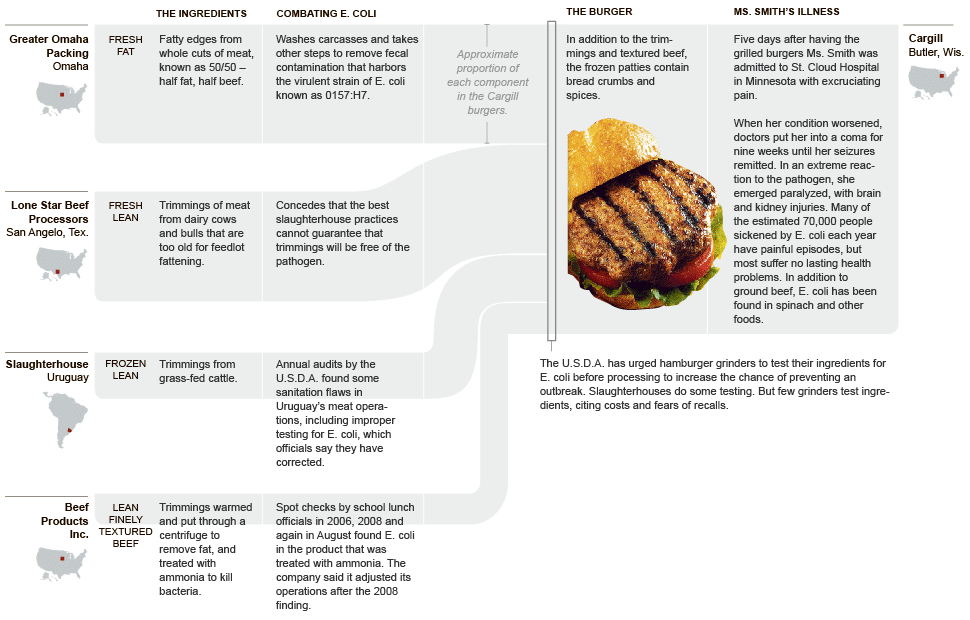
The frozen hamburgers that the Smiths ate, which were made by the food giant Cargill, were labeled “American Chef’s Selection Angus Beef Patties.” Yet confidential grinding logs and other Cargill records show that the hamburgers were made from a mix of slaughterhouse trimmings and a mash-like product derived from scraps that were ground together at a plant in Wisconsin. The ingredients came from slaughterhouses in Nebraska, Texas and Uruguay, and from a South Dakota company that processes fatty trimmings and treats them with ammonia to kill bacteria.
Using a combination of sources — a practice followed by most large producers of fresh and packaged hamburger — allowed Cargill to spend about 25 percent less than it would have for cuts of whole meat.
Those low-grade ingredients are cut from areas of the cow that are more likely to have had contact with feces, which carries E. coli, industry research shows. Yet Cargill, like most meat companies, relies on its suppliers to check for the bacteria and does its own testing only after the ingredients are ground together. The United States Department of Agriculture, which allows grinders to devise their own safety plans, has encouraged them to test ingredients first as a way of increasing the chance of finding contamination.
Unwritten agreements between some companies appear to stand in the way of ingredient testing. Many big slaughterhouses will sell only to grinders who agree not to test their shipments for E. coli, according to officials at two large grinding companies. Slaughterhouses fear that one grinder’s discovery of E. coli will set off a recall of ingredients they sold to others.
“Ground beef is not a completely safe product,” said Dr. Jeffrey Bender, a food safety expert at the University of Minnesota who helped develop systems for tracing E. coli contamination. He said that while outbreaks had been on the decline, “unfortunately it looks like we are going a bit in the opposite direction.”
Food scientists have registered increasing concern about the virulence of this pathogen since only a few stray cells can make someone sick, and they warn that federal guidance to cook meat thoroughly and to wash up afterward is not sufficient. A test by The Times found that the safe handling instructions are not enough to prevent the bacteria from spreading in the kitchen.
Cargill, whose $116.6 billion in revenues last year made it the country’s largest private company, declined requests to interview company officials or visit its facilities. “Cargill is not in a position to answer your specific questions, other than to state that we are committed to continuous improvement in the area of food safety,” the company said, citing continuing litigation.
The meat industry treats much of its practices and the ingredients in ground beef as trade secrets. While the Department of Agriculture has inspectors posted in plants and has access to production records, it also guards those secrets. Federal records released by the department through the Freedom of Information Act blacked out details of Cargill’s grinding operation that could be learned only through copies of the documents obtained from other sources. Those documents illustrate the restrained approach to enforcement by a department whose missions include ensuring meat safety and promoting agriculture markets.
Within weeks of the Cargill outbreak in 2007, U.S.D.A. officials swept across the country, conducting spot checks at 224 meat plants to assess their efforts to combat E. coli. Although inspectors had been monitoring these plants all along, officials found serious problems at 55 that were failing to follow their own safety plans.
“Every time we look, we find out that things are not what we hoped they would be,” said Loren D. Lange, an executive associate in the Agriculture Department’s food safety division.
In the weeks before Ms. Smith’s patty was made, federal inspectors had repeatedly found that Cargill was violating its own safety procedures in handling ground beef, but they imposed no fines or sanctions, records show. After the outbreak, the department threatened to withhold the seal of approval that declares “U.S. Inspected and Passed by the Department of Agriculture.”
In the end, though, the agency accepted Cargill’s proposal to increase its scrutiny of suppliers. That agreement came early last year after contentious negotiations, records show. When Cargill defended its safety system and initially resisted making some changes, an agency official wrote back: “How is food safety not the ultimate issue?”
The Risk
On Aug. 16, 2007, the day Ms. Smith’s hamburger was made, the No.3 grinder at the Cargill plant in Butler, Wis., started up at 6:50 a.m. The largest ingredient was beef trimmings known as “50/50” — half fat, half meat — that cost about 60 cents a pound, making them the cheapest component.
Cargill bought these trimmings — fatty edges sliced from better cuts of meat — from Greater Omaha Packing, where some 2,600 cattle are slaughtered daily and processed in a plant the size of four football fields.
As with other slaughterhouses, the potential for contamination is present every step of the way, according to workers and federal inspectors. The cattle often arrive with smears of feedlot feces that harbor the E. coli pathogen, and the hide must be removed carefully to keep it off the meat. This is especially critical for trimmings sliced from the outer surface of the carcass.
Federal inspectors based at the plant are supposed to monitor the hide removal, but much can go wrong. Workers slicing away the hide can inadvertently spread feces to the meat, and large clamps that hold the hide during processing sometimes slip and smear the meat with feces, the workers and inspectors say.
Greater Omaha vacuums and washes carcasses with hot water and lactic acid before sending them to the cutting floor. But these safeguards are not foolproof.
“As the trimmings are going down the processing line into combos or boxes, no one is inspecting every single piece,” said one federal inspector who monitored Greater Omaha and requested anonymity because he was not authorized to speak publicly.
The E. coli risk is also present at the gutting station, where intestines are removed, the inspector said
Every five seconds or so, half of a carcass moves into the meat-cutting side of the slaughterhouse, where trimmers said they could keep up with the flow unless they spot any remaining feces.
“We would step in and stop the line, and do whatever you do to take it off,” said Esley Adams, a former supervisor who said he was fired this summer after 16 years following a dispute over sick leave. “But that doesn’t mean everything was caught.”
Two current employees said the flow of carcasses keeps up its torrid pace even when trimmers get reassigned, which increases pressure on workers. To protest one such episode, the employees said, dozens of workers walked off the job for a few hours earlier this year. Last year, workers sued Greater Omaha, alleging that they were not paid for the time they need to clean contaminants off their knives and other gear before and after their shifts. The company is contesting the lawsuit.
Greater Omaha did not respond to repeated requests to interview company officials. In a statement, a company official said Greater Omaha had a “reputation for embracing new food safety technology and utilizing science to make the safest product possible.”
The Trimmings
In making hamburger meat, grinders aim for a specific fat content — 26.6 percent in the lot that Ms. Smith’s patty came from, company records show. To offset Greater Omaha’s 50/50 trimmings, Cargill added leaner material from three other suppliers.
Records show that some came from a Texas slaughterhouse, Lone Star Beef Processors, which specializes in dairy cows and bulls too old to be fattened in feedlots. In a form letter dated two days before Ms. Smith’s patty was made, Lone Star recounted for Cargill its various safety measures but warned “to this date there is no guarantee for pathogen-free raw material and we would like to stress the importance of proper handling of all raw products.”
Ms. Smith’s burger also contained trimmings from a slaughterhouse in Uruguay, where government officials insist that they have never found E. coli O157:H7 in meat. Yet audits of Uruguay’s meat operations conducted by the U.S.D.A. have found sanitation problems, including improper testing for the pathogen. Dr. Hector J. Lazaneo, a meat safety official in Uruguay, said the problems were corrected immediately. “Everything is fine, finally,” he said. “That is the reason we are exporting.”
Cargill’s final source was a supplier that turns fatty trimmings into what it calls “fine lean textured beef.” The company, Beef Products Inc., said it bought meat that averages between 50 percent and 70 percent fat, including “any small pieces of fat derived from the normal breakdown of the beef carcass.” It warms the trimmings, removes the fat in a centrifuge and treats the remaining product with ammonia to kill E. coli.
With seven million pounds produced each week, the company’s product is widely used in hamburger meat sold by grocers and fast-food restaurants and served in the federal school lunch program. Ten percent of Ms. Smith’s burger came from Beef Products, which charged Cargill about $1.20 per pound, or 20 cents less than the lean trimmings in the burger, billing records show.
An Iowa State University study financed by Beef Products found that ammonia reduces E. coli to levels that cannot be detected. The Department of Agriculture accepted the research as proof that the treatment was effective and safe. And Cargill told the agency after the outbreak that it had ruled out Beef Products as the possible source of contamination.
But federal school lunch officials found E. coli in Beef Products material in 2006 and 2008 and again in August, and stopped it from going to schools, according to Agriculture Department records and interviews. A Beef Products official, Richard Jochum, said that last year’s contamination stemmed from a “minor change in our process,” which the company adjusted. The company did not respond to questions about the latest finding.
In combining the ingredients, Cargill was following a common industry practice of mixing trim from various suppliers to hit the desired fat content for the least money, industry officials said.
In all, the ingredients for Ms. Smith’s burger cost Cargill about $1 a pound, company records show, or about 30 cents less than industry experts say it would cost for ground beef made from whole cuts of meat.
Ground beef sold by most grocers is made from a blend of ingredients, industry officials said. Agriculture Department regulations also allow hamburger meat labeled ground chuck or sirloin to contain trimmings from those parts of the cow. At a chain like Publix Super Markets, customers who want hamburger made from whole cuts of meat have to buy a steak and have it specially ground, said a Publix spokeswoman, Maria Brous, or buy a product like Bubba Burgers, which boasts on its labeling, “100% whole muscle means no trimmings.”
To finish off the Smiths’ ground beef, Cargill added bread crumbs and spices, fashioned it into patties, froze them and packed them 18 to a carton.
The listed ingredients revealed little of how the meat was made. There was just one meat product listed: “Beef.”
Anatomy of a Burger: Confidential grinding logs and other records and interviews reveal the ingredients and E. coli issues in a typical hamburger sold by grocers and fast food restaurants. This patty was made by the food giant Cargill, which recalled 844,812 pounds of ground beef on Oct. 6, 2007, after an estimated 940 people were sickened, including Stephanie Smith, 22, of Cold Spring, Minn.
Tension Over Testing
As it fed ingredients into its grinders, Cargill watched for some unwanted elements. Using metal detectors, workers snagged stray nails and metal hooks that could damage the grinders, then warned suppliers to make sure it did not happen again.
But when it came to E. coli O157:H7, Cargill did not screen the ingredients and only tested once the grinding was done. The potential pitfall of this practice surfaced just weeks before Ms. Smith’s patty was made. A company spot check in May 2007 found E. coli in finished hamburger, which Cargill disclosed to investigators in the wake of the October outbreak. But Cargill told them it could not determine which supplier had shipped the tainted meat since the ingredients had already been mixed together.
“Our finished ground products typically contain raw materials from numerous suppliers,” Dr. Angela Siemens, the technical services vice president for Cargill’s meat division, wrote to the U.S.D.A. “Consequently, it is not possible to implicate a specific supplier without first observing a pattern of potential contamination.”
Testing has been a point of contention since the 1994 ban on selling ground beef contaminated with E. coli O157:H7 was imposed. The department moved to require some bacterial testing of ground beef, but the industry argued that the cost would unfairly burden small producers, industry officials said. The Agriculture Department opted to carry out its own tests for E. coli, but it acknowledges that its 15,000 spot checks a year at thousands of meat plants and groceries nationwide is not meant to be comprehensive. Many slaughterhouses and processors have voluntarily adopted testing regimes, yet they vary greatly in scope from plant to plant.
The retail giant Costco is one of the few big producers that tests trimmings for E. coli before grinding, a practice it adopted after a New York woman was sickened in 1998 by its hamburger meat, prompting a recall.
Craig Wilson, Costco’s food safety director, said the company decided it could not rely on its suppliers alone. “It’s incumbent upon us,” he said. “If you say, ‘Craig, this is what we’ve done,’ I should be able to go, ‘Cool, I believe you.’ But I’m going to check.”
Costco said it had found E. coli in foreign and domestic beef trimmings and pressured suppliers to fix the problem. But even Costco, with its huge buying power, said it had met resistance from some big slaughterhouses. “Tyson will not supply us,” Mr. Wilson said. “They don’t want us to test.”
A Tyson spokesman, Gary Mickelson, would not respond to Costco’s accusation, but said, “We do not and cannot” prohibit grinders from testing ingredients. He added that since Tyson tests samples of its trimmings, “we don’t believe secondary testing by grinders is a necessity.”
The food safety officer at American Foodservice, which grinds 365 million pounds of hamburger a year, said it stopped testing trimmings a decade ago because of resistance from slaughterhouses. “They would not sell to us,” said Timothy P. Biela, the officer. “If I test and it’s positive, I put them in a regulatory situation. One, I have to tell the government, and two, the government will trace it back to them. So we don’t do that.”
The surge in outbreaks since 2007 has led to finger-pointing within the industry.
Dennis R. Johnson, a lobbyist for the largest meat processors, has said that not all slaughterhouses are looking hard enough for contamination. He told U.S.D.A. officials last fall that those with aggressive testing programs typically find E. coli in as much as 1 percent to 2 percent of their trimmings, yet some slaughterhouses implicated in outbreaks had failed to find any.
At the same time, the meat processing industry has resisted taking the onus on itself. An Agriculture Department survey of more than 2,000 plants taken after the Cargill outbreak showed that half of the grinders did not test their finished ground beef for E. coli; only 6 percent said they tested incoming ingredients at least four times a year.
In October 2007, the agency issued a notice recommending that processors conduct at least a few tests a year to verify the testing done by slaughterhouses. But after resistance from the industry, the department allowed suppliers to run the verification checks on their own operations.
In August 2008, the U.S.D.A. issued a draft guideline again urging, but not ordering, processors to test ingredients before grinding. “Optimally, every production lot should be sampled and tested before leaving the supplier and again before use at the receiver,” the draft guideline said.
But the department received critical comments on the guideline, which has not been made official. Industry officials said that the cost of testing could unfairly burden small processors and that slaughterhouses already test. In an October 2008 letter to the department, the American Association of Meat Processors said the proposed guideline departed from U.S.D.A.’s strategy of allowing companies to devise their own safety programs, “thus returning to more of the agency’s ‘command and control’ mind-set.”
Dr. Kenneth Petersen, an assistant administrator with the department’s Food Safety and Inspection Service, said that the department could mandate testing, but that it needed to consider the impact on companies as well as consumers. “I have to look at the entire industry, not just what is best for public health,” Dr. Petersen said.
Tracing the Illness
The Smiths were slow to suspect the hamburger. Ms. Smith ate a mostly vegetarian diet, and when she grew increasingly ill, her mother, Sharon, thought the cause might be spinach, which had been tied to a recent E. coli outbreak.
Five days after the family’s Sunday dinner, Ms. Smith was admitted to St. Cloud Hospital in excruciating pain. “I’ve had women tell me that E. coli is more painful than childbirth,” said Dr. Phillip I. Tarr, a pathogen expert at Washington University in St. Louis.
The vast majority of E. coli illnesses resolve themselves without complications, according to the Centers for Disease Control and Prevention. Five percent to 10 percent develop into a condition called hemolytic uremic syndrome, which can affect kidney function. While most patients recover, in the worst cases, like Ms. Smith’s, the toxin in E. coli O157:H7 penetrates the colon wall, damaging blood vessels and causing clots that can lead to seizures.
To control Ms. Smith’s seizures, doctors put her in a coma and flew her to the Mayo Clinic, where doctors worked to save her.
“They didn’t even think her brain would work because of the seizuring,” her mother said. “Thanksgiving Day, I was sitting there holding her hand when a group of doctors came in, and one looked at me and just walked away, with nothing good to say. And I said, ‘Oh my God, maybe this is my last Thanksgiving with her,’ and I stayed and prayed.”
Ms. Smith’s illness was linked to the hamburger only by chance. Her aunt still had some of the frozen patties, and state health officials found that they were contaminated with a powerful strain of E. coli that was genetically identical to the pathogen that had sickened other Minnesotans.
Dr. Kirk Smith, who runs the state’s food-borne illness outbreak group and is not related to Ms. Smith, was quick to finger the source. A 4-year-old had fallen ill three weeks earlier, followed by her year-old brother and two more children, state records show. Like Ms. Smith, the others had eaten Cargill patties bought at Sam’s Club, a division of Wal-Mart.
Moreover, the state officials discovered that the hamburgers were made on the same day, Aug. 16, 2007, shortly before noon. The time stamp on the Smiths’ box of patties was 11:58.
On Friday, Oct. 5, 2007, a Minnesota Health Department warning led local news broadcasts. “We didn’t want people grilling these things over the weekend,” Dr. Smith said. “I’m positive we prevented illnesses. People sent us dozens of cartons with patties left. It was pretty contaminated stuff.”
Eventually, health officials tied 11 cases of illness in Minnesota to the Cargill outbreak, and altogether, federal health officials estimate that the outbreak sickened 940 people. Four of the 11 Minnesota victims developed hemolytic uremic syndrome — an unusually high rate of serious complications.
In the wake of the outbreak, the U.S.D.A. reminded consumers on its Web site that hamburgers had to be cooked to 160 degrees to be sure any E. coli is killed and urged them to use a thermometer to check the temperature. This reinforced Sharon Smith’s concern that she had sickened her daughter by not cooking the hamburger thoroughly.
But the pathogen is so powerful that her illness could have started with just a few cells left on a counter. “In a warm kitchen, E. coli cells will double every 45 minutes,” said Dr. Mansour Samadpour, a microbiologist who runs IEH Laboratories in Seattle, one of the meat industry’s largest testing firms.
With help from his laboratories, The Times prepared three pounds of ground beef dosed with a strain of E. coli that is nonharmful but acts in many ways like O157:H7. Although the safety instructions on the package were followed, E. coli remained on the cutting board even after it was washed with soap. A towel picked up large amounts of bacteria from the meat.
Dr. James Marsden, a meat safety expert at Kansas State University and senior science adviser for the North American Meat Processors Association, said the Department of Agriculture needed to issue better guidance on avoiding cross-contamination, like urging people to use bleach to sterilize cutting boards. “Even if you are a scientist, much less a housewife with a child, it’s very difficult,” Dr. Marsden said.
Told of The Times’s test, Jerold R. Mande, the deputy under secretary for food safety at the U.S.D.A., said he planned to “look very carefully at the labels that we oversee.”
“They need to provide the right information to people,” Mr. Mande said, “in a way that is readable and actionable.”
Dead Ends
With Ms. Smith lying comatose in the hospital and others ill around the country, Cargill announced on Oct. 6, 2007, that it was recalling 844,812 pounds of patties. The mix of ingredients in the burgers made it almost impossible for either federal officials or Cargill to trace the contamination to a specific slaughterhouse. Yet after the outbreak, Cargill had new incentives to find out which supplier had sent the tainted meat.
Cargill got hit by multimillion-dollar claims from people who got sick.
Shawn K. Stevens, a lawyer in Milwaukee working for Cargill, began investigating. Sifting through state health department records from around the nation, Mr. Stevens found the case of a young girl in Hawaii stricken with the same E. coli found in the Cargill patties. But instead of a Cargill burger, she had eaten raw minced beef at a Japanese restaurant that Mr. Stevens said he traced through a distributor to Greater Omaha.
“Potentially, it could let Cargill shift all the responsibility,” Mr. Stevens said. In March, he sent his findings to William Marler, a lawyer in Seattle who specializes in food-borne disease cases and is handling the claims against Cargill.
“Most of the time, in these outbreaks, it’s not unusual when I point the finger at somebody, they try to point the finger at somebody else,” Mr. Marler said. But he said Mr. Stevens’s finding “doesn’t rise to the level of proof that I need” to sue Greater Omaha.
It is unclear whether Cargill presented the Hawaii findings to Greater Omaha, since neither company would comment on the matter. In December 2007, in a move that Greater Omaha said was unrelated to the outbreak, the slaughterhouse informed Cargill that it had taken 16 “corrective actions” to better protect consumers from E. coli “as we strive to live up to the performance standards required in the continuation of supplier relationship with Cargill.”
Those changes included better monitoring of the production line, more robust testing for E. coli, intensified plant sanitation and added employee training.
The U.S.D.A. efforts to find the ultimate source of the contamination went nowhere. Officials examined production records of Cargill’s three domestic suppliers, but they yielded no clues. The Agriculture Department contacted Uruguayan officials, who said they found nothing amiss in the slaughterhouse there.
In examining Cargill, investigators discovered that their own inspectors had lodged complaints about unsanitary conditions at the plant in the weeks before the outbreak, but that they had failed to set off any alarms within the department. Inspectors had found “large amounts of patties on the floor,” grinders that were gnarly with old bits of meat, and a worker who routinely dumped inedible meat on the floor close to a production line, records show.
Although none were likely to have caused the contamination, federal officials said the conditions could have exacerbated the spread of bacteria. Cargill vowed to correct the problems. Dr. Petersen, the federal food safety official, said the department was working to make sure violations are tracked so they can be used “in real time to take action.”
The U.S.D.A. found that Cargill had not followed its own safety program for controlling E. coli. For example, Cargill was supposed to obtain a certificate from each supplier showing that their tests had found no E. coli. But Cargill did not have a certificate for the Uruguayan trimmings used on the day it made the burgers that sickened Ms. Smith and others.
After four months of negotiations, Cargill agreed to increase its scrutiny of suppliers and their testing, including audits and periodic checks to determine the accuracy of their laboratories.
A recent industry test in which spiked samples of meat were sent to independent laboratories used by food companies found that some missed the E. coli in as many as 80 percent of the samples.
Cargill also said it would notify suppliers whenever it found E. coli in finished ground beef, so they could check their facilities. It also agreed to increase testing of finished ground beef, according to a U.S.D.A. official familiar with the company’s operations, but would not test incoming ingredients.
Looking to the Future
The spate of outbreaks in the last three years has increased pressure on the Agriculture Department and the industry.
James H. Hodges, executive vice president of the American Meat Institute, a trade association, said that while the outbreaks were disconcerting, they followed several years during which there were fewer incidents. “Are we perfect?” he said. “No. But what we have done is to show some continual improvement.”
Dr. Petersen, the U.S.D.A. official, said the department had adopted additional procedures, including enhanced testing at slaughterhouses implicated in outbreaks and better training for investigators.
“We are not standing still when it comes to E. coli,” Dr. Petersen said.
The department has held a series of meetings since the recent outbreaks, soliciting ideas from all quarters. Dr. Samadpour, the laboratory owner, has said that “we can make hamburger safe,” but that in addition to enhanced testing, it will take an aggressive use of measures like meat rinses and safety audits by qualified experts.
At these sessions, Felicia Nestor, a senior policy analyst with the consumer group Food and Water Watch, has urged the government to redouble its effort to track outbreaks back to slaughterhouses. “They are the source of the problem,” Ms. Nestor said.
For Ms. Smith, the road ahead is challenging. She is living at her mother’s home in Cold Spring, Minn. She spends a lot of her time in physical therapy, which is being paid for by Cargill in anticipation of a legal claim, according to Mr. Marler. Her kidneys are at high risk of failure. She is struggling to regain some basic life skills and deal with the anger that sometimes envelops her. Despite her determination, doctors say, she will most likely never walk again.
Gabe Johnson contributed reporting.
© 2009, The New York Times
Company's Record on Treatment of Beef Is Called Into Question
By Michael Moss
Eight years ago, federal officials were struggling to remove potentially deadly E. coli from hamburgers when an entrepreneurial company from South Dakota came up with a novel idea: injecting beef with ammonia.
The company, Beef Products Inc., had been looking to expand into the hamburger business with a product made from beef that included fatty trimmings the industry once relegated to pet food and cooking oil. The trimmings were particularly susceptible to contamination, but a study commissioned by the company showed that the ammonia process would kill E. coli as well as salmonella.
Officials at the United States Department of Agriculture endorsed the company’s ammonia treatment, and have said it destroys E. coli “to an undetectable level.” They decided it was so effective that in 2007, when the department began routine testing of meat used in hamburger sold to the general public, they exempted Beef Products.
With the U.S.D.A.’s stamp of approval, the company’s processed beef has become a mainstay in America’s hamburgers. McDonald’s, Burger King and other fast-food giants use it as a component in ground beef, as do grocery chains. The federal school lunch program used an estimated 5.5 million pounds of the processed beef last year alone.
But government and industry records obtained by The New York Times show that in testing for the school lunch program, E. coli and salmonella pathogens have been found dozens of times in Beef Products meat, challenging claims by the company and the U.S.D.A. about the effectiveness of the treatment. Since 2005, E. coli has been found 3 times and salmonella 48 times, including back-to-back incidents in August in which two 27,000-pound batches were found to be contaminated. The meat was caught before reaching lunch-rooms trays.
In July, school lunch officials temporarily banned their hamburger makers from using meat from a Beef Products facility in Kansas because of salmonella — the third suspension in three years, records show. Yet the facility remained approved by the U.S.D.A. for other customers.
Presented by The Times with the school lunch test results, top department officials said they were not aware of what their colleagues in the lunch program had been finding for years.
In response, the agriculture department said it was revoking Beef Products’ exemption from routine testing and conducting a review of the company’s operations and research. The department said it was also reversing its policy for handling Beef Products during pathogen outbreaks. Since it was seen as pathogen-free, the processed beef was excluded from recalls, even when it was an ingredient in hamburgers found to be contaminated.
The Beef Products case reveals a schism between the main Department of Agriculture and its division that oversees the school lunch program, a divide that underscores the government’s faltering effort to make hamburger safe. The U.S.D.A. banned the sale of meat found to be contaminated with the O157:H7 strain of E. coli 15 years ago, after a deadly outbreak was traced to Jack in the Box restaurants. Meat tainted with salmonella is also a hazard. But while the school lunch program will not buy meat contaminated with salmonella, the agriculture department does not ban its sale to the general public.
Even so, E. coli outbreaks nationwide have increased in recent years. And this summer, two outbreaks of particularly virulent strains of salmonella in hamburger prompted large recalls of ground beef across several states.
Although no outbreak has been tied to Beef Products, officials said they would thoroughly scrutinize any future industry innovations for fighting contamination “to ensure that they are scientifically sound and protect public health,” and that they were examining the government’s overall meat safety policies.
The founder and owner of Beef Products, Eldon N. Roth, declined requests for interviews or access to the company’s production facilities. Responding to written questions, Beef Products said it had a deep commitment to hamburger safety and was continually refining its operation to provide the safest product possible. “B.P.I.’s track record demonstrates the progress B.P.I. has made compared to the industry norm,” the company said. “Like any responsible member of the meat industry, we are not perfect.”
Beef Products maintains that its ammonia process remains effective. It said it tests samples of each batch it ships to customers and has found E. coli in only 0.06 percent of the samples this year.
The company says its processed beef, a mashlike substance frozen into blocks or chips, is used in a majority of the hamburger sold nationwide. But it has remained little known outside industry and government circles. Federal officials agreed to the company’s request that the ammonia be classified as a “processing agent” and not an ingredient that would be listed on labels.
Within the U.S.D.A., the treated beef has been a source of friction for years. The department accepted the company’s own study as evidence that the treatment was effective. School lunch officials, who had some doubts about its effectiveness, required that Beef Products meat be tested, as they do all beef used by the program.
School lunch officials said that in some years Beef Products testing results were worse than many of the program’s two dozen other suppliers, which use traditional meat processing methods. From 2005 to 2009, Beef Products had a rate of 36 positive results for salmonella per 1,000 tests, compared to a rate of nine positive results per 1,000 tests for the other suppliers, according to statistics from the program. Beef Products said its testing regime was more likely to detect contamination.
Despite some misgivings, school lunch officials say they use Beef Products because its price is substantially lower than ordinary meat trimmings, saving about $1 million a year.
Another snapshot of processed beef’s performance emerges from confidential records of tests in 2007 by the food giant Cargill. In the preceding year and a half, Cargill, which used more than 50 vendors, suspended three facilities for excessive salmonella; two were Beef Products plants, records show.
Since introducing the treated meat, Beef Products has faced the challenge of balancing safety with taste, records and interviews show.
Pathogens died when enough ammonia was used to raise the alkalinity of the beef to a high level, company research found. But early on, school lunch officials and other customers complained about the taste and smell of the beef. Samples of the processed beef obtained by The Times revealed lower levels of alkalinity, suggesting less ammonia was used.
Beef Products acknowledged lowering the alkalinity, and the U.S.D.A. said it had determined that “at least some of B.P.I.’s product was no longer receiving the full lethality treatment.”
Beef Products said it had submitted new research to the agriculture department showing that its treatment remained effective with lower alkalinity. Agriculture officials said Beef Products’ latest study is under review.
A Safety Solution
Headstrong and self-assured, Eldon N. Roth had the good fortune of being in the right place at the right time.
Mr. Roth spent the 1990s looking to give Beef Products a competitive edge by turning fatty slaughterhouse trimmings into usable lean beef.
Mr. Roth and others in the industry had discovered that liquefying the fat and extracting the protein from the trimmings in a centrifuge resulted in a lean product that was desirable to hamburger-makers.
The greater challenge was eliminating E. coli and salmonella, which are more prevalent in fatty trimmings than in higher grades of beef. According to a 2003 study financed by Beef Products, the trimmings “typically includes most of the material from the outer surfaces of the carcass” and contains “larger microbiological populations.” Beef Products said it also used trimmings from inside cuts of meat.
Mr. Roth was well suited to tackle the problem, friends say. Though lacking a science background, he had a knack for machinery and obtained patents for over two dozen pieces of equipment and methods used in processing beef.
“He looked and looked at stuff and always wondered, why can’t it be done this way?” said Dr. David M. Theno, a food safety consultant and friend of Mr. Roth. “He is like a lot of inventors. Not everyone sees Eldon’s vision.”
One of Mr. Roth’s early trials involved running electricity through the trimmings to kill bacteria, Dr. Theno and others said. Mr. Roth eventually settled on ammonia, which had been shown to suppress spoilage. Meat is sent through pipes where it is exposed to ammonia gas, and then flash frozen and compressed — all steps that help kill pathogens, company research found.
The treated beef landed in Washington in 2001, when federal officials were searching for ways to eliminate E. coli. Beef Products already had one study showing its treatment would do that; another company-sponsored study by an Iowa State University professor that was published in a professional journal seconded that finding.
Mr. Roth asserted that his product would kill pathogens in untreated meat when it was used as an ingredient in ground beef — raising the prospect of a risk-free burger. “Given the technology, we firmly believe that the two pathogens of major concern in raw ground beef — E. coli O157:H7 and salmonella — are on the verge of elimination,” Mr. Roth wrote to the department.
The Food and Drug Administration signed off on the use of ammonia, concluding it was safe when used as a processing agent in foods. This year, a top official with the U.S.D.A.’s Food Safety and Inspection Service said, “It eliminates E. coli to the same degree as if you cooked the product.”
Carl S. Custer, a former U.S.D.A. microbiologist, said he and other scientists were concerned that the department had approved the treated beef for sale without obtaining independent validation of the potential safety risk. Another department microbiologist, Gerald Zirnstein, called the processed beef "pink slime" in a 2002 e-mail message to colleagues and said, “I do not consider the stuff to be ground beef, and I consider allowing it in ground beef to be a form of fraudulent labeling.”
One of the toughest hurdles for Beef Products was the Agricultural Marketing Service, the U.S.D.A. division that buys food for school lunches. Officials cited complaints about the odor, and wrote in a 2002 memorandum that they had “to determine if the addition of ammonia to the product is in the best interest to A.M.S. from a quality standpoint.
“It is our contention,” the memo added, “that product should be labeled accordingly.”
Represented by Dennis R. Johnson, a top lawyer and lobbyist for the meat industry, Beef Products prevailed on the question of whether ammonia should be listed as an ingredient, arguing that the government had just decided against requiring another company to list a chemical used in treating poultry
School lunch officials said they ultimately agreed to use the treated meat because it shaved about 3 cents off the cost of making a pound of ground beef.“Several packers have unofficially raised concern regarding the use of the product since the perception of quality is inferior,” the 2002 memo said. “But will use product to obtain lower bid.”
In 2004, lunch officials increased the amount of Beef Products meat allowed in its hamburgers to 15 percent, from 10 percent, to increase savings. In a taste test at the time, some school children favored burgers with higher amounts of processed beef.
Beef Products does not disclose its earnings, but its reported production of seven million pounds a week would generate about $440 million in annual revenue, according to industry records.
Dr. Theno, the food safety consultant, applauds Mr. Roth for figuring out how to convert high-fat trimmings “with no functional value.”
“There were some issues with that,” Dr. Theno said. “But he, and God bless him, amassed a tidy fortune for it.”
As sales took off, Mr. Roth started offering a buy-back guarantee: If any of the most virulent E. coli was found in ground beef containing Beef Products meat, the company would buy the tainted meat.
This was based on Mr. Roth’s initial prediction that his treated beef could kill E. coli in any meat it was mixed with. The company acknowledges that its subsequent study found no evidence to back that up, although it says it is now trying with an enhanced treatment. The guarantee remains on the company Web site: “Contact a B.P.I. sales representative today to take the challenge!”
Odor and Alkalinity
As suppliers of national restaurant chains and government-financed programs were buying Beef Product meat to use in ground beef, complaints about its pungent odor began to emerge.
In early 2003, officials in Georgia returned nearly 7,000 pounds to Beef Products after cooks who were making meatloaf for state prisoners detected a “very strong odor of ammonia” in 60-pound blocks of the trimmings, state records show.
“It was frozen, but you could still smell ammonia,” said Dr. Charles Tant, a Georgia agriculture department official. “I’ve never seen anything like it.”
Unaware that the meat was treated with ammonia — since it was not on the label — Georgia officials assumed it was accidentally contaminated and alerted the agriculture department. In their complaint, the officials noted that the level of ammonia in the beef was similar to levels found in contamination incidents involving chicken and milk that had sickened schoolchildren.
Beef Products said the ammonia did not pose a danger and would be diluted when its beef was mixed with other meat. The U.S.D.A. accepted Beef Product’s conclusion, but other customers had also complained about the smell.
Untreated beef naturally contains ammonia and is typically about 6 on the pH scale, near that of rain water and milk. The Beef Products’ study that won U.S.D.A. approval used an ammonia treatment that raised the pH of the meat to as high as 10, an alkalinity well beyond the range of most foods. The company’s 2003 study cited the “potential issues surrounding the palatability of a pH-9.5 product.”
Soon after getting initial approval from the agriculture department, the company devised a plan to make a less alkaline version of the beef, internal company documents show. Beef Products acknowledged in an e-mail exchange that it was making a lower pH version, but did not specify the level or when it began selling it.
In 2008, after the school lunch program temporarily suspended a Beef Products plant for salmonella contamination, the company wrote in a letter that its effort to combat ammonia “aroma” might have reduced the alkalinity below the initial target levels. It said it was taking steps to ensure that the alkalinity remained elevated.
Samples of the treated beef obtained by The Times this month showed a pH as low as 7.75, according to an analysis by two laboratories. Dr. Michael P. Doyle, a food industry consultant and director of the Center for Food Safety at the University of Georgia, said one point on the exponential pH scale was a considerable difference, and “could have a significant effect on the antimicrobial effectiveness of the ammonia.”
This month, Beef Products provided The Times with new research that the company said showed that E. coli and salmonella were undetectable at a pH level of 8.5. The agriculture department said it did not learn that Beef Products was using lower levels until October, after inquiries by The Times, and that it was studying the company’s research.
McDonald’s, whose hamburgers have contained Beef Products meat since 2004, declined to say if it monitored it for pH. But Danya Proud, a chain spokeswoman, said, “We expect the pH level to meet the specifications that are approved by the U.S.D.A.”
Contagion and Notification
At 6:36 a.m. on Aug. 10, the Beef Products plant in South Sioux City, Neb., started up its production line for the school lunch program. In 60 minutes, the plant produced a batch of 26,880 pounds of processed beef that tested positive for E. coli.
Six days later at the same plant, another 26,880-pound lot was found to have salmonella, government records and interviews show.
Within hours of confirming the contamination, the school lunch division of the Agriculture Department in Washington began investigating.
Just down the hall at department headquarters, the division that oversees meat for the general public did not conduct its own inquiry for another month and half, after receiving questions from The Times.
The problems in South Sioux City came shortly after school lunch officials had suspended a Beef Products plant in Holcomb, Kan., for excessive salmonella. The main U.S.D.A. was not notified of the suspension by school lunch officials, and the plant continued to supply other customers.
Agriculture Secretary Tom Vilsack has since directed school lunch officials to share information about their suspensions with the department’s meat safety division.
In addressing the latest contamination cases in Nebraska, Beef Products said it suspected a glitch in its treatment operations, referring to ammonia gas by its chemical name, NH3, according to an e-mail message to school lunch officials.
“The system was stopped for two minutes in order to install a new valve,” the company said. “When the system was restarted, there was product flow for approximately one minute without NH3 flow.”
After the school lunch officials replied that the glitch might explain only one of the two episodes, Beef Products shifted focus to its suppliers, saying it would more closely scrutinize them for contamination.
Under the U.S.D.A.’s new policy for Beef Products, the company itself is also likely to get more scrutiny.
Cargill, one of the nation’s largest hamburger makers, is a big buyer of Beef Products’ ammoniated trimmings for its patties. Company records show that Beef Products, like other suppliers, has periodically exceeded Cargill’s limits on acceptable bacteria levels. That led Cargill to stop buying meat from two Beef Products plants for several months in 2006 after company tests showed excessive levels of salmonella.
But the following year, when Cargill faced an E. coli outbreak, it ruled out Beef Products as a possible culprit, citing the U.S.D.A.’s view that the ammonia treatment provided a “lethality step” for the pathogen. In addition, Cargill officials said recently, they suspect that another supplier, not Beef Products, was the problem. As a result, Beef Products did not face as wide a recall as other Cargill suppliers.
Recently, another E. coli outbreak was traced to a hamburger maker in upstate New York that also used multiple suppliers, including Beef Products. This time, the agriculture department said Beef Products was being recalled with other suppliers, although a source of the contamination had not been identified.
“This will continue to be our approach going forward,” the department said.
Griff Palmer contributed reporting.
© 2009, The New York Times
Food Giants Placing Onus for Safety on Consumer
By Michael Moss
The frozen pot pies that sickened an estimated 15,000 people with salmonella in 2007 left federal inspectors mystified. At first they suspected the turkey. Then they considered the peas, carrots and potatoes.
The pie maker, ConAgra Foods, began spot-checking the vegetables for pathogens, but could not find the culprit. It also tried cooking the vegetables at high temperatures, a strategy the industry calls a “kill step,” to wipe out any lingering microbes. But the vegetables turned to mush in the process.
So ConAgra — which sold more than 100 million pot pies last year under its popular Banquet label — decided to make the consumer responsible for the kill step. The “food safety” instructions and four-step diagram on the 69-cent pies offer this guidance: “Internal temperature needs to reach 165° F as measured by a food thermometer in several spots.”
Increasingly, the corporations that supply Americans with processed foods are unable to guarantee the safety of their ingredients. In this case, ConAgra could not pinpoint which of the more than 25 ingredients in its pies was carrying salmonella. Other companies do not even know who is supplying their ingredients, let alone if those suppliers are screening the items for microbes and other potential dangers, interviews and documents show.
Yet the supply chain for ingredients in processed foods — from flavorings to flour to fruits and vegetables — is becoming more complex and global as the drive to keep food costs down intensifies. As a result, almost every element, not just red meat and poultry, is now a potential carrier of pathogens, government and industry officials concede.
In addition to ConAgra, other food giants like Nestlé and the Blackstone Group, a New York firm that acquired the Swanson and Hungry-Man brands two years ago, concede that they cannot ensure the safety of items — from frozen vegetables to pizzas — and that they are shifting the burden to the consumer. General Mills, which recalled about five million frozen pizzas in 2007 after an E. coli outbreak, now advises consumers to avoid microwaves and cook only with conventional ovens. ConAgra has also added food safety instructions to its other frozen meals, including the Healthy Choice brand.
Peanuts were considered unlikely culprits for pathogens until earlier this year when a processing plant in Georgia was blamed for salmonella poisoning that is estimated to have killed nine people and sickened 27,000. Now, white pepper is being blamed for dozens of salmonella illnesses on the West Coast, where a widening recall includes other spices and six tons of frozen egg rolls.
The problem is particularly acute with frozen foods, in which unwitting consumers who buy these products for their convenience mistakenly think that their cooking is a matter of taste and not safety.
Federal regulators have pushed companies to beef up their cooking instructions with the detailed “food safety” guides. But the response has been varied, as a review of packaging showed. Some manufacturers fail to list explicit instructions; others include abbreviated guidelines on the side of their boxes in tiny print. A Hungry-Man pot pie asks consumers to ensure that the pie reaches a temperature that is 11 degrees short of the government-established threshold for killing pathogens. Questioned about the discrepancy, Blackstone acknowledged it was using an older industry standard that it would rectify when it printed new cartons.
Government food safety officials also point to efforts by the Partnership for Food Safety Education, a nonprofit group founded by the Clinton administration. But the partnership consists of a two-person staff and an annual budget of $300,000. Its director, Shelley Feist, said she has wanted to start a campaign to advise consumers about frozen foods, but lacks the money.
Estimating the risk to consumers is difficult. The industry says that it is acting with an abundance of caution, and that big outbreaks of food-borne illness are rare. At the same time, a vast majority of the estimated 76 million cases of food-borne illness every year go unreported or are not traced to the source.
Home Cooking
Some food safety experts say they do not think the solution should rest with the consumer. Dr. Michael T. Osterholm, director of the Center for Infectious Disease Research and Policy at the University of Minnesota, said companies like ConAgra were asking too much. “I do not believe that it is fair to put this responsibility on the back of the consumer, when there is substantial confusion about what it means to prepare that product,” Dr. Osterholm said.
And the ingredient chain for frozen and other processed foods is poised to get more convoluted, industry insiders say. While the global market for ingredients is projected to reach $34 billion next year, the pressure to keep food prices down in a recession is forcing food companies to look for ways to cut costs.
Ensuring the safety of ingredients has been further complicated as food companies subcontract processing work to save money: smaller companies prepare flavor mixes and dough that a big manufacturer then assembles. “There is talk of having passports for ingredients,” said Jamie Rice, the marketing director of RTS Resource, a research firm based in England. “At each stage they are signed off on for quality and safety. That would help companies, if there is a scare, in tracing back.”
But government efforts to impose tougher trace-back requirements for ingredients have met with resistance from food industry groups including the Grocery Manufacturers Association, which complained to the Food and Drug Administration: “This information is not reasonably needed and it is often not practical or possible to provide it.”
Now, in the wake of polls that show food poisoning incidents are shaking shopper confidence, the group is re-evaluating its position. A new industry guide produced by the group urges companies to test for salmonella and cites recent outbreaks from cereal, children’s snacks and other dry foods that companies have mistakenly considered immune to pathogens.
Research on raw ingredients, the guide notes, has found salmonella in 0.14 percent to 1.3 percent of the wheat flour sampled, and up to 8 percent of the raw spices tested.
ConAgra’s pot pie outbreak began on Feb. 20, 2007, and by the time it trailed off nine months later 401 cases of salmonella infection had been identified in 41 states, according to the Centers for Disease Control and Prevention, which estimates that for every reported case, an additional 38 are not detected or reported.
It took until June 2007 for health officials to discover the illnesses were connected, and in October they traced the salmonella to Banquet pot pies made at ConAgra’s plant in Marshall, Mo.
While investigators who went to the plant were never able to pinpoint the salmonella source, inspectors for the United States Department of Agriculture focused on the vegetables, a federal inspection document shows.
ConAgra had not been requiring its suppliers to test the vegetables for pathogens, even though some were being shipped from Latin America. Nor was ConAgra conducting its own pathogen tests.
The company says the outbreak and management changes prompted it to undertake a broad range of safety initiatives, including testing for microbes in all of the pie ingredients. ConAgra said it was also trying to apply the kill step to as many ingredients as possible, but had not yet found a way to accomplish it without making the pies “unpalatable.”
Its Banquet pies now have some of the most graphic food safety instructions, complete with a depiction of a thermometer piercing the crust.
Pressed to say whether the meals are safe to eat if consumers disregard the instructions or make an error, Stephanie Childs, a company spokeswoman, said, “Our goal is to provide the consumer with as safe a product as possible, and we are doing everything within our ability to provide a safe product to them.”
“We are always improving food safety,” Ms. Childs said. “This is a long ongoing process.”
The U.S.D.A. said it required companies to show that their cooking instructions, when properly followed, would kill any pathogens. ConAgra says it has done such testing to validate its instructions.
Getting to ‘Kill Step’
But attempts by The New York Times to follow the directions on several brands of frozen meals, including ConAgra’s Banquet pot pies, failed to achieve the required 165-degree temperature. Some spots in the pies heated to only 140 degrees even as parts of the crust were burnt.
A ConAgra consumer hotline operator said the claims by microwave-oven manufacturers about their wattage power could not be trusted, and that any pies not heated enough should not be eaten. “We definitely want it to reach that 165-degree temperature,” she said. “It’s a safety issue.”
In 2007, the U.S.D.A.’s inspection of the ConAgra plant in Missouri found records that showed some of ConAgra’s own testing of its directions failed to achieve “an adequate lethality” in several products, including its Chicken Fried Beef Steak dinner. Even 18 minutes in a large conventional oven brought the pudding in a Kid Cuisine Chicken Breast Nuggets meal to only 142 degrees, the federal agency found.
Besides improving its own cooking directions, ConAgra says it has alerted other frozen food manufacturers to the food safety issues.
But in the absence of meaningful federal rules, other frozen-dinner makers that face the same problem with ingredients are taking varied steps, some less rigorous. Jim Seiple, a food safety official with the Blackstone unit that makes Swanson and Hungry-Man pot pies, said the company tested for pathogens, but only after preliminary tests for bacteria that were considered indicators of pathogens — a method that ConAgra abandoned after its salmonella outbreak.
The pot pie instructions have built-in margins of error, Mr. Seiple said, and the risk to consumers depended on “how badly they followed our directions.”
Some frozen food companies are taking different approaches to pathogens. Amy’s Kitchen, a California company that specializes in natural frozen foods, says it precooks its ingredients to kill any potential pathogens before its pot pies and other products leave the factory.
Using a bacteriological testing laboratory, The Times checked several pot pies made by Amy’s and the three leading brands, and while none contained salmonella or E. coli, one pie each of two brands — Banquet, and the Stouffer’s brand made by Nestlé — had significant levels of T. coliform.
These bacteria are common in many foods and are not considered harmful. But their presence in these products include raw ingredients and leave open “a potential for contamination,” said Harvey Klein, the director of Garden State Laboratories in New Jersey.
A Nestlé spokeswoman said the company enhanced its food safety instructions in the wake of ConAgra’s salmonella outbreak.
Danger in the Fridge
ConAgra’s episode has raised its visibility among victims like Ryan Warren, a 25-year-old law school student in Washington. A Seattle lawyer, Bill Marler, brought suit against ConAgra on behalf of Mr. Warren’s daughter Zoë, who had just turned 1 year old when she was fed a pot pie that he says put her in the hospital for a terrifying weekend of high fever and racing pulse.
“You don’t assume these dangers to be right in your freezer,” said Mr. Warren, who settled with ConAgra. He does not own a food thermometer and was not certain his microwave oven met the minimum 1,100-wattage requirement in the new pot pie instructions. “I do think that consumers bear responsibility to reasonably look out for their well-being, but the entire reason for this product to exist is for its convenience.”
Public health officials who interviewed the Warrens and other victims of the pot-pie contamination found that fewer than one in three knew the wattage of their microwave ovens, according to the C.D.C. report on the outbreak. The report notes, however, that nearly one in four of the victims reported cooking their pies in conventional ovens.
For more than a decade, the U.S.D.A. has also sought to encourage consumers to use food thermometers. But the agency’s statistics on how many Americans do so are discouraging. According to its Web site, not quite half the population has one, and only 3 percent use it when cooking high-risk foods like hamburgers. No data was available on how many people use thermometers on pot pies.
Andrew Martin contributed reporting.
© 2009, The New York Times
Food Safety Problems Elude Private Inspectors
By Michael Moss and Andrew Martin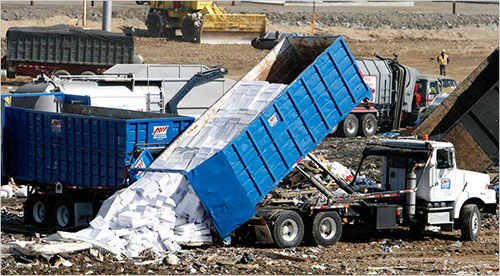
Westland/Hallmark frozen beef was dumped in a Los Angeles County, Calif. landfill last March. (Matt Sayles/Associated Press)
When food industry giants like Kellogg want to ensure that American consumers are being protected from contaminated products, they rely on private inspectors like Eugene A. Hatfield. So last spring Mr. Hatfield headed to the Peanut Corporation of America plant in southwest Georgia to make sure its chopped nuts, paste and peanut butter were safe to use in things as diverse as granola bars and ice cream.
The peanut company, though, knew in advance that Mr. Hatfield was coming. He had less than a day to check the entire plant, which processed several million pounds of peanuts a month.
Mr. Hatfield, 66, an expert in fresh produce, was not aware that peanuts were readily susceptible to salmonella — which he was not required to test for anyway. And while Mr. Hatfield was inspecting the plant to reassure Kellogg and other food companies of its suitability as a supplier, the Peanut Corporation was paying for his efforts.
“The overall food safety level of this facility was considered to be: SUPERIOR,” he concluded in his March 27, 2008, report for his employer, the American Institute of Baking, which performs audits for major food companies. A copy of the audit was obtained by The New York Times.
Federal investigators later discovered that the dilapidated plant was ravaged by salmonella and had been shipping tainted peanuts and paste for at least nine months. But they were too late to prevent what has become one of the nation’s worst known outbreaks of food-borne disease in recent years, in which nine are believed to have died and an estimated 22,500 were sickened.
With government inspectors overwhelmed by the task of guarding the nation’s food supply, the job of monitoring food plants has in large part fallen to an army of private auditors like Mr. Hatfield. And the problems go well beyond peanuts.
An examination of the largest food poisoning outbreaks in recent years — in products as varied as spinach, pet food, and a children’s snack, Veggie Booty — show that auditors failed to detect problems at plants whose contaminated products later sickened consumers.
In one case involving hamburgers fed to schoolchildren, the Westland/Hallmark Meat Company in California passed 17 separate audits in 2007, records show. Then an undercover video made that year showed the plant’s workers using forklifts to force sickly cows into the slaughterhouse, which prompted a recall of 143 million pounds of beef in February 2008.
“The contributions of third-party audits to food safety is the same as the contribution of mail-order diploma mills to education,” said Mansour Samadpour, a Seattle consultant who has worked with companies nationwide to improve food safety.
Audits are not required by the government, but food companies are increasingly requiring suppliers to undergo them as a way to ensure safety and minimize liability. The rigor of audits varies widely and many companies choose the cheapest ones, which cost as little as $1,000, in contrast to the $8,000 the Food and Drug Administration spends to inspect a plant.
Typically, the private auditors inspect only manufacturing plants, not the suppliers that feed ingredients to those facilities. Nor do they commonly test the actual food products for pathogens, even though gleaming production lines can turn out poisoned fare.
As in the Georgia peanut case, auditors are also usually paid by the food plants they inspect, which some experts said could deter them from cracking down. Yet food companies often point to an auditor’s certificate as a seal of approval.
The baking institute, which is based in Manhattan, Kan., and is also known as AIB International, says it inspected more than 10,000 food production sites in 80 countries last year. James R. Munyon, its president and chief executive, said his group’s inspections were reliable and tough, no matter who pays for them, but he declined to elaborate on specific audits.
Kellogg officials declined to be interviewed for this article. The company has said it is reviewing its use of private audits, including those by the American Institute of Baking. Kellogg said it required the Peanut Corporation to provide it with annual audits of the Georgia facility. Kellogg has recalled more than a dozen products, including Keebler crackers and Famous Amos cookies.
The retail giant Costco, which had already limited the institute’s audits to bakery vendors, has now told suppliers to stop using the group altogether.
Both the food industry and federal officials say they are aware of the problems with third-party audits. Nonetheless, the F.D.A. has proposed expanding the role of private auditors to inspect the more than 200,000 foreign facilities that ship food to the United States. The agency has proposed a voluntary certification program that would toughen audit standards and alert federal authorities of problems — an idea that has met stiff resistance from the food industry.
Food safety advocates say that audits can play a useful role in improving sanitation and catching problems. But in case after case, the audits have failed to prevent major outbreaks.
In 2007, Keystone Food Products, the Easton, Pa., plant that makes Veggie Booty, received an “excellent” rating from the American Institute of Baking. But the audit did not extend to ingredient suppliers, including a New Jersey company whose imported spices from China were tainted with salmonella.
As many as 2,000 people in 19 states were sickened, according to federal estimates. The incident prompted the New York company that sells the snack, Robert’s American Gourmet, to add its own inspections and regularly test ingredients for contamination.
Even when audits do turn up problems, it is up to the discretion of food companies to fix them.
After Nebraska Beef was linked to an E. coli outbreak in 2006, officials from the United States Department of Agriculture found that the company had not carried out the recommendations of auditors who had identified numerous problems at the plant in the preceding months.
Nebraska Beef has disputed its culpability in the outbreak, which sickened at least 17 people. A company spokesman said Thursday that the problems identified in the audit had been corrected but could not provide documents to verify that claim.
Robert A. LaBudde, a food safety expert who has consulted with food companies for 30 years, said, “The only thing that matters is productivity.” He added that “you only get in trouble if someone in the media traces it back to you, and that’s rare, like a meteor strike.”
Dr. LaBudde said a sausage plant hired him five years ago to determine the species of bacillus plaguing its meat. But the owner then refused to complete the testing. “I called them ‘anthrax sausages,’ and said they could be killing older people in the state, and still they wouldn’t do it,” he said, declining to name the company.
There are more than 200 companies and numerous independent operators in private food inspection. Few have grown faster than the American Institute of Baking. In addition to the peanut factories, the organization’s 120 auditors handle clients who process meat, seafood, vegetables, spices, oils and dairy products.
The baking institute also sells educational services to food industry personnel; the Peanut Corporation of America said some of its employees attended the organization’s food safety training classes. Audits provide nearly half the income for the organization, according to tax filings and the organization’s Web site.
Mr. Munyon, the organization’s president, said its auditors were drawn from industry experts with vast experience in food safety. “AIB emphasizes the educational value of its inspection procedure to the management and employees of the facilities it provides services to,” he said.
Mr. Munyon acknowledged that auditors were allowed to solicit contracts from plants that they then audited, but said this posed no ethical issues because the auditors were on salary, not paid by commission. Mr. Hatfield first audited the Peanut Corporation plant in Georgia in 2007 after contacting the plant’s managers to solicit their business.
The American Institute of Baking’s dual role as an educator and inspector troubles some in the food industry, as does its expansion beyond baking audits. Before the salmonella outbreak, Costco had rebuffed repeated proposals by the organization to inspect all its food suppliers.
“The American Institute of Baking is bakery experts,” said R. Craig Wilson, the top food safety official at Costco. “But you stick them in a peanut butter plant or in a beef plant, they are stuffed.”
Costco, Kraft Foods and Darden Restaurants are among a group of food manufacturers and other companies that use detailed plans to prevent food safety hazards. They also supplement third-party audits with their own inspections and testing of ingredients and plant surfaces for microbes.
The American Institute of Baking was not alone in missing the trouble at the Peanut Corporation plant in Blakely, Ga. State inspectors also found only minor problems, while a federal team last month uncovered a number of alarming signs, as well as testing records from the company itself that showed salmonella in its products as far back as June 2007. Federal health officials say there are now 677 officially reported cases of salmonella poisoning in the outbreak, which reflects only about 3 percent of the total number of people sickened.
But the baking institute’s private audit of the peanut plant had particular heft in assuring food makers that the processed peanuts were safe. Plant workers, in interviews with The Times, also cited the audits’ findings when asked why they did not pursue their own concerns about the plant.
Another audit of the peanut plant, by the Michigan-based NSF Cook & Thurber, raises further questions about the usefulness of private audits. That audit found nearly two dozen problems that it characterized as “minor,” but it nonetheless gave the peanut plant an overall score of 91 out of 100.
NSF officials said that for their audits, this was a low score. But the company that paid for the audit, the insurance giant American International Group, then sold the peanut company insurance to cover the costs of recalling products, according to lawyers for the Peanut Corporation.
Mr. Hatfield, who audited the peanut plant for the American Institute of Baking, referred questions to the organization, which said he “is degreed in biology” and “trained to do the job.” In auditing the Blakely plant last March, Mr. Hatfield became concerned about his ability to check the plant thoroughly and asked for more than the one day allotted, according to people familiar with the audit. The Peanut Corporation agreed to pay for the additional time, but only in future audits, according to those people.
Mr. Hatfield checked to see that the plant had a system in place to test its products for contamination, but the audit indicated that he did not ask to see any test results for salmonella and therefore did not know that the plant had found the bacteria.
“I never thought that this bacteria would survive in the peanut butter type environment,” Mr. Hatfield wrote to a food safety expert on Jan. 20, after the deadly salmonella outbreak was made public, according to a copy of his e-mail message. “What the heck is going on??”
This article has been revised to reflect the following correction:
Correction: March 7, 2009:
An article on Friday about the increasing use of private inspectors to monitor food manufacturers and their suppliers misidentified the operator of the plant that made Veggie Booty, a snack that was the source of a salmonella outbreak in 2007. It is Keystone Food Products of Easton, Pa. — not Keystone Foods, a different company based in West Conshohocken, Pa.
© 2009, The New York Times
Peanut Case Shows Holes in Food Safety Net
By Michael Moss
BLAKELY, Ga. — Raw peanuts were stored next to the finished peanut butter. The roaster was not calibrated to kill deadly germs. Dispirited workers on minimum wage, supplied by temp agencies, donned their uniforms at home, potentially dragging contaminants into the plant, which also had rodents.
Even the roof of the Peanut Corporation of America plant here in rural southwest Georgia was an obvious risk, given that salmonella thrives in water and the facility should have been kept bone dry.
“It leaked when it rained,” said Frank Hardrick, 40, an assistant manager who, along with four other workers, described life inside the plant. “Different crews would come in to work on it, but it would still leak.”
The conditions at the plant, more circa 1955 than 2009, would have been enough to cause alarm in an industry where sanitation can be a matter of life and death, food experts said.
But they were only one element in the salmonella outbreak and subsequent food safety train wreck that started here and swept through the country — claiming eight lives, sickening an estimated 19,000 people in 43 states and spurring an array of recalls, including TV dinners, snack bars labeled organic and ready-made meals for disaster relief.
An examination of the Blakely case reveals a badly frayed food safety net. Interviews and government records show that state and federal inspectors do not require the peanut industry to inform the public — or even the government — of salmonella contamination in its plants. And industry giants like Kellogg used processed peanuts in a variety of products but relied on the factory to perform safety testing and divulge any problems.
At the same time, processed peanuts have been finding their way into more and more foods as a low-cost yet tasty additive, making tainted products harder to track.
Problems emerged in southwest Georgia’s peanut country in 2004, when a whistleblower reported that the food-product giant ConAgra Foods had found salmonella in peanut butter at its plant in Sylvester, Ga., 75 miles from Blakely. But when plant officials declined to release their laboratory tests, the Food and Drug Administration did not pursue the records and was unable to confirm the report of salmonella.
The government finally demanded the records three years later, and verified the whistleblower’s claims, after hundreds of people were sickened by salmonella-tainted peanut butter produced at the plant in 2007. Even then, ConAgra insisted that the government not make those records public, according to documents obtained last week by The New York Times. Calling its testing proprietary, ConAgra told the food agency in a Feb. 27, 2007, letter: “Once F.D.A. has completed its review of the documents, please return them to ConAgra Foods or shred.”
ConAgra, which makes Peter Pan, ultimately improved conditions at its plant and increased testing. But neither federal regulators nor state regulators imposed those same standards on other peanut facilities like the one in Blakely, records and interviews show. To the contrary, inspection reports on the Peanut Corporation of America plant over the last three years show that state inspectors — Georgia has only 60 agents to monitor 16,000 food-handling businesses — missed major problems that workers say were chronic.
Georgia officials said budget constraints and other outbreaks of food-borne illnesses diminished their abilities to inspect the peanut plants.
On Friday, the Food and Drug Administration accused the Peanut Corporation of America of repeatedly shipping peanut butter and other products right after discovering salmonella, which is commonly found in the feces of humans and animals. The agency had previously said the company held up the shipments until a second test came back negative for the bacteria.
“Our whole family was angry,” said Jeff Almer of Savage, Minn., whose 72-year-old mother, Shirley Mae, died in December after eating tainted peanut butter from the plant. “This could have been avoided.”
The Peanut Corporation of America, a family-run business based in Lynchburg, Va., now under criminal investigation, declined to discuss events leading to the outbreak, saying in a statement: “We are sorry our process fell short of not only our goals, but more importantly, your expectations.”
Kellogg said it was looking for ways to improve its procedures for buying ingredients.
With children accounting for half of the salmonella illnesses traced to the Blakely plant — and a worldwide recall that now includes pails of peanut butter shipped to schools, military bases and nursing homes — the safety issues raised by the outbreak are drawing comparisons to those in China’s tainted milk scandal.
“It’s easy to fall into the trap of seeing our food safety problems as coming from other countries,” said Robert Tauxe, a Centers for Disease Control and Prevention official who helped trace the outbreak to the Blakely plant. “This outbreak is telling us we haven’t been paying enough attention.”
The Peanut Corporation of America began making peanut butter at the plant on Magnolia Street about three years ago, said Blakely’s mayor, Ric Hall. Peanut paste, a purer mash without added sugar, followed.
“They had a little niche market, importing some peanuts from Mexico and South America, and buying a lower grade,” said Mr. Hall, who visited the plant when it clogged city sewers with oil overflows. “To the uninitiated, it looked like they were doing everything right.”
But its yellow-brick walls hid the array of poor work conditions and safety flaws, said employees, who lost their jobs when the plant closed on Jan. 16.
Many of the hourly workers earned only minimum wage and had gone years without a raise. Frederic McClendon, 31, a shift supervisor, reached $12 an hour last year but still could not afford health insurance for his two boys, who live in a weather-beaten trailer. “If you pay your workers, you get the best out of them,” Mr. McClendon said. “If you don’t, you don’t.”
Using temporary workers also saved money, said Mr. Hardrick, the assistant manager, “but there was a lot of retraining going on.”
After Canadian officials in April found metal shavings in peanuts produced by the plant, a new manager handed out raises, stepped up cleaning and imposed tighter safety controls.
But the effort, employees said, was too little, too late for the salmonella problems, given that the plant had been shipping tainted products since 2007.
Mr. Hardrick said he had known about the salmonella at the time, but had been told the positive test results were only “presumptive” for the bacteria, not definitive. He regularly took peanut butter home to his family.
Inspecting the plant was the responsibility of Georgia, which like 42 other states is under contract with the Food and Drug Administration to monitor food plants. The agency’s Science Board concluded in 2007 that the agency did not have the capacity to ensure a safe food supply, with domestic businesses under its purview having risen to 65,500 from 51,000 in 2001.
In Georgia, state agriculture inspectors said they were hampered by rising needs and falling budgets. The state asked inspectors to conduct more tests for contamination, but slashed the number of miles they could drive, said Leta Emily Bird, who had 310 businesses to monitor in Georgia before she retired last fall. “You might do the inspection, but it takes a lot more driving to get a test done and delivered,” she said.
Reports show that the state ran tests for salmonella on three samples from the Blakely plant in 2007, and none in 2006 or 2008.
The last state inspection, on Oct. 23, 2008, found just two problems: mildew and dust in a storage room, and the reuse of shipping bags.
Plant employees said they typically had advance knowledge of state inspections and that last month, when they were tipped off that federal investigators were coming, the employees were told not to answer questions. Where the state had found no major problems, the federal team found many, like the leaky roof, and swab tests showed salmonella living on the plant floors. Plant managers had not decontaminated the peanut butter processing line after detecting salmonella, the federal report shows.
In examining Peanut Corporation of America’s records, federal investigators discovered that company tests had found salmonella 12 times since 2007. The inspectors said they got the records by invoking a bioterrorism law.
Dr. Michael Doyle, director of the Center for Food Safety at the University of Georgia, said he got an inside look into the nation’s food safety problem when ConAgra hired him two years ago to help address its salmonella crisis.
ConAgra, which acknowledges its past mistakes, shut its plant down for six months, studied the problem and spent $33 million to eliminate water leaks, air flows that might carry contaminants and numerous other threats. Employees now have 80 rules to follow before beginning work, starting with uniforms that they can’t take home. “I like to say that we built a submarine,” the plant manager, Earl Ehret, said last week.
ConAgra bolstered its salmonella testing process, sampling one jar per production line every 20 minutes. The company said it will also will turn over test results to inspectors upon request.
But even ConAgra may only go so far. Asked if the company would notify the Food and Drug Administration on its own if it finds salmonella, the company’s spokeswoman, Stephanie K. Childs, said: “Your question is new for us. It’s one the company is considering.”
Georgia regulators said they plan to try to change state law to require greater disclosure of food safety tests. But Dr. Steven M. Solomon, an official in the federal agency’s Office of Regulatory Affairs, said the agency has viewed such disclosures as a “double-edged sword” that might inhibit some companies from testing in the first place.
The ConAgra and Peanut Corporation of America outbreaks have left victims and their families embittered about the government’s role in protecting consumers.
David Marshall’s wife testified before Congress in 2007 after his mother, Mora Lou Marshall, of Shreveport, La., fell ill after eating Peter Pan peanut butter, which her dentist had recommended for her health.
Now the family is troubled to see the episode repeating itself, along with new vows to set things right. Another Congressional hearing on tainted peanut butter is scheduled for this week.
“The other day, there was some congresswoman saying we need to enact laws now to not let this happen again,” Mr. Marshall said. “And I was like, ‘You idiot. What have you all been doing?’ The law should have been enacted years ago, and this made us wonder, what does the F.D.A. even do?”
In Blakely, trouble at the plant has hit the black community especially hard, said Benjamin Cawthon, a former city councilman and community organizer. Most of the workers outside of management were black, and they worry they will not be able to find new jobs.
Mr. McClendon, the shift supervisor, said he was equally angered by the company’s response to finding salmonella, which he had not known about until now.
“What’s boiling inside my head is, if you find salmonella once, do something to change things,” he said. “But three times, you need to take drastic action, and 12 times?”
Mr. McClendon paused, and then said, “I can go find another job, but you can’t bring people back alive.”
Robbie Brown contributed reporting from Atlanta, and Andrew Martin and Margot Williams from New York.
This article has been revised to reflect the following correction:
Correction: February 10, 2009
A picture on Monday with the continuation of an article about the recent salmonella outbreak, which has given rise to concern over food safety, misidentified the building shown. It is the Birdsong Peanut Buying and Shelling Plant in Blakely, Ga., not the Peanut Corporation of America plant there.
© 2009, The New York Times
Biography