Staffs of The New York Times and The Washington Post
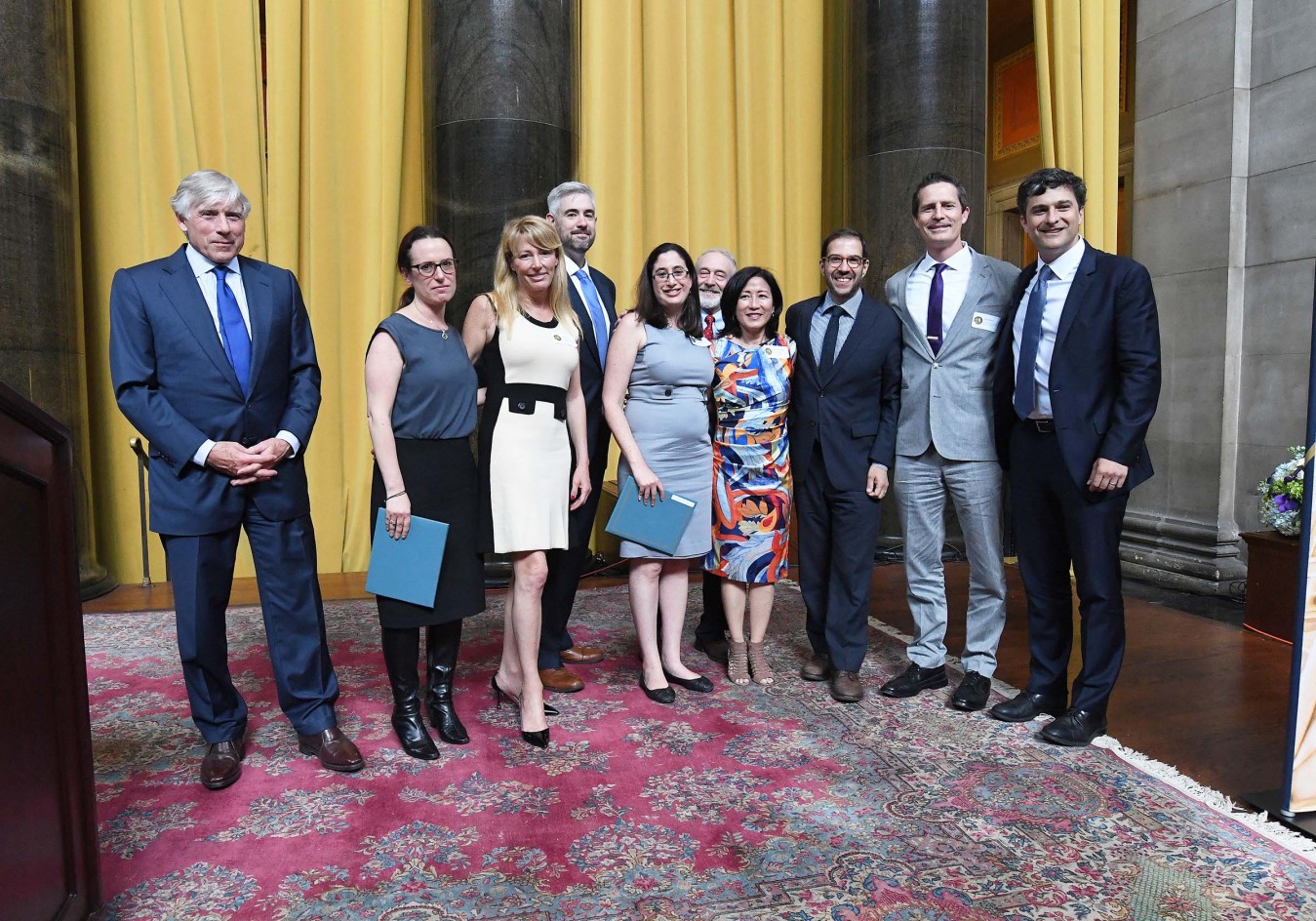
Staff members from The New York Times and The Washington Post (from left: Maggie Haberman, Jo Becker, Matt Apuzzo, Rosalind Helderman, Tom Hamburger, Ellen Nakashima, Adam Entous, Greg Miller and Mark Mazzetti) accept the 2018 Pulitzer Prize for National Reporting from Columbia University President Lee Bollinger. (Photo: Eileen Barroso/Columbia University)
Winning Work
Talks with Russia envoy said to have occurred before Trump took office
By Greg Miller, Adam Entous and Ellen Nakashima
National security adviser Michael Flynn privately discussed U.S. sanctions against Russia with that country’s ambassador to the United States during the month before President Trump took office, contrary to public assertions by Trump officials, current and former U.S. officials said.
Flynn’s communications with Russian Ambassador Sergey Kislyak were interpreted by some senior U.S. officials as an inappropriate and potentially illegal signal to the Kremlin that it could expect a reprieve from sanctions that were being imposed by the Obama administration in late December to punish Russia for its alleged interference in the 2016 election.
Flynn on Wednesday denied that he had discussed sanctions with Kislyak. Asked in an interview whether he had ever done so, he twice said, “No.”
On Thursday, Flynn, through his spokesman, backed away from the denial. The spokesman said Flynn “indicated that while he had no recollection of discussing sanctions, he couldn’t be certain that the topic never came up.”
Officials said this week that the FBI is continuing to examine Flynn’s communications with Kislyak. Several officials emphasized that while sanctions were discussed, they did not see evidence that Flynn had an intent to convey an explicit promise to take action after the inauguration.
Flynn’s contacts with the ambassador attracted attention within the Obama administration because of the timing. U.S. intelligence agencies were then concluding that Russia had waged a cyber campaign designed in part to help elect Trump; his senior adviser on national security matters was discussing the potential consequences for Moscow, officials said.
The talks were part of a series of contacts between Flynn and Kislyak that began before the Nov. 8 election and continued during the transition, officials said. In a recent interview, Kislyak confirmed that he had communicated with Flynn by text message, by phone and in person, but declined to say whether they had discussed sanctions.
The emerging details contradict public statements by incoming senior administration officials including Mike Pence, then the vice president-elect. They acknowledged only a handful of text messages and calls exchanged between Flynn and Kislyak late last year and denied that either ever raised the subject of sanctions.
“They did not discuss anything having to do with the United States’ decision to expel diplomats or impose censure against Russia,” Pence said in an interview with CBS News last month, noting that he had spoken with Flynn about the matter. Pence also made a more sweeping assertion, saying there had been no contact between members of Trump’s team and Russia during the campaign. To suggest otherwise, he said, “is to give credence to some of these bizarre rumors that have swirled around the candidacy.”
Neither of those assertions is consistent with the fuller account of Flynn’s contacts with Kislyak provided by officials who had access to reports from U.S. intelligence and law enforcement agencies that routinely monitor the communications of Russian diplomats. Nine current and former officials, who were in senior positions at multiple agencies at the time of the calls, spoke on the condition of anonymity to discuss intelligence matters.
All of those officials said Flynn’s references to the election-related sanctions were explicit. Two of those officials went further, saying that Flynn urged Russia not to overreact to the penalties being imposed by President Barack Obama, making clear that the two sides would be in position to review the matter after Trump was sworn in as president.
“Kislyak was left with the impression that the sanctions would be revisited at a later time,” said a former official.
A third official put it more bluntly, saying that either Flynn had misled Pence or that Pence misspoke. An administration official stressed that Pence made his comments based on his conversation with Flynn. The sanctions in question have so far remained in place.
The nature of Flynn’s pre-inauguration message to Kislyak triggered debate among officials in the Obama administration and intelligence agencies over whether Flynn had violated a law against unauthorized citizens interfering in U.S. disputes with foreign governments, according to officials familiar with that debate. Those officials were already alarmed by what they saw as a Russian assault on the U.S. election.
U.S. officials said that seeking to build such a case against Flynn would be daunting. The law against U.S. citizens interfering in foreign diplomacy, known as the Logan Act, stems from a 1799 statute that has never been prosecuted. As a result, there is no case history to help guide authorities on when to proceed or how to secure a conviction.
Officials also cited political sensitivities. Prominent Americans in and out of government are so frequently in communication with foreign officials that singling out one individual — particularly one poised for a top White House job — would invite charges of political persecution.
Former U.S. officials also said aggressive enforcement would probably discourage appropriate contact. Michael McFaul, who served as U.S. ambassador to Russia during the Obama administration, said that he was in Moscow meeting with officials in the weeks leading up to Obama’s 2008 election win.
“As a former diplomat and U.S. government official, one needs to be able to have contact with foreigners to do one’s job,” McFaul said. McFaul, a Russia scholar, said he was careful never to signal pending policy changes before Obama took office.
On Wednesday, Flynn said that he first met Kislyak in 2013 when Flynn was director of the Defense Intelligence Agency and made a trip to Moscow. Kislyak helped coordinate that trip, Flynn said.
Flynn said that he spoke to Kislyak on a range of subjects in late December, including arranging a call between Russian President Vladimir Putin and Trump after the inauguration and expressing his condolences after Russia’s ambassador to Turkey was assassinated. “I called to say I couldn’t believe the murder of their ambassador,” Flynn said. Asked whether there was any mention of sanctions in his communications with Kislyak, Flynn said, “No.”
Kislyak characterized his conversations with Flynn as benign during a brief interview at a conference this month. “It’s something all diplomats do,” he said.
Kislyak said that he had been in contact with Flynn since before the election, but declined to answer questions about the subjects they discussed. Kislyak is known for his assiduous cultivation of high-level officials in Washington and was seated in the front row of then-GOP candidate Trump’s first major foreign policy speech in April of last year. The ambassador would not discuss the origin of his relationship with Flynn.
In his CBS interview, Pence said that Flynn had “been in touch with diplomatic leaders, security leaders in some 30 countries. That’s exactly what the incoming national security adviser should do.”
Official concern about Flynn’s interactions with Kislyak was heightened when Putin declared on Dec. 30 that Moscow would not retaliate after the Obama administration announced a day earlier the expulsion of 35 suspected Russian spies and the forced closure of Russian-owned compounds in Maryland and New York.
Instead, Putin said he would focus on “the restoration of Russia-United States relations” after Obama left office, and put off considering any retaliatory measures until Moscow had a chance to evaluate Trump’s policies.
Trump responded with effusive praise for Putin. “Great move on the delay,” he said in a posting to his Twitter account. “I always knew he was very smart.”
Putin’s reaction cut against a long practice of reciprocation on diplomatic expulsions, and came after his foreign minister had vowed that there would be reprisals against the United States.
Putin’s muted response — which took White House officials by surprise — raised some officials’ suspicions that Moscow may have been promised a reprieve, and triggered a search by U.S. spy agencies for clues.
“Something happened in those 24 hours” between Obama’s announcement and Putin’s response, a former senior U.S. official said. Officials began poring over intelligence reports, intercepted communications and diplomatic cables, and saw evidence that Flynn and Kislyak had communicated by text and telephone around the time of the announcement.
Trump transition officials acknowledged those contacts weeks later after they were reported in The Washington Post but denied that sanctions were discussed. Trump press secretary Sean Spicer said Jan. 13 that Flynn had “reached out to” the Russian ambassador on Christmas Day to extend holiday greetings. On Dec. 28, as word of the Obama sanctions spread, Kislyak sent a message to Flynn requesting a call. “Flynn took that call,” Spicer said, adding that it “centered on the logistics of setting up a call with the president of Russia and [Trump] after the election.”
Other officials were categorical. “I can tell you that during his call, sanctions were not discussed whatsoever,” a senior transition official told The Post at the time. When Pence faced questions on television that weekend, he said “those conversations that happened to occur around the time that the United States took action to expel diplomats had nothing whatsoever to do with those sanctions.”
Current and former U.S. officials said that assertion was not true.
Like Trump, Flynn has shown an affinity for Russia that is at odds with the views of most of his military and intelligence peers. Flynn raised eyebrows in 2015 when he appeared in photographs seated next to Putin at a lavish party in Moscow for the Kremlin-controlled RT television network.
In an earlier interview with The Post, Flynn acknowledged that he had been paid through his speakers bureau to give a speech at the event and defended his attendance by saying he saw no distinction between RT and U.S. news channels, including CNN.
A retired U.S. Army lieutenant general, Flynn served multiple deployments to Iraq and Afghanistan in the years after the Sept. 11, 2001, attacks — tours in which he held a series of high-level intelligence assignments working with U.S. Special Operations forces hunting al-Qaeda operatives and Islamist militants.
Former colleagues said that narrow focus led Flynn to see the threat posed by Islamist groups as overwhelming other security concerns, including Russia’s renewed aggression. Instead, Flynn came to see America’s long-standing adversary as a potential ally against terrorist groups, and himself as being in a unique position to forge closer ties after traveling to Moscow in 2013 while serving as director of the Defense Intelligence Agency.
Flynn has frequently boasted that he was the first DIA director to be invited into the headquarters of Russia’s military intelligence directorate, known as the GRU, although at least one of his predecessors was granted similar access. “Flynn thought he developed some rapport with the GRU chief,” a former senior U.S. military official said.
U.S. intelligence agencies say they have tied the GRU to Russia’s theft of troves of email messages from Democratic Party computer networks and accuse Moscow of then delivering those materials to the anti-secrecy group WikiLeaks, which published them in phases during the campaign to hurt Hillary Clinton, Trump’s Democratic rival.
Flynn was pushed out of the DIA job in 2014 amid concerns about his management of the sprawling agency. He became a fierce critic of the Obama administration before joining the Trump campaign last year.
Karen DeYoung, Tom Hamburger, Julie Tate and Philip Rucker contributed to this report.
By Adam Entous, Ellen Nakashima and Philip Rucker
The acting attorney general informed the Trump White House late last month that she believed Michael Flynn had misled senior administration officials about the nature of his communications with the Russian ambassador to the United States, and warned that the national security adviser was potentially vulnerable to Russian blackmail, current and former U.S. officials said.
The message, delivered by Sally Q. Yates and a senior career national security official to the White House counsel, was prompted by concerns that Flynn, when asked about his calls and texts with the Russian diplomat, had told Vice President-elect Mike Pence and others that he had not discussed the Obama administration sanctions on Russia for its interference in the 2016 election, the officials said. It is unclear what the White House counsel, Donald McGahn, did with the information.
Flynn resigned Monday night in the wake of revelations about his contacts with the Russian ambassador.
In the waning days of the Obama administration, James R. Clapper Jr., who was the director of national intelligence, and John Brennan, the CIA director at the time, shared Yates’s concerns and concurred with her recommendation to inform the Trump White House. They feared that “Flynn had put himself in a compromising position” and thought that Pence had a right to know that he had been misled, according to one of the officials, who, like others, spoke on the condition of anonymity to discuss intelligence matters.
A senior Trump administration official said before Flynn’s resignation that the White House was aware of the matter, adding that “we’ve been working on this for weeks.”
The current and former officials said that although they believed that Pence was misled about the contents of Flynn’s communications with the Russian ambassador, they couldn’t rule out that Flynn was acting with the knowledge of others in the transition.
The FBI, Yates, Clapper and Brennan declined to comment on the matter.
In a Feb. 8 interview with The Washington Post, Flynn categorically denied discussing sanctions with Russian Ambassador Sergey Kislyak, repeating public assertions made in January by top Trump officials. One day after the interview, Flynn revised his account, telling The Post through a spokesman that he “couldn’t be certain that the topic never came up.”
Two officials said a main topic of the relevant call was the sanctions. Officials also said there was no evidence that Russia had attempted to exploit the discrepancy between public statements by Trump officials and what Flynn had discussed.
Flynn told The Post earlier this month that he first met Kislyak in 2013, when Flynn was director of the Defense Intelligence Agency and made a trip to Moscow.
U.S. intelligence reports during the 2016 presidential campaign showed that Kislyak was in touch with Flynn, officials said. Communications between the two continued after Trump’s victory on Nov. 8, according to officials with access to intelligence reports on the matter.
Kislyak, in a brief interview with The Post, confirmed having contacts with Flynn before and after the election, but he declined to say what was discussed.
For Yates and other officials, concerns about the communications peaked in the days after the Obama administration on Dec. 29 announced measures to punish Russia for what it said was the Kremlin’s interference in the election in an attempt to help Trump.
After the sanctions were rolled out, the Obama administration braced itself for the Russian retaliation. To the surprise of many U.S. officials, Russian President Vladimir Putin announced on Dec. 30 that there would be no response. Trump praised the decision on Twitter.
Intelligence analysts began to search for clues that could help explain Putin’s move. The search turned up Kislyak’s communications, which the FBI routinely monitors, and the phone call in question with Flynn, a retired Army lieutenant general with years of intelligence experience.
From that call and subsequent intercepts, FBI agents wrote a secret report summarizing Flynn’s discussions with Kislyak.
Yates, then the deputy attorney general, considered Flynn’s comments in the intercepted call to be “highly significant” and “potentially illegal,” according to an official familiar with her thinking.
Yates and other intelligence officials suspected that Flynn could be in violation of an obscure U.S. statute known as the Logan Act, which bars U.S. citizens from interfering in diplomatic disputes with another country.
At the same time, Yates and other law enforcement officials knew there was little chance of bringing against Flynn a case related to the Logan Act, a statute that has never been used in a prosecution. In addition to the legal and political hurdles, Yates and other officials were aware of an FBI investigation looking at possible contacts between Trump associates and Russia, which now included the Flynn-Kislyak communications.
Word of the calls leaked out on Jan. 12 in an op-ed by Post columnist David Ignatius. “What did Flynn say, and did it undercut U.S. sanctions?” Ignatius wrote, citing the Logan Act.
The next day, a Trump transition official told The Post, “I can tell you that during his call, sanctions were not discussed whatsoever.”
White House press secretary Sean Spicer, in a conference call with reporters on Jan. 13, said that the conversation between Flynn and Kislyak had “centered on the logistics” of a post-inauguration call between Trump and Putin. “That was it, plain and simple,” Spicer added.
On Jan. 15, Pence was asked about the phone call during an appearance on CBS’s “Face the Nation.” Citing a conversation he had with Flynn, Pence said the incoming national security adviser and Kislyak “did not discuss anything having to do with the United States’ decision to expel diplomats or impose censure against Russia.”
Before the Pence statement on Jan. 15, top Justice Department and intelligence officials had discussed whether the incoming Trump White House should be notified about the contents of the Flynn-Kislyak communications.
Pence’s statement on CBS made the issue more urgent, current and former officials said, because U.S. intelligence agencies had reason to believe that Russia was aware that Flynn and Kislyak had discussed sanctions in their December call, contrary to public statements.
The internal debate over how to handle the intelligence on Flynn and Kislyak came to a head on Jan. 19, Obama’s last full day in office.
Yates, Clapper and Brennan argued for briefing the incoming administration so the new president could decide how to deal with the matter. The officials discussed options, including telling Pence, the incoming White House counsel, the incoming chief of staff or Trump himself.
FBI Director James B. Comey initially opposed notification, citing concerns that it could complicate the agency’s investigation.
Clapper and Brennan left their positions when Trump was sworn in, but Yates stayed on as acting attorney general until Jan. 30, when Trump fired her for refusing to defend his executive order temporarily barring refugees and people from seven majority-Muslim countries — an action that had been challenged in court.
A turning point came after Jan. 23, when Spicer, in his first official media briefing, again was asked about Flynn’s communications with Kislyak. Spicer said that he had talked to Flynn about the issue “again last night.” There was just “one call,” Spicer said. And it covered four subjects: a plane crash that claimed the lives of a Russian military choir; Christmas greetings; Russian-led talks over the Syrian civil war; and the logistics of setting up a call between Putin and Trump. Spicer said that was the extent of the conversation.
Yates again raised the issue with Comey, who now backed away from his opposition to informing the White House. Yates and the senior career national security official spoke to McGahn, the White House counsel, who didn’t respond Monday to a request for comment.
Trump declined to publicly back his national security adviser after the news broke.
On Monday afternoon, Kellyanne Conway, counselor to the president, said Trump had “full confidence” in Flynn. Minutes later, however, Spicer delivered a contradictory statement to reporters.
“The president is evaluating the situation,” Spicer’s statement read. “He’s speaking to Vice President Pence relative to the conversation the vice president had with Gen. Flynn and also speaking to various other people about what he considers the single most important subject there is: Our national security.”
And then late Monday, Flynn resigned.
Karen DeYoung and Greg Miller contributed to this report.
Arrangement fell apart but shows bureau found his inquiry credible
By Tom Hamburger and Rosalind S. Helderman
The former British spy who authored a controversial dossier on behalf of Donald Trump’s political opponents alleging ties between Trump and Russia reached an agreement with the FBI a few weeks before the election for the bureau to pay him to continue his work, according to several people familiar with the arrangement.
The agreement to compensate former MI6 agent Christopher Steele came as U.S. intelligence agencies reached a consensus that the Russians had interfered in the presidential election by orchestrating hacks of Democratic Party email accounts.
While Trump has derided the dossier as “fake news” compiled by his political opponents, the FBI’s arrangement with Steele shows that the bureau considered him credible and found his information, while unproved, to be worthy of further investigation.
Ultimately, the FBI did not pay Steele. Communications between the bureau and the former spy were interrupted as Steele’s now-famous dossier became the subject of news stories, congressional inquiries and presidential denials, according to the people familiar with the arrangement, who spoke on the condition of anonymity because they were not authorized to discuss the matter.
At the time of the October agreement, FBI officials probing Russian activities, including possible contacts between Trump associates and Russian entities, were aware of the information that Steele had been gathering while working for a Washington research firm hired by supporters of Democratic nominee Hillary Clinton, according to the people familiar with the agreement. The firm was due to stop paying Steele as Election Day approached, but Steele felt his work was not done, these people said.
Steele was familiar to the FBI, in part because the bureau had previously hired him to help a U.S. inquiry into alleged corruption in the world soccer organization FIFA. The FBI sometimes pays informants, sources and outside investigators to assist in its work. Steele was known for the quality of his past work and for the knowledge he had developed over nearly 20 years working on Russia-related issues for British intelligence. The Washington Post was not able to determine how much the FBI intended to pay Steele had their relationship remained intact.
The dossier he produced last year alleged, among other things, that associates of Trump colluded with the Kremlin on cyberattacks on Democrats and that the Russians held compromising material about the Republican nominee.
These and other explosive claims have not been verified, and they have been vigorously denied by Trump and his allies.
The FBI, as well as the Senate Intelligence Committee, is investigating Russian interference in the election and alleged contacts between Trump’s associates and the Kremlin.
On Tuesday, House Speaker Paul D. Ryan (R-Wis.) told reporters that he had seen “no evidence so far” of Trump campaign contacts with Russia but said a bipartisan House inquiry would proceed so that “no stone is unturned.”
The revelation that the FBI agreed to pay Steele at the same time he was being paid by Clinton supporters to dig into Trump’s background could further strain relations between the law enforcement agency and the White House.
A spokesman for the FBI declined to comment. Steele’s London-based attorney did not respond to questions about the agreement.
White House press secretary Sean Spicer declined to comment.
Steele, 53, began his Trump investigation in June 2016 after working for another client preparing a report on Russian efforts to interfere with politics in Europe.
U.S. intelligence had been independently tracking Russian efforts to influence electoral outcomes in Europe.
Steele was hired to work for a Washington research firm, Fusion GPS, that was providing information to a Democratic client. Fusion GPS began doing Trump research in early 2016, before it hired Steele, on behalf of a Republican opposed to the businessman’s candidacy. The firm declined to identify its clients.
Steele’s early reports alleged a plan directed by Russian President Vladimir Putin to help Trump in 2016.
“Russian regime has been cultivating, supporting and assisting TRUMP for at least 5 years,” Steele wrote in June.
Steele’s information was provided by an intermediary to the FBI and U.S. intelligence officials after the Democratic National Convention in July, when hacked Democratic emails were first released by WikiLeaks, according to a source familiar with the events. After the convention, Steele contacted a friend in the FBI to personally explain what he had found.
As summer turned to fall, Steele became concerned that the U.S. government was not taking the information he had uncovered seriously enough, according to two people familiar with the situation.
In October, anticipating that funding supplied through the original client would dry up, Steele and the FBI reached a spoken understanding: He would continue his work looking at the Kremlin’s ties to Trump and receive compensation for his efforts.
But Steele’s frustration deepened when FBI Director James B. Comey, who had been silent on the Russia inquiry, announced publicly 11 days before the election that the bureau was investigating a newly discovered cache of emails Clinton had exchanged using her private server, according to people familiar with Steele’s thinking.
Those people say Steele’s frustration with the FBI peaked after an Oct. 31 New York Times story that cited law enforcement sources drawing conclusions that he considered premature. The article said that the FBI had not yet found any “conclusive or direct link” between Trump and the Russian government and that the Russian hacking was not intended to help Trump.
After the election, the intelligence community concluded that Russia’s interference had been intended to assist Trump.
In January, top intelligence and law enforcement officials briefed Trump and President Barack Obama on those findings. In addition, they provided a summary of the core allegations of Steele’s dossier.
News of that briefing soon became public. Then BuzzFeed posted a copy of Steele’s salacious but unproven dossier online, sparking outrage from Trump.
“It’s all fake news. It’s phony stuff. It didn’t happen,” Trump told reporters in January. “It was a group of opponents that got together — sick people — and they put that crap together.”
He later tweeted that Steele was a “failed spy.”
The development marked the end of the FBI’s relationship with Steele.
After he was publicly identified by the Wall Street Journal as the dossier’s author, Steele went into hiding. U.S. officials took pains to stress that his report was not a U.S. government product and that it had not influenced their broader conclusions that the Russian government had hacked the emails of Democratic officials and released those emails with the intention of helping Trump win the presidency.
“The [intelligence community] has not made any judgment that the information in this document is reliable, and we did not rely upon it in any way for our conclusions,” then-Director of National Intelligence James R. Clapper Jr. said in a statement in January.
The owner of a technology company identified in Steele’s dossier as a participant in the hacks is now suing Steele and BuzzFeed for defamation. BuzzFeed apologized to the executive and blocked out his name in the published document.
Comey spent almost two hours this month briefing the Senate Intelligence Committee. Democrats in the House have informally reached out to Steele in recent weeks to ask about his willingness to testify or cooperate, according to people familiar with the requests. Steele has so far not responded, they said.
Revelation contradicts his testimony at confirmation hearing
By Adam Entous, Ellen Nakashima and Greg Miller
Then-Sen. Jeff Sessions (R-Ala.) spoke twice last year with Russia’s ambassador to the United States, Justice Department officials said, encounters he did not disclose when asked about possible contacts between members of President Trump’s campaign and representatives of Moscow during Sessions’s confirmation hearing to become attorney general.
One of the meetings was a private conversation between Sessions and Russian Ambassador Sergey Kislyak that took place in September in the senator’s office, at the height of what U.S. intelligence officials say was a Russian cyber campaign to upend the U.S. presidential race.
The previously undisclosed discussions could fuel new congressional calls for the appointment of a special counsel to investigate Russia’s alleged role in the 2016 presidential election. As attorney general, Sessions oversees the Justice Department and the FBI, which have been leading investigations into Russian meddling and any links to Trump’s associates. He has so far resisted calls to recuse himself.
When Sessions spoke with Kislyak in July and September, the senator was a senior member of the influential Armed Services Committee as well as one of Trump’s top foreign policy advisers. Sessions played a prominent role supporting Trump on the stump after formally joining the campaign in February 2016.
At his Jan. 10 Judiciary Committee confirmation hearing, Sessions was asked by Sen. Al Franken (D-Minn.) what he would do if he learned of any evidence that anyone affiliated with the Trump campaign communicated with the Russian government in the course of the 2016 campaign.
“I’m not aware of any of those activities,” he responded. He added: “I have been called a surrogate at a time or two in that campaign and I did not have communications with the Russians.”
Officials said Sessions did not consider the conversations relevant to the lawmakers’ questions and did not remember in detail what he discussed with Kislyak.
“There was absolutely nothing misleading about his answer,” said Sarah Isgur Flores, Sessions’s spokeswoman.
In January, Sen. Patrick J. Leahy (D-Vt.) asked Sessions for answers to written questions. “Several of the President-elect’s nominees or senior advisers have Russian ties. Have you been in contact with anyone connected to any part of the Russian government about the 2016 election, either before or after election day?” Leahy wrote.
Sessions responded with one word: “No.”
In a statement issued Wednesday night, Sessions said he “never met with any Russian officials to discuss issues of the campaign. I have no idea what this allegation is about. It is false.”
Justice officials said Sessions met with Kislyak on Sept. 8 in his capacity as a member of the armed services panel rather than in his role as a Trump campaign surrogate.
“He was asked during the hearing about communications between Russia and the Trump campaign — not about meetings he took as a senator and a member of the Armed Services Committee,” Flores said.
She added that Sessions last year had more than 25 conversations with foreign ambassadors as a senior member of the Armed Services Committee, including the British, Korean, Japanese, Polish, Indian, Chinese, Canadian, Australian and German ambassadors, in addition to Kislyak.
In the case of the September meeting, one department official who came to the defense of the attorney general said, “There’s just not strong recollection of what was said.”
The Russian ambassador did not respond to requests for comment about his contacts with Sessions.
The Washington Post contacted all 26 members of the 2016 Senate Armed Services Committee to see whether any lawmakers besides Sessions met with Kislyak in 2016. Of the 20 lawmakers who responded, every senator, including Chairman John McCain (R-Ariz.), said they did not meet with the Russian ambassador last year. The other lawmakers on the panel did not respond as of Wednesday evening.
“Members of the committee have not been beating a path to Kislyak’s door,” a senior Senate Armed Services Committee staffer said, citing tensions in relations with Moscow. Besides Sessions, the staffer added, “There haven’t been a ton of members who are looking to meet with Kislyak for their committee duties.”
Last month, The Post reported that Trump national security adviser Michael Flynn had discussed U.S. sanctions with Kislyak during the month before Trump took office, contrary to public assertions by Mike Pence, the vice president-elect, and other top Trump officials. Flynn was forced to resign the following week.
When asked to comment on Sessions’s contacts with Kislyak, Franken said in a statement to The Post on Wednesday: “If it’s true that Attorney General Sessions met with the Russian ambassador in the midst of the campaign, then I am very troubled that his response to my questioning during his confirmation hearing was, at best, misleading.”
Franken added: “It is now clearer than ever that the attorney general cannot, in good faith, oversee an investigation at the Department of Justice and the FBI of the Trump-Russia connection, and he must recuse himself immediately.”
Several Democratic members of the House on Wednesday night called on Sessions to resign from his post.
“After lying under oath to Congress about his own communications with the Russians, the Attorney General must resign,” House Minority Leader Nancy Pelosi (D-Calif.) said in a statement, adding that “Sessions is not fit to serve as the top law enforcement officer of our country.”
Sen. Ron Wyden (D-Ore.), a senior member of the Senate Intelligence Committee, said on Twitter late Wednesday that “we need a special counsel to investigate Trump associates’ ties to Russia.”
Sen. Lindsey O. Graham (R-S.C.) said at a CNN town hall Wednesday night that if the substance of Sessions’s conversations with the Russian ambassador proved to be improper or suspect, he too would join the call for Sessions to recuse himself from the investigation.
“If there is something there and it goes up the chain of investigation, it is clear to me that Jeff Sessions, who is my dear friend, cannot make that decision about Trump,” Graham said — although he stressed that Sessions’s contacts with the Russian ambassador could have been “innocent.”
“But if there’s something there that the FBI thinks is criminal in nature, then for sure you need a special prosecutor. If that day ever comes, I’ll be the first one to say it needs to be somebody other than Jeff.”
Current and former U.S. officials say they see Kislyak as a diplomat, not an intelligence operative. But they were not sure to what extent, if any, Kislyak was aware of or involved in the covert Russian election campaign.
Steven Hall, former head of Russia operations at the CIA, said that Russia would have been keenly interested in cultivating a relationship with Sessions because of his role on key congressional committees and as an early adviser to Trump.
Sessions’s membership on the Armed Services Committee would have made him a priority for the Russian ambassador. “The fact that he had already placed himself at least ideologically behind Trump would have been an added bonus for Kislyak,” Hall said.
Michael McFaul, a Stanford University professor who until 2014 served as U.S. ambassador to Russia, said he was not surprised that Kislyak would seek a meeting with Sessions. “The weird part is to conceal it,” he said. “That was at the height of all the discussions of what Russia was doing during the election.”
Two months before the September meeting, Sessions attended a Heritage Foundation event in July on the sidelines of the Republican National Convention that was attended by about 50 ambassadors. When the event was over, a small group of ambassadors approached Sessions as he was leaving the podium, and Kislyak was among them, the Justice Department official said.
Sessions then spoke individually to some of the ambassadors, including Kislyak, the official said. In the informal exchanges, the ambassadors expressed appreciation for his remarks and some of them invited him to events they were sponsoring, said the official, citing a former Sessions staffer who was at the event.
Democratic lawmakers, including senior members of the Senate Judiciary Committee, have demanded in recent weeks that Sessions recuse himself from the government’s inquiry into possible ties between Trump associates and Russia.
Last week, Rep. Darrell Issa (R-Calif.), a senior member of the House Judiciary Committee, became one of the few Republican representatives to state publicly the need for an independent investigation.
Sessions’s public position on Russia has evolved over time.
In an interview with RealClear World on the sidelines of the German Marshall Fund’s Brussels Forum in March 2015, Sessions said the United States and Europe “have to unify” against Russia.
More than a year later, he spoke about fostering a stronger relationship with the Kremlin. In a July 2016 interview with CNN’s “State of the Union,” Sessions praised Trump’s plan to build better relations with Russian President Vladimir Putin.
“Donald Trump is right. We need to figure out a way to end this cycle of hostility that’s putting this country at risk, costing us billions of dollars in defense, and creating hostilities,” Sessions told CNN.
Asked whether he viewed Putin as a good or bad leader, Sessions told CNN: “We have a lot of bad leaders around the world that operate in ways we would never tolerate in the United States. But the question is, can we have a more peaceful, effective relationship with Russia? Utilizing interests that are similar in a realistic way to make this world a safer place and get off this dangerous hostility with Russia? I think it’s possible.”
Julie Tate, Robert Costa and Karoun Demirjian contributed to this report.
HIGHLY CLASSIFIED INFORMATION ON ISIS
Disclosure came at White House meeting, officials say
By Greg Miller and Greg Jaffe
President Trump revealed highly classified information to the Russian foreign minister and ambassador in a White House meeting last week, according to current and former U.S. officials, who said Trump’s disclosures jeopardized a critical source of intelligence on the Islamic State.
The information the president relayed had been provided by a U.S. partner through an intelligence-sharing arrangement considered so sensitive that details have been withheld from allies and tightly restricted even within the U.S. government, officials said.
The partner had not given the United States permission to share the material with Russia, and officials said Trump’s decision to do so endangers cooperation from an ally that has access to the inner workings of the Islamic State. After Trump’s meeting, senior White House officials took steps to contain the damage, placing calls to the CIA and the National Security Agency.
“This is code-word information,” said a U.S. official familiar with the matter, using terminology that refers to one of the highest classification levels used by American spy agencies. Trump “revealed more information to the Russian ambassador than we have shared with our own allies.”
The revelation comes as the president faces rising legal and political pressure on multiple Russia-related fronts. Last week, he fired FBI Director James B. Comey in the midst of a bureau investigation into possible links between the Trump campaign and Moscow. Trump’s subsequent admission that his decision was driven by “this Russia thing” was seen by critics as attempted obstruction of justice.
One day after dismissing Comey, Trump welcomed Russian Foreign Minister Sergei Lavrov and Ambassador Sergey Kislyak — a key figure in earlier Russia controversies — into the Oval Office. It was during that meeting, officials said, that Trump went off script and began describing details of an Islamic State terrorist threat related to the use of laptop computers on aircraft.
For almost anyone in government, discussing such matters with an adversary would be illegal. As president, Trump has broad authority to declassify government secrets, making it unlikely that his disclosures broke the law.
White House officials involved in the meeting said Trump discussed only shared concerns about terrorism.
“The president and the foreign minister reviewed common threats from terrorist organizations to include threats to aviation,” said H.R. McMaster, the national security adviser, who participated in the meeting. “At no time were any intelligence sources or methods discussed, and no military operations were disclosed that were not already known publicly.”
McMaster reiterated his statement in a subsequent appearance at the White House on Monday and described the Washington Post story as “false,” but did not take any questions.
In their statements, White House officials emphasized that Trump had not discussed specific intelligence sources and methods, rather than addressing whether he had disclosed information drawn from sensitive sources.
The CIA declined to comment, and the NSA did not respond to requests for comment.
But officials expressed concern about Trump’s handling of sensitive information as well as his grasp of the potential consequences. Exposure of an intelligence stream that has provided critical insight into the Islamic State, they said, could hinder the United States’ and its allies’ ability to detect future threats.
“It is all kind of shocking,” said a former senior U.S. official who is close to current administration officials. “Trump seems to be very reckless and doesn’t grasp the gravity of the things he’s dealing with, especially when it comes to intelligence and national security. And it’s all clouded because of this problem he has with Russia.”
In his meeting with Lavrov, Trump seemed to be boasting about his inside knowledge of the looming threat. “I get great intel. I have people brief me on great intel every day,” the president said, according to an official with knowledge of the exchange.
Trump went on to discuss aspects of the threat that the United States learned only through the espionage capabilities of a key partner. He did not reveal the specific intelligence-gathering method, but he described how the Islamic State was pursuing elements of a specific plot and how much harm such an attack could cause under varying circumstances. Most alarmingly, officials said, Trump revealed the city in the Islamic State’s territory where the U.S. intelligence partner detected the threat.
The Post is withholding most plot details, including the name of the city, at the urging of officials who warned that revealing them would jeopardize important intelligence capabilities.
“Everyone knows this stream is very sensitive, and the idea of sharing it at this level of granularity with the Russians is troubling,” said a former senior U.S. counterterrorism official who also worked closely with members of the Trump national security team. He and others spoke on the condition of anonymity, citing the sensitivity of the subject.
The identification of the location was seen as particularly problematic, officials said, because Russia could use that detail to help identify the U.S. ally or intelligence capability involved. Officials said the capability could be useful for other purposes, possibly providing intelligence on Russia’s presence in Syria. Moscow would be keenly interested in identifying that source and perhaps disrupting it.
Russia and the United States both regard the Islamic State as an enemy and share limited information about terrorist threats. But the two nations have competing agendas in Syria, where Moscow has deployed military assets and personnel to support President Bashar al-Assad.
“Russia could identify our sources or techniques,” the senior U.S. official said.
A former intelligence official who handled high-level intelligence on Russia said that given the clues Trump provided, “I don’t think that it would be that hard [for Russian spy services] to figure this out.”
At a more fundamental level, the information wasn’t the United States’ to provide to others. Under the rules of espionage, governments — and even individual agencies — are given significant control over whether and how the information they gather is disseminated, even after it has been shared. Violating that practice undercuts trust considered essential to sharing secrets.
The officials declined to identify the ally but said it has previously voiced frustration with Washington’s inability to safeguard sensitive information related to Iraq and Syria.
“If that partner learned we’d given this to Russia without their knowledge or asking first, that is a blow to that relationship,” the U.S. official said.
Trump also described measures the United States has taken or is contemplating to counter the threat, including military operations in Iraq and Syria, as well as other steps to tighten security, officials said.
The officials would not discuss details of those measures, but the Department of Homeland Security recently disclosed that it is considering banning laptops and other large electronic devices from carry-on bags on flights between Europe and the United States. The United States and Britain imposed a similar ban in March affecting travelers passing through airports in 10 Muslim-majority countries.
Trump cast the countermeasures in wistful terms. “Can you believe the world we live in today?” he said, according to one official. “Isn’t it crazy?”
Lavrov and Kislyak were also accompanied by aides.
A Russian photographer took photos of part of the session that were released by the Russian state-owned Tass news agency. No U.S. news organization was allowed to attend any part of the meeting.
Senior White House officials appeared to recognize quickly that Trump had overstepped and moved to contain the potential fallout. Thomas P. Bossert, assistant to the president for homeland security and counterterrorism, placed calls to the directors of the CIA and the NSA, the services most directly involved in the intelligence-sharing arrangement with the partner.
One of Bossert’s subordinates also called for the problematic portion of Trump’s discussion to be stricken from internal memos and for the full transcript to be limited to a small circle of recipients, efforts to prevent sensitive details from being disseminated further or leaked.
White House officials defended Trump. “This story is false,” said Dina Powell, deputy national security adviser for strategy. “The president only discussed the common threats that both countries faced.”
But officials could not explain why staff members nevertheless felt it necessary to alert the CIA and the NSA.
Sen. Bob Corker (R-Tenn.) said he would rather comment on the revelations in the Post story after “I know a little bit more about it,” but added: “Obviously, they are in a downward spiral right now and have got to figure out a way to come to grips with all that’s happening. And the shame of it is, there’s a really good national security team in place.”
Corker also said, “The chaos that is being created by the lack of discipline is creating an environment that I think makes — it creates a worrisome environment.”
Trump has repeatedly gone off-script in his dealings with high-ranking foreign officials, most notably in his contentious introductory conversation with the Australian prime minister earlier this year. He has also faced criticism for seemingly lax attention to security at his Florida retreat, Mar-a-Lago, where he appeared to field preliminary reports of a North Korea missile launch in full view of casual diners.
U.S. officials said that the National Security Council continues to prepare multi-page briefings for Trump to guide him through conversations with foreign leaders, but that he has insisted that the guidance be distilled to a single page of bullet points — and often ignores those.
“He seems to get in the room or on the phone and just goes with it, and that has big downsides,” the second former official said. “Does he understand what’s classified and what’s not? That’s what worries me.”
Lavrov’s reaction to the Trump disclosures was muted, officials said, calling for the United States to work more closely with Moscow on fighting terrorism.
Kislyak has figured prominently in damaging stories about the Trump administration’s ties to Russia. Trump’s first national security adviser, Michael Flynn, was forced to resign just 24 days into the job over his contacts with Kislyak and his misleading statements about them. Attorney General Jeff Sessions was forced to recuse himself from matters related to the FBI’s Russia investigation after it was revealed that he had met and spoke with Kislyak, despite denying any contact with Russian officials during his confirmation hearing.
“I’m sure Kislyak was able to fire off a good cable back to the Kremlin with all the details” he gleaned from Trump, said the former U.S. official who handled intelligence on Russia.
The White House readout of the meeting with Lavrov and Kislyak made no mention of the discussion of a terrorist threat.
“Trump emphasized the need to work together to end the conflict in Syria,” the summary said. The president also “raised Ukraine” and “emphasized his desire to build a better relationship between the United States and Russia.”
Julie Tate and Ellen Nakashima contributed to this report.
SOUGHT REBUTTALS OF FBI’S RUSSIA PROBE
Coats, Rogers did not agree to Trump’s requests
By Adam Entous and Ellen Nakashima
President Trump asked two of the nation’s top intelligence officials in March to help him push back against an FBI investigation into possible coordination between his campaign and the Russian government, according to current and former officials.
Trump made separate appeals to the director of national intelligence, Daniel Coats, and to Adm. Michael S. Rogers, the director of the National Security Agency, urging them to publicly deny the existence of any evidence of collusion during the 2016 election.
Coats and Rogers refused to comply with the requests, which they both deemed to be inappropriate, according to two current and two former officials, who spoke on the condition of anonymity to discuss private communications with the president.
Trump sought the assistance of Coats and Rogers after FBI Director James B. Comey told the House Intelligence Committee on March 20 that the FBI was investigating “the nature of any links between individuals associated with the Trump campaign and the Russian government and whether there was any coordination between the campaign and Russia’s efforts.”
Trump’s conversation with Rogers was documented contemporaneously in an internal memo written by a senior NSA official, according to the officials. It is unclear if a similar memo was prepared by the Office of the Director of National Intelligence to document Trump’s conversation with Coats. Officials said such memos could be made available to both the special counsel now overseeing the Russia investigation and congressional investigators, who might explore whether Trump sought to impede the FBI’s work.
White House officials say Comey’s testimony about the scope of the FBI investigation upset Trump, who has dismissed the FBI and congressional investigations as a “witch hunt.” The president has repeatedly said there was no collusion.
Current and former senior intelligence officials viewed Trump’s requests as an attempt by the president to tarnish the credibility of the agency leading the Russia investigation.
A senior intelligence official said Trump’s goal was to “muddy the waters” about the scope of the FBI probe at a time when Democrats were ramping up their calls for the Justice Department to appoint a special counsel, a step announced last week.
Senior intelligence officials also saw the March requests as a threat to the independence of U.S. spy agencies, which are supposed to remain insulated from partisan issues.
“The problem wasn’t so much asking them to issue statements, it was asking them to issue false statements about an ongoing investigation,” a former senior intelligence official said of the request to Coats.
The NSA and Brian Hale, a spokesman for Coats, declined to comment, citing the ongoing investigation.
“The White House does not confirm or deny unsubstantiated claims based on illegal leaks from anonymous individuals,” a White House spokesman said. “The president will continue to focus on his agenda that he was elected to pursue by the American people.”
In addition to the requests to Coats and Rogers, senior White House officials sounded out top intelligence officials about the possibility of intervening directly with Comey to encourage the FBI to drop its probe of Michael Flynn, Trump’s former national security adviser, according to people familiar with the matter. The officials said the White House appeared uncertain about its power to influence the FBI.
“Can we ask him to shut down the investigation? Are you able to assist in this matter?” one official said of the line of questioning from the White House.
Rep. Adam B. Schiff (Calif.), the ranking Democrat on the House intelligence committee, said the report is “yet another disturbing allegation that the President was interfering in the FBI probe.” Schiff said in a statement that Congress “will need to bring the relevant officials back to testify on these matters, and obtain any memoranda that reflect such conversations.”
The new revelations add to a growing body of evidence that Trump sought to co-opt and then undermine Comey before he fired him May 9. According to notes kept by Comey, Trump first asked for his loyalty at a dinner in January and then, at a meeting the next month, asked him to drop the probe into Flynn. Trump disputes those accounts.
Current and former officials said that Trump either lacks an understanding of the FBI’s role as an independent law enforcement agency or does not care about maintaining such boundaries.
Trump’s effort to use the director of national intelligence and the NSA director to dispute Comey’s statement and to say there was no evidence of collusion echoes President Richard Nixon’s “unsuccessful efforts to use the CIA to shut down the FBI’s investigation of the Watergate break-in on national security grounds,” said Jeffrey H. Smith, a former general counsel at the CIA. Smith called Trump’s actions “an appalling abuse of power.”
Trump made his appeal to Coats days after Comey’s testimony, according to officials.
That same week, Trump telephoned Rogers to make a similar appeal.
In his call with Rogers, Trump urged the NSA director to speak out publicly if there was no evidence of collusion, according to officials briefed on the exchange.
Rogers was taken aback but tried to respectfully explain why he could not do so, the officials said. For one thing, he could not comment on an ongoing investigation. Rogers added that he would not talk about classified matters in public.
While relations between Trump and Comey were strained by the Russia probe, ties between the president and the other intelligence chiefs, including Rogers, Coats and CIA Director Mike Pompeo, appear to be less contentious, according to officials.
Rogers met with Trump in New York shortly after the election, and Trump’s advisers at the time held him out as the leading candidate to be the next director of national intelligence.
The Washington Post subsequently reported that President Barack Obama’s defense secretary and director of national intelligence had recommended that Rogers be removed as head of the NSA.
Ultimately, Trump decided to nominate Coats, rather than Rogers. Coats was sworn in just days before the president made his request.
In February, the Trump White House also sought to enlist senior members of the intelligence community and Congress to push back against suggestions that Trump associates were in frequent contact with Russian officials. But in that case, the White House effort was designed to refute news accounts, not the testimony of a sitting FBI director who was leading an open investigation.
Trump and his allies in Congress have similarly sought to deflect scrutiny over Russia by attempting to pit U.S. intelligence agencies against one another.
In December, Trump’s congressional allies falsely claimed that the FBI did not concur with a CIA assessment that Russia intervened in the 2016 election to help Trump win the White House. Comey and then-CIA Director John Brennan later said that the bureau and the agency were in full agreement on Moscow’s intentions.
As the director of national intelligence, Coats leads the vast U.S. intelligence community, which includes the FBI. But that does not mean he has full visibility into the FBI probe. Coats’s predecessor in the job, James R. Clapper Jr., recently acknowledged that Comey did not brief him on the scope of the Russia investigation. Similarly, it is unclear to what extent the FBI has brought Coats up to speed on the probe’s most sensitive findings.
Officials: Counsel looking at whether president tried to obstruct justice
By Devlin Barrett, Adam Entous, Ellen Nakashima and Sari Horwitz
The special counsel overseeing the investigation into Russia’s role in the 2016 election is interviewing senior intelligence officials as part of a widening probe that now includes an examination of whether President Trump attempted to obstruct justice, officials said.
The move by special counsel Robert S. Mueller III to investigate Trump’s conduct marks a major turning point in the nearly year-old FBI investigation, which until recently focused on Russian meddling during the presidential campaign and on whether there was any coordination between the Trump campaign and the Kremlin. Investigators have also been looking for any evidence of possible financial crimes among Trump associates, officials said.
Trump had received private assurances from then-FBI Director James B. Comey starting in January that he was not personally under investigation. Officials say that changed shortly after Comey’s firing.
Five people briefed on the interview requests, speaking on the condition of anonymity because they were not authorized to discuss the matter publicly, said that Daniel Coats, the current director of national intelligence, Mike Rogers, head of the National Security Agency, and Rogers’s recently departed deputy, Richard Ledgett, agreed to be interviewed by Mueller’s investigators as early as this week. The investigation has been cloaked in secrecy, and it is unclear how many others have been questioned by the FBI.
The NSA said in a statement that it will “fully cooperate with the special counsel” and declined to comment further. The office of the director of national intelligence and Ledgett declined to comment.
The White House now refers all questions about the Russia investigation to Trump’s personal attorney, Marc Kasowitz.
“The FBI leak of information regarding the president is outrageous, inexcusable and illegal,” said Mark Corallo, a spokesman for Kasowitz.
The officials said Coats, Rogers and Ledgett would appear voluntarily, though it remains unclear whether they will describe in full their conversations with Trump and other top officials or will be directed by the White House to invoke executive privilege. It is doubtful that the White House could ultimately use executive privilege to try to block them from speaking to Mueller’s investigators. Experts point out that the Supreme Court ruled during the Watergate scandal that officials cannot use privilege to withhold evidence in criminal prosecutions.
The obstruction-of-justice investigation of the president began days after Comey was fired on May 9, according to people familiar with the matter. Mueller’s office has taken up that work, and the preliminary interviews scheduled with intelligence officials indicate that his team is actively pursuing potential witnesses inside and outside the government.
The interviews suggest that Mueller sees the question of attempted obstruction of justice as more than just a “he said, he said” dispute between the president and the fired FBI director, an official said.
Investigating Trump for possible crimes is a complicated affair, even if convincing evidence of a crime were found. The Justice Department has long held that it would not be appropriate to indict a sitting president. Instead, experts say, the onus would be on Congress to review any findings of criminal misconduct and then decide whether to initiate impeachment proceedings.
Comey confirmed publicly in congressional testimony on March 20 that the bureau was investigating possible coordination between the Trump campaign and the Russians.
Comey’s statement before the House Intelligence Committee upset Trump, who has repeatedly denied that any coordination with the Russians took place. Trump had wanted Comey to disclose publicly that he was not personally under investigation, but the FBI director refused to do so.
Soon after, Trump spoke to Coats and Rogers about the Russia investigation.
Officials said one of the exchanges of potential interest to Mueller took place on March 22, less than a week after Coats was confirmed by the Senate to serve as the nation’s top intelligence official.
Coats was attending a briefing at the White House with officials from several other government agencies. When the briefing ended, as The Washington Post previously reported, Trump asked everyone to leave the room except for Coats and CIA Director Mike Pompeo.
Coats told associates that Trump had asked him whether Coats could intervene with Comey to get the bureau to back off its focus on former national security adviser Michael Flynn in its Russia probe, according to officials. Coats later told lawmakers that he never felt pressured to intervene.
A day or two after the March 22 meeting, Trump telephoned Coats and Rogers to separately ask them to issue public statements denying the existence of any evidence of coordination between his campaign and the Russian government.
Coats and Rogers refused to comply with the president’s requests, officials said.
It is unclear whether Ledgett had direct contact with Trump or other top officials about the Russia probe, but he wrote an internal NSA memo documenting the president’s phone call with Rogers, according to officials.
As part of the probe, the special counsel has also gathered Comey’s written accounts of his conversations with Trump. The president has accused Comey of lying about those encounters.
Mueller is overseeing a host of investigations involving people who are or were in Trump’s orbit, people familiar with the probe said. The investigation is examining possible contacts with Russian operatives as well as any suspicious financial activity related to those individuals.
Last week, Comey told the Senate Intelligence Committee that he had informed Trump that there was no investigation of the president’s personal conduct, at least while he was leading the FBI.
Comey’s carefully worded comments, and those of Andrew McCabe, who took over as acting FBI director, suggested to some officials that an investigation of Trump for attempted obstruction may have been launched after Comey’s departure, particularly in light of Trump’s alleged statements regarding Flynn.
“I took it as a very disturbing thing, very concerning, but that’s a conclusion I’m sure the special counsel will work towards, to try and understand what the intention was there, and whether that’s an offense,” Comey testified last week.
Mueller has not publicly discussed his work, and a spokesman for the special counsel declined to comment.
Accounts by Comey and other officials of their conversations with the president could become central pieces of evidence if Mueller decides to pursue an obstruction case.
Investigators will also look for any statements the president may have made publicly and privately to people outside the government about his reasons for firing Comey and his concerns about the Russia probe and other related investigations, people familiar with the matter said.
Comey testified before the Senate Intelligence Committee last week that he was certain his firing was due to the president’s concerns about the Russia probe, rather than over his handling of a now-closed FBI investigation into Hillary Clinton’s use of a private email server as secretary of state, as the White House had initially asserted. “It’s my judgment that I was fired because of the Russia investigation,” Comey said. “I was fired, in some way, to change — or the endeavor was to change the way the Russia investigation was being conducted.”
The fired FBI director said ultimately it was up to Mueller to make a determination whether the president crossed a legal line.
In addition to describing his interactions with the president, Comey told the Intelligence Committee that while he was FBI director he told Trump on three occasions that he was not under investigation as part of a counterintelligence probe looking at Russian meddling in the election.
Republican lawmakers seized on Comey’s testimony to point out that Trump was not in the FBI’s crosshairs when Comey led the bureau.
After Comey’s testimony, in which he acknowledged telling Trump that he was not under investigation, Trump tweeted that he felt “total and complete vindication.” It is unclear whether McCabe, Comey’s successor, has informed Trump of the change in the scope of the probe.
Some advisers fear his intervention could place him in legal jeopardy
By Ashley Parker, Carol D. Leonnig, Philip Rucker and Tom Hamburger
On the sidelines of the Group of 20 summit in Germany last month, President Trump’s advisers discussed how to respond to a new revelation that Trump’s oldest son had met with a Russian lawyer during the 2016 campaign — a disclosure the advisers knew carried political and potentially legal peril.
The strategy, the advisers agreed, should be for Donald Trump Jr. to release a statement to get ahead of the story. They wanted to be truthful, so their account couldn’t be repudiated later if the full details emerged.
But within hours, at the president’s direction, the plan changed.
Flying home from Germany on July 8 aboard Air Force One, Trump personally dictated a statement in which Trump Jr. said that he and the Russian lawyer had “primarily discussed a program about the adoption of Russian children” when they met in June 2016, according to multiple people with knowledge of the deliberations. The statement, issued to the New York Times as it prepared an article, emphasized that the subject of the meeting was “not a campaign issue at the time.”
The claims were later shown to be misleading.
Over the next three days, multiple accounts of the meeting were provided to the news media as public pressure mounted, with Trump Jr. ultimately acknowledging that he had accepted the meeting after receiving an emailpromising damaging information about Hillary Clinton as part of a Russian government effort to help his father’s campaign.
The extent of the president’s personal intervention in his son’s response, the details of which have not previously been reported, adds to a series of actions that Trump has taken that some advisers fear could place him and some members of his inner circle in legal jeopardy.
As special counsel Robert S. Mueller III looks into potential obstruction of justice as part of his broader investigation of Russian interference in the 2016 election, these advisers worry that the president’s direct involvement leaves him needlessly vulnerable to allegations of a coverup.
“This was . . . unnecessary,” said one of the president’s advisers, who like most other people interviewed for this article spoke on the condition of anonymity to discuss sensitive internal deliberations. “Now someone can claim he’s the one who attempted to mislead. Somebody can argue the president is saying he doesn’t want you to say the whole truth.”
Trump has already come under criticism for steps he has taken to challenge and undercut the Russia investigation.
He fired FBI Director James B. Comey on May 9 after a private meeting in which Comey said the president asked him if he could end the investigation of ousted national security adviser Michael Flynn.
Director of National Intelligence Daniel Coats told associates that Trump asked him in March if he could intervene with Comey to get the bureau to back off its focus on Flynn. In addition, Trump has repeatedly criticized Attorney General Jeff Sessions for recusing himself from overseeing the FBI’s Russian investigation — a decision that was one factor leading to the appointment of Mueller. And he has privately discussed his power to issue pardons, including for himself, and explored potential avenues for undercutting Mueller’s work.
Although misleading the public or the news media is not a crime, advisers to Trump and his family told The Washington Post that they fear any indication that Trump was seeking to hide information about contacts between his campaign and Russians almost inevitably would draw additional scrutiny from Mueller.
Trump, they say, is increasingly acting as his own lawyer, strategist and publicist, often disregarding the recommendations of the professionals he has hired.
“He refuses to sit still,” the presidential adviser said. “He doesn’t think he’s in any legal jeopardy, so he really views this as a political problem he is going to solve by himself.”
Trump has said that the Russia investigation is “the greatest witch hunt in political history,” calling it an elaborate hoax created by Democrats to explain why Clinton lost an election she should have won.
Because Trump believes he is innocent, some advisers explained, he therefore does not think he is at any legal risk for a coverup. In his mind, they said, there is nothing to conceal.
The White House directed all questions for this article to the president’s legal team.
One of Trump’s attorneys, Jay Sekulow, declined to discuss the specifics of the president’s actions and his role in crafting his son’s statement about the Russian contact. Sekulow issued a one-sentence statement in response to a list of detailed questions from The Post.
“Apart from being of no consequence, the characterizations are misinformed, inaccurate, and not pertinent,” Sekulow’s statement read.
Trump Jr. did not respond to requests for comment. His attorney, Alan Futerfas, told The Post that he and his client “were fully prepared and absolutely prepared to make a fulsome statement” about the meeting, what led up to it and what was discussed.
Asked about Trump intervening, Futerfas said, “I have no evidence to support that theory.” He described the process of drafting a statement as “a communal situation that involved communications people and various lawyers.”
Peter Zeidenberg, the deputy special prosecutor who investigated the George W. Bush administration’s leak of CIA operative Valerie Plame’s identity, said Mueller will have to dig into the crafting of Trump Jr.’s statement aboard Air Force One.
Prosecutors typically assume that any misleading statement is an effort to throw investigators off the track, Zeidenberg said.
“The thing that really strikes me about this is the stupidity of involving the president,” Zeidenberg said. “They are still treating this like a family-run business and they have a PR problem. . . . What they don’t seem to understand is this is a criminal investigation involving all of them.”
Advocating for transparency
The debate about how to deal with the June 2016 Trump Tower meeting began weeks before any news organizations began to ask questions about it.
Kushner’s legal team first learned about the meeting when doing research to respond to congressional requests for information. Congressional investigators wanted to know about any contacts the president’s son-in-law and senior adviser had with Russian officials or business people.
Kushner’s lawyers came across what they immediately recognized would eventually become a problematic story. A string of emails showed Kushner attended a meeting with a Russian lawyer at Trump Tower in the midst of the campaign — one he had failed to disclose. Trump Jr. had arranged it, and then-campaign chairman Paul Manafort had also attended.
To compound what was, at best, a public relations fiasco, the emails, which had not yet surfaced publicly, showed Trump Jr. responding to the prospect of negative information on Clinton from Russia: “I love it.”
Lawyers and advisers for Trump, his son and son-in-law gamed out strategies for disclosing the information to try to minimize the fallout of these new links between the Trump family and Russia, according to people familiar with the deliberations.
Hope Hicks, the White House director of strategic communications and one of the president’s most trusted and loyal aides, and Josh Raffel, a White House spokesman who works closely with Kushner and his wife, Ivanka Trump, huddled with Kushner’s lawyers, and they advocated for a more transparent approach, according to people with knowledge of the conversations.
In one scenario, these people said, Kushner’s team talked about sharing everything, including the contents of the emails, with a mainstream news organization.
Hicks and Raffel declined to comment. Kushner attorney Abbe Lowell also declined to comment.
The president’s outside legal team, led by Marc Kasowitz, had suggested that the details be given to Circa, an online news organization that the Kasowitz team thought would be friendly to Trump. Circa had inquired in previous days about the meeting, according to people familiar with the discussions.
The president’s legal team planned to cast the June 2016 meeting as a potential setup by Democratic operatives hoping to entrap Trump Jr. and, by extension, the presumptive Republican nominee, according to people familiar with discussions.
Kasowitz declined to comment for this article, as did a Circa spokesman.
Consensus overruled
Circumstances changed when the New York Times began asking about the Trump Tower meeting, though advisers believed that the newspaper knew few of the details. While the president, Kushner and Ivanka Trump were attending the G-20 summit in Germany, the Times asked for White House comment on the impetus and reason for the meeting.
During breaks away from the summit, Kushner and Ivanka Trump gathered with Hicks and Raffel to discuss Kushner’s response to the inquiry, according to people with knowledge of the discussions. Kushner’s legal team joined at times by phone.
Hicks also spoke by phone with Trump Jr. Again, say people familiar with the conversations, Kushner’s team concluded that the best strategy would be to err on the side of transparency, because they believed the complete story would eventually emerge.
The discussions among the president’s advisers consumed much of the day, and they continued as they prepared to board Air Force One that evening for the flight home.
But before everyone boarded the plane, Trump had overruled the consensus, according to people with knowledge of the events.
It remains unclear exactly how much the president knew at the time of the flight about Trump Jr.’s meeting.
The president directed that Trump Jr.’s statement to the Times describe the meeting as unimportant. He wanted the statement to say that the meeting had been initiated by the Russian lawyer and primarily was about her pet issue — the adoption of Russian children.
Air Force One took off from Germany shortly after 6 p.m. — about noon in Washington. In a forward cabin, Trump was busy working on his son’s statement, according to people with knowledge of events. The president dictated the statement to Hicks, who served as a go-between with Trump Jr., who was not on the plane, sharing edits between the two men, according to people with knowledge of the discussions.
In the early afternoon, Eastern time, Trump Jr.’s team put out the statement to the Times. It was four sentences long, describing the encounter as a “short, introductory meeting.”
“We primarily discussed a program about the adoption of Russian children that was active and popular with American families years ago and was since ended by the Russian government, but it was not a campaign issue at the time and there was no follow up,” the statement read.
Trump Jr. went on to say: “I was asked to attend the meeting by an acquaintance, but was not told the name of the person I would be meeting with beforehand.”
Over the next hour, word spread through emails and calls to other Trump family advisers and lawyers about the statement that Trump Jr. had sent to the Times.
Some lawyers for the president and for Kushner were surprised and frustrated, advisers later learned. According to people briefed on the dispute, some lawyers tried to reach Futerfas and their clients and began asking why the president had been involved.
Also on the flight, Kushner worked with his team — including one of his lawyers, who called in to the plane.
His lawyers have said that Kushner’s initial omission of the meeting was an error, but that in an effort to be fully transparent, he had updated his government filing to include “this meeting with a Russian person, which he briefly attended at the request of his brother-in-law Donald Trump Jr.” Kushner’s legal team referred all questions about the meeting itself to Trump Jr.
The Times’ story revealing the existence of the June 2016 meeting was posted online about 4 p.m. Eastern time. Roughly four hours later, Air Force One touched down at Joint Base Andrews. Trump’s family members and advisers departed the plane, and they knew the problem they had once hoped to contain would soon grow bigger.
Alice Crites contributed to this report.
Russian Government Sought to Help Father and Hurt Clinton, Email Suggested
By Matt Apuzzo, Jo Becker, Adam Goldman and Maggie Haberman
WASHINGTON — Before arranging a meeting with a Kremlin-connected Russian lawyer he believed would offer him compromising information about Hillary Clinton, Donald Trump Jr. was informed in an email that the material was part of a Russian government effort to aid his father’s candidacy, according to three people with knowledge of the email.
The email to the younger Mr. Trump was sent by Rob Goldstone, a publicist and former British tabloid reporter who helped broker the June 2016 meeting. In a statement on Sunday, Mr. Trump acknowledged that he was interested in receiving damaging information about Mrs. Clinton, but gave no indication that he thought the lawyer might have been a Kremlin proxy.
Mr. Goldstone’s message, as described to The New York Times by the three people, indicates that the Russian government was the source of the potentially damaging information. It does not elaborate on the wider effort by Moscow to help the Trump campaign.
There is no evidence to suggest that the promised damaging information was related to Russian government computer hacking that led to the release of thousands of Democratic National Committee emails. The meeting took place less than a week before it was widely reported that Russian hackers had infiltrated the committee’s servers.
But the email is likely to be of keen interest to the Justice Department and congressional investigators, who are examining whether any of President Trump’s associates colluded with the Russian government to disrupt last year’s election. American intelligence agencies have determined that the Russian government tried to sway the election in favor of Mr. Trump.
The Times first reported on the existence of the meeting on Saturday, and a fuller picture has emerged in subsequent days.
Alan Futerfas, the lawyer for the younger Mr. Trump, said his client had done nothing wrong but pledged to work with investigators if contacted.
“In my view, this is much ado about nothing. During this busy period, Robert Goldstone contacted Don Jr. in an email and suggested that people had information concerning alleged wrongdoing by Democratic Party front-runner, Hillary Clinton, in her dealings with Russia,” he told The Times in an email on Monday. “Don Jr.’s takeaway from this communication was that someone had information potentially helpful to the campaign and it was coming from someone he knew. Don Jr. had no knowledge as to what specific information, if any, would be discussed.”
It is unclear whether Mr. Goldstone had direct knowledge of the origin of the damaging material. One person who was briefed on the emails said it appeared that he was passing along information that had been passed through several others.
Jared Kushner, Mr. Trump’s son-in-law, and Paul J. Manafort, the campaign chairman at the time, also attended the June 2016 meeting in New York. Representatives for Mr. Kushner referred requests for comments back to an earlier statement, which said he had voluntarily disclosed the meeting to the federal government. He has deferred questions on the content of the meeting to Donald Trump Jr.
A spokesman for Mr. Manafort declined to comment.
But at the White House, the deputy press secretary, Sarah Huckabee Sanders, was adamant from the briefing room lectern that “the president’s campaign did not collude in any way. Don Jr. did not collude with anybody to influence the election. No one within the Trump campaign colluded in order to influence the election.”
The president, a prolific Twitter user, did not address his son’s controversy on Monday, and instead sought to highlight other issues throughout the morning.
In a series of tweets, the president’s son insisted he had done what anyone connected to a political campaign would have done — hear out potentially damaging information about an opponent. He maintained that his various statements about the meeting were not in conflict.
“Obviously I’m the first person on a campaign to ever take a meeting to hear info about an opponent... went nowhere but had to listen,” he wrote in one tweet. In another, he added, “No inconsistency in statements, meeting ended up being primarily about adoptions. In response to further Q’s I simply provided more details.”
The younger Mr. Trump, who had a reputation during the campaign for having meetings with a wide range of people eager to speak to him, did not join his father’s administration. He runs the family business, the Trump Organization, with his brother Eric.
On Monday, after news reports that he had hired a lawyer, he indicated in a tweet that he would be open to speaking to the Senate Intelligence Committee, one of the congressional panels investigating Russian meddling in the election. “Happy to work with the committee to pass on what I know,” the younger Mr. Trump wrote.
Mr. Goldstone represents the Russian pop star Emin Agalarov, whose father was President Trump’s business partner in bringing the Miss Universe pageant to Moscow in 2013. In an interview Monday, Mr. Goldstone said he was asked by Mr. Agalarov to set up the meeting with Donald Trump Jr. and the Russian lawyer, Natalia Veselnitskaya.
“He said, ‘I’m told she has information about illegal campaign contributions to the D.N.C.,’” Mr. Goldstone recalled, referring to the Democratic National Committee. He said he then emailed Donald Trump Jr., outlining what the lawyer purported to have.
But Mr. Goldstone, who wrote the email over a year ago, denied any knowledge of involvement by the Russian government in the matter, saying that never dawned on him. “Never, never ever,” he said. Later, after the email was described to The Times, efforts to reach him for further comment were unsuccessful.
In the interview, he said it was his understanding that Ms. Veselnitskaya was simply a “private citizen” for whom Mr. Agalarov wanted to do a favor. He also said he did not know whether Mr. Agalarov’s father, Aras Agalarov, a Moscow real estate tycoon known to be close to President Vladimir V. Putin of Russia, was involved. The elder Mr. Agalarov and the younger Mr. Trump worked together to bring a Trump Tower to Moscow, but the project never got off the ground.
Mr. Goldstone also said his recollection of the meeting largely tracked with the account given by the president’s son, as outlined in the Sunday statement Mr. Trump issued in response to a Times article on the June 2016 meeting. Mr. Goldstone said the last time he had communicated with the younger Mr. Trump was to send him a congratulatory text after the November election, but he added that he did speak to the Trump Organization over the past weekend, before giving his account to the news media.
Donald Trump Jr., who initially told The Times that Ms. Veselnitskaya wanted to talk about the resumption of adoption of Russian children by American families, acknowledged in the Sunday statement that one subject of the meeting was possibly compromising information about Mrs. Clinton. His decision to move ahead with such a meeting was unusual for a political campaign, but it was consistent with the haphazard approach the Trump operation, and the White House, have taken in vetting people they deal with ahead of time.
But he said that the Russian lawyer produced nothing of consequence, and that the meeting ended after she began talking about the Magnitsky Act — an American law that blacklists Russians suspected of human rights abuses. The 2012 law so enraged Mr. Putin that he halted American adoptions of Russian children.
Mr. Goldstone said Ms. Veselnitskaya offered “just a vague, generic statement about the campaign’s funding and how people, including Russian people, living all over the world donate when they shouldn’t donate” before turning to her anti-Magnitsky Act arguments.
“It was the most inane nonsense I’ve ever heard,” he said. “And I was actually feeling agitated by it. Had I, you know, actually taken up what is a huge amount of their busy time with this nonsense?”
Ms. Veselnitskaya, for her part, denied that the campaign or compromising material about Mrs. Clinton ever came up. She said she had never acted on behalf of the Russian government. A representative for Mr. Putin said on Monday that he did not know Ms. Veselnitskaya, and that he had no knowledge of the June 2016 meeting.
Ms. Sanders said at a news briefing that the American president had learned of the meeting recently, but she declined to discuss details.
The White House press office, however, accused Mrs. Clinton’s team of hypocrisy. The office circulated a January 2017 article published in Politico, detailing how officials from the Ukrainian government tried to help the Democratic candidate conduct opposition research on Mr. Trump and some of his aides.
News of the meeting involving the younger Mr. Trump, Mr. Kushner and Mr. Manafort blunted whatever good feeling the president’s team had after his trip to Europe for the Group of 20 economic summit meeting.
The president learned from his aides about the 2016 meeting at the end of the trip, according to a White House official. But some people in the White House had known for several days that it had occurred, because Mr. Kushner had revised his foreign contact disclosure document to include it.
The president was frustrated by the news of the meeting, according to a person close to him — less over the fact that it had happened, and more because it was yet another story about Russia that had swamped the news cycle.
By Sharon LaFraniere, Mark Mazzetti and Matt Apuzzo
WASHINGTON — During a night of heavy drinking at an upscale London bar in May 2016, George Papadopoulos, a young foreign policy adviser to the Trump campaign, made a startling revelation to Australia’s top diplomat in Britain: Russia had political dirt on Hillary Clinton.
About three weeks earlier, Mr. Papadopoulos had been told that Moscow had thousands of emails that would embarrass Mrs. Clinton, apparently stolen in an effort to try to damage her campaign.
Exactly how much Mr. Papadopoulos said that night at the Kensington Wine Rooms with the Australian, Alexander Downer, is unclear. But two months later, when leaked Democratic emails began appearing online, Australian officials passed the information about Mr. Papadopoulos to their American counterparts, according to four current and former American and foreign officials with direct knowledge of the Australians’ role.
The hacking and the revelation that a member of the Trump campaign may have had inside information about it were driving factors that led the F.B.I. to open an investigation in July 2016 into Russia’s attempts to disrupt the election and whether any of President Trump’s associates conspired.
If Mr. Papadopoulos, who pleaded guilty to lying to the F.B.I. and is now a cooperating witness, was the improbable match that set off a blaze that has consumed the first year of the Trump administration, his saga is also a tale of the Trump campaign in miniature. He was brash, boastful and underqualified, yet he exceeded expectations. And, like the campaign itself, he proved to be a tantalizing target for a Russian influence operation.
While some of Mr. Trump’s advisers have derided him as an insignificant campaign volunteer or a “coffee boy,” interviews and new documents show that he stayed influential throughout the campaign. Two months before the election, for instance, he helped arrange a New York meeting between Mr. Trump and President Abdel Fattah el-Sisi of Egypt.
The information that Mr. Papadopoulos gave to the Australians answers one of the lingering mysteries of the past year: What so alarmed American officials to provoke the F.B.I. to open a counterintelligence investigation into the Trump campaign months before the presidential election?
It was not, as Mr. Trump and other politicians have alleged, a dossier compiled by a former British spy hired by a rival campaign. Instead, it was firsthand information from one of America’s closest intelligence allies.
Interviews and previously undisclosed documents show that Mr. Papadopoulos played a critical role in this drama and reveal a Russian operation that was more aggressive and widespread than previously known. They add to an emerging portrait, gradually filled in over the past year in revelations by federal investigators, journalists and lawmakers, of Russians with government contacts trying to establish secret channels at various levels of the Trump campaign.
The F.B.I. investigation, which was taken over seven months ago by the special counsel, Robert S. Mueller III, has cast a shadow over Mr. Trump’s first year in office — even as he and his aides repeatedly played down the Russian efforts and falsely denied campaign contacts with Russians.
They have also insisted that Mr. Papadopoulos was a low-level figure. But spies frequently target peripheral players as a way to gain insight and leverage.
F.B.I. officials disagreed in 2016 about how aggressively and publicly to pursue the Russia inquiry before the election. But there was little debate about what seemed to be afoot. John O. Brennan, who retired this year after four years as C.I.A. director, told Congress in May that he had been concerned about multiple contacts between Russian officials and Trump advisers.
Russia, he said, had tried to “suborn” members of the Trump campaign.
‘The Signal to Meet’
Mr. Papadopoulos, then an ambitious 28-year-old from Chicago, was working as an energy consultant in London when the Trump campaign, desperate to create a foreign policy team, named him as an adviser in early March 2016. His political experience was limited to two months on Ben Carson’s presidential campaign before it collapsed.
Mr. Papadopoulos had no experience on Russia issues. But during his job interview with Sam Clovis, a top early campaign aide, he saw an opening. He was told that improving relations with Russia was one of Mr. Trump’s top foreign policy goals, according to court papers, an account Mr. Clovis has denied.
Traveling in Italy that March, Mr. Papadopoulos met Joseph Mifsud, a Maltese professor at a now-defunct London academy who had valuable contacts with the Russian Ministry of Foreign Affairs. Mr. Mifsud showed little interest in Mr. Papadopoulos at first.
But when he found out he was a Trump campaign adviser, he latched onto him, according to court records and emails obtained by The New York Times. Their joint goal was to arrange a meeting between Mr. Trump and President Vladimir V. Putin of Russia in Moscow, or between their respective aides.
In response to questions, Mr. Papadopoulos’s lawyers declined to provide a statement.
Before the end of the month, Mr. Mifsud had arranged a meeting at a London cafe between Mr. Papadopoulos and Olga Polonskaya, a young woman from St. Petersburg whom he falsely described as Mr. Putin’s niece. Although Ms. Polonskaya told The Times in a text message that her English skills are poor, her emails to Mr. Papadopoulos were largely fluent. “We are all very excited by the possibility of a good relationship with Mr. Trump,” Ms. Polonskaya wrote in one message.
More important, Mr. Mifsud connected Mr. Papadopoulos to Ivan Timofeev, a program director for the prestigious Valdai Discussion Club, a gathering of academics that meets annually with Mr. Putin. The two men corresponded for months about how to connect the Russian government and the campaign. Records suggest that Mr. Timofeev, who has been described by Mr. Mueller’s team as an intermediary for the Russian Foreign Ministry, discussed the matter with the ministry’s former leader, Igor S. Ivanov, who is widely viewed in the United States as one of Russia’s elder statesmen.
When Mr. Trump’s foreign policy team gathered for the first time at the end of March in Washington, Mr. Papadopoulos said he had the contacts to set up a meeting between Mr. Trump and Mr. Putin. Mr. Trump listened intently but apparently deferred to Jeff Sessions, then a senator from Alabama and head of the campaign’s foreign policy team, according to participants in the meeting.
Mr. Sessions, now the attorney general, initially did not reveal that discussion to Congress, because, he has said, he did not recall it. More recently, he said he pushed back against Mr. Papadopoulos’s proposal, at least partly because he did not want someone so unqualified to represent the campaign on such a sensitive matter.
If the campaign wanted Mr. Papadopoulos to stand down, previously undisclosed emails obtained by The Times show that he either did not get the message or failed to heed it. He continued for months to try to arrange some kind of meeting with Russian representatives, keeping senior campaign advisers abreast of his efforts. Mr. Clovis ultimately encouraged him and another foreign policy adviser to travel to Moscow, but neither went because the campaign would not cover the cost.
Mr. Papadopoulos was trusted enough to edit the outline of Mr. Trump’s first major foreign policy speech on April 27, an address in which the candidate said it was possible to improve relations with Russia. Mr. Papadopoulos flagged the speech to his newfound Russia contacts, telling Mr. Timofeev that it should be taken as “the signal to meet.”
“That is a statesman speech,” Mr. Mifsud agreed. Ms. Polonskaya wrote that she was pleased that Mr. Trump’s “position toward Russia is much softer” than that of other candidates.
Stephen Miller, then a senior policy adviser to the campaign and now a top White House aide, was eager for Mr. Papadopoulos to serve as a surrogate, someone who could publicize Mr. Trump’s foreign policy views without officially speaking for the campaign. But Mr. Papadopoulos’s first public attempt to do so was a disaster.
In a May 4, 2016, interview with The Times of London, Mr. Papadopoulos called on Prime Minister David Cameron to apologize to Mr. Trump for criticizing his remarks on Muslims as “stupid” and divisive. “Say sorry to Trump or risk special relationship, Cameron told,” the headline read. Mr. Clovis, the national campaign co-chairman, severely reprimanded Mr. Papadopoulos for failing to clear his explosive comments with the campaign in advance.
From then on, Mr. Papadopoulos was more careful with the press — though he never regained the full trust of Mr. Clovis or several other campaign officials.
Mr. Mifsud proposed to Mr. Papadopoulos that he, too, serve as a campaign surrogate. He could write op-eds under the guise of a “neutral” observer, he wrote in a previously undisclosed email, and follow Mr. Trump to his rallies as an accredited journalist while receiving briefings from the inside the campaign.
In late April, at a London hotel, Mr. Mifsud told Mr. Papadopoulos that he had just learned from high-level Russian officials in Moscow that the Russians had “dirt” on Mrs. Clinton in the form of “thousands of emails,” according to court documents. Although Russian hackers had been mining data from the Democratic National Committee’s computers for months, that information was not yet public. Even the committee itself did not know.
Whether Mr. Papadopoulos shared that information with anyone else in the campaign is one of many unanswered questions. He was mostly in contact with the campaign over emails. The day after Mr. Mifsud’s revelation about the hacked emails, he told Mr. Miller in an email only that he had “interesting messages coming in from Moscow” about a possible trip. The emails obtained by The Times show no evidence that Mr. Papadopoulos discussed the stolen messages with the campaign.
Not long after, however, he opened up to Mr. Downer, the Australian diplomat, about his contacts with the Russians. It is unclear whether Mr. Downer was fishing for that information that night in May 2016. The meeting at the bar came about because of a series of connections, beginning with an Israeli Embassy official who introduced Mr. Papadopoulos to another Australian diplomat in London.
It is also not clear why, after getting the information in May, the Australian government waited two months to pass it to the F.B.I. In a statement, the Australian Embassy in Washington declined to provide details about the meeting or confirm that it occurred.
“As a matter of principle and practice, the Australian government does not comment on matters relevant to active investigations,” the statement said. The F.B.I. declined to comment.
A Secretive Investigation
Once the information Mr. Papadopoulos had disclosed to the Australian diplomat reached the F.B.I., the bureau opened an investigation that became one of its most closely guarded secrets. Senior agents did not discuss it at the daily morning briefing, a classified setting where officials normally speak freely about highly sensitive operations.
Besides the information from the Australians, the investigation was also propelled by intelligence from other friendly governments, including the British and Dutch. A trip to Moscow by another adviser, Carter Page, also raised concerns at the F.B.I.
With so many strands coming in — about Mr. Papadopoulos, Mr. Page, the hackers and more — F.B.I. agents debated how aggressively to investigate the campaign’s Russia ties, according to current and former officials familiar with the debate. Issuing subpoenas or questioning people, for example, could cause the investigation to burst into public view in the final months of a presidential campaign.
It could also tip off the Russian government, which might try to cover its tracks. Some officials argued against taking such disruptive steps, especially since the F.B.I. would not be able to unravel the case before the election.
Others believed that the possibility of a compromised presidential campaign was so serious that it warranted the most thorough, aggressive tactics. Even if the odds against a Trump presidency were long, these agents argued, it was prudent to take every precaution.
That included questioning Christopher Steele, the former British spy who was compiling the dossier alleging a far-ranging Russian conspiracy to elect Mr. Trump. A team of F.B.I. agents traveled to Europe to interview Mr. Steele in early October 2016. Mr. Steele had shown some of his findings to an F.B.I. agent in Rome three months earlier, but that information was not part of the justification to start an counterintelligence inquiry, American officials said.
Ultimately, the F.B.I. and Justice Department decided to keep the investigation quiet, a decision that Democrats in particular have criticized. And agents did not interview Mr. Papadopoulos until late January.
Opening Doors, to the Top
He was hardly central to the daily running of the Trump campaign, yet Mr. Papadopoulos continuously found ways to make himself useful to senior Trump advisers. In September 2016, with the United Nations General Assembly approaching and stories circulating that Mrs. Clinton was going to meet with Mr. Sisi, the Egyptian president, Mr. Papadopoulos sent a message to Stephen K. Bannon, the campaign’s chief executive, offering to broker a similar meeting for Mr. Trump.
After days of scheduling discussions, the meeting was set and Mr. Papadopoulos sent a list of talking points to Mr. Bannon, according to people familiar with those interactions. Asked about his contacts with Mr. Papadopoulos, Mr. Bannon declined to comment.
Mr. Trump’s improbable victory raised Mr. Papadopoulos’s hopes that he might ascend to a top White House job. The election win also prompted a business proposal from Sergei Millian, a naturalized American citizen born in Belarus. After he had contacted Mr. Papadopoulos out of the blue over LinkedIn during the summer of 2016, the two met repeatedly in Manhattan.
Mr. Millian has bragged of his ties to Mr. Trump — boasts that the president’s advisers have said are overstated. He headed an obscure organization called the Russian-American Chamber of Commerce, some of whose board members and clients are difficult to confirm. Congress is investigating where he fits into the swirl of contacts with the Trump campaign, although he has said he is unfairly being scrutinized only because of his support for Mr. Trump.
Mr. Millian proposed that he and Mr. Papadopoulos form an energy-related business that would be financed by Russian billionaires “who are not under sanctions” and would “open all doors for us” at “any level all the way to the top.”
One billionaire, he said, wanted to explore the idea of opening a Trump-branded hotel in Moscow. “I know the president will distance himself from business, but his children might be interested,” he wrote.
Nothing came of his proposals, partly because Mr. Papadopoulos was hoping that Michael T. Flynn, then Mr. Trump’s pick to be national security adviser, might give him the energy portfolio at the National Security Council.
The pair exchanged New Year’s greetings in the final hours of 2016. “Happy New Year, sir,” Mr. Papadopoulos wrote.
“Thank you and same to you, George. Happy New Year!” Mr. Flynn responded, ahead of a year that seemed to hold great promise.
But 2017 did not unfold that way. Within months, Mr. Flynn was fired, and both men were charged with lying to the F.B.I. And both became important witnesses in the investigation Mr. Papadopoulos had played a critical role in starting.
Called Comey 'Nut Job'
Remarks to Russians in the Oval Office a Day After the Firing
By Matt Apuzzo, Maggie Haberman and Matthew Rosenberg
WASHINGTON — President Trump told Russian officials in the Oval Office this month that firing the F.B.I. director, James B. Comey, had relieved “great pressure” on him, according to a document summarizing the meeting.
“I just fired the head of the F.B.I. He was crazy, a real nut job,” Mr. Trump said, according to the document, which was read to The New York Times by an American official. “I faced great pressure because of Russia. That’s taken off.”
Mr. Trump added, “I’m not under investigation.”
The conversation, during a May 10 meeting — the day after he fired Mr. Comey — reinforces the notion that the president dismissed him primarily because of the bureau’s investigation into possible collusion between Mr. Trump’s campaign and Russian operatives. Mr. Trump said as much in one televised interview, but the White House has offered changing justifications for the firing.
The comments represented an extraordinary moment in the investigation, which centers in part on the administration’s contacts with Russian officials: A day after firing the man leading that inquiry, Mr. Trump disparaged him — to Russian officials.
The White House document that contained Mr. Trump’s comments was based on notes taken from inside the Oval Office and has been circulated as the official account of the meeting. One official read quotations to The Times, and a second official confirmed the broad outlines of the discussion.
Sean Spicer, the White House press secretary, did not dispute the account.
In a statement, he said that Mr. Comey had behaved politically and put unnecessary pressure on the president’s ability to conduct diplomacy with Russia on matters such as Syria, Ukraine and the Islamic State.
“By grandstanding and politicizing the investigation into Russia’s actions, James Comey created unnecessary pressure on our ability to engage and negotiate with Russia,” Mr. Spicer said. “The investigation would have always continued, and obviously, the termination of Comey would not have ended it. Once again, the real story is that our national security has been undermined by the leaking of private and highly classified conversations.”
The day after firing Mr. Comey, Mr. Trump hosted Russia’s foreign minister, Sergey V. Lavrov, in the Oval Office, along with the Russian ambassador to the United States, Sergey I. Kislyak. The meeting ignited controversy this week when it was revealed that Mr. Trump had disclosed intelligence from an Israeli counterterrorism operation.
A third government official briefed on the meeting defended the president, saying that Mr. Trump, whose discursive speaking style has hindered him in office, was using a negotiating tactic when he told Mr. Lavrov about the “pressure” he was under. The idea, the official suggested, was to create a sense of obligation with Russian officials and to coax concessions out of Mr. Lavrov — on Syria, Ukraine and other issues — by saying that Russian meddling in last year’s election had created enormous political problems for Mr. Trump.
The president has been adamant that the meddling did not alter the outcome of the presidential race, but it has become a political cudgel for his opponents.
Many Democrats, and some Republicans, have said that the president may have tried to obstruct justice by firing Mr. Comey. The Justice Department’s newly appointed special counsel, Robert S. Mueller III, was given the authority to investigate not only potential collusion, but also related allegations, which would include obstruction of justice.
Representative Elijah E. Cummings, a Maryland Democrat and a member of the House Oversight Committee, called on Republicans to subpoena White House documents related to the meeting.
The F.B.I.’s investigation has bedeviled the Trump administration, and the president personally. Mr. Comey publicly confirmed the existence of the inquiry in March, telling Congress that his agents were investigating Russian attempts to influence the outcome of the presidential election and whether anyone in the Trump campaign had assisted in the Russian efforts. Mr. Trump has denied any collusion and called the case a waste of money and time. Former officials have testified that they have so far seen no evidence of collusion.
The acting F.B.I. director, Andrew G. McCabe, has called the case “highly significant” but said there had been no effort by the White House to impede the inquiry.
At first, the White House said Mr. Trump had fired Mr. Comey based on the recommendation of the Justice Department, and because of Mr. Comey’s handling of the F.B.I. investigation into Hillary Clinton last year. Officials said the move had nothing to do with the Russia investigation.
But the president undercut that argument a day later, telling NBC News, “When I decided to just do it, I said to myself — I said, you know, this Russia thing with Trump and Russia is a made-up story.”
The Oval Office comment about Mr. Comey’s sanity echoed what Mr. Trump has said privately at other times. The Times reported the day after Mr. Comey was fired that the president had told aides there was “something wrong with” Mr. Comey.
American intelligence agencies have concluded that Russia engaged in widespread computer hacking and propaganda intended to tip the election toward Mr. Trump. Against that backdrop, the president has faced repeated questions about his links to Russia. During his candidacy, Mr. Trump’s spokeswoman declared that “there was no communication” with foreign entities during the campaign.
Journalists have since revealed several instances of undisclosed meetings between Mr. Trump’s associates and Russians, or contacts that the White House initially mischaracterized. Mr. Trump’s first national security adviser, Michael T. Flynn, was forced to resign over misstatements about his conversations with the Russian ambassador.
In the Oval Office on May 10, Mr. Trump joked that he seemed to be the only person who had not met Mr. Kislyak, according to the American official reading the document. And while Mr. Trump played down his personal concern about the fighting in Ukraine, according to the official, the president said American critics cared about the issue and asked the Russians to help resolve the dispute. Russian-backed separatists in Ukraine are clashing with the country’s military.
The meeting, Mr. Trump’s first face-to-face encounter with Russian officials since becoming president, has been a distraction from the beginning. While American reporters were prohibited from attending, the Russian news agency Tass distributed photographs of the meeting.
After the meeting, Mr. Lavrov dismissed questions about the investigation into Russian meddling in the election and said the matter had not come up in the Oval Office. “We spoke with President Trump about concrete things and did not touch on this bacchanalia,” he said.
Behind closed doors, according to the document read by the official, Mr. Trump said that news stories about possible Russian collusion were fake, a comment he has repeatedly made in public. He told the Russians that his poll numbers remained strong and that Americans wanted the government to have a healthy relationship with Russia.
At one point, Mr. Trump jokingly asked whether there were reporters in the room.
“No,” Mr. Lavrov said. “No fake media.”
Loyalty Vow Sought at a Private Dinner
By Michael S. Schmidt
WASHINGTON — Only seven days after Donald J. Trump was sworn in as president, James B. Comey has told associates, the F.B.I. director was summoned to the White House for a one-on-one dinner with the new commander in chief.
The conversation that night in January, Mr. Comey now believes, was a harbinger of his downfall this week as head of the F.B.I., according to two people who have heard his account of the dinner.
As they ate, the president and Mr. Comey made small talk about the election and the crowd sizes at Mr. Trump’s rallies. The president then turned the conversation to whether Mr. Comey would pledge his loyalty to him.
Mr. Comey declined to make that pledge. Instead, Mr. Comey has recounted to others, he told Mr. Trump that he would always be honest with him, but that he was not “reliable” in the conventional political sense.
The White House says this account is not correct. And Mr. Trump, in an interview on Thursday with NBC, described a far different dinner conversation with Mr. Comey in which the director asked to have the meeting and the question of loyalty never came up. It was not clear whether he was talking about the same meal, but they are believed to have had only one dinner together.
By Mr. Comey’s account, his answer to Mr. Trump’s initial question apparently did not satisfy the president, the associates said. Later in the dinner, Mr. Trump again said to Mr. Comey that he needed his loyalty.
Mr. Comey again replied that he would give him “honesty” and did not pledge his loyalty, according to the account of the conversation.
But Mr. Trump pressed him on whether it would be “honest loyalty.”
“You will have that,” Mr. Comey told his associates he responded.
Throughout his career, Mr. Trump has made loyalty from the people who work for him a key priority, often discharging employees he considers insufficiently reliable.
As described by the two people, the dinner offers a window into Mr. Trump’s approach to the presidency, through Mr. Comey’s eyes. A businessman and reality television star who never served in public office, Mr. Trump may not have understood that by tradition, F.B.I. directors are not supposed to be political loyalists, which is why Congress in the 1970s passed a law giving them 10-year terms to make them independent of the president.
Mr. Comey described details of his refusal to pledge his loyalty to Mr. Trump to several people close to him on the condition that they not discuss it publicly while he was F.B.I. director. But now that Mr. Comey has been fired, they felt free to discuss it on the condition of anonymity.
A White House spokeswoman on Thursday disputed the description of the dinner by Mr. Comey’s associates.
“We don’t believe this to be an accurate account,” said Sarah Huckabee Sanders, the deputy press secretary. “The integrity of our law enforcement agencies and their leadership is of the utmost importance to President Trump. He would never even suggest the expectation of personal loyalty, only loyalty to our country and its great people.”
At the dinner described by Mr. Trump in his interview with NBC, the conversation with Mr. Comey was quite different. Mr. Trump told NBC that Mr. Comey requested it to ask to keep his job. Mr. Trump said he asked the F.B.I. director if he was under investigation, a question that legal experts called highly unusual if not improper. In Mr. Trump’s telling, Mr. Comey reassured him that he was not.
Mr. Trump did not say whether he asked Mr. Comey for his loyalty. Asked at Wednesday’s White House news briefing whether loyalty was a factor in picking a new F.B.I. director, Ms. Sanders said Mr. Trump wanted someone who is “loyal to the justice system.”
The dinner described by Mr. Comey’s associates came in the early days of Mr. Trump’s administration, as the F.B.I. was investigating Russian meddling in the election and possible ties to Mr. Trump’s campaign. That investigation has since gained momentum as investigators have developed new evidence and leads.
Mr. Trump had met Mr. Comey for the first time in January, during the transition, when, along with the intelligence chiefs, the F.B.I. director presented him with evidence of that intervention. Mr. Comey was tasked by his fellow intelligence directors to also pull Mr. Trump aside and inform him about a secret dossier suggesting that Russia might have collected compromising information about him.
The dinner at which the conversation Mr. Comey related took place was on Jan. 27, almost a month later. CNN reported on Thursday that Mr. Comey never gave Mr. Trump an assurance of his loyalty.
Mr. Comey’s associates said that the new president requested the dinner he described, and said that he was wary about attending because he did not want to appear too chummy with Mr. Trump, especially amid the Russia investigation. But Mr. Comey went because he did not believe he could turn down a meeting with the new president.
During the meal, according to the account of the two associates, Mr. Comey tried to explain to Mr. Trump how he saw his role as F.B.I. director. Mr. Comey told Mr. Trump that the country would be best served by an independent F.B.I. and Justice Department.
In announcing Mr. Comey’s dismissal on Tuesday, the White House released documents from the attorney general and the deputy attorney general that outlined why Mr. Comey should be fired.
Mr. Trump said in the NBC interview, “Regardless of recommendation, I was going to fire Comey.”
“In fact, when I decided to just do it, I said to myself, I said, you know, this Russia thing with Trump and Russia is a made-up story,” Mr. Trump said.
Peter Baker and Maggie Haberman contributed reporting.
By Jo Becker and Matthew Rosenberg
When Jared Kushner, President Trump’s son-in-law and senior adviser, sought the top-secret security clearance that would give him access to some of the nation’s most closely guarded secrets, he was required to disclose all encounters with foreign government officials over the last seven years.
But Mr. Kushner did not mention dozens of contacts with foreign leaders or officials in recent months. They include a December meeting with the Russian ambassador, Sergey I. Kislyak, and one with the head of a Russian state-owned bank, Vnesheconombank, arranged at Mr. Kislyak’s behest.
The omissions, which Mr. Kushner’s lawyer called an error, are particularly sensitive given the congressional and F.B.I. investigations into contacts between Russian officials and Trump associates. The Senate Intelligence Committee informed the White House weeks ago that, as part of its inquiry, it planned to question Mr. Kushner about the meetings he arranged with Mr. Kislyak, including the one with Sergey N. Gorkov, a graduate of Russia’s spy school who now heads Vnesheconombank.
Mr. Kushner’s omissions were described by people with direct knowledge of them who asked for anonymity because the questionnaire is not a public document.
While officials can lose access to intelligence, or worse, for failing to disclose foreign contacts, the forms are often amended to address lapses. Jamie Gorelick, Mr. Kushner’s lawyer, said that the questionnaire was submitted prematurely on Jan. 18, and that the next day, Mr. Kushner’s office told the F.B.I. that he would provide supplemental information.
Mr. Kushner’s aides said he was compiling that material and would share it when the F.B.I. interviewed him. For now, they said, he has an interim security clearance.
In a statement, Ms. Gorelick said that after learning of the error, Mr. Kushner told the F.B.I.: “During the presidential campaign and transition period, I served as a point-of-contact for foreign officials trying to reach the president-elect. I had numerous contacts with foreign officials in this capacity. … I would be happy to provide additional information about these contacts.” No names were disclosed in that correspondence.
Applicants for major national security positions must submit a lengthy F.B.I. questionnaire as part of a background check. They are asked to list the dates and details of all contacts with representatives of foreign governments.
This is not just bureaucratic paperwork. The form warns that “withholding, misrepresenting, or falsifying information” could result in loss of access to classified information, denial of eligibility for a sensitive job and even prosecution; knowingly falsifying or concealing material facts is a federal felony that may result in fines or up to five years imprisonment.
Clearance holders are often allowed to amend disclosure forms and avoid punishment if omissions are deemed oversights rather than deliberate falsifications, and prosecutions are rare.
Mr. Kushner is the second top White House official to have problems concerning his dealings with foreign officials. Michael T. Flynn, Mr. Trump’s first national security adviser, had his security clearance suspended and was fired for misleading Vice President Mike Pence about the content of phone calls with the Russian ambassador during the transition.
Last month, the F.B.I. director, James B. Comey, confirmed to Congress that his agency was investigating Russia’s interference in the election and the possibility of collusion between the Trump campaign and Russia.
Vnesheconombank is a target of American sanctions imposed in response to Moscow’s annexation of Crimea and aggression in Ukraine. It is controlled by members of President Vladimir V. Putin’s government, including Prime Minister Dmitri A. Medvedev, and has been used to bail out oligarchs favored by Mr. Putin and to fund pet projects like the 2014 Winter Olympics in Sochi.
Mr. Kushner has said he did not discuss sanctions with Mr. Gorkov, the Russian banker. Mr. Gorkov declined to comment on the subject of whether sanctions were discussed.
Maggie Haberman contributed reporting.
By Matthew Rosenberg and Mark Mazzetti
WASHINGTON — Michael T. Flynn told President Trump’s transition team weeks before the inauguration that he was under federal investigation for secretly working as a paid lobbyist for Turkey during the campaign, according to two people familiar with the case.
Despite this warning, which came about a month after the Justice Department notified Mr. Flynn of the inquiry, Mr. Trump made Mr. Flynn his national security adviser. The job gave Mr. Flynn access to the president and nearly every secret held by American intelligence agencies.
Mr. Flynn’s disclosure, on Jan. 4, was first made to the transition team’s chief lawyer, Donald F. McGahn II, who is now the White House counsel. That conversation, and another one two days later between Mr. Flynn’s lawyer and transition lawyers, shows that the Trump team knew about the investigation of Mr. Flynn far earlier than has been previously reported.
His legal issues have been a problem for the White House from the beginning and are at the center of a growing political crisis for Mr. Trump. Mr. Flynn, who was fired after 24 days in the job, was initially kept on even after the acting attorney general, Sally Q. Yates, warned the White House that he might be subject to blackmail by the Russians for misleading Vice President Mike Pence about the nature of conversations he had with the Russian ambassador to Washington.
After Mr. Flynn’s dismissal, Mr. Trump tried to get James B. Comey, the F.B.I. director, to drop the investigation — an act that some legal experts say is grounds for an investigation of Mr. Trump for possible obstruction of justice. He fired Mr. Comey on May 9.
The White House declined to comment on whether officials there had known about Mr. Flynn’s legal troubles before the inauguration.
Mr. Flynn, a retired general, is one of a handful of Trump associates under scrutiny in intertwined federal investigations into their financial links to foreign governments and whether any of them helped Russia interfere in the presidential election.
In congressional testimony, the acting F.B.I. director, Andrew G. McCabe, has confirmed the existence of a “highly significant” investigation into possible collusion between Mr. Trump’s associates and Russian operatives to sway the presidential election. The pace of the investigations has intensified in recent weeks, with a veteran espionage prosecutor, Brandon Van Grack, now leading a grand jury inquiry in Northern Virginia that is scrutinizing Mr. Flynn’s foreign lobbying and has begun issuing subpoenas to businesses that worked with Mr. Flynn and his associates.
The New York Times has reviewed one of the subpoenas. It demands all “records, research, contracts, bank records, communications” and other documents related to work with Mr. Flynn and the Flynn Intel Group, the business he set up after he was forced out as chief of the Defense Intelligence Agency in 2014.
The subpoena also asks for similar records about Ekim Alptekin, a Turkish businessman who is close to President Recep Tayyip Erdoganof Turkey and is chairman of the Turkish-American Business Council. There is no indication that Mr. Alptekin is under investigation.
Signed by Dana J. Boente, the United States attorney for the Eastern District of Virginia, the subpoena instructs the recipient to direct any questions about its contents to Mr. Van Grack.
Mr. Van Grack, a national security prosecutor based at the Justice Department headquarters in Washington, has experience conducting espionage investigations. He prosecuted a businessman for illegally exporting thousands of sensitive electronics components to Iran and a suspected hacker in the Syrian Electronic Army. In 2015, he prosecuted a Virginia man for acting as an unregistered agent of Syria’s intelligence services.
According to people who have talked to Mr. Flynn about the case, he sees the Justice Department’s investigation as part of an effort by the Obama administration and its holdovers in the government to keep him out of the White House. In his view, this effort began immediately after the election, when President Barack Obama, who had fired Mr. Flynn as the head of the Defense Intelligence Agency, told Mr. Trump that he would have profound concerns about Mr. Flynn’s becoming a top national security aide.
The people close to Mr. Flynn said he believed that when that warning did not dissuade Mr. Trump from making him national security adviser, the Justice Department opened its investigation into his lobbying work. They spoke on the condition of anonymity to avoid angering Justice Department or White House officials.
The investigation stems from the work Mr. Flynn did for Inovo BV, a Dutch company owned by Mr. Alptekin, the Turkish businessman. On Aug. 9, Mr. Flynn and the Flynn Intel Group signed a contract with Inovo for $600,000 over 90 days to run an influence campaign aimed at discrediting Fethullah Gulen, an reclusive cleric who lives in Pennsylvania and whom Mr. Erdogan has accused of orchestrating a failed coup in Turkey last summer.
When he was hired by Mr. Alptekin, Mr. Flynn did not register as a foreign agent, as required by law when an American represents the interests of a foreign government. Only in March did he file a retroactive registration with the Justice Department because his lawyer, Robert K. Kelner, said that “the engagement could be construed to have principally benefited the Republic of Turkey.”
Trump campaign officials first became aware of a problem with Mr. Flynn’s business dealings in early November. On Nov. 8, the day of the election, Mr. Flynn wrote an op-ed in The Hill that advocated improved relations between Turkey and the United States and called Mr. Gulen “a shady Islamic mullah.”
“If he were in reality a moderate, he would not be in exile, nor would he excite the animus of Recep Tayyip Erdogan and his government,” the op-ed said.
Days later, after an article in The Daily Caller revealed that the Flynn Intel Group had a contract with Inovo, a Trump campaign lawyer held a conference call with members of the Flynn Intel Group, according to one person with knowledge of the call. The lawyer, William McGinley, was seeking more information about the nature of the group’s foreign work and wanted to know whether Mr. Flynn had been paid for the op-ed.
Mr. McGinley now works in the White House as cabinet secretary and deputy assistant to the president.
The Justice Department also took notice. The op-ed in The Hill raised suspicions that Mr. Flynn was working as a foreign agent, and in a letter dated Nov. 30, the Justice Department notified Mr. Flynn that it was scrutinizing his lobbying work.
Mr. Flynn hired a lawyer a few weeks later. By Jan. 4, the day Mr. Flynn informed Mr. McGahn of the inquiry, the Justice Department was investigating the matter.
Mr. Kelner then followed up with another call to the Trump transition’s legal team. He ended up leaving a message, identifying himself as Mr. Flynn’s lawyer. According to a person familiar with the case, Mr. Kelner did not get a call back until two days later, on Jan. 6.
Around the time of Mr. Flynn’s call with Mr. McGahn, the F.B.I. began investigating Mr. Flynn on a separate matter: phone conversations he had in late December with Sergey I. Kislyak, Russia’s ambassador to the United States. Current and former American officials said that, on the calls, Mr. Flynn discussed sanctions that the Obama administration had imposed on Russia for disrupting the November election.
After news of the calls became public, Mr. Flynn misled Mr. Pence about what he had discussed with Mr. Kislyak, telling him that the two had only exchanged holiday pleasantries.
Days after the inauguration, Ms. Yates, the acting attorney general, spoke with Mr. McGahn at the White House, telling him Justice Department lawyers believed that Mr. Flynn might be vulnerable to Russian blackmail. Since the Russians knew that Mr. Flynn had lied to the vice president, she said, they might have leverage over him.
Matt Apuzzo contributed reporting.