The Washington Post, by Carol D. Leonnig
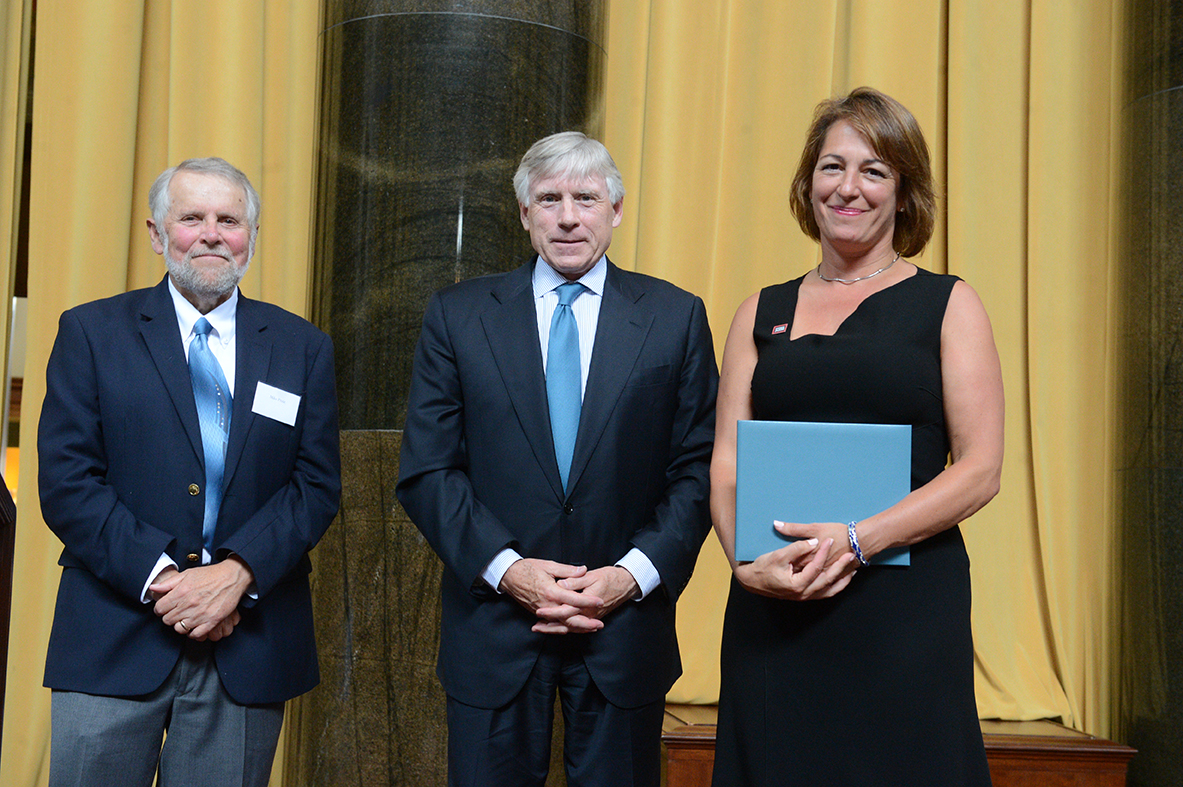
Mike Pride, Pulitzer Prize Administrator (left), and Lee C. Bollinger, President of Columbia University (center), present the 2015 National Reporting Prize to Carol D. Leonnig.
Winning Work
Officers at White House told to Stand Down
It was four days before agency realized bullets hit residence
By Carol D. Leonnig
The gunman parked his black Honda directly south of the White House, in the dark of a November night, in a closed lane of Constitution Avenue. He pointed his semiautomatic rifle out of the passenger window, aimed directly at the home of the president of the United States, and pulled the trigger.
A bullet smashed a window on the second floor, just steps from the first family’s formal living room. Another lodged in a window frame, and more pinged off the roof, sending bits of wood and concrete to the ground. At least seven bullets struck the upstairs residence of the White House, flying some 700 yards across the South Lawn.
President Obama and his wife were out of town on that evening of Nov. 11, 2011, but their younger daughter, Sasha, and Michelle Obama’s mother, Marian Robinson, were inside, while older daughter Malia was expected back any moment from an outing with friends.
Secret Service officers initially rushed to respond. One, stationed directly under the second-floor terrace where the bullets struck, drew her .357 handgun and prepared to crack open an emergency gun box. Snipers on the roof, standing just 20 feet from where one bullet struck, scanned the South Lawn through their rifle scopes for signs of an attack. With little camera surveillance on the White House perimeter, it was up to the Secret Service officers on duty to figure out what was going on.
Then came an order that surprised some of the officers. “No shots have been fired. . . . Stand down,” a supervisor called over his radio. He said the noise was the backfire from a nearby construction vehicle.
That command was the first of a string of security lapses, never previously reported, as the Secret Service failed to identify and properly investigate a serious attack on the White House. While the shooting and eventual arrest of the gunman, Oscar R. Ortega-Hernandez, received attention at the time, neither the bungled internal response nor the potential danger to the Obama daughters has been publicly known. This is the first full account of the Secret Service’s confusion and the missed clues in the incident — and the anger the president and first lady expressed as a result.
By the end of that Friday night, the agency had confirmed a shooting had occurred but wrongly insisted the gunfire was never aimed at the White House. Instead, Secret Service supervisors theorized, gang members in separate cars got in a gunfight near the White House’s front lawn — an unlikely scenario in a relatively quiet, touristy part of the nation’s capital.
It took the Secret Service four days to realize that shots had hit the White House residence, a discovery that came about only because a housekeeper noticed broken glass and a chunk of cement on the floor.
This report is based on interviews with agents, investigators and other government officials with knowledge about the shooting. The Washington Post also reviewed hundreds of pages of documents, including transcripts of interviews with officers on duty that night, and listened to audio recordings of in-the-moment law enforcement radio transmissions.
Secret Service spokesman Ed Donovan declined to comment. A spokesman for the White House also declined to comment.
The episode exposed problems at multiple levels of the Secret Service, and it demonstrates that an organization long seen by Americans as an elite force of selfless and highly skilled patriots — willing to take a bullet for the good of the country — is not always up to its job.
Just this month, a man carrying a knife was able to jump the White House fence and sprint into the front door. The agency was also embarrassed by a 2012 prostitution scandal in Cartagena, Colombia, that revealed what some called a wheels-up, rings-off culture in which some agents treated presidential trips as an opportunity to party.
The actions of the Secret Service in the minutes, hours and days that followed the 2011 shooting were particularly problematic. Officers who were on the scene who thought gunfire had probably hit the house that night were largely ignored, and some were afraid to dispute their bosses’ conclusions. Nobody conducted more than a cursory inspection of the White House for evidence or damage. Key witnesses were not interviewed until after bullets were found.
Moreover, the suspect was able to park his car on a public street, take several shots and then speed off without being detected. It was sheer luck that the shooter was identified, the result of Ortega, a troubled and jobless 21-year-old, wrecking his car seven blocks away and leaving his gun inside.
The response infuriated the president and the first lady, according to people with direct knowledge of their reaction. Michelle Obama has spoken publicly about fearing for her family’s safety since her husband became the nation’s first black president.
Her concerns are well founded — President Obama has faced three times as many threats as his predecessors, according to people briefed on the Secret Service’s threat assessment.
“It was obviously very frightening that someone who didn’t really plan it that well was able to shoot and hit the White House and people here did not know it until several days later,” said William Daley, who was White House chief of staff at the time.
Daley said he recalls the late discovery of the bullets shaking up the Obamas and their staffs. The Secret Service could not have prevented the shooting, Daley said, but it should have determined more quickly what happened.
“The handling of this was not good,” he said.
Confusion after shots
By the time Ortega shot at the White House, President Obama and the first lady were in San Diego on their way to Hawaii for the Veterans Day weekend.
With the first couple gone, the Secret Service staff at the White House slipped into what some termed a “casual Friday” mode.
By 8:30 p.m., most of the Secret Service agents and officers on duty were coming to the tail end of a quiet shift.
An undercover agent in charge of monitoring the White House perimeter for suspicious activity, McClellan Plihcik, had left with a more junior officer to fill up his service car at a gas station about a mile away.
On the White House’s southern border, a few construction workers were milling about. D.C. Water trucks, arriving on Constitution Avenue to clean sewer lines, had just parked in the lane closed off by red cones on the White House side of the street.
It was near that spot that Ortega pulled over his black 1998 Honda Accord.
Ortega had left his Idaho home about three weeks earlier, during a time his friends said he had been acting increasingly paranoid. He kept launching into tirades about the U.S. government trying to control its citizens, saying President Obama “had to be stopped.”
He had arrived in Washington on Nov. 9. He had 180 rounds of ammunition and a Romanian-made Cugir semiautomatic rifle, similar to an AK-47, that he had purchased at an Idaho gun shop.
Now, in striking distance of the president’s home, Ortega raised his weapon.
A woman in a taxi stopped at a nearby stoplight immediately took to Twitter to describe the actions of “this crazy guy.”
“Driver in front of my cab, STOPPED and fired 5 gun shots at the White House,” she wrote, adding, “It took the police a while to respond.”
Another witness — a visiting neuroscientist who was riding by in an airport shuttle van — later told investigators he had seen a man shooting out of a car toward the White House.
On the rooftop of the White House, Officers Todd Amman and Jeff Lourinia heard six to eight shots in quick succession, likely semiautomatic fire, they thought. They scurried out of their shedlike booth, readied their rifles and scanned the southern fence line.
Under the Truman Balcony, the second-floor terrace off the residence that overlooks the Washington Monument, Secret Service Officer Carrie Johnson heard shots and what she thought was debris falling overhead. She drew her handgun and took cover, then heard a radio call reporting “possible shots fired” near the south grounds.
Johnson called the Secret Service’s joint operations center, at the agency’s headquarters on H Street Northwest, to report she was breaking into the gun box near her post, pulling out a shotgun. She replaced the buckshot inside with a more powerful slug in case she needed to engage an attacker.
The shots were fired about 15 yards away from Officers William Johnson and Milton Olivo, who were sitting in a Chevrolet Suburban on the Ellipse near Constitution Avenue.
They could smell acrid gunpowder as they jumped out of their vehicle, hearts pounding. Johnson took cover behind some flowerpots. Olivo grabbed a shotgun from the Suburban’s back seat and crouched by the vehicle.
William Johnson noticed a curious clue as he crouched in the crisp autumn air — leaves had been blown away in a line-like pattern, perhaps by air from a firearm muzzle. It created a path of exposed grass pointing from Constitution Avenue north toward the White House.
Then another call came over the radio from a supervising sergeant — the one ordering agents to stand down.
The call led to some confusion and surprise, especially for officers who felt sure they had heard shots. Nevertheless, many complied, holstering their guns and turning back to their posts.
But William Johnson knew shots were fired and got on his radio to say so. “Flagship,” he said, using the code name for the command center, “shots fired.”
Ortega, meanwhile, was driving away “like a maniac,” the woman in the cab wrote on Twitter.
He was speeding down Constitution Avenue toward the Potomac River at about 60 mph, according to witnesses.
Ortega narrowly missed striking a couple crossing the street before he swerved and crashed his car.
Three women walking nearby heard the crash, and one called 911 on a cellphone. As they walked closer to the scene, the women saw the Honda spun around, headlights glaring at oncoming traffic, half on the on-ramp to the Roosevelt Bridge carrying Interstate 66 into Virginia. The driver’s-side door was flung open. The radio was blaring. The driver was gone.
At the same time, Park Police and Secret Service patrol cars were beginning to swarm the bridge area. Nestled in the driver console was a semiautomatic assault rifle, with nine shell casings on the floor and seat.
Plihcik, the special agent who had been gassing up his patrol car, was among those arriving on the scene. A homeless man told him he had seen a young white male running from the vehicle after the crash and heading toward the Georgetown area.
Amid conflicting radio chatter, including a Secret Service dispatcher calling into 911 with contradictory descriptions of vehicles and suspects, police began looking for the wrong people: two black men supposedly fleeing down Rock Creek Parkway.
The man who had shot at the White House had disappeared on foot into the Washington night, with the Secret Service still trying to piece together what he had done.
Fear for girls’ safety
Back in the White House, key people in charge of the safety of the president’s family were not initially aware that a shooting had occurred.
Because officers guarding the White House grounds communicate on a different radio frequency from the one used by agents who protect the first family, the agent assigned to Sasha learned of the shooting a few minutes later from an officer posted nearby.
The White House usher on duty, whose job is tending to the first family’s needs, got delayed word as well. She immediately began to worry about Malia, who was supposed to be arriving any minute. The usher told the staff to keep Sasha and her grandmother inside. Malia arrived with her detail at 9:40 p.m., and all doors were locked for the night.
The Secret Service’s watch commander on duty, Capt. David Simmons, had been listening to the confusing radio chatter since the first reports of possible shots.
When word came of the wrecked Honda, Simmons left the command center and drove to the scene at the foot of the Roosevelt Bridge.
It was up to Simmons to decide whether the events of that night appeared to be an attack on the White House. After consulting with investigators and calling his bosses at home to confer, he turned the case over to the U.S. Park Police, the agency with jurisdiction over the grounds near the White House.
In effect, the Secret Service had concluded there was no evidence linking the shooting to the White House.
U.S. Park Police spokesman David Schlosser told reporters at the time that the connection was a big coincidence. “The thing that makes it of interest is simply the location, you know, a bit like real estate,” he said.
At the time of the shooting, President Obama had been sitting courtside on the USS Carl Vinson warship in the California’s Coronado Bay, watching the University of North Carolina and Michigan State University basketball teams play on the flight deck. He was getting ready to be interviewed by ESPN at 9 p.m.
Forty-five minutes later, the president and Michelle Obama climbed aboard Air Force One, bound for a trade summit in Honolulu, unaware that a man had taken several shots at their living quarters.
Housekeeper’s discovery
The next day, things seemed to have settled down at the White House.
Officer Carrie Johnson, who had heard debris fall from the Truman Balcony the night before, listened during the roll call before her shift Saturday afternoon as supervisors explained that the gunshots were from people in two cars shooting at each other.
Johnson had told several senior officers Friday night that she thought the house had been hit. But on Saturday she did not challenge her superiors, “for fear of being criticized,” she later told investigators.
Though the Park Police was now in charge of the investigation, Secret Service agents continued to assist, using social media and other sources to locate witnesses, such as the tweeting taxi passenger, and people who knew Ortega.
Investigators did not issue a national lookout to notify law enforcement that Ortega was wanted. If they had, Ortega could have been arrested that Saturday in Arlington County, Va., where police responded to a call about a man behaving oddly in a local park. They questioned Ortega but had no idea he was a suspect in a shooting, and they let him go.
The Park Police did not obtain a warrant for Ortega on weapons charges until that Sunday. A Park Police spokeswoman, reached this Friday, declined to comment, saying the agency needed more time to review the episode.
Meanwhile, Secret Service agents, who had been learning from Ortega’s friends and family that he was obsessed with President Obama, began canvassing the D.C. area to locate him.
The situation at the White House remained quiet until Tuesday morning. President Obama was continuing from Hawaii to Australia. But the first lady had returned to Washington on an overnight flight. She had gone upstairs to take a nap shortly after arriving home early that morning.
Flying back on her plane was Secret Service Director Mark Sullivan. At that time, his agents were learning that Ortega, still at large, appeared to be obsessed with the president. The episode had not yet risen to the level of a confirmed threat that the Secret Service would share with the first couple, according to people familiar with agency practice.
Reginald Dickson, an assistant White House usher, had come to work early to prepare the house for the first lady.
Around noon, a housekeeper asked Dickson to come to the Truman Balcony, where she showed him the broken window and a chunk of white concrete on the floor.
Dickson saw the bullet hole and cracks in the antique glass of a center window, with the intact bulletproof glass on the inside. Dickson spotted a dent in another window sill that turned out to be a bullet lodged in the wood.
Dickson called the Secret Service agent in charge of the complex.
Suddenly, Ortega was no longer just a man who had abandoned a car with a rifle inside. He was now a suspect in an assassination attempt on the president of the United States — and he was about to become the target of a national manhunt.
Daley, the White House chief of staff, was alerted by aides about the discovery on the second floor of the residence.
The first lady was still napping, and Daley and his aides knew it was their job to tell her. They debated whether they should wake her up and give her the news.
They decided, according to people familiar with the discussions, to let her sleep. Instead, they concluded, they would brief the president and let him tell his wife.
But someone else told her first.
First lady furious
Dickson, the usher, went upstairs to the third floor to see how Michelle Obama was doing.
He assumed she knew about the bullets and began describing the discovery.
But she was aghast — and then quickly furious. She wondered why Sullivan had not mentioned anything about it during their long flight back together from Hawaii, according to people familiar with the first lady’s reaction.
That afternoon, Secret Service investigators for the first time began interviewing officers and agents who had been on the grounds the previous Friday night.
Authorities put out an all-points bulletin for Ortega and circulated his picture. Local police officers up and down the Eastern Seaboard were tasked with checking train and bus stations.
A team of FBI agents met early that evening to plan for taking over the investigation and securing the crime scene at the White House.
At 7:45 a.m. the next day, FBI agents arrived at the White House complex.
They interviewed some of the Secret Service officers who were on duty that Friday night and scoured the Truman Balcony and nearby grounds for casings, bullet fragments and other evidence.
The agents that day found $97,000 worth of damage.
At that same time, state troopers were headed to a Hampton Inn in Indiana, Pa. A desk clerk, on alert after Secret Service agents found out Ortega had stayed there and circulated his picture, called police after recognizing the man with a distinctive tattoo on his neck. They arrested Ortega and kept him chained at his feet and hands in a holding cell until FBI agents could arrive to question him.
Back at the White House, Michelle Obama was worried about how the scene of agents on the family balcony might upset her daughters. She relayed a special request that the FBI team finish their work on the balcony by 2:35 p.m., before Sasha and Malia came home from school.
The first lady was still upset when her husband arrived home five days later from Australia. The president was fuming, too, former aides said. Not only had their aides failed to immediately alert the first lady, but the Secret Service had stumbled in its response.
“When the president came back . . . then the s--- really hit the fan,” said one former aide.
Tensions were high when Sullivan was called to the White House for a meeting about the incident. Michelle Obama addressed him in such a sharp and raised voice that she could be heard through a closed door, according to people familiar with the exchange. Among her many questions: How did they miss bullets from an assault rifle lodged in the walls of her home?
Sullivan disputed this account of the meeting but declined to characterize the encounter, saying he does not discuss conversations with the first lady.
Problems exposed
Ortega was eventually charged with attempted assassination. His attorneys insisted he had no idea what he was doing. He pleaded guilty to slightly lesser charges and was sentenced to 25 years in prison.
The next year, the Colombia prostitution scandal rocked the agency’s reputation. Sullivan retired from the agency in 2013 to start a private security firm. President Obama named the first woman to head the service, Julia Pierson, with hopes she could help end Cartagena-like embarrassments.
Yet, on Capitol Hill and among many former Secret Service officials, the 2011 shooting was a sign of far deeper troubles. For them, no duty is more sacred than protecting the life of the president and his family, and on this night a man nearly got away with shooting into his house. In this case, they fear, a more powerful weapon might have pierced the residence, or the Obama daughters could have been on the balcony.
“This is symptomatic of an organization that is not moving in the right direction,” Rep. Jason Chaffetz (Utah), a leading Republican on the House Oversight and Government Reform Committee, said in an interview. The committee, which oversees the Secret Service, has invited the director to testify at a Tuesday hearing on security issues.
A subsequent internal security review found that the incident illustrated serious gaps.
The Secret Service, for instance, could not use any of the dozens of ShotSpotter sensors installed across the city to help police pinpoint and trace gunshots. The closest sensor was more than a mile away, too far to track Ortega’s shots.
Sullivan acknowledged in closed congressional briefings that the agency lacked basic camera surveillance that could have helped agents see the attack and swarm the gunman immediately.
Some of the technology issues have since been addressed, according to officials. The agency added a series of surveillance cameras in 2012, giving authorities a full view of the perimeter.
Alice Crites and Julie Tate contributed to this report.
MAN ENTERS WHITE HOUSE WITH KNIFE
Iraq veteran had served as a sniper, family says
By Carol D. Leonnig, Spencer Hsu and Annys Shin
The Secret Service on Saturday launched a security review to learn how a man carrying a knife was able to get inside the front door of the White House on Friday night after jumping a fence and sprinting more than 70 yards across the North Lawn — the first time that has ever happened.
Within seconds, the man who his public defender said served three tours in Iraq — and relatives said served as a sniper — got to the front double doors of the North Portico, turned the brass knob and stepped inside the vestibule. There he was grabbed and subdued by an officer standing post inside the door. He had a folding knife with a 2 1 / 2-inch serrated blade.
The success Omar J. Gonzalez, 42, had in breaching White House security Friday night — roughly 10 minutes after the president and his daughters lifted off the south grounds in his helicopter for Camp David — exposed new, worrisome gaps in the Secret Service’s extensive efforts to keep the first family safe and make the White House a “hard target.”
The front door on the North Portico of the mansion was unlocked at the time. It is a frequently used door, just one flight of stairs away from the Obama’s living quarters, and until now, the Secret Service didn’t imagine an intruder could reach it.
A trained attack dog — the Secret Service’s fail-safe measure for stopping intruders when officers cannot — was not released in this case. The reasons are under investigation.
The Secret Service trains its personnel not to shoot intruders on the grounds unless they appear armed, or are wearing bulky clothes or backpacks that could indicate they are carrying a bomb. Many questioned how officers can assess the real risk in the 20 seconds it takes someone to run from the fence to the mansion.
“This is totally and wholly unacceptable. . . . How safe is the president if this can happen?” said Rep. Jason Chaffetz (R-Utah), chairman of the House Oversight and Government Reform subcommittee on national security. “I just can’t believe somebody can go that far without being impeded. The perception they are creating is only going to inspire more security breaches.”
The White House released a statement Saturday, saying, “The President has full confidence in the Secret Service and is grateful to the men and women who day in and day out protect himself, his family and the White House. The Secret Service is in the process of conducting a thorough review of the event on Friday evening and we are certain it will be done with the same professionalism and commitment to duty that we and the American people expect from the U.S. Secret Service.”
On Friday at about 7:20 p.m., Gonzalez did the unthinkable, authorities said. The 42-year-old from Texas climbed over the north fence line along Pennsylvania Avenue, toward the eastern side of the house’s circular driveway. His breach set off the standard security alarm across the compound. Officers rushed to the North Lawn but were unable to reach him on foot as he ran, arms pumping, threading the needle between the fountain and a security guard booth and ignoring their commands that he stop.
Officers at the scene considered Gonzalez to be unarmed and likely mentally disturbed, a law enforcement official familiar with the incident said, and thus a low risk. It turned out Gonzalez was carrying the knife in his pants pocket. One source familiar with the incident said a sniper on scene had Gonzalez in his rifle sights just in case.
Edwin Donovan, spokesman for the Secret Service, said Gonzalez’s ability to get into the executive mansion is “obviously concerning. . . . What happened here is not acceptable to us, and it’s going to be closely reviewed.”
Chaffetz said he’s not satisfied with the Secret Service’s call for an internal security review, and said he fears the agency’s leadership needs an overhaul.
“The Secret Service has a serious management problem, and they have to acknowledge it. This is an agency that cannot make a mistake, ever,” he said. “And this was one unarmed person. My concern: what if 12 people had jumped over? Then what? That’s not out of the question.”
Former agents said they fear the breach may be related to a severe staffing shortage the agency has struggled with in the last year in its Uniform Division. This is the team of officers with primary responsibility for securing the White House grounds, and the service has been flying in agents from field offices around the country to do temporary assignments. Those agents naturally would have less familiarity with the grounds and intruder response plans.
The service, which once enjoyed a sterling reputation as an elite law enforcement agency, has struggled with some embarrassing episodes recently and the perception that its leadership is lagging in the best security strategies. In spring 2012, the service faced a humiliating moment when a dozen agents were shipped home from a presidential trip in Cartagena, Colombia, where they were implicated in a night of carousing and boozing with prostitutes.
It’s exceedingly rare for an intruder to get this close to the president’s residence. But fence-jumpers at the White House have become an all-too-frequent part of the job for the Secret Service. Nevertheless, almost all of these individuals are stopped and subdued within seconds of crossing the perimeter.
A sensor alarm automatically goes off when any unauthorized person crosses the fence line, and is transmitted to every on-duty agent’s radio and to the service’s joint operations command center. Officers hear the blaring “BAH-BAH-BAH-BAH” alarm, followed by code instructions from the command center about the location, such as “Break 307” or “Break 302.”
In many scenarios, if a jumper ignores officers’ demands to stop, a canine-team handler will release a Belgian Malinois — a breed chosen because it is considered highly intelligent — to stop the runner.
It typically takes a person sprinting across the grounds at least 20 to 25 seconds to run from the fence line to the mansion. Canine teams are trained to have the dog in position to be released within four seconds of the alarm sounding. The dog is trained to act as a missile, launching in the air to knock the subject down, and then biting an arm or leg if need be to subdue the person until the handler arrives.
But the dog was not released in this case, according to officials’ review of the event and video evidence from Friday night. The Secret Service’s security review will look closely at why.
“We’re asking, why not release the dog?” said one law enforcement person who is reviewing the incident. “That would have stopped this.”
The service’s tactical canine team is a celebrated jewel in the agency’s crown, winning international awards year after year. It was created in 1976 for one purpose: to stop would-be suicide bombers from getting near the White House. The teams exclusively use the Belgian Malinois, considered a kind of “faster, leaner, meaner” German shepherd.
But the dogs cannot easily distinguish between good and bad guys. When sent in the direction of an intruder, they could also attack a nearby officer responding.
For that reason, Secret Service training manuals advise officers to try to collar White House intruders if they feel sure they can do so, and otherwise stay at their posts, so as not to create confusion for the dogs.
Scores of breaches
A 2003 Secret Service study found that fence-jumpers accounted for about half of nearly 200 security breaches in the previous two decades, cases in which an intruder defeated agency checkpoints or perimeters set up to protect the president and other officials.
But Friday’s incident with Gonzalez has the Secret Service highly concerned, officials said, because his success can help or embolden would-be assassins with actual plots. And it could erode what the Secret Service training manuals called “one of the best tools for deterring future attempts” — the White House’s aura of invulnerability.
Gonzalez made it over the fence line just minutes after Obama and the first family took off from the South Lawn on a Marine One helicopter bound for Camp David. The White House grounds were ordered evacuated briefly due to the breach.
After being subdued Friday, Gonzalez was taken for evaluation to the psychiatric ward at George Washington University, according to the official.
Gonzalez told agents who apprehended him that he was very concerned the “atmosphere was collapsing” and he needed to get the president to get the word out to the people.
Bound in handcuffs and manacled at the waist and ankles, he appeared late Saturday afternoon before D.C. Superior Court Judge Judith Bartnoff where federal prosecutors accused him of entering a restricted building or grounds while carrying a dangerous or deadly instrument.
The Assistant U.S. Attorney John Marston of the District asked that Gonzalez be held until the case was transferred to U.S. District Court and he appeared there Monday.
Assistant Public Defender Margarita O’Donnell argued that Gonzalez had no convictions, no arrest warrants, tested negative Saturday for drug use and had served 18 years in the U.S. military including three tours in Iraq.
“This is someone who has provided service to his country and shown commitment in his life,” O’Donnell said, in an unsuccessful bid to win Gonzalez’s release. The knife could have been related to his line of work, O’Donnell said.
Gonzalez spent six years in Iraq with Army Special Forces as a sniper, according to his former stepson, Jerry S. Murphy.
“He’s a very good guy. He is suffering from post-traumatic stress disorder,” Murphy said. “I don’t believe he had any intention in hurting anybody. He has served his country for years.”
He said that Gonzalez was not a terrorist but has been living out of his car the past two years, driving around the country with his two dogs.
Murphy’s father, the Rev. Jerry Murphy, said his ex-wife married Gonzalez years after their divorce. He said the two met while working at a Wal-Mart, were married briefly, and then divorced while Gonzalez was on one of his tours in Iraq. He said his son was the one who kept up with Gonzalez, who had packed up his Ford Bronco and was living under a bridge the past couple of years, and staying where he could.
“I don’t really know the man, but I pray for him,” Murphy said.
While the Secret Service was answering questions and drilling down into the details of Friday’s response, it happened again. As if on cue, on Saturday afternoon, another person was arrested after trying to get onto the White House grounds. The man approached a White House gate on foot, then showed up a little while later in his car at another gate at 15th and E streets NW. He entered the vehicle screening area and refused to leave. He was arrested for trespassing.
By Carol D. Leonnig and David A. Fahrenthold
As an intruder sprinted for the White House door Friday, a Secret Service officer ran to get in his way — but the intruder barreled past the officer and kept going, officials familiar with the incident said Tuesday.
A few yards farther on, the intruder, Omar Jose Gonzalez, reached the White House door. A guard was supposed to be posted directly in front, but no one was blocking the door at that moment.
Those new details help explain how the Secret Service’s plan for guarding the White House — which envisioned five different rings of protection between the public sidewalk and the president’s front door — failed so completely.
A plainclothes surveillance team was on duty that night outside the fence, meant to spot jumpers and give early warning before they made it over. When that team didn’t notice Gonzalez, there was an officer in a guard booth on the North Lawn. When that officer couldn’t stop him, there was supposed to be an attack dog, a SWAT team and a guard at the front door — all at the ready.
But the attack dog wasn’t released.
The SWAT team, which didn’t react in time, was trailing Gonzalez as he dove through some bushes ringing the White House’s front entrance.
And when Gonzalez reached the door, he found his path clear and the door unlocked.
“One after another unit failed,” said a former high-ranking Secret Service official who spoke on the condition of anonymity to describe White House security protocols. “This guy has now crossed 70-some yards of restricted area. If he has [an explosive] device on him and he gets in, he controls the White House. He could have anything on him.”
Inside, Gonzalez was subdued by a plainclothes agent — the sixth ring of security that night. That agent’s job is to patrol a place that intruders are never supposed to reach: the interior of the executive mansion.
Questions for agency
Gonzalez, 42, did not express an intent to harm anyone at the White House. He was carrying only a folding knife, authorities say, and said he wanted to warn President Obama that the “atmosphere was collapsing.”
But the fact that he breached the White House’s legendary security perimeter — and did it using the unsophisticated method of jumping the fence and running for the door — has raised serious questions about the Secret Service’s preparation.
The agency is conducting an internal review of the incident. Officials will also face questions from the House Oversight and Government Reform Committee at a hearing next week.
Secret Service spokesman Ed Donovan declined to describe the details of Gonzalez’s path. Asked about the criticism that the system failed at several levels to stop the intruder, Donovan said it was not appropriate to respond during an ongoing internal review.
“Any conversation prior to the completion of the review is speculation or merely erroneous judgments provided by anonymous sources who are not in a position to know all the facts and whose experience and level are unknown,” Donovan said.
Already, Friday’s intrusion has altered the look of the White House grounds. Monday evening, the Secret Service put up a second fence along the mansion’s north side. About eight feet in front of the White House’s iconic, 49-year-old wrought-iron fence, there is now a line of metal barricades that look like bike racks linked end to end.
The Secret Service said that the new fence creates “a temporary buffer zone” and that it will stay up while officials conduct their review of Friday’s intrusion.
Four days after the incident, a look back shows that Gonzalez had come to the Secret Service’s attention twice earlier this year. This summer, he was interviewed by the agency after raising suspicions during a traffic stop on an interstate highway in rural Wythe County, Va.
The Virginia State Police allegedly found a number of weapons in Gonzalez’s car, including a sawed-off shotgun, two sniper rifles, an assault rifle, a bolt-action rifle, one intact shotgun and five handguns. Police also found a map of the Washington area with a circle around the Masonic temple in Alexandria, Va., and a line that pointed toward the White House, police and prosecutors said.
A Secret Service official, speaking on behalf of the agency, said Tuesday that agents had interviewed Gonzalez afterward, and found no reason to charge him with threatening the president or to refer him for mental health treatment.
Then, in late August, a Secret Service officer spotted Gonzalez walking along the White House’s south fence, carrying a hatchet in his waistband. Officers interviewed him and searched his car, finding camping gear but no evidence that he posed a threat.
The Secret Service official said that, at the time, officers were aware of the earlier contact with Gonzalez in Virginia. But, the official said, “he did not exhibit any mental-health issues at that point. He had not engaged in any criminal activity.” Gonzalez was let go.
On Friday, less than a month later, he returned to the White House and climbed the fence.
Crossing lines of defense
For some reason not yet explained, no officer was close enough to collar Gonzalez on his mad dash to the building.
The next line of defense was supposed to be the attack dog, a Belgian Malinois trained to hit an intruder like a canine missile. A video of the event shows a dog running onto the scene, possibly on a leash, but only after Gonzalez opened the front door.
The next level of security was supposed to be a heavily armed SWAT team that roves the White House grounds. This team was created specifically in the wake of a study by the Army’s Delta Force in the 1990s, which warned that the White House was vulnerable to jumpers.
It is unclear where the emergency-response team members were when the intruder passed Friday night. Some may have relocated to the South Lawn, where the president’s helicopter had lifted off 10 minutes before the intruder appeared. In a video of the incident, black-clad figures with guns are seen following Gonzalez, but at that point he was already close to the door.
Finally, according to former officials familiar with White House security, an officer is always supposed to be stationed at the front door. In this case, no officer was there, said several people familiar with the incident who spoke on the condition of anonymity to describe what they said were lapses. Video footage shows an officer on the far eastern side of the porch with his gun pointed at Gonzalez — but it is not clear what the officer’s assignment was that night.
Several former Secret Service officials said in interviews this week that they were surprised no officers fired at Gonzalez.
These former officials said Secret Service protocols have called for shooting an intruder who is close to crossing the threshold of the White House, as it might not be clear if the person is a serious threat.
“If they aren’t stopping and are on the threshold of the house, you have to use lethal force,” said Dan Emmett, a former Secret Service counterassault officer. “This would have been an easy shot and one that would have been entirely defensible.”
Spencer S. Hsu contributed to this report.
Fence jumper is said to have made it much deeper into building
By Carol D. Leonnig
The man who jumped the White House fence this month and sprinted through the front door made it much farther into the building than previously known, overpowering one Secret Service officer and running through much of the main floor, according to three people familiar with the incident.
An alarm box near the front entrance of the White House designed to alert guards to an intruder had been muted at what officers believed was a request of the usher’s office, said a Secret Service official who spoke on the condition of anonymity.
The officer posted inside the front door appeared to be delayed in learning that the intruder, Omar Gonzalez, was about to burst through. Officers are trained that, upon learning of an intruder on the grounds — often through the alarm boxes posted around the property — they must immediately lock the front door.
After barreling past the guard immediately inside the door, Gonzalez, who was carrying a knife, dashed past the stairway leading a half-flight up to the first family’s living quarters. He then ran into the 80-foot-long East Room, an ornate space often used for receptions or presidential addresses.
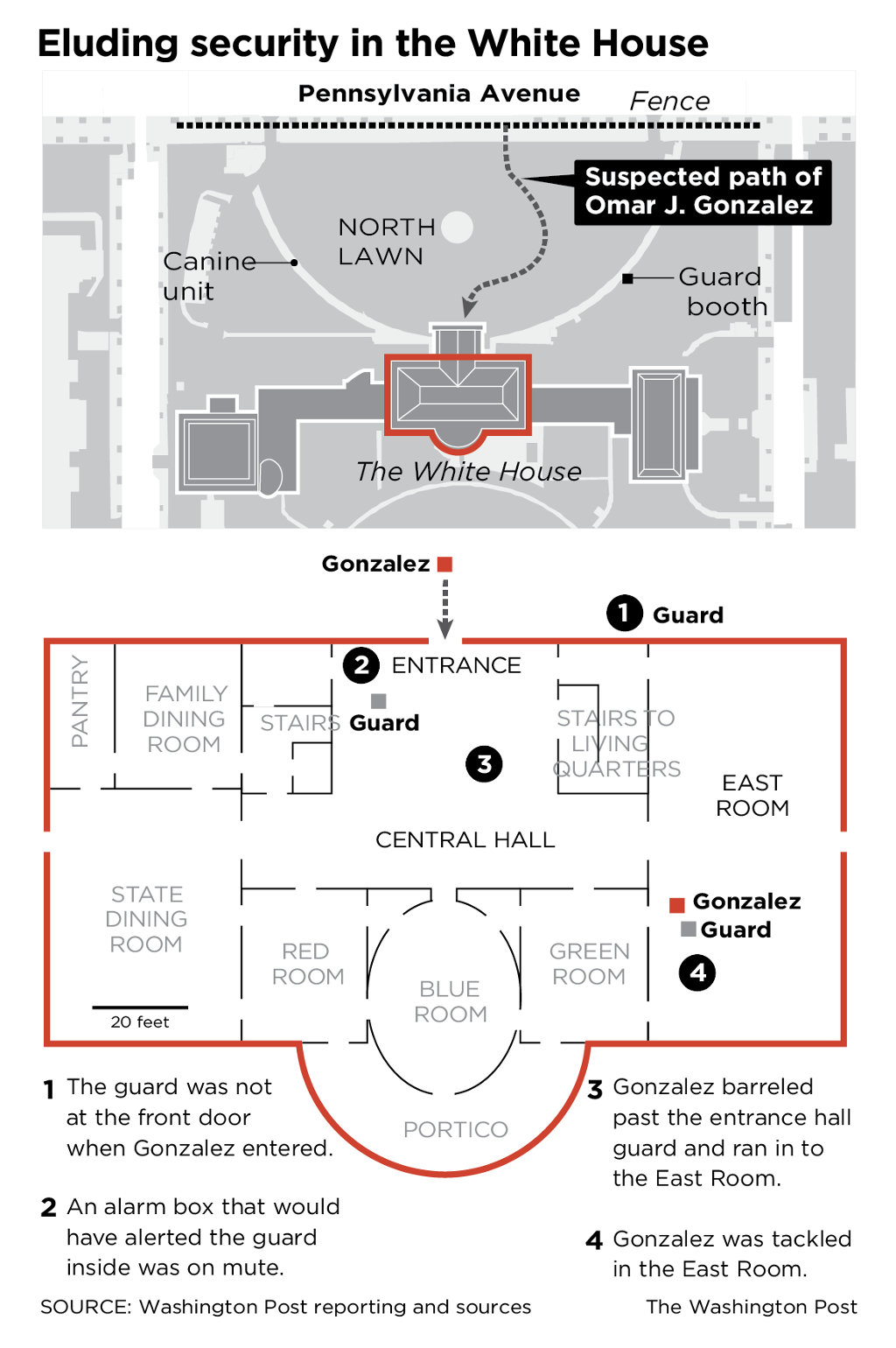 Gonzalez was tackled by a counterassault agent at the far southern end of the East Room. The intruder reached the doorway to the Green Room, a parlor overlooking the South Lawn with artwork and antique furniture, according to three people familiar with the incident.
Secret Service officials had earlier said he was quickly detained at the main entry. Agency spokesman Edwin Donovan said the office is not commenting during the ongoing investigation of the incident.
Breaches of the White House fence have become more common, but most jumpers are tackled by Secret Service officers guarding the complex before they get even a third of the way across the lawn. Gonzalez is the first person known to have jumped the fence and made it inside the executive mansion.
Secret Service Director Julia Pierson has said the breach was “unacceptable” to her, and on Friday she briefed President Obama on her plans to shore up security.
Pierson is expected to face tough questions about the Gonzalez incident Tuesday at a hearing of the House Oversight and Government Reform Committee. The hearing is likely to cover a number of security lapses by the agency, including new revelations published over the weekend by The Washington Post about the failure to identify and properly investigate a 2011 shooting attack on the White House.
The more detailed account of this month’s security breach comes from people who provided information about the incident to The Post and whistleblowers who contacted Rep. Jason Chaffetz (R-Utah), chairman of the oversight panel’s subcommittee on national security.
Chaffetz said he plans to ask Pierson how an alarm meant to alert officers to intruders could be silenced or turned down. The congressman said two people inside the agency told him that boxes were silenced because the White House usher staff, whose office is near the front door, complained that they were noisy. A Secret Service official told The Post that the usher’s office was concerned the boxes were frequently malfunctioning and unnecessarily sounding off.
The alarm boxes, which officers call “crash boxes,” are key pieces of the agency’s first-alert system, according to former agents and officials. If officers spot an intruder, they are trained to hit the large red button on the nearest box — sending an alert to every post on the complex about the location of an incursion and piping sound from that location to other boxes around the property.
“If true, the fact that crash boxes were muted to avoid being ‘disruptive’ is not due to a lack of resources or an insufficient number of checkpoints or barriers,” Chaffetz said.
He called the incident a “failure of leadership” by the Secret Service.
“The agency needs a solution that goes deeper than more fences and more people,” Chaffetz said. “It must examine what message is being sent to the men and women who protect the president when their leader sacrifices security to appease superficial concerns of White House ushers.”
The new revelations follow accounts provided to The Post last week detailing how Gonzalez’s ability to enter the White House reflected a failure of multiple levels of security at the compound. The agency relies on these successive layers as a fail-safe for protecting the president and the White House complex.
In this incident, a plainclothes surveillance team was on duty that night outside the fence, meant to spot jumpers and give early warning before they made it over. But that team did not notice Gonzalez. There was an officer in a guard booth on the North Lawn. When that officer could not reach Gonzalez, there was supposed to be an attack dog, a specialized SWAT team and a guard at the front door — all at the ready.
The dog was not released, a decision now under review. Some people familiar with the incident say the handler probably felt he could not release the dog, because so many officers were in pursuit of Gonzalez and the dog may have attacked them instead.
Since the incident, the Secret Service has added an additional layer of temporary fencing while the agency reviews its procedures.
Alice Crites contributed to this report.
ANOTHER LAPSE BY SECRET SERVICE
At CDC in Atlanta, contractor rode on elevator with Obama
By Carol D. Leonnig
The following was published on Sunday, November 2, 2014, on page A2:
CORRECTIONS
An Oct. 1 Page One article about a Secret Service security lapse incorrectly reported that agents had found that an armed security contractor who rode an elevator Sept. 16 in Atlanta with President Obama was a felon. Although agents found prior arrests on the contractor's record, he has never been convicted of a felony, according to people with knowledge of the incident.
A security contractor with a gun and an arrest record was allowed on an elevator with President Obama during a Sept. 16 trip to Atlanta, violating Secret Service protocols, according to three people familiar with the incident.
Obama was not told about the lapse in his security, these people said. The Secret Service director, Julia Pierson, asked a top agency manager to look into the matter but did not refer it to an investigative unit that was created to review violations of protocol and standards, according to two people familiar with the handling of the case who spoke on the condition of anonymity.
The incident, which took place when Obama visited the Centers for Disease Control and Prevention to discuss the U.S. response to the Ebola crisis, rattled Secret Service agents assigned to the president’s protective detail.
The private contractor first aroused the agents’ concerns when he acted oddly and did not comply with their orders to stop using a cellphone camera to record the president in the elevator, according to the people familiar with the incident.
When the elevator doors opened, Obama left with most of his Secret Service detail. Some agents stayed behind to question the man and then used a national database check that found some prior arrests in his historyturned.
When a supervisor from the firm providing security at the CDC approached and discovered the agents’ concerns, the contractor was fired on the spot. Then the contractor agreed to turn over his gun — surprising agents, who had not realized that he was armed during his encounter with Obama.
Under Secret Service protocols, people with weapons, arrests or convictions for assault and related offenses or any history of mental illness are typically barred from having any access to the president. But it appears that this man, possessing a gun, came within inches of the president after undergoing no such screening.
Rep. Jason Chaffetz (R-Utah), who heads a House subcommittee that oversees the Secret Service, first heard of the breakdown from a whistleblower. The Washington Post confirmed details of the event with other people familiar with the agency’s review.
“Words aren’t strong enough for the outrage I feel for the safety of the president and his family,” Chaffetz said.
Chaffetz added: “His life was in danger. This country would be a different world today if he had pulled out his gun.”
A Secret Service official, speaking on behalf of the agency, said an investigation of the incident is ongoing. The official spoke on the condition of anonymity, citing the pending review.
A White House spokesman declined to comment on the incident or say when, or if, the president had been informed of it.
In response to a question at a combative House hearing Tuesday, Pierson said she briefs the president “100 percent of the time” when his personal security has been breached. However, she said that had happened only one time this year: when Omar Gonzalez jumped over the White House fence Sept. 19 and was able to burst into the mansion.
The revelation of the lapse in Atlanta is the latest in a string of embarrassments for the Secret Service. Some elements of the incident were first reported Tuesday afternoon on the Washington Examiner’s Web site.
Pierson drew criticism Tuesday from lawmakers in both parties during the hearing on her agency’s security lapses. The session focused on the Secret Service’s fumbled responses to the recent White House fence jumper and a 2011 shooting attack on the residence.
The fence breach came three days after Obama’s trip to Atlanta.
The elevator incident exposed a breakdown in Secret Service protocols designed to keep the president safe from strangers when he travels to events outside the White House.
Under a security measure called the Arm’s Reach Program, Secret Service advance staffers run potential event staff members, contractors, hotel employees, invited guests and volunteers through several databases, including a national criminal information registry, and records kept by the CIA, the National Security Agency and the Defense Department, among others. Anyone who is found to have a criminal history, mental illness or other indications of risk is barred from entry.
Local police and federal officers are not checked in the same way under the Arm’s Reach Program, with the Secret Service presuming that they meet the safety standards because of their employment in law enforcement. But private security contractors would typically be checked, said two former agents who worked on advance planning for presidential trips.
For nearly every trip the president takes, at least one person is barred from attending or participating in an event because of problems discovered in his or her background, the two former agents said. Most recently, a local political campaign volunteer who was offering to help drive staffers to and from events during a visit had faced an assault charge in the past.
As part of the Secret Service’s review of the elevator incident, Pierson directed a supervising agent on the president’s protective detail to stay in Atlanta to examine the breakdown.
That decision aroused suspicion on Capitol Hill. Chaffetz said he believes that Pierson was trying to keep another security gaffe quiet at a time when her agency and her leadership are under fire.
Former and current agents say Secret Service leaders prefer this kind of informal internal review for assessing potentially embarrassing mistakes. They say such reviews rarely lead to broad reforms or consequences.
These agents also say it is problematic for a presidential protective detail supervisor to review how his team performed.
In an incident The Post revealed in 2013, a top manager of the president’s protective detail had met a woman while drinking at a bar at the Hay-Adams hotel and had left a bullet from his service weapon in her room after spending the evening with her there. One of his superiors reviewed the incident and at first recommended that he receive a few days of counseling. The Post report about the episode led to the agency launching a fuller investigation.
Julie Tate contributed to this report.
Agents diverted from White House perimeter to watch rural Md. home
By Carol D. Leonnig
Top Secret Service officials ordered members of a special unit responsible for patrolling the White House perimeter to abandon their posts over at least two months in 2011 in order to protect a personal friend of the agency’s director, according to three people familiar with the operation.
The new assignment, known internally as Operation Moonlight, diverted agents to a rural area outside the southern Maryland town of La Plata, nearly an hour’s drive from Washington. Agents were told that then-Director Mark Sullivan was concerned that his assistant was being harassed by her neighbor, the three people said.
Two agents were sent twice a day, in the morning and the evening, to monitor the home of the assistant, Lisa Chopey. The trips began June 30, 2011, and extended through the summer before tapering off in August, according to people familiar with internal shift records.
The agents were members of a surveillance team code-named Prowler, which patrols the outskirts of the White House compound and responds to reported problems. The unit is also tasked with monitoring the southern side of the White House whenever crowds gather to watch the president and first family travel via motorcade or helicopter.
Agents inside the Washington field office were concerned that Operation Moonlight increased security risks to the compound and the president, two people familiar with the discussion said.
On the first day of the new operation, the two Prowler agents on duty were directed to leave their position on the Ellipse, the public park directly south of the executive mansion, minutes before President Obama departed on his helicopter. The aircraft’s movements on and off the South Lawn are times of heightened security concern.
The agents thought the reassignment was a potentially illegal use of government resources. They were concerned enough about their own liability that they kept records of their involvement and their superiors’ instructions.
Some reported the operation to the inspector general for the Department of Homeland Security, the Secret Service’s parent agency. People familiar with the operation said a Senate committee’s recent finding that the former DHS inspector general softened and delayed investigations — particularly those critical of administration officials — renewed frustration that the issue may have not been properly investigated.
White House spokesman Jay Carney said the White House was not aware of the allegations involving the president’s protection and referred questions to the U.S. Secret Service.
Secret Service spokesman Ed Donovan confirmed that Prowler agents were pulled off their White House duty to check on the safety of Chopey in 2011.
But Donovan disputed accounts that Operation Moonlight lasted for months, saying agency records indicate that the assignment took place for only a few days over the Fourth of July weekend. Donovan declined to release the records.
He said that the operation was part of the agency’s standard response to potential threats to an employee and that Prowler, as an investigative unit, is not part of the president’s protective detail.
“Because there were no protective assets used during these checks, there was no impact on protective operations,” Donovan said.
Sullivan, 60, who now runs a private security firm, left his Secret Service job last year, 10 months after a controversy over members of the presidential protection team hiring prostitutes ahead of a 2012 Obama trip to Colombia. He said through a spokesman that he did not personally order the 2011 checks on his assistant’s home and that a supervisor in his office authorized the visits. He said that he learned of the checks after they began and that to his knowledge, they were done for just a few days and were “appropriate.”
“The U.S. Secret Service always has taken seriously threats made against employees and responds as appropriate,” Sullivan said in a statement. “In this case, the employee followed protocol in reporting concerns about her safety to a supervisor who took action consistent with the seriousness of the situation. I was informed later of those actions.”
Chopey, 41, who left the Secret Service last year for a position in the office of the DHS secretary, did not respond to requests for comment.
Security concerns have been generally heightened at the White House under Obama, the first black president. He received Secret Service protection unusually early as a candidate in 2007. His wife, Michelle, has expressed worries in the past about his safety, and similar fears have been widespread among many of Obama’s African American supporters.
An alarming reminder of the potential for danger came in November 2011, weeks after Operation Moonlight had ended, when a man who said Obama “needed to be stopped” fired a semiautomatic assault rifle from his car on Constitution Avenue, just a few hundred yards south of the White House. The shots struck the exterior wall and window of the second floor of the family residence on the Truman Balcony, where Obama has been known to wander. The president and first lady were not home at the time; their daughters and Obama’s mother-in-law were.
This past Tuesday, a motorist joined the Obama daughters’ motorcade and drove onto the White House grounds before a barrier could be raised to block him. Prowler agents responded to the incident and interrogated the driver, determining that he was unfamiliar with the city’s streets and made a mistake.
“Prowler is there for a reason, and it shouldn’t be pulled when the president is on the move,” said Dan Emmett, a former Secret Service agent and author of the book “Within Arm’s Length.”
Emmett and other former agents said they were surprised that Prowler or any other units would be deployed for an extended period to check on an employee.
“There is nothing more important than the president’s arrival and departure,” Emmett said. “The president takes far greater priority than the director’s secretary’s well-being.”
The orders for Operation Moonlight came from the top two agents in charge of the Washington field office, David Beach and Jim Donaldson. Both men, who have since been promoted within the Secret Service, declined to comment.
A Secret Service official said the agency’s current director, Julia Pierson, who was Sullivan’s chief of staff at the time, was unaware of the operation.
The episode had its origins in a series of escalating disputes between two neighboring families that shared a gravel road to their homes in La Plata.
On the morning of June 30, 2011, Chopey reported to local sheriff’s deputies that her neighbor, Michael Mulligan, had chased her while she was driving her Ford Expedition and he was on his four-wheel all-terrain vehicle.
Later that afternoon, Donaldson ordered two Prowler agents to leave their posts at the White House, according to two people familiar with the agents’ accounts.
The order came as the agents were in position south of the White House, preparing for Obama’s imminent departure aboard his Marine One helicopter to Joint Base Andrews, where he would board Air Force One for a trip to Philadelphia.
Donaldson was described as telling agents to drive directly to La Plata to perform a “welfare check” on Chopey’s home.
Chopey later sought and received a restraining order against Mulligan. Mulligan disputed Chopey’s account, saying that Chopey tried to hurt him with her SUV when he had been trying to catch up to her to discuss tensions between the families. He later pled guilty to misdemeanor assault under a special plea agreement in which he insisted he was innocent of the crime but acknowledged that the evidence against him could lead to a conviction.
The Prowler agents’ trips to La Plata continued through the summer months, with pairs of agents sent as often as twice daily to check on Chopey’s home and on Mulligan’s whereabouts.
The agents recorded their shifts by writing their initials in a Washington field office log stored in a manila folder stamped “Moonlight.”
The presence of imposing-looking unmarked vehicles, including a black SUV or an American-made sedan, came as a shock to Mulligan and his then-girlfriend, Brenda Allen. They said they did not know who owned the cars that parked behind the tree line near a backyard shed.
“There was all these cars down there for months,” Mulligan said. “They parked everywhere. It actually scared us. I wasn’t sure if it was police or what.”
Mulligan and Allen said they approached one of the cars one day to ask the occupants why they were parked in front of the house. But they said the car sped off.
The couple said they barely went outside their house when the cars were there. Eventually, the mysterious surveillance and the tensions with the Chopey family led them to move, they said.
Over time, the agents’ trips to La Plata grew less frequent, according to people familiar with the work, and by early fall, Operation Moonlight was over.
Mulligan and Allen said they did not know they had been under Secret Service surveillance until informed last week by The Washington Post. A spokesman for the Charles County Sheriff’s Office said the office was not aware of the Secret Service making security visits to Chopey’s home.
“I don’t think the Secret Service should have been down to my house, watching me all the time,” Allen said. “What threat do we pose? Why so much attention for this woman?”
Alice Crites contributed to this report.
Series of security lapses eroded lawmakers’— and the president’s — confidence in director
By Carol D. Leonnig and David Nakamura
Julia Pierson resigned as Secret Service director on Wednesday after just a year and a half on the job, following a series of major security lapses that eroded President Obama’s confidence in her ability to run the agency tasked with protecting him.
Pierson’s abrupt departure — one day after Obama expressed full confidence in her — came as lawmakers from both parties were calling for her ouster after her halting performance during a House hearing Tuesday.
A decisive factor in the president’s change of heart, aides said, was that he learned only from news accounts Tuesday that a private security guard with a gun and a criminal history had not been screened before being allowed to board an elevator with him last month in Atlanta.
Earlier Tuesday, Pierson, 55, had offered a shifting and incomplete account about how an armed intruder had evaded several layers of White House security two weeks ago and made it through the front door before being tackled by an off-duty agent.
Obama “concluded new leadership of the agency was needed based on recent and accumulating accounts” of performance problems within the agency, White House press secretary Josh Earnest said Wednesday.
Pierson had been installed by Obama in March 2013 as the first female director in the agency’s 148-year history. Her appointment was aimed in part at helping the agency overcome a reputation as a boys club following a prostitution scandal the previous year.
But her tenure was rocky and included an embarrassing scandal in March when three agents were sent home from a presidential trip to Europe after one was found passed out drunk in the hallway of Obama’s hotel.
“It had to happen,” Rep. Jason Chaffetz (R-Utah), one of Pierson’s fiercest critics, said of her departure. “She lost the confidence of the men and women in the Secret Service. The situation was getting worse, not better. She wasn’t candid with Congress, nor was she sharing vital details with the president.”
Homeland Security Secretary Jeh Johnson, who accepted Pierson’s resignation, said Joseph Clancy, a longtime Secret Service veteran who retired in 2011, will replace her on an acting basis as a search for a permanent replacement is conducted.
Clancy, who has been working security in the private sector for the past three years, served as the head of Obama’s first protective detail after he took office in 2009. Clancy was described by associates as someone who understands the demands of the job and commands respect within the 6,700-person agency.
Earnest said an independent panel of security experts will conduct the search, but he did not give a timetable for a decision. The appointment does not require Senate confirmation. Former agency officials said there is no clear successor to Pierson, and some in Congress were pushing the administration to look outside the Secret Service for a replacement.
The agency faces morale problems, budget constraints and operational questions as it prepares to ramp up for a presidential campaign, during which the Secret Service traditionally bolsters its manpower to protect candidates in both political parties during a hectic travel schedule.
“They will certainly consider individuals from outside that agency,” Earnest said of the search team. “They will also offer a recommendation to [Johnson] about whether or not a review of broader issues concerning the Secret Service is necessary.”
A three-decade veteran of the agency who had served as chief of staff to her predecessor, Mark Sullivan, Pierson was described upon taking the top job as a skilled and dedicated manager who had helped oversee a $250 million project to modernize the Secret Service’s communications and data-management networks.
She kept a low profile during her first year on the job but was thrust into the spotlight amid the scandals that broke this year in a series of reports in The Washington Post. The newspaper reported in May that Sullivan had pulled agents off White House patrols for at least two months in 2011 to protect a friend.
The Post also revealed last month that the Secret Service stumbled in its response to a gunman who fired at the White House from beyond the security perimeter while Obama was out of town in November 2011. It took four days for the agency to determine that bullets had struck the building, a finding that came only after a housekeeper discovered bullets on the Truman Balcony. Sasha Obama, the president’s younger daughter, was home at the time of the shooting.
The breach last month, in which Army veteran Omar J. Gonzalez leapt over the White House fence and managed to sprint through much of the mansion’s main floor, helped clinch Pierson’s downfall.
The Secret Service initially said that Gonzalez, who on Wednesday pleaded not guilty to three federal charges, was unarmed, but it was later revealed he was carrying a knife and had 800 rounds of ammunition in his car. Though the service said he had been tackled just after entering the White House, The Post revealed this week that he had in fact overpowered a Secret Service officer and made it into the East Room before being tackled by an off-duty agent near the Green Room.
“I wish to God you protected the White House like you protected your reputation here today,” Rep. Stephen F. Lynch (D-Mass.) told Pierson at Tuesday’s congressional hearing.
Pierson told lawmakers that “it is obvious that mistakes were made. I take full responsibility. What happened is unacceptable. It will never happen again.”
On Wednesday, a growing list of members of Congress from both sides of the aisle, including Sens. Charles E. Schumer (D-N.Y.) and Lindsey O. Graham (R-S.C.), called on her to resign.
Former Secret Service director Ralph Basham, who also testified at the hearing and spoke with Pierson later that evening, said she had endured “a feeding frenzy.”
“It was very difficult physically and emotionally, and it takes a toll on you,” said Basham, who oversaw the agency from 2003 to 2006. “She obviously went through a very difficult day.”
After Johnson accepted her resignation, Pierson spoke with Obama by phone and the president thanked her for her 30 years of service, White House aides said.
In the end, Basham said, the White House and Pierson recognized that the focus on her management and public performance “was becoming a distraction in terms of getting on with the investigation and doing the fact-finding.”
Recent security lapses can be traced to post-9/11 moves that expanded mission and stretched the agency thin
By Carol D. Leonnig
The Secret Service began struggling to carry out its most basic duties after Congress and the George W. Bush administration expanded the elite law enforcement agency’s mission in the wake of the Sept. 11, 2001, terrorist attacks.
According to government documents and interviews with dozens of current and former officials, the recent string of security lapses at the White House resulted from a combination of tight budgets, bureaucratic battles and rapidly growing demands on the agency that have persisted through the Bush and Obama administrations in the 13 years since the attacks. At the same time, the Secret Service was hit by a wave of early retirements that eliminated a generation of experienced staff members and left the agency in a weakened state just as its duties were growing.
The agency assumed new responsibilities monitoring crowds at an increasing number of major sporting events and other large gatherings seen as potential targets for terrorists. A new anti-terrorism law gave the agency a leading role in tracking cyberthreats against U.S. financial systems. And Bush expanded the circle of people granted round-the-clock protection to include the president’s and vice president’s extended family and some White House aides — an expansion that has been largely maintained under President Obama.
Where the Secret Service had been a gem of the Treasury Department for more than a century, its post-9/11 transfer to the sprawling new Department of Homeland Security suddenly forced it to compete for money and attention with bigger and higher-profile agencies focused on immigration and airport security.
The changes set in motion during that critical period after 2001 led to a slow, steady slide in quality, leaving an agency that, according to a DHS report released on Dec. 18, is “stretched to and, in many cases, beyond its limits.”
“We are not the Super Bowl team we once were,” Dan Emmett, a former Secret Service supervisor, said in a recent interview with The Washington Post.
When the attacks came in 2001, the Secret Service was seen as a model organization, revered for its aura of invincibility. Its stoic agents with their earpieces and dark sunglasses were immortalized in Hollywood movies, while the agency boasted a zero-error rate after the lessons learned from the assassination of President John F. Kennedy in 1963 and the shooting of President Ronald Reagan in 1981. In addition to its well-known duties protecting the country’s leaders, the agency was also carrying out a longtime dual mission of combating counterfeiters.
The day before the attacks, Secret Service details were safeguarding 18 people, including the president, the vice president and their immediate families, as well as former presidents and their spouses. Presidents have the power to expand the number of people under Secret Service protection, as President Bill Clinton temporarily did in the late 1990s amid growing concerns about al-Qaeda.
Immediately after the attacks, temporary details were mobilized for Bush’s extended family, including his grown siblings. Later, with the country at war in Afghanistan, the agency provided details for Vice President Dick Cheney’s grandchildren in addition to those for his adult daughters, Liz and Mary.
With that, the standard was set. By late 2003, Secret Service details were assigned to 29 people. Currently, the agency protects 27 people, including Vice President Biden’s five grandchildren, ranging from middle-school to college age, and senior White House adviser Valerie Jarrett.
The details create an added strain, as the service must field a team of anywhere from two to six agents to protect a person, usually with two to three rotating shifts per day.
The job of protecting the president was also growing more difficult in the post-9/11 world. The agency had to prepare for a rapidly expanding list of potential attacks to ward off — including improvised explosives, shrapnel truck bombs, and biological and chemical assaults.
But resources remained largely flat, forcing agents to work longer hours and spend extended stretches on the road. For years, hard work helped keep the agency’s turmoil from showing.
Inside DHS, the 6,200-member Secret Service was dwarfed by the new Transportation Security Administration and the rapidly growing U.S. Customs and Border Protection, each with more than 50,000 employees.
DHS officials were focused on addressing high-profile security concerns, and hundreds of millions of dollars were directed to anti-terrorism programs. But the Secret Service’s mission did not engender the same sense of urgency, according to people familiar with internal deliberations.
Tom Ridge, named by Bush to head DHS after its formation, said the terrorist attacks understandably reshaped priorities, although he said the Secret Service received the funding it needed.
“The entire focus of the nation shifted after 9/11, and all federal agencies had to adjust to the new realities,” Ridge said recently through a spokesman. “That said, the Secret Service, because of its protective mission and direct ties to the White House, never suffered from a lack of resources to carry out their critical responsibilities during my time at DHS.”
Andrew Card, the White House chief of staff at the time, said he intervened several times to fight off proposed cuts to the Secret Service’s budget. But Congress and DHS officials did not always view some of the agency’s initiatives as a top priority, he said.
“They’d say, ‘We need X millions of dollars to address this threat,’ ” Card recalled, “Somebody asks, ‘What’s the chance of that happening?’ The answer is maybe 2 percent. To the Secret Service agent, it doesn’t matter. . . . If it happens, it’s 100 percent.”
Chris Cummiskey, a former Obama DHS official who retired this fall, said he saw the Secret Service struggle — and suffer financially — from “organizational turmoil” stemming from its presence in DHS.
Cummiskey said the agency pushed for money in some areas — such as enhancing protective countermeasures at the White House and updating communications systems — but got far less than it sought.
“There was a competition for dollars in an increasingly finite budget environment,” he said. “All of a sudden, there was high premium placed on justification.”
Don Mihalek, a New York field agent who is the national representative for Secret Service agents in their law enforcement association, said the agency’s mission and “operational tempo” increased “exponentially” after the 2001 attacks.
“But the budget has never been commensurate with that,” he said.
As it happened, just as the Secret Service was facing those new bureaucratic challenges, it was in an especially weakened position — reeling from the early retirement of 925 senior agents from 1993 to 2002.
Under a 1950s-era program, Congress had given most agents and officers the same generous benefits as D.C. police received and allowed them to retire after 20 years of service. In 1983, Congress replaced that program with a less generous federal retirement plan. Most of the last agents covered under the old program reached their 20-year mark in the years leading to 9/11.
A report by the federal Office of Personnel Management in 2004 noted the potential ill effects of the loss of so many seasoned agents, saying that the agency “was losing these highly experienced law enforcement officers at a point in their careers when they are still capable of effectively serving.”
One of the earliest signs that the Secret Service was suffering from the strain came in May 2005, when the agency and local officers were unable to control a huge crowd entering a plaza in Tblisi, Georgia, to hear Bush deliver a pro-democracy speech. Thousands got past magnetometers used to screen for weapons.
Minutes after Bush began speaking, a protester threw a live grenade that landed 100 feet from the president. A defect kept the grenade from exploding, but the FBI concluded that shrapnel could have hit and injured Bush if it had detonated.
The election of Barack Obama in 2008 brought new challenges, as the agency saw an escalation of threats against the country’s first black president.
After a pair of aspiring reality-TV stars managed to talk their way into a White House state dinner in 2009, then-Secret Service Director Mark J. Sullivan initiated a broad review of vulnerabilities in the security net around the White House. Sullivan had previously complained to senior DHS leaders that most of his proposed technology upgrades and countermeasures were cut, former department officials said. The review team made about 130 recommendations, which were compiled in a classified report.
The review prompted DHS to spend about $80 million over the next several years to, among other things, improve screening for chemical and biological threats and upgrade communications at the White House complex. But some of the vulnerabilities cited in the report, concerning both the security of the White House and the safety of the president during travel, have not been fully addressed, according to people familiar with the report. In one case, the report highlighted the need to create a new security perimeter for the White House to address the insufficiency of the fence to stop intruders.
“We kept fighting, and we increased funding with major investments in cybersecurity, technology and White House countermeasures,” Sullivan told The Post in an interview this month. “Although we didn’t always get what we wanted, every single time we had knowledge of how to better protect our protectees, we fought hard for funding.”
As budget battles began to dominate Washington after the tea party wave of 2010 and lawmakers and the Obama administration pursued ways to slash the deficit, the Secret Service suffered cuts along with other federal agencies. The service was then forced to deal with problems that became public embarrassments. It failed to properly investigate a 2011 shooting targeting the White House, and agents were recalled from a 2012 summit that Obama attended in Colombia after being caught hiring prostitutes.
The Secret Service’s budget was cut — with the onset of sequestration — from $1.6 billion in 2012 to $1.5 billion in 2013. Relying on attrition, the agency cut its total staff by nearly 300, to 6,480, its records show.
The impact was deeply felt in the Uniformed Division, the arm of the Secret Service that protects the White House complex. Its officers were so frequently called in to work on their days off that most training was canceled to keep posts covered. The agency estimated that it needed 1,420 officers in the division to properly do its job, but it had 100 fewer than that.
In 2012 and 2013, agency officials canceled all but three of the summer academy classes that train new officer candidates, in part due to budget constraints. So when a steady stream of weary officers resigned during that period, the agency ran out of academy graduates to fill the spots.
To get the posts covered, the agency flew higher-paid agents in from field offices around the country to do temporary rotations. It had to pay for the agents’ travel, lodging, food and other expenses.
The toll on the Uniformed Division was cited as a major problem in the DHS report released this month. The panel that conducted the review called for adding 200 officers. It also assailed the Secret Service’s leadership for not knowing the actual cost for properly protecting the president and for instead making ballpark guesses on how much Congress would approve.
“[N]o one has really looked at how much the mission, done right, actually costs,” the panel said of the service’s budgeting process.
Rep. Bennie Thompson (Miss.), the ranking Democrat on the House Homeland Security Committee, said in an interview that he was disturbed by the service’s shoestring approach.
“You feel the commander in chief deserves the best security protocols known to man. There’s no skimping, there’s no talk about people working a lot of overtime, all this foolishness,” he said.
While not filling officer positions last year, the agency spent about $1 million on a project sought by then-Director Julia Pierson: upgrading a “Director’s Crisis Center” adjoining her executive suite. The new center is a smaller, near-replica of the Joint Operations Center on another floor of the Secret Service’s downtown Washington headquarters.
Pierson defended the project at a House hearing in September on the day before she resigned, saying managers “need to have instant information for us to be able to make informed decisions.”
Meanwhile, morale among agents and officers has been sinking amid a growing view that the agency was being led by an insular clique resistant to oversight and eager to promote yes men rather than independent thinkers.
A 2013 survey of Secret Service employees found what it called a “noteworthy” distrust of senior managers among the rank and file. Nearly 1 in 4 — 587 out of 2,575 — said they believed that top managers were not held responsible for their own misconduct. And 1 in 5 said they felt management tolerated misconduct, according to the electronic survey, conducted by the DHS’s inspector general’s office.
In addition, employees noted 318 incidents in which they witnessed colleagues engaged in misconduct that could threaten security, such as drunkenness or solicitation of prostitutes. In 80 percent of the incidents, they did not report the behavior — the most prevalent reason cited was they did not believe that management supported employees reporting such behavior.
Joseph P. Clancy, a former leader of Obama’s protective detail who assumed the role of acting Secret Service director when Pierson resigned, told lawmakers last month that a desire to fix the widespread distrust of management was “an integral part of why I agreed to return.”
Members of Congress are also distressed about the ill will that many agents and officers feel toward their bosses.
Rep. Elijah E. Cummings (Md.), the ranking Democrat on the House Oversight and Government Reform Committee, said in an interview that a “culture here of mediocrity, complacency and inefficiency” has resulted largely from the fear of agents to speak up. “They fear nothing will happen. They fear they’ll be retaliated against,” he said.
Secret Service officials say the agency, which protected more than 6,000 venues in fiscal 2014, is learning from its mistakes. “There is no question that today’s security environment presents distinct challenges,” agency spokesman Brian Leary said. “Our mission is one that requires constant vigilance and commitment from each of our employees, at all times.”
Still, to many who have long studied the Secret Service, the agency’s internal problems set the stage for a string of miscues that gained widespread public attention this year.
An internal review of the Sept. 19 incident in which a knife-wielding man was able to leap the White House fence and race through the building found that several officers on duty had never been trained in the types of force to use to stop an intruder who had entered the front door. Many officers had been on the job less than a year and were uncertain about their specific responsibilities in such a case. Some were confused about how the White House radio communications system worked in a crisis.
Cummiskey, the former DHS official, said it’s easy to connect the budget dots to this and other recent security lapses. “They’ve got fewer people and more demands, so it makes it harder for them to cover all the ground,” he said.
Rep. Jason Chaffetz (R-Utah), the incoming chairman of the House Oversight Committee, said the Secret Service has rarely had to answer hard questions from Congress or oversight groups and has repeatedly cited a need for secrecy to do its job.
“I don’t think the Secret Service has been held accountable for the last 15 years,” Chaffetz said.
Thompson said the agency’s recent missteps may have finally triggered a meaningful reassessment of whether the Secret Service can keep the president safe.
“Finally, people are acknowledging that obviously there has to be something wrong inside this agency,” he said. “You can’t gloss over what has occurred.”
Alice Crites contributed to this report.
January 21, 2015
To the Judges:
Rarely has any journalist penetrated the Secret Service, one of the world’s most locked-down organizations. Yet The Washington Post’s Carol D. Leonnig did just that, turning out story after story exposing serious security lapses and official misconduct. This long-revered agency, Leonnig revealed, was not living up to its most solemn duty — to keep the president safe.
The Secret Service was anything but forthcoming about its flaws. At times, it engaged in deception to avoid scrutiny. It was routinely unresponsive to Leonnig’s inquiries. And still, The Post’s reporting has been repeatedly affirmed. The power of Leonnig’s reporting was especially apparent over two remarkable weeks in the fall. In the days after a man leapt the White House fence on Sept. 19 and ran inside the mansion. The Post was the first to document numerous lapses, including the failure of a perimeter surveillance unit to identify the intruder, the attack dog that an officer never released, and the alarms that had been muted. Later that month, Leonnig broke yet more news regarding the fence jumper: Despite Secret Service statements that the intruder had been stopped immediately inside the front door, the man had in fact raced through much of the mansion’s main floor before being tackled in the East Room. In a subsequent scoop, Leonnig reported that the intruder’s capture was partly luck; he was tackled by an off-duty agent who happened to be walking through the mansion.
In late September, Leonnig produced her penetrating account of the Secret Service’s bungled response to a 2011 shooting attack on the White House. Her report showed for the first time that supervisors had disregarded accounts from agents who believed that bullets had struck the residence, that President Obama’s mother-in-law and daughter Sasha had been home at the time, and that the first couple were not told immediately and were incensed about the response.
Earlier in the year, Leonnig disclosed “Operation Moonlight.” Agents who were supposed to be working exclusively on a White House surveillance unit had been sent to rural Maryland to monitor a neighborhood dispute involving the director’s administrative assistant. Late in the year, an investigation by the Department of Homeland Security’s inspector general found that the operation was a “serious lapse in judgment.” The Secret Service said its records showed the operation lasted only days while several agents remembered it lasting many weeks — as both the Post and the IG noted — but the inspector general concluded that, however long it went on, there was “no justification” for it. He said: “These agents, who were there to protect the President and the White House, were improperly diverted for an impermissible purpose.”
At a Sept. 30 hearing, members of the House Oversight and Government Reform Committee repeatedly read aloud from The Post as they questioned Secret Service Director Julia Pierson. Rep. Jason Chaffetz (R-Utah) said he was “thankful” for The Post’s work. Rep. Elijah Cummings (D-Md.) read from Leonnig’s account of how an officer on the scene of the 2011 White House shooting who thought she heard bullets strike the mansion described her fear of being criticized if she contradicted her supervisors. Cummings prodded Pierson to ultimately concede that “the officer was right.” The New York Times published an editorial that evening titled “The Collapse of the Secret Service,” citing The Post four times for its unsettling revelations. Pierson resigned the next day.
Reporting on an agency that stonewalls journalists at nearly every turn is hugely challenging. And Leonnig’s huge and important volume of work on the Secret Service included one error. The Post reported that an armed private security guard who had not been screened by the Secret Service had been permitted onto an elevator with President Obama during a visit to Atlanta. That was correct. The Post’s story, however, described the unidentified guard as a convicted felon. He had not been convicted; he had been arrested. The Post published a corrective story immediately upon learning of its error. The central, and unnerving, point of the original story remains: An unauthorized armed man had breached what was supposed to be the world’s tightest security ring. Acting Director Joseph Clancy told the House Judiciary Committee in November, a month after The Post’s report, that a “lack of due diligence” led to the incident and that the Secret Service on that day had “failed our procedures.” Questioned more broadly by angry lawmakers about false Secret Service statements made amid Post revelations about other security lapses, Clancy assured them that, “I have the same outrage as you.”
Weeks later, a top-to-bottom Department of Homeland Security review prompted largely by The Post’s reporting echoed much of Leonnig’s cumulative findings — citing widespread distrust of management among the rank and file, staffing decisions that led to security gaps, and scaled-back training that left many officers unprepared for an intruder. The government report was unusually scathing as it described a dysfunctional Secret Service that is “starved for leadership” and stretched beyond its limits, and it called for sweeping changes. In response, Acting Director Clancy forced out or accepted resignations from most of the agency’s top managers, declaring, “Change is necessary to gain a fresh perspective on how we conduct business.”
Leonnig’s reporting, based on trust she had built with a broad range of sources, offered an unprecedented window into the flaws of an agency that once seemed picture-perfect. Many agents and officers spoke to her at risk to their livelihoods. The impact of her groundbreaking work cannot be underestimated: This president, and future presidents, will be safer. We are proud to nominate this work for the 2015 Pulitzer Prize for National Affairs.
Sincerely,
Martin Baron
Executive Editor
The Washington Post
Biography

Carol Leonnig is an investigative and enterprise reporter on The Washington Post’s National Staff. She joined the paper in 2001. Her work holding governments accountable has drawn numerous national awards and led to major legislative reform and federal investigations.
Leonnig and two Post colleagues won the Polk award for political reporting for uncovering the cash and gifts that Virginia Governor Robert McDonnell sought from a local businessman he was helping, which ultimately led to the governor’s indictment and conviction on public corruption charges. Her reporting of the Obama administration's clean-energy stimulus program first revealed how the White House pressured career government officials to award a half-billion-dollar loan to Solyndra, a solar company whose principal owner was a major Obama campaign donor. Leonnig and a small team of Post reporters won the Selden Ring Award for investigative reporting after they uncovered hazardous levels of lead in drinking water in Washington, D.C., as well as similar water quality reporting problems across the country.
Before joining The Post, Leonnig covered city halls, legislatures and Congress in various postings at the Philadelphia Inquirer, the Charlotte Observer and the Washington bureau of the former Knight-Ridder newspaper chain.
Leonnig lives in Washington, D.C. with her husband and two daughters.