The Huffington Post, by David Wood
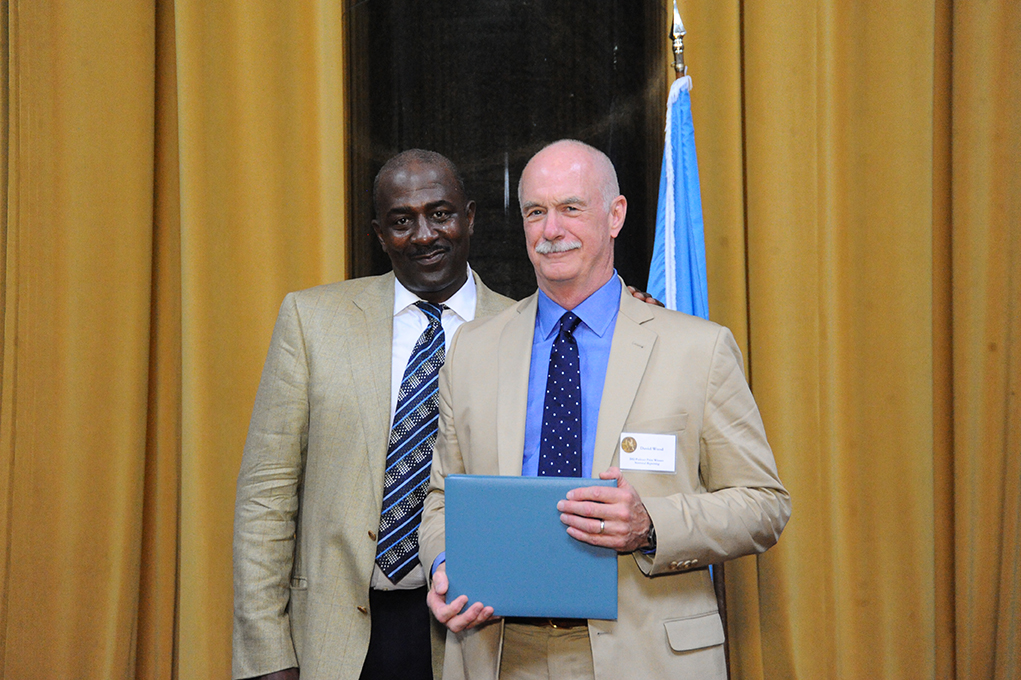
Gregory Moore (left), co-chair of The Pulitzer Prize Board, presents the 2012 National Reporting Prize to David Wood of The Huffington Post.
Winning Work
By David Wood
July 4, 2010, was a bad day for Tyler Southern. He dreamed he was with his older brothers, playing sandlot football, running and laughing, horsing around just like they used to when they were together as kids in Jacksonville, Fla.
In his dream, he was whole again.
Then he awoke in his hospital bed at the Walter Reed National Military Medical Center in Bethesda, Md., and reality came flooding back. Both of his legs and his right arm were gone, blown off in Afghanistan two months earlier by an improvised explosive device so powerful that only bits of his legs and boots were ever found. The explosion left one remaining limb, his left arm, broken and mangled.
Southern began to hyperventilate. His mother Patti, at his bedside, reached out to calm him. Mom, something's coming on, he cried. Breathe with me, she murmured. Breathe with me. She gathered him in her arms and held his head tight against her chest as sweat beaded over his body and his heart pounded wildly. He gulped lungfuls of air, his mother rocking him in her arms.
Breathe with me.
Suddenly Southern vomited. Patti rocked him gently in her arms until he was calm.
"My last big, bad day,” he recalled recently. "Everybody has 'em," he added, speaking of the other patients he knows who are struggling with severe wounds.
A 22-year-old Marine Corps corporal, Southern is just one of a growing number of young Americans -- 16,000 or more, so far, out of 2.3 million American troops sent overseas -- who volunteered for Iraq or Afghanistan and came back alive but catastrophically wounded.
Those numbers are small but significant, because they indicate an alarming new trend in warfare. Despite untold billions of dollars spent over the past 10 years to defeat Afghan insurgents, the enemy's ability to severely wound Americans in battle is growing, according to U.S. military data and analysis.
Proportionately fewer American troops are being killed outright on the battlefield, thanks in part to better protective equipment and improved medical care. "We are stealing some people from death," Army Brig. Gen. Joseph Caravalho, a senior Army medical officer, told me at the Pentagon.
Still, more Americans are being wounded in combat. And their wounds are more severe and complex, raising difficult issues for military medicine and for the nation on which disabled soldiers will depend for a lifetime of care.
The Defense Department uses a measure called the Military Injury Severity Score to categorize wounds. In Afghanistan, the severity scores have increased steadily since 2006, the Army reported in June.
The number of American soldiers who lost at least one limb in combat doubled from 86 in 2009 to 187 last year, while the number with multiple limb loss tripled, from 23 in 2009 to 72 last year. Those in need of blood transfusions of 10 units of blood or more (the human body holds a total of 10 units of blood) rose during that 12-month period from 91 to 165.
And triple amputees like Tyler Southern are becoming more common. Their ranks have nearly doubled this year from the total of all triple amputees seen over the past eight years of war, the Army said in its report, "Dismounted Complex Blast Injury."
"These complex blast injuries are not only complex for the person to live with for the rest of their life, but they're also difficult for the entire medical health care system because of the resources they take," said Army Col. James Ficke, chief orthopedic surgeon at the Brooke Army Medical Center in San Antonio, Texas.
THE DEVASTATION OF THE IED
Most of the severely wounded are victims of a deadly new form of explosives perfected by insurgents in Iraq and Afghanistan, classified as improvised explosive devices. A seven-year, $20 billion Pentagon campaign has been unable to defeat the IED and its deadly cousin, the suicide bomb. Over the past year, American troops have become more vulnerable to IEDs because they are walking more foot patrols, in keeping with the U.S. counterinsurgency doctrine of working closely with local Afghan villagers.
The survivors' wounds are often horrific. In Afghanistan, an IED is typically made of a plastic bucket of ammonium nitrate buried beneath layers of sand and dirt. It explodes with a lethal pressure wave strong enough to knock down concrete walls and bend metal, followed by a fireball as hot as 2,700 degrees that can burn away eyelids and fingers.
The blast severs limbs, ears and noses; tears off faces; crushes bones and teeth; bruises the brain; strips away skin and muscle; and ruptures eyeballs, eardrums, lungs, bowels and other internal organs. As the blast erupts upward, it drives sand, dirt, pebbles, bone fragments and barnyard filth deep into vulnerable soft tissue.
In recent months, trauma surgeons have seen a sharp rise in the war's most disturbing wound: the traumatic loss of both legs and the genitals.
The upward blast of an IED often rips off lower limbs as high as the hip, as well as the genitals. It shatters the pelvis and often takes off the arm the victim is using to hold out his weapon. In some cases the perineum, the seam at the bottom of the torso, is ripped open and the intestines and other organs spill out, a Navy combat corpsman told me.
One out of five Americans whom the Army medically evacuated from Afghanistan last October suffered such wounds, which the military calls genitourinary, or “GU,” wounds.
These GU injuries have become so widespread that the Army has begun training surgeons in genital repair and reconstruction in its urology residency training programs.
Among the troops serving in Afghanistan, though, the response has been more direct: They would rather be dead than castrated. According to the Army task force report on severe IED wounds, a number have developed "do not resuscitate" pacts in case they suffer traumatic genital amputation.
This month, the Army begins shipping tens of thousands of pairs of armored overgarments -- in effect, diapers -- to try to protect soldiers’ genitals from blasts. The devices, made with layers of Kevlar, is strapped on over clothing, passing between the legs and snapping at the waist, and provides front and rear shielding.
According to Army Col. William Cole, the procurement officer, the garments will only be issued to soldiers at risk of encountering IEDs, such as those who operate with route-clearance teams.
An informal accounting of GU wounds by doctors at the U.S. military hospital in Landstuhl, Germany, where the wounded first arrive from Iraq or Afghanistan, described a threefold increase in genital wounds, from 45 in 2008 to 142 last year. Through July of this year, Landstuhl's surgeons have seen 90 GU cases, most of them involving the loss of genitals.
"It's the first thing they ask" when patients wake up, said Dr. Steven Davis, a psychiatrist at Walter Reed. "Are they still there?"
Annette "Bo" Bergeron, Walter Reed's chief physical therapist for amputees, sighed heavily and nodded when asked about traumatic genital amputation. She said the high-testosterone young Americans drawn to military service can bear almost anything except that particular wound. For them, she said, "It's devastating."
Despite such wounds, the fact that so many of the badly wounded can live beyond all previous expectations is cause for celebration, of course -- for the troops, their families and the nation. But the severely wounded also pose new challenges for the military medical system: How do you care for a soldier or Marine who's not just a double amputee, but also has facial burns, severe infections, and has Traumatic Brain Injury and deep depression?
AMERICA'S WOUNDED WARRIORS
Among the questions the Defense Department and the Department of Veterans Affairs cannot answer is how many young Americans have been severely wounded in combat.
Incomplete battlefield reports and conflicting databases make it difficult to come to a precise accounting, Pentagon officials say.
About 45,000 American troops in all have been wounded in combat in Iraq and Afghanistan in ways that have been serious enough to warrant their evacuation to a hospital.
Within that group are roughly 16,500 who have been severely or catastrophically wounded, meaning they have lost the use of at least one limb and have other debilitating injuries.
These include 1,350 amputees and about 6,800 other men and women whose limbs are so mangled that their injuries will "affect their ability to function for the rest of their lives," said Ficke.
In addition, the Defense Department currently has on its books 310 cases of spinal cord injury, 2,043 troops with deep burns, 130 with the loss of at least one eye, 3,573 with severe penetrating head wounds, and 2,235 with severe traumatic brain injury. More than one fourth of military casualties suffer deep facial wounds. Some of these wounded troops are recorded in two or more categories: It is common, for instance, to see patients with multiple amputations and burns. On average, the wounded are being carried off the battlefield with 4.8 wounds each.
Separately, the Department of Veterans Affairs has on its rolls 6,500 severely wounded veterans under its care. VA officials expect that number to double to 13,000 within four years as the severely wounded retire from active-duty Defense Department care to the VA.
The VA accounts each year for the number of veterans who begin to receive disability payments. New cases of veterans receiving compensation for mental disorders have leaped from 32,838 in 2006 to 60,535 new cases in 2010.
COMING HOME
At Walter Reed or the Brooke Army Medical Center in San Antonio, two main intake points for the severely wounded, patients often arrive in a coma. Infections typically spread massively from the filth driven deep into their wounds. Patients at BAMC's burn center are especially vulnerable to infection. They spend hours on a gurney in a yellow-tiled shower room, heated to 90 degrees, while surgeons and trauma technicians wash away charred skin and bone and infected tissue. Months and years of painful surgery and both skin and tissue grafts follow.
Surgeons often use leeches on wounds to suck out venous -- deoxygenated -- blood that is not draining properly, Army doctors said.
Patients of all kinds also are vulnerable to heterotopic ossification, the mushrooming growth of bone in tissue damaged in combat. One veteran told me it felt like jagged coral growing in his leg. Patients typically suffer from compartment syndrome, in which nerves and muscles are crushed by uncontrollable swelling. Blood clots and organ failure are a constant threat. Understandably, acute anxiety and depression are common.
As the wounds of this war have become more severe, medical care has had to become more complex.
Two years ago, a wounded patient stayed three or four days in intensive care and a week or two in the hospital before being discharged to outpatient status. Today, the severely wounded are in intensive care two weeks or longer, and in the hospital 40 to 50 days as inpatients and two to three years as outpatients, according to Dr. Michael E. Kilpatrick, a senior Pentagon medical official. When the wars in Iraq and Afghanistan first began, wounded patients averaged 30 hours of surgery. Now patients are undergoing 60 to 100 hours of surgery, Kilpatrick said.
"There is a level of people who are catastrophically wounded, with a spinal cord injury or Traumatic Brain Injury (TBI) that leaves them in a minimally responsive state for months or years or decades," said Dr. Shane McNamee, chief of medicine and rehabilitation at the VA Polytrauma Rehabilitation Center in Richmond, Va.
"Despite what technology can do, these individuals will require significant amounts of physical assistance for a lifetime. These wounds don't simply go away. You can't cure these things. You can help an amputee by giving him a prosthetic limb, but you can't grow the leg back or nerves. You can't necessarily get rid of pain over time," said McNamee.
"There's just challenge after challenge, sad story after sad story," said Dr. Paul Pasquina, chief of orthopedics and rehabilitation at Walter Reed, where he has overseen the surge in the number of troops coming back from the battlefield severely wounded.
But they live.
The battle statistics tell an astonishing story. In 2002, the first full year of the war in Afghanistan, there were 81 American combat casualties, among whom 63 survived and 18 died, a survival rate of about 77 percent. This year, with tens of thousands more troops and a far higher tempo and intensity of combat, the first six months saw 2,585 casualties, of whom 172 died and 2,413 were saved, a survival rate of 93.3 percent, according to the casualty data the Pentagon makes public.
An increasing number of the wounded require massive blood transfusions, often or 10 units (about five liters) or more. The death rate for badly wounded soldiers who receive these massive blood transfusions has been cut in half, from 40 percent historically to 20 percent today, according to Army data.
Very rough estimates suggests the survival rate for American combat casualties was 76 percent in Vietnam, 80 percent in Korea and 70 percent in World War II.
Recent wartime innovations mean that rather than coming home in a flag-draped coffin, Tyler Southern, a self-proclaimed "triple" sporting two chrome-plated powered legs and an artificial arm, got married last summer. It was a gala celebration that a local TV station hosted in Jacksonville and which was paid for through donations. After the ceremony, Tyler and his bride, Ashley, took ownership of a new home in St. Augustine, Fla., built with donated labor and materials.
AN INTENSE NIGHTMARE
The ten pounds of ammonium nitrate meant to kill Tyler Southern lay buried three feet beneath the doorway of a squalid building in a ruined adobe village in southern Afghanistan called Salaam Bazaar. It was a blazing hot day on May 5, 2010, and the members of Mortar Platoon, Weapons Company, 1st Battalion, 2nd Marine Regiment were on a routine foot patrol when their radio picked up a transmission from insurgents in the Taliban stronghold. They were organizing an attack on the approaching Americans.
The Marines decided to attack first, with Southern, a lance corporal, walking point ahead of a half-dozen Marines circling warily around the building. The remaining Marines and Navy Corpsman James Stoddard circled the other way. His weapon held at the ready, Southern approached the doorway and stepped gingerly into the gloom -- and into an ambush, sprung when he stepped on a concealed pressure plate that closed an electric circuit connected to a detonator.
Stoddard and the Marines on the other side of the compound heard the blast and sprinted around to find half of Southern's body in a smoking crater. The rest of him was just gone.
Southern was one of Stoddard's closest buddies, and now Stoddard was responsible for trying to save his life. Southern's wounds would have challenged any civilian ER surgeon. Stoddard was 19 years old, and this was his first combat casualty.
As Stoddard reeled from the shock, his training -- his "muscle memory" -- took over. Southern had burns on his face and chest and was bleeding heavily. Stoddard quickly harnessed two tourniquets on what was left of Southern's legs and yanked them tight. Then a tourniquet on the stump of Southern's right arm, and one on his mangled left arm, pulled tight and velcroed closed.
Next, he checked Southern’s throat and airway and inserted a small tube through one nostril to make sure Southern could breathe. He grabbed a 500-milliliter bag of Hespan, a blood volumizer that compensates for massive blood loss. He plunged an IV needle into Southern's mangled left arm, then moved the tourniquet down toward the wrist so the IV fluid could flow up the arm into Southern's body, and he replaced the tourniquet with a pressure bandage to stanch the bleeding. He rolled up the IV bag and squeezed to get the precious Hespan into Southern's veins more quickly.
Shots began thudding around Stoddard as he worked, and he scrambled around on his knees to protect Southern, who was stirring and trying to talk. "I was telling him what I was doing, asking him if he remembered what happened, anything to keep his consciousness and to keep him from literally freaking out," Stoddard told me later.
He rolled Southern onto his side in the dust and checked his back and chest, discovering a few burns and small holes which he covered with a plastic seal.
It was a nightmare of intense heat, smoke, dust, noise: a Marine nearby on the radio, calling in an urgent "nine-line" casualty report and demanding a medevac helicopter; Stoddard, on his knees, yelling, "Tell them I need a litter and blood and a resupply bag for myself! What's the ETA on the bird? Gimme the ETA!"; a radioman shouting back that it would be five to 10 minutes.
It seemed to take forever. Stoddard had Southern stabilized as best he could: bleeding controlled, airway clear, vital signs okay -- he could detect a decent pulse under Southern's remaining arm. The shooting stopped after a brief firefight. The Taliban had fled.
Southern was stirring again into consciousness. As the pain kicked in, he began moaning and writhing. Stoddard shot 10 milligrams of morphine into his left shoulder, and then the bird came. Marines grabbed a litter and got Southern onto it and up into the aircraft, and then the helicopter lifted off in a hurricane of dust and pebbles, bound for the nearest military trauma hospital, at Camp Bastion.
He arrived essentially dead, unconscious and nearly drained of blood. Surgeons pumped fresh blood into him, quickly sliced deep between his ribs, reached into his chest and clamped off the descending aorta carrying blood to his torso. That last-ditch effort diverted blood to his brain, which cannot survive long without it.
Southern "flatlined," and doctors revived him once more as he was flown, strapped to a litter with tubes and wires and critical care trauma attendants, from Camp Bastion to the U.S. military hospital in Landstuhl, Germany.
"He was ripped out of the hands of death a couple of times," said Dr. Robert Howard, a Navy plastic and reconstructive surgeon who later performed a dozen surgeries on Southern in Bethesda.
Doctors often keep patients at Landstuhl for several days for additional surgery, but in Southern's case, they were concerned that he wouldn't survive. They rushed him onto another flight direct to Andrews Air Force Base in Maryland, near where his parents were waiting at Walter Reed in Bethesda.
"The guys at Landstuhl were convinced I wasn't going to make it. They sent me to Bethesda so I could die with my family," Southern told me.
His mom and dad were waiting when Tyler was unloaded from the ambulance that brought him from Andrews Air Force Base. His mother, Patti, thought he looked dead, he was so gray. As attendants lifted his stretcher she rushed at them crying, "Please just let me touch him! You have to let me touch him!"
He was unconscious for 14 days after being blown up. "I went to sleep on the 4th [the night before the blast] and I woke up on the 18th in Bethesda," he said. "In between, I don't remember a thing."
When he did claw his way into consciousness, no one knew if he would awake with his full brain capacity or whether his near-death experiences had left him in a vegetative state. Doctors urged him along: "Say your name, Tyler. Say your name." No response. "Tyler, say your name!" Nothing. His mom stood watch at the foot of the bed, gripping the rail. Finally she burst out, "Tyler! Say hi to your mama!"
Tyler stirred.
"Hi Mama," he croaked.
Tears streaming, she bent over him, shielding him from the sight of his missing legs. "You were injured in Afghanistan," she whispered. "You're missing both legs and one arm. You're okay."
At 22 years old, life as Southern had known it was over. His new life would become a seemingly endless procession of painful surgeries and dreary rehab sessions, a struggle to master the wheelchair and, eventually, prosthetic legs and a mechanical arm.
THE MOST GRUESOME THINGS
There are more Tyler Southerns coming. President Obama's announced withdrawal of 33,000 from Afghanistan by 2012 will still leave over 60,000 U.S. military personnel embroiled in a war that is still unpredictably deadly for dismounted troops and even for those enclosed in massive armored vehicles called MATVs, which have proven vulnerable to IED.
Violent clashes and IED attacks continue to soar in Afghanistan, up 39 percent in the first eight months of 2011 compared to the same period last year, according to a recent United Nations report.
The severely wounded continue to flow in from the battlefield, and many of them don't do as well as Southern. In Iraq several years ago, an IED blast tore off both legs of a soldier and ripped open his abdomen from sternum to pelvis. Trauma surgeons recorded a daunting list of other injuries: severe head injury, anoxic brain damage from lack of oxygen, spinal cord injury. Metal splinters and filth perforated his internal organs. His pelvis was shattered into more than 60 pieces. In a 24-hour period he lost 60 units of blood. He was 22 years old with a young, pregnant wife.
"It was one of the most gruesome things I've seen in medicine," said McNamee, at the VA Polytrauma Center in Richmond. Va. "He'd wake up every two or three hours and start shrieking, where are my fucking legs, who took my fucking legs?
"How do you fix a guy like that? You can't. There's so much loss, so much despair," he added. "It's a matter of resetting expectations, trying to pull the individual and the family back after such a catastrophe."
Whatever their prospects for reclaiming normal life, the severely wounded are heading into a difficult and lifelong struggle that can stretch out for half a century or more. At the outset, extraordinary care is lavished on them at Bethesda and other state-of-the-art military medical centers. They are patients there for years, healing in the warm embrace of their fellow soldiers or Marines, an environment that Harold Wain, a psychiatrist at Walter Reed, calls "the womb of war."
Barely out of their teens, the severely wounded are suddenly heroes. The president visits. They are awarded medals. Their catastrophic wounds bind them into an elite community.
But inevitably, real life catches up. After years of rehab, some remain on active duty, but rarely in the high-adrenaline jobs they held before their injuries. Others drift away into private life. All of them will require a lifetime of care, the joys and trials of their newly-won lives intensified by the continuing reality of their physical and psychological wounds. Many suffer from chronic pain. Most have at least mild traumatic brain injury and stress disorders that slow their movements and fog their thinking. Infections and painful bone growths are common; artificial limbs wear out and need replacing as stumps change shape and size.
Amputees have a particularly hard time. It takes more than twice as much energy for a double amputee to walk with prosthetics, and many choose a wheelchair instead. But without exercise, wheelchair users have a higher risk of obesity, diabetes and heart disease.
A study cited in the Army task force report found that 53 percent of Iraq and Afghanistan war amputees use wheelchairs at least some of the time, compared with 32 percent for Vietnam war amputees. About one quarter of Iraq and Afghan war amputees already report arthritis problems. Almost half have hearing problems.
Families are also forever changed when soldiers are severely wounded. A phone call in the night summons young wives, often married only a few months to their soldier or Marine, to a life they never wanted and couldn’t have imagined, giving up school or jobs to become full-time, lifelong caregivers.
"I am not only my husband's caregiver, non-medical attendant, appointment scheduler, cook, driver and groomer, but I am also his loving wife faced with my own stresses and frustrations," said Crystal Nicely, 25, whose husband Todd lost both arms and both legs to an IED blast March 26, 2010, in Lakari, Afghanistan.
"There is no other place on earth I want to be other than by his side," she said. But speaking of the long months at Walter Reed, she added: "Life here isn't a picnic."
Karie Fugett, a flight attendant who at age 20 married a Marine four months before he was blown up by an IED in Iraq in April 2006, kept a blog during the subsequent years of her husband’s struggle.
"We were fighting to get his life back, and fighting to make a marriage work through pill addiction, overdose, miscarriage, family feuds, infections, amputation, PTSD, and TBI," she wrote. "There were amazing times that made everything worth it, and there were times I truly felt like I was in hell. I was scared, I was exhausted, and I felt very alone."
The normal stresses of life, piled on top of chronic pain and limited mobility -- and people gawking at a man with no legs -- can trigger post-traumatic stress disorder, medical experts say, putting at risk family and job. Separation and divorce rates for severely injured can run as high as 64 percent, according a recent review of studies published in the Journal of Head Trauma Rehabilitation that looked at 7,925 patients.
For some, a cruel reality emerges: As time goes on, post-traumatic stress can emerge and worsen. The Pentagon has diagnosed more than 75,000 troops with post-traumatic stress syndrome, an anxiety disorder that usually accompanies a traumatic wound. Increasingly, PTSD is being recognized as a major cause of domestic violence and abuse.
One Army wife, whose husband came home from Iraq with severe PTSD, wrote in her blog: "His angry outbursts could suddenly with a blink of an eye turn very scary with him picking up tables, chairs, hitting walls, breaking things, and often would push me around. Grabbing me by the arms or wrists would leave bruises for a week or longer. I kept thinking to myself, if it gets worse...I will have to leave him.
"Just when I think I am ready to walk out the door and just give up.....the thought occurs to me 'if I leave, my husband will simply become another statistic on some blank page that no one cares about.' It blows over, he switches back to his semi-normal PTSD self and acts as if nothing ever happened. In the mean time, I am cowering on the inside and permanently waiting for the fists to fly..."
Combat veterans with mental health issues often feel out of place at home in the civilian world, and yearn to return to the uncomplicated and close-knit camaraderie of war. That makes it hard to open up to a civilian psychologist -- indeed if they can find a therapist who understands.
"Being in combat or doing anything when your life is in danger, that gives you an adrenaline high. I seek that out, when I can," said Zac Hershley, who came home in 2004 with PTSD from fighting in Iraq and Afghanistan.
"I feel safer over there than here," he told me. "I know what the situation is, I trust the guys over there. I don’t trust hardly anybody here." Said his wife, Elizabeth: "He's treatable. Not curable."
While many rise above these afflictions, for others alcohol and drug abuse are common, as is domestic violence. It is a long and hard road, and a painful, expensive and visible reminder that the costs of war endure long after the last troops are withdrawn.
“Americans love success stories," said McNamee, at the Richmond Polytrauma Center. “There’s this shiny, bright, happy theme that war wounds go away and everybody is going to be fine and the rest of us won’t have any societal guilt because of that."
"Well, that doesn’t always happen."
YEARS OF REHAB
Despite such gloomy forecasts, Tyler Southern, like many of the most seriously wounded warriors I've met, doesn't hold any bitterness about what happened. He knew when he enlisted, in 2007, that he'd go into combat. That was the goal, he said. He knew the risks.
"I wish it had happened later in my career," he said about being wounded. "I had a lot more to do."
He grew up the youngest of three brothers, and the smallest. Both brothers serve in the military; his father is a retired Navy senior chief petty officer. Proud enlisted guys all. Core values in the Southern household are fierce patriotism, humor and grit. As a kid, Southern painted his bedroom red, white and blue. He would complain to neighbors if they were flying a tattered American flag. The military was an early career choice: By the sixth grade, he said, "I knew my 11 general orders," a code of duty that military recruits are required to memorize. Above all, he said, he wanted to enlist to help protect his country. "It has given me everything," he said.
Southern shipped out to Afghanistan with his unit, 1st Battalion 2nd Marines, prepared to die. In fact, he had written a three-page letter for his family and closest friends in case he was killed. He told his buddies he suspected he'd get wounded, win a Purple Heart. He had in mind getting shot. He did not anticipate losing three limbs.
When he awoke from his coma at Bethesda and learned from his mother that he had only one damaged limb left, he said he took the news stoically. "I said fine -- what's on TV?" he recalled. He wasn't in much pain. He never complained. He looked on the bright side of things. He didn't really think about his future, which would be so different from what he'd always imagined.
At first, Southern insisted to me that being instantly transformed from an exuberant, athletic Marine to a near-helpless triple amputee didn't bother him. But, of course, it did, and he ended up conceding as much during a long talk. He said he had been holding it together for his father, the tough retired Navy senior chief. And that it wasn't until that July 4 dream a year ago -- his "last big bad day" -- that he broke down, realizing that being a triple amputee "is what I'm about to do for the rest of my life. It hit me like a ton of bricks."
But, he explained, "I didn't want my Dad to see me upset. I hoped it would make him a little more proud to see that I am strong about this."
Growing up, being the youngest, the "runt" as he described himself, he felt under pressure, "trying to live up to ... I had to be tougher, faster, stronger because that's what my father and brothers would have done."
Being injured, he said, turned out to be a good thing. "It gave me the opportunity to prove I'm the man they wanted me to be," he said.
After his panic attack with his mother, he went on with his new reality, adopting the Southern family philosophy: "If something happens to you, make the most of what you got left," is how he described it. "Cryin' ain't gonna grow anything back. I was raised to find the silver lining. Not religious, not that 'God has a plan for you' kind of thing. I'm here, I still have one good arm that's working, there's so much 'up' to look at, it's hard to look at the 'down.'
"I'm just missing a few pieces," he said.
But there's also a strong current of dark humor that pulses through Southern's new life. "There is something funny in all this," he said one day, looking around at amputees working out in the Walter Reed amputee center. "It's my way of fighting this."
Southern and his Dad made T-shirts for the Marines on the amputee ward, most of whom are victims of IEDs. One set of shirts carries the image of a bomb explosion and the legend, "I had a blast!" Another proclaims: "Combat Wounded Marine: Some Assembly Required."
He credits his survival to the support of his family -- Mom, Dad, brothers and Ashley -- and an "amazing" cast of talented medical personnel. "I was blown almost completely open and had all of Afghanistan inside me," he said. "Five years ago, I wouldn't have made it."
His wounds are healing. From the ruins of his upper thighs, surgeons fashioned stumps that can accommodate prosthetic legs, enabling Southern to walk and even run. His left arm, his one remaining limb, was more difficult. Most of the muscle and tissue were gone, the bones broken or missing, the mangled flesh laced with a raging Methicillin-resistant staph infection. At Bethesda, surgeons talked with Southern about amputation. But his lead doctor, Navy Cdr. Howard, was determined to save the limb. Southern "lights up a room," he said by way of explanation.
In the operating room, Howard performed aggressive wash-outs of the wound every day for weeks. When the infection was finally beaten, the arm was virtually a shred of bone, still missing much of the skin and supportive tissue, with a single artery left.
Howard and Southern went back in the OR, where Howard severed a large piece of skin, fat and muscle, the entire latissimus dorsi muscle, the big flat one in his lower back, and sewed it into his arm, covering much of his forearm and hand. He connected Southern’s single artery into the muscle to feed rich blood into the graft, bringing in nutrients and antibiotics.
"We've become a little more aggressive with this kind of limb salvage," Howard said, "and we're getting help from some new technologies." One is a series of miniature ultrasound micro-doppler devices implanted in the transplanted tissue to measure blood flow. These kinds of transplants, or "flaps," often fail because of inadequate blood supply. Howard hooked up Southern's flap for 24/7 monitoring of the blood flow.
The graft took, but it left Southern with a large Popeye-like forearm of loose tissue and scar tissue.
These days, Southern is back at the new Walter Reed National Military Medical Center in Bethesda, Md., created this summer with the merger of the old Walter Reed Army Medical Center and the Bethesda Naval Hospital. There, he and Ashley have a new two-bedroom apartment in Walter Reed housing.
Ashley, who attends most of Southern’s therapy sessions, is one of the unexpected upsides of his war injury. They knew each other in high school, but she was surrounded by boyfriends and Southern never dared to ask her out. After he was wounded she ran into his mother in Jacksonville, learned of his condition, and flew to Bethesda to see him. She stayed on as his official caregiver, and then they fell in love.
"She's the light at the end of my tunnel," he said.
He works out daily, building his upper body and core muscles that help him walk with his twin prosthetic legs. He's got more surgeries coming up, including one to reduce and smooth out the huge graft on his forearm.
Years of rehab lie ahead. Southern will be in and out of Walter Reed for perhaps 18 months, and will need refitting and adjustments to his residual limbs and prosthetics for a lifetime.
But he is determined to re-enlist in the Marine Corps-- and the military now makes room for the severely wounded to stay on active duty if they desire. After that, he wants to be a stay-at-home dad, or get into government contracting. Or do motivational speaking, "to show people I'm not sitting in a corner feeling sorry for myself," he said.
"I have no one to blame for this, there's no one to blame but me," he told me. In Afghanistan, as he approached the building where insurgents had set up the IED ambush, "maybe I missed a sign ... I was really focused on getting into that building and getting the guy in there."
Meanwhile, life goes on. "This is page one of chapter two," he said. "I have the world at my prosthetic feet.
"It'll go well," he added.
Southern's mom, Patti, has come around to that point of view as well. She regrets that he enlisted in the Marines as an infantryman. "I would have done anything in the world to stop him," she said. "It was his choice, but I am still mad about it."
Still, he came home and survived his wounds -- a living symbol of the hard work and major medical advances that are saving thousands of badly wounded warriors like Southern.
"I got him home. I got to tell him I love him," she told me. "There are a lot of mamas that don't."
But Southern has no regrets, he said, talking in the amputee center at Walter Reed, where soldiers and Marines were working out with their new legs.
"I've had an amazing life. What other 22-year-old is there with such life experiences? If there are any," he added with a sparkle in his eye, "they're all in here."
By David Wood
Stepping carefully through the blinding sun and heat and dust of southern Afghanistan with Lance Cpl. Tyler Southern and several squads of sweating Marines was a brand-new Navy corpsman, James Stoddard. He had never treated a real-life battle casualty. He was 19 years old.
Yet when an IED blew off Southern's legs and right arm, leaving him bleeding to death in the smoking crater, Stoddard's reaction was quick and simple: "You see a missing limb, you throw on a tourniquet."
Stoddard had already strapped tourniquets on simulated bleeding limbs hundreds of times, maybe thousands. During four months of medical school, two months of field training and then relentless drilling with the Marines, he'd practiced slamming that tourniquet on and yanking it tight over and over. By feel, blindfolded, in the rain, in the heat and while a sergeant bawled him out, Stoddard’s fingertips learned to quickly trace out the slick of fake blood on a volunteer and, one-handed, slip that tourniquet up and strap it down hard.
That training helped Stoddard to power through the shock of seeing his buddy blasted into pieces. Southern's life now depended on him. What did that moment feel like? "I have no idea," Stoddard says. "I literally don't remember. Muscle memory took over."
That begins to explain why Tyler Southern didn't die that day, May 5, 2010. Thanks to Stoddard, Southern came home -- badly wounded, but alive.
Stoddard is part of a long and noble tradition. Battlefield medics have saved countless lives since the Civil War and techniques have improved steadily since then, in small and large ways (at the Battle of Manassas in 1862, for example, it took a week to get the wounded off the field; today that usually happens almost immediately, most often by medevac helicopter with a trauma specialist aboard).
Razor-sharp training, battle-tested new medical procedures and new technology -- and the heroic work of medics like Stoddard -- are rescuing and revivifying a new generation of severely wounded survivors.
Combat has always produced gruesome wounds, and until recently many were fatal. During the Vietnam war, out of every 10 who died on the battlefield, nine would have died even if a trauma surgeon was standing next to them -- there simply wasn’t the medical technology or know-how to keep them alive.
"We've changed that nine of 10 to five or six out of 10," says Dale Smith, a medical historian at the Uniformed Services University of the Health Sciences in Bethesda, Md., a Defense Department medical school. "That's a huge difference. We've had 43,000 wounded in 10 years of war, and only 6,000 died. That's 13 percent, as low a number as we've ever had."
I interviewed Smith last summer, and since then those numbers have risen to 46,300 wounded and 6,232 dead, roughly the same 13 percent.
What changed?
Since March 2005, every troop headed into combat is certified with advanced trauma care training as a Combat Life Saver and carries at least two tourniquets and an airway tube. Those devices have dramatically cut the primary causes of previous combat deaths: choking and bleeding to death. A combat life saver medical kit also carries a needle and catheter for relieving pressure caused by a chest wound.
Other innovations include rapidly infusing patients in the operating room with a combination of whole blood, plasma and platelets to stem bleeding, rather the previous practice of using crystelloids or saline solution; rapid medical evacuation from the war zone aboard aircraft that are essentially flying intensive care units; and "smart" powered artificial limbs and experimental use of regenerated bone and spray-on skin.
"There's been more innovation in this war than in any other," said Dr. Robert Hale, a surgeon at the Armed Forces Institute of Surgical Research in San Antonio, where a number of clinical trials are about to get underway. "Much still has to be proven in the lab."
Tyler Southern, thanks to James Stoddard, is one of the saved.
In a previous war, he likely would have lived only minutes after an IED exploded beneath him, as all the blood in his body drained into the dust. Until recently, medics and corpsmen didn't use tourniquets. Official military medical practice was to pump IV saline solution into the patient and then try to stem the bleeding with bandages. The result: more than half of all those struck down in battle died of acute hemorrhage.
Tourniquets had long spooked military medical experts because in civilian practice, a tightly-bound limb could become damaged from lack of blood and require amputation. But by the early years of the Afghanistan and Iraq wars, the death rates in battle were so dismaying that combat trauma medics and doctors began reconsidering the tourniquet. In combat, they figured, better to risk the potential loss of a limb than to risk the loss of the patient. To embrace that strategy, the military turned on a dime: it supplied medics with redesigned tourniquets that could be applied and tightened with one hand.
The tourniquets proved so effective that in 2005 the military began issuing two to every combat troop, along with extensive instruction and training on how to use them on themselves and on buddies.
The tourniquet is only one innovation that is now saving lives. Another is the Combat Life Saver, a designation for a soldier or Marine who has been taught advanced trauma lifesaving skills.
The idea of extending battlefield medical expertise beyond medics came from the Israeli army's experience during the Lebanon war in 1982. Trained non-medical soldiers were saving lives by providing immediate treatment, usually tourniquets to stop the bleeding, before medics could arrive.
U.S. Army medical officers pushed the idea, which was met with resistance by the generals, according to Army medical historian Lewis Barger. Yet a few combat units at Fort Bragg tested the practice anyway, and such training proved invaluable during the invasion of Panama in 1989.
Today, nearly all soldiers and Marines have had CLS training. Even in basic training, soldiers are required to master skills that go well beyond Boy Scout first aid, including controlling bleeding, inserting a breathing tube through the nostrils, decompressing a chest wound with a needle, mouth-to-mouth resuscitation, cardiopulmonary resuscitation (CPR) and calling in a medevac helicopter.
'IT’S PLUMBING'
"Okay, gunshot wound to the chest, you want to seal that off, tape down all four sides," Army Spc. Steven Zimmerman told troopers of the 2nd Battalion, 30th Infantry last fall, before they deployed to Afghanistan.
The soldiers were sprawled beneath the longleaf pines of Fort Polk, La. Zimmerman was their medic, but he and the older ones had learned from previous deployments that everyone these days had to be a lifesaver. In a firefight, he was saying, a lot of guys might be hit. He'd be busy with the worst casualties. Self-aid and buddy aid would be critical until he could get to everybody. Got it?
With their deployment to Afghanistan only days away, some soldiers were taking notes. All listened intently.
"Always check for the exit wound. Don't try to clean 'em up, just get 'em on the chopper," Zimmerman said, talking quickly. "The heat from an explosion will cauterize a wound and it'll fuse clothing to the skin. Don't try to peel it off, that is his skin now. Just get 'em on the chopper."
Medics, of course, get far more sophisticated training, and senior medics get what many consider the most effective preparation for combat trauma: live tissue training. In that course, a medic or corpsman is given a short time to save a pig or goat that's been anesthetized and has gunshot wounds and partial amputations.
That training, long hidden due to concerns about protests by animal rights groups, "best simulates the challenges and stress inherent in stopping actual bleeding,” the Army's former surgeon general, Maj. Gen. Gale Pollack, told a congressional committee in 2007. It is "essential to properly train corpsmen for combat casualty response," according to a Marine Corps briefing.
Tough and realistic training, constant drilling and the widespread use of tourniquets has helped change the face of battlefield trauma medicine. Now, the military is saving people "who are literally within a minute of dying," Smith said.
Other improvements have come thick and fast in the heat of battle. Early in the Iraq war, soldiers were suffering penetrating chest wounds from gunshots and shrapnel; the Army designed body armor with ceramic plates that have virtually eliminated those wounds. Advanced helmets, eye protection and flameproof coveralls and gloves also cut the rate of serious wounds. The first of many versions of QuickClot, a powder or powder-impregnated gauze that helps stop bleeding, came in 2004. It's now routinely carried by all combat troops.
To control pain -- a major contributor to the later development of post-traumatic stress disorder -- combat medics found that fentanyl, a powerful pain reliever, was faster and more effective than morphine, especially when administered through the mouth. Some battlefield medics tape a fentanyl lozenge to the fingertip of the patient and stick it in his or her mouth; when the drug takes effect and the patient falls asleep, his or her finger drops out.
Medics also found that even in the intense heat of Iraq and Afghanistan, the severely wounded get cold -- hypothermic -- which accelerates blood loss. Now they are given warming blankets.
The Army is adding critical care flight paramedics aboard the helicopters that transport the wounded from battlefield to hospital to provide in-flight CPR and other life-saving interventions. A new, high-tech litter for patients medevac'ed by helicopter enables these paramedics to monitor patients' vital signs as well as administer oxygen and fresh blood in the minutes before the helicopter touches down at a Forward Surgical Hospital.
These field hospitals, manned by Forward Surgical Teams, or FSTs, are typically housed in large, air-conditioned and sterile tents close to combat action. Medevac helicopters bring the most seriously injured patients there for immediate resuscitation.
Equipped like a civilian hospital emergency room, they typically have two trauma surgeons, operating room technicians, a nurse-anesthesiologist and several nurses. FSTs are meant to stabilize critically wounded patients -- providing blood transfusions and tying off blood vessels and intestines -- before they are flown to a major hospital and on to the United States.
For some of those treating severely wounded soldiers, their work has become the stuff of high-end handiwork, albeit of the most probing sort.
At a Forward Surgical Hospital in Kandahar, Afghanistan in 2008, Navy Lt. Cmdr. Tom Vanhook, a trauma surgeon, described his work this way: "Basically, it's plumbing."
Their work relies heavily on such innovations as computerized tomography, or CT scans, to trace the often invisible paths that shrapnel and other fragments take as they slice through soft tissue and internal organs. Such deep, internal wounds can be fatal if untreated, said Army Staff Sgt. Bethany Moser, 27, a medic, who served with an FST in Ramadi, western Iraq.
"You have to track the path to find out what's been damaged," she explained at Fort Bragg, N.C., where she serves in the 82nd Airborne.
In another innovation, Navy doctors have figured out a way to move an operating room itself into the middle of a battle.
Frustrated by delays in treating severely wounded Marines, they invented a combat "doc-in-a-box" by mounting a small medical facility on the back of a truck and riding into battle. Predictably, their first effort attracted a fusillade of bullets from insurgents. Chastened, they went back and replaced it with a stoutly armored box. Today, these Mobile Trauma Bays accompany Marines across southern Afghanistan, where a team of surgeons, trauma specialists and senior medics can drive into firefights too intense for a medevac helicopter to land.
"The idea was to get trauma care to Marines closest to the point of injury," says Navy Cmdr. Sean Barbabella, the 2nd Marine Division (Forward) surgeon, in a phone interview from Camp Leatherneck in southern Afghanistan. "We can go in there and begin pretty sophisticated treatment, and keep it going while we're driving [back] out to a field hospital."
All of this, of course, rides on the back of basic research and the willingness of taxpayers to have their funds used this way.
"The trauma system is in pretty good shape. We got em forward, they can be saved, we stabilize them, get them back quickly to a good hospital and then we rehabilitate them," said Dale Smith, the medical historian. "Each of those pieces grew over 30 to 50 years, not over 10 years. But they all became militarily useful between the first Gulf war and Operation Enduring Freedom [Afghanistan]."
"It's important to understand that," he added, because at budget-cutting time "we are prone to wonder what some of our public expenditure on basic research is worth."
Combat medical practitioners like Barbabella and Stoddard talk about their work in crisp, clinical tones that mask the emotional burden of battlefield trauma care. It is only later that they can let down.
"When you see these guys, it breaks your heart that anybody has to be wounded like this," says Navy Cmdr. Lisa A. Osborne. "They're often in a state of confusion, frantically looking around wondering where they are,” she says. ‘I'm the last person they see" before they are sedated for surgery, "so whatever I say to them may be the last thing they hear for a really long time."
"I'm always hesitant to tell somebody they're going to be okay, because that's not always going to be true," she says. "We don't save every single person -- some of their injuries are not compatible with life, is the grim reality."
UNTIL THE BIRD ARRIVED
James Stoddard never told Tyler Southern he'd be okay, either. He knew better. After the medevac bird swooped in and carried Southern away, Stoddard had about a minute before the combat patrol resumed.
"I took a knee for a moment," he recalls, using military jargon for a pause to relax. Then he went around cleaning up bloody bandages and wrappings and stuffed them in his pockets.
He and another Marine picked up the bits of Southern's legs and arm that they could find. "It was one of the worst scenarios I've been in," he says.
But there was no time to absorb it. "I had to check all my guys for psychological issues. I went to each one, put my hand on his shoulder and said, 'Are you okay to push, you need anything?"
Back at their base that evening, Stoddard sat down with the Marine squad and platoon leaders and explained what had happened, and what he had done for Southern. He did not say Southern would be okay. "I just said I had done everything I could for him and sat with him until the bird arrived.”
Stoddard's deployment, or course, was not over. He treated 10 more casualties. In one 45-minute attack, Stoddard suffered a concussion and perforated eardrums from an explosion, but went on to save a Marine who'd lost three limbs, a Marine who'd lost two limbs and a Marine with shrapnel wounds on his face.
"I remember the initial blast and coming to, and I was putting on the tourniquets when I came to," Stoddard says.
Where did this teenager find all that strength?
A decade earlier, Stoddard was a Cub Scout when he heard a short lecture on first aid. Make sure the victim's airway and mouth are clear, he was told. Keep the victim warm, elevate his legs, and then go for help.
A few weeks after that, he and his younger brother Robert were playing on an abandoned railway bridge when Robert toppled off and was knocked unconscious. Stoddard ran to his side, checked that his brother's mouth and airway were clear, made sure he was warm, elevated his legs and ran for help.
At the hospital hours later, where his brother was diagnosed with a mild concussion, a doctor told Stoddard: You saved your brother's life by clearing his airway. He's going to be okay. You saved Robert's life.
At that moment, Stoddard’s work was set.
In Afghanistan, Stoddard heard that Southern had been airlifted to Germany, that he had flatlined twice and had been resuscitated each time. It wasn't until Stoddard's Marine battalion returned home to Camp Lejeune, N.C., that he and Southern were reunited.
Here came Stoddard, stepping off the bus, and there was Southern, grinning up from his wheelchair, the stumps of his legs and arm wrapped in bandages. They embraced.
By David Wood
Jimmy Cleveland Kinsey II was a good Marine who got blown up in Iraq and struggled for years with his wounds and with the demons that came with them. Eventually he lost, dying sick and alone, facedown on the floor of a Houston hotel room. He was 25 years old.
His young wife, Karie, had stayed with him in the years leading up to his death, in countless hospital wards and hotel rooms, changing his dressings, soothing his pain, managing his medicines, absorbing his moods, struggling to keep his well-being ahead of her own.
The wounded warriors visible to most Americans are the survivors, those who overcome debilitating injuries through their own perseverance and the hard work of military medical teams, friends and family.
There are those who rise even further above adversity, competing in the Paralympics, giving motivational speeches, enjoying standing ovations and special guest appearances at ballgames and State of the Union addresses.
Others come home wounded, and don't make it much further. For them, the quality and type of medical care they require simply isn’t available on a long-term basis, and that’s a problem the military and the Veterans Administration have yet to fully wrestle to the ground.
Kinsey was among those who are burdened with chronic pain and depression, with drug addiction, with the anguish of losing buddies in battle. Along with their physical injuries, they seem wounded with the shock and loss of finding themselves flung abruptly from the high-adrenaline camaraderie of battle into a harsh, solitary world of hospitals and rehab -- disoriented in a civilian world where nobody understands war or is paying much attention, and where they struggle to come to terms with their future as young, disabled Americans.
Jimmy Cleveland Kinsey II -- "Cleve,'' to tell him apart from his dad -- was a south Alabama boy, six feet and three inches of energy and mirth, with a weakness for radio-controlled model planes and, later, a 1988 Mustang Saleen. He also had an eye for a pretty local girl named Karie Fugett, whom he met in the eighth grade and, years later, met again when he was a Marine riding US Airways into Jacksonville, N.C., on his way to Camp Lejeune, and she was a flight attendant.
Jimmy and Karie became inseparable, joking and laughing and partying, and it wasn't long before they eloped. Ninety-nine days later, Jimmy, deployed on his second combat tour in Iraq, drove over a land mine in Ramadi, Iraq. He was trapped in the overturned burning vehicle; the blast left him with shrapnel wounds, burns, a mangled leg, post-traumatic stress disorder (PTSD) and traumatic brain injury (TBI).
That was in April 2006. He was 21 years old. Karie, who rushed to his side at Bethesda Naval Hospital, was 20.
"The next four years were spent in hospitals and hotel rooms,'' Karie wrote in her blog. "I was scared, I was exhausted, and I felt very alone.
"We were fighting to get his life back, and fighting to make a marriage work through pill addiction, overdose, miscarriage, family feuds, infections, amputation, PTSD and TBI.
"There were amazing times that made everything worth it, and there were times I truly felt like I was in hell.''
'THE GOOFIEST AND FUNNIEST PERSON EVER'
Jimmy had been bedridden for three months after he was blown up, and then was able to hobble around on crutches. Surgeons were trying to save his leg, which the blast had shattered. Most of his calf muscle was gone and doctors were trying to replace it with muscle transplants from his back.
He was also going to an outpatient clinic to deal with the brain injury he had suffered in the blast. He hurt all over. He had nightmares and anxiety attacks. He was on methadone and Percocet, a narcotic pain reliever, and over the months was taking morphine and Dilaudid, addictive pain relievers. Occasionally, according to Karie, he was prescribed Seroquel and Klonopin for anxiety and panic disorders.
The pills helped. More pills helped even more.
"He used the pills to escape,'' Karie recalled. "The thing is, he took more than he was supposed to … and that, mixed with his brain injury, was scary,'' fueling fits of anger and violence. "I felt he was abusing his pills and I didn't want that.''
She begged doctors to find alternative treatments but she said she was told the pills were necessary. She was at her wits' end.
"The thing that got me was the amount of times I told the military to please, please help me come up with a way to help him with his addiction and wean him off of the pills. I thought he needed inpatient drug addiction therapy. He needed help and I didn't feel like anyone would listen to me.''
So she flushed the pills down the toilet.
She and Jimmy got into an argument over the pills and he flew into a rage. Karie stood her ground. He headbutted her and tried to choke her.
"I knew he had his anger problems just like I did,'' said Justine Brown, one of Jimmy's closest Marine buddies, who also had been wounded. "They tend to throw you on a lot of medications, and you know you need to get off them but you just can't. It makes you sad and angry.''
For his part, Jimmy told Karie the pills made him crazy, that he "didn't feel right,'' but couldn't stop.
"He was the goofiest and funniest person ever,'' Karie told me. "Those are the times you live for, and they love you so much, and then he'd hit me and go into a rage and then when he realized what he did he'd fall to the floor and bawl. You'd just want to hold him.''
For years, Karie stuck with it. "I convinced myself that I was okay with him hurting me. As long as at the end of the day I know I was there for him, I didn't even care if I died.''
Eventually, the bone in Jimmy's left leg became infected, and doctors at Bethesda concluded they couldn't save it. He called Karie, who was at work in North Carolina, and said they were going to take it off. She drove all night and got there in the morning to find him with a bandaged stump. It seemed to throw them both deeper into depression.
"He fought so hard to keep that leg,'' Jimmy's mother, Penny, recalled, through tears. "It was a year and a half of surgeries, antibiotics … I was devastated.''
A RESPITE
For a brief time, things got better. Doctors moved Jimmy from Bethesda to the former Walter Reed Army hospital several miles away for a prosthetic leg and physical therapy. He began to walk haltingly, and joined outings and trips for the wounded and their families; he and Karie went to New York City and stayed at a hotel in Times Square, watching the celebrations on Election Night 2008.
Karie discovered a group of other despairing spouses of wounded soldiers and Marines and found support in online chat rooms. She got away with them once for a gala weekend in Las Vegas organized by a nonprofit, Wounded Warrior Wives.
But the loss of Jimmy's leg, and the ravages of his brain injury and post-traumatic stress disorder, were weighing them both down. Eventually, Jimmy's pain and depression brought deepening addiction.
One night in late 2008, Karie awoke with a start to find Jimmy bucking and grunting in bed, purple-faced and covered with vomit. He was overdosing. She heaved him off onto the floor, called 911, cleared his mouth and throat and gave him CPR. When the EMTs arrived, they found Jimmy almost dead and shot him with adrenalin before taking him to the hospital.
Karie stayed with him there the rest of the night.
When Jimmy awoke in the morning he was furious at her for calling 911, and yelled at her to get out. She left, found a corner where she could be alone, and sobbed with exhaustion and anger and frustration and loss. Days later he apologized; he hadn't understood that she had saved his life.
A week after the overdose, Karie found out she was five weeks pregnant. She was overjoyed. A few days later, she miscarried.
"At this point, I'm afraid to even talk to God,'' she wrote in her blog. "Maybe He's mad at me. Maybe I've asked for too many favors and He's tapped out.''
Jimmy was granted medical retirement from the Marine Corps. He received a 90 percent disability rating, which meant $1,100 a month less than they were expecting. And there was a months-long gap between the end of his military pay and the start of his veteran's disability payments.
Karie got a job as an online matchmaker, earning $10 an hour. The police arrested Jimmy one night for unpaid parking tickets and nobody could afford his bail. He would disappear for days at a time, then return and threaten Karie at gunpoint.
"Basically I was scared for my life,'' Karie recalled. She was having her own breakdown: nightmares, fits of anger, panic attacks so bad she'd rip off her shirt so she could breathe. For her own sanity, she began to see her girlfriends from high school.
Jimmy was furious when he’d come home and find her gone. One night he threw her clothes out into the yard and smashed beer bottles on top of them, and yelled at her that he'd kill her if she ever came back. She fled.
Karie said she finally realized that Jimmy was going to have to climb up out of his addiction and depression by himself. She sent him a list of things he'd have to do to win her back.
That seemed to work. He enrolled in PTSD therapy. He began to pay his own bills.
"He was making changes,'' she said. "They were slow, but I could see it happening. For the first time he was doing things on his own because he finally wanted to.'' But it was hard, she said, bearing "the pain of leaving the person I cared about more than anything in the world.''
A few months later, while Jimmy was a patient at Project Victory, a private, nonprofit facility for veterans in Houston, the bottom fell out.
NEUROSPSYCHIATRIC CASUALTIES
No one seems to know how many people there are like Jimmy and Karie, whose young lives and dreams are abruptly shattered by a random explosion, and whose trajectories seem to spiral down through layers of misery and depression and disintegration.
But there are enough of them to have prompted growing concern among some senior officials in the Defense Department and the VA that caring for the physical, visible wounds of the combat-injured is not enough.
"If you have a severe injury, you can get to a high level [of activity] with intensive care, but it's really hard to keep doing that,'' said Dr. Shane Mcnamee, chief of physical medicine and rehabilitation at the Veterans Administration Polytrauma Hospital in Richmond, Va.
"It's hard every day to struggle with the pain and stress, the forgetfulness. If we're not there to support them, they will get worse,'' he said. "You need strong, loving, caring advocates who can care for these individuals and continue to push them, and a health care team that can be responsive not just to the day-to-day pieces, but can pick their head up above the horizon and set goals that are significant and reachable.''
That theme -- that the military and veterans health care systems fail to provide "strong, loving, caring'' support -- was hammered home in a hearing this summer of the Senate Veterans Affairs Committee, whose chair, Patty Murray (D-Wash.), noted the awful toll of veterans who slip through the cracks.
Suicide is only one indication of their despair, but it's a powerful one. Among the troops who have returned from war with severe mental health issues, including those from the Vietnam era, "an average of 18 veterans kill themselves every day,'' Murray noted.
A senior Veterans Affairs official acknowledged poor coordination among various bureaucracies of the VA and other federal and private agencies.
"For those veterans with a complex interplay of mental health, medical and psychosocial issues, VHA [Veterans Health Administration] needs to better coordinate care internally among providers and clinics, between VBA [Veterans Benefits Administration] and VHA and when possible between private sector health care providers, families and VA,'' Dr. John D. Daigh, of the Veterans Affairs Inspector General's Office, told the Senate hearing on July 14.
"The military is faced with a problem: we have salvaged people, we can give them the physical tools back, and they begin to fall into another category of injury, the neuropsychiatric casualty,'' said Dr. Dale Smith, a medical historian at the Uniformed Services University of the Health Sciences in Bethesda, Md. "Some of it is the stigma of a prosthesis. The other piece is a psychological component of having been wounded, having had their bell rung. They aren't as quick to jump back to the fight -- the resilience is just not there."
"We have to get a better handle on understanding this problem,''' he added.
Military medical authorities have been aware of the links between PTSD, narcotics, risk-taking behavior and suicide for years. A U.S. Army study on pain management, chartered in August 2009, said the Army is "deeply concerned'' about drug addiction and suicide. But it faulted military medicine for failing to have any "routine or standardized screening for those at risk.'' Nor, it added, "is there a system to share'' information on what medications the combat injured are being given and how that might affect their treatment.
Seeming to describe the peril into which Jimmy Kinsey had fallen, the Army's Task Force on Pain Management reported that the "highest risk patients for unsafe behaviors have a 'trio diagnosis' of psychiatric disease, substance abuse, and pain."
"These patients are complex and need multidisciplinary evaluations … patients receiving higher doses of prescribed opioids are at increased risk for overdose, which underscores the need for close supervision of these patients,'' the report warned. "Often patients, especially with a history of impulsivity or medication misuse, will choose to use lethal medication as a means of suicide.''
That clarion call, for close professional supervision of these "complex'' patients who are at an increased risk of overdose, appears to have gone unheeded during Jimmy’s struggle. Once during that hard period, Karie wrote in her blog:
"Cleve has been taking the morphine the VA gave … I've been holding onto it and giving it to him when it's due. It still pisses me off so bad that I am being put in this position. It is bull-youknowwhat. Luckily, so far, it hasn't been so bad other than the lack of sleep from waking up and checking his pulse sporadically. I can feel the "I NEED MORE BECAUSE I'M STILL IN PAIN" argument lurking, though. He mentioned it yesterday, but I don't care. I'm giving him what is on the bottle. If it doesn't work, he needs to take it up with his doctor. I just hope I get more sleep. I had a nightmare last night, too, that was pretty gnarly ... When I woke up from it Cleve wasn't snoring. I put my hand on his chest to.... well... make sure he was still alive. He was actually awake. I told him I had a nightmare. He turned my way and put his arm around me, then everything was OK.
"If the VA doesn't solve this pill issue I'm ready to raise hell. Pills are not OK for this family! End of story. Find something else!''
A few days later: "VA appointment today. I hope we get his meds fixed and maybe his other injury [prescriptions] filled, or started at least.''
The next day: "The VA appointment was crap. All they did was give him more morphine. Ugh. I guess this is a battle I'm going to lose. They set up an appointment with the actual pain management clinic. Today was just some random doctor. I really don't think they can do anything. Such crap. I just felt defeated. Couldn't even fight her on it. The doctors hands are tied anyway.''
By the fall of 2009, the Kinsey’s marriage had reached a tipping point. Karie had come to the painful decision that Jimmy would have to take charge of his life himself; she'd done all she could. She had moved out and was struggling to make ends meet.
She was on the phone with Jimmy almost once a day, and things were up and down. She was hounded by doubts about what she was doing, trying to force him to take control of his own life.
"I failed to make this work. I can honestly say I have never tried so hard at something in my life. I wish this wasn't happening,'' she wrote.
"I'm terrified. I'm depending on others. I hate this. I wonder how many other caregivers end up on the street because they are scared of their husband or have been kicked out. I feel really alone. My mind is not working correctly right now. I feel destructive. I'm embarrassed … I've been a wife and caregiver for so long, I don't know where else I fit. Who am I? What do I do?''
PROJECT VICTORY
Continuing to seek help, Jimmy enrolled in a private PTSD clinic in Houston called Project Victory, where treatment for traumatic brain injury was offered free to veterans of Iraq and Afghanistan. Project Victory is funded with grants and donations through the TIRR Foundation, a Houston nonprofit that, according to its website, serves patients with central nervous system damage. The TIRR Foundation set up Project Victory in 2007, according to its website.
Jimmy was still on pain meds, with a Medtronic Restore Ultra neurostimulator implanted near his spinal cord, prescribed for chronic pain, and Fentanyl, a powerful painkiller, normally given to patients with severe pain. He received the drug through a skin patch, which was well known to be a risk to patients with a history of drug abuse and addiction. On the street, the word was that drying the Fentanyl contained in the patch and smoking it would give you a powerful high. In Florida alone, 115 people had died in overdoses of Fentanyl in 2003 and 2004.
Despite their separation, Karie drove Jimmy to the airport for the short flight to Houston. "If I knew he would die I would have hugged him longer,'' she wrote later. "I would have … well, caged him up and not let him out of my sight. Told him I loved him one more time. Touched him one more time.''
At Project Victory, patients were housed in a Marriott Residence Inn adjacent to the Project Victory facility. Patients typically stayed eight to 10 weeks. Jimmy and other patients lived at the Marriott, and during the day, walked the short distance to Project Victory's therapy sessions. Late afternoons and evenings, they were on their own, according to Jimmy's family.
Karie and Jimmy talked by phone around 4:30 p.m. on Monday, April 19, 2010, and it was a good conversation. "For the first time, he had a plan,'' Karie wrote. "He had hope. He wanted to change. He wanted to really work on fixing us.
"I remember getting off the phone and thinking, I really really hope I'm not disappointed again.''
Jimmy said he would call back later that night after he ran some errands. He didn't call. Karie sent him a text message.
No response.
Late afternoon the next day, Karie was at work when her friend Robin called. Jimmy was dead, she said. His mom had put the news on Facebook.
Houston police had received a call at 11:40 that morning. Report of a male deceased, “natural DOA” -- meaning no sign of trauma. Police found him facedown in the hotel room's kitchenette, lying next to a plastic bag containing a black tar-like substance and a piece of metal cut from a soda can with a black tarry residue on it. A pipe lay nearby.
The Harris County assistant medical examiner, Marissa L. Feeney, examined Jimmy's body. She found and removed the Medtronic neurostimulator and an empty Greenfield filter, used to prevent pulmonary embolism, in his abdominal cavity. She also found his breathing passages, the trachea and bronchi, clogged with foam.
Her diagnosis: Jimmy Kinsey died from acute fentanyl toxicity.
"He died from an accidental overdose,'' Jimmy's mother, Penny, told me from the family home, at the end of a small dirt road in Foley, Ala. "He was dependent on his drugs, that had a lot to do with it.'' I asked her gently if she felt it really was accidental. After a long pause, she said, "I honest-to-God don't know. He was going through so much at the time. He always swore to me he would never do that. I don't know if it was intentional or …
"I do feel,'' she said, "like he was forgotten.''
The last days of Jimmy Kinsey's life are shrouded in mystery, owing in part to restrictions on the release of private medical records. Jimmy's widow and family were devastated by his death and exhausted by the long struggle. They have not demanded to know the details of his final hours.
In a telephone interview last spring, I talked with Shawn Brossert, the program coordinator of Project Victory, without mentioning the case of Jimmy Kinsey. Brossert told me she had moved the clinic to a new facility in Galveston, Texas.
"We found we wanted a more restrictive environment'' for the patients, she said. "Some [patients] needed more oversight than we could provide'' as an outpatient clinic at the facility in Houston. The move to better facilities with more supervision came just months after Jimmy's death.
I called her again in August and said I had questions about the death of Jimmy Kinsey. She declined to talk other than to say someone "more responsible'' would have to answer, and hung up. She didn’t respond to further phone calls and emails.
I sent a detailed email to Cynthia Adkins, executive director of the TIRR Foundation, which founded, funds and solicits donations for Project Victory. Its website asks for checks "payable to: TIRR Foundation, Project Victory.'' I asked if she could shed any light on Jimmy Kinsey's death, and, in particular, whether it was the VA, a caregiver, or some other third party that was in charge of his care.
Adkins didn’t respond to these questions via email, and when I got her on the telephone she dismissed any inquiries about Jimmy’s death. "We have nothing to do with this,'' she said. I asked who was responsible for Project Victory. "I have no idea,'' she responded. "I cannot visit with you about this.'' Then she hung up.
I sent two subsequent emails to her with the detailed questions, but never received a response.
It was Jimmy himself, of course, who was most directly responsible for his own death. But where was the help and support he needed?
Technically, like all veterans, Jimmy was under the care of the Veterans Administration and it was under the agency’s auspices that he received his pain medication. But he was under no obligation to turn to the VA for help with his addiction.
"Veterans do have a choice about where they receive their care,'' said Antonette Zeiss, a senior VA official in Washington responsible for all VA mental health programs, including substance abuse. She said the VA has an extensive and vigorous outreach effort to contact veterans and advise them of the program available to them. "But these are American citizens with full rights and they can make choices,'' she said.
"We are not in the business of tracking down and forcing anyone to come in for care.''
Drug addiction due to chronic pain is difficult to treat, but the VA has a wide range of programs designed to help veterans like Jimmy Kinsey. Although she could not discuss individual cases, she said that for veterans "who need more complex, intensive care we have residential rehabilitation programs'' for pain management, substance abuse disorder and other health problems.
The problem with relying on the drug-abusing veteran to seek VA treatment, she acknowledged, is that some part of that veteran, some part of the time, simply doesn't want to be treated. "That ambivalence is very much a part of substance use disorder,'' Zeiss said, "and we have a full continuum of care for that.''
Zeiss, a psychologist, seemed to understand and empathize with veterans like Jimmy Kinsey, and clearly she knows how to help them. Tragically, she and Jimmy never met. The VA doctors and pharmacologists and therapists who saw Jimmy did not get him into the VA programs that might have saved him. Instead, he spiraled on down to his death.
Karie acknowledged that the initial care provided by the military and the VA is superb.
But the follow-up? Not so good, she told me. "Can they reconstruct a leg? Hell yeah, they can. It's what happens after the surgeries that they don't have a good grip on.''
Karie is the first to admit that Jimmy was hardly an ideal patient -- that his irresponsible behavior made things worse. But she also feels let down by the country that he volunteered to serve in combat.
"I felt the military would not listen to us,'' she wrote to me in a long, anguished email. "But all of his actions, I believe, were a result of the injuries he received at war. And now, I'm hearing more and more of accidental overdoses, suicides, homicides … what is wrong with this picture?
"For a while I thought it was only us. I thought there was something wrong with us. The reality, I'm finding, is that we were the norm. I'm afraid that the way the military and the VA handle these men and women is going to result in many more deaths similar to my husband's.
"Why were these fragile people not looked after more carefully?''
If Jimmy had been killed outright in that IED blast in Ramadi, he would have been flown home in a flag-draped casket with a white-gloved honor guard and buried with full military honors. The wounded are not returned home with such honors. Nor is recognition given to the severely wounded who struggle with and finally succumb to pain, addiction and despair.
In Jimmy's case, the family was left to battle with the VA to get them to pay for a graveyard headstone.
"I truly feel like I lost my husband to this war,'' Karie wrote late one night. "He would not have died at the age of 25 if he had not gone to Ramadi, Iraq, and been hit by an IED. If he hadn't lost his leg, he would never have had to take those strong pain medications. He never would have had PTSD and TBI. He wouldn't have been left alone in a PTSD therapy facility to die.
"I hate this stupid war,'' she wrote. "Everyone we knew from the military has been negatively affected by it.
"SO sick of hearing about all the tragedy. SO sick of it.''
By David Wood
Last January, on a dusty parade ground in Mosul, Iraq, Army Sgt. Robert Fierro was shot in the head.
An Iraqi soldier, part of a battalion being trained by American troops, had broken ranks and opened fire. As Fierro and others scrambled, a bullet struck him just beneath his helmet, crushing the right side of his skull. The tall, muscular 33-year-old collapsed to the ground, limp and almost lifeless.
At the same time in central Texas, it was a cool Saturday morning. Inside a snug house at Fort Hood, Lisa Fierro and her two kids had blankets and pillows scattered on the floor and "Band of Brothers" in their DVD player. Lisa, an experienced Army wife, had allowed her 8-year-old son, Diego, and his 6-year-old brother, Rodrigo, to watch the miniseries as a treat, helping them pass the time until their father came home from the battlefield.
A call from one of Lisa's girlfriends, also an Army wife, interrupted them: Go turn on the news, she said, something's happened. Off went "Band of Brothers." Lisa flipped impatiently through the channels. Nothing. Switched on the computer to Yahoo News, typed in Mosul and up popped the story: "Two Americans were killed in Mosul and one injured when an Iraqi soldier …"
Lisa called her dad, her stomach churning. "It's our guys," she said.
After she hung up, the phone rang again, this time a liaison officer from Robert's unit, Apache Troop, 1st Squadron of the 9th Cavalry. He called often while Robert was away: Lisa was a volunteer leader with the Family Readiness Group, a team of spouses organized to support military families by relaying important messages from the Army’s leadership through phone-trees. But this call wasn’t about helping other spouses.
"I need to come talk to you," the officer said. "Hurry up," she told him.
She gathered the boys. "Something's happened to your dad," she said, trying to stay calm, "and they are coming to tell us what. Please pick up the pillows." She told Diego to watch by the window and "tell me what kind of car they come in and what they're wearing." An official military sedan, carrying officers and a chaplain in dress uniforms, meant they were going to tell her that Robert was dead.
"It's a white truck," Diego shouted, "and they're wearing ACUs [fatigues]!" Before the doorbell rang, Lisa knelt and took the boys in her arms. "Daddy's alive!" she cried, tears brimming in her eyes. "Daddy's alive!"
A FAMILY AFFAIR
Families have always suffered in wartime, from stress and anxiety and from anger that a loved one is away. For many, that suffering is also mixed with pride in their shared service. And the dread of not knowing how a loved one is faring on the battlefield can be displaced by a more seismic reality: that a loved one has become a casualty. The wars in Iraq and Afghanistan are no different, with more than 52,600 casualties in the past decade, a list that includes almost 5,000 soldiers killed in action.
But for those whose son or sister or husband has been badly wounded and survived, the past decade of war has seen something new. Families, once cold-shouldered by the military, are now considered an essential part of the healing process.
The military immediately flies families to the bedsides of wounded soldiers and puts them up in local housing, courtesy of the Defense Department, for as long as needed. Child care is provided and counseling is available. A network of volunteer nonprofits covers food, clothing, transportation expenses and more.
Family members, for instance, can fly home for a few days rest or to see the children, and fly back to Walter Reed courtesy of Hero Miles, an organization that uses donated airline frequent-flyer miles to purchase plane tickets. Organizations such as the Fisher House Foundation and Operation Homefront provide long-term housing.
More than 500 combat-wounded warriors were treated last year at what is now the Walter Reed National Military Medical Center in Bethesda, Md., each accompanied by an average of three family members.
Involving families in the recovery of the severely wounded is not pure compassion on the part of the Pentagon. It "has been an enormous benefit," says Dr. Paul Pasquina, chief of orthopedics and rehabilitation at Walter Reed. "They are here to greet them, and they're housed right here and able to participate in each medical and surgical decision. In rehab you often see spouses and children there going through it with the patient -- that's been very, very powerful, especially in building self-reliance."
For someone with severe combat wounds, he explains, one of the greatest hurdles involves relying on a wife or father to tie shoes, feed meals, or help in the bathroom. So family members work alongside professional therapists, and learn to encourage soldiers to fend for themselves.
None of this is easy, of course, and the military has teams of psychiatrists, social workers and therapists on hand to work with families tasked with helping and accommodating severely wounded loved ones.
"Once a member of a family is traumatized, the whole family is traumatized," says Dr. Steven Davis, a psychiatrist on the Walter Reed staff. "Some families are strong, some are less strong. Most of what we do is trying to stabilize the family because the family will become the permanent caregiver."
A LONG RECOVERY
After the military contacted her, Lisa Fierro knew only that Robert had been shot in the head and was on a ventilator at the U.S. military hospital in Balad, Iraq, about to be flown to Walter Reed, and that she had to race to meet him there.
When the liaison officer left her house, she took an uneasy breath. Hold on, she told herself. I am prepared for this. She pulled out a notebook she'd assembled before Robert deployed four months earlier, so that in the midst of a possible crisis when it was difficult to think straight she’d have a list that would tell her exactly what to do.
Wills, powers of attorney, marriage certificate, the boys' birth certificates and key contacts: someone to pay the rent, someone to look after the dog, a list of what bills to pay and when. A second power of attorney in case a neighbor or friend had to take the kids to the doctor.
"I pulled all this out and it saved my life," she later recalled.
She wasn’t sure if a hospital of the severely wounded was a good place to be for her young sons. Sensing her hesitation, Diego offered to stay at home with his little brother, whom the family had nicknamed “Yoyo.”
"I said no,” Lisa recalls. “You are still a little boy, this is our family, it is happening to all of us. We will go and see your dad, and if you don't want to see him that's okay."
She also cautioned the boys: "I will not lie to you. We don't know how daddy's going to come out of this."
Robert had been shot Jan. 15, 2011. He arrived at Bethesda Jan. 17, and the family, aided by Army family assistance officers all along the way, got there at 2 a.m. the next morning. Lisa rushed in to see her husband, whose face and head were so swollen from his injury that she almost couldn’t recognize him. He'd had a craniotomy to relieve the pressure of the swelling, and tubes and wires protruded from his bandages.
"I talked immediately with the doctor," Lisa recalled. "I said, 'Lay it on me,' and she did. She said it's bad but there's hope, but he had a long recovery ahead of him."
The next day Lisa brought the boys in. Robert was still sedated. At the doorway, Diego peeked in. "Can he hear us?" he whispered. "Of course he can!" his mother said.
They set up house in the Navy Lodge on the Bethesda campus. Lisa looked into local schools, which were eager to take the kids, but she decided otherwise. Her father, a retired Army sergeant, volunteered to teach. He flew up from Texas and held class in their hotel room, wearing a coat and tie to make the instruction seem more formal.
Before long, word got out that the Fierro family was at Bethesda, where Robert was recuperating from a terrible head wound, and offers of help poured in from old friends and former neighbors, as well as soldiers and wives who had moved from Fort Hood and Robert's unit, 1/9 Cav, to Washington.
After school hours, Diego and Yoyo were whisked off on excursions to ballgames, museums, even the White House, which arranged a special tour that went on for so long that Yoyo began to feel hunger gnawing at him. His eyes lit up when they were ushered through the State Dining Room, which was set for a formal dinner. An aide finally noticed his discomfort and disappeared. He returned a few minutes later with a bag of M&Ms -- autographed by the president.
Far from being depressed, the kids were having a ball. "They were like, 'Can we do this every year?'" Lisa recalls, laughing.
But it was hard, working with Robert and his therapists every day, hours on end. His physical recovery went quickly: Within days, he was up and out of bed and walking on the treadmill. "The doctors had said I would never use my left arm again, so I worked hard on that," he says. He pushed himself relentlessly in the gym.
Diego and Yoyo came to see their father daily in what Lisa said was an essential part of his rapid recovery. "Seeing them there every day I think helped push himself to work harder, he had something to work for, to get back to being a father again," she says.
The boys stayed a month before returning to Fort Hood, but they visited regularly until Robert was released from Walter Reed in April to spend several weeks at the VA Polytrauma Center in Richmond, Va.
The center specializes in focused physical and mental rehabilitation, and it worked with Robert and other patients to help them fully recover speech, reasoning, memory and other cognitive functions that the severely wounded often lose. It was these mental faculties that gave Robert the most trouble.
"I was tired and frustrated," Robert said of the mental difficulties. "I knew I needed help and more rehab time." Therapists at the polytrauma center worked with him patiently. While he exercised on the treadmill, they'd give him multiplication problems and have him shout out the names of football teams to match their hometowns -- "New York … Jets! Philadelphia … Eagles!"
"It was difficult and frustrating, doing some things I thought were childish, like playing Connect Four and finding the difference between drawings of stick figures," he says. "I knew something was wrong, but it was hard to ask for help."
Lisa pushed him. "They'd give him a task to do and sometimes he couldn't do it, and he'd get on himself," she says. "I'd tell him, you can do this, yes you can! I'd tell him he was doing really great when he was down, I'd tell him, it's not what you can't do, it's what you can do!"
"I could fight for him when he couldn't fight for himself."
Visibly improved, Robert returned to Walter Reed in July for additional rehab work, and will have a titanium plate implanted in his skull later this year. He's worked hard to regain his physical strength, and said his mental functions are returning.
"I feel I've worked hard enough to be able to stay on active duty," he says. He's a combat soldier and wants to stay that way. "It's something I enjoy."
VA doctors at the polytrauma center in Richmond said his progress has been remarkable -- in some measure due to the persistent presence of Lisa and the boys. Keeping the family together through the crisis, she said, turned out to be a good decision for all of them.
"I was determined for the kids that this not be the kind of thing where they'd look back and say, 'Well, we had a great childhood until my dad got shot,"' Lisa told me. "I wanted it to be, 'We had a great childhood and my dad got shot and we got to go to D.C. for a month and we had a great time!'"
Other veterans agree with Lisa’s view that having family nearby speeds a recovery.
"After I got blown up in Vietnam, I was with 40 guys in an amputee ward in San Antonio for a year, and in all that time I only saw two family members come in, and that was because they lived in San Antonio," says Jim Meyer, a double amputee who works with the Wounded Warrior Project , a private nonprofit that helps wounded soldiers returning home.
"The idea was families got in the way. Now, look at this!" he says, sweeping his arm around the amputee center at Walter Reed, where wounded soldiers and Marines were busy working out in a gym crammed with spouses, kids, baby carriages and teenagers.
Even with state-of-the-art, family-centered rehab therapy, complete or even satisfactory recovery from devastating wounds may not come for years, if at all. Many of the wounded and their families already have spent years in hospital wards and nights in dreary, neon-lit waiting rooms outside operating rooms and intensive care units.
Asked if it was difficult to get through the bad days, Lisa replies, "How can you not?"
For her family, at least, the future definitely looks brighter than it did on that awful day last January when their world turned upside down, and then shrank to an intensive-care hospital bed in Bethesda.
During those dark days, she says, she would pray "for just one more day, just one more … and now I pretty much have my husband back, and the boys have met some wonderful people here. I'm glad they are getting to see how much people sacrifice for what they love.
"Everything," Lisa says, "has turned out for the best."
By David Wood
Army Staff Sgt. Bryan Gansner was lucky: The IED that exploded beneath his vehicle in Iraq one hot night in July 2006 didn't kill him. It did, however, shatter his heels and ankles and shred his legs, and the concussion bruised his brain, dimming his cognitive and emotional abilities. Jagged shrapnel also peppered his body, leaving him bleeding heavily. Forty of his fellow 101st Airborne troopers lined up to donate blood, and medics and surgeons patched the holes and saved his leg. Medevac planes sped him homeward for advanced surgery.
But as his wife Cheryl, then 24, raced from Kentucky to meet her wounded husband at the former Walter Reed Army Medical Center in Washington D.C., neither she nor he knew that as painful and terrifying as the past few hours had been, the very worst lay ahead.
At first, "he was like an infant, he was so sweet and so doped up," Cheryl recalls. "We didn't have any idea of what was going to happen."
How could they?
When Bryan left with the 101st Airborne for Iraq, Cheryl had tried to prepare herself for the possibility that he would be killed in combat. "I never thought too much about him being wounded," she says. "I was stuck on the part of, if something happened, he'd be dead."
No one, a decade ago, anticipated that the wars in Iraq and Afghanistan would produce more than 50,000 battle casualties, among them some 16,000 young Americans so badly injured -- "ripped out of the hands of death" by advanced trauma care, as a Navy surgeon put it -- that many of them would require lifetime care.
Yet despite all the training and preparation lavished on combat-bound military personnel, there is no training for managing the realities of being severely wounded. Not for the combat troops. Not for their families.
Like thousands of other young Americans, Bryan and Cheryl, married for less than a year, were thrust into the unanticipated roles of "severely wounded soldier" and "full-time medical caregiver."
The first hours can be a traumatic shock: Wounded soldiers often arrive in a coma and swathed in gauze and tubes. Their wives, or mothers, often face immediate decisions about how long to keep them on life support, whether to amputate a shattered leg, or whether to donate the body to medical science if the soldier dies.
Newcomers to this daunting new world often don’t understand that military medicine is terrific at addressing immediate problems -- patching holes, repairing crushed bones, healing the stump of an amputated limb, grafting skin and muscle -- but not so good on the long-term physical consequences of severe wounds. Few families reckoned that those consequences, including chronic pain, abnormal growth of jagged bone and swelling tissue, nerve damage, arthritis, headaches, infections, drug addiction and many others, would persist or even increase over a long lifetime.
Traumatic brain injury and post-traumatic stress disorder, with their accompanying frustrations and emotional storms, also aren’t widely understood by the wounded and their families. Few are prepared for the outbursts of violence, the disorientation and confusion, that persist or can unexpectedly erupt months or years after a patient leaves a hospital.
And it’s certainly not widely appreciated that the primary responsibility for taking care of these long-term problems gradually shifts from the professional staffs of the military and the Department of Veterans Affairs to families -- and specifically to wives and mothers.
For those left to care for a severely wounded or disabled soldier, the stress, over time, can become severe. Caregivers and medical professionals say that it isn’t uncommon for some to eventually feel that suicide is their only way to escape lives that have become traps.
"We've all thought it," says Cheryl, a strong, lively and capable woman with an easy laugh and an ability to minimize the hard times. "Most of the women have felt that way, that the only way out is to kill herself."
"We fought so hard, but there comes a point where it seems you can't live like that anymore, there's no where to turn … it gets so bad."
SHREDDED IDENTITIES
"One of the things everyone missed is that there's a life afterwards, a 'rest of their lives,'" says Sarah Wade. An IED in Iraq blew off her husband Ted’s right arm and left him with traumatic brain injury. After doctors at Walter Reed and at the VA Polytrauma Center in Richmond, Va., tended to his immediate wounds, "we realized that the normal medical model ended, that we didn't know what to do with the rest of our lives."
As time went on, the shape of Sarah’s new life emerged.
"It became more and more obvious I needed to step up to the plate and be a full-time caregiver for the rest of my life," she says.
For all partners of severely wounded veterans, it is a common, and obviously life-altering, realization.
Luana Schneider, an artist and mother living in Atchiston, Kan., wasn't prepared for what happened halfway around the world on a Saturday afternoon in November 2006, when her son, Scott Stephenson, drove over an IED constructed of four 155 mm artillery shells and 10 gallons of gasoline in his Humvee near Iskandaria, Iraq. Shrapnel from the blast punctured her son's body and internal organs and almost severed his left arm.
Bleeding badly, he was soaked with fuel that ignited into a fireball, severely burning him over two thirds of his body. He flatlined twice and suffered several strokes, but the military got him from the wreckage into intensive care at Brooke Army Medical Center in San Antonio by Monday evening.
He was barely alive, but he was alive, and when Schneider got to his bedside, he struggled against the tubes in his throat and mouthed the word, "Mom!" From then on, his mother started down a new path as his primary caregiver.
Having shed their own identities, women like Cheryl Gansner, Sarah Wade and Luana Schneider, find themselves redefined as caregivers. In intensive care wards and long afterwards they eat and sleep beside their injured husbands or sons, empty bed pans, change wet, soupy dressings, feed and bathe them, schedule appointments and manage medications.
They learn to soothe pain and confusion and depression. They struggle with the arcane language of trauma surgery, neuropsychiatrics and pharmacology, and with the military's often-bewildering bureaucracy. Doing everything they can, as Cheryl put it, "to find treatments, research symptoms, compare medications and figure out why things weren't right."
Though many have had to quit their own jobs, they have to continue to pay the bills at home, too. In many cases, they also have to parent and manage the children.
These full-time caregivers often say they feel like enlisted soldiers themselves -- but without the structure, the camaraderie and the institutional support that soldiers have. Many of them find counseling available for their husbands' PTSD -- but not for their own stress and the anger, fear and guilt that often plays out in nightmares.
The wounded receive Purple Heart medals and are called heroes. Too often, the caregivers stand in the shadows -- unacknowledged and unsung.
"I am not only my husband's caregiver, non-medical attendant, appointment scheduler, cook, driver, and groomer but I am also his loving wife faced with my own stresses and frustrations," Crystal Nicely, whose husband, Todd, is a Marine quadruple amputee, told the Senate Veterans Committee in July. "What is upsetting is the lack of support, compassion and benefits" for caregivers, she added. "Helping him through his treatment is what I want to do. But I need the system to help me do that."
After a long struggle, Congress, with the help of Sarah Wade and others, finally prodded the Department of Veterans Affairs to officially recognize, train and pay small stipends to family caregivers. Those certified by the VA will have access to their own mental health services, according to the VA -- and a paid vacation.
Unveiled with fanfare earlier this year, the program is off to such a slow start that Crystal Nicely, whose husband is one of only four Marines to lose both arms and both legs in combat, said that she has "gotten hardly any information on how to participate."
Luana Schneider gave up her career as an interior decorator and her "side job" as a mother of six, and moved to Brooke Army Medical Center in San Antonio to care for her son. In addition to his severe burns, he had suffered perforated internal organs and leg injuries that eventually required an amputation. She lived in a hotel room and devoted days and nights to his care. Just changing his dressings took up to eight hours a day.
Caregivers who are mothers have a special burden.
"The things I had to do for my child, at 22 to 25, are things that you don't think you're ever going to do," she says. "When you have to wipe his bottom, hold him up in the shower and wash his privates and … things people can't comprehend. It does create an intimacy between you two, but it's damaging. That's not what your adult male child wants his mother to be doing."
She and her son got through the worse of it, she says, by joking.
Because Schneider is not a military spouse or a dependent, she is not allowed to shop at the base PX, a type of retail store on Army posts, or use any other military facilities. Visiting Fort Leavenworth, Kan., recently for medical appointments, she stopped at a military store for a bottle of water for Scott, who was feeling ill. The clerk at first refused her because she didn’t have a military ID.
Schneider’s son is medically retired from the Army and, five years after he was wounded, Schneider still spends most of her days seeing to his well-being. Yet she doesn’t qualify for financial support from the VA's caregiver assistance program. "He is not wounded severely enough," she says she was told.
But that didn't stop her from pursuing his care aggressively.
"I am a bitch and that is my child, and you owe my child respect," is how she explains her approach to the Army and VA bureaucracy. "I gave him to the Army in the best physical condition of his life, and they gave him back to me in pieces. You will take care of him or I will know why and I will do something about it and I will be rude."
STEELY DETERMINATION
Other caregivers quickly learn that Schneider’s kind of steely determination is needed to get results.
During the 20 months that Bryan Gansner spent at Walter Reed, his wife Cheryl recalls "how hard it was to manage the red tape, the appointments, the medicines and the wound dressings, when I was overly tired and Bryan was in extreme pain. I will never forget how dirty the hospital was. I remember heating water from the sink in the microwave in a large puke bucket and carrying it up and down the hall so I could bathe him."
Beneath it all, of course, spouses are grateful that their husbands are alive. But especially for these young women caregivers, the grim world of the severely wounded may stretch out ahead of them for decades.
Their days and nights also become populated with the once unimaginable. Nightmares, for instance.
They started the day after Cheryl was notified of Bryan's injury. She says a sickly smell of blood soaks these vivid and unsettling dreams. She is in a military vehicle being bombed from the air or rolling over an IED. The face of the Iraqi who planted Bryan's IED looms up suddenly, and Bryan is blown apart, and there are other injured soldiers. Then she is stuck again at Walter Reed, dressing Bryan's wounds over and over.
"I feel like I am trapped in my dreams," she wrote in her blog in February 2011, almost five years after Bryan was wounded. "You know the sensation of falling and you know you need to wake up before you hit? This is how it feels to be stuck in my dreams … I think this is probably a common issue for wives of wounded warriors."
She has stayed by her husband’s side, however, finding strength from a painful and difficult period when she was 16 and her parents divorced, and Cheryl and her mother found themselves on their own. Cheryl had to grow up faster than she had planned, and she vowed then that if she ever got married, she would do her best to make it work no matter what the circumstances.
"I just didn't know that situation would come so quickly," she says with a rueful chuckle.
Five weeks after Bryan was blown up, with his legs in casts, they decided to escape the confines of Walter Reed and head out for some fast food. Just getting Bryan into their tiny rental car was a chore, since his legs couldn't be bent and he had to sit in the back seat, and Cheryl had a hard time fitting his wheelchair into the trunk.
As she drove carefully up Georgia Avenue, trying not to jar his legs, Bryan was gasping and clenching his fists, peering out at manhole covers and trash piles, looking for IEDS and terrified that a bomb might go off as it had beneath him in Iraq.
"This broke my heart -- I had no idea it would be this scary for him," Cheryl wrote that night.
After a few weeks in intensive care and 30 days of convalescent leave, Bryan and Cheryl were assigned to live at Mologne House, an Army-run hotel for outpatients on the former Walter Reed complex. This was not the vermin-infested, rotting, greasy slum that some patients were assigned outside Walter Reed, in a scandal uncovered in 2007 by the Washington Post. This was Army housing, but it was deeply depressing.
Their room had two double beds, a mini-fridge and a desk. They could eat meals at the cafeteria or sit on their beds to eat take-out. Washers and dryers were shared by 50 families and Cheryl would have to do wash at 4 a.m. The bathroom was so small she'd have to drag Bryan in sideways up to the sink to brush his teeth. This would be their home for the indefinite future.
They lay on one of the beds, in despair. They knew they'd have to sell their house in Kentucky. They would lose contact with Bryan's combat buddies and Cheryl's girlfriends at the 101st Airborne at Fort Campbell. The happy life they had known was over. Suddenly, Bryan started sobbing. He told Cheryl he didn't want to be there, that he didn't want to hurt, that he was sorry for putting her through this.
As she held him, he said he didn't want to live any longer.
"I was the most scared I had been in my life," Cheryl wrote later. "I knew he had beat the odds and survived the blast but I knew at this point he would struggle for the rest of his life. The outcome probably wouldn't be what we had expected. We knew at that point that he would always be in physical and emotional pain."
There was little they could do but to keep on, struggling.
Cheryl was raised as a Southern Baptist, but she'd let religion slide when she went away to college. After Bryan was blown up, though, she returned to prayer for help.
"I prayed every night for God to bring back a piece of my husband, to return some semblance of what he was before," she says. Bryan's brain injury, and the medications he'd been given, made him numb and flattened out his personality. "He was somebody I didn't recognize at all. He wasn't happy or joyous, which were the things that had attracted me to him. He was standoffish, hateful, angry and selfish."
"I wanted part of the old Bryan back," she recalls. "Even just a part."
It took two and a half years to get Bryan a case worker through the Army's Wounded Warrior program, which initially denied him care because he wasn't missing limbs -- even though his legs were encased in casts up to his hips. It took the intervention of Gen. Dick Cody, then the Army's vice chief of staff, its second-highest officer, to fix that, Cheryl said.
One time she left Bryan alone to run an errand, and came back to find him stranded in the bathroom: He'd had to use the toilet and had gotten in okay, but couldn't get back into his chair because it wouldn't fit between the sink and the toilet.
Their first Christmas at Walter Reed, the veterans organization Rolling Thunder put on a breakfast for the wounded and their caregivers.
"I was choking back tears that this group was volunteering their time on Christmas morning to serve us," Cheryl wrote. "It was hard to see everyone sitting around in wheelchairs … it amazes me every time I see this many wounded soldiers in one room of how young they are … A little blond haired girl of about eight came up to Bryan and said 'Hi, would you like a board game?' Bryan said sure. She said 'Here ya go,' and she said, 'I want to thank you for your service and sacrifice. Merry Christmas.' I got huge tears in my eyes. What a touching moment … we had a great Christmas after all."
Such good times seemed swamped by an onslaught of other problems. Bryan was once an avid skier. Now his legs hurt all the time; his joints were stiff and his feet ached. Eventually he won a medical discharge from the Army. Struggles with the VA ensued -- to get his medical appointments, to get his mental health therapy, his pills, his disability rating. Bryan's emotional outbursts worsened. He was having memory problems; at restaurants he couldn't remember what he liked to eat. He got a job, but it was difficult and frustrating.
"I used to be very sharp, a steak knife -- now I feel like a butter knife," Bryan says.
PAYMENTS DENIED
The Gansner's VA case manager was in Mountain Home Va., a two-hour drive away. "She had 5,000 cases, and you're supposed to see her every month?" asks Cheryl. When Cheryl would call, she'd sometimes get a message saying the case manager’s voice mail box was full. "Recently I told her not to worry about it, I know she's too busy."
Inevitably, Bryan and Cheryl’s frustrations turned on each other. Cheryl would prod him to be more active; he would accuse her of trying to run his life. He tried to wean himself off the drugs and became sick. Fights became more frequent. At one point he tried to run her over with his car. Another time he fled the house and disappeared with his guns. He returned hours later and again told Cheryl he wanted to commit suicide. At her wits' end, Cheryl told him that decision was up to him but "I wasn't going to help." He began crying, and she held him.
Today, more than five years after the IED blast that shattered their lives, Bryan and Cheryl seem to have reached a somewhat better place. Through her own research, Cheryl found a treatment for Bryan's PTSD, hyperbaric oxygen therapy, which helped immensely. But the treatments are extraordinarily expensive, almost $29,000 each.
After being assured by Tricare, the Defense Department health insurance system, that the expenses would be covered, the Gansners were recently notified that Tricare denied payment because Bryan is no longer on active duty. A nonprofit organization, Healing Heroes Network, paid part of the bill and the doctor reduced his fee. Still, the Gansner's face a bill for $6,000, which they cannot pay. He needs another treatment, but that is beyond their means.
Given that Bryan volunteered to serve his country and came home wounded, Cheryl said, it's "hard not to feel bitter, enraged, cheated, lied to and left high and dry."
The bill has gone to a collection agency. Their struggle continues.
On the bright side, Bryan is working; his pain is easing; his emotions are more stable.
"My legs hurt, but they work pretty good," he said one day as we strolled outside his house in Knoxville, Tenn. "I don't focus as well. I get distracted. It's very disheartening if I think about it. I feel I can never accomplish what I could have. I am not glad I got blown up. I had decided to get out [of the Army] at the end of the deployment." Thinking of the way things have turned out, he said, "I am … disappointed."
As for Cheryl, she is trying to emerge from the role of caregiver and embrace a new identity. "I had to let things go," she wrote. "We both needed him to start caring for himself. I needed to quit being his mother. It was hard for both of us to let go. I felt anxious and grief when I did not attend his appointments."
Today, they no longer identify themselves as a combat-wounded couple. They have stopped explaining that he was blown up in Iraq. Cheryl started volunteering. She puts in longer hours at work.
"Since we're in a good place and we kind of survived everything, the emotional and mental and physical wounds, and our marriage is still intact -- that's kind of a success story, compared to a lot of people," she said recently. "Although last week was a hard one."
Cheryl, who has a degree in sociology, is now the program coordinator for Wounded Warrior Wives, a nonprofit set up to support caregivers. Her experience has proven invaluable as she manages private Internet forums and the Facebook page, counsels other caregivers and plans retreats and other meetings.
"When I'm on the phone with a person who may be struggling, I feel I give them a sense of hope, that we made it through to the other side, that Bryan and I are doing really great, moving on with our lives," she said. "I think it's helpful for people to talk with someone who knows about the medical boards and the VA and Social Security and all the different pieces that are so confusing."
Cheryl has found it hard to leave behind the close-knit military community, which surprises her because when she first met a cute guy named Bryan Gansner in a bar, she recoiled upon hearing that he was a soldier.
"I miss it, actually, the kind of bonds and friendships that come so easily," she says. "It's really hard in the civilian world to make friends with people who have no clue about your background and that your husband was wounded -- a lot of people don't want to be a part of it."
"I never thought being a military wife would be so life-changing. I don't regret it. It has taken me on the path I'm on now. It's not been all bad," she said with a chuckle. "I can fix a toilet and a broken garage door …"
By David Wood
It was just another hot, dusty August day in Kabul five years ago, and Army Staff Sgt. Todd M. Nelson was traveling in just another convoy passing just another of the thousands of white Toyota Corollas that crowd Afghanistan’s capital. Except this Corolla was packed with explosives, and as Nelson's convoy passed, the suicide driver detonated them.
The blast blew the Corolla to bits and shredded the right side of the Toyota Land Cruiser where Nelson was sitting. The shock wave crushed his face, smashing the bones behind his cheeks, his forehead and his chin and nose. Jagged chunks of metal and glass slashed across his face, ripping off flesh and muscle and tearing away bone fragments. A fireball followed, searing his right arm, setting his head aflame beneath his helmet, burning off his nose and ears and eyelids, then charring what was left of his face.
A decade ago, Nelson would have had a slim chance of living after a blast like that. Recent major improvements in battlefield trauma care, swift medical evacuation and advances in burn surgery and reconstruction saved his life.
But it was close: When he arrived at the burn center at Brooke Army Medical Center (BAMC) in San Antonio, he was in a coma and the only evidence that he was still alive was his beating heart.
"These are particularly disturbing injuries," says Dr. Robert G. Hale, who performed many of the dozens of surgeries on Nelson's face in San Antonio. After the charred flesh is washed away with gentle streams of warm water, the wound has to be covered with skin grafts to prevent life-threatening infection, which can set in quickly. "If you don't close the wound within a month or two, many of these patients don't make it," Hale says.
Once the burn is covered, there's no way to operate to try to reconstruct the face without taking the skin back off -- or by burrowing through nearby flesh.
Meanwhile, as the skin graft heals, it contracts into painfully thick scars, pulling soft tissue such as eye openings, nostrils and mouths into grotesquely distorted shapes as it shrinks unevenly across the face. Each subsequent surgery forms more scars, with more painful shrinking and more contortions. Nelson's contracting scars flattened his nose, turned his one eyelid inside out and pulled down the corners of his mouth.
Trying to correct these distortions and enable severely burned patients to make normal facial expressions requires months and years of painful and debilitating surgeries, with outcomes often less than ideal. At some point most patients simply decide, as Nelson did, that enough is enough and wave off more surgery.
But that was years away. First, doctors cleaned and covered his wounds, and performed dozens of innovative surgeries to restore Nelson’s face to a form acceptable to him. In one series of operations, Hale pieced together the bone fragments of his jaw by operating through incisions inside Nelson’s mouth and neck.
From the very edge of death, Nelson was given new life -- and he seized the opportunity.
Less than four months after he arrived in San Antonio in a coma, Todd Nelson walked onto the dance floor at the BAMC holiday ball with his wife, Sarah. His face at that point was still grotesquely disfigured. But he wore an American flag bandana tied proudly over his burned skull and his best dress uniform as he and Sarah swirled and turned among the dancers.
Over four years, Hale and other surgeons performed 43 surgeries on Nelson, leaving his face a patchwork of scar tissue and grafts of his own skin as well as synthetic skin, pig skin and cadaver skin. He has a prosthetic eye and a prosthetic ear that attaches with magnets to a metal plate in his head. ("I've almost lost it a couple of times," he says with a sheepish grin. "I got a backup ear, but it's one of those things you gotta worry about.")
Nelson can see and hear and speak normally, and he's gotten used to going out in public. That's a long way from his first glimpse of himself in the mirror after he was wounded. "I looked like Skeletor," he recalls. "All I could think to myself was, ‘I guess I can live with this.’ Because I felt fortunate just to be alive."
Yet Nelson's case also marks a limit as to what modern medicine can presently achieve. "There is no way to return these patients to function and aesthetics," Hale says. "We have run out of options with conventional treatment."
Even face transplants have proven less than satisfactory. Since 2005, when French surgeons performed the world's first facial transplant, the Defense Department has funded all five full facial transplant operations for American patients. The procedure sentences the patient to a lifetime of immuno-suppression treatment. "Once they stop that medicine, whatever body part you gave them from somebody else will be rejected," Hale points out.
Frustration with this apparent dead-end has led Hale and many others into a fast-paced research effort to perfect new techniques in regrowing the patient's own tissue. Hale is director of craniomaxillofacial (head, jaw, face) research at the U.S. Army Institute of Surgical Research in San Antonio and a consultant at the Armed Forces Institute of Regenerative Medicine.
He and other military researchers are working with scientists at the Department of Veterans Affairs, the National Institutes of Health and the Uniformed Services University of the Health Sciences in Bethesda, Md., and universities across the country to regenerate tissue lost in combat -- skin, muscle, bone, blood vessels, even nerves.
Some of their work, including human-engineered skin and spray-on skin made from a patient's own stem cells, will be put through clinical trials shortly aimed at winning a stamp of approval from the Food and Drug Administration. That may only be the beginning.
"Twenty years from now, I think we will be able to regenerate the entire face," Hale says.
THEIR SKIN WAS GONE
Hale, 54, was a highly successful surgeon with a booming practice in Los Angeles when he was summoned in 2003, as an Army reservist, to active duty as a trauma surgeon. Working in a field hospital in Kuwait, he experienced the first waves of the severely wounded as the Iraq war ignited into a raging and bloody insurgency. There were few surgeons on hand, and even fewer with his special skills in facial and jaw reconstruction.
"I saw soldiers with horrific injuries that conventional treatment could not even hardly close, much less make functional," he says.
Recognizing both a need and a calling, he instructed his wife to sell his lucrative private practice back home. Hale stayed on active duty, serving another tour in Afghanistan where there was such a shortage of medical staff that he treated his own infected tooth by pulling it himself, using forceps and a mirror.
Returning home to work with burned soldiers and Marines, Hale kept running across an ugly problem: Many of them were burned so badly that their skin was gone -- and with it the underlying layers of fat, muscle and other tissue that is essential in bringing blood to a skin graft sewn on top. Without blood and nourishment from underlying fat, grafted skin will die.
To get around the problem, Hale eventually performed several surgeries on Nelson and other patients in which he partially cut a piece of skin from one shoulder, sewing an end of it onto a wound and leaving the other end still attached to the shoulder so it could continue to carry blood and other nutrients into the skin.
The surgery would leave Nelson wearing a sheet of skin, or what surgeons call a "flap," with one end still attached to his chest and the other grafted onto his cheek. It would take 20 days for the flap to heal, drawing blood and nutrients from its new site on his face, before surgeons could safely sever the end from Nelson's shoulder.
These surgeries began months into Nelson's treatment. In the meantime he had become an outpatient at BAMC, had bought a nearby house and moved in with his family. While the flaps were healing, with the sheets of skin stretching between his shoulder and cheekbones, regular life went on, for weeks.
"You have to walk around San Antonio -- home improvement, grocery store -- everybody knows you, you look like Jabba the Hutt," Nelson says, a glint of humor in his eye. Asked how difficult that was for him, he shrugs. "You don't do as much socializing in the checkout line."
Nelson’s flap procedures didn't work perfectly. The blood supply tended to run out at the edges of the flap and the skin there would die. The operation produced more scarring and contractions that pulled his mouth out of shape.
"When it comes to skin grafts, it's roll of the dice as to how much of it is going to work and if it's gonna work at all," Nelson says. Above all, the skin didn't look right. The skin on his cheeks, from a graft that eventually did heal, is shoulder skin -- not facial skin.
"There is nothing on the body that looks like a face, except a face,” Hale says.
The reconstruction of Nelson's face went on. Surgeons worked to build an eyelid over his right eye, which he had lost in the explosion, but there's not enough muscle left and it just sags. They tried to build up his nose, using synthetic material to recreate the bridge of his nose, but the skin just shrank and tightened up around it and flattened the nose again. Hale and others tried a surgical technique called a z-plasty, in which the skin graft is cut in the shape of a Z, to minimize the painful and ugly shrinkage around his mouth. But the scars would worsen, and they'd try more z-plasties, and those didn't do any better.
When they could, surgeons would "harvest" a patch of skin from somewhere on Nelson's body, usually from his back. They would try to pull the edges of this new wound together and use expanders to stretch the skin around it. In three weeks, new skin would have formed and be ready to harvest again -- a painful and laborious process repeated over and over.
At the outset of his facial reconstruction, Nelson conferred with the surgeons to plan what would be done. "You have to have a plan because you run out of patience with the process after so many procedures," Nelson recalls. "I told them I wanted my eyelids to close, I wanted to be able to breathe through my nose, to eat a good-sized hamburger. Simple things."
Not, as it turned out, that simple. "It was one step forward and two steps back," Nelson says. Eventually, he "kind of hit the wall," and asked that no more surgeries be done on his face.
"I ended up with some of the best skin I've seen on a burn patient myself," Nelson says. "A lot of folks are nowhere near as fortunate as me. The problem was we were sort of repeating ourselves, almost like a broken record."
Nelson consults regularly with Hale on the research underway, but he is cautious and wary. "I am looking forward to improvements that are really proven," he says, "where if I do a procedure I can see a quantitative result. That's what I'm really looking forward to.
"I would like my nose to be improved. I think that would be probably number one. It's the first thing you see, really. I would love to have an ear back, if I could get another ear …"
THE RESEARCH RACE
While Nelson and others wait, researchers are racing to perfect a wide range of new medical technologies and procedures, among them several initiatives specifically designed for the severely burned:
-- Spray-on skin: In the operating room where they are working on a new burn patient with second-degree burns, surgeons can remove a small, postage-stamp size piece of the patient's skin, extract the skin cells, place them in a solution and spray them on the open wound where they will grow vigorously. The spray-on skin quickly closes a large wound area with the patient's own skin, lowering the risk of infection and eliminating the need for difficult and painful skin grafts. The technique has been shown in Europe to be effective. "It's like throwing seed out on a fertilized field," Hale says. "We know it works." Clinical trials are underway to win FDA approval.
-- Tissue-engineered skin: Third-degree burns leave patients with no layers of skin. To replace "full-thickness'' skin, surgeons remove a patch of a patient's skin and send it to a lab in Rockville, Md., where enzymes are used to break out different types of skin cells that are cultured and grown on a square meter of collagen sponge. Then it's shipped back for surgeons to use. Because it is the patient's own skin, it heals better and is perfectly matched in color and texture, although more work is needed to effectively use it on the face.
-- Adipose fat transfer: The fat that normally underlies the skin often is burned away in a severe wound. Researchers have found that fat taken from elsewhere on the patient's body, enriched with the patient's own adult stem cells and injected under a tissue-engineered skin or a graft helps a wound heal without abnormal scarring.
-- The bio-mask: It is possible, researchers believe, to combine various technologies to create a healing mask for burn patients like Todd Nelson. Step one is a wound-vac, a black foam device connected to a suction pump that is placed on the open wound, where it helps pull the wound edges together and gently draws out excess fluid and infectious material that inhibits healing. Such devices are in use but are not yet adapted for the face.
Next, Hale would apply tissue-engineered skin, inject fat rich with stem cells beneath it, and place over the patient's face a mask made from a three-dimensional CT scan. Very light suction would continue to draw fluid from the wound and encourage the upward growth of blood vessels into the new skin.
When this layer of tissue is healing, rich with new blood vessels, Hale would use spray-on skin to add the final layer of outer skin.
The technical details of the bio-mask have yet to be worked out, but Hale is excited about the promise. "If this process works, you would have a higher-functioning and aesthetic skin," Hale told me. "We have the technologies, we need to tweak them and apply them and prove it works. We think in five to 10 years we will be able to replace a burn patient's face using this bio-mask, fat transfer and the new technologies of skin engineering."
That leaves only one step before surgeons can regenerate a face for Nelson: regrowing muscle. r"Once we know how to regenerate muscle, then we can add it all together 10 to 20 years from now and regenerate the entire face," he says, beaming.
MOVING FORWARD
But Todd Nelson is not the kind of guy to stand around and wait. He's been working on a college degree in education. Some people have asked him to go on a speaking tour; others have suggested government service.
"Whatever it is, I want to be passionate about it," he says. "Life is too short to live for the weekends."
Todd had been married just six months before he deployed to Afghanistan. He was blown up 45 days before the end of his second one-year combat tour. It was his second marriage; his first broke apart during his first combat tour, in Iraq.
His second wife, Sarah, was born with one leg and walks with a prosthesis, which has made for some interesting encounters. At a movie theater recently, the young lad taking the tickets stared at her leg, then at Todd's face. "Wh-wh-what happened?" he gasped.
"We looked at each other and wanted to ask innocently, 'What?' but we didn't, though," Todd said later.
His wife's strength and his faith have pulled him through the ordeal, he told me. And like many of the severely wounded, he has come through it with a brimming optimism and energy. It's as if he has been given a new life.
In war, he said, "you really learn that you are out of control, that this life is not in your control, so you turn to your faith. And that prepared me for this." In Afghanistan he served at the base chapel as a music minister. After he was wounded, he took his guitar to the worship center at BAMC as soon as he could make chords with his fingers, and began leading the music.
"That's really been the cornerstone. I give that all the credit for my positive attitude," he says. "It's the only way you can get through an event regardless of whether it's a suicide bomb or the foreclosure of your house. It's only your attitude, and I think my faith has been what has kept that going."
His severe wounds were hard on Nelson’s two daughters, too. In their young teenage years, they were not immediately allowed to come see him, and his disfigurement was hard to accept. It was particularly hard on his eldest daughter. She became withdrawn, and her grades suffered. "That put the pressure on me. I had to step up and be the dad again," he said. He did, and drew the family together, and her grades went back up.
But not long ago, his former wife, who is remarried, learned that her new baby had leukemia. The news further devastated Nelson's eldest daughter, but they dealt with the crisis and the baby is doing okay.
"But it's, you know, if there's a reason for everything, maybe this [his wound] was to prepare her for her sister's ordeal, and who knows what this is preparing her for in the future? We've just tried to see the silver lining in this kind of thing," Nelson says.
That attitude extends to his Army service. He might have been furious that he was forced to conduct convoys in Afghanistan with "soft-skin" un-armored vehicles, when the threat of IEDs and suicide bombs was evident.
He is not furious.
Todd Nelson has retired from the Army as a master sergeant. It was time. He had enlisted as a "typical misguided teenager" looking for the regular pay and the GI Bill and vocational education as a mechanic. "And I got that," he said. "They gave me everything I ever wanted, and I knew I was taking a chance every time I signed up. When this happened, it was just … the dice finally landed double snake eyes. It was part of the chance I was taking, so I don't harbor any bad feelings toward it. The price had to be paid and it was going to be paid that day … and I was the one to pay the price," he said. "I don't have any beef against the VA or the military medical system. They've been really good to me the whole way."
In addition to faith and family, he draws much of his passion and strength from the response of so many ordinary Americans who have been in touch with him since his injury. He had long aspired to own a Harley Davidson motorcycle, and finally put in an order for one. Somehow word leaked out. "Next thing I know I am receiving Harley Davidson T-shirts, very expensive ones, for months. I have quilts made out of Harley Davidson T-shirts ... the whole country just rallied.
"So do I have bad feelings about this? No! This is the best country it could ever happen to you in."
By David Wood
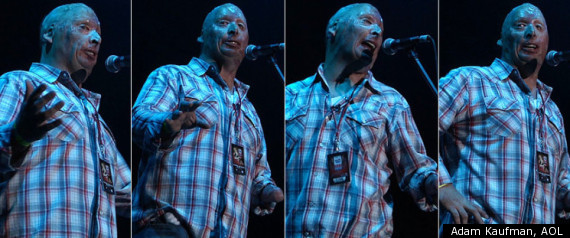
They are becoming more common, the war's severely wounded. Men and women missing one leg or two, with disfigured bodies, with steel arms and mechanical claws for hands, with burn scars and nubs where their noses and ears once were.
How do they feel about being out and among the rest of us?
How do they bear such visible scars of their military service, among a population of ordinary Americans who not only didn't serve, but widely ignored both the war and the experiences of those who went to fight in their place?
Do they want us to ignore their wounds, avert our eyes? Or do they want us to look more closely? To feel guilty? Or angry?
Just ask.
"I used to look in the mirror at my missing ears, missing nose -- do I really want to go outside today?'' says Shilo Harris, a 10th Mountain Division staff sergeant who was badly injured and burned in an IED explosion in Iraq in 2007. "I was all bent over, crippled up, I felt exposed."
"I didn't want people to be scared of me. So I really appreciate people coming up to me and asking what happened -- and thanking me for my service. I'm proud of my military service -- and my injuries,'' he says.
Some 16,000 young Americans who volunteered to serve in Iraq and Afghanistan have come home with devastating wounds. A lot of them want you to ask about them.
Far from being ashamed of his appearance, Scott Stephenson calls his wounds a badge of honor. He and other combat wounded tend to look at it this way: They volunteered, saw combat, and in many cases sacrificed their mobility, their health, their looks and their innocence.
"It's a sign of what I went through, what I've given up," he says.
It may be difficult for civilians to work up the courage to ask, Stephenson concedes. Still, he says, start the conversation. Acknowledge him.
"For people to ignore me, shun me -- that hurts," he says.
A paratrooper with the 3rd Battalion (Airborne), 509th Infantry, Stephenson deployed to Iraq with the 4th Brigade Combat Team, 25th Infantry Division. Near Iskandaria, Scott was severely burned by an IED blast in Iraq in November 2006. Two thirds of his body was charred. His stomach was ripped open, his internal organs riddled with shrapnel. Doctors told his parents he had a 5 percent chance of living. He lost the use of his left arm and eventually had his left leg amputated. His face is severely scarred.
"He looked like something out of a horror film," says his mother, Luana Schneider.
But Stephenson likes being out in public.
"I like to talk to people, give them some insight into what we soldiers do go through, because not a lot of civilians are aware of all the sacrifices we make -- and we choose to do it," Stephenson says. "It's bringing people back to more of a supporting role rather than thinking we are just pawns."
FIRST OUTINGS
About 245 amputees have remained on active duty, according to Chuck Scoville, chief of amputee care services at Walter Reed National Military Medical Center. He knows personally of 45 amputees who have returned to serve in Iraq or Afghanistan. Others have retired from the military. Increasingly, to a degree not seen in past generations of the severely wounded, they are out and about in communities, schools, offices and playing fields.
The severely wounded of the Vietnam war, for instance, faced a triple barrier, said Jim Mayer, an infantryman with the 25th Division who lost both legs below the knee to a land mine in Vietnam in 1969. He came out of the hospital in a wheelchair to find a public hostile to Vietnam-era soldiers, public places inaccessible to the disabled -- and a civilian population not used to seeing the disabled and shocked when they did.
"The reactions were a lot more negative because of that mix,'' said Mayer, who has been a patient advocate for amputees at Walter Reed, for the VA and for the Wounded Warrior Project, a nonprofit veterans service organization, for decades.
And today's disabled, particularly the amputees, are not shy about displaying their wounds and their prosthetic legs. Around Walter Reed and other military hospitals, where the wounded were once sequestered in open-bay wards, it's common to see amputees strutting around in their new legs, or even running.
"In my day it was, Hey -- cover up!'' Mayer said. "I never wore shorts, even in hot weather. Today, they are athletes and they are getting back to being athletes. And they dress that way.''
Even if later generations of wounded warriors are more capable and more interested in leading public lives, working up the nerve to step outside is still challenging.
John Roberts was a Marine Corps sergeant who was burned over 80 percent of his body in a 1992 helicopter crash in Somalia, where the Marines and 10th Mountain Division troopers were deployed to protect emergency food shipments against warlords and insurgents who turned out to be al Qaida-inspired fighters.
After a year at Brooke Army Medical Center in San Antonio and 60 surgeries that left his face a mass of scars, he and his wife ventured out to see Steven Seagal in "Under Siege'' -- and he promptly had an anxiety attack. "I was so self-conscious, I felt everybody was staring at me. I was nervous started sweating. I told my wife I had to get out of there.''
But time eases such anxieties. "Now I walk through an airport or any crowded area and I almost walk taller. I am very proud of my injuries," said Roberts, 46, who is a senior executive with the Wounded Warrior Project. Out in public, he says to himself: "You know what? I did this, I served my country, most people staring at me didn't have the guts to do it in the first place and if you're staring at me that's your problem, you need to get over it. I'm here to stay.''
Roberts believes that veterans with disfiguring burns, especially facial burns, have a more difficult time being accepted in public than amputees. The experience of Bobby Henline bears that out.
"I didn't like to go to restaurants at first, afraid I'd ruin peoples' appetites," says Henline, a former staff sergeant in the 82nd Airborne who suffered deep burns to his face, left arm and a hand that was later amputated. His face is a mask of scars and he describes himself as “Freddy Krueger's cousin.”
But as time passed, Henline became less self-conscious about his disfigurement.
"Once I got more healed, even still having scars, I like people to come up to ask. I'd rather they ask what happened," he says. "Especially little kids, they are so curious and they come up, sometimes they ask if I'm okay, if I'm hurt -- but then they get dragged away by their parents."
One time when Henline was visiting a Boston hospital, a guy cleaning plants in the waiting room took one look at him and burst out: "Jesus Christ! What happened to you?"
"I almost died laughing," Henline said. "Most people just avert their eyes."
Henline and others have had children run away from them, screaming. "I knew I looked different," says Henline, who just turned 40. "I couldn't help noticing people staring. My kids would get upset at it."
When Tyler Southern first went home on leave from Bethesda Military Hospital, months after being injured in Afghanistan by an IED that severed both legs and his right arm, he arrived in a wheelchair anxious to see his young cousins and the neighborhood kids for whom he had babysat. They clustered inside, took one look -- and ran.
Tyler was crushed.
After he noticed people rudely staring at him at the mall, he had a darkly humorous T-shirt made up that reads: "If you stop staring, it'll grow back."
The transition from the safety and comfort of the hospital can be jarring for wounded warriors. The severely wounded spend months and sometimes years sequestered with their fellow soldiers and Marines, in a comfortably familiar military structure and culture. They call it "the bubble.'' Inside it, people know what they've been through; there's a common language to gossip about weapons, sergeants, women, prosthetic legs or arms. Outside, people often don't have a clue. "It's a lot easier to talk to somebody who's been through it,'' says Vietnam veteran Mayer.
But eventually, the wounded are desperate to get out. "They want the experience of getting out and doing normal things -- getting ice cream, or going to the phone store -- realizing there is life after the hospital,'' says Sherry R. Ceperich, a counseling psychologist at the VA Polytrauma Rehabilitation Center in Richmond, Va. She prepares the injured for initial, short-term excursions, often practicing what they should say when people approach them.
"Sometimes, guys will come back and say, 'Oh God, I don't want all these people coming up to me and thanking me for my service, I just want to be left alone.' But they're in the minority. Most of them do want to be asked.'' And if they want to be recognized but not get into a lengthy conversation, she encourages them to say, "I got blown up in Iraq and I'm in rehab,'' and turn away. "They like to say 'blown up,''' she says with a laugh.
Nonprofit volunteer groups can help. In Washington, D.C., a group of Vietnam veterans recognized the problem and got together in 2003 to organize and finance weekly Friday night dinners for the newly wounded being treated at Walter Reed. Doctors endorsed giving their patients a break from the drab hospital routine -- as well as the idea of having the patients go out as a group to ease their contact with civilians.
The private dinners continue, now sponsored each week by a series of hosts including foreign embassies, foundations, nonprofits, local families and area restaurants. Guests often include senior government officials and low-key celebrities like "Doonesbury" creator Garry Trudeau.
Such closed-door events relieve the agony some wounded warriors often experience on their first outing into the civilian world.
"My first steps out into the world with half a face, I was drooling, my jaw was wired shut, I couldn't talk," recalls Army Sgt. Robert Bartlett, who was blown up by an IED in Iraq. He was so badly injured that medics twice had to bring him back from the dead. "My head was cut in half from the left corner of my eye all the way through my jaw. People couldn't help but stare. I couldn't give them a smile back."
"How do you focus on being positive? You count your blessings every step you take," he notes.
THAT VETERAN MENTALITY
Two months after her husband Bryan was blown up by an IED in Iraq in 2006, Cheryl Gansner decided to take him out of Walter Reed, then in Washington, for a fast-food treat. His legs were shattered and he was suffering from post-traumatic stress.
She managed to get his wheelchair up a hill to a Quizno's and pushed the "handicapped" button to get the door open. It was broken. But the clerk inside saw her struggling and came rushing to help -- and Cheryl and Bryan froze: the man was of Middle Eastern descent and wore a turban.
To some who are wounded with post-traumatic stress, anything that reminds them of combat, and the dangers of combat, can trigger a violent reaction: a loud backfire, the sight of trash along the street that could hide an IED, or the sight of a man in a turban.
But the Quizno's man held the door and asked what happened. When they explained, he apologized for the difficulty they'd had getting inside, and offered them 20 percent off their meal. "We had a good lunch and felt somewhat normal to be out," Cheryl recalled later. But it was stressful: "Bryan just looked so different and everyone was staring."
In Scott Stephenson's case, after his burns healed and he could walk and even drive with a prosthetic leg, he began attending college. On his way home from class one day, he spotted a handicapped girl in a motorized scooter, stuck in the gutter in front of the police station in downtown Atchison, Kan., his hometown. People were ignoring her, passing by without a glance.
That did it.
"I was hot," he recalls. Stephenson, who is now 27 and is a former football and soccer player, says he made a U-turn, wrenched open the door of his car, balanced on his one good leg, grabbed the girl’s scooter with his good arm and hauled her up onto the sidewalk. Pedestrians continued to pass by without stopping to help.
"I have that short fuse now," he explains. "People were just staring in ignorance while I lifted that scooter with my one good arm on my one good leg."
Back in the car, he fumed, then decided something had to be done. He and his mother founded an organization, Tempered Steel, which arranges speaking engagements for wounded and disfigured warriors.
"The idea is to talk about our story, what we've gone through -- the story behind the scars," Stephenson says. "It helps break down the barriers of fear that people have put up, it makes them able to come and ask people what their story is. If you ask, 90 percent of the guys will tell you."
Often, the visible wounds cover deeper troubles, as the wounded struggle with anxiety, depression and survivor's guilt.
At the Richmond Polytrauma Center , wounded patients get state-of-the-art physical, mental and vocational therapy to prepare them for life on the outside.
"Our biggest challenge, and the struggle within the VA rehabilitation program, is not trying to 'fix' the patient, but how do we take these patients and turn them back into people again?" says Dr. David Cifu, the VA's national director for physical medicine and rehabilitation.
"We're not pushing them away, we're always here for them," he says. "But how about we move that veteran identity into the community?"
As they do move into the community, being asked about their service can be a doorway to acceptance.
"It gives me a chance to brag about my service, to brag about being blessed with my family and with having some of the best medical people taking care of me,'' Shilo Harris says. "It gives me a chance to feel better about myself, to stay confident, to say, 'I can't let this slow me down.'''
By David Wood
A decade of fighting in Afghanistan and Iraq has left thousands of young Americans suffering with severe pain from amputated limbs, burned flesh, lacerations, shrapnel punctures and traumatic brain damage, injuries that kept them in intensive care for months or years.
Yet military doctors and nurses felt they were "ill prepared" to manage their patients' pain, an Army task force reported in May 2010.
The scope and ferocity of the wars caught the medical system serving the U.S. military and its veterans flat-footed. No one was ready for IEDs and the distinctive pattern of terrible wounds they would cause. No one was ready for the war to extend beyond a decade. No one was ready for the massive numbers of wounded, the severity of their wounds or the resulting strain on the broader system.
"The upside is the survival rate," says Army Col. Kevin T. Galloway, chief of staff for the pain management task force study, referring to the high percentage of battlefield casualties who are being saved from near-certain death -- a dramatic increase from previous conflicts.
The challenge for the medical system, he notes, is that the wounded "survive with such complex, serious injuries and pain management challenges that we didn't have to deal with in the past."
Over a decade of war, the Department of Defense and the Department of Veterans Affairs have been scrambling to catch up with the care that the severely wounded need, and with some notable exceptions and scandals, they have largely succeeded. Years of hard work have produced what many regard as the best combat trauma and rehabilitation system in the world. Military medicine, under the pressure of successive waves of the severely wounded, has created breakthroughs in prosthetics, surgical techniques and regenerative medicine, among others.
As a result, 16,000 or more badly wounded young Americans like Tyler Southern are coming home alive.
"I just want everyone to know what wonderful people took care of him,” says Southern’s mother, Patti. “They all went above and beyond, they do such wonderful work and they are so compassionate and took such good care of all of us, not just Tyler."
Yet despite all of their compassion, hard work and medical innovations, the huge bureaucracies of the Defense and Veterans Affairs departments still pose significant problems for the severely wounded. Veterans report difficulties in getting appointments, getting their disability ratings and payments, and getting access to mental health services. Wounded veterans, and especially their spouses, complain of having to spend hours and weeks on the telephone with what they view as the VA's bewildering bureaucracy.
A CONSTANT BATTLE
Ted Wade is a case in point. A sergeant with the 82nd Airborne, Wade fought in Afghanistan and then Iraq, where an IED struck his convoy in 2004. The blast severed his right arm above the elbow and left him in a coma with severe traumatic brain injury. When his fiancée Sarah Dent flew to the military hospital in Landstuhl, Germany, to be with him, the first issue she dealt with was whether she and the staff should simply let him die. Doctors were dubious about his chances of survival.
But Sarah and Ted fought for his life, and won.
Sarah says the intervening years, however, have been a nightmare. "Ted has incredible resolve and determination and has always been very motivated," she says. "But he had to learn to talk and walk again, and to continue to fight is demoralizing and exhausting."
Having to fight the Defense Department and the VA as well, she said, "has been really hurtful."
For instance: Ted was treated at the former Walter Reed Army Medical Center, where he received excellent orthopedic care, but no help was available there for his brain injury. Sarah found a private facility in Washington that specialized in such injuries, but the Army refused to pay for it. Instead, Ted was sent home to North Carolina for treatment at the Durham VA Medical Center.
The Durham center had no experience with combat brain injuries either, so doctors put him in the geriatric ward. His roommates were veterans of World War II and Korea.
It wasn't until Sarah convinced his former doctors at Walter Reed that Ted badly needed help that they arranged to have him treated at a private clinic in North Carolina, where he is still an outpatient today.
But Ted still needs a close supervisor to enable him to get out and into the community, a role Sarah can't fill while trying to earn a living.
"With the VA over the years, it has been a constant battle," Sarah says. "Six months after we got home they wanted to discontinue his care, the second he wasn't under the eyes of Walter Reed. It's been difficult to get them to pay for what the doctors recommended. I really had a challenge to get the VA to provide appropriate long-term care for him, a battle that continues to this day."
Sarah also fought, loudly and publicly, to get the VA to train, certify and pay full-time caregivers like herself who have given up their jobs and career to take care of their severely wounded spouses or sons. When the VA balked, Congress passed legislation demanding it establish such a program, and President Barack Obama signed the bill into law in May 2010, with Sarah there to witness it. The president lauded her "passionate and very effective voice on behalf of wounded warriors and their families."
It still took the VA another year before it actually put the caregiver program into action, and even now it doesn't cover the kind of long-term care and supervision that Ted and other young veterans feel they need to be active in their communities.
"What I have not seen, over more than seven years, is anybody admit that there is a problem," Sarah says.
THE INDIVIDUAL VS. THE MACHINE
Talk with combat-wounded veterans and you find a mix of high admiration for individual surgeons, therapists, nurses and other care providers -- sometimes mixed with frustration or contempt for the medical bureaucracy that constrains them. Many of the severely wounded feel that they should receive the best care available. After all, they reason, they’ve put their lives at risk serving their country and top-notch care is what most politicians promise anyway.
Triple amputee Southern, a Marine corporal blown up last year by an IED in Afghanistan, says flat-out that medics, surgeons and other trauma specialists saved his life. Still, he said, life at Walter Reed, where he is in his second year of rehab,"isn't the greatest."
"Overall, they take good care of us," says Bobby Henline, a former staff sergeant with the 82nd Airborne who was badly burned in an IED blast in Iraq. "They weren't ready for this many people coming in at once. We got that fixed. There's always room for improvement, but we're getting good medical care, what we need and then some."
While acknowledging the strengths of the system, however, Henline is also fighting to get the VA to pay for modifying his house in San Antonio, with extra-strength air conditioning. Burn patients, he pointed out, have skin grafts that don't sweat and they have trouble controlling their body temperature. The VA pays to modify the homes of amputees for wheelchair access. Why not help out burn patients, too?
Eric Shinseki, a retired general and former Army chief of staff who lost a foot in combat in Vietnam, is secretary of the Department of Veterans Affairs. He did not respond to numerous requests for an interview to discuss the VA's care of the severely wounded.
But I asked the VA's undersecretary for health, who is responsible for all VA medical and mental health care, about these kinds of difficulties for wounded veterans and their families. Robert Petzel, a soft-spoken avuncular physician, told me that whatever problems veterans have encountered with VA medical care are in the past.
The problems have been fixed, he asserts -- including what had been a chronic problem with VA care: losing track of patients. To counteract that problem, veterans getting VA care are now each assigned at least one case manager, Petzel says.
I mentioned the difficulty that Cheryl Gansner had in getting help from the case manager assigned to her husband, former Army Staff Sgt. Bryan Gansner, badly wounded by an IED in Iraq. Cheryl had told me that their case manager was so busy with 5,000 cases that Cheryl told her not to bother trying to keep track of Bryan's traumatic brain injury treatments because she was useless.
"Everybody who enters traumatic brain injury care gets intensive case management," Petzel insists. "A tremendous amount of VA assets are directed at providing case management and support. That's quite remarkable, because it's so extensive. It's not something we have done in the past."
Other veterans also have had difficulty getting mental health therapists. Zac Hershley, an Air National Guardsman, came back from multiple tours in Iraq and Afghanistan with post traumatic stress disorder. The VA eventually assigned him a psychologist in private practice, several hours' drive away from his home.
When Hershley showed up for his first appointment, he found his therapist wearing a traditional Middle East headscarf, the hijab. He recoiled. "I could never talk to her about what I experienced over there," he later said. "I probably killed her brother."
Hershley says he eventually found a good therapist who helped, but she was transferred, and he hasn't found another therapist reasonably nearby who had the time to see him and the experience to understand his problems.
While some veterans and even therapists say there are insufficient mental health resources, Petzel says that problem has been fixed. The VA alone has hired 7,500 mental health therapists since 2005, he says. "We do not have any evidence that we're not able to provide mental health services. So there isn't a shortage -- there just isn't," he says.
An outside view comes from Nancy Berglass, director of the Iraq Afghanistan Deployment Impact Fund at the California Community Foundation in Los Angeles. The foundation provides grants to non-VA community-based services for veterans who often are waiting for overcrowded VA programs. Dozens of these nonprofit service organizations are filling the gaps between the growing demand of veterans for mental health services, and the ability of the VA to meet the demand.
"Many Iraq-era veterans who have enrolled with the VA are receiving the care and benefits they need, and under Secretary Shinseki's leadership, the VA has begun to address some of its shortcomings more aggressively," Berglass wrote in an email. "Nevertheless, veterans don't come home to federal agencies; they come home to communities and families. It is there, at the community level, that nongovernmental service providers, with grants from the Iraq Afghanistan Deployment Impact Fund and other support, address unmet deployment-related needs and integrate veterans back into their families and communities as civilians.”
A psychologist in private practice, who treats veterans under contract to the VA, says the demand for mental health services is so great "the VA is simply overwhelmed.'' He asked not to be identified by name.
UNCHECKED INCOMPETENCE
VA officials, in response to criticism, like to cite surveys that they say show that most veterans are highly satisfied with VA care. "Our satisfaction rates are phenomenally high with the people who use the system," Petzel says.
According to the VA, 414,761 veterans accessed VA health care during 2010. Of those, only 1,057 complaints were registered by Iraq and Afghanistan war veterans about the coordination of their care. An independent assessment of how satisfied all veterans are with VA services was recently completed by the American Customer Satisfaction Index, which measures across industry and government agencies.
It found that in 2010, 85 percent of veterans treated as in-patients at VA hospitals were satisfied with their care; these veterans -- of whom only a small portion served in Iraq or Afghanistan -- rated the VA's customer service most highly, with 93 percent satisfaction. Across the civilian hospital industry the satisfaction rating was 74 percent, according to the study.
"The public outside the VA, outside of people who use the VA, don't understand what we're about," Petzel says. "I think sometimes they tend to believe these things they read which we think don't actually reflect what's going on."
The 9th Circuit U.S. Court of Appeals in San Francisco challenged that view in a decision that took the unprecedented step of finding that the VA, because of inadequate mental health care and other medical lapses, had violated veterans’ constitutional rights.
It found the "influx of injured troops returning from deployment in Iraq and Afghanistan has placed an unprecedented strain on the VA and has overwhelmed the system..." As a consequence, the court determined, veterans were forced to endure lengthy delays for treatment, especially for mental health care. Some, it found, have committed suicide.
"The VA's unchecked incompetence has gone on long enough," the court declared. "No more veterans should be compelled to agonize or perish while the government fails to perform its obligations."
While Justice Department lawyers wrangle over a possible appeal, I asked Petzel, in view of the flood of complaints from veterans and families -- and the courts -- whether he and others at the VA felt misunderstood.
"I guess the short answer is yes," he says. "But there's great satisfaction in knowing that we have this incredible system, particularly in terms of mental health and outreach. We know what we can do."
"It would be very nice," he adds, sadly, "if there was a better understanding in some quarters of what we do."
In the meantime, medical officials have tackled the problem of pain with a vengeance. An electronic database was established that tracks the pain treatments a patient has received from the battlefield to retirement. The VA adopted a new policy for patients transferring from active duty to VA care, requiring that if the VA facility doesn't have the same pain medication the patient had been receiving, he or she will get that medication while the VA figures out what to do -- rather than denying him or her the medication, as had been done until now.
The Army is reorganizing the way it trains its medical personnel to deal with pain, focusing on interdisciplinary care to ensure that traumatic brain injury patients, for instance, benefit from the latest pain treatments. The Army also is working with acupuncture, aromatherapy, yoga, movement therapy, massage and other nontraditional pain treatments as they prove successful.
Galloway, the chief of staff for the pain management task force study, described the Army's new work on pain management as a culture shift toward more innovative, collaborative work. "Combat accelerates this kind of change," he told me. "Weaknesses in our system have been highlighted to the max," he said, and the reforms will spread to civilian health care as well. From this experience, he said, "there's going to be long-term gains for the entire country."
The struggles that the wounded and their families have with the health care systems that serve the military and its veterans likely will go on. Both systems, which manage tens of thousands of people, are inherently monolithic and bureaucratic. Both health care systems, often when scandal or Congress prods them, have moved to address glaring problems. The Pentagon invented Warrior Transition Units to keep better track of the wounded; the Marines have similar detachments. The VA has added patient care coordinators and mental health advocates.
Large gaps remain, however, in the services and care the systems can provide, as the nonprofit veterans' service organizations that have grown rapidly in the past decade can attest.
Taking care of the wounded "is a large problem and they need some help with it,'' Bill Lawson, president of Paralyzed Veterans of America, says of the Defense Department and the VA.
"They do the best they can with the funding they have,'' he notes. "Unfortunately, when you have a big bureaucracy such as the VA, it comes with a lot of red tape. So it takes organizations such as ours to step in and help out.''
By David Wood
Three days after Sept. 11, 2001, Congress met to authorize giving the president the power to respond with "all necessary and appropriate force" to the terrorist attacks in New York and Washington, D.C. It was, in effect, a declaration of the war that has now lasted a decade. In a rhetorical cascade that went on for five hours, hundreds of politicians of both parties joined the war fervor, demanding that troops be sent to "crush" the perpetrators and their supporters.
Only one person, a now-retired Democratic congresswoman, took time to observe that war would create a new generation of wounded veterans who would need lifetime care, and that Congress ought to agree to pay those bills before sending young Americans into battle.
"There will be casualties, both physical and psychological," said Rep. Darlene Hooley of Oregon. "Let us ensure that when they come home Congress honors their sacrifice, not solely with parades, but for the rest of their lives."
There would be more casualties than anyone at the time could imagine -- 53,000 dead and wounded -- and there would be more severely wounded among them as well, roughly 16,000 so far. Moreover, the cost of caring for these young, severely wounded combat survivors for a lifetime would also rise exponentially.
In a report that the Congressional Budget Office issued last summer, economist Heidi L. W. Golding said future costs for the Department of Veterans Affairs to treat veterans "will be substantially higher (in inflation-adjusted dollars) than recent appropriations for that purpose, partly because more veterans are likely to seek care in the VA system but mostly because health care costs per enrolled veteran are projected to increase faster than the overall price level."
Responsibility for caring for veterans could add at least another half-trillion dollars to the U.S. debt, according to Harvard economist Linda Bilmes. Yet there is at present no long-term strategy on how to pay for it. Money for veterans' care emerges from the annual budget squabbles in Congress. Unlike a pension fund or even Social Security, Congress doesn’t actually set aside funds for future obligations to veterans.
And given the current budget-ax climate in Washington, it's unlikely that Congress will begin setting aside money for the future care of veterans who are being wounded this year.
So far, politicians generally have been loathe to cut funds for veterans. But the uproar this year over the budget and debt squeeze suggests that even annual appropriations for severely wounded and disabled soldiers such as Tyler Southern and Todd Nelson could be vulnerable.
Politicians of both parties vow to protect veterans' funding, and the White House has directed that $25 billion be stripped from the Pentagon's 10-year spending plan and set aside for veterans' medical costs. The Department of Veterans Affairs projects that its costs will drop as the generation of Vietnam veterans require less support.
But VA funding remains an enticing target as tempers fray over the ballooning deficit.
Rep. Michele Bachmann (R-Minn.), for instance, a GOP presidential candidate, proposed early this year a package of federal spending cuts that included a $4.5 billion cut in veterans' health benefits. Veterans organizations screamed in protest. The measure would, said Veterans for Common Sense, leave the war's wounded "twisting in the wind."
"While the country is at war, there's a lot of positive feeling about those who fight," said economist Bilmes, who has studied and written about the cost of veterans programs. "But it is quite conceivable to me that over a period of time, when the wars are over and the U.S. is involved in other things and budget resources are very scarce, the desire to support veterans will change."
LIFETIME CARE
At the close of 2001, with the war in Afghanistan barely underway and the Iraq war still 18 months away, the VA was paying compensation to 172,254 veterans who had a disability rating of 100 percent from service in prior conflicts. By the end of last year, the VA had 295,529 veterans with 100 percent disability ratings on its books, an increase of 123,275 disabled veterans in just a decade.
The increase in costs was also substantial. In 2003, the VA paid $18 million to care for veterans of Iraq and Afghanistan. By 2013, the VA projects that cost will be $3.5 billion -- and that figure will continue to grow by $1.5 billion a year.
Why?
Among many reasons -- more wounded veterans, more generous allowances and more veterans who are aggressively seeking help -- is this: The growing number of severely wounded soldiers and Marines coming off the battlefield require more expensive services and compensation over the five decades or more of their lifetimes.
Because Iraq and Afghan war casualties are more severely wounded than veterans of past conflicts, the cost of their lifetime care may be underestimated. A recent Army study reported that the severely wounded experience "prolonged and profound dysfunction (physical and emotional) that is oftentimes underestimated by health care providers."
As President Obama observed in a speech last summer to the American Legion: "Thanks to advanced armor and medical technologies, our troops are surviving injuries that would have been fatal in previous wars. So we're saving more lives, but more American veterans live with severe wounds for a lifetime. That's why we need to be there for them for their lifetime.”
Prosthetic legs, for instance, have grown in sophistication and capability in the past decade. Instead of the "dumb" peg-legs seen in pirate movies, today's powered legs come with microprocessors, accelerometers and gyroscopes to mimic the complex motions of walking, as well as a carbon-fiber foot that enables amputees to run.
One such prosthesis, the Otto Bock X2, costs $30,000 for the knee joint alone. Tyler Southern has two of them. Otto Bock HealthCare of Duderstadt, Germany, developed the joint working with the Defense Advanced Research Projects Agency and the U.S. Army Telemedicine & Advanced Technology Research Center.
The entire powered leg, from hip to toe, can cost up to $100,000 -- and most amputees are given three or four of them for different uses. The prostheses have to be replaced after three to five years, depending on how much they are used.
Still in the experimental phase is a mind-controlled arm that will replace the static hook commonly seen today. The new arm, a collaboration between Otto Bock and U.S. researchers funded by the Defense Department, uses signals from the brain, re-routed through nerves transferred from chest muscles to the arm stump, to rotate and open and close the hand and to flex the elbow. A prototype has advanced sensors implanted into the prosthetic index finger to feel heat and cold, judge the strength of the grip and, it is said, feel the difference between a grape and a raisin.
Such devices are developed to deliver maximum benefit to military amputees, not necessarily to control costs. "We'll do everything we can to return you to the highest level of function," is the way Chuck Scoville, chief of amputee patient care at Walter Reed National Military Medical Center, describes his work.
Each new generation of a prosthetic limb has been "radically more expensive" than the device it replaced because of its increasing complexity, said David McGill, a board member of the Amputee Coalition and a prosthetics industry official. "With increased sophistication of the device you see an increase in the cost," he says.
Aside from hardware, the cost of caring for veterans is rising because veterans are increasingly demanding mental health services and disability payments, among other benefits. According to Army studies, the levels of acute stress among combat troops deployed in Afghanistan is "significantly higher" than in previous years, suggesting the demand for mental health services will continue to grow for years.
Past wars have shown that the cost of caring for the wounded rises and peaks long after the war is over and largely forgotten by the general population. Disability payments for veterans of World War I didn't peak until 1969, according to Harvard economist Bilmes, who teaches public finance at the Kennedy School of Government.
The VA is still making disability payments to a dependent of a soldier who fought in the Civil War 150 years ago, according to VA officials who declined to provide details because of privacy guidelines.
QUESTION MARKS
Costs are already rising. Each year the VA enrolls new veterans for disability payments. In 2006 the VA signed up 32,838 veterans to begin receiving disability payments for mental disorders. Four years later, its intake of new veterans with mental health disabilities had almost doubled, to 60,535 veterans. Altogether, more than 1.2 million of the 5.2 million veterans seen by the VA in 2009 had a mental health diagnosis -- a 40 percent increase since 2004.
To care for these veterans, the VA has hired 7,500 mental health care staffers just since 2005, and has opened almost a thousand outpatient clinics across the country.
It still isn't enough to meet the demand, and for that reason the VA has to outsource some of its mental health work, senior VA officials said. The VA pays private psychologists and other mental health care providers to see VA patients, especially those with the most severe conditions.
"The system is just swamped now," says one psychologist in private practice who works with VA patients, and who requested anonymity because he is not authorized to speak publicly about his work with the agency. He said patients seeking a mental health appointment at VA facilities face a two to three-month wait.
VA officials themselves acknowledge that they expect this influx of mental health patients to increase over time, even as U.S. military operations in Afghanistan taper off. Symptoms of post traumatic stress disorder, for instance, often don't appear for years or even decades after the experiences that trigger them.
"Someone who seemed to be coping well initially may develop significant problems later on, even after several years," Dr. Robert Petzel, the VA's undersecretary for health, said in a written statement to The Huffington Post.
What will it all cost? How much should Congress -- if it wanted to fund future veterans costs -- put aside?
The VA doesn't know.
The agency doesn't have a good record of forecasting future expenses. In early 2002, after American troops were already fighting in Afghanistan, it estimated it would owe disability payments to veterans of $26.9 billion in 2010 and $36.3 billion in 2020. In fact, the VA has already hit the 2020 mark: Last year it made $36.5 billion in disability payments to veterans. Its annual report for 2010 does not forecast future costs.
Miscalculating the growing population of wounded veterans, the VA ran a $1 billion budget shortfall in 2005, and a $1.5 billion shortfall in 2006. In 2009 the Government Accountability Office concluded, after studying the VA's books, that the agency's budgeting was "unrealistic" and "raises questions about both the reliability of VA’s spending estimates and the extent to which VA is closing gaps in non-institutional long-term care services."
Senior VA officials say that the size of the veteran population and the services that veterans will require in the future is unknown and unknowable. "To look 20 years out is purely speculative. You just can't calculate what the cost of health care will be," Petzel says, noting that it's particularly difficult to foresee the cost of caring for the severely wounded.
"We don't have extensive experience, particularly with the most severely injured population," he says. "It's fair to say the cost of prostheses isn't going to go down. You can't predict at all how many people are going to need that." The VA budget projects three years into the future and Petzel says "that's the best we can do."
Long-term cost estimates, Petzel adds, "are just not possible."
Others disagree. Bilmes estimates the total cost of caring for the war's wounded veterans, in disability payments and medical care, will come to between $589 billion and $934 billion over 40 years -- almost a trillion dollars, depending on the length and severity of the fighting yet to come in Afghanistan and Iraq. These numbers, developed with Nobel Prize-winning economist Joseph Stiglitz, are based on budget estimates by the Congressional Budget Office, the Congressional Research Service and data from the VA itself.
The Congressional Budget Office, in a study released last summer, estimates it will cost between $40 billion and $55 billion to care for all wounded Iraq and Afghanistan war veterans. The CBO study uses more narrow definitions of costs than Bilmes, who counts, for example, the cost of lost productivity by wounded troops unable to work.
While no one would argue that veterans don't deserve medical treatment and compensation, the long-term costs of caring for veterans remains unfunded, and that concern has prompted some to lobby for the creation of a Veterans Trust Fund. An unusual coalition of supporters, including peace groups such as Win Without War and conservative Republicans like Rep. Walter B. Jones of North Carolina, whose district includes the Marine base at Camp Lejeune, have gathered around the idea.
The sponsors say a key part of the plan mandates that Congress, in authorizing any U.S. participation in armed conflict, would also have to put money away for veterans wounded in that conflict.
"Even though you can't predict it exactly, you know if you are committing the country to a military conflict, there is going to be a long-term cost of providing medical care and disability benefits to those who are fighting the war," Bilmes says. She believes that without any mechanism to force Congress to set aside the money up front, "there is a willful, deliberate underestimation of the cost of war."
A Veterans Trust Fund, she says, "might lead our elected representatives to make different decisions or at least ask more questions about whether the objectives [of war] are worth the costs."
For his part, Rep. Jones dismisses the current year-by-year funding of veterans as a "shell game" that "has to stop.”
At a recent congressional hearing he spoke passionately about why the issue matters to him.
"I've seen those kids at Walter Reed with their legs blown off. I’ve seen the moms crying, the wives crying," he said. "These kids are 19, 20, 21 years old. And it's 30 years from now that we really have to be careful."
He endorsed the idea of a Veterans Trust Fund as the way "to ensure that we keep our promise to those who have served this country …"
But at present, there is no draft legislation establishing a Veterans Trust Fund and there are no sponsors for it in Congress -- leaving future funding for the severely wounded in question, despite the frequent declarations of patriotism and support by politicians.
Will the money be there? Will Congress in 2051 still be willing to set aside billions of dollars for replacement prosthetic legs and traumatic stress treatment for Tyler Southern and Todd Nelson and thousands of their wounded buddies?
Among others, Adm. Mike Mullen, who retired last month as chairman of the Joint Chiefs of Staff, has his doubts and he made them clear before a Senate panel last June.
Mullen noted that the vast array of services for the wars’ wounded -- from suicide prevention to family counseling and medical research -- is "some of the first money that budget types like to take out, historically."
The reason for this is simple, he said. "We like airplanes before we would keep [these] programs intact." A tireless champion for upgrading care for the wounded, Mullen warned that "unless we watch that very carefully, it will not be there when we need it."
Darlene Hooley, who urged in 2001 that Congress begin setting aside money for veterans, retired from Congress in 2009 and went home to Oregon. But she is not pleased that her predictions have come to pass. "I knew we would have a lot of injuries and that the budget didn't have anything in there for newly injured soldiers," she recalls. "We were really not prepared -- and we are still way behind."
She knows firsthand. After she left Washington, she started a scholarship fund for returning veterans, those whose needs are not covered by the VA. The Darlene Hooley scholarships help them get the college courses and vocational education they need to get good jobs.
"We are fighting every day to catch up," she says. "I said 10 years ago that if people go over there and serve, we absolutely have to make sure they get treated fairly when they got home. And time eventually tells -- we needed to be a lot more prepared."
By David Wood
There is rarely any warning, and this time it was no different.
Outside the Iraqi village of Zaganiyah on April 7, 2007, insurgents had buried three or four heavy artillery shells in the road, the trigger wire invisible to an approaching U.S. convoy. The lead Humvee in the convoy was carrying five paratroopers, and the blast threw their vehicle five car-lengths down the road where it crumpled upside down and in flames.
Four of the soldiers lay dead. The fifth, a staff sergeant named Bobby Henline, was alive, but just barely. A nearby soldier ran to beat out the flames that engulfed Henline's arms, legs and head, then knelt and scooped out Henline's broken teeth from his mouth so he could breathe.
Like many of the 16,000 or more severely wounded of the Iraq and Afghanistan wars, Henline came home in a coma. Doctors at Brooke Army Medical Center's burn unit in San Antonio worked on him frantically, but they told his wife Connie that they had no medical explanation for why he continued to live.
He was in a coma for two weeks after the explosion, while surgeons in Iraq and Germany gently covered his charred skull with gauze, while intensive care nurses hovered over him on the medevac plane to Texas, and while medical personnel repeatedly cleansed his burned skin and tissue in the shower room at the burn center.
As he struggled painfully into consciousness, Henline began to remember. Not the explosion, which he still doesn't recall to this day. It was something stronger and more vivid. More real.
"It was like a giant iceberg, there were stars out. It wasn't cold," he says. "And there was a voice telling me I'm gonna be all right, my family is waiting for me."
There was more to it than merely surviving. At that moment, he felt deeply and profoundly that there was a reason he'd been given the opportunity to live. Something he was meant to do, something that would justify his life when the lives of his four comrades had been so abruptly and brutally ended.
But what?
Bobby was an atheist. A guy with a lusty sense of humor, he had a way of taking life with a hearty laugh. The way he looked at the world's religions was that they all claimed to have the answer but they couldn't all be right. What if you picked the wrong one, he would ask jokingly.
In the summer of 2007, doctors tried to graft skin onto his head, and failed. They performed 12 surgeries on his burnt eyelids alone, and worked on his smashed and burned hand before finally amputating it. Through it all, Henline kept wondering: What should be the purpose of his life now? If God had singled him out for a purpose, he wasn't saying what it was, Henline felt with some irritation.
"And of course I didn't know," he recalls. After all, what could he do? "C'mon, I'm a high school dropout! An Army truck driver!"
His four guys, the ones who died in that ruined Humvee in Zaganiyah, were on his mind.
Capt. Jonathan D. Grassbaugh, 25, an Army Ranger with a Bronze Star and 10 months of marriage to Jenna, a law school student. Spc. Ebe F. Emolo, 33, a native of the Ivory Coast in West Africa, who had achieved his goal of becoming an American citizen and serving his new country. Spc. Levi K. Hoover, 23, newly engaged that past Christmas. Spc. Rodney L. McCandless, 21, just back from visiting his grandparents in Arkansas on a two-week leave. All paratroopers of the 82nd Airborne.
"All these young kids," Bobby recalls (he was 34 at the time). "They were my kind of people, the captain and first sergeant living in a tent with the guys, being one of them, this was a good tight unit ... Airborne brothers."
Now, he says, "these families wish their guy was alive. If I sit here and feel sorry for myself, they're dying in vain, I'm wasting what one of them could have had. And maybe one of them could have handled this mission and not me."
Whatever that mission was, "I knew I had to step up."
THE COMEDIAN
It wasn't just that Henline didn't know how he could put his skills to work. He confronted a bigger barrier: He was terribly burned and missing a hand. It took 18 months for doctors just to get skin to grow on his skull, and during that time he had no protection against infection, which would have killed him fast. It took Connie four hours in the morning, after she'd sent their three kids off to school, to dress his head wounds so he could go out to the day's appointments.
His face was a mass of scars and partially healed skin grafts. One ear was gone, the other a jagged stump. While his eyelids healed, he had to wear motorcycle goggles to protect them from the air and infection.
By chance, he was interviewed on National Public Radio. The interviewer wanted to know how he kept going in life. The question still makes him laugh. "You have to!" he told her. "I wake up -- still breathing! I gotta deal with this!"
The story went up on NPR's website in 2008, and people began posting comments, praising his optimism, saying his story had inspired them. He was amazed.
"I'm just being positive and realizing the good things in life," he says. For one thing, to be with his kids -- a daughter in college, a younger son and daughter. "I get to see them grow up, I get to be a grandfather someday," he says, with the wonder and passion of someone who almost lost all of those things.
"Just embracing the small things in life that are great, that a lot of times we take for granted," he adds. "And I saw how that helped others to look at life differently. And I took that as a sign."
When his eyes healed enough to take the goggles off, he began noticing people staring at him. Why don't they just ask me what happened, he wondered. Eventually he figured it out: They didn't know how to approach him.
In irritation, he bought a portable fart machine that he kept in a bag holding his bandages and ointments. When somebody stared, he'd crank one off, then say in a contrite voice, "Excuse me."
Did that make people laugh? Break the ice? "No," he says, "but it made me feel better to have some fun with it."
Still, the idea of "helping others to look at life differently" wouldn't leave him alone. But he didn't see how to do that until one of his therapists urged him to take his natural sense of humor onto the stage, doing stand-up comedy.
He resisted. "I didn't want to tell people what had happened to me," he says. "I wasn't sure if they could laugh at it, and I didn't want sympathy laughs. I wanted to know I was really funny."
With deep misgivings, he appeared at a small club in Los Angeles. He told a couple of jokes, to embarrassed silence. "The last thing I heard was aaaaaa-BOOM!" he said.
Silence.
"I did four tours in Iraq ... the last one was a real blast!"
That got a small giggle from the back of the room. He plunged on, explaining that he had a skin graft on his skull that used skin from his stomach. "Only problem is I get lint in my ears," he said to growing laughter. "When I eat too much, I get a headache!"
It was working, he realized. People were responding. This is how he could deliver his message of hope -- not by hiding away, but by being out there. "I'm supposed to tell my story, to share this with others: that no matter how bad it gets ... keep laughing. Life will get better."
"If it's a group of a hundred people and one person in that group says, 'If he can do this, I can quit smoking tomorrow,' or 'I can be healthier to see my grandchildren someday,' or 'I can go back to school and better my education and better myself and get that career I've always wanted,' then this is worth it."
BURN SURVIVOR
These days, Henline talks to high school groups, community groups and gatherings of veterans. He does fundraising shows for Operation Homefront, a nonprofit dedicated to helping wounded warriors. He's teamed up with other wounded veterans in a group called Crosshair Comedy, and did a show in Austin, Texas, last month. Through an admirer he got a gig in Las Vegas last spring -- and has been invited back for a week at the Tropicana in January.
In addition to reaching general audiences, Henline hopes that his stand-up routines will reach other burn survivors, "to help other soldiers get through this. A lot of them don't like to go out in public, especially if you got your face burned. They hide. I want people to see us in a different light -- not the shell on the outside."
Still, being a burn survivor, being permanently disfigured, is a difficult road.
"Sometimes it gets to me, the way I look. I still have those days. I feel sorry for myself, get mad at everything, sit there and just cry, beat the clothes in the closet. Nobody's perfectly happy after this, but you gotta learn that this is me now."
When things get bad, Henline pulls out a photo of the smoking ruins of the Humvee in which his four pals died, while he lived. The photo encapsulates the question as well as the answer: Why me?
"I look at it to remind me, you're here for a reason, you're doing the right thing," he says.
People often ask severely wounded veterans like Bobby Henline, what can I do?
He tells them, "live your life to the fullest. Do what I'm doing -- chase your dreams!"
Biography
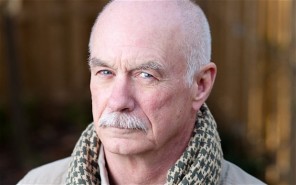
David Wood has been a journalist since 1970, a staff correspondent successively for Time Magazine, the Los Angeles Times, Newhouse News Service and The Baltimore Sun. A birthright Quaker and former conscientious objector, he covers military issues, foreign affairs and combat operations, and has been a Pulitzer Prize finalist for national reporting.
For four years (1977-1980), he covered guerrilla wars in Africa as Time Magazine's Nairobi bureau chief. A Washington-based correspondent since 1980, Mr. Wood has covered national security issues at the White House, Pentagon and State Department, and has reported on conflict from Europe, Africa, Asia, the Middle East and Central America.
During the Cold War he reported from Russia and China, patrolled the inter-German border with American troops on one side and visited a Soviet motorized rifle regiment across the border in East Germany. He reported from Nicaragua during the Sandinista-Contra conflict, and covered the overthrow of President Marcos in the Philippines and the war in Bosnia before and during the U.S. military intervention in 1995. He has written extensively about international conflict resolution, peacekeeping and the post-war rebuilding of civil societies.
He has accompanied U.S. military units in the field many times, both on domestic and overseas training maneuvers and in Desert Storm, the Persian Gulf tanker war, the interventions in Panama, Somalia and Haiti, peacekeeping missions in the Balkans and combat operations in Afghanistan and Iraq. He was embedded with the 24th Marine Expeditionary Unit in Somalia, and the 10th Mountain and 101st Airborne Division units in Afghanistan in 2002. In four trips to Iraq he has embedded with numerous units including the 2d Armored Cavalry Regiment's 2nd Squadron in East Baghdad, the 1st Battalion, 2nd Marines in al-Anbar and the 386th Air Expeditionary Wing flying resupply missions across Iraq.
In five trips to Afghanistan since January 2002, he has lived and worked with the 10th Mountain and 101st Airborne Divisions, the 1st Battalion, 6th Marines, the 82nd Airborne Division’s special troops battalion, the 4th Brigade Combat Team, 25th Infantry, in RC-East and, most recently, with the 10th Mountain Division’s 1st Brigade in Kunduz, Faryab and Kandahar provinces.
He has flown on B-52 and B-1 bombers, slogged through Army Ranger School, accompanied Rangers on night airborne maneuvers and Marines on amphibious and air assault operations, flown off aircraft carriers and sailed on battleships, cruisers, minesweepers and amphibs, and has submerged aboard attack and strategic missile submarines.
He has been scared much of his professional life.
Wood has written widely across the span of national security issues, from nuclear deterrence theory to combat stress, domestic terrorism, military technology and doctrine, and scarce resources and demographic shifts as causes of instability.
In 1992-1993 he spent a year with the 24th Marine Expeditionary Unit, including three months of ground operations in Somalia. His account of that experience, A Sense of Values, was published by Andrews & McMeel in 1994.
A Pulitzer Prize finalist, he has won the Gerald R. Ford Prize for Distinguished Defense Reporting and other national awards. He has appeared on CNN, CSPAN, the PBS News Hour, WUSA , RTV and the BBC, and is a regular guest on National Public Radio’s Diane Rehm Show. He has lectured at the U.S. Army Eisenhower Fellows Conference , the Marine Staff College, the Joint Forces Staff College and Temple University.
Mr. Wood was raised as a pacifist and in 1968 completed two years of civilian service in lieu of military duty. He has three grown children and two stepchildren and lives outside Washington DC. He runs and bicycles for sport and goes to climb high mountains when possible.