The New York Times, by Matt Richtel and members of the Staff
Lee C. Bollinger, President of Columbia University (left), presents the 2010 National Reporting prize to Matt Richtel of The New York Times.
Winning Work
By Matt Richtel
OKLAHOMA CITY — On his 15th birthday, Christopher Hill got his first cellphone. For his 16th, he was given a used red Ford Ranger pickup, a source of pride he washed every week.
Mr. Hill, a diligent student with a reputation for helping neighbors, also took pride in his clean driving record. “Not a speeding ticket, not a fender bender, nothing,” he said.
Until last Sept. 3. Mr. Hill, then 20, left the parking lot of a Goodwill store where he had spotted a dresser he thought might interest a neighbor. He dialed her to pass along news of the find.
Mr. Hill was so engrossed in the call that he ran a red light and didn’t notice Linda Doyle’s small sport utility vehicle until the last second. He hit her going 45 miles per hour. She was pronounced dead shortly after.
Later, a policeman asked Mr. Hill what color the light had been. “I never saw it,” he answered.
Extensive research shows the dangers of distracted driving. Studies say that drivers using phones are four times as likely to cause a crash as other drivers, and the likelihood that they will crash is equal to that of someone with a .08 percent blood alcohol level, the point at which drivers are generally considered intoxicated. Research also shows that hands-free devices do not eliminate the risks, and may worsen them by suggesting that the behavior is safe.
A 2003 Harvard study estimated that cellphone distractions caused 2,600 traffic deaths every year, and 330,000 accidents that result in moderate or severe injuries.
Yet Americans have largely ignored that research. Instead, they increasingly use phones, navigation devices and even laptops to turn their cars into mobile offices, chat rooms and entertainment centers, making roads more dangerous.
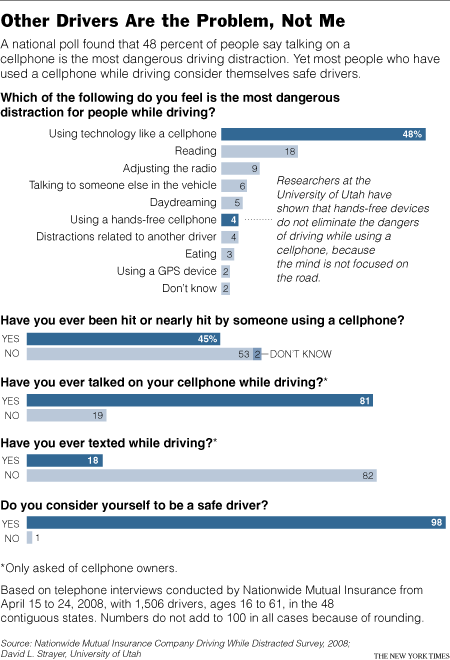
A disconnect between perception and reality worsens the problem. New studies show that drivers overestimate their own ability to safely multitask, even as they worry about the dangers of others doing it.
Device makers and auto companies acknowledge the risks of multitasking behind the wheel, but they aggressively develop and market gadgets that cause distractions.
Police in almost half of all states make no attempt to gather data on the problem. They are not required to ask drivers who cause accidents whether they were distracted by a phone or other device. Even when officers do ask, some drivers are not forthcoming.
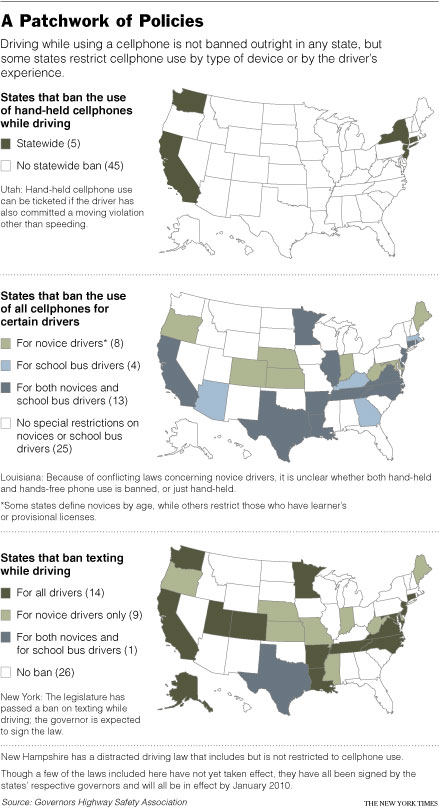
The federal government warns against talking on a cellphone while driving, but no state legislature has banned it. This year, state legislators introduced about 170 bills to address distracted driving, but passed fewer than 10.
Five states and the District of Columbia require drivers who talk on cellphones to use hands-free devices, but research shows that using headsets can be as dangerous as holding a phone because the conversation distracts drivers from focusing on the road.
Fourteen states have passed measures to ban texting while driving, and the New York State Assembly sent such a bill to the governor on Friday.
The states that rejected any efforts to limit distracted driving this year include Oklahoma.
“I’m on the phone from when I leave the Capitol to when I get home, and that’s a two-hour drive,” said Tad Jones, the majority floor leader in the Oklahoma House, who helped block the legislation. “A lot of people who travel are used to using the phone.”
Scientists who study distracted driving say they understand the frustrations of colleagues who publicized the dangers of tobacco. Like cigarettes, they say, gadgets are considered cool but can be deadly. And the big device companies even offer warnings that remind them of labels on cigarette packs.
Verizon Wireless, for instance, posts instructions on its Web sites not to talk while driving — with or without a headset. But neither Verizon nor any other cellphone company supports legislation that bans drivers from talking on the phone. And the wireless industry does not conduct research on the dangers, saying that is not its responsibility.
Some researchers say that sufficient evidence exists to justify laws outlawing cellphone use for drivers — and they suggest using technology to enforce them by disabling a driver’s phone. “Just outlawing the behavior cannot possibly go very far toward getting people not to do it,” said Robert D. Foss, senior research scientist at the Highway Safety Research Center at the University of North Carolina. “The behavior is too ingrained and compelling.”
For his part, Mr. Hill rarely talks when he drives now. His mother gave him a hands-free headset two months after the accident. She thought it would create less distraction. He tried it once, and found his mind wandering into his phone call so much that “I nearly missed a light,” he said.
He pleaded guilty to negligent homicide, a misdemeanor, for the death of Ms. Doyle. Now, when he is a passenger in a car, it makes him nervous when the driver starts talking on the phone. But Mr. Hill, who is polite and deferential, said he doesn’t want to badger drivers about the risks.
“I hope they don’t have to go through what I did to realize it’s a problem,” he added.
Dangerous Overconfidence
Sgt. Matthew Downing, a tough-talking 11-year veteran on the Oklahoma City police force, drives a car with no lights on the roof. That way, drivers are less likely to notice him as he waits for speeders.
Increasingly, he sees erratic behavior — swerving across lanes, running red lights — that looks just like drunken driving. Instead, he sees drivers talking on their phones, or texting. “A ton of people pass me literally unaware of their surroundings,” he said.
Sergeant Downing, who often handles traffic fatalities, arrived at the scene of Mr. Hill’s crash after paramedics had extracted Ms. Doyle, who was 61, from her car. He found Mr. Hill sitting on a fire truck, acting “hysterical.”
There was no mystery about the accident’s cause; the roads were dry. “He told me he was talking on the phone and didn’t see the light,” Sergeant Downing said.
“He’s a nice kid,” he said of Mr. Hill. But he said he felt angry, both at Mr. Hill and at what he sees as an epidemic of multitasking on the road. “Driving and talking are automatic,” he said.
Over all, cellphone use has soared. From 1995 to 2008, the number of wireless subscribers in the United States increased eightfold, to 270 million, and minutes talked rose 58-fold.
Last year, the federal agency dealing with road safety, the National Highway Traffic Safety Administration, published a study, based on researchers’ observations of drivers, suggesting that at any time during daylight hours in 2007, 11 percent — or 1.8 million drivers — were using a cellphone.
And in a survey of 1,506 people last year by Nationwide Mutual Insurance, 81 percent of cellphone owners acknowledged that they talk on phones while driving, and 98 percent considered themselves safe drivers. But 45 percent said they had been hit or nearly hit by a driver talking on a phone.
“When we ask people to identify the most dangerous distraction on the highway today, about half — correctly — identify cellphones,” said Bill Windsor, associate vice president for safety at Nationwide. “But they think others are dangerous, not themselves.”
He and others who favor restrictions say drivers regularly make what amount to ill-informed analyses of cost-benefit tradeoffs, often deciding that the value of constant communication outweighs any risks.
Seven years ago, when cellphones and services like texting were less common, federal researchers estimated that drivers using cellphones caused about 1,000 fatalities and played a role in 240,000 crashes. (In 2007, drunken driving caused 13,000 fatalities.)
By other measures, American roads are becoming safer. According to the highway safety agency, the number of driving fatalities has remained around 42,000 a year for most of the last decade, though it fell to 37,261 in 2008, when gas prices rose sharply and Americans drove less.
From 1997 to 2007, the number of reported accidents fell to 6 million a year from 6.7 million, according to the highway safety agency. “There are more drivers, more talking drivers,” said John Walls, spokesman for the Cellular Telecommunications and Internet Association. “If it’s so risky, then logically one would think there would be more accidents.”
The association, a trade group, fought rules to ban phone use while driving until January, when it shifted to a neutral position on the issue. “I wouldn’t say, ‘Talk on the phone more and have fewer accidents,’ ” Mr. Walls added. “I’m just saying, ‘How does this square?’ ”
Some scientists say this argument is flawed. “We’ve spent billions on air bags, antilock brakes, better steering, safer cars and roads, but the number of fatalities has remained constant,” said David Strayer, a psychology professor at the University of Utah and a leading researcher in the field of distracted driving.
“Our return on investment for those billions is zero,” he added. “And that’s because we’re using devices in our cars.”
Better data would help settle the debate. But 21 states do not include a box on accident forms for police to mark electronic devices as a cause. Those that now account for it started doing so only recently. Mr. Windsor of Nationwide Mutual said that such data, while valuable, would greatly underestimate the problem because it relies on driver confessions. Sometimes drivers say they just finished a call. Cellphone records are not much help because of the difficulty of establishing the precise time of an accident.
“By the time you get to a crash, it’s very, very difficult to determine whether someone was talking on the phone and whether the phone caused the crash,” said Rae Tyson, a spokesman for the National Highway Traffic Safety Administration.
For Mr. Windsor and many scientists who study the issue, accident figures are not necessary to prove the risks.
“The research is just so strong,” Mr. Windsor said.
Risks of Multitasking
In a windowless room at the University of Utah, Professor Strayer has spent a decade studying driver distraction.
On a recent afternoon, Anne McLaren, 19, who just finished her freshman year studying dental hygiene and who gets class credit for volunteer work, climbed behind the wheel of Mr. Strayer’s $100,000 driving simulator. Her task was to closely follow a white car that often slowed abruptly. A voice on a speaker phone asked Ms. McLaren questions like, “When you do a pull-up, do your palms face toward you?” and “Can you touch your elbow to your ear?”
For the most part, she ably multitasked. But sometimes she took her hands from the wheel when trying to answer a question, like, “True or false: A peanut butter jar opens clockwise.” And she was so focused on her call that she seemed to miss surprises, like a body at the side of the road.
Texting while driving was more difficult; she soon slammed into the virtual car in front of her.
Mr. Strayer’s research, using a small camera to track his volunteers’ eye movements, shows that texting drivers regularly focus on their screens for stretches of more than five seconds.
“I should pay attention to the road,” she said afterward. But sometimes it’s hard to ignore the phone, she added, like when her parents want to reach her. “My dad gets more mad if I don’t have the phone than if I’m talking and driving.”
Mr. Strayer’s research, showing that multitasking drivers are four times as likely to crash as people who are focused on driving, matches the findings of two studies, in Canada and in Australia, of drivers on actual roads.
The highway safety administration estimates that drivers using a hand-held device are at 1.3 times greater risk of a crash or near crash, and at three times the risk when dialing, compared with others who are simply driving. The agency based its conclusions on research from the Virginia Tech Transportation Institute, which placed cameras inside cars to monitor drivers for more than a year. The study found cellphones to be the most common cause of driver distraction.
Research also shows that drivers conversing with fellow passengers do not present the same danger, because adult riders help keep drivers alert and point out dangerous conditions and tend to talk less in heavy traffic or hazardous weather.
Scientists note that there are limits to how much the brain can multitask. The brain has trouble assessing separate streams of information — even if one is visual and the other aural, said Steve Yantis, professor of psychological and brain sciences at Johns Hopkins University.
Further, he said, when people talk on the phone, they are doing more than simply listening. The words conjure images in the mind’s eye, including images of the person they are talking to. That typically doesn’t interfere with driving. The problem starts when a car swerves unexpectedly or a pedestrian steps into traffic, he said, and the mind lacks the processing power to react in time.
“There is zero doubt that one’s driving ability is impaired when one is trying to have a cellphone conversation — whether hands-free or hand-held, it doesn’t matter,” said David E. Meyer, professor of psychology at the University of Michigan.
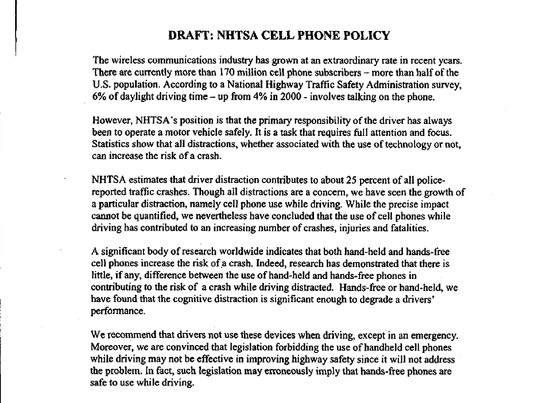
In fact, some scientists argue that hands-free laws make driving riskier by effectively condoning the practice. As early as July 2003, researchers at the National Highway Traffic Safety Administration reached that conclusion based on what they referred to, in a proposed draft of a cellphone policy for the agency, as “a significant body of research worldwide.”
The draft policy said: “We are convinced that legislation forbidding the use of handheld cellphones while driving will not be effective since it will not address the problem. In fact, such legislation may erroneously imply that hands-free phones are safe to use while driving.”
The agency’s current advice is that people should not use cellphones while driving and that hands-free devices do not eliminate the risks of distracted driving.
Scientists are grappling, too, with perhaps the broadest question hanging over the phenomenon of distracted driving: Why do people, knowing the risk, continue to talk while driving? The answer, they say, is partly the intense social pressures to stay in touch and always be available to friends and colleagues. And there also is the neurological response of multitaskers. They show signs of addiction — to their gadgets.
John Ratey, an associate professor of psychiatry at Harvard University and a specialist on the science of attention, explained that when people use digital devices, they get a quick burst of adrenaline, “a dopamine squirt.” Without it, people grow bored with simpler activities like driving. Mr. Ratey said the modern brain is being rewired to crave stimulation, a condition he calls acquired attention deficit disorder.
“We need that constant pizzazz, the reward, the intensity,” he said. He largely dismisses the argument that people need the time in the car to be productive. “The justification for doing work is just that — a justification to be engaged,” he said.
In many legislatures, including Oklahoma’s, the concerns of such scientists have made little impression.
Concerns About New Rules
In February, five months after the accident that killed Ms. Doyle, Sue Tibbs was in Tulsa undergoing one of her regular seven-hour chemotherapy treatments for ovarian cancer.
As an Oklahoma state representative, Ms. Tibbs was finishing a bill to require hands-free devices for drivers and to ban texting while driving. She had developed an interest in the issue last fall, after hearing about a growing number of crashes like the one involving Mr. Hill and Ms. Doyle, and after an Oklahoma state trooper told her he was increasingly concerned about multitasking behind the wheel.
As Ms. Tibbs sat in the cancer center, she overheard a conversation that sealed her resolve. A woman nearby talked of how her husband often became so engrossed in his cellphone calls he would miss the turn for the road to their home. The cellphone, Ms. Tibbs decided, isn’t like other distractions. “When you’re eating, you’re not concentrating like when you’re on the cellphone,” she said.
On Feb. 19, the public safety committee voted 8 to 4 to send Ms. Tibbs’s bill to the full legislature. She was thrilled. But on March 12, the last day her bill could be considered, the majority floor leader, Mr. Jones, hadn’t brought up her bill. That night, she asked Mr. Jones, a fellow Republican, why. He explained that there was too much opposition, she said. Later, Ms. Tibbs said, he added another reason: she was fragile from cancer and he didn’t want her to go through a long-shot battle for the bill.
Mr. Jones, in an interview, said he and his colleagues needed more evidence of the dangers before they considered restricting the freedom to talk while driving. “We’re concerned about going into the cellphone realm at this point,” he said, adding that he was not lobbied by any companies that make money from the use of devices in cars.
But he said he recognized from using his phone while driving that it could be dangerous, particularly when dialing. “There’s definitely a time when you’re looking at your cellphone,” said Mr. Jones, who uses a hands-free device. “If you’re going to do it, you have to be extremely cautious.”
Like Oklahoma, many states have resisted legislating against multitasking behind the wheel because there is no long-term data on crashes caused by distracted driving, said Anne Teigen, a policy specialist with the National Conference of State Legislatures. But she also acknowledged the shortcomings of any such studies. “It mostly relies on self-reporting, and for insurance reasons people don’t want to admit they were on the phone,” she said.
Others cite more fundamental reasons to block any such legislation. “To me, the death of freedom is far worse than the risk of talking on the phone while driving,” said Carl Wimmer, a state representative in Salt Lake City who successfully fought a bill this year to ban talking while driving. “Why pick on cellphones?” he asked, noting that distraction comes in many forms. “You can’t legislate against stupidity.”
Some states have overcome opposition to pass restrictions. Joe Simitian, a state senator in California, managed to get his hands-free legislation, an effort he began in 2001, passed in 2006. He argued, based on data collected by the California Highway Patrol, that drivers using cellphones caused more fatalities than all the drivers distracted by eating, children, pets or personal hygiene.
In each previous year, the bill was killed — after lobbying by cellphone carriers, including Sprint, AT&T and T-Mobile. Mr. Simitian said that in the first two years, he would visit the offices of his colleagues on the Transportation Committee on the day of the vote and “find three cellphone industry lobbyists sitting in the legislator’s office,” Mr. Simitian said. “They’d just smile.”
He said they fought him even though their brochures said that distracted driving was dangerous. The exception was Verizon Wireless, which supported his efforts from the start.
Opposition gradually eased, and his bill requiring use of headsets while driving took effect in July 2008. In the first six months the California law was in effect, a preliminary California Highway Patrol estimate showed that fatalities dropped 12.5 percent — saving 200 lives. Mr. Simitian said it was too soon to determine whether the law or other factors caused the drop.
Mr. Simitian said one reason political opposition eased was that fellow legislators saw the dangers firsthand. “They’d come to me and say: ‘You may be bringing me around. I almost got creamed at the corner,’ ” he recalled.
For its part, the cellphone industry trade group said it had dropped its objection to restricting cellphone use by drivers — it now is neutral on the subject — because it decided the industry should play no role in trying to shape public policy on the issue. “The change came after we had an epiphany that, if you will, we’re in the business of providing service, and how they use that service is at their discretion,” said Mr. Walls, the industry spokesman.
But Mr. Windsor from Nationwide Mutual and others are skeptical of the cellphone industry’s explanation. They believe its position changed because its business has changed to rely less on total minutes that people spend talking. Cellphone companies’ growth is coming more from customers surfing the Internet, downloading games and using other data services — things that people typically do less of behind the wheel.
Mr. Simitian believes that a ban on talking on cellphones while driving would save even more lives. But he hasn’t proposed one, and has no plans to. “It’s a political nonstarter,” he said. “It’ll be a cold day in hell before people give up their phones altogether in cars.”
Not to mention other devices.
An Array of Distractions
Mr. Hill now owns a silver Chevrolet Silverado pickup that he bought with help from his grandmother. When he drives, he keeps his cellphone tucked in a space in the dashboard, and has set strict rules not to use it — rules he acknowledges he sometimes breaks.
He is also careful to keep his eyes on the road as he searches for his Nickelback, Christian rock or other CDs to play on his stereo.
His dashboard is relatively primitive compared with those of many other vehicles. Sales of multimedia systems for cars — with audio, video and GPS — were up 46 percent in the first four months of this year from a year earlier, according to the research firm NPD Group. More such systems also now come with a dock for MP3 players.
Scientists say they are frightened by each new device, giving drivers more reasons to look away from the road — like searching through song titles on the small screen of an iPod.
To device makers, it’s a big and growing market, though they say they are keenly aware that drivers can become distracted. “We have a chance to create what I call the ‘digital car,’ ” said Glenn Lurie, an executive at AT&T, the service provider for iPhones. “There are phenomenal opportunities.”
For instance, he said, new wireless technology could allow better real-time services, like maps that point to the closest, cheapest gas station. Mr. Lurie said devices would be developed foremost with “safety and security” in mind.
But other corporations emphasize just how engrossing their in-car entertainment can be. A recent ad from Audible.com, which sells audio books, says, “you just might miss your exit on the turnpike.”
Automakers also see a market for new features. Ford, for example, offers in most of its cars a $395 Sync system, which lets drivers use phones and music players with voice commands. The company says it is working to develop the product so drivers might even surf the Internet through voice commands and hear responses.
Joe Berry, Ford’s director of business and product development, said Sync enhances safety by providing a hands-free experience. But he said that not using a device is still safer.
The bottom line is that Ford is catering to consumer interests, Mr. Berry said, using an argument that car makers have made when the safety and fuel economy of sport utility vehicles are questioned, and used by tobacco companies as health concerns grew. The Sync product, he argues, makes drivers safer because its voice-command features let them keep their hands on the wheel and eyes on the road.
“It’s not as if you are going to be able to take this away from people,” he said of phones and other devices in cars. “They simply won’t give it up.”
Mr. Berry compared the situation to eating unhealthy foods. “We, as people, don’t want to stop doing things that aren’t in our best interest,” he said.
And so the fight against in-car distraction has fallen to a small band of activists, notably those who have lost a loved one. They argue that, unlike eating unhealthy foods — or for that matter, not wearing a seat belt — mobile multitasking can cost someone else’s life.
The Resistance
When Linda Doyle was hit by Mr. Hill’s truck, she was on her way to pick up cat food. She volunteered at the Central Oklahoma Humane Society, and drove every day without fail to nearby Lake Overholser, where she fed abandoned cats.
She would sometimes talk on the phone in her car. “If she was driving and I called, she would answer,” said Jennifer Smith, 35, Ms. Doyle’s daughter. “If my sister called, she would answer.”
Ms. Smith, who lives in Grapevine, Tex., and is a real estate agent, says she, too, once talked incessantly while driving. “We’re all guilty of it,” she said. “I’m the first to admit it.”
In her case, no longer. Ms. Smith almost always ignores the ring of an incoming call. And she has become one of the cellphone era’s answers to Mothers Against Drunk Driving. She devotes half her time to her uphill battle — contacting legislators in Texas and Oklahoma, filing a complaint with the federal Consumer Product Safety Commission and reaching out to other victims and their families.
She has talked to a handful of class-action lawyers. “They tell me this is the tobacco or asbestos case of our generation,” she said. But she says they also tell her the case would be too time-consuming and expensive.
David Teater of Spring Lake, Mich., is also fighting distracted driving; he works for the National Safety Council on transportation issues. His son Joe was killed on Martin Luther King’s Birthday in 2004, hit by a young woman talking on the cellphone to someone from her church, where she volunteered. Even after the accident, Mr. Teater said, he had trouble breaking his cellphone habit.
“With all the motivation in the world I couldn’t do it,” he said, adding that he eventually took more decisive action: “I put the cellphone in the trunk.”
Some drivers who caused accidents themselves have become activists, too. Mr. Hill, as part of his misdemeanor charge, must devote 240 hours to community service — talking about the risks of distracted driving, as well as working with animals, as Ms. Doyle’s family said she would have liked.
He spoke to a classroom of fellow students about his experience, sparing no details.
“Their jaws just dropped,” he said. “They couldn’t believe they had someone standing in front of them who was talking on the cellphone and killed someone.”
Correction: July 24, 2009
A chart with the continuation of an article on Sunday about the hazards of driving while using cellphones and other electronic devices omitted Michigan from a map showing which states ban or restrict texting while driving and which do not. Michigan is among the states that have no laws restricting texting while driving. A corrected chart is at nytimes.com/business.
© 2009, The New York Times
New studies show that drivers overestimate their ability to multitask behind the wheel. This game measures how your reaction time is affected by external distractions. Regardless of your results, experts say, you should not attempt to text when driving.
Click below to play the Driving Game on The New York Times website:
http://www.nytimes.com/interactive/2009/07/19/technology/20090719-driving-game.html
By Matt Richtel
In 2003, researchers at a federal agency proposed a long-term study of 10,000 drivers to assess the safety risk posed by cellphone use behind the wheel.
They sought the study based on evidence that such multitasking was a serious and growing threat on America’s roadways.
But such an ambitious study never happened. And the researchers’ agency, the National Highway Traffic Safety Administration, decided not to make public hundreds of pages of research and warnings about the use of phones by drivers — in part, officials say, because of concerns about angering Congress.
On Tuesday, the full body of research is being made public for the first time by two consumer advocacy groups, which filed a Freedom of Information Act lawsuit for the documents. The Center for Auto Safety and Public Citizen provided a copy to The New York Times, which is publishing the documents on its Web site.
In interviews, the officials who withheld the research offered their fullest explanation to date.
The former head of the highway safety agency said he was urged to withhold the research to avoid antagonizing members of Congress who had warned the agency to stick to its mission of gathering safety data but not to lobby states.
Critics say that rationale and the failure of the Transportation Department, which oversees the highway agency, to more vigorously pursue distracted driving has cost lives and allowed to blossom a culture of behind-the-wheel multitasking.
“We’re looking at a problem that could be as bad as drunk driving, and the government has covered it up,” said Clarence Ditlow, director of the Center for Auto Safety.
The group petitioned for the information after The Los Angeles Times wrote about the research last year. Mother Jones later published additional details.
The highway safety researchers estimated that cellphone use by drivers caused around 955 fatalities and 240,000 accidents over all in 2002.
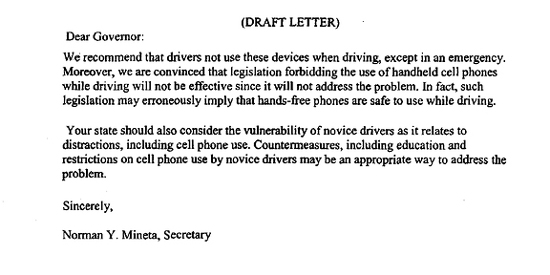
The researchers also shelved a draft letter they had prepared for Transportation Secretary Norman Y. Mineta to send, warning states that hands-free laws might not solve the problem.
That letter said that hands-free headsets did not eliminate the serious accident risk. The reason: a cellphone conversation itself, not just holding the phone, takes drivers’ focus off the road, studies showed.
The research mirrors other studies about the dangers of multitasking behind the wheel. Research shows that motorists talking on a phone are four times as likely to crash as other drivers, and are as likely to cause an accident as someone with a .08 blood alcohol content.
The three-person research team based the fatality and accident estimates on studies that quantified the risks of distracted driving, and an assumption that 6 percent of drivers were talking on the phone at a given time. That figure is roughly half what the Transportation Department assumes to be the case now.
More precise data does not exist because most police forces have not collected long-term data connecting cellphones to accidents. That is why the researchers called for the broader study with 10,000 or more drivers.
“We nevertheless have concluded that the use of cellphones while driving has contributed to an increasing number of crashes, injuries and fatalities,” according to a “talking points” memo the researchers compiled in July 2003.
It added: “We therefore recommend that the drivers not use wireless communication devices, including text messaging systems, when driving, except in an emergency.”
Dr. Jeffrey Runge, then the head of the highway safety agency, said he grudgingly decided not to publish the Mineta letter and policy recommendation because of larger political considerations.
At the time, Congress had warned the agency not to use its research to lobby states. Dr. Runge said transit officials told him he could jeopardize billions of dollars of its financing if Congress perceived the agency had crossed the line into lobbying.
The fate of the research was discussed during a high-level meeting at the transportation secretary’s office. The meeting included Dr. Runge, several staff members with the highway safety agency and John Flaherty, Mr. Mineta’s chief of staff.
Mr. Flaherty recalls that the group decided not to publish the research because the data was too inconclusive.
He recalled that Dr. Runge “indicated that the data was incomplete and there was going to be more research coming.”
He recalled summing up his position as, the agency “should make a decision as to whether they wanted to wait for more data.”
But Dr. Runge recalled feeling that the issue was dire and needed public attention. “I really wanted to send a letter to governors telling them not to give a pass to hands-free laws,” said Dr. Runge, whose staff spent months preparing a binder of materials for their presentation.
His broader goal, he said, was to educate people about the dangers of distracted driving. “Based on the research, there was a possibility of this becoming a really big problem,” he said.
But “my advisers upstairs said we should not poke a finger in the eye of the appropriations committee,” he recalled.
He said Mr. Flaherty asked him, “Do we have enough evidence right now to not create enemies among all the stakeholders?”
Those stakeholders, Dr. Runge said, were the House Appropriations Committee and groups that might influence it, notably voters who multitask while driving and, to a much smaller degree, the cellphone industry.
Mr. Mineta, who left as transportation secretary in 2006, said he was unaware of the meeting.
“I don’t think it ever got to my desk,” he said of the research. Mr. Ditlow, from the Center for Auto Safety, said the officials’ explanations for withholding the research raised concerns. He said the research did not constitute lobbying of states.
And he said it was consistent with the highway safety agency’s research in other areas, like seat belts.
Mr. Ditlow said that putting fears of the House panel ahead of public safety was an abdication of the agency’s responsibility.
“No public health and safety agency should allow its research to be suppressed for political reasons,” he said. Doing so “will cause deaths and injuries on the highways.”
State Senator Joe Simitian of California, who tried from 2001 to 2005 to pass a hands-free cellphone law over objections of the cellphone industry, said the unpublished research would have helped him convince his colleagues that cellphones cause serious — deadly — distraction.
“Years went by when lives could have been saved,” said Mr. Simitian, who in 2006 finally pushed through a hands-free law that took effect last year.
The highway safety agency, rather than commissioning a study with 10,000 drivers, handled one involving 100 cars. That study, done with the Virginia Tech Transportation Institute, placed cameras inside cars to monitor drivers for more than a year.
It found that drivers using a hand-held device were at 1.3 times greater risk of a crash or near crash, and at three times the risk when dialing compared with other drivers.
Not all the research went unpublished. The safety agency put on its Web site an annotated bibliography of more than 150 scientific articles that showed how a cellphone conversation while driving taxes the brain’s processing power, impairing reaction time. But the bibliography included only a list of the articles, not the one-page summaries of each one written by the researchers.
Chris Monk, who researched the bibliography for 18 months, said the exclusion of the summaries took the teeth out of the findings.
“It became almost laughable,” Mr. Monk said. “What they wound up finally publishing was a stripped-out summary.”
Mr. Monk and Mike Goodman, a division head at the safety agency who led the research project, theorize that the agency might have felt pressure from the cellphone industry. Mr. Goodman said the industry frequently checked in with him about the project and his progress. (He said the industry knew about the research because he had worked with it to gather some data).
But he could offer no proof of the industry’s influence. Mr. Flaherty said he was not contacted or influenced by the industry.
The agency’s current policy is that people should not use cellphones while driving. Rae Tyson, a spokesman for the agency, said it did not, and would not, publish the researchers’ fatality estimates because they were not definitive enough.
He said the other research was compiled as background material for the agency, not for the public.
“There is no report to publish,” he said.
LOGAN, Utah — In most states, if somebody is texting behind the wheel and causes a crash that injures or kills someone, the penalty can be as light as a fine.
Utah is much tougher.
After a crash here that killed two scientists — and prompted a dogged investigation by a police officer and local victim’s advocate — Utah passed the nation’s toughest law to crack down on texting behind the wheel. Offenders now face up to 15 years in prison.
The new law, which took effect in May, penalizes a texting driver who causes a fatality as harshly as a drunken driver who kills someone. In effect, a crash caused by such a multitasking motorist is no longer considered an “accident” like one caused by a driver who, say, runs into another car because he nodded off at the wheel. Instead, such a crash would now be considered inherently reckless.
“It’s a willful act,” said Lyle Hillyard, a Republican state senator and a big supporter of the new measure. “If you choose to drink and drive or if you choose to text and drive, you’re assuming the same risk.”
The Utah law represents a concrete new response in an evolving debate among legislators around the country about how to reduce the widespread practice of multitasking behind the wheel — a topic to be discussed at a national conference about the dangers of distracted driving that is being organized by the Transportation Department for this fall.
Studies show that talking on a cellphone while driving is as risky as driving with a .08 blood alcohol level — generally the standard for drunken driving — and that the risk of driving while texting is at least twice that dangerous. Research also shows that many people are aware that the behavior is risky, but they assume others are the problem.
Treating texting behind the wheel like drunken driving raises complex legal questions. Drunken drivers can be identified using a Breathalyzer. But there is no immediate test for driving while texting; such drivers could deny they were doing so, or claim to have been dialing a phone number. (Many legislators have thus far made a distinction between texting and dialing, though researchers say dialing creates many of the same risks.)
If an officer or prosecutor wants to confiscate a phone or phone records to determine whether a driver was texting at the time of the crash, such efforts can be thwarted by search-and-seizure and privacy defenses, lawyers said.
Prosecutors and judges in other states already have the latitude to use more general reckless-driving laws to penalize multitasking drivers who cause injury and death. In California, for instance, where texting while driving is banned but the only deterrent is a $20 fine, a driver in April received a six-year prison sentence for gross vehicular manslaughter when, speeding and texting, she slammed into a line of cars waiting at a construction zone, killing another driver.
But if those prosecutors want to charge a texting driver with recklessness, they must prove the driver knew of the risks before sending texts from behind the wheel.
In Utah, the law now assumes people understand the risks.
The law “is very noteworthy,” said Anne Teigen, a policy specialist with the National Conference of State Legislatures, an organization of state legislators. “They have raised the bar and said texting while driving is not just irresponsible, and it’s not just a bad idea — it is negligent.”
Ms. Teigen said legislators throughout the country were struggling with how to address threats created by new technology, just as they once debated how to handle drunken driving.
Ray LaHood, the transportation secretary, has said drivers should not text behind the wheel, and several United States senators recently introduced legislation to force states to ban texting while driving.
Utah, governed by a Republican legislature with a libertarian bent, may seem an unlikely state to pursue particularly tough penalties governing driver behavior.
But the issue forced itself onto the legislative agenda here because of what occurred on the rainy morning of Sept. 22, 2006.
The accident occurred on a two-lane highway just west of Logan, in a verdant valley in Utah’s northernmost county.
Reggie Shaw, a 19-year-old college student working as a house painter, was driving west to work in a Chevrolet Tahoe S.U.V. Approaching him, in a Saturn sedan, was James Furaro, 38, and his passenger, Keith P. O’Dell, 50. The senior scientists were commuting to ATK Launch Systems, where they were helping to design and build rocket boosters.
Mr. Shaw crossed the yellow dividing line on the two-lane road and clipped the Saturn. It spun across the highway and was struck by a pickup truck hauling a trailer filled with two tons of horseshoes and related equipment.
The two scientists were killed instantly.
At the scene, the investigating officer, Bart Rindlisbacher of the Utah Highway Patrol, said he could not pinpoint the cause of the crash. Mr. Shaw said he could not remember doing anything out of the ordinary.
The trooper figured it was an unfortunate case of “left of center,” a catch-all for a traffic offense that involves crossing the yellow divider.
But a witness told the police he had seen Mr. Shaw swerving several times just before the accident, raising Mr. Rindlisbacher’s suspicions. The trooper’s concerns grew as he drove Mr. Shaw to the hospital. He saw Mr. Shaw, in the passenger seat, pull out his phone and start texting.
“Were you texting while you were driving?” Mr. Rindlisbacher recalled asking.
“No,” he recalled Mr. Shaw responding. (Mr. Shaw said he did not remember the conversation or much about the accident.)
The trooper was deeply skeptical. He figured out how to subpoena Mr. Shaw’s phone records. Six months later, with help from a state public safety investigator, they got the records and their proof: Mr. Shaw and his girlfriend had sent 11 text messages to each other in the 30 minutes before the crash, the last one at 6:47 a.m., a minute before Mr. Shaw called 911. Investigators concluded he sent that last text when he crossed the yellow line.
Still, county prosecutors thought they were unable to charge Mr. Shaw with something other than “left of center.” For instance, if they wanted to prove Mr. Shaw guilty of negligent homicide, a misdemeanor, they would need to show he knew of the dangers or should have known of the dangers of texting while driving.
Mr. Shaw, who had retained a lawyer, would not discuss the issue with law enforcement or prosecutors.
Then Terryl Warner, a victim’s advocate in the county where the accident occurred, got involved.
Ms. Warner had a personal interest in the case because she knew the family of one of the scientists.
In July 2007, Ms. Warner, convinced by the trooper’s evidence, wrote to prosecutors arguing for a vehicular manslaughter charge. She said the dangers of texting and driving were broadly known, therefore Mr. Shaw should have known better.
Mr. Shaw had just started a Mormon mission in Canada when he was called home to face charges of negligent homicide. The trial was set for early 2009.
Then, just before Thanksgiving in 2008, at a hearing, Mr. Shaw looked at the families of the two dead scientists and decided he could no longer keep dismissing the phone records that showed he was texting, even though his lawyers advised him to remain quiet. “It hit me that I was being selfish dragging this on,” he said. “I decided I’ve got to do whatever it takes to make this come to an end. If there was anything I could do — spend a year in jail, two years in jail, whatever — I’d do it.”
He pleaded guilty to two counts of negligent homicide, but his record will be cleared if he fulfills the sentence imposed by the judge. It included 30 days in jail, 200 hours of community service, and a requirement that he read “Les Misérables” to learn, like the book’s character Jean Valjean, how to make a contribution to society.
Last February, Mr. Shaw spoke to the state House Subcommittee on Law Enforcement and Criminal Justice, which was considering a ban on texting for motorists. The measure seemed likely to fail given the legislature’s lack of interest in previous such efforts. Then Mr. Shaw stood to talk about his crash and started sobbing.
“I was the one driving and texting,” Mr. Shaw said through tears. “Excuse me. I apologize. I didn’t know the dangers.”
Ms. Warner, the victim’s advocate, said that moment was a turning point. “Before he spoke, some legislators were talking and texting,” she recalled. “After he started talking, there wasn’t a dry eye in the room.”
Under Utah’s law, someone caught texting and driving now faces up to three months in jail and up to a $750 fine, a misdemeanor. If they cause injury or death, the punishment can grow to a felony and up to a $10,000 fine and 15 years in prison.
Alaska is the only other state that takes a similarly tough approach to electronic distraction, said Ms. Teigen of the National Conference of State Legislators.
A law passed there in 2007 makes it a felony punishable by up to 20 years in prison if a driver causes a fatal accident when a television, video monitor or computer is on inside the car and in the driver’s field of vision. (The law applies to phones used for texting, but not to phones used exclusively for calling or to some other devices, like GPS devices.)
The law, which is less focused on texting than Utah’s, resulted from a 2003 accident in which a driver, who prosecutors said was watching a movie on a video monitor perched on his dashboard, killed two motorists.
These tougher penalties can lead to prickly legal questions.
John Wesley Hall, who just stepped down as president of the National Association of Criminal Defense Lawyers, said the police might have difficulty proving a driver suspected of texting wasn’t merely dialing a phone. And, he said, there are serious privacy and search issues raised when an officer wants to confiscate a phone.
“The police have no business going into my phone,” he said.
James Swink, the Cache County attorney, expects such challenges, but says that the police in some cases could simply get phone records later, as in the Shaw case.
More broadly, Mr. Swink said, drivers in Utah are now on notice that texting while driving is inherently reckless. And as drivers across the nation become more aware of that notion, he said, judges and prosecutors will feel more comfortable asking for big penalties. He said the Shaw case helped to pave the way.
“Once the word is out there,” he said, “it will become easier for judges to lower the big boom.”
© 2009, The New York Times
By Matt Richtel
After decades of marriage, Terry and Debbie Buchen learned to work through various marital issues. Then something new came between them — his cellphone.
Mr. Buchen, 62, couldn’t put it down while driving. The first time he sent e-mail messages from behind the wheel, he drove his BMW S.U.V. into a ditch on a deserted stretch of road.
He was alone and driving slowly, and he wasn’t injured. Still, the incident was “very scary,” his wife said.
Mr. Buchen knew he had a to make a choice between his habit and marital bliss.
“I chose my wife,” he said. But then Mr. Buchen, an agronomist for golf courses, asked for a compromise: he asked her to drive when they were together so he could stay connected with clients. That didn’t fly. “If looks could kill,” he said.
For all the conversations about distracted driving playing out in statehouses and on talk shows, the most heated discussions, and the ones with the most lasting impact, may be happening between family members and friends.
Such disputes are an extension of a longstanding source of tension — sometimes light, other times more antagonistic — between drivers and their self-appointed watchdogs.
It’s just that now, the back-seat driver is going after the BlackBerry.
These critics say such devices not only put lives at risk, but also steal attention from passengers hoping for some quality catch-up time. The multitaskers counter with the view that they must, and like, to tend to social and work demands.
Safety advocates who favor outlawing multitasking behind the wheel say the new generation of back-seat hawks may be playing a crucial role in changing the culture — much as they did in helping enforce seat belt laws — in a way these advocates say laws alone may not be able to.
In a survey conducted this year of 2,501 people, the AAA Foundation for Traffic Safety found that 48 percent of people worry about a friend or family member driving unsafely. Of those people, 19 percent said the cause of their concern was multitasking behind the wheel.
Some drivers say that the second-guessing is unnecessary because of their ability to handle driving and other tasks.
“I barely even look at my phone when I text,” said Sarah Edwards, 29, a customer service representative in Cleveland.
Her close friend, Amy Macauley, 32, isn’t convinced. “We’ve talked about this,” Ms. Macauley said. “I’ve cited vague statistics about how dangerous it is, but she doesn’t pay attention.”
She brings a particular sensitivity to the discussion. Her sister and the husband of a close friend died from crash injuries, and her brother-in-law was seriously injured in a car accident.
“I know things can change in an instant when someone is behind the wheel,” Ms. Macauley said. To her, talking on the phone or texting while driving, unless it’s an emergency, is “completely gross.”
People like Ms. Macauley are finding more ammunition to argue their side.
Studies show that people who talk on the phone while driving face four times as great a crash risk as those who do not. The risk is considerably higher for motorists who text.
The federal government estimates that at any given time about 11 percent of drivers, or about two million people, are talking on a cellphone.
Many of them are most likely doing so alone. Up to 85 percent of drivers have no passenger with them in the car, estimates the Virginia Tech Transportation Institute.
But when an adult passenger is present, the Transportation Institute found, he or she can enhance safety — and reduce crash risk by up to 50 percent — by keeping eyes on the road, or encouraging safer behavior.
That means that a friend or family member cajoling a motorist to put down the phone can provide a safety advantage, as long as the disagreement itself doesn’t escalate to the point of distraction.For all the evidence about the dangers of distracted driving, multitaskers say there are powerful forces — both social and economic — that make it hard to put their devices down.
A 2008 poll taken by Nationwide Insurance of 1,500 motorists found that 48 percent of people who multitasked behind the wheel did so because they felt an urgent need to address an issue pertaining to school or work; 33 percent said they felt pressure to stay connected socially.
That pressure may affect some people more than others. An emerging body of science suggests that there are some people who are more likely to be drawn to multitasking — behind the wheel or otherwise — because of the way their brains are wired.
Clifford Nass, a co-director of an automotive research laboratory at Stanford University, said some researchers had labeled such heavy multitaskers as “explorers” because they enjoyed the constant hunt for information — whether it pertained to work, entertainment or social life.
Vic Gideon, 48, a hospital executive from Cleveland, says he feels the call of his device for social and work purposes, even when behind the wheel and even when his family, including his four children, are in the car.
“Even if I’m going 60 miles an hour, I feel the need to check it,” said Mr. Gideon, referring to his phone. “It might be spam, a wrong number, whatever. But who cares? My cell vibrates. I respond.”
Mr. Gideon said it had created tension. “My wife tells me I don’t know how to drive,” he said. “And then, of course, not only do I not know how to drive, but I don’t know how to drive safely. I believe I’m being careful.”
The Nationwide Insurance poll found that both men and women were avid multitaskers. About 85 percent of female drivers said they multitasked, compared with 78 percent of male drivers.
Grace Andrews, 49, a corporate consultant in Melrose, Mass., is the one taking heat in her family. Her husband, Joe Nardone, 44, and her son, Colby Andrews, 12, despise her incessant use of the phone.
“I honestly do laugh at myself all the time,” says Ms. Andrews. “Is it really possible that I am talking on the phone, e-mailing and driving with my knees simultaneously?”
Her husband and son tell her she cares more about the phone than about them, and that she puts herself and others at risk.
“I could never imagine that we would get to this stage — that this is the stuff we would fight about,” she said.
Joan Raymond contributed reporting.
Correction: September 10, 2009
An article on Wednesday about rising tensions among family and friends over the use of electronic devices while driving rendered incorrectly part of the name of an organization that conducted a survey on the issue. It is the AAA Foundation for Traffic Safety, not the AAA Foundation for Highway Safety.
© 2009, The New York Times
By Matt Richtel
Crisscrossing the country, hundreds of thousands of long-haul truckers use computers in their cabs to get directions and stay in close contact with dispatchers, saving precious minutes that might otherwise be spent at the side of the road.
The trucking industry says these devices can be used safely, posing less of a distraction than BlackBerrys, iPhones and similar gadgets, and therefore should be exempted from legislation that would ban texting while driving.
“We think that’s overkill,” Clayton Boyce, spokesman for the American Trucking Associations, said of a federal bill that would force states to ban texting while driving if they want to keep receiving federal highway money.
The legislation will be discussed at a conference on distracted driving in Washington, starting Wednesday, organized by the Transportation Department.
The issues raised by truckers show the challenges facing advocates for tougher distracted-driving laws, given that so many Americans have grown accustomed to talking and texting behind the wheel.
Mr. Boyce, who said the industry does not condone texting while driving, said computers used by truckers require less concentration than phones. The trucks “have a screen that has maybe two or four or six lines” of text, he said. “And they’re not reading the screen every second.”
Banning the use of such devices, he added, “won’t improve safety.”
But some safety advocates and researchers say the devices — which can include a small screen near the steering wheel and a keyboard on the dash or in the driver’s lap — present precisely the same risk as other devices. And the risk may be even greater, they note, given the size of 18-wheel tractor trailers and the longer time required for them to stop.
Some truckers say they feel pressure to use their computers even while driving in order to meet tight delivery schedules.
“We’re supposed to pull over, but nobody ever does,” said Kurt Long, 46, a veteran trucker based in Wagoner, Okla., who hauls flour, sugar and other dry goods.
“When you get that load,” he added, “you go and you go and you go until you get there.”
The trucking industry has invested heavily in technology to wire vehicles. Satellite systems mounted on trucks let companies track drivers, send new orders, distribute companywide messages and transmit training exercises. Drivers can also use them to send and receive e-mail and browse the Internet.
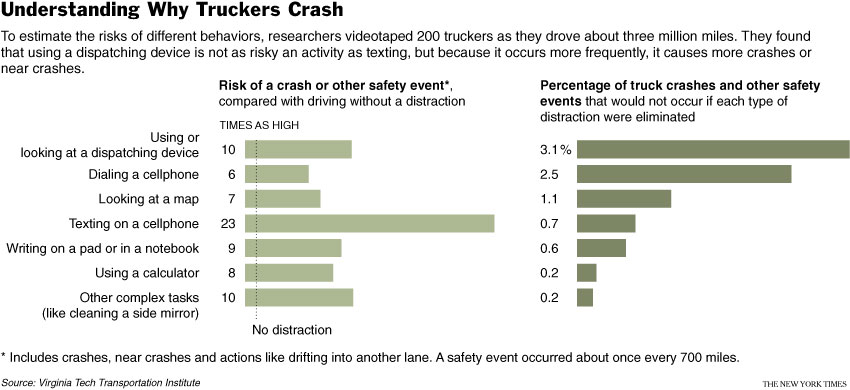
After videotaping truckers behind the wheel, the Virginia Tech Transportation Institute found that those who used on-board computers faced a 10 times greater risk of crashing, nearly crashing or wandering from their lane than truckers who did not use those devices.
That figure is lower than the 23 times greater risk when truckers texted, compared with drivers simply focused on the road, according to the same study. However, the Virginia researchers said that truckers tend to use on-board computers more often than they text.
The study found that truckers using on-board computers take their eyes off the road for an average of four seconds, enough time at highway speeds to cover roughly the length of a football field.
Richard J. Hanowski, director of the Center for Truck and Bus Safety at the Virginia institute, said videotape monitoring of 200 truckers driving about three million miles showed many of them using the devices, even bypassing messages on the screen warning them not to use the devices while driving.
“Is this any different than texting?” Mr. Hanowski said. “With either one, the risks are very high.”
In Mr. Long’s unkempt cab, the computer screen is mounted on the dashboard to the right of his steering wheel. He operates it both by touching the screen and by using a keyboard, which he often keeps in his lap (along with one of the two Chihuahuas that keep him company on his drives).
On the computer screen, there is a warning: do not use while vehicle is in motion.
“But it gives you a proceed button,” Mr. Long said with a laugh during an interview in August at a truck stop in Joplin, Mo.
Mr. Long pushes that button often. After all, pulling over to read and respond to a message, then start up again, would take 10 to 15 minutes, he said. If he’s late by even 15 minutes on a delivery, he said, his pay can be cut.
Mr. Long’s experience is typical, according to Michael H. Belzer, an economics professor at Wayne State University who studies the trucking industry. He said truckers had no choice but to use their computers while driving, given their deadline pressures.
Some makers of the on-board devices, like Qualcomm, sell versions of the systems that cannot be used while a vehicle is in motion or that can be used only in a limited way — for example, allowing drivers to only read messages or listen to a computerized voice reading them.
In recent years, fatalities which involved large trucks have fallen slowly, despite many safety advances like air bags and antilock brakes, according to the National Highway Traffic Safety Administration. In 2007, large trucks were involved in 4,808 deaths — or 12 percent of all driving-related fatalities.
Randy Mullett, vice president for government relations at Con-way, one of the nation’s biggest fleets, says safety is paramount for the industry, and for his company.
For instance, he said Con-way forbids the drivers of its roughly 8,000 trucks on regional routes to use a cellphone or to text while driving. Trucks on those routes tend not to have the computer systems.
For the company’s 4,000 longer-haul trucks, the company discourages drivers from texting and talking on cellphones, but does not have an official policy against it. Mr. Mullett said that such a policy would be difficult to enforce and that drivers rely on that technology to stay connected to both work and home.
Mr. Mullett also said drivers use the technology only to communicate with dispatchers, and infrequently at that.
He said drivers only have to press a button on the screen to acknowledge they received new instructions that appear on the screen. “It’s not much different than pressing a button on the radio,” he said.
Asking truckers to pull over for such a simple action is inefficient and expensive, Mr. Mullett said, given that the company loses about $1.50 a minute when a truck is idle.
“If it took a driver 15 minutes four times a day to pull over, you’d basically lose 10 percent of a driver’s time. You can’t take 10 percent of a truck fleet out of service to make them answer,” he said.
“Let’s figure out a way to work with Congress that doesn’t make these technology advances obsolete or less efficient than they are,” Mr. Mullett said.
Tim Lynch, senior vice president at the American Trucking Associations, said a compromise might exempt devices mounted in places where drivers can keep their eyes straight ahead.
“That way a driver could still be focusing on the road but looking at a device as opposed to having a BlackBerry they’re looking down at,” he said.
At least one sponsor of the federal legislation, Senator Charles E. Schumer, Democrat of New York, said that he was not aware of the trucking industry’s concerns but that there was room to accommodate their devices without compromising safety.
“There are ways I think to preserve what the trucker actually needs in terms of doing his or her job,” he said. “I think the real danger occurs when you’re regularly texting, not when you’re looking at a machine and doing a quick answer.”
But Robert D. Foss, a senior researcher at the Highway Safety Research Center at the University of North Carolina, said the dispatch computers and texting devices present the same potential for distraction.
“It’s hard to accept the assertion: ‘We’re just different,’ ” he said. “You know full well this is motivated by economic considerations.”
Beyond the dispatch computers, truckers said they relied heavily on an array of technologies to stay productive, entertained and connected on the road. Their cabs become like home offices, wired with CB radios, AM/FM and satellite radios, weather band radios, GPS devices, electrical outlets, laptops and even computer desks. And, of course, cellphones.
Mr. Long said he uses one or another of his devices 90 percent of the time he is on the road. He said doing so actually makes him a safer driver because it keeps him awake and alert.
And he said it was one reason he had not had any serious accidents in more than two decades as a trucker.
At least, until last Monday.
On a highway in Oklahoma, a dump truck pulled into his lane from a side road. Mr. Long slammed into it, lost control and drove into a lake.
His truck was totaled. Neither he nor the dump-truck driver was badly injured. (His dogs were hurt, one thrown from the cab, but neither badly.)
Mr. Long said he had not been using his phone or computer at the time, but he had taken his eyes off the road for an instant. “I reached down to grab a cup of coffee,” he said.
He said the lesson is that drivers need to be careful not to get distracted, particularly when they use electronic devices.
“I guarantee if you’re not an ace on that keyboard, you’ve got to look to find them letters,” he said. “Sometimes, it takes a lot longer to find a letter on that keyboard than it does to get a cup of coffee.”
Correction: September 30, 2009
An article on Monday about the trucking industry’s concerns over proposals to ban texting while driving referred incorrectly to statistics regarding large trucks and fatal crashes. The statistics, from the National Highway Traffic Safety Administration, cover trucks that were involved in fatal crashes; they do not specify the number of crashes “caused” by the trucks. The article also misstated the change in numbers of fatal crashes involving large trucks from 1997 to 2007. According to N.H.T.S.A., that number declined to 4,808 in 2007, from 5,416 in 1997; it did not increase to 4,808 in 2007, from 4,777 in 1997. (In 1997, N.H.T.S.A. data differentiated between medium-weight and heavy trucks; in the 2007 data, they were counted together as large trucks.)
© 2009, The New York Times
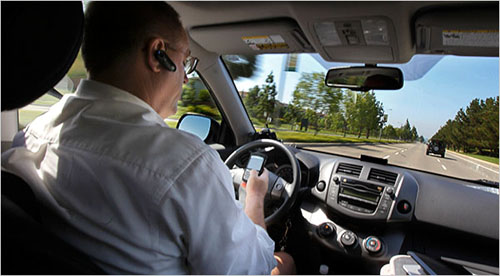
David Vered, an entrepreneur, checked his e-mail for 10 seconds while cruising at 45 m.p.h. in light traffic in California. (Chang W. Lee/The New York Times)
JOPLIN, Mo. — Looking back, Paul Dekok wonders what he was thinking that May morning when the urgent call came in. Mr. Dekok, a manager at the Potash Corporation, learned that a 25-ton truckload of the company’s additive for livestock feed had been rejected by a customer as contaminated.
Scrambling to protect his company’s credibility with a big customer, he grabbed his cellphone to arrange a new shipment, cradling it between his left ear and shoulder, and with his right hand e-mailed instructions to his staff from his laptop computer — all while driving his rental car in a construction zone on a two-lane highway in North Carolina.
“I thought I was doing a great job because I was being productive,” Mr. Dekok said. “It’s an adrenaline rush. It’s the buzz we all get of trying to do everything you can in business.”
But later, reflecting on the risks he took that spring day in 2007, he saw himself in a different light: “I was Bozo the clown.”
Mr. Dekok may be rethinking how he works on the road, but tens of thousands of Americans barely give it a second thought. They have turned their cars, vans and trucks into mobile offices, wired with phones and computers to stay in close touch with bosses and customers.
On Wednesday, the Transportation secretary, Ray LaHood, called the broader phenomenon of distracted driving a “deadly epidemic” at a meeting on the issue in Washington. Real estate brokers, pharmaceutical sales people, entrepreneurs, marketers and others say they have little choice but to transform their cars into cubicles. In this merciless economy, they say, they have to make every minute count, and respond instantly to opportunities and challenges.
And they argue that the convenience of constant contact — and the chance to tick off items from an endless to-do list while driving — far outweigh what they think are slim chances that it could lead to a wreck.
For white-collar employees, pressures to multitask are largely self-imposed. For blue-collar workers, the demands to stay connected while driving are often imposed by their bosses.
Truckers, plumbers, delivery drivers and others are tethered to dispatchers with an array of productivity devices, including on-board computers that send instructions about the next job and keep tabs on drivers’ locations. Such devices can require continual attention — distracting drivers who are steering the biggest vehicles on American roads.
The compulsion to work while driving often trumps clear evidence that such activity is dangerous. Studies show that someone who talks on the phone while driving is four times more likely to crash, even using a hands-free headset, than someone who is simply driving. The risks are even greater when sending text messages.
For all the perceived benefits of multitasking behind the wheel — like staying a step ahead of competitors — the dangers have begun to take their toll on companies, leading some to ban the practice by employees.
Some families of victims killed in collisions with a multitasking worker have successfully sued the driver’s employer for tens of millions of dollars.
Researchers say there is another reason to question the benefits of working behind the wheel: a growing body of research shows that splitting attention between activities like working and driving often leads to distracted conversations and bad decisions.
“There is an illusion of productivity,” said David E. Meyer, a professor of psychology at the University of Michigan. “It’s actually counterproductive.”
“To the extent that someone is focused on driving, the quality of work product is diminished,” he added. “To the extent someone is focused on work and not driving, there’s a risk of crashing and burning. Something’s got to give.”
The Drive to Compete
Potash, a large public fertilizer and chemical company, never told managers like Mr. Dekok, or regional salesmen like Rob Hudson, that they needed to multitask while driving.
But given that both men drive an average of 150 miles each day visiting feed mills and other customers, their cars inevitably became rolling offices, the place where they call clients, plan meetings and make hotel reservations.
“I’d be on my cellphone, writing notes in my planner, driving with my knee, and with a sandwich in my lap,” Mr. Hudson said. He felt he could not ignore his phone, he said, because he never knew which call or e-mail message would be one he could not miss.
“For the clients, a lot of times it’s an urgent request for a delivery,” he said. “In the animal feed business, they never stop eating. It’s not like that can wait until tomorrow.”
Plenty of other workers feel similar pressures. IDC, a market research firm, estimated last year that there were 111 million mobile workers in the United States, including all manner of people who do work outside an office, whether in a car, café, or airport lounge. And in a 2007 survey, IDC found that 70 percent of owners of BlackBerrys and other smartphones used their device in a car at least once a week. (The survey did not specify whether the phone users were drivers or passengers, but 80 percent of people typically drive alone).
“It’s a seconds-count economy,” said Sean Ryan, an analyst at IDC.
Mr. Ryan feels the pressure. He schedules work calls to make his own 45-minute commute — from Boston to Framingham, Mass. — more productive.
At stop lights, he checks texts and e-mail messages. He does not want to miss something important, but he also sees the practice as a time saver. “I might as well get a quick e-mail taken care of, or at least delete spam,” he said. “When I get to the office, I’ve saved 15 to 20 minutes of work.”
David Vered, 53, chief executive of Pacific Yogurt Partners, which operates Golden Spoon frozen yogurt stores in the San Francisco Bay Area and helps manage other stores around the state, sometimes does not wait for stop lights to check his e-mail.
He has trained employees to send concise messages so that he can read them while driving on the highway as he visits stores.
“With the BlackBerry, you can hold it up over the steering wheel,” he said. “I just hit ‘open’ and see what the issue is.”
On his lengthy commutes, he occasionally schedules calls with lawyers to do lease negotiations, or with contractors to discuss construction of a new retail outlet.
But his phone can also ring with an urgent problem, like a broken frozen-yogurt machine. Mr. Vered’s workers need to know what to do. If he delays, he said, they might be paralyzed, wasting time and money.
“I respond to them as rapidly as possible,” he said. “I don’t like holding people up. And I’m not just holding them up: I’m paying them. I want them to be as effective as possible.”
Studies show that drivers who send text or e-mail typically take their eyes off the road for an average of five seconds.
But Mr. Vered said he was vigilant about safety. Besides, he said, he never reads e-mail on his bigger laptop computer, which he keeps on a desk he has installed on the passenger seat of his small Toyota S.U.V.
“That’s dangerous because you have to shift the field of vision away from the road,” he added.
Mr. Vered said he was an adept multitasker.
“I’m in a zone,” he said. He uses a Bluetooth cellphone device attached to his ear so he can keep both hands on the wheel unless he is dialing or reading a text. “I’ve done it my whole life, so I know how to multitask,” he added.
As his own boss, Mr. Vered can choose whether to multitask while driving.
But other employees, particularly blue-collar workers, do not have that luxury. Many employers deploy an array of devices to stay connected with their drivers at all times.
The Mobile Office
“When someone’s toilet overflows, they call a bunch of plumbers — the first plumber there wins,” said Brian Edds, a marketing director for Xora, a company based in Mountain View, Calif.
Xora’s software lets workers using mobile phones receive dispatch and navigation directions, deal with payroll, fill out invoices and otherwise manage their work as if they were sitting at a desk.
IDC, the research firm, estimates companies spent $850 million last year for such software from Xora and its competitors, and estimated the market size would double in five years. The software has been installed on the phones of millions of electricians, service technicians, home health care workers, sales people, plumbers and others — at companies like Coca-Cola, Merck, Pitney Bowes and Xerox, and the city of Chicago.
Xora’s customers include the Roto-Rooter Services Company, the plumbing chain.
In the past, Mr. Edds said, a mobile worker might have had to scribble down directions from a dispatcher.
“Now he gets sent the information in an organized manner, so he can click on the address, and get the best route, so he gets to a job very fast,” he said.
Stephen R. Poppe, chief information officer for Roto-Rooter, said that when employees turned on their device, it warned them not to use it while driving. But employees can bypass the warning, and Mr. Poppe conceded the company cannot stop them from doing so,
“It’s like telling your daughter, ‘Don’t talk while driving,’ ” he said. “She answers, ‘Sure, Dad.’ ”
The company also needs quick responses from its plumbers.
“We want to know right this minute if they’re going to take that job or not, or we’ll assign the job to someone else,” he said. “We’ll know within 60 seconds.”
Mr. Edds said that Xora software included a standard warning screen urging users not to use it while driving. But he acknowledged that it could be ignored — and often was.
“Like the warning screens on in-dash navigation systems, most users treat them as a speed bump on their way to do what they want to do,” he said.
And sometimes a computer in the driver’s seat can be a deadly distraction.
Unintended Costs
Jered Noe was driving a Coca-Cola delivery truck on a quiet stretch of two-lane highway in Seminole County, Okla., two Novembers ago.
Samantha Dawn Earnest, with her three children, Jason, 7; Dakota, 5; and Hailey, 4; was driving along the same road in the other direction in her green 1999 Chevrolet Malibu.
In the back seat, Jason and Dakota talked about decorating the walls of their shared room. Jason favored pictures of dinosaurs. Dakota preferred horses.
As Ms. Earnest crested a hill, the delivery truck swerved into her car, spun it around and sent it careening across the highway. Jason died on impact.
Ms. Earnest, stunned and bleeding, saw the truck driver walking toward her.
“I said, ‘Why, why, why?’ ” she recalled screaming at him. “He told me, ‘I just took my eyes off the road for a second because I was looking at my computer.’ ”
She started chasing him.
“I went into a mad rage,” she said. “If he’d said he’d fallen asleep, maybe I’d have understood. But using a computer?”
Mr. Noe, 24, received a suspended sentence for negligent homicide, a misdemeanor, and the Earnest family sued Mr. Noe’s employer, the ADA Coca-Cola Bottling Company.
The company settled, and the terms of the agreement are confidential. ADA did not respond to requests for comment.
Lawyers and expert witnesses in cases involving multitasking drivers say such lawsuits are common.
Last year, International Paper reached a settlement to pay $5.2 million because of a 2006 accident in which an employee on a phone hit another driver, whose arm had to be amputated.
Katherine McArthur, a lawyer in Macon, Ga., who sued International Paper in that case, said the company permitted employees to use a cellphone while driving if it had a hands-free headset. (This remains the company policy, according to International Paper).
But Ms. McArthur said that several studies show that drivers using headsets face the same likelihood of crashing as someone holding the phone to their ear. That risk has been compared to driving at the legal limit for intoxication.
“What I’m arguing in these cases is that these companies are authorizing something as bad as drunk driving and that they knew about the research or should have known,” she said. Ms. McArthur said that companies should expect more such lawsuits.
“They’re the deep pockets,” she said. Some may pay before an accident even happens. Insurance executives say that when setting premiums the industry has started to consider whether companies have policies on cellphone use.
The Calculus
There might be another reason for drivers to reconsider working behind the wheel: a growing body of studies suggest that such work may be less valuable than many people assume.
The reason, researchers say, is that the brain can effectively perform only one difficult task at a time.
Mr. Meyer, the Michigan professor, found that when someone tried to multitask, important neural regions must switch back and forth, taking time and creating inefficiencies.
That can be particularly dangerous, of course, when a driver suddenly feels the tires slipping on an icy road in the middle of a phone call. But that 2001 study, and numerous others, also show that multitasking motorists can pay another price — in the quality of their work.
In 2006, for instance, researchers at University of California, Los Angeles, used brain imaging to show that multitaskers were less effective learners.
According to that research, a person focused on a single task remembers what he has learned using the hippocampus, a part of the brain critical to storing and recalling information.
But when that person multitasks — like trying to learn something new while driving — the brain relies more on the striatum, a part of the brain used more for learning motor skills.
The researchers concluded, “Don’t multitask while you are trying to learn something new you hope to remember.”
“The brain is fundamentally built to unitask,” said Clifford Nass, a communications professor at Stanford, where he is also a co-director of a new automotive research laboratory.
That limitation can put drivers at a disadvantage if they are negotiating with someone who, say, is in an office and less distracted.
Driving, Mr. Nass said, taxes the parts of the brain that make it more difficult to appreciate nuances of a conversation. “A person is much more manipulatable when they’re behind the wheel,” he said.
Mr. Nass said that the counterproductive effects can linger after the ride. Research shows that the brains of heavy multitaskers can become so accustomed to hopping from task to task that they have trouble focusing on longer, more in-depth ones.
Some companies have weighed several factors — including the safety risks and the cost of potential lawsuits — and banned employees from doing work on their phones behind the wheel. (In a survey taken in August of its 13,000 member companies, the National Safety Council found 469 with such bans.)
Some corporations that have imposed the bans have found that productivity has not suffered.
AMEC, an international engineering and project management company, banned its 9,000 North American workers, starting in 2005, from talking on the phone while driving — a decision the company made after executives heard about a fatal accident caused by a driver talking on a cellphone.
AMEC surveyed its workers a year later, asking them to respond anonymously to encourage candor, and 95 percent said their productivity had not been affected.
In 2004, Exxon Mobil started asking the same question after it became concerned about the safety of its 90,000 workers and 100,000 contract workers, who drove up to 1.5 million miles each day, said Michael Henderek, the company’s safety executive at the time. The company wanted to know what a ban would do to the bottom line.
“Exxon Mobil is a corporation in which 50 percent of employees are engineers,” said Mr. Henderek. “It’s driven by data.”
The company determined that research equating the dangers of behind-the-wheel multitasking with drunken driving was reliable. So in early 2004, Exxon Mobil ran a pilot project, restricting some employees from using the phone while driving. It found no loss in productivity, and quickly imposed a ban for all workers and contractors.
“To not act was irresponsible,” Mr. Henderek said. “The risk to employees was much greater than any marginal benefit of the productivity you get.”
Exxon Mobil was particularly concerned about its big fuel trucks.
“The last thing you want to have,” Mr. Henderek said, “is an incident between the fuel fleet and the community.”
Tragedy Begets a Change
Last March, Potash’s chief executive, William J. Doyle, attended a conference in Bahrain that focused on safety in the fertilizer industry.
He was particularly moved by a harrowing speech — not about chemical safety, but distracted driving. Before day’s end, Mr. Doyle had sent an e-mail message to several Potash executives telling them the company needed to change its policy.
“It said, ‘We have to get a cellphone policy in place. We can’t subject people to this anymore,’ ” John Hunt, Potash’s executive in charge of safety, health and environment, recalled.
On April 1, Potash banned its 5,000 workers from using their phones while driving, telling them they could be fired if they broke the rule. “There’s always an extra 15 or 30 minutes where someone can pull the car over to place a call. Nothing is that critical,” Mr. Hunt said, explaining the policy.
Mr. Dekok, the manager, was skeptical. But his grudging acceptance vanished when he heard a speech by David Teater, an executive with the National Safety Council, which has made a cause of eliminating driver distraction.
This year, as part of that, the group began an effort to get corporations representing one million workers to ban their employees from using cellphones while driving.
At the invitation of Potash, Mr. Teater, 53, a former college football player with an easygoing manner, recently gave company workers and their families a version of the stump speech he has given dozens of times.
Over 40 minutes, Mr. Teater detailed the increased risks drivers face when multitasking. He talked about cognitive distraction and the need for stronger laws. He thanked Potash for being a leader and urged the audience to tell others to rethink their priorities.
“We don’t need our phones as much as we think we do,” he said.
Then Mr. Teater, his audience already rapt, showed pictures on a projector of people who had been killed by multitasking drivers.
The last photo he showed was of a 12-year-old blond boy, smiling — it was Joe Teater, Mr. Teater’s son.
On Martin Luther King Day in 2004, a driver talking on a cellphone on her way to church hit the Teaters’ car, killing Joe and injuring his mother, who was driving. (After his son’s death, Mr. Teater worked 18 months for a company that is developing technology that can prevent a driver from using a cellphone while the car is in motion, and he still owns shares in the company.)
Many of the Potash employees teared up as Mr. Teater concluded. They thanked him, and said they would change their behavior and urge friends and family to do the same.
Mr. Hudson, the Potash salesman, still wishes there could be some compromise on the policy. He acknowledged that he has had more than a few scary moments in the past when he’s “swerved off the beaten path” while multitasking. But he still feels drive time should be productive.
“You’d think we could have some leeway on the highway — when you’re on open road and you’re wide awake,” he said. “It’s a little over the top to have a 100 percent ban. But then, where do you draw the line?”
For Mr. Dekok, the line is now clear. If he is driving and the phone rings, he lets it go to voicemail. He knows every rest stop on his routes, and which ones have good cellular and Wi-Fi service.
He does not drive more than 30 miles without stopping to respond to messages. And he delegates more authority to subordinates so they can deal with problems when he is on the road.
Business is just as urgent as it always has been, but he has a new view of the calculus.
“After you go cold turkey, and get rid of the cellphone when you drive, you see other people’s behavior,” he said. “It’s like getting sober and realizing everyone else is still drunk.”
Correction: October 3, 2009
An article on Thursday about the hazards of multitasking while on the road for business misstated, in some editions, the given name of the daughter of Samantha Earnest, whose son Jason was killed when their car was hit by a delivery truck whose driver was operating a computer. Mrs. Earnest’s daughter is Hailey, not Dawn. The article also rendered incorrectly in some editions part of the name of the company that employed the driver. It is the Ada Coca-Cola Bottling Company, not ADA. Because of an editing error, a picture caption with the continuation of the article also misstated the job title for Paul Dekok, whose company, Potash, has banned the use of cellphones in company cars. He is a manager, not the general manager.
© 2009, The New York Times
David Vered says he takes care when he multitasks behind the wheel. This video provides a glimpse of the car as mobile office and of behavior that research shows can prove dangerous.
Click the link below to play video on The New York Times website.
http://www.nytimes.com/video/multimedia/1247464933158/multitasking-behind-the-wheel.html
© 2009, The New York Times
By Matt Richtel
Martin Cooper, who developed the first portable cellphone, recalled testifying before a Michigan state commission about the risks of talking on a phone while driving.
Common sense, said Mr. Cooper, a Motorola engineer, dictated that drivers keep their eyes on the road and hands on the wheel.
Commission members asked Mr. Cooper what could be done about risks posed by these early mobile phones.
“There should be a lock on the dial,” he said he had testified, “so that you couldn’t dial while driving.”
It was the early 1960s.
Long before cellphones became common, industry pioneers were aware of the risks of multitasking behind the wheel. Their hunches have been validated by many scientific studies showing the dangers of talking while driving and, more recently, of texting.
Despite the mounting evidence, the industry built itself into a $150 billion business in the United States largely by winning over a crucial customer: the driver.
For years, it has marketed the virtues of cellphones to drivers. Indeed, the industry originally called them car phones and extolled them as useful status symbols in ads, like one from 1984 showing an executive behind the wheel that asked: “Can your secretary take dictation at 55 MPH?” (View a timeline of ads marketing cellphones to drivers, and studies showing their risks.)
“That was the business,” said Kevin Roe, a telecommunications industry analyst since 1993. Wireless companies “designed everything to keep people talking in their cars.”
They succeeded. The federal government estimated in 2007 that 11 percent of drivers were talking on their phones at any given time. But that success has come at a cost. Researchers at Harvard have estimated that, even seven years ago, drivers using cellphones were causing 2,600 fatal crashes a year in the United States and 570,000 accidents that resulted in a range of injuries, from minor to serious.
And studies show that a driver talking on a cellphone is four times likelier to crash and that using a hands-free device does not eliminate the risk.
The industry notes that the mobile device has moved well beyond its origins as a car phone and argues that research on the dangers of distracted driving is inconclusive, even as wireless companies have spent millions on campaigns to educate drivers.
But the industry’s chief spokesman, Steve Largent, acknowledged in recent interviews that those efforts have fallen short. He said the companies plan to do more, particularly in light of the explosion of text messaging, which they say poses a profoundly serious risk.
The CTIA, the industry’s trade group, supports legislation banning texting while driving. It has also changed its stance on legislation to ban talking on phones while driving — for years, it opposed such laws; now it is neutral.
“This was never something we anticipated,” said Mr. Largent, head of the CTIA, adding that distracted driving is a growing threat now that more than 90 percent of Americans have cellphones. “The reality of distracted driving has become more apparent to all of us.”
Critics of the industry argue that its education efforts over the years provided a weak counterbalance to its encouragement of cellphone use by drivers and to its efforts to fight regulations banning the use of cellphones while driving, or at least requiring drivers to use hands-free devices.
The critics — including safety advocates, researchers and families of crash victims — say the industry should do more, by placing overt warnings on the packaging and screens of cellphones.
The critics also say that even as the industry continues to pay lip service to the risks, companies are marketing a new generation of technology, like GPS applications for smartphones like the iPhone and BlackBerry, and wireless Internet access for cars. A description of one new application for the iPhone reads, “Maps on iPhone shows you live traffic information, indicating traffic speed along your route in easy-to-read green, red and yellow highlights.”
Clarence M. Ditlow, executive director at the Center for Auto Safety, a nonprofit advocacy group, was invited last month to speak about distracted driving by the Federal Communications Commission. He told the audience that the cellphone industry was selling a product consumers can use dangerously — without properly warning them or providing safeguards.
He added: “The only questions are: what did they know, and when did they know it?”
Dawn of the Car Phone
On Oct. 13, 1983, hundreds of people, including reporters, photographers and TV crews, gathered at Soldier Field in Chicago for a special event.
The big draw? A cellphone call.
An executive from Ameritech, the regional phone company that sponsored the event, sat in the driver’s seat of a Chrysler convertible and phoned a great-grandson of Alexander Graham Bell, who was living in Germany.
That call signified the introduction of mass-market commercial cellphone service, the equivalent of a moon shot for the telecommunications industry.
“The whole idea of placing a call from anywhere — without wires — it was amazing,” said Joe Colson, then a department head at Bell Labs, the prominent research arm of the nation’s telephone giants, who was part of the crowd.
Their work capped an effort that began decades earlier with radio telephones.
On its Web site today, AT&T notes that the first mobile telephone call, using that early radio technology, took place in 1946. An accompanying picture shows a trucker, phone to his ear. “A trucker rolls with one of the first mobile phones,” the caption says.
But because of the expense and limits of that radio technology, wireless phones were used early on mostly by truckers and other professional drivers. In the 1960s, AT&T says, New York City had 2,000 customers with these phones, and they typically waited 30 minutes for a call to go through.
Early innovators, like Mr. Colson, saw new possibilities with the advent of smaller computer chips and batteries, as well as advances in wireless technology to simultaneously carry millions of conversations.
In ads, the industry promoted car phones as must-have accessories for the elite. In addition, it made sense to market to business people, who could justify the cost of cellphones as a way to make commuting time more productive.
In August 1987, an ad in The New York Times for Metro One, a mobile service provider, showed a man talking on a cellphone while driving a sports car with a surfboard in the back. The ad read: “You can reach all those important clients and still beat the traffic.”
A television commercial for Centel, an early cellphone provider that merged with Sprint, shows a handsome businessman leaving the city in his Jeep while talking on his phone. His wife is on the other end, using her own portable phone, standing in a speedboat.
The marketing paid off. Cellphones, including portable models with brick-size batteries, became status symbols, used by Michael Douglas as Gordon Gekko in the 1987 movie “Wall Street.” (The first phones, like the one at Soldier Field, cost about $2,800, with installation — around $6,000 in today’s dollars.)
“It was like carrying around a Prada bag,” said Ray DeRenzo, now chief marketing officer for MobiTV, a TV service for phones, who in 1986 worked at Pacific Telesis.
In the late 1980s, one company even succeeded in selling tens of thousands of a $16 replica of a car phone called the “Cellular Phoney.” The company motto: “It’s not what you own, it’s what people think you own.”
In late 1985, wireless companies had 340,000 customers. Only 10 years later, as the price of phones fell sharply, there were almost 34 million.
The industry poured profits back into expanding networks. In just 10 years, the number of cell sites rose to 68,000 in 1995 from 913. The industry planted many cell sites near highways, partly because it was easier than persuading homeowners to put them in neighborhoods, and drivers were crucial customers.
Mr. Roe, the longtime industry analyst, estimates that in the 1980s and early ’90s, wireless companies got 75 percent or more of their revenue from drivers, a figure that fell below 50 percent by the mid-’90s and is now below 25 percent (the cellphone industry says it does not break out such figures).
In the late 1980s, the market remained heavily focused on drivers, even though the original car phones gave way to slimmer and less expensive portable cellphones.
Well into the 1990s, Mr. Roe said, wireless companies focused on three questions: “Can we cover the highways, do we have enough capacity to handle all the people on the highways, and is the signal strong enough?”
Mr. Colson, the engineer, said he was astonished by the popularity of cellphones, but he and others in the industry rarely paused to wonder about risks. “Driver distraction?” he said. “I mean, come on.”
Troubling Studies
Mr. Cooper, now 80, and commonly referred to as the father of the cellphone for his early work at Motorola, sensed early on that the technology had risks.
“I’d pass by the exit I was supposed to take because I was talking on the phone,” he said. Thinking back, he said he was “absolutely” aware of potential dangers but did not think roads would become filled with distracted drivers.
Other early innovators of cellphones said they felt nagging concerns. Bob Lucky, an executive director at Bell Labs from 1982-92, said he knew that drivers talking on cellphones were not focused fully on the road. But he did not think much about it or discuss it and supposed others did not, either, given the industry’s booming fortunes.
“If you’re an engineer, you don’t want to outlaw the great technology you’ve been working on,” said Mr. Lucky, now 73. “If you’re a marketing person, you don’t want to outlaw the thing you’ve been trying to sell. If you’re a C.E.O., you don’t want to outlaw the thing that’s been making a lot of money.”
Revenue for wireless service providers was soaring — to $16 billion in 1995 from $354 million in 1985. The industry had revenue of $148 billion in 2008.
One researcher who spoke up about his concerns was quickly shut down. In 1990, David Strayer, a junior researcher at GTE, which later became part of Verizon, noticed more drivers who seemed to be distracted by their phones, and it scared him. He asked a supervisor if the company should research the risks.
“Why would we want to know that?” Mr. Strayer recalled being told. He said the message was clear: “Learning about distraction would not be very helpful to the overall business model.”
Outside the industry, others started raising red flags. In 1984, the AAA urged drivers to park before using their phones. In 1991, the AAA Foundation for Traffic Safety financed a laboratory study that found that drivers talking on cellphones had difficulty responding to challenging situations.
In 1997, the Canadian Ministry of Health and other groups helped finance research to determine whether drivers distracted by cellphones were more likely to crash. The researchers’ answer: a resounding yes.
They found that drivers using cellphones were four times likelier to get into accidents than drivers who were focused entirely on the road.
“This relative risk is similar to the hazard associated with driving with a blood alcohol level at the legal limit,” the researchers wrote in The New England Journal of Medicine. They said hands-free devices were no safer than hand-held phones because of the distraction that comes from focusing on a conversation, not the road.
In subsequent years, dozens of researchers also determined that phone use by drivers divides attention, slows reaction time and increases the risks of crashing. Their ranks included Mr. Strayer, who left GTE for academia to research distracted driving.
Using a driving simulator at the University of Utah, he showed that drivers distracted by calls miss otherwise obvious sights along a virtual highway and that they face a four times greater crash risk, echoing other studies’ findings.
The research was not easy for the industry to ignore, particularly given that a wireless company, AT&T, had helped pay for a widely publicized study.
AT&T paid Harvard researchers to study the economic value created by drivers using cellphones. In 2000, the researchers put that value at $43 billion. But in late 2002, based on an update to the findings, it was those researchers who estimated that distracted drivers using phones also caused 2,600 deaths each year and 570,000 accidents that caused injuries.
Similar findings piled up. In 2005, the federal National Highway Traffic Safety Administration published a bibliography of more than 150 scientific papers from the previous eight years about the dangers of cellphone use by drivers.
“It’s been a very consistent picture,” said Chris Monk, a researcher at the agency. “Frankly, I get a little annoyed that we continue to see studies that investigate the effects of cellphone use on driving, because they all show the same thing, whether you’re talking hands-free or not.”
Mixed Messages
Critics say the wireless carriers have sent mixed messages about the risks posed by drivers using cellphones.
The industry has resisted legislation to regulate cellphone use and, critics say, it has not warned drivers about dialing and talking as forcefully as it now warns them about texting.
Cellphone companies point out that for a decade they have run numerous public service ads, like AT&T’s 2001 “Be Sensible” campaign, telling customers not to talk while driving through bad weather or heavy traffic. On its Web site, Verizon Wireless cites government recommendations that the safest course is to stay off the phone while driving.
The CTIA ran its first distracted-driving campaign in 2000, with the tagline: “With Wireless, Safety Is Your Most Important Call.” Its latest slogan: “On the Road, Off the Phone.”
On its Web site, the CTIA offers safety tips including, “Do not engage in stressful or emotional conversations that might divert your attention from the road” and “Use a hands-free device for convenience and comfort.”
Those warnings do not acknowledge the many studies that show that hands-free devices do not eliminate risks. The industry says the research is inconclusive. One widely cited study, for example, shows that hands-free devices do limit the risk of talking while driving. However, that study, by the Virginia Tech Transportation Institute, also showed that the act of dialing while driving poses serious risks.
Cellphone industry leaders also say studies have not shown a link between cellphone use and crashes. But little data exists on the number of crashes caused by drivers using cellphones because police either do not collect such data or started doing so only recently.
The industry says the number of reported accidents fell to six million in 2007 from 6.7 million a decade earlier — at the very time cellphone use has soared. Its critics say that the drop reflects the many safety improvements to vehicles and roads and that, besides, fatality rates have stayed fairly constant.
Ultimately, the industry has been motivated to educate customers because of good corporate citizenship, not because of research, said Mr. Largent, the head of the CTIA. “We don’t like to see our devices used in a way that puts drivers at risk,” he said.
The most aggressive education effort has come in recent months, focused on texting. “Texting or mobile device usage in a car is an issue on par with drunk driving itself,” said Daryl Evans, a vice president at AT&T, which has begun adding a sticker that reads “don’t text and drive” to the screens of nearly all new phones.
Verizon Wireless has put up billboards and is running television and radio spots. Last month, Sprint Nextel put out a news release urging customers not to text and drive and urging employees to agree not to do so. The CTIA has started a public service campaign to warn teenagers.
But why, critics ask, does the industry accept researchers’ findings on the dangers of texting when it found their studies lacking on the dangers of dialing or talking on the phone while driving?
“There’s probably little difference between making a phone call and texting,” Mr. Largent conceded. “If you have to take your eyes off the road, it can’t be a good thing.”
But he said the industry is not taking a position on whether states should ban dialing or talking while driving. “We’re not saying anything about that,” he said. “We’re going to let our consumers make their voices heard.”
For critics, it adds up to an effort by the industry over the years to appear responsible without hurting its core business. The companies’ warnings, critics argue, have not been loud enough to register (Over the last decade, the percentage of drivers talking on the phone at any given time has doubled, the government estimated).
“The landfill-sized accumulation of studies about the dangers of using these devices while driving should have prompted a much more engaged posture on the part of the industry to be leaders to attempt to rein in this behavior,” said James E. Katz, the director for the Center for Mobile Communications Studies at Rutgers.
Other critics go further. “The real message was: continue to use our product,” said Mr. Ditlow, from the Center for Auto Safety.
He and others say a legislative battle in California shows that the industry’s actions speak louder than its words.
The Fight for California
“I am at an absolute loss,” Joe Simitian said, standing at the podium, facing fellow members of a California Assembly subcommittee.
It was April 23, 2001, the day Mr. Simitian, Democrat of Palo Alto, submitted legislation to require California drivers to use hands-free devices.
Mr. Simitian could not understand why major cellphone companies opposed his legislation, even though their educational materials urged drivers to use hands-free devices.
He cited such materials published by AT&T, Cingular and Sprint — companies that opposed the bill. “When using your Sprint PCS phone in the car, focus on driving, not talking, and use your hands-free kit,” Mr. Simitian said, reading from Sprint’s own materials. “Failure to follow these instructions may lead to serious personal injury and possibly property damage.”
Mr. Simitian, who seized on the issue after seeing dangerous behavior on the roadways, told his colleagues the legislation merely sought to codify “the very practices this industry has been promoting for the last several years.”
Verizon Wireless was the first wireless company to testify. Breaking with the other major companies, as it often has on this issue, it supported Mr. Simitian. Its representative called the Simitian legislation necessary because education was not enough.
Representatives from AT&T, Sprint and Cingular said their education efforts were working. Their lobbyists added other concerns: research did not show cellphone use as a major cause of accidents; wireless phones should not be singled out from other kinds of distractions like eating; and mobile phones were essential emergency tools.
The representative from AT&T said the legislation did not adequately define “hands-free device.”
Mr. Simitian saw a contradiction. “These are the folks who wrote the brochure and now tell us they don’t know what a hands-free device is,” he said.
The legislation did not make it out of committee, a result Mr. Simitian attributed to heavy company lobbying. In each of the next five years, major wireless companies opposed the same proposal in California, saying education was sufficient.
Companies also said they were looking out for consumers. They argued, for instance, that a hands-free law would provide an excuse for police officers to pull over minority drivers. There is “the very real possibility it will lead to unfair and discriminatory consequences,” Sprint Nextel wrote in a letter opposing the 2006 bill.
But that version passed and the law took effect in 2008.
The industry’s position has since changed. In a recent interview, Mr. Largent conceded that the opposition in California was “a mistake.”
“At the time, we were all operating on the science that was before us and the evidence we had,” he said.
Mr. Simitian, now a state senator, finds that position “disingenuous.”
“The science at the time was the science that caused them to publish brochures telling people to use hands-free devices,” he said.
And Mr. Simitian says the industry had ample evidence at the time that its education efforts were not working.
Mr. Largent conceded recently that the industry’s education efforts were inadequate. He added that if people say, “ ‘That’s not your position 10 years ago,’ I say, ‘You’re right.’ This industry continues to evolve. We think it’s evolving in the right direction.”
“The bottom line is safety. That’s our position.”
The Next Wave
The industry is evolving. It focuses less on marketing the car phone. But some ads promote a new generation of devices for cars.
A recent Sprint television ad shows a driver and four passengers in a car. The ad is for a mobile wireless service that allows people to use the Internet not just on phones but also computers. “Right now, five co-workers are working from the road using a ‘Mi-Fi,’ a mobile hotspot,” the voiceover says. One person is checking e-mail, another is streaming music, a third is using Mapquest and two are downloading and revising a presentation, the voice says.
Sprint says that despite what the voiceover says, not all five co-workers are actually working. “Throughout this television commercial, the driver has both hands on the wheel. He is not engaging in any unsafe behavior and is focused on driving,” Sprint says. The company also says the product’s instructions warn about distracted driving.
And the newest phones let people do many tasks at once. A recent ad in People magazine for the Nuvifone, sold by AT&T, shows a woman, apparently in the lawn-ornament business, explaining how she got directions from her phone while making a work call.
“I just tapped the address and followed spoken, turn-by-turn directions right to the front door,” it reads. “And I was able to take the call about pink palm trees — while still navigating.”
Mark Siegel, a spokesman for AT&T, said safety is paramount. “Your first priority in the car is driving safely,” he said. The marketing for the Nuvifone, he added, is “not intended to override our position.”
© 2009, The New York Times
By Danielle Belopotosky, Matt Richtel, Tom Jackson, and Jon Huang
1973
The First Mobile Call
Martin Cooper, who helped design the first portable cellular phone, placed one of the earliest cellphone calls while he was general manager of Motorola.
Click below to view interactive timeline on The New York Times website.
http://www.nytimes.com/interactive/2009/12/07/technology/07distracted-timeline.html
Biography
Matthew D. Richtel joined The New York Times in January 2000 as a technology reporter in the San Francisco bureau. He has covered the dot-com boom and bust, the cellphone industry, Internet gambling, identity theft, corporate espionage, the videogame business, personal computers and the culture of Silicon Valley.
Mr. Richtel has approached technology as more than a business story about companies, hardware and software. He has a sociologist’s eye, and regularly appears on Page 1 with surprising trend-spotting stories, including churches using violent video games to attract young congregants; the impatience of computer users as they wait for machines to boot up; and the way email actually hurts productivity. In a 4,500-word profile last April of a Google engineer from India, Mr. Richtel humanized the complex — and at times controversial — role of immigrants in Silicon Valley.
Mr. Richtel is the author of “Hooked,” a novel centered on technology and published in 2007.
Born in Los Angeles, Mr. Richtel grew up in Boulder, Colo. He received a B.A. degree in rhetoric from the University of California at Berkeley in 1989 and an M.S. degree in journalism from Columbia University in 1990.
Mr. Richtel enjoys tennis, and teaching writing and journalism. He lives in San Francisco with his wife and their son.