The Washington Post Staff
Columbia University President Lee C. Bollinger (left) presents the 2016 National Reporting Prize to The Washington Post Staff
Winning Work
Among the thousands of fatal shootings at the hands of police since 2005, only 54 officers were charged, a Post analysis found. In the resolved cases, most were cleared or acquitted
By Kimberly Kindy and Kimbriell Kelly
Among the thousands of fatal shootings at the hands of police since 2005, only 54 officers have been charged, a Post analysis found. Most were cleared or acquitted in the cases that have been resolved.
On a rainy night five years ago, Officer Coleman “Duke” Brackney set off in pursuit of a suspected drunk driver, chasing his black Mazda Miata down rural Arkansas roads at speeds of nearly 100 miles per hour. When the sports car finally came to rest in a ditch, Brackney opened fire at the rear window and repeatedly struck the driver, 41-year-old James Ahern, in the back. The gunshots killed Ahern.
Prosecutors charged Brackney with felony manslaughter. But he eventually entered a plea to a lesser charge and could ultimately be left with no criminal record.
Now, he serves as the police chief in a small community 20 miles from the scene of the shooting.
Brackney is among 54 officers charged over the past decade for fatally shooting someone while on duty, according to an analysis by The Washington Post and researchers at Bowling Green State University. This analysis, based on a wide range of public records and interviews with law enforcement, judicial and other legal experts, sought to identify for the first time every officer who faced charges for such shootings since 2005. These represent a small fraction of the thousands of fatal police shootings that have occurred across the country in that time.
In an overwhelming majority of the cases where an officer was charged, the person killed was unarmed. But it usually took more than that.
When prosecutors pressed charges, The Post analysis found, there were typically other factors that made the case exceptional, including: a victim shot in the back, a video recording of the incident, incriminating testimony from other officers or allegations of a coverup.
Forty-three cases involved at least one of these four factors. Nineteen cases involved at least two.
In the most recent incident, officials in North Charleston, S.C., filed a murder charge Tuesday against a white police officer, Michael T. Slager, for gunning down an apparently unarmed black man. A video recording showed Slager repeatedly shooting the man in the back as he was running away.
“To charge an officer in a fatal shooting, it takes something so egregious, so over the top that it cannot be explained in any rational way,” said Philip M. Stinson, a criminologist at Bowling Green who studies arrests of police. “It also has to be a case that prosecutors are willing to hang their reputation on.”
But even in these most extreme instances, the majority of the officers whose cases have been resolved have not been convicted, The Post analysis found.
And when they are convicted or plead guilty, they’ve tended to get little time behind bars, on average four years and sometimes only weeks. Jurors are very reluctant to punish police officers, tending to view them as guardians of order, according to prosecutors and defense lawyers.
The definition of “officers” used in the analysis extends beyond local police to all government law enforcement personnel who are armed, including sheriff’s deputies and corrections officers. The analysis included some shootings that officers described as accidental.
There is no accurate tally of all the cases of police shootings across the country, even deadly ones. The FBI maintains a national database of fatal shootings by officers but does not require police departments to keep it updated.
Over the past year, a series of controversial police killings of unarmed victims — including Michael Brown in Ferguson, Mo., Tamir Rice in Cleveland and Eric Garner on Staten Island — has raised questions over what it takes for officers to face criminal charges. Often, the public is divided over whether the police went too far. Only in rare cases do prosecutors and grand juries decide that the killing cannot be justified.
Such cases include a Michigan state trooper who shot and killed an unarmed homeless man in Detroit as he was shuffling toward him, the man’s pants down past his knees. The incident was captured on video, and the officer, who said he thought the man had a gun, was charged with second-degree murder. A jury accepted the officer’s account and found him not guilty. He remains on the job.
They also include a police officer in Darlington County, S.C., who was charged with murder after he chased an unarmed man wanted for stealing a gas grill and three U-Haul trailers into the woods, shooting him in the back four times. A jury, believing that he feared for his life, found him not guilty.
Two Atlanta plainclothes officers opened fire and killed a 92-year-old woman during a mistaken drug raid on her home. As they pried the bars off her front door, she fired a single warning shot with an old revolver. The police responded by smashing the door down and shooting at her 39 times. One of the officers tried to disguise their error by planting bags of marijuana in her basement. The two officers pleaded guilty and received unusually stiff sentences of six and 10 years in a federal prison.
A rap musician, Killer Mike, wrote a song to memorialize the death of this African American grandmother at the hands of white officers, comparing her killing to “the dream of King when the sniper took his life.”
After the death of Michael Brown last summer, concerns about racism in policing have exploded in public debate, in particular whether white officers use excessive force when dealing with minorities and whether the criminal justice system protects the victims’ rights.
Among the officers charged since 2005 for fatal shootings, more than three-quarters were white. Two-thirds of their victims were minorities, all but two of them black.
Nearly all other cases involved black officers who killed black victims. In one other instance, a Latino officer fatally shot a white person and in another an Asian officer killed a black person. There were a total of 49 victims.
Identifying the exact role of race in fatal shootings and prosecutions is difficult. Often, prosecutors pursued charges against a backdrop of protests accusing police of racism. Race was also a factor in court when federal prosecutors stepped in and filed charges against officers for allegedly violating the victims’ civil rights. Six officers, all white, faced federal civil rights charges for killing blacks.
In interviews with more than 20 prosecutors across the country, they said that race did not factor into their decisions to bring charges against officers. The prosecutors said they pursued cases based on the legal merits.
But defense lawyer Doug Friesen, who represented a white officer convicted in 2013 for fatally shooting an unarmed black man, said that “it would be naive” for prosecutors to say race isn’t a consideration.
“Anytime you have politicians that have to make charging decisions, realistically that is part of their decision-making process,” Friesen said. “They are asking themselves, ‘Is there going to be rioting out in the streets?’ ”
Both Officer Coleman “Duke” Brackney and his victim James Ahern, shot dead in his Miata, were white.
Brackney, 32, recalled in an interview that he believed Ahern was about to back his car up and run over him. The engine was racing and the backup lights flashed, Brackney said.
A video, captured by a camera mounted on his cruiser’s dashboard, indicated that the sports car was not moving when the officer opened fire. The existence of that video was the key reason why prosecutors decided to bring charges, they said.
“In my mind, it was the third time he tried to run me over,” Brackney said in an interview with The Post. “His right hand came up in this sweeping motion, and I thought he was going for a gun. I don’t know what a jury would have believed — and that’s the problem. There was this risk, so entering a plea, I viewed it as a business decision.”
After pleading to a reduced charge of negligent homicide, a misdemeanor, Brackney served 30 days in jail as part of a plea agreement. The judge deferred the conviction, and if Brackney fulfills the terms of his probation, the case will be dismissed.
“No one wants to take a life, but at the end of the day, I realize that I’m the one who got to go home,” he said, adding, “I wouldn’t change what I did.”
He was fired by the Bella Vista Police Department, where he worked at the time, but was given another chance by the city of Sulphur Springs, Ark. Two years ago, city officials hired him to run the police department, where he manages a force of four officers who spend much of their time patrolling quiet streets and arresting small-time drug dealers.
Most of the time, prosecutors don’t press charges against police — even if there are strong suspicions that an officer has committed a crime. Prosecutors interviewed for this report say it takes compelling proof that at the time of the shooting the victim posed no threat either to the officer or to bystanders.
Jay Hodge, a former South Carolina prosecutor, said the question boils down to this: Can the evidence disprove the officer’s story that he was defending himself or protecting the public. Hodge recounted one case he had prosecuted in which a sheriff’s deputy said he had opened fire on an unarmed suspect who grabbed for his gun. The autopsy report, Hodge said, told a different story.
“You don’t shoot someone in the back four times and then claim self-defense,” he said. “They can’t be going for a gun if they are running away.”
In half the criminal cases identified by The Post and researchers at Bowling Green, prosecutors cited forensics and autopsy reports that showed this very thing: unarmed suspects who had been shot in the back.
Not that long ago, police had wide latitude to shoot fleeing felons. But a 1985 Supreme Court decision changed that. In Tennessee v. Garner, the justices ruled that it was not justifiable for officers to shoot simply to prevent a suspect’s escape. The suspect had to pose a significant threat of death or serious harm to either law enforcement or innocent bystanders for the shooting to be legally justified.
In a third of the cases where officers faced charges, prosecutors introduced videos into evidence, saying they showed the slain suspects had posed no threat at the moment they were killed. The videos were often shot from cameras mounted on the dashboards of patrol cars, standard equipment for most police departments.
In nearly a quarter of the cases, an officer’s colleagues turned on him, giving statements or testifying that the officer opened fire even though the suspect posed no danger at the time.
Such testimony carries almost unequalled weight with judges and juries because police officers are considered highly credible eyewitnesses as well as experts in the proper use of force, according to prosecutors and defense attorneys. Moreover, because officers so rarely cross the “thin blue line” to testify against a colleague, their evidence can be especially powerful.
And in 10 cases, or about a fifth of the time, prosecutors alleged that officers either planted or destroyed evidence in an attempt to exonerate themselves — a strong indication, prosecutors said, that the officers themselves recognized the shooting was unjustified.
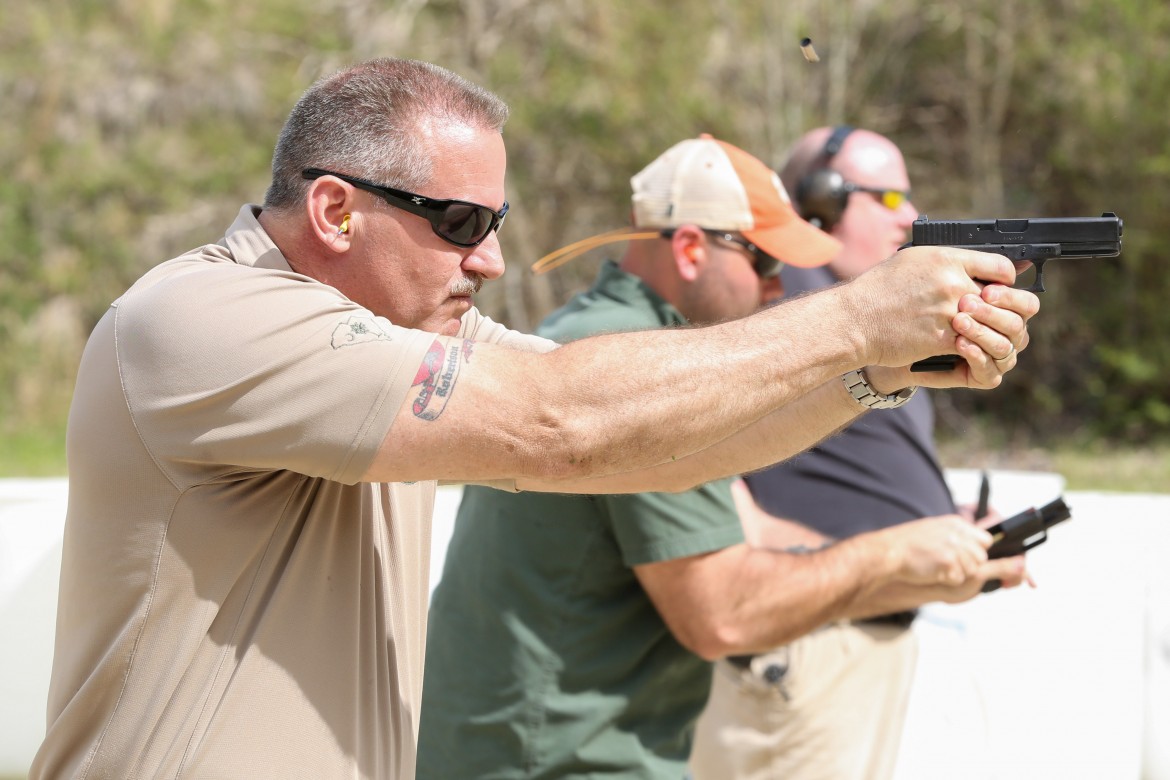
Tim Robertson, left, trains officers at a firing range in Florence, S.C. Now a reserve deputy retired from the Darlington County Sheriff’s Department, Robertson was acquitted in 2006 of a murder charge in the death of a suspect who had been shot in the back four times. (Alice Keeney for The Washington Post)
It was late one South Carolina evening 10 years ago, when Darlington County Sheriff’s Deputy Tim Robertson finally caught up with William Sheffield, a 45-year-old white man wanted for stealing a gas grill and three hauling trailers. Under the dim porch light of a mobile home, Robertson, who is white, urged the man to surrender, forcing him to spread his hands against the cab of his GMC pickup truck.
But as Robertson prepared to put the handcuffs on, the suspect lunged to the right, turned and then tried to grab the deputy’s gun, Robertson recounted in an interview with The Post. Robertson, who said he feared for his life, fired two shots. Sheffield broke away and ran for the woods. Robertson gave chase, opening fire again. According to prosecutors, the deputy gunned down the unarmed suspect in the back.
“There was no threat because there was no one around who could get hurt. There was a trail of shell casings that showed the deputy chased him and shot at him as he ran away,” said J.R. Joyner, the lead prosecutor in the case. “One shot was point-blank — an execution shot.”
Joyner said the forensics evidence was “the strongest of any case in my career.”
Prosecutors successfully indicted Robertson on a murder charge, citing the law that bars an officer from shooting a fleeing suspect in the back.
But at trial, jurors would go on to acquit Robertson, believing his account that he was forced to fire the final, fatal shots because the suspect turned back during the chase, attacked him and grabbed for his gun a second time. Robertson would keep his job at the sheriff’s department and be put in charge of training deputies in firearms and use of force.
In Cleveland, Officer Michael Brelo, who is white, was indicted for killing a pair of black suspects after a grand jury reviewed a wide range of evidence, including nearly two dozen video recordings from dashboard cameras, traffic cameras and surveillance cameras mounted at businesses and a school.
The deadly encounter began when the pair, Timothy Russell, 43, and Malissa Williams, 30, drove past the Cleveland police headquarters on a November night in 2012 and their Chevy Malibu fatefully backfired. Officers mistook the sound for gunfire and went in pursuit. Soon, 62 police vehicles were chasing the Chevy through city streets at speeds of up to 110 mph.
The cameras captured the furious pursuit with officers’ Dodge Chargers rocketing past repeated red lights and weaving through traffic at breakneck speed, tires squealing as panicked drivers peeled onto the shoulders.
The suspects, later found to be under the influence of drugs, came to a stop in a middle school parking lot. Eleven officers got out of their cars and formed a semicircle around the Chevy, court records show. Although two police radio broadcasts had reported that the pair was unarmed, according to transmissions compiled by state investigators, the officers opened fire, shooting 139 times.
Brelo himself fired 34 shots at the car and then climbed onto the hood of the Chevy and fired 15 more times “at close range” through the windshield, state investigation records show.
In a statement to investigators with the Ohio attorney general’s office, Brelo did not deny firing the shots but said he believed gunfire was coming from inside the vehicle. “I’ve never been so afraid in my life,” he said. “I thought my partner and I would be shot and that we were going to be killed.”
A grand jury indicted Brelo on two counts of voluntary manslaughter, saying he acted in a “fit of rage” and “under the influence of sudden passion.”
A lawyer for Brelo, whose trial began Monday, declined to comment.
Stinson, the Bowling Green criminologist, said it is often the case that questionable police shootings are an act of passion. Sometimes, he said, the encounters start with something as simple as a traffic stop and escalate when someone fails to obey the officer’s directions.
“They are used to giving commands and people obeying,” said Stinson, who previously worked as a police officer. “They don’t like it when people don’t listen to them, and things can quickly become violent when people don’t follow their orders.”
Levi Randolph, a black police officer in Gary, Ind., fatally shot a black 16-year-old robbery suspect in the back of the neck after the fleeing teen climbed a fence to escape, court records show.
Prosecutors charged Randolph with reckless homicide.
But when the case went to trial, his attorney told jurors that Randolph had felt threatened by the 6-foot, 200-pound teenager, Vince Smith Jr. Twice during the chase, Randolph said in a deposition, Smith turned around to confront him, both times reaching into the front pocket of his black hooded sweatshirt. He said he thought the teen was going for a gun.
Although Smith turned out to be unarmed, it took jurors only two hours of deliberation to acquit Randolph. Randolph could not be reached for comment.
“Jurors tend to be sympathetic toward police officers,” said Randolph’s attorney, Scott King. “For every movie like ‘Training Day,’ there are 10 movies where cops are underpaid, hard-working, struggling against insurmountable odds and on the side of good.”
The outcome of Randolph’s case is more the rule than the exception and demonstrates the daunting task facing prosecutors in those rare instances when they do charge officers in connection with fatal shootings.
Of the 54 officers who were charged for fatally shooting someone while on duty over the past decade, 35 have had their cases resolved. Of those, a majority — 21 officers — were acquitted or saw their charges dropped.
Jurors usually see the officer as “the good party in the fight,” said David Harris, a University of Pittsburgh law professor and expert in police use of force. “To get them to buy into a story where the officer is the bad guy goes fundamentally against everything they believe.”
Most jurors, experts say, view officers as those who enforce laws, not break them. And unlike civilians, police officers are allowed, even expected, to use force.
“It’s a question of whether it was too much force,” Harris said. “It’s a very flexible standard that has to be interpreted in every case. All this makes it very difficult to convict an officer.”
Most laws that apply to on-duty shootings require jurors to essentially render a verdict on the officer’s state of mind: Was the officer truly afraid for his life or the lives of others when he fired his weapon? Would a reasonable officer have been afraid?
That’s what Clay Rogers says he was asked to do when he served as a juror for the 2009 trial of a Hartford, Conn., narcotics officer charged with fatally shooting a fleeing black suspect.
“It’s difficult to prove an officer is not justified beyond a reasonable doubt, because you almost have to get inside their head to know what he was thinking and feeling,” Rogers said in an interview with The Post.
The officer, Robert Lawlor, who is white, had fired five shots at a car as it sped away. Two bullets struck a passenger, 18-year-old Jashon Bryant, in the back of the head, killing him.
The officer testified before a grand jury that he had initially approached the car, a black Nissan Maxima, because it matched the description of a vehicle used in a homicide. He said he opened fire at the car because he believed that Bryant had a gun and that the vehicle was barreling toward another officer.
Although no weapon was found, Rogers said he and his fellow jurors had to take seriously the officer’s claim that he believed his life and that of his partner were in jeopardy.
Rogers said the jury was also influenced by the tough questions directed at the car’s driver on the witness stand. The officer’s attorney grilled the driver about his criminal past, bringing up the cocaine found in the car and marijuana he had in his jacket on the day of the incident.
“The way the defense made it look was there were these two gangsters out there, riding around, and selling crack,” Rogers recounted. “You had an officer using deadly force, but he was up against dangerous drug dealers. It worked.”
The jury acquitted Lawlor.
His attorney, Michael Georgetti, said in an interview that he worked to build what he sees as a natural alliance between jurors and officers to win the case. “You don’t get people on a jury with a criminal record,” Georgetti said. “If a police officer says stop, they stop. They don’t put their car in drive and speed away.”
As hard as it is for prosecutors to win a conviction or an admission of guilt, it’s even harder to persuade a judge or jury to give an officer significant prison time.
For the nine officers convicted in state prosecutions, sentences ranged from six months to seven years, The Post analysis shows. One of the other cases, the shooting death of the 92-year-old woman in Atlanta, was taken up by federal prosecutors, who added civil rights violations to manslaughter charges and won stiffer sentences, ultimately sending the two convicted officers to prison for six and 10 years.
Six of the officers who faced state prosecutions were convicted after going to trial. On average, they got 3 1/2 years.
But prosecutors were eager at times to dispense with cases without a trial by negotiating a plea agreement. Winning a conviction against an officer is tough. And the cases can come with bruising headlines and strained relations with the very police department that prosecutors rely on daily to help build other criminal cases.
In at least six cases, lawyers for the officers were able to get the charges reduced, resulting in lighter sentences. These cases included convictions as well as instances in which judges deferred convictions and put officers on probation for their actions. These officers on average did about 2 1/2 years behind bars.
Antonio Taharka, a former police officer in Savannah, Ga., fatally shot a probation violator as he scrambled over a fence, trying to escape arrest. He ended up spending three months in a county jail.
The grand jury that indicted Taharka on voluntary manslaughter charges, which can bring up to 20 years in prison, said the officer had killed the suspect “while acting solely as the result of a sudden, violent and irresistible passion.”
But members of the local African American community rallied around Taharka, recalled former prosecutor David Lock, who had presented the case to the grand jury. “He was an African American officer and was beloved,” Lock said. “There was more of an outcry about why he was being charged versus why not.” At the same time, Lock said, there was little public sympathy for the 41-year-old victim, Anthony Smashum, a black man who had a long rap sheet, including convictions for rape and assault.
Lock said he believes these factors delayed the prosecution and ultimately contributed to lessening the charge against Taharka.
Chatham County District Attorney Meg Heap, who replaced Lock in the elected post, downgraded the charges from voluntary manslaughter, agreeing that Taharka could plead guilty instead to the less-serious charge of involuntary manslaughter, which carries a maximum of 10 years. Heap said in an interview that the lesser charge was a better fit for the facts of the case. But she said her office made no promises about a reduced sentence, leaving that up to the judge.
At sentencing in 2009, Superior Court Judge John E. Morse Jr. said he had to strike “the most delicate balance.” In assessing the fatal incident, he said, “All I can glean from what I have read and heard up to this particular point is that it was not malicious and ill-wanton.” He told Taharka moments later, “What you have to deal with from a day-to-day basis as an officer of the law, no one can stand in your shoes other than you.”
Morse ordered Taharka to spend three months in jail and nine months confined to his home except when he was working. If he follows the terms of his probation of nine years, his record will be wiped clean.
Messages left for Taharka’s lawyers were not returned, nor were a series of e-mails requesting comment. Taharka resigned from the police department about a year after the 2007 shooting.
Georgia Ferrell’s daughter is a police officer. Her son was shot dead by one.
“My daughter loves being a police officer, but she knows that the uniform doesn’t make you a good person,” she said.
Officer Randall Kerrick of the Charlotte-Mecklenburg police department is scheduled to face trial this summer on charges of voluntary manslaughter arising from a fatal encounter with Ferrell’s son in September 2013.
It was well after midnight when Jonathan Ferrell, 24, a former Florida A&M football defensive back, crashed his Toyota Camry, rolling it into a ditch, according to the police report. Dazed, he kicked out the rear window, crawled from the vehicle and made his way to a nearby house to seek helps.
But when he started banging on the door, the woman who lived there panicked and called 911. The officers who responded to the call told investigators that they believed that Ferrell was a threat, records show. When Ferrell, who was black, did not follow their orders to get on the ground, Kerrick, who is white, shot him 10 times, police officials said.
After Police Chief Rodney Monroe saw the 15-second dashcam video of the incident, he arrested Kerrick within the day, saying the officer “did not have a lawful right to discharge his weapon during this encounter.”
Kerrick’s attorney Michael Green said the video tells a different story. “Officer Kerrick did his job that night. Although the shooting was a tragedy, it was justified,” Green said. “On the video, you hear the officer telling him multiple times to get down on the ground . . . and at trial, I think you’ll find folks who say [Ferrell] wasn’t necessarily looking for help that evening.”
Georgia Ferrell worries that jurors will believe that account. As someone who has personal reasons to hold most police in high regard, she recognizes how difficult it is to convict and punish an officer.
“Society has put it into our heads that the officer is always right,” she said. “That has to change.”
Alice Crites and Steven Rich contributed to this report.
Post analysis finds killings are at twice rate reported by FBI
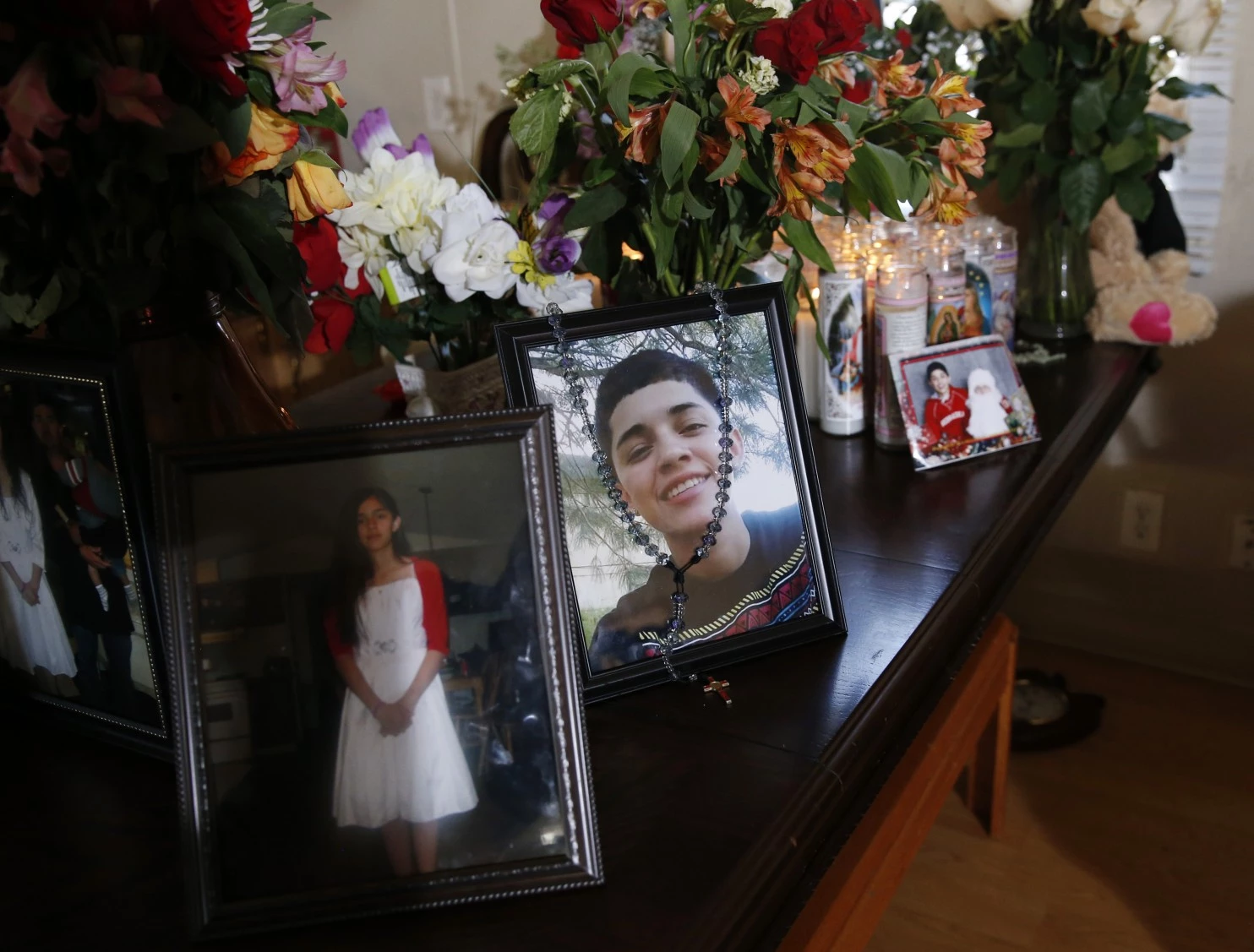
A rosary is draped over a portrait of 17-year-old Jessie Hernandez. The teen, who was killed by Denver police officers in January as she and friends allegedly tried to run them down in a stolen car, is among eight people younger than 18 who have been fatally shot by police this year. (David Zalubowski/Associated Press)
Written by Kimberly Kindy
Reported by Julie Tate, Jennifer Jenkins, Steven Rich, Keith L. Alexander and Wesley Lowery
In an alley in Denver, police gunned down a 17-year-old girl joyriding in a stolen car. In the backwoods of North Carolina, police opened fire on a gun-wielding moonshiner. And in a high-rise apartment in Birmingham, Ala., police shot an elderly man after his son asked them to make sure he was okay. Douglas Harris, 77, answered the door with a gun.
The three are among at least 385 people shot and killed by police nationwide during the first five months of this year, more than two a day, according to a Washington Post analysis. That is more than twice the rate of fatal police shootings tallied by the federal government over the past decade, a count that officials concede is incomplete.
“These shootings are grossly underreported,” said Jim Bueermann, a former police chief and president of the Washington-based Police Foundation, a nonprofit organization dedicated to improving law enforcement. “We are never going to reduce the number of police shootings if we don’t begin to accurately track this information.”
A national debate is raging about police use of deadly force, especially against minorities. To understand why and how often these shootings occur, The Washington Post is compiling a database of every fatal shooting by police in 2015, as well as of every officer killed by gunfire in the line of duty. The Post looked exclusively at shootings, not killings by other means, such as stun guns and deaths in police custody.
Using interviews, police reports, local news accounts and other sources, The Post tracked more than a dozen details about each killing through Friday, including the victim’s race, whether the person was armed and the circumstances that led to the fatal encounter. The result is an unprecedented examination of these shootings, many of which began as minor incidents and suddenly escalated into violence.
Among The Post’s findings:
● About half the victims were white, half minority. But the demographics shifted sharply among the unarmed victims, two-thirds of whom were black or Hispanic. Overall, blacks were killed at three times the rate of whites or other minorities when adjusting by the population of the census tracts where the shootings occurred.
● The vast majority of victims — more than 80 percent — were armed with potentially lethal objects, primarily guns, but also knives, machetes, revving vehicles and, in one case, a nail gun.
● Forty-nine people had no weapon, while the guns wielded by 13 others turned out to be toys. In all, 16 percent were either carrying a toy or were unarmed.
● The dead ranged in age from 16 to 83. Eight were children younger than 18, including Jessie Hernandez, 17, who was shot three times by Denver police officers as she and a carload of friends allegedly tried to run them down.
The Post analysis also sheds light on the situations that most commonly gave rise to fatal shootings. About half of the time, police were responding to people seeking help with domestic disturbances and other complex social situations: A homeless person behaving erratically. A boyfriend threatening violence. A son trying to kill himself.
Ninety-two victims — nearly a quarter of those killed — were identified by police or family members as mentally ill.
In Miami Gardens, Fla., Catherine Daniels called 911 when she couldn’t persuade her son, Lavall Hall, a 25-year-old black man, to come in out of the cold early one morning in February. A diagnosed schizophrenic who stood 5-foot-4 and weighed barely 120 pounds, Hall was wearing boxer shorts and an undershirt and waving a broomstick when police arrived. They tried to stun him with a Taser gun and then shot him.
The other half of shootings involved non-domestic crimes, such as robberies, or the routine duties that occupy patrol officers, such as serving warrants.
Nicholas T. Thomas, a 23-year-old black man, was killed in March when police in Smyrna, Ga., tried to serve him with a warrant for failing to pay $170 in felony probation fees. Thomas fled the Goodyear tire shop where he worked as a mechanic, and police shot into his car.
Although race was a dividing line, those who died by police gunfire often had much in common. Most were poor and had a history of run-ins with law enforcement over mostly small-time crimes, sometimes because they were emotionally troubled.
Both things were true of Daniel Elrod, a 39-year-old white man. Elrod had been arrested at least 16 times over the past 15 years; he was taken into protective custody twice last year because Omaha police feared he might hurt himself.
On the day he died in February, Elrod robbed a Family Dollar store. Police said he ran when officers arrived, jumping on top of a BMW in the parking lot and yelling, “Shoot me, shoot me.” Elrod, who was unarmed, was shot three times as he made a “mid-air leap” to clear a barbed-wire fence, according to police records.
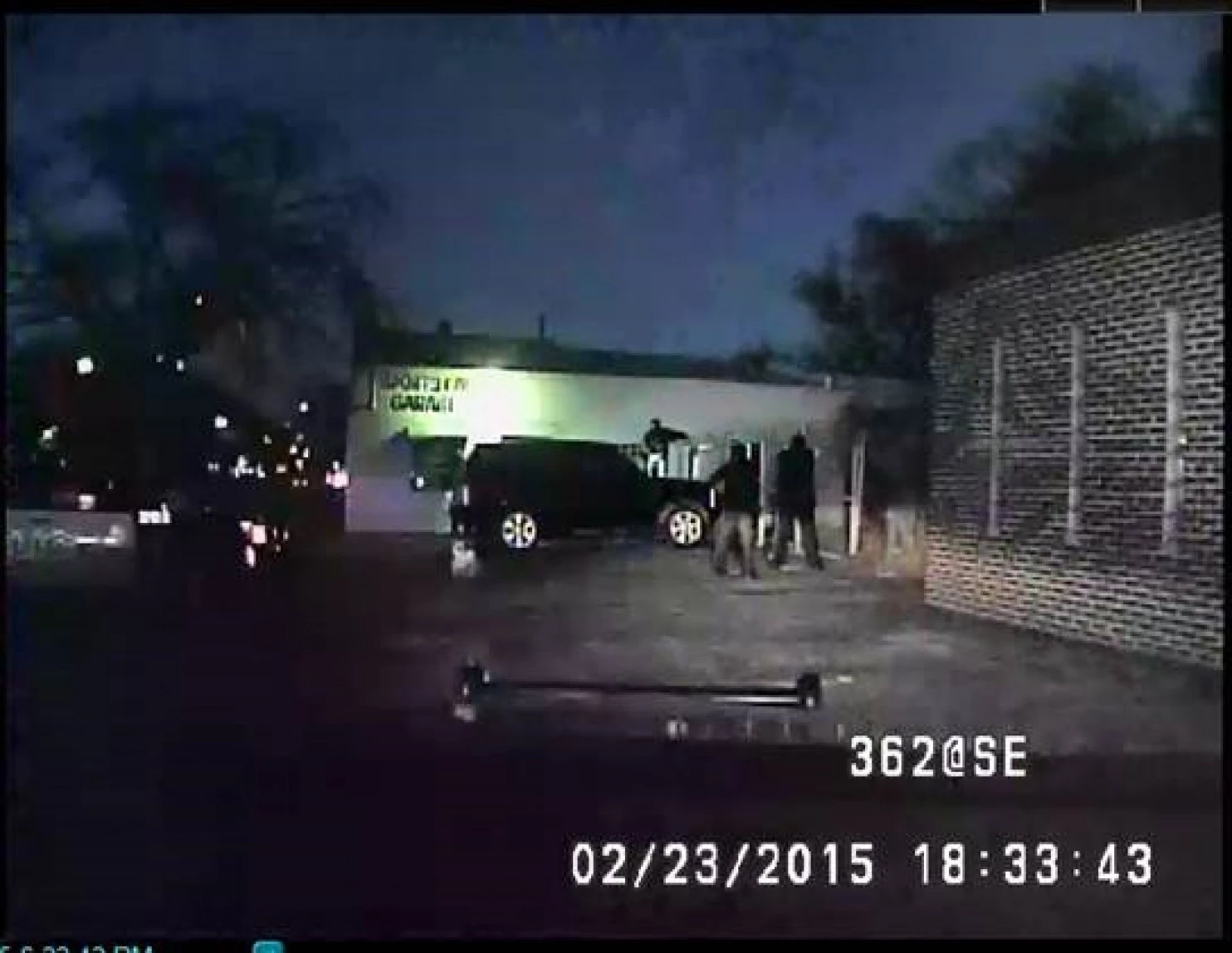
A surveillance image of Daniel Elrod, after he robbed a Family Dollar store and shortly before the time of his death (Courtesy of Douglas County Attorney's Office)
Dozens of other people also died while fleeing from police, The Post analysis shows, including a significant proportion — 20 percent — of those who were unarmed. Running is such a provocative act that police experts say there is a name for the injury officers inflict on suspects afterward: a “foot tax.”
Police are authorized to use deadly force only when they fear for their lives or the lives of others. So far, just three of the 385 fatal shootings have resulted in an officer being charged with a crime — less than 1 percent.
The low rate mirrors the findings of a Post investigation in April that found that of thousands of fatal police shootings over the past decade, only 54 had produced criminal charges. Typically, those cases involved layers of damning evidence challenging the officer’s account. Of the cases resolved, most officers were cleared or acquitted.
In all three 2015 cases in which charges were filed, videos emerged showing the officers shooting a suspect during or after a foot chase:
● In South Carolina, police officer Michael Slager was charged with murder in the death of Walter Scott, a 50-year-old black man, who ran after a traffic stop. Slager’s attorney declined to comment.
● In Oklahoma, reserve deputy Robert Bates was charged with second-degree manslaughter 10 days after he killed Eric Harris, a 44-year-old black man. Bates’s attorney, Clark Brewster, characterized the shooting as a “legitimate accident,” noting that Bates mistakenly grabbed his gun instead of his Taser.
● And in Pennsylvania, officer Lisa Mearkle was charged with criminal homicide six weeks after she shot and killed David Kassick, a 59-year-old white man, who refused to pull over for a traffic stop. Her attorney did not return calls for comment.
In many other cases, police agencies have determined that the shootings were justified. But many law enforcement leaders are calling for greater scrutiny.
After nearly a year of protests against police brutality and with a White House task force report calling for reforms, a dozen current and former police chiefs and other criminal justice officials said police must begin to accept responsibility for the carnage. They argue that a large number of the killings examined by The Post could be blamed on poor policing.
“We have to get beyond what is legal and start focusing on what is preventable. Most are preventable,” said Ronald L. Davis, a former police chief who heads the Justice Department’s Office of Community Oriented Policing Services.
Police “need to stop chasing down suspects, hopping fences and landing on top of someone with a gun,” Davis said. “When they do that, they have no choice but to shoot.”
As a start, criminologists say the federal government should systematically analyze police shootings. Currently, the FBI struggles to gather the most basic data. Reporting is voluntary, and since 2011, less than 3 percent of the nation’s 18,000 state and local police agencies have reported fatal shootings by their officers to the FBI. As a result, FBI records over the past decade show only about 400 police shootings a year — an average of 1.1 deaths per day.
According to The Post’s analysis, the daily death toll so far for 2015 is close to 2.6. At that pace, police will have shot and killed nearly 1,000 people by the end of the year.
“We have to understand the phenomena behind these fatal encounters,” Bueermann said. “There is a compelling social need for this, but a lack of political will to make it happen.”
For the vast majority of departments, a fatal shooting is a rare event. Only 306 agencies have recorded one so far this year, and most had only one, the Post analysis shows.
However, 19 state and local departments were involved in at least three fatal shootings. Los Angeles police lead the nation with eight. The latest occurred May 5, when Brendon Glenn, a 29-year-old homeless black man, was shot after an altercation outside a Venice bar.
Oklahoma City police have killed four people, including an 83-year-old white man wielding a machete.
“We want to do the most we can to keep from taking someone’s life, even under the worst circumstances,” said Oklahoma City Police Chief William Citty. “There are just going to be some shootings that are unavoidable.”
In Bakersfield, Calif., all three of the department’s killings occurred in a span of 10 days in March. The most recent involved Adrian Hernandez, a 22-year-old Hispanic man accused of raping his roommate, dousing her with flammable liquid and setting fire to their home.
After a manhunt, police cornered Hernandez, who jumped out of his car holding a BB gun. Police opened fire, and some Bakersfield residents say they are glad the officers did.
“I’m relieved he can’t come back here, to be honest with you,” said Brian Haver, who lives next door to the house Hernandez torched. “If he came out holding a gun, what were they supposed to do?”
Although law enforcement officials say many shootings are preventable, that is not always true. In dozens of cases, officers rushed into volatile situations and saved lives. Examples of police heroism abound.
In Tempe, Ariz., police rescued a 25-year-old woman who had been stabbed and tied up and was screaming for help. Her boyfriend, Matthew Metz, a 26-year-old white man, also stabbed an officer before he was shot and killed, according to police records.
In San Antonio, a patrol officer heard gunshots and rushed to the parking lot of Dad’s Karaoke bar to find a man shooting into the crowd. Richard Castilleja, a 29-year-old Latino, had hit two men and was still unloading his weapon when he was shot and killed, according to police records.
And in Los Angeles County, a Hawthorne police officer working overtime was credited with saving the life of a 12-year-old boy after a frantic woman in a gray Mercedes pulled alongside the officer and said three men in a white Cadillac were following her and her son.
Seconds later, the Cadillac roared up. Robert Washington, a 37-year-old black man, jumped out and began shooting into the woman’s car.
“He had two revolvers and started shooting both of them with no words spoken. He shot and killed the mom, and then he started shooting at the kid,” said Eddie Aguirre, a Los Angeles County homicide detective investigating the case.
“The deputy got out of his patrol car and started shooting,” Aguirre said. “He saved the boy’s life.”
In about half the shootings, police were responding to non-domestic criminal situations, with robberies and traffic infractions ranking among the most common offenses. Nearly half of blacks and other minorities were killed under such circumstances. So were about a third of whites.
In North Carolina, a police officer searching for clues in a hit-and-run case approached a green and white mobile home owned by Lester Brown, a 58-year-old white man. On the front porch, the officer spotted an illegal liquor still. He called for backup, and drug agents soon arrived with a search warrant.
Officers knocked on the door and asked Brown to secure his dog. Instead, Brown dashed upstairs and grabbed a Soviet SKS rifle, according to police reports.
Neighbor Joe Guffey Jr. told a local TV reporter that he was sitting at home with his dogs when the shooting started: “Pow, pow, pow, pow.” Brown was hit seven times and pronounced dead at the scene.
While Brown allegedly stood his ground, many others involved in criminal activity chose to flee when confronted by police. Kassick, for example, attracted Mearkle’s attention because he had expired vehicle inspection stickers. On the day he died, Kassick was on felony probation for drunken driving and had drugs in his system, police and autopsy reports show.
After failing to pull over, Kassick drove to his sister’s house in Hummelstown, Pa., jumped out of the car and ran. Mearkle repeatedly struck Kassick with a stun gun and then shot him twice in the back while he was face-down in the snow.
Jimmy Ray Robinson, a.k.a. the “Honey Bun Bandit,” allegedly robbed five convenience stores in Central Texas, grabbing some of the sticky pastries along the way. Robinson, a 51-year-old black man, fled when he spotted Waco police officers staking out his home.
Robinson sped off in reverse in a green Ford Explorer. It got stuck in the mud, and four Waco officers opened fire.
“They think they can outrun the officers. They don’t realize how dangerous it is,” said Samuel Lee Reid, executive director of the Atlanta Citizen Review Board, which investigates police shootings and recently launched a “Don’t Run” campaign. “The panic sets in,” and “all they can think is that they don’t want to get caught and go back to jail.”
The most troubling cases began with a cry for help.
About half the shootings occurred after family members, neighbors or strangers sought help from police because someone was suicidal, behaving erratically or threatening violence.
Take Shane Watkins, a 39-year-old white man, who died in his mother’s driveway in Moulton, Ala.
Watkins had never been violent, and family members were not afraid for their safety when they called Lawrence County sheriff’s deputies in March. But Watkins, who suffered from bipolar disorder and schizophrenia, was off his medication. Days earlier, he had declared himself the “god of the fifth element” and demanded whiskey and beer so he could “cleanse the earth with it,” said his sister, Yvonne Cote.
Then he started threatening to shoot himself and his dog, Slayer. His mother called Cote, who called 911. Cote got back on the phone with her mother, who watched Watkins walk onto the driveway holding a box cutter to his chest. A patrol car pulled up, and Cote heard her mother yell: “Don’t shoot! He doesn’t have a gun!”
“Then I heard the gunshots,” Cote said.
Lawrence County sheriff’s officials declined to comment and have refused to release documents related to the case.
“There are so many unanswered questions,” she said. “All he had was a box cutter. Wasn’t there some other way for them to handle this?”
Catherine Daniels called police for the same reason. “I wanted to get my son help,” she said. Instead, officers Peter Ehrlich and Eddo Trimino fired their stun guns after Hall hit them with the metal end of the broomstick, according to investigative documents.
“Please don’t hurt my child,” Daniels pleaded, in a scene captured by a camera mounted on the dash of one of the patrol cars.
“Get on the f---ing ground or you’re dead!” Trimino shouted. Then he fired five shots.
Police spokesman Mike Wright declined to comment on the case. Daniels said no one from the city has contacted her. “I haven’t received anything. No apology, nothing.”
But hours after her son was killed, Daniels said, officers investigating the shooting dropped off a six-pack of Coca-Cola.
“I regret calling them,” Daniels said. “They took my son’s life.”
Ted Mellnik, John Muyskens and Amy Brittain contributed to this report.
Officers often lack training for interacting with the mentally unstable, experts say
By Wesley Lowery, Kimberly Kindy and Keith L. Alexander
Officers often lack training for interacting with the mentally unstable, experts say
It was not yet 9 a.m., and Gary Page was drunk. The disabled handyman had a long history of schizophrenia and depression and, since his wife died in February, he had been struggling to hold his life together.
That bright Saturday morning in March, something snapped. Page, 60, slit his wrists, grabbed a gun and climbed the stairs to his stepdaughter’s place in the Pines Apartments in Harmony, Ind. He said he wanted to die. And then he called 911.
“I want to shoot the cops,” Page slurred to the dispatcher, prodding his stepdaughter to confirm that, yes, he had a gun. “I want them to shoot me.”
Minutes later, Page’s death wish was granted. Two Clay County sheriff’s deputies arrived to find that he had taken a neighbor hostage. They opened fire, striking him five times in the torso and once in the head. Page’s gun later turned out to be a starter pistol, loaded only with blanks. His threats of violence turned out to be equally empty, the product of emotional instability and agonizing despair.
Nationwide, police have shot and killed 124 people this year who, like Page, were in the throes of mental or emotional crisis, according to a Washington Post analysis. The dead account for a quarter of the 462 people shot to death by police in the first six months of 2015.
The vast majority were armed, but in most cases, the police officers who shot them were not responding to reports of a crime. More often, the police officers were called by relatives, neighbors or other bystanders worried that a mentally fragile person was behaving erratically, reports show. More than 50 people were explicitly suicidal.
More than half the killings involved police agencies that have not provided their officers with state-of-the-art training to deal with the mentally ill. And in many cases, officers responded with tactics that quickly made a volatile situation even more dangerous.
The Post analysis provides for the first time a national, real-time tally of the shooting deaths of mentally distraught individuals at the hands of law enforcement. Criminal-justice experts say that police are often ill equipped to respond to such individuals — and that the encounters too often end in needless violence.
“This a national crisis,” said Chuck Wexler, executive director of the Police Executive Research Forum, an independent research organization devoted to improving policing. “We have to get American police to rethink how they handle encounters with the mentally ill. Training has to change.”
As a debate rages over the use of deadly force by police, particularly against minorities, The Post is tracking every fatal shooting by a police officer acting in the line of duty in 2015. Reporters are culling news reports, public records and other open sources on the Internet to log more than a dozen factors about each case, including the age and race of the victim, whether the victim was armed and the circumstances that led to the fatal encounter.
The FBI also logs fatal police shootings, but officials acknowledge that their data is far from complete. In the past four decades, the FBI has never recorded more than 460 fatal shootings in a single year. The Post hit that number in less than six months.
For this article, The Post analyzed 124 killings in which the mental health of the victim appeared to play a role, either because the person expressed suicidal intentions or because police or family members confirmed a history of mental illness. This approach likely understates the scope of the problem, experts said.
In many ways, this subset mirrors the overall population of police shooting victims: They were overwhelmingly men, more than half of them white. Nine in 10 were armed with some kind of weapon, and most died close to home.
But there were also important distinctions. This group was more likely to wield a weapon less lethal than a firearm. Six had toy guns; 3 in 10 carried a blade, such as a knife or a machete — weapons that rarely prove deadly to police officers. According to data maintained by the FBI and other organizations, only three officers have been killed with an edged weapon in the past decade.
Nearly a dozen of the mentally distraught people killed were military veterans, many of them suffering from post-traumatic stress disorder as a result of their service, according to police or family members. Another was a former California Highway Patrol officer who had been forced into retirement after enduring a severe beating during a traffic stop that left him suffering from depression and PTSD.
And in 45 cases, police were called to help someone get medical treatment, or after the person had tried and failed to get treatment on his own.
In January, for instance, Jonathan Guillory, a white 32-year-old father of two who had worked as a military contractor in Afghanistan, was having what his widow called a mental health emergency. He sought help at a Veterans Affairs hospital in Arizona, his wife, Maria Garcia, told local reporters, but the busy hospital turned him away. Jean Schaefer, a spokeswoman for the Veterans Health Administration in Phoenix, said the hospital had no record of Guillory’s visit.
Back home, Guillory dialed 911 twice and hung up. When police responded, he pulled a gun from his waistband and said, “I bet I can outdraw you,” according to Maricopa police spokesman Ricardo Alvarado. They shot him six times.
The dead range in age from 15 to 86. At both ends of that spectrum, the victim was male, suicidal and armed with a gun. On average, police shot and killed someone who was in mental crisis every 36 hours in the first six months of this year. On April 25, three mentally ill men were gunned down within 10 hours.
That afternoon, David Felix, a 24-year-old black man with schizophrenia, was killed by police in the New York apartment building where he lived with other men undergoing treatment for mental health problems, according to police reports. Police said he struck two officers with a heavy police radio after they tried to serve him with a warrant for allegedly punching a friend in the face and stealing her purse.
Two hours later, sheriff’s deputies in Clermont, Fla., fatally shot Daniel Davis, a 58-year-old white man who had recently been released from a mental health facility, according to police reports. Police say he threatened his stepfather and then a deputy with a hunting knife.
And shortly before midnight, police in Victoria, Tex., shot Brandon Lawrence, a 25-year-old white man, a father of two toddlers and an Afghanistan war veteran who suffered from PTSD. Police officers said Lawrence approached them in an “aggressive manner” with a two-foot-long machete. They said they ordered him to drop it more than 30 times.
Lawrence’s wife and another witness have disputed aspects of that account, saying that Lawrence, while armed, was not advancing and was obviously not in his right mind. Convinced someone was coming to kill him, Lawrence repeatedly asked police officers who they were and what they wanted, his wife said.
“He was clearly confused . . . but they didn’t try to talk to him,” said Lawrence’s father, Bryon Lawrence, who works as an Illinois state prison guard.
“Everyone I work with is a convicted felon; I can’t just go up to them and shoot them,” Bryon Lawrence said. “My boy is 25 years old, working 50 hours a week, paying taxes. He was in his own home when they showed up.
“Within six minutes, they murdered him.”
Victoria police declined to comment, citing the ongoing investigation.
Plice increasingly acknowledge that they have few effective tools for handling the mentally ill. In interviews, current and former police chiefs said that without large-scale police retraining, as well as a nationwide increase in mental health services, these deadly encounters will continue.
Severe budget cuts for psychiatric services — by as much as 30 percent in some states in recent years — have created a vacuum that local police are increasingly asked to fill, they said.
“We as a society need to put more money and funding into treating the mentally ill. We need to work with these people . . . before they end in tragedy,” said Mike Carter, the police chief in Sand Springs, Okla., where officers in April shot and killed a 66-year-old white Vietnam veteran with PTSD. The man, Donald Allen, grew agitated after officers asked him to stop firing a gun in his back yard.
So far, police departments generally have not risen to the challenge. Although new recruits typically spend nearly 60 hours learning to handle a gun, according to a recent survey by the Police Executive Research Forum, they receive only eight hours of training to de-escalate tense situations and eight hours learning strategies for handling the mentally ill.
Otherwise, police are taught to employ tactics that tend to be counterproductive in such encounters, experts said. For example, most officers are trained to seize control when dealing with an armed suspect, often through stern, shouted commands.
But yelling and pointing guns is “like pouring gasoline on a fire when you do that with the mentally ill,” said Ron Honberg, policy director with the National Alliance on Mental Illness.
Sandy Jo MacArthur is an assistant chief who oversees “mental response teams” for the Los Angeles Police Department, a program considered to be a national model. MacArthur said her officers are trained to embrace tactics that may seem counterintuitive. Instead of rushing to take someone into custody, they try to slow things down and persuade the person to come with them. When possible, a psychologist or psychiatrist is on the scene.
The mentally ill “do not process what is happening like a normal criminal,” MacArthur said. “There’s a lot of white noise in their head.”
On the day he died in April, Daniel Covarrubias was taking powerful painkillers for a broken collarbone, hadn’t eaten for days and was hallucinating. The 37-year-old Native American and Latino had gone to St. Clare Hospital near Tacoma, Wash., “to get the cameras out of his eyes,” according to Ben Barcus, attorney for the Covarrubias family.
Covarrubias, who had a history of depression and drug addiction, was treated for “substance/medication induced psychotic disorder,” according to medical records obtained by the police. Five hours later, he was released “in stable condition,” according to hospital spokesman Scott Thompson.
As Covarrubias walked home, police sirens began blaring behind him. For reasons that are unclear, Covarrubias dashed into Pinnacle Lumber and Plywood, scaled a 25-foot-tall stack of wood and crouched to hide, police records show.
His mother, Marilyn Covarrubias, speculates that he may have believed the police were after him. “I think he thought the sirens were for him,” she said.
Alarmed lumberyard employees thought so, too, and called police to report a man hiding on the property. Within minutes, two Lakewood, Wash., police officers were standing at the base of the lumber stack, shouting up at Covarrubias to “show your hands.”
What happened next is in dispute. Lakewood Police Chief Mike Zaro has said Covarrubias “raised up with a dark object in his hand and pointed it at the officers in a manner that was consistent with pointing a firearm.” Barcus said lumberyard employees “didn’t see pointing.” Managers at Pinnacle Lumber declined to comment. In any case, police opened fire, hitting Covarrubias five times, including once in the head, according to Barcus. The dark object in his hand turned out to be a cellphone.
Barcus criticized the officers’ failure “to de-escalate this situation.”
“They arrived at the lumberyard, and six minutes later Covarrubias was dead,” Barcus said. “It doesn’t appear they know how to deal with the mentally ill.”
Lakewood police spokesman Chris Lawler said that the department works with mental health experts and that both officers involved in the shooting had received training to handle such encounters.
He declined to comment further, saying the investigation was still pending.
Oe of the youngest shooting victims was Kristiana Coignard, a 17-year-old white girl who walked out of the darkness one evening in January and into the empty lobby of a Longview, Tex., police station. In her waistband, she had a knife. And on her palm, she had written the words: “I have a gun.”
Coignard did not have a gun, nor any clear reason for going to the station that night. Her case underscores a central difficulty for police encountering a mentally ill person: It can be almost impossible to determine intent, or judge capacity to inflict harm.
Coignard appeared to pose a threat, but unlike someone committing a robbery, her intentions were obscure.
Since the age of 12, Coignard had displayed signs of mental illness; she regularly took medication for depression and bipolar disorder, according to her father, Erik Coignard. She dropped out of high school a year before graduation, but she later obtained a GED and had plans to attend college.
“She wanted to be a counselor in the mental health area because she said she felt that they failed her,” said her stepmother, Elizabeth Coignard.
On the day she died, Kristiana Coignard met with the counselor she had seen for years. She entered the police station shortly before 6:30 p.m.
In a video released by Longview police, Coignard at first seems hesitant. She wanders in, checks her mobile phone, then approaches a phone on the far wall that connects to dispatch. After a minute or so, she picks up the receiver and asks to speak to an officer.
An officer arrives and addresses Coignard, who appears to show him her palm. The officer struggles with the teen, forcing her into a chair, then down to the ground. She reaches for the knife, and the officer draws his gun.
As two more officers arrive, Coignard stands and charges at the first officer, who opens fire. Coignard falls to the floor, struck four times.
As colleagues comfort the officer, paramedics arrive, perform CPR on Coignard and carry her body away on a stretcher.
Longview Police Chief Don Dingler has defended the officers’ actions. The video shows “time was a factor,” Dingler told reporters. “There was no time for the officers to use other means.”
Coignard’s parents strongly disagree. Though they are baffled by their daughter’s actions that day — was it a suicide attempt? — they don’t understand why three officers couldn’t subdue their slight, teenage daughter without resorting to deadly force.
Whatever her motives, “she should still be here,” Erik Coignard said. “She was asking for help, and she was failed when that officer failed to take control of the situation. . . . This shouldn’t have ended this way.”
Mntal health experts say most police departments need to quadruple the amount of training that recruits receive for dealing with the mentally ill, requiring as much time in the crisis-intervention classroom as police currently spend on the shooting range. But training is no panacea, experts caution.
The mentally ill are unpredictable. Moreover, police often have no way of knowing when they are dealing with a mentally ill person. Officers are routinely dispatched with information that is incomplete or wrong. And in a handful of cases this year, police were prodded to shoot someone who wanted to die.
That was the case with Matthew Hoffman, a 32-year-old white man who had long struggled with mental illness, according to family members. After breaking up with his girlfriend, Hoffman walked up to San Francisco police officers in January outside a police station in the bustling Mission District. He pulled a gun from his waistband, pointed it at the officers and advanced in silence.
The startled officers fired 10 shots, three of which struck Hoffman. They later discovered that his weapon was a BB gun. And they found a note on his mobile phone, addressed to the officers who shot him.
“You did nothing wrong,” it said. “You ended the life of a man who was too much of a coward to do it himself.”
Grace Gatpandan, San Francisco Police Department spokeswoman, said the department offers crisis-intervention training. But those classes are designed primarily to teach officers to handle someone threatening to jump off a bridge, not someone pointing a gun in a crowded tourist area.
“When officers are faced with a deadly situation, when there is a gun pointed at a cop, there is no time to go into mental health measures,” Gatpandan said. “There was nothing we could have done. This is one of those tragedies.”
In the region around Harmony, Ind., few local police agencies have the money for crisis-intervention training, said attorney Craig McKee, who represents the Clay County Sheriff’s Office. The deputies who responded to Gary Page’s call had not received such training, he said.
“They need help from professionals to prepare them for this,” McKee said. “Society is not necessarily handling mental health issues well, so the number of encounters like this is escalating.”
But Clay County Sheriff Paul Harden said he is not sure any amount of training would have helped his deputies that day.
“No officer I know wants to be involved in an incident like this,” Harden said in a written statement. “Even when I am confident that we handled the situation the right way, as I do here, it can’t help but shake people.”
Family members still wipe away tears when discussing Page’s death. But his sister-in-law, Nyla Young, said they do not blame police.
“I pray every night for the officer who had to make that decision, because they didn’t go to work that day and want to have to make that decision,” Young said. “Gary made them make that decision. Gary wanted to die. And Gary got what he wanted that day.”
Page, who was white, married Young’s sister Hester in 1997, and the two were inseparable, she said. When Hester got sick about six years ago, Page became her primary caregiver. He had stopped working after securing disability payments for a back injury. So he was able to take her to doctor’s appointments, bathe and dress her, and carry her from their bed to their living room to watch TV.
In February, Hester slipped into a coma and died. Her death crushed Page, Young said. He had vowed to keep her alive and had devoted years to that mission. Now, he was alone.
A week before the shooting, Page called Young and asked her to pick up her sister’s ashes, a move she now regrets.
“That was probably the final straw,” Young said. “He wasn’t taking care of her ashes any longer, so he had nothing left to live for.”
Page lived in the Pines Apartments, downstairs from his stepdaughter. With police on the way, a neighbor unaware of the unfolding drama emerged from her apartment and asked Page to quiet down, according to a detailed account of the shooting prepared by a local prosecutor, who cleared the deputies of wrongdoing. Page took the woman hostage and waited for police.
Three deputies soon arrived. One approached through the front door and ordered Page to drop his weapon. The enraged man continued to scream at his hostage. Then Page spotted two more deputies approaching through the back door.
“Don’t do it. . . . I’ll shoot!” he shouted and raised his gun.
Brian Helmer, who had been with the sheriff’s department for less than two years, fired twice. The deputy who had come in through the front, Joshua Clarke, heard the gunfire and shot six times more.
As Page lay bleeding, Helmer and Clarke quickly transitioned into rescue mode. In a scene captured by a police body camera, the officers secured Page’s weapon, realizing for the first time that it was not loaded with real bullets. They tore off his sweatpants and used them to stanch the blood pouring from a wound in his chest.
When Page stopped breathing, the officers performed CPR. A bystander urged them to let Page die, according to the prosecutor’s report. Instead, the officers asked for Page’s first name and spoke to him as they pumped his chest.
Moments later, paramedics arrived. In the video’s final seconds, Helmer walked away from Page’s body, breathing heavily and sobbing. Then the video ends.
Gary Page was dead.
A year after Michael Brown’s fatal shooting, unarmed black men are seven times more likely than whites to die by police gunfire
Fractured in Ferguson, a racial dynamic shifts
By Sandhya Somashekhar, Wesley Lowery and Keith L. Alexander
It begins with a relatively minor incident: A traffic stop. A burglary. A disturbance. Police arrive and tensions escalate. It ends with an unarmed black man shot dead.
That pattern played out in March in Madison, Wis., where police responded to reports of a man yelling and jumping in traffic.
It was repeated two months later in Los Angeles, where beachgoers complained that a homeless man was harassing people on the Venice boardwalk.
It surfaced again in Cleveland, where police were called to a burglary at a corner store. And in Tallahassee, where a man was reported banging on someone’s door. And last month in Cincinnati, where Samuel DuBose, 43, wound up with a bullet in his head after being pulled over for driving without a front tag.
Perhaps most infamously, the pattern played out one year ago Sunday in Ferguson, Mo., where a white police officer searching for a convenience-store robber shot and killed an unarmed black teenager. That incident sparked a national movement to protest police treatment of African Americans and turned 18-year-old Michael Brown into a putative symbol of racial inequality in America.
So far this year, 24 unarmed black men have been shot and killed by police - one every nine days, according to a Washington Post database of fatal police shootings. During a single two-week period in April, three unarmed black men were shot and killed. All three shootings were either captured on video or, in one case, broadcast live on local TV.
Those 24 cases constitute a surprisingly small fraction of the 585 people shot and killed by police through Friday evening, according to The Post database. Most of those killed were white or Hispanic, and the vast majority of victims of all races were armed.
However, black men accounted for 40 percent of the 60 unarmed deaths, even though they make up just 6 percent of the U.S. population. The Post's analysis shows that black men were seven times more likely than white men to die by police gunfire while unarmed.
The latest such shooting occurred Friday, claiming Christian Taylor, 19, a promising defensive back on the Angelo State University football team. Police said Taylor crashed an SUV through the front window of a car dealership in Arlington, Tex., and was shot in an altercation with responding officers. The case is under investigation.
The disproportionate number of unarmed black men in the body count helps explain why outrage continues to simmer a year after Ferguson — and why shootings that might have been ignored in the past are now coming under fresh public and legal scrutiny.
“Ferguson was a watershed moment in policing. Police understand they are now under the microscope,” said Mark Lomax, executive director of the National Tactical Officers Association, which represents police rank-and-file.
Video shot by bystanders or captured on police camera, meanwhile, has served in some cases to undermine trust in police. So far this year, three officers have been charged with crimes after fatally shooting unarmed black men. All three were caught on video. One — the April shooting of Eric Harris in Tulsa — appears to have been an accident. But in the other two, the footage contradicted the officer’s initial account of what happened.
“Prior to Ferguson, police were politically untouchable. Ferguson changed that calculus,” said Georgetown University professor Paul Butler, a former federal prosecutor whose book, “The Chokehold: Policing Black Men,” is scheduled to be published next year.
“Five years from now, every major police department in America will have officers who wear body cameras,” Butler said. “That is a change that is happening right now because of Ferguson.”
Some in law enforcement are troubled by this trend, worried that public sympathy is shifting toward suspects and away from the police who put their lives on the line every day. They are concerned that people will forget that Darren Wilson, the officer who shot Michael Brown, was exonerated by Justice Department investigators, who found no evidence to refute Wilson’s contention that he fired in self-defense.
Most of all, they fear that the legacy of Ferguson will include a higher death toll for police.
“We are worried that police officers who should rely on their intuition and training to make a split-second decision — which could mean life or death for them — won’t do it. That their fear of being second-guessed, and maybe even prosecuted, will take over instead,” said Jim Pasco, executive director of the national Fraternal Order of Police.
So far, there is no sign of an increase in police fatalities. Still, 18 law officers have been shot and killed in the line of duty by a suspect this year, including Memphis police officer Sean Bolton who died last weekend after a routine traffic stop.
In its ongoing analysis of every fatal shooting by police in 2015, The Post is separating the dead into four categories, based on information provided by police and other sources:
Someone is considered armed if he or she had a deadly weapon — such as a gun, a knife or a machete — or some other object that could inflict fatal injury given the circumstances of the encounter. People who drove aggressively at officers or otherwise used a vehicle to try to inflict harm are also considered armed.
A person is considered unarmed if he or she was not in possession of a weapon at the time of the shooting or was holding an object unlikely to inflict serious injury, such as a stick or a broom handle.
People brandishing pellet guns or other toy weapons — which often are indistinguishable from firearms — make up a third category.
And in some cases, The Post could not determine whether a person was armed because of conflicting accounts from witnesses or a lack of information.
Four black men fall into this last category, along with one black woman: Janisha Fonville, 20, who died in February after Charlotte police responded to a call about a domestic dispute. Police said Fonville, who had a history of mental illness, lunged at the officer with a knife. Fonville’s girlfriend, who summoned officers, said Fonville was no longer holding the weapon.
A person who is unarmed may nonetheless pose a threat. In April, for instance, New York City police shot and killed David Felix, 24, as they tried to arrest him for assaulting a friend and stealing her purse. Police said Felix, who was mentally ill, wrested away a police radio and battered one of the officers in the head.
In many of the 24 shootings of unarmed black men, however, the threat was not readily apparent, raising questions about the officers’ use of deadly force. In most of those cases, investigations are ongoing.
The 24 dead range in age from 50 to 18, the same age as Michael Brown. Their killings took place in small towns and big cities, including Los Angeles, Owings Mills, Md., and Strong, Ark. Most occurred in the South, where blacks are more heavily concentrated, with five shootings occurring in Florida alone.
The events that led to the fatal encounter run the gamut. Routine traffic stops and calls about erratic or bothersome behavior were most common. Other shootings followed reports of petty theft or attempts by police to serve a warrant. Two shootings occurred during sting operations.
In each case, the situation rapidly spun out of control. Often, police said they pulled the trigger during a struggle or because the person physically attacked them. In at least four cases, police reported that the person appeared to be reaching for a weapon.
In some cases, police have not said why they opened fire. Naeschylus Vinzant, 37, was shot and killed in March by a member of an Aurora, Colo., SWAT team trying to arrest him on charges of kidnapping, robbery and parole violation. The case has been investigated by a special prosecutor and is under review by a grand jury.
Five months later, however, Aurora police have yet to publicly explain why they shot Vinzant; officials rebuffed requests for additional information.
The shooting of Kris Jackson, 22, has also been shrouded in silence. Authorities in the resort town of South Lake Tahoe, Calif., have been so tight-lipped about the case that at first they wouldn’t respond to questions from Jackson’s mother.
Angela Ainley, 44, said she learned about the June 15 shooting the following day, when Jackson’s girlfriend sent her a message on Facebook complaining that the hospital was refusing to reveal his condition. Ainley, who owns a small financial-services company, drove from her home in Sacramento, about an hour away, to get answers; when none were forthcoming, it dawned on her that her son was dead.
“Nobody told me,” she sobbed in an interview. “My son died by himself.”
The family has since hired an attorney, Alan M. Laskin, who is conducting his own investigation in preparation for a wrongful-death lawsuit. Local authorities defended their reticence.
“There’s always those pressures in these kind of cases, but we’re going to do it right and make sure we have all the facts,” said Bill Clark, chief assistant to the El Dorado County prosecutor, who is reviewing the case.
“I’m not going to run in front of the microphones, Baltimore-like,” Clark said, in a reference to Marilyn Mosby, the Baltimore prosecutor who grabbed headlines this spring by rapidly pursuing criminal charges against several police officers after Freddie Gray, an unarmed black man, died in custody.
Jackson was shot at the Tahoe Hacienda Inn, where he had been living with his girlfriend. The two had been fighting, the early-morning disturbance drew the attention of other guests, and someone called police.
When police arrived, Jackson’s girlfriend opened the door while Jackson, who was wanted on a charge of possessing cocaine, ran into the bathroom and tried to climb out the first-floor window. According to Laskin, the girlfriend then heard a single gunshot.
She wheeled around to look for Jackson and found him hanging halfway out the window like “a kid dangling his legs off a bridge,” Laskin said. Jackson had been shot in the chest by a white police officer, Joshua Klinge, who had come around the back of the building.
After Klinge opened fire, according to the girlfriend’s account, Jackson had his hands up and was yelling, “Don’t shoot.”
South Lake Tahoe police have offered a similar account, up until the final moments when they said Klinge “perceived a deadly threat” — even though Jackson was shoeless, shirtless and unarmed. They have not revealed the nature of that threat, which Clark said is a focus of the investigation.
“The guy was fleeing out a window, so I don’t know. Is that a threat?” Clark said. “That is for us to decide how that works out when we get there.”
The girlfriend has not been named by police, and Laskin declined to provide her name or contact information. Klinge did not respond to a message left on his phone, and police declined to make him available for an interview.
Tallahassee police have been more forthcoming about the February shooting of Jeremy Lett, 28. They released a stack of documents from their internal investigation, including the statement of officer David Stith, who fired the fatal shots.
But in the shadow of Ferguson, police faced intense pressure to justify their actions from protesters making troubling claims about the case.
The shooting occurred after Lett, an assistant minister at a local church, showed up around 8 p.m. at the Shadow Ridge Apartments and demanded to see a former neighbor. Her roommate told Lett to come back another time, but Lett persisted, banging on windows and doors. The roommate called police.
Stith was working a traffic accident when he responded to the call. According to documents released by police, Stith found Lett passed out on the stoop of an apartment and scanned his face with the beam of his flashlight.
Lett’s eyes shot open. He leaped to his feet, let out three loud screams and ran toward the officer, who said he sidestepped Lett at the last moment. Lett fell, but got up and charged again.
Stith says he then came under sustained attack. He said he tried unsuccessfully to subdue Lett with a Taser, then had to draw his gun. Stith said he fired once, and still Lett kept coming, knocking the officer to the ground.
Finally, Stith said he kicked his feet up in the air to fend Lett off while firing a series of shots into Lett’s chest. Lett collapsed on top of Stith, and the officer called for medical assistance.
“Shots fired! Roll EMS,” Stith said into his radio, according to police documents. One minute 57 seconds had elapsed since Stith had responded to the burglary call.
“I don’t know what the f--- was wrong with this f---ing guy, but he just started coming at me and coming at me,” a rattled Stith told officers who arrived on the scene. “I just kept firing because he wouldn’t stop f---ing coming.”
Lett was shot five times.
Although Stith is black, university students involved with Dream Defenders, a group formed after the 2012 fatal shooting of Trayvon Martin, contended that Lett was racially profiled. Protesters rallied outside the local prosecutors’ office demanding that Stith be charged. Photos of Lett in a pinstripe suit and clergy collar began circulating on the Internet.
The medical examiner later determined that Lett had a significant amount of cocaine in his system when he died. Since a grand jury concluded in late February that the shooting was justified, the protests have died down.
Frank Shephard was killed on live TV. No one had to badger Houston police for information about his case. But the video footage of Shephard’s last moments has only intensified questions about why he is dead.
The 41-year-old barber sped away from a routine traffic stop in April, leading police on a high-speed chase that was covered live by local TV stations. News helicopters hovered over Shephard’s blue Chrysler 300 as it veered along the streets of Houston, crashing into two cars before rolling to a stop in oncoming traffic.
Shephard stepped out of the vehicle. Then, something happened that caused startled TV producers to cut away: As Shephard reached back into the Chrysler, two officers opened fire and Shephard slumped motionless near the open car door.
Since then, Shephard’s mother, Cheryl, has watched and rewatched the last moments of her son’s life. She and other relatives think Shephard was probably tangled in the seat belt or was trying to grab his phone.
Moments earlier, he had dialed 911 to falsely report that he had a child in the car, a failed effort, perhaps, to save his own life. In the heat of the chase, he had also called his mother to say goodbye.
“They’re just shooting them down,” Cheryl Shephard said of police treatment of black men. “I watched my son die, and I don’t even know why.”
Ray Hunt, president of the Houston Police Officers’ Union, has also watched the video. In his opinion, Shephard wasn’t trapped in the seat belt. Hunt says he’s not sure what Shephard was doing.
Whatever it was, Hunt said, “it’s unfortunate that he made the decision that day to reach back into the vehicle and the officers had to draw the conclusion that he had a weapon.”
Hunt declined to make the officers — identified by Houston police as L. Ingle, a white male, and R. Gonzalez, a Hispanic male — available for an interview. Both are back on active duty.
Nothing was clear-cut about the death of Nicholas Thomas. As in Ferguson last year, understanding of the March shooting outside Atlanta has been confounded by conflicting witness statements, inconclusive physical evidence and the absence of decisive video footage.
In The Post’s analysis, Thomas, 23, is among the five black victims who could not be conclusively categorized as unarmed.
In early July, the Georgia Bureau of Investigation and the Cobb County prosecutor declared the shooting justified; a county grand jury declined to pursue criminal charges. But last week, under the lingering shadow of Ferguson, the U.S. attorney for the Northern District of Georgia announced that he was effectively reopening the case.
What’s known from witness statements and surveillance video is this: One day after lunch, Thomas, who worked as a mechanic at a Goodyear tire center, was preparing to service a customer’s Maserati. He grabbed the keys and photographed the car, as was his habit whenever he worked on a sports car, according to his father, Huey. Then Thomas began driving the car toward the service bay.
Suddenly, five officers from Smyrna, Ga., and Cobb County showed up to arrest Thomas for violating probation from a 2013 assault on a police officer. They blocked off the parking lot, and several officers, including one with a police dog, began chasing the car on foot.
After trying to evade officers, the car disappeared out of view of a company security camera. Shots rang out. Thomas was hit once in the back.
He did not have a weapon.
Smyrna Police Chief David Lee said the officer who shot Thomas, Sgt. Kenneth Owens, thought Thomas was trying to run down the K-9 officer. Owens described the shooting in a videotaped interview with internal affairs investigators, his voice cracking.
“The vehicle went into drive, aggressively came forward, wide open, engine revving. As I came around the building, I realized, ‘Oh hell, you ain’t got no cover if this individual comes out with a weapon or comes at you.’ ”
Owens said he “was able to get out of the way where I didn’t need to engage the threat.” But then he spotted his colleague.
“I’ll never forget his face,” Owens said. “I could see his eyes, that he was placed in a situation where he didn’t know how to act, just to get the hell out of the way, and get his dog out of the way. He had nowhere to go. The car was headed directly at him.”
Owens said the shooting is “kind of like a fog. . . . I think I shot three times.”
Another customer, Brittney Eustache, 26, disputed parts of that account. In a videotaped interview with detectives the day after the shooting, Eustache said police opened fire after the Maserati crashed into a curb.
“Cops were everywhere,” Eustache said. “They say, ‘Sir, step out your car.’ They say it twice, he doesn’t get out of the car. Then they open fire.”
By that point, Thomas had already been wounded, according to Owens’s attorney, Lance LoRusso. What Eustache saw, he said, were bean bags shot to break the Maserati’s tinted windows and to force Thomas out of the car.
Thomas left behind a baby daughter. His parents have notified Smyrna officials that they plan to file a wrongful-death lawsuit. Huey Thomas said he is grateful for the Justice Department review.
“I don’t think they would have taken it,” he said, “if not for Ferguson and the other cases that are happening.”
The Smyrna police chief said he, too, welcomes the federal investigation.
“If they find something that my officer has done wrong,” Lee said, “I will act accordingly.”
Alexander reported from Smyrna, Ga. Kimberly Kindy, Julie Tate, Jennifer Jenkins and Steven Rich contributed to this report.
But officers investigated in fatal shootings are often given access to body camera footage
Autumn Steele’s parents, Gina and Mark Colbert, are photographed with her dog, Sammy. An officer told investigators that he was forced to shoot because the dog attacked him, and that he accidentally hit Steele. (Melissa Golden for The Washington Post)
By Kimberly Kindy and Julie Tate
Autumn Steele and her husband, Gabriel, were fighting again, so he called 911. A police officer sped to their home, pulled out his gun and then — frightened by the family dog — opened fire, killing Autumn with a bullet to her chest.
Since the Jan. 6 shooting, Steele’s family has battled police in Burlington, Iowa, to see 28 minutes of body camera video recorded by the two officers who responded that day. Police have declared the videos confidential, saying the shooting was tragic but reasonable, given that the dog “attacked.” State investigators have released a 12-second clip from the videos, but Steele’s relatives say it raises more questions than it answers.
“I deserve to know what happened to my daughter. The public deserves to know,” said Steele’s mother, Gail Colbert. “How can they keep this from us?”
In the turbulent year since Michael Brown’s death sparked protests in Ferguson, Mo., and beyond, politicians, law enforcement officials and community activists have seized on body cameras as a vital reform capable of restoring transparency and trust to police interactions with the public. But in Burlington and elsewhere around the country, police and other officials are routinely blocking the release of body camera videos while giving officers accused of wrongdoing special access to the footage.
Nationwide, police have shot and killed 760 people since January, according to a Washington Post database tracking every fatal shooting. Of those, The Post has found 49 incidents captured by body camera, or about 6 percent.
Just 21 of those videos — less than half — have been publicly released. And in several of those cases, the footage, as in Burlington, was severely cut or otherwise edited.
Meanwhile, virtually all of the 36 departments involved in those shootings have permitted their officers to view the videos before giving statements to investigators, The Post found. Civil and human rights groups fear that access could help rogue officers tailor their stories to obscure misconduct and avoid prosecution.
“What point is there of even doing this if they are going to be treated this way? Why even spend the money on these cameras?” said Burlington Mayor Shane McCampbell, who has called on police to release video of the Steele shooting. He noted that police promised greater openness last year when they petitioned the city to buy body cameras.
If the videos “are going to be a secret, no one is being held accountable,” McCampbell said. “And that was the point.”
While individual police departments are adopting rules on the local level, police chiefs and unions are lobbying state officials to enshrine favorable policies into law. In 36 states and the District this year, lawmakers introduced legislation to create statewide rules governing the use of body cameras, often with the goal of increasing transparency.
Of 138 bills, 20 were enacted, The Post found. Eight of those expanded the use of body cameras. However, 10 set up legal roadblocks to public access in states such as Florida, South Carolina and Texas. And most died after police chiefs and unions mounted fierce campaigns against them.
Police officials defend that effort, saying overly lax rules could end up helping criminals. Jury pools could be tainted by the general release of video evidence, making it difficult to win convictions. Eyewitnesses and informants may be reluctant to come forward if there’s a chance they were caught on a video that may be publicly released. Other people caught on camera may file lawsuits claiming that police violated their right to privacy.
“If you have a kid who drank too much on his 21st birthday and the police are called, do you really want video of that kid, sick and throwing up, to be on YouTube for the rest of his life?” said Richard Beary, president of the International Association of Chiefs of Police and chief of the University of Central Florida’s police force.
Those arguments prevailed in Los Angeles this spring, when the city’s police commission adopted one of the most restrictive policies in the nation. Now, anyone who wants a body camera video from the Los Angeles Police Department will likely have to ask for it in court.
“A judge should be making this decision,” said Craig Lally, president of the Los Angeles Police Protective League, the local police union. “They can listen to all sides of the argument, weigh everyone’s interests and determine if there really is a public interest at stake.”
Civil rights organizations say policies that restrict access subvert the promise of body cameras.
“If police departments and law enforcement become the sole arbiters of what video the public gets to see, body cameras will go from being a transparency and accountability tool to a surveillance and propaganda tool,” said Chad Marlow, an attorney with the American Civil Liberties Union. “Are we going to let that happen?”
Unreliable footage
Despite the growing popularity of body cameras, fatal police encounters are still rarely documented by department-owned video. Only about a third of the nation’s 18,000 police departments have acquired body cameras, and some issue the devices only to a few officers.
Last month, the Obama administration announced $23 million in grants to expand the use of the cameras, with the goal of enhancing “transparency, accountability and credibility” in police encounters with the public, Attorney General Loretta E. Lynch said.
But even when a camera is present, things can go wrong. The cameras typically attach to an officer’s lapel or eyeglasses, and they can fall off during struggles or be angled away from the action. And police acknowledge that one of their biggest challenges is getting officers to turn the cameras on.
Most departments require officers to flip the switch just before they engage a member of the public — while making a traffic stop, for example, or responding to a 911 call. In more spontaneous encounters, officers are required to activate their cameras as soon as it is safe.
Once an incident is over, the cameras are turned off. The devices typically store footage automatically and are often tamper-proof, meaning officers cannot edit or delete video without being detected.
Problems with activation also have plagued cameras mounted on patrol car dashboards — known as dashcams — which have been standard equipment since the 1990s.
“Activating the cameras: This gets to the heart of transparency,” said Ken Wallentine, vice president of Lexipol, a company that police departments subscribe to for help in crafting model police policies. “Oversight from the video can’t happen if there is no video.”
‘Show it to us. Release it.’
In the 36 departments where body cameras captured an officer-involved shooting this year, policies for releasing the video vary dramatically.
Five departments say they will never release video without a court order. Five say they will always release the footage. The rest fall somewhere in between, saying they release videos at the discretion of the police chief or local prosecutor, or when investigations are complete.
In some places, policies seem to be in flux. Consider the case of Brandon Lawrence, 25, of Victoria, Tex. In April, shortly after the Victoria Police Department started its body camera program, two officers equipped with cameras approached Lawrence’s apartment.
An Afghanistan war veteran who suffered from post-traumatic stress disorder, Lawrence had gotten into a fight with a neighbor and believed the man was coming to kill him, according to family and witnesses. Someone called 911, police knocked on Lawrence’s door and he opened it holding a machete.
By all accounts, Lawrence was disoriented. The officers repeatedly asked him to drop the blade; Lawrence repeatedly asked the officers to identify themselves. The officers said they opened fire because he advanced toward them, pinning one of them against a car.
The next day, Lawrence’s mother and stepfather drove 13 hours from Carbondale, Ill., to look for answers. They found a giant bloodstain on the lawn, just outside the apartment.
“How much advancing could Brandon have done if he died just five feet from his front door?” said Lawrence’s stepfather, Bryce Jacquot. “If they have video proof that their actions were righteous, show it to us. Release it.”
Local reporters have also petitioned to see the videos. In July, Victoria City Attorney Thomas Gwosdz said they would be released “when the investigation is over. The city’s practice and policy is that it is not confidential at that point.”
Now, however, Gwosdz says the videos may never be publicly disclosed. He is asking the Texas attorney general to determine whether the release would violate the privacy rights of surviving family members.
Lawrence’s mother and stepfather continue to seek full disclosure. Lawrence’s father, Bryon, said the videos are “nobody’s business.” Lawrence’s wife, Yasmine, has declined interview requests.
Meanwhile, Greg Cagle, an attorney for the two officers, insists the videos “100 percent support what the officers said happened.” Last month, a grand jury declined to bring criminal charges against the officers.
Keeping evidence a secret
The Burlington, Iowa, video policy falls into the most restrictive category. Burlington city and police officials said if it had been up to them, no video of Autumn Steele’s shooting would have been released.
But the Iowa Department of Public Safety was called in to investigate the shooting, and state officials put out a 12-second excerpt.
On the day of the shooting, Steele, 34, had been released from jail on a domestic violence charge for hitting Gabriel with a spatula, according to a police report. Violating a court order, she returned home, and Gabriel called police.
The wobbly video opens with officer Jesse Hill running toward the Steeles on a snowy sidewalk outside their home. Autumn is chasing Gabriel, who is carrying their 3-year-old son, Gunner. Their dog, Sammy, a German shepherd-collie mix, trails behind.
As Hill approaches, Autumn yells, “He’s got my kid!” Hill orders her to stop. Sammy starts barking, and the dog disappears from view.
“Get your dog!” Hill yells.
Before anyone can respond, Hill fires two shots while falling backward into the snow. The camera points briefly to the sky.
Gabriel stops running and turns to his wife: “He shot you?”
Autumn slumps to the sidewalk. The excerpt ends there.
Nearly 28 additional minutes of video were recorded that day, and Steele’s mother believes it would tell her much that she wants to know.
What did Hill say after firing the shots? Did Sammy bite him, as Hill claimed? And what did Hill do to try to save Steele’s life?
“How can you kill people and keep any of that evidence a secret?” Colbert said.
Hill told investigators he was forced to shoot because Sammy attacked him, and that he accidentally hit Steele. But Gabriel Steele and a neighbor who witnessed the shooting said Hill was blaming the dog to justify his own reckless behavior.
In February, both men testified at an animal control board hearing called to determine whether Sammy should be euthanized.
“As soon as that officer seen my dog, he pulled his weapon,” Gabriel Steele testified, periodically choking back tears. “That man stepped backward on the snow and he slipped. . . . That was when he fired his weapon twice because he had his finger on the trigger.”
The neighbor, Ed Ranck, testified that Sammy “startled” Hill, who overreacted.
“The dog basically jumped and put his paws on [Hill],” Ranck said. “I think it was more a playful action because he did the same thing to [Autumn Steele].”
Hill did not show up for the hearing. A different officer testified that Hill had been treated for a dog bite but presented no evidence.
“In the past, when we’ve had a bite like this, we have photographs of the bite,” said board Chairman Mark Cameron. The board voted unanimously to let Sammy live.
Burlington police declined to comment on the case, as did Hill. Beyond labeling the videos confidential, Holly Corkery, an attorney representing the city, also declined to discuss the case, saying city officials believe “litigation is imminent.”
Embracing disclosure
Some departments have embraced disclosure. In Muskogee, Okla., police released an unedited 10-minute video six days after one of their officers shot and killed a man outside Old Agency Baptist Church, where a wedding was underway.
“It’s nice to be out in front of something. We are usually the last with these things,” said Deputy Police Chief Chad Farmer.
The shooting occurred in January after Terence Walker, 21, told his former girlfriend that he “had a bullet with her name on it.” The woman took shelter in the church, and the pastor called 911.
The video begins as Officer Chansey McMillin pulls into the church parking lot and begins to pat down Walker. Suddenly, Walker breaks free and starts running down a two-lane road.
Walker has a gun, which he drops twice. As he retrieves it, he turns toward McMillin with the gun in his hand. McMillin raises his own gun and shoots Walker five times.
As Walker rolls into a drainage ditch, Pastor Andre Jones rushes into the frame, yelling, “Don’t shoot no more!”
Rumors quickly spread about the shooting: Walker was unarmed. McMillin killed him, execution-style, as Walker lay bleeding in the street. But threats of civil unrest subsided once people saw the video.
Farmer knows it may not always turn out that way. Still, he said, the department “will continue to release the videos. That’s our policy. That’s not going to change if we think it isn’t going to make us look good.”
Seeking accountability
In most fatal shootings where there is body camera evidence, the officers involved have been allowed to view the footage before talking to investigators. This spring, LAPD Chief Charlie Beck urged the Los Angeles Police Commission to adopt that practice as official policy.
The practice is becoming standard nationwide, thanks in part to a 2014 report funded by the Justice Department and prepared by the Police Executive Research Forum (PERF). The report says prior review will “lead to the truth,” and that officers will have to “account for their actions, regardless of what the video shows.”
Beck’s proposal provoked a heated debate, in part because of the March 1 shooting of Charly Leundeu Keunang, 43, a homeless man who lived in an orange tent on skid row.
Police say Keunang was a robbery suspect who became dangerously combative when confronted and tried to grab an officer’s gun. Witnesses say Keunang was not dangerous, and that police created a volatile situation by beating on his tent and swarming him when he emerged.
Two police body cameras captured the altercation. Officers who fired shots at Keunang were allowed to see the video. Non-police witnesses were not.
Civil rights attorneys and community groups argue that the practice could aid corrupt officers in covering up misconduct.
“If you are going to concoct a story that isn’t true, it is awfully helpful to know if you will or will not be contradicted by your body camera video,” said Marlow, the attorney at the ACLU.
Attorney Dan Stormer, who represents the Keunang family in a $20 million claim against the LAPD, said the practice could help police discredit witnesses who disagree with the official account.
“If you get to see the video and you know exactly what happened, you can totally destroy someone else’s credibility who has a less firm view of what took place,” Stormer said.
Before the commission, Beck dismissed such concerns. “The officers cannot alter the video,” he said. “The video shows what it shows.”
In April, the commission voted with Beck, 3-1. Commissioner Robert Saltzman was the lone dissenter.
“Research shows that watching videos affects memory. It alters it,” Saltzman said. “If they watch it first, we will miss what the officer’s perception was at the time they used force and why they felt force was necessary.”
PERF Executive Director Chuck Wexler agreed, saying his position has shifted since the group issued its report. In an interview, Wexler cited academic research showing that video can “essentially erase and record over” an officer’s memory.
“If [police] are going to review the video, other [eyewitnesses] should be allowed to see it, too,” Wexler said. “How can they expect to have any credibility if they keep it to themselves?”
‘More harm than good’
This year, lawmakers in dozens of states entered the debate, introducing bills often intended to supersede restrictive local policies.
California Assemblywoman Shirley Weber (D) was among the first. She offered AB66, a measure that proposed dozens of new regulations, including a provision that would bar officers from viewing videos before giving statements or writing reports.
“The policies need to be fair not only to police officers, but to the public,” Weber said.
The California Police Chiefs Association took aim at that provision. When the measure came before the assembly’s privacy committee, dozens of uniformed police chiefs descended on the state capitol, telling lawmakers that AB66 was a “gotcha” bill aimed at stripping officers of their badges should their statements not align with the videos.
In the hearing room, the chiefs lined up to declare their opposition. Committee members were soon at their microphones, saying they, too, were worried about the bill.
Weber was stunned. Weeks earlier, she had added protections for honest officers with imperfect memories — at the request of police lobbyists.
“This was not a ‘gotcha’ thing,” she told the committee.
Still, Weber backed down, granting officers the right of review they were seeking, and the privacy committee approved the measure. But the fight wasn’t over. Two weeks later, police lobbyists sought prior review of dashcam video as well. This time, Weber said no.
“I’ve never seen lobbying at this level,” she said. “The bill that got out of the committee is not the bill I wanted.”
So Weber tucked AB66 in her dead-letter box and refused to let it proceed. As amended, she said, “it would do more harm than good.”
Lawmakers in other states also rewrote or killed body camera measures under pressure from police lobbyists. According to a Post analysis, only 20 of 138 proposals were enacted. A handful of those created new requirements for police, such as mandating use of body cameras.
Most gave police the authority to establish their own rules — or gave them greater power to keep videos secret.
Texas, for example, passed SB158, which created more than a dozen new obstacles to public access. Sen. Royce West (D), the former prosecutor who wrote the law, calls it a “national model,” noting that it provides $10 million to expand the use of body cameras in the state. West said studies show that the mere presence of cameras significantly reduces police use of force and citizen complaints.
But the ACLU calls the law “a mess.” One of its most controversial provisions bans the release of video shot in a “private space.” West said that provision extends to footage from traffic stops: “When someone is in their car, we consider that to be a private area.”
Citizens can appeal to see such a video. But the law requires every person who appears in it — and is not an accused felon — to sign off first.
Civil rights groups have complained about the substance of the law, as well as the process West used to draft it. When West was unable to attend meetings, for example, he often let Dallas Deputy Police Chief Gary Tittle take over.
“To say I was the unofficial co-chair of the working group would be appropriate,” Tittle said. He called the law “a very good balance for the people of Texas and law enforcement.”
‘I want justice’
In Iowa, where Autumn Steele was killed, lawmakers proposed a series of body camera bills, including one that would have made videos public record as soon as any criminal investigations were concluded. Strongly opposed by police organizations, the measure died when the legislature adjourned in June.
Now Steele’s mother says she feels “stuck.” The family is considering a lawsuit.
“I want justice,” Colbert said. Referring to officer Hill, she added: “I want [his] badge. [His] job.”
For now at least, that seems unlikely. In February, a local prosecutor cleared Hill of wrongdoing. In March, he returned to patrol duty.
He faced no disciplinary action.
Jennifer Jenkins and Alice Crites contributed to this report.
A Wisconsin trooper faced down a gunman who planned to go out fighting
By Amy Brittain
Stopped in his patrol cruiser, Trooper Trevor Casper searched for a gray Toyota Corolla on a busy stretch of Highway 41. Behind the wheel was Steven Timothy Snyder, a bank robber and killer on the run. When Casper spotted Snyder about 5:30 p.m., he eased his cruiser into southbound traffic, following the Corolla at a distance, keeping his lights and siren off.
But Snyder soon realized he was being followed. Outside the Pick ’n Save grocery store, he abruptly turned his car around. He raised his semiautomatic pistol and opened fire, striking Casper in the neck.
Snyder and Casper jumped out of their cars while they were still rolling. The 21-year-old trooper, armed with a .40-caliber Glock, and the 38-year-old bank robber circled the cruiser, guns blazing. Casper fired 12 rounds; Snyder got off nine armor-piercing bullets, one of which penetrated Casper’s ballistic vest. And when it was over, Snyder lay dying of a gunshot wound to his back.
“Bad guy is down,” a dispatcher reported.
Casper collapsed and then dropped his gun. March 24 was his first solo day on the job — and his last. Shot three times, he became the youngest law enforcement officer killed in the line of duty in Wisconsin history. Casper is among 31 officers this year who have been shot to death by perpetrators, according to the Officer Down Memorial Page. He was hailed as a hero for stopping Snyder, who had magazines of ammunition tucked in his socks and left a manifesto promising “to go down fighting hard.”
Snyder’s killing, as documented in interviews and police reports, is among the 800 fatal shootings by police so far this year. As the tally continues to grow, so does public debate and criticism over police use of deadly force.
But only a small number of the shootings — roughly 5 percent — occurred under the kind of circumstances that raise doubt and draw public outcry, according to an analysis by The Washington Post. The vast majority of individuals shot and killed by police officers were, like Snyder, armed with guns and killed after attacking police officers or civilians or making other direct threats.
Jim Pasco, executive director of the national Fraternal Order of Police, said The Post’s findings confirm what police officers already know.
“We know that anecdotally, because typically that’s why police officers choose to use deadly force,” said Pasco, whose organization includes 335,000 officers nationwide. “These are circumstances where their lives or the lives of citizens around them are in imminent danger.”
In 74 percent of all fatal police shootings, the individuals had already fired shots, brandished a gun or attacked a person with a weapon or their bare hands, according to an analysis of actions immediately preceding the shootings, which draws on reports from law enforcement agencies and local media coverage. These 595 cases include fatal shootings that followed a wide range of violent crimes, including shootouts, stabbings, hostage situations, carjackings and assaults.
Another 16 percent of the shootings came after incidents that did not involve firearms or active attacks but featured other potentially dangerous threats. These shootings were most commonly of individuals who brandished knives and refused to drop them.
The 5 percent of cases that are often second-guessed include individuals who police said failed to follow their orders, made sudden movements or were accidentally shot. In another 4 percent of cases, The Post was unable to determine the circumstances of the shootings because of limited information or ongoing investigations.
Much of the public outcry about police use of deadly force began in August 2014 when a white police officer shot and killed an unarmed black teenager, Michael Brown, after a struggle in Ferguson, Mo. A grand jury declined to indict the officer. Of the 800 people killed by police this year, almost half have been white, a quarter have been black and one-sixth have been Hispanic.
The Post is tracking all fatal shootings by police while on duty in 2015. Recently, the FBI and the U.S. attorney general acknowledged weaknesses in their own counting of fatal shootings by police and announced plans to more thoroughly collect data.
To identify trends among the shootings, The Post studied whether the individuals were unarmed or armed with weapons and reviewed the actions they took in the immediate moments before police shot and killed them.
Of the 595 cases in which a person fired a gun, brandished a gun or attacked an officer or individual with a weapon or bare hands:
The most common type of encounter — 242 fatal shootings by police officers — occurred when individuals pointed or brandished a gun but had not yet fired the weapon at a person.
The next-largest group — 224 shootings — included situations similar to the one that led to Casper’s death: an individual firing a gun at a police officer or a bystander. The Post found that in 87 percent of these cases, the gunfire was directed at police officers.
In 129 of the fatal shootings, individuals attacked police officers or civilians but had no gun. They were armed with weapons such as knives, hatchets, chemical agents and vehicles. Of these, 70 percent of the attacks were directed at police.
First day solo on the job
With a population of 43,000, Fond du Lac is about halfway between Milwaukee and Green Bay. Here, there were no protests and no moments of second-guessing after Casper’s decision to shoot and kill Snyder.
Elementary school children mailed stacks of hand-drawn cards to the troopers, and boxes of free pizzas were delivered to their post. Supporters tied ribbons to a local bridge and shone blue lights at night to honor Casper’s sacrifice.
“There are so many people who have 30-year careers and never have this happen to them,” said Clarissa Justmann, a trooper who responded to help Casper. “Trevor was on the job, by himself, for one day. And you just sit there, and you just wonder how this happened.”
Casper grew up in the rural Wisconsin community of Kiel, population 3,747. He was 5 feet 7 inches tall, with an average build, blue eyes and light blond hair. He wrestled and played soccer and was a big brother to his younger sisters, Olivia and Lauren.
After high school, he studied criminal justice at Lakeshore Technical College. Casper appeared in a promotional video in 2014 to talk about the school’s program. In the piece, he conducted mock field-sobriety tests, wrestled down a perpetrator and hosed off a fellow officer with water after he was pepper-sprayed.
The interviewer asked him about the risks he might face in this line of work: “Are you ever worried?”
Casper paused and smiled. He admitted he had been a little nervous.
“I know that when I go out there, I’m always looking around, I’m always safe,” he said. “It could happen, but I think it’s kind of . . . I don’t know how to say it . . . but going out and helping people and putting a positive impact on people’s lives, I think it would be worth it.”
Kevin Casper, 52, remembers the day in June 2014 that his son found out he had made it into the cadet class of the Wisconsin State Patrol. He came out of the house — nearly flying — into the back yard to share the news. They jumped and yelled and hugged each other.
In December, he graduated in the top half of his cadet class. Because of his good grades, Casper got his top choice for his first post: Fond du Lac, just 45 minutes from his home town.
He spent his first 14 weeks on the job with field training officers. He would then get the chance to ride solo for the first time.
The family traveled down to Fond du Lac to visit with Trevor the weekend before the big day. Late that Friday afternoon, Kevin gave Trevor a haircut in his apartment kitchen. He asked him if he was nervous.
Trevor spun around in his chair to face his father. “I’m not nervous at all,” he told him. “I can’t wait. This is what I want to do.”
The family took Trevor to dinner at Friar Tuck’s, a local restaurant. He ordered a half-pound burger and fries. They visited afterward at his apartment and then headed home.
A few days later, on Tuesday, March 24, Casper was scheduled to start his shift at 3 p.m. When he went to get into his patrol car outside his apartment, the battery was dead.
Justmann, then 23, lived a few doors down, so she stopped by to jump-start his car. Justmann had been on the force just a year herself. The two had become quick buddies, part of a self-described “wolf pack” of new troopers who forged a friendship over trivia nights.
The two chatted about Casper’s first day. She told him not to do anything too “dramatic.” Just make some easy stops, as they call them, for loud exhaust mufflers or for dark-tinted windows. She would be out there, too, and she would stay nearby just in case he needed her.
Casper hit the road.
‘Armed and dangerous’
Hours north, in Marinette County, Snyder had robbed a local community bank with a gun and ordered employees to empty the vault and cash registers. Outside the bank, he stole a van and drove to where he had parked his getaway car.
There, he encountered 59-year-old Thomas C. Christ, a grandfather who worked as a truck driver. Authorities believe that Christ may have confronted Snyder because he parked his car near Christ’s property. Snyder shot Christ to death, leaving him in a ditch by the road.
Authorities would later determine that Snyder had a violent past.
Snyder, who lived in Michigan and worked as a mason, had been involved with skinhead and neo-Nazi movements, reflected in white-supremacist tattoos on his body. Friends told investigators that he was the “lone wolf” type — a man who believed in anarchy and held strong anti-government sentiments.
He had attacked his estranged wife, grabbing and hitting her head last Christmas. She sought treatment at an emergency room for the injuries. At the time of the shootout, he was wanted in Michigan on a charge of aggravated assault because of the incident.
Attempts to reach Snyder’s family for comment were unsuccessful.
After his death, the FBI and Michigan authorities would determine that Snyder was the man they had been searching for in a string of bank robberies. Using DNA samples, they linked him to nine bank robberies across three states since 2011. The FBI had dubbed him the “Respectful Robber” for his eerily calm demeanor and because he reportedly held the door open for a woman during a holdup.
In his getaway car, authorities would later find $137,960 from the robbery in Marinette County and a handwritten manifesto dated March 23. He vowed to be “relentless and dangerous till the last breath I take.”
Snyder texted goodbye messages to friends and family on March 24. Authorities tracked Snyder’s phone electronically and determined that he was driving south from the robbery and passing through Oshkosh, just north of Fond du Lac.
“Bank robbery, homicide, Marinette County,” a dispatcher said, providing a description of the getaway car and the perpetrator. “Armed and dangerous.”
Casper scoured the highway for Snyder’s car. About seven miles away, Justmann and fellow trooper Andrew Hyer, 37, kept watch in a crossover.
Casper saw the car first.
The moment is one Casper’s family revisits again and again. What if he had glanced down to look at his phone? What if he had been elsewhere?
“Being the first day, when the car came by, it would have been so easy to look the other way,” said his mother, Debbie Casper, 52.
Kevin stopped her. “That never would have happened,” he said. “I know Trevor was watching, and I know he wouldn’t have missed it.”
They both imagine their son sitting a bit taller in his patrol car, perhaps with a rush of adrenaline and a sense of pride.
‘Please keep trying’
As Casper followed Snyder’s car into Fond du Lac, his fellow troopers raced to provide back-up. They arrived just as the shootout had begun. Justmann remembers seeing Casper in a full sprint chasing the suspect around the car. And she saw the fatal shot that killed Snyder.
“I remember seeing Trevor hit this guy, and the bullet went into this guy’s back,” she said. “I saw the shirt ripple, and there was an explosion of gray fabric.”
She reached for the shotgun in the trunk of her patrol car. She asked Casper if he was okay. He seemed winded, perhaps out of breath.
He grabbed onto the trunk of his car to steady himself. Then, he fell. He dropped his gun to the ground. There was blood everywhere.
“Trevor, stay with me!” Justmann screamed.
Snyder’s body lay nearby in the grass, with his right hand clenching his gun to his chest. Another handgun was found nearby, along with 137 rounds of ammunition.
Capt. Anthony Burrell, then 48, arrived just as Casper had fallen. Hyer dragged Casper along the ground. Justmann rolled him onto his side. She realized that he had been shot in his back. An armor-piercing bullet had traveled through his ballistic vest, into his back and out his chest, according to a district attorney’s report.
“We’ve got to get him out of here,” Burrell told the two troopers. They loaded him into the back of a patrol SUV, and as they sped from the scene, they saw paramedics parked nearby.
They transferred Casper to the ambulance and rushed to the local airport, hoping to catch a Flight for Life helicopter to a trauma center close to Appleton. Burrell paced in the airport hangar, waiting for them to load Casper in the helicopter. A nurse dressed in a flight suit told Burrell they were still working on him in the ambulance.
A few minutes passed. Then the nurse pulled Burrell aside. Casper hadn’t made it, she told him.
“Please keep trying,” he said. “You have to keep trying.”
“There’s nothing more we can do,” she told him. Casper had lost too much blood.
Burrell cursed. One of the paramedics took off his gloves. He asked Burrell if he wanted a few minutes alone in the ambulance.
Burrell sat with his trooper. A white sheet covered Casper’s body. With his right hand, Burrell lifted up the sheet. He stared at Casper’s face, now ashen. He said a prayer and then lowered the sheet.
Together, they began the 10-minute drive to the hospital.
The ultimate price
The Caspers can’t remember how they first heard of the shooting. They think it was online or maybe on the local TV news. Debbie remembers searching Twitter and finding fragments of information. She called and texted Trevor. The family paced in circles in the kitchen.
“You just keep hoping,” said Debbie. “You talk yourself into the idea that no news is good news.”
Debbie called Dave Funkhouser, the Kiel police chief and a longtime family friend. She was panicked. He called the State Patrol post to get answers.
They told Funkhouser that Casper was dead. Top-ranking State Patrol officials were rushing toward Kiel to tell the Casper family but were concerned that word would leak to local media. They asked Funkhouser to quickly drive to the Caspers’ home.
It was dark outside. Funkhouser saw Debbie waiting in the doorway. He placed his hand on her shoulder and led her, along with Kevin and Olivia, to the living room. He sat on a loveseat, facing the family on the sofa.
He didn’t drag it out.
Trevor died, he told them. That moment, the chief remembers, was the worst in his 27-year career in law enforcement.
About 10 minutes later, the Wisconsin State Patrol’s superintendent, lieutenant colonel and chaplain arrived at the front door.
In the dark, the family began the 45-minute drive to Fond du Lac.
There, the troopers had followed the ambulance to the local hospital. The Wisconsin Department of Justice later released dash-cam video that captured the conversation in the patrol car between the two troopers who witnessed the fatal shootout.
Hyer drove. Justmann cried. He told Justmann there are “bad people” in this world.
“We try to make it safer for everyone else. We try to do our part.”
“Yeah,” she said. “But, oh, my God.”
“It sounds like Casper was able to do something about it,” he told her.
“He did,” she said. “He paid the ultimate price.”
They stood in St. Agnes Hospital for hours, waiting outside the room that held Casper’s body. All of Casper’s clothing and personal belongings would be catalogued, at first for the investigation, and then, for his family to claim and divide among those who loved him.
Justmann kept his Taser. She wanted a piece of him with her on duty. His younger sister, Olivia, keeps one of his dress uniforms in her bedroom closet.
‘His heroic sacrifice’
As night fell on March 24, the top brass across Wisconsin descended upon the scene to begin a forensic analysis of how this had happened to one of their own.
Every bullet and every blood spatter would become evidence in the killing of Trooper Trevor Casper.
The state’s report would total nearly 1,000 pages. A second report, from Fond du Lac District Attorney Eric Toney, would conclude that “Casper eliminated the threat posed to our community by the suspect” and that Casper was both “privileged and justified” in defending himself and others by using deadly force.
“His heroic sacrifice,” Toney wrote, and the loss to the Casper family “should never be forgotten.”
The local sheriff, Mick Fink, arrived at the scene soon after the shootout. As Fink looked around, the scene already told the story.
It was a battlefield.
“Holy cow,” he thought. “This kid died fighting.”
Julie Tate, Jennifer Jenkins and Ted Mellnik contributed to this report.
Society is loath to convict police officers who kill, so civil court is often the best place for victims’ families to get results. But those awards vary widely.
By Marc Fisher, Scott Higham and Derek Hawkins
Two bad shootings, two guilty cops. One family sues and gets a million dollars; the other sues and collects not a penny.
Joseph Erin Hamley, 21, was wandering lost and alone on an isolated stretch of Highway 412 near the Ozark National Forest, fumbling with the toy balls he kept in his pockets. Born with cerebral palsy, Hamley had shaved his head in solidarity with his brother, who was about to go to Iraq with the Arkansas National Guard.
The haircut gave Hamley an unfortunate resemblance to a young man who had just escaped from a prison boot camp. A passing motorist alerted the Arkansas State Police. Trooper Larry Norman raced to the scene at speeds over 100 mph, jumped out of his cruiser, aimed his shotgun at Hamley and ordered him to the ground.
Confused, Hamley lay on his back. The trooper ordered him to roll over, and Hamley raised his arm to turn. Norman saw the motion as evidence that Hamley was armed, and he opened fire, killing Hamley. Norman had been on the scene for less than a minute, records show.
Hamley’s mother sued the state, which settled the civil lawsuit for $1 million.
A year later, the trooper pleaded guilty to negligent homicide, a misdemeanor in Arkansas. Norman, who apologized to the family at his sentencing, served 54 days in jail.
“Nothing in this world will bring my son back,” Mary Hamley said last month, nine years after her son’s death. “It was never about the money. It was the injustice of it all.”
A thousand miles away and four years after the Hamley shooting, Elvira Fernandez called Phoenix police. Her son Danny Rodriguez was high on meth and threatening her. She wanted the police to calm him down.
Officer Richard Chrisman confronted Rodriguez in his mother’s trailer. The young man’s pit bull reacted aggressively, so Chrisman shot the dog. Then he held his handgun to Rodriguez’s head, pepper-sprayed him and zapped him with a stun gun, records show. When Rodriguez, 28 and unarmed, picked up his bicycle — to escape, his mother contends — Chrisman shot him twice in the chest.
Chrisman pleaded guilty to manslaughter and is serving seven years in prison.
Rodriguez’s parents sued, but a judge dismissed their case against the city, finding no evidence that the police department should have known that the officer had a propensity to use excessive force. Chrisman was ordered to pay Rodriguez’s parents $8.5 million, but he has virtually no assets.
“We got nothing,” Rodriguez’s mother said. “All I have is my hate — I hate myself for calling the police. I never hated anybody like I hate myself.”
Though the spread of smartphone cameras has turned police-civilian confrontations into fodder for popular analysis, society remains reluctant to send police officers to prison for killing people. For the grieving families of the victims, civil lawsuits have proven far more likely to produce results.
But the system dispenses uneven justice. As part of a year-long investigation of fatal shootings by police, The Washington Post examined the cases of 59 officers who were charged over the past decade for fatally shooting someone while on duty, allegedly crossing the line between enforcing the law and breaking it.
In criminal court, 11 of the officers were convicted and served time. But when 46 families of those shot and killed by police sought justice in the civil system, 32 received monetary awards, The Post found. Settlements ranged from $7,500 to $8.5 million. The median settlement was $1.2 million. Seven families have not filed suit.
When officers were criminally convicted, families won settlements in all but one case, The Post found. But when the officers were acquitted or had criminal charges dismissed, families were just as likely to win civil settlements.
The review also found that families collected more money if they settled before the criminal cases were resolved. When families accepted settlements before criminal charges were resolved, they received a median award of $2.2 million. When the settlement came after criminal proceedings ended, the families received $500,000.
Most of the settlements are between families and the officers’ employer. Going after the officer rarely pays off. Many lawyers don’t bother to sue the officer who pulled the trigger. As civil servants, they tend to have few assets. And if you don’t sue them, “you prevent the officer and the officer’s wife from making an emotional appeal to the jury,” said Michael Napier, a lawyer in Phoenix who for four decades has represented police officers, including Chrisman in the Rodriguez case.
Instead, suits are typically filed against the city or county or state that employed the officer, usually under a federal civil rights statute first enacted in 1871 to combat the Ku Klux Klan. But winning such lawsuits is difficult. The laws strongly favor police, requiring families to prove that officers acted “unreasonably” or that their departments acted with “deliberate indifference.”
“If you don’t have a good case, you’re doing people more harm than good,” said Michael Avery, founder and director of the National Police Accountability Project, a network of civil rights lawyers who handle police abuse cases. Every lawsuit is “a mine field. There are a hundred mines in the field, and we have to get across without tripping any one of them. If we trip one, we lose.”
Even when families collect settlements, victory can feel hollow. Tarika Wilson, a 26-year-old Ohio woman, was unarmed and holding her 14-month-old boy when she was killed during a SWAT raid on her home in 2008. The sergeant in the case was acquitted of homicide and assault charges; the city of Lima settled with the family for $2.5 million.
“It’s very hard on the families,” said Cheryl R. Washington, an attorney who represented Wilson’s family. “The settlements are based on the monetary value of that person’s life. What did that person do? What would they have done if they weren’t killed? . . . Her children lost their mother, and the amount of money in a case like this is never enough.”
‘Their negligence’
When police kill someone, the odds that their family will receive compensation can seem as random as the spin of a roulette wheel. Harold Phillips’s family still wonders if the wheel will ever stop spinning.
In July 2009, Phillips, 54, had just arrived home after a 90-day stint in prison for shoplifting. He was outside the house in Colfax, La., roughhousing joyfully with his sister, when Officer Stephen Merchant happened by and saw what looked like a domestic assault.
Merchant, then 28 and on the job for less than two months, ordered Phillips to stop. Fearful of going back to jail, Phillips ran. Merchant followed, the two fought and the officer pulled out his gun. Five bullets struck the unarmed man in the back as he tried again to get away.
Merchant pleaded guilty to manslaughter and was sentenced to five years at hard labor. Leaders in the little town of 1,500 agreed that the shooting was wrong. “Everyone wanted to do right by the family,” said town attorney Numa Metoyer III.
The mayor and council members attended the funeral. “You bury him and bring us the bill,” they said, according to Janie Lee West, 70, one of Phillips’s seven siblings. But when West took the $10,000 funeral bill to the sheriff’s office, she was told there was no such deal.
Instead, a local radio station appealed for donations to a bank account to help with the family’s burial costs. “But when we went to the bank,” West said, “they said nobody brought no money.”
The family would have to settle the debt on its own.
For six years, West made payments of $25 or $50 every few weeks from her retirement checks. Another sister, Chester Mae Tucker, paid $3,000. A few months ago, they finally paid off the Boyce Community Funeral Home.
“The city didn’t give them a penny,” said the funeral director, the Rev. Herbert Green.“The city doesn’t have millions, but they could at least be fair. This was their negligence.”
Metoyer said the town indeed offered to pay for Phillips’s burial but that the offer was valid only if the family agreed to forgo a lawsuit. The family wouldn’t make that promise, so the town rescinded the offer.
Even then, the town wanted to help, Metoyer said. But Colfax is not wealthy; sometimes it can’t even pay its employees on time. So instead of cash, the town offered a couple acres of land — “a little rural piece with a little timber on it,” Metoyer said.
“The town was nervous about a lawsuit because it has no assets to speak of and no insurance,” he said. “The only thing that the town had of any value was some land, and that wasn’t worth much, either.”
West and Tucker went out to look at the property. “It was a big mud hole with rocks in it, big old rocks they dug off the road,” West said. “People saw that, and they were just laughing at us.”
The family turned down the land.
Green, the funeral director, urged the family to contact a lawyer, Darrell Hickman. On behalf of Phillips’s siblings, Hickman filed a federal suit in 2010 against the town and Merchant, who by then had been fired. (Merchant served only a few months of his five-year prison sentence, according to lawyers in the case. He did not respond to calls and letters.)
Two years later, after repeated pleas for Hickman to respond to court orders and file the proper papers, the judge dismissed the case. By that time, the Phillips siblings had fired the attorney, who has since been suspended twice in Louisiana and Texas for violating ethics rules and failing to communicate with a client.
Hickman said the Phillips case was dismissed “because the town had no money and the officer had no assets.” Court orders cite only the lack of response from Hickman and the family’s failure to hire a new lawyer.
“None of us got nothing,” West said. “We got letters and letters, papers and papers, but we never got no kind of answers, no kind of nothing.”
In Colfax, some people talk about the Phillips case as the kind of racially combustible confrontation that might have caused a national stir if it had happened in a larger community. Phillips was black, and the officer is white. But attorneys on both sides say race was not at play. The town’s mayor, a majority of its council members and Metoyer are all black, as is Hickman.
“This had nothing to do with race,” Metoyer said. “It’s just a tragic situation. You feel for the family, but we offered everything we had.”
A racial divide
Even when a family wins a substantial cash settlement, a different outcome in criminal court can make justice seem elusive.
Jonathan Ferrell, 24, a former college football star who was soon to be married and working two jobs, had just dropped off a friend early on the morning of Sept. 14, 2013. As he drove out of the suburban Charlotte neighborhood known as Bradfield Farms, Ferrell lost control of his Toyota Camry on a curve, skidded and crashed into a stand of trees.
The car was totaled. Ferrell couldn’t open the doors. He crawled out the broken rear windshield and went looking for help. Bleeding, he knocked on the door of Sarah McCartney, then 32. It was close to 2:30 in the morning.
McCartney opened the door, expecting to see her husband, a nurse, returning from the late shift. Instead, she saw Ferrell. She slammed the door, dialed 911 and activated the house alarm system,. The front lawn was bathed in floodlights.
“There’s a guy breaking in my front door,” McCartney told the 911 dispatcher, saying she was alone with her baby boy.
“Have you seen this person?” the dispatcher asked.
“Yes, he’s a black man.”
“You say he’s a black male?”
“Yes. Oh, my God,” McCartney said. “Please hurry.”
Eleven minutes later, three officers from the Charlotte-Mecklenburg Police Department arrived. Two were African American, and one was white: Randall “Wes” Kerrick, a former animal control officer on the force for 23 months.
A police cruiser dash cam shows Ferrell walking toward the cruiser at 2:47 a.m. One officer fired his Taser but missed. Ferrell started to run into the darkness, toward Kerrick, the only officer who had pulled his firearm. Ferrell’s hands were visible and empty before leaving the frame of the dash cam. The recorder picked up the voice of an officer, yelling: “Get on the ground!”
Twelve shots ring out, the final round fired 19 seconds after Ferrell first appeared on camera. Ten struck Ferrell, most hitting him in his chest. Ferrell, the designated driver for his friends that night, was not drunk, toxicology tests later showed. He died at the scene, his hands cuffed behind his back.
After then-Police Chief Rodney Monroe viewed the footage and read officers’ statements, he ordered Kerrick arrested, saying his officer “did not have a lawful right to discharge his weapon during the encounter.” A grand jury indicted Kerrick on felony manslaughter charges.
It was another case of a white officer shooting an unarmed black man. The Ferrell family sued, and the city of Charlotte quickly decided to settle. The city might wind up paying far more in civil penalties if Kerrick went to trial and was convicted.
“The city realized that once a jury heard about Jonathan and his mother and his brother, they would be impressed,” said Charles G. Monnett III, a Charlotte lawyer who filed the wrongful death suit. “Jonathan was a quality person, and he came from a quality family.”
Ferrell grew up in Tallahassee in an accomplished family with a strong focus on law enforcement. His sister is a sergeant for the Leon County (Fla.) Sheriff’s Office. His cousin ran for Leon County sheriff. His stepfather is a customs officer in Miami. Another cousin, Morris A. Young, is sheriff in Gadsden County, Fla.
Young knows the dangers young black men face when they encounter police officers. “All his life, he was on the right track,” Young said. Ferrell “was looking for help, and the next thing you know, law enforcement comes and they see a young black male at night in that neighborhood. And sometimes people react to that.”
With Kerrick’s criminal trial looming, Charlotte officials announced they would settle with the Ferrell family for $2.25 million. Part of the money went to an educational foundation in Ferrell’s name, but his mother said the money doesn’t matter.
“It could have been $20 million. That will not give me my child back,” Georgia Ferrell said. “Jonathan is not coming back, and I will do whatever I can to make sure this never happens to another family.”
Three months later, the criminal case went to trial. Kerrick testified that he fired in self-defense after Ferrell ran toward him, disobeyed orders to get on the ground and then went for his gun.
Kerrick’s attorneys portrayed Ferrell as a young man looking for trouble, said Moses E. Wilson, one of three African Americans on the jury that heard the case. Wilson, 67, a retired constable from Boston, said the panel voted five times, largely along racial lines, without reaching a verdict. The judge declared a mistrial.
In August, Attorney General Roy Cooper (D), who is running for governor, announced he would not retry the case.
And last month, Charlotte officials announced another settlement, this one with Kerrick. Placed on leave without pay since the shooting, the officer asked for back pay and help with his legal expenses. The city agreed to give Kerrick nearly $180,000.
Kerrick also agreed to resign from the police force; he declined through his attorneys to comment. His resignation gave Georgia Ferrell some solace.
“He should not work as a police officer ever again, anywhere,” she said.
‘Above the law’
Families who win million-dollar judgments often say the money does little to salve their pain. But it is proof that actions have consequences, they say, that there’s a price to pay for excessive use of force.
That’s the message that should have been delivered by the $8.5 million judgment that Danny Rodriguez’s parents won against Phoenix Police Officer Richard Chrisman. But the police department was protected: In Arizona, local governments are immune from responsibility for an officer’s behavior unless they had evidence the officer was a rogue cop and did nothing about it.
Chrisman remains in prison; he is scheduled to get out in 2019. The family’s case against the city is under appeal. But Rodriguez’s mother, Elvira Fernandez, said she never expects to see a dime.
“It’s like trying to take a million dollars out of me,” she said. “With the officer, there’s nothing there. And with the city, there’s just the feeling that they’re above the law.”
The family could collect if they could prove that Phoenix trained Chrisman improperly or knew he had a tendency to abuse his authority. A surveillance camera once captured Chrisman planting drug paraphernalia on a mentally ill woman, and he was suspended without pay for 10 hours. But a judge concluded the planted-evidence case was too dissimilar from the shooting to serve as a warning to Chrisman’s superiors.
Last month, Rodriguez’s mother moved back into the trailer where her son was killed. For five years, it remained locked, Danny’s blood still streaked across the floor and walls. After staying with relatives and living in her car, Fernandez, 65, decided she had to face the scene.
“I can’t leave it like a haunted house,” she said. For weeks, she unlocked the door each day and spent as much time as she could tolerate scrubbing away the blood.
“Who’s responsible?” she asked. “That officer is in prison, but what does that do? The city should pay for the damages caused by somebody who worked for them. But the city doesn’t have to pay.
“Who’s responsible? Me, for calling the police. I just wanted to scare him, that’s all. My guilt and my conscience every day damages my soul. Nobody wants to be around me because I cry all the time. I miss my boy so much. I miss happiness, every day for five years. Every day.”
Alice Crites, Steven Rich, Kimberly Kindy and Kimbriell Kelly contributed to this report. Derek Hawkins is attached to The Washington Post’s investigative unit through a program with American University.
For 55 in 2015, it wasn’t their first time
Gap exposed in oversight of fatality cases nationwide
Written by Keith L. Alexander
Reported by Steven Rich, Amy Brittain, Wesley Lowery and Sandhya Somashekhar
More than 50 police officers involved in fatal shootings this year had previously fired their guns in deadly on-duty shootings, according to a Washington Post investigation.
For a handful of officers, it was their third fatal shooting. For one officer, it was his fourth.
The findings concerned many law enforcement experts, who said that most officers never fire their weapons on the job. The analysis also exposed another gap in the federal government’s oversight of fatal police shootings nationwide: the absence of a system for tracking multiple shootings by individual officers.
The 55 officers were identified as part of a Post project tracking all fatal shootings by police in the line of duty in 2015. It is the first nationwide attempt to determine whether fatal police shootings are isolated events in an officer’s career or whether some officers repeatedly fire their weapons in deadly encounters.
The Post also found that an additional 45 officers had previously been involved in non-fatal shootings.
“It’s a national embarrassment. We don’t even know how many times cops pull their triggers,” said Geoffrey Alpert, a criminologist at the University of South Carolina.
In most cases, the person killed was armed and the shootings were found to be justified by authorities or were still under investigation. The shootings cut across departments of all sizes, involved officers on a variety of assignments and grew out of circumstances such as routine patrols, undercover police operations and standoffs with SWAT teams that spanned hours.
In Broward County, Fla., a sheriff’s deputy on a SWAT team was involved in three fatal shootings from 2009 to 2011. His fourth came in June when officers shot and killed a suspected bank robber.
In San Bernardino, Calif., five officers opened fire in February, killing a man who led police on a high-speed chase and then tried to ram their cars. For two of the officers, it was their third fatal shooting with the department; and for another, his second.
And in New Mexico, five state police officers who were involved in fatal shootings in 2015 also fired their weapons in earlier encounters in which police killed someone. One of those officers took part in two fatal shootings this year — six weeks apart. Both involved standoffs with armed individuals.
Many departments withheld officers’ names from the public or released only vague details, making it impossible to precisely determine how many officers have been involved in multiple shootings.
Policing experts said the phenomenon has not been deeply studied nationwide, and a deeper review of the cases could root out officers who resort too often to deadly force and help officials develop strategies for officers to defuse — or avoid — volatile situations.
The Post requested information on 743 deadly police shootings it tracked from January through September. Agencies provided information on officers in about half the cases, or 367 shootings.
Of those, 1 in 8 shootings involved at least one officer who had taken part in a previous deadly shooting. Many fatal shootings by police involve multiple officers. It is often unclear who fired the fatal shot or shots.
“If someone is involved in multiple shootings, it doesn’t mean that it was a bad shooting,” said Jonathan Smith, a former chief of the special litigation section in the Justice Department’s civil rights division who studied the issue in Miami. “But it does mean that you should be asking a lot of questions.”
One March morning in Bakersfield, Calif., Adrian Hernandez raped a woman and set her house on fire, police said. Hours later, after a manhunt, officers spotted his car and gave chase.
Hernandez exited the vehicle and pointed a weapon, later determined to be a BB gun, at police, Bakersfield authorities said. Five officers opened fire, killing him.
For three of those officers, it was their second deadly shooting.
A year earlier, one fired at an unarmed man who appeared to be reaching for a gun.
In 2013, another officer shot at a woman who pointed a pellet gun at police.
And in the same year, a third officer opened fire on two men. One was wanted for violating parole on an assault charge, the other was a police informant.
In that incident, police were following the wanted man’s car as the informant, 34-year-old Jorge Ramirez, a passenger in the car, was texting a contact in the department. The wanted man stopped in a hotel parking lot and fired at officers, police said, wounding one. Police fired back, killing the suspect and Ramirez.
Police shootings in Bakersfield, a department with fewer than 400 officers, show the broad range of situations that officers encounter that can quickly turn volatile. This year, police there have shot and killed six people.
Bakersfield police spokesman Gary Carruesco, who previously worked as an investigator in the department’s internal affairs unit, declined to comment on the shootings other than to say that each was found by police to be justified.
“That speaks volumes on the training we receive as officers,” Carruesco said. “I’m sure any department would love it if they never had a fatal shooting, the negative attention it draws to the department, and the emotional stress it probably brings to the officer.”
Jorge Ramirez Sr., who has filed a lawsuit on behalf of his son against the department, questions how a department the size of Bakersfield could have so many fatal shootings.
“This isn’t Los Angeles or New York. Something is wrong here,” Ramirez said.
Los Angeles police have had 20 deadly shootings this year; New York City police have had eight.
There are many and complex reasons an officer might be involved in multiple shootings, experts said. The officer’s assignment matters — for example, an officer on a gang or drug squad in a crime-heavy area might be more likely to end up in a gunfight than an officer who patrols a quiet suburb.
When the Justice Department investigated the Miami Police Department in 2011 after a spate of officer-involved shootings, the federal agency found that “a small number of officers were involved in a disproportionate number of shootings.”
Seven officers accounted for more than one-third of the department’s 33 total shootings, both fatal and non-fatal incidents, from 2008 to 2011. One officer shot and killed two people in the span of two weeks, the report said.
“This is a problem across the country,” said Smith, the former chief of the special litigation section of the Justice Department’s civil rights division. “It was not unique to Miami.”
In many cases, Miami officers returned to patrolling the streets long before any investigations had been completed, Smith said. The report raised questions about potential corrective actions that could have, or should have, been put into place.
Miami Police Chief Rodolfo Llanes said the department has made changes, including using a state agency to review police shootings. The department, which has 1,258 officers, has had two fatal shootings this year.
Tactical changes also may have led to fewer shootings, Llanes said. The department has reduced the number of “jump-out squads,” the undercover units known for breaking up drug deals and going after violent offenders, he said.
“When you discharge a firearm, you shouldn’t automatically feel like you did something wrong,” Llanes said. “But you did take someone’s life. It’s a matter of being accountable to the community. It’s serious. It’s a big deal. It’s not the normal course of business.”
Patrol officers account for the majority of the repeat shooters identified by The Post. They are often the first to respond to tense situations including domestic disputes and calls to help someone with mental illness.
Shortly before 11 p.m. one August evening, police in Kerrville, Tex., got a call from a woman pleading for help. She said her husband had become violent, and she and her children had fled their home. She warned that he had a gun.
Minutes later, Sgt. Jonathan Lamb, a patrol officer, and three colleagues pulled up. As the officers approached the house, police said, the man rushed out of his front door and began shooting. Lamb and the other officers returned fire.
Lamb’s first deadly shooting had occurred six years earlier.
In 2009, he and others killed a hit-and-run suspect who police said lunged at officers with a knife as they tried to arrest him.
“I feel I had no other choice in both circumstances,” Lamb, a 14-year veteran with the department, said in an interview with The Post.
Three other times in his career as a police officer, Lamb said, he pulled out his weapon — in the first two, he was responding to domestic violence calls and the suspect advanced toward him with a knife. In the third, a fugitive who was taller and nearly 100 pounds heavier than Lamb charged him in an attempt to evade arrest.
Each of those times, the suspect stopped advancing as the officer drew his firearm, and he was able to make an arrest without firing a shot.
“I think a lot of people, quite honestly, don’t know what they don’t know about use of force,” Lamb said. “In the aftermath of some of these high-profile shootings that have made headlines, the public sometimes has an unrealistic expectation of what law enforcement should be capable of. Use of force is never pretty.”
LaMaurice Gardner, a police psychologist who advises the National Tactical Officers Association, said officers often develop anxiety and depression and avoid situations that remind them of the shooting. For officers with multiple shootings, the effect can be cumulative.
“I’ve had officers literally say, ‘Is death chasing me?’ ” said Gardner, who also works as a reserve lieutenant for the Oakland County Sheriff’s Department in Pontiac, Mich. “They don’t want to risk getting labeled as a RoboCop or a killer. It borders on paranoia.”
After shootings, some officers have taken nearly a year to return to full duty, while others have returned much sooner, he said. In his 20 years of work, he said, about eight officers he treated who had been involved in shootings left their jobs because of post-traumatic stress disorder. He said that one officer who had been involved in 10 shootings recently retired because the mental burden was too much to bear.
Not all officers experience long-lasting effects after a shooting, however, experts said. Lamb said neither the fatal shooting this year nor the one in 2009 left him with anxiety or second thoughts.
“In both cases, I felt that I was protecting my own life and the lives of the other officers on the scene,” Lamb said, “although neither was the outcome that we would have preferred.”
Many of the officers involved in multiple fatal shootings were assigned to specialized police units, including SWAT and narcotics teams, The Post found. Of eight officers who opened fire in three or more fatal shootings, six were on specialized units.
In January, Sgt. Jesus Deanda with the Chandler police and two other officers were on assignment as part of a special fugitive task force in Arizona. Police said a burglary suspect led the officers on a car chase and began shooting. Deanda and the officers returned fire, killing the man.
It was Deanda’s third fatal shooting.
In 2013, he was among six officers on a U.S. Marshals task force who were trying to arrest a man wanted for assaulting a police officer and drug possession, according to police.
Police said the suspect, sitting in a pickup truck, reached for a gun. Deanda and the other officers opened fire, killing him.
A decade earlier, Deanda was involved in another fatal shooting. He and his then-partner Antonio Frias killed a suspected drug dealer they were chasing while working on an undercover narcotics unit.
Deanda yelled, “He’s got a gun!” Frias told The Post.
As the man climbed a fence, Frias pulled him to the ground. The two wrestled, and the man pointed the gun and fired at Frias.
The bullet creased the top of Frias’s skull. “It sounded like an M-80 firecracker go off at the head,” Frias told The Post.
Both officers returned fire.
Frias said that he retired in 2012 after being diagnosed with PTSD because of the shooting.
Deanda declined comment through a police spokesman, who said the shootings were all justified. He remains assigned to a special task force with the Chandler police, a department of 345 officers.
“Sgt. Deanda is a decorated professional police officer who continues to perform at the highest level and has continued on with his career in an exemplary manner,” said spokesman Joseph Favazzo.
One officer who has killed twice in the line of duty now faces criminal charges for the most recent fatal shooting. He is one of the few officers nationwide to be prosecuted for an on-duty shooting in 2015.
On the morning of April 22, Portsmouth, Va., police officer Stephen D. Rankin responded to a call for a shoplifting at a local Walmart. There he encountered 18-year-old William L. Chapman II in the parking lot. About a minute later, Rankin fatally shot the unarmed man in his face and chest, according to police records.
Multiple witnesses said that there was a physical struggle between Rankin and Chapman in the moments prior to the shooting, according to statements obtained by The Post.
In September, a grand jury indicted Rankin on a charge of first-degree murder. Rankin, 36, was fired from his job. The interim Portsmouth police chief declined an interview request.
Rankin’s defense attorney, Nicole Belote, said the facts did not support a charge of first-degree murder and that she would prepare to “zealously defend” Rankin at trial.
Attorney Jon Babineau, who represents Chapman’s family, said he was a “soft-spoken” man with learning disabilities. Walking through Walmart was part of his daily routine, Babineau said.
Four years earlier, Rankin fatally shot another unarmed man, 26-year-old Kirill Denyakin, an immigrant from Kazakhstan.
On the evening of April 23, 2011, Denyakin was drunk and pounding on the glass door of an apartment building, according to court records. A neighbor called 911 to report a burglary. Rankin said that when he arrived he told Denyakin to stop, according to a statement the officer gave investigators. Denyakin then turned around, dug into his waistband and ran toward the officer with a “steely-eyed look in his eyes,” Rankin stated.
Rankin said Denyakin reached into his waistband and ran toward him. Rankin shot him 11 times. “I believed he was charging at me with a weapon,” he told the jury in a civil trial.
The jury found Rankin not liable for Denyakin’s death.
Rankin spent three years on administrative duty while the case was investigated by the Justice Department, police spokeswoman Misty Holley said. No charges were filed, and Rankin returned to his patrol job in 2014. A year later, Rankin shot Chapman in the Walmart parking lot.
Rankin is scheduled for trial in February.
Jennifer Jenkins and Julie Tate contributed to this report.
Tally more than twice FBI’s usual count
Project compiles 2015 list of civilians killed by police
Written by Kimberly Kindy and Marc Fisher
Reported by Julie Tate and Jennifer Jenkins
Nearly a thousand times this year, an American police officer has shot and killed a civilian.
When the people hired to protect their communities end up killing someone, they can be called heroes or criminals — a judgment that has never come more quickly or searingly than in this era of viral video, body cameras and dash cams. A single bullet fired at the adrenaline-charged apex of a chase can end a life, wreck a career, spark a riot, spike racial tensions and alter the politics of the nation.
In a year-long study, The Washington Post found that the kind of incidents that have ignited protests in many U.S. communities — most often, white police officers killing unarmed black men — represent less than 4 percent of fatal police shootings. Meanwhile, The Post found that the great majority of people who died at the hands of the police fit at least one of three categories: they were wielding weapons, they were suicidal or mentally troubled, or they ran when officers told them to halt.
The Post sought to compile a record of every fatal police shooting in the nation in 2015, something no government agency had done. The project began after a police officer shot and killed Michael Brown in Ferguson, Mo., in August 2014, provoking several nights of fiery riots, weeks of protests and a national reckoning with the nexus of race, crime and police use of force.
Race remains the most volatile flash point in any accounting of police shootings. Although black men make up only 6 percent of the U.S. population, they account for 40 percent of the unarmed men shot to death by police this year, The Post’s database shows. In the majority of cases in which police shot and killed a person who had attacked someone with a weapon or brandished a gun, the person who was shot was white. But a hugely disproportionate number — 3 in 5 — of those killed after exhibiting less threatening behavior were black or Hispanic.
Regardless of race, in more than a quarter of cases, the fatal encounter involved officers pursuing someone on foot or by car — making chases one of the most common scenarios in the data. Some police chiefs and training experts say more restrictive rules on when to give chase could prevent unnecessary shootings.
Like a growing number of police shootings, the death of David Kassick on a snow-covered field near his sister’s house in Hummelstown, Pa., was captured on video — a technological shift that has dramatically altered how Americans perceive officers’ use of deadly force.
In two minutes and 10 seconds of harrowing footage, the Kassick video serves as an almost perfect Rorschach test in the national debate over when it is justifiable for an officer to take a life.
‘Shots fired’
Officer Lisa Mearkle has chased Kassick, first by car, then on foot. Now she’s zapped him with her Taser and he’s writhing on the ground, on snow, jammed up against a line of trees.
Viewed through the camera attached to the officer’s Taser, Kassick reacts to each of three shocks from the stun gun. Mearkle, screaming, orders Kassick, who is already involuntarily on the ground, to “Get on the ground! Get on the ground!”
“Okay, okay,” he responds.
As the officer stands over Kassick, repeatedly ordering him to “Lie down” and “Show your hands,” the 59-year-old does just that. He moans in pain, pulls his right hand out from under his head and stretches to display the hand.
But three times during the video, Kassick also does other things with his hands. As he says “Okay, okay” to the officer’s command, he also reaches toward his jacket pocket. A little later, his left hand moves toward his front pants pocket. He appears to be trying to remove Taser wires from his clothing. Thirty seconds later, he uses his left hand to lift himself slightly from the snow.
At the 1:39 mark, there’s a pop and Mearkle says, “Shots fired.”
Within seconds, Kassick is flat on his stomach. He lifts his head. The officer, calm now, says, “Keep your hands where I can see them.”
The video ends. Kassick is dead, shot twice in the back.
He was unarmed.
Mearkle had given chase after Kassick fled from her attempt to pull him over for having an expired inspection sticker on his car.
The video age
In today’s tinderbox of public concern about police brutality, video of shootings can be damning evidence or a clear defense. Police chiefs and politicians like video because in most cases it absolves officers of allegations of wrongdoing. Civilians like video because when officers do act abusively, digital proof makes coverups unlikely.
In the Kassick case, some of Mearkle’s defenders argue that intricate inspection of videos warps perceptions of the challenges police face. A system in which officers make split-second decisions — but in which their bosses, prosecutors, jurors and the public have the luxury of examining every frame of video — is unfair, said Les Neri, president of the Pennsylvania Fraternal Order of Police.
“We now microscopically evaluate for days and weeks what they only had a few seconds to act on,” Neri said. “People always say, ‘They shot an unarmed man,’ but we know that only after the fact. We are criminalizing judgment errors.”
The decisions police officers must make in a flash can have fatal consequences — for themselves as well as for suspects. Thirty-six officers have been shot and killed in the line of duty this year, according to the Officer Down Memorial Page.
The widespread availability of video of police shootings — from bystanders’ smartphones as well as from police body and dashboard cameras — has been a primary factor in the rising number of indictments of officers.
Prosecutors cited video evidence against officers in 10 of the 18 felony cases filed against officers this year — twice as often as video played a role in prosecutions over the previous decade, The Post found.
“Thank God for technology,” said the Rev. Ira Acree, pastor at Greater St. John Bible Church in Chicago, where Officer Jason Van Dyke faces a first-degree murder charge for shooting 16 rounds and killing Laquan McDonald, a 17-year-old who was walking down the middle of the street holding a three-inch knife. “Maybe it’s finally helping us crack the blue code of silence.”
After police dash-cam video of the 2014 incident was released last month, Mayor Rahm Emanuel (D) fired the city’s police chief.
“In the past, an officer’s word was not challenged,” said Philip M. Stinson, a criminologist at Bowling Green State University who studies arrests of officers. “If anything has shifted this year, it’s that. They are facing the kind of scrutiny the rest of us face when we kill someone.”
But some officers’ friends and attorneys attribute the uptick in prosecutions to rising political pressure. On a fundraising website, supporters of West Monroe, La., officer Jody Ledoux blamed his January felony negligent-homicide indictment on “our country’s current climate towards police.” Ledoux’s attorney, Mickey DuBos, did not return calls seeking comment.
Ledoux killed Raymond Martinez, a homeless 51-year-old, the day after a grand jury in New York City declined to bring criminal charges against Officer Daniel Pantaleo, who was recorded last year putting a fatal chokehold on Eric Garner, a Staten Island man who was stopped for selling loose cigarettes. The decision not to charge Pantaleo sparked nationwide protests.
Surveillance video in the Louisiana case shows Ledoux shot Martinez as he reached into a newspaper vending machine in front of a convenience store to retrieve his cellphone. Ledoux said he feared Martinez was reaching for a gun.
Although more officers were indicted in shooting cases this year, the outcome of such cases improved for officers. Five of the seven cases tried this year ended with the officer acquitted or with a mistrial. In two cases, charges were dismissed. Over the previous decade, one-third of officers charged in shooting cases were convicted of crimes ranging from misdemeanor reckless discharge of a firearm to felony murder.
This year, only one officer, Richard Combs, former chief of a small department in Eutawville, S.C., pleaded guilty. In September, following two mistrials on a murder charge, he pleaded to a misdemeanor charge of misconduct in office and was sentenced to one year of home detention after he fatally shot Bernard Bailey in a parking lot. Bailey had resisted arrest on a warrant in 2011.
As protests have increased pressure for transparency about fatal shootings, more departments have moved to equip officers with body cameras. Many chiefs say the cameras boost public confidence in the police, but most departments do not yet use them. About 6 percent of fatal shootings this year were captured by body cameras, according to The Post’s database.
Where cameras are used, police often refuse to publicly release video. In more than half the cases in which body-cam footage was available, police declined The Post’s requests to make the video public. Officials said releasing footage before cases are closed could taint jury pools, making it difficult to win convictions.
Judging ‘mind-set’
Officer Mearkle killed Kassick in February and was charged with third-degree murder, manslaughter and involuntary manslaughter. Eight months later, 12 jurors sat in judgment. Mearkle, 37, faced up to 40 years in prison and the end of her career.
Mearkle, who would later express regret for Kassick’s death, testified that she had “no doubt” that Kassick — who was a heroin addict, though the officer didn’t know that when she gave chase — was reaching for a weapon when he moved toward his jacket pocket as he squirmed in the snow. “There was no reason for him to reach into his frigging pocket!” she yelled in court.
She could not let Kassick escape, she said, because someone who runs from an officer might be a danger to the community. “Something is wrong here,” she testified, recalling her thinking at the start of the chase. “This is not normal for someone to flee the police.”
Last month, after 11 hours of deliberations, the jury acquitted Mearkle of all charges.
The jury foreman, Scot Benoit, says he would not have shot Kassick. After watching the video eight times, Benoit and some of his fellow jurors concluded it was not necessary to shoot the man on the ground. But that is not the question they were asked to consider.
“Our job was to look at her mind-set,” Benoit said. “We had to determine if her fears were justified.”
To figure that out, the jury had to look beyond the video. One fact weighed heavily on jurors: When the chase started, Kassick, trying to pull away from Mearkle, steered around another vehicle that was stopped at a red light.
“That escalated the situation in Officer Mearkle’s mind,” Benoit said. “Quite clearly, he was eluding the police and she didn’t know why. The prosecutor kept saying this was just over an inspection sticker. But when Kassick went around the other vehicle, he’s fleeing at a high rate of speed on a residential street and kids are coming home from school, so I could see where she’s coming from.”
Kassick’s sister, Diane Fetters, says it was her brother who had reason to be afraid, not the officer. “He just panicked,” she said. “He was afraid of going to jail because he was driving without a license. Her adrenaline kicked in and she wasn’t able to deal with it. She had plenty of opportunity to back off.
“I mean, what she was pursuing him for, the expired sticker? She could have just sent him a summons in the mail.”
A lack of data
The landscape of police shootings is surprisingly thinly explored. The FBI is charged with keeping statistics on such shootings, but a Post analysis of FBI data showed that fewer than half of the nation’s 18,000 police departments report their incidents to the agency.
The Post documented well more than twice as many fatal shootings this year as the average annual tally reported by the FBI over the past decade. The FBI and the federal Bureau of Justice Statistics now acknowledge that their data collection has been deeply flawed. FBI Director James B. Comey called his agency’s database “unacceptable.” Both agencies have launched efforts to create new systems for documenting fatalities.
The FBI will replace its current program with a “near real-time” database to be made public by 2017, said Stephen L. Morris, a senior FBI official whose division is responsible for collecting crime data.
“We are responding to a real human outcry,” Morris said. “People want to know what police are doing, and they want to know why they are using force. It always fell to the bottom before. It is now the highest priority.”
The Post’s database, compiled from interviews, police reports, local news accounts and other sources, tracked more than a dozen details about each killing, including the events that led to the fatal encounter, whether the slain person was armed, and demographic data on each person. The Post will continue tracking fatal shootings by police in 2016.
The research also noted whether victims were mentally ill or experiencing an emotional crisis, a category that came to account for one-quarter of those killed. Officers fatally shot at least 243 people with mental health problems: 75 who were explicitly suicidal and 168 for whom police or family members confirmed a history of mental illness.
The analysis found that about 9 in 10 of the mentally troubled people were armed, usually with guns but also with knives or other sharp objects. But the analysis also found that most of them died at the hands of police officers who had not been trained to deal with the mentally ill.
“Often they have an edged weapon, like a knife, and when officers start yelling, ‘Drop it! Drop it!’ that will not calm them down,” said Chuck Wexler, executive director of the Police Executive Research Forum, a Washington police think tank. “Instead, it increases their anxiety.”
In most of those cases, police were called by a relative or a neighbor who was worried about a mentally fragile person’s erratic behavior. Yvonne Mote of Alabama dialed 911 in March out of desperation, hoping police could help her brother, Shane Watkins, who suffered from schizophrenia. Instead, he wound up dead.
“A week after they killed my brother, there was an armed robbery,” Mote said. “That guy had a gun, and they arrested him without killing him. Why did they have to kill my brother, who only had a box cutter? I still don’t understand.”
The prosecutor in the Mearkle case, Johnny Baer, still says it was right to charge the officer with murder. She was “out of control,” he said.
In court, Baer told jurors that “anytime anyone involved in an encounter with a police officer doesn’t show their hands, that isn’t a reason to shoot. Ninety-nine point nine percent of police officers use extraordinary restraint in these situations.”
But, Baer said weeks after the trial, “we had a conservative central-Pennsylvania jury and a female officer who is a mother and who was tearful and emotional in court.”
It remains unusual for police to face criminal charges in fatal shootings, but the indictment rate in such cases more than tripled this year — a striking shift in the willingness of prosecutors to charge officers.
The Post found that an average of five officers per year have been indicted on felony charges over the previous decade; this year, 18 officers have been charged with felonies including murder, manslaughter and reckless discharge of a firearm.
Such accusations rarely stick, however. Only 11 of the 65 officers charged in fatal shootings over the past decade were convicted.
Guiding principles
Aftershocks of the Mearkle case still reverberate in Hummelstown and beyond. Several thousand people signed an online petition asking that the town not reinstate Mearkle to her police job. No decision has been made on that.
Mearkle, whose criminal and civil attorneys did not return repeated calls from The Post, said at a news conference after the verdict that she is determined to return to her job and is sorry about the shooting.
“I truly wish it didn’t happen, and I want [the family] to know that I never wanted to shoot anybody,” she said.
Police departments design rules and training with the aim of resolving difficult situations without shooting anyone. But the rules vary enormously. About half of departments allow officers to give chase no matter what offense a suspect has committed, while the other half limits pursuits to certain kinds of offenses, according to a study by the International Association of Chiefs of Police.
The Post’s database shows that nearly 1 in 3 shootings that result from a car chase start with a traffic stop for a minor infraction.
In recent years, pursuit policies have generally grown tighter. Old rules that left the decision to “officer judgment” have been replaced by sometimes complex matrixes requiring police to weigh the severity of the crime being committed before they decide whether to give chase.
After Las Vegas police in 2009 adopted a use-of-force policy requiring officers to put the highest premium on “the sanctity of human life,” some other departments followed suit. Four years after the change in Las Vegas, the city’s officer-involved shootings had fallen by nearly half.
“That is a real sign of the times, a new kind of language that changes police culture,” said Wexler, whose organization recommends tighter pursuit policies. “The guiding principle has to be proportionality: Is my action proportional to the act being committed? We’ve recommended that the policy has to be ironclad, because if you say ‘except if the officer fears for his life,’ inevitably they will say they fear for their life.”
When New York, Boston and other big cities tightened rules on pursuits, they saw a sharp decline in the number of officers who shot at vehicles.
“Good cops judge when they can hold back,” said Geoffrey Alpert, a criminologist at the University of South Carolina who has studied pursuits for three decades. “So what if you get pushed in a volatile domestic situation? You’re justified to use force, but you tactically withdraw, calm them down and move on.”
More-restrictive pursuit policies are no panacea, however. Although many experts support the change, a review by George Mason University criminologist Cynthia Lum of 33 studies of pursuit policies concluded that tightening the rules led to fewer police injuries — but also more crime.
Still, Rob Ord, a longtime instructor on defensive police tactics who now runs Falken Industries, a Virginia security company, said, “It’s almost always better to back off and call for help.”
When Ord was a police officer in Florida, he was directing traffic one day when a driver disobeyed his command to turn left. Instead, the driver gunned his engine and drove straight at Ord.
“I rolled onto his hood, firearm drawn,” Ord recalled. “My finger was on the trigger, ready to pull.”
“And I stopped. I did not fire,” he said. “That person’s alive and he was charged, and I’m alive and I have a house and a job and I wasn’t sued. I’m happy.”
Steven Rich and Kimbriell Kelly contributed to this report.
To the Judges:
After a police officer shot and killed a black teenager in Ferguson, Mo., people began asking pointed questions about the use of deadly force by police. How often do police shoot people? Who are the victims? Are the officers ever charged with a crime?
None of those questions could be answered when Michael Brown died in August 2014 because police are not required to report fatal shootings to the FBI. Without that data, it was impossible to say whether Brown’s death fit a pattern. It was impossible to hold police to account.
So The Washington Post launched an unprecedented effort to tally every fatal shooting by an on-duty officer in 2015.
Our database chronicled shootings in real time, using news reports and other public sources. Post researchers compiled a trove of data, including the race of each victim, whether he was armed, and whether he had threatened officers before he died.
By year’s end, the death toll had risen to nearly 1,000 — more than twice as many as had ever been recorded in a single year by the FBI. Embarrassed, FBI Director James B. Comey called for better record-keeping and greater accountability.
“It is unacceptable that The Washington Post and the Guardian newspaper from the U.K. are becoming the lead source of information about violent encounters between police and civilians,” Comey said in October. The Guardian’s effort, unveiled shortly after The Post’s, counted fatalities of all kinds in any encounter with an officer, whether on duty or off.
In December, a top FBI official told The Post that the agency plans to overhaul its record-keeping system, calling it “the highest priority.” The agency’s new approach will mirror The Post’s, capturing shootings and other violent incidents in real time and logging many of the same details.
Meanwhile, Post reporters produced more than a dozen deeply reported stories that defied conventional wisdom about police shootings. Very few of those killed were unarmed black men, for example, though unarmed black men died at a rate seven times greater than unarmed whites. The dead were overwhelmingly white men with guns, who had attacked or threatened people. While police were being vilified in the public debate, The Post found that many acted heroically.
Other stories revealed an urgent need for reform: A quarter of those killed were suicidal or had a history of mental illness, The Post found, underscoring a national gap in police training. More than 40 officers who killed in 2015 had killed before — though many departments refuse to disclose that information. And though dozens of shootings were captured by police body cameras, The Post found that many departments are refusing to release the footage.
The Post also found that prosecutors rarely hold police criminally accountable for killing someone: Over the past decade, fewer than 60 officers have faced criminal charges. Even fewer have been convicted.
None of these facts had ever been documented. Police experts praised The Post’s coverage and two Senate Democrats cited The Post as they introduced legislation to force states to report officer-involved shootings to the FBI.
We are proud to nominate this work for the 2016 Pulitzer Prize for National Reporting.
Sincerely,
Martin Baron