Finalist: Abrahm Lustgarten, Al Shaw, Jeff Larson, Naveena Sadasivam and David Sleight of ProPublica
Nominated Work
How federal dollars are financing the water crisis in the West.
By Abrahm Lustgarten and Naveena Sadasivam
STATE ROUTE 87, the thin band of pavement that approaches the mostly shuttered town of Coolidge, Ariz., cuts through some of the least hospitable land in the country. The valley of red and brown sand is interrupted occasionally by rock and saguaro cactus. It’s not unusual for summer temperatures to top 116 degrees. And there is almost no water; this part of Arizona receives less than nine inches of rainfall each year.
Then Route 87 tacks left and the dead landscape springs to life. Barren roadside is replaced by thousands of acres of cotton fields, their bright, leafy green stalks and white, puffy bolls in neat rows that unravel for miles. It’s a vision of bounty where it would be least expected. Step into the hip-high cotton shrubs, with the soft, water-soaked dirt giving way beneath your boot soles, the bees buzzing in your ears, the pungent odor of the plants in your nostrils, and you might as well be in Georgia.
Getting plants to grow in the Sonoran Desert is made possible by importing billions of gallons of water each year. Cotton is one of the thirstiest crops in existence, and each acre cultivated here demands six times as much water as lettuce, 60 percent more than wheat. That precious liquid is pulled from a nearby federal reservoir, siphoned from beleaguered underground aquifers and pumped in from the Colorado River hundreds of miles away. Greg Wuertz has been farming cotton on these fields since 1981, and before him, his father and grandfather did the same. His family is part of Arizona’s agricultural royalty. His father was a board member of the Central Arizona Water Conservation District for nearly two decades. Wuertz has served as president of several of the most important cotton organizations in the state.
But what was once a breathtaking accomplishment — raising cotton in a desert — has become something that Wuertz pursues with a twinge of doubt chipping at his conscience. Demand and prices for cotton have plummeted, and he knows no one really needs what he supplies. More importantly, he understands that cotton comes at enormous environmental expense, a price the American West may no longer be able to afford.
Wuertz could plant any number of crops that use far less water than cotton and fill grocery store shelves from Maine to Minnesota. But along with hundreds of farmers across Arizona, he has kept planting his fields with cotton instead. He says he has done it out of habit, pride, practicality, and even a self-deprecating sense that he wouldn’t be good at anything else. But in truth, one reason outweighs all the others: The federal government has long offered him so many financial incentives to do it that he can’t afford not to.
“Some years all of what you made came from the government,” Wuertz said. “Your bank would finance your farming operation … because they knew the support was guaranteed. They wouldn’t finance wheat, or alfalfa. Cotton was always dependable, it would always work.”
The water shortages that have brought California, Arizona and other Western states to the edge of an environmental cliff have been attributed to a historic climate event — a dry spell that experts worry could be the worst in 1,000 years. But an examination by ProPublica shows that the scarcity of water is as much a man-made crisis as a natural one, the result of decades of missteps and misapprehensions by governments and businesses as they have faced surging demand driven by a booming population.
The federal subsidies that prop up cotton farming in Arizona are just one of myriad ways that policymakers have refused, or been slow to reshape laws to reflect the West’s changing circumstances. Provisions in early–20th-century water-use laws that not only permit but also compel farmers and others to use more water than they need are another. “Use It or Lose It” is the cynical catch phrase for one of those policies.
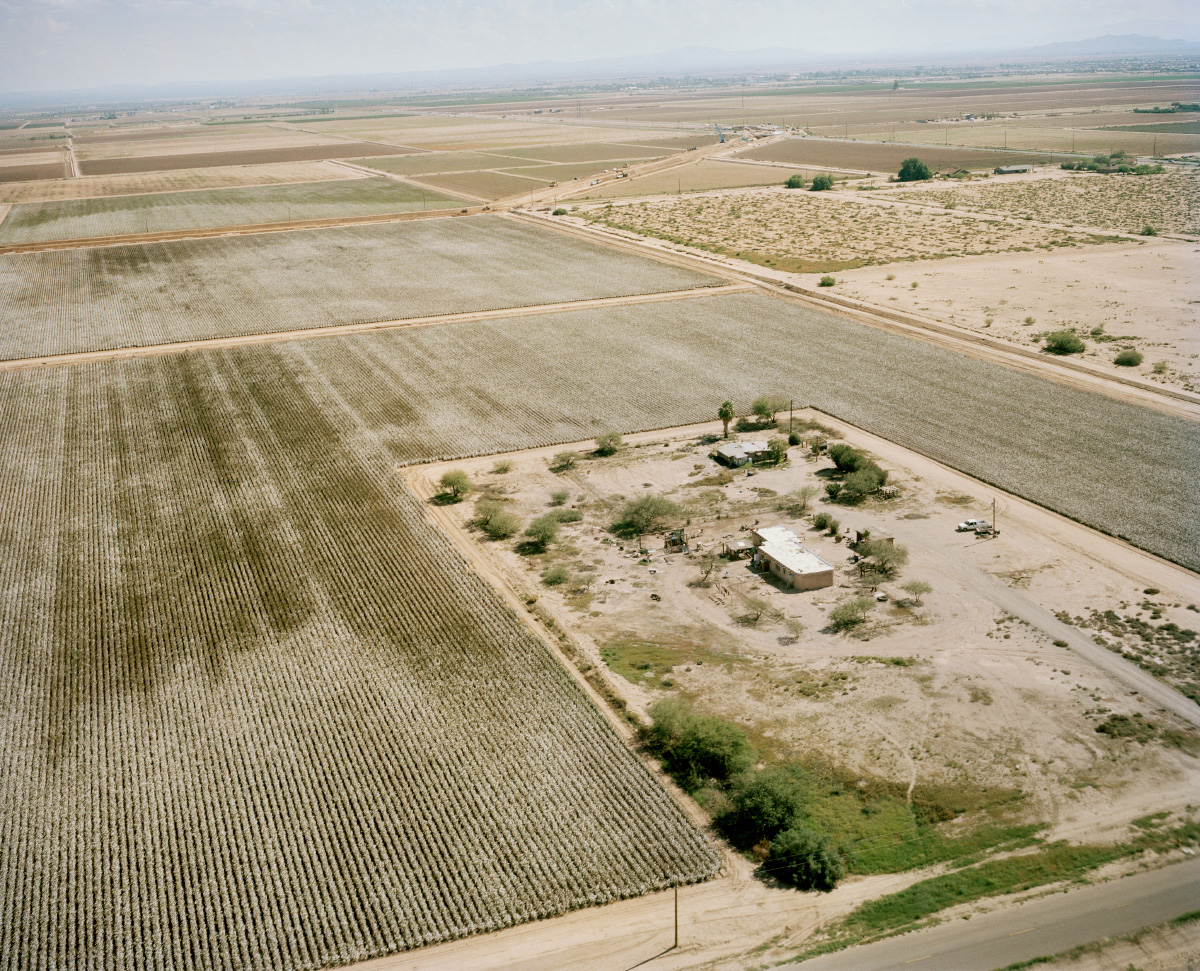
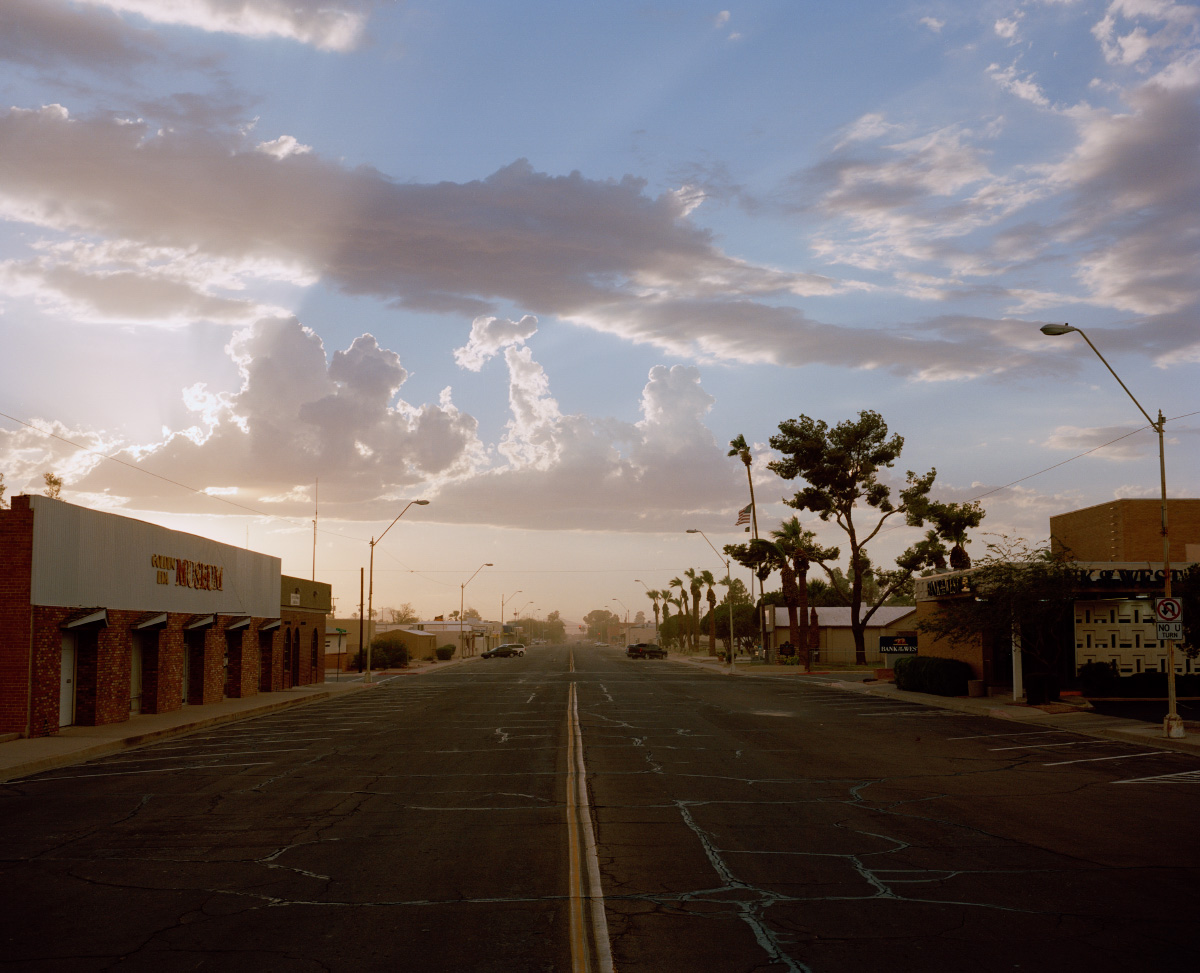
Growing cotton in the desert has always been a challenge. But for many farmers, it is a proud tradition and a cherished way of life. Below: Downtown Coolidge, where drought and sinking cotton prices have had their effect. (Jake Stangel, special to ProPublica)
Western leaders also have flinched repeatedly when staring down the insatiable, unstoppable force of urban sprawl. Las Vegas authorities have spent billions of dollars inventing new ways to bring water to their ever-expanding city, yet could not cite a single development permit they had ever denied because of concerns about water.
Instead, when faced with a dwindling water supply, state and federal officials have again and again relied on human ingenuity to engineer a way out of making hard choices about using less water. But the engineering that made settling the West possible may have reached the bounds of its potential. Dams and their reservoirs leak or lose billions of gallons of water to evaporation. The colossal Navajo Generating Station, which burns 22,000 tons of coal a day in large part to push water hundreds of miles across Arizona, is among the nation’s biggest greenhouse gas polluters, contributing to the very climate change that is exacerbating the drought.
Few crises have been more emphatically and presciently predicted. Almost 150 years ago, John Wesley Powell, the geologist and explorer, traveled the Colorado River in an effort to gauge America’s chances for developing its arid western half. His report to Congress reached a chastening conclusion: There wasn’t enough water to support significant settlement.
For more than a century, Americans have defied Powell’s words, constructing 20 of the nation’s largest cities and a vibrant economy that, among other bounties, provides an astonishing proportion of the country’s fruit and vegetables.
For almost as long, the policies that shaped the West have struggled to match the region’s ambitions — endless growth, new industry, fertile farming and plentiful power — to its water supply.
Today, as the Colorado River enters its 15th year of drought, the nation’s largest reservoirs have been diminished to relative puddles. Power plants that depend on dams along the river face shortages and shutdowns that could send water and electricity prices skyrocketing. Many of the region’s farmers have been forced to fallow fields.
The still-blooming cotton farms of Arizona are emblematic of the reluctance to make choices that seem obvious. The Wuertz family has received government checks just for putting cottonseeds in the ground and more checks when the price of cotton fell. They have benefited from cheap loans for cotton production that don’t have to be fully repaid if the market slumps. Most recently, the government has covered almost the entire premium on their cotton crop insurance, guaranteeing they’ll be financially protected even when natural conditions — like drought — keep them from producing a good harvest.
The payments, part of the U.S. Farm Bill, are a legacy of Dust Bowl-era programs that live on today at the urging of the national cotton lobby and the insurance industry. Similar subsidies support corn, rice, wheat and, indirectly, alfalfa — all of which also use lots of water. But in Arizona one of the driest states in the nation, it’s cotton that has received the most federal aid, tipping the balance on farmers’ decisions about what to plant.
Over the last 20 years, Arizona’s farmers have collected more than $1.1 billion in cotton subsidies, nine times more than the amount paid out for the next highest subsidized crop. In California, where cotton also gets more support than most other crops, farmers received more than $3 billion in cotton aid.
Cotton growers say the subsidies don’t make them rich but help bridge the worst years of losses and keep their businesses going. And because the money is such a sure thing, they have little choice but to keep planting.
“If you’re sitting on land and thinking of shifting, cotton is safer,” said Daniel Pearson, a senior fellow of trade policy studies at the Cato Institute.
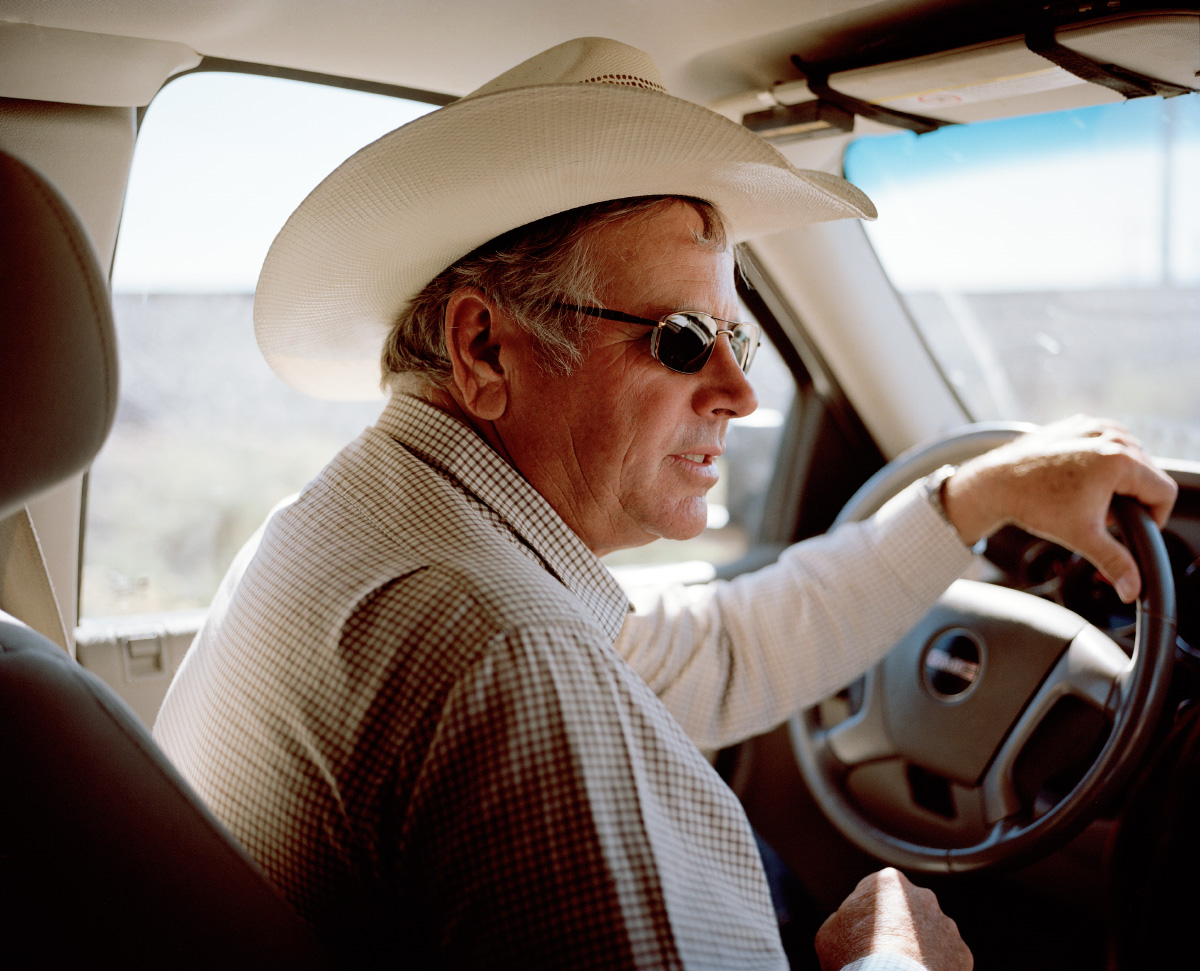
Greg Wuertz’s family has grown cotton for generations, always with the backing of federal subsidies. “Some years, all of what you made came from the government,” he said. (Jake Stangel, special to ProPublica)
Growing cotton in the desert, long term, may be doomed. In Arizona, the price for cotton has been in decline, and with it the overall planting of the crop. But when the price spikes, as it did dramatically in 2010, the growers get busy. One thing has yet to change: the government’s willingness to back and protect those still wanting to be cotton farmers.
For years, the federal support came through subsidies and price protection cash put directly in the farmer’s pocket. In Arizona, those payments could total tens of millions of dollars a year. Today, the government’s aid comes chiefly in the form of insurance subsidies — reliable and robust protections against losses that many farmers and their lobbyists hoped would be every bit as effective as cold cash. And so every year more than 100,000 acres of cotton still get planted, making the crop the second-most popular in the state.
Thus, at a time when farmers in Arizona, California and other Western states might otherwise adapt to a water-short world, federal farm subsidies are helping preserve a system in which the thirstiest crops are grown in some of the driest places.
“The subsidies are distorting water usage throughout the West and providing an incentive to use more water than would be used in an open market,” said Bruce Babbitt, Arizona’s former governor and a former U.S. Secretary of the Interior.
One night last October, in the weary twilight of the cotton harvest, Greg Wuertz nestled his white Chevy pickup by the mailboxes at the head of his street. Opening a small aluminum door, he removed an envelope containing a $30,000 insurance payment on a policy paid for by the U.S. Department of Agriculture. Easy money, to be sure, but it left Wuertz uncertain.
“This kind of way of life in the West, it’s got to be different,” he said. “Water is going to be the oil of the 21st century and it should go to the best use. Right now, I don’t know if we’re doing that.”
Cotton might never have been grown in Arizona without some form of government enticement. During the Civil War, a Union blockade impounded the Southern states’ global exports. As Europe turned to new strains of cotton grown in Egypt, Arizona’s settlers, knowing the Pima Indians had long planted cotton there, thought they could replicate hot and dry North African conditions and compete. Townships reportedly offered cash to farmers willing to pioneer commercial-scale crops, according to a local historical account. Arizona’s first cotton mogul was said to be a blacksmith who abandoned his trade to take the subsidies and try farming.
Arizona, at the time, was short on people and long on land. It was also rich in freshwater aquifers, groundwater that then seemed ample enough to irrigate vast fields and turn the desert into an oasis.
When the United States first went to war in Europe, the demand for cotton surged. The fibers were used to reinforce truck tires and canvas airplane wings. The Goodyear Tire and Rubber Company bought thousands of farm acres and built a factory west of Phoenix, where a city by the name of Goodyear still stands. Farmers flocked to the state in search of opportunity.
In 1929, Wuertz’s grandfather packed the family’s belongings into their old Buick and drove down from South Dakota. He strung up tents on 160 acres, six miles outside Coolidge, and planted his first rows of cotton in the months before the Great Depression. By the 1950s, cotton farming had been woven into the state’s identity; Arizona schoolchildren learned about the “Five C’s”: cattle, copper, citrus, climate and cotton.
Draw a sagging line today from San Francisco to Washington, D.C., and every state below it grows cotton. The United States is the world’s largest exporter, with 17 states producing some eight billion pounds of cotton each year, most of which gets shipped off to Asia and Europe.
California and Arizona are able to produce more than twice as much cotton on each acre they plant as can cotton powerhouses like Texas and Georgia because they irrigate their fields more often. But that also means that they use two to four times as much water per acre.
From almost the beginning, Arizona’s cotton farmers understood they were withdrawing from a finite account. “There was a sense the water would run out,” said Wuertz’s father, Howard, now 89. “You could tell there was going to be an end to it, even in the 1950s.”
They’ve made it last, in large part, because as the aquifers beneath their feet were depleted, the state brought in new supplies, mainly from the Colorado River.
Today, Wuertz’s irrigated cotton plants grow to about 4 feet tall, and are planted in even rows, about 3 feet center to center, extending for miles across furrowed fields. Every August, the bolls — pregnant pods just smaller than a golf ball — burst open, allowing their white cellulosic fiber to spring outward from hearty, splayed leaves and a small seed. Modern tractors, called cotton pickers, drive a comb through the fields, plucking the drying bolls from their stems and shooting them through a mechanical snorkel into a large basket being towed behind. Another basket, or “boll buggy,” dumps the load into a compressor, which packs the cotton into a brick 8 feet tall and 32 feet long.
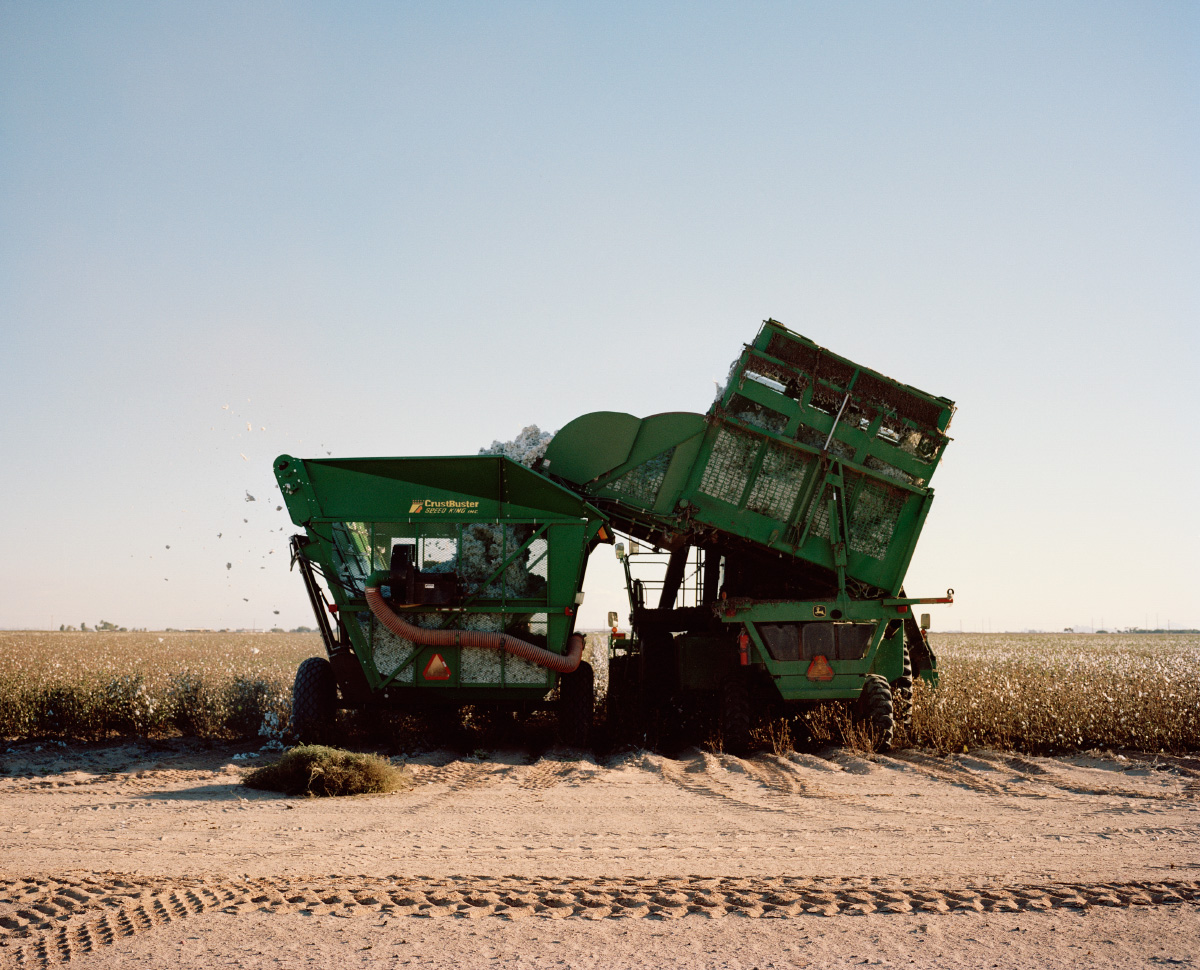

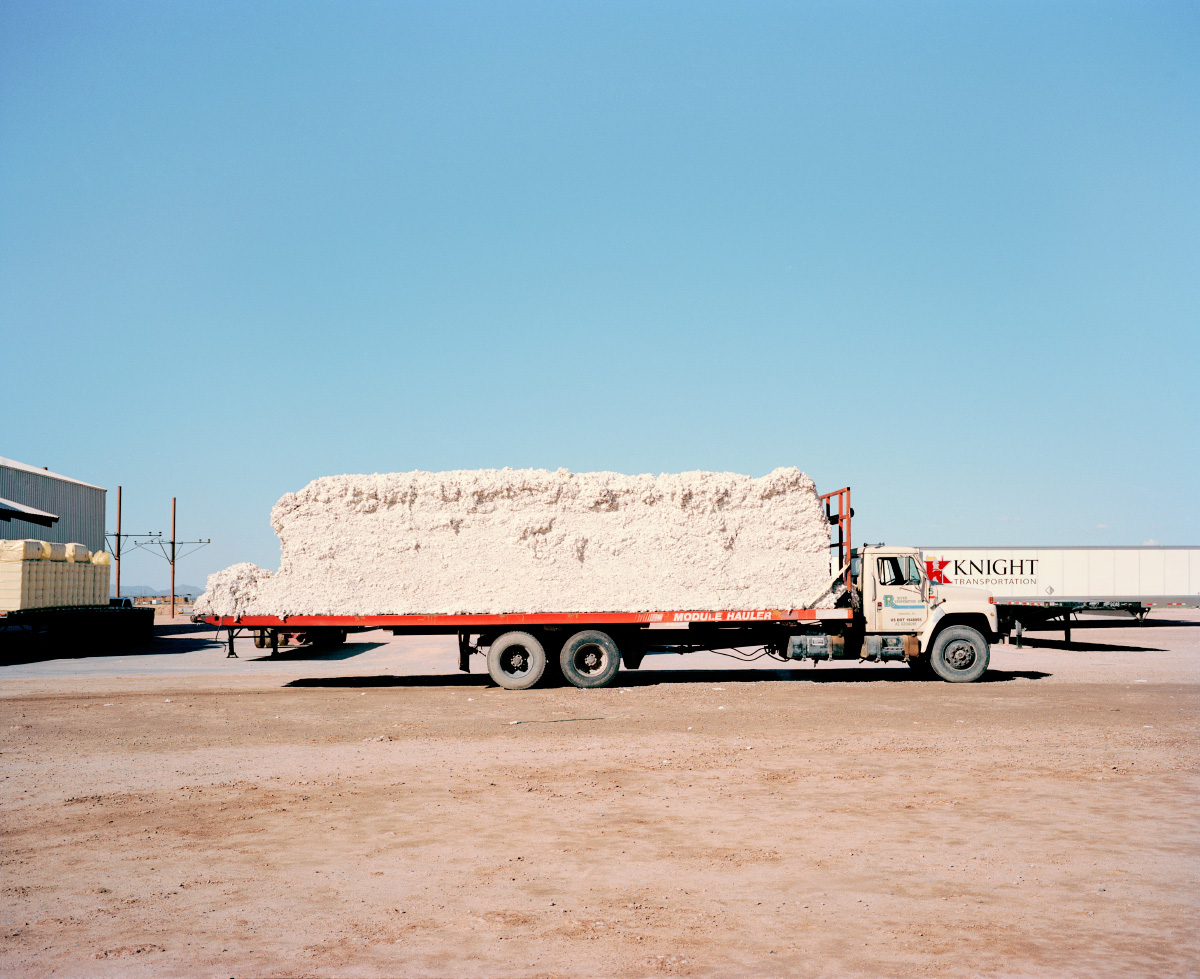
On Greg Wuertz’s farm, cotton gets harvested as it has for generations: with field hands, cotton gins and flat beds. (Jake Stangel, special to ProPublica)
The brick is hauled through Coolidge to a local gin, where computerized modern machines roll it through a whirring conveyor, separating the seeds and fibers from their leaves and chaff. The seeds are collected for animal feed or crushed for cooking oil. The lint, cleaned and dried, is strapped into 500-pound bales and shipped off through distributors who either sell the cotton or store it in vast warehouses, waiting for prices to rise and the commodity markets to buoy the crop.
Between land costs, labor, equipment, shipping and other expenses, Wuertz said he spends about $1,200 for every acre of cotton he harvests. His cotton has garnered about 62 cents per pound lately, so even if Wuertz gets four bales from each acre — a blockbuster harvest — he brings in about $1,240 and barely breaks even.
Cotton farmers can cut corners to try to eke out a profit, stretching their water, cutting back on fertilizer and making fewer laps with their tractors to save on diesel. But in years when the price is lower, water is short or demand plummets, they’ll lose money. This is when they count on federal subsidies and the crop insurance programs. If Wuertz needs an advance until his cotton is bought, the government lends it to him. If he can’t sell his cotton at a profit, the government never asks for its money back. If the price falls below a base of around 52 cents, Wuertz is insured for much of the decrease in value. If his fields produce a light yield — perhaps because he couldn’t give them enough water — he’s covered for the difference in weight, too. Other crops get subsidized insurance and loans, but none, Wuertz said, are covered as thoroughly as cotton. Add it all up, and the message from the Farm Bill is clear: Grow cotton and you will not be harmed.
“If they didn’t have insurance, it would be ugly around here,” Wuertz said. “It’d be the rope and chair. There’d be people killing themselves. It’s that bad.”
Standing in his field last fall, Wuertz cupped a tuft of cotton about the size of a softball and mused over its miraculous origins.
He gets about one-quarter of his water from the Central Arizona Project, or CAP, the system of canals that brings water from the Colorado River, some 230 miles away. The rest comes from a federally built reservoir nearby called San Carlos Lake, which, with the drought, has been diminished to little more than a bed of mud.
“There comes a time when you have to leave some to keep the fish alive,” Wuertz said wryly.
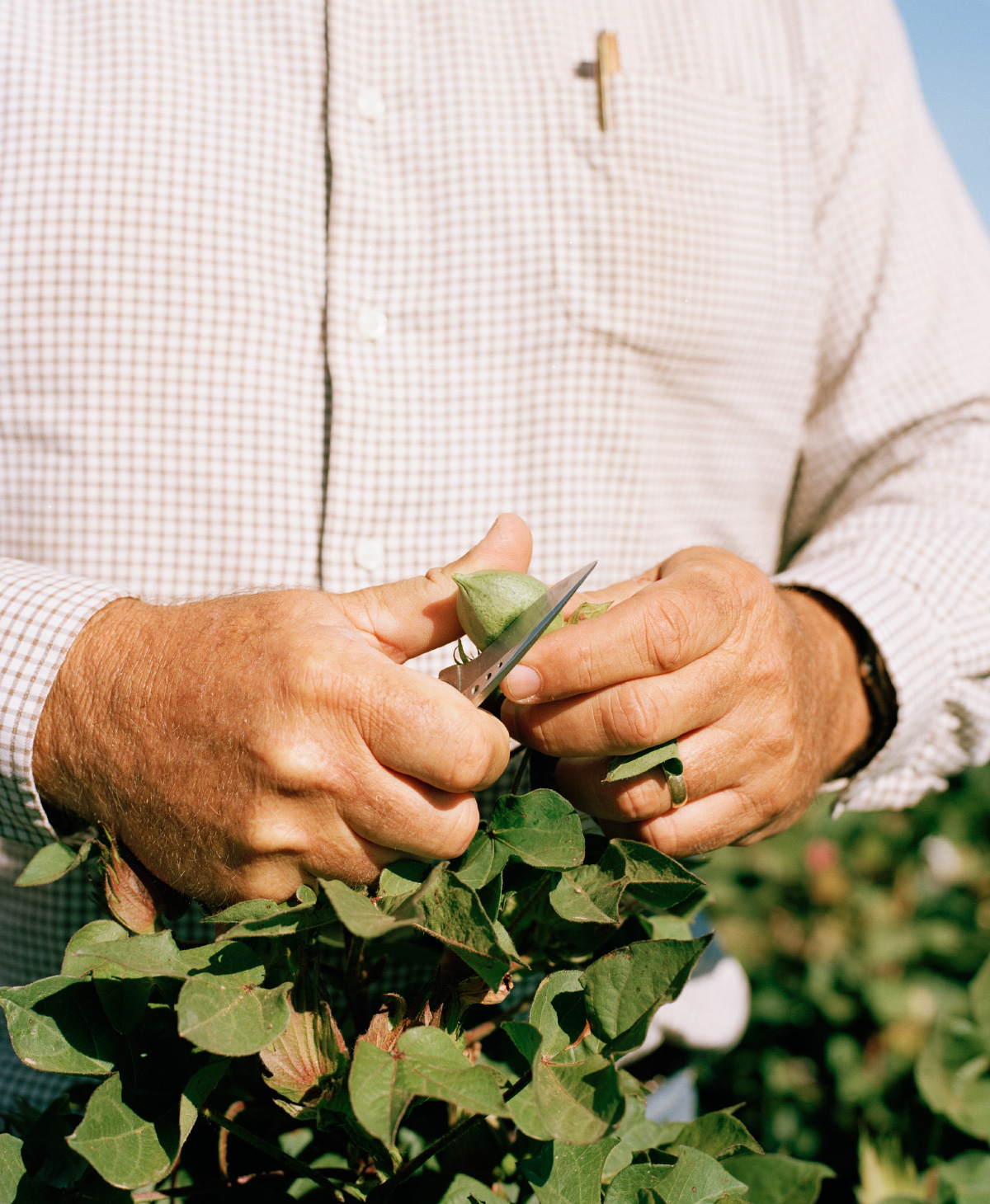
Arizona schoolchildren have for years learned about the “Five C’s”: cattle, copper, citrus, climate and cotton. (Jake Stangel, special to ProPublica)
Wuertz loves to farm cotton. Fingering the plant’s thorny, rose-like leaves, he explains the difference between hirsutum, what Arizonans call Upland, or short staple cotton used for everyday clothes, and barbadense, the long-fiber Pima cotton used in high-end sheets and expensive textiles. He is stocky, wearing jeans, cowhide boots, a blue-striped button-down shirt and a broad-rimmed white cowboy hat that shields his face from view as he talks. Every 10 days, he explains, he releases his ditch gates and floods the furrows, using an irrigation technique hundreds of years old, until the roots of his plants are submerged ankle deep. If he were to do it all at once, the water Wuertz spends to produce one acre of cotton would stand 4 feet deep. The ditches flow with hundreds of millions of gallons of water every year.
For the last third of a century, Wuertz was supplied prodigious amounts of water, largely because Arizona was pushing its farmers to use as much as they could. The state’s run on water began in the 1970s, when Arizona planned its mega canal in order to lay claim to its full share of water from the Colorado River. The canal would bring more water than the state needed at the time, ultimately supplying future urban expansion as its cities and economy grew. But in the short term, Arizona had to justify the canal’s $4.4 billion federally subsidized construction cost by demonstrating to Congress that it had a plan to put all that water to use right away.
The state’s aquifers had been drawn down so much that, in places, the land had begun to settle above them. The canal project looked like a way to wean Arizona’s farmers off ground water, using river water to replace it. It looked good on paper until 1993, when the Central Arizona Project canal was completed. The cost of construction plus the cost of the power needed to pump the water made CAP water more expensive than what farmers could pump cheaply from underground. In a bind, state and federal officials slashed the price — subsidizing nearly half the true cost of the water and charging farmers just a fraction of its value to get them to use more of it.
For a while, the plan worked. Farmers made the switch, using government-subsidized canals and inexpensive power to nourish their farms for another generation. But the farms were little more than a place holder in the state’s grand plans. It was understood that as cities grew, farming in Arizona would have to change. Much of the cotton, alfalfa, wheat and citrus would eventually need to be grown somewhere else as the water from CAP was switched to supply urban areas.
“That was the deal that was struck to induce agriculture to go out of business,” said Jon Kyl, the former three-term senator and four-term congressman from Arizona.
But the transition hasn’t been completed, in part owing to the farm subsidies that have delayed change. And now the state’s intricate water supply plan is beginning to crumble.
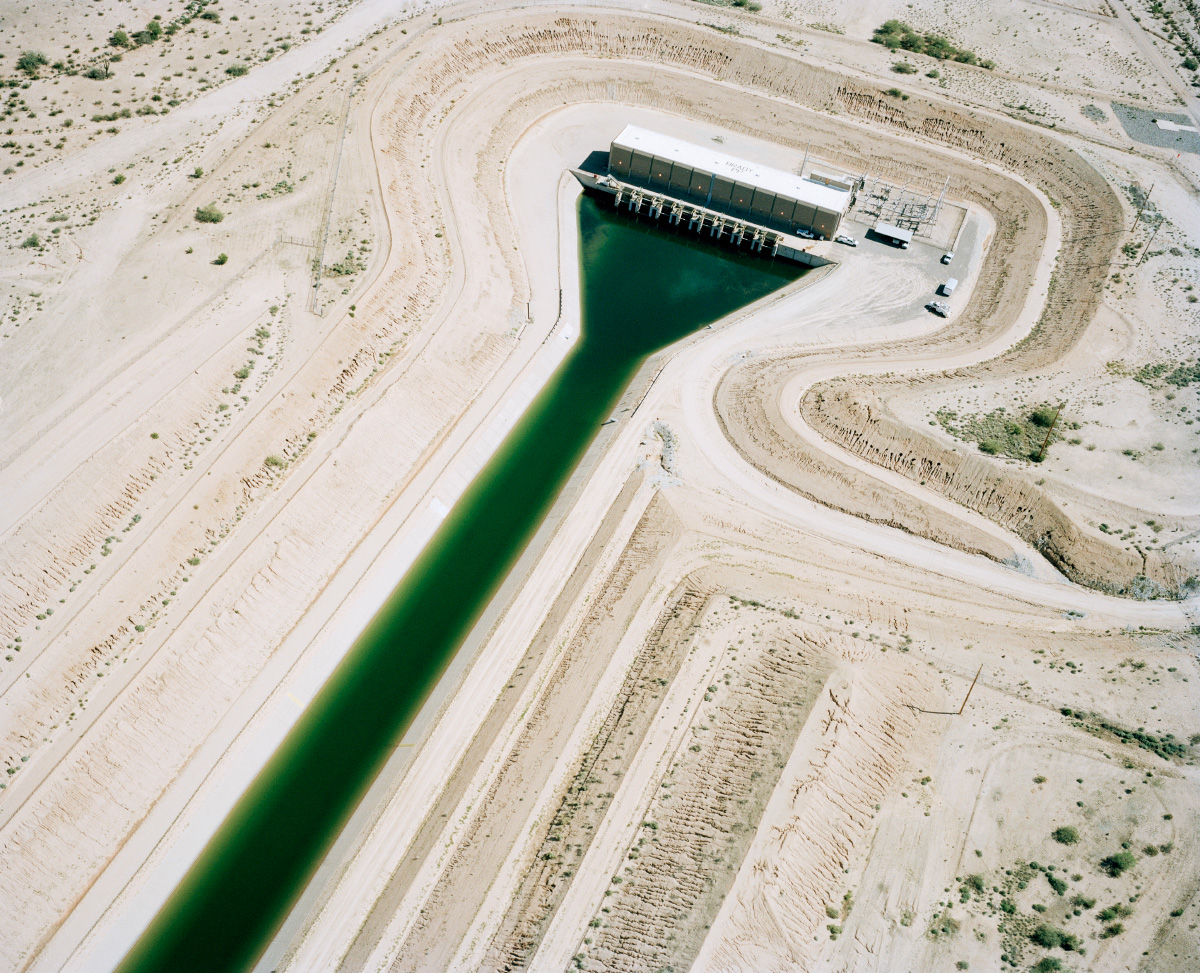
Farmers around Coolidge get some of their water from the Central Arizona Project, a system of canals that brings water from the Colorado River, 230 miles away. (Jake Stangel, special to ProPublica)
Drought has diminished the Colorado’s flow so much that federal officials — who control water deliveries on the southern half of the Colorado — now predict they will have to cut the state’s water deliveries through the CAP canal as soon as next year, potentially eliminating much of the farmers’ share. Meanwhile, loopholes in laws designed to conserve aquifers for exactly this situation have allowed housing developers and others to draw down resources that were supposed to be protected.
The water needs of Arizona’s cities are surging. The state’s population — less than two million in 1970 — has ballooned to more than three times that and is expected to reach 11 million within the next 30 years, turning the state into what the Morrison Institute for Public Policy at Arizona State University has described as a “megalopolis.”
Last year Arizona officials forecast the state could run out of water within a few decades.
“The shortages projected hitting municipal customers are really in the 2026 time frame,” said Thomas Buschatzke, the director of Arizona’s Department of Water Resources, as if a 10-year cushion was supposed to be reassuring.
Land use statistics show that acres of irrigated farmland in Arizona have decreased over the past few decades, and since 1985 they’ve dropped by more than half in the area around Phoenix. The Wuertz family sold a chunk of its fields to home developers in 2009.
But the patterns of agricultural water use make clear that it’s not just how many acres of land are planted there, but what is grown on them.
Cotton’s domestic benefits are questionable. After a price spike in 2010, production of cotton surged while global demand — and prices along with it — plummeted. Today, China, the world’s largest cotton producer, has enough cotton in warehouses to stop farming for a year. And Texas, the U.S.’s largest producer, harvests enough to cover more than one third of U.S. exports alone, relying largely on natural rainfall, not irrigation, to do it. Wuertz’s cotton — produced with Arizona’s precious water — is likely to get stacked in cavernous warehouses until the marketing cooperative he uses finds new customers. If Arizona stopped farming cotton tomorrow, Wuertz said, he’s not sure anyone would notice.
This underscores questions about whether continuing to grow these water-hogging crops at their current levels is in the public interest, and whether such an important pillar of U.S. economic policy as the Farm Bill should continue to champion them.
“The basic question is how are you going to manage your water supply? And we have managed it in a way that has subsidized agriculture,” said John Bredehoeft the former manager of the western water program for the U.S. Geological Survey, referring not just to subsidies for crops like cotton, but also the support for crops like alfalfa that are grown as feed. “If you look at the fact that half of the water use in the West is to raise cows — can you say, 'Hey, we’ve got a water shortage in the West?’”
First established as a New Deal program to rescue farmers during the Great Depression, today’s unwieldy version of the U.S. Farm Bill wraps everything from food stamps to sugar imports into one 357-page, nearly $1 trillion law.
The measure allots about $130 billion over 10 years to protect farmers against price drops, bad weather and bad luck and to insure them against virtually any scenario that gets in the way of turning a profit.
No American law has more influence on what, where and when farmers decide to plant. And by extension, no federal policy has a greater ability to directly influence how water resources are consumed in the American West.
Until this year, the bill doled out direct subsidies for a full menu of crops. Every farmer planting commodities, including those planting cotton, got $40,000 just for signing up.
Then there are the steeply discounted business loans, which have a measurable impact on what farmers decide to plant. In many cases, to be eligible for these subsidies one year, a farmer has to have previously planted the crop — a basic component of the bill’s architecture that gives farmers an incentive to maintain “base” levels of acreage. In an analysis, the Congressional Budget Office found that the subsidies don’t just maintain the status quo, they also foster more planting, and more water use. The USDA’s marketing loans alone, for example, led to a 10 percent increase in the amount of cotton farmers planted — compared to 2.5 percent increase in the amount of wheat, and a 1.5 percent increase in the amount of soybeans produced — in part because the subsidies not only make cotton a safer bet, they also make it more competitive against alternative crops. Banks lend cotton growers money they wouldn’t lend for other crops, largely because they know the government will stand behind them.
All told, Wuertz estimates that nearly one-fifth of his income is derived from Farm Bill aid, and cotton has almost always been his largest and most important crop. According to USDA statistics compiled by the Environmental Working Group, the Wuertz family — including his brother’s and father’s farms — has received more than $5.3 million in farm bill subsidies since 1995, a portion of which may have been targeted for efficient irrigation equipment, Wuertz said.
The Farm Bill has been used in the past to steer environmental policy. It provides for withholding money, for example, from farms that would contribute to soil erosion or the destruction of wetlands. In North Dakota, where farmers were tearing out grasslands to plant corn for ethanol production, the law contains “sodbuster” provisions withholding insurance benefits from those who rip up lands the government wants to conserve.
The Farm Bill contains $56 billion for conservation, funding an effort to encourage farmers to reduce their water consumption by using more-modern equipment as well as measures meant to conserve land. Another section of the bill is aimed at saving energy. But the law’s farming incentives run counter to its far more modest water conservation initiatives.
“There is a real disconnect between that and what the commodity and crop insurance program are promoting, and that’s a basic conflict,” said Ferd Hoefner, the policy director at National Sustainable Agriculture Coalition, based in Washington, D.C.
The Farm Bill’s authors have sometimes factored in environmental concerns in specific places and tailored incentives to affect them, Hoefner said. But when it comes to cotton, the bill does not consider the related water use, and it does not distinguish between the places where it is grown. Instead, the money corresponds roughly to the amount of cotton harvested; Arizona, which ranks in the middle in terms of its cotton production, also ranks 10th among the 17 states that receive cotton aid. California, which ranked third for overall cotton production in 2013, also ranks third in subsidies over the last 20 years according to data collected by the Environmental Working Group. It’s in those places that the incentives created by the subsidies are most in conflict with the government’s aid to conserve water.
“Trying to get USDA to break down the silos is difficult,” Hoefner noted.
The Congressional Budget Office attacked this disconnect in 2006, urging the USDA to stop supporting agricultural products that act to “impede the transfer of water resources to higher value uses,” and “encourage the use of water.” Analysts advised the USDA to enhance its conservation programs, align its subsidies with those conservation efforts, and stop paying for infrastructure that makes water artificially cheap.
Every six years or so Congress has the opportunity to revisit its Farm Bill policies and update the bill. When Congress reauthorized it in 2014, however, lawmakers changed, but did not retreat in their support for cotton farming in the Southwest, despite growing awareness of the persistent water crisis in the Colorado River basin.
Instead, legislators allowed the cotton industry to write its own future. Faced with international trade pressures and allegations that subsidies — like payments triggered by price drops — were distorting the market, U.S. cotton trade associations lobbied to ramp up the USDA’s insurance program.
Rather than paying direct subsidies to cotton farmers, starting this year the USDA will use taxpayer dollars to buy farmers additional crop insurance. Policies that once covered up to around 70 percent of farmers’ losses can now be supplemented with new coverage covering up to 90 percent, cushioning the shallowest of losses. The lucrative marketing loan program that serves as a sort of price guarantee also remains in place.
Right now, though, the stubbornly low price of cotton is making Wuertz nervous that the new, enhanced insurance program won’t deliver the same revenues as the old direct subsidies. He’s temporarily cut back, then, planting less cotton this year and only the most valuable strains.
Still, the more than 161,000 acres of cotton that were planted in Arizona in 2013 accounted for almost one out of every five acres of the state’s irrigated farmland. Many believe the insurance program is likely to keep the practice going because it limits most — if not all — downsides, encouraging farmers to take big chances with limited resources.
“If I knew my 401k was guaranteed to not fall below 85 percent of its current level and there was no limit on the upside,” said Craig Cox a senior vice president at the Environmental Working Group, who was a former staff member for the Senate committee on Agriculture, Nutrition and Forestry, “my portfolio would be a lot riskier than it is.”
If the Farm Bill reshuffled its incentives, water policy experts say, farmers in states that draw on the Colorado River could reduce their water usage substantially, adding large amounts back into the region’s budget.
According to research by the Pacific Institute, simply irrigating alfalfa fields less frequently, stressing the plant and slightly reducing its yield, could decrease the amount of water needed across the seven Colorado River basin states by roughly 10 percent. If Arizona’s cotton farmers switched to wheat but didn’t fallow a single field, it would save some 207,000 acre-feet of water — enough to supply as many as 1.4 million people for a year.
There’s little financial reason not to do this. The government is willing to consider spending huge amounts to get new water supplies, including building billion-dollar desalinization plants to purify ocean water. It would cost a tiny fraction of that to pay farmers in Arizona and California more to grow wheat rather than cotton, and for the cost of converting their fields. The billions of dollars of existing subsidies already allocated by Congress could be redirected to support those goals, or spent, as the Congressional Budget Office suggested, on equipment and infrastructure that helps farmers use less water.
“There is enough water in the West. There isn’t any pressing need for more water, period,” Babbitt said. “There are all kinds of agriculture efficiencies that have not been put into place.”
Today Wuertz lives with the deep uncertainty that comes with a transition he can no longer control. He told his son, Thomas, 24, that there is no future in cotton farming. He says that if Arizona farmers keep planting cotton, farming itself may be in jeopardy. But knowing that and acting on it have so far been different beasts, and Wuertz finds himself resistant to change. He tried growing more cantaloupe but had difficulty finding buyers who would take the time-sensitive crop before it rotted. He’s planting some acres he used to plant with cotton with alfalfa instead, but that uses even more water, though it commands a premium price.
In the end, Wuertz said he doesn’t know how to grow other plants as well as he knows cotton. He’s been a gin director, president of the Arizona Cotton Growers Association, head of the Arizona Cotton Research and Protection Council. His identity is wrapped up in those prickly bolls out in his fields.
“When I quit cotton all of that goes away. Ninety percent of my life is gone. It doesn’t mean a damn thing,” he said. “I’m just not ready to do that yet. And it’s not to say I won’t get there.”
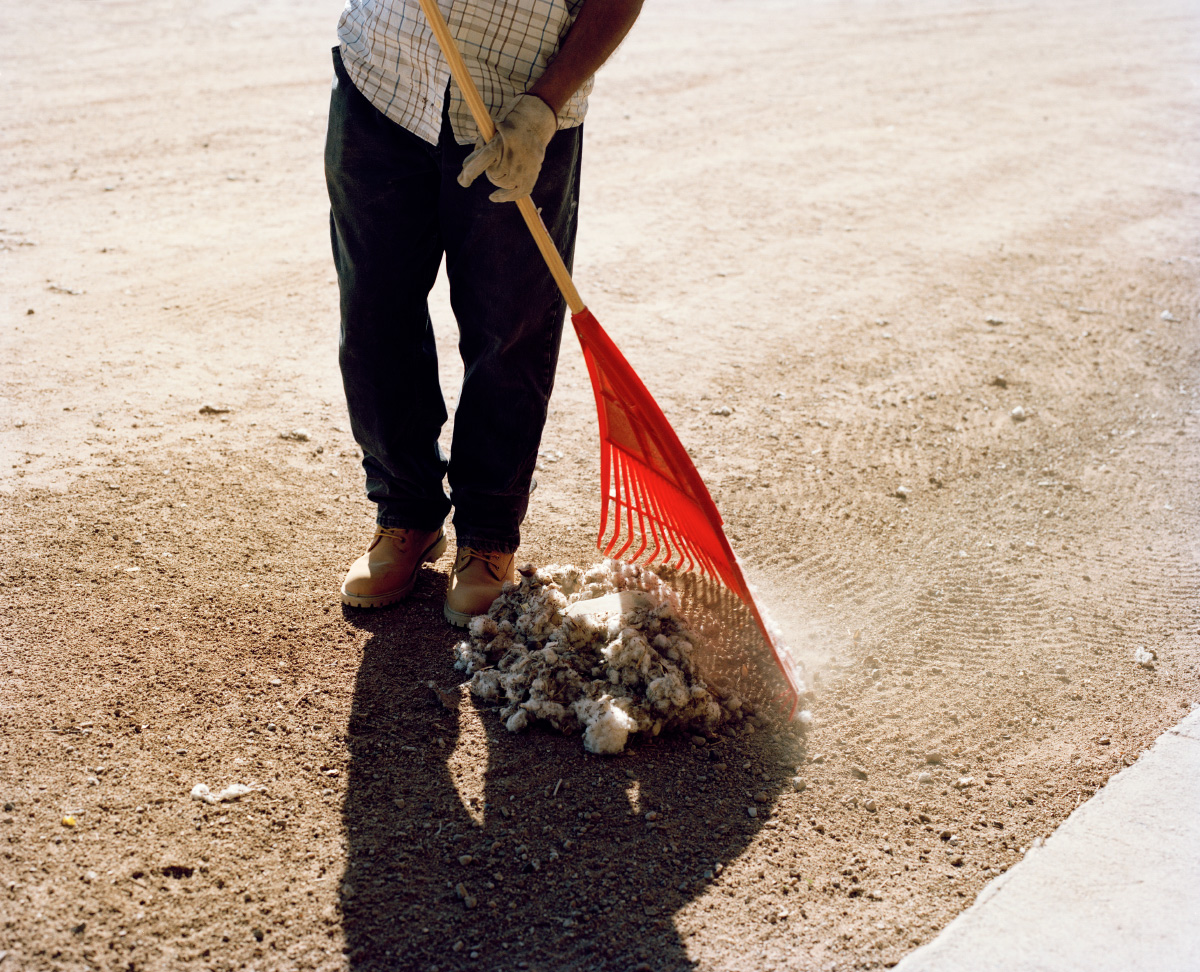
A worker sweeps cotton scraps at the gin where Wuertz brings his harvest. Wuertz says that if he stopped growing cotton, “ninety percent of my life is gone.” (Jake Stangel, special to ProPublica)
This story was co-published with Matter, a new digital magazine on Medium. Follow ProPublica on Medium for more conversation on the West’s water crisis.

For nearly three decades, Mulroy’s agencies never rejected a development proposal based on its use of water. (Christaan Felber, special to ProPublica)
By Abrahm Lustgarten
One afternoon last summer, Pat Mulroy stood in 106-degree heat at the broad concrete banister atop the Hoover Dam, the wall that holds back the mighty Colorado River, and with it the nation’s largest reserve of water.
The reservoir is the brain stem of the system that helps sustain just about every person from here to San Diego. But as Mulroy looked out over the drought-beleaguered pool, then at 39 percent capacity, it appeared almost empty.
“Scary,” Mulroy said.
Few people have played a greater role in determining how the reservoir’s coveted and contested water supply has been used than Mulroy. Much of it has gone to nourish the Southwest’s booming cities, and for 26 years, Mulroy was the chief arbiter of water for the fastest-growing city of them all, Las Vegas. As the head of the Las Vegas Valley Water District, she handled the day-to-day approval of water for new housing developments, emerald golf courses and towering casinos. As the general manager of the Southern Nevada Water Authority — a second job she held starting in 1993 — she also budgeted water for Las Vegas’ future, helping to decide its limits. As the Water Authority’s general director, Mulroy stretched her enormous influence over state bounds, shaping how Nevada negotiated with the six other states sharing Colorado River water.
Deploying a prickly wit and a rare willingness to speak truth about the water challenges hammering the Western states, Mulroy met head-on a reality few other leaders wished to face: that the Colorado River’s ability to support the West’s thirst to grow its economy and embrace the large population that came with it was not unbounded. She has been lionized for espousing conservation and pioneering a list of progressive urban water programs in Las Vegas while fiercely negotiating tough agreements between the states to use their water more efficiently and come to terms with having less.
But an examination of Mulroy’s reign shows that, despite her conservation bona fides, she always had one paramount mission: to find more water for Las Vegas and use it to help the city keep expanding.
Mulroy wheeled and dealed, filing for rights to aquifers in northern Nevada for Las Vegas, and getting California to use less water while her city took more. She helped shape legislation that, over her time at the Water Authority, allowed Las Vegas’ metropolitan footprint to more than double. She supported building expensive mechanisms with which to extract more water for the city’s exploding needs – two tunnels out of Lake Mead and a proposed pipeline carrying groundwater from farms in the east of the state. Not once in her tenure did the Authority or the Las Vegas Valley Water District she ran beneath it reject a development proposal based on its use of water. The valley’s total withdrawals from the Colorado River jumped by more than 60 percent on her watch.
Yet even last summer — staring at the effects of growth and drought on the reservoir, where once-drowned islands were visible for the first time in as much as 75 years — Mulroy apologized for none of it. She bridled at the idea that Las Vegas or other desert cities had reached the outer edge of what their environments could support.
“That’s the silliest thing I have ever heard,” she said, her voice rising in anger. “I’ve had it right up to here with all this ‘Stop your growth.’”
ProPublica is exploring how the West’s water crisis reflects man-made policies and management strategies as much, or possibly more, than it does drought and climate change.
Whether and how cities grow is one of the most decisive factors in determining the future of Western water supplies, and, to some extent, the nation’s economy. For much of the last century the West has been guided by a sort of “bring ’em on” philosophy of the more people the better. Teddy Roosevelt first envisioned using the Colorado River’s resources to move west a population the size of that day’s Eastern Seaboard. They came in droves, supported by infrastructure the federal government built — including the Hoover Dam — and the water those facilities helped supply.
To an arid region blessed with little rain, the newcomers brought their Eastern tastes: Kentucky bluegrass planted across sprawling yards; fountains flowing with abundance; fruits and vegetables growing in an Eden-like oasis. Hundreds of thousands of settlers turned into tens of millions of people still dividing the same finite supply of water, one that was stretched thin from the very start. By the time it became apparent that growth might need to be controlled to be both productive and efficient, Western sprawl, like a sort of Frankenstein monster, had taken on a momentum of its own.
Los Angeles went through this spurt first, roaring through the 1920s with Hollywood’s ascendance and having its own legendary water wars. Then came Phoenix and Denver. Las Vegas, in many ways, was last. But in its story the tensions are the strongest, the lessons the loudest and the crisis the most imminent.
It is all the more powerful because the person charged with managing Las Vegas’ water strategy was Mulroy, whose knowledge and moxie suggested she better than almost anyone could tackle the quandary Western cities had gotten themselves into.
Mulroy, of course, was not the emperor of Las Vegas. She did not have autonomy over every decision the city made about growth. But she did have enormous say.
Dina Titus, the U.S. congresswoman who represents Las Vegas, thinks Mulroy squandered her chance to get ahead of the water problem by managing growth, instead of supporting it unconditionally.
“The Water Authority had the attitude that if people come, they’ll get the water, beg, borrow or steal,” Titus said. “And that’s what they set out to do with very little long-term concern for what the impact was going to be.”
Today Las Vegas is on the brink of a new building binge, and Mulroy, 62, remains uncompromisingly bullish. Standing 5-foot-5, her gray-blond hair wilting in the sweltering sunshine, her upper lip curled as she contemplated the idea that the city should rein itself in. Water can be found, she said emphatically, standing over the near-empty reservoir. Without growth, cities have no jobs and no future to offer coming generations.
“You have Detroit,” she warned. “There isn’t a city in the country or the world that wants to be Detroit.”
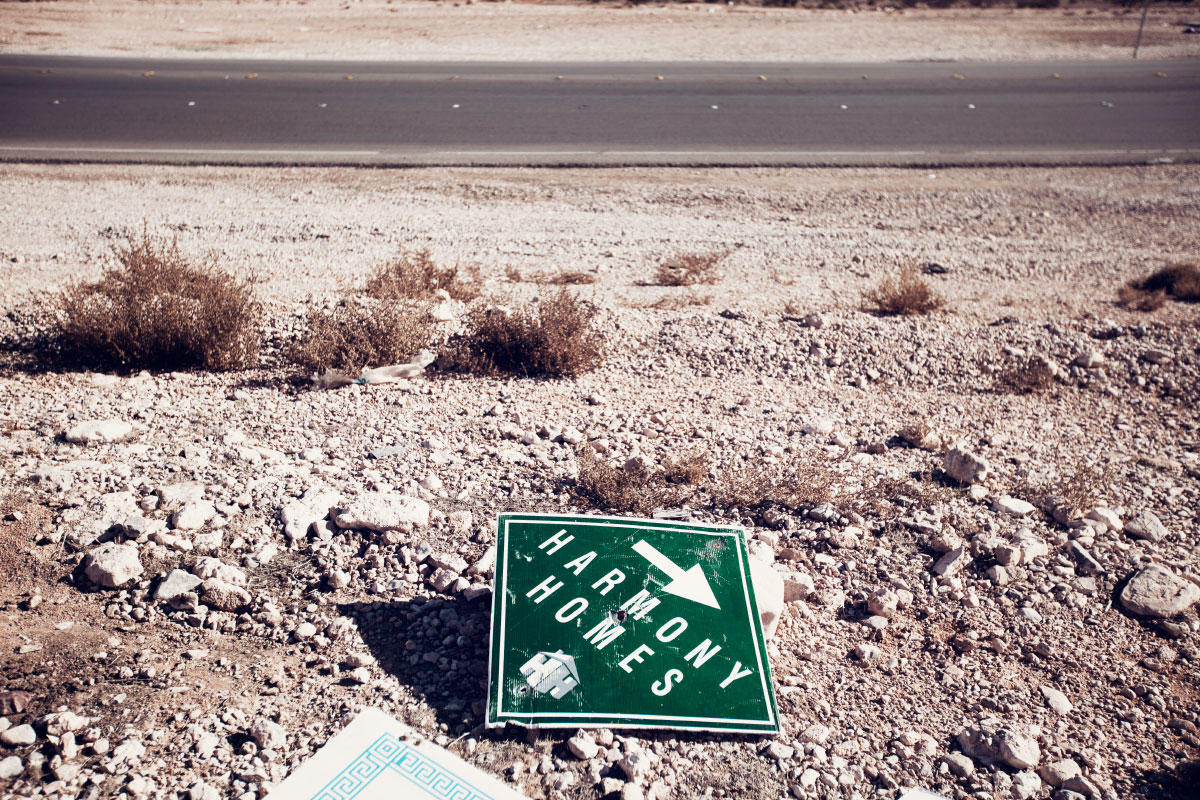
In Las Vegas, a decades-long building boom is regaining momentum after the economic crash. The city has always built first, found water later. (Christaan Felber, special to ProPublica)
Pat Mulroy first landed in Las Vegas in 1974, getting a $50 room at the Desert Rose Motel and sleeping on a round bed with a red velvet comforter beneath a mirror mounted on the ceiling.
She had flown in from Frankfurt, Germany, where she was born and raised, to accept a scholarship to study German literature at the University of Nevada, Las Vegas. A narrow slit of windows was cut into the hotel’s cinderblock wall and it looked away from Las Vegas Boulevard, into the desert. The morning after her arrival, Mulroy, 21 years old, spread the curtains, gazed outside and saw what looked like a lava pit. “Oh my god I’m on Mars,” she recalled thinking.
Mulroy went on to earn first a bachelor’s and then a master’s degree at U.N.L.V. Initially, she said she intended to chase a career with the State Department, an interest she picked up from her father, who worked as a civilian in the Air Force. He was an Irish Catholic Kennedy Democrat. Her mother was German but had grown up in India, spoke five languages and worked as a housekeeper and sometimes-translator for Gen. Dwight D. Eisenhower. Together they had instilled a no-limits mentality in their daughter.
“The notion that because you were born a certain way mattered didn’t exist in my house,” she said.
But then a friend of her father’s at the U.S. Embassy in Bonn told her that a woman would never rise in the diplomatic corps. She was momentarily disillusioned, and turned her focus to studying in the United States.
After later dropping out of her doctorate program at Stanford to help raise money to send her sister to college, she returned to Las Vegas and took a $13,000-a-year job as a junior management analyst with Clark County. She became part of the county’s legislative team, lobbying for tax and governance bills up in Carson City.
It was impossible to work for Las Vegas-area government and not find yourself staring at the underbelly of Nevada’s culture. Gangsters walked the halls of the county seat, crowding hearings or petitioning the commissioners for their building projects. “Where do you find people to build a gaming industry those days?” she asked. “It was with the mob.”
“I knew Moe Dalitz, I knew Morris Shenker. I had to deal with Tony Spilotro,” Mulroy went on, ticking off some of the most notorious criminals and mob associates in Nevada history. “Moe Dalitz was the greatest gentleman you ever wanted to meet. Tony Spilotro was a scumbag — a dirty, filthy scumbag.”
Cash flowed like water in those days, she said, and early one morning before a county commission vote, her boss, in the hopes of keeping the process clean, dispatched her to retrieve envelopes off the desks of commissioners before they arrived to discover what was in them. The envelopes were each stuffed with 50 $100 bills.
In 1985, Mulroy was promoted out of a county administrative post to help run the Las Vegas Valley Water District, one of seven feuding water utilities that served Las Vegas and the rest of Clark County. When her boss lost the confidence of his board in 1989, she inherited the whole department. “I didn’t want the job. I didn’t have the self-confidence. I didn’t think I could do it,” she said recently. “It seemed daunting.”
Indeed, Mulroy, though ambitious, had no engineering or environmental experience, and had thought little about water as a resource. She was 36 then, with two children younger than 3 years old at home. Her attention, as she put it, was “kind of split,” and she was weighted by guilt for the hours she poured into work and just as torn about the hours she spent away from the office.
But the job was politics, not science, and that came to her naturally. She had learned that politics works through relationships, not rules, and she applied the lesson to her new position. The valley, back then, still had a quaintness to it, with a population of just 741,000 and a Las Vegas strip that looked little like it does today. There was no ersatz Eiffel Tower or Empire State Building and no Bellagio hotel, with its musically synchronized water cannons. As Las Vegas grew up and corporate bigwigs displaced mobsters as the city’s ruling class, Mulroy prided herself on being a student of character.
“You develop an instinct and a political sixth sense. I can smell a phony a mile off,” she says now. “The minute someone flatters you, back up, take a hard look. The more sweetness and niceties that come out of someone’s mouth, especially if they don’t know you, beware, don’t get caught.”
Shortly after Mulroy took charge of the Water District she learned that the people who ran her utility, as well as the valley’s other water agencies, didn’t know how much water the area had — let alone how much water they were committing to give out. The valley gets just four inches of rainfall a year. Moreover, the groundwater springs that once supplied Las Vegas had been drawn down so far the land was collapsing above them. Las Vegas depended on Lake Mead for almost all of its water, and Mulroy feared that with surging growth the city would soon need more than it was allowed to take.
Her fears were confirmed when consultants she hired as one of her first acts developed a set of models that produced a damning assessment of the area’s water resources. Tapping all the water it had at the time, their models warned, Las Vegas would run out of water completely in five years. The Water District wasn’t even sure it had enough water to deliver what it had promised to development projects already underway.
On Valentine’s Day 1991, Mulroy took what seemed like a logical step: She placed a moratorium on new water commitments in Las Vegas, stomping on the brakes of the city’s booming growth. For the first time, there would be no new construction permits issued for buildings, subdivisions or the city’s signature open spaces: golf courses. Even the permitting for new casinos, the engine of the state’s economy, would have to pause. Only projects that had already been approved would be allowed to proceed.
Within a day or two, she received an urgent phone call from casino magnate Steve Wynn beckoning her to his office in a suite at the Mirage hotel. Wynn, one of Nevada’s most influential businessmen, told her Las Vegas couldn’t attract investors to pay for new development if it couldn’t assure them they’d be able to get the most basic of permits for their projects.
“He wanted to know what the hell was going on,” Mulroy said.
To give Wynn the answer he wanted – that the moratorium was temporary – Mulroy needed to get more water. The federal Bureau of Reclamation, which controlled the water coming out of Lake Mead, might let the Las Vegas Valley take more, but not while the valley’s utilities remained as disorganized as they were.
In a feat of diplomacy, Mulroy convinced the other six utilities that she could get each of them more water if they formed a single agency and let her negotiate for the group. The Southern Nevada Water Authority was born; Mulroy got more water, and a year after it began, she lifted the permitting freeze. She would never try to enact a moratorium on growth again.
Years later, she acknowledged that Wynn’s challenge amounted to a charge to never slow down growth. And she is blunt about how she chose to respond to it.
“I would rather be strategic and not be Don Quixote swinging at windmills,” Mulroy said of her dealings with the city’s business leaders. “They want to be an economic engine. They want to be a major global city. That’s their strategic plan. That’s their vision of themselves. They want to be Los Angeles.”
“Had we not done it, they would have found someone who would.”
Once Mulroy realized there would be no stopping Las Vegas’ growth, even temporarily, she attacked the challenge of meeting the city’s growing need for water with equal measures of pragmatism and creativity.
Starting in 1989, she made a series of moves to increase the metro area’s water supplies, immediately and into the future.
She quietly filed for virtually all of the unclaimed rural water rights across Nevada, water Las Vegas could eventually import. She swooped in a few years before an enormous Fort Mohave coal power plant closed and struck a deal to transfer the facility’s long-term water rights to Las Vegas. And through the original deal brokered to get more water from the Bureau of Reclamation, she increased her agency’s water budget by almost 70 percent by persuading the federal government to give Las Vegas credits for the waste water it poured back into Lake Mead.
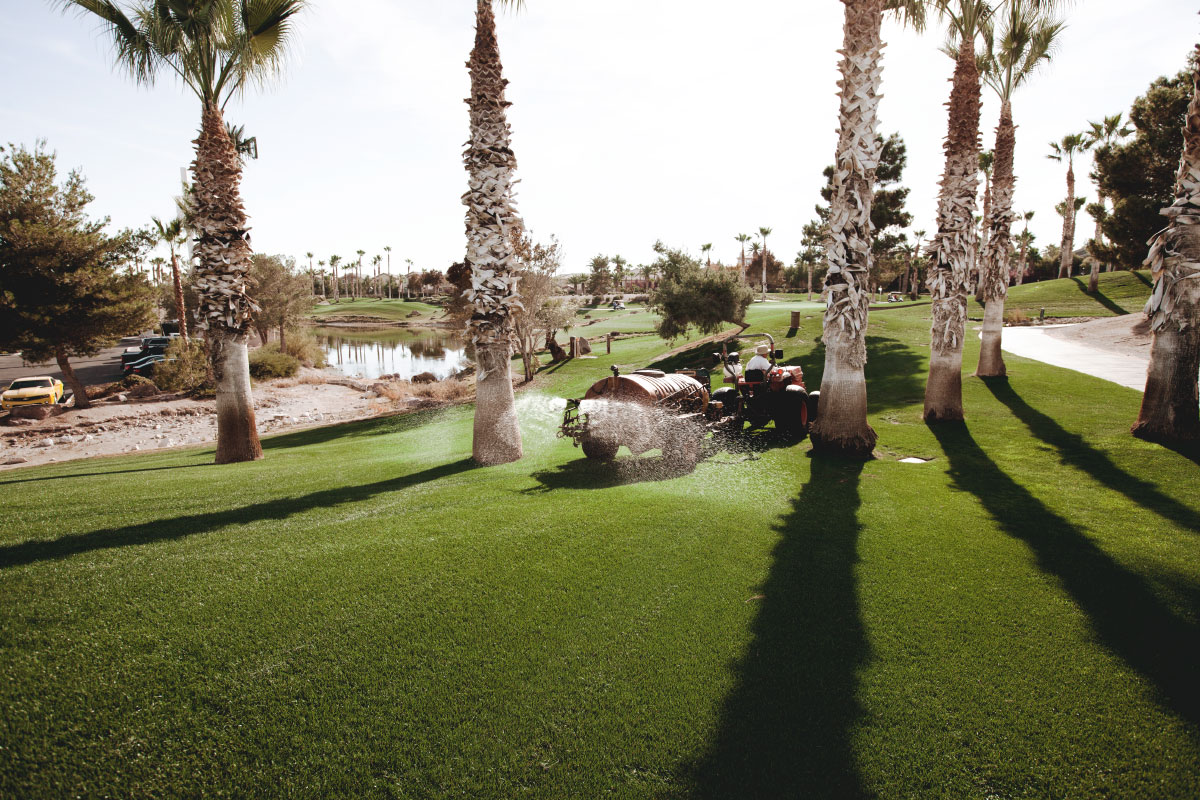
The golf courses of Las Vegas are only the most vivid symbols of possibly reckless growth. (Christaan Felber, special to ProPublica)
When Nevada’s governor appointed Mulroy to the state’s negotiating team for the Colorado River, expanding her authority by giving her a role in discussions between the seven state governments sharing the Colorado, she directed her search for more water across state lines.
She negotiated innovative swaps in which water savings in one place could be conveyed to another. She used the Water Authority’s resources to help pay to build a reservoir capturing excess river flow before it ran into Mexico from California, saving hundreds of millions of gallons of water, of which the Southern Nevada Water Authority got a significant share. She pushed Los Angeles and San Diego’s utilities to learn to get by with less, which they did in part by paying California farmers to fallow some of their fields.
Over time, Mulroy became known for pressing her view that, when it came to the Colorado River, the interests and fates of all the basin states were inextricably intertwined, giving all a stake in conserving it.
“She became synonymous with water conservation and Nevada’s quest to define itself with respect to water management,” said John Wodraska, who headed Southern California’s Metropolitan Water District during Mulroy’s ascent.
Others, though, saw her deal-making largely as enabling Las Vegas to use an ever-expanding amount of water with little of the discipline and restraint she urged on others. Mulroy instituted what she calls “soft conservation” measures to save water in Las Vegas — advertising water savings on billboards, running community education programs and banning artificial lakes in new developments. But across the 1990s, the overall water consumed by the Las Vegas metro area grew by 61 percent.
“Everybody has a water supply, and we were living within ours,” said Tina Shields, interim water department manager for the Imperial Irrigation District in California, one of the largest rights holders to Colorado River water and a frequent target of Mulroy’s criticism. “Others needed to live within theirs.”
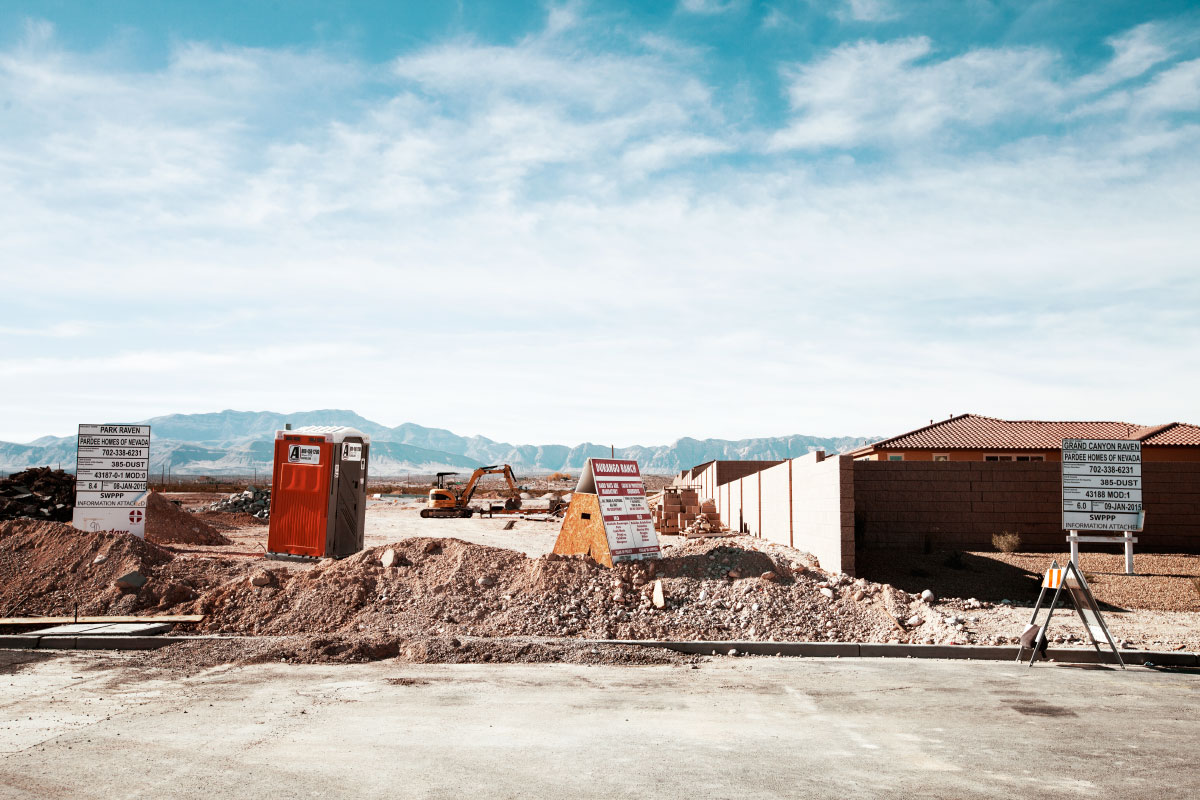
Building in Las Vegas is heating up again, but the plan for how to supply adequate water for this latest expected boom depends on a controversial $3.2 billion pipeline that has not been built. (Christaan Felber, special to ProPublica)
Some of the resentment Mulroy engendered surely reflected her manner as much as her message. She could be bombastic and provocative. Her adversaries called her the Iron Maiden or the Water Witch. (Her staff gave her a broom and she mounted it on the wall in her office.) She wasn’t afraid to antagonize those she saw as standing between Las Vegas and water she thought it was entitled to.
She angered Colorado officials by advertising in local newspapers to try to buy water from farmers there. She threatened to take California all the way to the U.S. Supreme Court if it kept diverting more water from the Colorado than it was supposed to. She blasted farmers in neighboring states for wasting water by flood-irrigating their hayfields.
“Pat Mulroy had what we called a command presence,” said Richard Bryan, the former U.S. senator and former governor from Nevada. “She was knowledgeable, self-assured without being arrogant, and when she spoke, she spoke with authority.”
By the end of the ’90s, the Las Vegas that Mulroy helped enable was considerably bigger and more bustling than the one she first knew.
The Las Vegas Valley’s population had nearly doubled during the decade, coming to exceed 1.3 million people. An average of 48,000 new homes were added each year to accommodate the influx, as were a dozen new casinos. Eight miles from downtown, the Howard Hughes Corporation began construction of Summerlin, a 22,500-acre suburban micro-community complete with schools, parks, shopping centers and nine golf courses.
Mulroy capped off the ’90s by helping to shape the Southern Nevada Public Land Management Act, which cleared the way for still more growth.
Historically, Nevada’s settlers claimed only two million acres of land within the state’s borders, leaving the rest to federal control because it wasn’t viable without water.
Legislation in 1998, advanced by Bryan and Nevada’s other senator, Harry Reid, and then-congressman John Ensign, allowed the U.S. Department of the Interior to sell tens of thousands of acres of federal land to private developers, enabling Las Vegas Valley authorities to steer federal land sales they otherwise would not have the right to control. It thus also formally freed Las Vegas from old urban boundaries.
Mulroy was part of the brain trust that refined the bill, hosting several early meetings at the Water Authority to discuss it. She insisted that if Las Vegas’ footprint was going to be larger, the Water Authority would need to add staff and infrastructure to supply water to the new areas. Her price: A 10 percent slice of the revenue from each lot sold. The Water Authority’s haul from the sale of federal lands eventually came to almost $300 million and helped bolster financing for the pipelines, tunnels, pumps and more that Las Vegas eventually built to double its capacity to move water out of the Colorado River.
More controversially, it also allowed Mulroy to start buying up northern Nevada farmland, paying as much as $32 million for properties that previously sold for no more than a few hundred thousand dollars. With the land came the right to tap vast aquifers underneath it. The Southern Nevada Water Authority would eventually become one of the largest owners of ranch land in the state.
Mulroy says the 1998 federal legislation merely allowed Nevada a say in sales the government was pursuing anyway, but she does not deny that enormous growth followed. To enable it — or respond to it, as she says — Mulroy pushed big infrastructure investments that she describes as a turning point. “The second treatment plant, the second tunnel,” she said, referring to the $2.1 billion project to expand the water intakes from Lake Mead, “that was the big growth spurt.”
Las Vegas spilled into the space opened up by the 1998 land measure at an astonishing pace.
More than 34,000 acres were sold in the first decade after the act was passed, more than twice the size of Manhattan, and master-planned mini-cities appeared on the edges of the Las Vegas metro area. Neighborhoods teemed with bulldozers and paving machines and rang with a cacophony of nail guns and air compressors. Business leaders joked that the beeping backhoe had become Nevada’s state bird.
To Rob Mrowka, who once worked as the Clark County Environmental Planning manager, it was all part of the “Western development-industrial complex.”
“That whole vicious cycle just kept pushing the boundary out and out and then you need greater and greater services,” said Mrowka, who is now a senior scientist with the Center for Biological Diversity, an environmental advocacy group that has sued to stop Mulroy’s effort to import more water from upstate. “Elected officials didn’t pay any attention to the long-term issues. It was always balls to the wall. The specter of rapid growth was like a mermaid sitting on a rock, calling.”
In May 2002, Mulroy was in her large, corner office with views of the strip in the distance when her deputy, Kay Brothers, brought unexpected news.
“‘We are walking right into a wrecking ball,’” Mulroy recalls Brothers saying. Abysmal snowpack in the Rockies would put about one-quarter the normal amount of water into the Colorado River that season.
The Water Authority relied on a 50-year water plan it updated every couple of years that was supposed to project the area’s need for water against population growth and infrastructure demands. The plan was dependent on a stopgap measure Mulroy had negotiated: Nevada’s ability to take a share of excess river water left unclaimed by the other states.
The Water Authority had allowed a tsunami of growth on the belief that their figures were unassailable. But the Authority’s forecasts — which Mulroy says were based on data given to them by the Bureau of Reclamation — had failed to anticipate the risk that a severe drought could affect the Colorado basin. The surplus water they had anticipated had suddenly evaporated. The development plan Mulroy had placed confidence in for the next half-century was suddenly worthless.
“The drought changed everything,” Mulroy said.
Mulroy moved beyond public awareness campaigns and began to crack down on profligate residential and recreational water use in Las Vegas more aggressively. She banned the lush green lawns that had typically lined the city’s newly developed suburban streets and offered cash incentives for homeowners to rip out their existing lawns. She also barred fountains and ornamental waterfalls, the kind that decorated just about every hotel and a good number of upscale communities. She installed watering restrictions for golf courses and demanded that new housing developments meet water efficiency guidelines.
“Conservation had to stop being a luxury and something we journeyed into slowly, but something that had to be kick-started in a very different way,” Mulroy said.
She became almost evangelical about climate change – something she had previously described as “not an exact science”– and implored her counterparts in the other river states to plan for the threat it posed to Southwestern cities. “We have no rearview mirrors anymore,” she told ProPublica in a 2008 interview. “All the old probabilities, throw them away. We are walking into a dramatically shifting climate and that is fundamentally going to change everything.”
Mulroy even rallied the gaming and development companies to conserve water. Wynn, forever an ally, made phone calls on her behalf, helping to raise funds to further her public relations campaign and fill billboards across Las Vegas with appeals to save water and heed the drought.
By some measures, Mulroy’s conservation push was successful. Las Vegas residents served by the water district reduced their water use from 314 gallons per person per day in 2003 to around 205 gallons (a figure still 30 percent more than in Los Angeles, and more than three times what San Francisco metropolitan area residents use each day.) Mulroy argues that the water Las Vegas recycles should be factored in, a calculation that lowers use in the valley to merely twice that of San Francisco residents. Las Vegas’ net water consumption, as long as you subtract that water recycled back into Lake Mead, began to decline.
But the drought didn’t go away. Lake Mead’s levels steadily dropped by nearly one foot every month. The seven river states began to talk about an emergency shortage declaration, in which water deliveries throughout the Southwest would be cut back.
Through it all, Las Vegas’ building boom continued, fueled by increasing casino revenue, a spike in tourist visits and a seemingly irrational mortgage and real estate market.
The casinos employed huge numbers of service industry workers. The workers needed housing. By 2008 there were about 200,000 more homes in the valley than there were in 2000, and every new development served by the Las Vegas Valley Water District received a water commitment letter agreeing to hook up water. Other utilities serving parts of the valley under the Water Authority acted similarly.
Mulroy maintains that she had no real opportunity to thwart building, even if she had wanted to.
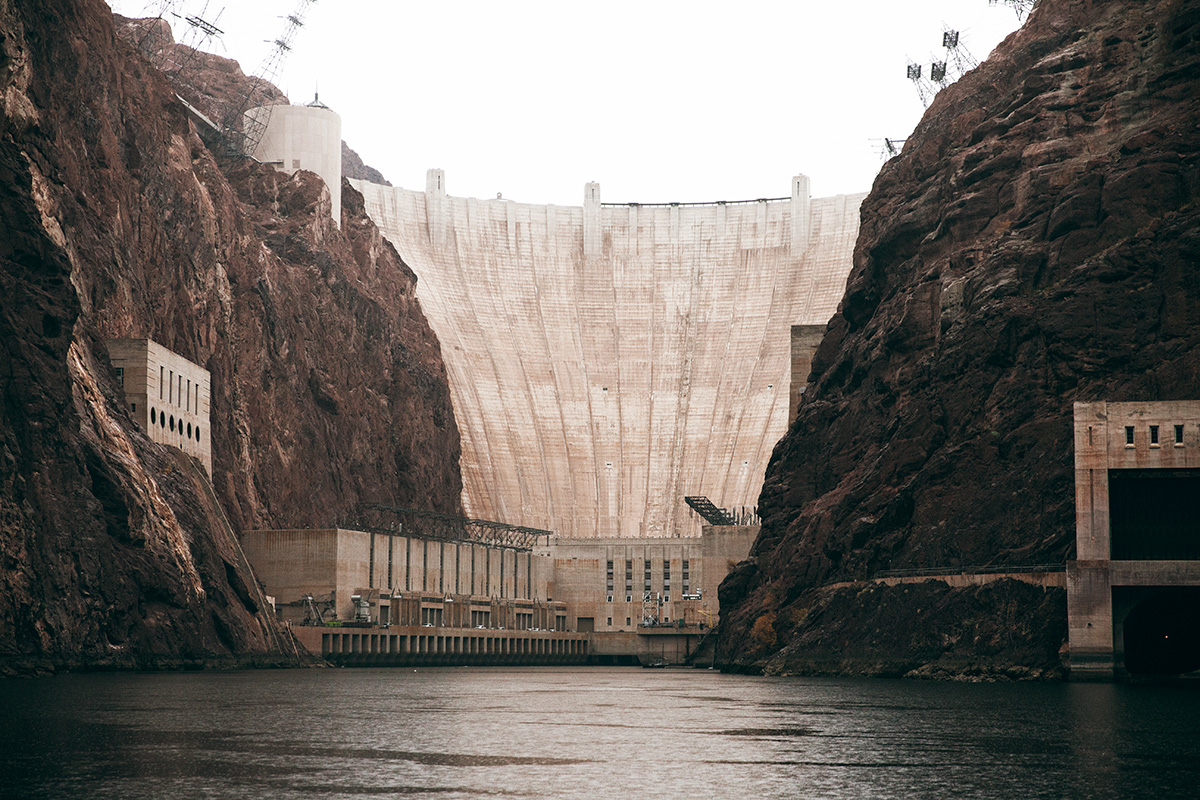
New major infrastructure projects, like the legendary Hoover Dam, are among Pat Mulroy’s best ideas for conquering the water crisis in the West. (Christaan Felber, special to ProPublica)
“We can’t pick and choose who gets water and who doesn’t,” she said. “Whoever gets zoned, whoever gets the business licensing, whoever gets approval, we have to service. They come to us courtesy of county and city zoning.”
She referred ProPublica to the Water District’s service rules which lay out her legal authority, but those rules state that the “District may deny any request for a water commitment or request for a water connection if the District has an inadequate supply of water.”
It was certainly true that the local officials in charge of planning and zoning had little or no interest in taking on the casino and building industries that benefited most from growth.
In 2003, one former Clark County commissioner, Erin Kenny, got caught accepting more than $25,000 from a strip club developer with business before the commission, then implicated her colleagues, testifying that such bribes were common. Kenny and two other commissioners went to prison.
“Growth was abundant, it was rabid, it was almost unstoppable,” Kenny said in a recent interview.
To this day, candidates for Clark County and other area commission seats get a substantial amount of their political contributions from the building and development industry. The commissioners not only make the most important decisions about growth, they also sit on the boards of the water utilities, including the Water Authority, controlling decisions on water use in the Las Vegas Valley. Furthermore, some of the most significant new housing developments built in Las Vegas — accounting for thousands of new homes — were built in places where planning officials approved zoning changes to allow higher-density building.
“The money from the gaming industry and the money from developers, they controlled the politics,” said Don Williams, a one-time campaign manager for Harry Reid and a veteran Las Vegas area political analyst. “The casinos wanted to control planning. They didn’t elect people who were interested in slowing things down for the good of the area.”
The industry’s response to any measure seen as anti-growth could be virulent. Titus, the local congresswoman, says she was once pictured on the cover of a construction trade magazine with a noose around her neck after she pushed for growth restrictions and then passed a bill as a state senator that restricted re-zoning rural land for high-density construction.
Still, Titus was disappointed by the Water Authority’s complicity in the headlong rush to build. “It was one and the same with the local government,” Titus said. “They encouraged the growth and accommodated the growth and found ways to foster the growth. They thought of that as the goal.”
Many were surprised and disillusioned by Mulroy’s acquiescence, especially after her persistent efforts to advance conservation, both in Las Vegas and among the seven states that shared the Colorado River. Her department signed off on an endless procession of development proposals, based on the notion that as long as they met the standard water efficiency criteria she had helped the county set up, all projects were equal.
Neither the Water Authority nor the Clark County zoning department factors the total amount of water a new project will require into its permitting decision. They do not prioritize water-efficient developments over others, instead approving proposals on a first-come-first-served basis as long as they comply with zoning categories and more generic efficiency guidelines.
Chris Giunchigliani, a current Clark County commissioner who once served on the Water Authority board, sees the agency — which she called “the final arbiter” of what can and should be built — as centrally responsible for why Las Vegas’ building boom continued through the drought years.
Still, she empathizes with Mulroy’s predicament.
“When a city thinks the only way they can generate a tax base is by generating growth, the word is, ‘Don’t tell us we can’t do this,’” she said. It’s “‘Find a way to make it possible.’”
Growth stalled briefly in the Las Vegas Valley during the 2008–2009 financial crisis, but is heating up again.
Though the Water Authority has managed to reduce its overall water consumption since the drought began in 2002, the Las Vegas Valley used 1.2 billion gallons more water in 2014 than in 2011. According to a recent report from the U.S. Conference of Mayors, the valley is expected to add another 1.3 million people by 2042. By the Water Authority’s own demand projections, that growth will translate into taking at least 240 billion gallons of water each year, 74 percent more than Las Vegas demands today.
As a consequence, the ranch land bought up by the Water Authority in northern Nevada could be seen as Mulroy’s parting gift to her parched city. But getting the water underneath that land to Las Vegas will require building a $3.2 billion pipeline across half the state, an idea that has generated immense controversy.
Some experts fear that if the city taps this water supply, it will suck dry wetlands that support valuable species, cripple farm communities and possibly cause ground across the Great Basin valley to subside. But the pipeline’s supporters herald it as a visionary step towards reducing Las Vegas’ near-universal dependence on the Colorado River. “We really need to diversify our resources,” said Bronson Mack, the Water Authority’s spokesman.
The debate provides a frame for assessing Mulroy’s legacy.
Before she ran the Las Vegas Valley’s water supply, the city’s environmental constraints seemed insurmountable. But Mulroy demonstrated that with enough money, savvy and will, almost any limit could be overcome. In 1991, warned she had five years of water, she deployed creative accounting to maximize every possible gallon of water credit the city could muster. In the mid–2000’s — faced with a renewed crisis — she again found water by taking it out of residents’ lawns and fountains. In a sense, she pulled off a miracle. Las Vegas absorbed nearly three decades of astronomical growth with the water it had, and it did it in the midst of the worst drought in a generation.
“She is the prophet of growth,” said Bruce Babbitt, the former governor of Arizona and former U.S. Secretary of the Interior, who has worked both with and against Mulroy on various projects. “No question.”
But what will happen next? Lake Mead reached its lowest level since 1937 last month. Today the lake is just 20 inches above the level that can trigger a formal emergency declaration. If levels drop past that point on Jan. 1, 2016, something the government forecasts as a one-in-three chance, the federal government will declare a shortage and Nevada and Arizona will face dramatic cuts in supply.
When Mulroy stood above the Hoover Dam last summer, looking down at the shocking white 148-foot-tall bathtub rings lining the orange sandstone walls of the dwindling reservoir, it hardly looked as though the strategy that had worked for the past two decades would work in the future.
“Las Vegas and Southern Nevada have been a harbinger,” said Wodraska, the former L.A. water chief, reflecting on the push to turn so much of the arid West into cities. “You’re in a desert. I think we’re going to look back and shake our heads and say, ‘What were we thinking when we tried to create this artificial environment that just is not sustainable?’”
The Southern Nevada Water Authority’s most recent 50-year water plan once again aims to outline how the area’s water resources can meet the needs of its population and economy. In six charts presented in the document, there is no scenario the Water Authority could conceive in which demand for water does not significantly outstrip the current supply, unless it completes the pipeline and begins to harvest water from other parts of the state.
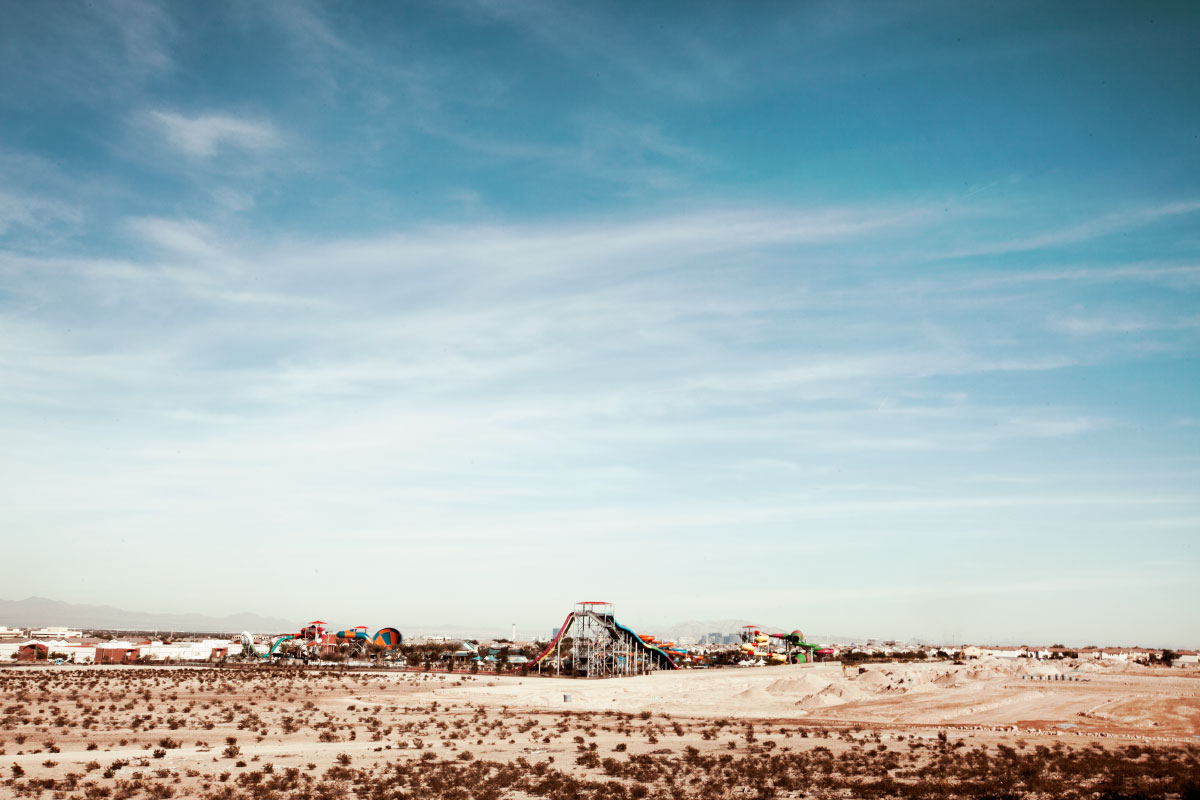
“I think we’re going to look back and shake our heads and say, ‘What were we thinking when we tried to create this artificial environment that just is not sustainable?’” John Wodraska, former Los Angeles water chief. (Christaan Felber, special to ProPublica)
That reality seems to have provoked desperate measures. The Water Authority is finishing a $1.4 billion tunnel and pumping station that amounts to a drain hole in the bottom of Lake Mead, a project Mulroy describes as “a survival policy,” that would allow the city to continue taking water even after the generators and pumps in the Hoover Dam stop operating and California, Arizona and Mexico, which is also entitled to the tail end of the Colorado’s water, are completely cut off. “We’ll still be pumping,” Mulroy said. “You better be able to take the last drop.”
In February 2014, Mulroy retired, saying she was tired of fighting Las Vegas’ water battle, which she described as constantly in crisis. She nominated as her successor her senior deputy general manager, John Entsminger, a lawyer experienced with interstate Colorado River negotiations and known to be a supporter of Mulroy’s water management strategy.
In her last days at the Water Authority, Mulroy began to talk about the drought as a natural disaster — like a flood, which often garners federal aid money and a swift emergency response — just slower moving. If the federal government made disaster money available for droughts, she thought, it could help in water conservation and water purchases. “This is as much an extreme weather event as Sandy was on the East Coast,” she told The Las Vegas Review Journal in 2013.
These days, Mulroy is a senior fellow with the Brookings Institution, where she focuses on climate adaptation and global water policy. She is particularly interested in scaling up her experience in the Colorado basin, examining what a projected nine billion people inhabiting the planet will mean for its water supplies. But she is still involved in Colorado River issues daily.
In a sort of stump speech she has delivered to audiences around the world, she advocates what she calls a “mosaic” approach to the West’s water problems. It involves a little bit of everything: a slice of conservation, some compromise by farmers, some new groundwater wells and so on.
Some of the mosaic tiles — like projects to desalinate ocean water, pipelines to move water west from the Mississippi River or seeding rain clouds with silver iodide — stretch technological limits and call for innovation. In some cases they demand positive, even wishful, thinking.
“Right now, we don’t have the luxury to take any options off the table,” she said.
The one concept she holds as an exception, however, is limiting growth. It won’t be limited for Las Vegas. Or for the rest of the Colorado River basin. Not ever. To Mulroy, suggesting such a notion would be tantamount to accepting that human progress can be limited or dictated by nature.
Even with the evidence of the water crisis right in front of her, she’s just not there yet.
“We live in a free country where people can move wherever they want,” she said. “I can build a de-salter. I can cause more conservation. I can’t slow growth and manage growth. I’m not going to waste a lot of time trying to create something that stands in exact contradiction to an ever-exploding human population.”
An earlier version of this article misstated how many Western states will face dramatic cuts in their water supplies if the water in Lake Mead falls to emergency levels. Only Nevada and Arizona would face such cuts, not every state in the Colorado River basin.
This story was co-published with Matter, a new digital magazine on Medium. Follow ProPublica on Medium for more conversation on the West’s water crisis.
Naveena Sadasivam contributed to this story.
Across the west, exercising one’s right to waste water
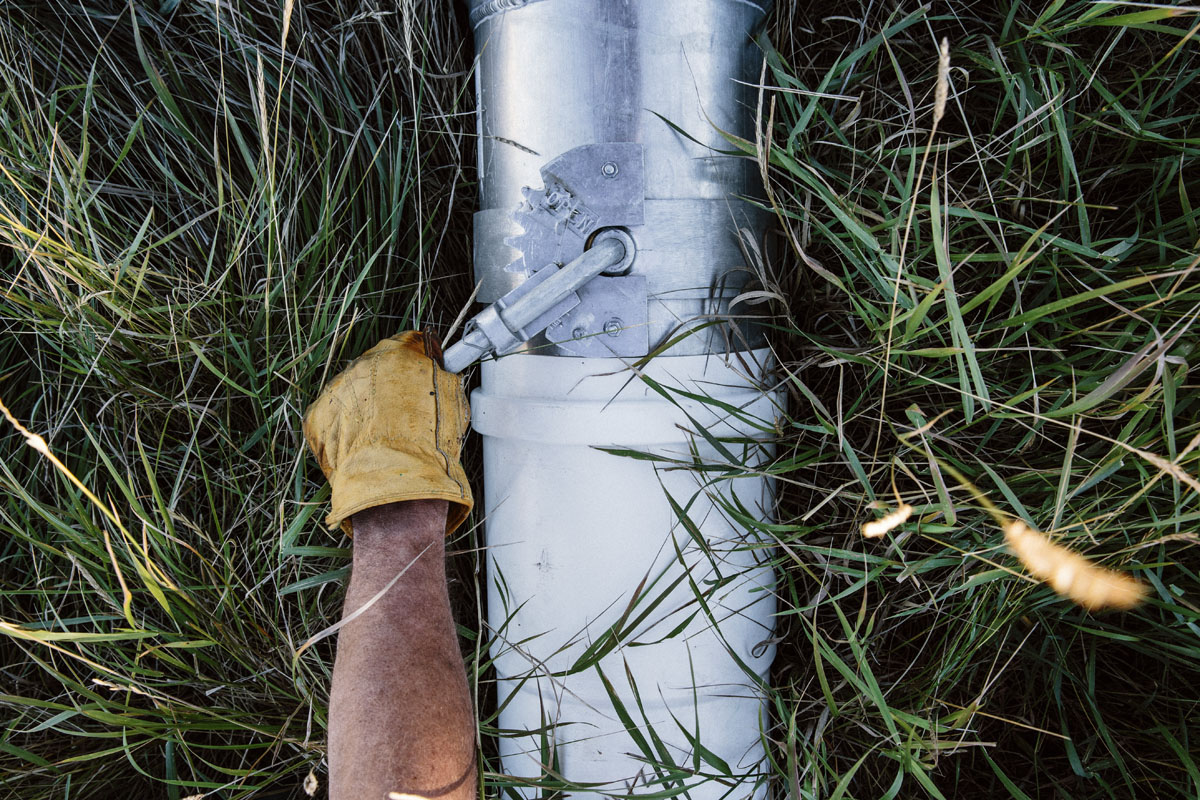
(Bryan Schutmaat, special to ProPublica)
By Abrahm Lustgarten
High in the Rocky Mountains, snowmelt fills a stream that trickles down into Ohio Creek and then onward toward the Upper Gunnison River. From there, it tumbles through the chasms of the Black Canyon, joining the Colorado River, filling the giant Lake Powell reservoir, and, one day, flowing to Los Angeles.
But before the water gets more than a few miles off the mountain, much of this stream is diverted into dirt ditches used by ranchers along the Ohio Creek Valley. Standing astride one of those ditches one day last fall, Bill Ketterhagen dug his boot soles against the concrete edge of a 5-foot-wide dam. He spun a steel wheel and opened a gate that allowed water to pour into his fields of hay crops.
Ketterhagen, 39, manages a 750-acre ranch outside the town of Gunnison, Colorado, for its out-of-state owners, mostly growing a mixture of Meadow Foxtail, Timothy, wheat grasses and some alfalfa. The grasses, knee-high with bursts of clover flowers and flat, slender leaves, are cut, baled and shipped to feedlots where they fatten cattle soon to be slaughtered for beef.
Thickly built, wearing overalls and a four-day beard, Ketterhagen has a degree in biology and natural resource management and once worked in a division of the U.S. Department of Agriculture. He knows his fields could thrive with much smaller amounts of water — he’s seen them do so in dry years — but the property owners he works for have the legal right to take a large supply, and he applies the water generously.
“When we have it, we’ll use it,” he said. “You’ll open your head gate all the way and take as much as you can — whether you need it or not.”
Ketterhagen feels he has little choice. A vestige of 139-year-old water law pushes ranchers to use as much water as they possibly can, even during a drought. “Use it or lose it” clauses, as they are known, are common in state laws throughout the Colorado River basin and give the farmers, ranchers and governments holding water rights a powerful incentive to use more water than they need. Under the provisions of these measures, people who use less water than they are legally entitled to risk seeing their allotment slashed.
There are few starker examples of how man’s missteps and policies are contributing to the water shortage currently afflicting the western United States. In a series of reports, ProPublica is examining how decisions on water management and growth have exacerbated more than a decade of drought, bringing the West to the point of crisis. The Colorado River is the most important source of water for nearly 40 million people across California, Arizona, Nevada, New Mexico, Wyoming, Utah and Colorado, and supports some 15 percent of the nation’s food crops.
But the river is in trouble, and water laws are one significant cause. Legal water rights and state allocations have been issued for more water than the river, in an average year, can provide. Meanwhile its annual flow has been steadily decreasing as the climate changes and drought grips the region. And so, for more than a decade, states and the federal government have tried to wring more supply out of the Colorado and spread it further, in part by persuading the farmers and ranchers who use the vast majority of the river’s water and have the largest water rights to conserve it.
But in many ways it’s the vast body of often-antiquated law governing western water rights, officials acknowledge, that actively undermines conservation, making waste — or at least heavy use — entirely rational.
“Water is money,” said Eugene Backhaus, a state resource conservationist for the U.S. Department of Agriculture’s Natural Resources Conservation Service, which works to help ranchers use water more efficiently. “The way the current water law structure is, if they don’t use it for the assigned use, they could lose the water right.”
Adding to the problems, the states linked by reliance on the Colorado govern their water resources separately and have not standardized their water laws. While states have made incremental adjustments to those laws, they have not recast them to address the new needs of a region undergoing vast changes. Some rules force ranchers to dry up entire streams; others ignore the ecological value of maintaining a healthy river. The common element of all these laws is the blunt ethos of the West: Water exists mainly in order to get used up, even if that means deepening the problems of neighboring states.
Ketterhagen understands that the ranch he runs sits atop a system under enormous stress and that he’s wasting water in a region that desperately needs it. But he also understands Colorado water law — rights are precious, and sometimes more valuable even than the land to which they are attached.
Throughout the long, hot summer, Ketterhagen let water course through his fields, irrigating his pastures and vitalizing the gravelly soil beneath. Last spring, the water flowed over the grass’s roots, drowning them, and climbed past the first leaves of the sprouting plants until it stood calf-deep.
“She’s my gauge,” Ketterhagen said, pointing at Gilli, his black and white Aussie heeler mix, who bounded around the field. “When I see a little bit of spray kicking up behind her, it’s just right.”
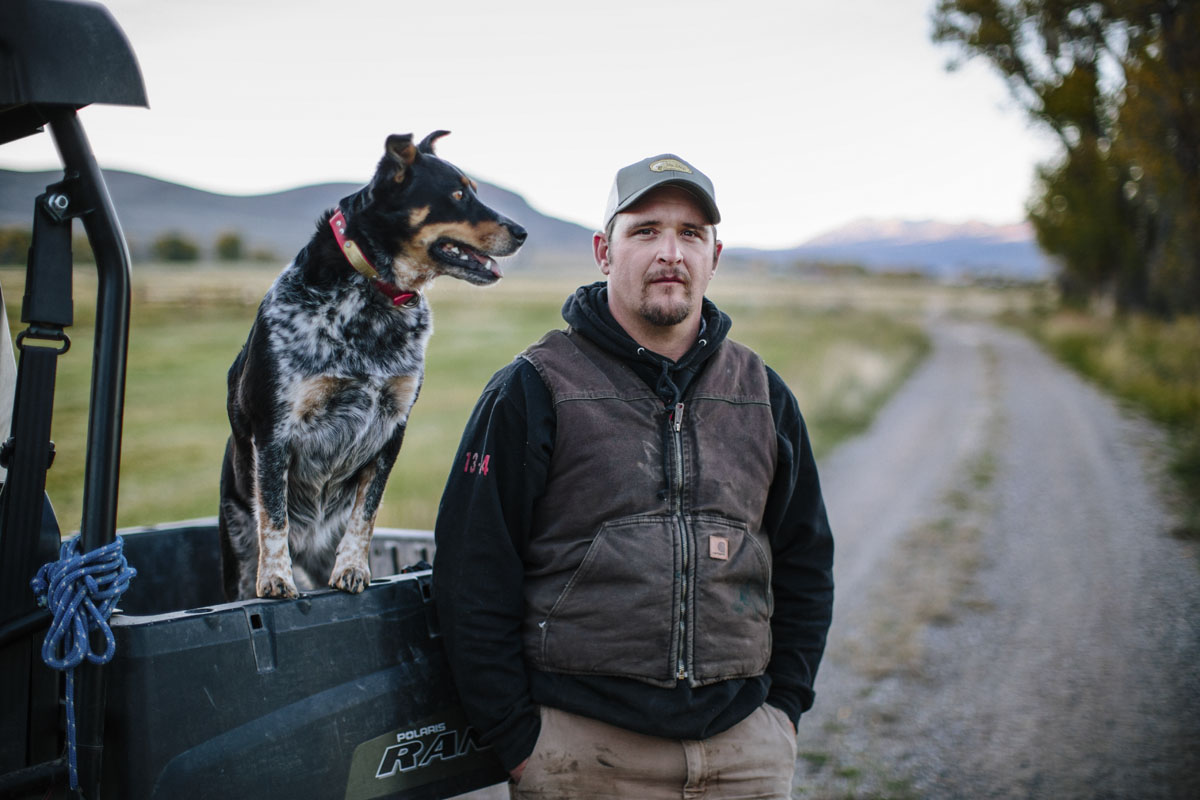
Bill Ketterhagen and his dog, Gilli. “When we have it, we’ll use it,” Ketterhagen says of Colorado water, “whether you need it or not.” (Bryan Schutmaat, special to ProPublica)
The body of law governing how water is distributed in the West was shaped by the gold rush.
As people were lured to settle vast, uninhabited and arid parts of the country, they staked their claims to land and water only to face fierce competition upstream as rivers were diverted to sluice for treasure. Courts decreed that water would be saved for the first to use it. Since most property was far from streams and there was little rain, officials then gave settlers formal rights to take water out of rivers and move it across dry land where it could be used to mine minerals or turn rocky fields into farms.
As western territories became states, those states institutionalized the rules — sometimes in their state constitutions — first locking in water rights for those who were already there and then issuing more to those who requested them, on a first-come-first-served basis. For irrigation, shares were apportioned according to crude 19th-century notions of how much water was needed to get 40 acres of dry soil to produce a crop. In times of drought, those with the oldest, or most senior, rights to water would get it first; those with the newest rights would have to wait at the back of the line.
It wasn’t until the 1920s that the seven states whose territory was touched by the Colorado River and its tributaries began to compete for access to the source of that water. Herbert Hoover, then the U.S. Secretary of Commerce, led negotiations in which the states agreed on an estimate of the amount of water in the river. The rights to most of the flow were split between states in the upper and lower basins. Colorado, Wyoming, Utah and New Mexico got half, while Arizona, California and Nevada got the rest. This was, in part, to keep California — already the most populous and industrious of western states — from taking it all. Each state continued to govern the rights to water distributed within its borders.
But even in that first 1922 compact, more water was divvied up on paper than would actually run through the river. Officials, it turned out, had estimated the Colorado’s average flow after a period of unusually wet conditions, calculating that 18 million acre-feet flowed through the river each year, and dividing up some 15 million acre-feet, or 4.8 trillion gallons of water, between the states. Within two decades they began to understand their folly: During many years as little as 12 million acre-feet flowed, and under normal conditions the river would rarely yield close to the amount of water expected. And yet the states piled on more obligations, bringing the amount of water parceled out even higher. In 1944, for instance, Congress signed a treaty promising an additional 1.5 million acre-feet to Mexico, where the Colorado River naturally ends.
Today, 15 years into an epochal drought, 16.5 million acre-feet of water have been allocated, while the river, during the recent drought, has been flowing at a rate of around 12.4 million acre-feet each year.
Still, aside from a 2007 temporary pact to divide the pain of river shortages between them, officials in the seven states have never renegotiated the original river compact or fundamentally changed the foundations of water law that lead to overuse. The result is a set of codified principles designed for a different era and divorced from today’s environmental realities.
The term “water law” in the Colorado River basin has come to refer to a monstrous volume of federal statutes and agreements, court precedents and state laws and regulations that can differ from place to place and have changed incrementally over the years but are structured by the interstate agreements to divide the river. Most of those state laws share the basic principle that the first people to arrive in the West should hold the most senior rights to its water.
The notion of “first in time, first in right” has persisted even as the need for water has exploded in urban areas that sprang up long after most water rights were distributed and therefore rank lowest in priority.
Fly-fishing, rafting and mountain tourism contribute billions of dollars to Colorado’s economy, yet in most cases state law distributes rights to a majority of water in streams and tributaries to farmers and ranchers and incentivizes them to leave little, if any, for recreational use. Many small streams in the Rockies run dry by midsummer, often because ranchers don’t have a reason to let water pass them by.
“Ninety percent of water users thought water running downstream was wasted water,” said Cary Denison, the Gunnison basin project coordinator for Trout Unlimited, a sportsmen’s and river conservation group working with ranchers to get them to use less water.
Years of worsening water scarcity passed before those ranchers began to appreciate how their practices — and the laws guiding them — were contributing to the problem. “Only recently do we start to see articles in the paper about the drought, and we think, gosh, we have some effect on this,” Denison said.
Even when there is no more water to distribute, Colorado officials can certify place holders in an endless line, assuring that water will be overallocated forever and that someone will always use whatever the last person leaves untouched.
“The whole system is designed towards preserving the status quo,” said Jim Lochhead, the chief executive of the urban utility Denver Water, who formerly represented Colorado on interstate water negotiations. The most pragmatic approach, he thinks, is to build off existing water law while reforming its worst parts. But in a perfect world, he said, “I would abolish Colorado water rights law and start all over again with a clean slate.”
None of the antiquated parts of what across the entire basin is referred to loosely as “water law” play as much a role in stressing the water system — or seem as fixable — as the one known as “use it or lose it.”
Originally devised in part to keep speculators from hoarding water to build wealth and power, the intent of “use it” laws was to make sure the people who held rights to water exercised them. They could keep those rights indefinitely, passing them on through generations or selling them, attached to the land, at great profit, as long as they constantly put the water to what most Western water laws refer to as “beneficial use.”
Each Colorado River basin state has a variation of rules promising to confiscate water rights if water users don’t maximize their use. While some of the laws allow for state-approved conservation or other flexibility, legal experts say ranchers often understand the laws to be absolute. Colorado authorities keep a list of property owners whose water rights are primed for “abandonment,” meaning that the full extent of the rights haven’t been exercised, by intent and on average, over a 10-year period.
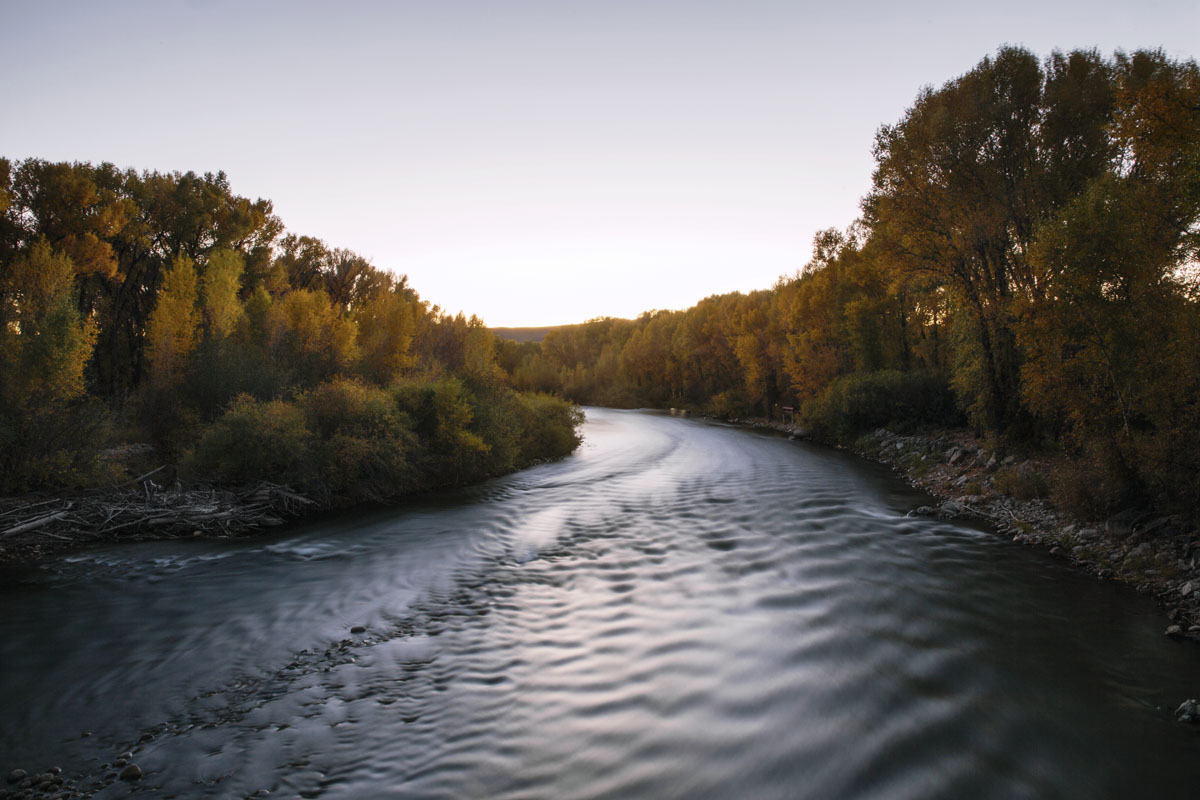
“First in time, first in line” has been the hallmark of water law in the west for more than a century. (Bryan Schutmaat, special to ProPublica)
The provision leaves landowners feeling they have little choice but to take as much as they are allowed, and many do it year in and year out to preserve the value of their property. “I would say to my clients: ‘You have to protect yourself … by using the water that is appropriated,’” said John McClow, a prominent water rights attorney who represented the state on the Upper Colorado River Commission, the interstate water management coalition, and now serves on the Colorado Water Conservation Board. But maximizing their rights keeps the river under maximum strain.
It’s not just ranchers who feel they must use up water for fear of losing rights to it. Towns, counties and even states do more or less the same thing, not necessarily because they are bound by abandonment clauses like ranchers but because they harbor fears of losing their water as it flows out of state. There is a push for Colorado to maximize its use of all the water it can.
“The state of Colorado is supposed to double in size by 2050,” said Marc Catlin, who sits on the board of the Colorado River Water Conservation District and represents Montrose County, which has filed applications to snatch up additional conditional water rights for its own future growth. “And somebody has got to be thinking about the future if that’s the case.”
The effects of “use it or lose it” laws are so significant that policy experts warn that western states won’t be able to begin untangling larger issues of drought and conservation without dealing with it first. “It’s fundamental,” said Laura Ziemer, senior counsel for Trout Unlimited and a leading expert on water law.
Any reform would probably have to happen state by state. States are fiercely protective of their sovereign rights to govern their water resources, and the federal government has repeatedly pledged not to interfere. Challenging state leaders on that, said Pat Mulroy, the former head of Las Vegas’ water authority and Nevada’s former negotiator on the Colorado River, is a sure way to “see eyeballs start popping out and bones start showing up on the side of their backs.”
At the state level, suggestions that the “first-in-time” water rights policies might be modified triggers an equally radical reaction, conjuring fears of property seizure and a nearly religious opposition to change. Even the most ardent supporters of such changes — people like Lochhead of Denver Water — admit water laws are probably too sensitive to be reformed any time soon.
Still, overhauling “use it or lose it” clauses would protect property, could offer quick improvement for water supplies and has the support of many ranchers.
Recognizing that its groundwater aquifers were being rapidly depleted, Kansas passed legislation protecting farmers’ full water rights even if they choose to use less water in any given year. But efforts to pass a similar measure in Colorado have so far failed. Last year Colorado’s governor vetoed a bill that would have allowed ranchers to use less water without jeopardizing their long-term entitlements, and an effort to revive the issue earlier this year hit a dead end. Some ranchers — including Ketterhagen — wanted to see the water they didn’t need stay in the river, where it would support the state’s booming fishing and outdoor tourism economy. But others, including those with more junior water rights, didn’t want to give water to trout — or to lower basin states.
“Do we want to fix it in a way that sends more water to Arizona?” asked McClow, the water attorney. “We’re still parochial about that. If we save some water, I think we want to use it ourselves.”
Across the fields from the ranch managed by Ketterhagen lives Bill Trampe, a significant user of Colorado water and one of the most influential.
Like his father and grandfather, Trampe, 68, harvests alfalfa on what is now 6,000 acres of picturesque rolling hay crops and grassland 30 minutes outside the town of Crested Butte. His grandfather cleared stones and dug the miles of irrigation ditches that bring water to the ranch with his own hands.
Trampe sits on the boards of the Colorado River Water Conservation District and the state’s Interbasin Compact Committee. Many of the River District members at first supported Colorado’s attempt to fix the “use it or lose it” law last year. But when Trampe — who argued the law would embroil ranchers in expensive legal and engineering fights to defend their water rights — came out in opposition, momentum shifted against the bill, and the governor ultimately killed it.
Trampe, like many alfalfa ranchers, flood irrigates his pastures, and he says that while the water he dumps on his fields can seem excessive, it serves other invisible but essential purposes. He fears a law that encourages farmers to conserve water would have unintended consequences on a complex natural system.
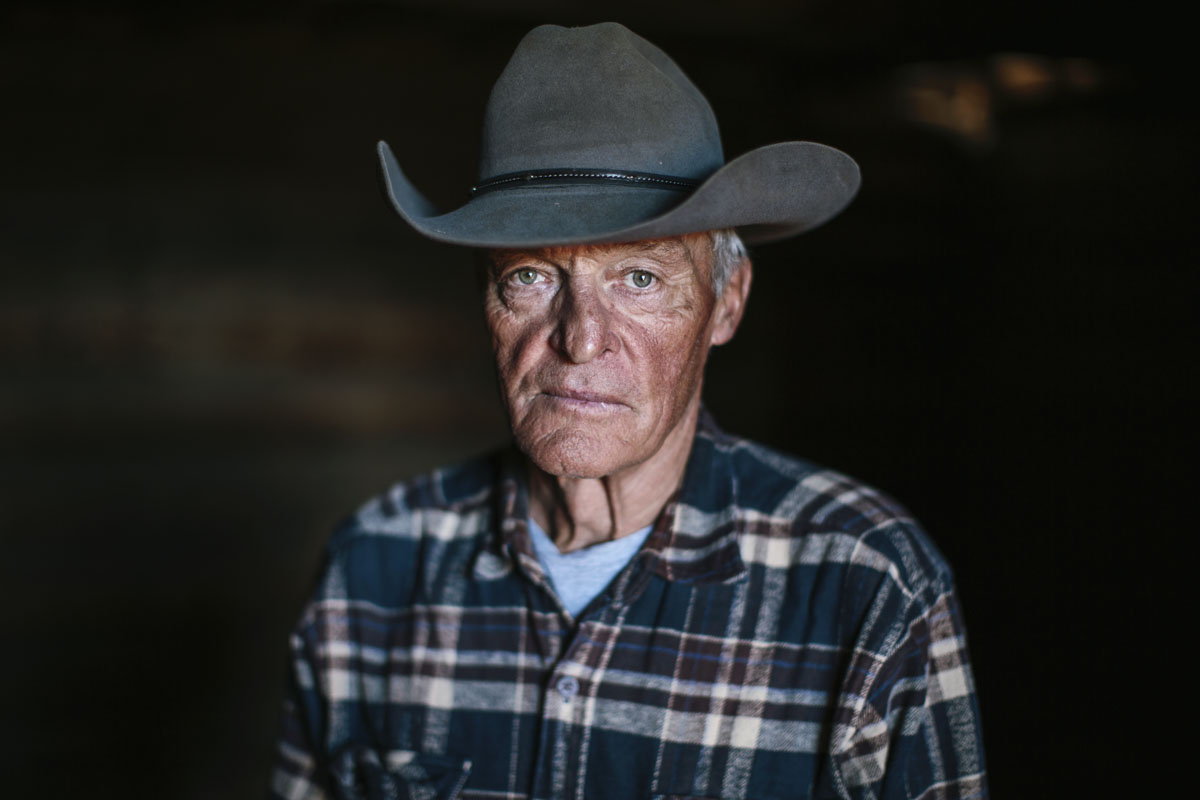
Bill Trampe is a farmer in Colorado and a staunch defender of personal water rights in the West. Of cities and their need for water, he says, “Why should I suffer for their sprawl?” (Bryan Schutmaat, special to ProPublica)
Driving his combine tractor, his thick, calloused hands wrapped over the vinyl steering wheel, Trampe described his fields in the way that only someone who has spent his entire life on the land can. Because his rocky soil drains quickly, the extra water he applies seeps downward and keeps the underlying aquifer full, he says. What water isn’t sipped up by his own plants flows underground downhill to benefit his neighbors, and ultimately to provide a steady flow of water back into the river itself.
Before there was farming, Trampe says, there wasn’t much of a ground water supply in his part of the valley north of Gunnison. But today households there depend on water wells for bathing and drinking, and those wells tap into a water table that is kept artificially high by the overuse of irrigation water on the ranches. There is also the drain water: “return flows” that seep back into the river to be claimed again by “junior” water rights holders downstream.
Return flows are an essential component of Colorado water accounting, and ranchers like to say their water is recycled four or five times by the time it gets all the way down to the main stem of the river. Among Trampe’s concerns is that conservation would wind up cutting off return flows the next farmer counts on.
“Over a century, we’ve been irrigating this country, and we’ve established an ecology based on what we’ve been doing,” he said.
Trampe also sees conservation efforts as a sort of Trojan horse. He says that, squeezed between Denver to the east and all the big thirsty desert cities downstream, Colorado’s ranchers are under siege.
“The municipalities will come here and condemn us, or buy us out,” he said.
Indeed, western cities have become increasingly critical of the imbalance between rural and urban regions when it comes to rights to water. “There is a very small number of people that control a huge amount of water,” said Douglas Kenney, director of the Western Water Policy Program at the University of Colorado Law School in Boulder. “Is it truly equitable that water was allocated 100 years ago and now we are locked into that forever?”
Denver and other eastern Colorado cities already take 154 billion gallons of water across the Continental Divide from western Colorado each year. Schemes to build more tunnels to divert more water from rural western areas like Gunnison are a constant concern. And last July the utilities and groups that represent the lower river states’ biggest urban areas — including Las Vegas, Denver and Los Angeles — proposed a pilot program to find additional water supplies in the agriculturally rich parts of Colorado, in part by paying people like Trampe to fallow fields, be more water-efficient or perhaps lease or sell their water rights.
“The cities continue to grow and grow and grow … and they expect me — or us as an industry — to give up water,” Trampe said. “Why should I suffer for their sprawl?”
In 2012, it hardly snowed in Colorado. Even in the Colorado River’s uppermost reaches, streams narrowed to a desperate trickle in the early summer, and long before Gunnison’s ranchers could take their water, Ohio Creek and the other tributaries nearly ran dry. A strange thing happened as a result.
Walking through shoulder-high Garrison grass, Ketterhagen recounted the lessons of that summer: His fields did great, perhaps better than they have done since. He has come to think the grasses — a pasture mix of slender wheat, Garrison, clover and alfalfa — suffer with too much water. The dry year trained them to withstand the rigors of water shortages in the future. “If you are able to irrigate your crops with less water over time,” Ketterhagen said, holding his arms out and letting the silky plumes brush his palms, “I think you could create a more drought-resistant hay crop.”
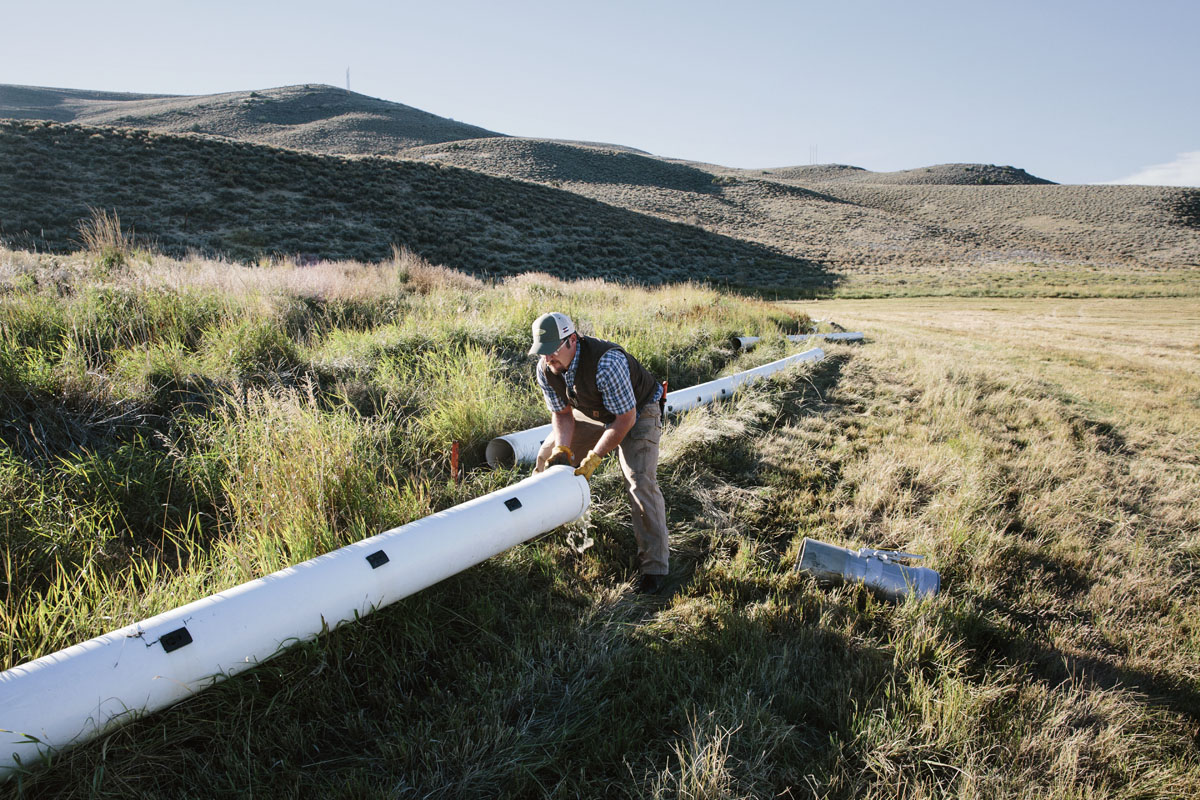
Ketterhagen uses pipes to limit water lost to evaporation or seepage into ground beneath. (Bryan Schutmaat, special to ProPublica)
There’s no quicker way to make a Colorado rancher bristle than to suggest that the water he applies to his meadows is wasted, but the science — and Ketterhagen’s observations — suggest many water users could get by with less.
According to the Natural Resources Conservation Service’s Backhaus, an alfalfa plant in particular, set in saturated soil, will grow weak roots only half as deep as normal. The saturation can bring more disease and insects and grow a plant deficient in iron. Alfalfa is the thirstiest crop grown in western Colorado, consuming as much as 3 acre-feet of water per acre of crop each year. But it’s not uncommon for local ranchers to deliver 4 to 6 acre-feet of water, taking twice as much water from the river as their crop needs. If it doesn’t drain, that much water can suffocate the plants and they will be overtaken by sedges and other species.
“Saturated soil actually doesn’t have oxygen in it, and so you will start seeing more of that wetland type plant growing in it,” Backhaus said. “By continually irrigating — letting the water go over a field and never stopping it — it could turn into an artificial wetland.”
Even where crops aren’t overwatered, water is lost just by transporting it from the river to the field. Copious amounts evaporate out of the ditches that line the hillsides and seep out the bottom into the loamy soil, well before the water even gets to ranchers’ fields. Ranchers know this; they open the gates long before they need the water, allowing extra time for the soil to get saturated enough to hold water.
Along the banks, the roots of weedy tamarisk shrubs guzzle even more water, and sedges grow in depressions — a sign of moisture pooling where it isn’t needed. As Trout Unlimited’s Denison points out, flood irrigation is just 35 percent efficient, meaning nearly two-thirds of the water taken out of the river is lost, and never gets used by the grasses it is meant to nourish. The extra water is presumed to ultimately return to the river — and is counted that way when the state tallies up its usage — but Denison and others say only some of it actually does.
Denison sees opportunity in the margins. Rather than a black-or-white struggle between agriculture and cities, a compromise could send more water downriver while keeping the farms in business. But finding it requires rethinking water entitlements, and more flexibility than existing laws allow. California has been grappling with this realization as its most senior water rights holders have begun to relinquish part of their share. “There is plenty of water to meet current needs, but we have to define what needs are, versus what a ‘right’ is,” Denison said.
The Natural Resources Conservation Service offers financial incentives to help ranchers upgrade equipment and adopt new, more efficient irrigation technologies. A pivot irrigation system — in which a long sprinkler pipe is set on wheels and rotates from a fixed point, leaving lush green crop circles — can potentially cut water use in half. Remote-controlled water ditch gates allow ranchers to shut off flows they otherwise leave running for months at a time because they are too far up in the mountains to visit. Drip irrigation for vegetable crops, in which small amounts of water are emitted right at a plant’s roots, is estimated to be as much as 95 percent efficient.
Standing at the top of a meadow full of Timothy and wheat grasses, Ketterhagen points to a 12-inch PVC pipe running beside an empty 2-foot-deep dirt ditch that it replaced. He worked with advisers from the NRCS to design the pipe system and install it on part of the ranch. The pipes don’t lose water en route to the field and let Ketterhagen distribute water more evenly. Within a week, he says, his water use on that section of the ranch seemed to drop by about half.
Federal officials believe the subsidy program could successfully prod ranchers to put hundreds of billions of gallons of water back into the river and help relieve the shortages plaguing states downstream. “If every producer did that … there would be measurable gains,” said the NRCS’s Backhaus. “If 50 percent of them did it and they got a 10 percent gain, that would still be measurable.”
And yet ranchers have been slow to adopt changes. Their reasoning varies from the practical — Gunnison-area ranches often grow only one cutting of alfalfa a season, putting the $90,000 cost of some pivot irrigation systems out of reach — to the cynically ideological. “If you save it you lose it. You don’t get paid for it. You just give it up,” said Patrick O’Toole, president of the Family Farm Alliance, a national farmer advocacy group that advises Washington policymakers, repeating complaints he says he hears from some of his members. “So why would you give up water for use you don’t even believe in, for nothing?”
The risk to long-term water rights figures prominently in ranchers’ thinking. If Ketterhagen piped every ditch on the ranch he runs, the pipes might not even carry enough water for the owners to be able to take their full allotment out of Ohio Creek. The Colorado authorities could confiscate their water rights. Ketterhagen’s employers would lose much of the value of their land, and Ketterhagen expects he’d be out of a job. Federal officials say similar concerns weigh on other ranchers, and that “use it or lose it” statutes create a strong headwind for the government’s conservation program, prompting ranchers to worry about becoming too efficient for their own good.
“It kind of runs crosswise with the goal of our program,” said John Scott, a former district conservationist for the NRCS in Gunnison.
Many of the same ranchers who insist they need all of their water also say they could use less if their rights were protected and they benefitted from the savings. “Why shouldn’t we have a say in how those savings are used?” asked Ken Spann, one of western Colorado’s significant water users, who farms thousands of acres between Crested Butte and the town of Delta downstream. “Do I have a moral and ethical obligation as a citizen of Colorado to ensure that they can continue to expand the metropolitan area toward the Kansas line? I don’t think I do.”
Spann would support a change in the law if it allowed him to retrieve the water he saved one year and use it the next. For now, he says, he has no good reason to use less water.
“People behave rationally,” said the University of Colorado’s Kenney. “The incentives are structured in a way that they are encouraged to act in a way that isn’t in society’s best interest.”
There is a consensus that this status quo has got to change. There is going to be less water and increasing pressure to use it efficiently.
“It’s like I’ve got a devil and an angel on my shoulder,” Ketterhagen said. He wants to see a healthy river and applauds an effort last spring to send a surge of water to the river’s end to restore its delta. “On the one hand the Colorado River flowed all the way into the Sea of Cortez this year, it brings a tear to my eye.”
“On the other, we give them our water and what do we get in return?”
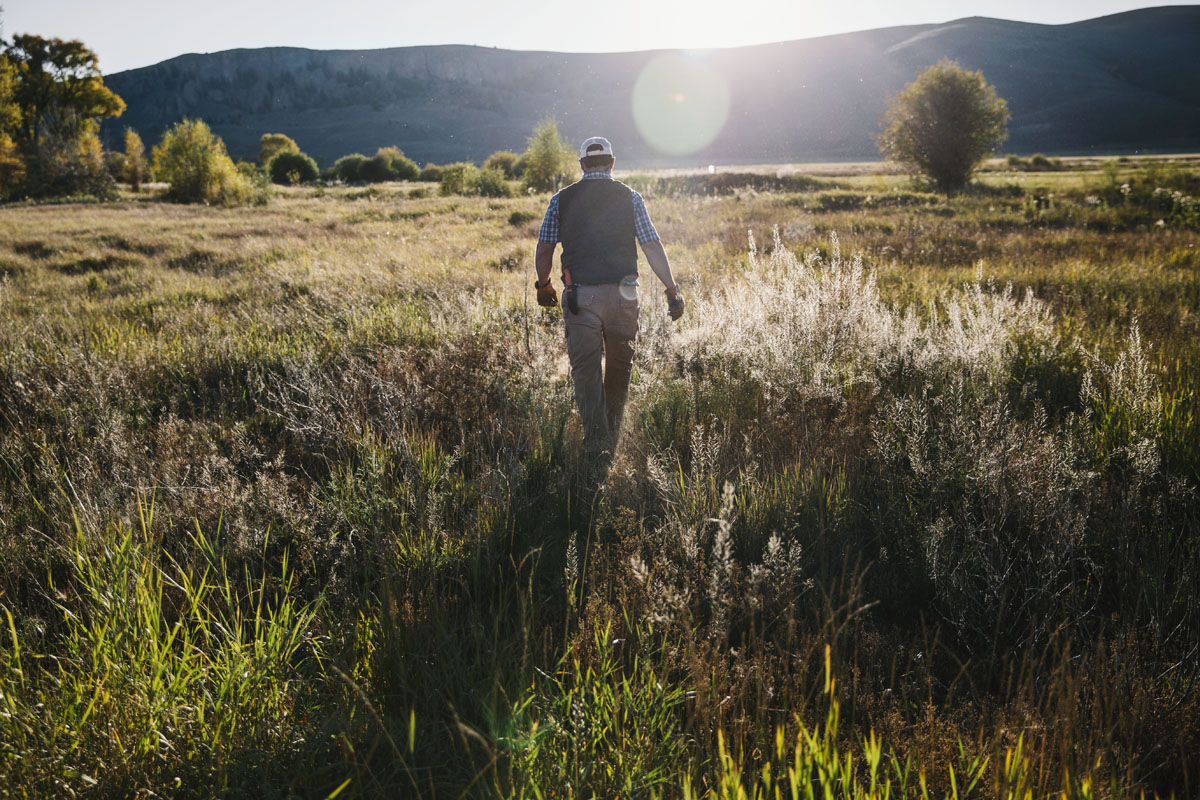
Ketterhagen says he has a devil on one shoulder, an angel on the other. Who he and other farmers listen to could shape the future of water use in the West. (Bryan Schutmaat, special to ProPublica)
Naveena Sadasivam contributed to this story.
Inside the power plant fueling America’s drought
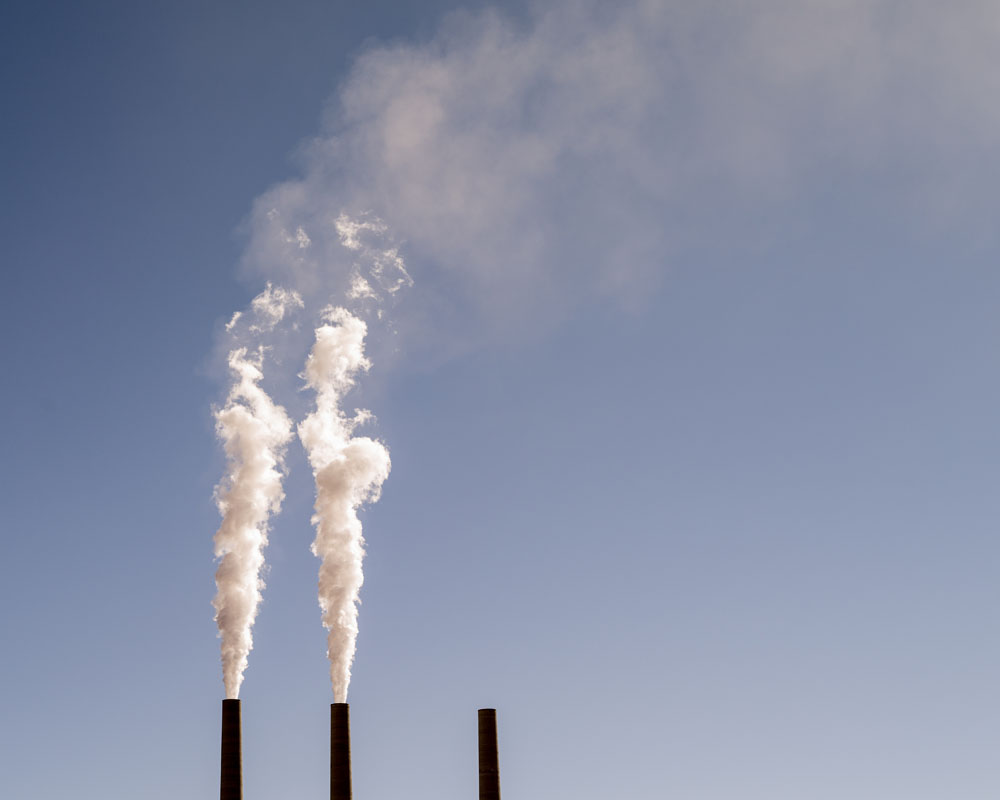
(Michael Friberg, special to ProPublica)
By Abraham Lustgarten
A couple of miles outside the town of Page, three 775-foot-tall caramel-colored smokestacks tower like sentries on the edge of northern Arizona’s sprawling red sandstone wilderness. At their base, the Navajo Generating Station, the West’s largest power-generating facility, thrums ceaselessly, like a beating heart.
Football-field-length conveyors constantly feed it piles of coal, hauled 78 miles by train from where huge shovels and mining equipment scraped it out of the ground shortly before. Then, like a medieval mortar and pestle machine, wheels crush the stone against a large bowl into a smooth powder that is sprayed into tremendous furnaces — some of the largest ever built. Those furnaces are stoked to 2,000 degrees, heating tubes of steam to produce enough pressure to drive an 80-ton rod of steel to spin faster than the speed of sound, converting the heat of the fires into electricity.
The power generated enables a modern wonder. It drives a set of pumps 325 miles down the Colorado River that heave trillions of gallons of water out of the river and send it shooting over mountains and through canals. That water — lifted 3,000 vertical feet and carried 336 miles — has enabled the cities of Phoenix and Tucson to rapidly expand.
This achievement in moving water, however, is gained at an enormous cost. Every hour the Navajo’s generators spin, the plant spews more climate-warming gases into the atmosphere than almost any other facility in the United States. Alone, it accounts for 29 percent of Arizona’s emissions from energy generation. The Navajo station’s infernos gobble 15 tons of coal each minute, 24 hours each day, every day.
At sunrise, a reddish-brown snake slithers across the sky as the burned coal sends out plumes of carbon dioxide, nitrogen oxide, mercury, lead and other metals. That malignant plume — containing 16 million tons of carbon dioxide every year — contributes to causing the very overheated weather, drought and dwindling flows of water the plant’s power is intended to relieve.
Its builders knew that the Navajo Generating Station, which began being constructed in 1969, would cause enormous pollution. An early government analysis warned that burning so much coal would degrade the region’s air by “orders of magnitude,” and federal scientists suggested Navajo and other coal plants in the region could turn the local terrain into a “national sacrifice area.” But for more than a decade, the pollution went largely unchecked. Climate change wasn’t yet a threat, and the other option for getting water into central Arizona — damming the Grand Canyon — seemed worse.
At times, officials have tried to mitigate the plant’s problems, pouring $420 million into improvements to limit sulfur dioxide emissions as acid rain blanketed parts of the country, for example.
But again and again, the federal government and the other agencies responsible for the plant have dodged calls to clean up the facility and have pushed some of the most stringent environmental requirements far into the future.
In a series of reports, ProPublica has examined how the West’s water crisis is as much a product of human error and hubris as it is of nature. The Navajo Generating Station is a monument to man’s outsized confidence that it would always be possible to engineer new solutions to an arid region’s environmental limits.
Now, 15 years into a historic drought, it is becoming increasingly clear that the era of engineering more and more water out of the Colorado River is coming to a close. The Navajo Generating Station is more a caution than a marvel, showing how much energy it takes to move water through an artificial river system, and the unforeseen damage produced by doing so.
The plant’s environmental toll is sure to fuel arguments for its eventual closing. For now, it has been granted a reprieve from complying with the Obama administration’s new Clean Power initiative, which requires Arizona to reduce its carbon output by 52 percent. But the Environmental Protection Agency has said that it expects to work with the Navajo tribe to reduce emissions separately from Arizona’s mandate, and will likely revisit that issue in the future. The plant will also soon be subject to a new federal environmental review process triggered by its renewed lease on Navajo lands.
To date, though, the Navajo has always found a way to survive as an essential piece of the infrastructure needed to tame the wild Colorado.
Last year, the plant’s owners and their supporters negotiated a compromise with the EPA that will allow it to continue operating until 2044.
“The mechanics of moving water is just lost on people,” said Jared Blumenfeld, administrator of the EPA’s region for the Pacific Southwest, including Arizona, Nevada and California. “It’s something that is just invisible. I don’t think people connect the dots on how enormous an undertaking it is to move water around, especially in a time of drought.”
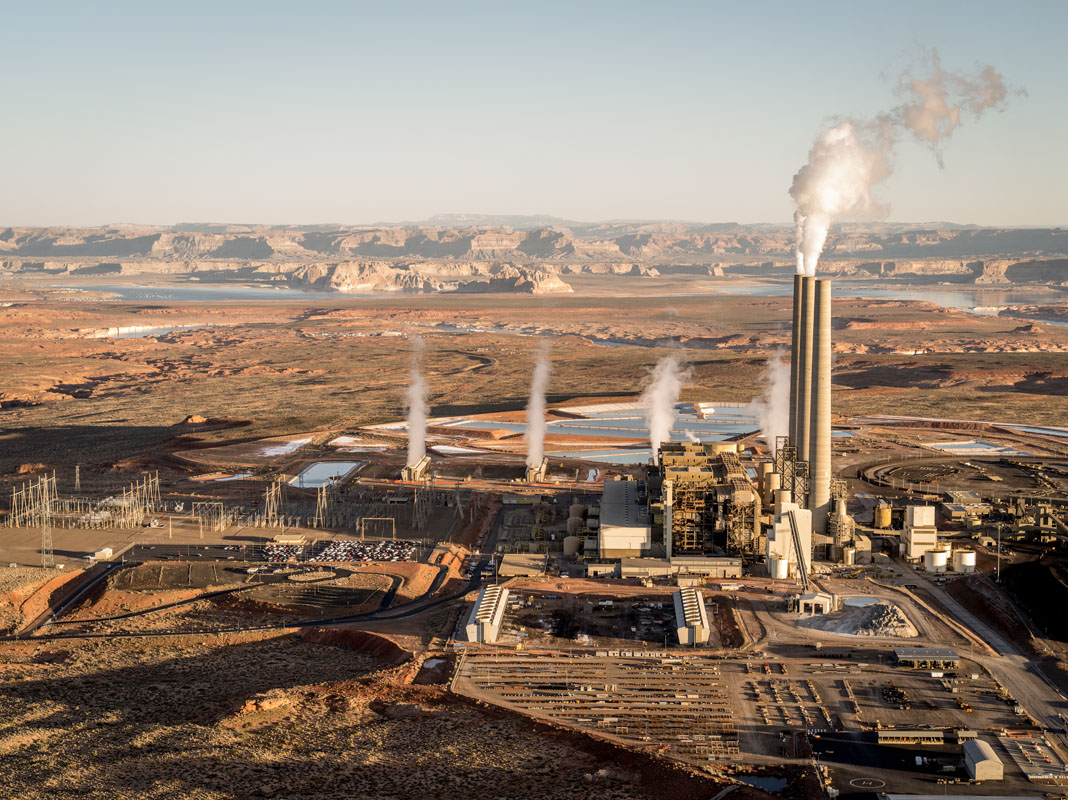
The Navajo Generating Station in Page, Arizona. (Michael Friberg, special to ProPublica)
It was with awesome feats of engineering that the West was built. To settle a vast, inhospitable region that lacked water, Americans harnessed the Colorado River — which tumbles 1,450 miles from the boulder-strewn flanks of the Rockies to the Sea of Cortez — and daringly used it to remake one-fifth of the country.
More than 100 dams were built across the system. Where the river’s path was inconvenient, its reach was extended with tentacles of tunnels and trenches deep into Southern California and Arizona. Parts of the river were even reversed; water sent eastward through pipelines beneath the Continental Divide. Each project was like a small surgery meant to strengthen and preserve the West’s access to the river before it was overused. And the more people who relied on the river, the more bandages and appendages engineers attached to it.
Over time, the engineers turned the river into one of the world’s largest plumbing systems, where a person and a button control even the wildest rapids in the Grand Canyon. The river’s tail waters have been allowed to flow their natural course into Mexico for just a few days out of the last 16 years.
The capacity to control a river — to tame its floods, to store its water so that it can be used even in drought and to displace it so that it can be streamed through the landscape for irrigation — is one of the greatest engineering advancements in modern civilization.
But as surging population, excessive demand for water, climate change and drought continue to menace the American West, the ability of mega-projects to sustain the same old patterns of consumption has diminished. The techniques used to extend the Colorado River’s vitality have instead begun to squeeze the life out of it.
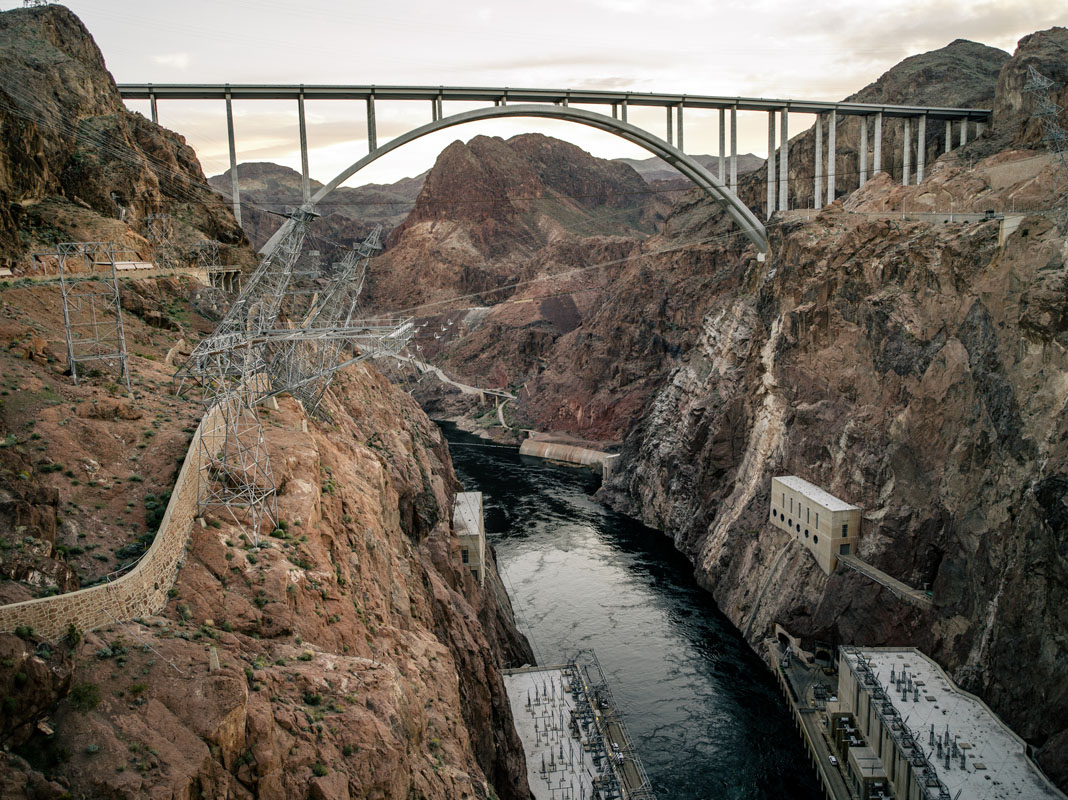
A view from the Hoover Dam. Its walls stretch 1,200 feet across the Black Canyon, are 726 feet high and 660 feet thick. (Michael Friberg, special to ProPublica)
It is not only the Navajo Generating Station — aging, polluting — that is so troubled. Many of the most significant pieces of infrastructure lose water, no longer function the way they were designed to as water levels drop, or have required hundreds of millions of dollars in fresh investments.
The Hoover Dam, completed in 1936, was erected to hold two years of river flow in reserve. Its walls stretch 1,200 feet across the Black Canyon, are 726 feet high and 660 feet thick. But today, the dam holds back lots of air, and less water, since the lake levels have dropped more than 140 feet from their high.
Lake Powell, which sits behind the 700-foot-tall Glen Canyon Dam and is the nation’s second-largest water reserve, is even more troubled. The lake has recently fluctuated between 39 and 51 percent full, and if the drought ended tomorrow, it could take nearly a decade for it to fill back up. But the larger problem is not that Lake Powell could one day approach what experts call “dead pool,” meaning there is no longer enough water for it to flow through the dam’s gates or generate the hydropower that the West’s electricity grid depends on.
It’s that the reservoir leaks like a sieve. As much as 123 billion gallons of water — 2.6 percent of the annual flow of the entire Colorado River — likely seeps into fissures in the porous sandstone underlying the lake and disappears each year, according to a 2013 study. Another 168 billion gallons evaporates off the surface annually, as the sprawling lake bakes in the arid desert climate. A facility whose central purpose is to save water instead loses a mind-boggling amount of it. Were Lake Powell to go away, the American Southwest would have approximately 6 percent more water overnight.
“There may well be an oncoming argument about whether we really ought to take that dam out,” said Bruce Babbitt, the former secretary of the interior and former governor of Arizona.
The river’s big canals have faced similar problems. The All-American Canal, an 80-mile aqueduct that ferries water along the north side of the Mexican border into California, recently received a nearly $300-million upgrade to stop some 22 billion gallons of water from seeping into the sand dunes beneath it each year.
“The vulnerabilities in this system are so numerous,” said Blumenfeld, the EPA official for several Western states. “When you look at the thousands of miles that water moves … the water loss is huge.”
This reckoning of the limits of American ingenuity to conquer the West was predicted more than 135 years ago, after John Wesley Powell first explored the river’s basin. Powell, who later ran the United States Geological Survey, assessed water supplies across the country for Congress. Though he had lost most of his right arm in the Battle of Shiloh, he rowed the Colorado River from Wyoming through the Grand Canyon, with 10 men in custom-made oak and pine boats he’d had sent from Chicago. Four of the men abandoned the expedition; three were killed by tribes as they hiked away from the canyon.
Powell, reporting afterward, told Congress about a bifurcated landscape: a river gushing and abundant, but relatively inaccessible, surrounded for hundreds of miles on all sides by a desert so devoid of rainfall and moisture that it almost certainly could not alone sustain efforts to grow food from its soil. “Many droughts will occur; many seasons in a long series will be fruitless,” he cautioned in a dour report. If one were to try to irrigate the desert, Powell warned, the infrastructure and facilities needed to do it would be so enormous and costly that only a large collective effort — like from the government — could pay for it.
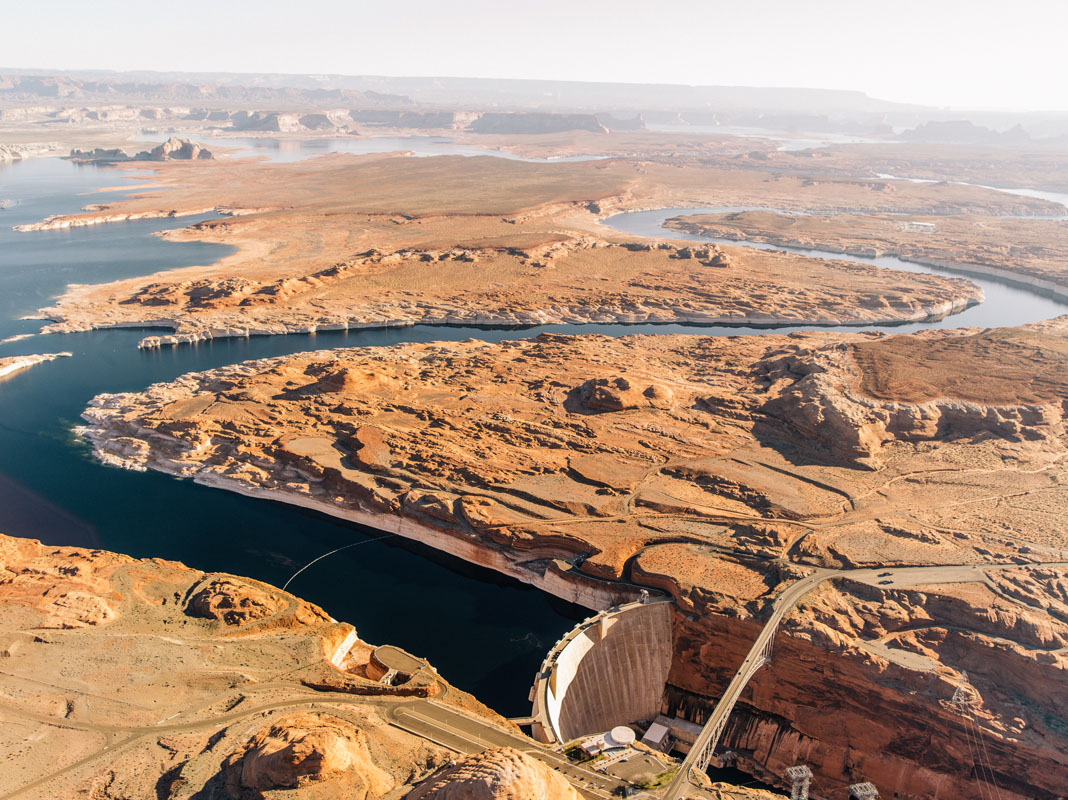
The Glen Canyon Dam holds back Lake Powell, the second-largest water reserve in the U.S. Some have suggested that taking down the dam might improve water supplies in the West. (Michael Friberg, special to ProPublica)
What Powell wrote then could just as easily summarize what the Department of the Interior is relearning today. In 2012, the Bureau of Reclamation, in an unvarnished assessment of the West’s current water predicament, found the river outmatched by demand and implied that its water projects, by themselves, were no longer an adequate answer.
The best way to spread the region’s limited water supply further was to find ways to use it more efficiently, the agency concluded.
The Navajo Generating Station was born out of jealousy and Arizona’s great ambition. In 1901, Theodore Roosevelt declared, “The western half of the United States would sustain a population greater than that of our whole country today if the waters that now run to waste were saved and used for irrigation.” Roosevelt soon signed a law creating the Bureau of Reclamation and charged it with taking back the lands of the West from nature’s control.
Arizona coveted the thriving growth of Los Angeles but couldn’t keep California from hoarding water unless it had a way to take some for itself.
What Arizona wanted was a mega-canal — an artificial river that would pump one-tenth of the Colorado’s flow out of Lake Havasu, send it upward nearly the height of the Chrysler building and halfway across the state. The state’s business leaders didn’t just yearn for water. They envisioned their own thriving metropolises, kept cool in the scorching desert with air conditioning, lit bright and speckled with verdant golf courses and retirement villas. Such a vision would be possible only with lots of cheap power.
At first the Bureau of Reclamation proposed building two large hydropower-generating dams in the Grand Canyon, filling its majestic valleys to power Arizona’s canal. Environmentalists, though, ran newspaper ads comparing the plan to flooding the Sistine Chapel. The bureau needed an alternative.
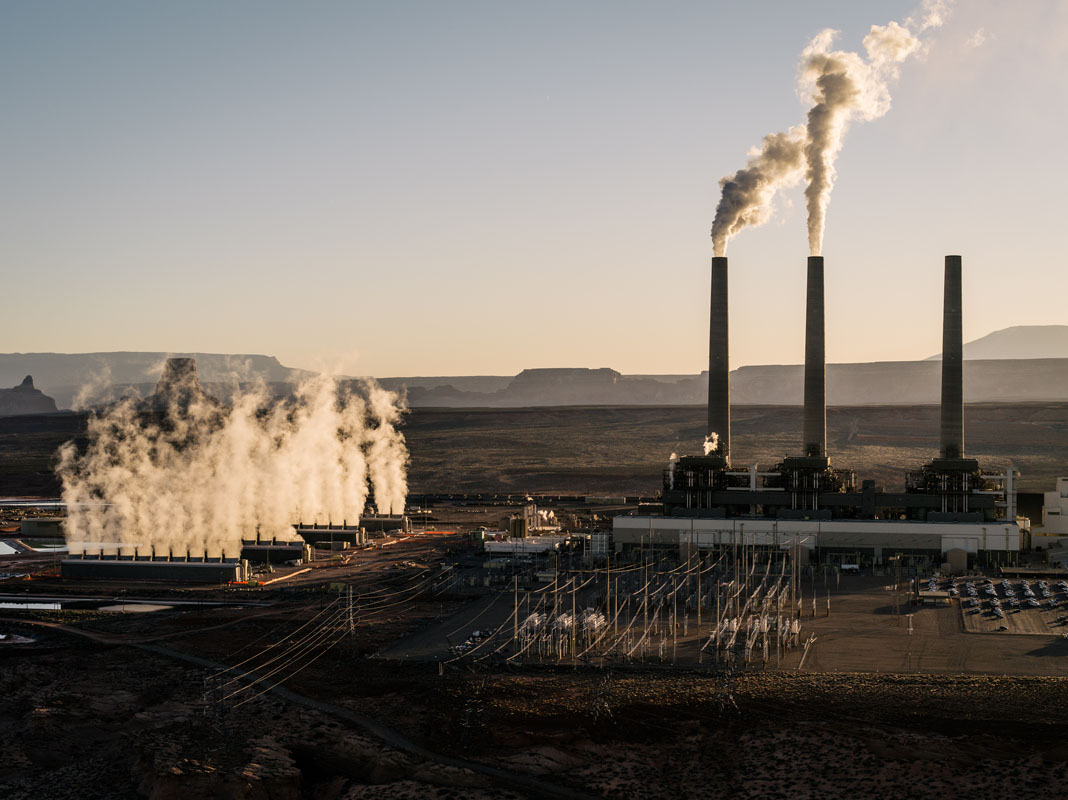
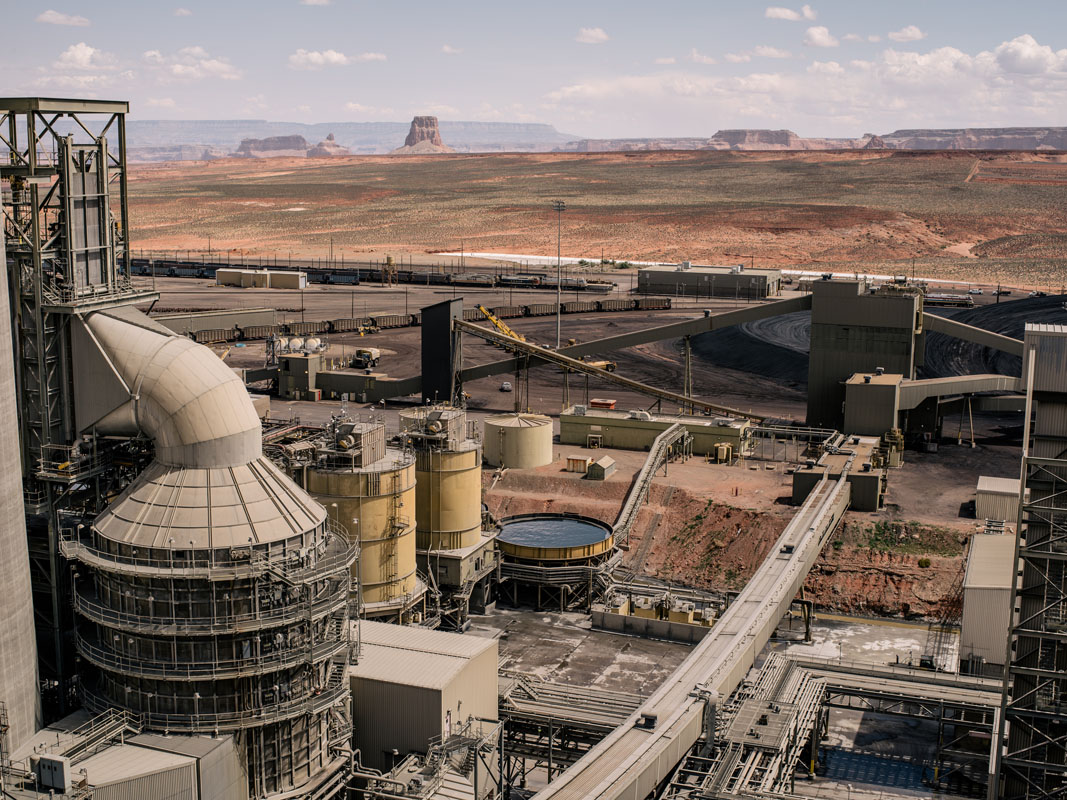
Some of Arizona’s most influential leaders have rejected the scientific consensus that the Navajo station’s carbon pollution plays any role in a warming planet or intensifying drought. (Michael Friberg, special to ProPublica)
Arizona, it turned out, had immense reserves of coal, most of it underlying the nation’s largest Indian reservation. A consortium of power companies had long been working toward what historians have called a “grand plan” to tap those coal reserves and generate the power to execute an expansive vision for Arizona and the rest of the West. In 1964, Time Magazine described the six-power-plant project as the world’s largest electricity complex, one that “would dwarf the TVA.”
The Navajo Generating Station promised to take the traditional coal plant and supersize it, employing state-of-the-art generators to produce 2,250 megawatts of power, more than all but a handful of the operating plants in the nation at the time.
The federal Bureau of Reclamation had never built a coal plant before, but it agreed to be the Navajo’s largest investor, taking a nearly 25 percent stake. The other investors included a number of Arizona utilities as well as the Los Angeles Department of Water and Power.
It all seemed a godsend. The Navajo plant would power Arizona’s big canal, the Central Arizona Project. The Native American tribes would get jobs. One of the world’s largest coal companies would mine the coal on the reservation, and a national construction firm would benefit, too. And the Southwest would get an abundant supply of homegrown energy that could support its expanding cities and cool them. The plan would even save the Grand Canyon.
“Back up and put yourself in that time frame,” said David Roberts, senior director of water resources for the Salt River Project, one of the station’s six co-owners and the operator of the plant. “It was a win-win for everyone.”
How the Navajo plant and Arizona’s water canal would pay for themselves, though, was based on a financially complex scheme, and everyone — from the federal government to Arizona’s water and power companies — had a stake. Almost none of it worked out as planned.
Most simply put, the Navajo plant — and all the pollution it caused — became a form of subsidy for cheap water. The Arizona authorities charged with selling the water in order to repay taxpayers scrambled for years just to break even, and their debt payment schedule to federal authorities is still significantly delayed.
“Financially, it wasn’t a wise decision,” said Douglas Kenney, director of the Western Water Policy Program at the University of Colorado Law School in Boulder.
For many, though, any financial setbacks mattered little when set against what the plant, the canal and the water it made available achieved: By 2010, Arizona had credited its water canal with nearly half of the state’s annual economic production.
“Monday morning quarterback all you want,” said the Salt River Project’s senior director of base load generation, Jim Pratt. The canal, Pratt said, “made Arizona, and the state has never looked back.”
Navajo turned out to be every bit as filthy as the government had warned in the 1970s, when officials predicted it would cause severe haze and health problems. The prized landscape that surrounds it, and the adjacent Four Corners region, has become significantly polluted, with 11 national parks and protected wilderness areas draped behind a curtain of smog. While no epidemiological studies have pinpointed a cause, EPA records include tribal complaints of a doubling in cancer rates in the Navajo Nation since the generating station began operating, as well as worsening asthma. The nonprofit environmental organization Clean Air Task Force estimated emissions from the Navajo plant alone were responsible for 12 premature deaths in 2012.
The EPA tried to clean up the site in the 1980s after environment groups sued — pressing for controversial emissions limits and forcing the plant, a decade later, to install expensive smokestacks that sharply reduced sulfur dioxide. But it wasn’t enough.
In 1999, the EPA tried to get serious again. Haze still veiled the national parks. The threat of climate change loomed on the horizon. The environmental tradeoffs that allowed the Navajo Generating plant to exist grew ever more dramatic.
The remaining problem was largely due to thousands of tons of nitrogen oxide that Navajo and other coal-fired plants still spewed into the atmosphere, pollution that wasn’t caught by the enormous filters installed to catch sulfur dioxide a few years before. The agency finalized a regional haze rule that aimed to restore all polluted areas — not just northern Arizona — to natural background levels of pollution. But Navajo, because it was so close to the Grand Canyon and other prized parks, would face some of the most stringent cuts.
Navajo’s owners, including both the Salt River Project and the Bureau of Reclamation, haggled with the EPA for years, suggesting alternatives and challenging the rules. But in 2009 the EPA announced its plans to force the Navajo Station into making dramatic cuts. In order to keep producing power, the agency wanted Navajo’s owners to install enormous catalytic converters that would scrub its emissions of nitrogen oxide and other pollutants, steps that would ultimately cut the plant’s most worrisome emissions by 84 percent and keeping some 28,500 tons of nitrogen oxide out of the atmosphere each year.
But in pushing for dramatic changes at the Navajo plant, the EPA underestimated how intertwined the plant had become with every aspect of life in the region — from providing its power to moving its water to buttressing the tribal economy.
The plant represented a herculean effort to solve the conflict between water and growth in the West. The EPA’s interference suggests that the consequences were too great. But Arizona and much of the broader region’s vitality had become dependent on the plant. It represented the core of the nation’s strategy to manage the most important resource for a significant chunk of the country’s economy. A seemingly simple aim of curbing pollution really suggested re-examining the larger system.
What the EPA really wanted, opponents claimed, was for the Navajo Generating Station’s owners to simply close up shop. After all, the EPA’s rulemaking process had led two other large coal plants in the region to shut down all or part of their operations.
“You don’t just close this power plant down,” said Jon Kyl, the former three-term senator and four-term congressman from Arizona who was closely involved in negotiations over the fate of the plant. “It will have an enormous impact on the entire fabric of the state of Arizona, not just because of power but because of water.”
The plant’s operators denied responsibility for the haze and claimed the fixes the EPA demanded would cost nearly $1 billion to implement. Such an expense, they argued, would cause electricity rates to skyrocket, doubling the cost of water delivered through the Central Arizona Project canal and threatening its viability. Where else would the canal, which depends on the Navajo station for more than 90 percent of its energy, get power?
Complicating any effort to recognize the plant’s problems was the fact that some of Arizona’s most influential leaders rejected the scientific consensus that the Navajo station’s carbon pollution played any role in a warming planet or intensifying drought.
Kyl, who was attuned to water scarcity issues and had sponsored several bills to address them, told ProPublica the link between the plant’s emissions and climate change “is absolutely not proven, it is simply assumed.”
As debate over the EPA’s plans meandered on, environmental groups made the case that the coal-fired Navajo was polluting the air and damaging people’s health.
“You are trying to raise your family in this environment, and you realize this is one of the top 10 dirtiest plants in the nation and it’s been spewing all this stuff for 40 years,” said Nicole Horseherder, a Navajo environmental activist. “Who is going to speak up and say, ‘Look, we are paying a huge cost so that the state of Arizona can have its profits, have its taxes, have its electricity, have its water?’ ”
Horseherder has twice testified before Congress about the power plant’s effects. Alongside groups like the Sierra Club, she urged legislators to replace coal with investment in new solar and other clean energy plants on the reservation.
Many of the strongest arguments for maintaining the Navajo as it was didn’t hold up to scrutiny.
The National Renewable Energy Laboratory, a division of the Department of Energy, analyzed the impacts of the EPA’s plan and found that power costs were unlikely to increase anywhere near as much as the plant owners insisted. “Could we have found the energy to move that water?” asked Tom McCann, Central Arizona Project’s deputy general manager of operations and maintenance, in an interview with ProPublica. “Yes.”
Finally, in July 2014, 15 years after the EPA formalized its haze rule and first set in motion rules that would curb nitrogen oxide pollution at the Navajo plant, a deal was finally struck to limit the plant’s harm.
But the deal, to many, was yet another compromise showing that the government was not yet prepared to adapt its power and water policies to a changing environmental reality.
The EPA had originally sought an 84 percent reduction in nitrogen oxide by 2018, swiftly curtailing the pollutant most linked to haze and health problems. Instead, the plant owners agreed to an 80 percent cut after 16 years, and to shut down one of its three generators for good by 2019, reducing overall emissions by one-third in the short term.
They successfully put off installing new equipment to filter the two remaining smokestacks until 2030, a delay that would get the EPA much closer to its goals for nitrogen oxide in the long run, but allow the plant more flexibility. And the government agreed to allow the plant to continue operating until 2044.
The National Parks Conservation Association called the deal “unconscionable,” and other environmental groups also took note.
“They always get special bargains and deals,” Janette Brimmer, an attorney with Earthjustice, said of the Navajo’s long history with environmental regulators.
The EPA’s Blumenfeld insists the deal is better than it appears and that federal regulators achieved their most important goal of cutting nitrogen oxide by 80 percent while considering the complex employment and social needs of the region.
“You really can’t go and meet and talk to folks on the ground and understand all the issues and then say that the solution here was to shut it down. It would have been an absolute disaster,” Blumenfeld said. “It wasn’t balancing for balancing sake, it was wanting to get it right.”
On a morning last fall, Terry Edwards stood atop a waffled steel gangplank outside the humming heart of the Navajo Generating Station, 203 feet above the sprawling concrete yard. A rising breeze came off the desert as it heated in the bright sun.
Edwards, 58, with graying hair and metal-framed glasses, could almost see the town in Utah where he was born. He’d never strayed far, coming to work at the generating station in 1979, five years after it opened. Now he’s become an operations and maintenance supervisor and is accustomed to finding the most dramatic places in the facility to show off in a tour.
He calls the plant “Big Iron,” a nod to its central role in providing power to an entire region from a single plant. “We’re one of the cheapest suppliers of energy,” he said proudly. The coal is good quality, inexpensive and practically bottomless, he said, pointing down to a yard where miniature-looking trains pull up to the endless conveyors. It’s been moving like that every day for 40 years, he said, like a giant machine. And he thinks — though the feds estimate far less — that there’s another 200 years’ worth under the reservation.
Edwards has no qualms about the effect of burning all that coal on the drought or on climate change, which he said “is cyclical and man can’t change on his own.”
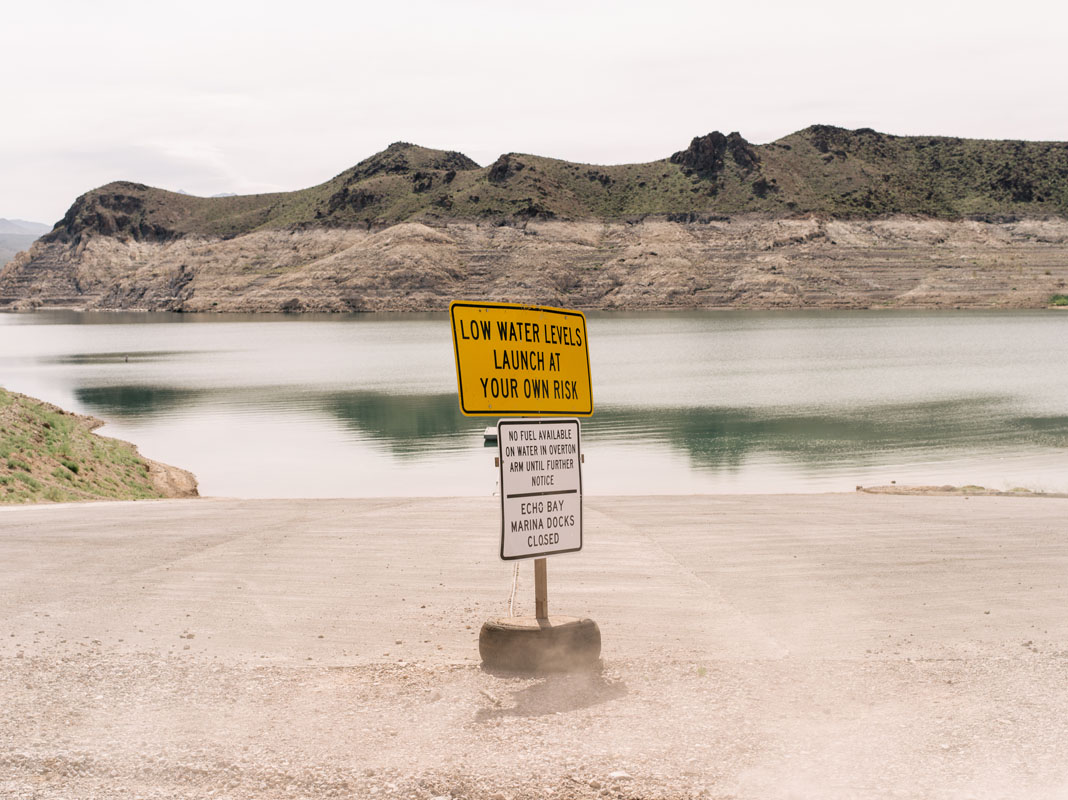
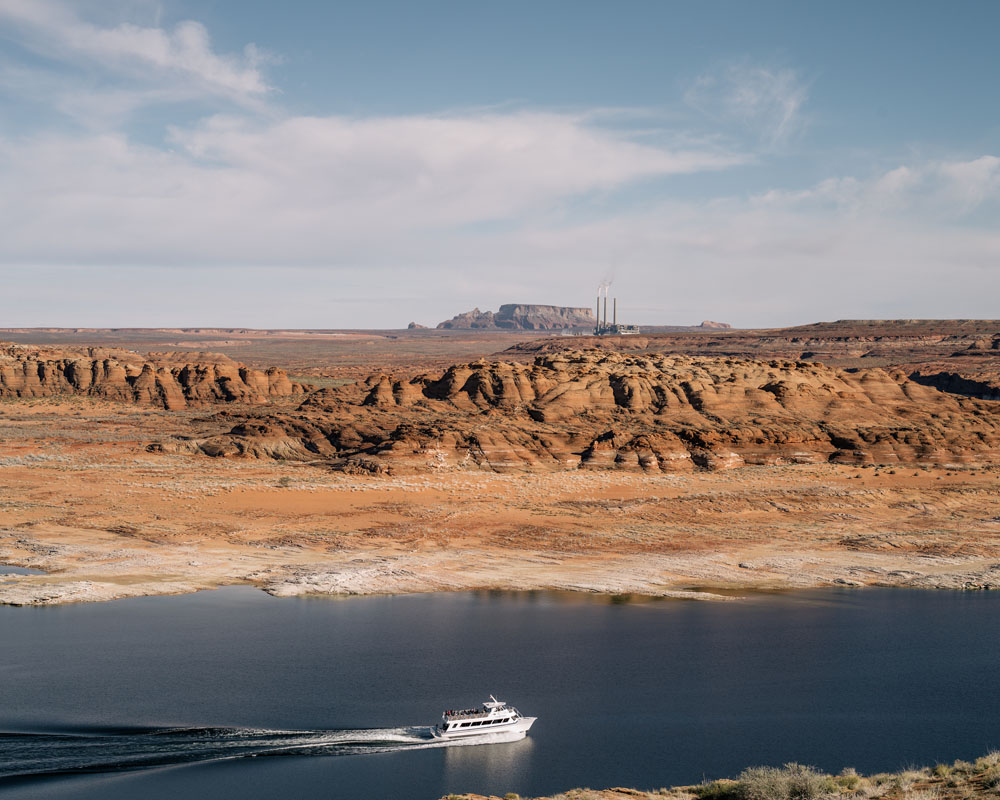
Grim signs of the West’s shrinking water reserves are everywhere. Above: A beleaguered boat ramp at Lake Mead near Las Vegas. Below: Lake Powell has recently fluctuated between 39 and 51 percent of capacity. If the drought ended tomorrow, it would take 10 years for it to fill back up. (Michael Friberg, special to ProPublica)
Even after the decadeslong debate over whether the plant’s contributions outweigh its harm, he has not reconsidered its purpose or wavered in his awe for what the generating station accomplishes, and he sees it as proof that man’s ability to conquer the West’s environment is as durable as ever.
The West is full of people like him. Indeed, as the region gets more crowded, drier and hotter, there is talk not of living within the current constraints but of engineering new ways to gather additional supplies of water. The West must continue to grow, Kyl says, or it will begin slipping backward. He thinks it will be necessary to shoot silver iodide into the clouds in an effort to make it rain or to build plants to desalt ocean water.
Some have proposed building a pipeline to route water 700 miles from the Mississippi River — or from its tributary the Missouri — to Colorado. Such a pipeline, like Arizona’s canal, would likely require yet another power plant to make it work. Others suggest towing icebergs down from the Arctic or filling tankers from Alaska’s rivers.
Though these ideas seem far-fetched, all are listed in the Bureau of Reclamation’s 2012 report on water shortages across the Colorado River basin and have been contemplated by some of the smartest policy experts in the nation.
Even if they remain out of reach, states are already racing to build billions of dollars of smaller engineering marvels in the hopes that machines and money can dig the West out of its drought.
Utah plans to dam its Bear River, at a cost of some $1.5 billion, and hopes to build a pipeline from Lake Powell, even as it runs dry. New Mexico plans to build a channel to divert water out of the Gila River before it crosses into Arizona, even though Arizona already uses much of that water. Colorado’s Legislature has discussed a plan to divert water from the Missouri River, at the far end of Kansas. California voters just passed a $7 billion water measure that amounts to a blank check but will likely be put toward new dams. The list goes on.
“Arizona will eventually have to bring water in,” said Kyl, who thinks the state has exhausted its other options. “When you cannot conserve any more and the demand exceeds the supply, you have to consider options.”
Environmentalists say it won’t work to spend new billions to add more bandages and appendages to the Colorado. The health of the river will get worse with each new diversion, they say, and the water wars between states will only intensify.
“Right now we have two colossal reservoirs and there isn’t enough water to keep even one of them full, and yet entities around the basin are trying to build more,” said Gary Wockner, executive director of Save the Colorado, an advocacy group. “They can pour more cement, but they can’t make it rain.”
Wockner and others say the elaborate projects built along the river amount to expensive distractions. The more permanent solution: Put the Colorado’s limited water to the best purpose, by planting more efficient crops, irrigating with modern equipment, writing laws that incentivize conservation, and reducing energy spent moving water over large distances.
“The Colorado River is already extremely depleted,” Wockner said. “There is nothing left to give, and it’s time to go to plan B, which is water conservation efficiency. It’s faster, cheaper and easier than building these new dams.”
As the debate continues and the water crisis deepens, the Navajo Generating Station keeps grinding away, consuming 22,000 tons of coal and emitting 44,000 tons of carbon dioxide each day, in large part to deliver Arizona’s water.
This article originally stated that the Hoover Dam is located in Boulder Canyon. It is in the Black Canyon.
Naveena Sadasivam and Lauren Kirchner contributed to this story.
By Abrahm Lustgarten
Deep beneath the bleached-out, dusty surface of the drought-stricken West is a stash of water sequestered between layers of rock and sometimes built up over centuries.
Officials in the Colorado River basin states have long treated this liquid treasure as a type of environmental retirement account — an additional supply of water they can raid to get through the driest years and make up for the chronic overuse of the rivers themselves.
In recent years, the withdrawals have taken on even more importance: At least 60 percent of California’s water now comes from underground, some researchers say. Arizona, staring down imminent rationing of Colorado River water, pumps nearly half its supply from aquifers.
But in allowing their residents to tap underground resources this way, regulators and legislators in Southwestern states have ignored an inconvenient truth about how much water is actually available for people to use: In many places, groundwater and surface water are not independent supplies at all. Rather, they are interconnected parts of the same system.
The science has been clear for the better part of a century. Drawing groundwater from near a stream can suck that stream dry. In turn, using all the water in streams and rivers lessens their ability to replenish the aquifers beneath them. Farmers who drill new wells to supplement their supplies with groundwater are often stealing water from their neighbors who hold rights to the rivers above them. This understanding has been the foundation of the U.S. Department of the Interior’s water accounting for decades, and was used by the U.S. Supreme Court to decide one of the most significant water contests in history.
Yet California and Arizona — the two states water experts say are facing the most severe water crises — continue to count and regulate groundwater and surface water as if they were entirely separate.
“States have their own take on this. Or they choose to not address it at all,” said Stanley Leake, a hydrologist with the U.S. Geological Survey and a leading expert on properly accounting for the connection between ground and surface waters in the West. “In some cases they pretend that there is no connection.”
Leaders in California and Arizona acknowledge that their states have done this, at least in part to avoid the grim reckoning that emanates from doing the math accurately. There is even less water available than residents have been led to believe.
If these states stopped effectively double-counting their resources, they would have to change laws, upend traditional water rights and likely force farmers and cities to accept even more dramatic cuts than they already face — a political third rail.
“The politics of water are more challenging than any other issue the state faces,” said Fran Pavley, a California state senator who helped draft a much-praised package of state laws passed last year regulating groundwater withdrawals for the first time.
Tucked into Pavley’s package was a little-noticed provision that explicitly prohibits California state regulators from addressing the interconnection between groundwater and surface water in local water plans until 2025, a compromise meant to give local water agencies a leisurely runway to adjust to a new way of counting.
Pavley said the prospect of more immediately acknowledging the overlap between ground and surface waters threatened to derail the legislation entirely, triggering fierce opposition from the Agricultural Council of California, the California Chamber of Commerce and other industry groups.
“Those who have unlimited water supply don’t particularly like the idea of changing that,” she said. “You can’t manage what you don’t measure.”
Arizona law, too, treats groundwater and surface water as unconnected, as does Arizona’s state water plan, which purports to account for water resources and to estimate how many years of supply remain. Its authors know better, Arizona’s top water official acknowledged, but rewriting them to be more truthful would be politically impossible and economically damaging.
“We know for a fact that pumping aquifers can dry up rivers,” said Thomas Buschatzke, the director of the Arizona Department of Water Resources, who says his policy is bound by the Legislature and court rulings. “But it is the law … it would be a huge upset to the economy to do away with that.”
The costs of refusing to acknowledge or adapt to the reality that two seemingly separate sources of water are actually often one are hard to measure but may turn out to be profound, leading hydrologists say.
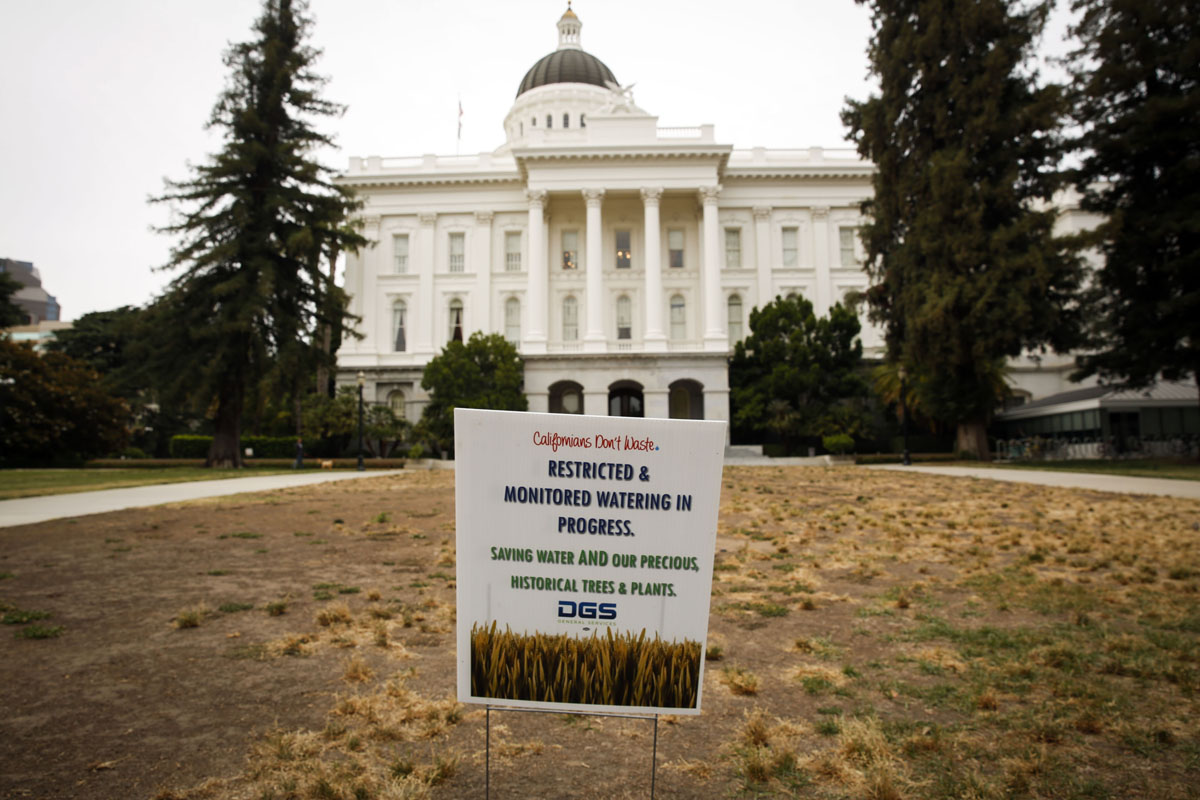
The statehouse in Sacramento, California. “The politics of water are more challenging than any other issue the state faces,” said California Sen. Fran Pavley. (Patrick T. Fallon/Bloomberg via Getty Images)
In a series of articles, ProPublica has been examining the ways in which man’s mistakes in managing water in the West have exacerbated the severity of the drought and have left Colorado River basin states less able to adapt to a changing climate. There are lots of culprits: farming subsidies for water-intensive crops, arcane laws encouraging waste, leaky infrastructure and more.
But none may be more significant than allowing a miscounting of how much water exists in the first place. Willingly overlooking the science amounts to a fundamental failure of water management, leading water experts say, one that is leading to decisions about how to use it that will deepen and prolong the drought’s painful effects. In the end, said Rich Juricich, an engineer with the California Department of Water Resources, it may mean that some places run short of the water they need.
Already, damage from the West’s increasing reliance on underground water supplies is proliferating. In parts of California and Arizona, groundwater levels are being drawn down so quickly that the earth above them is collapsing. Bridges and canals are buckling.
The more water is extracted from underground, the harder it becomes to restore the region’s rivers and reservoirs — some of which no longer flow through the summer — simultaneously sucking them dry from above and below.
“If you don’t connect the two, then you don’t understand the system,” said John Bredehoeft, a leading hydrogeologist who for many years managed the U.S. government’s western states water program for the U.S. Geological Survey. “And if you don’t understand the system, I don’t know how in the hell you’re going to make any kind of judgment about how much water you’ve got to work with.”
At about 30,000 feet above the Earth, oxygen becomes scarce, and the stratosphere begins.
Hydrogeologists estimate that the part of the Earth that holds water stretches almost as deep beneath our feet. Down there, another dark, invisible frontier awaits.
If you were to slice a knife through the Earth, a cross section would show bands of rock bent over like a bell or bent up like a bowl. When it rains, water soaks into the soil, through compacted dirt and rock, until it is blocked by an impermeable surface. There, the water can sit undisturbed for tens of thousands of years. The deeper the water, the more it is saturated with salt and minerals. But the shallowest layers — say, the first mile — can hold natural reservoirs, or aquifers, with water sweeter and cleaner than almost any other on Earth.
Ever since people figured out how to dig a hole, they have relied on this underground water. Villages from Jerusalem to central Texas were settled around wells and artesian springs. The water was hauled up by human muscle and a pulley or, eventually, with the aid of wind-powered gears.
Harnessing the power of the combustion engine allowed people to pump water from farther underground. Farmers used groundwater to turn the American High Plains — and then the West — into fertile ground for wheat and cotton and corn. Las Vegas built casinos dependent on wells.
The more water was pumped from underground, the more scientists began to ask where it came from and how much you could take before reaching a bottom.
Charles Theis, a poet and an engineer who once studied Kentucky’s geology by walking across the state, theorized that water moved in the Earth according to the same properties by which heat moved in a solid object — that is, it seeps from areas of high pressure to low pressure. “You stick a metal rod in a fire, and it takes a while for heat to get to your hand,” Bredehoeft said. “So you have to store enough heat in that rod for it to collect enough to get to your hand. Theis said that’s the way groundwater works.”
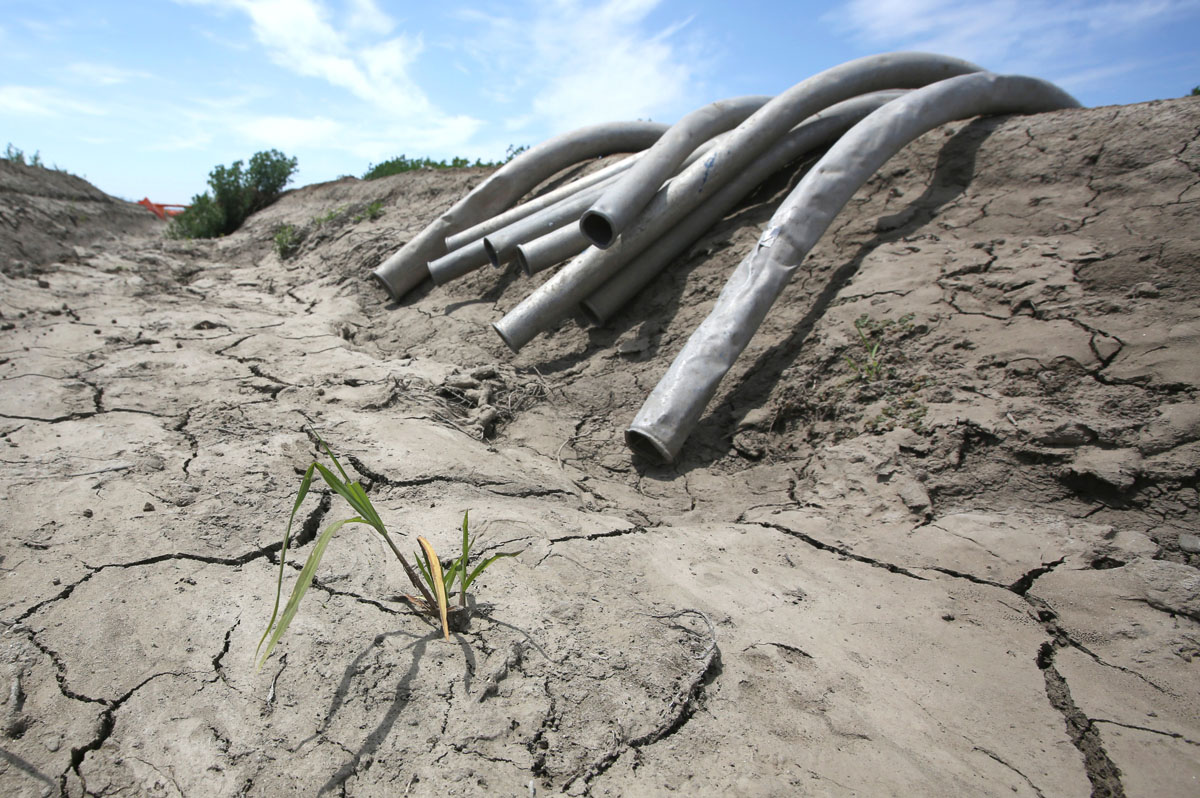
Stockton, California. More than 60 percent of the state’s water now comes from underground. (Rich Pedroncelli/AP Photo)
When Theis pumped water from an underground test well, he found the ground was constantly refilled from somewhere else. Over time, he concluded, the well was drawing most of its water from a stream miles away. Later experiments confirmed that stream and ground waters were often parts of the same system.
By the middle of the 20th century, this interconnectivity was considered proven. The energy industry began using models based on it to search for new oil. Environmental agencies used it to track pollution.
Today, it’s well understood that water pumped out of the ground by one person is water that otherwise would have filled a stream and met the needs of another person, said Bill Cunningham, chief of the Office of Groundwater at the USGS. “It may have ended up in the river tomorrow, or 100 years from now,” he said, “but it was going to end up in the river.”
Leading USGS water scientists say the connections are nearly ubiquitous, affecting at least part of almost every American waterway. For example, Las Vegas and a smattering of rural and tribal communities draw groundwater from wells and springs northeast of the city. The USGS determined that some of the groundwater in that area is connected over as much as 10 miles to the Virgin River, a tributary of the Colorado River, and Lake Mead. It used models and forecast that as groundwater withdrawals continue there in the future, as much as 90 percent of the supply could be drawn directly from the Colorado.
The dynamic works both ways: While streams can be drained by groundwater wells, they can be fed by underground aquifers, the USGS has found. That’s how streams continue to run even when it doesn’t rain.
New USGS research shows groundwater from rural western Colorado makes up a larger share of the water that eventually flows to Phoenix and Los Angeles than previously thought. According to stream gages, as much as 58 percent of the water in the Gunnison River — a prominent Colorado River tributary — comes not from snowpack on the peaks above but from groundwater.
Even as the understanding about interconnectivity has grown, western states have taken radically different approaches to regulating surface water and groundwater. The use of surface water is governed by more than a century of law and, in the case of the Colorado River, divided down to the gallon under a seven-state compact and state laws.
The pumping of groundwater, by contrast, has been left largely unregulated for the better part of the past century across California and parts of Arizona. Other states regulate their groundwater to varying degrees (Arizona does in certain populated areas) but have also been inconsistent in recognizing the connections and overlaps between their resources. Farms have drawn hundreds of millions of gallons to spread across crops, pumping more in dry years to make up for what rivers could not provide. New subdivisions have put in wells for thousands of households.
The West has consumed these resources ravenously, as if they were bottomless. By 1965, scientists measured that parts of the aquifer beneath Las Vegas had dropped by more than 75 feet. Arizona officials estimated the state’s aquifers had dropped by as much as 500 feet by 1980. By 2004, USGS scientists estimated— based on modeling — that the region south of Denver had drawn down water levels by more than 900 vertical feet.
In some places, so much water has been drained from underground, the effects can be seen with the naked eye. A USGS scientist’s 1977 photograph near the town of Mendota in central California uses a telephone pole to show how the ground had effectively collapsed, sinking some 30 feet.
Anyone who recognized these telltale signs would worry that the West’s groundwater was approaching a state of crisis. But even as the drought began and then worsened, with surface water vanishing, the West dug in and doubled down — replacing dwindling reservoirs with new water pumped from underground.
Today, the Colorado River states consume more than 21 billion gallons of groundwater each day — adding up to 1 1/2 times the flow of the Colorado River itself each year.
In 2009, Jay Famiglietti, now a scientist researching underground water in partnership with NASA’s Jet Propulsion Laboratory in Pasadena, California, set out to quantify just how much groundwater had been lost over time.
NASA had a pair of satellites that gathered data on subtle changes in the Earth’s mass by measuring almost indiscernible shifts in gravitational forces during orbit. Famiglietti and his team of doctoral students at the University of California Irvine, where he also teaches, thought they could tease out which parts of those gravitational shifts were due to a changing volume of water inside the Earth’s crust.
The team determined that aquifers were shrinking at an astonishing rate in Asia, North Africa and across the globe. The western United States stood out.
“It was among the worst in the world,” Famiglietti said. “The rate of decline is much steeper than the rate of decline of the reservoirs. While everyone is looking at the surface water, no one is looking at the groundwater, and it’s disappearing at a rapid clip.”
Famiglietti and his team determined that some 13 trillion gallons of water had been lost from underground reservoirs in the Colorado River basin since the NASA satellites began collecting data in late 2004. To put that figure in perspective, it’s nearly 1 1/2 times the total capacity of Lake Mead — the nation’s largest reservoir and the West’s most important — and as much water as the state of Arizona uses in six years.
The research suggested the seven-state Colorado River basin region was actually using about one-third more water each year than its river budget alone allowed. In separate research Famiglietti looked at California’s aquifers — which lay outside the Colorado River basin — and found that they had also been severely diminished, having dropped by about 7 trillion gallons since just 2011.
“We are living in ignorance here in California, and in Phoenix, and in Scottsdale, and in Las Vegas,” said Stephanie Castle, the doctoral student who led much of the research.
Other research conducted by the USGS in Arizona suggests that because of huge delays in the way things unfold inside the Earth, even if all the groundwater pumping stopped tomorrow, the hydrologic suck out of the Colorado River basin might increase for another 40 years as the aquifers there sought to regain their balance.
“We can’t keep doing this forever,” said Famiglietti, the NASA scientist. “We’re heading towards the bottom.”
Arizona was the rare state to identify the overuse of groundwater as a threat early on.
In 1980, the state passed what amounted to a landmark groundwater act requiring its Department of Water Resources to identify where groundwater was being depleted the fastest and to set limits on how much water could be pumped there. The state designated “active management areas” — mostly around its cities and farming regions — and then, in effect, distributed rights to harvest groundwater much the way it had distributed rights to surface waters years before on a strict first-come-first-served basis.
Later, the state regulators established tough rules forcing housing developers in those management zones to prove they had access to 100 years’ worth of water before they could get permits to build, and setting limits on how much of it could come from underground. And when the state’s water canal, built to transfer water hundreds of miles from the Colorado River, began to deliver copious new supplies, Arizona pumped that water back underground, with the goal of restoring its beleaguered aquifers.
Old sprinklers in California. The impact of efforts at conservation have been handicapped by a stubbornness in accepting the science of how water on the planet works. (Patrick T. Fallon/Bloomberg via Getty Images)
But exceptions were allowed that diluted the effect of those efforts as quickly as they were launched. In a concession to developers who feared they couldn’t secure long-term water supplies, the state passed a law in 1993 allowing them to pump groundwater in excess of their limits in one place, but then pay for more Colorado River water to be re-injected underground by newly created replenishment districts in another. Developers used the loophole far more than was anticipated, drawing heavily on groundwater, and the cities sprawled. Today the state, having created what University of Arizona professor Robert Glennon calls “an end run” around the law by essentially lending the water to builders on paper, has run up an enormous deficit; its districts project that within 10 years they will owe their aquifers more than four times as much water as they have access to — 65 billion gallons each year.
Bruce Babbitt, who as governor signed Arizona’s 1980 groundwater act and later served as U.S. Secretary of the Interior, attributes the state’s retreat on groundwater conservation to the powerful agriculture and development lobbies.
“There is no question that the various economic groups have consistently begun to undermine the provisions in the act,” Babbitt said.
There were other exceptions made, too. One rule allows farmers who were supposed to stop pumping groundwater to resume pumping — almost without limits — so long as they use modern irrigation practices that use that water efficiently. Homebuilders found they could circumvent limits on groundwater pumping for large residential developments by building just a few homes at a time, because single homes could drill new water wells without a permit.
The result is that today, following decades in which the state continued to recharge its aquifers (and had some success with this beneath parts of the larger cities), 61 percent of the state’s groundwater basins have lower water levels than they did in 1993.
Arizona officials recognize that the continued profligate use of groundwater has also been taking its toll on the state’s badly imperiled supply of surface water. Thomas Buschatzke, the director of Arizona’s Department of Water Resources, puts it as emphatically as any scientist.
“Groundwater pumping can reduce the stream flow and eventually dry up the streams,” Buschatzke said, nodding to the scientific consensus and at least one federal study that documented the phenomenon on Arizona’s Verde River.
Today, the state’s most significant natural waterways are mostly tapped out. The Gila River, which runs from the mountains of New Mexico all the way to the junction of Arizona’s westernmost edge and the Mexican border, is diminished to a trickle by the time it reaches its confluence with the Colorado. Its biggest tributaries — the Salt and the Verde — are often stopped dead at a dam east of Phoenix, if they don’t run dry before they get there.
These rivers have been emptied in part because the people who live beside them continue to drill water wells along their banks. Because of the interplay between the rivers and groundwater, they know that’s where they will find water. And Arizona, with its loosened groundwater enforcement, has let them. Year after year, as the rivers and streams have dwindled, the state’s Department of Water Resources, which requires permits, has continued to issue them, allowing new groundwater wells, and not counting their withdrawals as part of a single system.
David Roberts oversees water rights and policy for the Salt River Project, one of the state’s largest public water and power utilities, which is suing landowners over their groundwater wells. Roberts says that in the absence of laws recognizing that groundwater and surface water are pulling from the same source, people will continue to do what benefits them most, which is tap into the ground for water where they know they’ll find it.
“The easiest way to get water is to drill a well, so you have lots of wells, thousands of wells, near the stream,” Roberts said.
Buschatzke, the state water official, acknowledges that none of this is wise: the continued overuse of groundwater and the refusal to note and act upon the fact that surface water and groundwater are connected. But he says he is barred by law from actually applying that knowledge in regulating how much water Arizonans use every day, every week, every year. It’s been that way since 1931, when Arizona’s Supreme Court ruled that ground and surface waters were separate.
“We really have a bifurcated system, and there is largely not legally a connection between the groundwater aquifer and the stream flows,” Buschatzke said of the state of Arizona’s laws. Changing it might bring economic turmoil because Arizona’s economy has grown up based on that system.
As a result, he said, “We do not attempt to determine how much of the pumping might be depleting the stream flow.”
The implications are considerable.
In 2014, Arizona’s Department of Water Resources issued a plan for sustaining the state’s water supply into the future. It predicted that Arizona’s population would grow by 50 percent over the next two decades and that the state’s residents and industries would need at least 19 percent more water than they consume today.
Even without a proper accounting of overlapping water supplies, the plan warned that demand for water could “outstrip existing supplies” by 2035 unless the state pursued dramatic solutions like desalinating and piping in ocean water or artificially seeding clouds to make it rain. Though the report doesn’t state it, calculations based on figures within it suggest the shortfall could come much sooner — in as little as eight to 10 years. The pain, the report said, would be distributed broadly and affect just about everyone. (Arizona’s water department says both population and demand have been increasing slower than it had expected, relieving the threat of a shortage, but it has not released new estimates.)
All of these forecasts would, of course, be worsened if the state plan accurately counted surface and groundwater supplies, reducing the total to reflect the overlap between the two. The state’s earlier water plan from 2011 says as much, warning that the failure to account for the interconnections “may also damage the state and local economies.” Deep in a 685-page document that is part of Arizona’s state water plan, the state lists 42 groundwater basins that it says are connected to surface water, indicating a potential conflict with stream water rights. It’s nearly impossible to tell how much water would flow from one into the other, but figures in the documents make it clear that the water sources are heavily relied on as sources of both groundwater and surface supplies at the same time.
For the law governing how to count water to change now, the Legislature would have to vote on it. But that’s proved elusive, Buschatzke said, and Arizona’s elected officials have been steered away from action by farmers and industries that understand that a change would inevitably mean drastic cuts in their water.
“The issue comes up,” — in briefings and informal conversations — he said, but farmers, some cities and big industry advocate for the status quo. “And there is never enough consensus among the opposing factions to even get far enough to draft the legislation.”
“This is not perceived by people in the Legislature as a major issue that they want to invest their political capital in,” said Rhett Larson, an associate professor of Law at Arizona State University and a senior research fellow at the Kyl Center for Water Policy, whose family has farmed in Arizona for generations. “If we draw the line more brightly, then someone is going to end up on the wrong side of that line.”
Jon Kyl, the former three-term senator and four-term congressman from Arizona who is behind the Kyl Center, said he thinks a legal change is not just due, but also inevitable.
The drought may just be severe enough to compel that.
“It has to come to a head, because there are literally thousands of wells which could be taking surface water,” Kyl said. “And eventually that’s got to be sorted out.”
In n February 2014, Pavley, the California state senator, saw her best chance in years to change the way California managed its groundwater supplies.
The governor had released a water plan, an assemblyman had proposed more modest groundwater regulations, and the drought was worsening. She wanted to reform forever the way the state accounted for its water. But it didn’t figure to be easy.
California, after all, had never even bothered to count its groundwater — how much it had or how much it was withdrawing.
It had tried. The state lets its local water agencies govern groundwater, but in 2002 it mandated that those agencies could receive state funds only if they set up groundwater management plans and investigated whether a connection between surface and groundwater existed. Fewer than half the state’s water districts ever complied, and only 17 percent of the state’s groundwater area has ever been examined, the state’s Department of Water Resources recently reported. According to Rich Juricich, an engineer with the California Department of Water Resources, California had endured the early years of the worst water crisis in centuries with nothing more than “a general idea” of how much water was actually available.
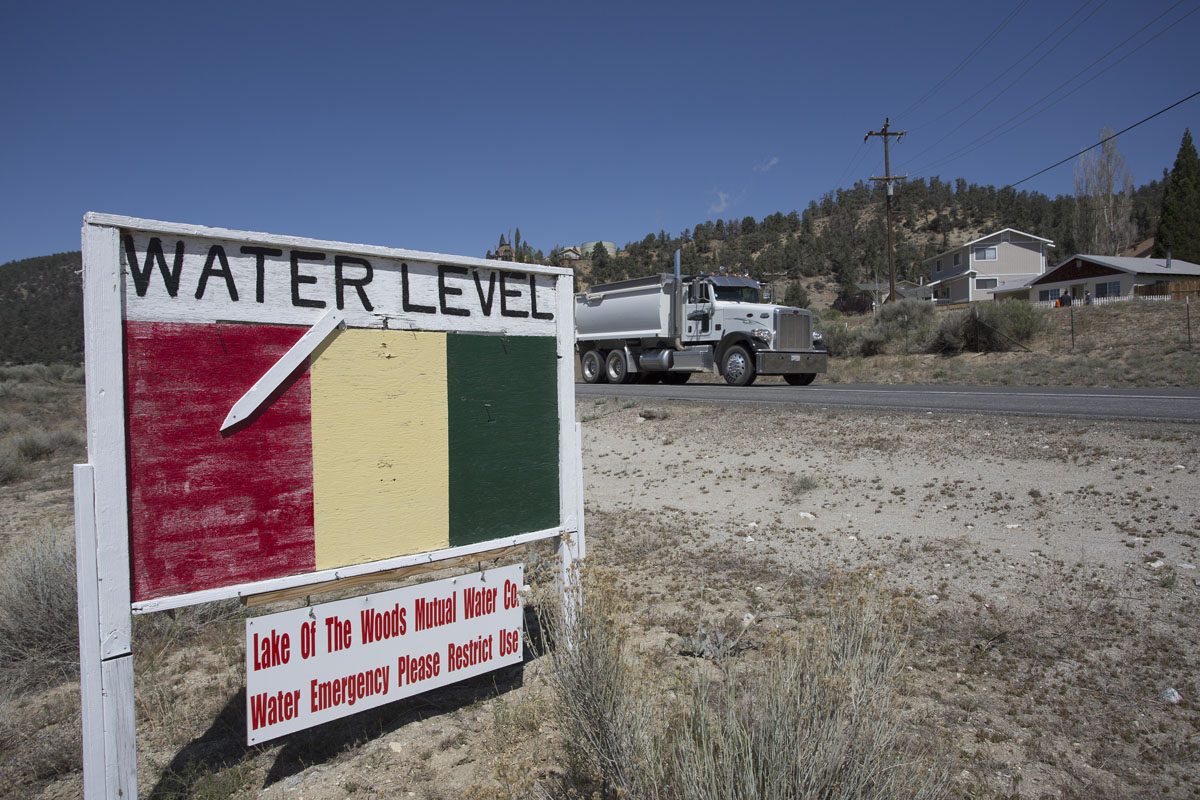
Kern County, California. In 2009, Jay Famiglietti, a scientist researching underground water, set out to quantify just how much groundwater had been lost over time. “We can’t keep doing this forever,” Famiglietti said of the vast and often unregulated withdrawals. “We’re heading towards the bottom.” (David McNew/Getty Images)
Pavley, a liberal Southern California legislator who has chaired the state’s water committee for the past seven years, was convinced it was time for a step forward. She rallied support among interest groups, embraced the assembly measure and wrote two more ambitious bills to drive the agenda: The bills would for the first time require the state — through its local agencies — to determine how much groundwater it had, how much was being taken and what effect that was having on the state’s surface water supply.
“Timing is everything,” Pavley said. “Our being the last of the western states to manage our groundwater basins resonated, at least with a majority of the legislators.”
The pushback against the efforts was fierce.
“What part of agriculture are we going to dewater and put out of business?” asked Danny Merkley, a farmer and director of water resources for the California Farm Bureau Federation, in an interview with ProPublica. The bureau was among the most influential organizations that lobbied against the bills.
Pavley’s opponents argued that the connection between surface and groundwater varied. Farmers insisted they needed more time to adjust to a world where water was properly counted because it would inevitably mean that less of it would be doled out. Some claimed the bills amounted to gross overreaching by the government.
No one denied the science.
“California has treated surface water and groundwater as distinct items, so there were those who didn’t want to change that,” said a state Senate staff member close to the negotiations. “Most of the agricultural interests were opposed: the Agricultural Council of California, the Association of Egg Farmers, the Bean Shippers Association, the Farm Bureau Federation, dairy farmers.”
In a position paper prepared last August and recently sent to ProPublica, the California Chamber of Commerce, which lobbied against the groundwater legislation, said Pavley’s bills aimed at better counting and regulation would set off an explosion in costly and lengthy litigation. The paper warned of “a veritable feeding frenzy for environmental attorneys.”
Those pushing back prevailed. Last September, the Sustainable Groundwater Management Act was signed into law. It amounted to far less than Pavley and others had hoped. California authorities will not even begin counting groundwater withdrawals for a decade. And, explicitly, the state is barred for 10 years from any effort to “remedy a condition where the groundwater extractions result in significant depletions of interconnected surface waters.”
Pavley, for her part, is proud of what was achieved. “You never get everything you want, but you have to start somewhere,” she said.
She regards the law as a critical and substantial step that promises to close a gaping hole in the way California manages its water. For her, merely putting the surface and ground water connection on the record is significant, given the state’s history and the interests at play. She only wishes the law’s teeth would bite sooner.
“So it’s going to take up to 20 years to implement a sustainable groundwater management plan,” she said, “and if you are overdrafting today and you are in the middle of a severe drought, of course it doesn’t seem like this is fast enough, but it is complicated.”
Those who will implement the plan urge patience.
“You have to take this a step at a time, and it’s something I don’t think we can just turn around overnight,” said David Gutierrez, the Department of Water Resource’s manager for the state’s Sustainable Groundwater Program. “It’s going to take us a while to get out of the hole and figure out what we are doing in the future. This legislation is not to fix the problems of yesterday, it’s to fix the problems of tomorrow.”
“Should we have done this decades ago?” he adds, “Heck yeah.”
What California and Arizona are both so reluctant to accomplish, the federal government has been routinely doing for more than 50 years: counting the waters it controls as from a single source, and using an honest estimate of the total to determine the resources available for people to use.
But that kind of accounting is far from easy, and it requires vigilance.
Paul Matuska is the closest thing the American West has to a water cop, and his beat includes Needles, California, a dog-eared desert town midway between Flagstaff, Arizona,
and Los Angeles.
About 4,800 people live in Needles, on the western banks of the Colorado River where it cuts a swath in the mud between California and Arizona. An old railroad town and the gateway to the farmland of the Fort Mojave Indian Reservation across the river, Needles has 16 churches, seven gas stations and an 18-hole golf course.
Matuska, a hydrologist, manages a small group of accountants for the federal Bureau of Reclamation, which controls water distribution along the lower half of the Colorado River. His job is to count the water used by towns like Needles and the farms around them — lands close by the legendary and essential Colorado — and make sure they don’t take more than their share of the river.
“We’ve been doing this for a long period of time,” Matuska said. “The Colorado River basin is definitely a resource that we want to protect.”
Needles, despite its proximity to the physical river itself, gets most of its water from underground — pumping hundreds of million gallons a year from four wells drilled into the local aquifer. But if you could dive beneath the Earth near Needles, you’d discover a subterranean valley packed with porous gravel. That gravel is filled with water, a shallow aquifer that Needles taps to sprinkle its golf greens and feed its taps.
Even as Needles pumps the water from its underground valley, the water level in the wells never drops. Instead, water rushes toward it, underground, from the direction of the river. The nearby Colorado essentially flows beneath the surface, spilling away from the riverbed and filling the bathtub of the valley for miles in either direction. Of course, the seemingly separate sources of water are actually one and the same.
Matuska’s job is to make sure that’s the way the water is counted.
He estimates that the wells in Needles draw an average of about 700 million gallons of groundwater annually that, in truth, ultimately comes from the Colorado River.
Technically, that water has already been doled out, with strict budgets allowed for each of the states along the river. And so to avoid double counting the valley’s resources, Matuska subtracts the water Needles uses from the amount California is allowed to pump into its canals and ship to Los Angeles and elsewhere each year.
But the federal government has the authority to take this approach only in the few places where it has direct control, slender swaths of land adjacent to the Colorado. So long as it is not being distributed through a federal facility, the feds leave the rest of the West’s water — its counting and its distribution — to the states and their laws.
And so Matuska and a dozen or so other scientists who make up the bureau’s accounting team stick to what they can change: analyzing the Colorado River aquifers through small towns from Needles to Blythe to Yuma.
On patrol one day last fall in Blythe, another California town along the Colorado, Matuska drove his SUV looking for large green lawns in rural areas that he hadn’t noticed before — a new farm field or some other sign of small-scale irrigation bringing life to a red desert. When he can’t see from the roads, he scans satellite images, looking for patches of green that haven’t already been accounted for. He wants to know, and report, how much water was used to create such little wonders.

A water conservation official about to begin his patrol in Sacramento, California. Some experts think years of leaving the task of accurately counting and rigorously regulating water supplies to individual states has contributed to today’s crisis in the West. (Patrick T. Fallon/Bloomberg via Getty Images)
The city of Blythe estimates its wells draw more than 1.2 billion gallons of groundwater annually that Matuska says ultimately come from the Colorado, and he counts it — through complex calculations — as part of the much larger amount of river water used by a farming district surrounding the city. Matuska estimates that on the whole, California water users in the area draw more than 2 billion gallons of groundwater from the Colorado River each year, which, through his strict accounting, is then properly factored into the state’s larger water math.
As for the continued failure of the states to do likewise, Matuska has little understanding or sympathy.
“To the degree that you want to maintain a long-term sustainability, you need to factor the entire hydrologic system into your decision,” Matuska said. “I don’t know how else to say it.”
This story was co-published with Matter, a new digital magazine on Medium. Follow ProPublica on Medium for more conversation on the West’s water crisis.
Naveena Sadasivam and Lauren Kirchner contributed to this story.
To the judges,
Abrahm Lustgarten’s “Killing the Colorado,” was the defining work of reporting on one of the nation’s most urgent issues: the water crisis in the American West.
Informed. Surprising. Damning. Engaging and enraging. Full of secrets and solutions.
The five-part series amounted to a sophisticated and searing indictment of years of flawed public policy, at the local and national level both.
For starters, “Killing the Colorado” definitively dispelled one of the fundamental misapprehensions about the crisis – that it is solely the result of an epic drought that occurs once in a thousand years. As the stories demonstrated, the crisis is as much, or more, an act of man, the result of generations of legislative and legal decisions that trace to greed, political cowardice and willful ignorance of basic science.
Lustgarten dug out one scandal after another – from the enormous and baroque U.S. farm bill; from the ancient, long forgotten legislation governing water rights and landowners; from the musty archives of the Southern Nevada Water Authority, which held every water use permit issued going back decades; from the EPA’s enforcement actions against the Navajo Generating Station in Arizona; and from NASA satellite data that showed that, for all the concern about the drought, states continue to mislead the public about how little water there actually is.
“Redefining epic,” Jay Famiglietti, a professor at the University of California, Irvine and one of the nation’s leading water scarcity experts, said of “Killing the Colorado.”
Because ProPublica allows its work to be republished for free, newspapers in Arizona ran several of the stories in full. Scientific American ran every one of them on its website. The Denver Post ran an editorial based on Lustgarten’s reporting. The Los Angeles Times asked Lustgarten to write an op-ed piece on the prospect of establishing a fair-value market for water as a properly understood commodity. His series even inspired the Discovery Channel to adapt “Killing the Colorado” into a feature documentary.
“This is exactly the sort of journalism that this subject matter has needed for a decade,” said Doug Kenney, director of the Western Water Policy Program at the University of Colorado Law School.
Abrahm Lustgarten is one of the foremost environmental reporters in the U.S. He had been studying the water crisis in the American West for years. He recognized the full dimensions of the issue, and built a foundation of scholarship and sources, oral histories and official documents.
Still, to simultaneously research, report and write the five installments of “Killing the Colorado” was a gargantuan task. It required that Lustgarten master the science of hydro-geology; it meant penetrating the closed world of Las Vegas politics; it required that he win the trust of cotton farmers and persuade them to, in effect, come clean on the recklessness of their decades of government subsidies; it meant having the audacity to question the wisdom of an engineering marvel that had made a city like Phoenix possible but that was contributing to a rate of climate change that was imperiling the entire planet; it mandated that he walk miles and miles of Western farmland to understand and assess the fear among those who had owned those acres for generations.
Across more than 12 months, Lustgarten read widely and reported rigorously. And then he wrote bravely – taking on the entrenched interests, puncturing myths, highlighting hypocrisy. His reporting, and the presentation of its findings, were brilliantly complemented by the research, design, and software development by Al Shaw, Jeff Larson, Naveena Sadasivam and David Sleight.
“Your Colorado River pieces are provocative,” said John Bredehoeft, a former senior research geologist from the Water Resources Division of the USGS. “For me, the story in California is the opposition to groundwater legislation. Those opposed would rather see the system fail than to have regulation. When failure occurs they can blame it on Mother Nature.”
“Killing the Colorado” also represented an inaugural collaboration for ProPublica. Matter, the online publishing site, financed the photography for the project and then hosted online debates about Lustgarten’s reporting. Each of Lustgarten’s installments – co-published on Matter’s site – were accompanied by a discussion involving a pair of experts who hashed out the history and attempted to see more clearly a sustainable future.
The full impact of the series will not be known for years. That’s how slowly America responds to crisis. But there can be little doubt that Lustgarten’s work helped reset the terms of the debate about what that impact ought to look like. The series was, at its heart, a bracing dose of desperately needed honesty and self-examination.
We are proud to nominate Lustgarten’s “Killing the Colorado” for the Pulitzer Prize in National Reporting.
Best,
Stephen Engelberg
Editor-in-Chief, ProPublica