Justin Chang of the Los Angeles Times
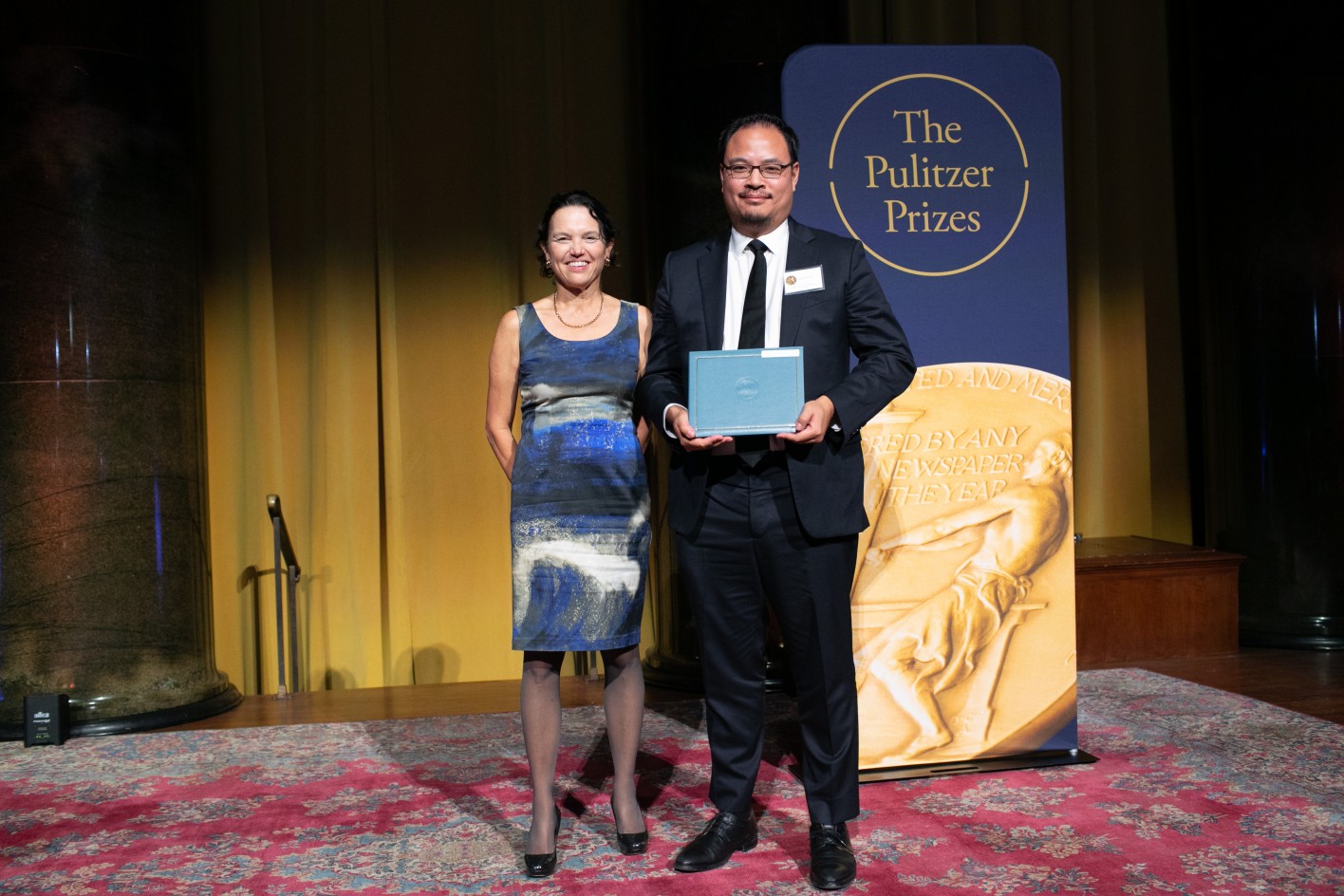
Justin Chang (right) accepts the 2024 Pulitzer Prize for Criticism from Columbia University Interim President Katrina Armstrong. (David Dini/The Pulitzer Prizes)
Winning Work
By Justin Chang
The key word in Christopher Nolan’s “Oppenheimer” is “compartmentalization.” It’s a security strategy, introduced and repeatedly enforced by Col. Leslie R. Groves (Matt Damon) in his capacity as director of the Manhattan Project, which is racing to build a weapon mighty enough to bring World War II to an end. In Groves’ mind, keeping his various teams walled off from one another will help ensure the strictest secrecy. But J. Robert Oppenheimer (Cillian Murphy), the brilliant theoretical physicist he’s hired to run the project laboratory in Los Alamos, N.M., knows that compartmentalization has its limits. The success of their mission will hinge not on isolation but on an extraordinary collaborative synthesis — of physics and chemistry, theory and practice, science and the military, the professional and the personal.
In the weeks since “Oppenheimer” opened to much critical acclaim and commercial success, Groves’ key word has taken on an unsettling new meaning. Compartmentalization, after all, is a pretty good synonym for rationalization, the act of setting aside, or even tucking away, whatever we find morally troubling. And for its toughest critics, many of them interviewed for a recent Times piece by Emily Zemler, “Oppenheimer” compartmentalizes to an outrageous degree: In not depicting the atomic bombings of Hiroshima and Nagasaki, they argue, the movie submits to a historical blindness that it risks passing on to its audience. Nolan, known for crafting fastidiously well-organized narratives in which nothing appears by accident, has been taken to task for what he chooses not to show.
Most of those decisions, of course, flow directly from his source material, “American Prometheus,” Kai Bird and Martin J. Sherwin’s authoritative 2005 Oppenheimer biography. With the exception of one key narrative thread, everything onscreen is framed, per biopic convention, through its subject’s eyes. And so you see Oppenheimer as an excitable young physics student, and you behold his eerie, captivating visions of the subatomic world. You see him become one of America’s leading physicists, take a major role in the secret race to the A-bomb and, together with his recruits, devise and build the world’s first nuclear weapons. You see his shock and awe when the Trinity test proves successful, lighting up the desert sky and landscape with a blinding flash of white and a 40,000-foot pillar of fire and smoke.
What you don’t see — because Oppenheimer doesn’t see them either — are the bomb’s first victims: the thousands of New Mexicans, most of them Native American and Hispanic, who dwell within a 50-mile radius of the Trinity test site and whose exposure to radiation will have deadly health consequences for generations. You don’t see the bombs being dropped on Hiroshima and Nagasaki; you don’t see the lethal conflagrations and ash-covered rubble, and you don’t see the bodies of Japanese victims burned beyond recognition, or hear the screams and wails of survivors. (Estimates place the eventual death toll at close to 200,000.)
In refusing to visualize these horrors, is Nolan showing admirable dramatic restraint or committing unforgivable sins of omission? Is he merely sticking to his subject’s perspective or conveniently dodging the kind of imagery that would trouble Oppenheimer’s conscience?
As it happens, the scientist does in fact see that imagery, and his conscience is duly troubled. In one key scene, the camera studies Oppenheimer and his colleagues as they watch disturbing footage of the bombings’ aftermath. An offscreen speaker describes how thousands of Japanese civilians were incinerated in an instant, while thousands more died excruciating deaths from radiation poisoning. You see Oppenheimer recoil, even if what he recoils from is left pointedly out of frame.
These are not the only images of WWII that the movie withholds. It’s a measure of the formal and structural rigor of “Oppenheimer” that we see nothing of the Pacific theater conflict, and nothing of the European theater conflict, either — not even when Oppenheimer fears that the Nazis might be building a nuclear weapon of their own. Nolan, who always trusts us to keep up with his elaborately constructed puzzle-box narratives, also trusts us to know a thing or two about history. And crucially, he wants to open up a different perspective on the war, to show how some of its most crucial tactics and maneuvers played out not on battlefields but in classrooms and laboratories — and, finally, in the theater of Oppenheimer’s mind.
It’s a brilliant mind, to say the least. It’s also ill prepared for the terrifying, world-altering reality that it ushers into being. Oppenheimer may see footage of Hiroshima and Nagasaki, but images are a poor substitute for reality; he will never walk among the ruins, witness the despair of the survivors or behold the devastation up close. Nolan knows that we can’t either. What’s more, he clearly believes that we shouldn’t be able to.
Seen in this light, the director’s refusal to thrust his camera onto Japanese soil, far from being an act of historical vagueness or obliviousness, instead represents a carefully thought-out, rigorously executed solution to the problem of how to represent history. And his solution speaks not to his insensitivity but his integrity, his refusal to exploit or trivialize Japanese suffering by re-enacting it for the camera. Nolan lays the groundwork in one of his most revealing scenes, shortly before the decision is made to target Hiroshima and Nagasaki. As Oppenheimer looks on, U.S. Secretary of War Henry L. Stimson (James Remar) removes Kyoto from the list of potential targets, citing the city’s cultural and historical significance and fondly recalling that he and his wife honeymooned there years earlier.
Before the bombings have even taken place, Nolan, in this one scene, indicts the arbitrary callousness of a U.S. war machine that cloaks its destructive intentions in cultural high-mindedness and rank sentimentality. It’s an appalling moment, and Stimson unambiguously solicits Oppenheimer’s contempt as well as the viewer’s; watch that scene in a packed house and you’ll hear the audience scoff as one. You might also begin to suspect, if you haven’t already, that Nolan isn’t going to dramatize the bombings in straightforward fashion, if he means to dramatize them at all.
Nolan has never been turned on by spectacles of violence. Even “Dunkirk,” a harrowing if ultimately optimistic World War II bookend of sorts to “Oppenheimer’s” apocalyptic despair, is a combat picture far more driven by ideas than by carnage. Violence certainly plays its part in Nolan’s movies, but seldom is it an end in itself. Reviewing “Oppenheimer” in the New York Times, Manohla Dargis noted, “There are no documentary images of the dead or panoramas of cities in ashes, decisions that read as [Nolan’s] ethical absolutes.” And in a recent Decider essay, the critic Glenn Kenny shrewdly examined “Oppenheimer” alongside Alain Resnais’ elliptical 1959 masterpiece, “Hiroshima Mon Amour,” itself a powerful commentary on the futility of trying to represent the unrepresentable. “Had Nolan chosen to somehow ‘recreate’ the bombing of Hiroshima,” Kenny writes, “we, the viewers, would really see nothing.”
Japanese filmmakers, of course, have been powerfully evoking and re-creating the bombings for decades: Kaneto Shindo’s “Children of Hiroshima” (1952) and especially Shohei Imamura’s devastating “Black Rain” (1989) are just two well-known examples. Over the past few weeks, social media users have circulated clips of Mori Masaki’s 1983 anime “Barefoot Gen,” an adaptation of Keiji Nakazawa’s manga series of the same title. It contains what is surely one of the cinema’s most upsetting, unsparingly graphic depictions of the atomic blast and its casualties. It’s one of several animated films, including Renzo and Sayoko Kinoshita’s 1978 short “Pica-don” and Sunao Katabuchi’s “In This Corner of the World” (2016), that have confronted the destruction of Hiroshima and Nagasaki with a boldness and artistry that live-action cinema can be hard-pressed to match.
Much of this evidence has been marshaled in Nolan’s defense: Surely this is Japan’s story to tell, not his. I’m reluctant to embrace that particular stay-in-your-lane logic, which is ultimately deadening to the cause of art and empathy. As Clint Eastwood demonstrated in “Letters From Iwo Jima,” it is not beyond a white Hollywood filmmaker’s ability to enter persuasively and movingly into the mindset of a wartime enemy. Even so, that clearly isn’t the story Nolan is telling. And with such a wealth and variety of Japanese fiction and nonfiction filmmaking on the atomic bombings already, why should “Oppenheimer” bear the responsibility of representing events and experiences that fall outside its subject’s perspective?
Some would rebut that “Oppenheimer,” being a Hollywood blockbuster with serious global reach (whether it will play Japanese theaters remains uncertain), will be many audiences’ only exposure to the events in question and thus might “create a limit on public consciousness and concern,” as the poet, writer and professor Brandon Shimoda told The Times. A corollary of this argument: The crimes committed against the people of Hiroshima and Nagasaki were so unspeakable, so outsized in their impact, that Oppenheimer’s perspective does and should dwindle into insignificance by comparison. For Nolan to focus so exclusively on an American physicist’s story, some insist, ultimately diminishes history and humanity, even as it reinforces the Hollywood hegemony of the great-man biopic and of white men’s narratives in general.
I get those complaints. I also think they betray an inherent disrespect for the audience’s intelligence and curiosity, as well as a fundamental misunderstanding of how movies operate. It’s telling that few of these criticisms of perspective were leveled at “American Prometheus” when it was published in 2005, that no one begrudged Bird and Sherwin for offering a meticulously researched, morally ambivalent portrait of their subject’s life and consigning the destruction of two Japanese cities to a few pages. That’s because books are books, the argument goes, and movies are movies — and this perceived difference, it must be said, reveals a pernicious double standard.
Because they seldom achieve the narrative penetration and richness of detail of, say, a 700-page biography, movies, especially those about history, often are hailed as achievements of breadth over depth, emotion over intellect. They are assumed to be fundamentally shallow experiences, distillations of real life rather than sharply angled explorations of it, propelled by broad brushstrokes and easy expository shortcuts, and beholden to the audience’s presumably voracious appetite for thrilling, traumatizing spectacle. And because movies offer a visual immediacy and narrative immersion that books don’t, they are expected to be sweeping if not omniscient in their narrative scope, to reach for a comprehensive, even definitive vantage.
Movies that attempt something different, that recognize that less can indeed be more, are thus easily taken to task. “It’s so subjective!” and “It omits a crucial P.O.V.!” are assumed to be substantive criticisms rather than essentially value-neutral statements. We are sometimes told, in matters of art and storytelling, that depiction is not endorsement; we are not reminded nearly as often that omission is not erasure. But because viewers of course cannot be trusted to know any history or muster any empathy on their own — and if anything unites those who criticize “Oppenheimer” on representational grounds, it’s their reflexive assumption of the audience’s stupidity — anything that isn’t explicitly shown onscreen is denigrated as a dodge or an oversight, rather than a carefully considered decision.
A film like “Oppenheimer” offers a welcome challenge to these assumptions. Like nearly all Nolan’s movies, from “Memento” to “Dunkirk,” it’s a crafty exercise in radical subjectivity and narrative misdirection, in which the most significant subjects — lost memories, lost time, lost loves — often are invisible and all the more powerful for it. We can certainly imagine a version of “Oppenheimer” that tossed in a few startling but desultory minutes of Japanese destruction footage. Such a version might have flirted with kitsch, but it might well have satisfied the representational completists in the audience. It also would have reduced Hiroshima and Nagasaki to a piddling afterthought; Nolan treats them instead as a profound absence, an indictment by silence.
That’s true even in one of the movie’s most powerful and contested sequences. Not long after news of Hiroshima’s destruction arrives, Oppenheimer gives a would-be-triumphant speech to a euphoric Los Alamos crowd, only for his words to turn to dust in his mouth. For a moment, Nolan abandons realism altogether — but not, crucially, Oppenheimer’s perspective — to embrace a hallucinatory horror-movie expressionism. A piercing scream erupts in the crowd; a woman’s face crumples and flutters, like a paper mask about to disintegrate. The crowd is there and then suddenly, with much sonic rumbling, image blurring and an obliterating flash of white light, it is not.
For “Oppenheimer’s” detractors, this sequence constitutes its most grievous act of erasure: Even in the movie’s one evocation of nuclear disaster, the true victims have been obscured and whitewashed. The absence of Japanese faces and bodies in these visions is indeed striking. It’s also consistent with Nolan’s strict representational parameters, and it produces a tension, even a contradiction, that the movie wants us to recognize and wrestle with. Is Oppenheimer trying (and failing) to imagine the hundreds of thousands of Japanese civilians murdered by the weapon he devised? Or is he envisioning some hypothetical doomsday scenario still to come?
I think the answer is a blur of both, and also something more: In this moment, one of the movie’s most abstract, Nolan advances a longer view of his protagonist’s history and his future. Oppenheimer’s blindness to Japanese victims and survivors foreshadows his own stubborn inability to confront the consequences of his actions in years to come. He will speak out against nuclear weaponry, but he will never apologize for the atomic bombings of Japan — not even when he visits Tokyo and Osaka in 1960 and is questioned by a reporter about his perspective now. “I do not think coming to Japan changed my sense of anguish about my part in this whole piece of history,” he will respond. “Nor has it fully made me regret my responsibility for the technical success of the enterprise.”
Talk about compartmentalization. That episode, by the way, doesn’t find its way into “Oppenheimer,” which knows better than to offer itself up as the last word on anything. To the end, Nolan trusts us to seek out and think about history for ourselves. If we elect not to, that’s on us.
By Justin Chang
The two girls we see patiently digging away at a Mississippi hillside in “All Dirt Roads Taste of Salt” are taking part in an age-old tradition, one that has long been passed down by Black women in the rural South. As they shake and sift, the girls isolate choice particles of clay-enriched earth to eat, a practice that ties them to a distant African ancestral past as well as the very ground beneath their feet.
There’s wisdom in learning to embrace the delicacies of dirt: Open your eyes, your hands and your taste buds, the idea goes, and you might be surprised and even satisfied by what you find. That’s not a bad approach to some movies too, this stunningly lyrical dust-to-dust epic not least among them.
A ravishing first feature from poet and photographer Raven Jackson, “All Dirt Roads Taste of Salt” tells the story of Mack, whom we encounter as a toddler, a preadolescent, a young adult and a middle-aged woman, but not in that order. (She is played at those respective life stages by actors Mylee Shannon, Kaylee Nicole Johnson, Charleen McClure and Zainab Jah.) The story, whose earliest moments take place during the 1970s, drifts freely back and forth across years and eventually decades, never supplying obvious narrative signposts or pausing to let us get our bearings. Over time you learn to recognize Mack by the way her hair is braided, the clothes she’s wearing, the presence or absence of earrings. This is a movie that teaches you how to watch it.
That’s only fitting, since teaching is fundamental to what it’s about. It begins on the bank of a river, where young Mack (Johnson) is learning to fish from her father, Isaiah (Chris Chalk), while her older sister, Josie (played here by Jayah Henry and later by Moses Ingram), looks quietly on. “Not too quick,” Isaiah murmurs as Mack cranks the fishing rod. A similar patience suffuses this scene and others like it, none of which feel like means to an obvious dramatic end. Jackson seems to be after nothing more (or less) profound than letting us soak in the moment, and she wants us to experience its physical sensations not vicariously but viscerally: the warmth of sunlight on skin, the cool of rushing water, the rough texture of fish scales under Mack’s gently probing fingers.
In a significant sense, fingers and hands tell the story. Jackson, working with cinematographer Jomo Fray (who shot the picture on 35mm), photographs those extremities with enough grace and attention to suggest that the French master Robert Bresson might be one of her many influences. (She has cited Terrence Malick, Chloé Zhao and Carlos Reygadas, all auteurs similarly under the spell of the natural world.) Like Bresson, Jackson uses hands to remind us that our identities consist of more than faces and names, that a touch or a gesture can be equally expressive of who we are.
And so she lingers, absorbingly, over the sight of a woman pressing a newborn into her sister’s arms. Sometime later, we’ll see the siblings bathing the infant over a sink, one of them cupping handfuls of water with an almost baptismal solemnity and tenderness. Neither woman’s face is visible in either scene, an intentional omission that Jackson echoes elsewhere by shooting her characters from behind as they walk. That’s a fairly common art-film strategy that often hints at an overarching universality: These individuals represent something larger than themselves. But in the scenes of child rearing, the absence of faces expresses something more: a depth of sisterly intimacy and family solidarity that renders exposition superfluous.
Even without that exposition, “All Dirt Roads Taste of Salt” flows intuitively. Jackson has composed a sensory poem of extraordinary tactility and stealthy emotional force, but she has also constructed a story from fragments you immediately recognize and contextualize: the tragedy of losing a home, the pleasure of hearing a song in church and the consolation of resting your head in your grandmother’s lap. It’s about what happens when a young man named Wood enters the picture, first as a childhood friend of Mack’s (played by Preston McDowell) and later as her teenage sweetheart (Reginald Helms Jr.). It’s about the toughness of family bonds and the reverberant loss of Mack’s mother, Evelyn (Sheila Atim, “The Underground Railroad,” “The Woman King”), a striking presence who soon becomes an equally striking absence.
At the same time, Evelyn — so quietly alive when we see her applying lipstick before a party, or losing herself as she dances with Isaiah — never entirely vanishes. That’s partly due to the beauty of the movie’s circular, unchronological structure, which mimics the mercurial nature of memory. (The movie was edited by Lee Chatametikool, known for his dreamlike cutting for director Apichatpong Weerasethakul.) But it’s also due to a conviction that the movie holds down to its bones, namely that Mack cannot help but carry the presence of those who’ve come before her: in the words she speaks, the ablutions she dispenses, the passion she feels and, yes, the earth she touches, shapes and consumes. At the same time, Mack is very much her own being, something she drives home with a painful personal decision that is both an assertion of self and an act of love.
“All Dirt Roads Taste of Salt” had a muted reception at this year’s Sundance Film Festival, where it went mysteriously unrewarded despite being easily one of the strongest films (and one of the few actual films on film, period) in the event’s drama competition. But even storytellers of a more prosaic bent could learn something from Jackson’s gift for narrative elision and economy, her insistence on the primacy of the visual and her sparing use of music. (The strings surge gorgeously, but ever so discerningly, in Sasha Gordon and Victor Magro’s score.) There’s risk in this approach, of course: artistic risk, commercial risk, the risk of turning off audiences that react with indifference and sometimes hostility to new ways of seeing. But sometimes an audience faces a risk of its own, namely that it might overlook as powerful and uncompromised a work of American art as any to have appeared in a movie theater this year.
By Justin Chang
It will surprise few people and interest fewer to hear that the motion picture academy’s choice for best picture of the year was a far cry from my own. That happens most years anyway, and it’s long been the prerogative (some would say the obligation) of film critics and Oscar voters to disagree. And from the moment it appeared on the scene, “Everything Everywhere All at Once,” Daniel Kwan and Daniel Scheinert’s frenzied mashup of immigrant fable, martial-arts spectacular, cosmological slapstick and multiverse-spanning group hug, has provoked more than its share of disagreement.
Did I say disagreement? More like the kind of rancor that can thrive only in the hothouses of social media, where a movie about the importance of kindness somehow provokes some of the more hostile cinephile debates in recent memory. Had Daniels, as Kwan and Scheinert bill themselves, thrillingly rejuvenated the motion-picture medium, or had they turned out something so exhaustingly frenetic as to verge on unwatchable (at least in one sitting)? In concocting a genuine word-of-mouth theatrical hit (with more than $100 million worldwide, it’s by far A24’s biggest success), had they singularly disproved the theory that Hollywood originality is dead, or had they inadvertently confirmed it by making a derivative Marvel-adjacent superhero movie in indie drag?
I’ve been asking myself these and other questions since last March, not long after “Everything Everywhere All at Once” premiered at the SXSW Film Festival and unfurled the story — or stories — of Evelyn Wang (Michelle Yeoh), a dismally unfulfilled Chinese American laundromat owner who saves the multiverse by harnessing the power of many, vastly more successful parallel-universe Evelyns and enacting momentous reconciliations with her long-suffering husband, Waymond (Ke Huy Quan); her estranged lesbian daughter, Joy (Stephanie Hsu); her perpetually disappointed father (James Hong); and even her alternately grouchy and murderous IRS auditor, Deirdre (Jamie Lee Curtis). Reviewing the movie at the time, I filed an admiring but ambivalent notice that seems a tad mealymouthed in retrospect: “I don’t know if this movie fully works in this universe, but I suspect it might in the next.”
Several months and several viewings later, I’m still waiting for that next universe to kick in, still trying to see the lasting greatness that so many others see in this admirably ambitious, wildly idiosyncratic and maddeningly overwrought movie. Funnily enough, though “Everything Everywhere” doesn’t strike me as remotely the best movie of the year, it has very much been the movie of my year — the one that, in all manner of annoying, bracing, culturally and aesthetically revealing ways, has simply refused to leave me alone.
Or maybe it’s the other way around: I’ve watched, rewatched, paused, rewound and, yes, dozed off during “Everything Everywhere All at Once” more times over the last year than I care to count. I’ve written appreciatively about its place in a cinematic renaissance for Asian American mother-daughter representation. I’ve reflected on the short time I spent on a film jury years ago with Kwan, who was as lovely, thoughtful and brilliant then as he’s been in his many acceptance speeches — the kind of guy whose movies you want to embrace wholeheartedly, rather than puzzle over from a somewhat vexed distance.
I’ve thought about the fact that, for $36, you can buy latex gloves with hot-dog fingers on the A24 website, in reference to one of the movie’s more belabored sight gags. (I haven’t thought about buying any.)
I’ve thought about how, in toggling restlessly between parallel worlds, “Everything Everywhere” captures something of the social fragmentation and narrative oversaturation of the internet age and its attendant, all-consuming feelings of apathy and despair: the sense that “nothing matters,” as Hsu’s all-powerful antagonist moodily declares. I’ve thought about the intense loyalty that the A24 brand commands among younger audiences in particular (they’re like Disney/Marvel fans with edgier taste), some of whom have taken to championing “Everything Everywhere” and attacking its detractors with such cultish devotion that Kwan himself has more than once had to urge his fans to practice some of the kindness his movie preaches.
For that matter, I’ve thought about the generational divide that many have noted between those who couldn’t stand the movie, like my uncle, and those who adored it, like my younger cousin and most of my undergraduate film criticism students. But I’ve also reflected on the folly of such generalizations, which are nearly as reductive as the notion that every Asian American everywhere — myself included — must love the year’s most acclaimed and popular Asian American movie.
How to reckon, then, with the fact that “Everything Everywhere All at Once,” with its phenomenal box office success and seven Oscar wins Sunday night, now stands as the most culturally and commercially significant Asian American movie ever made? It’s undeniably a watershed moment, and after roughly a century’s worth of Hollywood indifference to Asian characters, actors, stories and storytellers — plus the past few years’ heightened anti-Asian violence and rhetoric — it’s not one to be taken lightly.
In a year when a movie industry in post-pandemic recovery might have thrown its weight behind something more traditional — a rousing studio blockbuster (“Top Gun: Maverick” or “Avatar: The Way of Water”), a biopic of America’s greatest rock icon (“Elvis”), a personal memoir from Hollywood’s most beloved filmmaker (Steven Spielberg’s “The Fabelmans”) — it’s significant that, for the first time ever, a movie centered on a messily dysfunctional Chinese American family swept top honors, with Daniels winning for best picture (shared with their fellow producer, Jonathan Wang), directing and original screenplay.
Even before the night began, “Everything Everywhere” had already helped make Oscar history with its acting nominations for Yeoh, Quan and Hsu — which, combined with Hong Chau’s supporting actress nomination for “The Whale,” made for a record four acting nominees of Asian descent in a given year. To everyone’s delight and no one’s surprise, Quan won the supporting actor Oscar, becoming only the second Asian performer to win in that category (after the late Cambodian-born actor Haing S. Ngor, for 1984’s “The Killing Fields”). Quan gave as nakedly emotional a speech as he’s given all season long, choking back tears as he described his moment as “the American dream.”
Most deservedly of all — and yes, even this “EEAAO”-gnostic let out a cheer — Michelle Yeoh became the first Asian woman and only the second woman of color ever to win an Oscar for lead actress, a milestone as thrilling as it is ridiculous in over nine decades of the Academy Awards’ existence.
None of the movie’s wins — which included a supporting actress win for Curtis and a prize for Paul Rogers’ editing — came as a shock. Long before final ballots were turned in, the Oscar-night dominance of “Everything Everywhere All at Once,” once dismissed as too zany for stuffy academy sensibilities, had hardened into destiny. After a strong if not dominant run with critics groups and an unsurprising near-shutout at the British Academy Film Awards, Daniels’ movie steamrolled over the American guild circuit, winning top prizes from Hollywood’s producers, directors, actors, writers, editors, art directors and costume designers.
It dominated the Independent Spirit Awards to a tedious degree, sweeping every category in which it was nominated and leaving some of the year’s other noteworthy independent films, including “After Yang,” “Bones and All,” “Emily the Criminal,” “The Inspection” and “Women Talking,” with nary a single accolade among them. Somehow, the weird, wacky also-ran had ballooned into the most surefire awards juggernaut in recent memory — every award everywhere all at once! — a trajectory that echoes the drama of the movie itself. After all, if the biggest failure in the multiverse can turn out to be its savior, why can’t an unlikely awards contender defy its own statistical improbabilities and realize its Oscar dream?
The Academy Awards have, to their credit, become less and less statistic-dependent anyway. The academy is a more diverse, more international organization than it was several years ago, and its tastes are not easy to pin down. There is no easy-to-follow template for a best picture anymore (if there ever was), and films that enter the race reeking too obviously of traditional Oscar quality— a group that includes not only “The Fabelmans” but also two earlier Spielberg pictures, “The Post” and “West Side Story” — run the risk of falling by the wayside.
A best picture winner now can be filmed predominantly in a non-English language and feature actors of Asian descent, like the brilliant South Korean thriller “Parasite,” a movie to which “Everything Everywhere All at Once” otherwise bears little resemblance. In some respects, it feels more in line with last year’s winner, “CODA,” suggesting that pandemic-scarred academy voters are especially fond of cozily sentimental family dramas these days. And like “CODA,” which premiered at Sundance in 2021, Daniels’ movie played at a festival early in the year and ultimately demonstrated more staying power with voters than some of its later-breaking rivals.
The victory of “Everything Everywhere” ushers in a few best picture precedents of its own, with its “Crouching Tiger, Hidden Butt Plug” action sequences and those overworked hot-dog fingers (proudly worn by David Byrne during a midtelecast performance of the Oscar-nominated song “This Is a Life”). The wholehearted embrace of juvenile silliness and ostensibly world-shaking profundity is, of course, crucial to the appeal of a movie that delights in collapsing barriers between high and low, epic and intimate, past and present, universe and universe. Even the doom-laden everything bagel that provides the film’s titular motif is redeemed, by the end, as a doughy symbol of wholeness, a poppy-seed circle of life.
All this should be — wants to be — unbearably moving, and the awestruck tears of its many passionate fans suggests that it is. My own eyes remained so bone-dry on first and successive viewings that I wondered, for a moment, if I’d seen one Asian American dysfunctional-family movie too many — only to realize how dumb that question was, considering how few of them have even been made. That dearth of Asian American stories is something the movie, with its dizzying panoply of Evelyns, implicitly critiques; it’s why Yeoh and Quan, two superb talents who’ve never had the Hollywood careers they’ve deserved, are so poignantly cast as a married couple trying to figure out where their lives went astray.
There’s great purpose and meaning in the cultural redress that “Everything Everywhere” attempts, though I do wish its execution were surer, its aim truer. There are scenes and lines in the movie that could have felt ripped from my own Asian American upbringing: the way Evelyn reflexively calls Joy “fat” when she’s trying to have a heart-to-heart, or a tortured “Ratatouille”/“Raccacoonie” malapropism I could almost imagine my own title-butchering mom stumbling into. But even allowing for the movie’s comically (and cosmically) exaggerated register, these moments come across as strained, overworked approximations of Asian immigrant family banter — the work of filmmakers who seem eager to strike a chord with one half of the audience yet desperate to make sure they don’t lose the other half.
Could that be why “Everything Everywhere All at Once,” which spends a lot of time laying out its delightfully screw-loose multiverse logic, seems to overexplain its big emotional beats and cultural specificities? Would it account for why Evelyn and Joy’s mother-daughter bond, for all its apocalyptic stakes, feels more telegraphed than fully inhabited? How to explain why the movie’s most weepily quoted line — “In another life, I would have really just liked doing laundry and taxes with you” — strikes me less as a romantic lament for the ages than as a calculated go-for-the-jugular moment, engineered for maximum retweeting? (Perhaps it takes more than an aquarium-green filter to evoke the spirit of Wong Kar-wai, a filmmaker who knows the value of saying more with less, and who is thus in little danger of ever winning an Oscar.)
I’m not accusing “Everything Everywhere All at Once” of insincerity. As this year’s most flamboyantly operatic best picture nominee not directed by Baz Luhrmann, the movie is off-the-charts sincere. That’s partly the problem: It’s so eager to bare its soul, to show you just how much its heart breaks for Evelyn and Joy and Waymond and Deirdre and everyone in the whole damn multiverse, that it practically does all your emoting for you. There’s almost no need — and no room — for a viewer to feel anything at all.
I say all this knowing that there are few things more cinematically subjective than what makes us laugh and cry. And audiences have wept buckets over “Everything Everywhere,” whose sheer too-muchness — its pull-out-the-stops, feel-all-the-feels, everything-plus-the-laundry-sink energy — is exactly what they love most about it. It’s what they feel has been missing from movies, and perhaps the Oscars, forever.
The academy seems to agree. Against the unceasing din of the multiverse, what chance was there for the subtler glories of the best picture race — the haunting ambiguities of “Tár,” the lyrical epiphanies of “The Fabelmans,” the intensely pointed debates of “Women Talking” or, hell, even the exploding mortar shells of “All Quiet on the Western Front,” which are indeed quiet by comparison? The more I’ve thought about “Everything Everywhere,” for all its undeniable representational significance, the more traditional a best picture winner it seems. Beneath its veneer of impish, form-busting radicalism, it’s as epically self-important, broadly sentimental and thematically unambiguous a movie as any the academy has so honored.
Could the academy’s generosity ever extend, in future, to a more intimate, truthful, modestly scaled drama of Asian American life? A movie that prioritizes the specific over the multiversal, with subtler insights and fewer hot-dog fingers? I sure hope so — even if, for now, the wiener takes it all.
By Justin Chang
“Past Lives,” Celine Song’s gorgeously heady and heartfelt love story, opens with its own wry version of a “three characters walk into a bar” joke. At a warmly lit counter somewhere in New York City, a man and a woman, both of Asian descent, appear lost in conversation while a third man, who’s white, looks quietly on. We can’t hear what they’re saying, though we do hear two off-screen people-watchers — obvious, frankly annoying stand-ins for the audience — musing about how these three might be connected. Are the Asians siblings or significant others? Is the white man one-half of an interracial couple, or is he a tour guide?
Having been on the receiving end of similar questions and assumptions myself (why no, I’m not with the Asian dude standing behind me in line, why do you ask), I fell for “Past Lives” pretty much from the jump. You might, too, even if this playful prologue turns out to be its least typical scene. This achingly romantic and disarmingly thoughtful movie, a critical favorite at the recent Sundance and Berlin film festivals, does not strand us on the outside looking in. It invites us to hang out with its characters in their rooms and workspaces, eavesdrop on their calls and walk alongside them in New York or South Korea, which is where Song’s decades-spanning, continent-hopping fiction properly begins.
It suddenly whooshes us back to 24 years earlier, when the two leads — a girl, Na Young (Seung Ah Moon), and a boy, Hae Sung (Seung Min Yim) — are attending the same school in Seoul. They’re playmates, academic rivals and childhood sweethearts, as signaled by a lovely shot of them riding in the backseat of a car, Na Young sleepily resting her head on Hae Sung’s shoulder. In time Song will summon forth another image, studied but effective, of a fork in the road: Hae Sung walks down a drab-looking street to the left, while Na Young ascends the bright-colored stairs to the right. It’s the last time they’ll see each other for a while: Na Young is moving to Canada with her parents and younger sister, and before long her Korean childhood and her time with Hae Sung will have receded into memory.
That past life is one explanation for the movie’s title, although Song, a playwright making a beguilingly assured feature writing-directing debut, has a gift for tossing off fresh ideas and new meanings on the fly. And I do mean on the fly: “Past Lives,” folding two decades into less than two hours, is as swift and fleet as it is emotionally and philosophically expansive. Soon 12 years have passed (whoosh), and Na Young, once a shy girl with thick braids and a few words of English under her belt, is now Nora, an MFA candidate and aspiring playwright living in Toronto. (Played by “Russian Doll’s” remarkable Greta Lee, Nora is also a stand-in for Song, who drew this story from her personal experience.)
By skipping over Nora’s teenage and early adult years, Song elides a lot of details and short-circuits a lot of potential immigrant-experience clichés. Beyond an occasional phone chat with her mom (Ji Hye Yoon), Nora’s family is seldom in the picture; they’re part of her life, but they don’t define it. And apart from a later scene in which she acknowledges a not-uncommon sense of East-West cultural bifurcation, that identity confusion never becomes an obvious source of drama in itself. Refreshingly, Song doesn’t turn Nora into a mouthpiece for anyone’s experience but the character’s own. She also doesn’t pretend that her narrative approach, isolating three key time frames spaced a dozen years apart, can open more than a partial window into human experience.
All the movie can give us, really, is the same thing memory affords us: a handful of piercing, shimmering moments. When Nora and Hae Sung (Teo Yoo) reconnect by chance on Facebook — she casually searches for him, only to find that he’s been searching for her — a lot of those long-buried moments come surging back. Soon they’re spending hours on Skype, catching up and giving Nora’s rusty Korean a workout. (The elegant trans-Pacific cross-cutting is by editor Keith Fraase.) We learn about Hae Sung’s mandated military service, his engineering studies and his plans to learn Mandarin, his living situation with his parents and his general sense of inertia. We see, too, how closely bound he and Nora are even after 12 years apart, as their reminiscences about the past soon give way to musings about their future.
It’s Nora, realizing that she’s getting distracted from her life in Toronto, who puts that future on hold, asking a disappointed Hae Sung if they can take a break. And life being life, soon another 12 years have whooshed past, bringing the story into roughly the present day. By now, Nora is living in New York City with her husband of seven years, Arthur (John Magaro) — a marriage of green-card convenience that has, with an inevitability the movie scarcely needs to explain, become a union of love. By the time Hae Sung gets in touch and tells Nora he’s coming to New York for a visit, you can see the pieces of that barroom prologue being moved into position.
You can also glimpse the contours of a romantic triangle, albeit one that resists every temptation toward melodramatic confrontation as it finally brings Nora and Hae Sung face-to-face. It’s not that Song isn’t interested in, say, her characters’ physical attraction to each other; it’s that she sees that attraction as inextricable from their emotional history, their cultural overlap and philosophical compatibility. For Nora, Hae Sung is at once a soulfully handsome face, a loving friend, a piercing reminder and maybe the one man on the planet who can begin to see her in her totality. And it’s in their reunion that “Past Lives,” without breaking its casual, conversational register, becomes something quite extraordinary.
New York plays its part: Nora and Hae Sung’s wanderings around the city — a stroll through Brooklyn Bridge Park one day, a ferry ride around the Statue of Liberty the next — offer up a succession of wistfully beautiful, effortlessly resonant images. (Shooting on 35-millimeter film, cinematographer Shabier Kirchner, who did such vibrant work on “Small Axe” and “Skate Kitchen,” works wonders with observational long shots and intimate close-ups alike.) With its mix of soul-searching and sightseeing, “Past Lives” at times suggests a condensed version of Richard Linklater’s temporally and geographically sprawling “Before … ” trilogy. At other moments, this study in lost time and constrained desire steals a glance in the direction of Wong Kar-wai. (I’m tempted to go further still and say that, as a meditation on Asian diasporic destinies, parallel realities and paths not taken, “Past Lives” suggests a quieter but more reverberant companion volume to “Everything Everywhere All at Once.”)
But Song’s voice is more than the sum of these possible inspirations and points of comparison. Crucially, Nora and Hae Sung’s conversations continually circle the Buddhist-derived concept of inyun, which suggests that every encounter between two individuals, however significant, is one thread in fate’s intricately patterned tapestry: the culmination of countless interactions or near-interactions over their past lives. And so the artificial symmetry of the story’s three-part, 24-year structure imposes a near-cosmic significance. Does this movie mark the culmination of a millennia-in-the-making love story? Or is it just the latest step toward some future, endlessly postponable consummation?
The two lead performances hold this difficult question in a kind of exquisite balance, even as they anchor Song’s lofty conceits in a sturdy art-house naturalism. Lee, with her sharply planed and expressive features, capable of shifting from wonderment to skepticism in a heartbeat, suggests the learned assurance of someone very comfortable with change. Yoo’s performance, by contrast, is a pure, guileless distillation of longing. It’s telling that Nora, despite or perhaps because of the freedom she experiences as an artist, may be the greater pragmatist of the two, while it’s Hae Sung, self-identifying as an “ordinary,” traditional specimen of Korean manhood, who makes the movie’s boldest romantic gesture.
And where does all this leave Arthur? A lesser movie would have reduced him to a complication or, worse, a comic-relief cuckold, and the waves of laughter I heard at the movie’s Sundance premiere sounded, in some ways, like a response to that lesser movie. But Magaro, one of the finest actors now working in American independent cinema (“First Cow,” “Showing Up”), sidesteps those possibilities with perhaps the movie’s subtlest, trickiest turn. In his kindly gaze and gentle hands, Arthur, who initially comes across as a bad-boy literary posturer, is both bemused bystander and acutely sensitive soul. No less bound by inyun than Nora or Hae Sung, he responds to an impossibly awkward situation with decency and grace.
And it’s this grace that swirls like a ghost through “Past Lives,” enfolding all three central characters and investing their stories, or what little we see of those stories, with a rare and harmonious balance. This is at once the loftiest and the most grounded love story I’ve seen in some time, a movie that feels lingering and contemplative in the moment but is over as quickly (too quickly) as a drink with a long-absent friend. I won’t give away the lovely, optimistic final image (whoosh!), especially since “Past Lives” knows the very idea of endings is suspect. You leave this movie grateful to have lived alongside these characters to this point, and wondering about the infinite possibilities that lie ahead.
By Justin Chang
More than any great movie I can remember, Andrew Haigh’s “All of Us Strangers” captures the eerie, disorienting and utterly sacred experience of encountering a lost loved one in your dreams. There they are, smiling at you as if it were the most natural thing in the world, as if they haven’t actually been gone a decade or more. You may smile back and even give them a hug, in hopes that your physical touch might cement the moment and confirm that everything is happening for real. But by that point, the reunion has already taken on a peculiar sadness, a tinge of unreality that only a cruel shock of daylight and the tears on your pillow will be able to explain.
The achievement of this quietly devastating movie, loosely and exquisitely adapted from Taichi Yamada’s 1987 novel “Strangers,” is to sustain and explore these feelings with a freedom that movies are rarely able to promise. For Adam (a pitch-perfect Andrew Scott), a wistful screenwriter in his 40s, the journey begins not long after he’s moved into a conspicuously underpopulated London high-rise. Seeking creative inspiration, and perhaps a little refuge from his own loneliness, he hops on a train to his nearby hometown of Sanderstead and drops in on his parents, whom he hasn’t seen in some time. He and his father (Jamie Bell) greet each other outside a liquor store, then head back to the house where Adam’s mother (Claire Foy) is waiting for them: “Yes, it is you,” she says to her son before waving him inside.
Yet something seems immediately though not disturbingly amiss, given his parents’ matter-of-fact demeanor — they seem to have been expecting him — and strikingly youthful appearance. (Foy and Bell are both younger than Scott, though the last’s own boyish affect confuses the issue further.) His mum and dad appear to have been frozen in time for decades, likely since the ’80s, to judge by their hair, clothes and wallpaper, plus the snippets of Pet Shop Boys arising from their record player.
The truth is revealed early on, and it’s no spoiler: Adam’s parents are dead, having perished in an accident when their son was just 11 — a shattering blow for a boy already struggling with schoolyard bullies and inconvenient desires. Now, Adam is diving into the past for inspiration, conjuring his parents’ apparitions for several precious minutes at a time. It’s still barely enough for him to say what he wants to say.
His parents are quick to listen, if not always to understand. They’re excited to learn that Adam is a writer, bearing out the sensitive, imaginative streak he’d always demonstrated as a child. No, he doesn’t have a girlfriend — he’s gay, actually, which comes as more of a shock to his mother than his father. Surely he must be terribly unhappy and lonely, she worries. Things have changed a lot since the more closeted, AIDS-imperiled days of the ’80s, Adam assures her, with a smile but also some undisguised exasperation. You too might register some mild impatience, some of it directed at the movie itself, as if Haigh were fashioning an earnest tutorial on coming out to your dead parents.
But any reservations are soon nullified by the movie’s commitment to its own eccentric premise: Adam, after all, is imagining these interactions out loud as an artistic and therapeutic exercise, and so if the occasional cliché arises, it can be justified, in context, as his cliché. Happily, too, these aren’t the only conversations he’s having about his love life. Like Haigh’s wonderful 2011 romance, “Weekend” (as well as the HBO series “Looking,” much of which he directed), “All of Us Strangers” pushes back against reductive assumptions about gay experience and identity. When it comes to his sexuality, Adam is a lonely island in a sea of cross-generational misunderstanding: He may blanch when his mother says “homosexual,” but his inner Gen Xer still has trouble embracing the word “queer.”
Or so he explains to Harry (Paul Mescal), the scruffily handsome neighbor who becomes the crucial fourth figure in this metaphysical chamber piece, and who turns a story of spectral comings and goings into a rapturous flesh-and-blood romance. Harry enters the movie early, knocking on Adam’s apartment door one night, drunk, horny and desperate for companionship. He’s several years younger than Adam but considerably more forthright, and Mescal exudes an almost wolfish hunger that at once pulls Adam in and frightens him off.
Tellingly, it’s only after Adam has his first ghostly visitation with his parents that he musters the courage to seek out a sobered-up Harry. This sets in motion a love story that grows in tenderness and intimacy even as Adam, whooshing between London and Sanderstead on a train that comes to feel like a wormhole, sees his bond with his parents subtly deepen. There’s an honesty to the way Haigh connects the dots between parent-child affection and erotic yearning, granting the same dramatic emphasis to two different scenes of bedroom intimacy: two naked lovers wrapped around each other in one, a son nestled between his mother and father in the other. It’s as if Adam, by finally revealing his unguarded self to his parents in ways that he never could as a child, had finally freed himself to love another man without hesitation or shame.
That’s one theory, at least, in a movie where potential explanations are at once abundant and utterly beside the point. The conceptual ambiguity of “All of Us Strangers” — has Adam popped into a neighboring dimension or simply become trapped in the sorrowful recesses of his own memory? — conjures an atmosphere that is by turns spooky, playful, urgent and haunting. The premise may appear ludicrous on the surface, but Haigh’s filmmaking, somehow loose and fleet but also unerringly precise, grounds even the most farfetched conceit in an unswerving emotional logic. Adam’s childhood home (remarkably, the same house in which Haigh himself grew up) is a maze of personal mysteries: old clothes, faded photographs and other relics of a palpable yet irretrievable past. The melancholy ambience of Emilie Levienaise-Farrouch’s synth score, the saturated hues and delicate underlighting of Jamie D. Ramsay’s cinematography and, above all, the faultless conviction of the performances compel not just our attention but our awestruck belief.
Foy and Bell are utterly persuasive as two doting yet distractible guardian figures who may, for all we know, be exaggerated, faintly idealized versions of Adam’s actual parents, a mystery that renders them more poignant rather than less. Adam’s mother tempers her occasional bluntness and insensitivity with a mature understanding of her parental failings; his father acknowledges his flaws as well, especially in one scene that Bell plays with such aching directness, it somehow heals and destroys in the same instance. And Mescal, whose presence stirs inevitable (and mutually flattering) comparisons with last year’s lyrical father-daughter memory piece, “Aftersun,” finds the deep, vulnerable ache in a character whose brash millennial swagger hides a loneliness — and an alienation from his family — as deep and undeniable as Adam’s own.
Until now, Scott has been a largely diffident presence in the movies, having distinguished himself most prominently as a masterly TV foil: the Moriarty to Benedict Cumberbatch’s “Sherlock,” the “hot priest” to Phoebe Waller-Bridge’s “Fleabag.” That he’s rarely stepped into a feature role this emotionally and psychologically layered explains, at least partly, why his work feels so quietly revelatory. Adam’s silence can seem sweetly companionable one moment and freighted with trauma the next. Smiling his little elfin smile, he sometimes looks no older than that 11-year-old boy who had the world taken from him. But the movie also sees him, plainly, for the man he was forced to become too soon, the survivor who can offer others a consolation he himself was long denied.
Call it “The Power of Love,” to quote the Frankie Goes to Hollywood song that reverberates throughout the film with near-Proustian insistence, collapsing our sense of narrative time and space. In both “Weekend” and “45 Years,” Haigh proved a storyteller of rare intelligence and economy, with a particular gift for distilling the complex essence of a relationship into an exactingly specific time frame.
But chronology works differently in “All of Us Strangers,” whose understanding of time’s passage finally feels as moving and bracingly expansive as its title. You emerge from it reminded how fleeting life is, but also how some moments, like some movies, can stay with you forever.
By Justin Chang
The first time Harrison Ford appears in “Indiana Jones and the Dial of Destiny,” you can’t take your eyes off him, and not really in a good way. It’s 1944, and Indy, captured while trying to plunder a Nazi stronghold, doesn’t look a day over 46, an illusion that director James Mangold and his 80-year-old star have fostered with the latest and uncanniest in digital de-aging technology. The effects are fairly astonishing, and all the more spookily disorienting for it (why does this Indy look so young but sound so gravelly?). If this is movie magic, it strikes me as magic of a decidedly dark vintage, and not just because of the dim haze that seems to cloud the finer details of cinematographer Phedon Papamichael’s images.
Who or what exactly are we looking at here and why? As Indy hurls himself into a familiar round of death-defying high jinks, you may find yourself scanning the lightly scruffed but artificially smoothed contours of Ford’s mug and wondering precisely that question. It’s still a beautiful mug, of course, and it’s one of the reasons this well-worn series, originally conceived by director Steven Spielberg and creator George Lucas as a kind of parodic homage to the weekend action-adventure serials they loved as children, is still chugging along in its fourth decade. But there’s something jarring about seeing Ford’s face turned, even briefly, into a special effect — an amalgam of images yanked from deep within the Lucasfilm vault, in the latest example of artificial intelligence’s incursion into big-budget moviemaking.
If you find these matters in any way ethically or aesthetically troubling, Mangold (one of the script’s four credited writers, along with Jez Butterworth, John-Henry Butterworth and David Koepp) trusts that you’ll be too caught up in the action to give them more than a passing thought. And maybe caught up in your own nostalgia too: The runaway train that backgrounds the first of Indy’s many high-speed melees also means to transport us swiftly and fondly down memory lane. Here, despite the phony-looking digital scenery, the busy, tension-free action and Spielberg’s absence from the director’s chair, the movie aims to serve up a smorgasbord of familiar Indy blockbuster pleasures. There are jokes to be cracked, Nazis to be punched, explosives to be detonated and ancient artifacts to be discovered and purloined — none more coveted than the Antikythera, a.k.a. the Dial of Destiny, a clock-like instrument that dates back to the time of Archimedes and is rumored to be capable of detecting “fissures in time.”
Cinema being its own nifty time machine, the movie then cuts World War II short and zips ahead to 1969, landing on the sad-sack spectacle of Indy (Ford, now sans digital airbrushing) drinking and languishing away in his New York City apartment. Regret and loss are apparent in every crease in Indy’s weathered face, every fold of his sagging frame. His long career in academia is coming to an end, as is his marriage to his longtime love and fellow explorer, Marion (Karen Allen). As Vietnam War protesters and moon-landing revelers flood the streets beneath his window, his predicament becomes clear: In a world increasingly consumed by present-day perils and future frontiers, what place is there for Dr. Henry Jones, who has always found his greatest excitement, fulfillment and meaning in the past?
It’s an existential question whose cultural and commercial implications can’t help but rebound on this beleaguered franchise: More than four decades after “Raiders of the Lost Ark” (1981) became a smash hit and helped set the template for the contemporary Hollywood blockbuster, is there still a place on our superhero-clogged, action-overloaded movie landscape for the handsome charmer with the fedora, the whip and the dyspeptic grimace? “Dial of Destiny” clearly wants us to believe there is, even if the evidence it marshals over the next 2½ hours proves inconclusive at best and unpersuasive at worst. Funnily enough, the picture is at its best when it casts its own argument into doubt, when it leans poignantly and even self-critically into the notion that time and the movies themselves may well have passed Indy by.
Spielberg had already entertained that possibility — and orchestrated a symbolic passing of the underground-cavern torch — in “Indiana Jones and the Kingdom of the Crystal Skull,” the lucrative but unfondly remembered 2008 film that introduced Shia LaBeouf as Indy’s impetuous long-lost son, Mutt. With Mutt pointedly absent here, the role of quarrelsome foil and possible heir apparent falls to Indy’s goddaughter, Helena Shaw (“Fleabag’s” Phoebe Waller-Bridge), a fast-talking, light-fingered dynamo who shares Indy’s jones for archaeology but has her own playfully duplicitous, mercenary agenda. Before long, Indy and Helena are tossing off second-rate quips and mapping their way from New York to Tangier to the Aegean Sea — all as part of a quest to recover the Dial of Destiny and keep its potentially history-altering powers from falling into the wrong hands.
No hands could be wronger than those of Jürgen Voller (Mads Mikkelsen, solid but predictable), an embittered SS officer who’s determined to rewrite the ending of World War II. Nazis have, of course, long been Indy’s most reliable nemeses, and if their front-and-center villainy here feels like a somewhat rote gesture, it also supplies one of the story’s few points of contact with the real world. (A brief scene in which Voller dresses down a Black hotel worker carries an insinuating chill that the rest of the film doesn’t quite know how to handle.) Mostly, though, the use of Nazis signals an ostensible return to basics, if that’s the word for an elaborate, often tortured series of winks and callbacks to the original Indiana Jones trilogy.
Nearly every beat, every quip, every character dynamic and every outbreak of fisticuffs has its clear antecedent. Teddy (Ethann Isidore), Helena’s plucky juvenile sidekick, is this movie’s version of Ke Huy Quan’s Short Round. Toby Jones does typically fine work as one of Indy’s archaeologist allies, one whose incipient madness sounds an echo of John Hurt’s character from “Crystal Skull.” John Rhys-Davies returns in a few welcome scenes as Sallah, Indy’s faithful pal from “Raiders” and “Indiana Jones and the Last Crusade” (1989). There are the expected diversionary battles, skittering creepy-crawlies and a fresh reminder of Indy’s horror of snakes. There’s also a strangely uncomfortable echo of one of “Raiders’” most famous moments, when a jealous, scimitar-wielding ex-fiancé tries to have his vengeful way with Helena in Tangier.
The first time Harrison Ford appears in “Indiana Jones and the Dial of Destiny,” you can’t take your eyes off him, and not really in a good way. It’s 1944, and Indy, captured while trying to plunder a Nazi stronghold, doesn’t look a day over 46, an illusion that director James Mangold and his 80-year-old star have fostered with the latest and uncanniest in digital de-aging technology. The effects are fairly astonishing, and all the more spookily disorienting for it (why does this Indy look so young but sound so gravelly?). If this is movie magic, it strikes me as magic of a decidedly dark vintage, and not just because of the dim haze that seems to cloud the finer details of cinematographer Phedon Papamichael’s images.
Who or what exactly are we looking at here and why? As Indy hurls himself into a familiar round of death-defying high jinks, you may find yourself scanning the lightly scruffed but artificially smoothed contours of Ford’s mug and wondering precisely that question. It’s still a beautiful mug, of course, and it’s one of the reasons this well-worn series, originally conceived by director Steven Spielberg and creator George Lucas as a kind of parodic homage to the weekend action-adventure serials they loved as children, is still chugging along in its fourth decade. But there’s something jarring about seeing Ford’s face turned, even briefly, into a special effect — an amalgam of images yanked from deep within the Lucasfilm vault, in the latest example of artificial intelligence’s incursion into big-budget moviemaking.
If you find these matters in any way ethically or aesthetically troubling, Mangold (one of the script’s four credited writers, along with Jez Butterworth, John-Henry Butterworth and David Koepp) trusts that you’ll be too caught up in the action to give them more than a passing thought. And maybe caught up in your own nostalgia too: The runaway train that backgrounds the first of Indy’s many high-speed melees also means to transport us swiftly and fondly down memory lane. Here, despite the phony-looking digital scenery, the busy, tension-free action and Spielberg’s absence from the director’s chair, the movie aims to serve up a smorgasbord of familiar Indy blockbuster pleasures. There are jokes to be cracked, Nazis to be punched, explosives to be detonated and ancient artifacts to be discovered and purloined — none more coveted than the Antikythera, a.k.a. the Dial of Destiny, a clock-like instrument that dates back to the time of Archimedes and is rumored to be capable of detecting “fissures in time.”
Cinema being its own nifty time machine, the movie then cuts World War II short and zips ahead to 1969, landing on the sad-sack spectacle of Indy (Ford, now sans digital airbrushing) drinking and languishing away in his New York City apartment. Regret and loss are apparent in every crease in Indy’s weathered face, every fold of his sagging frame. His long career in academia is coming to an end, as is his marriage to his longtime love and fellow explorer, Marion (Karen Allen). As Vietnam War protesters and moon-landing revelers flood the streets beneath his window, his predicament becomes clear: In a world increasingly consumed by present-day perils and future frontiers, what place is there for Dr. Henry Jones, who has always found his greatest excitement, fulfillment and meaning in the past?
It’s an existential question whose cultural and commercial implications can’t help but rebound on this beleaguered franchise: More than four decades after “Raiders of the Lost Ark” (1981) became a smash hit and helped set the template for the contemporary Hollywood blockbuster, is there still a place on our superhero-clogged, action-overloaded movie landscape for the handsome charmer with the fedora, the whip and the dyspeptic grimace? “Dial of Destiny” clearly wants us to believe there is, even if the evidence it marshals over the next 2½ hours proves inconclusive at best and unpersuasive at worst. Funnily enough, the picture is at its best when it casts its own argument into doubt, when it leans poignantly and even self-critically into the notion that time and the movies themselves may well have passed Indy by.
Spielberg had already entertained that possibility — and orchestrated a symbolic passing of the underground-cavern torch — in “Indiana Jones and the Kingdom of the Crystal Skull,” the lucrative but unfondly remembered 2008 film that introduced Shia LaBeouf as Indy’s impetuous long-lost son, Mutt. With Mutt pointedly absent here, the role of quarrelsome foil and possible heir apparent falls to Indy’s goddaughter, Helena Shaw (“Fleabag’s” Phoebe Waller-Bridge), a fast-talking, light-fingered dynamo who shares Indy’s jones for archaeology but has her own playfully duplicitous, mercenary agenda. Before long, Indy and Helena are tossing off second-rate quips and mapping their way from New York to Tangier to the Aegean Sea — all as part of a quest to recover the Dial of Destiny and keep its potentially history-altering powers from falling into the wrong hands.
No hands could be wronger than those of Jürgen Voller (Mads Mikkelsen, solid but predictable), an embittered SS officer who’s determined to rewrite the ending of World War II. Nazis have, of course, long been Indy’s most reliable nemeses, and if their front-and-center villainy here feels like a somewhat rote gesture, it also supplies one of the story’s few points of contact with the real world. (A brief scene in which Voller dresses down a Black hotel worker carries an insinuating chill that the rest of the film doesn’t quite know how to handle.) Mostly, though, the use of Nazis signals an ostensible return to basics, if that’s the word for an elaborate, often tortured series of winks and callbacks to the original Indiana Jones trilogy.
Nearly every beat, every quip, every character dynamic and every outbreak of fisticuffs has its clear antecedent. Teddy (Ethann Isidore), Helena’s plucky juvenile sidekick, is this movie’s version of Ke Huy Quan’s Short Round. Toby Jones does typically fine work as one of Indy’s archaeologist allies, one whose incipient madness sounds an echo of John Hurt’s character from “Crystal Skull.” John Rhys-Davies returns in a few welcome scenes as Sallah, Indy’s faithful pal from “Raiders” and “Indiana Jones and the Last Crusade” (1989). There are the expected diversionary battles, skittering creepy-crawlies and a fresh reminder of Indy’s horror of snakes. There’s also a strangely uncomfortable echo of one of “Raiders’” most famous moments, when a jealous, scimitar-wielding ex-fiancé tries to have his vengeful way with Helena in Tangier.
For the most part, “Dial of Destiny” tries to steer clear of the exoticizing First World gaze and monkey-brained racist stereotyping that has so often marred the series, especially 1984’s “Indiana Jones and the Temple of Doom.” The new picture might have also done well to apply the brakes on its many endlessly attenuated car chases, which, like most heavily green-screened action sequences, are at once high-speed and low-stakes. Only George Miller in full-throttle “Mad Max” mode can really rival Spielberg for this kind of vehicle-hopping mayhem, and Mangold — a solid Hollywood craftsman who’s done strong, genre-straddling work (“3:10 to Yuma,” “The Wolverine,” “Ford v Ferrari”) — never makes the overused action-movie signature his own.
That’s hardly his fault, given the general thanklessness of trying to put a personal stamp on an industrial product as mechanized and fan service-driven as an Indiana Jones sequel. In a way, Indy has been swallowed up by not only the very action-comedy movie formula he helped normalize but also by the dispiriting, depersonalizing trends in 21st-century studio filmmaking. The greatness of “Raiders” and parts of the original trilogy lay in qualities you rarely encounter in movies anymore: their jaunty exuberance, the arresting physicality of their action and the tactile creepiness of their practical effects. And, of course, it also lay, most of all, with Ford, whose persistent stubbornness and equally persistent likability made you want to follow Indy into every booby-trapped fortress, every spider-infested cave and, yes, every underwhelming sequel he came across.
Ford’s sheer movie-star charisma is the one flame this film can’t extinguish. As throwback entertainment, “Indiana Jones and the Dial of Destiny” engages only in fits and starts; its workmanlike script bogs down in tedious treasure hunts and gives mind-boggling short shrift to some of its more intriguing supporting players (Antonio Banderas as a fisherman friend of Indy’s, Shaunette Renée Wilson as a government agent on Helena’s tail). But as a meditation on Indy’s (and Ford’s) mortality, on the passage of time and the plasticity of the motion-picture medium, it’s an unexpectedly, even accidentally resonant piece of work, especially as it gradually finds its footing in the final stretch and sprints toward a loopily audacious climax.
I don’t think it’s entirely coincidental that the fabled Antikythera looks, from certain angles, like a dusty old film-reel canister (talk about rare antiquities). I also can’t deny having shed a few tears over a crucial scene in which Indy, like many an aging movie protagonist, learns to embrace his moment — and to realize that moment was always destined to be fleeting.
His pop-cultural immortality, of course, is more than assured, and it’s in that tension that the sneaky poignancy of “Dial of Destiny” emerges. It’s worth remembering that Spielberg and Lucas dreamed up Indiana Jones, a consummate man of history, as a means of keeping their own favorite chapters of movie history alive, only to wind up making some not-insignificant movie history of their own.
“Dial of Destiny” may wind up little more than a footnote to that history, but that’s not nothing. It’s a muddled if on-brand addendum, a tarnished curio, a not-bad epilogue and, intentionally or not, a lament for the film industry that used to be. Its seamless, largely soulless digital wizardry reminds us of everything Hollywood can do now, and also everything it can’t do anymore and maybe will never do again. It belongs in a museum — which is to say, a movie theater.
By Justin Chang
Paul Hunham, the eloquent, embittered human wreck played by Paul Giamatti in Alexander Payne’s “The Holdovers,” is a man of many wretched ailments. He suffers from aches, hemorrhoids, lazy eye and trimethylaminuria, a rare genetic condition that causes him to reek of fish. He counteracts this problem, at least inadvertently, by drinking and smoking to excess; surely there’s no odor that whiskey and pipe tobacco can’t partly conceal. Asked about his single worst affliction, though, Paul might point to his young history students at Barton Academy, a New England prep school whose commitment to tradition, discipline and academic rigor he has devoted his life to upholding.
And a good thing too, since in Paul’s own estimation, Barton boys are, with rare exception, a hopeless bunch of “philistines,” “reprobates,” “troglodytes,” “degenerates,” “hormonal vulgarians,” “fetid layabouts” and “snarling Visigoths.” That last jab speaks to Paul’s deep knowledge of ancient civilizations, a field of expertise that he cannot help but bring into casual conversation. Stop and chat with Paul, in other words, and you may walk away bruised of ego, wrinkled of nose and renewed in your determination to know as little as possible about the Peloponnesian War.
But speaking of ancient civilizations: This movie unfolds during the winter of 1970-71, a moment that Payne, making his first period picture, surveys from a wry, self-conscious distance. His choice of time frame supplies some handy sociopolitical scaffolding (the Vietnam War), a few retro stylistic flourishes (an aggressive zoom lens, old-school MPAA and distributor logos, digitally applied scratch marks) and various homages to the questing, adventurous spirit of New Hollywood. As “The Holdovers” morphs from miserablist odd-couple comedy to bittersweet road movie, it aims to remind you, sometimes with a hard nudge, of Hal Ashby classics like “Harold and Maude” and “The Last Detail”; an argument with a waitress automatically nods to Bob Rafelson’s “Five Easy Pieces.” Payne expresses, and seeks to satisfy, a yearning for an earlier ethos of American filmmaking, one that gave precedence to rough-edged characters and real, lived-in human experiences.
Giamatti has long been a specialist in that arena, and here he draws on his mastery of the prickly and irascible to make his fictional namesake a credible, compelling protagonist. He is stymied, at times, by the belligerent comic overstatement of David Hemingson’s script, and also by the nagging predictability of the story’s destination. Still, he embraces Paul Hunham as unconditionally as he did Miles Raymond, the self-lacerating wine lover he played in Payne’s superior 2004 comedy “Sideways.” If director and star were to collaborate again, perhaps with an eye toward completing their own “Erudite Drunk” trilogy, I wouldn’t really complain, though Giamatti’s character certainly would.
The aim of “The Holdovers” is to cure Paul of his misanthropy, at least temporarily, by having him bond with one of his best but also most difficult students. Angus Tully (appealing newcomer Dominic Sessa) is a very smart kid and an inveterate troublemaker, with a history of rebellion and a tongue that’s nearly as sharp and uninhibited as Paul’s. “You’re a f— insecure sociopath,” Angus rails against a class nemesis with whom he soon comes to physical blows. Sometime later, Angus rudely confronts Paul with how bad he smells, how boring his class is and how widely disliked he is by Barton students and faculty.
You can’t entirely blame Angus for lashing out. You would, too, if you were forced to spend winter break at Barton, joining the few unlucky students, or “holdovers,” unable to head home for the holidays. While his mother and new stepfather spend Christmas honeymooning in the Caribbean, Angus is left under the supervision of Paul, who has no family, friends or winter plans to speak of. There are a few other young holdovers, too, though soon the script conveniently sends them packing, leaving Angus alone with Paul and Mary (a terrific Da’Vine Joy Randolph), the school’s cafeteria manager. She’s observing her first Christmas since the loss of her only child, Curtis, a Barton grad who died while serving in Vietnam.
A grumpy professor, a rebellious teen, a mournful cook and a briefly seen custodian (Naheem Garcia), all trapped under one roof for two weeks of frigid isolation, sounds like a promising horror-movie setup: “The Catcher in the Rye” meets “The Shining.” Thankfully, no one gets axed to death in “The Holdovers,” though one character does land in the hospital after a minor accident. There are other off-campus adventures too, including a Christmas Eve party thrown by a friendly Barton colleague (a lovely Carrie Preston) and a surprise “field trip” to Boston. But whatever they do and wherever they go, Paul and Angus always find time to bicker incessantly, reminding themselves and us of just how little they can stand each other.
In a similar spirit of truth-telling, allow me to look past this movie’s self-evident virtues — fine performances, evocative images (shot by Eigil Bryld), an enveloping sense of time and place — and briefly approximate its characters’ blunt, tactless insult-comedy rhetorical style. “The Holdovers” is a flat, phony, painfully diagrammatic movie masquerading as a compassionate, humane one. It seldom stops trying to convince you how sensitive it is, even as its mix of coyness and overstatement, its clunky tonal seesaws between humor and pathos, and its pride in its own good liberal conscience suggest that it hasn’t begun to think through its characters and their circumstances at all.
Its oil-and-water fusion of snark and smarm can be summed up, more or less, by its casual mistreatment of a minor character, a lonely Barton student named Ye-Joon Park (Jim Kaplan). Subject to racist taunts, separated from his family back in Korea and prone to wetting the bed, Ye-Joon is an easy object of pity. His sole narrative function, really, is to awaken Angus’ sympathies, to show us how much better and kinder Angus is than the bully who refers to Ye-Joon as “Mr. Moto.” But in reducing Ye-Joon to such an abused prop, is “The Holdovers” itself really any better? Can anyone watch a scene this callous and then be honestly moved, later on, by Paul’s sanctimonious speech about the injustices of American racism, classism and white privilege?
The impetus for that speech is Mary, whose full name, Mary Lamb, is an unspeakably tasteless joke to play on a grieving mother at Christmastime. But that indignity turns out to be an honest reflection of the movie’s patronizing, sanctifying attitude toward Mary, a Black woman whose devastation over her son’s death isn’t explored so much as exploited for dramatic and topical effect. It’s a testament to Randolph’s no-nonsense smarts, heavenly comic timing and bottomless emotional depths that Mary is somehow both the movie’s most under-developed role and its most affecting one; she’s the character you most want to hang out with in a movie that can barely see her apart from her grief. “I don’t need you feeling sorry for me,” Mary tells Paul at one point; she might as well be rebuking the script.
The movie’s best moments are the ones in which Mary and Paul camp out in front of the TV, drinking whiskey and joshing each other well into the wee hours. There’s an unforced, casual-hangout quality to these scenes that otherwise eludes “The Holdovers,” which manages to be both overwritten and underwritten, and in all the wrong places. By the time Paul and Angus utter their umpteenth variation on “You’re insufferable, but you’re not such a bad guy deep down,” you might well be craving some actual, actionable misbehavior, having probably long forgotten why they were supposed to be so insufferable in the first place.
If Paul and Angus’ mutual loathing is spelled out with grating obviousness, their moments of genuine bonding and fitful reconciliation are too often pushed to the margins or relegated to a glossy acoustic-rock montage. Not for the first time, Payne seems distrustful of, and even embarrassed by, the very feelings he ostensibly means to elicit. What often gets mistaken for restraint in his work — a tear just on the verge of welling up, a voice that almost-but-not-quite cracks with emotion, a moment of near-catharsis suddenly cut off by a cheap jab — reads more as emotional cowardice, a complacency that couldn’t be further removed from the New Hollywood spirit he’s trying to channel.
For all this, “The Holdovers” has been hailed by many as vintage Payne, a welcome comeback after the critical and commercial disappointment of his 2017 science-fiction curio, “Downsizing.” But that movie, for all its missteps, looks increasingly like the noblest of failures, a genuinely nervy, conceptually ambitious folly from which the director has now retreated to this movie’s safer, smugger climes. “The Holdovers” means to send you out of the theater exuding holiday cheer and possibly some renewed faith in humanity, but all that lingers, really, is an overpowering whiff of self-satisfaction. It reeks — not of fish, but of insincerity.
Biography

Justin Chang is a film critic for the Los Angeles Times and NPR’s “Fresh Air” and is a regular contributor to KPCC’s “FilmWeek.” Before joining The Times, he was chief film critic at Variety. He is the author of the book “FilmCraft: Editing” and serves as chair of the National Society of Film Critics and secretary of the Los Angeles Film Critics Association. In 2014, he received the inaugural Roger Ebert Award from the African American Film Critics Association. A Southern California native and USC graduate, he lives with his wife and daughter in Pasadena.