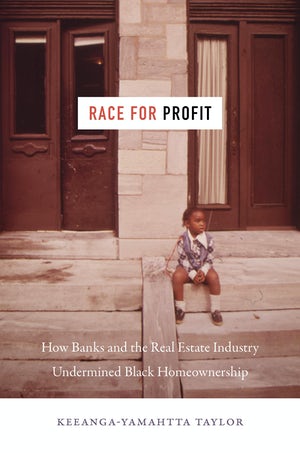
Finalist: Race for Profit: How Banks and the Real Estate Industry Undermined Black Homeownership, by Keeanga-Yamahtta Taylor (University of North Carolina Press)

A deeply researched and rigorously argued account of the public-private partnership that replaced redlining with even more predatory and destructive practices.

Nominated Work

Race for Profit


By the late 1960s and early 1970s, reeling from a wave of urban uprisings, politicians finally worked to end the practice of redlining. Reasoning that the turbulence could be calmed by turning Black city-dwellers into homeowners, they passed the Housing and Urban Development Act of 1968, and set about establishing policies to induce mortgage lenders and the real estate industry to treat Black homebuyers equally. The disaster that ensued revealed that racist exclusion had not been eradicated, but rather transmuted into a new phenomenon of predatory inclusion.

Race for Profit uncovers how exploitative real estate practices continued well after housing discrimination was banned. The same racist structures and individuals remained intact after redlining’s end, and close relationships between regulators and the industry created incentives to ignore improprieties. Meanwhile, new policies meant to encourage low-income homeownership created new methods to exploit Black homeowners. The federal government guaranteed urban mortgages in an attempt to overcome resistance to lending to Black buyers – as if unprofitability, rather than racism, was the cause of housing segregation. Bankers, investors, and real estate agents took advantage of the perverse incentives, targeting the Black women most likely to fail to keep up their home payments and slip into foreclosure, multiplying their profits. As a result, by the end of the 1970s, the nation’s first programs to encourage Black homeownership ended with tens of thousands of foreclosures in Black communities across the country. The push to uplift Black homeownership had descended into a goldmine for realtors and mortgage lenders, and a ready-made cudgel for the champions of deregulation to wield against government intervention of any kind.

Narrating the story of a sea-change in housing policy and its dire impact on African Americans, Race for Profit reveals how the urban core was transformed into a new frontier of cynical extraction.

-- from the publisher
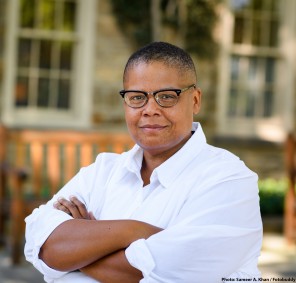
Biography

Keeanga-Yamahtta Taylor is assistant professor of African American studies at Princeton University and author of From Black Lives Matter to Black Liberation and How We Get Free: Black Feminism and the Combahee River Collective.

Winners

Prize Winner in History in 2020:

W. Caleb McDaniel

A masterfully researched meditation on reparations based on the remarkable story of a 19th century woman who survived kidnapping and re-enslavement to sue her captor. History

Finalists

Nominated as finalists in History in 2020:

Greg Grandin

A sweeping and beautifully written book that probes the American myth of boundless expansion and provides a compelling context for thinking about the current political moment (Moved by the Board to the General Nonfiction category, where it was also entered.)

The Jury

Rachel Klein(Chair)

Professor of History and Academic Senate Distinguished Teacher, University of California, San Diego

Natalie J. Ring

Associate Professor of History, University of Texas at Dallas

Stephanie Smallwood

Associate Professor of History and Comparative History of Ideas, University of Washington

Winners in History

David W. Blight

A breathtaking history that demonstrates the scope of Frederick Douglass’ influence through deep research on his writings, his intellectual evolution and his relationships.

Jack E. Davis

An important environmental history of the Gulf of Mexico that brings crucial attention to Earth’s 10th-largest body of water, one of the planet’s most diverse and productive marine ecosystems.

Heather Ann Thompson

For a narrative history that sets high standards for scholarly judgment and tenacity of inquiry in seeking the truth about the 1971 Attica prison riots.

T.J. Stiles

A rich and surprising new telling of the journey of the iconic American soldier whose death turns out not to have been the main point of his life. (Moved by the Board from the Biography category.)

2020 Prize Winners

Nikole Hannah-Jones of The New York Times

For a sweeping, provocative and personal essay for the ground-breaking 1619 Project, which seeks to place the enslavement of Africans at the center of America’s story, prompting public conversation about the nation’s founding and evolution.

Christopher Knight of the Los Angeles Times

For work demonstrating extraordinary community service by a critic, applying his expertise and enterprise to critique a proposed overhaul of the L.A. County Museum of Art and its effect on the institution’s mission.