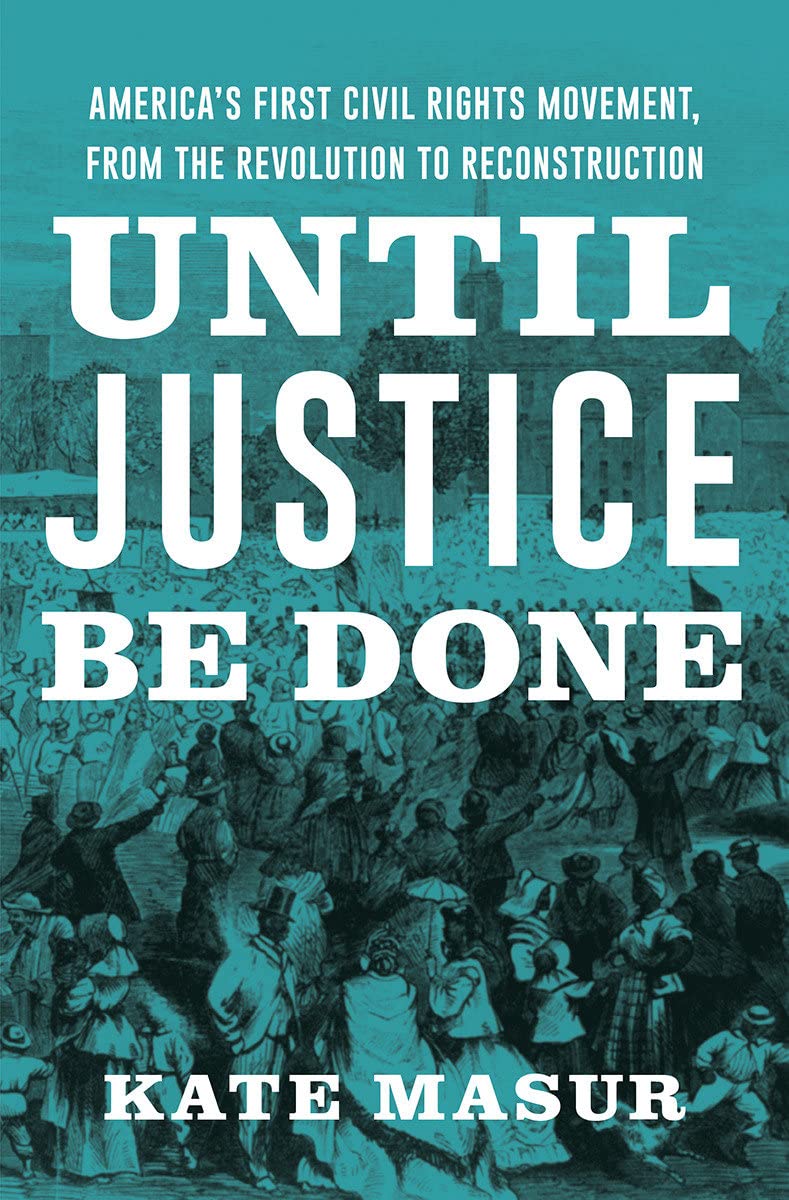
Finalist: Until Justice Be Done: America's First Civil Rights Movement, from the Revolution to Reconstruction, by Kate Masur (W. W. Norton & Company)

A sweeping and resonant consideration of abolitionist work, begun decades before the Civil War, that eventually became America’s first civil rights movement–an account that is also a deep study of federalism in jurisprudence, politics and history.

Nominated Work

Until Justice Be Done: America's First Civil Rights Movement, from the Revolution to Reconstruction


Finalist for the 2022 Lincoln Prize
One of NPR's Best Books of 2021
New York Times Critics' Top Book of 2021

A groundbreaking history of the movement for equal rights that courageously battled racist laws and institutions, Northern and Southern, in the decades before the Civil War.

The half-century before the Civil War was beset with conflict over equality as well as freedom. Beginning in 1803, many free states enacted laws that discouraged free African Americans from settling within their boundaries and restricted their rights to testify in court, move freely from place to place, work, vote, and attend public school. But over time, African American activists and their white allies, often facing mob violence, courageously built a movement to fight these racist laws. They countered the states’ insistences that states were merely trying to maintain the domestic peace with the equal-rights promises they found in the Declaration of Independence and the Constitution. They were pastors, editors, lawyers, politicians, ship captains, and countless ordinary men and women, and they fought in the press, the courts, the state legislatures, and Congress, through petitioning, lobbying, party politics, and elections. Long stymied by hostile white majorities and unfavorable court decisions, the movement’s ideals became increasingly mainstream in the 1850s, particularly among supporters of the new Republican party. When Congress began rebuilding the nation after the Civil War, Republicans installed this vision of racial equality in the 1866 Civil Rights Act and the Fourteenth Amendment. These were the landmark achievements of the first civil rights movement.

Kate Masur’s magisterial history delivers this pathbreaking movement in vivid detail. Activists such as John Jones, a free Black tailor from North Carolina whose opposition to the Illinois “black laws” helped make the case for racial equality, demonstrate the indispensable role of African Americans in shaping the American ideal of equality before the law. Without enforcement, promises of legal equality were not enough. But the antebellum movement laid the foundation for a racial justice tradition that remains vital to this day.

Biography

Kate Masur is professor of history at Northwestern University. A finalist for the Lincoln Prize, she is the author of An Example for All the Land: Emancipation and the Struggle over Equality in Washington, D.C.

Winners

Prize Winner in History in 2022:

Ada Ferrer

An original and compelling history, spanning five centuries, of the island that became an obsession for many presidents and policy makers, transforming how we think about the U.S. in Latin America, and Cuba in American society. History

The Jury

Tera Hunter(Chair)

Edwards Professor of American History and African American Studies, Princeton University

David W. Blight*

Sterling Professor of History, African American Studies and American Studies, Yale University

Matthew J. Garcia

Ralph and Richard Lazarus Professor of History, Latin American, Latino, and Caribbean Studies, and Human Relations, Dartmouth College

Margaret D. Jacobs

Charles Mach Professor of History, University of Nebraska – Lincoln

Christopher Tomlins

Elizabeth Josselyn Boalt Professor of Law, University of California, Berkeley

Winners in History

Marcia Chatelain

A nuanced account of the complicated role the fast-food industry plays in African-American communities, a portrait of race and capitalism that masterfully illustrates how the fight for civil rights has been intertwined with the fate of Black businesses.

W. Caleb McDaniel

A masterfully researched meditation on reparations based on the remarkable story of a 19th century woman who survived kidnapping and re-enslavement to sue her captor.

David W. Blight

A breathtaking history that demonstrates the scope of Frederick Douglass’ influence through deep research on his writings, his intellectual evolution and his relationships.

Jack E. Davis

An important environmental history of the Gulf of Mexico that brings crucial attention to Earth’s 10th-largest body of water, one of the planet’s most diverse and productive marine ecosystems.

2022 Prize Winners

Jennifer Senior of The Atlantic

For an unflinching portrait of a family’s reckoning with loss in the 20 years since 9/11, masterfully braiding the author's personal connection to the story with sensitive reporting that reveals the long reach of grief.