Los Angeles Times, by William R. Stall
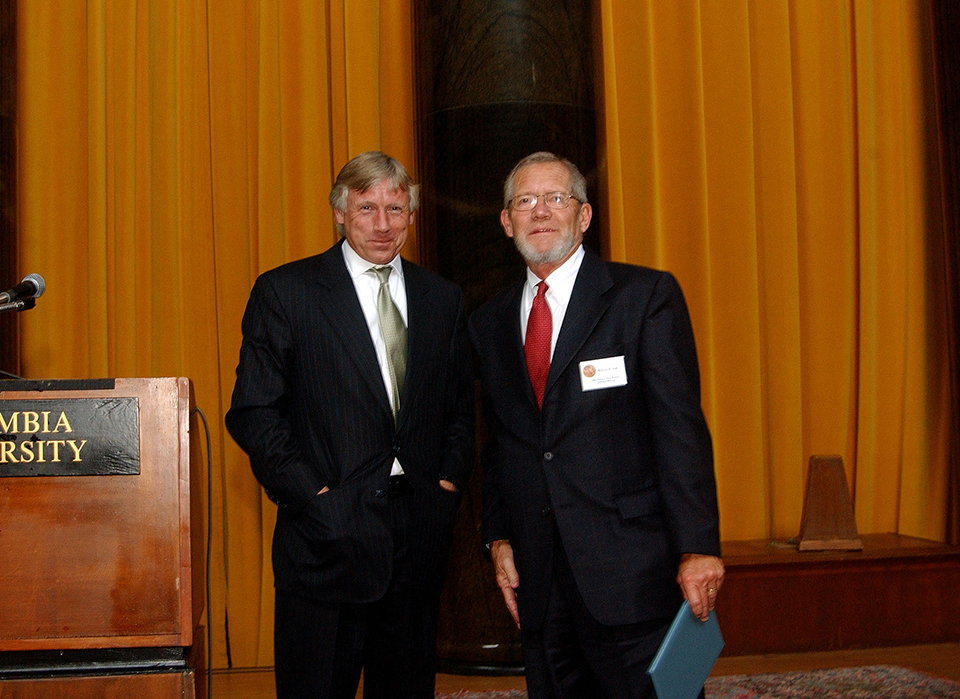
Columbia University President Lee C. Bollinger presents William R. Stall with the 2004 Pulitzer Prize in Editorial Writing.
Winning Work
By William R. Stall
In 1971, nothing was more contentious than welfare reform. Gov. Ronald Reagan railed at welfare cheats and wanted to trim the rolls. Bob Moretti, the late Democratic Assembly speaker, sought to boost payments to the needy. He later recalled saying, "Look, Governor, I don't like you particularly and I know you don't like me, but we don't have to be in love to work together." That touched off two weeks of intense negotiations that led to a landmark welfare reform supported by both parties. The breakthrough factor? Both men later said it was that they trusted each other.
Contrast that with the wee hours of Sept. 14, when the Assembly's 48 Democrats and 32 Republicans struggled to close the 2003 legislative session. Republicans, angry over $80 million they couldn't get from the other side for rural law enforcement, decided in closed caucus to effectively stall any legislation requiring a two-thirds vote. Then, in the heat of partisan warring, lawmakers realized they needed a two-thirds vote to renew Megan's Law, which lets the state keep a database to inform parents of the whereabouts of sex offenders.
Republicans proposed a list of amendments toughening the bill; Democrats raised an outcry over civil rights. Neither side budged. The measure failed. Charges flew over who was to blame for putting California kids at risk of sexual predators. Later, in special session, and after embarrassment and shame for both sides, the bill got extended to 2007.
The paralysis of California's state government helped drive the recall movement against Gov. Gray Davis. The bitterly partisan Legislature has escaped scrutiny. With the recall fresh in their minds, we urge voters to take on what really ails Sacramento, because what's wrong with state government goes much further than the governor's office.
When the State Got Off Track
Here are some of the factors that were at work that September night -- and during years of failing government in Sacramento:
* Term limits. A voter initiative passed in 1990 capped service in the Assembly at six years and in the Senate at eight, making it almost impossible for legislators to build the friendships and trust necessary for consensus government. Sacramento now sees a constant stream of inexperienced pols who spend more time than ever in pursuit of campaign contributions so they can finance their next step up the political ladder. Or they're job-hunting among former corporate contributors. With few exceptions, they avoid long-range solutions to California problems because they will be gone from office before results are seen. The real winners are the special interests that bankroll campaigns.
Before term limits, members were elected as partisans but over time saw the benefit in seeking common goals. "Now, they're in here and out of here," a former Assembly member said. "The partisan level is not diluted."
* Redistricting. A Satan's pact between Republicans and Democrats in 2001 led to a redrawing of legislative and congressional district lines that assure the parties mostly safe seats throughout the state. The real decisions occur in the party primaries, where ideology usually rules. The result is polarization at the extremes, a body dominated by conservative, no-tax Republicans on one side and liberal, union-supporting Democrats on the other. The moderate center has lost its balance of power.
* The two-thirds vote rule. During the fiscal crisis of the Depression, in 1933, the Legislature adopted the forerunner of the constitutional two-thirds vote requirement for passing the budget, or any spending bill. Proposition 13 in 1978 extended it to any state tax increase. California is one of just three states to have this crippling restriction. Though no one challenges the wisdom of the two-thirds vote for putting bills -- like the Megan's Law extension -- into effect immediately, the same requirement for fiscal measures allows for tyranny by a minority.
* Proposition 13. The Jarvis-Gann property tax limit law galvanized California politics along tax and no-tax lines with little regard for the state's needs. Several Republican lawmakers elected in 1978 were called "Proposition 13 babies." The ranks of dedicated anti-tax lawmakers increased every two years. The last time Democrats and Republicans really compromised on a tax plan was during Gov. Pete Wilson's administration in 1991. The Legislature approved a $7-billion tax hike to weather that recession. Since then, there have been billions in tax cuts without any hikes until the recent restoration of the car tax.
* Proposition 98. The November 1988 ballot measure, sponsored by the public school lobby, required that roughly 40% of the state's general fund budget go to education. This triggered copycat campaigns for other "ballot box budgeting" measures, sponsored by various special interests, that earmarked state revenues for specific purposes such as cigarette taxes for anti-smoking programs and early childhood education. One, Proposition 49, was sponsored by Arnold Schwarzenegger to divert money for after-school programs. Proposition 53, on the recall ballot, would have set aside up to 3% of the state's general fund for roads and other infrastructure. This voter-approval trend has diminished the governor's and Legislature's control over spending to less than half the budget. Sacramento has steadily increased fiscal control over city and county governments, diminishing their ability to govern.
What Lies Ahead
UC professor Bruce E. Cain and Stanford professor Roger G. Noll, editors of "Constitutional Reform in California," wrote, "The objective of efficient, flexible government requires giving considerable authority to government officials." The anti-tax, anti-government mood of the last 25 years has done the opposite, reducing the effectiveness of elected officials.
If the recall campaign did one positive thing, it focused California's attention on state government. There's a new opportunity for reforms that would enable state and local governments to deal effectively with a rapidly changing state. This editorial page will propose several solutions -- a fix-it kit for voters -- during the coming weeks.
© 2003, Los Angeles Times
By William R. Stall
There hasn't been a riper time for change since 1978.
Picture this: The governor, flanked by beaming community and business leaders and elected officials, signs into law a $1.5-billion package of tax relief for motorists, businesses, families and seniors. Is this Arnold Schwarzenegger in a few months, carrying out his promise to solve the fiscal mess in Sacramento and restore California's economy? Nope, it was Gov. Gray Davis on July 7, 2000, doling out what he called "the largest tax rebate in California history."
How quickly times change and how slowly California's brittle, overly complicated fiscal structure changes with them. Huge revenue surges in boom times enable grand gestures, but revenue inevitably plunges when the economy turns. Local government has for years been robbed of the reliable revenue it needs for street repairs, parks, libraries and water and sewer plants. Statewide, highways are deplorable, state buildings are aging and the ability to deliver water is falling behind demand. The state budget, of course, is in unspeakable condition.
Yet ....
California ranks high among the states in average personal income and has lost fewer jobs proportionally than the rest of the country -- in fact, counties outside the Bay Area gained jobs during the downturn. More new businesses were created than lost. Except for Silicon Valley, the high-tech industry remains strong, and UCLA experts expect the economy to grow by 2.3% this year and 3% in 2004. The tax burden is near the national average, and California has the fewest government workers per capita of any state.
The problem is not lack of resources or capability but that state revenue gyrates wildly, budgeting is straitjacketed by the requirement of a two-thirds legislative vote and flexibility is erased by requirements on how the money must be spent. The state has usurped too much spending power and decision-making from local governments.
Fixing these things is separate from slogging through the current crisis, which will in the end require temporary revenue increases along with spending cuts already passed and new ones that Schwarzenegger's team will be combing the budget for. It will be important to keep the remedy for the current pain -- pain that includes the car tax -- separate from larger reforms.
Businesses groaning under excessive costs are hurt not so much by ordinary taxes as by such things as workers' compensation and ill-timed insurance mandates. These too are issues separate from fiscal reform.
The story starts with Proposition 13, the 1978 voter initiative against soaring property taxes. The sweeping measure fixed one big problem by cutting and capping runaway property taxes on homes and businesses. But an unintended result was to shift taxing ability and spending decisions from the school districts and cities and counties to Sacramento. It also increased dependence on the state income tax.
The State Is Ready for Change
Enter the Schwarzenegger administration, borne on a wave of voter revulsion at politics as usual. There hasn't been a riper time for change since 1978.
Fiscal reform plans -- handsome volumes from study commissions -- line the shelves in Sacramento. Specific measures, proven in other states, appear over and over. Political apathy and division, aided by special-interest money, have kept them from being seriously considered. Dust the reports off, open them and find these good ideas:
* Give local government specific, logical functions and the funds to carry them out. The state shouldn't be doling out money for cops on the street or funding for local parks and recreation facilities. Cities and counties need reliable revenue -- not the current "the state giveth and the state taketh away" that reduces mayors to backstabbing one another to get the next big-box store and its sales taxes. These cash generators come at the expense of established businesses and sensible planning and zoning.
* Eliminate the two-thirds rule on passing a budget and raising taxes. This would require voter approval, which is more likely to be gained if the change is part of a larger package of political reforms -- such as revising term limits -- that would stabilize the Legislature. It will help that power is now balanced between a Democratic-majority Legislature and a Republican governor.
* Apply the sales tax, at a lower rate, to services like lawyering and accounting. This would make it possible to slightly reduce retail sales tax rates as well. Requires a two-thirds vote of the Legislature.
* Make it much harder for businesses to duck reassessment under Proposition 13, so that the sale of a skyscraper can't be cloaked as a lease-back. Sen. Martha Escutia (D-Whittier) is sponsoring legislation, SB 17, to tighten the definition of change of ownership.
* Merge the Franchise Tax Board and the state Board of Equalization into a single department of revenue. Currently, one collects sales and property taxes while the other administers income tax law. Both maintain large bureaucracies and both are elected. Each batch of elected officials brings new policy ideas to each agency, which drives businesses crazy. Requires a state constitutional amendment.
If sales and property taxes bore a slightly larger share of the state's revenue needs, dependence on a steeply progressive income tax could also be reduced. It is at the top brackets that volatility is highest; when the rich lost their capital gains in 2001, California's revenue plunged more steeply than other states'.
An End to 'Gotcha' Politics
As a moderate Republican entering office in a populist revolt, Schwarzenegger has an opportunity to wrestle consensus from two squabbling parties and the voters. He has promised to respond not to special interests or partisanship but to the needs of the state's economy and citizens. He'll have to go beyond slogans to accomplish that. Some of his ideas about evil, wasteful government need toning down.
Democrats already setting legislative booby traps for the governor-elect will only arouse voters' wrath again. So would Republicans who are itching to fight him on conservative principle. All sides can see where "gotcha politics" have brought California's fiscal house. They should sit down and fix it.
By William R. Stall
In his campaign, Arnold Schwarzenegger missed the target with many of the vague darts he tossed at "the mess in Sacramento," but he hit the bull's-eye with this television ad: "Special interests have a stranglehold on Sacramento. Here's how it works. Money comes in, favors go out. The people lose."
Anger at cash-register politics is not something that arose with the recall campaign. Californians voted half a dozen times in the last 25 years to "reform" the way politicians raised money for their campaigns and how they spent it. Every effort has been thwarted by political party opposition, adverse court decisions and loopholes in the laws -- either deliberate or unintended. The current law was written by legislators, sold to voters as a reform and approved as Proposition 34 in 2002. It actually gave the political parties a bigger-than-ever role in bankrolling the campaigns of favored candidates. The perversity of that "reform" is illustrated by the recall campaign itself.
Most notable was Lt. Gov. Cruz Bustamante's acceptance of nearly $5 million from Indian tribes operating Nevada-style casinos. He virtually promised them that, if he was elected governor, they could run all the slot machines they wanted without fear of the state taxing them. When a court ruled that the contribution amounts violated the law, Bustamante tried to use the money for ads against Proposition 54, which sought to ban certain uses of racial data. The ads actually amounted to Bustamante commercials. By the time the courts ruled against the shell game Bustamante used to pay for those ads, he had spent the $5 million. It is not clear whether he will face further sanctions.
About the same time, Maloof Sports and Entertainment, owner of the Sacramento Kings basketball team, gave Gov. Gray Davis' no-on-the-recall committee $100,000 while a bill that could help finance a new Kings downtown arena with public bond money was awaiting his action. Surprise, he signed. The link is just as clear during the frantic end of legislative sessions when lawmakers shake down lobbyists at receptions -- usually getting $5,000 a head for hors d'oeuvres while bills await final votes.
Schwarzenegger, however, looked disingenuous in condemning Davis and others for taking money from the casinos and public employee unions while himself was accepting at least $9 million from real estate developers, contractors and other businesses with intense interest in state law and regulation.
Each ding of the cash register makes Californians more distrustful of politics.
Public Financing
When he takes office as governor, Schwarzenegger will have momentum. He should use it for campaign reform. The Legislature may agree to close some loopholes in current law, but public financing remains the only sure way to reduce the legalized influence-peddling that rules the state today. Californians endorsed public campaign finance in 1988 in a measure that won a majority of votes but was canceled out by passage of a watered-down competing proposition.
The federal General Accounting Office cites recent studies showing that public financing in Los Angeles and New York city elections has increased electoral competition and helped challengers mount credible campaigns against incumbents. Seventeen states have some degree of public financing. Arizona and Maine offer nearly full public financing that candidates may use on a voluntary basis.
Seven of the nine statewide offices in Arizona, including the governorship, were won in 2002 by candidates who accepted public financing and its conditions. These included strict limits on how much they could spend and a commitment to debate opponents.
It's hard to quantify "clean" or "corrupt," and the laws are too new to make unassailable claims. Still, Arizona's public financing advocates tout increases in contested campaigns and increased voter participation. And we know it's better than what we have in California, whose motto for governing is little more than "pay to play."
Promising Proposals
The new California governor will find plenty of good advice already formulated. Some of the best comes from the California Clean Money Campaign, a nonpartisan umbrella group formed in 2002 that has drawn on experts, including Robert M. Stern, president of the Center for Governmental Studies in Los Angeles and the first general counsel to the state Fair Political Practices Commission in the mid-1970s.
Under the Clean Money Campaign's proposals, candidates for statewide office and the Legislature would have to demonstrate grass-roots support by raising large numbers of small contributions if they wanted public financing. Candidates for governor who didn't opt for public financing would be more limited than they now are in the size of contributions they could accept. (Rich candidates could still self-finance without limit, because the courts have ruled that the 1st Amendment forbids such limits.) Television broadcasters -- stewards of the publicly owned airwaves -- should help by offering radio and television time at less than the premium rates they now charge candidates to get their messages out.
Stern estimates the cost to California at roughly $178 million a year to cover all state elections, if it is combined with new, effective contribution limits. That compares with the more than $130 million that Davis and his foes spent just in the 2002 contest for governor, most of it raised from unions, businesses and other parties that are keenly interested in what elected officials do in Sacramento.
Arizona finances its plan with a 10% surcharge on civil and criminal fines levied in the state. Other possible sources include gambling levies, which would have to be negotiated with tribes that operate casinos. California could also experiment by funding only legislative races at first, for about half the cost. Legislators, degraded by having to continuously shake down special interests for contributions, should embrace public funding and put it on the 2004 ballot. California can't go on awarding the state to the highest bidders.
Here's a final word from Arizona Gov. Janet Napolitano, about her delight at campaigning under a public finance system: "I could spend my time talking with voters, not with [big] contributors. We were able to ... campaign in a fundamentally different way." Once she was in office, she said, "lobbyists were not swarming around me" for payback. It sounds just like public service, doesn't it?
© 2003, Los Angeles Times
By William R. Stall
There is plenty of talent in Sacramento. But members are forced to work in a system that produces constant political warfare.
Perhaps just once this year did the California Legislature look more ridiculous than during its rancorous budget debates. Back in June, lawmakers came within two votes of defeating a resolution to honor fathers on Father's Day. Fourteen lawmakers refused to vote at all, afraid of going on the record.
A change of attitude is evident now in Sacramento, almost a dazed awakening after the recall. Newly humbled Democrats fear that Arnold Schwarzenegger's election could mean that their seats are in jeopardy. Republicans promise to work hand in hand with the incoming governor, who is more moderate than most of them. Unfortunately, the structural flaws that left the Legislature frozen are still in place. One is term limits. Another is the drawing of district boundaries so that districts are safe for the party in the seat but hostile to the moderate strain of thought that used to prevail in the Legislature and the state.
Roots of Rancor
That brings us back to the Father's Day resolution, which was a struggle of cultures as well as ideology. Four of the 80 Assembly members, including the resolution's sponsor, San Diego Assemblywoman Christine Kehoe, are openly gay. Kehoe's resolution honored fathers "including single fathers, foster fathers, adoptive fathers, biological fathers, stepfathers, families headed by two fathers, grandfathers raising grandchildren, fathers in blended households and other nontraditional fathers."
Conservative Republicans condemned it as part of the "pro-gay agenda." They said it slighted "traditional fathers." Assemblyman Ray Haynes (R-Murrieta) complained that Kehoe and her allies had injected "all this extraneous garbage into it."
Assemblywoman Jackie Goldberg (D-Los Angeles), a longtime gay activist, retorted, "That's the kind of thing that makes you think they're from another planet."
Not another planet, but certainly a different community. The left-wing Goldberg was elected to her 45th Assembly District seat in 2002 with 86% of the vote to 14% for her GOP opponent. As with so many lopsidedly partisan districts, the primary is the contest. In 2002, Goldberg didn't even have a primary foe. She has no reason to compromise.
The conservative Haynes represents the 66th Assembly District in San Diego and Riverside counties, not quite as lopsided but he still won his seat 68% to 32%. The only way Haynes could lose would be to a Republican who managed to run to the right of him. That's why Haynes will not vote for a state budget, a tax increase of any form or anything else that offers a potential Republican primary election foe an opening.
The vast majority of legislative districts in California are solidly Democratic or Republican. Of the 100 seats that come up in 2004, only about 15 are considered competitive. This is the result of a devil's pact made by Republicans and Democrats after the 2000 census to carve as many safe seats for each party as possible, one of the state's worst redistricting gerrymanders of modern times.
Now California is stuck with legislative districts that mostly serve parties and causes and have turned the Legislature into a battleground of ideological purity.
Term limits are the other half of the equation. With Assembly members limited to three two-year terms, they aren't there long enough to trust or respect one another. Father's Day resolutions turn into take-no-prisoners combat. Measures that used to pass with overwhelming moderate support now lead to rigid caucus positions, protracted debate, party-line votes and personal animosities.
Former Assemblyman and Rep. Rick Lehman says: "Senior members used to tell me that it would take six years to find my way around. Now, six years and you're out." The turnover leads to constant churn in the legislative staff. There's precious little institutional memory left. One new lawmaker introduced a bill seemingly ignorant of the fact that an identical measure caused a bitter controversy years before. Legislators end up catering to the corporate or union interests that might provide their next job or finance their campaign for a different political seat.
Term limits, passed by voters in 1990, remain popular and most legislators will not publicly call for repeal. But there is a growing consensus that California's strictest-in-the nation limits -- six years in the Assembly and eight in the Senate -- should be relaxed to 12 years in each house. It's not likely that the Legislature itself will have the courage to put a proposed constitutional amendment on the ballot, something requiring a two-thirds vote in each house. Reform groups such as the League of Women Voters and the California Clean Money Campaign should collaborate on a ballot initiative to make the change.
Redrawing District Lines
It's just as critical that the job of redrawing legislative districts after each census be taken from the Legislature and given to an independent commission, possibly composed of retired judges picked by lot. This has been tried before, by voter initiative, and always defeated by television campaigns bankrolled by entrenched incumbents.
The best redistricting plans were drawn under supervision of the California Supreme Court either because of legal challenges or because the legislators and governor could not agree on a plan. One such plan, in effect for most of the 1990s, provided compact districts and divided as few cities and counties as possible. This resulted in a more centrist Legislature that was able to compromise on major issues. Then the 2001 gerrymander undid it. Ted Costa of People's Advocate, who started the recall drive against Gov. Gray Davis, has crafted a new ballot measure to hand redistricting permanently to a judicial panel. It could be on the November 2004 ballot.
There is plenty of talent in Sacramento. But members are forced to work in a system that produces constant political warfare. That does not serve California well. Angry citizens may be tempted to go after politicians they don't like, such as Gray Davis, but they should also give their attention to reforms that could restore common sense to a state capital obsessed with its own private ideological wars -- wars that have nothing to do with taking care of the people's business.
© 2003, Los Angeles Times
By William R. Stall
All the energy and interest in the political system generated by the recall campaign against Gov. Gray Davis will be wasted if Sacramento slips back into deadlock and polarized politics-as-usual. Gov.-elect Arnold Schwarzenegger has said he is bent on preventing that, promising "action, action, action, action" on taking office Nov. 17.
Unfortunately, one of his first scheduled actions is a political fund-raiser Dec. 3. An effective overhaul of state government will require something much less ordinary: leadership and strong bipartisan cooperation.
The pieces of reform must work in concert. Allowing legislators to serve longer terms will do little good if they still are elected from "safe" districts that encourage extremism. Giving the Legislature and governor more flexibility to deal with tough state problems, such as the budget deficit and the need for new infrastructure, won't help much if lawmakers remain beholden to special- interest contributors and restricted by special-interest initiative measures. A good example is a planned California Teachers Assn. initiative, aimed for the ballot next year, to boost property taxes on businesses to generate money exclusively for teacher salaries and preschool programs. Such earmarking hampers both annual budgeting and reform of spending and revenue.
Lawmakers will never advance bold proposals or seek to solve long-range problems if they not only operate under the nation's most restrictive term limits but also fear being recalled from office. The initiative and recall processes need modernization. For one thing, the percentage of signatures required to start a recall is the same as in 1911, long before the advent of paid signature-gathering. Grass-roots legislating has become too much a special-interest tool, as the teachers union initiative illustrates.
A reform package must be done within the next two election cycles, by the end of 2006, to work as a whole. Any reform by itself is likely to fail, becoming a target for the "I told you government doesn't work" crowd.
Building State's Assets
Schwarzenegger takes office with a chief goal of easing business regulation and taxes to make California a more attractive place economically. Business executives and economists need to point out that other factors are also critical to a good business climate: a well-educated and skilled workforce, an attractive natural environment -- always one of California's biggest advantages -- a good transportation system and housing availability. Those are investments that pay a handsome return. "It's the quality of the human resources, the capital resources, the infrastructure" that matter most, says Robert Friedman, chairman of the Corp. for Enterprise Development.
Here are some essential actions:
* Enhance the workers' compensation revisions that the Legislature started last year, to lift a crushing, unpredictable cost burden that dampens job creation. By doing this first, the Legislature would give business more confidence in wider reforms. Requires only a majority vote of the Legislature.
* Fix the campaign finance system to greatly reduce special-interest clout with elected officials. Casino-operating Indian tribes, public employee unions, trial lawyers, the big-spending insurance and finance industry, the land developers who back Schwarzenegger and the political parties themselves all encourage pay-for-play government. The state should consider public campaign financing to return power to voters without opening new loopholes. Requires a constitutional amendment, put on the ballot either by a two-thirds vote of the Legislature or by initiative petition.
* Lengthen legislative terms to 12 years in each house, six two-year terms in the Assembly and three four-year terms in the Senate. Requires a constitutional amendment.
* Turn over redistricting of legislative seats to an independent commission -- possibly made up of retired judges -- overseen by the state Supreme Court. The present districts assure either Republican or Democratic control and too often are won by die-hard conservatives or liberals. Moderates get squeezed out. Requires a constitutional amendment. A voter initiative in the works could accomplish this change by 2006.
* Reduce the margin needed to pass a state budget and any other spending bill. In 47 other states and in Congress, a majority suffices. The two-thirds rule in California ties up budgets for weeks or months beyond the deadline. The change would force the majority party, answerable to the voters every two years, to accept clear responsibility for its spending program. Requires a constitutional amendment.
* Increase the signatures needed for initiatives and recalls. A measure to reform recalls has been introduced in the Legislature and should be broadened to both.
Past initiative measures earmarking state revenue for special items, including education, should be revised or repealed to give the Legislature and governor the flexibility to adapt state spending to existing needs and economic circumstances. In many cases requires a constitutional amendment.
* Review the tax code to level out revenue spikes and plunges. Revise Proposition 13 regulations so business properties are reassessed for property tax purposes when ownership changes. The sales tax could be reduced if it were extended to services such as dry cleaning and legal work, reflecting the state's modern economy. The overly volatile income tax should be flattened slightly, even if the middle class pays slightly more. Combine with overhauled spending limits.
The recall showed that state government's problems run deep. Much of the advice Schwarzenegger is receiving from narrow interest groups such as the Howard Jarvis Taxpayers Assn., which emerged from the Proposition 13 campaign, will be to clamp ever more restrictions on ever-smaller government. Schwarzenegger has a choice. He can submit, Gulliver-like, to being tied by a thousand special-interest strings. Or he can exercise the boldness needed to revive a California of opportunity, beauty and rational growth.
© 2003, Los Angeles Times
By William R. Stall
Gov. Arnold Schwarzenegger promised to rid Sacramento of politics as usual and to forge a new consensus to restore California's fiscal health. Unfortunately, his first major effort to do that crashed Friday in a resurgence of partisan deadlock. Frantic efforts to figure out a compromise came up against a too-short deadline and political divides that could not be closed.
Schwarzenegger and lawmakers, some of them huddling in ad hoc bipartisan groups, got closer than most people had thought possible to agreement on his major demands. These were for curbs on state spending and a $15-billion bond to finance the current deficit. Both measures would have to go before voters, and Secretary of State Kevin Shelley had set a Friday deadline for whatever might go on the March 2 primary ballot. "Failure is no option," Schwarzenegger told skeptics who doubted that a deal could be forged in such a short time. A compromise on the bond could have been pretty easily reached. The same was not true of the spending cap, with the two sides battling over where to set spending at its start. Unfortunately, everyone gave up too easily.
Now, Schwarzenegger's aides say, the governor will mount a voter signature campaign like the one that brought about the recall election against Gray Davis. The spending cap, untempered by debate or compromise, would appear on the ballot in November. Long campaigns for and against would seal a return to rigid partisan politics in California.
Lawmakers should get the chance to try again for a compromise, perhaps along lines of the bipartisan plan developed over the last five months by Assemblymen Joe Canciamilla (D-Pittsburg) and Keith Richman (R-Northridge). That plan would have put the starting point of the cap higher than Schwarzenegger's proposal but still below what the state spent per resident in 1998. Spending caps imposed in the past have been broken, but passing a new one was one of Schwarzenegger's chief promises in the Oct. 7 recall election.
Contributing to Friday night's failure was a split in the governor's staff. A hard-line faction aligned with Republican leaders in the Legislature opposed any compromise and seemed to prefer a public initiative campaign. Schwarzenegger did not help by spending much of the week traveling the state to promote his program. His personal involvement was needed to make negotiations work.
Old grudges, Democratic and Republican, also deteriorated initially hopeful talks. As Richman described it, Schwarzenegger was "working through the [legislative] leadership, which is driven by the extremes of their parties.... He hit a wall. He's got to figure out how to go around it." Giving up and going to the ballot is not the way.
Secretary of State Shelley should have worked much harder to stretch his deadline a few days. It could still be done, even by printing a separate March 2 ballot pamphlet. Schwarzenegger could afford to seek compromise on the spending cap because he has the final word in the form of his veto pen. He can eliminate or reduce any spending item with little fear of being overridden by the Legislature.
Schwarzenegger is still learning how to use his power to best effect. Giving up on compromise and going straight to a signature campaign will show more weakness than strength. He doesn't need to do it, as his close brush with success testifies.
© 2003, Los Angeles Times
By William R. Stall
Without an agreement, local government faces severe, immediate cuts in state aid because of Schwarzenegger's rollback of the car tax increase the day he took office.
The "politics as usual" scorn aimed at Sacramento this week, emphasized by a downgrade of California's investment quality, appears to be moving the boulder of partisan stubbornness. Legislators and Gov. Arnold Schwarzenegger returned to bargaining Wednesday. They were reportedly closing in on a possible compromise to put a $15-billion bond to finance the state's debt on the March 2 ballot, along with new limits on future spending.
Republicans in the Legislature were balking Wednesday night at occupying a middle ground, in a mirror image of what Democratic leaders did to former Gov. Gray Davis. The obstructionist mantle doesn't look good on either side, and GOP leaders will surely see how bad the refusal to compromise appears to voters.
On Friday, a compromise was almost in view when both sides just up and quit. They can't afford to be seen failing again, either in the calculations of investors or the minds of voters.
Without an agreement, local government faces severe, immediate cuts in state aid because of Schwarzenegger's rollback of the car tax increase the day he took office. The first victims would be police and fire departments and public health. Schwarzenegger inexplicably washed his hands of their plight Tuesday. "It's not me taking anything away from them," he said, it's the Legislature. Perhaps one of his advisors recognized how bad that sounded and helped push Schwarzenegger back to the table.
The governor was right during his campaign in saying people don't care about political details. They just want him and the rest of the state's elected officials to deliver. Message to the Legislature: Get the bond and spending-limit issues solved or face the wrath of voters who see state government as merely stealing local money.
Some Democrats -- most notably Senate President Pro Tem John Burton -- have been as inflexible about keeping their spending power as some Republicans in the Legislature and on Schwarzenegger's campaign staff have been about a strict spending cap. This time around, Schwarzenegger talked directly and effectively with Democratic leaders and will have to persuade his own party to accept the result.
The deal reportedly calls for a balanced budget and enables midyear spending cuts. That is far from the governor's initial draconian spending cap proposal but close to a bipartisan plan that was defeated Friday.
The bond and the spending limit are just one step. They do nothing about a projected shortfall of an additional $10 billion or more in next year's budget. But a success on these issues would persuade investors that California's political system is not completely broken. It would save the state a divisive, costly 11-month political campaign, which is what would happen if talks failed.
Across the capital, the gravity of what comes next is apparent. The state's elected leaders have been deaf to their failure, but their hearing seems to be returning.
© 2003, Los Angeles Times
Biography
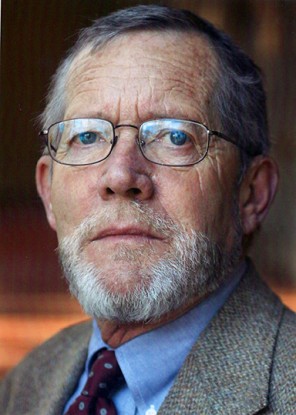
EXPERIENCE
- Los Angeles Times, editorial writer, Sacramento bureau, 1997-; political writer, 1990-97; editorial writer, 1984-90; staff writer and political writer, Washington bureau, 1979-81; assistant Metropolitan editor, 1978-79; energy writer, 1977-78; staff writer, Metro section, 1976-77.
- Senior lecturer in journalism, University of Southern California, 1984-92.
- Hartford (CT) Courant, Washington bureau chief, 1981-84.
- California governor's office, press secretary and director of public affairs, 1975-76.
- Associated Press, Sacramento bureau chief and political writer, 1966-74; Reno correspondent, 1963-66; reporter, Cheyenne, WY, 1960-63.
- Daily Bulletin and Laramie (WY) Daily Boomerang, sports editor and reporter, 1956-59.
EDUCATION
- Johns Hopkins University, 1983-84.
- Northwestern University, 1959-60.
- University of Wyoming, B.S., arts and sciences, 1959.
PERSONAL
- Born: February 21, 1937, Philadelphia, PA.
- Married: Anne Baker.
AWARDS
- Pulitzer Prize for local reporting of spot news (team coverage), presented to the staff of The Times for coverage of the first day of the Northridge, CA, earthquake, 1994.
- California Newspaper Publishers Assn., best editorial series, 1988.
- Los Angeles Press Club, best editorial, 1986.
- Associated Press, California staffer of the year, 1972.
PROFESSIONAL AFFILIATIONS
- American Alpine Club, board of directors, 1992-98.