Chicago Tribune, by Cornelia Grumman
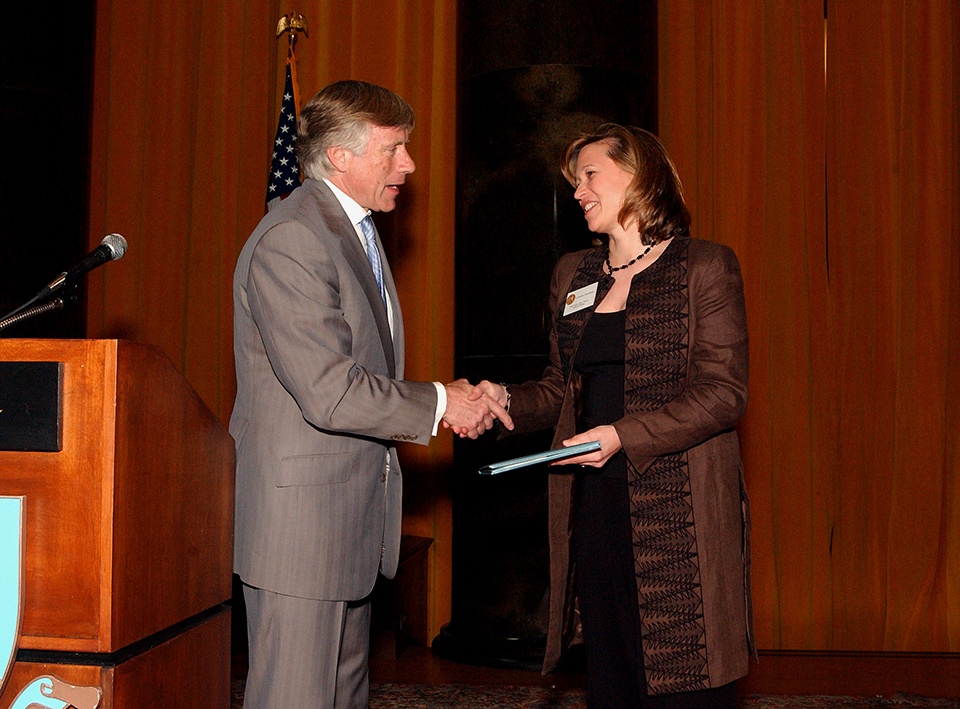
Columbia University President Lee C. Bollinger presents Cornelia Grumman with the 2003 Pulitzer Prize in Editorial Writing.
Winning Work
By Cornelia Grumman
Advances in DNA technology in recent years have exposed astonishing failings in the Illinois criminal justice system. Wrongful convictions, mistaken eyewitness identifications, arbitrarily applied punishment--profound errors at every level of the process--have deeply shaken many people, including some of the most ardent supporters of capital punishment.
There are 13 people alive today who bear personal witness to that. Those are the people who have been freed from Death Row in recent years because evidence proved they had been wrongfully convicted.
This is not a system of justice. This is a system of rank injustice. It is deeply fractured, and it must be repaired if Illinois is ever again to carry out a sentence of execution.
It has been more than two years since Gov. George Ryan imposed a moratorium on executions and formed a commission of distinguished attorneys and other citizens to study the system and recommend reforms. Faced with one of the worst records of wrongful capital convictions in the country, his decision eventually garnered nearly unanimous support in the legislature and triggered nationwide soul-searching into how--and whether--the death penalty can be carried out with any sense of confidence.
The Illinois Supreme Court has done its part.
In 2001 it established a Capital Litigation Trial Bar, which set minimum standards for attorneys representing capital defendants. It mandated that judges receive more training in how to handle death penalty cases, and that ethical rules for prosecutors include a pointed reminder that their job is about seeking justice, not just winning convictions. It required that indigent defendants be appointed two attorneys and that prosecutors give notification of their intent to seek the death penalty no later than 120 days after arraignment in order to give the defense more time to prepare.
After putting the new rules into effect, the high court emphasized these were the beginnings of reform, not the conclusion. The court urged the legislature to move on videotaping custodial police interrogations, which it said would constitute a "major improvement" to criminal procedure.
The legislature has had no shortage of ideas to consider, videotaping among them, and it has had plenty of time to ponder them.
A task force appointed by Senate Minority Leader Emil Jones in 1999 called for videotaping interrogations, setting minimum standards for defense attorneys handling capital cases, and allowing claims of innocence if new evidence is found after conviction. A special committee on prosecutorial misconduct headed by Republican Rep. Jim Durkin made several recommendations, including pretrial screening by a judge of jailhouse snitch testimony.
The legislature has approved increased funding for defense attorneys and prosecutors and automatic DNA testing for all convicted felons. When it comes to fundamental changes in the criminal justice system, however, the legislature has stalled, evaded, done as little as possible while begging for more time to study the issue.
Study time's over.
The Governor's Commission on Capital Punishment has finished its work. After two years of investigation, the commission in April issued 85 recommendations, the result of thorough research, sophisticated analysis and input from all sides of each issue.
Legislative hearings on many of those recommendations were held throughout the summer.
When lawmakers return to the state capital for a post-election session in November, they will have no excuses left. They will fix Illinois' humiliating system of broken justice, or they will prove they are too timid to take up the task.
Over the next several days, the Tribune will look closely at the most significant of the proposals that require legislative action: How to improve eyewitness identifications, why the state should narrow eligibility for the death penalty, what a statewide review of capital prosecutions would mean for public confidence.
They must be part of legislative reform, as should the required videotaping of all custodial police interrogations and confessions, a matter this page examined in April.
Illinois has issued more than 300 death sentences since the legislature reinstated capital punishment in 1977. We know at least 13 of those sentences were terrible mistakes. We know that in one of those cases, the people of Illinois came within hours of killing an innocent man.
If the state is to impose irreversible punishment, if the state is to take a life in the pursuit of justice, it must do so with far greater confidence that no innocent man or woman will be executed. It must do so with the assurance that the legal journey to the execution chamber in Downstate Tamms has been accurate, even and fair.
Illinois has shown the nation that it is fully capable of meting out flawed justice. It has the opportunity in November to show the nation how to repair the damage.
If insufficient political will exists to do that, then the moratorium must stay right where it is. State lawmakers, by their unwillingness to act, will have, in effect, repealed the death penalty.This is not a system of justice. This is a system of rank injustice. It is deeply fractured, and it must be repaired if Illinois is ever again to carry out a sentence of execution.
By Cornelia Grumman
Our minds don't work like video recorders, and yet the moment we put an eyewitness to a crime on the stand suddenly we treat his memory like truth from the mountaintop.
Thanks to a generation's worth of research, we know an awful lot about the fickleness of memory. We know eyewitness accounts of crimes are fragmented and suggestible. We know they're apt to go from shaky to confident between the time a cop confirms a witness' lineup choice ("You picked the right guy") and the start of trial.
The live lineup is a staple of modern-day police work in many station houses, Chicago in particular. Anyone who has watched police dramas on film or television knows how it works. And yet erroneous eyewitness testimony is the single greatest contributor to wrongful convictions in the United States.
Since the U.S. Supreme Court restored capital punishment, 86 Death Row inmates across the nation have been exonerated based on claims of innocence. The convictions in more than half of those cases depended at least in part on eyewitnesses, according to a 2001 study by the Center on Wrongful Convictions at Northwestern University School of Law. In 33 of the cases, eyewitness testimony was the only evidence used against the accused.
Take the experience of Chicagoan James Newsome. His was not a capital case, but the lessons apply to all felony prosecutions. Newsome was driving with a friend on Halloween in 1979 when police stopped them, guns drawn, as possible suspects in the robbery of a prostitute.
One of the officers thought Newsome resembled a composite sketch of a suspect in a murder that occurred a day earlier. Next thing he knew, Newsome was being marched into a live lineup at the police station, where three eyewitnesses fingered him as the man who gunned down South Side convenience store owner Mickey Cohen.
Newsome, who had never before been arrested, spent 15 years in a rat-infested prison serving a life sentence. That's how long it took for fingerprint technology to develop that would prove the prints left at the scene by the killer weren't Newsome's. For five years police knew, but didn't divulge, that the prints belonged to Dennis Emerson, a career criminal.
Newsome and Emerson didn't even look alike.
Newsome was nearly three inches taller.
Newsome had a mole on his nose. Emerson didn't.
Newsome had short-cropped hair. Emerson had more of an Afro.
Decide for yourself from the photos included in this editorial.
Last year, a federal jury awarded Newsome $15 million for being framed by Chicago police for the murder.
False identifications don't simply represent the failure of a single witness. It's not uncommon for multiple witnesses to make the same bad ID. In Newsome's case, at least one of the witnesses was shown a photograph of Newsome before he viewed the live lineup, and one was instructed by police to "take another look at No. 3" when he twice picked someone else in the lineup.
Of course, most police departments don't follow such egregiously bad practices. But there are myriad ways officers conducting photo spreads or live lineups can send subtle clues to steer eyewitnesses to identify the person who police believe is the real suspect.
Gary Wells, a professor of psychology at Iowa State University, has spent more than 20 years studying police "sixpack" lineups and photo spreads, as well as the memory of eyewitnesses to a crime. Through repeated experiments with staged crimes in front of college students, he has found that the practice of lining a bunch of suspects up at once has a higher error rate than if suspects are shown to witnesses individually, in sequence. The same is true with photo spreads.
Why? Because when all suspects are viewed at once, the eyewitness is tempted to make a relative judgment (Who most resembles the suspect among those present?) rather than an absolute one (Is this the person who committed the crime?).
When the real perpetrator is not in the sequential lineup, witnesses tend not to pick anyone. In group lineups, witnesses are more likely to pick somebody in the interest of being helpful.
"I would see the need for expert testimony [on problems with eyewitness identification] declining if everybody accepted sequential lineups," Wells said. "So it might turn out to be a net money-saving thing."
To make these techniques work, however, sequential lineups have to be conducted by an individual who has no idea who the actual suspect is. This precaution ensures that officers don't give even inadvertent signals--through eye contact, lifted eyebrows or any other kind of unintentional body language--that would steer an eyewitness.
Years of research shows that even the most well-intentioned, conscientious individuals who conduct lineups can still send unintentional body cues to eyewitnesses when the administrator knows the identity of the actual suspect.
Sequential lineups are now urged by the U.S. Department of Justice in its Eyewitness Evidence Guidelines. Still, the practice draws plenty of resistance from police and prosecutors who worry that suburban or rural police departments with small staffs will have trouble finding someone who is unfamiliar with a case to conduct a lineup.
There are two answers to this.
One is that most neighboring jurisdictions are no more than 20 minutes away; it wouldn't be that hard to find someone who didn't know about suspects in a case. The second is that there are automated ways of administering such lineups. A Canadian researcher has created a software program that administers lineups via laptops, asking the witness at the end for a statement about his or her level of certainty. One New Jersey assistant prosecutor designed a wooden board with six openings, each of which can slide open, one at a time. Drug forfeiture funds were used to pay a carpenter to make one for each of Union County's 23 police agencies.
Another complaint is that this technique is untested, based on university research rather than real police practice.
"It all struck me as theoretical," said Tom Needham, former chief of staff to the Chicago Police Department, who served on the Governor's Commission on Capital Punishment, which included sequential lineups among its 85 recommendations. "Why don't we wait and see how it goes out there in New Jersey."
New Jersey started doing sequential lineups a year ago, by order of the state attorney general, with little fanfare and, so far, little complaint.
"I'm pleased to tell you we're not experiencing any difficulties," said Richard Rodbart, Union County's deputy first assistant prosecutor. Rodbart said it's too early to tell whether the new procedure has increased the credibility of eyewitness testimony in court.
Michael Mastronardy, chief of the Dover Township, N.J., police department, said the new procedures haven't cramped the style of his 150 officers. His only concern is about the state providing sufficient funding to train them. "In my 10 years as chief and 28 years on the force, I've experienced situations with identifications where people are sure, though all the evidence says, no, that's not the person," Mastronardy said. "I'd rather have fewer overall identifications than a false identification."
That is the expectation. Sequential lineups don't necessarily heighten the probability of positive identifications, but they reduce the chance of false ones.
Of course there will be instances where a formal police lineup is not possible. If a lineup has to be conducted, say, outside the station house. But there are ways state legislation could accommodate those exceptions.
The governor's commission has recommended one more protection, that lineup procedures be videotaped, including a witness' confidence statement. At the very least, they should be audiotaped.
Statements made by a witness during the course of a lineup can be essential information to demonstrate later the confidence level of the witness at the time of identification. Too often, witnesses who were somewhat uncertain about their lineup selection suddenly become confident once trial rolls around because their decision has been confirmed by investigators.
Given the cost--virtually nothing--these changes should be easy for Illinois lawmakers to adopt this fall during the veto session, despite the inevitable thunder and lightning they will hear from some law enforcement groups in opposition.
"Police are just resistant to change," said Sgt. Paul Carroll, a retired former Chicago police sergeant who estimates he administered more than 1,000 photo and live lineups, and who now travels the world as a consultant and trainer on sequential lineups. "But cops know as well as anyone, it does no good to clear a crime and have the wrong guy in jail."
© 2002, Chicago Tribune
By Cornelia Grumman
"I don't particularly want some panel with a representative from Cook County on it who's seen 150 murders of the same type as the one we've got down here, telling us whether we can seek the death penalty on our case."
Donald Quickle slipped a ski mask over his head before driving up at closing time to Sheba's II, a roadside tavern in Creve Coeur. Quickle was there to rob the cash register. Larry Ederer, the owner, made the mistake of trying to wrestle him down and, in the scuffle, a bartender recognized Quickle's unmasked face from high school. Quickle shot Ederer dead, grabbed the bartender's purse, and ran.
Cut northeast across 150 paper-flat miles of corn and soy to reach the former home of aftershave vendor Darlene Dudeck in Aurora. One chill night in 1986, she walked in as Walter Thomas was burglarizing her garage.
Thomas stabbed her to death. He then broke open some of the boxes of English Leather he aimed to steal and used them to ignite the garage around her body.
Similar crimes. Different penalties.
Quickle's sentence: 90 years in prison.
Thomas' sentence: death.
Quickle's murder was no more or less ghastly than Thomas'. But their different punishments illustrate how justice in Illinois is dispensed with a geographic arbitrariness guided less by law than by the varying political sensibilities of 102 county prosecutors.
Sentences can depend not just on what crime has been committed, but on which side of the street the defendant happened to be standing, a Tribune analysis of state police and corrections records shows. That provides a prime reason why a centralized, statewide system of approving death penalty prosecutions is needed.
Across the state, 1.1 death sentences have been handed out for every 100 homicides since capital punishment was restored in 1977. The rate is significantly higher in some counties, while others have not imposed a single death sentence.
Cook County has had 20,600 homicides in that same time span. There have been 0.7 death sentences handed out for every 100 homicides.
Tazewell County, where Quickle killed Ederer, has had 50 homicides. No one has been sent to Death Row.
Compare that to DuPage County, where Thomas killed Dudeck. DuPage has had 213 homicides and 15 death sentences--10 times the Cook County rate and 6 times the statewide rate.
These are not precise measures. They don't reflect possible differences in the rates in which local police solve crimes. The disparities, though, have been confirmed by two Northeastern University researchers who found significant regional differences in how the death penalty has been applied in Illinois. Controlling for other factors, they found that convicted murderers in rural counties are nearly five times more likely to receive a death sentence than are those who commit similar murders in Cook County.
According to the research, done for the Governor's Commission on Capital Punishment, the decision to impose the death sentence spins not just on the depravity of the act or the place it occurred, but also on the race of the victim. In Illinois, a murder defendant is four times more likely to be sent to Death Row if his victim is white than if the victim is black.
Prosecutors say the most difficult decision they make is whether to seek to send someone to Death Row. Aside from the legal issues, they must weigh the enormous burden of money and time a capital prosecution places on their offices, the extent of public outrage generated by the crime, the desires of the victim's family and their own beliefs about the death penalty.
At the federal level, the U.S. attorney's manual contains recommended standards to follow in determining whether to seek the death penalty. Among the recommendations: There must be strong, admissible evidence that eliminates all reasonable doubts about whether the defendant's crime makes him eligible for the death penalty and that overcomes any mitigating factors.
No such voluntary guidelines exist for state's attorneys. They should. They are needed.
Also at the federal level, no U.S. attorney may proceed with a death penalty prosecution until he or she has prior written approval from the U.S. attorney general, who oversees a review committee. The governor's commission, in its recommendations released in April, urged adoption of a statewide review team that would scrutinize every request to seek a death sentence.
That five-member panel would be comprised of the state attorney general, three prosecutors and a retired judge. They would develop standards and apply them to each case as a way of ensuring a more uniform, standardized application of the death penalty.
Tazewell County State's Atty. Stewart Umholtz explained that his attempt to seek a death sentence for Donald Quickle was rejected by a judge. That case marked the only time since Umholtz became the central Illinois county's top prosecutor in 1995 that he has sought a capital sentence.
"I don't believe my job is so easy that all I have to do is decide whether the crime has at least one aggravating factor and then pursue the death penalty," Umholtz said.
Just two counties away, Livingston County State's Atty. Thomas "Maximum Tom" Brown has a reputation for seeking the most severe sentence possible in most cases. In his mind, his duty is to reflect the values and the outrage of the county residents who elected him.
"This isn't Chicago. This is Livingston County," Brown said on a recent harried day in the small red brick courthouse in Pontiac's town center. "I don't particularly want some panel with a representative from Cook County on it who's seen 150 murders of the same type as the one we've got down here, telling us whether we can seek the death penalty on our case."
State police report that Livingston has had seven homicides since 1977, three of which resulted in death sentences. Brown says the total number of homicides is actually higher.
County prosecutors are used to autonomy. They see themselves as representatives of their community and its values. And, to a great extent, they are. But death penalty prosecutions rise above local cases. They are carried out on behalf of the state, and more broadly, society.
Cook County State's Atty. Dick Devine insists the idea of a centralized review is unconstitutional in that it usurps authority from prosecutors and replaces it with a superfluous layer of bureaucracy.
If some loss of local autonomy is the price for a more uniform, rational system of capital punishment, so be it. The legislature defines crimes and the legislature defines which types of murder merit death. The legislature defines the authority prosecutors have to seek the death penalty. The legislature can narrow that authority, too. And this time, it should.
Just as it makes sense to create a centralized system to review capital prosecutions before they begin, it makes sense to build a review of the final results.
Unlike some states, Illinois has no system of collecting data and analyzing its system of capital punishment in a methodical way to monitor that it is being applied equitably. It has no way to investigate whether defendants aren't being convicted and sentenced to die in arbitrary fashion.
The governor's commission unanimously recommended that trial judges be required by the state Supreme Court to fill out a form on all first-degree murder cases, regardless of whether the defendant is sentenced to die. The forms would include such information as the race of the victim and defendant, whether eligibility factors were used and, if so, which ones, and the experience level of trial counsel--information not always readily available in court opinions. States such as Nebraska, Oklahoma, Tennessee, New Jersey and Georgia collect data of this kind.
Illinois has an agency that is set up to oversee this kind of data-gathering and analyzing: the Illinois Criminal Justice Information Authority.
The Illinois State's Attorney's Association has grumbled that this would pose an undue burden on trial judges for the benefit of statisticians. That misses the point by a mile. Illinois sees roughly 1,000 homicides a year, and not all of them get solved. Any judge would be able to fill out these forms in his sleep. Undue burden? We're talking about imposing death on behalf of the state's citizens. A little paperwork is hardly an undue burden.
To fully understand how the system is working in Illinois and to make sure death penalty is rooted in law rather than race, geography or any other extra-legal factor, how we deal with those who murder must be monitored through windows rather than keyholes.
© 2002, Chicago Tribune
By Cornelia Grumman
In 1984 a Chicago gang member named Gilbert "Blue Eyes" Perez slammed his car into another car on the Northwest Side. Perez, who was drunk, tried to get away from the accident, and three people who were driving by the scene offered to help him.
They didn't help him. They were rival gang members. They drove several blocks to an alley, they took Perez out of the car, and one of them, Mario Flores, shot him dead. The Perez murder was like hundreds of other homicides in Chicago, homicides that, if they are solved, usually send the killer to prison for many, many years.
Except for one thing. Perez's chain necklaces were missing.
There was no evidence to prove who stole the "handful of chains"--three people were involved in the incident and presumably any one of them could have taken it.
Flores was convicted of shooting Perez. And because of the missing necklaces, Flores was convicted of armed robbery.
And sentenced to death.
The missing necklaces set Flores' conviction apart from the hundreds of homicides that lead to lengthy prison sentences rather than Death Row. Because Flores was convicted of committing a felony--taking the necklaces during the course of a murder--he was eligible for the death penalty. And he got it.
There is no question that Mario Flores is a killer. There is a question as to whether he is the kind of killer who Illinois citizens believe should be executed.
Polls have shown for many years that a majority of Illinois residents support the death penalty, although that support has declined in recent years. While a majority supports capital punishment, there is also a political and legal consensus that it should be reserved only for the most heinous of killings.
The Illinois legislature recognized that when the state brought back the death penalty in 1977. The legislature authorized the imposition of the death penalty only in cases of first degree murder that involved any of seven eligibility factors, also called "aggravating factors."
The seven: murder of a peace officer or fireman; murder of an employee, inmate or visitor in a prison; murder of two or more people; murder in the course of a hijacking; contract murder; murder during the commission of another felony.
Over the years the legislature added 13 more ways to send a defendant to the death chamber. Anyone who kills a teacher, a disabled individual, a paramedic, or a community policing volunteer now qualifies for the death penalty. Anyone who commits a murder in a drive-by shooting or in the midst of a drug conspiracy. Anyone who tortures a victim. Anyone who kills or orders a murder in the course of committing a felony inside a prison. Anyone who has an order of protection against them.
How many times have those relatively new factors cited above been used?
Never.
In fact, only two eligibility factors have figured in nearly 90 percent of the cases in which capital punishment has been imposed: multiple murder and felony murder.
The legislature's expansion of the death penalty factors has placed at risk the principle of proportionality, that the ultimate punishment--the state-sanctioned taking of a life--should be reserved for the worst murders.
It's not just a pragmatic imperative. It's a constitutional one. The U.S. Supreme Court has stated that execution is not permissible for all first-degree murders. It also has clearly ruled that states allowing capital prosecutions must do so in a narrowly defined, rational way that is free of arbitrary decisions.
Last August, the Illinois Supreme Court upheld the constitutionality of the state's death penalty. In a concurrence, however, Justice Mary Ann McMorrow warned that the law could be on questionable ground. She encouraged the legislature to give "serious consideration" to reducing the number of aggravating factors. "Each time an additional aggravating factor is added to our death penalty statute, the risk of arbitrary and capricious sentencing is increased," she wrote.
If legislators are committed to the principle of proportionality, they will sharply reduce the number of factors that make a defendant eligible for death.
The Governor's Commission on Capital Punishment has unanimously recommended that the number of aggravating factors be whittled to five. Those five are:
- murder of a peace officer or firefighter.
- murder inside a prison.
- murder of more than one person.
- murder in the course of torturing a victim.
- murder of a person involved in the investigation, prosecution or defense of a defendant's alleged crime, including judges, juries, prosecutors and defense attorneys.
This is a sensible list. Few people in politics and government, however, expect that the legislature will be willing to draw such a narrow guideline of eligibility for the death penalty.
The legislature should retain one other aggravating factor: the brutal murder of a child under age 12.
It also should revise the most controversial of the commission's recommendations, that felony murder be eliminated as an eligibility factor.
Indeed, the members of the commission were deeply divided on this recommendation. Felony murder is the most often-used way to send a defendant to Death Row. It is also the factor that, as it is currently drawn, has the greatest potential for creating sentencing disparities.
Originally, nine violent crimes were included under felony murder. Today, it's 16.
Since the death penalty was reinstated in Illinois, there have been 304 death sentences imposed. Felony murder has played a role in 60 percent of those cases. In 37 percent of all death sentences, felony murder was the only aggravating factor used.
The theory behind felony murder was that it would protect the victims of various crimes. A rapist or a kidnapper, for instance, might not kill his victim because the penalty for the death would be substantially greater than that for rape or kidnapping.
Yet many cases that fall under felony murder are characterized by a homicide that occurred because a dangerous situation got out of hand, rather than because the killer was contemplating the consequences of his actions.
That doesn't justify the crime. It doesn't soften the loss. But it does argue against the death penalty, when so many similar murders result in a sentence of a number of years, or life, in prison. It's not too much a stretch to argue that this is death penalty by virtue of legal technicality.
The legislature should not eliminate the factor of felony murder, but it should reduce the number of crimes that qualify to these five:
- aggravated criminal sexual assault.
- predatory criminal sexual assault of a child.
- aggravated kidnapping.
- home invasion.
- forcible detention.
This would significantly reduce the number of felony murder death cases while preserving the death penalty for the most serious of these cases.
It will be important for the legislature to maintain a harsh penalty--life imprisonment--for the cases that come off the felony murder list. This charge is also used to convict and to exact long prison sentences for accomplices who are involved in a murder but don't commit the actual act. The full list of felony murder crimes should still apply to such cases.
The death penalty has not been used terribly frequently in Illinois. Of the nearly 27,000 murders that have been reported to the Illinois State police between 1978 and 2001, 304 resulted in a sentence of death.
And yet, nearly half of all death sentences imposed since 1977 have been reversed by higher courts. Most ominous of all, 13 Death Row inmates have been released because of wrongful convictions, and in many cases their innocence was later proved.
It is the policy of Illinois that certain, particularly grave crimes warrant a sentence of death. That is a solemn responsibility handed to the legislature and to those who work in the criminal justice system. Capital punishment must be applied fairly, sparingly and with great discipline.
Over the years, Illinois has sacrificed its sense of fairness and its discipline. The legislature must reclaim it.
© 2002, Chicago Tribune
By Cornelia Grumman
In mid-November Illinois lawmakers will have the opportunity to restructure the criminal justice system, to demonstrate that they understand a system that has bred wrongful convictions, false confessions, mistaken eyewitnesses and other outrages cannot be allowed to stand.
The timing is perfect. Legislators have had the chance to gauge the impact of court reforms enacted by the Illinois Supreme Court. They have had months to study the recommendations issued in April by the Governor's Commission on Capital Punishment. The pressures of the political campaign will be behind them.
It could well be their last genuine opportunity. The movement to change the justice system has had many supporters, but it has largely been sustained by one person, Gov. George Ryan, who will leave office in January.
George Ryan's potential successors, Democrat Rod Blagojevich and Republican Jim Ryan, have vowed that they will keep in place the moratorium on executions the governor imposed in January 2000. The two candidates have offered their own prescriptions for new protections in the justice system, but they don't have the same personal stake in a resolution of this issue that George Ryan has taken.
For those reasons, it is imperative that the legislature act before the end of the year. No more excuses. Lawmakers must restore confidence in a damaged system. They must establish a model for the rest of the nation to emulate.
Every new delay is an affront to justice. It keeps open the possibility that still more individuals will find themselves imprisoned for crimes they didn't commit, and that new victims will be created while real criminals run free. Every postponement also prolongs the pain of murder victims' families, who regard the moratorium as a delay in the justice they seek.
On the day the commission's report was released, a reporter asked George Ryan if he thought lawmakers would find these reforms difficult to support in an election year. Ryan's face reddened in anger and his voice boomed: "We're talking about life and death, we're not talking about losing an election!"
He was right.
If it appears the legislature is prepared to act in November, we can expect criticism to rise. Some police and prosecutors are resistant to many of the changes recommended by the governor's commission.
Gripes against reforming the state's death penalty are as plentiful as they are weak. Some argue that this is a problem largely confined to Cook County, that prosecutors in the other 101 counties should not be `punished' for bad practices in the state's most populous region. They argue that advanced DNA technology will root out future wrongful convictions, so there is no need for further reforms. They argue that the reforms will be too expensive.
Those are specious contentions. Illinois' criminal justice problems extend far beyond Cook County's borders. Five of the state's 13 exonerated Death Row inmates were from counties other than Cook, both rural and suburban. The problems extend beyond Death Row, too. The experience of wrongful convictions in capital cases only raises the prospect that more innocent people have been convicted in cases that have drawn less attention because they didn't lead to the death penalty.
As for the magic of DNA, it figures in only a small fraction of all crimes. Most criminals don't leave DNA material behind, particularly in armed robberies and shootings. Even as DNA evidence becomes more widely used, there is evidence that the justice system continues to put innocent people behind bars. Corethian Bell spent 17 months in Cook County jail on charges that he stabbed his mother to death. He confessed to the crime after 50 hours of interrogation, but DNA tests later linked another man to the crime. Bell was finally released last January.
Nothing, however, argues better for the need for reform than the cases of the 13 men who once called Death Row home.
If Illinois had required that interrogations and confessions be videotaped, there likely would have been no years-long dispute about whether Rolando Cruz told investigators he had a mysterious "vision" about the murder of a little girl, implicating himself in the 1983 death of Jeanine Nicarico. That reform likely would have spared him the 11 years, 7 months and 25 days he spent incarcerated for the crime before being released in 1995.
If Illinois disallowed death sentences in cases where the conviction relied solely on the testimony of an accomplice with something to gain, Verneal Jimerson might have been spared 11 years on Death Row for the kidnapping, rape and murder of two people. Jimerson's nightmare was sealed by the testimony of a 17-year-old woman with an IQ of 64 who couldn't read, write or tell time--and who continually changed her story.
If Illinois barred hanging a conviction on the testimony of a single, unrelated eyewitness, Steven Smith might have been spared 14 years on Death Row for the murder of a man outside a Chicago bar. After all those years, the Illinois Supreme Court ruled the testimony was unreliable.
If Illinois mandated that a judge screen before trial all testimony by jailhouse informants, Steve Manning might have been spared the 41/2 years he spent under a death sentence. In his case, the prosecution's star witness--a chronic liar and con man--wove a tale that Manning had confessed to him in prison. The Illinois Supreme Court cited insufficient evidence when it reversed Manning's conviction in 1998.
Over the last five days the Tribune has set out guidelines for reform, many of them ideas that were contained in the report by the governor's commission.
The commission had the benefit of great expertise. Of the commission's 14 members, 11 had prosecutorial experience. One, Thomas Needham, served as general counsel to the Chicago Police Department. The commission did some extraordinary work. In the course of the panel's two years of study, it took in testimony from dozens of law enforcement officials and evaluated exhaustive data provided by police departments.
It's time to restore Illinois' system of justice.
There will be significant costs to getting it right. An accurate, fair and reliable system of capital punishment will not come cheap. As it is, the state Supreme Court spends an enormous amount of its time hearing and ruling on death penalty appeals. Crime labs are woefully backed up with requests for DNA testing. Defense attorneys still are desperately underfunded, even with increased money granted to them by the legislature.
The costs of getting it wrong, though, are far worse. Figure in the multi-million dollar settlements paid to some of those who have been wrongfully convicted. Cook County paid $36 million to Jimerson and three other men. DuPage County paid $3.5 million to former Death Row inmates Rolando Cruz and Alejandro Hernandez.
The emotional costs are even more daunting. Innocent people have spent years wasting away in prison. Victims' families are burdened anew with the knowledge that the real perpetrator of the crime has been free for all those years.
These are the kinds of costs this state can no longer bear. With the authority to impose the death penalty comes a responsibility to get it right.
Now's the time to get it right. Get it right, or get rid of it.
By Cornelia Grumman
In one of the Kankakee County sheriff's first attempts at videotaping an interrogation, suspect Christopher Connery was led into a small room. It was bare but for two chairs, a table and a wall thermostat the size of a cigarette pack.
Detectives listened intently to Connery's repeated denials that he had raped and stabbed Melissa Osman to death. By the time investigators left the room to interview another witness, though, Connery appeared to have forgotten something--he had agreed that his interview could be videotaped. A tiny camera was perched behind the thermostat.
Alone in the room, Connery started singing, "Ding, dong, the wicked witch is dead..."
Connery has now taken up lifetime residence at the Pontiac Correctional Center.
For a sheriff's department full of cynics, that marked a conversion to the value of videotaping. Today their basement offices in downtown Kankakee are teeming with converts.
Detectives assert that their community reputation has improved since they started videotaping felony interrogations and confessions in 1996. Serious police brutality challenges have become almost non-existent. Prosecutors rarely lose on a motion to suppress a confession before trial. The police have learned new techniques by watching each other on tape.
Undersheriff Bradley O'Keefe notes another unexpected bonus: The valuable information they learn when the suspect thinks he's alone in the room.
Videotaping interrogations and confessions stood among the major recommendations issued last week by the Governor's Commission on Capital Punishment. The respected panel spent two years meticulously examining the system and issued 85 suggestions to make it better. Videotaping is one of the more controversial proposals, even though the idea has also been endorsed by a state Supreme Court committee that issued an earlier set of reforms.
The states of Minnesota and Alaska require videotaped interrogations and confessions. An increasing number of police departments around the country have adopted it on their own.
So why is it that so many law enforcement officials in Illinois still regard videotaping as a neutron bomb to effective policing? Why do places like Kankakee remain lonely islands of reason in a combative sea?
Mere hours after Monday's press conference to announce the commission's report, spitballs started flying. Why? Because too many cops want to serve and protect the status quo. Because they see it as a knock to their credibility rather than as a tool to help build strong cases while protecting the rights of the accused.
Law enforcement folks have plenty of reasons to worry about credibility, but this isn't one of them. The reasons they should be focused on include Ronald Jones, Corethian Bell, Rolando Cruz and Alejandro Hernandez--not to mention the 7- and 8-year-old boys who were wrongly accused of murdering 11-year-old Ryan Harris.
All were Death Row inmates or murder defendants who eventually were released because police took bad confessions from them. That means DNA or someone else's confession exonerated them from the crime they "confessed" to police. Had their interrogations been videotaped, that might have been discovered weeks, rather than months or years, later.
Ronald Jones confessed to murder. But he later claimed at trial that he had been interrogated for eight hours and brought to the crime scene to enhance the detail and accuracy of his statement. A videotape, with a date and time stamp on it, would have resolved that issue years ago.
A Tribune series published in December illustrated that it's not hard to extract a false confession from someone who, like Jones, has a low IQ or who is an alcoholic or a drug addict.
So taping only murder confessions, as is the practice in Cook County, doesn't go far enough. Corethian Bell confessed on videotape that he murdered his mother. But DNA tests later linked someone else to the crime. After 17 months in jail, Bell was released in January. A video of his interrogation leading up to the false confession would have shed light on what happened here.
Another Death Row inmate, Aaron Patterson, for years has maintained he confessed to a crime he did not commit because he was subjected to police torture. Given that he was interrogated by officers working under notorious Chicago Police Commander Jon Burge, his claims may have credibility. A videotape would have resolved the issue years ago.
Dozens of excuses, from the picayune to the far-fetched, have been thrown out by police departments terrified by the idea of pulling back the curtain to the interrogation room.
Excuse No. 1: All that fancy equipment costs too much.
Video cameras cost a few hundred bucks. Sony sells digital video cameras starting at $500 retail. The entire setup, including cassettes, could reach $1,000. That's cheaper than the alternative financial burden, shelling out millions in civil liabilities for false confessions. DuPage County paid $3.5 million to exonerated Death Row inmates Rolando Cruz and Alejandro Hernandez; Cook County paid $38.5 million to the four released Death Row inmates known as the Ford Heights Four. Cook taxpayers are destined to shell out millions more in legal fees and settlements for mishandling interrogations and confessions of four men wrongfully convicted of murdering medical student Lori Roscetti. Then there are the two young boys initially charged in the Ryan Harris case after their questionable confessions.
Excuse No. 2: Who has room to store all those cassettes?
In the Kankakee sheriff's evidence room is one small bookshelf on which sits all of last year's 157 videotapes, and there's plenty of room for more. Now with digital video technology, interviews could be stored on computers instead of shelves.
Excuse No. 3: This is one more technicality that will let murderers and rapists to go free.
Many prosecutors and police who use videotapes say just the opposite is true: Videotape helps win their cases or leads to faster plea bargains. "I would describe it as a big improvement," said Kankakee County Judge Clark Erickson. "We're spending a lot less time on pre-trial motions. It just narrows the issues."
In Minnesota, Hennepin County Prosecutor Amy Klobuchar said there are two major advantages to videotaped interrogations. They squelch virtually all police brutality claims because judges and jurors are able to see for themselves whether brutality occurred. And jurors are able to see what a defendant's demeanor was after the crime, rather than have to rely on someone else's descriptions and memories. "We had a guy who claimed he was blind," Klobuchar said. "When police left the room, he picked up a paper and started reading. The camera was on the whole time."
Excuse No. 4: Things can go wrong with the tape.
True. Kankakee Chief Investigator Ken McCabe said he has a case now where no audio was recorded on a tape. But this is the first time that has happened after handling more than 500 videotapes. Exceptions can be written into the law to allow confessions to be admitted when there was a technical breakdown or practical problem with videotaping. The commission recommends just such an exception.
Excuse No. 5: Sometimes a suspect will start confessing in the squad car or in the field before he can be taken to the station for interrogation.
Minnesota has provided the answer. Have cops carry small tape recorders for instances when a confession occurs outside of the police station.
Excuse No. 6: Suspects will clam up if they know a camera is on.
That was the same argument made before Miranda warnings were imposed, and it turned out not to be true. Kankakee Police Chief Michael Kinkade said about 55 percent of last year's felony suspects agreed to be videotaped. At the sheriff's office, more than 95 percent of felony suspects have assented to videotaping, O'Keefe said. Cameras can be positioned to be unobtrusive.
Excuse No. 7: Juries won't understand the kinds of tactics police use, which can involve legally protected lies or misleading statements.
To that, Kankakee Circuit Judge Kathy Bradshaw-Elliott said juries have gotten increasingly sophisticated about police questioning tactics by, believe it or not, watching television crime shows like NYPD Blue and Law & Order. Beyond that, people simply have the ability to understand the sometimes tough interrogation techniques used by police when they're carefully explained in court.
Some authorities suggest videotaping should be voluntary. Videotaping already is voluntary. Mandating it statewide is good, sensible policy. And for all the election year Nervous Nellies, this has nothing to do with being soft on crime. Videotaping interrogations helps further the search for the truth.
No one craves truth more than victims. Ask Dorothe Ernest of Hinsdale, whose daughter Kimberly was murdered while jogging in Philadelphia in 1995. The suspects claimed their confessions were coerced; the jury believed them. A videotape, Ernest believes, would have proved otherwise.
Illinois' criminal justice system is flawed. The 13 men who have been wrongly sentenced to die since 1977 stand as stark evidence of that. It is time to substantially improve that system, and videotaping interrogations and confessions will be an important step toward that.
A videotaping bill has sat in the House Judiciary committee for years. It is a fine bill. Some committee members have said the recommendation of the governor's commission will prompt them to take fresh look at it.
Great. Do it now. The Illinois legislature has proved it can respond quickly and forcefully when it is faced with a crisis, as it did nearly a decade ago in reforming the state's child welfare system.
Well, here is an issue that is no less one of life and death. The governor's commission on capital punishment has offered dozens of ways to improve on Illinois' capital punishment system. Move on them. No one craves truth more than victims.
© 2002, Chicago Tribune
By Cornelia Grumman
More than two years ago Gov. George Ryan declared a moratorium on capital punishment in Illinois and handed 14 people a breathtaking challenge: Tell us how to repair a justice system that repeatedly has condemned innocent people to be put to death.
The governor's commission on death penalty reform took its time. Some thought it was taking so much time because the real goal was to stall as long as possible the day when executions would resume in Illinois.
On Monday, the commission came back with its answer: 85 recommendations outlined in an extraordinarily thoughtful and exhaustively researched report. This is exceptional work. It was worth the wait.
And now it is the Illinois legislature's turn. The members of the General Assembly have to put most or all of these recommendations into law. Illinois' moratorium on capital punishment must stay firmly in place for however long it takes until they do.
Many lawmakers have said they were waiting for the panel's recommendations before supporting any particular death penalty reform.
Excuse time is over. Now it's time for each member of the legislature to spell out exactly where he or she stands on these reforms. The candidates for governor and attorney general must do the same.
The 14 members of the commission included respected prosecutors, defense attorneys, business people, a judge, an author and a former U.S. senator. They said that Illinois law enforcement should videotape all interrogations and confessions. They said that eligibility for the death penalty should be restricted to the most heinous cases such as torture, multiple murder, and the murder of a police officer.
They said the execution of the mentally retarded should be banned. They said to limit use of notoriously unreliable jailhouse informants and convictions based on one eyewitness account.
This is not just the work of those who oppose capital punishment. The commission included experts who believe in it. Commission member Thomas Needham, former chief of staff at the Chicago Police Department and a strong supporter of the death penalty, said he fully agreed with nearly 85 percent of these reforms.
"We need to do a better job in this state of singling out those relatively few people who deserve this punishment," he said Monday.
We know the problems. We've known them for a long time. Judges who don't understand the law. Prosecutors who pursue convictions at the cost of truth. Defense attorneys who are incompetent. Crime lab technicians who report whatever results cops want to hear or police who coerce false confessions. Laws that don't protect against those actions.
The panel also confirmed what many already suspected, that race and geography play into death penalty. If the victim is white, death becomes a more likely sentence for the murderer. Prosecutors in rural areas are more likely than those in urban areas to seek a death sentence.
That is why another proposed reform must be enacted: A single, statewide committee, comprised mostly of prosecutors, to determine when death penalty cases may be pursued. That would help assure more consistency and fairness from county to county.
Election-year jitters should not cloud anyone's resolve to support these measures. The public understands that being tough on crime doesn't mean sentencing the innocent to death. The public understands Illinois has done exactly that.
© 2002, Chicago Tribune
By Cornelia Grumman
At some point in our nation's history, it was perfectly legal to publicly flog thieves and perfectly legal to execute anyone who stole another man's horse.
Times change. Thank goodness.
Times changed again on Thursday, when the U.S. Supreme Court handed down a stunning reversal of the high court's previous ruling and banned executing those who are mentally retarded.
Back in 1989, when the court upheld the constitutionality of the practice, only two states--Maryland and Georgia--prohibited such executions. The court relied on that relative paucity of states to determine "national consensus" about the practice. The court again relied on the same standard to formulate its most recent decision.
Today, 18 states and the federal government ban such punishment, while 12 others and the District of Columbia have abolished the death penalty outright.
"Much has changed," the court majority said. "It is not so much the number of these states that is significant, but the consistency of the direction of change," wrote Justice John Paul Stevens for the 6-3 majority.
It was, in ways, an odd decision. The court's role is to rule on law, not gauge public sentiment. Nevertheless, the majority found that the fact that 16 states had acted since 1989 to ban executions of the mentally retarded, and none acted to reinstate it, sent a message that society now considered this practice excessive. That states such as Illinois continued to allow it but did so only rarely suggested it also had become unusual.
The court correctly recognized that those with diminished mental capacities, like juvenile defendants, are less able to aid in an effective defense. They are less able to fully understand arrest and trial procedures.
It's also hard to argue that capital punishment serves as any deterrent to those who are mentally retarded. What effect does such a deterrent have on those with childlike minds?
Most important, mentally retarded suspects are far more susceptible to making false confessions. The alarming number of cases where that has been proven to be true through DNA evidence continues to grow. Corethian Bell, a young man with a history of retardation and mental illness, spent 17 months in Cook County Jail after confessing on tape to stabbing his mother. DNA later proved it could not have been him.
Will there be a sudden "dumbing down" inside our nation's prisons of Death Row defendants in search of a break? Sure.
But there are reliable ways to determine subaverage intellectual capacities and impaired adaptive skills, including going back into childhood histories. States do it every day, for instance, to determine eligibility for disability benefits.
If society wants the option of capital punishment, that complication comes with the territory.
Yesterday's court decision absolves no one of responsibility for crime. Prison terms will still be served. It acknowledges, however, that not only have we come a long way from the days of horse stealing, but also a long way from holding the mentally retarded as morally culpable for crimes as everyone else.
© 2002, Chicago Tribune
By Cornelia Grumman
It is time to clean house. It is time to figure out whether officers have been covering up or lying under oath about whether torture occurred.
At least 66 people claim to have been tortured by former Chicago Police Lt. Jon Burge or police officers who were under his command.
All those making the claims were crime suspects, but there's good reason to believe most or all are telling the truth. A limited police department review concluded in 1990 that abuse under Burge was methodical. A federal judge described widespread torture in the early- to mid-1980s as "common knowledge."
The alleged torture included suffocation, burns, electric shocks to the genitals, heads slammed with phone books and "games" of Russian roulette. Some of the suspects were released. Some confessed to crimes they had committed. Some may have confessed to crimes they did not commit -- in a desperate bid to stop th abuse.
No one knows for certain what happened under Burge's command. That's why it's high time to appoint a special prosecutor to conduct a comprehensive, independent investigation of torture allegations that have been hanging over the Chicago Police Department for decades.
This Friday will mark one year since attorneys went to court seeking a special prosecutor. Cook County Chief Criminal Court Judge Paul Biebel Jr. has been considering the matter since it was argued before him in November.
Cook County State's Atty. Dick Devine is fighting the measure with gusto. Of course he is. He has much to lose should a full-blown investigation substantiate more of those claims.
Devine was first assistant in the state's attorney office from 1980 to 1983, during which time some of the torture is said to have occurred. Some of those working for Devine today were closely involved in taking statements from individuals who allegedly were tortured; others had a hand in prosecuting them. Any thorough inquiry may put hard-won convictions in jeopardy, and might implicate some in a conspiracy of silence if they knew what was occuring inside Burge's interrogation rooms.
Devine once appeared in federal court on behalf of Burge, because the private law firm Devine joined in 1983 as a partner spent years representing the commander after he was fired.
Devine, however, casually dismisses those obvious conflicts of interest. Instead, he is trying to deep-six the appointment of a special prosecutor with the argument that the statute of limitations on any offenses has expired.
But the full picture of torture has yet to emerge. For years, the alleged victims had no idea others were making strikingly similar allegations. It is, as well, premature to say that the time to bring criminal charges has expired -- before the exact details of such offenses have been fully aired.
It is time to clean house. It is time to figure out whether officers have been covering up or lying under oath about whether torture occurred. It is time to determine the exact extent of the torture, which officers engaged in abuse, how many confessions were unlawfully obtained and, most important, whether any of those confessions turned out to be false.
Eleven people from whom Burge or his officers extracted confessions are sitting on Death Row. Others are serving lengthy sentences for murder convictions. Most, probably, are guilty. A few, though, may have credible claims of innocence. Meanwhile, Burge, who was fired by the Chicago Police Board in 1993, is retired and living in Florida.
Judge Biebel should appoint a prosecutor now.
© 2002, Chicago Tribune
By Cornelia Grumman
Alexander Williams, a chronic paranoid schizophrenic, believes he is under "demon attack." He thinks Sigourney Weaver is God. He claims insects removed his left eye and substituted a shell.
Williams is too insane to be executed. So prison officials in Georgia have been forcing medication on him to make him less insane and delusional by Wednesday at 7 p.m., when he is scheduled to die by lethal injection for the 1986 rape and murder of a 16-year-old girl.
Georgia law prohibits executions of the mentally retarded, but not the mentally ill. And though the U.S. Supreme Court has said insane individuals should not be executed, it never has directly addressed the issue of whether such individuals could be forcibly medicated in order to make them competent enough to be executed.
Yes, that's what's going on in Georgia: Medicating someone for the sole purpose of making him lucid enough to understand why he is about to be executed for an act he committed while bordering on insane. That is bizarre.
The high court has not yet ruled on whether the imposition of the death penalty on juvenile offenders amounts to a violation of the 8th Amendment protection against cruel and unusual punishment, given today's standards of decency. Williams was just 17, still considered a minor, when he carried out his very adult crime. That made him too young to vote or drink, but despite his hallucinatory mind, not young enough to avoid being sentenced to death.
Society regards young people as different from old people for good reason: they lack the judgment and the impulse control that adults have. Brain research documents and underscores why we shouldn't hold juveniles to the same standards of culpability that we do adults.
It doesn't mean Alex Williams should be free to roam the streets. It means he should be locked away somewhere secure for the rest of his life.
But that probably won't happen, in large part because of a third aspect of this case that has been treated inexplicably by the courts like a piece of irrelevant trivia.
Williams' hideously incompetent trial attorney failed to bring up Williams' long history of abuse, abandonment and torture at the hands of his parents. That he frequently was kicked out of the house, sometimes naked. That his mother beat his toes with a hammer and a screwdriver, and struck him with various objects. That he regularly would be denied food and use of the bathroom.
Attorney O.L. Collins didn't bother bringing any of this up as mitigating evidence at sentencing. Instead he spent a mere 15 minutes instructing the jury to "do what you will" with his client.
Executing Alexander Williams will amount to nothing more than an act of hollow, cruel vengeance. The plunger will empty, and the state of Georgia will have one less problem on its hands--at the cost of diminishing all of us.
© 2002, Chicago Tribune
Biography
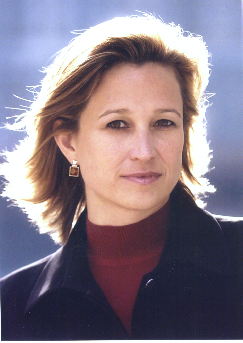
Cornelia Grumman joined the Chicago Tribune's editorial board in May 2000. There, she writes primarily about social policy, education, juvenile justice and the death penalty. She also oversees the Tribune's political endorsements. Prior to becoming a member of the editorial board, Grumman spent six years as a metropolitan, state government and Internet reporter for the Tribune.
Before coming to the Tribune, Grumman worked at the News and Observer in Raleigh, North Carolina, as a stringer at theWashington Post in Beijing in the aftermath of student democracy movement in 1989, and at the Daily Southtown.
Grumman earned a master's degree in public policy from the Kennedy School of Government at Harvard University and a bachelor's degree in public policy from Duke University.
In 2001 Grumman received the Casey Medal for Meritorious Journalism for editorials on children and family issues, a Studs Terkel award for coverage of disadvantaged communities, a Herman Kogan award for editorials on the death penalty and the Peter Lisagor award for commentary.