The San Diego Union-Tribune and Copley News Service, by Staffs
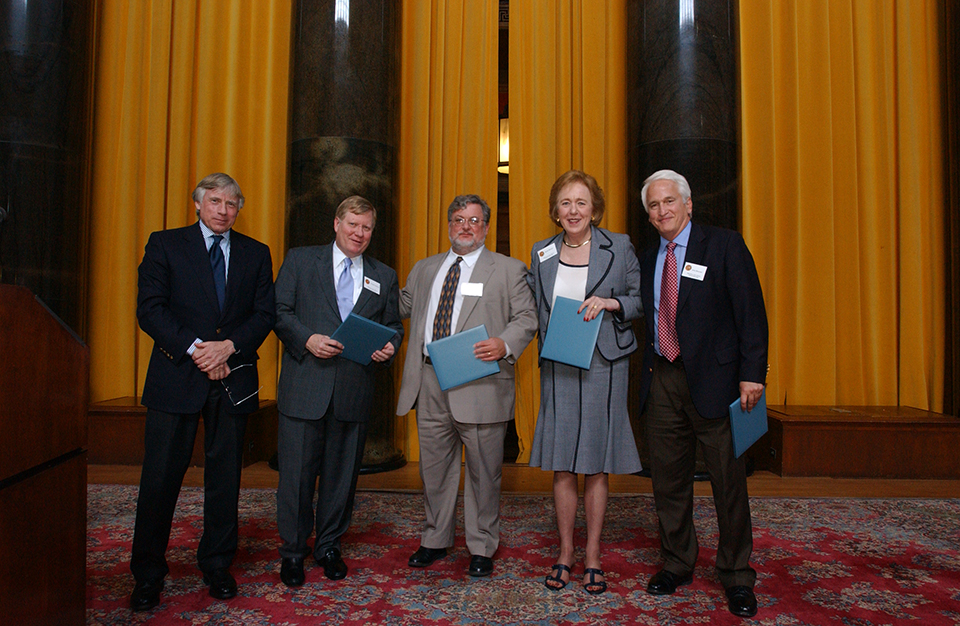
Lee C. Bollinger (left) presents (left to right) George Condon, Jr., Marcus Stern, Karin Winner and Jerry Kammer with a 2006 Pulitzer Prize in National Reporting.
Winning Work
By Marcus Stern
COPLEY NEWS SERVICE
"I don't have anything to do with contracts," Cunningham said. "The way it works here, I support a lot of credible defense programs for either the Air Force, Navy, shipbuilding, ship repair, intel. And they say, you know, 'Duke, these are good programs. This is what we want to do.' I support those programs like I have literally thousands in San Diego."
WASHINGTON -- A defense contractor with ties to Rep. Randy "Duke" Cunningham took a $700,000 loss on the purchase of the congressman's Del Mar house while the congressman, a member of the influential defense appropriations subcommittee, was supporting the contractor's efforts to get tens of millions of dollars in contracts from the Pentagon.
Mitchell Wade bought the San Diego Republican's house for $1,675,000 in November 2003 and put it back on the market almost immediately for roughly the same price. But the Del Mar house languished unsold and vacant for 261 days before selling for $975,000.
Meanwhile, Cunningham used the proceeds of the $1,675,000 sale to buy a $2.55 million house in Rancho Santa Fe. And Wade, who had been suffering through a flat period in winning Pentagon contracts, was on a tear -- reeling in tens of millions of dollars in defense and intelligence-related contracts.
In an interview Wednesday, Cunningham conceded that the circumstances surrounding the transaction could raise "fair" questions, but he insisted that the real estate deal was legitimate and independent of his efforts to help Wade win contracts.
"My whole life I've lived aboveboard," Cunningham said. "I've never even smoked a marijuana cigarette. I don't cheat. If a contractor buys me lunch and we meet a second time, I buy the lunch. My whole life has been aboveboard and so this doesn't worry me."
Later, he added, "The last thing I would do is get involved in something that, you know, is wrong. And I feel very confident that I haven't done anything wrong."
Congressional and political watchdog organizations expressed concerns, saying the circumstances raise questions about whether the transaction might constitute an illegal campaign contribution or even an official bribe.
"This doesn't look good at all," said Larry Noble, director of the Center for Responsive Politics. "It doesn't look like something that was on the up and up."
"The potential conflicts here are enormous," added Brad White, director of investigations for Public Citizen's Congress Watch.
Wade was traveling without access to a telephone last week, according to Scotty Brumett, an official of Wade's company, MZM Inc. Brumett said Wade purchased the two-story, four-bedroom, three-and-a-half-bath residence to raise MZM's corporate profile in San Diego.
"We were looking at expanding our company presence in San Diego," Brumett said. "We looked at the property and thought it would work for us. But after we bought it, we realized that it did not meet our security or our corporate needs."
So the company placed it back on the market within one month of purchasing it, where it stayed for more than eight months, selling eventually for $700,000 less than the price Wade gave Cunningham.
"I don't know why it didn't sell," said listing agent Elizabeth Todd, a Realtor with the Willis Allen Co. in Del Mar. "I honestly don't. I mean, it's a house in Del Mar west of I-5 and it's a good-sized house. I honestly don't know why."
No Realtor was formally involved when Cunningham sold the house to Wade. But Todd had set the asking price for Cunningham at $1,675,000 and sent a table of comparable house sales to Wade justifying the price, she and Cunningham said. He didn't hire Todd as the listing agent and never paid her a fee, she added. Nor was the house ever posted in the Realtors' multiple listing service, she added.
Property records don't list Wade or MZM as the buyer of Cunningham's house. Instead, the records state that Cunningham sold the house to 1523 New Hampshire Avenue LLC. Nevada state business records show that Wade owns that company, too. It is the address of his Washington, D.C., office.
"I tried to sell my house," Cunningham explained. "And I told a bunch of other people I wanted to sell it when Mr. Wade said, 'Hey, I'll buy it.' I went through Willis and Allen. They sent him comps. And he said that's a fair price and I'll buy it. Now other than that, I don't know anything about it."
Noble and White portrayed the transaction as suspicious.
"It's not even like he sold the house to a friend who moved in," said Noble. "And MZM wasn't buying an office in San Diego. I don't know a lot of companies that increase their presence by buying a home that they don't live in.
"I mean this whole thing, frankly, raises a lot of serious questions. At the worst end of the scenarios are illegal gifts or, if this transaction was in essence a payment to Cunningham for his help in getting contracts, then you'd be talking about official bribery."
Said White: "Just the circumstances surrounding this deal raise concerns about whether it was legitimate. And it's an important question, because if it wasn't, then this transaction would be a questionable $700,000 gift from an ambitious defense contractor to a sitting member of the House defense appropriations subcommittee."
No mention of Cunningham's real estate transaction with Wade or the lawmaker's subsequent purchase of the $2.55 million house in Rancho Santa Fe appears on the annual financial disclosure form he is required to fill out each year as a member of Congress because personal residences are exempt from the forms.
Cunningham, who also sits on the House Intelligence Committee, has been a member of Congress since 1990, and has represented the 50th Congressional District since 2002. The district includes several north county communities, such as Carlsbad, Encinitas, San Marcos, Del Mar and Escondido.
Cunningham said his home sale to Wade was totally independent of any assistance he might have given MZM in its efforts to win defense and intelligence contracts.
"I don't have anything to do with contracts," Cunningham said. "The way it works here, I support a lot of credible defense programs for either the Air Force, Navy, shipbuilding, ship repair, intel. And they say, you know, 'Duke, these are good programs. This is what we want to do.' I support those programs like I have literally thousands in San Diego."
The defense appropriations subcommittee drafts the bill that sets specific funding levels for defense programs each year. Committee staff members, acting under the supervision of the chairman and with input from members of the committee, create the initial draft of the spending bill.
With the chairman's approval, subcommittee members are able to insert targeted provisions, frequently benefiting companies, schools or other projects in their congressional districts. This process goes on largely behind closed doors, and the language of the bill rarely identifies the intended beneficiary or the subcommittee member responsible for the provision. Subcommittee members frequently win support for their pet provisions by supporting the provisions of other members.
"It's almost like a swap meet sometimes," said Eric Miller, senior defense investigator for the Project On Government Oversight.
After the draft is completed, the subcommittee, full committee and House must approve the legislation.
Asked if he had supported funding requests benefiting MZM, Cunningham said, "Oh, sure. Just like I have supported Qualcomm and everything else. Titan. SAIC. TRW."
MZM has also been a major contributor to Cunningham's political campaigns, having donated $13,000 in the 2003-04 election cycle.
Asked if he and Wade were friends, Cunningham answered, "No more than I am with (Qualcomm founder) Irwin Jacobs or (Titan Corp. founder) Gene Ray or any of the other CEOs."
Nobody would equate MZM, which is headquartered in the trendy Dupont Circle area in Washington, with San Diego-based giants Qualcomm and Titan. Nor would anyone equate Wade with Jacobs or Ray. Wade was a Pentagon program manager before launching MZM in 1993, and he struggled to get contracts as recently as three years ago.
But in 2003 and 2004, roughly around the time of the house transaction, MZM's fortunes began to soar. In fiscal year 2003, it received $41 million in defense contracts. Since then, MZM has added tens of millions of dollars in additional contracts, including a $5 million sole source contract to provide interpreters in Iraq.
In 2004, MZM had $66 million in revenues, according to Washington Technology magazine, which put the relative corporate newcomer on its 2005 list of "Top 100 Federal Prime Contractors."
MZM offers a broad range of consulting services for national security, intelligence, law enforcement and defense agencies.
Cunningham said he couldn't discuss the MZM programs he's helped advance because they are "very, very classified."
Brumett, the MZM official, refused to discuss any of MZM's contracting activities, saying, "It's government proprietary information and it's also classified."
But MZM's corporate Web site boasts that during 2004, "MZM Inc. experienced significant growth, tripling revenues since the beginning of the year and increasing staff by 285 percent. We look forward to continued growth in 2005."
--Contributing to this report was Union-Tribune Researcher Cecilia Iniguez.
© 2005 The San Diego Union-Tribune/Copley News Service
By Marcus Stern
WASHINGTON -- Mitchell Wade, founder of the defense contracting firm MZM Inc., pressured employees to donate to a political fund that benefited Rep. Randy "Duke" Cunningham and other members of Congress, according to three former employees of the company.
Wade, who took a $700,000 loss on the purchase of Cunningham's Del Mar home and allows the congressman to stay on his yacht while in Washington, demanded employees make donations to the company's political action committee, MZM PAC, they said.
"By the spring of '02, Mitch was twisting employees' arms to donate to his MZM PAC," said one former employee. "We were called in and told basically either donate to the MZM PAC or we would be fired."
Many companies have PACs, but campaign finance laws prohibit employers from pressuring workers to contribute to the PAC. They may encourage contributions, but not compel them.
"It is illegal to solicit campaign contributions for the company's political action committee by the use of threats, force or threat of job reprisal," said Larry Noble, former general counsel of the Federal Election Commission and currently director of the Center for Responsive Politics, a nonpartisan organization that tracks the flow of money in politics.
"If they say to somebody, 'You either give or you are going to be fired,' they have violated the law," Noble said.
MZM officials did not respond to requests for comment. In the past week, Wade resigned the posts of president and chief executive officer of the company, turning over those duties to Chief Operating Officer Frank Bragg, company sources said. Wade remains the primary shareholder of the privately held, Nevada-licensed company, sources added.
The resignations came after the Union-Tribune reported that Wade had purchased and then sold Cunningham's Del Mar house at a loss of $700,000 and has allowed the Rancho Santa Fe Republican to stay aboard his yacht, called the Duke-Stir, while in the nation's capital. The FBI and a federal grand jury are investigating the matter.
Since the initial disclosure of the 2003 home sale, Cunningham has released only two brief statements on his ties to Wade, saying that the home sale was "aboveboard" and that he has paid an undisclosed amount for use of the yacht.
Wade has made no public comment since his ties to Cunningham were first reported.
Wade operates out of the company headquarters, a four-story townhouse in the Dupont Circle area of Washington. About 20 to 25 employees work in the building, according to the former employees. They say the company has grown to more than 400 employees, with much of the expansion coming in the past two years.
Little public information exists on what MZM -- a name based on the first names of Wade's children Matthew, Zachary and Morgan -- does for the government. Former employees, however, say much of its work is with three defense intelligence operations:
- Counter Intelligence Field Activity, a highly secretive program created in 2002 by a Pentagon directive that focuses on gathering intelligence to avert attacks like the ones on Sept. 11, 2001.
- The Army National Ground Intelligence Center in Charlottesville, Va., whose mission is to provide soldiers with battlefield intelligence.
- The U.S. Army Intelligence and Security Command at Ft. Belvoir, Va., just outside Washington, which also provides battlefield intelligence.
MZM has been seeking to increase its contracts with the Central Command, which oversees military operations in Iraq and Afghanistan, and the Special Operations Command, both based at MacDill Air Force Base in Tampa, Fla., according to former employees.
The three former MZM employees who said Wade pressured them and others to donate money to the company PAC declined to be identified, saying they feared for their careers if their names were disclosed. All continue to work in the military and intelligence fields.
They and other former MZM employees questioned the way Wade solicited contracts from Defense Department intelligence agencies during the time they worked for the company.
They also expressed concerns about Wade's dealings with three House members who received a large portion of the money disbursed by MZM's PAC. The three -- all Republicans -- are Cunningham and Reps. Virgil Goode of Virginia and Katherine Harris of Florida.
MZM's PAC donated $17,000 to Cunningham from 2000 to 2004. Donations included $12,000 to "Friends of Duke Cunningham" and $5,000 to his leadership PAC, the American Prosperity PAC. During the same period, MZM PAC gave Goode $11,000 and Harris $10,000.
Neither Goode's nor Harris' offices returned calls seeking comment.
Many companies form PACs to raise and spend money to help elect or defeat political candidates. Individuals also may contribute separately. PACs are not allowed to give more than $5,000 to any one candidate per election. When a primary and general election are involved, PACs may give $5,000 per candidate in each, for a total of $10,000 per election cycle. Individuals may give up to $4,000 per election cycle.
In addition to the MZM PAC, MZM officials also made contributions to the House members' campaigns. Wade gave Cunningham $6,000 between 2000 and 2004.
MZM officials and their family members gave Harris, who ran for Congress in 2002, a total of $44,000 during 2003 and 2004. Goode received a total of $27,851 between 2000 and 2004.
MZM senior employees and family members gave Goode an additional $44,625 in March, according to information compiled by the Center for Responsive Politics.
MZM has a facility in Goode's rural Virginia district, not far from the Army National Ground Intelligence Center, which is one of MZM's key customers.
MZM is also planning to buy a facility in Harris' district, where it can be close to two of its other customers, the U.S. Central Command and the Special Operations Command, which are in a neighboring congressional district.
Cunningham is on the Permanent Select Committee on Intelligence and the defense appropriations subcommittee, which puts him in position to influence the awarding of defense intelligence contracts.
MZM had 56 such contracts totaling $68,645,909 in fiscal year 2004, according to Keith Ashdown, an analyst with Taxpayers for Common Sense. One of those contracts is to provide interpreters in Iraq. For the most part, the contracts were awarded to MZM without competition through a process known as "blanket purchase agreements."
Ashdown echoed the comments of former MZM employees in saying Wade strategically targeted MZM's donations.
"A lot of people will throw a lot of money at a lot of different people," Ashdown said. Wade's "strategy was, 'I need to make friends with a few very influential lawmakers and really, really schmooze and coddle them and that's how I'm going to make my money.' And that's what he did.
"The first person is Cunningham, a senior guy on the (defense appropriations) committee, and he helps them get business. Then they go to another guy on the (defense appropriations) committee, Goode, who's more junior but has the benefit of getting a facility in his district. And then they go to Katherine Harris, who isn't on the committee but needs lots of money for her Senate race and would be bringing business and new jobs to her area," Ashdown said.
Harris plans to run for Senate next year.
One of the former MZM employees quoted Wade as describing his congressional strategy this way: "The only people I want to work with are people I give checks to. I own them."
Another former employee said Wade used letters to remind employees before their employment anniversaries to contribute a designated amount to the company PAC. The specific amount was based on their level of seniority in the company, with more senior officials expected to give $1,000 each and less senior employees expected to give $500, the former official said.
A third former employee described being rounded up along with other employees one afternoon in the company's Washington headquarters and told to write a check, with the political recipient standing by. The former employee wouldn't give the name of the politician receiving the donations.
"When (employers) solicit contributions to the political action committee, they are supposed to say that the contribution is voluntary," said Noble, the former general counsel of the Federal Election Commission. "They are allowed to suggest an amount to give, but they have to say you can give more or less, or nothing at all.
"And they have to say that there will be no job reprisals for not giving. So even being silent on it and soliciting contributions is, actually, technically a violation of the law."
Citizens for Responsibility and Ethics in Washington, a group with ties to the Democratic Party, lodged a complaint yesterday with the Federal Election Commission after a Copley News Service story posted on the Union-Tribune's Web site -- SignOnSanDiego.com -- disclosed the allegations that Wade had pressured employees to contribute to MZM PAC.
© 2005 The San Diego Union-Tribune/Copley News Service
By Bruce V. Bigelow
Union-Tribune Staff Writer
The defense contractor embroiled in controversy over the purchase of Rep. Randy "Duke" Cunningham's Del Mar home has maintained an aura of secrecy as its business boomed during the past three years.
As a privately held company, MZM Inc. is not required to file financial disclosures with government regulators that describe its business operations. The company is based in Washington, D.C., and has made few public pronouncements since it was founded by Mitchell Wade in 1993.
Wade did not return calls for comment made to MZM's headquarters this week.
The company's business began to take off three years ago when it was designated the sole contractor for certain types of Army intelligence programs.
MZM's five-year contract with the Department of Defense was structured as an open-ended blanket-purchase agreement, with a $250 million spending limit, said Keith Ashdown, an analyst with Taxpayers for Common Sense, a nonpartisan group dedicated to cutting wasteful government spending.
(Blanket-purchase agreements are vaguely worded contracts designed to give agencies flexibility and to speed purchases. Contractors are screened and pre-qualified. Critics contend these open-ended contracts allow agencies to skirt public oversight.)
Under the agreement, MZM became an exclusive contractor for the Defense Information Systems Agency, enabling the agency to order services from MZM.
Landing important defense intelligence business was like a Class-A minor league baseball player suddenly pitching in the major leagues, Ashdown said.
He said he could find no federal contract revenue for MZM before fiscal year 2003. A search of MZM's federal contracts on FSI, a Virginia market research firm that maintains an online database of federal contracting information, also indicates the company had no contract revenue before 2003.
Since then, MZM's business has mushroomed.
The company now ranks as the nation's 100th largest federal prime contractor, based on 2004 revenue that was estimated at $66.2 million in an annual survey prepared by Washington Technology, a regional news organization.
In its 2005 list of the nation's biggest contractors, Washington Technology noted that MZM declined to disclose information about its major customers, contracts or projects.
Summaries of contracts awarded to MZM in recent years suggest, however, that most of the company's revenue stems from the blanket-purchase agreement, which was awarded to the company in late 2002 or early 2003.
Wade purchased Cunningham's Del Mar home in November 2003.
"As far as I can tell, everything they have gotten was awarded no-bid," Ashdown said.
He estimated that MZM generated about $68.6 million in revenue in 2004, and about $65 million of that was derived from orders placed under the blanket-purchase agreement. Out of 56 "contractual actions" last year, 50 came through the agreement, Ashdown said.
He estimated that in the past two years MZM has reaped $110 million through the arrangement.
"Why did they get that contract, and who helped them get it -- that's the question mark," Ashdown said. "But it's clear that they exist almost solely on this one contract."
Much of MZM's services under the agreement involved classified work on intelligence programs for the U.S. Army, although FSI shows MZM also filled orders for office equipment and computer systems design services.
Under one key program, MZM established a computerized data center for the Army National Ground Intelligence Center near Charlottesville, Va.
The company subsequently joined the Charlottesville Regional Chamber of Commerce, but the chamber's director of member services could not remember MZM officials participating in any of the chamber's networking opportunities.
"They are members, but I don't know them personally," said Larry Banner, a chamber vice president.
MZM also has done work for the U.S. Army Intelligence and Security Command at Fort Belvoir, Va., and for the Counter Intelligence Field Activity, a highly secretive program created in response to the Sept. 11, 2001, terrorist attacks.
MZM may have been in a position to win such important intelligence work in part because of the credentials of James C. King, a senior vice president at MZM.
King, 59, retired in 2001 as an Army lieutenant general after spending most of his 33 years in military intelligence. King established the National Imagery and Mapping Agency in Bethesda, Md. The agency provides surveillance imagery from satellites and reconnaissance aircraft, imagery intelligence and geospatial information in support of national security objectives.
Recruiting top military and government officials into the senior ranks of defense contractors is a common practice, said John Pike, director of GlobalSecurity.org, a Web-based institute focused on defense, aerospace and national security issues.
"The notion that you would get former senior military people so they could help you get business ... and that companies would make political contributions and get things earmarked for them is normal," Pike said. "That's how you get things done in this town."
Information gleaned from the federal government's Central Contractor Registration indicates that MZM usually operates as a consultant.
MZM's registration data, which all federal contractors are required to file, says the company provides services as a marketing consultant and in administrative management and general management consulting services. Wade, the company's founder, is listed as the chief point of contact in all categories.
Documents detailing federal campaign contributions made through MZM's political action committee also indicated that Wade's 42-year-old brother, Gregory, works in San Diego as a project director for the company.
Gregory Wade declined to comment yesterday, except to say he no longer works for MZM.
Records in Gregory Wade's 2002 divorce, filed in San Diego Superior Court, show that he reported income of $13,630 in the 12 months prior to his divorce. He worked for MZM for seven of the 12 months, according to the records.
(He is not to be confused with Greg V. Wade, who is the community development director for Imperial Beach.)
© 2005 The San Diego Union-Tribune/Copley News Service
By Jerry Kammer and Marcus Stern
Copley News Service
U.S. Coast Guard records do not reflect the sale of the Kelly C from Cunningham to Kontogiannis, showing Cunningham as the boat's owner since 1997.
CITY ISLAND, N.Y. -- Rep. Randy "Duke" Cunningham made roughly a $400,000 profit by selling the boat he lived aboard in the nation's capital from 1997 to 2002 to a businessman convicted in a bid-rigging scheme. The man said he subsequently got advice from Cunningham about how to pursue a presidential pardon from the Bush administration.
The businessman further acknowledged that a mortgage company owned by his daughter and nephew provided Cunningham with two loans totaling $1.1 million so the congressman could buy his home in Rancho Santa Fe. The businessman said he eventually paid off one of those loans in partial payment for the yacht.
Cunningham bought the 65-foot flat-bottom riverboat Kelly C from then-Rep. Sonny Callahan, R-Ala., for $200,000 in 1997. Five years later, he sold the boat for $600,000 to Thomas Kontogiannis, the Long Island businessman said yesterday.
Kontogiannis defended the $600,000 price tag as "a steal," saying that he had received an appraisal for twice that amount.
The Kontogiannis family is a frequent contributor to Republican causes, including a $300 contribution to Cunningham in July 2002, the year of the sale.
Cunningham's financial dealings in recent weeks have embroiled him in a multitiered federal investigation and cast a shadow over his Washington career.
In a series of interviews with Copley News Service yesterday, Kontogiannis confirmed that he bought Cunningham's boat and that the congressman offered to help him explore the possibility of seeking a pardon from President Bush and the Justice Department. Cunningham then put him in touch with a Washington law firm and recommended "two or three" lawyers to talk to, said the businessman.
"I said I have this problem and I was wondering if I can get a pardon out of it," said the 56-year-old real estate developer, who has more than a dozen companies. "He (Cunningham) said to me, 'I know nothing about these things, but I'll find the proper law firm and I'll let you know if they can help you.' "
Kontogiannis was among four people and five corporations pleading guilty in October 2002 to kickback and bribery charges in connection with a $6.3 million bid-rigging scheme involving contracts to provide computer services to New York public schools. Kontogiannis owned three of the companies. The defendants were ordered to repay the school board $4.8 million.
Kontogiannis said he went to Washington and talked to the law firm recommended by the congressman. But he said he then dropped the idea. "It's not worth the aggravation," he said, describing the process as too complicated.
U.S. Coast Guard records do not reflect the sale of the Kelly C from Cunningham to Kontogiannis, showing Cunningham as the boat's owner since 1997.
Kontogiannis said he never registered the yacht in his name because it is not seaworthy and he knew he would not be able to take it out on the ocean in its current condition.
He confirmed that he and Cunningham had talked about the congressman buying it back from him, at a price he did not disclose. But Kontogiannis said he dropped that idea when he saw how expensive it would be to acquire an ocean-worthy yacht.
That change of mind came after Cunningham visited the shipyard here with a long list of repairs to be made, but just before Cunningham became engulfed in controversies over his sale of his Del Mar-area house to Mitchell Wade, a defense contractor, who later resold the house at a $700,000 loss.
Cunningham's dealings with Wade are the subject of FBI and federal grand jury investigations.
Wade is the founder of MZM Inc., a Washington, D.C.-based company that has received $163 million in defense contracts since 2002. Cunningham, a member of the influential House defense appropriations subcommittee and Permanent Select Committee on Intelligence, has said that he supported funding requests benefiting MZM. Cunningham also has lived aboard Wade's 42-foot yacht, the Duke-Stir, since April 2004 in the same slip once occupied by the Kelly C.
Federal agents executed search warrants Friday at Cunningham's Rancho Santa Fe home, MZM's headquarters and Wade's yacht.
The boat at the center of this latest storm to rock Cunningham today sits forlornly on blocks in the shipyard of Consolidated Yachts at the end of Pilot Street not far from the Neptune Inn and Sammy's Fish Box restaurant.
Though gussied up recently with fresh coats of white paint and what Kontogiannis said was a $100,000 refurbishing overseen by his wife, the boat is far from ready for much ocean travel, according to workers at the shipyard.
Its last sea voyage came with Cunningham at the helm. That was late in 2002 when Cunningham delivered it to the Glen Cove Marina near here, according to Joe Weiser, Glen Cove's owner.
"He brought it here himself," Weiser said of Cunningham. "He gave me a picture of himself in his flight outfit."
Cunningham was a decorated pilot in Vietnam.
Attempts to reach Cunningham attorneys K. Lee Blalack and Mark Holscher for comment last night were unsuccessful. Nor did Cunningham spokesman Mark Olson respond to calls to his cell phone.
Kontogiannis said there is no comparison between the sale of Cunningham's Del Mar-area house to Wade and the sale of the Kelly C.
"There is no reason for me to avoid something. Everything is plain and simple for me," he said, adding about Cunningham's problems with MZM, "I don't know what the problem is that they have out there, but that is their problem."
The developer confirmed that a mortgage company owned by his daughter and nephew, Coastal Capital, provided the mortgage loans to the congressman when he bought his $2.55 million home in Rancho Santa Fe.
He insisted the loans were at "normal rates." Kontogiannis said he paid off a $500,000 second mortgage on that home earlier this year, primarily using money he said he owed Cunningham for the yacht.
"We accumulated all the money and paid the second mortgage off ... on the fifteenth of March," he said.
A review by Copley News Service found that Cunningham never listed the mortgage debt on his congressional financial disclosure forms, though he was not required to do so. (Members of Congress are are not required to list or provide details on their personal residences or personal property.)
Kontogiannis said the rate on the $500,000 loan was about 10 percent and the rate on a $595,000 loan was "maybe around 6 or 6 1/4 ."
Weiser said the Kelly C, whose twin engines are considered too small for a 65-foot yacht, never left its slip. Kontogiannis agreed that the flat-bottomed boat could not handle the ocean, and said he used it primarily for dockside parties.
"It's basically a party barge," said marina mechanic Wes Iencierz. "It's something you'd take out into a river, drop an anchor and have a party."
Iencierz confirmed yesterday that six weeks ago Cunningham showed up at the marina with his own mechanic in tow, clearly indicating that he intended to buy it back. Cunningham's mechanic handed him a long list of needed repairs.
Shipyard employees had derided the Kelly C when it arrived at the Glen Cove Marina around August 2002 because of its poor mechanical condition. The boat was rarely used while berthed at Glen Cove, according to marina employees.
Aboard the yacht yesterday, the repair list -- or a similar list -- could still be seen on the boat, which rests on wood blocks stacked three-high and is held aloft by adjustable metal braces.
The door to the interior has a stylized "C" etched in the glass and the signs of the $100,000 refurbishing could be seen in the blue carpeting, leather coach and well-crafted wood bar.
The list of repairs included work on engine impellers, running lights, the anchor light and the filters.
The co-owner of Consolidated Yachts clearly was uncertain about the future of the boat now that Cunningham has removed himself from the picture. "I could get stuck with the damn thing," said Wesly L. Rodstrom Jr. He said he called Cunningham only a few days ago -- either Thursday or Friday -- to find out what was going on. "He said, 'Oh, I've got nothing to do with the boat.' "
© 2005 The San Diego Union-Tribune/Copley News Service
By Dean Calbreath
Union-Tribune Staff Writer
Fossel says he never met the co-owners of the jet, never heard of Group W and was surprised to learn that the jet had been used for congressional flights.
San Diego's Group W Transportation is a private air carrier so small that until recently its entire fleet consisted of a one-16th ownership stake in a Lear jet.
Yet Group W, owned by Poway defense contractor Brent Wilkes, has provided personal air transportation for some high-profile passengers -- including House Majority Leader Tom DeLay and Rep. Randy "Duke" Cunningham, who has flown on the jet to such locations as Idaho for a hunting trip and Hawaii for a golf tournament.
Although the flights may be legal, critics say they serve as prime examples of how federal contractors and lobbyists use travel and other perks to make friends on Capitol Hill.
"Making a corporate jet available for key members of Congress to use for their personal and business travel is a nice way to curry favor with people who can help get earmarked appropriations included in massive spending bills, not to mention the chance to put your lobbyist on a five-hour flight in the next seat," said Sen. Russ Feingold, a Wisconsin Democrat best known for crafting campaign finance laws with Arizona's Republican Sen. John McCain.
Congressional travel expenses have been in the spotlight since February, when it was reported that DeLay had accepted free trips from lobbyists. In the past five months, more than 200 members of Congress, including DeLay's Democratic counterpart, Minority Leader Nancy Pelosi, have revised their travel reports to reflect trips that were paid for by special interests.
Although members of Congress are permitted to take all-expense-paid travel related to their legislative work, they are required to disclose the trips within 30 days.
Members of Congress cannot take free trips for campaign activities. Campaign laws require candidates to pay the equivalent of first-class commercial air fare when flying aboard corporate jets. However, since private jet travel is far more expensive than commercial air fare, politicians who comply with the law are getting an expensive gift from the company that owns the jet.
Feingold introduced a bill in the Senate last month that would require lawmakers to pay charter fares for such flights, rather than first-class fares.
"It's time to end the charade that says that the fair market value of a flight on a Lear jet is the same as the cost of a first-class plane ticket," Feingold said. "If that fiction is eliminated, the use of corporate jets as a lobbying tool will be history."
Cunningham, R-Rancho Santa Fe, defends his trips, saying they were related to political fundraising activities and were paid for by his campaign.
"Everything we've done that way has been paid for and is legitimate," he told The San Diego Union-Tribune. "When you go to a campaign fundraiser, it doesn't just involve raising funds. There can be other things involved, such as hunting or golfing."
Federal Election Commission records show that Cunningham has paid for nine flights aboard Group W's jet since 2001, at a total cost of $15,674. But the FEC records -- which only show the dates and amounts of the checks, not the dates or destinations of the flights -- do not completely match up with Cunningham's trips. Additionally, there is no record that Cunningham paid for his own food or lodging on the trips.
"Duke believes that all of his congressional and campaign travel has been properly reported," said his attorney, K. Lee Blalack. But he added that Cunningham is checking his campaign filings "and will amend those filings if any travel expenses were inadvertently omitted."
At the time Cunningham was taking the trips, Wilkes' company, ADCS Inc., was winning multimillion-dollar contracts on projects approved by the House defense appropriations subcommittee, on which Cunningham sits.
ADCS, a private company in Poway that specializes in converting paper records into computer records, has received tens of millions of dollars in military contracts since 1996.
Over the past eight years, the defense appropriations subcommittee has repeatedly added funding for ADCS-related projects to the Defense Department budget, even criticizing the Pentagon for not requesting the money itself.
Wilkes, who also runs Group W Advisors, a Washington, D.C.-based lobbying firm, declined to answer phone calls and e-mails seeking comment on the issue.
Cunningham's ties to another defense contractor, Mitchell Wade, founder of MZM Inc., are currently the subject of investigations by a federal grand jury in San Diego, the FBI and the U.S. Attorney's Office in Washington. Wade also has ties to ADCS, listing himself as recently as 2000 as an ADCS employee on political donations, according to FEC records.
The investigations were launched after articles in the Union-Tribune raised questions about Cunningham's sale of his Del Mar-area home to Wade, who later sold it for a $700,000 loss.
Cunningham also lived aboard Wade's yacht, called the Duke-Stir, while in Washington.
MZM has received $163 million in federal contracts since 2002. Cunningham has said that as a member of the House defense appropriations subcommittee, he supported funding requests benefiting MZM.
Since launching ADCS in the late 1990s, Wilkes has built relationships with key legislators on Capitol Hill. He and his close family members and business associates have donated more than $600,000 to congressional campaigns, mostly targeted at members of the Senate and House appropriations and armed services committees, which oversee the Pentagon budget.
In addition, Wilkes has spent $440,000 on lobbying activities, according to the Center for Public Integrity, a Washington, D.C.-based nonprofit that monitors government ethics issues. He also has repeatedly provided the use of his corporate jet to Cunningham and DeLay.
Technically, Wilkes does not own the jet. Instead, he has a fractional ownership from Bombardier Flexjet, which sells time-share ownership of jets.
Federal Aviation Administration records show that until March, Wilkes was one of 16 co-owners of a Lear 31A jet, whose registered owner was Jon Fossel, former chairman and chief executive of Oppenheimer Funds. Wilkes has since dropped his ownership in that jet and become one of eight co-owners of a different jet.
Fossel says he never met the co-owners of the jet, never heard of Group W and was surprised to learn that the jet had been used for congressional flights.
"The way these things work is that you're all grouped together by Flexjet," he said. "Even though you officially own a specific plane, you don't necessarily travel on the plane you own. You call up Flexjet and tell them you need a charter, and they will send you whatever plane is closest to your location."
Fossel said each owner of the plane was entitled to 50 hours per year of flight time, although Group W upgraded its ownership this spring to one-eighth of a jet, guaranteeing 100 hours per year. Filings with the FEC show that in 2001 and 2003, Group W used much of its flight time to transport politicians.
During one weekend campaign swing in July 2003, DeLay used at least a quarter of Group W's 50-hour annual allotment on the jet.
DeLay flew the Group W jet from Dulles Airport in Washington, D.C., to John Wayne Airport in Orange County to appear at a campaign dinner for Rep. Dana Rohrabacher, R-Huntington Beach.
When the dinner was over, DeLay flew from Orange County to Seattle, where he appeared at a campaign event for then-Rep. Jennifer Dunn. Once that event ended, DeLay used the Group W jet to fly back to Washington, D.C.
The DeLay, Rohrabacher and Dunn campaigns, which jointly funded the trip, paid Group W a total of $3,057 -- about what DeLay would have paid for a single hour on the jet, if he were paying for it on his own.
DeLay's spokeswoman, Shannon Flaherty, declined to answer questions regarding the Group W flight. "He has a lot of other things on his mind these days," she said.
Bill Allison, managing editor at the Center for Public Integrity, said that any money that companies such as Group W lose when subsidizing campaign travel pales in comparison to the benefits they might receive by solidifying relationships with legislators.
"The company is donating something of value to a politician -- a cheap flight on a charter jet -- and it's getting something with potentially even greater value in return: face time with somebody who handles the purse strings of federal budget," he said. "In the end, the money that the company spends on the jet flights is a fraction of the benefits that can come out of it."
FEC records show that DeLay took his first Group W flight in June 2003 on a trip with Cunningham. The two legislators paid a combined total of $3,765 for the trip. DeLay also used the Lear jet to fly to a campaign event for Rep. Buck McKeon, R-Santa Clarita, in July 2004 at a cost of $2,350. The political action committee of Rep. Roy Blunt, a Missouri Republican, also paid $1,590 for tickets on the plane.
However, Cunningham spent the most time of any legislator on Group W's jet.
In August 2003, Cunningham used Group W to fly to Coeur d'Alene, Idaho, where Idaho Republican Sen. Larry Craig was holding a golf tournament and fundraising dinner.
Besides Craig's fundraising events, Cunningham's visit to Idaho included a hunting trip that he described as a fundraiser for his own campaign.
According to Cunningham, the hunting trip almost cost him his life.
He and the other hunters used four-wheel, all-terrain vehicles to maneuver through the thick forests of the Rockies. But it was Cunningham's first time on a four-wheeler, and he was not adept at steering. On a tight curve, he lost control. The four-wheeler ran downhill through the underbrush and the left side of Cunningham's chest slammed into a tree.
"I almost got killed on that thing," he said. "I was lucky to walk away."
He ended up missing the golf tournament as he recuperated from his injuries, although he joined Craig for dinner at the country club afterward.
Cunningham's record of campaign expenses -- which generally are so meticulous that they include his dues and single dinners at the tony Capitol Hill Club -- do not reflect any campaign-related expenses for food or lodging in Idaho. And there is no FEC record of Cunningham paying for a flight to Idaho in the summer of 2003.
© 2005 The San Diego Union-Tribune/Copley News Service
By Onell R. Soto
Staff Writer
Rep. Randy "Duke" Cunningham "demanded and received" a bribe from a Pentagon contractor who paid far above market value for the congressman's Del Mar-area home in 2003, according to court documents filed yesterday by federal prosecutors.
Without citing details, prosecutors said in the documents that Cunningham sold the house in return for his influence in Congress, where he serves on the House subcommittee that oversees Pentagon spending. The allegation is the most specific and damaging that has been made public since a federal investigation was launched into the powerful Rancho Santa Fe Republican's dealings with defense contractors.
It is an outgrowth of a secret grand jury probe that has been under way for several weeks and deals with only one aspect of a series of controversies that have enveloped Cunningham.
While the court filing is not a criminal charge, legal experts said it definitively spells out what authorities are investigating in language common to criminal cases.
"It reads kind of like an indictment," said Bob Grimes, a veteran criminal defense lawyer who has handled many high-profile cases in San Diego. "They're accusing him of criminal conduct."
Prosecutors filed the papers in an effort to seize the Rancho Santa Fe house that Cunningham bought with money that the lawsuit says was tainted from the sale of his Del Mar-area home.
The congressman's spokesman referred calls to his lawyers K. Lee Blalack II and Mark Holscher, who accused the U.S. Attorney's Office of grandstanding.
"This complaint is not a serious legal filing; it's a public relations exercise," they said in an e-mailed statement.
"It cites no testimony, no documents -- in short, no evidence," the statement read. "Duke Cunningham strongly denies these allegations and we will contest them in court as soon as the judge permits us to do so."
On November 20, 2003, Cunningham and his wife sold their Del Mar- area home for $1.675 million to a company owned by Mitchell Wade, at the time the president and owner of a Pentagon contractor, MZM Inc.
That price was "far greater than its true fair market value," prosecutor Jason Forge said in the lawsuit.
Cunningham used the proceeds of the house sale, more than $1.4 million, as a down payment for a $2.55 million mansion they bought two weeks later, according to the suit.
"Cunningham demanded and received this money in return for being influenced in the performance of his official acts as a public official," the document read.
At the time, MZM was "seeking to earn substantial income from contracts with the United States Government," Forge said in the lawsuit.
The San Diego Union-Tribune revealed the controversial deal June 12 and reported that Wade sold it at a $700,000 loss more than eight months later, during a time when San Diego's real estate market was sizzling.
Since receiving its first federal contract in 2002, MZM has collected $163 million in government contracts. In late June, the Defense Department cut off one of MZM's most lucrative contracts, a $250 million "blanket-purchase agreement" that allowed the company to sell services to the government under a streamlined process. Pentagon officials said at the time that the cutoff was related to government regulations, not the unfolding legal and political controversy. A lawyer for MZM said yesterday that the company -- from which Wade resigned and which is in the process of being sold to Veritas Capital -- is cooperating fully with investigators.
A lawyer for Wade declined to comment.
Cunningham announced July 14 that he would not seek a ninth term in Congress. He said he planned to sell the Rancho Santa Fe house and give a portion of the proceeds to charity.
Government lawyers moved to block the sale by filing the lawsuit secretly July 21, and putting a notice with county property records advising potential buyers of the government's claim.
That made it nearly impossible for the Cunninghams to sell the house.
On Aug. 17, the couple listed the eight-bathroom mansion for sale at $3.5 million.
Nancy Cunningham said in a court filing that she and her soon-to- retire husband are looking for less-expensive housing in the $750,000 range in the La Costa section of Carlsbad.
Cunningham's lawyers responded to the government's claim on the house by asking a federal judge to remove it so the house may sell. They also asked the judge to force government officials to make the full contents of the lawsuit public.
Prosecutors responded in the documents filed yesterday that those arguments are moot, because the lawsuit has now been filed publicly and Cunningham's lawyers have been given a copy.
U.S. District Judge Dana M. Sabraw is scheduled to hear arguments Sept. 9 at the San Diego federal courthouse.
Prosecutors declined to comment on their court filing or on the response by Cunningham's lawyers.
The language in the government lawsuit is taken directly from a federal anti-bribery law. Violations are punishable by up to 15 years in prison, a fine of up to three times the bribe and a ban on seeking public office.
Grimes, the San Diego defense lawyer, said prosecutors spoke volumes in yesterday's filings.
"What they have stated here is very unequivocal," he said. "They're stating that the transaction for the house in Del Mar was a bribe."
Grimes said government lawyers are ensuring that there's some way to make Cunningham pay if they are able to prove their case against him.
"He might spend whatever the value of this house is just on his defense," Grimes said.
But prosecutors will need much more to prove that the house was bought with dirty money, said Richard Barnett, a San Diego lawyer who specializes in forfeiture cases.
"The complaint is devoid of any specifics other than this allegation," he said. "It's clearly subject to attack by the Cunninghams."
Although the move to take the house is a significant step, the case is very much in its infancy, he said.
"We don't know what happened here, really," Barnett said. "At this point we're just speculating. We don't know what the testimony to the grand jury has been."
Several of those who continued to support Cunningham last month when he announced he would not seek re-election said they are unfazed by the new allegation.
"I stood with Congressman Cunningham because he has served our city for a long time," said Escondido Mayor Lori Holt Pfeiler. "I know he's dealing with all these issues -- but we can't forget that while he was serving us, he made our community a better place."
Former Congressman Ron Packard, a Carlsbad Republican who also supports Cunningham, said no one knows at this point whether Cunningham violated a law or just used poor judgment.
"I don't know of any person or public official who hasn't probably done something that would raise eyebrows," he said.
--Staff writer Dani Dodge contributed to this report.
© 2005 The San Diego Union-Tribune/Copley News Service
By Marcus Stern and Jerry Kammer
Copley News Service
WASHINGTON -- When Rep. Randy "Duke" Cunningham first responded to questions about his dealings with defense contractor Mitchell Wade, he stressed that his position on the House defense appropriations subcommittee did not enable him to secure contracts for Wade's company, MZM Inc.
"I do not have the authority or ability to award a contract to Mr. Wade's company and no single member of Congress, no matter how influential, can dictate to the armed services who will be awarded contracts," the Rancho Santa Fe Republican said during a June 23 news conference.
While Cunningham's claim is technically correct under the government's doctrine of separation of powers, it doesn't reflect the reality that many members of Congress, especially members of appropriations committees, have a great deal of say over how funds are allocated.
A federal grand jury in San Diego is probing Cunningham's dealings with Wade after disclosures that Wade bought and sold Cunningham's Del Mar home at a $700,000 loss and allowed Cunningham to live aboard his yacht in Washington. Wade has since resigned as head of MZM, and the company is in the process of being sold to a New York-based equity firm.
Since receiving its first federal contract in 2002, Washington- based MZM has collected more than $163 million in government contracts.
Cunningham's dealings with another defense contractor -- Brent Wilkes, president of Poway-based ADCS Inc. -- have also come under scrutiny. On Aug. 16, agents from the FBI, Internal Revenue Service and Defense Department raided the company's headquarters. Agents were seeking records pertaining to government contracts secured by ADCS, particularly deals related to the House defense appropriations subcommittee, according to sources familiar with the investigation.
The raid came seven weeks after a similar raid on MZM.
Like MZM, ADCS won millions of dollars of government contracts while making significant campaign donations to Cunningham and other members of the House defense appropriations subcommittee. The subcommittee repeatedly penciled in funding for projects involving the company, even though the Pentagon had not requested the money.
Cunningham's possible abuse of his clout has opened a window on the congressional appropriations process, giving the public a rare glimpse at the growing premium that contractors place on obtaining influence on Capitol Hill.
Cunningham's seats on the defense appropriations subcommittee and the House Permanent Select Committee on Intelligence give him influence over the kinds of military-intelligence contracts MZM has been seeking, said Nathan Facey, a former aide to Rep. Marcy Kaptur, D-Ohio, a senior member of the House Appropriations Committee.
"It's one-stop shopping," Facey said of Cunningham's potential usefulness to Wade. "He can get an earmark lined up in the intelligence committee, and then he can walk it over to appropriations and say, 'It's classified, so I can't talk about it, but it's a good program.' "
Earmarks are relatively small provisions that members of Congress insert into a bill to fund specific programs that often benefit their districts or supporters. They typically write them cryptically to obscure the lawmaker and the beneficiary.
Wade poured $272,426 into the political process in the past five years, with the help of political action committees, employees and friends, according to data provided by the Center for Responsive Politics. Wilkes orchestrated $499,200 in contributions during the same period, according to the center's data.
"They know the process," Rep. Jeff Flake, R-Ariz., said of contractors. "They come in and say, 'This is what we need, so can you ask for this? Can you write a letter to the appropriators?' It's really pernicious because once you get an earmark in a bill, you're going to support the bill, or your earmark is removed. . . . Members are getting hooked on earmarks quickly. They are led to believe that that is the way you get re-elected."
News accounts contribute to the problem, said Jacques Gansler, former undersecretary of defense for acquisition, technology and logistics.
"The problem with pork is that in the local press it's always viewed as a plus. It's 'Congressman Jones just got us a $20 million project and isn't that wonderful' -- even though the executive branch didn't ask for it and it's not necessarily a priority in terms of the nation's interest."
Pork-barreling has always been a feature of the federal budget process, but as the budget has expanded in recent decades, so has the pork. The mounting pressure on lawmakers to raise large sums of money for campaigns has further accelerated the trend. In the past decade, the process has become more ingrained and efficiently managed.
In 1998, the 2,000 earmarks in all 13 appropriations bills had an overall value of $10.6 billion, said Keith Ashdown of Taxpayers for Common Sense. By 2004, the numbers had reached 15,584 earmarks worth $32.7 billion.
Rep. Virgil Goode, R-Va., a member of the House Appropriations Committee, has been another target of Wade's political contributions. MZM has given $87,476 to Goode, mostly in the form of individual contributions from employees.
Goode was instrumental in getting funding beginning this year for a new program awarded to MZM -- the Foreign Supplier Assessment Center.
The program, created to monitor the participation of foreign companies in U.S. defense programs, is based in Martinsville, Va., which is in Goode's district. When MZM increased its presence there, Goode touted the jobs the move would bring to the rural community in southern Virginia.
Goode grew testy in an interview when asked why he sought the provision even though the Pentagon didn't want it.
"I've probably put in 30 or 35 requests over the last five or six years," he said, including some affecting other agencies. "And the Defense Department hasn't come by on a single one and asked me to put it in."
In March, Wade hosted a fundraiser for Goode at MZM's headquarters. Employees queued up to hand over more than $50,000 in contributions.
"It was just like any other fundraiser," Goode said. "Stuff to eat, stuff to drink. They had hors d'oeuvres. I made a talk about the importance of our military and having them supplied with good information. It was a pro-defense talk."
Asked if he thought Wade intended the contributions as a reward for Goode's support in pushing through the Foreign Supplier Assessment Center over Pentagon objections, Goode said, "I can't read his mind. But my support for MZM stems from the fact that they had a large presence in the district."
Winslow Wheeler, a former Senate staff member and frequent critic of the appropriations process, looks ruefully at the proliferation of pork.
"In the mid-'70s, a defense appropriations bill, conference report and the statement of managers would be 30 pages and the bill 30 pages, so the entire document was about 60 pages," he said. "Each pork item would get about a paragraph and there might be 100 or 150 of those items.
"Today, you're talking about a document that is 200 to 250 pages." You find so many earmarks that "if they did a paragraph on each one, we'd be talking about a real tree killer."
Cunningham's suggestion that he could not significantly influence the outcome of relatively small military-intelligence contracts worth a few million dollars, doesn't square with reality, Wheeler said.
"If he did line-items in committee reports or conference reports for MZM, he understands perfectly well that he required the Department of Defense to do exactly that or there would be hell to pay," Wheeler said.
The kind of payback a spurned lawmaker can deal the military was amply illustrated by former Rep. Charlie Wilson, D-Texas, who used his position on the defense appropriations subcommittee during the 1980s to steer billions of defense dollars covertly to help Afghan fighters dislodge Soviet forces from Afghanistan.
"We would have never won the war if it hadn't been for earmarking because the (CIA) would have never spent the money the way we wanted it to," Wilson said in a recent interview. "There are three branches of the government and you have to explain that to the executive branch every once in a while and earmarking is the best way to do that."
He recalled one such lesson from the 1980s.
Wilson had talked his girlfriend out of a trip to Paris to accompany him to Pakistan. A U.S. spy plane was supposed to fly them from one end of Pakistan to the other.
However, an Air Force colonel working for the Defense Intelligence Agency refused to transport Wilson's girlfriend on the spy plane, saying it was against the rules. Wilson got even with the Defense Intelligence Agency in the next appropriations bill.
"I just removed two planes from their inventory," he said. "The Louisiana National Guard was very glad to get them."
© 2005 The San Diego Union-Tribune/Copley News Service
By Onell R. Soto
Union-Tribune Staff Writer
Congressman Randy "Duke" Cunningham resigned in disgrace yesterday after admitting he took more than $2.4 million in bribes to help defense contractors land lucrative government contracts.
"This was a crime of unprecedented magnitude and extraordinary audacity," U.S. Attorney Carol Lam said after the haggard-looking Vietnam war fighter ace pleaded guilty to conspiracy and tax evasion charges in San Diego federal court.
While prosecutors had confirmed for several months they were investigating Cunningham's dealings with contractors, the scope of the corruption revealed yesterday was staggering.
Lam described a five-year conspiracy that included bribes in the form of cash, mortgage payments, antiques, yachts, a Rolls-Royce, a college graduation party for Cunningham's daughter and two antique French commodes worth $7,200.
The money was frequently funneled through Cunningham's bank accounts and his commercial Web site, Top Gun Enterprises. Some of the other goods were delivered to his homes in Arlington, Va., and Rancho Santa Fe.
"It is abundantly clear that Congressman Cunningham let greed take priority over his duty to serve the best interests of his constituents and his country," Lam said.
Cunningham, a Republican representing the 50th District, was a senior member of the powerful House Defense Appropriations subcommittee. Members of that subcommittee are well-situated to influence the military bureaucracy's selection of contractors.
The 63-year-old Cunningham, who has battled skin and prostate cancer, looked noticeably thinner and walked slowly in the courtroom as he was led away by marshals to be photographed and fingerprinted after pleading guilty.
"I broke the law, concealed my conduct, and disgraced my high office," he said in a brief statement afterward.
"I know that I will forfeit my freedom, my reputation, my worldly possessions, and most importantly," he said, pausing to wipe away tears, "the trust of my friends and family."
Lam said the investigation will continue, but declined to comment about whether others would be charged in the case.
The court documents detail bribes and other acts by four unidentified businessmen described only as "co-conspirators."
She said the investigation began after a Copley News Service article appeared inThe San Diego Union-Tribune questioning the 2003 sale of Cunningham's Del Mar-area home.
That June 12 story reported that in November 2003, Cunningham and his wife sold their home for $1.675 million to a company owned by Washington, D.C., defense contractor Mitchell Wade, who later sold the house at a $700,000 loss.
Cunningham's guilty pleas are the latest chapter in a series of recent political scandals in San Diego County.
San Diego City Councilmen Ralph Inzunza and Michael Zucchet were convicted of extortion, wire fraud and conspiracy charges in July, although a judge later overturned the convictions against Zucchet.
And across Broadway from the federal courthouse yesterday, a Superior Court judge began hearing evidence against six former members of the city's pension board accused of conflict-of-interest charges.
The money and goods Cunningham demanded and received, and the variety of methods in which he profited by selling his influence, were described by Lam as "an egregious pattern of bribes."
Lam said one defense contractor:
Overpaid for Cunningham's former Del Mar-area house by hundreds of thousands of dollars.
Paid the capital gains tax on the home at Cunningham's request.
Purchased and paid for the upkeep of a yacht in Washington, D.C., for Cunningham's use.
Another contractor paid $525,000 to pay off a mortgage on the house Cunningham bought in Rancho Santa Fe after he sold the Del Mar-area home, Lam said.
In return, the defense contractors got "tens of millions" of dollars worth of government business, prosecutors said.
In court, Cunningham's lawyers said that he believed in some of the programs he pushed, even though he took money for doing so.
Cunningham admitted conspiring to accept bribes, evade taxes and commit wire and mail fraud.
He also pleaded guilty to tax evasion for failing to report the bribes as income in his 2004 tax return. He reported income of $121,079, but knew his income was at least $1.2 million, skirting at least $385,077 in taxes.
He faces up to 10 years in prison at a sentencing hearing scheduled for Feb. 27. He also will have to file new tax returns for 2000 through 2004, an Internal Revenue Service official said.
Cunningham also agreed to forfeit $1.8 million in bribes, his financial interest in the Rancho Santa Fe home he and his wife are selling, and a variety of antiques and other furnishings.
Cunningham's wife, Nancy, was not by his side yesterday. She said through a lawyer that she would not have any comment.
Cunningham admitted in a plea agreement that he "made recommendations and took other official action" to benefit two government contractors because of the payments and not because it was "in the best interest of the country."
Contractor Wade's company, MZM Inc., received $163 million in federal work, primarily for Pentagon programs, from 2002 to 2005. It had not done government business before.
Wade has since sold the company.
Authorities investigated Cunningham's relationship with Wade and two other businessmen, Brent Wilkes, founder of Poway-based ADCS Inc., and Thomas Kontogiannis, a Long Island developer.
The investigation has included testimony from numerous witnesses before a San Diego federal grand jury, subpoenaed documents, and raids on the congressman's home and offices and the offices and homes of the businessmen.
The government contractors - who have not been charged - are identified in the court documents filed yesterday as "Co-conspirator No. 1 and Co-conspirator No. 2."
Justice Department officials confirmed yesterday that Wilkes is Co-conspirator No. 1 and Wade is Co-conspirator No. 2.
The officials also confirmed that Kontogiannis and John T. Michael are the other two uncharged co-conspirators identified in the documents.
Kontogiannis controlled a financial company in Long Island, N.Y., and his wife's nephew, Michael, is president of a mortgage company there.
Wade paid more than $1.1 million in bribes, Wilkes $636,000 and Kontogiannis $328,000, according to the plea agreement and Justice Department officials.
In May 2004, several months after Cunningham bought the Rancho Santa Fe home for $2.5 million, Wilkes paid Kontogiannis $525,000 to be used to pay off the second mortgage on the home, according to the documents.
Kontogiannis said in an interview in July that he paid off the mortgage primarily as payment for his purchase of the Kelly C, a 65-foot yacht he said he bought from Cunningham for $627,000.
Prosecutors say Cunningham never sold the boat, but Kontogiannis made $58,674 in mortgage payments on it over 2½ years.
The Coast Guard has no record of a sale.
In August 2004, according to the documents, Wade paid $500,000 to Kontogiannis to pay off the Rancho Santa Fe home's first mortgage. Kontogiannis made $28,237 in mortgage payments to Washington Mutual until this June, when news of the questionable Del Mar Heights house deal broke.
This summer, Cunningham's wife filed a court declaration saying the couple were paying a $3,250 monthly mortgage on the home.
Wilkes paid $11,116 over five months, ending in April 2001, in mortgage payments for the Kelly C, according to the documents. Cunningham bought the boat in 1997 and lived aboard it, docked in a Washington, D.C, marina a few blocks from the Capitol.
In August 2002, after buying an Arlington condominium with Kontogiannis paying the $200,000 down payment, Cunningham moved the Kelly C out of Washington, according to the plea agreement.
The agreement doesn't say what Kontogiannis received in return for his financial dealings with Cunningham.
However, in 2002, Kontogiannis pleaded guilty to being part of a $6.3 million bid-rigging scheme in New York schools and asked Cunningham for advice in how to get a presidential pardon. Kontogiannis never followed through on trying to get the pardon.
Before Kontogiannis pleaded guilty, Cunningham wrote a letter to a New York prosecutor saying the prosecution was politically motivated, according to The Washington Post and The Associated Press.
In 2002, Wade bought a 45-foot boat for $140,000, renamed it the Duke-Stir, and docked it in the same slip once occupied by the Kelly C for Cunningham to live in.
Cunningham claimed he paid docking fees and maintenance in lieu of rent for his use of the Duke-Stir, but those benefits were included in the bribery charges he admitted to yesterday.
When announcing in July that he wouldn't run for re-election, Cunningham publicly declared his innocence.
Yesterday, he said, "I was not strong enough to face the truth" about his earlier denials. "So, I misled my family, staff, friends, colleagues, the public - even myself. For all of this, I am deeply sorry."
--Copley News Service writers Joe Cantlupe and Dana Wilkie contributed to this report.
© 2005 The San Diego Union-Tribune/Copley News Service
By Dean Calbreath, Union-Tribune
Jerry Kammer, Copley News Service
In government documents, he is referred to as "co-conspirator No. 1": a man who gave more than $630,000 in cash and favors to former Rep. Randy "Duke" Cunningham for help in landing millions of dollars in federal contracts.
Poway military contractor Brent Wilkes - whom Justice Department officials identify as the co-conspirator - has long been active in local political circles, serving as the San Diego County finance co-chairman of Gov. Arnold Schwarzenegger's campaign and the state finance co-chairman for President Bush.
Wilkes has not been charged with a crime in the Cunningham case. The former Rancho Santa Fe congressman announced his resignation Monday after pleading guilty to charges of tax evasion and conspiracy. Three other men - Washington defense contractor Mitchell Wade, businessman Thomas Kontogiannis and financier John T. Michael, both of New York - also have been identified as co-conspirators.
Wilkes' story shows how gifts, favors and campaign contributions can be used to gain lucrative business from the government.
Over the past 20 years, Wilkes has devoted much of his career to developing political contacts in Washington. He and his associates have spent at least $600,000 on political contributions and $1.1 million on lobbying beyond the gifts mentioned in the Cunningham plea agreement, as they cultivated such politicians as House Majority Leader Tom DeLay and Appropriations Committee Chairman Jerry Lewis.
And since 1996, he has received at least $95 million in government contracts for the small family of firms based in his $11 million headquarters in Poway, including ADCS Inc. and Group W.
Those who know Wilkes describe him as gregarious and ambitious, a person who can make friends easily and toss them aside just as quickly.
Born in San Diego County in 1954, Wilkes graduated from Hilltop High School in 1972, along with his football teammate and best friend Kyle Dustin "Dusty" Foggo, currently third-in-command at the Central Intelligence Agency. Wilkes and Foggo were roommates at San Diego State University, were best men at each other's weddings and named their sons after each other.
Wilkes' career in political relations dates to the early 1980s, shortly after Foggo joined the CIA. Foggo was sent to Honduras to work with the Contra rebels who were trying to topple the Sandinista government of Nicaragua, according to sources within the CIA.
Making connections
Wilkes had moved to Washington, D.C., and opened a business named World Finance Corp. about three blocks away from the White House. One of his chief activities, sources say, was to accompany congressmen - including then-Rep. Bill Lowery of San Diego, whom Wilkes met during his participation in the SDSU Young Republicans organization - to Central America to meet with Foggo and Contra leaders.
A number of sources who have had business dealings with Wilkes say he hinted at that time and afterward that he was affiliated with the CIA. CIA sources say he was never employed by the agency.
By the time Wilkes returned to San Diego in the late 1980s, he had established relationships with members of the House Armed Services, Intelligence and Appropriations committees.
Neither Wilkes, Foggo nor Lowery responded to requests for comment.
By 1990, Wilkes was working for Aimco Financial Management in La Jolla. His chief duty was to bring in politicians, including Lowery, to talk to Aimco clients about how new laws might affect their finances.
Aimco ran into trouble after securities regulators accused its founder, Marvin I. Friedman, of taking $268,000 of a client's funds in 1991.
Wilkes left Aimco in 1992 to take a job as a political consultant for Audre Inc., a Rancho Bernardo firm that specialized in automated document conversion systems, which converted maps and engineering drawings into a format that could be edited via computer.
Audre, which was nearly bankrupt at the time, was eager to get more federal contracts. Shortly after Wilkes' arrival, the 35-person firm, headed by San Diego businessman Tom Casey, began donating thousands of dollars to key members of Congress.
"Wilkes was a political operator," said former Audre engineer Dirk Holland. "He was pretty slick. He knew how to grease the wheels."
Said a former business associate of Wilkes: "He knew that it pays to get a sponsor. He knew that's the way the game is played, and he convinced Tom Casey that that's what it's all about."
Between 1992 and 1997, Audre employees and family members donated $77,000 to members of Congress.Rep. Duncan Hunter, R-El Cajon, who got $7,250, and Cunningham, who got $5,050, became prominent backers of automated document systems in Congress.
"Our job as San Diego congressmen is to do our best to make sure our guys get a fair shot," Hunter said recently. "And Brent Wilkes and Tom Casey were aggressive and enthusiastic promoters of a breakthrough technology."
Audre was able to increase its influence by teaming up with Evergreen Information Technologies, a Colorado company that specialized in computerizing federal contract information.
Casey had been one of the founders of Evergreen in the early 1990s and served on its board of directors. Evergreen gave $22,000 in political donations, often targeting the same politicians on the same dates as Audre.
According to charges filed by the Securities and Exchange Commission, $20,000 of Evergreen's donations were illegal. Evergreen Chief Executive Barry Nelsen asked staffers to write $1,000 checks, leaving the "payee" line blank, according to SEC documents. Nelsen then gave the checks to lawmakers and repaid his workers in violation of federal law, the SEC charged in 1993.
Nelsen did not fight the charges and was fined $65,000. He says he made the donations - none of which went to Hunter or Cunningham - so Congress would push the Navy to work with his firm.
Getting noticed "I went to Tom Casey and said, 'How do we get some money or political heat or something to make the Navy do what they should do?' " Nelsen said. "So up pops Brent Wilkes."
Nelsen said Wilkes identified which politicians should be given donations.
The lobbying by Audre, as well as that of other software companies, was effective. Congress created an automated document conversion program, which provided $190 million in contracts between 1993 and 2001.
Audre won more than $12.5 million of those contracts, largely provided through earmarks that let legislators add pet projects to the budget.
"An earmark is usually devoted to a particular company or particular project that is tied to a particular congressman," said Michael Surrusco, director of ethics campaigns at Common Cause, a government watchdog group.
Earmarks are typically added to budget bills after they have been passed by the Senate and the House and the differing versions are being resolved in a conference committee. Because those meeting occur outside public view, the earmarks can be a way of avoiding scrutiny or accountability.
The earmarks were included in the budget even though the Pentagon never asked for funds for automated document conversion. In 1994, the General Accounting Office, now known as the Government Accountability Office, which monitors federal spending, found that the military did not need automated systems because it already had its own systems to digitize documents.
That did not dissuade Audre's supporters in Congress.
"I operate under the idea that not all good ideas come out of the Pentagon," Hunter said.
Two dozen firms vied for funding from the automated document conversion program. Their success depended on lobbying influential legislators, said Richard Gehling, who headed Audre's federal sales in the late 1990s.
Once Congress has appropriated money for programs, Pentagon officials decide how to apportion the money among prequalified contractors. These officials are very mindful of the desires of members of Congress who were crucial in funding the program, contractors and program managers said.
Gehling described Audre's technique for obtaining government contracts during a deposition in a lawsuit he filed in 2000 to gain back pay from the company.
A successful sale to the military, he maintained, "normally boiled down to who the House or Senate member was and how much pressure they put on the undersecretary (of Defense) about getting the funding for their constituents."
Audre attorney Ian Kessler asked: "That, in turn, depends upon how much political muscle, how much influence (a company has) with a particular congressperson?"
Gehling: "The majority of the time, it's (whichever company) has the most clout."
Kessler: "You mean the most political clout?"
Gehling: "Who's paid more."
Kessler: "Paid more in terms of political contributions?"
Gehling: "Fundraisers. Sponsoring."
To build more political backing for Audre, Wilkes asked Casey in 1994 to budget at least $40,000 a month for lobbying, far beyond what the money-losing company had been spending, according to two sources at the company.
When Casey balked, Wilkes quit the firm. Six months later, Wilkes launched ADCS Inc., customizing a German system called VPMax to compete for contracts to convert government documents. It was a family affair. Most of the company's top executives were related to Wilkes or his wife, Regina.
The Pentagon rated VPMax as faster, easier and cheaper than Audre. VPMax cost $6,035 per unit, compared with $11,479 for Audre's PC system and $29,950 for its Unix system.
Even so, Hunter backed Audre, partly because it was a U.S.-made product.
"I did oppose having a German firm get the business," he said recently, although the German creator of VPMax was getting little more than licensing fees for the ADCS project.
Casey played on that sentiment. When talking to Hunter about ADCS, Casey called it "the German software." Hunter, in turn, asked Maj. Gen. John Phillips, the Pentagon's chief purchasing officer, to "whenever possible, use [document conversion] products that are made in the United States by American taxpayers."
In May 1995, just as Wilkes was launching ADCS, Hunter - who had just been named chairman of the Armed Services Committee - let Audre use his office for two weeks to demonstrate its newest release to Pentagon officials.
Two weeks after the demonstrations ended, Audre sold $1.2 million of the software to the military for testing.
"When you're in a position like Hunter was, you have a lot of clout, and we're not supposed to rock the boat," said a former Pentagon procurement official who declined to be named.
At that point, Wilkes started donating money to Cunningham, who sat on a House Appropriations subcommittee overseeing the Pentagon budget. Since October 1995, he and his associates have given $71,500 to Cunningham's campaign and political action committee. Cunningham became an ADCS booster.
"The success achieved by ADCS Inc. is an asset to the San Diego business and technological communities," Cunningham said in a 1997 endorsement that was printed in ADCS' pamphlets and press releases. He predicted VPMax would lead to "a stronger, more efficient national defense."
In 1996, Casey pressed Hunter to find out why the military was not buying more of Audre's software. Hunter demanded a Pentagon investigation.
A report from the Pentagon's Inspector General responded that "little demand exists" for automated document conversion systems. Aside from a Navy base in Ventura County, Port Hueneme, no military installation said it needed the systems. Much of the software Congress had funded was languishing in storage.
Such criticism did not dissuade Hunter.
According to Gehling's deposition, Hunter pushed the military to buy $2.5 million in Audre software in February 1997.
"There were still problems with the software," Gehling said. "It's always been flaky. It's still flaky."
Under pressure from Cunningham, the Pentagon shifted the money from Audre to ADCS. At the time, Cunningham said he only wanted the military to pick the best contractor possible. Donald Lundell, who was then Audre's chief executive, accused Cunningham of being swayed by Wilkes' campaign contributions.
At the time, Cunningham rejected any criticism of his actions.
"I'm on the side of the angels here," he said then, adding that anyone who questioned his role "can just go to hell."
Questionable projects
By then, the document conversion program was drawing fire from Arizona Republican Sen. John McCain, who included it on a list of $5.5 billion "objectionable" earmarks that Congress had tacked onto the military budget.
In July 1997, McCain accused the Senate Armed Services Committee and the House National Security Committee, where both Hunter and Cunningham sat, of "virtually ignoring the request of the Pentagon and impeding the military's ability to channel resources where they are most needed."
McCain said that "with military training exercises continuing to be cut, backlogs in aircraft and ship maintenance, flying hour shortfalls, military health care underfunded by $600 million, and 11,787 servicemembers reportedly on food stamps," Congress should not be funding "a plethora of programs not requested by the Defense Department."
McCain was largely ignored. Three months later, Congress earmarked $20 million for document conversion systems. The earmarks hit $25 million the next year, including ADCS' biggest project: a $9.7 million contract to digitize documents in the Panama Canal Zone, which was to be handed to Panama in 1999.
The idea for the project came about at a time that Hunter and Cunningham were both warning that the People's Republic of China might try to take over Panama once U.S. forces left. The project was based on the idea that the U.S. should have blueprints of public buildings in Panama in case of a Chinese takeover.
Wilkes began lobbying for the project in early 1998, targeting Rep. Robert Livingston of Louisiana, who chaired the Appropriations Committee, and Rep. Jerry Lewis of Redlands and Cunningham, who served on the subcommittee on defense.
As the Appropriations Committee earmarked the budget, Wilkes, his wife Regina, Wilkes' nephew and lobbyist Joel Combs, attorney Richard Bliss and Rollie Kimbrough, a Democrat who headed a Washington, D.C., company that partnered with ADCS on the project, contributed a total of $28,000 to the three Republican lawmakers.
The project passed without the Pentagon's support, since most of the documents in Panama had little military value. Many of the documents that were of military value already were being photocopied, faxed or scanned into computers.
But Wilkes got a contract to convert millions of documents into computer-readable format, including reams of papers that dated to the administration of President Theodore Roosevelt. By Wilkes' own description, ADCS was using its most expensive technology to scan engineering drawings from the 1870s and images of boats from the 1910s.
Louis Kratz, an assistant undersecretary of defense, tried to block funding for the project, arguing there were more pressing needs at the Army's Missile Command, the Air Force's Logistics Center and an Air Force Pacific Base project.
Kratz was rebuffed by Cunningham as well as Hunter, who wanted the Pentagon to give Audre a $3.9 million contract to perform document conversion on an Abrams tank project.
Kratz later told The Washington Post that he had never encountered such "arrogance" and "meddling" as he had from Cunningham and Wilkes. John Karpovich, who helped run the document conversion program at the Defense Department before his retirement, said Wilkes infuriated Pentagon staff by claiming that the document conversion money belonged to him.
"Brent came in and said, 'That's our money,' " Karpovich recalled. "He said, 'The congressmen put the money in there for us.' "
Kratz eventually freed the funds, delaying the Air Force and Missile Command projects. But he also asked the Inspector General to investigate how the projects got funding.
In June 2000, the Pentagon Inspector General reported that several important projects had lost funding because "two congressmen" pressured defense officials to shift the money to the Panama and Abrams tank projects. The shift in funding was causing some military officers to "lose confidence in the fairness of the selection process," the Inspector General reported.
Lavish living
The money from Panama and other ADCS contracts - ranging from Gateway computer systems to military sound technology - helped fund a heady lifestyle for Wilkes and his associates.
In 1999, Wilkes and his wife bought a $1.5 million home in the Poway hills. He soon bought a second home: a $283,500 town house in the Virginia suburbs near Washington, D.C. During his visits to Washington, he made his rounds in a chauffeur-driven Mercedes. At the Capital Grille, a favored hangout of legislators and lobbyists, he rented a personalized wine locker with his best friend Foggo.
Wilkes spread his taxpayer-provided funds throughout his company, taking executives on periodic retreats to Hawaii and Idaho.
In Honolulu, Wilkes stayed at suites at the Royal Hawaiian Hotel or rented the beachfront mansion of the late hairstyling mogul Paul Mitchell, which typically goes for $50,000 a week.
In Idaho, Wilkes' team stayed at the posh Coeur d'Alene Resort, where Wilkes paid $2,500 a night for a 2,500-square-foot penthouse suite, featuring an indoor swimming pool and outdoor Jacuzzi, said former employees and sources in Idaho.
For dinner, Wilkes would take his team to Beverley's restaurant, where a group meal could easily cost several thousand dollars. For recreation, they would fish, Jet Ski or play at the resort's exclusive golf course, famed for its 14th hole on a man-made floating island in Lake Coeur d'Alene.
There were retreats to Hawaii and Idaho at least once a year, said one source inside the company, with visits to Idaho typically occurring in spring or summer and visits to Hawaii in fall or winter.
Wilkes made no bones about where his money was coming from. His jet-black Hummer bore a license plate reading MIPR ME - a reference to Military Interdepartmental Purchase Requests, which authorize funds in the Pentagon.
Wilkes shared the benefits of his largesse with the politicians who helped him. He took Cunningham on several out-of-state trips on his corporate jet. Cunningham has produced no records showing that he paid for food, lodging or transportation while traveling to resorts with Wilkes, although he does have receipts for several campaign trips on Wilkes' jet.
Wilkes also bought a small powerboat that he moored behind Cunningham's yacht, the Kelly C, at the Capital Yacht Club in Washington, D.C. The boat was available for Cunningham's use anytime Wilkes was not using it.
But what landed Wilkes in trouble with federal prosecutors was his gifts to Cunningham. According to Cunningham's plea agreement, "Co-conspirator No. 1," gave $525,000 to Cunningham on May 13, 2004, to pay off the second mortgage on Cunningham's home in Rancho Santa Fe.
Co-conspirator No. 1 also gave $100,000 to Cunningham on May 1, 2000, which went into Cunningham's personal accounts in San Diego and Washington, D.C. And he paid $11,116.50 to help pay Cunningham's mortgage on the Kelly C.
The plea agreement charged that in return for the payments, Cunningham "used his public office and took other official action to influence U.S. Department of Defense personnel to award and execute government contracts."
Wilkes befriended other legislators, too. He ran a hospitality suite, with several bedrooms, in Washington - first in the Watergate Hotel and then in the Westin Grand near Capitol Hill.
He also kept his donations flowing, targeting people with clout over the Pentagon budget: $43,000 to Jerry Lewis, who now heads the Appropriations Committee; $35,500 to Hunter, who heads the Armed Services Committee; and $30,000 to Tom DeLay, who flew on Wilkes' jet several times and has been a frequent golfing buddy.
Over the past three years, Wilkes' lobbying group in Washington - Group W Advisors - also paid about $630,000 in lobbying fees to Alexander Strategy Group, a firm headed by DeLay's former chief of staff Ed Buckham and staffed with former DeLay employees.
The firm has a well-publicized reputation in Washington as a conduit to DeLay's office.
"The Alexander lobbyists' sales pitch was, 'Either you hire me or DeLay is going to screw you,'" an anonymous source identified as a top Republican lobbyist told the Congressional Quarterly weekly last month. "It was not really a soft sell."
Besides donating money to DeLay's campaign, Wilkes also has given money to a political action committee that DeLay helped organize: Texans for a Republican Majority. The group is under investigation for allegedly breaking Texas law to divert corporate contributions into its drive to redraw the state's election districts.
DeLay was indicted in late September over his activities with the group.
One of the group's biggest contributors was PerfectWave Technologies, one of Wilkes' companies, which donated $15,000.
House Speaker Dennis Hastert also flew on Wilkes' jet several times, sources say, although Hastert's expense records show no payments for such trips.
Besides its military work, ADCS also vied for state and municipal contracts, both for document conversion services as well as mapping systems to help speed police, firefighters and emergency workers to crime sites or fires.
As Wilkes vied for contracts, he donated to state and local politicians, such as San Diego County Supervisor Ron Roberts and Assemblyman George Plescia of Poway. The kickoff for Plescia's political campaign was held in ADCS' headquarters; Plescia was about to marry Wilkes' government affairs manager Melissa Dollaghan.
Other than Wilkes' donations to federal campaigns, his biggest contributions went to Gov. Arnold Schwarzenegger.
Besides helping coordinate the Schwarzenegger campaign's finance activities in San Diego County during the 2003 recall election, Wilkes and his wife donated $42,400 to Schwarzenegger, the maximum allowable. The next year, Wilkes allowed Schwarzenegger to use ADCS' headquarters as a local office for his 2004 workers' compensation initiative campaign.
Schwarzenegger appointed Wilkes as a board member of the Del Mar Race Track Board in 2004 and the State Race Track Leasing Commission this year.
Despite the recent negative publicity, ADCS remains in operation. At the company's glass-and-steel headquarters in Poway one day last week, about 20 cars were in the parking lot.
None of the employees would comment, and company officials shooed a reporter and a photographer away from the property.
The headquarters building was erected in 2003 at a cost of $11 million when the company was receiving a steady stream of government contracts. According to the architectural firm that built it, the building boasts a 100-seat theater, a 2,000-square-foot kitchen, and 32,000 square feet of office space, including a large sandbox lined with surfboards, which was designed to bring an element of fun into the workplace.
Sources who have worked at or done business with ADCS say the company has shrunk in size from more than 135 employees at its heyday to about 45 or fewer today. The headquarters is largely empty, the sources say.
© 2005 The San Diego Union-Tribune/Copley News Service
By Jerry Kammer
Copley News Service
WASHINGTON -- From powerful positions on the House Appropriations Committee, California Rep. Jerry Lewis has greenlighted hundreds of millions of dollars in federal projects for clients of one of his closest friends, lobbyist and former state Congressman Bill Lowery.
Meanwhile, Lowery, the partners at his firm and their clients have donated 37 percent of the $1.3 million that Lewis' political action committee received in the past six years.
Such intertwining of public, political and for-profit business is legal. But because the relationships between campaign contributors, lobbyists and lawmakers are forged out of the public's view, they are not widely known or understood.
That could be changing as a result of the scandal that toppled Randy "Duke" Cunningham from Congress In the wake of the Rancho Santa Fe Republican's admission last month that he took $2.4 million in bribes from two defense contractors, there is growing concern about the Capitol Hill environment in which Cunningham prospered.
One of the defense companies that received federal contracts with Cunningham's support was a Lowery client. And some of the money was disbursed when Cunningham was a member of the defense appropriations subcommittee and Lewis was the committee chairman.
Washington is filled with lobbyists trying to get money for their clients. Some of the most successful are former lawmakers who trade on contacts with old colleagues and their understanding of legislative strategy.
The Lewis-Lowery relationship, however, is remarkable for the closeness and mutual dependence of the powerful appropriations chairman and the ambitious lobbyist, who served together on the appropriations committee from 1985 until Lowery left Congress in 1993. They've even exchanged two key staff members, making their offices so intermingled that they seem to be extensions of each other.
"Word is getting around that if you want to be close to Jerry Lewis, it's a good idea to be close to Bill Lowery," said a former Capitol Hill insider who asked not to be identified, saying he "cannot afford to make an enemy out of the chairman of the appropriations committee."
Lowery declined to be interviewed for this article. But a three- month investigation -- based on examination of dozens of spending bills, lobbyist disclosure records, court records and reports by Lowery clients, as well as interviews with Capitol Hill veterans familiar with his work -- makes clear that his lobbying success is based largely on his access to Lewis.
The son of southeast San Diego parents who ran a neighborhood hardware store, Lowery faced chronic personal financial problems throughout his congressional career. Now he owns a luxurious Capitol Hill town house and a riverfront estate in Southern Virginia.
For Lewis, the relationship has eased the burden of fundraising, which he calls "the last thing I want to do with my time."
Lowery, his partners and their spouses have contributed $135,000 to Lewis' campaigns and political action committee over the past decade, routinely giving the maximum allowed by law. Lowery also organizes and hosts Lewis fundraisers. And many of Lowery's defense- contractor clients contribute to Lewis as part of their lobbying strategy.
Taken together, they have contributed $480,000 to Lewis' political action committee since 2000.
Last year Lewis used some of that money to wow the Republican leadership with checks for $650,000 in "excess campaign funds" to help maintain Republican control of the House. In January he was given the coveted chairmanship of the appropriations committee, which oversees about $900 billion in federal spending. He called the honor "the highlight of my career."
Beyond their close friendship, the essential ingredient in the Lewis-Lowery relationship is earmarking, the congressional practice in which special projects, sometimes derided as "pork," are slipped quietly into the federal budget without public review. Some earmarks are added just before final votes on appropriations bills, so they receive no scrutiny or analysis.
Earmarks have more than tripled in the past seven years. In 1998, Congress approved 2,000 earmarks, worth $10.6 billion. Last year it passed 15,584 earmarks, worth $32.7 billion.
As the number of earmarks has grown, so has the number of lobbyists, some of whom specialize in appropriations lobbying. The nation's capital has nearly 35,000 registered lobbyists, more than twice as many as it had five years ago. They now outnumber the 535 members of the House and Senate 65-to-1.
Norman Ornstein, a scholar at the conservative American Enterprise Institute, a Washington, D.C., think tank, is alarmed at what he calls the "pernicious" effect of earmarking -- the linkage of lobbyists, elected officials, earmark seekers and campaign finance.
"They all come together in a self-enforcing loop," he said.
Earmarking has drawn scrutiny since Cunningham pleaded guilty to taking bribes from two defense contractors -- including Lowery client Brent Wilkes of Poway-based ADCS Inc. -- who received earmarks with Cunningham's support.
Between 1998 and 2002, Wilkes paid Lowery's firm about $200,000 to lobby for his company's defense projects.
Ornstein calls the Cunningham scandal an extreme example of the consequences of the lobbyist-contractor-politician connection.
"We now have a situation where billions of dollars of federal funds are allocated not on the basis of where it is most needed and can be spent most effectively, but according to who's sloshing the (campaign contribution) money around so they can get the earmarks," Ornstein said.
"When you do that, then ultimately you are being very destructive to the society."
Rep. Jeff Flake, R-Ariz, said few lawmakers are willing to criticize the practice because so many have something to gain from it.
"They want to make sure their earmarks stay in the bill, so no one complains," Flake said.
Even congressional staff members can have a stake in an earmark, said Nathan Facey, who left the staff of appropriations committee member Marcy Kaptur, D-Ohio, this year to go to graduate school.
"Sometimes staffers know that if they can help a lobbyist's project get put into an appropriations bill, they'll be able to get a job with that same lobbyist, which will allow them to make a lot more than what they're making with the government," Facey said.
Lewis has vowed to slash earmarking as chairman of the appropriations committee. But at the same time he says earmarks play "a very positive role" because they meet specific needs in the congressional districts that receive them. The role of Congress, he says, is to evaluate White House budget proposals and make useful changes.
"That's why you get elected," he said in an interview at his Capitol Hill office, as his dog, Bruin, a Bichon Frise-poodle mix, lay curled at his feet.
Those who don't see the value of earmarks, Lewis said, are "way out of touch in terms of what we elected officials have to deal with year in and year out."
Wide range of clients
Lewis' willingness to sign off on earmarks has been a boon to Lowery's firm, now known as Copeland Lowery Jacquez Denton & White.
From 1998 to 2004, the firm's income more than tripled, from $1.58 million to $5.11 million, according to the Center for Public Integrity, a nonpartisan organization that monitors government ethics. It had 28 clients in 1998 and now has 101.
The biggest growth has come in the past seven years, as Lewis served as chairman of the defense appropriations subcommittee, then of the full committee.
Lowery's personal income expanded with his firm's influence, according to court records from his two divorces. During his first divorce, from Katie Brown in 1997, he was earning about $850,000 a year. When he and Melinda Morrin divorced last year, he testified he had earned "just under $2 million" in 2003.
His firm's client list now includes government agencies, universities and defense contractors across California, all looking for earmarked money.
The city of San Diego paid Lowery's firm $960,000 to seek federal funding for transportation, sewage treatment, summer youth employment and other projects between 1998 and 2002. A number of projects were funded.
This year the California state Senate became a client. The registration form filed by Lowery's firm says it will lobby for "a fair share of federal funds" for the state.
Minutes of a 1999 Redlands City Council meeting illustrate the reasoning of many Lowery clients. Councilman Kasey Haws urged that the firm be hired because "it is expected that (the cost) will be returned many times over in federal funds received."
The lobbying duties for Lewis' constituents were handled primarily by Jeffrey Shockey, who worked for Lewis, then Lowery, and now Lewis again.
When Shockey was with the Lowery firm, his clients included his alma mater, Cal State San Bernardino.
As word spread that millions of dollars in federal money were raining down on the CSUSB campus, Dr. Clifford Young, who oversees federal relations for the school, began receiving calls from other universities and from town and county governments across the Inland Empire.
"They were asking, 'Who are you using (in Washington)? What are they doing for you? How are they doing it for you?' I get a lot of those calls."
As word traveled, the cities of San Bernardino, Highland, Twentynine Palms, Victorville, Murrieta and Loma Linda signed on. So did San Bernardino and Riverside counties, along with the San Joaquin Council of Governments and several universities. Redlands, Lewis' hometown, wanted a hired hand in Washington, as did the University of Redlands.
Nearly all cashed in with earmarks.
- The University of Redlands got $700,000 over two years for "technology enhancement."
- Twentynine Palms got $200,000 for a visitor center.
- The town of Yucca Valley got $100,000 for a civic center park and a half million dollars for a solar energy project
- San Bernardino County got $50,000 for a wading pool.
Among the biggest beneficiaries was Loma Linda University, whose medical center got millions of dollars earmarked into NASA's budget for research projects. Since 1988 the small Seventh-day Adventist school has received more than $160 million in earmarks. Some Lewis staffers call it "Loma Lewis University."
The projects have earned Lewis the gratitude of his constituents, who during his 27 years in Congress never provided him less than 60 percent of the vote. He has become such an icon in his district that last year no Democrat stepped up to run against him.
San Bernardino City Councilwoman Susan Lien Longville told the local Sun newspaper about her gratitude for more than $1 million in Environmental Protection Agency funds that Lewis earmarked to create a lake.
"It has been the generous earmarks that Congressman Lewis has provided for us that has allowed us not to dip into the general fund or redevelopment fund," she said.
Her comment illustrates what is perhaps the ultimate political magic of earmarking. Local communities benefit while the cost is simply added to the national debt. Earmarking concentrates benefits and disperses costs.
A close friendship
In some ways, Lewis and Lowery are an unlikely pair.
Lowery, 58, has a boisterous amiability and loves to entertain a crowd with his bawdy humor. The affable and courtly Lewis, 71, has the temperament of an amused and supportive uncle.
The congressman and the lobbyist have celebrated birthdays together, vacationed together and often share meals at restaurants near their Capitol Hill homes. Lewis was the best man at Lowery's second marriage. Lowery emceed a gala for Lewis in Redlands last year. Their day-to-day contacts are made convenient by Lowery's special access to Capitol Hill.
As a former congressman, he can exercise at the House gym and walk onto the House floor. He has parking privileges near congressional offices for his 2004 Lexus, whose California license reads "U.S. Congress: C 41 r," reflecting that he is a retired representative of the 41st District.
Lewis and Lowery have often traveled together. In 1999, shortly after Lewis became chairman of the defense appropriations subcommittee, they toured the San Diego headquarters of Orincon, a defense contractor now owned by Lockheed Martin. Lowery was Orincon's lobbyist and sat on its board of directors. Lewis' political action committee got $47,000 from Orincon's executives between 2001 and 2003.
Lowery has cultivated relationships with the appropriations committee staff and with the staffs of some committee members. When the committee worked late one night to meet a legislative deadline, he sent the staff about $300 worth of sandwiches. When Cunningham's staff held its 2001 Christmas party at the Oceanaire restaurant near the White House, he paid the $1,800 bill.
The appropriations committee staff, meanwhile, has invited Lowery to birthday parties, going-away parties and baby showers. Over the years Lowery has become an active member of what Lewis calls "the Lewis family."
Joining the lobbyist
When the Republicans won control of the House in 1994, Lewis was named chairman of an appropriations subcommittee that controlled the budgets of a long list of federal agencies, including the Department of Veterans Affairs, NASA and the EPA.
He won praise for cutting spending at those agencies. But he continued to find money for projects in his home district.
In 1999 Lewis became chairman of the defense appropriations subcommittee, which oversees more discretionary spending than any other congressional body.
He soon won praise from budget hawks for what ultimately was a losing battle to cut funding for the Air Force's F-22 fighter. Despite that early demonstration of fiscal toughness, earmarks in the defense bills exploded on Lewis' watch.
"We used to think that Mr. Lewis would be a champion for smart spending," said Keith Ashdown of the watchdog group Taxpayers for Common Sense. "But he brought us the biggest increase in defense earmarking in history."
Many of the earmarks went to clients of Lowery's firm, which grew even more prosperous when Lewis' principal defense-earmarks gatekeeper, Letitia White, joined the firm in 2003. White declined to be interviewed other than to say she chose the Lowery firm from among "five excellent offers."
Lowery had worked with White when she was on Lewis' staff, treating her to occasional meals and gifts of her favorite wine, Veuve Clicquot champagne. She often received him and his clients at her office, where they discussed the clients' earmark proposals.
At the firm, White quickly acquired a client roster of two dozen defense firms for which she seeks earmarks and other special treatment. In 2004 she brought in $1.44 million in lobbying fees.
White's husband, a former tobacco industry lobbyist, had switched to defense lobbying by that time. He began lobbying for earmarks after Lewis took charge of the defense appropriations subcommittee.
San Jose-based Tessera Technologies, which is working on a project to cool electronic components to make them more reliable, paid Richard White $180,000 in 2003 and 2004, according to his lobbyist disclosure forms. The project received $4.5 million in earmarks in those years.
This was a joint victory for the Whites.
Tessera's partner in the project is Clarkston, Washington-based Isothermal Systems Research. Letitia White was the company's principal lobbyist, and she billed Isothermal $120,000 for lobbying services in 2003 and 2004.
The Whites contribute heavily to Lewis and the Republican Party.
Since 2003 they have poured $30,000 into Lewis campaigns and his PAC. They also gave $40,000 to the National Republican Congressional Committee and thousands more to PACs established to retain Republican control of the House.
Lewis said he saw no reason to question Richard White's lobbying efforts. "He's one of the people I think the world of," Lewis said.
At the request of Copley News Service, budget watchdog Ashdown examined appropriations bills to see how Letitia White's clients have fared. Ashdown said he was astonished at her success in getting earmarks.
The overall success rate for earmark requests submitted to Congress is 1 in 4, Ashdown said. In baseball terms that's a .250 average.
"Letitia White is hitting about .600 or .700," Ashdown said. "She might be the lobbyist batting champion. If I were looking for an earmark, I'd hire her in a heartbeat."
Ashdown said White is cashing in on her relationship with Lewis.
"Special interests want to buy influence," he said. "People know that if you keep Letitia White happy, you keep Jerry Lewis happy."
Lewis strenuously disagrees, saying White's 21 years of service in his office hasn't won her special treatment.
"Frankly she carries her own weight," he said. "She's a talented person who works very hard."
Lewis said White, 47, is so dedicated to public service that she asked to rejoin his staff when he took the reins of the appropriations committee. But he said no, because he wanted White, whose husband is 25 years older than she is, to build some financial security.
"I said, 'Letitia, I'm afraid you shouldn't do that,'" Lewis said.
Joining the lawmaker
When Jeffrey Shockey, 39, left Lowery's firm in January to return to work for Lewis, he accepted a salary of just under $160,000.
Although that puts him among the best-paid congressional employees, it's a big comedown from the $1 million or so he likely was earning as a prolific "rainmaker" for Copeland Lowery Jacquez Denton & White.
But the firm helped cushion the income drop by hiring Shockey's wife, Alexandra, as a subcontractor.
Alexandra Shockey, also a former Lewis employee, has her own lobbying venture, called Hillscape Associates. But Hillscape's address on federal disclosure forms is identical to that of the Lowery firm, where she keeps her office.
Both Shockeys declined to be interviewed, but in an e-mail Alexandra Shockey, 37, acknowledged that her client roster includes some of her husband's old clients. That means she is now lobbying congressional staffers who work for her husband -- and she's doing it on behalf of her husband's former partners.
The Shockeys' attorney, William Oldaker, said the couple sought his legal advice about their working arrangement and he assured them they were complying with House ethics rules "in letter and spirit." He said the arrangement was disclosed to the House Ethics Committee "and Jeff has recused himself from any decisions involving any clients Alex represents."
That explanation did not impress Larry Noble of the Center for Responsive Politics, a campaign watchdog group.
"If what they are doing is appropriate, I think it reflects an ethics culture in the House that is blind to what most people would say are conflicts of interest," Noble said.
"People working for her husband are going to decide on issues that will affect her income and her ability to do her job, which in turn impacts on her husband."
Since 1999 the Shockeys have contributed more than $170,000 of their income to Republican causes, including $40,000 to Lewis.
Lewis views Jeffrey Shockey's decision to return to join the appropriations committee staff not as another turn of Washington's revolving door, but as proof of the idealism he says is characteristic of the Shockeys, the Whites and Bill Lowery.
"I'm very proud of the fact that these people basically are motivated by ... public service," Lewis said. "They didn't come to Washington to get rich. Instead, they came to Washington because they actually wanted to serve.
"They have attempted to make a serious contribution. And over time they have made a very serious contribution."
--A video interview with Copley News Service reporter Jerry Kammer and audio of one of his interviews with Rep. Jerry Lewis can be found at uniontrib.com
--Union-Tribune researchers Denise Davidson, Erin Hobbs and Peter Uribe contributed to this report.
© 2005 The San Diego Union-Tribune/Copley News Service