The New York Times Staff
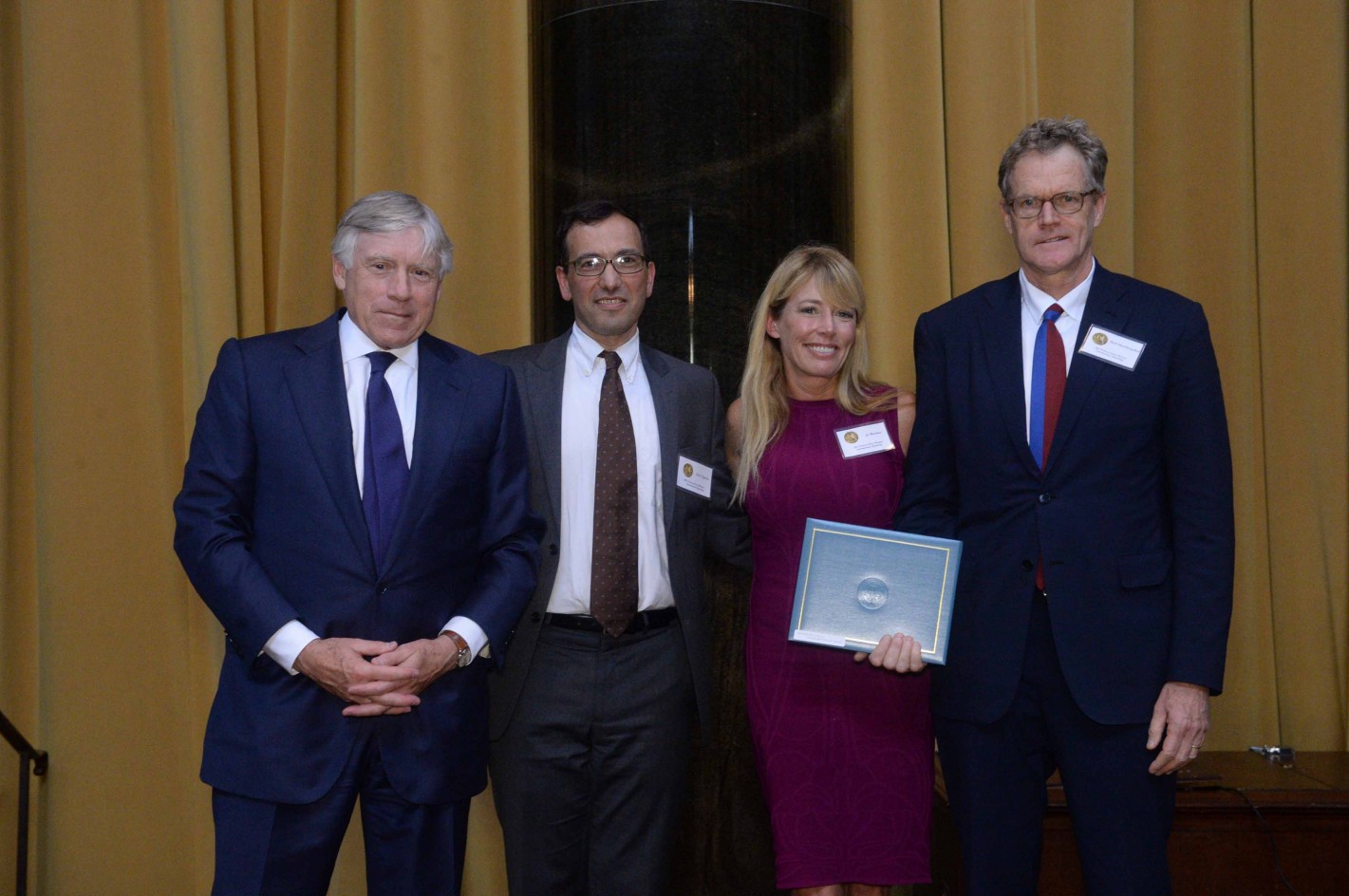
Eric Lipton, Jo Becker and Neil Macfarquhar of The New York Times accept the 2017 Pulitzer Prize for International Reporting from Columbia University President Lee C. Bollinger.
Winning Work
By Andrew Higgins
HELSINKI, Finland — Seeking to shine some light into the dark world of Internet trolls, a journalist with Finland’s national broadcaster asked members of her audience to share their experience of encounters with Russia’s “troll army,” a raucous and often venomous force of online agitators.
The response was overwhelming, though not in the direction that the journalist, Jessikka Aro, had hoped.
As she expected, she received some feedback from people who had clashed with aggressively pro-Russian voices online. But she was taken aback, and shaken, by a vicious retaliatory campaign of harassment and insults against her and her work by those same pro-Russian voices.
“Everything in my life went to hell thanks to the trolls,” said Ms. Aro, a 35-year-old investigative reporter with the social media division of Finland’s state broadcaster, Yle Kioski.
Abusive online harassment is hardly limited to pro-Russian Internet trolls. Ukraine and other countries at odds with the Kremlin also have legions of aggressive avengers on social media.
But pro-Russian voices have become such a noisy and disruptive presence that both NATO and the European Union have set up special units to combat what they see as a growing threat not only to civil discourse but to the well-being of Europe’s democratic order and even to its security.
This “information war,” said Rastislav Kacer, a veteran diplomat who served as Slovakia’s ambassador to Washington and at NATO’s headquarters in Brussels, “is just part of a bigger struggle.” While not involving bloodshed, he added, it “is equally as dangerous as more conventional hostile action.”
For Ms. Aro, the abuse increased sharply last year when, following up on reports in the opposition Russian news media, she visited St. Petersburg to investigate the workings of a Russian “troll factory.” The big office churns out fake news and comment, particularly on Ukraine, and floods websites and social media with denunciations of Russia’s critics.
In response to her reporting, pro-Russian activists in Helsinki organized a protest outside the headquarters of Yle, accusing it of being a troll factory itself. Only a handful of people showed up.
At the same time, Ms. Aro has been peppered with abusive emails, vilified as a drug dealer on social media sites and mocked as a delusional bimbo in a music video posted on YouTube.
“There are so many layers of fakery you get lost,” said Ms. Aro, who was awarded the Finnish Grand Prize for Journalism in March.
As Ms. Aro’s experiences illustrate, Finland, a country at the center of Russia’s concerns about NATO’s expansion toward its borders, has emerged as a particularly active front in the information wars. A member of the European Union with an 830-mile-long border with Russia, Finland has stayed outside the United States-led military alliance but, unnerved by Russian military actions in Ukraine and its saber-rattling in the Baltic Sea, has expanded cooperation with NATO and debated whether to apply for full membership.
Public opinion is deeply divided, making Finland a prime target for a campaign by Russia.
“Their big thing is to keep Finland out of NATO,” said Saara Jantunen, a researcher at the Finnish Defense Forces in Helsinki, who last year published a book in Finland entitled “Info-War.” She said that she, too, had been savaged on social media, sometimes by the same and apparently fake commentators who have hounded Ms. Aro.
“They fill the information space with so much abuse and conspiracy talk that even sane people start to lose their minds,” she added.
Europe’s main response so far has been to try to counter outright lies. In November, the European Union launched “Disinformation Review,” a weekly compendium of pro-Kremlin distortions and untruths.
But facts have been powerless against a torrent of abuse and ridicule targeted at European journalists, researchers and others labeled NATO stooges.
Pro-Russian activists insist that they are merely exercising their right to free speech, and that they do not take money or instructions from Moscow.
The most abusive messages against Ms. Aro were mostly sent anonymously or from accounts set up under fake names on Facebook and other social media.
One of her most vocal critics in Finland, however, has openly declared his identity. He is Johan Backman, a tireless supporter of President Vladimir V. Putin of Russia who highlights the blurred lines between state-sponsored harassment and the expression of strongly held personal views.
Fluent in Russian, Mr. Backman now spends much of his time in Moscow, appearing regularly in the Russian news media and at conferences in Russia as “a human rights defender.” He also serves as the representative in Northern Europe for the Russian Institute for Strategic Studies, a state-funded research group led by a Soviet-era intelligence officer.
Mr. Backman, who also represents the Donetsk People’s Republic, the breakaway state set up with Russian support in eastern Ukraine, denied targeting Ms. Aro as part of any “information war.” Rather, he insisted that Russia was itself the victim of a campaign of disinformation and distortion conducted by the West.
In a recent interview in Moscow, he said that Ms. Aro was part of this campaign and that she had tried to curtail the freedom of speech of Russia’s supporters in Finland by labeling them as “Russian trolls.” All the same, Mr. Backman added, her complaints about being targeted for abuse “have been very beneficial for Russia” because they have made others think twice about criticizing Moscow.
“She says she is a victim, and nobody wants to be a victim,” he said. “This changed the atmosphere in the journalistic community.”
Mr. Backman said he used his own private means to fund his activities in support of what he described as an “entirely defensive” campaign by Russia to counter Western propaganda. His activities, however, invariably follow Moscow’s political and geopolitical script, particularly on NATO, which he regularly denounces as a tool for United States military occupation.
Aside from NATO, Mr. Backman’s biggest bugbear of late has been Ms. Aro and the “Russo-phobic” tendencies that she, in his view, represents.
Just days after Ms. Aro made her first appeal in September 2014 for information about Russian trolls, Mr. Backman told Russian People’s Line, a nationalist Russian website, and other media that she was a “well-known assistant of American and Baltic special services.”
Around the same time, she received a call late at night on her cellphone from a number in Ukraine. Nobody spoke, and all she could hear was gunfire. This was followed by text and email messages denouncing her as a “NATO whore” and a message purporting to come from her father — who died 20 years ago — saying he was “watching her.”
The hardest blow, Ms. Aro said, came early this year when a Finnish-language news site, MVLehti.net, which is based in Spain and mostly focuses on vilifying immigrants, dug up and published court records that showed she had been convicted of using illegal amphetamines in 2004. She had been fined 300 euros.
The website’s headline: “NATO’s information expert Jessikka Aro turned out to be a convicted drug dealer.” It also posted photographs of Ms. Aro dancing in a slinky outfit at a nightclub in Bangkok.
Mr. Backman requested and received Ms. Aro’s old case file from the court shortly before the website published the documents. He denied passing them on to the site.
The false claim that Ms. Aro was a drug dealer triggered an unusual open letter signed by more than 20 Finnish editors infuriated by what they denounced as the “poisoning of public debate” with “insults, defamation and outright lies.” The Finnish police began an investigation into the website for harassment and hate speech.
“I don’t know if these people are acting on orders from Russia, but they are clearly what Lenin called ‘useful idiots,’” said Mika Pettersson, the editor of Finland’s national news agency and an organizer of the editors’ open letter. “They are playing into Putin’s pocket. Nationalist movements in Finland and other European countries want to destabilize the European Union and NATO, and this goes straight into Putin’s narrative.”
Ilja Janitskin, the founder and head of MVLehti, who is based in Barcelona, Spain, said in response to emailed questions that he had no connection with Russia other than his surname. His political views, he said, are closer to those of Donald J. Trump, not Mr. Putin.
He added that he had become interested in Ms. Aro only after she accused his website of “distributing Russian propaganda.”
Like Mr. Backman, he denied receiving any money from Russian sources, insisting that his website, which in just 18 months has become one of Finland’s most widely read online news sources, finances itself from advertising and donations by readers.
Ms. Aro acknowledged that she had used amphetamines regularly in her early 20s but dismissed as a “total lie” claims that she had been or is a drug dealer.
“They get inside your head, and you start thinking: If I do this, what will the trolls do next?” she said.
By Andrew E. Kramer
MOSCOW — From a certain perspective, certainly the Kremlin’s, Vladimir Kara-Murza’s behavior in Washington could be seen as treasonous, a brazen betrayal of his homeland.
In a series of public meetings on Capitol Hill, Mr. Kara-Murza, a leader in the Russian opposition, urged American lawmakers to expand economic sanctions against the Russian government under a law known as the Magnitsky Act. That would hasten political change in Russia, he argued.
Back in Moscow a month later, in May 2015, the changes Mr. Kara-Murza detected were going on in his own body. Midway through a meeting with fellow dissidents, beads of sweat inexplicably dotted his forehead. His stomach churned.
“It all went so fast,” he recalled. “In the space of about 20 minutes, I went from feeling completely normal to having a rapid heart rate, really high blood pressure, to sweating and vomiting all over the place, and then I lost consciousness.” He had ingested a poison, doctors told him after he emerged from a weeklong coma, though they could find no identifiable trace of it.
While Mr. Kara-Murza survived, few others in his position have proved as lucky. He said he was certain he had been the target of a security service poisoning. Used extensively in the Soviet era, political murders are again playing a prominent role in the Kremlin’s foreign policy, the most brutal instrument in an expanding repertoire of intimidation tactics intended to silence or otherwise intimidate critics at home and abroad.
Russia’s president, Vladimir V. Putin, has made no secret of his ambition to restore his country to what he sees as its rightful place among the world’s leading nations. He has invested considerable money and energy into building an image of a strong and morally superior Russia, in sharp contrast with what he portrays as weak, decadent and disorderly Western democracies.
Muckraking journalists, rights advocates, opposition politicians, government whistle-blowers and other Russians who threaten that image are treated harshly — imprisoned on trumped-up charges, smeared in the news media and, with increasing frequency, killed.
Political murders, particularly those accomplished with poisons, are nothing new in Russia, going back five centuries. Nor are they particularly subtle. While typically not traceable to any individuals and plausibly denied by government officials, poisonings leave little doubt of the state’s involvement — which may be precisely the point.
“Outside of popular culture, there are no highly skilled hit men for hire,” Mark Galeotti, a professor at New York University and an authority on the Russian security services, said in an interview. “If it’s a skilled job, that means it’s a state asset.”
Other countries, notably Israel and the United States, pursue targeted killings, but in a strict counterterrorism context. No other major power employs murder as systematically and ruthlessly as Russia does against those seen as betraying its interests abroad. Killings outside Russia were even given legal sanction by the nation’s Parliament in 2006.
Applied most notoriously in the case of Alexander V. Litvinenko, a Putin opponent who died of polonium-210 poisoning in London in 2006, murders and deaths under mysterious circumstances are now seen as such a menace that Kremlin critics now often flee the country and keep their whereabouts secret.
Russia has never acknowledged using the authority under the 2006 law and has specifically denied any government ties to high-profile cases, including the Litvinenko murder.
Among those fleeing Russia recently is Grigory Rodchenkov, a whistle-blower in Russia’s sports doping scandal.
This is not without reason. In the case over state-sponsored doping, two other officials with knowledge of the scheme died unexpectedly as the outlines of the scandal began to emerge. Just this month, another whistle-blower, Yulia Stepanova, a runner in hiding with her husband in the United States, was forced to move amid fears that hackers had found her location. “If something happens to us,” she said, “then you should know that it is not an accident.”
“The government is using the special services to liquidate its enemies,” Gennadi V. Gudkov, a former member of Parliament and onetime lieutenant colonel in the K.G.B., said in an interview. “It was not just Litvinenko, but many others we don’t know about, classified as accidents or maybe semi-accidents.”
Most recently, a coroner ruled that blunt-force trauma caused the death of a Kremlin insider, Mikhail Y. Lesin, 57, in a Washington hotel room last year, not the heart attack his colleagues first said. In July, the Russian Interfax news agency reported that Aleksandr Poteyev, 64, an intelligence officer accused of defecting and betraying a ring of Russian spies living undercover in American suburbs, had died in the United States.
Still, the Magnitsky Act, the law that Mr. Kara-Murza was in Washington urging lawmakers to expand, has proved to be perhaps the most lethal topic of all over the years.
Sergei L. Magnitsky, a lawyer and auditor, was jailed on tax evasion charges while investigating a $230 million government tax “refund” that corrupt Russian officials had granted to themselves. He died in 2009 after having been denied essential medical care in prison, earning the Kremlin widespread condemnation.
In response, William F. Browder, an American financier who was the target of the tax fraud during time he spent working in Russia and had employed Mr. Magnitsky, campaigned in Congress for a law punishing the officials involved in the misdeeds and subsequent mistreatment of the auditor. The proposed measure, which eventually passed in 2012 as the Sergei Magnitsky Rule of Law and Accountability Act, denied visas and blocked access to the American financial system for Russians deemed to have committed rights abuses and avoided punishment at home — including those involved in the Magnitsky tax fraud case.
Mr. Putin, perceiving an intrusion into his country’s affairs, campaigned hard against the measure. When it passed, he retaliated by ending American adoptions of Russian children. The law became a prototype for the blacklisting of prominent Russians accused of murders, human rights abuses and financial theft, among other violations.
The question of who was involved in the tax fraud became vitally important first to the investigation, and eventually to the final scope of the legislation. Access to inside information became pivotal and, it turned out, lethal. To date, five people who either handed over such information or were potential witnesses have died under mysterious circumstances that, in their sophistication, suggest state-sponsored killings.
One of the victims was Mr. Magnitsky, whose death was hardly the stuff of cloak-and-dagger security operations. Two others died before Mr. Magnitsky. And as the case gained greater prominence, others began dying under mysterious circumstances.
One victim whose death preceded Mr. Magnitsky’s, Valery Kurochkin, a potential witness whose name appeared on documents related to the fraud, fled Russia for Ukraine but died there of liver failure at the age of 43.
The other, Oktai Gasanov, a low-level figure in the fraud case but one who might have shed light on the group’s modus operandi, died of heart failure at 53.
Then, after Mr. Magnitsky’s death in prison, a fourth insider met an untimely end in a plunge from a balcony. A fifth, a banker linked to the scheme, Alexander Perepilichny, made it to London in 2009 and passed wire-transfer records to Swiss investigators. In 2012, however, at the age of 44 and in apparently excellent health, he suffered a heart attack while jogging. The police were left scratching their heads over the body found crumpled on a road in a well-guarded housing development, home to Kate Winslet and Elton John. An autopsy initially did nothing to clear up the questions.
It was not until 2015 that a botanist was able to identify the presumptive cause of Mr. Perepilichny’s death: His stomach held traces of gelsemium, a rare, poisonous plant grown in the Himalayas and known to have been used in Chinese assassinations. A coroner’s inquest is scheduled for September.
“All of this sounds like paranoid conspiracy theories,” Mr. Browder said in a telephone interview. “But there are too many of these happening to important people. Captains of industry and lawyers are not dying left, right and center like this in the West.”
Poison has been a favorite tool of Russian intelligence for more than a century. A biochemist, Grigory Mairanovski, labored in secret from 1928 on the task of developing tasteless, colorless and odorless poisons. In 1954, a K.G.B. defector described a secret lab near the agency’s Lubyanka headquarters and “experiments on living people.”
The agencies developed an arsenal of lethal, hard-to-trace poisons that, analysts of Russian security affairs say, is still in use. The Arab-born terrorist known as Khattab died in 2002 in his mountain hide-out in Chechnya after opening a letter laced with a form of sarin, a nerve agent.
In 1995, a Russian banker, Ivan K. Kivelidi, died after coming in contact with cadmium, which is deadly to the touch. His secretary died of the same symptoms, apparently because the poison had been spread on an office telephone handset. In 2008, Karinna Moskalenko, a Russian lawyer specializing in taking cases to the European Court of Human Rights, fell ill in Strasbourg, France, from mercury found in her car.
And in one case, a Bulgarian dissident, Georgi Markov, was killed on Waterloo Bridge in London in 1978 with an umbrella tipped with a pellet of ricin.
Mistakes abound. In 1971, a year after he won the Nobel Prize for literature, Aleksandr Solzhenitsyn survived a poisoning attempt. Ricin, made from castor beans, was probably involved, according to news media accounts and a biography of the dissident writer. Ukraine’s former pro-Western president, Viktor A. Yushchenko, was left with his face disfigured after a dioxin poisoning — most likely concealed in a meal of boiled crayfish — that Mr. Yushchenko attributed to Russian assassins.
The attempt on Mr. Kara-Murza’s life turned out to be one of those mistakes, though that was not immediately certain. As his colleagues looked on surprised, Mr. Kara-Murza’s sweat-covered head flopped down onto a table.
The poison threw him into a weeklong coma with a puzzling range of symptoms, including swelling in his brain and kidney failure, giving his legs and arms a blue hue, his wife, Yevgenia, recalled.
He endured nerve damage that left him limping, but has otherwise made a full recovery. A French laboratory found heavy metals in his blood but was unable to identify a specific poison or explain how he might have ingested them accidentally. Mr. Kara-Murza, 34, has insisted that the police open an investigation. He is convinced that he ingested the poison during a flight on Aeroflot.
If so, it would not have been the first time such an episode occurred. In 2004, the opposition journalist Anna Politkovskaya drank poisoned tea on a domestic flight operated by Karat, another Russian airline, but she survived. Two years later, she was shot and killed in her apartment elevator.
“How can you protect yourself?” Mr. Kara-Murza’s wife asked. “What can you do? Not eat? Bring your own lunch everywhere? How can you predict a poisoning?”
Some do take precautions. Garry Kasparov, the former chess champion and now an opposition figure, has long had bodyguards carry bottled water and prepared meals for him.
In a chilling epilogue to Mr. Kara-Murza’s ordeal, a warning appeared in February on the Instagram account of Ramzan A. Kadyrov, the leader of Chechnya. It showed Mr. Kara-Murza outside the European Parliament building in Strasbourg, where he was speaking in favor of sanctions against Russia. He was in cross hairs, with a caption: “Those who haven’t understood will understand.”
Correction: September 21, 2016
An article on Aug. 21 about the rise of political murders in Russia misidentified the airline whose flight Anna Politkovskaya, an opposition journalist, was aboard when she drank poisoned tea in 2004. The airline was Karat, not Aeroflot.
By Neil MacFarquhar
STOCKHOLM — With a vigorous national debate underway on whether Sweden should enter a military partnership with NATO, officials in Stockholm suddenly encountered an unsettling problem: a flood of distorted and outright false information on social media, confusing public perceptions of the issue.
The claims were alarming: If Sweden, a non-NATO member, signed the deal, the alliance would stockpile secret nuclear weapons on Swedish soil; NATO could attack Russia from Sweden without government approval; NATO soldiers, immune from prosecution, could rape Swedish women without fear of criminal charges.
They were all false, but the disinformation had begun spilling into the traditional news media, and as the defense minister, Peter Hultqvist, traveled the country to promote the pact in speeches and town hall meetings, he was repeatedly grilled about the bogus stories.
“People were not used to it, and they got scared, asking what can be believed, what should be believed?” said Marinette Nyh Radebo, Mr. Hultqvist’s spokeswoman.
As often happens in such cases, Swedish officials were never able to pin down the source of the false reports. But they, numerous analysts and experts in American and European intelligence point to Russia as the prime suspect, noting that preventing NATO expansion is a centerpiece of the foreign policy of President Vladimir V. Putin, who invaded Georgia in 2008 largely to forestall that possibility.
In Crimea, eastern Ukraine and now Syria, Mr. Putin has flaunted a modernized and more muscular military. But he lacks the economic strength and overall might to openly confront NATO, the European Union or the United States. Instead, he has invested heavily in a program of “weaponized” information, using a variety of means to sow doubt and division. The goal is to weaken cohesion among member states, stir discord in their domestic politics and blunt opposition to Russia.
“Moscow views world affairs as a system of special operations, and very sincerely believes that it itself is an object of Western special operations,” said Gleb Pavlovsky, who helped establish the Kremlin’s information machine before 2008. “I am sure that there are a lot of centers, some linked to the state, that are involved in inventing these kinds of fake stories.”
The planting of false stories is nothing new; the Soviet Union devoted considerable resources to that during the ideological battles of the Cold War. Now, though, disinformation is regarded as an important aspect of Russian military doctrine, and it is being directed at political debates in target countries with far greater sophistication and volume than in the past.
The flow of misleading and inaccurate stories is so strong that both NATO and the European Union have established special offices to identify and refute disinformation, particularly claims emanating from Russia.
The Kremlin’s clandestine methods have surfaced in the United States, too, American officials say, identifying Russian intelligence as the likely source of leaked Democratic National Committee emails that embarrassed Hillary Clinton’s presidential campaign.
The Kremlin uses both conventional media — Sputnik, a news agency, and RT, a television outlet — and covert channels, as in Sweden, that are almost always untraceable.
Russia exploits both approaches in a comprehensive assault, Wilhelm Unge, a spokesman for the Swedish Security Service, said this year when presenting the agency’s annual report. “We mean everything from internet trolls to propaganda and misinformation spread by media companies like RT and Sputnik,” he said.
The fundamental purpose of dezinformatsiya, or Russian disinformation, experts said, is to undermine the official version of events — even the very idea that there is a true version of events — and foster a kind of policy paralysis.
Disinformation most famously succeeded in early 2014 with the initial obfuscation about deploying Russian forces to seize Crimea. That summer, Russia pumped out a dizzying array of theories about the destruction of Malaysia Airlines Flight 17 over Ukraine, blaming the C.I.A. and, most outlandishly, Ukrainian fighter pilots who had mistaken the airliner for the Russian presidential aircraft.
The cloud of stories helped veil the simple truth that poorly trained insurgents had accidentally downed the plane with a missile supplied by Russia.
Moscow adamantly denies using disinformation to influence Western public opinion and tends to label accusations of either overt or covert threats as “Russophobia.”
“There is an impression that, like in a good orchestra, many Western countries every day accuse Russia of threatening someone,” Maria Zakharova, the Russian Foreign Ministry spokeswoman, said at a recent ministry briefing.
Tracing individual strands of disinformation is difficult, but in Sweden and elsewhere, experts have detected a characteristic pattern that they tie to Kremlin-generated disinformation campaigns.
“The dynamic is always the same: It originates somewhere in Russia, on Russia state media sites, or different websites or somewhere in that kind of context,” said Anders Lindberg, a Swedish journalist and lawyer.
“Then the fake document becomes the source of a news story distributed on far-left or far-right-wing websites,” he said. “Those who rely on those sites for news link to the story, and it spreads. Nobody can say where they come from, but they end up as key issues in a security policy decision.”
Although the topics may vary, the goal is the same, Mr. Lindberg and others suggested. “What the Russians are doing is building narratives; they are not building facts,” he said. “The underlying narrative is, ‘Don’t trust anyone.’”
The weaponization of information is not some project devised by a Kremlin policy expert but is an integral part of Russian military doctrine — what some senior military figures call a “decisive” battlefront.
“The role of nonmilitary means of achieving political and strategic goals has grown, and, in many cases, they have exceeded the power of force of weapons in their effectiveness,” Gen. Valery V. Gerasimov, the chief of the general staff of the Russian Armed Forces, wrote in 2013.
A prime Kremlin target is Europe, where the rise of the populist right and declining support for the European Union create an ever more receptive audience for Russia’s conservative, nationalistic and authoritarian approach under Mr. Putin. Last year, the European Parliament accused Russia of “financing radical and extremist parties” in its member states, and in 2014 the Kremlin extended an $11.7 million loan to the National Front, the extreme-right party in France.
“The Russians are very good at courting everyone who has a grudge with liberal democracy, and that goes from extreme right to extreme left,” said Patrik Oksanen, an editorial writer for the Swedish newspaper group MittMedia. The central idea, he said, is that “liberal democracy is corrupt, inefficient, chaotic and, ultimately, not democratic.”
Another message, largely unstated, is that European governments lack the competence to deal with the crises they face, particularly immigration and terrorism, and that their officials are all American puppets.
In Germany, concerns over immigrant violence grew after a 13-year-old Russian-German girl said she had been raped by migrants. A report on Russian state television furthered the story. Even after the police debunked the claim, Russia’s foreign minister, Sergey V. Lavrov, continued to chastise Germany.
In Britain, analysts said, the Kremlin’s English-language news outlets heavily favored the campaign for the country to leave the European Union, despite their claims of objectivity.
In the Czech Republic, alarming, sensational stories portraying the United States, the European Union and immigrants as villains appear daily across a cluster of about 40 pro-Russia websites.
During NATO military exercises in early June, articles on the websites suggested that Washington controlled Europe through the alliance, with Germany as its local sheriff. Echoing the disinformation that appeared in Sweden, the reports said NATO planned to store nuclear weapons in Eastern Europe and would attack Russia from there without seeking approval from local capitals.
A poll this summer by European Values, a think tank in Prague, found that 51 percent of Czechs viewed the United States’ role in Europe negatively, that only 32 percent viewed the European Union positively and that at least a quarter believed some elements of the disinformation.
“The data show how public opinion is changing thanks to the disinformation on those outlets,” said Jakub Janda, the think tank’s deputy director for public and political affairs. “They try to look like a regular media outlet even if they have a hidden agenda.”
Not all Russian disinformation efforts succeed. Sputnik news websites in various Scandinavian languages failed to attract enough readers and were closed after less than a year.
Both RT and Sputnik portray themselves as independent, alternative voices. Sputnik claims that it “tells the untold,” even if its daily report relies heavily on articles abridged from other sources. RT trumpets the slogan “Question More.”
Both depict the West as grim, divided, brutal, decadent, overrun with violent immigrants and unstable. “They want to give a picture of Europe as some sort of continent that is collapsing,” Mr. Hultqvist, the Swedish defense minister, said in an interview.
RT often seems obsessed with the United States, portraying life there as hellish. On the day President Obama spoke at the Democratic National Convention, for example, it emphasized scattered demonstrations rather than the speeches. It defends the Republican presidential nominee, Donald J. Trump, as an underdog maligned by the established news media.
Margarita Simonyan, RT’s editor in chief, said the channel was being singled out as a threat because it offered a different narrative from “the Anglo-American media-political establishment.” RT, she said, wants to provide “a perspective otherwise missing from the mainstream media echo chamber.”
Moscow’s targeting of the West with disinformation dates to a Cold War program the Soviets called “active measures.” The effort involved leaking or even writing stories for sympathetic newspapers in India and hoping that they would be picked up in the West, said Professor Mark N. Kramer, a Cold War expert at Harvard.
The story that AIDS was a C.I.A. project run amok spread that way, and it poisons the discussion of the disease decades later. At the time, before the Soviet Union’s 1991 collapse, the Kremlin was selling communism as an ideological alternative. Now, experts said, the ideological component has evaporated, but the goal of weakening adversaries remains.
In Sweden recently, that has meant a series of bizarre forged letters and news articles about NATO and linked to Russia.
One forgery, on Defense Ministry letterhead over Mr. Hultqvist’s signature, encouraged a major Swedish firm to sell artillery to Ukraine, a move that would be illegal in Sweden. Ms. Nyh Radebo, his spokeswoman, put an end to that story in Sweden, but at international conferences, Mr. Hultqvist still faced questions about the nonexistent sales.
Russia also made at least one overt attempt to influence the debate. During a seminar in the spring, Vladimir Kozin, a senior adviser to the Russian Institute for Strategic Studies, a think tank linked to the Kremlin and Russian foreign intelligence, argued against any change in Sweden’s neutral status.
“Do they really need to lose their neutral status?” he said of the Swedes. “To permit fielding new U.S. military bases on their territory and to send their national troops to take part in dubious regional conflicts?”
Whatever the method or message, Russia clearly wants to win any information war, as Dmitry Kiselyev, Russia’s most famous television anchor and the director of the organization that runs Sputnik, made clear recently.
Speaking this summer on the 75th anniversary of the Soviet Information Bureau, Mr. Kiselyev said the age of neutral journalism was over. “If we do propaganda, then you do propaganda, too,” he said, directing his message to Western journalists.
“Today, it is much more costly to kill one enemy soldier than during World War II, World War I or in the Middle Ages,” he said in an interview on the state-run Rossiya 24 network. While the business of “persuasion” is more expensive now, too, he said, “if you can persuade a person, you don’t need to kill him.”
Correction: August 28, 2016
An earlier version of this article misstated the surname of a spokesman for the Swedish Security Service. He is Wilhelm Unge, not Urme.
Correction: September 29, 2016
Because of an editing error, an article on Aug. 29 about the Kremlin’s reliance on disinformation to sow doubt, fear and discord in Europe and the United States referred incorrectly to coverage of the Democratic National Convention by a Russian television outfit, RT. It devoted little time to the speeches, focusing instead on scattered demonstrations, on the day President Obama spoke — not throughout the entire convention.
By Andrew Higgins
VILNIUS, Lithuania — Facing trial in Russia over the theft of a street-art drawing valued by its creator at $1.55, Nikita Kulachenkov, a Russian forensic accountant involved in anticorruption work, fled to Lithuania to avoid what he decided was a doomed battle against trumped-up charges.
What he did not realize was that Russia’s reach these days extends far beyond its borders. Arriving in Cyprus from Lithuania in January to join his mother for a holiday, Mr. Kulachenkov was stopped at airport passport control, questioned for hours by immigration officials and then taken in handcuffs to a police detention center.
“They told me there was a problem with Russia and kept asking me what crime I had committed,” Mr. Kulachenkov recalled. Cypriot immigration and police officers seemed as mystified as he was, he said, by a note in their computer systems that described him as a wanted criminal requiring immediate arrest.
The wanted notice had been put there in August last year by Russia, where the theft of millions and even billions of dollars by the politically connected goes mostly unpunished but where the alleged theft of a street sweeper’s all-but-worthless drawing has been the focus of a lengthy investigation involving some of the country’s most senior law enforcement officials.
The arrest demand, known as a “diffusion,” had gone out to Cyprus and 50 other countries through the international police organization, Interpol. It had not been endorsed by Interpol, which is “strictly forbidden” by its Constitution from any action of a “political character,” but nonetheless labeled the 34-year-old anticorruption activist as a criminal in databases around the world.
Determined to punish domestic opponents who flee abroad, as well as non-Russians whose lives and finances it wants to disrupt, Moscow has developed an elaborate and well-funded strategy in recent years of using — critics say abusing — foreign courts and law enforcement systems to go after its enemies.
Some countries, including Russia, “work really hard to get Interpol alerts” against political enemies, said Jago Russell, the chief executive of Fair Trials International, a human rights group in London, because “this helps give credibility to their own prosecution and undermines the reputation of the accused.”
“It is also potentially a good threat to use against people still in the country: ‘You may be able to leave, but don’t assume you will be safe,’” he added.
The efforts have often fallen flat in the end, but have succeeded in tying up their targets in legal knots for months and years.
Acting on a Russian request, a British court, for example, froze the worldwide assets of Sergei Pugachev, a former close friend of President Vladimir V. Putin’s who fell out with the Kremlin in a squabble over property and fled to Britain, then France.
Russia has also used British courts and Interpol to pursue what many Western governments view as a vendetta against William F. Browder, an American-born British citizen. Mr. Browder was convicted in absentia in Russia of tax fraud after he fled to London and mounted an international campaign against Russia over the killing of his jailed Moscow lawyer, Sergei Magnitsky.
Mr. Browder defeated a libel case in 2013 brought in London by a Moscow police officer whom the financier had accused of involvement in a fraud uncovered by Mr. Magnitsky. But he faces a new fight as Russia seeks to get British courts to find and freeze his assets and enforce a civil judgment against him in Russia.
The only winners in most such cases are expensive lawyers, for whom pursuing Russia’s foes in foreign courts has become a highly lucrative business.
Russia pushed three times between 2012 and 2015 to get Interpol to issue arrest orders against Mr. Browder. Having failed each time to convince the police organization that it did not have political motives, it announced this summer that it would try yet again.
“The Russians try stuff a hundred times, and sometimes it works,” Mr. Browder said. “They can fail 99 times, but the 100th time it could work. For them, that makes it all worthwhile.” He described the practice as “lawfare.”
Based in Lyon, France, and comprising 190 countries, Interpol defines its role as enabling “police around the world to work together to make the world a safer place.” It has often done this, allowing police forces to share information about the whereabouts of mafia bosses, murderers and other criminals, and to secure their arrest.
But the Interpol membership of nations — like Russia, Iran and Zimbabwe — that routinely use their justice systems to persecute political foes has stirred worries that wanted notices can be easily misused. In September, the congressional Tom Lantos Human Rights Commission heard a litany of complaints about abuse from experts and victims of Interpol notices during a discussion of how to reform the police organization’s system of so-called red notices.
Interpol issues such notices, which amount to an international arrest warrant, at the request of a member country seeking help in catching a fugitive who has fled abroad. Interpol’s computer system also circulates diffusions like the one against Mr. Kulachenkov. These are less formal than red notices, but are also used to request the arrest or location of an individual, or information, in relation to a police investigation.
Interpol does not release figures for how many red notices or other arrest alerts are issued through its computer system by each member country, but the number of people identified in Interpol’s databases as wanted criminal suspects has risen sharply in recent years.
In 2004, Interpol issued just 1,924 red notices at the request of member countries. Last year, it issued 11,492, as well as 22,753 diffusions.
As a result of one of those, Mr. Kulachenkov spent nearly three weeks in a Cypriot jail while the authorities in Cyprus reviewed a request from Moscow that he be sent to Russia to stand trial in a case that even Russia’s prosecutor general had initially ruled was not worth pursuing.
The drawing he is accused of stealing was done by Sergei Sotov, a street sweeper and artist who had left it and other examples of his work hanging on railings around Vladimir, a city east of Moscow. The street sweeper made no complaint to the police when the drawing disappeared, and said he was glad that someone liked his work.
In the end, Cyprus decided not to extradite Mr. Kulachenkov after Lithuania advised it that he had no criminal record and had been granted political asylum because of his work in Russia with Alexei Navalny. A prominent anticorruption campaigner and Kremlin opponent, Mr. Navalny himself has been ensnared in a tangle of apparently trumped-up criminal cases in Moscow, including the supposed art theft.
The Russian authorities, said Mr. Kulachenkov, whose name has been purged from Interpol’s databases, “don’t really care about me, but they wanted to send a message that if you get involved with Navalny, we will make problems for you, even if you leave Russia.”
Stung by criticism that its role fighting real crime is being hijacked by repressive regimes, Interpol has moved to strengthen safeguards against abuse, particularly since the naming of a new secretary general, Jürgen Stock, in late 2014. Mr. Russell, of Fair Trials International, acknowledged that the group “is trying to make it more difficult to game the system.”
Interpol said last year that it would not issue arrest notices against people who had been granted political asylum or other forms of refugee status, though this did not help Mr. Kulachenkov when he traveled to Cyprus in January.
Asked about that, a spokeswoman for the Interpol General Secretariat in Lyon said that she could not comment on individual cases, but that the policy of not targeting recipients of political asylum for arrest would work only if countries passed on information about who had been granted such a status. In most cases, she added, “this information is not available to the General Secretariat” when red notices or diffusions are issued.
Whatever Interpol finally does to stop the gaming of the system, it is too late for Petr Silaev, a 34-year-old Russian editor. Mr. Silaev took part in demonstrations against the destruction of a forest in Khimki near Moscow in 2010 and fled to Brussels seeking refuge after several protesters were badly beaten and the authorities branded the protests an armed riot.
He was later given political asylum in Finland and felt safe, until he took a trip to Spain to visit friends. Two days after his arrival, Spanish antiterrorism police officers stormed a hostel where he was staying and arrested him on the basis of a red notice issued against him by Interpol at Moscow’s request.
Held for nearly two weeks in a Spanish prison while a Madrid court approved his extradition to Moscow, he finally managed to phone a lawyer in Finland and contact Fair Trials International, which has campaigned against abuses of Interpol by repressive governments.
After appeals from a German member of the European Parliament and a storm of protest in the European news media, the authorities released Mr. Silaev from prison but ordered that he report to the Spanish police once a week.
Six months later, in early 2013, a Madrid court canceled Mr. Silaev’s extradition order and allowed him to return to Finland, where he spent another year pleading with Interpol to purge his name from its database.
“Interpol is a very Soviet-style organization,” Mr. Silaev said, describing it as “absolutely nontransparent” and easily manipulated by governments that regard protesters as no different from “rapists and murderers.” Interpol says it cannot publicly share information that belongs not to itself but to the member countries that provide it.
“It is a nightmare that keeps coming back if you don’t know how to fight it,” said Eerik-Niiles Kross, a member of Parliament in Estonia and former coordinator of the country’s intelligence services who has been targeted for arrest at least twice by Russia through Interpol.
Pilloried on Russian state television as a dangerous criminal, Mr. Kross has battled for years to purge international arrest orders issued against him. He and Estonian government officials say the orders are based entirely on fabricated claims by Russia that he was involved in hijacking a cargo ship off the coast of Sweden in 2009.
Mr. Kross, who is the son of a prominent Estonian writer arrested by the Soviet authorities and a frequent critic of Russia’s direction under Mr. Putin, believes the Russian accusations are payback for his work helping Georgia during its 2008 war with Russia.
“All Western institutions, particularly those in law enforcement, are based on good faith in government,” Mr. Kross said. “It is not foreseen that governments themselves are criminal. They can cook up anything they want and put it in the system, and the whole system starts to work against its purpose.”
Invented criminal cases, he said, “work like a computer virus: You put it in the system, and it starts to create havoc.”
Mr. Kulachenkov, the accused Russian art thief, said friends had warned him that Russia might try to get at him through Interpol. After his flight from Moscow to Lithuania in 2014, he wrote a lengthy letter to the police organization, pleading that it not list him as a criminal.
“It has become evident that Russian authorities use local investigation bodies and criminal justice systems to pursue their own political objectives,” he wrote. He detailed the Russian case against him for the supposed theft of the crude drawing that even Russian investigators, after inflating the artist’s initial evaluation of less than $2, valued at just $75.
He said he wished he had never taken the drawing, which he and a colleague gave to Mr. Navalny as a birthday gift. Taking the art “was a bad idea, but it was not a criminal offense,” Mr. Kulachenkov said.
“This whole thing is not about the drawing or me, but about Alexei,” he said of Mr. Navalny. “They are making him toxic. Anybody involved with Alexei gets a criminal case.”
By Eric Lipton, David E. Sanger and Scott Shane
WASHINGTON — When Special Agent Adrian Hawkins of the Federal Bureau of Investigation called the Democratic National Committee in September 2015 to pass along some troubling news about its computer network, he was transferred, naturally, to the help desk.
His message was brief, if alarming. At least one computer system belonging to the D.N.C. had been compromised by hackers federal investigators had named “the Dukes,” a cyberespionage team linked to the Russian government.
The F.B.I. knew it well: The bureau had spent the last few years trying to kick the Dukes out of the unclassified email systems of the White House, the State Department and even the Joint Chiefs of Staff, one of the government’s best-protected networks.
Yared Tamene, the tech-support contractor at the D.N.C. who fielded the call, was no expert in cyberattacks. His first moves were to check Google for “the Dukes” and conduct a cursory search of the D.N.C. computer system logs to look for hints of such a cyberintrusion. By his own account, he did not look too hard even after Special Agent Hawkins called back repeatedly over the next several weeks — in part because he wasn’t certain the caller was a real F.B.I. agent and not an impostor.
“I had no way of differentiating the call I just received from a prank call,” Mr. Tamene wrote in an internal memo, obtained by The New York Times, that detailed his contact with the F.B.I.
It was the cryptic first sign of a cyberespionage and information-warfare campaign devised to disrupt the 2016 presidential election, the first such attempt by a foreign power in American history. What started as an information-gathering operation, intelligence officials believe, ultimately morphed into an effort to harm one candidate, Hillary Clinton, and tip the election to her opponent, Donald J. Trump.
Like another famous American election scandal, it started with a break-in at the D.N.C. The first time, 44 years ago at the committee’s old offices in the Watergate complex, the burglars planted listening devices and jimmied a filing cabinet. This time, the burglary was conducted from afar, directed by the Kremlin, with spear-phishing emails and zeros and ones.
An examination by The Times of the Russian operation — based on interviews with dozens of players targeted in the attack, intelligence officials who investigated it and Obama administration officials who deliberated over the best response — reveals a series of missed signals, slow responses and a continuing underestimation of the seriousness of the cyberattack.
The D.N.C.’s fumbling encounter with the F.B.I. meant the best chance to halt the Russian intrusion was lost. The failure to grasp the scope of the attacks undercut efforts to minimize their impact. And the White House’s reluctance to respond forcefully meant the Russians have not paid a heavy price for their actions, a decision that could prove critical in deterring future cyberattacks.
The low-key approach of the F.B.I. meant that Russian hackers could roam freely through the committee’s network for nearly seven months before top D.N.C. officials were alerted to the attack and hired cyberexperts to protect their systems. In the meantime, the hackers moved on to targets outside the D.N.C., including Mrs. Clinton’s campaign chairman, John D. Podesta, whose private email account was hacked months later.
Even Mr. Podesta, a savvy Washington insider who had written a 2014 report on cyberprivacy for President Obama, did not truly understand the gravity of the hacking.
By last summer, Democrats watched in helpless fury as their private emails and confidential documents appeared online day after day — procured by Russian intelligence agents, posted on WikiLeaks and other websites, then eagerly reported on by the American media, including The Times. Mr. Trump gleefully cited many of the purloined emails on the campaign trail.
The fallout included the resignations of Representative Debbie Wasserman Schultz of Florida, the chairwoman of the D.N.C., and most of her top party aides. Leading Democrats were sidelined at the height of the campaign, silenced by revelations of embarrassing emails or consumed by the scramble to deal with the hacking. Though little-noticed by the public, confidential documents taken by the Russian hackers from the D.N.C.’s sister organization, the Democratic Congressional Campaign Committee, turned up in congressional races in a dozen states, tainting some of them with accusations of scandal.
In recent days, a skeptical president-elect, the nation’s intelligence agencies and the two major parties have become embroiled in an extraordinary public dispute over what evidence exists that President Vladimir V. Putin of Russia moved beyond mere espionage to deliberately try to subvert American democracy and pick the winner of the presidential election.
Many of Mrs. Clinton’s closest aides believe that the Russian assault had a profound impact on the election, while conceding that other factors — Mrs. Clinton’s weaknesses as a candidate; her private email server; the public statements of the F.B.I. director, James B. Comey, about her handling of classified information — were also important.
While there’s no way to be certain of the ultimate impact of the hack, this much is clear: A low-cost, high-impact weapon that Russia had test-fired in elections from Ukraine to Europe was trained on the United States, with devastating effectiveness. For Russia, with an enfeebled economy and a nuclear arsenal it cannot use short of all-out war, cyberpower proved the perfect weapon: cheap, hard to see coming, hard to trace.
“There shouldn’t be any doubt in anybody’s mind,” Adm. Michael S. Rogers, the director of the National Security Agency and commander of United States Cyber Command, said at a postelection conference. “This was not something that was done casually, this was not something that was done by chance, this was not a target that was selected purely arbitrarily,” he said. “This was a conscious effort by a nation-state to attempt to achieve a specific effect.”
For the people whose emails were stolen, this new form of political sabotage has left a trail of shock and professional damage. Neera Tanden, president of the Center for American Progress and a key Clinton supporter, recalls walking into the busy Clinton transition offices, humiliated to see her face on television screens as pundits discussed a leaked email in which she had called Mrs. Clinton’s instincts “suboptimal.”
“It was just a sucker punch to the gut every day,” Ms. Tanden said. “It was the worst professional experience of my life.”
The United States, too, has carried out cyberattacks, and in decades past the C.I.A. tried to subvert foreign elections. But the Russian attack is increasingly understood across the political spectrum as an ominous historic landmark — with one notable exception: Mr. Trump has rejected the findings of the intelligence agencies he will soon oversee as “ridiculous,” insisting that the hacker may be American, or Chinese, but that “they have no idea.”
Mr. Trump cited the reported disagreements between the agencies about whether Mr. Putin intended to help elect him. On Tuesday, a Russian government spokesman echoed Mr. Trump’s scorn.
“This tale of ‘hacks’ resembles a banal brawl between American security officials over spheres of influence,” Maria Zakharova, the spokeswoman for the Russian Foreign Ministry, wrote on Facebook.
Over the weekend, four prominent senators — two Republicans and two Democrats — joined forces to pledge an investigation while pointedly ignoring Mr. Trump’s skeptical claims.
“Democrats and Republicans must work together, and across the jurisdictional lines of the Congress, to examine these recent incidents thoroughly and devise comprehensive solutions to deter and defend against further cyberattacks,” said Senators John McCain, Lindsey Graham, Chuck Schumer and Jack Reed.
“This cannot become a partisan issue,” they said. “The stakes are too high for our country.”
A Target for Break-Ins
Sitting in the basement of the Democratic National Committee headquarters, below a wall-size 2012 portrait of a smiling Barack Obama, is a 1960s-era filing cabinet missing the handle on the bottom drawer. Only a framed newspaper story hanging on the wall hints at the importance of this aged piece of office furniture.
“GOP Security Aide Among 5 Arrested in Bugging Affair,” reads the headline from the front page of The Washington Post on June 19, 1972, with the bylines of Bob Woodward and Carl Bernstein.
Andrew Brown, 37, the technology director at the D.N.C., was born after that famous break-in. But as he began to plan for this year’s election cycle, he was well aware that the D.N.C. could become a break-in target again.
There were aspirations to ensure that the D.N.C. was well protected against cyberintruders — and then there was the reality, Mr. Brown and his bosses at the organization acknowledged: The D.N.C. was a nonprofit group, dependent on donations, with a fraction of the security budget that a corporation its size would have.
“There was never enough money to do everything we needed to do,” Mr. Brown said.
The D.N.C. had a standard email spam-filtering service, intended to block phishing attacks and malware created to resemble legitimate email. But when Russian hackers started in on the D.N.C., the committee did not have the most advanced systems in place to track suspicious traffic, internal D.N.C. memos show.
Mr. Tamene, who reports to Mr. Brown and fielded the call from the F.B.I. agent, was not a full-time D.N.C. employee; he works for a Chicago-based contracting firm called The MIS Department. He was left to figure out, largely on his own, how to respond — and even whether the man who had called in to the D.N.C. switchboard was really an F.B.I. agent.
“The F.B.I. thinks the D.N.C. has at least one compromised computer on its network and the F.B.I. wanted to know if the D.N.C. is aware, and if so, what the D.N.C. is doing about it,” Mr. Tamene wrote in an internal memo about his contacts with the F.B.I. He added that “the Special Agent told me to look for a specific type of malware dubbed ‘Dukes’ by the U.S. intelligence community and in cybersecurity circles.”
Part of the problem was that Special Agent Hawkins did not show up in person at the D.N.C. Nor could he email anyone there, as that risked alerting the hackers that the F.B.I. knew they were in the system.
Mr. Tamene’s initial scan of the D.N.C. system — using his less-than-optimal tools and incomplete targeting information from the F.B.I. — found nothing. So when Special Agent Hawkins called repeatedly in October, leaving voice mail messages for Mr. Tamene, urging him to call back, “I did not return his calls, as I had nothing to report,” Mr. Tamene explained in his memo.
In November, Special Agent Hawkins called with more ominous news. A D.N.C. computer was “calling home, where home meant Russia,” Mr. Tamene’s memo says, referring to software sending information to Moscow. “SA Hawkins added that the F.B.I. thinks that this calling home behavior could be the result of a state-sponsored attack.”
Mr. Brown knew that Mr. Tamene, who declined to comment, was fielding calls from the F.B.I. But he was tied up on a different problem: evidence suggesting that the campaign of Senator Bernie Sanders of Vermont, Mrs. Clinton’s main Democratic opponent, had improperly gained access to her campaign data.
Ms. Wasserman Schultz, then the D.N.C.’s chairwoman, and Amy Dacey, then its chief executive, said in interviews that neither of them was notified about the early reports that the committee’s system had likely been compromised.
Shawn Henry, who once led the F.B.I.’s cyber division and is now president of CrowdStrike Services, the cybersecurity firm retained by the D.N.C. in April, said he was baffled that the F.B.I. did not call a more senior official at the D.N.C. or send an agent in person to the party headquarters to try to force a more vigorous response.
“We are not talking about an office that is in the middle of the woods of Montana,” Mr. Henry said. “We are talking about an office that is half a mile from the F.B.I. office that is getting the notification.”
“This is not a mom-and-pop delicatessen or a local library. This is a critical piece of the U.S. infrastructure because it relates to our electoral process, our elected officials, our legislative process, our executive process,” he added. “To me it is a high-level, serious issue, and if after a couple of months you don’t see any results, somebody ought to raise that to a higher level.”
The F.B.I. declined to comment on the agency’s handling of the hack. “The F.B.I. takes very seriously any compromise of public and private sector systems,” it said in a statement, adding that agents “will continue to share information” to help targets “safeguard their systems against the actions of persistent cybercriminals.”
By March, Mr. Tamene and his team had met at least twice in person with the F.B.I. and concluded that Agent Hawkins was really a federal employee. But then the situation took a dire turn.
A second team of Russian-affiliated hackers began to target the D.N.C. and other players in the political world, particularly Democrats. Billy Rinehart, a former D.N.C. regional field director who was then working for Mrs. Clinton’s campaign, got an odd email warning from Google.
“Someone just used your password to try to sign into your Google account,” the March 22 email said, adding that the sign-in attempt had occurred in Ukraine. “Google stopped this sign-in attempt. You should change your password immediately.”
Mr. Rinehart was in Hawaii at the time. He remembers checking his email at 4 a.m. for messages from East Coast associates. Without thinking much about the notification, he clicked on the “change password” button and half asleep, as best he can remember, he typed in a new password.
What he did not know until months later is that he had just given the Russian hackers access to his email account.
Hundreds of similar phishing emails were being sent to American political targets, including an identical email sent on March 19 to Mr. Podesta, chairman of the Clinton campaign. Given how many emails Mr. Podesta received through this personal email account, several aides also had access to it, and one of them noticed the warning email, sending it to a computer technician to make sure it was legitimate before anyone clicked on the “change password” button.
“This is a legitimate email,” Charles Delavan, a Clinton campaign aide, replied to another of Mr. Podesta’s aides, who had noticed the alert. “John needs to change his password immediately.”
With another click, a decade of emails that Mr. Podesta maintained in his Gmail account — a total of about 60,000 — were unlocked for the Russian hackers. Mr. Delavan, in an interview, said that his bad advice was a result of a typo: He knew this was a phishing attack, as the campaign was getting dozens of them. He said he had meant to type that it was an “illegitimate” email, an error that he said has plagued him ever since.
During this second wave, the hackers also gained access to the Democratic Congressional Campaign Committee, and then, through a virtual private network connection, to the main computer network of the D.N.C.
The F.B.I. observed this surge of activity as well, again reaching out to Mr. Tamene to warn him. Yet Mr. Tamene still saw no reason to be alarmed: He found copies of the phishing emails in the D.N.C.’s spam filter. But he had no reason, he said, to believe that the computer systems had been infiltrated.
One bit of progress had finally been made by the middle of April: The D.N.C., seven months after it had first been warned, finally installed a “robust set of monitoring tools,” Mr. Tamene’s internal memo says.
Honing Stealthy Tactics
The United States had two decades of warning that Russia’s intelligence agencies were trying to break into America’s most sensitive computer networks. But the Russians have always managed to stay a step ahead.
Their first major attack was detected on Oct. 7, 1996, when a computer operator at the Colorado School of Mines discovered some nighttime computer activity he could not explain. The school had a major contract with the Navy, and the operator warned his contacts there. But as happened two decades later at the D.N.C., at first “everyone was unable to connect the dots,” said Thomas Rid, a scholar at King’s College in London who has studied the attack.
Investigators gave it a name — Moonlight Maze — and spent two years, often working day and night, tracing how it hopped from the Navy to the Department of Energy to the Air Force and NASA. In the end, they concluded that the total number of files stolen, if printed and stacked, would be taller than the Washington Monument.
Whole weapons designs were flowing out the door, and it was a first taste of what was to come: an escalating campaign of cyberattacks around the world.
But for years, the Russians stayed largely out of the headlines, thanks to the Chinese — who took bigger risks, and often got caught. They stole the designs for the F-35 fighter jet, corporate secrets for rolling steel, even the blueprints for gas pipelines that supply much of the United States. And during the 2008 presidential election cycle, Chinese intelligence hacked into the campaigns of Mr. Obama and Mr. McCain, making off with internal position papers and communications. But they didn’t publish any of it.
The Russians had not gone away, of course. “They were just a lot more stealthy,” said Kevin Mandia, a former Air Force intelligence officer who spent most of his days fighting off Russian cyberattacks before founding Mandiant, a cybersecurity firm that is now a division of FireEye — and the company the Clinton campaign brought in to secure its own systems.
The Russians were also quicker to turn their attacks to political purposes. A 2007 cyberattack on Estonia, a former Soviet republic that had joined NATO, sent a message that Russia could paralyze the country without invading it. The next year cyberattacks were used during Russia’s war with Georgia.
But American officials did not imagine that the Russians would dare try those techniques inside the United States. They were largely focused on preventing what former Defense Secretary Leon E. Panetta warned was an approaching “cyber Pearl Harbor” — a shutdown of the power grid or cellphone networks.
But in 2014 and 2015, a Russian hacking group began systematically targeting the State Department, the White House and the Joint Chiefs of Staff. “Each time, they eventually met with some form of success,” Michael Sulmeyer, a former cyberexpert for the secretary of defense, and Ben Buchanan, now both of the Harvard Cyber Security Project, wrote recently in a soon-to-be published paper for the Carnegie Endowment.
The Russians grew stealthier and stealthier, tricking government computers into sending out data while disguising the electronic “command and control” messages that set off alarms for anyone looking for malicious actions. The State Department was so crippled that it repeatedly closed its systems to throw out the intruders. At one point, officials traveling to Vienna with Secretary of State John Kerry for the Iran nuclear negotiations had to set up commercial Gmail accounts just to communicate with one another and with reporters traveling with them.
Mr. Obama was briefed regularly on all this, but he made a decision that many in the White House now regret: He did not name Russians publicly, or issue sanctions. There was always a reason: fear of escalating a cyberwar, and concern that the United States needed Russia’s cooperation in negotiations over Syria.
“We’d have all these circular meetings,” one senior State Department official said, “in which everyone agreed you had to push back at the Russians and push back hard. But it didn’t happen.”
So the Russians escalated again — breaking into systems not just for espionage, but to publish or broadcast what they found, known as “doxing” in the cyberworld.
It was a brazen change in tactics, moving the Russians from espionage to influence operations. In February 2014, they broadcast an intercepted phone call between Victoria Nuland, the assistant secretary of state who handles Russian affairs and has a contentious relationship with Mr. Putin, and Geoffrey Pyatt, the United States ambassador to Ukraine. Ms. Nuland was heard describing a little-known American effort to broker a deal in Ukraine, then in political turmoil.
They were not the only ones on whom the Russians used the steal-and-leak strategy. The Open Society Foundation, run by George Soros, was a major target, and when its documents were released, some turned out to have been altered to make it appear as if the foundation was financing Russian opposition members.
Last year, the attacks became more aggressive. Russia hacked a major French television station, frying critical hardware. Around Christmas, it attacked part of the power grid in Ukraine, dropping a portion of the country into darkness, killing backup generators and taking control of generators. In retrospect, it was a warning shot.
The attacks “were not fully integrated military operations,” Mr. Sulmeyer said. But they showed an increasing boldness.
Cozy Bear and Fancy Bear
The day before the White House Correspondents’ Association dinner in April, Ms. Dacey, the D.N.C.’s chief executive, was preparing for a night of parties when she got an urgent phone call.
With the new monitoring system in place, Mr. Tamene had examined administrative logs of the D.N.C.’s computer system and found something very suspicious: An unauthorized person, with administrator-level security status, had gained access to the D.N.C.’s computers.
“Not sure it is related to what the F.B.I. has been noticing,” said one internal D.N.C. email sent on April 29. “The D.N.C. may have been hacked in a serious way this week, with password theft, etc.”
No one knew just how bad the breach was — but it was clear that a lot more than a single filing cabinet worth of materials might have been taken. A secret committee was immediately created, including Ms. Dacey, Ms. Wasserman Schultz, Mr. Brown and Michael Sussmann, a former cybercrimes prosecutor at the Department of Justice who now works at Perkins Coie, the Washington law firm that handles D.N.C. political matters.
“Three most important questions,” Mr. Sussmann wrote to his clients the night the break-in was confirmed. “1) What data was accessed? 2) How was it done? 3) How do we stop it?”
Mr. Sussmann instructed his clients not to use D.N.C. email because they had just one opportunity to lock the hackers out — an effort that could be foiled if the hackers knew that the D.N.C. was on to them.
“You only get one chance to raise the drawbridge,” Mr. Sussmann said. “If the adversaries know you are aware of their presence, they will take steps to burrow in, or erase the logs that show they were present.”
The D.N.C. immediately hired CrowdStrike, a cybersecurity firm, to scan its computers, identify the intruders and build a new computer and telephone system from scratch. Within a day, CrowdStrike confirmed that the intrusion had originated in Russia, Mr. Sussmann said.
The work that such companies do is a computer version of old-fashioned crime scene investigation, with fingerprints, bullet casings and DNA swabs replaced by an electronic trail that can be just as incriminating. And just as police detectives learn to identify the telltale methods of a veteran burglar, so CrowdStrike investigators recognized the distinctive handiwork of Cozy Bear and Fancy Bear.
Those are CrowdStrike’s nicknames for the two Russian hacking groups that the firm found at work inside the D.N.C. network. Cozy Bear — the group also known as the Dukes or A.P.T. 29, for “advanced persistent threat” — may or may not be associated with the F.S.B., the main successor to the Soviet-era K.G.B., but it is widely believed to be a Russian government operation. It made its first appearance in 2014, said Dmitri Alperovitch, CrowdStrike’s co-founder and chief technology officer.
It was Cozy Bear, CrowdStrike concluded, that first penetrated the D.N.C. in the summer of 2015, by sending spear-phishing emails to a long list of American government agencies, Washington nonprofits and government contractors. Whenever someone clicked on a phishing message, the Russians would enter the network, “exfiltrate” documents of interest and stockpile them for intelligence purposes.
“Once they got into the D.N.C., they found the data valuable and decided to continue the operation,” said Mr. Alperovitch, who was born in Russia and moved to the United States as a teenager.
Only in March 2016 did Fancy Bear show up — first penetrating the computers of the Democratic Congressional Campaign Committee, and then jumping to the D.N.C., investigators believe. Fancy Bear, sometimes called A.P.T. 28 and believed to be directed by the G.R.U., Russia’s military intelligence agency, is an older outfit, tracked by Western investigators for nearly a decade. It was Fancy Bear that got hold of Mr. Podesta’s email.
Attribution, as the skill of identifying a cyberattacker is known, is more art than science. It is often impossible to name an attacker with absolute certainty. But over time, by accumulating a reference library of hacking techniques and targets, it is possible to spot repeat offenders. Fancy Bear, for instance, has gone after military and political targets in Ukraine and Georgia, and at NATO installations.
That largely rules out cybercriminals and most countries, Mr. Alperovitch said. “There’s no plausible actor that has an interest in all those victims other than Russia,” he said. Another clue: The Russian hacking groups tended to be active during working hours in the Moscow time zone.
To their astonishment, Mr. Alperovitch said, CrowdStrike experts found signs that the two Russian hacking groups had not coordinated their attacks. Fancy Bear, apparently not knowing that Cozy Bear had been rummaging in D.N.C. files for months, took many of the same documents.
In the six weeks after CrowdStrike’s arrival, in total secrecy, the computer system at the D.N.C. was replaced. For a weekend, email and phones were shut off; employees were told it was a system upgrade. All laptops were turned in and the hard drives wiped clean, with the uninfected information on them imaged to new drives.
Though D.N.C. officials had learned that the Democratic Congressional Campaign Committee had been infected, too, they did not notify their sister organization, which was in the same building, because they were afraid that it would leak.
All of this work took place as the bitter contest for the Democratic nomination continued to play out between Mrs. Clinton and Mr. Sanders, and it was already causing a major distraction for Ms. Wasserman Schultz and the D.N.C.’s chief executive.
“This was not a bump in the road — bumps in the road happen all the time,” she said in an interview. “Two different Russian spy agencies had hacked into our network and stolen our property. And we did not yet know what they had taken. But we knew they had very broad access to our network. There was a tremendous amount of uncertainty. And it was chilling.”
The D.N.C. executives and their lawyer had their first formal meeting with senior F.B.I. officials in mid-June, nine months after the bureau’s first call to the tech-support contractor. Among the early requests at that meeting, according to participants: that the federal government make a quick “attribution” formally blaming actors with ties to Russian government for the attack to make clear that it was not routine hacking but foreign espionage.
“You have a presidential election underway here and you know that the Russians have hacked into the D.N.C.,” Mr. Sussmann said, recalling the message to the F.B.I. “We need to tell the American public that. And soon.”
The Media’s Role
In mid-June, on Mr. Sussmann’s advice, D.N.C. leaders decided to take a bold step. Concerned that word of the hacking might leak, they decided to go public in The Washington Post with the news that the committee had been attacked. That way, they figured, they could get ahead of the story, win a little sympathy from voters for being victimized by Russian hackers and refocus on the campaign.
But the very next day, a new, deeply unsettling shock awaited them. Someone calling himself Guccifer 2.0 appeared on the web, claiming to be the D.N.C. hacker — and he posted a confidential committee document detailing Mr. Trump’s record and half a dozen other documents to prove his bona fides.
“Surprisingly, he answered right away,” Mr. Franceschi-Bicchierai said. But whoever was on the other end seemed to be mocking him. “I asked him why he did it, and he said he wanted to expose the Illuminati. He called himself a Gucci lover. And he said he was Romanian.”
That gave Mr. Franceschi-Bicchierai an idea. Using Google Translate, he sent the purported hacker some questions in Romanian. The answers came back in Romanian. But when he was offline, Mr. Franceschi-Bicchierai checked with a couple of native speakers, who told him Guccifer 2.0 had apparently been using Google Translate as well — and was clearly not the Romanian he claimed to be.
Cyberresearchers found other clues pointing to Russia. Microsoft Word documents posted by Guccifer 2.0 had been edited by someone calling himself, in Russian, Felix Edmundovich — an obvious nom de guerre honoring the founder of the Soviet secret police, Felix Edmundovich Dzerzhinsky. Bad links in the texts were marked by warnings in Russian, generated by what was clearly a Russian-language version of Word.
When Mr. Franceschi-Bicchierai managed to engage Guccifer 2.0 over a period of weeks, he found that his interlocutor’s tone and manner changed. “At first he was careless and colloquial. Weeks later, he was curt and more calculating,” he said. “It seemed like a group of people, and a very sloppy attempt to cover up.”
Computer experts drew the same conclusion about DCLeaks.com, a site that sprang up in June, claiming to be the work of “hacktivists” but posting more stolen documents. It, too, seemed to be a clumsy front for the same Russians who had stolen the documents. Notably, the website was registered in April, suggesting that the Russian hacking team planned well in advance to make public what it stole.
In addition to what Guccifer 2.0 published on his site, he provided material directly on request to some bloggers and publications. The steady flow of Guccifer 2.0 documents constantly undercut Democratic messaging efforts. On July 6, 12 days before the Republican National Convention began in Cleveland, Guccifer released the D.N.C.’s battle plan and budget for countering it. For Republican operatives, it was insider gold.
Then WikiLeaks, a far more established outlet, began to publish the hacked material — just as Guccifer 2.0 had promised. On July 22, three days before the start of the Democratic National Convention in Philadelphia, WikiLeaks dumped out 44,053 D.N.C. emails with 17,761 attachments. Some of the messages made clear that some D.N.C. officials favored Mrs. Clinton over her progressive challenger, Mr. Sanders.
That was no shock; Mr. Sanders, after all, had been an independent socialist, not a Democrat, during his long career in Congress, while Mrs. Clinton had been one of the party’s stars for decades. But the emails, some of them crude or insulting, infuriated Sanders delegates as they arrived in Philadelphia. Ms. Wasserman Schultz resigned under pressure on the eve of the convention where she had planned to preside.
Mr. Trump, by now the Republican nominee, expressed delight at the continuing jolts to his opponent, and he began to use Twitter and his stump speeches to highlight the WikiLeaks releases. On July 25, he sent out a lighthearted tweet: “The new joke in town,” he wrote, “is that Russia leaked the disastrous D.N.C. e-mails, which should never have been written (stupid), because Putin likes me.”
But WikiLeaks was far from finished. On Oct. 7, a month before the election, the site began the serial publication of thousands of private emails to and from Mr. Podesta, Mrs. Clinton’s campaign manager.
The same day, the United States formally accused the Russian government of being behind the hackings, in a joint statement by the director of national intelligence and the Department of Homeland Security, and Mr. Trump suffered his worst blow to date, with the release of a recording in which he bragged about sexually assaulting women.
The Podesta emails were nowhere near as sensational as the Trump video. But, released by WikiLeaks day after day over the last month of the campaign, they provided material for countless news reports. They disclosed the contents of Mrs. Clinton’s speeches to large banks, which she had refused to release. They exposed tensions inside the campaign, including disagreements over donations to the Clinton Foundation that staff members thought might look bad for the candidate and Ms. Tanden’s complaint that Mrs. Clinton’s instincts were “suboptimal.”
“I was just mortified,” Ms. Tanden said in an interview. Her emails were released on the eve of one of the presidential debates, she recalled. “I put my hands over my head and said, ‘I can’t believe this is happening to me.’” Though she had regularly appeared on television to support Mrs. Clinton, she canceled her appearances because all the questions were about what she had said in the emails.
Ms. Tanden, like other Democrats whose messages became public, said it was obvious to her that WikiLeaks was trying its best to damage the Clinton campaign. “If you care about transparency, you put all the emails out at once,” she said. “But they wanted to hurt her. So they put them out 1,800 to 3,000 a day.”
The Trump campaign knew in advance about WikiLeaks’ plans. Days before the Podesta email release began, Roger Stone, a Republican operative working with the Trump campaign, sent out an excited tweet about what was coming.
But in an interview, Mr. Stone said he had no role in the leaks; he had just heard from an American with ties to WikiLeaks that damning emails were coming.
Julian Assange, the WikiLeaks founder and editor, has resisted the conclusion that his site became a pass-through for Russian hackers working for Mr. Putin’s government or that he was deliberately trying to undermine Mrs. Clinton’s candidacy. But the evidence on both counts appears compelling.
In a series of email exchanges, Mr. Assange refused to say anything about WikiLeaks’ source for the hacked material. He denied that he had made his animus toward Mrs. Clinton clear in public statements (“False. But what is this? Junior high?”) or that the site had timed the releases for maximum negative effect on her campaign. “WikiLeaks makes its decisions based on newsworthiness, including for its recent epic scoops,” he wrote.
Mr. Assange disputed the conclusion of the Oct. 7 statement from the intelligence agencies that the leaks were “intended to interfere with the U.S. election process.”
“This is false,” he wrote. “As the disclosing party we know that this was not the intent. Publishers publishing newsworthy information during an election is part of a free election.”
But asked whether he believed the leaks were one reason for Mr. Trump’s election, Mr. Assange seemed happy to take credit. “Americans extensively engaged with our publications,” he wrote. “According to Facebook statistics WikiLeaks was the most referenced political topic during October.”
Though Mr. Assange did not say so, WikiLeaks’ best defense may be the conduct of the mainstream American media. Every major publication, including The Times, published multiple stories citing the D.N.C. and Podesta emails posted by WikiLeaks, becoming a de facto instrument of Russian intelligence.
Mr. Putin, a student of martial arts, had turned two institutions at the core of American democracy — political campaigns and independent media — to his own ends. The media’s appetite for the hacked material, and its focus on the gossipy content instead of the Russian source, disturbed some of those whose personal emails were being reposted across the web.
“What was really surprising to me?” Ms. Tanden said. “I could not believe that reporters were covering it.”
Devising a Government Response
Inside the White House, as Mr. Obama’s advisers debated their response, their conversation turned to North Korea.
In late 2014, hackers working for Kim Jong-un, the North’s young and unpredictable leader, had carried out a well-planned attack on Sony Pictures Entertainment intended to stop the Christmastime release of a comedy about a C.I.A. plot to kill Mr. Kim.
In that case, embarrassing emails had also been released. But the real damage was done to Sony’s own systems: More than 70 percent of its computers melted down when a particularly virulent form of malware was released. Within weeks, intelligence agencies traced the attack back to the North and its leadership. Mr. Obama called North Korea out in public, and issued some not-very-effective sanctions. The Chinese even cooperated, briefly cutting off the North’s internet connections.
As the first Situation Room meetings on the Russian hacking began in July, “it was clear that Russia was going to be a much more complicated case,” said one participant. The Russians clearly had a more sophisticated understanding of American politics, and they were masters of “kompromat,” their term for compromising information.
But a formal “attribution report” still had not been forwarded to the president.
“It took forever,” one senior administration official said, complaining about the pace at which the intelligence assessments moved through the system.
In August a group that called itself the “Shadow Brokers” published a set of software tools that looked like what the N.S.A. uses to break into foreign computer networks and install “implants,” malware that can be used for surveillance or attack. The code came from the Tailored Access Operations unit of the N.S.A., a secretive group that mastered the arts of surveillance and cyberwar.
The assumption — still unproved — was that the code was put out in the open by the Russians as a warning: Retaliate for the D.N.C., and there are a lot more secrets, from the hackings of the State Department, the White House and the Pentagon, that might be spilled as well. One senior official compared it to the scene in “The Godfather” where the head of a favorite horse is left in a bed, as a warning.
The N.S.A. said nothing. But by late August, Admiral Rogers, its director, was pressing for a more muscular response to the Russians. In his role as director of the Pentagon’s Cyber Command, he proposed a series of potential counter-cyberstrikes.
While officials will not discuss them in detail, the possible counterstrikes reportedly included operations that would turn the tables on Mr. Putin, exposing his financial links to Russia’s oligarchs, and punching holes in the Russian internet to allow dissidents to get their message out. Pentagon officials judged the measures too unsubtle and ordered up their own set of options.
But in the end, none of those were formally presented to the president.
In a series of “deputies meetings” run by Avril Haines, the deputy national security adviser and a former deputy director of the C.I.A., several officials warned that an overreaction by the administration would play into Mr. Putin’s hands.
“If we went to Defcon 4,” one frequent participant in Ms. Haines’s meetings said, using a phrase from the Cold War days of warnings of war, “we would be saying to the public that we didn’t have confidence in the integrity of our voting system.”
Even something seemingly straightforward — using the president’s executive powers, bolstered after the Sony incident, to place economic and travel sanctions on cyberattackers — seemed too risky.
“No one was all that eager to impose costs before Election Day,” said another participant in the classified meeting. “Any retaliatory measures were seen through the prism of what would happen on Election Day.”
Instead, when Mr. Obama’s national security team reconvened after summer vacation, the focus turned to a crash effort to secure the nation’s voting machines and voter-registration rolls from hacking. The scenario they discussed most frequently — one that turned out not to be an issue — was a narrow vote in favor of Mrs. Clinton, followed by a declaration by Mr. Trump that the vote was “rigged” and more leaks intended to undercut her legitimacy.
Donna Brazile, the interim chairwoman of the D.N.C., became increasingly frustrated as the clock continued to run down on the presidential election — and still there was no broad public condemnation by the White House, or Republican Party leaders, of the attack as an act of foreign espionage.
Ms. Brazile even reached out to Reince Priebus, the chairman of the Republican National Committee, urging him twice in private conversations and in a letter to join her in condemning the attacks — an offer he declined to take up.
“We just kept hearing the government would respond, the government would respond,” she said. “Once upon a time, if a foreign government interfered with our election we would respond as a nation, not as a political party.”
But Mr. Obama did decide that he would deliver a warning to Mr. Putin in person at a Group of 20 summit meeting in Hangzhou, China, the last time they would be in the same place while Mr. Obama was still in office. When the two men met for a tense pull-aside, Mr. Obama explicitly warned Mr. Putin of a strong American response if there was continued effort to influence the election or manipulate the vote, according to White House officials who were not present for the one-on-one meeting.
Later that day, Mr. Obama made a rare reference to America’s own offensive cybercapacity, which he has almost never talked about. “Frankly, both offensively and defensively, we have more capacity,” he told reporters.
But when it came time to make a public assertion of Russia’s role in early October, it was made in a written statement from the director of national intelligence and the secretary of homeland security. It was far less dramatic than the president’s appearance in the press room two years before to directly accuse the North Koreans of attacking Sony.
The reference in the statement to hackings on “political organizations,” officials now say, encompassed a hacking on data stored by the Republicans as well. Two senior officials say the forensic evidence was accompanied by “human and technical” sources in Russia, which appears to mean that the United States’ implants or taps in Russian computer and phone networks helped confirm the country’s role.
But that may not be known for decades, until the secrets are declassified.
A week later Vice President Joseph R. Biden Jr. was sent out to transmit a public warning to Mr. Putin: The United States will retaliate “at the time of our choosing. And under the circumstances that have the greatest impact.”
Later, after Mr. Biden said he was not concerned that Russia could “fundamentally alter the election,” he was asked whether the American public would know if the message to Mr. Putin had been sent.
“Hope not,” Mr. Biden responded.
Some of his former colleagues think that was the wrong answer. An American counterstrike, said Michael Morell, the former deputy director of the C.I.A. under Mr. Obama, has “got to be overt. It needs to be seen.”
A covert response would significantly limit the deterrence effect, he added. “If you can’t see it, it’s not going to deter the Chinese and North Koreans and Iranians and others.”
The Obama administration says it still has more than 30 days to do exactly that.
The Next Target
As the year draws to a close, it now seems possible that there will be multiple investigations of the Russian hacking — the intelligence review Mr. Obama has ordered completed by Jan. 20, the day he leaves office, and one or more congressional inquiries. They will wrestle with, among other things, Mr. Putin’s motive.
Did he seek to mar the brand of American democracy, to forestall anti-Russian activism for both Russians and their neighbors? Or to weaken the next American president, since presumably Mr. Putin had no reason to doubt American forecasts that Mrs. Clinton would win easily? Or was it, as the C.I.A. concluded last month, a deliberate attempt to elect Mr. Trump?
In fact, the Russian hack-and-dox scheme accomplished all three goals.
What seems clear is that Russian hacking, given its success, is not going to stop. Two weeks ago, the German intelligence chief, Bruno Kahl, warned that Russia might target elections in Germany next year. “The perpetrators have an interest to delegitimize the democratic process as such,” Mr. Kahl said. Now, he added, “Europe is in the focus of these attempts of disturbance, and Germany to a particularly great extent.”
But Russia has by no means forgotten its American target. On the day after the presidential election, the cybersecurity company Volexity reported five new waves of phishing emails, evidently from Cozy Bear, aimed at think tanks and nonprofits in the United States.
One of them purported to be from Harvard University, attaching a fake paper. Its title: “Why American Elections Are Flawed.”
Correction: December 13, 2016
Editors’ Note: An earlier version of the main photograph with this article, of a filing cabinet and computer at the Democratic National Committee headquarters, should not have been published. The photographer had removed a framed image from the wall over the filing cabinet — showing a Washington Post Watergate front page — because it was causing glare with the lighting. The new version shows the scene as it normally appears, with the framed newspaper page in place.
By Andrew E. Kramer, Mike McIntire and Barry Meier
KIEV, Ukraine — On a leafy side street off Independence Square in Kiev is an office used for years by Donald J. Trump’s campaign chairman, Paul Manafort, when he consulted for Ukraine’s ruling political party. His furniture and personal items were still there as recently as May.
And Mr. Manafort’s presence remains elsewhere here in the capital, where government investigators examining secret records have found his name, as well as companies he sought business with, as they try to untangle a corrupt network they say was used to loot Ukrainian assets and influence elections during the administration of Mr. Manafort’s main client, former President Viktor F. Yanukovych.
Handwritten ledgers show $12.7 million in undisclosed cash payments designated for Mr. Manafort from Mr. Yanukovych’s pro-Russian political party from 2007 to 2012, according to Ukraine’s newly formed National Anti-Corruption Bureau. Investigators assert that the disbursements were part of an illegal off-the-books system whose recipients also included election officials.
In addition, criminal prosecutors are investigating a group of offshore shell companies that helped members of Mr. Yanukovych’s inner circle finance their lavish lifestyles, including a palatial presidential residence with a private zoo, golf course and tennis court. Among the hundreds of murky transactions these companies engaged in was an $18 million deal to sell Ukrainian cable television assets to a partnership put together by Mr. Manafort and a Russian oligarch, Oleg Deripaska, a close ally of President Vladimir V. Putin.
Mr. Manafort’s involvement with moneyed interests in Russia and Ukraine had previously come to light. But as American relationships there become a rising issue in the presidential campaign — from Mr. Trump’s favorable statements about Mr. Putin and his annexation of Crimea to the suspected Russian hacking of Democrats’ emails — an examination of Mr. Manafort’s activities offers new details of how he mixed politics and business out of public view and benefited from powerful interests now under scrutiny by the new government in Kiev.
Anti-corruption officials there say the payments earmarked for Mr. Manafort, previously unreported, are a focus of their investigation, though they have yet to determine if he actually received the cash. While Mr. Manafort is not a target in the separate inquiry of offshore activities, prosecutors say he must have realized the implications of his financial dealings.
“He understood what was happening in Ukraine,” said Vitaliy Kasko, a former senior official with the general prosecutor’s office in Kiev. “It would have to be clear to any reasonable person that the Yanukovych clan, when it came to power, was engaged in corruption.”
Mr. Kasko added, “It’s impossible to imagine a person would look at this and think, ‘Everything is all right.’”
Mr. Manafort did not respond to interview requests or written questions from The New York Times. But his lawyer, Richard A. Hibey, said Mr. Manafort had not received “any such cash payments” described by the anti-corruption officials.
Mr. Hibey also disputed Mr. Kasko’s suggestion that Mr. Manafort might have countenanced corruption or been involved with people who took part in illegal activities.
“These are suspicions, and probably heavily politically tinged ones,” said Mr. Hibey, a member of the Washington law firm Miller & Chevalier. “It is difficult to respect any kind of allegation of the sort being made here to smear someone when there is no proof and we deny there ever could be such proof.”
Mysterious Payments
The developments in Ukraine underscore the risky nature of the international consulting that has been a staple of Mr. Manafort’s business since the 1980s, when he went to work for the Philippine dictator Ferdinand Marcos. Before joining Mr. Trump’s campaign this spring, Mr. Manafort’s most prominent recent client was Mr. Yanukovych, who — like Mr. Marcos — was deposed in a popular uprising.
Before he fled to Russia two years ago, Mr. Yanukovych and his Party of Regions relied heavily on the advice of Mr. Manafort and his firm, who helped them win several elections. During that period, Mr. Manafort never registered as a foreign agent with the United States Justice Department — as required of those seeking to influence American policy on behalf of foreign clients — although one of his subcontractors did.
It is unclear if Mr. Manafort’s activities necessitated registering. If they were limited to advising the Party of Regions in Ukraine, he probably would not have had to. But he also worked to burnish his client’s image in the West and helped Mr. Yanukovych’s administration draft a report defending its prosecution of his chief rival, Yulia V. Tymoshenko, in 2012.
Whatever the case, absent a registration — which requires disclosure of how much the registrant is being paid and by whom — Mr. Manafort’s compensation has remained a mystery. However, a cache of documents discovered after the fall of Mr. Yanukovych’s government may provide some answers.
The papers, known in Ukraine as the “black ledger,” are a chicken-scratch of Cyrillic covering about 400 pages taken from books once kept in a third-floor room in the former Party of Regions headquarters on Lipskaya Street in Kiev. The room held two safes stuffed with $100 bills, said Taras V. Chornovil, a former party leader who was also a recipient of the money at times. He said in an interview that he had once received $10,000 in a “wad of cash” for a trip to Europe.
“This was our cash,” he said, adding that he had left the party in part over concerns about off-the-books activity. “They had it on the table, stacks of money, and they had lists of who to pay.”
The National Anti-Corruption Bureau, which obtained the ledger, said in a statement that Mr. Manafort’s name appeared 22 times in the documents over five years, with payments totaling $12.7 million. The purpose of the payments is not clear. Nor is the outcome, since the handwritten entries cannot be cross-referenced against banking records, and the signatures for receipt have not yet been verified.
“Paul Manafort is among those names on the list of so-called ‘black accounts of the Party of Regions,’ which the detectives of the National Anti-Corruption Bureau of Ukraine are investigating,” the statement said. “We emphasize that the presence of P. Manafort’s name in the list does not mean that he actually got the money, because the signatures that appear in the column of recipients could belong to other people.”
The accounting records surfaced this year, when Serhiy A. Leshchenko, a member of Parliament who said he had received a partial copy from a source he did not identify, published line items covering six months of outlays in 2012 totaling $66 million. In an interview, Mr. Leshchenko said another source had provided the entire multiyear ledger to Viktor M. Trepak, a former deputy director of the domestic intelligence agency of Ukraine, the S.B.U., who passed it to the National Anti-Corruption Bureau.
The bureau, whose government funding is mandated under American and European Union aid programs and which has an evidence-sharing agreement with the F.B.I., has investigatory powers but cannot indict suspects. Only if it passes its findings to prosecutors — which has not happened with Mr. Manafort — does a subject of its inquiry become part of a criminal case.
Individual disbursements reflected in the ledgers ranged from a few hundred dollars to millions of dollars. Of the records released from 2012, one shows a payment of $67,000 for a watch and another of $8.4 million to the owner of an advertising agency for campaign work for the party before elections that year.
“It’s a very vivid example of how political parties are financed in Ukraine,” said Daria N. Kaleniuk, the executive director of the Anti-Corruption Action Center in Kiev. “It represents the very dirty cash economy in Ukraine.”
Offshore Companies
While working in Ukraine, Mr. Manafort had also positioned himself to profit from business deals that benefited from connections he had gained through his political consulting. One of them, according to court filings, involved a network of offshore companies that government investigators and independent journalists in Ukraine have said was used to launder public money and assets purportedly stolen by cronies of the government.
The network comprised shell companies whose ultimate owners were shielded by the secrecy laws of the offshore jurisdictions where they were registered, including the British Virgin Islands, Belize and the Seychelles.
In a recent interview, Serhiy V. Gorbatyuk, Ukraine’s special prosecutor for high-level corruption cases, pointed to an open file on his desk containing paperwork for one of the shell companies, Milltown Corporate Services Ltd., which played a central role in the state’s purchase of two oil derricks for $785 million, or about double what they were said to be worth.
“This,” he said, “was an offshore used often by Mr. Yanukovych’s entourage.”
The role of the offshore companies in business dealings involving Mr. Manafort came to light because of court filings in the Cayman Islands and in a federal court in Virginia related to an investment fund, Pericles Emerging Markets. Mr. Manafort and several partners started the fund in 2007, and its major backer was Mr. Deripaska, the Russian mogul, to whom the State Department has refused to issue a visa, apparently because of allegations linking him to Russian organized crime, a charge he has denied.
Mr. Deripaska agreed to commit as much as $100 million to Pericles so it could buy assets in Ukraine and Eastern Europe, including a regional cable television and communications company called Black Sea Cable. But corporate records and court filings show that it was hardly a straightforward transaction.
The Black Sea Cable assets were controlled by a rotating cast of offshore companies that led back to the Yanukovych network, including, at various times, Milltown Corporate Services and two other companies well known to law enforcement officials, Monohold A.G. and Intrahold A.G. Those two companies won inflated contracts with a state-run agricultural company, and also acquired a business center in Kiev with a helicopter pad on the roof that would ease Mr. Yanukovych’s commute from his country estate to the presidential offices.
A Disputed Investment
Mr. Deripaska would later say he invested $18.9 million in Pericles in 2008 to complete the acquisition of Black Sea Cable. But the planned purchase — including the question of who ended up with the Black Sea assets — has since become the subject of a dispute between Mr. Deripaska and Mr. Manafort.
In 2014, Mr. Deripaska filed a legal action in a Cayman Islands court seeking to recover his investment in Pericles, which is now defunct. He also said he had paid about $7.3 million in management fees to the fund over two years. Mr. Deripaska did not respond to requests for comment.
Mr. Manafort’s lawyer, Mr. Hibey, disputed the account of the Black Sea Cable deal contained in Mr. Deripaska’s Cayman filings, and said the Russian oligarch had overseen details of the final transaction involving the acquisition. He denied that Mr. Manafort had received management fees from Pericles during its operation, but said that one of Mr. Manafort’s partners, Rick Gates, who is also working on the Trump campaign, had received a “nominal” sum.
Court papers indicate that Pericles’ only deal involved Black Sea Cable.
Mr. Manafort continued working in Ukraine after the demise of Mr. Yanukovych’s government, helping allies of the ousted president and others form a political bloc that opposed the new pro-Western administration. Some of his aides were in Ukraine as recently as this year, and Ukrainian company records give no indication that Mr. Manafort has formally dissolved the local branch of his company, Davis Manafort International, directed by a longtime assistant, Konstantin V. Kilimnik.
At Mr. Manafort’s old office on Sofiivska Street, new tenants said they had discovered several curiosities apparently left behind, including a knee X-ray signed by Mr. Yanukovych, possibly referring to tennis matches played between Mr. Manafort and Mr. Yanukovych, who had spoken publicly of a knee ailment affecting his game.
There was another item with Mr. Yanukovych’s autograph: a piece of white paper bearing a rough sketch of Independence Square, the site of the 2014 uprising that drove him from power.
Andrew E. Kramer reported from Kiev, and Mike McIntire and Barry Meier from New York. Steven Lee Myers contributed reporting from Washington.
By Andrew E. Kramer
MOSCOW — Aleksandr B. Vyarya thought his job was to defend people from cyberattacks — until, he says, his government approached him with a request to do the opposite.
Mr. Vyarya, 33, a bearded, bespectacled computer programmer who thwarted hackers, said he was suddenly being asked to join a sweeping overhaul of the Russian military last year. Under a new doctrine, the nation’s generals were redefining war as more than a contest of steel and gunpowder, making cyberwarfare a central tenet in expanding the Kremlin’s interests.
“Sorry, I can’t,” Mr. Vyarya said he told an executive at a Russian military contracting firm who had offered him the hacking job. But Mr. Vyarya was worried about the consequences of his refusal, so he abruptly fled to Finland last year, he and his former employer said. It was a rare example of a Russian who sought asylum in the face of the country’s push to recruit hackers.
“This is against my principles — and illegal,” he said of the Russian military’s hacking effort.
While much about Russia’s cyberwarfare program is shrouded in secrecy, details of the government’s effort to recruit programmers in recent years — whether professionals like Mr. Vyarya, college students, or even criminals — are shedding some light on the Kremlin’s plan to create elite teams of computer hackers.
American intelligence agencies say that a team of Russian hackers stole data from the Democratic National Committee during the presidential campaign. On Thursday, the Obama administration imposed sanctions against Russia for interfering in the election, the bedrock of the American political system.
The sanctions take aim at Russia’s main intelligence agencies and specific individuals, striking at one part of a sprawling cyberespionage operation that also includes the military, military contractors and teams of civilian recruits.
For more than three years, rather than rely on military officers working out of isolated bunkers, Russian government recruiters have scouted a wide range of programmers, placing prominent ads on social media sites, offering jobs to college students and professional coders, and even speaking openly about looking in Russia’s criminal underworld for potential talent.
Those recruits were intended to cycle through military contracting companies and newly formed units called science squadrons established on military bases around the country.
As early as 2013, Sergei K. Shoigu, the Russian defense minister, told university rectors at a meeting in Moscow that he was on a “head hunt in the positive meaning of the word” for coders.
The Defense Ministry bought advertising on Vkontakte, Russia’s most popular social network. One video shows a man clanging a military rifle on a table beside a laptop computer, then starting to type.
“If you graduated from college, if you are a technical specialist, if you are ready to use your knowledge, we give you an opportunity,” the ad intoned. Members of the science squadrons, the video said, live in “comfortable accommodation,” shown as an apartment furnished with a washing machine.
University students subject to mandatory conscription in the nation’s armed forces, but who wanted to avoid brutal stints as enlistees, could opt instead to join a science squadron. A government questionnaire asks draftees about their knowledge of programming languages.
The ministry posted openings on job forums, according to an investigation by Meduza, a Russian news site based in Riga, Latvia, that first disclosed the recruitment effort. One post from 2014 advertised for a computer scientist with knowledge of “patches, vulnerabilities and exploits,” which refers to sabotage used to alter a computer.
Given the size of Russia’s cybercrime underworld, it was not long before the military considered recruiting those it described as “hackers who have problems with the law.”
In an article titled “Enlisted Hacker” in Rossiiskaya Gazeta, the government newspaper, a deputy minister of defense, Gen. Oleg Ostapenko, said the science squadrons might include hackers with criminal histories. “From the point of view of using scientific potential, this is a matter for discussion,” he was quoted as saying in 2013.
Experts say the strategy was more than just talk.
“There have been cases where cybercriminals are arrested but never ended up in prison,” said Dmitri Alperovitch, the co-founder and chief technology officer of CrowdStrike, the cybersecurity company that first identified the group known as Fancy Bear as the perpetrator of the Democratic National Committee hacking.
Mr. Vyarya, the programmer who turned down the government’s job offer, was an attractive recruit from the opposite end of the spectrum: someone with a career protecting people against hackers.
Specifically, he had experience shielding websites from a maneuver called a distributed denial of service, or DDoS attack, in which the sites are overwhelmed and disabled by a torrent of fake traffic. Among his clients were Vedomosti, an independent newspaper; TV Rain, an opposition-leaning television station; and the website of Aleksei A. Navalny, the opposition leader.
Mr. Vyarya said that in 2015 he was invited to accompany Vasily Brovko, an executive at the military contracting company Rostec, on a trip to Sofia, Bulgaria. But he said it turned out to be a demonstration of a new software suite capable of staging DDoS attacks.
The Bulgarian firm demonstrating the software briefly crashed the website of Ukraine’s Defense Ministry and Slon.ru, a Russian news website, Mr. Vyarya said. Slon.ru has confirmed its site went down inexplicably for about two minutes that day, Feb. 5, 2015.
After the demonstration, Mr. Vyarya said Mr. Brovko asked him how the program might be improved. Then, according to Mr. Vyarya, Mr. Brovko offered him a job running the DDoS software, which he said the Russians planned to buy from the Bulgarians for about $1 million.
Mr. Vyarya said his problems began when he turned down the offer: He was surveilled, and an acquaintance in law enforcement advised him to flee the country. He left in August 2015 for Finland to seek asylum, he and his former employer said. The Finnish government, citing safety and privacy concerns, would not comment on the asylum application.
“As soon as we saw what was on the table, Sasha was given direct instructions to return to his hotel and stop all contacts,” said his former boss, Aleksandr V. Lyamin of Qrator, a cyberdefense company in Moscow, using Mr. Vyarya’s Russian nickname. But the overtures from the military contractor persisted, Mr. Lyamin said, and Mr. Vyarya fled.
Rostec strongly denied Mr. Vyarya’s account. Mr. Brovko did travel to Bulgaria with Mr. Vyarya, the company said, but to evaluate software for defensive, not offensive, cybersystems. A spokeswoman for Mr. Brovko called the account of crashing sites in a product demonstration the imagination of a “mentally unstable” man.
The military’s push into cyberwarfare had intensified in 2012, with the appointment of a new minister of defense, Mr. Shoigu. The next year, a senior defense official, Gen. Valery V. Gerasimov published what became known as the Gerasimov Doctrine. It posited that in the world today, the lines between war and peace had blurred and that covert tactics, such as working through proxies or otherwise in the shadows, would rise in importance.
He called it “nonlinear war.” His critics called it “guerrilla geopolitics.”
But Russia is certainly not alone.
“Almost all developed countries in the world, unfortunately, are creating offensive capabilities, and many have confirmed this,” said Anton M. Shingarev, a vice president at Kaspersky, a Russian antivirus company.
Recruitment by Russia’s military should be expected, he said. “You or I might be angry about it, but, unfortunately, it’s just reality. Many countries are doing it. This is the reality.”
American intelligence agencies, including the National Security Agency, have for decades recruited on college campuses. In 2015, the N.S.A. offered a free summer camp to 1,400 high school and middle school students, where they were taught the basics of hacking, cracking and cyberdefense.
In Russia, recruiters have looked well beyond the nation’s school system.
In 2013, as Russia’s recruitment drive was picking up, Dmitry A. Artimovich, a soft-spoken physicist, was awaiting trial in a Moscow jail for designing a computer program that spammed email users with advertisements for male sexual enhancement products.
One day a cellmate, who had been convicted of selling narcotics online, sidled up to him with some news. The cellmate said that people incarcerated for cybercrimes could get out before trial, in exchange for working for the government. Another inmate had already taken a deal, he said.
“It was an offer to cooperate,” Mr. Artimovich said.
“Why else would you work for the government?” he added. “The salaries are tiny. But if you do something illegal, and go to prison for eight or nine years, the F.S.B. can help you,” he said, using a Russian abbreviation for the Federal Security Service.
Mr. Artimovich said he decided to take his chances at trial, and served a year in a penal colony.
As Russia ramped up its abilities, government agencies were also in the market for surveillance and hacking software, including some from legal suppliers in the West.
In 2014, a Russian company called Advanced Monitoring that has a license to work with the F.S.B., the agency that succeeded the K.G.B. after the fall of the Soviet Union, bought iPhone hacking software from an Italian company called Hacking Team, according to invoices published by WikiLeaks. Hacking Team has since lost its export license.
Western cybersecurity analysts believe they have identified the one responsible for the breaching the Democratic National Committee: a group nicknamed Fancy Bear.
First known as Advanced Persistent Threat 28, the group has been active since 2007 but its abilities evolved to emphasize attacks, rather than gather intelligence, after the military placed a priority on cyberwarfare.
It stepped up “faketivist” actions that released stolen data through contrived online personalities like Guccifer 2 and websites like DCLeaks, according to Kyle Ehmke, a senior intelligence researcher at ThreatConnect, a cybersecurity company. The group had been called Pawn Storm, named for a chess maneuver. It was nicknamed Fancy Bear in 2014.
This year, the group appropriated the nickname for its own use, setting up the website fancybear.net and publishing hacked data from the World Anti-Doping Agency, which showed that many American athletes, including the American tennis star Serena Williams, had medical exemptions to take banned substances. The hacking was apparently in retaliation for revelations of Russian doping in sports.
President Vladimir V. Putin has said repeatedly, most recently at his annual year-end news conference, that the information released in the recent hacking of the Democratic National Committee was more important than who was behind them.
“The main thing, to my mind, is the information the hackers provided,” Mr. Putin said of this summer’s cyberattack.
Democratic Party members and the Obama administration should not look abroad for someone to blame for losing the election, Mr. Putin said. “You need to learn how to lose gracefully,” he said.
By Neil MacFarquhar
PRAGUE — For a brief moment, it seemed that the powerful adviser’s head might roll at the Castle. After he lost his long legal battle over a hefty state fine, the Czech president warned him to pay up or lose his post.
Then a guardian angel materialized from Moscow.
Lukoil, the largest private Russian oil company in an industry dependent on Kremlin approval, stepped in to pay the nearly $1.4 million fine owed to a Czech court.
The aide, Martin Nejedly, stayed on as economic adviser to the Czech president, Milos Zeman, and vice chairman of his party. Perhaps more important, he retained his office right next to the president’s in the Castle, the official palace that looms over the capital, Prague.
But the payment last spring raised questions about Russian influence-buying in the Castle, where Mr. Zeman has staked out a position as one of the Kremlin’s most ardent sympathizers among European leaders.
“Unfortunately in the Czech Republic, some advisers to the president or the prime minister are willing to cooperate with the Russians,” said Karel Randak, who retired as head of the Czech foreign intelligence service in 2007. “I am not saying that they are Russian agents — but unfortunately for some people, the money is more important than the security of the Czech Republic.”
On Thursday, the Obama administration imposed sanctions against Russia to retaliate against what American intelligence agencies say was the use of cyberattacks to meddle in the presidential election. But while the hacking focused attention on one particularly stealthy, intrusive way of influencing other states, it is just one lever that the Kremlin pulls.
The others include disinformation campaigns across a range of Russian-financed media outlets, support for violent fringe groups and even occasional plots against high-profile government critics.
And in some cases, experts say, the Kremlin and its allies resort to an old-fashioned but highly effective technique: trying to buy seats at the table of mainstream politics, never sure where or when their support might pay off.
One overarching question about Russian influence in Europe is whether President Vladimir V. Putin has just been lucky that some politicians echo his thinking, or whether the Kremlin has manipulated that trend. For many analysts, somewhere between pure luck and outright manipulation lies opportunism, and they call that a Kremlin specialty.
“The Russians systematically fill any open space, and they try to expand it,” said Martin Stropnicky, the Czech defense minister. “They have years of practice, and they are not in a hurry.”
Moscow did not construct public disenchantment with either the European Union or liberal immigration policies, for example, but it exploits such issues, analysts said. The Kremlin seeks to weaken what it considers alliances arrayed against it, like the European Union and NATO, especially as it sees them spreading through its natural sphere of influence in the former Soviet bloc.
“Every country that was successful in moving away from Communism toward an open, prosperous society based on law is a real threat to them,” said Ivan Gabal, deputy chairman of the Security Committee in the Czech Parliament.
Russia’s funding of political movements or individual politicians is nothing new, analysts say. After the collapse of the Soviet Union, all manner of payments from Moscow came to light, including subsidizing of the antinuclear movement.
“The behavior is so close to Soviet behavior it is ridiculous,” said Martin Kragh, head of the Russia and Eurasia Program at the Swedish Institute of International Affairs in Stockholm. “It is like they picked up an old handbook and just dusted it off.”
Gleb Pavlovsky, a political consultant who served as a Kremlin spin doctor for 15 years before 2011, said the main difference now was that while the Soviet Union had sought out ideological allies, the modern Kremlin looked for anyone who could serve its purposes.
“I am certain that they pay a large number of different people,” he said. “In the Kremlin they see this as the normal ways of the market. I think that they always have some money, a line item in the budget, to help in creating advantageous positions.”
A Czech Leader’s Path Back
As prime minister from 1998 to 2002, Mr. Zeman was the key official in negotiating the Czech Republic’s entrance into the European Union, lauding it as his country’s return to its Western roots. Then he lost a presidential bid in 2003, withdrawing to a remote village and passing summer days floating in a rubber dinghy on a local lake.
Most Czechs forgot about him. The Russians did not.
He was invited to an annual forum used as a platform to attack Western institutions by Vladimir I. Yakunin, head of Russian Railways and a former Soviet intelligence officer at the United Nations. At least one Russian ambassador dropped in to visit as well, according to several Czech journalists.
Mr. Zeman made a comeback in 2013, winning the presidency in a victory partly engineered by Mr. Nejedly, the key financial official for the campaign.
Mr. Nejedly remains a shadowy figure — serving the president as a private adviser, not on the government payroll.
He spent most of the 1990s working in Russia, telling one Czech reporter in a rare interview that he promoted Opel cars. He eventually returned to the Czech Republic and in 2007 founded Lukoil Aviation Czech, a Lukoil subsidiary, becoming its general manager. The company won no-bid contracts to supply aviation fuel at several Czech airports, including Prague’s.
But the business failed, running up almost $7.5 million in debts, according to commercial records kept by the Prague Municipal Court, including a $1.4 million fine Mr. Nejedly owed to the Czech state over a fuel deal gone sour. The records were first unearthed in November by the MF DNES newspaper.
Lukoil liquidated its subsidiary. Court records indicate that Mr. Nejedly, who owned 40 percent of Lukoil Aviation Czech, paid nothing.
Fostering ties with energy middlemen who owe their fortunes to Russia and exert considerable political influence is a classic Russian method seen in Germany, Ukraine and other countries. Such links might not be forged by the Kremlin directly, but by individuals or companies seeking to please Mr. Putin.
Mr. Nejedly displays his Russian sympathies plainly enough — a recent picture published in the Czech media showed him holding his cellphone with a picture of Mr. Putin on the back.
Relations between Russia and the European Union deteriorated sharply in 2014 after Russian used its military to annex Crimea and to destabilize Ukraine. In the aftermath, Mr. Zeman proved notably friendly toward Russia.
He repeatedly criticized Western economic sanctions imposed on Russia, and denied that the Kremlin had deployed troops in Ukraine. The latter prompted Carl Bildt, the Swedish foreign minister at the time, to remark in September of 2014: “I don’t know if the Czech Republic has an intelligence service. It does? Then he should ask them.”
Mr. Zeman was among just two or three European Union leaders who attended the May 2015 Victory Day parade in Moscow commemorating the 70th anniversary of the end of World War II. Mr. Putin greeted him warmly.
“It is a pleasure to know that there are politicians in Europe who are capable of directly expressing their viewpoint and of asserting and conducting an independent policy,” the Russian president said, according to the Kremlin’s website.
Mr. Nejedly, though lacking a Czech government security clearance, was one of just two aides in the meeting, a move Mr. Zeman defended because of Mr. Nejedy’s role as an economic adviser.
Since that time, Mr. Zeman has continued backing pro-Kremlin policies. He endorsed the Russian intervention in Syria, and last summer called for a “Czechxit” referendum like the British vote to withdraw from the European Union.
Debate Over Influence
There is a debate in the Czech Republic over the extent to which the Kremlin influences the president. Some accuse him of accepting Russian money for his campaigns, while others say his statements reflect the sentiments of a public increasingly fed up with the European Union. Then there are those who argue that he has long espoused a role for the Czech Republic as an East-West bridge.
Some observers also note that as president, Mr. Zeman has a loud megaphone but little real power. The prime minister and the cabinet, who set policy, have remained staunchly pro-Western.
The president’s spokesman, Jiri Ovcacek, said in a text message that he would not respond to questions about alleged Russian influence. Mr. Zeman tends to dismiss his critics, including the press, as “Prague whiners” or “Prague cafe society.”
Mr. Nejedly, reached by telephone, railed briefly about the court fine levied against Lukoil Aviation Czech, before asking to see any questions in writing. He did not answer them. The Russian Embassy also asked for questions in writing and did not respond. Lukoil’s Moscow headquarters said it had liquidated the company and paid off its debts in accordance with Czech law, noting that it had appealed the fine and lost.
Mr. Zeman previously denied that Lukoil was among his sponsors, and Vagit Alekperov, head of the company, told a Czech newspaper years ago that Lukoil was privately owned and entirely independent of Russian politics, according to translations from The Fleet Sheet, an English-language news service.
It is difficult to prove that the Kremlin buys influence. Even in the rare cases when the payments are obvious, cause and effect are not black and white. Various Czech politicians and analysts argued that President Zeman merely reflected the popular mood at home.
Zdenek Ondracek, a member of Parliament for the Communist Party, said many Czechs were nostalgic for the days before 1989, when the Soviet model offered greater stability, income equality and relative ease.
“The socialist state offered its citizens many guarantees, and no one would find themselves facing hardships on their own,” Mr. Ondracek said, wearing a black T-shirt printed with words “I was born in the CSSR,” the old initials for the Czechoslovak Socialist Republic.
In some cases, old ties may be more potent than any website pumping out false stories, said Mr. Randak, the former intelligence chief. He noted that many such personal links existed from the more than four decades that the Soviet Union controlled Czechoslovakia.
Russian businesspeople, journalists and others have longstanding social or commercial ties here, and some undoubtedly work for Russian intelligence, he said.
The Russian Embassy also tried to recruit members of the 40,000-strong exile community as agents of influence, setting up the Coordinating Council of the Russian Compatriots in the Czech Republic, according to two Russian leaders of expatriate groups, Alexej N. Kelin, the coordinating council’s former head, and Igor Zolotarev. At first the exiles thought the embassy outreach was to learn how the Czech Republic transitioned away from Communism.
“This illusion disappeared at the time when Putin came to power and the whole interest of Russia in its citizens abroad was treating them as a channel to exercise Russian foreign policy abroad,” said Mr. Zolotarev, the founder of an expatriate group called Russian Tradition.
In addition, Prague is teeming with Russian spies. The 2015 annual report by the domestic intelligence service stated that the extraordinary number of Russian diplomats accredited to the embassy here meant many were working as intelligence officers. The number of Russian Embassy diplomats is generally pegged at 120 to 140, compared with about 40 Foreign Service officers for the United States.
Puppet organizations and other Russian operations “can be used to destabilize or manipulate Czech society or the political environment at any time, if Russia wishes to do so,” the report said.
In January, the Interior Ministry will start a Center Against Terrorism and Hybrid Threats meant to expose disinformation and the like.
Analysts suspect the Kremlin is the main Russian entity that tries to buy influence, but hardly the only one. Oligarchs and companies are guilty of the same behavior.
“A lot of this is not at the direct behest of Putin,” said Alina Polyakova of the Atlantic Council, editor of a recent study on Russian influence in Europe. “There are individuals who try to seek favoritism, who want to bring something good to the czar.”
Hana de Goeij contributed reporting.
By Andrew Higgins
BONY, Hungary — To his neighbors in a village in western Hungary, 76-year-old Istvan Gyorkos was just an old man who mostly kept to himself. Hardly anyone looked askance at his passion for guns and for training youths in paramilitary tactics.
In late October, however, Mr. Gyorkos, a veteran neo-Nazi and the leader of a tiny fringe outfit called the Hungarian National Front, suddenly took on a more sinister visage when, according to Hungarian police officers who raided his home in search of illegal weapons, he shot and killed a member of the police team with an assault rifle. Members of his family say the dead policeman was shot by a fellow officer.
The saga then took an even stranger turn: Hungarian intelligence officials told a parliamentary committee in Budapest that Mr. Gyorkos had for years been under scrutiny for his role in a network of extremists linked to and encouraged by Russia. So close was the relationship, the committee heard, that Russian military intelligence officers, masquerading as diplomats, staged regular mock combat exercises using plastic guns with neo-Nazi activists near Mr. Gyorkos’s home.
That Russia, a nation intensely proud of its huge role in the defeat of Hitler’s Germany in World War II, would want anything to do with marginal, anti-Semitic crackpots who revere Hitler’s wartime allies in Hungary might, at first glance, seem beyond comprehension.
But Andras Racz, a Russia expert at the Finnish Institute of International Affairs, said it fit into a scattershot strategy of placing small bets, directly or through proxies, on ready-made fringe groups in an effort to destabilize or simply disorient the European Union.
Most of these bets fail, but reaching out to those on the margins costs little and sometimes hits pay dirt. That happened with Jobbik, a once-marginal far-right Hungarian group that is now the country’s leading opposition party — and a big fan of President Vladimir V. Putin, as is Hungary’s prime minister, Viktor Orban.
At a time when Russia’s relations with the West, or at least with established parties there, have soured dramatically over Syria, Ukraine and accusations of interference on all sides, Mr. Putin has enjoyed an extraordinary run of apparent good luck, as exemplified by the surprise election victory of Donald J. Trump, who has repeatedly voiced admiration for the Russian leader. Pro-Russia candidates won presidential elections recently in Bulgaria and Moldova, and France’s National Front, which received bank loans worth nearly $12 million from Russian banks, is now a serious contender for the French presidency next year.
Britain, which has generally taken a tough stance on Russia and its meddling abroad, has turned in on itself amid rancorous internal struggles over how to leave the European Union after a referendum in June.
Even in Estonia, a Baltic nation deeply suspicious of Moscow, a party long reviled as a Russian tool recently took charge of a new government.
Each country has its own particular and often very local reasons for its Russia-friendly turn. Mr. Putin did not engineer the shift single-handedly, but he has been adept at making his own luck, deploying Orthodox priests, Russian-funded news media outlets like RT, spies and computer hackers to ride and help create the wave of populist anger now battering the foundations of the post-1945 European order.
Mr. Gyorkos, one of the foot soldiers in that assault, is now in jail but, according to his lawyer, has not yet been formally charged. A few days before he was accused of opening fire on police officers, a court in the southern Norwegian town of Tonsberg ordered the detention of Jan Petrovsky, a longtime local resident of Russian nationality who, according to a confidential 19-page report by Norway’s security service, belonged to “a network of people characterized by abnormal interest in weapons” and a “shared enmity towards Norwegian democracy and other democracies.”
Mr. Petrovsky, the report said, posed a “threat to fundamental national interests” because of his involvement with far-right extremists in Norway, his trips to eastern Ukraine to fight alongside Russian-backed separatists and his efforts to recruit Scandinavians to the pro-Russian cause.
There is no evidence that Mr. Petrovsky, 29, acted on instructions from the Russian state. He instead served a murky Russian nationalist movement that, under Mr. Putin, has provided muscle for Kremlin-backed operations to subvert government control in eastern Ukraine and, more recently, in the Balkan nation of Montenegro.
After his detention in Norway, the immigration authorities stripped him of his residency permit and sent him back to Russia. Mr. Petrovsky, now in St. Petersburg helping nationalists there train for combat, declined to be interviewed. His Oslo lawyer, Nils Christian Nordhus, dismissed Norway’s assessment as untrue and said his client would appeal the revocation of his Norwegian visa and permanent-residency status.
Lorant Gyori, an analyst with Political Capital, a research group in Budapest that has studied Russia’s outreach to extremist groups, said Russian methods today mimicked those of the Soviet era, when the K.G.B. had a department dedicated to “active measures.” These went beyond merely collecting intelligence and included disinformation and subversion, often involving various front organizations and Moscow-funded fringe parties that worked to shape, not just spy on, events in foreign countries.
This department, Section A of the K.G.B.’s First Chief Directorate, survived the collapse of Communism and now operates as part of Russia’s foreign intelligence service, known as the S.V.R. Russian military intelligence, the G.R.U., has its own teams expert in subversion, disinformation and other tools of hybrid warfare.
Casting a Wide Net
Russia has spread its net wide, reaching out to mainstream parties and politicians — like former Chancellor Gerhard Schröder of Germany, who was given a lucrative job by Russia’s state-controlled Gazprom energy giant — while also targeting figures widely dismissed as kooks.
Others, like Hungary’s prime minister, Mr. Orban, have been attracted by Mr. Putin’s hostility toward liberal democracy and Russia’s readiness to hand out cash, like a $10 billion loan to Hungary to pay for the construction by Russia of a nuclear power plant.
While polls show that public opinion in Hungary remains far more favorable to the West than to Russia, which crushed uprisings there in 1848 and 1956, Mr. Orban and the leader of Jobbik have both ditched their previous hostility toward Moscow and focused their fire on the West instead, particularly the European Union.
The turnaround by Jobbik has been particularly spectacular and is linked to the role of Bela Kovacs, an enigmatic Hungarian businessman who worked for years in Russia. He joined the far-right party when it was still a struggling band of marginal nationalists in 2005; provided it with funds to stave off bankruptcy, ostensibly out of his own pocket; and took charge of its foreign relations. Mr. Kovacs, now a member of the European Parliament, has been under investigation by Hungarian prosecutors since 2014 over suspicions that he and his Russian-born wife have been recruited as Russian agents.
Widely mocked as KGBela, the businessman has denied any links to Russian intelligence but has never explained big gaps in his biography, which include long periods when he disappeared in Russia. Also unexplained is why he gave Jobbik money and where it came from.
The European Parliament last year lifted his immunity so the investigation could proceed, but the authorities in Hungary have so far shown little real interest in pursuing the matter.
The government has shown similar reluctance to probe too deeply into Russia’s links to Mr. Gyorkos, the neo-Nazi in Bony. Those connections were revealed in October by Index, a well-regarded opposition news media outlet, and were then confirmed and expanded upon by security officials who briefed the parliamentary security committee, members of the committee said.
Mr. Gyorkos, the committee was told, had such close relations with Russians acting under diplomatic cover at the embassy in Budapest that they traveled to his remote village as many as five times a year to join his supporters for games of airsoft, a form of mock combat that involves the firing of plastic pellets with replica guns. The Russian Embassy in Budapest did not respond to a request for comment.
Zsolt Molnar, the head of the security committee, said that the diplomats were believed to be members of Russia’s G.R.U. military intelligence agency, and that the games were a form of military training.
“It was all entirely legal,” Mr. Molnar said. “There was no problem, and this is precisely the problem.” He expressed dismay at how easily and openly supposed Russian diplomats had cultivated ties with violent and disruptive elements on Hungary’s political fringe.
Bernadett Szel, a legislator from Hungary’s small green party and a member of the security committee, said she had this month proposed a full-scale parliamentary investigation into Russian meddling in Hungary but the move was blocked by Mr. Orban’s governing party, Fidesz. Members of the security committee from Fidesz declined to comment.
Kolas Gyorkos, the arrested man’s son, who is a gunsmith, said he had not participated in the exercises, organized by his father for followers, and did not know if any Russians had taken part. He denied that his father was a neo-Nazi, saying he was simply a Hungarist, a reference to a Hungarian fascist party set up in the 1930s with much the same ideology as the Nazis.
The mock military games, which peaked between 2010 and 2012, seem to have been merely a prelude to what security officials believe was Russia’s primary goal: taking control of a far-right website, Hidfo, or the Bridgehead, that Mr. Gyorkos’s group had set up, and turning it into a platform for Russian disinformation.
The website, Hidfo.net, began as a bulletin board for rants by members of the Hungarian National Front and other extremist groups but has since switched its server to Russia — it is now Hidfo.ru — and serves as a portal for more sober but heavily slanted articles on military and geopolitical affairs with a decidedly pro-Russian tilt.
It is also an outlet for fake news, including an invented report in 2014 that Hungary was sending tanks to Ukraine, which set off a diplomatic incident. Recent reports, all false, asserted that the United States Department of Homeland Security had declared the November presidential election free of any cyberattack; that Austria wanted to lift sanctions against Russia; and that NATO’s secretary general had pledged to make European nations vassals of Washington. A special section offered a Russian expert’s opinions on how the United States and its allies use hybrid warfare to undermine their rivals around the world.
Efforts in Scandinavia
Russian efforts to disrupt the normal functioning of democracy have also been on display in Scandinavia. There, an extremist and avowedly revolutionary outfit called Nordic Resistance has formed a curious alliance with the Russian Imperial Movement, a far-right group that, while not sponsored by the Russian state, has helped the Kremlin by recruiting Russian fighters for the conflict in eastern Ukraine.
The Russian group announced last year that it had given an unspecified “monetary sum” to Nordic Resistance, but the Russian group’s leader, Stanislav Vorobyov, said in a recent interview that this amounted to just 150 euros.
His group has nonetheless played a prominent role in rallying extremists from Europe and the United States into a common front against what they see as a globalized elite out of touch with their people and traditional values. It joined a Russian political party, Rodina, in organizing a conference in March 2015 in St. Petersburg that was attended by white supremacists from the United States like Jared Taylor and many of Europe’s most prominent far-right figures. Mr. Petrovsky, the Russian recently expelled from Norway, also attended.
Thor Bach, a Norwegian youth worker who has followed far-right extremism in Norway for decades, said the influx of new blood, ideas and possibly even money from Russia had helped revive what had until recently, at least in Norway, been a moribund cause.
“The neo-Nazi scene here was dead, but it has had a reawakening this year,” he said. “Someone in Russia thinks it is a good idea to support neo-Nazis in Scandinavia.”
He said that there was no evidence of direct support by the Russian state but that there had clearly been an intermingling of Russian and Scandinavian extremists who all see Mr. Putin as a standard-bearer for muscular nationalism. “All the loonies are gathering under the banner of Putin, and now also Trump,” he said.
Neil MacFarquhar contributed reporting from Moscow, and Henrik Pryser Libell from Oslo.
Correction: January 21, 2017
An article on Dec. 25 about Russia’s cultivation of far-right extremist groups in other countries to destabilize the European Union referred imprecisely to the political party of a Hungarian legislator who proposed a parliamentary investigation into Russian meddling in Hungary. While it is a green party, its official name is Politics Can Be Different, not the Green Party.
American officials say Mr. Assange and WikiLeaks probably have no direct ties to Russian intelligence services. But the agendas of WikiLeaks and the Kremlin have often dovetailed.
By Jo Becker, Steven Erlanger and Eric Schmitt
Julian Assange was in classic didactic form, holding forth on the topic that consumes him — the perfidy of big government and especially of the United States.
Mr. Assange, the editor of WikiLeaks, rose to global fame in 2010 for releasing huge caches of highly classified American government communications that exposed the underbelly of its wars in Afghanistan and Iraq and its sometimes cynical diplomatic maneuvering around the world. But in a televised interview last September, it was clear that he still had plenty to say about “The World According to US Empire,” the subtitle of his latest book, “The WikiLeaks Files.”
From the cramped confines of the Ecuadorean Embassy in London, where he was granted asylum four years ago amid a legal imbroglio, Mr. Assange proffered a vision of America as superbully: a nation that has achieved imperial power by proclaiming allegiance to principles of human rights while deploying its military-intelligence apparatus in “pincer” formation to “push” countries into doing its bidding, and punishing people like him who dare to speak the truth.
Notably absent from Mr. Assange’s analysis, however, was criticism of another world power, Russia, or its president, Vladimir V. Putin, who has hardly lived up to WikiLeaks’ ideal of transparency. Mr. Putin’s government has cracked down hard on dissent — spying on, jailing, and, critics charge, sometimes assassinating opponents while consolidating control over the news media and internet. If Mr. Assange appreciated the irony of the moment — denouncing censorship in an interview on Russia Today, the Kremlin-controlled English-language propaganda channel — it was not readily apparent.
Now, Mr. Assange and WikiLeaks are back in the spotlight, roiling the geopolitical landscape with new disclosures and a promise of more to come.
In July, the organization released nearly 20,000 Democratic National Committee emails suggesting that the party had conspired with Hillary Clinton’s campaign to undermine her primary opponent, Senator Bernie Sanders. Mr. Assange — who has been openly critical of Mrs. Clinton — has promised further disclosures that could upend her campaign against the Republican nominee, Donald J. Trump. Separately, WikiLeaks announced that it would soon release some of the crown jewels of American intelligence: a “pristine” set of cyberspying codes.
United States officials say they believe with a high degree of confidence that the Democratic Party material was hacked by the Russian government, and suspect that the codes may have been stolen by the Russians as well. That raises a question: Has WikiLeaks become a laundering machine for compromising material gathered by Russian spies? And more broadly, what precisely is the relationship between Mr. Assange and Mr. Putin’s Kremlin?
Those questions are made all the more pointed by Russia’s prominent place in the American presidential election campaign. Mr. Putin, who clashed repeatedly with Mrs. Clinton when she was secretary of state, has publicly praised Mr. Trump, who has returned the compliment, calling for closer ties to Russia and speaking favorably of Mr. Putin’s annexation of Crimea.
From the outset of WikiLeaks, Mr. Assange said he was motivated by a desire to use “cryptography to protect human rights,” and would focus on authoritarian governments like Russia’s.
But a New York Times examination of WikiLeaks’ activities during Mr. Assange’s years in exile found a different pattern: Whether by conviction, convenience or coincidence, WikiLeaks’ document releases, along with many of Mr. Assange’s statements, have often benefited Russia, at the expense of the West.
Among United States officials, the emerging consensus is that Mr. Assange and WikiLeaks probably have no direct ties to Russian intelligence services. But they say that, at least in the case of the Democrats’ emails, Moscow knew it had a sympathetic outlet in WikiLeaks, where intermediaries could drop pilfered documents in the group’s anonymized digital inbox.
In an interview on Wednesday with The Times, Mr. Assange said Mrs. Clinton and the Democrats were “whipping up a neo-McCarthyist hysteria about Russia.” There is “no concrete evidence” that what WikiLeaks publishes comes from intelligence agencies, he said, even as he indicated that he would happily accept such material.
WikiLeaks neither targets nor spares any particular nation, he added, but rather works to verify whatever material it is given in service of the public, which “loves it when they get a glimpse into the corrupt machinery that is attempting to rule them.”
But given WikiLeaks’ limited resources and the hurdles of translation, Mr. Assange said, why focus on Russia, which he described as a “bit player on the world stage,” compared with countries like China and the United States? In any event, he said, Kremlin corruption is an old story. “Every man and his dog is criticizing Russia,” he said. “It’s a bit boring, isn’t it?”
Since its inception, WikiLeaks has succeeded spectacularly on some fronts, uncovering indiscriminate killing, hypocrisy and corruption, and helping spark the Arab Spring.
To Gavin MacFadyen, a WikiLeaks supporter who runs the Center for Investigative Journalism at the University of London, the question for Mr. Assange is not where the material comes from, but whether it is true and in the public interest. He noted that intelligence services had a long history of using news organizations to plant stories, and that Western news outlets often published “material that comes from the C.I.A. uncritically.”
Recent events, though, have left some transparency advocates wondering if WikiLeaks has lost its way. There is a big difference between publishing materials from a whistle-blower like Chelsea Manning — the soldier who gave WikiLeaks its war log and diplomatic cable scoops — and accepting information, even indirectly, from a foreign intelligence service seeking to advance its own powerful interests, said John Wonderlich, the executive director of the Sunlight Foundation, a group devoted to government transparency.
“They’re just aligning themselves with whoever gives them information to get attention or revenge against their enemies,” Mr. Wonderlich said. “They’re welcoming governments to hack into each other and disrupt each other’s democratic processes, all on a pretty weak case for the public interest.”
Others see Mr. Assange assuming an increasingly blinkered approach to the world that, coupled with his own secrecy, has left them disillusioned.
“The battle for transparency was supposed to be global; at least Assange claimed that at the beginning,” said Andrei A. Soldatov, an investigative journalist who has written extensively about Russia’s security services.
“It is strange that this principle is not being applied to Assange himself and his dealings with one particular country, and that is Russia,” Mr. Soldatov said. “He seems to think that one may compromise a lot fighting a bigger evil.”
Support From Moscow
WikiLeaks was just getting started in 2006 when Mr. Assange, an Australian national, sent a mission statement to potential collaborators. One of his goals, he said, was to help expose “illegal or immoral” behavior by governments in the West.
Mr. Assange made clear, though, that his main focus lay elsewhere. “Our primary targets are those highly oppressive regimes in China, Russia and Central Eurasia,” he wrote.
Shortly after releasing the war logs in 2010, Mr. Assange threatened to make good on that promise. WikiLeaks, he told a Moscow newspaper, had obtained compromising materials “about Russia, about your government and your businessmen.”
But Mr. Assange’s life was soon upended. On Nov. 20 of that year, an international warrant was issued for his arrest in connection with allegations of sexual assault in Sweden, which he denies. Eight days later, WikiLeaks’ release of a cache of State Department cables cast unvarnished — and unwelcome — light on the United States’ diplomatic relationships.
As Mr. Assange pointed out in the interview with The Times, many of the cables involved blunt judgments on Russia; one called it a “mafia state.” But the documents proved far more damaging to the United States’ interests than to Russia’s, and officials in Moscow seemed unperturbed. Russia’s foreign minister, Sergey V. Lavrov, dismissed Mr. Assange as a “petty thief running around on the internet.”
Mr. Assange, asked soon after by Time magazine whether he still planned to expose the secret dealings of the Kremlin, reiterated his earlier vow. “Yes indeed,” he said.
But that promised assault would not materialize. Instead, with Mr. Assange’s legal troubles mounting, Mr. Putin would come to his defense.
In late November 2010, United States officials announced an investigation of WikiLeaks; Mrs. Clinton, whose State Department was scrambled by what became known as “Cablegate,” vowed to take “aggressive” steps to hold those responsible to account.
The next month, Mr. Assange was arrested by the London police to face questioning by the Swedes, who he feared would turn him over to the Americans. Out on bail, he holed up and fought extradition at a Georgian country house owned by a supporter, Vaughan Smith, who said in an interview that he believed Mr. Assange to be the victim of an “intense online bullying and disinformation” campaign.
One day after Mr. Assange’s arrest, the Russian president appeared at a news conference with the French prime minister. Brushing off a questioner who suggested that the diplomatic cables portrayed Russia as undemocratic, Mr. Putin used the opportunity to bash the West.
“As far as democracy goes, it should be a complete democracy. Why then did they put Mr. Assange behind bars?” he asked. “There’s an American saying: He who lives in a glass house shouldn’t throw stones.”
It was the first of several times that Mr. Putin would take up Mr. Assange’s cause. He has called the charges against Mr. Assange “politically motivated” and declared that the WikiLeaks founder is being “persecuted for spreading the information he received from the U.S. military regarding the actions of the U.S.A. in the Middle East, including Iraq.”
In January 2011, the Kremlin issued Mr. Assange a visa, and one Russian official suggested that he deserved the Nobel Peace Prize. Then, in April 2012, with WikiLeaks’ funding drying up — under American pressure, Visa and MasterCard had stopped accepting donations — Russia Today began broadcasting a show called “The World Tomorrow” with Mr. Assange as the host.
How much he or WikiLeaks was paid for the 12 episodes remains unclear. In a written statement, Sunshine Press, which works as his spokesman, said Russia Today “was among a dozen broadcasters that purchased a broadcasting license for his show.”
But on June 19, 2012, Mr. Assange’s narrative quickly took a different turn. He broke bail after losing an appeal against extradition to Sweden and was granted asylum in the tiny embassy of Ecuador in London, overlooking the back of Harrods department store.
A World Divided
One year later, a man who would soon eclipse Mr. Assange in terms of whistle-blowing fame boarded a plane in Hong Kong. His name was Edward J. Snowden, and he was a National Security Agency contractor-turned-fugitive, having stunned the world and strained American alliances by leaking documents that revealed a United States-led network of global surveillance programs.
Mr. Snowden had not given his thousands of classified documents to WikiLeaks. Still, it was at the suggestion of Mr. Assange that the flight Mr. Snowden boarded on June 23, 2013, accompanied by his WikiLeaks colleague Sarah Harrison, was bound for Moscow, where Mr. Snowden remains today after the United States canceled his passport en route.
In fact, worried that he would be seen as a spy, Mr. Snowden had hoped merely to pass through Russia on his way to South America, Mr. Assange later recounted, a plan he had not fully endorsed. Russia, he believed, could best protect Mr. Snowden from a C.I.A. kidnapping, or worse.
“Now I thought, and in fact advised Edward Snowden, that he would be safest in Moscow,” Mr. Assange told the news program Democracy Now.
Years earlier, during a November 2010 meeting with New York Times journalists negotiating for access to the diplomatic cables, Mr. Assange had mused about seeking refuge in Russia. Anticipating the likely fallout from the cables’ release, Mr. Assange spoke of relocating to Russia and setting up WikiLeaks there. His associates were openly skeptical of the idea, given the Kremlin’s ruthless surveillance apparatus and tight control over the news media.
That Mr. Assange would now advise Mr. Snowden to travel that path is a measure not just of his worldview, but also of his circumstances and personality, friends and former colleagues say.
Suelette Dreyfus, a longtime friend of Mr. Assange’s and an academic who studies whistle-blowing, says his sole motivation is a deep-seated belief that governments and other large and powerful institutions must be held in check to safeguard the rights of individuals.
“This is not an East-West fight,” she said, though “it is being presented as such by people with an agenda.
But even as other longtime supporters continue to see Mr. Assange as a courageous crusader — “a moral individual in a world of mass societies,” as one put it — they say he can be vain and childlike, with a tendency to see the world as divided into those who support him and those who do not.
During his time isolated in the Ecuadorean Embassy, under constant surveillance, his instinctive mistrust of the West hardened even as he became increasingly numb to the abuses of the Kremlin, which he viewed as a “bulwark against Western imperialism,” said one supporter, who like many others asked for anonymity for fear of angering Mr. Assange.
Another person who collaborated with WikiLeaks in the past added: “He views everything through the prism of how he’s treated. America and Hillary Clinton have caused him trouble, and Russia never has.”
The result has been a “one-dimensional confrontation with the U.S.A.,” Daniel Domscheit-Berg, who before quitting WikiLeaks in 2010 was one of Mr. Assange’s closest partners, has said.
And the beneficiary of that confrontation, played out in a series of public statements by Mr. Assange and strategically timed document releases by WikiLeaks, has often been Mr. Putin. While the release of the Democratic Party documents appears to be the first time WikiLeaks has published material that United States officials assert was stolen by Russian intelligence, the agendas of WikiLeaks and Mr. Putin have repeatedly dovetailed since Mr. Assange fled to the embassy.
Mr. Assange has at times offered mild criticisms of the Putin government. In a 2011 interview, for instance, he spoke of the “Putinization” of Russia. On Twitter, he has also called attention to Pussy Riot, the punk band whose members were jailed after taking on Mr. Putin.
But for the most part, Mr. Assange has remained silent about some of the Russian president’s harshest moves. It was Mr. Snowden, for instance, not Mr. Assange, who took to Twitter in July to denounce a law giving the Kremlin sweeping new surveillance powers. Mr. Assange, asked during Wednesday’s interview about the new law and others like it, acknowledged that Russia had undergone “creeping authoritarianism.” But he suggested that “that same development” had occurred in the United States.
Mr. Assange has also taken a decidedly pro-Russian view of hostilities in Ukraine, where the Obama administration has accused Mr. Putin of supporting the separatists. The United States, Mr. Assange told an Argentine newspaper in March of last year, has been the one meddling there, fomenting unrest by “trying to draw Ukraine into the Western orbit, to pluck it out of Russia’s sphere of influence.” After the annexation of Crimea, he said Washington and its intelligence allies had “annexed the whole world” through global surveillance.
Like Mr. Trump, who stood to gain from the Democratic Party leak, Mr. Assange supported Britain’s vote to leave the European Union, and he has repeatedly gone after NATO — taking on two organizations that Mr. Putin would like nothing more than to defang or dismantle.
In September 2014, for instance, Mr. Assange wrote on Twitter about what he called the “corrupt deal” that Turkey engineered to force the suppression of a pro-Kurdish television station in Denmark in return for allowing that country’s prime minister, Anders Fogh Rasmussen, to take the helm of NATO.
The timing of his Twitter post was curious on two fronts. It relied on a diplomatic cable that had garnered headlines when WikiLeaks released it four years earlier. And it followed a monthslong tit for tat between Mr. Rasmussen and Mr. Putin, with the Russian president taking the NATO chief to task for secretly recording their private conversation, and Mr. Rasmussen accusing Mr. Putin of playing a “double game” in Ukraine by issuing conciliatory statements while massing troops on the border and shipping weapons to the separatists.
Mr. Assange again recycled the story this past June — days after President Petro O. Poroshenko of Ukraine named Mr. Rasmussen a special adviser — this time via a video appearance at a Russian media forum attended by Mr. Putin and timed to coincide with the 75th anniversary of the Soviet Information Bureau.
A Matter of Timing
Then there are the leaks themselves. Some, such as hacked Church of Scientology documents, are of no obvious benefit to the Russians. But many are.
The organization has published leaks of material from Saudi Arabia and Turkey, which are United States allies, but also to varying degrees from authoritarian regimes. The leaks came during times of heightened tension between those countries and Russia.
The Saudi documents, for instance, which highlighted efforts to manipulate world opinion about the kingdom, were published months after Mr. Putin accused the Saudis of holding down oil prices to harm the economies of Russia and its allies Iran and Venezuela.
Another set of leaks indirectly benefited Rosatom, Russia’s state-owned atomic energy company. Those documents detailed a “corrupt multi-billion-dollar war by Western and Chinese companies” — including Rosatom’s chief competitors — to obtain uranium and other mining rights in the Central African Republic.
WikiLeaks seems aware of a perception problem when it comes to Russia.
When Russia Today began broadcasting Mr. Assange’s television program, he joked in a statement that it would be used to “smear” him: “Assange is a hopeless Kremlin stooge!”
And Sunshine Press, the group’s public relations voice, pointed out that in 2012 WikiLeaks also published an archive it called the Syria files — more than two million emails from and about the government of President Bashar al-Assad, whom Russia is supporting in Syria’s civil war.
Yet at the time of the release, Mr. Assange’s associate, Ms. Harrison, characterized the material as “embarrassing to Syria, but it is also embarrassing to Syria’s opponents.” Since then, Mr. Assange has accused the United States of deliberately destabilizing Syria, but has not publicly criticized human rights abuses by Mr. Assad and Russian forces fighting there.
Many of the documents WikiLeaks has published are classified, such as a C.I.A. tutorial on how to maintain cover in foreign airports. But what may be WikiLeaks’ most intriguing release of secret documents involved what is, on the surface, a less sensational topic: trade negotiations.
From November 2013 to May 2016, WikiLeaks published documents describing internal deliberations on two trade pacts: the Trans-Pacific Partnership, which would liberalize trade between the United States, Japan and 10 other Pacific Rim countries, and the Trade in Services Agreement, an accord between the United States, 21 other countries and the European Union.
Russia, which was excluded, has been the most vocal opponent of the pacts, with Mr. Putin portraying them as an effort to give the United States an unfair leg up in the global economy.
The drafts released by WikiLeaks stirred controversy among environmentalists, advocates of internet freedom and privacy, labor leaders and corporate governance watchdogs, among others. They also stoked populist resentment against free trade that has become an important factor in American and European politics.
The material was released at critical moments, with the apparent aim of thwarting negotiations, American trade officials said.
WikiLeaks highlighted the domestic and international discord on its Twitter accounts.
American negotiators assumed that the leaks had come from a party at the table seeking leverage. Then in July 2015, on the day American and Japanese negotiators were working out the final details of the Trans-Pacific Partnership, came what WikiLeaks dubbed its “Target Tokyo” release.
Relying on top-secret N.S.A. documents, the release highlighted 35 American espionage targets in Japan, including cabinet members and trade negotiators, as well as companies like Mitsubishi. The trade accord was finally agreed on — though it has not been ratified by the United States Senate — but the document release threw a wrench into the talks.
“The lesson for Japan is this: Do not expect a global surveillance superpower to act with honor or respect,” Mr. Assange said in a news release at the time. “There is only one rule: There are no rules.”
Because of the files’ provenance, United States intelligence officials assumed that Mr. Assange had gotten his hands on some of the N.S.A. documents copied by Mr. Snowden.
But in an interview, Glenn Greenwald, one of the two journalists entrusted with the full Snowden archive, said that Mr. Snowden had not given his documents to WikiLeaks and that the “Target Tokyo” documents were not even among those Mr. Snowden had taken.
The same is true, Mr. Greenwald said, of another set of N.S.A. intercepts released by WikiLeaks that showed that the United States bugged conversations of United Nations officials and European allies, including private climate-control talks between Chancellor Angela Merkel of Germany and the United Nations secretary general, Ban Ki-moon. On Wednesday, Mr. Assange said he had his own separate sources for N.S.A. material.
That raises the question of whether another, still-secret, N.S.A. whistle-blower is leaking documents to WikiLeaks, or whether the files were obtained from the outside via a sophisticated cyberespionage operation, possibly sponsored by a state actor. That question was underscored by Mr. Assange’s statement a few weeks ago that he would release the codes that the United States uses to hack others.
And that has some former collaborators questioning just who is giving Mr. Assange his information these days.
“It’s not in his temperament to be a cat’s paw, and I don’t think he would take anything overtly from the F.S.B.,” said one, referring to the Russian intelligence agency. “He wouldn’t trust them enough. But if someone could plausibly be seen as a hacker group, he’d be fine. He was never too thorough about checking out sources or motivations.”
The Panama Papers
In April of this year, the International Consortium of Investigative Journalists unleashed a torrent of articles that reverberated around the world.
Based on 11.5 million leaked documents from a Panamanian law firm that specialized in creating secretive offshore companies, the “Panama Papers” offered a look inside a shadowy world in which banks, law firms and asset management companies help the world’s rich and powerful hide wealth and avoid taxes.
It was the largest archive of leaked documents that journalists had ever handled, and so it was no surprise that WikiLeaks initially linked to the consortium’s work on Twitter. But what shocked some of the journalists involved was what WikiLeaks did next.
Among the biggest stories was one showing how billions of dollars had wound up in shell companies controlled by one of Mr. Putin’s closest friends, a cellist named Sergei P. Roldugin. Nearly a dozen news organizations, including two of Russia’s last independent newspapers, Vedomosti and Novaya Gazeta, had collaborated in tracing the money.
But WikiLeaks seized on the contribution of just one: the Organized Crime and Corruption Reporting Project. In a series of Twitter posts after the revelations about Mr. Roldugin, WikiLeaks questioned the integrity of the reporting, noting that the project had received grants from the Soros Foundation and the United States Agency for International Development.
Mr. Assange, in an interview with Al Jazeera, reiterated the suggestion that the consortium, with a pro-Western agenda, had cherry-picked the documents it chose to release. “There was clearly a conscious effort to go with the Putin bashing, North Korea bashing, sanctions bashing, etc.,” he said.
In fact, the consortium’s opening salvo featured many hard-hitting articles with Western targets, including one on the use of offshore companies in tax havens by the father of then-Prime Minister David Cameron of Britain. Another focused on an offshore company set up by the Ukrainian president, Mr. Poroshenko, a Putin enemy.
Nevertheless, Mr. Putin seized on WikiLeaks’ take on the controversy to defend himself. He declared that while the articles suggested that “there is this friend of the Russian president, and they say he has done something, probably corruption-related, in fact there is no corruption involved at all.”
“Besides,” he added, “we now know from WikiLeaks that officials and state agencies in the United States are behind all this.”
Gerard Ryle, the consortium’s director, chalked Mr. Assange’s actions up to professional jealousy. The leaker, who remains anonymous, said in a manifesto in May that the Panama Papers had first been offered to WikiLeaks, but that multiple attempts to contact the organization had gone unanswered. (Mr. Assange said he had no knowledge of that.)
But Mr. Soldatov, the Russian investigative journalist, was so furious that he confronted Ms. Harrison, Mr. Assange’s associate, at a journalism conference in Italy the next day. “Many journalists at Novaya Gazeta were killed” after reporting on Mr. Putin’s Russia, he told her, “and now their integrity is questioned by WikiLeaks?”
It is striking, Mr. Soldatov said in an interview, that Mr. Snowden, who is stuck in Moscow, is far more willing to criticize Mr. Putin than is Mr. Assange, whom he sees as an apologist.
Roman Shleynov, who worked on the project first at Vedmosti and then as an editor at the Organized Crime and Reporting Project, said that he, too, was “at a loss” to explain Mr. Assange’s attack on the Panama Papers.
“For me it was a surprise that Mr. Assange was repeating the same excuse that our officials, even back in Soviet days, used to say — that it’s all some conspiracy from abroad,” Mr. Shleynov said.
“I understand his struggle with the United States,” he added, “but I never thought he’d use our work, the work of Russian journalists, to make such a statement. I respected and still respect what Julian Assange has done, but I have changed my opinion of him as a person.”
Public Spats
Mr. Assange has always insisted, “I am WikiLeaks,” and it seems truer now than ever.
Four years into his time at the Ecuadorean Embassy, he is increasingly isolated. Now 45, he lives in two small rooms: an office equipped with a bed, sunlamp, phone, computer, kitchenette, shower, treadmill and bookshelves, and a conference room where he can meet with visitors and oversee the operation with the help of a few dozen employees, mostly in Berlin. One person familiar with the setup called it “a gas station with two attendants.”
Melinda Taylor, one of Mr. Assange’s lawyers, said that he needed dental work and a magnetic resonance imaging scan for a painful shoulder, but that those procedures could not be done inside the embassy for practical and insurance reasons. He also has a vitamin D deficiency from a lack of sunlight, she said, and “severe depression exacerbated” by his legal travails.
Mr. Smith, who still supports and visits Mr. Assange, said, “Julian’s a big bloke, with big bones, and he fills the room physically and intellectually.”
“It’s a tiny embassy with a tiny balcony,” he added, “small, hot and with not great air flow, and it must be jolly difficult for everyone there.”
And public spats with would-be allies are not uncommon.
One involves Mr. Assange’s insistence that document troves should be published in their entirety, not curated by journalists who might have agendas.
In his interview with The Times on Wednesday, Mr. Assange criticized the Panama Papers consortium for not making all the documents in its possession public, calling it censorship. “It is not the WikiLeaks model,” he said. “In fact, it is the anti-WikiLeaks model.”
WikiLeaks did collaborate with journalists on the war logs and diplomatic cables. But Mr. Assange’s decision to abandon that approach in the name of total transparency is what led Mr. Snowden to work with Mr. Greenwald and another journalist on the N.S.A. revelations. Mr. Snowden felt openness should be balanced with concern for people’s privacy and safety.
After the release of the Democratic Party documents this summer, Mr. Snowden criticized WikiLeaks on Twitter for not redacting the Social Security numbers and credit card information of private individuals named in the trove.
WikiLeaks shot back on Twitter: “Opportunism won’t earn you a pardon from Clinton & curation is not censorship of ruling party cash flows.”
Mr. Greenwald said of Mr. Assange, “He’s alienated a lot of people.”
“It’s often hard for me to separate my personal views of Julian with my views of WikiLeaks” he added. “I do think on balance WikiLeaks is a force for good.”
Friends can differ, Mr. Assange said in the interview. Still, some of his staunchest supporters, like the heiress Jemima Goldsmith Khan, have turned on him, troubled by what they see as a double standard. In an opinion piece for the New Statesman, Ms. Khan wrote that WikiLeaks, which was created to produce a more just society, “has been guilty of the same obfuscation and misinformation as those it sought to expose.”
In February, Mr. Assange received legal news that he hoped would be a game changer. The United Nations Working Group on Arbitrary Detention ruled that he was being arbitrarily detained and should be released freely and with compensation for the violation of his rights. But the opinion was nonbinding and has been rejected by British and Swedish courts.
“The U.S. and the West will hold out a U.N. working group decision when it is in their favor,” said Jennifer Robinson, one of his lawyers. “But when it’s about Julian Assange, they criticize and undermine.”
A few weeks ago came a possible breakthrough: an agreement for Swedish prosecutors to question Mr. Assange about the rape allegations. But Ms. Taylor said that even if the Swedes declined to prosecute, Mr. Assange still feared being held by Britain on bail-jumping charges and turned over to the United States, where an investigation into his leak activities remains open. “The uncertainty gets to him,” she said.
Mr. Assange tries to keep his mind off his troubles with his guitar and a cat given to him by his children, but what really lifts his spirits is publishing new leaks like the Democrats’ files. “The work keeps him going,” said his colleague, Ms. Harrison.
Is there an October surprise in his back pocket?
“Julian loves misinformation; it’s his passion,” Mr. Greenwald said. “He’d likely say this just to make the Clintons uncomfortable.”
For his part, Mr. Assange is looking a bit further on.
“Let’s leap forward a couple of years,” he said in the interview. “Let’s imagine that rival intelligence services — in the U.S., in China — went to settle their conflicts about who is right, who’s the good actor, who’s the bad actor, on a particular situation by presenting the public the truth.
“That’s the most amazing advance I can think of.”