The Washington Post, by Eli Saslow

Lee C. Bollinger, President of Columbia University (left), presents the 2014 Explanatory Reporting Prize to Eli Saslow of The Washington Post.
Winning Work
Every four weeks, a Rhode Island town’s economy booms as residents use food stamp money to stock up. But full shelves inevitably give way to days of want.
By Eli Saslow
WOONSOCKET, R.I. – The economy of Woonsocket was about to stir to life. Delivery trucks were moving down river roads, and stores were extending their hours. The bus company was warning riders to anticipate “heavy traffic.” A community bank, soon to experience a surge in deposits, was rolling a message across its electronic marquee on the night of Feb. 28: “Happy shopping! Enjoy the 1st.”
In the heart of downtown, Miguel Pichardo, 53, watched three trucks jockey for position at the loading dock of his family-run International Meat Market. For most of the month, his business operated as a humble milk-and-eggs corner store, but now 3,000 pounds of product were scheduled for delivery in the next few hours. He wiped the front counter and smoothed the edges of a sign posted near his register. “Yes! We take Food Stamps, SNAP, EBT!”
“Today, we fill the store up with everything,” he said. “Tomorrow, we sell it all.”
At precisely one second after midnight, on March 1, Woonsocket would experience its monthly financial windfall — nearly $2 million from the Supplemental Nutrition Assistance Program (SNAP), formerly known as food stamps. Federal money would be electronically transferred to the broke residents of a nearly bankrupt town, where it would flow first into grocery stores and then on to food companies, employees and banks, beginning the monthly cycle that has helped Woonsocket survive.
Three years into an economic recovery, this is the lasting scar of collapse: a federal program that began as a last resort for a few million hungry people has grown into an economic lifeline for entire towns. Spending on SNAP has doubled in the past four years and tripled in the past decade, surpassing $78 billion last year. A record 47 million Americans receive the benefit — including 13,752 in Woonsocket, one-third of the town’s population, where the first of each month now reveals twin shortcomings of the U.S. economy:
So many people are forced to rely on government support.
The government is forced to support so many people.
The 1st is always circled on the office calendar at International Meat Market, where customers refer to the day in the familiar slang of a holiday. It is Check Day. Milk Day. Pay Day. Mother’s Day.
“Uncle Sam Day,” Pichardo said now, late on Feb. 28, as he watched new merchandise roll off the trucks. Out came 40 cases of Ramen Noodles. Out came 230 pounds of ground beef and 180 gallons of orange juice.
SNAP enrollment in Rhode Island had been rising for six years, up from 73,000 people to nearly 180,000, and now three-quarters of purchases at International Meat Market are paid for with Electronic Benefit Transfer (EBT) cards. Government money had in effect funded the truckloads of food at Pichardo’s dock . . . and the three part-time employees he had hired to unload it . . . and the walk-in freezer he had installed to store surplus product . . . and the electric bills he paid to run that freezer, at nearly $2,000 each month.
Pichardo’s profits from SNAP had also helped pay for International Meat Market itself, a 10-aisle store in a yellow building that he had bought and refurbished in 2010, when the rise in government spending persuaded him to expand out of a smaller market down the block.
The son of a grocer in the Dominican Republic, Pichardo had immigrated to the United States in the 1980s because he expected everyone to have money — “a country of customers,” he had thought. He settled in Rhode Island with his brother, and together they opened a series of small supermarkets. He framed his first three $5s, his first three $20s and his first three $100s, the green bills lining a wall behind his register. But now he rarely dealt in cash, and he had built a plexiglass partition in front of the register to discourage his most desperate customers from coming after those framed bills when their EBT cards ran dry. The local unemployment rate was 12 percent. The shuttered textile mills along the river had become Section 8 housing. The median income had dropped by $10,000 in the last decade.
Pichardo catered his store to the unique shopping rhythms of Rhode Island, where so much about the food industry revolved around the 1st. Other states had passed legislation to distribute SNAP benefits more gradually across the month, believing a one-day blitz was taxing for both retailers and customers. Maryland and Washington, D.C., had begun depositing benefits evenly across the first 10 days; Virginia had started doing it over four. But Rhode Island and seven other states had stuck to the old method — a retail flashpoint that sent shoppers scrambling to stores en masse.
Pichardo had placed a $10,000 product order to satisfy his diverse customers, half of them white, a quarter Hispanic, 15 percent African American, plus a dozen immigrant populations drawn to Woonsocket by the promise of cheap housing. He had ordered 150 pounds of the tenderloin steak favored by the newly poor, still clinging to old habits; and 200 cases of chicken gizzards for the inter-generationally poor, savvy enough to spot a deal at less than $2 a pound. He had bought pizza pockets for the working poor and plantains for the immigrant poor. He had stocked up on East African marinades, Spanish rice, Cuban snacks and Mexican fruit juice. The boxes piled up in the aisles and the whir of an electronic butcher’s knife reverberated from the back of the store.
Late on the 28th, a boyfriend and girlfriend arrived at Pichardo’s register with a small basket of food. “Finally! A customer,” Pichardo said, turning away from a Dominican League baseball game streaming on his computer. The last day of the month was always his slowest. The 1st was always his best, when he sometimes made 25 percent of his profits for the month. Pichardo rang up his last transaction of February: a gallon of milk, a box of pasta and a bag of discount cookies.
“That’s $5.28,” he said.
The boyfriend handed over his EBT card: “Sorry. Running low,” he said. “I only got $1.07 on there.”
The girlfriend handed over hers: “I got $3.20 on this one.”
They paid the remainder of their balance with change, and Pichardo dropped it into his nearly empty register. Slow days reminded him of times when he had worked 14-hour days to avoid paying employees and once faced charges for selling stolen merchandise. But now, thanks to SNAP, he had scheduled four extra employees to work the next morning, when they would hand out free eggs to big spenders.
Pichardo closed the register and totaled his sales for Feb. 28. He had made $526.
“Tomorrow, we do 15 times more,” he said.
****
The last meal of the month was almost always their worst.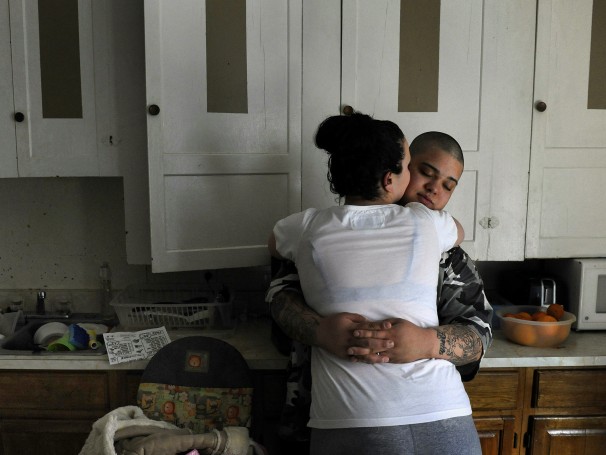
Jourie Ortiz gets a hug from his wife, Rebecka, after he was woozy and hardly able to stand after 48 hours with only about five hours of sleep. He works an overnight shift at a supermarket and then comes home to be with his family, getting less than three hours of sleep on many days. They have two children and a combined monthly income of $1,700. They also rely on the Supplemental Nutrition Assistance Program (SNAP), formerly known as food stamps. (Michael S. Williamson/The Washington Post)
Rebecka and Jourie Ortiz usually ran out of milk first, after about three weeks. Next went juice, fresh produce, cereal, meat and eggs. By the 27th or 28th, Rebecka, 21, was often making a dish she referred to in front of the kids as “rice-a-roni,” even though she and Jourie called it “rice-a-whatever.” It was boiled noodles with canned vegetables and beans. “Enough salt and hot sauce can make anything good,” she said.
Late on Feb. 28, Rebecka came home to their two-bedroom apartment to make a snack for her daughters, ages 1 and 3. The kitchen was the biggest room in their apartment, with a stove that doubled as a heater and a floral wall hanging bought at the dollar store that read: “All things are possible if you believe!” She opened the refrigerator. Its top shelf had been duct-taped and its cracked bottom shelf had been covered with a towel. Only a few jars of jelly, iced tea, rotten vegetables and some string cheese remained in between.
For the past three years, the Ortizes’ lives had unfolded in a series of exhausting, fractional decisions. Was it better to eat the string cheese now or to save it? To buy milk for $3.80 nearby or for $3.10 across town? Was it better to pay down the $600 they owed the landlord, or the $110 they owed for their cellphones, or the $75 they owed the tattoo parlor, or the $840 they owed the electric company?
They had been living together since Rebecka became pregnant during their senior year of high school, long enough to experience Woonsocket’s version of recession and recovery. Jourie had lost his job at a pharmacy late in 2010 because of downsizing, and Rebecka had lost hers in fast food for the same reason a few months later. They had filled out a one-page application for SNAP and been accepted on Oct. 11, 2011, awarded $518 for a family of four, to be delivered on the first of every month. “Check Day!” they had begun calling it. They had applied for jobs until finally, late in 2012, they had both been hired for the only work high school graduates were finding in a low-wage recovery: part time at a nearby supermarket, the nicest one in the area, a two-story Stop & Shop across the Massachusetts line.
She made $8 an hour, and he earned $9. She worked days in produce, and he worked nights as a stocker. Their combined monthly income of $1,700 was still near the poverty line, and they still qualified for SNAP.
Rebecka had read once that nobody starved to death in America, and she believed that was true. But she had also read that the average monthly SNAP benefit lasted a family 17 days, and she knew from personal experience the anxiety headaches that came at the end of every month, when their SNAP money had run out, their bank account was empty and she was left to ply Woonsocket’s circuit of emergency church food pantries. Saint Agatha’s on Mondays. All Saints’s on Tuesdays. Saint Charles’s on Thursdays, where the pantry opened at 10 a.m. but the line of regulars began forming at 6.
To steady her nerves and improve her mood near the end of the month, Rebecka had started making elaborate grocery lists to prepare for the 1st — “an OCD habit,” she said. She sorted the items in order of importance and then rewrote the list again and again, until her handwriting looked perfect and the list became irrelevant, because she had memorized it all.
Now she reached into the refrigerator and grabbed two string cheeses for her daughters. Then she reached back for a third.
“Do you want a snack for work?” she asked Jourie, who was getting dressed for his midnight shift.
“Do we have enough?”
“I think so,” she said, handing him the cheese. “But I’m shopping tomorrow.”
“I’ll wait,” he said, handing it back. He stood up and hugged her goodbye. “They’ll fire me if I’m late,” he said.
He had neither a driver’s license nor a car, so he always walked the mile to work. He headed out of their apartment building in a hooded sweatshirt and turned down Privilege Street. His feet crunched against the snow, and his head steamed in the cold air. He passed a U-Save Liquors, a Cheap-O Tires and an Instant Payday Loans. He passed four stores with signs advertising that they accepted SNAP.
The government had designated Woonsocket a “highly distressed community” in 2012, and at night Jourie thought it also seemed deserted, a town that disappeared into twisting two-lane roads, shadowy mills and abandoned smokestacks. He watched his reflection in the empty store windows as he walked, crossing the border into Massachusetts and cutting through a parking lot toward the Stop & Shop. Its lights glowed neon. Four trucks idled at the loading docks, the sign of an economy coming alive for the 1st.
Jourie had almost never shopped at the store himself; it was too expensive. His family would spend Check Day somewhere else. He punched his timecard at 10:57 p.m. and walked into the store, where he stocked the aisles with cat food as Feb. 28 ended and March 1 arrived.
****
The first five customers came to International Meat Market at 7 a.m., 30 minutes before the store opened. They leaned on shopping carts and smoked cigarettes, passing around a yellow flier that advertised the market’s bulk deals for the 1st. The flier detailed eight “Meat Packs.” Five pounds of deli cuts went for $12.99; 28 pounds of beef for $49.99; a 58-pound variety pack with pork, pig’s feet, chicken wings and London broil for $99.99.
Pichardo unlocked the store and led the customers to the meat counter, where both the butcher and his apron were already smeared with blood.
“Lucky. You get first pick,” Pichardo told his customers, gesturing at the full meat counter. “Place your orders, and we’ll fill them as fast as we can.”
Every store had a gimmick for the 1st, and Pichardo’s was the meat packs, which accounted for most of his sales. The idea was to sell merchandise in bulk when customers were hungry and most likely to splurge, hours after the government had deposited an average benefit payment of $265 onto their EBT cards. The nearby Shaw’s Market had started a dollar aisle, and the dollar store had 50-cent specials. Wal-Mart stayed open 24 hours, and customers sometimes waited out the final minutes of the month with full carts near the registers, counting down to midnight.
Grocery store chains had started discount spinoffs. Farmers markets had incentivized SNAP shopping by rewarding customers with $2 extra for every $5 of government money spent. Restaurants, long forbidden from accepting SNAP, had begun a major lobbying campaign in Washington, and now a handful of Subways in Rhode Island were accepting the benefit as part of a pilot program.
But SNAP recipients at International Meat Market were allowed to spend their money only on uncooked foods — nothing hot or pre-prepared, no paper products, pet food, alcohol or cigarettes. A line formed at Pichardo’s register, and he lifted one heavy cardboard box of meat after the next.
A part-time janitor came through with a meat pack, vegetable oil and canned tomatoes. “That’s $132.20,” Pichardo said.
An unemployed welder with two meat packs and a 24-pack of Ramen. “One-hundred and-ten,” Pichardo said.
A retired teacher. A single mother of three. A Salvadoran immigrant who wanted the meat pack flier translated into Spanish. A part-time employee at International Meat Market, hired for the day, buying $69.99 worth of meat with a SNAP card during his 20-minute break.
“Thank you,” Pichardo told one customer.
“Gracias,” he told the next.
“Okay, my friend.”
“See you next month.”
By noon his shirt was drenched and his feet were swollen. His thumb and index finger were stained brown after grabbing and sliding 120 EBT cards in the past four hours. The store smelled like meat and sweat, and the aisles were a trail of discarded items. The exhausted butcher behind the meat counter had started mumbling under his breath in Spanish: “No mas. No mas. No mas.”
Pichardo noticed none of it. His store had already sold more than $5,000, with $4,700 paid for in SNAP.
****
Rebecka went shopping early that afternoon. Jourie was still sleeping off his midnight shift, so she decided to take the girls by herself. She wanted to visit at least two stores to capitalize on the best deals. She packed snacks and diaper bags and loaded the girls into the car, a 2004 Mitsubishi Galant leased on 18 percent interest for $90 a week. They drove across town to Price Rite, the cheapest chain in Woonsocket, and the town’s epicenter of the SNAP economy.
Nearly 150 cars filled the lot, and stray shopping carts edged into the adjacent road. The sign in front of the store advertised “Impossibly, Incredibly, Inconceivably Low Prices.” A city bus had stopped at the entrance a few minutes earlier to drop off 30 shoppers before turning back to pick up 30 more. The residents of Woonsocket had petitioned for the route in 2011, but now buses suffered from overcrowding on the 1st and drivers enforced a limit of seven grocery bags per person on the way home. A line of opportunistic cab drivers had begun waiting outside Price Rite on the 1st, ready for customers with more than seven bags and with $4.75 for the fare.
Rebecka moved quickly through the lot and lifted her 1-year-old, Jaeliece, and her 3-year-old, Sariah, into an empty shopping cart.
“Please keep your hands in the cart,” she told them. “Only Mommy gets to do the shopping.”
The first tantrum came before they reached the front door. Sariah wanted a balloon, and then a gum ball, and then a bag of oranges off a display near the entrance. That was the trouble with shopping on the 1st, after a week of skimping and rice-a-whatever: There were so many things to want, and stores designed themselves to maximize temptation. Juices were placed low within reach of the kids. Candy and Coke displays blocked the aisles. A six-foot-tall mountain of Oreos towered just inside the Price Rite entrance, a temporary display for the 1st that Sariah was reaching for now.
“No,” Rebecka said. “That’s not on the list.”
“Mine,” Sariah said, grabbing a bag of cookies.
“No.”
“Mine!” Other customers turned to look. Rebecka still had two stores and 70 items left on her shopping list for the day.
“Fine,” she said. “You can hold it.” She moved past the cookies and hustled through the store, weaving between customers who were shopping with two carts and grabbing items by the cardboard crate. Little boys ran around retirees on their motorized scooters. Rebecka focused on the list and calculated prices in her head. She grabbed two boxes of Cinnamon Toast Crunch ($2.49), a four-gallon bottle of cooking oil ($5.99) and three gallons of milk ($3.10). She pushed the kids toward checkout, where long lines snaked behind all 12 registers. Sariah started throwing items out of their cart. Jaeliece began to cry. “Damn it,” Rebecka said. She pushed her cart into an express lane for 10 items or less and set her 22 items on the conveyer belt. “I’m sorry,” she told the cashier. Then she handed over her EBT card, paid $49.20, and loaded the kids back into the car for Wal-Mart.
The crowds got bigger.
The prices got higher.
The tantrums got worse.
“Damn it!” Rebecka said again, racing around the store, oblivious to her own list, picking up anything that looked healthy or filling and dropping it into the cart. Sariah grabbed a box of Goldfish off the shelf and opened it. “I guess we have to buy that now,” Rebecka said. Jaeliece opened a string cheese and threw it on the floor. “I guess we have to buy that, too,” Rebecka said. Sariah ran away, and Rebecka ran after her. Sariah hid, and Rebecka searched for her in produce.
“I can’t do this anymore,” she said, after almost an hour in Wal-Mart. She pushed the kids toward the checkout line. Another SNAP shopper was already in front of her with $230 worth of food on the conveyer belt, so they had to wait. Sariah grabbed a package of Play-Doh off the shelf and ripped it open, throwing green putty on the floor. “Are you serious?” Rebecka said. “That’s another $6.50 you just cost me.”
“I’ve been there,” said the shopper in front of her, turning to help clean up the Play-Doh.
“I’m flipping,” Rebecka said.
“The best and the worst day of the month,” the shopper said.
Rebecka paid $168 and returned to the parking lot. Sariah fell on the gravel and started to cry. “We’ll stop at Burger King,” Rebecka said, crying now, too, so tired she didn’t care what lunch would cost. They went to the drive-through and continued home. She left the groceries in the car, and Jourie hauled them up to the apartment. They wedged the boxes into the fridge. “I couldn’t get it all,” she told Jourie, explaining that she had made it only halfway through her list. She had spent about two weeks of SNAP money on groceries that would last seven or eight days.
Later that night, as the kids went to bed and Jourie readied for another shift at work, Rebecka grabbed a calendar off the wall and turned the page to March. The 1st was almost over. Price Rite had closed. The buses had stopped running. Pichardo and his employees at International Meat Market had all gone home, after mopping meat from the aisles at the end of an $8,200 day.
Rebecka touched each empty box on the calendar with her finger and counted out loud, plotting the long decline before the cycle of a SNAP economy began again.
“Thirty more days,” she said.
In Florida, a food-stamp recruiter faces would-be recipients’ wrenching choices
By Eli Saslow
A good recruiter needs to be liked, so Dillie Nerios filled gift bags with dog toys for the dog people and cat food for the cat people. She packed crates of cookies, croissants, vegetables and fresh fruit. She curled her hair and painted her nails fluorescent pink. “A happy, it’s-all-good look,” she said, checking her reflection in the rearview mirror. Then she drove along the Florida coast to sign people up for food stamps.
Her destination on a recent morning was a 55-and-over community in central Florida, where single-wide trailers surround a parched golf course. On the drive, Nerios, 56, reviewed techniques she had learned for connecting with some of Florida’s most desperate senior citizens during two years on the job. Touch a shoulder. Hold eye contact. Listen for as long as it takes. “Some seniors haven’t had anyone to talk to in some time,” one of the state-issued training manuals reads. “Make each person feel like the only one who matters.”
In fact, it is Nerios’s job to enroll at least 150 seniors for food stamps each month, a quota she usually exceeds. Alleviate hunger, lessen poverty: These are the primary goals of her work. But the job also has a second and more controversial purpose for cash-strapped Florida, where increasing food-stamp enrollment has become a means of economic growth, bringing almost $6 billion each year into the state. The money helps to sustain communities, grocery stores and food producers. It also adds to rising federal entitlement spending and the U.S. debt.
Nerios prefers to think of her job in more simple terms: “Help is available,” she tells hundreds of seniors each week. “You deserve it. So, yes or no?”
In Florida and everywhere else, the answer in 2013 is almost always yes. A record 47 million Americans now rely on the Supplemental Nutrition Assistance Program (SNAP), also known as food stamps, available for people with annual incomes below about $15,000. The program grew during the economic collapse because 10 million more Americans dropped into poverty. It has continued to expand four years into the recovery because state governments and their partner organizations have become active promoters, creating official “SNAP outreach plans” and hiring hundreds of recruiters like Nerios.
A decade ago, only about half of eligible Americans chose to sign up for food stamps. Now that number is 75 percent.
Rhode Island hosts SNAP-themed bingo games for the elderly. Alabama hands out fliers that read: “Be a patriot. Bring your food stamp money home.” Three states in the Midwest throw food-stamp parties where new recipients sign up en masse.
On the Treasure Coast of Florida, the official outreach plan is mostly just Nerios, who works for a local food bank that is funded in part by the state. She roams four counties of sandbars and barrier islands in her Ford Escape, with an audio Bible in the CD player and a windshield sticker that reads “Faith, Hope and Love.” She distributes hundreds of fliers each week, giving out her personal cellphone number and helping seniors submit SNAP applications on her laptop.
On this particular morning, Nerios pulled into the Spanish Lakes retirement community near Port St. Lucie, Fla., and set up a display table in front of the senior center. She advertised her visit weeks in advance, but she can never predict how many people will come. Some events draw hundreds; others only a dozen. Her hope was to attract a crowd with giveaways of pet toys and hundreds of pounds of food, which she stacked high on the table. “What person in need doesn’t want food that’s immediate and free?” she said.
She watched as a few golf carts and motorized scooters drove toward her on a road lined with palm trees, passing Spanish Lakes signs that read “We Love Living Here!” and “Great Lifestyle!” The first seniors grabbed giveaway boxes and went home to tell their friends, who told more friends, until a line of 40 people had formed at Nerios’s table.
A husband and wife, just done with nine holes of golf, clubs still on their cart.
An 84-year-old woman on her bicycle, teetering away with one hand on the handlebars and a case of applesauce under her other arm.
A Korean War veteran on oxygen who mostly wanted to talk, so Nerios listened: 32 years in the military, a sergeant major, Germany, Iron Curtain, medals and awards. “A hell of a life,” the veteran said. “So if I signed up, what would I tell my wife?”
Tell her you’re an American and this is your benefit,” Nerios said, pulling him away from the crowd, so he could write the 26th name of the day on her SNAP sign-up sheet.
She distributed food and SNAP brochures for three hours. “Take what you need,” she said, again and again, until the fruit started to sweat and the vegetables wilted in the late-morning heat. Just as she prepared to leave, a car pulled into the senior center and a man with a gray mustache and a tattered T-shirt opened the driver-side door. He had seen the giveaway boxes earlier in the morning but waited to return until the crowd thinned. He had just moved to Spanish Lakes. He had never taken giveaways. He looked at the boxes but stayed near his car.
“Sir, can I help?” Nerios asked. She brought over some food. She gave him her business card and a few brochures about SNAP.
“I don’t want to be another person depending on the government,” he said.
“How about being another person getting the help you deserve?” she said.
***
Did he deserve it, though? Lonnie Briglia, 60, drove back to his Spanish Lakes mobile home with the recruiter’s pamphlets and thought about that. He wasn’t so sure.
Wasn’t it his fault that he had flushed 40 years of savings into a bad investment, buying a fleet of delivery trucks just as the economy crashed? Wasn’t it his fault that he and his wife, Celeste, had missed mortgage payments on the house where they raised five kids, forcing the bank to foreclose in 2012? Wasn’t it his fault the only place they could afford was an abandoned mobile home in Spanish Lakes, bought for the entirety of their savings, $750 in cash?
“We made horrible mistakes,” he said. “We dug the hole. We should dig ourselves out.”
Now he walked into their mobile home and set the SNAP brochures on the kitchen table. They had moved in three months before, and it had taken all of that time for them to make the place livable. They patched holes in the ceiling. They fixed the plumbing and rewired the electricity. They gave away most of their belongings to the kids — “like we died and executed the will,” he said. They decorated the walls of the mobile home with memories of a different life: photos of Lonnie in his old New Jersey police officer uniform, or in Germany for a manufacturing job that paid $25 an hour, or on vacation in their old pop-up camper.
A few weeks after they moved in, some of their 11 grandchildren had come over to visit. One of them, a 9-year-old girl, had looked around the mobile home and then turned to her grandparents on the verge of tears: “Grampy, this place is junky,” she had said. He had smiled and told her that it was okay, because Spanish Lakes had a community pool, and now he could go swimming whenever he liked.
Only later, alone with Celeste, had he said what he really thought: “A damn sky dive. That’s our life. How does anyone fall this far, this fast?”
And now SNAP brochures were next to him on the table — one more step down, he thought, reading over the bold type on the brochure. “Applying is easy.” “Eat right!” “Every $5 in SNAP generates $9.20 for the local economy.”
He sat in a sweltering home with no air conditioning and a refrigerator bought on layaway, which was mostly empty except for the “experienced” vegetables they sometimes bought at a discount grocery store to cook down and freeze for later. He had known a handful of people who depended on the government: former co-workers who exaggerated injuries to get temporary disability; homeless people in the Fort Pierce park where he had taken the kids each week when they were young to hand out homemade peanut-butter-and-jelly sandwiches, even though he suspected some of those homeless were drug addicts who spent their Social Security payments on crack.
“Makers and takers,” Lonnie had told the kids then, explaining that the world divided into two categories. The Briglias were makers.
Now three of those kids worked in law enforcement and two were in management. One of them, the oldest, was on his way to visit Spanish Lakes, driving down at this very moment from Valdosta, Ga., with his wife and two kids. Lonnie placed the SNAP brochures in a drawer and turned on a fan to cool the mobile home.
His son arrived, and they went out to dinner. Lonnie tried to pay with a credit card, but his son wouldn’t let him. Then, before leaving for Valdosta, the son gave his parents an air conditioner, bought for $400. Lonnie started to protest.
“Please,” his son said. “You need it. It’s okay to take a little help.”
***
The offer of more help came early the next morning. Nerios reached Lonnie on his cellphone to check on his interest in SNAP.
“Can I help sign you up?” she asked.
“I’m still not sure,” he said. “We have a lot of frozen vegetables in the freezer.”
“Don’t wait until you’re out,” she said.
She was on her way to another outreach event, but she told Lonnie she had plenty of time to talk. She had always preferred working with what her colleagues called the Silent Generation, even though seniors were historically the least likely to enroll in SNAP. Only about 38 percent of eligible seniors choose to participate in the program, half the rate of the general population. In Florida, that means about 300,000 people over 60 are not getting their benefits, and at least $381 million in available federal money isn’t coming into the state. To help enroll more seniors, the government has published an outreach guide that blends compassion with sales techniques, generating some protests in Congress. The guide teaches recruiters how to “overcome the word ‘no,’ ” suggesting answers for likely hesitations.
Welfare stigma: “You worked hard and the taxes you paid helped create SNAP.”
Embarrassment: “Everyone needs help now and then.”
Sense of failure: “Lots of people, young and old, are having financial difficulties.”
Nerios prefers a subtler touch. “It’s about patience, empathy,” she said. While she makes a middle-class salary and had never been on food stamps herself, she knows the emotional exhaustion that comes at the end of each month, after a few hundred conversations about money that didn’t exist. Nowhere had the SNAP program grown as it has in Florida, where enrollment had risen from 1.45 million people in 2008 to 3.35 million last year. And no place in Florida had been reshaped by the recession quite like the Treasure Coast, where middle-class retirees lost their savings in the housing collapse, forcing them to live on less than they expected for longer than they expected. Sometimes, Nerios believes it is more important to protect a client’s sense of self-worth than to meet her quota.
“I’m not going to push you,” she told Lonnie now. “This is your decision.”
“I have high blood pressure, so it’s true that diet is important to us,” he said, which sounded to her like a man arguing with himself.
“I can meet with you today, or tomorrow, or anytime you’d like,” she said.
“I don’t know,” he said. “I’m really sorry.”
“You don’t have to be,” she said. “Please, just think about it.”
***
She hung up the phone and began setting up her giveaway table at another event.
He hung up the phone and drove a few miles down the highway to his wife’s small knitting store. They had stayed married 41 years because they made decisions together. She was an optimist and he was a realist; they leveled each other out. During the failures of the past three years, they had developed a code language that allowed them to acknowledge their misery without really talking about it.
“How you doing?” he asked.
“Just peachy,” she said, which meant to him that in fact she was exhausted, depressed, barely hanging on.
She opened the knitting store three years earlier, but it turned out her only customers were retirees on fixed incomes, seniors with little money to spend who just wanted an air-conditioned place to spend the day. So Celeste started giving them secondhand yarn and inviting customers to knit with her for charity in the shop. Together they had made 176 hats and scarves for poor families in the last year. The store, meanwhile, had barely made its overhead. Lonnie wanted her to close it, but it was the last place where she could pretend her life had turned out as she’d hoped, knitting to classical music at a wooden table in the center of the store.
Now Lonnie joined her at that table and started to tell her about his week: how he had been driving by the community center and seen boxes of food; how he had decided to take some, grabbing tomatoes and onions that looked fresher than anything they’d had in weeks; how a woman had touched his shoulder and offered to help, leaving him with brochures and a business card.
He pulled the card from his pocket and showed it to Celeste. She leaned in to read the small print. “SNAP Outreach,” it read.
“I think we qualify,” Lonnie said.
There was a pause.
“Might be a good idea,” Celeste said.
“It’s hard to accept,” he said.
Another pause.
“We have to take help when we need it,” she said.
Celeste looked down at her knitting, and Lonnie sat with her in the quiet shop and thought about what happened when he opened a barbershop a few years earlier, as another effort of last resort. His dad, an Italian immigrant, had been a barber in New Jersey, and Lonnie decided to try it for himself after a dozen manufacturing job applications went unanswered in 2010. He enrolled in a local beauty school, graduated with a few dozen teenaged girls, took over the lease for a shop in Port St. Lucie and named it Man Cave. He had gone to work with his scissors and his clippers every day, 9 a.m. to 5 p.m., Saturdays and Sundays, standing on the curb and waving a handmade sign to advertise haircuts for $5. He had done a total of 11 cuts in three months. But what tore him up inside had nothing to do with the lonely echo of his feet on the linoleum floor or the empty cash register or the weeks that went by without a single customer. No, what convinced him to close the shop — the memory that stuck with him even now — were the weeks when old friends had come in to get their hair cut twice. He couldn’t stand the idea of being pitied. He hated that his problems had become a burden to anyone else.
He wondered: Sixty years old now, and who was he? A maker? A taker?
“I’m not ready to sign up for this yet,” he said.
“Soon we might have to,” she said.
He tucked Nerios’s business card into his back pocket.
“I know,” he said. “I’m keeping it.”
More than 1 in 4 kids depend on the government for food, and many of them are still left hungry in the summer. In rural Tennessee, one food bank is trying a new solution: delivering lunch.
By Eli Saslow
It was the first day of summer in a place where summers had become hazardous to a child’s health, so the school bus rolled out of the parking lot on its newest emergency route. It passed by the church steeples of downtown and curved into the blue hills of Appalachia. The highway became two lanes. The two lanes turned to red dirt and gravel. On the dashboard of the bus, the driver had posted an aphorism. “Hunger is hidden,” it read, and this bus had been dispatched to find it.
The bus was empty except for a box of plastic silverware and three oversize coolers that sat on green vinyl seats. Inside each cooler were 25 sack lunches, and inside each sack was what the federal government had selected on this day as the antidote to a growing epidemic of childhood hunger — 2 ounces of celery sticks, 4 ounces of canned oranges, chocolate milk and a bologna sandwich, each meal bought with $3.47 in taxpayer money.
On the outside of the bus, the familiar yellow-and-black design had been modified with the bold lettering of the U.S. economy in 2013: “Kids Eat FREE!”
Here, in the rural hills of Tennessee, is the latest fallout of a recession that officially ended in 2009 but remains without end for so many. More than 1 in 4 children now depend on government food assistance, a record level of need that has increased the federal budget and changed the nature of childhood for the nation’s poor.
First, schools became the country’s biggest soup kitchens, as free and reduced-price lunch programs expanded to include free breakfast, then free snacks and then free backpacks of canned goods sent home for weekends. Now those programs are extending into summer, even though classes stop, in order for children to have a dependable source of food. Some elementary school buildings stay open year-round so cafeterias can serve low-income students. High schools begin summer programs earlier to offer free breakfast.
And late last month came the newest iteration: a school bus retrofitted into a bread truck bouncing along a potholed road near the Blue Ridge Mountains. It parked in a valley of 30 single-wide trailers — some rotting in the sun, others swallowed by weeds and mosquitoes alongside the Nolichucky River. The driver opened his window and listened to the utter silence. “It feels like a ghost town,” he said.
A 5-year-old girl saw the dust trail of the bus and pedaled toward it on a red tricycle. Three teenage boys came barefoot in swimsuits. A young mother walked over from her trailer with an infant daughter in one arm and a lit cigarette in the other. “Any chance there will be leftover food for adults?” she asked.
It was almost 1 p.m. For some, this would be the first meal of the day. For others, the last.
The driver opened the bus door and made the announcement he would repeat at six more trailer parks on this day.
“Lunch is served,” he said.
The driver’s name was Rick Bible, and his 66-mile route through the hills of Greene County marked the government’s latest attempt to solve a rise in childhood hunger that had been worsening for seven consecutive years.
Congress had tried to address it mostly by spending a record $15 billion each year to feed 21 million low-income children in their schools, but that left out the summer, so the U.S. Department of Agriculture agreed to spend $400 million more on that. Governors came together to form a task force. Michelle Obama suggested items for a menu. Food banks opened thousands of summer cafes, and still only about 15 percent of eligible children received regular summer meals.
So, earlier this year, a food bank in Tennessee came up with a plan to reverse the model. Instead of relying on children to find their own transportation to summer meal sites, it would bring food to children. The food bank bought four used school buses for $4,000 each and designed routes that snake through some of the most destitute land in the country, where poverty rates have almost doubled since 2009 and two-thirds of children qualify for free meals.
“We got ketchup?” Bible said now, loading supplies onto the bus before heading out for the day.
“Yes,” said Morgan Anderson, a food bank employee who worked on the bus with him.
“Ice? Hand sanitizer?”
“Yes. Yes.”
Bible and Anderson were beginning their second week together on the route, which made seven regular stops in five hours, Mondays through Fridays, delivering 66 sack lunches with 750 calories each. Government rules required them to stop for 15 minutes at each trailer park to make sure children ate their lunches on the bus. Anderson, 22 and pursuing her master’s degree in dietary studies, tested the temperature of the coolers every hour and kept inventory of food in a color-coded binder. Bible, 58 and laid-off from a furniture factory, sneaked extra fruit cups to the kids and told stories as long and winding as their route.
Their job on the bus included enforcing a long list of rules from the USDA: No giving out seconds, because the federal government reimburses only 2 percent of their value. No extra milks. No children taking food home. No free meals for adults over 18 unless they are disabled. On Anderson’s first day, she had watched three men come on board, sweaty and unshaven after a morning working in the strawberry fields. “Are you under 18?” she had asked them. “Yes,” one had said, even though she suspected it was a lie. The men had eaten quickly and left, never returning to the bus on subsequent days, and lately Anderson had begun to worry about them, blaming herself for their absence. Had she scared them away? Were they going hungry because of her? Why had she bothered to ask about their age?
“You learn that there are rules, and then there’s the reality of the people you see on the bus,” Anderson said.
On this day, what she saw at the first stop was five siblings arriving in clothes still stained from the pizza sauce they had been served on the bus the day before. “Did you get a chance to change today?” Anderson asked one of them, a 10-year-old girl. “Into what?” she said.
Next, at the second stop, a 7-year-old whose parents were both at work arrived carrying his 1-year-old sister in nothing but a diaper, spoon-feeding her juice from the bottom of his fruit cocktail cup. “She can’t eat chunks yet,” he said.
At the third stop, a high school football player pleaded for extra milk; at the fourth, teenagers fired rifles at cans up the road; at the fifth, always the most crowded, kids, parents and dogs waited in the shade under the trailer park’s only tree.
“Finally!” one of them said as the bus pulled in. He was a 12-year-old boy, shirtless and muddy with half of a cigarette tucked behind his ear, and he barged onto the bus and grabbed his lunch. “Bologna again?” he asked, studying his sandwich.
“I’ll take yours then,” another boy said, grabbing for his bag.
“No fighting,” Anderson said, as she handed out 15 meals and walked toward the back of the bus, where a young mother in a tank top and pink slippers was sitting with her 2-year-old son. The mother opened the toddler’s fruit cup and, a minute later, the little boy stood up on his seat, laughed and tossed the fruit cup out the school bus window.
“How dare you?” the mother said, turning to the toddler, slapping his bottom hard enough for the bus to go quiet, then pulling her arm back to slap him again.
“It’s okay,” Anderson said, hurriedly reaching into another bag for a replacement cup of fruit, breaking the rule about seconds.
“It is not okay with me!” the mother said. She turned back to her son, who was wailing, and yanked him back into his seat. “Sit on your butt,” she said. “What did I tell you about wasting?”
Anderson watched the mother for a few seconds and wondered if this would be one of the times when she needed to call child protective services to make a report. It had happened three times on buses already in the past two weeks, once for possible child abuse and twice for possible neglect. Stress, anger, desperation — these were behaviors she had been told to anticipate on the bus at a time when a record 10 percent of children live in homes unable to provide adequate, nutritious food. “Low-income families are being pushed to the very edge,” one of her training manuals had warned. But now Bible walked back from his driver’s seat and put his hand on the young mother’s shoulder. “It’s hot. We’re hungry. Nobody is in a good mood,” he said. “So I’d like to tell a joke. Have you heard that this bus has 2050 air conditioning? That means 20 windows down and 50 miles an hour.”
The mother appeased him with a smile. The 2-year-old went back to eating his sandwich. The meal ended, and the bus emptied out.
“We got them through it,” Bible said.
“Thank goodness,” Anderson said.
“Fifteen minutes and 750 calories,” Bible said.
“And again tomorrow,” Anderson said.
The bus pulled away. The mother in pink slippers took her 2-year-old back to a trailer with no air conditioning. The 12-year-old boy walked away cursing about bologna. This is what the bus left behind at every stop along the route: children who were not quite satisfied, and whose appetites would build for 23 hours and 45 minutes until the bus returned.
At Cedar Grove, the first stop, all five Laughren siblings returned to their single-wide trailer, back into the vacuum of their summer. Their mother usually took the family’s only car to work, leaving the children stranded in the trailer park. Admission to the nearby swimming pool cost $3 per person and they only had $4.50 among them. The cable company had cut off their service, and they had already spent the morning watching a DVD of “Fast & Furious” twice.
“I am so freaking bored,” said Courtney Laughren, 13, walking over to their refrigerator 21 hours before the school bus was scheduled to return. Inside she found leftover doughnuts, ketchup, hot sauce, milk and bread. “Desperation time,” she said, reaching for a half-eaten doughnut and closing the door.
Desperation had become their permanent state, defining each of their lives in different ways. For Courtney, it meant she had stayed rail thin, with hand-me-down jeans that fell low on her hips. For Taylor, 14, it meant stockpiling calories whenever food was available, ingesting enough processed sugar and salt to bring on a doctor’s lecture about obesity and early-onset diabetes, the most common risks of a food-stamp diet. For Anthony, 9, it meant moving out of the trailer and usually living at his grandparents’ farm. For Hannah, 7, it meant her report card had been sent home with a handwritten note of the teacher’s concerns, one of which read: “Easily distracted by other people eating.” For Sarah, the 9-month-old baby, it meant sometimes being fed Mountain Dew out of the can after she finished her formula, a dose of caffeine that kept her up at night.
And for Jennifer, their mother, 32, desperation time meant the most stressful part of her day began when she arrived home at 6 p.m., after another 12-hour shift as a cook at a nursing home.
“I’m back,” she said now, dropping her keys onto the floor of the trailer, collapsing onto the couch.
She had spent her day preparing meals for $8 an hour in an industrial kitchen at the nursing home: 50 servings of breaded pork chops, rolls and macaroni salad — unless, of course, residents requested something else, in which case she cooked to order. She prepared chef salads, chicken soup and sweet-potato pies until the leftovers filled the refrigerator and stacked on the counter. A few weeks earlier, a boss had spotted her taking some of those leftovers home and threatened to put her on probation. So now Jennifer had returned to the trailer empty-handed, with five more dinners left to make for her children.
She always worried about the basics of caring for her family — “Home. Job. Food. I never hit that jackpot all at once,” she said — but only in summer did their situation become so dire that she regularly asked her children to rate their hunger on a scale of 1 to 10. When her kids were in school, they ate a total of 40 free meals and 20 snacks there each week — more than 25,000 government-sponsored calories that cost her nothing. Her $593 in monthly food stamps usually lasted the entire month. They ate chicken casserole and ground beef for dinner. But now, with school out, she was down to $73 in food stamps with 17 days left in the month. “Thank God for the bus,” she said, but even that solved their problems for only one meal a day.
She walked into the kitchen, collected what items remained in the pantry and set them on the table for dinner. “Buffet’s ready,” she announced. The children ate corn chips, Doritos, bread, leftover doughnuts, Airheads candy and Dr Pepper.
“I’m still hungry,” Courtney said a few minutes later, 14 hours before the bus returned.
“Me, too,” Jennifer admitted.
Her food stamps could be used for cold food but not hot food, and the nearby grocery store sold pre-made sandwiches for half-price after 8 p.m. She loaded all five kids into the car and drove a mile to the supermarket. They chose three subs from a case that glowed under fluorescent lights. They shared two, mushing pieces of bread for the baby, and then Jennifer wrapped the third sandwich to take home.
“For breakfast,” she said, and they drove back to the trailer and went to bed.
The kids awoke at 9, two on the bed they had found at Goodwill and two more on the box spring. They watched “Fast & Furious.” They ate the leftover sandwich.
At 11 a.m., Courtney stood by the window, rocking the baby and watching for the bus. Three other children from the trailer park were already waiting outside, picking rocks off the road and throwing them at a nearby tree. They heard the bus before they saw it, big tires crunching gravel. “Food’s here!” Courtney yelled, alerting her sisters. Before they were ready to leave the trailer, Bible, the driver, walked over to find them. By now he knew the regulars on his route, and he always made sure they were fed.
Bible had lived in Greene County his entire life, but the trailer parks on his route reminded him of Belize, where he had traveled on a mission trip a decade earlier. He had spent a week there building a basic shelter for a homeless man while 70 other homeless people watched, wondering if Bible might build them houses, too. What he had experienced then was the same combination of fatigue and helplessness he felt now, looking inside the Laughrens’ dilapidated trailer. In this part of the country, in this time, no amount of sack lunches would ever be enough.
He knocked on the door. Courtney and her siblings opened it.
“We have turkey, crackers and pears today,” he said. “You hungry?”
“Always,” she said, and they followed him back to the bus.
The Republican from Florida is facing his toughest job yet: Trying to persuade a divided Congress to overhaul the food stamp program
By Eli Saslow
The congressman had been called a "starvation expert" by analysts on TV and a "monster" by colleagues in the House of Representatives. Protesters had visited his offices carrying petitions demanding he resign. And now, six months into his crusade to overhaul the food stamp program, Rep. Steve Southerland (R-Fla.) departed the Capitol to address his most wary audience yet: the people whose government benefits he hoped to curtail.
"Stick to your talking points this time if you can," said a staff member, handing him a sheet of those talking points minutes before they left for the event.
"It’s too late to start being cautious," Southerland said, folding the paper and leaving it on his desk. It was already late summer, and he hoped to pass the most significant food stamp overhaul in decades by the end of the fiscal year on Sept. 30.
The event was listed on his schedule as a "Poverty Tour," and Southerland had invited a dozen Republican policy experts to join him. They boarded a bus provided by the Heritage Foundation, a conservative think tank, and traveled across Washington to a job training center, where three homeless men idled outside. Southerland stood at the front of the bus to address his colleagues. He looked like the funeral director he had been before running for Congress in 2008 - shoes polished, suit pressed, eyes solemn, head bowed as if in prayer. "This is an important moment for us," he said. If only his tough-love message could resonate with the unemployed, then maybe he could win over a divided Congress.
"What we are fighting for is a cultural shift," Southerland told his colleagues on the bus. "The explosion of food stamps in this country is not just a fiscal issue for me. This is a defining moral issue of our time."
Southerland’s food stamp proposal, which on Thursday the House narrowly voted to approve, would require able-bodied adults to work or volunteer at least 20 hours each week in order to receive government food assistance. "It’s the simple solution," he said in March at a news conference introducing the idea. But in the months since, he has learned that no idea is simple in Washington, especially not one that would fundamentally alter a program that has tripled in size during the past decade, growing to support a record 47 million people at a cost of $80 billion each year.
In a divided Congress, few debates have been more fractious than the one over food stamps and few proposals have been as contentious as Southerland’s. Republicans say his idea would encourage people to find jobs, decreasing government spending while adding workers to the economy. Democrats say it would leave millions of the most vulnerable Americans hungry at a time when food insecurity is already approaching historic highs.
Southerland’s proposal passed the House despite receiving no Democratic support, as part of a bill that would cut 3.8 million people and $4 billion from the food stamp program next year. But that vote was only the first of many. In order to become law, his work requirement must survive a conference committee between leaders in the House and Senate, two more congressional votes and a president already threatening a veto.
"Getting something done here can be like navigating a maze," Southerland said.
On this day, the maze led him up the stairs to the training center, where 25 residents of Southeast Washington were crammed into a classroom to learn tips about preparing for a job interview in fast food. All were unemployed. Most were among the 24 percent of Washington residents who receive between $100 and $600 each month in food assistance.
"Shower. Tuck in your shirt. Make eye contact with the interviewer," the teacher was saying.
"Make sure your belt and your shoes match," Southerland interjected, walking into the room with his colleagues and then introducing himself.
He began as he always does by telling his family story, which aides refer to as "the Gospel of Work." His grandfather quit school in the sixth grade and made himself into the busiest funeral director in Panama City, Fla., continuing to work until he died at 91. Southerland started helping in that same funeral home before he turned 10, answering phones, washing cars and arranging flowers as he learned the family business. He required each of his four daughters to apply for work at a nearby restaurant on the day she turned 15. "Work is life. Work is opportunity," he said now. He quoted from the Bible, citing a passage about how God created Adam to tend the Garden of Eden. "Even in paradise, we worked," he said. "Work is not a punishment. It is what connects you with your purpose in life. What’s your purpose?"
One by one, the men and women in the classroom stood to share their plans. One wanted to become a teacher. Another said his "purpose" was to make at least $10 an hour. A man who had just cared for his dying mother thought maybe he could become a hospice nurse. "I liked the feeling of taking care of her, just knowing I was needed," he said.
"Yes!" Southerland shouted, clapping his hands, punching his fist against the air. "Now that’s a purpose. Don’t wait for your ship to come in. Swim out to it."
An older woman raised her hand in the corner of the classroom. She explained that she had been on public assistance most of her life. Food stamps helped her feed three kids. "I’ve been through dark times," she said. "I needed help, and I got it. Do you believe that’s wrong?"
Southerland thought for a few seconds and then took a step toward her. "I believe that if you are going to eat, you should bring something to the table," he said. The woman started to interrupt, but Southerland held up his hand. "That can be volunteering. That can be delivering Meals on Wheels, But somehow you’ve got to contribute. "I believe in a God-given purpose," he told her.
"I believe that being dependent makes you more vulnerable. I believe work is the greatest gift you will ever receive."
'This is what I'm about'
For the past six months, Southerland had been translating those beliefs into a succession of 14-hour workdays, trying to will his proposal into existence. He had delivered 45 speeches about food stamps, consulted with 20 anti-poverty experts and presented his idea to 13 governors. He had studied persuasive-writing techniques and read half a dozen books about effective leadership. And yet the biggest legislative project of his life still existed only on paper, inside two binders on his office shelf labeled "Important."
Southerland had left his job at the funeral home in 2007 to run for office on a platform of small government and Second Amendment rights despite having no legislative experience and no connections in Washington. When it looked as if he would win, to become the first Republican elected in his district in 130 years, he went to the library to study books about the legislative process. Write a bill. Get a sponsor. Go to committee. Debate. Vote. Senate. President. Only in the past few months, Southerland said, had he begun to learn "all the behind-the-scenes steps nobody talks about."
His food stamp proposal was not, in fact, his proposal. It was something that was handed to him by a stroke of political luck. He had wanted to pursue food stamp reform since arriving in Washington, but he lacked authority as a junior lawmaker relegated to subcommittees on fisheries and highway transportation. Instead, the idea for a work requirement came from 17 state human service secretaries who gathered in November to pitch their proposal to Republican members of the House Ways and Means Committee, who forwarded some of those ideas to Majority Leader Eric Cantor (R-Va.), who suggested the human service secretaries work with Southerland because, Cantor said, he was "a passionate true believer."
"Absolutely! This is what I’m about," Southerland had said, promising to make the proposal his No. 1 priority until it passed.
Now his color-coded office schedule had become a rainbow of food stamp events: red for anti-poverty tours, blue for private meetings, black for lobbyist appointments and the rare sliver of teal for personal time. He was meeting regularly with Arthur Brooks, president of the American Enterprise Institute, to learn how to sell the idea by using active language, such as "earned success," "sweat equity" and "upward mobility." He was asking Newt Gingrich to give supportive interviews and Rick Santorum to write op-eds.
The best chance to enact reform, Southerland had decided, was to make the specifics of his proposal "utterly unobjectionable," he said. Even though he believed in a 40-hour workweek, his proposal would mandate only 20. Even though he wanted it to be a national requirement, states would be able to implement or ignore it. There would be exemptions for the elderly, the disabled and mothers with children under 1. Some conservatives refused to back his proposal because it was "too soft," he said, but Southerland was willing to trade their endorsements for more-widespread support.
Earlier in the summer, he stood on the House floor to present his idea to the entire chamber for the first time. He planned to speak for two minutes. After 10 seconds, he noticed a dozen Democrats moving toward a microphone, lining up for rebuttals.
"Egregious," one said.
"Unbelievably misguided," said another.
"Offensive."
"Draconian."
"Outright shameful."
On the road
Several weeks later, still reeling from what he called the "debacle on the floor," Southerland climbed into a black SUV in northwest Florida to drive across his congressional district with Jonathan Hayes, his chief of staff. They had booked seven events in two days, a trip that would cover more than 300 miles, but Southerland was looking forward to the drive. He hung his suit jacket in the back seat and grabbed a tobacco pipe. "Even if we’re working nonstop, the stress fades when I’m here," he said.
His trips home sometimes made him wonder why he had ever decided to leave. In Panama City, he had left behind the wife he met in first grade and their four daughters, two of whom were still in high school. He missed his single-story house in the Panama City suburbs, where friends mostly wanted to talk about deer season and where even the most ardent Democrats respected the Southerlands for their work ethic and their Southern Baptist faith.
"In Washington, if someone disagrees with you, the problem must be your heart - you must be evil," he said. "Here, if we fight, we are only fighting about an idea."
On some days, Southerland also pined for his old job: 450 funerals every year, each not only a crisis for the family of the deceased but also a chance to make an immediate impact on the living. The funeral home had five phone lines, including one that rang straight to Southerland’s house when a death occurred in the middle of the night. Stillbirths, abductions, car accidents — he worked the funerals that others in his funeral home tried to avoid. He stood beside relatives as they visited the body. He rode with them in the hearse. Sometimes, at the grave sites, he sang hymns in a deep and mournful baritone. Nobody ever questioned his heart or his motives. He never doubted the value of his work.
Each funeral helped clarify his priorities. No matter whom they buried - backwoods alcoholics and resort owners, immigrants and veterans, in birch boxes and blue velvet caskets - the best eulogies remained the same. They were stories of family, friendship, ambition and hard work. Work created a legacy. Work provided meaning.
"I never heard anybody remembered for the things they didn’t do, or the impact they didn’t make, or the dreams they didn’t have," Southerland said as the SUV crossed into Liberty County, the center of his district.
He looked out the window at the twisting Apalachicola River, its brown water buffeted by green cedars and Spanish moss. Some locals in Liberty County believe the Garden of Eden had once existed on a bluff high above the river, and the land had been home to Seminole and Creek tribes, Spanish missionaries, British settlers and the Confederate Army - a place where societies rose and then fell. On his drives through the area, Southerland sometimes wondered if he was witnessing another civilization in decline. Many stores in downtown Bristol were unoccupied and boarded up. The poverty rate was 25 percent. A pawnshop advertised "cheap guns," and a gas station sign read, "Food stamps welcome here."
"Food stamps welcome everywhere," Southerland said, seeing the sign.
"So many people, just stuck," Hayes said.
"This is the fifth generation of dependency," Southerland said. "We have encouraged people to be sharecroppers instead of owning the land. The casualty of human capital, only eternity knows."
They crossed through the dense pines of Apalachicola National Forest, where intergenerational poverty was hidden behind the trees. Southerland had received letters from people here who lived in trailers on unincorporated land. They wanted help buying food. They wanted opportunities for their children. How could Southerland convince them that this was one problem government alone could not solve? The United States had already spent 50 years and $16 trillion on the war against poverty, and yet the wealth gap continued to grow and the rate of extreme poverty in rural Florida had increased for eight consecutive years. If anything, government was complicit, Southerland thought. It had drained people's ambition by giving them just enough money to stay poor. "It’s a travesty, what we’ve done," he said. Food stamps were necessary to ward off desperation for the truly vulnerable - the disabled, sick, elderly - but they didn’t count as a way of life. The only chance to create opportunities for the next generation, he said, was to do what his grandfather had done, accepting groceries and tools in exchange for burial services to keep the business alive that first year; or what his father had done, risking the family’s emergency savings to build a bigger funeral home; or what Southerland himself had done, working 80-hour weeks to double the family business and expanding it into granite and timber.
"Government might help you survive," he said, "but work creates lasting improvement."
Now Southerland arrived in Tallahassee to tour a job training facility for the homeless, where he hoped to tell residents about his proposal. Fifteen minutes into the visit, he noticed a videographer following him on the tour. He recognized the man as a Democratic activist who was making campaign videos for Southerland’s opponent in the next election. The ads would splice Southerland’s words and make him into a caricature, he thought. They would dismiss his qualifications and distort his ideas. They would question not only his policies but also his motives.
He pulled one of the program’s founders aside midway through the tour.
"I’m mostly going to listen today," Southerland said, gesturing at the videographer. "Anything I say here could be turned against me."
The distance between
This was the part of being a congressman that Southerland had begun referring to as the "devil’s duty" — the strategic part, when true belief capitulated to politics. And as the end of the fiscal year neared, it was politicking that dominated his schedule, first in Florida and then back in Washington.
In the run-up to Thursday’s vote, Southerland met with Republicans four times in Cantor’s office, and Cantor promised to push for a work requirement in the final version of the bill. But Democrats in the House and the Senate continued to object to even minor changes, promising to defeat Southerland’s proposal even after it passed the House by seven votes. They disagreed not only with Southerland’s proposal but also with his diagnosis of the problem and with his facts.
He said food stamp spending was "growing into oblivion"; Democrats said it would decrease just as quickly once the economy improved.
He cited data from the Agriculture Department indicating that half of food stamp recipients had stopped looking for work; Democrats countered with data also from the USDA showing that the fastest-growing demographic on food stamps was people who did work, but in jobs that paid so little they still qualified for the benefit.
He said his proposal would encourage people to enter the workforce; they said encouragement was useless since his proposal provided no guaranteed money for job training programs.
He said that only working-age adults would be affected by the requirement; they questioned what would happen to the children of those working-age adults if their parents didn’t find jobs and their families lost food stamps.
"We are dealing with opposite realities," Southerland said. "So you fight and fight and fight and maybe get half of what you want."
One night, exhausted and eager for a break, he left the Capitol to have dinner with his eldest daughter, Samantha, along with Hayes and his communications director, Matt McCullough. Samantha had graduated from college in Florida and moved to suburban Virginia to learn about government and be closer to her father.
"How’s life in the crazy Capitol?" she asked now, over milkshakes and burgers.
"This place is a mile wide and an inch deep," Southerland said.
He explained that he had spent the past few days studying 20 years of food stamp policy, trying to differentiate himself from his colleagues by becoming an expert. "Nobody here really knows anything," he said. He thought about that for a second and then reconsidered. "There’s one other guy," he said. "A Democrat." He told her about a Massachusetts liberal named Jim McGovern, who had been giving a speech about hunger on the House floor each week. McGovern had rallied the Democrats against Southerland’s proposal. Out of 435 people in the House, he was the only one who had studied food stamps just as hard and who seemed to care just as much.
"What does he say about all of this to you?" his daughter asked. "I don’t know," Southerland said. "I haven’t talked to him."
"What?" she said. "Seriously? Never? That doesn’t make sense." She knew her dad as a conciliator who valued mentoring young men at church, yearly hunting trips with his three siblings and funeral director retreats to the mountains. "Your whole thing is connecting with people," she said. "Everybody likes you." And yet here was another Washington lawmaker, elected to solve the same problems, who had become an expert on the same issue, who worked in the same place, and her dad had never met with him.
"Can’t you ask him to coffee?" she asked. "You could work together."
"That wouldn’t play so well with the conservative base," Hayes joked.
"Or back in district," McCullough said.
"Honey, look," Southerland said, staring at her intently, pleading with her to understand. "Washington is a runaway freight train. There isn’t time here for anything." He reached for two empty milkshake glasses to help him illustrate the problem, setting the glasses side by side on the table, their rims touching. "This is me, and this is the other guy when we get to Washington," he said. "Different ideas, different people, but we are close. We are touching. Democrat and Republican. We can do something with this."
He started to slowly pull the glasses in separate directions, ticking off reasons for the escalating divide. "Fundraising. Campaigns," he said, moving the glasses farther apart. "Votes, strategy, rushing around, lobbyists, name-calling," he continued, spreading the glasses farther, moving his daughter’s plate to clear a path for one of them. "I have my meetings and they have theirs. I run by them. They run by me. It’s all about winning, winning, winning. Winning - not fixing problems - defines all."
Now Southerland stretched his arms as far as he could, placing each glass at a distant edge of the table. Each was just an inch from falling and shattering on the ground. This was the congressional divide over food stamps and so much else. This was Washington in 2013 - one place, Southerland was beginning to realize, where legislation depended on so much more than hard work.
"So now I’m here and they’re way over there," he said, pointing to the glasses. "We can barely see each other. We can’t solve anything like this."
A previous version of this article incorrectly identified Southerland's eldest daughter as Amanda. This version has been corrected.
A diet fueled by food stamps is making South Texans obese but leaving them hungry
By Eli Saslow
McAllen, Tex. — They were already running late for a doctor’s appointment, but first the Salas family hurried into their kitchen for another breakfast paid for by the federal government. The 4-year-old grabbed a bag of cheddar-flavored potato chips and a granola bar. The 9-year-old filled a bowl with sugary cereal and then gulped down chocolate milk. Their mother, Blanca, arrived at the refrigerator and reached into the drawer where she stored the insulin needed to treat her diabetes. She filled a needle with fluid and injected it into her stomach with a practiced jab.
“Let’s go,” she told the children, rushing them out of the kitchen and into the car. “We can stop for snacks on our way home.”
The family checkup had been scheduled at the insistence of a school nurse, who wanted the Salas family to address two concerns: They were suffering from both a shortage of nutritious food and a diet of excess — paradoxical problems that have become increasingly interconnected in the United States, and especially in South Texas.
For almost a decade, Blanca had supported her five children by stretching $430 in monthly food stamp benefits, adding lard to thicken her refried beans and buying instant soup by the case at a nearby dollar store. She shopped for “quantity over quality,” she said, aiming to fill a grocery cart for $100 or less.
But the cheap foods she could afford on the standard government allotment of about $1.50 per meal also tended to be among the least nutritious — heavy in preservatives, fats, salt and refined sugar. Now Clarissa, her 13-year-old daughter, had a darkening ring around her neck that suggested early-onset diabetes from too much sugar. Now Antonio, 9, was sharing dosages of his mother’s cholesterol medication. Now Blanca herself was too sick to work, receiving disability payments at age 40 and testing her blood-sugar level twice each day to guard against the stroke doctors warned was forthcoming as a result of her diet.
She drove toward the doctor’s office on the two-lane highways of South Texas, the flat horizon of brown dirt interrupted by palm trees and an occasional view of the steel fence that divides the United States from Mexico. Blanca’s parents emigrated from Mexico in the 1950s to pick strawberries and cherries, and they often repeated an aphorism about the border fence. “On one side you’re skinny. On the other you’re fat,” they said. Now millions more had crossed through the fence, both legally and illegally, making Hidalgo County one of the fastest-growing places in America.
“El Futuro” is what some residents had begun calling the area, and here the future was unfolding in a cycle of cascading extremes:
Hidalgo County has one of the highest poverty rates in the nation . . . which has led almost 40 percent of residents to enroll in the food-stamp program . . . which means a widespread reliance on cheap, processed foods . . . which results in rates of diabetes and obesity that double the national average . . . which fuels the country’s highest per-capita spending on health care.
This is what El Futuro looks like in the Rio Grande Valley: The country’s hungriest region is also its most overweight, with 38.5 percent of the people obese. For one of the first times anywhere in the United States, children in South Texas have a projected life span that is a few years shorter than that of their parents.
It is a crisis at the heart of the Washington debate over food stamps, which now help support nearly 1 in 7 Americans. Has the massive growth of a government feeding program solved a problem, or created one? Is it enough for the government to help people buy food, or should it go further by also telling them what to eat?
Blanca walked her children into the doctor’s office in the sprawling town of McAllen and they took turns stepping onto the scale: 110 pounds. Seventy-eight. Fifty-five. “Not perfect, but not so bad,” the doctor said. Then a nurse handed him the children’s blood work — a series of alarming numbers that lately read more like averages in this part of Texas. Clarissa needed to watch her sugar, he said. Antonio needed to increase the dosage of his cholesterol medication.
“Can I still eat hot Cheetos?” Antonio asked. “Just one bag a day?”
“Not anymore,” the doctor said.
“One a week?”
“No.”
The doctor set down his chart and turned to face Blanca. He had 17 more appointments on his schedule for the day — 17 more conversations like this one. The waiting room was filled with the children of Hidalgo County, 40 percent of them experiencing severe hunger at least once each month and 32 percent of them obese. His challenge was the same one that preoccupied so many in the Rio Grande Valley: How could families who had so little find ways to consume less?
“Either you address this now or it will be too late,” he told Blanca. “I can give you medicine, but that’s not the permanent solution.”
Off the menu
There was a time when Terry Canales thought he knew the solution, and that solution could be accomplished through politics.
Canales, a 33-year-old Texas state representative, grew up outside McAllen, surrounded by the poverty and obesity he called “the double deaths” of Hidalgo County. He had waited in line at the area’s ubiquitous drive-through convenience stores and watched people use their government Lone Star cards to purchase some of South Texas’s most popular snacks, paying $1 for hot Cheetos smothered with cheese or $2 for a Mexican snow cone covered with gummy bears and chili powder. He had seen children use food stamps to buy Red Bull energy drinks by the case, and he had seen some of those same children waiting in line at the medical clinic near his house where 28 people had diabetes diagnosed every day.
“We are slowly killing ourselves,” he concluded.
So, he took time off from his law practice in 2012 to run for office, spending $500,000 of his own money to win a job that pays $600 a month. He left his wife and three young children at home to spend each week at the Capitol in Austin, where he became one of several lawmakers across the country working to change what people can buy with food stamps.
Minnesota wanted to ban candy, New York City hoped to eliminate soft drinks and South Carolina wanted to rule out cookies and cakes. As a model, they heralded the U.S. Department of Agriculture’s own WIC program, which subsidizes the purchases of only a few hundred essential foods such as milk, cheese and baby formula for young mothers and children under 5. But no state had yet persuaded the USDA, which prohibits using food stamps only to buy tobacco and alcohol, so Canales decided to start smallest of all.
Instead of trying to regulate the estimated $2 billion in junk-food purchases enabled each year by food stamps, he wrote a bill to ban the food-stamp purchase of only one product. That was energy drinks — high in caffeine and higher in sugar, expensive and marketed to children despite offering little nutritional value.
“A no-brainer,” he explained as he introduced the bill in a committee meeting last summer.
Then he yielded the microphone and waited for rebuttals. The first critic was one he had anticipated, a lobbyist for the Texas Beverage Association, which desperately wanted all of its drinks available for sale to the fastest-growing market in America: the food-stamp market, which has quadrupled from $20 billion to $80 billion in the past 12 years. Companies such as Coca-Cola, Kraft and Mars have spent more than $10 million in the past several years lobbying Congress to keep their products available to those using food stamps. “No clear standards exist for defining foods as good or bad,” the lobbyist said.
But next came a litany of speakers Canales hadn’t expected. They were Democrats who shared his ideals and equaled his devotion in the fight against poverty. At previous committee meetings on his other bills, many of them had lined up to speak on his behalf.
“Better not to micromanage other people’s diets,” said the director of an interfaith organization.
“Opposed,” said the representative of a Texas food bank.
“Against,” said the head of an anti-hunger group.
For more than half an hour, Canales listened to their concerns about his bill and another proposed by a lawmaker who wanted to eliminate candy and chips: Should government really be in the position of telling adults what to eat? And if so, who would be trusted to sort through the 40,000 items sold in a typical grocery store and divide healthy from unhealthy? If energy drinks were banned, why not also ban canned iced coffee that has twice the caffeine and triple the sugar? Or Sunny D fruit drink? Or Gatorade? Or fruit punch? And once every product had been rated and sorted, what if some grocery stores decided it was easier not to accept food stamps at all? Or what if food-stamp recipients felt too stigmatized to shop?
Wouldn’t lawmakers be better off working to solve the problems of poverty rather than regulating them? How about funding programs for nutrition education, or encouraging more fresh produce in inner-city grocery stores, or building playgrounds and making streets safer so people would exercise? Why not focus on alleviating the stresses of poverty, which so many studies had linked to overeating?
“It is unrealistic to expect someone stretching their dollars to be highly worried and focused on nutritional content,” one food policy analyst testified. “They just need to eat.”
The committee meeting ended without a vote on Canales’s proposal, and suddenly he, too, felt a little less sure. He did nothing to resurrect his bill over the next weeks, deciding instead to raise money for diabetes awareness and nutrition education.
“The more you learn in this job, the more complicated it gets to take a position,” he told his district director one evening a few months after the committee meeting.
“What do you want to do about it, boss?” the district director asked.
“I don’t ever want to pass a bill and end up regretting it,” he said. “Let’s teach people to make good choices and go from there.”
A nutrition lesson
Later that same afternoon, Luisa Colin and Jessica Rueda grabbed their nutrition brochures and their plastic vegetables and headed toward the Mexican border to do that kind of teaching. They had been working together for three years as nutrition educators, paid in part by the USDA to instill better eating habits in low-income families. Theirs was the government-sponsored solution.
“If only people had the basic knowledge,” Colin said.
“If they just understand their choices,” Rueda said.
The two women drove out of McAllen and into the desert until the paved roads gave way to gravel, and the gravel gave way to a roller coaster of irrigation ditches and rocks. Two miles from the border, they stopped at a collection of a few hundred ramshackle houses called Little Mexico where residents had built their own homes using drywall and scrap metal. The community had no running water and only intermittent electricity. Chickens wandered through the streets and a donkey stood in an intersection eating trash. Two children ran outside to greet them, and Rueda asked them in Spanish, “Is your mom home? I’d like to talk to her about something.”
Her job was to walk through the neighborhood and enroll women in nutrition classes that would improve their diets: better portion sizes, more dark-green vegetables and whole grains, fresh fish instead of ground beef, at least 30 minutes of exercise each day. These were the tenets of their work. Research showed that every $1 spent on nutrition education saved the government $10 in future health-care costs. But lately, the USDA had cut funding for nutrition programs by 25 percent and Congress was threatening cuts again. A dozen nutrition workers in Hidalgo County had been steadily reduced to six devoted women who worked 60-hour weeks to keep pace with the rising need. Now, in some of her conversations, Rueda’s goals had become more basic: to keep people nourished and living, she said.
“How is your nutrition?” she asked one woman in Spanish as they stood together at a front doorway missing its door.
“We eat what we can get,” the woman said.
“Do you ever eat vegetables?”
“Not much. Maybe beans, some salsa.”
“Do you exercise?”
“No.”
“Do you have a fridge?”
“Not anymore.”
The woman explained that she stored what little food she had in an icebox, and that the closest grocery store offering fresh produce was seven miles away. Nobody in Little Mexico exercised outside after 4 p.m., she said, for fear of the dogs and drug cartels that roamed the streets.
Rueda started to move on to the next house, but the woman called after her with a question of her own — one not covered in the six nutrition lessons, and the one Rueda heard most often in Little Mexico and the hundreds of places like it.
“Do you have any extra food?” the woman asked. “Anything?”
“Yes,” Rueda said. “We can bring you some.”
The diet dilemma
If education had failed to break the cycle of poverty and obesity, and politics had failed to break the cycle, then the only solution left for one family at the center of the crisis was the most basic solution of all: to eat better, one meal at a time.
“It ends today,” Blanca Salas told her son, Antonio, after they came back from the doctor.
“I’m on a diet!” he said.
“Me, too,” she said.
She had attended a nutrition class earlier in the week, and now she held a sheet listing federally recommended foods in one hand while sorting through her fridge to take inventory with the other. “Fresh vegetables,” the sheet suggested, and Blanca found two rotting tomatoes, a package of frozen broccoli and two containers of instant vegetable soup. “Fruit,” the sheet read, and she saw grape-flavored popsicles and three apples in the crisper. “Dairy”: They had Cool Whip and Nesquik. “Whole grains”: three frozen pizzas and a package of corn dogs. “Healthy Snacks”: a 24-pack of hot Cheetos.
She had already exhausted her food-stamp account for the month, and she had nothing else to spend until the next deposit arrived in a few days. This time she would receive about $30 less, like everyone on food stamps, because of stimulus funding that expired in November. She looked again at the list of recommended foods: fat-free cottage cheese, quinoa, bok choy, chickpeas and dozens of other items. Some she had never heard of; most she had never encountered in the dollar stores of South Texas.
She had been born in the United States in the last years when being poor also usually meant being thin. Her parents had lied about her age when she was 11 so she could get a job picking with them in the fields. They ate what they picked, raised their own chickens and boiled rice by the pound. But the sprawl of McAllen edged into the farmland, and Blanca dropped out of school in 10th grade and took a job at a Kentucky Fried Chicken. She had her first baby at 19 and her second a few years later, with a man who soon disappeared to Mexico. She applied for public housing in a community that offered little space to grow her own food, near a commercial road lined with 17 fast-food restaurants. Now, each morning on the way to school, her children rode past signs that advertised “Dollar Menu,” “Ultimate Dollar Menu,” “Dollar Tacos,” and “Hot Cheetos, two for a dollar.” These were the treats they loved and the treats they could afford.
For years, Blanca had tried to provide an antidote by forcing the children to sit nearby as she gave herself insulin shots. “You need to look at your future,” she told them. “Is this what you want?” She had tried planning a menu and cooking family dinners, but tailoring meals on a budget to the varied tastes of five children exhausted her. They would eat broccoli only if she slathered it with butter and cheese. They would eat Mexican mole sauce only if it came with a hulking side of tortilla chips. The prepackaged diet lunches she splurged on at $3.50 each sometimes came back from school with uneaten turkey and whole-wheat crackers.
As her health worsened, she had started shopping mostly for foods she knew they would eat and prepare themselves. She was a single mother with little money and less energy, she reasoned; it was more important to provide enough than it was to worry about what, exactly, she was providing.
Now Antonio came into the kitchen looking for something to eat. “Make a smart choice,” she told him. She watched him grab a bag of Super Mario Brothers Fruit Flavored Snacks and a Coke Zero.
“Fruit and diet,” he said.
“Good,” she said.
They sat together in the living room, shoulder to shoulder on the couch while Antonio did math homework and ate his snack. Three o’clock came, and together they swallowed their cholesterol medication. Four o’clock came, and Salas pricked her thumb and tested her blood sugar. Five o’clock came, and she injected her next dosage of insulin.
“I’m hungry,” Antonio told her.
“Wait for dinner,” she said.
He sat next to her for a few more minutes on the couch, attempting to be patient, caught in the cycle that has confounded politicians and nutritionists and families in the Rio Grande Valley. Was it more hazardous to go hungry or to eat junk? The choice was left to a 9-year-old boy stuck in a culture that provided him both too much and far too little.
“I need to eat,” he said, and he walked back to the kitchen and opened the fridge.
The months seem a bit longer for a D.C. woman and her family after recent cuts to the food stamps they rely on.
By Eli Saslow
She believed you could be poor without appearing poor, so Raphael Richmond, 41, attached her eyelash extensions, straightened her auburn wig and sprayed her neck with perfume as she reached for another cigarette. "For my nerves," she explained, even though doctors already had written eight prescriptions to help her combat the wears of stress. She blew smoke into the living room and waited until her eldest daughter, Tiara, 22, descended the stairs in new sneakers and a flat-brimmed baseball cap.
"I look okay?" Tiara asked.
"Fresh and proper," Raphael said, and then they left to stand in line for boxes of donated food and day-old bread.
It was Thursday, which meant giveaways at a place called Bread for the City. Fridays were free medical care at the clinic in Southeast Washington. Saturdays were the food pantry at Ambassador Baptist Church. The 1st of each month was a disability check, the 2nd was government cash assistance and the 8th was food stamps. "November FREEBIES," read a flier attached to their fridge, a listing of daily handouts that looked the same as October's freebies, and September's freebies, and the schedule of dependency that had helped sustain Raphael's family for three generations and counting.
Except this month had introduced a historic shift. The nation's food stamp program had just undergone its biggest cut in 50 years, the beginning of an attempt by Congress to dramatically shrink the government's fastest-growing entitlement program, which had tripled in cost during the past decade to almost $80 billion each year. Starting in November, more than 47 million Americans had experienced decreases in their monthly benefit, averaging about 7 percent. For the Richmonds, it was more. Not far across the Anacostia River from their house, Congress was already busy debating the size and ramifications of the next cut, likely to be included in the farm bill early next year.
It was a debate not only about financial reform but also about cultural transformation. In a country where 7 million people had been receiving food assistance for a decade or longer, the challenge for some in government was how to wean the next generation from a cycle of long-term dependency.
Raphael's challenge was both more pressing and more basic: Her monthly allotment of $290 in food assistance had been reduced to $246. She already had spent the entire balance on two carts of groceries at Save a Lot. There were 22 days left until the 8th.
"Mama's version of the hunger games," was how she sometimes explained the predicament to her six children, five of whom still lived with her, ranging in age from 11 to 22.
Feeding a family on zero income always had required ingenuity; she took the lights out of their refrigerator to save money on the electric bill and locked snack foods in a plastic tub in her bedroom to ration them throughout the month. In September, when she first heard rumors of an impending cut, she had taken Tiara to sign up for a food stamp card of her own, thereby increasing the family's take. Here was one surprising result of a government reduction: one new recipient added to the rolls. "A daughter looking out for her mother," was how Raphael had explained it, bragging to friends, but Tiara was less enthused. She chose not to carry the Electronic Benefit Transfer (EBT) card in her wallet, believing from personal experience that people who entered into the system tended to rely on it forever. "I'm not wanting to sign over my independence for good," she said.
Now, as they walked together up Good Hope Road toward the food bank, they took turns using a cellphone and passed a cigarette back and forth. "I used to apply for jobs at all these places," Tiara said, pointing out the convenience stores and check-cashing shops that lined the road. She also had tried to improve her job prospects by attending a health-care training program ("medical school," she called it) and a seminar on Microsoft Word ("a computer diploma"), and yet her last paid work had come five months earlier for a temp agency that had yet to pay her the $170 she was owed.
"I'm grown, and I don't own nothing," Tiara said, flicking away the cigarette. "It's pathetic."
"Pathetic?" Raphael said, rolling the word out of her mouth, considering it. "How you figure that?"
"Us going around, getting things, relying on people who treat us like nothing. I mean, I'm having to ask you for money we don't have."
"You ain't stealing. You ain't begging. We're just surviving, best we can."
Tiara flipped up the hood of her sweatshirt and walked ahead.
"Sur-viv-ing. You hear me?" Raphael called after her. "We're getting it while we can."
They walked into Bread for the City, where 40 people were crowded into the waiting room, and where the food line was a steady procession toward disappointment. "No more deer meat," read one sign. "Pick a holiday bag OR a regular bag. You cannot receive both," read the next. "Only one visit per month," read another. "Food is intended to last for three days," read the last notice, right by the counter, where Raphael handed over her number to a volunteer and waited for her bag of food.
"Thank you," she said when the bag came back three minutes later, filled with turkey, applesauce, yams and five cans of greens. Raphael turned away from the counter, doing the math in her head.
"So that's three days," she said to Tiara on their way out the door. "What are we supposed to do about the rest?"
For all of her life, Raphael had been counting down to the 8th. It was her most reliable event, a monthly promise that she would have enough to eat when her parents spent their cash on heroin, or when asbestos and carbon monoxide forced her family to move houses three times in a year, or when a series of five "gone again" men fathered her six children and provided a total of $20 in monthly child support. Her life had been a swinging pendulum of uncertainty - of bad health, eviction and the sudden deaths of loved ones. But the 8th had always come, and the federal money had always been deposited on time into her account. "The golden date," she called it.
Only once, when she was in her early 30s, had she lived without government assistance. She had moved her children into a two-bedroom apartment near the Southwest waterfront and signed a lease for $925, working as a home health aide during the day and as a prep cook at RFK Stadium at night. "Climbing the ladder," she said, but then came the reality of what that meant. The increase in her income disqualified her from food stamps, and buying food with cash left nothing to pay the gas bill, and cutting off the heat made the winter seem endless, and the combination of the cold house and the 60-hour workweeks aggravated her arthritis, damaged her heart and compelled her to quit work and apply for disability.
After nine months, she packed three duffel bags and took a bus to the homeless shelter. Her family spent two months in the shelter and two years in transitional housing and then received a voucher for a four-bedroom house in Anacostia with a leaky ceiling and a front-porch view of a highway underpass. The subsidized rent was $139 a month. She covered the shag carpeting with plastic mats and decorated the living-room walls with Japanese characters for peace, tranquility and good health.
"I feel like I'm having a heart attack," she said now, sitting in that living room, 17 days before the 8th arrived again.
"A real one or a stress one?" Tiara asked, her eyes still glued to a rap video on the cellphone. In the past two years, she had taken her mother to the emergency room for stress, panic attacks, leg numbness and anxiety.
"Maybe I'm just depressed," Raphael said. "If I could just have a good day. One day with no stresses."
"Why don't you cook?" Tiara suggested.
It was the activity that made Raphael happiest. Her grandmother had worked as a cook for President Jimmy Carter in the White House, and her mother had used most of her monthly food stamps to make Sunday dinners for her 14 children. One of Raphael's most vivid memories was of her only trip to a sushi restaurant, in downtown Washington, where the colors of the fish seemed "more like art than food." Now she opened her freezer and grabbed a 32-pack of quarter-pound hamburgers, bought at Save a Lot for $7.99.
Raphael obsessed over the future of the food stamp program in part because she herself had become a neighborhood safety net, regularly feeding a group of castoffs who called her "mom." There were her own children at home: ages 11, 13, 15, 17 and 22, plus a 25-year-old living in Maryland. Then there were the twin 2-year-olds whose mother - Raphael's sister - disappeared for such long stretches Raphael had started potty training; and one of her children's friends who was always avoiding her foster parents; and the cousin who stayed a week in the living room in exchange for the last $27 on her EBT card. "No judgment, just love," was Raphael's motto. She believed people who had the least were also the most likely to give. "We know what it's like to suffer," she said. "That's the problem with this craziness going on right now. How many of those people cutting stamps are using stamps to eat? They're trying to make their budget, and I'm trying to make mine, but I'm the one who has to keep stretching noodles and apologizing to my family."
She watched the burgers sizzle on the electric stove. The smell of meat filled the house. She put on an apron as Tiara turned up some music.
"Hey, Ma, let me take a video of you cooking," Tiara said, taking out the cellphone, hitting record.
"We're eating good," Raphael said, dicing an onion and tossing it in with the burgers.
"Mm-hmmm. Lady can cook," Tiara said.
"You know it, baby," Raphael said, smiling at the camera. "We're in the fat part of the month."
'Options'
A week later, all 32 burgers gone, Tiara grabbed a package of instant noodles to make as her lunch for the third consecutive day. "I'm so bored of this," she said, mixing in vinegar, butter and black pepper. She sat down to eat and opened a newspaper to the job listings, compelled more by habit than ambition.
The ads made it sound so easy to get a job in the budding economic recovery of 2013 - "Hiring now!" one read; "Start tomorrow!" promised another - but recent experience made Tiara believe she had better odds "playing lotto," she said. The unemployment rate in Ward 8 was 24 percent, triple the national average, and there were an estimated 13 job seekers for every open position. She had been offered a security job, but first the company wanted $500 to train her. Marriott had openings at a new hotel, but the application required her to submit a background check online. So she had gone to the police station and paid $9 for a form showing that she had no criminal record. And then enrolled with a nonprofit group that gave out free computers and scanners, since the ones at the nearby library always seemed to be broken. And then learned that she could only pick up the computer in Rockville, four bus transfers and a Metro ride away.
The latest advice from a caseworker assigned to help with her job search was to "make a list of options" and "stay prayerful," but lately Tiara sounded more like resigned in the songs she wrote under the rap moniker Madame T. "This is the life I was dealt with," she wrote in one.
"I'm sick of these job counselors," she said, pushing aside the classifieds. "What do they know? They have a job. They go home. They go on vacation."
"When God is ready for you to have certain things, you are going to have it," Raphael said.
"I bet it was better in the days of Martin Luther King, for real," Tiara said. "At least back then people were angry. They were doing something. How do they expect us to live? We got no jobs, no opportunities, and now they're cutting our benefits? What's Obama doing, for real? How can you be a good president when half of your own city is like this? Yo, Mr. President! We're here, right under your nose, living, struggling, going nowhere."
For 22 years, Tiara had successfully avoided what she referred to as the "ghetto woman traps." She had arrived at adulthood single and childless, a talented musician with a high school diploma and a clean record - "a miracle," Raphael called her. And yet none of those successes had earned her anything like stability, and she had little in her life that qualified as support. Her mother, fearing the next trip to the emergency room, had made her the default guardian for four younger siblings. Her absentee father, a Puerto Rican, had given her nothing but smooth brown skin, soft dreadlocks and, with some reluctance a few years earlier, a phone number where he could be reached in case of emergencies. Believing her life consisted of one long emergency, Tiara had called him the next day, only to learn the number was fake.
At the moment, the only "options" she could list for her caseworker were the new EBT card with her name on it and a food training class hosted by DC Central Kitchen. The class was free, but it was also three months of training that didn't guarantee a job. The class flier had been sitting on the kitchen table for weeks. "Must be able to lift 50 pounds," it read. Must stand for hours. Must work in a noisy environment.
"You remember your cousin Anthony?" Raphael asked one day. "He took that class, couldn't fry an egg, and he came out making $13 an hour cooking for the embassies."
"Who cares about embassies?" Tiara said.
"Thirteen an hour. You care about that?"
"No matter how many certificates I get, nobody's hiring. What's the point? I'm tired of trying for these things."
"You can stop trying if you want," Raphael said. "But that won't make things any easier."
he alarm sounded one morning in the last week of November at 5:15, and Raphael stumbled throughout the dark and stepped over three relatives sharing an air mattress in the living room. She opened the door to the basement, where her children were sleeping, and yelled down the stairs. "Let's go, y'all!" she called. "It's time to get in line." Nobody answered, so she shouted again. "Come on! I need this!" A third time. "Get up and execute the damn game!"
Of all the stereotypes about urban poverty, the one Raphael resented most was the notion that a dependent life is a lazy life. Their food supply was down to four boxes of mac-and-cheese, three loaves of white bread, juice, rice and a few dozen canned goods. "Lazy would be getting in a car, turning on the heat, going to the grocery store and picking out some bacon," she said. Instead, she headed outside in 25-degree weather to walk a mile with three of her children in hooded sweatshirts and windbreakers, some of the best winter clothing they owned, so they could wait as long as it took for whatever food they were given.
"You know that real people are still sleeping now, right?" said her son Tiere, 17, who had come to help his mother carry home her grocery bags. "This is too damn early."
They turned a corner toward the church and saw that, in fact, they had come too late. The pantry wouldn't open for another hour, but already the line stretched two blocks, a collection of 250 people who had brought their own grocery carts, shopping bags and lawn chairs. Single mothers held their babies and paced to stay warm. A disabled man inched forward in his motorized scooter. Off in the distance, closer to the church, Tiara could see another line, just as long as hers. "What's that?" she asked the man standing in front of her, and he explained that because the pantry was especially busy before the holidays it had decided to divide the wait between two lines. Theirs was only for tickets, which would then earn them placement in the next line for food.
"This is crazy," Tiara said, leaning against a nearby car. "We should be leaving."
"It is what it is, T," Raphael said. "At least we're here. We're doing it. We're trying."
They inched forward for the next few hours, taking turns warming up in a nearby convenience store. Tiere lost sensation in his toes, so he went home to bed and his youngest brother, Anthony, 15, replaced him in line. Tiara's fingers trembled, so she tried to warm them by holding her mother's lit cigarette. They traded tips with people nearby about other food giveaways later in the day, the economy of Southeast Washington at the end of a month: D.C. Council member Marion Barry was handing out turkeys at 1 p.m. and Grace Memorial had vegetables at 3. One elderly woman stepped out of line to ask a pantry supervisor if she could use the church bathroom. "I'm sorry," the supervisor said, explaining that the bathrooms were off-limits because someone had vandalized them the week before. "All I can ask is please don't come here to wait at 4 or 5 in the morning," the supervisor said. "That's too many hours to be standing in line outside. It's getting cold. It's dangerous."
But even as she spoke, the people who had arrived at 4 or 5 began walking out of the pantry with full grocery carts of cakes, bread, Coke, cereal, hot dogs and collard greens. "High-end product," Raphael said, whistling as they passed. She wrapped her arm around Tiara to keep warm and tucked her chin under the collar of her coat.
An hour later, as Raphael neared the front of the line, a pantry volunteer made an announcement. "Plenty of bread, onions and sweet potatoes," he said, before explaining they had only 17 packages of nonperishable food left to give. Tiara counted the people in line. "We're 26th," she said, kicking the curb. "Count again," Raphael said. "Twenty-sixth," Tiara said again. "Been waiting out here for nothing."
Tiara walked after the pantry volunteer and gently tugged at his coat. "Can we go to the front if my mom's on disability?" she asked.
"Sorry," he said.
"If she's a regular?"
"Sorry," he said again.
A middle-age man cut in front of Anthony in line, and Raphael stamped her foot. "No. Hell no!" she shouted. "That's a baby, and you a grown-ass man." The man held up his hand to apologize and stepped back to his original spot. "What you need to do is get yourself a job," Raphael said, still fuming as she reached the front of the line and a volunteer ushered her into the emptying pantry.
The first table had only hot-dog buns. "Don't pout," Raphael told her children. "Be grateful for what God gives you."
The second was covered with onions. "Some countries got nothing," Raphael said. "They drink dirty water."
The third table was covered with a mound of sweet potatoes, and Raphael filled a 20-pound bag with the biggest ones she could find. A volunteer recognized her and brought out six pastries, frosted bear claws from a secret stash inside the church. "Sorry we don't have more," the volunteer said.
"That's okay," Raphael said. "This is more than we had before."
They walked back down Good Hope Road, passing a check-cashing store, a memorial for a gunshot victim and a mural with a quote from Frederick Douglass. "If there is no struggle, there is no progress," the quote read. It was the kind of walk that made them feel progressively better about the 20 pounds of sweet potatoes in their bag. "Mash 'em, boil 'em, fry 'em, pie 'em," Raphael said, imagining the dishes she could prepare.
A few blocks from their house, they walked through a park where seven people were sleeping on benches. One of them, a woman wrapped in a blanket, stretched out her hand. "Please," she said. "Can you help?"
"We all hurting," Tiara said. But she stopped and reached into their bag from the pantry. "Here," she said, and she handed over one of the pastries.
'The golden date'
One week left until the 8th, and now each scrounge through their emptied refrigerator was a reminder of what they didn't have and all the reasons they didn't have it. They weren't so much hungry as bored, anxious, tired, depressed. Tiere, normally a reliable student who talked about wanting to attend college, skipped school the Monday after Thanksgiving and stayed in the basement, dodging the truancy officer. Raphael turned off every light in the house to save money. Then, when her children kept turning them back on, she unscrewed the light bulbs. She skipped breakfasts and subsisted on coffee. Her blood sugar spiked, her feet went numb and she started walking around the house with a cane. Her temper flared. Her generosity wore thin.
"All you people got to go. Now," Raphael said, with six days left until the 8th, kicking out most of her relatives except for her children.
"I need to get out of this place before I flip, for real," Tiara said, with five days left. "Atlanta, Chicago, Charlotte - I'm talking about fleeing, anywhere."
"What are we going to do?" said Raphael, with four days left.
"I'm getting serious about signing up for that cooking class," Tiara said, with three days.
"I can't live like this," Raphael said, with two days.
"I feel like a damn failure," Tiara said, on the last day.
"Thank you, Jesus!" Raphael said on the morning of the 8th, back in the aisles of Save a Lot to purchase her family's groceries for the month, pushing two carts that creaked under the weight of 40 pounds of meat, 12 boxes of cereal, 11 packages of cheese and 75 bottles of juice. She set her items on the conveyer belt and handed the cashier her EBT card. "Take the whole balance off there," she said. And then, a minute later, she also handed over Tiara's card. "Take the whole balance, too," she said.
"Okay. You're cashed out," the cashier said, handing back both cards as the total hit $420. Raphael stared at the 35 items still on the conveyer belt, the ones she would have been able to afford before the government cuts. Ground beef. Tilapia. Snickers. Yogurt. "I guess just put these back," she told the cashier, and then, as she bagged up her items, she had an idea.
Her own food stamps no longer seemed like enough for the family, and neither did Tiara's, but there was another option. Her eldest son had yet to enroll in the food stamp program. He had no income. She was sure he would qualify. His likely benefit would be about $160 each month.
"I'm taking him to get signed up first thing tomorrow morning," Raphael said, already imagining what she would be able to buy with the extra EBT card when the 8th came again.
Congress could come up with its solutions, but so could she.
"With three, we should be good," she said as she carried her food into the house.
January 21, 2014
To the Judges:
One of Eli Saslow’s greatest skills as a journalist is his ability to transform the most complicated subjects into stories that are understandable and deeply affecting. In 2013, Eli wanted to write about the U.S’s $78-billion food stamp program, which has tripled in size over the last decade and now reaches a record 47 million Americans. From that abstract beginning, Eli ended up reporting and writing six extraordinary stories:
The first, located in Woonsocket, R.I., where one-third of the residents receive food stamps, details the astonishing transformation of a despairing town on the day each month when those food stamps arrive. “The economy of Woonsocket was about to stir to life,” is how Eli’s story begins. “Delivery trucks were moving down river roads, and stores were extending their hours. The bus company was warning riders to anticipate ‘heavy traffic.’ A community bank, soon to experience a surge in deposits, was rolling a message across its electronic marquee on the night of February 28: ‘Happy shopping! Enjoy the 1st.’ ”
The second story, in Florida, details the efforts underway to bring food stamps to “some of Florida’s most desperate senior citizens,” including a man who for all of his life has divided the world into “makers and takers” and now must decide which one he is.
The third story, in rural Tennessee, is the story of what happens to hungry children in summertime when the schools where they get breakfast, lunch, snacks and cans of food for weekends are shut down. Tennessee’s solution to a growing, nationwide problem: “It was the first day of summer in a place where summers had become hazardous to a child’s health, so the school bus rolled out of the parking lot on its newest emergency route,” Eli’s story begins. “The highway became two lanes. The two lanes turned to dirt and gravel. On the dashboard of the bus, the driver had posted an aphorism. ‘Hunger is hidden,’ it read, and his bus had been dispatched to find it.”
The fourth story, about U.S. Rep. Steve Southerland, R-FL, follows Southerland in Congress as he pushes for an historic overhaul of the food stamp program, and on what his schedule calls a “Poverty Tour,” where he exhorts the needy, “I believe in a God-given purpose. I believe that being dependent makes you more vulnerable. I believe work is the greatest gift you will ever receive.”
The fifth story, set in Hidalgo County, TX, tells of a place of cascading extremes: “one of the highest poverty rates in the nation … which has led almost 40 percent of the residents to enroll in the food-stamp program … which means a widespread reliance on cheap, processed foods …which results in rates of diabetes and obesity that double the national average … which fuels the country’s highest per capita spending on health care.” The question in Hidalgo: “Has the massive growth of a government feeding program solved a problem or created one?”
The sixth, set in one of the poorest neighborhoods of Washington, D.C., tells the surprising story of a 41-year-old mother of six who has been on food stamps her entire life and suddenly has to contend with the biggest cuts in the food stamp program in fifty years. “What are we going to do?” she says as she is running out of food, and then, as Eli writes of the unexpected answer she comes up with: “Congress could come up with its solutions, but so could she.”
Six stories, six masterpieces. Each on its own is a model of exemplary journalism. Together, they are journalism at the highest levels of ambition and execution, and we are proud to nominate them for a 2014 Pulitzer Prize in Explanatory Reporting.
Sincerely,
Martin Baron
Biography

Eli Saslow is a staff writer at The Washington Post, where he writes narrative stories for the national staff’s enterprise team.
Previously a sports writer at The Post, he has won awards for news and feature writing.
His first book, Ten Letters, was published by Doubleday in 2011.
Saslow lives in Washington with his wife and two daughters.