Finalist: The Oregonian, by Les Zaitz
Nominated Work
Mexican drug gangs control an ocean of drugs washing over Oregon, and bombings and shootings show the telltale signs of their savagery
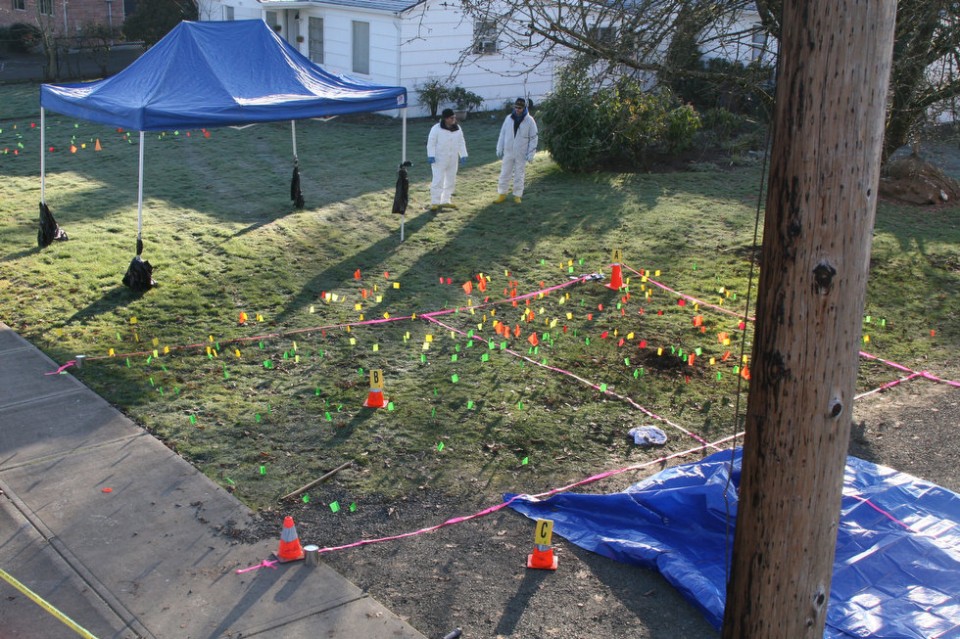
Flags mark evidence sprayed across the yard of a home in Canby where a rigged toolbox exploded Dec. 11, 2011, killing a young father of four. Credit: Canby Police Department
By Les Zaitz
Relatives, ruthlessness and boundless greed help Pocho — and many like him — command a brutal business
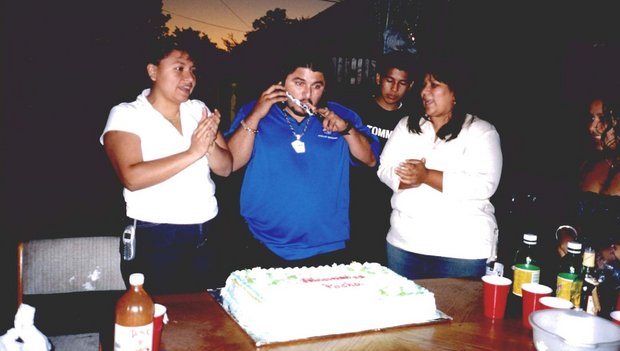
Porfirio Arevalo-Cuevas, better known as Pocho (center), was one of Oregon’s most infamous drug traffickers. He celebrates his birthday with relatives in this undated photo. Law enforcement officials connected Pocho to three of Mexico’s biggest and most notorious cartels: the Sinaloa, Los Zetas and La Familia Michoacana.
By Les Zaitz
Lou Nalepa, an agent with the U.S. Drug Enforcement Administration, reached for his ringing cellphone as he guided his car through Portland freeway traffic.
On that Friday afternoon in February 2010, he expected to hear from a witness in an upcoming drug trial. Instead, he found on the line a fugitive he'd been chasing for six years.
"This is Pocho," said the voice on the other end -- Porfirio Arevalo-Cuevas.
The name means little to most Oregonians. But law enforcement officials know Arevalo-Cuevas as one of the most prolific drug traffickers in Oregon history, a violent thug with ties to Mexico's most notorious cartels.
Pocho, calling from somewhere in Latin America, was angry that U.S. officials had disrupted his drug trade there. He resented that Nalepa's work had helped jail relatives, including his mother, according to federal documents and law enforcement officials.
"Now," Pocho told Nalepa, his fury escalating, "I am going to start (messing) with you and your family."
The DEA whisked Nalepa, his wife, son and stepson out of the state for two weeks. Officials also installed high-tech security equipment at Nalepa's home that weekend and stepped up street patrols.
The threat illustrates the extraordinary brazenness of cartel-connected traffickers in the Northwest. Pocho in particular turned Salem into a national hub for meth, cocaine and heroin distribution before leading U.S. officials on a maddening international chase. Authorities traced his drugs as far away as Texas, Georgia and Illinois.
"It's hard to think of any drug organization in Oregon that was larger or had farther reach," said Dwight Holton, Oregon's interim U.S. attorney in 2010-11.
Pocho's story, constructed with documents rarely available to reporters plus interviews with officials and former traffickers, offers a window on the tactics used by him and the many like him. His operation was unusual for its size and sweep, officials said, but his reliance on relatives, ruthlessness and a seemingly endless supply of meth cooks, dealers and couriers was dismally common.
Pocho was born in the Mexican state of Michoacan and peddled pot for his dad as a kid. He quit school after eighth grade and later sneaked into the U.S. to join relatives. In spring 1997, at age 18, he and his girlfriend and two children moved into the Salem home of a cousin, according to federal court filings and law enforcement officials.
The cousin tutored Pocho in heroin trafficking. That November, Pocho stepped off a plane from Oakland, Calif., at Portland International Airport with 300 grams of heroin hidden under his insoles. He attracted a police officer's attention by nervously pacing, then quickly confessed. He served 13 months in the federal prison in Sheridan before being sent back to Mexico in 2000.
Pocho boomeranged right back to Salem and expanded into meth production, according to documents and officials. In September 2000, Salem police caught him with 7,400 pills of pseudoephedrine, a key meth ingredient, plus $1,240 and a .40-caliber Taurus handgun, according to Salem Police Department reports.
This time, Pocho had no plans to confess. He coolly gave police a false identity and chewed off portions of his fingertips on the way to jail to keep his true name secret. He was released on bail the next day.
"I'm like a fighting rooster," he bragged in a call intercepted by DEA agents in 2008. "The only way they'll take me is dead."
Pocho moved to a home nine miles east of Scio, a small town northeast of Albany where residents gather each spring for a Lamb & Wool Fair and its pie-eating contest.
Using connections to the La Familia cartel in Michoacan, Pocho opened some of the biggest meth labs Oregon has ever seen, federal court documents show. Investigators calculated that one superlab outside Brownsville, still the biggest ever found in Oregon, churned out 70 pounds of meth a week, worth $700,000 wholesale.
Pocho's younger brother, Arturo, dropped out of Salem's McKay High School and joined the operation as a top aide. Other brothers made deliveries and sales. Sisters kept the books, paid the bills and shuttled to California for supplies.
In 2002, a meth cook's mistake destroyed the group's lab outside Scio in a fireball. Pocho's crew scattered unscathed before firefighters and police arrived. Investigators linked the lab to Pocho only years later.
Pocho and his family then settled in a two-story house just off of Salem's busy State Street. Pocho moved labs around the Willamette Valley, according to investigators.
In Salem, Pocho carried himself with a bravado common among traffickers in Mexico but unusual here, former associates said. Still in his 20s then and short and stocky at 225 pounds, Pocho favored Tommy Hilfiger jeans and shirts. He often wore a heavy gold necklace, a Mexican centenario framed by jewels. He told friends it was worth $20,000. He also had a girlfriend in addition to his wife, and children with both.
With his jet-black hair combed straight back and piercing eyes dominating a round face and thin mustache, Pocho regularly held court at El Flamingo, a nightclub on Salem's east side.
"He would roll in with 10, 15, 20 people," said a former associate, an Oregon man who asked that his identity be shielded to protect his safety. "He'd bring out a wad of cash and first thing buy 10 bottles of the most expensive wine."
Pocho would pay a Mexican band $10,000 to play for after-hours parties at the club, the man said. He also hired bands to write songs praising his drug-trafficking savvy, according to a federal wiretap affidavit. Some of the "narcocorridos" can still be found on YouTube.
"His vice is to be a cook of good heroin and crystal. And if you want to meet him, you'll find him in Oregon," says one, titled "El Pocho."
"He goes wherever he wants because he's not afraid of anyone."
Pocho lived up to the description.
One associate described how in 2002 Pocho held a pistol to his head while two other men hit and kicked him in the face, according to a federal wiretap affidavit. "Are you afraid to die?" one of the men asked. The associate passed the test and went on to work for Pocho for years.
Other insiders told DEA agents in 2008 that Pocho returned to Mexico in 2004 after ordering the Salem execution of a suspected thief. Agents searched but never found a body, according to Marion County Sheriff's Office records.
Pocho put his brother, Arturo, in charge of day-to-day operations but otherwise maintained brutal control. He sent collectors to rough up a Fresno, Calif., dealer behind on a $96,000 debt.
"Why did they come and get me, man?" the dealer asked Arturo in a phone call taped by investigators.
"Because you don't pay him, that's why," Pocho's brother replied. "Dude, it is 96 pesos that are over there."
In recordings from 2005, Pocho can be heard working the phones to track $162,000 left in a Lincoln Navigator seized by investigators after a bungled run to San Jose, Calif.
Pocho asked Arturo: Was the money hidden? No, his brother replied, it was in a duffel bag on a seat.
"That's why they have the cars with the hole," Pocho chided, referring to secret compartments in drug cars.
"You guys get your story straight and act dumb," he ordered.
By then, investigators knew they were on to something big.
They were astonished to discover in early 2005 that 8 pounds of meth seized in Indiana had come from Pocho via the Fresno dealer, according to a federal wiretap affidavit. That meant Pocho's operation was so large that his drugs were reaching far from Oregon and, more important, feeding California's vast drug market. A DEA task force in Salem began tailing Pocho's associates, tapping phones and prodding for inside sources.
That spring, the DEA raided the meth lab outside Brownsville and arrested Arturo, Pocho's girlfriend, three sisters and seven others. Pocho, keeping tabs from Mexico, sent an associate to recover 16 pounds of meth from a pickup police had overlooked, a wiretap affidavit shows.
About this time, federal investigators think, Pocho formed an alliance with the Los Zetas cartel. Pocho shifted meth production to Mexico, in part to circumvent a U.S. clampdown on meth chemicals. He also recruited a new crew to rebuild his Salem operation, according to a federal affidavit, and reinforced his reputation for violence.
Insiders told investigators that in 2006, Pocho retaliated against a pair of brothers he suspected of stealing $50,000. He ordered rounds fired into the Salem home of one brother, though no one was hit, according to a federal wiretap affidavit, and had the other brother's home in Gervais burned to the ground.
Pocho paid his wife's two brothers $10,000 to kill the Salem cousin who first taught him the trade, mistakenly suspecting that the cousin had informed on him and caused his arrest back in 1997, according to federal investigators. The cousin traveled to Mexico in May 2006 and stayed in a house owned by Pocho. The brothers knocked on the door and cut him down with bullets when he answered, investigators said.
In a bizarre twist, Pocho had the body shipped back to Salem for an elaborate graveside service at City View Cemetery, complete with a mariachi band.
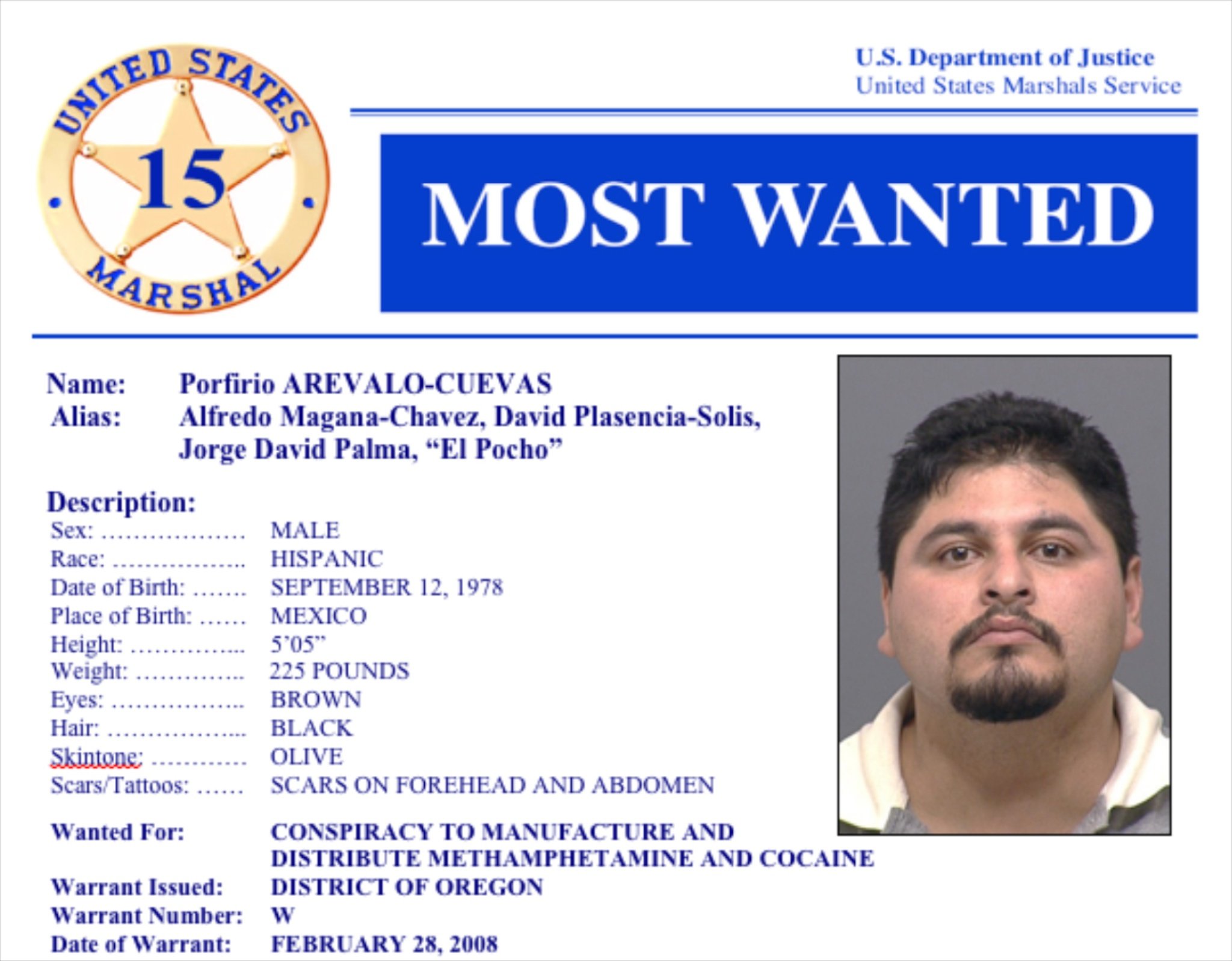
Even as Pocho's relatives and associates trooped through federal court in 2005 and '06 -- Arturo was packed off to a federal prison in Eden, Texas, to serve 11 1/2 years -- Pocho was making plans.
DEA agents got wind in 2007 that Pocho, working with the Sinaloa cartel, was plotting to smuggle 500- to 1,000-kilogram loads of cocaine from Colombia to Oregon. Pocho called an Oregon associate from Panama, according to a federal affidavit, saying he was about to leave for Guatemala "to start squaring up" -- bribing officials, investigators believed.
Panamanian officials, working with the U.S., got to him first. They jailed him the next day on money-laundering charges. They seized his property, including the gold necklace.
"I remember waiting for his photo out of Panama," said Nalepa, the DEA agent. "When I saw it, I felt like I sunk the winning putt at the Masters."
In late 2007, after a second long investigation, federal prosecutors in Oregon indicted Pocho and 23 others. They jailed his mother for 10 days as a material witness, freeing her only after she agreed to provide a voice sample to compare with recorded phone calls.
Early the next year, Panama's president approved Pocho's extradition. Pocho and his allies hatched plans to buy his freedom with bribes, according to calls intercepted by U.S. agents.
The race was on. Nalepa, fellow DEA agent Shaun Alexander and Guy Gino, then a special agent with U.S. Immigration and Customs Enforcement, flew to Panama City, arriving Feb. 21, 2008.
Two days later, the three men and a DEA agent stationed in Panama headed back toward the airport expecting Pocho to be handed off there for the flight back, Gino said recently. They stopped for groceries on the way so they'd have something for Pocho to eat.
Then the local agent's phone rang.
"They can't find him," he said.
"What do you mean they can't find him?" Gino asked.
They went to the airport and paced the tarmac for two hours before an embarrassed Panamanian official showed up to explain that Pocho and two prison officials were missing. Panamanian investigators later determined that Pocho had walked though the prison gates the day before after paying five prison officials $500,000 to give him the identity of an inmate set for transfer to another prison.
Two years later, Pocho called Nalepa's government cellphone.
"I could not believe I was talking to someone who had been so elusive for so many years," Nalepa said recently. He has since left the DEA to become a special agent in the U.S. Postal Service's Office of Inspector General.
In a conversation that quickly grew heated, Pocho told Nalepa he had "eyes and ears everywhere" and knew Nalepa had traveled to Mexico and Central America to interview relatives. Nalepa, he said, had no idea how powerful he was.
"By threatening an agent's family, that was crossing a line that drug traffickers have not been willing to cross in the United States," said Holton, the former U.S. attorney. "We talked about what to do. Are we going to tolerate that kind of violence coming into Oregon or are we going to put our foot down and say, 'This stops now'?"
U.S. officials made catching Pocho a national priority, distributing "most wanted" fliers offering a $25,000 reward. They pressed Mexican authorities to do the same. Three months later, Mexican military commandos raided Pocho's ranch outside the town of Xalapa and arrested his uncle and three sisters. They also seized guns, 43 cellphones, a gold Versace watch and "five fine horses" boarded there by the state governor.
Mexican police caught Pocho himself weeks after that in Puebla, about 75 miles southeast of Mexico City. He was charged with bribery and sent to a prison three hours east of Mexico City to await extradition.
Now 34, Pocho remains in that prison, awaiting extradition to Oregon and U.S. justice.
Officials in both countries, wary of upsetting a sensitive process, won't say what happens next.
Pocho history
1978: Born in Mexican state of Michoacan.
Spring 1997: Moves to Salem.
November 1997: Arrested at Portland International Airport with heroin. Spends 13 months in prison, then is deported to Mexico.
2000: Returns to Salem.
September 2000: Caught in Salem with meth supplies, cash and a gun. Gives false name and gets out on bail.
October 2000: Moves to Scio area.
June 2002: Scio-area meth lab explodes.
2002: Moves back to Salem.
2004: Returns to Mexico, former associates later tell DEA agents, after ordering a suspected thief killed.
Spring 2005: The DEA raids a meth lab outside Brownsville, arresting Pocho's brother, sisters, girlfriend and others.
May 2006: Two brothers-in-law -- paid $10,000 by Pocho -- kill Pocho's cousin in Mexico, federal investigators say.
November 2007: Officials in Panama arrest Pocho.
December 2007: Federal prosecutors in Oregon indict Pocho on drug trafficking charges. Police arrest 23 associates in Salem. Pocho's mother, Minerva Cuevas Salgado, is held in jail 10 days as a material witness.
Early 2008: Panama's president approves Pocho's extradition.
February 2008: U.S. agents travel to Panama to bring Pocho to Oregon. He escapes before they can get to him.
February 2010: Pocho calls DEA agent Lou Nalepa in Portland and threatens his family.
May 2010: Mexican military commandos raid Pocho's ranch in Mexico.
June 2010: Mexican police arrest Pocho.
June 2013: Pocho remains in a Mexican prison.
A former trafficker details a world where meth is cooked near downtown Salem and 150 pounds of pot travels up I-5 with a family returning from Disneyland
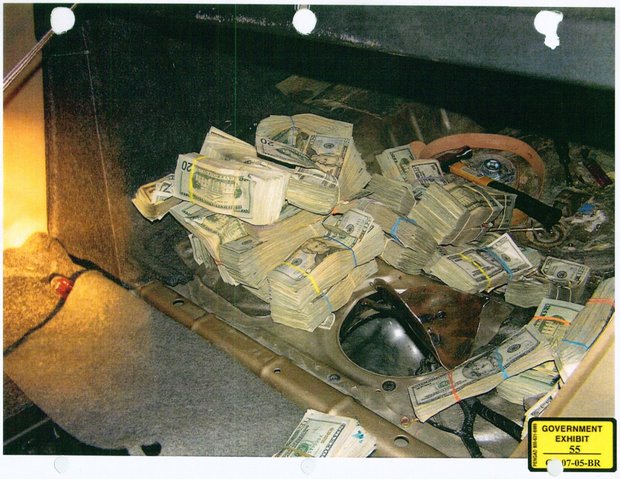
U.S. Drug Enforcement Administration agents stopped a Honda Accord near Ashland in September 2006 and found $364,975 hidden in a compartment above the gas tank. The car was part of Jorge Ortiz Oliva’s drug trafficking operation. T.J., a former trafficker who agreed to share his story but asked that his name be kept secret, worked in the operation for six years.
By Les Zaitz
T.J. wasn't eager to tell his story.
He spent six years as a lieutenant of Jorge Ortiz Oliva, a cartel-connected trafficker who ran a national-level meth, cocaine and marijuana empire from Salem.
T.J. knows talking to The Oregonian could get him hurt or killed. His attorney urged him to stay quiet, and law enforcement officials agreed that he could be putting himself in danger.
But after thinking it over for months, T.J. decided he wanted to share his tale -- to atone for what he did and to leave an account for his children to read one day. He asked not to be identified in any way. Even his initials have been changed. He also agreed to meet only behind closed curtains at his apartment, and only when his wife and children weren't home.
In three long interviews, T.J. offered a rare insider's look into Oregon's strange and brutal drug underworld. He described walking into a meth-cooking operation near downtown Salem, fans pumping a chemical fog into the street. He told of "counting parties" where people bundled piles of cash. He recalled picking up marijuana on the way home from a family trip to Disneyland, stuffing the pot in a rooftop carrier and crowding the luggage into the car with his kids.
He answered every question directly and with details. Government records and federal officials verify his account.
Speaking at his small, tidy apartment, the air perfumed by plug-in air fresheners, T.J. said he's out of the drug business and knows how outrageous his lifestyle once was.
Now, he said, "I'm worlds apart from that person."
For T.J., life in the drug-dealing big leagues started with Jet Skis.
He was a commercial power washer who had served time for drugs when he came across a party one summer weekend in 2001. Men and their dates were gathered around food and beer spread across the ground at Salem's popular Wallace Marine Park. Men sprinted across the Willamette River on Jet Skis.
T.J., drawn to anything fast and flashy, paused to look as he walked past. Ortiz Oliva, the party host, knew of T.J. through a friend and waved him over to join in.
As the afternoon wore on, T.J. and Ortiz Oliva, then 31, struck up a conversation about T.J.'s experience fixing used cars. Ortiz Oliva suggested they open an auto-body shop together.
"I just saw dollar signs," T.J. recalled.
With Ortiz Oliva's cash, the new partners leased warehouse space a few blocks northeast of downtown Salem. They bought equipment and brought in 15 cars to fix and sell.
But T.J. soon discovered Ortiz Oliva wasn't interested in dings and dents. The Mexico native had been dealing drugs in Salem since the early 1990s, interrupted by a two-year stint at the federal Big Spring Correctional Institution in Texas for selling meth. He was deported after his release but returned to Oregon and quickly resumed drug dealing.
T.J. didn't object. He overheard Ortiz Oliva on the phone one day offering to pay an underling $2,000 to fetch a car in California. "I stepped in and said, 'I want to do it.'"
Ortiz Oliva sent T.J. to central California in a Honda Accord and told him to check into a motel room and wait. A man showed up, wordlessly took the car keys, and returned two hours later. T.J. drove the car back to Salem and collected his cash. Ortiz Oliva told him chemicals needed to make meth had been concealed in the Honda.
More trips followed. T.J. estimated he went to California more than 100 times, bringing back marijuana, chemicals and cocaine.
As the enterprise grew, so did T.J.'s duties.
Ortiz Oliva asked him to figure out how to move marijuana and cocaine to dealers in Ohio and Minnesota. T.J. devised a scheme to tow show cars, such as a 1964 Chevy Impala and a custom 1980s Chevy pickup, with a Hummer H2 as if headed to an auction or sale. To back up the illusion, he slapped a business sign on the pickup and posted an ad on eBay.
Drugs were hidden in car trunks or under a pickup bed with a false bottom. Ortiz Oliva paid T.J. up to $6,000 a trip.
T.J. also made money on his own reselling Ortiz Oliva's drugs. He collected as much as $250,000 a month from a Portland marijuana dealer who ordered 100 pounds or more at a time.
As Ortiz Oliva added customers in Rhode Island, Florida, Texas and elsewhere, T.J. also had to process loads of cash. He would gather friends and relatives for counting parties to band mountains of bills, paying the helpers $1,000 each for maybe an hour's work. They once spent two hours counting $900,000.
Raised in a large American family with little money, T.J. reveled in his new wealth. He routinely dropped $2,000 a night at a Salem strip club, buying rounds and lap dances, and flashing cash to attract women.
"I felt naked if I didn't have $5,000 in my pockets," he said. He bought himself a jet boat, a Harley-Davidson motorcycle, all-terrain vehicles and the biggest pickup he could find.
The traffickers felt invincible, he said, leading to unnecessary risks.
Ortiz Oliva used the auto-body shop one weekend to cook meth. T.J. swung by to get paperwork and felt his throat burn as he stood in the office. He opened the door to the work bays and stepped into a dense white haze.
"Three guys literally come walking out of the fog," T.J. said. "You couldn't see 6 inches. One guy had a mask on. Two others had guns over their shoulders. They said they would be done pretty soon."
The men were using auto-painting fans to vent meth fumes into the street. T.J., alarmed by the recklessness of cooking meth so close to downtown, stepped into the parking lot and angrily jabbed Ortiz Oliva's number into his cellphone. Ortiz Oliva promised it wouldn't happen again.
Later, Ortiz Oliva asked to use T.J.'s rural home to cook meth. T.J. took $3,000 from Ortiz Oliva and drove his family to Disneyland.
"I thought I was the best dad in the world," he said.
On the way home, he picked up the load of pot -- 150 pounds' worth -- and forced his kids to ride the rest of the way crammed in the car with the family luggage.
Life wasn't all easy money.
Asked if Ortiz Oliva ever threatened associates to keep quiet, T.J. reacted with surprise. "He didn't need to," he said. "It's common sense. I didn't need anyone to tell me. I knew if I started talking something bad would happen."
On New Year's Eve 2005, Ortiz Oliva threw a party at his ranch-style home in east Salem, hiring a mariachi band to play in the garage. Ortiz Oliva, who had two girlfriends and children with each, bounced an infant son on one knee as a handful of men streamed out a side door.
One was a man nicknamed Nacho who had a reputation for killing people in Mexico, including a neighbor who refused to turn down his music. Nacho walked up to T.J. and accused him of stealing a pickup. The men -- T.J. flanked by two friends, Nacho by three -- faced off.
Nacho pulled out a pistol and threatened to shoot T.J. One of T.J.'s friends jutted his hand out, bullets cradled in his palm. He dared Nacho to try. As Nacho reached forward, T.J.'s friends pulled back their jackets to reveal semi-automatic weapons. Nacho left.
The next day, Nacho showed up at T.J.'s auto-body shop with two black eyes and an apology. T.J. assumed Ortiz Oliva had ordered someone to beat him.
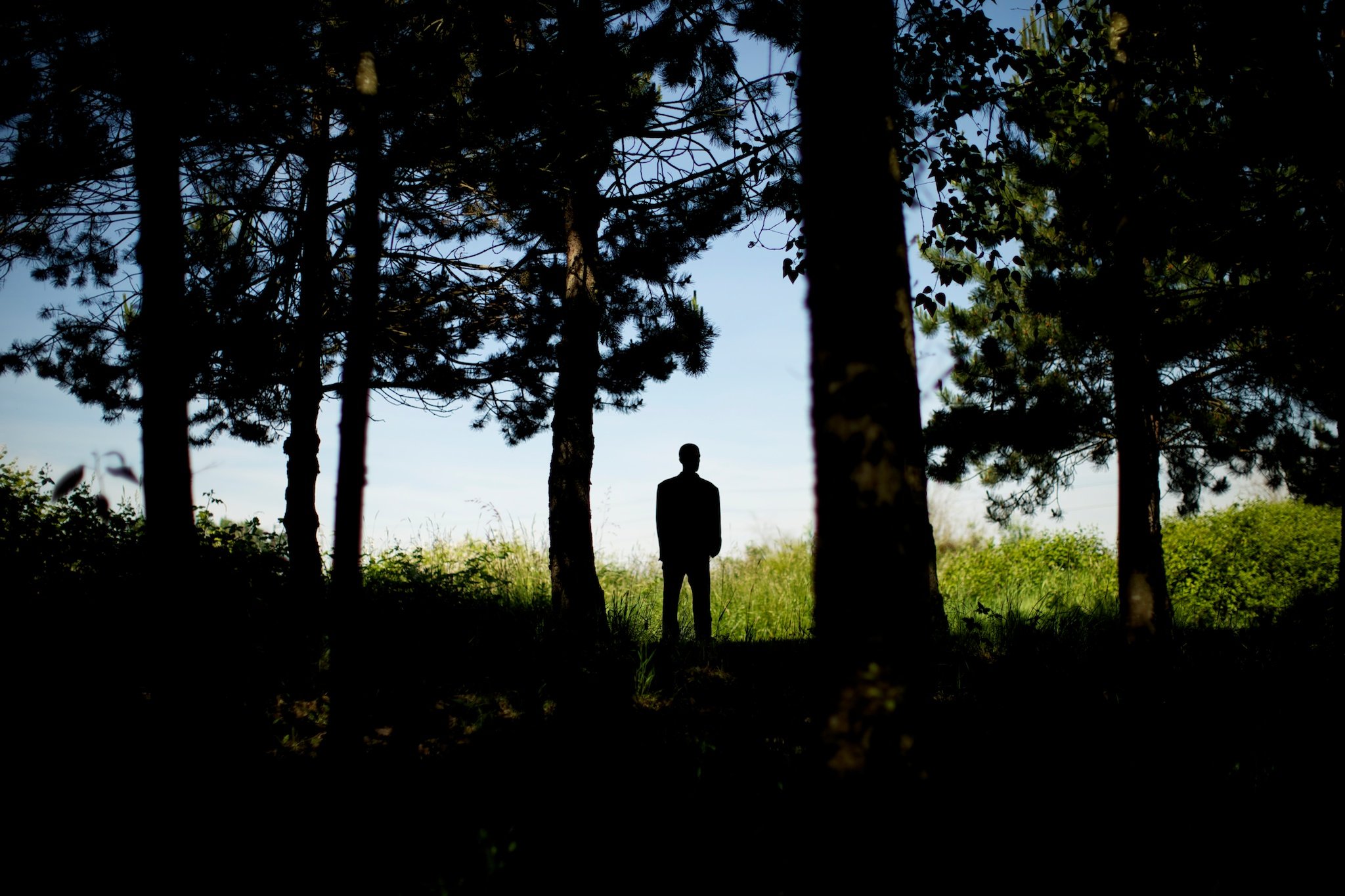
T.J. spent years near the top of a Salem drug trafficking organization. He agreed to tell his story and have his photo taken but asked that his identity be kept secret to protect his safety. After serving time in prison, he’s back living with his wife and younger children in Oregon. He insists his drug-dealing days are behind him.
Soon things began to unravel.
A U.S. Drug Enforcement Administration task force had zeroed in on Ortiz Oliva, ultimately found to be one of the biggest drug kingpins in state history. Ortiz Oliva, with ties to a cartel in Nocupetaro, Mexico, trafficked cocaine and ran meth superlabs in Marion County and marijuana plantations in Oregon and elsewhere.
Agents eavesdropped for months on calls by T.J. and others.
In September 2006, agents intercepted a Honda Accord near Ashland and found $364,975 in a secret compartment above the gas tank. A month later, they stopped a courier near Cottage Grove, finding $94,750 in a gift bag in the trunk and $194,000 in the passenger air bag cavity.
Just before Thanksgiving, T.J. and four friends were hauling cash to Ortiz Oliva in California when they were stopped just south of Salem. The officer greeted T.J. by name and asked if he had cash in the car.
T.J., puzzled how the officer knew his identity, joked that he wished he did. Police went on to seize $179,160 hidden in a door panel and an armrest but made no arrests.
Despite losing more than $800,000 in a matter of weeks, Ortiz Oliva considered the incidents no more than bad luck.
"We couldn't be touched," T.J. said.
Then T.J.'s son was caught in 2007 with marijuana at high school. The teen had helped himself to 2 pounds stashed and forgotten in the family's motor home, plus $30,000 swiped from $130,000 T.J. kept in a box under the bed.
Police searched the home and arrested T.J.
"I knew this was over," he said.
Soon, the DEA task force swept up Ortiz Oliva's organization on federal charges, with Ortiz Oliva and most of the others sent to prison for a decade or more. Ortiz Oliva, in federal prison in Florida, did not respond to three letters seeking comment.
T.J., stripped of his assets, pleaded guilty and went to prison for just under two years.
When he left prison, he reunited with his wife and their younger children. Their two-bedroom apartment has a wall hanging that reads, "With God All Things Are Possible."
T.J. works as a $10-an-hour laborer and shrugs off memories of the easy-money days. The cash, the women and the fancy vehicles all fed his craving for attention, he said. Now, he said, he needs only the attention of his wife and children.
In his dealing days, he didn't feel responsible for the mayhem caused by trafficking. "I never killed, stabbed or robbed anybody," T.J. said.
That has changed, too.
"People were getting hurt and getting killed over marijuana," he said. He sees that Ortiz Oliva's network preyed on young customers.
"I realize the damage I caused," T.J. said. "Every time I think about it, I feel like ..."
He finished with an expletive.
Police are targets of intimidation as drug traffickers expand their reach into rural areas
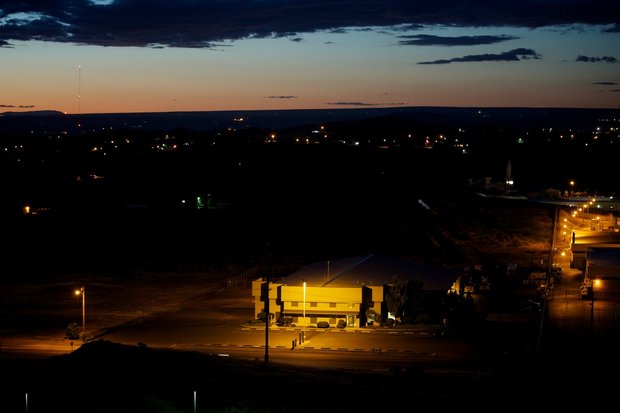
Drug kingpin Carlos J. Barragan sent men to a bluff overlooking the Oregon State Police office in Hermiston to log officers’ vehicles and schedules. Such tactics helped Barragan and his crew stay ahead of police for years.
By Les Zaitz
Big-time drug traffickers aren't easy to take down, not even in a small Oregon city where cops can see what they're doing.
They rarely handle the drugs they sell. They switch phones and cars often. They silence associates with threats and violence. Most troubling, the smartest traffickers use the same surveillance tools on police that police use on them.
Federal agencies devote about $10 billion a year and thousands of officers to drug investigations. Yet officials at all levels acknowledge they'll never stamp out the problem, only hold it in check.
"We need to fight the fight," said Tom Padden, deputy director of the U.S. Justice Department's Organized Crime Drug Enforcement Task Forces. "But this is not a military war where you plant a flag in the ground and say, 'We've won.'"
A case in Hermiston, a town of 17,000 perched along the Columbia River three hours east of Portland, shows just how clever drug traffickers have become -- and the immense resources and time police need to put a bad guy behind bars.
Investigators spent nine years building a case against Carlos J. Barragan, whose organization spread meth and marijuana across a vast swath of northeast Oregon, from the rolling hills of Hermiston to Baker City and John Day. Police shared details of the case with The Oregonian to help illustrate what they're up against.
More than once, police found that as they tailed the traffickers, the traffickers were tailing them. Barragan's crew figured out officers' addresses, schedules and unmarked vehicles. Barragan scared away witnesses. One dealer, terrified that he would be tagged as an informant and shot, pleaded with police not to put him in jail.
"It's a constant game of cat and mouse," said Brad Bench, special agent in charge of the Seattle regional office of federal Homeland Security Investigations.

Drug kingpin Carlos J. Barragan sent men to a bluff overlooking the Oregon State Police office in Hermiston to log officers’ vehicles and schedules. Such tactics helped Barragan and his crew stay ahead of police for years.
Hermiston is in farm country, surrounded by wheat and potato fields that stretch across a landscape turned green by deep wells. For years, potato processing plants and the nearby Umatilla Chemical Depot provided blue-collar jobs. In the 1960s, an enterprising mayor made Hermiston famous for watermelons, holding annual giveaways in Portland.
Thanks to Wal-Mart and FedEx distribution centers, the town is now the biggest in eastern Oregon, surpassing Pendleton in the 2010 census.
Barragan showed up in the mid-1990s trailing a string of arrests involving petty crimes in California. A burly man with a chinstrap beard and pressed Western-style shirts, he liked to play the tough guy in town. In 2009, a teenager yelled at him from the sidewalk as he drove by. Barragan circled the block and waved the boy over to show a gun tucked in his waistband, according to police records.
By 2000, police suspected Barragan was trafficking drugs, working with cartel-connected relatives in California and Mexico. The Blue Mountain Enforcement Narcotics Team -- now with officers from Oregon State Police, Pendleton, Hermiston, Milton-Freewater, the Confederated Tribes of the Umatilla Indian Reservation, and Umatilla and Morrow counties -- started paying attention.
Again and again, Barragan and his crew turned the tables.
Barragan sent associates to a bluff overlooking the state police office in Hermiston to log schedules and license plate numbers. He learned where officers lived, and let them know.
Pendleton police Sgt. Rick Jackson joined the narcotics team in 2004 and soon got a taste of Barragan's tactics. A patrol officer had stopped Barragan for a traffic violation as a pretense to search for drugs. Jackson, following in another car, walked up to Barragan's car window to introduce himself.
Barragan addressed Jackson by name and described the location of Jackson's home.
"That sent a chill down my spine," Jackson said.
In 2005, investigators said, Barragan and an associate entered the under-construction home of a state trooper. Barragan was accused of stealing a chandelier and an oven hood, but he was acquitted after witnesses backed away.
One witness, threatened by Barragan outside the Umatilla County Courthouse, recanted on the stand, according to a court memo filed by Assistant U.S. Attorney Jennifer Martin. Another failed to show at all, telling prosecutors he was too afraid, the memo said.
Barragan faced more charges starting in 2007, with convictions for theft and auto theft, according to court records. Still, he was never off the street for long. Police were convinced he was selling meth supplied by cartels, but they needed more evidence.
The narcotics team put Barragan under surveillance, launching 30 operations to document who worked for him, who met with him and where he stashed drugs and money. The traffickers always spotted the police on their tails.
In February 2008, state police Sgt. Mike Schultz drove 600 miles to borrow a surveillance van from another agency, hoping the traffickers wouldn't recognize it. Late that night, as he eased the van into the garage at the state police office in Hermiston, Barragan cruised by and stared him in the face. Schultz, concerned that Barragan was tracking him somehow, disabled his cellphone's GPS.
Two weeks later, three investigators parked the van on a residential street outside Hermiston, planning to photograph from a distance as Barragan made a drug deal. As the investigators watched helplessly, Barragan pointed an associate over to the van. The man circled the vehicle, knocking and peering into the tinted windows. He pressed his face to the rear glass and saw eyes looking back. Investigators sat still as the man reported back to Barragan.
"Carlos would have made a great detective," Jackson said. "I told him so."
Developing informants was no easier.
In 2007, police arrested a dealer who told them he bought as much as $5,000 in meth a day from Barragan's group. He "wept and begged" not to be jailed, telling them he'd be shot if traffickers suspected he was talking, according to a wiretap affidavit.
Also that year, a low-level dealer, in exchange for the possibility of a lighter sentence, agreed to wear a body wire as he bought meth from one of Barragan's partners. Once inside, the informant turned off the device and tipped off the seller. The pair slipped out the back door.
Police and court records show similar setbacks around the state. A Salem heroin dealer caught in 2010 with $20,000 hidden under his dishwasher went to prison for five years rather than earn a lesser sentence by talking about the Mexican cartel he worked for.
"He refuses to state who (his) boss is as the consequence could be someone in his family getting his head cut off like animals," his attorney explained in a court filing.
A former dealer from Corvallis, now in prison, told The Oregonian that she was assigned to monitor the Benton County Jail website. If a member of her trafficking group got out too quickly, she said, she alerted the boss that the person could be talking.
"I think people would be surprised how much like a business they run at the upper levels -- very smart, very capable businessmen," said Bench, the Seattle agent.
In Portland, a dealer turned police interest to his advantage. According to a state investigator's affidavit, Jesus Carillo Machain ratted out other traffickers for years until mid-2010 to eliminate competition for his own growing empire. Now he's in prison, too.
Investigators invest untold hours and billions of taxpayer dollars to fight traffickers. The U.S. Drug Enforcement Administration alone gets $2.8 billion a year for work in the U.S. and 67 other countries. The agency operates 218 task forces with 1,895 agents and attorneys, and it works with 2,257 officers at local levels.
No one tracks spending on drug cases by state and local agencies, but the Oregon State Police budgets $5 million a year. Task forces in nine regions of Oregon share $1.3 million in federal grants to pursue large-scale traffickers.
But staffing isn't keeping up. The DEA eliminated 164 positions in 2012. State police had 33 narcotics investigators in 2007 but just 24 by 2011. Oregon also lost $1 million in federal money for smaller police agencies and task forces.
The state Criminal Justice Division's drug unit has three attorneys and four investigators to take on major cases with local agencies, but a proposal this year to double that didn't win legislative approval.
The pinch is especially keen outside big cities as traffickers shift away from metro areas.
"Cartels are increasingly getting away from bigger city police departments, hitting rural America," said Carl Pike, deputy director of the DEA's Special Operations Division in Washington, D.C. "They realize the smaller police departments don't have the financial resources and capabilities to run an operation for two years or run a wire for many, many months."
In Klamath County, a six-person drug enforcement team was named Oregon's "drug team of the year" in 2007. Then budget cuts left it "no longer viable," said Chris Kaber, a former state police officer who worked on the team. The team disbanded last year.
Drug trafficking roared out of control. Last month, 300 officers from local, state and federal agencies assembled before dawn to break up a Klamath County meth and gun trafficking ring with links to Mexican cartels. Heavily armed police in camouflage swept through homes and businesses making arrests, leading to 47 indictments.
In Barragan's case, a resident's tip and his own mouth led to his downfall.
In spring 2009, a Grant County rancher came to police to tell them Barragan had asked to grow marijuana on his property.
Police asked the rancher to play along. The rancher, coached by the cops, directed Barragan to nearby U.S. Forest Service land. Authorities installed video equipment and captured images of Barragan's group growing what turned out to be 23,000 pot plants, the biggest plantation ever found in Grant County.
They also got clearance to record the rancher's phone calls with Barragan and his men.
Listening in on thousands of calls that summer and fall, police recorded Barragan directing a dealer to his house to pick up meth destined for La Grande. They heard an associate tell Barragan that police had discovered his marijuana grow south of Pendleton. "Ouch, ouch, ouch," the boss replied.
Such wiretaps can be invaluable. In a groundbreaking 2007 case, Oregon's Criminal Justice Division used wiretaps to demolish a major Corvallis drug ring. In 2009, recorded conversations helped police take down a dealer supplying University of Oregon students and led from there to heroin traffickers in Beaverton and a cocaine ring in Gresham.
But wiretaps are also expensive and easily foiled. At the federal level, layers of approval can require 100 or more pages of evidence. Companies that specialize in wiretap monitoring can charge $20,000 a month. And cops can land back at square one when dealers change phones, as they often do.
Most concerning, wiretaps are useless against rapidly evolving web-based communications and other technologies. Because of the challenges, Oregon averages just two wiretapping operations a year, all led by the state Criminal Justice Division.
Barragan, though, kept making calls. Authorities listened to him brag that he was untouchable. Even after he was arrested in October 2009, he seemed unconcerned.
"He'd beat us so many times," Jackson said.
His demeanor changed as investigators rolled out evidence.
"He was begging to talk to us" in hopes of making a deal, Jackson said. Peppering replies with "Yes, sir" and "No, sir," he pleaded guilty to drug conspiracy in June 2010.
Barragan didn't respond to three letters seeking comment, but one of his attorneys did. "His case was a garden-variety drug case," Alex Kessel of Encino, Calif., wrote in an email. "Let the man live in peace without the public humiliation to him and his family."
Barragan, now 34, is serving a nearly six-year sentence at a federal prison in Seattle.
After police took down his operation, meth supplies were tight in northeast Oregon -- for a short time. Within weeks, police said, new dealers stepped in. Last August, the Blue Mountain Enforcement Narcotics Team dismantled a new meth and marijuana ring, arresting 29 people.
"They're like weeds," Darin Tweedt, the chief counsel at the state Criminal Justice Division, said of traffickers. Work by police merely "disrupts the supply," he said. "That's the best we can hope for in law enforcement."
A Bend 21-year-old joins dozens and dozens of Oregonians felled by drugs from cartels
By Les Zaitz
Jedidiah Elliott came home late on a January afternoon in 2011, his heroin dealer at the wheel.
Jed’s mom and sister were outside, keeping his dad company as he fixed a car. They watched the pickup pull into the driveway of their home on the south end of Bend.
Jed, blue in the face, got out of the pickup, took a few steps and collapsed on the lawn.
His parents, Chad and Lois Elliott, rushed to his side as his sister, Amber Elliott, called 911.
"Oh my God!" Amber cries to a dispatcher in a tape of the call. "My brother's dying! I don't know what's wrong!" Her mother screams in the background as the dispatcher tells Amber he'll get help on the way.
Amber, 18 at the time, shouts to the others: "Do a CPR! Do a CPR!" The dealer, Brian G. Sinclair, is heard yelling, "Breathe, damn it, breathe!"
Medics arrived and spent 20 minutes working on Jed, a 21-year-old musician, before rushing him to St. Charles Medical Center.
In following days, Deschutes County sheriff's detectives began tracing the heroin in Jed's veins. The trail took them from Sinclair to a second dealer, then to a third. Police believe that last dealer's source was a Mexican drug cartel.
Heroin killed 143 Oregonians in 2011, 147 in 2012. Meth and cocaine claimed dozens more. Together, the victims left years of unfulfilled potential and thousands of bereft friends and relatives. They and their dealers, from street hustlers to kingpins, also undercut any notion that cartels and their ugly machinery are a problem only in Mexico.
"Drugs here universally come from bloody hands," said Dwight Holton, Oregon's interim U.S. attorney in 2010-11, "whether it's here or abroad."
Jed was the family prankster, a kid who bummed money from his parents by asking, "Can you help out a poor fellow American?" He helped in his parents' concrete masonry business, the three of them often working together on job sites.
But his passion was music. He started a hip-hop band, Jedidiah Bullfrog, as a teen and was starting to get noticed. Local radio stations played his songs, and Jed had a contract with a record company to produce an album.
The band's MySpace page attracted more than 4,000 friends. Sepia-toned photos of Jed -- one shows him smiling, a straight-brimmed cap cocked on his head -- carry dozens of comments from admiring young women. One says: "nice picture! Cute Smile!" Another: "marry me."
"He was a charmer," his dad said.
Jed's problems began with surgery to remove his tonsils when he was 17. He discovered, he told his parents later, that painkillers erased his sometimes crushing anxiety. Without his parents' knowledge, he found doctors to keep prescribing the pills.
He dropped out of high school but later earned a GED. In 2008, he pleaded guilty to four counts of criminal mischief after he and two friends spray-painted his band's initials all over Bend. He landed in jail for 28 days.
"The bad choices that I've made had nothing to do with you guys. It was just me being stupid," he wrote in a remorseful letter home. "I think you are the best parents in the whole wide world. ... All I want is just to come home and be with my family and work with Dad and stay outta trouble."
Sometime after his release, he switched from pills to heroin. His dad now figures that heroin, running as little as $10 a dose, was cheaper.
Jed quit hanging out with friends. "He wasn't as happy anymore," Chad Elliott said. "He got to be a loner."
In May 2009, Lois Elliott reached up to dust the top of a medicine cabinet and found a syringe and spoon. She showed them to her dumbfounded husband. "You mean my son is a (expletive) junkie?" he said. Only later did they realize why spoons had been disappearing.
When they talked to Jed, he told them in tears that he never wanted them to find out. He said he needed help.
Lois took him to St. Charles for a referral and helped him enroll at BestCare Treatment Services, a nonprofit addiction and rehabilitation center based in Redmond. He told counselors there he had been using heroin for six weeks.
"He wasn't the classic strung-out heroin addict," BestCare Executive Director Rick Treleaven said after reviewing Jed's records.
But Jed checked out after spending one night in a 14-day program and relapsed. By late 2010, heroin's hooks were in deep. Still, he gave his mom his cellphone, loaded with numbers for drug contacts, hoping to cut off his supply.
Soon after, Lois took him to St. Charles for another assessment. "He wanted to be his old self again," she said.
As they were going in, she noticed he had a dealer's number written on his palm. "Mom, if they don't help me, I need something," he said.
At St. Charles, a doctor urged him to return to BestCare. Jed called but was put on a waiting list for those with no money to pay.
"He hugged me," Lois said. "He said, 'I love you, Mom. Thanks for helping me.'"
He also washed off the phone number.
Jed wasn't unusual, Treleaven said. The BestCare director started noticing an uptick in middle-class young people -- "kids that should be going to college" -- popping pills at parties in 2008. Some became addicted to powerful opiates such as oxycodone. Some tried heroin after pills became too expensive or tough to get.
"They start smoking. A few months later, they begin shooting up, and pretty soon they are hooked," Treleaven said. "It's a huge tragedy." Many overdose by accident, he said, "because they are clueless about being a junkie."
Authorities estimate 100,000 Oregonians abuse heroin, methamphetamine, cocaine and other hard drugs. Police and public health officials report a particularly alarming increase in heroin use and deaths. The death tolls in 2011 and '12 were the highest in more than a decade.
But hospitals and treatment clinics don't have near enough beds for those seeking help.
"We have to stop talking about the problem. We have to stop doing another study. We have to stop appointing another group," said U.S. Attorney Amanda Marshall, the state's top federal prosecutor. "We need inpatient drug treatment. We don't have it."
For Jed, life took a nose dive in early 2011.
On Jan. 16, 2011, Lois took Jed back to St. Charles. Jed was given paperwork on how to manage a narcotic withdrawal. "Call BestCare tomorrow as discussed," the orders said. Again, he was put on BestCare's waiting list.
Four days later, a passer-by found him unconscious in his sister's car, which had run off the road. The family brought him home and kept him under close watch.
"He said, 'You'd be better off without me.' He hated himself," Lois said.
On the afternoon of Jan. 24, the Elliotts went to fetch a radiator to repair Amber's car. Jed was in a deep sleep in his room, and the Elliotts didn't expect to be gone long.
But Jed had already texted Sinclair just after noon to say he had a gun to trade for heroin, according to phone records obtained from the Deschutes County Sheriff's Office.
He signaled that he was in withdrawal: "I cant stop throwing up."
Just before 3, Jed was awake again and impatient. "Hey its jed," he texted.
Sinclair replied, "im on my way call u in a min."
Sinclair picked up Jed and took him to his house. Jed shot up in the bathroom.
The Elliotts returned home to find Jed gone. Amber told them she suspected he had headed off with Sinclair. Chad Elliott went to the driveway to begin installing the radiator. Lois started calling Jed's cellphone again and again. She also went to the computer to look up how heroin affects someone with asthma, like Jed.
She printed out a story headlined "Drug addict died from asthma attack after taking heroin" at 4:24 p.m.
Barely a half-hour later, Jed arrived home and collapsed on the lawn.
At St. Charles, the family kept vigil at Jed's bedside. "I (saw) all the needle marks on his arms and wondered how did my precious baby boy get like this," Lois wrote later in a letter for court. "We were good parents. We tried to guide him in the right direction. We helped him with his music contract and taught him a good trade in masonry."
Doctors told them Jed had suffered severe brain damage and would never recover. The Elliotts agreed to withdraw life support. His dad signed the form.
Jed's strong young heart beat another 18 hours. He died Jan. 27, 2011.
Detectives, tracing the source of Jed's heroin, followed Sinclair, 29, and his girlfriend, 27-year-old Amber R. Frank, on runs to Portland to buy the drug. The couple typically went three times a week and bought 3 ounces, enough for about 165 doses.
They later told police they were dealing to support their own addictions while waiting to get into a treatment program in Portland.
Portland police joined the case and identified Zachary A. Wilson, 27, as the next link in Jed's supply chain. He was arrested April 6, 2011. He, Sinclair and Frank eventually each pleaded guilty to a felony drug charge.
From Wilson, police traced the drug to Joaquin Segura-Cordero, 28. Portland police arrested him April 12, 2011, with a half-pound of heroin, enough for 440 doses. Police said the amount alone indicates Segura-Cordero was supplied by a cartel or cartel-connected group.
A parallel investigation in Clackamas County linked Segura-Cordero to the April 3, 2011, death of a 17-year-old Milwaukie High School student, Toviy Sinyayev. Federal prosecutors in Portland indicted Segura-Cordero in both deaths under a "Len Bias" law -- named for the basketball star who died of a cocaine overdose in 1986 -- that carries a 20-year penalty for contributing to a drug death. Segura-Cordero pleaded guilty last October and awaits sentencing.
Lois and Amber Elliott wrote letters to the judge sentencing Sinclair.
"Losing Jedidiah means that we lost a beautiful smile, a crazy laugh and most importantly a man with a heart of gold," Amber, now 20, wrote about her brother.
Lois wrote how, after Jed's death, her husband developed esophageal cancer and they had to shut down their business. A bank has foreclosed on their home, Jed's home.
Mostly, she wrote of the ache of losing her son to heroin.
"This drug ruined a good family forever," she said.
At their home, where walls are covered with family photos, Lois and Chad Elliott talked about their son and why he died. At first, they wanted to keep their grief private. Later they decided to share their story so other parents and Oregonians understand the pain drugs inflict on families.
Lois wondered aloud whether dealers think about the people their drugs will kill. She said they work for Satan.
"They work for the Mexican cartel," Chad interjected. "And they don't care."
Jedidiah Chad Elliott is buried near relatives at Miller Cemetery in Scio under a gravestone etched with his photo. It shows him in the same hat from his MySpace page. A ceramic bullfrog wearing a crown is among decorations on his grave.
After night fell on the day Jed died, his cellphone buzzed to life in his mom's hand. A drug friend was texting.
"Hay can you find anything," the message said.
"Jed died this morning because of this drug he wanted to be clean so bad," Lois replied, "whoever you are I lost my baby for good."