Raj Mankad, Sharon Steinmann, Lisa Falkenberg and Leah Binkovitz of the Houston Chronicle
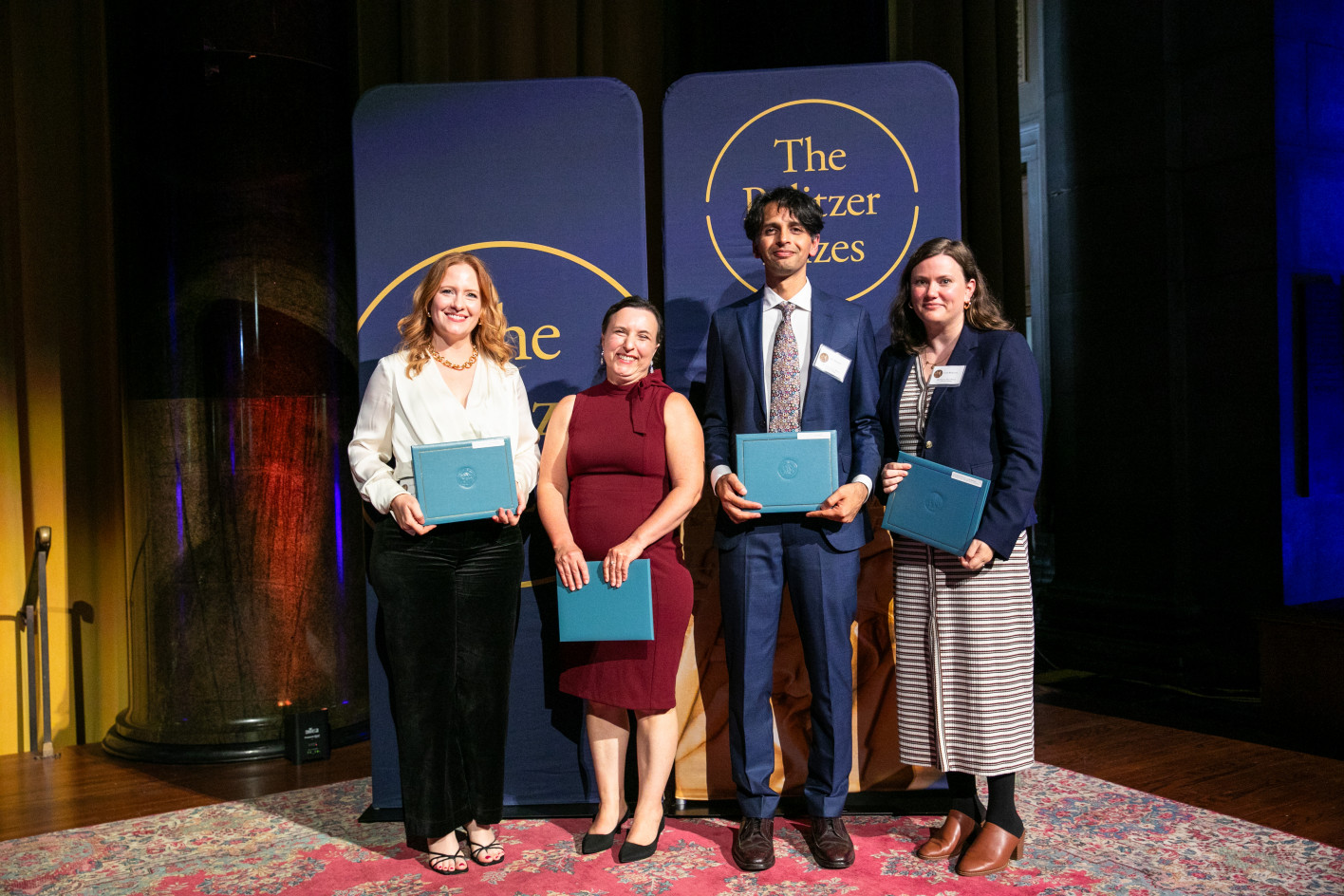
Lisa Falkenberg (left), Sharon Steinmann, Raj Mankad and Leah Binkovitz of the Houston Chronicle accept the 2025 Pulitzer Prize for Editorial Writing. (David Dini/The Pulitzer Prizes)
Winning Work
By The Editorial Board
Whisper-voiced Ruby Tista gets nervous before every classroom presentation but on this day, gripping a microphone in the McReynolds Middle School library in front of a tri-fold poster board, she’s so nervous that she’s given herself a headache.
That’s because she’s not just talking to her peers in the room. She and two classmates are trying to persuade two representatives of Union Pacific, a $24 billion revenue railroad company that controls most of the freight traffic rumbling in and out of Houston, including cars that can carry everything from toxic chemicals and petroleum products to coal and grain . It all chugs past her school every day. Sometimes the long trains move slowly. And sometimes they stall there for more than an hour.
“The train is always there blocking our way home, school and other places that we want to head,” Tista tells the largely expressionless faces of two representatives, one in a suit and one in a polo. “This is a problem because some students and other people in our community go over and under, which is illegal and it’s also a safety hazard.”
It’s also nothing new. For generations, students at McReynolds, about a mile outside one of the nation’s busiest rail yards in Fifth Ward, have been crawling over and under trains to get home from school in the afternoon and to avoid tardies in the morning. For decades, residents and city leaders have pleaded with Union Pacific for solutions. The company has long insisted that stopped trains aren’t good for anybody, including their bottom line. And everyone there we’ve talked with agrees that safety is important.
Little seems to change, though. Stalled trains blocking busy roads are a part of life in Houston, especially in the East End. Our economy depends on them. But trains aren’t just an inconvenience for kids at some Houston ISD schools and charters. They’re a threat to life and limb.
Something needs to change.
On the April afternoon last year when this editorial board followed Ruby and her classmates in their visit with UP, the youngsters tried to accomplish what some powerful people haven’t. After their library presentation, they led the UP representatives along the tracks outside their red-brick school, pointing to where the trains block roughly 100 students headed home to apartment buildings and beyond on the other side. They made their big ask: for Union Pacific to help build a pedestrian bridge that would allow students to bypass the trains and commute safely.
Many students have harrowing stories about the trains. Ruby can recall the last time she crawled under a stopped train, it suddenly started to move: “I thought I was gonna get run over,” she told us later. Now, she only climbs over the trains or waits.
The UP representatives at the school promised ongoing communication: “Thank you for your time and your research,” Richard Zientek with public affairs told them. “Safety is the No. 1 priority.” He shook their hands. Ruby felt they listened.
A year later, nearing the end of her seventh grade year, she’s not so sure.
“I don’t really think it will happen,” she told us with a shrug, “but I’m hopeful.”
Kids at McReynolds need more than hope and a poster board presentation. They’ve done their best to get results. Now they need allies who can get them more than temporary, patchwork solutions.
Union Pacific did agree to try to keep trains from stopping during drop-off and dismissal. And new Principal Chastity Caeser, who grew up in the area, now has a direct number for Zientek, whom she calls if trains are clogging up the tracks.
“But that just Band-Aids the situation,” she told us.
She knocks her fist on wood that they’ve never had a medical emergency while a train was stalled outside.
She worries about the weekends and the coming summer, when she won’t be able to peer out her office window and see if there’s a stopped train and when kids won’t have a teacher stationed out there making sure they’re staying safe as they venture to the pool or the store.
Over the past two years, we have visited McReynolds several times. We’ve witnessed the sometimes chaotic dismissals when teachers try to keep students away from passing or parked trains. We’ve seen nearby Wheatley High School students hoist themselves over a train. Our hearts stopped during one dismissal when we heard a kid shout out “He fell!” only to start up again when we saw the young boy scramble to his feet and out of the way of a slow-moving train more than 50 cars long. Just last month, we too had to navigate the rocky slopes to make our way around a train that was stopped for over an hour.
The treeless intersection beside McReynolds is the perfect reflection of Houston’s unique and often fraught relationship with freight trains.
Situated just outside one of two major rail yards in the area, the tracks that run alongside the school are, as one expert put it, akin to an airplane runway, constantly managing traffic on its way to and from the Englewood Yard that sorts and resorts freight headed for every corner of the country.
McReynolds is just a small piece of a much bigger problem that will likely take significant funding for infrastructural improvements, expanded train monitoring systems and other community investments. But after decades of scrambling under and around freight trains, the students here deserve better.
Why should rail companies essentially get to wait out the bad press and ire of rotating politicians and principals? The company helps sponsor the end of year festivities at the school but, as of yet, hasn’t offered to cover the costs of a bridge to help students make sure they make it to the end of the year.
One glimmer of hope emerged recently, though. A bridge, even if UP helps fund it, will be expensive and will likely require federal assistance. Last year the city secured federal funds to build four underpasses and eliminate seven at-grade crossings, also on the East Side. The Gulf Coast Rail District has helped prioritize needed projects in the area and plans to hold workshops this summer to help local jurisdictions apply for more grants to get those done.
Finally, though, McReynolds found itself on one of those applications when the area’s city council member, Mario Castillo, applied this month for a federal grant, with the blessing and promise of $250,000 in matching funds from Harris County Commissioner Adrian Garcia, to get improvements for pedestrians at the Market Street crossing.
They’ll know by October if they got it.
It’s a hopeful development but it’s still more waiting. Ruby is used to that. But we think she and the other roughly 400 students at McReynolds have waited long enough.
A Union Pacific spokesperson told us the company hadn’t been asked for a letter of support for the recent grant but is “more than willing to accommodate, if asked.”
We’re asking. The bridge should be built. Union Pacific has shown a willingness to listen and even think about solutions. Here’s one the $24 billion corporation should fund. No more stalling.
By The Editorial Board
About 700 feet from Milby High School, horrified onlookers, some in tears, watched late Monday morning as forensic investigators trudged down the tracks on the grim errand of collecting the remains of a 10th grader who lost his life to a train.
He was apparently just trying to get to school.
Officials haven’t released the teen’s name and offered few details in a press conference about exactly how the incident occurred.
But we don’t have to wonder about why.
The young man’s death in the Pecan Park neighborhood was as inevitable as it was tragic. Just six months ago, this editorial board published an editorial, along with a video, that showed students of McReynolds Middle School literally risking life and limb to run in front of trains or crawl under them in order to make it to school on time. Students there had begged Union Pacific to fund a bridge to bypass the tracks. Union Pacific officials listened but they built no bridge.
The $24 billion rail company did promise to work closely with the school’s principal to avoid scheduling trains around arrival and dismissal. It helped a bit, but not enough. And it certainly didn’t prevent Monday’s death at another school situated perilously close to passing trains.
"Our hearts go out to the family of a teenager who was struck and killed today in Houston," Union Pacific spokesperson Robynn Tysver said in a statement.
Always hearts. And never money. Or solutions.
Near Milby on Monday, community members and business owners we interviewed at the scene said students are constantly confronted with slow-moving or stalled trains that block access to school or home.
“It’s a daily thing. It’s ridiculous, really, that this happens a lot because, for whatever reason, the train always comes at that time that the kids are released,” said Janelle Cantu, 36, who works at her family's business, "Team Blessed Car & Truck Accessories," which is between the school and the site of the tragedy.
She said the train can stay “locked up,” meaning it stopped in place, for 20 to 30 minutes.
It’s a problem almost as old as Houston: trains snaking through our city often block cars and pedestrians, including students, for anywhere from minutes to hours, as they stall or move slowly on their way to major rail yards that are busy and sometimes backed up.
Residents, politicians and train executives have known the dangers for decades. They knew in 2005 when a Deady Middle School student lost his legs about a quarter mile from this recent collision after taking a shortcut on the tracks to get to school sooner. They knew in 2016 when a beloved 69-year-old Kashmere High School special education teacher’s assistant was killed by an Amtrak train a block from the school.
Leaders have fought for change. Mayor Bill White got so desperate he started having the train conductors ticketed.
Nothing seems to have worked. But that doesn’t mean nothing can.
Yes, the trains were here before the city. Yes, they’re a vital part of the Houston economy. Yes, some local officials are diligently pursuing dollars to build new grade separations that the region needs.
But surely, more must be done.
Surely, Union Pacific can be cajoled into helping pay for a few pedestrian bridges.
Surely, local officials can do a better job winning grants to fund over- and under-passes.
Surely, at the very least, Mayor John Whitmire, Houston ISD Superintendent Mike Miles and other leaders should demand that Union Pacific coordinate with the district, and schools directly, to reduce train traffic during school arrival and dismissal times.
Better education on rail safety should also be provided to the region’s schoolchildren so they understand the risks of engaging with trains, even those that seem firmly parked.
It’s true, some kids will take risks they shouldn’t. But in this case, it’s the grownups who keep leaving them in risky situations day after day, decade after decade.
Enough.
A young man chose school over his own safety. He should never have been faced with such a cruel choice.
By The Editorial Board
There was no train in sight near Milby High School as classes let out on Tuesday. There probably won’t be for a while, not until the TV crews have cleared out.
Another kind of hulking, slow moving presence plagued the long faces and downcast eyes of teen football players praying in the biting wind around a makeshift memorial. The grief, in all its forms — sadness, shock, maybe guilt — seemed to roar louder than the passing freight cars ever did.
They were mourning Sergio Rodriguez, a 10th-grader on the football team who had been so full of life the last time friends saw him. He was killed in a gruesome tragedy involving a Union Pacific train as he tried to get to school around 7:30 Monday morning.
“It hurts, it hurts, it hurts, the fact that I know that I gotta come to school every day, I gotta go back home every day knowing that these tracks killed my best friend,” Xavier Marin, an 18-year-old senior, told us earlier in the day.
Rodriguez’s friends and teammates gathered after school at the base of a utility pole adorned with prayer candles for Jesus, the Virgen de Guadalupe and Saint John, all forming in a heart shape with flowers and rocks apparently gathered from the tracks.
A football was tucked in the display and Rodriguez’s No. 77 was drawn at the center of a poster board covered with written tributes from classmates.
After the prayers, seven of the boys began to walk, backpacks slung across their shoulders, to retrace Rodriguez’s last steps. As they made it to the tracks, no one seemed to acknowledge the irony of their well-intended memorial procession: they were taking the same risks on the same steely, forbidden path that had killed their friend.
They kept walking, into the distance, much farther than Rodriguez had made it alive.
Such walks are a decades-long ritual, sure, for students in certain parts of town that were built too close to the trains. Milby, now a predominately Hispanic, low-income campus of over 2,000 students, was originally constructed in 1926. The rail line dates back to 1857.
Brandon Lozano, 16, couldn’t bring himself to take that walk, down the same path that forensics investigators a day earlier had scoured for Rodriguez’s remains.
Lozano had known Rodriguez since spring training of last year and called him a “best friend,” and the “most loving and funny person.” Lozano bikes to school and he frequently passed Rodriguez, who walked.
“If I wasn’t so rushed, maybe those five minutes, I could have talked to him,” Lozano told us. Maybe they would have teased each other, as they often did, over their rivalry on the field.
When it came to the Retro Bowl video game, Rodriguez’s team was always the Dallas Cowboys and he was unstoppable, his friend said: “I never got to beat him properly,” Lozano chuckled.
Why was Rodriguez taken from this world? “God only knows,” Lozano said.
There’s no logic mere humans can decipher in the loss of a young person simply trying to make his way through the world, going to school, enjoying life, treating others with kindness.
A spokesperson for Houston ISD told reporters Tuesday that Rodriguez “did not cross at the designated crossing spot” where the district says the principal routinely paid officers overtime to monitor students.
Perhaps he didn't cross there. Perhaps he also didn’t follow the old slogan, “stop, look, listen.” Perhaps he wore earbuds or earphones that obstructed his hearing. Perhaps. Perhaps. Perhaps.
We hope the details emerge soon about the specific events that led to Rodriguez’s death. His family has filed a lawsuit alleging the train failed to sound the horn. The fact remains: Rodriguez was a child. Children will make mistakes. It’s the job of adults to protect them.
Education campaigns can help, and surely, those should be restarted or enhanced. But can’t we all agree that Rodriguez and thousands of other Houston schoolchildren shouldn’t have to contend routinely — every day, every other day or every week — with stalled or slow-moving trains that block their paths to school and home?
Can’t we all agree that long-delayed, stymied or never-even-attempted solutions — such as pedestrian bridges; train bans around arrival and dismissal; enforceable limits on train idling; and direct communication between rail representatives and principals on every affected campus — should be, at long last, urgent priorities?
The children never chose to be in this predicament. Generations of callous or otherwise irresponsible adults chose it for them.
We know, whether in the meeting rooms of Union Pacific or the state Legislature, at Houston ISD or City Council or Harris County Commissioners Court, our region’s leaders have for a century allowed schools to be built next to train tracks without providing a safe way to cross.
“Quiero un puente, no más,” said Noemi Ramirez, 58, as she picking up her son from Milby. She wants a bridge — that’s all.
Houston Mayor John Whtimire and U.S. Rep. Sylvia Garcia have this week pledged to fight for infrastructure that can provide safe passage for students. We’ll follow their efforts.
And we hope they’ll keep one image in their minds that we can’t seem to shake from ours: a photo shared by Rodriguez’s family in a GoFundMe page for funeral expenses. In the boy’s eyes, we see pride and optimism and a hint of mischievousness in that dimpled grin. We also see promise that, due to adults’ inaction, has now been extinguished.
Sergio Rodriguez deserved a safe path to school. He’ll never get it. But thousands of other kids still have a chance.
By The Editorial Board
The trains were here first. We all know this. They were lumbering through Houston’s wood-and-steel-streaked prairies and marshlands before the first Model T clattered up Commerce Street.
They were here before the port. Before the Astrodome. Before the moon landing. Before Enron played us all a fool. Before Harvey brought us to our knees. Before the Astros picked us up.
And they were here long before you, modern Houstonian, stuck there in the driver’s seat at a railroad crossing, unable to drive. White knuckles on the steering wheel, unable to steer. Eyes darting back and forth in desperation as your car and everybody else’s around you becomes captive to a graffitied fortress rolling down the track with its load of toxic chemicals or who knows what — creeping slower, ever slower until finally screeching to a merciless halt, just five minutes before the tardy bell at your daughter’s school. Or your big job interview. Or the birth of your first grandchild. Or the movie, the opera, the church service, the Texans game. Wherever it was you were headed before a train stopped time and didn’t bother to tell the clocks.
We’ve all been there, cursing the trains, even as we have some sense of their history in a city once dubbed “Houston – where 17 railroads meet the sea.” Today, Houston is one of the nation’s busiest rail hubs, with the freight industry pouring many billions of dollars into our economy.
Trains made Houston. They still do. They’re also standing in its way. Sometimes for hours. Sometimes near schools. Sometimes blocking the path of firetrucks and ambulances.
The impact of train delays and blockages ranges from inconvenience to economic losses to deadly threats. It’s an impediment that’s only getting worse as freight traffic increases, train workers dwindle and trains themselves get longer so rail companies can maximize their profits.
While the marquee outside a furniture store near a train crossing on Durham once playfully lamented “Sorry about the train!” East End business owners decry train blockages that keep the customers away and residents try not to breathe too deeply when the idling engines of stalled trains emit exhaust.
Meanwhile, down in Fifth Ward, school children are risking life and limb to crawl under stopped trains, or hop aboard slower moving ones, to get to school. In June, when we published an editorial about students at McReynolds Middle School taking such risks, we asked, where is the outrage? A tragedy seemed inevitable.
Indeed it was. On Dec. 9, Sergio Rodriguez, a Milby High School sophomore, lost his life trying to “outrun” an approaching train on his way to school, a Houston ISD spokesperson told reporters. His family has sued Union Pacific alleging that the train operator failed to blow a warning horn as it approached the crossing.
Such a tragedy deserves a thorough investigation and urgent action to prevent another. That should include everything from safety education to better supervision before and after school to new infrastructure.
“It’s terrible and I am in discussions and looking for options,” Houston Mayor John Whitmire texted in response to our questions in the first hours after Rodriguez’s death. “Unfortunately, trains were a part of our beginning. Look at our city seal.”
He’s not wrong. But we’re glad he added: “no reason not to be innovative and strive to improve.”
Whitmire soon proposed a pedestrian “sky bridge” across the tracks near Milby. He said the cost would likely be around $6.5 million and he wants Union Pacific to help pay for it. A few days later, Lt. Gov. Dan Patrick, a Republican, asked state Sen. Carol Alvarado, a Democrat who represents the area and is a Milby graduate, to carry a bill next session to build a bridge named after Rodriguez. Patrick told us he is urging the Texas Department of Transportation to seek more funding, around $350 million, to address the state’s most congested rail crossings.
Meanwhile, state-appointed HISD Superintendent Mike Miles announced a collaboration to address nine hazardous rail crossings close to trains. They include Milby, Waltrip and Kashmere high schools; McReynolds and Forest Brook middle schools; and Cook, Burnet, Tijerina and Roosevelt elementaries. It’s a hopeful move, even if the district has 118 campuses situated near rail crossings.
U.S. Rep. Sylvia Garcia told reporters Tuesday that she would refile the Don’t Block Our Communities Act, which would prohibit rail companies from blocking intersections with passing trains for more than 10 minutes and penalize them if they violate that standard. “We need the Federal Railway Administration to do more to hold train companies like Union Pacific accountable,” she said, and called on the company to proactively invest in safety infrastructure, signage and training for students and families. Garcia’s legislative team is also researching possible ways to regulate the length, speed and frequency of trains.
We commend leaders for vowing action. They must see it through. And they’ll need help from other federal officials in Washington who haven’t been vocal. That includes U.S. Sen. Ted Cruz, ranking member on the Senate Committee on Commerce, Science and Transportation, which oversees freight rail.
But the truth is, a few regulations and pedestrian bridges won’t be enough. A problem on this scale requires a systemic infrastructure plan.
Christof Spieler, an urban planner, rail expert and senior lecturer at Rice University, points out there has been no new significant rail line built in Houston in nearly a century, even though U.S. rail cargo has tripled in volume.
He says the answer to dangerous crossings, bottlenecks and delays is a massive plan for grade separations — overpasses and underpasses — that keep freight trains, car traffic and people from colliding. Such a plan would require billions in public investment — which shouldn’t be an insurmountable obstacle for a region that’s almost entirely rebuilding its major airport and replacing freeways around downtown.
“We do projects of that ambition all the time,” Spieler wrote in an op-ed for the Chronicle. “Much of the work could be coordinated with freeway projects, transit expansion and street reconstruction, reducing the overall cost.”
It will take political leadership to get that done — and community voices demanding it.
As a community, it’s time we ask: Why do we put up with the danger and the obstruction when cities such as Chicago and Los Angeles have built bridges and underpasses to more easily coexist with rail traffic? Why do we put up with it when, for decades, elected leaders have promised change, task forces have proposed solutions, and railroad executives have promised to do better?
All the while, the executives’ plan has always been to wait us out.
Like that hulking nuisance planted across your path in rush hour, the companies know that, once the train gets going again and that guard rail lifts, you’ll zoom on with your day, your anger will fade.
The railroad companies know that, in time, concerned politicians and squeaky-wheel middle school principals cycle out. The government reports and memoranda of understanding with mayors and governors will collect dust. The middle schoolers at McReynolds who asked Union Pacific for a bridge to get to school safely will move on to high school.
They know you may never even hear about fire crews being delayed by trains, including a truck stalled in 2022 while responding to a fire that engulfed the home of an elderly couple who died in the blaze.
It’s true that Houston has greater impediments than some other cities when it comes to addressing train traffic and dangerous crossings. One is geographic: we’re flat and we flood and that complicates the building of grade separations. With so few hills and gullies, costly overpasses are among the only options. The other is cultural: we’re a business-friendly city where the interests of job creators often take priority over the interests of those who live, drive, breathe, and go to school here.
Rail companies are obligated to shareholders, not to communities harmed by their business practices. Federal laws dating to the 19th century give Union Pacific near total protection of their rights of way and the rail industry’s powerful lobby at the federal and state levels manages to fend off improved safety measures.
So where does that leave us?
Hopelessly stuck in perpetual annoyance or deadly peril? Only if we allow it.
We’re calling on political leaders who have spoken out, including Mayor Whitmire, Lt. Gov. Patrick, U.S. Rep. Sylvia Garcia, state Sen. Carol Alvarado, Harris County Commissioner Adrian Garcia, Houston City Councilmembers Mario Castillo and Joaquin Martinez, and others who understand Houston’s train challenges, to resolve to find new ways to make progress where past efforts have failed.
We’re also calling on readers and members of the Houston community to give this issue the sustained attention it deserves. We ask you to phone, write and ping on social media your elected representatives to register your concern and demand change. Share our editorials and your own train fears and frustrations on social media (use #DangerousCrossings) and in letters to the editor.
We ask you to act — and not just accept the notion that Houston’s historic debt to and ongoing reliance on the railroad industry should leave us forever captive to it.
By The Editorial Board
Mere hours after a teen boy was struck and killed by a train on his way to Milby High School, Sylvia Garcia, the longtime congresswoman representing the area, says she found herself in a tense phone conversation with Union Pacific’s president.
Garcia demanded a meeting — in person, in Houston, in the community where 15-year-old Sergio Rodriguez’s life had been violently extinguished, where hundreds of schoolchildren routinely risk life and limb to bypass stalled or slow-moving trains blocking their paths to and from school.
At some point, Garcia recalled in an interview with this editorial board Monday, she must have raised her voice, prompting what she described as a flash of condescension from UP President Beth Whited.
“She said I was being ‘too emotional’ and I needed to ‘calm down,’” Garcia recalled. “I said ‘of course I’m emotional. There’s a kid who got killed. Who wouldn’t be emotional?’”
Perhaps the president of a $6 billion railroad company headquartered 900 miles away in Omaha, Nebraska who is trying to grow an already 27% net profit margin?
A Union Pacific spokesperson said that Whited disagreed with the congresswoman's characterization of the conversation and maintained that Whited had actually said it was an "emotional situation."
Certainly, Garcia's emotion when she talks about the tragedy stands in stark contrast to the resigned silence of some of Texas’ other leaders in Washington. Where are the vows of action from U.S. Senators John Cornyn or Ted Cruz, who serves as ranking member on an influential committee overseeing rail?
Even U.S. Rep. Troy Nehls, R-Richmond, who, to his credit, has called for eliminating as many potentially deadly grade crossings as possible where rail and roadways meet, offered up no solutions after Sergio’s death.
In the end, Whited did come to Houston to meet, not with Garcia, but with Mayor John Whitmire. Her company did agree to stop sending trains past Milby around arrival and dismissal times and to "collaborate on long-term solutions and additional rail safety outreach efforts." Various school and elected officials made other promises: a pedestrian bridge or two, train safety education, perhaps even hundreds of millions more in state funding to address congested rail crossings across Texas.
The promises matter, but they’re woefully inadequate in a vast state with more than 9,000 at-grade crossings, of which 700 are in Houston alone.
Building one bridge near Milby does nothing to mitigate the daily dangers of thousands of other schoolchildren at Houston ISD’s more than 118 campuses built near rail crossings. The kids at McReynolds Middle School, only 300 feet from train tracks, have been begging UP for a bridge for years, as we documented in a video project earlier this year.
In fact, confusing these recent minor concessions with real progress may actually impede the fundamental change that’s needed in Houston, and frankly, across the nation, in communities that are obstructed and imperiled by trains growing ever longer in the pursuit of corporate profits and a railroad industry seemingly impervious to regulation and accountability at any level.
“We can’t get sucked into saying ‘oh great, you’re going to give us a bridge,’ and pat ourselves on the back and move on,” Garcia says. “We can’t let them appease us with one little piece.”
We don’t need less emotion or concern around Sergio’s death. We need more. Our community’s loss shouldn’t just be another statistic chalked up to the cost of doing business.
It should not end up, for instance, like the largely forgotten tragedy in Leggett, just north of Houston, where paramedics risked their own lives responding to a mother’s 911 call in 2021, crawling between the cars of a train known to block the road for hours, to get to 11-week-old K-Twon, who had inexplicably stopped breathing. It was too late. The baby boy died later at a hospital.
These tragedies should be wake-up calls about the daily risks our city, our region, our state and our nation face from trains.
Blocked crossings have long been a major obstruction to American motorists, a financial hardship to nearby businesses and a life-threatening risk to patients and fire victims whose rescues are delayed when first responders are blocked by stalled or slow-moving trains. In Houston, fire trucks and ambulances are blocked about 100 times per month, totaling more than 1,100 times this year, according to Fire Chief Thomas Munoz. Yes, there are some workarounds and Houston is experimenting with sensor technology that alerts first responders of passing trains but we need solutions that keep pace with the problem, which is only growing.
Texas leads the nation in reports of blocked crossings, according to data from the Federal Railroad Administration (FRA). Houston alone saw more than 5,300 reports this past year, compared with more than 300 in Chicago and around 30 in Los Angeles. And blockages are almost certainly severely underreported since Union Pacific encourages motorists to call its own private number whose data is not released and the FRA refuses to improve access to reporting tools beyond a cumbersome website that few know about. Still, we encourage people to use it: https://www.fra.dot.gov/blockedcrossings/
Federal funding is flowing to address safety issues, but while grants are being sought locally for bridges and grade separations, sporadic efforts aren’t terribly organized or successful. Union Pacific’s newsletter pointed out recently that Chicago’s Cook County has 67 percent more grade-separated crossings than Houston’s Harris County, which has the most rail crossings than any other part of UP’s 32,000-mile network.
As local principals and firefighters have told us, we need more than Band-Aid fixes to address a blockage problem that’s only getting worse as trains get longer and more frequent. ProPublica has documented how the rail industry is getting richer even as its “monster trains” — some stretching two and even three miles long — are hampering communities and derailing while regulators do little to address the risk.
How can this be? The railroad industry enjoys three privileges that few others can boast: a nostalgic legacy (there’s a locomotive on Houston’s city seal), a powerful lobby (A New York Times analysis found that U.S. railroads and the Association of American Railroads have spent about $454 million on federal lobbying over two decades), and a vexing legal confusion over who can regulate it.
A mix of lobbying and election year politics last year helped sink even the popular, bipartisan, Donald Trump-endorsed Railway Safety Act that Republican Sen. JD Vance and Democrat Sen. Sherrod Brown pushed passionately to address some of the causes and toxic aftermath of a derailment devastating East Palestine, Ohio. Garcia, the Texas congresswoman, says Brown’s office at one point agreed to add some provisions of a bill she was carrying to curb train blockages.
Does the bill have another chance now that Vance will be able to cast a tie-breaking Senate vote as Trump’s vice president? Not so fast. Republican majority leader John Thune is a former railroad lobbyist who has taken hundreds of thousands of dollars from the industry. And Trump’s pick for the Federal Railroad Administration? David Fink, former Pan Am Railways president whom financial analysts have already declared a “positive” for railroad stocks.
The legal situation is perhaps even more bleak. Regulating the railroad has always been a fraught issue. Federal railroad officials lack the authority (or the will) to take meaningful action. State rail safety legislation has been proposed in Texas but passage is doubtful and the outcome of court challenges would be uncertain given rulings striking down other states’ attempted regulations, including of train lengths, due to supposed federal jurisdiction. In 2022, Texas Attorney General Ken Paxon joined 17 other states’ top lawyers in urging the U.S. Supreme Court to hear an Ohio case they hoped would end a “regulatory void” by affirming states’ ability to address blocked crossings and other aspects of rail safety.
The high court declined. That leaves Congress among the few avenues for real relief.
And that gets us back to Congresswoman Garcia, whose "emotional" commitment to protecting the schoolchildren in her district is only one of her many tools. She has deep relationships and knowledge of the railroad and its battles in Houston, some of which she has fought in her long career of public service as a county commissioner, state senator and now U.S. representative.
She plans to refile her anti-blocking bill that previously went nowhere but certainly now deserves urgent attention from her colleagues. It would allow for penalties for train blockages that exceed a certain amount of time. She also plans to propose something like a "school zone" that would encompass rail crossings within 2 miles of campuses to protect students who live too close to qualify for bus transportation and often must walk. Similar to how motorists are subject to stricter rules and lower posted speeds around schools, Garcia wants a federal law requiring crossing guards, better lighting and signage to protect kids.
Will she have the bipartisan support she needs? Cruz’s office didn’t respond to our inquiry but Cornyn’s did. A spokesperson said Cornyn would be willing to review Garcia’s proposals once they're introduced and “would be open to working in a bipartisan way to address the issue next Congress.”
That’s a start. We need others to commit to the same. We need more than that. We need a true turning point.
We need a true paradigm shift where our leaders stop throwing up their hands and start rolling up their sleeves. We need a true coordinated effort at all levels — federal, state and local — to address the many safety risks posed by trains in our communities. Garcia’s ideas for a “train caucus” and safety summit sound good to us.
Yes, trains are vital for fueling our economy and delivering products we need in our daily lives. But the same can be said for 18-wheelers, Amazon trucks, airplanes and shipping vessels. Our leaders and regulators diligently try to ensure their safety and minimize their harm and negative impacts on communities.
Railroads require the same diligence. Sergio deserved the same diligence. Thousands of Houston schoolchildren and residents still do. No cargo is more precious than a human life.
EDITOR'S NOTE: This editorial has been updated to include a response from a Union Pacific spokeswoman regarding Whited's comments to Garcia.
Biography
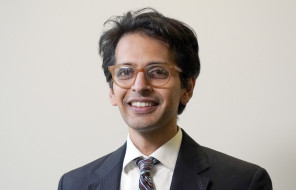
Raj Mankad is the deputy opinion editor at the Houston Chronicle. He has a PhD from the University of Houston Creative Writing Program, and has edited and written for publications that specialize in economics, philosophy, literature, architecture, science and health. He previously served as the Chronicle’s op-ed editor and won the 2021 Texas APME first place in general column writing.

Sharon Steinmann is the opinion video journalist on the Houston Chronicle Editorial Board. She is a former Houston Chronicle newsroom photojournalist and has worked for newspapers in California, Washington State and Alabama. She also spent two years freelancing in South America. As a senior photo editor at The Penny Hoarder, one of the world’s largest personal finance websites, she spent three years building their photo department. Sharon has documented many stories of international impact, including the AIDS epidemic in Honduras and the displacement of Hurricane Katrina victims. She was nominated for a regional Emmy Award for Public/Current/Community Affairs in 2015 for her video project about The Prancing Elites, a Mobile, AL gender non-conforming dance group. Sharon was born and raised in Los Angeles and graduated from UC Berkeley with a BA in Anthropology.
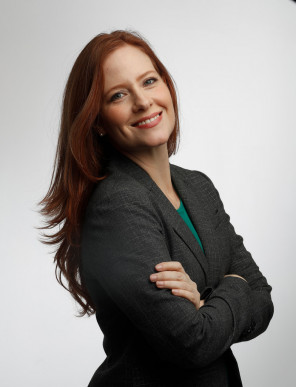
Lisa Falkenberg is the Houston Chronicle’s vice president/editor of opinion. A two-time Pulitzer Prize-winning journalist, Falkenberg leads the editorial board and the paper’s opinion sections.
In 2022, she shared a Pulitzer Prize in editorial writing for a series debunking the “Big Lie” of voter fraud and examining Texas’ long history of voter suppression. Falkenberg wrote a metro column at the Chronicle for more than a decade and in 2015 was awarded the Pulitzer for commentary, as well as the American Society of News Editors’ Mike Royko Award for Commentary/Column Writing for a series that exposed a wrongful conviction in a death case and led Texas lawmakers to reform the grand jury system. Raised in Seguin, Texas, Falkenberg is the daughter of a truck driver and a homemaker, and the first in her family to go to college. She earned a journalism degree from the University of Texas at Austin in 2000. She started her career at The Associated Press and joined the Chronicle in 2007 as a roving state correspondent based in Austin. Falkenberg is the proud mother of two daughters and a son.
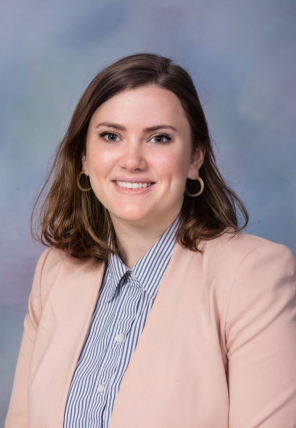
Leah Binkovitz is a senior editorial writer with the Houston Chronicle Editorial Board. She was the senior editor for Rice University's Kinder Institute for Urban Research and its Urban Edge blog. She previously covered Fort Bend County for the Houston Chronicle. Before that, she was a journalism fellow in Washington, D.C., where she reported for the Washington Post and NPR. Binkovitz earned her bachelor’s degree from the University of California, Berkeley, and her master’s degree in journalism from Columbia University. She is also a current PhD student in Rice University’s sociology department.