Staff of The Wall Street Journal
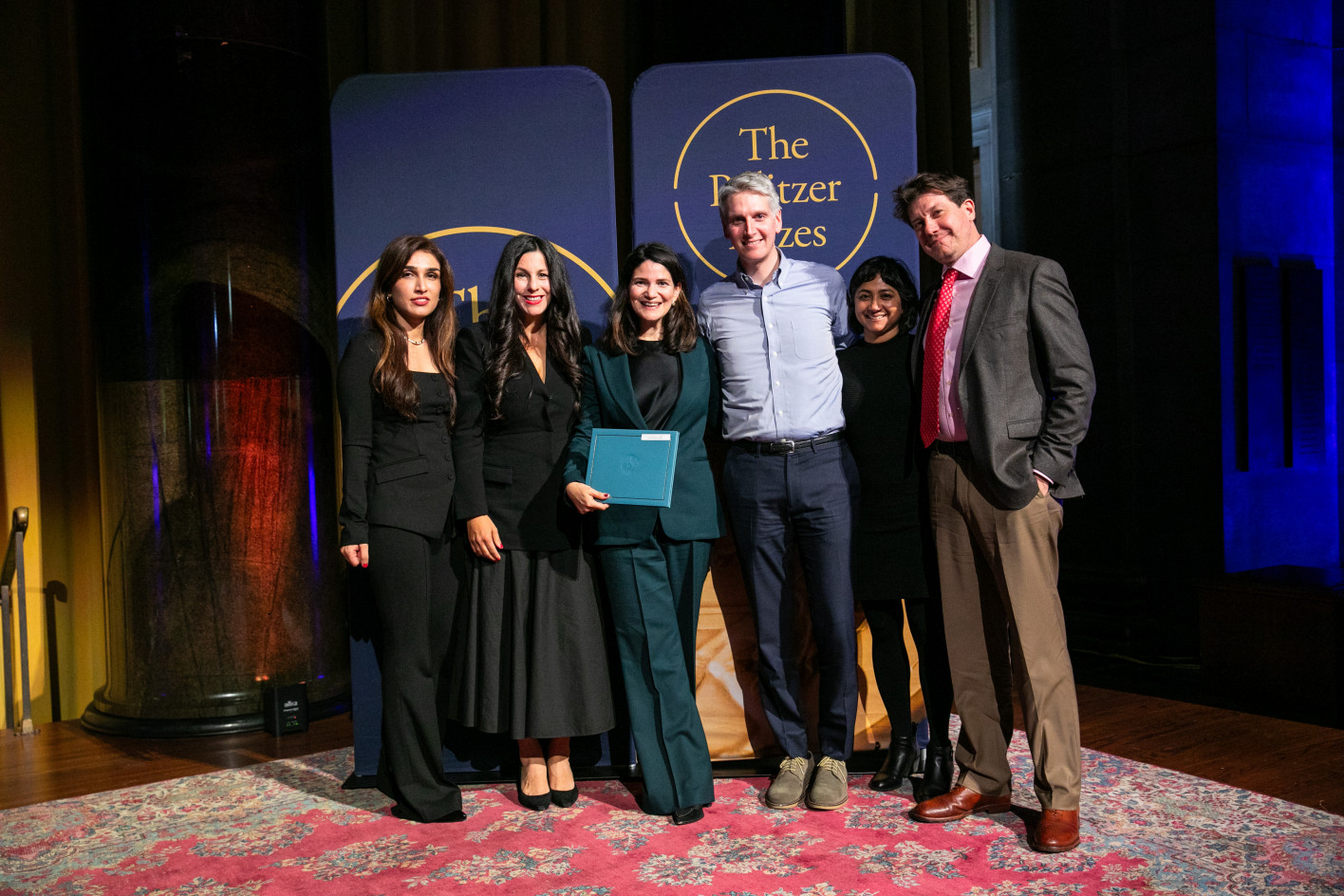
Khadeeja Safdar (left), Dana Mattioli, Emily Glazer, Joe Palazzolo, Aruna Viswanatha and Thomas Grove of The Wall Street Journal accept the 2025 Pulitzer Prize for National Reporting. (David Dini/The Pulitzer Prizes)
Winning Work
Some executives and board members fear the billionaire’s use of drugs—including LSD, cocaine, ecstasy, mushrooms and ketamine—could harm his companies
By Emily Glazer and Kirsten Grind
Elon Musk and his supporters offer several explanations for his contrarian views, unfiltered speech and provocative antics. They’re an expression of his creativity. Or the result of his mental-health challenges. Or fallout from his stress, or sleep deprivation.
In recent years, some executives and board members at his companies and others close to the billionaire have developed a persistent concern that there is another component driving his behavior: his use of drugs.
And they fear the Tesla and SpaceX chief executive’s drug use could have major consequences not just for his health, but also the six companies and billions in assets he oversees, according to people familiar with Musk and the companies.
The world’s wealthiest person has used LSD, cocaine, ecstasy and psychedelic mushrooms, often at private parties around the world, where attendees sign nondisclosure agreements or give up their phones to enter, according to people who have witnessed his drug use and others with knowledge of it. Musk has previously smoked marijuana in public and has said he has a prescription for the psychedelic-like ketamine.
In 2018, for example, he took multiple tabs of acid at a party he hosted in Los Angeles. The next year he partied on magic mushrooms at an event in Mexico. In 2021, he took ketamine recreationally with his brother, Kimbal Musk, in Miami at a house party during Art Basel. He has taken illegal drugs with current SpaceX and former Tesla board member Steve Jurvetson.
People close to Musk, who is now 52, said his drug use is ongoing, especially his consumption of ketamine, and that they are concerned it could cause a health crisis. Even if it doesn’t, it could damage his businesses.
Illegal drug use would likely be a violation of federal policies that could jeopardize SpaceX’s billions of dollars in government contracts. Musk is intrinsic to the value of his companies, potentially putting at risk around $1 trillion in assets held by investors, tens of thousands of jobs and big parts of the U.S. space program.
SpaceX is the only U.S. company now approved to transport NASA astronauts to and from the International Space Station. The Pentagon, meanwhile, has stepped up purchases of SpaceX rocket launches in recent years, and the company has also been looking to develop a large business selling satellite services to national-security agencies.
One former Tesla director, Linda Johnson Rice, grew so frustrated with Musk’s volatile behavior and her concerns about his drug consumption that she didn’t stand for re-election to the electric-car company’s board in 2019, according to people familiar with the matter.
Musk didn’t respond to requests for comment.
An attorney for Musk, Alex Spiro, said that Musk is “regularly and randomly drug tested at SpaceX and has never failed a test.” Spiro, who said he represents Tesla, added in response to detailed questions that “there are other false facts” in this article but didn’t detail them.
The people around Musk long ago became accustomed to his volatile behavior. Some SpaceX executives who had long worked with him, however, noticed a change at a company event in late 2017.
Hundreds of SpaceX employees gathered around mission control at the rocket company’s headquarters in Hawthorne, Calif., in anticipation of Musk, who was nearly an hour late to arrive at the all-hands meeting about the company’s latest rocket.
When he finally took the stage, Musk was strangely incomprehensible at times. He slurred his words and rambled for around 15 minutes, according to executives in attendance, and referred repeatedly to SpaceX’s Big Falcon Rocket prototype, which was known as BFR, as “Big F—ing Rocket.”
SpaceX President Gwynne Shotwell ultimately stepped in and took over the meeting.
It couldn’t be learned if Musk was under the influence that day. But after the meeting, the SpaceX executives privately talked about their worries Musk was on drugs. One described the event as “nonsensical,” “unhinged” and “cringeworthy.”
Spiro called the description of the SpaceX incident “false as has been confirmed by countless people who were present.” He declined to elaborate on what specifically was false or describe the countless people.
Then in 2018, people familiar with Musk’s behavior said, another incident seemed to mark a turning point for him—and showed that his drug use could have consequences for his businesses. That year, Musk got into trouble with NASA for smoking marijuana on the Joe Rogan show, raising red flags for some about the business impact of Musk’s conduct and causing employees at SpaceX to be randomly tested for drugs.
Worry by board members
In addition to violating federal contracts, any kind of illegal drug use would break company policies at both SpaceX and Tesla, and would raise questions about Musk’s executive role at the publicly traded Tesla, where the board has a duty to shareholders to oversee management.
Some Tesla board members over the years have talked among themselves about their concerns over Musk’s alleged drug use but haven’t said anything formally that would end up as an official board agenda item or in meeting minutes, people familiar with the discussions said. Some directors, including current Tesla board chair Robyn Denholm, have gone to Kimbal Musk, who is a Tesla board member and was a SpaceX board member until early 2022, for help with Musk’s behavior, without using the word “drugs,” the people said.
Some on the board and others close to Musk worried he was on drugs when he tweeted in 2018 about plans to take Tesla private, people familiar with the episode said. Kimbal Musk informally approached Musk about it on behalf of some board members, some of the people said. The tweet brought on an SEC investigation into whether the statement was misleading or false, and resulted in Musk’s agreement to step down as Tesla chairman for a time.
Some close to Musk said they learned he was under the influence during a media interview he gave soon after the tweet when he choked up describing how difficult his year had been.
Part of the issue directors have grappled with over the years is whether drug use by Musk is to blame for his unusual behavior, or if it is something else, such as his consistent lack of sleep, which he has talked about.
Musk oversees six companies, including social-media platform X, formerly Twitter; his tunneling venture, The Boring Co.; his brain implant startup, Neuralink; and a new artificial-intelligence company, xAI. His business life bleeds into his personal time in a way that is uncommon even for other chief executives.
At Tesla and X, he has said he regularly slept at the office. He often emails company lieutenants in the middle of the night, and hosts work meetings at midnight. He said he works almost nonstop. “Vacation is a strong word,” he said in 2022 court testimony. “For me, it is email with a view.”
In a new authorized biography of Musk, author Walter Isaacson described Musk’s “demon mode”: Musk, Isaacson wrote, entered into a state of intense fury and would frequently lash out at employees and executives. In the Isaacson book, Musk is quoted as saying, “I really don’t like doing illegal drugs.”
Musk and others have attributed his erratic office behavior to his mental health. A Twitter user asked in 2017 if he had bipolar disorder, which can cause mood swings, to which Musk replied affirmatively, although he said he was undiagnosed.
Musk also said, when he hosted “Saturday Night Live” in 2021, that he had Asperger’s, a form of autism.
Drug use has also been a thorny topic for directors at Musk’s companies because some of them are his close friends, and attend parties and travel with him, according to people familiar with the matter and court documents.
Musk has been known to attend parties and events at Burning Man, the Nevada arts and music festival where drugs are widely used, to blow off steam, according to people close to him.
He also throws his own private events, where drug use is common, according to people who have attended the parties.
The executive’s whereabouts are often a closely guarded secret, and he is protected by private security. At his companies, executives and employees often have to sign nondisclosure agreements.
Kimbal Musk frequently attends the same parties and events as his brother, including an Art Basel party in Miami in late 2021 when both took ketamine recreationally, according to people with knowledge of their drug use. Kimbal Musk has talked to friends about the benefits of psychedelics, and tweeted in June in support of his wife when she spoke at the country’s largest psychedelic conference about the benefits of the drugs for mental health treatment.
In 2023, The Wall Street Journal reported that Elon Musk microdoses ketamine for depression and also takes full doses at parties. Following publication of the article, Musk tweeted that ketamine is a better way to deal with depression compared with more widely prescribed antidepressants that are “zombifying” people.
In a separate tweet, Musk later said that he had a prescription for ketamine. The psychedelic-like drug can be prescribed “off label” for depression and post-traumatic stress disorder, and it is also a widely used party drug that can be purchased illegally through dealers.
Government contracts
As a general rule, board members and executives have long struggled with how to deal with substance abuse at their companies.
Some directors have wondered whether it is their role to police drug use outside the office, saying what executives do in their personal lives—especially with drugs that may be legal in certain instances or states—may not impact their business decisions.
At most companies, board members aren’t required to investigate an executive for drug use, but they often do take action if they believe it is impacting the business.
That can include encouraging a leave of absence for treatment or opening an investigation, corporate governance experts say. Drug use is a more challenging issue than other substance problems, such as alcohol, because possessing certain drugs, such as cocaine, can bring felony charges.
In 2020, former Zappos chief executive Tony Hsieh’s abuse of ketamine ultimately caused executives at the shoe company’s parent, Amazon, to step in, according to people familiar with those events.
Amazon executives gave Hsieh a couple of months to clean up his act, and when he wasn’t able to do so, he resigned. Hsieh was trapped in a house fire while under the influence in late 2020 and later died from his injuries.
Tesla’s code of conduct described the electric-vehicle maker as a drug-free workplace and prohibits all employees, including executives, from using them, even out of the office.
Illegal drug use by employees is also in violation of the rules that govern the more than $14 billion in contracts that Musk’s private rocket company, SpaceX, has with the U.S. government for civilian and military space missions.
Federal contracts require that companies comply with the Drug-Free Workplace Act and foster a drug-free culture with programs and policies, regardless of any state laws that may legalize some usage. Contractors can also lose security clearances because of drug abuse, defined as the use of illegal drugs or prescription medications “in a manner that deviates from approved medical direction.”
In his role as CEO and founder of SpaceX, Musk has a security clearance that gives him access to classified information.
Investors have often turned a blind eye to concerns about Musk, including his drug use, especially when Tesla is doing well, investors and people close to the board said. And in recent years, Tesla and SpaceX have both performed exceptionally. Tesla stock is up around 1,000% in the past five years, despite declines in 2022, compared with the S&P 500’s increase of around 86% in that time period. Revenue at SpaceX also has soared.
Tweet firestorm
In the summer of 2018, some people around the billionaire began getting concerned that he was losing control.
Several months after the all-hands meeting at SpaceX, Musk tweeted in August that he planned to take Tesla private at $420 a share—“420” is slang for smoking marijuana—and that he had “funding secured.”
The now-infamous tweet set off a firestorm among investors, who scrambled to understand the billionaire’s plans for the electric-car maker. Tesla shares increased more than 6% the day of the tweet. The SEC launched an investigation that resulted in a settlement that included fines of $40 million and Tesla adding two independent board members and overseeing the CEO’s communications. Musk didn’t admit or deny wrongdoing.
Board members told regulators they didn’t know about Musk’s plans and were taken aback by his actions. Privately some on the board became concerned that Musk was on drugs when tweeting, and some directors briefly discussed among themselves the idea of him taking a leave of absence from Tesla, people familiar with the discussions said.
In an interview with the New York Times soon after, Musk choked up multiple times as he described the intense personal toll of leading Tesla, saying, “This past year has been the most difficult and painful year of my career.”
Behind the scenes, things were much more dire: Musk had been under the influence as he answered the reporters’ questions, according to people briefed on the episode. The CEO hadn’t informed Tesla’s communications team that he was giving the interview, people familiar with the episode said.
Soon after, Musk smoked marijuana on the comedian Rogan’s show, which can be streamed online. NASA demanded written assurances that SpaceX was complying with the federal drug-free workplace law and spent $5 million in taxpayer dollars on training for SpaceX employees, according to a letter NASA sent to the company and federal contracting records.
Musk has said the agency required drug testing at SpaceX for a year.
Corporate contractors must follow standard NASA guidelines for drug tests that usually check for marijuana and cocaine and have the ability to also test for amphetamines, opiates and PCP.
Spiro didn’t respond to a question on what type of drug tests Musk has taken.
At SpaceX and some of Musk’s other companies, including the tunnel venture Boring Co., executives began warning employees to follow company rules at all times, including to not use illegal drugs, even out of the office, according to people familiar with the warnings.
SpaceX brought in drug-sniffing dogs on a random basis to make sure employees weren’t carrying illegal substances, according to the people.
At Tesla, Denholm, the current board chair, James Murdoch and other directors sometimes gathered around Kimbal Musk informally during board breaks or after meetings to ask how Elon Musk was doing or if he was getting enough sleep, people familiar with the conversations said. While the directors wouldn’t specifically ask about substance abuse, the people said they understood the questions to be about Elon Musk’s perceived drug use.
Rice, the director who didn’t stand for re-election in 2019, raised concerns about his drug consumption more than once in side conversations with board members about Musk’s increasingly erratic behavior during her two year tenure on the board, according to people familiar with her concerns. She informally asked whether the board should investigate and was brushed off, one of the people said.
Joe Palazzolo, Micah Maidenberg, Jim Oberman and Jeff Horwitz contributed to this article.
Regular contacts between world’s richest man and America’s chief antagonist raise security concerns; topics include geopolitics, business and personal matters
By Thomas Grove, Warren P. Strobel, Aruna Viswanatha, Gordon Lubold and Sam Schechner
Elon Musk, the world’s richest man and a linchpin of U.S. space efforts, has been in regular contact with Russian President Vladimir Putin since late 2022.
The discussions, confirmed by several current and former U.S., European and Russian officials, touch on personal topics, business and geopolitical tensions.
At one point, Putin asked the billionaire to avoid activating his Starlink satellite internet service over Taiwan as a favor to Chinese leader Xi Jinping, said two people briefed on the request.
Musk has emerged this year as a crucial supporter of Donald Trump’s election campaign, and could find a role in a Trump administration should he win. While the U.S. and its allies have isolated Putin in recent years, Musk’s dialogue could signal re-engagement with the Russian leader, and reinforce Trump’s expressed desire to cut a deal over major fault lines such as the war in Ukraine.
At the same time, the contacts also raise potential national-security concerns among some in the current administration, given Putin’s role as one of America’s chief adversaries.
Musk has forged deep business ties with U.S. military and intelligence agencies, giving him unique visibility into some of America’s most sensitive space programs. SpaceX, which operates the Starlink service, won a $1.8 billion classified contract in 2021 and is the primary rocket launcher for the Pentagon and NASA. Musk has a security clearance that allows him access to certain classified information.
Knowledge of Musk’s Kremlin contacts appears to be a closely held secret in government. Several White House officials said they weren’t aware of them. The topic is highly sensitive, given Musk’s increasing involvement in the Trump campaign and the approaching U.S. presidential election, less than two weeks away.
Musk didn’t respond to requests for comment. The billionaire has called criticism from some quarters that he has become an apologist for Putin “absurd” and has said his companies “have done more to undermine Russia than anything.”
On Friday, Musk responded derisively on X to the Journal’s story, without denying it. In one instance, he used two laughing emojis in response to a tweet that said, “Welp, the Swamp’s ‘Trump is Hitler’ didn’t work. Might as well give ‘Elon is a Russian agent’ a whirl.”
During his campaign swing through Pennsylvania last week, Musk talked about the importance of government transparency and noted his own access to government secrets. “I do have a top-secret clearance, but, I’d have to say, like most of the stuff that I’m aware of…the reason they keep it top secret is because it’s so boring.”
A Pentagon spokesman said: “We do not comment on any individual’s security clearance, review or status, or about personnel security policy matters in the context of reports about any individual’s actions.”
One person aware of the conversations said the government faces a dilemma because it is so dependent on the billionaire’s technologies. SpaceX launches vital national security satellites into orbit and is the company NASA relies on to transport astronauts to and from the International Space Station.
“They don’t love it,” the person said, referring to the Musk-Putin contacts. The person, however, said no alerts have been raised by the administration over possible security breaches by Musk.
NASA Administrator Bill Nelson said Friday the WSJ report should prompt an investigation.
“If the story is true that there have been multiple conversations between Elon Musk and the president of Russia then I think that would be concerning, particularly for NASA, for the Department of Defense, for some of the intelligence agencies,” he said, speaking at a Semafor’s World Economy Summit.
White House officials acknowledged the Journal’s story Friday. “I’ve seen the reporting out of The Wall Street Journal,” said John Kirby, a spokesman for the National Security Council. “I’m not a position to corroborate the veracity of those reports, and we would refer you to Mr. Musk to speak to his private communications.”
Kremlin spokesman Dmitry Peskov said the only communication the Kremlin has had with Musk was over one telephone call in which he and Putin discussed “space as well as current and future technologies.”
Apart from that, he said neither Putin nor Kremlin officials were holding regular conversations with Musk.
A spokeswoman for Trump’s campaign called Musk “a once-in-a-generation industry leader” and said “our broken federal bureaucracy could certainly benefit from his ideas and efficiency.”
“As for Putin,” the spokeswoman continued, “there’s only one candidate in the race that he did not invade another country under, and it’s President Trump. President Trump has long said that he will re-establish his peace through strength foreign policy to deter Russia’s aggression and end the war in Ukraine.”
A bottle of vodka
Musk has long had a fascination with Russia and its space and rocket programs. Walter Isaacson’s biography of Musk said the businessman traveled to Moscow in 2002 to negotiate the purchase of rockets for his fledgling space program, but passed out during a vodka-heavy lunch. The sale ultimately failed, though his Russian hosts gave Musk a bottle of vodka with his likeness superimposed on a drawing of Mars.
The billionaire’s conversations with Putin and Kremlin officials highlight his increasing inclination to stretch beyond business and into geopolitics. He has met several times and talked business with Javier Milei of Argentina, as well as former Brazilian President Jair Bolsonaro, whom he defended in an acrimonious online debate.
Putin is on a different order of magnitude. The Russian leader has created an authoritarian system that oversees fraudulent elections and the assassinations of political opponents, for which President Biden called him a “killer.” With keys to one of the world’s most powerful nuclear arsenals and growing territorial ambitions in Europe, Putin has become the U.S.’s chief antagonist.
Labeling him a “despot,” the Treasury Department took the unusual step in 2022 of blacklisting him for invading Ukraine, putting him in the same company with North Korea’s Kim Jong Un, Syrian President Bashar al-Assad and Alexander Lukashenko of Belarus.
In October 2022, Musk said publicly that he had spoken only once to Putin. He said on X that the conversation was about space, and that it occurred around April 2021.
But more conversations have followed, including dialogues with other high-ranking Russian officials past 2022 and into this year. One of the officials was Sergei Kiriyenko, Putin’s first deputy chief of staff, two of the officials said. What the two talked about isn’t clear.
Last month, the U.S. Justice Department said in an affidavit that Kiriyenko had created some 30 internet domains to spread Russian disinformation, including on Musk’s X, where it was meant to erode support for Ukraine and manipulate American voters ahead of the presidential election.
After the Russian invasion in February 2022, Musk at first made strong public statements of support for Kyiv. He posted “Hold Strong Ukraine,” flanked by Ukrainian flags on what was then still known as Twitter. Shortly after, he jokingly challenged Putin to one-on-one combat over “Україна,” the Ukrainian language name for the country.
He followed up by donating several hundred Starlink terminals to Ukraine. By July some 15,000 terminals were providing free internet access to broad swaths of the country destroyed by the Russian attacks.
Later that year, Musk’s view of the conflict appeared to change. In September, Ukrainian military operatives weren’t able to use Starlink terminals to guide sea drones to attack a Russian naval base in Crimea, the Black Sea peninsula Moscow had occupied since 2014. Ukraine tried to persuade Musk to activate the Starlink service in the area, but that didn’t happen, the Journal has reported.
His space company extended restrictions on the use of Starlink in offensive operations by Ukraine. Musk said later that he made the move because Starlink is meant for civilian uses and that he believed any Ukrainian attack on Crimea could spark a nuclear war.
His moves coincided with public and private pressure from the Kremlin. In May 2022, Russia’s space chief said in a post on Telegram that Musk would “answer like an adult” for supplying Starlink to Ukraine’s Azov battalion, which the Kremlin had singled out for the ultraright ideology espoused by some members.
Later in 2022, Musk was having regular conversations with “high-level Russians,” according to a person familiar with the interactions. At the time, there was pressure from the Kremlin on Musk’s businesses and “implicit threats against him,” the person said.
At the same time, Musk increasingly took to Twitter, for which he was completing the purchase, to say SpaceX was losing money by funding the operation of the terminals.
In October 2022, he asked his tens of millions of followers on X to vote on a pathway to peace that mirrored some aspects of the Kremlin’s offer to Ukraine at the time.
Those conditions included continued Russian occupation of Crimea and Ukrainian neutrality outside of NATO. He also specified that Ukraine should continue allowing the supply of water to Crimea, an issue that had been an important concern of the Kremlin before the war.
One current and one former intelligence source said that Musk and Putin have continued to have contact since then and into this year as Musk began stepping up his criticism of the U.S. military aid to Ukraine and became involved in Trump’s election campaign.
‘Red lines’
In the fall of 2022, political scientist Ian Bremmer, founder of New York-based consulting firm Eurasia Group, wrote on Twitter that Musk had told him he had spoken with Putin and Kremlin officials about Ukraine. “He also told me what the Kremlin’s red lines were,” he wrote.
Bremmer wrote in a newsletter to subscribers that Musk had relayed to him a message from Putin that Russia would secure Crimea and Ukrainian neutrality “no matter what,” and that it would respond to a Ukrainian invasion of Crimea with a nuclear strike. Musk said that “everything needed to be done to avoid that outcome,” Bremmer wrote.
Musk has publicly denied he said any of those things to Bremmer.
In the past year, Musk and Russia’s interests have increasingly overlapped. Apart from Russia’s use of X for disinformation and Musk’s outspoken opposition to aid to Kyiv, Ukrainian officials said earlier this year that Russian forces occupying the country’s eastern and southern swaths had started using Starlink to enable secure communications and extend the range of their drones.
Russian troops also began using Starlink terminals, brought in through third countries, at a massive scale, undermining one of Ukraine’s few battlefield advantages. Musk has said on X that to the best of his knowledge, no terminals had been sold directly or indirectly to Russia, and that the terminals wouldn’t work inside Russia.
Pentagon officials have said the military was working with Ukraine and Starlink to address the issue, and described SpaceX as a great partner in those efforts. People familiar with the situation have said controlling who is using Starlink in Ukraine is difficult.
Starlink has said on X that when SpaceX learns of claims that unauthorized parties are using the service, it investigates and can cut off access.
Earlier this year, Musk gave airtime to Putin and his views on the U.S. and Ukraine when X carried Tucker Carlson’s two-hour interview with the Russian leader inside the Kremlin. In that interview, Putin said he was sure Musk “was a smart person.”
“There’s no stopping Elon Musk, he’s going to do what he thinks he needs to do,” Putin said. “You need to find some common ground with him, you need to search for some ways to persuade him.”
Late last year, the Kremlin first made the request of Musk to not activate Starlink over Taiwan, said a former Russian intelligence officer briefed on the situation. The request was done as a favor to China, he said, whom Russia was increasingly relying on for trade and to get around sanctions. A representative of the Chinese embassy in Washington said they weren’t aware of the specifics and couldn’t comment.
Starlink has never secured permission to offer internet service in Taiwan, whose government places restrictions on non-Taiwanese satellite operators.
Taiwan is currently listed as “coming soon” on a Starlink map of where it provides service.
As the year progressed, Musk became more preoccupied with the presidential election.
Through the first months of the year, Musk said he would refrain from backing any presidential candidate while at the same time holding private conversations discussing how he could get Trump elected. Musk publicly endorsed him in July. The businessman said he planned to commit as much as $45 million a month to a new super political-action committee in part to get it done, according to people familiar with the matter. The effort included hiring armies of canvassers to scour battleground states for voters.
Since then, Trump has said he intends to make Musk the head of a “government efficiency commission.” The two speak often.
Micah Maidenberg and Tim Higgins contributed to this article.
Other backers of America PAC include Palantir Technologies co-founder Joe Lonsdale and the Winklevoss twins
By Dana Mattioli, Emily Glazer and Khadeeja Safdar
Elon Musk has said he plans to commit around $45 million a month to a new super political-action committee backing former President Donald Trump’s presidential run, according to people familiar with the matter.
Other backers of the group, called America PAC, include Palantir Technologies co-founder Joe Lonsdale, the Winklevoss twins, former U.S. Ambassador to Canada Kelly Craft and her husband, Joe Craft, who is chief executive of coal producer Alliance Resource Partners.
Formed in June, America PAC is focused on registering voters and persuading constituents to vote early and request mail-in ballots in swing states, according to one of the people. The coalition assessed that the Democrats have historically had very robust “get out the vote” campaigns and took note of the amounts of money that the Biden camp has dedicated to what are called on-the-ground efforts in swing states. America PAC will try to counter that.
After this article published, Musk on X posted a humorous meme responding to it with the caption “FAKE GNUS.” Subsequently, he wrote “Yeah” in response to a post that said: “Elon Musk went from being an Obama voter to pledging $180 million to elect DJT. The woke left really f*cked up. Badly.”
Musk is currently the world’s richest person, with an estimated fortune exceeding $250 billion. The amount that he has said he plans to commit to America PAC is an extraordinary sum.
While it can be difficult to trace the full scope of some political giving, the largest known donation of the 2024 election so far is $50 million given recently by the great-grandson of banker Thomas Mellon to a super PAC supporting Trump.
America PAC has hired hundreds of employees for its efforts, and has been registering voters, having conversations with constituents in swing states and urging voters to request mail-in ballots, some of the people familiar with the matter said.
According to a filing made on Monday, America PAC had $8.75 million in contributions for the three-month period ending on June 30. Musk had indicated that he planned to start his donations in July, one of the people said.
In addition to Lonsdale, the Winklevosses and the Crafts, the filing listed a number of other donors to America PAC, including several with close connections to Musk.
Bloomberg News earlier said that Musk has donated to America PAC. The scale of his planned commitment hasn’t been reported.
Musk in March tweeted that he didn’t intend to donate to either Trump or President Biden’s campaigns. But the billionaire Tesla CEO has gotten closer to the former president in recent months.
On Saturday, Musk formally endorsed Trump for president after a shooter attempted to assassinate the former president at a Pennsylvania rally. “I fully endorse President Trump and hope for his rapid recovery,” Musk said on X. In a subsequent post he said, “Last time America had a candidate this tough was Theodore Roosevelt.”
The Wall Street Journal reported in May that Musk and Trump had been talking frequently in recent months and were developing a friendly rapport, and that Musk was helping organize a data-driven project to prevent voter fraud that Trump was briefed on. The article said the two men had also discussed a possible advisory role for Musk in a potential second Trump administration, something Musk later denied.
Jim Oberman contributed to this article.
Corrections & Amplifications
Backers of the pro-Trump America PAC took note of money that President Biden’s camp has dedicated to so-called on-the-ground efforts in swing states. An earlier version of this article incorrectly said it was the Biden administration involved in those efforts. (Corrected on July 15)
Five years ago, Elon Musk mostly tweeted about his companies—plus memes and the occasional dad joke.
Today, he posts almost daily about political issues on X, the platform he acquired in 2022, and has thrown his support behind former President Donald Trump's campaign.
In total, as Musk ramped up his posting on the platform, his conversations mentioning common political keywords increased more than 200-fold.
Meanwhile, the share of his conversations mentioning business terms decreased.
Here’s how that happened.
The billionaire’s posts show his metamorphosis from a businessman who largely avoided politics to a vocal Trump supporter
By Andrea Fuller, Alexa Corse, John West and Kara Dapena
When Elon Musk endorsed former President Donald Trump’s campaign in July, X was his megaphone to reach his almost 200 million followers. The endorsement not only made Musk one of Trump’s most influential supporters, but also represented a remarkable shift in his eagerness to weigh in on political debates compared with just a few years ago.
Musk posted about 13,000 times this year through the end of July—almost as much as in all of 2023. That’s about 61 posts a day, compared with nine in 2019.
If you were to read all his exchanges on X from the past 5½ years—including the posts he replied to—that would add up to about 1.5 million words. That’s roughly twice as long as the King James Bible. The words in Musk’s posts alone added up to more than 300,000—not counting emojis.
Musk and his representatives didn’t respond to questions from The Wall Street Journal about his posting patterns on X, formerly called Twitter.
To understand the political evolution of one of the world’s richest men, the Journal captured nearly 42,000 of Musk’s exchanges on X between 2019 and the end of July. (That’s nearly all his conversations during that period, with a small number of exceptions, such as posts he deleted. Read here for more on methodology.)
Musk’s exchanges included roughly 76,000 posts—his tweets as well as his retweets, tweets to which he replied and any quoted tweets. The Journal mapped them using the same technology that powers artificial intelligence tools like ChatGPT.
All told, the Journal classified more than 500 variations of words and phrases related to political and social issues, and nearly 300 as terms related to Musk’s companies and their industries.
In 2024, Musk had roughly 230 times as many exchanges a month containing the political terms compared with 2019. Conversations containing business terms more than doubled, but fell as a share of overall tweets.
To dig into the details of the shift, the Journal manually classified each of Musk’s tweets from July 2019. Roughly two-thirds were about cars or space, both industries central to Musk’s business empire. The handful that pertained to governmental issues or the media generally related to his business interests.
In July of this year, roughly a fifth of Musk’s nearly 2,200 posts pertained to his rocket and electric-vehicle companies, or those industries, according to the Journal’s manual review. Nearly 60% of Musk’s posts were about politics, the media, current events or cultural issues.
Five years ago, Musk said he wasn’t a partisan.
Elon Musk @elonmusk
Feb. 2, 2019
I’m openly moderate. There, I said it.
The outbreak of the Covid-19 pandemic marked a turning point. A tweet calling the “coronavirus panic” dumb was his first post to get more than one million likes in the Journal’s analysis.
Elon Musk @elonmusk
March 6, 2020
The coronavirus panic is dumb
In subsequent tweets, Musk criticized government-mandated lockdowns and sparred with local authorities over reopening Tesla’s factory in Fremont, Calif. He complained about the power of “unelected” officials over pandemic-related mandates, with nine of his conversations on the platform containing the term in May 2020.
Musk had courted controversy on Twitter in prior years, such as when his tweets about taking Tesla private led the Securities and Exchange Commission to sue him. But he began taking on a more political tone. In May 2020, he tweeted a reference to the movie “The Matrix” that is used by some on the right as a rallying cry. In the movie, the red pill allows the main character to see the reality behind the illusion.
Elon Musk @elonmusk
May 17, 2020
Take the red pill 🌹
Throughout 2020, Musk’s Twitter exchanges directly named President Biden, who was elected in November of that year, once. In 2021, Musk repeatedly clashed with the president and other Democrats whom he accused of unfairly treating him and his companies.
Musk bristled when the Biden administration invited only automakers with unionized workforces to a White House event on electric vehicles in August 2021, excluding Tesla. He continued to complain about the administration’s auto industry policies.
Elon Musk @elonmusk
Oct. 31, 2021
Biden is a UAW 🧦 puppet
He also feuded with Democratic Sen. Elizabeth Warren of Massachusetts.
Elizabeth Warren @SenWarren
Dec. 13, 2021
Let’s change the rigged tax code so The Person of the Year will actually pay taxes and stop freeloading off everyone else.
https://www.bostonglobe.com/2021/12/13/business/elon-musk-named-times-person-year/
Elon Musk @elonmusk
Dec. 14, 2021
And if you opened your eyes for 2 seconds, you would realize I will pay more taxes than any American in history this year
By 2022, Musk was spending more time wading into sensitive political and social issues.
More than 250 of Musk’s Twitter exchanges in 2022 mentioned “free speech,” “disinformation,” “the media” or similar phrases.
That year, Musk offered to buy Twitter. He accused the platform of having a “strong left wing bias” and said that he would soften content moderation in the name of free speech if he bought the platform.
Elon Musk @elonmusk
March 25, 2022
Free speech is essential to a functioning democracy.
Do you believe Twitter rigorously adheres to this principle?
Yes 29.6%
No 70.4%
2,035,924 votes • Final results
Elon Musk @elonmusk The consequences of this poll will be important. Please vote carefully.
He completed the acquisition in October 2022 in a deal valued at $44 billion. The move won him many admirers among conservatives and critics of big social-media platforms. Several of his most-liked posts of all time pertain to free speech and his acquisition of Twitter, with some receiving millions of likes. His top most-liked in the Journal’s analysis: a joke about “buying Coca-Cola to put the cocaine back in.”
The name of the platform appeared in about 900 of his exchanges in 2022. That’s nearly twice as many as mentioned Tesla during the same period. In November of that year, a record 36% of his conversations mentioned Twitter.
In a May 2022 tweet, Musk made his split with Democrats explicit.
Elon Musk @elonmusk
May 18, 2022
In the past I voted Democrat, because they were (mostly) the kindness party.
But they have become the party of division & hate, so I can no longer support them and will vote Republican.
Now, watch their dirty tricks campaign against me unfold … 🍿
Musk said his shift was fueled in part by how Democrats treated him and his companies.
Elon Musk @elonmusk
May 30, 2022
I support free speech, but not any one candidate. In fact, I gave money to & voted for Hillary & then voted for Biden.
However, given unprovoked attacks by leading Democrats against me & a very cold shoulder to Tesla & SpaceX, I intend to vote Republican in November.
Musk also began expressing more views about international affairs, such as Russia’s invasion of Ukraine starting in February 2022.
Early on, Musk posted his support for Ukraine, tweeting “Hold Strong.” SpaceX’s Starlink, which uses a fleet of satellites to provide internet service, has been a key tool Ukraine has used in its fight with Russia.
Later, he voiced concerns about oversight of the U.S. government’s spending on Ukraine and the risk of nuclear war. Musk drew ire from Ukraine’s President Volodymyr Zelensky over a tweet in which he proposed that Ukraine cede the Crimea region to Russia. Musk responded that he still supports Ukraine.
Elon Musk @elonmusk
Oct. 3, 2022
Ukraine-Russia Peace:
- Redo elections of annexed regions under UN supervision. Russia leaves if that is will of the people.
- Crimea formally part of Russia, as it has been since 1783 (until Khrushchev’s mistake).
- Water supply to Crimea assured.
- Ukraine remains neutral.
Yes 40.9%
No 59.1%
2,748,378 votes • Final results
In 2023, Musk replied to, quote-tweeted or retweeted prominent foreign leaders at least 18 times, including Indian Prime Minister Narendra Modi and Israeli Prime Minister Benjamin Netanyahu.
Of those exchanges, seven were with Hungarian Prime Minister Viktor Orban, whose policies have made him an icon for some on the right.
Orbán Viktor @PM_ViktorOrban
Oct. 17, 2023
Meeting with President Putin in #Beijing. Everyone in Europe is asking the same thing: can there be a ceasefire in Ukraine? It’s crucial for Europe, including Hungary, that the flood of refugees, sanctions and fighting should end!
Elon Musk @elonmusk
Oct. 18, 2023
Good question
Musk engaged more frequently than in prior years with accounts focused on political commentary. Among the accounts he engaged with the most since 2023 were @EndWokeness, which Musk replied to, quote-tweeted or retweeted more than 470 times. He had about 450 exchanges on the platform with Alex Lorusso, a conservative political commentator, during that period.
The term “woke” appeared in more than 400 of Musk’s exchanges since 2023 as he criticized liberals, or amplified others who did. In more than 60 of those, Musk posted about the “woke mind virus,” his way of labeling what he sees as a herd-like mentality on the left.
Elon Musk @elonmusk
March 21, 2024
This is a battle to the death with the anti-civilizational woke mind virus.
My positions are centrist:
- Secure borders
- Safe & clean cities
- Don’t bankrupt America with spending
- Racism against any race is wrong
- No sterilization below age of consent
Is this right-wing?
Musk grew increasingly occupied by issues at the center of U.S. culture wars over the past two years, such as gender and diversity.
He has said that his opposition to medical treatment for transgender children often known as gender-affirming care was one of the animating issues in his political shift. In a recent podcast, Musk said he felt tricked into signing documents allowing one of his children to have treatment. “I vowed to destroy the woke mind virus after that,” he said.
In June 2023, Musk responded to a user who said he had received backlash for rejecting the term “cis,” which describes people whose gender identity aligns with their sex at birth.
Elon Musk @elonmusk
June 21, 2023
Repeated, targeted harassment against any account will cause the harassing accounts to receive, at minimum, temporary suspensions.
The words “cis” or “cisgender” are considered slurs on this platform.
Musk also ramped up posting about diversity, equity and inclusion initiatives, known as DEI, which he called a form of discrimination, writing in December 2023, “DEI must DIE.”
Since 2023, more than 1,400 of his exchanges included the terms “DEI,” “racist,” “trans,” “gender,” or similar words related to race, gender and sexuality.
Elon Musk @elonmusk
Feb. 26, 2023
The media is racist
Elon Musk @elonmusk
For a *very* long time, US media was racist against non-white people, now they’re racist against whites & Asians.
Same thing happened with elite colleges & high schools in America.
Maybe they can try not being racist.
Musk also amplified the idea that white people are made to feel guilty about their skin color, replying to a post that included a video of people being asked if they are proud to be white.
Libs of TikTok @libsoftiktok
Nov. 7, 2023
They managed to convince an entire population that they’re somehow guilty and should be ashamed of their skin color. Racism against white people is the only kind of discrimination that’s allowed.
Elon Musk @elonmusk
Nov. 8, 2023
It’s messed up and needs to stop
As Musk spent more time engaging with political controversies, he also at times amplified inflammatory or conspiratorial content. In 2022, in a later-deleted tweet, he posted a link to an article with salacious and unsubstantiated claims about the attack on lawmaker Nancy Pelosi’s husband.
In November 2023, Musk responded to a user’s post that espoused an antisemitic conspiracy theory by writing: “You have said the actual truth.” Musk has vehemently denied being antisemitic and said he hadn’t meant anything antisemitic by that post. That comment, he said, was “one of the most foolish, if not the most foolish thing, I’ve ever done on the platform.”
Since last year, more than 100 of his exchanges on the platform mentioned the billionaire George Soros. Some of his comments about Soros, including a comparison to Jewish X-Men villain Magneto, drew condemnation from the Anti-Defamation League.
Elon Musk @elonmusk
May 15, 2023
Soros reminds me of Magneto
Musk also amplified claims that the left is “importing future left-wing voters” through illegal immigration.
Elon Musk @elonmusk
Feb. 2, 2024
Biden’s strategy is very simple:
1. Get as many illegals in the country as possible.
2. Legalize them to create a permanent majority – a one-party state.
That is why they are encouraging so much illegal immigration. Simple, yet effective.
This year, illegal immigration has been a focal point of his attacks against Democrats. Musk has called out Homeland Security Secretary Alejandro Mayorkas on the issue.
Elon Musk @elonmusk
Feb. 3, 2024
Impeach @SecMayorkas for deliberately breaking the law and massively increasing illegal immigration beyond all historical precedent
Yes 89.8%
No 10.2%
462,171 votes • Final results
He’s also raised alarms about high levels of immigration abroad, warning that Europe appears to be headed for “civil war” in response to posts from users over the past year citing social unrest. Since January, terms like “illegal immigrants,” “migrants,” “the border” and similar phrases appeared in more than 900 of Musk’s conversations.
In April, Musk posted, “My politics are (I think) fairly moderate anyway.”
By July, Musk was posting often about Trump and Biden, with 15% of his exchanges on X mentioning at least one of their names that month. He declared his support for Trump in a post on X shortly after the former president was shot in a failed assassination attempt.
Elon Musk @elonmusk
July 13, 2024
I fully endorse President Trump and hope for his rapid recovery
In recent months, Musk dove into the presidential race, including by hosting Trump on X for a freewheeling conversation that lasted more than two hours.
Musk had told others he planned to contribute around $45 million a month to the Trump-supporting America PAC, the Journal previously reported. Musk later said on X that he is donating at a “much lower level.”
The day of the assassination attempt, Musk posted a viral photo of Trump raising his fist in defiance after he was shot. The post garnered roughly 3.4 million likes. It was Musk’s second-most popular post to date.
Ben Warren contributed to this article.
Board members have reaped hundreds of millions from stock awards and separate investments, even as some have done drugs with Musk; former Tesla director Larry Ellison offered him a chance to dry out
By Kirsten Grind, Emily Glazer, Rebecca Elliott and Coulter Jones
Board members at Elon Musk’s electric-car maker, Tesla, were facing a dilemma.
One longtime director, the venture capitalist Steve Jurvetson, had left his firm after an internal investigation found he had slept with multiple women in the tech industry and used illegal drugs.
Some of the details had been splashed across the press in 2017, and Tesla directors informally discussed how they should handle it, according to people familiar with the situation. Some urged him to resign.
Luckily, Jurvetson, even though the company designated him an independent director, had a good friend with whom he had deep financial ties and also attended parties, using ecstasy and LSD: Musk.
Musk pushed directors in private conversations to allow Jurvetson to take an unusual leave of absence from the board of the public company, and then step down on his own accord in 2020, the people said. Jurvetson remains a director at Musk’s privately held rocket company, SpaceX.
“The answer was do nothing and see what happens,” said another former independent Tesla director and good friend of Musk’s, Antonio Gracias, in a 2021 court deposition, when asked how the board handled the Jurvetson situation. Gracias and his venture-capital firm held investments recently valued at about $1.5 billion in Musk companies.
Multiple other directors of Musk companies have deep personal and financial ties to the billionaire entrepreneur, and have profited enormously from the relationship. The connections are an extreme blurring of friendship and fortune and raise questions among some shareholders about the independence of the board members charged with overseeing the chief executive. Such conflicts could run afoul of the loose rules governing what qualifies as independence at publicly traded companies.
On Tuesday, a Delaware judge struck down Musk’s multibillion-dollar pay package at Tesla, saying board members who signed off on it in 2018 were beholden to Musk.
Several current or former directors at Tesla and SpaceX attend parties with him, go on exotic vacations and hang out at Burning Man, the Nevada arts and music festival.
Musk and these directors, including venture capitalists Gracias and Ira Ehrenpreis, tech mogul Larry Ellison, former media executive James Murdoch, as well as Musk’s brother, Kimbal Musk, have invested tens of millions of dollars in each other’s companies—Ellison held billions of dollars in Tesla shares with about a 1.5% holding in 2022. Some also received career support and help from Elon Musk.
Most members of Tesla’s current eight-person board have amassed shares worth hundreds of millions of dollars from their seats over the years, significantly more than what board members at other companies make for their service.
Tesla pays its directors mostly in stock options, and the current board, not including Musk himself, collectively has made more than $650 million selling shares from those options. They hold additional options valued at nearly $1 billion. Some directors agreed to return a portion of that compensation to Tesla to resolve a shareholder lawsuit about their compensation while denying any wrongdoing. A judge has yet to approve the settlement.
Some current and former Tesla and SpaceX directors have knowledge of Musk’s illegal drug use but haven’t taken public action, according to people who have witnessed the drug use or were briefed on it.
The Wall Street Journal reported in January that Musk has used drugs including cocaine, ecstasy, LSD and magic mushrooms, and that leaders at Tesla and SpaceX were concerned about it, particularly his recreational use of ketamine, for which Musk has said he has a prescription. The illegal drugs violate strict antidrug policies at Musk’s companies and could put SpaceX’s federal contracts and Musk’s security clearance at risk.
At the upscale Austin Proper Hotel, Musk has attended social gatherings in recent years with Tesla board member Joe Gebbia, the Airbnb co-founder and a friend of his, where Musk took ketamine recreationally through a nasal spray bottle multiple times, according to people familiar with the drug use and the parties.
Other directors, Gracias, Jurvetson and Kimbal Musk, have consumed drugs with him, according to people who have witnessed the drug use and others with knowledge of it.
Musk and some people close to him, including Kimbal Musk, attend parties at Hotel El Ganzo, a boutique hotel in San José del Cabo, Mexico, known for its art and music scene as well as drug-fueled events, according to people familiar with the parties.
The volume of drug use by Musk and with board members has become concerning, some of these people said.
In the culture Musk has created around him, some friends, including directors, feel there is an expectation to consume drugs with him because they think refraining could upset the billionaire, who has made them a lot of money, some of the people said. More so, they don’t want to risk losing the social capital that comes from being close to Musk, which for some feels akin to having proximity to a king.
Musk and his lawyer, Alex Spiro, didn’t respond to requests for comment.
In response to the Journal article in January about Musk’s illegal drug use, Spiro said Musk is “regularly and randomly drug tested at SpaceX and has never failed a test.”
After that article, Musk tweeted that in three years of undergoing random drug testing after a pot-smoking incident in 2018, “Not even trace quantities were found of any drugs or alcohol. @WSJ is not fit to line a parrot cage for bird [poop emoji].” He later tweeted: “If drugs actually helped improve my net productivity over time, I would definitely take them!”
Tesla’s general counsel and a SpaceX spokesman didn’t respond to requests for comment.
Ellison offer
Some board members worry about the negative effects of Musk’s behavior on the six companies he oversees and the roughly $800 billion in assets held by investors, according to people close to Musk.
Despite the concerns, the Tesla board hasn’t investigated his drug use or recorded their worries into official board minutes, which could become public.
Around the winter of 2022, Musk’s good friend and former Tesla board member, Ellison, urged him to come to his Hawaiian island to relax from work and dry out from the drugs, according to people familiar with the offer.
The outreach came as friends and others close to Musk worried that his drug use was getting worse, and some asked him to go to rehab, some of the people said.
Around the same time as the Ellison offer, Musk attended a party in the Hollywood Hills where he consumed a liquid form of ecstasy from a water bottle, according to a person who was there. Musk’s security guards asked people to leave the floor of the house for privacy before Musk took the drug.
Across Silicon Valley, executives sometimes invest in each others’ companies and ventures, and might have one or two personal friendships on a company board, especially before it goes public.
Musk, because of the extent of his personal and professional board ties and the enormous amount of money involved, is the most prominent example of a chief executive who is intertwined with directors. The Journal traced connections by reviewing hundreds of pages of court documents and depositions, Securities and Exchange Commission filings and other public records.
The amount Tesla pays its directors is far more than the average compensation for boards at most U.S. companies. The average total compensation for board members in the largest 200 U.S. companies was $329,351 in 2023, according to a new report from the National Association of Corporate Directors and compensation consultant Pearl Meyer. By comparison, current Alphabet board members hold stock valued at about $8 million, and received an average annual compensation for board service of about $475,000 since 2015.
Beyond board pay, some Tesla and SpaceX directors have tens of millions of dollars in additional investments in Musk’s companies, including his brain implant startup, Neuralink, and his tunneling venture, The Boring Co.
Musk, in turn, invests in some directors’ companies. Board members also have invested in Kimbal Musk’s Kitchen Restaurant Group and in SolarCity, a company run by Musk’s cousins that was acquired by Tesla.
Governance experts, such as longtime board members and advisers to boards, say the personal and financial ties could muddy directors’ views, and that it is highly unusual at U.S. public companies.
According to the rules of Nasdaq, where Tesla trades, an independent director can’t be an employee, a family member or someone whose relationship “would interfere with the exercise of independent judgment.” Nasdaq requires a majority independent board.
While rules governing independent directors across the country are murky, financial entanglement is one area where courts have sometimes found public companies at fault for claiming directors’ independence while they hold investments tied to one another.
Amalgamated Bank, which managed around $180 million of investments in Tesla as of September, signed a shareholder letter last year asking Tesla board members to step up their “meager oversight” of Musk.
The investors expressed concern that the close ties between Musk and several Tesla directors make the board ill-equipped to act in the best interest of shareholders.
CEO with leeway
Some directors view Musk as a once-in-a-generation genius, with a brilliant mind and unusual methods. In depositions and courtroom testimony, directors have said they think Musk’s leadership is crucial to both Tesla and SpaceX, and believe in his long-held mission to colonize Mars. He is seen as the soul of his companies and intertwined with their success. Tesla’s stock is up more than 300% in the past four years, but has dropped about 25% since the beginning of January.
When striking down Musk’s pay package on Tuesday, the Delaware Court of Chancery judge called the process for approving it “deeply flawed” and cited Musk’s “extensive ties” to some of the directors who negotiated it. A Tesla shareholder had sued, alleging Musk played too big a role in deciding his own pay.
Musk “enjoyed thick ties with the directors tasked with negotiating on behalf of Tesla, and dominated the process that led to board approval of his compensation plan,” wrote Chancellor Kathaleen McCormick in the opinion. She described board Chair Robyn Denholm’s approach to her oversight obligations as “lackadaisical.”
Tesla board members can appeal the decision to the Delaware Supreme Court. After the ruling, Musk posted on X saying, “Never incorporate your company in the state of Delaware” and said Tesla would hold a shareholder vote about incorporating in Texas.
Board members had signed off on the pay deal in 2018, with Tesla valuing it at a maximum of $55.8 billion. It was the biggest pay package ever to the chief executive of a U.S. public company, according to governance-data firm Equilar.
While negotiating the pay package, Musk emailed the company’s top lawyer explaining how he would use the additional compensation. “The added comp is just so that I can put as much as possible towards minimizing existential risk by putting the money towards Mars,” Musk wrote. Ehrenpreis, a yearslong friend, was head of the board’s compensation committee.
Company directors frequently allowed Musk an unusual amount of leeway on issues big and small.
After he bought Twitter in 2022, for example, Musk tapped Tesla employees to review the social-media platform’s engineering talent. Also around that time, SpaceX signed off on an unusual $1 billion loan to its chief executive, the Journal has reported.
A 2018 settlement with the SEC, following Musk’s tweet about plans to take Tesla private, required Tesla to establish more controls and form a new committee of independent board members to oversee Musk’s communications. But according to court documents, Denholm said Musk “does self-regulate” compliance, and some directors said they don’t review his tweets.
Tesla disclosed in 2022 that it had received a subpoena from the SEC seeking information about how the company was complying with the settlement.
Musk’s freewheeling commentary on Twitter, now X, and in interviews has injected volatility into Tesla’s share price and affected his other companies. In 2020, Tesla’s stock closed down more than 7% for the day after Musk tweeted, “Tesla stock price is too high imo.” Last year, major companies stopped advertising on X after he described an antisemitic post on X as “the actual truth.”
Investors have for decades pressed for independent directors, especially at public companies, because it allows them to push back against management and closely monitor what is happening inside the business.
The sweeping set of rules known as Sarbanes-Oxley in 2002 mandated that public companies have independent directors, including on the audit committee. The rules came after the collapse of energy trading giant Enron, which later was found to have hidden its financials amid improper board oversight.
Stock exchanges generally spell out how they define independence on boards and other expectations. At private companies, there are no requirements for the number of independent directors, or what constitutes one. At Nasdaq, if a company doesn’t comply with its majority independent board rule, it gives the company one year or until its next shareholder meeting to make a change; if not, it may be delisted.
Questions about a public director’s independence have gone to the courts, with judges sometimes finding problems with deep financial ties.
The Delaware Supreme Court in 2016 ruled that the majority of videogame developer Zynga’s board weren’t independent. Among the reasons was that a venture-capital firm two directors worked for had invested in a startup the CEO’s wife co-founded and that another director and her husband co-owned a private plane with the CEO.
Following the court’s decision, Zynga expanded its board and formed a special litigation committee to investigate insider trading allegations. Zynga settled the suit in 2019 for $11 million.
“To me, it’s really: Are you capable of making a disinterested, objective decision uninfluenced by the relationship?” said Lawrence Hamermesh, former director of the Widener Institute of Delaware Corporate and Business Law, who has also served as senior special counsel in the SEC’s corporate finance division.
Surrounded by friends
When Tesla was looking to replace a departing director, it turned to a familiar face in JB Straubel. The board believed the company’s former chief technology officer, whom Tesla considers a co-founder, was someone Musk would listen to, could fill Ellison’s shoes and had technical expertise, according to people with knowledge of the board’s thinking.
Last year, ahead of a vote to approve Straubel, some shareholders pushed back over his close ties to the company, saying if he were added to the board then at least five of the eight members would lack independence. Straubel was elected anyway. A Nasdaq spokesman said it doesn’t comment on specific companies and referred a Journal question on how Straubel can be classified as an independent director to Tesla.
Musk has long surrounded himself with close friends as he built his business empire. He has turned to them for advice on new business ventures and on daily operational help.
In addition to Musk on the Tesla board, his brother, Kimbal Musk, is a member. He previously served on the SpaceX board and has counseled Musk on numerous ventures, including whether to start OpenAI and Neuralink. He and Musk are also close personally, often attending the same events and parties.
Ehrenpreis, who chairs two of four committees on the Tesla board, is designated independent by the company and has been close to Musk for years.
The venture capitalist held the right to buy the first Tesla Model 3—which some covet for bragging rights. Around Musk’s 46th birthday in 2017, he gave it to Musk, tweeting, “Much love and respect for everything you do.”
Ehrenpreis has personally or through his venture-capital firm, DBL Partners, invested in many of Musk’s ventures, totaling about $70 million.
On the Tesla board, he has made more than $220 million on stock sales earned through board service and has additional options worth more than $200 million at recent prices.
James Murdoch, former chief executive of 21st Century Fox, also is classified independent by Tesla. His friendship with Musk dates back to around 2006, and he has vacationed with Musk and their families, including on trips to Israel and Mexico.
In court testimony in 2022, Musk said he didn’t know Murdoch well, though Murdoch in an earlier deposition affirmed his friendship with Musk.
Murdoch, who is the younger son of Rupert Murdoch, chairman emeritus of News Corp, which owns The Wall Street Journal, has said in court testimony he considers himself independent and has described a director as “having an ability to exercise independence of thought in governance and oversight as a member of a public company.”
Murdoch poured $20 million into SpaceX, and a company controlled by him invested about $50 million in the space company, court records show.
Denholm, who is designated independent, is based in Australia and doesn’t socialize with Musk. She has said in court testimony she doesn’t have personal investments in Musk’s other companies.
Her decadelong position on the Tesla board has been lucrative, earning her more than $625 million in the company’s equity. Denholm has exercised about half her options, profiting more than $280 million from the sales.
Denholm runs Tesla board meetings as informal, family-style occasions. Directors sometimes ask softball questions of Musk, such as future Tesla product colors, according to people familiar with the board.
Musk, meanwhile, would sometimes arrive two hours late, or hours early, and then blame his staff for not getting him there at the appropriate time, according to one of the people.
Musk said he handpicked Denholm, who replaced him as board chair in 2018 under an agreement with the SEC, according to an interview on “60 Minutes” that year.
The idea Denholm would watch over him was “not realistic” given his status as the company’s largest shareholder, he said in the interview, adding: “I can just call for a shareholder vote and get anything done that I want.” Musk later tweeted that the show had edited the interview in a misleading way. A “60 Minutes” spokeswoman said the show stands by its reporting.
Gebbia, the Airbnb co-founder and friend of Musk’s, joined the Tesla board in 2022, lives in Texas and is designated an independent director.
Former Walgreens Boots Alliance executive Kathleen Wilson-Thompson, who joined the board in 2018, is designated independent and doesn’t have public ties to Musk.
Deal with ex-girlfriend
Three current and former Tesla and SpaceX board members have been among Musk’s closest personal and financial partners.
Ellison, the co-founder and current chief technology officer of Oracle, was designated independent during his board tenure at Tesla between 2018 and 2022. He has said “I’m very close friends” with Musk and has hosted him multiple times at his Hawaiian island, Lanai.
When Musk revealed his plans to buy Twitter, Ellison committed $1 billion in 2022, while still on the Tesla board, to help fund it, surpassing the investments of many of the venture-capital firms involved in the deal.
Gracias, whom Tesla classified as the company’s lead independent director from 2010 until 2019, has been close friends with Musk for more than two decades. Musk turned to Gracias for support after his baby son died in the early 2000s, according to a 2021 court deposition.
He is also one of the friends who attends private parties around the world and sometimes consumes illegal drugs with Musk.
In court testimony in 2022, he called Musk “extraordinary,” “an amazing engineer” and “a product genius.”
For his work on the Tesla board, he has made more than $100 million by selling shares he earned.
When Musk needed cash, Gracias lent him $1 million, Gracias said in a court deposition, though it is unclear when he gave the money or what it was for. Musk has also personally invested about $10 million in Gracias’s Valor Equity Partners.
When asked in a court deposition whether his close friendship and business relationships with Musk affected his ability to act as an independent director at Tesla, particularly related to Musk’s 2018 pay package, Gracias said it didn’t. “Otherwise, I wouldn’t have done it,” he said.
Gracias stepped down from the Tesla board after more than a decade in 2021 in response to the pressure to improve its corporate governance. He remains a SpaceX director.
Jurvetson is one of Musk’s closest friends, and the two have mixed friendship and business for years. Jurvetson was an early investor in SpaceX, and the two have used LSD and ecstasy together.
Jurvetson, who is an amateur rocket enthusiast, often hosts Elon and Kimbal Musk for parties at his house at Half Moon Bay, a small beachside city south of San Francisco.
One episode, soon after the 2017 scandal that led to Musk and Jurvetson working to keep his Tesla board seat, shows the extreme intertwining of personal and business relationships around Musk.
Tesla’s general counsel at the time, Todd Maron—who had been a divorce lawyer for Musk—helped negotiate an understanding with one of Jurvetson’s ex-girlfriends, Keri Kukral, according to emails between the company and Kukral reviewed by the Journal.
As part of the 2018 arrangement, Kukral was given permission by Maron to review and approve public messaging, such as press releases, related to Jurvetson and his Tesla board seat, the emails show. After Maron left Tesla, his successor general counsel, Jonathan Chang, continued to communicate with her, the emails show.
In return, Kukral wrote a professional recommendation of Jurvetson to Tesla as he campaigned to keep his board seat.
It is highly unusual for a company’s general counsel to get involved in such personal matters of board members, or to give an outside person the power to review company messaging, corporate governance experts said.
Musk also tried to persuade board members to let Jurvetson vote while he was on a leave of absence, people familiar with the conversations said. Kimbal Musk, Murdoch and Denholm pushed back, the people said.
Jurvetson made more than $9 million selling Tesla shares received as a director before leaving the board in 2020, according to the documents reviewed by the Journal.
At least two former board members have bristled at the company’s lack of corporate governance and deference to Musk.
Former Tesla board member Linda Johnson Rice wasn’t close with Musk or other directors outside of work, although she sometimes saw fellow director Gracias at work events in Chicago, where they are both based.
She didn’t stand for re-election to the board in 2019 after serving less than two years over frustration with Musk’s volatile behavior, including his drug use, the Journal reported. She informally asked whether the board should investigate and was brushed off.
“She served her term and that was it,” Musk tweeted about Rice, following the Journal’s January article about his drug use. “No negativity at all with Linda!”
Similarly, Hiromichi Mizuno, a former chief investment officer of Japan’s Government Pension Investment Fund, left the Tesla board in 2023 after three years in part because of the lack of ability he felt he had to work on improving the company’s governance-related practices. At issue was the board’s deference to Musk, who had different priorities for Tesla, according to people familiar with the board.
Mizuno found the board to operate more like a family company with fiefdoms, rather than a public company with stringent rules and regulations, even if it did usually perform well. He has made a practice of avoiding close relationships with others in the workplace to remain objective. While Mizuno was sometimes invited for a drink with Musk, he never attended his private parties or events, according to the people.
Musk has been recently pushing for even greater control over Tesla. He currently owns around 13% of the company.
In mid-January, before the Delaware court ruling on his pay package, he wrote in a post on X that he was uncomfortable transforming the electric vehicle giant into a leader in artificial intelligence and robotics without voting control over roughly 25% of the company.
“Unless that is the case, I would prefer to build products outside of Tesla,” Musk wrote.
The tweet was effectively an ultimatum for Tesla board members to revisit his compensation. The board so far hasn’t acted.
Berber Jin, Lisa Schwartz and Jim Oberman contributed to this article.
The billionaire founder had sex with an employee and a former intern, and asked a woman at his company to have his babies
By Joe Palazzolo and Khadeeja Safdar
When Elon Musk personally contacted a former SpaceX engineering intern to discuss a role on his executive staff in 2017, the woman spoke with excitement to her friends about a high-profile problem-solving role at the rocket company, a dream for someone a few years out of college.
She and Musk had met years earlier during her internship, when she was still in college. She’d approached him with ideas for improving SpaceX. Her outreach had led to a date, which led to a kiss, and eventually sex, she told friends. The year after her internship, the billionaire had the fresh college graduate flown out to a resort in Sicily, before they ended things, according to documents reviewed by The Wall Street Journal.
Musk, who is more than 20 years her senior, attempted to restart their relationship but she rejected his advance. They remained close as she tried to establish herself in the new job.
He texted her often and invited her to come over to his Los Angeles mansion at night on multiple occasions. Sometimes she accepted his invitations, but friends said she told them at the time that his behavior made her job harder.
She eventually moved off Musk’s executive team, according to friends she told and to people familiar with her time at SpaceX. The woman left the company in 2019.
Her lawyers, who also represent Musk, provided the Journal with two affidavits signed by the woman. The affidavits disputed some aspects of the Journal’s reporting but confirmed many others, including that she had a romantic relationship with Musk in the past. She said she invited him to dinner near the end of her summer internship and broke things off the following year.
She said at no point during employment at SpaceX from 2017 to 2019 was there any “romantic relationship” with Musk.
“Nothing that Elon Musk did towards me during either of my periods of employment at SpaceX was predatory or wrongful in any way,” the woman said.
She is one of several female employees at SpaceX who have told friends, family, or the company itself, that Musk showed them an unusual amount of attention or pursued them.
One woman, a SpaceX flight attendant, alleged that in 2016 Musk exposed himself to her and offered to buy her a horse in exchange for sex acts.
Another woman who left the company in 2013 alleged in exit negotiations with SpaceX human resources and legal executives that Musk had asked her to have his babies.
A fourth woman had a month-long sexual relationship with Musk in 2014 while she directly reported to him. The relationship ended badly, leading to recriminations over text and email as she left the company and signed an agreement prohibiting her from discussing her work for Musk.
Former SpaceX executives, as well as fired SpaceX employees who complained to the National Labor Relations Board in 2022, say a high-level group around Musk fails to apply his company’s own rules to the CEO, contributing to a culture of sexism and harassment.
They say there’s an understanding that Musk, a charismatic leader with many fans who call him a genius, can act with impunity. “Elon is SpaceX, and SpaceX is Elon,” one former engineer recalled an executive saying during a June 2022 meeting after the firings of some of the SpaceX employees, who had criticized Musk and demanded greater accountability at the company.
Musk, who is one of the richest men in the world, leads companies including the publicly traded electric-vehicle maker Tesla, rocket-maker SpaceX and social-media platform X.
SpaceX has won billions in federal contracts, and is key to NASA and Pentagon space programs. Tesla, meanwhile, is holding a shareholder vote that closes on June 13 over Musk’s $46 billion pay package, which was struck down by a Delaware court in January because of concerns about the approval process.
Musk didn’t reply to requests for comment.
Gwynne Shotwell, SpaceX’s president and chief operating officer, said the Journal’s reporting doesn’t reflect SpaceX’s culture.
“The untruths, mischaracterizations, and revisionist history in your email paint a completely misleading narrative,” she said. “I continue to be amazed by what this extraordinary group of people are achieving every day even amidst all the forces acting against us. And Elon is one of the best humans I know.”
She said SpaceX fully investigates all complaints of harassment and takes appropriate actions.
Other behavior by Musk, including his use of illegal drugs, has raised concerns among some executives and board members of SpaceX and Tesla, according to previous Journal reporting. Musk has used drugs including LSD, cocaine, ecstasy, mushrooms and ketamine, at times with some board members, the Journal has reported.
An attorney for Musk, Alex Spiro, said at the time that Musk is “regularly and randomly drug tested at SpaceX and has never failed a test.” He said “there are other false facts” in the reporting about Musk’s drug use but didn’t detail them.
Encounters with Musk
This article is based on conversations with more than four dozen people, including former employees, people familiar with Musk’s interactions with female subordinates and friends and family of the women. The Journal also reviewed emails, text messages and other documents.
Since 2017, the era of MeToo has resulted in a pronounced cultural shift that has put more scrutiny on the conduct of executives in the workplace. Good-governance norms in the corporate world have shifted toward hard bans on supervisor-employee sexual relationships, out of concern for their potential to create power imbalances and conflicts of interest in the workplace.
Federal and state laws bar supervisors from sexually harassing employees. Some courts have recognized “sexual favoritism” as a form of harassment, blessing claims of a hostile work environment by employees who alleged that their bosses gave preferential treatment to colleagues with whom they were having consensual affairs.
A SpaceX policy discourages employees from directly overseeing romantic partners.
The women who described the encounters with Musk had jobs that meant they worked closely with him.
The college student studying engineering met Musk in the early 2010s during her summer internship at SpaceX. Musk and the woman went out for a meal after she sent him ideas about how to improve the company, she told friends. They bonded over “Star Wars” and kissed.
A year later, the chief executive arranged for the woman to meet him at a resort in Sicily, where he was attending an exclusive conference sponsored by Google, according to documents reviewed by the Journal.
The woman’s passport was in another city at the time so Musk had arrangements made for a friend of hers to bring it to the woman on an early morning domestic flight, documents show. The woman was then scheduled on a first-class flight to London and a private jet to Italy, the documents show.
The former intern told friends not to speak with Journal reporters and later said that she didn’t want to be part of an article, following outreach from the Journal.
Clare Locke, a Virginia-based law firm that also represents Musk and Tesla, sent the Journal legal letters on behalf of the woman that demanded her removal from the article. The affidavits signed by the woman were attached to the letters.
The woman said in one of the affidavits that after she broke off the relationship with Musk they remained friends. Following publication of the article, her lawyers sent an email saying that she “never had sexual relations” with Musk nor told her friends that she had.
‘Nothing out of the ordinary’
In 2017, Musk personally contacted the former intern about a fulltime job at SpaceX, which would be to find problems at the company and fix them. She moved from New York to the Los Angeles area to become a member of Musk’s executive staff. Former employees said that while she was a talented engineer, they found it odd that someone so junior was given such a high-profile role so close to the boss.
She said in one of the affidavits that she believes she was one of many candidates for the role.
After she arrived in California, Musk invited her for drinks and came on to her, touching her breast, friends said she told them at the time. One of them said the woman recalled Musk saying, “Oh, I’m so bad. I shouldn’t be doing this.”
In one of her affidavits, she said, without providing details, “Elon tried to rekindle our relationship prior to my employment, and I rejected the advance. While there was some initial awkwardness, it was nothing out of the ordinary after a rejection.”
She told friends that she was unhappy at SpaceX, had no authority and had trouble getting executives to take her ideas seriously. She told one friend that she sometimes hid in the bathroom at SpaceX.
She said in one of the affidavits that her feelings about her job at SpaceX “were completely unrelated to any romantic or personal interactions with Elon Musk.”
“I came into a very difficult role as a newcomer into an established company,” she said in the affidavit.
She visited Musk at his home multiple times, as she struggled at work to establish herself, according to people familiar with the matter and friends she confided in.
“He would text her, like a lot,” said one of the friends. When she didn’t respond to a nighttime invitation to come over to his house, Musk texted her name repeatedly, the friend recalled.
About half a year into her job, the woman received another invitation from Musk to come to his house, according to a text exchange reviewed by the Journal.
“Come by!” he wrote. When she didn’t respond, he peppered her with more texts:
“Look, it’s either me or 6am [exercise] :)”
“Just finished the Model 3 production call. It’s def going to be hell for several more months.”
“Are you coming over? If not, I will probably tranq out. Too stressed to sleep naturally.”
When she still hadn’t responded, he wrote, “Probably best if we don’t see each other.”
The woman texted him in the morning. “Oh man. I’m sorry, I’d already fallen asleep. I’ve been a late night person most of my life but have been trying to switch over because it seems responsible. Tbh. Sorry I crashed last night,” she wrote.
Later that day, she shared the text exchange with a friend.
“Dude not gonna lie the fact that I have mild society[sic] anxiety resulting from imposter syndrome definitely makes this job harder,” the woman wrote in a text. “And that’s definitely exacerbated by Elon’s behavior.”
“I was wondering about that,” her friend responded.
“So badly,” she said.
“I mean if hanging out with him stresses you out about work maybe you might want to let things chill? I dunno.”
“Well I mean I think he broke up with me this morning. If I interpreted that last text 😆,” she wrote.
She then sent her friend a copy of Musk’s string of messages asking her to come over.
“Why are so many of the men in my life so weiiiiirrddddd,” she wrote.
The woman said in an email provided by her lawyers that her comment about Musk breaking up with her was a joke. His text message to her, she said, “was not referring to a romantic relationship.”
She said Musk’s lack of interest in roles such as hers is what made her job more difficult, and that her background expertise “made an already difficult role even more difficult.”
She said in one of the affidavits that she and Musk texted frequently as she supported him through difficulties, including issues at Tesla and his divorce from actress Talulah Riley. He was married to Riley when the woman and Musk were in a romantic relationship years earlier. They divorced in 2016.
On the few occasions that she went to Musk’s house, the woman said in one of the affidavits, they watched TV and talked. In the email, she said they watched anime and talked about the Tesla Model 3 production ramp up and the “technical future of humanity.”
Friends said she told them at the time that the job wasn’t going well because it had gotten awkward with Musk. Eventually she moved off the executive staff to a role reporting to another engineer.
The woman said in one of the affidavits that she requested the move and “worked out an arrangement that would give me better support for my daily responsibilities at the company.”
She exited SpaceX in 2019 after an executive she reported to was included in a mass layoff, she said in one of the affidavits.
Defended by leadership
One incident of alleged sexual harassment of workers by Musk has surfaced publicly, in a 2022 report by Business Insider about the flight attendant who told SpaceX that Musk exposed himself to her and asked her for sex.
The woman, who worked on contract for SpaceX, alleged in a 2018 mediation with the company that Musk showed her his erect penis and offered her a horse in return for sex acts as she gave him a massage during a flight, according to people familiar with the allegations. SpaceX cut her shifts back after she rejected his advances, she alleged. The company agreed to pay her $250,000.
Musk called the flight attendant’s allegations “utterly untrue.” In social-media posts, he joked that the scandal should be called “Elongate” and denied that he used a flight attendant on his plane.
But he had used flight attendants in the past, including in 2016, when the woman alleged Musk’s proposition had taken place, according to former SpaceX employees as well as LinkedIn profiles of former SpaceX flight attendants.
Shotwell, Musk’s No. 2 at SpaceX, defended him against the flight attendant’s allegations in a companywide email after the news report. “Personally, I believe the allegations to be false; not because I work for Elon, but because I have worked closely with him for 20 years and never seen nor heard anything resembling these allegations,” she wrote.
Musk’s denials and Shotwell’s email prompted SpaceX employees to post an internal letter protesting what they viewed as the company’s failure to take harassment allegations seriously.
Eight of them who were fired after the letter subsequently filed complaints with the NLRB, alleging they were terminated for speaking up. SpaceX denies the allegations in that ongoing case and is seeking a court ruling that the agency’s process is unconstitutional.
‘Civilization is going to crumble’
In the summer of 2013, a woman who reported directly to Musk left the company and later returned with a lawyer. She alleged that Musk had asked her on multiple occasions to have his babies, according to people familiar with the allegations.
Musk, who has at least 10 children, has said that the world faces an underpopulation crisis and that people with high IQs should procreate. He has encouraged some of his employees to have children. He has spoken of the need to colonize Mars to protect the human species in the event of a cataclysm on Earth. Sending people to the red planet is a long-held ambition that animates his work at SpaceX.
“If people don’t have more children, civilization is going to crumble. Mark my words,” Musk said in a 2021 interview with the Journal.
Musk had children with an employee in 2021. He and Shivon Zilis, an executive at Musk’s Neuralink brain-implant company, share twins. Zilis has said Musk encouraged her to have children and later offered to be the sperm donor. “I can’t possibly think of genes I would prefer for my children,” Zilis is quoted as saying in “Elon Musk,” a biography by author Walter Isaacson.
But the woman at SpaceX declined Musk’s offer. She had continued working for Musk after he asked her to have his children, but their relationship deteriorated. Besides the baby allegations, Musk had denied the woman a raise and complained about her performance, according to people familiar with the matter.
The woman received an exit package of cash and stock valued at more than $1 million, according to a person familiar with the agreement.
Planning a party
The same year that woman left SpaceX, 2013, Shotwell made allegations of her own: The executive accused one of her employees of having an affair with her husband, and then allegedly retaliated against the woman, according to the employee’s account to friends and family and emails she showed them at the time.
On her own time, the woman had helped Shotwell’s husband, Robert, plan a surprise Western-themed 50th birthday party for Shotwell, her boss. Robert sent boxes containing bull horns and other Western decor to the employee’s house for the party. Before leaving town to visit her family for Thanksgiving, the woman called Robert to arrange for him to pick up the boxes while she was away.
“So, your call last night was not good,” Robert wrote to the woman in a November 2013 email, with the subject line “Trouble.” “She accused us of having an affair…Be prepared when she gets in.”
The employee was on a plane with her brother when she got the email, which she later shared with her family. The accusation shocked and mortified her, her brother said.
“I hope you realize that this puts me in a very awkward position with my boss and makes me super uncomfortable,” she replied to Robert.
He emailed her after the party to thank her for her help and to tell her that “everything is cleared up now.”
When the woman told a human resources executive about the affair accusation, it got back to Shotwell, the woman told a friend.
The woman said in a text message that she understood the conversation to have been confidential. “He told Gwynne everything. She told me,” the woman texted the friend, referring to the human resources executive to whom she’d reported Shotwell. “I should be able to go to HR for such things. She f— thought I was having an affair with her husband for God’s sake.”
Gwynne and Robert Shotwell didn’t respond to requests for comment on the matter.
Musk’s lawyers sent a sworn declaration from Brian Bjelde, SpaceX’s current vice president of human resources, that said he could not locate any records of an HR complaint from the woman.
By the time of Shotwell’s party, the woman was working for both Shotwell and Musk. Shotwell told the HR department at SpaceX that she wanted the woman removed from the office of the chief executive.
While Shotwell was trying to push her out, Musk was pulling her in, she told people close to her.
17-hour days
In the fall of 2014, Musk initiated a sexual relationship with the woman, who by that time was working directly for him alone, she told the people. Musk was still married to but separated from Riley.
A couple of months earlier, Musk and a human resources officer had met with the employee and said that a coming restructuring in Musk’s office meant that the woman would have to move to another part of the company, into a less visible role, if she wanted to stay, she later told friends.
She had declined but agreed to stay on as long as needed to get Musk’s new chief of staff, Sam Teller, up to speed.
“[Shotwell] has 100% sabotaged my future at a company I love, and I am not safe in any position,” she wrote in an email to another friend in September 2014. “This position is killing me and it has [affected] my mental and now physical health.”
But she was still at SpaceX in the late fall of 2014, at Musk’s request, when he approached the woman at her desk and asked her if she wanted to have a drink and talk at his Bel-Air mansion, his primary Los Angeles residence at the time, situated on a knoll overlooking a country club.
Leading up to the invitation, Musk and the woman had become close professionally. They sat within view of each other in the office and were in frequent contact on work matters. She often put in 17-hour days to keep pace with Musk, helping out with matters at Tesla and in Musk’s personal life, in addition to her primary duties at SpaceX.
Her friends and family noticed she’d lost an unhealthy amount of weight, and her hair was falling out as she worked long hours and friction with Shotwell continued.
Musk’s invitation came as such a surprise to the woman that she told Teller about it at the office, according to people familiar with the matter.
When she arrived at Musk’s house that night, with her computer and work bag, they went into his living room.
She gave this account to friends in the following days: She and Musk drank and chatted. Musk told the woman she had both beauty and brains and continued to compliment her. They had sex and spent much of the rest of the night talking.
They saw each other again at his house in mid-December 2014, after Musk’s children were put to bed, according to text messages the woman shared with a friend at the time.
“I’ll see you at 11 or so,” the woman wrote in a text to Musk.
“Ok :) If you get tired or don’t feel like it for any reason, no problem to cancel,” he replied.
She said she didn’t want to cancel. “I might send a note to your house security only, to let them know I’m coming to drop something off….or something. So they’re prepared?”
In bed the next morning, Musk promised the woman Tesla stock for unpaid work she’d done for him at the carmaker and in his personal life, she told a person close to her.
Musk told the woman that if the relationship ever became public, they’d have to say it started after she left the company, the woman later told that person and another friend.
Later that December, the woman asked Musk if she could enlist SpaceX information-security employees to check her email account, after they discussed the possibility of her email getting hacked. Musk granted her request but urged her in an email to delete “anything you don’t want them to see ahead of time, incl from sent folders and trash.”
Missed ‘bootie call’
The woman initially confided in people close to her that she believed she and Musk were starting a serious relationship and that they had a connection.
By late December, she was telling her friends that she felt used. Early on, she had wanted to keep their relationship private, but as it progressed, she sought more than drinks at his house and sex.
When she suggested dinner out, Musk said he couldn’t be seen with her in public, citing ongoing negotiations over a possible divorce from Riley.
As tensions mounted, Musk assigned Teller, his chief of staff, to handle the woman’s exit, according to people familiar with the matter and emails the woman shared with others. Musk had shared some of the woman’s texts with Teller, according to the people.
Musk declined to pay the woman directly in Tesla stock. In a Dec. 29, 2014, email, Teller offered her $35,400 in cash for her unpaid work, saying she could use it to buy the stock instead. She negotiated the offer up to $85,000, citing taxes and her broad brief for the billionaire.
To get the money, she had to sign an agreement that required her to release Musk from potential legal claims “known and unknown,” and to keep information about him “in strictest confidence,” including the document itself, which Teller had received from Tesla’s then-general counsel Todd Maron, who had also been a divorce lawyer for Musk. She shared the agreement with people close to her before signing.
Both Teller and Maron left their roles in 2019.
On Jan. 10, 2015, two days before she left the company, she received a late-night text from Musk: “Drinks?”
The woman didn’t see the invitation until the following morning.
“11:25 pm bootie call. Glad I was sleeping,” she wrote in a text to a friend.
After the woman left SpaceX, Musk told her in texts and emails that she shared with others that she had thrown herself at him while he was in a fragile state over his separation from his then-wife, and they had been intimate only after she had resigned.
“You insisted on coming to my house to sleep with me when I was just sad and tired and wanted to be alone,” he said in a text, the day after her exit from the company.
She and Musk never saw each other again.
Emily Glazer and Micah Maidenberg contributed to this article.
Former employees cite an antiregulatory mindset for environmental problems at giant Texas facility
By Susan Pulliam, Emily Glazer and Becky Peterson
Elon Musk made big promises to Wall Street about Tesla’s new Model Y SUV in 2022, and the company was ramping up its production in Austin, Texas, when environmental problems threatened to derail his plans.
The door to the plant’s giant casting furnace, which melts metal to be molded into the Model Y’s parts, wouldn’t shut, spewing toxins into the air and raising temperatures for workers on the floor to as high as 100 degrees. Hazardous wastewater from production—containing paint, oil and other chemicals—was also flowing untreated into the city’s sewer, in violation of state guidelines.
Tesla left the costly problems largely unaddressed during the critical ramp-up. As a result, the company’s 10 million-plus square foot plant—among the largest car factories in the world—dumped toxic pollutants into the environment near Austin for months.
This account of the Austin plant’s environmental problems, which haven’t been reported previously, comes from emails between Texas regulators and the company obtained by The Wall Street Journal in response to public-records requests, as well as interviews with former employees and other documents, including a memo sent by a whistleblower to the Environmental Protection Agency.
A Journal investigation shows that Tesla bosses were aware of the problems but sometimes chose short-term fixes to avoid slowing production. Former employees said they feared they might lose their job if they drew attention internally to potential environmental hazards, because senior managers didn’t consider such issues to be mission critical. As head of the company, Musk set the tone, these people said, pushing employees to move fast and complaining frequently in public statements that unnecessary regulations are strangling the U.S.
The world’s richest man now has an even bigger megaphone. Musk, who aligned himself closely with President-elect Donald Trump during his campaign, was named Nov. 12 as co-head of a new Department of Government Efficiency, or “DOGE.” Musk has said he thinks he can chop “at least $2 trillion” from the federal budget, including by cutting government jobs at regulatory agencies. How that will play out for the EPA is unclear, but some people who have worked with him for years expect that Musk will attempt to curb environmental regulations—including those that affect his companies.
“We finally have a mandate to delete the mountain of choking regulations that do not serve the greater good,” Musk tweeted after Trump’s announcement.
Tesla and Musk didn’t respond to requests for comment.
Musk is considered a champion of the environment for his role in pioneering the electric car industry. He has said the mission of Tesla, which is the largest maker of electric cars in the U.S., is to “protect life on Earth.” Yet across his business empire, Musk’s companies show a pattern of breaking environmental rules again and again, federal and state government filings and documents show.
Tesla’s Fremont, Calif., facility has accumulated more warnings for violations of air pollution rules over the past five years than almost any other company’s plant in California, according to a Journal analysis of informal enforcement actions in the EPA’s compliance database. It is second only to a refinery owned by oil-and-gas behemoth Chevron, which is in nearby Richmond.
This year, California regulators said Tesla violated air-pollution permits at its Fremont factory 112 times over the past five years and alleged it repeatedly failed to fix equipment designed to reduce emissions, releasing thousands of pounds of toxic chemicals in excess of permissible limits into the surrounding communities. “Even after extensive discussion,” Tesla’s efforts “have not been enough to stem the violations,” the abatement order from the Bay Area Air Quality Management District read. Tesla denied the allegations in the state proceeding. Since the order was filed, the regulator has issued 75 additional notices of violations to Tesla, according to a spokesperson.
Musk’s rocket company, SpaceX, has also had run-ins with regulators in Texas and community pushback in Florida, including over the impact of its launches on local plants and animals. Federal regulators recently fined the company for dumping about 262,000 gallons of wastewater from launches into wetlands in Texas without a permit. SpaceX has denied the allegations.
Complying with environmental rules isn’t usually the top priority for Tesla management, people familiar with the company’s officials said. Tesla brought to the auto industry a Silicon Valley ethos to move fast and break things, and Musk views regulations as a hindrance to innovation because they slow down the work, the people said.
At the factory in Austin, managers sometimes ignored workers who raised warnings about environmental issues, former employees say. Some employees feared they would be fired if they slowed down production.
One environmental-compliance staffer in the Austin plant claimed that “Tesla repeatedly asked me to lie to the government so that they could operate without paying for proper environmental controls,” according to a 2024 memo from the employee to the EPA that was reviewed by the Journal.
The staffer sent the detailed memo alleging environmental violations at Tesla to the EPA. The memo, including hundreds of pages of state regulatory documents, as well as photos and videos, was reviewed by the Journal. The EPA’s criminal-enforcement division and the Texas Commission on Environmental Quality earlier this month opened a preliminary inquiry related to the former Tesla staffer’s allegations, according to people familiar with the matter.
Multiple employees left Tesla without severance pay after declining to sign nondisclosure agreements to keep quiet about their work for the company, including environmental and other noncompliance issues they witnessed, people familiar with the negotiations said.
Tesla has continued to draw the attention of regulators. On June 4, 2024, Austin Water regulators notified Tesla that it had violated its permit with the city when it discharged to the sewer system more than 9,000 gallons of wastewater that wasn’t properly treated for pH, according to documents released under public-records requests. On Aug. 30, 2024, TCEQ notified Tesla of five violations, including exceeding its permitted emissions limit for certain air pollutants and not disclosing deviations, according to the documents.
Environmental lawyers say state regulators rely on companies to self-report environmental lapses and don’t typically levy fines or take other punitive measures against them. “The underlying theme for enforcement is to create an environment where companies get back to compliance,” rather than to penalize them heavily and discourage them from self-reporting, says environmental lawyer Lynn Grayson.
Musk moved Tesla’s headquarters from California to Austin in 2021, citing tax incentives, lesser regulatory oversight and the general political climate. Environmental regulators in Texas—like most states—are charged with monitoring compliance under the Clean Air Act, the Clean Water Act and other federal statutes.
The year before, Tesla sold nearly 500,000 vehicles, and sales were growing rapidly. But Musk had moonshot ambitions for the company to grow sales by more than 50% each year to eventually hit his goal to sell 20 million cars in 2030. Giga Texas was a vital part of the plan and to get there, Tesla set a goal to manufacture 5,000 Model Ys a week at the factory.
Everything about the nearly mile-long Gigafactory in Austin is outsized, including the casting shop, where the roughly 30-foot-tall furnaces do the old-fashioned work of melting aluminum to be molded into car parts in giant die-casting machines.
The furnace temperature can soar to around 1,200 degrees, but in 2022 the massive door wouldn’t close, creating a slew of environmental and safety issues.
For months, the door yawned open as car production churned up. Such a defect would typically cause the furnace to use more fuel and to emit higher levels of pollutants from its smokestack, according to former employees. A constant haze enveloped the factory floor and temperatures reached 100 degrees, they said.
When a TCEQ regulator arrived for a site visit in early fall 2022, Tesla employees employed an “elaborate ruse” to hide the issues, adjusting the amount of fuel going into the furnace and temporarily closing the door, the memo sent to the EPA alleged. These actions allowed Tesla to pass the important emissions test, according to the memo.
The staffer’s memo said managers were aware the regulator’s tests didn’t represent “actual operating conditions,” but the gambit worked, and the factory received a passing grade. Afterward, the fuel levels were put back to their regular settings, the memo said. Former employees say the furnace door wasn’t permanently fixed for several more months.
In August 2024, TCEQ issued notices of violation to the company related to fuel use. By the time the regulator issued the notices, Tesla had already largely resolved the problems, according to TCEQ documents.
TCEQ disclosed through a public information request from the Journal that there were 15 investigations of the Tesla Austin facility—14 related to air and one to waste.
With production ramping up at the Gigafactory in the spring of 2022, Tesla decided to celebrate the new facility with a party. It dubbed the event the “Cyber Rodeo.”
Workers got ready by rolling in mechanical bulls and buffing the factory floors to a shine for 15,000 guests, including investors and VIPs like Harrison Ford, who were set to tour the facility.
But behind the scenes, some environmental engineers and others at Tesla were fretting about a roughly six-acre, triangular-shaped “evaporation” pond Tesla built to hold wastewater from construction, chemical spills and its paint shop.
The pond was filled with toxins, including sulfuric and nitric acids, and the algae-colored water had begun to smell of rotten eggs, former employees said. At one point, employees found a dead deer in the water, they said. For a time, Tesla discharged untreated pond water directly into the sewer system without permission from Austin Water, the water utility for the city, according to former employees and emails from regulators.
By the time of the party, Tesla had self-reported its actions to Austin Water. To hide the eyesore, it hired a team of contractors to pump most of the pond’s water into trucks across the road, after having secured permission to then divert the water from the trucks into the sewer system.
Austin Water said in a statement that it later issued a notice of violation in connection with the pond to Tesla through email and required the company to meet monthly to “avoid further violations,” and that it works to develop a “working partnership with our industrial customers” to protect the city’s wastewater treatment facilities.
Sometimes during rainstorms, Tesla discharged a sludgy mix of mud and chemicals from occasional spills outside the plant, turning a ¾ mile stretch of the Colorado River into a mucky brown slick, according to pictures and videos viewed by the Journal.
A top civil engineer at Tesla “repeatedly committed to fixing the storm sewer system” in 2022 but “never directed any serious repairs,” a former staffer wrote in the memo to the EPA outlining the issue. Instead, Tesla periodically cleaned the storm sewer with pressurized water and vacuum trucks, according to the memo reviewed by the Journal.
Even when it wasn’t raining, the Gigafactory generated vast amounts of industrial wastewater as it built cars—about 500,000 gallons a day, currently according to the water utility—and like most companies it was required to obey certain rules in disposing of it.
Throughout the day, water flowed from across the factory into three large tanks, where much of the contamination was supposed to be filtered out before being released into the local sewer system.
The company had assured regulators multiple times that its system was working, according to state regulators and emails reviewed by the Journal. But the system wasn’t completely separating out pollutants, according to former employees and an April 2022 email reviewed by the Journal.
As a partial stopgap, the company assigned a staffer to manually test the wastewater, according to the memo sent to the EPA and former employees. But despite their efforts, the levels exceeded what Tesla’s permit allowed, and between Sept. 9-11, the company released 259,000 gallons of caustic water into the Austin sewer system, according to emails from state regulators to Tesla that were reviewed by the Journal. In a statement, Austin Water said the release didn’t pose a threat to fish or other aquatic life, and that Tesla “did not receive a permit to discharge process water until all pretreatment systems were installed and operational.”
On Sept. 20, Austin Water issued two notices of violations to Tesla for exceeding the pH limit in its permit, according to state regulators and emails to Tesla provided by the city of Austin under a public information request.
Problems mounted a few days later when an outside lab that Tesla hired to test its wastewater notified environmental staff that the company had exceeded its permit level for zinc, according to the memo and former employees.
Environmental staff notified Austin Water, but one member refused to comply with a request from Tesla managers to lobby the regulator not to consider the violation as a “significant non-compliance,” according to the memo.
In late November, Tesla again urged the environmental staffer to reach out to Austin Water. The staffer refused.
That same week, Tesla fired the staffer for “pushing back on their requests” according to the memo.
John West contributed to this article.