The Washington Post, by Eugene Robinson
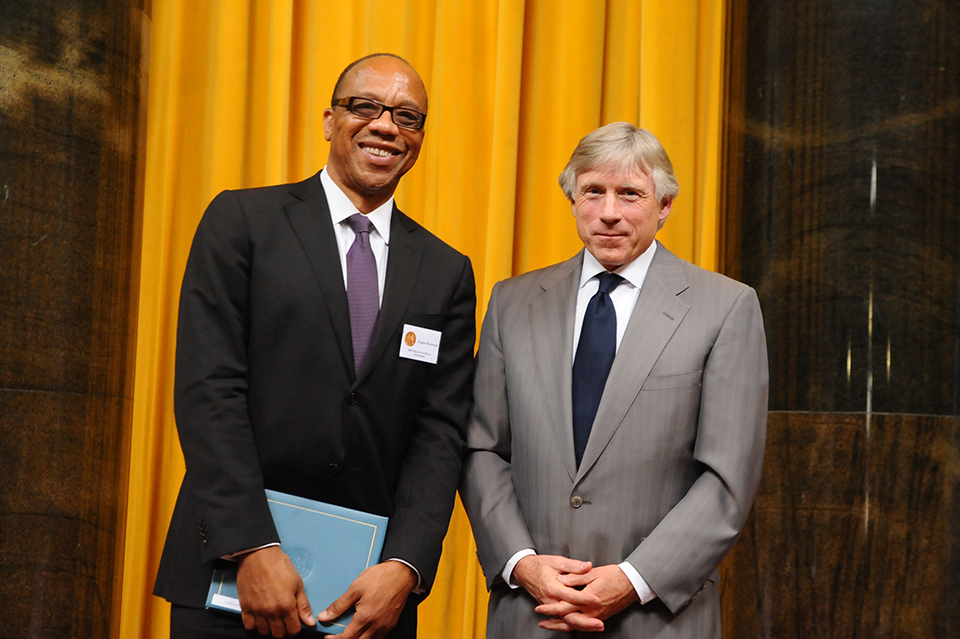
Lee C. Bollinger, President of Columbia University (right), presents the 2009 Commentary prize to Eugene Robinson of The Washington Post.
Winning Work
By Eugene Robinson
It was one of those moments that give you goose bumps -- the cheering crowd, the waving placards, the candidate and his family looking Kennedyesque on the occasion of a stunning victory. Barack Obama took the stage Thursday night in Des Moines and proclaimed his vindication of hope: "They said this day would never come. They said our sights were set too high."
Anyone watching could take away but one message: That was then; this is now.
Yet there he was, the son of a Kenyan father and a Kansan mother, a man with brown skin, kinky hair and utter command of what he called a "defining moment in history."
Those of us who have struggled to get our minds around the notion that a man who looks like Barack Obama could be the next president of the United States can no longer take easy refuge in the disappointments of history. Obama may not be elected president; he may not even get the Democratic nomination. But at this point, it's impossible to deny that what we are witnessing is something new.
The Iowa caucuses showed us the America we like to believe we live in, a country ready to embrace a man with brown skin as its leader. Is this really a land of such racial harmony and understanding? No, it's not. "We are one nation, we are one people, and our time for change has come," Obama said in his soaring victory speech. But sometimes we see things so differently that it's a wonder we agree on the blueness of the sky.
I spent Thursday evening doing television commentary on the caucus results. During a break, one of my fellow pundits -- Air America radio host Rachel Maddow, who happens to be white -- mused that white Iowans who harbored racist views might be unwilling to put them on display in the caucuses, where participants have to take a public stand. Voters in a secret-ballot primary would have no reason to be so inhibited, she speculated.
But earlier in the day, in an Internet discussion group that I host, a woman identifying herself as African American had written about her concern that the public nature of the Iowa process would sink Obama's chances. White voters, she feared, might be reluctant to reveal to their neighbors that they supported a black man with a Muslim-sounding name -- even if, the writer implied, they might have been willing to vote for him in a secret ballot.
So no, we're not always on the same page. But so what if the America we saw Thursday night is the America we'd like to imagine rather than the one we inhabit? Isn't an America that at least aspires to transcend racism better than one that doesn't?
On black-oriented radio shows Friday, the airwaves crackled with possibility. On his afternoon drive-time show, popular host Michael Baisden asked listeners if they supported Obama because of his race. Most callers said their support was conditioned on his positions on the issues, which shouldn't be surprising; African American voters have never hesitated to reject black candidates -- Republicans, for example -- whose views they do not share. But it was impossible to miss the pride in the callers' voices.
The change that Obama represents is largely generational, and this fact was evident throughout the Iowa campaign. Obama's army of young volunteers used the tools and skills of the Information Age to master the arcane caucus process. The Obama campaign offered a simple, consistent message. By contrast, Hillary Clinton's constantly shifting wardrobe of slogans and John Edwards's class-conscious rhetoric seemed dated.
You could see the contrast as the candidates spoke Thursday night. Clinton was flanked by her husband, Bill, and former secretary of state Madeleine Albright. Obama was surrounded by young faces. Anyone watching could take away but one message: That was then; this is now.
I've never thought the question of whether this country was "ready" for a black president or a female president made any sense. Breakthroughs always depend on the right person and the right moment, and "firsts" never happen -- by definition -- until they happen. All we can know at this point is that as far as Iowa Democrats are concerned, the time is now and the man is Obama. Voters in New Hampshire, South Carolina and other states may disagree.
Nor do I believe that a society magically reaches a point of colorblindness. Diversity is more of a journey than a destination, and we have to keep moving forward.
We do make progress, though. I don't know whether Obama is right that this is a "defining moment." But yes, I do believe a page has been turned.
© 2008, The Washington Post Company
By Eugene Robinson
Six months ago, Bill Clinton seemed to be settling comfortably into roles befitting a silver-maned former president: statesman, philanthropist, philosopher-king. Now he has put all that high-mindedness on hold -- maybe it was never such a great fit, after all -- to co-star in his wife Hillary's campaign as a coldblooded political hit man.
No, scratch the "coldblooded" part. At times, in his attempt to cut Barack Obama down to size, Bill Clinton has been red-faced with anger; his rhetoric about voter suppression and a great big "fairy tale" has been way over the top. This doesn't look and sound like mere politics. It seems awfully personal.
Obama's candidacy not only threatens to obliterate the dream of a Clinton Restoration. It also fundamentally calls into question Bill Clinton's legacy by making it seem . . . not really such a big deal.
That, I believe, is the unforgivable insult. The Clintons picked up on this slight well before Obama made it explicit with his observation that Ronald Reagan had "changed the trajectory of America in a way that Richard Nixon did not and in a way that Bill Clinton did not."
Let's take a moment to consider that remark. Whether it was advisable for Obama to play the role of presidential historian in the midst of a no-holds-barred contest for the Democratic nomination, it's hard to argue with what he said. I think Bill Clinton was a good president, at times very good. And I wouldn't have voted for Reagan if you'd held a gun to my head. But even I have to recognize that Reagan -- like Margaret Thatcher in Britain and Mikhail Gorbachev in the Soviet Union -- was a transformational figure, for better or worse.
Bill Clinton's brilliance was in the way he surveyed the post-Reagan landscape and figured out how to redefine and reposition the Democratic Party so that it became viable again. All the Democratic candidates who are running this year, including Obama, owe him their gratitude.
But Obama has set his sights higher, and implicit in his campaign is a promise, or a threat, to eclipse Clinton's accomplishments. Obama doesn't just want to piece together a 50-plus-1 coalition; he wants to forge a new post-partisan consensus that includes "Obama Republicans" -- the equivalent of the Gipper's "Reagan Democrats." You can call that overly ambitious or even naive, but you can't call it timid. Or deferential.
Both Clintons have trouble hiding their annoyance at Obama's impertinence. Bill, especially, gives the impression that Obama has gotten under his skin. His frequent allegations of media bias in Obama's favor recall the everybody-against-us feeling of the impeachment drama, when the meaning of the word "is" had to be carefully parsed and the Clinton White House was under siege.
Obama hit back in an interview that aired Monday on "Good Morning America," saying the former president "has taken his advocacy on behalf of his wife to a level that I think is pretty troubling" and promising to "directly confront Bill Clinton when he's making statements that are not factually accurate."
For Obama, it's clearly an added burden to have to fight two Clintons instead of one. But at the same time, there may be benefits in having Bill Clinton take such a high-profile role in his wife's campaign that the missteps and disappointments of the Clinton years are inevitably recalled along with the successes. Whatever the net impact, there appears to be no plan for Bill Clinton to tone it down -- not with the nomination still in doubt. The Clintons don't much like losing.
So forget about the Bill Clinton we've known for the past eight years -- the one who finds friendship and common ground with fellow former president George H.W. Bush (a Republican, last I heard), who dedicates most of his time and energy to the William J. Clinton Foundation and the Clinton Global Initiative, who speaks eloquently about global citizenship, environmental stewardship and economic empowerment. Forget about the statesman who uses appropriately measured language when talking about transient political events, focusing instead on the broad sweep of human history. Forget about the apostle of brotherhood and understanding whose most recent book is titled, simply, "Giving." That Bill Clinton has left the building.
There's a battle to be fought against an upstart challenger who has the audacity to suggest that maybe the Clinton presidency, successful as it was in many ways, didn't change the world -- and that he, given the office, could do better. Some things, I guess, just can't be allowed. Bill Clinton obviously has decided that history can wait.
© 2008, The Washington Post Company
By Eugene Robinson
Playing the race card against Barack Obama didn't work out quite the way Bill Clinton had hoped. Neither did a reported last-minute personal appeal to keep Ted Kennedy, venerable guardian of the Camelot flame, from joining the Obama crusade. The question now is whether the Clintons understand how the country they seek to lead -- and, regrettably, I do mean "they" -- has changed.
I wonder how all the Clintonistas who protested that Bill and Hillary would never, ever dream of stooping to racial politics must be feeling now, after Bill was videotaped in the act. On Saturday, as Democrats in South Carolina went to the polls, a reporter asked Bill about Obama's boast that it took two Clintons to try to beat him. Bill replied: "Jesse Jackson won South Carolina in '84 and '88. Jackson ran a good campaign. And Obama ran a good campaign here."
But if you look more closely, Clinton and Obama were practically tied among white men, 28 percent to 27 percent. Clinton's advantage among whites came from women.
Now, the question had nothing to do with Jesse Jackson. So why do you suppose such an expert on American politics as Bill Clinton, with no prompting, would bring up contests that took place decades ago -- back when South Carolina picked its convention delegates in caucuses, not primaries? John Edwards's victory four years ago, in a primary, would have been much more relevant; he ran a good campaign, too.
The only possible reason for invoking Jackson's name was to telegraph the following message: Barack Obama is black, so if a lot of black people decide to vote for him -- doubtless out of racial solidarity -- it doesn't really mean squat.
And the reasons to send that message would be to devalue an Obama victory in South Carolina; to inoculate the Clinton campaign against potential losses next Tuesday in Georgia, Alabama and Tennessee -- Southern states with large African American populations; and, most important, to pigeonhole Obama as "a black candidate" as opposed to a candidate who, among other characteristics, is black.
That would help Hillary Clinton in other states, because the more prominent race becomes in this campaign, the more likely it is that she will win the nomination. They don't call us a "minority" for nothing.
But a funny thing happened in South Carolina. Clinton didn't lose by 10 or 12 points, as most polls had predicted; it was a 28-point blowout, with Obama more than doubling her vote. Yes, he took 78 percent of the black vote, according to exit polling, and she beat him among white voters, 36 percent to 24 percent. But if you look more closely, Clinton and Obama were practically tied among white men, 28 percent to 27 percent. Clinton's advantage among whites came from women.
If Obama wanted to take a page from the "identity politics" playbook of the 1990s, he could try to hang the "female candidate" label around Clinton's neck.
He won't, though, because the Obama campaign is well aware that identity politics is a fatal trap. In his victory speech Saturday night, Obama went back to his focus on tearing down barriers rather than reinforcing them. On his way to the rhetorical mountaintop, however, he paused to note that the "status quo is fighting back with everything it's got; with the same old tactics that divide and distract us from solving the problems people face."
Oh, and he threw in a line about people who would "say anything and do anything to win an election." No, he didn't mention the Clintons by name.
It pains me to refer to the Clintons in the plural, since Hillary's campaign is indeed a milestone. But after South Carolina, it's hard to claim that this candidacy is entirely about her. At the very least, it's about them-- and if you listen to Bill's speeches, you get the distinct impression that he thinks it's all about him. Does anyone believe his sense of entitlement will somehow dissipate if the Clintons move back into the White House?
The Clintons are a remarkably successful political partnership, and Hillary Clinton still has to be considered the favorite to win the Democratic nomination. Yet they can't have anticipated that Kennedy would defect, or that other Democratic Party grandees would complain so loudly about their tactics -- or that Nobel laureate Toni Morrison, who called Bill the "first black president," would endorse Obama.
The Clintons are running the kind of campaign they know how to run. But there are signs that the country has changed -- that it's less concerned about identity than character, more interested in commonality than difference, hungrier for inspiration than triangulation.
If, as Obama said Saturday night, "this election is about the past versus the future," the Clintons are in for more rude surprises.
© 2008, The Washington Post Company
By Eugene Robinson
Humor me while we conduct a little thought experiment. Imagine that Barack Obama had lost 10 contests in a row. Imagine that he now trailed Hillary Clinton substantially in the number of Democratic primaries and caucuses won, in total votes cast, in pledged convention delegates, in the overall delegate count, in fundraising and in the ineffable attribute called mojo. Imagine that Obama was struggling, at this late hour, to come up with the right message. What would the conventional wisdom say?
That it was over, of course. That Obama was toast. That staking everything on the March 4 primaries in Ohio and Texas was a starry-eyed hope, not a plan, and that it was time to smell the coffee.
Whenever Obama faced reporters, he'd have to answer tough questions. Why was he carrying on, knowing that he'd have to win by unrealistically large margins in all the remaining states to catch up? Didn't it worry him that relying on the superdelegates -- the Democratic establishment, basically -- to hand him the nomination could divide and weaken the party? Wasn't he concerned that Republican John McCain has such a head start in unifying his party and plotting his general election campaign?
The above, you will have noticed, is an accurate description of where Clinton stands right now. Yet nobody is forcing her to respond publicly to those painful questions. The reason is obvious: She's Hillary Clinton, and history suggests it's foolish to count out a Clinton until the last dog dies.
But history can be a deceptive guide -- and the Clinton campaign's failure to recognize that fact may be what finally dooms her candidacy.
From Obama's solid victory in the Iowa caucuses through his blowout victories in Wisconsin and Hawaii, the Clinton campaign has never acted as if its brain trust seriously entertained the notion that she could actually lose. The Clintons and their advisers knew, better than any other Democrats, how to win the presidency: Just consult the history books.
"Listen, Hillary is going to be the nominee," campaign Chairman Terry McAuliffe told reporters the day after Iowa, as if the result there were just a clerical error.
By the time the campaign realized that Obama was more than a nuisance, he had become a nemesis. When Obama began mesmerizing voters with his simple but powerful message -- change, hope, empowerment -- Clinton's pollster-guru, Mark Penn, responded with slogan after slogan that sought to marry the words "change" or "hope" with Clinton's basic theme of "experience." Slogans had always worked in the past; surely they would work again.
Sigh. To this day, I'm not sure the Clinton campaign understands that no focus-group-tested slogan is going to have the elemental resonance of "Yes, we can" (Obama's homage to César Chávez) or "Change the world." Hasn't anybody on the Clinton team ever read Joseph Campbell on the power of mythic narrative? And while we're on the subject of message, what genius decided it was a great idea to demonize hope?
Some missteps would have been hard to foresee -- chief among them the decision to deploy Bill Clinton, whose ham-fisted intervention in South Carolina is seen by some campaign insiders as the beginning of the end, or at least the end of the beginning.
But it's stunning that the battle-tested Clinton machine allowed itself to be outsmarted and outhustled at the arcane science of winning delegates in caucuses. And it's even more surprising that the campaign has been so careless with its money that it now is resigned to being outspent anywhere and everywhere.
Most striking of all, to me, is that the campaign still can't settle on what kind of candidate Hillary Clinton should be. Does she now have to go negative, or should she try to hitchhike on the hope express? Does she project steely resolve or reveal human vulnerability? The campaign wants to convince voters that they don't know who Obama really is -- yet also insists on fitting Clinton with a new persona every week.
Meanwhile, just about every analyst who has done the math predicts that unless Obama makes some huge blunder, it's highly unlikely that Clinton can catch up in pledged delegates. It is also unlikely that the superdelegates will dare to overturn the verdict of the primaries and caucuses.
Yes, we're dealing with Hillary Clinton, whose picture ought to be in the dictionary beside the word resilient. But after losing 10 in a row, she can't avoid facing -- and we can no longer avoid asking -- those unwelcome questions about whether she does her party more harm than good if she stays in the race until the convention.
© 2008, The Washington Post Company
By Eugene Robinson
If Fox viewers are being invited to entertain the notion of a Black Genius Camp where young Afro-brainiacs are busy plotting world domination, something has changed.
How weird is this presidential election? So weird that I'm about to give a nod of appreciation (of sorts) to Geraldo Rivera, of all people -- and also to, gulp, Fox News.
On "Fox and Friends" last week, the mustachioed infotainer gave his take on Barack Obama's borrowing of his campaign chairman's words: "When I saw that they were the same words that Deval Patrick, the black guy who won as Massachusetts mayor -- as Massachusetts governor -- had used, I said to myself, it seems so premeditated. It's almost as if they went to a camp where these black geniuses got together and figured out how to beat the political system. . . . What's the other formula that they're going to use?"
Ridiculous? Of course -- this is Geraldo, remember. But it's absurd in a way that's new and refreshing. If Fox viewers are being invited to entertain the notion of a Black Genius Camp where young Afro-brainiacs are busy plotting world domination, something has changed.
Whether Obama wins or loses, his campaign has made it impossible for anyone so inclined to cling to certain racist assumptions -- just as Hillary Clinton has blown some old sexist assumptions to smithereens.
In this day and age, no one can claim to be surprised at encountering an African American man of superior intellect. But whether or not you think Obama would be a good president, his campaign brings the often-overlooked reality of mainstream black America into the nation's living rooms every day -- and into the nation's subconscious.
We in the media spend a lot of time and energy covering African American dysfunction, with good reason. Far too many young black men are in prison (although Obama is wrong when he says more are in jail than college). Far too many young black women are single mothers. Far too many black communities are marred by drugs, crime and mindless violence.
But that's just part of the story. Since the great civil rights victories of the 1960s, a huge mainstream African American middle class has risen via the traditional path of hard work and education. This successful black America gets very little coverage, for the obvious reason that good news isn't really news in the traditional sense. The headline "Family Celebrates Daughter's Graduation From Princeton" did not greet Michelle Obama when she received her degree.
The Obamas are the real-life version of our first great illustration of black success: "The Cosby Show." That family, too, was a picture of upper-middle-class rectitude, ambition and achievement. The fictional Huxtables, however, lived in an almost exclusively African American world. The school that both Cliff and Clair attended, and to which they sent their daughter Denise, was the historically black Hillman College. The school that Barack and Michelle Obama have in common is Harvard Law.
The Obama campaign hasn't had success just on black America's terms but on white America's terms. For all the impact of Barack Obama's soaring rhetoric, he wouldn't be where he is without a campaign organization that is second to none. He's the one with more money and more offices. He's the one who made the better decisions about where to spend resources. Obama has won overwhelming support from black voters, but there's nothing stereotypically "black" about his campaign. It's as if a black American is beating white America at its own game.
So when Clinton made an issue of how a passage from a Deval Patrick speech found its way into a Barack Obama speech, Geraldo Rivera imagined some sort of secret conclave of black geniuses who had developed a foolproof formula for winning elections. He didn't envision a basketball camp, or a prison camp; he saw a genius camp, presumably for African Americans who had figured out just how white America works and just what buttons to push. How diabolically clever.
Hey, if I'm trying to catch a taxi late at night, I'd rather have the cab driver wondering if I'm secretly plotting world domination than thinking I'm about to mug him.
Who else attended Black Genius Camp? Will Smith must have spent at least one summer there -- he's the most bankable star in Hollywood right now. And Tiger Woods, who has conquered our whitest sport. Condoleezza Rice enjoys sitting around the campfire, entertaining everyone with corny knock-knock jokes in Russian. And Oprah's a regular, of course; she even has her own "cabin," although it looks more like a luxury hotel.
Oops -- I think I've said too much. Forget I mentioned it. And pay no attention to Geraldo's paranoid fantasies.
By Eugene Robinson
Forty years after the Rev. Martin Luther King Jr. was killed, we sometimes talk about race in America as if nothing has changed. The truth is that everything has changed -- mostly for the better -- and that if we're ever going to see King's dream fulfilled, first we have to acknowledge that this is not an America he would have recognized.
On April 4, 1968, it was possible to make the generalization that being black in this country meant being poor; fully 40 percent of black Americans lived below the poverty line, according to census data, with another 20 percent barely keeping their heads above water. African Americans were heavily concentrated in the inner cities and the rural South. We were far less likely than whites to go to college, and our presence in the corporate world was minimal.
Today, about 25 percent of African Americans are mired in poverty. In many ways, being black and poor is a more desperate and hopeless condition now than it was 40 years ago. For those who managed to enter the middle class, however, most of the old generalizations no longer apply.
There remains a significant income gap between whites and blacks in this country, although it shrinks when educational level is factored in. But the gap in wealth, or net worth, is huge, even when you control for education, age, family size and whatever else you want to throw in. Still, African Americans control an estimated $800 billion in purchasing power. If that were translated into gross domestic product, a sovereign "Black America" would be the 15th- or 16th-richest nation on earth.
Forty years ago, not even 2 percent of black households earned the equivalent of $100,000 a year in today's dollars. Now, about 10 percent of black households have crossed that threshold. George and Louise Jefferson aren't so lonely anymore in that "deluxe apartment in the sky."
Then again, if "The Jeffersons" were being produced today, George and Louise probably wouldn't live in an apartment at all. More realistically, they'd be on a cul-de-sac in a suburban community. In Washington and a growing number of cities, more African Americans now live in the suburbs than within the city limits.
In a sense, then, the most striking measure of how far African Americans have come since 1968 isn't the rise of Barack Obama. It's the story of Stanley O'Neal.
That's not to minimize the prospect that a nation midwifed by slavery could soon have its first black president. But O'Neal did something that would have been equally unimaginable 40 years ago. He rose to become chief executive of Merrill Lynch, one of Wall Street's biggest firms; by all accounts, he was a taskmaster of a boss who cared less about whether subordinates liked him than he did about the bottom line. He placed big bets on mortgage-backed securities, generating record profits for the firm. When he got caught in the mortgage crisis several months ago and was forced to write off billions in losses, he resigned -- and floated back to earth with the help of one of the loveliest golden parachutes Wall Street has seen.
Oh, and his grandfather was born a slave.
Lacking family wealth accumulated by prior generations, middle-class black Americans are right to worry that their economic success is more precarious than that of many whites. But no one can deny that most African Americans today have opportunities that weren't remotely possible 40 years ago.
For those who haven't made it into the middle class, however, things are different. Inner-city communities were hollowed out -- a process accelerated by the riots that followed King's death -- and left fallow for decades. Middle-class professionals fled, businesses closed, schools disintegrated, family structures fell apart. Drugs and crime were symptoms of the general rot; the gentrification of recent years has just shifted the pathology from one part of the city to another, or perhaps to a close-in suburb, sweeping it into a corner.
The African American poor are a smaller segment than they were 40 years ago, but arguably they are further from full participation in society than they were in King's era. It's not that they have no interest in climbing the ladder, it's that too many rungs are missing.
It's misleading, then, to make any general statement about the condition of black Americans without recognizing black America's diversity. Economically speaking, there is one group of black Americans that has achieved success and one that hasn't -- and the distance between those groups is growing. To make more progress toward Martin Luther King's dream, we have to make an honest assessment of how far we've come -- and honestly account for who's been left behind.
By Eugene Robinson
There will be plenty of time to chart Barack Obama's attempt to navigate a course between the exigencies of the old politics and the promise of the new, between yesterday and tomorrow, youth and experience, black and white. For now, take a moment to consider the mind-bending improbability of what just happened.
A young, black, first-term senator -- a man whose father was from Kenya, whose mother was from Kansas and whose name sounds as if it might have come from the roster of Guantanamo detainees -- has won a marathon of primaries and caucuses to become the presumptive presidential nominee of the Democratic Party. To reach this point, he had to do more than outduel the party's most powerful and resourceful political machine. He also had to defy, and ultimately defeat, 389 years of history.
It was in 1619 that the first Africans were brought in chains to these shores, landing in Jamestown. That first shipment of "servants" did not include any of Obama's ancestors; it's impossible to say whether some distant progenitor of his wife, Michelle, might have been present at that moment of original sin. Ever since -- through the War of Independence, the abolitionist movement, the Civil War, Reconstruction, Jim Crow, the great migration to Northern cities and the civil rights struggle -- race has been one of the great themes running through our nation's history.
I'm old enough to remember when Americans with skin the color of mine and Obama's had to fight -- and die -- for the right to participate as equals in the life of the nation we helped build. Watching Obama give his speech Tuesday night marking the end of the primary season and the beginning of the general election campaign, I thought back to a time when brave men and women, both black and white, put their lives on the line to ensure that African Americans had the right to vote, let alone run for office -- a time when Democrats in my home state of South Carolina were Dixiecrats, and when the notion that the Democratic Party would someday nominate a black man for president was utterly unimaginable.
Tiresome, isn't it? All this recounting of unpleasant history, I mean. Wouldn't it be great if we could all just move on? Bear with me, though, because this is how we get to the point where, as Obama's young supporters like to chant, "race doesn't matter." No one will be happier than I when we reach that promised land, and we've come so far that at times we can see it, just over the next hill. But we aren't there yet.
This is a passage from an e-mail I received in April from an Obama volunteer in Pennsylvania: "We've been called 'N-lovers,' Obama's been called the 'Anti-Christ,' our signs have been burned in the streets during a parade, our volunteers have been harassed physically, or with racial slurs -- it's been unreal."
Yet the amazing thing isn't that there were instances of overt, old-style racism during this campaign, it's that there were so few. The amazing thing is that so many Americans have been willing to accept -- or, indeed, reject -- Obama based on his qualifications and his ideas, not on his race. I'll never forget visiting Iowa in December and witnessing all-white crowds file into high school gymnasiums to take the measure of a black man -- and, ultimately, decide that he was someone who expressed their hopes and dreams.
When historians and political scientists write books about this extraordinary campaign season, surely they will seek to assess what impact Obama's race had on his prospects. But they will also devote volumes to exploring how he put together a fundraising apparatus that generated undreamed-of amounts of cash, and how his organization drew so many new voters into the process, and how his young supporters made use of social-networking Web sites such as Facebook and MySpace, and how his delegate-counting team managed to consistently outthink and outhustle everyone else. It will be written that Obama's nomination victory owes as much to adroit management as it does to stirring inspiration.
Will Americans take the final step and elect Obama as president? Should they? Is this first-term senator up to the job?
We'll find out soon enough. At the moment, to tell the truth, I don't care. Whether Obama wins or loses, history has been made this year. Maybe there's more to come, maybe not; but already -- after 389 long years -- it's safe to say that this nation will never be the same.
© 2008, The Washington Post
By Eugene Robinson
Anyone who took U.S. history in high school ought to know that one of the five men killed in the Boston Massacre, the atrocity that helped ignite the American Revolution, was a runaway slave named Crispus Attucks. The question the history books rarely consider is: Why?
Think about it for a moment. For well over a century, British colonists in North America had practiced a particularly cruel brand of slavery, a system of bondage intended not just to exploit the labor of Africans but to crush their spirit as well. Backs were whipped and broken, families systematically separated, traditions erased, ancient languages silenced. Yet a black man -- to many, nothing more than a piece of property -- chose to stand and die with the patriots of Boston.
Now think about the Buffalo Soldiers and the Tuskegee Airmen. Think about Dorie Miller, who, like so many black sailors in the segregated U.S. Navy of the 1940s, was relegated to kitchen duty -- until Pearl Harbor, when Miller rushed up to the deck of the sinking USS West Virginia, carried wounded sailors to safety and then raked Japanese planes with fire from a heavy machine gun until he ran out of ammunition.
Think about Colin Powell -- but also think about the Rev. Jeremiah Wright, a former Marine. And consider, as we celebrate Independence Day, how steadfast and complicated black patriotism has always been.
The subject is particularly relevant now that the first African American with a realistic chance of becoming president, Barack Obama, has felt compelled to give a lengthy speech explaining his own patriotism. It is not common, in my experience, for sitting U.S. senators to be questioned on their love of country -- to be grilled about a flag pin, for example, or critiqued on the posture they assume when the national anthem is played. For an American who attains such high office, patriotism is generally assumed.
It seems that some people don't want to give Obama the benefit of that assumption, however, and I have to wonder whether that's because he's black. And then I have to wonder why.
The fact that African American patriotism is never simple doesn't mean it's in any way halfhearted; to the contrary, complicated relationships tend to be the deepest and strongest. It's a historical fact that black soldiers and sailors who fought overseas in World War II came home to Southern cities where they had to ride in the back of the bus -- and that they were angry that the nation for which they had sacrificed would treat them this way. To some whites, I guess, it may seem logical to be suspicious of black patriotism -- to believe that anger must somehow temper love of country.
It doesn't, of course. It never has. Black Americans are just more intimately and acutely aware of some of our nation's flaws than many white Americans might be. This generalization is less true of my sons than of my parents, and I hope that someday it won't be true at all. But only in the past half-century has the United States begun to fully extend the rights of citizenship to African Americans -- and only in the past year has the idea that a black man might actually be elected president been more than a plot device for movies and television shows. We're someplace we've never been.
Michelle Obama was sharply attacked for saying that she felt proud of her country for the first time in her adult life. Her phrasing may have been impolitic, but I know exactly what she meant.
This isn't about whether or not Barack Obama wins. Just the fact that he might win is an incredible change for this country -- and recognizing the importance of that change is, to me, the very essence of patriotism.
What's unpatriotic is pretending that the past never happened. What's unpatriotic is failing to acknowledge that we've struggled with race for nearly 400 years. What's unpatriotic is relegating "black history" to the month of February when, really, it's American history, without which this nation could never be what it is today.
My father, Harold I. Robinson, served in the Army during World War II and has lived to witness this transformative moment of possibility. My father-in-law, the late Edward R. Collins, was a sailor who saw action in the South Pacific; he rests at Arlington National Cemetery. I have no patience with anyone who thinks that patriots don't have brown skin.
© 2008, The Washington Post Company
By Eugene Robinson
In a week and a half, it'll be over. What will we do to fill the void in our lives?
Opinion surveys, voter registration totals and cable television ratings indicate that Americans have been engrossed by the marathon presidential campaign. That's no surprise, given the first-in-history nature of the candidacies, the host of crucial problems we face and the sense that the outcome may determine the course -- and the prospects -- of our nation for many years to come.
But there's a fine line between being engrossed and being obsessed, and many of us have crossed it.
Last week in Los Angeles, I met a lawyer who said her husband has had to set strict limits on the amount of time she spends each day watching cable news and checking the latest tracking polls on the Internet. She said she welcomed the intervention. She has a 16-month-old son, and every day she takes a break from the exhausting task of chasing a toddler around the house. But instead of using that personal time to put her feet up or take a nap, she found herself sitting at the computer comparing Gallup's daily tracking poll with Rasmussen's.
In Indiana, I met a college professor whose detailed familiarity with every nook and cranny of the Pollster.com Web site was a little frightening. In the course of our conversation, I mentioned another site that aggregates poll data -- RealClearPolitics.com -- and when I saw her make a mental note I immediately regretted the indiscretion. I had inadvertently sentenced her to even more hours of obsessive behavior.
People who strike up conversations with me in airports or on the street almost always go much deeper than the general question of whether Barack Obama or John McCain will -- or should -- prevail on Nov. 4. They ask whether Virginia has now gone "solid" for Obama or is still just "leaning" that way, whether Missouri's status as a bellwether is a significant fact or a statistical accident, whether the so-called Bradley effect is real, and whether the trend toward early voting is likely to favor Democrats or Republicans.
I get paid to obsess about the election, but these are civilians I'm talking about. Sometimes I think I'm hearing a cry for help.
It feels as if we've been making our way through some great epic novel, by Tolstoy, perhaps, or Thomas Pynchon -- a book peopled by indelible characters who act against the backdrop of sweeping events. Just think back to where we started. On New Year's Day, the conventional wisdom was that the general election would be an Empire State contest between Hillary Clinton and Rudy Giuliani.
So much for the conventionally wise. The Iowa caucuses were the equivalent of the famous opening line of "Gravity's Rainbow," Pynchon's masterpiece: "A screaming comes across the sky."
In the course of the long narrative, some characters emerged from nowhere -- Joe the Plumber, for example -- had a dramatic impact, and then disappeared -- Jeremiah Wright, for example. Others went away but returned unexpectedly, such as Giuliani, who came back to lead Republican convention delegates in the unforgettable chant "Drill, baby, drill." Or John Edwards, who dropped out of the race but later resurfaced at a Beverly Hills hotel, hiding from National Enquirer reporters chasing a tip that he was visiting his mistress.
As for plot twists, I can think of few in literature that compare with the sudden emergence of Sarah Palin. If you look closely at the video clip of her appearance on "Saturday Night Live," when she's in the hallway talking to Alec Baldwin and SNL honcho Lorne Michaels, a man dressed like Abraham Lincoln is in the background with what appears to be a llama. That's the kind of year it's been.
We're now at a bittersweet point that's analogous to reaching the middle of the final chapter. We want to race ahead and find out what happens. We want to know if our hero -- Obama or McCain -- is victorious. But we also know that when we finally get the answer, we'll have to exit the alternative reality of narrative, atmosphere and emotion that we've inhabited for months. We'll be bereft.
We'll have something to savor, though. After Election Day has come and gone, we -- at least those of us who bother to vote -- will know that the time we spent obsessing about the campaign was worth it. That's because we'll be the ones who decided how the story ended.
© 2008, The Washington Post Company
By Eugene Robinson
I almost lost it Tuesday night when television cameras found the Rev. Jesse Jackson in the crowd at Chicago's Grant Park and I saw the tears streaming down his face. His brio and bluster were gone, replaced by what looked like awestruck humility and unrestrained joy. I remembered how young he was in 1968 when he stood on the balcony of the Lorraine Motel with the Rev. Martin Luther King Jr., moments before King was assassinated and hours before America's cities were set on fire.
I almost lost it again when I spoke with Rep. John Lewis (D-Ga.), one of the bravest leaders of the civil rights crusade, and asked whether he had ever dreamed he would live to see this day. As Lewis looked for words beyond "unimaginable," I thought of the beating he received on the Edmund Pettus Bridge and the scars his body still bears.
I did lose it, minutes before the television networks projected that Barack Obama would be the 44th president of the United States, when I called my parents in Orangeburg, S.C. I thought of the sacrifices they made and the struggles they endured so that my generation could climb higher. I felt so happy that they were here to savor this incredible moment.
I scraped myself back together, but then almost lost it again when I saw Obama standing there on the stage with his family -- wife Michelle, daughters Malia and Sasha, their outfits all color-coordinated in red and black. I thought of the mind-blowing imagery we will see when this young, beautiful black family becomes the nation's First Family.
Then, when Michelle's mother, brother and extended family came out, I thought about "the black family" as an institution -- how troubled it is, but also how resilient and how vital. And I found myself getting misty-eyed again when Barack and Michelle walked off the stage together, clinging to one another, partners about to embark on an adventure, full of possibility and peril, that will change this nation forever.
It's safe to say that I've never had such a deeply emotional reaction to a presidential election. I've found it hard to describe, though, just what it is that I'm feeling so strongly.
It's obvious that the power of this moment isn't something that only African Americans feel. When President Bush spoke about the election yesterday, he mentioned the important message that Americans will send to the world, and to themselves, when the Obama family moves into the White House.
For African Americans, though, this is personal.
I can't help but experience Obama's election as a gesture of recognition and acceptance -- which is patently absurd, if you think about it. The labor of black people made this great nation possible. Black people planted and tended the tobacco, indigo and cotton on which America's first great fortunes were built. Black people fought and died in every one of the nation's wars. Black people fought and died to secure our fundamental rights under the Constitution. We don't have to ask for anything from anybody.
Yet something changed on Tuesday when Americans -- white, black, Latino, Asian -- entrusted a black man with the power and responsibility of the presidency. I always meant it when I said the Pledge of Allegiance in school. I always meant it when I sang the national anthem at ball games and shot off fireworks on the Fourth of July. But now there's more meaning in my expressions of patriotism, because there's more meaning in the stirring ideals that the pledge and the anthem and the fireworks represent.
It's not that I would have felt less love of country if voters had chosen John McCain. And this reaction I'm trying to describe isn't really about Obama's policies. I'll disagree with some of his decisions, I'll consider some of his public statements mere double talk and I'll criticize his questionable appointments. My job will be to hold him accountable, just like any president, and I intend to do my job.
For me, the emotion of this moment has less to do with Obama than with the nation. Now I know how some people must have felt when they heard Ronald Reagan say "it's morning again in America." The new sunshine feels warm on my face.
© 2008, The Washington Post Company
Biography
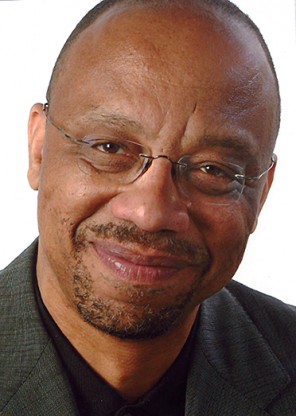
Eugene Robinson is an Associate Editor and twice-weekly columnist for The Washington Post. His column appears on Tuesdays and Fridays.
In a 25-year career at The Post, Robinson has been city hall reporter, city editor, foreign correspondent in Buenos Aires and London, foreign editor, and assistant managing editor in charge of the paper’s award-winning Style section. In 2005, he started writing a column for the Op-Ed page. He is the author of "Coal to Cream: A Black Man’s Journey Beyond Color to an Affirmation of Race" (1999) and "Last Dance in Havana" (2004).
Robinson is a member of the National Association of Black Journalists and has received numerous journalism awards.