The Sacramento Bee, by Tom Philp
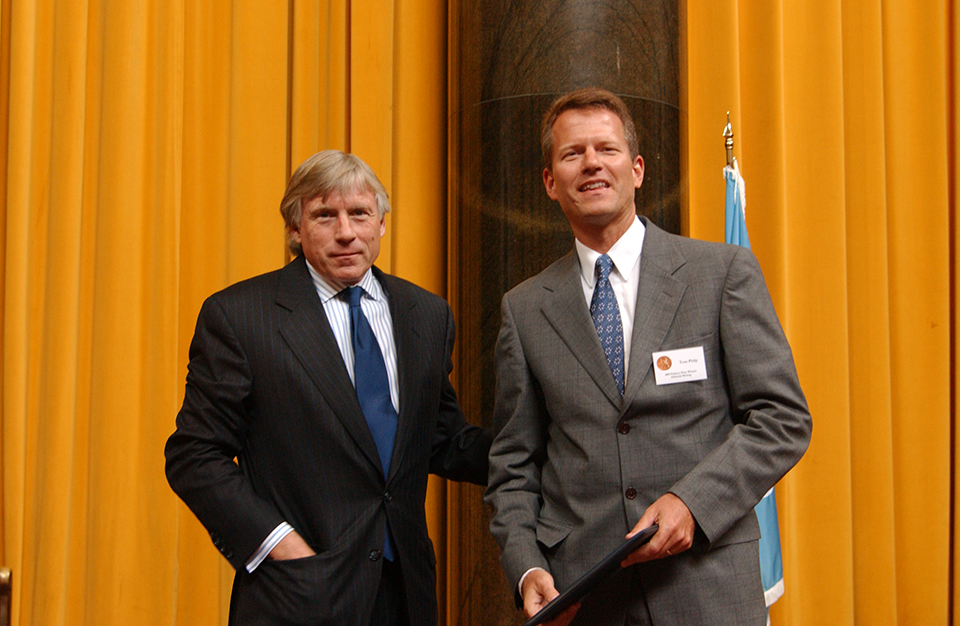
Columbia University President Lee C. Bollinger (left) presents Tom Philp with the 2005 Pulitzer Prize in Editorial Writing.
Winning Work
By Tom Philp
Here's the best-kept secret of Yosemite Valley: It has a twin.
This little brother, as the late naturalist John Muir called it, has a thundering waterfall named Wapama, a feathery cascade named Tueeulala and a towering peak called Kolana. Below Kolana, a valley snakes between granite walls for eight miles to reach a staircase of rock known as the Grand Canyon of the Tuolumne.
Yosemite's little brother has a name. It is called Hetch Hetchy, derived from the Indian name for its native meadow grasses. But despite its grandeur and its presence in a park that is a national treasure, few people know Hetch Hetchy exists and few visit it.
There is a reason for this remarkable obscurity. Hetch Hetchy is underwater.
A river could be allowed to run free through a glacial valley, just as it did before Congress locked it away nine decades ago.
Since 1923, a dam that supplies water to the San Francisco Bay Area has submerged the valley's roughly three square miles. An act of Congress in 1913 gave San Francisco control of the valley, a precious resource that belonged to the entire nation.
No wonder, then, that Hetch Hetchy is today the least visited natural feature in the 1,189-square-mile Yosemite National Park. In one survey of Yosemite's popular sites, Hetch Hetchy finished last, below "other." No other national park has such a centerpiece jewel that is locked away from the public, both by the ranger's key at 9 p.m. every day and by 300 feet of sparkling, clear Sierra water.
Yosemite serves nearly 4 million visitors a year. Someday soon it will run out of room for the public. When that day comes, the choice will be stark: Ration the chance to experience the glories of the Yosemite Valley or create, literally, more valley.
Such an expansion is possible if an idea once considered fanciful, even quixotic, gains legitimacy: Drain Hetch Hetchy - an enlarged hole at the dam's base would do the job - and let nature begin to reclaim this spectacular setting.
That may sound simple, but it isn't. It would require some changes to the Bay Area's water system and a consensus among major holders of Tuolumne River water rights. But if the notion is complicated, it is not out of the realm of the possible and is well worth discussing. An upcoming replumbing of San Francisco's Hetch Hetchy system and a convincing restoration proposal generated by a new computer program at the University of California, Davis, make this an appropriate time for the conversation to begin.
Any debate about piercing the dam at Hetch Hetchy is sure to be heated. Debates about Hetch Hetchy always are.
The debate that led to the construction of the dam embroiled the U.S. Senate for a week. It ended near the stroke of midnight on Dec. 6, 1913, when senators weighed environmental and development values and made their decision. The vote was 43 to 25. The dam in Yosemite would be built. The Hetch Hetchy Valley would be inundated. And San Francisco would have the use of the water.
San Francisco first set its sights on this river for water in 1901. The city's leaders and residents would understandably be nervous and resistant to change today. Water and electricity are still precious commodities. Hetch Hetchy provides nearly 85 percent of the city's water and about a sixth of its electricity. It also supplies a large portion of the water for Alameda, Santa Clara and San Mateo counties.
So any debate over Hetch Hetchy today would involve more players than in 1913 and even more factors to consider, such as climate changes in the Sierra. But a debate today could lead to a new conclusion because the Tuolumne River watershed and the world have changed so much.
Ninety years ago, the senators' collective clairvoyance was spotty. They had no way to anticipate that in 1971 the New Don Pedro Dam, creating a reservoir more than five times the size of Hetch Hetchy's, would be built downstream. They had no way to know that an invention called the computer would reveal to UC Davis researchers that the big downstream dam could do the work that Hetch Hetchy does now. They had no way to know, in other words, that they were making a decision that might someday be undone.
By design, dams are meant to be solid and permanent. Perhaps that is why their engineering so often defines conventional wisdom and the universe of the possible. The structures are seen as unchangeable features of the landscape, by politicians, by engineers and even by newspapers. As recently as 1987, these pages pooh-poohed the idea of draining Hetch Hetchy.
But Hetch Hetchy today is truly an unusual case and Californians can dare to regard the dam in a new way. If they look carefully at water and electricity options, they may just find the dam more expendable than the lost valley below. It is possible to imagine a different future, one that restores the glories of Hetch Hetchy to the public while satisfying the legitimate municipal demands on this river.
As coming editorials will explain, San Francisco doesn't have to lose water for Hetch Hetchy to be reclaimed. But Hetch Hetchy's restoration will involve more than San Francisco's interests. It cannot occur as an isolated political act. There would have to be a water package to address the needs of every interest. The many public purposes of the Tuolumne River - its spectacular Yosemite watershed, the downstream water demands of San Francisco, electricity, Modesto flood control, Turlock agriculture - all are pieces of an intricate puzzle. The upcoming challenge is to fit them together - for the benefit of Californians and, where Yosemite National Park is concerned, for the benefit of all Americans.
In short, Californians don't have to be prisoners of a 90-year-old debate. Change is coming to the river. As part of that evolution, it is no longer unthinkable to imagine reuniting Yosemite's twin valleys. Something magnificent and unexpected could actually happen. A river could be allowed to run free through a glacial valley, just as it did before Congress locked it away nine decades ago.
© 2004, The Sacramento Bee
By Tom Philp
Seventeen years ago, Interior Department Secretary Donald Hodel had a provocative idea for Hetch Hetchy, Yosemite Valley's smaller twin:
Dismantle the dam that has kept the valley underwater since 1923, thus restoring the granite peaks and signature waterfalls to the national park system and the American public.
President Reagan's appointee met a reaction as swift and mighty as a wall of water unleashed by a storm. He didn't have a sound alternative for replacing San Francisco's water supply, which Hetch Hetchy largely provides. It was no surprise that his plan for Hetch Hetchy soon died.
What Hodel needed to make his case didn't exist then, but it does today. That ally is CALVIN, a new, water-modeling computer program also known as the California Value Integrated Network.
With a blissful ignorance of politics and conventional wisdom, CALVIN concerns itself largely with two questions: How much water can be delivered, and with what plumbing?
Using state and federal dollars, the University of California, Davis, invented CALVIN in 2001 to calculate how changes would affect a water system. It has come in handy in other California water quandaries thanks to its dispassionate, outside-the-box view of the world.
Last year, the minds behind CALVIN tried an interesting exercise. They programmed CALVIN to consider Hodel's idea. CALVIN punched a virtual hole in a virtual Hetch Hetchy dam. It added a virtual pipe and a virtual pump downstream. CALVIN then calculated whether San Francisco would be short of water.
The results surprised its human operators. CALVIN found minimal impact. Hetch Hetchy's dam, CALVIN announced, is expendable.
How could that be? CALVIN examined the flow of the river, the Tuolumne. It examined its four dams and, based on the river's typical flow, concluded that the other three dams could do the job.
Besides Hetch Hetchy, the Tuolumne's flow is interrupted by the Cherry, Eleanor and New Don Pedro dams. San Francisco owns Hetch Hetchy, Cherry and Eleanor. Hetch Hetchy provides nearly 85 percent of the city's water and a large portion of the water for Alameda, Santa Clara and San Mateo counties. Irrigation districts for the Central Valley communities of Modesto and Turlock own New Don Pedro, which can store 5.6 times the water Hetch Hetchy can.
New Don Pedro rests alongside San Francisco's existing pipeline system from the Sierra, but they are not connected. CALVIN, applying a computer's cold-eyed logic to the situation, connected them.
They aren't connected today because of politics. Legal agreements meticulously divide the Tuolumne River's water among Modesto, Turlock and the Bay Area. Since 1913, when Congress allowed San Francisco to build the dam in Yosemite National Park, four legal agreements have governed the water distribution. Draining Hetch Hetchy would require a fifth agreement. It would need to allow San Francisco to draw its supply downstream and outside the park, from New Don Pedro instead of Hetch Hetchy.
Computers don't write legal agreements. Lawyers do, ones hired by water district leaders. These lawyers are a risk-averse breed. They crave certainty. They trust concrete.
Their instincts serve them well in many cases, but not in all. San Francisco is planning to replace a local reservoir in the East Bay's Calaveras hills with one that has potentially more capacity than Hetch Hetchy. New Don Pedro has the potential to be raised slightly to add even more storage.
The prospect of "new storage" in exchange for eliminating some "old storage" at Hetch Hetchy offers a kind of balance at a time when California continues to weigh the competing interests of the environment and development. CALVIN wouldn't appreciate the symmetry in the least. It deems the proposed East Bay dam unnecessary. But CALVIN wouldn't have the last word. It has done its job, which is to reveal whether a river system is flexible enough for change. This one is.
Secretary Hodel's idea seemed like folly back in 1987. Today, CALVIN reports that his wasn't an outlandish proposal after all. A Yosemite National Park with two spectacular valleys wide open for the public? Twin valleys reunited? Hetch Hetchy regained?
Imagine the possibilities. Donald Hodel did in 1987, though unsure of how to make them a reality. Californians can imagine them again today, with the knowledge that they are within reach.
© 2004, The Sacramento Bee
By Tom Philp
When it comes to San Francisco's environmental sensibilities, no cause is too distant, no endeavor too bold.
In recent years, San Francisco has vowed to reduce its greenhouse emissions by 20 percent and to produce enough electricity from ocean tides to power 1,000 homes.
Sell It Yourself It has voiced its support for tightening hazardous chemical regulations in the European Union and protecting arctic Alaska from oil development.
It has discouraged consumption of Chilean sea bass and promoted the pro-vegetarian Great American Meatout.
It plans to recycle 75 percent of its garbage and wants to convert restaurant grease into fuel for city buses.
It promises someday to appropriately honor an environmental hero of the Bay Area, the late David Brower, the first executive director of the Sierra Club and founder of Friends of the Earth and the Earth Island Institute.
"[He] awakened us to our responsibility to enrich and protect our habitat," according to a city proclamation, which calls for "a suitable and permanent memorial."
But did Brower truly awaken San Francisco? He certainly didn't think so, at least where it mattered most.
Brower spent a half-century following the lead of the great naturalist John Muir. Like Muir, Brower championed the goal of providing two spectacular valleys in Yosemite National Park, not just the Yosemite Valley most tourists see today. Like Muir, Brower failed.
Muir died in 1914, having failed to stop Congress from approving a plan to flood Hetch Hetchy Valley with 300 feet of Sierra water. Brower died in 2000, having failed in his efforts to restore Hetch Hetchy to the American public.
Since the beginning of the 20th century, San Francisco has been steadfast in its contention that a municipal reservoir is the highest use of Hetch Hetchy. In 1913, Congress agreed with San Francisco and approved the dam's construction. Since 1923, Hetch Hetchy has been underwater, relegated to obscurity. Today, it is the least visited natural feature in the park.
Like Muir, Brower implored San Francisco to get its water elsewhere on the Tuolumne River, outside Yosemite National Park. San Francisco never did.
"It belongs to everybody," Brower said of the Hetch Hetchy Valley when he visited it in May 2000, six months before he died. "We happen to be the current custodians. And San Francisco happens to be the current pirates."
Hetch Hetchy is San Francisco's great civic contradiction. While the city's environmental agenda spans the globe, it keeps a glacial valley locked away close to home. San Francisco claims part of a national park, a public treasure, for its own utilitarian purposes of securing water and electricity.
Hetch Hetchy provides nearly 85 percent of San Francisco's water and a major portion of the supply for San Mateo, Santa Clara and Alameda counties. The system, then and today, is an engineering marvel. It captures and conveys water for 160 miles solely by gravity's force, along the way spinning turbines that provide electricity to run the city's famous cable cars and other municipal services.
The water system is no ordinary source of civic pride. Hetch Hetchy, said the former mayor Dianne Feinstein, is the city's "birthright." No wonder that by 1988 she had quashed the effort by Interior Secretary Donald Hodel to study the valley's restoration.
Nothing, in San Francisco's view, seems broken. What is there to fix? Nothing, if the view is a narrow one.
But if Californians pull back and take a broader look, they will see that Hetch Hetchy is not San Francisco's birthright. It is the country's. In Yosemite, buried beneath glacial waters, is part of a park that was set aside for all Americans. Surely San Franciscans and Feinstein, now a U.S. Senator and the state's most seasoned leader on water issues, can envision the grandeur of a national park made whole.
Modern-day environmentalism calls for examining old assumptions, rebalancing public values and accepting new findings. Some decisions need recalibrating, especially ones made 90 years ago.
Could San Francisco, as Brower and Muir said, get its water someplace other than Yosemite National Park? Researchers at the University of California, Davis, asked the question and, with a computer's help, found that it could. San Francisco could take its water downstream, from the New Don Pedro Dam, whose reservoir is more than five times Hetch Hetchy's size. A replacement reservoir, Calaveras, proposed in the East Bay, would be larger than Hetch Hetchy.
There is ample reason to ponder a different future for Yosemite Valley's little twin - to talk about restoring Hetch Hetchy, modifying the Tuolumne River water system, replacing lost hydropower and removing San Francisco from the national park.
This will be a serious and contentious discussion for the state as well as for San Francisco. But it will be worth the trouble.
Imagine the possibilities. No longer would San Francisco be, as Brower declared it years ago, the pirate with the stolen national treasure. Instead, a city that prides itself on environmentalism could set its sights on a new cause: restoring Hetch Hetchy, a public jewel close to home.
© 2004, The Sacramento Bee
By Tom Philp
What can you get for less than $85 in Yosemite National Park?
If you're a member of the public, $84.70 will buy you and your family a night in one of the park's tent cabins in Yosemite Valley. If that sounds like a bargain, wait until you hear about the deal San Francisco gets.
To enjoy free rein in Hetch Hetchy, the neighboring glacial valley that features Yosemite-like waterfalls and granite peaks, the city of San Francisco pays the federal government even less - $82.19 a day, to be exact.
Not that anyone from San Francisco - or anywhere else, for that matter - can see the Hetch Hetchy Valley as it once was, with its wildflowers, meadows and groves of oaks and pine. For $82.19 a day, San Francisco gets to submerge the valley under 300 feet of water.
Where else but Hetch Hetchy has a fee stayed the same since Franklin Roosevelt's administration? In Yosemite Valley, lodging rates go up every year. Compensation for the loss of the Hetch Hetchy Valley, meanwhile, hasn't changed since 1938.
The frozen fee reflects politics frozen in time. Congress in 1913 decided to sacrifice Hetch Hetchy, the roughly three square miles regarded by naturalist John Muir as Yosemite Valley's smaller twin. San Francisco wanted to flood the valley to supply water and electricity to the Bay Area, and Congress agreed.
That 1913 decision locked in two fee increases that San Francisco pays the federal government, from $15,000 a year in 1918 to $20,000 in 1928, then to $30,000 in 1938, the equivalent of $82.19 a day. The fee, like the 1913 decision to flood the valley, has been untouchable ever since.
It is the only payment the nation receives for losing this valley.
San Francisco likes to point out that it also pays the park service about $3 million annually for rangers and high country maintenance, but this expenditure is entirely self-serving. It pays for patrols to keep any trace of human activity out of the super-pristine watershed. As a result, the water flowing from Hetch Hetchy is so pure San Francisco is spared the expense of filtering it.
It's only natural that San Francisco would want to hang on to that kind of deal. After 66 years of giving San Francisco such a bargain, however, it seems only reasonable that the park's landlords -that is, the American public -should question whether they are getting their money's worth.
Even in 1913, Congress haggled over financial and environmental tradeoffs.
During the Hetch Hetchy debate that December, Sen. George Norris, a Nebraska Republican, lamented that with "hundreds and thousands of horsepower going to waste in this valley," it seemed to him "almost a sin" not to allow the dam to be built for San Francisco's benefit.
Sen. Porter McCumber, a Republican from North Dakota, held a different view. He warned that Congress was about to turn over to San Francisco a valley "that which has great value, without the slightest idea among any of us of what the real value is."
Nearly 91 years later, the late Sen. McCumber still has a point. But today there are differences: Other water options exist for San Francisco and economists have viable methods of assessing costs and benefits of public treasures.
When economists set out to value beautiful places, they consider two numbers. One could be called the "chamber of commerce" value for calculating any direct economic benefit. In Hetch Hetchy's case, the number would correspond to potential tourism. Then there is what might be called the "John Muir" value: the estimate of how much the interested public would value reopening a beautiful place in Yosemite.
Today, the park serves nearly 4 million visitors a year. Roughly one in seven of them come from other countries; the interest in this park, and a restored valley, would span the globe.
Valuing Western gems
Economists have calculated similar values for other important Western landscapes. A generation ago, Mono Lake, to the east of Yosemite, was dying a slow death as Los Angeles steadily drained it. Courts stepped in and forced its restoration. A restored Mono Lake was valued by an economic study at $1.5 billion in 1987 dollars. Today, Mono Lake is a recovering oasis for millions of migratory and nesting birds.
The Elwha River in Washington state was once teeming with salmon, but that was no longer the case by the mid-1990s. In 1996 economists estimated the public value of restoring the Elwha's fishery at $3 billion to $6 billion. Today, two dams are set to be torn down in 2008 to bring back the salmon.
So what would a restored Hetch Hetchy be worth? The valley and the public deserve such a modern-day study to answer the question.
At the very least, shedding light on Hetch Hetchy's true value as the reunited twin of Yosemite Valley would help the public secure a suitable fee for a lost treasure. Maybe, at the end of a closer look, San Francisco, the valley's occupant, would move on.
© 2004, The Sacramento Bee
By Tom Philp
Anyone considering a restoration of Hetch Hetchy should not underestimate the political realities of the San Francisco palate or of San Francisco's pride.
How proud is San Francisco of its water?
You can buy it in a bottle as if it were Perrier, that's how proud.
"Hetch Hetchy," reads the bottle's label. "Contains mountain water from a municipal source high within the Sierra Nevada."
What's missing is the fine print about how the "municipal source" is a once-magnificent valley in Yosemite National Park. That valley now lies submerged under 300 feet of water, water that supplies San Francisco and much of the Bay Area.
Over the years, San Francisco and environs have acquired a taste for the naturally filtered water that flows over granite into a reservoir in the park. That addiction explains why the Bay Area will instinctively resist an emerging effort to restore Hetch Hetchy, a valley inundated for San Francisco's water supply in 1923 and a source for the cherished bottled water today.
There is one difference between the water you can buy in a half-liter bottle for $1.25 and the water that flows from taps in San Francisco. Because of state regulations, Hetch Hetchy water is filtered before being bottled. Hetch Hetchy water that comes out of faucets in San Francisco is not.
Every other major urban water department in California has to filter its river water supply. For San Francisco and three surrounding counties that depend on the Hetch Hetchy reservoir, there is no such requirement. Yosemite does the filtering. As the snow melts in the high country and tumbles down Yosemite's granite falls, the granite naturally filters away most impurities.
The label on the bottled water features the feathery Tueeulala and thundering Wapama waterfalls of Hetch Hetchy, but it cannot reveal the lost national treasure that is the Hetch Hetchy Valley.
The valley is Yosemite Valley's smaller twin, the object of a crusade by naturalist John Muir nearly a century ago. Muir failed when Congress gave San Francisco the go-ahead to build a dam in Hetch Hetchy. Now the valley is the least visited feature in the park.
San Francisco's occupation of the national park is attracting a fresh look, and deservedly so. The Bush administration for one, has questioned why the city should continue occupying such a treasure for the paltry fee of $82.19 a day. A University of California, Davis, computer analysis shows that the Hetch Hetchy dam is expendable. Three other dams on the same Tuolumne River seem capable of capturing the necessary water for all who depend on the river. And on the political front, Environmental Defense is mobilizing a campaign to restore Hetch Hetchy, a crusade unmatched since Muir's time.
The challenge is technical, to be sure. Draining Hetch Hetchy would require capturing the same quantity of river water downstream and outside the park. And the water would need filtering.
But the challenge doesn't end there.
Former San Francisco Mayor Willie Brown came up with the idea of bottling Hetch Hetchy back in 1998 because, in his words, "the quality of the water is superior to anything else we produce in the city." Hetch Hetchy, he said in the San Francisco Chronicle, "will be a brand name, with national appeal."
Anyone considering a restoration of Hetch Hetchy should not underestimate the political realities of the San Francisco palate or of San Francisco's pride.
But, in all due respect to Brown, who remains one of the state's sharpest political minds, the national appeal of Hetch Hetchy goes beyond what's found in a plastic bottle. If given the choice, wouldn't the nation prefer the chance to visit the Hetch Hetchy Valley? The national park's Yosemite Valley is crowded and growing more so. Wouldn't it be remarkable to have a second valley, Hetch Hetchy restored?
Would San Francisco be willing to swallow the change?
© 2004, The Sacramento Bee
By Tom Philp
The last time the Hetch Hetchy Valley emerged from 300 feet of Sierra water was during the severe drought of 1991.
To quench the Bay Area's thirst, San Francisco water officials sucked the reservoir almost dry. For a brief time they uncovered the glacial valley that had inspired paintings and prose a century before.
But in 1991, the Hetch Hetchy Valley looked more dead than alive.
One-hundred-year-old tree stumps studded the barren landscape. A dusting of silt and pebbles covered the valley floor. There were no signs of the valley's lush meadow. Gone were the groves of oaks and pine. The valley that naturalist John Muir championed in the early 20th century was unrecognizable.
Congressmen didn't listen to Muir in 1913, when he lobbied to leave Hetch Hetchy Valley intact for the American public as part of Yosemite National Park. They allowed San Francisco to build a dam and flood it in 1923. Only on unusual occasions, when serious droughts demand it, does the valley emerge again from its underwater fate.
Hetch Hetchy, the smaller twin of Yosemite Valley, might look dead on those occasions, but it's not, according to federal biologists who studied the matter. Its state is rather like that of a deep sleep.
A team of scientists from U.S. Fish and Wildlife Service, the California Department of Fish and Game and the National Park Service came together in 1988 to study the matter. Their job was to examine a controversial proposal by Donald Hodel, President Reagan's secretary of the interior. Hodel wanted Hetch Hetchy restored for the national park.
San Francisco leaders howled in protest. Hodel got nowhere with his idea. But credit him and the scientists who prepared the Interior Department report. They figured out the science of the restoration if not the politics.
A restoration of Hetch Hetchy wouldn't be a quick makeover. The scientists examined the main issues and concluded:
- The dam must stay, or at least a very large section of it must remain. San Francisco dug 118 feet below the riverbed to build the foundation for the dam. "The removal of the lower 118 feet of the dam would vastly change the river gradient at the narrow lower end of the valley and would probably lead to rapid erosion of the meadows in the lower chamber of Hetch Hetchy," the scientists said.
- The sediment isn't as big a problem as one might think. On many rivers, a dam will capture tons of loose dirt and small rocks and transport the sediment toward the sea. That didn't happen at Hetch Hetchy, which is a good thing. If it had, the valley would be more dead than alive. The sediment load "appears quite low," the scientists said. "The Tuolumne River descends from a watershed comprised largely of thin soils and great expanses of exposed and glaciated rock." (In 1991, barely an inch of sediment covered the floor.)
- The river channel probably remains. "The aquatic ecosystem of the Tuolumne River will return to near pristine conditions without management intervention," the scientists said.
- Two options exist for grasses, plants and trees. Let nature do the job, or manage what grows back. By leaving things alone, "within two years extensive areas on the floor of Hetch Hetchy valley would be covered with grasses, sedges and rushes. ... Willows would begin to colonize the riverbanks." The drawbacks: Grasses wouldn't be native grasses, and the native pines and oaks might face some competition. If the valley were managed, after five years, "conifers would be up to 15 feet high and black oaks would be about six feet high in areas planted the first year."
- The valley would have a "bathtub ring," but it wouldn't last forever. Eighty-one years of storing water has left a line along the granite walls. "It is the result of impounded water killing the native rock lichen colonies, which cover the granite walls. Natural restoration of such colonies would take between 80 and 120 years."
- Wildlife would return, possibly at breakneck speed. Deer would return in the first year and black bears soon afterward.
As the scientists reported, awakening Hetch Hetchy is not a physical impossibility. It is a political challenge, and one that is receiving a fresh look by the University of California, Environmental Defense and others. They are unearthing some surprisingly achievable options, such as relying on three other dams on the Tuolumne River to store the water Hetch Hetchy supplies for the Bay Area today. Legislators have shown an interest: This week the head of the California Assembly's water committee, Joseph Canciamilla of Pittsburg, and Assemblywoman Lois Wolk of Davis, both Democrats, asked Gov. Arnold Schwarzenegger to study Hetch Hetchy anew.
The fate of a spectacular valley in a national park is worth another look. Restoration would certainly take years, even decades. But as a natural marvel, united once again with the Yosemite Valley to the south, Hetch Hetchy would be something to behold.
Muir said it best in 1890: "Imagine yourself in Hetch Hetchy. It is a sunny day in June, the pines sway dreamily, and you are shoulder-deep in grass and flowers. Looking across the valley through beautiful open groves you see a bare granite wall 1,800 feet high rising abruptly out of the green and yellow vegetation and glowing with sunshine, and in front of it the fall, waving like a downy scarf, silver bright, burning with white sun-fire in every fiber. ... It is a flood of singing air, water, and sunlight woven into cloth that spirits might wear."
For now that scene is a memory, a national treasure hidden away, underwater. It doesn't have to be that way. With political champions, the vista could become a reality once more, a place to be experienced and savored by all who visit our national park.
© 2004, The Sacramento Bee
By Tom Philp
Ninety years ago, Hetch Hetchy's fate in Yosemite National Park was decided, but it was not sealed.
On Dec. 6, 1913, near the stroke of midnight, a divided Congress gave up control of the valley. It voted to allow San Francisco to build a dam and flood Hetch Hetchy.
With that vote, San Francisco won water and electricity. The American public lost a treasure.
Today, the Hetch Hetchy Valley lies under 300 feet of water. Nearby, its larger twin, the crowded Yosemite Valley, is on the verge of being loved to death.
These twin wonders of nature, with their breathtaking waterfalls and imposing granite peaks, deserve to be treated as equals. They deserve to be the subject of a debate to rival the Senate battle of 1913.
Should they be reunited? The question is reasonable because the prospect is realistic. Hetch Hetchy's future, contrary to conventional wisdom, is not preordained.
Already, a new chapter is taking shape for Hetch Hetchy.
A computer analysis by scientists at the University of California, Davis, shows that San Francisco and its neighboring counties could get adequate water from three other reservoirs on the Tuolumne River instead of Hetch Hetchy.
San Francisco has said it wants to expand its water system, first by building a pipeline across the Central Valley to carry more Sierra water and, second, by building a new reservoir in the Bay Area to replace one that is seismically unsafe.
To accomplish that kind of expansion, San Francisco will have to push the boundaries of its water rights. That kind of question is usually resolved by the state or the courts.
Since the city is on course to address its water rights issues anyway, this is now an opportune time to examine which use of Hetch Hetchy holds a higher value: as a magnificent public asset in the national park or as a utilitarian project for San Francisco and neighboring counties.
This is also the right time to ask whether a replacement reservoir in the Calaveras hills should be larger than the existing reservoir and whether San Francisco might secure new, additional sources for drought years beyond the unpredictable Sierra.
Put all these factors together and the result is clear. It is possible now to imagine a different future for Hetch Hetchy.
Two leading California Assembly members on water issues - Joseph Canciamilla of Pittsburg and Lois Wolk of Davis - are already pondering such a future. They wrote the Schwarzenegger administration last week urging a full-blown study of Hetch Hetchy. It was a short letter, barely a page. But it broke the political taboo on mentioning the lost valley.
The governor should join them by saying yes to the study. Facts about all the options - from an independent, trusted source - will be crucial. The job best falls to the state and federal governments, which are the stewards of Yosemite, the Tuolumne River and water rights.
In California water wars, peace prevails when government provides the necessary technical information, when water district lawyers protect their clients and when politicians show a willingness to lead, accept change and compromise.
Who will lead on Hetch Hetchy? One possibility is Gavin Newsom, San Francisco's mayor, who has demonstrated his ability to tackle controversial issues.
Another is U.S. Sen. Dianne Feinstein, who long has opposed proposals to restore Hetch Hetchy. Even so, her emerging role as a deal-maker on water conflicts would suggest she could tolerate a study of an idea that she does not personally favor. Crafting an epic deal that protects San Francisco but awards the American public its lost treasure would provide the single, missing piece of her environmental legacy - the Sierra.
A local congressman such as Yosemite's George Radanovich might lead the challenge, through his chairmanship of the House subcommittee on national parks.
And of course there is Gov. Arnold Schwarzenegger, who is insistent that he wants to leave an environmental legacy. It turns out that his top water official, Lester Snow, was working with Environmental Defense on an analysis of restoring Hetch Hetchy when the new governor came knocking to hire him. The governor loves the big stage and the grand gesture. What could be bigger or grander than the restoration of Hetch Hetchy?
The story of Hetch Hetchy already has taken some surprising turns and led to one conclusion: Reuniting Yosemite's twins is hardly fantasy. In fact, if the study provides credible evidence, it is within the nation's grasp. Sometimes the right moment comes along. This has got to be it.
© 2004, The Sacramento Bee
By Tom Philp
Try having a conversation with someone who's hyperventilating. It's not easy.
Take the San Francisco Bay Area leaders. They are having a hard time swallowing how some legitimate questions arise from a water plan they crafted. One question, underscored Monday by an Environmental Defense study, is whether they need to keep a spectacular valley, Hetch Hetchy, under water in Yosemite National Park.
When the gasping subsides, a little patience is in order. And a little history.
San Francisco built a dam that submerged Hetch Hetchy in 1923 to supply water and electricity to the Bay Area. While millions of tourists annually crowd into Yosemite Valley, few visit the waterfalls and granite cliffs of its twin, Hetch Hetchy Valley, because of the dam.
Are there new alternatives that would allow Yosemite to get its valley back? San Francisco's water plan raises one possibility.
San Francisco is studying whether to build a reservoir even larger than Hetch Hetchy much closer to the Bay Area in the Calaveras hills. It would store more than a year's supply of water and could very well render the Hetch Hetchy dam expendable.
That is the conclusion of Environmental Defense, a conservation group that hired some of the state's top water experts to examine the issue. On Monday, the group unveiled 275 pages of data and findings, hoping to start a serious dialogue about Hetch Hetchy.
Two Bay Area leaders had their minds made up and press releases at the ready.
"This is no time to destroy an important source of water," said Sen. Dianne Feinstein, as if the supply itself is somehow at risk. It is not.
"Environmental groups and Southern California are conspiring to pry away the Bay Area's hold on its water supply," said the Bay Area Council's Jim Wunderman. "Today's study release ... is just one small step in this quiet, plodding effort."
Why would respected leaders brush off Environmental Defense, when the merits of an impressive study are worth discussing? The Hetch Hetchy dam is upstream on the Tuolumne River from a reservoir nearly six times as large. That reservoir is New Don Pedro, and it rests over existing pipelines to the Bay Area. Environmental Defense experts studied how to maximize the use of New Don Pedro, and the proposed new reservoir in Calaveras.
The findings boil down to this: Storing and drawing water from these two reservoirs - New Don Pedro and Calaveras - could solve 97 percent of the Bay Area's future water challenge. Sound far-fetched, particularly using New Don Pedro for storage? Consider that San Francisco has been storing water in New Don Pedro through a complex water exchange arrangement with its owners, the Modesto and Turlock irrigation districts, for 33 years.
The Environmental Defense findings echo those of a previous computer analysis by the University of California, Davis. They both point to the conclusion that the Bay Area needs this Yosemite supply. They both question, however, the future need of storing the water in the national park.
The political hyperventilating could be eased with a steady flow of dispassionate facts. The only respected, independent source is the state. That is why two Northern California legislators with a special interest in water -Assemblyman Joseph Canciamilla of Pittsburg and Lois Wolk of Davis -reiterated their call for a state study on Monday. They await a response from Gov. Arnold Schwarzenegger and his water leader, Lester Snow.
Nobody is asking the Bay Area to give up any water. Nothing horrible is about to happen. Something magnificent might happen that would restore a valley in a national park. A serious conversation is appropriate for the future of a national public asset.
© 2004, The Sacramento Bee
By Tom Philp
An emerging debate on whether to restore Yosemite's second great valley, Hetch Hetchy, is holding true to the history of this valley and of the Tuolumne River, which runs through it.
Proposals to change anything about the river's water resurrect controversy over water rights, over who owns what and whose claim comes first. The controversy began more than a century ago, when San Francisco proposed building a dam in the Hetch Hetchy Valley, a smaller twin of the famous Yosemite Valley. Today, as new evidence suggests that this dam is no longer needed because San Francisco can store this same water elsewhere, there is consternation once again.
If you, like us, are intrigued by the possibility of reclaiming the Hetch Hetchy Valley and restoring this national treasure to the American public, fear not. At this stage in a Tuolumne River water debate, whether the proposal involves building a dam or draining one, lines in the sand go with the territory.
On the facing page, the Modesto and Turlock irrigation districts offer some views on restoring the national park, for changes in Yosemite would directly affect them. Their perspective is important, for they hold the oldest water rights on the river, rights older than San Francisco's. Although the dam in the national park belongs to the city of San Francisco, the dam downstream that is nearly six times the size, New Don Pedro, belongs to them.
This big downstream dam did not exist in 1913, when Congress, believing that San Francisco had no viable alternative, approved the Hetch Hetchy dam. But it exists now and could be used to help supply water for San Francisco. In addition, in the coming years there may be even more storage. San Francisco is mulling whether to build a reservoir even larger than Hetch Hetchy in the Calaveras hills (to replace a smaller, seismically unsafe one).
Since the only argument for flooding Hetch Hetchy nine decades ago was that San Francisco had no alternative, the question is obvious: With all this other storage, is a dam in Hetch Hetchy truly necessary to capture all the needed supply?
Two recent studies, one from the University of California, Davis, and another from Environmental Defense, conclude that the answer is "no." Both studies point to New Don Pedro playing a role in any Yosemite solution.
The studies have intrigued two key water leaders in the California Assembly - Pittsburg's Joe Canciamilla and Davis' Lois Wolk. They are right in calling for an independent state study to better clarify the possibilities. (Gov. Arnold Schwarzenegger has yet to respond.) An exhaustive independent study, regardless of one's initial views about the idea, would be useful. Facts never hurt a debate. This debate could use more light than heat.
To provide a little flavor on how basic facts can be viewed differently, consider this straightforward question: Who gets to store water these days at New Don Pedro? This isn't a trivial question. If Hetch Hetchy were drained, New Don Pedro would have to play a role in the solution.
Modesto and Turlock contend that "San Francisco does not own any water or storage rights in Don Pedro Reservoir."
Then there is San Francisco's perspective, as lifted straight from its Web site. The city "holds exchange storage rights of 570,000 acre feet in the New Don Pedro Reservoir." (As an aside, that is more water storage than is available at Hetch Hetchy, more water than the Bay Area consumes from Yosemite in a year.)
So does New Don Pedro play any role in San Francisco's water system now? Yes, a big one, according to an analysis of existing agreements by Sacramento water attorney Stuart Somach. (He should know, for he represents the Turlock district.) San Francisco indeed has the right to bank water in New Don Pedro. Modesto and Turlock control this water once it is in the reservoir, but they keep track of what water San Francisco is owed. At the moment, the city makes withdrawals from this bank upstream at Hetch Hetchy.
The rules of this water bank arrangement would need some changes if San Francisco were to store its Sierra supply in reservoirs outside of Yosemite. But regardless of what happens at Hetch Hetchy, these rules are due for a revisiting as the Bay Area prepares to expand how much Tuolumne water it can convey and capture in reservoirs.
Change has never been easy on this river. But change is coming. History tells us that this change will involve acrimony, gnashing of teeth and phalanxes of lawyers. But this time around, it is just possible that what's good for San Francisco, Modesto and Turlock may prove to be great for Yosemite and the American public as well.
© 2004, The Sacramento Bee
By Tom Philp
Yosemite National Park's Hetch Hetchy Valley is going to get the careful rethinking about its future that it deserves. An idea that not so long ago was far beyond the bounds of political convention - to drain San Francisco's 81-year-old reservoir in this magnificent valley and store the Bay Area's water elsewhere - has piqued the interest of a most unconventional leader: Gov. Arnold Schwarzenegger.
Mike Chrisman, head of the California Resources Agency, sent the signal for the governor by writing two key state Assembly leaders and accepting their request to lead a comprehensive study of Hetch Hetchy. The letter arrived in the Capitol via U.S. mail. There was no press conference, no photo opportunity in Yosemite National Park, no grinning governor (he was off in Japan). The low-key style, and high-substance letter, was precisely what this debate needs. It breathes legitimacy into the idea of retooling a water system and reclaiming an irreplaceable landscape while addressing the state's broader water challenges.
"California, faced with significant water demands, needs a net increase in water storage capacity, not a decrease. Any plan to remove or modify existing water storage systems would need to be balanced by a viable alternative plan to, at a minimum, replace the water supply now provided by the Hetch Hetchy reservoir."
Agreed.
The letter arrived just hours after the Assembly's key champion of a Hetch Hetchy study, Lois Wolk of Davis, held a briefing for legislative staffers who were trying to get their arms around an issue that hasn't changed very much since 1913, when Congress allowed San Francisco to build this dam in the national park and submerge the smaller twin of Yosemite Valley.
This was a rainy November morning when the halls of the state Capitol are typically empty. Yet hearing room No. 127 was packed, San Francisco's paid lobbyists standing with their arms crossed at the door, as Wolk urged the staffers to keep an "open mind." Researchers from UC Davis and Environmental Defense then went about detailing their separate studies that showed how different reservoirs, both existing and proposed by San Francisco, can store this same supply.
The dam is a small portion of the overall Tuolumne River/San Francisco storage system that benefits the Bay Area. But Hetch Hetchy, one of nature's perfect and pristine granite bowls, holds the ultrapure water that San Franciscans have grown accustomed to drinking. Laws to keep the public away from the reservoir (it is a federal crime to wade in Hetch Hetchy) keep it so pure. But these same Hetch Hetchy restrictions, and this reservoir have made the valley the least visited feature in the national park.
An open mind doesn't seem to be the norm when it comes to this subject, as the body language and whispers in the hearing room attested. The room clearly had its share of sentimentalists, concrete devotees and San Franciscans clinging to the mystique that what Congress did in 1913 can't possibly be undone today. Today, the dam is still there, and to restore the valley, punching a large hole at its base and leaving the rest of the structure intact would suffice. But gone is the ability to dismiss the idea of restoring Hetch Hetchy as a far-fetched fantasy.
The Hetch Hetchy evaluation process outlined by Chrisman is both pragmatic and true to the possibilities. The state (ideally with the help of the river users from San Francisco, Modesto and Turlock) seeks to calculate the value of restoring the valley as well as the costs of restructuring the water system, all impacts considered and addressed. More reliable supply, not less. More storage overall, not less. This process is going to take some time. But, finally, this debate has time on its side. It has a governor and a bipartisan coalition in the California Assembly that seems ready to navigate the course, wherever the findings may lead them.
© 2004, The Sacramento Bee
Biography
Tom Philp has been an editorial board member at The Sacramento Bee since 1997. An associate editor, he writes editorials, columns and Sunday Forum section articles about regional planning, water use issues, agriculture, forestry, energy, health care and telecommunications.
Before joining the editorial board, Philp was a staff writer in The Bee's newsroom for five years, covering a variety of subjects, including medicine. He has won a number of awards, including the 1992 Best of the West first place for deadline writing about a high school shooting in a nearby community and the 1994 American Association of University Professors top prize for his series detailing the finances of college athletics. Philp received the 2000 California Newspaper Publishers Association Better Newspapers first place award for Editorial Comment. In 2001 he earned the Bay Institute of San Francisco's Harold Gilliam Award for Excellence in Environmental Reporting. In 2004 his editorial series on questionable spending inside California water districts won the Scripps Howard Foundation's Walker Stone award, the Sigma Delta Chi Award and the National Headliner Award for editorial writing.
Philp is a graduate of Northwestern University's Medill School of Journalism. He lives in Carmichael, California, with wife and their children, Max and Charlotte.