Staff of the Miami Herald
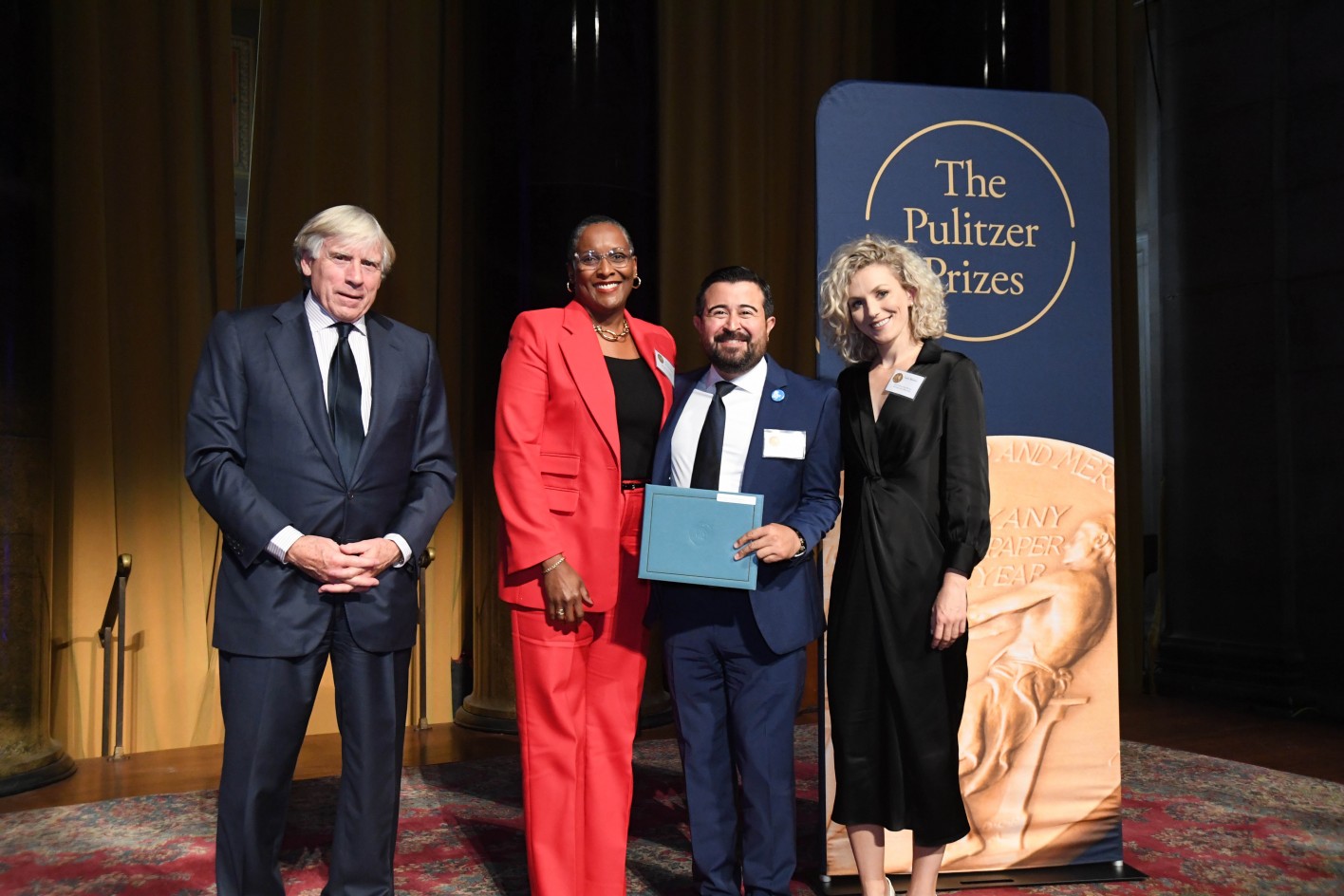
Staff members from the Miami Herald (from left: Monica Richardson, Joey Flechas and Sarah Blaskey) accept the 2022 Pulitzer Prize for Breaking News Reporting from Columbia University President Lee Bollinger. (Eileen Barroso/Columbia University)
Winning Work
By Sarah Blaskey and Aaron Albright
A sound — almost like thunder that lasted just a bit too long — roused people out of bed in Surfside early Thursday morning. Those who looked out their windows saw a wall of smoke-like debris billowing out from the corner of 88th Street and Collins Avenue, obscuring their view of the 12-story Champlain Towers South Condo that had occupied that stretch of beachfront for 40 years.
When the dust cleared, half the tower was gone. Fifty-five apartments where people had been sleeping just moments before were nothing but a pile of rubble resting at the base of the building’s sheared-off remains. What was left looked as if it had been sliced by a giant knife, brutally exposing the remains of people’s lives like a twisted, life-sized doll house. About half way up, a white bunk bed teetered on the edge.
As the first day of what promised to be a drawn-out rescue-and-recovery effort came to a close, the immensity of the tragedy had only just begun to set in. At least one person was confirmed dead, but rescuers expected the number to rise dramatically. Dozens of people — maybe more than 100 — were still missing.
In dozens of interviews conducted throughout the day, residents, witnesses, rescuers and family members described their experiences during the first 24 hours of unimaginable horror.
Sometime around 1:20 a.m., June 24
Bright flashes came from the middle of the Champlain Towers South Condo, footage from a nearby surveillance camera showed.
Then, the concrete began to fall –– as if the layers of the building were just melting into one another, something demolition experts call a “pancake collapse.”
Marian Lopez, who has lived in the building for over 20 years, said she and her husband were awakened by the building trembling. She assumed it was an earthquake. A loud boom followed by a louder crash sent their adult son hurtling into their room, asking what was happening. She rushed to gather her phone and eyeglasses.
Nothing was visible from the apartment window so using his phone as a flashlight, Marian’s husband, Alfredo, gingerly opened the front door of their ninth-floor unit. The hallway extended maybe five feet before dropping away into nothing but dust and sky.
"My neighbor's apartment was gone. All my neighbors' apartments were gone," Alfredo Lopez said.
Terrified that the floor might cave in, the trio began to move to an emergency staircase on the other side of the building, joining about 10 other people who were also trying to escape. One woman was frozen from shock and had to be carried.
Unable to exit through the lobby door, the group waded through ankle-deep water in the garage, where cars had been flattened by the collapse.
They made it to safety by crawling through a crack in a fractured wall, a route that took them past the destroyed pool deck and onto the beach.
1:23 a.m
Miami-Dade Fire Rescue responded to a request for assistance at the Champlain Towers South. Dozens of condos were listed on the report.
Soon, hundreds of police officers and firefighters from agencies across Miami-Dade County began to arrive to help with search-and-rescue efforts. They carried residents out to safety on stretchers, and sometimes even on their own backs.
Rescuers in a cherry-picker tried to reach people who were still trapped in the high-rise as they cried for help. Among those lowered to safety were Barry Cohen, a former Surfside vice mayor, and his wife.
Three people were taken to Aventura Hospital, according to a hospital spokesperson. Two arrived in critical condition and the other in fair condition.
Between 1:23 and 3:20 a.m.
Emergency responders also evacuated the Solara Surfside hotel, next door to the collapsed Champlain Towers.
Myka Carroll, 23, a tourist from New Orleans, was sleeping at the Solara Surfside next door when the commotion startled her awake.
“The fire alarms were going off and we heard banging on the door,” she said. As she and her family evacuated, they saw the remains of the south tower. “As soon as we looked to the left, the building was all gone,” Carroll said.
Television actor Jamal Akakpo, known for his roles in “Black Lightning,” “Watchmen” and “Agents of S.H.I.E.L.D,” was also staying in the hotel and posted videos of his view of the rubble.
The images, some of the first to emerge on social media, showed fire trucks arriving as bystanders speculated on how many people might have died.
Around 4 a.m.
Herald reporters overheard firefighters saying they expected multiple fatalities.
Dogs trained to alert rescuers to the location of survivors were not barking as they surveyed the wreckage.
5 a.m.
Santo Mejil, 50, snapped this photo of the devastation as he paced outside of the police tape, before finally getting the call he had been desperately waiting for.
“They’re bringing you down?” he said into the phone to his wife. “Thank God.” He wiped tears from his eyes with his T-shirt.
Mejil’s wife had been trapped in a ninth-story unit with the disabled woman she cares for at night.
6:31 a.m.
Dawn broke with the threat of a thunderstorm rolling in over the Atlantic and a whirlwind of speculation on what might have caused the devastating collapse.
“This is an oddity of biblical proportions,” said Peter Dyga, president of a Florida chapter of the Associated Builders and Contractors.
He and others interviewed by the Herald said that water damage to the steel reinforcements inside the concrete of old buildings can cause serious structural damage but urged caution when speculating on the specifics of this tragedy.
The tower had been up for a 40-year recertification inspection, a safety check of the structure and electrical systems, but according to the town clerk, the review had not been completed. John Pistorino, an engineer with a 50-year career in Miami, was instrumental in writing the 40-year recertification policy and other building safety laws.
"Condo residents will be frantic but these buildings are built so strong for our South Florida coastal conditions and hurricanes that this should never happen and it must be something unique to that tower," Pistorino said.
"It is so dramatically unusual that it's hard to compare to anything other than a building going down in a city in a state of war,” he said.
6:45 a.m.
Residents and tourists who had been staying in the Champlain Towers and nearby buildings waited for updates at Surfside Community Center, which became a reunification center for families.
As news spread about the reunification hub, more people poured in looking for lost family members and friends. Miami-Dade Fire Rescue asked everyone to report who they found, or didn’t, in order to help rescuers maintain a list of the missing.
Surfside Commissioner Eliana Salzhauer told the Miami Herald she had spoken with more than a dozen people that morning. One woman at the center said she was there to hear word on two brothers who were missing.
"This is crazy," Salzhauer said. "Buildings don't just collapse. You just can't wrap your head around the fact that this happened."
Around 8 a.m.
Rescuers tried to get a trapped victim out of the garage shortly after 8 a.m. The person was discovered by a Miami-Dade Fire Rescue dog, said Frank Rollason, director of Miami-Dade Emergency Management.
"It's bad," Rollason said.
Rollason told the Miami Herald that emergency workers had cleared all survivors from the tower.
“Everyone who is alive is out of the building,” Rollason said. However, the search-and- rescue efforts continued.
9 a.m.
At a press conference, Miami-Dade Fire Rescue Assistant Fire Chief & Chief of Operations Ray Jadallah described the rescue efforts. He said 35 survivors were pulled out.
9:40 a.m.
A somber Gov. Ron DeSantis addressed the tragedy at a news conference at Hillsborough Community College.
“The first responders were able to save a lot of people,” he said. “It’s a really, really tragic situation so we’ll hope for the best in terms of additional recoveries.”
Still, with the lists of missing people growing, the governor’s optimism was measured.
“We are bracing for some bad news just given the destruction that we’re seeing,” DeSantis said.
Mid-morning
Back at the reunification center, people cupped their faces in their hands as they wept, while others embraced their relatives who had arrived to comfort them. Volunteers brought coffee, sandwiches and coats.
Luz Marina Peña, whose 77-year-old aunt was missing, had been waiting outside the family reunification center since 5 a.m., after getting a call from a cousin in New York with the news.
“You can imagine the horrible anguish, because you don’t know what — if she’s under the debris, if she’s alive, if she isn’t,” said Peña, who held up a photo of her missing aunt, Marina Azen.
Azen is asthmatic and lives alone on the fourth floor of the building, Peña said.
“We’ve called the police stations, we’ve called the hospitals, we’ve done the police report. We’ve done everything humanly possible,” said Peña. “We want to be in the first place where we can get the news.”
Sybil Hart, a 30-year resident of a condo on 93rd and Collins, lingered nearby after finally finding out that a friend was safe after what felt like "a day of broken telephone."
"We used to want more parks and green space," said Hart, who has long been skeptical of development on Collins Avenue. "Now we are just scared for our safety."
11:54 a.m.
The list of residents who remained unaccounted for had reached 51, Sally Heyman, the Miami-Dade commissioner whose district includes Surfside, told CNN.
In a text, Heyman said that information came from the emergency reunification center.
But Rachel Johnson, communications director for County Mayor Daniella Levine Cava, said she couldn't confirm the tally. "We don't have an official count," she said.
12:09 p.m.
President Joe Biden called Mayor Daniella Levine Cava to offer support. Mayor Levine Cava took the call from a desk at the reunification center.
“Just got off the phone with @POTUS. He offered the full support of the federal gov. to help our community during this difficult time,” Levine Cava tweeted.
“We continue to work with local, state, & federal agencies as we respond to this tragedy and do everything we can to support the impacted families,” she wrote.
2:41 p.m.
The number of missing people had reached 99, according to County Police Director Alfredo "Freddy" Ramirez. But his top aide, Lt. Carlos Rosario, said the numbers may not be entirely accurate and are just "the best we have right now."
Rosario said rescuers did not have a precise accounting of people who were in the building at the time of the collapse. Rather, the missing persons numbers were based on a list of those who either lived in the building or were supposed to have been there when it collapsed. The list likely came from some combination of people coming forward saying a friend or relative was missing, property records or a list of names supplied by a property manager.
"It's very fluid," Rosario said.
3:03 p.m.
Dozens of survivors suddenly found themselves without a home and Gov. DeSantis directed the Florida Housing Finance Corporation to work with landlords across Miami-Dade to identify rental vacancies.
“The Department stands ready to assist the Surfside Community and to aid them in recovery,” said Dane Eagle, secretary of the Florida Department of Economic Opportunity.
Displaced residents can used the FHFC’s rental locator at https://www.floridahousingsearch.org
Midafternoon
The reunification hub was busy throughout the afternoon.
The Cadena Foundation, a Mexico-based humanitarian aid organization with offices in Miami, brought in a truckload of food, water and other necessities. Other volunteers arrived with televisions and snacks.
Still, frustration mounted among those waiting on news.
Almost 12 hours after Soraya Cohen first arrived at the family reunification center seeking answers about her missing husband and brother-in-law, Cohen was upset about how slowly search efforts were progressing.
Cohen said firefighters had not yet attempted to rescue her husband, Brad Cohen, and brother-in-law Gary Cohen. The siblings had been staying on the 11th floor when the building came down, she said.
Authorities took a DNA sample of Soraya and Brad Cohen’s 12-year-old daughter in case they needed to identify his body, Soraya Cohen said. She was hopeful that he was still alive, especially after learning that rescue crews could hear banging from under the fallen building.
“Go in and stop waiting,” said Cohen, who was not staying at the condo when it collapsed. “This is the difference between life and death.”
The Miami-Dade Police Department Community Affairs Bureau brought therapy dogs to the reunification center, and county chaplains offered spiritual counseling.
Jeepers, a 5-year-old therapy dachshund, garnered the attention of children who filled the more family-oriented of the two rooms at the center.
8:40 p.m.
Volunteers put up signs Thursday evening outside the Surfside Community Center telling drivers to take their donations elsewhere: In the 19 hours since the condo collapse, the family reunification center had received more pillows, blankets, bottles of water, and food than it could handle.
“We don’t need any more donations,” said Mirtha Davis, the volunteer coordinator at the community center, working with the American Red Cross. “We thank them, but no more.”
10:15 p.m.
At the reunification center, Mayor Levine Cava thanked volunteers and spoke to family members, urging them to be patient as officials try to find more survivors.
“We know you’re waiting for word,” Levine Cava said to those who were upset that rescuers weren’t moving faster. “This is a very dangerous situation. They must proceed slowly. They have to be careful not to break down the rubble” and potentially hurt people who are below.
The mayor then led the group of families, a crowd of dozens, in prayer.
Authorities said the reunification site would remain operable around the clock.
“We are coming to an end of the first day,” Levine Cava said. “There is still hope.”
At the end of the day, 102 people who were in the building had been accounted for, according to the mayor.
But the number of people still unaccounted for had not changed: 99.
Contributors: Aaron Albright, Sarah Blaskey, Eduardo Alvarez, Mary Behne, Joey Flechas, Bianca Padró Ocasio, Dana Cassidy, Doug Hanks, Mary Ellen Klas, Chuck Rabin, Aaron Leibowitz, Rob Wile, David Santiago, Emily Michot, Matias Ocner, Linda Robertson, Jay Weaver, Samantha Gross, Marie-Rose Sheinerman, and Martin Vassolo
By Allie Pitchon, Rob Wile, Samantha J. Gross and Joey Flechas
Alfredo and Marian Lopez were sound asleep around 1:30 a.m. Thursday when they heard the first boom, like a crash of thunder from a Florida squall. Only louder.
“I woke up and thought we’re just having a bad thunderstorm,” Alfredo, 61, later told the Miami Herald. The noise jolted him from sleep in his sixth-floor apartment at the northwest corner of Champlain Towers South in Surfside.
So did Bruno Treptow, 62, who was sleeping in his unit exactly two floors above, in the same corner of the 40-year-old, 12-story condo tower.
“Did lightning just hit the building?” Treptow wondered. Then the lights went out.
The second boom shook the Lopezes’ bed. Their whole sixth-floor apartment rattled. Treptow’s floor moved beneath him. The chandelier in Sharon Schechter’s 11th-floor unit swayed.
What was left of the building trembled.
Marian Lopez thought an earthquake might’ve hit their home of 22 years. Alfredo thought maybe something had exploded at the hotel next door. The view from their bedroom window, which faces Collins Avenue in Surfside, was obscured by a thick cloud of dust.
Their adult son ran into their bedroom. “What the hell is happening?” he asked them, clearly in shock. Neither Marian nor Alfredo had an answer. No one did.
Still recovering from his own shock, Treptow’s first thought was of the construction work that had been happening on the condominium’s roof as part of the building’s 40-year recertification. Had the heavy machinery caused the roof to collapse? He feared that whatever it was, it would kill him and his wife.
“I thought to myself, the roof is caving. I turned to my wife and she wakes up startled. And she says no it can’t be,” Treptow said. “So I hug her. I give her a hug and say, ‘Listen, this is it. We’re gonna die.’ ”
On the ninth floor, a caretaker for an elderly disabled woman was working her overnight shift when she felt the tremor. She called her husband, Santos Mejía, 50, who was asleep at their home near Miami International Airport. He jumped in the car and drove east. No car could go fast enough.
Alfredo turned on his phone’s flashlight while Marian grabbed her eyeglasses and looked for closed-toe shoes, unsure of what would be on the other side of the door. Some of the dust was starting to waft into the apartment. Flip-flops would have to do. So would pajamas. No time to change.
The Treptows, too, had gotten out of bed and begun to gather a few things. Bruno tried to peer out his front door, but what looked like a thick fog clouded everything. He could feel the wind blowing, carrying strips of debris through the air. Part of the roof must’ve given out, he figured. He went back inside to get dressed.
‘THAT COMPLETE SIDE OF THE BUILDING WAS GONE’
Just about 20 feet below, Alfredo opened the front door minutes later. The dust had dissipated, and the scene before him was horribly clear.
His home was about five feet away from calamity. Where the hallway with his neighbor’s doors should have been, there was nothing. Just billowing dust, sky and a dark beach. Half of a vertical community that stretched about 120 feet into the air had vanished.
“That complete side of the building was not there,” Marian said. “The apartments were gone.”
Dressed and ready to leave, Treptow stepped out of his unit. He faced the same surreal abyss. To one side, he saw only his neighbor’s doorframe. No door.
“Three families that I know well,” he later recounted, his voice cracking. He doesn’t expect that they’ll be found alive.
Barry Cohen, a former vice mayor in this small seaside town, and his wife, Ofi, have lived in their third-floor unit since 2018. When they opened their door, they saw more clearly what had happened. Almost half of the building’s units had collapsed in a heap of twisted metal and cracked concrete. Their sleeping neighbors had tumbled with their homes.
“I was worried it was all going to go down,” he later told reporters.
A PATH TO SAFETY
The Lopezes made their way down the emergency stairwell with about a dozen other fleeing neighbors. Unable to open the door to the lobby, they descended to the garage. Wading in shin-deep water flowing from broken pipes and passing by flattened cars, they finally found a crumbled wall with a big enough crack to escape through.
Nearby, a woman stood frozen from shock. Alfredo hoisted her over his shoulder and carried her out through the opening to the pool deck. He barely recognized it. Debris littered the ground everywhere. Red, yellow and blue streams of light now illuminated the haze. As they left the pool and stepped onto the beach, he heard voices from the wreckage.
“I could hear people crying and screaming for help,” Lopez said.
Treptow, his wife, and the Cohens were trapped in the corner of the condominium, facing the collapsed section. They stood on their balconies, pleading with the dozens of rescue crews that had arrived. Treptow, his wife, and their dog descended on a ladder. The Cohens were lowered in a cherry picker.
Mejía got as close as he could before police tape and flashing lights kept him a block away from the hellish scene. His wife called to tell him that she and her patient, who uses a wheelchair, were stuck.
Then at around 5 a.m., his phone rang.
“They’re bringing you down?” he said, wiping tears from his eyes with his shirt. “Thank God.”
By Marie-Rose Sheinerman, Samantha J. Gross, Bianca Padró Ocasio, Douglas Hanks, and Daniel Chang
After the dust had settled and the fog of incredulity had lifted, Soriya Cohen had only prayer and hope and questions — lots of questions — about the abrupt and violent collapse of a 12-story oceanfront condominium tower in Surfside early Thursday morning.
First and foremost in Cohen’s mind was the whereabouts of her husband, Brad Cohen, whom she had not seen or heard from since part of the Champlain Towers South Condo came crashing down, wiping away 55 units in mere seconds.
Brad Cohen was inside one of those units on the 11th floor along with his brother, Gary Cohen, said Soriya Cohen, when the building collapsed at 1:23 a.m., the time that Miami-Dade Fire Rescue first responded to a call for help at the condominium tower. Soriya Cohen had spent the night with their daughter at a different building in neighboring Miami Beach.
“We can’t find him,” Soriya Cohen said Thursday afternoon, showing anyone who could help a photo of her husband that she keeps in her iPhone. She said rescuers took a DNA sample of their daughter in case they need it to identify Brad Cohen’s body.
“He hasn’t responded for 15 hours. … Maybe he’s alive, I don’t know.”
Those last three words underscored the agony shared by dozens of survivors and loved ones of the missing who gathered at the Surfside Community Center seeking answers and solace. And they echo the response of many who cannot fathom how a concrete structure housing dozens of homes could suddenly fall to the ground.
“It’s the unimaginable,” said Miami-Dade County Mayor Daniella Levine Cava. “It’s a terrible, terrible nightmare that we have here on Surfside.”
It will likely be months or even years before engineers and other experts know exactly why a part of the Champlain Towers South came crashing down.
Before those answers are found, search and rescue crews will continue the painstaking work of picking through a mountain of rubble, looking for even the faintest signs of life that might be buried inside the two-story-high pile of debris.
More than 20 hours after the partial collapse, the death toll remained unknown. Officials confirmed at least one death, and said 35 survivors were pulled from the wreckage, with 10 injured persons treated at the scene and at least two transported to a hospital.
Miami-Dade County police said as many as 99 people are reported missing. There were 102 people from the building who had been accounted for. The part of the tower that collapsed held 55 units. The remainder of the 136-unit tower remained standing, though residents have been evacuated.
The disaster occurred while most who live in the building were in bed. The tower at 8777 Collins Ave. crumpled with “a bang that just kept on going,” said former Surfside Vice Mayor Barry Cohen, who moved into a third-floor unit in the tower in June 2018.
Barry Cohen said he and his wife gathered their belongings and rushed out of their condo after they were awakened by the noise and realized what was happening. Unable to navigate through the debris, twisted metal and a flooded parking garage, the couple returned to their unit and called for help from the balcony.
The Cohens and their two neighbors waited 20 minutes before firefighters rescued them from their balcony with a cherry picker bucket.
“I was worried it was all going to go down,” Barry Cohen said.
Security camera footage of the collapse looked eerily similar to a controlled demolition, minus the flash of explosives. One side of the tower buckled first before more of the structure collapsed into a pile of rubble. The cause of the collapse is unknown, though one building expert deemed it “an oddity of biblical proportions” for the 40-year-old structure to fall unexpectedly.
A different expert, John Pistorino, who has a 50-year career as a consulting engineer in Miami, said such a collapse “should never happen.”
“It is so dramatically unusual that it’s hard to compare to anything other than a building going down in a city in a state of war,” said Pistorino, who played a key role in drafting the county’s 40-year building recertification policy and other building safety rules. Champlain Towers South was in the early stages of its 40-year recertification.
‘THERE’S A LOT OF UNCERTAINTY’
In a scene reminiscent of 9/11, evacuees and family and friends of residents gathered at the nearby Surfside Community Center, many carrying photos of missing loved ones. More than 700 missing-person reports came in to a Miami-Dade hot line and web page set up to track victims of the collapse, according to the county’s Emergency Operations Center.
Levine Cava, the county mayor, said in an evening video briefing with county commissioners that the count of missing people remains an estimate. She said “102 people who were in the building have been accounted for.”
“Unfortunately,” Levine Cava added, “99 at least are unaccounted for. Some of those may not have been in the building.”
Sergio Barth, a Doral resident, said his brother, Luis Fernando Barth, was visiting South Florida from Colombia with his wife and 14-year-old daughter to get the COVID-19 vaccine. The family was staying in a friend’s condo at Champlain Towers South.
“Early this morning I heard on Colombian radio that a building had collapsed in Surfside, and I knew the area,” Barth said, “and I started putting the dots together.”
Barth soon discovered that his brother and family are among the missing.
“There’s a lot of uncertainty,” he said, “no useful information right now.”
As news of the collapse spread across the globe, relief organizations and others launched efforts to support those who were forced to flee their homes with little or no belongings. An online donation fund for victims and families, set up by the Shul of Bal Harbour, had raised more than $160,000 from more than 1,300 donors as of Thursday afternoon.
Others who jumped in to help include the Miami Heat, the Miami Heat Charitable Fund, the Coral Gables Community Foundation, the Key Biscayne Community Foundation and the Miami Foundation, working together to build a hardship fund.
The disaster has united hundreds of strangers seeking to help, said Ryan Mermer, a member of the Shul who started a WhatsApp group chat to rally the community and collect blankets, phone chargers, sweatshirts, pain relievers, water and snacks.
“People are coming together more than ever,” Mermer said.
By Thursday evening, volunteers had put up signs outside the Surfside Community Center telling drivers to take their donations elsewhere. The family reunification center had received more than it could handle, said a volunteer with the American Red Cross.
OFFICIALS PROMISE HELP, ANSWERS
Local, state and national leaders addressed the building collapse on Thursday, offering to send help and find answers.
Surfside Commissioner Eliana Salzhauer held out hope that search and rescue dogs would lead workers to survivors in the rubble. By late morning, she noted the troubling silence. “They aren’t turning up very much,” she said. “No one is celebrating anyone being pulled out.”
Salzhauer said the Champlain Towers South was undergoing the required 40-year recertification to ensure its structural integrity, and that the building’s roof was being redone. She added that a building inspector had visited Champlain Towers on Wednesday, but she did not know what the inspector found. It is unknown if any construction activity contributed to the disaster.
“The residents that I talked to were not aware that there was some kind of problem or issue that would cause something like this,” Salzhauer said.
Gov. Ron DeSantis, speaking at a press conference one block away from the Champlain Towers, said he toured the scene and what he saw was worse than he had expected.
“The TV doesn’t do it justice,” DeSantis said. “It is really, really traumatic to see the collapse of a massive structure like that.”
DeSantis thanked first responders for risking their lives to search for survivors when it was unknown if the building was stable enough to enter.
He said engineers and other experts would probe the evidence to determine what went wrong.
News of the disaster also reached the White House, where President Joe Biden said he had a “long discussion” with Levine Cava, the county mayor, about the building collapse.
Biden put the onus on DeSantis to declare a state of emergency so federal resources, including FEMA help, can be deployed.
“We are ready to move federal resources immediately,” Biden said. “We can’t go in and do it but FEMA is down there taking a look at what’s needed, including whether the rest of the buildings need to be evacuated as well.”
He said federal resources could help with recovery, cleanup and shelter for families who were displaced.
“I’m waiting for the governor to declare an emergency,” Biden said. “We’re working on it, and I made it clear, I say to the people of Florida: Whatever help you want that the federal government can provide, we’re waiting. Just ask us, we’ll be there. We’ll be there.”
DeSantis signed an emergency declaration early Thursday evening.
‘CRIES FOR HELP’ AND AN EERIE PREMONITION
As help begins to pour in for victims and families of the collapse, survivors of the disaster and their loved ones relayed the details of their traumatizing experiences.
Adriana Chi was waiting outside Jackson Memorial Hospital’s Ryder Trauma Center in Miami early Thursday, worried about two relatives inside and a third she had yet to locate.
Chi said her brother, sister-in-law and teenage niece lived in a ninth floor unit of the Champlain Towers South. Chi was able to speak with her niece ahead of her emergency surgery at Ryder, and she said the 16-year-old recalled being awakened by her mother and a shaking building before the floor gave way beneath them.
“She felt the building shake,” said Chi, a nurse practitioner. “Then everything collapsed.”
Chi said her sister-in-law, a psychologist, was taken to Ryder as well but that she did not know the whereabouts of her brother, an attorney. Chi said her father has owned the unit in Champlain Towers South for about 30 years, and that leaks were a chronic problem.
Between tearful cellphone calls in the hospital’s driveway and hugs with other family members gathered outside, Chi recalled an eerie premonition she had shared with her brother.
“The last time I was there, I looked at him and I said, ‘I am serious. This building is going to collapse.’ ”
Alfredo Lopez, who lived in a sixth-floor corner unit with his wife and son, said he awoke to a series of loud booms that shook his bed and startled his family. They evacuated the building with a group, making their way out through a crack in a crumbling wall near the crumpled pool deck, where Lopez and others could hear what they could not see through the thick cloud of dust.
“Exiting the pool area, I could hear people crying and screaming for help,” Lopez said.
A DESPERATE RESCUE SCENE
The massive search-and-rescue effort began before dawn. Rescuers from Miami-Dade’s Urban Search and Rescue Team worked quickly to free residents from the warped steel and concrete that trapped them in their homes, sometimes cutting through balconies to reach survivors in the part of the structure that was still standing.
At an evening press conference, Miami-Dade’s mayor emphasized the rescue operation was proceeding overnight — and that images of a seemingly idle scene didn’t always capture the intensity of efforts below the surface.
“We are working round the clock,” said Levine Cava, who oversees county fire and police agencies. U.S. Sen. Marco Rubio, a Republican from Miami-Dade, also touched on complaints that efforts weren’t moving quickly enough.
“Sometimes when you watch it on television, it can be hard to ask for patience in a time like this,” he said.
Alfredo “Freddy” Ramirez, the county’s police director, said his agency’s victim coordinators were helping counsel relatives of the missing, including those frustrated by the rescue pace.
“This is a slow process. We understand their pain,” he said. Ramirez said with rescue crews often underneath the rubble, the scene can look misleadingly quiet on television. “They don’t see from above what’s really going on,” he said.
Jose “Pepe” Diaz, chairman of the county commission, said the rescue operation will continue until “the moment hope is gone.”
“They’re working hard — hard,” he said. “They’re taking every precaution. And they hope and pray.”
Levine Cava visited the family reunification center at about 9:30 p.m. The center on 93rd street was still active, with tables of food, sweet snacks and drinks. In one of the rooms, families sat in front of a TV playing footage of the collapse. The mayor thanked volunteers and spoke to family members, urging them to be patient as rescue workers search for survivors.
“We are coming to an end of the first day,” Levine Cava. “There is still hope.”
For family members of those who survived, news of their loved one’s rescue felt like divine intervention.
Santos Mejía, 50, said he was awakened by a predawn call from his wife, who was inside a unit on the ninth floor of the collapsed south condo. She is an overnight caretaker for an elderly disabled woman.
“She said she heard a big explosion. It felt like an earthquake,” Mejía said.
As he recounted rushing over to the beach from their home near Miami International Airport, Mejía’s cellphone rang. It was his wife.
“They’re bringing you down?” he said. Tears welled in his eyes. “Thank God.”
As the sun rose, the rescues got trickier. A mother and child were pulled from the rubble, but the mother’s leg had to be amputated to free her, said Frank Rollason, director of Miami-Dade Emergency Management.
Just after 8 a.m., Rollason told the Miami Herald that emergency workers believed they had cleared all easily reachable survivors from inside the tower.
“Everyone who is alive is out of the building,” he said.
One of the search-and-rescue dogs detected someone trapped under a mountain of concrete around that time. Officials first believed the trapped person was a child but later identified her as an adult woman.
Rollason said they lost voice contact with her shortly after, but they had not given up on the rescue effort.
“We’re still working on getting to her,” he said.
Miami-Dade Fire Rescue spokeswoman Maggie Castro said more than 80 rescue units from all over the county rushed to the initial scene. Well into the morning she said the department was in “100% rescue mode.”
She said the department used dogs and sensitive microphones and cameras that can pick up the slightest sounds, even breathing. But even with the most advanced technology, she added that only so many rescuers could sift through the wreckage at one time because they were uncertain about the stability of the debris.
The equipment used by search and rescue teams is so sensitive Castro said, “that we would even be able to hear people scratching.”
HOW MANY MISSING?
Surfside Vice Mayor Tina Paul said authorities are compiling a list of residents who remain unaccounted for following the tower’s collapse.
A Realtor with COMPASS who has multiple listings in the building told the Herald about 70% of the 136 units were occupied at the time by primary or secondary homeowners. It’s unclear how many other units were in use for short-term rentals.
Surfside Mayor Charles Burkett said authorities are compiling names called into Surfside’s missing persons hotline.
“I think we’re trying to piece together who’s missing by tallying up those calls,” he said.
Burkett said the building manager does not keep a log of residents, but logs visitors. First responders were using the list to try and account for the missing.
Dozens gathered at the town’s community center, where the Red Cross was assisting those who were waiting to hear about missing loved ones. Evacuees of nearby condo towers and hotels, who were hoping for information on a place to stay and how to gather their belongings, also filled the community center.
Rollason said the building to the south, which is newer, is far enough away that it appears to be fine for now. The building on the north, he said, is older and has been evacuated. The Solara Surfside hotel, which is next to the tower, has also been evacuated.
Some residents said they have lived in the condominium complex for decades and never had any significant problems with the structure until construction began on a new building just south of Champlain Towers South. The construction caused tenants to complain about shaking last year, said Norma Arbide, who has lived in the complex since 1987.
The new building is located in Miami Beach, not Surfside, and Arbide said her neighbors were complaining because, “Their building was shaking and vibrating when they were digging and blasting at the construction site. That could have caused cracks or some kind of damage.”
Burkett, the Surfside mayor, noted that the building is not as old as many in the surrounding area, and that “there is no reason for a building to come down like that.” There are one-foot gaps between stories where there used to be 10, he said.
“This doesn’t happen,” he said. “I’ve been here my whole life, and I haven’t seen anything like this happen.”
When asked if he believed the collapse was an accident, Burkett wouldn’t hazard a guess.
“What I can say is that a building has fallen down .... I expect that this building is not salvageable at this point.”
He said there had been construction work on the building’s roof over the last 30 days, and that, “We’re certainly going to look at that.”
Peter Dyga, president and CEO of a Florida chapter of the Associated Builders and Contractors, a national construction trade association, called the partial collapse at the Champlain Towers “an oddity of biblical proportions.”
“People have to remember, there are thousands of buildings of this height or taller in South Florida, millions worldwide ... This does not happen. Clearly, something was wrong,” Dyga said.
“We need to find what happened and make sure if there was any kind of negligence we hold people accountable,” Dyga said.
Dyga urged Floridians not to jump to conclusions as investigators assess architectural plans, engineering calculations, construction materials, and maintenance records to try to determine what went wrong.
“This is going to be probably multiple years in trying to figure out what happened here. There are so many variables,” he said. “It’s probably more than likely going to be a combination of bad things.”
To Floridians living in other high-rise condos, Dyga stressed calm. “People do not have to worry about their building falling down,” he said.
Miami Herald staff writers Joey Flechas, Charles Rabin, Alex Harris, Linda Robertson, Mary Ellen Klas, Sarah Blaskey, Martin Vassolo and David J. Neal contributed to this story, as did McClatchy Washington Bureau reporters Alex Daugherty and Alex Roarty.
By Sarah Blaskey and Aaron Leibowitz
There was nothing unusual about the lobby and pool area at Champlain Towers South condo, which looked clean and well maintained to a commercial pool contractor who visited the building last Tuesday, just 36 hours before half of the building unexpectedly collapsed. Then, he saw the basement-level garage.
“There was standing water all over the parking garage,” the contractor, who asked not to be named, told the Miami Herald. He noted cracking concrete and severely corroded rebar under the pool.
He also took photos, which he shared with the Herald.
The contractor visited the condo building last week to put together a bid for a cosmetic restoration of the pool as well as to price out new pool equipment — a small piece of the multimillion-dollar restoration project that just was getting underway at the 40-year-old building.
While he had worked in the industry for decades and had “gone in some scary places,” he said he was struck by the lack of maintenance in the lower level. The amount of water at Champlain Towers seemed so unusual that the contractor mentioned it to a building staff member, Jose, who was showing him around.
“He thought it was waterproofing issues,” the contractor said of the staff member. “I thought to myself, that’s not normal.” He said Jose told him they pumped the pool equipment room so frequently that the building had to replace pump motors every two years, but he never mentioned anything about structural damage or cracks in the concrete above.
The deepest puddle of standing water, according to the contractor, was located around parking spot 78 — an area that building plans show is located directly under the pool deck where in a 2018 inspection report, engineer Frank Morabito had flagged a “major error” in the original design that was allowing water intrusion and causing serious damage to the structural concrete slabs below.
He did not photograph that standing water because he was there to examine the pool and what was underneath it.
In the pool equipment room, located on the south side of the underground garage, the contractor saw another problem — exposed and corroding rebar in the concrete slab overhead. He snapped some pictures and sent them to his supervisor along with a note expressing concern that the job might be a bit more complicated than expected. He worried they would have to remove pool pipes to allow concrete restoration experts access to repair the slabs.
The building caved in two days later, before they had time to complete their bid.
“I wonder if this was going on in other parts of the building and caused this collapse,” he said.
CBS4’s Jim DeFede interviewed William Espinosa, a Champlain maintenance manager from the late 1990s, who said ocean saltwater would make its way into the underground garage — so much that “pumps never could keep up with it.”
Maxwell Marcucci, a representative for the Champlain Towers South condo association, declined to comment Monday on whether the association was aware of the issues the pool contractor noticed.
Mohammad Ehsani, an engineer and concrete restoration expert who invented QuakeWrap technology, a way to reinforce old concrete columns, reviewed the contractor’s photos from the pool equipment room.
“You can see extensive corrosion of the rebars at the bottom of the beam. That is very serious,” Ehsani said, commenting it was the worst damage he had seen documented in the building so far. The equipment room runs along the southern wall of the building — an area that did not collapse.
“If the condition of the beam in the pool guy’s photo is something that was also happening under the building, that is a really major concern,” Ehsani said. In that case, it “absolutely” could have contributed to the collapse.
However, he cautioned against rushing to conclude that all beams in the building showed similar levels of damage to those exposed to chemicals from the pool. The 2018 report that documented “severe” structural damage to concrete in the garage under the pool deck did not include photos of anything nearly as alarming as what the pool contractor documented, Ehsani said.
Either way, the damage in the photo should have been a concern.
Metadata on the photographs confirmed they were taken when the contractor said they were: the morning of June 22.
“In these buildings that are asymmetrical like this one, there is a possibility that if you have one part of the building that collapses, the building does some turning and twisting,” Ehsani said. “In this case, it is possible that a failure any place in this building could cause distortion to the frame of the building and could cause a collapse in any of the areas, not just adjacent [to the failure].”
By Sarah Blaskey and Sohail Al-Jamea
A murky video looking into the basement-level garage of the Champlain Towers South condo, recorded from the street by a tourist just minutes before the 12-story building caved in, is more than just a macabre curiosity. Experts say it’s a critical piece of evidence that shows the beginning of the deadly collapse sequence.
“It looks like the slab fell down,” said Dawn Lehman, professor of engineering at the University of Washington. “This is certainly the first place where we see structural damage before the collapse.”
Experts were already zeroing in on that part of the garage ceiling — below the pool deck at the edge of the part of the building that collapsed — as the likely point of first failure. The video was the missing piece.
According to building plans, the slab shown crumbled in the video was located beneath a large planter on the pool deck, where in 2018, engineer Frank Morabito noted “major structural damage.” The slab fell directly adjacent to the part of the garage where a pool contractor noted unusual amounts of standing water, indicating a potential problem in the area, 36 hours before the collapse. Just moments before the total collapse of the part of the building above, two eyewitnesses also described a crater opening in roughly the same area from which the debris in the video appeared to have fallen.
“It really does suggest that the initiation point is there,” Lehman said. “All of this matches up together.”
Around 1:15 a.m. on June 24, tourist Adriana Sarmiento heard a loud noise from her hotel and headed outside to investigate. She looked south, across 88th Street, toward the Champlain Towers South condo, and was shocked by what she saw through the entrance to the underground parking garage.
“I saw the roof of the parking garage on the floor — huge chunks of concrete,” Sarmiento told the Miami Herald. She took out her phone and recorded a short video. The time stamp shows 1:18 a.m. Emergency calls about the building collapsing started coming in at 1:26 a.m., 911 records show. The whole side of the building shown in Sarmiento’s video was gone.
“Something was happening a few minutes before the building comes down,” said Abi Aghayere, a Drexel University engineering researcher. “There was something happening around this deck area [above the debris]. For this type of flat slab construction, my hypothesis is the punching shear began at this slab level.”
“Punching shear” failure is when concrete slab cracks and falls away from the column supporting it. Aghayere said that type of initial failure can cause sudden collapse.
In 2018, Frank Morabito, an engineer under contract with the condo association, surveyed the building and noted a “major error” in the design resulting in lack of proper drainage. That error was causing severe damage to the concrete slab below the pool deck and planters — some that sit directly above the part of the garage seen covered in rubble just moments prior to the catastrophic collapse.
As it turned out, the damaged conditions highlighted by Morabito only deteriorated further, as he warned they would, according to an April letter from the president of the Champlain Towers South Condominium Association first reported by USA Today.
“The observable damage such as in the garage has gotten significantly worse since the initial inspection,” the letter said. The extent of the damage could not be known without removing the immense planters and pulling up all of the tiles on the pool deck, the letter added. Meanwhile, a report from 2019 by Morabito noted something “curious” about concrete samples taken from the area but did not elaborate.
Still, deteriorated concrete does not usually break without a trigger, Lehman said. The video shows the initial collapse, but not the specific trigger, she said.
“I don’t know why the slab broke,” Lehman said. “When you’re looking at what could have caused this you want to look at multiple things. And unexpected loading is one.”
Although she cautioned against speculating too much, based on the 2018 report of structural weakness below the planter on the pool deck, Lehman offered one theory.
“If there was all this standing water, and if the planter was collecting the water and the water wasn’t evaporating because it was raining a lot and there was already deterioration there, that could be a cumulative effect,” she said.
Engineer Mohammad Ehsani said the rubble indicated the slab above was beginning to fail at the time the video was shot. He also pointed to the planter above the area as a possible reason for the strain.
“That’s a very heavy concentrated load, and if the reinforcing bar below it [was weak], just before it collapses you would see chunks of concrete falling down,” Ehsani said.
Even still, experts agree that in general a building should not fall due to a single failure of a slab. But Aghayere said a review of the building plans, inspection reports and photos from the collapse shows a lack of necessary backstops.
“It doesn’t have structural integrity reinforcement,” Aghayere said. “Because there’s no structural integrity reinforcement if it falls, it just goes.”
Structural engineer and retired building inspector Gene Santiago said the part of the building that collapsed was lacking an adequate number of structural walls called “shear walls” that would have helped the building resist caving under lateral or twisting forces from an initial failure of a slab on a single floor.
“There doesn’t seem to be enough of them in the plans,” he said. There were no shear walls in the east-west direction, he pointed out.
In general, experts agreed that the building, which was constructed in the early 1980s, was not designed with the same level of redundancy as modern-day buildings.