Staff of the Star Tribune, Minneapolis, Minn.
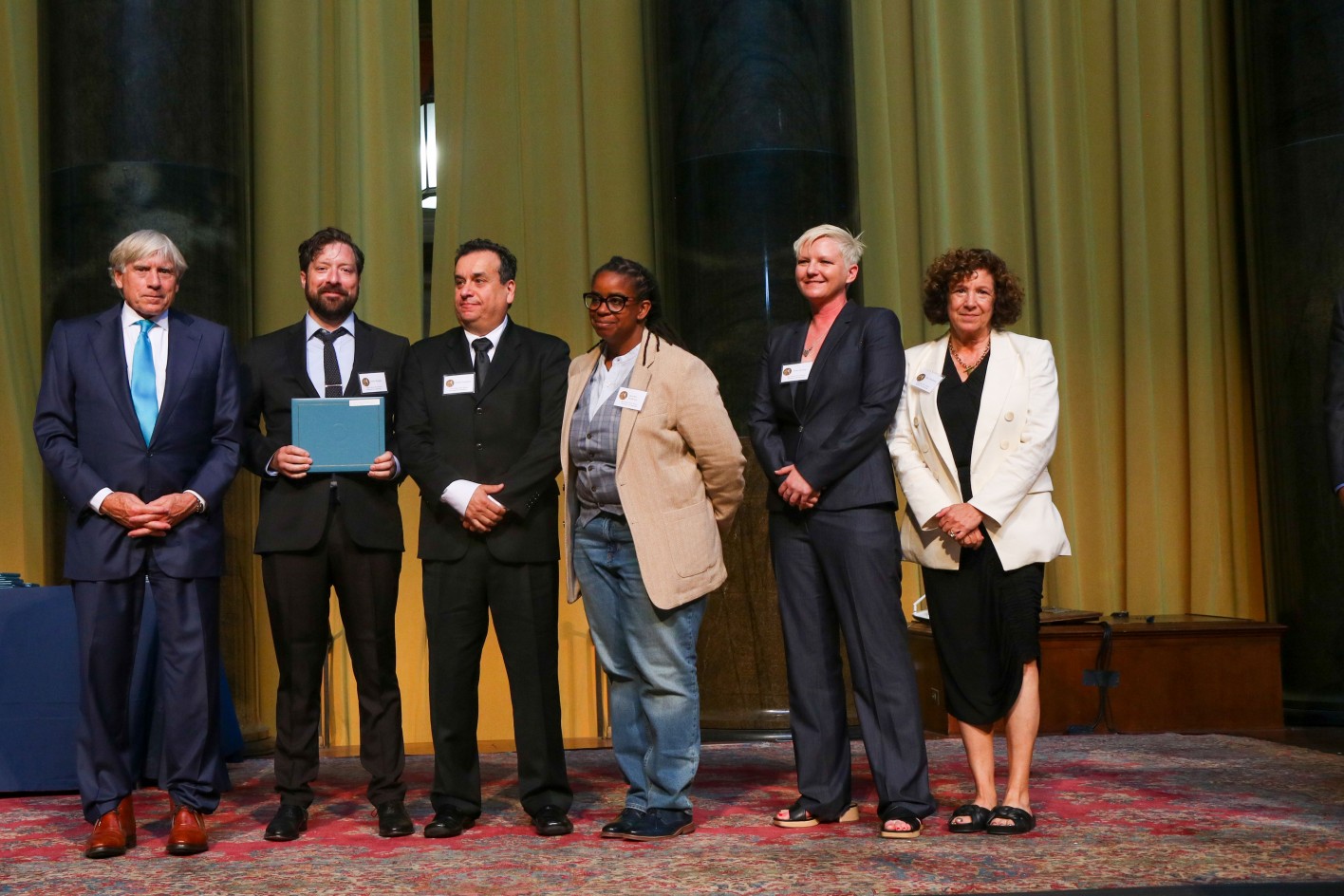
Staff members from the Star Tribune (from left: Andy Mannix, Carlos Gonzalez, Kyndell Harkness, Abby Simons and Suki Dardarian) accept the 2021 Pulitzer Prize for Breaking News Reporting from Columbia University President Lee Bollinger. (Jose Lopez/The Pulitzer Prizes)
Winning Work
Four officers were fired after a video showed one of them kneeling on a handcuffed black man's neck and ignoring pleas that he couldn't breathe.
By Libor Jany
Four Minneapolis police officers were fired Tuesday after the detention and death of 46-year-old George Floyd — a scene that unfolded in a Facebook video showing a white officer kneeling on Floyd's neck as he pleaded with police, "I can't breathe."
Floyd died at Hennepin County Medical Center soon after the encounter, which started when police detained him Monday evening on suspicion of trying to pass a fake $20 bill at a convenience store.
The FBI launched an investigation Tuesday, as the Minneapolis Police Department fired the officer as well as three others who were at the scene. The quick action didn't prevent a large protest Tuesday evening that included tense confrontations with police, who responded with tear gas.
"Being black in America should not be a death sentence," said a visibly shaken Mayor Jacob Frey, who said the officer used an unauthorized move against Floyd. "For five minutes, we watched a white officer press his knee into a black man's neck. Five minutes. When you hear someone calling for help, you're supposed to help. This officer failed in the most basic, human sense."
Police Chief Medaria Arradondo said he had stayed up all night wrestling with his decision to fire the officers. Arradondo said he couldn't say much about the case — either about the FBI's investigation or a parallel probe by the state Bureau of Criminal Apprehension (BCA) — but added that "sanctity of life" has always been a pillar of his department.
"What occurred last night was certainly very tragic, and very sad," he said in an afternoon news conference on the steps of City Hall.
Officials have not publicly named the four officers, but multiple sources identified the two prominently featured in the 10-minute Facebook Live video as Derek Chauvin, who was kneeling on Floyd's neck, and Tou Thao, who stood by as witnesses pleaded with the officers to let Floyd up and to check his pulse.
Arradondo said at an earlier news conference that he'd asked the FBI to take the case after watching the video of the encounter and receiving "additional information" about it from community members, without elaborating.
Community activist John Thompson says the images of Floyd and other black men across the country who have met unjust deaths at the hands of police trigger a kind of collective trauma within the black community.
"Let's be clear: This is murder," said Thompson, whose advocacy in the 2016 police killing of his friend Philando Castile catapulted him into a run for state office. "I don't want to be labeled the angry black man — I should be able to have that emotion. I'm angry. Wouldn't you be?"
Floyd's family has retained attorney Benjamin Crump, who also represents the families of Ahmaud Arbery and Breonna Taylor, a black man and woman killed in recent high-profile cases.
"This abusive, excessive and inhumane use of force cost the life of a man who was being detained by the police for questioning about a nonviolent charge," read the statement from Crump's office.
Chauvin is represented by Thomas Kelly, a Minneapolis attorney who was part of the legal team that successfully defended former St. Anthony police officer Jeronimo Yanez in the 2016 fatal shooting of Castile. Kelly declined to comment through a spokesman Tuesday.
Fatal chain of events
The arrest that sparked the fatal chain of events happened about 8 p.m. Monday, when police were called to investigate a report of someone trying to pay with a counterfeit bill at Cup Foods, 3759 Chicago Av., and found the man matching the suspect's description in his car, according to police and scanner audio posted online.
Cup Foods' owner, Mike Abumayyaleh, later confirmed that one of his employees had followed store policy by calling police after someone, thought to be Floyd, tried to pay with a counterfeit $20 bill. Abumayyaleh said he's been receiving death threats since then.
Officers ordered Floyd out of the car and took him into custody, police spokesman John Elder said, adding that their body cameras were rolling the whole time.
The arrest also was streamed by a bystander on Facebook Live, where the archived footage approached 1 million views as of Tuesday evening.
The video captures Chauvin with his knee on the neck of Floyd, who is lying face down on the street next to the rear passenger wheel, writhing, while repeatedly telling police he couldn't breathe as three officers hold him down.
"Please, please, please I can't breathe. Please, man," Floyd is heard pleading with the officers. At one point, he cries out for his mother.
By then, several other witnesses had gathered on the sidewalk outside of Cup Foods, with several recording the scene on their phones. "Bro, you've got him down, let him breathe at least, man," one bystander is heard telling police.
At one point, as a group of bystanders continue to plead for the officers to check Floyd's pulse, an officer, believed to be Thao, can be heard saying, "Don't do drugs, guys."
"So you call what he's doing OK?" one bystander asks, referring to Chauvin.
As Floyd begins to lose consciousness, the group of bystanders becomes increasingly agitated. Among them was a woman who identified herself as an off-duty firefighter and first responder.
"The fact that you guys aren't checking his pulse and doing compressions if he needs them — you guys are on another level!" she said.
Thao is then shown moving away from his colleagues to tell the crowd to "get back on the sidewalk." As he moves toward them, one of the bystanders points out that Floyd no longer seems to be moving.
A short time later, paramedics arrive and put him onto a gurney and into a waiting ambulance. Floyd was taken to HCMC, where he died at 9:25 p.m. The cause of his death is "pending further testing and investigation" by multiple agencies, according to the medical examiner.
No weapons were recovered from the scene, police said.
The footage doesn't capture what led to Floyd's arrest, only picking up after he has already been taken to the ground and is in handcuffs.
Darnella Frazier, who filmed and posted the encounter, told the Star Tribune that she started recording "as soon as I heard him trying to fight for his life" in front of her and other bystanders near the intersection of 38th Street and Chicago Avenue S.
"It was like a natural instinct, honestly" to start recording, said Frazier, who lives in the neighborhood. "The world needed to see what I was seeing. Stuff like this happens in silence too many times."
Later on Tuesday, Frey and Council Member Andrea Jenkins, who represents the ward where Floyd died, joined editors of traditional black publications North News and Insight News for an emotional 45-minute Facebook live session.
The conversation later turned to the MPD's initial news release that said Floyd died after a "medical incident," which sparked widespread criticism on social media that the department appeared to be downplaying his death.
Jenkins pointed out that the MPD has its own communications department and issues statements without vetting at City Hall.
"The statement that was put out was almost as harmful the perpetration of the act," Jenkins said. "We all watched that video — there were no medical concerns prior" to the officer putting his knee on Floyd.
Elder, the police spokesman, at first said that Floyd had gotten out of the car on his own, but "physically resisted" officers and was handcuffed, before officers noticed that he was in "medical distress." Elder later walked back some of those statements, saying they were based on preliminary information.
The technique used, he added, was not a department-authorized chokehold.
All body camera footage has been turned over to the BCA, which said in a news release that its investigation was separate from the FBI's civil rights investigation, and that it would turn over its findings to the Hennepin County Attorney's Office for possible criminal charges.
The racially charged death also threatened to reignite tensions between police and minority communities that reached a boiling point in 2015 after the fatal shooting of Jamar Clark and a weekslong protest outside a nearby police station that followed.
Nekima Levy-Armstrong, a prominent local voice on police reform who was a fixture at those protests, said that for all the gains that people of color have made, deaths like Floyd's are another reminder that the system remains stacked against them.
"It just reminds me of Eric Garner once again: a black man being accosted by police and pleading for his life saying he couldn't breathe," she said, referring to an unarmed New York man who died in 2014 after being placed in a police chokehold. "I'm fully convinced that if police wouldn't have been called to the scene, then he would still be alive."
Staff writers Chao Xiong, Miguel Otárola, Rochelle Olson, Liz Sawyer, Randy Furst, Paul Walsh, Andy Mannix and Ryan Faircloth contributed to this report.
As a second night of protests erupted around a police station, one person died at HCMC after being shot by a store owner amid looting, police said.
By Liz Navratil and Libor Jany
Minneapolis shuddered with violence overnight Wednesday, as rioters ignited fires and looted stores all over the city, standing in stark contrast to the mostly peaceful protests outside of a South Side police station over the police killing of George Floyd.
Early Thursday, city and law enforcement officials were still tallying the full toll of the night, which saw at least five people struck by gunfire, one fatally when the owner of a pawn shop opened fire on a man he believed was burglarizing his business. Dozens of businesses were either looted or torched, or both, mostly in the area of Minnehaha Avenue and E. Lake Street, but also along business corridors on the city's North and South sides.
The National Guard was ordered to the 3rd Precinct police station to relieve Minneapolis police officers, as demonstrators encircled the precinct, chanting loudly and carrying banners demanding justice for Floyd. St. Paul police and the State Patrol were also on hand.
It's not clear how many arrests police made throughout the night. In the fatal shooting, a 59-year-old man was booked into the Hennepin County Jail on suspicion of murder, according to online jail records.
Department sources say the suspect shot a man whom he assumed was trying to loot Cadillac Pawn & Jewelry, at 1538 E. Lake St. — about a mile west of the main protest site. The victim, whose identity hasn't yet been released, died later at a nearby hospital.
"Please, please, Minneapolis," an emotional Mayor Jacob Frey told a Star Tribune reporter just before midnight. "We cannot let tragedy beget more tragedy. The activity around Lake and Hiawatha is now unsafe. Please, help us keep the peace. ..."
The violence followed a daylong protest outside the Third Precinct police headquarters, where officers sought to disperse crowds with flash-bang grenades, tear gas and projectiles through the day and night.
Earlier, Frey called for the arrest and charging of now-fired police officer Derek Chauvin, who knelt on Floyd's neck as he pleaded to breathe.
"I've wrestled with, more than anything else over the last 36 hours, one fundamental question: Why is the man who killed George Floyd not in jail?" Frey said. "If you had done it, or I had done it, we would be behind bars right now. And I cannot come up with a good answer to that."
Frey's comments came on the second day of widespread protests over Floyd's death, which occurred shortly after police detained him Monday on suspicion of trying to pass a counterfeit $20 bill.
In addition to the protests near the Third Precinct in Minneapolis, demonstrators also gathered Wednesday at the homes of Hennepin County Attorney Mike Freeman and the Oakdale home of Chauvin.
Frey said he was calling for action by Freeman, who has the authority to seek charges in Floyd's death. "We are working with the Minnesota Bureau of Criminal Apprehension (BCA) and the Hennepin County Medical Examiner to expeditiously gather and review all of the evidence in the tragic death of Mr. George Floyd," Freeman's office said in a statement. "The videotaped death of Mr. Floyd, which has outraged us and people across the country, deserves the best we can give and that is what this office will do."
State Department of Public Safety Commissioner John Harrington said the BCA investigation, which he oversees, is underway. "We will do an expeditious investigation. We will ensure that this is not an investigation that lags," he said, adding that the department also won't cut corners to complete its work quickly.
Because the BCA and FBI are conducting a joint investigation, those two agencies have the authority to make an arrest, said police spokesman John Elder. Either agency could arrest any of the four officers at any time if they believe they have probable cause. The BCA would send the case to Freeman's office for charging, while the FBI would send the case to the U.S. Attorney's Office.
The city identified the officers involved as Chauvin, Thomas Lane, Tou Thao and J Alexander Kueng. Chief Medaria Arradondo fired all four Tuesday. Chauvin, 44, is a 19-year department veteran. Thao is a 12-year veteran. Kueng joined the department in 2017 and Lane in 2019.
Chauvin is represented by attorney Tom Kelly. Thao is represented by Robert Paule, Kueng by Thomas Plunkett, and Lane by Earl Gray. All declined to comment.
"We watched for five whole excruciating minutes as a white officer firmly pressed his knee into the neck of an unarmed handcuffed black man. I saw no threat. I saw nothing that would signal that this kind of force was necessary," Frey said.
He noted that in many other cases, officers' decisions are made in "four or five or six seconds."
"We are not talking about a split-second decision that was made incorrectly," Frey said. "There's somewhere around 300 seconds in those five minutes, every one of which the officer could have turned back, every second of which he could have removed his knee from George Floyd's neck."
On Wednesday, the Minnesota Peace Officer Standards and Training (POST) Board said Chauvin's actions do not reflect any training officers receive.
"The video is troubling and disturbing and it is the Board's position that sanctity of life must be the guiding principle for all law enforcement officers," the statement said.
In additional fallout from the Floyd case, University of Minnesota President Joan Gabel announced that the school will cut some ties with the Minneapolis police, including no longer contracting for off-duty security at football games, concerts and ceremonies, and terminating its contract for bomb-sniffing dogs.
"We will limit our collaboration with the MPD to joint patrols and investigations that directly enhance the safety of our communities or that allow us to investigate and apprehend those who put our students, faculty, and staff at risk," Gabel said in a letter to students and faculty.
Eric Hageman, a Minnesota attorney who has successfully sued police officers in brutality cases, said that use of force must be "objectively reasonable" from the officer's perspective at the time it was used, a standard established in a landmark 1989 Supreme Court case, Graham v. Connor.
Among the factors a court might consider are the severity of the underlying crime, whether the suspect was actively resisting arrest and whether his or her behavior presented a threat to the safety of the officer or anyone else. It's unclear whether the officers had previous contacts with Floyd, but his Minnesota criminal history was limited to a pair of traffic violations.
"The video would appear that he was using force solely for the purpose of inflicting harm, which is unconstitutional," Hageman said of the officer.
The death has also renewed calls for overhauling the police department's culture, although most critics have stopped short of calling for the chief's resignation.
Elizer Darris, an organizer with the ACLU, said he sees a need to root out a culture that prioritizes covering for one another. This "blue code of silence" continued even after Arradondo issued an order saying that officers who allowed their colleagues to behave badly would also be held responsible.
"Even if that's your blue brother, the preservation of life should be paramount to everything else," he said.
The FBI is also assisting with the investigation, and while Frey said he believes charging authority lies with Freeman, he added that to the extent federal authorities have jurisdiction, "Yeah, I'm calling on that, too."
He said he had not seen any evidence that Floyd resisted arrest, and that he wants the body camera footage released "as soon as possible, while not compromising the investigation but, more importantly, the charge that I hope will come forward."
Staff writers Chao Xiong, Paul Walsh, Rochelle Olson, Ryan Faircloth, Matt McKinney, Andy Mannix and Briana Bierschbach contributed to this report.
A Houston native, George Floyd worked security at the Conga Latin Bistro on East Hennepin Avenue.
By Paul Walsh
Friends and employers remembered George Floyd as a big man with a heart to match.
Floyd, 46, a native of Houston who was nicknamed "Big Floyd" and also went by Floyd Perry, lived in St. Louis Park and worked security for years at Conga Latin Bistro, where photos of him on the job show him dressed in a dapper suit.
Conga regular Luz Maria Gonzalez Gonzalez said she would make a point to drop in early before dancing on Friday nights to joke around and eat with Floyd, who "took care of people."
Floyd died Monday night in police custody in south Minneapolis during an encounter captured on video by a passerby and broadcast on Facebook. The 10-minute video featured Minneapolis police officer Derek Chauvin kneeling on Floyd's neck while he was handcuffed and complaining he couldn't breathe before losing consciousness.
Christina Dawson, Floyd's former girlfriend who remained on friendly terms with him, said she and others close to her "were up all night searching and calling, and hoping it wasn't him.
At about midnight or 1, I see on my [social media] feed another black man being attacked."
Then she found and watched the video from the scene.
"When I heard him say 'I can't breathe,' I knew who it was," she told the Star Tribune late Tuesday afternoon. "We finally reach out to his family. Sure enough, it was him."
Dawson said she and Floyd had been together for nearly three years until his death. "I'm so sorry this happened to his children, family and friends.
"That king did not have to die before his time."
Gonzalez last saw Floyd just before the coronavirus outbreak brought restaurant dining to a halt roughly two months ago, when he mentioned he enjoyed Tajin, a Mexican spice.
Gonzalez told Floyd she'd have the spice for him the next time they saw each other, but COVID-19 restrictions left that gesture unfulfilled.
"I got some," she said. "Now I guess I will put it on his memorial for him."
Longtime Minneapolis businessman Jovanni Thunstrom said he didn't at first recognize the black man dying under the knee of a white police officer on the South Side of his city.
"I was shocked when I saw the video," said Thunstrom, owner of Conga Latin Bistro on East Hennepin Avenue. "I didn't know who this poor guy was."
Thunstrom would later learn that the man who died Monday night following the altercation at E. 38th Street and Chicago Avenue S. was Floyd, an employee who also rented a residence from him in St. Louis Park.
"The way he died, he was begging for his life," said Thunstrom, who last saw Floyd about a week ago, when he came by to pay his rent. "I just hope he gets some justice. … I just don't understand."
Thunstrom said Floyd worked at the restaurant for the past five years, but he was more than just an employee to him, staff and customers.
Floyd was "a good friend, person and a good tenant," he said. "He was family. His co-workers and friends loved him."
The restaurateur took his emotions to Facebook, saying that Floyd's death was "plain murder. It can't go unpunished."
He ended his post by saying he would "like to keep on writing, but my vision is blurry from the tears. … I am sorry. I usually don't cry."
Gonzalez, who first watched the video not realizing it was Floyd, said "there needs to be consequences. This is happening all over America. … He was a kind man who did not deserve to die."
Another Conga patron, Jessi Zendejas, called Floyd a "gentle giant" who kept everyone at the restaurant safe.
"Everyone who knows him knew he loved his hugs from his regulars when working as a security guard," Zendejas said on Facebook. "[He] would be mad if you didn't stop to greet him because he honestly loved seeing everyone and watching everyone have fun."
Zendejas recalled that "on the days I didn't bring extra change for coat check, he would keep my stuff in his closet and made sure I got it back."
Hundreds of buildings have been damaged by rioters, looters.
By Jackie Crosby and Kavita Kumar
Khader Safi was sitting outside an open door to his tobacco shop on University Avenue in St. Paul on Friday afternoon, a gun holstered to his hip.
He’d had three hours of sleep the night before, as looters broke windows and tried to set the building afire. Armed with weapons and fire extinguishers, Safi and seven family members were able to ward off complete devastation as protests over the death of George Floyd in police custody turned violent.
“I feel so sad,” Safi said, as he planned another sleepless night defending his store. “It was an experience I never expected to happen to our neighborhood.”
In small retail nodes and busy stretches of commerce, neighbors and shop owners across Minnesota reeled from the devastation brought on their lives and livelihoods after a second night of unrest. The bulk of the destruction continued to be in the area around Lake Street in Minneapolis and central St. Paul. Hundreds of businesses Wednesday and Thursday had been damaged.
As fire trucks sprayed smoldering buildings and backhoes pulled away charred rubble on Friday, the sound of drills echoed down streets as businesses rushed to board up windows in anticipation of another fiery night.
“Part of you doesn’t want to do it because of the fear message it sends,” said Joe Hughes, who owns a building used by five small businesses at the corner of Selby and Snelling avenues in St. Paul. “But some of the business owners wanted us to do it. I am praying for justice and I am praying for peace.”
Target CEO Brian Cornell said Friday the retailer, which calls Minneapolis home, hopes to have the Lake Street location destroyed by looters open again by the end of the year.
Cornell said Target had not yet assessed the damage and said the company would redo other damaged stores as well.
But while chains might be able to rebuild, for small-business owners who have already put life savings into businesses and were hurting because of the COVID-19 downturn, it will not be as easy.
Luis Tamay, owner of El Chuchi Market on Cedar Avenue, noted the double blow. His sales have been down about 60% since the coronavirus hit Minnesota.
“We were trying to work through the COVID and then this happened,” he said.
Tamay and others who helped him keep watch outside his market watched with fear early Friday morning as the flames from a fire in a nearby building came menacingly close to his shop. Luckily, his shop was not harmed.
But he was preparing for another tough night Friday, putting boards over El Chuchi’s remaining windows. He and three others planned to stand watch outside the shop as he did the previous night to ward off potential vandals.
He pleaded with the looters not to break in. “They listened,” he said.
The first night of unrest on Wednesday, he decided to leave the shop after hearing gunshots in the area, and looters broke in and stole cellphones, face masks and hand sanitizer.
Barlin Abdi, co-owner of Cedar Child Care Services, was incredulous to discover that vandals had smashed the locked office door toward the back of the day care.
“It’s too sad,” she said. “Violence isn’t going to solve anything. We feel sorry like everybody else about what happened [to Floyd], but it’s not our fault.”
It’s not the America she had come to know. “We know civil war,” she said, of her native Somalia. “They don’t know the value of peace.”
Down the street, Ali Hussein, owner of Sanaag Coffee and Restaurant, was shaking his head as he assessed the damage left by a looter who smashed one of his windows, broke a TV inside and grabbed cash from behind the counter.
Even though the police officer, Derek Chauvin, was charged on Friday with Floyd’s death, Hussein was still preparing for a rough night.
“I don’t think it’s going to be safe,” he said.
Neighbors mourned the losses of mainstays on Lake Street in Minneapolis and in the Hamline-Midway neighborhood in St. Paul, where the century-old Lloyd’s Pharmacy was on Friday only a pile of burnt wood.
Kathy Sundberg, owner of Ginkgo Coffeehouse, spent the past 27 years across the street from the pharmacy, and the fire was still going when Sundberg arrived Friday morning to open up her shop. Fire officials warned her to stay closed, but Sundberg never considered it.
“I wanted to have a place for people to come and gather, to ask how you’re feeling about what happened,” she said.
Along one stretch of Lake Street, there was a burned out business every few blocks. An O’Reilly Auto Parts store, a Foot Locker, and a Family Dollar were among the casualties that were completely destroyed as firefighters continued to hose down flames throughout the day and gawkers took pictures of the surreal spectacle.
The sound of drills and saws also filled the street throughout the day as businesses rushed to put boards on windows that had not yet been covered as they prepared for another potentially fiery night. Many also put “Justice for Floyd” and “Black Lives Matter” signs on top of the boards to show their solidarity with protesters and in the hopes of not becoming a target for vandalism.
And for a second day in a row, an army of volunteers descended on their neighborhoods, with brooms and garbage bags.
“I thought I would help clear the sidewalk so people could walk by,” said Dan Mariska, sweeping up charred remains by a still-smoldering auto parts store. “I didn’t know what else to do.”
Though public officials have yet to place a cost on the property damage caused by the riots in the Twin Cities this week, it will likely be in the millions of dollars.
Eight civil outbreaks have resulted in more than $100 million in damage in today’s dollars, according to the Insurance Information Institute. Those include the 1992 riot in south-central Los Angeles after four officers were acquitted of charges in the beating of Rodney King, and a 1980 riot in Miami after a group of Miami-Dade police officers were acquitted on charges of beating a black man to death after a traffic violation, according to the institute.
The Ferguson, Mo., uprising in 2014 — which erupted after Michael Brown was shot by a white police officer — generated about $4.6 million in property damage to 17 buildings, according to St. Louis Business Journal.
Most of the small businesses that sustained heavy damage probably don’t carry insurance that will cover their losses. Just 44% of businesses that have been operating for at least a year have never had insurance, according to surveys by Next Insurance.
For Ruhel Islam, owner of the Gandhi Mahal restaurant, insurance seemed far from his mind.
“Let my building burn!” he said, according to a Facebook post by his daughter. “Justice needs to be served, put those officers in jail.”
The Gandhi Mahal building, heavily damaged Thursday, burned to the ground Friday after the Minneapolis’ Third Precinct caught fire. Friday morning, onlookers stared at a line of State Patrol troopers blocking the road at Lake Street and 29th Avenue. Among them were Charles Stotts and Kacey White, whose restaurant, the Town Talk Diner, was destroyed in the first wave of protests Wednesday night.
White asked one of the officers to take a photo of the diner Friday morning. It had burned down and collapsed.
Includes reporting by staff writers Miguel Otárola and Jeff Meitrodt.
Even before George Floyd was killed, the south Minneapolis precinct had a reputation for being home to police officers who played by their own rules.
By Libor Jany and Andy Mannix
Long before former officer Derek Chauvin knelt on George Floyd's neck, the Third Precinct in south Minneapolis had a reputation for being home to police officers who played by their own rules.
One officer kicked a handcuffed suspect in the face, leaving his jaw in pieces. Officers beat and pistol-whipped a suspect in a parking lot on suspicion of low-level drug charges. Others harassed residents of a south Minneapolis housing project as they headed to work, and allowed prostitution suspects to touch their genitals for several minutes before arresting them in vice stings.
These and more substantiated incidents, detailed in court records and police reports, help explain a saying often used by fellow cops to describe the style of policing practiced in the Third: There's the way that the Minneapolis Police Department does things, and then there's the way they do it "in Threes."
Between 2007 and 2017, the city paid out $2.1 million to settle misconduct lawsuits involving Third Precinct officers. Judges have thrown out cases for "outrageous" conduct of the officers, and prosecutors have been forced to drop charges for searches found to be illegal, according to court records.
The brand of aggressive policing on display in the Floyd video has long been standard practice for some Third Precinct officers when dealing with suspects of nonviolent, low-level crimes, often involving people of color, said Abigail Cerra, a commissioner for Minneapolis' Police Conduct Oversight Commission.
"My clients were constantly getting anal searches," said Cerra, who also has been a public defender. "Not at the hospital. At the Third Precinct."
Chauvin and the other three officers who assisted in Floyd's arrest — all of whom worked at the Third Precinct — have been fired and now face criminal charges. That has not satisfied protesters, who continue to call for more action from city officials, ranging from drastically overhauling to dismantling the police force.
The officers who participated in Floyd's killing, they say, are a reflection of broader issues that have shadowed the Minneapolis Police Department for decades. Its strained relations with minority communities, reflected in part by the troubling disparities in its use of force and the deaths of other unarmed black men, are now drawing unprecedented national scrutiny.
While 40% of the city's residents are people of color, 74% of all Minneapolis police cases with force involve them. Black people are on the receiving end of officers' force 63% of the time, according to the most recent department data available. And, despite the implementation of de-escalation training and body cameras, complaints against officers continue to rise, according to a 2019 annual report.
Public defender Jordan Deckenbach said the Floyd footage "is 100% consistent with the hours and hours and hours of body camera footage I've watched over the years."
Last week, the Minnesota Department of Human Rights announced it would investigate the past decade of the Police Department's policies and procedures to determine if officers have engaged in systemic discrimination against minorities. U.S. Sen. Amy Klobuchar has asked the Department of Justice for a similar review at the federal level, and U.S. Rep. Ilhan Omar is calling for a new federal agency focused on criminal misconduct of police.
In a statement, Police Chief Medaria Arradondo said that after taking over the department he released a "vision statement" outlining his expectations for every officer on the force.
"There is no precinct, shift or staff member that is exempt from these expectations," Arradondo said. "Staff that deviates from these expectations shall be subjected to corrective action to bring them into compliance with expectations."
Combustible mix
Cerra believes the Third Precinct's culture dates to the infamous Metro Gang Strike Force. The state shut down the task force in 2009 after an investigation revealed officers stole money, cars and other evidence, and routinely beat suspects, including, in one case, an officer kicking a 2-year-old child in the head. The state has paid out more than $3.6 million to victims of the strike force's misconduct.
Some task force officers ended up in the Third Precinct.
Greg Hestness, a retired Minneapolis deputy chief, thinks the precinct's cocky, swaggering culture dates to the 1980s, when a flood of transfers from downtown's First Precinct and the then-recently shuttered Sixth Precinct brought a combustible mix of "old timers" and "young Vietnam vets."
"The Third Precinct was kind of sleepy until then," said Hestness. Almost overnight, the precinct's culture changed, he said, suddenly overrun with a new brand of "go-getters and hard chargers."
The third covers Minneapolis' largest geographic area, bound by Interstate 35W, I-94 and the Mississippi River. It includes some of the most racially diverse neighborhoods in Minneapolis such as Little Earth, a housing project that has long been the heart of the region's urban American Indian population.
While department data show that officers in the First and Fourth precincts use force more often, officers in the Third are more likely to use it when responding to a call. Years of overaggressive policing had driven a wedge between nearby communities and the precinct.
"It was kind of like a playground for rogue cops," said Paul Applebaum, an attorney who specializes in civil police misconduct cases. He said he had a hard time producing witnesses to come forward when he filed suits involving residents of Little Earth, because many feared retaliation from officers.
Jeff Jindra, a former supervisor for the Metro Gang Strike Force, served as sergeant for the Third Precinct's community response team, a task force that specialized in drugs, prostitution and other quality-of-life issues. Jindra, who has since retired, racked up several complaints and lawsuits for excessive use of force over the years. In one highly publicized case, the city paid out $110,000 to a murder suspect who sued Jindra for brutality, alleging the veteran officer kicked him while handcuffed and broke his jaw in several places, requiring metal plates to put it back together.
It was the community response team that arrested Victor Gaten, a black man, in 2015 on E. Lake Street, just blocks from the Third Precinct, on suspicion of drug possession. After tackling him, one officer hit him with the sight on the top of his pistol. Another, Christopher Reiter, punched Gaten so hard that he threw his back out and needed an ambulance, according to court records.
"They could have killed me right there," Gaten later told Hennepin County Judge Toddrick Barnette.
The officers recovered drugs, but Barnette dismissed the charges due to the officers' "outrageous" conduct, saying he didn't believe some of the officers' testimony.
"This is one of the reasons why some citizens in Minneapolis have problems with Minneapolis police," Barnette, now the county's chief judge, said of the officers in a 2015 court hearing.
Reiter was eventually fired from the department and convicted in 2017 of kicking a handcuffed suspect in the face, breaking the man's jaw and teeth and leaving him with a traumatic brain injury.
In January, officers from the Third Precinct stopped Troy Carlton Donicht after seeing him driving a car that had been reported stolen. One officer shouted, "I'm going to shoot you right in the head!" as another ripped him from the car, according to a transcript of body camera video. Last Monday, in the aftermath of the Floyd protests, prosecutors dropped the charges.
A few problem cops?
Defenders of the Third say that the problem lies with a few problem cops, not with the entire precinct.
Al Berryman, a past president of the police union, says that it's easy for the department's critics to point fingers after the Floyd controversy.
"If this guy was doing it all along, then why was he out there?" Berryman said of Chauvin, who racked up at least 17 civilian complaints, only one of which led to discipline. "It always bothered me that there's so much chatter about what has not been done, and yet the mayor's the head of the department: Why has the mayor not done anything about some of these people?"
Margarita Ortega, a community organizer at Little Earth, said that the precinct's officers have made more of an effort in recent years to reach out to residents, including two Police Athletics League officers who coach a youth girls softball team called the PAL Red Bears.
But because of countless bad police run-ins over the years, "Our community tends to not call the police as often because they don't know what the reaction is going to be," she says.
The simmering resentment over police conduct exploded into widespread protests and rioting after Floyd's death. The South Side police headquarters at 3000 Minnehaha Av. quickly became a focal point of protesters' rage.
Demonstrators laid siege to the building on May 28 and stormed it after police abandoned their post. After looting the building, they set it ablaze.
Staff writers Liz Navratil and Jeff Hargarten contributed to this report.