East Bay Times, by Staff
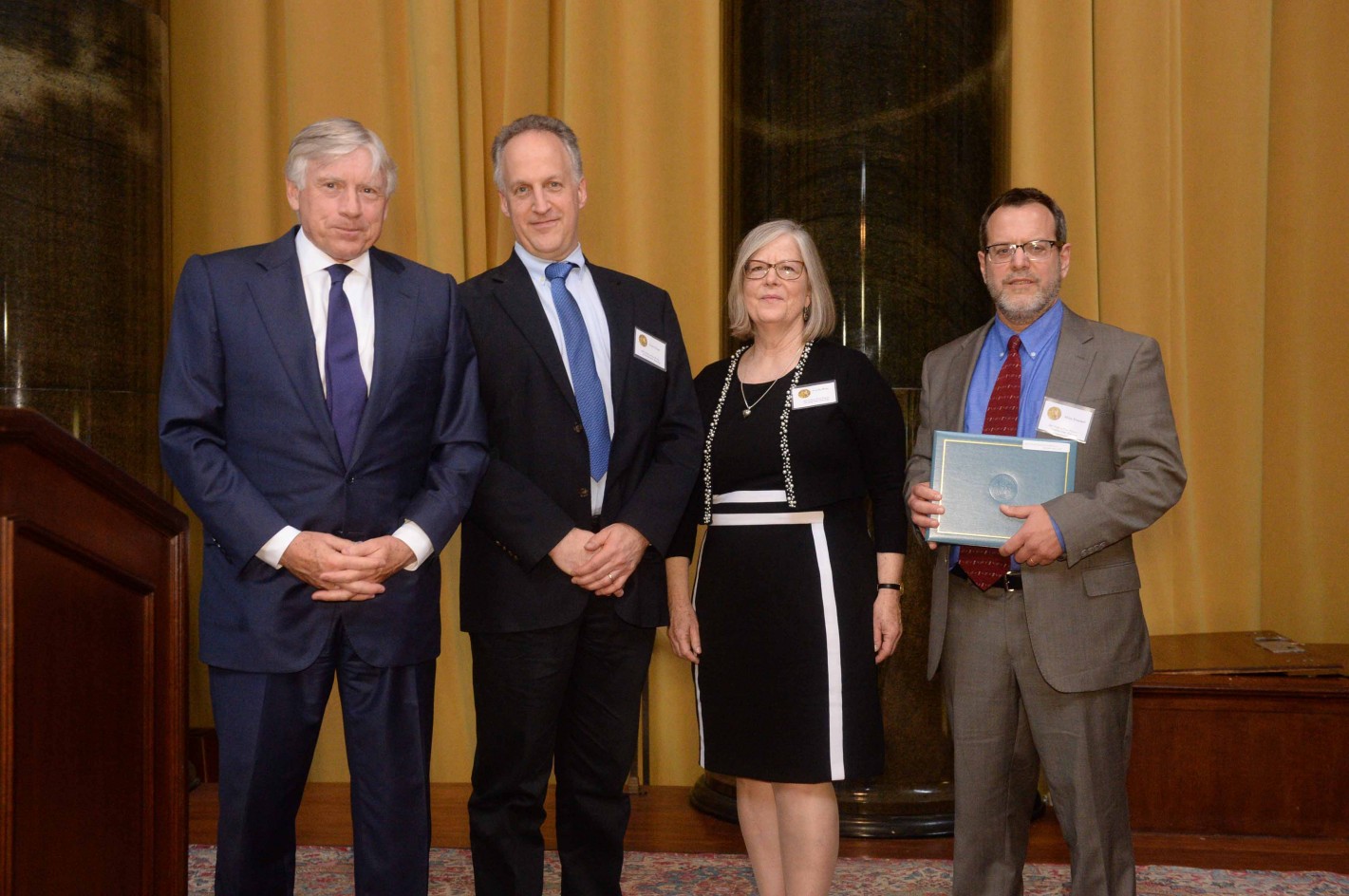
Neil Chase, Cecily Burt and Mike Frankel of the East Bay Times accept the 2017 Pulitzer Prize for Breaking News Reporting from Columbia University President Lee C. Bollinger.
Winning Work
Please access the timeline here.
By Erin Baldassari, Julia Prodis Sulek, Matthais Gafni and Tracy Seipel
OAKLAND — Doomed partygoers trapped on the second floor of a crudely converted warehouse screamed, “Help us! Help us!” as one of the deadliest structure fires in Oakland’s history ripped through a tinderbox of makeshift living spaces and a labyrinth cluttered with art late Friday night, killing at least 24 people and possibly more.
On Sunday morning, Alameda County Sheriff’s Sgt. Ray Kelly confirmed that they have “24 decreased victims of this fire.”
“We anticipate the number of victims will rise,” Kelly said.
The blaze broke out at an electronic music party at a Fruitvale district live-work space occupied by an arts collective, and firefighters late Saturday were combing through the burned building in search of victims — a process they say may take 48 hours and require bulldozers and cadaver dogs.
Dozens of people waited for news about their loved ones late Saturday night at the coroner’s office.
“It’s like waiting for your name to be called, and if your name is called, it’s going to be the worst day of your life,” Alameda County Sheriff’s Sgt. Ray Kelly said. “It’s very tense in there.”
As the horrific scene unfolded Friday night, people banged on windows when they couldn’t escape down the main path to safety: a steep, rickety staircase cobbled together with wooden pallets and plywood.
Survivors described a chaotic scene of people desperately trying to help their friends but overcome by fire and smoke.
“It was too hot, too much smoke, I had to get out of there,” said Bob Mule, a photographer and artist who lives in the building and who suffered minor burns. “I literally felt my skin peeling and my lungs being suffocated by smoke. I couldn’t get the fire extinguisher to work.”
When he escaped, he could see someone calling for help from the second-floor window, and tried to get a ladder, “but they jumped out the window.”
The building known as the “Ghost Ship” was zoned as a warehouse but had been the subject of a number of complaints about blight and illegal structures inside. On Saturday, city officials acknowledged that inspectors had knocked on the door of the warehouse two weeks ago but left when no one answered.
Outside the smoldering structure Saturday, Oakland police asked for descriptions of tattoos and piercings to help identify the nine bodies removed from the building Saturday as well as another two dozen or more who remain missing, including college students, artists and musicians attending a dance party upstairs. A 10th body had been found as of early Sunday, according to media reports.
It took about four hours to bring the blaze under control; at one point, the roof collapsed. The building had no sprinklers, Oakland fire Chief Teresa Deloach Reed said, and crews did not hear any smoke detectors going off when they arrived.
“We still have to do a more thorough search of the building, and we don’t know the potential number of other victims,” Reed said. No firefighters were reported injured while battling the blaze.
Kelly said emergency responders were prepared Saturday night for a “mass casualty event” that could involve “several dozen fatalities.” He also said that “several dozen” people who were initially reported missing have since been located and are safe.
The plan is to “disassemble the building piece by piece and place the debris into bins,” Kelly said. Heavy equipment could be seen and heard working on the building into Saturday evening.
Authorities were bringing in bulldozers, excavators, cadaver dogs and remote control equipment to find bodies buried beneath a collapsed second floor and roof and hidden within a clutter of pianos, camping trailers, artwork and old furniture.
“It’s very bad wreckage, twisted debris. It’s like a maze: wires, beams, wood,” Kelly said. “It’s all fallen on top of each other. There are places and crevices we can’t get in to.”
Like 9/11 in New York, few victims of the fire were taken to the hospital with injuries, he said. “People either made it out or didn’t make it out.”
Families of the missing gathered at an Alameda County Sheriff’s Department building on Saturday waiting for word. Dan Vega, whose brother Alex is missing, says the wait is unbearable.
“I have my work boots, I have gloves,” Vega said. “I just want to find him.”
Chris, a local musician who asked to use only his first name, said he was in the bathroom when the fire broke out. He walked out into a room filled with thick smoke. The lights had gone out and it was pitch black inside the warehouse space, where only a few moments earlier a group of 40 to 50 people were listening to a DJ play music and waiting for the show to start.
Immediately, people were screaming and trying to direct others to safety. With no lights, and smoke filling the warehouse, it made it difficult for people to find their footing on the somewhat irregularly shaped staircase, which Chris said appeared to have been built in three sections.
“We did that for as long as we could, but when you’re in a burning building, you’re being surrounded by a completely hostile environment,” he said. “It was kind of a free for all.”
Chris said he ran to his car to grab a flashlight and ran back into the building, crawling on his hands and knees, but he couldn’t get to the staircase or help move people to safety. The smoke, which he said hit him “like getting slapped in the face,” made it impossible for him to see or to breathe.
Firefighters started arriving as the flames grew larger and started erupting out of the side of the building.
“I felt so helpless,” he said as he watched the firefighters douse the flames.
The warehouse is one of numerous buildings in Oakland that have been illegally converted into artists collectives that have not been properly inspected, according to City Councilman Noel Gallo. Still, young hipsters looking for cheap, creative communities seek them out to survive in a city where rents are skyrocketing to accommodate an influx of highly paid tech workers.
The “Ghost Ship” was under investigation by city building inspectors just weeks ago amid reports of blight and illegal structures inside. When they knocked on the door to get inside the building Nov. 17, however, no one answered, so they left, according to city officials.
The building is owned by Chor N. Ng, of Oakland, but former residents say Derick Alemany and his wife, Micah, were raising three young children there, although they weren’t in the building when the fire broke out. The couple were the creative force behind the labyrinthine menagerie and collected monthly rent from other artists of between $300 and $600. They held dance parties with live electronic music and charged at the door to help raise money for rent.
In a Facebook post Saturday that was excoriated by readers, Alemany wrote, “Everything I worked so hard for is gone. Blessed that my children and Micah were at a hotel safe and sound. … it’s as if I have awoken from a dream filled with opulence and hope … to be standing now in poverty of self-worth.”
Alemany had advertised on Facebook and Craigslist looking for renters seeking “immediate change and loving revolution,” who enjoyed “poetics, dramatics, film, tantric kitten juggling and nude traffic directing.” He described it as 10,000 square feet of vintage redwood and antique steel “styled beyond compare.”
His 1951 purple Plymouth remained parked Saturday in front of the building that burned so hot, the “Ghost Ship” letters painted across the front had all but melted away.
“They are ex-Burning Man people and had their kids in the place — three kids running around with no shoes,” said DeL Lee, 34, who lived there for three months two years ago. “It was nuts.”
He described the place as a filthy firetrap, with frequent power outages, overloaded outlets, sparks and the smell of burning wire. A camping stove with butane tanks served as the kitchen, and a hole had been chiseled through the concrete wall to access the bathroom at the adjoining automotive repair shop next door.
The staircase, which had two switchbacks to get to the second floor, was built of pallets, plywood and footholds — like a ship’s gangplank — and was like “climbing a fort” to get up and down, say people who had visited the building.
Pianos and old couches doubled as room dividers. Pallets covered with shingles and elaborate trim formed sculptural walls. Often, Lee said, the place was filled with the sounds of sawing and hammering as Alemany continued to build.
“They’d be up all night, til 10 a.m., playing on the piano, banging on the floor, singing — it was crazy,” Lee said.
On Saturday, a candlelight vigil was held at Chapel of the Chimes. The Alameda County Sheriff’s Office also became a painful gathering place of sobs and embraces.
Kimberly Gregory, of South San Francisco, said she was watching the news about the fire, thinking how sad it was, when she got a call from her daughter’s friend asking if Michela, a student at San Francisco State, was safe.
“What do you mean?” Gregory asked. She and her husband raced to Oakland, where they were met by Mayor Libby Schaaf.
Joel Shanahan, the electronic musician who performed as Golden Donna at the Ghost Ship when the fire broke out, confirmed on Facebook that he was safe. “But like many people he is heartbroken and has several friends among the missing,” a post on his Facebook page read.
But Micah Danemayor, who was performing at the warehouse Friday, remains among the missing, along with his girlfriend. Karen Tate, who is close to the Danemayor family, fears they are both dead.
“His passion was the performances. He made his life work so he could do that,” Tate said. “They moved in together, and the next day they perished together. It’s so tragic.”
Staff writers Harry Harris, Sam Richards, Malaika Fraley and Katrina Cameron contributed to this story.
By Thomas Peele, Aaron Davis and David DeBolt
OAKLAND — Just three weeks before Friday’s deadly fire, city building inspectors had launched an investigation into “illegal structures” built inside the converted warehouse dubbed the “Ghost Ship,” but officials conceded Saturday they had been unable to gain access during an inspection visit and it appears they did not follow up.
The revelation sickened family members and survivors of the nine confirmed victims and dozens of others feared dead amid the charred remains occupied by the art collective, which was not permitted for the living area, underground dance club and artists’ studios that firefighters found late Friday night. The quirky, cluttered, wood-filled space — with no smoke alarms or sprinklers — seems to have trapped its inhabitants and visitors inside.
Officials had cited the building’s owner for blight on Nov. 13 after neighbors complained of “a ton of garbage piling up” in the adjoining lot. They next day, city records show officials began an investigation of an alleged “illegal interior building structure.”
When inspectors returned on Nov. 17, they couldn’t get in, Darin Ranelletti, Oakland’s interim director of planning and building, said at a news conference. He didn’t say why or explain whether they had tried later to return.
But City Council member Noel Gallo told the Bay Area News Group on Saturday that nobody had answered the door when inspectors visited the building, and they apparently had not tried again.
Family members waiting for word about loved ones were furious when Mayor Libby Schaaf told them that the city had tried to inspect the warehouse last month, but couldn’t get access.
“What I don’t understand is why weren’t they able to gain access, and if that was the case, why didn’t they stay there until they could?” said Dan Vega, an Oakley mechanic whose 22-year-old brother Alex Vega is still missing. “They should have locked it up.
“I don’t think it’s fair that my brother had to lose his life because the city didn’t know what to do.”
Gallo said what was going on at the warehouse was an open secret and that the city had ample chances to shut it down before the fire. He’s been complaining about the warehouse for years, he said, but inspectors were slow to react.
“We need to get our act together,” he said of the city. “It’s unfortunate that it takes a tragedy like this for us to realize that we have to do something.”
He said there are similar industrial buildings with people living in them in the neighborhood.
An art collective called “Ghost Ship” was occupying the building in the 1300 block of 31st Ave., which property records show is owned by Chor N. Ng of Oakland. The two-story building is zoned for a warehouse, but it had been converted into an unpermitted living space — a recurring problem in the Bay Area’s white-hot housing market.
The building had no sprinklers or fire alarms, a few fire extinguishers and only two known exits, officials said Saturday. The roof of the building collapsed, trapping dozens in a horrific inferno during a rave when the blaze raged into a three-alarm fire about 11:30 p.m. Friday. At least nine people were confirmed dead as of Saturday with more than 25 people unaccounted for.
Oakland Fire Chief Teresa Deloach Reed said firefighters had trouble battling the blaze because the space “was filled end-to-end with furniture, what-not, collections … it was like a maze almost.”
Photographs on social media show what was a mezzanine that ran more than half of the building’s length, a finished space with a large rug, lamps, couches, a piano, speakers and art work.
City building inspectors wrote in online records Saturday that “some of the victims might have been trapped in the blaze when they couldn’t escape down a makeshift, one-way stairwell leading to the second floor that was built out of wooden pallets.”
Matt Hummel, who occasionally visited the warehouse, called the way up to the mezzanine “a pirate ship claptrap” that was “a really scary way to get up and down. It was like climbing a fort.”
There was a little-known staircase behind an area of the mezzanine used as a musical stage, said Hummel, 46. It was unknown Saturday if anyone tried to escape the fire using those stairs.
Hummel said the place had “an opium den bordello vibe” and that the first floor was full of improvised wooden structures where people lived.
Shelley Mack said she lived in the warehouse for five months at the end of 2014 and witnessed generator fires and artists using butane torches. Showers upstairs were heated with propane, she said.
A man who said he lived in the warehouse for a few months said it was strewn with electrical wires that sometimes sparked. The interior often smelled like burning wires and wood. There were numerous wooden living spaces, and even camping trailers inside.
“The whole place was wires and cables and wood, said DeL Lee, 34.
The person who he said rented the warehouse, Derick Alemany, “had a fetish for wood.” The place was filled with wood signs and shingles, he said.
City inspectors went to the property in mid-November after a neighbor complained about “a ton of garbage piling up” in a vacant lot next to the building, calling it a “trash collection site” and a “trash recycling site.” The building had been “remodeled for residential,” the complaint states.
An inspection of that complaint prompted another investigation about the illegal structure inside, records show. Ranelletti said the warehouse was not permitted for residents.
Ng, according to property records, bought the warehouse in 1997. She could not be reached Saturday afternoon.
Ng went to court in late 2005 to evict a person from the building, Alameda County Superior Court records show. The tenant was paying $500 a month. There is no indication in the record how the property was being used.
Records show Ng owns 11 other Oakland properties, including an art gallery and retail building on International Boulevard, and at least two in San Francisco. A tenant at one of the Oakland properties would only describe her as a nice woman.
She also owns a business called Kingmaker Marketing and Consulting.
Jonah Strauss, who survived a fire at an artists’ collective on 24th Street last year, said sometimes artists have little choice but to live in places like the warehouse.
“Artists have gone from living in fairly safe conditions to being edged into sketchier and sketchier conditions because that’s what we can afford,” Strauss said. “We’re all feeling the crunch.”
Staff writers Mathias Gafni, Tracy Seipel and Julia Prodis Sulek contributed to this story.
By Erin Baldassari, Katy Murphy and Tracy Seipel
OAKLAND — Alex Vega always answers his phone. But his brother’s frantic text on Saturday morning — “I hope you’re OK” — got no response.
Vega, 22, and his girlfriend of four years, 20-year-old Michela Gregory, are among dozens missing after a Friday night blaze that consumed an artists’ collective in a Fruitvale-area warehouse and killed nine people at a dance party — and possibly many more.
Now, a memorial of flowers and candles grows at the site, and their loved ones wait in excruciating agony for news.
“I’m just hoping for a miracle at this point,” said David Gregory, Michela’s father, his eyes red from crying.
For friends and family gathered Saturday at the chaotic scene on 31st Avenue — or scouring social media for clues — information about the missing was maddeningly scarce. Police say it might be days before some victims, many in their 20s, are identified. They have yet to issue an official count of the dead after a Friday night fire that could go down as one of the deadliest structure fires in the city’s history.
The list of the missing includes KQED freelance producer Alex Frantz Ghassan, who posted a video of what appeared to be the party scene about an hour before the fire. Also unaccounted for are three UC Berkeley students — Griffin Madden, Jenny Morris and Vanessa Plotkin — the Daily Californian reported.
“Where are you, Alex?! Please say something soon! Please!” someone wrote on Ghassan’s Instagram page in response to the video — one of many friends begging the producer to get in touch.
Now, their loved ones wait in excruciating agony for news.
Dan Vega of Oakley was scrolling through Facebook during a break at work Saturday morning and saw the headlines of the fire. Knowing his brother Alex and girlfriend Michela had planned to go an Oakland art and music event, Vega repeatedly called his brother, but was put straight into voicemail. His heart sank when he heard from someone who had seen Michela at the party, and sank again after finding that their car was still parked in San Bruno, where they had caught the train to Oakland.
He stopped at a family assistance center at the sheriff’s substation on E. 12th Street. There, he said, he saw about 30 people inside, crying and making calls. He didn’t stay long.
“I figure I’ll get more news outside here quicker than if I go in there,” Vega said through tears.
The three-alarm fire, first reported at 11:30 p.m. Friday, destroyed a two-story warehouse building in the 1300 block of 31st Avenue, the scene of a concert and party featuring musician Golden Donna’s 100% Silk West Coast tour. In addition to those known dead, at least 25 others believed to be at the party were missing Saturday. In part because the burned structure remained unsafe to go into for much of Saturday, authorities said the process of getting more information will likely be time consuming.
Police said Saturday night they had found “several dozen” people — initially thought to be missing — to be safe, without offering specifics. But many of the people with loved ones on the missing person list have gone from anxiously awaiting good news to trying to reconcile the grim reality that they may never see them again.
Kevin Tanouye of Walnut Creek is all but certain that his older sister Jennifer Kiyomi Tanouye of Oakland was at the dance party. It’s been a long day of hoping to hear something, anything, from anyone, about what has happened to her.
“It’s just been a lot of sitting and waiting,” Kevin Tanouye said.
Jennifer works in Oakland as a manager with Shazam, which makes music-identification apps for computers and smart phones. Her brother believes she may have gone to the party to do “nail art,” to paint people’s nails in creative ways, something she enjoyed doing.
Her close friend, Ronnie Casey, got a message late Friday notifying him of the fire. Knowing she had been at the party, he stayed up all night hoping she would let him know she was safe.
“When I first heard about the fire, I didn’t realize the gravity of the situation and I was a lot more hopeful,” he said. “As the night turned into morning, I came to realize how serious it was.”
When the friend he described as vibrant, fashionable and beautiful didn’t turn up at Highland Hospital and was still missing as the morning progressed into day, Casey said he began to prepare himself for the worst.
“She was a light,” he said. “To know her was to love her.”
Also still missing is Peter Wadsworth, from Boston, who had lived in the building for about a year.
“He’s like my big brother,” said his friend Tammy Tasoff, choking up. “He takes care of me and makes sure I’m organized.”
Tasoff was not optimistic. “It’s not good news,” she said. “His housemates said he definitely went to that party.”
Ray Wan said he wasn’t at the party, but got a call around midnight about the fire. He showed up at the scene early Saturday to check on three DJ friends who were playing house music at the art collective, which throws the events to raise money for rent.
Friends and family of party-goers were also on social media early Saturday looking for confirmation their loved ones were safe. Some have posted images and messages on Facebook of people they believe are missing, while others shared news that they had escaped safely.
Karely Cerritos said she has tried in vain to reach three of her friends who were at the party — Nicole Siegrist, Benjamin Runnels and Donna Kellogg — and they weren’t listed at local hospitals.
Siegrist is like a sister to her, Cerritos said; after hours of silence from her friend, she fears the worst.
“If I express concern, she wouldn’t ignore it,” Cerritos said.
Just before 2 p.m. Capt. Purnell Hall — a pastor with the local Salvation Army — emerged from the sheriff’s office after dropping off meals to the roughly 50 people gathered inside.
“It’s tough to lose a loved one, and our hearts and prayers are with them,” Hall said. “I just hope that in time they will be able to get the answers they need.”
Reporters Matthias Gafni, Tammerlin Drummond, David DeBolt, Tatiana Sanchez and Sam Richards contributed to this story.
By Julia Prodis Sulek and Rick Hurd
OAKLAND — As families waited another day for their missing loved ones to be identified from the charred wreckage of the “Ghost Ship” warehouse, the death toll from Oakland’s deadliest fire surged to at least 33 victims Sunday while Alameda County officials announced they had launched a criminal investigation into the inferno.
“The scope of this tragedy is tremendous,” Oakland Mayor Libby Schaaf said Sunday afternoon. “We have many witnesses to interview. We have been able to bring in extra detectives to put as many resources on this and get to the bottom of this as quickly as possible.”
Working shifts around the clock since the blaze broke out Friday night, firefighters described a “quiet, heartbreaking” process of sifting through buckets of ashen rubble, looking for signs of the missing and preserving any clues for the criminal probe.
At the same time, with only eight of the dead identified by Sunday afternoon, Oakland Police were tasked with the most difficult duty: asking relatives to place personal items — a hairbrush, toothbrush, or comb — belonging to their loved ones into brown paper bags to match DNA if necessary.
“It’s a terrible thing to have to say,” Alameda County Sheriff’s Sgt. Ray Kelly said Sunday, “but that’s what we are left to deal with.”
Friday night’s fire, which started at a dance party inside a warehouse that was serving as an artists co-operative and living space, is Oakland’s deadliest fire; the 1991 Oakland hills fire killed 25.
“I don’t even know how many people are left in there,” Kelly said Sunday afternoon at a news conference where he said four teams of searchers were methodically sifting through the area to find victims. “We have no idea. We don’t even know how many people got out of that building. We are expecting the worst and hoping for the best with regard to the number of victims we might find.”
As officials try to figure out what sparked the fire in the warehouse, which didn’t have a permit to be a living space or dance club, county District Attorney Nancy O’Malley on Sunday announced that she has opened a criminal probe, looking for any signs of arson or criminal negligence.
Depending on what is found, Russ Giuntini, an attorney and former Alameda County prosecutor, said it’s possible someone could be charged with manslaughter with gross negligence.
“You have to conduct an investigation and see where it goes,” Giuntini said Sunday. “It’s proper for the authorities to figure out if there is any criminal conduct involved.”
Carmen Brito, 28, and Nikki Kelber, 44, returned to the Fruitvale neighborhood Sunday, trying to get close to the “Ghost Ship” they called home. Both women narrowly escaped the blaze Friday night.
Brito said she had fallen asleep in her room on the first floor near the rear of the building. She woke up to the smell of smoke and an orange glow.
“By the time it took me to put on these shoes and this jacket, there was a wall of fire,” Brito said. “I was yelling for help and I don’t know if anyone could hear me. And a minute after I got out the front door, the power went out. It went from either you lived or you didn’t in under 10 minutes.”
One of the residents, she said, used the light from his cellphone to help guide people out.
The two-story warehouse was home to about two dozen artists and musicians who lived downstairs, Brito and Kelber said. Former residents say they threw dance parties upstairs to raise money for rent. Oakland officials had launched an investigation into the building two weeks before the fire for code violations, including blight and illegal structures inside. Warehouse owner Chor Ng from Oakland and Derick Almena, who leased the space, have come under intense criticism about the interior of the building, which has been described as a bonfire in the making.
A steep, narrow main staircase was made of wooden pallets and plywood, and the space was so cluttered with a jumble of pianos, camping trailers, second-hand furniture and artwork that rescuers could barely get inside. Almena has been described as an eccentric who provided a beautiful, creative community to struggling artists, as well as an egotist who cared more about the quirky aesthetic of the building than of the safety of the people who lived there.
The fire burned so hot, the roof and second floor collapsed to the ground.
On Sunday, firefighters sawed lumber to build a ramp into the building to better view the damage and coordinate their recovery operation. They were searching through the “tiniest little corners” of the massive space, Sgt. Kelly said, digging with shovels and forming an assembly line of orange and white buckets. They had yet to search inside any of the half-dozen or so incinerated camping trailers inside the building and had only gone about 40 percent of the building by Sunday night.
“We’re still not done,” Kelly said “They are working and pulling this building apart and dissecting it so we are really starting to get deeper into the building. As we do that we continue to find more victims.”
Bodies of the victims were found throughout the remains of the building, with no apparent sign that people were congregated near any kind of exit or window, he said. The main exit was the rickety staircase and door at the front, but there was a second staircase behind the main stage upstairs and an exit below that few people knew about, some of the regulars there have said.
Brito said she didn’t know how many were there that night. One of the residents, Brito said, they fear is dead. The rest of the victims were visitors to the space, most upstairs at the dance party.
“We lost one of our own. We lost everything we own and people lost their lives,” Kelber said. “People are trying to place blame when it shouldn’t be about blame.”
Both women wore some of the clothes they escaped with Friday night. They still smelled like smoke.
“This was our home,” Brito said, choking up. “The only thing I have left of that space is the photos of it burning.”
The identities of seven victims were released Sunday: Cash Askew, 22, Travis Hough, 35, David Cline, 24, and Donna Kellogg, 32, of Oakland; Nick Gomez-Hall, 25, of Coronado; Sara Hoda, 30, of Walnut Creek; and Brandon Chase Wittenauer, 32, of Hayward. The identity of the eighth victim, the youngest at 17, was not released because he is a minor.
Many of the victims — who had not been confirmed dead Sunday — were artists, professionals and free spirits drawn to the warehouse party Friday night by a shared love of electronic dance music. They included Chelsea Faith Dolan, a pink-haired electronic music artist who went by the stage name Cherushii; Nicholas Walrath, a young lawyer who was two months into a new job at a San Francisco law firm; and Alex Frantz Ghassan, a freelance producer for KQED with tattoos of his children on his body.
Josh Howes said he and Kellogg were a couple for four years. She was in culinary school and worked at a coffee shop.
“She and anybody else there, they were cool, awesome intelligent artists, musician freaks,” Howes said. “She was just a super, awesome, fiery, intelligent redhead who loved to heal and wanted to be a healer, was going to school to learn how to be a healer. She was a great artist, fantastic musician. She was just a beautiful, hilarious, strict, radical crazy lady.”
One of the victims was the son of an Alameda County Sheriff’s Office deputy.
Friends and family members posted desperate messages on Facebook over the weekend, pleading for information about their loved ones.
“Hey are you OK?” they begged Dolan. “Let us know if you are OK.”
Staff writers David DeBolt, Marisa Kendall, Thomas Peele and Robert Salonga contributed to this report.
By Robert Salonga and Thomas Peele
OAKLAND — Five months before Friday’s raging fire killed at least 33 people at the “Ghost Ship” warehouse, the architect of the cluttered artists’ cooperative took to Facebook in a 1,000-word rant claiming he was “the thriller love child of Manson, Pol Pot and Hitler.”
There was little sense to the bizarre writing of Derick Ion Almena, 46, known as a passionate artist from Los Angeles devoted to an alternative way of life who led the Oakland arts collective and commune with a distorted sense of reality. But he ended his writing with incredibly haunting words: “I can proverbally (sic) get away with murder.”
The warehouse had been rented for a dance party, Almena apparently wasn’t at the property Friday night, and no one has accused him of directly causing the fire. He does not own the structure. Police won’t say if they have questioned him — or anyone — but District Attorney Nancy O’Malley has opened a criminal investigation into the blaze at the facility, which wasn’t permitted for parties or residential living.
Almena’s name came up in discussions before the probe was announced, a law enforcement source close to the investigation told the Bay Area News Group. Attention has focused on the man behind the “Ghost Ship,” whom former residents and frequent visitors say was cavalier about safety hazards at the warehouse that many labeled a death trap.
Almena is no stranger to law enforcement. In January 2015, he pleaded no contest in Alameda County to a misdemeanor charge of receiving stolen property after negotiating a plea deal that saved him from facing a felony. He is on probation until 2019. Online records show his criminal history also includes an unspecified arrest in Los Angeles County. Efforts to reach Almena — whom people had identified Saturday as Derick Alemany — at addresses affiliated with him in Oakland have been unsuccessful.
Public outrage
Shortly after the blaze, he became a central figure of public outrage about the fire when he failed to mention the victims in a post on Facebook, lamenting his own loss: “Everything I worked so hard for is gone.”
A disturbing picture of Almena quickly emerged on social media and in interviews with people who know him; many skewered him as selfish and careless and for next-level narcissism, but some celebrated his unyielding quirky vibe. A deeper look into Almena’s past shows a man who sought to desperately defy convention in his art, work and life.
“This is NOT a nite club,” he wrote in a 2012 Facebook post about an event he promoted at Cloud 9 in Berkeley. “You will not be asked to leave at 2 am. You will not be subjected to plastic falsely proud deejays subjecting you to manufactured soul-less beats. You will be in the house of a living temple. Surrounded by magnificent Alters, Antique furniture, Balinese beds, Persian rugs, organic food and drink.”
A former neighbor from when Almena lived in the Oakland hills in the earlier part of the decade said he elicited suspicion from many in the calm hillside neighborhood.
Jurgen Braunngardt, the neighbor, said cars came and went from Almena’s home frequently at night, fueling suspicions. Almena was eccentric, the neighbor said, describing him as having “a way about him like he was founding a new religion. … I felt sorry about his wife and the people around him. It’s a tragedy.”
Almena and his wife, Micah Allison, and their three young children eventually moved into the Ghost Ship but were not there Friday night. The warehouse had been rented out for an underground dance party, as it often has been, and the couple spent the night at a hotel.
Danielle Boudreaux, a former friend of the couple, told the Associated Press she had a falling out with Almena when she persuaded Allison’s parents and sister about a year ago that the warehouse was a dangerous place for the couple’s three children to live.
“Oh my God, the children,” Allison’s relative Claudette Selvin, of Gardena, said Sunday upon hearing about the fire but learning the children were safe.
Almena’s Facebook posts, under the account Derick Ion, hinted at what some described as his growing instability. Others say drug use was widespread at the warehouse.
“Addictions never admitted armed me as revolutionary,” he wrote. “… as long as i seek help and healing, have current registration, pay my insurance, piss in a cup twice weekly … i can proverbally (sic) get away with murder.”
The couple didn’t own the Ghost Ship; they leased it from an Oakland landlord and lived at the warehouse, welcoming others to live and work in the building for $300 to $600 a month, according to interviews with former tenants.
Life in the Ghost Ship
Shelley Mack lived at the warehouse for a few months in 2014-15 and described Almena as gypsy-like, often spinning tales and writing poetry. But Mack said she was alarmed by the hazardous living conditions, questionable electrical hookups, artists using butane torches and by the propane tanks used to heat the showers upstairs.
“He knew all of it,” Mack said. “We argued a lot. They said they would fix things, and then they would collect money. They never would use the money to fix things.”
Oakland building inspectors were familiar with the property and had visited the site just last month after a complaint, but they couldn’t get inside.
Almena had converted the two-story space into a Burning Man-style arts collective and commune in Oakland’s Fruitvale district, cluttered with Persian rugs, dozens of pianos and a gangplank-style staircase to the second floor, where many of the victims of Friday’s fire were trapped.
Nikki Kelber, 44, a jewelry maker who lived in the Ghost Ship and narrowly escaped the fire with her cat, said Almena is being unfairly blamed for the fire.
“Their sole purpose was to create a space where artists could survive and thrive,” she said. “To point fingers at them is unfair. They are not bad people by any stretch of the imagination.”
While Almena’s building was known as the Ghost Ship, he had named the arts collective Satya Yuga, which in Hinduism refers to an initial golden age marked by knowledge, meditation, repentance and good deeds.
One poster on Facebook described how the “inside of the warehouse looked like his mind … beautifully exotic and creative, but with sharp edges, dangerous corners, hazardous materials and twisting turning darkness.”
“I’ve had years of being in community and hearing people have dangerous encounters with him. … All the Balinese art that’s inside is his. Same for the antiques. Same for the wooden boards and nails jutting out at all angles. Same for the mushroom infested furniture,” the Facebook poster said. “It’s his design. There wasn’t any interest in making the space be safe for people. And since so many people didn’t want to deal with him due to the trauma they went through, they stayed away.”
Alexander Dore, another former resident, fondly described the warehouse on Facebook as “a collective, a commune, a temple, a home, a place to run free stoned naked without fear, it was a sacred space that wasn’t owned by the government.”
But now, Dore wrote, it is a “mausoleum for the dead.”
Staff writer Julia Prodis Sulek and Aaron R. Davis contributed to this report.
By David DeBolt and Angela Hill
OAKLAND — Chris Dunn stood on International Boulevard on Sunday, across from the charred artist warehouse where dozens of people perished in a deadly fire Friday night, and shared a fear that is on the minds of many in this city’s celebrated arts community.
As they grieved for friends killed in the inferno at the Ghost Ship warehouse on 31st Avenue, artists, musicians and partygoers from east to west Oakland couldn’t help but worry about a backlash of building inspections at other warehouse collectives.
“There’s going to be a draconian overreaction to shut everything down,” said Dunn, 42, who has attended events at the collective in the Fruitvale neighborhood. “That would only add to the tragedy.”
“People are getting worried (the fire) is gonna be used against us,” said Katelyn Charvoz, of West Oakland. The 25-year-old said she’s been involved in the music/party scene since she was about 15. “The city’s gonna paint us as some ugly, crusty, punk kids that are up to no good. If they buy up all the warehouses on every street and kick everyone out, it will just hurt the arts community here.”
The tragic warehouse fire is roiling an already simmering tension between official Oakland and a vibrant, free-wheeling arts community that has given life to many of its former industrial neighborhoods in recent years. Already, rising rents were threatening to dislodge some of these artistic centers; now concerns about lack of proper permitting and unsafe conditions, like what existed at the Ghost Ship, could add to the pressure.
As far back as the 1980s, artists’ live and work spaces have been hives of creativity inside converted industrial buildings left empty after many of Oakland’s blue-collar manufacturing companies closed. Large, open and dirt-cheap, the vacant buildings of West Oakland and East Oakland were attractive to artists and developers desperate for tenants.
They became homes to punks, sculptors, musicians, Burning Man artists, people in construction — makers of things responsible for creating the First Friday festival and putting Oakland on the international art scene map. Parties are a constant theme, and some raise money to pay rent like the Ghost Ship event Friday night.
A lot has changed since the first and second wave of artists came to Oakland. A round of development ushered in during the Mayor Jerry Brown era converted some of those former manufacturing sites into gleaming new condos. This time around, rents are skyrocketing, and landlords are finding ways to evict or push out artists for a new wave of tech and wealthier residents willing to pay more.
Mayors from Brown to Libby Schaaf have embraced Oakland’s thriving underground art scene and its more recent transformation to a global happening place that has garnered the East Bay city international attention and helped make it a tourist destination.
Schaaf often arrives at parades and other events in a fire-breathing art car in the shape of a large snail, fabricated by Burning Man artist Jon Sarriugarte, and has attended events in converted arts spaces around town. She has pledged to do all she can to preserve and promote the arts and spaces for artists in Oakland.
So Friday’s tragedy has put city officials in a bind: Red-tagging unsafe or unpermitted buildings used by artists will likely reduce an already scarce supply of affordable space. But ignoring code violations puts residents at risk.
In January, Oakland city building inspectors deemed 1919 Market St., a large, two-story warehouse hub in West Oakland unsafe because of illegal construction and ordered the metal and wood workers to leave. In May, residents at Ghost Town Gallery on San Pablo Avenue, a 12-year-old warehouse shared mostly by musicians, were evicted. The landlord claimed the construction done inside by tenants was unsafe, but after doing some minor renovations, the place is advertising for new tenants — at a much loftier price.
An ad on Craigslist last month listed the rent as three times what the Ghost Town Gallery residents paid and boasted of having space for a yoga studio.
“They don’t want you to have affordable rent,” said Damon Gallagher, who was the master tenant at Ghost Town and has since left Oakland. “There was blood dripping out of their mouths, dollar signs in their eyes.”
The 1919 Market evictions had artists who live in warehouses around the city worried that their buildings were next. Now they wonder if that was one reason why no one at Ghost Ship answered the door when city inspectors showed up Nov. 17.
“Who is going to want to call inspectors and risk losing their space?” Dunn wondered.
On Sunday Schaaf was asked how the city will balance the need for artists’ safety with making sure they aren’t forced out. She pledged her support for the artists, and said, ironically, that on Tuesday the city will announce a significant philanthropic grant to address recent displacement of Oakland artists, an event scheduled before Friday’s horrific fire.
“The issue of creating safe, vibrant spaces for Oakland’s artist community is a priority not just of me as mayor but of this community,” Schaaf said. “This is work that’s been going on for a long time and we’re going to stay focused on accomplishing that in a way that makes sense both for Oakland and also for all the different stakeholders involved.”
Sarriugarte, 53, an artist, blacksmith and longtime part of Oakland’s vibrant arts community as well as the Burning Man crowd, wants to make sure artists using warehouses are not painted with a broad brush.
“It’s a new generation of warehouse dwelling that’s different than what we did when we were younger,” Sarriugarte said. “We were a more independent group and we used very large spaces with very few people. Now you see more communal living, not a very big space with a lot of people in it.
“But if we start sending in all the city agencies going after each space, it will be the demise of underground spaces, which have been a very important incubator for all the beautiful stuff that happens here,” he said.
In Oakland, there’s a range of communities using converted warehouses, groups that often overlap. Some are organized, permitted artist collectives engaging in legal warehouse use for work spaces, gallery shows and events. At Vulcan, an East Oakland warehouse with just under 60 units, fire sprinklers were installed earlier this year and fire paths are clearly marked, said resident Darin Marshall, 47.
Then there are the so-called DIY collectives – the underground arts scene, often operating in illegal live/work situations like Ghost Ship. And there’s also the underground music scene, holding parties and electronic music shows in some of these spaces that are not permitted or up to code.
“In 2010, 2012, there were a lot more underground performance spaces and venues,” said Marshall Brooks, 31, a West Oakland resident and party thrower. “It used to be we could do it in places where it’s not so dangerous. We didn’t have to use places where red flags abound. But now everybody gets kicked out of warehouses and they turn them into condos.”
Already, some in the “Burning Man hierarchy” are talking about how to facilitate improvements to some of the illegal warehouse set-ups without getting the city involved, Sarriugarte said.
To this end, Michael Snook, founder of the NIMBY collective in East Oakland, reached out to artists on Facebook Sunday. NIMBY started in a West Oakland warehouse in 2004 and was forced to move after an untended candle sparked a smoky fire in 2008 and inspectors shut it down for lack of permits and sprinklers. The city helped the group relocate to a new space in East Oakland, but it took months and a $30,000 permitting nightmare before they could rest easy.
“If anyone lives in a live work space and would like it inspected without worry of all hell breaking loose, contact me,” Snook wrote on Facebook. “I can hook you up with a private professional that knows all the rules but doesn’t work for the city of Oakland. There is a fee and all I ask is you do what he says. Please.”
By David DeBolt, Thomas Peele and Robert Salonga
OAKLAND — City and county officials missed at least 10 chances to flag dangers at the Ghost Ship art collective that might have led to Friday night’s inferno in which at least 36 people died, according to documents and interviews.
Officials also declined to say Monday when the building last underwent a fire inspection. Most cities have routine yearly fire inspections of commercial properties, said Eric Dutton, executive director of the California Fire Chiefs Association. And many departments in the state do them more frequently.
A Bay Area News Group analysis of city, county and court records and police documents, along with interviews with investigative experts, strongly indicates that glaring dangers at the warehouse on 31st Avenue were either tacitly or willfully ignored by the building owner and the people running the artist collective, and by city employees often called there for everything from fistfights to garbage outside.
Officials from various agencies were no strangers to the Ghost Ship over the years, leaving plenty of opportunities for the fire and safety dangers to be detected. Police responded to fights and reports of stolen property; code inspectors cited everything from tall weeds to mounds of garbage to structures being built inside the warehouse; and state workers temporarily took the three children of the couple running the collective away because of fears for their safety.
The warehouse — with little separate dwelling units on the first floor and a staircase made of scrap wood leading to a cluttered, furniture filled second floor where dance parties were held — was roundly called a deathtrap by some survivors and others familiar with the building.
A retired Contra Costa firefighter said he was outraged that the city did not act to shut down the cooperative over the obvious code violations.
“Any professional firefighter, regardless of rank, would have recognized the deadly threat that this building represented and did everything possible to shut it down,” John Stiglich wrote in an email.
Fire companies are responsible for knowing the hazards that exist in their own areas, Stiglich wrote: “Something should have come from this level and proceeded without delay.”
Farzaneh Farsoudi, a relative of Sara Hoda, 30, a teacher at the Urban Montessori Charter School in Oakland who died in the blaze, said it was tragic that the fire department didn’t act.
It seemed apparent the fire department hadn’t been to the Ghost Ship recently, he said, “because otherwise they would have advised them to have (a) fire extinguisher.” Several fire extinguishers found in the building wreckage were inoperative, officials have said.
“If (they) had worked, it may have saved a lot of lives. … It’s very sad,” Farsoudi said.
Jake Jacobitz, an electrician who did some work at Ghost Ship and stayed there occasionally, said an electrical wire ran from a neighboring business. When he first arrived at the warehouse, it had only one power outlet and only one exit until he cut a fire door, he said Monday,
“You could hear the electrical feed vibrating in the pipe, it was so hot,” Jacobitz said. “Everything in there was illegal. (Almena) has been told so many times but he doesn’t care.”
Shelley Mack, who lived at the warehouse in late 2014 and 2015, said the police knew of the location and had even been inside the building when they escorted her out as she left after a dispute with Derick Ion Almena, the leader of the collective.
Residents were “nice when you get there, but it didn’t take long to know (living there) was a bad idea,” Mack said.
Repeated requests Monday for routine city records showing when the building was last inspected for fire safety were denied. Records normally provided over the counter that would show details about code enforcement visits were also not released Monday despite repeated requests. A Bay Area News Group lawyer objected in a letter to the city about the lack of access.
Oakland officials were mum on the matter Monday. Mayor Libby Schaaf walked away from a reporter trying to interview her about the visits and how often the fire department inspected the building. In a statement issued Monday night, Schaaf said “initial information (is being) compiled and (we) will be reviewing it with the District Attorney prior to release.” DA Nancy O’Malley is conducting a criminal investigation of the fire.
The city’s fire department boasts on its website of “an excellent program” in which firefighters do surprise “field inspections, on a block-by-block basis. Inspections occur at least one time annually. In some instances, high-hazard (buildings) may require additional inspections.”
Warehouse owner Chor Ng was well known to the city Code Enforcement office.
She faced $15,000 in code enforcement fines attached to her 2013-2014 county tax bill and $7,600 in similar costs in 2009 for the property. In 2007, a notice of a substandard building and special assessment of $15,000 was filed against her.
Records also show city taxes on the property were often not paid. Ng could not be reached for comment. A lawyer who has represented her in real estate matters did not return messages.
Last month an unidentified code enforcement officer went to the building in response to complaints about piles of garbage. No one came to the door of the collective. The next day, the city started an investigation about apparent illegal structures being built inside the warehouse. But no inspectors returned to follow up before the fire.
It was far from the only chance for someone to notice the hazardous conditions.
• In March of last year, police responded to a report of a dance party at the warehouse where attendees were paying $25 a head to get in. An officer was reportedly denied entry by a doorman claiming that the location was a private club with members paying monthly dues, records show. The officer left because there was no evidence of a crime.
• A tenant dispute in February 2014 also drew the attention of police. Almena was reportedly cited for battery, and another man was arrested, but no charges came out of the encounter. Officers didn’t enter the building.
• On Jan. 13, 2015, Almena was arrested on suspicion on possession of stolen property at the warehouse. According an Alameda County Sheriff’s Office probable-cause document, a woman named Farrah Dalal flagged down a passing Alameda sheriff’s deputy and said Almena had stolen her trailer and she had tracked it to the 31st Avenue site.
Dalal, who claimed Almena was her former tenant, had performed a citizen’s arrest of Almena, and Deputy Jeremy Lucha arrested him and booked him into a county jail. In his report, Lucha stated that Almena confessed to having the trailer “for about a week.” It was unclear from the report if Lucha entered the warehouse or arrested Alemna in the vacant lot next to it.
Almena spent two days in jail and agreed to plead no contest to a lesser misdemeanor charge of possessing stolen property. He was sentenced to three years’ probation and was ordered to pay restitution.
• In February 2015, the Alameda County Child and Family Services Department was called to the warehouse and took custody of Almena’s three children out of safety concerns about them living there, according to a court document. Almena also later posted on Facebook that it had happened but blamed a tenant for “fake accusations.” The children were later returned to Almena and his wife. The department director didn’t return a message Monday.
Sara Huntley, who lost a friend in the fire, and whose partner left the collective earlier this year, said the conditions there were frightening.
“I begged my partner to move out to find some other place,” she said. “I just knew that if things didn’t change that place would have a terrible thing happen as a result of neglect and people looking the other way.”
Staff writers Erin Baldassari, Aaron Davis, Malaika Fraley andJulia Prodis Sulek contributed to this report.
The harrowing stories of that night tell a heartbreaking tale of what was lost, and who should have known better.
By Julia Prodis Sulek and Matthias Gafni
OAKLAND — Max Ohr considered himself the creative director, the “go-to guy,” the “camp counselor” at the Ghost Ship warehouse, and on that Friday night, he was also the doorman.
He had spent the day getting ready for an electronic music party upstairs, arranging the sound system and cleaning up the fantastical bohemian space where he and about two dozen of his fellow artists lived. Before 9 p.m., the lanky jewelry maker with a scraggly beard and crescent tattoo on his cheekbone began welcoming visitors. They arrived in small groups, more than 100 guests in all from a tight-knit music and art scene — a transgender barista, a 35-year-old therapist who helped at-risk kids, a father of twin daughters, a couple in their 20s, he with a pencil-thin mustache, she with green glitter sparkling on her cheeks.
As they entered this one-of-a-kind sanctuary to Oakland’s creative culture, they followed the pulsating beat to the second floor, up the single-file staircase made of scrap wood and pallet planks to a dance party promising good vibes and good friends.
“I greeted almost every single person who walked through that door,” said Ohr, 26, “and I’m usually the one who says goodbye to them at the end of the night as well.”
On this night, he would be screaming for them to escape.
On this night, Ohr would be the doorman to an epic tragedy, Oakland’s deadliest fire ever.
This was no natural disaster, no earthquake, no terrorist shooting. This disaster was avoidable; 36 people were victims not just of the smoke and fire, but of recklessness, bureaucracy and indifference.
The harrowing stories of that night — from those who made it out, those who traded panicked texts, and those who tried to help — tell a heartbreaking tale of what was lost and who should have known better.
The invitation to the party in the warehouse on 31st Avenue in Oakland’s Fruitvale district spread on social media.
Local promoter Jon Hrabko had been drumming up excitement for the Dec. 2 event on Facebook for a week: “invite as many of your friends as possible and share this event on your page for maximum visibility.” With a lineup of popular DJs creating pounding techno beats, the show was typical of Oakland’s trendy off-the-grid electronic music scene found on rooftops and in warehouses. “They can limit our invites but Not gonna let them limit our fun,” Hrabko wrote. “We shall rise up, overcome, and dance on the ruins. Stay safe out there.”
Oakland DJ Johnny Igaz, who goes by the stage name Nackt, had posted that he would be performing: “really looking forward to breaking the seal with this one on Friday!” The cover charge was $15.
At 7:44 p.m. Hrabko posted a last-minute “BYOB folks.” Ara Jo, an Oakland artist, added that she would be filling in for a hairstylist who backed out, trimming bangs for partygoers for $5 while her friend Kiyomi Tanouye, who worked for the music app Shazam, “will be doing nails!”
For those who had never been to the Ghost Ship, the space was a wonder of wood, an elaborate, eclectic exhibit of carvings, mannequins, paintings, Balinese artwork, second-hand furniture and Indian tapestries. Musicians, tattooists, clothing designers and sculptors lived in alcoves carved out of the 10,000-square-foot space. One of them called it “everything in my life that was beautiful and brought me joy.”
If the Ghost Ship were a temple, Derick Almena, 46, was its high priest. The charismatic eccentric had leased the warehouse for at least three years from Chor N. Ng, the building’s longtime owner. Almena lived on the second floor with his wife and three young daughters who often ran around barefoot. The night of the party, they went to a hotel so the girls could get some sleep.
Almena collected rent from the resident artists, charging between $300 and $600 a month in a city where a one-bedroom apartment can go for more than $2,000. He told his tenants to say the warehouse was merely a 24-hour art studio, not their home. But photos show an AirStream trailer, campers and loft beds inside the warehouse among the art installations. Pianos were lined up as room dividers. Extension cords and cables snaked throughout the building. Propane tanks fueled a camping stove in the kitchen.
Visitors had called it a tower of kindling. It would become a funeral pyre.
The hundred or so guests likely didn’t know the warehouse had no sprinklers or smoke alarms, that it wasn’t permitted for either a living or event space, that neighbors had complained for years. They didn’t know city code enforcement inspectors had knocked on the door two weeks earlier and left when no one answered.
They didn’t know they had something to fear when they climbed that rickety staircase.
Upstairs, the music was thumping at 10:26 p.m. when Alex Ghassan, an Oakland father of twins, posted what would be his last video to Instagram: dark grainy images of the party just getting started. The sound of laughter echoed over the music.
Alex Vega, 22, and Michela Gregory, 20, a couple who worked part time at a Daly City mortuary, came over from the Peninsula and lounged on a couch upstairs. One of them snapped a photo, capturing a darkened silhouette of the ornate decor. Gregory, a San Francisco State student, her face shimmering with glitter, loved to dance. They had been to the Ghost Ship at least once before.
As the party grew upstairs, about a dozen residents carried on with their evening downstairs. Anthony Perrault, 27, was listening to music with a friend. Nikki Kelber, 44, was with her cat in her studio up front. Carmen Brito, 28, had fallen asleep in bed, in the back of the building near where the fire started.
It was about 11:20 p.m. when the smell of smoke and a flickering orange glow woke her.
By the time she put on her boots and black wool coat, the glow had turned into a wall of fire. She yelled for help but didn’t think anyone could hear her. She took off running for the front door and fumbled with her cellphone to call 911. It was 11:23 p.m. when she made it outside.
Ohr, the doorman, had just left his post to walk down a hallway to the bathroom when he heard the voice of a young woman. Her tone was strange, questioning: “Is that a fire?”
A moment later, another woman’s voice, a little louder, a bit frantic, but not a scream: “Fire, fire!”
Ohr heard the crackling and saw the eerie glow. He raced to his studio through the maze he knew so well, and didn’t waste time with the lock. Instead, he kicked in the door and grabbed the biggest of the fire extinguishers he kept near his jewelry-making equipment. Perrault, who lived next to Ohr, grabbed his own fire extinguisher. With a third resident, they faced the fire.
The extinguishers might as well have been squirt guns to the inferno swirling up the rows of pianos and Tibetan screens and cotton tapestries, then sweeping in waves across the ceiling. The back of the building was in flames. The three men dropped their extinguishers and ran toward the front, screaming “Fire! Fire! Fire!” every step of the way.
Upstairs, Igaz, a 34-year-old voice-over artist at Pandora, had started his set, and people were dancing when thick smoke started funneling up the staircase. The music was loud, and many first assumed the smoke was coming from a fog machine. Most of the guests had no idea about another stairwell hidden behind the stage at the back of the building. It was one of the Ghost Ship’s “secret passages.”
With Ohr halfway to the front door, the power went out, cutting off the music and plunging everything into darkness. He fumbled for his phone in his pocket to call 911.
Billowing smoke knocked Kelber back from her studio at the front of the building. She opened a window but still couldn’t breathe. Within two minutes, she grabbed her cat and carrier and fled with “15-foot fireballs down the hallways coming toward me, moving fast.”
By the time she reached the front door 30 seconds later, she was dizzy and faint, but she kept running, her cat in her arms, a block and a half around the corner to Fire Station 13, yelling “Fire!”
Firefighters reached the Ghost Ship at 11:27 p.m., within three minutes of the first 911 call, according to a department tweet.
Ohr had made it back through the darkness to the place where he had started the night: the front door. Those around him shined their cellphone lights on the doorway as he screamed, “The door is this way!”
The front door kept swinging closed, so Ohr held it open, still bellowing so his voice could be heard — “the door is this way!” He said he watched as 20, 30, 50, maybe 70 people fled the fire to safety.
“It chased people to the door,” he would later say. “It was terrifying. It was the most hellish thing I’ve ever seen.
“After two minutes, no one else came out.”
He heard screams and pleas in the chaos. With the staircase in flames, someone jumped out a second-floor window. And in a heartbreaking message, a young woman managed to text her mother.
“I love you,” she wrote. “I’m going to die, Mom.”
Oakland fire Lt. Dan Robertson, a 27-year veteran and union president, had just rolled into bed and closed his eyes at Station 4 when the speaker blasted an alert: Warehouse fire, 1315 31st Ave. Even before the second alarm sounded, he knew he and his guys, just a mile and a half from the blaze, would be dispatched.
He slid down the pole, jumped in the rig and pulled on his heavy-duty turnouts as they passed the taquerias and laundromats of the Fruitvale district. As the truck crested a hill on International Boulevard, Robertson got his first glimpse of the Ghost Ship. Thick black smoke billowed from the roof.
“Hey, I know that building, it’s a maze inside, clustered, all (bleeped) up,” a fellow firefighter leaned over to tell Robertson. “It’s going to be really tough getting in, and I think we’re going to have to get defensive very early.”
At the same time, the Rev. Jayson Landeza, a chaplain for the Oakland Fire Department, was getting ready for bed in the rectory at St. Benedict’s Catholic Church on 82nd Avenue and Bancroft when he noticed the fire department’s first alert. When the second one was sent four minutes later — at 11:31 p.m. — announcing a “second alarm struck,” Landeza put back on his priest’s collar and headed out the door.
A third alarm went out seven minutes after that, and Landeza knew the fire was moving fast. On his way over in his old, black Crown Victoria, with his fire hat and jacket in the trunk, Landeza — like he always does — said a silent prayer: “Watch over everyone on scene.”
He thought he was only praying for firefighters.
The crew from Engine 13 around the corner from the warehouse had already entered the building when Robertson and his company arrived. The East Oakland native had battled many dangerous blazes over the past three decades, including the Oakland hills fire that killed 25 people a quarter century ago. He knew this was a bad one, with the kind of thick, ugly smoke that can knock someone down in a single breath. “The human instinct is to gasp for another breath,” he said, “and then you’re out.”
Robertson didn’t know anyone was inside when he strapped on his air tank. He and his crew crouched as they entered the front door, then dropped to their hands and knees to stay below the smoke. It was so dark, so thick with smoke, Robertson could see nothing. He only heard the crackling fire ahead and the familiar pinging of firefighters’ air tanks — a signal that the Engine 13 crew that arrived first was running low and needed to vacate soon.
Robertson had about 15 minutes on his tank as he tried to penetrate deeper into the building, searching for a staircase. But his helmet kept bumping into things, a piano bench here, a sculpture there. His gloved hands felt the way forward. A narrow path to the left. Five more feet and a dead end to the right. He pulled more than 50 feet of hose, but with his serpentine path, he barely advanced 20 feet.
“We had no choice but to zigzag through,” he said.
As his crew aimed the hoses to the ceiling, the water heated by the flames cascaded down like hot syrup seeping under his collar. Debris fell and timbers crackled. With his air running too low and the fire burning too hot, Robertson’s “mental alarm” started ringing and an image of Oakland firefighter Tracy Toomey streaked through his mind. In 1999, the 52-year-old was killed when the second story of a burning home collapsed on top of him.
About 30 minutes after the first firefighter arrived to the warehouse, Robertson heard the battalion chief’s radio call of retreat: “We’re going defensive!”
No firefighter ever found the main staircase. The one better suited for a tree house than a warehouse was consumed in minutes, officials would later confirm. The firefighters had no way to climb up, and the dancers and the DJs had no way to get down.
Ten minutes before midnight, Al Garcia’s sister called him at home in Alameda to tell him about the fire raging in the warehouse near his appliance store. He knew the spot for the junk piling up outside, the rooftop parties, the time he watched two guys remove air vents from the roof. He climbed out of bed and headed out the door.
The Garcias grew up in the Fruitvale district. He remembers back in the 1950s and ’60s when the Ghost Ship was the “Dairy Rich” milk processing plant. Garcia said he and his buddies “were rascals in the neighborhood.” They’d ride their Stingray bikes to the dairy, sneak in at night and wander through the rows of parked milk trucks. The warehouse never had a real staircase. Instead, a conveyor belt carried empty milk cans to the loft upstairs. They rode up and slid down.
Industry left the neighborhood long ago, he said, but the job he had as a teenager delivering appliances at Reed Supply on Fruitvale Avenue became his career when he and his brother, Rick, bought the business 42 years ago. His shop has barely changed, but the neighborhood around it has.
Fires destroyed a number of buildings over the years, including the liquor store on the corner where he used to buy sodas as a kid. International Boulevard, a half block away, became known as “The Track” for prostitution. The day of the Ghost Ship fire, Garcia’s brother got back from a delivery at 5:30 p.m. and found cops in their back parking lot arresting a guy who stole a car and fled. The police asked permission to climb on their roof to look for a bag of drugs the suspect may have tossed there.
Just three weeks earlier, the Garcia brothers were chatting in the store with City Councilman Noel Gallo. They had known each other for years. Gallo also grew up in the neighborhood, a few blocks away. While rents skyrocket in other parts of Oakland and old neighborhoods go upscale as Uber, Pandora and even Sunset Magazine move to town, the streets of Fruitvale are still known for trash and potholes. Gallo, his wife and other volunteers spend Saturday mornings cleaning up the garbage. The sidewalk in front of Ghost Ship was a frequent stop.
“We’ve got to do something about this, Noel,” the brothers said, telling him their concerns about the warehouse. “Someone’s going to get hurt.”
It was about 12:30 a.m. when Garcia, 62, arrived at the store with flames still shooting through warehouse windows. He found two teenagers at the store’s front door. One said he was 17, the other 18. The teens were upset as they told Garcia: “We were the last two to get out, but our friend is still in there.”
When the boys left to join other survivors, Garcia, shaken by their story, sat in his car with the heater on for two hours, watching the Ghost Ship’s windows break and the roof collapse.
Across from the warehouse, Landeza, the chaplain, helped the Red Cross hand out blankets and Chex Mix and Oreos. Survivors hugged and cried.
Landeza walked over to the command post. Even the firefighters looked stunned.
“Are you hearing what we’re hearing?” he asked them. “Up to 50, 100 people were at the party?’ We kept looking at each other.”
Across the Bay Area, cellphones were exploding with text messages.
“Yo (sic) hear about the fire at the oakland party?” a friend texted Ray Wan, waking him up at his San Francisco apartment at 12:37 a.m.
The electronic music fan ran in these circles with his friends Chelsea Dolan, who was a popular DJ, and Travis Hough, who counsels at-risk kids, but he was too tired from his software sales job Friday night to go out.
“No one can get in touch with johnny igaz or chelsea who were at the party,” his friend texted.
“They (sic) place went up in flames.”
Still groggy, Wan was confused.
“What!? … Was Chelsea djing?” he texted back.
His friend sent screenshots of Facebook posts from others who had escaped and were panicking about their friends. “The whole buildings in flames,” one wrote.
“Omfg,” wrote another.
Wan tried to call Dolan, who is known as Cherushii and was set to perform at the party. They shared the same taste in music, and he remembers watching the 33-year-old San Francisco woman perform a couple weeks earlier at a house party. The call went directly to voicemail. Something was wrong.
Around 1:30 a.m., Almena, who had skipped the party, posted on Facebook a message he would later regret: “Confirmed. Everything I worked so hard for is gone. Blessed that my children and Micah were at a hotel safe and sound… it’s as if i have awoken from a dream filled with opulence and hope…. To be standing now in poverty of self worth.”
The post quickly went viral, drawing hundreds of outraged replies from across the globe about a man who seemed to care more about his fantastical creation than the devastation of so many lives lost. It would be days before he said in a television interview that he had made his Facebook comment before he knew anyone had died.
But others in the music scene knew the Ghost Ship was ripe for calamity.
At 3:52 a.m., “The Black Madonna”, a DJ and producer who wasn’t at the party, tweeted: “fire in an underground venue called ghost ship? Winding staircase. Wood everywhere. Worst possible place.”
Just before dawn, after an exhausting night, Robertson and his fire crew finally returned to Station 4. After filling out paperwork, he gathered his firefighters. They still didn’t know how many had perished inside. But they knew they hadn’t saved a single soul.
“Take care of your mental health. Don’t do something self-destructive. I know this is hard to deal with,” Robertson told them.
His shift over, Robertson — father of a 21-year-old daughter and a school-age son — showered and drove home. His wife greeted him when he walked in the door about 6 a.m. He opened his mouth, but no words came out. They embraced, and Robertson started sobbing. She had never seen him break down like that before.
The sun rose just after 7 a.m. Saturday. The Ghost Ship was smoldering as friends and families started gathering at the Alameda County Sheriff’s substation a few blocks away.
Wan, who had spent the night monitoring his cellphone, a police scanner and social media, drove past the warehouse on his way.
Holding a cup of coffee, Wan put out his cigarette and walked through the eerily quiet sheriff’s lobby, then gathered in a back room with the family and friends who had heard the news overnight. Survivors were there, too, wrapped in blankets, staring off in a daze. He hugged his friends and cried. Hope was fading, he said. “They would have reached out by now.”
Already a list of the missing was growing on the wall, including his friends. A police note asked for intimate descriptions of loved ones — identifiable markings, tattoos, piercings. Mayor Libby Schaaf would arrive to console the families waiting for word. She promised answers.
The second shift of firefighters at the warehouse were rolling up the door and pulling out charred debris — a piano, a sculpture, a sign that read “Come Drink” — to make a path inside. The graffiti art and block lettered “Ghost Ship” painted on the lavender-and-grey building facade was faded by blackened soot.
Crews stood on the roof of a building next door and peered through the collapsed roof. Light smoke wafted into the chilly morning air, and the enormity of the tragedy came into focus.
At about 7:20 a.m., Oakland Fire Chief Teresa Deloach Reed stood before a handful of reporters gathered on the curb.
“We have nine confirmed bodies,” she said, “and we’re unable to locate about 25 people.”
The reporters looked up from their notepads. A radio reporter frantically called his newsroom.
Soon, the Bay Area was waking up to the news. In South San Francisco, Kim and David Gregory were watching the reports on TV.
“I was just thinking to myself, ‘Oh my God, another fire. Why is this always happening around Christmas?’ ’’ David Gregory said.
He had little reason to be concerned. His 20-year-old daughter, Michela, lived with them, but when she stayed out at night, he knew she was safe with her dependable boyfriend, Alex Vega.
But Michela’s good friend, Shannon Luppino, was frantic. She knew that the young couple had planned to attend the show at Ghost Ship, and since early Saturday morning, she and her friends had been trying to reach them. But each call rolled straight to voicemail.
Luppino knew she had to call Michela’s parents, but she could barely bring herself to tap in the number. She took a deep breath and thought, please God, let Michela be home.
Michela’s mother answered, with no hint of concern. But, no, she said Michela wasn’t there.
Luppino didn’t know quite what to say.
“On the news right now … there’s a big fire at a warehouse where they had a rave,” she said, “and I just hope that Michela came back from that.’’
Kim Gregory gasped and called for her husband.
Satellite trucks began multiplying at the intersection of 31st Avenue and International Boulevard as the peculiar scene of a parade celebrating Our Lady of Guadalupe came into view. When a city worker in a bright yellow jacket diverted the procession, a DJ on one of the floats turned down the lively mariachi music as it passed the solemn ruins of the warehouse.
The parade passed Garcia’s appliance shop, where he and Gallo had met earlier that morning. Together, they watched their neighborhood — already infamous for the shooting of Oscar Grant at the Fruitvale BART station a few blocks away — become the scene of the deadliest fire in the country in 13 years.
In the days that followed, as the list of the dead grew from 9 to 24 and finally 36, the inevitable reactions set in: grief, guilt — and blame. All but one of the dead were visitors to the Ghost Ship.
Gallo feels responsible and powerless at the same time. He knew that place was a disaster waiting to happen, but what more should he have done? Complaints were logged. A city code enforcement inspector was sent. Gallo once even confronted Almena, telling him to stop throwing junk on the curb, “blocking the sidewalk like it was his.”
Even though Gallo said he was not the one causing the trouble, “I’m just as guilty for allowing it to happen,” he said. “I get that.”
Ryan Zaddy O’Keefe reassured his friend, the party promoter Jon Hrabko, that they had done everything they could when the fire broke out.
“I love you man,” O’Keefe wrote in a Facebook post Saturday morning to Hrabko. “I had to stop you from going back into the building.”
They saved a lot of people at the front door, he wrote. “Don’t ever let me hear you saying what u were saying about fault ever (expletive) again.”
Two days later at a vigil overlooking Lake Merritt where thousands of people gathered to share their grief, Ohr recalled the anguish he felt, standing outside the fire for hours, watching survivors desperately look for friends. “And knowing there is nothing you can do,” he said, choking up “… it’s the worst feeling.”
Schaaf, who had faced the media’s searing questions every day about the city’s failure to crack down on the Ghost Ship, attended the vigil and was booed at the podium.
“It’s part of my job to hear that and feel that,” she said, “because government has done painful things.”
While authorities still search for what sparked the deadly blaze, Alameda County’s district attorney has opened a criminal investigation to determine whether someone should be charged in the 36 deaths.
And Almena, who has been criticized again and again for creating the firetrap, apologized on national TV, saying he was just trying to build a “beautiful community.”
When “Today” host Matt Lauer asked if he should be blamed, the man behind the Ghost Ship didn’t know how to respond. “What am I going to say to that? …
“I’d rather get on the floor and be trampled by the parents,” Almena said, his voice rising. “I’d rather let them tear at my flesh than answer these ridiculous questions. I’m so sorry. I’m incredibly sorry.”
Kim and David Gregory aren’t thinking about that kind of vengeance, but they want answers. This week, along with 35 other families, they are planning a funeral. The Gregorys found some solace when they learned that when the bodies were found, it appeared Michela’s boyfriend, Alex, had wrapped his arms around her to shield her from danger.
For days after the tragedy, though, Kim Gregory kept the door to Michela’s bedroom shut, unable to bear the memories inside.
On Wednesday morning, she summoned the strength and turned the knob. The room with the bright green walls was just as Michela left it, her laptop and homework papers still scattered across the bed. Her mother tidied them up and pulled up the blankets. She vacuumed the floor and picked up Michela’s little stuffed llamas, drinking in her daughter’s scent.
“It was a healing process for me,” said Gregory, her voice breaking.
Finally, she turned to Michela’s makeup table and picked up a small round container filled with bright green glitter like her daughter had worn that night. The lid of the jar was still loose — her daughter could never quite close the peanut butter either — and when Gregory picked it up Wednesday morning, glitter flew everywhere. She smiled, watching the sparkles settle on the table, the floor and the smooth covers of Michela’s bed.
Staff writer Tracy Seipel contributed to this report.
Click here to read the stories of all 36 musicians, artists, students, lovers and friends who perished in the Ghost Ship fire. Follow ongoing coverage of the fire investigation and how Oakland is responding to the tragedy here.