Los Angeles Times Staff
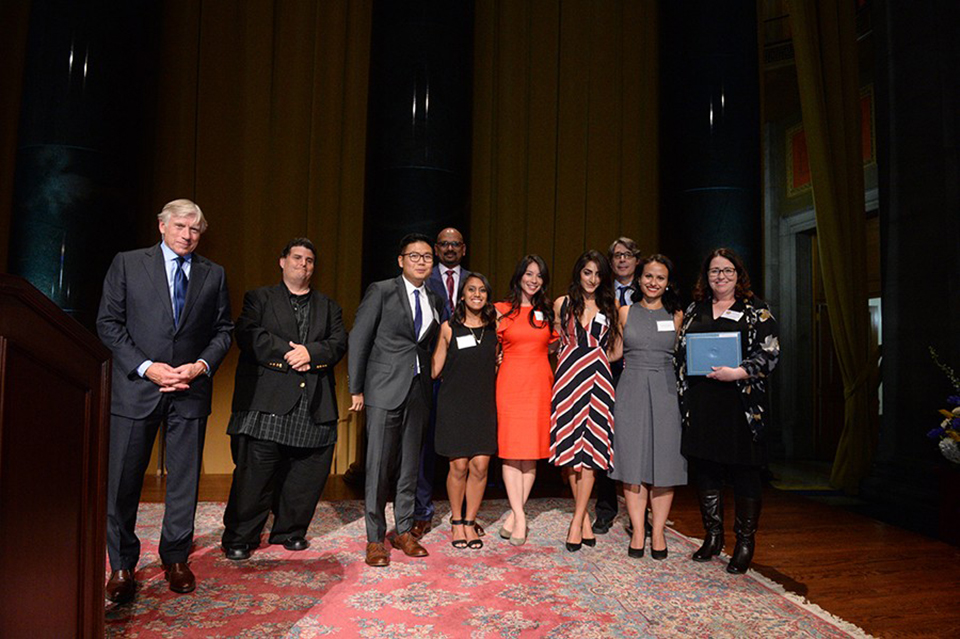
Columbia University President Lee C. Bollinger presents the 2016 Breaking News Reporting Prize to the Los Angeles Times Staff.
Winning Work
Shooters attack San Bernadino office
Two suspects killed after car chase; officer wounded
Masked assailants armed with assault rifles opened fire on a holiday banquet for county employees in San Bernardino on Wednesday, killing 14 people and plunging a nation already on edge about terrorism and mass shootings into hours of tense uncertainty.
The massacre at the Inland Regional Center set off a surreal day in which hundreds cowered in their offices, schools went on lockdown, SWAT teams swarmed neighborhoods and a four-hour manhunt played out on live TV. The finale was a gun battle on a residential street that left two suspects dead.
San Bernardino Police Chief Jarrod Burguan said investigators had not determined a motive for the shooting, in which 17 people were wounded. But an official at the FBI, which is working with local agencies, said he could not rule out terrorism as a motive.
"It is a possibility, but we don't know that yet, and we aren't willing to go down that road yet," said David Bowdich, assistant director in charge of the FBI's Los Angeles office.
Authorities identified the dead suspects as Syed Rizwan Farook, 28, and Tashfeen Malik, 27. A family member said they had been married for two years and had a 6-month-old daughter.
Farook was a U.S. citizen, born in Illinois, and a five-year employee of the government agency holding the holiday banquet. His co-workers said Farook, a Muslim, had traveled in recent years to the Middle East.
Burguan said he could not rule out that a personal conflict led to the shooting. During the banquet, "there was some type of dispute," and Farook left the gathering angrily, the chief said, and he returned with his wife and they opened fire.
Law enforcement officials said they recovered four firearms, at least two of which were legally purchased.
Farook worked for the San Bernardino County Public Health Department as a health inspector, according to public records and co-workers. One co-worker, Patrick Baccari, told The Times that Farook was present when the banquet began but disappeared before a staff photo was taken.
"I guess he's missing the photo this year," Baccari recalled thinking.
By the time scores of officers arrived at the shooting scene, the assailants had fled. Witnesses said they left in a black SUV. Another tip led police to a home in nearby Redlands. As officers arrived about 3 p.m., a black SUV drove away.
Officers pursued the vehicle to San Bernardino, where it stopped on San Bernardino Avenue near Mountain View Street. A gun battle between the suspects and about 20 officers ended with the couple dead and an officer wounded. The officer's injuries were not considered life-threatening.
Farook and Malik were dressed in what the chief called "assault-style clothing," and both were armed with assault rifles and handguns.
Police saw a third person running from the area and detained him for questioning, Burguan said. He said it was unclear whether he was involved in the shooting.
Investigators said they were concerned about possible explosives or booby traps at the Redlands home and near the SUV. An object hurled from the vehicle was initially believed to have been a pipe bomb, but on closer inspection it was not, Burguan said.
The FBI's Bowdich said investigators searching the Redlands home were also on guard for explosives.
"We are certainly going to proceed very cautiously into that house to preserve life and limb of our employees."
The shooting Wednesday was a grim marker: It was the deadliest mass shooting since the massacre of 20 children and six teachers at Sandy Hook Elementary School in Newtown, Conn., in 2012. It stood apart from many other mass murders in that there were at least two assailants and one was female.
President Obama said the killings were yet more evidence of the need for stricter gun laws.
"The one thing we do know is that we have a pattern now of mass shootings in this country that has no parallel anywhere else in the world," he said in an interview with CBS.
Late Wednesday, Farhan Khan, introduced as Farook's brother-in-law, appeared at a news conference called by the L.A.-area office of the Council on American-Islamic Relations.
"I just cannot express how sad I am for what happened," Khan said. "My condolences to the people who lost their lives. … I am in shock that something like this could happen."
When asked if his brother-in-law had been religious, he declined to comment.
The shooting began at about 11 a.m. in a building on the campus of the Inland Regional Center, a nonprofit that serves people with developmental disabilities in Riverside and San Bernardino counties.
The county public health department had rented a large conference room for its annual holiday potluck. Employees were gathered for lunch when suddenly the doors burst open.
Banquet attendee Denise Peraza, 27, said two people in black clothes and black masks entered brandishing "big ol' guns."
"Everyone dropped to the floor," Peraza said in a phone call from Arrowhead Regional Medical Center. "The guys opened fire for 30 seconds, randomly, then paused to reload and began firing again."
Peraza, who was hiding under a desk, was hit in the lower back. The gunfire eventually stopped. The conference room, scattered with the bodies of the dead and injured, was eerily silent, Peraza said. Then, after what seemed like five minutes, the doors opened again and police officers yelled out: "Anyone who can move, leave immediately and find cover behind vehicles."
Seventeen people were wounded and taken to area hospitals, authorities said. Some were reported to be undergoing surgery Wednesday night.
While stunned survivors rushed from the conference room, others in the building were laughing at what they assumed was yet another safety drill. In her second-story office, Dorothy Vong trained her cellphone camera on a swarm of heavily armed police officers sprinting across parking lots and vaulting hedges.
"They're all geared up!" a colleague remarked, according to Vong's video. "Rifles and everything!"
Then the reality set in.
"Well it's real," Vong texted her husband, adding later, "We're in a locked office."
The shooting rippled across San Bernardino. All county schools, as well as city government buildings and courthouses, were locked down as police searched for the assailants.
Hundreds of people on the campus grounds at the time of the attack were evacuated in stages, some on school buses to sites where they were interviewed by police and reunited with anxious relatives.
As night fell, some family members were still waiting for news. Mindy Velasco called hospitals, police, evacuee centers, looking for anyone who might have information about her niece, Yvette Velasco, who was at the banquet.
No one knew anything.
"I'm fearing the worst," Velasco said, her voice breaking. "She would definitely be in contact after something like this."
Times staff writers Ruben Vives, Rong-Gong Lin II, Rosanna Xia, Christine Mai-Duc, Tony Barboza, Hailey Branson-Potts, Taylor Goldenstein, Brian Bennett, Jack Dolan, Joel Rubin, Kate Mather, Kate Linthicum, Ben Poston, Zahira Torres, Laura J. Nelson, James Queally, Lauren Raab, Javier Panzar, Sarah Parvini, Sarah D. Wire, Stephen Ceasar, Joseph Serna, Veronica Rocha, Matt Hamilton, Richard Winton, Doug Smith and Harriet Ryan contributed to this report.
UPDATES: This article was updated with information about when Malik was identified by authorities and Obama's statement about possible motivation for the shooting.
This story was originally published at 1 a.m.
As FBI seeks motive, terrorism not ruled out
Coroner releases the names of those killed in San Bernadino
Rampage victims are remembered
By Alan Zarembo, Hailey Branson-Potts and Esmeralda Bermudez
The victims ranged from 26 to 60 years old. They hailed from across Southern California: Los Angeles, Fontana, Upland, San Jacinto and Santa Ana.
Many were health inspectors charged with making sure San Bernardino County's restaurants, pools and other gathering spots were clean and safe for the public.
In their time off, they were known for enjoying life. One coached youth soccer, another dressed as Santa Claus for kids. One played a peasant dancing through the crowds at the Renaissance Pleasure Faire. Another cherished her job and family, having fled Iran as a child to escape the country's Islamic Revolution.
Massacres have now torn up schools, churches and theaters across the country. Still, relatives and friends of the victims couldn't understand why Syed Rizwan Farook and Tashfeen Malik, the heavily armed couple who riddled a holiday gathering with gunfire, had to add San Bernardino to the list.
"It's really hard," said Jenni Kosse, 50-year-old environmental health worker who counted three friends among the dead. "It's hard to process so much loss."
In San Bernardino, several government buildings were closed. On Facebook, workers added a black bar to the iconic arrowhead on the county shield, and hundreds of people attended vigils across the Inland Empire.
Hours before finding out that her husband, Michael Wetzel, had been killed, Renee Wetzel wrote on Facebook: "So many prayers needed."
The 37-year-old was well-known in the tight-knit San Bernardino mountain communities where he was raised and still lived. He was often seen with several of his kids — three from his first marriage, three from his second, said family friend Arlene Arenas, 40.
He spent seven years coaching boys' and girls' soccer.
"He was super-tall, and the littlest of girls thought he was a giant," said Arenas, whose daughter played on the team. "He had no qualms about letting them follow him around, or walking around like a monster, with the little ones shrieking and hanging off his legs."
Speaking outside her Colton home, the wife of another victim, 52-year-old Nicholas Thalasinos, remained composed as she spoke to reporters in her driveway.
"As soon as I heard what had happened, I pretty much knew that he was gone," she said. "I just had a feeling."
Jennifer Thalasinos said her husband, who was outspoken about his conservative political views, was a health inspector who worked with Farook, one of the assailants, at the county's environmental services division.
"They got along," she said. "As far as I know, [Syed] got along with everybody. That's what's so shocking."
The Thalasinos, both Messianic Jews, met online and had been together for 14 years. Thalasinos said her husband wore a tie clip with the Star of David.
"My husband was just a very devout believer," she said. "He became born again a couple of years ago and because of that I had a very strong faith, so I know that he's in a much better place."
By Thursday evening, little was known about Shannon Johnson, 45.
And some victims' loved ones remained reluctant to say much, so soon. A relative of Isaac Amanios, 60, of Fontana, called him "an amazing father, brother, an amazing everything."
The family of one the shooting's youngest victims, Yvette Velasco of Fontana, described the environmental health specialist as "full of life and loved by all who knew her."
Other family and friends wanted to discuss their heartache.
Aurora Godoy and her husband, James Godoy, had met in 2003 during a Junior ROTC class at Carson High School, her husband said.
They dated for about eight years before eloping in 2012. They bought a home in San Jacinto. And she gave birth to their son, Alexander, who will turn 2 in January.
Speaking by telephone as his son fussed in the background, Godoy said of her wife's devotion to the boy: "It was all about him."
Kosse, the county worker who lost three friends, felt numb as she thought of returning to work and not seeing her colleagues.
Among those lost was Robert Adams, a 40-year-old health specialist from Yucaipa who left behind a 20-month-old daughter.
Adams and his wife, Summer, grew up in the Inland Empire and were high school sweethearts, Kosse said. They had tried to have kids for some time and adored their daughter, Savannah. Adams loved taking her to the park and uploaded new pictures of her to Facebook almost every night.
"When you saw the three of them together," Kosse said, her voice breaking, "you just wanted to jump in the middle and think, 'I want to have fun too.'"
Adams' death, along with that of Thalasinos and Wetzel, whom she had known since high school, left her devastated.
"I just keep going through it in my head and picturing where they're supposed to be — at their desks," she said. "They're not and they won't be."
On Facebook, Tamishia Clayborn grieved the loss of her sister, Sierra Clayborn, 27, of Moreno Valley.
"I just found out the most horrible news of my life," she wrote. "RIP Baby sis I love you more than you ever knew."
On her own page, Sierra Clayborn had just written that she loved her "blooming career" in public and environmental health. Her final Facebook post was a tribute to the victims of the Paris attacks.
Bennetta Betbadal, the Iranian immigrant, left behind a husband and three children, ages 10, 12 and 15.
She was married to a police officer and led a team of restaurant inspectors for the county, said Mark Russell, a friend who was acting as a spokesman for the family.
A fundraising page set up for Betbadal's children said that she left for work Wednesday morning eager to deliver a presentation to her colleagues.
In Santa Ana on Thursday night, four generations of family gathered to grieve 31-year-old Tin Nguyen, who used to rise each day at 5 a.m. for her two-hour commute to work as a health inspector in San Bernardino.
The day of the shooting, she headed out to buy doughnuts for the office party, said her mother, Vanessa.
Nguyen was her only daughter. The two fled Vietnam to rebuild their life in a place they considered "a safe country where younger people would find their rewards through education."
"She was such a good soul," Vanessa said. "Only she can understand me — she understood everything I went through."
The graduate of Cal State Fullerton had a huge family, whom she loved to gather for Sunday dinners, hiking trips and excursions to Las Vegas.
In recent weeks, Nguyen had been trying on wedding dresses to prepare for her wedding in 2017. She insisted on a ceremony in her beloved St. Barbara's Catholic Church, a few miles from her house.
"She promised that no matter what, she would return to have her wedding there," her mother said. "And now we're having a funeral. What will become of our lives?"
The torment set in for Ryan Reyes early Wednesday afternoon, moments after he heard about the shooting.
His boyfriend of three years, a friendly, Renaissance Faire aficionado named Larry Daniel Kaufman, ran the coffee shop in building 3 at the Inland Regional Center, training developmentally disabled clients.
Reyes called him over and over, but the phone went straight to voicemail.
"Call me ASAP!" he texted.
There was no reply.
The next few hours turned into a torturous waiting game for the Rialto resident, as for many others. Many turned to prayer and social media. Some raced from hospitals to police stations; others patiently hovered at a local community center as traumatized shooting survivors were dropped off by the busloads.
Reyes watched the buses all evening — until there were no more.
Times staff writers Marisa Gerber, Laura J. Nelson, Corina Knoll, Anh Do, Matthew Hamilton, Louis Sahagun, Ben Poston, Sarah Parvini and Taylor Goldenstein contributed to this report.
By Soumya Karlamangla, Paloma Esquivel and Laura J. Nelson
Early Wednesday morning, Syed Rizwan Farook asked his mother for the sort of favor grandmothers love to grant: A few hours of baby-sitting. Farook told her that he and his wife, Tashfeen, had a doctor’s appointment and didn’t want to take their 6-month-old daughter.
In an account of the conversation provided by a relative through a local Islamic leader, the grandmother agreed. She was caring for the child at the couple’s Redlands home when news of a mass shooting in nearby San Bernardino broke.
Fearing her son and daughter-in-law were victims, “she started calling. No answer,” said Hussam Ayloush, executive director of the Council on American-Islamic Relations’ Los Angeles office. It was only after reporters started phoning her that she realized the couple were the assailants.
That Farook’s own mother had apparently sensed nothing wrong underscored a feeling among investigators and acquaintances Thursday that the couple responsible for the massacre at a holiday party inside the Inland Regional Center scrupulously concealed their views, plans and a cache of weapons and explosives.
Of particular interest to investigators is the relationship between Farook, a 28-year-old U.S. citizen of Pakistani descent, and Tashfeen Malik, 27, a Pakistani national. While his upbringing and adult life in Riverside is chronicled in school files, work documents and other records, little is known publicly about her.
Authorities said Thursday that she was more than just an accomplice. At one point as the couple attempted to elude police, Malik fired an assault rifle out the back window of their sport utility vehicle at pursuing officers.
Nizaam Ali, who worshipped with Farook at a San Bernardino mosque, said he had met Malik on a few occasions, but she wore a head scarf that obscured her face.
“If you asked me how she looked, I couldn’t tell you,” Ali said.
The couple met online a few years ago and married last year in Islam’s holy city of Mecca in Saudi Arabia, according to co-workers at the public health department and others who knew them. The Saudi Embassy in Washington confirmed that Farook spent nine days in the kingdom in summer 2014.
Authorities said that when he returned to the U.S. in July 2014, he brought Malik with him on a fiancee visa. After a background check by the FBI and the Department of Homeland Security, she was granted a conditional green card last summer.
The couple held a walima, a celebration after the wedding, at the Islamic Center of Riverside for people who couldn’t attend the Saudi ceremony. Ali said a few hundred people attended. The couple’s daughter was born in the spring and co-workers at the San Bernardino County Public Health Department, where Farook worked for five years as an inspector, said some of them had thrown him a baby shower.
An online baby registry in Malik’s name listed a large box of Pampers, Johnson’s safety swabs, a car seat and baby wash.
The idea of a new mother helping carry out a mass murder perplexed many. Sen. Dianne Feinstein (D-Calif.), who had a classified FBI briefing on the shooting Thursday, said leaving an infant for a suicide mission was “not something a woman would easily do.”
“So it’s going to be very interesting for me to see what her background was, what level of animus she had, because she had to have a considerable level,” Feinstein said.
Meanwhile, acquaintances and colleagues of Farook were struggling to reconcile the soft-spoken man they knew with the masked rampage killer who shot up a room filled with co-workers.
At the Islamic Center of Riverside, where Farook had worshipped until about two years ago, mosque director Mustapha Kuko described him as quiet, private and devoted to Koran study.
“He knows that we believe that to take one life is to take all life. So for him to do the opposite of what we as Muslims believe … I don’t know,” Kuko said.
One victim, who worked in the same department as Farook, was also a member of the congregation, he said.
“He shot her,” Kuko said. “Point blank.”
The victim’s husband reported she is in stable condition, he said.
Recently, Farook had worshipped at a San Bernardino mosque, Dar-Al-Uloom Al-Islamiyah of America. Farook was “a very nice person, very soft,” said Ali, a mosque regular. He said Farook had memorized the Koran, a rare accomplishment for even devout Muslims.
According to law enforcement, Farook traveled to Saudi Arabia in 2013 during the hajj, the pilgrimage to Mecca that all Muslims who are able should perform at least once in their lives.
Another congregant saw Farook at the mosque a few weeks ago. Gasser Shehata said Farook had hurt not just his victims, but his own child.
“She will grow up knowing what her parents did,” Shehata said.
Farook was born in Chicago, the son of Pakistani immigrants. The family subsequently moved to Riverside, where his father worked as a truck driver and his mother as a clerk at Kaiser Permanente.
He and his siblings attended public schools. Yearbooks from La Sierra High School in Riverside show a smiling Farook during his sophomore and junior years. He was a member of the school’s Muslim club.
Farook loved fixing up old cars, neighbors said.
His mother, Rafia, portrayed family life as chaotic and sometimes violent in divorce papers she filed in 2006 to end her marriage of 24 years. She recounted an occasion when one of her two sons — it is unclear which — had to defend her from his father.
Farook got a bachelor’s degree in environmental health from Cal State San Bernardino in 2010. His older brother, Syed Raheel, who also attended La Sierra, joined the Navy immediately after high school. He served from 2003 to 2007 and was awarded two medals for service in the “Global War on Terrorism.”
In a profile on an Indian matrimonial site, Imilap.com, a user identified as “farooksyed49” described himself as a 22-year-old Muslim living in Riverside and working as a county health inspector.
“Enjoy working on vintage and modern cars, read religious books, enjoy eating out sometimes travel and just hang out in back yard doing target practice with younger sister and friends,” the profile read.
In May, Farook and his family moved into the Redlands home where authorities said he and his wife stashed the weapons. Judy Miller, his landlord, described Farook as a model tenant.
“He appeared as a very gentle person,” said Miller, 73.
She saw no signs of weapons when she visited. After Wednesday’s shootings, Miller said she immediately handed over a copy of Farook’s lease to FBI agents.
“I interviewed a whole bunch of people,” she said. “And he was the one I chose.”
Times staff writers Harriet Ryan, Dexter Thomas, Matt Hamilton, W.J. Hennigan, Brian Bennett, Peter Jamison, Jack Dolan, Richard Winton, Richard A. Serrano and Joel Rubin contributed to this report.
By Joe Mozingo and Sarah Parvini
Away from their downtown cubicles for the day, they gathered in a conference room on the south end of town for their annual training and Christmas potluck party. Chris Nwadike brought doughnuts. His colleagues sat around him at a folding table with a festive tablecloth and a decorative fir branch.
Ever the diligent worker, Syed Rizwan Farook had arrived first and took the seat at the head of the table. The tech-savvy restaurant inspector, 28, had taught his co-workers how to use some new computer programs and had won TGI Friday gift cards for his good performance.
Now they would play a game to win more gift cards. The 75 or so workers in the room were handed wireless clickers so they could answer yes or no questions on a big screen. Fun, true-or-false questions about one another at first, then training ones.
The woman delivering the clickers came to their table.
"Where's Syed?" someone asked.
His jacket still hung from the back of his chair.
They told her to just leave the clicker there, he would be back.
::
Born to Pakistani parents in Chicago and raised in Riverside, Farook graduated from Cal State San Bernardino with a degree in environmental studies and was part of the relatively prosperous Muslim community spread throughout the Inland Empire.
He had worked for the San Bernardino County Department of Health for a few years, making $52,000 a year and sharing a cubicle with a friend, Isaac Amanios, a 60-year-old father of three from Eritrea.
Nwadike said the two of them spoke what he assumed was Arabic — with Amanios clearly the native speaker, often poking fun at Farook's poor delivery.
The health inspectors came from all over the world, with all types of beliefs. Nwadike was from Nigeria. Others hailed from Vietnam, Iran, Mexico and Colombia.
They considered Farook a friend. He was quiet but approachable.
"He smiled, but he didn't laugh," Nwadike said.
In 2014, Farook traveled to Saudi Arabia to marry a Pakistani woman he had met online, Tashfeen Malik, 29. When he returned, his co-workers teased him about the beard he'd started to grow. Before their baby girl was born this year, they threw him a baby shower at the office.
But they never met Malik. She mostly stayed to herself, and at family gatherings the men and the women didn't commingle. Nizaam Ali, an acquaintance who worshiped with Farook at a San Bernardino mosque, said that in public Malik wore a head scarf that obscured her face.
One of Farook's co-workers, Nicholas Thalasinos, 57, a Messianic Jew, wore a tie clip with the Star of David. He was outspoken against Islamic extremism, in person and on social media.
Two weeks earlier, he and Farook argued over whether Islam was a violent religion. Recounting the conversation to a friend, Thalasinos said that Farook insisted his God was peaceful but argued that Israel had no place in the Middle East.
Thalasinos liked discussing such topics. There was no indication that their interaction was anything out of the ordinary.
Farook lived in a rented townhouse on Center Street in Redlands, with all the trappings of a young family: baby bouncer on the living room floor, boxes of Pampers in the entryway, a big carton of Quaker Oats on the refrigerator.
On Wednesday morning, he asked his mother if she could watch the baby for a few hours. Malik said she had a doctor's appointment.
Farook headed to the conference, about a 10-minute drive away.
::
The Inland Regional Center serves the developmentally disabled but also rents out its No. 3 building conference room for other events.
The complex along Waterman Avenue sits in a part of the city where new offices and warehouses are spreading north from the city's hotel zone into a poor, dusty area of weedy lots and dilapidated homes. It was a clear winter day, with the San Bernardino Mountains in sharp relief.
During a break after the personal trivia game, Nwadike and Patrick Baccari got up from their table to use the restroom.
It was just before 11 a.m.
Baccari was pulling a paper towel from a dispenser when he heard a blast. A puff of plaster dust rose from the wall and shards of the dispenser flew into his face.
He turned to the other men in the bathroom, who looked at him as if he had caused the commotion.
Blood ran into his eyes. Then he saw a hole in the wall.
"Get down! Get down! Get down!" he yelled.
Everyone hit the floor as a barrage of gunfire sounded outside.
Wearing tactical clothing and black masks, Farook and his wife had burst into the back of the conference room and opened fire with .223 semi-automatic rifles.
Screaming, his co-workers and supervisors ran for exits and ducked under tables.
Bullets struck Amanios, Thalasinos and others at Farook's table. A Muslim woman he prayed with was shot three times.
Amanda Gaspard dropped to the floor and slid under her table. She closed her eyes and lay motionless.
One of the assailants stood over her and shot her in the arm and leg.
911 calls started pouring into police dispatch lines. A suspect in black clothing. "He's still firing rounds," a dispatcher told police.
Julie Swann-Paez lay on the floor, bleeding and in pain, shot in the thigh and abdomen, her pelvis shattered. She was supposed to receive an Employee of the Year award.
She sent a text to her family. "Love you guys. Was shot."
After firing at least 65 rounds, the assailants stopped. They set a black duffel bag on a conference table. It contained three pipe bombs tied together and wired to a remote control.
Dispatchers told officers that crowds were racing from the south building and that a person with a machine gun was in the parking lot. A black SUV with Utah plates.
Officers arrived within four minutes of the first calls. They didn't know how many shooters there were or if they were gone.
San Bernardino police Lt. Mike Madden was a mile away, on his way to lunch, when he heard the frantic dispatches.
He pulled up just south of building No. 3 and waited for two minutes until three other officers arrived. They entered the building together.
The carnage they found was "surreal," he said. Dead and grievously injured bodies. Sheer panic in survivors' faces. White smoke and cordite filled the air. Water sprayed from pierced sprinkler pipes as fire alarms blared.
Madden motioned for a group of people in the hallway to run to them. But they didn't want to come. He feared the shooter might be among them around a corner, holding them hostage.
"Come to us, come to us!"
Finally one made the break, and the rest — dozens of them — followed.
More officers and sheriff's deputies stormed into the building. Emergency workers set up a triage area. Officers removed the pipe bombs.
"Ida-9, hold for possible suspect info," one officer radioed in.
"Ida-9, go ahead."
"A male subject who was in the meeting left out of the blue. Um, and 20 minutes later the shooting occurred. The subject's name is Farbook — Farook —Frank Adam Roger Ocean Ocean King. First [name] of Syed — Sam Yellow Edward David."
It took hours for Nick Paez, 26, to track down his mother, who had sent the text that she was shot, at a local hospital.
He had thought she was among the 14 people the shooters had slaughtered.
By the time they finally got to see her, just before 10 p.m, Farook and his wife were dead, killed hours earlier in a fusillade of 380 gunshots as they roared down a residential street in the rented SUV.
Paez tried to fill his mom in on what had happened.
"They think it's your co-worker," he said.
"That doesn't make sense," she replied. "They were congratulating him for having a baby."
Times staff writers Joseph Serna, Kate Mather, Richard Winton, Stephen Ceasar and Hailey Branson-Potts contributed to this article.
For the record
1:33 p.m.: An earlier version of this story reported that a Muslim woman that shooter Syed Rizwan Farook had prayed with was killed in Wednesday’s massacre at the Inland Regional Center in San Bernardino. The woman, Anies Kondoker, 42, was shot three times but survived.
7:53 p.m.: An earlier version of this story misspelled Isaac Amanios' name as Amianos.
‘In five seconds you look at their skin color, their breathing and you feel their pulse. By all those things, you are determining if they are critical or deceased.’
By Ben Welsh, Thomas Curwen, Tony Barboza and Paloma Esquivel
As the water raining down from the overhead sprinklers pooled in rivers of blood and the smell of gunpowder hung in the air Wednesday, Ryan Starling remembered his training.
He got out his white tape.
More than two dozen victims lay on the floor at the Inland Regional Center, the 33-year-old medic recalled Tuesday.
Starling began moving from body to body to determine who might survive.
"In five seconds, you look at their skin color, their breathing and you feel their pulse," he said. "By all those things, you are determining if they are critical or deceased."
He marked the dead with white tape so he and other rescuers could focus their efforts on the living.
Just minutes earlier, Starling and his SWAT teammates had been training for just such a grim task — conducting active shooter drills less than 10 miles away.
He said that when the first shooting reports arrived, his specialized team, already armed and dressed, switched out blanks for real rounds in their assault rifles and rushed to the scene.
Starling expected to be the first paramedic to arrive, and he knew that other medical personnel would be ordered to wait at a safe distance in keeping with standard policy intended to keep firefighters safe.
As a medic attached to a SWAT team, Starling wasn't bound by that rule. He would be going in.
Coordinating with police and sheriff's deputies, the SWAT team worked first to clear civilians out the first floor of the southernmost building on the campus.
The team also searched room by room for any signs that the shooters might still be nearby.
By then, though, the assailants, Syed Rizwan Farook and Tashfeen Malik, had fled, subjects of a manhunt that would end hours later in a massive shootout.
As the SWAT team crawled slowly through the building, Starling and a fellow SWAT officer broke off from the others and approached the conference room.
He could see that a holiday party had been underway. He found the scene both grotesque and strangely ordinary.
A table of pastries sat by the front door, untouched, while water rained down from the sprinklers. The carpet was soggy.
He could hear voices, crying, screaming and moaning of the victims. He couldn't say how many were hurt. Perhaps more than two dozen, he thought.
Starling put aside his emotions and got to work. He needed to separate the living from the dead. He pulled on gloves and took a roll of white tape from his vest.
He moved with practiced precision, five seconds to assess skin coloring, breathing and pulse, all factors he used to determine the victim's chances for survival. He started tearing off pieces of the tape.
Fontana Police Cpl. Mike Ernes, a member of the second team into Inland Regional Center, was working in the conference room as well.
Ernes felt terrible walking past some victims to reach others who were in greater need, "one of the worst things I've ever had to experience in my career," he remembered later.
Starling started giving orders. He told police which of the wounded to take outside to the parking lot.
Joining them outside, Starling opened his medic bag, filled with medication and gauze, and directed officers to begin bandaging the victims before police cruisers ferried them to ambulances beyond the perimeter.
San Bernardino Fire Battalion Chief Grant Hubbell had helped set up a triage site at Waterman Avenue and Park Center Drive.
There, medics waited for victims.
With the wounded removed from the conference room, the SWAT team again combed the building. When what looked like a pipe bomb was discovered, the team evacuated until it was safe again to go back inside.
Soon, two suspects were spotted elsewhere driving in a black Ford Expedition.
The final shootout took place about three miles from the Inland Regional Center. San Bernardino County Sheriff's Deputy Shaun Wallen, one of the closest officers to the SUV, exchanged gunfire with Farook.
As he did, San Bernardino city police Officer Nicholas Koahou got out of his vehicle to give Wallen cover and was hit in the left thigh. It felt as if he had been punched in the leg.
Falling to the ground, Koahou heard the gun battle rage as more than 400 shots were exchanged. Then there was silence.
Starling and his team had been called in during the shootout. Now he stood over the bodies of Farook and Malik and declared them dead.
A week later, the acting deputy fire chief for the city of San Bernardino, Dan Harker, is proud of his department's response.
But the accomplishment comes with a sense of regret: Under its plan to emerge from bankruptcy, the city voted this year to disband the 137-year-old Fire Department and outsource fire services to the county.
"It's a little solemn, thinking we did such a great job and now this department may go away," Harker said.
In much of the country, fire rescuers are held back in safe "cold" zones, waiting for law enforcement to clear "hot" areas where gunmen are active.
Only an elite group of firefighters like Starling, trained to embed with SWAT teams, enter active scenes. Starling is the only medical employee in that category in the San Bernardino Fire Department, officials said.
But Wednesday's shooting was an exception.
Greg Soria, a captain with the San Bernardino Fire Department, and his team decided to join Starling and enter the building before it was secured.
"They needed help in there," Soria said. "We went ahead and made entry."
Recommendations issued by the Federal Emergency Management Agency in 2013 call for changes so that all fire department medics, working with police, can enter "warm zones" — areas near active shooters where a threat might exist — before the attackers have been fully subdued.
"It is almost unacceptable to stand back any more," said E. Reed Smith, medical director of the Arlington County Fire Department in Virginia and an advisor on the federal government's new guidelines. "The citizen expects us to go to work."
Smith said that the proximity of San Bernardino's SWAT team, with its trained medic, resulted in a "lucky break" that probably saved lives.
U.S. Fire Administrator Ernest Mitchell, the nation's top fire official, echoed Smith's call to speed up medical responses to victims of shootings. But in an interview with the Los Angeles Times, he offered praise for the performance in San Bernardino.
"I think what they did is they improvised with the tools they had available and that's great," he said.
San Bernardino Fire Capt. Mike Arviso agreed. If the medical help hadn't arrived as quickly as it did, there would have been possibly four or five more fatalities.
"Obviously we don't know," Arviso said, but having Starling near the scene "probably kept them from bleeding out."
Starling thinks that more than simple luck was at play.
Times staff writers Matt Stevens and Richard Winton contributed to this report.
In the chaotic aftermath of a terrorist attack, officers teamed up for a dangerous mission: Find and stop the killers
By Joel Rubin, Brittny Mejia, Richard Winton and Joseph Serna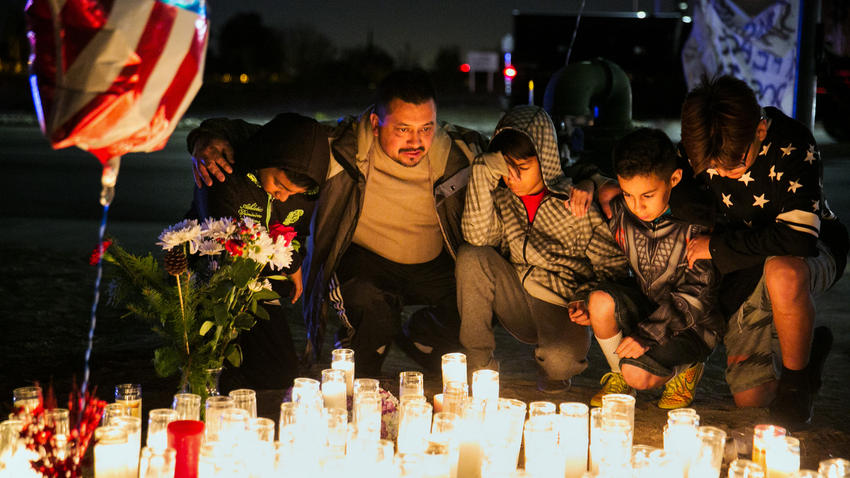
People kneel in prayer for victims of the recent mass shootings at the Inland Regional Center, in San Bernardino. (Marcus Yam / Los Angeles Times)
The light turned green, and the black Ford Expedition pulled away. Not too fast, not too slow.
Redlands police Sgt. Andy Capps was behind the SUV with his emergency lights and siren on, but the driver didn't stop.
It was six minutes after 3 on Wednesday afternoon. Hours earlier, a masked man and woman, clad in black and armed with military-style rifles, had stormed into a holiday party a few miles away in neighboring San Bernardino. Fourteen people were dead. Others were fighting for their lives.
A black SUV had been seen fleeing the scene. Capps had told his officers to stay alert, but privately he wasn't worried. Never in a million years will we encounter these people, he thought.
Now he thought otherwise.
Following the Expedition from a few car lengths behind, he could make out two people inside. They seemed to be changing clothes and handing objects back and forth.
Capps grabbed his radio. He warned officers in the cars behind him that the pair were probably arming themselves and putting on bulletproof vests.
The Expedition turned right onto San Bernardino Avenue.
Seconds later, its back window exploded.
Gun muzzle flashes erupted from the back seat of the SUV. A volley of bullets flew toward Capps. A short lull, then another eruption.
I hope it doesn't hurt too much when I get shot, Capps thought as he drove into the gunfire.
The assailants at the Inland Regional Center had targeted a gathering of county health workers. In the chaos that followed, an employee mentioned a hunch to a cop.
“A male subject who was in the meeting left out of the blue,” the officer reported over the radio to a dispatcher. "Um, and 20 minutes later the shooting occurred. The subject’s name is Farbook — Farook — — Frank Adam Roger Ocean Ocean King. First of Syed — Sam Yellow Edward David."
A search of law enforcement databases turned up a few addresses in the area linked to Farook. San Bernardino police scrambled to dispatch officers to each of the residences. First on the list was a townhouse on Center Street in Redlands, about six miles away.
Sometime in the afternoon, a pair of detectives pulled up in front of the brown, two-story property. But, dressed in suits and driving a type of sedan typically used by police, they stood out as obvious cops. A team of undercover narcotics officers who specialized in surveillance was sent out to replace them.
Just as the undercover team was arriving in the area, a black Expedition approached. Police would later learn that the vehicle had been rented by Syed Rizwan Farook and his wife, Tashfeen Malik.
Detectives watched as the SUV slowed in front of the townhouse but kept moving down the street — “a soft drive by,” one of the officers reported over the radio.
The vehicle disappeared down the block, and for a few nervous minutes its whereabouts were unknown.
“It left, ahh, on Redlands at State Street,” one of the officers radioed. “We’re trying to catch up.“
Hearing the exchange, several more officers announced they were heading to the area. Police managed to quickly find the SUV and officers in unmarked cars trailed it surreptitiously as it wound its way through the streets of Redlands.
Capps came on duty at 11 that morning, just as the shooting rampage was unfolding. Instead of the quiet day he expected to spend supervising a handful of patrol officers, the 48-year-old watched as nervous residents flooded emergency lines at three times the typical volume of calls.
Some of his officers responded to a false alarm report of a shooter laying siege at the local Amazon distribution warehouse. Capps listened on the radio as others went in pursuit of a stolen vehicle. Knowing a supervisor would be needed there, he headed in the direction of the chase.
As he crossed an overpass to get on the San Bernardino Freeway, Capps noticed the driver of a silver Dodge van ahead of him frantically flailing his arm out the window.
Capps pulled up alongside the van. A young bearded man met his eyes.
“Can I help you?” Capps asked.
“San Bernardino PD,” the man said. “We’re following a suspect's vehicle, we don’t have any marked units and we need your help.”
Capps wouldn’t learn until later that the driver was Nicholas Koahou, one of the undercover officers who had been tailing the black SUV.
Capps fell in behind Koahou as he tore west down the freeway at about 100 mph. He broadcast his whereabouts to a Redlands dispatcher, asking her to get any information she could from San Bernardino police about the unfolding situation.
Capps and his officers had checked out more than one bogus call of a suspicious black SUV that day. As he drove, he thought this could just be another one. But the urgency in Koahou's voice told him this time might be different.
Minutes later, they exited the freeway onto Tippecanoe Avenue and immediately got caught in heavy traffic at a red light.
Capps saw another arm waving at him from a pickup truck. He maneuvered alongside.
"What are we looking for?" he asked.
The undercover officer pointed ahead. Several cars up, a black Expedition was idling at the traffic light.
Capps pulled into the opposite lane as the light turned green and slipped in behind the SUV as it drove away from the light. Looking in his rearview window, he was relieved to see a motorcycle cop and several cars from his department and others not far behind.
“This is too crazy,” he thought to himself. "How could this really be them?'"
When David Espinoza arrived for his afternoon shift as a supervisor at a warehouse on San Bernardino Avenue, he was told to keep an eye on the front gate. The shooting that morning had everyone spooked.
About an hour later, shortly after 3, Espinoza was chatting outside the gate with another worker when he caught the distant wail of police sirens.
Looking down the street to the west he saw a black SUV followed by a cavalcade of police cars. Thinking it wasn't anything big, he nonetheless reached for his phone and started recording.
The SUV wasn’t moving fast, maybe 40 mph. It passed by and Espinoza, 46, saw two people inside.
A loud pop cracked the air. Espinoza was momentarily confused. But as the back window of the SUV shattered, he pieced together what was happening.
“That’s when it got to me. That’s them,” he said.
The hazard lights on the SUV started flashing after that first shot. Several more rounds came from the SUV as it continued along the street.
Espinoza saw the driver: Two hands gripping the steering wheel, glancing back two or three times at the police cars giving chase.
“He had that face of — scared,” Espinoza said.
Then, “all hell broke loose,” he said.
Bullets sounded as if they were slamming into the warehouse.
“Close the gate! Close the gate!’ he screamed.
Across the street, Billy Sirk was up on a ladder in the front yard of a rental property he owned, sawing branches off an overgrown tree.
From his perch, Sirk saw the police cars coming. The SUV passed by and then came to a stop a short distance down the street.
He watched as a woman opened one of the back doors and began shooting at police with a “long gun.”
“Boom, boom, boom, boom,” he recalled.
Sirk dropped from the ladder and ran to the back of the house. He peered out at the gun battle on the street. He pushed on the back door. It was locked.
“Open the door for me, please!” he shouted, pounding on it.
A teenage boy opened the door.
The child’s mother was standing inside with her hands up, praying.
Capps slammed on his brakes and unlatched the AR-15 rifle he kept anchored between the two front seats. Throwing open the door, he got out and, crouching, made his way to the back of his vehicle.
Positioned on one knee, he raised his rifle to his shoulder and took aim. Directly in front of him, about 30 yards away, he saw Farook standing just outside the driver's side door firing at officers.
Capps let off several rounds and then turned his attention to the gunfire coming from the back seat of the SUV.
Time collapsed in on itself. Seconds could have been hours.
A deafening gunshot erupted next to his ear. Another officer had rushed up behind him and was firing directly over his shoulder. When the officer ran out of ammunition, he fell back and another arrived to let off another barrage.
Bullets smashed into homes and parked cars, shattering windows.
Overhead, two officers circled in a police helicopter. In the deluge of 911 calls, someone had mistakenly reported seeing a third person running from the SUV into a nearby alley.
“Forty-King, you on this frequency?” a dispatcher asked over the radio, trying to summon the helicopter’s pilot.
“My partner is transitioned in the back seat with an M-4 rifle.... I’m going to be flying the helicopter and working the radios all at the same time,” the pilot said.
Shaun Wallen, a deputy with the San Bernardino Sheriff’s Department, had pulled his car past Capps to his left and taken a position closer to the SUV.
Koahou, the undercover officer who had flagged Capps down, took the scene in from farther back. He worried that Wallen was too exposed. He decided to bring the deputy back to a safer position.
After an exchange of gunfire with Farook, Koahou made his move. He ran toward Wallen.
Farook was now face down in the street, blood pooling around his body. Malik was continuing to fire.
As he ran, Koahou stumbled and fell. He felt like someone had punched him hard in the thigh.
“I looked down at my leg and saw there was a bullet hole in it,’ Koahou recalled.
Over the roar of the gunfire, Capps heard the shouts of “officer down!” Trying to block out the torrent of questions and fears that rose up in his mind — How bad are they hurt? Is it one of my guys? — he knew he had to keep his rifle trained on the SUV.
“We need medical aid!” a San Bernardino officer radioed to a dispatcher.
Hearing the frantic call for help, the pilot of a rescue helicopter circled nearby asking for an exact location so he could land.
A few officers quickly formed a plan and moved out from cover into the open street together to rescue Koahou, who was pinned down. The officers brought Koahou back behind the patrol cars. Not seriously hurt, Koahou refused to leave the scene.
“It’s Officer Koahou, he’s code four,” an officer reported to the pilot over the radio. “We do not need to extract him.”
Capps reflected afterward on the rescue.
“It made me feel very proud and it made me feel very safe, for lack of a better term, in the middle of all that,” he said. “I knew we were all taking care of each other out there.”
It is unclear how long the gunfight lasted. Capps’ best guess is about five minutes. But at some point it became clear the gunfire coming from the SUV had stopped. Capps spotted SWAT teams in armored vehicles coming down the wide street.
“Hold your fire!” officers yelled at others who were continuing to shoot.
Malik’s lifeless body lay in the back seat of the bullet-riddled SUV. Farook was dead across the street.
Investigators would tally 380 bullets fired by 23 officers or deputies. Farook and Malik, meanwhile, shot about 75 times.
Still on his knee, Capps rose to his feet. He stretched his body, marveling that his vehicle had been hit by only two bullets.
He checked his phone. There was a text message his adult daughter had sent during the firefight.
"Watching news. They just showed a graphic shot of one of the suspects down."
"I was in that shootout," Capps texted back. "I'm OK."
Times staff writer Phil Willon contributed to this report.
Shooter was a modern Pakistani whose ‘Saudi girl’ identity was shaped by her time as an expatriate
By Shashank Bengali and Kate Linthicum
As a college student in Pakistan, she was known as a "Saudi girl," her face shrouded in a black veil in the conservative style typical of women in the Persian Gulf kingdom where she spent most of her childhood.
But growing up in Riyadh, Saudi Arabia's oil-rich and sometimes turbulent capital, Tashfeen Malik lived the life of a Pakistani girl, part of a large but often isolated guest worker community acutely aware of its outsider and second-class status.
Years before she and her husband killed 14 people in a torrent of gunfire inside the Inland Regional Center in San Bernardino, Malik straddled two very different countries and her identity spanned two worlds.
She was a brilliant and diligent student who traded school gossip and spoke of plans for a career in pharmacology. At the same time, she was quietly becoming an increasingly orthodox Muslim who shunned male classmates, urged her female relatives to be more religious and, in private Facebook messages, expressed a desire to take part in violent jihad.
Those who knew Malik, who was 29, are still struggling to understand what drove her and her husband to leave their 6-month-old child with relatives on Dec. 2 to don military gear and open fire on dozens of county government employees enjoying a holiday party.
Her family members in Saudi Arabia, who have given only limited statements to the media because they are afraid Saudi officials will revoke their guest worker status, say they are devastated and confused. At her university in Pakistan, former classmates say she had no close friends, but never gave signs that her religious studies were leading toward extremism.
What is clearer is that Malik grew up amid strict social constraints in politically charged lands. A teenager in Saudi Arabia at the height of Al Qaeda's terrorism campaign against the country, she probably lived in the isolation typical of most expatriates here, particularly women. She left her parents and returned to Pakistan around 2005, barely into adulthood, as that country was gripped by rising anti-American sentiment and extremist violence.
Born in Karor Lal Esan, in a region of wheat and rice fields in Pakistan's Punjab province, Malik moved to Saudi Arabia as a child after her father found work as an engineer there. She was, according to her brother and former high school teachers, a gifted and obedient student who stood out for her high marks but little else.
"She was the top of the class, always," said her brother, Saad Malik. He said he and his family members are struggling to understand how Tashfeen became a radicalized killer in the faraway suburbs of California, where she'd moved with her new husband.
"We don't have any idea about what happened over there."
::
The Malik family's path from the fertile fields of Pakistan to the sand-blown Saudi kingdom was not unique. Pakistani laborers have been making the journey since the discovery of vast oil reserves in the Persian Gulf almost a century ago. Of the 28 million people now living in Saudi Arabia, more than 2 million are Pakistanis.
Malik's father, Gulzar, came to Riyadh in the early 1980s to work at a Saudi construction company. He was joined several years later by his wife, three sons and three daughters.
Relatives in Pakistan have said Gulzar appeared to become more religiously conservative and embrace more radical political beliefs while living in the kingdom. But Saudi officials say the engineer and his family never registered as a security threat.
"We are very careful who we allow to come to Saudi Arabia and who we allow to stay here because we are threatened by terrorism," said Mansour Sultan al-Turki, a spokesman for the Saudi Interior Ministry. "There was nothing at all to suspect any of them."
Malik studied at the Pakistan International School from grades nine through 12, around 2002 to 2005, according to the Pakistani Embassy in Riyadh, which oversees the coed school of 10,000 students.
With classes in Urdu, instead of Arabic, and a curriculum based on the one back home in Pakistan instead of the Saudi system, the sprawling walled campus is something of a bubble, its administrators say. Students can choose from among three tracks — arts, pre-engineering or pre-medical, said Rahir Raza Abid, the school's principal. Malik was on the math- and science-heavy pre-med track, and she flourished.
"She was a brilliant student," Abid said.
But like all foreign nationals who come to Saudi Arabia from countries with few job opportunities, Pakistanis often live under strict controls, enjoying fewer freedoms and a poorer lifestyle than the Saudis who hire them. Even those in higher-paying jobs usually live in their own neighborhoods, study at their own schools and rarely mix socially with Saudi society.
"They could grow up here for years without ever meeting a Saudi, without ever having a Saudi friend," said Khaled Almaeena, a former editor in chief of both of the country's major English-language newspapers. "Some Americans are racist. We Saudis are double racist."
The alienation can be especially acute for foreign women, who must adhere to the nation's strict Islamic laws governing women's dress, behavior and freedom of movement.
Barred from driving or socializing in places where there are men, they face lashes from the religious police if spotted without a long black cloak. Many families expect their women to wear the niqab, a black covering over the head and face with only a small slit for the eyes.
"Sometimes we feel isolated," said Mehreen Zulfiqar, 35, a Pakistani living in Saudi Arabia with her engineer husband. He spends most of his time at work, she said, which means she rarely leaves the house.
The couple and their children were eating lunch at a Pakistani restaurant in downtown Riyadh — not far from the apartment that Malik and her family had shared — seated behind a partition designed to block women from public view.
"Everything is different here," said her husband, Shoabi, 39. "The food, the gender separation. We are not mixing with Saudis. Their culture is different. We can't. We don't send our children to Arabic schools because we know one day we have to go back to Pakistan."
::
Many Pakistanis embrace Saudi Arabia's more conservative culture, which is shaped by Wahhabism, a strict branch of Sunni Islam. At the private Pakistani school Malik attended, female students are taught on a separate campus and cannot leave at the end of the day without a male family escort.
Nisma Rafiq, a Saudi-born woman of Pakistani origin who attended the same high school as Malik, said going home can be challenging. She faced taunts when she went to Pakistan for college, she said.
"We go to Pakistan and they call us 'Saudi girls,'" she said. "You are judged by your family. They say you're not the same."
Malik graduated and returned to Pakistan around 2005, Abid said. Family members who greeted her in Punjab saw a young woman clearly changed.
Although relatives in Karor Lal Esan had remembered her as a "modern girl," she now covered her face in a veil. She spoke Arabic — unlike many Pakistani expatriates — and occasionally would have conversations in Arabic online late at night, one relative said.
In 2007, Malik enrolled in the pharmacology program at Bahauddin Zakariya University, one of the most competitive in Punjab. Located in Multan, a bustling city renowned for its Sufi shrines, the private institution bills itself as "a progressive university." Many female faculty members don't cover their hair. In the pharmacology program that included several hundred female students, Malik was in a minority of about 10% who wore a veil, a professor recalled.
"I never knew what she looked like," said Nazar Mohammad Ranjha, a lecturer who taught Malik in 2007. "The first time I saw her face was on CNN."
She lived at a house her father owned in Multan's Babar Colony, a neighborhood of law offices and single-family homes. On campus, she studiously avoided contact with male students and had few close friends, classmates said. But that did not stop her from taking note of romantic relationships among her peers.
When classmates discussed fashion and boys, she chimed in with the latest gossip in her familiar loud, nasal voice, said one female student who knew her.
"We used to discuss our classmates' love affairs, and she had more information than any of us," said the student, who did not want to be named discussing Malik. "She used to laugh loudly. We used to make fun of her voice, but she never complained about it."
In the department, "everyone knew she was from Saudi Arabia," said a professor, Nisar Hussain.
"She was religious, but a very normal person as well," Hussain said. "She was a very hardworking and submissive student."
In her spare time, she was throwing herself deeper and deeper into conservative Islam.
::
Multan, now a city of 3 million in southern Punjab, is known for towering, blue-tiled shrines to saints of Sufism, a mystical Islamic order that eschews violence. But in recent decades, the city and surrounding province, the most populous in Pakistan, have seen the growing influence of conservative Islamic schools, known as madrassas, and militant organizations.
In mid-2013, alongside her pharmacology studies, Malik began attending classes at Al Huda, a chain of modern madrassas that cater to upper-class urban women. Classmates said she was there almost every day, although she didn't discuss what she was learning.
The institute teaches a deeply conservative strain of Islam, preaching that wives should obey their husbands. Al Huda's founder, Farhat Hashmi, promotes anti-Western conspiracy theories and has argued that Osama bin Laden was "a warrior."
Many students bring the institute's teachings home with them, intending to indoctrinate other women in their family, analysts say. A relative of Malik's in Karor Lal Esan, who asked not to be identified, said that toward the end of her university days, Malik "started asking women in the family and the locality to become good Muslims."
From 2011 to early 2013, protests frequently erupted in Multan over U.S. drone strikes in Pakistan's tribal belt, with demonstrators setting fire to likenesses of the American flag.
In March 2013, while Malik was a student at the university, Junaid Hafeez, a lecturer in the English department, was accused of making derogatory remarks about the prophet Muhammad. Hafeez was jailed on blasphemy charges, and a year later, two men walked into his lawyer's office in Multan and shot and killed him.
"The university does have a liberal leaning, which makes one believe that any extremist influence on Malik — religious or otherwise — may have taken place before or on the side of her university studies," said Fahd Humayun, research manager at the nonprofit Jinnah Institute think tank in Islamabad, the Pakistani capital.
But Pakistan was growing more unstable while Malik was there, Humayun said, "and Multan is not an exception."
Saudi officials say immigration records show Malik visited from Pakistan in July 2008 and again in 2013. On the second trip, Saudi officials say, her stay in the country overlapped for about six days with that of Syed Rizwan Farook, a U.S. citizen of Pakistani descent who was there on hajj, the annual Muslim pilgrimage to Mecca. The following year, she would join Farook in the United States.
She would become his wife, the mother of his child, his partner in death.
Bengali reported from Mumbai, India, and Linthicum from Riyadh. Special correspondent Aoun Sahi in Islamabad, Pakistan, contributed to this report.
To the Judges:
On the afternoon of Dec. 2, hours after the deadliest terrorist attack on American soil since 9/11, the San Bernardino Fire Department sent an official tweet: “Live updates on today’s events can be found on the LA Times web site.”
It was a ringing affirmation of what was already clear to readers and other news organizations: The Los Angeles Times was the source of the most current, most accurate and most comprehensive reporting on the tragedy.
The story broke shortly before noon that day, with vague reports from first responders of a “20 victim shooting” in San Bernardino, 60 miles east of Los Angeles. Within minutes, The Times confirmed the news and posted its first story. A Times reporter based in the area raced to the scene and began sending feeds to a live blog on latimes.com. A dozen reporters and photographers were launched from downtown L.A., with more to follow, while a team in the newsroom worked the phones, calling hospitals, neighbors, police and city officials.
In the first hour, staff members filled the live blog with a dozen posts: reporting that police were searching for gunmen, that bystanders were hiding in nearby businesses, that hospitals were preparing for casualties, that President Obama had been briefed, and that police had detonated a “suspicious device” left behind by the attackers.
By 11 p.m. that night, our main story had been updated 22 times, with details that revealed the full scope of the tragedy: 14 slain, 21 wounded, by a pair of black-clad assailants who opened fire on a holiday potluck for county health workers.
Over the course of that day, Times journalists pushed out 149 news reports on Twitter and 16 detailed posts on Facebook, including video.
Every news department at The Times was involved, with reporters chasing facets of this complicated story from San Bernardino to Riyadh, Saudi Arabia.
In the chaotic early hours, The Times was the first to report many of the chilling details. We also pursued the deeper stories that would help explain what happened. In the first 12 hours, along with continuous news updates, we posted half a dozen in-depth stories. One re-created the horror at the scene of the slaughter. Another reported that one of the shooters, Syed Rizwan Farook, had traveled to Saudi Arabia to get married – crucial early evidence that the attack might have terrorist roots.
Over the next few days, Times reporters in San Bernardino, Washington, Pakistan and the Middle East explored how Farook and his wife, Tashfeen Malik, had become radicalized and had assembled a cache of weapons, all while keeping up appearances as a quiet young couple with a new baby. The Times was the first to report – from Islamabad — that Malik had studied a fundamentalist strain of Islam in Pakistan and had sent extremist messages to her Facebook friends.
The newspaper drew on its reporters’ deep knowledge of San Bernardino to give context to the tragedy. Many of the victims, we reported, were themselves immigrants — from Iran, Vietnam and Eritrea — who had come to this country seeking freedom, security and a better life.
We quickly built a database of the victims, their photographs and their life stories. We asked their loved ones to send us remembrances, which we published along with staff- written profiles. We were in the homes of victims, and we were with Ryan Reyes when he learned that his boyfriend was among the dead. Our photo of him in that moment became one of the iconic images of the tragedy.
Weaving together police dispatches, and audio and video recordings from witnesses, we created a multimedia reconstruction of the police pursuit of the killers, which ended in a gun battle.
“The LAT is demonstrating its enduring capacity to make sense of the chaos,” one reader wrote, in an email that echoed many others.
Lydia Polgreen, an editor at the New York Times, tweeted: “It’s amazing to see how the LA Times, after all it has been through, can bring it on a big story. Respect.”
We are proud to nominate the staff of the Los Angeles Times for the Pulitzer Prize for Local Reporting of Breaking News.
Sincerely,
Davan Maharaj