Finalist: The Post and Courier Staff
Nominated Work
Read PDF here.
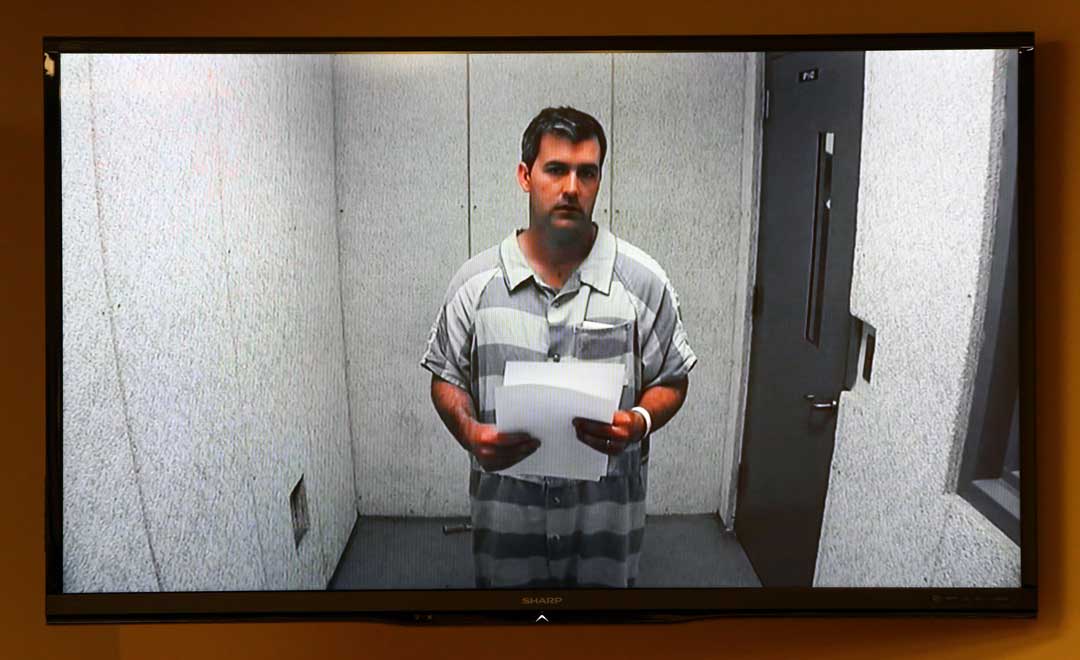
North Charleston Patrolman 1st Class Michael T. Slager, charged with murder in the death of Walter L. Scott, appears on a video screen at a bond hearing on Tuesday at the Al Cannon Detention Center. (WADE SPEES/STAFF)
By Andrew Knapp
A white North Charleston police officer was arrested on a murder charge after a video surfaced Tuesday of the lawman shooting eight times at a 50-year-old black man as the man ran away.
Walter L. Scott, a Coast Guard veteran and father of four, died Saturday after Patrolman 1st Class Michael T. Slager, 33, shot him in the back.
Five of the eight bullets hit Scott, his family's attorney said. Four of those struck his back. One hit an ear.
The footage filmed by a bystander, which The Post and Courier obtained Tuesday from a source who asked to remain anonymous, shows the end of the confrontation between the two on Saturday after Scott ran from a traffic stop. It was the first piece of evidence contradicting an account Slager gave earlier this week through his attorney.
The U.S. Department of Justice said in a statement that FBI investigators would work with the State Law Enforcement Division, which typically investigates officer-involved shootings in South Carolina, and the state's attorney general to examine any civil rights violations in Scott's death.
North Charleston Mayor Keith Summey said during a news conference that Slager had made a “bad decision.”
“When you're wrong, you're wrong,” Summey said. “If you make a bad decision, don't care if you're behind the shield or just a citizen on the street, you have to live by that decision.”
The 9th Circuit Solicitor's Office will prosecute the murder charge that carries from 30 years to life in prison.
The Police Department, which has 343 sworn officers, has fought accusations in the past that aggressive patrolling tactics had unfairly targeted poor, predominately black communities. The newspaper reported in September that 18 percent of the officers were black while the city's population is 45 percent black.
Scott's older brother, Anthony Scott, called on community members during a news conference late Tuesday to pray for his family.
“From the beginning ... all we wanted was the truth,” he said. “Through this process, we've received the truth. ... We can't get my brother back, and my family is in deep mourning because of that.”
Community members planned to protest Scott's death Wednesday morning in front of City Hall.
Ed Bryant, president of the North Charleston chapter of the NAACP, said communication between neighborhood leaders and police commanders had improved since Chief Jon Zumalt left the department in early 2013. But the community's relationship with the department's rank-and-file members was still strained, he said.
“There has been a good conversation at the top,” Bryant said. “But nothing has changed at the bottom level.”
Gov. Nikki Haley said in a statement late Tuesday that the shooting “is not acceptable” and not indicative of how most officers in the state act.
“This is a sad time for everyone in South Carolina,” she said. “I urge everyone to work together to help our community heal.”
Victoria Middleton, executive director of the ACLU of South Carolina, urged state and federal officials to start a broad probe into North Charleston police policies, training and allegations of racial profiling. Past calls for such an investigation have been met with no response, she said.
“We would hope that an investigation goes deeper than just this incident,” Middleton told the newspaper. “I think that's for the good of the community and the good of the department.”
The video footage
The three-minute clip of Saturday morning's shooting starts shaky, but it steadies as Slager and Scott appear to be grabbing at each other's hands.
Slager has said through his attorney that Scott had wrested his Taser from him during a struggle.
The video appears to show Scott slapping at the officer's hands as several objects fall to the ground. It's not clear what the objects are.
Scott starts running away. Wires from Slager's Taser stretch from Scott's clothing to the officer's hands.
With Scott more than 10 feet from Slager, the officer draws his pistol and fires seven times in rapid succession. After a brief pause, the officer fires one last time. Scott's back bows, and he falls face first to the ground near a tree.
After the gunfire, Slager glances at the person taking the video, then talks into his radio.
The cameraman curses, and Slager yells at Scott as sirens wail.
“Put your hands behind your back,” the officer shouts before he handcuffs Scott as another lawman runs to Scott's side.
Scott died there.
Slager soon jogs back to where he fired his gun and picks up something from the ground. He walks back to Scott's body and drops the object.
Through the entire footage, it's not clear whether Scott ever had control of the Taser.
At the time, he was wanted for arrest on a Family Court warrant, Charleston County sheriff's Maj. Eric Watson said Tuesday.
He had a history of arrests related to contempt of court charges for failing to pay child support. The only accusation of violence against Scott during his lifetime came through an assault and battery charge in 1987.
The mayor and Police Chief Eddie Driggers expressed sympathies to Scott's family. Driggers grew emotional as he referred to his police officers as his children.
“It's been a tragic day for many, a tragic day for me,” Driggers said. “It is not reflective of this entire police department. ... One does not throw a blanket across the many.”
Slager, a former Coast Guardsman with two stepchildren and a wife who is expecting a child, served for more than five years with the department without being disciplined.
Two people filed complaints against Slager during his time with the force, including one man who said the policeman shot him with a Taser for no reason in September 2013. Internal investigators exonerated the officer of any wrongdoing, though the suspect in that case was never arrested.
Yolanda Whitaker, a North Charleston woman who witnessed the 2013 incident and gave her account to the investigators at the time, told the newspaper Tuesday that Slager pulled Mario Givens, who was clad in boxer shorts, from his home and shot him with a Taser.
Whitaker watched the ordeal unfold from inside Givens' home.
“I know he doesn't have the cleanest record in the world, but he's still due some respect,” Whitaker said of Givens, who had a history of drug charges and running from the police. “I don't care what neighborhood you're from or what kind of record you have, that whole situation was uncalled for.”
Attorney David Aylor, who released a statement on Slager's behalf earlier this week, said Tuesday that he wasn't representing the officer anymore.
Attempts to contact Slager by telephone and at his Hanahan home before SLED agents arrested him were not successful.
“This is a terrible tragedy that has impacted our community,” his former attorney said.
National sentiment
The footage comes amid a discussion about race and policing in the U.S. fueled by the fatal shooting in August of Michael Brown in Ferguson, Mo.
Brown, an 18-year-old black man, was unarmed at the time, but witnesses said he got into a struggle with Officer Darren Wilson, who is white, and was shot during the scuffle.
Though a grand jury did not find any reason to indict Wilson, the shooting ignited protests, some of which turned violent. A “black lives matter” movement inspired talk about whether police nationwide resort to deadly force too quickly against black men.
During the wave of sentiment that prompted rallies in the Charleston area, a state trooper was captured on video shooting a man who had reached for his driver's license during a Columbia traffic stop. The trooper was arrested.
Community leaders in North Charleston stressed the need for calm in the aftermath of Scott's death.
Bryant, the local NAACP official, said he was taken aback by the video. But he encouraged investigators and prosecutors to pursue justice in Scott's death, and he urged openness from the authorities.
“If he was running away, how does that pose the need for deadly force?” Bryant said. “If he's leaving, they should just pursue him. But shooting him? That's another story.”
Pastor Thomas Dixon, a community activist, said that he is concerned about outsiders coming into the community to incite violence. He said the outcry of anger so often ends up “tearing down our communities,” and emotions should be diverted to something more constructive than violence.
“Good people get caught up with crazy people,” he said. “The smart reaction is to just gather and peacefully let your voice be heard without any foolishness or craziness.”
North Charleston Councilman Ron Brinson said the officer's arrest was “sad, sad news” for the city.
“We need to do everything we can to remember this family,” he said, “to remember all of our policemen and make sure as a city that we can learn and move on.”
Officer's account
Slager said earlier this week in the statement from his attorney at the time that his encounter with Scott had started around 9:30 a.m. Saturday as a routine traffic stop.
His department said he pulled over Scott's Mercedes-Benz sedan near Remount and Craig roads because it had a broken brake light. But at some point, Scott ran away with Slager in pursuit on foot. Scott's passenger stayed with the Mercedes.
During the foot chase over a dirt-surfaced road near a small park, Scott confronted Slager, according to the lawyer's statement. Slager got out his Taser to subdue the man, but Scott took the device during a struggle, the statement said. That's when the officer fired at Scott several times because he “felt threatened,” it added.
The bystander's cellphone camera continued to roll as Slager stands over Scott and another officer puts on gloves.
“(Expletive) abuse,” the cameraman says. “(Expletive) abuse.”
During the 21/2 minutes after the shooting until the end of the video, the backup officer lifts up Scott's shirt to check his wounds. But no one immediately starts CPR.
The police have said, though, that they tried desperately to save Scott until paramedics showed up.
The video ends with Slager standing next to Scott, who was still face down, and checking the dying man's pulse.
'Sobering and evil'
Summey, the city's mayor, said the cameraman handed over the footage to Scott's family, who gave it to SLED. City officials reviewed it late Tuesday afternoon.
The mayor said that the case could have ended differently if it weren't for the footage. But Summey said he couldn't speculate about what would have happened.
“Without the video ... it would be difficult for us to ascertain exactly what did occur,” Summey said. “We want to thank the young person who came forward ... because it has helped us resolve the issue.”
Chris Stewart, an attorney for Scott's relatives, also questioned during the family's news conference whether Slager would have been charged.
“What happened today doesn't happen all the time,” Stewart said. “What if there was no video? What if there was no witness? ... This wouldn't have happened.”
North Charleston Pastor Nelson Rivers, who is a vice president in the Rev. Al Sharpton's National Action Network, called the cameraman a “hero.”
Rivers said he was alarmed by the ease at which the officer shot Scott. He called it disturbing for the officer to show so little about “what life means.” He called it “sobering and evil.”
“If not for the video, we would still be following the narrative from the officer,” Rivers said. “If not for this video, the story would be entirely different.”
Councilwoman Dorothy Williams said the city's handling of the episode showed “the people of America that the city of North Charleston is not going to do no cover-up.” But she also stressed the community's role.
“I'm asking all the citizens of North Charleston,” she said, “to continue taping.”
Though the video buoyed the family's hope for justice in Scott's death, his younger brother said it had already given him nightmares.
“Every time I close my eyes, all I see is my brother taking those bullets,” Rodney Scott said. “I can't sleep.”
Glenn Smith, Melissa Boughton, Christina Elmore, Brenda Rindge, Cleve O'Quinn, Schuyler Kropf and Deanna Pan contributed to this report.
By Glenn Smith
South Carolina police officers have been involved in more than 200 shooting incidents in the past five years, almost all of which were deemed justified and undeserving of criminal charges.
The difference between those cases and the shooting that led to a murder charge against North Charleston Police officer Michael Slager is that he faced no apparent danger when he gunned down an apparently unarmed, fleeing man Saturday, according to experts in police use of force.
Samuel Walker, a professor emeritus at the University of Nebraska who specializes in police accountability, called the video of Slager’s shooting of 50-year-old Walter Scott “absolutely outrageous.”
“This person is fleeing. He does not have a gun, he hasn’t stopped to turn,” said Walker, who testified earlier this year before the President’s Task Force on 21st Century Policing. “There is absolutely no justification for that shooting.”
Scott’s killing came at a time when police-involved shootings have stoked racial tensions and community unrest across the nation, from Ferguson, Mo., to New York City. The national dialogue, punctuated by chants of “black lives matter” and “I can’t breathe,” has focused on the often brittle intersection between law enforcement and race, and the extent to which deadly force can be used to keep the peace.
The nation’s highest court ruled in a 1985 Tennessee case that officers can use lethal force to stop a fleeing suspect if there is probable cause to believe that offender poses significant harm to the officers or others.
But simply trying to get away — as it appeared Scott was trying to do in a bystander video that surfaced Tuesday — doesn’t meet that standard, experts said.
According to the statement from the officer’s lawyer. Slager shot at Scott after the suspect took his Taser during a struggle, causing the officer to feel threatened.
But David J. Thomas, a professor and former police officer who serves as a senior research fellow with the Washington, D.C.-based Police Foundation, said he saw no evidence of a deadly threat in the video of the encounter.
“From what I just saw in video, the guy was just running away,” Thomas said. “It’s very tragic. This should have never happened.”
Seth Stoughton, a former police officer and law professor at University of South Carolina, said it was too early for him to pass final judgment on the case, but “the video looks pretty bad.” He said he was particularly troubled by Slager appearing to move the Taser closer to the body after the shooting. The officer also made no attempt to chase after the fleeing Scott before opening fire, shouted no commands to stop and made no attempt to quickly render aid to Scott after the shooting, as police are trained to do, he said.
“I have a hard time viewing this video and believing that this is anything that is going to be justified,” he said.
Though charges came quickly after the video surfaced, obtaining a conviction against Slager will be another challenge altogether. Murder charges can be difficult to prove against police officers, particularly those claiming to be acting in self-defense in the line of duty.
In January, former Eutawville Police Chief Richard Combs dodged a murder conviction in Orangeburg County after his trial in a 2011 shooting of an unarmed man ended in a hung jury. Prosecutors argued that Combs killed Bernard Bailey in a senseless act of violence, but Combs’ claims of self-defense sowed doubt in jurors’ minds.
Then again, there was no video of those fatal shots being fired.
“All cases where an officer is claiming self-defense are problematic,” said David Klinger, a professor at the University of Missouri-St. Louis and a former Los Angeles police officer. “However, if there is video evidence that indicates that self-defense claim is not warranted because the individual is not threatening a life, that is a very dicey proposition for the officer.”
Klinger said the end result of the case is that it could make life more difficult for other officers by damaging police relations and trust with the community.
Walker said North Charleston leaders took a step in the right direction by addressing the community, supporting the arrest of the officer and strongly condemning his alleged actions. “Both the mayor and the police chief appeared very concerned by this, and they appeared to have done the right thing given the evidence,” he said.
Scott death deals blow to city’s struggle to balance civil rights, public safety
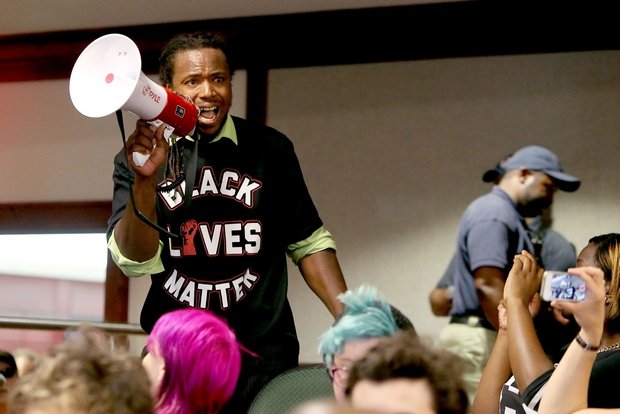
Muhiyidin D'Baha speaks to the audience before a press conference by North Charleston Mayor Keith Summey Wednesday, April 8, 2015 at North Charleston City Hall. Paul Zoeller/Staff
By Glenn Smith and Andrew Knapp
North Charleston has struggled since its inception with mistrust and tension between citizens and police as it tries to find a delicate balance between public safety and civil rights in a community beset with violent crime.
The state’s third-largest city has pockets of deep, entrenched poverty and neighborhoods where gunfire has been a familiar visitor in the night. But attempts to quell the crime, which for three years landed North Charleston among the nation’s most dangerous cities, brought about cries of racial profiling and unfair treatment of minorities — particularly of young, black men.
Years-long efforts to bridge that divide and smooth relations with the community took a deep hit this week with the arrest of Patrolman 1st Class Michael T. Slager, accused of gunning down an apparently unarmed, fleeing black man after a traffic stop. Slager, who is white, is charged with murder in 50-year-old Walter L. Scott’s death.
A protest outside City Hall remained peaceful Wednesday morning, but demonstrators drowned out Mayor Keith Summey during an afternoon news conference with chants demanding justice and questioning the city’s struggle to hire minority police officers. The department is about 18 percent black in a city that is 45 percent black.
While the FBI has opened a civil rights probe into the shooting, Summey vowed to discuss with residents whether the city’s policing tactics and policies should be changed. He also announced that the city Wednesday bought 150 body-worn cameras in light of Scott’s death that will complement the 101 cameras it had already ordered through a state grant. He didn’t say when the city would get the shipment of 251 cameras that will outfit every uniformed patrol officer.
State Rep. David Mack, a North Charleston Democrat who is black, was a speaker a few years ago in classes on cultural sensitivity that were mandated for all new officers. It was a program designed to help them better understand policing from the perspective of those they serve. Mack thought the classes made a difference, but a video of Scott’s shooting that emerged Tuesday shows that the Police Department still has its issues, he said.
“It’s an ongoing battle,” he said. “I think we have made progress, but this incident ... wounded the community tremendously.”
The footage, which was shot by a passerby, spread rapidly worldwide after The Post and Courier first broke the news of the evidence that contradicted Slager’s account. Though it showed the officer shooting Scott in the back, it left some questions unanswered and sparked speculation of what happened.
A spokesman from the State Law Enforcement Division, which is tasked with an independent investigation, said he couldn’t answer those questions because the probe wasn’t finished. SLED has dashboard camera footage from Slager’s car, which could explain why Scott’s Mercedes-Benz was pulled over but would not show anything about the shooting, the spokesman, Thom Berry, said. Berry did not respond Wednesday to a request for the video.
Police Chief Eddie Driggers also wouldn’t clarify whether the video showed Slager picking up his Taser X26 and dropping it near Scott’s body. The officer has said that Scott had taken the device from him and tried to use it.
Driggers also was uncertain whether his officers performed CPR on Scott.
“I’m going to be totally honest with you,” he said of the footage, “I was sickened by what I saw.”
After Scott is buried, the city’s mayor said he would open up police procedures for a discussion, a process he said Driggers had been working on for two years.
“We will be ... looking for ways to develop a closer relationship with the individual communities,” Summey said. “We will look at ways to enhance the quality of service we provide to our citizens, and by that, I mean all our citizens.”
But if history is any guide, the road to restoring trust could be an arduous path. That problem was clear during the news conference when residents interrupted Summey several times with chants.
“How are you the mayor?” one man yelled. “Nobody respects you.”
The conference was punctuated with chants of “the mayor gotta go” and “no justice, no peace.” Some people in the crowd were familiar with the sentiment.
A difficult history
Old-timers in the Police Department used to share stories of bare-knuckled brawls as outnumbered officers waded into packed and unruly roadhouses to restore order in the days after the city formed in 1975. Outmanned and hemmed in, they found it safer to subdue and ask questions later. It was a question of survival, they said.
The department has come a long way since those days and is now a nationally accredited institution, priding itself on professional rules and policies that have withstood expert scrutiny. But questions have lingered through the years about the methods employed by the rank-and-file to keep the peace — particularly in regard to using deadly force against black residents.
“We want the world to understand that this is not an isolated incident,” protester Muhiyidin d’Baha said at the demonstration Wednesday morning in front of City Hall. “This has been a reality that has been in the North Charleston Police Department for many, many years.”
In October 2000, for example, protesters took to the streets after the police shooting death of Edward Snowden in a Dorchester Road video store. Snowden, a black man who was being attacked by four white men, was shot by police after they arrived and found him holding a gun. Police were cleared of wrongdoing, though the city later settled a wrongful death lawsuit filed by Snowden’s family for about $70,000.
Racial tensions rose again after the November 2003 fatal shooting of Asberry Wylder, a black shoplifting suspect with a history of mental illness. Police shot Wylder after he plunged a knife into an officer’s protective vest during a confrontation outside a Rivers Avenue supermarket. Some witnesses said Wylder was beaten and shot a second time after he was handcuffed on the ground. The state’s probe found nothing to indicate that the police acted improperly, but that conclusion won little acceptance in the black community.
Tensions continued to simmer as the pressure to drive down crime intensified when the city racked up 55 killings between the start of 2006 and the end of 2007. That led to Washington-based CQ Press ranking North Charleston among the Top 10 most-dangerous cities in the nation.
Desperate to shake the distinction, city officials enacted a policy of aggressive patrolling: incessant stops of motorists for minor violations, seemingly random interviews with residents and a virtual police occupation of neighborhoods in the days just after violence occurred.
The idea was to create constant contact with residents of the most troubled areas in the city, tamping down the opportunities for crime while establishing sources to help investigators solve cases. The strategy seemed to work. By 2010, the number of people slain had fallen to five, and the city tumbled off the upper reaches of the infamous list of perilous places to live.
Striking a balance
Critics, however, insisted that those gains had come with a steep cost to civil liberties, particularly for black residents who constituted the majority of those subjected to stops and field questioning. Between 2008 and early 2012, 120 complaints were lodged against the Police Department, with the majority of the complaints coming from blacks.
Then-Police Chief Jon Zumalt tried numerous approaches to easing the tensions on this front, from the cultural sensitivity classes that Mack participated in to a program called “Sell the Stop” in which officers were trained to politely explain to residents the necessity of pulling them over. But the drumbeat of criticism continued through Zumalt’s tenure.
Like the chief who took over for him, Zumalt said in an interview Wednesday that he was sickened by what he saw on the video of Scott’s death, which he called “heartbreaking.”
Balancing public safety with the need to preserve civil rights is perhaps the most challenging part of police work these days, he said, and one that he confronted during his time here. He tried to involve community members and activists such as James Johnson, a local National Action Network president, in the process to help increase understanding of policing and strengthen bonds with citizens, he said.
“You have to reduce violence and keep the community safe, but you have to do it in such a way that you don’t alienate the people you are serving,” Zumalt said. “That is the core and the most difficult thing to achieve in policing today.”
The Scott shooting “is going to damage that relationship and make it even more difficult to achieve that balance,” Zumalt said.
When Driggers, a veteran law enforcement officer and former police chaplain, took over after Zumalt’s retirement in early 2013, Summey said his Christian approach to policing was what the city needed. The soft-spoken chief, who has a penchant for meeting detractors with hugs, set out to win over critics and invite them into his office to share their views. He visited crime scenes, oversaw an effort to place officers in every school and started a Powder Puff football program to give teen girls something positive to do.
But Johnson, the activist whom Driggers’ predecessor once tried to work with, said the chief had not thoroughly addressed allegations of racial profiling or dealt with a perception that the city’s officers “will stop you, lock you up and shoot you.”
“Driggers really just took up where Zumalt left off; he may just be doing it in a different way,” Johnson said Wednesday. “What his department needs is to be rebuilt from the bottom to the top. That’s how he’s going to get that confidence from the community.”
It remains to be seen how much goodwill and patience Driggers’ efforts will earn the city in the wake of the shooting. The chief’s voice has quivered this week, and he occasionally appeared on the verge of tears as he addressed local and national news media. He often drew on his faith.
“I have been praying for peace, peace for this family and peace for this community,” he said Wednesday after he and the mayor visited with Scott’s loved ones. “I will continue to stand on that as I strive to protect and serve.”
People in the neighborhoods he serves, though, are clearly shocked. And angry.
About 200 protesters amassed Wednesday morning in front of City Hall, the first organized rally since the video came to light. Members of Black Lives Matter Charleston, a grassroots group that formed after police-involved deaths in Missouri and New York, had figured that the day might come when the national conversation on the use of deadly force hit home.
Signs thrust into the air were emblazoned with messages of “back turned, don’t shoot” and “stop racist police terror.”
“I’m here on behalf of every father in this country, in this nation, that’s saying I’m tired of seeing this weekly, daily,” protester Calvin Bennett said. “The good cops know the bad cops. If you’re a good cop, do something about that.”
The rally ended with protesters blocking nearby Mall Drive for 15 minutes. Some angry motorists yelled at them from their cars. But one got out to hug and link arms with the demonstrators.
Charleston County Sheriff Al Cannon, himself a former North Charleston police chief, said the delicate balance between civil rights and public safety is made even more difficult against the backdrop of Ferguson, Mo., and in the age of social media and the 24-hour news cycle.
But in regard to the investigation in North Charleston, Cannon said, the process has shown to be valid. “It’s working here,” he said, “and it’s not working to satisfy anyone in particular. It’s working to satisfy justice.”
'A miracle'
Some local community members have lauded Summey and Driggers for acting so quickly to fire Slager and condemn his actions when the video of the killing surfaced.
Both of them also attended the protest Wednesday. Summey said the city offered a consolation to the officer’s wife, who is in her eighth month of pregnancy, by continuing to pay for her health insurance.
Bill Saunders, a longtime civil rights activist who spent years documenting alleged police abuses as head of the North Charleston-based Committee on Better Racial Assurance, said he was stunned by the pair’s swift condemnation and pledge to seek justice. Saunders once had so little faith in the police that he issued an alert to young black men in 2006, warning them not to drive at night lest they encounter an officer.
“What happened right now with this police officer being charged, it really is a miracle,” he said. “And I think one of the most impressive things to come out of this all is the position the mayor and chief of police have taken.”
David J. Thomas, a professor and former police officer who serves as a senior research fellow with the Washington, D.C.-based Police Foundation, said the public is generally willing to accept that police are human beings and subject to flaws. If goodwill exists between the chief and his community, they are more likely to give him the benefit of the doubt going forward.
If not, tensions could continue to build, he said, and the city runs the risk of attracting people from outside the area who could ramp up the volume and intensity of the demonstrations.
To stop that before it happens, observers and residents said prosecutors must also vigorously pursue the murder charge that Slager faces. Ninth Circuit Solicitor Scarlett Wilson vowed to pursue a grand jury indictment, likely next month, and let the public know about every court date.
'Moment like this'
But investigators also must answer lingering questions.
They must determine what Clarence Habersham, the first backup officer to show up at the shooting scene, saw when he got there.
Slager had chased Scott to the secluded area near Remount Road and Rivers Avenue after he said he stopped Scott for a broken brake light about 9:30 a.m. Saturday. A young man who happened to be there started filming, and he told NBC News on Wednesday night that the pair were locked in a struggle on the ground.
“They were down on the floor before I started recording,” Feidin Santana of Hanahan told NBC News. “The police had control of ... Scott. Scott was trying just to get away from the Taser. You can hear the sound of the Taser ... before I started recording.”
The video does not show if Scott ever gained control of the Taser, but he appeared to slap something from the officer’s hands.
Slager, who said he felt threatened because Scott had taken the device, fired eight .45-caliber bullets from his Glock 21. Five of them plunged into Scott’s body. In Slager’s radio communications that local and state agencies released Wednesday after the newspaper pointed out that they were public record, the officer said that Scott had been shot in the chest and the buttocks.
All the bullets, though, hit Scott from behind, Charleston County Coroner Rae Wooten said in a statement.
The video showed the officer jogging back to an object that had fallen to the ground during the struggle. Slager dropped it near the body, but the footage also showed him later picking up something and attaching it to his duty belt. Habersham, a black officer, was standing near Slager.
In protests Wednesday, residents cried out for the police chief to answer their questions about the video, and they balked when the city’s mayor asked for quiet so he could answer journalists’ questions. “Our community member died,” they chanted, “not the media’s.”
Ed McClain, a retired pastor who has lived in North Charleston for all of his 75 years, was in the crowd. He had been encouraged by progress in the relationship between the police and the community. Getting body cameras would be another step in the right direction, he said.
“But then there’s a moment like this,” McClain said, “when the trust is torn away.”
William Pugh, a junior at Academic Magnet High School, said it’s impossible to live in a world where people don’t feel safe, and Scott’s killing makes it difficult to see the police in a good light as protectors of the community.
“Being an African American young man, I cannot even describe what it’s like to know that events like this happen,” he said. “We have to change the system. We have to do something. And we have to stop letting these events happen.”
Christina Elmore, Brenda Rindge and Melissa Boughton contributed to this report.
By Tony Bartelme
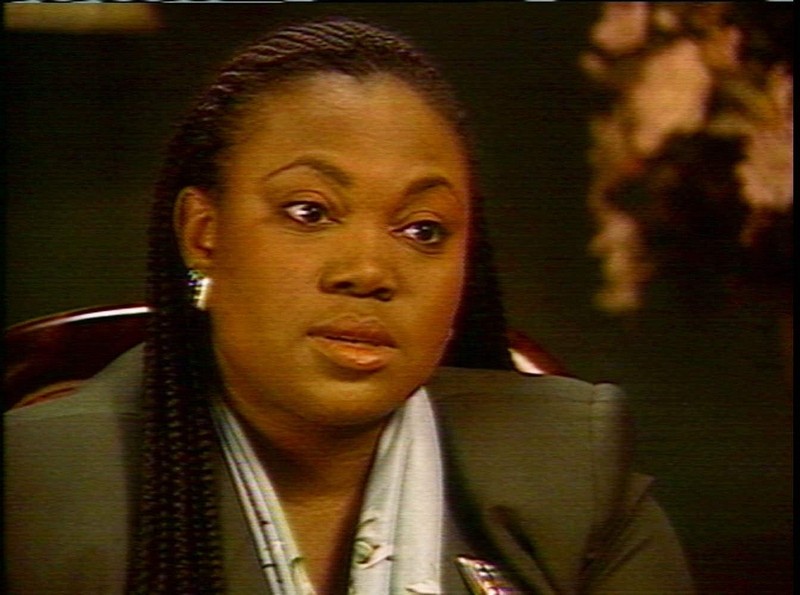
Sandra Antor appears on NBC's “Dateline” in 1996. She was physically abused by a state trooper during a traffic stop that year. AP
Long before smartphones and YouTube, a shocking video from South Carolina hit the airwaves: A furious white highway patrolman dragging a black woman from her car.
It happened in Clarendon County one January afternoon in 1996. State Trooper Harvey Beckwith was in an unmarked car on Interstate 95 and tried to stop Sandra Antor, who was driving from Florida.
Antor didn’t stop for a few minutes because she wasn’t sure Beckwith was truly a police officer. When she did, Beckwith marched to her door with his gun drawn.
He pointed the gun at her with one hand and yanked her onto the pavement with the other. When he had trouble handcuffing her because of her clothes, he threatened to cut them off. “Roll over and stand your a-up, lady, now! You’re fixin’ to taste liquid hell in a minute!”
The entire scene was captured on Beckwith’s dashboard camera, which at the time was a relatively new phenomenon among police agencies.
The video triggered an uproar, but not for several months. Scratched and bruised, the woman hired a lawyer and filed a formal complaint. When superiors finally checked Beckwith’s video, they fired him. He later made a tearful apology on “Dateline.” She received a $400,000 out-of-court settlement.
Since then, even more graphic videos have surfaced of white law enforcement officers crossing lines with black suspects.
In 2007, The Post and Courier obtained dashboard videos showing Lance Cpl. Alexander Richardson chase a black man through an apartment complex in Columbia. Richardson bumped over curves and passed startled onlookers, including a child. Richardson was later charged with a misdemeanor and ordered to perform 100 hours of community service.
Another dashboard video showed Lance Cpl. S.C. Garren run into a suspect and later brag: “Yeah, I hit him. I was trying to hit him.” Garren was later acquitted of charges that he violated the man’s civil rights.
Until Tuesday’s shooting in North Charleston, perhaps the most graphic video was one from a stop at a gas station in Columbia last September.
The dashboard camera captured state trooper Sean Groubert stop Levar Jones for a seat belt violation. Groubert told Jones to get his wallet. When he reached into his car to retrieve it, Groubert shot him.
“What did I do? ... I just got my license, you said get my license,” Jones could be heard in the video. “Why did you shoot me?”
Jones was wounded but not killed and later settled with the state for $285,000.
Groubert was fired, arrested on a charge of assault and battery of a high and aggravated nature. His case is still working its way through the courts. The video has 2.5 million views on YouTube.
Like many dogged by mounting child-support debt, Walter Scott faced an arduous future, likely jail time
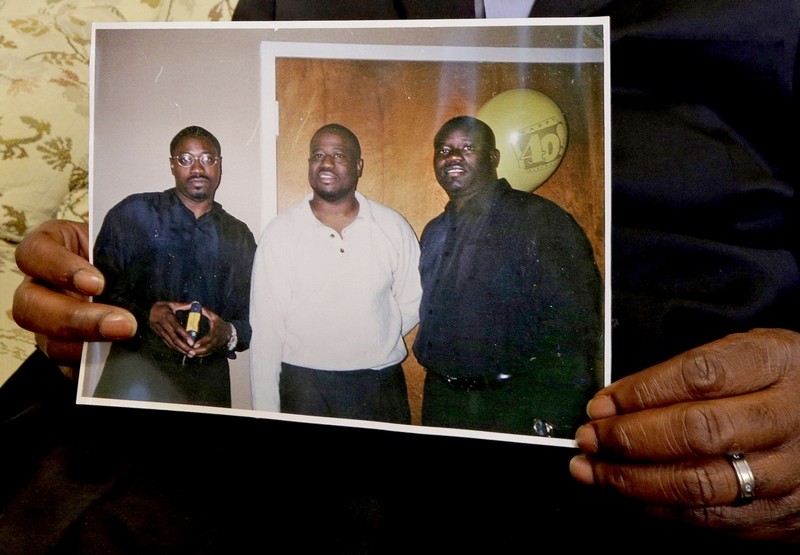
Chuck Burton/AP Anthony Scott holds a photo of himself (center) and his brothers Walter (left) and Rodney this week at his North Charleston home. Walter Scott was killed by a police officer after a traffic stop last week. The officer, Michael Slager, is charged with murder.
By Lauren Sausser
Some 15 years ago, long before Walter Scott’s death by a North Charleston police officer made national headlines, a family court judge threw him in jail for 15 days because he hadn’t made his child support payments.
Scott already knew how the system worked — he owed support for two children, and then two more — but he claimed at the time that the Department of Social Services sent some of his money to the wrong mother.
Nevertheless, he went to jail. And then he lost his $35,000-a-year job at a film company.
“I got mad at everybody in the whole world because I just lost the best job I ever had,” Scott told The Post and Courier in 2003. “I just stopped doing everything. I just closed myself into a little shell and started doing things I shouldn’t have been doing.”
He drank. He found odd jobs. Still, he couldn’t make enough money to make the payments he owed.
“I didn’t even care if I lived or died,” he said.
Then, Scott seemed to turn a corner. He was featured in an article about a promising program called “Father to Father,” designed to help men who had fallen behind on their payments. He admitted his mistakes, then turned himself in to the state for even more missed child-support payments. He spent another five months in jail.
“This whole time in jail, my child support is still going up,” he said. “I said, ‘Man, you got four kids depending on you, and you got people in your life that love you. You got to get it together.’ ”
Past due
Maybe Walter Scott eventually became the father he hoped he could be. Maybe “Father to Father” helped him find the footing he needed to support his family. Maybe it didn’t. After all, those child support payments caught up with him again.
He owed nearly $18,104 in child support, according to court documents. He’d already been jailed three previous times.
“He said that’s what he would do, he would run, because he’s not going to jail for child support,” his brother, Rodney Scott, told MSNBC on Wednesday. Walter Scott, father of four, was a wanted man. Like untold thousands of other South Carolinians, a warrant had been issued for his arrest because, once again, he hadn’t paid his child support.
State law allows county court clerks to issue bench warrants once these bills are only five days past due. The state can levy a variety of other penalties, including revoking someone’s driver’s license or garnishing their wages, for failure to pay child support, but many of the offenders languish in county jails across the state. There, child support bills continue to accumulate, setting many men up for a seemingly endless cycle of failure, some advocates say.
“I hate it to see when fathers don’t pay child support,” said Sue Berkowitz, executive director of the S.C. Appleseed Legal Justice Center, but “killing someone over it — that’s just mind-boggling.”
'Treating debtors like criminals'
Richard Barr, director of community development for the S.C. Center for Fathers and Families, called South Carolina’s child support collection policy — known as “Rule 24” — among the strictest in the country. A bill five days past due hardly warrants jail time, he argued.
“That’s tough,” Barr said. “If that happened to me every time my credit card came out, I’d be in trouble.”
Barr, and others, say child support enforcement shouldn’t be a public safety issue anyway.
“When you make a family issue a policing issue, what you literally do is end up treating debtors like criminals,” he said. “It’s very different to be wanted for murder and to be behind on a bill.”
DSS, which manages 75 percent of all child support cases here, said it doesn’t know how many active warrants have been issued for men and women in South Carolina who have failed to make timely child support payments. Court clerks in Charleston and Dorchester counties would not provide their own numbers.
Sandra Holland, support enforcement supervisor for Berkeley County Family Court, said there are currently 1,103 active bench warrants for failure to pay support in Berkeley County alone.
“There is no question that there are lots and lots of people who are behind. The caseloads are phenomenal,” Berkowitz said. “At one point, a couple of years ago, our DSS child support attorneys had some of the highest caseloads in the country. They’re dealing with huge volume and huge numbers and they don’t always have the resources to track someone down.”
Supreme Court case
Berkowitz said the number of bench warrants issued for failure to pay child support seemed to abate after a U.S. Supreme Court case four years ago forced state child support agencies and family courts across the country to re-evaluate their policies. The federal case actually originated in the Upstate after Michael Turner, an Oconee County resident, was imprisoned several times for failure to pay child support.
The federal government determined incarceration may be justified in some of cases, but, by and large, “jail is not appropriate for noncustodial parents who do not have the means to pay their child support debts.”
“It really kind of stopped for a while,” Berkowitz said. “I didn’t think they were picking people up or issuing bench warrants for child support.”
The number of bench warrants issued varies from county to county, Barr explained. Smaller counties with lighter dockets tend to issue more of them, he said.
Operation Work
South Carolina received an $8 million federal grant to launch “Operation Work” last year — a program that helps fathers who owe child support payments find ways to support their families. Only seven other states were invited to participate.
Operation Work is currently available in Charleston, Horry and Greenville counties. Fathers who qualify regularly meet with counselors, job coaches and program coordinators to make sure they’re meeting their families’ needs.
Almost 100 people have enrolled so far, Barr said. “We work with men every day who have never had a resume.”
Some of them also qualify for assistance to attend technical college or see a tutor for help with schoolwork. While they’re enrolled in the program, their child support payments are suspended.
Unlike spending time in jail, where their debts keep adding up, Operation Work offers participants a temporary reprieve to establish work skills they need to earn money.
The alternative is a life in the shadows, Barr said, because “as soon as you get out of jail, you’re a fugitive again.”
This is just the type of program Berkowitz said South Carolina needs.
“We’ve got to rethink how we help families,” she said. “Because you can’t pay child support when you’re in jail.”
Why he ran
Anthony Scott, Walter Scott’s older brother, knows why he ran.
“I know why he ran away. We know why he ran away. Everybody knows why he ran away now,” Anthony Scott said. “I wasn’t saying it before, but it’s out there now.”
He didn’t know how much Walter owed in child support or why he fell behind on his payments, other than to say he was “just living life.” According to Fielding Home for Funerals, Scott was a warehouseman at Brown Distribution before his death. The Associated Press reported he was a temporary forklift operator.
In 2003, child support payments were automatically drafted from Scott’s paycheck. Back then, he earned about $800 a month. It is unclear how much money he made at Brown Distribution.
“If God ever blessed me and I came into some money, I’d help,” Scott told the newspaper 12 years ago.
But his brother said the deck was always stacked against him.
“I hate for anybody to get in the child support system. It can be trying. It doesn’t seem to work out for them,” Anthony Scott said. “(Walter) said that it was crazy, that he couldn’t wait to get over it. But once you’re behind, you’re behind.”
Brooks Brunson and Bo Petersen contributed to this report.
Grieving family hopes death of 50-year-old Walter Scott will be ‘a catalyst of change’ for police practices nationwide
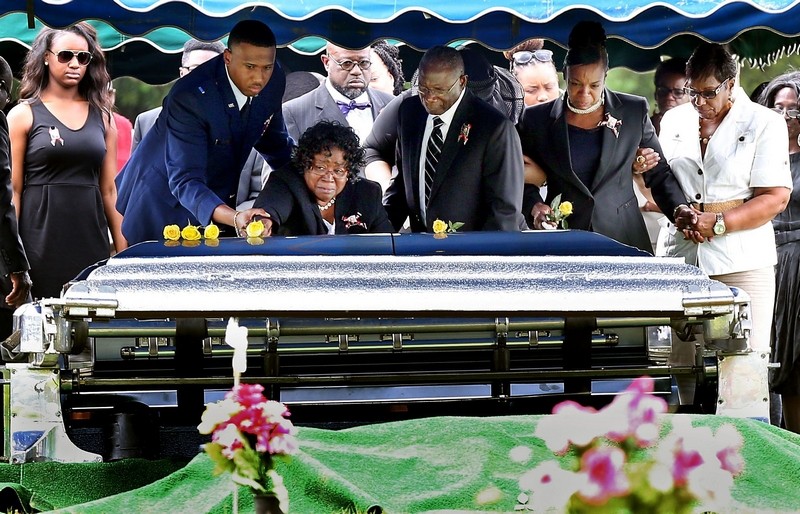
Judy Scott lays a flower on the casket of her son Walter Scott along with her husband Walter Scott Sr., (right) during the burial at the Live Oak Memorial Gardens cemetery Saturday in Charleston. GRACE BEAHM/STAFF
By Cynthia Roldan, Christina Elmore and Deanna Pan
Anticipation built in Judy Scott’s face as an American flag that had been draped over her son’s casket all morning was folded in front of her.
Her second son, Walter Scott, was killed by a North Charleston police officer two months after his 50th birthday. On Saturday, she watched as he was lowered into the ground with yellow flowers decorating his cadet blue casket at Live Oak Memorial Gardens cemetery in Charleston.
Judy Scott mumbled prayers to herself, at times looking in the direction of the skies, while shaking her head in disbelief. She closed her eyes when she was handed the flag and clutched it tight as the crowd watched.
It was exactly a week ago, on April 4, when Walter Scott was shot and killed while running from Michael Slager, a white North Charleston police officer who pulled over Scott for a broken brake light. Slager has since been fired from his job and charged with murder.
But before Judy Scott, along with the rest of her family and friends, said goodbye to the father of four, they celebrated his life at a “Homegoing Service” at W.O.R.D. Ministries Christian Center, inside the same walls he frequented to sing, praise and pray.
Scott lay in a closed casket for most of the ceremony at the Summerville church. A blue and white flower arrangement in the shape of a star to his right had a ribbon that read “beloved son.”
Those who attended the service, which lasted nearly two and a half hours, showed and voiced frustration and sorrow over Scott’s killing. Pastor George Hamilton fueled the crowd’s anger when he dubbed Slager’s actions “overt racism.”
“Walter’s death was motivated by racial prejudice,” Hamilton said. “You’ve got to hate somebody to shoot them in the back.”
But family members who addressed those who attended the service said they hoped Scott’s death would trigger changes in police practices nationwide.
“I know that my family was chosen to be a catalyst of change,” said Keya Grant, Scott’s cousin. “His memory and his life will not be in vain.”
Both of Scott’s brothers, Rodney and Anthony, thanked those who took the time to come to the service. Scott’s daughter, Samantha, also read a poem for her father.
“I cry every time I think about you,” she read. “Every breath I take, I’ll remember that you gave it to me.”
A picture slideshow brought tears and sighs of distress to many. But it was the sight of Scott in his casket that made many break down once it was opened, and everyone was allowed to walk to say goodbye one last time.
Tensions had been high for most of the morning, even before the service started. Dozens of family members and friends arrived early to ensure seating inside of the church. But as the crowd grew, its members became anxious and started to push each other, hoping to make it inside as rain clouds loomed.
Many were left standing outside of the service, and some were forced to leave when heavy rain poured. But among those who made it inside were U.S. Reps. Mark Sanford and Jim Clyburn. U.S. Sen. Tim Scott and state Sen. Marlon Kimpson were also present, in addition to state Reps. Seth Whipper and Mary Tinkler; Gov. Nikki Haley’s chief of staff, James Burns; and Director of Public Safety Leroy Smith.
The crowd was cut nearly in half when the service continued about 20 minutes away at the cemetery. Daniel Garner, 47, was among those who made it to the burial, after hopping on a train from Philadelphia to see Scott, his fellow seaman in the Coast Guard, for the last time.
“We called him ‘The Renaissance Man’ because he always took care of himself so well,” Garner said of Scott. “He was nothing but a family man. I never met a more honest man.”
After the funeral, the rain began to fall.
Shortly before 5 p.m., dozens gathered near the grassy lot on Rivers Avenue where Scott was killed.
The makeshift memorial at the lot had grown since the news of Scott’s death spread around the world. Bouquets of flowers, American flags, candles, stuffed animals and handwritten cards to Scott’s family adorned the lot’s chain-link fence. Charles Dash, a former Marine, took pictures of the site on his cellphone. He had traveled all the way from the Bronx on Thursday to attend Scott’s funeral.
“I was compelled to be here,” he said. “This man here, he helped South Carolina more than anything anybody can do from a black point of view. ”
Here, pastors and religious leaders from local churches organized a march down Remount Road. As thunder cracked, about 50 people walked in silence through the rain.
Carol Washington had come from the funeral, too. She went to the same high school as Scott, St. Andrew’s Parish High, but graduated four years behind him.
“Where is the heart?” she asked. “There is only one judge and that’s God. We try to let justice prevail, but it doesn’t always work.”
The procession ended about a mile away, at Aldersgate United Methodist Church, with a prayer service led by 17 local pastors and Bishop L. Jonathan Holston, the Episcopal leader of the South Carolina United Methodist church. The rain stopped; the sky cleared. On the front lawn of the church, beneath two sprawling magnolia trees, the crowd prayed and sang hymns to beat of a West African djembe drum.
Ernestine Brunet, who just turned 82, left her family’s birthday party early to be in attendance; they hadn’t even had a chance to cut the pound cake yet. She gripped her cane in her right hand and held on to her sister’s arm as she marched to the church. She said she managed to walk one long city block before she had to hitch a ride with a pastor.
The Rev. William Wrighten, of Washington United Methodist Church in North Charleston, was among the pastors who helped organize Saturday’s service. Come Sunday morning, he’ll give his own congregation a sermon — a message, he said, of love, hope and reconciliation.
“Sometimes in life it takes a tragedy to bring a blessing. Sometimes it takes rain followed by sunshine,” Wrighten said. “So although we lost a member of our community in a tragic way, it has brought the community together and hopefully, there will be systematic changes.”
How 8 bullets pierced the nation
By Andrew Knapp and Tony Bartelme
A blink of an eye takes about four-tenths of a second. From the first shot to the last, the shooting of Walter L. Scott took 2.7 seconds. Seven blinks.
This brief moment in time would have a cascading effect: Scott grabbed his left side and crumpled face-first onto a patch of grass; Michael T. Slager, the North Charleston police officer who shot him, lowered his pistol; Feidin Santana, on his way to work, finished capturing it all on his phone camera, video that would bring these seconds to the world.
But that 2.7-second space in time is deceptive.
Experts in officer-involved shootings say they usually happen after a chain of events, each link leading to another until the one where an officer decides to pull the trigger.
And this burst of gunfire also happened against the longer chain of history, in this case, one stretching back to slavery, segregation, decades of discrimination and, more recently, officer-involved deaths in Missouri, New York, Ohio and so many other places across the country.
As with any chain, a tragedy has links that, if broken, could have changed everything. And one such link was forged at 9:33 a.m. April 4, when Slager turned on his blue lights behind a 1990 Mercedes.
At first, everything proceeded like just another routine traffic stop. The driver of the Mercedes signaled a left turn into the parking lot of the Advance Auto Parts store on Remount Road. Slager followed. The skies threatened rain. The Mercedes moved to an empty area of the lot. Slager parked his cruiser a few car lengths behind. He could see a driver and a passenger through the Mercedes’ rear window.
Slager climbed out of his cruiser and walked toward the car. When he reached the back of it, he brushed the driver’s side taillight with his right hand. Music played in his cruiser, an Everlast song:
God forbid, you ever had to wake up to hear the news
’Cause then you really might know what it’s like to have to lose
Then you really might know what it’s like …
In a calm voice, Slager asked the driver: “See your license, registration and insurance card? What’s that? OK, let’s start with your license. The reason for the stop is your brake light is out.”
It was a moment that thousands of people in North Charleston and in cities across the nation know well.
Every year, police stop about 12 percent of all American drivers.
But black motorists are more likely to see blue lights in their rear-view mirror. Some researchers estimate that one out every four black drivers will be stopped in a given year, according to a new book, “Pulled Over: How Police Stops Define Race and Citizenship” by sociologists Charles Epps, Steven Maynard-Moody and Donald Haider-Markel.
The authors studied different types of traffic stops — those done for people who clearly broke laws, such as speeders and drunken drivers, and “investigatory stops,” where officers use broken taillights and windshields as a pretext to stop other crimes.
While investigatory stops can be effective at identifying criminals, they also open the door to bias, the sociologists wrote. And over time, this has a corrosive effect on the entire community. “What makes inquisitive police stops so offensive to many African Americans and Latinos is not that the officers carrying them out are impolite or even frankly bigoted, but that these stops are common, repeated, routine, and even scripted.”
In the mid-2000s, as North Charleston’s violent crime rate rose and earned the city a place on the top 10 list of dangerous cities, so did the number of tickets for seemingly minor offenses.
Between 2006 and 2009, the height of North Charleston’s crime crackdown, officers issued more than 2,020 tickets for defective taillamps, brake lights, headlamps and mirrors, a Post and Courier analysis shows. Officers wrote more than 2,100 tickets for improperly tinted windows, 285 tickets for loud noises coming from vehicles and 175 tickets for not having a bell or light on a bike.
Since then, North Charleston’s crime rate dropped dramatically, but tensions over these stops and tactics remained high.
Amid this backdrop, Slager asked Scott: “Do you have insurance on the car?”
“No. I don’t have insurance.”
“Well, if you don’t have insurance on your car, since you bought it, you have got to have insurance.”
“Well, I haven’t bought it yet. I’m saying I’m about to do that Monday.”
Slager asked a few more questions, then said, “OK, All right. I will be right back with you.”
Slager, 33, was 6 feet tall and about 180 pounds. His black hair had touches of gray on the sides and his widow’s peak. He joined the force in 2009, after six years in the Coast Guard, where he served as a member of a boarding team. Before the Coast Guard, Slager worked as a waiter at a restaurant in Vorhees Township, New Jersey.
As a rookie police officer, Slager “was very enthused and ready to work,” one supervisor wrote. In March 2010, after Slager passed basic training at the S.C. Criminal Justice Academy, he swore an oath: “I shall never abuse my authority either by words or act, nor shall I allow my personal feelings, prejudices or friendships to influence my decisions.” He aced his early training at the department on how to use a Taser. He completed annual policing classes, including a two-hour session on first aid and CPR. In target practice, his aim with his .45-caliber Glock was on the mark.
Then, in September 2013, a mark on his record: Slager was investigating a burglary when he knocked on the door of Mario Givens’ house on Delaware Avenue. Givens would later say that he didn’t want to open the door because he was only in a T-shirt and boxers. Slager would write in a report that he feared that Givens had a weapon and might be a suspect in the burglary. Slager burst through the door and pressed his Taser into Givens’ stomach. Givens crumpled to the floor and writhed in pain.
Givens later filed a formal complaint. The case was closed a few weeks later with a note that said Slager was exonerated.
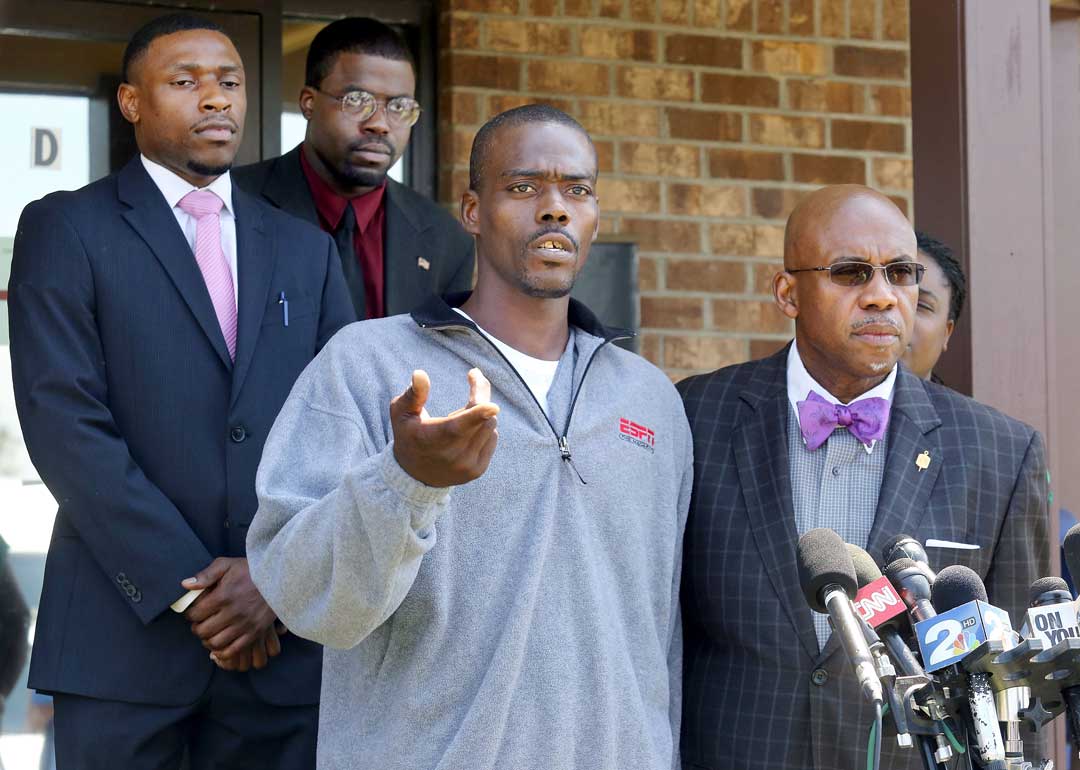
Mario Givens tells his story of when now former North Charleston Police officer Michael Slager used his Taser on Givens back in 2013. Givens and his lawyer Eduardo Curry (right) plan to file a lawsuit against North Charleston and Slager, who has been charged with murder in the shooting death of Walter Scott. (Brad Nettles/Staff)
In the parking lot, Slager returned to his cruiser, his dashboard camera still pointed at the Mercedes.
Five seconds later, Walter Scott opened the door and waved what appeared to be a wallet.
“Got to stay in the car!” Slager yelled in a rapid-fire burst.
Scott slipped back into his seat.
Sixteen seconds passed, then Scott suddenly opened his door and took off down a side street.
Sixteen more seconds ticked off on the dashboard camera, and then Slager screamed: “Taser! Taser! Taser!”
Walter Scott was small but stocky, about 5-foot-7 and 165 pounds. He had two brothers, a younger one named Rodney and Anthony, the eldest. Like Michael Slager, Scott also had been in the Coast Guard. He joined in 1984 after graduating from St. Andrews High School. He wound up serving in Baltimore as a fireman’s apprentice. Two years later, he was cited for what officials would later describe as a drug-related offense. He was involuntarily but honorably discharged.
A year later, he had a job with Renken, a boat-builder, when a fight broke out at O.J.’s bar in West Ashley, according to report of the incident. During the melee, a deputy was struck, and Scott was charged with assault and battery.
Six years later, in 1993, he married Lisa Aiken. But they argued, separated, and after about a decade, divorced. At the time, he’d been making good money working for a filmmaking company. And, away from the arguments, he felt as if his life was on track. But after a Family Court proceeding, a judge ordered him to pay child support through the Department of Social Services. He would later say that the money was sent to the wrong person. He was hauled again before a judge, who sentenced him to 15 days in jail.
He lost his job. “I got mad at everybody in the whole world because I just lost the best job I ever had,” he told The Post and Courier in an interview 11 years ago for a story about fathers’ rights. “I just closed myself into a little shell and started doing things I shouldn’t have been doing.”
He said he drank too much and lost touch with his family, until one day he called his mother, who told him his children missed him. “That just broke my heart. It helped me come to my senses.” He joined a group program called Father to Father. He turned himself in for failing to pay child support and spent five months in jail. In jail, his child support bills grew even more. He told himself, “Man, you got four kids depending on you, and you got people in your life that love you. You got to get it together.”
He graduated from the Father to Father program. He began enjoying life: He rooted for the Dallas Cowboys; he invited friends over to play dominoes; he loved ham and potato salad. He still had problems with Family Court, though. He had an outstanding warrant for failing to pay child support. The tab was $18,104.43. Through his troubles, his older brother, Anthony, remained protective. As Walter began driving the Mercedes, Anthony had a bad feeling, he would say later.
The car’s shiny large rims could catch the attention of police.
“Black male,” Michael Slager said on the radio. “Green shirt. Blue pants.”
On foot, Slager followed Scott down Craig Road, past a window-tinting shop and a lot behind a pawnshop. To their right was a chain-link fence with barbed wire. At an opening in the fence, Scott turned right, and so did Slager.
At least one witness saw the pursuit.
Feidin Santana was on the alley-like road that paralleled the vacant lot. He took that route every day he went to work at a nearby barbershop. When he saw the pursuit, he decided to follow them. He heard the zapping sound of the Taser. He would later tell reporters that Scott seemed to be trying to get away from the Taser.
He pressed record on his cellphone. He twisted it sideways, and then steadied it as Michael Slager, a few yards away, pulled his Glock 21 from his holster.
Walter Scott ran from Slager. Ahead of him was another opening in the fence.
Behind him, Slager squared his shoulders and planted his left foot slightly ahead of his right.
He pointed his pistol and fired his first shot.
The second shot came .4 seconds later, followed by six more at .3-second intervals.
After the seventh gunshot, there was a .83 second delay. Two blinks of the eye. Slager fired again.
Scott arched his back and took a few short steps and fell face-first onto the ground.
Slager turned and looked behind his left shoulder, and brought his left hand to his mouth to talk into his radio.
“Shots fired,” Slager radioed. “Subject is down. He grabbed my Taser.”
He walked at a moderate pace toward Scott. Four bullets had struck his back, and a fifth had hit an ear.
“Put your hands behind your back,” Slager shouted at Scott. “Put your hands behind your back.” Slager pulled Scott’s hands behind his back and cuffed him.
Feidin Santana kept his camera rolling.
After cuffing Scott, who lay motionless in the dirt, Slager turned around and jogged back to where he fired the shots; at that spot, he picked up an object and returned to Scott as another officer, Clarence Habersham, arrived. Slager dropped the object next to Scott.
It’s standard procedure to secure loose weapons after a violent event. But it’s unclear whether the object was Slager’s Taser or why he moved something in a crime scene.
“Someone grab a kit and come directly behind the pawnshop,” Slager said, summoning an officer with first-aid equipment.
“Everyone’s 10-4 except for the suspect,” he said.
Those 2.7 seconds would form one link in a chain that would quickly grow longer.
At 12:54 p.m., the city’s police spokesman emailed local reporters with the first public account based on Slager’s words. The spokesman’s statement said that Scott had taken his Taser, and that Slager shot him because he thought he was a threat. No witnesses came forward.
Without an opposing account, community leaders from the National Action Network and the NAACP urged residents to be patient, remain calm — don’t make North Charleston the latest Ferguson, the city in Missouri where 18-year-old Michael Brown was shot in August. It was a rare plea from the activists who often grow angry early when the police don’t release information after an officer-involved shooting.
That day, 40 people were locked up in the Charleston County jail on charges of failure to pay child support.
Feidin Santana stewed over that footage on his phone. At first, he thought about deleting it because he was afraid for his safety, he told NBC News. He also thought about turning it into police. Then he saw news reports about the shooting.
“I saw the police report, I read it. It wasn’t like that, the way they were saying,” he told NBC.
Sunday night at Walter Scott’s vigil, his older brother, Anthony, received Santana’s footage. The family waited another day to see whether police would stand by Slager’s story.
On Monday, Slager sent reporters a statement through his attorney, David Aylor. He repeated that he felt threatened and had no choice but to use deadly force. That day, the Scott family turned over the video to the State Law Enforcement Division.
Even before they saw the video, North Charleston Police Chief Eddie Driggers and other officers began to question Slager’s account. But they didn’t have the results of the autopsy, didn’t know where the bullets entered and exited Scott’s body; they didn’t know for sure how many rounds he had fired.
Monday night, SLED agents played the video over and over. Word of the footage began leaking to the public Tuesday morning.
Slager was married with two stepchildren and another on the way. City officials took his family to a local hotel; they dispatched a police chaplain to be with Scott’s grieving family. Tuesday afternoon, The Post and Courier reported online about the existence of the video. An hour later, city officials called a press conference.
“When you’re wrong, you’re wrong,” Mayor Keith Summey said.
“I have watched the video, and I was sickened by what I saw,” Chief Driggers said.
By 5:49 p.m., Slager was in jail, charged with murder, that 2.7 seconds in time looming larger by the minute.
Cynthia Roldan, Melissa Boughton and Brenda Rindge of The Post and Courier staff contributed to this report.
Mother can’t bear to watch video; father did, was rushed to ER
By David Slade
Michael Thomas Slager, who was charged with the murder of Walter Scott and fired from the North Charleston Police force last week, was drawn to public safety jobs as a young man, according to his mother.
Until April 7, when a bystander’s video went public showing the patrolman firing repeatedly and fatally at the fleeing 50-year-old Scott, Slager’s life and career appeared quite ordinary.
The video of Slager shooting Scott has been shown around the world, and photographs from the video have been printed on front pages of newspapers around the world. One person who hasn’t see any of the images, or read any of the stories, is Slager’s mother, Karen Sharpe.
“It would be very hard for me to see that,” Sharpe said during an interview in Charleston. “I just don’t think I could.”
The national media has been scouring the places Slager has lived and worked, mainly Florida and New Jersey, finding little but a handful of speeding tickets. In North Charleston, where Slager became a police officer in 2009, he wasn’t in the news until last week, and his limited years on the force went by with little controversy. Two citizen complaints were filed during his more than five years on the force, and he was cleared both times by internal investigators.
An excessive force claim involving a Taser, in 2013, was among those resolved in his favor but became public only after his arrest, and is now seen by some as a warning sign. On Friday, a lawsuit was filed by a man who claims Slager used a Taser on him during a 2014 traffic stop; a claim that was not among the previous citizen complaints.
Slager’s mother said she cannot imagine that her son would intentionally hurt anyone.
“In my heart, I know that Michael didn’t do anything wrong,” Sharpe said. “He’s not a bad person.”
She said Slager’s father saw the video of the shooting, and was rushed to an emergency room with chest pains; apparently an anxiety attack.
Sharpe said she and Slager’s father, who lives in Pennsylvania, divorced when their son was in elementary school. The oldest of three children, and the only boy, Slager grew up in a military family, moving frequently as his father’s Army postings changed.
Slager, now 33, lived in Burlington County, N.J., during his high school years. The area is an edge suburb of Philadelphia, where subdivisions give way to New Jersey farms. He graduated from Lenape High School in 2001, and according to his mother took some junior college classes and obtained some training as an emergency medical technician.
“We never had an issue with Mike while he was here,” Slager’s supervisor at Mount Laurel Emergency Medical Services 14 year ago, Fran Pagurek, told The New York Times.
Slager was briefly a waiter — his former boss described him as “quiet” to a Philadelphia Inquirer reporter — and in interviews reported from New Jersey to Florida former friends and in-laws have described him as nice, shy and “a good guy.” In Slager’s Hanahan neighborhood, the reaction was similar the evening of April 7, after Slager was charged with murder.
“This guy right here? He was charged for murder?” said neighbor Barbara Perry. “He seemed pretty normal to me. Walked his little pugs. Kept to himself.”
Before he was a police officer, Slager served in the Coast Guard, his first job after high school other than waiting tables.
“He decided to go into the Coast Guard, and was mostly on the water,” said Sharpe, who said Slager had done some recreational boating in New Jersey.
Slager was in the Coast Guard for six years and received an honorable discharge with the junior rank of E-3. His North Charleston job application says he was a boarding party team member, machinist and engineer.
Slager’s mother does not recall anything particular drawing her son toward public safety professions. She is overwhelmed, stunned, by the events of the past week.
“This has been a nightmare that I’m not waking up from,” she said, adding that she knows it’s been a nightmare for Scott’s family, too. “I do want them to know that I have compassion for them.”
When Slager finished his time with the Coast Guard he came looking for a job as a police officer, applying in North Charleston at the urging of a friend, William Janicki, who was on the force then but has since left the department.
Efforts to contact Janicki and two other men listed as Slager’s references on his job application were unsuccessful.
Just a week before Slager’s arrest and dismissal from the police department, Sharpe had come up to see him and his wife Jamie, who is eight months pregnant. He is the stepfather to her two children.
“He’s not a bad person,” said his mother.
Melissa Boughton and Deanna Pan contributed to this report.
Protest, civil disobedience vs. working with police, city
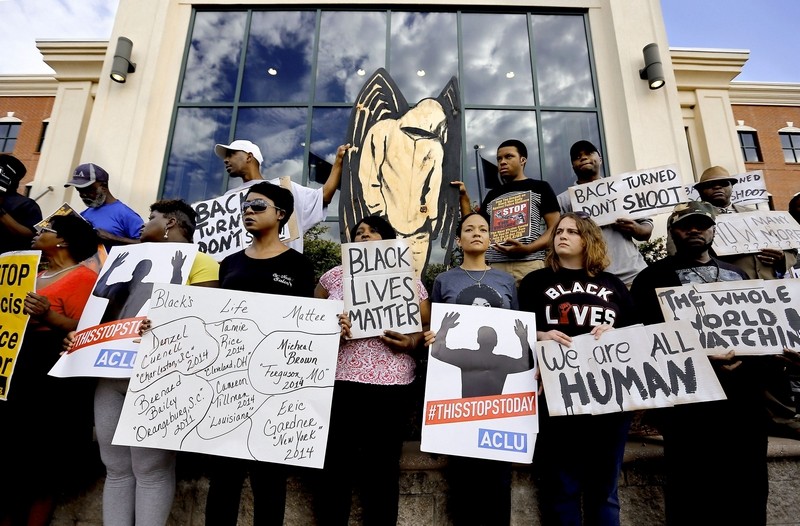
People gather to protest the shooting of Walter Scott by a North Charleston police officer during a Black Lives Matter Charleston demonstration against police violence on April 8 at North Charleston City Hall. PAUL ZOELLER/STAFF/FF
By Andrew Knapp and Melissa Boughton
When a video made Walter Scott’s name known to the world, advocacy groups in North Charleston saw a chance to make theirs known, too.
The footage of a white police officer fatally shooting Scott, a black man, drew nationally known activists. They joined protests and spoke out against alleged police abuses. It was building up to be the culmination of a national discussion inspired by police-involved deaths in Missouri and New York.
What do you think?
Do you think the people who come from out of town to take part in protests and rallies about the shooting of Walter Scott are helping or harming the situation?
Helping.
Harming.
I have no strong opinion.
Members of Black Lives Matter Charleston, a group born out of their rally cry, found themselves in front of cameras from NBC News and CNN. Jay Johnson, a national leader unaffiliated with the local group, called Scott’s death a turning point in how black men are seen by law officers.
To Johnson, his group was fast supplanting traditional civil rights groups of the 1950s and ’60s.
“Black Lives Matter is no longer a cry. ... You are witnessing the birth of the 21st century NAACP,” he said. “The pivotal moment in that movement happened right here in Charleston.”
But tactics employed by the younger activists, the public faces of the protests after Scott’s death, have marginalized them in talks with city leaders unwilling to consider their “unreasonable” demands. The role of negotiating a fix to the strained relations between young black people and the police instead fell back on the long-established organizations that the new activists seemed destined to replace.
Instead of galvanizing their efforts, the shooting in some ways splintered activists into factions with different strategies for reaching their goals. The younger grassroots sect saw protesting and civil disobedience as the route to change; the older ones saw it as a time to lay down their posters and megaphones and sit with city and police leaders to mete out a solution.
It’s a quiet feud not unlike the ones during the last century’s civil rights movement. Malcolm X, a Muslim minister, was accused of inciting riots then, and Martin Luther King Jr., a Baptist preacher, stressed nonviolence and sat down with politicians.
In North Charleston, about 200 people attended a protest outside City Hall the day after the video showed the world how Scott died. Many of them were news media. But the number of participants at rallies dwindled until they fizzled out a week after the video came to light.
To James Johnson, leader of the local chapter of one traditional group, the Rev. Al Sharpton’s National Action Network, the cause fell back into the hands of “the elders” like him.
“When you don’t have a structure, you’re going to sooner or later dissolve, and it’s going to go back to the people who are organized,” Johnson said. “They did a great job of expressing their feelings, but when the anger goes, what happens next?”
‘A different outcome’
Black Lives Matter started as a Twitter hashtag that caught fire after George Zimmerman’s acquittal in the Florida shooting death of Trayvon Martin. It became a chant of the protesters nationwide who took to the streets then and after a police officer in Ferguson, Mo., fatally shot Michael Brown. It decried on its website the “virulent” racism that led to killings of young black people by police and vigilantes.
The local group, Black Lives Matter Charleston, formed in the days after a grand jury failed to indict the New York City police officer who put Eric Garner in a fatal chokehold. Muhiyidin d’Baha, 29, assumed the role as one of its three core members, all of whom work or volunteer for community nonprofits. Of the three, d’Baha is the only black person.
The group’s first protest consisted of 300 people marching downtown in December — an effort to make the community aware of the use of deadly force by police nationwide. They stood ready if a controversial killing hit closer to home.
“We had the ability to respond if and when it happened,” d’Baha said.
Members held poetry readings, as well as sessions on how to film police officers and assert their civil rights during a traffic stop.
Thomas Dixon, co-founder of The Coalition: People United To Take Back Our Community, sat down with them during their early days. Dixon, 62, saw it as a way to brainstorm with the younger people who could benefit from changes in police policies before presenting ideas to city officials. They talked about seven suggestions, including a citizens board to review allegations of police abuse.
But Dixon said the group lost its focus on the police and talked instead about education programs and economics. Those goals were noble, he said, but they distracted participants from the issue that brought them together in the first place.
He called its members “socially conscious and engaging” but lacking the wisdom of more experienced activists. Dixon lost touch with the group.
The membership rolls fell from 70 at its peak to about 10 before eight gunshots on a Saturday thrust them back into the limelight.
“The reason we gathered just got lost in the mix,” Dixon said. “I really do believe that if we got back to it sooner, we could have sat down with police and had a different outcome that Saturday.”
‘Resistance phase’
Patrolman 1st Class Michael Slager pulled over Scott’s Mercedes-Benz on April 4. Scott ran. Slager shot Scott, he said, because the man had grabbed his Taser during a struggle. The video showed him shooting the fleeing man in the back.
The emotions that drove Black Lives Matter Charleston to protest were never more apparent than at a news conference the day after the footage was made public and Slager was jailed on a murder charge.
D’Baha used a megaphone to lead chants in City Council chambers and shout questions at Police Chief Eddie Driggers and Mayor Keith Summey, who promised to open a discussion about police policies.
“The overall tactic ... is to negotiate,” d’Baha said later. “You can expect to hear us making noise and calling out leaders.”
Over the next two days, d’Baha called on Summey to form a citizens review board with subpoena powers to oversee the police, and he promised to make his voice heard “by whatever means necessary.” Did that mean violence? “Anything’s possible,” he said at the time.
The fledgling group’s time in the spotlight was enviable to some mainstays on the local advocacy scene. Dot Scott, president of the Charleston NAACP, expressed disappointment over the low number of phone calls she got from journalists after Walter Scott’s death. She is not related to him.
Dot Scott, who has long lamented problems between the community and police, said young people had been the “energy to the movement” for decades. It’s no different today, but Walter Scott’s shooting gave the community a chance to shed light on the real problems that led to his fatal confrontation with Slager, she said.
Despite others’ momentum, the NAACP has remained important, she insisted. Her chapter’s membership has risen since the “black lives matter” movement started, though she wouldn’t give statistics. It takes donations from out-of-state contributors on its redesigned website, she added, and reaches youths through the Twitter account it started last week.
“If somebody else can keep this message in the forefront, then so be it,” she said. “But at this point, we’d be protesting what exactly? The killing happened; we can’t undo that. The arrest has been made. Where it goes from here in terms of Slager’s prosecution, of course, that’s undetermined.”
Members of other organizations didn’t like what they saw either. Christopher Cason, who belongs to Dixon’s coalition, appealed to fellow advocates through Facebook last week, encouraging them to “discuss the lack of solidarity” and put aside their differences.
“I’ve had enough of community leaders saying they’re down for the cause but don’t want to work with this one or that one simply because their points make better sense,” he wrote.
As the protests stretched through last weekend, d’Baha warned that the “resistance phase” was looming. The group called for the police chief’s firing.
‘Without disruption’
That’s when James Johnson, the local National Action Network leader, said he raised concerns over d’Baha’s strong words that could alienate fellow residents and turn off city officials.
But after protesters from Ferguson arrived by the busload to join their ranks early last week, the demonstrators clogged streets by walking back and forth in sidewalks. One motorist cursed at them and demanded their arrests.
Johnson, who had called for calm on the day Walter Scott was slain, welcomed “them young fellas” to learn from the people who have “been doing this for a long time.”
“What kind of justice can they get by screaming in the street?” Johnson said. “We need to sit at the table and talk about what’s causing the problem with the police. If you go out there stopping cars, you turn the community against you.”
The young protesters’ tactics subverted their appeal to the city, too.
Summey’s spokesman, Ryan Johnson, said the mayor and d’Baha had talked about setting up a meeting, but it was never scheduled. And the group’s actions after that changed Summey’s mind.
“Due to the actions taken,” Johnson said, “along with the unreasonable and unrealistic demands of Mr. d’Baha and Black Lives Matter Charleston, it is not in the best interest of the city to meet.”
Scott’s loved ones also distanced themselves from the demonstrators and refused to take part in their events. The family’s attorney, Christopher Stewart of Atlanta, said they were instead focused on getting answers about Scott’s death.
“They are fully supportive of the rights of people to protest,” he said. “But they want to ensure that it is done peacefully and without disruption.”
‘Different roles’
Just as the protests appeared to be ramping up, they ended.
They ended despite the arrival of Malik Shabazz, president of Black Lawyers for Justice and former head of the New Black Panther Party. A guest of Black Lives Matter Charleston, Shabazz called Scott’s death “the last straw” and talked about shooting back at police.
His comments came during what he billed as a “mass demonstration” that was attended by a few dozen people Monday. On Tuesday, quiet prevailed in North Charleston, and Shabazz caught a flight out.
“I heard some people on Facebook say, ‘Get out of Charleston, you racists,’ ” said Bobby Worthy, president of Justice League United, who works with Shabazz. “But we had already left.”
Shabazz is expected to return for a town hall meeting today, when he will gather accounts of racial profiling and decide what to do about it. He said his organization has pending lawsuits against police departments in 13 states.
“The most inflammatory and violent thing is Walter Scott’s murder and what is happening to African-Americans across the country,” he said late last week. “I’m an advocate, and I speak the truth in an uncompromising way. It’s a serious time, and there’s a lot of hurt and pain.”
Black Lives Matter Charleston isn’t going away, said one its members, Brandon Fish, 27. The group’s message is still in line with “elder” activists, who had been concerned only with its tactics, he said.
“We’re all fighting to make things better,” said Fish, who is white. “I think it’s inaccurate to paint us as radical when the only thing we’ve asked for is the ear of our elected officials and the only demonstrations we’ve had have been non-violent.”
Jay Johnson, the national Black Lives Matter leader who calls himself “Grand Master Jay,” came here after Scott’s shooting with plans to assess the local group and decide whether it should become one of the 34 sanctioned chapters nationwide. But he likened it to an emotional and “unruly mob.” Instead of sanctioning it, he urged its members to work with traditional organizations like the NAACP.
“They lack guidance that you ... gain with age and experience,” he said. “We all started that way.”
Perhaps no one who visited North Charleston after Scott’s death understands that more than the Rev. Jesse Jackson, who worked with Martin Luther King Jr. and founded the social justice nonprofit Rainbow/PUSH.
During a visit Thursday, he praised Black Lives Matter Charleston and took up a collection for one of its outreach program.
He recalled how college-age people often led protests against segregation during King’s time.
“It’s a way of expressing outrage and pain,” Jackson said. “People express it in different ways.”
To the 2016 Pulitzer Prize Judges:
The phone rang a little before 10 p.m. on Monday, April 6. Post and Courier statehouse reporter Cynthia Roldan looked down at her cellphone and saw the name of an influential South Carolina lawmaker.
“You know I’d never call you this late unless it was really important,” the lawmaker told her. “There’s video of the shooting. And it’s bad. Really bad.”
“The shooting” had taken place three days earlier. It had been front-page news in The Post and Courier. A traffic stop for a faulty brake light had led to a deadly encounter between the driver, Walter Scott, and North Charleston Police Officer Michael Slager. Questions swirled around the incident, but there was little indication of the firestorm to come.
The lawmaker ended the call with a simple plea: “You have to figure out a way to get a hold of that video.”
For the next 12 hours, Roldan and roughly a half-dozen editors and reporters worked to do just that. They learned that a passing bystander had filmed the encounter with his cell phone and then ran off, shaken by what he had seen. They also learned that the video directly contradicted Slager’s claims that he had been forced to shoot Scott during a struggle over the officer’s Taser. The footage, they were told, now resided with a source close to Scott’s family.
We knew that other media outlets, including some with national resources and reach, also were working to obtain the video. But we also knew that this was our turf, our story and that we were uniquely positioned to tell it with breadth, authority and context.
While working to secure the video’s release, The Post and Courier posted the first story on its existence after independently confirming the contents of the footage. The newspaper published the first screen shots from the video a short time later, followed by the footage itself.
The images and the story that followed shook the nation and forever changed the way we examine police shootings in this country.
Tens of thousands of people from around the world flocked to The Post and Courier’s website and social media accounts for breaking updates about the shooting and the damning footage that challenged Slager’s claims of self-defense.
The video, which soon went viral, showed Slager firing eight shots at Scott as the unarmed, 50-year-old man ran through a field trying to escape from the officer. Four rounds pierced his back and Scott crumpled to the ground. He died before help could reach him.
The paper became the first to report that Slager had been charged with murder and would soon be out of a job. We also broke the news that his attorney had abandoned him after the video surfaced and that the U.S. Justice Department planned to launch a civil rights investigation into the killing.
We launched a homepage takeover on our website to help draw readers’ attention to the latest developments. We also prepared interactive graphics that helped readers understand this event. A map of the shooting site helped readers understand how the situation developed. A data visualization that accompanied the video demonstrated that Officer Slager fired in a remarkably steady and measured way. Interactive Editor Emory Parker painstakingly analyzed an audio recording of the shooting to determine how the encounter played out. He determined that Slager had squeezed off eight rounds in just 2.7 seconds in his quest to stop Scott.
Later, we used data to illuminate the workings of the North Charleston Police Department, demonstrating how the agency was woefully behind its peers when it came to hiring a diverse workforce.
Strong breaking news coverage is more than just minute-by-minute reporting. It should offer a tapestry of context as well, exploring the backdrop and forces that drive events, as well as the future implications and consequences of the actions at hand.
In the first 24 hours, The Post and Courier published stories detailing law enforcement experts’ analysis of the tape, the impact on the family and community and inaction by South Carolina lawmakers in the face of earlier calls to require police body cameras. Within the first 36 hours, we published an in-depth look at North Charleston’s long and complicated struggle to find a delicate balance between public safety and civil rights in a community beset by violent crime, and we analyzed the key differences between the violent reactions in Ferguson and the relative peace in South Carolina.
We then dug deeper for even greater context. In the wake of Scott’s death, we assembled a team of reporters to investigate and analyze how police shootings are investigated in South Carolina. The team scoured more than 30,000 investigative documents and produced a five-part series the following month.
Among the findings: South Carolina officers shoot someone on average every ten days; a disproportionate share of these shootings involved minorities; while some shootings were clearly justified, evidence in others showed that officers pulled their triggers as suspects fled, as happened in the Walter Scott case. What’s more, state investigators often failed to answer key questions about what happened in these incidents before closing cases and helping to exonerate the officers involved.
The Post and Courier also explored the history of “pretext” traffic stops in which motorists like Scott were pulled over for minor violations so officers could stop and question them about their activities. Reporters learned that North Charleston led the state by a wide margin in making these stops and that a disproportionate number of those detained were African-American. This story and the series on officer-involved shootings are included as supplemental material.
Our coverage underscored the critical role a well-funded, seasoned local newsroom can play in a tragedy like this one. By embracing new digital storytelling tools and combining those skills with talented, veteran reporters who know the community, we were able to offer the most immediate updates on the situation and the kind of depth that helped the rest of the nation put this tragedy into a larger context.
For those reasons, we nominate our coverage of the Walter Scott shooting for the 2016 Pulitzer Prize for breaking news reporting.
Sincerely,
Mitch Pugh
Executive Editor