The Boston Globe, by Staff
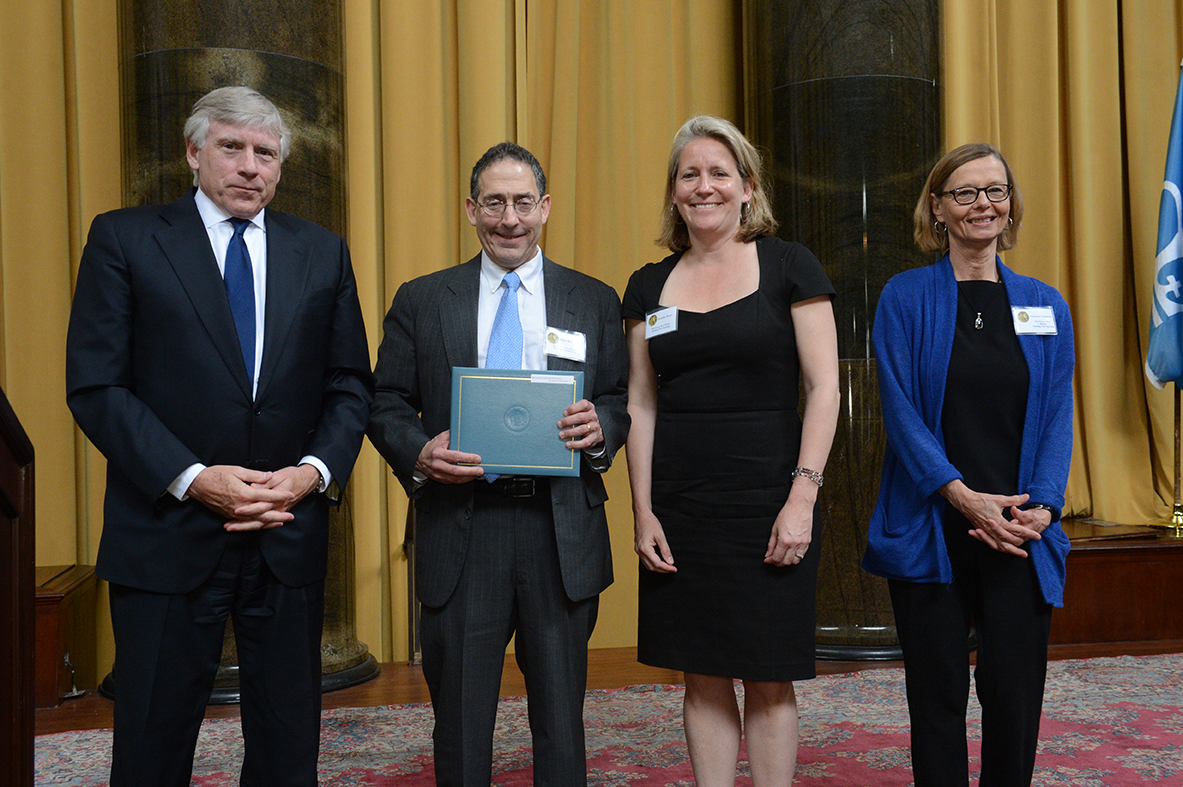
Lee C. Bollinger, President of Columbia University (left), presents the 2014 Breaking News Reporting Prize to Mike Bello, Jennifer Peter (center) and Christine Chinlund of The Boston Globe.
Winning Work
On April 15, Steve Silva, a videographer with the Globe’s sports department, was gathering footage for a feature on slower runners, when two bombs exploded near the finish line of the Boston Marathon. His video, which captured the actual moment of the blasts and the immediate aftermath, was posted shortly after the explosions and viewed 6,431,310 times on the Globe’s website that week. It has now been viewed a total of more than 24 million times on YouTube. This is a condensed version of his raw footage.
Beginning with the words “God help us,” tweeted from the Boston Marathon finish line by Boston.com producer Steve Silva within minutes of the April 15 explosions, the Globe maintained a liveblog over five days, culminating with the capture of the second bomber on the evening of April 19.
The blog contained posts from Globe reporters, photographers, and online producers, as well as selected tweets from law enforcement, other media outlets, and members of the community documenting the unfolding story. When Boston.com and BostonGlobe.com crashed from the initial surge of traffic, the Globe redirected viewers to the liveblog for about an hour.
That week, the liveblog became the most comprehensive and up-todate source of information on the bombings, garnering 6.6 million pageviews and 3.2 million visits over the course of the week.
Here are some excerpts; the entire liveblog can be seen by clicking the link below.
THE BOSTON MARATHON BOMBINGS | DAY 1
THE BACK STORY
Within minutes of the Marathon blasts, which occurred at 2:49 p.m. on April 15, Globe reporters at the scene were tweeting what they had witnessed. By 3 p.m., the Globe had confirmed dozens of injuries.
Boston Globe @BostonGlobe 2:57 p.m.
BREAKING: A witness reports hearing two loud booms near the Boston Marathon finish line.
Eric Wilbur @GlobeEricWilbur 2:57 p.m.
Two explosions just rocked Boylston. Source not yet known. Chaos down here right now.
Boston Globe @BostonGlobe 2:59 p.m.
BREAKING NEWS: Two powerful explosions detonated in quick succession right next to the Boston Marathon finish line this afternoon.
BostonGlobe @BostonGlobe 3:00 p.m.
BREAKING NEWS: At least dozens of people have been seriously injured, a Globe staffer on the scene says.
The Globe’s first full post was published at 3:05:49 and would be updated more than three dozen times before the final edition was sent to the press.
Explosions rock Boston Marathon finish line; dozens injured
BY DAVID ABEL | GLOBE STAFF
Two powerful explosions detonated in quick succession right next to the Boston Marathon finish line this afternoon, leaving at least dozens of people wounded, some with massive injuries. Multiple people are being evacuated. Blood is staining the sidewalks of Boylston Street in the area.
The explosion cleared an area as people ran for cover after what was a celebratory finish for hundreds of runners coming to the finish line just before 3 p.m.
Swarms of police officers and firefighters descended on the scene immediately, clearing the stands. FBI officials could be seen responding.
At two spots on Boylston Street, scores of people fell and were injured.
Shattered glass littered the sidewalk by LensCrafters.
THE BACK STORY
Within an hour of the explosions, the Globe had deployed 24 reporters, including 11 at the finish line. More than 7.5 million people visited the Globe’s two websites that first day.
The Boston Globe @BostonGlobe 3:17 p.m.
Eyewitness: “Blood everywhere” after powerful explosions near Boston Marathon finish line.
Michael Levenson @mlevenson 3:25 p.m.
Spectator: “When I looked up, I saw people with bloody heads, people with their shirts blown off.” #bostonmarathon
Kay Lazar @GlobeKayLazar 3:27 p.m.
Mass General Hospital says 4 people already brought there and expecting more after #bostonmarathon explosion
At 4:00:04 p.m., the Globe posted this update from those who had witnessed the blasts.
Witnesses describe scenes of carnage, chaos
BY DAVID ABEL, MARTINE POWERS, BILLY BAKER AND ERIC MOSKOWITZ | GLOBE STAFF
Shaken witnesses described scenes of chaos and horrific injuries near the Boston Marathon finish line this afternoon.
Al Ghilardi, a photographer for the Boston Athletic Association, was standing on the bridge over the finish line when he saw a red flash.
“Then a big plume of white smoke, and then I ducked because I felt the shrapnel,” Ghilardi said. “I saw people in awe. They were frozen. It took a few seconds for people to recognize what happened.”
Dave Benson, 41, was in the stands across Boylston Street from the explosion.
“I thought it was an end of the event celebration with fireworks,” Benson said. “Then I saw a huge plume of smoke and people falling down.”
Andrea George, 39 was also across the street from the finish line.
“We heard a noise and heard the glass shatter,” George said.
“My friend was right there, and I can’t get in touch with them. I just started running. Everyone was running in different directions. It was the scariest thing I ever saw.”
Boston.com sports producer Steve Silva, who was covering the race, said the blasts left a tableau of carnage, with horribly injured victims.
“I was there at the finish, shooting finish line scenes, and then bang, it just went off, and then less than 15 to 20 seconds after there was a second explosion, closer to Fairfield street,” Silva said.
“It was just immediately [evident] there were injuries, right in the middle of the spectator crowds. There was blood everywhere, there were victims being carried out on stretchers. I saw someone lose their leg, people are crying, people are confused.”
THE BACK STORY
Over the next eight hours, the Globe staff continued to post and tweet continuously online, while producing 14 stories for the next day’s paper. This is the lead story, which included the first published report — tweeted by the Globe at 1:05 a.m. — that the 8-year-old boy killed in the attacks was Martin Richard of Boston.
3 killed, 130 hurt by bombs at finish line; area locked down
BY MARK ARSENAULT | GLOBE STAFF
Two bomb blasts, 12 seconds apart, rocked the finish line of the 117th running of the Boston Marathon Monday, killing at least three people, including an 8-year-old Dorchester boy, wounding more than 140, and leaving the sidewalks of Boylston Street covered in blood.
Medical professionals on hand to care for blisters and sore knees in Copley Square suddenly found themselves treating life-threatening lacerations and lost limbs, as a high holiday in Boston, Patriots Day, turned into an epic tragedy. Emergency workers rushed to the scene, despite the very real possibility of more blasts.
The explosions blew out windows, sent plumes of smoke into the sky, and left victims piled on each other in a scene far more reminiscent of a battlefield than a celebrated day in Boston’s Back Bay. The blasts occurred at 2:50 p.m., several hours after the elite runners had finished the race.
About 30 people were transferred to hospitals under a Code Red, meaning life-threatening injuries, which may point to a rising death toll, said a law enforcement official.
Flags were lowered to half-staff in Washington, D.C., and around the nation, as the country mourned with Boston.
“We will find out who did this; we’ll find out why they did this,” pledged President Obama, in remarks from the White House. “Any responsible individuals, any responsible groups will feel the full weight of justice.”
The grief resonated sharply in Dorchester, where residents gathered Monday night at Tavolo Restaurant in memory of 8-year-old Martin Richard, who was killed in the attack, and his mother and sister, who suffered grievous injuries. Martin’s father, Bill, is a community leader in the Ashmont section of Dorchester. A third child was reportedly uninjured.
“They are beloved by this community,” said City Councilor at Large Ayanna Pressley, who was among the mourners. “They contribute in many ways. That’s why you see this outpouring. It’s surreal, it’s tragic’’
A massive investigation was underway Monday night under the direction of the FBI, as much of the Back Bay was locked down to protect the sprawling crime scene. Last night, officials called the investigation “very active and fluid.” Authorities were questioning at least one person at Brigham and Women’s Hospital, said sources familiar with the situation. Police Commissioner Edward F. Davis said no one was in custody.
“Any event with multiple explosive devices, as this appears to be, is clearly an act of terror, and will be approached as an act of terror,” a White House official said. “We don’t yet know who carried out this attack, and a thorough investigation will have to determine whether it was planned and carried out by a terrorist group, foreign or domestic.”
The person questioned in the hospital was a Saudi national, who was reportedly tackled and held by a bystander after he was seen running from near the scene of the explosion, said a law enforcement source who spoke with someone involved in the FBI’s investigation.
The Saudi man, believed to be a university student in Boston, is cooperating with the FBI and told agents that he was not involved in the explosions, and that he ran only because he was frightened. Investigators did not characterize the man as a suspect. No one had been arrested or charged by late Monday night.
Hospital officials said late last night that tests showed no radiation or biological agents on the victims. Although many people were wounded by flying shrapnel, it did not appear the bombs had been packed with nails or other fragments to increase the injuries.
Twitter and the Internet overflowed with rumors in the aftermath of the blast, some of which were later debunked. Law enforcement and city officials disputed published reports that investigators had discovered one or more bombs that had failed to explode.
Law enforcement officials also descended late Monday on a high-rise apartment building in Revere and conducted a search related to the investigation, said an official with knowledge of the search.
A woman received help at the scene of the first of two explosions on Boylston Street Monday. Medical workers at the finish line treated life-threatening wounds and losses of limbs.
FBI and Homeland Security agents were seen entering the Water’s Edge apartment complex at 364 Ocean Ave.. The several police vehicles gathered outside left the scene before midnight.
The Revere Fire Department was called in to assist State Police in the search of an apartment unit of a “person of interest,’’ according to a statement from the department.
A city touched 11 years ago by terrorism, when 9/11 hijackers took off from Logan Airport, was touched again, in a plot to inflict untold casualties at the city’s annual Marathon celebration, the one day each spring when the attention of the sporting world is on Boston.
The attack truncated the world’s most prestigious road race, which draws runners from across the globe, and will forever mar what is annually the city’s most uplifting day: Marathon Monday.
“It puts a cloud over the event for everyone,” said runner Maureen Tighe of Boston’s North End. “The people who finished. The people who didn’t. And the spectators. I don’t know if it will ever be the same.”
Marathon officials and police immediately ended the race after the explosions, turning runners away from Copley Square. Officials told television viewers to stay out of the city and asked runners and spectators to go home or back to their hotels and avoid gathering in crowds.
The aftermath of the tragedy is expected to be felt across the city Tuesday. Governor Deval Patrick, who provided updates through the afternoon and evening, said the blast area is expected to be closed Tuesday. He said Boston “will not be business as usual,” after the terrorist attack and that police presence will be heavy in the city. MBTA riders can expect random bag searches.
The closed-off area spans the length of Boylston between Berkeley Street and Massachusetts Avenue, and on either side of Boylston from Newbury Street to Huntington Avenue, a section nearly a mile long and three blocks across, he said.
Investigators faced an overwhelming crime scene, littered with bags dropped by people fleeing the blasts.
Police had to treat every backpack and gym bag as a potential deadly threat. Authorities blocked cellphone service to the area to prevent any other device from being detonated by phone, leaving thousands of athletes and spectators unable to call loved ones to make sure they were OK.
Police locked down a 15-block area around the scene of the attack, in the heart of the Back Bay neighborhood. State Police sent units to every hospital in the city and to South Station to provide security and swept the State House for bombs, as a precaution.
Eyewitnesses to the blasts reported a sudden shock, followed by unreal scenes of human carnage.
“I saw white smoke and at first I thought it might be a firecracker but it was really loud,” said Megan Raftery, who was standing near the finish in front of the Mandarin hotel with her two young sons, waiting to cheer on her Marathon-running husband.
Seconds later, a second explosion directly across Boylston Street, near the Apple store, shot debris high in the air. And when Raftery looked down she saw that the explosion had blown a man’s leg off, just below the knee. “You could see stuff just flying,” she said. “I looked across the street and I could see a man on the sidewalk. There was blood and part of his leg was just gone.”
Ron M. Walls, chief of emergency medicine at Brigham and Women’s, said the hospital had received 26 of the wounded. The youngest was 3 years old and was sent to Children’s Hospital; the oldest was 62.
The injuries included eardrum damage, serious limb and head injuries, but no amputations, he said. Some victims had burns, including one with very significant burns. “I haven’t seen anything like this anywhere before,” he said. “These types of events are things we drill for and practice for and get ready for, but you don’t expect you’re going to see it.”
A US Immigration and Customs Enforcement officer was among those who sustained less than life-threatening injuries from the explosion, said a federal law enforcement official with direct knowledge of the information. The officer was off duty and was watching the race with the rest of the spectators. He was taken to a hospital for treatment.
The Patriots Day holiday is steeped in Boston sports tradition, when the Red Sox play a rare morning game at Fenway Park, and the best runners on the planet race from Hopkinton to Copley Square, on a 26.2-mile course lined by millions of cheering, celebrating fans.
As part of the prerace security stepped up since the 9/11 terrorists attacks, Boston police had swept the streets for explosives, said State Police.
Relatives of those killed in the Sandy Hook school shooting massacre were guests at the finish line tent, near where the bombing occurred; a theme of this year’s marathon was “26 Miles for 26 Victims,” referring to those killed in the Newtown, Conn., shooting.
Hours after the blasts, on the outer edge of the Boston Common, across from the Public Garden, Royal Courtain was with his wife, Cindy, as heavily armed police and SWAT officers with automatic weapons entered the Common.
Courtain was about 100 yards from the finish line when the explosions occurred. Cindy had just finished her first Boston Marathon.
“I crossed the finish line and saw the bodies,” he said. “People were on the course rolling around, probably from the noise. I saw injuries.”
He paused and covered his face. “Some missing legs.” After the worst 30 minutes of his life, Courtain got a call from his wife saying she was unhurt.
The Boston Athletic Association called Monday “a sad day for the city of Boston, for the running community, and for all those who were here to enjoy the 117th running of the Boston Marathon.”
“What was intended to be a day of joy and celebration quickly became a day in which running a marathon was of little importance,” the BAA said.
Travis Andersen, Billy Baker, Brian Ballou, Laura Crimaldi, Kevin Cullen, Carolyn Y. Johnson, Kay Lazar, Shelley Murphy, Maria Cramer, Michael Rezendes, Maria Sacchetti, and Lisa Wangsness of the Globe staff and Globe correspondents Derek J. Anderson and Todd Feathers contributed. Mark Arsenault can be reached at [email protected].
Even as the Marathon began to wind down, Globe photographers remained in place at the finish line, to document the stories of those who finish long after the elite runners pass by. They became witnesses to history, documenting on a second-by-second basis the damage inflicted by the bombs as well as the heroic response. This is a photo gallery posted on our website in the hours after the explosions.
THE BOSTON MARATHON BOMBINGS | THE WOUNDED
THE BACK STORY
At about 8:30 p.m. on April 15, the Globe’s Patricia Wen was stationed outside Beth Israel Deaconness Medical Center, one in a pack of reporters sent out to the city’s hospitals within moments of the bombings. There she found Liz Norden, whose two sons had each lost a leg. Produced on tight deadline, Wen’s story was the first to identify and tell the tale of those most grievously injured by the attacks.
A mother reels as two sons lose legs
BY PATRICIA WEN | GLOBE STAFF
Liz Norden, a mother of five, had just finished hauling groceries into her Wakefield home Monday afternoon when her cellphone rang.
“Ma, I’m hurt real bad,” said her 31-year-old son. He was in an ambulance, he told her, being rushed to Beth Israel Deaconess Medical Center.
It was her second boy, who had gone with his older brother to watch a friend run in the Boston Marathon.
On the phone, her son said his legs were badly burned in an explosion. His brother had been next to him, but he didn’t know where he was.
Within the next two hours, amid frantic phone calls and a panicked drive into Boston, Norden pieced together the horrific truth that will forever change her two sons’ lives — and her own. Each of the brothers lost a leg, from the knee down. One was taken to Beth Israel Deaconess, while the other was at Brigham and Women’s Hospital.
The deadly attack didn’t look like the work of an international terrorist network, researchers and analysts who study terrorism said.
“I’d never imagined in my wildest dreams this would ever happen,” Norden said, sitting on a bench outside the Beth Israel Deaconess emergency room Monday night.
As she looked at her feet, with socks mismatched because she had dressed so quickly to leave the house, tears fell to the sidewalk.
‘I’d never imagined in my wildest dreams this would ever happen.’
“I feel sick,” she said. “I think I could pass out.”
She had yet to see either son, because doctors had not authorized visitors. Both are graduates of Stoneham High School and had been laid off recently from their jobs as roofers. The oldest, age 33, still lives in Stoneham, the younger in Wakefield. Both are avid fishermen.
Norden didn’t want to release their names without talking to them. As she tried to absorb what had happened to her two oldest children, she was surrounded by family, including her sister and brother-in-law, as well as Mike Jefferson, her sons’ friend, the one they had gone to watch run the Marathon.
Jefferson, a Somerville firefighter who had graduated from Stoneham High with Norden’s two sons, shook his head at the surreal events of the day. He was close to finishing the Marathon when he saw race officials abruptly stopping runners. Little did he know then that it was because of an explosion that had seriously injured two of his closest friends.
“I was a quarter-mile away from the finish line,” said Jefferson.
Also on their minds was the younger son’s girlfriend, who they said suffered serious burns and other injuries and was hospitalized at Tufts Medical Center.
Norden braced herself for the moment when she would be allowed to see her boys. She said her sons were apparently standing next to the 8-year-old boy who died in the blast. As FBI officers and local police left the hospital, having finished rounds of interviews with patients and family members, Norden’s head sank onto the shoulder of her brother-in-law.
A relative approached her, handing her some Tylenol she had asked him to buy at a nearby pharmacy.
“Thank you,” she said, burying her face in her hands.
Patricia Wen can be reached at [email protected].
THE BOSTON MARATHON BOMBINGS | THE VICTIMS
THE BACK STORY
The Globe dedicated two reporters on April 16 to telling the story of Martin Richard, the 8-year-old killed in the attacks, who quickly came to symbolize the tremendous loss inflicted by the bombings.
They posted updates throughout the day and wrote this front-page story for the morning paper.
Martin Richard, symbol to many
BY EVAN ALLEN AND JENNA RUSSELL
GLOBE CORRESPONDENT AND GLOBE STAFF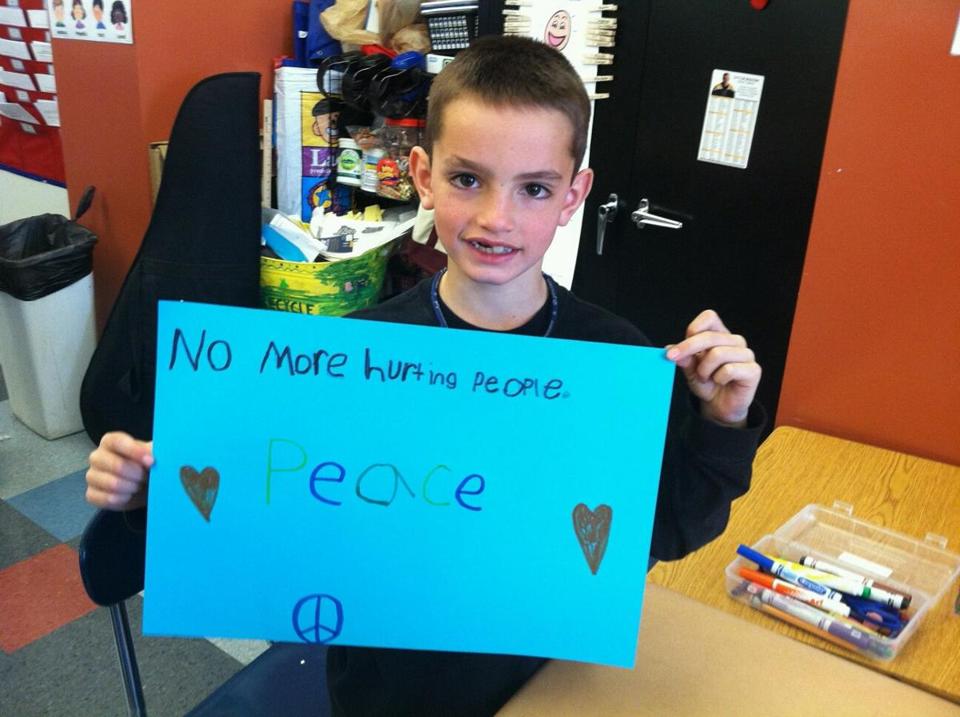
A photo of Martin Richard, the 8-year-old boy killed in the Marathon, holding this sign has come to symbolize the tragedy worldwide.
The procession of mourners began overnight, with a single candle and a yellow flower.
By Tuesday morning, they came one after another, leaving bouquets, balloons, and stuffed animals on the front porch of the empty house. More than a thousand gathered with candles at a Dorchester playground in the evening, and on the Internet, prayers and expressions of grief came from around the world for 8-year-old Martin Richard, killed in the same instant his mother and sister were severely injured.
In the frenetic social media traffic that followed the Marathon blasts, a photograph of the wide-eyed boy holding a hand-lettered sign — “No more hurting people. Peace” — became an international emblem of the the day’s horror.
The boy’s father, Bill Richard, a loved and respected figure in his neighborhood, was with his family when the bomb detonated. He survived with shrapnel damage to his legs.
“My dear son Martin has died from injuries sustained in the attack on Boston,” Bill Richard said in a statement Tuesday. “My wife and daughter are both recovering from serious injuries. We thank our family and friends, those we know and those we have never met, for their thoughts and prayers. I ask that you continue to pray for my family as we remember Martin.”
As was true for so many of the injured, the family had gone to the race to celebrate the dawn of warm weather and one of Boston’s most cherished events.
The family watched the first part of the race near Hereford Street, several blocks away from Copley Square, according to a family friend. They were keeping watch for friends from their close-knit neighborhood, several of whom were running the race on Monday for charity.
They took a break for ice cream. When they returned around 2:30 p.m., they decided to watch from a spot nearer the finish line, where Martin and his siblings could see the weary runners take their last triumphant steps. Fifteen minutes later, the explosion rocked the sidewalk.
News spread fast in the Ashmont section of Dorchester, and on Tuesday, some children from Martin Richard’s class at the Neighborhood House Charter School in Dorchester came to the front porch.
Classmates said Martin told a mean knock-knock joke, always won at math games, and stuck up for friends at school.
“If somebody was left out, he would come say, ‘Want to join my group?’ ” said Colin Baker, 9. “He sticks up for kids.”
“It should not have happened to him,” Colin said. “It should not have happened to nobody.”
Martin’s 7-year-old sister, Jane looked up to her big brother, another friend said. “She likes playing like Martin,” said Kaytlyn Lynch, 8. “She’s just like Martin.”
The family was better known than most in the city. Bill Richard, a respected longtime activist in Dorchester, pushed for the rehabilitation of the Ashmont T station and was intimately involved in improving the neighborhood in recent years, friends said.
His wife, Denise, who works as a librarian at her son’s school, is a leader of the local civic association.
Hundreds of their friends and neighbors, already stunned by the bombings, were stunned again by the gut-wrenching revelation that they knew the devastated family.
When Dotty Willett heard an 8-year-old was killed, she said she felt overwhelmed, imagining the family’s pain.
“Then I found out we were the family,” said Willett, her voice choked with emotion.
Martin Richard was her cousin’s son, she said.
Many could not bring themselves to talk about the loss.
“It’s too emotional, and it’s a very private thing,” said Judy Tuttle, a leader of the Ashmont Adams Neighborhood Association, her voice shaking. “I just ask that people be patient.”
Former state senator Jack Hart, a longtime friend, called the Richards “pillars of the community . . . a model family, who somehow always found the time to give something back.”
“Any tragedy of this sort is extraordinarily difficult, but when you know people, when it’s people in your life, in your school, that’s when it really hits home,” said Hart.
The sidewalk in front of the family’s home was bright with chalk drawings Tuesday morning, butterflies, flowers, and stars that a neighbor said the Richard children made on Sunday night. The chalk sat in an open bucket by a hedge where the children had left it.
Neighbor Dan Aguilar said he had barely slept the night before because he could not stop thinking about the family. “That little boy will never come home again,” he said.
Emira Myers, 10, came with her mother to the family’s home, where she left a small stuffed animal on the porch. She went to school with Martin, she said, though they were not in the same class.
Asked how she was feeling, the girl said, “Scared.”
“I never know where they are,” she added.
“Where the bad people are,” her mother murmured, and Emira nodded.
A few blocks away, the black clock in the center of Peabody Square was wrapped in black bunting, stopped at 2:50, when the bombs went off.
Close by, a man with an accordion played a mournful rendition of “Amazing Grace.”
He said he played Tuesday outside the John Hancock building, but left to come home to Dorchester to play in honor of the Richard family.
“Tears my heart out,” said the man, who declined to give his name. “The city’s never going to be the same.”
Billy Baker and John R. Ellement of the Globe staff contributed to this report. Evan Allen can be reached at [email protected]. Follow her on Twitter @evanmallen. Jenna Russell can be reached at [email protected].
THE BOSTON MARATHON BOMBINGS | THE MANHUNT BEGINS
THE BACK STORY
The third day after the bombings started early, with the Globe reporting exclusively, at 7:51 a.m., that the FBI had obtained clear images of the bombers.
POSTED IN LIVE BLOG April 18, 2013 at 7:51 a.m.
Adrienne Lavidor-Berman 7:51 a.m.
BREAKING NEWS FROM THE GLOBE: Authorities have clear video images of two separate suspects in the Boston Marathon bombings carrying black bags at each explosion site and are planning to release the images today in an appeal for the public’s help in identifying the men, according to an official briefed on the case.
An interfaith memorial service, attended by President Obama, began at 11 a.m., bringing together a community in mourning.
Wesley Lowery @WesleyLowery 11:31 a.m.
The service is echoing through parts of Washington St, as Boston Police officers outside gather around cruisers and listen on the radio.
‘You will run again,’ Obama tells Boston at interfaith service
POSTED April 18, 2013 at 12:23 p.m.
BY ANDREW RYAN, JOHN R. ELLEMENT AND MARTIN FINUCANE
President Obama said today that America stands with the city of Boston after the deadly terror bombing attacks at the Boston Marathon finish line on Monday.
In a powerful, uplifting speech at an interfaith service at the Cathedral of the Holy Cross, Obama said he had come to join people to “pray and mourn and measure our loss. We also come today to reaffirm that the spirit of this city is undaunted and the spirit of this country shall remain undimmed.”
“I’m here today on behalf of the American people with a simple message: Every one of us has been touched by this attack on your beloved city. Every one of us stands with you,” he said.
THE BACK STORY
At 5 p.m., the FBI released the first photos of the bombing suspects.
Milton Valencia @Milton Valencia 5:25 p.m.
One has a white hat, one a black hat. One can be seen dropping bag right in front of restaurant in second blast.
Boston Dot Com @BostonDotCom 5:40p.m.
A view of both suspects in the Marathon bombing. Suspect No. 1 is in front; suspect 2 walks behind him down Boylston Street.
At 10 p.m., the Globe staff was putting the finishing touches on 26 bombing-related stories. This was the mainbar, as prepared for first edition.
Authorities release videos, photos of two suspects in marathon bombing
BY MARK ARSENAULT | GLOBE STAFF
The FBI released dramatic photographs and video Thursday of two suspects in the Marathon bombing, plucking the young men out of the obscurity of the festive downtown crowd and putting their faces on worldwide display as they enlisted the public’s help in identifying them.
“Somebody out there knows these individuals as friends, neighbors, co-workers, or family members,” said FBI Special Agent in Charge Richard DesLauriers. “The nation is counting on those with information to come forward.”
The dramatic unmasking of the men who allegedly turned Boston’s annual spring sports festival Monday into a bloody scene of chaos and lost limbs, came hours after President Obama delivered an uplifting salute to the city’s resiliency in an interfaith service, which honored the three killed and the scores maimed by the blasts.
THE BACK STORY
At 10:30 p.m., MIT police officer Sean Collier was shot. By just after 11 p .m., there were at least five reporters in Cambridge covering what appeared to be an unrelated fatal shooting. Our first post was at 11:29.
MIT police officer hit by gunfire, Cambridge Police dispatcher says
CAMBRIDGE -- An MIT police officer was hit by gunfire late Thursday night, a Cambridge Police dispatcher said, and the campus was placed under an alert.
According to a tweet from the Massachusetts Institute of Technology, “there is a report of an active shooter in the vicinity” of Building 32, the renowned Stata Building.
Police officers and canine units swarmed the campus, and a big swath of Vassar Street was blocked.
There was no information immediately available on the officer’s condition.
Just after midnight, police suddenly sped away from the Cambridge crime scene. This was soon followed by reports of gunfire and detonated explosives in Watertown. At least 14 Globe reporters were sent out to report through the night.
At 2:16:07, the Globe — via tweet—became the first to report that the mayhem in Cambridge and Watertown was connected to the marathon bombings. Online visitors to the Globe’s websites surged to more than 400,000 between 2 and 3 a.m.
The Boston Globe @BostonGlobe 1:24 a.m.
Chaos descends onto Cambridge, Watertown after fatal shooting of MIT police officer and then an apparent carjacking.
Jennifer Peter @GlobeJenPeter 1:45 a.m.
To recap, this appeared to begin with the shooting death of an MIT officer, which triggered a manhunt followed by explosions in Watertown.
Jennifer Peter @GlobeJenPeter 2:16 a.m.
A marathon suspect is in custody as manhunt continues for another in Watertown, according to official with knowledge of the investigation.
THE BACK STORY
The story for the next day’s paper was quickly rewritten to top with the news out of Cambridge and Watertown. By pushing back deadlines and calling in extra staff, the updated story – sent to the desk just before 2:50 a.m. – made all third edition newspapers.
MANHUNT, SHOOT-OUT, CAPTURE IN BOMB CASE
Chaos erupts in Cambridge and Watertown after
MIT officer is gunned down
PUBLISHED APRIL 19, 2013
BY MARK ARSENAULT, SHELLEY MURPHY, AND MILTON J. VALENCIA | GLOBE STAFF
One of the suspects in the Boston Marathon bombings was captured following a dramatic shootout with police in a Watertown neighborhood, and a second suspect remained at large early Friday morning with an army of police and federal agents on his trail, according to an official familiar with the investigation.
Police created a 20-block perimeter in a massive search for the fugitive, according to a law enforcement official.
The capture came after a wave of violence spilled from Cambridge to Watertown. An MIT police officer was shot and killed. A carjacking following that led to a gunfight with police in Watertown.
Boston Police, federal authorities and police officers from many area towns descended on the community. Television footage showed one suspect captured, as helicopters circled above in an apparent search for the second bombing suspect.
Witnesses in Watertown said they heard explosions. Police officers were screaming about improvised explosive devices.
“This is still extremely dangerous,” an FBI agent said.
The violence came just hours after the FBI released photos and video of two suspects in the deadly Boston Marathon terrorbombings case, appealing to the public to help them to find them.
“Somebody out there knows these individuals,” said Richard DesLauriers, special agent in charge of the Boston FBI office. He said the two men are considered “armed and dangerous.”
DesLauriers described the two men as Suspect No. 1 and Suspect No. 2. Suspect No. 1 was wearing a dark hat. Suspect No. 2 was wearing a white hat.
The FBI said Suspect No. 2 was observed planting a bomb, leaving it in place shortly before it went off.
“Within minutes,” he said at a news conference at a Boston hotel.
The latest string of violence began just before 11 p.m. Thursday, when an MIT police officer was shot multiple times and killed, triggering a manhunt and a campus lockdown. A little more than an hour later, police cars streamed from Cambridge to Watertown, where a gunfight broke out between police and the suspects.
Dozens of law enforcement officers, including FBI agents, were on the scene in Watertown early on Friday.
At Arsenal Court and Arsenal Street in Watertown, an officer bellowed: “Ya gotta get outta here. There’s an active shooter here with an active explosive. Go!”
Peter Jennings, 33, said he was sleeping just before 1 a.m. in his home on Prentiss Street in Watertown when he was awakened by a huge boom.
“It sounded like a stick of dynamite went off,” he said. “I looked out the window, and it was like nothing I’ve ever seen — blue light after blue light after blue light.”
He said more than three dozen emergency vehicles with sirens blaring were heading down Route 16 West. He went to the end of his street, where some neighbors were gathering. The air, he said, smelled like “at the end of a fireworks show, like a wick smell.”
“I had a bad feeling because of what happened on Monday,” he said.
The Patriots Day bombing killed 8-year-old Martin Richard of Dorchester; 29-year-old Krystle Campbell, a Medford native; and Lingzi Lu, a Boston University graduate student from China.
Campbell’s devastated family issued a statement Thursday thanking those who tried to save Krystle’s life.
“Furthermore, we are thankful for the outpouring of prayers, love, and support from our friends and families, the great community of Medford, the city of Boston, the Commonwealth of Massachusetts, the nation and the world,” the family said.
Lingzi Lu’s family, in a statement, said: “It has always been her dream to come to America to study. While she was here, she fell in love with Boston and its people.”
More than 170 people were wounded in the blasts, many grievously. Fifty-seven remained in Boston hospitals Thursday, Including six in critical condition, down from 12 critical patients Wednesday.
At the interfaith service dedicated to the victims, President Obama delivered a moving speech designed to comfort, but not coddle.
“If they sought to intimidate us, to terrorize us, to shake us from those values . . . that make us who we are as Americans — well, it should be pretty clear by now that they picked the wrong city to do it,” Obama thundered.
The president, sadly, has had plenty of practice delivering soothing words after mass killings, following attacks at Fort Hood in 2009; Tucson in 2011; and Aurora, Colo., and Newtown, Conn., in 2012.
In each of those speeches, Obama spoke eloquently of the victims. His Boston remarks were unique for their vivid and damning description of the perpetrators, whom Obama called “small, stunted individuals who would destroy instead of build, and think somehow that makes them important.”
Not far away, a 10-block area of the Back Bay remained closed to the public Thursday as the investigation continued, city officials said. The area included Boylston Street, where the bombings
occurred, and all side streets between Newbury Street and Huntington Avenue, though those thoroughfares were open, said John Guilfoil, a spokesman for Mayor Thomas M. Menino. The area extended east to Clarendon Street, and was bounded on the west by Hereford, Dalton, and Belvidere streets.
Deb Seifert — a spokeswoman for the Bureau of Alcohol, Tobacco, Firearms, and Explosives — said explosives specialists had processed approximately 70 percent of the scene affected by the blasts. She could not say how long the rest of the process would last. “It’s slow and methodical,” she said. “We have an obligation to the victims and their families to conduct a thorough investigation.”
In Washington on Thursday, Homeland Security Secretary Janet Napolitano told a congressional committee that investigators did not yet know if the bombing was a plot by domestic or foreign terrorists.
“The investigation is proceeding apace,” she said. “This is not an ‘NCIS’ episode. Sometimes you have to take time to properly put the chain together to identify the perpetrators, but everybody’s committed to seeing that that gets done in the right way.”
Early Friday in Watertown, the gunfight and bomb blasts shook a sleeping neighborhood. John Antonucci’s 79-year-old mother called him hysterical from her home in Laurel Street. She heard about five gun shots and didn’t know what to do.
“She was saying they’re running down the street shooting,” Antonucci said standing outside of yellow police tape. “She was crying so hard I couldn’t understand what she was talking about.”
So he told her: Stay inside the house.
Residents describe the neighborhood as safe and family-oriented, where they leave open doors and windows and feed stray cats.
Standing on the corner of Quimby and Nichols as police officers hastily strung up caution tape, Lindsay Gaylord, 25, and Collin Ausfeld, 26, peered over the scene to get a glimpse of their apartment about a block away on Dartmouth Street.
“I was buying ice cream right there” -- Gaylord pointed to a structure a few steps away, behind the caution tape “just this afternoon.”
Ausfeld stared at the crime scene in front of him, trying to make sense of what he was seeing. As an afterthought, he muttered, “I hope the apartment doesn’t blow up.”
The couple said they moved to the neighborhood in January, leaving behind their Belmont place, because Watertown was closer to the city, and their block was quiet, safe, and friendly.
“After this, I still feel safe on this street,” Gaylord said. “I mean, you just never know with these things.”
Adam Healy, 31, said he stepped outside for a cigarette near one of the shooting scenes in Watertown, when he heard gunfire.
“I just heard tons of gunshots,” he said. “Gunshot, gunshot, gunshot, gunshot. Then I saw an explosion and saw a burst of light in the sky.”
Imran Saif, a cab driver, was parking his car for the night near Dexter and School streets and was preparing to bike home from Cambridge when he heard a series of loud noises that he said “sounded like fireworks.”
He said he biked toward the sounds, thinking they fireworks, when people in nearby houses began waving him back, telling him it was gunfire.
“It just sounded like there was automatic weapons going off, and I heard a few explosions,” he said. “They sounded like fireworks, mostly, big fireworks going off — tons, I’d say. I’m really scared. When I found out it was gunshots, that just knocked the wind out of me.”
Marcella Bombardieri, David Dahl, Akilah Johnson, Wesley Lowery, Brian MacQuarrie, Eric Moskowitz, Jim O’Sullivan, Martine Powers, Maria Sacchetti, John Vitti, and Lisa Wangsness of the Globe staff and Globe correspondents Jeremy C. Fox, Haven Orecchio-Egresitz, Jaclyn Reiss, Matt Rocheleau, and Gal Tziperman Lotan contributed to this report.
THE BOSTON MARATHON BOMBINGS | THE CAPTURE
THE BACK STORY
As the presses began printing news of the Watertown manhunt for the April 19 editions, the Globe’s on-the-ground coverage continued through the night. A team of 14 Globe reporters was in Watertown, tweeting details and developments. Several gained thousands of followers over the course of the night.
Wesley Lowery @WesleyLowery 3:08 a.m.
Parade of more than 25 cruisers just peeled out. Headed away from original scene/current perimeter
Jaclyn Reiss @JaclynReiss 3:15 a.m.
swat tanks loaded with military personnel just rushed onto the scene at Quimby and Nichols #Watertown
Jennifer Peter @GlobeJenPeter 4:24 a.m.
BPD Commissioner: We believe he is a terrorist. We believe he came here to kill people.
Jaclyn Reiss@JaclynReiss 5:20 a.m.
Police are checking cars coming into and going out of #watertown
Akilah Johnson@akjohnson1922 5:39 a.m.
Sun is rising in #watertown. Scene still active.
Garrett Quinn@GarrettQuinn 6:09 a.m.
Police are reminding all residents of Watertown, Waltham, Belmont, Allston-Brighton, and Cambridge to stay indoors.
Daniel Adams @DanielAdams86 6:46 a.m.
With MBTA closed, area colleges appear to be closing too. @EmersonCollege is closed until further notice, asking students to stay inside.
Wesley Lowrey @WesleyLowrey 7:25 a.m.
Now in Cambridge, outside of apartment believed to be shared by suspects. State police have street blocked off
Akilah Johnson@akjohnson1922 8:36 a.m.
Officers converging on Quimby Street and Willow street, guns drawn. Military Police now pushing crowd back. #watertown
THE BACK STORY
The Globe’s comprehensive coverage continued throughout the day, in Watertown, where the search continued; in Cambridge, where the suspects had lived; and in Dartmouth, where the younger suspect had gone to school.
At about 8:45 p.m., Dzhokhar Tsarnaev was captured as he hid in a boat in a Watertown backyard.
The Boston Globe @BostonGlobe 8:45 p.m.
Dzhokhar Tsarnaev IN CUSTODY!
THE BACK STORY
Building on our online efforts, the Globe produced 20 stories for the editions of April 20, with contributions from 61 reporters. This was our main story:
Nightmare’s end
Second Marathon bombing suspect captured after all-day hunt that brought Boston area to standstill; alleged accomplice dead
BY MARK ARSENAULT | GLOBE STAFF
In the waning moments of daylight, police descended Friday on a shrouded boat in a Watertown backyard to capture the suspected terrorist who had eluded their enormous dragnet for a tumultuous day, ending a dark week in Boston that began with the bombing of the world’s most prestigious road race.
The arrest of 19-year-old Dzhokhar Tsarnaev of Cambridge ended an unprecedented daylong siege of Greater Boston, after a frantic night of violence that left one MIT police officer dead, an MBTA Transit Police officer wounded, and an embattled public — rattled again by the touch of terrorism — huddled inside homes.
Tsarnaev’s elder brother and alleged accomplice — 26-year-old Tamerlan Tsarnaev, the second suspect in Monday’s Boston Marathon attack — was pronounced dead early Friday morning at Beth Israel Deaconess Medical Center, after suffering shrapnel and bullet wounds in a gunfight with police.
“It’s a proud day to be a Boston police officer,” Police Commissioner Edward F. Davis told his force over the radio moments after the arrest. “Thank you all.”
President Obama, addressing the nation from the White House, applauded Boston for not allowing the terrorists to prevail.
“They failed because the people of Boston refused to be intimidated,” the president said.
Friday will be remembered as the day the city stood still, after Governor Deval Patrick asked the people of Boston and the nearby communities of Watertown, Waltham, Newton, Belmont, and Cambridge to “shelter in place” — stay inside, lock the door, and don’t open it for anyone except police in uniform — while the younger Tsarnaev was on the loose.
A city of some 625,000, in a metropolis of 2 million, screeched to a halt. Heavily armed officers patrolled eerily empty streets that looked like the set of an apocalyptic movie. The MBTA halted its trains, buses, and subways. Taxi service was temporarily frozen. Amtrak stopped service between Boston and Providence.
Officials asked businesses across the region not to open. The Red Sox and Bruins games were postponed. And the campus of the University of Massachusetts Dartmouth, where Dzhokhar Tsarnaev is a student, was evacuated and closed.
The day began with bomb blasts and gunshots on a street in Watertown, where police said more than 200 rounds were fired in the battle.
While his brother was taken to the hospital, where he was pronounced dead, Dzhokhar Tsarnaev survived and escaped on foot. Local, state, and federal law enforcement officers — including the Secret Service, K-9 teams, explosives experts, and SWAT officers — searched door to door for the suspect throughout Friday. Police in helicopters scoured the streetscape from above. More than 1,000 officers participated in the hunt.
By 6 p.m., frustrated officials relaxed the rule and allowed residents to leave their homes. The people of Watertown began to venture outside.
But within an hour, the crack of gunshots again blasted through the neighborhood. Sirens blared, and officers on foot scrambled down Franklin Street.
Police found Dzhokhar Tsarnaev hiding on a boat stored in a backyard on Franklin Street. Police -exchanged gunfire with him before capturing him alive. Spontaneous celebrations erupted across the region, from the Boston Common to the Back Bay streets near the bombing.
The boat’s owners, a couple, spent Friday hunkered down under the stay-at-home order. When it was lifted early in the evening, they ventured outside for some fresh air and the man noticed the tarp on his boat blowing in the wind, according to their his son, Robert Duffy.
The cords securing it had been cut and there was blood near the straps. Duffy’s father called police, who swarmed the yard and had the couple evacuated, Duffy said.
Residents, who had barricaded themselves in their homes for nearly 20 hours, were still deeply shaken. “I’m so happy they got these guys,” said Tom Sheridan, 35, an interior painter from Watertown, as he cheered police cruisers and ambulances as they drove by on Mount Auburn Street. “But I’m worried there are more people out there like that. It won’t be the same.”
Tsarnaev was wounded and taken to a hospital. In an interview late last night, Patrick said he is “hoping very deeply he survives those wounds, because I’ve got a lot of questions and I know investigators have a lot of questions for him.”
Investigators believe the Tsarnaev siblings, originally from the former Soviet Republic of Kyrgyzstan, who came to the United States in the early 2000s, are responsible for the attack on the Marathon on Monday that killed three people and injured more than 170, many grievously.
The FBI-led investigation of the atrocity took a sudden and shocking turn Thursday afternoon after the FBI released photos and videos of the alleged Marathon bombers and asked the public for help identifying them. The images showed two young men casually lugging backpacks along Boylston Street Monday, shortly before two bombs exploded near the finish line.
Investigators said they believe the suspects carried crude but powerful bombs made from household pressure cookers in their backpacks, which they abandoned on the sidewalk.
Upon release of the images, tips poured into the FBI. Within hours, the brothers allegedly killed again, shooting Massachusetts Institute of Technology police officer Sean Collier in his cruiser, near Vassar and Main streets in Cambridge, at about 10:24 p.m.
The 26-year-old officer later died.
Police say the siblings carjacked a motorist minutes later on Memorial Drive. They released the unidentified motorist in Cambridge about 30 minutes later, police said. He was not hurt. Later that evening — the timing is unclear — an MBTA police officer spotted the stolen car, and a cavalcade of police cruisers chased the suspects into Watertown. The brothers threw explosives at the pursuing officers, police said.
The brothers stopped near Dexter and Laurel streets, got out of the car, and traded gunfire with police for several minutes.
MBTA Transit Police Officer Richard H. Donohue Jr., 33, was wounded. He was in stable condition Friday at Mount Auburn Hospital.
The elder brother was shot in the battle and collapsed.
As his brother lay on the street, Dzhokhar Tsarnaev jumped into the car and took off, plowing past a line of police officers who fired furiously. As he drove, he ran over his brother’s body. Dzhokhar Tsarnaev abandoned the car nearby and fled on foot, triggering an enormous search and setting the region on edge.
Police took Tamerlan Tsarnaev to Beth Israel Deaconess Medical Center about 1:10 a.m. Friday. He was pronounced dead at 1:35 a.m. Dr. Richard Wolfe said the suspect had been hit by shrapnel from an explosion and that he had died from “a combination of blasts” and “multiple gunshot wounds.”
The question that remains is why the siblings would attack their adoptive nation. But a picture began to emerge Friday of Tamerlan Tsarnaev as an aggressive, possibly radicalized immigrant who may have -ensnared his younger brother — described almost universally as smart and sweet — into an act of terror.
“I used to warn Dzhokhar that Tamerlan was up to no good,” Zaur Tsarnaev, who identified himself as a 26-year-old cousin, said by phone Friday from Makhachkala, Russia. “[Tamerlan] was always getting into trouble. He was never happy, never cheering, never smiling. He used to strike his girlfriend. He hurt her a few times. He was not a nice man.”
In a photo essay about boxing, Tamerlan said: “I don’t have a single American friend. I don’t understand them.”
In 2011, a foreign government asked the FBI for information about Tamerlan Tsarnaev, based on information that he was a follower of “radical Islam” who had changed drastically, the bureau said in a statement Friday. In response, the FBI investigated and interviewed Tamerlan and family members. “The FBI did not find any terrorism activity, domestic or foreign,” the bureau said.
Dzhokhar, the suspect seen in FBI photos in a white cap worn backward, was a student at the University of Massachusetts Dartmouth. On Wednesday, two days after the Marathon attack, he spent the night at his dorm, according to a school official who declined to be named. He was an all-star wrestler and a member of the class of 2011 at Cambridge Rindge & Latin School; he won a Cambridge City Scholarship that year.
A Northeastern University sophomore who lived within blocks of Dzhokhar and graduated from Cambridge Rindge and Latin with him described the younger bombing suspect as an honor student popular with classmates who enjoyed playing pickup basketball with a large circle of friends.
Gilberto Junior, 44, owner of Junior’s Auto body in Somerville, said the younger suspect dropped off a white Mercedes station wagon two weeks ago for repairs. Junior said he had not yet touched the car when the suspect came back demanding the car, the day after the bombing. The owner said Dzhokhar appeared nervous.
The family of 8-year-old Martin Richard, who died in the blasts, thanked law enforcement officers for their work on the investigation. “None of this will bring our beloved Martin back, or reverse the injuries these men inflicted on our family and nearly two hundred others,” the Dorchester family said in a statement.
“We continue to pray for healing and for comfort on the long road that lies ahead for every victim and their loved ones.”
William Campbell III, whose 29-year-old sister, Krystle M. Campbell, was killed when the bombs went off on Boylston Street Monday, said after Tsarnaev was captured: “I’m happy that nobody else is going to get hurt by these guys, but it’s not going to bring her back.”
As for the rest of the family, including Krystle’s father, William Campbell Jr., and mother, Patricia Campbell, “they’re happy they got the guys, but basically they feel the same,” he said. “You can only get so angry, and you then know she’s not going to be here anymore.”
James Vaznis, Andrea Estes, Shelley Murphy, Eric Moskowitz, Maria Cramer, Brian MacQuarrie, Milton J. Valencia, Meghan E. Irons, Matt Carroll, Michael Levenson, Noah Bierman, Scott Helman, Evan Allen, Akilah Johnson, Martine Powers, Bryan Marquard, and Brian Ballou of the Globe staff and Globe correspondents Zachary T. Sampson, Derek J. Anderson, Matt Rocheleau, Jaclyn Reiss, and Todd Feathers contributed to this report. Mark Arsenault can be reached at [email protected].
THE BOSTON MARATHON BOMBINGS | THE SUSPECTS
THE BACK STORY
The names of the two bombing suspects, Dzhokhar and Tamerlan Tsarnaev, were released just after 7 a.m. on April 19, as a massive manhunt was underway for the surviving brother following an overnight shoot-out in Watertown. By mid-morning, we had posted a 500-word separate. It would be updated 18 times before the first edition of the paper was published that evening.
Bombing suspects were local, ‘normal’ US immigrants
POSTED April 19, 2013 at 9:40 a.m.
Suspects in the Boston Marathon bombing appeared to embody the best of the American immigrant experience, having come from southern Russia, near war-torn Chechnya, more than five years ago, and assimilated into the local Cambridge community and culture.
Tamerlan Tsarnaev, 26, the alleged bomber pictured in a dark hat in FBI videos released Thursday, was a talented boxer with hopes of joining the US Olympic team. He was reportedly killed overnight in a shootout with police.
His brother, Dzhokhar Tsarnaev, 19, the suspect seen in FBI photos in a white cap, was a member of the class of 2011 at Cambridge Rindge & Latin School, and won a Cambridge City Scholarship that year. He was on the run Friday morning and the target of an unprecedented manhunt in Greater Boston.
People who knew the suspects are struggling this morning to reconcile the young men they knew, who lived on Norfolk Street in Cambridge, with the acts of terrorism they are accused of committing. “He was normal,” said Lulu Emmons, who went to Rindge & Latin with Dzhokhar. “He kind of fit in with everyone. Not really close with anyone, but he was friendly.
“I am just a little shocked. I sat next to this guy. I joked with him. I laughed with him. I had class with him. It is a little crazy,” she said.
Former teacher and school photographer at Cambridge Rindge and Latin, Larry Aaronson, said he knew Dzhokhar. “If someone were to ask me what the kid was like, I would say he had a heart of gold,” he said. “He was as gracious as possible.”
THE BACK STORY
Over the next 13 hours, building on that base, 28 reporters contributed to a 3,200-word breaking news profile of the Tsarnaev brothers.
Two brothers, two paths into everlasting infamy
THIS STORY WAS WRITTEN BY JENNA RUSSELL, JENN ABELSON, PATRICIA WEN, MICHAEL REZENDES, AND DAVID FILIPOV OF THE GLOBE STAFF.
The two young brothers from Cambridge seemed to be on promising paths, one a scholarship student at college, the other fighting for a national title in amateur boxing.
And then, apparently with little warning, they veered violently off track, deep into the darkness, setting off deadly bombs, authorities are convinced, at one of Boston’s most iconic and joyful events.
To those who knew them, the apparent transformation of Tamerlan Tsarnaev, 26, and Dzhokhar Tsarnaev, 19 — ethnic Chechens, born in the former Soviet territory now known as Kyrgyzstan and transplanted to a working-class Inman Square neighborhood — seemed almost inconceivable.
But as friends and neighbors pieced together recollections of the terrorism suspects and their family, a picture emerged of an older brother who seemed to grow increasingly religious and radical — and who may have drawn his more easygoing younger brother into a secret plot of violence and hatred.
“I used to warn Dzhokhar that Tamerlan was up to no good,” Zaur Tsarnaev, who identified himself as a 26-year-old cousin, said in a phone interview from Makhachkala, Russia, where the brothers briefly lived. “[Tamerlan] was always getting in trouble. He was never happy, never cheering, never smiling. He used to strike his girlfriend. . . . He was not a nice man.”
The older brother dropped out of college, was seemingly unemployed, and faced a domestic violence charge in 2009. The younger brother, Dzhokhar (pronounced Ja-HAR), seemed less troubled, people who knew him said, a friendly, relaxed teenager called “an angel” by his uncle and a party-loving “pothead” by some friends. But there were hints of something ominous underneath the surface: a message on Dzhokhar’s Twitter feed on Marathon Monday last year referred to a Koran verse often used by radical Muslim clerics and propagandists.
The two young men, seven years apart, shared a keen intelligence and willingness to work hard, according to interviews with dozens of people who knew them. But there were stark differences between Tamerlan, who came to America as a teenager, and Dzhokhar, who was 10 or 11 when the family immigrated to the United States, and by all accounts thrived in their new American home. Their father, a lawyer before he emigrated, worked as an auto mechanic in the United States, while their mother was a licensed cosmetologist.
Their older son, an accomplished amateur boxer described by some as arrogant or standoffish, aspired to be an engineer but dropped out of Bunker Hill Community College. His younger brother, a well-liked wrestling team captain and National Honor Society member in high school, is currently enrolled as a sophomore at the University of Massachusetts Dartmouth, living in a dorm on campus and studying to be a marine biologist.
“If someone were to ask me what this kid is like, I would say that he had a heart of gold,” said Larry Aaronson, who taught the younger suspect at the public Cambridge Rindge & Latin School. “He was as gracious as possible … This is all surreal to me.”
The Tsarnaev brothers were ethnic Chechens, born in the former Soviet Republic now called Kyrgyzstan. Whether they ever lived in war-torn Chechnya is unclear. Their father, Anzor Tsarnaev, was described by family Friday as a former Russian amateur boxing champion. While the family was living in Kyrgyzstan, Anzor Tsarnayev said in an interview Friday by the Russian agency lifenews.ru, they had trouble with government authorities.
“In Kyrgyzstan we were oppressed,” the father said. “We wanted a quiet life. I was afraid for my kids and tried to save them.”
By 2001, the family had taken refuge in Makhachkala, the capital of the predominantly Muslim Russian region of Dagestan, which borders Chechnya. There, the brothers briefly attended grade school. Anzor’s sister Maret Tsarnaeva told reporters that she wrote the refugee petition in April 2002 for the father, mother and youngest son, Dzhokhar, to receive asylum in the United States. The three other children, Tamerlan and his sisters, Alina and Bella, joined the family later.
With the family reunited in the United States, they seemed to be on the path to fulfilling their American dreams. The brothers attended high school and college and seemed to be succeeding, family members said.
“Everything was perfect because Anzor is a very loving soft hearted father,” Maret said of her brother.
But Anzor Tsarnaev’s former boss at Webster Auto Body in Somerville saw a very different side of the man, describing him as “one of the toughest guys I’ve ever known.”
Joe Timko, a foreman at the repair shop where Anzor Tsarnaev worked several years ago, recalled seeing him changing a transmission in a car in front of his house in single digit temperatures and snow. Timko said he instilled that toughness in his sons, sometimes riding a bike to a boxing gym on Somerville Avenue, while Tamerlan ran alongside him, training.
Tamerlan, the eldest son, became an amateur boxer, emulating his father, who helped train him. Boxing as a heavyweight, he competed in the national Golden Gloves competition, said John Allan, owner of Wai Kru Mixed Martial Arts in Allston, who remembered seeing him compete.
“He was the best boxer in Boston,” said Allan. “He smoked all of the professionals.”
“He was noticeable because he was very relaxed, very smooth.” said Douglas A. Yoffe, the coach at the Harvard Boxing Club, who has seen Tamerlan box about half a dozen times over the past decade.
Yoffe also said Tamerlan stood out because he kept his distance from others in the clubs and at the tournaments where he fought.
“I remember he had that blase attitude,” Yoffe added. “For a very young fighter he was almost disdainful. He was very confident.”
Profiled in the Lowell Sun in 2004, Tamerlan said he liked the USA.
“America has a lot of jobs. That’s something Russia doesn’t have,” he told the newspaper. “You have a chance to make money here if you are willing to work.”
He later said, in a photo essay about his boxing exploits, that he hoped to be selected for the US Olympic team, and that he dreamed of becoming a naturalized citizen. But he also lamented his alienation, saying, “I don’t have a single American friend. I don’t understand them.’’
Tamerlan attended Bunker Hill Community College part-time for three semesters, from the fall of 2006 through the fall of 2008, according to a school spokeswoman. But he never graduated and appeared to focus on his boxing career and a Rhode Island woman he is said to have met outside an Allston gym where he trained.
Dzhokhar, meanwhile, was a gifted student who earned good grades in high school but liked to smoke marijuana with friends, said those who knew him. He volunteered with the Best Buddies program, which pairs volunteers with people who have disabilities, and wore a red bow tie and matching vest with his black tuxedo at his prom in the spring of 2011.
On September 11th, 2012, a year and a half after his high school graduation, Dzhokhar Tsarnaev became a naturalized US citizen, according to government officials, after passing a criminal background check, a US civics and English test, and completing an interview with a federal immigration officer.
At the naturalization ceremony at the TD Garden, he stood with more than 2,500 immigrants to take the oath of US citizenship, raising his right hand and promising to defend the Constitution and laws “against all enemies, foreign and domestic.”
“I don’t want to dwell on the anniversary today, of 9/11,” Judge Douglas P. Woodlock, wearing black robes, told the cheering crowd of immigrants from 132 countries. “But it seems to me that one thing we can say is the resilience of the United States after that attack is the result of the many different cultures which have blended together to provide continued strength for this nation.”
By contrast, Tamerlan had a green card, but was not a citizen. His father said in a New York Times interview that the domestic violence charges against him might have thwarted Tamerlan’s attempt to gain United States citizenship.
In recent years, as discord rippled through their family, both brothers displayed signs of growing extremism.
Maret Tsarnaev told reporters at a press conference on Friday in Toronto that her nephew Tamerlan recently went from praying no more than once a day to praying five times a day. A neighbor and family friend in Cambridge said Tamerlan became a devout Muslim within the past few years.
“He started talking about religion,” said the family friend, who asked not to be identified. “He grew a long beard.”
The friend said Tamerlan urged him to be more observant, asking, “Why don’t you become a better Muslim? Why don’t you pray, why don’t you do your Islamic duties?”
When the friend joked about the beard, he said, Tamerlan became upset, asking “Why are you making fun of my religion?”
A next-door neighbor on Norfolk Street in Cambridge said he too noticed a change in Tamerlan’s appearance about a year ago when he began wearing long white linen garments. The neighbor, who asked not to be identified, characterized it as a striking change for the once hip-looking, urban young man, but said it only lasted a month.
Online, it appears, Tamerlan toyed with extremism. A YouTube account created in Tamerlan Tsarnaev’s name in August 2012 includes in one playlist a video dedicated to the prophecy of the Black Banners of Khurasan, which is apparently embraced by Islamic extremists.
In another video, featured on a playlist entitled “terrorists,” a speaker holds an assault rifle and wears camouflage fatigues while flanked by armed men wearing masks.
“There will always be a group of people who will stick to the truth, fight for that truth,” the speaker says in Russian with an accent common to the Caucasus region that includes Chechnya. “And those who won’t support them will not win.”
The Globe could not confirm that the user was the same person as the bombing suspect who was killed in a shoot-out.
At the end of 2011, Dzhokhar Tsarnaev contacted Brian Glyn Williams, a history professor at UMass Dartmouth who teaches a course on the history of Chechnya, expressing an interest in learning more about Chechen history.
“He wanted to rediscover his roots and his identity,’’ said Williams.
Williams called Chechnya “probably the most dangerous heart of darkness in the world.’’ The Russians, he said, have fought the Chechens since the 1700s and killed about 200,000 people — one fifth of Chechnya’s population — from 1999 to 2001.
But Christopher Swift, who teaches national security studies at Georgetown University School of Foreign Service and has studied the war in Chechnya for nearly 15 years, said it is unlikely that the Tsarnaev brothers were formally trained by Chechen Islamist militants, whose terrorist activities have always been focused on Russia.
“If there is any connection between these kids and the insurgency there, it will be the first time they have struck a target outside of Russia,” Swift said in an interview.
The brothers’ mother, Zubeidat Tsarnaev, said she never heard her sons talk about terrorism. She was quoted by CNN saying that one son got involved in religion about five years ago, but “he never told me he would be on the side of jihad,” she said. “How could this happen?”
Tamerlan’s turn to Islam came as the family seemed to be disintegrating, according to neighbors and court records.
A next-door neighbor on Norfolk Street, who declined to provide his name, said he would constantly hear yelling and police would often show up at the family’s apartment. Another neighbor also described “screaming and arguments.”
The parents divorced, and spent extended periods of time back in Russia. The suspects’ mother, Zubeidat, was arrested in June 2012 in Natick and charged with shoplifting after a Lord & Taylor employee accused her of cutting the sensor tags out of several dresses, valued at $1,952, and hiding them in her shopping bag. The police report described her as unemployed and divorced.
Yet the older brother had the beginnings of his own family. He was married to Katherine Russell, who grew up in North Kingstown, R.I. Russell began wearing Islamic clothing shortly after she started at Suffolk University, one neighbor said. Russell and Tsarnaev also had a child in the past few years, and the three of them were seen on and off at Russell’s parents’ home in Rhode Island. Her mother, Judith, Friday read a prepared statement from the home saying she was “sickened” by the knowledge of what Tsarnaev did.
“Our daughter has lost her husband today, the father of her child. We cannot begin to comprehend how this horrible tragedy occurred,” said the mother. “In the aftermath of the Patriots Day horror we know that we never really knew Tamerlan Tsarnaev.”
The family declined to answer questions when a Globe reporter came to the door.
Dzhokhar, who reportedly did well in high school, was failing many of his college classes, according to a university transcript reviewed by The New York Times. The transcript shows him receiving seven failing grades over two semesters in 2012 and 2013. Several UMass students recalled seeing him smoking or playing laptop video games in the common area of his hall.
About two years ago, the father, Anzor, returned to Dagestan and his former wife also returned to Russia sometime later, according to CNN, leaving the sons on their own. The parents went back and forth to the United States numerous times to visit their children, their aunt said, and another relative said the older brother, Tamerlan, also spent a lengthy period in Russia last year.
Cousin Zaur Tsarnaev said he most recently expressed his concerns about Tamerlan — the alleged bomber pictured in a dark hat in FBI videos released Thursday — to Dzhokhar when the younger brother visited last summer. He added that Dzhokhar went to mosque sometimes but he was “never an extremist.”
“Dzhokhar is a sweet boy, innocent. He was always smiling, friendly and happy,” Zaur Tsarnaev said. “I don’t know how he is involved in this.”
Tamerlan, by contrast, had seen his share of troubles.
Gym owner Allan said that Tamerlan had once introduced him to an American, Brendan Mess, whom Tamerlan described as his best friend.
Two years ago, Mess and two other men were brutally killed in a Waltham apartment where they were found by police with their throats slit and their bodies covered with marijuana. The murders remain unsolved.
Tsarnaev hadn’t been to Allan’s Wai Kru Mixed Martial Arts center in years, instead going to another nearby boxing gym.
Until this month.
Allan, who is currently traveling in Thailand, said he got an e-mail within the past week saying Tsarnaev showed up at the gym acting rude and disrespectful, using other people’s equipment, walking on the mats with his shoes.
“It was a clear indication that something was up,” Allan said. “He was becoming a complete [expletive].”
In the photo essay about Tamerlan’s boxing, called “Will Box for Passport,” Tamerlan stops to answer a phone call while walking from his Mercedes to the martial arts center. He has a long wool scarf wrapped fashionably around his neck and gleaming white leather slip-on shoes and is carrying an Oceanfly dufflebag.
He said in the essay that he quit smoking and drinking because “God said no alcohol.” He worried that “there are no values anymore . . . people can’t control themselves.”
People who knew the suspects struggled Friday to reconcile the young men they thought they knew, who lived on Norfolk Street in Cambridge, with the acts of terrorism they are accused of committing.
Pamala Rolon, a senior at UMass Dartmouth and a resident assistant at the Pine Dale dorms on campus, said she knew Dzhokhar for the past year and finds it incredible that he could have played any role in the bombs at the Boston Marathon.
“He studied. He hung out with me and my friends,” she said in a telephone interview Friday. “I’m in shock.”
Rolon, 22, said the 300 or so students at the dorm were evacuated this morning by school authorities as the campus was shut down.
Rolon said when she returned from class Thursday afternoon, she and her friends watched the television news broadcast showing the images of the suspects, including one that she thought looked faintly like the student she knew on campus.
“We made a joke like – that could be Dzhokhar,” she said. “But then we thought it just couldn’t be him. Dzhokhar? Never.”
In fact, less than 48 hours after the bombings, police said, Dzhokar was back on campus at UMass, working out in the gym on Wednesday and sleeping at his dorm. “I’m a stress-free kind of guy,” he wrote on Twitter, as investigators furiously worked to track him down.
In another posting, the day after the bombs, Dzhokar left a cryptic message.
“There are people that know the truth but stay silent,” he wrote, “[and] there are people that speak the truth but we don’t hear them cuz they’re the minority.”
Peter Payack, the assistant wrestling coach at Cambridge Rindge & Latin where Dzhokhar graduated, said the youth wrestled on the team for three years and was captain for two years and a Greater Boston League all-star. Though he graduated from Rindge & Latin, he came back to wrestle with the team in February, he said.
“He was a dedicated kid, and all the kids loved him,” Payack said.
“He wasn’t a loner, the complete opposite. . . . He seemed like one of the most well-adjusted kids on the team.
“Never in a million years did [we] expect anything like this,” Payack said.
Payack, who has run the Boston Marathon 24 times and often wears his blue-and-yellow Marathon jacket, said he was particularly saddened that Dzhokar would target the race.
“It was like a bomb going off in my heart this morning because he’s one of our wrestlers. I said ‘That guy looks like my guy.’ ”
The capture of Dzhokhar and the bloody shoot-out that resulted in his brother’s death has triggered questions about their origins.
The state news agency of Kyrgyzstan said the brothers are ethnic Chechens who lived in the Central Asian country until “roughly 2001,” when they moved to Dagestan, on the border of Chechnya in southern Russia. A spokesman for School No. 1 in Makhachkala, the capital of Dagestan, told Russian news agencies that Dzhokhar Tsarnaev was a pupil in the first and second grade.
The Russian social media website VKontakte has a profile of a Dzhokhar Tsarnaev who identifies himself as a resident of Boston and a member of the class of 2011 at Cambridge Rindge & Latin School.
According to the profile, Tsarnaev is a member of the group “Everything About the Chechen Republic.”
The profile lists Dzhokhar’s languages as English, Russian, and Chechen, and lists him as a Muslim. The last post was made in 2012.
While the brothers are Chechens, the press secretary of Chechnya’s pro-Moscow government told the official Russian news agency Interfax that Dzhokhar and Tamerlan Tsarnaev have no recent connection with Chechnya.
The US Embassy in Bishkek, Kyrgyzstan, said US diplomats in the Central Asian nation were scrambling to learn more about the brothers’ roots.
“We are following this issue very closely,” said Christian Wright, the embassy’s public affairs officer.
Back in the US, speaking to reporters outside his Maryland home on Friday, the uncle of the two suspects lashed out at his nephews for the shame they brought upon their family and country and “on the entire Chechen identity.”
Then the uncle, Ruslan Tsarni, apologized to the victims.
“I’m ready to kneel in front of them, seeking their forgiveness,” he said.
Maria Sacchetti, Mark Arsenault, Brian Ballou, Maria Cramer, Lisa Kocian, Sean P. Murphy, Matt Carroll, Gideon Gil, Tracy Jan, Bob Hohler, Michael Kranish, Doug Most, Sarah Schweitzer, Noah Bierman, Jonathan Saltzman, Todd Wallack, Meghan E. Irons, Bryan Bender, Lisa Wangsness, and Michael Levenson of the Globe staff as well as correspondents Leanne Poirier, Todd Feathers and Haven Orecchio-Egresitz contributed.
In the five days following the Boston Marathon bombings, the Globe’s videographers, photographers, and reporters captured hours of footage. On Friday and Saturday, even as the manhunt was ongoing, the Globe video department began producing a seven-minute piece, “Five Days in April,” that provided a coherent narrative of the astonishing and horrifying series of events. The resulting video, which was posted less than 24 hours after Dhzokhar Tsarnaev was captured, combined bombing footage shot at the Marathon finish line with just-in footage from the manhunt’s closing scenes in Watertown. It became a signature piece in the Globe’s ongoing effort to help the region understand an unprecedented week in its history.
To the judges of the Pulitzer Prizes:
At 2:49 p.m. on Monday, April 15, life in Boston was about as good as it gets. It was Patriots Day, and the Red Coats took the loss again in the reenactments at Lexington and Concord. The Red Sox' traditional holiday morning game ended as it should, with a wall-ball double securing the win. And of course it was Marathon day, and the 117th running was unfolding without a hitch. Of the more than 23,000 who had set off in waves from Hopkinton that morning, only a few thousand remained to cross the Boylston Street finish, where the throng remained thick.
Then, two young men, filtering through the crowd, set down their backpacks and walked away. History shifted. In the Globe newsroom, an editor with his ear to the police scanner heard, just before 2:50 p.m., the first confused reports of smoke, maybe fireworks. And then the words that immediately and fully mobilized the Globe's staff: Blood, severed limbs, mass casualties.
The response by the newspaper and its websites, Bostonglobe.corn and Boston.com, was as swift as it was comprehensive, utilizing every tool at our disposal to document, interpret, and investigate the Marathon bombings, which killed three and wounded 260, and the dizzying days that followed. From the first blast to the arrest of the second suspect in Watertown, it was one vast story that unfolded without cease over five days. The gravest act of domestic terrorism since 9/ll, the biggest manhunt in Boston history, the assassination of a police officer, the early-morning shootout on a quiet suburban street, and the unprecedented lockdown of an entire metropolis, all in 102 electric hours that put the city, and the Globe, to the test.
From the first seconds, the world was captive to the story and leaning hard on us. Over the course of the first five days, the Globe' s websites registered 86.8 million page views. We dropped the paywall immediately on our subscription site because we knew the public would uniquely depend on us at such a time - and traffic soared six-fold. Our Twitter followers increased by nearly 250,000.
We had, at the outset, the advantage of proximity, an advantage born of commitment. Most other media had left in the hours after the winners were crowned. The Globe' s first tweet, from a videographer with the sports department, went out at 2:53 p.m., just four minutes after the explosions. "God help us," wrote Steve Silva. The first post on our website followed seven minutes later, based on details provided by a dazed reporter who had been stationed at the finish line. "Blood is staining the sidewalks of Boylston Street," David Abel wrote. Two Globe photographers were posted just yards away when the first bomb went off. The Globe's images would define for every news outlet, website, and broadcast in the world the horror, blood, and spontaneous heroism that followed the blasts. Silva, stationed at the finish to tell the stories of the Marathon stragglers, wound up providing the first footage - raw and powerful - of the blasts and the immediate aftermath. "We've been attacked," he says on the video. And then: "Oh my God. Oh my God."
Over the course of the next nine hours of that first day, the Globe reported relentlessly, posting dozens of updates, relying on an army of reporters to convey an accurate account of the crime, its many victims, and the nascent investigation. At least three reporters who ran the race that day reported for duty, gathering details in their gym shoes. Our social media team immediately launched a live blog that drew in Globe tweets, as well as telling images, videos, and observations from other outlets and individuals. As information became available, graphic artists augmented our online coverage with maps plotting the detonations and street closures.
We sought to stay with, and think ahead of, a story moving at warp speed, while always making accuracy and fairness our first priorities. We weren't perfect - we put out and swiftly corrected one errant posting that relied on a to-that-moment impeccable law enforcement source. But especially during the most confusing and chaotic stages - the first minutes, the after-midnight chase, the deadly crossfire, the house-by-house hunt - readers noticed the effort to hew to the facts, to be solicitous of the grieving, to avoid premature speculation over who the mystery assailants might be.
Along the way, we broke just about every story that mattered. To mention just one epic stretch: At just after 2: 15 a.m. on the morning of April 19, the Globe was the first to report that the murder of an MIT police officer that evening and the subsequent gunfight in Watertown was the work of the suspected bombers. The presses were held for third edition as reporters and editors - many of whom had been working since dawn, others who rushed back in after the gunfight - worked to revise the main story by a 2:50 a.m. deadline. As at least 14 reporters worked through the night in Watertown, posting updates for an avid online audience that swelled to some 415,000 unique visitors in the predawn hours, the Globe was
able to deliver the most up-to-date print edition to more than 160,000 people on their doorsteps at dawn. Even amid the swirling events, we set out to assemble a stronger sense of what had happened and why. We devoted ourselves to the victims' stories, the dead and the grievously wounded, in the initial hours, across the first week, and ever since. As soon as the names of the alleged terrorists emerged early Friday, we launched a swift, searching examination of the brothers, an extraordinary team effort, produced on a crushing deadline, that set the factual framework and tone for all future efforts to understand the Tsarnaev family. We published the first take of that effort online Friday, followed by a comprehensive 3,000-word report in Saturday's paper. It was the highlight of a 30-story Globe report that day that anatomized the last gripping moments of the manhunt and the final dramatic arrest.
It was a harrowing week. We did our very best to serve our community and our readers. And our work was widely recognized, by our readers, by our peers, and even by the president, as an indispensable source of information at a time of trauma. "If anyone wonders," Obama said, "whether newspapers are a thing of the past, all you needed to do was pick up or log on to papers like The Boston Globe."
I proudly nominate the staff of the Boston Globe for consideration for the Pulitzer Prize for Local Reporting of Breaking News.
Sincerely,
Brian McGrory
Editor