Finalist: The Arizona Republic, by Staff
Nominated Work
19 firefighters killed in fast-moving wildfire; other injuries reported
Yarnell residents flee; half of its 500 homes may be destroyed
Lightning sparked fire; blaze continues to rage out of control
By Craig Harris and Michelle Ye Hee Lee
Nineteen firefighters, including 18 from the elite Granite Mountain Hotshots of Prescott, died Sunday fighting an out-of-control wildfire in Yarnell, a tiny Yavapai County town roughly 80 miles northwest of Phoenix.
About half of the town’s 500 homes were feared destroyed by the blaze, which began early Friday evening, and by Sunday the fire had spread to more than 2,000 acres. All of Yarnell and the neighboring Peeples Valley were evacuated. “We are devastated. We just lost 19 of the finest people you will ever meet,” Prescott Fire Chief Dan Fraijo said Sunday night. “We’re going through a terrible crisis right now.”
It is the worst firefighting tragedy ever in Arizona, eclipsing the 1990 Dude Fire near Payson, which claimed six firefighters. It was the worst wildland firefighting tragedy in U.S. history since 25 were killed in the Griffith Park Fire in Los Angeles in 1933.
Fraijo said one member of the local hotshot crew had survived because the firefighter was not with the other members when they were caught in the blaze, which was caused by lightning.
Mike Reichling, Arizona State Forestry Division spokesman, said the 19 firefighters were found in an area that also had 19 fire shelters deployed. Some of the firefighters were inside their shelters, which are typically used as a last resort to withstand the fire if it overtakes them. Some of the crew members were found outside the shelters.
Officials said 18 of the dead were members of the Granite Mountain Hotshots team. It’s unknown which fire crew the 19th firefighter belonged to. The firefighters are part of a team that is typically sent in first to help cut off the fire, Reichling said.
Fraijo late Sunday declined to provide details of how the firefighters died, and he added that additional information would be released at 10 a.m. today. The Yavapai County Sheriff’s Office was notifying the families of the deceased. “This is as dark a day as I can remember, with Arizona suffering the truly unimaginable loss of 19 wildland firefighters,” Gov. Jan Brewer said in a statement. “It may be days or longer before an investigation reveals how this tragedy occurred, but the essence we already know in our hearts: fighting fires is dangerous work. The risk is well-known to the brave men and women who don their gear and do battle against forest and flame.
“When a tragedy like this strikes, all we can do is offer our eternal gratitude to the fallen, and prayers for the families and friends left behind. God bless them all.”
Brewer said late Sunday that she plans to tour the area today and could call the Legislature into a special session to provide emergency funding for the victims. When asked if he could provide any update on the number of homes lost in Yarnell, Fraijo said his attention had been on more pressing matters all afternoon. “Once we started getting notification of what happened, I lost all track of Yarnell,” he said.
At least 250 firefighters were battling the fire late Sunday, and the force was expected to increase to 400 today, said Reichling, the Forestry Division spokesman. The wind-whipped blaze also prompted officials to shut 25 miles of Arizona 89 between Congress and Kirkland, but residents of the hundreds of evacuated homes could still travel the estimated 30 miles to a shelter in Prescott, Reichling said.
Erratic winds, dry fuel and monsoon-like weather created conditions for the fire to spread quickly, Reichling said. He added that the winds changed direction on the hotshot crew. There had not been a fire in the Yarnell area in 40 years. “They were caught up in a very bad situation,” he said.
The Wickenburg Community Hospital treated residents with minor injuries and smoke inhalation, said Roxie Glover, director of community relations at the hospital.
Glover said the emergency room started filling up about 6:30 p.m., and “it’s been pretty steady ever since.”
Those with more serious injuries were transported to other medical centers. “It’s a terrible tragedy,” Glover said, noting the hospital had fielded phone calls from families wondering if their family member was among the firefighters lost.
Red Cross officials opened a second, larger shelter for Yarnell Hill Fire evacuees at Wickenburg High School, said Brian Gomez, spokesman for Red Cross Grand Canyon Chapter.
The new shelter was to open later Sunday night and had 475 beds, Gomez said. The other shelter, at Yavapai College in Prescott, has 100 beds. About 19 people registered to sleep in the Prescott shelter, Gomez said.
One of them, Jim Kellmann, 65, fled his Peeples Valley home with his wife, five cats and two dogs.
“When I left there was no fire but thick, black smoke,” said Kellmann. Kellmann said he and his wife were able to grab a few precious belongings, but that if his house is gone, so are many of their possessions.
The Prescott shelter can accommodate small pets and the Hidden Spring Ranch In Peeples Valley can take livestock and large animals.
Gordon Acri, who has property in Yarnell, described the situation as a wall of flame coming from the north to the south.
“It was just eating everything up in sight,” said Acri.
He said he managed to get past a roadblock and get into town even though Yavapai County Sheriff’s Office deputies urged residents to leave.
Yavapai County Supervisor Rowle P. Simmons, who represents Yarnell, said he is devastated by the loss of life and the fire.
“I am physically sick right now,” he said. “I know these firefighters. I know a number of them personally — one of them particularly I talked to when he first arrived. I’ve got myself pretty well composed right now, but I’m in a mess.” Simmons, who spent the morning and afternoon at the scene, returned home around 4 p.m.
“And that’s when everything went to hell,” he said. “I’m disappointed that I left when I did — I thought things would be ok. Little did I know it was going to turn into such a disaster. What I’m hearing is complete devastation down there. Propane tanks are blowing up.”
U.S. Rep. Paul Gosar, who is Arizona, said in a statement that his “heart weeps for those who have lost their lives.
“My thoughts and prayers go out to the families who have lost so much and the first responders battling this difficult situation,” Gosar said, adding he will continue to closely monitor the fire and keep in contact with emergency responders. Speaker of the House Andy Tobin, R-Paulden, was shaken Sunday evening during a brief interview with The Republic. He could not confirm details of the number of people injured, and said the Department of Safety was on its way to take him to the scene.
“Tonight, we need all of Arizona’s prayers,” Tobin said.
Fueled by chaparral and grass, the blaze burned uphill on state land about 25 miles north of Wickenburg with 15- to 20-foot flames.
The Yavapai County Sheriff’s Office evacuated the Double Bar A Ranch and Model Creek areas, officials said. A reverse 911 call was sent and sheriff’s deputies went door-to-door to alert residents. When the temperature warmed to 101 degrees Sunday afternoon and southwest winds were blowing up to 22 miles per hour, Reichling said.
The low humidity, type of fuel, topography and northwest direction of the wind was feeding the and pushing it up the hill toward the communities, Reichling said.
Seeking answers in wake of tragedy
By Craig Harris, Sean Holstege and Bob Ortega
As the Yarnell Hill Fire continues to rage uncontrolled, Arizona officials launched an investigation to find out how a fast, erratic wildfire killed 19 Prescott hotshot firefighters and whether the tragedy could have been averted.
Fire conditions were among the most dangerous some experts had ever seen. Low humidity, high temperatures and extremely dry and dense fuel created a worst-case scenario for the crew, which was trapped between two ridges when the winds suddenly reversed.
Some of the men had covered themselves with foil-lined, heat-resistant tarps known as fire shelters, but they were unable to survive the blaze. The fire dispatch center was notified at approximately 4:50 p.m. Sunday that the shelters were deployed, said Carrie Dennett, an Arizona State Forestry Division fire-prevention officer.
The grim scene will be the starting point for the state’s investigation. It comes as the Forestry Division turned over command of firefighting activities late Monday to a federal fire-management team with broader access to resources and equipment. While the federal government will oversee firefighting, the state will maintain control over the investigation.
As of 9 p.m. Monday, the Yarnell Hill Fire had grown to 8,400 acres and was completely uncontained. As many as 500 firefighters were battling the blaze, and more were expected today.
The identities of the Granite Mountain Hotshots, some as young as 21, were disclosed Monday afternoon as the small community 80 miles northwest of Phoenix mourned. The fire killed about one-third of Prescott’s sworn firefighters.
The members of the crew, the only hotshot team in the nation from a city fire department, were killed Sunday protecting homes as they battled the Yarnell Hill Fire. It is the worst firefighting tragedy ever in Arizona, and one of the nation’s deadliest.
Dennett declined to say when the firefighters died. She said the state agency’s investigative team should begin taking shape today.
“It will be designed so we can learn from this and teach up-and-coming firefighters, if there are any lessons that can be learned,” Dennett said. “A lot of firefighters died. We have to do this right and get the right team here. It will take some time.”
The investigative team will consist of up to 10 people who would be recruited from around the country from local, state and federal agencies, Dennett said.
The group will include a team leader, a fire-behavioral analyst who can describe how a fire accelerates, a fire-operations specialist, a safety specialist and a person to document the information, said Judith Downing of the U.S. Forest Service. Downing said the end product will include a published report.
Downing, who arrived in Arizona on Monday with a seven-member National Incident Management Organization team to assist in the operation, said the investigation will be independent.
“Our role is not to do the investigation,” Downing said. “Our role is to provide support to the state.”
Fire investigators will likely start their work today, said Dugger Hughes of the Southwest Coordination Center, an interagency organization in New Mexico that coordinates state and federal firefighting resources. They will start at the scene of the tragedy and work their way backward.
They will want to understand the weather, how the fire behaved, the location of the fire crews and what the vegetation was like. They are expected to sift through troves of records: dispatch logs, standing plans, incident-management decisions, radio logs, historical weather readings, forest clearance schedules — anything to help them understand why so many died and how to prevent it from happening again.
“Hotshot crews always assess the risks before going in. I know, knowing Granite Mountain, they did that. They are as good a crew as is out there,” said Hughes, a wildland battalion chief whose command includes a hotshot team.
“They knew what they were getting into. It had to be pretty dramatic. I’m anxious to see the report. I want to know what happened,” he said, noting that he has fought fires with the men who died. There was no indication of communications failures, he added.
Although details remain scarce, there are already some indications of key areas of inquiry.
A fire-monitoring station 4 miles from the fire measured nearly record combustion levels for the fuel on the ground. The Energy Release Component reading measures the potential fuel levels. They were in the 97th percentile, meaning the chaparral grass and scrub could release more energy than at almost any time since the station was installed in 1985.
“That reading should make the hairs on the back of any good fire manager’s neck stand up,” said Rocky Barker, who has written about every fatal fire in the West since 1988 and authored “Scorched Earth: How the Fires of Yellowstone Changed America.”
The last fire in the Yarnell area was in 1967, Hughes said, adding that there had been no controlled burns in the area since then.
The weather combined with fuel loads to create a deadly combination. Meteorologists at the University of Arizona ran models the morning of the fire predicting to within an hour the terrifying conditions the hotshots would later confront.
“One model showed 45-knot winds and rapidly changing wind direction. It is a worst-case scenario for firefighting. They were the most dangerous conditions you could have in Arizona,” said research meteorologist Mike Leuthold, at the university’s Institute of Atmospheric Physics.
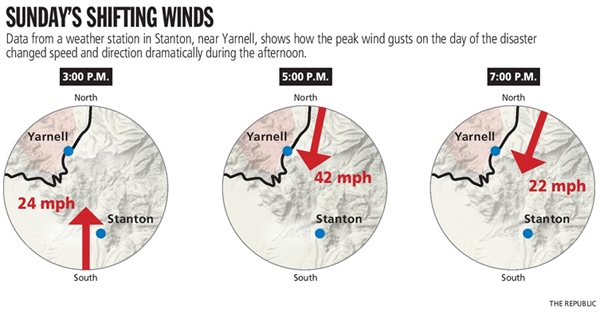
In the real world, winds from the southwest were gusting at 15 to 25 mph at 4:01 p.m. at the monitoring station near the blaze. An hour later, winds were gusting at 30 to 47 mph from the northeast.
Huddled in a hollow between two ridges were the hotshots.
There was worse to come. During the monsoon, the searing desert temperatures force columns of hot air high into the atmosphere, Leuthold and National Weather Service meteorologists said. The higher these plumes climb, the more chance they have for lifting embers and dispersing them widely. They also increase the chance of dry lightning strikes.
On Sunday, meteorologists measured the thermals as high as 22,000 feet — halfway through the atmosphere. The readings were among the highest they’d ever seen. In early fire reports, lightning was blamed for starting the Yarnell Hill Fire. And in Rim Country and near Prescott, the thunderstorms bring massive downdrafts of air — pushing huge gusts of air and reversing winds.
That’s exactly what happened Sunday.
Brian Klimowski, the National Weather Service’s meteorologist in chief in the Flagstaff division, said local topography could channel winds into even stronger gusts, making fire behavior more unpredictable.
The Weather Service provides twice-daily fire weather forecasts for each region. In large fires, the service also provides spot forecasts for specific fire locations, upon request.
Firefighters did make spot requests for the Yarnell Hill Fire, which Klimowski’s team updated twice a day, he said. In addition, the Weather Service also called firefighters twice on Sunday afternoon warning about the likelihood of thunderstorms and high winds, he said.
Weather and fuel loads are certain topics of any fire investigation.
The fire itself was a beast.
“Guys on the ground told me the fire behavior was as extreme as anything they’d ever seen,” Hughes said. Early official reports showed flames reached 40 feet high and traveled up to half a mile per hour.
Such conditions are among the factors investigators will consider as they reconstruct the hotshot team’s actions and the fire command’s decisions over the weekend.
A parallel investigation is under way to determine precisely what killed the hotshot members. The Yavapai County Sheriff’s Office heads up that inquiry, though the Maricopa County medical examiner will conduct the autopsies. Yavapai officials moved the bodies to Phoenix on Monday in a solemn caravan because Maricopa County was better equipped to handle so many casualties.
The Yarnell Hill Fire victims make up the largest mass-casualty event in memory at the Maricopa County morgue, county spokeswoman Cari Gerchick said. Ten pathologists will work on the fire autopsies, the results of which are expected within 48 hours. Full reports are expected within 90 days.
What forensic pathologists find will be important in learning how quickly the fire passed over the Prescott firefighters.
The state has jurisdiction over any investigation into fire fatalities on state land, according to Charlie Gripp, a Federal Emergency Management Agency consultant and a former fire-operations safety officer for the U.S. Forest Service.
“The topography can set up a situation where it may not be too bad, but the wind changes and it could be a real problem,” Gripp said. “They’ll see whether the weather forecast was accurate, and did the crew have the forecast. They’d been on other fires recently, so they’ll look at whether they were adequately rested, were they mentally fatigued.”
The Granite Mountain Hotshots had been deployed on a half-dozen other fires, two of them large, in the last two months.
Gripp also said the team also will analyze their fire shelters.
“They can save your life, but they’re not designed to survive in front of a blowtorch,” Gripp said.
“They’ll go over all the qualifications, make sure there were no obvious oversights by leadership,” he said. “They’ll look at the training they had: How good was it? Was it done timely and right? They could take weeks to put all the pieces together.”
Lynn Bleeker, a former Forest Service firefighter, said the questions investigators will be asking are the obvious ones: “Did they need to be there? With the weather coming in, were they informed as soon as they could have been to get the hell out of there?”
The bottom line, she said, “You should never be losing lives.”
Republic reporter Amy B Wang contributed to this article.
Fuels, thunderstorm likely contributed to deadly fire condition
By Shaun McKinnon
The Granite Mountain Hotshots were fighting the Yarnell Hill Fire on Sunday in scrubby chaparral, terrain that has a record of killing firefighters. When the weather changed, it turned a bad situation deadly.
The combination of fast-burning fuels and a wind-blown thunderstorm likely contributed to conditions that took the lives of 19 Prescott-based firefighters, experts said Monday. The same set of circumstances has led to tragedy before, but the experts say no two fires are alike.
“There’s not just one factor that leads to a tragedy like this,” said Dick Mangan, a former wildfire program manager for the U.S. Forest Service and owner of Blackbull Wildfire Services, a Montana-based consulting firm. “Everything kind of comes together and you get a perfect storm of things that can go wrong.”
Authorities refused to speculate Monday about what led to the deaths of the 19 firefighters in the Yarnell Hill Fire. The experts said it is possible the crew was caught in a “burnover,” trapped by flames that abruptly changed direction and engulfed the firefighters.
Burnovers were implicated in almost all of the deadliest wildfires over the past 100 years, according to records from the National Interagency Fire Center.
The components for such a disaster were present Sunday on the edges of the Yarnell Hill Fire, which was burning through hilly chaparral, a landscape of low-lying brush and trees that can flare up easily when heated by an approaching fire.
Late in the afternoon, storm cells began to develop and weather observations near Yarnell showed a significant shift in wind direction and speed. Gusts topped 40 miles per hour as a thunderstorm moved across the area. Such storms, however short or fast-moving, can produce erratic, localized winds that can fan flames and help spread a fire rapidly.
“When a thunderstorm comes in, the wind kicks around in a way you can never tell where it’s coming from,” Mangan said. “And with those flashy fuels, it’s easier to get trapped.”
Hotshot crews are deployed in already dangerous locations in a wildfire, often the hottest parts of a fire, which is how they got their name. They are sometimes working away from other crews and must monitor conditions on the ground constantly, prepared to move ahead of the fire if it flares up. They undergo special training, but also rely on experience.
“You can talk about how wind shifts occur and maybe how the thunderstorms come overhead, but it’s a completely different thing when you’re there actually seeing it and experiencing it,” said Rick Swan, a retired deputy chief of the California Department of Forestry and Fire Protection. “When the wind starts changing direction, you see that. If you’re trained, you’re paying attention.”
Some of the procedures firefighting crews follow today grew out of the 1990 Dude Fire near Payson, which killed six firefighters when flames exploded amid a rapidly developing thunderstorm. The fire has been studied intently by fire experts and government agencies. The lessons drawn from it still guide wildland firefighting.
“Those things are ingrained in our head,” Swan said. “No matter where you’re at, you’re constantly re-evaluating your situation, the wind, the topography, the fuel types. You’re always reassessing where you are, where you have to be, the amount of time you have to get there, all to make sure you’re safe.”
Crews constantly battle other obstacles, such as smoke so thick that views are obscured, or mountains that interrupt radio signals, isolating firefighters from command posts or others relaying information. Confusion on the fire line can be as deadly as the fire itself.
Firefighters learn from the start that fire needs three elements to burn: fuel, heat and oxygen. If any one of those elements grows, a wildfire can become more unpredictable. Denser or drier fuel can spread flames more rapidly. Rising heat can cause fuels to ignite faster. Winds can spread flames and cause a fire to blow up.
One of the most volatile types of terrain for a wildfire is chaparral, covered with lower-lying vegetation rather than the tall pines of higher elevation.
“The fuel is much more responsive to changes in humidity or even short-term drought,” said Mangan. “You get flashier, faster-moving fires, and the margin for error is greater.”
Fire-training manuals use campfires as an example. The twigs or brush used to start a campfire burn fast, sometimes with flames flashing upward. The kindling heats up the bigger logs, which eventually start to burn and last for a while. Some kinds of chaparral are like acres of kindling, small-diameter vegetation that ignites and spreads fire quickly.
The weather adds another volatile element. Winds can shift as a storm moves in and can push flames in a new direction, sometimes before a fire crew can react. If the winds are strong enough and the fuel volatile enough, a burnover can occur, a situation firefighters can’t control.
That’s why fire crews pay such close attention to weather forecasts and fuel models that predict how vegetation burns, Mangan said.
“That’s why you have to have a good lookout,” he said. “You watch for changes in wind, in smoke direction, watch for thunder cells. It shouldn’t be instantaneous. Even in the hills you should have a couple of minutes.”
Constantly updated models measure moisture content and other factors, such as the potential energy in a stand of trees or in brush. But the onset of unexpected winds or a sudden downdraft from a storm, Mangan said, “will blow the models out of the sky.”
By Brandon Loomis
PRESCOTT - The Yarnell Hill Fire’s deadly sweep through a central Arizona community exposed a weak spot in the West’s preparedness.
The 19 who died fighting the fire Sunday were part of a well-trained national army of federal, tribal, state and local firefighters who have stamped out countless wildfires over the past century.
But as fuel for blazes has built up in ever-thickening forests and brambles across the region, spending to fortify communities with firebreaks has not kept pace — and is now declining as the threat worsens.
By all accounts, the chaparral on the rugged, bouldered hills surrounding Yarnell was thick — an ever-present danger. Within the past two years, the U.S. Bureau of Land Management brought in a crew of prisoners to clear brush along roads and a densely vegetated creek near the community, but the tangle where lightning launched the fire several miles away was inaccessible and untouched.
Local volunteer firefighters say they worked with residents to clear trees and shrubs from their properties, but they had not addressed the piñon pines, manzanita and oak brush beyond.
With limited state and federal funding, it’s doubtful they could have done enough to prevent the destruction.
“If you’ve got a massive elephant out there,” Yavapai County Emergency Manager Denny Foulk said, “you can only eat it one bite at a time.”
There’s precious little funding, and how it’s divvied often depends on how aggressively fire-threatened communities fight for it. For 2013, Arizona received $1.5 million from the U.S. Department of Agriculture, which oversees the U.S. Forest Service.
The state has roughly 1 million acres of forest in need of thinning or other treatment to reduce fire risk near communities, Arizona Deputy State Forester Jerry Payne said. The costs per acre of such prevention efforts ranges from $400 to $1,000, he said.
Treating the chaparral around Yarnell is at the high end of that range, Payne said. It requires cutting and chipping piñon and juniper, whacking brush, and raking needles and duff.
Payne was unsure Monday whether the Arizona Division of Forestry had done any work near Yarnell in recent years. It was clear, though, that much of the area that burned was unnaturally thick, he said.
“I don’t believe that’s the natural cycle,” he said. “I’m certain that there’s been fire suppression in that area.”
Local officials said the last wildfire in the area was in 1967.
The Yarnell Hill Fire is burning on state trust land, where the Office of the State Forester is responsible for fire prevention and suppression efforts, and on private property.
Although it is unclear what, if any, money the state directed in recent years to the Yarnell area for fire prevention, state funding for firefighting is clear: The budget has included $3 million for each of the past four years for fire suppression.
For the budget year that began Monday, state lawmakers shifted $1 million from the agency’s operating budget — which pays for such things as staff salaries, utility bills and office supplies — and added it to the suppression budget, for a total of $4 million.
Matthew Benson, spokesman for Gov. Jan Brewer, said the governor has been a vocal proponent of forest-thinning but cautioned against leaping to conclusions “that this fire is the result of bad land management, because we don’t know that at this point,” he said. “For all we know, this was a fluke event,” caused by the weather, he said.
Sandy Bahr, director of the Sierra Club’s Grand Canyon chapter, said the state struggles to manage 9.3 million acres of state trust land with a limited budget. Bahr said it’s up to state lawmakers and their constituents to demand greater attention to forest management on state lands.
“Is the public willing to spend some dollars trying to make sure that we’re as prepared as we can be?” she said. “In the case of state lands, that’s the state Legislature and the governor and the state budget.”
Federal officials have also lamented the lack of resources and shifting of funds from prevention to battling blazes.
As historic wildfires have raged across Western states, including Arizona, in the past several years, the U.S. Forest Service has had to tilt its budget toward preparedness and suppression — the latter getting a 27 percent increase in the president’s 2014 budget. However, fuel-reduction programs have suffered, with the administration’s 2014 budget reducing this funding by 37 percent, to $201 million.
In a May conference call with reporters, Agriculture Secretary Tom Vilsack said, “Part of the challenge that we face with limited budgets ... when you take resources to suppress fires, you sometimes have to take it from the very resources that you would use to restore property or to prevent fires to begin with. And that just basically shifts the risk to a much longer term and more serious risk.”
Rep. Paul Gosar, R-Ariz., who was in Prescott for a firefighter memorial that drew hundreds to a local auditorium, said federal forest policy must change. He is proposing a bill to allow local firefighters to bypass federal environmental laws to thin forests if federal officials don’t do so within 60 days of a declaration of excessive fire risk.
Yarnell Volunteer Fire Department Capt. Sallie Foster lost her home in the fire and on Monday was second-guessing her efforts at creating a buffer around her property. She had cleared brush but not two trees she loved, a dilemma faced by many who choose to live among nature. “We all understand defensible space because one of the reasons we love living in Yarnell is because it’s a wilderness and we love the trees and shrubs and wild animals,” she said.
The Fire Department had worked with homeowners to clear fuels around homes, she said. But asked whether they had ever considered thinning the greater forest, she hesitated. “I don’t want to answer, because it’s a stupid answer: no,” Foster said. “I think we felt that if we did a good job with defensible space on our property that if a fire started 4 miles away that by the time it reached us it would be suppressed and our defensible space would spare our homes.”
She was unaware of any efforts by other agencies to thin the growth, except for the BLM brush-clearing in town.
Other Arizona communities have aggressively pursued grants from the federal program and leveraged them by getting private landowners to clean up. The Prescott Area Wildland Urban Interface Commission has used $7 million from the grant program over 12 years feverishly protecting wooded developments around Yavapai County, Chairwoman P.J. Cathey said.
The commission has not worked around Yarnell.
The grants are highly competitive, she said, so a community’s buy-in is critical.
Some communities have decided to pay for forest restoration themselves. Flagstaff passed a $10 million bond last fall for that purpose. That sort of cooperation will be critical in the future, Payne said.
Yavapai County’s Foulk said that despite BLM’s efforts, the area remained “heavily brush-laden.”
“Different people have different perspectives on how they treat their property and how they clear their property, so you can’t force somebody to do that,” Foulk said. “With the amount of fuel load that was in there, it would’ve taken a lot to get it down ... and probably (cost) more money than was budgeted and more crews than were available.”
Republic reporters Erin Kelly, Mary Jo Pitzl, Mary K. Reinhart and Yvonne Wingett Sanchez contributed to this article.
By Dennis Wagner, Michelle Ye Hee Lee and Yvonne Wingett Sanchez
PRESCOTT - At about 3 p.m. Sunday, Andrew Ashcraft texted his wife a photo showing some of his colleagues on the Granite Mountain Hotshots crew resting calmly before hiking off to fight the Yarnell Hill Fire.
It was the last known photo taken of the firefighters before they were overtaken by tragedy. In less than two hours, they would be doing what they’d done a half-dozen times over the past two months, digging firelines to protect property.
Interviews with wildfire experts suggest the hotshots were following protocol — flanking the fire, staying in touch with commanders and a spotter and observing weather conditions — when the fire turned on them after a sudden change in wind direction and speed.
On Tuesday, investigators from across the country began to piece together details of the Granite Mountain crew’s deployment and firefighting activities while Prescott and Yarnell tried to cope with the deaths of 19 elite firefighters.
The formal investigation will be led by Florida State Forester Jim Karels, the Arizona State Forestry Division said.
The probe will review weather and Fire Department records, radio logs and other evidence. Updates are expected later this week. Meanwhile, agencies have not yet responded to similar public-records requests by The Arizona Republic.
The Maricopa County medical examiner, meanwhile, is expected to finish autopsies on the fire victims by late this week. The process could be delayed if positive identification of any victim requires checks of dental records, DNA and fingerprints, said Cari Gerchick, a Maricopa County spokeswoman.
An honor guard is keeping vigil with the fallen firefighters at the medical examiner’s facility, officials said.
The Granite Mountain Hotshots had been dispatched to the fire earlier Sunday by the State Forestry Division, which commanded the fire, according a federal Bureau of Land Management spokesman. The fire season had started for them on April 30, when they worked a shift on the Perkinsville Fire near Prescott.
They had worked 23 shifts in June, about half of them in New Mexico. On Sunday, when they were sent to Yarnell, it had been four days since they’d last been on a fireline. Just before noon, fire officials ordered Yarnell’s evacuation. A few hours later, the Granite Mountain crew headed toward the fireline.
Some media reports and online blogs implied the hotshots must have violated “safety first” rules in battling the blaze, but fire experts came to their defense Tuesday, noting there were no indications that any safety protocols were violated.
Jim Paxon, a spokesman for the state Department of Game and Fish who helped found Arizona’s Wildfire and Incident Management Training Academy a decade ago in Prescott, lamented the inclination to cast blame or find scapegoats after a blaze becomes a killer.
If folks are looking for a culprit, Paxon said, they should focus on backcountry-management practices. He said grazing is limited and natural fires are extinguished, so fuels build up at the same time more people move into the wildlands. The fires that inevitably start up are more volatile and more dangerous to those battling them. “It’s amazing that we don’t have more Yarnell Hill Fires,” Paxon said.
Even veterans can be stunned by the dynamics of wildfire, Paxon said.
Although investigations have only begun, Paxon said, it appears the Yarnell Hill Fire defied reasonable predictions, taking the lives of men who understood the risks. “In my heart of hearts, and as a fireman, I don’t see how they did something out of the norm,” Paxon said. “Certainly not cavalier, not reckless.
“People who don’t know fire draw faulty conclusions. … Those who want to play armchair quarterback need to put on the boots and put on the pack and go over the hill.”
Paxon worked on six deadly blazes over the years and wrote a book on the 2011 Wallow Fire, Arizona’s largest in recorded history. He said that safety precautions are ingrained in wildland crews and that protocols are rigid: The hotshots’ superintendent and three squad bosses got detailed safety briefings before moving out to protect Glen Ilah, a subdivision just west of Yarnell.
They would have seen reports on weather, topography and other dangers, Paxon said. Once on the fireline, they would have established an escape route and agreed upon a safe fallback zone to deploy protective fire shelters in a worst-case scenario.
A fire-behavior analyst was on-site with the hotshot crews, and meteorology reports were being sent from Flagstaff, said Stewart Turner, fire-behavior analyst with a fire-incident command. A meteorologist was not required on the scene because the blaze had not yet been designated a “Type 1” fire. “They (hotshots) were getting accurate, updated information from the Flagstaff office,” Turner said.
When the monsoon created unpredictable winds that afternoon, a thunderstorm approached “from a distance,” said Jim Wallmann, a National Weather Service meteorologist based in Reno. That means meteorologists would had advance notice to warn fire crews, he said.
“I don’t know how much, but there was advance notice,” Wallmann said.
Brendan McDonough, the lookout for the crew, had been sent to the top of a hillside to give the crew “situational awareness,” Prescott Fire Department spokesman Wade Ward said. McDonough was told to set a “trigger point” and keep an eye on that point to determine if he should change his location. His job was to observe the fire, the weather and the topography.
“He radioed the crew that he’d reached his trigger point and that he was leaving and that he would contact them and they could contact him if they needed anything,” Ward said, noting that the change in weather was a factor. McDonough walked to a bulldozer line, and when he met another crew, “he turned around and realized that the fire had increased to such a point that the location that he was at at his lookout had already burned over.”
Art Morrison, a spokesman with the Arizona State Forestry Division, said the crew had an escape route and safety zone, as required by safety protocols, to protect against being overtaken by the fire.
“The fire went from 400 acres to 8,400 acres in a couple of hours,” Morrison told The Republic. “And, obviously, when it blew up like that, the safety zone that they thought they had wasn’t sufficient.
“All we knew was that the fire went from 400 to 8,400 in a very short period of time, and then we did hear that there was a crew that we didn’t have contact with,” Morrison said.
Paxon said he’d known Eric Marsh, the crew’s 43-year-old superintendent, for years. He was a quiet, conscientious leader who paid attention to detail and danger. He said Marsh started the hotshot crew and taught wildfire suppression at the academy.
Paxon said he cannot speculate about what Marsh and the other hotshots observed or may have missed. Photographic evidence makes it clear they were cutting lines along the fire’s flank, not on a dangerous front. The picture Ashcraft texted to his wife 30 minutes before to the blowup shows the fire’s edge in the distance: “It’s innocuous, a little ol’ puff of smoke,” Paxon said.
But time-lapse photography taken minutes later by professional photographer Matt Oss shows that, as a thunderstorm closed in, smoke billowed and turned orange before a wall of flames surged over the mountains and roared into canyons. Oss said he was stunned, even miles away, by the ferocity of the event: “I was out there by myself,” he said, “but I started yelling out loud at how crazy it was.”
Before 4 p.m. Sunday, a nearby weather station recorded slight breezes near Yarnell. Suddenly, winds reversed direction and gusted over 45 mph. The fire turned so fast, Paxon said, the hotshots were cut off from any escape route, unable to reach whatever safe zone they established.
“That change was in seconds, not minutes but seconds,” Paxon said. “This happened so quick, they didn’t have time to do anything but get into their shelters. ... It simply blew that fire over them with tremendous heat, ... I have been there, but for the grace of God.”
A nearby state Department of Public Safety helicopter crew of two paramedics and a pilot heard the hotshots’ distress calls on the radio. They wanted to fly, but the incident commander would not allow it because the sudden blowup made the immediate area smoky, meaning little or no visibility. Once the smoke cleared a short time later, the chopper crew took off.
They flew over the scene, and from the air could see firefighters and fire shelters on the ground. They landed about 500 yards away. One paramedic jumped out and hiked over to the scene, confirming none of the men survived. The pilot and a second paramedic left to refuel the chopper, leaving their colleague on the ground.
A radio dispatch reviewed by The Republic indicates that emergency workers were trying to determine at 5:33 p.m. who was going to “help with the down firefighters?” The response: “They’re determining right now which one of us should go.”
At 6 p.m., officials told news media in Prescott that the hotshots were “unaccounted for” — that a helicopter had spotted them but could not make contact. At 7:30 p.m., the Prescott Courier posted a story reporting the deaths. It was hour before authorities confirmed the tragedy.
Firefighters spent the night on the mountain, remaining at the scene to stand guard over the bodies. Early the next morning, another group arrived, fellow Prescott firefighters there to recover 19 of their own. One by one, they carried the bodies away from the fire scar to send them on their final journey home, past the burned-out subdivision they had tried to protect.
Republic reporters JJ Hensley and Sean Holstege contributed to this article.
EDITOR’S NOTE: From the beginning, we vowed to tell the story of all 19 firefighters. Officials didn’t release identities of any of the firefighters until Monday afternoon. By that evening, we had compiled capsule biographies of all 19 for online, and they were printed in our Tuesday edition. On Wednesday, we began publishing staffwritten obituaries on each firefighter, which continued to print through Saturday of that week. We met our goal: Publish obituaries on all 19 firefighters in four days.
SEAN MISNER, 26: A job, a family, a dream come true
Sean Misner dreamed of being a firefighter and of having children.
One of those dreams came true last year and the other is due in early September, though he won’t be there to meet his newborn son.
In September, Misner started a job with the Granite Mountain Hotshots. He and his new wife, Amanda, moved from Santa Ynez, Calif., and his life was seemingly in perfect balance, said his friend Jason Lambert.
“He said as soon as he was married he wanted to have kids,” Lambert said.
Amanda is seven months into her pregnancy with a boy she plans to name Jaxon. Friends of Misner have established a fund to help with Jaxon’s education now that his father is gone at the age of 26. “We just want to see Jaxon taken care of,” said Lambert, a friend of Misner’s since they were 7, growing up near Santa Barbara.
Lambert said Misner was a hard worker who tried a variety of things after graduating from high school in 2005. But what he really wanted was to become a firefighter like his grandfather, Herbert McElwee, a former fire chief in Montecito, Calif. McElwee died last year. Misner also has an uncle and cousin who are firefighters.
“He had firefighting in his blood,” Lambert said.
Misner played wide receiver for the football team, outfielder on the baseball team, and ran the 400-meter for the track team at Santa Ynez High School, Lambert said.
“It didn’t matter what he was doing, he was doing it 110 percent,” Lambert said. He tried playing football at Santa Barbara City College after graduating in 2005, but struggled with injuries, Lambert said.
Misner moved to Wyoming briefly with Lambert, who was attending college there. When Lambert moved to Alabama for school, Misner also joined him there. But that was in early 2010, and Misner had recently met Amanda Wilkinson of Placerville, Calif. They met while they were both working at a small store called Los Olivos Grocery in Santa Ynez. “He just missed Amanda too much,” Lambert said. “He ended up getting out of the lease. He couldn’t stand being away from her.”
Back in California with Amanda, Misner worked on airplanes. Then his cousin, Travis McElwee, who works as a firefighter and lives in Prescott Valley, got him a line on the job with the Granite Mountain Hotshots, Lambert said. Misner’s parents, Ronald and Tammy, still live in California. His older sister, Steffie, is in Nashville.
A memorial fund for Jaxon is collecting donations at facebook.com/SeanMisnerMemorial. Last year, when Misner got the firefighting job, he and Amanda married. Lambert was the best man.
Misner was scheduled to reciprocate at Lambert’s wedding in October.
“I just got married a year too late,” Lambert said.
— Ryan Randazzo
WADE PARKER, 22
School leader turned to firefighting
Wade Parker had a passion and talent for baseball that took him to Colorado to play at a junior college.
But when his playing days were over, he returned to his hometown of Chino Valley and took up firefighting, following in his father’s footsteps.
That endeavor was cut short for Parker, 22, when a wildfire on Sunday killed him and 18 other members of the Granite Mountain Hotshots in the Yarnell Hill Fire. He was a co-captain of the crew. He was engaged to marry Alicia Owens, a classmate at Chino Valley High School, in October.
Parker, a 2009 graduate of Chino Valley High School and a baseball star for the Cougars, was remembered as a good student and a leader who got along well with his classmates and who always had a smile on his face.
“He was very enthusiastic,” said Trish Smith, a biology teacher who taught Parker during both his freshman and senior years.
“He would always stop and say hi to me even when he didn’t have me anymore” for class, Smith said, adding affectionately that Parker was “a Chino boy.”
That is, he went through all 12 grades in Chino Valley schools.
“He had a strict code of honor,” Smith said. “I don’t know (but) he got that from his father.”
Parker’s father is Capt. Dan Parker of the Chino Valley Fire District.
The district posted this statement Monday: “The Chino Valley fire family has experienced a tremendous loss with the death of the son of one of our captains. We grieve with the family and express our deepest sympathy for this tragic loss.”
Former Chino Valley High School agriculture teacher Patrick Wellert recalled how helpful Parker was with younger students as a volunteer teacher’s aide.
“He would spend a lot of time in the shop with the freshmen teaching them to weld,” Wellert said.
“He was definitely a leader,” Wellert said. “It’s awesome that someone saw that leadership ability in him” as a firefighter. Bruce Nesbitt, who retired as Chino Valley High’s baseball coach this year, said Parker was an exceptional player, energetic and a spiritual team leader. “He was just a supertrooper guy, involved in the community, a good student and ready to help anybody do anything,” Nesbitt said.
Parker was a three-year varsity letterman and was starting shortstop his junior and senior years.
The Cougars lost in the state 3A finals in 2008 and the semifinals his senior year. “He hoped to play some college ball and he was good enough to do that,” Nesbitt said.
Parker played at Lamar Community College in Lamar, Colo., and summer baseball at Scottsdale Community College, the coach said.
“This is kind of surreal for us,” Nesbitt said of the tight-knit Chino Valley community. “Everyone is taking it hard. He was one of us.”
— Peter Corbett
TRAVIS CARTER, 31
He grew up in the hills he would protect
Travis Carter’s wife knew it. His personal trainer knew it. And his fellow firefighters who braved the Yarnell Hill Fire with him knew it, too.
Carter, 31, was one of the good guys. “He was one of those people who would do anything for anybody, whether he knew them his whole life or met them five minutes before,” Carter’s wife, Krista, said Monday.
The two met while Krista was working at a cosmetic counter at Dillard’s department store.
“He just came up and talked to me,” she said. “Everybody said it wasn’t like him because he was incredibly shy. He still did not have an answer as to why he did it, to this day.”
The couple were together for almost nine years and were married in 2007. They have two children, Brayden, who will turn 7 in two weeks, and Brielle, 3.
“He loved his kids more than anything,” Krista said. “That’s what he lived for, seeing them happy and having family time.” Krista said Carter also had a passion for being outdoors.
Carter was raised in Prescott and Kirkland, just a few miles from the scene of the fire. His dad, Courtlandt “Tripp” Carter, owns “Necktie Ranch,” a cattle ranch that has been around since the late 1800s. Carter is also survived by his mother, Glenna Eckel, and sister, Melissa Lange.
As a kid, Carter’s favorite activity was making homemade rockets with his dad, a tradition he carried on with his own son. He could cook just about anything, and his family joked that he was a chocoholic. Krista said that Carter was intimate with the hills where the fire took place.
“I know there has been a lot of talk about maybe something wasn’t done right or the guys didn’t know what they were doing,” she said. “But I can assure you, they were a Type-1 crew that’s been around for years and they knew exactly what they were doing. And I know they made the best choices that they thought were best for everyone, themselves, and the homes and people.”
Janine Pereira, a trainer at Captain CrossFit, a gym in Prescott where six members of the hotshot team worked out, said Carter “always came in smiling.” Pereira said while Carter was one of the strongest people she knew, he was very humble about it.
“He was here just three days ago just to stop in and say hi and see how everyone was doing,” she said. “He said, ‘Oh I have a couple days off, but I’m sure I’ll be heading to another fire soon.’”
She called him a leader in the gym as well as on the fire line, and said many of the firefighters looked up to him.
“(Carter) helped out everyone — not only the hotshot team,” she said. “As soon as he was done, instead of going and relaxing, he would help the last person until they were done too.”
— Robert Anglen, Kristina Goetz and Saba Hamedy
ERIC MARSH, 43
Created Granite Mountain Hotshots
Eric Marsh, the superintendent and founder of the Granite Mountain Hotshots, was cautious about the dangers of his job, his parents recalled.
Their only son knew the risks of firefighting, said John and Jane Marsh in an interview with The Arizona Republic at their Prescott Valley home.
In some previous fires, “several times they wanted him to take out the team to the middle of a fire at night when all they had to see was the little light on their helmets,” Jane said. “He told them ‘no.’ He wasn’t taking his crew into that danger.”
Marsh is survived by his wife, Amanda.
At 43, Eric was the oldest member of the hotshots team. But he had turned down his parents’ offers to retire and take care of property they own in North Carolina. He didn’t want to leave firefighting. “He was just a leader, and he enjoyed what he was doing,” said Gary Marsh, his uncle. “He loved life.”
Marsh grew up in Jefferson, N.C., and discovered firefighting when he spent a summer in college in Arizona learning wildland firefighting with one of his friends. After graduating from Appalachian State University, he returned to Arizona and took up the profession full time. He was working for the Prescott Fire Department when the opportunity arose to
form a hotshot team, the first in the country to be sponsored by a city. Marsh spent two years finishing the grueling training and paperwork to form the crew.
“He was totally in his element and he absolutely loved being a firefighter,” said friend Bill Bentz, 49, of Prescott Valley. He treated his crew members like family, taking team members to doctors’ visits and organizing softball games and cookouts.
He took pride in his crew but didn’t like to brag.
“I couldn’t even get him to enter his team in the Fourth of July parade,” John said.
Marsh was an honor student at Ashe Central High School and played running back on the football team. In college, he majored in biology because he loved nature so much. He played rugby and founded a fraternity chapter, NC Omega Tau. He and his wife kept four horses at their home in Chino Valley. More recently, Marsh had learned saddle-making from a friend in Yarnell. He was working on a saddle for his wife.
Mike Reordan, 56, a longtime friend, said he remembers that when the couple wanted horses to ride, they went to a thoroughbred rescue shelter.
“That’s the kind of person he was,” said Reordan, of Prescott Valley. “Instead of getting the perfect, rideable horse, they got a thoroughbred that wasn’t perfect and rideable and that took a lot of work and patience and energy. But to save a life, that’s what they did, you know?” He said Marsh also was instrumental in helping to start the Arizona Wildfire and Incident Management Academy in Prescott that trains firefighters from around the world.
— Anne Ryman and Rebekah L. Sanders
TRAVIS TURBYFILL, 27
He died ‘selflessly trying to protect others’
The caption beneath Travis Turbyfill’s Prescott High School yearbook photo says: “I have decided to live forever or die in the attempt.”
Friends and family members of the firefighter said he managed to cram a lot of living into his 27 years.
They said Turbyfill, known as “Turby,” was selfless, and dedicated to his family. They also said he was very, very funny.
Turbyfill, who served in the U.S. Marine Corps, began his firefighting career with the U.S. Forest Service in 2005.
In 2009, he married Stephanie Turbyfill. The couple have two daughters, Brynley, 19 months, and Brooklyn, who will turn 3 this month.
Lifelong friend and fellow firefighter Jeffrey Archer of Prescott Valley said Monday that nobody could ever say anything bad about Turbyfill.
He called Turbyfill “one hell of a good family man.”
He said he and Turbyfill were inseparable growing up. They went to the same schools, had the same hobbies, played the same sports and shared the same career. He said they loved to hunt together and spend time in the outdoors. They even started a business together this year focusing on trapping, but he said it hadn’t gotten off the ground.
“Our wives were pregnant together,” Archer said. Their children are the same age.
He said anyone who didn’t get a chance to know Turbyfill missed out. “He was a great guy. All of those guys were great guys.”
Archer said he knows many of the men who died; they worked across the street from his fire station and would often barbecue together.
“We are like one family,” Archer said.
“It is a close-knit group.”
Janine Pereira, a trainer at Captain CrossFit gym in Prescott, also knew several of the 19 firefighters who died on Sunday. She said Turbyfill was a funny, family-oriented man who often came to the gym with his wife and daughters. “He was probably the goofiest of the bunch,” Pereira said. “He was always joking around with everyone.”
Turbyfill grew up in Prescott, graduated from Prescott High School and attended Yavapai College.
Relatives declined to speak to reporters. However, his cousin, Molly Malone Mitchell of Alabama, posted a status on her Facebook page Monday lamenting the Turbyfill family’s loss.
“I have been trying to find the words to post on here to describe the fact that my heart feels like it was ripped straight out of my chest a little after midnight,” she wrote. “I haven’t been able to wrap my mind around the fact that my beloved cousin, Travis Turbyfill, is gone forever and I will never hear his sweet laughter again on this Earth.”
Mitchell also wrote that Turbyfill “died doing what he loved and selflessly trying to protect others.”
— Robert Anglen, Kristina Goetz and Saba Hamedy
KEVIN WOYJECK, 21
Firefighting was a father-son passion
Kevin Woyjeck, 21, was determined to become a firefighter, just like his father. But when he wasn’t training, studying or working, he showed that he also had a knack for line dancing.
Woyjeck and friends often went to the Ranch — a country-music line- dancing joint near the El Camino College Fire Academy in Inglewood, Calif. — on the weekends to catch a break from training. “Any girl in sight, it didn’t matter how old they were or what they looked like, Kevin would go up to them and just dance — they loved it,” said Drew Fabrigas, Woyjeck’s friend. “He taught me a few dances, too.”
Fabrigas said Woyjeck was a “jokester” with a “contagious smile.”
Woyjeck, a Southern California native, was also a hard worker who wanted to follow in the footsteps of his father, Los Angeles County Fire Department Capt. Joe Woyjeck.
“He led a lot of our drills at the academy,” Fabrigas said. “While we were all hurting and down in the dirt, he was still up and picking us back up. He was extremely motivated.”
Before joining the elite unit of firefighters, Woyjeck was a member of the Los Angeles County Fire Department Explorers and worked at an ambulance service.
“Right out of high school, Kevin was laser-focused on becoming a firefighter,” said Bill Weston, director of operations at Care Ambulance Service in Orange, Calif. “He worked here as an EMT.”
Weston said many ambulance employees know Woyjeck’s father and watched Kevin grow from a toddler.
Weston choked back tears while talking about Kevin’s dedication, saying he has not encountered many men, especially at such a young age, so committed to accomplishing a goal.
Weston said Kevin worked with the service until September 2011, when he became a wildland firefighter.
Woyjeck’s Facebook Page showed that he lived in Prescott and studied at Santa Ana College in California.
Pictures show Woyjeck fishing and skiing. In many of the poses, he is holding fresh-caught fish or lobsters. In another, he is pictured in a kayak.
Neighbors said the scene around the Woyjeck family home in Seal Beach was somber Monday, as people left cards and brought baked goods to the door.
Hayley Bjorklund, who went to Los Alamitos High School with Woyjeck, said Woyjeck was very involved at school, where he was a member of the varsity track and cross-country teams, and with the community, where he was a volunteer firefighter.
Friends said Woyjeck was close with his two younger siblings.
“His brother is a spitting image of him,” Fabrigas said. “They were best friends.”
While Fabrigas was sad about Woyjeck, he said he knows his friend died doing something he loved.
“Being a hotshot is what he wanted to do and loved,” Fabrigas said. “He was a true hero.”
— Saba Hamedy and Robert Anglen
Community reeling from tragedy gets first glimpses of homes reduced to ashes
By Michelle Ye Hee Lee, D.S. Woodfill and Jim Walsh
YARNELL — The Yarnell Hill Fire left a pockmarked landscape in Peeples Valley and a Yarnell neighborhood, with the erratic, wind-driven blaze torching some houses while leaving others untouched.
A house and truck were saved in the Yarnell neighborhood of Glen Ilah when they had the good fortune of getting hit by by an air drop of red fire retardant. But the random nature of the damage will leave some residents wondering why they were lucky or unlucky.
The Yavapai County Sheriff’s Office believes 114 of the area’s 500 homes were damaged or destroyed by the fire.
Chief Deputy John Russell said deputies have been unable to go house-to-house to check on homes because of heat from the fire.
“As soon as we can get in there, we will and start checking residences,’’ Russell said.
Firefighters on Wednesday had achieved 45 percent containment of the blaze that killed 19 of their brothers.
As investigators began piecing together the events that led to the catastrophe, an Arizona Republic reporter ventured behind the fire lines with a resident whose property sustained heavy damage.
“Look at the cars. There’s nothing left of them,” said Gordon Acri as he drove down what he said was Lakewood Drive in Glen Ilah, on the southern fringe of Yarnell. Acri, a contractor, was just beginning to build his dream home, was granted access to the area to retrieve his grader, a piece of heavy equipment used to smooth out land.
When Acri got to his land, his grader appeared untouched, but it wouldn’t start. A cement mixing truck he owned was torched.
“This was like Disneyland before,” he said. “It was a paradise.”
He surveyed what is still a spectacular view of the Valley framed with a magnificent blue sky, south of his property.
“Not a damn thing left,” Acri said.
Acri visited another home that was scorched a couple of days earlier to retrieve a friend’s medical supplies. He said a house his friend was working on was diminished to “a stack of bricks.”
A cat somehow survived the blaze and was hiding in an adjacent lot, even though metal tool sheds had melted into what Acri described as a “puddle of aluminum.”
“It’s incredible the heat that was in that fire,” he said. “I don’t see how anything could survive.
“The town was just like Roman candles going off everywhere and flare-ups from propane tanks. There had to be at least 15 propane tanks that I heard. And you hear the gas go and then you hear the explosion, and you see the ball of fire.”
Acri said he was on a hill east of the town when he saw the wall of fire move through.
“When the wind changed, it just stopped that wall of fire that was heading right for Main Street,” he said. “You can’t imagine that much force just being redirected by (the) changing direction of the wind.”
“It was just total fire everywhere,” he said. “I can’t even describe it.”
The glimpse of a random damage pattern comes as sheriff’s officials expressed concerns about whether residents could have been injured or killed if they refused to evacuate.
Residents were asked to call a hotline to check on whether their property was damaged, but the line also serves as a way for sheriff’s deputies to account for those residents.
Jim Whittington, a spokesman for the Southwest Incident Management Team, said the team hoped to get residents home by Saturday. Those who live to the north, in Peeples Valley, could move back sooner than those who live in Yarnell.
Jim Karels, the Florida state forester who is leading the national investigation, said he understood what it was like for the residents, particularly in light of the 19 firefighters who were killed.
“I feel for this community and I know what it’s like,’’ he said. “Our hearts and prayers are out to them.’’
Karels said he lost two firefighters in a burnover incident about two years ago in Florida. He said the group is just getting started on the investigation but hopes to release some information this weekend.
“Our goal is to see what happened and make sure it doesn’t happen again to future firefighters,’’ Karels said.
Mike Dudley, acting director of cooperative forestry with the U.S. Forest Service, said the panel will provide a preliminary report to the state in 60 days.
Firefighters coped with the loss of the fallen firefighters by focusing on their jobs, driven by their sense of duty, said Ben Plumb, a Kaibab National Forest supervisor working on the fire.
Firefighters working on the blaze would pause and remember the fallen firefighters during breaks by discussing the tragedy.
“Everyone feels it all the way through,’’ said Todd Pederson, a division trainee of the Price Valley Helicopter Repel Crew. “We feel like we’re winning,’’ with crews thinning trees.
Aerial images on Wednesday showed random damage on the western side of the boulder-strewn community on the lower heights of the surrounding mountains. Some homes and other buildings were burned to the ground, while others nearby appeared to be untouched.
The landscape in much of Glen Ilah was surreal. Much of the undeveloped areas looked almost lunar. Many residential lots were diminished to blackened patches of ground with a few sticks still standing where homes once were located. On many of the adjacent plots of land, homes were completely untouched.
The damage was just as random in Peeples Valley, where the smell of burned trees hung heavy in the air.
The Shrine of St. Joseph, a popular attraction in Yarnell, was partially damaged. A chapel appeared to be intact, but buildings used as a retreat center were burned. Some of the shrine’s concrete statues were visible from overhead, but others were obscured by trees.
Yarnell, a hamlet of fewer than 700 people, most of them 45 or older, has been evacuated since Sunday as fire crews worked to construct fire lines and suppress the blaze.
According to the latest updates, crews working the northwestern side of the fire were pulled from fire lines Tuesday afternoon as a precaution after thunderstorms developed near Flagstaff and moved toward Prescott. The storms did not end up affecting the fire.
Two hotshot crews scouted the western flank until the threat of thunderstorms prompted them to move to safer areas. Some areas around structures are still holding enough heat to be a concern.
The Yarnell Hill Fire, which was sparked by lightning, has burned 8,400 acres, but the acreage has not grown for days. A spokeswoman said 675 firefighters were working on the blaze.
Officials are working on a plan to restore utilities and infrastructure in the area.
Whittington, the Southwest Incident Command spokesman, said crews would work to link fire lines built on the fire’s northeastern flank and around Yarnell. The lines are separated by about 4 miles.
He said crews are working on the ground to identify and put out hot spots. Some are deep within boulder formations around the town, he said, and finding them requires “a lot of walking around, eyeballing things, touching things.”
One lightning strike.
That’s all it takes.
A SINGLE MOMENT
By Brandon Loomis and Mary Jo Pitzl
Editor’s note: New details have emerged since this story was originally published. For the latest information and complete coverage on the fire that killed 19 firefighters and destroyed more than 100 homes, visit yarnell.azcentral.com.
BIG BUG MESA - It could have been Breezy Pine.
Like Yarnell, before lightning sparked a fire that swept through it last week — and like dozens of towns and summer enclaves carved into Arizona’s wooded hills — the Breezy Pine subdivision is a mountain retreat.
It’s also highly flammable. A lightning bolt at this spot southeast of Prescott and the Granite Mountain Hotshots could have been scraping firelines on this mountain instead of making their last stand at Yarnell.
The unincorporated canyon village just under the cusp of Big Bug Mesa is the definition of the danger zone that firefighters call “wildland-urban interface.” It’s rugged country at an elevation of 6,700 feet, and its one access road is lined with the red-barked manzanita shrubs that Yavapai County forest-fuels specialists call “gasoline on a stick.”
The 125 or so homeowners who live there, many retirees or metro Phoenix workers with retirement dreams, know the flames could come.
Forest Service data show that a wide swath of Arizona — from the upper western corner almost to the eastern edge — is at risk of a difficult-to-contain wildfire. At the same time, funding for preventing and fighting the fires wanes. On Friday, U.S. Sen. John McCain, R-Ariz., said that draconian federal spending cuts could affect those resources even more. That comes as forests and brambles across the region become ever thicker with powerful fuel for wildland blazes.
“It’s just kind of a fact of life,” said Jim Pressley, a 44-year-old Peoria man who hopes to retire at his family’s wooden, 1,700-square-foot cabin. He and his sons have raked pine needles and cleared brush. He might need some prodding from fire officials to remove a lovely spruce that drapes over his deck.
Forestry experts in Arizona focus most of their fire-prevention efforts and attention on ponderosa forests like the one around Breezy Pine because their dense growth fuels fast-moving crown fires. The Wallow Fire of 2011 and Rodeo-Chediski Fire of 2002 torched more than a million acres of pine forest between them.
In 2009, the State Forestry Division compiled a “Communities at Risk” list that included 192 towns and developments. Of them, 80 were considered high risk from wildfires because of their encroachment into the wildland-urban interface.
The high-risk list includes cities such as Flagstaff and Prescott, and small communities such as Congress. It does not include Breezy Pine or, for that matter, Yarnell, although both have since been covered by a Yavapai County fire-prevention plan.
The plan, updated last year, states that about a third of the homes in the wildland-urban interface have undergone clearance work to create defensible space, with a quarter-million cubic yards of wood removed.
Yavapai County is growing — up by about 25 percent, to 211,000 people, between the 2000 and 2010 censuses. The forest, for all its risks, is a draw.
“I wouldn’t trade it for the world,” said one of Pressley’s Breezy Pine neighbors, Pam Camacho, 50. She spends half the year in Phoenix and half here, in a home well-protected by a gravel flat on one side but directly under a steep slope of ponderosas on the other.
“That’s why you have insurance and just hope for the best,” she said.
“You buy a place like this and you think about (fire),” Pressley said. “But then you stick your head in the sand and say, ‘Well, everybody else is doing it.’ ”
In May 2012, some of Pressley’s neighbors frantically drove 7 miles up Poland Junction Road’s gravel, rising from desert scrub past dense chaparral to their former mining camp notched amid the ponderosa pines and Gambel oaks. They were racing the Gladiator Fire, burning to the south near Crown King, to claim photos and keepsakes.
In their faces: a prevailing southwesterly wind aligned perfectly with the funnel of their canyon.
They were spared. The fire turned back several miles away.
“It’s just a disaster waiting to happen,” said Gary Roysdon, fuels-reduction coordinator for the volunteer Prescott Area Wildland Urban Interface Commission.
He’s trying to ensure it doesn’t happen. And after Yarnell Hill and Gladiator, a blaze a California hotshot crew barely escaped, so are the people of Breezy Pine.
The community conducted a fire-safety day in May and is completing paperwork to become Yavapai County’s 24th Firewise Community. It’s a designation that requires a commitment by the villagers to spend $2 per person each year hacking brush and trees around their homes. With it, the area will become eligible for grant money to help remove wood. Yarnell and Peeples Valley are not Firewise Communities.
The Prescott Area commission is doling out a $500,000 grant from the state for use over three years, and Roysdon thinks he might be able to get $15,000 or $20,000 for Breezy Pine.
Communities have to fight for limited cash. For 2013, the U.S. Forest Service sent $1.5 million to Arizona to distribute in competitive fuel-reduction grants. A deputy state forester last week estimated that at least 1 million acres need attention, at a cost of $400 to $1,000 per acre, depending on whether it is cleared with a controlled burn or thinned with heavy equipment.
There are other funds, but apparently no single agency monitors how the money is distributed and spent.
The state got $8 million in federal economic-stimulus money four years ago to reduce hazardous fuels such as pine needles, dead trees and other organic materials that help fire spread. More than half, $4.5 million, went to the White Mountain Apache Tribe’s forest-restoration program; another $2.2 million helped the tribe develop a nursery and do ecosystem restoration after Rodeo-Chediski. Three other projects were in Yavapai and Navajo counties.
The state also issues grants from its Cooperative Forestry Fund to help with prevention as well as firefighting. It was not immediately known how the money has been allocated in recent years.
The State Forestry Division this year has a $7.2 million budget, with $4 million earmarked for fire suppression. It is unclear how much of the remainder, if any, goes toward preventative efforts.
Yavapai County, which includes Yarnell, is among the most fire-conscious in the state. But even there, hazard reduction has never kept pace with a forest that grows thicker every year. There are 7,500 homes with defensible space in Firewise Communities forming a semicircle around Prescott, said P.J. Cathey, Wildland Urban Interface Commission chairwoman. But she thinks at least 10,000 more homes need it.
Arizona’s persistent drought, coupled with dead or dying trees and brush and the risk of human-caused fires, means the long-term threat is high. Fuel is the key, said Bruce Greco, outreach director for the Ecological Research Institute at Northern Arizona University.
“There are areas of Arizona that have very dense, overstocked areas of vegetation, particularly with ponderosa pine,” he said.
In the case of Yarnell and many areas of Yavapai County, thick stands of chaparral are perpetual risks, said Pat Graham, state director of the Nature Conservancy in Arizona.
Controlled burns can help clean up pine areas, but they’re often dangerous in chaparral, Graham said. Manzanita and creosote are especially oily.
“They tend to explode,” he said.
And clearing brush isn’t a one-time chore. Chaparral returns almost instantly.
“It’s kind of like wiping your fanny with a hoop,” said Roysdon, the Prescott-area fuels-reduction coordinator. “There’s no end to it.”
Roysdon is 80, an Oklahoman with a handlebar mustache who retired near Prescott after an electronics career in Southern California. Retirement finds him working about 40 hours a week assessing and attacking fire hazards with rented or donated crews.
This spring, he noticed a lot of brush and trees awfully close to homes in Yarnell. The U.S. Bureau of Land Management had worked to reduce fuels around town, he said, “and the people were aware. But there wasn’t much activity by individual homeowners.”
There’s no forcing the issue, he said. It’s private property, and if people want trees and shrubs, they can keep them. Retirement areas like Yarnell may suffer if owners can’t do maintenance.
The tragedy of the Yarnell Hill Fire not only took the lives of 19 men, it also took something tangible out of Roysdon’s crusade. Wood-chipping crews cost hundreds, sometimes thousands of dollars a day. The community-minded Granite Mountain Hotshots did it for free when they weren’t fighting fires.
The week before those 19 Prescott-based hotshots died, they were helping contain the Doce Fire. It crested their namesake Granite Mountain, northwest of the city, but faded on the edge of horse properties on the other side. Emergency-management officials credited educated and motivated homeowners who kept a clean buffer.
Steve Maslansky is one of them.
His home is just across a ravine from the base of Granite Mountain. The Doce Fire burned to within 35 yards of it.
Upon moving in 17 years ago, Maslansky set out to clear oak brush and other potential kindling. Some parts of his yard are pebble-covered, some are studded with junipers and succulents. Drought-resistant grassy fields where his late wife trained Australian shepherds form an outer shield.
At first, it took him 40 hours of hacking through brush just to find his fence line. Now, at 65, he hires out most of the work each year, at about $1,000 to protect his 6 acres.
Just beyond his fence is the dense brush that covered his yard before — and that still persisted on Granite Mountain until the fire raced over it in roughly five hours. The junipers on that side of the fence are charred.
“I think it’s safer now, with the fire,” he said. “And I’ve still got some green.”
All is green at Breezy Pine. So green, that little of the sky is visible away from the road’s clearing. Pressley likes it that way: a shady spot to relax or putter with a metal detector, looking for the gold nuggets that first drew people here.
But after Gladiator, when a U.S. Forest Service official came through and told him not a single home was defensible, he knew something had to change. The dense growth meant firefighters wouldn’t risk themselves protecting homes that likely couldn’t be saved.
“I’d like this place to have a fighting chance,” he said.
Roysdon and others are helping Breezy Pine owners create a plan for a 150-foot-wide pocket of safety in which they’ll keep down brush and small trees that could ignite the ponderosas.
It won’t be a “moonscape,” Roysdon promised. Then he drove over a pass and descended into Walker, a hillside hamlet of about 500 homes.
He groaned at the sight of unnaturally thick ponderosas.
Republic reporter Matt Dempsey contributed to this article.
Half a mile beyond the nearest home, three white Prescott Fire Department pickups rolled up the south side of Yarnell Hill, into the wasteland.
The area had been heavy desert brush, scrub against endless piles of granite boulders. Now, only the boulders and a lone cactus remained.
The fire that swept through the day before had been so hot it cracked the granite, shearing off pieces of superheated stone. It left the earth baked and crumbling.
And as the fire barreled forward, it burned over 19 firefighters, killing them all.
In the hours that followed, fire investigators took photographs, collected evidence and prepared the bodies. A small group of firefighters stood watch through the night.
Just after daybreak Monday, the pickups rolled to a stop, and a 12-man crew emerged. They were there for a changing of the guard.
Across the yellow police tape, firefighters could see their comrades’ axes with spade heads, used for digging firelines. They saw water bottles and burned chain saws, abandoned when the firefighters took cover under their emergency shelters.
“It was a hot, hot fire,” said Prescott Firefighter Mark Matthews. The land looked “nuked,” he said. “That was hard to see. And then you had to see all the body bags.”
Nineteen body bags, already tagged and numbered, lay in three rows.
It was time to carry the men off the mountain.
On Sunday, June 30, flames had already eaten nearly 1,000 acres across Yarnell Hill, and firefighters from Prescott and elsewhere fanned out to protect people and property.
The Granite Mountain Hotshot crew was working on the south side. Matthews and his partner, Conrad Jackson, were on the northwest side, setting up a sprinkler system in case the fire got close to a house.
Matthews had been with the department since 2001 and filled in a couple of times on the Granite Mountain Hotshot crew when they needed help. Jackson had been with the department for 12 years and had been a member of another team, the Prescott Hotshots, back in the 1990s. He’d also filled in on the Granite Mountain crew.
As the men worked, Jackson started hearing from family and friends who asked if something might have gone wrong on the fire. He didn’t know.
“With today’s technology, you start to get text messages and phone calls saying, ‘Hey, I heard this. You’re on the fire. What are you hearing?’ ” Jackson said.
He listened more closely to the chatter on the two-way radio for clues, but the rugged terrain blocked some signals, allowing only fragments of conversations to come through.
The Yarnell Hill Fire already had an incident commander. But then someone called for a Granite Mountain incident commander. That didn’t make sense because there was no Granite Mountain fire.
But Jackson knew what it meant.
“If there’s two incident commanders on the fire, it means there’s an incident within an incident,” he said. “I’ve been doing this 20 years. Something transpired. You just don’t know the gravity of it.”
The fire had been making a run to the north that afternoon, he said, eating up turf in Peeples Valley, when a thunder cell coming in from the north abruptly pushed a wall of fire south.
“Anytime there’s a thunderstorm, you’re going to expect erratic winds,” Jackson said. “Anybody who’s been around a monsoon shower here knows what it’s like. ... So there was a significant change in the fire behavior. And we started catching wind that something had transpired. But there was nothing definitive. We couldn’t make phone contact with anybody who had a definitive answer for us. So even as we came back into the main camp that night, we still didn’t know definitively.”
There were conflicting reports. One said no firefighters were injured. Another said an entire crew was gone.
That night, a task-force leader met them between their post on the fire and base camp at Hays Ranch Road. He told them there were 19 fatalities. But he didn’t say who. Once they arrived at base camp, Matthews finally realized the gravity:
The Granite Mountain crew on the other end of the fire had been in what firefighters call a burnover. Everyone caught in the fire had died, 19 in all.
As the fire burned, the Prescott firefighters regrouped. There was talk of pulling out everyone from the department.
But Jackson and Matthews wanted to stay, to collect “the boys.”
“Anytime there’s a tragedy, a fatal tragedy, it’s tradition that,” Jackson said, his voice breaking, “your own family comes and gets you.”
“I don’t want strangers going in and getting them out of there,” he said. “I want to be the one that gets to go in there and get them out of there. It’s a horrific honor to go in and do that.”
Jackson said he whispered in as many ears as he could. He couldn’t be sure what would happen.
“Every investigator that’s doing their investigation, they want to have control of that scene. They want to know who’s coming and going and impacting their scene. And I respect that. We all respect that.”
But he knew someone would have to bring the bodies down the hill. “We wanted to be in that group,” he said.
Early the next morning, he got the call.
He wasn’t sure who granted the request or why. He just got word they were going.
Twelve men would be allowed on the mountain. Eleven would be from the Prescott Fire Department.
One would be from the Chino Valley Fire District: Capt. Dan Parker. His son, Wade Parker, was one of the 19.
After the burnover, a bulldozer had plowed a path half a mile up the hillside, the fresh desert earth stark against the blackened hill.
On Monday morning, that track led the three pickups to within about 30 feet of the fire crew.
The recovery crew, still in their yellow fire gear and hard hats, emerged from the trucks and approached the scene.
Some walked up to each man to say a silent prayer — or goodbye.
Jackson was grateful the men were already in body bags because he knew that would have been an image “you can’t get out of your head.”
“It was devastating,” Matthews said. “There wasn’t a dry eye.”
Prescott Fire Department Wildland Division Chief Darrell Willis called the 12 together in a circle. They listened as he recited the 23rd Psalm.
The Lord is my shepherd. I shall not want ...
“I’m pretty sure everybody was on a knee — or two,” Matthews said.
Yea, though I walk through the valley of the shadow of death, I will fear no evil for thou art with me ...
“It was beautiful,” Matthews said. “We wanted to hear that at that time.”
Two firefighters walked up to the body bags and unfurled American flags that had been brought to the scene.
“We draped those flags over each and every boy,” Matthews said.
Then, eight firefighters, four on either side, stood in salute at the back of each truck as the other four men carried their bodies.
“It’s not something you practice,” Jackson said. “It’s definitely not something you ever want to have to do.”
But Prescott firefighters had been to New York after 9/11 and modeled their ceremony after one the FDNY held for firefighters whose remains were recovered from the Twin Towers.
As each body was placed in the back of the trucks, the men rotated.
“All of us participated in the honor line, and we all participated in moving our brothers,” Jackson said.
It was hard for him to think.
“You almost have to go on autopilot and just work your way through it because all I’m thinking about is every moment I had with those kids,” Jackson said. “And to me they’re my kids. … To see something so tragic happen to my own kids, I feel like any other father that has lost a son. ”
Three pickups made four single-file trips to take the bodies to the waiting medical-examiner vans at the bottom of the mountain. First six bodies. Then another six. Then another six. And finally one more trip for the remaining man.
“We transported them every step of the way after that, draped,” Jackson said.
Matthews choked up when he recalled the moment.
“We knew these young men, these kids,” he said. “And they were the cream of the crop. You couldn’t ask for better guys. It was tough, but I was glad I was there. I was glad I had the opportunity to honor them in a small way and bring them back down. I’ll never forget it. I’ll never forget it. It’s something you never want to see again.”
At last, the firefighters were ready to descend for a final time. On the one cactus that still stood, they placed a black T-shirt.
The shirt carried the logo of the Granite Mountain Hotshots.
Matthews recalled what Division Chief Willis told the group.
“He said, ‘I don’t know how long this will be here, but this is the best we can do right now.’ ”
Jackson and Matthews were part of the long procession following the white vans that took the 19 firefighters’ bodies to the Maricopa County Medical Examiner’s Office.
“I think Conrad and I said maybe five words to each other on the ride down there,” Matthews said. “We were just thinking and remembering these faces that would flash up in front of us because we worked with these guys.”
Jackson taught a fire-science course at Prescott High School from 2000 to 2006. Travis Turbyfill and Andrew Ashcraft had been his students. And he knew a handful of the others from passing them in the hall. Because they were minors, they couldn’t participate in live fire exercises, but Jackson had showed them how to pull hose and watched them perform drills in the high-school parking lot. He taught them how to rappel and oversaw their practice extrication exercises in broken-down cars.
“Andrew was always smiling, always smiling just happy, a happy-go-lucky kid. He was just good to be around.” He had a “grin from ear to ear.”
Travis loved the fire-science course so much he came back the next year and served as Jackson’s teaching assistant. “He became my right-hand man,” Jackson said.
Long after graduation, both young men went to their former teacher for advice or to practice interview questions. Even after they were picked up by the Granite Mountain crew, they still called him Mr. Jackson.
“You can tell what era they met me from as to whether or not they would call me Conrad or would say Mr. Jackson,” he said. “If they ever went to Prescott High School, they surely called me Mr. Jackson because that’s how they were raised. They’re locals. That’s how they do it.”
In the truck as Phoenix drew closer, the faces and memories kept coming. Every now and then, Jackson took out his handkerchief.
“And I knew what he was doing,” Matthews said. “I’m trying to keep my eyes on the road, trying not to tear up so I can see that road and get us down there all right. It was a long ride.”
As the pair pulled into Phoenix, people were lined up on street corners, cheering, holding banners and saluting. Some simply stood still.
“There’s not a dry eye in the vehicle from Wickenburg to the Capitol,” Jackson said. “That’s a long way to cry.”
As the vans turned onto Eighth Avenue, they crossed under arched firetruck ladders that held a fluttering American flag.
One by one, the vans arrived at the Medical Examiner’s Office. There, the 19 bodies would be unloaded.
And there, firefighters from other departments stood in uniform, waiting for another changing of the guard.