Finalist: The Baltimore Sun Staff
Nominated Work
Freddie Gray is not the first to come out of a city police wagon with serious injuries
By Doug Donovan and Mark Puente
When a handcuffed Freddie Gray was placed in a Baltimore police van on April 12, he was talking and breathing. When the 25-year-old emerged, "he could not talk and he could not breathe," according to one police official, and he died a week later of a spinal injury.
But Gray is not the first person to come out of a Baltimore police wagon with serious injuries.
Relatives of Dondi Johnson Sr., who was left a paraplegic after a 2005 police van ride, won a $7.4 million verdict against police officers. A year earlier, Jeffrey Alston was awarded $39 million by a jury after he became paralyzed from the neck down as the result of a van ride. Others have also received payouts after filing lawsuits.
For some, such injuries have been inflicted by what is known as a "rough ride" — an "unsanctioned technique" in which police vans are driven to cause "injury or pain" to unbuckled, handcuffed detainees, former city police officer Charles J. Key testified as an expert five years ago in a lawsuit over Johnson's subsequent death.
As daily protests continue in the streets of Baltimore, authorities are trying to determine how Gray was injured, and their focus is on the 30-minute van ride that followed his arrest. "It's clear what happened, happened inside the van," Mayor Stephanie Rawlings-Blake said Monday at a news conference.
Christine Abbott, a 27-year-old assistant librarian at the Johns Hopkins University, is suing city officers in federal court, alleging that she got such a ride in 2012. According to the suit, officers cuffed Abbott's hands behind her back, threw her into a police van, left her unbuckled and "maniacally drove" her to the Northern District police station, "tossing [her] around the interior of the police van."
"They were braking really short so that I would slam against the wall, and they were taking really wide, fast turns," Abbott said in an interview that mirrored allegations in her lawsuit. "I couldn't brace myself. I was terrified."
The lawsuit states she suffered unspecified injuries from the arrest and the ride.
"You feel like a piece of cargo," she added. "You don't feel human."
The van's driver stated in a deposition that Abbott was not buckled into her seat belt, but the officers have denied driving recklessly.
Police officials have not directly linked Gray's van ride to his injuries but did say that he was not buckled in, as required by department policy. Medical experts say Gray could have injured his spine when he was arrested and that injury could have worsened in the van through even an inadvertent bump, turn or stop.
"From my work in the criminal defense arena over the past 40 years, I'm aware of this term 'rough ride' and that it happens," said Byron L. Warnken, a University of Baltimore law school professor who trains police officers in proper techniques for dealing with people they stop. "How frequent it is, how abusive it is — I don't know."
But, he added, if a prisoner dies of a broken neck while in custody, the city has a problem. "The force it takes to break a neck means wrongdoing, in my judgment."
Fractured neck, then death
The most sensational case in Baltimore involved Johnson, a 43-year-old plumber who was arrested for public urination. He was handcuffed and placed in a transport van in good health. He emerged a quadriplegic.
Before he died, he complained to his doctor that he was not buckled into his seat when the police van "made a sharp turn," sending him "face first" into the interior of the van, court records state. He was "violently thrown around the back of the vehicle as [police officers] drove in an aggressive fashion, taking turns so as to injure [Johnson] who was helplessly cuffed," the lawsuit stated.
Johnson, who suffered a fractured neck, died two weeks later of pneumonia caused by his paralysis. His family sued, and a jury agreed that three officers were negligent in the way they treated Johnson. The initial $7.4 million award, however, was eventually reduced to $219,000 by Maryland's Court of Special Appeals because state law caps such payouts.
In 1997, Alston became paralyzed from the neck down in a van after being arrested. Alston said he told the officers he couldn't breathe, but they refused to give him an inhaler for asthma.
Officers said the 32-year-old repeatedly rammed his head into the side of the van, freed himself from a seat belt and thrashed some more.
Alston sued, and at the trial, Dr. Adrian Barbul, a Sinai Hospital trauma surgeon, testified that Alston had no external head injuries when he was taken to the emergency room.
A jury awarded Alston $39 million, but he and the city settled for $6 million. In settlements, the city generally does not acknowledge liability; the officers involved in the case did not face disciplinary actions.
Alston's attorney, Philip Federico, said Thursday that the Gray case brought back memories of Alston, who died about eight years ago. What jumped out was that both men had asthma and were denied when they asked police for inhalers, he said.
Federico said he doesn't condone misconduct by police but cautioned that all of the facts in the Gray case are not yet known. The autopsy will be crucial in showing whether Gray had any head injuries or whether the spine injury came from his neck twisting, he added.
Federico said of the protests and national spotlight in Baltimore: "It's tearing our city apart. We're going in the wrong direction from a race-relations standpoint."
In 1997, the city paid $100,000 to settle a lawsuit brought by the family of Homer Long, who suffered a fatal heart attack in a van in 2003. Family members said the arrest was improper; officers said Long contributed to his death by behaving belligerently during the arrest.
And in 1980, a 58-year-old man broke his neck and became paralyzed during a ride to the Southwestern District. While seated on a bench with his hands cuffed behind his back, John Wheatfall was thrown to the floor and hit his head against a wall, The Sun reported. The officer said he swerved to avoid an oncoming car, and investigators ruled that the officer was not reckless.
At the time, the vans did not have seat belts, and police officials said installing them could cause other injuries during accidents. An official said: "We carry thousands and thousands of people in those wagons, and this is the most serious accident I've ever heard of."
Wheatfall sued for $3 million, but a judge ruled that there was no evidence the officer was negligent. The jury granted Wheatfall $20,000, the maximum amount under a state law when an accident is caused by an unknown driver of another vehicle.
'Like a roller coaster'
On June 2, 2012, Abbott was hosting a party at her Hampden home when two officers arrived to follow up on a noise complaint. According to her lawsuit in U.S. District Court, the officers began to argue with a guest for not putting out a cigarette while they spoke to him. When Abbott tried to calm both sides, the officers threw her to the ground. They then pulled her up, ripping her dress and exposing her breasts. They handcuffed her and "forcefully threw [Abbott] into the back of a police van," the lawsuit states.
"It felt like a roller coaster," Abbott said in the interview. "Except a roller coaster is more secure because you're strapped in."
In their response to the lawsuit, police acknowledged that Abbott was not strapped into the van. But they denied throwing her into it.
Michael Marshall, the attorney for the two officers, added in an interview, "The wagon guy is a veteran officer, he's not giving anyone a rough ride,"
Police did not respond to a request for details about complaints related to the vans.
Department policy governing "persons in police custody" now requires officers to use seat belts to "prevent the detainee from maneuvering out of the restraint and possibly causing injury to himself/herself or others." It also says officers are required to take detainees to the nearest medical facility upon request.
Abbott was detained for 19 hours and eventually charged with second-degree assault and resisting arrest, among other charges. All charges were dropped three months later.
In the Gray arrest, video shows him yelling in pain as officers hoisted him into a police van on April 12. He was taken to the Western District police station and later underwent surgery at Maryland Shock Trauma Center for three fractured neck vertebrae and a crushed voice box — injuries that doctors said are more common among the elderly or victims of high-speed crashes.
Medical experts said it takes powerful blunt force — akin to the impact from a car accident — to tear or sever the spinal cord. Such injuries can fatally impair the body's ability to regulate blood flow and breathing.
If Gray's neck was already injured when he was placed in the van, it may not have taken a rough ride to render him unable to speak or breathe, as he was when officers retrieved him from the vehicle, said Dr. Ali Bydon, an associate professor of neurosurgery at the Johns Hopkins University School of Medicine. And video of Gray standing at the back of the van before being placed inside is not necessarily proof that his spine was uninjured before the ride, he said.
"It can be a progressive, cumulative loss of function if the spinal cord is unstable and unprotected," Bydon said. "You don't need tremendous force to follow up on further injury to the spine — a force you and me can take because we have stable necks, but that an unstable neck cannot withstand."
Police officials said Tuesday that they are checking all vans to make sure they're outfitted with proper restraints, and they are considering putting cameras inside. City Councilman Brandon Scott said he plans to hold hearings on the state of the police fleet of vans or "wagons," including why the department halted a plan last year to reduce their use.
Natalie Finegar, the deputy public defender for Baltimore City, said she does not believe rough rides are a common practice in Baltimore — or she would have heard about it.
Key, the former city police officer who is now a consultant, said another term for the practice was "bringing them up front." By slamming on the brakes, detainees would bump against the cage behind the driver's seat.
"If it's done on purpose, it's a criminal act and violates regulations," said Key, who is not involved in Gray's case. If a detainee is injured in a ride due to some action by the driver, the incident must be reported, he added.
University of South Carolina professor Geoffrey Alpert, an expert in police force, said rough rides are also known as "screen tests." When police cars or vans had screens between the front and back seats, drivers would stop short — "to avoid a dog" — sending a handcuffed prisoner flying face-first into the screen, he said.
"Cops used to laugh about it. That was big in the 1980s and 1990s," Alpert said. "It was obviously against policy and illegal. I remember in some trainings that police chiefs would say, 'You'd better bring the damn dog you were trying to avoid if you come in with a prisoner with such an injury.'"
Alpert added, "Now a lot of these vans and cars have videos in them. So it doesn't happen very often."
Baltimore Sun reporters Scott Dance and Justin Fenton and research librarian Paul McCardell contributed to this article.
By Jean Marbella
In a boxful of documents stored in Baltimore City Circuit Court, the outlines of an all-too-familiar inner-city childhood emerge.
The life of Freddie Gray Jr., who died Sunday from a severe spinal cord and other injuries sustained in police custody, had a beginning as tragic, in a way, as his end.
As children, he and his two sisters were found to have damaging lead levels in their blood, which led to multiple educational, behavioral and medical problems, according to a lawsuit they filed in 2008 against the owner of a Sandtown-Winchester home they rented for four years.
With so much of its housing stock predating laws banning lead in paint, Baltimore continues to wrestle with the after-effects on thousands of children who have inhaled or ingested the toxic metal.
While the property owner countered in the suit that other factors could have contributed to the children's deficits — poverty, frequent moves and their mother's drug use, for example — the case was settled before going to trial in 2010. The terms of the settlement are not public.
The following year, Gray's sisters purchased a home on East Lorraine Avenue where the family has been living.
The case and the four fat volumes of documents it generated provide details missing from the current public snapshot of Gray, the 25-year-old man at the center of national furor over allegations of police brutality.
Gray was found unresponsive in the back of a prisoner transport van under circumstances that remain unexplained and died a week later. His death is being investigated by local and federal authorities.
Included in the lead paint case file are photographs of a chubby-cheeked, smiling boy, his two sisters and a dog, as well as a deposition during which Gray acknowledged that he didn't particularly like animals. In the background of photos are the walls and windows with crumbling paint that is alleged to have poisoned them.
All three of the children — Carolina, now 27, and twins Freddie and Fredericka — were born "preemie," Gloria Darden said in a deposition.
"They were real small and they had to keep them inside the hospital for a couple months, like until they gained five pounds," Darden said of the twins. "I had them too early, had to have them like when I was seven months pregnant."
While the family lived in a number of different houses during Gray's childhood, the lawsuit focuses on 1459 N. Carey St., where he lived from ages 2 to 6. The "beat up" house, as Darden described it, had "peeling and peeling" paint in every room. The rent was $300 a month.
The siblings filed the lawsuit against Stanley Rochkind and several corporations associated with him. (Originally, the suit also targeted the owner of another home where the family lived, but that defendant was ultimately dropped.)
Rochkind is well known for owning hundreds of rentals in the city over the years, many of which have drawn lead paint lawsuits. In 2001, he was fined $90,000 by the Maryland Department of the Environment as part of a consent agreement that required him to rid some 480 rental units in Baltimore of lead paint.
When news of Gray's death spread, one of Rochkind's attorneys, Ryan Naugle, remembered the name, especially when a picture of him started circulating.
"Particularly in a Baltimore lead paint case, you're thrust into a person's life," Naugle said. "I remember working on those depositions and feeling like I had a good understanding of who these people were and the challenges they faced.
"Regardless of who I represented, or what the issues were, I have nothing but sympathy for Ms. Darden and her other surviving children, and my heart goes out to them as a human being for what they're going through."
Neither Naugle, of the Bodie Law Firm, nor the Grays' attorney in the lawsuit, Cara O'Brien of the law offices of Evan K. Thalenberg, would discuss the details of the case or the amount of the settlement.
Among the evidence were the results of blood tests conducted on the siblings as children that showed all of them had lead levels above the 10 micrograms per deciliter (mg/dL) that state law defines as the threshold for lead poisoning. (Experts say there are no safe levels of lead, and the U.S. Centers for Disease Control and Prevention consider anything above 5 mg/dL cause for concern.)
Freddie Gray, for example, was tested as having between 11 mg/dL and 19 mg/dL in six tests conducted between 1992 and 1996, court documents show.
The siblings were treated for lead at Kennedy Krieger, the documents show. Family members said Darden and her partner, Richard Shipley, who is considered the children's stepfather, tried to ameliorate the lead problem.
Shipley said in a September 2009 deposition that the children should be on "certain diets" to help prevent lead absorption. (Iron- and calcium-rich foods, among others, help minimize the amount of lead absorbed by the body.)
"We kept them on a pretty nice diet," Shipley said. "I did because I did most of the food shopping."
He said they also were told to keep the windowsills clean.
"Gloria was an excessive cleaner," Shipley said.
The house had three bedrooms, for Darden, the two girls and Freddie. But in Freddie's June 2009 deposition, he said that because he was so young then, he mostly remembers sleeping with his mother.
"I used to end up in my mother's bed," he said. "She always used to say like I used to sleep with her. She used to call me 'the mama's boy.'"
As tends to happen in such litigation, the background of the plaintiffs and their family came under scrutiny.
One doctor, called by the defense, noted in her deposition that in 2002 the family came to the attention of Child Protective Services, which reported they were living in a house without food or electricity.
And Darden was questioned about her education, parenting and drug use in an April 2009 deposition.
She said she had never been to high school, and when asked if she had been told to leave middle school, responded, "Yeah, something like that." She also said she couldn't read, which hampered her ability to help Freddie and his siblings.
Darden said she helped her son learn to count, but "that's it, you know. I can't teach him nothing else. … I can't help him with nothing else but raise him."
Under questioning, she said she began "sniffing" heroin when she was 23, according to the deposition transcript. She said she had used it perhaps once a day but then entered treatment.
"Now I don't do it," she said. "Since I went into a program and I'm doing good now."
William H. "Billy" Murphy Jr., who has been representing Gray's family since his death, declined to comment or make them available for an interview.
During Freddie Gray's deposition, he talked about the peeling paint in almost all the windows. He said he had been diagnosed with attention-deficit hyperactivity disorder. His sisters spoke of having to repeat grades and other problems.
As is common in lead paint cases, the defense argued that the children's troubles in school were not necessarily caused by lead poisoning. Rather, poverty, parenting issues and other socioeconomic forces might have come into play, the defense experts said.
But Ruth Ann Norton, a longtime Baltimore-based advocate for lead-poisoned children, said the science is clear on how exposure can damage the developing brain of a youngster.
"This is the toxic legacy of lead-based paint," said Norton, who heads the Green & Healthy Homes Initiative and is a founding member of the Maryland Lead Poisoning Prevention Commission.
"Our kids are ill equipped to stay in the classroom, finish school. They're very unlikely to go on to higher education. They're less likely to be able to hold a job," she said. "They're less equipped to be able to overcome the poverty and other circumstances that pull them down."
Norton said she is angered when people try to diminish the danger of lead poisoning and instead point to other factors. At high levels, doctors say, lead poisoning can cause damage to the brain and central nervous system.
"Children with lead poisoning will have defects, regardless of whether their parents are 'nice' or not," she said.
The Grays' case was scheduled to go to trial in February 2010. It had been postponed to that date because the Grays' lawyers had four different lead paint trials scheduled to begin in the first two weeks of December 2009. All were against Rochkind.
Lead paint litigation is "all we do," according to the website of Evan K. Thalenberg, whose firm represented the Grays. The site also says the firm has "recovered over $100 million for our clients and changed their lives." Thalenberg did not return calls for comment.
Naugle, the defense lawyer, recalled that he deposed Freddie Gray in prison. The case file showed a request that he be brought from the Maryland Correctional Institute in Jessup for the trial. He was then serving time for a conviction of drug possession with intent to deliver.
But both sides agreed to a settlement. It is not known if the Gray siblings received a monetary award, but a friend said the house on Lorraine Avenue was bought with lead paint money.
State property records show Carolina Gray and Fredericka Gray purchased the home in 2011 for $112,000.
Death of Freddie Gray and protests that turn violent muffle the new hope for a better city
By Dan Rodricks
Saturday afternoon, when things were still peaceful and the Freddie Gray marchers first reached Martin Luther King Jr. Boulevard, that long asphalt barrier that separates some of the poorest neighborhoods of West Baltimore from the central part of the city, first boys on bicycles, then men with raised hands brought traffic to a halt at the busy intersection with Pennsylvania Avenue.
Car horns blared — some in annoyance, some in solidarity with the marchers. A man with a bullhorn asked drivers to slow down and stop. A woman on the sidewalk screamed for the boys on bikes to get out of the road.
Then the traffic suddenly froze and the car horns stopped. In the next minute there was a great gathering of people in the intersection — men and women carrying signs that said, "Quit Killing Black People Damn It," and "Justice 4 Freddie Gray" and "Jobs Not Killings."
A woman with golden hair and a portable loudspeaker led a chant: "All night, all day, we will fight for Freddie Gray." Little girls held their mothers' hands and tried to keep up. A tiny boy next to me blew a whistle and held a handmade sign: "RIP Freddie."
The protesters marched down Greene Street, toward the downtown University of Maryland campus — the law school and the hospital. And at the hospital, a block from the Shock Trauma Center where Freddie Gray died last Sunday, the marchers stopped and raised their hands and shared a moment of silence. Drivers and passengers in their cars and trucks — at least those I could see along Lombard Street — seemed to accept the reality before them, and they seemed to do so without grimace.
West Baltimore had broken across MLK Boulevard and entered the city's sweet spot, down to Camden Yards and over to City Hall and then to the Inner Harbor.
A couple of summers ago, we had the anti-violence 300 Men March along North Avenue, and that was impressive, an important push to make Baltimore a better city, to get us to the Next Baltimore.
And though the Freddie Gray protests carry a different message — bitter anger toward police, outrage over Gray's treatment, demands for quick justice against those responsible for his death — you can still hear the earnest voice that says: "We deserve better than this."
While it's probably unwise to ascribe anything too grandiose to a particular event or moment in a city's history — especially here, in the first rough drafts — you can't help but feel this is a big moment, Baltimore at some tipping point.
"It is a big moment in Baltimore history, I would not hesitate to say that," said the Rev. Harold Carter Jr., whose New Shiloh Baptist Church in West Baltimore will be the site of Gray's funeral on Monday. "What has happened here has called on political leaders, black and white, to speak out, and people — not exclusively African-American people, either — to take to the street. I've been watching that carefully. There have been whites and Asians, too, joining in.
"Baltimore is having its own call to action," Carter added. "We've had any number of these unfortunate incidents across the country, but now it's come to roost in Baltimore. And what previously might have been swept under the rug has been brought — with social media and videos — to light in a big way."
You can't look at the death of Freddie Gray in isolation, certainly not in post-Ferguson America. But you can't separate it from Baltimore's history either.
You can't look at this moment, and the story of Freddie Gray, without thinking of Baltimore's long struggle — its loss of middle-class population, starting more than 50 years ago; the riots of the late 1960s and white flight; the loss of manufacturing jobs; the concentration of poor, black families on the east side and the west side and in the public housing high-rises. Children, like Freddie Gray and his sisters, were poisoned by lead paint in substandard houses. Add heroin to the mix of debilitating problems. Add crack cocaine. Don't forget the spread of HIV and AIDS. Add the war on drugs and a period of zero-tolerance policing.
Why should anyone be shocked at this anger?
There was a hard fight to instill some pride in a city that was rapidly losing population and prestige. Baltimore started to reinvent itself as a tourist destination, but the road from there has been rocky and winding, and it did not travel through much of West Baltimore.
As hard as the last week has been, there's hope in that we-can-do-better sentiment you hear among some of the protesters. It's the same expression I hear in the young professionals who have started to inhabit the city in greater numbers: We can do better. We have to, or the fragile dream of the Next Baltimore will never be a reality.
And as I write those words, the Freddie Gray march turned violent ...
By Kevin Rector, Scott Dance and Luke Broadwater
After two weeks of tension over the death of Freddie Gray, Baltimore descended into chaos on Monday.
Roaming gangs of mostly young men clashed with police in the streets, seriously injuring officers, tore open businesses and looted their stocks. Gov. Larry Hogan declared a state of emergency and called in the National Guard, and state police requested as many as 5,000 reinforcements from neighboring states.
Mayor Stephanie Rawlings-Blake instituted a weeklong citywide curfew from 10 p.m. to 5 a.m. starting Tuesday.
Rawlings-Blake blamed the mayhem on "thugs who only want to incite violence and destroy our city." She joined a chorus of officials and residents — some of whom fought off rioters to defend their homes and businesses.
"Too many people have spent generations building up this city for it to be destroyed by thugs who, in a very senseless way, are trying to tear down what so many have fought for," Rawlings-Blake said. "It's idiotic to think that by destroying your city, you're going to make life better for anybody."
Col. William M. Pallozzi, superintendent of the state police, said 1,500 state troopers were in Baltimore Monday night. Maj. Gen. Linda Singh, commander of the Maryland National Guard, said as many as 5,000 soldiers could be deployed.
Church leaders took to the streets to intervene in the violence, to call for calm and pray for peace. Later Monday, more than 75 ministers met with gang members — Bloods and Crips — and representatives of the Nation of Islam leaders to talk about ways to end the violence.
The events stood in stark contrast to earlier, more peaceful protests in the city following Gray's death last week in police custody.
The 25-year-old Baltimore man suffered spinal cord and other injuries after his arrest April 12. The case is still under investigation.
The violence began hours after Gray's funeral, despite a suspension of demonstrations on Monday in deference to mourners and pleas from his family that protests remain peaceful.
"I want you all to get justice for my son," said Gloria Darden, Gray's mother. "Don't do it like this."
Clashes with police, looting and fires spread fear throughout the city. The Baltimore Orioles postponed a home game at Camden Yards, and the Baltimore school district canceled classes for Tuesday.
Late Monday, a massive fire gutted a building under construction in East Baltimore. Neighbors believe the fire was linked to the violence. Authorities said the cause remains under investigation.
Terrance Taylor, 17, said he was "devastated" by the destruction. "We are trying to build up this community," he said. "It's a waste of millions of dollars. I don't see how this is making a statement at all."
Rawlings-Blake surveyed the fire damage. "This is one of our darkest days as a city," she said. "What does it solve?"
President Barack Obama spoke with Rawlings-Blake and Hogan early Monday. Attorney General Loretta Lynch, who was sworn in on Monday, condemned the "senseless acts of violence" for causing "a shattering of the peace in the city of Baltimore."
Attorney Billy Murphy said the Gray family has faith that Lynch will conduct a thorough investigation into Freddie Gray's death.
Carron Morgan, an 18-year-old cousin of Gray, said the violence Monday was "not what my family asked for. "This is not justice. This is just people finding a way to steal stuff," Morgan said.
He said Gray's family and neighbors were not rioting. Instead, he said, "we're going to be out tomorrow cleaning up, for sure."
The violence began around 3 p.m., as students fresh out of school gathered met shield-carrying police officers at Mondawmin Mall.
"They thought it was cute to throw cinder blocks" at officers, Police Commissioner Anthony W. Batts said. He said rioters pulled police to "opposite ends of the city" and "outnumbered us and outflanked us."
Students threw rocks. Police fired tear gas and retreated. As viewers around the world watched live on television, rioters set fire to vehicles and a pharmacy and smashed into businesses.
Looters casually loaded merchandise into cars and SUVs.
At least 15 police officers were injured — six seriously — in the clashes.
Police Capt. Eric Kowalczyk said all were going to recover from their injuries.
Kowalczyk simmered with frustration as he described officers facing a hail of rocks as they tried to bring calm.
"A group of outrageous criminals attacked our officers," Kowalczyk said. "This is not OK."
Police made at least two dozen arrests, and said they would be using pictures and videos to identify more suspects.
More than a dozen people were taken to the University of Maryland Medical Center emergency department and Shock Trauma for treatment of wounds that ranged from lacerations to head injuries, a spokeswoman said.
Councilman Brandon Scott called on adults to bring Baltimore back to order.
"We can cannot stand idle and let cowards ruin our city," he said. "If you are an adult and you are out there participating in this, you are ruining the future for these young people.
"We cannot let this be a repeat of 1968," when riots broke out after the assassination of Martin Luther King Jr. "The neighborhood they're in right now is still burned down from 1968."
Scenes reminiscent of major riots in large American cities decades ago — including in Baltimore — as well as violent confrontations between police and protesters more recently in Ferguson, Mo., were captured by helicopter news crews and broadcast across the world.
City Council President Bernard C. "Jack" Young said the rioters were only hurting their city.
"I am asking all of you out there looting to stop it. Please stop it," Young said. "When you loot the CVS store, that means that your relatives who work in those stores can't go to work, so they can't get paid. There's a ripple effect. This has gone from being a protest to rioting."
"An eye for an eye and we all become blind," added City Councilwoman Helen Holton. "We are better than this," said City Councilwoman Helen Holton.
Former congressman and NAACP President Kweisi Mfume called the events a "growing pain" in a process toward "real structural change" in the Police Department, which has been criticized by protesters for a history of brutality against citizens.
Mfume said he was walking the streets Monday night to try to connect with the young people causing trouble.
"There are a number of neighborhoods where men like myself, older, mature men … telling them there is a better way, a different way," Mfume said.
More than 1,000 protesters gathered Saturday from the West Baltimore neighborhood where Gray was first arrested and marched downtown. Those protests were largely peaceful, but the day was tarnished by isolated vandalism and looting, and a late-night clash between police and protesters.
Monday's violent acts followed the distribution of a flier on social media calling for high schoolers to "purge," a reference to a movie in which all laws are suspended for a day.
Police said Monday that officers had received a "credible threat" that gangs in the city had formed a partnership to target officers. Kowalczyk said police did not know of a connection between the threat and the riots.
Members with the Bloods and Crips claimed it was not true that they were targeting police officers.
Hundreds of people were involved in the riots, which popped up in spurts.
Dozens broke into Mondawmin Mall. Some drove off with armfuls of clothing and boxes of store goods.
Portions of the Metro system were shut down, and streets were closed as police set up perimeters around entire neighborhoods.
Many downtown employers and attractions closed early Monday afternoon. Some, including the T. Rowe Price office tower on Pratt Street, planned to stay closed Tuesday. Others said they would to wait to see what morning brought before deciding whether to open on Tuesday.
A CVS store on Pennsylvania Avenue was looted and then set aflame. The fire that billowed thick smoke into the air. A Save-a-Lot in Bolton Hill was vandalized, and residents in the neighborhood were left to fend for themselves as police diverted resources to Mondawmin.
As afternoon turned to evening, looting spread along Howard and Centre streets. A group of people destroyed property around North and Fulton avenues, police said, and a car was set on fire at North Avenue and Pulaski Street.
About five stores in the 600 block of Eutaw Street were looted at about 4 p.m., witnesses said.
Kowalczyk said the department "will find the people that are responsible and we will put them in jail." He called them "lawless individuals with no regard for the safety" of neighbors and officers.
Fires continued to break out into Monday night.
Hogan's emergency order allowed him to activate the guard and authorize federal assistance.
The governor also promised repercussions for those responsible for the violence and looting.
"There is a significant difference between protesting and violence, and those committing these acts will be prosecuted under the fullest extent of the law," Hogan said.
Baltimore Sun reporters Yvonne Wenger, Liz Bowie, Pamela Wood, Justin Fenton, Erica L. Green, Colin Campbell, Doug Donovan, Timothy B. Wheeler, Carrie Wells, Natalie Sherman, Mark Puente, Ian Duncan, Meredith Cohn and Dan Rodricks contributed to this article.
By Justin Fenton and Erica L. Green
It started Monday morning with word on social media of a "purge" — a reference to a movie in which crime is made legal. It was to begin at 3 p.m. at Mondawmin Mall, then venture down Pennsylvania Avenue to the Inner Harbor.
With tensions in the city running high on the day of Freddie Gray's funeral, police began alerting local businesses and mobilizing officers.
The University of Maryland, Baltimore was one of the first institutions to acknowledge law enforcement concerns. With exams about to begin, school officials abruptly canceled classes "on recommendation of the BPD."
T. Rowe Price sent employees home; Lexington Market closed early. One by one, other businesses shut down.
When 3 p.m. came, 75 to 100 students heading to Mondawmin Mall were greeted by dozens of police officers in riot gear. The mall is a transportation hub for students from several nearby schools.
The students began pelting officers with water bottles and rocks. Bricks met shields. Glass shattered up and down Gwynns Falls Parkway. Officers sprayed Mace. Confrontations bled into side streets, where officers threw bricks back. A heavily armored Bearcat tactical vehicle rolled through the neighborhood.
One officer, bloodied in the melee, was carried through Westbury Avenue by his comrades. Police used tear gas to move crowds down the street.
Vaughn DeVaughn, a city teacher, watched the scene.
"This is about anger and frustration and them not knowing how to express it," he said. "Everyone out here looks under the age of 25. I'm out here for them."
Some said the presence of the police antagonized the neighborhood.
"The thing is if the cops never came up here, they weren't going to [mess] up Mondawmin," said a young woman who was watching the clash. " What are they going to [mess] up Mondawmin for? They shop here. This is their home."
Karl Anderson, who works at a community center in the Mondawmin neighborhood, said he believed students misunderstood what it looks like to fight for civil rights.
"This is going to be their history," Anderson said. "Not the Rosa Parks, the Martin Luther Kings.
"They don't understand that."
Sandra Almond-Cooper, president of the Mondawmin Neighborhood Improvement Association, said it wasn't the first confrontation between these students and police.
"These kids are just angry," Almond-Cooper said. "These are the same kids they pull up on the corner for no reason."
The crowds at Mondawmin were thinning when police tweeted that a police officer had been assaulted at the busy intersection of Pennsylvania and West North avenues.
A line of officers looked south as smoke rippled into the sky. Two Maryland Transit Administration vehicles had been set on fire. People were tearing a city police vehicle apart.
People took turns standing on the roof, taking selfies. A group of men located a crowbar and pried open the trunk, where police store equipment.
A CVS store and a check-cashing store were breached. Then, a mom-and-pop grocery store. People walked away with garbage bags full of supplies: diapers, bleach, snack foods, prescription drugs.
Next door, another business remained intact. A man stood in the locked vestibule wielding a shotgun.
"The kids are acting up because there's no one to hold them accountable," said Anthony Cheng, who lives on the block.
A group of men who said they were members of the Crips — they wore blue bandannas and blue shirts — stood on the periphery and denounced the looting.
"This is our hood, and we can't control it right now," one of the men said.
But another bystander, who said his name was Antwion Robinson, 26, said the outburst had been building.
"They are killing us," Robinson said. "They are actually killing us, and then they make this seem like we're out of control. But they're killing our neighbors and brothers. We're just supposed to sit back and take that?"
As Robinson spoke, a man walked by.
"Don't do anything without your face covered," he said.
Tyrone Parker, 64, watched the mayhem. He said police broke his arm two years ago, but he didn't approve of what he was seeing.
"They're [messing] the whole neighborhood up," he said.
Traffic continued along North Avenue. Sometimes, motorists pulled over to collect items looted from stores, then took off.
As police vehicles screamed through, people threw items that exploded on their windshields. One unmarked police vehicle wobbled back and forth, and nearly fishtailed out of control.
Crowds moved downtown, wandering through Mount Vernon and toward the Inner Harbor, smashing windows along the way.
At least nine businesses were breached by a group of men along Centre Street in Mount Vernon and Eutaw Street nearby.
Boubacar Sall said looters destroyed Benita's, his sister's beauty salon. They stole hair extensions, a television set and boxes of hair products.
Construction workers descended on Trinacria Italian Cafe on Center Street to board up windows. They were sent by a project manager from a nearby building site.
"This is a tough situation for anyone," said project manager Dan Harrington, of the construction company Saje Build.
The workers sawed plywood sheets and boarded up broken windows. A man at the cafe who would not give his name expressed his gratitude.
"I am shocked," he said. "I owe this man my life. He has a heart of gold."
Outside the cafe, Paula Easton began to cry.
"This is absolutely horrible," the lifelong Baltimorean said. "They aren't doing it for [Freddie Gray]. They're taking an opportunity for personal gain. They're tearing up their own neighborhood."
Looters smashed windows and broke through a metal roll-down door in the Save-a-Lot shopping center on McMechen Street in Bolton Hill. Neighbors arrived minutes later to stand in front of the stores, board them up and help sweep up the debris and broken glass.
Despite their efforts, looters came back — this time, not the bands of young men the neighbors had seen before, but people driving SUVs and cars. Neighbors, African-American and white, shouted at them to go away, and said they were writing their tag numbers down.
Then came another group of six or seven young men, and a fight broke out between the neighbors protecting the stores and looters trying to run into Rite Aid. A neighbor sprayed a yellow cloud at a young man. He fled, but not before someone was hit on the head.
Looters darted into the back of the store and hauling out goods and loading them into cars. There were no police in sight. People could be seen walking casually away with large loads of looted goods piled high in grocery carts.
Late Monday, as Gov. Larry Hogan was activating the National Guard and State Police were calling for reinforcements from neighboring states, a massive blaze broke out on the city's East Side. Looting broke out on Monument Street, a strip of business near Johns Hopkins Hospital. Police said someone fired shots at an officer in the Park Heights area of Northwest Baltimore.
And police rushed back to Mondawmin Mall, where the conflict started. People had broken in and were looting the stores inside.
Baltimore Sun reporters Liz Bowie, Yvonne Wenger and Colin Campbell contributed to this article.
As days of unrest unfolded, The Baltimore Sun’s visual journalists were on the scene to capture the emotion rippling through the city. Photo galleries and raw video were posted immediately to The Sun’s site in conjunction with our live coverage. Click here to see a selection of photos, video and the front pages from that week when peaceful protests turned violent and six officers were charged in connection with Freddie Gray’s death.
State’s attorney stuns public with prompt charges
By Jean Marbella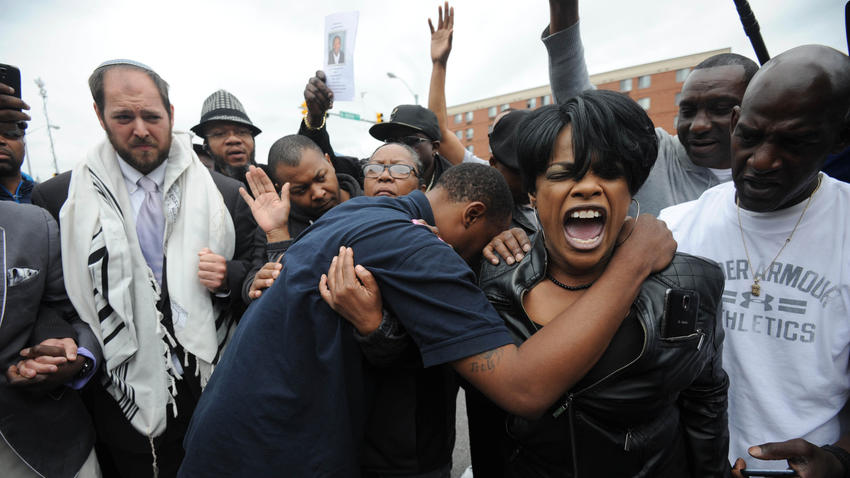
The Rev. Pamela Coleman, right, prays with Baltimore residents at the corner of West North Avenue and Pennsylvania Avenue after charges were announced against six Baltimore police officers in the death of Freddie Gray. (Kim Hairston, Baltimore Sun)
Widespread outrage over the death of Freddie Gray gave way to impromptu celebrations Friday after Baltimore's chief prosecutor filed criminal charges against the six police officers who arrested him, drove him to a police station and ignored his pleas for medical help.
State's Attorney Marilyn J. Mosby charged the driver of the van with second-degree murder and the other officers with offenses that included involuntary manslaughter, vehicular manslaughter, second-degree assault, false imprisonment and misconduct in office. The officers were taken into custody Friday and released on bail.
"These charges are an important step in getting justice for Freddie," said Richard Shipley, stepfather of the 25-year-old Gray, who died April 19, one week after he was injured in police custody.
Mosby's conclusion that Gray had been illegally arrested and suffered a spinal injury while unrestrained in a police transport wagon led to joyous outbursts in many parts of a city that has been under heavy police and National Guard watch and a 10 p.m. curfew following Monday's rioting.
After weeks of tension and occasional violence, it felt as if many exhaled in relief Friday. Gray had become the focus of massive demonstrations, here and in other cities, as the latest in a string of African-American men who died during confrontations with police.
The case stood in stark contrast to others across the nation in which police officers were cleared of wrongdoing in the deaths of black men. Grand juries declined to indict the officer who put a chokehold on Eric Garner in Staten Island, N.Y., or the officer who fatally shot Michael Brown in Ferguson, Mo.
Baltimore's police union president, Gene Ryan, said none of the officers charged are responsible for Gray's death. Michael E. Davey, an attorney who works with the union and is representing one of the officers, decried what he called an "egregious rush to judgment."
Meanwhile, Gray's family continued to implore protesters, who are expected to march Saturday in a previously scheduled rally, to remain peaceful.
"Whoever comes to our city — a city that we love, a city that we live in — come in peace. If you are not coming in peace, please don't come at all," said Shipley, accompanied at a news conference by Gray's mother, Gloria Darden; his father, Freddie Gray Sr.; and twin sister, Fredericka.
"This city needs to get back to work. The last thing that Freddie would want is to see the hardworking people of Baltimore lose their jobs and businesses because of this."
City officials had warned residents not to expect the conclusion of a police investigation Thursday to immediately lead to an announcement on whether officers would be charged. They feared that dashed hopes could lead to more violence.
But on the steps of the War Memorial Building on Friday, Mosby said the police findings were not new to her and that she had been working on her own investigation.
Her conclusion: "The manner of death deemed a homicide by the State Medical Examiner is believed to be the result of a fatal injury that occurred while Mr. Gray was unrestrained by a seatbelt in the custody of the Baltimore Police Department wagon."
Baltimoreans watched Mosby's announcement live on TV. In neighborhoods previously filled with chanting demonstrators, cheers rang out and car horns honked.
On East Lorraine Avenue in Harwood, where Freddie Gray lived with his mother and sisters, someone played a radio airing a continuous loop of Mosby reading the charges.
At Gilmor Homes, where Gray spent his last moments of freedom, young men remembered "a friend we ain't never going to be able to replace," as lifelong friend Rontee Jenkins, 26, put it.
Yet the tears shed by Jenkins, who helped carry Gray's casket at his funeral on Monday, were of joy.
"I want my friend not to go in vain," he said.
Mayor Stephanie Rawlings-Blake ordered the officers suspended without pay.
"To those of you who want to engage in brutality, misconduct, racism and corruption, let me be clear: There is no place for you in the Baltimore City Police Department," she said in a brief appearance at City Hall.
President Barack Obama said, "It is absolutely vital that the truth comes out on what happened to Freddie Gray.
"It is my practice not to comment on the legal processes involved. That would not be appropriate.
"But I can tell you that justice needs to be served. All the evidence needs to be presented," he said. "What I think the people of Baltimore want more than anything else is the truth. ... That's what people around the country expect."
Under gray skies, Mosby read a probable-cause statement, the basis for arresting the officers, in an even voice as traffic occasionally rumbled past on Fayette Street. Although the outlines of Gray's arrest and transport were widely known, her recitation of a fuller narrative proved riveting.
Two of her repeated themes: that the handcuffed and leg-shackled Gray was never secured by a seatbelt in the police wagon against police policy, and that officers ignored repeated appeals for medical help from Gray.
Officer Caesar R. Goodson Jr., the driver of the van, was charged with second-degree murder, three counts of manslaughter and assault. Lt. Brian W. Rice was charged with manslaughter, assault and false imprisonment. Sgt. Alicia D. White and Officer William G. Porter were charged with manslaughter and assault. Officers Garrett E. Miller and Edward M. Nero were charged with assault and false imprisonment. All were charged with misconduct in office.
The arrest on the morning of April 12 began when Rice made eye contact with Gray near the corner of North Avenue and Mount Street. Gray ran, and Rice, along with Miller and Nero chased him.
Gray surrendered in the 1700 block of Presbury St., where Mosby said "he was placed in a prone position, with his hands handcuffed behind his back." It was there that Gray first asked for and was denied medical care, she said.
"It was at this time that Mr. Gray indicated that he could not breathe and requested an inhaler to no avail," she said.
Officers discovered he had a knife with its blade folded into the handle, she said. It wasn't a switchblade but a legal implement.
Having failed to establish probable cause, Mosby said the officers' arrest of Gray was illegal.
And then began the van ride, which stopped four times for various reasons, as the unrestrained Gray injured his neck and his condition deteriorated.
Goodson, who was driving the van, made his first stop on Baker Street, where Gray was removed by the three officers who had arrested him, Mosby said. They put flex cuffs on his wrists, leg shackles on his ankles and "completed required paperwork," Mosby said. Then they put Gray back into the wagon, on his stomach on the floor.
It was during the next segment of the drive that Gray was injured, Mosby said. She did not say whether the driver took him on a so-called "rough ride," in which officers intentionally drive erratically, causing shackled passengers to bounce helplessly against the walls of the van.
The driver, Goodson, made a second stop near Mosher Street and Fremont Avenue, where Mosby said he parked and walked to the back of the wagon to check on Gray. But "at no point did he seek nor did he render any medical assistance for Mr. Gray," she said, and he resumed his course toward Central Booking.
Several blocks later, Goodson called dispatch, saying that "he needed to check" on Gray and requested additional units to meet him at Dolphin Street and Druid Hill Avenue, Mosby said. There, he and the responding officer, Porter, checked on Gray, she said.
"Mr. Gray at that time requested help and indicated that he could not breathe," Mosby said. "Officer Porter asked Mr. Gray if he needed a medic, at which time Mr. Gray indicated at least twice that he was in need of a medic."
Porter helped Gray onto a bench, but she said neither officer put a seatbelt on him or called for medical help. Rather, Mosby said, the officers heard a request for units to help with an arrest on West North Avenue, and Porter responded, followed by Goodson driving the van with Gray still in it.
On North Avenue, the fourth stop, Goodson was met by the other officers as well as White, who was investigating two citizen complaints about Gray's arrest, Mosby said.
The officers "found Gray unresponsive on the floor of the wagon," she said.
"Sgt. White … spoke to the back of Mr. Gray's head," Mosby said. "When he did not respond, she did nothing further despite the fact that she was advised that he needed a medic.
"She made no effort to look or assess or determine his condition," Mosby said. "Despite Mr. Gray's seriously deteriorating medical condition, no medical assistance was rendered or summoned for Mr. Gray at that time by any officer."
The officers put the new suspect in the opposite side of the wagon, and Goodson drove to the Western District police station, she said. They took that suspect in before dealing with Gray, who by then was not breathing.
"A medic was finally called to the scene, where upon arrival the medic determined that Mr. Gray was in cardiac arrest and was critically and severely injured," Mosby said.
He was rushed to University of Maryland Shock Trauma where he underwent surgery, but died a week later.
On Friday, the six officers were processed at the Central Booking and Intake Center, where Gray was initially headed after his arrest.
At a news conference at the Reginald F. Lewis Museum, which is devoted to African-American history, Gray's family made a brief appearance and their lawyer asked that they be allowed to continue grieving privately.
"Freddie was taken too early and too horrifically," said lawyer William H. "Billy" Murphy Jr., who represents the Gray family.
Mosby, who says her family boasts five generations of law enforcement officers, insisted that "the charges are not an indictment of the entire police force."
Union officials asked that Mosby appoint an independent prosecutor. They said her ties to Murphy, a campaign contributor and member of her transition team, and her marriage to Nick Mosby, the city councilman who represents the area where Gray was arrested, constituted a conflict of interest.
Baltimore Sun reporters Pamela Wood, Colin Campbell, Carrie Wells, Michael Dresser, Jessica Anderson, Kevin Rector, Julie Scharper and Scott Dance contributed to this article.
Exclusive, behind-the-scenes look at the Baltimore police investigation into the death of Freddie Gray
By Justin George
In a fourth-floor conference room at Baltimore police headquarters, two training officers in blue T-shirts and blue pants lowered themselves onto the carpeted floor to demonstrate the leg hold officers used to restrain Freddie Gray the day he was arrested — and sustained a fatal spine injury.
As one officer played Gray's role, lying face down on the floor, the other bent his crossed legs back toward his head. Watching closely were members of the police task force investigating Gray's death, and Dr. David L. Higgins, a Maryland orthopedic surgeon who has worked with the U.S. Olympic team.
Higgins had already reviewed cellphone video showing the 25-year-old's arrest in West Baltimore, including scenes with him yelling in pain or protest as officers dragged him to a transport van. Now, Higgins was asked what injuries a person could suffer in such a leg hold.
"From that maneuver, even if you slammed him or dropped him like a wrestling move, you still won't have a neurological injury," said Higgins, continuing to explain in more detail.
"OK," said Maj. Stanley Brandford, the Homicide Unit commander who led the task force. He marked another task complete. Another question about Gray was answered.
The scene on Thursday was part of a high-stakes police investigation — and came as Baltimore was reeling from protests that brought thousands of marchers, and some violence, to city streets. International attention was focused on the city, and many residents were protesting alleged police brutality and calling for criminal charges.
The Baltimore Sun was granted exclusive access to the task force and monitored the investigation for days. The Sun agreed not to publish details about the investigation until Baltimore State's Attorney Marilyn J. Mosby decided whether to prosecute any of the officers involved in the Gray incident, though reporters continued to use other sources for information. On Friday, she announced charges against six officers.
Mosby's announcement came just a day after police provided her with a lengthy report on their probe, but prosecutors had conferred with police from time to time, and Mosby said she also used an independent team of investigators. Her announcement Friday took members of the police task force by surprise.
Officers assigned to the task force had been working for two weeks to complete an investigation that might otherwise have taken months. They canvassed West Baltimore for witnesses and mapped out the locations of security camera footage. To recreate Gray's 45-minute ride in a police van, plainclothes officers rolled a $250,000 laser imaging system on a tripod down potholed roads and cracked sidewalks, ready to tell residents who questioned them that they were city surveyors.
At least 30 members of the Police Department were pulled onto the task force, including staff from the crime lab, Force Investigation Team, Internal Affairs, Homicide, and automobile CRASH team. Each brought with them an expertise to help answer the questions a volatile city desperately needed: how Gray sustained the severed spine and other injuries that led to his death on April 19, a week after his arrest.
They all realized the importance of their investigation and that they were part of a pivotal moment in Baltimore history. There were no days off.
"As I've said before," Col. Garnell Green told the task force Thursday morning. "What happens ... rests on our shoulders."
145 tasks
The investigation was run out of Green's conference room in the Administrative Bureau. Members of the task force met there two, sometimes three times a day, gathering around two large tables that had been pushed together. They employed a checklist to keep track of their investigation, and the list grew daily until it had 145 tasks — many completed, some still open — on Thursday.
On one wall was a timeline that plotted Gray's arrest and all of the police van's stops. Each point on the timeline was outfitted with pictures of Gray, the officers who interacted with him at that location, time stamps and blurry screen shots taken from surveillance video. On another wall, autopsy photos of Gray stared back near a color-coded map listing all the private and public surveillance cameras along the van's route. In the back was a table with Gatorade and water bottles.
The task force worked while being unable to question the six officers, beyond initial statements the officers had provided. Detectives were told to reconstruct the officers' actions not only for April 12 but several days and even years earlier, using internal records and "run sheets," which log officers' daily actions.
While each task force member focused on a specific task — interviewing witnesses, serving search warrants, updating a "living" timeline of events — top-level commanders looked at the big picture with the Police Department's credibility in mind. They knew the investigation would be picked apart by many people in Baltimore, including the thousands of protesters outside their door. Amid the allegations of brutality, they wanted to show that they would leave no stone unturned. They wanted an answer for any question prosecutors, attorneys and the public might ask.
They focused on the task of gathering information, and showed no sign of discomfort while investigating colleagues on the police force — knowing that the decision to bring criminal charges would rest with Mosby and not them. Over and over, they said they "would follow wherever the evidence leads."
Investigators tried to determine what had happened during the foot and bicycle chase that preceded the takedown of Gray. Did he fall? Had Gray been in a fight prior to the arrest? Was the Internet rumor about an insurance settlement for a car accident true (it was not). When was he sitting and when was he "prone," without a seat belt, in the van?
Task force members continued to investigate all possibilities even though they felt confident that Gray had suffered a "catastrophic injury" while being taken from the arrest at Gilmor Homes to the Western District police station. They discovered that the van's video camera was broken and that one of the officers during the transport said Gray had "jailitis" — a faked illness — when he complained about his condition.
And they spent many hours retracing the actions of Officer Caesar R. Goodson, Jr., the wagon driver. Goodson, the investigators said, had heard Gray ask for medical help a number of times — a key factor in the charges Mosby would bring against him. Still, there were gaps along the route where no video or witness statements existed.
The investigators sought to understand why Goodson had made a stop that was discovered in a review of video camera footage. All they could determine was that Goodson looked into the back of the van, but did not touch Gray. But they wondered: Were there other stops?
To find out more about the van route, officers took to the streets.
Last Sunday, at the spot Gray had been arrested, a makeshift memorial included a sign that said "[Expletive] the Police. I would kill all 6 of u bitches." A half block away, crime lab technician Tom Wisner and detectives Michael Boyd and Timothy Hamilton rolled the laser imaging device along a wheeled yellow tripod. They wore T-shirts and cargo pants to keep a low profile and avoid long conversations or, worse, a confrontation in a neighborhood where residents' anger was still raw from violent protests the previous night.
"Google-team rollout," Boyd said — a joking reference to Google's mapping process — after the trio finished a section of streets.
They had nearly 70 scans to do, each taking a circular image as far as 850 feet away, and a tight time frame to complete them.
On the clear sunny day, they went about their work without any interference. One man walked by with a rose in a pint bottle that his girlfriend had given him. A man in a car slowed to a near stop, but then moved on. No one really asked what they were doing.
The "Google team" scanned streets and avenues: Presbury, Cumberland, Calhoun, Gilmor, Dolphin and Druid Hill.
Wisner, who is not a sworn officer, was tasked with creating detailed multi-dimensional maps that would show the route and terrain. His job was to painstakingly stitch the maps together until the van's path was recreated — a process that was only partially completed by the time Mosby announced the charges.
Taken by surprise
Late last week, Brandford, the homicide commander, said he felt "confident" about where his investigation was pointing, but he never locked onto an explanation for Gray's spine injury. He left open the possibility that Gray was beaten or handled too roughly.
"We're still going strong as far as this task force is concerned. We have to fight fatigue," he told his team. "I feel confident we have a solid case here but we still have things to do."
On Friday, more remained. The task force was planning to go full-bore straight through the weekend, feeding supplemental reports to Mosby's office, and the investigation was to remain active indefinitely, according to Brandford.
"Important that the state's attorney continue to get things as we collect them," Brandford told his tired members Friday morning.
Then his cellphone rang. He stepped into the hall and didn't return.
Minutes later, task force members found out why: Mosby was holding a news conference on the steps of the nearby Baltimore War Memorial. From a flat-screen television in Green's office, they watched a live broadcast.
They stood motionless as Mosby began speaking. A lieutenant wearing a suit and bow tie rested his left hand on a leather chair; Green stood in uniform against the wall, hands behind his back. As Mosby read off the charges — including second-degree depraved-heart murder, the most serious, against Goodson — stunned looks crossed their faces.
They had not expected the state's attorney's office to act so soon.
Later on Friday, Mosby said the charges were the result of prosecutors working 12- and 14-hour days alongside police investigators. She also said prosecutors had been working on a "parallel investigation" that included using city sheriff's deputies.
"This was not something that was quick, fast and in a hurry," she said. "We reviewed hundreds of hours of camera footage and statements. This is something we worked really hard to get to the bottom of."
Still, plenty of items remained on the police task force's checklist. Members soon were back to their investigation.
To the Judges,
The April death of a West Baltimore man in police custody quickly spiraled into a controversy that left some city neighborhoods in flames, and brought attention from national and international media. Within days, the name Freddie Gray became associated with the broader debate over the way police across the nation treated African-Americans.
Over two weeks, The Baltimore Sun provided up-to-the-minute coverage of these breaking news events – from protests and rioting to results of a police investigation and the state’s attorney’s surprise announcement of charges against six officers.
Meanwhile, an investigative team examined allegations of police brutality in Baltimore, continuing coverage that began in 2014, months before Gray died. Days after his death, The Sun revealed that Gray was not the first person to be seriously injured in a Baltimore police transport van. Reporters also quickly studied Gray’s background and learned from court documents that he and his siblings suffered from lead poisoning as children. That provided more information about Gray’s early life and the poor West Baltimore neighborhood where he grew up. And police reporter Justin George embedded with the city's task force investigating Gray's death.
The Sun set the tone for its multimedia coverage when reporters and videographers took to the streets to recreate the route of the van that carried Gray and search for witnesses. That effort yielded, in less than a week, a fully interactive account: “The 45-minute Mystery of Freddie Gray’s Death.” That was the first of many Sun exclusives to be cited by CNN, The New York Times, The Washington Post, NPR and other media outlets.
Later, as rioting and looting broke out across the city, The Sun used Twitter feeds, other social media platforms and its web and mobile sites to provide comprehensive coverage. During the chaos, 235 people were arrested, 20 police officers were injured, 400 businesses were damaged, 144 vehicles and 15 buildings were set on fire and property damage reached an estimated $13 million.
The Sun provided comprehensive coverage of the unfolding events including developments leading up to April 27, the worst day and night of the riots. What started as peaceful protests a few days before eventually turned destructive downtown on a Saturday night as the Orioles finished up a game and fans were held by police inside the stadium until the unrest settled.
Tensions throughout the city remained high during the cleanup Sunday and Gray’s funeral Monday.
The situation changed dramatically Monday afternoon. At 2:23 p.m., Sun reporter Erica L. Green tweeted that downtown businesses were closing early due to concerns about a possible high-school student “purge” – a reference to a movie where crime is made legal. Green and other Sun reporters aggressively followed the news, heading to areas around the city and immediately posting updates to Twitter that fed into our live blog. Reporters Colin Campbell and Justin Fenton, meanwhile, were dispatched to nearby areas on the west side and provided photos, video and live reporting from the scene as police clashed with school-age children and adults.
Throughout the rest of the night, as the National Guard was deployed and a citywide curfew announced, The Sun sought to provide comprehensive coverage across platforms that was fair, balanced and accurate. We created an interactive map so users could share their experiences during the unrest and see The Sun’s reporting that detailed where various looting, fires and other disturbances were recorded.
Reporters from throughout the newsroom contributed to the mainbar and other articles on our website, and about 60 journalists overall added in some way to our ongoing coverage during the next week. A few of our journalists were hit by rocks, maced or pushed around by looters. The Sun’s coverage emerged as the go-to destination for live coverage/breaking news, in-depth/explanatory reporting, commentary, visuals and information on the affected communities.
We continued to update the live blog through May 3, two days after charges were announced against the six officers who arrested Gray. It received more than 1.3 million total page views, with readers spending an average of 17 minutes per visit. The live blog ended up with 97 pages of updates during those 10 days. As a public service to the community, The Sun turned off its digital subscription meter and left the website and apps open. The result: Coverage of the worst night of rioting and the following day generated more than 20 million page views and 3.6 million unique visitors -- about 10 times higher than average.
For its nonstop coverage of the death of Freddie Gray, the weeks of protests that followed, several days of unrest and rioting, and the subsequent charges announced against police officers, we proudly nominate The Baltimore Sun for the Pulitzer Prize for breaking news reporting.
Sincerely,
Trif Alatzas
Executive Editor