Finalist: Staff of The New York Times
Nominated Work
Hours after the United States voted, the president declared the election a fraud — a lie that unleashed a movement that would shatter democratic norms and upend the peaceful transfer of power.
By Jim Rutenberg, Jo Becker, Eric Lipton, Maggie Haberman, Jonathan Martin, Matthew Rosenberg and Michael S. Schmidt
By Thursday the 12th of November, President Donald J. Trump’s election lawyers were concluding that the reality he faced was the inverse of the narrative he was promoting in his comments and on Twitter. There was no substantial evidence of election fraud, and there were nowhere near enough “irregularities” to reverse the outcome in the courts.
Mr. Trump did not, could not, win the election, not by “a lot” or even a little. His presidency would soon be over.
Allegations of Democratic malfeasance had disintegrated in embarrassing fashion. A supposed suitcase of illegal ballots in Detroit proved to be a box of camera equipment. “Dead voters” were turning up alive in television and newspaper interviews.
The week was coming to a particularly demoralizing close: In Arizona, the Trump lawyers were preparing to withdraw their main lawsuit as the state tally showed Joseph R. Biden Jr. leading by more than 10,000 votes, against the 191 ballots they had identified for challenge.
As he met with colleagues to discuss strategy, the president’s deputy campaign manager, Justin Clark, was urgently summoned to the Oval Office. Mr. Trump’s personal lawyer, Rudolph W. Giuliani, was on speaker phone, pressing the president to file a federal suit in Georgia and sharing a conspiracy theory gaining traction in conservative media — that Dominion Systems voting machines had transformed thousands of Trump votes into Biden votes.
Mr. Clark warned that the suit Mr. Giuliani had in mind would be dismissed on procedural grounds. And a state audit was barreling toward a conclusion that the Dominion machines had operated without interference or foul play.
Mr. Giuliani called Mr. Clark a liar, according to people with direct knowledge of the exchange. Mr. Clark called Mr. Giuliani something much worse. And with that, the election-law experts were sidelined in favor of the former New York City mayor, the man who once again was telling the president what he wanted to hear.
Thursday the 12th was the day Mr. Trump’s flimsy, long-shot legal effort to reverse his loss turned into something else entirely — an extralegal campaign to subvert the election, rooted in a lie so convincing to some of his most devoted followers that it made the deadly Jan. 6 assault on the Capitol almost inevitable.
Weeks later, Mr. Trump is the former President Trump. In coming days, a presidential transition like no other will be dissected when he stands trial in the Senate on an impeachment charge of “incitement of insurrection.” Yet his lie of an election stolen by corrupt and evil forces lives on in a divided America.
A New York Times examination of the 77 democracy-bending days between election and inauguration shows how, with conspiratorial belief rife in a country ravaged by pandemic, a lie that Mr. Trump had been grooming for years finally overwhelmed the Republican Party and, as brake after brake fell away, was propelled forward by new and more radical lawyers, political organizers, financiers and the surround-sound right-wing media.
In the aftermath of that broken afternoon at the Capitol, a picture has emerged of entropic forces coming together on Trump’s behalf in an ad hoc, yet calamitous, crash of rage and denial.
But interviews with central players, and documents including previously unreported emails, videos and social media posts scattered across the web, tell a more encompassing story of a more coordinated campaign.
Across those 77 days, the forces of disorder were summoned and directed by the departing president, who wielded the power derived from his near-infallible status among the party faithful in one final norm-defying act of a reality-denying presidency.
Throughout, he was enabled by influential Republicans motivated by ambition, fear or a misplaced belief that he would not go too far.
In the Senate, he got early room to maneuver from the majority leader, Mitch McConnell. As he sought the president’s help in Georgia runoffs that could cost him his own grip on power, Mr. McConnell heeded misplaced assurances from White House aides like Jared Kushner that Mr. Trump would eventually accede to reality, people close to the senator told The Times. Mr. McConnell’s later recognition of Mr. Biden’s victory would not be enough to dissuade 14 Republican senators from joining the president’s last-ditch bid to nullify millions of Americans’ votes.
Likewise, during the campaign, Attorney General William P. Barr had echoed some of Mr. Trump’s complaints of voter fraud. But privately the president was chafing at Mr. Barr’s resistance to his more authoritarian impulses — including his idea to end birthright citizenship in a legally dubious pre-election executive order. And when Mr. Barr informed Mr. Trump in a tense Oval Office session that the Justice Department’s fraud investigations had run dry, the president dismissed the department as derelict before finding other officials there who would view things his way.
For every lawyer on Mr. Trump’s team who quietly pulled back, there was one ready to push forward with propagandistic suits that skated the lines of legal ethics and reason. That included not only Mr. Giuliani and lawyers like Sidney Powell and Lin Wood, but also the vast majority of Republican attorneys general, whose dead-on-arrival Supreme Court lawsuit seeking to discount 20 million votes was secretly drafted by lawyers close to the White House, The Times found.
As traditional Republican donors withdrew, a new class of Trump-era benefactors rose to finance data analysts and sleuths to come up with fodder for the stolen-election narrative. Their ranks included the founder of MyPillow, Mike Lindell, and the former Overstock.com chief executive Patrick Byrne, who warned of “fake ballots” and voting-machine manipulation from China on One America News Network and Newsmax, which were finding ratings in their willingness to go further than Fox in embracing the fiction that Mr. Trump had won.
As Mr. Trump’s official election campaign wound down, a new, highly organized campaign stepped into the breach to turn his demagogic fury into a movement of its own, reminding key lawmakers at key times of the cost of denying the will of the president and his followers. Called Women for America First, it had ties to Mr. Trump and former White House aides then seeking presidential pardons, among them Stephen K. Bannon and Michael T. Flynn.
As it crossed the country spreading the new gospel of a stolen election in Trump-red buses, the group helped build an acutely Trumpian coalition that included sitting and incoming members of Congress, rank-and-file voters and the “de-platformed” extremists and conspiracy theorists promoted on its home page — including the white nationalist Jared Taylor, prominent QAnon proponents and the Proud Boys leader Enrique Tarrio.
With each passing day the lie grew, finally managing to do what the political process and the courts would not: upend the peaceful transfer of power that for 224 years had been the bedrock of American democracy.
‘A Fraud on the American Public’
In the days before Nov. 3, polls strongly indicated that election night would show Mr. Trump in the lead, as his voters were less concerned about the coronavirus and more likely to vote in person. Those tallies would register first on the network television scoreboards.
But the polls also indicated that the president’s apparent lead would diminish or disappear overnight, as more mail-in ballots, favored by Biden voters, were added to the official counts.
As Election Day approached, Mr. Trump and those closest to him believed that his lead would be insurmountable, their views swayed by the assurances of pro-Trump pundits and the unscientific measure of the size and excitement of the president’s rally crowds. Yet for months he had also been preparing an argument to dispute a possible loss: that it could only be due to a vast conspiracy of fraud. (A spokesman for the former president declined to comment for this article.)
Flying home on Air Force One from the final campaign event in Grand Rapids, Mich., in the early hours of Nov. 3., Mr. Trump’s son Eric proposed an Electoral College betting pool.
He wagered that the president would win at least 320 electoral votes, according to a person present for the exchange. “We’re just trying to get to 270,” an adviser more grounded in polling and analytics replied.
The polls, in fact, had it right.
Gathered in the East Room of the White House on election night, Mr. Trump and his entourage fell into enraged disbelief as his lead inexorably dissipated, even in formerly red states like Arizona, which Fox called for Mr. Biden at 11:20 in what the president took as a stinging betrayal. Eric Trump goaded him on — a dynamic that would play out in the weeks to come. There would be no early victory speech that evening.
Instead, in a brief televised address shortly before 2:30 a.m., Mr. Trump furiously laid down his postelection lie.
“This is a fraud on the American public. This is an embarrassment to our country. We were getting ready to win this election — frankly, we did win this election,” the president declared. “We want all voting to stop. We don’t want them to find any ballots at 4 o’clock in the morning and add them to the list.”
Leading Republicans quickly fell in line.
On Fox, Newt Gingrich, the former House speaker, predicted that Mr. Trump’s supporters would erupt in rage “as they watch Joe Biden’s Democratic Party steal the election in Philadelphia, steal the election in Atlanta, steal the election in Milwaukee.”
On Thursday night, Kevin McCarthy, the House Republican leader, told Laura Ingraham on Fox: “Everyone who’s listening, do not be quiet, do not be silent about this. We cannot allow this to happen before our very eyes.”
Online, the disinformation floodgates opened still further, their messages frequently landing on local and cable news. Facebook, Twitter and Instagram filled with videos alleging that a dog had voted in Santa Cruz, Calif. Fears that thousands of Trump votes would be thrown out in Arizona — because voters had been forced to use felt-tipped Sharpie pens that scanners could not read — rocketed across conservative social media accounts and the QAnon network before informing two lawsuits, one filed by Mr. Trump’s campaign. (The ballots were readable; both suits were dropped.)
But another, more enduring conspiracy theory was gaining momentum, one that would soon be taken up by Mr. Giuliani.
On Oct. 31, an obscure website, The American Report, had published a story saying that a supercomputer called the Hammer, running software called Scorecard, would be used to steal votes from Mr. Trump.
The story’s authors had spent years spreading false claims that the Obama administration had used the Hammer to spy on the 2016 Trump campaign — in their telling, a central part of the deep-state conspiracy that spawned the Russia investigation and Mr. Trump’s first impeachment.
Their reports were sourced to Dennis Montgomery, a onetime national security contractor described by his former lawyer as a “con man,” and were often backed by Thomas McInerney, a retired Air Force lieutenant general whose military résumé could lend credibility to the fantastical tales.
Mr. McInerney was just emerging from conservative media purgatory. Two years earlier, Fox had banned him after he falsely stated that Senator John McCain had shared military secrets while he was a prisoner of war in North Vietnam. But he was finding new exposure through social media and new outlets, like One America News and Mr. Bannon’s podcast and radio show, “War Room: Pandemic,” that had elastic ideas about journalistic standards of verification.
The vote-stealing theory got its first exposure beyond the web the day before the election on Mr. Bannon’s show. Because of the Hammer, Mr. McInerney said, “it’s going to look good for President Trump, but they’re going to change it.” The Democrats, he alleged, were seeking to use the system to install Mr. Biden and bring the country to “a totalitarian state.”
The Hammer and Scorecard story came together with disparate conspiracy theories about Dominion voting systems that had been kicking around on the left and the right, most forcefully on the Twitter feed of a Republican congressman from Arizona, Paul Gosar. In a post on Nov. 6, he called on Arizona’s governor, Doug Ducey, to “investigate the accuracy and reliability of the Dominion ballot software and its impact on our general election.”
The tweet helped set off a social media wildfire, drawing intense interest from accounts that regularly circulate and decode QAnon-related content.
A day later, The Associated Press and the major television networks declared that Mr. Biden would be the 46th president of the United States.
‘The Media Doesn’t Get to Decide’
For decades, leaders of both parties have treated the TV network and Associated Press election calls as definitive, congratulating the president-elect within hours. Despite record reliance on mail voting because of the pandemic, there was nothing especially unusual about the outcome in 2020: Mr. Biden’s margins in key Electoral College states were similar to Mr. Trump’s four years before.
This time, Republican leaders in Congress broke with the norm.
On ABC’s “This Week” on Nov. 8, the senior Republican senator overseeing elections, Roy Blunt of Missouri, declared that the old rules no longer applied. “The media can project, but the media doesn’t get to decide who the winner is,” he said. “There is a canvassing process. That needs to happen.”
The senator who mattered most, whose words would have the greatest bearing on Mr. Trump’s odds-against campaign, was the majority leader, Mr. McConnell of Kentucky.
Mr. McConnell was playing a long game.
The leader and the president had been in regular contact in the days since the election, according to several people with knowledge of their conversations. But the publicly bellicose president rarely confronted Mr. McConnell in one-on-one calls and avoided making any specific demands. He did not threaten retribution should Mr. McConnell follow tradition and congratulate Mr. Biden.
But Mr. McConnell knew that by doing so, he would endanger his own overriding political goal — winning the two runoffs in Georgia and maintaining Republican control of the Senate, which would allow him to keep his power as majority leader. If he provoked Mr. Trump’s anger, he would almost certainly lose the president’s full support in Georgia.
So as Mr. Trump would rant about voter fraud as if he were making an appearance on “Fox & Friends,” Mr. McConnell would try to redirect the discussion to a specific court case or the runoffs, according to party officials familiar with the calls. “They were talking past one another,” one of them said.
The senator was also under a false impression that the president was only blustering, the officials said. Mr. McConnell had had multiple conversations with the White House chief of staff, Mark Meadows, and the senator’s top political adviser, Josh Holmes, had spoken with Mr. Kushner, the president’s son-in-law and senior adviser. Both West Wing officials had conveyed the same message: They would pursue all potential avenues but recognized that they might come up short. Mr. Trump would eventually bow to reality and accept defeat.
The majority leader rendered his verdict on Nov. 9, during remarks at the first postelection Senate session. Even as he celebrated Republican victories in the Senate and the House — which in party talking points somehow escaped the pervasive fraud that cast Mr. Biden’s victory in doubt — Mr. McConnell said, “President Trump is 100 percent within his rights to look into allegations of irregularities and weigh his legal options.” He added, “A few legal inquiries from the president do not exactly spell the end of the republic.”
That left the Senate with only a handful of Republicans willing to acknowledge the president’s loss: established Trump critics like Mitt Romney of Utah and Lisa Murkowski of Alaska.
That night, Senator Lindsey Graham of South Carolina, then the Judiciary Committee chairman, went on Sean Hannity’s program to share an affidavit from a postal worker in Erie, Pa., who said he had overheard supervisors discussing illegally backdating postmarks on ballots that had arrived too late to be counted. He had forwarded it to the Federal Bureau of Investigation.
“They can all go to hell as far as I’m concerned — I’ve had it with these people. Let’s fight back,” Mr. Graham said. “We lose elections because they cheat us.”
Earlier that day, however, the postal worker had recanted his statement in an interview with federal investigators — even though he continued to push his story online afterward. His affidavit, it turned out, had been written with the assistance of the conservative media group Project Veritas, known for its deceptive tactics and ambush videos.
2020 Is Not 2000 All Over Again
The attorney general, Mr. Barr, arrived at the White House on the afternoon of Dec. 1 to find the president in a fury.
For weeks, Mr. Trump had been peppering him with tips of fraud that, upon investigation by federal authorities, proved baseless. That morning, after the president complained to Fox that the Justice Department was “missing in action,” Mr. Barr told The Associated Press that “we have not seen fraud on a scale that could have effected a different outcome.”
But another allegation had just captured the presidential imagination: A truck driver on contract with the Postal Service was claiming that he had delivered many thousands of illegally filled-out ballots to Pennsylvania from a depot on Long Island.
Federal investigators had determined that that one, too, was bunk. Court records showed that the driver had a history of legal problems, had been involuntarily committed to mental institutions several times and had a sideline as a ghost hunter, The York Daily Record reported.
Now, with the White House counsel, Pat A. Cipollone, backing him, Mr. Barr told the president that he could not manufacture evidence and that his department would have no role in challenging states’ results, said a former senior official with knowledge about the meeting, a version of which was first reported by Axios. The allegations about manipulated voting machines were ridiculously false, he added; the lawyers propagating them, led by Mr. Giuliani, were “clowns.”
Mr. Trump paused, thought about it and said, “Maybe.”
But before Mr. Barr left the building, the president tweeted out the truck driver’s account, which quickly gained 154,000 mentions on Twitter, according to an analysis by Zignal Labs. The driver would appear on Newsmax, Mr. Bannon’s “War Room” and “Hannity,” among the most-watched programs on cable.
Days later, that allegation was featured in a lawsuit with an extraordinary request: that the court decertify the Pennsylvania result and strip Mr. Biden of the state’s delegates — a call to potentially disenfranchise nearly seven million voters.
The legal group behind the suit, the Amistad Project, was part of the Thomas More Society, a conservative law firm historically focused on religious liberty issues. It was now working with Mr. Giuliani and had as a special counsel a Trump campaign legal strategist, Jenna Ellis. A judge dismissed the suit as “improper and untimely.”
It was exactly the sort of lawsuit Mr. Trump’s more experienced election lawyers viewed as counterproductive and, several people involved in the effort said in interviews, embarrassing.
In the run-up to the election, the legal team, led by Mr. Clark and Matt Morgan, had modeled its strategy on the disputed election of 2000, when only a few hundred votes separated Al Gore and George W. Bush in Florida. Mr. Bush had benefited from a combination of savvy lawyering and ugly political tactics that included the riotous “Brooks Brothers” protest over specious allegations of Democratic fraud.
Twenty years later, the margins were far too large to be made up by recounts or small-bore court maneuvers.
Even after a recount in the tightest state, Georgia, found some 2,000 lost Trump votes, Mr. Biden led by nearly 12,000. And Mr. Giuliani’s arguments that the Trump campaign could prove Dominion voting machines illegally made the difference were summarily dismissed by Mr. Trump’s other lawyers, who were carefully tracking a recount of the machines’ paper receipts.
“There was a literal physical hand count of every single one of those five million pieces of paper, and they matched almost identically, and we knew that within a week,” said Stefan Passantino, a Trump lawyer who helped oversee the initial strategy in the state. “We are not going to participate in bringing allegations about the sanctity of this machine.” (Dominion has sued Mr. Giuliani and Ms. Powell for defamation.)
But the Trump election lawyers were looking to another lesson from 2000. In a Supreme Court opinion in Bush v. Gore, Chief Justice William H. Rehnquist had argued that Florida court orders dictating recount procedures violated the constitutional clause that gives state legislatures the power to set the terms for selecting electors.
Many of the early Trump campaign suits had adopted that approach. Contradicting the president, the campaign lawyers — and even Mr. Giuliani — had in several cases acknowledged in court that they were not alleging fraud. Rather, they argued that in bending rules to make mail voting easier during the pandemic — extending deadlines, striking requirements for witness signatures — secretaries of state or state courts or election boards had improperly usurped their legislatures’ role.
Yet as the suits failed in court after court across the country, leaving Mr. Trump without credible options to reverse his loss before the Electoral College vote on Dec. 14, Mr. Giuliani and his allies were developing a new legal theory — that in crucial swing states, there was enough fraud, and there were enough inappropriate election-rule changes, to render their entire popular votes invalid.
As a result, the theory went, those states’ Republican-controlled legislatures would be within their constitutional rights to send slates of their choosing to the Electoral College.
If the theory was short on legal or factual merit, it was rich in the sort of sensational claims — the swirl of forged ballots and “deep state” manipulation of voting machines — that would allow Mr. Trump to revive his fight, give his millions of voters hope that he could still prevail and perhaps even foment enough chaos to somehow bring about an undemocratic reversal in his favor.
‘This Is the Big One’
Before Thanksgiving, a team of lawyers with close ties to the Trump campaign began planning a sweeping new lawsuit to carry that argument.
One of them, Kris Kobach, a former Kansas secretary of state, had been a central player in some of the harshest recent moves to restrict voting, leading to frequent pushbacks in court. He had also helped lead Mr. Trump’s “election integrity” commission, created after the president claimed he had lost the 2016 popular vote because of fraud; it had ended with litigation, internal strife and no evidence of fraud.
Another member of the team, Mark Martin, a former North Carolina chief justice, was now a law school dean and informal Trump adviser. A third, Lawrence Joseph, had previously intervened in federal court to support Mr. Trump’s efforts to block the release of his income-tax returns.
According to lawyers involved in the conversations, the group determined that the fast-approaching Electoral College vote did not leave time for a series of lawsuits to work their way through the courts. They would need to go directly to the Supreme Court, where, they believed, the conservative majority would be sympathetic to the president, who had appointed three of its members. The team quickly began working on a draft complaint.
Only one type of lawyer can take a case filed by one state against another directly to the Supreme Court: a state attorney general. The president’s original election lawyers doubted that any attorney general would be willing to do so, according to one member of the team, speaking on the condition of anonymity. But Mr. Kobach and his colleagues were confident. After all, nine attorneys general were on the Trump campaign’s lawyers group, whose recruitment logo featured the president as Uncle Sam, saying: “I want you to join Lawyers for Trump. Help prevent voter fraud on Election Day.”
Yet as the draft circulated among Republican attorneys general, several of their senior staff lawyers raised red flags. How could one state ask the Supreme Court to nullify another’s election results? Didn’t the Republican attorneys general consider themselves devoted federalists, champions of the way the Constitution delegates many powers — including crafting election laws — to each state, not the federal government?
In an interview, Mr. Kobach explained his group’s reasoning: The states that held illegitimate elections (which happened to be won by Mr. Biden) were violating the rights of voters in states that didn’t (which happened to be won by Mr. Trump).
“If one player in a game commits a penalty and no penalty is called by the referee, that is not fair,” he said.
The obvious choice to bring the suit was Ken Paxton of Texas, an ardent proponent of the president’s voter-fraud narrative who had filed a number of lawsuits and legal memos challenging the pandemic-related expansion of mail-in voting. But he was compromised by a criminal investigation into whether he had inappropriately used his office to help a wealthy friend and donor. (He has denied wrongdoing.)
The Trump allies made a particularly intense appeal to Louisiana’s attorney general, Jeffrey M. Landry, a member of Lawyers for Trump and, at the time, the head of the Republican Attorneys General Association.
He declined. Mr. Paxton would be the one. He decided to carry the case forward even after lawyers in his own office argued against it, including his own solicitor general, Kyle D. Hawkins, who refused to let his name be added to any complaint.
On Dec. 7, Mr. Paxton signed an unusual contract to hire Mr. Joseph as a special outside counsel, at no cost to the State of Texas. Mr. Joseph referred questions about his role to the Texas attorney general; Mr. Paxton declined to comment.
The same day the contract was signed, Mr. Paxton filed his complaint with the Supreme Court. Mr. Joseph was listed as a special counsel, but the brief did not disclose that it had been written by outside parties.
The lawsuit was audacious in its scope. It claimed that, without their legislatures’ approval, Georgia, Michigan, Pennsylvania and Wisconsin had made unconstitutional last-minute election-law changes, helping create the conditions for widespread fraud. Citing a litany of convoluted and speculative allegations — including one involving Dominion voting machines — it asked the court to shift the selection of their Electoral College delegates to their legislatures, effectively nullifying 20 million votes.
Condemnation, some of it from conservative legal experts, rained down. The suit made “a mockery of federalism” and “would violate the most fundamental constitutional principles,” read a brief from a group of Republican office holders and former administration officials. Putting a finer point on it, Richard L. Hasen, an election-law scholar at the University of California, Irvine, called it “a heaping pile of a lawsuit.”
One lawyer knowledgeable about the planning, speaking on the condition of anonymity, said: “There was no plausible chance the court will take this up. It was really disgraceful to put this in front of justices of the Supreme Court.”
Even the Republican attorney general of Georgia, Chris Carr, said it was “constitutionally, legally and factually wrong.”
That prompted a call from the president, who warned Mr. Carr not to interfere, an aide to the attorney general confirmed. The pressure campaign was on.
The next day, Dec. 9, Representative Mike Johnson of Louisiana sent an email to his colleagues with the subject line, “Time-sensitive request from President Trump.” The congressman was putting together an amicus brief in support of the Texas suit; Mr. Trump, he wrote, “specifically asked me to contact all Republican Members of the House and Senate today and request that all join.” The president, he noted, was keeping score: “He said he will be anxiously awaiting the final list to review.”
Some 126 Republican House members, including the caucus leader, Mr. McCarthy, signed on to the brief, which was followed by a separate brief from the president himself. “This is the big one. Our Country needs a victory!” Mr. Trump tweeted. Privately, he asked Senator Ted Cruz of Texas to argue the case.
On Fox, Sean Hannity, who spoke regularly with the president, declared that “tonight, every decent Republican attorney general with a brain needs to get busy working on their amicus briefs to support this Texas suit.”
In fact, the Missouri solicitor general, D. John Sauer, was already circulating an email, giving Republican attorneys general less than 24 hours to decide whether to join a multistate brief.
And once again, red flags were going up among the attorneys generals’ staff, emails obtained by The Times show.
“The decision whether we join this amicus is more political than it is legal,” James E. Nicolai, North Dakota’s deputy solicitor general, wrote to his boss.
“I still think it is most likely that the Court will deny this in one sentence,” Mr. Nicolai wrote in a follow-up email, which was also sent to the attorney general, Wayne Stenehjem.
But the brief was gaining momentum, closing in on support from two-thirds of the Republican attorneys general, 18 in all. At the last minute, Mr. Stenehjem decided to become one of them, leading Mr. Nicolai to send another email.
“Wonder what made Wayne decide to sign on?” he wrote.
At Mr. Trump’s urging, the Republican Attorneys General Association made one final play, asking Mr. Barr to back the suit. He refused.
On Dec. 11, the court declined to hear the case, ruling that Texas had no right to challenge other states’ votes.
‘We the People Decide’
If the highest court in the land couldn’t do it, there had to be some other way.
And so they came the next day, by the thousands, to a long-planned rally in Washington, filling Freedom Plaza with red MAGA caps and Trump and QAnon flags, vowing to carry on. The president’s legal campaign to subvert the election might have been unraveling, but their most trusted sources of information were glossing over the cascading losses, portraying as irrefutable the evidence of rampant fraud.
“The justice system has a purpose in our country, but the courts do not decide who the next president of the United States of America will be,” the freshly pardoned former national security adviser, Mr. Flynn, told the crowd. “We the people decide.”
There was encouragement from figures like Marjorie Taylor Greene, the conspiracy theorist just elected to Congress from Georgia, and Senator Marsha Blackburn of Tennessee, beamed in on a giant video screen.
“Hey there, all of you happy warrior freedom fighters,” Ms. Blackburn said. “We’re glad you’re there standing up for the Constitution, for liberty, for justice.”
The rally had been planned by Women for America First, which was quietly becoming the closest thing Mr. Trump had to a political organizing force, gathering his aggrieved supporters behind the lie of a stolen election.
The group’s founder, Amy Kremer, had been one of the original Tea Party organizers, building the movement through cross-country bus tours. She had been among the earliest Trump supporters, forming a group called Women Vote Trump along with Ann Stone, ex-wife of the longtime Trump adviser Roger Stone.
With donors including the Trump-affiliated America First Policies, Women for America First had rallied support for the Supreme Court nomination of Amy Coney Barrett and defended Mr. Trump during his first impeachment.
The group’s executive director was Ms. Kremer’s daughter, Kylie Jane Kremer, who recently worked on Sean Hannity’s radio show. Two organizers helping the effort, Jennifer Lawrence and Dustin Stockton, were close to Mr. Bannon, having worked at Breitbart and then at his nonprofit seeking private financing to help complete Mr. Trump’s border wall. (In August, federal prosecutors accused Mr. Bannon of defrauding the nonprofit’s donors, after an investigation that included a raid of Ms. Lawrence and Mr. Stockton’s motor home; they were not implicated, and Mr. Bannon, who pleaded not guilty, was later pardoned by the president.)
A onetime organizer for the hard-line Gun Owners of America, according to his LinkedIn page, Mr. Stockton had come to know members of the Three Percenters militia group. He had an online newsletter, Tyrant’s Curse, whose credo was, “A well-armed and self-reliant populace, who take personal responsibility and put their faith in God, can never be oppressed and will never be ruled.” One post featured a photo from the Dec. 12 rally — Mr. Stockton posing with several Three Percenter “brothers” in military-grade body armor.
Ms. Lawrence had personal ties to Mr. Trump. Her father was a real estate broker in the Hudson Valley, where Mr. Trump has a golf club and his sons have a hunting ranch. “He’s done business with Mr. Trump for over a decade, so I’ve had the opportunity of meeting the president and interacting with him on a lot of occasions,” she said in an interview. She also knew Mr. Flynn through their mutual association with a conservative think tank, she said.
Within hours of the last poll closings on election night, Women for America First had started organizing, forming one of the first major “Stop the Steal” Facebook groups — shut down within 22 hours for posts that the platform said could lead to violence — and holding the first major rally on the Mall, on Nov. 14. The rally permit predicted 10,000 protesters; the crowd was far larger.
“The letdown of the election was kind of put aside,” Mr. Stockton said in an interview. “It was like, ‘We have a new fight to engage in.’”
For the Kremers, Ms. Lawrence and Mr. Stockton, the instrument of that fight would be a reprise of the Tea Party Express, a bus tour to enlist state and federal lawmakers in Mr. Trump’s effort to keep states from certifying results ahead of the Electoral College vote. Equally important, it would be a megaphone to rally the dejected faithful.
The group tapped new veins of financing, with sponsorships from Mr. Bannon’s “War Room,” which paid $5,000, and Mr. Lindell, who said he believed he gave $50,000. It helped the group lease the bus and paint it MAGA red, with a huge photo of Mr. Trump and the logos of MyPillow, “War Room” and other sponsors emblazoned on the sides.
As they made their way across the country, they reached out to local elected officials and branches of the Republican National Committee. But with the social media platforms starting to block groups promoting the stolen-election theory, Ms. Lawrence explained, the bus tour would also give “people the outlet that if they’d been de-platformed, they were able to come out and be around like-minded people.”
Early on, the “Trump March” website had included promotion for banned extremists and conspiracy theorists like the white supremacist Mr. Taylor, various QAnon “decoders” and the “Western chauvinist” Proud Boys, according to a version saved by the Internet Archive. (The promotion was taken down ahead of the bus tour).
There were early warning signs of the explosion to come.
In Tennessee, a church that was to host a rally canceled after threats of violence. An evangelical pastor, Greg Locke, who had gained national attention for calling Covid-19 a “fake pandemic,” offered them his church and joined the tour as a speaker.
Following a rally in Des Moines, an armed and armored protester shot a Black teenager in the leg after she and some friends drove by taunting the crowd. An Army veteran named Michael McKinney who followed the Proud Boys on his Facebook page, The Des Moines Register reported, was later charged with attempted murder. (He has pleaded not guilty; his lawyer says he was acting in self-defense as the teenagers menaced the crowd with their car.)
The tour was otherwise doing what it was intended to do. Large crowds often turned out, drawn in part by Mr. Lindell. He had emerged as a star of the Trump media universe in part by standing firm as a major sponsor of Tucker Carlson on Fox when other advertisers deserted over, among other things, Mr. Carlson’s remarks that white supremacy was “a hoax.”
In an interview, Mr. Lindell said he had sponsored the bus tour so that he could share the findings of investigations he was financing — he was spending $1 million in all — to produce evidence of voter fraud, including for Ms. Powell’s Dominion lawsuits.
“Donald Trump got so many votes that they didn’t expect, it broke the algorithms in the machines,” he told the crowd in Des Moines. “What they had to do was backfill the votes.” Ms. Powell, he said, had “the proof, 100 percent the proof.”
Mr. Trump was watching and, seeing the tour’s success, even helicoptered above the Dec. 12 rally on Marine One.
But after the 12th, the group found itself in limbo — leading a restive movement without a clear destination.
The Cavalry ‘Is Coming, Mr. President’
The day after the Electoral College certified the votes as expected, Mitch McConnell moved to bring the curtain down. He called the president’s chief of staff, Mr. Meadows, to say that he would be acknowledging Mr. Biden as president-elect that afternoon on the Senate floor.
Mr. McConnell had been holding off in part because of the earlier assurances from Mr. Meadows and Mr. Kushner, and he had been inclined to believe them when Mr. Trump finally freed the General Services Administration to begin the transition. Yet even now, the president was refusing to concede. “This fake election can no longer stand,” he wrote on Twitter. “Get moving Republicans.”
Perhaps most important in Mr. McConnell’s evolving calculus, internal polls were showing that the Republicans’ strongest argument in the Georgia runoffs was that a Republican-led Senate would be a necessary check on a new — and inevitable — Democratic administration.
Mr. McConnell did not call the president until after his speech congratulating Mr. Biden. It was a perfunctory conversation, with the president expressing his displeasure. The men have not spoken since.
At the White House, Mr. Trump was still searching for ways to nullify the results, soliciting advice from allies like Mr. Flynn, Mr. Giuliani and Ms. Powell.
On Dec. 18, he met with Mr. Byrne, Mr. Flynn and Ms. Powell in a four-hour session that started in the Oval Office and ended in the White House residence, where Swedish meatballs were served, Mr. Byrne later recalled.
With a team of “cybersleuths,” Mr. Byrne was working with Mr. Flynn and Ms. Powell to develop and promote theories about Dominion and foreign interference. Earlier, Mr. Flynn had publicly raised the notion that the president should use martial law to force a revote in swing states.
The meeting descended into shouting as a group that included Mr. Cipollone, who had absorbed most of Mr. Trump’s frustrations for weeks as he tried to stop a number of legally questionable ideas, tried to dissuade the president from entertaining a range of options the visitors were proposing. “It was really damned close to fistfights,” Mr. Byrne recalled on the “Operation Freedom” YouTube show.
By then, even Mr. Bannon had turned on the Dominion theory he’d helped push — it was time to present “evidence” or move on, he said on his show a few days later. And ultimately Mr. Trump agreed, at least for the moment, to focus on a different goal: blocking congressional certification of the results on Jan. 6.
Mr. Meadows had connected the president to Mr. Martin, the former North Carolina justice, who had a radical interpretation of the Constitution: Vice President Mike Pence, he argued, had the power to stop the certification and throw out any results he deemed fraudulent.
In fact, under the Constitution and the law, the vice president’s role is strictly ministerial: He “shall” open envelopes from each state, read the vote count and ask if there are objections. Nothing more.
But that process, at the very least, gave Mr. Trump and his congressional allies an opening to stir up trouble — and a cause to energize the base. If one senator and one House member object to a state’s results, the two chambers must convene separately to debate, then reconvene to vote. Rejection of the results requires majority votes in both chambers.
Now, Women for America First had a purpose, too. Objectors were already lining up in the House. So the group planned a new bus tour, this one to travel from state to state helping to sway persuadable senators — 11 by their count.
The cavalry “is coming, Mr. President,” Kylie Kremer tweeted to Mr. Trump on Dec. 19.
This tour took on an edgier tone. Before heading out, the Kremers, Ms. Lawrence and Mr. Stockton visited the Tactical Response marksman training center in Nashville. Its owner, James Yeager, had had his gun permit suspended in 2013 after posting a video in which he threatened to “start killing people” if the Obama administration banned assault rifles.
At the training center, Kylie Kremer and Ms. Lawrence taped an episode of Mr. Yeager’s “Tactical Response” YouTube show, promoting their tour. They also documented the afternoon with a campy Facebook video of themselves cradling assault weapons and flanking Mr. Stockton, who narrated.
“See, in America, we love our Second Amendment like we love our women: strong. Isn’t that right, girls?”
Ms. Lawrence whooped. “That’s right,” she replied. “Second Amendment, baby.”
By the time the bus pulled into West Monroe, La., for a New Year’s Day stop to urge Senator John Kennedy to object to certification, Mr. Trump was making it clear to his followers that a rally at the Ellipse in Washington on Jan. 6 was part of his plan. On Twitter, he promoted the event five times that day alone.
The emcee of the Louisiana stop, the Tea Party activist James Lyle, announced that the next day’s event in Missouri was now going to be a thank-you — Senator Josh Hawley had just become the first senator to announce that he would object. “You’ve got to thank them when they do the right thing,” Mr. Lyle said.
But talk at the rally was tilting toward what to do if they didn’t.
“We need our president to be confirmed through the states on the 6th,” said Couy Griffin, the founder of Cowboys for Trump. “And right after that, we’re going to have to declare martial law.”
The next day, Mr. Kennedy announced that he would sign on, too.
‘Standing at the Precipice of History’
On Saturday, Jan. 2, Kylie Kremer posted a promotional video for Wednesday’s rally on Twitter, along with a message: “BE A PART OF HISTORY.”
The president shared her post and wrote: “I’ll be there! Historic day.”
Though Ms. Kremer held the permit, the rally would now effectively become a White House production. After 12,000 miles of drumbeating through 44 stops in more than 20 states, they would be handing over their movement to the man whose grip on power it had been devised to maintain.
There were new donors, including the Publix supermarket heiress Julie Jenkins Fancelli. She gave $300,000 in an arrangement coordinated through the internet conspiracy theorist Alex Jones, who pledged $50,000 as well, The Wall Street Journal reported.
New planners also joined the team, among them Caroline Wren, a former deputy to Kimberly Guilfoyle, the Trump fund-raiser and partner of Donald Trump Jr. The former Trump campaign adviser Katrina Pierson was the liaison to the White House, a former administration official said. The president discussed the speaking lineup, as well as the music to be played, according to a person with direct knowledge of the conversations.
For Mr. Trump, the rally was to be the percussion line in the symphony of subversion he was composing from the Oval Office.
That Saturday, Mr. Trump had called the Georgia secretary of state, Brad Raffensperger, and pressed him, unsuccessfully, to “find” the 11,780 votes needed to win the state.
Mr. Barr had resigned in December. But behind the back of the acting attorney general, Jeffrey A. Rosen, the president was plotting with the Justice Department’s acting civil division chief, Jeffrey Clark, and a Pennsylvania congressman named Scott Perry to pressure Georgia to invalidate its results, investigate Dominion and bring a new Supreme Court case challenging the entire election. The scheming came to an abrupt halt when Mr. Rosen, who would have been fired under the plan, assured the president that top department officials would resign en masse.
That left the congressional certification as the main event.
Mr. McConnell had been working for weeks to keep his members in line. In a mid-December conference call, he had urged them to hold off and protect the two Republican runoff candidates in Georgia from having to take a difficult stand.
When Mr. Hawley stepped forward, according to Republican senators, Mr. McConnell hoped at least to keep him isolated.
But Mr. Cruz was working at cross-purposes, trying to conscript others to sign a letter laying out his circular logic: Because polling showed that Republicans’ “unprecedented allegations” of fraud had convinced two-thirds of their party that Mr. Biden had stolen the election, it was incumbent on Congress to at least delay certification and order a 10-day audit in the “disputed states.” Mr. Cruz, joined by 10 other objectors, released the letter on the Saturday after New Year’s.
Mr. McConnell knew that Senator Tom Cotton of Arkansas, among the most conservative Republicans, had been planning to come out publicly against the gambit. Now the majority leader called Mr. Cotton, according to a Republican familiar with the conversation, and urged him to do so as soon as possible. Mr. Cotton quickly complied.
It was coming down to a contest of wills within the Republican Party, and tens of thousands of Trump supporters were converging on Washington to send a message to those who might defy the president.
The rally had taken on new branding, the March to Save America, and other groups were joining in, among them the Republican Attorneys General Association. Its policy wing, the Rule of Law Defense Fund, promoted the event in a robocall that said, “We will march to the Capitol building and call on Congress to stop the steal,” according to a recording obtained by the progressive investigative group Documented.
Mr. Stockton said he was surprised to learn on the day of the rally that it would now include a march from the Ellipse to the Capitol. Before the White House became involved, he said, the plan had been to stay at the Ellipse until the counting of state electoral slates was completed.
The president’s involvement also meant that some speakers from the original Women for America First lineup would be dropped from the main event. So, Mr. Stockton said, he arranged to have them speak the night before at a warm-up rally at Freedom Plaza.
That event had been planned by a sister group, the 80 Percent Coalition, founded by Cindy Chafian, a former organizer with Women for America First.
“What we’re doing is unprecedented,” Ms. Chafian said as she kicked off the rally. “We are standing at the precipice of history, and we are ready to take our country back.” Addressing Mr. Trump, she said: “We heard your call. We are here for you.”
One scheduled speaker would not be in Washington that night: the Proud Boys’ leader, Enrique Tarrio. A judge had banished him from the city after his arrest on charges of destruction of property and illegal weapons possession.
Defiantly, to a great roar from the plaza, Ms. Chafian cried, “I stand with the Proud Boys, because I’m tired of the lies,” and she praised other militant nationalist groups in the crowd, including the Oath Keepers and the Three Percenters.
Speakers including Mr. Byrne, Mr. Flynn, Mr. Jones, Mr. Stone and the Tennessee pastor Mr. Locke spoke of Dominion machines switching votes and Biden ballots “falling from the sky,” of “enemies at the gate” and Washington’s troops on the Delaware in 1776, of a fight between “good and evil.”
“Take it back,” the crowd chanted. “Stop the steal.”
As the rally wound down in a cold drizzle, groups of young men wearing Kevlar vests and helmets began appearing toward the back of the plaza. Some carried bats and clubs, others knives. Some were Proud Boys, but more sported the insignia of the Three Percenters.
One of the men, with a line of stitches running through his ear, told a reporter: “We’re not backing down any more. This is our country.” Another, holding a bat, cut the conversation short. “We know what to do with people like you,” he said.
Mr. Trump took the stage at the Ellipse the next day shortly before 1 p.m., calling on the tens of thousands before him to carry his message to Republicans in the Capitol: “You’ll never take back our country with weakness.”
As he spoke, some protesters, with Proud Boys helping take the lead, were already breaching the outer security perimeter around the Capitol. Inside, when Mr. Gosar stood to raise the first objection, to results in his home state of Arizona, several Republican lawmakers gave him a standing ovation.
Less than an hour later, the lawmakers would flee to a secure location as the mob streamed into the building.
By that point, with “all hell breaking loose,” as Mr. Stockton put it, he and Ms. Lawrence decided to take golf carts back to their room at the Willard Hotel and, “await instructions about whether to go back to the Ellipse.”
Women for America First put out a statement. “We are saddened and disappointed at the violence that erupted on Capitol Hill, instigated by a handful of bad actors, that transpired after the rally,” it read. (The Kremers did not provide comment for this article.)
At least one of those actors had been part of their tour — Mr. Griffin, the Cowboys for Trump founder, who was later arrested and charged with knowingly entering a restricted building. The federal charging documents cited a Facebook post in which he vowed to return and leave “blood running out of that building.” Others arrested included members of the Proud Boys and the Three Percenters.
On Jan. 15, Mr. Trump acquiesced to an Oval Office meeting with Mr. Lindell, who arrived with two sets of documents. One, provided by a lawyer he would not name, included a series of steps Mr. Trump could take, including “martial law if necessary.” The other, Mr. Lindell claimed in an interview the next day, was computer code indicating that China and other state actors had altered the election results — vetted by his own investigators after he found it online.
“I said: ‘Mr. President, I have great news. You won with 79 million votes, and Biden had 68 million,’” he recalled. (Mr. Biden had more than 80 million votes, to Mr. Trump’s 74 million; Homeland Security officials have rejected the allegations of foreign meddling.)
A couple of minutes later, Mr. Trump directed his national security adviser, Robert O’Brien, to escort Mr. Lindell upstairs, to Mr. Cipollone’s office. He told the MyPillow founder to come back afterward.
After a perfunctory discussion, aides directed Mr. Lindell to the exit. “I say it loud, ‘I’m not leaving,’” he recalled telling them. He eventually left when an aide made it clear there would be no Oval Office follow-up. The president was done.
The violence at the Capitol, and Congress’s eventual certification of Mr. Biden’s victory that day, may have spelled the end of Mr. Trump’s postelection campaign. The same cannot be said about the political staying power, the grip on the Republican faithful, of the lie he set in motion.
In the Senate, Mr. McConnell, who lost his majority leader’s gavel with dual defeats in Georgia, initially indicated that he might vote against Mr. Trump in an impeachment trial. But amid rising fury in the Republican ranks, he ultimately voted with most of his colleagues in an unsuccessful attempt to cancel the trial altogether. With only five defectors, though, any thought of a conviction seemed dead on arrival.
In the House, moves were afoot to recruit primary challengers to the 10 Republicans who had voted for impeachment.
It was all as Ms. Lawrence had predicted. “The MAGA movement is more than just Donald Trump,” she said in an interview. “This is not going to go away when he leaves office.”
Mr. Lindell now says he has spent $2 million and counting on his continuing investigations of voting machines and foreign interference.
And Mr. Stockton recently announced a new plan on his Facebook page: a “MAGA Sellout Tour.”
“What we do now is we take note of the people who betrayed President Trump in Congress and we get them out of Congress,” he said. “We’re going to make the Tea Party look tiny in comparison.”
Mark Walker contributed reporting.
Correction:
Jan. 31, 2021
An earlier version of this article misstated the state where D. John Sauer is solicitor general. It is Missouri, not Mississippi.
Correction:
Feb. 12, 2021
An earlier version of this article misidentified a man charged in the shooting of a Black teenager in Des Moines. His name is Michael McKinney, not William McKinney.
By Dmitriy Khavin, Haley Willis, Evan Hill, Natalie Reneau, Drew Jordan, Cora Engelbrecht, Christiaan Triebert, Stella Cooper, Malachy Browne and David Botti
A six-month Times investigation has synchronized and mapped out thousands of videos and police radio communications from the Jan. 6 Capitol riot, providing the most complete picture to date of what happened — and why.
By Dan Barry, Alan Feuer and Matthew Rosenberg
The American flag became a blunt instrument in the bearded man’s hands. Wielding the flagpole like an ax, he swung once, twice, three times, to beat a police officer being dragged down the steps of a United States Capitol under siege.
Other officers also fell under mob attack, while the rest fought to keep the hordes from storming the Capitol and upending the routine transfer of power. Sprayed chemicals choked the air, projectiles flew overhead and the unbridled roars formed a battle-cry din — all as a woman lay dying beneath the jostling scrum of the Jan. 6 riot.
Amid the hand-to-hand combat, seven men from seven different states stood out. Although strangers to one another, they worked as if in concert while grappling with the phalanx of police officers barring entry to the Capitol.
The moment was a flicker in the chaotic panorama, a 90-second flash of unhinged violence overshadowed by the high drama inside, where rioters menaced in packs, legislators hid in fear and a protester was shot to death.
Now, nine months removed from the mayhem, Republicans bound to former President Donald J. Trump’s unfounded assertion that the 2020 election was stolen from him have all but wished the day away: blocking the creation of a bipartisan investigative commission; blaming antifa, or Democrats, or the Federal Bureau of Investigation; and minimizing the overwhelming video evidence.
Even so, a reckoning is underway, as prosecutors and congressional investigators seek to understand how a political rally devolved into an assault on the citadel of American democracy and those who guard it. They are drilling down on whether the riot was organized and what roles were played by far-right extremist groups, various Trump supporters and Mr. Trump himself.
But it may also help to slow down the video evidence, linger on those 90 seconds on the Capitol steps and trace back the roots of the violence and its perpetrators. Doing so provides a close-up view of how seemingly average citizens — duped by a political lie, goaded by their leaders and swept up in a frenzied throng — can unite in breathtaking acts of brutality.
Nearly a quarter of the more than 600 people arrested in connection with the riot have been charged with assaulting or impeding police officers. But only a handful of that subset have any ties to extremist provocateurs like the Oath Keepers or the Proud Boys. The most violent on Jan. 6, it seems, were the most ordinary — a slice of the Trump faithful.
They largely represent a group certain to have powerful sway in the nation’s tortured politics to come: whiter, slightly older and less likely than the general voting population to live in a city or be college-educated. Recent studies indicate that they come from places where people tend to fear the replacement of their ethnic and cultural dominance by immigrants, and adhere to the false belief that the 2020 election was stolen.
This description generally fits the seven men, now bound together by federal prosecutors as co-defendants in an indictment charging them with myriad felonies. To a man, they are described in superlatives by relatives and friends: perfect neighbor, devout churchgoer, attentive father, good guy. They include:
1 The bearded truck driver from Arkansas who weaponized Old Glory. 2 A heavy-machine operator from Michigan who once modeled for the covers of romance novels. 3 A fencing contractor from Georgia. 4 A geophysicist from Colorado. 5 A former Marine from Pennsylvania. 6 A deputy sheriff from Tennessee.
7 And a self-made businessman from Kentucky named Clayton Ray Mullins, 52, described as a well-intentioned person devoted to keeping his small country church afloat. He does not drink, smoke, curse or bother with social media, and prefers old westerns to the news.
On the first Sunday of 2021, Mr. Mullins arrived at the church before anyone else, as always, and made sure everything was just so — down to placing a water glass at the pulpit for the morning’s preacher. The next day, Jan. 4, he began the two-day drive with his wife and a sister to a place he’d never been: Washington.
They say they thought this might be their last chance to experience a Trump rally. They say they had no intention of rioting or trespassing to keep Mr. Trump in office.
Even if this were true, why did Mr. Mullins join the mob overrunning the Capitol grounds? Why was he standing so close to the violent standoff with the police? Why did he pull on the leg of a downed officer under attack?
Sitting recently in his empty church, so far from Washington, Mr. Mullins began to weep, as the question hung heavy over him, his family, his community, this country.
Why?
‘WE NEED PATRIOTS!’
The thing is, Mr. Mullins almost hadn’t gone to Washington.
The hastily planned trip had depended on whether his wife, Nancy, could get time off from her job as a physical therapist. Once she got permission, the Mullinses and one of his sisters, Tena Mullins Sisson, rented a Honda Accord and headed out.
“I told Clayton it was something to see,” Nancy Mullins said of Washington. “Plus you get to see Trump.”
In his western Kentucky community, Mr. Mullins is not known as a political activist or even a man of strong opinion, other than that Jesus Christ is his lord and savior.
He grew up in Wingo, a town of 800 just outside Mayfield, the Graves County seat, which features several religious-goods stores and no saloons. After high school, he roped cattle and dabbled in auctioneering before opening Mullins Machinery, a salvage business that operates from a lot cluttered with rusted heavy equipment.
He would bid on distressed machinery at auctions throughout the South, traveling in the Nissan Frontier truck that he bought, used, nearly 20 years ago. It has since clocked more than 1.4 million miles.
Mr. Mullins and his wife, whom he met in the seventh grade, live beside a lake about 30 miles north of Wingo. But he spends a lot of time in his hometown, drawn to the steepled cornerstone of his life, the Little Obion Baptist Church, which has 12 pews and a history going back 175 years.
There is no longer a permanent pastor, though, and the full-immersion baptistery has fallen out of use. Mr. Mullins is the treasurer, handyman and quiet benefactor who finds the preachers for sparsely attended Sunday services.
“He’s been the burden-carrier of that church for years,” honoring a promise to his dying mother “to keep it going,” said Richard Heatherly, one of its former pastors.
Mr. Mullins has no social media presence and is relatively new to text messaging. He watches little more than reruns of “The Andy Griffith Show” and “Gunsmoke,” while his wife prefers programs about home decorating.
Where, then, does he get his news? “Word of mouth,” Mr. Mullins said. “People listening to different stations.”
But many in his circle are active on social media, including Ms. Sisson, the sister who accompanied him to Washington. This year her Facebook postings of biblical quotations and makeup tutorials have been sprinkled with criticisms of mask mandates, Covid vaccinations, gun-control initiatives and other familiar Republican targets.
Among the images she has reposted: One of Representative Alexandria Ocasio-Cortez superimposed between President John F. Kennedy and his wife, Jacqueline, in the limousine in which he was assassinated in 1963. The caption mocks Ms. Ocasio-Cortez’s recollection that she feared for her life during the Jan. 6 riot.
On Monday, Jan. 4, the three Trump supporters from Kentucky drove more than 400 miles before stopping in southwestern Virginia. The next day they drove 360 miles more, parking on Constitution Avenue in time to do some sightseeing and catch the end of a “Stop the Steal” rally, where a tag team of speakers warned of a country on the precipice — of a fight being waged between good and evil, the godly and the godless.
Once the evening’s battle cries ended, the trio returned to Constitution Avenue to find that their rental car, with all their luggage, had been towed.
Late the next morning, Jan. 6, they made their way to the Ellipse, a sprawling park just south of the White House, for the “Save America March.” The rally’s purpose: to sound the alarm that in a few hours, Congress would certify what the president had proclaimed a fraudulent election — another step in the transition of government to culminate on Inauguration Day, two weeks away.
The speakers did their best to flatter, coax and enrage the gathered thousands into action. “The greatest group of patriots ever put together,” Mr. Trump’s middle son, Eric, declared, while his eldest, Donald Jr., warned that Trump supporters would be “coming for” any Republican legislator who voted for certification.
It was noon by the time the president took his place before the bank of American flags arrayed onstage. Standing behind a protective shield in a dark overcoat and black gloves, Mr. Trump exhorted his loyalists to march to the Capitol and somehow stop Congress from certifying the election. He said they would never take back their country with weakness, they had to show strength — and as they marched, “I’ll be there with you.”
In spirit only. After dispatching his followers, Mr. Trump and his family, who had been watching the rally on television in the celebratory atmosphere of a nearby tent, vanished from view.
The Mullinses were so far from the stage during Mr. Trump’s long speech that they heard more echoes than words. “I think he said we were going to march,” Ms. Mullins recalled.
They joined the human river of frustration flowing the two miles east to the Capitol — a Trump rally on the move, its angry stop-the-steal chants heating the cool air. As they walked, many passed the figures carved into the white marble of a Civil War memorial known as the Peace Monument, including one named History and another named Grief.
The river pooled outside the security barriers surrounding the Capitol, forming furious eddies of resistance, brimming with Trump red and camo green. The shouts of “Our House” grew louder, the rage directed at the outnumbered police officers more profane — until, finally, the dams broke.
Shortly before 1 p.m., protesters breached the barricades on the Capitol’s west side to pour by the hundreds onto the manicured grounds, past the commemorative trees and Olmsted-designed lanterns. Amid the flapping flags and throaty chants of “U.S.A.! U.S.A.!” people were urging marchers to climb over the barriers. “We need patriots!” Ms. Mullins remembered someone shouting into a megaphone. “We need men!”
Mr. Mullins would later say that while he supported Mr. Trump’s re-election — he liked the president’s approach to business — he had also accepted the election results. “No one man has the power,” he would say. “You’re not supposed to put one man up on a pedestal and think he’s going to bring peace to the world.”
Still, he left his wife and sister behind and joined the trespassing throng.
UPSIDE-DOWN REPUBLIC
Glass shattered, and a dark-clothed man climbed over the shards of a broken window and leapt down like a cat burglar to the polished floor. The moment, at about 2:13 in the afternoon, marked the first sustained breach of the Capitol since a fiery attack by the British in 1814 — only this time, the attackers were American.
Other insurrectionists followed, including one wielding a bat and another holding a Confederate flag. A locked door was kicked open, other windows were smashed and the rioters rushed in.
What ensued in the Capitol’s hallowed halls and chambers over the next two hours has been seared in the national consciousness: the hostility and fear, the valor and violence — the shocking but ultimately failed attempt to derail the republic’s democratic process in the name of Donald J. Trump, who had closed his incendiary speech at the Ellipse with: “God bless you. And God bless America.”
But the startling scenes inside the Capitol tend to eclipse the medieval civil war that was waged just beyond its doors. In suffocating clouds of chemical irritants, Americans fought other Americans with fists and cudgels, with bear spray and hunks of broken wood, roaring in combat frenzy and spilling blood on the white steps of their country’s democratic center.
Adding to the sense of a republic turned upside down was that many of the rioters identified with the Republican Party, which has long prided itself on being the champion of law and order. But here they were, fighting police officers, the very defenders of law and order.
The rioters kept coming, a ragtag army in mismatched colors: the orange knit caps of the Proud Boys, the green camouflage jackets of men girding to fight antifa, the red-white-and-blue shirts and caps and flags espousing allegiance to Mr. Trump. Some walked with a jaw-jutting air; others ran, as if storming a beachfront.
Along the Capitol’s west side, knots of rioters pressed against the interlocking metal barricades, while police officers pushed back to hold the line. “Push forward, patriots!” one insurgent kept screaming. “Push forward!”
Pepper balls flew, flags rippled and flash bangs detonated in failed attempts to disperse the determined mob, as police radios crackled with battlefield updates:
“Multiple officers injured at the Capitol, west side.”
Throughout, Clayton Ray Mullins was often in the frame, a Zelig among insurgents in black gloves and a gray winter coat, with a distinctive crop of thick brown hair.
Here he was, joining hundreds of others near the lower west terrace in singing “The Star-Spangled Banner” off key. Here he was, at the front of a tense standoff between rioters and officers separated by barricades and differing understandings of patriotism, as a man in a Trump cap beside him sprayed the officers with an irritant, used his “Stop the Steal” sign to shield the blowback and melted back into the crowd.
Mr. Mullins winced as the chemical cloud hit his face. Still, he stayed on the scene.
By 2:45, he was near the fore of a roaring mob forcing police officers to backpedal on the terrace, their riot shields raised, their backs nearly to the wall. As scuffles broke out, someone near him was shouting: “Take their helmets! Take their face masks!”
By 3, Mr. Mullins was standing high up on the Capitol’s ascending stone balustrade, holding an American flag and taking in the sweeping view of the raucous gathering below. He wasn’t moving or chanting or even waving his flag. He was just standing, still as a sentry.
‘GO FORTH AND FIGHT’
Circulating in the milling crowd around Mr. Mullins were six strangers destined to become his co-defendants.
One was Peter Stager, 42, a burly truck driver whose long dark hair and full beard would distinguish him in any crowd. He had stopped to join the Trump rally on his way back from a delivery in New Jersey to take some photographs, his employer, Charlie Penrod, later testified. “And the other thing is, he was asked by the president to show support.”
Had Mr. Stager instead kept driving, he would have returned to the small Arkansas city of Conway. Back to his one-story brick house on a working-class street where residents, Black and white, knew him as an even-keeled father of two teenagers who went out of his way to help others.
A next-door neighbor, Karmesia Odonell, recalled that when her water heater broke down, Mr. Stager installed the new unit free of charge. “It’s a big job, and he just did it for us,” Ms. Odonell said.
Mr. Stager tended to talk a lot, but never about politics, as far as anyone could remember. “Not even once,” said his close friend Melvin Jemerson, who is not a Trump supporter.
“I’m not a politics person,” Mr. Jemerson said. “It is what it is. What can we do about it? We can just go to work every day and come home and take care of our families.
“I thought Pete was like that, too.”
Also trespassing on the Capitol grounds that wintry afternoon was Jack Wade Whitton, 31, carrying a military-style backpack and wearing a red-billed “Trump 2020” baseball cap over his thinning brown hair.
Mr. Whitton and his fiancée, Haley McLean, had come to Washington from Locust Grove, a small town about 35 miles south of Atlanta. He was well known in the local fitness community — a former CrossFit instructor good enough to earn a sponsorship with the Hurt Locker apparel company, whose T-shirts sport slogans like, “If You’re Afraid to Be Strong Then You Deserve to Be Weak.” He was also known for his passionate adherence to right-wing conspiracy theories.
“Were we surprised when we heard about what happened to him? Yes and no,” said Kirk Gibson, the owner of Smashletics, a gym in Locust Grove. While Mr. Whitton wasn’t a malicious person, he said, he might very well think it cool to “come back and go ‘Hoorah’ to his buddies — he was fighting for Trump.”
Several friends have sent glowing reference letters to the federal judge handling Mr. Whitton’s criminal case. But some of those friends were decidedly less politic when contacted by a reporter.
One of them, Alexander Shakkour, a commercial pilot, wrote that his friend was “a hard-working, charismatic and humble leader.” But in a recent phone conversation, after deriding a reporter for trying to “take down a real patriot,” he asked, “How’d you like to meet me in person?” — punctuating his taunt with an expletive.
When the reporter pointed out that he had tried to meet him in person by going to his front door, Mr. Shakkour called him another crude name and hung up.
A few years ago, Mr. Whitton branched out by starting his own fencing company, which was doing well by the start of 2021. When plans to visit family in Florida fell through, he and Ms. McLean instead flew to hear Mr. Trump speak for what they thought was probably their last opportunity.
They did not go to “stop the steal” or disrupt Congress, Ms. McLean recalled recently, as she stood outside their apartment, her arms folded, her eyes averted.
“Everything was fine,” she said. “Everything was great. It was a happy experience the entire day. And then — I don’t know.”
There at the Capitol, too, was Jeffrey Sabol, 51, wearing a crash helmet and carrying a backpack containing a two-way radio, an earpiece and a bundle of zip ties. He had traveled from the Colorado mountain town of Kittredge, where people knew him as a rugby-playing father of three who worked as a geophysicist, specializing in the removal of unexploded munitions at mines and other energy installations.
“His job is safety and protecting others,” his sister wrote to the judge handling his case.
While Mr. Sabol held strong conservative beliefs, one of his friends, a self-described liberal Democrat, wrote the judge that the geophysicist was one of the few people he could “have a conversation with about politics and it doesn’t get nasty.” But Mr. Sabol’s sister — whose name was redacted in court documents — described a troubling trajectory that began with his divorce in 2011 and worsened with the death of his older brother three years later.
“I believe at this point, Jeff lost his bearing and allowed himself to be led by others that steered him down a negative path,” she wrote.
He had come to Washington for what “he thought were good reasons at the time,” one of his lawyers later said. “The president of the United States of America was telling citizens, ‘Something evil has happened, and you all have to go fix it.’”
Others had answered this call. Ronald McAbee, 27, a sheriff’s deputy from Williamson County, Tenn., just south of Nashville, had been in a car accident days earlier. He had injured his hip and shoulder and been granted medical leave.
Despite these injuries, Mr. McAbee, described by those who know him as a good and upright man, had come prepared for action. He wore a red MAGA hat, reflective sunglasses and black gloves with metal knuckles, and his text messages with a friend suggested that they expected violence. Referring to the injuries from his accident, Mr. McAbee wrote, “I’ll slap a commie with this dead arm.”
And when Mr. Trump tweeted about the need for a strong turnout at the Jan. 6 rally, a Michigan man named Logan Barnhart tweeted in response: “I’ll be there.”
Now here he was, moving through the crowd in an American-flag hat, his extraordinary physique covered by a hooded sweatshirt bearing the logo of the Caterpillar construction equipment company. Mr. Barnhart, 40, a heavy-machine operator from a Lansing suburb, had trained as a bodybuilder and modeled bare-chested for the covers of books like “Stepbrother UnSEALed: A Bad Boy Military Romance.”
Among the actual veterans trespassing on Capitol grounds was Michael Lopatic, 57, from Pennsylvania. Six foot four, well over 200 pounds and sporting a scraggly gray beard, he announced his military affiliation with his red Marines cap and his political affiliation with a “Trump 2020” T-shirt that said, “PTSD: Pretty Tired of Stupid Democrats.”
Mr. Lopatic served in civil-war-torn Beirut in the early 1980s before taking part in the American invasion of Grenada, where he suffered injuries and hearing loss in a mortar explosion. He left the Marines on disability and, according to one of his lawyers, has not held a full-time job in years. But his military service has remained central to his identity, as one peculiar incident would attest.
While in line at a Chinese buffet in 2012, Mr. Lopatic helped himself to the crab legs — all of them — prompting an enraged man behind him to start a fistfight. Later, Mr. Lopatic told the doctors treating his injuries that he’d been jumped in an attempted robbery.
Confronted by this lie at his assailant’s criminal trial, Mr. Lopatic said: “Talk about a hit to your masculinity. I’m supposed to tell people I got beat up at a Chinese buffet over crab legs? I’m a former Marine. This isn’t supposed to happen to me.”
Mr. Lopatic and his Laotian-born wife, Chinh, have four children and live just outside downtown Lancaster. He is an active parishioner at Historic St. Mary’s Catholic church, ushering at Sunday Mass, volunteering with the meals-on-wheels program and joining the parish’s marriage-strengthening program, “I Still Do.” Another participant in the program, John Claus, later wrote, “Violence is simply not in this man’s nature that I have observed.”
Still, some of Mr. Lopatic’s friends said they noticed an unsettling embrace of conspiracy theories after the presidential election. “He got all twisted up,” said a friend who asked not to be identified. “He just spent too much time listening to lies. He really, really believed.”
A day after the election, Mr. Lopatic posted a photograph on Facebook of two bloodied pheasants he had killed. “Both head shots,” he wrote. “I got a rooster and a hen. I named them Joe and Kamala.”
Two days later, he posted photographs of two other shot pheasants. “I named this one Schumer,” he wrote of one, presumably referring to Chuck Schumer, the New York Democrat who would soon become Senate majority leader. “I called this old bird Nancy,” he wrote of the other, an apparent reference to the House speaker, Nancy Pelosi.
By New Year’s Day, Mr. Lopatic had committed to rallying in Washington on Jan. 6. He wrote, “UNITED WE STAND, GO FORTH AND FIGHT.”
WAR ON THE WEST TERRACE
With dusk approaching, mayhem reigned. At its center was a fevered cluster of humanity on the Capitol’s west side, mustering its collective rage to batter through an arched portal that figures prominently on Inauguration Day every four years.
“Heave-ho!” they shouted, like sailors set to task.
In two weeks, Mr. Biden would emerge from this door to take the oath as president, in a ceremony meant to convey stability and continuity. Preparations were underway on the terrace of Massachusetts marble, with woodwork and scaffolding everywhere.
But rioters had been scaling that scaffolding as part of their offensive. Now they were using its metal bars, confiscated riot shields and anything else at hand to remove a blockade of officers straining to keep them from entering the building.
The insurgents managed to get just inside the archway, where a wall of sweat-stained riot shields was blocking them at the beeping metal-detector checkpoint. In the surreal half-light they kept pushing, pushing, moving like a body at war with itself.
“They’re getting tired!” someone shouted. “We got fresh fucking meat here! Push ’em back!”
Amid the spasmodic violence, the unthinkable became routine: the throwing of poles like spears at the police, a vandal working unimpeded to smash a Capitol window. And at the archway’s edge, a woman sprawled on the ground, unconscious.
This was Rosanne Boyland, 34, from Kennesaw, Ga., a passionate Trump supporter whose embrace of conspiracy theories had worried her family. It was as if these outlandish beliefs — including that top Democrats belonged to a global pedophile ring — had become a replacement addiction for Ms. Boyland, who had worked hard at sobriety after years of substance abuse.
She had come to Washington with a friend, Justin Winchell, who earlier in the day had taken a photograph of her in all her “Save America March” splendor: holding a large yellow “Don’t Tread on Me” flag and wearing red-white-and-blue sunglasses. But now she was on the marble terrace, out, her friend kneeling beside her, pleading for help.
Mr. Mullins stood close by. He later said he was trying to stand over Ms. Boyland to protect her, with the undulating crush of people so strong that he temporarily lost his shoes.
Then Mr. Mullins either stepped away or was shoved, as the roiling crowd began another push. Some shouted a taunting appropriation of a Black Lives Matter chant, echoing the final words of Eric Garner, an unarmed Black man who died after being choked by a New York City police officer in 2014.
“I can’t breathe!” they yelled over the body of a woman slipping from life. “I can’t breathe!”
Metropolitan Police Department officers in protective gear were now positioned at the threshold. Among them were members of a specially trained Civil Disturbance Unit that included Officers Blake Miller, Carter Moore and Andrew Wayte, all with less than four years on the force. They had just arrived in response to an emergency call: officers in need of assistance.
By now Mr. Trump had issued a video by tweet, falsely asserting once again that the election was “fraudulent.” He told the rioters he loved them, then said, “I know how you feel, but go home — and go home in peace.”
They did not.
In an instant, at 4:27, the fraught scene exploded. A roar went up as insurgents and police officers fought hand to hand. Someone threw a riot shield; someone swung a hockey stick; someone stumbled away with his face awash in blood. In the middle of it all stood a man dressed as a red-white-and-blue bald eagle.
“U.S.A.!” the trespassers sang again. “U.S.A.!”
From the back of the crowd, a man in a “Trump 2020” cap raised a middle finger high and rushed up like a cornerback intent on a tackle. This was Jack Wade Whitton, the fencing contractor from Georgia. He and his six future co-defendants were all within yards of one another, all about to play their roles in the 90 seconds of brutality to come, as reflected in court documents, crowdsourced video and footage from officers’ body cameras.
From the officers’ perspective, the scene as framed by the archway was like a stained-glass window brought to violent life, with the reds and blues of Trump regalia coming toward them — and the majestic Washington Monument in the far distance. Now the menacing mob was upon them.
An unidentified rioter grabbed Officer Wayte by the face and knocked him to the ground. Jeffrey Sabol — the geophysicist from Colorado, wearing a green military-style helmet — then yanked a baton from the officer’s hand with such force that Sabol fell backward down the steps.
Mr. Whitton, meanwhile, began thrusting a metal crutch at those guarding the archway, targeting Officer Miller in particular. He climbed over a railing, kicked at the fallen Officer Wayte and wrestled with Officer Miller, pulling the man by his helmet and dragging him down face first. Several rioters helped him, including Logan Barnhart, the heavy-machine operator and body builder from Michigan.
Returning to the fray, Mr. Sabol held the stolen police baton against Officer Miller’s neck, then jerked the officer into the mob while punching him in the back.
Mr. Sabol would later claim that he was merely patting the officer and saying, “We got you, man.” He would also claim that he was a “patriot warrior,” answering a call to battle.
A few steps down stood Peter Stager, the bearded truck driver and family man from Arkansas; in his hand was the American flag, attached to a pole. As Mr. Barnhart, Mr. Sabol and others dragged Officer Miller down the steps, Mr. Stager raised the flagpole and struck the defenseless policeman three times.
He would later be filmed pointing at the Capitol and saying, “Death’s the only remedy for what’s in that building,” and “Everybody in there is a treasonous traitor.”
A few steps above, as a Trump flag and a “Stop the Steal” sign were being weaponized against the police, Mr. Mullins joined the action. He began yanking on the booted right foot of the prostrate Officer Wayte, engaging in a tug of war with other officers trying to save their colleague.
Mr. Mullins would later say that he had been trying to rescue the officer by pulling him away from the dangerous front lines — “out of the storm.”
Ronald McAbee, the deputy from Tennessee, was now right outside the door, his intentions as confusing as the patches he wore: one saying “Sheriff,” the other featuring the emblem of the Three Percenters, the anti-government militia movement. He was bending over Officer Wayte — his lawyer would later say to provide aid — when he was hit with a baton, possibly by Officer Moore. An enraged Mr. McAbee began shoving, swinging and swearing.
At this point, a bearish, gray-bearded man in a Marines cap rushed up the steps, his T-shirt announcing a weariness with “Stupid Democrats.” This was Michael Lopatic, church volunteer and former Marine from Pennsylvania.
As Officer Moore tried to push past Mr. McAbee, Mr. Lopatic grabbed him by the head and began punching furiously. This freed up Mr. McAbee to grab Officer Wayte by the torso, drag him down the steps and pin him to the ground.
Officer Wayte was ultimately pulled into the violent sea. There, federal investigators say, rioters ripped off his helmet; stripped him of his baton, cellphone and gas mask; sprayed him with Mace; kicked him; struck him with poles; and stomped on him.
The assaults on the police were vicious and sustained. “Carter told me he thought for sure he was going to die,” Officer Moore’s mother, Stephanie Smith, later told The Seaford Star in his Delaware hometown.
When Officer Moore’s colleague, Officer Miller, who had been beaten about the head and body, tried to make his way up the steps with the help of some protesters, Mr. Mullins waved them back and pushed on the officer’s black helmet, as if to stop him.
“They wanted to turn him back to the crowd that was beating him,” Mr. Mullins said. “Why would we feed him back into what we had pulled him out of?”
Now even deeper in the mob, Officer Miller seemed dazed but still intent on returning to his post in the archway. As at least 14 protesters surrounded him, with some trying to protect him from others, Mr. Lopatic approached, his face cut and T-shirt bloodied. With one quick move, he reached over and removed the officer’s body-worn camera.
Throughout these frenetic 90 seconds, Ms. Boyland lay amid debris at the foot of the archway. Her stomach was exposed, her body jostled by rioters oblivious in their rage. In her outstretched hand were those red-white-and-blue sunglasses.
“I got my arm underneath her, and I was pulling her out, pulling her out, and then another guy fell on top of her, and then another guy was just walking,” her friend Mr. Winchell later told an Atlanta television station. “I mean, there was people crushed.”
Ms. Boyland was suffering the effects of acute amphetamine intoxication, but police officers close by were unable to reach her because of the mob’s furious offensive. Kneeling beside her, Mr. Winchell frantically called for assistance, but he could not be heard above the clattering batons and profane roars, including that of Mr. Stager, who was coming up the steps with an American flag in hand, yelling, “Traitors!”
Then came a lull. And someone screamed, “She’s fucking dead!”
EPILOGUE
In the fresh wake of the deadly riot, a reeling country began to assess what just had happened, and why. This included quantifying the physical and psychological injuries to more than 140 officers, among them Officers Wayte, Moore and Miller. These officers, as well as the Metropolitan Police Department, declined to comment.
The assessment also required tracking down the many hundreds responsible, including seven particular men on the lower west terrace. If found and convicted, they would face years in prison.
Mr. Sabol, the geophysicist, returned home to Colorado. Fearing charges of sedition, federal prosecutors say, he destroyed anything that might be taken as anti-government and fried his electronic devices in a microwave oven. He then traveled to Boston with a plan to flee to Switzerland, where he would ski to make the trip “look natural.”
But once at the airport, he believed the police were talking about his backpack, so he aborted the plan and began driving a rental car west. Along the way, he tossed his cellphone.
On Jan. 11, police spotted a car moving erratically through New York’s Rockland County. The bloodied driver, who apparently had been slashing himself with a razor, was Mr. Sabol, who soon explained that he was “done fighting.”
“I was fighting tyranny in the D.C. Capitol,” he told the police. “I am wanted by the F.B.I.”
Three days later, Mr. Stager — his identity revealed to the F.B.I. by an acquaintance who recognized the bearded man swinging the flagpole — was arrested in a lawyer’s office in Conway, his hair now short, his beard a trim goatee. As officers led him to his jail cell, he seemed almost jovial, as if not grasping the severity of the seven charges against him, including assaulting a police officer.
“Be safe!” he called out. “Have a good one.”
Mr. Lopatic, the former Marine, drove back to Pennsylvania the night of the riot, discarding along the way the body camera he had removed from a besieged Officer Miller just hours before. After a family member contacted the F.B.I., he was arrested on Feb. 3 at home, where investigators found the bloodstained T-shirt saying “Pretty Tired of Stupid Democrats.”
Mr. Whitton, the contractor, was arrested in Georgia on April 1, several weeks after a high school acquaintance tipped off the F.B.I. Investigators had been especially keen to find him in part because he had returned to the archway after the 90-second battle to threaten the officers (“You’re going to die tonight”) and because he had sent a text message bragging about sacrificing an officer to the mob (“Yea I fed him to the people. Idk his status. Don’t care tbh”).
Mr. Whitton’s grandmother, Sandra Bivins, dismissed one officer’s injuries as “a skinned chin and some bruises,” and said, “They made the whole thing political.” Still, she added, her incarcerated grandson is deeply remorseful. “He’s saying, ‘I’ve wasted my whole life,’” she said. “‘I’ve thrown my life away.’”
It took longer to find Mr. Barnhart, the Michigan bodybuilder in the Caterpillar sweatshirt, and Mr. McAbee, the now-former deputy sheriff from Tennessee. But with the help of online crowdsourcing efforts, both men were finally arrested in mid-August and charged with various federal offenses.
At some point on the evening of Jan. 6, Mr. Mullins left the fray. He made his way out of the Capitol’s restricted area, back to where his wife and sister were waiting. His stricken face told them that something was wrong.
On the long walk back to their rental car, they later said, Mr. Mullins wept. And on the long, two-day drive back to Kentucky, they said, he was silent.
He returned to life as it had been. But it was a life seemingly oblivious to the fact that his image was ricocheting around the internet, and that he, too, was a wanted man with a nickname: “Slickback,” in reference to his thick, combed-back brown hair.
Three weeks after the riot, the F.B.I. received a tip that ultimately led to a bank in Mayfield, where an employee who had known Mr. Mullins for decades said that he’d been in the lobby just the day before.
One evening in late February, Mr. Mullins drove his well-traveled Nissan Frontier out of his salvage yard and onto Highway 45, only to be pulled over minutes later by law enforcement officials. He spent a week in custody in Paducah before being granted house arrest.
Relatives and friends still puzzle over how a man they knew as apolitical and of deep faith wound up at the center of the Capitol riot. But they all echo Mr. Mullins’s contention that he was trying to help, not hinder, the officers he encountered. The one whose foot he had grabbed. The one whose head he had shoved.
Richard Heatherly, Mr. Mullins’s former pastor, said he was convinced the man had gone to Washington “to show support for the president, the country and law and order.” In defending his friend, the retired minister said that the Black Lives Matter movement had been “the spearhead of breaking into the building” — an assertion not based in fact.
The very real prospect of spending a long time away from Wingo looms over Mr. Mullins, who — along with his six co-defendants — has pleaded not guilty. But as he awaits his fate, he wears an ankle monitor and tries to carry on.
He salvages and repairs equipment at Mullins Machinery. He spends time at the Little Obion Baptist Church, tending to the maintenance, arranging for Sunday preachers. He watches reruns of “Gunsmoke.”
But never far from Mr. Mullins’s mind is what he thought to himself on the evening of Jan. 6, as he walked away from the profoundly damaged United States Capitol, his face wet with tears:
“We never should have come here.”
Threats of violence have become commonplace among a significant part of the party, as historians and those who study democracy warn of a dark shift in American politics.
By Lisa Lerer and Astead W. Herndon
At a conservative rally in western Idaho last month, a young man stepped up to a microphone to ask when he could start killing Democrats.
“When do we get to use the guns?” he said as the audience applauded. “How many elections are they going to steal before we kill these people?” The local state representative, a Republican, later called it a “fair” question.
In Ohio, the leading candidate in the Republican primary for Senate blasted out a video urging Republicans to resist the “tyranny” of a federal government that pushed them to wear masks and take F.D.A.-authorized vaccines.
“When the Gestapo show up at your front door,” the candidate, Josh Mandel, a grandson of Holocaust survivors, said in the video in September, “you know what to do.”
And in Congress, violent threats against lawmakers are on track to double this year. Republicans who break party ranks and defy former President Donald J. Trump have come to expect insults, invective and death threats — often stoked by their own colleagues and conservative activists, who have denounced them as traitors.
From congressional offices to community meeting rooms, threats of violence are becoming commonplace among a significant segment of the Republican Party. Ten months after rioters attacked the United States Capitol on Jan. 6, and after four years of a president who often spoke in violent terms about his adversaries, right-wing Republicans are talking more openly and frequently about the use of force as justifiable in opposition to those who dislodged him from power.
In Washington, where decorum and civility are still given lip service, violent or threatening language still remains uncommon, if not unheard-of, among lawmakers who spend a great deal of time in the same building. But among the most fervent conservatives, who play an outsize role in primary contests and provide the party with its activist energy, the belief that the country is at a crossroads that could require armed confrontation is no longer limited to the fringe.
Political violence has been part of the American story since the founding of the country, often entwined with racial politics and erupting in periods of great change: More than 70 brawls, duels and other violent incidents embroiled members of Congress from 1830 to 1860 alone. And elements of the left have contributed to the confrontational tenor of the country’s current politics, though Democratic leaders routinely condemn violence and violent imagery.
But historians and those who study democracy say what has changed has been the embrace of violent speech by a sizable portion of one party, including some of its loudest voices inside government and most influential voices outside.
In effect, they warn, the Republican Party is mainstreaming menace as a political tool.
Omar Wasow, a political scientist at Pomona College who studies protests and race, drew a contrast between the current climate and earlier periods of turbulence and strife, like the 1960s or the run-up to the Civil War.
“What’s different about almost all those other events is that now, there’s a partisan divide around the legitimacy of our political system,” he said. “The elite endorsement of political violence from factions of the Republican Party is distinct for me from what we saw in the 1960s. Then, you didn’t have — from a president on down — politicians calling citizens to engage in violent resistance.”
From his earliest campaigning to the final moments of his presidency, Mr. Trump’s political image has incorporated the possibility of violence. He encouraged attendees at his rallies to “knock the hell” out of protesters, praised a lawmaker who body-slammed a reporter, and in a recent interview defended rioters who clamored to “hang Mike Pence.”
Yet even with the former president largely out of the public eye and after a deadly attack on the Capitol where rioters tried to overturn the presidential election, the Republican acceptance of violence has only spread. Polling indicates that 30 percent of Republicans, and 40 percent of people who “most trust” far-right news sources, believe that “true patriots” may have to resort to violence to “save” the country — a statement that gets far less support among Democrats and independents.
Such views, routinely expressed in warlike or revolutionary terms, are often intertwined with white racial resentments and evangelical Christian religious fervor — two potent sources of fuel for the G.O.P. during the Trump era — as the most animated Republican voters increasingly see themselves as participants in a struggle, if not a kind of holy war, to preserve their idea of American culture and their place in society.
Notably few Republican leaders have spoken out against violent language or behavior since Jan. 6, suggesting with their silent acquiescence that doing so would put them at odds with a significant share of their party’s voters. When the Idaho man asked about “killing” political opponents at an event hosted by the conservative activist Charlie Kirk, Mr. Kirk said he must “denounce” the question but went on to discuss at what point political violence could be justified.
In that vacuum, the coarsening of Republican messaging has continued: Representative Paul Gosar, Republican of Arizona, this week tweeted an anime video altered to show him killing Representative Alexandria Ocasio-Cortez and swinging two swords at Mr. Biden.
Lee Drutman, a senior fellow at the left-leaning group New America who has studied political violence, said there was a connection between such actions and the growing view among Americans that politics is a struggle between enemies.
“When you start dehumanizing political opponents, or really anybody, it becomes a lot easier to inflict violence on them,” Dr. Drutman said.
“I have a hard time seeing how we have a peaceful 2024 election after everything that’s happened now,” he added. “I don’t see the rhetoric turning down, I don’t see the conflicts going away. I really do think it’s hard to see how it gets better before it gets worse.”
Democrats are seeking Mr. Gosar’s censure, arguing that “depictions of violence can foment actual violence and jeopardize the safety of elected officials.”
The ranking G.O.P. lawmakers, Senator Mitch McConnell and Representative Kevin McCarthy, did not respond to repeated requests for comment. Mr. McCarthy, who initially condemned the Jan. 6 attack and said “violence is never a legitimate form of protest,” more recently has joked about hitting Nancy Pelosi in the head with a gavel if he were to replace her as speaker. Like nearly all of the members of his caucus, Mr. McCarthy has said nothing about Mr. Gosar’s video.
For his part, Mr. Gosar suggested that critics were overly thin-skinned, insisting that the video was an allegory for a debate over immigration policy. He was slaying “the policy monster of open borders,” not Ms. Ocasio-Cortez or Mr. Biden, his office said. “It is a symbolic cartoon. It is not real life.”
Carlos Curbelo, a Republican former congressman from Florida who is a critic of Mr. Trump, said Republicans needed to take a stronger approach against violent language and intimidation tactics.
“I do think the problem is more acute among Republicans because there are a handful of Republican officials who have no limits,” he said. “Your country and your integrity should be more important to you than your re-election.”
The increasing violence of Republican speech has been accompanied by a willingness of G.O.P. leaders to follow Mr. Trump’s lead and shrug off allegations of domestic violence that once would have been considered disqualifying for political candidates in either party.
Herschel Walker, the former professional football player running for Senate in Georgia, is accused of repeatedly threatening his ex-wife’s life, but won Mr. Trump’s endorsement and appears to be consolidating party support behind his candidacy. Mr. Trump also backed the Ohio congressional campaign of Max Miller, who faces allegations of violence from his ex-girlfriend, the former White House press secretary Stephanie Grisham. Mr. Miller has sued Ms. Grisham for defamation.
And Sean Parnell, a Senate candidate in Pennsylvania who was endorsed by Mr. Trump, appeared in court this week in a custody fight in which his estranged wife accuses him of choking her and physically harming their children. He denies it.
Senator Rick Scott of Florida, the chairman of the National Republican Senatorial Committee, declined to repudiate Mr. Parnell. Asked on CNN whether Mr. Parnell was the right candidate for the job, he said, “We’ll see who comes out of the primary.”
There is little indication that the party has paid a political price for its increasingly violent tone.
Even after corporations and donors vowed to withhold donations to the G.O.P. in the wake of the Jan. 6 attack, Republicans out-raised Democrats this year. And they outperformed expectations in the elections this month, capturing the Virginia governorship, winning a host of upset victories in suburban contests and making a surprisingly strong showing in New Jersey.
Yet violent talk has tipped over into actual violence in ways big and small. School board members and public health officials have faced a wave of threats, prompting hundreds to leave their posts. A recent investigation by Reuters documented nearly 800 intimidating messages to election officials in 12 states.
And threats against members of Congress have jumped by 107 percent compared with the same period in 2020, according to the Capitol Police. Lawmakers have been harassed at airports, targeted at their homes and had family members threatened. Some have spent tens of thousands on personal security.
“You don’t understand how awful it is and how scary it is until you’re in it,” said Representative Debbie Dingell, a Michigan Democrat who praised a Republican colleague, Representative Fred Upton, for publicly sharing some of the threats he received after voting to approve the infrastructure bill. (Mr. Upton’s office did not respond to requests for comment.) “But not telling people that this violence isn’t OK makes people think it is OK.”
Ms. Dingell, who said she was threatened by men with assault weapons outside her home last year after she was denounced by Tucker Carlson on his Fox News show, shared a small sample of what she said were hundreds of profanity-laden threats she has received.
“They ought to try you for treason,” one caller screamed in a lengthy, graphic voice mail message. “I hope your family dies in front of you. I pray to God that if you’ve got any children, they die in your face.”
Bradford Fitch, president of the Congressional Management Foundation, which advises lawmakers on issues like running their offices and communicating with constituents, said he now urged members not to hold open public meetings, an American tradition dating back to the colonies, because of security concerns. Politics, he said, had become “too raw and radioactive.”
“I don’t think it’s a good idea right now,” Mr. Fitch said. “I hope we can get to a point where we can advise members of Congress that it’s safe to have a town-hall meeting.”
But even at right-wing gatherings of the like-minded, there is a shared assumption that political confrontation could escalate into violence.
At a Virginia rally last month for conservative supporters of Glenn Youngkin, the Republican candidate for governor, the urgency of a call to arms was conveyed right from the opening prayer. The speaker warned of the looming threat of “communist atheists.”
“Heavenly Father, we come before you tonight,” said Joshua Pratt, a conservative activist. “Your children are in a battle, and we need your help.”
Nominated Work
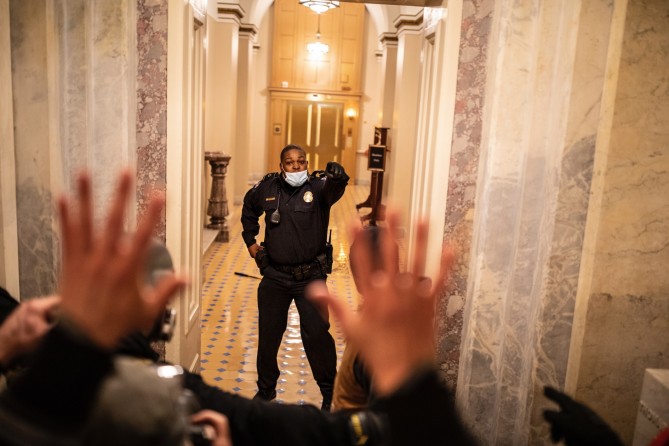
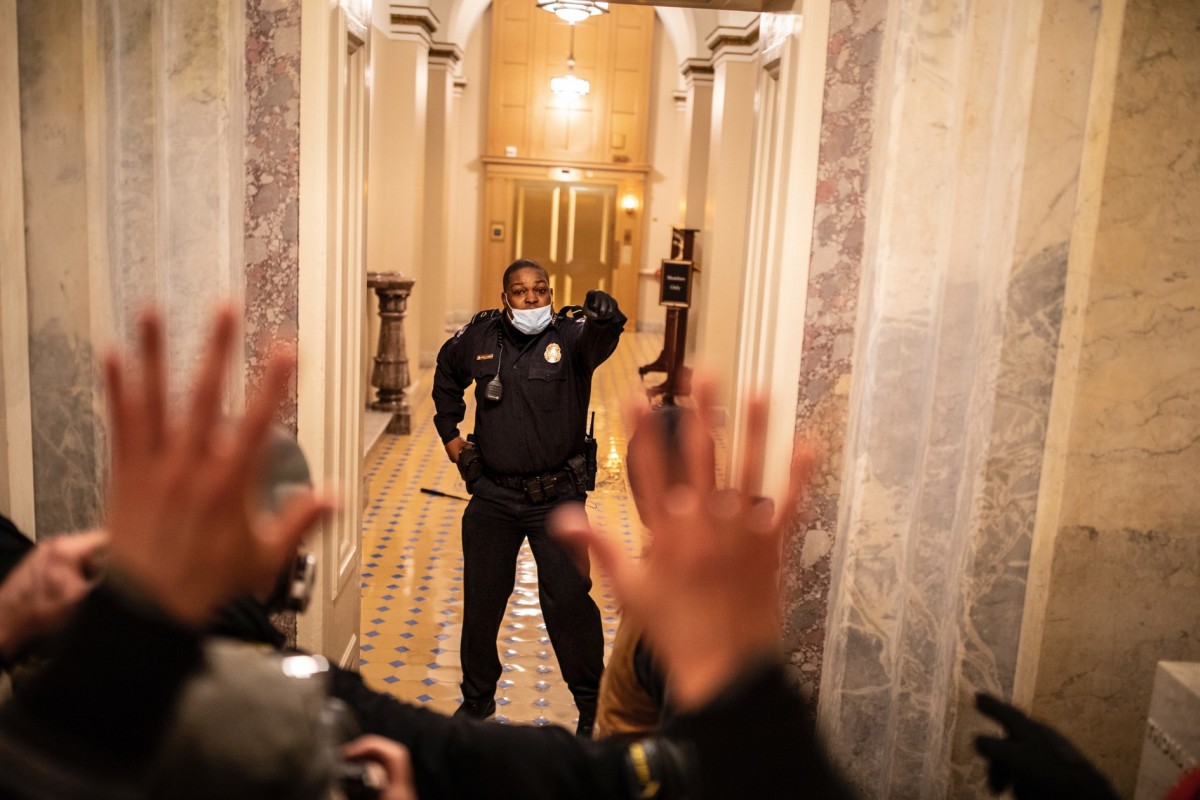
Bands of Jan. 6 rioters roamed the Capitol in a menacing hunt for Congressional adversaries of President Trump. Some were thwarted by a Capitol Police officer, Eugene Goodman, who—after being chased up a stairwell—diverted them from a hallway where senators and staff members were scurrying to safety. Throughout the tense encounter, Officer Goodman never drew his gun. (January 6, 2021/Ashley Gilbertson for The New York Times)