Staff of the Los Angeles Times
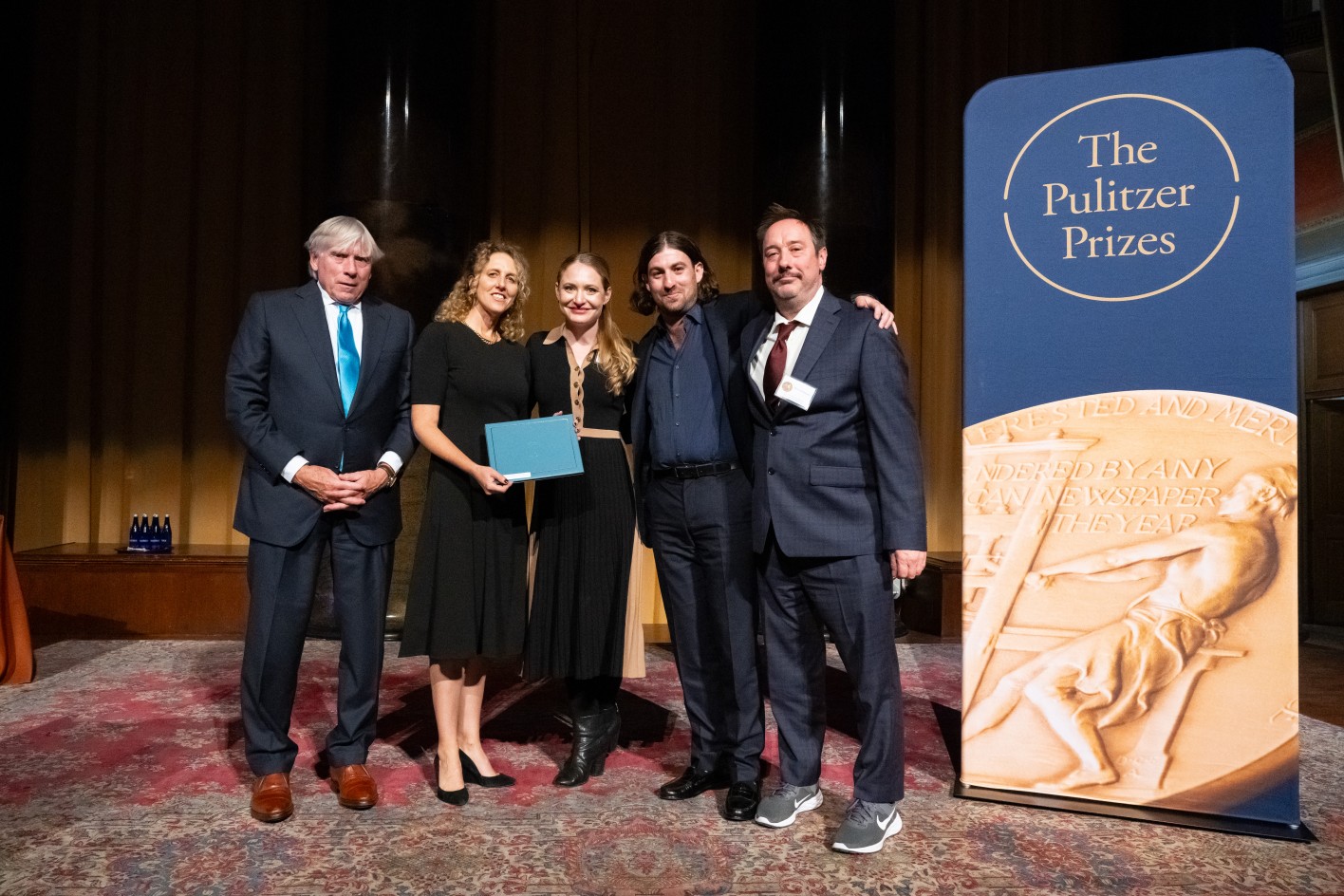
Staff members from the Los Angeles Times (from left: Dakota Smith, Julia Wick, Benjamin Oreskes and David Zahniser) accept the 2023 Pulitzer Prize for Breaking News Reporting from Columbia University President Emeritus Lee Bollinger. (Diane Bondareff/The Pulitzer Prizes)
Winning Work
By Julia Wick, David Zahniser, Dakota Smith, Benjami. Oreskes
Calls for Los Angeles City Councilmembers Nury Martinez, Kevin de León and Gil Cedillo to resign continued to mount on Monday, as the fallout from an incendiary leaked conversation radiated through the city.
The political implosion, unparalleled in recent L.A. history, was set off by a leaked audio recording reported Sunday by The Times.
The city’s political and civic establishment — including major figures who’d issued more subdued statements a day prior — had taken the temperature of the city and found it white-hot amid a growing national scandal.
The list of political figures and organizations issuing those calls took in Mayor Eric Garcetti, former Mayor Antonio Villaraigosa, U.S. Sen. Alex Padilla (D-Calif.), the Los Angeles County Democratic Party, Reps. Adam B. Schiff (D-Burbank), Tony Cárdenas (D-Pacoima) and Jimmy Gomez (D-Los Angeles), an array of labor unions and two mayoral candidates — Rep. Karen Bass (D-Los Angeles) and developer Rick Caruso.
The leaked conversation, which took place roughly a year ago during a meeting over the city’s redistricting process, involved the three Los Angeles councilmembers and a powerful labor leader. Martinez was heard making racist statements, and the group disparaged other politicians.
Los Angeles County Federation of Labor President Ron Herrera resigned from his post Monday night at a meeting with the federation’s executive board, two sources close to the situation told The Times, requesting anonymity to describe sensitive internal matters. One source said the organization would make a formal statement Tuesday.
The political futures of Martinez, De León and Cedillo remained seriously in doubt. Following outrage over the racist comments she made about a colleague’s then-toddler son, Martinez stepped down from her leadership position as president of the City Council on Monday morning.
The move instantly triggered behind-the-scenes jockeying at City Hall over who will replace her as leader, along with more questions about whether she and the others will remain on the council. Tensions will probably come to a head Tuesday morning on the council floor, during the body’s first meeting since the leaked recording was released.
Martinez reiterated her apologies in a Monday morning statement, saying she was “truly ashamed” and hoped her colleagues and residents of the city would give her “the opportunity to make amends.”
“I ask for forgiveness from my colleagues and from the residents of this city that I love so much,” she said.
The revelations have upended L.A. politics a month before a critical city election and brought the crucible of race relations back into the center of municipal debate. Martinez had endorsed a number of candidates, including a handful who called for her departure from the council.
Martinez said Councilmember Mike Bonin handled his young Black son as though he were an “accessory” and described the son as “Parece changuito,” or “He’s like a little monkey.” And she referred to Oaxacans in Koreatown as “little short dark people.”
Speaking about Los Angeles County Dist. Atty. George Gascón, Martinez said, “F— that guy.... He’s with the Blacks.”
De León, Cedillo and Herrera all also apologized Sunday for their role in the conversation. At one point in the leaked audio, De León appeared to compare Bonin’s handling of his child to Martinez holding a Louis Vuitton handbag.
Councilmembers Nithya Raman, Paul Koretz, Marqueece Harris-Dawson, Mitch O’Farrell, Heather Hutt and Bonin have all called on Martinez to resign.
Harris-Dawson, Hutt and O’Farrell also called for De León and Cedillo to step down from the council.
Cedillo issued his own statement Sunday, saying: “While I did not engage in the conversation in question, I was present at times during this meeting last year. It is my instinct to hold others accountable when they use derogatory or racially divisive language.”
“Clearly, I should have intervened,” he said in a text to The Times. “I did not make a racist statement and I did not mock my colleagues.”
Cedillo, who was defeated in the June election by community activist Eunisses Hernandez, steps down in December. But De León and Martinez had remained influential at City Hall — and had been seen as potential contenders for the mayoralty or other higher offices.
De León, who previously made history as the first Latino leader of the state Senate in more than a century, finished third in the 2022 mayoral primary.
A San Fernando Valley native, Martinez made history when she was sworn in as the first Latina president of the City Council in 2019.
Martinez led the council through the early months of the COVID-19 pandemic, using federal funds to provide rent relief and money to help families pay their utility bills. She spearheaded the passage of a vaccination requirement for city workers and worked to redirect money from the Police Department to other city purposes, including social services, after George Floyd’s murder.
She steps down as president at a key moment for City Hall. As many as five councilmembers could depart by the end of the year, depending on the outcome of the Nov. 8 election.
Four councilmembers are leaving office while a fifth, O’Farrell, is in a tough reelection fight. As the City Council President Pro Tem, O’Farrell will serve as acting president at Tuesday’s council meeting.
It’s unclear what will transpire during Tuesday’s meeting. The council does not have the power to suspend Martinez, De León and Cedillo.
The City Charter has a provision for councilmembers to suspend an elected officer only if they are awaiting trial in criminal proceedings, as was the case with former Councilmember Jose Huizar and suspended Councilmember Mark Ridley-Thomas.
It’s possible that the council could introduce a motion to censure the three councilmembers, though such a move would be largely symbolic.
The council president is one of the most powerful positions at City Hall, deciding when issues are placed on council agendas and selecting who will sit on the council’s most influential committees — ones dealing with the city budget, real estate development, energy and other issues. A council president who can secure 10 votes, enough to withstand a veto, can be at times more powerful than the mayor.
Councilmember-elect Hernandez said she wants the council to select “an intermediate caretaker” as president until the end of the year, when she and the other new councilmembers will be seated.
Hernandez said Councilmember Paul Krekorian would make a good caretaker in the coming months. “In January, when the new council is on board, we should do a new vote. And I would be interested in seeing Marqueece’s leadership,” said Hernandez, referring to Councilmember Marqueece Harris-Dawson.
Krekorian said he is in fact interested in becoming council president, arguing that the city is about to go through huge political changes — the arrival of a new mayor, city attorney, city controller and at least four new councilmembers. The council, he said, will need someone experienced to lead the council through its “latest crisis.”
Councilmember Curren Price said he too is seeking the presidency, arguing that his history and accomplishments show that he will provide “healing and reconciliation.”
Price, who is Black, has been elected three times in a district that is four-fifths Latino, with residents not just from Mexico but also South America and the Caribbean. He said his colleagues want someone “who’s not going be demeaning, someone who’s not talking down, someone who will value diversity and give it the respect it deserves.”
Protesters on the left and right sides of the political spectrum have targeted Martinez and other politicians in recent years. At some points, they gathered outside the officials’ homes, prompting Martinez to propose a law barring protest from within 300 feet of a target’s residence.
On Sunday night, a group gathered outside Martinez’s Sun Valley home to protest her racist comments, according to a video posted on Twitter.
The leaders of eight SEIU California unions with Los Angeles-area members also issued a statement Monday morning calling on Martinez, De León and Cedillo to step down from their council seats, as did the California Nurses Assn.
Times staff writers Matt Pearce and Salvador Hernandez contributed to this report.
By Benjamin Oreskes, Emily Alpert Reyes
When Nury Martinez was growing up in Pacoima, the child of immigrants from the Mexican state of Zacatecas, she watched politicians from afar.
They were white Jewish men, she said, even as the neighborhood became more and more Latino. Her own parents — her mother a seamstress turned factory worker, her father a dishwasher who was deported the year Martinez was born — had bought their home from a white family that left the San Fernando Valley for Kern County.
Their neighborhood was represented by “the Katzes of the world, the Bermans of the world,” Martinez said, alluding to Valley politicians such as former state Assemblyman Richard Katz and former Rep. Howard Berman. “I never saw them in the community or at the grocery store with us. I just saw them on TV.
“Now we have Latinos in office. We hold each other accountable,” Martinez added, sipping a michelada during an interview over lunch in Panorama City, a week before the political uproar that would torpedo her leadership of the Los Angeles City Council. “I think we are a huge political base.”
Her ascension as the first Latina to become City Council president had personified the gains in political representation that Latinos have made in Los Angeles. At City Hall, she has been known as a blunt and forthright speaker, perhaps at her most pointed when asking whether city policies will put the working-class neighborhoods that she represents — including Arleta, Van Nuys, Sun Valley and Panorama City — at a disadvantage.
But she is now in political free fall over the unguarded words that she, Councilmembers Gil Cedillo and Kevin de León and Los Angeles County Federation of Labor President Ron Herrera were caught saying on a leaked recording.
During a freewheeling conversation about redistricting, Martinez used racist language about the Black child of Councilmember Mike Bonin; riffed that “little short dark people” in Koreatown were ugly — employing stereotypes long used against Oaxacans; and declared of Dist. Atty. George Gascón: “F— that guy. … He’s with the Blacks.”
De León, in turn, appeared to compare how Bonin handles his child to Martinez holding a Louis Vuitton handbag.
Beyond the offensive words and jabs at other politicians, the recording gives an unvarnished glimpse into how Martinez and the others aim to preserve their political power.
“It’s not us,” de León said as the four strategized about redistricting. “It’s for Latino strength for the foreseeable future.”
Amid calls for her to quit the council, Martinez resigned Monday as its president, as the political support that elevated her to the role three years ago evaporated. She remains a councilmember.
It’s a swift fall for the former school board member, who joined the council after a come-from-behind victory almost nine years ago, defeating an opponent who had finished far ahead of her in the primary.
She had also been eyed as a possible candidate for mayor: Martinez recently told The Times she came within days of announcing a mayoral run last year, only to pull back as she considered how the sentiment had turned against incumbents.
Martinez, 49, is a product of the San Fernando Valley: She graduated from San Fernando High School and Cal State Northridge. During that time, she worked at a nonprofit focused on HIV/AIDS prevention and later at the nonprofit Pacoima Beautiful, which focuses on environmental justice.
In many ways, “her political history is informed by the disenfranchisement of the Latino community in the San Fernando Valley,” fighting for communities that were facing environmental hazards because they lacked political power, said Manuel Pastor, a USC sociology professor who directs the university’s Equity Research Institute.
Her politics were shaped by “the way in which the Latino part of the Valley has scrambled to get a voice,” Pastor added.
Martinez said that “what I remember growing up is we didn’t identify with the rest of the city.”
As a councilmember, Martinez has championed family issues such as parental leave, pushed for a renters’ relief program during the pandemic and worked to create a task force focused on human trafficking in the Valley. She fought to block a privately run facility for immigrant children from opening in her district, likening it to a prison.
But the issue that has dominated her tenure as council president is homelessness. Martinez has urged more attention to quality-of-life issues for working-class residents; at one point, when L.A. was hammering out rules about where people could sleep in cars, Martinez argued that the policies would disproportionately push vehicle dwellers near homes in her district.
“This isn’t going to be a problem in Bel-Air,” Martinez said.
In a speech laying out her agenda as council president, Martinez said the city needed to lead with compassion at homeless encampments, “but we also have to restore order in our streets.” At one point, when activists were protesting against policies she pushed, Martinez asserted that her supporters were not able to show up to comment because they were working.
“Latinos are frustrated; they’re tired,” she said recently. “They don’t want to deal with these encampments anymore.”
Carla Orendorff, who organizes unhoused people in Van Nuys, said Martinez “has always been incredibly divisive.”
Orendorff once hoped that the councilmember, with her history in environmental activism, might prove to be an ally in addressing the needs of people living in encampments. Instead, “she treats people as environmental hazards,” said Orendorff, who grew up in Van Nuys and Reseda and is part of the After Echo Park Lake research collective. “It wasn’t ever about housing. It’s about eliminating the sight of encampments.”
Martinez has disputed those arguments, pointing to supportive housing projects that have opened or broken ground in her district.
The City Council eventually adopted a law allowing councilmembers to designate areas as off-limits to homeless camps. This summer, the council expanded the law to prohibit homeless people from setting up tents within 500 feet of schools and daycare centers, as protesters shouted down councilmembers and, at one point, brought the raucous meeting to a halt.
The clashes with activists, who have also turned out to protest at Martinez’s home, have been emblematic of the leftward shift in Los Angeles politics. But Martinez has also had critics at the other end of the political spectrum, including the Los Angeles Police Protective League, which targeted her with mailers when she proposed reductions to the police budget.
As council president, Martinez was in many ways the opposite of her predecessor, Herb Wesson, who worked assiduously behind the scenes to ensure consensus. Martinez was comfortable letting divisions break out into the open, telling reporters, “I’m not afraid of having an 8-to-7 vote.”
Nor was she afraid to use political muscle: After indicted Councilmember Mark Ridley-Thomas was suspended from his post, Martinez moved to put Wesson in his seat, despite warnings from her colleagues that the appointment needed time for legal vetting. A judge later struck down the appointment.
Last month, Martinez again moved aggressively to find a replacement, securing the votes to install legislative aide Heather Hutt — who on Monday called for all the elected officials heard on the tape to step down.
Several of Martinez’s colleagues questioned the move to install Hutt, delaying the decision. But Martinez received backup from Herrera; the labor leader appeared personally to demand that Hutt be approved — and questioned whether those who were dissenting were his “friends.”
In the leaked recording, Cedillo declares to Martinez, De León and Herrera that “the one who will support us is Heather Hutt.”
Martinez “was always a straight shooter who said the things that she thought, and you always knew where you stood with her,” said Stuart Waldman, president of the Valley Industry & Commerce Assn., who attended college with her. He condemned her racist comments but said she was always fighting for people she felt were being passed over.
Pastor said it is unsurprising that Martinez is “a hard-knuckled political figure.”
But the racist and derogatory remarks in the leaked recording are devastating to her ability to lead in Los Angeles, “a city which requires that its leaders lead across communities,” Pastor said. “This is really a forfeiture of leadership, because it makes it extraordinarily difficult to claim to build bridges on the council if you express those kind of attitudes.”
By Monday afternoon, calls had grown for Martinez not just to relinquish the council presidency but to step down from the council entirely, with many also calling for De León, Cedillo and Herrera to lose their positions. Both mayoral candidates had called for Martinez to step down, as did one of her closest political allies, U.S. Sen. Alex Padilla.
Her political future is in question, but the change that her rise represented is not.
Latinos are “paying attention,” Martinez said in an interview before the scandal erupted. “And that’s the difference between now and when my parents moved here.”
Times staff writer David Zahniser contributed to this report.
By Benjamin Oreskes, David Zahniser, Julia Wick, Dakota Smith, Libor Jany
Politicians, religious leaders, activists and everyday Angelenos directed their fury at the Los Angeles City Council on Tuesday, telling elected leaders about the rage and sadness they felt over a recording in which Councilmember Nury Martinez is heard making racist remarks and denigrating colleagues.
Martinez was not in the room, announcing shortly before the meeting that she was taking a leave of absence. She stepped down as council president a day earlier.
Hours later, President Biden took the extraordinary step of weighing in on the controversy, with his press secretary saying that he thinks all three politicians who took part in the recorded conversation — Martinez and Councilmembers Gil Cedillo and Kevin de León — should resign.
In the packed council chamber, a boisterous crowd echoed that view, with some calling for the meeting to be canceled unless all three stepped down. The three can be heard talking to a high-level county labor leader on the recording, whose contents were first reported Sunday by The Times.
After nearly an hour of chanting and shouting, the room fell silent as Councilmember Mike Bonin gave a tearful response to the recording, in which Martinez made racist remarks about his young son, who is Black.
Martinez said on the recording that Bonin handled his young son as though he were an “accessory” and said of the child, “Parece changuito,” or “He’s like a monkey.”
“I take a lot of hits, and I know I practically invite a bunch of them. But my son? It makes my soul bleed,” said Bonin, his voice choked with emotion.
“I know I can never really know or comprehend the real weight of the daily relentless anti-Black racism my son is going to face,” Bonin went on. “But man, I know the fire that you feel when someone tries to destroy Black boy joy. Man, it’s a rage.”
Other councilmembers responded to the fury by announcing a series of reform proposals. One would ask voters to expand the size of the council in 2024. Another would create a new committee to look at ways of limiting corruption. A third would ensure that the next redistricting process — the subject of the secret recording — is decided by an independent citizens’ panel, not the council.
Councilmember Mitch O’Farrell, serving as acting president, announced his support for those proposals. And he denounced what he called “the casual racism,” the “abhorrent language,” the “dehumanizing racist reference” to Bonin’s son, the “denigration of Indigenous peoples” and “the familiar tropes against LBGTQ+ individuals.”
O’Farrell, who is gay, said he had attended Bonin’s wedding to Sean Arian. He described Bonin’s family as “an inspiration” to him and his partner, and the entire city.
“You deserved better,” O’Farrell told Bonin, his voice cracking. “We deserve better. The people of Los Angeles deserve better.”
Martinez was recorded in October 2021 at a meeting to discuss redistricting, the city’s once-a-decade process of redrawing council district boundaries. During the conversation, Martinez mentioned Los Angeles County Dist. Atty. George Gascón, saying “F— that guy. ... He’s with the Blacks.”
At one point in the recordings, Martinez said Bonin’s son had misbehaved at a parade and needed a “beatdown.” At another, De León appeared to compare Bonin’s handling of his child to Martinez holding a Louis Vuitton handbag.
The leaked recordings quickly sparked outrage across Los Angeles, with demands for the councilmembers’ resignations from Mayor Eric Garcetti, mayoral candidates Karen Bass and Rick Caruso, Sen. Alex Padilla (D-Calif.) and numerous members of the City Council.
Martinez has apologized repeatedly in recent days, while De León said he regretted his actions and “fell short.” Cedillo said he should have intervened during the conversation, but did not mock his colleagues or make racist statements.
Cedillo and De León started out Tuesday’s meeting by sitting in their chairs. But they immediately became the subject of angry chants from the crowd, and eventually left the room.
Pastor Thembekila Crystal Coleman, addressing the council, said she welcomed their departure.
“Their seats are poisonous. The seat of Nury is poisonous,” she said.
Assemblymember Isaac Bryan (D-Los Angeles) told the council that, like Bonin’s son, he was adopted by a white family and is Black. He said the city cannot move forward without the three resignations.
“Trust me, there will be a healing, because everybody in this room and everybody in this city wants that healing,” he said. “But we can’t have it without accountability.”
Under the City Charter, there does not appear to be a mechanism that the rest of the council could use to remove their colleagues in this situation. Instead, six councilmembers introduced a motion on Tuesday seeking to censure Martinez, De León and Cedillo — a largely symbolic move.
Garcetti, who leaves office in December, said he is interested in ways of rewriting the City Charter to provide more transparency and better governance. He said he’d like to see the City Council change its process for appointing members to committees and find a way to fill vacancies on the council faster through special elections rather than appointments.
In the audience, some people wore black T-shirts with white text that read “I’m with the Blacks” — a reference to Martinez’s remarks about the district attorney. Others carried makeshift signs with the same message.
Before the meeting began, the crowd chanted fuera — “out” in Spanish — using the names of Cedillo, De León and Martinez.
Councilmembers entered the chamber to the thunderous chants of “Shut it down” echoing throughout the room. Members of the public spoke for about two hours.
“I’m sick and tired of being sick and tired,” said community activist Morris Griffin, noting that he’s been involved with Los Angeles politics since the aftermath of the 1991 Rodney King beating by police officers.
Griffin implored the council to change the City Charter to allow the council to force the three colleagues to resign — a move that would itself require voter approval.
So far, the only resignation has come from Ron Herrera, president of the Los Angeles County Federation of Labor, who hosted the secretly recorded meeting and occasionally chimed in during Martinez’s remarks.
The leaked audio and its aftermath abruptly halted the political rise of Martinez, 49, who in 2019 became the first Latina to hold the powerful position of council president. Martinez, who represents part of the San Fernando Valley, had been considered at one point as a potential candidate for mayor.
Martinez’s decision to take a leave of absence was only the latest shake-up at City Hall in recent years. Councilmember Mark Ridley-Thomas was indicted last year on bribery charges and has been suspended for nearly a year.
Former Councilmember José Huizar is awaiting trial on felony charges of bribery, racketeering and fraud. And former Councilmember Mitch Englander was sentenced in 2021 for lying to authorities who were investigating Huizar.
Four councilmembers are scheduled to depart by the end of the year and a fifth, O’Farrell, is in a tough reelection fight. Cedillo, who lost his bid for a third term in June, is currently set to step down in December.
The Rev. Rae Huang, who volunteers with the group Black Lives Matter, said she wants Cedillo, Martinez and De León to go immediately. Standing outside City Hall early in the day, she said she had no intention of letting up.
“I will be here every day until [they] step down,” she said.
By Melanie Mason
Nearly 20 minutes into the secretly recorded conversation that would cost Nury Martinez her L.A. City Council seat, she remarked to fellow Councilmember Kevin de León that it was recently his anniversary. Seven years before, he had been sworn in as the leader of the California Senate.
The ceremony at Walt Disney Concert Hall was a career landmark, celebrating the first time in more than a century that a Latino led the state’s upper chamber. It ushered in four years when De León was one of California’s most powerful politicians. But instead of nostalgia, De León spoke of the memory as a deep wound.
“That swearing-in ceremony, I got s— on all over for that,” De León said, recounting how his event was portrayed by the media as unnecessarily lavish while a white politician’s gala in the same venue got no negative coverage. His theory why? “Because we as Latinos — whether you’re labor or you’re in the political space — we’re not supposed to fill those positions.”
The anecdote has received little attention amid the furious reaction to the leaked audio of the conversation, rife with racism, homophobia and general divisiveness, that has left City Hall in shambles. But De León’s recollection of his swearing-in, much like other comments woven into the hour-plus recording, offers a window into his political ambition, personal grievance and decades-long project of solidifying Latino power. In short, it captures the mind-set of a onetime Democratic rising star whose career now risks near-total collapse.
In the days after The Times reported on the discussion among three City Council members and a labor power broker, Martinez and Ron Herrera, the leader of the Los Angeles Labor Federation, have resigned. There remains pressure for the others — De León and Gil Cedillo — to do the same. The stakes are especially high for De León, who has two years left in his City Council term; Cedillo is set to leave office in two months.
The chorus of calls for De León’s resignation include his City Council colleagues, Mayor Eric Garcetti, President Biden and some of his oldest friends. His allies, many of whom requested anonymity in order to speak candidly, expressed deep disappointment that De León did not stop the racist discourse and that he described Councilmember Mike Bonin, a political foe, as using his adopted Black son as a prop akin to a designer handbag. But they point out that his comments were not nearly as offensive as Martinez’s myriad slurs.
“Kevin is not a racist,” said Fabian Núñez, the former Assembly speaker who has been close to De León since their teenage years. “What he said on that occasion is inappropriate. What he didn’t say is also inappropriate. But no way, no how is he a racist.”
The recording revealed that De León’s perspective was heavily defined by race and class. He expressed deep distrust that Black and white colleagues would treat Latino politicians fairly. The biggest threat to Latinos was not “those crazies in Orange County who are pro-Trump,” he said. “It’s the white liberals. It’s the L.A. Times.”
De León, 55, declined an interview request. He has not made a public statement since he expressed regret after the story broke on Sunday.
His allies and detractors alike say his heightened awareness about social status stems from his upbringing. He was born in Los Angeles and raised in impoverished conditions in San Diego’s Logan Heights by a single mother, a Guatemalan immigrant who cleaned houses to support him. His father, also from Guatemala and of Chinese descent, was not in the picture.
De León’s background is fundamental to his political trajectory; he speaks about it often to demonstrate his commonality with the neighborhoods he represents, such as Boyle Heights and El Sereno. It also left him with a chip on his shoulder, a sense of being judged as he rose through the ranks and a desire to fit in with whichever crowd he was with, said people who know him well.
He began his political career as an immigrant rights activist, organizing opposition to Proposition 187, the 1994 ballot measure to block public services to people who were in the country illegally. That cause remained a focus during his 12 years in the state Legislature, especially when he carried a 2017 law to designate California as a “sanctuary state.”
De León took big swings to pass an array of progressive priorities — and often succeeded. He successfully sponsored bills that increased the state’s use of renewable energy and established state-run retirement savings accounts, and he passed a single-payer healthcare bill off the Senate floor. He parlayed his growing profile to a speaking slot at the 2016 Democratic National Convention.
His ambition alienated many in the Capitol, and his detractors wondered whether his agenda was driven by conviction or calculation. The critique arose again this week after he was recorded speaking about how the state Senate handled sexual misconduct allegations against Democratic Sen. Tony Mendoza. Publicly, De León had pushed for Mendoza’s resignation. On the audio, however, he disparaged white liberals in his caucus for being too quick to cut Mendoza loose, describing the offense as “not really a legal issue ... just a harassment issue.”
His comments dismayed Jennifer Kwart, the then-legislative staffer whose complaint against Mendoza was substantiated by a state Senate investigation.
“Of course that speaks to his credibility,” Kwart said. “You don’t know if what he’s saying in public is how he actually feels.”
De León challenged Sen. Dianne Feinstein in 2018, running to her left. Vastly underfunded, he lost by 9 points, a more respectable showing than many anticipated. He ran for Los Angeles City Council in 2020, with his eye on the next mayoral race. He saw a path drawing on support from Latinos and progressives.
But some in Los Angeles, especially those engaged in activism for homeless people, were deeply skeptical of De León’s progressive bona fides.
“He talks likes a progressive, walks like a liberal — at best,” said Pete White, executive director of the Los Angeles Community Action Network. “When you look at his track record, you might look at the overt anti-Black racism and say this is an aberration. But this is one big-ass aberration. Your leadership has to be solid throughout.”
The skepticism turned into open hostility by the start of this year, when activists clashed with De León’s efforts to reduce the number of encampments by moving homeless people into temporary housing or other forms of shelter.
On the recording, his antipathy shines through, mocking the protesters at homeless encampments as Tesla drivers from Silver Lake.
The leak also gave a glimpse into De León’s motivation in the meeting, which was about redistricting: the effort to consolidate “Latino strength for the foreseeable future.” At the heart of the matter is the fact that Latinos make up more than half of the city’s population, yet occupy only four of the 15 council seats.
The discussion had the tenor of a zero-sum exercise pitting them against other groups, particularly Black members who represent areas that are now largely Latino. De León compared the significant influence African Americans held in redistricting to the Wizard of Oz, an exaggeration of their actual presence in the city. The comments prompted an outcry as demeaning to Black political power.
The meeting displayed an “overly elementary” expression of power politics, said former Assembly Speaker John Pérez, who said it would be completely legitimate to try to increase Latino representation and “make sure redistricting makes up for historical wrongs in the way the community has been divided.”
“That’s different from ‘screw this group, screw that group, we have to flex our muscle,’” said Pérez, a Democrat who now serves as a University of California regent.
De León’s allies note that he has repeatedly backed Black politicians over Latinos. But the recording also showed that De León held grudges when the favor wasn’t returned. He vented about Assemblyman Reggie Jones-Sawyer, whom De León endorsed in a tough 2020 reelection bid, for siding with Karen Bass over him in the mayoral race.
Jones-Sawyer said he was surprised by the comments he heard on the tape and noted that De León never asked for his endorsement.
“I thought we had a friendship,” Jones-Sawyer said. “If it means me supporting Karen — going with my gut on who I think is best for mayor — results in him not feeling we’re friends anymore, all I can do is what I think is best.”
Núñez, who has called on his friend to resign, said De León and the others “forgot who they were” in that closed-door meeting.
“They’re in charge,” Núñez said. “I think they were thinking like activists and not like leaders. This is where it’s harder for people to forgive them.”
Forgiveness is not likely to come anytime soon; calls for De León’s resignation continue and protesters have said they will keep disrupting council proceedings until De León and Cedillo are gone. Though Martinez may have made the most egregious comments, De León has not banked enough goodwill to weather the outcry, said White, of LACAN, the community advocacy group. He compared De León to an accomplice to a crime.
“If you were there — and you didn’t pull the trigger and you didn’t say hand over the bag but you were there — you are guilty,” White said. “The same applies here.”
By Jessica Garrison, Ruben Vives, Marisa Gerber, Angel Jennings, David Zahniser
Jorge Nuño learned the hard way how race, power and politics work in Los Angeles.
Nuño, 45, the son of immigrants from Jalisco, Mexico, grew up in South Los Angeles near Vernon Avenue and Main Street, then built a successful graphic design business and a printing business, launched a multiracial youth services nonprofit, and threw himself into grass-roots organizing among both Black and Latino groups in his neighborhood.
With this background, he decided to run for City Council representing the 9th District — its constituents majority Latino — expecting his campaign would garner at least some interest from the city’s traditional Latino establishment.
Instead, word filtered down: No way.
“What I heard was that no Latino [power brokers] are going to come support any candidate coming out of South L.A.,” he said, “because there is a coordination between Black and brown caucuses about keeping it Black” through the tenure of the current councilman.
Nuño lost that election to the incumbent, Curren Price, a Black former state lawmaker who also grew up in South L.A. He said he simply did not understand the complicated alliances brokered by Black and Latino politicians and their allies in labor.
“Naive to the game,” he said of himself back then.
City government has been thrown into crisis by the racist rhetoric of a secretly recorded conversation in which three Latino councilmembers — Nury Martinez, Gil Cedillo, and Kevin de León — plotted electoral strategy with a labor leader. The language was so outrageous that President Biden waded into city politics, calling on them all to resign.
Nuño said he too was sickened by the racism, but he said he was also struck by what the conversation revealed about the complex way politicians use race to exercise power in a sprawling multicultural city. Even as she said terrible things about Black people, including comparing a colleague’s Black child to a monkey, Martinez kept circling back to one of her major political goals: helping Price — a Black councilman representing a district that is now fourth-fifths Latino — hold on to his seat against a Latina challenger.
Politics in Los Angeles has always been organized along racial lines. But those lines are not as stark as the crass and hateful language on the recordings might lead many to conclude. Instead, in a city where more than 100 languages are spoken, leaders have put together coalitions to win elections and move their legislative priorities through the City Council, where eight votes are required to approve anything. And in the last three decades, the center of those coalitions has often been an alliance between Latino and Black leaders.
An enduring, fragile alliance
That alliance, which often includes strong backing from organized labor, has achieved major progressive goals, winning one of the highest minimum wages in the country, for example, and pushing initiatives to benefit renters, immigrants and neighborhoods long beset by environmental hazards.
For much of the last few decades, Black and brown leadership provided vital focus on social issues in core areas of L.A., as many whites moved to suburbs and wrote off older neighborhoods in the central city as no-go crime zones.
But the foundations of that alliance are threatened by the shift of the demographics it was built on: the Latino population has grown rapidly for generations while the number of Black people has continuously decreased. Over the last four decades the Latino share of the city’s population has grown from 27% to 48%, while the Black share has dipped from 17% to just below 9%.
A critical factor in keeping the alliance alive and essential: high Black voter turnout to counterbalance the decline in numbers of residents.
Martinez, Cedillo, De León and Herrera have been as skillful as any at building and maintaining these Black-brown coalitions, which made the racist tape all the more shocking.
“I think that is exactly why people are so offended, because that is not who we are,” said Councilman Marqueece Harris-Dawson, who is Black and represents South Los Angeles’ 8th Council District. He predicted that “coalition politics in Los Angeles comes back stronger than ever now.”
“The path to prosperity in Los Angeles is through a Black-brown coalition,” he said.
The long fight for a seat at the table
The framework for modern coalition politics built across racial lines in Los Angeles, and, in many ways, the nation as a whole, was forged in the early 1970s when Angelenos elected Mayor Tom Bradley, the son of former sharecroppers and the grandson of slaves.
His election, making him the first Black mayor in Los Angeles, but also one of the first in any major city in the nation, became a defining narrative in American politics — a win credited to his broad support among many groups in the city, but anchored by Black and Jewish voters.
Until the 1950s, Los Angeles was a city that offered essentially no political access to Black, Latino, Asian and Jewish Angelenos, according to Raphael Sonenshein, executive director of Cal State L.A.’s Pat Brown Institute for Public Affairs.
The first real break in that status quo, he said, came with the election of Edward Roybal to the City Council in 1949, making him the first Latino to serve in the role in nearly 70 years. (In an interview years later, Roybal recalled that at his first City Council meeting, he was introduced as “our new Mexican councilman who also speaks Mexican.”)
In one of the first and most powerful examples of the Black and Latino communities working together to advance common political goals, Roybal in 1962 supported the appointment of Gilbert Lindsay, who was Black, to take over his seat when he left for Congress.
“Progressive politics in Los Angeles is fundamentally coalition politics,” said Sonenshein.
Nowhere is that more true than in South Los Angeles, the sprawling land of farms and agricultural fields that gave way to white suburbs before it became a Black space and then, in more recent decades, a majority Latino area.
Between the 1940s and 1970s, hundreds of thousands of Black people moved to the area amid a labor shortage and a manufacturing boom in the wake of World War II.
Housing covenants prevented Black Angelenos and other minorities from living in other parts of the city, while in South L.A. banks and insurance companies denied loans and insurance policies, keeping the area economically depressed and increasingly dilapidated. When Black people finally defeated housing discrimination policies in court, some moved into the middle class. But South L.A. just became impoverished and neglected, served by substandard schools and hospitals, patrolled by a hostile police force, and otherwise largely ignored by City Hall.
In the 1980s, thousands of Latinos began moving into the area, many displaced by the civil wars in Guatemala and El Salvador, and economic strife in Mexico.
Their arrival also came as the manufacturing jobs disappeared and crack cocaine became an epidemic.
During that era, Sylvia Castillo, a Latina pediatric nurse, teamed up with her friend Karen Bass, a Black emergency room physician’s assistant. Castillo and Bass — now the front-runner in the city’s mayoral race — were heartsick about the way the drug was ripping through their community, particularly what it was doing to the children of drug-addicted parents. They began going door to door recruiting residents who wanted to organize to build better services for the neighborhood.
“We knew if we were going to organize that we needed to do it around our power base, which was Latinos and African Americans,” Castillo said. “We knew they were invested in their children and their futures.”
The Community Coalition was officially founded in 1990 and focused on addressing the nuisance of liquor stores and motels that contributed to prostitution and drug sales. They also wanted to change the way their neighbors were treated by the Los Angeles Police Department.
“We understood there were forces that would have liked to keep us divided,” she said. “But if we continued to be divided then we wouldn’t have power to leverage and get resources for our neighborhoods that were being decimated by the drug epidemic and incarcerations.
“We had a common ground,” she added.
Uneven gains in a rapidly changing city
Black people were the first to consolidate their electoral power and take seats around the ornate City Council horseshoe.
Two years after Lindsay took the 9th District seat in 1961, an LAPD lieutenant named Tom Bradley won his first council race in 1963, representing the 10th District, the same year that a Black lawyer Billy G. Mills took the 8th council seat. The three districts have had Black representatives ever since.
Latino leaders, meanwhile, were increasingly feeling as though their voices were not being heard. After Roybal vacated his desk, it would be 23 years before another Latino succeeded in winning a council seat.
While the Latino population reached 27% of the city by the 1980 census, Latinos remained locked out of the council chambers where leaders drafted the policies and laws that governed life in Los Angeles.
Their opening came in 1985, when a white councilman, Art Snyder, suddenly resigned his seat representing the 14th District — stretching across rolling brown hills from El Sereno to Boyle Heights — an area that was 75% Latino.
Richard Alatorre, the son of an East Los Angeles beautician and repairman, who served 13 years in the state Assembly and was a close ally of California’s first Black speaker, Willie Brown, decided to run for the seat to, as he put it at the time, “serve the people more directly and more immediately.”
Brown told him he was crazy to relinquish his powerful position in Sacramento. “‘What the hell do you want to do that for?’” Alatorre recalled him saying. “‘Follow barking dogs and stuff like that?’”
Alatorre announced his candidacy at a news conference in the Plaza de la Raza in Lincoln Heights.
In the middle of his campaign, the U.S. Department of Justice filed a civil rights lawsuit against the city of Los Angeles and its elected leaders, charging “a history of official discrimination” against Latinos and seeking to overturn the city’s 1982 redistricting plan for council districts. The suit charged that city officials intentionally had drawn district lines to disperse Latinos and dilute their political power.
“There has been a history of official discrimination by the State of California and the City of Los Angeles against Hispanic residents of the city,” the suit alleged. “Such discrimination has included discrimination touching on the right of Spanish-speaking and other language minorities to register, vote and participate in the political process.”
Two weeks later, Alatorre won his election despite the alleged gerrymandering.
He was appointed chair of the reapportionment committee, in charge of coming up with new district maps that would meet with the Justice Department’s approval.
Within months, Alatorre’s plan had infuriated the council’s first Asian member, Mike Woo — elected the year before — after he proposed moving his 13th District east and out of Hollywood, making the district two-thirds Latino.
Part of Alatorre’s rationale, according to coverage at the time, was to protect the council’s three Black seats.
By then, the 9th District was 40% Latino and, with slightly altered lines, could have become a Latino seat.
But Alatorre promised the council’s three Black members — Lindsay, David Cunningham and Robert Farrell — that he would leave them alone.
“Hey, I like to win,” Alatorre said at the time. Part of winning, he said, meant “not going after the Black districts. I decided I wasn’t going to do that because then we could be accused of doing to Blacks what the Justice Department says we did to Hispanics.”
To be legally defensible, maps need to comply with the Voting Rights Act, meant to safeguard Black and Latino representation. But a delicate balance is required, in that race cannot be the “predominant” factor when drawing maps; that would violate the equal protection clause of the 14th Amendment of the Constitution.
When the final plan was approved by the council in the fall of 1986, Alatorre had managed to carve out a second Latino council district — the seat now occupied by Gil Cedillo — stretching north and west of downtown. The next year, Gloria Molina won that seat to become the first Latina on the City Council.
She quickly began pursuing laws and policies that reflected longtime concerns of residents in her district — and in Black districts — such as sweeping streets in neglected areas and building affordable housing. When she left the council in 1991 to become the first Latina on the county Board of Supervisors, Mike Hernandez, a young activist from Cypress Park, was elected to fill her spot.
Two other new members, Mark Ridley-Thomas and Rita Walters, both Black and elected to represent districts in South L.A., joined the council at the same time as Hernandez.
This all came during a fraught time for Los Angeles that would challenge the coalition and the rest of the city.
After a successful Olympics in 1984 reinforced the city’s image of L.A. as a multicultural success story, led by Bradley, conditions took turns for the worse. Crime spiked. The LAPD under Chief Daryl Gates reacted with aggressive, brutal policing in Black and Latino neighborhoods. Residents decried their treatment. But many felt that the white power structure didn’t care about what was going on in their communities — whether it be the policing, the poverty, or the mass loss of jobs as the aerospace industry declined and other manufacturing left Los Angeles.
Communities burn, demand change
Then came the civil uprising that would forever change the city and burn parts of their districts to the ground.
On April 29, 1992, when an all-white jury acquitted the white police officers who had brutally beaten Rodney King, furious residents poured into the streets near Florence and Normandie avenues in South L.A., setting off days of violent unrest.
In the smoky aftermath, the three leaders fought for government resources to rebuild, trying to fix the destruction in districts that been starved of services for generations.
A year later, Hernandez and Ridley-Thomas convened a news conference at City Hall to discuss the results of a study about how the unrest harmed the Latino community.
The study found that Latinos made up 49% of the population in areas most affected by the uprisings and that immigration officials had taken advantage of the chaos to detain hundreds of people they suspected were undocumented. Improving economic opportunities for Latinos, the study’s authors wrote, was critical to rebuilding efforts in the city.
Meanwhile, Latinos were slowly getting more political representation in City Hall and beyond, but always at a percentage far below their numbers in the city at large.
Following the 1992 redistricting, Richard Alarcon became the first Latino elected to the council from the San Fernando Valley. When he moved to the state Senate in 1999, he was succeeded by Alex Padilla, then a young MIT graduate from Pacoima, who is now California’s first Latino United States senator.
Year after year, the Latino councilmembers found common cause with the three Black councilmembers from South Los Angeles.
Together, they pushed for gang-intervention programs, after-school programs, improved transit, and reformed policing. In 1997, when Mayor Richard Riordan appointed Bernard C. Parks, who is Black, as the police chief, Alatorre was one of his biggest backers.
In an interview this week, Hernandez recalled how he and Ridley-Thomas would sometimes spar, but the result, he said, was that both “our districts would get twice as much.”
But by then Los Angeles seemed more fractured than ever. Suburban organizers tried to break off the San Fernando Valley from the rest of the city, arguing residents would get better services for their tax dollars. Some critics saw a racial movement in the secession fight, which ended up being defeated in 2002.
There were also growing tensions between Blacks and Latinos. The immigration boom from Mexico and Central America had depressed wages among service workers, which had once been a key source of jobs for Blacks. Longtime Black neighborhoods swelled with immigrants, leaving longtime residents feeling squeezed out. Racial tensions turned violent among the city’s street gangs, including several cases where Latino gangs targeted Blacks in killing sprees.
Smears, then L.A. makes history
In 2001, Antonio Villaraigosa, then speaker of the California Assembly, set out to become the city’s first Latino mayor in more than 100 years.
His opponent was James K. Hahn, then the city attorney and son of former County Supervisor Kenneth Hahn, who had represented South Los Angeles for more than 40 years and was a beloved figure there. Hahn banked on his father’s name in the community for his run.
But Hahn, who is white, also deployed a racial trope in his campaign tactics. In the waning days before the election, Hahn’s campaign released an ad that showed a crack pipe as a narrator intoned: “Los Angeles can’t trust Antonio Villaraigosa.”
The ad referenced a letter of clemency that Villaraigosa had written to the White House on behalf of Caros Vignali, a convicted drug dealer who wanted his sentence commuted. Villaraigosa called the ad “reprehensible,” and accused Hahn of seeking to portray him as “like a gang member and a drug dealer.”
In the end, Hahn won by a slim margin, capturing more than 80% of the Black vote.
But Councilman Harris-Dawson of the 8th District, who worked as a canvasser on Villaraigosa’s 2001 campaign, said he thought the ad, while it may have turned white voters against Villaraigosa, actually helped him in the Black community. They viewed it as similar to the sort of racist dog whistle attacks many Black candidates faced.
“When that Vignali ad came out, it was the best thing that could happen [for Villaraigosa] with Black voters,” he recalled. “Because Black voters were like, ‘Oh, we get that’ ... it turned around people’s openness to Antonio.”
In 2005, Villaraigosa, by then a member of the City Council, took on Hahn again and beat him, in part by securing more votes in the Black community this time around.
But many strategists were also keenly aware that some Black Angelenos felt anxious about whether a Latino mayor would look out for their interests.
During the race, Villaraigosa’s director of campaign field operations, Anthony Thigpenn, who is Black, told The Times that some voters feared that “because it’s a Latino candidate, he’ll only take care of Latinos, and therefore African Americans will somehow be left out of the picture and diminished.”
“It’s a big challenge for Villaraigosa,” said Thigpenn. “It’s a big challenge for L.A.”
After Villaraigosa’s election as the first Latino mayor of the city in 130 years, Newsweek put the grinning mayor on the cover, under a banner headline that said: “Latino Power.”
But the new mayor took pains to pay heed to Black voters’ concerns, mentioning them in the very first sentences of his inauguration speech, and tipping his hat to Tom Bradley.
“When others said it couldn’t be done, you elected the first African American mayor of a leading American city,” he said. “And believe me, early in our campaign, there were those who said it wasn’t time for a Latino mayor. The faith you placed in me makes me so proud to be an Angeleno today, and I promise you, I will be a mayor for all the people.”
Race and redistricting
Throughout Villaraigosa’s eight-year tenure, the racial balance on the City Council remained as it had been since 2003: Three Black councilmembers from South Los Angeles, and four Latino councilmembers, two from the Eastside and two from the Valley. The remaining council seats were held by whites, but they were far from a monolithic bloc. Those from the Westside often championed progressive causes while those in the Valley tended to be more moderate or conservative.
But the Latino population continued to grow across the city, particularly in South Los Angeles. And this continued to lead to tensions, noted Earl Ofari Hutchinson, the Black author and activist, who noted that the “record of political empowerment and cooperation between Blacks and Latinos has been mixed.” They have fought together for improved neighborhood services, he said, but they have both also pushed to maintain and increase their own political power.
He noted that civil rights groups have “largely failed to engage the broad Black and Latino public in South L.A. on these flashpoint issues.”
Then the once-a-decade redistricting rolled around in 2012.
The City Council president at the time was Herb Wesson, the Black representative from the city’s 10th District.
Wesson was elected as the council’s first Black president without the support of the council’s other two Black members, Parks, the former police chief who was now on the council, and Jan Perry, who represented the 9th District. All other members of the council voted for him.
When it came time to draw up new district lines, Wesson’s appointees on the redistricting commission teamed up with representatives of Mayor Villaraigosa and Councilman Jose Huizar to come up with a map that stripped Parks and Perry of some of the most cherished parts of their districts. Baldwin Hills and Leimert Park were taken out of the 8th District and put in Wesson’s district. Downtown was taken from Perry and given to Huizar, who represented the 14th District.
After some in South L.A. complained, Wesson defended himself, saying he had had to act because other councilmembers were trying to take advantage of the split among the council’s Black members. Wesson did not explain what he meant or provide evidence at the time.
“When I was elected president … the other factions said, ‘A-ha! The Negroes are fighting,’” Wesson told a mostly Black audience. His comments were captured on video.
“Brothers and sisters, it was me against 12 other members of the council,” Wesson continued. “I had no backup. I had no faction. And I did the very best I could with what I had. I was able to protect the most important asset that we as Black people have, and that’s to make sure that a minimum of two of the council people will be Black for the next 30 years.”
In 2019, Wesson stepped down from the council presidency to focus on a campaign for county supervisor, a race he ultimately lost to Holly Mitchell. He was replaced as council president by his No. 2, Nury Martinez, who had been elected in 2013 to represent a Latino seat in the Valley.
She became the first Latina to hold the post. She took power at a time when City Hall was in crisis, reeling from a federal corruption investigation. Huizar was indicted in 2020 on federal charges that he ran a sprawling pay-to-play scandal, and in the fall of 2021 Ridley-Thomas was indicted on conspiracy and fraud charges. Both have pleaded not guilty. Another former councilmember, Mitch Englander, who is white, pleaded guilty to a corruption charge in 2020. In the midst of this, the council again took up its once-in-a-decade redistricting
It was a meeting over district maps that led Martinez, along with Councilmembers Kevin de León and Gil Cedillo, to travel to the Los Angeles County Federation of Labor building last October for their now infamous meeting.
Racist leak brings pain, reckoning
When a recording of the conversation was leaked last week, snippets of it rocketed through Los Angeles City Hall and the city at large, exploding in hundreds of thousands of cell phones.
Marsha Colone, 57, who is Black and lives in South LA, said what upset her most was the possibility that the hateful words could jeopardize the unity Black and Latino people have forged together as they have fought side by side for equal rights for many decades.
“I thought we were working together,” she said. “It feels like they’ve split us up again.”
She said the recording has created distrust at a time when the country is already divided.
“People don’t know what or who to believe anymore,” she said. “The trust has been . . . challenged.”
She paused for a moment to stare at a group of Black and Latino students walking by her, together, smiling and laughing. “It’s nice to see them,” she said.
She said she believes the situation between her and her neighbors — two Latino families who live on either side of her — represent the real Los Angeles. “They treat me and my family like I’m part of theirs,” she said. “How they treat us and how we treat them won’t be affected by what Martinez said.”
But the tapes have already had an enormous political impact — and will continue to.
Former Councilman Alarcon said he feared Martinez’s comments had set the city back by “20 years in terms of Black-brown relations.”
Parks, the former councilman and police chief, said the racist talk was appalling, but “I suspect you had very similar conversations in 2012, it’s just nobody taped them.”
He added that the focus on the offensive comments was causing people to “somewhat ignore the larger issue,” which is that the councilmembers and the labor leader were trying to “configure the city for their benefit, as opposed to the benefit of the community.
Is it any wonder, he asked, why turnout is so low in city elections?
Price, the 9th District councilman whom Martinez was so vehement about protecting, publicly denounced his former ally this week, calling on her and the other two councilmembers to resign and saying: “Their actions are unforgivable and the damage is too much to bear.”
Martinez apologized on Sunday, took a leave of absence on Tuesday and resigned on Wednesday. All week, council meetings have been disrupted by activists who refuse to let things proceed until Cedillo and De León follow suit.
Even if he does not, Cedillo will be leaving office in December. He was defeated in the June election by a progressive challenger, Eunisses Hernandez, a graduate of Franklin High School in Highland Park, a traditionally Latino neighborhood that has been transformed in recent decades by gentrification.
She said the tapes reveal something she has long maintained: Martinez, De León and Cedillo were not multiracial coalition builders at all, despite their long history of cooperation with Black leaders. Instead, she charged, they are “very much embedded in racist values and thoughts and language.”
Hernandez said the next generation of Black and Latino leaders who seek office — such as her friend state Assemblyman Isaac Bryan, who is Black — recognize that the divide between the Black and Latino communities has harmed both.
Bryan was among those who went to City Hall on Tuesday to decry the sentiments on the tapes.
“Latino power building can’t be rooted in the erasure of Black representation,” he said. “That’s a form of political violence akin to the strategies of white supremacy.”
Nuño, the business owner from the 9th District who failed to get backing from the Latino establishment for his 2017 council run, has been following it all closely.
He said he may run again for a seat representing District 9.
“This is about seizing the moment to transform L.A. politics,” he said. “I see multiracial coalition building, and that is going to be the future not just in South Los Angeles, but across the city. This is the future of Los Angeles.”
Times staff writers Kailyn Brown, Benjamin Oreskes, Rachel Uranga, James Rainey, and Melanie Mason contributed to this report.