The New York Times
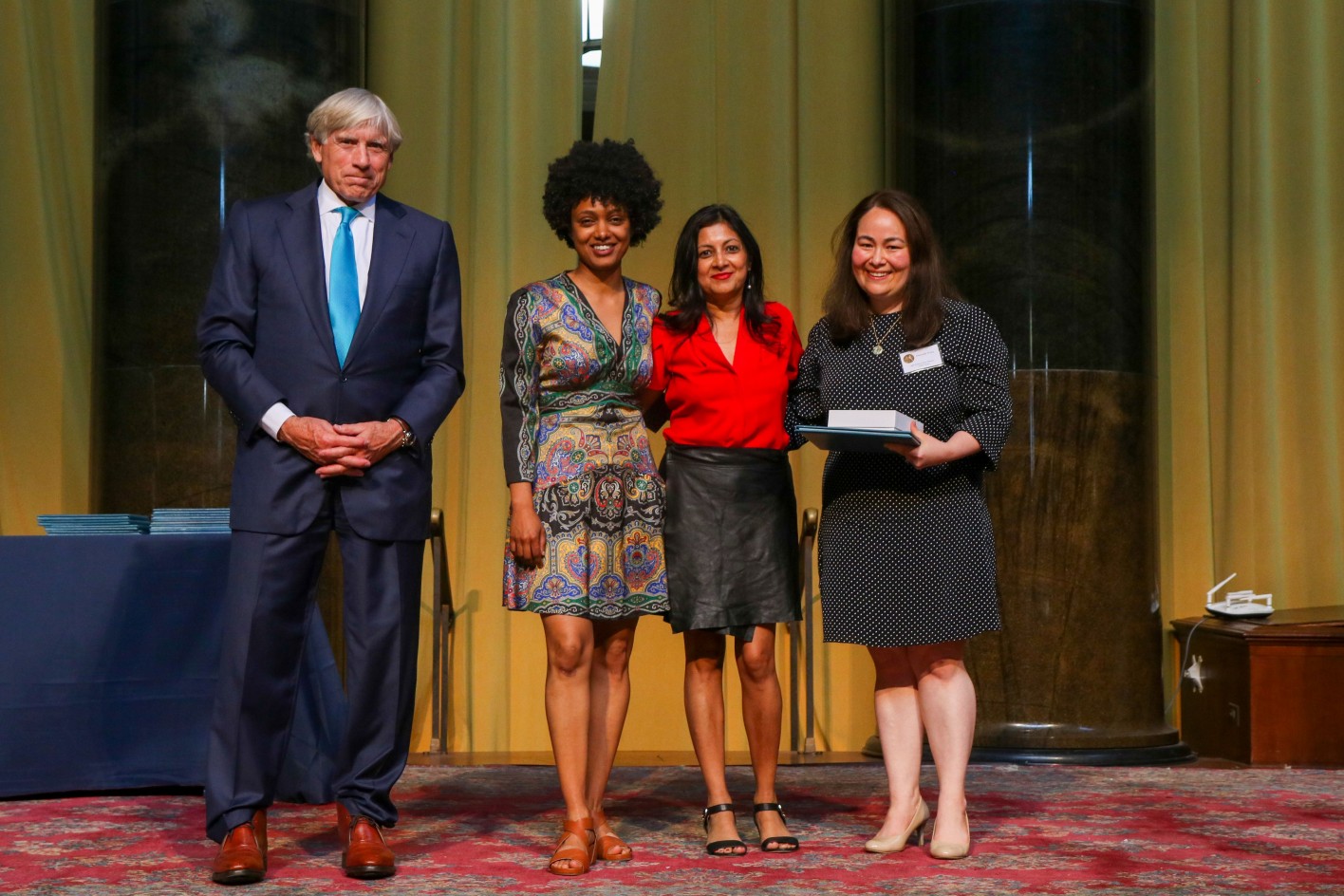
Staff members from The New York Times (from left: Selam Gebrekidan, Apoorva Mandavilli, Danielle Ivory) accept the 2021 Pulitzer Prize for Public Service from Columbia University President Lee Bollinger. (Jose Lopez/The Pulitzer Prizes)
Winning Work
Beijing is racing to identify a new illness that has sickened 59 people as it tries to calm a nervous public.
By Sui-Lee Wee and Vivian Wang
BEIJING — For days, Li Bin had what felt like a cold, with a high fever of between 102 and 105, and he could not understand why he wasn’t getting better.
After four days, he went to a hospital, and a doctor told him he had a form of viral pneumonia, without offering specifics. Mr. Li, 42, was hospitalized, then transferred to another facility and quarantined with other patients who had similarly unexplained symptoms.
Mr. Li is one of 59 people in the central city of Wuhan who have been sickened by a pneumonia-like illness, the cause of which is unclear. The cases have alarmed Chinese officials, who are racing to unravel the mystery behind them in a region where the memory of an outbreak of the dangerous respiratory disease known as SARS remains fresh.
SARS originated in China and killed more than 800 people worldwide in 2002 and 2003. At the time, the Chinese government tried to cover up the problem, which is exacerbating fear now about this new illness.
Symptoms of the new illness include high fever, difficulty breathing and lung lesions, the Wuhan health commission has said. No deaths have been reported but seven people are critically ill. On Sunday, the city government said they had ruled out as causes SARS, the Middle East Respiratory Syndrome (MERS), bird flu and the adenovirus.
The illness appeared just weeks before the Spring Festival, the country’s biggest holiday, when tens of millions of people travel. The authorities urged the public to be on alert for pneumonia-like symptoms like fever, body aches and breathing difficulties.
Workers wearing hazmat suits disinfected and shut down the Huanan Seafood Market in Wuhan, which also sold poultry, pheasants and wild animal meats, after the city health department said it traced many of the cases to it. Viruses that caused SARS and the H7N9 strain of bird flu in humans were first detected in markets that sold animals and experts have said contact with infected animals was the likeliest source of transmission.
Health authorities around the region have responded quickly. In Hong Kong, 21 people who had visited Wuhan in recent weeks were hospitalized between Dec. 31 and noon on Monday, according to that city’s health department. Officials said they would install additional thermal imaging systems at the international airport to monitor passengers coming from Wuhan; they also added staff at the high speed rail station to check body temperatures.
The authorities in Singapore placed a Chinese girl with pneumonia in isolation because she had traveled to Wuhan, then said on Sunday that doctors had found that the child had a common childhood viral illness.
Chinese health officials at first appeared to be closely guarding information about the illness. The Wuhan government confirmed on Dec. 31 that health authorities were treating dozens of cases of pneumonia of unknown cause only after an emergency notice to city hospitals was shared on social media sites a day earlier, apparently triggering some public panic.
But more recently, the government appeared to be moving more quickly to disclose information about new cases in a sign that it has learned its lesson from SARS, said Leo Poon, a public health expert at the University of Hong Kong. “I have to emphasize this is a new disease, and no one on earth has gone through this before,” he said.
Mr. Poon said a surge in cases in the coming week would suggest either that the source of the virus had not been eradicated despite the shutdown of the market or that the illness could be transmitted between humans.
“I hope this pathogen is a less harmful one so it would not cause a major epidemic similar to SARS,” he said. “It would be a nightmare for all of us.”
Wang Linfa, an expert on emerging infectious diseases at the Duke-NUS Medical School in Singapore, said he was frustrated that scientists in China were not allowed to speak to him about the outbreak. Dr. Wang said, however, that he thought the virus was likely not spreading from humans to humans because health workers had not contracted the disease. “We should not go into panic mode,” he said.
The World Health Organization said it was closely monitoring the situation and was prepared to mount a broader response, if needed.
In Hong Kong, residents raced to stockpile surgical masks. On Monday, employees at several pharmacies and convenience stores said they had sold out by lunch time. Watsons, a major chain owned by the family of Hong Kong tycoon Li Ka-shing, said sales for masks and hand sanitizers increased significantly this week compared with last week.
The Hong Kong government on Saturday also introduced a new response system for “novel infectious diseases,” citing a desire to avoid repeats of the SARS epidemic or the 2009 swine flu outbreak. In response to the Wuhan cases, the government declared a “serious” response level, the middle tier of the new system, which officials said signaled a “moderate” risk to the local population.
In Wuhan, Mr. Li, who works for a hotel restaurant, was one of the first patients to fall ill. He came down with a fever on Dec. 23, after visiting the Huanan Seafood Market.
“It felt like a common cold,” Mr. Li said by telephone. He has since recovered and is set to come home in the next two days. None of his other family members have become sick, according to his wife.
The authorities have acted swiftly to clamp down on discussion about the outbreak. Censors blocked the hashtag #WuhanSARS. The police said they were investigating eight people in Wuhan for “spreading rumors” online about the disease, an announcement that was met with anger on Sina Weibo, one of China’s most popular social media sites.
“I don’t have the right to speak and I don’t even know the truth,” one user wrote. “Don’t I have the right to panic and save myself?”
Vivian Wang reported from Hong Kong. Elaine Yu contributed reporting in Hong Kong, and Elsie Chen contributed research in Beijing.
At critical turning points, Chinese authorities put secrecy and order ahead of openly confronting the growing crisis and risking public alarm or political embarrassment.
By Chris Buckley and Steven Lee Myers
WUHAN, China — A mysterious illness had stricken seven patients at a hospital, and a doctor tried to warn his medical school classmates. “Quarantined in the emergency department,” the doctor, Li Wenliang, wrote in an online chat group on Dec. 30, referring to patients.
“So frightening,” one recipient replied, before asking about the epidemic that began in China in 2002 and ultimately killed nearly 800 people. “Is SARS coming again?”
In the middle of the night, officials from the health authority in the central city of Wuhan summoned Dr. Li, demanding to know why he had shared the information. Three days later, the police compelled him to sign a statement that his warning constituted “illegal behavior.”
The illness was not SARS, but something similar: a coronavirus that is now on a relentless march outward from Wuhan, throughout the country and across the globe, killing at least 304 people in China and infecting more than 14,380 worldwide.
The government’s initial handling of the epidemic allowed the virus to gain a tenacious hold. At critical moments, officials chose to put secrecy and order ahead of openly confronting the growing crisis to avoid public alarm and political embarrassment.
A reconstruction of the crucial seven weeks between the appearance of the first symptoms in early December and the government’s decision to lock down the city, based on two dozen interviews with Wuhan residents, doctors and officials, on government statements and on Chinese media reports, points to decisions that delayed a concerted public health offensive.
In those weeks, the authorities silenced doctors and others for raising red flags. They played down the dangers to the public, leaving the city’s 11 million residents unaware they should protect themselves. They closed a food market where the virus was believed to have started, but didn’t broadly curb the wildlife trade.
Their reluctance to go public, in part, played to political motivations as local officials prepared for their annual congresses in January. Even as cases climbed, officials declared repeatedly that there had likely been no more infections.
By not moving aggressively to warn the public and medical professionals, public health experts say, the Chinese government lost one of its best chances to keep the disease from becoming an epidemic.
“This was an issue of inaction,” said Yanzhong Huang, a senior fellow for global health at the Council on Foreign Relations who studies China. “There was no action in Wuhan from the local health department to alert people to the threat.”
The first case, the details of which are limited and the specific date unknown, was in early December. By the time the authorities galvanized into action on Jan. 20, the disease had grown into a formidable threat.
It is now a global health emergency. It has triggered travel restrictions around the world, shaken financial markets and created perhaps the greatest challenge yet for China’s leader, Xi Jinping. The crisis could upend Mr. Xi’s agenda for months or longer, even undermining his vision of a political system that offers security and growth in return for submission to iron-fisted authoritarianism.
On the last day of 2019, after Dr. Li’s message was shared outside the group, the authorities focused on controlling the narrative. The police announced that they were investigating eight people for spreading rumors about the outbreak.
That same day, Wuhan’s health commission, its hand forced by those “rumors,” announced that 27 people were suffering from pneumonia of an unknown cause. Its statement said there was no need to be alarmed.
“The disease is preventable and controllable,” the statement said.
Dr. Li, an ophthalmologist, went back to work after being reprimanded. On Jan. 10, he treated a woman for glaucoma. He did not know she had already been infected with the coronavirus, probably by her daughter. They both became sick. So would he.
Hazmat Suits and Disinfectants
Hu Xiaohu, who sold processed pork in the Huanan Seafood Wholesale Market, sensed by late December that something was amiss. Workers were coming down with nagging fevers. No one knew why but, Mr. Hu said, several were in hospital quarantine.
The market occupies much of a block in a newer part of the city, sitting incongruously near apartment buildings and shops catering to the growing middle class. It is a warren of stalls selling meats, poultry and fish, as well as more exotic fare, including live reptiles and wild game that some in China prize as delicacies. According to a report by the city’s center for disease control, sanitation was dismal, with poor ventilation and garbage piled on wet floors.
In hospitals, doctors and nurses were puzzled to see a cluster of patients with symptoms of a viral pneumonia that did not respond to the usual treatments. They soon noticed that many patients had one thing in common: They worked in Huanan market.
On Jan. 1, police officers showed up at the market, along with public health officials, and shut it down. Local officials issued a notice that the market was undergoing an environmental and hygienic cleanup related to the pneumonia outbreak. That morning, workers in hazmat suits moved in, washing out stalls and spraying disinfectants.
It was, for the public, the first visible government response to contain the disease. The day before, on Dec. 31, national authorities had alerted the World Health Organization’s office in Beijing of an outbreak.
City officials struck optimistic notes in their announcements. They suggested they had stopped the virus at its source. The cluster of illnesses was limited. There was no evidence the virus spread between humans.
“Projecting optimism and confidence, if you don’t have the data, is a very dangerous strategy,” said Alexandra Phelan, a faculty research instructor in the department of microbiology and immunology at Georgetown University.
“It undermines the legitimacy of the government in messaging,” she added. “And public health is dependent on public trust.”
Nine days after the market closed, a man who shopped there regularly became the first fatality of the disease, according to a report by the Wuhan Health Commission, the agency that oversees public health and sanitation. The 61-year-old, identified by his last name, Zeng, already had chronic liver disease and a tumor in his abdomen, and had checked into Wuhan Puren Hospital with a raging fever and difficulty breathing.
The authorities disclosed the man’s death two days after it happened. They did not mention a crucial detail in understanding the course of the epidemic. Mr. Zeng’s wife had developed symptoms five days after he did.
She had never visited the market.
The Race to Identify a Killer
About 20 miles from the market, scientists at the Wuhan Institute of Virology were studying samples from the patients checking into the city’s hospitals. One of the scientists, Zheng-Li Shi, was part of the team that tracked down the origins of the SARS virus, which emerged in the southern province of Guangdong in 2002.
As the public remained largely in the dark about the virus, she and her colleagues quickly pieced together that the new outbreak was related to SARS. The genetic composition suggested a common initial host: bats. The SARS epidemic began when a coronavirus jumped from bats to Asian palm civets, a catlike creature that is legally raised and consumed. It was likely that this new coronavirus had followed a similar path — possibly somewhere in or on the way to the Huanan market or another market like it.
Around the same time, Dr. Li and other medical professionals in Wuhan started trying to provide warnings to colleagues and others when the government did not. Lu Xiaohong, the head of gastroenterology at City Hospital No. 5, told China Youth Daily that she had heard by Dec. 25 that the disease was spreading among medical workers — a full three weeks before the authorities would acknowledge the fact. She did not go public with her concerns, but privately warned a school near another market.
By the first week of January, the emergency ward in Hospital No. 5 was filling; the cases included members of the same family, making it clear that the disease was spreading through human contact, which the government had said was not likely.
No one realized, the doctor said, that it was as serious as it would become until it was too late to stop it.
“I realized that we had underestimated the enemy,” she said.
At the Institute of Virology, Dr. Shi and her colleagues isolated the genetic sequence and the viral strain during the first week of January. They used samples from seven of the first patients, six of them vendors at the market.
On Jan. 7, the institute’s scientists gave the new coronavirus its identity and began referring to it by the technical shorthand 2019-nCoV. Four days later, the team shared the virus’s genetic makeup in a public database for scientists everywhere to use.
That allowed scientists around the world to study the virus and swiftly share their findings. As the scientific community moved quickly to devise a test for exposure, political leaders remained reluctant to act.
‘Politics Is Always No. 1’
As the virus spread in early January, the mayor of Wuhan, Zhou Xianwang, was touting futuristic health care plans for the city.
It was China’s political season, when officials gather for annual meetings of People’s Congresses — the Communist Party-run legislatures that discuss and praise policies. It is not a time for bad news.
When Mr. Zhou delivered his annual report to the city’s People’s Congress on Jan. 7 against a backdrop of bright red national flags, he promised the city top-class medical schools, a World Health Expo, and a futuristic industry park for medical companies. Not once did he or any other city or provincial leader publicly mention the viral outbreak.
“Stressing politics is always No. 1,” the governor of Hubei, Wang Xiaodong, told officials on Jan. 17, citing Mr. Xi’s precepts of top-down obedience. “Political issues are at any time the most fundamental major issues.”
Shortly after, Wuhan went ahead with a massive annual potluck banquet for 40,000 families from a city precinct, which critics later cited as evidence that local leaders took the virus far too lightly.
As the congress was taking place, the health commission’s daily updates on the outbreak said again and again that there were no new cases of infection, no firm evidence of human transmission and no infection of medical workers.
“We knew this was not the case!” said a complaint later filed with the National Health Commission on a government website. The anonymous author said he was a doctor in Wuhan and described a surge in unusual chest illnesses beginning Jan. 12.
Officials told doctors at a top city hospital “don’t use the words viral pneumonia on the image reports,” according to the complaint, which has since been removed. People were complacent, “thinking that if the official reports had nothing, then we were exaggerating,” the doctor explained.
Even those stricken felt lulled into complacency.
When Dong Guanghe developed a fever on Jan. 8 in Wuhan, his family was not alarmed, his daughter said. He was treated in the hospital and sent home. Then, 10 days later, Mr. Dong’s wife fell ill with similar symptoms.
“The news said nothing about the severity of the epidemic,” said the daughter, Dong Mingjing. “I thought that my dad had a common cold.”
The government’s efforts to minimize public disclosure persuaded more than just untrained citizens.
“If there are no new cases in the next few days, the outbreak is over,” Guan Yi, a respected professor of infectious diseases at the University of Hong Kong, said on Jan. 15.
The World Health Organization’s statements during this period echoed the reassuring words of Chinese officials.
It had spread. Thailand reported the first confirmed case outside China on Jan. 13.
A City Besieged
The first deaths and the spread of the disease abroad appeared to grab the attention of the top authorities in Beijing. The national government dispatched Zhong Nanshan, a renowned and now-semiretired epidemiologist who was instrumental in the fight against SARS, to Wuhan to assess the situation.
He arrived on Jan. 18, just as the tone of local officials was shifting markedly. A health conference in Hubei Province that day called on medical workers to make the disease a priority. An internal document from Wuhan Union Hospital warned its employees that the coronavirus could be spread through saliva.
On Jan. 20, more than a month after the first symptoms spread, the current of anxiety that had been steadily gaining strength exploded into public. Dr. Zhong announced in an interview on state television that there was no doubt that the coronavirus spread with human contact. Worse, one patient had infected at least 14 medical personnel.
Mr. Xi, fresh from a state visit to Myanmar, made his first public statement about the outbreak, issuing a brief set of instructions.
It was only with the order from Mr. Xi that the bureaucracy leapt into action. At that point the death toll was three; in the next 11 days, it would rise above 200.
In Wuhan, the city banned tour groups from visiting. Residents began pulling on masks.
Guan Yi, the Hong Kong expert who had earlier voiced optimism that the outbreak could level off, was now alarmed. He dropped by one of the city’s other food markets and was shocked by the complacency, he said. He told city officials that the epidemic was “already beyond control” and would leave. “I hurriedly booked a departure,” Dr. Guan told Caixin, a Chinese news organization.
Two days later, the city announced that it was shutting itself down, a move that could only have been approved by Beijing.
In Wuhan, many residents said they did not grasp the gravity of the epidemic until the lockdown. The mass alarm that officials feared at the start became a reality, heightened by the previous paucity of information.
Crowds of people crushed the airport and train stations to get out before the deadline fell on the morning of Jan. 23. Hospitals were packed with people desperate to know if they, too, were infected.
“We didn’t wear masks at work. That would have frightened off customers,” Yu Haiyan, a waitress from rural Hubei, said of the days before the shutdown. “When they closed off Wuhan, only then did I think, ‘Oh, this is really serious, this is not some average virus.’”
Wuhan’s mayor, Zhou Xianwang, later took responsibility for the delay in reporting the scale of the epidemic, but said he was hampered by the national law on infectious diseases. That law allows provincial governments to declare an epidemic only after receiving central government approval. “After I receive information, I can only release it when I’m authorized,” he said.
The official reflex for suppressing discomforting information now appears to be cracking, as officials at various levels seek to shift blame for the government’s response.
With the crisis worsening, Dr. Li’s efforts are no longer viewed as reckless. A commentary on the social media account of the Supreme People’s Court criticized the police for investigating people for circulating rumors.
“It might have been a better way to prevent and control the new coronavirus today if the public had believed the ‘rumor’ then and started to wear masks and carry out sanitary measures and avoid the wild animal market,” the commentary said.
Dr. Li is 34 and has a child. He and his wife are expecting a second in the summer. He is now recovering from the virus in the hospital where he worked. In an interview via text messages, he said he felt aggrieved by the police actions.
“If the officials had disclosed information about the epidemic earlier,” he said, “I think it would have been a lot better. There should be more openness and transparency.”
This article is based on reporting and research by Elsie Chen, Sheri Fink, Claire Fu, Javier Hernandez, Zoe Mou, Amy Qin, Knvul Sheikh, Amber Wang, Yiwei Wang, Sui-Lee Wee, Li Yuan, Albee Zhang and Raymond Zhong.
Rapidly rising caseloads alarm researchers, who fear the virus may make its way across the globe. But scientists cannot yet predict how many deaths may result.
By Donald G. McNeil Jr.
The Wuhan coronavirus spreading from China is now likely to become a pandemic that circles the globe, according to many of the world’s leading infectious disease experts.
The prospect is daunting. A pandemic — an ongoing epidemic on two or more continents — may well have global consequences, despite the extraordinary travel restrictions and quarantines now imposed by China and other countries, including the United States.
Scientists do not yet know how lethal the new coronavirus is, however, so there is uncertainty about how much damage a pandemic might cause. But there is growing consensus that the pathogen is readily transmitted between humans.
The Wuhan coronavirus is spreading more like influenza, which is highly transmissible, than like its slow-moving viral cousins, SARS and MERS, scientists have found.
“It’s very, very transmissible, and it almost certainly is going to be a pandemic,” said Dr. Anthony S. Fauci, director of the National Institute of Allergy and Infectious Disease.
“But will it be catastrophic? I don’t know.”
In the last three weeks, the number of lab-confirmed cases has soared from about 50 in China to more than 17,000 in at least 23 countries; there have been more than 360 deaths.
But various epidemiological models estimate that the real number of cases is 100,000 or even more. While that expansion is not as rapid as that of flu or measles, it is an enormous leap beyond what virologists saw when SARS and MERS emerged.
When SARS was vanquished in July 2003 after spreading for nine months, only 8,098 cases had been confirmed. MERS has been circulating since 2012, but there have been only about 2,500 known cases.
The biggest uncertainty now, experts said, is how many people around the world will die. SARS killed about 10 percent of those who got it, and MERS now kills about one of three.
The 1918 “Spanish flu” killed only about 2.5 percent of its victims — but because it infected so many people and medical care was much cruder then, an estimated 50 million died, perhaps even more.
By contrast, the highly transmissible H1N1 “swine flu” pandemic of 2009 killed about 285,000, fewer than seasonal flu normally does, and had a relatively low fatality rate, estimated at .02 percent.
The mortality rate for known cases of the Wuhan coronavirus has been running about 2 percent, although that is likely to drop as more tests are done and more mild cases are found.
It is “increasingly unlikely that the virus can be contained,” said Dr. Thomas R. Frieden, a former director of the Centers for Disease Control and Prevention who now runs Resolve to Save Lives, a nonprofit devoted to fighting epidemics.
“It is therefore likely that it will spread, as flu and other organisms do, but we still don’t know how far, wide or deadly it will be.”
In the early days of the 2009 flu pandemic, “they were talking about Armageddon in Mexico,” Dr. Fauci said. (That virus first emerged in pig-farming areas in Mexico’s Veracruz State.) “But it turned out to not be that severe.”
An accurate estimate of the virus’s lethality will not be possible until certain kinds of studies can be done: blood tests to see how many people have antibodies, household studies to learn how often it infects family members, and genetic sequencing to determine whether some strains are more dangerous than others.
Closing borders to highly infectious pathogens never succeeds completely, experts said, because all frontiers are somewhat porous. Nonetheless, closings and rigorous screening may slow the spread, which will buy time for the development of drug treatments and vaccines.
Other important unknowns include who is most at risk, whether coughing or contaminated surfaces are more likely to transmit the virus, how fast the virus can mutate and whether it will fade out when the weather warms.
The effects of a pandemic would probably be harsher in some countries than in others. While the United States and other wealthy countries may be able to detect and quarantine the first carriers, countries with fragile health care systems will not. The virus has already reached Cambodia, India, Malaysia, Nepal, the Philippines and rural Russia.
“This looks far more like H1N1’s spread than SARS, and I am increasingly alarmed,” said Dr. Peter Piot, director of the London School of Hygiene and Tropical Medicine. “Even 1 percent mortality would mean 10,000 deaths in each million people.”
Other experts were more cautious.
Dr. Michael Ryan, head of emergency responses for the World Health Organization, said in an interview with STAT News on Saturday that there was “evidence to suggest this virus can still be contained” and that the world needed to “keep trying.”
Dr. W. Ian Lipkin, a virus-hunter at the Columbia University Mailman School of Public Health who is in China advising its Center for Disease Control and Prevention, said that although the virus is clearly being transmitted through casual contact, labs are still behind in processing samples.
But life in China has radically changed in the last two weeks. Streets are deserted, public events are canceled, and citizens are wearing masks and washing their hands, Dr. Lipkin said. All of that may have slowed down what lab testing indicated was exponential growth in the infection.
It’s unclear exactly how accurate tests done in overwhelmed Chinese laboratories are. On the one hand, Chinese state media have reported test kit shortages and processing bottlenecks, which could produce an undercount.
But Dr. Lipkin said he knew of one lab running 5,000 samples a day, which might produce some false-positive results, inflating the count. “You can’t possibly do quality control at that rate,” he said.
Anecdotal reports from China, and one published study from Germany, indicate that some people infected with the Wuhan coronavirus can pass it on before they show symptoms. That may make border-screening much harder, scientists said.
Epidemiological modeling released Friday by the European Center for Disease Prevention and Control estimated that 75 percent of infected people reaching Europe from China would still be in the incubation periods upon arrival, and therefore not detected by airport screening, which looks for fevers, coughs and breathing difficulties.
But if thermal cameras miss victims who are beyond incubation and actively infecting others, the real number of missed carriers may be higher than 75 percent.
Still, asymptomatic carriers “are not normally major drivers of epidemics,” Dr. Fauci said. Most people get ill from someone they know to be sick — a family member, a co-worker or a patient, for example.
The virus’s most vulnerable target is Africa, many experts said. More than 1 million expatriate Chinese work there, mostly on mining, drilling or engineering projects. Also, many Africans work and study in China and other countries where the virus has been found.
If anyone on the continent has the virus now, “I’m not sure the diagnostic systems are in place to detect it,” said Dr. Daniel Bausch, head of scientific programs for the American Society of Tropical Medicine and Hygiene, who is consulting with the W.H.O. on the outbreak.
South Africa and Senegal could probably diagnose it, he said. Nigeria and some other countries have asked the W.H.O. for the genetic materials and training they need to perform diagnostic tests, but that will take time.
At least four African countries have suspect cases quarantined, according to an article published Friday in The South China Morning Post. They have sent samples to France, Germany, India and South Africa for testing.
At the moment, it seems unlikely that the virus will spread widely in countries with vigorous, alert public health systems, said Dr. William Schaffner, a preventive medicine specialist at Vanderbilt University Medical Center.
“Every doctor in the U.S. has this top of mind,” he said. “Any patient with fever or respiratory problems will get two questions. ‘Have you been to China? Have you had contact with anyone who has?’ If the answer is yes, they’ll be put in isolation right away.”
Assuming the virus spreads globally, tourism to and trade with countries besides China may be affected — and the urgency to find ways to halt the virus and prevent deaths will grow.
It is possible that the Wuhan coronavirus will fade out as weather warms. Many viruses, like flu, measles and norovirus, thrive in cold, dry air. The SARS outbreak began in winter, and MERS transmission also peaks then, though that may be related to transmission in newborn camels.
Four mild coronaviruses cause about a quarter of the nation’s common colds, which also peak in winter.
But even if an outbreak fades in June, there could be a second wave in the fall, as has occurred in every major flu pandemic, including those that began in 1918 and 2009.
By that time, some remedies might be on hand, although they will need rigorous testing and perhaps political pressure to make them available and affordable.
In China, several antiviral drugs are being prescribed. A common combination is pills containing lopinavir and ritonavir with infusions of interferon, a signaling protein that wakes up the immune system.
In the United States, the combination is sold as Kaletra by AbbVie for H.I.V. therapy, and it is relatively expensive. In India, a dozen generic makers produce the drugs at rock-bottom prices for use against H.I.V. in Africa, and their products are W.H.O.-approved.
Another option may be an experimental drug, remdesivir, on which the patent is held by Gilead. The drug has not yet been approved for use against any disease. Nonetheless, there is some evidence that it works against coronaviruses, and Gilead has donated doses to China.
Several American companies are working on a vaccine, using various combinations of their own funds, taxpayer money and foundation grants.
Although modern gene-chemistry techniques have made it possible to build vaccine candidates within just days, medical ethics require that they then be carefully tested on animals and small numbers of healthy humans for safety and effectiveness.
That aspect of the process cannot be sped up, because dangerous side effects may take time to appear and because human immune systems need time to produce the antibodies that show whether a vaccine is working.
Whether or not what is being tried in China will be acceptable elsewhere will depend on how rigorously Chinese doctors run their clinical trials.
“In God we trust,” Dr. Schaffner said. “All others must provide data.”
Aggressive screening might have helped contain the coronavirus in the United States. But technical flaws, regulatory hurdles and lapses in leadership let it spread undetected for weeks.
By Michael D. Shear, Abby Goodnough, Sheila Kaplan, Sheri Fink, Katie Thomas and Noah Weiland
WASHINGTON — Early on, the dozen federal officials charged with defending America against the coronavirus gathered day after day in the White House Situation Room, consumed by crises. They grappled with how to evacuate the United States consulate in Wuhan, China, ban Chinese travelers and extract Americans from the Diamond Princess and other cruise ships.
The members of the coronavirus task force typically devoted only five or 10 minutes, often at the end of contentious meetings, to talk about testing, several participants recalled. The Centers for Disease Control and Prevention, its leaders assured the others, had developed a diagnostic model that would be rolled out quickly as a first step.
But as the deadly virus spread from China with ferocity across the United States between late January and early March, large-scale testing of people who might have been infected did not happen — because of technical flaws, regulatory hurdles, business-as-usual bureaucracies and lack of leadership at multiple levels, according to interviews with more than 50 current and former public health officials, administration officials, senior scientists and company executives.
The result was a lost month, when the world’s richest country — armed with some of the most highly trained scientists and infectious disease specialists — squandered its best chance of containing the virus’s spread. Instead, Americans were left largely blind to the scale of a looming public health catastrophe.
The absence of robust screening until it was “far too late” revealed failures across the government, said Dr. Thomas Frieden, the former C.D.C. director. Jennifer Nuzzo, an epidemiologist at Johns Hopkins, said the Trump administration had “incredibly limited” views of the pathogen’s potential impact. Dr. Margaret Hamburg, the former commissioner of the Food and Drug Administration, said the lapse enabled “exponential growth of cases.”
And Dr. Anthony S. Fauci, a top government scientist involved in the fight against the virus, told members of Congress that the early inability to test was “a failing” of the administration’s response to a deadly, global pandemic. “Why,” he asked later in a magazine interview, “were we not able to mobilize on a broader scale?”
Across the government, they said, three agencies responsible for detecting and combating threats like the coronavirus failed to prepare quickly enough. Even as scientists looked at China and sounded alarms, none of the agencies’ directors conveyed the urgency required to spur a no-holds-barred defense.
Dr. Robert R. Redfield, 68, a former military doctor and prominent AIDS researcher who directs the C.D.C., trusted his veteran scientists to create the world’s most precise test for the coronavirus and share it with state laboratories. When flaws in the test became apparent in February, he promised a quick fix, though it took weeks to settle on a solution.
The C.D.C. also tightly restricted who could get tested and was slow to conduct “community-based surveillance,” a standard screening practice to detect the virus’s reach. Had the United States been able to track its earliest movements and identify hidden hot spots, local quarantines might have confined the disease.
Dr. Stephen Hahn, 60, the commissioner of the Food and Drug Administration, enforced regulations that paradoxically made it tougher for hospitals, private clinics and companies to deploy diagnostic tests in an emergency. Other countries that had mobilized businesses were performing tens of thousands of tests daily, compared with fewer than 100 on average in the United States, frustrating local health officials, lawmakers and desperate Americans.
Alex M. Azar II, who led the Department of Health and Human Services, oversaw the two other agencies and coordinated the government’s public health response to the pandemic. While he grew frustrated as public criticism over the testing issues intensified, he was unable to push either agency to speed up or change course.
Mr. Azar, 52, who chaired the coronavirus task force until late February, when Vice President Mike Pence took charge, had been at odds for months with the White House over other issues. The task force’s chief liaison to the president was Mick Mulvaney, the acting White House chief of staff, who was being forced out by Mr. Trump. Without high-level interest — or demands for action — the testing issue festered.
At the start of that crucial lost month, when his government could have rallied, the president was distracted by impeachment and dismissive of the threat to the public’s health or the nation’s economy. By the end of the month, Mr. Trump claimed the virus was about to dissipate in the United States, saying: “It’s going to disappear. One day — it’s like a miracle — it will disappear.”
By early March, after federal officials finally announced changes to expand testing, it was too late. With the early lapses, containment was no longer an option. The tool kit of epidemiology would shift — lockdowns, social disruption, intensive medical treatment — in hopes of mitigating the harm.
Now, the United States has more than 100,000 coronavirus cases, the most of any country in the world. Deaths are rising, cities are shuttered, the economy is sputtering and everyday life is upended. And still, many Americans sickened by the virus cannot get tested.
In a statement, Judd Deere, a White House spokesman, said that “any suggestion that President Trump did not take the threat of Covid-19 seriously or that the United States was not prepared is false.” He added that at Mr. Trump’s direction, the administration had “expanded testing capacities.”
Dr. Bruce Aylward, a senior adviser at the World Health Organization, led an expert team to China last month to research the mysterious new virus. Testing, he said, was “absolutely vital” for understanding how to defeat a disease — what distinguishes it from others, the spectrum of illness and, most important, its path through populations.
“You want to know whether or not you have it,” Dr. Aylward said. “You want to know whether the people around you have it. Because you know what? Then you could stop it.”
“You can’t stop it,” he warned, “if you can’t see it.”
A Startling Setback
The first time Dr. Robert Redfield heard about the severity of the virus from his Chinese counterparts was around New Year’s Day, when he was on vacation with his family. He spent so much time on the phone that they barely saw him. And what he heard rattled him; in one grim conversation about the virus days later, George F. Gao, the director of the Chinese Center for Disease Control and Prevention, burst into tears.
Dr. Redfield, a longtime AIDS researcher, had never run a government agency before his appointment to lead the C.D.C. in 2018. Until then, his biggest priorities had been fighting the opioid epidemic and the spread of H.I.V. Suddenly, a man who preferred treating patients in Haiti or Africa to being in the public glare was facing a new pandemic threat.
At first, Dr. Redfield’s agency moved quickly.
On Jan. 7, the C.D.C. created an “incident management system” for the coronavirus and advised travelers to Wuhan to take precautions. By Jan. 20, just two weeks after Chinese scientists shared the genetic sequence of the virus, the C.D.C. had developed its own test, as usual, and deployed it to detect the country’s first coronavirus case.
“That’s our prime mission,” Dr. Redfield said later in an interview, “to get eyes on this thing.”
Assessing the virus would prove challenging. It was so new that scientists had little information to work with. China provided limited data, and rebuffed an early attempt by Mr. Azar and Dr. Redfield to send C.D.C. experts there to learn more. That the virus could cause no symptoms and still spread — something not initially known — made it all the more difficult to understand.
To identify the virus, the C.D.C. test used three small genetic sequences to match up with portions of a virus’s genome extracted from a swab. A German-developed test that the W.H.O. was distributing to other countries used just two, potentially making it less precise.
But soon after the F.D.A. cleared the C.D.C. to share its test kits with state health department labs, some discovered a problem. The third sequence, or “probe,” gave inconclusive results. While the C.D.C. explored the cause — contamination or a design issue — it told those state labs to stop testing.
The startling setback stalled the C.D.C.’s efforts to track the virus when it mattered most. By mid-February, the nation was testing only about 100 samples per day, according to the C.D.C.’s website.
Dr. Redfield played down the problem in task force meetings and conversations with Mr. Azar, assuring him it would be fixed quickly, several administration officials said.
With capacity so limited, the C.D.C.’s criteria for who was tested remained extremely narrow for weeks to come: only people who had recently traveled to China or had been in contact with someone who had the virus.
The lack of tests in the states also meant local public health officials could not use another essential epidemiological tool: surveillance testing. To see where the virus might be hiding, nasal swab samples from people screened for the common flu would also be checked for the coronavirus.
The C.D.C. announced a plan on Feb. 14 to perform the screening in five high-risk cities: New York, Chicago, Los Angeles, San Francisco and Seattle. An agency official said it could provide “an early warning signal to trigger a change in our response strategy.” But most of the cities could not carry it out.
“Had we had done more testing from the very beginning and caught cases earlier,” said Dr. Nuzzo, of Johns Hopkins, “we would be in a far different place.”
The consequences became clear by the end of February. For the first time, someone with no known exposure to the virus or history of travel tested positive, in the Seattle area, where the U.S.’s first case had been detected more than a month earlier. The virus had probably been spreading there and elsewhere for weeks, researchers later concluded. Without a more complete picture of who had been infected, public health workers could not do “contact tracing” — finding all those with whom any contagious people had interacted and then quarantining them to stop further transmission.
The C.D.C. gave little thought to adopting the test being used by the W.H.O. The C.D.C.’s test was working in its own lab — still processing samples from states — which gave agency officials confidence. Dr. Anne Schuchat, the agency’s principal deputy director, would later say that the C.D.C. did not think “we needed somebody else’s test.”
And the German-designed W.H.O. test had not been through the American regulatory approval process, which would take time.
Throughout February, Dr. Redfield shuttled between Atlanta, where the C.D.C. is based, and Washington, holding multiple calls every day with Mr. Azar and participating in the coronavirus task force.
Mr. Azar’s take-charge style contrasted with the more deliberative manner of Dr. Redfield, who lacked the kind of commanding television presence that impressed Mr. Trump. He was “a consensus person,” as one colleague described him, who sought to avoid conflict. He relied heavily on some of the C.D.C.’s career scientists, like Dr. Schuchat and Dr. Nancy Messonnier, the director of the agency’s National Center for Immunization and Respiratory Diseases.
Under scrutiny from Congress, Dr. Redfield offered reassurances. Responding on Feb. 24 to a letter from 49 members of Congress about the need for testing in the states, he wrote, “CDC’s aggressive response enables us to identify potential cases early and make sure that they are properly handled.”
Days later, his agency provided a workaround, telling state and local health department labs that they could finally begin testing. Rather than awaiting replacements, they should use their C.D.C. test kits and leave out the problematic third probe.
Meanwhile, the agency’s epidemiologists were growing more concerned as the virus spread in South Korea and Italy. On Feb. 25, Dr. Messonnier gave a briefing with a much blunter warning than usual. “Disruption to everyday life might be severe,” she said.
Mr. Trump, returning from a trip to India, was furious, according to senior administration officials. Later that day, Mr. Azar seemed to be tamping down the level of concern. All Dr. Messonnier had meant, he said at a news conference, was that people should “start thinking about, in their own lives, what that might involve.”
“Might,” Mr. Azar repeated emphatically. “Might involve.”
Barriers to Testing
Dr. Stephen Hahn’s first day as F.D.A. commissioner came just six weeks before Mr. Azar declared a public health emergency on Jan. 31. A radiation oncologist and researcher who helped turn around MD Anderson in Houston, one of the nation’s leading cancer centers, Dr. Hahn had come to Washington to oversee a sprawling federal agency that regulates everything from lifesaving therapies to dog food.
But overnight, his mission — to manage 15,000 employees in a culture defined by precision and caution — was upended. A pathogen that Mr. Trump would later call the “invisible enemy” was hurtling toward the United States. It would fall to the newly arrived Dr. Hahn to help build a huge national capacity for testing by academic and private labs.
Instead, under his leadership, the F.D.A. became a significant roadblock, according to current and former officials as well as researchers and doctors at laboratories around the country.
Private-sector tests were supposed to be the next tier after the C.D.C. fulfilled its obligation to jump-start screening at public labs. In other countries hit hard by the coronavirus, governments acted quickly to speed tests to their populations. In South Korea, for example, regulators in early February summoned executives from 20 medical manufacturers, easing rules as they demanded tests.
But Dr. Hahn took a cautious approach. He was not proactive in reaching out to manufacturers, and instead deferred to his scientists, following the F.D.A.’s often cumbersome methods for approving medical screening.
Even the nation’s public health labs were looking for the F.D.A.’s help. “We are now many weeks into the response with still no diagnostic or surveillance test available outside of C.D.C. for the vast majority of our member laboratories,” Scott Becker, chief executive of the Association of Public Health Laboratories, wrote to Mr. Hahn in late February. “We believe a more expeditious route is needed at this time.”
Ironically, it was Mr. Azar’s emergency declaration that established the rules Dr. Hahn insisted on following. Designed to make it easier for drugmakers to pursue vaccines and other therapies during a crisis, such a declaration lets the F.D.A. speed approvals that could otherwise take a year or more.
But the emergency announcement created a new barrier for hospitals and laboratories that wanted to create their own tests to diagnose the coronavirus. Usually, they faced minimal federal regulation. But once Mr. Azar took action, they were subject to an F.D.A. process called an “emergency use authorization.”
Even though researchers around the country quickly began creating tests that could diagnose Covid-19, many said they were hindered by the F.D.A.’s approval process. The new tests sat unused at labs around the country.
Stanford was one of them. Researchers at the world-renowned university had a working test by February, based on protocols published by the W.H.O. The organization had already delivered more than 250,000 of the German-designed tests to 70 laboratories around the world, and doctors at the Stanford lab wanted to be prepared for a pandemic.
“Even if it didn’t come, it would be better to be ready than not to be ready,” said Dr. Benjamin Pinsky, the lab’s medical director.
But in the face of what he called “relatively tight” rules at the F.D.A., Dr. Pinsky and his colleagues decided against even trying to win permission. The Stanford clinical lab would not begin testing coronavirus samples until early March, when Dr. Hahn finally relaxed the rules.
Executives at bioMérieux, a French diagnostics company, had a similar experience. The company makes a countertop testing system, BioFire, that is routinely used to check for the flu and other respiratory illnesses in 1,700 hospitals around the country. It can provide results in about 45 minutes.
“A lot of us said, you know, your typical E.U.A. is just much too demanding,” said Dr. Mark Miller, the company’s chief medical officer, referring to the emergency approval. “It’s going to take much too much time. And can’t you do something to shorten that?”
Officials at the F.D.A. tried to be responsive, Dr. Miller said. But rather than throw out the rules, the agency only modified the regulatory requirements, still requiring weeks of discussions and negotiations.
After conversations with the F.D.A. in mid-February, the company received emergency approval for its BioFire test on March 24. (The company also began talking to the F.D.A. in January about another type of test, but decided not to pursue it in the United States for now.) Dr. Miller said that while he was ultimately satisfied with the F.D.A.’s actions, the overall response by the government was too slow, especially when it came to logistical questions like getting enough testing supplies to those who needed them.
“You’ve got other countries — and I’m sorry, unfortunately, the U.S. is one of those — where they’ve been slow, disorganized,” he said. “There are still not enough tests available there to test everybody who needs it.”
In an emailed statement, Dr. Hahn maintained that his agency had moved as quickly as it safely could to ensure that tests would be accurate. “Since the early days of this pandemic,” he said, “the F.D.A.’s doors have always been and still remain open to test developers.”
A Lack of Trust
Alex Azar had sounded confident at the end of January. At a news conference in the hulking H.H.S. headquarters in Washington, he said he had the government’s response to the new coronavirus under control, pointing out high-ranking jobs he had held in the department during the 2003 SARS outbreak and other infectious threats.
“I know this playbook well,” he told reporters.
A Yale-trained lawyer who once served as the top attorney at the health department, Mr. Azar had spent a decade as a top executive at Eli Lilly, one of the world’s largest drug companies. But he caught Mr. Trump’s attention in part because of other credentials: After law school, Mr. Azar was a clerk for some of the nation’s most conservative judges, including Justice Antonin Scalia of the Supreme Court. And for two years, he worked as Ken Starr’s deputy on the Clinton Whitewater investigation.
As Mr. Trump’s second health secretary, confirmed at the beginning of 2018, Mr. Azar has been quick to compliment the president and focus on the issues he cares about: lowering drug prices and fighting opioid addiction. On Feb. 6 — even as the W.H.O. announced that there were more than 28,000 coronavirus cases around the globe — Mr. Azar was in the second row in the White House’s East Room, demonstrating his loyalty to the president as Mr. Trump claimed vindication from his impeachment acquittal the day before and lashed out at “evil” lawmakers and the F.B.I.’s “top scum.”
As public attention on the virus threat intensified in January and February, Mr. Azar grew increasingly frustrated about the harsh spotlight on his department and the leaders of agencies who reported to him, according to people familiar with the response to the virus inside the agencies.
Described as a prickly boss by some administration officials, Mr. Azar has had a longstanding feud with Seema Verma, the Medicare and Medicaid chief, who recently became a regular presence at Mr. Trump’s televised briefings on the pandemic. Mr. Azar did not include Dr. Hahn on the virus task force he led, though some of the F.D.A. commissioner’s aides participated in H.H.S. meetings on the subject.
And tensions grew between the secretary and Dr. Redfield as the testing issue persisted. Mr. Azar and Dr. Redfield have been on the phone as often as a half-dozen times a day. But throughout February, as the C.D.C. test faltered, Mr. Azar became convinced that Dr. Redfield’s agency was providing him with inaccurate information about testing that the secretary repeated publicly, according to several administration officials.
In one instance, Mr. Azar appeared on Sunday morning news programs and said that more than 3,600 people had been tested for the virus. In fact, the real number was much smaller because many patients were tested multiple times, an error the C.D.C. had to correct in congressional testimony that week. One health department official said Mr. Azar was repeatedly assured that the C.D.C.’s test would be widely available within a week or 10 days, only to be given the same promise a week later.
Asked about criticism of his agency’s response to the pandemic, Dr. Redfield said: “I’m personally not focused on whether they’re pointing fingers here or there. We’re focused on doing all we can to get through this outbreak as quickly as possible and keep America safe.”
For all Mr. Azar’s complaints, however, he continued to defer to the scientists at the two agencies, according to several administration officials. Mr. Azar’s allies said he was told by Dr. Redfield and Dr. Fauci that the C.D.C. had the resources it needed, that there was no reason to believe the virus was spreading through the country from person to person and that it was important to test only people who met certain criteria.
But even in the face of a crescendo of complaints from doctors and health care researchers around the country, Mr. Azar failed to push those under him to do the one thing that could have helped: broader testing.
In a statement, Caitlin Oakley, Mr. Azar’s spokeswoman, said that the secretary had “empowered and followed the guidance of world-renowned U.S. scientists” on the testing issue. “Any insinuation that Secretary Azar did not respond with needed urgency to the response or testing efforts,” she said, “are just plain wrong and disproven by the facts.”
By Feb. 26, Dr. Fauci was concerned that the stalled testing had become an urgent issue that needed to be addressed. He called Brian Harrison, Mr. Azar’s chief of staff, and asked him to gather the group of officials overseeing screening efforts.
Around noon on Feb. 27, Dr. Hahn, Dr. Redfield and top aides from the F.D.A. and H.H.S. dialed in to a conference call. Mr. Harrison began with an ultimatum: No one leaves until we resolve the lag in testing. We don’t have answers and we need them, one senior administration official recalled him saying. Get it done.
By the end of the day, the group agreed that the F.D.A. should loosen regulations so that hospitals and independent labs could move forward quickly with their own tests.
But the evening before, Mr. Azar had been effectively removed as the leader of the task force when Mr. Trump abruptly put Mr. Pence in charge, a decision so last-minute that even the top health officials in the White House learned of it while watching the announcement.
A Tacit Acknowledgment
Previous presidents have moved quickly to confront disease threats from inside the White House by installing a “czar” to manage the effort.
During an outbreak of the Ebola virus in 2014, President Barack Obama tapped Ron Klain, his vice president’s former chief of staff, to direct the response from the West Wing. Mr. Obama later created an office of global health security inside the National Security Council to coordinate future crises.
“If you look historically in the United States when it is challenged with something like this — whether it’s H.I.V. crises, whether it’s pandemic, whether it’s whatever — man, they pull out all the stops across the system and they make it work,” said Dr. Aylward, the W.H.O. epidemiologist.
But faced with the coronavirus, Mr. Trump chose not to have the White House lead the planning until nearly two months after it began. Mr. Obama’s global health office had been disbanded a year earlier. And until Mr. Pence took charge, the task force lacked a single White House official with the power to compel action.
Since then, testing has ramped up quickly, with nearly 100 labs at hospitals and elsewhere performing it. On Friday, the health care giant Abbott said it had received emergency approval for a portable test that could detect the virus in five minutes.
The president boasted on Tuesday that the United States had “created a new system that now we are doing unbelievably big numbers” of tests for the virus. The U.S., he said, had done more testing for the coronavirus in the last eight days than South Korea had done in eight weeks.
Yet hospitals and clinics across the country still must deny tests to those with milder symptoms, trying to save them for the most serious cases, and they often wait a week for results. In tacit acknowledgment of the shortage, Mr. Trump asked South Korea’s president on Monday to send as many test kits as possible from the 100,000 produced there daily, more than the country needs.
Public health experts reacted positively to the increased capacity. But having the ability to diagnose the disease three months after it was first disclosed by China does little to address why the United States was unable to do so sooner, when it might have helped reduce the toll of the pandemic.
“Testing is the crack that split apart the rest of the response, when it should have tied everything together,” said Dr. Nahid Bhadelia, the medical director of the Special Pathogens Unit at Boston University School of Medicine.
“It seeps into every other aspect of our response, touches all of us,” she said. “The delay of the testing has impacted the response across the board.”
Eric Lipton contributed reporting from Washington and Choe Sang-Hun from Seoul, South Korea.
Symptomless transmission makes the coronavirus far harder to fight. But health officials dismissed the risk for months, pushing misleading and contradictory claims in the face of mounting evidence.
By Matt Apuzzo, Selam Gebrekidan and David D. Kirkpatrick
MUNICH — Dr. Camilla Rothe was about to leave for dinner when the government laboratory called with the surprising test result. Positive. It was Jan. 27. She had just discovered Germany’s first case of the new coronavirus.
But the diagnosis made no sense. Her patient, a businessman from a nearby auto parts company, could have been infected by only one person: a colleague visiting from China. And that colleague should not have been contagious.
The visitor had seemed perfectly healthy during her stay in Germany. No coughing or sneezing, no signs of fatigue or fever during two days of long meetings. She told colleagues that she had started feeling ill after the flight back to China. Days later, she tested positive for the coronavirus.
Scientists at the time believed that only people with symptoms could spread the coronavirus. They assumed it acted like its genetic cousin, SARS.
“People who know much more about coronaviruses than I do were absolutely sure,” recalled Dr. Rothe, an infectious disease specialist at Munich University Hospital.
But if the experts were wrong, if the virus could spread from seemingly healthy carriers or people who had not yet developed symptoms, the ramifications were potentially catastrophic. Public-awareness campaigns, airport screening and stay-home-if-you’re sick policies might not stop it. More aggressive measures might be required — ordering healthy people to wear masks, for instance, or restricting international travel.
Dr. Rothe and her colleagues were among the first to warn the world. But even as evidence accumulated from other scientists, leading health officials expressed unwavering confidence that symptomless spreading was not important.
In the days and weeks to come, politicians, public health officials and rival academics disparaged or ignored the Munich team. Some actively worked to undermine the warnings at a crucial moment, as the disease was spreading unnoticed in French churches, Italian soccer stadiums and Austrian ski bars. A cruise ship, the Diamond Princess, would become a deadly harbinger of symptomless spreading.
Interviews with doctors and public health officials in more than a dozen countries show that for two crucial months — and in the face of mounting genetic evidence — Western health officials and political leaders played down or denied the risk of symptomless spreading. Leading health agencies including the World Health Organization and the European Center for Disease Prevention and Control provided contradictory and sometimes misleading advice. A crucial public health discussion devolved into a semantic debate over what to call infected people without clear symptoms.
The two-month delay was a product of faulty scientific assumptions, academic rivalries and, perhaps most important, a reluctance to accept that containing the virus would take drastic measures. The resistance to emerging evidence was one part of the world’s sluggish response to the virus.
It is impossible to calculate the human toll of that delay, but models suggest that earlier, aggressive action might have saved tens of thousands of lives. Countries like Singapore and Australia, which used testing and contact-tracing and moved swiftly to quarantine seemingly healthy travelers, fared far better than those that did not.
It is now widely accepted that seemingly healthy people can spread the virus, though uncertainty remains over how much they have contributed to the pandemic. Though estimates vary, models using data from Hong Kong, Singapore and China suggest that 30 to 60 percent of spreading occurs when people have no symptoms.
“This was, I think, a very simple truth,” Dr. Rothe said. “I was surprised that it would cause such a storm. I can’t explain it.”
Even now, with more than 9 million cases around the world, and a death toll approaching 500,000, Covid-19 remains an unsolved riddle. It is too soon to know whether the worst has passed, or if a second global wave of infections is about to crash down. But it is clear that an array of countries, from secretive regimes to overconfident democracies, have fumbled their response, misjudged the virus and ignored their own emergency plans.
It is also painfully clear that time was a critical commodity in curbing the virus — and that too much of it was wasted.
‘She Was Not Ill’
On the night of Germany’s first positive test, the virus had seemed far away. Fewer than 100 fatalities had been reported worldwide. Italy, which would become Europe’s ground zero, would not record its first cases for another three days.
A few reports out of China had already suggested the possibility of symptomless spreading. But nobody had proved it could happen.
That night, Dr. Rothe tapped out an email to a few dozen doctors and public health officials.
“Infections can actually be transmitted during the incubation period,” she wrote.
Three more employees from the auto parts company, Webasto, tested positive the following day. Their symptoms were so mild that, normally, it’s likely that none would have been flagged for testing, or have thought to stay at home.
Dr. Rothe decided she had to sound the alarm. Her boss, Dr. Michael Hoelscher, dashed off an email to The New England Journal of Medicine. “We believe that this observation is of utmost importance,” he wrote.
Editors responded immediately. How soon could they see the paper?
The next morning, Jan. 30, public health officials interviewed the Chinese businesswoman by phone. Hospitalized in Shanghai, she explained that she’d started feeling sick on the flight home. Looking back, maybe she’d had some mild aches or fatigue, but she had chalked them up to a long day of travel.
“From her perspective, she was not ill,” said Nadine Schian, a Webasto spokeswoman who was on the call. “She said, ‘OK, I felt tired. But I’ve been in Germany a lot of times before and I always have jet lag.’”
When the health officials described the call, Dr. Rothe and Dr. Hoelscher quickly finished and submitted their article. Dr. Rothe did not talk to the patient herself but said she relied on the health authority summary.
Within hours, it was online. It was a modest clinical observation at a key time. Just days earlier, the World Health Organization had said it needed more information about this very topic.
What the authors did not know, however, was that in a suburb 20 minutes away, another group of doctors had also been rushing to publish a report. Neither knew what the other was working on, a seemingly small academic rift that would have global implications.
Academic Hairsplitting
The second group was made up of officials with the Bavarian health authority and Germany’s national health agency, known as the Robert Koch Institute. Inside a suburban office, doctors unfurled mural paper and traced infection routes using colored pens.
Their team, led by the Bavarian epidemiologist Dr. Merle Böhmer, submitted an article to The Lancet, another premier medical journal. But the Munich hospital group had scooped them by three hours. Dr. Böhmer said her team’s article, which went unpublished as a result, had reached similar conclusions but worded them slightly differently.
Dr. Rothe had written that patients appeared to be contagious before the onset of any symptoms. The government team had written that patients appeared to be contagious before the onset of full symptoms — at a time when symptoms were so mild that people might not even recognize them.
The Chinese woman, for example, had woken up in the middle of the night feeling jet-lagged. Wanting to be sharp for her meetings, she took a Chinese medicine called 999 — containing the equivalent of a Tylenol tablet — and went back to bed.
Perhaps that had masked a mild fever? Perhaps her jet lag was actually fatigue? She had reached for a shawl during a meeting. Maybe that was a sign of chills?
After two lengthy phone calls with the woman, doctors at the Robert Koch Institute were convinced that she had simply failed to recognize her symptoms. They wrote to the editor of The New England Journal of Medicine, casting doubt on Dr. Rothe’s findings.
Editors there decided that the dispute amounted to hairsplitting. If it took a lengthy interview to identify symptoms, how could anyone be expected to do it in the real world?
“The question was whether she had something consistent with Covid-19 or that anyone would have recognized at the time was Covid-19,” said Dr. Eric Rubin, the journal’s editor.
“The answer seemed to be no.”
The journal did not publish the letter. But that would not be the end of it.
That weekend, Andreas Zapf, the head of the Bavarian health authority, called Dr. Hoelscher of the Munich clinic. “Look, the people in Berlin are very angry about your publication,” Dr. Zapf said, according to Dr. Hoelscher.
He suggested changing the wording of Dr. Rothe’s report and replacing her name with those of members of the government task force, Dr. Hoelscher said. He refused.
The health agency would not discuss the phone call.
Until then, Dr. Hoelscher said, their report had seemed straightforward. Now it was clear: “Politically, this was a major, major issue.”
‘A Complete Tsunami’
On Monday, Feb. 3, the journal Science published an article calling Dr. Rothe’s report “flawed.” Science reported that the Robert Koch Institute had written to the New England Journal to dispute her findings and correct an error.
The Robert Koch Institute declined repeated interview requests over several weeks and did not answer written questions.
Dr. Rothe’s report quickly became a symbol of rushed research. Scientists said she should have talked to the Chinese patient herself before publishing, and that the omission had undermined her team’s work. On Twitter, she and her colleagues were disparaged by scientists and armchair experts alike.
“It broke over us like a complete tsunami,” Dr. Hoelscher said.
The controversy also overshadowed another crucial development out of Munich.
The next morning, Dr. Clemens-Martin Wendtner made a startling announcement. Dr. Wendtner was overseeing treatment of Munich’s Covid-19 patients — there were eight now — and had taken swabs from each.
He discovered the virus in the nose and throat at much higher levels, and far earlier, than had been observed in SARS patients. That meant it probably could spread before people knew they were sick.
But the Science story drowned that news out. If Dr. Rothe’s paper had implied that governments might need to do more against Covid-19, the pushback from the Robert Koch Institute was an implicit defense of the conventional thinking.
Sweden’s public health agency declared that Dr. Rothe’s report had contained major errors. The agency’s website said, unequivocally, that “there is no evidence that people are infectious during the incubation period” — an assertion that would remain online in some form for months.
French health officials, too, left no room for debate: “A person is contagious only when symptoms appear,” a government flyer read. “No symptoms = no risk of being contagious.”
As Dr. Rothe and Dr. Hoelscher reeled from the criticism, Japanese doctors were preparing to board the Diamond Princess cruise ship. A former passenger had tested positive for coronavirus.
Yet on the ship, parties continued. The infected passenger had been off the ship for days, after all. And he hadn’t reported symptoms while onboard.
A Semantic Debate
Immediately after Dr. Rothe’s report, the World Health Organization had noted that patients might transmit the virus before showing symptoms. But the organization also underscored a point that it continues to make: Patients with symptoms are the main drivers of the epidemic.
Once the Science article was published, however, the organization waded directly into the debate on Dr. Rothe’s work. On Tuesday, Feb. 4, Dr. Sylvie Briand, the agency’s chief of infectious disease preparedness, tweeted a link to the Science article, calling Dr. Rothe’s report flawed.
With that tweet, the W.H.O. focused on a semantic distinction that would cloud discussion for months: Was the patient asymptomatic, meaning she would never show symptoms? Or pre-symptomatic, meaning she became sick later? Or, even more confusing, oligo-symptomatic, meaning that she had symptoms so mild that she didn’t recognize them?
To some doctors, the focus on these arcane distinctions felt like whistling in the graveyard. A person who feels healthy has no way to know that she is carrying a virus or is about to become sick. Airport temperature checks will not catch these people. Neither will asking them about their symptoms or telling them to stay home when they feel ill.
The W.H.O. later said that the tweet had not been intended as a criticism.
One group paid little attention to this brewing debate: the Munich-area doctors working to contain the cluster at the auto parts company. They spoke daily with potentially sick people, monitoring their symptoms and tracking their contacts.
“For us, it was pretty soon clear that this disease can be transmitted before symptoms,” said Dr. Monika Wirth, who tracked contacts in the nearby county of Fürstenfeldbruck.
Dr. Rothe, though, was shaken. She could not understand why much of the scientific establishment seemed eager to play down the risk.
“All you need is a pair of eyes,” she said. “You don’t need rocket-science virology.”
But she remained confident.
“We will be proven right,” she told Dr. Hoelscher.
That night, Dr. Rothe received an email from Dr. Michael Libman, an infectious-disease specialist in Montreal. He thought that criticism of the paper amounted to semantics. Her paper had convinced him of something: “The disease will most likely eventually spread around the world.”
Political Paralysis
On Feb. 4, Britain’s emergency scientific committee met and, while its experts did not rule out the possibility of symptomless transmission, nobody put much stock in Dr. Rothe’s paper.
“It was very much a hearsay study,” said Wendy Barclay, a virologist and member of the committee, known as the Scientific Advisory Group for Emergencies. “In the absence of real robust epidemiology and tracing, it isn’t obvious until you see the data.”
The data would soon arrive, and from an unexpected source. Dr. Böhmer, from the Bavarian health team, received a startling phone call in the second week of February.
Virologists had discovered a subtle genetic mutation in the infections of two patients from the Munich cluster. They had crossed paths for the briefest of moments, one passing a saltshaker to the other in the company cafeteria, when neither had symptoms. Their shared mutation made it clear that one had infected the other.
Dr. Böhmer had been skeptical of symptomless spreading. But now, there was no doubt: “It can only be explained with pre-symptomatic transmission,” Dr. Böhmer said.
Now it was Dr. Böhmer who sounded the alarm. She said she promptly shared the finding, and its significance, with the W.H.O. and the European Center for Disease Prevention and Control.
Neither organization included the discovery in its regular reports.
A week after receiving Dr. Böhmer’s information, European health officials were still declaring: “We are still unsure whether mild or asymptomatic cases can transmit the virus.” There was no mention of the genetic evidence.
W.H.O. officials say the genetic discovery informed their thinking, but they made no announcement of it. European health officials say the German information was one early piece of an emerging picture that they were still piecing together.
The doctors in Munich were increasingly frustrated and confused by the World Health Organization. First, the group wrongly credited the Chinese government with alerting the German authorities to the first infection. Government officials and doctors say the auto parts company itself sounded the alarm.
Then, the World Health Organization’s emergency director, Dr. Michael Ryan, said on Feb. 27 that the significance of symptomless spreading was becoming a myth. And Dr. Maria Van Kerkhove, the organization’s technical lead on coronavirus response, suggested it was nothing to worry about.
“It’s rare but possible,” she said. “It’s very rare.”
The agency still maintains that people who cough or sneeze are more contagious than people who don’t. But there is no scientific consensus on how significant this difference is or how it affects the spread of virus.
And so, with evidence mounting, the Munich team could not understand how the W.H.O. could be so sure that symptomless spreading was insignificant.
“At this point, for us it was clear,” said Dr. Wendtner, the senior doctor overseeing treatment of the Covid-19 patients. “This was a misleading statement by the W.HO.”
‘If This Is True, We’re in Trouble’
The Munich cluster was not the only warning.
The Chinese health authorities had explicitly cautioned that patients were contagious before showing symptoms. A Japanese bus driver was infected while transporting seemingly healthy tourists from Wuhan.
And by the middle of February, 355 people aboard the Diamond Princess cruise ship had tested positive. About a third of the infected passengers and staff had no symptoms.
But public health officials saw danger in promoting the risk of silent spreaders. If quarantining sick people and tracing their contacts could not reliably contain the disease, governments might abandon those efforts altogether.
In Sweden and Britain, for example, discussion swirled about enduring the epidemic until the population obtained “herd immunity.” Public health officials worried that might lead to overwhelmed hospitals and needless deaths.
Plus, preventing silent spreading required aggressive, widespread testing that was then impossible for most countries.
“It’s not like we had some easy alternative,” said Dr. Libman, the Canadian doctor. “The message was basically: ‘If this is true, we’re in trouble.’”
European health officials say they were reluctant to acknowledge silent spreading because the evidence was trickling in and the consequences of a false alarm would have been severe. “These reports are seen everywhere, all over the world,” said Dr. Josep Jansa, a senior European Union health official. “Whatever we put out, there’s no way back.”
Looking back, health officials should have said that, yes, symptomless spreading was happening and they did not understand how prevalent it was, said Dr. Agoritsa Baka, a senior European Union doctor.
But doing that, she said, would have amounted to an implicit warning to countries: What you’re doing might not be enough.
‘Stop Buying Masks!’
While public health officials hesitated, some doctors acted. At a conference in Seattle in mid-February, Jeffrey Shaman, a Columbia University professor, said his research suggested that Covid-19’s rapid spread could only be explained if there were infectious patients with unremarkable symptoms or no symptoms at all.
In the audience that day was Steven Chu, the Nobel-winning physicist and former U.S. energy secretary. “If left to its own devices, this disease will spread through the whole population,” he remembers Professor Shaman warning.
Afterward, Dr. Chu began insisting that healthy colleagues at his Stanford University laboratory wear masks. Doctors in Cambridge, England, concluded that asymptomatic transmission was a big source of infection and advised local health workers and patients to wear masks, well before the British government acknowledged the risk of silent spreaders.
The American authorities, faced with a shortage, actively discouraged the public from buying masks. “Seriously people — STOP BUYING MASKS!” Surgeon General Jerome M. Adams tweeted on Feb. 29.
By early March, while the World Health Organization continued pressing the case that symptom-free transmission was rare, science was breaking in the other direction.
Researchers in Hong Kong estimated that 44 percent of Covid-19 transmission occurred before symptoms began, an estimate that was in line with a British study that put that number as high as 50 percent.
The Hong Kong study concluded that people became infectious about two days before their illness emerged, with a peak on their first day of symptoms. By the time patients felt the first headache or scratch in the throat, they might have been spreading the disease for days.
In Belgium, doctors saw that math in action, as Covid-19 tore through nursing homes, killing nearly 5,000 people.
“We thought that by monitoring symptoms and asking sick people to stay at home, we would be able to manage the spread,” said Steven Van Gucht, the head of Belgium’s Covid-19 scientific committee. “It came in through people with hardly any symptoms.”
More than 700 people aboard the Diamond Princess were sickened. Fourteen died. Researchers estimate that most of the infection occurred early on, while seemingly healthy passengers socialized and partied.
Government scientists in Britain concluded in late April that 5 to 6 percent of symptomless health care workers were infected and might have been spreading the virus.
In Munich, Dr. Hoelscher has asked himself many times whether things would have been different if world leaders had taken the issue seriously earlier. He compared their response to a rabbit stumbling upon a poisonous snake.
“We were watching that snake and were somehow paralyzed,” he said.
Acceptance. Or Not.
As the research coalesced in March, European health officials were convinced.
“OK, this is really a big issue,” Dr. Baka recalled thinking. “It plays a big role in the transmission.”
By the end of the month, the U.S. Centers for Disease Control announced it was rethinking its policy on masks. It concluded that up to 25 percent of patients might have no symptoms.
Since then, the C.D.C., governments around the world and, finally, the World Health Organization have recommended that people wear masks in public.
Still, the W.H.O. is sending confusing signals. Earlier this month, Dr. Van Kerkhove, the technical lead, repeated that transmission from asymptomatic patients was “very rare.” After an outcry from doctors, the agency said there had been a misunderstanding.
“In all honesty, we don’t have a clear picture on this yet,” Dr. Van Kerkhove said. She said she had been referring to a few studies showing limited transmission from asymptomatic patients.
Recent internet ads confused the matter even more. A Google search in mid-June for studies on asymptomatic transmission returned a W.H.O. advertisement titled: “People With No Symptoms — Rarely Spread Coronavirus.”
Clicking on the link, however, offered a much more nuanced picture: “Some reports have indicated that people with no symptoms can transmit the virus. It is not yet known how often it happens.”
After The Times asked about those discrepancies, the organization removed the advertisements.
Back in Munich, there is little doubt left. Dr. Böhmer, the Bavarian government doctor, published a study in The Lancet last month that relied on extensive interviews and genetic information to methodically track every case in the cluster.
In the months after Dr. Rothe swabbed her first patient, 16 infected people were identified and caught early. All survived. Aggressive testing and flawless contact-tracing contained the spread.
Dr. Böhmer’s study found “substantial” transmission from people with no symptoms or exceptionally mild, nonspecific symptoms.
Dr. Rothe and her colleagues got a footnote.
View the page here.