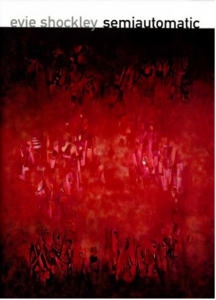
Finalist: semiautomatic, by Evie Shockley (Wesleyan University Press)

A brilliant leap of faith into the echoing abyss of language, part rap, part rant, part slam, part performance art, that leaves the reader unsettled, challenged—and bettered—by the poet’s words.

Nominated Work

semiautomatic

Poetry that acts as a fierce and loving resistance to violence

Art can’t shield our bodies or stabilize the earth’s climate, but Evie Shockley’s "semiautomatic" insists that it can feed the spirit and reawaken the imagination. The volume responds primarily to the twenty-first century’s inescapable evidence of the terms of black life—not so much new as newly visible. The poems trace a whole web of connections between the kinds of violence that affect people across the racial, ethnic, gender, class, sexual, national, and linguistic boundaries that do and do not divide us. How do we protect our humanity, our ability to feel deeply and think freely, in the face of a seemingly endless onslaught of physical, social, and environmental abuses? Where do we find language to describe, process, and check the attacks and injuries we see and suffer? What actions can break us out of the soul-numbing cycle of emotions, moving through outrage, mourning, and despair, again and again? In poems that span fragment to narrative and quiz to constraint, from procedure to prose and sequence to song, "semiautomatic" culls past and present for guides to a hoped-for future.

-- from the publisher
Biography

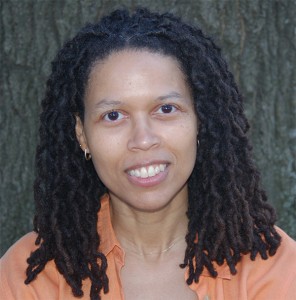
Evie Shockley has published multiple books of poetry, including "the new black" (Wesleyan, 2011), winner of the Black Caucus of ALA’s Literary Award for Poetry, and "a half-red sea" (Carolina Wren Press, 2006), in addition to two chapbooks. Her newest title "semiautomatic," will be published in September 2017 from Wesleyan. She also has a book of criticism, "Renegade Poetics: Black Aesthetics and Formal Innovation in African American Poetry" (Iowa, 2011). Shockley has had essays and reviews published in such journals as Callaloo, African American Review, and Indiana Review. Her poetry has appeared in MELUS, Harvard Review, Columbia Poetry Review, and in the anthology "Black Nature: Four Centuries of African American Nature Poetry," among many other publications. Shockley has sat on a number of panels and given many presentations at a variety of conferences including MLA, the American Studies Association Conference, and the American Literature Association. She has read at the Vermont Studio Center, Squaw Valley Community of Writers, Barnard College, University of New Mexico, and at a number of other universities and literary venues. Shockley received the 2012 Theodore H. Holmes ’51 and Bernice Holmes National Poetry Prize, awarded to "a single poet of special merit" by the faculty of Princeton University’s creative writing program.

Shockley received her BA in English from Northwestern University, followed by a JD from University of Michigan Law School, before earning her MA and PhD from Duke University. She is assistant professor in the English department at Rutgers University.

Winners

Prize Winner in Poetry in 2018:

Frank Bidart

A volume of unyielding ambition and remarkable scope that mixes long dramatic poems with short elliptical lyrics, building on classical mythology and reinventing forms of desires that defy societal norms. Poetry

Finalists

Nominated as finalists in Poetry in 2018:

Patricia Smith

A searing portrait of the violence exacted against the bodies of African-American men in America and the grief of the women who mourn them, infused with a formal virtuosity emblematic of the poet’s aesthetic sophistication and savvy linguistic play.

The Jury

Alison Hawthorne Deming(Chair)

Agnes Nelms Haury Chair in Environment and Social Justice and Regents’ Professor

David Baker

Professor of English

Thomas Lynch

writer and undertaker

Winners in Poetry

Tyehimba Jess

For a distinctive work that melds performance art with the deeper art of poetry to explore collective memory and challenge contemporary notions of race and identity.

Peter Balakian

Poems that bear witness to the old losses and tragedies that undergird a global age of danger and uncertainty.

Gregory Pardlo

Clear-voiced poems that bring readers the news from 21st Century America, rich with thought, ideas and histories public and private.

Vijay Seshadri

A compelling collection of poems that examine human consciousness, from birth to dementia, in a voice that is by turns witty and grave, compassionate and remorseless.

2018 Prize Winners

Staff of The Washington Post

For purposeful and relentless reporting that changed the course of a Senate race in Alabama by revealing a candidate’s alleged past sexual harassment of teenage girls and subsequent efforts to undermine the journalism that exposed it.