Finalist: Portland Press Herald/Maine Sunday Telegram, by Colin Woodard
Nominated Work
In one of the fastest-warming ocean locations on Earth, an ecosystem’s species – and the people who rely on them – are caught in the cross-hairs of a changing climate.
By Colin Woodard
YARMOUTH BAR, NOVA SCOTIA — Sandwiched on a narrow sandbar between Yarmouth’s harbor and the open Gulf of Maine, the fishermen of Yarmouth Bar have long struggled to keep the sea at bay.
Nineteenth-century storms threatened to sweep the whole place away, leaving Yarmouth proper’s harbor more open to the elements, prompting the province to build a granite cribwork across the quarter-mile bar, behind which the hamlet’s fishing fleet docks. Global warming has brought rising seas, a two-story-high rock wall to fight them and the hamlet’s designation as one of the communities in the province most threatened by climate change.
Now, snaking around the snout of Nova Scotia and into the Gulf of Maine is a new, unseen threat to Yarmouth Bar and hundreds of coastal communities in Maine, eastern New England and the Maritimes: currents fueling the rapid warming of of the sea.
The Gulf of Maine – which extends from Cape Cod in Massachusetts to Cape Sable at the southern tip of Nova Scotia, and includes the Bay of Fundy, the offshore fishing banks, and the entire coast of Maine – has been warming rapidly as the deep-water currents that feed it have shifted. Since 2004 the gulf has warmed faster than anyplace else on the planet, except for an area northeast of Japan, and during the “Northwest Atlantic Ocean heat wave” of 2012 average water temperatures hit the highest level in the 150 years that humans have been recording them.
As a result, many native species – boreal and subarctic creatures at the southern edges of their ranges – are in retreat. Lobsters populations have been shifting northward and out to sea along our coast as they’ve abandoned Long Island Sound almost entirely. Many of other commercially important bottom-dwelling fish – including cod, pollock and winter flounder – have been withdrawing from Maine and into the southwestern part of the gulf, where the bottom water is cooler.
“We’re really in the crosshairs of climate change right now,” says Andy Pershing, chief scientific officer at the Gulf of Maine Research Institute in Portland, who first revealed the alarming pace of the gulf’s recent warming.
For two years running, Maine’s northern shrimp fishery has been closed for lack of shrimp. Endangered right whales have virtually stopped visiting the waters off Lubec and Grand Manan because the tiny cold-loving copepods that they feed on – as do herring and, indirectly, almost everything else in the gulf – are in short supply there.
Warm-water invaders are gaining a toehold, and those that already had one are taking over. Green crab populations exploded in 2012 and 2013, extirpating soft-shell clams from vast areas of mudflats and stripping the northern parts of Casco Bay of their life-sustaining eelgrass meadows, which have yet to recover. Blue crabs, a species normally identified with the sultry Chesapeake, have appeared in lobster traps and in southwestern Nova Scotia have started making themselves at home. Asian shore crabs now dominate the shores of seacoast New Hampshire. Ugly, bottom-smothering sea squirts have spread across the seafloor all the way to Eastport, displacing the animals that the gulf’s sea creatures actually want to eat.
“The main message is that fish are definitely on the move,” says Michael Fogarty, chief of the ecosystem assessment program at the National Fisheries Service’s Northeast Fisheries Science Center in Woods Hole, Massachusetts. “There’s no doubt about that, and it has ramifications for fishermen and the ecosystem.”
In accordance with climate change models, the region has also been experiencing markedly increased rainfall and snowfall, reducing the salinity of the gulf and hampering the growth of the microscopic marine plants at the base of the food web. More frequent extreme precipitation events are making coastal waters more acidic, snuffing out baby oysters, mussels and other creatures that have difficulty building their shells under the new conditions.
“The impact of ocean acidification will be felt first by some of the wild bivalve fisheries like soft-shell clams and mussels,” predicts oyster hatchery owner Bill Mook, who now often has to treat his water to make it alkaline enough for his stock. “It will be manifested by a failure of the larvae to become juveniles.”
Two cold winters have given the gulf some breathing space, but climate models and recorded trends indicate our seas are going to keep warming, with the conditions experienced in the “ocean heat wave” becoming the new normal by mid-century. The result will be dramatic changes in an ecosystem Mainers have relied on since the end of the last ice age, ones for which our communities, industries and government are poorly prepared to face.
“We’re conducting this great experiment, but we don’t have a pristine control site to compare results to,” says Larry Harris, a marine zoologist at the University of New Hampshire who studies invasive species. “Unfortunately we only have one Gulf of Maine.”
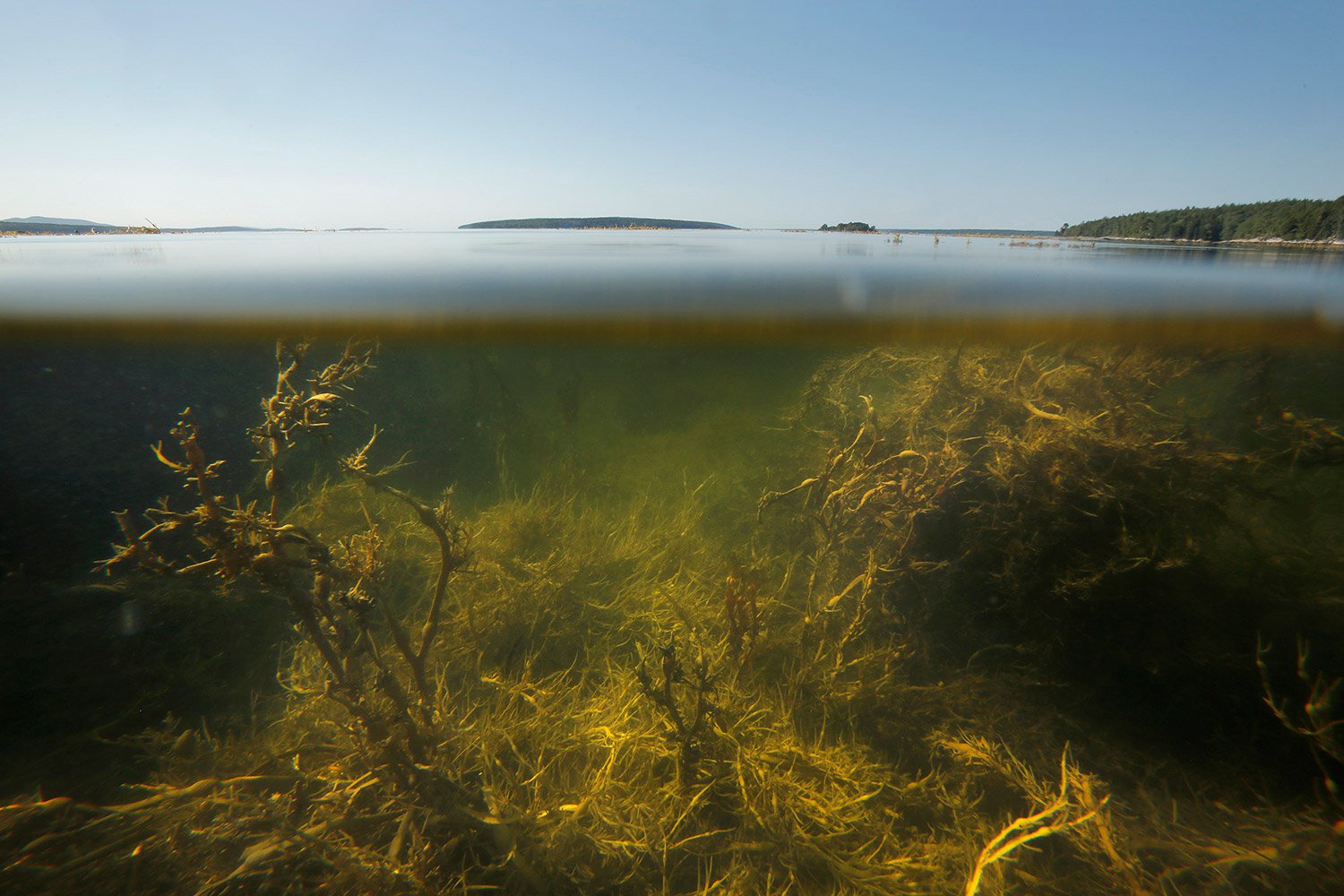
Below the surface of the Gulf of Maine, changes are happening that will impact Maine, New England and the Canadian Maritimes. Since 2004, the gulf has warmed faster than any other body of water on the planet save for an area northeast of Japan. In 2012, the average water temperature in the gulf hit the highest level in the 150 years temperature records have been kept. Photo by Gregory Rec/Staff Photographer
Few places in the world’s oceans are as well-suited to sustaining marine life as the Gulf of Maine. By a fortunate confluence of geography, geology, climate and oceanography, the gulf is a fertile oasis in an ocean that is, ecologically speaking, largely desert.
On a standard map, the gulf looks like little more than a bulge of the Atlantic Ocean, but on a nautical chart its true nature is revealed. Hidden just a few dozen feet beneath the waves at its southern entrance are two enormous submerged islands – Georges and Browns banks – which separate it from the surrounding ocean, deflecting and shaping ocean currents. It’s really a semi-enclosed sea, like the Baltic or Mediterranean seas, with characteristics all its own.
Two narrow channels provide the only deep-water connections into the gulf. The larger of these, the Northeast Channel is only 22 miles wide, but through it often flows a cold, nutrient-rich current originating among the ice floes of northern Labrador. It courses around the end of Nova Scotia and loops the mouth of the Bay of Fundy before flowing down the coast of Maine like an ecological conveyor belt, then arcing back around the northern flank of Georges Bank to form a spinning, life-sustaining gyre.
In the oceans, as on land, plants are at the base of the food web, capturing and storing the sun’s energy through photosynthesis. At sea, most plants are microscopic, and they generally thrive when two things can be found at once: light, which is available only near the surface, and nutrients, which tend to fall to the dark ocean floor. The Gulf of Maine puts these things together in myriad ways.
First there are the river systems – the Kennebec, Penobscot, Saint Croix, Saint John and 21 others – that together drain a quarter-trillion gallons of fresh, nutrient-laden water into the gulf each year, further fertilizing the sea. The cold climate plays a role, helping to prevent nutrient-rich bottom water from being trapped under a thick layer of warmer, lighter surface water, as happens in warmer climates.
Then there are the tides – the world’s highest, thanks to the fortuitous interaction of coastal geography and the orbital tracks of the Earth and moon around the sun – rising and falling 50 feet and more at the head of the gulf, the Minas Basin in Nova Scotia, and then surging in and out of the Bay of Fundy where it collides with the north-south tides flowing in and out of the bays and estuaries of Maine. The tides mix and churn the water, keeping nutrients suspended in the lighted surface waters and even forming the Western Hemisphere’s largest whirlpool, the Old Sow off Eastport at the Maine-New Brunswick border. They also create vast expanses of critical habitat: the salt marshes, clam flats, mussel banks and seagrass meadows that serve as nurseries for countless marine creatures.
In its pristine state, the Gulf of Maine was stupendously productive. Early European explorers were flabbergasted by its largesse. They encountered great schools of whales, landed 5-foot-long cod with virtually every drop of a hand-held hook, and waded at low tide to capture 20-pound lobsters among the rocks.
It was in the pursuit of cod that Maine was first colonized, starting with year-round fishing stations at Damariscove, Monhegan and other islands in the decade prior to the Pilgrims’ landing at Plymouth. The Pilgrims avoided starvation at the end of the winter of 1621-1622 only by turning to Damariscove for food, and the later Puritan experiment at Massachusetts Bay was underwritten by its own fishing stations, leading 18th-century New England leaders to put the image of the cod on their stamps, coins and buildings.
“The members of the ‘codfish aristocracy,’ those who traced their family fortunes to the 17th-century cod fisheries, had openly worshiped the fish as the symbol of their wealth,” Mark Kurlansky wrote in “Cod: A Biography of the Fish That Changed the World.” “The Boston Town Hall … had a gilded cod hanging from the ceiling [and]…after the American Revolution a carved wooden cod was hung in the Old State House” as if overseeing the commonwealth’s proceedings.
If anything, fishing had an even greater impact on Maine, where cod remained plentiful close to shore right into the 20th century. Using logbooks, a University of New Hampshire team led by maritime historian Karen Alexander reconstructed the 1861 catch of the small sailboat fleet operating out of a handful of hamlets between Blue Hill and Winter Harbor. Using baited hooks and hand-held lines, these day fishermen caught nearly 10,000 metric tons of cod – more than the entire modern U.S. fleet in the Gulf of Maine was able to land between 1996 and 1999 with their powerful engines, enormous bottom-trawling nets and high-tech fish finders. The researchers estimated the overall 1861 catch in the U.S. part of the gulf at 78,600 metric tons.
This year’s fishing quota is just 386 metric tons, because so few cod remain, the result of overfishing in the late 20th century and the failure of the stock to fully rebound – due, it is thought, to the temperature changes. “The warm water is absolutely not making things easy for the cod,” Pershing says.
Because it has been regularly fed by frigid currents originating in the Arctic, the gulf is home to a range of northern and subarctic species that could not thrive south of Cape Cod, where the warm Gulf Stream holds sway: cod, salmon, herring, mackerel, lobsters and a protein-packed, rice-sized copepod called Calanus finmarchicus on which many other species rely. The cold kept pathogens away, and was too hardy for annoying creatures like green crabs and jellyfish to take hold.
All that has been changing over the past decade, starting with the incoming currents from Canada. “There’s been a marked change in the deep water coming into the Northeast Channel,” says John Hare, a biological oceanographer and director of National Oceanic and Atmospheric Administration’s Northeast Fisheries Science laboratory in Narragansett, Rhode Island. “There’s much less of the colder Labrador water and more of the warmer water coming in from the [continental] slope.”
This is likely due to the melting of the Greenland ice sheet and ice from the Arctic Ocean over the past two decades, which has dumped huge quantities of very cold freshwater into the Labrador Sea, changing the arrangement of ocean currents. David Townsend, a biological oceanographer at the University of Maine who studies the phenomenon, says the localized effect has been the shifting of the extremely cold Labrador Slope Current away from the Gulf of Maine, resulting in greater deep-water inflows of warmer water coming up from the Gulf Stream to the south.
Temperature variability has always been a characteristic of the Gulf of Maine, which has always seen three or five years of warmer temperatures followed by a similar period of cooler ones. We’re still seeing that today, Townsend notes, based on pulses of cold water that still come down the coast of Nova Scotia and inhibit deeper continental slope water from entering our region. The difference in recent years is that when the Scotia current lulls, the slope water that pours in is far warmer than it once was.
“For reasons that we do not understand, there is less Labrador Slope water sitting outside the entrance to the Northeast Channel than there used to be,” he says, helping drive the past decade’s temperature spike in the Gulf of Maine.
What happens next “upstream” from us in Canadian waters is anyone’s guess. Annual reports on the state of the Atlantic Canadian marine ecosystem produced by Canada’s Department of Fisheries and Oceans indicate above-normal surface- and bottom-water temperatures for several years running and record-breaking levels in some areas in 2012, including the eastern half of the Gulf of Maine. Catherine Johnson of the Bedford Institute of Oceanography in Halifax said the reasons for the warming of the deep-water were not entirely clear, nor was it well understood how these effects would work their way down the shelf.
A half-dozen other Canadian government scientists who worked on the marine ecosystem assessment and other research relevant to the warming of the Gulf of Maine either did not respond to interview requests or could not obtain permission to speak to a reporter about them, and obtaining permission to speak to Johnson about her work took two months.
Under Prime Minister Stephen Harper, government scientists have been prevented from discussing climate change-related research with journalists – sometimes unable even to answer questions about their own scientific papers in the public domain – prompting protests across Canada and hampering efforts to integrate information across the Gulf of Maine.
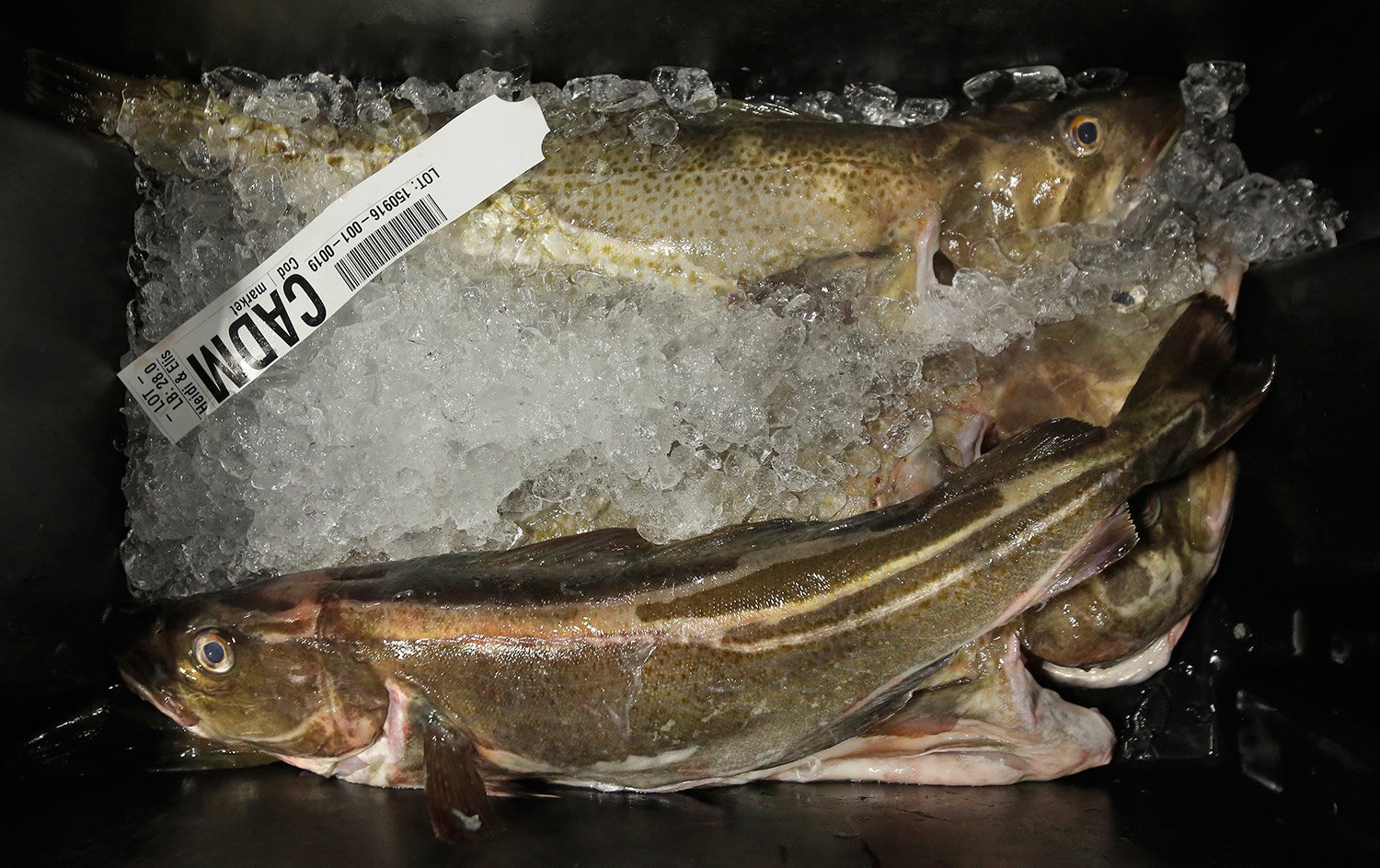
Cod packed in ice await inspection during a fish auction at the Portland Fish Exchange in Portland. Maine was first colonized in the pursuit of cod, a fish so abundant that early settlers landed 5-foot long cod with virtually the drop of every handheld hook. Bottom-dwelling fish like cod, haddock and flounder have retreated away from Maine in to the southwestern part of the Gulf of Maine, where the water is cooler. Photo by Gregory Rec/Staff Photographer
Amid the 10-year warming trend, the 2012 “ocean heat wave” stood out. Researchers think they’ve figured out why that year was so unusual, providing some indications of how likely the conditions are to repeat themselves.
During the winter of 2011-2012, an already warming gulf was subject to unusually warm air temperatures, courtesy of the unusual behavior of the jet stream, the shifting front between cold arctic and temperate continental air masses. “What was so peculiar was that the jet stream just locked in place for weeks at a time in a pattern that had warm air up above Quebec City all winter, and people were going around in their T-shirts in January,” says Glen Gawarkiewicz, an oceanographer at the Woods Hole Oceanographic Institution, who helped unlock the puzzle. “Normally that warm air would have been south of Maryland.”
As a result, the gulf never properly cooled down. In the first half of the year, water temperatures across the gulf and down to 150 feet or more were about 4 degrees Fahrenheit higher than they usually were; in some places there was an 8-degree spike. Things warmed further through the summer, sending shock waves throughout the ecosystem.
Unfortunately, Gawarkiewicz says, the jet stream is still behaving strangely, getting stuck in place for long stretches of winter instead of undulating along over Maine, providing deep chills and brief thaws. The difference is that in the past three winters the jet stream has stalled with the northeastern United States stuck in the cold and the western United States in sustained warmth, whereas the opposite was true in 2011-2012. “Fundamentally the dynamics of the jet stream are changing, and we’re not sure why,” he says.
Meanwhile, climate models predict atmospheric temperatures will continue to increase in New England in the coming decades, with average surface temperatures reaching 4 to 5 degrees Fahrenheit higher in 2050 then they are today, according to Massachusetts’ Climate Change Adaptation Advisory Committee. Average summer sea surface temperatures in the Gulf of Maine region will increase by about 5.5 degrees – a rate of just over 0.1 degree a year – between now and 2065, according to projections averaging the results of six independent models by a team led by John Loder, an ocean modeler at the Bedford Institute of Oceanography, a Canadian Department of Fisheries and Oceans research institute in Dartmouth, Nova Scotia.
That’s less than the past decade’s unusually steep average rate (0.4 degrees Fahrenheit a year) but twice as fast as the 30-year warming trend in the gulf (0.054 per year). If the projections are accurate, sea temperatures comparable to 2012’s could be the “new normal” by 2050.
Preliminary modeling by Canadian scientists of the ecosystem effects of a 1.8-degree Fahrenheit increase in average sea surface temperatures in our region over the next 50 years predicted a reduction in the total mass of all creatures currently living in the region of 19 to 29 percent. The biggest factors, says co-author Sylvie Guenette, a fisheries biologist in St. Andrews, New Brunswick, were a marked decline in phytoplankton and Calanus finmarchicus, which would trigger steep declines in cod, herring, lobster and other species. “This model is a first attempt, and there’s a lot of uncertainty in this,” she cautions, not least the fact that since it was created in 2009, predictions of how much the Gulf of Maine would heat up have more than tripled.
While nobody knows for sure what all this will mean for marine life and the coastal economy, 2012 provided a sobering glimpse into a warmer future.
That May, lobster fishermen were shocked to encounter strong runs of newly shedded lobsters, six weeks ahead of their usual schedule. “Nobody knew what was happening, just that there were lobsters to catch,” recalls Islesford lobsterman David Thomas. “It kind of rattled everybody’s cage and made a big economic problem.”
Maine lobstermen were pulling up mountains of soft-shell lobsters, but dealers had nowhere to send them. The Maritimes processing plants that usually purchase the lion’s share were still busy with the spring harvest from the Gulf of St. Lawrence. The price plummeted until it got so low the processors reconsidered, buying up the glut of cheap Maine lobsters instead of local lobsters, prompting eastern New Brunswick lobstermen to blockade trucks of Maine lobsters to prevent them from unloading. Police tactical teams responded to calls for help from lobster plants that had been surrounded by hundreds of angry lobstermen.
Meanwhile, the warmer water triggered an explosion in the population of green crabs, which proceeded to devour most of the clams in Freeport, Brunswick, Penobscot and other towns. “Green crabs were literally boiling up out of the ocean,” recalls Freeport clammer Chad Coffin, president of the Maine Clammers Association. “They ate everything, all the sea grass, tearing up the shore.”
Marissa McMahan, now a doctoral student at Northeastern University, was lobstering with her father off Georgetown that summer and was surprised to find a large, stout-bodied gray-and-black fish in a trap. “I had to ask him what it was – a black sea bass – and he’d only seen four or five in his 40-plus years on the water,” she says. By the end of the summer they’d caught nearly 20 of the warm-water bottom fish, which normally live off New Jersey and Delaware. “Fishermen up and down the coast were seeing the same thing.”
On Eastern Egg Rock, puffin chicks starved because their parents were unable to find appropriate food for them, while off Grand Manan Island, northern right whales failed to find swarms of Calanus finmarchicus to eat.
Cod, which fishermen had hoped were recovering from the overfishing of the late-20th century, were found to be in bad shape across the region, with very few young fish present in either the interior of the gulf or Georges Bank. Fishing quotas in the interior gulf were cut by 80 percent that year, and as bad news continued to roll in, the fishery was essentially closed in 2014, with federal regulators estimating the stock at less than 4 percent of the level deemed sustainable.
hile 2012 was the warmest year on record, the ecosystem has been responding to the rapid warming of the past decade as well.
William Balch of the Bigelow Laboratory for Ocean Sciences in East Boothbay has documented a reduction in the growth of phytoplankton, the microscopic plants at the base of the food chain. Each month in the growing season since 1998, Balch and his colleagues have surveyed the tiny plants from the Nova Star and its predecessor ferries as they cross the gulf from Yarmouth, Nova Scotia, to Portland. (When ferry service was interrupted, they used other vessels.) The readings were constant until 2007, when they saw phytoplankton concentrations fall by about three-quarters, where they’ve stayed ever since.
Why? Balch thinks it’s because of increased precipitation, which has substantially increased river flows into the gulf. This water is laden with tea-colored dissolved organic matter that so happens to absorb sunlight in the same wavelengths craved by the phytoplankton, essentially cutting off their energy supply. The reduced flow of deep, cold Labrador water into the gulf – a key source of silicate, a nutrient needed by some types of phytoplankton – may have compounded the problem.
“It’s a double whammy when you lower a plant’s light and its nutrients,” he says. (Disclosure: this reporter is a Bigelow trustee.)
Maine and the region are poorly prepared for the challenges ahead, with critical scientific programs having been cut by Congress and the Canadian Parliament and climate change planning having been assigned a low priority under the administration of Maine Gov. Paul LePage.
“Changes are coming – it’s inevitable,” says Lou Van Guelpen, curator of fishes at the Huntsman Marine Science Center in St. Andrews, New Brunswick. “We don’t really know what their effects will be, but they’re happening faster and they’re happening now.”
Under the outgoing prime minister, efforts to understand the challenges facing the Gulf of Maine are hampered by Ottawa’s tight grip of the contact between the media and government scientists.
By Colin Woodard
ST. ANDREWS, New Brunswick — Half of the Gulf of Maine ecosystem lies in Canada, where much of the water feeding the gulf and affecting its temperature comes from.
Getting information about scientific research relevant to the future of the ecosystem isn’t easy, however, because of the outgoing Canadian government’s controversial policies that have prevented government scientists from speaking freely with journalists, and sometimes from speaking at all.
While researching this six-part series on climate change in the gulf, the Portland Press Herald/Maine Sunday Telegram was repeatedly blocked from speaking to Department of Fisheries and Oceans scientists by communications officers based in Halifax.
Multiple attempts to speak with a researcher based at the St. Andrews Biological Station here about temperature-driven changes in marine species distribution were blocked, even though scientific colleagues both inside and outside the institution said his work was relevant to the questions at hand. “Nobody is willing to talk about this topic at this time,” a DFO spokesman said in a voice-mail message.
Multiple requests to speak to John Loder, director of DFO’s Centre for Ocean Model Development and Application at the Bedford Institute of Oceanography near Halifax, about new sea surface temperature forecasts for the gulf were also denied by department spokespeople, who would only provide written answers to written questions about earlier results from 2013.
A request to speak to any of the scientists involved in the ongoing Atlantic Zone Management Program – which analyzes oceanographic and biological developments across the region – was approved only after two months of effort. The sole researcher who was ultimately allowed to be interviewed, Catherine Johnson, asked not to be quoted, as the department had not yet developed talking points for the topics discussed.
“I would say this doesn’t surprise me in the slightest,” says biologist C. Scott Findlay of the University of Ottawa, a co-founder of Evidence for Democracy, a group of scientists protesting the federal government’s communications policies. “Issues that are either directly or indirectly associated with climate change are something the government has been particularly concerned about controlling.”
After taking power in 2006, Prime Minister Stephen Harper’s government prevented government scientists from speaking to journalists about a wide range of topics, including the Arctic’s ozone hole, regional snowfall patterns in Ontario, the decline of sockeye salmon populations and a study several of them had published in the journal Nature on a flood that occurred 13,000 years ago in northern Canada. Previously, DFO scientists were easily accessible to journalists, even those critical of federal fisheries policy during the politically sensitive collapse of the overfished cod stocks in the Grand Banks.
Harper’s Conservative Party was defeated in a landslide election on Oct. 19. The next prime minister, Liberal Party leader Justin Trudeau, is likely to revisit these policies, as his party’s platform includes a pledge to “ensure that government science is fully available to the public, that scientists are able to speak freely about their work, and that scientific analyses are considered when the government makes decisions.” The new Liberal Party government will be sworn in Nov. 4.
In the spring of 2012, scientists from Environment Canada attending an international scientific conference in Montreal were assigned minders from the department’s media relations unit and instructed not to agree to be interviewed by the press, according to a 2013 report by the University of Victoria’s Environmental Law Clinic.
The report – which prompted Canada’s information commissioner to launch an ongoing investigation – reproduced DFO’s 2008 media relations handbook, which instructed spokespeople to “be familiar with what the Minister (of DFO) or other officials have already said on the topic and be sure your messages are consistent.” When requests come from national media outlets, the Minister’s Director of Communications in Ottawa “needs to be notified … before an interview with the journalist is granted.”
“In many cases, the talking points have to be agreed upon between the scientists and the staff in the minister’s office before the discussion can take place,” says Jeffrey Hutchings, a professor of biology at Dalhousie University in Halifax who has been critical of the media control. “Even for what, from a political sensitivity perspective, are the most mundane requests, it can be turned down or take forever to be approved.”
Hutchings, a fellow of the prestigious Royal Society of Canada, says the situation is stifling to researchers. “If you inhibit the communication of science, you’re inhibiting science itself,” he says. “Government scientists find it extremely frustrating and demeaning.”
A 2013 survey of 4,069 government scientists by the Professional Institute of the Public Service of Canada found that 90 percent of respondents had been prevented from speaking publicly about their scientific work and more than a third had been prevented from responding to public or media requests.
On retiring from DFO this year, fisheries scientist Steve Campana told the Canadian Broadcasting Corporation that government scientists were working in a climate of fear and were rarely allowed to talk to the media, even about their own groundbreaking research. “We have very strict directives of what we can say and the approval steps we have to go through, and very often that approval seems to be withheld for totally arbitrary reasons,” he said.
Matt Abbott, the Fundy baykeeper, lives in St. Andrews and knows many of the muzzled scientists. “How is it a bad thing, a government scientist speaking to a reporter doing serious-minded work about a potential impact on an important industry?” he asks, referring to warming effects on aquaculture and fisheries. “It’s so unfortunate.”
At DFO’s U.S. equivalent, the National Marine Fisheries Service, journalists can contact scientists directly, and the scientists can arrange interviews themselves.
Nature, one of the world’s most prestigious scientific journals, has condemned Canada’s media policies. “Nature’s news reporters, who have an obvious interest in access to scientific information and expert opinion, have experienced directly the cumbersome approval process that stalls or prevents meaningful contact with Canada’s publicly funded scientists,” the magazine editorialized in 2012. “The way forward is clear: It is time for the Canadian government to set its scientists free.”
The issue was the topic of heated debate in the Parliament of Canada this spring, with opposition members demanding an end to the restrictions.
The Press Herald did obtain permission to talk to three Canadian scientists, including one involved in estimating climate effects on fisheries populations and another working on sea lice control in aquaculture pens. All interviews had to be organized through regional communications specialists in Halifax.
Asked to explain why they had such policies in place, the media relations department at DFO headquarters in Ottawa did not answer the question but sent a written statement saying the department approved over 90 percent of the 682 science-related interview requests it received in the last two fiscal years, and that some of those that were not approved were for sources who were unavailable by reporter’s deadlines or were for information “outside the scope of DFO’s mandate.”
“Communicating our science is a priority for (DFO) and our record is solid,” the statement said.
The department did not respond to questions about why and how many requests were denied that were made to scientists who were both available and being asked about their own research.
Scientists predict more water ‘heat waves’ will drive away the zooplankton and smaller fish crucial to sustaining many species, which has been blamed for kill-offs of puffin chicks.
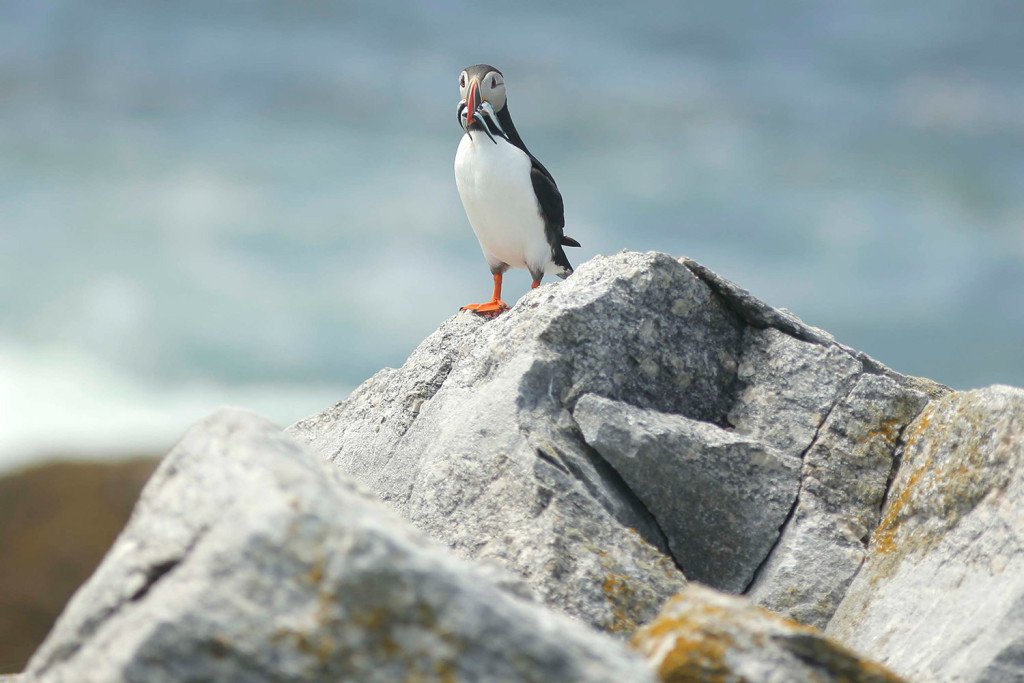
A puffin holds white hake in its beak after landing on Eastern Egg Rock in Muscongus Bay. During the "ocean heat wave" of 2012, small fish like the white hake and herring the puffins catch to feed to their chicks fled for deeper and cooler water. The puffins caught butterfish but their chicks couldn't fit the larger fish down their throats and many chicks ended up starving. Gregory Rec/Staff Photographer
By Colin Woodard
EASTERN EGG ROCK — The puffins are having a better year. On a late June day, the adults are landing on the rocky shore of this 7-acre bird sanctuary in flights of three or four, their bright red and yellow beaks stuffed with sand lance, tiny haddock and white hake, sometimes a herring or two. They look about, unruffled after a 30- or 40-mile round-trip sortie over Muscongus Bay and the open ocean south of Pemaquid Point and Monhegan, then duck into the rocky hideaways where their hungry chicks are waiting.
Puffins – penguin-like in their comical stoicism – were virtually wiped out in Maine in the mid-19th century by hungry fishermen, who threw nets over their hideaways to catch them by the thousands. Restored to midcoast islands by scientists, they have a threatened status in Maine and were recently listed as endangered in Europe, where Icelanders caught and consumed them as a delicacy just five years ago.
“It was a late year for egg laying and hatching, which fits a pattern we’ve been seeing and is probably climate related, but overall they had a good year,” says Stephen Kress, the Cornell University ornithologist who has led the 42-year effort to restore puffin breeding colonies to this and two other midcoast islands. “Food availability really underlies the health of the colony in every respect, and this year there was lots of it.”
Not so in 2012, the summer of the “ocean heat wave,” when temperatures in the Gulf of Maine exceeded anything in a historical record dating back to the Civil War. Herring, sand lance and other puffin prey apparently fled to colder depths, replaced by butterfish, a mid-Atlantic species fond of eating the jellyfish-like creatures called ctenophores, whose numbers exploded in the heated water.
The puffins at Eastern Egg Rock and two other offshore island sanctuaries piled butterfish at their chicks’ feet, but the hungry birds couldn’t fit the teardrop-shaped animals down their throats. Hundreds starved to death in burrows strewn with uneaten fish.
“In 2012 they were starving because there wasn’t enough food of the right size, and in 2013 there wasn’t much of anything at all. They starved for lack of fish,” says Kress, who has recorded a sustained and worrisome drop since 2003 in the weight of chicks when they depart the island at the end of summer to start their lives in the open ocean. “If they’re going out lighter weight, what are their chances of making it?”
Two cold winters have allowed the numbers of fledgling puffins to rebound, but the longer-term climate trends are not favorable for these and hundreds of other species adapted to a cold, nutritive gulf. Since 2004 the Gulf of Maine has warmed faster than anyplace else on the planet save an area northeast of Japan, and climate models suggest 2012-like conditions will become the new normal by the 2050s, with dramatic implications for life in Maine, on land as well as at sea.
Scientists say the most catastrophic outcome would be a collapse in the foundations of the marine food web that sustains not just the puffins and their prey but most other species, from endangered right whales to the haddock and cod that fishermen depend on.
Concern focuses on what is in many ways the keystone species of the gulf, a rice-sized copepod called Calanus finmarchicus, a fatty shrimplike creature that thrives in subarctic waters and the cold, nutrient-rich gulf, providing an unmatched food supply for herring, mackerel, right whales, and, indirectly, dozens of other creatures.
“The zooplankton biomass in the Gulf of Maine is dominated by this one species, which has a huge role in production at the lower levels of the food web,” says Jeffrey Runge, a biological oceanographer at the Gulf of Maine Research Institute in Portland. “It’s a little bit scary, because if Calanus disappears, there would be all sorts of implications in a food web that’s adapted to its presence.”
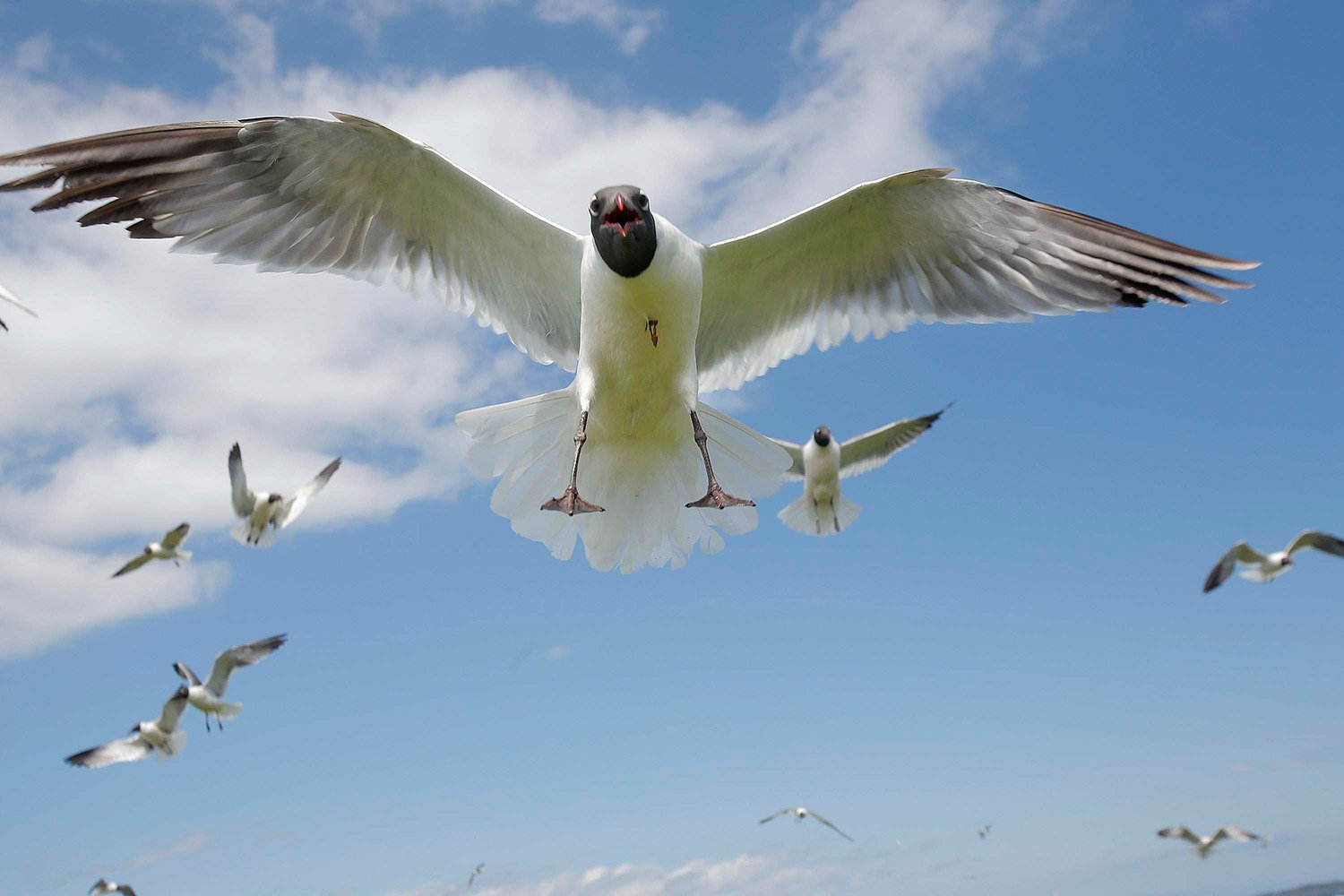
In addition to puffins, Eastern Egg Rock is home to eider ducks, arctic terns and laughing gulls, like this one defending its nest. Photo by Gregory Rec/Staff Photographer
Four years ago, two ecological researchers published research predicting just such a disappearance. Gregory Beaugrand of France’s Centre National de la Recherche Scientifique and the University of British Columbia’s Gabriel Reygondeau concluded that predicted climate-change-driven warming would dramatically reduce Calanus’ presence in the southern part of its range over the coming decades, especially Georges Bank and the Gulf of Maine, prompting “a major alteration” in the food web.
The year after their research appeared, the Gulf of Maine experienced the warmest water temperatures since records began in the Civil War era. Runge and other scientists set out to see if the 2012 “ocean heat wave” had damaged Calanus populations, surveying offshore in 2013. “To our surprise, Calanus had in fact done pretty well, so we’re trying to figure out why,” says Nick Record of the Bigelow Laboratory for Ocean Sciences in East Boothbay, who collaborated on the project. (Disclosure: this reporter is a Bigelow trustee.)
Good news, Runge says, is that Calanus remained abundant because more of the creatures were being carried into the gulf in a cold-water current that runs from their prime habitat in the Gulf of St. Lawrence, down the Atlantic coast of Nova Scotia, into the Gulf of Maine and down the Maine coast. The cold current lets Calanus survive, even while the gulf in general is too warm.
The bad news: that supply is likely to be unsteady, as the cold currents wax and wane. Moreover the timing of the gulf’s spring phytoplankton blooms may no longer line up with the emergence of females from their overwintering period. “I think Calanus will continue to be abundant because of this feed from Canada,” Runge says. “But there will be a lot more variability, especially in the southern Gulf of Maine.”
If so, North Atlantic right whales may already be feeling the effects. The whales are the Atlantic’s most endangered marine mammals, with a worldwide population of just 522 after a century of protection from hunting. At one point in the mid-20th century, researchers thought they might be extinct until a few were spotted around Cape Cod and Grand Manan Island, just over the Maine-New Brunswick border in the mouth of the Bay of Fundy.
The 45-ton whales eat only tiny planktonic species that are the right size to get caught in their baleen – the sievelike filtering plates some whales have instead of teeth – and only then when oceanographic conditions cause the tiny creatures to gather in dense swarms. Calanus finmarchicus is far and away their favorite and most nutritive prey. Until recently, more than 150 of the whales would show up each August off Lubec and Grand Manan to feed on swarms of Calanus reliably found there.
In recent years, however, the New England Aquarium researchers who have been monitoring the whales report the marine mammals have largely abandoned the area. “For the past five or six years, we’ve been seeing pulses of whales early in the season, but they don’t stick around,” says the aquarium’s senior scientist, Moira Brown. “We think they just aren’t finding a concentration of food sufficient to keep them anchored in the area, and our sampling stations for Calanus match up with that.”
This year the team didn’t see a single right whale until late August. The number of total sightings for the season – four – was the lowest in the project’s 35-year history.
Farther down the coast, researchers are trying to understand fluctuations in food available to puffins and other seabirds. At Eastern Egg Rock, the 2012 and 2013 chick starvations appear to have occurred because the adult birds couldn’t find ample herring, white hake or other food sources within flying and diving range. At Machias Seal Island – disputed territory controlled by Canada – the puffin colony did OK in 2012 but had the worst season on record in 2013, with the number of chicks fledging falling by more than three-quarters.
Tony Diamond of the University of New Brunswick, who monitors that island’s puffins, has found chick survival to be directly correlated to herring availability in eastern Maine and the Bay of Fundy. “There’s not much doubt that the herring have declined in their diet,” he says. “The herring may be going deeper when the water is warm, and they’re much smaller than they were in the 1960s.”
His research shows substantial declines in herring catches on the Canadian side of the gulf since the 1990s, which match observed declines in the number of herring puffins delivered to their chicks. His conclusion in a paper published last year on the issue: “The Bay of Fundy-Gulf of Maine ecosystem may be approaching a state in which it is unable to support populations of cold-water seabirds such as puffins.”
Ongoing monitoring of herring and other fish species by the National Marine Fisheries Service shows they have been concentrating deep in the southwestern Gulf of Maine where bottom temperatures are coldest. Herring, sand lance and other puffin forage also prey on Calanus, adding further questions about why the birds couldn’t find them in 2013.
Offshore, herring schools are targeted by fishermen, who caught 100 million pounds in the waters on the U.S. side of the Gulf of Maine last year, the highest quantity since 2009, prompting protests from other types of fishermen who fear the trawlers aren’t leaving enough for tuna, cod and other species.
“That’s really the key message: if we don’t leave enough fish in the oceans for these birds then they’re not going to survive as well,” says Kress, seated in an observation blind at Eastern Egg Rock amid a cacophony of seabird cries. “My God, especially these small ones like herring. If the population doesn’t get enough recruits when these tough periods come along like 2012 and 2013, you really run into trouble.”
Salmon runs and stocks of cod and shrimp decline as the ocean warms, while lobsters shift to the north – still plentiful, but will they eventually become scarce?
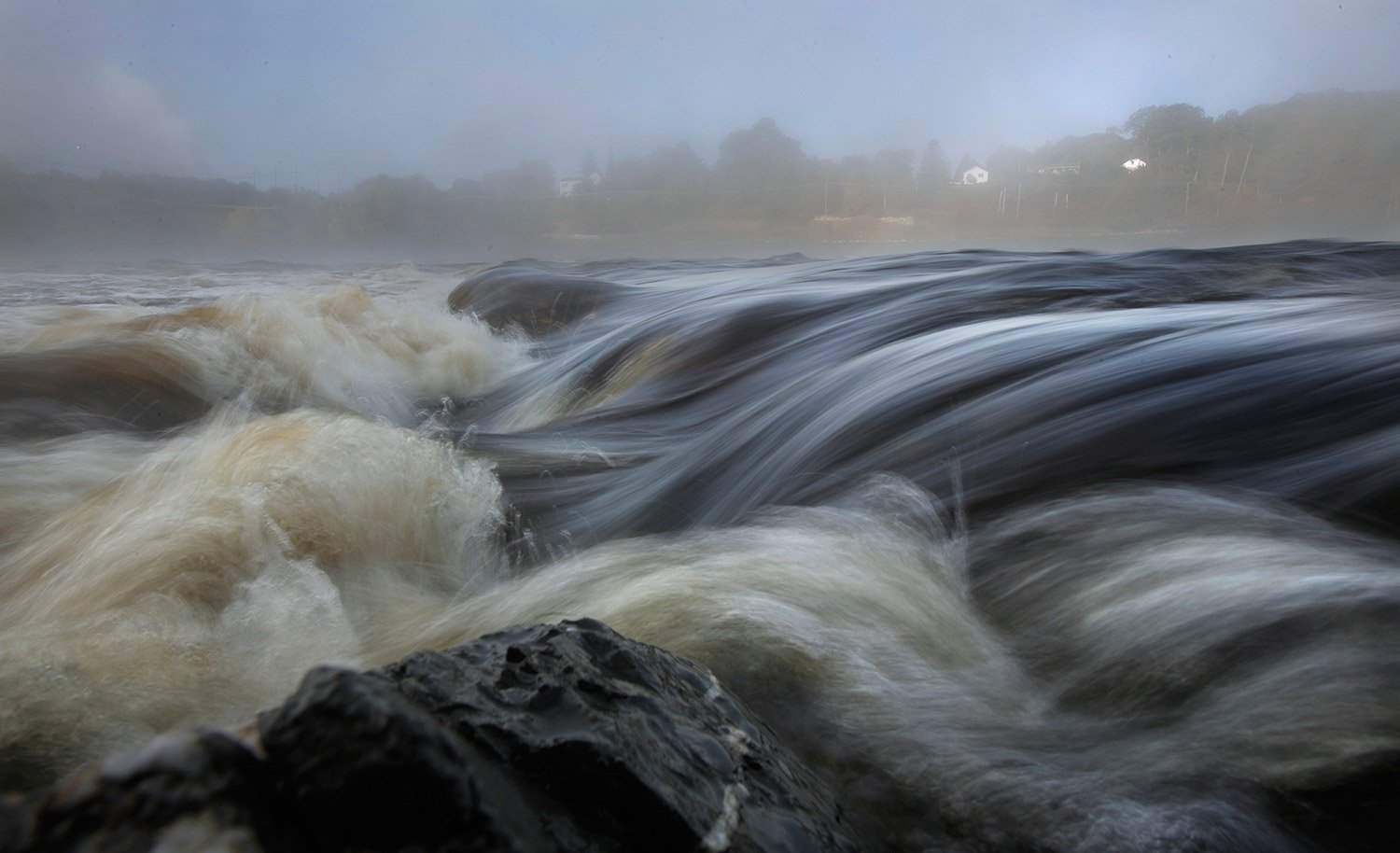
Swollen from recent rains, the Penobscot River flows through the area of the river where the Veazie Dam once stood. The dam, along with the Great Works Dam farther downstream, was removed two years ago in an effort to allow salmon easier passage to spawning grounds upriver from the dam. The salmon face a new threat, though, with the increase in the water temperature in the Gulf of Maine. Photo by Gregory Rec/Staff Photographer
By Colin Woodard
Now, two years after the dam’s removal, the salmon’s proponents fear the fish face a more fearsome threat: a warming sea.
In recent years, the Gulf of Maine has been one of the fastest-warming parts of the world’s oceans, and climate change models project average sea surface temperatures here to increase by another 5.5 degrees Fahrenheit by 2065, a development that could extirpate Atlantic salmon and other cold-loving species, many of which already find Maine at the southern edge of their ranges.
“We’re all for taking down the dams and all the things that are going on to restore habitat, but how much are they looking at the evidence?” asks Gerhard Pohle of the Huntsman Marine Science Center in St. Andrews, New Brunswick, co-author of a study predicting how the changes are likely to affect 33 commercial species over the next 75 years. “Distribution of salmon in the Gulf of Maine would be such that there wouldn’t be many left at all.”
The warming gulf is already presenting challenges to many of its cold-loving denizens. Scientists at the National Marine Fisheries Services, or NMFS, have recorded the steady retreat of a range of commercially or ecologically important fish species away from the Maine coast and into deep water in the southwestern part of the gulf, where bottom water temperatures are cooler.
The retreat, which intensified over the past decade, includes cod, pollock, plaice, and winter and yellowtail flounder. Other native species that once ranged south of Long Island – lobster, sand lance and red hake – have stopped doing so, presumably because the water there is now too warm.
“You can imagine that when you have species at the southern end of their ranges, they will be really sensitive to these changes,” says Michael Fogarty, chief of the Ecosystem Assessment Program at the NMFS Northeast Fisheries Science Center in Woods Hole, Massachusetts. “They will either shift distribution or their survival rates might change.”
American lobster have been doing just that, abandoning ever warmer conditions south of Cape Cod, where a report this August from the Atlantic States Marine Fisheries Commission found stocks that had “completely collapsed.” The estimated population of adult lobsters in southern New England in 2013 was the lowest on record: 10 million, or about one-fifth the level of the 1990s.
“These declines are largely in response to adverse environmental conditions including increasing water temperatures over the last 15 years combined with sustained fishing mortality,” the fisheries management group concluded, even though the lobster catch had fallen from 22 million to 3.3 million pounds since 1997. The commission is considering the results of the report, which recommends a near closure of the southern New England fishery, where hundreds of lobstermen have given up their licenses over the past 18 years.
Meanwhile, the lobster population in the colder Gulf of Maine has doubled to 250 million adult lobsters over the past two decades, even as Maine’s lobster catch has tripled. As most other commercial fish populations have cratered, most Maine fishing communities now rely almost solely on lobster, which is far and away the state’s most valuable fishery, at $457 million a year. (The figure for soft-shell clams, the closest competitor, is just $19 million.)
Robert Steneck, a lobster expert at the University of Maine’s Darling Marine Center, believes the lobster boom is largely the result of the destruction of the gulf’s primary predator, the Atlantic cod, through centuries of intense fishing. Freed from predation and fished in a responsible manner, he says, the crustacean has been able to expand faster than lobstermen can catch them.
The warming gulf introduces potential perils, Steneck warns. Lobster larvae don’t survive when the water is too cold or too warm, which is likely why lobster landings have actually been going down in York County, even as they’ve exploded in eastern Maine, where the water used to be too cold. Mainers of a certain age can recall that in the 1970s, the best lobstering was in Casco Bay but had shifted to the Boothbay region in the 1980s, the western entrance to Penobscot Bay in the late 1990s, and is in and around Stonington in Hancock County today.
“We’re definitely seeing this geographic shift and it’s in keeping with the warming of the gulf,” Steneck says. “Unless something changes in terms of ocean temperature trends, the Gulf of Maine will not likely remain a great place for high lobster abundance. How long this takes to play out, whether it’s decades or centuries, nobody knows.”
The potential problems are manifold, Steneck observes. Warmer water holds less dissolved oxygen. It could cause lobster eggs to hatch too early in the season, while the parents their eggs were attached to are still migrating from deep water, where the newly hatched larvae are less likely to survive.
David Thomas, who fishes for lobster from Islesford, says he and his colleagues have been seeing surprisingly small lobsters bearing eggs, even ones too small to keep under Maine laws, suggesting the animals might be maturing faster in the warm water. “Mother Nature tends to have corrective actions, but what’s the tipping point?” he asks. “You look down the other side of Cape Cod and the fishery is desolate. That’s pretty scary.”
Then there’s shell disease, caused by bacteria that eat through the shell, weakening and sometimes killing the lobster. The disease exploded in southern New England since 1997, with roughly a third of all lobsters becoming afflicted with it, but the colder temperatures in the Gulf of Maine have kept it at bay. Still, the rate of infection grew sixfold between 2010 and 2012, to 0.3 percent, raising concerns about what may happen as average water temperatures climb.
“Temperature has an impact, especially on how much the bacteria grow,” says Michael Tlusty, director for ocean sustainability science at the New England Aquarium in Boston, who studies shell disease. “It also causes stress to the lobsters, especially if they don’t get to bed down in cool temperatures for the winter to recover and recuperate.”
Northern shrimp have already seen an apocalypse of sorts. During the “ocean heat wave” of 2012, all ages of shrimp took a nosedive that didn’t appear to be driven by fishing pressure, says Anne Richards, a shrimp expert at the Northeast Fisheries Science Center. “Not only were no more babies coming into the population, but there was huge mortality for all sizes,” she says. “We’re still trying to figure out what that might be.”
Among the culprits, according to the Atlantic States Marine Fisheries Commission: “increasing water temperatures and a decline in phytoplankton abundance (a food source for shrimp)” and a rise in predators, including dogfish and redfish. The gulf’s shrimp fishery – prosecuted overwhelmingly by Maine-based boats – has been closed for two years running and was closed early in each of the three previous years.
As for salmon, the prospects look uncertain, with runs in decline not just in the Penobscot but in the Saint Croix and the relatively wild Miramichi River in New Brunswick as well. “We’re seeing declines over very large geographic areas, which points to some sort of factor out to sea, in the marine ecosystem,” says fisheries ecologist Katherine Mills of the Gulf of Maine Research Institute in Portland. “We feel the impacts very strongly in Maine because we started with such low population numbers before the downturn.”
The primary suspect: the decline of capelin off Greenland and Atlantic Canada, where Maine’s salmon go to feed. “We think it’s related to the warming temperatures shifting their prey base, the zooplankton,” Mills says.
Andy Goode of the Atlantic Salmon Federation says the salmon’s best hope lies in improving their riverine habitat, so the fish are as healthy as possible before they go to sea. The main stems of Maine’s rivers may be getting warmer, but if fish have access to cooler, tree-shaded tributaries high beyond old dam sites like Veazie, they’ll be better able to cope.
“The warmer climate is also leading to more moisture and rainfall here in Maine, and that makes the rivers cooler,” Goode notes. “So it’s not completely doom and gloom.”
Bringing promise and problems, new species like green crab and black sea bass throw the evolving Gulf of Maine into an unpredictable state of flux.
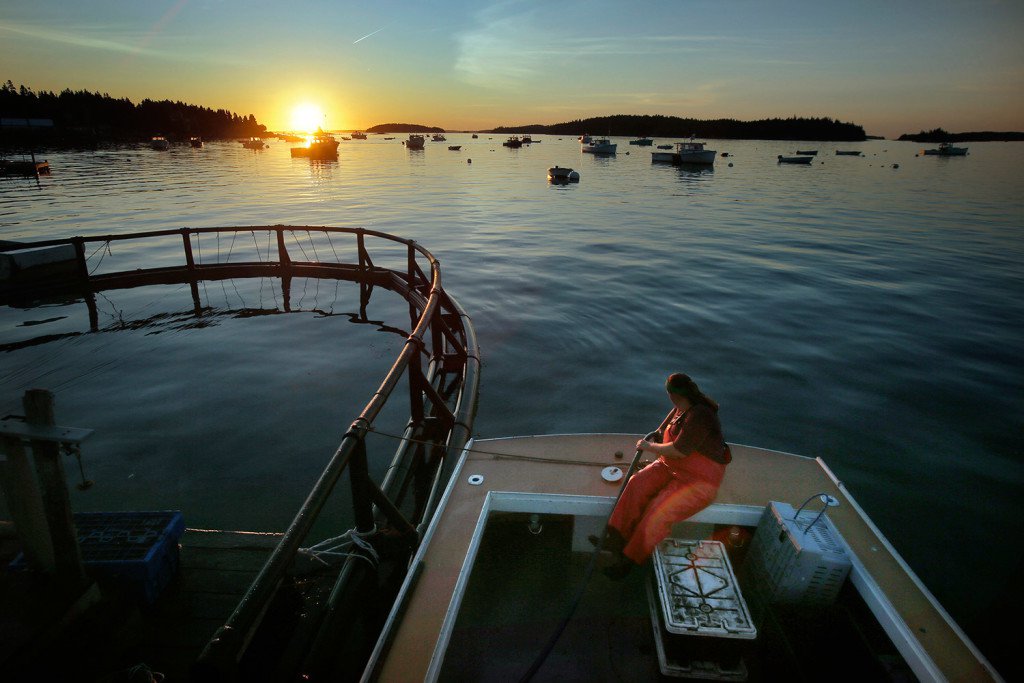
Genevieve McDonald fuels up before a day of lobstering off Stonington, in Hancock County. The waters there are considered the best for lobstering these days, a claim held by Casco Bay to the south in the 1970s. (Gregory Rec)
By Colin Woodard
BRUNSWICK — Until two years ago, if you had walked down to the shore of Maquoit Bay at low tide, you would have seen a meadow of eelgrass stretching nearly as far as the eye could see across the exposed seafloor. Here near the head of the bay, the sea grass stretched for two miles to the opposite shore, creating a vast nursery for the shellfish and forage species of Casco Bay, of which Maquoit is a part.
Now there’s only mud.
Green crabs took over the bay in the late fall of 2012 and the spring and summer of 2013, tearing up the eelgrass in their pursuit of prey and devouring almost every clam and mussel from here to Yarmouth. Fueled by record high water temperatures in 2012 and a mild winter in 2013, the green crab population grew so huge that the mudflats of Casco Bay became cratered with their burrowing, and much of the Maquoit and adjacent Middle Bay bottom turned into a lunar landscape.
Eelgrass coverage in Maquoit Bay fell by 83 percent. With nothing rooted to the bottom, the seawater turned far muddier, making life hard on any plants or baby clams that tried to recolonize the bay.
“We were astounded,” says Hilary Neckles of the U.S. Geological Survey’s Patuxent Wildlife Research Center, who linked the destruction to the green crabs. “The ecological ramifications really reverberate throughout the ecosystem, because sea grass is the preferred habitat of so many fish and shellfish species.”
Over the past decade, the Gulf of Maine has been one of the fastest-warming parts of the world’s oceans, allowing warm-water intruders to gain a toehold and earlier invaders such as the green crab to take over. Coupled with declines of the cold-loving species that have dominated the gulf for thousands of years, the ecological effects of even more gradual long-term warming are expected to be serious, even as precise forecasting remains beyond the state of scientific knowledge.
Scientists say the 2012 “ocean heat wave” was an unusual event, and that the 10-year accelerated warming trend is likely part of an oceanographic cycle and unlikely to continue. But the gulf has been consistently warming for more than 30 years, and long-term forecasts project average sea surface temperatures in our region could reach 2012-like levels by mid-century. The events of 2012 and the nearly as warm year that followed likely provide a preview of things to come, of a gulf radically transformed, with major implications for life on the Maine coast.
Genevieve MacDonald, who fishes for lobster out of Stonington, was standing on the dock at Isle au Haut one morning that summer, looked in the water, and couldn’t believe her eyes. There, swimming around the harbor like mackerel, were dozens and dozens of longfin squid, temperate creatures rarely seen in the chill waters of eastern Maine. “If you had a cast net you could have brought in a whole basket full of squid,” she recalls.
Since then, people from Brunswick to Bristol have been encountering gigantic beds of gelatinous, finger-shaped pods in shallow water at low tide, some measuring four feet across. Researchers from the University of Maine’s Darling Marine Center ran across one in the Damariscotta River in August 2014 and, perplexed as to what they were, brought them back to the lab. A colleague recognized it at once: a longfin squid egg mass containing thousands of squirming embryos.
The squid, apparently, are intending to stick around, and MacDonald hopes they do, since they’re the stuff of calamari. “Climate change is real, but it might also provide some new opportunities if we’re careful,” she says. “Lobstering is really lucrative, and I hope it stays that way, but if something happens it would be nice to have a backup plan.”
Marissa McMahan spent that notoriously warm summer of 2012 lobstering with her father out of Georgetown and encountered a different visitor, a large, stout gray-and-black fish she’d never seen before. The fish, which began turning up in lobster traps up and down the coast, was the black sea bass, a succulent mid-Atlantic species normally unable to tolerate Maine’s cold sea.
McMahan is now a doctoral student at Northeastern University and doing her dissertation on how black sea bass are spreading and interacting with lobster and other native species. “I don’t see anything to immediately worry about, but I talk to a lot of fishermen south of Cape Cod who think sea bass have played a role in reducing lobster numbers there,” she says. “They tend to open up the sea bass they catch, and they do have a lot of lobsters inside them.”
“It’s a very sought-after and marketable fish, so it could create an economic subsidy where we’re pretty much dependent on one single fishery,” McMahan adds. “But if there are all these other species moving north, we may have a lot more predators on lobsters.”
Other invaders appear to have few upsides.
Larry Harris of the University of New Hampshire has been tracking the spread of an unpleasant Asian weed, the pancake batter tunicate, an ugly, bloblike sea squirt that grows in dense colonies that spread in sheets across the seafloor, smothering native creatures. “It can overgrow mussels and sponges and anemones and other species that provide food for predators,” he says, noting that nothing here wants to eat it. “It’s the tunicate from hell.”
Brought to New England by shellfish farmers using Asian oysters, the tunicate used to die back each winter, but with the warmer water temperatures, its expanded over large swaths of the bottom from Passamaquoddy Bay to Georges Bank, where Harris thinks its presence may be contributing to the failure of cod stocks.
Green crabs, a European species introduced to the East Coast in the mid-19th century, reached Maine in the late 1940s, when the gulf began experiencing a warming spike second only to the present one. Then, as now, the crabs’ assault on soft-shell clams made newspaper headlines. “Green Killers March On,” the Portland Evening Express warned in January 1952, reporting that “old-timers suggest extreme cold and heavy sheet ice … were responsible for keeping them under control.”
The gulf has seen cold and warm cycles since, but with an ever warmer background trend, the green crabs appear to be doing more lasting damage.
With its 20-foot tides and miles of sheltered bottom, Cobscook Bay, a multi-chambered estuary in easternmost Maine, is to intertidal ecologists what the Amazon is to rainforest ones, a place where whelks and periwinkles grow to Jurassic proportions. Animals that normally live below the low-tide mark – accessible only by scuba or submarine – live in the intertidal zone here and can be studied with no more than a pair of boots.
Carl Merrill, director of Suffolk University’s field station in Edmunds, on the western end of the bay, has been studying Cobscook’s shores for nearly 40 years. In his surveys, he used to find both the smooth and rough periwinkles in concentrations of hundreds to thousands of individuals per square meter. Now he gets dozens or fewer per square meter. “The decline is substantial and very obvious,” he says. “Sometimes you don’t find one.”
The culprit isn’t harvesters – “wrinklers” collect the larger, non-native common periwinkle, which lives lower down the intertidal zone. “The green crab is the likely explanation,” he says. The crustaceans appear to be picking the shore clean of the little snails, with unknown ecological effects.
The crabs also appear to be stripping much of the coast of mussels. On shorelines that 20 or 30 years ago would be carpeted with the bivalves – taking up half the available space – they now cover less than 10 percent. Water temperature and ocean acidification may be playing a role, but green crabs appear to be a large part of the picture, since wild larvae settle and grow just fine at mussel farms and on the undersides of buoys and other objects the crabs can’t climb to.
Brian Beal, a marine shellfish ecologist at the University of Maine at Machias, says it’s likely not just green crabs but also lobsters and even Asian shore crabs, another invasive species that’s already become the dominant shore crab in seacoast New Hampshire. Together, he suspects, they’re eating the juvenile mussels, which explains why the bivalve is found only in places crabs can’t easily get to.
Warming is also responsible for the collapse of soft-shell clam populations in Freeport, Brunswick, Penobscot and other communities, Beal says. “As water temperature increases, we get a higher predation rate because most of the predators are invertebrates who are much more active in warm water,” including milky ribbon worms, moon snails and, of course, the green crab, he adds.
To prove his point, in April 2014 Beal oversaw the placement of net-covered plots in Freeport’s Harraseeket River, which were then seeded with juvenile clams. Seven months later, 90 percent of the seeded clams in all plots had survived, plus a staggering 1,400 wild clams per square foot were taking refuge under the nets, designed to stop green crabs from entering. “We estimated that close to 13 million wild clams settled into those 40 netted plots during that seven-month experiment,” Beal said. Just a few feet away from the 40 nets, his team found just 0.4 clams per square foot, suggesting predators account for the difference.
“We know that when we have cold water we have more shellfish survival,” says Freeport clammer Chad Coffin, president of the Maine Clammers Association. “The real question is what we are going to do when it gets really warm again.”
It’s possible the warmer water will bring a solution with it.
At Nova Scotia’s Kejimkujik National Park, rangers five years ago decided to take action against marauding green crabs, which had already torn up 88 percent of the eelgrass in the park’s two estuaries, which face the open Atlantic near the entrance to the gulf. Their strategy: fish them hard with modified shrimp traps, composting the catch until a market develops. “It looks like we’ve had phenomenal success,” says Parks Canada ecologist Chris McCarthy.
By 2013, trapping has helped knock the crab population down to size, with the average haul per trap falling from nearly 50 to fewer than eight. And as they cleaned out the green crabs, eelgrass has returned, along with eels, geese, migrating shorebirds, proper water quality and the stability of the surrounding marsh. Park staff wondered whether the gains would be maintained if they started scaling back trapping.
Then a new invader started showing up in the traps: Callinectes sapidus, the Atlantic blue crab, a delicious cousin of the green crabs that is as iconic to the culture of the Chesapeake as lobsters are to Maine. Normally not seen north of Cape Cod, they began showing up at Kejimkujik in 2013 where they were caught by the hundreds last year. “We’ve seen them chasing the green crabs around, so hopefully they’ll have an effect on them without harming the sea grass,” McCarthy says. “The big question will be if they can really establish themselves, given that we get fairly cold waters up here.”
Harris of UNH says they’re likely to do so, as southwestern Nova Scotia has fairly warm water. In fact, he says there’s now a small resident population in the Great Bay and Piscataqua River on the Maine-New Hampshire border. And despite two cold winters, he’s seen the whole crab assemblage continuing to shift eastward, with Bar Harbor lobstermen catching blue crabs last year, Asian shore crabs taking over seacoast New Hampshire, Jonah crabs – which once ranged no further than Casco Bay – established in Eastport, and large numbers of green crabs surviving cold Cobscook Bay winters, an indication that the species may be adapting to colder water.
What the net ecological effect will be is anyone’s guess. Adult Asian shore crabs will eat green crabs and aren’t attracted to muddy areas, but they do enjoy stripping the shore of barnacles. Adult blue crabs will happily munch on green ones, but nobody knows what they’ll do to, say, eelgrass. “Blue crabs are something fishermen can sell, so that’s a good thing, but on the other hand it’s also M
ost immediately affected are bivalves such as mussels, oysters and clams, which have a much harder time building their shells in more acidic conditions.
Bill Mook, owner of Mook Sea Farm just up the river from the Darling Center, started seeing mass die-offs of oyster larvae at his hatchery a decade ago, usually following a major storm, an increasingly frequent occurrence in Maine. “We’d see the swimming larvae develop normally for a week or two, and then they’d just stop feeding,” he recalls. “At first we couldn’t figure out what was happening.”
Then in 2009 a visiting Oregon oyster farm owner described an ongoing disaster in that state’s hatcheries, where production had fallen by 80 percent. The larvae, he told colleagues in Maine, turned out to be dying because the water was too acidic, making it much harder for them to build their first shells out of dissolved calcium carbonate in the surrounding seawater. The energy reserves from their eggs was running out before the larvae could develop their digestive organs and survive on their own.
Mook began testing the pH of the water entering the hatchery from the Damariscotta: After each storm it was way too high, and the level in between storms was going up as well. “When I started my business 30 years ago, the CO2 levels were at least 30 parts per million lower, so even during spring rains the carbonate conditions would remain OK,” he says.
Now, with the background level higher, each major storm drove acidity conditions into the red. In a few decades, even the background level may be too high for spring larvae to survive.
Mook now treats the water coming into his hatchery to ensure proper pH levels are maintained, but he fears what it means for wild shellfish populations. “The real question here is what is happening to the mussel larvae,” he says. “I predict the impact of ocean acidification is going to be first felt by the wild bivalve fisheries like clams and mussels and will be manifested by a failure of recruitment” – the failure of the infants to survive and become adults.
The state’s aquaculture industry is extremely concerned about acidification. “Make no mistake about it: What is at risk here is nothing short of the future of the aquaculture and fishing sectors of this state,” Maine Aquaculture Association executive director Sebastian Belle warned state legislators in June.
Belle says he knows of at least one instance where mussel farmers witnessed a different sort of failure: The larvae built their shells and grew into tiny mussels but couldn’t attach themselves to ropes for some reason. This is particularly worrisome, because scientists at the University of Washington have found that acidification substantially reduces the strength of the thread-like material – the byssus – that mussels use to anchor themselves.
“We don’t know enough about the physiological impacts of shifts of ocean pH on specific organisms,” Belle says. “There’s been a lot of talk about shellfish, but we’ve heard relatively little about the impact on larval finfish. What about cod and halibut larvae?”, two species farmed in Maine. “Is there an impact on their ability to metamorphose and grow into juveniles?”
Researchers at Stony Brook University in New York have also established that high carbon dioxide levels in seawater kill many hard-shell clam larvae and weaken the shells of the juveniles that do survive, stunting their future growth even when CO2 levels returned to normal.
Jeff Clements, a doctoral student at the University of New Brunswick in Saint John, has been studying how juvenile soft-shell clams deal with another problem: muddy bottoms that have become more acidic. “If they are exposed to acidic sediments, they won’t burrow into them,” he says. “The juveniles let the tidal currents carry them around as they search for places where that’s not a problem. Problem is, they’re exposed to predators the whole time they do that.”
With all of these challenges, Green of Saint Joseph’s College thinks humans are going to have to learn to grow shellfish larvae into juveniles to maintain wild stocks. “Hatcheries are going to become so important, because wild populations are going to falter,” he says. “Larval clams and mussels can’t survive with the water chemistry changes that are going to come. There’s no two ways about it.”
By Colin Woodard
In seawater tanks in a refrigerated room at the Darling Marine Center, the baby mussels are thriving.
Two months ago they were near-invisible larvae, swimming around in the tanks. Now tens of thousands of the tiny mollusks, each just a few millimeters long, have attached themselves to the different kinds of rope scientists have been testing here, and are eating the lab’s stock of algal food at an impressive clip.
Mick Devin, the lab manager at this University of Maine marine research facility, has been overseeing this experiment, part of an effort to master the art of hatching mussels, something mussel farmers – who grow their product on lines hanging in seawater – have never previously needed to do.
“Mussel farmers have been able to just throw their lines out and collect all the larvae they want from nature,” Devin says. “But mussel populations are down drastically in this state, so that may not be working so well now.” Hatcheries, he expects, may have to step up in the not-too-distant future.
Mussels have been vanishing from stretches of coastline where they once were ubiquitous, and scientists remain uncertain as to why. Green crabs, whose population exploded after an “ocean heat wave” in 2012, may have stripped many sections clean. But warmer water and increased rainfall – both problems expected to grow in Maine as a result of global climate change – may be creating a far worse problem: an acid sea.
“We know this affects larval development in bivalves, (and) chances are it will result in decreased numbers, whether it’s a natural population on a bed or one in a farm,” says Paul Rawson of the University of Maine’s School of Marine Sciences, who is in charge of the research. “We need to make sure the technology is in place so the farms will have a reliable source of seed.”
Brian Beal, the director of research at the institute and a marine shellfish ecologist at the University of Maine Machias, holds a handful of juvenile mussels that he is raising inside mesh bags as part of an experiment in the hatchery at the Downeast Institute in Beals.
The world’s oceans are turning more acidic. Since the Industrial Revolution, carbon dioxide levels in the atmosphere have grown by more than 70 percent and now stand at the highest level in at least 800,000 years. As the oceans absorb additional CO2, they’ve become 30 percent more acidic over this period. By 2050, scientists estimate surface pH levels will be lower – that is, more acidic – than at any time in several million years and by 2100 more acidic than any time in the past 300 million years – two or three times more so than today.
The Gulf of Maine is particularly vulnerable because its colder water more readily absorbs carbon dioxide and because the increasing frequency of major snow and rain events flood the gulf with more acidic river runoff. Monitoring buoys have recorded an increase in CO2 levels of about 1.25 parts per million – or roughly 0.3 percent – per year in the gulf since they were installed in 2007.
With climate models predicting a 10 percent to 14 percent increase in winter precipitation across Maine, New Hampshire and most of eastern Massachusetts – and more modest increases in spring and fall – the situation is expected to continue worsening faster than the global average, with serious effects on marine life and coastal communities.
“Maine is ground zero for North Atlantic acidification,” says Mark Green, professor of marine science at Saint Joseph’s College in Standish. “It’s happening, it’s documented, but we don’t know when the tipping point is going to be reached.”
Maine’s fisheries economy is also especially vulnerable, as it depends on species that may not thrive in a more acidic gulf. “Shellbuilders are the ones that will be impacted the most and we have an overwhelming reliance on shellbuilding organisms,” notes Susie Arnold, a marine scientist at the Island Institute in Rockland who studies the problem. Eighty-seven percent of the value of Maine’s commercial fish catch comes from creatures that have shells, including lobsters, clams, scallops and oysters.
The effects of acidification on lobsters have barely been studied in colder water. The only published research – a 2012 study from Saint Francis Xavier University conducted on Nova Scotia’s northern coast – suggested that larvae exposed to acidic conditions were smaller and slower to develop, though scientists say more research is needed to really get a handle on the effect.
Most immediately affected are bivalves such as mussels, oysters and clams, which have a much harder time building their shells in more acidic conditions.
Bill Mook, owner of Mook Sea Farm just up the river from the Darling Center, started seeing mass die-offs of oyster larvae at his hatchery a decade ago, usually following a major storm, an increasingly frequent occurrence in Maine. “We’d see the swimming larvae develop normally for a week or two, and then they’d just stop feeding,” he recalls. “At first we couldn’t figure out what was happening.”
Then in 2009 a visiting Oregon oyster farm owner described an ongoing disaster in that state’s hatcheries, where production had fallen by 80 percent. The larvae, he told colleagues in Maine, turned out to be dying because the water was too acidic, making it much harder for them to build their first shells out of dissolved calcium carbonate in the surrounding seawater. The energy reserves from their eggs was running out before the larvae could develop their digestive organs and survive on their own.
Mook began testing the pH of the water entering the hatchery from the Damariscotta: After each storm it was way too high, and the level in between storms was going up as well. “When I started my business 30 years ago, the CO2 levels were at least 30 parts per million lower, so even during spring rains the carbonate conditions would remain OK,” he says.
Now, with the background level higher, each major storm drove acidity conditions into the red. In a few decades, even the background level may be too high for spring larvae to survive.
Mook now treats the water coming into his hatchery to ensure proper pH levels are maintained, but he fears what it means for wild shellfish populations. “The real question here is what is happening to the mussel larvae,” he says. “I predict the impact of ocean acidification is going to be first felt by the wild bivalve fisheries like clams and mussels and will be manifested by a failure of recruitment” – the failure of the infants to survive and become adults.
The state’s aquaculture industry is extremely concerned about acidification. “Make no mistake about it: What is at risk here is nothing short of the future of the aquaculture and fishing sectors of this state,” Maine Aquaculture Association executive director Sebastian Belle warned state legislators in June.
Belle says he knows of at least one instance where mussel farmers witnessed a different sort of failure: The larvae built their shells and grew into tiny mussels but couldn’t attach themselves to ropes for some reason. This is particularly worrisome, because scientists at the University of Washington have found that acidification substantially reduces the strength of the thread-like material – the byssus – that mussels use to anchor themselves.
“We don’t know enough about the physiological impacts of shifts of ocean pH on specific organisms,” Belle says. “There’s been a lot of talk about shellfish, but we’ve heard relatively little about the impact on larval finfish. What about cod and halibut larvae?”, two species farmed in Maine. “Is there an impact on their ability to metamorphose and grow into juveniles?”
Researchers at Stony Brook University in New York have also established that high carbon dioxide levels in seawater kill many hard-shell clam larvae and weaken the shells of the juveniles that do survive, stunting their future growth even when CO2 levels returned to normal.
Jeff Clements, a doctoral student at the University of New Brunswick in Saint John, has been studying how juvenile soft-shell clams deal with another problem: muddy bottoms that have become more acidic. “If they are exposed to acidic sediments, they won’t burrow into them,” he says. “The juveniles let the tidal currents carry them around as they search for places where that’s not a problem. Problem is, they’re exposed to predators the whole time they do that.”
With all of these challenges, Green of Saint Joseph’s College thinks humans are going to have to learn to grow shellfish larvae into juveniles to maintain wild stocks. “Hatcheries are going to become so important, because wild populations are going to falter,” he says. “Larval clams and mussels can’t survive with the water chemistry changes that are going to come. There’s no two ways about it.”
As leaders procrastinate, experts say Mainers can take action to mitigate the ecosystem damage.
By Colin Woodard
AUGUSTA — When the Maine Legislature’s commission on ocean acidification reported its findings – that the state’s fisheries and aquaculture industries were threatened by this baleful byproduct of global warming – officials here were not exactly spurred to action.
Acidification, driven by increased carbon dioxide from the atmosphere and freshwater runoff from extreme rainfall in river basins, has been implicated in failures at oyster hatcheries and mussel farms, and has been shown to weaken clams and other shell-building animals vital to Maine’s fishing and aquaculture industries. But bills introduced in the last session – one each by a Democratic marine scientist and a Republican lobsterman – to implement many of the panel’s findings were withdrawn, one for lack of resources, the other for lack of support from Gov. Paul LePage’s administration.
“I could see the bill wasn’t going to go anywhere and that the governor was going to veto it,” Rep. Mick Devin, a Democrat from Newcastle, says of legislation he sponsored to allow the commission to continue its work for another three years.
Patricia Aho, who was the commissioner of environmental protection until she resigned in August, opposed Devin’s bill, saying the status quo was sufficient. “Since the issues of climate change and ocean acidification are inextricably linked, we think it will be more efficient to consider this issue in the broader context of climate change and adaptation programs,” she said in written testimony to legislators.
Devin’s bill and another one sponsored by Rep. Wayne Parry, a Republican from Arundel, were carried over to the next legislative session. Parry’s bill would have put a bond issue on the ballot that would borrow $3 million to fund several of the expert committee’s recommendations: collecting data, monitoring waterways, and performing tests in coastal waters to better assess the impact of acidification on wildlife and commercial fish species. It was withdrawn after failing to make it to the top of an informal list of bonding priorities drawn up by legislative leaders.
The Gulf of Maine has been warming at a rate faster than nearly anywhere else on the planet, and water temperatures in 2012 were the highest in the century and a half that readings have been collected. The impacts, including the retreat of native species, the spread of invaders from more southern climes, and the acidification of seawater, have been substantial and are expected to be more so in the future, as long-term warming trends make 2012-like temperatures the “new normal” by mid-century.
Experts say there’s little that Maine or New England can do by itself to address the underlying issue: the continued warming of the Earth because of greenhouse gas emissions from factories, cars, power plants, livestock feedlots and other human activities. Maine produces just 0.32 percent of the nation’s greenhouse gas emissions, according to the U.S. Environmental Protection Agency, which works out to about .05 percent of those in the world.
But Mainers could mitigate the damage by shoring up the Gulf of Maine ecosystem, reducing other stresses we can control and learning ways to protect resources from some of the worst effects.
“We have to pay attention to the factors we can exert some control over and try to identify ones that would produce the best possible return, the best bang for your buck,” says Katherine Mills, a fisheries ecologist at the Gulf of Maine Research Institute in Portland, who has studied the effect of warming sea temperatures on salmon and other species.
“If we limit pollution, if we reduce excess nutrients in our rivers, if we ensure the coastal habitats to be as robust as they can be, that’s going to help the system to be resilient,” says Matt Abbott, the Fundy Baykeeper at the Conservation Council of New Brunswick, an environmental group. “Even if we don’t know exactly what is going to happen, we know changes are occurring and that the system needs to be as robust as it can.”
At a local level, scientists believe there are ways to mitigate the effects of one aspect of a warming gulf, ocean acidification.
Eelgrasses and kelps take up dissolved carbon dioxide at a remarkable rate – with almost triple the effectiveness of a similar acreage of forest – and consumes excess nutrients, the two primary drivers of acidification. In doing so, they reduce the acidity of the surrounding seawater, to the benefit of clams, mussels and other creatures living nearby.
The Rockland-based Island Institute, a nonprofit that supports coastal communities, is partnering with a commercial kelp farm off Chebeague Island and scientists at the Bigelow Laboratory for Ocean Sciences in East Boothbay to find out how effective and widespread these benefits can be. This winter – the growing season for kelp – they’ll deploy monitoring equipment around one of Ocean Approved Inc.’s first-in-the-nation open-ocean commercial kelp farms. (Disclosure: this reporter is a Bigelow trustee.)
“You may very well be able to improve the growing conditions for shellfish on a very local level by locating a kelp farm with shellfish,” says Suzie Arnold, the marine scientist at the Island Institute who is collaborating on the effort. Kelp, she says, could become “the new kale,” a nutritious food source, while improving the environment, the survival of shellfish, and the winter employment opportunities in fishing communities.
Eighty-seven percent of the value of Maine’s $585 million commercial fish catch comes from shell-building creatures, including lobsters, clams, scallops and oysters. The federal government estimates the industry supports 33,000 jobs in Maine, roughly half of them ashore.
Those on the front lines of acidification are frustrated that the state government isn’t doing more.
“Maine’s resource industries are what defines the state, and it totals up to a lot of money,” says Bill Mook, founder of Mook Sea Farms, who watched acidic water devastate crops of newly hatched oysters. “It boggles my mind that as a state we wouldn’t act on bills that would give us some idea of what businesspeople like me will be facing.”
The ocean acidification commission, a panel of scientists, fishermen, aquaculturists and legislators that studied the problem, issued a range of recommendations, many of them focused on the collection of data that will help assess more precisely what the impacts are and will be on key species. The “most alarming” finding, their 122-report stated, was “how much we do not know about ocean acidification and how it will affect Maine’s commercially important species.”
“We’re far more dependent than at any other time on lobsters, for instance, but we don’t know what the pH is in the important coastal regions where the juvenile stages of development and settlement of lobsters occur and how it affects their survival,” says state Sen. Chris Johnson, D-Somerville, who co-chaired the commission with Rep. Devin. “We can’t wait until we have a collapse of an economically important species for our industry. We need to be working now on how to test mitigation strategies and build our monitoring.”
Parry, the lobsterman legislator who sponsored the acidification monitoring bond, agrees. “The biggest thing we learned on the commission was that we don’t have enough data,” he says. “I’m normally not a bond person, but we need to be able to get the equipment so that we can have continuous, real time monitoring so we can determine what is what. It’s very important for the survival of all Maine fisheries.”
The DEP, asked to substantiate why it believes existing programs are sufficient to deal with the problem, sent the Press Herald a five-page summary of its programs that touch on climate change, including providing technical assistance for eelgrass restoration in Casco Bay, the routine collection of discharge data from polluters, participation in the acidification commission’s meetings and the Regional Greenhouse Gas Initiative, a multi-state effort to reduce carbon dioxide emissions.
Asked to comment on the DEP summary, Sen. Johnson said “it’s suggesting that what we’re doing already is good enough. That is not the case.”
The administration, he said, left a number of key goals unaddressed, including identifying and reducing acidification-causing nutrient pollution from unpermitted sources, stepping up ocean chemistry monitoring, or creating a body that can coordinate the necessary work.
“None of the departments have stepped up to embrace the need for an entity that will move things forward so we don’t just wait for something to happen,” he says.
Mick Devin, a marine lab manager and Democratic legislator from Newcastle, says such an entity is vital. “Without a formal committee, none of this is going to be a priority,” he says. “Our state government needs to take the lead on this, because we’re not going to have a federal response on this at this time.”
The state of Washington has taken the lead in confronting ocean acidification, which threatens its $270 million shellfish industry. Its blue-ribbon panel released findings in November 2012, which helped inform the Maine commission’s study. The day it released the report, Gov. Chris Gregoire ordered state agencies to take steps to implement it and called for increased investments in scientific research and efforts to curb nutrient runoff from land.
California convened its own ocean acidification panel in 2012, which has since been joined by the governments of Oregon, Washington and the Canadian province of British Columbia and is now a vehicle to study the issue and build political momentum up and down the West Coast to address the issue.
Maine DEP spokesman David Madore said the administration has also made steps to address other aspects of climate change, highlighting the work of the Environmental and Energy Resources Working Group, an interagency panel convened by LePage and chaired by Aho. That group issued a report in September 2014 recommending its work should be continued to coordinate action and the implementation of 31 other specific recommendations, four of which appear to bear directly on climate change effects on the gulf.
More than a year later, however, the group has not reconvened. Madore said Aho “had a timetable to restart and expand the Working Group” beginning this fall or winter, but that those plans had been put on hold after her departure last month. Acting commissioner Avery Day is “aware of the importance of this work going forward” but “has not formalized any schedule for implementation.”
Two of the four actions directly related to the gulf – the development of a $26.9 million bond issue to repair, replace and upgrade failed septic systems and commercial discharge practices and the creation of new water runoff models for the state – will be acted on once the group reconvenes, Madore said. A third – increasing stormwater assumptions in culvert replacement rules – was implemented this August, he said, backed by $800,000 in grants to help pay for new projects.
The other directly relevant recommendation – to assist fishermen in adapting to climate-induced changes in fish stocks – falls under the Department of Marine Resources’ jurisdiction. In a written response for information on how this was being implemented, a department spokesman cited the department’s efforts to develop regulations for the fishing of black sea bass, its support for confronting the green crab explosion (including the fencing of clam flats and the convening of a summit on the issue), and the ongoing development of a long-term lobster fishery management plan.
The spokesman also said the department “remains committed to participating in ongoing discussions and supporting efforts by organizations that are targeting” ocean acidification.
U.S. Rep. Chellie Pingree, a Democrat representing Maine’s 1st District, has introduced federal legislation directing the National Oceanic and Atmospheric Administration to assess the likely impacts of acidification on individual coastal communities and identify gaps in knowledge. Her staff said the bill’s short-term prospects were dim because the Republican leadership of the U.S. House had little enthusiasm for funding climate-related research.
“I’m really quite concerned about ocean acidification and its impact on the Gulf of Maine,” Pingree said in a statement. “We need more information, more research and we need to be much better prepared.”
Parry, the Republican state representative from Arundel, put it this way in his testimony: “We can say it’s mostly from airborne CO2, but we here in Maine are not going to stop China and India from polluting.”
“If there are things we can do here in Maine,” he told legislators, “we should try.”
By Colin Woodard
The rapid warming of the Gulf of Maine over the past decade is largely responsible for the surprising failure of the Gulf of Maine cod stocks to rebound from overfishing, according to a new study.
Five years ago, federal fisheries managers put tough fishing quotas in place to protect the region’s cod until their populations could rebuild from the devastating effects of decades of overfishing. To their surprise, the Gulf of Maine cod stock continued to decline, prompting a near-closure of the fishery. The size of the adult stock – an estimated 3,000 metric tons – is just 4 percent of what would be needed to support an optimal fishery.
The study by Andrew Pershing, chief science officer at the Gulf of Maine Research Institute, and 11 colleagues from that and three other research institutions found that warming-related stresses accounted for much of the discrepancy between what managers thought would happen to the stock and what actually occurred. The study was published Thursday in the journal Science.
“Managers kept reducing quotas, but the cod population kept declining,” Pershing said in a written statement. “It turns out the warming waters were making the Gulf of Maine less hospitable for cod, and the management response was too slow to keep up with the changes.”
The Gulf of Maine – which extends from Cape Cod in Massachusetts to Cape Sable at the southern tip of Nova Scotia, and includes the Bay of Fundy, the offshore fishing banks and the entire coast of Maine – has been warming rapidly as the deep-water currents that feed it have shifted. Since 2004, the gulf has warmed faster than anyplace else in the world’s oceans, except for an area northeast of Japan, and during the “Northwest Atlantic Ocean heat wave” of 2012, average water temperatures hit the highest level in the 150 years that humans have been recording them.
“You can see the influence of temperature on the cod stock in a variety of ways, including the failure of the young to survive as they get older and the loss of more older fish along the way,” said co-author Katherine Mills of GMRI. “When we’re looking at rapidly warming systems, we need to change the way we do things and incorporate these effects into stock assessments.”
The scientists from GMRI, the University of Maine, the Bigelow Laboratory for Ocean Sciences, Stony Brook University and the National Oceanic and Atmospheric Administration’s Earth System Research Laboratory recalculated population projections from the official federal stock assessments of the past 10 years, this time taking into account the deleterious effects of warmer water.
The result: Instead of predicting the growth in numbers that managers had expected, the projections indicated the stock would decline, which is in fact what happened out in the water. “They were overestimating the stock because the assessment models did not incorporate the temperature changes,” Mills noted.
The warmer temperatures increased the metabolic demands on the juvenile fish, she said, requiring that they find more food to grow and survive. Warmer waters also increased predation by extending the hunting season of spiny dogfish and other species that eat small cod.
Michael Fogarty, chief of the ecosystem assessment program at the National Fisheries Service’s Northeast Fisheries Science Center in Woods Hole, Massachusetts, says the study is an important contribution, and mirrors results of a study he and his colleagues published in 2008 that predicted warmer temperatures would harm cod stock recovery.
That 2008 study analyzed warming data through 2004, just before the record-breaking recent temperature spike began. “The results they got are quite similar to the ones we had before, but the temperature increased much faster than we thought it would, so the time frame was very different,” Fogarty said. “I can tell you nobody expected the kind of increase we saw in 2012 based on the measures we had” in 2007 and 2008, he said.
Over the past decade, average sea surface temperatures increased at the shocking rate of about 0.4 degrees Fahrenheit per year, dwarfing the 30-year warming trend of 0.054 degrees a year. Scientists do not expect that enhanced rate of warming to continue, but long-term projections for our region by Canadian government scientists predict a rate of 0.1 degree per year through 2065, which would make 2012-like temperatures the “new normal” by mid-century.
To the judges:
Puffins running out of food. Green grabs infesting local shores. Eelgrass disappearing. Lobsters shedding their shells unusually early. The stories were coming on a regular basis, and while they seemed related, no one had connected the dots.
Last spring we asked Colin Woodard to look into what was happening to the Gulf of Maine. An unusually talented reporter who already had a firm grasp of oceanographic issues, Colin came back with the answer and unfurled it in a six-part series: The Gulf of Maine is warming faster than virtually any other body of water on Earth, so much so that it is considered ground zero in the climate change battle. And the state of Maine is doing nothing to fight these changes - or even prepare to deal with them.
Over six days and in a beautiful digital presentation, Colin explained with authority and in great detail the changes that are occurring and the ramifications for our future. And he did so in language that anyone can easily comprehend.
We proudly nominate “Mayday: Gulf of Maine in Distress” for the Pulitzer Prize for distinguished explanatory reporting.
Sincerely,
Steve Greenlee, Managing Editor
Cliff Schechtman, Executive Editor