Bloomberg News, by Zachary R. Mider
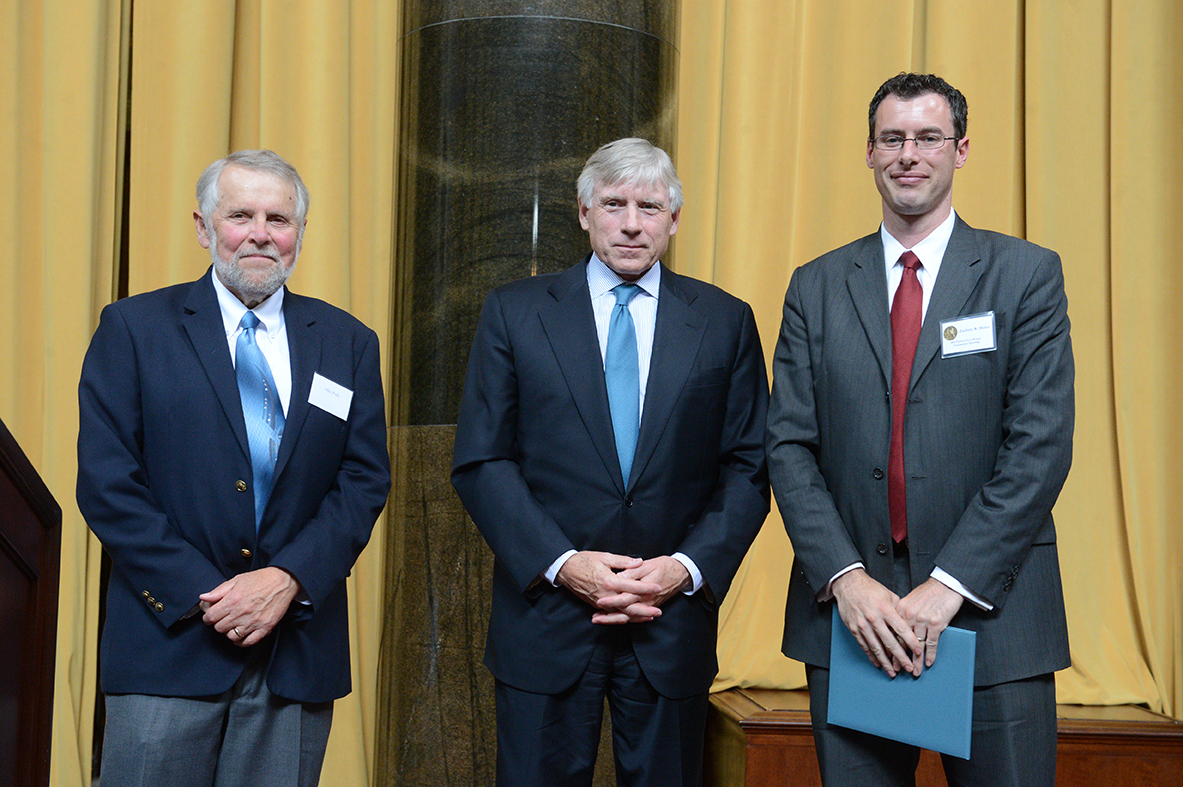
Mike Pride, Pulitzer Prize Administrator (left), and Lee C. Bollinger, President of Columbia University (center), present the 2015 Explanatory Reporting Prize to Zachary R. Mider.
Winning Work
By Zachary R. Mider
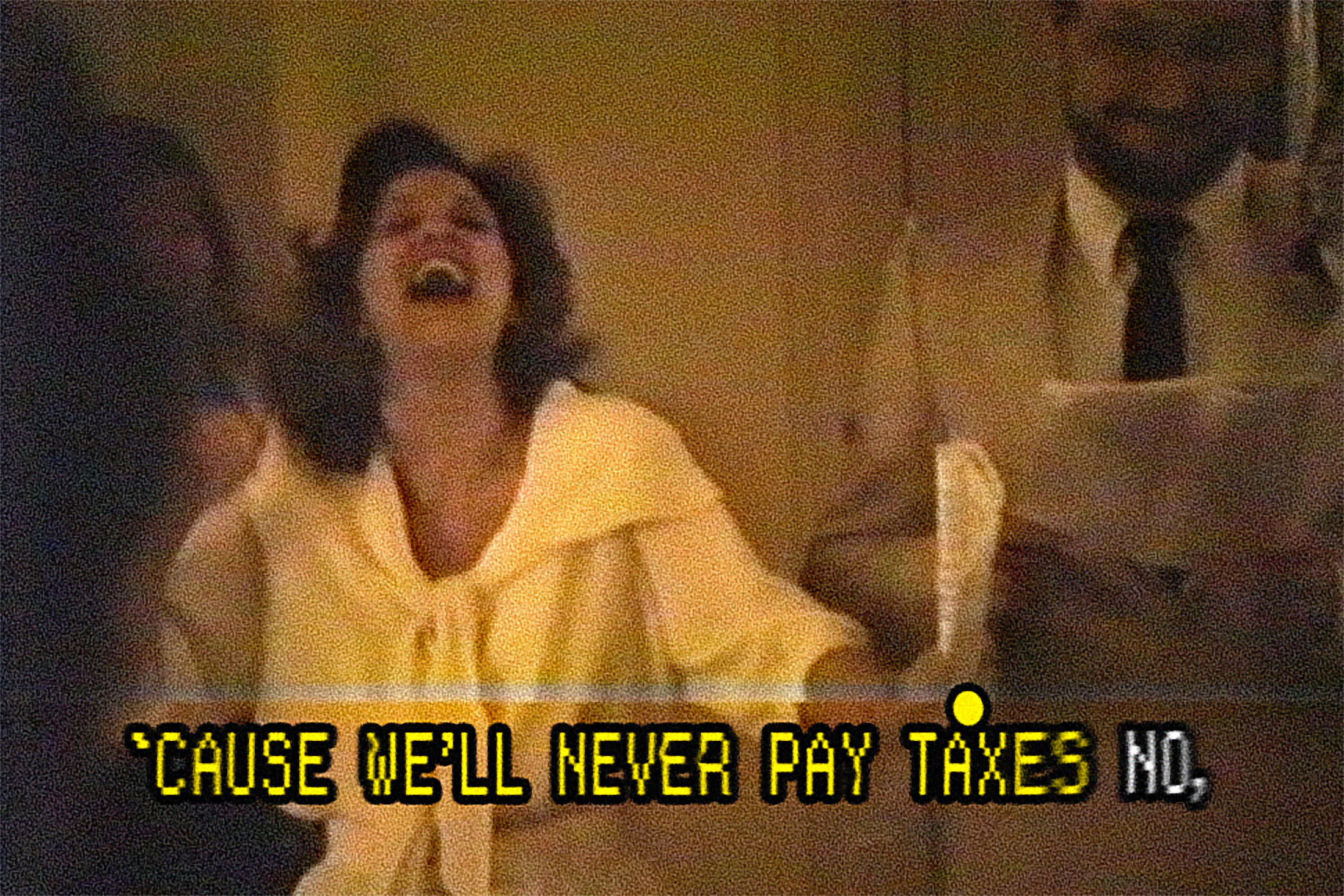
(Illustration by 731)
The only operetta ever written about Subpart F of the Internal Revenue Code made its debut on a rainy Sunday evening in May 1990, in a Fifth Avenue apartment overlooking Central Park. In bow ties and spring blazers, partners of the law firm of Davis Polk & Wardwell dined on lobster prepared by a Milanese chef. Then everyone gathered around a piano, and a pair of professional opera singers, joined by the few Davis Polk men who could carry a tune, performed what sounded like a collaboration of Gilbert & Sullivan and Ernst & Young.
The 13-minute operetta, Charlie’s Lament, told how the party’s host, John Carroll Jr., invented a whole category of corporate tax avoidance and successfully defended it in a fight with the Internal Revenue Service. The lawyers sang:
The Feds may be screaming,
But we all are beaming
’Cause we’ll never pay taxes,
We’ll never pay taxes,
Never pay taxes again!
The first corporate “inversion,” as Carroll’s maneuver came to be known, was obscure then and is all but forgotten now. Yet at least 45 companies have followed the lead of Carroll’s client, New Orleans-based construction company McDermott International, and shifted their legal addresses to low-tax foreign nations. Total corporate savings so far: at least $9.8 billion—money that otherwise would have gone to the U.S. government.
This year, inversions have received more attention than ever, as well-known companies such as Burger King and Pfizer announced plans to change their addresses. (Pfizer didn’t follow through.) In July, President Obama called the practice an “unpatriotic tax loophole” and urged Congress to put a stop to it. In September, the Department of the Treasury tightened regulations to discourage the deals. “My attitude is, I don’t care if it’s legal,” Obama said in July. “It’s wrong.”
If history is any guide, the stiffer regulations won’t stop the exodus. Ever since the McDermott deal, inversions have been the subject of legions of congressional hearings, bills, and regulations, yet companies continue to find ways to circumvent them and escape the U.S. tax system.
John Patrick Carroll,
You’re the man for me.
You have a firm that is first-rate.
You have the skill to solve
this tax quandary
(Although you come in
to work very late).
Around the Manhattan offices of Davis Polk, Carroll was known as a wit and a curmudgeon. To keep fellow lawyers on their toes, he slipped nonsense words, such as “phlaminimony,” into legal documents. He always seemed to do his best work in the middle of the night. His office was a mess. He didn’t own a television set. If someone asked how he was doing, he’d reply, “They haven’t caught me yet.”
A Brooklyn native who served in the Marine Corps in China during World War II, Carroll attended Cornell University and Harvard Law School. He worked at the IRS before joining Davis Polk in 1957, when the firm still required its men—there were no women partners as yet—to wear hats. A committed liberal, he was one of the few members of his firm to oppose the war in Vietnam. He once considered leaving the practice to work for antiwar candidate George McGovern’s 1972 presidential campaign. “He would stop by my office and say, ‘Let’s go commit lunch.’ He had all sorts of wonderfully fictional phrases for noncriminal crimes, like ‘mopery in the second degree,’” says M. Carr Ferguson, a colleague. “I simply adored him.”
Carroll proved to be a brilliant pioneer in corporate law. He helped open the North Sea to oil exploration and invented a financial instrument known as the currency swap, now a $2 trillion-a-day market. Carroll was modest about that achievement. When a book credited him with inventing the swaps, he penned a tongue-in-cheek letter explaining that, although he attended the London brainstorming sessions where the idea was hatched, he was merely “a foreigner who attended most meetings principally for beer and free lunch.” He named five others who he said deserved more credit.
Around 1980, Carroll got a call from a client: Charles Kraus, the tax director at McDermott, a construction and engineering giant with a thriving business in building offshore oil rigs. Throughout the 1970s, high oil prices, helped by the Arab oil embargo and the revolution in Iran, had kept its tugboat crews and welders busy from Indonesia to Saudi Arabia. McDermott was the biggest company in Louisiana’s booming oil-services industry. It occupied half of a downtown skyscraper and, at its peak, employed more than 40,000 people around the world.
My name’s Charlie. Here’s my problem,
Our subsidiary
Pays too much in bloody taxes.
It’s dying fiscally.
As Kraus explained to Carroll, McDermott’s profits had created a big tax problem. Most of the income had been earned abroad, and the parent company in New Orleans couldn’t touch it without first paying U.S. taxes on it—at a rate of as much as 46 percent. The earnings were piling up in Treasury bonds offshore. When they came back, the total bill would be about $220 million.
John, be a hero; cut out
tax down to zero,
Because if your plan’s not inspired,
Next month we may all be fired!
After months of kicking around ideas, Kraus and Carroll hit upon an elegant but untested solution: Simply flip the company structure, so its main foreign subsidiary, incorporated in Panama, becomes the parent. Just like that, all those offshore profits would slip out from under the U.S. corporate tax system. Carroll nicknamed it the Panama Scoot. There was something screwy about the plan, like a daughter legally adopting her own mother, and the details were staggeringly complicated, involving share swaps, dividends, and debt guarantees. But Kraus and Carroll were convinced it would work.
Kraus, now 85, is a slight man who relishes the arcana of tax accounting. He once dreamt of becoming a concert pianist, and he used to spend his free time rehearsing Chopin’s polonaises on his baby grand piano. During an interview in his pink-brick home in the Louisiana woods, he recalls using a different name for the novel deal he helped put together. “We called it the Flip Flop,” he says, laughing, his hands folded behind his head. “There was a loophole in the law, and we capitalized on it legitimately.”
Kraus’s boss, John Lynott, McDermott’s chief financial officer at the time, says he sometimes puzzled over Carroll’s motivations. “It was always an enigma to me,” Lynott says. “We knew this guy was a Democrat, and yet he would take on the government in a New York minute over a tax issue. There was nothing liberal about his thinking as far as the tax code was concerned.”
John’s really flipped this time.
He’s surely lost his mind.
If we should do it,
I know we shall rue it.
We’ll pay interest, penalties and fines.
The McDermott team knew the deal would face resistance. Shareholders needed to approve the transaction, requiring a public announcement and a filing with the Securities and Exchange Commission, which would inevitably forward the papers to the IRS.
Then there was the U.S. Navy. McDermott was a major supplier of nuclear fuel and boilers for the fleet. When Admiral Hyman Rickover, the father of the nuclear Navy, caught wind of the plan, he was alarmed enough to summon Lynott and another executive to Washington. Lynott says he and his colleague spent half a day waiting outside Rickover’s office until they realized the admiral was snubbing them and had left the building. They flew back to New Orleans on their private jet without meeting Rickover. Eventually, the Navy set aside its concerns about Panama, Lynott says. “They were reassured there was nothing there but a post office box,” he says. “We weren’t moving anything.”
McDermott disclosed the plan publicly on Oct. 28, 1982. The next day, the New Orleans Times-Picayune quoted the company’s chairman, who assured the community that “no changes in the operations and management of the company are planned, and the principal executive offices will remain in New Orleans.” Shareholders had no objection, and by December, the address change was official. Kraus hung a skull and crossbones in his office, a nod to Panama’s piratical past.
Once the deal was announced, McDermott rushed to complete it as quickly as possible, according to Carr Ferguson, who was a federal tax prosecutor before he joined Davis Polk. They were hoping to reduce the chance the Treasury Department would learn about it and ask Congress to block it. As it was, no one heard from the Treasury until the following January, when Ferguson got a call from a top tax official he knew there.
“Carr, you can’t do this,” Ferguson remembers the official saying.
“That was my first impression,” Ferguson replied, “but we worked at it pretty carefully, and we think we can.”
“You’re going to have to prove that in court to me.”
Move down to Panama!
Think of our painful chagrin:
The Feds will be cheerful,
and we will be tearful
’Cause we’ll all end up in the pen!
The IRS fought the case for seven years, giving up in 1989 only after a federal appeals court upheld a U.S Tax Court decision in the company’s favor.
In 1984, Congress passed a law specifically designed to prevent more McDermott-type arrangements. But don’t bet against the imagination of tax lawyers. A decade later, a company in El Paso that made curling irons and hair dryers found a way to create a foreign parent in Bermuda without triggering the McDermott rule. More laws and regulations followed, in 1994, 2004, and 2009, but the deals just kept coming, each permutation more complicated than the last. Somewhere along the way, tax lawyers started calling them inversions, because they turn a company’s corporate structure upside down.
However helpful the Panama Scoot was for avoiding taxes, the new address couldn’t protect McDermott from getting clobbered by an oil slump. Lower energy prices and an economic downturn led to a series of losses during the 1980s, Kraus says. Later, the unit that supplied the Navy’s nuclear fuel was engulfed by asbestos claims. After Hurricane Katrina in 2005, McDermott moved its corporate headquarters to Houston. It closed its remaining office in downtown New Orleans last year.
In a way, Admiral Rickover’s beef with McDermott got a second life in 2007, when Congress passed a law banning federal contracts for inverted companies. Eventually, McDermott was forced to spin off the unit that worked with the Navy to avoid losing all its contracts.
Kraus says he hasn’t thought much about inversions since his retirement in 1989, nor has he followed the debate in Washington this year. He remains proud of his work. When a congressional committee in the 1980s complained that the McDermott deal made a “mockery” of the tax code, Kraus says, he half-jokingly called it “the crowning achievement of my career.”
“The law is an unintelligible monstrosity, and it’s Congress’s fault,” says Kraus, who still has a small Lucite trophy commemorating the Panama deal. He uses it as a paperweight.
A few months after Carroll’s victory over the IRS, he and his wife, Luceil, threw the party at their apartment. A video survives of the moment when, to his surprise, his colleagues began performing Charlie’s Lament, named for Kraus. A musically inclined lawyer in the tax department, William Weigel, wrote the libretto and recruited a professional tenor and soprano through his church choir. Carroll listened from an armchair, and at the finale he clapped and rose. Somebody called for a speech.
“I wrap myself in the American flag,” he said. “And I say, without the slightest fear of successful contradiction—blah, blah, blah, blah!”
Carroll retired later that year. He didn’t play a role in the copycat deals that eventually followed McDermott, nor did he seek any recognition. In a tax journal in 2007, a law professor referred to the McDermott deal’s creator as “a brilliant tax lawyer (I don’t know who).”
One of Carroll’s two sons, Brian, recalls that his father, toward the end of his career, reflected on his role in making the tax system even more convoluted. “Look, I did all these crazy things,” Carroll told him. “I would really like to see the tax code completely scrapped. The whole business of trying to define income and deductions is pure madness. And I’ve got no one to thank except myself for creating that.”
Carroll died in 2009 at the age of 84. Following his wishes, in lieu of a funeral there were parties with food and wine, including one for his many friends at Davis Polk’s Manhattan headquarters. Amid the talk and laughter came the familiar strains, playing over and over again on a TV in the next room:
The Feds may be screaming
But we all are beaming
’Cause we’ll never pay taxes no,
Never pay taxes,
Never pay taxes again!
By Zachary R. Mider

An Ingersoll-Rand generator next to the Cannon office building. Photographer: Chris Maddaloni/Roll Call/Getty Images
American manufacturer Ingersoll-Rand Co. forged the tools that carved the Panama Canal and shaped Mount Rushmore. When it shifted its legal address to Bermuda in 2001 to reduce taxes, the maneuver sparked bipartisan outrage in Congress.
“These corporations have turned their back on their country,” Nevada Democrat Harry Reid fumed from the Senate floor, adding that his father, a hard-rock miner, had wielded an Ingersoll-Rand jackhammer. “There is no reason the U.S. government should reward tax runaways with lucrative government contracts.”
Over the next dozen years, Congress passed law after law to prohibit American companies that reincorporate overseas from doing business with the federal government.
Those laws haven’t worked. Benefiting from loopholes and a cooperative Obama administration, the companies avoid the ban on federal contracts as effectively as they avoid U.S. taxes.
Ingersoll-Rand continues to score federal work worth hundreds of millions of dollars, touting projects for the Army and Navy in sales brochures. The company’s strategies have even included trying to piggyback on the eligibility of other companies, according to two former Ingersoll-Rand employees.
Ingersoll-Rand is one of more than a dozen large U.S. companies that have shifted their tax addresses offshore yet still earn federal business, a Bloomberg News investigation has found. In all, these companies are collecting more than $1 billion a year from the government, even as their tax-avoidance techniques have deprived the Treasury of untold billions of dollars in revenue.
Policing Themselves
Regulators rely on the companies to police themselves for compliance with the prohibition. At least three companies -- Xoma Corp., Cooper Industries Plc and Foster Wheeler AG -- have acknowledged they were subject to the ban and yet have said in a federal database that they’re exempt.
Other firms that reincorporated overseas -- a strategy known as “inversion” -- qualify for contracts because they don’t meet the law’s narrow definition of an inverted company. Under the law, a U.S. company that shifts its address to a location abroad isn’t eligible for federal contracts, unless it has substantial business in its new home or undergoes a major change in ownership. That means the prohibition doesn’t apply, for example, to companies that got a new address through a takeover of a foreign competitor.
“These are bad actors. We should not be rewarding them,” said Representative Rosa DeLauro, a Connecticut Democrat who has led the push to keep contracts from the companies. “Let’s give it to the companies that stay here, employ people here and pay their taxes here.”
Complex Law
Ingersoll-Rand, which now is run from North Carolina, continues to reap the benefits of a low-tax foreign address. The company says it works closely with government contracting officials to ensure compliance with a “complex area of the law.”
For several years, said spokeswoman Misty Zelent, Ingersoll-Rand avoided bidding on contracts that were off-limits to companies that shifted their tax address overseas. The company won other sales legally because they were awarded during periods when the prohibition had temporarily lapsed, or that were grandfathered because of earlier contracts, she said. Ingersoll-Rand also warned shareholders and federal customers that it may be ineligible for contracts.
Recently, the company conducted an “exhaustive legal analysis” and concluded that it’s not subject to the prohibition after all, Zelent said.
She declined to share the firm’s reasoning or say whether the government endorsed this view, citing “competitive reasons.”
Corporate Stampede
Representatives for a half-dozen federal agencies said they followed the law in awarding projects to Ingersoll-Rand. Some of the agencies, including the U.S. Forest Service and the U.S. Mint, said they relied on the company’s statements in a federal database that it wasn’t banned.
The ranks of federal contractors with foreign addresses are likely to grow this year as a new stampede of companies escapes the U.S. tax system. Medtronic Inc., a Minnesota medical device maker with $17 billion in annual sales, announced plans last month to become Irish. Four other American companies are in the process of reincorporating abroad, and Pfizer Inc., Monsanto Co. and Walgreen Co. also have flirted with the idea this year.
Without a change to the tax code, future inversions may cost the government $19.5 billion in forgone revenue over the next decade, a congressional panel estimated this year. That doesn’t count the billions avoided by the 36 U.S. companies that already have shifted their address overseas.
Rented Mailboxes
The U.S. has the highest corporate income-tax rate in the developed world, 35 percent. Because the U.S. taxes profits based on the country of the company’s legal incorporation, rather than of executives, factories or customers, switching to an address in a lower-tax nation can dramatically reduce a firm’s tax bills. Before a tax-law change in 2004, this exercise involved little more than completing some paperwork and renting an office or a mailbox in Bermuda or the Cayman Islands.
That’s how Ingersoll-Rand did it. The company was founded by Simon Ingersoll, a Connecticut farmer who invented a steam-powered rock drill in 1871. Its factories have made everything from golf carts to refrigerated boxcars.
Changing its address from New Jersey to Bermuda, an island in the Atlantic with no corporate income tax, was only Ingersoll-Rand’s first step in cutting its U.S. tax bills. The company then loaned more than $3 billion to itself, which had the effect of shifting reported profits from its main U.S. unit to Bermuda, according to records in U.S. Tax Court.
IRS Challenge
In part because of this loan, the company’s effective tax rate dropped by half to about 16 percent in the years following its change in address. The Internal Revenue Service is challenging aspects of the loan arrangement, demanding $774 million in additional taxes from 2002 through 2006, plus interest and penalties, Ingersoll-Rand said in securities filings. The company says the arrangements were proper and is defending them in Tax Court.
Ingersoll-Rand was one of several companies to take Bermuda addresses in the early 2000s, and by 2002 the trend caught lawmakers’ attention. As Congress prepared legislation to set up the Homeland Security Department, DeLauro and others sought a clause prohibiting the new agency from doing business with inverted companies, arguing that their lower tax costs would give them an unfair advantage over domestic contractors.
Congressional Critics
As one of the biggest companies to go offshore, Ingersoll-Rand became a punching bag for Reid and the measure’s other advocates. Charles Grassley, the top Republican on the Senate Finance Committee, described the company’s move as “immoral” and called for an end to “fat government contracts” for such firms. Representative Richard Neal, a Massachusetts Democrat, called the company and another firm “financial traitors.”
A version of the Homeland Security contract ban became law, but it was toothless. It applied only to the inverted companies themselves, not to any subsidiaries they might have. And it applied only to companies that had shifted overseas after November 2002, sparing all those that had already done so, including Ingersoll-Rand.
The ban had so little effect that when Homeland Security awarded its first big contract in 2004, it chose Accenture Ltd., the former consulting arm of the Arthur Andersen accounting firm. Although Accenture had Chicago roots and a Dallas CEO, it had incorporated in Bermuda in 2001. The contract was worth as much as $10 billion.
Closing Loopholes
That summer, a group of Democrats pushed to tighten the law and revoke the Accenture contract. Eventually, Accenture kept the award, though the loopholes for subsidiaries and for pre-November 2002 inversions were closed.
In 2007, Congress extended the ban to all contracts funded by an annual government-wide appropriations bill. Similar one-year bans were approved in four of the following six years.
The law defines an “inverted” company so narrowly that it still doesn’t catch Accenture or Tyco International Ltd., another company that took a Bermuda address and was repeatedly cited by legislators as a target. Also exempt is Chicago Bridge & Iron NV, a Texas-run company with a Dutch address. All three companies, as well as Ingersoll-Rand, were included on a list of dozens of inverted companies published yesterday by Democrats on the House Ways and Means Committee, who said the names were furnished by the nonpartisan Congressional Research Service. Accenture got $960 million from federal contracts in 2013, and Chicago Bridge had $734 million, according to data compiled by Bloomberg.
Never U.S.-Based
All three companies say they’ve complied with the law. James McAvoy, a spokesman for Accenture, said the company isn’t inverted because it was never a U.S.-based organization. When it first separated from Chicago-based Arthur Andersen in 1989, it was set up as a network of separate partnerships around the world overseen by a Swiss entity. For that reason, the U.S. General Accounting Office concluded in 2002 that Accenture wasn’t inverted.
McAvoy said a 2012 legal analysis by the Homeland Security Department confirmed that Accenture isn’t covered by the ban.
The most recent U.S. companies seeking foreign addresses also qualify for exceptions to the contracting ban. For instance, Medtronic plans to reincorporate through a foreign takeover. A maker of pacemakers and defibrillators, Medtronic’s customers include the Veterans Affairs Department.
One of the few companies to face real consequences is McDermott International Inc., a Houston engineering firm that’s been incorporated in Panama since 1982. In 2010, citing the contracting ban, McDermott spun off a division that specializes in government contracts as a separate U.S. company.
Government Contracts
Even as Ingersoll-Rand reaped the tax benefits of its foreign address, it took steps to expand its U.S. government business. In December 2007, two weeks before the first government-wide contracting ban took effect, Ingersoll-Rand agreed to buy Trane Inc., a New Jersey maker of energy-efficient air conditioners and heating and ventilation gear.
Part of Trane’s sales came from retrofitting buildings -- including government facilities -- with new equipment to cut fuel and power costs. Combined with the legislation, the sale to Ingersoll-Rand was greeted with apprehension by Trane employees in the unit that served government customers, according to a former member of the unit who spoke on condition of anonymity. Since the prohibition applied to subsidiaries, would Trane be ineligible for government contracts?
Instead, Ingersoll-Rand has championed Trane’s work for the government and used it as a selling point. Marketing materials highlight how the unit is one of an elite group of contractors authorized by the Energy Department to bid on major federal retrofitting projects, including at military bases all over the country.
‘Valued Customers’
“Trane counts among our valued customers nearly all major government departments and agencies,” reads a pamphlet for the company’s Federal Sector Team that’s posted on the Energy Department’s website. There’s a photograph of a serviceman in white gloves, snapping a salute.
Since the company agreed to buy Trane in 2007, shares of Ingersoll-Rand have returned 79 percent, including dividends, through July 3, compared with a 56 percent return for the Standard & Poor’s 500 Index.
As it pursued government business, Ingersoll-Rand gave different accounts of whether it was subject to the contracting ban. In 2008, it warned shareholders in a securities filing that the company’s contracting work may be affected by the ban. The warning was repeated as recently as February. The company as recently as May included boilerplate language in its bids stating that it was restricted from receiving some government funds.
Cautious Statements
Ingersoll-Rand made those statements “out of an abundance of caution,” because it wasn’t sure until recently whether it was subject to the ban, spokeswoman Zelent said.
Meanwhile, in a federal contracting database known as the System for Award Management, Ingersoll-Rand was taking the position that it was exempt from the ban.
SAM is a central registry for government contractors. Procurement officials can use SAM to check if a company is eligible to receive federal contracts or if it’s on a list of firms that are prohibited -- for instance, if they’re deemed a national security risk. As early as 2011, company employees stated in filings that Ingersoll-Rand was “not an inverted domestic corporation.”
For the most part, Ingersoll-Rand has been able to sidestep the question of whether it’s inverted or not. Three different gaps in the laws have allowed the company to continue making big sales to government customers.
Military Supermarkets
First, Ingersoll-Rand could garner contracts that aren’t funded by annual congressional appropriations. In March 2010, an Ingersoll-Rand unit received a contract to maintain equipment at supermarkets on military bases from Texas to Hawaii. Funded by a 5 percent surcharge on purchases at the stores, the contract has already paid more than $100 million, according to data compiled by Bloomberg.
Second, the company was awarded contracts during periods when the ban had temporarily expired. For example, a few months after Ingersoll-Rand completed the Trane acquisition, the Energy Department selected it as one of 16 contractors allowed to bid on large government retrofitting projects. Signed in December 2008, the contract authorizes Ingersoll-Rand to pursue up to $5 billion in government work, over as much as 10 years.
Congress’s first government-wide contracting ban had applied to the 2008 fiscal year, which ended in September 2008. Not until the following March did Congress restore the ban when it passed a funding bill for the 2009 fiscal year. By that time, officials at the Energy Department in Colorado had already signed Ingersoll-Rand’s contract. The prohibition didn’t apply retroactively.
Grandfathered In
Third, some contracts gave Ingersoll-Rand what spokeswoman Zelent calls a “grandfather clause,” allowing the company to bid on new projects for decades without running afoul of the ban. The 2008 contract, and similar ones that Trane had won in earlier years, basically designate the company as an approved vendor that can compete on projects as they become available.
Thus Ingersoll-Rand has bid for and won 10 energy-savings projects since 2008, worth more than $350 million in all, under the authority of Energy Department contracts signed years earlier.
The biggest of these was a $124 million project at Naval Air Station Oceana in Virginia Beach, Virginia, the East Coast home of the Navy’s fighter jets. The Trane unit was hired to replace an old steam plant with a more efficient heating system, and get paid
back from the Navy’s cost savings. It was Trane’s third such project at the base.
Old Contract
Despite being awarded in August 2009, when the ban was technically in effect, the project came under the authority of an old Trane contract from 1999.
“The Navy had no legal basis for not considering Trane’s proposal, which the Navy found to be the best value to the government,” the Navy said in an e-mailed statement.
Later that year, service members from Oceana and Ingersoll-Rand officials traveled to a ceremony at the Ronald Reagan Building in Washington to accept a presidential award for their work on an earlier energy-savings project at the base. The company has used a photo of the Lucite trophy in its marketing material. The White House didn’t respond to a request for comment.
Ingersoll-Rand tried other ways to get around the contracting ban, according to Jose Sanchez, a former senior engineer at the Trane unit that works on federal projects.
Joint Ventures
“In some cases, they do a joint venture with a company that’s not inverted,” said Sanchez, who left Ingersoll-Rand in 2011 and now works in Texas for a competitor. “They’re able to process the application that way.” He declined to discuss specific transactions.
Ingersoll-Rand submitted just such a bid in 2010, according to the other former Trane employee. That year, company officials believed they were well positioned to win a bid on an energy-savings project at a Marine Corps base in Okinawa, Japan, yet were concerned the contracting ban might disqualify them, this person said. So they teamed up with Clark Energy Group LLC, a much smaller Virginia-based company, this person said.
Under the joint proposal, Clark would serve as the Navy’s prime contractor at the base in Okinawa and subcontract most of the work to Ingersoll-Rand, this person said.
In a statement, the Navy said the project was ultimately canceled “for reasons unrelated to any company’s status” as inverted, adding that “the Navy never formally accepted Clark’s proposal or its use of Trane as a subcontractor.” Clark confirmed its involvement in the bid and declined to answer specific questions.
‘Bidding Groups’
“The characterization that Ingersoll-Rand did anything improper is inaccurate,” said Zelent, the spokeswoman. She added that forming bidding groups on projects is common and “often encouraged by the acquiring governmental agency.”
Inside the Trane unit that catered to government customers, some employees now worried they were being too cautious in avoiding bids where inverted companies were off limits, according to the former Trane employee. Some said the company should just start asserting that it wasn’t inverted after all, forcing the government to rebut the claim if it disagreed, this person said.
Advocates of this strategy were emboldened by the company’s decision to switch its legal domicile again in 2009 to Ireland from Bermuda, this person said. Although Ireland’s tax-friendly policies, like Bermuda’s, make it a magnet for U.S. companies looking to avoid taxes, it also has a network of treaties and a strong trading relationship with the U.S.
Zelent declined to say why the company recently decided that it’s not banned. It reached that conclusion after a federal rulemaking process that ended in 2011, she said.
Domicile Hopping
If companies could escape the contracting ban by hopping from one foreign domicile to another, it would “eviscerate” the law, said Willard Taylor, a retired corporate tax lawyer and adjunct professor at New York University School of Law.
Congress “would be very annoyed, I’m sure,” he said.
DeLauro says she’s working on a bill that would expand the definition in the contracting ban to apply to more companies, including most of those that inverted recently.
To bid on federal contracts, companies must attest in the SAM database that they aren’t subject to the ban. Three such companies have contradicted their SAM filings by acknowledging elsewhere that the ban did apply to them.
Xoma Contract
Xoma Corp., a California drugmaker, had a Bermuda address when it got contracts worth as much as $93 million from 2008 to 2011 to make an antitoxin for the deadly poison botulinum for the National Institute of Allergy and Infectious Diseases.
A Xoma employee submitted a form in the federal SAM database claiming that, as of July 2011, it wasn’t inverted, the database shows. The form includes language acknowledging unspecified “penalties” if the information is inaccurate.
The statement was probably an “honest mistake,” said spokeswoman Ashleigh Barreto. “The form that he’s filling out was all these check, check, check boxes and he probably just checked the wrong box,” she said. Both of the contracts were awarded lawfully because of other exceptions to the law, she said.
The institute said in a statement that it was unaware Xoma was inverted. The company switched back to a U.S. domicile in December 2011.
Pentagon Review
Cooper Industries Plc, a Texas-run firm that picked up a Bermuda address in 2002, said in a securities filing in 2009 that it somehow got $8 million in federal contracts that probably should have been prohibited. It said it might face penalties from the Defense Department, which was reviewing the matter. That review continues six years later, according to Maureen Schumann, a department spokeswoman.
Nevertheless, Cooper continued to do work for the government. A SAM filing by an employee at a Cooper division in Sarasota, Florida, effective as of February 2012, stated that the company wasn’t inverted after all.
Later that year, Cooper was sold for $11.8 billion to Eaton Corp., a larger Ohio firm that coveted its offshore address. Thanks to the way the contracting ban is worded, the entire combined company, known as Eaton Corp. Plc and incorporated in Ireland, is now qualified to bid on government work, said spokesman Scott Schroeder. He declined to comment on Cooper’s conflicting statements about whether it was inverted prior to the takeover.
Swiss Incorporation
Another inverted company that claimed not to be is Foster Wheeler AG, a former New Jersey firm now incorporated in low-tax Switzerland. Scott Lamb, the company’s vice president for investor relations, said the division whose name appears on the filing hasn’t worked for the government since 2006.
“We recognize that Foster Wheeler is classified as an inverted corporation,” he said in an e-mail. “I cannot vouch for the authenticity of that document.”
The U.S. General Services Administration, which oversees the SAM database, said in a statement that “submission of false representations or certifications is a very serious matter.” It said penalties range from “monetary recoveries” to barring the contractor from future government work.
Ingersoll-Rand’s quest for profit from making buildings more efficient dovetails with a priority of the Obama administration, which announced this year a raft of energy conservation initiatives. Among them was the expansion of the Energy Department’s program for government buildings that’s already worth more than $500 million to Ingersoll-Rand, including its work for the Navy in Virginia.
The president announced the initiatives in May from the aisles of a Wal-Mart store in California equipped with solar panels. Ingersoll-Rand Chief Executive Officer Michael Lamach, 51, was an invited guest.
“Thanks to all the companies who are doing the great work,” Obama said as he stepped from the stage. “We appreciate your leadership.”
By Zachary R. Mider
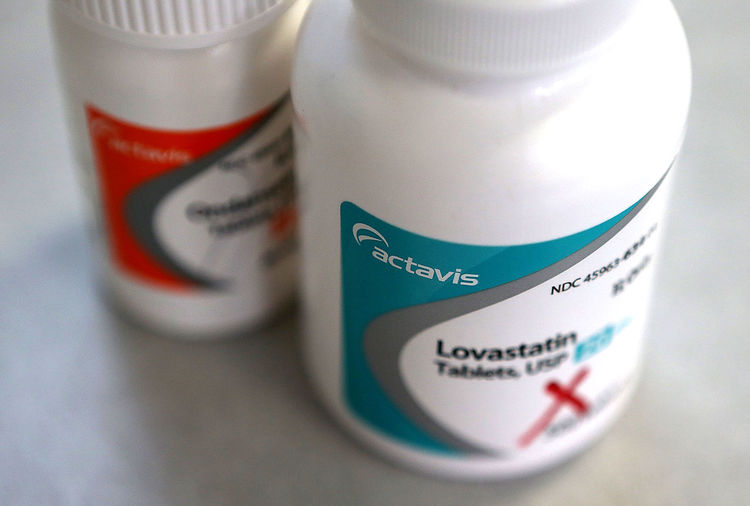
Pharmaceuticals made by Actavis. Photographer: Justin Sullivan/Getty Images
Ten years ago, Congress passed a law intended to penalize chief executive officers whose companies shift their legal addresses to tax havens.
It hasn’t worked out as planned. Companies have found ways around the law that create new rewards for executives. When Actavis Inc. changed its incorporation to Ireland in October, the New Jersey-based drugmaker helped CEO Paul Bisaro avoid the law’s bite by handing him more than $40 million of stock as much as three years ahead of its schedule, then promising him an additional $5 million to remain with the company.
The payouts to executives highlight the ineffectiveness of the 2004 law, which contained a series of provisions aimed at reducing the tax benefits of reincorporating overseas. In the past two years, a fresh wave of companies has fled the U.S. system to avoid hundreds of millions of dollars in taxes.
The 2004 law has “clearly been a failure” in halting the tax exodus, said Edward Kleinbard, a professor at University of Southern California’s Gould School of Law. “And it now has the perverse result of putting money into executives’ pockets sooner.”
The law imposes a special tax of 15 percent on restricted stock and options held by the most senior executives when a company reincorporates outside the U.S. Since the measure took effect, at least seven large companies have disclosed in securities filings that they risked triggering the tax. All took steps to shield their executives from having to pay.
Tax Bill
Three of the companies’ boards simply picked up the tax bill for their executives, maintaining that the managers shouldn’t suffer for a decision that benefits shareholders.
At three other companies, including Actavis, the boards went a step further, helping them avoid the tax altogether by allowing restricted stock to vest early and for options to be exercised. Awarding the equity early raises the risk that the executives might quit or sell their shares, or get paid for meeting goals they never attain.
Since 2012, at least 13 large U.S. companies have announced or completed shifts of legal address, which tax experts call “inversions,” to lower-tax nations such as Ireland and Switzerland.
Omnicom Inc., the New York advertising firm, estimates that a planned incorporation in the Netherlands this year, as part of a merger with a French rival, will save the combined company $80 million a year. The cost to the U.S. Treasury of the recent wave of address changes may be about $500 million a year, estimates Robert Willens, a New York-based tax and accounting consultant.
Tax Rate
The statutory U.S. corporate income tax rate of 35 percent is the highest among developed countries, although many companies end up paying less. Lawmakers in both parties and President Barack Obama have endorsed tax code changes that would lower the rate below 30 percent, reducing the incentive to reincorporate overseas. Those proposals have been stymied by disputes over details and what should happen to individual taxes.
Some Democratic lawmakers have introduced legislation that would treat companies managed from the U.S. as domestic even if they’re incorporated elsewhere. Carl Levin, a Michigan senator, said last year the change would raise tax revenue by $6.6 billion over 10 years. None of those bills have attracted much Republican support or emerged from committee.
Lawmakers Notice
An earlier flurry of corporate flights to tax havens triggered the 2004 law. Tyco International Ltd. of Exeter, New Hampshire; Chicago-based Fruit of the Loom Inc.; and Ingersoll-Rand Co., based in Woodcliff Lake, New Jersey, incorporated in Bermuda or the Cayman Islands in the late 1990s and early 2000s.
By the time Stanley Works, the 159-year-old Connecticut toolmaker, announced plans to use a Bermuda address in 2002, lawmakers took notice. They denounced the company’s CEO and proposed more than 30 different bills to curtail the practice.
Connecticut’s attorney general sued, and union officials organized protests in the company’s hometown of New Britain.
“These expatriations aren’t illegal. But they’re sure immoral,” Charles Grassley of Iowa, then the top Republican on the Senate Finance Committee, said at the time. Stanley Works eventually dropped the Bermuda plan.
Grassley helped shepherd a series of anti-inversion measures into law in the American Jobs Creation Act of 2004. Some provisions made it harder for companies to get tax savings from incorporating abroad. Acquiring a mailbox in Bermuda was no longer enough.
Foreign Mergers
One route that remains available involves a foreign merger, as long as the partner is at least one-fourth the size of the U.S. firm. Most of the reincorporations since 2004 have been achieved through acquisitions abroad. They include Liberty Global Inc., the Englewood, Colorado-based cable operator, and Tower Group Inc., the New York-based insurer.
So many pharmaceutical companies are switching addresses that bankers are pitching takeovers of Irish drugmakers based on the tax benefits. Gregg Gilbert, a Bank of America Corp. drug analyst, dubbed it a “tax rate land grab.”
Another provision in the 2004 law imposed the penalty on CEOs. Since the mid-1990s, the Internal Revenue Service has required stockholders of some companies reincorporating abroad to recognize capital gains on the shares and pay income tax, even if they continue to hold the equity. That rule doesn’t apply to the restricted stock or unexercised options of executives, who technically don’t own the shares. Some lawmakers saw that as an unjustified boon for the CEOs.
Picking Pockets
“It is only fair for these executives, who are picking the pockets of the American taxpayer to the tune of $4 billion, to feel some of the pinch,” said Richard Neal, a Massachusetts Democrat, in a speech on the House floor in 2002.
Argonaut Group Inc., a niche insurer in San Antonio, Texas, was one of the first companies to face the new tax on executives’ equity awards. When it acquired a Bermuda address through an acquisition in 2007, Argonaut accelerated its top executives’ awards to avoid the tax, recording an estimated $10.5 million expense, according to a securities filing. Jazz Pharmaceuticals Inc. of Palo Alto, California, did the same for its executives when it shifted to Ireland through a 2012 merger. CEO Bruce Cozadd got $3.1 million ahead of schedule, a securities filing shows. Both companies declined to comment.
Applied Materials Inc. said on Jan. 21 that it would help Chairman Michael Splinter avoid the tax by granting him $23 million in stock awards ahead of schedule. The Santa Clara, California-based maker of computer-chip equipment plans to buy a Japanese company this year and incorporate in the Netherlands.
Executive Awards
Other top executives will get early vesting on only a portion of their equity and will have to pay taxes on the rest, the filing shows. Some will get extra cash bonuses. The company declined to comment beyond the filing.
Eaton Corp., the Cleveland-based manufacturer of electrical equipment, and Perrigo Co., the over-the-counter drugmaker based in Allegan, Michigan, opted to pay their executives’ tax bills instead.
The cost of these payments can add up because the payments themselves are subject to tax. The total expense was $11.5 million for Eaton’s CEO, A.M. “Sandy” Cutler, and an estimated $9.3 million for Perrigo’s Joseph Papa, according to securities filings. Both companies, which declined to comment, shifted their incorporation to Ireland through acquisitions.
Cost Savings
It’s easy to see why Eaton’s board decided the shift was justified even with the extra compensation cost. Cutler told analysts the Irish address would save $160 million a year because of “cash management and resultant tax benefits.”
The board of Endo Health Solutions Inc., a maker of painkillers in Malvern, Pennsylvania, weighed both options while making plans to acquire a new address in Ireland, the company said in a securities filing. The board opted to pay the tax, estimated at $7.8 million for CEO Rajiv De Silva, in part because “accelerating the vesting of these performance-based awards could result in unearned compensation being paid” if goals weren’t met. Endo declined to comment beyond the filing.
The biggest disclosed payout so far has been to Bisaro at Actavis.
After becoming CEO in 2007, the former lawyer embarked on a series of acquisitions, assembling one of the world’s largest generic drug companies. When bidding for foreign assets against rivals with lower tax rates, he said on a conference call last year, he felt “handicapped.”
Serial Acquirers
For instance, another serial acquirer, Valeant Pharmaceuticals International Inc., is incorporated in Canada and earns much of its profits through subsidiaries in havens such as Bermuda, achieving an effective tax rate of less than 10 percent. Before getting the Irish address last year, company officials said, Actavis’s effective rate was about 28 percent.
Bisaro found a solution last May when he announced the $5 billion acquisition of Warner Chilcott Plc, a smaller company that made birth control and acne treatments and was incorporated in Ireland. He estimated the total cost savings from the takeover at $400 million a year, including the tax savings from using the Irish address as well as job cuts and other operational changes. He said the combined company’s effective tax rate would be about 17 percent and eventually drop further. On its own, Warner
Chilcott’s effective rate was about 11 percent to 12 percent.
Not that Bisaro was packing his bags for Dublin.
“Everybody loves New Jersey too much, so nobody’s willing to go,” Bisaro told analysts on a conference call announcing the deal.
Staying Put
In fact, Warner Chilcott’s top executive, Roger Boissonneault, wasn’t in Ireland either. Once an executive at New Jersey’s Warner-Lambert Co., Boissonneault became president of the Chilcott generics division when it spun off in 1996. In the intervening years, takeovers shifted Warner Chilcott’s ultimate corporate parent to Ireland, Northern Ireland, Bermuda, and back to Ireland.
Boissonneault stayed put, leading the company from Rockaway, New Jersey.
“I didn’t have to travel far this morning,” Boissonneault told analysts when he visited Bisaro’s office to announce the deal.
“Actavis is about five minutes away from our Warner Chilcott headquarters, a little bit further up on Route 80.”
Since becoming CEO, Bisaro has gotten the biggest chunk of his pay in the form of restricted stock, which doesn’t vest until as long as four years after it’s awarded. In the meantime, he can lose it if he misses performance targets or quits. In 2012, restricted stock made up about half of his $8.7 million in compensation.
Restrictions Dropped
Because of the special tax due upon reincorporation, Bisaro’s board decided to drop restrictions on Bisaro’s stock when the Warner Chilcott deal was completed -- even some that he’d gotten in March that wasn’t due to vest until 2017. Actavis estimated the value of that stock at $40 million in an August filing and said the total amount for the top five officers was $100.8 million. By the time the deal was completed, the stock had gained an additional 13 percent.
Directors reasoned that the executives shouldn’t have to pay a penalty for a transaction that was in the shareholders’ interest, Actavis said in the filing last year. The board chose to accelerate the executives’ stock awards rather than pay the 15 percent penalty because the former option was partly tax-deductible, the company said.
“It’s important to point out that this approach was overwhelmingly approved by the shareholders,” David Belian, a company spokesman, said in an e-mail. He declined to comment further and didn’t respond to a request to speak with Bisaro.
Unintended Consequences
The accelerated stock award triggered an early tax bill for Bisaro, who reported that about half the stock was withheld for tax purposes. Stock awarded as compensation is usually taxed at the same ordinary income rate as wages. Without the acceleration, he would have faced a similar tax bill in the future, whenever the restrictions lapsed.
The law is a classic example of how Congress’s attempts to tweak corporate behavior through the tax code usually backfire, said Kevin Murphy, a professor at USC’s Marshall School of Business who studies executive compensation. “One thing we can always count on is that there will be lots of unintended consequences -- usually costly -- for shareholders and for taxpayers.”
Besides rewarding CEOs for corporate tax avoidance, the accelerated payments may upend companies’ compensation plans, said Brian Foley, a consultant in White Plains, New York, who helps companies set pay. Restricted shares are designed to be earned over time. If officers can cash out their shares immediately, they may no longer have as much reason to stay at the company or contribute to its long-term success, he said.
Pickup Sticks
“I want him or her to have skin in the game,” Foley said. Without restrictions on equity awards, “they can pick up their sticks and leave, and they get to take all that vested stuff with them.”
Indeed, Actavis said last year that it would have to make additional payments to retain Bisaro and his team after allowing them to collect their shares ahead of schedule. Shortly after shifting its address to Ireland, Actavis promised Bisaro the $5 million cash retention bonus, contingent on his remaining at the company through 2016.
Congress should overhaul the whole corporate tax system rather than targeting address shifts, said Bret Wells, a professor at the University of Houston Law Center. U.S. rules allow foreign companies to dodge taxes on their American profits, a process called “earnings stripping,” more easily than domestic companies can, he said.
‘Wakeup Call’
“Inversion transactions should be a wakeup call,” Wells said. “They should tell us there’s something wrong with our tax system when it’s more valuable to be foreign-owned than U.S.- owned.”
Two months after Actavis announced the reincorporation to Ireland, Gilbert, the Bank of America analyst, asked on a conference call if Bisaro could comment on the “tax rate land grab that is going on.”
“Unfortunately we have a tax structure in the United States that’s putting companies in the U.S. at a disadvantage,” Bisaro said. “We won’t be at a disadvantage anymore. And I think other companies have to take a look at that. It just makes economic sense.”
By Zachary R. Mider
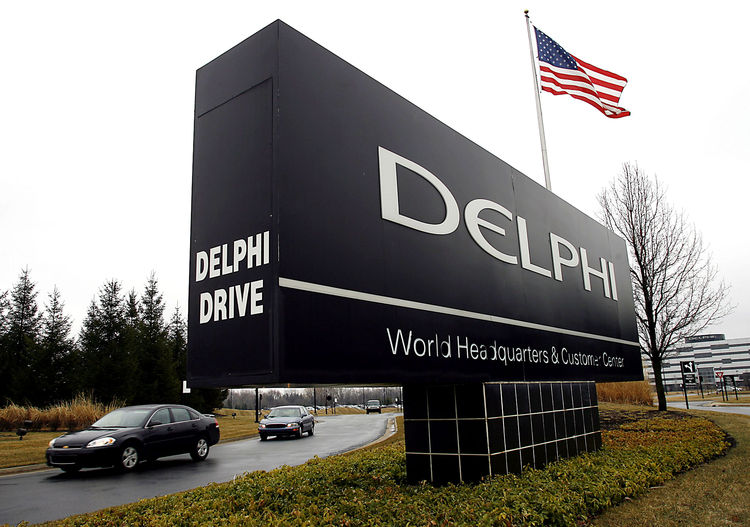
Delphi Corp. headquarters in Troy, Michigan. Photographer: Gary Malerba/Bloomberg
President Barack Obama says U.S. corporations that adopt foreign addresses to avoid taxes are unpatriotic. His own administration helped one $20 billion American company do just that.
As part of the bailout of the auto industry in 2009, Obama’s Treasury Department authorized spending $1.7 billion of government funds to get a bankrupt Michigan parts-maker back on its feet -- as a British company. While executives continue to run Delphi Automotive Plc from a Detroit suburb, the paper headquarters in England potentially reduces the company’s U.S. tax bill by as much as $110 million a year.
The Obama administration’s role in aiding Delphi’s escape from the U.S. tax system may complicate the president’s new campaign against corporate expatriation. After a wave of companies announced plans to shift addresses this year, Obama last month labeled the firms “corporate deserters.”
The Delphi case also highlights how little attention the administration paid to the tax avoidance technique until recently. Only this year did Obama include a measure in his annual budget proposal to prevent some tax-driven address changes, which are known as “inversions.” Thanks to gaps in a Congressional ban on contracts with inverted companies, his administration continues to award more than $1 billion annually in government business to more than a dozen corporate expats.
IRS Case
The Obama administration is now trying to rescind the tax benefits of the Delphi deal that it helped broker. In June, the Internal Revenue Service told Delphi that the 2009 address change should be disregarded for tax purposes, and that Delphi must pay taxes as a U.S. company. Delphi says in a securities filing that it will “vigorously contest” the IRS’s demand.
“The recent rise in inversion transactions has the IRS and Treasury and the president understandably rattled, so they’re now trying to play catch up,” said Julie Roin, a tax professor at University of Chicago Law School. “They were worried about other things in 2009.”
U.S. companies have been inverting for decades. The pace of departures began to quicken about two years ago, as a series of drugmakers sought to become Irish. The issue caught the attention of lawmakers and the Obama administration this year. The companies are trying to escape the country’s 35 percent corporate income tax rate, the highest in the developed world.
With some of the country’s biggest companies, including Deerfield, Illinois-based Walgreen Co. and New York-based Pfizer Inc., having considered such plans, legislators are increasingly concerned that the U.S. corporate income tax base will dwindle. One Congressional estimate puts the cost of inaction at $19.5 billion in forgone revenue over the next decade.
Examining Options
The Treasury Department said yesterday that it is examining options for curbing inversions that wouldn’t require Congress to act. Such changes could limit inverted companies’ ability to claim interest deductions that reduce their U.S. taxable income.
To be sure, the administration’s goal in helping Delphi in 2009 was to prop up its main customer, Detroit-based General Motors Co. -- not the corporate tax base. The Treasury Department said at the time that it wouldn’t micro-manage GM or force changes for government policy reasons, although it did intervene in the politically sensitive area of executive pay.
Adam Hodge, a Treasury Department spokesman, said the department’s work with Delphi was limited to providing funding through GM in order to shore up a crucial supplier for the automaker.
Saving Car Industry
“We weren’t involved in that decision regarding the tax implications in their emergence from bankruptcy,” he said, adding that he got his information from the former Treasury officials who worked on the bailout. “We were focused on trying to save the auto industry.” He declined to answer specific questions, citing the pending IRS dispute. Timothy Geithner, the Treasury secretary during Obama’s first term, also declined to comment.
Claudia Tapia, a Delphi spokeswoman, declined to comment on the IRS dispute or the government’s role in Delphi’s address change. The company’s shares have more than tripled since a 2011 initial public offering.
“Delphi was on its deathbed. They had to do something to keep the company from being liquidated,” Roin said. The favorable tax treatment may have helped save Delphi, she said.
Delphi’s official home base is now an hour’s train ride east of London, at a plant and research compound in the county of Kent. Inside windowless gray factory walls, workers in navy blue uniforms make pumps for diesel engines. Employees there said last week that top executives rarely visit.
Delphi’s Beginnings
These days, most U.S. companies trying to escape the domestic tax system do so by buying a smaller company abroad and adopting its address. Delphi took a different route, through a courtroom in Manhattan.
The journey began in 1999, when GM, the largest U.S. automaker, spun off some of its parts-making operation as an independent company. The plan was to separate Delphi so that it could thrive on its own, supplying not just GM but rivals around the world.
That didn’t work out so well. Saddled with legacy obligations to union workers, Delphi filed for bankruptcy protection in federal court in 2005. By 2009, with the nation in recession and GM itself tottering, Delphi was still limping along in bankruptcy, sustained by occasional cash infusions from GM.
Rescue Loans
Facing the worst car market in decades, GM and Auburn Hills, Michigan-based Chrysler were themselves running out of cash. Some officials said they feared an economic catastrophe if the automakers were forced to liquidate and put hundreds of thousands out of work.
In December 2008, the outgoing Bush administration approved $17.4 billion in rescue loans for GM and Chrysler. In February, Obama assembled a task force led by Steven Rattner, a Wall Street financier, to oversee the bailout.
The Treasury task force had broad authority at the automakers, because the terms of the government loans propping them up gave it veto power over major decisions.
One of the team’s first jobs was to fix Delphi. GM still depended on its former subsidiary for crucial parts like steering assemblies. A liquidation of the supplier could end up shutting down many of GM’s assembly lines, too. But the team members didn’t want GM to dump money into Delphi indefinitely. In March, the night before GM was slated to get court approval to hand over another $150 million to Delphi, the task force rejected the plan. Delphi would get no more cash from GM unless it was part of an exit from bankruptcy.
Platinum Deal
Negotiations ensued between Rattner’s task force, GM, Delphi’s executives, and its creditors.
By June 1, the task force found a solution it could endorse: the bulk of Delphi’s assets would be sold to Platinum Equity LLC, a Los Angeles-based private-equity firm. GM would provide most of the financing, and then separately would buy Delphi’s steering unit and four U.S. factories.
In his 2010 book about the bailout, “Overhaul,” Rattner credits his team with sealing the Platinum deal, working through sleepless nights to “put the parts company onto a glide path toward successful resolution.”
Tax-Friendly Luxembourg
He doesn’t mention one detail of the transaction that was disclosed three weeks after the Platinum agreement in a public court filing: Platinum was considering registering the new Delphi in tax-friendly Luxembourg rather than in the U.S. The following month, Platinum took steps to carry out the plan, dispatching lawyers to register two Luxembourg entities. Both bore the name Platinum used for its Delphi project: Parnassus, the mountain in Greece where, according to legend, the oracle of Delphi issued her prophecies.
Meanwhile, GM made its own trip through bankruptcy court to shed its debts. On July 10, 2009, it emerged under the formal control of the Treasury Department, which had swapped some of its debt for stock and now held 61 percent of the shares. Rattner stepped down, and his task force began disbanding, handing much of its authority to a reconstituted GM board.
In an interview, Rattner said as far as he can remember, he wasn’t aware of any plan for Delphi to take a foreign address until Bloomberg News asked him about it a few weeks ago. He said others on his team handled the details of the Delphi negotiations, which he said contributed to the industry’s revival.
“The companies are making money. They’re hiring more workers. The whole supplier base, including Delphi, is doing well,” Rattner said. “In 2009, they were about to evaporate from the planet.”
Platinum Out
The deal with Platinum soon ran into trouble.
Creditors including Elliott Management, the hedge fund run by New York billionaire Paul E. Singer, said Platinum was buying the company too cheap. So Elliott and another hedge fund, Greenwich, Connecticut-based Silver Point Capital LP, put in their own bid for the company, offering to swap their debt for new shares. On July 26, 2009, they agreed with GM to cut Platinum out of the deal.
In some ways, the Elliott deal was similar to the one Rattner’s task force approved the previous month. GM would provide crucial financing for the new company -- a $1.7 billion direct investment in its equity, making it a shareholder alongside the hedge funds. GM would also buy the steering business and other assets for about $1.1 billion.
All this spending would depend on the Treasury Department’s approval. After it emerged from bankruptcy, GM ended up with $16 billion of Treasury Department funds in a special escrow account that could be tapped only with the government’s blessing.
Another detail remained the same as well: GM and the hedge funds agreed to register the new Delphi in Luxembourg or another, mutually agreeable foreign country.
Complex Discussions
The agreement was “the result of complex and extensive arms-length discussions among Delphi and its various stakeholder groups,” including creditors, GM, and the Treasury Department, Delphi said in a July 27, 2009, court filing.
A few weeks later, Elliott and Silver Point dispatched lawyers in London to register a new limited-liability partnership, Delphi Automotive LLP, using the law firm’s address near Finsbury Square.
In October, GM, with authorization from the Treasury Department, pumped $1.7 billion from its government escrow account into its new English partnership with the hedge funds. GM’s contribution entitled it to about half of the initial cash generated by Delphi, dropping to about 35 percent over time.
English Home Base
England wasn’t an obvious choice as a new home base. For years, Delphi had sought to diversify its customer base and shift production to lower-cost nations around the world; only about 5 percent of its workforce remained in the U.S. Still, the U.S. was its biggest market, and GM its largest customer. Most top executives lived near the company’s headquarters in Michigan. Delphi had some factories and employees in the U.K., but it had more in the U.S. And the three lead investors in the new Delphi -- Elliott, Silver Point, and GM -- were all American.
One reason for choosing England was its tax system, according to two people who were involved in the discussions and who spoke on condition of anonymity because the matter is politically sensitive. Given Delphi’s long struggle to achieve viability, a lower tax rate would give it a “fighting chance,” one of the people said.
Lower Corporate Taxes
Along with Ireland and the Netherlands, the U.K. is becoming increasingly popular with companies seeking to flee the U.S. system. In addition to Pfizer, AbbVie Inc., an Illinois drugmaker with a market value of about $85 billion, announced plans last month to become a U.K. taxpayer.
The U.K. not only has a lower corporate tax rate -- 21 percent -- than the U.S., but it taxes companies only on their domestic earnings. U.S. companies must pay taxes on the profits of their foreign operations -- a major hindrance for Delphi, whose factories are spread around the world.
Judge Robert Drain, who approved the sale in bankruptcy court, declined to comment. Spokesmen at Elliott and Silver Point also declined to comment, and Mark Barnhill, a partner at Platinum, didn’t respond to requests for comment.
Hedge Funds Win
The Delphi takeover proved to be a huge win for the hedge funds, and for Treasury-controlled GM. Stripped of its debts and its U.S. tax domicile, the company surged in value.
GM sold its stake back to Delphi in 2011, recognizing a $1.6 billion after-tax gain. Elliott did even better, according to the New York Post. Singer’s fund turned a $300 million investment into $1.3 billion by the time Delphi sold shares to the public that year, the Post reported at the time.
After Delphi got its New York Stock Exchange listing in 2011, its stock continued to advance. With a market capitalization of about $20 billion, it’s now among the biggest and most profitable U.S. corporate expatriates.
Going public required Delphi to switch from partnership to corporate form. Becoming a U.K. corporation, though, would have required an accounting change that could have threatened its eligibility for inclusion in the Standard & Poor’s 500 Index of the largest U.S. companies. Instead, Delphi incorporated in the tiny English Channel island of Jersey, a self-governing Crown dependency that didn’t require the accounting change. Still, Delphi retained an English address for tax purposes.
Under U.K. law, a company incorporated elsewhere can be deemed domestic if it’s “managed and controlled” from there. Chief Executive Officer Rodney O’Neal, 60, an Ohio native who studied engineering at a GM-sponsored college, continues to work in Troy, Michigan, along with most of his top officers.
Delphi meets the “managed and controlled” requirement by holding the majority of its board meetings in England, said Tapia, the Delphi spokeswoman. Ten of the 11 Delphi board members are Americans. The other is from Germany.
IRS Notice
One cloud on Delphi’s horizon is the IRS case.
In September 2009, just before GM and the creditors bought Delphi, the IRS surprised them by issuing a notice interpreting a five-year-old law meant to prevent companies from shifting their legal addresses offshore. This reading of the law threatened to imperil the tax benefit of Delphi’s shift to England. In securities filings, Delphi said its lawyers disagree with the interpretation.
In June of this year, the tax agency sent Delphi a notice saying that it is still a U.S. company for tax purposes. Although the back taxes it would owe wouldn’t be material, Delphi said in a securities filing, its future annualized effective tax rate would rise to 20 percent to 22 percent if the IRS prevails. That’s well below the U.S. statutory rate of 35 percent, but 3 to 5 points more than the effective rate of 17 percent Delphi paid last year. Most U.S. companies pay less than the statutory rate because of various breaks, including tax credits and deferred taxes on foreign earnings.
Tax Costs
Analysts expect Delphi to earn about $2.2 billion before taxes next year, according to the median estimate of 12 surveyed by Bloomberg. Based on that estimate, an additional 3 to 5 percentage points in its tax rate would cost Delphi $66 million to $110 million. The analysts expect pre-tax profit to increase the following year. The IRS declined to comment.
Companies renouncing their U.S. tax citizenship became a front-page issue in April, when the drugmaker Pfizer announced plans for a British address. A few days later, Rattner wrote a column in the New York Times urging Congress to revamp the tax code, and take quick action in the meantime to prevent such tax flights.
“These days, tax avoidance feels like a full-fledged business strategy, with American citizens as the losers,” he wrote.
President Obama took up the theme last month in a speech at a college in Los Angeles, where he called for an end to what he called an “unpatriotic tax loophole.”
“My attitude is I don’t care if it’s legal -- it’s wrong,” the president said. “You shouldn’t get to call yourself an American company only when you want a handout from American taxpayers.
By Zachary R. Mider

A building is reflected in the John Hancock Tower, Bain Capital LLC's headquarters in Boston, Massachusetts. Photographer: Brent Lewin/Bloomberg
There’s more than one way for a U.S. company to avoid taxes by claiming a foreign address.
Consider the business founded in 1916 as General Plate Co., a maker of sensors and controls for everything from Fords and Frigidaires to the spaceship that first carried Americans to the moon. While its top executives are still based in Attleboro, Massachusetts, it’s now known as Sensata Technologies Holding NV of the Netherlands.
Sensata didn’t become Dutch by using the strategy known as “inversion” that has alarmed President Barack Obama and that the U.S. Treasury Department and some Democrats in Congress are trying to curb. That technique, which involves reincorporating overseas without a change in majority ownership, has helped more than 40 U.S. companies lower their tax bills.
Instead, Sensata is one of at least 14 firms that have left the U.S. tax system through a sale to an investment fund, according to a tally by Bloomberg News. Although these companies have a combined market value of about $75 billion, this tax-avoidance strategy has gotten less attention in Washington than inversions and may be harder to discourage.
These buyouts mean profits for the U.S. private equity firms like Boston-based Bain Capital LLC that orchestrated them. Bain earned more than $3 billion after it took Sensata public as a Dutch company in 2010, with an effective tax rate about one-tenth of some competing manufacturers.
Minimize Taxes
Shifting to a foreign tax domicile “is looked at hard in every private equity deal,” said Joan Arnold, a tax partner at Pepper Hamilton LLP in Philadelphia. “They will be interested in what they can do to minimize taxes, and maximize sale price.”
Sensata and Bain declined to comment.
For the past three decades, Congress and regulators have adopted rule after rule to limit inversions, and a fresh wave of such deals has prompted discussions about tightening the law again. The Treasury Department is also studying how it can attack inversions without congressional action.
The buyout deals promise to be trickier to regulate, because they involve U.S. companies that are technically sold to a foreign acquirer -- typically a shell company set up by the buyout fund in a tax-friendly jurisdiction like Bermuda. Policymakers are loath to penalize takeovers by genuinely foreign acquirers. A 2004 law targeting inversions didn’t address the technique at all.
‘Corporate Deserters’
Remarking that inverted companies have been called “corporate deserters,” President Obama has accused them of exploiting “an unpatriotic tax loophole.” The 51 companies that have inverted since 1982 or plan to do so have a current market value of $689 billion, based on the Bloomberg News tally. The total doesn’t include Burger King Worldwide Inc., the U.S. burger chain that said yesterday it’s in talks to buy Tim Hortons Inc. and move its headquarters to Canada from Miami.
By one Congressional estimate, future inversions will cost the Treasury Department $19.5 billion in forgone revenue over the next decade. It’s unclear how much the buyouts cost the U.S. government, or whether their impact is included in the estimate.
Companies that have gone offshore with the help of an investment fund include Michael Kors Holdings Ltd., the New York handbag maker that’s now incorporated in the British Virgin Islands; and Herbalife Ltd., the nutritional and weight-loss supplement company run from Los Angeles and incorporated in the Cayman Islands.
Kors declined to comment. Hilary Rosen, a spokeswoman for Herbalife, said the Cayman Islands incorporation wasn’t chosen for tax purposes.
Dell Buyout
As part of its $24 billion buyout by founder Michael Dell last year, the Round Rock, Texas-based computer maker Dell Inc. evaluated the idea of reincorporating in a foreign country. A description of the tax move was included in a presentation to the company by its bankers at JPMorgan Chase & Co. that was filed with the Securities and Exchange Commission.
The plan might have helped Dell make use of billions of dollars in profits that it had accumulated in foreign subsidiaries and that hadn’t yet been taxed in the U.S., according to the presentation.
One downside, according to the presentation, was that it risked alienating one of Dell’s biggest customers, the U.S. government. The company opted to remain registered in the U.S. It declined to comment.
Carlyle’s Axalta
Bain, which was co-founded by former Republican presidential candidate Mitt Romney and counts Boston Celtics co-owner Stephen Pagliuca among its top executives, followed up its Sensata acquisition by getting a Luxembourg domicile for a plastics maker run from Pennsylvania. Other private equity firms that have helped companies expatriate are New York-based Blackstone Group LP and TPG Capital of Fort Worth, Texas. The firms all declined to comment.
Last week, Carlyle Group LP, the Washington-based buyout firm, took steps to sell shares in Axalta Coating Systems Ltd. to the public. Axalta, incorporated in Bermuda and run from Philadelphia, is a former auto-paint division of DuPont Co. that Carlyle bought for $4.9 billion in 2013. Randall Whitestone, a Carlyle spokesman, had no immediate comment.
There may be more such buyouts than is publicly known. Companies sold to private-equity firms often stop making disclosures to the SEC until they seek to return to the public markets years later. So there’s no way of knowing how many buyout firms used the technique in recent years, a time when the pace of inversions by publicly traded companies surged.
Private Deals
“One thing about private equity is that it’s private,” said Arnold, the Pepper Hamilton lawyer.
One proposed rule change that may affect such buyouts was crafted by Democratic lawmakers including Representative Sander Levin of Michigan, echoing a proposal from the Treasury Department. That rule would treat certain companies as domestic taxpayers after a sale to a foreign buyer if the combined company’s “management and control” remain in the U.S.
Depending on how the language is interpreted, that might affect companies that undergo future buyouts like Sensata’s. Of the 14 buyout deals since 1990 in the Bloomberg tally, all but three of the companies kept their top officers in the U.S.
Even if the language applies, however, it may just create another potential problem: Companies might move their top executives abroad as part of a leveraged buyout, taking high-paying jobs as well as tax revenue out of the country.
‘Double Whammy’
“You’d have a double whammy,” said Nancy McLernon, the head of the Washington-based Organization for International Investment, which represents foreign-based companies operating in the U.S. “Only in Washington would we applaud a proposal that would encourage management to leave the U.S.”
In some cases, Arnold said, such a law would lead private-equity bidders to tell a company’s managers, “We’re going to do this deal, but the day after, you’re all moving to Ireland.”
Republican lawmakers are mostly opposed to legislation to tackle inversions unless it’s part of a broader revamp of the tax code, arguing that the U.S. tax system should be made less onerous so that companies aren’t compelled to flee. Even some Democrats have criticized the “management and control” idea.
Unintended Consequences
Senator Charles Schumer, the New York Democrat, said at a hearing in Washington last month that he’s concerned the “management and control” clause might have unintended consequences. He’s working on his own bill targeting inversions and hasn’t made it public yet.
Mark Mazur, the assistant Treasury secretary for tax policy, said in a statement to Bloomberg News that “the administration’s proposal is designed to ensure that firms with substantial U.S. business operations and executives in the United States also pay their corporate income taxes here, rather than changing their tax residency by simply using creative tax techniques.”
Sensata got its start almost a century ago as a supplier of gold plating to the jewelry industry in nearby Rhode Island. Sold to Dallas-based Texas Instruments in 1959, it became the electronics company’s materials and controls division. The unit supplied controls used on the Apollo 11 moon mission, and provided expertise for a restoration of the Statue of Liberty’s copper skin in the 1980s. Much of its sales come from sensors used in automobiles.
Favorable Tax Rate
By 2006, when Texas Instruments christened the unit Sensata and sold it to Bain for $3 billion, most of its manufacturing operations had already been shifted to lower-cost countries like Mexico, China, and Malaysia. Only 18 percent of its 5,550 workers were based in the U.S.
The buyout firm completed the acquisition through a Dutch entity, using a company factory near the German border as its legal address. Thomas Wroe, who became chief executive officer, remained in Attleboro along with most of his top managers.
When Bain sold shares to the public in 2010, Wroe and his staff included the company’s favorable tax rate as part of their sales pitch. On a conference call, Wroe said that Sensata paid cash taxes of about 4 percent of its “adjusted net income,” which he said compared with 30 to 40 percent rates paid by some competitors.
Part of the reason for the rate is Sensata’s Dutch domicile, which allows it to earn profits in subsidiaries around the world without subjecting them to taxes in its home country. American companies, by contrast, must pay U.S. taxes on foreign earnings before they make use of the funds. The U.S. corporate tax rate, of 35 percent, is the highest in the developed world.
‘Big Benefit’
During a presentation that year, Chief Financial Officer Jeffrey Cote said the Dutch domicile “is a big benefit” that the company will enjoy “forever.”
Bain has now sold most of its shares in Sensata to the public, pocketing about five times its original $880 million investment, according to calculations based on Sensata’s SEC filings.
Last year, Wroe’s successor as CEO, Martha Sullivan, spoke at an investing conference in Laguna Beach, California. Given the growing political scrutiny of “offshore tax vehicles,” a Morgan Stanley analyst asked, was Sullivan concerned about the Dutch domicile?
“I don’t see it as a near-term risk or even an intermediate-term risk,” Sullivan replied, adding that the company’s effective rate would probably ultimately rise to the “high teens or low 20s” when some unrelated short-term tax benefits from the buyout transaction expire.
“We don’t think that kind of a tax rate is one we would need to apologize for,” she said. “You could turn around and say, how does this country then become more friendly from a business perspective?”
By Zachary R. Mider
Hal Hicks cleared his throat and addressed a roomful of peers in a midtown Manhattan auditorium. The topic: the tax-avoidance technique called inversion, in which a U.S. company claims a foreign legal address.
Waving his hands back and forth as if tracing a pendulum’s swing, Hicks explained how four government attacks over three decades had failed to stop the practice. “There’s been lots of law thrown at these transactions,” he said at the January session.
Hicks ought to know. He was the one doing the throwing, during four years as a top government tax lawyer. Then, he returned to private practice and helped set in motion a spree of inversions that a congressional panel estimates will cost at least $19.5 billion in lost tax revenue over the next decade.
Hicks epitomizes the world of high-level Washington lawyers who have played a behind-the-scenes role in helping these tax-driven address changes proliferate. Top federal tax officials, many of them career corporate lawyers, have sometimes closed loopholes only after companies slipped through them. And former officials like Hicks use skills and contacts honed in office to help companies legally outmaneuver the government.
Changing Address
Until this year, when address-shifting by more than a dozen companies worth $100 billion caught policy makers’ attention and President Barack Obama clamped down again, inversion rules had for a decade attracted little notice outside the small community of international tax lawyers in Washington.
At the Treasury Department and Internal Revenue Service, officials, many on hiatus from private practice, crafted the rules in dialogue with top corporate law and accounting firms.
While some European nations have historically relied on career civil servants, the top ranks of the U.S. tax administration have swapped staff with industry for decades.
It’s a low-cost way to provide government with the best legal talent, said Gregory Jenner, a former acting assistant Treasury secretary, who calls it an “incredibly beneficial tradition.”
“Putting rookies into these jobs -- they would be overwhelmed,” Jenner said. “It’s too high-level, too sophisticated, too complicated.”
The risk, critics say, is that some government lawyers may continue to sympathize with corporate interests, or be swayed by former colleagues.
U.S. ‘Loses’
“The government loses,” said Susan Borkowski, an accounting professor at La Salle University in Philadelphia who has studied IRS staffing. “It’s very hard to be sitting across from someone that you know -- you may have dealt with that company in the past and you know you’re going to deal with it in the future -- and be totally objective.”
Hicks declined to comment for this story. Since 2000, the five people including Hicks to leave the international tax counsel post at the Treasury joined private law or accounting firms. All but one registered as lobbyists. Only two had stints in government that lasted more than five years.
In a statement, the Treasury said that hiring from the private sector helps “keep us at the forefront of emerging issues.”
“We have benefited from numerous staff who bring their extensive expertise on a range of issues, including tax policy, financial markets and economics from their time in the private sector,” the department said.
Former Officials
Current and former officials mingle at dozens of tax conferences each year, where the business cards change yet not the faces. At a 2009 conference, Hicks took the opportunity to rib a fellow panelist -- an IRS lawyer whom he’d worked with in government -- about a rule that Hicks deemed unreasonable.
“Who the hell are you,” he exclaimed, “and what have you done with my friend Steve Musher?” The audience of tax lawyers erupted in laughter.
The revolving door was again on display at Hicks’s talk in January, at a legal education forum hosted by New York-based non-profit Practicing Law Institute. To his right and left at the panel discussion were three prominent corporate lawyers, all of whom had previously served at the IRS or Treasury.
One was Hicks’ former boss at the IRS, Nicholas DeNovio. Last year, DeNovio helped New Jersey’s Actavis Inc. become Irish in one of the largest corporate inversions. Through a spokesman, DeNovio declined to comment.
Treasury Rules
Some 45 companies have inverted over the past three decades. Most of these companies don’t move their executives or factories out of the U.S., just their legal domicile. Treasury Department rules issued last month to discourage inversions stopped three planned transactions. Six more are still in the pipeline.
The incentive for companies to invert is simple: foreign-owned companies operating in the U.S. typically pay less tax than multinational companies incorporated here. That’s because the U.S. has a corporate income tax of 35 percent, the highest in the developed world. And the tax applies to U.S. companies’ global income; foreign-owned firms don’t pay U.S. tax on their worldwide income.
What’s more, tax lawyers have developed sophisticated methods of shifting reported profits from the U.S. to lower-tax jurisdictions abroad, increasing the potential payoff for escaping the U.S.’s tax on foreign income.
Tax Maneuver
No U.S. law firm has helped more companies escape the tax system through inversions in the past decade than Skadden Arps Slate Meagher & Flom LLP. Hicks, 55, who runs its international tax group, has pulled off three inversions himself, including one involving an innovative maneuver nicknamed a “skinny down distribution.”
A jovial Virginian who rarely misses a chance to crack a joke, Hicks once co-wrote a paper that compared the IRS to Mr. Wilson, the grumpy neighbor in the Dennis the Menace comic strip.
In and out of government, Hicks has argued that federal officials should focus on policing the most clear-cut examples of abusive tax dodging, eschewing broad attacks that could hinder legitimate business.
“If there’s a pro-taxpayer position that we can take, especially if it’s going to reduce the compliance burden on IRS, we’ll take it,” he told the legal publication BNA in 2007. “If there’s a real problem, we’re going to shut it down.” BNA is now owned by Bloomberg News parent Bloomberg LP.
‘Objectionable Transaction’
Not everyone in the tax community favored that style of regulation. In a 2007 article in Tax Notes, columnist Lee Sheppard criticized Hicks for using an approach that “attacked an objectionable transaction in narrow and specific terms while letting near-misses have a pass.”
The son of a Virginia Beach lawyer, Hicks was rush chairman for his fraternity at the College of William & Mary, in Williamsburg, Virginia, before earning law degrees at the University of Virginia and New York University.
In a 2012 note to fellow Virginia law alumni, Hicks said he had been married for 27 years -- “clearly the woman is a saint” -- and one of his sons had become a teacher. “Much more noble than a tax lawyer,” he wrote.
Hicks started at Skadden in the 1980’s, followed by roles at the accounting firm Ernst & Young LLP and two other law firms. In 2003, the top international job opened up at the Internal Revenue Service’s chief counsel’s office.
“He really thought he had missed something by not spending some time inside the IRS or the Treasury,” said David Benson, a former colleague at Ernst & Young in Washington. “He wanted to put that arrow in his quiver.”
‘Death Star’
During his time in government, Hicks and his colleagues published volumes of regulatory guidance, and he was quoted extensively in the tax trade press. He nicknamed one anti-abuse regulation he authored the “Death Star,” after the world-destroying weapon in the “Star Wars” movies.
Hicks’s tenure coincided with a temporary lull in inversions. Responding to a flurry of deals in the early 2000’s, Congress had adopted an anti-inversion law in 2004, leaving it to Bush administration tax lawyers to implement details of the law.
In some cases, Hicks sought to temper the law’s effect. Echoing a suggestion from industry lawyers, he successfully pushed for a rule that any company with at least 10 percent of its business in a foreign country could establish tax residence there without running afoul of the law.
More Restrictive
Others, including the IRS’s Musher, argued unsuccessfully for a more restrictive threshold, according to a person with knowledge of the discussions. Musher declined to comment, as did the IRS.
At another point, Hicks told a tax conference that he was considering an idea, floated by the corporate tax bar, to eliminate the tax that shareholders of U.S. companies reincorporating overseas are required to pay. That idea didn’t go anywhere.
One of the few U.S. companies that shifted its address overseas during Hicks’ government tenure was Lazard Freres & Co., an investment bank founded in New Orleans in 1848 and now run from New York. Lazard shifted its tax address from Delaware to Bermuda when it sold shares to the public in May 2005--and then used a former government official to protect its tax advantage.
Tax Penalties
The 2004 anti-inversion law had targeted U.S. companies that set up a new parent corporation abroad, but it was silent on what would happen if they used a foreign partnership. That’s what Lazard did, creating an unusual Bermuda entity that issued publicly traded shares like a corporation but that qualified as a partnership under U.S. law.
Concerned that the “partnership” gap rendered the new law toothless, the Treasury Department published rules in December 2005 to close it. And it threatened to make the rules retroactive, erasing the tax advantage of Lazard’s new Bermuda domicile.
Lazard warned in a securities filing that it would face “substantially higher” taxes if the government applied the anti-inversion law to Lazard retroactively, adding that the company believed the law didn’t apply. Lazard hired four lobbyists to make its case to Congress and the Treasury.
One of Lazard’s advocates was Hicks’ predecessor in his Treasury job, Barbara Angus, who had returned to private practice after about four years of government service.
Make Retroactive
In June, the Treasury Department withdrew its threat to make the regulation retroactive. Although no more companies would be allowed to follow Lazard’s path to Bermuda, the bank kept its tax-haven domicile. Now at Ernst & Young, Angus declined to comment.
In a statement, Lazard said its 2005 reorganization shouldn’t be characterized as an inversion. “Lazard pays significantly more U.S. corporate tax as a Bermuda company than we did as a private global partnership,” the company said. “Lazard is rooted in three partnerships separately founded in 19th-century France, the United States and the United Kingdom, and now spans 27 countries.”
At the time the Treasury was weighing action on the type of transaction Lazard had used, Hicks was the department’s international tax counsel. It’s unclear what role, if any, he played in the decision to give Lazard a pass. The author of the published guidance was an IRS lawyer whom Hicks had hired, Jefferson VanderWolk, who now also works at Ernst & Young. Through a spokeswoman, he declined to comment.
‘Radical Assertion’
After leaving the IRS, VanderWolk wrote a paper denouncing the 2004 anti-inversion law as a “radical assertion of tax jurisdiction.”
In early 2007, at a meeting of corporate tax lawyers, Hicks announced that he was returning to private practice after almost four years in government.
“I promised my wife I would be there for two,” he told the International Tax Review.
He was headed back to Skadden, which he told the Tax Review he’d chosen after considering a number of “wonderful firms.” In 2007, the average Skadden partner earned $2.3 million, according to American Lawyer magazine, more than 10 times what a top government lawyer can make.
Former top government officials often end up at Skadden. Hicks’s new partners there included a former IRS commissioner and two former assistant Treasury secretaries, not to mention B. John Williams, who had been the top IRS lawyer when Hicks joined the agency, and who later represented an inverted company, Ingersoll-Rand Plc, in a $774 million tax dispute with the IRS. Through a spokeswoman, Skadden declined to comment.
That year, the Tax Review called Skadden “the law firm of choice for departing government officials,” citing Hicks’s hiring.
U.K. Address
Not long after, Hicks found a role on the biggest inversion since the 2004 crackdown. He advised the independent directors of a Dallas oil-rig operator, Ensco International Inc., on its attempt to claim a U.K. tax address.
After Hicks left the government, Treasury had declared that the standard he had backed, which let any company with at least 10 percent of its business in a foreign country establish tax residence there, was too lax. Each inversion would instead be judged case by case. Ensco, which would have easily passed the 10 percent test, now faced the possibility of an IRS challenge.
In November 2009, a few days after Ensco announced its plans to invert, Hicks attended the panel discussion with the IRS’s Musher. Unlike Hicks and others of his predecessors in his IRS post, Musher has spent the bulk of his career at the agency.
Tougher Stance
Musher defended the IRS’s tougher stance, according to BNA, prompting Hicks to reply with his wisecrack about “What have you done with my friend?”
A few weeks later, Ensco completed the reorganization, and soon three other U.S. companies carried out the same type of inversion. Eventually, the government imposed an even higher threshold, but didn’t take action against Ensco or the others that had already completed deals. Ensco declined to comment.
In 2010, Hicks helped put together a deal that would do even more to trigger the next wave of inversions. Michael Pearson, the chief executive officer of Valeant Pharmaceuticals International Inc. in Aliso Viejo, California, shifted his company’s address to Canada by buying a smaller drugmaker there. Normally, such a deal would entail an exit tax--the one Hicks had considered eliminating--for the U.S. company’s shareholders. Pearson himself would face a tax bill in the millions of dollars.
Foreign Partner
The exit tax applies only to companies that took the legal address of a smaller foreign partner. If the Canadian company, Biovail Corp., were bigger, there would be no tax. The rule included an anti-abuse provision that prevented artificially inflating the size of the foreign company to be bigger than the U.S. one.
As Hicks explained to his audience at the seminar in January, there was no analogous barrier to making the U.S. company temporarily smaller. The rules “focus on stuffing, not stripping,” he said. He paused with a smirk. “It sounds like it’s racier than it is.”
So like a boxer before a weigh-in, Pearson put his company on a crash diet. He paid his shareholders $1.3 billion of cash just before completing the acquisition, shrinking the U.S. company’s value to about 49.5 percent of the merged enterprise. This was what Hicks called the “skinny down distribution.”
‘Skinny Down’
Would the “skinny down” pass muster with the IRS? Hicks later wrote in a trade journal article that the IRS won’t give companies a formal answer on its views, but that “informal” talks with the agency “confirmed” that it wouldn’t challenge his interpretation.
As a Canadian company, Valeant was able to record profits in tax havens such as Barbados and then return them to shareholders without paying extra corporate taxes. Its effective tax rate dropped from 36 percent to 3, Pearson told analysts on a conference call in May.
On another call that month, Pearson ticked off a list of tax maneuvers Valeant uses, starting with its Canadian domicile. “We ask our tax teams to continue to try to do things that are completely legal,” he said. “We just work harder at it.”
This gave Valeant a leg up in competing for takeovers against U.S. rivals. Pearson embarked on an acquisition spree to build one of the largest drug makers in the world. Not to be left behind, rival pharmaceutical companies carried out their own inversions.
Pearson’s stake in Valeant is worth more than $1 billion. Despite the paper headquarters in Canada, he runs the company from near his home in New Jersey. Through a spokeswoman, Valeant and Pearson declined to comment.
Inversion Pace
As the pace of inversions picked up, Skadden and Hicks gained one client after another. Hicks helped food company Sara Lee Corp. shift its European coffee business out of the U.S. tax system; other partners helped a Pearson protege take another U.S. drug company offshore, and advised Pfizer Inc. on its failed attempt to get a British address through a takeover of AstraZeneca Plc.
This year, Hicks helped AbbVie Inc., the Illinois drugmaker, strike a deal to become British. With a market value of more than $90 billion, AbbVie’s would have been the largest inversion on record.
‘Unpatriotic’ Move
But the Treasury Department, reacting to the increase in pace and size of the deals, had them in its sights. In September, after Obama called inversions an “unpatriotic tax loophole,” Treasury unveiled more rules meant to make them less attractive.
Two recent recruits from private practice, including one from Skadden, authored the regulations. AbbVie was among three companies forced to cancel inversion plans.
Treasury also clamped down on “skinny down” deals. It stopped short of demanding back taxes on completed inversions like Valeant’s.
Undeterred, CEO Pearson is pursuing a $50 billion hostile takeover of California-based Botox maker Allergan Inc. If he prevails, he intends to use the Canadian domicile to shrink Allergan’s tax bill down to the level of Valeant’s. One of the law firms helping Pearson with his tax plans: Skadden Arps.
By Zachary R. Mider
U.S. companies that have already carried out inversions are likely to cost the government a record $2.2 billion or more in lost tax revenue next year, double the amount in 2014, according to calculations based on companies’ financial results.
That doesn’t include the impact of companies that shift their legal addresses abroad in the future, which one Congressional study pegged at about $2 billion a year over the next decade. Since the first inversion in 1982, the deals have cost more than $9.8 billion in inflation-adjusted dollars, the calculations based on data compiled by Bloomberg show.
In an era when tax rates paid by U.S. companies overall have declined, those that inverted reduced their taxes far more than competitors did. They were able to lower their effective tax rates between 6.6 and 17.4 percentage points more than peers that didn’t take a foreign address, the calculations show.
The data highlight how the U.S. government is paying the price for inversions it allowed to happen years or decades earlier. Even if Congress or President Barack Obama, who has called inversions an “unpatriotic tax loophole,” were to stop them today, the erosion of the tax base by past deals will continue to accelerate.
Many inverted companies are using their tax edge to out-compete U.S. rivals or buy them. Actavis Plc, a drugmaker with roots in New Jersey and California, took a legal address in tax-friendly Ireland last year. Since then, it has struck deals to acquire four U.S. competitors and slash their tax bills by hundreds of millions of dollars.
Winners and Losers
“It’s a system that creates an artificial group of winners and losers,” said Bret Wells, a professor at the University of Houston Law Center who has testified before Congress on tax policy.
Inversions have drawn increasing attention this year, including the current debate over Obama’s nomination of Antonio Weiss as a Treasury undersecretary. Some Democratic senators have objected to Weiss because the investment banker worked on Burger King Worldwide Inc.’s pending inversion to Canada.
Data compiled by Bloomberg show that U.S. companies that are already inverted will earn a record $32.7 billion before taxes next year, more than double this year’s profit. The growth mostly reflects profit expansion at companies such as Actavis and Valeant Pharmaceuticals International Inc. that inverted more than a year ago.
Tax Advantage
To determine the amount of taxes these companies are avoiding, Bloomberg compiled the financial results of 15 companies that inverted between 1994 and 2009, and compared their effective tax rates during the three years before and after their address changes with those of firms in the same industries that didn’t invert.
Measured by the amount of tax expense they recognized under accounting rules, these businesses lowered their average tax rate to 15.7 percent from 33.5 percent. That means they enjoyed a decline of 17.8 percentage points while their competitors cut their rate by 0.4 percentage point -- a relative tax advantage of 17.4 percentage points.
Considering actual cash taxes paid rather than accounting expense, the tax advantage is about 6.6 percentage points. Inverted firms reduced their rate to 13 percent from 21.3 percent by that measure, while peers cut it by 1.8 percentage points.
Ingersoll-Rand Shifts
The example of Ingersoll-Rand Plc, a New Jersey manufacturer that shifted its legal address to Bermuda in 2001, shows how much tax savings is possible. The company lowered its effective tax rate under accounting rules to 12 percent from 34 percent, during a time when competitors had only a 6-point decline. It has since shifted addresses again, to Ireland.
Misty Zelent, a spokeswoman for the company, declined to comment. David Belian, a spokesman for Actavis, also declined to comment.
Based on the total amount of profit inverted companies will earn this year, the tax-rate improvement from the Bloomberg calculations, of 6.6 to 17.4 percentage points, suggests that inverted companies will save $1.1 billion to $2.8 billion. Based on Wall Street brokerages’ estimates of next year’s profits, the potential savings is $2.2 to $5.7 billion next year. In all, the U.S. estimates it will collect about $389 billion in corporate income taxes in the current budget year.
Burger King, Medtronic
None of those figures include the impact of inversions that have yet to be completed. Seven companies are currently planning to invert. The queue includes Burger King as well as Medtronic Inc., which would be the biggest company ever to complete such a transaction.
Most of these pending deals would be prevented by measures proposed by Congressional Democrats that would stop inversions carried out through a takeover of a smaller foreign company. A projection from Congress’s nonpartisan Joint Committee on Taxation, in May, estimated that such a bill would bring in $19.5 billion in otherwise forgone tax revenue over the next decade.
Bloomberg’s calculations follow the methodology used in a 2004 paper in the National Tax Journal by James Seida of the University of Notre Dame in Indiana and William Wempe of Texas Christian University in Fort Worth. That study, examining the accounting expense for tax recorded by 12 inverted companies, found a decline of about 7.6 percentage points compared with peers.
Tyco’s Savings
The Bloomberg calculations were carried out with suggestions from Seida and from Michelle Hanlon, an accounting professor at the Massachusetts Institute of Technology’s Sloan School of Management.
Company managers’ own statements provide another glimpse into the tax savings from inversions. On average, companies announcing inversion plans said they expected to knock about 6.4 percentage points off their tax rates, according to Bloomberg’s compilation of public comments from 28 firms.
One of the largest inverted companies, Tyco International Ltd., estimated that its inversion saved $400 million in taxes in 2001 alone, and Eaton Corp. predicted its 2012 inversion would save $160 million a year. A study published by the magazine Tax Notes in 2010 found at least $4 billion of savings by four large inverted companies over about a decade. In all, there have been 45 inversions since the first one in 1982.
Quirk in Tax Code
Companies pursue inversions because of a quirk in the U.S. tax code that favors foreign-owned companies over domestic ones. The U.S. imposes its 35 percent corporate income rate, the highest among developed countries, on the worldwide earnings of American corporations, but not the earnings outside the U.S. of foreign-owned firms.
Simply by buying or creating a foreign parent company, U.S. multinationals can avoid the tax on their income abroad. What’s more, inversions can help bolster other tax-avoidance techniques that involve shifting corporate profits from the U.S. to tax havens such as the Cayman Islands, often through the use of interest or royalty payments. Preventing that activity would require wide-ranging changes to the tax code.
After more than a dozen companies inverted in the past three years, the Treasury Department in September limited the tax benefits of some types of future inversions. The Democrats’ proposals to restrict inversions through legislation are stalled in Congress. Republicans say that the issue should be addressed only as part of a broader revamp of the tax code.
More Takeovers
To the extent that the U.S. creates more barriers to inversion, it may just encourage more U.S. companies to be sold, said Linda Swartz, a tax partner at Cadwalader Wickersham & Taft LLP in New York.
“The inversion rules simply set U.S. companies up for takeovers by larger foreign acquirers,” Swartz said. “It doesn’t stop the flow of capital out of the U.S. It simply changes the vehicle for leaving.”
Sometimes, these foreign acquirers are just U.S. companies that inverted years earlier. One U.S. drug company that had planned to invert this year, Auxilium Pharmaceuticals Inc., changed plans after the new Treasury rules took effect and agreed to be sold instead to Endo International Plc, a company that inverted in February.
Actavis said on Nov. 16 that it would become one of the 10 largest drugmakers in the world through a $66 billion acquisition of Allergan Inc., the Irvine, California-based maker of Botox.
Brenton Saunders, Actavis’s chief executive officer, said the deal will lead to annual “financial” savings of as much as $500 million a year, a category that he said on a conference call consisted mostly of lower tax costs. Spokesman Belian declined to comment further on the CEO’s estimate.
The deal allowed Allergan to fend off a hostile takeover by Valeant, which also based its bid in part on the money it could save by lowering Allergan’s taxes. A former neighbor of Allergan’s in Southern California, Valeant carried out its own inversion to Canada in 2010.
By Zachary R. Mider
Randall Hogan chairs the Federal Reserve Bank of Minneapolis. Sandy Cutler ran the Greater Cleveland Partnership. Tony Petrello donated $5 million to the Texas Children’s Hospital.
They’re all chief executive officers who have given back to their communities. They oversee thousands of American workers. And they run companies that have opted out of the U.S. tax system.
The technique these companies use to lower their tax bills -- shifting legal addresses to low-tax Switzerland, Ireland, and Bermuda -- was in the spotlight last week. Pfizer Inc., the largest U.S. drugmaker, said it’s seeking a British address, a move that might save more than $1 billion a year in U.S. taxes.
Pfizer is the biggest company yet to follow a growing trend. At least 15 publicly traded U.S. companies have taken steps to reincorporate abroad in the past two years. Most of their CEOs didn’t leave. Just the tax bills did.
“In the normal, common sense way of looking at things, that’s a lot of blarney,” said Robert McIntyre, director of Citizens for Tax Justice, a Washington-based advocacy group that says corporations don’t pay enough. “They want to have all the joys of being American and none of the burdens.”
Hogan, who runs Pentair Ltd. from suburban Minneapolis, and Cutler, who works in Ohio and runs Eaton Corp., declined to comment. Petrello, the Houston boss of Nabors Industries Ltd., didn’t return calls. Cutler said last year the move would save his company $160 million annually.
Bermuda Shift
Dennis Kozlowski, who shifted Tyco International Ltd.’s address to Bermuda when he was CEO in 1997, said Congress should focus on revamping the tax code to make U.S. companies more competitive, rather than penalizing moves like his.
“If your counterpart has a tax advantage and you don’t, that makes competing that much more difficult,” Kozlowski said in a telephone interview last week. “The entire tax code needs to be looked at to keep the U.S. competitive.”
For the past 20 years, Congress and the Internal Revenue Service have repeatedly targeted the practice, which tax experts call inversion. Each rulemaking effort has made inversions more difficult though not impossible.
Nowadays, most companies use an exception to a 2004 anti-inversion law that allows them to take a foreign address during the course of a merger with a non-U.S. partner that’s at least 25 percent of their market value.
Highest Rate
Congressional leaders now say they want to address inversion as part of broader tax-code changes. The U.S. corporate income tax rate of 35 percent is the highest among developed countries, and lawmakers in both parties advocate lowering it.
“The last few weeks have presented a textbook for why tax reform is so important,” Senator Ron Wyden, an Oregon Democrat and chairman of the tax-writing Finance Committee, told reporters last week.
With the two parties deadlocked over how to proceed on a tax revision, however, any change probably won’t occur this year, leaving a window for Pfizer and others considering a move.
Some Democrats are proposing narrow anti-inversion rules that have gotten little support in Congress. The Obama administration unveiled a plan in March to curtail future inversions that it estimates would prevent $17 billion from escaping the U.S. Treasury over the next decade.
Democratic lawmakers including Jeanne Shaheen, a New Hampshire senator, have submitted bills to tax corporations based on where their managers work, rather than where they’re incorporated. Those have gone nowhere. One concern with that idea is that companies might respond by moving their CEOs abroad.
U.S. Roots
At least 31 publicly traded companies with U.S. roots and executive offices in the U.S. are incorporated overseas, according to an informal tally by Bloomberg News. They’re listed on U.S. exchanges including the New York Stock Exchange. Almost all obtained their foreign address through an inversion, rather than by initially incorporating overseas.
Pfizer is seeking the U.K. address through a $105.6 billion acquisition of AstraZeneca Plc. Mark Purcell, a Barclays Plc analyst in London, estimated in a note last week that every percentage point Pfizer can lower its effective tax rate would amount to savings of about $200 million a year.
Pfizer’s rate is about seven points higher than AstraZeneca’s, he said. Pfizer could potentially save as much as $1.4 billion a year by lowering its rate to the level of the British firm over time.
AstraZeneca has rejected Pfizer’s offer, setting the stage for a hostile takeover battle. If successful, Pfizer said its management team, led by Chief Executive Officer Ian Read, would remain in New York.
‘Loves’ Jersey
Paul Bisaro, the chief executive officer of Actavis Plc, faced the same decision. The U.S. drugmaker shifted its legal domicile to Ireland when it bought Warner Chilcott Plc last year. The deal valued Warner Chilcott, incorporated in Ireland and run from Rockaway, New Jersey, at about 30 percent of Actavis’s market value, just over the 25 percent threshold needed to win the tax advantage.
“Everybody loves New Jersey too much,” Bisaro told analysts on a conference call announcing the deal. “Nobody’s willing to go.” His office remains in Parsippany.
Petrello, the Nabors CEO, was company president when the oil and gas driller switched its address from Houston to Bermuda in 2002. Petrello stayed put. According to the Houston Press, Petrello owns a 17,000-square-foot mansion in Houston’s oak-lined Shadyside enclave.
Swiss Address
In Minnesota, Hogan scored a Swiss address for Pentair through a 2012 merger with a unit of Tyco, which had obtained a foreign domicile under Kozlowski years earlier. The same year, Hogan was chosen the Minneapolis/St. Paul Business Journal executive of the year. He ascended to chairmanship of the regional Fed bank in 2014. His company makes pumps, valves, and filters and employs more than 30,000.
Rebecca Osborn, a Pentair spokeswoman, said in a statement that the transaction with Tyco “necessitated” retaining the Swiss domicile. “More than two-thirds of our employees work outside the United States and at the time of the merger, 60 percent of the combined company’s revenues were generated outside the U.S.,” she said.
David Fettig, a spokesman for the Minneapolis Fed, said the bank reviewed the Pentair transaction with Tyco and found “no issues or concerns whatsoever” with Hogan’s continued service on the board.
After Tyco’s shift to the Bermuda address in 1997, Kozlowski kept his office in Exeter, New Hampshire.
‘Little Time’
“I spent very little time in the home office. I was probably on the road three-quarters of the time,” Kozlowski said. “When you have a multinational company, you really are based wherever you are that day.”
After Kozlowski’s departure, the company moved its legal domicile to Switzerland. And it said last week it plans another shift, to Ireland, where about 100 of its 65,000 employees are based now.
Kozlowski was recently released after serving more than eight years in prison on charges unrelated to the Bermuda arrangement.
Sandy Cutler works at Eaton’s new corporate campus in the Cleveland suburbs. He oversees 101,000 employees around the world, making circuit breakers and truck transmissions. The Yale University graduate donated $2.5 million to the Cleveland Museum of Art and helped lead a campaign to clean up the Cuyahoga County government after a corruption scandal.
As a member of the Campaign to Fix the Debt, a non-partisan organization that advocates cutting government spending and raising tax revenue, Cutler addressed the City Club of Cleveland last year. Ignoring the debt problem risks putting America on the path of Greece, he told a roomful of Ohioans.
‘Those Loopholes’
“The time to act is now,” Cutler said, according to a recording of his speech on YouTube. Any solution must include changing corporate tax rates to make the U.S. more competitive, he said. Tracing a tiny circle with an index finger, he said lawmakers must target “those loopholes in the tax system.”
When Cutler took the top job at Eaton in 2000, the company’s effective tax rate was about 30 percent. By 2011, it was less than 20 percent, partly because it used factories in tax-advantaged Puerto Rico, he told analysts that year.
The IRS maintains that Eaton improperly reduced its taxes by inflating profits on circuit breakers built in Puerto Rico at the expense of its U.S. units. The agency is seeking $127 million in extra taxes and penalties for the 2005 and 2006 tax years.
Contesting Claims
Eaton says the claims are without merit and is contesting them in U.S. Tax Court.
In 2012, Cutler shifted the company’s domicile to Ireland through an acquisition of Cooper Industries Plc, a company run from Texas that had gained a foreign address through a 2002 inversion. With the help of the new domicile, Cutler predicts his company’s tax rate will be about 5 percent this year.
In addition to the tax benefits, the Cooper acquisition was “a strategic decision to add scale and breadth to our global electrical business” that will result in $475 million in annual cost savings and other benefits unrelated to taxes, said Scott Schroeder, a company spokesman.
A year ago, Cutler gave a speech at a conference in Florida. Someone in the audience asked whether he thought Eaton’s new, lower tax rate was “sustainable” in light of political pressure, pointing out that Apple Inc. CEO Tim Cook was being grilled by senators that day over his use of Irish subsidiaries.
Cutler said he wasn’t concerned.
“We are not a U.S. company employing offshore-type activities,” Cutler said. “We are an Irish company.”
January 13, 2015
To The Pulitzer Prize Committee:
"The Feds may be screaming, but we all are beaming
'Cause we'll never pay taxes again.''
Until Bloomberg News reporter Zachary Mider began writing about the topic in January, an “inversion” was best known as a change in air temperature. Only corporate tax lawyers and a few financiers knew the term also referred to a tax-avoidance technique. Simply by claiming a new legal address in a foreign country, corporations could lower their taxes and gain an edge on competitors, even if their top executives remained in the U.S.
In a ground-breaking series, clearly written on an immensely complex topic, Mider documented how the purported moves abroad often took place on paper only, and that the Obama administration, despite its populist rhetoric, often facilitated the tax dodge.
Miderʼs reporting helped spur reforms. The Obama administration, after previously saying it lacked authority, imposed tougher rules. Obama denounced inversions in July, calling them “unpatriotic.”
Two days after Mider revealed that inverted companies continued to receive federal contracts, avoiding a Congressional ban, the U.S. House of Representatives added language targeting companiesʼ use of these loopholes to a spending bill. Connecticut Congresswoman Rosa DeLauro, who sponsored the measure, summarized and quoted from Miderʼs article on the House floor. The Obama administration then began drafting an executive order to restrict contracts for inverted companies.
Other Mider exclusives showed that the Treasury Department helped a large U.S. corporation get a foreign address in 2009, and that a federal law meant to discourage inversions was being exploited to create windfalls for corporate chief executives.
Mider analyzed hundreds of corporate filings in the U.S. and Europe and spoke with dozens of tax lawyers, executives, and government officials. In a first-ever calculation that was cited on the House floor by Massachusetts Congressman Richard Neal, Mider showed that the cost of inversions to taxpayers has topped $10 billion and is accelerating. Mider even tracked down the father of inversions – and the operetta, quoted above, that his law-firm colleagues wrote and performed to celebrate his achievement.
Mider and Bloomberg News withstood lobbying from inverted companies. When Mider was compiling the only authoritative list of all inversions since 1982, three firms including investment bank Lazard Ltd. asked to be removed from the roster. They werenʼt.
Fortune, Reuters, The New York Times and other media followed Miderʼs exposes. His stories became grist for critics of Obamaʼs November nomination of Lazard investment banker Antonio Weiss as a Treasury undersecretary. Massachusetts Senator Elizabeth Warren highlighted that Lazard had worked on three of the past four inversions and itself had exploited a loophole to move offshore – both facts that Mider was the first to report. The backlash prompted Weiss to withdraw his nomination this month.
Miderʼs meticulous, innovative reporting introduced a new term to the American political lexicon and compelled President Obama and members of Congress to tackle a formerly obscure threat to the U.S. tax base.
Sincerely,
Matthew Winkler
Editor-in-Chief
Biography
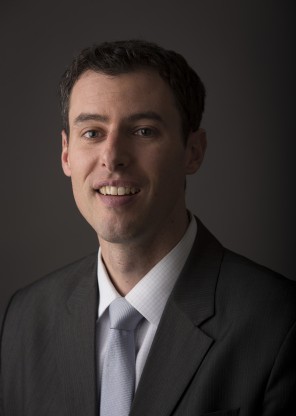
Zachary Mider is an enterprise reporter for Bloomberg News in New York where he writes features for the news service as well as Bloomberg Businessweek and Bloomberg Markets magazines. Before joining the enterprise team in 2012, he covered mergers and acquisitions and Wall Street. Mider joined Bloomberg in 2006 fromThe Providence Journal in Rhode Island, where he contributed to the newspaper's coverage of the deadly 2003 Station nightclub fire. Born in upstate New York, he attended Deep Springs College in Deep Springs, Calif., and Harvard College in Cambridge, Mass., where he received a bachelor's degree in Social Studies. He lives in New Jersey with his wife and two children.