Finalist: The Baltimore Sun, by Andrew Green, Tricia Bishop, Peter Jensen and Glenn McNatt
Nominated Work
Our view: Baltimore is saddened and concerned by Monday night’s violence and looting, and it will need stronger leadership to recover
Baltimoreans woke yesterday morning saddened and unsettled by the wanton destruction that engulfed much of the city the night before. Just hours after 25-year-old Freddie Gray was laid to rest amid calls for peaceful protest against the treatment of the city’s poor and minority residents by police, a large group of teens clashed with officers near the Mondawmin transit station, and violence and lawlessness spread from west to east and throughout downtown. The images of cars on fire, officers felled by rock-throwing teens and looters pillaging and setting fire to stores were shocking. People needed the reassurance of strong city leadership, and they didn’t get it.
As Baltimore spun out of control Monday afternoon and evening, Mayor Stephanie Rawlings-Blake was nowhere to be seen for hours. When she did emerge for televised news conferences, her demeanor was calm to the point of being flat and expressionless. The city needed to hear about action, not the hours she spent behind the scenes dealing with the “T’s to be crossed and I’s to be dotted” to make sure the executive order mandating an evening curfew was just right. The only time she did become animated was in defending her bungled statement from the weekend in which she appeared to suggest that the city had deliberately allowed some “space” for unlawful acts.
“I never said, nor would I ever say, we are giving people space to destroy our city, so my words should not be twisted,” she snapped at one reporter.
We don’t believe the mayor was really giving permission for people to loot and pillage, and we certainly don’t believe the teens were acting on what they thought was her authority. We doubt they heard what she said or would have cared if they did. Likewise, we doubt any of the rioters cared about the “Statement Regarding Mayor’s Comments on the Rights of Protesters” her office issued, in which a spokesman annotated her language with italics, underlining and the strategic addition of a couple of words to convey what he said she really meant.
If that botched statement meant little to those who rioted, it meant a lot to the law-abiding residents of the city who began to wonder just who was in charge here and what she was thinking. That sentiment was doubtless bolstered by wonder that Ms. Rawlings-Blake did not act sooner to request that the governor declare a state of emergency and activate the National Guard. Evidently, Gov. Larry Hogan was wondering the same thing, as he told CNN in a news conference late Monday night that he had an executive order ready to sign and personnel ready to deploy as soon as the mayor called to request it. Though he may initially have been a little intemperate in hinting at his frustration, he eventually managed to say what the community needed to hear: “We’ll get this under control. The city will be safe.”
That was a message Police Commissioner Anthony Batts had failed to convey. Speaking at his own news conference, he implied that Baltimore was in for a rougher spell than Ferguson, Mo., because its much greater size would make it harder to control. He concluded by saying, “For those parents who have kids out there that came off that campus, take control of your kids.” We certainly agree that all of us must play our parts in restoring order and marginalizing violence. But in the moment, it came across as if the police commissioner was recommending a do-it-yourself approach to riot suppression.
The police officers who tried to restore calm Monday night were placed in an awful and dangerous position. We offer our deepest sympathies to those who were harmed, and we are not in a position to judge whether they were deployed in the most effective way to prevent violence or to quash it once it erupted. But we can question whether the police leadership has done more to reassure the public or to alarm it. Even as Gray’s funeral was going on, police urged the media to disseminate the message that the department’s Criminal Intelligence Unit had received “credible information” that the Black Guerilla Family, Bloods and Crips gangs had teamed up to “take out” law enforcement
officers. They could hardly have done more to signal that Baltimore was descending into anarchy. Even if the threat was genuine, what purpose was served by alerting the public?
Hours later, some members of those gangs met with 75 ministers to discuss ways to restore calm, and yesterday several stood by City Council President Bernard C. “Jack” Young to proclaim their intent to stop the destruction of the community. We greet their proclamations with skepticism but also with the disquieting feeling that they may have done a more effective job at easing the public’s fears than the police.
Yesterday was a jittery day in the city, with soldiers lining the streets and businesses, schools and other institutions jumping at rumors of more possible riots from the city to the county. The question on everyone’s minds was whether Monday would be the end of the violence or whether it would continue to roil the city like the 1968 riots, whose legacy reverberates to this day. We have our concerns, as the aftermath of Gray’s death offers many more potential flashpoints -- one of which could come quite soon.
A week ago, Mr. Batts promised to hand over his investigation into the matter to State’s Attorney Marilyn Mosby by May 1 -- this Friday. But she has said that she is operating on her own timetable and not some arbitrary deadline, and he has softened his commitment by suggesting what he turns over may not immediately be made public. In setting a date, Mr. Batts created expectations that may well be unfulfilled. The Rev. Al Sharpton, recently in town, has seized on that to criticize the city for its handling of Gray’s death; no doubt others will as well.
Baltimore has already suffered incalculable damage in terms of destroyed property, injured police officers and civilians, and the tarnished image of the city in the eyes of those who live here, in the suburbs and around the world. Repairing that damage is going to require real leadership. When it counted most, we didn’t see it.
Our view: Freddie Gray’s death has sparked discussions of many injustices, but at its heart is the breakdown in relations between police and the community
The death of Freddie Gray and the riots that followed have brought Baltimore's problems to the forefront of national, even international, attention. The drug addiction, poverty, failing schools, health disparities, deteriorating housing, broken families and unemployment that plague neighborhoods like the one where Gray lived and was arrested in have been on full display, and they have become a part of the larger discussion about what it would mean to bring about justice in the wake of his death. It's a conversation Baltimore and many cities like it need to have, and in the weeks and months ahead, we intend to play a role in fostering it.
But as important as all those issues are in understanding the context of Baltimore's present unrest, they are not what led to two weeks of peaceful protests and two nights of mayhem and violence. First and foremost, Baltimore needs to address the prevalent and well documented brutality some members of its police force inflict on residents of mostly poor and minority communities. State's Attorney Marilyn Mosby brought the focus back to that issue Friday with her indictments of six officers in the case, describing their actions as callously indifferent to Gray's pleas for medical attention. What has become readily apparent is that far more people in Baltimore have experienced that kind of treatment, though thankfully with a less tragic end, than we might like to admit.
The past week has seen an avalanche of accounts from those who grew up in inner city Baltimore of their encounters with brutal, dehumanizing policing tactics. Ta-Nehisi Coates of The Atlantic, who grew up near the epicenter of Monday's riots and whose mother was raised in the same housing project where Gray lived, wrote that "everyone I knew who lived in that world regarded the police not with admiration and respect but fear and caution." He added: "When nonviolence is preached as an attempt to evade the repercussions of police brutality, it betrays itself." D. Watkins, the Baltimore native, author and Coppin State professor, wrote in The New York Times about run-ins with the cops that left him, his family and friends bruised, bloodied and humiliated, even when they were the victims of crime. "To us, the Baltimore Police Department is a group of terrorists, funded by our tax dollars, who beat on people in our community daily, almost never having to explain or pay for their actions." Shaun La, a writer and photographer who grew up in Baltimore, wrote in The Sun that "some of the cops would use Black Baltimore as a playground to do whatever they wanted to do."
There's more here than just anecdotal accounts. Last fall, The Sun's Mark Puente documented more than 100 instances in the last five years when the city paid settlements or judgments in police brutality cases totaling nearly $6 million, with a like amount spent on legal fees. The cases were harrowing: "Victims include a 15-year-old boy riding a dirt bike, a 26-year-old pregnant accountant who had witnessed a beating, a 50-year-old woman selling church raffle tickets, a 65-year-old church deacon rolling a cigarette and an 87-year-old grandmother aiding her wounded grandson." In virtually all instances, the charges against the victims were dropped, yet some officers were named in multiple such suits without the city taking notice.
Complaints of excessive force and strained relations between the community and police are nothing new — they were also at issue the last time Baltimore saw riots, in 1968 — and they aren't unique to this city, either. But they have become amplified as the war on drugs has led to a massive increase in enforcement in neighborhoods like Gray's, and long prison sentences even for non-violent offenders. Gov. Martin O'Malley, contemplating a run for president, is finding himself on the hot seat for the aggressive policing tactics he encouraged while mayor more than a decade ago, a time when the equivalent of nearly one out of every six Baltimore residents was arrested in a given year. Prosecutors didn't even bother to file charges in a third of the cases. The zero-tolerance strategy led to a lawsuit by the NAACP and ACLU that was settled years after Mr. O'Malley had left for Annapolis, with the city agreeing to pay $870,000 and accept outside monitoring of its arrests for quality of life crimes.
After violence broke out last week, Mr. O'Malley cut short a trip to Ireland, but he found himself heckled by residents of West Baltimore. Perhaps more worrisome for him, presumed Democratic front-runner Hillary Clinton, whom Mr. O'Malley has been trying to outflank on the left, made an "out of balance" criminal justice system one of the first policy focuses of her campaign, saying "There is something profoundly wrong when African-American men are still far more likely to be stopped and searched by police, charged with crimes and sentenced to longer prison terms than are meted out to their white counterparts."
Yet Mr. O'Malley spoke some truth in defending himself when he noted that "In all my years of mayor I never had one community leader ever ask for less of a police presence in their neighborhood." Indeed, there is a broader context here, and it is that the heavy enforcement in inner city Baltimore didn't spring out of nowhere. It was a reaction to the real and present threat of violent crime that, in the decade before Mr. O'Malley became mayor, resulted in more than 300 homicides every year — most of them in neighborhoods like Freddie Gray's. Murders immediately dropped below that horrific level after Mr. O'Malley introduced tough New York-style policing here, and he can justifiably claim hundreds of lives saved as a result.
But what the former mayor has been stubbornly unable to accept is that crime continued to drop after he left City Hall, even as the number of arrests plummeted. In 2013, when violence was ticking up in the city (though still well below the levels when he was mayor), Mr. O'Malley publicly made the case that the city needed to start arresting more people, despite data showing no real correlation between violent crime and the total number of arrests.
Clearly, the answer is not simply for the police to stop enforcing the laws. As much as we believe the nation has erred in treating drug addiction primarily as a problem of criminal justice rather than public health, the truth is that not all drug offenders are non-violent, and innocent people in neighborhoods like Sandtown-Winchester pay a terrible price for it. We cannot forget the truly malevolent face of Baltimore's crime problems, as shown in cases like that of the Dawson family, a mother, father and five children who were killed in 2002 when a man tied to the local drug trade burned their house down in retaliation for her efforts to keep the dealers away from her block.
But there must be another way, one that keeps communities like Sandtown-Winchester safe without dehumanizing their residents in the process. Mayor Rawlings-Blake and Police Commissioner Anthony Batts say they have been working for the last two years to find it. Mr. Batts has proclaimed himself a "reform commissioner," and he has been visible in community meetings, beefed up foot patrols to encourage more face-to-face contact between officers and citizens and disbanded a specialized unit that had been the subject of many use-of-force complaints.
But whatever the merits of their efforts, they clearly have not won over those who felt persecuted by the police, and it's easy to see why. The mayor and commissioner have been slow or ineffectual at pushing through the kind of concrete reforms that would offer residents tangible proof that the department was really trying to change.
Ms. Rawlings-Blake was unable to get any other local government leaders to join her push to reform legislation that limits police departments' ability to discipline officers; she didn't even get Commissioner Batts to testify in favor of it. When she announced, on the eve of the legislative session's final day, that she would return to Annapolis to make a last push for her package of reform bills, it was already too late.
The city has been discussing equipping officers with body cameras to record their interactions with the public since at least September, but the best the mayor has been able to offer is a pilot program by the end of the year. We understand that there are complexities involved, but don't the present circumstances argue for accelerating the process? After Mr. Puente's stories ran, the mayor promised to start posting information about police brutality settlements online and to consider ending a practice that barred those receiving settlements from discussing their cases publicly. The first is sort-of done, the latter not at all. Baltimore police said last fall that they would phase out use of the kinds of vans that were used to transport Gray, but that has not yet happened.
Meanwhile, it's not clear that Mr. Batts' reform message is even getting through to his own department. Last year, a city surveillance camera captured footage of an officer beating a man at a crowded North Avenue bus stop. The camera operator flagged the incident the night it happened, and both the department's Internal Affairs division and the state's attorney's office knew about it, yet the officer remained on the streets for two months until the victim's lawyer obtained the footage and released it to the media. A department order to secure suspects with seat belts in the back of police vans was emailed to officers just three days before Freddie Gray was placed, handcuffed and shackled, face-down on the floor of one. What are we to make of the Fraternal Order of Police's excuse for its members' failure to follow the rule that many officers probably didn't read the email?
Ms. Mosby's indictment of the six officers may have momentarily lowered the temperature in the public outrage over aggressive police tactics. What the outcome of those cases will be and how the public will react, we can't know. But unless the mayor and commissioner take some concrete steps soon — putting cameras on officers or putting them in vans, for example — the outrage will come back, sooner or later. The protesters are demanding justice for Freddie Gray, but what they really want goes much deeper than that.
Our view: As violence spikes, the mayor does herself and the city no favors in defending her handling of the riots and sniping at Governor Hogan
Nobody died during the riots," Mayor Stephanie Rawlings-Blake observed Tuesday in defending her administration's response to the widespread violence and looting in the wake of Freddie Gray's death, mayhem that left scores of police officers and civilians injured, buildings burned, businesses looted and a city reeling to recover. "Out of the two weeks of demonstrations, we only had a few hours of unrest, and then we were able to restore peace and calm" — a few hours in which she as leader of the city was mostly invisible but images of Baltimore descending into chaos were broadcast around the world.
In trying times, leaders need to step up. That's more than a matter of making the right decisions behind the scenes — and it's certainly debatable whether Mayor Rawlings-Blake did even that. It's also a matter of projecting calm and authority. Not only did she fail at that on the fateful Monday night of the riots, but the defensiveness with which she has discussed her role and that of Gov. Larry Hogan has only diminished her stature as the city has descended into a new and horrific round of violence.
Nobody may have died on that Monday night, but at least 18 people have been killed since then and more than 50 shot. At any other time, that would constitute a full-blown municipal crisis, but what has the mayor had to say about it? What has Police Commissioner Anthony Batts said, other than a pledge to redistribute patrols? The only voices the public hears are from some police officers who blame the crime spike on the angst and ennui of their fellow patrolmen in the wake of State's Attorney Marilyn Mosby's decision to charge the six officers involved in Freddie Gray's death.
But rather than reassuring the public that the city can both hold officers accountable for alleged misconduct and fight crime, the mayor appears more interested in defending herself and sniping at Governor Hogan. In both The Sun and the Washington Post, she has asserted that her reluctance to ask the governor to call out the National Guard even as her police department was issuing dire warnings about cop-killing gang members and potentially violent gatherings of high school students actually prevented a bad situation from getting worse. "You've seen that militarization of a city turn into violence," she told The Sun, and she told the Post that she worried that "the National Guard with machine guns and riot gear waiting for the kids outside school" would "potentially amp things up."
If that was her thinking at the time, why did the police department have a phalanx of riot-gear clad police, accompanied by at least one armored vehicle, waiting for students as they filtered out of West Baltimore high schools to the Mondawmin transit center?
As for Mr. Hogan, we agree that he was, in the heat of the moment that Monday evening, initially intemperate in making remarks that betrayed his frustration with Mayor Rawlings-Blake. But since then, he has been nothing if not generous in his appraisals of her and in his willingness to credit others — particularly the ordinary residents of Baltimore — with restoring order, cleaning up and moving forward. "I've said multiple times I think she did a good job," Governor Hogan told The Sun.
Whatever frustrations Mr. Hogan had, he's evidently gotten over them. Ms. Rawlings-Blake, evidently, has not. This week her spokesman complained to The Post that the mayor was "pissed off" when the governor suggested on the night of the riots that he wished she had called sooner. "She thought it was a rookie move," said the spokesman, Kevin Harris. "And you can quote me on that."
Who's acting like a rookie here, the governor who said Tuesday "I didn't want to criticize her, and I don't think she deserved some of the criticism," or the mayor — who, by the way, is trying to get Mr. Hogan to release $11 million for the city schools — who could muster nothing nicer to say than, "I will continue to work with anyone who wants to work to move Baltimore forward"?
We acknowledge that there's more to being mayor than going out in public and rallying the city, and that Ms. Rawlings-Blake has brought real skill and determination to problems for which she will never get much credit, like reforming municipal pensions and reducing employee health care costs. But the city was in crisis when rioters took to the streets on April 27, and it has been in crisis during the spate of violence that has followed. We need the mayor to rise to the occasion, not to talk about the "tremendous personal sacrifice" that the job entails. We understand that she doesn't think all the criticism she has faced is fair. Not all of it is, but that goes with the job. If it is too much for her, there are plenty of others who would be willing to take on that responsibility. The way things are going, we suspect we'll be hearing quite a lot from them before next year's election.
Our view: The police commissioner has been trying for almost three years to mend relations between the department and those it serves, but it’s not working
Police Commissioner Anthony Batts says violence is out of control in the Western District in part because his officers find themselves surrounded by people with video cameras every time they show up to do even the most routine police work. To give him some credit for his first significant public remarks about the three-week-long spate of drastically increased murders and non-fatal shootings, he did not appear angry or mystified at this phenomenon. Rather, he recognized it for what it is: evidence of a community whose relations with the police have passed the breaking point in the wake of Freddie Gray's death and the ensuing riots. Mr. Batts is promising more community engagement as a result, and that's good, but he has been promising that since the moment he arrived in Baltimore nearly three years ago. That his efforts have only brought us to this point calls into question whether he can ever achieve his goals.
While Mr. Batts may have been exaggerating in saying officers are being videotaped by "30 to 50" people on every call, it's clear that the dynamics on the street have changed. Officers are not only being taped but also frequently berated by residents angry not just over what happened to Freddie Gray but also about what they say is a long history of abuse by police officers. Even with the passage of three weeks since the riots, passions have not cooled. Nor is the anger — or the recent violence — contained to West Baltimore. On the same day that Mr. Batts made his remarks, five people were shot, one fatally, along Linwood Avenue in East Baltimore. The city saw its 100th homicide of the year the next day.
From his very first public appearances in Baltimore, Mr. Batts preached the need to foster a "a police organization that remembers that we serve our community." He had a reputation for engaging closely with the community during his tenure as police chief in Long Beach, Calif., and he pledged to take time to learn the culture here. In his confirmation hearing in 2012, he pledged "marked improvement in our systems and our commitment to community." He went on ride-alongs, attended community meetings and chatted up residents on the streets.
On a substantive level, he disbanded the Violent Crimes Impact Section, a plainclothes unit that had generated significant community complaints, and he put more officers on patrol to respond to 911 calls. He created a new community policing division and beefed up internal affairs to investigate police uses of force and allegations of misconduct. He promised to give officers "the tools... so they can be more empathetic." In a Sun op-ed two years ago, Mr. Batts explained his strategy: "Simply put, we continue to target illegal guns and violent offenders, and we have added two factors — additional police presence for the comfort and safety of the community and community engagement, in an effort to build bridges and communication between police and the community." At his one-year anniversary, Mayor Stephanie Rawlings-Blake said she was "proud of his emphasis of getting in the community and making sure everyone understands it's not them against us, which is for far too long what people felt."
But 2014 saw the commissioner and mayor on the defensive about police misconduct after a Sun series on the city's history of police brutality settlements, which came around the same time as a widely publicized video of an officer beating up a man at a bus stop — a video the department had for two months but did nothing about. Mr. Batts and the mayor requested that the Justice Department conduct a "collaborative review" into allegations of brutality and misconduct. "I didn't break it, but I'm here to fix it," he said at the time. By this spring, even before Freddie Gray's arrest and death, Mr. Batts was lamenting the "1950s-level black-and-white racism" in Baltimore and a "visceral hatred of the police department" in the community. After Freddie Gray's death and the riots, the mayor requested that the Justice Department upgrade the collaborative review to a full-scale civil rights investigation.
The commissioner has always been a candid observer of the breakdown in Baltimore's police-community relations. We appreciate that, but acknowledging the situation isn't the same as resolving it. When he first arrived here, Mr. Batts said he would keep driving violent crime down and start driving community trust up. Now violent crime is up — murders by 40 percent and non-fatal shootings by 70 percent over last year — and community trust is perhaps as low as it has been since the 1968 riots. At what point do we stop saying Mr. Batts needs more time for his reforms to work and at what point do we concede that they don't?
Our view: A new report stresses regional approaches to Baltimore’s problems; the effort needs to start with the city’s closest suburban neighbor
The new report this week from the regional Opportunity Collaborative didn't unearth much that anyone who has lived in Baltimore for long didn't already know. The area has tremendous resources in higher education, health care and high-tech industries but also deeply concentrated poverty. The opportunities to live a fulfilling, healthy, safe and economically secure life are great in places like Howard County and north-central Baltimore County and terrible in places like East and West Baltimore. Even the idea that the suburbs can't ultimately prosper without a strong central city is, by this point, old hat.
What the report may lack in originality, though, it makes up for in clarity and timing. It happened to be released just weeks after the death of Freddie Gray and the subsequent protests and riots forced people across the region — even across the globe — to confront Baltimore's stark social and economic divide. And the report didn't mince words about the root causes of that divide: a legacy of racial exclusion that allowed one segment of the population to adapt to a changing economy and left another trapped in concentrated areas of poverty. If ever there was a moment when the area's leaders would be inclined to actually do something about that, you'd think this would be it.
But what we're getting instead is a lot of silence. Elected leaders from Carroll and Anne Arundel counties declined to comment, as did Gov. Larry Hogan's office. Harford County Executive Barry Glassman's spokeswoman said he appreciates the effort but is focused on local issues rather than regional ones. This report is no surprise; it's been in the works for years and has involved the collaboration of a wide variety of state and local agencies, non-profits, higher education groups, advocates and others. For it to produce no reaction whatsoever from so many key leaders is stunning. Fortunately, though, the one exception to the rule may be the most important one: Baltimore County Executive Kevin Kamenetz.
Baltimore Mayor Stephanie Rawlings-Blake has enacted a number of key policies during the last few years to help the city's cause, but she can't do it all on her own. Mr. Kamenetz, who is chairman of the Baltimore Metropolitan Council, the organization that led the development of the report, is uniquely positioned to help. "We need every jurisdiction in the region to participate in facilitating solutions," he said. We'd urge him to lead by example.
The report indicated that the Baltimore region is short by 70,000 affordable housing units, and in particular, that those homes should not fall predominantly in low-income, low-opportunity neighborhoods but should be connected with jobs and transit. Last year, Mr. Kamenetz established a fund to provide incentives for developers to include affordable units in their projects. It stands at $9 million, with a commitment to provide a total of $30 million over a decade. But the county can and must do more.
Perhaps the most significant step Mr. Kamenetz could take would be to enact an inclusionary housing ordinance to mandate that new development include a component of workforce housing. A similar law has been in effect in Baltimore since 2010, with little to show for it, but Montgomery County's much older inclusionary housing ordinance has been successful. Given the development boom in Towson and elsewhere, setting aside a small percentage of new units for lower-income residents could make a difference. The county could also pursue policies that make housing vouchers easier to use, for example by lobbying for a state law banning housing discrimination based on the source of a prospective renter's income. It could also seek to partner with the federal Department of Housing and Urban Development on a policy that would allow housing voucher recipients to receive more support for renting homes in higher-cost areas, an approach that has worked elsewhere.
The county could also work to solve what the report's authors termed the "last mile" problem, which refers to the difficulty low-income workers face in getting from transit hubs to jobs. Part of the answer to that problem involves changing bus routes and schedules — something the state would have to undertake — but it could also be alleviated through the creation of local shuttle services. With grant support from the Opportunity Collaborative, the BWI Business Partnership has established well-used shuttle services to get workers from Baltimore City to the airport hotel district. Baltimore County could seek to partner with its major employers to do something similar, perhaps in conjunction with the redevelopment of Sparrows Point.
Policies to help poor people find opportunities for housing and jobs in Baltimore County have a fraught political history, to be sure, but the reality is that there is no magic force field separating the county from the city. Baltimore's problems have been spilling across the border for decades now, and addressing issues of concentrated poverty is no longer an act of charity but one of necessity. Mr. Kamenetz knows that — he has long talked about the stresses on the county's inside-the-beltway communities — and now is his opportunity to show some real vision and leadership on a regional scale.
Our view: A change in leadership at the Police Department will mean little without changes in how it fights crime, treats the rank and file and relates to the community
Firing Anthony Batts was the easy part. Now Mayor Stephanie Rawlings-Blake and interim Police Commissioner Kevin Davis must stop Baltimore's surge in violence while simultaneously accomplishing the twin tasks of restoring community trust in the police and boosting officers' morale, goals that have appeared starkly at odds with one another in the weeks since Freddie Gray's arrest and death. It can be done, and it must, but it's going to require steps that go beyond what the department and administration have appeared willing to take up to this point.
Community relations
If all it took to overcome the historical animosity between many Baltimore residents and the officers who are supposed to protect them was showing up at neighborhood meetings and crime walks, Mr. Batts would have set the world record for the fastest turnaround in police-community relations. He could cite a battery of statistics about declining complaints against officers, use-of-force incidents and police brutality lawsuits, but they didn't add up to a true change in attitudes. If they did, Freddie Gray's death wouldn't have struck such a chord (and maybe wouldn't have happened at all), and residents wouldn't be following police around with video cameras every time they show up to make an arrest or interview witnesses in West Baltimore.
The mayor and Mr. Davis need to do something tangible, and the most obvious answer is to greatly accelerate the deployment of body cameras for officers in the city. Ms. Rawlings-Blake has maintained her commitment to doing so, but she has sent mixed signals by vetoing a City Council bill requiring them and insisting that they will come on her own, strikingly deliberative timetable. The mayor's insistence that she would rather do it right than quickly sounds good but fails to appreciate the greater danger, which is that the lack of trust between the community and police is contributing to the city's runaway violent crime rate. We understand that the cameras present a host of logistical, technical and legal issues, but Baltimore isn't the first city to grapple with them. It doesn't take four years to figure this out. The sooner city residents see cameras on officers, the sooner they will believe that something has changed.
Police morale
As for the officers, the causes of their morale problems are no mystery. They have been quite explicit about them. The city Fraternal Order of Police's report on what went wrong during April's riots describes a host of grievances about how the department's commanders and the mayor prepared, equipped and deployed them. If Ms. Rawlings-Blake gained anything in the eyes of the rank and file by firing Mr. Batts, she more than squandered it by flatly dismissing the document as a politically motivated hatchet job, and then by icily observing during her news conference about the chief's dismissal that, "I don't think many who know me would suggest that I would do anything to placate the FOP."
You cannot improve the department's morale by refusing to take its concerns seriously. Both the mayor and Mr. Davis need to offer a substantive, public and transparent response, and they can start by providing the radio communications, emails, text messages and other materials the FOP requested when compiling the report. Before he was fired, Mr. Batts said he had completed his own after-action report. That needs to be made public, too. Officers have also said they are hesitant in doing their jobs for fear that they will face criminal charges, as the six officers involved in Freddie Grays' arrest are. The mayor and her commissioner need to publicly and clearly state their view of the standards police must follow in detaining, searching and arresting suspects, and they need to stand behind officers who follow them. As the city endures its worst stretch of violence in years, it's not good enough for the mayor to say we need to let the legal process play out. We can't wait that long.
The crime surge
Stemming the crime surge is the most urgent and perhaps most difficult task, simply because its causes aren't well known. Police passivity and a lack of cooperation from the community may be factors, and so might be the flood of prescription drugs that hit the market after the looting of pharmacies during the riots. But we know strategies that have worked in the past, and they don't have to involve the mass arrests that drove such a wedge between the community and the police a decade ago. Baltimore had its best successes in recent days when it adopted a targeted enforcement approach — the "bad guys with guns" theory that Mr. Davis alluded to on Wednesday — and paired it with robust, institutionalized cooperation with federal and particularly state law enforcement agencies. That provided not only intelligence but also the means to go after potentially violent offenders through warrant sweeps, probation violations and other tools.
But key tools, like the Violence Prevention Initiative, in which probation officers met with high-risk probationers in district police stations; the warrant task force, which provided state assistance for sweeps to serve outstanding warrants; and GunStat, an initiative that tracked gun cases and helped officials identify hotspots for enforcement and individuals for tougher prosecution, have withered on the vine. Whether that's the fault of the new administration in Annapolis, the Rawlings-Blake administration or both, it needs to be reversed. Just because these were signature initiatives of former Gov. Martin O'Malley doesn't mean Gov. Larry Hogan's administration can't or won't adopt them. They worked, and not just in Baltimore. But Mayor Rawlings-Blake needs to make a push for them, and a good first step in that direction would be to stop sniping at Governor Hogan. Railing against the state's Republican chief executive (who has largely held his fire in return) might seem like good politics for next year's Democratic mayoral primary, but reducing the homicide rate would be even better.
A final step, though perhaps the most difficult, could improve officer morale, community relations and the crime rate all in one, and that is to change the culture of a department in which an obsession with statistics has overshadowed the emphasis on good police work. Critics of city police leadership (notably, David Simon of "The Wire" fame, among others) have viewed the Freddie Gray case through the lens of a department in which producing statistics of arrests, stops, searches and so on became a substitute for the kind of thorough investigation that builds good cases and gets the right people off the street.
If the theory needed any validation, it came from the reaction to a March email from State's Attorney Marilyn Mosby's office. The head of her Crime Strategies Unit wrote to a Western District police commander to say that community members had complained to the state's attorney about an open air drug market in the area of North Avenue and Mount Street and suggesting a possible collaboration. That translated into an email from the commander to four lieutenants in the Western — including one of the officers charged in Gray's death — demanding a narcotics initiative that would produce "daily measurables." Had it not ended so tragically, Gray's arrest three weeks later presumably would have counted among them, even though he had done nothing more to attract police attention than to make eye contact with an officer.
Statistical analysis of crime patterns is a crucial tool in modern policing. But it's just that, a tool, and not an end in itself. That it has been treated that way by the Baltimore police has driven good people out of the department and rewarded callous ones; it has driven a wedge between the police and the community; and it has distracted from the difficult work of building cases that produce convictions.
Mr. Batts spoke frequently about the need to reform the department, mainly in terms of dealing with corruption in the ranks and weeding out cops who engage in brutality. Given the scandals that the department has weathered in recent years, both were clearly necessary. But they are products of deeper problems in a department where the focus on "measurables" has too often bred cynicism rather than accountability and professionalism.
Mr. Davis gets high marks from his previous postings in Prince George's and Anne Arundel counties, but he has little history in the Baltimore Police Department, which could prove an obstacle for him in taking over for Mr. Batts, another outsider who came to the city after a career in California. Meanwhile, the mayor's announcement that he would be the "interim" chief, though without any corresponding explanation about whether she would conduct a search for a permanent replacement for Mr. Batts, puts him in a sort of limbo in which he will doubtless feel pressure to show results quickly without necessarily commanding the kind of authority that would come with a full appointment.
So far, he is saying the right things about standing with the officers and serving the community, and so is the mayor when she talks about the urgency of stopping Baltimore's violent spring and summer. But Mr. Batts (with some notable exceptions) said a lot of the right things but had little to show for it. Baltimore has had enough talk. It needs action, and it's up to Mr. Davis to deliver.
More fundamentally, though, Mayor Rawlings-Blake needs to realize that the police department can only do so much to reduce crime, no matter who the leader is and no matter what strategies he or she follows. It is the underlying social and economic conditions in neighborhoods like Freddie Gray's that foster the violence and a whole host of other problems. The world saw that in the days before and after the riots, but it has produced no response whatsoever from City Hall. Baltimore is in need of visionary leadership, and that means a lot more than just firing the police commissioner.
Our view: As candidates seek to succeed Rawlings-Blake, they need to address the issues laid bare by the unrest following Freddie Gray’s death
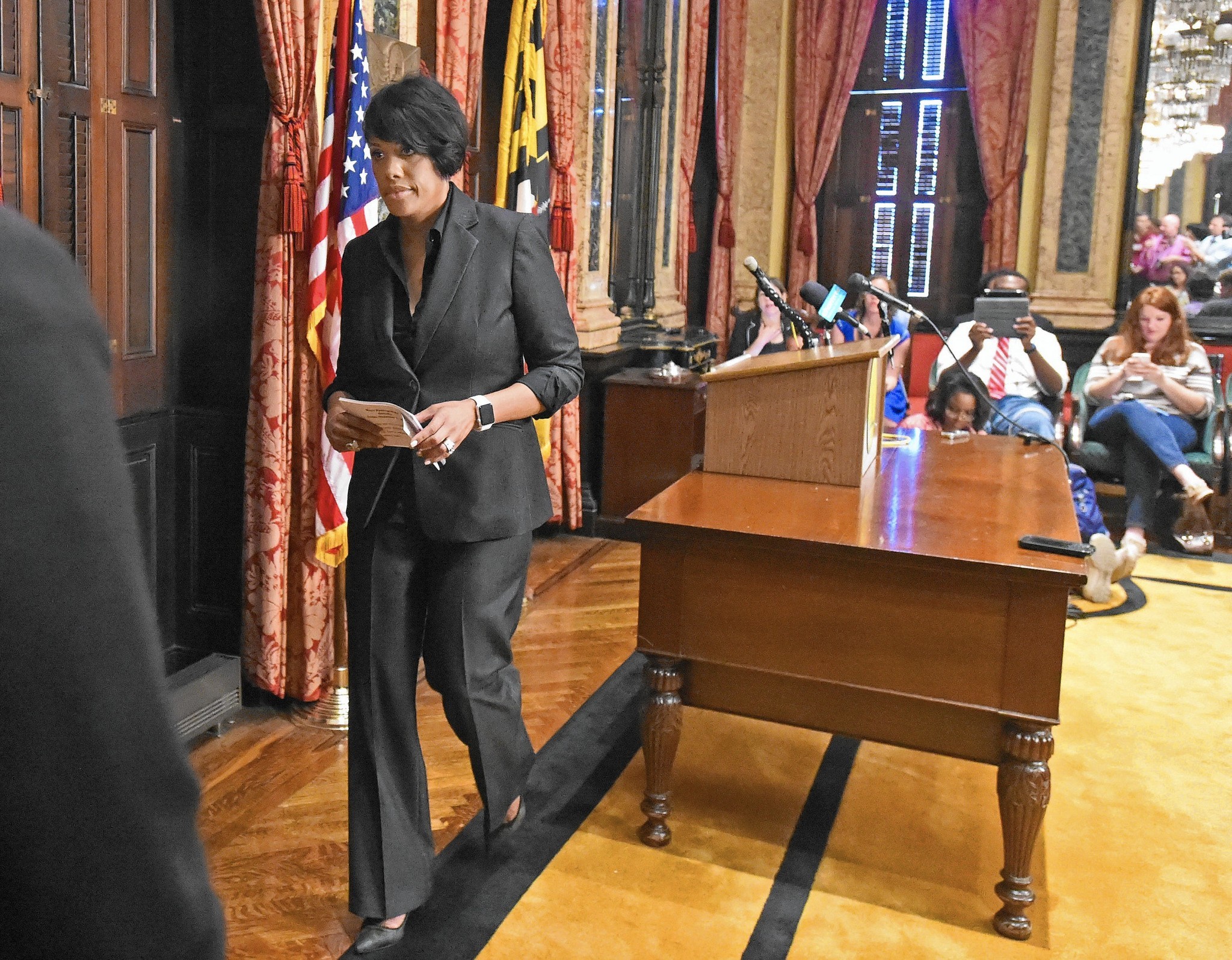
Mayor Stephanie Rawlings-Blake’s announcement that she won’t seek re-election should lead to a vigorous debate about Baltimore’s future. (Baltimore Sun)
The mayor's race was already getting crowded before incumbent Stephanie Rawlings-Blake announced Friday that she would not seek re-election. In addition to a handful of political novices, well known Democrats Sheila Dixon, state Sen. Catherine Pugh and City Councilman Carl Stokes are already in, and many more may well be on the way. Those contemplating a run are probably doing the math and figuring that the winner in the Democratic primary might not need to come close to a majority to secure the nomination, which in this town is tantamount to winning the general election. It's entirely possible that the more people who get in the race, the more people will get in the race.
That's good news for the voters. When Ms. Rawlings-Blake was in the race, it was a referendum on her leadership. Now it becomes a vigorous debate about the issues. The race needs to be about addressing the systemic problems brought to the fore by the unrest after the death of Freddie Gray. Here's what we'd like the candidates to talk about:
• Police and public safety. The decline in arrests since Baltimore's era of zero-tolerance policing and nearly three years of a self-proclaimed reformist police chief evidently did little or nothing to repair relations between the police department and the community. The dehumanizing way officers allegedly treated Freddie Gray resonated far too closely with too many residents of Baltimore's poor neighborhoods. The next mayor needs to address not only the police department's policies and practices but also its culture. He or she also needs to be able to rally the city's law-abiding residents to identify suspects, testify and put violent criminals behind bars. The mayor needs to make the community and police partners, not adversaries.
• Jobs. Baltimore has taken steps to remove obstacles to employment — such as the "ban the box" legislation or the effort by Mayor Rawlings-Blake and school officials to allow some ex-offenders to work on school construction projects. But it needs to do more to encourage private sector job creation. A proposal spearheaded by the city's hospitals to target a hiring initiative at low-income neighborhoods speaks to the potential for partnerships with businesses. The next mayor needs to work on a regional strategy to take advantage of opportunities at the port and Sparrows Point, and he or she needs to remove barriers to business ownership and entrepreneurship.
• Education. The 21st Century Schools Initiative, which will pump $1 billion into construction and renovation in the coming years, is a tremendous opportunity, but it won't transform the city's educational system on its own. For good reason, mayors have limited influence over education policy, but they can work to build greater community engagement in schools by providing targeted services and supports. Baltimore contributes to its schools at a lower rate than almost any jurisdiction in the state. It may be time to change that.
• Transportation. Baltimore has done a great job of providing free and efficient public transportation to tourists and residents of some of its wealthier neighborhoods. Now it needs to turn its attention to finding ways to help get people from the inner city to employment centers.
• Housing. Neighborhoods like Freddie Gray's Sandtown are more segregated than ever, and more bereft of opportunity. The next mayor needs to embrace the Obama administration's efforts to use housing policy to alleviate segregation and to work in a regional partnership to help those who want to move to better neighborhoods, even if it means they leave the city.
• Taxes. Baltimore's high property tax rate isn't likely to dominate the conversation the way it did in the 2011 mayor's race, but it's still important. It doesn't just affect the affluent. Poor people pay higher rents because of the property tax, and leads to blight and abandonment in marginal neighborhoods, not wealthy ones.
• Hope. The next mayor needs to restore the belief in every neighborhood that we all have the ability to create a better tomorrow. That doesn't mean launching a new marketing campaign. It means creating an environment in which hard work pays off, in which everyone gets a fair shake. It is the most abstract task for the city's top leader, but perhaps the most crucial.
Our view: Marylanders may want to help Baltimore after the riots, but first they need to understand justhow closely connected we all are
There are some obvious differences in how voters in Baltimore City and the rest of the state view the aftermath of Freddie Gray's death and the underlying social problems the ensuing riots exposed. The Sun/University of Baltimore poll found that voters statewide sympathize much more strongly with the police than with the protesters, whereas opinions are closely divided in the city. Voters in the rest of the state are much more likely to see Baltimore's problems as stemming from a lack of personal responsibility among the residents, while city voters place the blame squarely on the lack of economic opportunity.
But what this poll and others conducted since the riots suggest is not that residents of Baltimore and those of other parts of the state have fundamentally different views of what's going on here but that their experiences and exposure color their perspectives. Other surveys have shown a strong sentiment on the part of Maryland voters that the state needs to help Baltimore in the wake of the spring's unrest, but in order for that to happen and for the aid to be effective, leaders in the city and beyond need to find ways to bridge the divide.
For all the differences in attitudes The Sun/UB poll found, it also uncovered some striking similarities. Voters in the city and state gave Gov. Larry Hogan overwhelmingly positive marks for his handling of the situation related to Gray's death — 55 percent of city primary voters approved and 37 percent disapproved, compared to 60 percent approval and 26 percent disapproval statewide. Similarly, voters disapproved of Mayor Stephanie Rawlings-Blake's handling of events in roughly equal proportions — 54 percent for the state and 53 percent for the city. She did get higher approval ratings from city voters — 43 percent compared to 34 percent, a difference evidently related to how directly familiar they are with her leadership. The same phenomenon holds with views about the city police department — approval ratings are roughly the same in the city (48 percent) and state (49 percent), but a higher percentage of city voters disapproved (46 percent to 37 percent).
In both cases, greater familiarity materially changes the perception. It's easy to appreciate, then, why exposure to Baltimore's social problems also changes one's perception of their cause and cure. Catherine Rentz's profile on Sunday of Freddie Gray delves into the details of his life that have made him a Rorschach test. Some see him as a person who was doing no wrong when he was arrested, shackled and put into the back of a police van where he sustained a fatal injury. Others see him as nothing more than a drug dealer with a long criminal record. But as Ms. Rentz's account makes clear, his life was complicated and profoundly shaped by his surroundings. He suffered lead paint poisoning as a child, dropped out of high school and dealt drugs in a neighborhood where that is the one industry that's always hiring, no questions asked about a criminal record. When he tried to break free and start a life in the legitimate economy, he found few opportunities and was told the best he could hope for was low-paying drudgery that might eventually offer the chance to do something more. At a jobs center, he was given referrals to three potential employers, but he appears not to have followed up.
How you view that may well depend on how close to it you are. Do you view the issue as a lack of personal responsibility, which nearly a third of poll respondents statewide and more than half of Republicans saw as the primary cause of Baltimore's problems? Or is the issue a lack of job opportunities, which 41 percent of city voters identified as Baltimore's chief problem?
Clearly, there is some truth to both perspectives. Some people do break free of criminal pasts and make new lives, but doing so takes extraordinary perseverance of a sort that people with no connection to that world may have a hard time appreciating. The farther you are from the Freddie Grays of the world, the easier it is to say that you would have done things differently than he did. But if the rest of the state wants to help Baltimore in a way that will truly make a difference, it needs not just to care but also to understand.
Unfortunately, though, the riots and the violence that followed seem not to have fostered connections between the city and suburbs but to have severed them. Last week, Baltimore County Executive Kevin Kamenetz teamed up with Mayor Rawlings-Blake to urge county residents to patronize Baltimore's arts institutions, which have seen substantial drop-offs in attendance since the riots. Certainly the economic and cultural implications of that trend are important in their own right, but more significant is the degree to which that suggests people in the Baltimore region are separating themselves from the city literally and figuratively. It's not only the city's cultural attractions that are "just down the road," as Mr. Kamenetz put it, but also the neighborhoods like the one where Freddie Gray lived. We won't be able to help until we understand just how closely connected we all are.
Our view: The outgoing mayor has 366 days left to steer Baltimore in the right direction before her successor takes over; she has no time to waste
One year from today, someone will be sworn in as the next mayor of Baltimore. If next year's election does what elections are supposed to do, he or she will take office with a strong mandate to enact a vision that will take Baltimore beyond the Freddie Gray unrest and the violence that followed and address the underlying problems that sparked both.
But a year is a long time to wait. It's clear that many in the city and beyond are ready here and now to put their efforts into building a new and better Baltimore, one that is more inclusive and provides greater opportunities for all. You can see it in the $6 million that philanthropists gave to the Baltimore Community Foundation to expand the city's Judy Centers, which provide early childhood education and social services. It was behind the effort of Johns Hopkins, other hospitals and community partners including Baltimoreans United in Leadership Development to create 1,000 entry-level jobs with opportunities for advancement for people from impoverished ZIP codes. (That effort, unfortunately, has been imperiled by state regulators but could and should be salvaged at a meeting this week.) The desire to do something sparked the Divided Baltimore class — free and open to the public — presented by the University of Baltimore as an effort to find solutions to the city's problems. It's reflected in the support from Hopkins, IBM, Kaiser Permanente and others to bring the high school-college-career P-TECH model to city schools. It prompted 1,700 people to call Big Brothers Big Sisters of the Greater Chesapeake in the days after the April unrest to inquire about mentoring city youth. After a call went out for more male mentors in November, another 170 calls came in. It inspired Strong City Baltimore (formerly the Greater Homewood Community Corporation) to launch a new program "focused on violence prevention and workforce development in Baltimore's low-income communities," with a goal of serving 6,500 youth.
The list of the good that has poured forth could go on and on, but it is drowned out by anxiety over what could happen in the trials of the six officers involved in Freddie Gray's arrest, by shock, outrage and fear over the horrible increase in violence, by disgust and frustration over the failures of the housing department, by disappointment over Gov. Larry Hogan's decision to kill the Red Line. It's not that the negatives outweigh the positives but that we are hard wired after decades of urban decay to see and expect the worst and ignore or discount the best.
Compounding the problem is that the surge in enthusiasm for tackling Baltimore's long-standing social problems is inchoate and diffuse. It lacks a central purpose, narrative and agenda, and above all, it lacks a leader who can connect the dots for a citizenry who need to see how we are going to emerge from our latest round of troubles. There is, of course, only one person who can do that, and it is the mayor. We can't wait for a new one to be inaugurated.
Mayor Rawlings-Blake announced that she would not run for re-election so that she could shed the distractions of electoral politics and focus on making the decisions necessary to steer the city through the tense times that are sure to come as the officers' trials proceed in the months ahead. That is important, but we need more.
To be sure, Ms. Rawlings-Blake has lent her support to many of the positive things going on in the community and has helped to shine a spotlight on them. This week, she titled her weekly review "Determination and Generosity," and she highlighted the efforts by businesses affected by the riots to rebuild. But what's missing is a unifying vision.
Immediately after the unrest, she created OneBaltimore, a new entity with a mission to become "a comprehensive and collaborative public-private initiative to support ongoing efforts to rebuild communities and neighborhoods." She hired as its leader Michael Cryor, a public relations executive with deep ties to Baltimore's political, business and philanthropic communities. He spearheaded former Mayor Martin O'Malley's Believe initiative, and many assumed it would be more of the same. Instead, it has turned out to be what Mr. Cryor calls an "incubator of ideas," mostly around workforce and economic development, and its focus has turned out to be decidedly long-term. It is probably a more substantive and deliberative effort than many expected, but it does still leave a need for someone to fashion a cohesive story of the city's response to the unrest.
Back when Ms. Rawlings-Blake was assumed to be engaged in a tough re-election battle, there was some danger in her trying to fill that role — it would have diminished the community's efforts by making them seem political. That's no longer a problem. She now needs to devote her full energies toward channeling the enthusiasm, ideas and philanthropy that have poured forth since April into a cohesive strategy for rebirth. That's something only a mayor can do. Thanks to the leap year, Ms. Rawlings-Blake has 366 days left in her term. She can't afford to let them go to waste.
Our view: The post-Freddie Gray reckoning has produced much introspection about Baltimore’s problems -- and also ideas about how to tackle them
***
Police-community relations
Better body camera policies: Baltimore is well on its way to providing all police officers with body cameras to record their interactions with the public. Three more steps are needed. City police need to make a practice of promptly releasing video of incidents involving police use of force, as Baltimore County has pledged to do (1). The department’s body camera policy needs to be changed so that officers are not allowed to review video before giving a statement in cases where they may face sanctions (2). No police officer questioning a civilian suspect would show him or her all the evidence before an interrogation because it makes it impossible to tell whether he or she is honest. Baltimore needs to resist efforts to change state public information law to restrict access to the videos to those recorded in them (3). That would harm transparency and hinder the ability of organizations like the NAACP and ACLU to gather information on patterns of behavior by police.
Reforms to LEOBR: The Law Enforcement Officers Bill of Rights has become something of a lightning rod, but at least some changes would help restore public confidence. The period when officers are allowed to refuse to answer questions while seeking a lawyer in an internal investigation should be shortened from the current 10 days; it is an excessive period and contributes to public distrust of the process (4). Departments should be allowed to suspend officers without pay when they are charged with certain misdemeanors, not just felonies (5).
Better internal processes: Baltimore needs to revamp its Civilian Review Board to ensure it includes representatives from every district, has proper resources and has more than the perfunctory role it now plays in police discipline (6). Provisions preventing the city department from disciplining officers until criminal proceedings against them are closed need to be stripped from the next contract with the Fraternal Order of Police (7).
Crime
Do what worked before: The “war room” Police Commissioner Kevin Davis set up with local, state and federal law enforcement heralds the kind of cooperative effort necessary to stem violent crime, and it should be continued (8). But other tactics that helped push the homicide rate below 200 should be revived, including the Violence Prevention Initiative, in which probation officers met
with high-risk probationers in district police stations; the warrant task force, which provided state assistance for sweeps to serve outstanding warrants; and GunStat, an initiative that tracked gun cases and helped officials identify hotspots for enforcement and individuals for tougher prosecution (9). State parole and probation agents need to restore the level of cooperation with city police they had during the Frederick Bealefeld era (10).
Get witnesses to testify: State’s Attorney Marilyn Mosby has redirected resources to witness and victim services in hopes of reducing intimidation, and that effort must continue (11). But she needs help, and Congress needs to pass legislation that would make $150 million in witness protection grants available nationwide (12).
Housing
Break up concentrated poverty: Baltimore needs more resources to provide public housing assistance recipients the chance to move to the suburbs, something that is going to require a greater commitment from the federal government (13). Equally important, Maryland needs to prohibit landlords from discriminating against prospective tenants because of their source of income (14). The best hope for that is a push for a local anti-Section 8 discrimination law in Baltimore County; if such a law passes there, it would gain real momentum on the state level. Baltimore and its surrounding suburbs need to enact inclusionary housing policies based on Montgomery County’s successful program so that new developments include affordable units (15).
Safer conditions: The city’s housing commissioner currently has authority over both the massive public housing program and the city’s code enforcement functions. The roles need to be split (16) so there is less chance of the debacles we’ve seen in poorly maintained public housing in recent months, including days without heat or hot water in one complex and a lawsuit alleging that workers demanded sex in exchange for making repairs. Maryland needs to devote more resources to lead paint inspections (17) -- an investment that will more than pay for itself in reduced costs for special education and, too often, incarceration as lead poisoned children grow up.
Fewer vacants, more value: Baltimore should follow up on some of the ideas in a recent Abell Foundation report on the Vacants to Value program, including expanded use of receivership to get nuisance properties in the hands of new owners (18). It also needs to explore reforms to a property tax system that serves as a disincentive for owners of dilapidated properties to fix them up (19). Finally, there needs to be a community-by-community conversation about what housing is worth saving, what should be demolished and what should be done with the land that remains (20).
Education
Better opportunities for every child: Schools need to become community resource centers that address a wide range of the needs of the families who use them (21). The recent expansion of Baltimore’s Judy Centers is a step in the right direction. The school system absolutely must come to a settlement with Baltimore’s charter schools over funding (22). They serve children with a variety of educational needs, and they are a key to keeping the middle class in the city. The $1.1 billion effort to rebuild city schools is a tremendous opportunity -- and Baltimore needs to make the most of it by actively participating in the conversation state officials are having about new construction models that could help reduce building costs (23). Meanwhile, the state needs to expand investment in educating youths committed to the juvenile justice system, too many of whom are failing to get the individualized instruction they need (24).
Better opportunities for adults: The idea of a charter high school for adults so dropouts can get diplomas rather than GEDs is a terrific one that should be easy to accomplish (25). The University System of Maryland needs to accelerate reform efforts at Coppin State University in order to increase completion rates for its students (26). Expanded partnership with community colleges is likely a large part of the answer.
Economic opportunity
Help for ex-offenders: Part of what keeps people in the drug trade is the difficulty after any criminal conviction of getting a job. The Hogan administration’s review of so-called “collateral consequences” of incarceration, like ineligibility for certain professional licenses is a welcome step to overcome that (27). The General Assembly should also take up the recommendations of the Justice Reinvestment Council, a bipartisan effort to find ways to reduce the prison population and to invest the savings in things like better re-entry services (28). The state should also allow for automatic expungement of criminal charges that do not result in a conviction (29). Johns Hopkins has undertaken a model effort to hire ex-offenders that other big employers should emulate (30).
Help for entrepreneurs: Governor Hogan’s review of business regulations holds promise to reduce barriers to entrepreneurship (31). Baltimore City should do the same, with a focus on customer service by city agencies, reducing overlapping regulatory authority and reducing the costs of permits (32). The city should eliminate “minor privilege” fees altogether (33).
Access to jobs: The governor’s decision to kill the Red Line was a major blow. City officials need to keep looking for alternatives, even if they may not connect as many people to jobs as the original proposal (34). Governor Hogan’s attempt to revamp the city’s bus routes could be helpful -- so long as city residents and officials demand that improvements be more than cosmetic (35). Shuttle services for major employment centers like the Amazon warehouse and the BWI hotel district should be expanded to other areas (36).
Health
Reduce drug addiction: The report by Governor Hogan’s task force on heroin addiction represents a welcome commitment by the state to tackle the issue, and it dovetails in many respects with the work of a similar panel in the city. Baltimore officials need to closely watch a proposal to change the way methadone clinics are reimbursed to make sure it actually results in more and better counseling and not a reduction in the availability of services (37).
Proposals by the panel to increase services for addicts who have just been released from prison are particularly welcome (38). Meanwhile, the city’s efforts to increase access to the anti-overdose medication Naloxone need to be expanded (39).
Eliminate disparities: There is a nearly 20-year difference in life expectancy between Roland Park and Freddie Gray’s Sandtown. The city can begin reducing the gap by offering incentives for supermarkets to locate in food deserts (40) and using a re-write of the zoning code to help reduce the over-concentration of liquor stores in poor neighborhoods (41). Hospitals have a big role to play -- and under the state’s new Medicare waiver, they have real incentive to do so. They need to expand services like house calls to improve treatment of chronic conditions like diabetes and high blood pressure (42).
What are your ideas?
Give us your ideas for building a better Baltimore. Send them to [email protected] and include “Better Baltimore” in the subject line. We’ll print the best ones over the coming weeks.
To the Judges,
The death of Freddie Gray and the violence that followed were a turning point for Baltimore, a moment when the alienation and hopelessness that lie beneath the façade of the Inner Harbor and Camden Yards broke through for the world to see. It was a moment that demanded strong and visionary leadership, clear accountability and, above all, an understanding that, to paraphrase Abraham Lincoln, the policies of a quiet past were inadequate to the stormy present. But what we got instead were leaders who disappeared when they were needed most, who willfully ignored the seismic shifts occurring under their feet and who clung desperately to the status quo. The Sun’s editorial board wouldn’t let them get away with it.
As a jittery city took stock of the damage on the day after the riots, The Sun excoriated the mayor and police chief for doing less to calm the public’s fears than a group of self-proclaimed gang members who had promised the night before to restore peace. In dozens of editorials that followed, the board refused to allow them and other leaders to paper over what happened that night and what it signified, and members demanded both immediate and long-term reforms to address the rift between police and the community, the widespread poverty and joblessness in neighborhoods like Gray’s and the failure of municipal and state policies on housing, transportation, education and more.
Writing on deadline during Baltimore’s chaotic year, The Sun’s editorials helped forge a community consensus demanding new leaders and new ideas. As public pressure mounted, Mayor Stephanie Rawlings-Blake finally agreed to request the Department of Justice civil rights investigation of the Baltimore Police Department that The Sun had been demanding for months. She fired a police commissioner who The Sun had called out for failing after three years in the job either to reduce crime or fulfill his promise to regain the community’s trust. And eventually she announced that she would not seek re-election, opening the door for the most competitive mayoral contest the city has seen in at least a generation.
From the beginning, The Sun’s editorials recognized Freddie Gray not as an isolated tragedy but the product of Baltimore’s dysfunctional legacy of racial and economic segregation. The cruel circumstances of the world in which he lived were both well known in this city and easily ignored or dismissed as unsolvable problems.
The Sun’s editorial writers refused to accept that, offering specific agendas for the police and political leaders, culminating in a year-end editorial detailing 42 ideas for a better Baltimore. The proposals to improve police-community relations, public safety, education, the economy, housing and more have prompted readers to submit ideas of their own in a continuing dialogue about how to move the city forward.
What needs to be done cannot be easily accomplished – it’s not just a matter of passing a few bills in the legislature or allocating a few million dollars more – and it will require the kind of sustained pressure The Sun’s editorials have provided. In all, from April 21 until the end of the year, The Sun ran 87 editorials that discussed the implications of Gray’s death, accompanied by hundreds of letters to the editor and op-eds. With the city’s crucial mayoral primary just months away, that focus will only intensify.
For serving as a clear voice demanding not just justice for Freddie Gray but for the community of which he was a part, The Sun’s editorial board is most deserving of this year’s Pulitzer Prize for Editorial Writing.
Sincerely,
Trif Alatzas
Senior Vice President/Executive Editor