The Wall Street Journal Staff

Mike Pride, Pulitzer Prize Administrator (left), and Lee C. Bollinger, President of Columbia University (second from left), present a 2015 Investigative Reporting Prize to John Carreyrou, Christopher Weaver, Tom McGinty, Stefanie Ilgenfritz and Mike Siconolfi (left to right) of The Wall Street Journal Staff.
Winning Work
By John Carreyrou, Christopher S. Stewart and Rob Barry
Ronald S. Weaver isn't a cardiologist. Yet 98% of the $2.3 million that the Los Angeles doctor's practice received from Medicare in 2012 was for a cardiac procedure, according to recently released government data.
The procedure is rarely used by the nation's heart doctors. Patients are strapped to a bed with three large cuffs that inflate and deflate rhythmically to increase blood flow through the arteries—a last resort to treat severe chest pain in people who can't have surgery.
The government data show that out of the thousands of cardiology providers who treated Medicare patients in 2012, just 239 billed for the procedure, and they used it on fewer than 5% of their patients on average. The 141 cardiologists at the Cleveland Clinic, renowned for heart care, performed it on just six patients last year. Dr. Weaver's clinic administered it to 99.5% of his Medicare patients—615 in all—billing the federal health-insurance program for the elderly and disabled 16,619 times, according to the data.
In an interview, Dr. Weaver said he learned about the procedure by "reading lots of articles, studies and clinical trials" and decided to build his practice around it. There is no consensus in the cardiology community whether the treatment provides significant benefits. Dr. Weaver, who likens it to "exercise while lying on your back," says it improves his patients' health.
More than 2,300 providers earned $500,000 or more from Medicare in 2012 from a single procedure or service, according to a Wall Street Journal analysis of Medicare physician-payment data made public for the first time in April. A few of those providers, including Dr. Weaver, collected more from the single procedures than anyone else who billed for them—by very large margins. The data release was prompted by a Journal legal effort to make the information public.
There is nothing inherently wrong with medical professionals billing primarily for one thing. Some doctors specialize in certain procedures and fashion their practices around them. At times, the billings of one doctor can encompass the work of a staff, including other doctors, physician assistants and nurses, distorting comparisons with other doctors in that field.
A closer look at a few of the doctors who make most of their money from just a few procedures reveals that they are operating outside their areas of expertise or deviating from standard medical practice.
The doctors featured in this article say financial incentives play no role in their treatment patterns, and some argue that the procedures save the government money by keeping patients out of hospitals.
Among the doctors whose billings stand out is Evangelos G. Geraniotis, a urologist in Hyannis, Mass. Dr. Geraniotis received $2.1 million from Medicare in 2012, the most of any member of his specialty.
Nearly $1 million of that sum came from a procedure not considered routine in a urological practice. Known as a "cystoscopy and fulguration," it involves threading a scope up the male urethra to burn potentially cancerous lesions inside the bladder.
According to his Medicare billings, Dr. Geraniotis performed two variations of the procedure 1,757 times in 2012. Of the 8,791 providers whose specialty is listed in the Medicare data as urology, 973 billed for the procedure, doing so an average of 38 times. The urologist who billed for the second-most performed the procedure less than one-third as often as Dr. Geraniotis did, the data show.
Dr. Geraniotis said Cape Cod retirees account for the majority of his practice. He said many have bladder issues such as urinary bleeding, but otherwise he isn't sure why he stands out in his use of the procedure.
"If I see something, I say: 'Let's cauterize it and take care of it,' whereas someone else might wait and see," he said. "I guess you could call it a more aggressive approach."
Dr. Geraniotis said the more than $500 he received from Medicare each time he billed for the procedure played no role in his medical judgment and, by performing the procedure in his office, he keeps patients out of the hospital.
"My style of practice is an outlier, but I don't think it reflects anything more than my trying to do good for my patients. I think I'm an honest guy," he said.
In Port St. Lucie, Fla., Gary L. Marder, a dermatologist, specializes in treating melanoma with radiation. Dr. Marder's website, which features photos of smiling elderly couples, says he has cured more than 100,000 skin cancers.
Medicare paid Dr. Marder $3.7 million in 2012—$2.41 million of which came from a radiation treatment billed by just two other doctors in the data, which doesn't include hospital billings. Neither of them came close to billing as much for it as Dr. Marder.
David Beyer, a radiation oncologist in Scottsdale, Ariz., said the procedure code Dr. Marder used to bill Medicare corresponds to higher-voltage machines than the one pictured on Dr. Marder's website. Such higher-voltage machines require substantial shielding and a contained room typically found in the radiation-oncology departments of hospitals, Dr. Beyer said.
Under Medicare guidelines, the lower-voltage machine pictured on Dr. Marder's website was reimbursed at a rate of about $22 per treatment in 2012, radiation oncologists say. Dr. Marder received an average of $154 per treatment by billing under the code for the higher-voltage machine.
In an email exchange, Dr. Marder said he used a machine different than the lower-voltage one pictured on his website, but didn't respond to a question about what kind. Dr. Marder said he had "professionals who can vouch for my correct coding," although he didn't provide their names.
Dr. Marder billed for the procedure, using the more lucrative code, 15,610 times in 2012, and performed the procedure on 94 patients, according to the Medicare data. That works out to 166 treatments per patient, on average.
Dr. Beyer, the Arizona radiation oncologist, said the maximum number of radiation treatments appropriate per skin-cancer lesion is 35, and a more normal regimen would be 20. When a patient has several lesions, they commonly get treated simultaneously and are billed for as a single treatment, he said.
Dr. Marder said he billed for each lesion separately and treated each lesion about 40 times, explaining his high billing count per patient.
In 1998, Dr. Marder was disciplined by Florida's Board of Osteopathic Medicine for alleged "fraudulent" billing. The board fined him $2,500 and ordered him to take courses in medical record-keeping and medical risk management. He neither admitted nor denied the allegations.
Dr. Marder said his medical care "was never in question" and that the medical board merely asked him to better document in his medical charts the justifications for his billings, which he said he has done since then.
Some of the Medicare doctors whose billings stand out aren't performing procedures that are particularly technical or specialized.
The practice of James E. Beale, an orthopedic surgeon in the Detroit area, received $3.7 million from Medicare in 2012, more than any other member of his specialty, according to the data.
Dr. Beale's practice accomplished that despite not performing a single surgery on a Medicare patient. His chief Medicare revenue source was "manual therapy techniques," which the coding manual used by Medicare to set reimbursements describes as a massage or manipulation of various regions of the body, lasting 15 minutes.
Dr. Beale's practice billed Medicare for it 107,670 times and received $2.3 million. By contrast, the average doctor or physical therapist in the data who billed for the technique performed it 520 times and was reimbursed less than $11,000 for it.
How Dr. Beale's practice came to bill for so many massages is unclear. In a brief interview on the doorstep of his large brick home, he said of the Medicare billing that appears under his name: "What you see, it wasn't me." He declined to answer additional questions.
Iris Winchester, who works with Dr. Beale at an orthopedic clinic in a Detroit suburb, said the Medicare payments for the manual therapy went to a company called Abyssinia Love Knot Physical Therapy that she and Dr. Beale worked for until July 2012. Although Ms. Winchester and Dr. Beale opened their own clinic at that time, Ms. Winchester said Abyssinia continued billing Medicare under Dr. Beale's name, which Abyssinia denied.
"You need to follow the money," she said, declining to comment further.
Abyssinia is owned by Shirley Douglas, a former home-health aide who founded a network of physical-therapy centers several years ago. Ms. Douglas, who also is a preacher and goes by "Pastor Shirley," said she ran her facilities in partnership with Dr. Beale until mid-2012.
In 2012, "we did a lot of massages," Ms. Douglas said, adding that the billing under Dr. Beale's name reflected the work of a staff of doctors and physical therapists, not just one person.
But she said her facilities accounted for just $1.5 million of Dr. Beale's $3.7 million in total Medicare billings in 2012. She said Dr. Beale and Ms. Winchester's new clinic must have accounted for the remainder of the 2012 billings, something Ms. Winchester denies.
The Medicare payment data show that Dr. Beale's practice performed the 15-minute massage an average of 149 times per patient for average Medicare billings per patient of $3,155.
Medicare since has capped the amount it reimburses for physical therapy at $1,920 per patient a year.
"Medicare said: 'No more. This is too expensive,'" Ms. Douglas said, adding that her billings for the procedure have declined sharply this year.
Dr. Beale's medical license was temporarily suspended by Michigan's medical board in 1988 for letting a physician assistant use prescription pads bearing his signature to prescribe controlled substances. The medical board separately reprimanded him in 2003 for "negligence" in the treatment of a patient. Dr. Beale couldn't be reached for comment on the sanctions.
Dr. Weaver, the Los Angeles internist whose practice billed Medicare the most for the seldom-used cardiac procedure, acknowledged having no specialized training in cardiology beyond a residency in internal medicine. He is rarely at his clinic, according to former employees. By his own account, he doesn't see patients himself but employs two to three cardiologists for that purpose.
The former employees say the driving force behind Dr. Weaver's clinic is a colleague, Sara Soulati, whose company manages the clinic. Though Ms. Soulati isn't a doctor, she described herself in an interview as an "expert" in the procedure, which is called "enhanced external counterpulsation," or EECP.
Medicare covers EECP only for patients who have "disabling" angina, a kind of persistent and extreme chest pain, and who can't have surgery to treat it. Steven Nissen, chairman of cardiovascular medicine at the Cleveland Clinic, characterizes EECP as "a treatment that is, and should be, rarely used" because there are many other more effective ways to address angina.
Ms. Soulati promotes the procedure as a broader preventive measure against cardiovascular disease. In a speech posted on YouTube that she gave at the City of Refuge Church in south Los Angeles, Ms. Soulati said EECP "grows new arteries" and will "save your life." She asked for the names and numbers of congregants interested in the treatment. "God has been great to me because he allowed me to bring the service here," she said. Dr. Nissen says it is improbable that EECP would grow new arteries.
Dr. Weaver says EECP costs about one-fifth as much as surgical procedures such as stenting and results in fewer hospital admissions. Ms. Soulati and Dr. Weaver said they follow "all applicable laws and regulations."
Their clinic resembles a spa. In several dark treatment rooms, patients lay on about two dozen beds, as the EECP machines emitted pumping sounds. Outside, vans advertising a free EECP trial picked up and dropped off patients, most of them elderly.
Internal emails reviewed by the Journal show the staff was instructed to make frequent calls to patients. In September 2012, Ms. Soulati emailed her staff: "We had VERY low numbers today…please make sure everyone is on the phone all day long." One day the following month when 135 patients were scheduled for treatment but only 83 showed up, she emailed: "Please work hard and get our numbers back to the 90's. our goal is to stay above 90."
A policy document from the clinic notes that "it is so hard to get EECP covered through insurance," advising employees to reassure patients that "we are the experts at getting Medicare to pay when others wouldn't be able to."
Dr. Weaver said Ms. Soulati's emails were "primarily motivated by a desire to assure that patients receive the greatest available benefit from their treatments…without interruption."
The clinic's patients receive tests at a neighboring laboratory, according to the former employees. Ms. Soulati owns the lab, GCC Imaging. Dr. Weaver said the patients who come for EECP tend to have conditions requiring diagnostic testing, and Ms. Soulati's lab is "the only such facility in the building." Ms. Soulati said she agreed with Dr. Weaver's comments.
The government data show the lab collected nearly $1 million from Medicare in 2012. It billed the program for medical tests on 626 patients, roughly the same number as were treated with EECP at Dr. Weaver's clinic.
—Matthew Dolan and Tom McGinty contributed to this article.
By Christopher Weaver and Anna Wilde Mathews
Doctors are testing seniors for drugs such as heroin, cocaine and “angel dust” at soaring rates, and Medicare is paying the bill.
It is a roundabout result of the war on pain-pill addiction.
Medical guidelines encourage doctors who treat pain to test their patients, to make sure they are neither abusing pills nor failing to take them, possibly to sell them.
Now, some pain doctors are making more from testing than from treating.
Spending on the tests took off after Medicare cracked down on what appeared to be abusive billing for simple urine tests. Some doctors moved on to high-tech testing methods, for which billing wasn’t limited.
They started testing for a host of different drugs—including illegal ones that few seniors ever use—and billing the federal health program for the elderly and disabled separately for each substance.
Medicare’s spending on 22 high-tech tests for drugs of abuse hit $445 million in 2012, up 1,423% in five years.
The program spent $14 million that year just on tests for angel dust, or PCP. Sue Brown, a laboratory director in Brunswick, Ga., said she has never seen someone over 65 test positive for angel dust, in 25 years in the business.
For dozens of pain doctors, Medicare payments for drug testing have eclipsed their income from treating patients, a Wall Street Journal analysis of 2012 billing data shows. The billing data for 880,000 providers were released in April after a long legal effort by the Journal.
In Raleigh, N.C., pain specialist Robert Wadley started doing high-tech drug tests in his office in 2010 with equipment he installed there. Drug testing accounted for 82% of his medical practice’s Medicare payments in 2012.
“Urine drug testing is how I pay the bills,” Dr. Wadley said.
As his case shows, even though laboratories perform most drug tests, there are ways doctors themselves can be reimbursed, including by doing the tests right in their offices. Dr. Wadley is among doctors who have purchased devices called mass-spectrometry machines that can count the precise number of particles of different substances in a urine sample. Other doctors become laboratory owners or benefit indirectly from arrangements made with labs.
Dr. Wadley in 2011 helped launch a business that does tests for other physicians. The firm, AvuTox LLC, has routinely tested Medicare patients’ specimens for more than three-dozen separate drugs, billing for each. The drugs range from pain pills to MDMA, or “ecstasy,” and its chemical cousin MDEA, or “eve,” the billing data and company documents show.
AvuTox was paid an average of $1,265 per Medicare patient in 2012, nearly double the average of 108 other labs where a majority of Medicare revenue related to drug tests. In its second year in business, AvuTox became the tenth-biggest recipient of Medicare drug-test payments, $7.3 million. At his medical practice, Dr. Wadley received $1.4 million for drug tests on his own patients.
Many medical experts say high-tech drug tests should generally be used only to confirm results from cheaper, low-tech screenings.
Routinely testing specimens for many different drugs is a red flag because “it would seem like it might be without regard to the patient’s medical condition,” said Andrea Treese Berlin, a lawyer at the federal Health and Human Services Department’s inspector general’s office.
Dr. Wadley said he believes the tests he and AvuTox have done were medically necessary. He also said testing for a broad range of drugs makes sense because it means less risk of missing substance-abusers, and high-tech tests are more accurate.
The doctor said he didn’t know that AvuTox billed Medicare for more tests than many competitors. “There are probably some things we’ve stumbled [over]” as a newer firm, he said.
The drug-testing boom follows an earlier effort to curb heavy billing by Medicare providers. It shows how such an effort can backfire.
Four years ago, Medicare officials capped payments for simple screenings, including test strips that change color when exposed to drugs in urine.
Doctors had been billing $20 for each class of drug they tested for this way, such as amphetamines or benzodiazepines. Medicare capped the payment at about $20 per specimen. It put a $100 cap on a slightly more complex test.
Yet overall payments for drug testing actually accelerated. The reason: Some doctors switched to high-tech testing methods with fewer billing restrictions, chiefly mass spectrometry.
The shift is “a great example of the creativity that results under [Medicare’s] payment system,” which encourages doctors to choose more-lucrative services and perform more of them, said Mark McClellan, a Medicare chief under President George W. Bush. “The technologies keep changing rapidly, and it results in this game of Whac-A-Mole,” Dr. McClellan said.
Medicare pays separately for each substance that high-tech testers look for. Cocaine tests pay up to $21 on average. Hydrocodone, an active ingredient of the prescription drugs Vicodin and Lortab, pays $29.
Officials at the federal Centers for Medicare and Medicaid Services, in a document laying out some proposed changes to lab-service payments, recently said they “are concerned about the potential for overpayment when billing for each individual drug test.” The agency is “evaluating public comments on our proposal and expects to make a final decision” soon, a CMS spokeswoman said.
Medicare also pays for high-tech tests for substances that aren’t specified in its fee schedule, such as ecstasy. For each, it pays about $25.
Use of such club drugs by older people is extremely rare, doctors say. Even counting marijuana, only about one of 1,000 seniors abuse or are addicted to illicit drugs, according to a 2012 survey by the federal Substance Abuse and Mental Health Services Administration.
Dr. Wadley said AvuTox found at least nine patients who tested positive for ecstasy and 16 for angel dust between March and September, though he didn’t know whether it had detected any such drugs in seniors. He said AvuTox does the same tests on all patients’ specimens to avoid discriminating based on age.
In rare cases, doctors might have good reason to test for many different drugs, said Daniel Duvall, chief medical officer for Medicare’s Center for Program Integrity. But, he said, “the most creative [drug testers] are clearly getting into billing abuse.”
The need for vigilance against prescription-drug abuse is real, public health experts say. U.S. overdose deaths involving “opioid” painkillers such as OxyContin, Vicodin and Percocet have risen rapidly. They exceeded 16,000 in 2010, according to the Centers for Disease Control and Prevention.
Said Gilbert Fanciullo, chief of pain medicine at Dartmouth-Hitchcock Medical Center in Hanover, N.H.: “There is a compelling public health need to do urine drug testing—and there’s an enormous profit motive to overdo” it.
One major drug-test biller to Medicare was also a big prescriber of pain medicine. Fathalla Mashali, a Massachusetts pain specialist, received $2.8 million in drug-test reimbursements from Medicare in 2012—more than any other single doctor—mostly for bills he submitted for doing high-tech tests in his office.
Dr. Mashali was arrested in February after former colleagues told investigators he had prescribed opioids for people “who were clearly drug-seekers,” according to a Federal Bureau of Investigation agent’s affidavit in a criminal case later filed against him. Dr. Mashali has pleaded not guilty to federal health-care-fraud charges, including allegations of billing for office visits that didn’t happen. His attorney, Jeff Denner, said that his client “has broken no criminal laws” and that a jury trial is anticipated.
Some labs encourage doctors to refer more patient specimens for drug testing by giving physicians an ownership stake or cut of test revenue, according to doctors and documents from several labs.
The HHS inspector general has pursued several cases involving drug testing recently. In one, Kentucky firm PremierTox 2.0 LLC settled a federal civil suit alleging that two doctors who were part owners of the lab referred specimens to it for testing that wasn’t medically justified. The lab and doctors agreed to pay $15.75 million.
An attorney for PremierTox, Robert Bertram, said a billing company working for it made errors, and PremierTox settled, without admitting liability, “to stay in business” after Medicare and Medicaid payments were suspended.
Dr. Wadley’s AvuTox lab benefited both from Medicare’s system of paying separately for each substance checked and from arrangements that could encourage more test-prescribing.
AvuTox agreed to test doctors’ non-Medicare patients for dozens of drugs, with the doctors paying a flat fee. Then the doctors could bill private insurers for the testing, profiting from any reimbursement above what they paid AvuTox, said a company promotional document.
This deal could bring doctors an extra $96,000 a year, the document said.
“AvuTox can increase the level of patient care while growing your practice revenues,” its website said. That language disappeared after the Journal asked about it.
Such flat-fee deals can be legal, so long as they don’t involve Medicare patients. Even so, they can incentivize doctors to bill for more tests overall, including to Medicare, some experts say.
“If you’re giving a big discount for private pay [to doctors who] are still referring Medicare,” they may refer more samples overall, said Jane Pine Wood, a lawyer who represents labs and doctors who own labs.
Dr. Wadley said that “there is no increase in costs to the payers.” In any case, AvuTox stopped offering that type of arrangement in April, he said, explaining that “it was a side show we didn’t want to get mixed up with.” AvuTox is focused on fast, high-quality testing, he added.
Dr. Wadley, 56 years old, said it was after seeing patients’ laboratory bills that he got the idea of doing high-tech drug tests himself. “We thought, ‘Why not bring that internal?’” he said in an interview at his flagship clinic, Brier Creek Integrated Pain & Spine.
He teamed up with a toxicologist, Phil Radford, who responded to an online job posting. The two met over dinner to discuss offering drug-testing services, Dr. Radford said, then set up high-tech equipment in Dr. Wadley’s practice.
Soon, other doctors started asking if the operation could do their tests as well. In early 2011, the two formed AvuTox in a low-slung medical office in Rocky Mount, a Raleigh exurb. Dr. Radford said the name “AvuTox” echoes a question that might be asked of doctors: “Have you tox[ed] your patients?” Dr. Wadley bought out Dr. Radford in 2013.
AvuTox began testing urine specimens sent to it for a wide range of drugs. Its standard panel included tests for 44 different substances, according to a former sales representative and copies of requisition forms. Dr. Wadley said the firm recently expanded the panel.
Three doctors said AvuTox representatives encouraged them to agree that every specimen they sent would be tested for many drugs. “They said ‘we think it is reasonable to confirm everything’” with high-tech tests, said James Skeen, a Pinehurst, N.C., pain specialist who used the lab until February. “I never thought there was another option” beyond the standard panel, he said.
Dr. Wadley said doctors “can order whatever they want.” He said for the standard panel, AvuTox typically received about $800 from Medicare.
Dr. Skeen said the size of the bills some of his Medicare patients brought in for AvuTox tests “raised my eyebrows…when I was getting paid $75” for a typical pain treatment.
AvuTox and Dr. Wadley’s medical practice both tested specimens for an average of 17 substances for which Medicare has no specific billing code, six times the lab-industry average.
Dr. Wadley said billing for a broad range of drugs can protect doctors from legal liability as law enforcement and medical boards scrutinize opioid prescribing.
Elaine Jeter, a medical director at Medicare contractor Palmetto GBA, said big test panels created by testing firms “encourage unnecessary and excessive testing when no clinical cause exists.”
Palmetto, which processes claims in Virginia, West Virginia and the Carolinas, has proposed a new policy in which firms that routinely do high-tech tests for panels of 40 drugs or more wouldn’t be able to bill for each individually, but would get a single flat payment that wouldn’t go up if more substances were added. It would still be possible to bill separately for smaller numbers of tests in some circumstances. The policy is scheduled to go into effect in mid-December.
Dr. Wadley has supported such a change, over more-onerous restrictions that Palmetto had considered. He sent Dr. Jeter a letter in May that backed the proposed change.
“I said, ‘You guys pay too much,’” he recalled.
By Christopher S. Stewart And Christopher Weaver
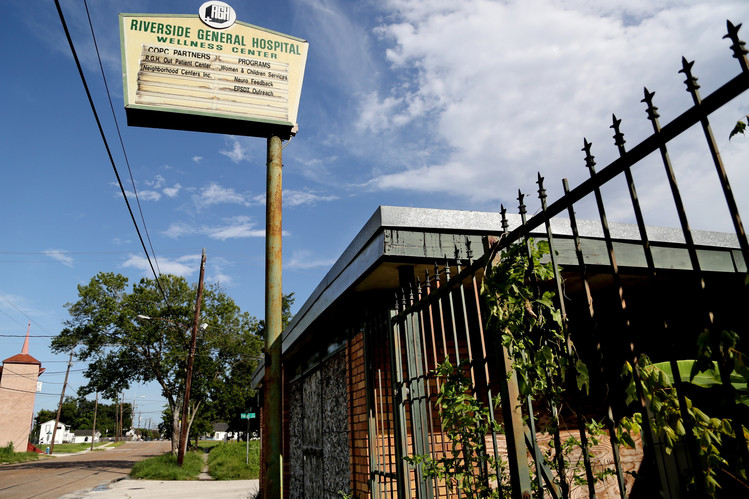
A closed satellite of Houston’s Riverside General Hospital, where a top executive was convicted in connection with alleged Medicare fraud. (Houston Chronicle/Associated Press)
When investigators suspected that Houston’s Riverside General Hospital had filed Medicare claims for patients who weren’t treated, they moved to block all payments to the facility. Then politics intervened.
Rep. Sheila Jackson Lee, a Texas Democrat, contacted the federal official who oversees Medicare, Marilyn Tavenner, asking her to back down, according to documents reviewed by The Wall Street Journal. In a June 2012 letter to Ms. Tavenner, Rep. Jackson Lee said blocking payments had put the hospital at financial risk and “jeopardized” patients needing Medicare.
Weeks later, Ms. Tavenner, administrator of the Centers for Medicare and Medicaid Services, instructed deputies to restore most payments to the hospital even as the agency was cooperating in a criminal investigation of the facility, according to former investigators and documents. “These changes are at the direction of the Administrator and have the highest priority,” a Medicare official wrote to investigators.
About two months after that order, Riverside’s top executive was indicted in a $158 million fraud scheme. The hospital was barred from Medicare this May, and the CEO was convicted in October.
What happened at Riverside General Hospital shows how political pressure from medical providers and elected officials can collide with efforts to rein in waste and abuse in the nearly $600 billion, taxpayer-funded Medicare system. More than a dozen former investigators and CMS officials said in interviews that they faced questions from members of Congress about policy changes or punitive action affecting providers or individual doctors.
Ricky Sluder, a former senior investigator for a Medicare contractor who oversaw part of the Riverside investigation, said “it was extremely frustrating to stall an investigation to give some explanation to a lawmaker. It’s providers’ way of using political power.”
In an emailed statement, Medicare administrator Ms. Tavenner said the Riverside episode “reflected the tension between fraud prevention and access to care.” She said she wasn’t aware of the pending indictments and that her job required her to “balance two important policy goals”—saving taxpayer money and protecting Medicare’s beneficiaries.
A spokesman for Rep. Jackson Lee declined to comment.
Medicare has reported that during the 2013 fiscal year, waste, fraud and abuse accounted for an estimated $34.6 billion in improper payments to medical providers. CMS says it clawed back about $9 billion that year through audits and investigations.
Medicare hires contractors to enforce antifraud rules and fight improper billing. The contractors can suspend payments to doctors and hospitals and revoke billing privileges. They also can block some payments to review claims—called “prepayment review.”
Such actions can squeeze medical providers and even threaten to put them out of business. Medical providers sometimes seek help from elected officials. Politicians have a stake in such disputes: Health providers often provide jobs and valued services in their districts, and can be campaign contributors.
Houston’s Riverside hospital, for example, had treated patients in that district for nearly 100 years and employed about 200 in 2011.
Ted Doolittle, a former deputy director of the Center for Program Integrity, CMS’s antifraud unit, said most legislators support Medicare’s efforts to fight fraud. But “the member who just lost 150 jobs in her district at the hands of faceless Washington bureaucrats, she is flipping livid,” he said.
Mr. Doolittle, who left the agency in May and joined law firm LeClairRyan, said the antifraud office should be sheltered from political pressure, which he said can interfere with investigations. CMS’s top fraud investigator reports to Ms. Tavenner, who was appointed by President Barack Obama in 2011 and whose agency is overseen by Congress.
In her statement, Ms. Tavenner said: “I must be available and responsive to each of the constituencies that CMS serves, including our beneficiaries, professional associations and elected officials.”
Over the past five full years, medical providers and health-care interests spent $2.5 billion lobbying federal officials and lawmakers, according to the Center for Responsive Politics, fueled in part by a surge before passage of the 2010 health law. That constitutes 15% of all federal lobbying over that period.
The health-care industry long has contributed to lawmakers who oversee government health spending. In the current election cycle, for example, hospitals and nursing homes gave $218,800 to Rep. Kevin Brady, the Texas Republican who became chairman of the House Ways and Means health subcommittee last year, through his personal campaign fund and two political-action committees, according the Center for Responsive Politics. Those contributors gave $39,500 to him in 2012 when he didn’t hold the key position, and when his overall contributions also were less. Prior chairmen of health committees also saw jumps in such donations.
The Ways and Means Committee crafted a March bill that barred Medicare recovery auditors from scrutinizing short hospital stays—historically, an area of concern for incorrect payments—until April 2015. Last month, Rep. Brady put forward a discussion draft for a bill to overhaul audits of those short stays and provide a “comprehensive solution” to hospital payments for those visits, according to a statement from his office.
Hospital lobbyists credited the Ways and Means Committee and Rep. Brady for helping on the audit issue.
A spokeswoman for Rep. Brady said he supports the Medicare audit program “and wants to ensure it is accomplishing its mission—deterring fraud, waste and abuse.” But the current rules for short hospital stays, she said, are “arbitrary” and lack “clinical basis.” She said the March decision was made by Republican leaders in the House.
Medicare providers under investigation sometimes contact lobbying organizations for help.
Medicare investigators began looking into Florida skilled-nursing facilities in 2011 and found what they considered suspicious billing patterns at 33 homes. CMS contractor SafeGuard Services LLC was concerned about how often Florida nursing facilities were charging for the costliest physical and occupational-therapy services, according to documents. About a quarter of the 33 facilities were paid at least 20% more a day than their local rivals, a Journal analysis of Medicare data found.
Three of the 33 are owned by Plaza Health Network. Plaza Chief Executive William Zubkoff previously ran a hospital that was barred in 2006 from billing Medicare and other federal health-care programs following fraud allegations. The U.S. attorney’s office for the Southern District of Florida also is investigating whistleblower allegations that Plaza paid kickbacks for patient referrals between 2008 and 2011.
Lawyers for Plaza and Dr. Zubkoff said neither has done anything wrong and both are cooperating with the investigation. They said Dr. Zubkoff wasn’t personally accused of wrongdoing in the 2006 matter.
By 2012, the Medicare investigators had partially blocked payments to the 33 nursing homes.
Some of the nursing homes contacted the Florida Health Care Association, a trade group. It asked lawmakers and Florida Governor Rick Scott, a Republican, for assistance, according to the group’s director and emails.
Gov. Scott contacted Ms. Tavenner, according to a person familiar with the investigation. The two had once worked together at hospital operator HCA Holdings Inc., where both had been executives. The governor’s office connected CMS to the Florida Health Care Association. The trade group put an owner of two of the nursing homes, William Kelsey, on the phone with Ms. Tavenner.
Mr. Kelsey told her the prepayment reviews were “creating a real hardship on the business, staff and residents,” he recalled recently.
On Aug. 22, 2012, Ms. Tavenner ordered the agency’s antifraud officials to release payments for the 33 homes, including the two operated by Mr. Kelsey, according to emails.
A CMS spokesman said Ms. Tavenner got involved to ensure the agency was “preserving access and quality of care.” The spokesman said Ms. Tavenner “often discusses issues and concerns with elected officials…including Gov. Scott.”
In an email ordering SafeGuard to restore payments, John Spiegel, a Medicare antifraud official, said one reason for the action was that the nursing homes were “established providers with long-standing history.”
“Thanks to you and Governor Scott, some sanity has prevailed,” Florida Health Care Association Executive Director J. Emmett Reed wrote to a Scott staffer that Aug. 22.
The spokesman for Gov. Scott said he couldn’t confirm or deny that the governor called Ms. Tavenner about the nursing homes.
Medicare later told its antifraud contractors to avoid using “prepayment review” on skilled-nursing facilities without first receiving approval from CMS, according to documents. The CMS spokesman said the agency instructed contractors to use other approaches to recoup money before resorting to prepayment review.
Former investigators for SafeGuard, a unit of Hewlett-Packard Co., said that decision stripped them of an important tool for fighting fraud and chilled their nursing-home probe. SafeGuard referred questions to CMS.
The CMS spokesman said there is “no single viewpoint” about the value of various antifraud tools, and the agency must also consider patients’ access to care.
As of January 2014, none of the Florida nursing homes caught in SafeGuard’s probe faced any new prepayment action, a former investigator said.
The CMS spokesman said the agency advised law enforcement of its concerns about seven of the nursing homes and that its antifraud investigators referred 30 of them to another contractor to attempt to recoup excess payments.
Houston’s Riverside General Hospital already had been tangling with law enforcement before Rep. Jackson Lee contacted CMS.
In February 2012, in a separate case, the hospital’s assistant administrator, Mohammad Khan, pleaded guilty to defrauding Medicare, admitting that many services weren’t medically necessary and in some cases never provided.
By that time, Medicare antifraud contractor Health Integrity LLC had concluded that 88% of a sampling of Riverside’s partial-hospitalization claims—Medicare’s term for certain outpatient mental-health services—were incorrect, according to government records.
That June 8, Medicare suspended all payments to the facility and put its claims on prepayment review.
Then Rep. Jackson Lee jumped in. In a June 18 letter to Ms. Tavenner, she said the action could harm the “most vulnerable patients.”
Mr. Doolittle, a senior Medicare antifraud official at the time, responded in writing that “the balance favors protecting [Medicare] and the taxpayers,” and the agency would continue to block funds.
At a follow-up meeting that July with Medicare antifraud officials, Rep. Jackson Lee argued that Riverside was the area’s only provider of certain mental-health services, according to CMS investigation records.
Medicare antifraud officials determined that six other providers within 10 miles of Riverside offered the same services, records show, and they again declined to restore payments.
Rep. Jackson Lee spoke with Ms. Tavenner, according to people familiar with the investigation. Ms. Tavenner “listened to her concerns” about how the payment suspension could limit patients’ access to care, the Medicare spokesman said.
Afterward, Ms. Tavenner instructed her antifraud team to restore 70% of Medicare payments to Riverside, effective immediately, according to an email to contractors from a Medicare antifraud official.
At that time, a criminal investigation into Riverside executives, including CEO Earnest Gibson III, was already under way. Ms. Tavenner’s spokesman told the Journal she was unaware of details of the criminal investigation when she ordered the resumption of payments. However, Ms. Tavenner and senior Medicare officials had discussed the possibility of pending law-enforcement action in a conference call earlier the same day, according to one person who was on the call.
Two months after Ms. Tavenner ordered the payment release, federal agents arrested Mr. Gibson at the hospital and charged him with crimes related to health-care fraud.
Medicare officials resumed blocking payments to Riverside, according to investigation records. This May, Riverside’s Medicare billing privileges were revoked for two years, Medicare emails show. A lawyer for the hospital, Clement Aldridge Jr., said the facility now is “on its last breath,” with most of it closed.
Garnet Coleman, the state representative for Riverside’s district, said that after the payments stopped, “there were no patients, so there was no money.” He said low-income people now have fewer choices for psychiatric care.
“We need that kind of care in the community,” he said. But in the end, he said, it became clear to him that the person handling the disputed program “broke the rules.”
Mr. Gibson, the CEO, was convicted in October. His lawyer, Dick DeGuerin, said his client is innocent and is seeking a new trial.
In a recent interview, Mr. Gibson said he was unaware of fraudulent billing at the time, and that he later learned that an employee and some contractors submitted fraudulent bills for their own gain. He said executives sought to retract incorrect bills.
Mr. Gibson said he sought help from Rep. Jackson Lee to “make sure we got a fair shot.”
This June 12, Rep. Jackson Lee requested a phone meeting with Ms. Tavenner to discuss Riverside, an email shows.
CMS employees prepared talking points for Ms. Tavenner, advising her to inform the congresswoman that a revocation of hospital billing privileges is “appealable,” an email shows.
Asked about the June meeting, the Medicare spokesman said Ms. Tavenner “tries to listen to as many of the concerns that are raised as possible and ask many questions of our CMS staff to make sure we are preserving access and quality of care while aggressively preventing and punishing fraud.”
—Tom McGinty contributed to this article.
By Christopher Weaver, Anna Wilde Mathews and Tom McGinty
Many cancer doctors now use a drug called Procrit sparingly.
It was approved in 1989 for anemia and became a popular treatment for that side effect of chemotherapy. But regulators later learned Procrit can speed tumor growth and hasten death in cancer patients. Today, use of this class of drug—best known as EPO, a substance Lance Armstrong took illicitly to pedal faster and longer—is sharply restricted.
One Florida oncology group stands out for how much it bills Medicare for the pricey drug.
Medicare paid U.S. oncologists $128 million in 2012 to administer Procrit, federal data show. One-sixth of that money went to oncologists in the group, Florida Cancer Specialists. Of the 20 oncologists whom Medicare paid most for Procrit, 11 belonged to the Florida group.
Florida Cancer Specialists, based in Fort Myers, Fla., also used Procrit at higher rates than is typical, a Wall Street Journal analysis of 2012 Medicare billing data shows. Its 104 cancer doctors in the analysis on average treated 11% of patients with Procrit at least once, versus an average of 6.2% among other oncologists who used Procrit or a similar drug called Aranesp.
Some other oncologists have stopped using the drugs since 2007, when the Food and Drug Administration began warning about their risks. The FDA eventually said they shouldn't be used on some chemotherapy patients and required doctors to warn many others of their risks. Medicare that year also announced restrictions on reimbursements for the drugs when used on some cancer patients.
The Medicare data, released in April after a legal effort by the Journal to make them public, have shown how a minority of doctors account for an outsize portion of Medicare's costs. A look at oncologists' billing data reveals how, despite regulators' moves to limit the two anemia drugs' use in cancer patients, some oncologists still bill Medicare heavily for what can be highly profitable treatments.
The wide variation shown in the Journal's analysis "makes me think there is some excessive use," says Otis Brawley, the American Cancer Society's chief medical officer. "We have clear evidence that this drug stimulates tumor growth," he says, and is appropriate for only a "very narrow slice" of cancer patients.
William Harwin, president of Florida Cancer Specialists, whose oncologists received $20 million in 2012 Medicare payments for Procrit, says his groups' use of the drug is "correct medically and we follow the guidelines" for administering and billing for the treatment. "There's no conspiracy to give [Procrit] in any extra dose or any extra amounts."
The Medicare data may be flawed, he says, and the usage rates the Journal identified seem too high. The group's rates are partly due to regional differences in patients' health and in what Medicare covers, he says, adding that its electronic records system helps avoid missed treatments that might cause under-billing among other oncologists.
The group's Procrit use "has dropped significantly" since 2007, Dr. Harwin says. Its doctors primarily use Procrit for patients with kidney disease or a rare blood disorder, he says, some of whom also have cancer.
Cancer doctors say it is typical for their patients, particularly the elderly, to have multiple diseases. Oncologists also sometimes treat patients who don't have cancer for kidney disease or blood disorders that are considered precancerous. Medicare doesn't have national payment restrictions for the drugs' use for diseases other than cancer.
Other doctors may underuse the drugs, Dr. Harwin says. He spoke out against Procrit restrictions in 2007 and now says "these were remarkably effective drugs and remain remarkably effective."
The 2012 data have limitations. They include only payments to doctors for services to at least 11 patients. They include 3,026 office-based oncologists who used the drugs but not hospitals that billed through another system.
Despite the data's limitations, "it does appear that some of the highest billing for EPO has occurred in Florida," says a Medicare statement responding to questions about Florida Cancer Specialists' Procrit use, "and that the vast majority of those billing physicians belong to a single, albeit large, practice."
Florida's rates of cancer and kidney disease are well above the national average. Still, Florida Cancer Specialists used Procrit more than other Florida oncologists in the data, who used the two drugs on 7% of patients on average. Doctors and researchers who reviewed the Journal's findings say differences in patients' health aren't likely to explain wide variations in doctors' drug-use rates.
While Medicare paid Florida Cancer Specialists the most as a group for the drugs, doctors elsewhere were the biggest individual recipients of payments in 2012.
Louis Avvento, a Riverhead, N.Y., oncologist, was No. 1 in Medicare payments for Procrit, receiving $618,049 and using it on 17% of patients. He didn't respond to inquiries.
The oncologist receiving Procrit payments for the largest percentage of patients was Chadia Morcos, a part-time Syosset, N.Y., doctor who treated 36% of her 47 patients with it. She says she follows guidelines for the drugs and that her rate appears high because she treats so few.
Some doctors were above-average users of both Procrit, from Johnson & Johnson, and Aranesp, from Amgen Inc. The top biller for both combined was David Dresdner of St. Petersburg, Fla., whom Medicare paid $740,949. He used Procrit on 16% of patients and Aranesp on 13%. He declines to comment.
Ralph Boccia of Bethesda, Md., says he is among "real believers in the benefits" of the drugs for cancer patients. The oncologist, who co-wrote Amgen-sponsored research supporting Aranesp's use in cancer patients, used Procrit on 24% of patients and Aranesp on 19%. He says his usage reflects his practice's growth and that he follows the guidelines but considers the safety concerns overblown.
A J&J spokeswoman says Procrit is "an important treatment option for patients with certain types of anemia" and that usage rates may vary because of differences in doctor experience and patient health. "Physicians and patients must consider the risks and benefits of treatment on an individual basis."
An Amgen spokeswoman says the anemia drugs, used according to their labels, "have a positive risk-benefit profile."
Regulators first approved the drugs, called erythropoiesis-stimulating agents, for anemia from kidney disease and then for anemia from cancer therapy. Oncologists once used them widely.
The drugs also gained illicit users among athletes seeking to boost red-blood-cell counts. Mr. Armstrong revealed his use of EPO, nicknamed after the generic name epoetin alfa, in a 2013 Oprah Winfrey interview.
In 2007, Medicare paid doctors $1.15 billion for Procrit and Aranesp combined for applications other than dialysis, the most for any physician-administered drug.
But medical-journal articles around that time linked the drugs to increased stroke risk, tumor growth and earlier death for cancer patients. In 2007, the FDA issued a warning calling attention to the findings. It ultimately changed the drugs' labels to say that they shouldn't be used on patients undergoing so-called curative chemotherapy for cancer—treatment where the hope is to eliminate cancerous cells—and that they hadn't been proved to relieve many anemia symptoms.
Medicare in 2007 issued a rule that it would pay for Procrit or Aranesp for a cancer patient only if blood tests showed anemia beyond a certain threshold. A small proportion of patients qualify, oncologists say.
Since then, many cancer doctors have cut back on the drugs, as have many kidney doctors. In 2012, Medicare paid $363 million for the drugs, down 70% from 2007.
The drugs can be lucrative. In 2012, 56% of oncologists' Medicare payments were from drugs, compared with 5% for other doctors. Medicare pays doctors only for drugs they inject or infuse in-office. They usually buy drugs upfront, and Medicare then pays them up to 6% more than an "average sales price" based on what drug makers officially report.
Pricey drugs thus yield more income than cheaper ones. Medicare paid $849 for Aranesp and $624 for Procrit for the average monthly treatment on a cancer patient, a separate Journal analysis of 2010 Medicare data shows.
The 2010 data, acquired from Medicare for a fee, are the most recent the Journal could obtain showing individual patient billings. They include payments for 5% of U.S. Medicare patients.
Big practices can extract discounts from suppliers that potentially yield more than the 6% margin. One oncology practice with more than 20 doctors recently could buy Procrit at low enough prices for an average margin of 21%, according to data from Oncology Analytics, a firm that helps manage insurers' cancer costs. It declined to identify the practice.
Dr. Harwin of Florida Cancer Specialists, which has roughly 170 doctors now, won't comment on the group's Procrit margin. It uses Procrit exclusively, in part for volume discounts, he says, but its doctors have "no financial incentive to choose a drug based on its margin."
The group's big bills go beyond Procrit. Of its doctors, 28 were among the top 100 U.S. oncologists by 2012 Medicare payments for all services, 22 of whom received over $3 million each.
Payments over $3 million a year were deemed "high cumulative payments" in a 2013 report by the Medicare parent agency's inspector general, which recommended Medicare scrutinize top-paid doctors' billings.
"We have an incredibly high expense structure," Dr. Harwin says, largely because of drug costs.
The group's biggest payee, Vikas Malhotra, received $8.4 million—including $562,907 for Procrit—the 12th-highest 2012 Medicare payment to any doctor. He says the payment level reflects a patient-volume increase, Florida's high cancer rates and work by nurse practitioners. The Procrit payments might trace to high blood-disease rates and referrals from kidney specialists, he says.
Kidney disease is common among the elderly, many of whom meet criteria for at least minor forms of it, oncology-practice administrators say.
Procrit and Aranesp billings listing kidney disease but not cancer don't face national Medicare restrictions. And while the FDA requires doctors to have cancer patients receiving the drugs for anemia caused by chemotherapy sign a consent form that says Procrit or Aranesp "may make my tumor grow faster and I may die sooner," there is no such requirement of kidney patients who are given the drugs for reasons other than chemotherapy.
Dr. Harwin says Florida Cancer Specialists requires doctors to follow all FDA rules when giving Procrit to patients, and doesn't use it on patients undergoing curative chemotherapy.
Medicare doesn't prohibit a doctor from billing for Procrit for kidney disease, even if the patient is in cancer treatment and doesn't meet Medicare's anemia threshold for billing for cancer. Some Medicare-billing experts say that if a patient has both diseases, some oncologists will list kidney disease on a Procrit bill to avoid the cancer rules.
Some former employees of the Florida group who were at one office in 2012 say that if patients met the criteria for either a chemotherapy or kidney-disease claim when billing for Procrit, doctors would typically list kidney disease. Such a practice is acceptable under Medicare and FDA requirements.
The 2012 Medicare data don't provide detail for how the Florida group billed for individual patients. But the slice of patient information in the 2010 data obtained by the Journal includes individual records for 314 people the group treated with Procrit. The group's doctors listed a cancer diagnosis for 147 of them on overall Medicare billings.
When the Florida group's doctors gave Procrit to the 147 patients, they listed kidney disease 54% of the time on Medicare bills—without mentioning cancer—and listed cancer 25% of the time. When its doctors billed for anything other than Procrit for those 147, they included a cancer diagnosis 89% of the time.
One of the group's oncologists gave chemotherapy drugs to a man in his late 70s for prostate cancer in 2010, telling Medicare the treatment had caused anemia, the data show. In a separate claim that day, the doctor billed Medicare for Procrit to treat his anemia, listing the cause as kidney disease.
"There is no central directive to do such a thing," Dr. Harwin says. "There's never been any thought that anyone should alter their diagnoses to justify giving Procrit."
Sarah Cevallos, the group's revenue vice president, says it sometimes bills separately for Procrit when treating cancer patients because Medicare's processor in Florida sometimes rejects Procrit claims with multiple diagnoses. She says the group has passed Medicare audits without problems.
A Medicare spokesman says "there are no administrative requirements that require these type of claims to be billed separately." Medicare hasn't identified issues at the Florida group other than small overpayments the group repaid, he says.
—Lisa Schwartz contributed to this article.
By Christopher S. Stewart
HOLLYWOOD HILLS, Calif.—Eleven armed FBI agents crept around a stone-and-glass house here just before dawn. An AR-15 rifle and four other guns were registered to the man in the house.
"FBI warrant," the agents called out, and a man in a T-shirt and shorts emerged.
It was no drug lord. The target was a doctor who moonlighted as a movie producer with an Alec Baldwin comedy to his credit. The Justice Department charged the doctor, Robert A. Glazer, with writing prescriptions and certifications resulting in $33 million of fraudulent Medicare claims.
The raid in May capped a year-long investigation by the Medicare Fraud Strike Force, a joint effort by the Justice Department and Department of Health and Human Services. Raids that day in six cities resulted in the busts of 90 Medicare providers, including 16 doctors, who were separately charged with generating a total of $260 million of false Medicare billings.
The odds are slim of retrieving much of that money if the providers plead guilty or are convicted. Law-enforcement officials involved in the effort estimate that fraud accounts for as much as 10% of Medicare's yearly spending—which would amount to about $58 billion in bogus payments in the 2013 fiscal year. Yet the U.S. government recovered just $2.86 billion in Medicare funds that year.
"Usually the money gets away," said Special Agent-in-Charge Glenn R. Ferry, who oversees HHS/Office of Inspector General's strike-force operations in Los Angeles, which charged Dr. Glazer. "As soon as it hits an account, it disappears."
Many strike-force investigations, including the Glazer case, start with an agent behind a computer screen, eyeing page after page of Medicare claims data, looking for unusual billing patterns. In April, the government publicly released data on doctor billing for the first time after a legal effort by The Wall Street Journal to make the information public.
Federal prosecutors alleged that the Glazer fraud stretched over eight years and involved prescribing patients equipment and hospice and home-health services they didn't need—and in a lot of cases didn't receive. In return for referrals, the equipment and service providers allegedly paid kickbacks to the 68-year-old Dr. Glazer.
In an email, Dr. Glazer described the charges against him as "one-sided and grossly inaccurate." He said his lawyer has forbidden him from discussing the case before trial. His lawyer declined to comment.
The Glazer case comes as the strike force increasingly targets physicians. "You need a doctor in all the schemes," said David A. O'Neil, a deputy assistant attorney general for the criminal division who supervises strike-force prosecutions.
He said the team charged 36 doctors with health-care fraud in the 2013 fiscal year, compared with just three in 2007, when many cases dug into fraud involving durable medical equipment such as wheelchairs.
The claims database reveals that some alleged bad actors have been in the Medicare system for years.
Because Congress has mandated that Medicare pay providers within 30 days of receiving claims, investigators play catch-up. "We're working behind the eight ball," said the Los Angeles strike force's Mr. Ferry.
In 2009, Vahe Tahmasian and Eric Mkhitarian used a straw buyer to purchase a medical-equipment company and then to enroll in Medicare, according to an indictment. When an inspector working for the Centers for Medicare and Medicaid Services, the agency that administers the federal health-insurance program for the elderly and disabled, visited the company, Mr. Tahmasian showed a fake California driver's license with the straw buyer's name, according to evidence presented at trial.
The men operated for about a year, using stolen beneficiary numbers to bill Medicare, before CMS referred the case to the strike force, according to the evidence at trial. But it was too late to stop the money. The men billed the program $1.5 million in two years, prosecutors said.
When Mr. Tahmasian went on trial this year, he testified he wasn't aware of fraud going on at the company. In March, he was found guilty in a California federal court of health-care fraud and identity theft. In July, he was sentenced to 10 years in prison. The Justice Department said Mr. Mkhitarian has been a fugitive since the charges were announced. Only $146,243 was recovered.
It is a huge challenge to track billings. About 4.5 million claims funnel through the system each day. Medicare spent some $583 billion last year.
CMS has been working to address the fraud problem. It has instituted temporary enrollment moratoriums on "high-risk" providers in targeted areas, and has been bulking up its provider-enrollment process with fingerprinting and site visits. It also launched a predictive-analysis data program, called the Fraud Prevention System, which scans fee-for-service claims for suspect behavior.
The two-year-old program aims to, among other things, identify bad actors before they get paid. In fiscal year 2013, it spawned leads for 469 new investigations and identified or prevented $211 million in improper payments—nearly double that of the first year, but still tiny compared with the estimated tens of billions lost.
"It's still early days" for the system, said Shantanu Agrawal, deputy administrator and director of CMS's Center for Program Integrity. He said the effort underlines a broader shift at the agency from "pay and chase" to "stopping dollars from flowing out the door."
The strike force's Los Angeles team includes about 20 investigators and prosecutors working out of multiple offices, including a shiny tower in the suburbs near a strip mall dotted with family restaurants and chain stores.
Last fiscal year, the strike force's nine offices charged 350 people with health-care fraud, up from 122 charged when the strike force had just two offices. One agent described dealing with the voluminous number of potential cases as "Whac-A-Mole."
Dr. Glazer attracted attention from authorities long before this year's charges.
In 1994, he was indicted with six others for an alleged referral scheme between 1986 and 1993. He was accused of paying $73,454 to a marketer during one 3½-year stretch to send him patients, according to California Superior Court documents obtained through a public-records request.
Court documents indicate that the case was dismissed after a judge ruled that the prosecution's witness testimony was inadmissible. Dr. Glazer was never excluded from billing Medicare, but patient complaints over billing prompted CMS several years ago to place him on "prepayment review," according to people familiar with the situation. That meant any claims made to Medicare were manually reviewed by CMS contractors, a measure intended to prevent improper billing.
Dr. Glazer was removed from the review list around 2009, these people said, although it isn't clear whether CMS decided to take him off or if he appealed to an administrative judge. CMS said it doesn't comment on administrative actions against individual providers.
It is difficult to permanently ban a provider from Medicare. A criminal conviction or a loss of a state medical license can provide grounds to take a provider out of the system, and CMS can revoke billing privileges for reasons such as failing to comply with Medicare rules.
Since 2011, CMS has revoked about 20,000 providers. But a provider can eventually appeal or reapply to return to the program.
Dr. Glazer received a medical degree in Mexico from the University of Guadalajara, according to the Medical Board of California. On his Facebook profile, where he sometimes refers to himself as "Dr. G," he writes that he is "multifacited," that he "can ride and jump horses, take photos," that he has been an associate producer on three movies, and that there is "nothing like the sound of a real, V-12 Ferrari."
At one point in late 2011, he announced on Facebook: "Fantastic news! The medical board has ended the investigation against me. It's all over!"
The only evidence in the doctor's public medical records of any investigation is a March 2012 public reprimand by the Medical Board of California for "gross negligence" and "failure to maintain adequate and accurate medical records" in connection with his treatment of a patient complaining of dizziness and memory problems.
The strike force began investigating him after sorting through years of his payment claims in the Medicare database, according to people familiar with the investigation. Such database searches look for "the sort of medically impossible or medically unlikely scenario," said Supervisory Special Agent Robin McIlroy, who oversees the FBI's part of the strike force.
Between 2006 and 2014, Dr. Glazer's family practice billed Medicare about $2 million, according to an affidavit by FBI Special Agent Janine Li, who was part of the investigation team.
When agents cross-referenced his Medicare provider number with other parts of the database—including claims data for home-health agencies, hospice and durable medical equipment—large billing numbers stood out, according to a person familiar with the investigation.
"Once you start crunching the data, you start to see everything," said Mr. Ferry, the special agent-in-charge.
In the same eight-year time period, Dr. Glazer's referrals to home health-care companies resulted in billings to Medicare for $16.5 million, and referrals to medical-equipment companies resulted in billings of about $5.4 million, the FBI's Ms. Li said in her affidavit. Hospice services added up to about $10 million, according to a person familiar with the case.
Outliers popped up in the data. Using Dr. Glazer's prescriptions, Medicare paid $2.5 million to one home-health agency down the hall from his office, while a local hospice was the recipient of nearly all his referrals, according to the person familiar with the case. Generally referrals are more spread out between multiple providers, said a person familiar with health-care fraud.
The volume of motorized-wheelchair prescriptions in the data stunned the agents—an average of 134 a year, compared with a typical doctor working with elderly people who prescribed as few as one or two, according to the affidavit.
As the investigation progressed, agents in unmarked cars drove to Dr. Glazer's clinic in Hollywood and watched. Located in a strip mall, along with a Salvadoran fast-food restaurant, a check cashier and a medical-supply company, the office received many elderly patients who spoke English as a second language, said the people familiar with the investigation.
The agents interviewed patients drawn from the data, and a common allegation emerged: Dr. Glazer was billing Medicare for patient services sometimes never rendered and farming out patients to other providers, according to the indictment.
One female patient, referred to in the affidavit as "MVL," told agents she was offered a free powered wheelchair.
Dr. Glazer's clinic used several marketers to recruit patients, a person familiar with the case said. Some offered free diabetic shoes. One marketer, later named as a co-conspirator, would become a cooperating witness in the case.
An unnamed woman drove the patient referred to as MVL to Dr. Glazer's clinic, where Dr. Glazer said to expect a wheelchair, according to the affidavit. Along with the wheelchair, several other things arrived, the patient told agents. A back brace she didn't need came one day, and the clinic called to say that they were sending a nurse, which she refused.
Dr. Glazer charged the patient's Medicare account for five services totaling $555, including a home visit and electrocardiogram, a heart test, which she told agents she never received, according to the indictment.
Dr. Glazer also began to pass along the patient's Medicare number to other providers, prescribing services the patient wouldn't receive, the affidavit says.
One equipment company billed the patient's Medicare account $680 for a back brace, bilateral knee braces and a heating pad, while a home-health agency submitted $1,080 worth of claims for eight home-health visits, according to the affidavit. Only two of those visits were made, though the patient hadn't asked for them, and her daughter told the nurse not to come back, the affidavit says.
For the prescriptions, Dr. Glazer was paid a kickback, the affidavit says. The indictment didn't specify how much he allegedly received. People familiar with the investigation say a doctor could get a kickback of as much as $1,200 for prescribing a motorized wheelchair that could cost Medicare between $3,000 and $6,000.
The indictment identified as a co-conspirator Dr. Glazer's office manager, who wasn't named, who the indictment said also happened to be co-owner of the nearby home-health agency. That agency was the recipient of many of Dr. Glazer's referrals, according to one of the people familiar with the investigation.
The indictment alleged that the office manager acted as a middleman between Dr. Glazer and the marketers as well as the agencies paying for the prescriptions.
In a court appearance on May 13, the day of the raid, Dr. Glazer stood in a black polo shirt, his hair tousled, as the judge read the charges. He stared ahead.
The judge said a condition of his release on a $200,000 bond was that he not bill government programs. A trial is scheduled for February.
As the hearing ended, the judge ordered Dr. Glazer to surrender his guns and instructed agents to return to his house for them. Dr. Glazer gave up the AR-15 rifle and ammunition, but said the other guns were no longer in his possession.
By John Carreyrou and Tom McGinty
A fast-growing Virginia laboratory has collected hundreds of millions of dollars from Medicare while using a strategy that is now under regulatory scrutiny: It paid doctors who sent it patients' blood for testing.
Health Diagnostic Laboratory Inc. transformed itself from a startup incorporated in late 2008 into a major lab with $383 million in 2013 revenues, 41% of that from Medicare.
It built that business selling tests to measure "biomarkers" that help doctors predict heart disease. HDL bundles together up to 28 tests it performs on a vial of blood, receiving Medicare payments of $1,000 or more for some bundles.
Until late June, HDL paid $20 per blood sample to most doctors ordering its tests—more than other such labs paid. For some physician practices, payments totaled several thousand dollars a week, says a former company employee.
HDL says it stopped those payments after a Special Fraud Alert on June 25 from the Department of Health and Human Services, which warned that such remittances presented "a substantial risk of fraud and abuse under the anti-kickback statute."
The fraud alert is part of an investigation the health agency's Office of Inspector General is conducting with the Justice Department into doctor payments by HDL and several other labs specializing in cardiac-biomarker testing, people familiar with the investigation say. The agencies decline to comment.
HDL is cooperating with the investigation, a spokesman says. Its fee fairly compensated doctors for the labor cost of handling blood that went beyond the $3 that Medicare pays for each blood draw, he says.
HDL "rejects any assertion that we have grown and succeeded as a result of anything other than proper business practices," says Chief Executive Tonya Mallory in a statement, and "has consistently complied with all applicable laws."
Payments like HDL's $20 fee could give doctors an incentive to order unnecessary tests, says Kirk Ogrosky, a former federal prosecutor on the Medicare Fraud Strike Force who now works for the law firm Arnold & Porter LLP. "With every allegation of kickbacks," he says, "the real question is whether money was paid to get the referral of Medicare patients."
Large established labs like Quest Diagnostics Inc. don't pay such fees. They operate blood-draw sites and sometimes place blood-drawing technicians in physician practices—doctors get no financial compensation for the blood draw.
At issue is a "safe harbor" exception to the federal anti-kickback statute. A vendor selling something to doctors may compensate them for certain related services. For instance, a lab could reimburse a doctor the partial cost of employing a blood-drawing technician who sends samples to the lab.
Under the exception, payments must not offer a financial incentive for doctors to send more business the vendor's way. They must not exceed a "fair market value" for the service and must be a fixed amount set beforehand. The government is examining whether the labs' payments were excessive and encouraged doctors to send more samples because they were paid for each one.
HDL and several other labs under investigation say that their payments were fair-market-value compensation for handling blood, that they had been a widespread industry practice and that the fraud alert represents new government guidance.
HDL documents and emails reviewed by The Wall Street Journal reveal details about its fee and another practice that raised internal concerns: performing a genetic test on thousands of blood samples it had refrigerated after previous tests. A former HDL lab employee says the lab performed the test on many more samples than she thought medically legitimate. HDL says it ran only tests doctors requested.
Tax dollars helped fuel HDL. It collected $139 million from Medicare in 2012, according to federal data released in April after a legal effort by the Journal. HDL's Medicare receipts rose to $157 million in 2013, a company document shows.
HDL received 64% of Medicare's nationwide reimbursements for the nine lab procedures from which the company earned the most in 2012. It received 93% of Medicare's reimbursements for a procedure to separate blood particles based on their electric charge. HDL billed Medicare for it 262,308 times, collecting $11.9 million. The 35 other labs using the procedure together billed Medicare for it 19,621 times, collecting $850,000.
The HDL spokesman says its billing reflects proprietary lab methods and that detecting disease early with its tests "is far less expensive, in both human and financial terms" than treating heart attacks or strokes.
HDL traces its roots to efforts to improve heart-disease detection. Researchers have found that when the body produces certain molecules in abnormal quantities, its ability to process fats and cholesterol diminishes, increasing cardiovascular risk. Those molecules have become known as biomarkers of potential heart disease.
In the late 1990s, a California company, Berkeley HeartLab Inc., began developing tests to measure those biomarkers. It was acquired by Celera Corp. and is now a Quest unit.
Ms. Mallory was Berkeley's senior lab-operations manager in 2008 when she left to found HDL in Richmond, Va. Two Berkeley sales representatives, Cal Dent and Brad Johnson, later left to form BlueWave Healthcare Consultants Inc., which became HDL's independent sales-and-marketing contractor.
Berkeley sued HDL, accusing it of stealing Berkeley's business after some doctors switched to ordering tests from HDL. In court filings, HDL denied the allegations. It settled the case for about $7 million, Celera said in 2010. Berkeley and HDL sued each other in 2011 and settled those suits under undisclosed terms. The companies declined to comment on the litigation.
HDL began offering tests in 2009, promising doctors a fee for each sample. In a May 1, 2010 memo, Ms. Mallory distinguished between a venipuncture—drawing blood—and other aspects of processing and handling a sample, such as vial labeling, cooling and shipment coordination. HDL called those aspects "P&H."
Medicare doesn't pay additional P&H fees beyond the $3 it reimburses for a venipuncture. Citing a time-motion study HDL conducted, Ms. Mallory's memo valued the P&H tasks at $17. Adding the two, her memo concluded, doctors were entitled to an overall $20-per-sample fee from HDL.
The fee, she wrote, met anti-kickback-law exceptions allowing compensation for services at fair market value. The memo demonstrates good faith, the HDL spokesman says. "That P&H fees could have been misinterpreted or misread by others was the very reason that HDL" put it in writing.
HDL paid some practices more than $4,000 a week in blood-sample fees, says a former HDL marketing manager whose duties included sending doctors checks. In an October 2010 email copied to Ms. Mallory, he asked how to handle a doctor who said HDL had promised a $25 "draw fee," $5 more than HDL paid.
After Ms. Mallory forwarded his query to BlueWave's Messrs. Johnson and Dent, Mr. Johnson emailed: "Fyi To all I want to refocus that this is an ph fee not a draw fee. One word makes it legal the other illegal."
The manager emailed Ms. Mallory: "Can you explain the difference between a draw fee and a P&H fee?" She explained that $17 was for packaging, he says. He says he expressed concerns to her about the fee's ethics.
Ms. Mallory declined interview requests. Mr. Johnson declined to comment. Mr. Dent didn't respond to inquiries.
That month, Becky Morrissey, a representative for the Tennessee Medical Association, which represents doctors in the state, emailed HDL about the payments: "My question, how is this not a kickback and a violation of federal law?" Ms. Morrissey says HDL referred her to outside lawyers who said the payments were legal.
Blood-sample fees were "a long-standing, industrywide practice" before the fraud alert, which was "new guidance," Ms. Mallory said in her statement.
Other labs under investigation—Quest's Berkeley HeartLab, Singulex Inc., Boston Heart Diagnostics Corp. and Atherotech Diagnostics Lab—say they are cooperating. Quest says Berkeley ended payments of $7.50 to $11.50 in 2011 when Quest bought Berkeley. HDL, Singulex, Boston and Atherotech say they stopped payments after the June 25 alert.
Singulex says it paid $10, saying such fees were "a long-standing industrywide practice," before the "government clarified their view." Boston says it paid $15 and thought the practice lawful before the alert. Boston and Singulex didn't include a $3 draw fee. Berkeley did include the $3, as did Atherotech, which says it paid $10, declining further comment.
Of those labs, HDL collected the most from Medicare in 2012. Its $139 million receipts compared with Berkeley's $17 million, Atherotech's $16 million, Boston Heart's $13 million and Singulex's $8 million.
Some doctors stood out for heavy use of HDL's services in 2010 Medicare data. The data, which the Journal obtained for a fee, include reimbursement claims for a random 5% sample of Medicare patients and are the most recent the Journal could obtain showing individual patient billings.
In that sampling, Charles "Sam" Fillingane was the most prolific test prescriber among 296 doctors who referred patients to HDL. HDL submitted 140 Medicare claims in 2010 for the 12 patients in the sample referred by the Flowood, Miss., family practitioner—11.7 claims per patient. HDL collected $14,780 from Medicare for those 140 claims. Doctors in the HDL sampling averaged 3.8 claims per patient.
Dr. Fillingane is on HDL's medical advisory board, a position that HDL paid doctors up to $3,000 a month for in 2010. He also earned speaking fees from HDL, says the former marketing manager. In a YouTube video, jazz musician Steamboat Willie says the doctor changed his life with HDL's tests.
Dr. Fillingane and the musician, whose real name is Larry Stoops, didn't respond to inquiries. A company document shows Dr. Fillingane sent HDL 1,179 blood samples in 2010's first half, which would have earned him $23,580 in fees.
The other HDL practice raising internal concerns involved Plavix, a blood thinner ineffective in an estimated 2% to 14% of people. In July 2010, HDL introduced a test measuring sensitivity to the drug. For a doctor considering prescribing Plavix, the test helped determine if the drug wouldn't work.
HDL had refrigerated samples it tested earlier and told doctors it could run the Plavix test on those. By December 2010, orders for retroactive Plavix tests totaled nearly 5,600 patients from about 30 doctors, internal documents show. Many ordered the test on all their stored samples. HDL says it ran only tests doctors requested.
HDL says it didn't pay doctors additional sample fees for those retroactive tests. It did bill insurers or Medicare. About 35% of the patients tested were 65 or older and would have been predominantly on Medicare.
Allison Cicero, then-manager of HDL's lab, says she told Ms. Mallory that performing the test on so many was inappropriate because only a fraction were likely to be candidates for Plavix. She says Ms. Mallory ignored her concerns.
The former HDL marketing manager, taken aback that the lab was retesting so many samples, emailed Ms. Mallory on July 8, 2010: "It was my understanding that this test was going to be run on approximately 10% of our patients." She responded that doctors would add it to "baseline" bundles of tests they prescribed to patients.
Prescribing the Plavix test routinely to patients "is not something we would endorse," says Allan Jaffe, a Mayo Clinic cardiologist. It is appropriate only for patients with blood-clot risk whom doctors want to treat with the drug, he says.
Later on July 8, Ms. Mallory emailed Ms. Cicero and others with instructions to perform the test for a South Carolina doctor, J. Frank Martin Jr., who had ordered it on all his stored samples. Dr. Martin had sent 1,237 samples up to that point, which would have earned him $24,740 in fees.
The task was urgent, Ms. Mallory wrote, to generate revenues to pay what HDL owed Berkeley HeartLab under their settlement. "I'd like to have all of the backlog of back testing cleared by the end of July so that the reimbursement will hit us in September when we will need it to pay our next settlement fees to BHL," she wrote.
Dr. Martin didn't respond to inquiries. The HDL spokesman says Ms. Mallory wrote the email "to make clear that the company has bills to pay and there is no reason to wait to run testing once already ordered."
Ms. Cicero says HDL fired her for insubordination in 2011 after she expressed her misgivings. HDL says it dismissed her for performance issues and irregular behavior.
HDL continued to grow, inaugurating a new $100 million headquarters in June.
In a July 2 letter to doctors, Ms. Mallory disagreed with the government's suggestion that HDL's payments "might inappropriately affect some physicians' decisions."
But stopping them, she wrote, "is the right decision for us and for you."
By John Carreyrou And Janet Adamy
In a letter to a friend, the manager of a Florida urology practice worried in 2010 that her company would attract federal scrutiny for its frequent use of an expensive bladder-cancer test.
The manager’s concern involved a program at 21st Century Oncology Holdings Inc.—a national chain of cancer practices—that gives its urologists a financial incentive to order the test from a central in-house lab. A federal law since the 1990s has prohibited “self-referral,” in which doctors can profit from Medicare-reimbursed procedures they order. But 21st Century Oncology and many physician groups around the country have found ways to do it anyway, exploiting an exception to the law in ways its writers didn’t anticipate.
The manager attached an email from a 21st Century Oncology executive who touted an increase in the number of tests ordered through the central lab, and encouraged doctors in her office to direct business to the lab and share in the revenue. The surge in orders for the bladder-cancer test was so sharp, she wrote to her friend, that it would “surely bring the OIG to our door!”
The letter was prescient. The OIG, or Office of Inspector General at the U.S. Department of Health and Human Services, subpoenaed 21st Century Oncology in February, requesting records of patients it performed the bladder-cancer test on, the company disclosed in filings with the Securities and Exchange Commission this spring. The investigation focuses on whether the testing from 2007 to the present was medically necessary, according to the filings.
A 21st Century Oncology spokesman says the company is cooperating with the investigation and believes its actions “were proper and in accordance with applicable Medicare guidelines.”
The SEC filings didn’t mention self-referral. But ordering tests and treatments in-house is a pillar of 21st Century Oncology’s business model. By grouping several medical specialties under the same corporate roof, it captures revenues generated when one group of doctors refers patients to another. Its 95 urologists can get a cut of the revenues generated by the Fort Myers lab to which they refer tests.
The pricey bladder-cancer test, known as FISH, has been part of that program. Urologists at 21st Century Oncology ordered it frequently, says Richard D. Fernandez, its senior pathologist from 2009 until late 2010. “There was in the background, I suppose, a financial component” to the urologists’ propensity to order the test, he says.
Newly released Medicare billing records, made public following a legal effort by The Wall Street Journal, show 21st Century Oncology is an outlier in billing for a computer-assisted version of the FISH test. Its two current pathologists in 2012 each billed Medicare more for that version of the test than any other pathologist or lab in the country, the data show.
The company says its urologists order the test through its two pathologists for valid medical reasons, not financial ones. Catching bladder cancer early keeps patients alive by turning the disease “into a chronic illness” instead of a death sentence, says Constantine Mantz, the company’s chief medical officer.
Self-referral has become common practice among many U.S. physician groups, which refer anything from lab services to MRIs to entities from which they benefit financially.
That wasn’t the intention of Congress two decades ago, when it passed the so-called Stark Law banning self-referral when the patient is covered by Medicare or another government plan. The law, named after former Rep. Pete Stark (D., Calif.), includes an “in-office ancillary services” exception—intended for simple, routine procedures such as in-office blood tests that would let doctors make patient care more efficient.
But as technology advanced, doctors argued the exception applied to newer services they could administer in an office, such as sophisticated diagnostic tests and radiation therapy. The government didn’t challenge this interpretation, leading many physician practices to buy medical equipment they could profit from.
Mr. Stark, who is 82 years old and retired, says the exception has been so expertly exploited that he probably wouldn’t vote for the law today unless it were changed. “When I began to see that evolve,” he says, he asked himself, “Why did we do the law in the first place?”
Regulators have gone after some hospitals. The Justice Department in March reached a settlement with Halifax Hospital Medical Center and Halifax Staffing Inc. of Daytona Beach, Fla., in which the hospital system agreed to pay $85 million, without admitting wrongdoing, to resolve allegations it violated the Stark Law by providing an incentive bonus to a number of oncologists that improperly included the value of prescription drugs and tests the oncologists ordered. Halifax declines to comment.
But regulators have largely not challenged physician groups that can invoke the in-office exception.
Cancer specialist 21st Century Oncology owns a network of cancer centers in 16 states that specialize in radiation therapy. It had $646 million in U.S. revenue in 2013, according to a May financial filing—55% of that from Medicare.
Doctors at 21st Century Oncology have a number of ways to benefit financially from self-referrals.
Launched by cancer doctors in 1983, the company acquired urology and radiation-oncology practices around the country. It says patients benefit from its “integrated cancer care” model, in which company urologists often refer patients with prostate cancer to their oncologist colleagues for radiation therapy. That model allows the urologists to share in the revenue generated by the radiation treatments. Medicare reimbursements for radiation therapy can reach $30,000 a case, according to Astro, the medical society for radiation oncologists.
The company entered pathology in 2009 by starting its Fort Myers lab. It encouraged its urologists to order tests from the lab, promising them a cut of testing revenues, according to the email from the 21st Century Oncology executive, Michael Tompkins, to the urology-practice manager.
One test, in particular, began to generate big revenues: a bladder-cancer test known as fluorescent in situ hybridization, or FISH.
At the time, Medicare paid from $700 to just under $1,000 for the FISH test. For an older test used for the same purpose, Medicare paid up to $84 in the 21st Century Oncology lab’s region.
There is debate over the FISH test’s value. Ashish Kamat, a urologic oncologist at MD Anderson Cancer Center in Houston, says it is valuable for detecting tumors in patients with aggressive bladder cancer. But a 2010 study he conducted with colleagues found the FISH test had a high rate of false positives.
Urologists at 21st Century Oncology quickly increased orders to the new lab to 942 FISH tests in October 2009 from 202 tests in May 2009, according to a table and chart contained in Mr. Tompkins’ email.
“If you are interested in revisiting the financials we would love to have your group aboard,” he wrote to the practice manager. “The return to the physicians is about 50% of the total revenue that is distributed out in the pools that urologist belong.”
The company spokesman, addressing the increased 2009 FISH testing, says a lab’s volume typically rises rapidly in the months after it opens, as it ramps up operations.
Mr. Tompkins declines to comment about his email. The spokesman says Mr. Tompkins’s phrasing incorrectly implied that urologists’ pay is tied to their individual test-referral volume. Rather, the spokesman says, urologists are paid bonuses linked to the lab’s overall test revenue, which he says is permitted by the Stark Law exception.
The 21st Century Oncology lab collected $7.8 million from Medicare in 2010 through the identification number of Dr. Fernandez, its senior pathologist at the time. Of that, nearly $5 million was for the FISH test, the company says.
Dr. Fernandez says he merely executed his urologist colleagues’ frequent orders for the test. He says the high reimbursements may have driven that heavy order flow.
“If you’re going to be the beneficiary of testing that you order, and you’re going to order a test for $50 and get an answer…or maybe somewhat justifiably order a similar test for $1,000,” he says, “it might be reasonable to think that some individuals would be swayed by the test that is more highly compensated.”
The company, in response, says its urologists order tests for medical reasons, not financial ones.
In 2011, Medicare cut the reimbursement to a maximum of about $430 for the computer-assisted version of the FISH test 21st Century Oncology uses. The 2012 Medicare data released in April after the Journal’s legal effort show it continued to use the test extensively.
Brian Babbin and George Kalemeris, the pathologists who now head its Fort Myers lab, performed the computer-assisted version of the test 12,180 times in 2012. Through the two pathologists’ identification numbers, 21st Century Oncology collected $4.13 million—21% of what Medicare paid out nationwide to 379 pathologists and labs for that version of the test in 2012.
The spokesman says the pathologists’ billings reflect the lab’s total Medicare billings for all the tests ordered by 21st Century Oncology doctors. Dr. Babbin and Dr. Kalemeris decline to comment.
A report the OIG released this summer cited questionable Medicare billings by laboratories, including 21st Century Oncology’s. The report didn’t discuss the FISH test or self-referral, but it showed the lab stood out among its peers.
The agency analyzed 94,609 labs and found 1,025 of them exceeded its thresholds for five or more measures of questionable billing. It highlighted, without naming them, six of those labs.
It cited a nonindependent laboratory in Florida for having an average Medicare reimbursement per ordering physician of $107,700 in 2010—24 times the average for all nonindependent labs. The lab’s average reimbursement per Medicare patient was $1,193—16 times the average for such labs.
The lab is 21st Century Oncology’s, the company confirms.
The OIG found the company met three other criteria for questionable Medicare billing: In 2010, it had a high percentage of claims for beneficiaries who lived more than 150 miles from the ordering physician, a high percentage of duplicate lab tests and a high percentage of claims with a “compromised” patient-identification number.
Dr. Mantz, 21st Century Oncology’s chief medical officer, discussing the OIG report, says its lab’s billings are unusual because the company specializes in treating more elderly patients with cancer than average. “We do serve a very different population,” he says. The company spokesman says it counts snowbirds who winter in Florida among its patients, which might explain the rate of beneficiaries who live far from their ordering physicians.
The OIG is conducting its civil investigation with the U.S. attorney’s office for the middle district of Florida, 21st Century Oncology said in its spring SEC filing. In an August SEC filing it said it recorded a liability of about $5 million on its balance sheet to account for how much it may have to pay should it decide not to litigate. It estimated its maximum financial exposure at $10 million.
“Our recording of a liability related to this matter is not an admission of guilt,” it said. “We believe we have a meritorious position.”
The College of American Pathologists and some other medical societies advocate narrowing the scope of the Stark Law’s in-office ancillary-services exception. In its last two budgets, the White House recommended doing so, estimating it would save Medicare $6 billion over 10 years by eliminating medical overutilization the exception can foster.
When the White House made the proposal last year, 21st Century Oncology and seven other radiation-oncology groups sent the Senate leadership a letter opposing it. The company’s political-action committee has spent nearly $440,000 over the past three election cycles. The family of Daniel Dosoretz, its co-founder and chairman, has made about $200,000 in political donations since 2009.
The 21st Century Oncology spokesman says its PAC’s “efforts are designed to protect and promote the patients that we serve.” Dr. Dosoretz declines to comment.
Mr. Stark says when he hears his namesake law mentioned when visiting a doctor, “I just look the other way and pretend that I had a lot of cousins.”
—Tom McGinty and Christopher S. Stewart contributed to this article.
By John Carreyrou And Christopher S. Stewart
John and David Mkhitarian found a soft spot in Medicare’s defenses against fraud: Inspectors aren’t required to visit medical providers deemed to present a lower risk of fraud and abuse.
So the cousins used exchange students to create some 70 bogus laboratories, clinics and physician practices, then enrolled the companies in the program with the stolen identities of doctors, prosecutors assert. Medicare paid out $3.3 million over about two years.
Both Mkhitarians pleaded guilty to health-care fraud conspiracy. David was sentenced in September to seven months in prison, and John will be sentenced in February.
Their case illustrates a vulnerability in the nearly $600 billion taxpayer-funded program: Vetting of new providers often is inadequate. An inspection of the Mkhitarians’ companies might have stopped the scheme before it started.
Shortcomings in Medicare’s efforts to stop fraud, abuse and waste have come into focus since April, when the Centers for Medicare and Medicaid Services, the agency that runs the program, made public medical-provider billing records for the first time since 1979. The disclosure followed a legal effort by The Wall Street Journal.
CMS must strike a delicate balance: reducing fraud and abuse as much as possible without restricting access to medical care for the 50 million people who depend on the program. “Preventing fraud, abuse and waste are priorities” and “hold equal importance with creating and maintaining transparent and viable patient-doctor relationships,” CMS said in a written statement.
Fixing some of the system’s most pervasive problems—such as doctors billing for lots of procedures that may not be medically necessary—would require Medicare to change how it pays providers, some former Medicare officials said. That, in turn, would necessitate an act of Congress, they said.
“Unless you change the rules of the game in terms of how Medicare pays, you’ll never fix it,” said Gail Wilensky, who ran Medicare in the early 1990s. Congress is “not going to voluntarily make major changes in a program that is as popular as Medicare,” she said.
Two improvements could be made without congressional involvement: tighter screening of medical providers when they enroll in the program, and more rigorous enforcement to kick out bad actors.
CMS said it has implemented stricter measures to vet new enrollees in recent years. And this month, the Obama administration strengthened CMS’s authority to revoke billing privileges of doctors and other providers with a suspicious pattern of billing.
Current and former law-enforcement officials estimate that fraud accounts for as much as 10% of Medicare’s yearly spending, or about $58 billion in fiscal 2013. Federal antifraud efforts clawed back $2.86 billion in Medicare funds that year.
CMS hasn’t publicly set a specific monetary goal for fraud reduction. In government programs, as in business, attempting to eradicate all fraud is considered close to impossible—and perhaps not even cost-effective, given how expensive it can be.
One problem is that CMS doesn’t have the resources to deal with the sheer volume of providers flooding the system. Every month, some 45,000 new providers, from doctors and physical therapists to nursing homes and ambulance operators, apply to enroll in Medicare.
CMS has tightened some screening requirements since 2011, hiring new contractors that specialize in site visits. The agency also has begun looking for bad actors by checking the fingerprints of, among others, providers of home-health care and durable medical equipment like wheelchairs, two categories with a history of fraud.
In some fraud hot spots around the country, CMS has imposed moratoria on the enrollment of new home-health agencies and ambulance operators. And it now requires suppliers of prosthetics and orthotics to submit $50,000 “surety” bonds before they can start billing Medicare.
The most stringent vetting is limited to provider categories deemed to carry the highest risk of fraud and abuse. Visiting every new provider would be impractical, former Medicare officials say.
“If the cops stop and hassle every single motorist, two things happen: traffic congestion, and you get political blowback,” said Ted Doolittle, a former deputy director of CMS’s antifraud unit.
Yet simple improvements to the screening process would make it easier to spot fake medical providers.
“Even to get a driver’s license, you need to take a driver’s education course and pass a test,” said Ryan Stumphauzer, former head of the Medicare Fraud Strike Force in Miami. “Why not perform this type of common-sense screening before handing out Medicare billing privileges? Ask basic questions: Does the applicant have education, training or experience in health care? Are they versed in basic Medicare rules and regulations?”
Some legislators say that once bad providers are in the program, CMS and its contractors aren’t quick enough to kick them out.
Sen. Orrin Hatch, a Utah Republican, is expected in January to become chairman of the Senate Finance Committee, the committee that oversees Medicare. He said much more needs to be done “to weed out the bad actors.”
Sen. Hatch and Tom Coburn, an Oklahoma Republican, in September 2011 sent CMS a list of 34 individuals who still had their Medicare-billing privileges despite being convicted of, or pleading guilty to, felonies such as health-care fraud, tax evasion and lewd and lascivious behavior.
CMS responded with a variety of reasons why they might still be enrolled, including that some of the felonies were “not excludable offenses.”
Calling the response unacceptable, the senators criticized the agency for not taking immediate action. And they raised a 35th name: Conrad Murray, Michael Jackson’s personal physician.
Dr. Murray remained “a legitimate Medicare provider,” they noted, even though California had suspended his medical license and a jury had recently convicted him of involuntary manslaughter for providing the pop star with the sedative that caused his death.
Dr. Murray wasn’t excluded from Medicare and Medicaid by the health department’s Office of Inspector General until June 2012, although data show no billing by him that year. He was released from custody last year after serving two years of a four-year sentence. His lawyer, Valerie Wass, said “it’s going to be very difficult for him to get a medical license again in this country because of his conviction.”
A complicating factor is that CMS and the inspector general—two separate agencies within the health department—have separate rules about when they can act against medical providers.
Of the 34 felons on Sens. Hatch and Coburn’s original list, 15 eventually were excluded from Medicare and Medicaid by the inspector general, but some of the exclusions didn’t take effect until two to three years after a conviction or guilty plea. Another 16 are no longer listed as program participants on Medicare’s website. Three remain Medicare providers.
CMS declined to comment on the individuals, citing the federal Privacy Act. A spokesman for the inspector general said the exclusion process takes time because providers have extensive appeal rights. He said the inspector general excluded 4,017 providers in the 2014 fiscal year, up from 3,214 the proceeding year.
When CMS does act to curb questionable billing, recouping the money can be difficult. Providers prevailed at least in part in 62% of the nearly 600,000 Medicare appeals decided by administrative-law judges since 2005, according to a Journal analysis of data published by the health department’s Office of Medicare Hearings and Appeals. The government won just 26% of the time, and 12% of cases were dismissed.
—Christopher Weaver contributed to this article.
To the Judges:
The Wall Street Journal forced the government in 2014 to release important Medicare data kept secret for decades, and in a sweeping investigative series uncovered abuses that cost taxpayers billions.
Last year, the U.S. made public Medicare billing data by doctors for the first time since 1979. The government acted because of successful litigation by Journal parent Dow Jones & Co. and amid persistent reporting on Medicare by Journal reporters.
The Journal used the newly released data to highlight a toxic mixture of medicine and greed in the nation’s health-care system, detailing numerous ways in which U.S. taxpayers are on the hook for nearly $60 billion in bogus Medicare payments each year. In the process, the Journal paved the way for other news organizations to dig into the federal system.
The Journal’s efforts “changed the whole paradigm,” allowing all of the media to uncover potential medical fraud and abuse, said Donald White of the Office of Inspector General at the Department of Health and Human Services. “And now that (the government) has released that data, it realizes it’s going to have to release more.”
In the process, the Journal has struck a major blow for gaining access to government information at a time when the Obama administration is fighting to keep it secret.
The reporting in our series, “Medicare Unmasked,” had major impact.
After a piece examined high payments to pain specialists to test for PCP and other drugs rarely abused by seniors, the federal agency formally rejected industry proposals to cover even more tests.
The Journal revealed that a high-profile laboratory that collected hundreds of millions of dollars from Medicare used the controversial practice of paying doctors to send it patients’ blood for testing. Two weeks after the Journal article, the lab’s CEO resigned under pressure.
A separate blockbuster examined medical providers who collected more from Medicare for a single procedure than anyone else — and by large margins. Soon after, the Journal broke news of an FBI investigation into one of the providers it had identified as an outlier.
And an article showing how oncologists use a lucrative anti-anemia drug on cancer patients despite counter-indications prompted some patients to end that treatment, according to a prominent oncologist and medical journal editor.
The Journal has been widely recognized for its legal and journalistic efforts. Margaret Sullivan, the New York Times Public Editor, praised the Journal for its “time, expense and persistence” in pursuing and writing about Medicare, calling it a “cornerstone of investigative reporting.”
A Washington Post editorial said the newly released Medicare data “begin to illuminate the workings of a complex system of fee-for-service medicine whose seemingly uncontrollable costs have challenged U.S. policymakers for decades
The Journal did more than simply present the data. A team of reporters and data experts created numerous programs to analyze and make sense of the numbers. The effort generated a series of interactive graphics, charts and other art, which the Pew Research Center, a nonpartisan think tank, cited for its clarity and “a great deal of nuance.”
“You’re really providing a great public service,” said Leigh McKenna, of the National Health Care Anti-Fraud Association, a private-public partnership that in November 2014 awarded the Journal its Excellence in Public Awareness Award.
The Wall Street Journal’s successful efforts to procure this Medicare data and its “Medicare Unmasked” reporting generated change for the public benefit. I am proud to nominate this series for the Pulitzer Prize for Investigative Reporting.
Sincerely,
Gerard Baker