Staff of The New York Times
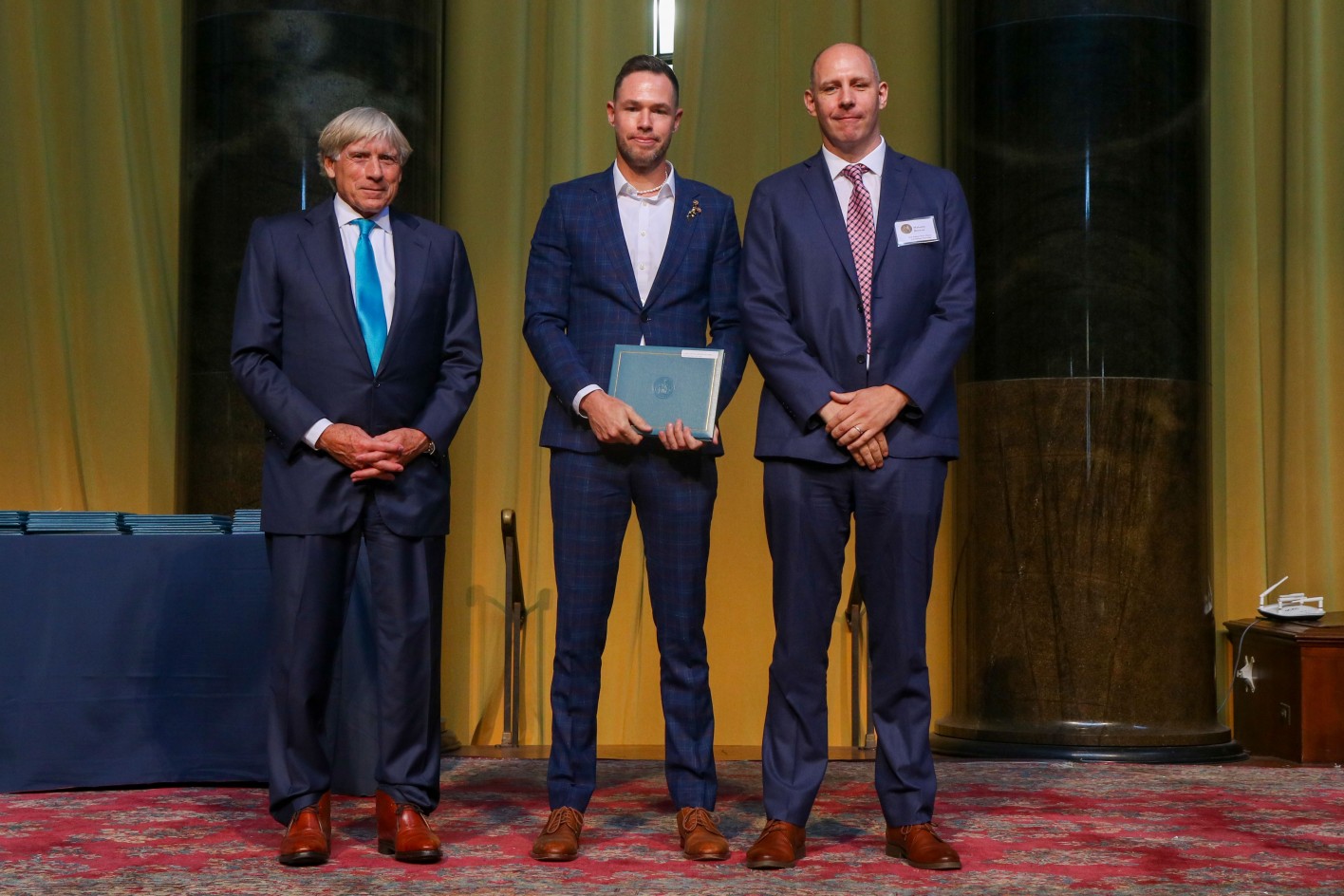
Staff members from The New York Times (from left: Michael Schwirtz and Malachy Browne) accept the 2020 Pulitzer Prize for International Reporting from Columbia University President Lee Bollinger. (Jose Lopez/The Pulitzer Prizes)
Winning Work
By Michael Schwirtz
RIVNE, Ukraine — The target lived on the sixth floor of a cheerless, salmon-colored building on Vidinska Street, across from a thicket of weeping willows. Oleg Smorodinov found him there, rented a small apartment on the ground floor, and waited.
He had gotten the name from his two handlers in Moscow. They met at the Vienna Cafe, a few blocks from the headquarters of Russia’s domestic intelligence agency, and handed him a list of six people in Ukraine. Find them, they told Mr. Smorodinov, and he set off. He was already boasting to friends that he was a spy.
Each person on the list was assigned a code name related to flowers. One was ‘briar.’ Another was ‘buttercup.’ The target, a man named Ivan Mamchur, was called ‘rose.’ To Mr. Smorodinov, he was a nobody, an electrician who worked at the local jail. To the handlers in Moscow, though, he was significant.
“Drenched in blood up to his elbows,” they told him.
The surveillance was uneventful. At 7 each morning, Mr. Mamchur left his wife and daughter, rode his bicycle to work, and returned each evening at 6. “Like clockwork,” Mr. Smorodinov recalled. In his idle hours, Mr. Smorodinov drank beer in the parking lot where an old woman kept watch on a clowder of cats.
Then, on Sept. 16, 2016, Mr. Smorodinov’s phone buzzed with a text message from Moscow.
“The rose has to be picked today,” he remembered it saying. “Tomorrow, it will no longer be relevant.”
In the grim hallway outside the man’s apartment, Mr. Smorodinov positioned himself, a cigarette in one hand and in the other, a pneumatic pistol modified to fire real bullets and fitted with a silencer.
“I took the pistol,” he later recalled, “and thought ‘what will be, will be.’ ”
As Mr. Mamchur emerged from the elevator, Mr. Smorodinov called his name and fired until the magazine was empty.
Mr. Mamchur did not fall immediately, but turned toward his assassin, stumbling a few steps before gasping.
“It was not me,” he said. “I’m not guilty.”
Then he dropped to the concrete floor.
Mr. Smorodinov fled to Moscow, where his handlers treated him to dinner at a Japanese sushi chain called Two Chopsticks. For his work, they bought him a Mercedes van, pictures of which he posted on social media. But they withheld a portion of a promised $5,000 because he had left the murder weapon in Ukraine.
They told him not to worry. No one would ever catch him. No one would ever care. At the time, Mr. Smorodinov was not certain why they had asked him to kill Ivan Mamchur but now he thinks he knows.
“It was revenge,” he told me. “Most likely revenge.”
‘They Have a Workflow. They Murder People.’
I met Oleg Smorodinov last October, during his trial at the Rivne City Court in Ukraine, about two years after the murder. He had been arrested a few months after it happened while crossing back into Ukraine to surprise an ex-girlfriend for her birthday.
A mistake. She helped tip off the police.
“He killed a person,” she told me later by text message. “Let him answer for it.”
The courtroom was tiny, about the size of a large bedroom in a New York apartment, if one equipped with a steel cage. I approached Mr. Smorodinov as he was being locked in. He was dressed in a blue track suit and perked up when I introduced myself as a reporter. He was surprisingly eager to talk and invited me to meet him afterward, in the jail.
The trial had been underway for weeks but seemed like a formality. Ukrainian prosecutors say he was a hit man for Russia’s intelligence services. His DNA was found on the murder weapon and on cigarette butts collected at the scene. Mr. Smorodinov admits he pulled the trigger.
The three judges sat glumly beneath a nylon Ukrainian flag, listening impassively as a prosecutor read out the results of a ballistics test and a gory medical examiner’s report.
Everyone seemed bored. Violence is normalized in Ukraine.
For months, I had been traveling in Russia and Europe, reporting on the poisoning last year in England of the former Russian spy, Sergei V. Skripal. It had touched off a geopolitical confrontation and brought talk of a new Cold War. Britain and its allies enacted sanctions and expelled more than 150 Russian diplomats after blaming the nerve agent attack on two officers from Russia’s military intelligence service, the G.R.U.
For Ukraine, Russian interference was an old reality. Russian special forces had seized Crimea in February 2014 and since then, the Kremlin has supplied arms, funding and troops to fuel a separatist war in eastern Ukraine that has cost 13,000 lives.
Assassinations happen frequently enough in Ukraine that they are often just blips in the local news cycle. In 2006, Russian President Vladimir V. Putin signed a law legalizing targeted killings abroad, and Ukrainian officials say teams of Russian hit men operate freely inside the country.
“For the intelligence services, as bad as this sounds, murdering people is just part of the work flow,” said Oleksiy Arestovych, a retired officer in Ukraine’s military intelligence service. “They go to work, it’s their job. You have a work flow, you write articles. They have a workflow, they murder people.”
“It doesn’t really worry them,” he said. “They celebrate it, mark it, without much sentiment.”
The Skripal poisoning had woken the West up to this. In Britain, authorities are now reviewing the cases of several Russians whose deaths on British soil were not initially deemed suspicious. In the United States, a bipartisan group of senators recently introduced legislation that would require the State Department to determine whether Russia should be deemed a state sponsor of terrorism.
“There’s no evidence to suggest that Russia can be deterred from making these kinds of attacks,” said Daniel Hoffman, a former C.I.A. station chief who helped negotiate the release of Mr. Skripal from a Russian prison in 2010. “It really does fall on the people at risk to try to conceal their location and be on the lookout for any signs that the Russians might be targeting them.”
Russian officials have denied their country’s involvement in the Skripal poisoning. In a text message, Dmitri S. Peskov, Mr. Putin’s spokesman, said the Kremlin knew of neither Mr. Mamchur nor Mr. Smorodinov.
I had come to Ukraine to learn more about G.R.U. assassins like those accused of trying to kill Mr. Skripal. Ukraine was where the agency had proved itself to Mr. Putin by helping to seize Crimea back in 2014. But now, G.R.U. fingerprints were turning up around the world.
Several years ago, while working in Moscow, I had gotten to know a handful of Russian intelligence officers. A retired colonel once listed the qualities that he, as a professional, believed a successful assassin should possess.
“To do this,” he told me, “you need spirit and training and hatred. And in addition to hatred, you also need money and desire.”
But these were elite assassins. More often, I learned, if the Kremlin wants you dead, they send someone like Oleg Smorodinov, an amoral hired gun willing to kill in exchange for a few thousand dollars and a Mercedes van.
Liquidators
At the Rivne jail, the guards confiscated my scarf. They worried that Mr. Smorodinov could use it to strangle me.
In earlier photos, Mr. Smorodinov does look menacing, with a sailor’s blocky build and a boxer’s misshapen face. But jail has aged him, melting away his musculature.
“A grandpa,” he sighs. He is 51.
In reality, he is the one who should be afraid. Rivne is a proudly anti-Russian city in western Ukraine with a monument that bears the spectral faces of the 21 local sons who have died in the fighting still underway in eastern Ukraine against the Russian-backed separatist groups.
Mr. Smorodinov is an ethnic Russian who moved to eastern Ukraine as a teenager. He later fought with the same separatists loathed in Rivne.
For his safety, he is being held in the smaller transit jail rather than the main detention center where the victim, Mr. Mamchur, worked. One guard told him a story, perhaps apocryphal, about an accused Russian assassin who was jailed in Kiev, the capital. He was dead within 40 minutes.
In the first of our three meetings, Mr. Smorodinov unfolded a map of central Moscow that he had drawn from memory on graph paper. He pointed to a pencil-shaded block labeled Vienna Cafe, around the corner from a square representing the headquarters of Russia’s Federal Security Service, or F.S.B., the main successor of the Soviet K.G.B.
“This, in general, is where I met with my handlers, in the cafe,” he said.
Mr. Smorodinov has never been an intelligence officer, or so he says. Though he had once served in the Soviet navy and worked for a few years as a police officer, he has dedicated much of his adult life to organized crime, having done time in prison for bribery and extortion. Between prison stints, he worked as a sex trafficker, shuttling women from Ukraine to clients in Moscow, a former criminal associate told me.
Mr. Smorodinov described the murder in minute detail, including the text message from Moscow, the floral code names and the stunned expression on Mr. Mamchur’s face as he collapsed to the floor.
But he is trying to persuade prosecutors, and me, that he was an unwitting assassin, duped by the two mysterious handlers he met at the Vienna Cafe, men he knew only as Philipp and Maksim.
Mr. Smorodinov said he was steered to them by contacts he made at weapons expos in Moscow. He settled in the Russian capital in 2015 after he was injured by artillery fire while fighting in eastern Ukraine.
Nikolai A. Gorbunov, whose company OOO Zenit sells accessories for AK-style assault rifles, recalled Mr. Smorodinov and said Russian intelligence agents frequently attend the expos.
At one expo, Mr. Smorodinov said someone linked to Wagner, the Russian mercenary outfit, mentioned a need for fighters in Syria, where Russian troops are supporting the government of President Bashar al-Assad.
“I wanted to go to Syria,” he said, “honestly, to shoot, to fight, to earn money.”
But when the plan fell through, Mr. Smorodinov said the Wagner contact introduced him to Maksim and Philipp. He was thrilled. He equated it to a job in the Interior Ministry.
“I was thinking of my pension — to work several years and retire to collect my pension,” he said.
When he arrived in Rivne, Mr. Smorodinov said he understood that his mission was to document Mr. Mamchur’s movements. The murder was supposed to have been carried out by a team of what he called “the liquidators.”
“Liquidators only work for one day, an hour, two, three, not more,” he said. “They work under the principle that they don’t exist. As soon as they arrive, they’re gone to a different city.”
An inconvenient fact in this scenario is that during his stay in Rivne, his accomplice, Kostya, identified by investigators as Konstantin Ivanov, brought him two guns, one of which had a silencer. In their communications, alluding to the code names of the targets, the two men referred to the guns as “watering cans.”
“We’re dealing with flowers here,” Mr. Smorodinov said.
Mr. Smorodinov insisted that even as he fired the shots into Mr. Mamchur, he thought it was a charade, a way to test his mettle. The bullets could have been blanks, he said.
“I’m standing there, and go up to him and say, ‘Get up.’ It’s not a test,” he told me. “That’s what went through my head. ‘It’s not a test.’”
It is not an especially convincing defense. Aleksandr Gatiyatullin, who headed the criminal gang Mr. Smorodinov was involved with in the early 2000s and served time in prison with him, described him as thickheaded, willing to take serious risks without thinking much about the consequences.
Weeks before Mr. Mamchur’s murder, Mr. Gatiyatullin said, Mr. Smorodinov confided in him and his wife, claiming that he had been made a lieutenant in the F.S.B. and was working in Ukraine on a special mission.
“We laughed and laughed. No one ever took him seriously,” Mr. Gatiyatullin said. “Then this murder of Mamchur happened. I see he posts photos of a Mercedes minibus and I wonder where he got the money for it.”
He added: “I think some F.S.B. guys called him for a meeting, saw what an idiot he was and thought they could use him.”
The List
On the day Mr. Smorodinov was arrested, Ukraine’s prosecutor general, Yuri V. Lutsenko, held a news conference and described the murder as further evidence that Ukraine was “in a state of war.” Ukraine’s news media quickly lost interest, chalking it up as just another bloody episode in Russia’s continuing interference.
Prosecutors seem only marginally interested in why Mr. Mamchur had been a target. To Ukrainian officials, the answer seemed obvious.
“This is part of an interlinked chain of crimes, the main purpose of which is to destabilize the country,” Serhii Knyazev, the chief of Ukraine’s national police, told me.
But it wasn’t that simple. From the morning I met him in the courtroom, Mr. Smorodinov had talked about a list of six names. They were all Ukrainians, and his first assignment had been to locate each of them. Once he did that, he was sent to Rivne.
In jail, he gave me the passcodes to his social media accounts and told me I could find the list on his computer, which was in Moscow with his nephew. When I telephoned the nephew, Vladimir Dobrovolsky, he said he knew about his uncle’s trips to Ukraine to “surveil people.”
“I tried not to get involved in that,” Mr. Dobrovolsky said. “With the intelligence services, the less you know, the better you sleep.”
He emailed me the files and I found a flood of photos of naked women and one document named “List of Workers,” a title Mr. Smorodinov said he had concocted as a ruse in case anyone seized his computer.
The six men were of different ages and, except for two of them, lived in different cities. Ukrainian investigators and prosecutors hadn’t been very interested. One police investigator told me he had never even seen the list and asked if I could forward a copy. I never did.
I had assumed the people on the list were somehow tied to Russia’s continuing conflict in Ukraine, that the Kremlin was seeking revenge against individuals tied to the fighting. And as I investigated the names, I learned that they did all share a military background.
But there was a surprise. What tied them together wasn’t the Ukraine conflict. Instead, it was a different Russian war.
A Different War
In early August 2008, I rushed from Moscow to Tbilisi to cover the conflict breaking out between Russia and the Republic of Georgia. I had never covered a war and hired a driver to take me and a photographer to get as close to the action as possible. It did not take long.
On a road in the middle of a field, we were stopped by Georgian military police officers, who said they were looking for spies. I don’t remember the exact chronology of what happened next: I had gotten out to speak with the officers, when an antiaircraft battery began firing toward a Russian bomber that I strained to see against the bright blue of the sky.
Then came a terrible whooshing sound that kept getting louder until it felt like my ears were going to pop. I dove into a ditch just as the bombs hit the road. A squadron of Russian Air Force fighter jets, Su-25s, appeared, pummeling everything in view — apartment buildings, the fields on either side of us.
One thing stands out vividly: the antiaircraft guns firing round after round into the sky. I have a memory of a single Su-25 coming down in flames, floating like a leaf, back and forth, until it hit the ground.
The war lasted only five days and ended with a crushing victory for Moscow. But in many ways, the conflict was an embarrassment for Russia’s intelligence services. Years earlier, Ukraine had secretly sold sophisticated antiaircraft systems to Georgia, allowing for the effective defense that I had seen.
Russian officials refused to believe that Georgian soldiers had the skill to operate the complicated systems. Ukrainian troops, they insisted, must have helped.
For Mr. Putin — who has described Russians and Ukrainians as “one people” — it was an act of bloody treachery.
“We don’t know who decided to deliver equipment and weapons from Ukraine during the conflict, but whoever it was, that person made a huge mistake,” Mr. Putin said at a news conference shortly after the war.
“That the weapons delivered in the course of military action were operated by specialists from Ukraine is a crime,” he continued. “If we find confirmation of this, we will accordingly make contact with the people who did it.”
Ukraine’s Russia-backed Party of Regions, then in the opposition, began an investigation and published the names of Ukrainian soldiers believed to have been involved. One man, described in the report as having “participated in military actions,” was on Mr. Smorodinov’s list.
So were two others who appeared in books about the war written by Russian historians. Ukrainian officials confirmed that a fourth man on the list was in Georgia but provided no details. A fifth man confirmed to me that he was in Georgia, but denied any involvement in the war.
The Times is withholding the names of the men for their safety.
“Fortunately, these citizens are alive,” Mr. Knyazev, the national police chief, told me. “At least for now.”
Mr. Mamchur was third on the list, the only name highlighted in green font.
Initially, Ukrainian officials were reluctant to tell me that he had been in Georgia. His wife refused to speak with me. But a co-worker at the Rivne jail, Serhii M. Klymchuk, said Mr. Mamchur spoke fondly about his time in Georgia and praised the efficiency of the Georgian military.
Eventually, officials confirmed that Mr. Mamchur had been in Georgia when the war began, as a commander in the Ukrainian army’s third special operations regiment, an elite contingent whose fighters had also seen action in Iraq and Afghanistan. But they insisted that neither he nor any other Ukrainian soldier took part in the fighting.
Yuri I. Yekhanurov, who was Ukraine’s defense minister at the time, said he rushed to evacuate the soldiers when the fighting started.
“I remember that time well,” he said in an interview. “For me, it was a problem to extract my people.”
The Kremlin has never believed that. After the war, Russian state television produced an all-out propaganda campaign that included a documentary by Arkady Mamontov, whose films often serve as a barometer of Kremlin sentiment.
In one scene, Mr. Mamontov is shown berating a bewildered, shirtless man inside his home in Ukraine, accusing him of firing on Russian jets during the war.
“Are you a former soldier?” Mr. Mamontov shouts as the man fumbles for answers. “Ukrainians and Russians we’re brothers — and you shot them down,” he said.
Curiously, a month before Mr. Mamchur was killed, Russian television again aired the Mamontov documentary.
Mr. Smorodinov assumes he will be found guilty. In more than six hours of interviews, not once did he express remorse. Had he not been caught, he acknowledged, he most likely would have continued working his way down the list, name by name.
He is hoping to be swapped for one of the dozens of Ukrainians imprisoned in Russia, but the Russians have yet to show any interest.
“He doesn’t understand that no one needs him,” Mr. Knyazev, the national police chief, said. “He’s forgotten, written off, a used bullet. Our enemy, unfortunately, has a lot of people like him in reserve.”
Stanislav Kozliuk and Sergey Korovayny contributed reporting from Rivne, Ukraine.
By Michael Schwirtz
First came a destabilization campaign in Moldova, followed by the poisoning of an arms dealer in Bulgaria and then a thwarted coup in Montenegro. Last year, there was an attempt to assassinate a former Russian spy in Britain using a nerve agent. Though the operations bore the fingerprints of Russia’s intelligence services, the authorities initially saw them as isolated, unconnected attacks.
Western security officials have now concluded that these operations, and potentially many others, are part of a coordinated and ongoing campaign to destabilize Europe, executed by an elite unit inside the Russian intelligence system skilled in subversion, sabotage and assassination.
The group, known as Unit 29155, has operated for at least a decade, yet Western officials only recently discovered it. Intelligence officials in four Western countries say it is unclear how often the unit is mobilized and warn that it is impossible to know when and where its operatives will strike.
The purpose of Unit 29155, which has not been previously reported, underscores the degree to which the Russian president, Vladimir V. Putin, is actively fighting the West with his brand of so-called hybrid warfare — a blend of propaganda, hacking attacks and disinformation — as well as open military confrontation.
“I think we had forgotten how organically ruthless the Russians could be,” said Peter Zwack, a retired military intelligence officer and former defense attaché at the United States Embassy in Moscow, who said he was not aware of the unit’s existence.
In a text message, Dmitri S. Peskov, Mr. Putin’s spokesman, directed questions about the unit to the Russian Defense Ministry. The ministry did not respond to requests for comment.
Hidden behind concrete walls at the headquarters of the 161st Special Purpose Specialist Training Center in eastern Moscow, the unit sits within the command hierarchy of the Russian military intelligence agency, widely known as the G.R.U.
Though much about G.R.U. operations remains a mystery, Western intelligence agencies have begun to get a clearer picture of its underlying architecture. In the months before the 2016 presidential election, American officials say two G.R.U. cyber units, known as 26165 and 74455, hacked into the servers of the Democratic National Committee and the Clinton campaign, and then published embarrassing internal communications.
Last year, Robert S. Mueller III, the special counsel overseeing the inquiry into Russian interference in the 2016 elections, indicted more than a dozen officers from those units, though all still remain at large. The hacking teams mostly operate from Moscow, thousands of miles from their targets.
By contrast, officers from Unit 29155 travel to and from European countries. Some are decorated veterans of Russia’s bloodiest wars, including in Afghanistan, Chechnya and Ukraine. Its operations are so secret, according to assessments by Western intelligence services, that the unit’s existence is most likely unknown even to other G.R.U. operatives.
The unit appears to be a tight-knit community. A photograph taken in 2017 shows the unit’s commander, Maj. Gen. Andrei V. Averyanov, at his daughter’s wedding in a gray suit and bow tie. He is posing with Col. Anatoly V. Chepiga, one of two officers indicted in Britain over the poisoning of a former spy, Sergei V. Skripal.
“This is a unit of the G.R.U. that has been active over the years across Europe,” said one European security official, who spoke on condition of anonymity to describe classified intelligence matters. “It’s been a surprise that the Russians, the G.R.U., this unit, have felt free to go ahead and carry out this extreme malign activity in friendly countries. That’s been a shock.”
To varying degrees, each of the four operations linked to the unit attracted public attention, even as it took time for the authorities to confirm that they were connected. Western intelligence agencies first identified the unit after the failed 2016 coup in Montenegro, which involved a plot by two unit officers to kill the country’s prime minister and seize the Parliament building.
But officials began to grasp the unit’s specific agenda of disruption only after the March 2018 poisoning of Mr. Skripal, a former G.R.U. officer who had betrayed Russia by spying for the British. Mr. Skripal and his daughter, Yulia, fell grievously ill after exposure to a highly toxic nerve agent, but survived.
(Three other people were sickened, including a police officer and a man who found a small bottle that British officials believe was used to carry the nerve agent and gave it to his girlfriend. The girlfriend, Dawn Sturgess, died after spraying the nerve agent on her skin, mistaking the bottle for perfume.)
The poisoning led to a geopolitical standoff, with more than 20 nations, including the United States, expelling 150 Russian diplomats in a show of solidarity with Britain.
Ultimately, the British authorities exposed two suspects, who had traveled under aliases but were later identified by the investigative site Bellingcat as Colonel Chepiga and Alexander Mishkin. Six months after the poisoning, British prosecutors charged both men with transporting the nerve agent to Mr. Skripal’s home in Salisbury, England, and smearing it on his front door.
But the operation was more complex than officials revealed at the time.
Exactly a year before the poisoning, three Unit 29155 operatives traveled to Britain, possibly for a practice run, two European officials said. One was Mr. Mishkin. A second man used the alias Sergei Pavlov. Intelligence officials believe the third operative, who used the alias Sergei Fedotov, oversaw the mission.
Soon, officials established that two of these officers — the men using the names Fedotov and Pavlov — had been part of a team that attempted to poison the Bulgarian arms dealer Emilian Gebrev in 2015. (The other operatives, also known only by their aliases, according to European intelligence officials, were Ivan Lebedev, Nikolai Kononikhin, Alexey Nikitin and Danil Stepanov.)
The team would twice try to kill Mr. Gebrev, once in Sofia, the capital, and again a month later at his home on the Black Sea.
Speaking to reporters in February at the Munich Security Conference, Alex Younger, the chief of MI6, Britain’s foreign intelligence service, spoke out against the growing Russian threat and hinted at coordination, without mentioning a specific unit.
“You can see there is a concerted program of activity — and, yes, it does often involve the same people,” Mr. Younger said, pointing specifically to the Skripal poisoning and the Montenegro coup attempt. He added: “We assess there is a standing threat from the G.R.U. and the other Russian intelligence services and that very little is off limits.”
The Kremlin sees Russia as being at war with a Western liberal order that it views as an existential threat.
At a ceremony in November for the G.R.U.’s centenary, Mr. Putin stood beneath a glowing backdrop of the agency’s logo — a red carnation and an exploding grenade — and described it as “legendary.” A former intelligence officer himself, Mr. Putin drew a direct line between the Red Army spies who helped defeat the Nazis in World War II and officers of the G.R.U., whose “unique capabilities” are now deployed against a different kind of enemy.
“Unfortunately, the potential for conflict is on the rise in the world,” Mr. Putin said during the ceremony. “Provocations and outright lies are being used and attempts are being made to disrupt strategic parity.”
In 2006, Mr. Putin signed a law legalizing targeted killings abroad, the same year a team of Russian assassins used a radioactive isotope to murder Aleksander V. Litvinenko, another former Russian spy, in London.
Unit 29155 is not the only group authorized to carry out such operations, officials said. The British authorities have attributed Mr. Litvinenko’s killing to the Federal Security Service, the intelligence agency once headed by Mr. Putin that often competes with the G.R.U.
Although little is known about Unit 29155 itself, there are clues in public Russian records that suggest links to the Kremlin’s broader hybrid strategy.
A 2012 directive from the Russian Defense Ministry assigned bonuses to three units for “special achievements in military service.” One was Unit 29155. Another was Unit 74455, which was involved in the 2016 election interference. The third was Unit 99450, whose officers are believed to have been involved in the annexation of the Crimean Peninsula in 2014.
A retired G.R.U. officer with knowledge of Unit 29155 said that it specialized in preparing for “diversionary” missions, “in groups or individually — bombings, murders, anything.”
“They were serious guys who served there,” the retired officer said. “They were officers who worked undercover and as international agents.”
Photographs of the unit’s dilapidated former headquarters, which has since been abandoned, show myriad gun racks with labels for an assortment of weapons, including Belgian FN-30 sniper rifles, German G3A3s, Austrian Steyr AUGs and American M16s. There was also a form outlining a training regimen, including exercises for hand-to-hand combat. The retired G.R.U. officer confirmed the authenticity of the photographs, which were published by a Russian blogger.
The current commander, General Averyanov, graduated in 1988 from the Tashkent Military Academy in what was then the Soviet Republic of Uzbekistan. It is likely that he would have fought in both the first and second Chechen wars, and he was awarded a Hero of Russia medal, the country’s highest honor, in January 2015. The two officers charged with the Skripal poisoning also received the same award.
Though an elite force, the unit appears to operate on a shoestring budget. According to Russian records, General Averyanov lives in a run-down Soviet-era building a few blocks from the unit’s headquarters and drives a 1996 VAZ 21053, a rattletrap Russia-made sedan. Operatives often share cheap accommodation to economize while on the road. British investigators say the suspects in the Skripal poisoning stayed in a low-cost hotel in Bow, a downtrodden neighborhood in East London.
But European security officials are also perplexed by the apparent sloppiness in the unit’s operations. Mr. Skripal survived the assassination attempt, as did Mr. Gebrev, the Bulgarian arms dealer. The attempted coup in Montenegro drew an enormous amount of attention, but ultimately failed. A year later, Montenegro joined NATO. It is possible, security officials say, that they have yet to discover other, more successful operations.
It is difficult to know if the messiness has bothered the Kremlin. Perhaps, intelligence experts say, it is part of the point.
“That kind of intelligence operation has become part of the psychological warfare,” said Eerik-Niiles Kross, a former intelligence chief in Estonia. “It’s not that they have become that much more aggressive. They want to be felt. It’s part of the game.”
By Michael Schwirtz and Gaelle Borgia
ANTANANARIVO, Madagascar — The Russians were hard to miss. They appeared suddenly last year in Madagascar’s traffic-snarled capital, carrying backpacks stuffed with cash and campaign swag decorated with the name of Madagascar’s president.
It was one of Russia’s most overt attempts at election interference to date. Working from their headquarters in a resort hotel, the Russians published their own newspaper in the local language and hired students to write fawning articles about the president to help him win another term. Skirting electoral laws, they bought airtime on television stations and blanketed the country with billboards.
They paid young people to attend rallies and journalists to cover them. They showed up with armed bodyguards at campaign offices to bribe challengers to drop out of the race to clear their candidate’s path.
At Madagascar’s election commission, officials were alarmed.
“We all recall what the Russians did in the United States during the election,” said Thierry Rakotonarivo, the commission’s vice president. “We were truly afraid.”
Of all the places for Russia to try to swing a presidential election, Madagascar is perhaps one of the least expected. The island nation off the coast of southeastern Africa is thousands of miles away from Moscow and has little obvious strategic value for the Kremlin or the global balance of power.
But two years after the Russians’ aggressive interference in the United States, here they were, determined to expand their clout and apply their special brand of election meddling to a distant political battleground.
The operation was approved by President Vladimir V. Putin and coordinated by some of the same figures who oversaw the disinformation around the 2016 American presidential election, according to dozens of interviews with officials in Madagascar, local operatives hired to take part in the Russian campaign and hundreds of pages of internal documents produced by the Russian operatives.
The meddling in Madagascar began just a few weeks after Mr. Putin sat down with the nation’s president, Hery Rajaonarimampianina, in Moscow last year. The meeting, which has never been reported, also included Yevgeny Prigozhin, a close confidant of Mr. Putin who was indicted in the United States for helping to orchestrate Russia’s effort to manipulate the 2016 American election, according to Mr. Rajaonarimampianina and another government minister present on the trip to Moscow.
Mr. Putin has repeatedly denied any official effort to tamper with foreign elections. But his sit-down with Madagascar’s president — Mr. Prigozhin by his side — points to his involvement in Russia’s electoral interference in even the smallest, most remote countries.
In some vital ways, the Madagascar operation mimicked the one in the United States. There was a disinformation campaign on social media and an attempt to bolster so-called spoiler candidates. The Russians even recruited an apocalyptic cult leader in a strategy to split the opposition vote and sink its chances.
“What surprised me is that it was the Russians who came over to my house without me contacting them,” said the cult leader, known as Pastor Mailhol. “They said, ‘If you ever need money, we are going to pay all the expenses.’”
But while Russia’s efforts in the United States fit Moscow’s campaign to upend Western democracy and rattle Mr. Putin’s geopolitical rivals, the undertaking in Madagascar often seemed to have a much simpler objective: profit.
Before the election, a Russian company that local officials and foreign diplomats say is controlled by Mr. Prigozhin acquired a major stake in a government-run company that mines chromium, a mineral valued for its use in stainless steel. The acquisition set off protests by workers complaining of unpaid wages, canceled benefits and foreign intrusion into a sector that had been a source of national pride for Madagascar.
It repeated a pattern in which Russia has swooped into African nations, hoping to reshape their politics for material gain. In the Central African Republic, a former Russian intelligence officer is the top security adviser to the country’s president, while companies linked to Mr. Prigozhin have spread across the nation, snapping up diamonds in both legal and illegal ways, according to government officials, warlords in the diamond trade and registration documents showing Mr. Prigozhin’s growing military and commercial footprint.
Last year, three Russian journalists were gunned down while investigating his activities there.
“Prigozhin had tremendous success in 2016, and he is now the guy everyone is watching,” said Paul Stronski, a senior fellow at the Carnegie Endowment for International Peace. “He’s got some boots on the ground, people peddling stuff in different countries in Africa. These are countries with authoritarian-style leaders who need a little extra help to win. And in return, he gets access to some of the goodies.”
But Russia’s forays abroad have been far from flawless. For all its efforts, the operation in Madagascar missed its mark at first, plagued by a startling incompetence and corruption that undercuts Russia’s image as a master political manipulator.
Campaign materials were riddled with grammatical mistakes. Ballpoint pens meant as election giveaways misspelled Mr. Rajaonarimampianina’s name. Some operatives appeared to undermine the campaign for their own personal gain, demanding fake receipts with double the actual price of publishing the newspaper so they could pocket the difference.
“They paid well, but they were messing around,” said the printing house owner, Lola Rasoamaharo.
One person working for the campaign described packets of gold and precious stones piled on the bed in the room of a Russian operative, another sign that the people entrusted with the mission were often more interested in profit than politics.
They also chose the wrong candidate. As it became clear that Mr. Rajaonarimampianina had little hope of winning, even with their help, the Russian operatives pivoted quickly, dumping the incumbent, whom they referred to as “the piano,” and shifting their support to the eventual winner, Andry Rajoelina.
“The piano is very weak,” Yaroslav Ignatovsky, a manager of the operation, wrote to a colleague in a text exchange obtained by the Dossier Center, a London-based research organization. “He’ll never make it. But we have to make it somehow.”
The maneuver worked. After the Russians pirouetted to help Mr. Rajoelina — their former opponent — win the election, Mr. Prigozhin’s company was able to negotiate with the new government to keep control of the chromium mining operation, despite the worker protests, and Mr. Prigozhin’s political operatives remain stationed in the capital to this day.
‘Everything Is Possible in Politics’
It all started with a secret meeting.
News reports described Mr. Rajaonarimampianina’s three-day trip to Moscow in March, 2018, as mundane: He attended an investment forum, met a foreign ministry official and received an honorary degree from a local university.
But at some point, his plans veered from the published itinerary.
Slipping away from the press pool, he made his way to the Kremlin. There, in the private office of the Russian president, he met for no more than 30 minutes with Mr. Putin and Mr. Prigozhin.
In an interview, Mr. Rajaonarimampianina explained that Mr. Prigozhin had set up the meeting, and even met him at the airport in Moscow. But he insisted that the presidential election, scheduled for that fall, was not discussed.
Others remembered things differently. Harison E. Randriarimanana, a former agriculture minister who accompanied the president to Moscow, said that after the meeting his boss proudly announced that Mr. Putin had agreed to assist with his re-election campaign.
“Putin said he wanted to help him,” Mr. Randriarimanana recalled the president saying. “He was going to help us with the election.”
Just weeks later, local residents were startled by the sudden appearance of Russian operatives in Antananarivo, Madagascar’s capital.
The operation happened alongside an aggressive push by the Kremlin to revive relations with a number of African countries. For Moscow, Africa had been an important ideological battlefield during the Cold War, and Mr. Putin, who makes no secret of his nostalgia for the Soviet Union, views the continent as an important front for combating the West’s global influence.
Last month, Mr. Putin played host to more than 40 African heads of state, including Madagascar’s, at a summit meeting in the Black Sea resort town of Sochi to showcase Russia’s growing stature as a player in the region and present his country as a partner preferable to the West.
“We see how a number of Western governments have resorted to pressuring, bullying and blackmailing the governments of sovereign African countries,” Mr. Putin said before the meeting. By contrast, he added, “Our African agenda has a positive, aspirational character.”
In recent years, a parade of African leaders have paid visits to the Kremlin, seeking lucrative deals with Russia’s giant state-run companies, including for weapons.
In dollar terms, Russia is no match for China or the United States, which have tens of billions of dollars worth of economic investment in the continent. But for some leaders in search of a political edge, Russia has developed a handy tool kit, which is where Mr. Prigozhin comes in.
After being indicted on charges of intervening in the 2016 American election, he has traveled the world, proffering his services. In Africa, he has found a highly receptive market. He and his operatives have been active in nearly a dozen African countries, including Libya, Sudan and Zimbabwe, analysts say.
In the interview, Mr. Rajaonarimampianina described his meeting with Mr. Putin as run-of-the-mill for someone of his stature. During his tenure, he had met with the leaders of China and India, and twice visited the White House.
But unlike those encounters, the meeting with Mr. Putin and Mr. Prigozhin was kept secret.
Mr. Rajaonarimampianina insisted that he took “not one penny from the Russians” for his campaign, though he did not rule out that the Kremlin worked to assist him without his knowledge. “Everything is possible in politics,” he said.
He stumbled a bit when shown a letter with his signature written to a Russian political operative named Oleg Vasilyevich Zakhariyash. In the letter, written in French and stamped “PROJET CONFIDENTIEL,” the president requests the Russian’s help “to resist attempts by international institutions to interfere” in Madagascar’s election. Western diplomats had, in fact, been concerned that the president was trying to delay the vote.
“I am convinced,” the president’s letter said, “that certain forces will attempt to call into doubt” the election.
Mr. Rajaonarimampianina confirmed that the signature on the letter was his and acknowledged meeting Mr. Zakhariyash in Madagascar, but he said he did not recall writing the letter.
Mr. Zakhariyash, who did not respond to repeated requests for comment, was later quoted by RIAFAN, a Russian news outlet connected to companies owned by Mr. Prigozhin, blaming the United States, Britain and France for interfering in the Madagascar elections.
Local residents hired by the Russian operation in Madagascar described Mr. Zakhariyash as “the boss.” Likewise, one of the Russian unit’s internal spreadsheets identified him as the “head of department.” He is also one of two authors of a confidential report detailing plans for the Madagascar campaign, including the creation of a “troll factory” to focus on social media, echoing the tactics Mr. Prigozhin is accused of unleashing on the United States.
The documents — along with text exchanges and emails between Russian operatives — were obtained and analyzed by the Dossier Center, a London-based investigative organization founded by Mr. Putin’s longtime nemesis, the former oil billionaire Mikhail B. Khodorkovsky. Through interviews with officials, candidates and local operatives in Madagascar, The New York Times independently confirmed much of the information in the documents, which the Dossier Center said were provided by moles working within Mr. Prigozhin’s organization.
The spreadsheets name more than 30 Russians working in the country ahead of the election, calling them media managers, lawyers, translators and a “counterpropaganda technologist.” People in Madagascar hired by the Russians to work on the campaign verified many of the operatives’ identities.
Many of them appear to be from St. Petersburg, where Mr. Prigozhin’s so-called troll factory is based. But not all. Several worked for the Russian-backed separatist government in eastern Ukraine. One attracted attention earlier this year when his wife posted a photo of her battered and bruised face on Facebook, accusing her husband of beating her.
Few appeared to have much expertise on Madagascar, or on Africa at all — and it showed, locals said. They often used a translation application on their phones to communicate and had little understanding of local politics.
“They’re always going around with money, they’re always going around with women,” said one Malagasy man who worked with the Russians and feared reprisals. “They just thought it was all very simple in Madagascar. They arrived and that’s it, let’s go. That’s why it all fell apart.”
‘A Powerful Country Came to My House’
Nearly two decades ago, André Christian Dieudonné Mailhol, the founder and pastor of the Church of the Apocalypse, said he received a message from God that he would be president of Madagascar one day.
He did not predict, however, that three Russians would turn up like Magi on his doorstep 18 years later with an offer to help fulfill that prophecy.
“They said that they came here to help me with the presidential election,” he said.
The three gathered in his brightly painted living room in 2018, peppering him with questions: “How old are you? Why do you want to run for the presidency?”
Pastor Mailhol explained God’s plan for him, and they offered him cash, promising to fully fund his campaign.
They never fully explained who they were, he said, beyond giving their first names — Andrei, Vladimir and Roman — and never said what they wanted in return. Pastor Mailhol didn’t ask.
“I just thought, a powerful country came to my house and suggested helping me. Why would I bother them with questions like, ‘Who are you? What are you here for?’” the pastor, 59, recalled. “No other foreign countries came to help me. They were the only ones, so I did not want to ask much. I was O.K. with that.”
The strategy of supporting so-called spoiler candidates is another echo of the 2016 plot to subvert the American election, in which Russian social media bots encouraged support for figures like Jill Stein, the Green Party candidate — as a way, officials say, to draw votes away from Hillary Clinton.
Pastor Mailhol said his Russian team wrote some of his speeches and paid for campaign posters and television advertising. On one internal spreadsheet, the “Pastor Group” is identified as Andrei Kramar, Vladimir Boyarishchev and Roman Pozdnyakov. Shown photos of the men from Facebook, Pastor Mailhol and his assistants confirmed they were the men who worked with his campaign.
They made for a curious team. A photo of Mr. Boyarishchev posted to a Russian social media site in 2012 shows him shirtless, flexing his biceps and wearing the blue beret of a United Nations peacekeeper. Other social media posts suggest he served in a United Nations mission in the Democratic Republic of Congo. Pastor Mailhol said he spoke excellent French, which many educated Malagasy know well.
The other two have equally colorful histories. In a Facebook post from a decade ago, Mr. Kramar describes himself as a member of Mr. Putin’s political party, United Russia, but later he popped up in eastern Ukraine as a functionary in a Kremlin-backed separatist enclave that has been fighting a war against Ukraine since 2014.
Ukrainian authorities say the third operative, Mr. Pozdnyakov, is also involved with the pro-Kremlin rebels. His wife, once a United Russia member of Parliament, is the head of the separatist government’s election commission.
Other presidential candidates in Madagascar gave similar accounts of Russians turning up out of the blue, some with bags of cash.
Onja Rasamimanana, who worked for a history professor-turned-candidate named Jean Omer Beriziky, said she coordinated with a Maksim, an Anastasia and a Margo, who was the interpreter. “And then a Grigori showed up,” she said.
“They were looking for fresh faces,” she said. “They didn’t explain anything. They didn’t mention anything regarding their motivations.”
She said that her candidate, Mr. Beriziky, later told her the Russians offered $2 million in campaign funding, but ultimately provided less than half a million.
Two Russians also approached a pop megastar running for president, Rasolofondraosolo Zafimahaleo, also known as Dama. Over four meetings, Mr. Zafimahaleo said, the Russians tried to pressure him to support a delay in the election so that the incumbent had more time to campaign.
“They made big promises,” Mr. Zafimahaleo said. “‘If you do what we want you to do, we’ll help your campaign,’” he said they told him. He refused, he said, suspecting that the Russians had come to exploit Madagascar’s natural resources.
Only three of the Russian operatives identified by local hires of the campaign responded to requests for comment. All acknowledged visiting Madagascar last year, but only one admitted working as a pollster on behalf of the president.
The others said they were simply tourists. Pyotr Korolyov, described as a sociologist on one spreadsheet, spent much of the summer of 2018 and fall hunched over a computer, deep in polling data at La Résidence Ankerana, a hotel the Russians used as their headquarters, until he was hospitalized with the measles, according to one person who worked with him.
In an email exchange, Mr. Korolyov confirmed that he had come down with the measles, but rejected playing a role in a Russian operation. He did defend the idea of one, though.
“Russia should influence elections around the world, the same way the United States influences elections,” he wrote. “Sooner or later Russia will return to global politics as a global player,” he added. “And the American establishment will just have to accept that.”
‘If You Accept This Deal You Will Have Money’
As the election approached, the Russians grew nervous and frustrated. In one text message, Mr. Ignatovsky, who helped oversee the operation, describes Madagascar as a “black hole.” One of his colleagues complains that “everything is ass-backward,” and that the “unhappy locals” were impeding the team’s work.
But the Russians were setting off alarms, too.
An op-ed in a local newspaper warned that after meddling in the United States, Russia had set its sights on Madagascar.
“Russia badly wants to make good use of its impressive experience in destabilization” by intervening in Madagascar, the article said. “Vodka will flow like water if they achieve their goal.”
Relations with the various candidates the Russians were backing began to sour. By September, they had dumped the incumbent, Mr. Rajaonarimampianina, deciding he was too unpopular to win, according to internal communications.
In the interview in Paris, Mr. Rajaonarimampianina said he was aware the Russians were supporting other candidates and became indignant when told of the Russians’ conclusion that he was a losing bet. “How could they know that I will lose the election?” he said.
In the first round, he received less than 9 percent of the vote, finishing a distant third.
The Russians shifted their support to Mr. Rajoelina, a young former mayor who had been Madagascar’s transitional president after a coup in 2009.
In the campaign’s final weeks, Pastor Mailhol said, the team of Russians made a request: Drop out of the race and support Mr. Rajoelina. He refused.
The Russians made the same proposal to the history professor running for president, saying, “‘If you accept this deal you will have money,’” according to Ms. Rasamimanana, the professor’s campaign manager.
When the professor refused, she said, the Russians created a fake Facebook page that mimicked his official page and posted an announcement on it that he was supporting Mr. Rajoelina.
The members of the so-called Pastor Group — Mr. Kramar, Mr. Pozdnyakov and Mr. Boyarishchev — were arrested and deported last year after organizing a protest in front of the French Embassy. They left without fully paying what they owed their local operatives, said Niaina Rakotonjanahary, the pastor’s campaign spokeswoman.
“It happened to all of us who worked there,” she said. “We were so dumb.”
As in the American election, it is not clear whether the Russians directly colluded with the eventual winner, Mr. Rajoelina, or simply operated a parallel campaign to support him. Before switching sides, the Russians had local hires write articles disparaging Mr. Rajoelina, according to one of the people who worked for them.
“They asked me to write bad things about Andry Rajoelina — that he sold our lands to the Chinese,” said the person, speaking anonymously for fear of reprisals. “During the second round of the presidential election, though, they asked me to write good things about Andry Rajoelina.”
Mr. Rajoelina declined to comment, but an official from his campaign said that his team was aware of Russian payments to other candidates.
In the end, the Russians retained their prize — control over the chromium operation. They now maintain a staff of 30 in the country, including engineers and geologists. The contract gives them a 70 percent stake in the venture, said Nirina Rakotomanantsoa, the managing director of the Malagasy company that owns the remaining share.
“The contract is already signed,” he said. “I am thankful the Russians are here.”
Not all the Russian operatives appeared satisfied. In a moment of doubt, Yevgeny Kopot, a Prigozhin functionary who appears to play a coordinating role for operations in different African countries, sent a text message to a colleague in Madagascar in January.
“Do you think that we’re disgracing our country?” he asked, according to texts obtained by the Dossier Center. “Or devaluing her name?”
The colleague told him not to worry. “If you think about it,” she replied, “the whole planet is disgraced. Not the planet, precisely, but humanity.”
Gaelle Ramamonjisoa and Prisca Rananjarison contributed reporting.
For years, members of a secret team, Unit 29155, operated without Western security officials having any idea about their activities. But an attack on an arms dealer in Sofia helped blow their cover.
By Michael Schwirtz
SOFIA, Bulgaria — The Russian assassin used an alias, Sergei Fedotov, and slipped into Bulgaria unnoticed, checking into a hotel in Sofia near the office of a local arms manufacturer who had been selling ammunition to Ukraine.
He led a team of three men.
Within days, one man sneaked into a locked parking garage, smeared poison on the handle of the arms manufacturer’s car, then left, undetected, except for blurry images captured by surveillance video.
Shortly after, the arms manufacturer, Emilian Gebrev, was meeting with business partners at a rooftop restaurant when he began to hallucinate and vomit.
The poisoning left Mr. Gebrev, now 65, hospitalized for a month. His son was poisoned, and so was another top executive at his company. When Mr. Gebrev was discharged, the assassins poisoned him and his son again, at their summer home on the Black Sea. They all survived, though Mr. Gebrev’s business has yet to recover fully.
The assassination attempts in 2015 were remarkable not only for their brazenness and persistence, but also because security and intelligence officials in the West initially did not notice. Bulgarian prosecutors looked at the case, failed to unearth any evidence and closed it.
Now Western security and intelligence officials say the Bulgaria poisonings were a critical clue that helped expose a campaign by the Kremlin and its sprawling web of intelligence operatives to eliminate Russia’s enemies abroad and destabilize the West.
“With Bulgaria, there was an ‘aha’ moment,” said one European security official, who spoke on condition of anonymity to discuss classified intelligence matters. “We looked at it and thought, damn, everything aligned.”
Entering his third decade in power, President Vladimir V. Putin of Russia is pushing hard to re-establish Russia as a world power. Russia cannot compete economically or militarily with the United States and China, so Mr. Putin is waging an asymmetric shadow war. Russian mercenaries are fighting in Syria, Libya and Ukraine. Russian hackers are sowing discord through disinformation and working to undermine elections.
Russian assassins have also been busy.
In October, The New York Times revealed that a specialized group of Russian intelligence operatives — Unit 29155 — had for years been assigned to carry out killings and political disruption campaigns in Europe. Intelligence and security officials say the unit is responsible for the assassination attempt last year against Sergei V. Skripal, a Russian former spy in Britain; a failed operation in 2016 to provoke a military coup in Montenegro; and a campaign to destabilize Moldova.
Western intelligence agencies now know the name of the unit’s commanding officer, Maj. Gen. Andrei V. Averyanov, and the location of its headquarters in Moscow. Based on interviews with officials in Europe and the United States, it is also now clear that the assassination attempts against Mr. Gebrev served as a kind of Rosetta Stone that helped Western intelligence agencies to discover Unit 29155 — and to decipher the kind of threat it presented.
Since the original Times story, more information has come to light, including the true identities of some of the unit’s members and other possible activities in Spain and France. This month, Germany expelled two Russian diplomats as punishment for the daylight assassination in Berlin of a former Chechen rebel commander, though it is unclear whether operatives from 29155 were involved.
Security and intelligence officials are still working to understand how and why the unit is assigned certain targets. Even now, investigators have not determined the precise motive in the Gebrev case. Most likely, intelligence officials say, Mr. Gebrev was a target because of the way his business rankled the Kremlin: his arms sales to Ukraine, his company’s intrusion into markets long dominated by Russia, and his efforts to purchase a weapons factory coveted by a Russian oligarch.
Mr. Gebrev says he also believes that local business rivals or politicians might somehow be involved.
“I have been thrown to the wolves,” Mr. Gebrev said in an interview. “But why and how, I’m still asking myself.”
A Visit to the Afterlife
The poison took effect slowly.
Mr. Gebrev first realized something was wrong on the evening of April 27, 2015, when his right eye suddenly turned “as red as the red on the Russian flag.” It felt, he said, as if someone had dumped a bucket of sand into his pupil.
The next evening, Mr. Gebrev went to his favorite restaurant on the 19th floor of the Hotel Marinela, a luxury hangout in Sofia, the Bulgarian capital, where the clientele can pose for selfies with the peacocks wandering freely around the bar. At dinner, Mr. Gebrev began to vomit violently and was rushed to a military hospital. There, he began to see explosions of vivid colors. Then, his field of vision suddenly turned to black and white.
As his hallucinations intensified, he imagined angry, fantastical creatures that threatened to drag him away.
“I visited the afterlife three times, by my estimate,” he said in one of a series of interviews conducted over the past half year. “The doctors said they almost lost me.”
A day later, the company’s production manager, Valentin Tahchiev, was hospitalized, too. Days after that, Mr. Gebrev’s son, Hristo, who was being groomed to lead Mr. Gebrev’s company, Emco, was also rushed to intensive care.
“When they get rid of me and my son, the company will be destroyed,” Mr. Gebrev said later. “Who would sign contracts? Who has the rights?”
For the next month, as Mr. Gebrev recuperated in the hospital, the Bulgarian authorities made little progress on the case. In a former Soviet satellite country with a long history of contract killings, the Bulgarian news media barely paid attention. The prosecutor general suggested that Mr. Gebrev had been sickened by tainted arugula. Eventually, though, officials concluded that all three men had been poisoned.
In late May, Mr. Gebrev was released from the hospital and joined his son at the family vacation home on the Black Sea. There, the two men were poisoned again. This time, the symptoms were less dramatic and they drove themselves back to Sofia and checked into the same hospital for about two weeks.
Despite two poisonings, Bulgarian prosecutors failed to unearth any leads or evidence. Bulgarian intelligence agencies never reported detecting a Russian assassination team in the country, and possibly never realized it had been there.
“Anytime it’s linked to something with Russia, Bulgarian intelligence is very impotent,” said Rosen Plevneliev, who was Bulgaria’s president at the time of the poisonings. “Bulgarian intelligence is not willing to counter Russian intelligence and hybrid warfare.”
When the hospital failed to determine the substance used in the poisoning, Mr. Gebrev enlisted a Finnish laboratory, Verifin, which detected two chemicals in his urine, including diethyl phosphonate, which is found in pesticides. The other chemical could not be identified.
By the following summer, the Bulgarian authorities had dropped the case. They apparently had no idea that Unit 29155 even existed. Neither did intelligence and security officials in the rest of Europe.
Yet as Mr. Gebrev’s case remained colder than cold, members of Unit 29155 were very busy, according to partial travel records reviewed by The Times. From 2016 to 2018, operatives made at least two dozen trips from Moscow to different European countries.
Their operation in Bulgaria most likely would never have been detected.
Then there was another poisoning.
An Unexpected Breakthrough
In March 2018, a former Russian spy named Sergei V. Skripal was poisoned by a lethal nerve agent in the English town of Salisbury. He began ranting at a restaurant and fell into a coma before clawing his way back to life. It was the first recorded use of a chemical weapon in Europe since World War II, and it touched off a frantic investigation to determine the extent of the threat.
British prosecutors attributed the attack to assassins working for Russia’s military intelligence agency, known widely as the G.R.U. Working with European allies, the British authorities analyzed travel records of known Russian operatives. One stood out, a man using a Russian passport with the name of Sergei Fedotov.
For five years, he had traveled extensively in Europe, visiting Serbia, Spain and Switzerland. He was in London a few days before Mr. Skripal was poisoned, leaving shortly after that attack, and British authorities have now identified him as the commander of the team that poisoned Mr. Skripal.
It also turned out that he had been in Bulgaria in 2015, making three visits: in February; in April, when Mr. Gebrev was first poisoned; and again in late May, coinciding with the second poisoning.
Investigators from the Britain-based open-source news outlet Bellingcat have identified the man using the Fedotov alias as Denis V. Sergeev, a high-ranking G.R.U. officer and a veteran of Russia’s wars in the North Caucasus. The British authorities confirmed the accuracy of the report.
The revelation that he was connected to the poisonings in both England and Bulgaria was critical in helping Western officials conclude that these were not one-off Russian attacks but rather part of a coordinated campaign run by Unit 29155.
In recent weeks, another operation possibly involving the man known as Mr. Fedotov has emerged in Spain. The highest criminal court there is investigating whether Mr. Fedotov and other Russian operatives might have had some involvement in the protests that destabilized Catalonia in October 2017. Travel records show that he arrived in Barcelona a few days before the region held an independence referendum that month.
During his visits to Bulgaria two years earlier, Mr. Fedotov was joined by other officers. For the April 2015 poisoning, it was two men using the aliases Georgi Gorshkov and Sergei Pavlov, according to two European security officials, who requested anonymity to discuss sensitive intelligence matters. The man using the Pavlov identity also visited London a year before the Skripal poisoning, possibly in preparation for the attack.
Armed with new evidence provided by the British, the Bulgarian prosecutor general, Sotir Tsatsarov, reopened the case in October 2018. Almost immediately, investigators discovered fresh clues. Before the initial poisoning, Mr. Fedotov and two other operatives from Unit 29155 had checked into the Hill Hotel, in the same complex where Mr. Gebrev has his office. They insisted, prosecutors now say, on rooms with views of the entrance to an underground parking garage where Emco executives kept their cars.
In the garage, prosecutors discovered grainy surveillance video that showed a well-dressed figure approaching Mr. Gebrev’s gray Nissan, as well as the cars owned by Mr. Gebrev’s son and by the production manager. The figure appears to smear something on the handles of all three cars. Western intelligence officials have surmised that the substance was a poison.
The surveillance video was described to The Times by two security officials familiar with its contents, but who had not watched it themselves. They requested anonymity to discuss a live investigation. This month, the office of Mr. Tsatsarov, the prosecutor general, confirmed the existence of the video — but said that its poor quality prevented investigators from identifying the well-dressed figure. Mr. Tsatsarov, whose term ended on Wednesday, has sent the video for analysis by the Federal Bureau of Investigation.
Travel information shared with The Times shows that all three assassins with Unit 29155 left Bulgaria on April 28, as Mr. Gebrev lay in the hospital imagining monsters trying to tear him apart.
Bad Arugula
There is little doubt that Mr. Gebrev’s profession — the manufacture and sale of munitions and light weapons — places him in a risky field, especially in Bulgaria.
In recent years, the Kremlin has grown increasingly alarmed as smaller countries have nibbled away at Russia’s dominance in the arms industry. At a meeting in June with high-ranking security officials, Mr. Putin warned that Russia’s position in the industry was threatened.
“New factors, complicating our work with our partners in military and technical cooperation — including competitive fights and increasingly aggressive use of unscrupulous methods of political blackmail, and sanctions — demand attention and an adequate response,” Mr. Putin said. “We need to do everything we can to preserve Russia’s leading position in the world arms market.”
Bulgaria now sells more than 1.2 billion euros, about $1.3 billion, in weapons annually, a relatively modest figure for the sector, but a sum that has not gone unnoticed by Moscow. Tihomir Bezlov, a security analyst, says he believes that is what made Mr. Gebrev a target.
“This is really big trouble for Russia,” said Mr. Bezlov, of the Center for the Study of Democracy in Sofia. “We don’t produce planes and tanks, but in this area of light weapons, this is serious competition.”
Mr. Gebrev’s business grew out of the collapse of communism. When a scramble ensued for control of weapons factories, the new Bulgarian government blocked Russian buyers and doled out export licenses to men like Mr. Gebrev.
He has since moved into areas long dominated by Russia, including the Indian market, where he describes himself as “a niche player.”
“While Russia is exporting ammo worth billions of euros, we are exporting for millions or hundreds of millions,” Mr. Gebrev said. “But never mind, we’re winning tenders and they’re dreaming and thinking that the markets belong to them.”
Emco, Mr. Gebrev’s company, also made sales to Ukraine, Russia’s enemy.
At the outset of Ukraine’s war with Russian-backed separatists in 2014, Emco signed a contract with the Ukrainian government to supply artillery ammunition, according to Sergii Bondarchuk, a former head of one of Ukraine’s state-controlled arms companies.
After Russian protests, the Bulgarian government canceled the contract in 2015, Mr. Bondarchuk said. In a statement to The Times on Wednesday, Emco made no mention of Russian pressure but said it had unilaterally halted sales to Ukraine in November 2014. Mr. Gebrev described his contracts in Ukraine as “peanuts.”
Mr. Gebrev was also entangled with another project that might have displeased Moscow. Shortly before he was poisoned, Mr. Gebrev tried to buy Dunarit, a large arms production plant in Bulgaria coveted by a Kremlin-backed oligarch. A secret memo written around the same time (and since made public by Bulgarian prosecutors) detailed a Russian plan to transfer Dunarit to the oligarch, Konstantin Malofeev.
The United States and the European Union have imposed sanctions on Mr. Malofeev for funding Russian-backed separatists in eastern Ukraine.
Today, Mr. Gebrev has recovered physically, though his business is still ailing. In August 2017, the Bulgarian Economic Ministry temporarily revoked his export license. The ministry is headed by Emil Karanikolov, who was nominated to his post by the far-right Ataka party, which has long faced scrutiny over its close ties with Moscow.
Unlike many wealthy businessmen in Bulgaria, Mr. Gebrev has no bodyguard and prefers to drive himself. But he remains jumpy. Last fall, a surveillance camera at his home captured infrared images of a spectral figure with a mask snooping around outside.
“I would be the happiest man on earth if the poisoning didn’t take place and I felt sick because I had eaten some bad arugula,” he said later. “I don’t see myself as so important that someone would try to kill me.”
Boryana Dzhambazova contributed reporting and research.
By Dionne Searcey
BANGUI, Central African Republic — The dealer pulled back a shiny pink curtain and sprinkled the contents of two white envelopes across his desk: sparkling diamonds, more than 100 of them.
Some gems are sold legally, he explained. But many are trafficked by rebels who fight over the mines, adding fuel to a six-year uprising that has killed thousands and displaced more than a million people here in the Central African Republic.
Now, hoping to wrest control over the diamond trade and piece the country back together, the government has turned to a new partner — Russia — in what some lawmakers fear is a dangerous bargain that trades one threat for another.
Russian mercenaries have fanned out across the nation to train local soldiers. A former Russian spy has been installed by the Central African president as his top security adviser. Russians shuttled warlords to peace talks with the government, helping lead to a deal with more than a dozen armed groups to stop fighting.
And the central figure behind the Russian involvement, according to local and Western officials, is Yevgeny V. Prigozhin, a confidant of President Vladimir V. Putin who was indicted in the United States last year, accused of helping to finance “information warfare” and disrupt the 2016 American election.
The Central African government has welcomed the Russians, betting that stability will enable it to sell more diamonds legally and use the money to rebuild the nation.
“The rebellion in our country has cost us a lot,” said Albert Yaloke Mokpeme, the spokesman for the Central African president. “No one came to our aid except the Russian Federation.”
“With the help of Russia,” he added, “we will be able to secure our diamond mines.”
The diamond merchant, Arab Arab Koussay, who runs one of the country’s largest dealerships, fingered the gems on his desk and expressed a similar view. “We can’t control everything in this country,” he said.
But Russia’s help comes at a cost. Its representatives have struck deals with the government to mine diamonds where the trade is legal — one of many signs that Russia’s push into the country is closely tied to the profits it can reap.
Russian operatives have even partnered with murderous rebels to obtain diamonds in areas where the trade is outlawed, cashing in on the very lawlessness they have been brought in to end, according to members of the Central African government, Western officials and some of the warlords themselves.
More broadly, the fact that Russian mercenaries are training the nation’s troops has unnerved some lawmakers. Human rights violations in the country are so common that the United Nations imposed an arms embargo against Central African soldiers. But the Russian trainers have been accused of abuses as well, including rounding up innocent bystanders in mass sweeps.
“I keep thinking of what kind of army we are going to have if they are trained by Russians,” said Hamadou Aboubakar Kabirou, a member of Parliament.
Mr. Prigozhin has ties to mining, security and logistics companies that have been set up in the nation since 2017, according to American intelligence officials, Western diplomats and a security analyst who provided registration documents connecting him to some of the businesses. Mr. Prigozhin also personally showed up for peace talks with rebel groups several months ago, according to one warlord present.
Mr. Prigozhin’s role in the country has set off international alarms. Three Russian journalists were killed last year under suspicious circumstances while looking into his ties to diamond and gold mining. The Central African government has said it is investigating the deaths, Russian officials have denied involvement, and Mr. Prigozhin’s spokesman declined to answer questions about the companies’ mining or security operations in the country.
As in the American election, the battle for control over the country is also being fought in the media and on social media. As Russian mercenaries connected to Mr. Prigozhin were streaming into the nation, Facebook sites were popping up with pro-Russian themes, showing photographs of local residents in T-shirts bearing a giant red heart and the slogan “Russia 2018.”
Other soft-power tactics have helped the Russians build, and potentially profit from, deepening ties. Billboards sprouted around the capital, Bangui, with pictures of local soldiers under a Russian flag.
A mining company linked to Mr. Prigozhin has built hospitals and slaughterhouses, sponsored a soccer tournament and held a “Miss Centrafrique” beauty contest. It created a Russian-focused radio station, with a broadcast range that reached farther than state radio.
It even made a propaganda-style cartoon for children, with a powerful Russian bear racing through a wintry forest, charging across the globe and coming to the rescue of its embattled friends in the African nation.
Analysts and some diplomats say the Central African Republic has offered Russia a blueprint that it can export to other oil- and mineral-rich nations in exchange for mining rights.
In Europe and the United States, Russia has used hacking, disinformation and other strategies to try to penetrate and destabilize Western democracies. But here in the Central African Republic, analysts say, it appears to have a different goal: asserting its global importance and reaping the financial rewards.
As the United States has pulled away from engaging Africa, withdrawing troops and offering no broad policy agenda, Russia has pushed hard into the continent, expanding its presence in unstable nations with abundant natural resources.
Several countries south of the Sahara have asked Russia for help with security. In May, Russia announced it would send military specialists to the Democratic Republic of Congo. In Guinea, a former Russian ambassador who praised the country’s president — backing a constitutional change to allow him to run for a third term — was recently named head of a major Russian aluminum company operating there. Mr. Putin has announced the first Russia-Africa summit in October in Sochi.
“They’re collecting friends and allies, and they’re finding permissive environments to sell their wares and gain commercial opportunities,” said Judd Devermont, director of the Africa Program at the Center for Strategic and International Studies. “They are using the U.S. retreat to present themselves as a global power.”
In the Central African Republic, tumult has reigned since 2012, when Muslim rebels, fed up with being overlooked by the government, invaded the capital and carried out a coup. Christian groups formed to beat back the rebels, and the nation veered toward genocide.
Elections took place in 2016, but violent armed groups still rampage against almost anyone who gets in their way. More than a quarter of the people have fled their homes. The economy is crippled, and most of the population lives in poverty.
Despite the wealth of diamonds here, the deprivation is often extreme. At one market near mines, some women each sold a single onion — cut into quarters because they had nothing else to offer and customers could not afford to buy a whole one, anyway.
The Central African Republic has experienced few years of stability since breaking free from French colonial rule in the 1960s. Many of the old upheavals, too, centered around control of diamonds. The nation is teeming with them.
They are found at the bottom of holes dug by men paid $3 a day. They sit in the ground outside a dilapidated encampment where a 14-year-old girl was shot in the face in a spray of gunfire by rebels fighting over the jewels.
In 2013, the Kimberley Process, the international effort to block armed groups from profiting from the diamond trade, deemed the nation’s stones “blood diamonds” and banned all sales from the country.
About three years ago, Kimberley Process officials signed off on exports of diamonds from mines in some areas west of the capital, satisfied that the government had wrested control there.
But that is a sliver of what the government could earn if it controlled more mines across the country.
“The world sees our diamonds as blood diamonds today, but we’ll no longer have blood diamonds,” said Léopold Mboli Fatran, the nation’s minister of mines. “We are going to get control over all our diamonds.”
An illegal diamond trade still flourishes. A man on the street quietly offered to sell diamonds to journalists from The New York Times as they were passing by. At a police station nearby, an officer, without prompting, pulled out a tissue that he said contained a diamond, adding that he had seized it from illegal miners.
“It’s for the state,” he said, tucking it back in his pocket, “not for me.”
Last year, President Faustin-Archange Touadéra fired his own top adviser after a video was leaked showing the adviser displaying piles of hundreds of diamonds — several pounds worth — leading to his arrest, government officials said.
“There’s always fraud: from the collectors, in the mines, from the government,” said Sylvain Marius N’Gbatouka, the cabinet director for the mining ministry.
Russians have entered this fraught scenario.
In October 2017, a year after France declared its own peacekeeping mission complete and generally disengaged from the country, the Central African president traveled to Sochi to ask Russia for help. While United Nations peacekeepers remained in the country, his nation’s soldiers were still barred from receiving arms, and he complained publicly about the void France had left.
Later that month, Lobaye Invest, a mining company, was registered in Bangui, followed by a security company called Sewa Security Services 12 days later, according to registration information for the companies. Both are affiliated with Mr. Prigozhin, according to American intelligence officials, Western diplomats and a former Central African government official.
In December 2017, Russia then lobbied for — and received — an exemption to the United Nations arms embargo. The next month, the Russian government sent five military and 170 civilian trainers to Bangui.
Sewa employees joined the presidential guard, and after a round of violence by rebel groups in 2018, Valeriy Zakharov, a former Russian intelligence official, was installed as the top security adviser to the nation’s president, Mr. Touadéra.
The president soon asked for dozens more Russian mercenaries, who spread into training centers across the country.
Central African officials began distributing a free newspaper with articles advancing Russian interests. Russian officials also visited local media, offering training, cash and equipment — something French and American officials also do. But some journalists who refused the Russian help were threatened, according to Saber Jendoubi, a former radio journalist in Bangui who now lives in France. Mr. Jendoubi said he was tailed and photographed by Russian operatives when he began asking questions about Russian involvement in the media.
Russian support among lawmakers grew as well. Members of Parliament were gathered outside the capital and bribed to vote out the Parliament president, who had been viewed as unfriendly to Russian interests, according to a member of Parliament and to a record of the payments signed by lawmakers.
Lobaye, the mining company tied to Mr. Prigozhin, began work in diamond mines in the small swath of the country from which the gems can be legally exported, government officials said. But diplomats said the Russian ambassador complained that the activities there were not producing much.
Around the same time, the company paid to shuttle warlords to peace talks in Sudan between Central African armed groups. Mr. Prigozhin showed up at the meetings, too, according to the warlord present. Afterward, the nation’s president offered a letter of thanks to Mr. Putin, addressed to “Mr. President and dear friend,” for helping organize the discussions, according to a copy released by the United Nations.
In February 2019, as Russian officials looked on, more than a dozen armed groups signed a peace agreement with the Central African government. The deal, which the United Nations supports, puts warlords accused of sweeping crimes in place at cabinet-level positions.
At a May Day parade, the warlords sat alongside the nation’s president under a V.I.P. tent, as white-gloved majorettes and band members passed playing duct-taped tubas. Masked national soldiers patrolled the street, and Russian mercenaries stood guard.
American officials now estimate the number of Russian mercenaries at more than 400, some in rebel-controlled areas where they can be spotted riding in white pickup trucks and drinking in local bars at night. The Russian Ministry of Foreign Affairs would not say how many Russian contractors were deployed in the Central African Republic, but emphasized that they had been sent as instructors with the consent of the United Nations.
“Many of them have already started executing tasks related to combating insurgents and guarding civilians,” the ministry said in a statement.
At a United Nations Security Council meeting in June, Alexander Repkin, the Russian representative, insisted his country was merely hoping to “normalize the situation without any hidden agenda.”
But Russian mining operations have been spotted in areas where the gems are considered blood diamonds, according to diplomats, local officials and two warlords whose groups operate there. The areas offer the most abundant, best-quality gems, which are regularly smuggled through Cameroon, Chad and Sudan, government officials said.
One former government official said Russian mercenaries have flown private planes — near to a site where they are training local soldiers — and loaded them with diamonds. Russian contractors are also digging up diamonds near the border with Sudan, according to the local officials and warlords.
“They are making these deals in the dark of night,” said Hassan Bouba, a rebel leader who was recently appointed a cabinet-level minister under the peace deal and has been linked to the illicit diamond trade himself.
The three Russian journalists investigating Mr. Prigozhin’s ties to diamond and gold mining were killed last year at a mine where such blood diamonds are extracted, near the city of Bambari, long a crossroads for violence.
Fighting between rebel groups near there has forced farmers into ramshackle camps, where people have nothing but threadbare shirts, ragged dresses and ripped pants. At a school for orphans, where the class size averaged more than 200, children were learning phrases in French: “I’m hungry” and “I’m thirsty” were written on a chalkboard.
The president, Mr. Touadéra, tried to visit Bambari for a ceremony this year, despite warnings from rebels. Gunshots chased away cabinet members and their security contingents, scuttling the trip.
The next day, the Central African military and their Russian mercenary trainers carried out mass arrests, sweeping up dozens of Muslims they presumed were part of the fighting, according to residents and a United Nations official.
One 38-year-old shop owner said he was rounded up by local soldiers, who deposited him at the Russian training facility nearby. Over the course of four days, he said he was hog-tied, beaten and cut repeatedly by more than a dozen Russians in civilian clothes.
When he wouldn’t confess to being a rebel, one of the Russians hacked off his finger, he said. Nearby, he saw another man, with two fingers missing, lying in a pool of blood, he said. The United Nations alerted the Central African government about allegations of “detention and torture” carried out by “individuals of Russian nationality” and shared documents supporting the claims with government officials.
Russia’s foreign ministry called the claims “bogus.”
“Russia provides its assistance in strict accordance” with international law to “bring about a lasting settlement of the protracted violent conflict,” it said in a statement.
Mr. Prigozhin’s spokesman also dismissed the allegations. In a statement, he said that French forces, which have also been accused of human rights abuses in the country in the past, had paid a militant to lie about being tortured, calling it “a fictional incident that discredits Russian citizens.”
For now, the peace accord that the Russians helped broker mostly seems to be holding. But many victims of atrocities wonder whether they will see justice, especially now that warlords are in government and rebel fighters are being incorporated into the military.
“It’s like death has become banal here,” said Pasquale Serra, an artist from Bangui who joined a ceremony for families to place bricks in a circle, representing their lost loved ones.
After it was over, officials took the bricks away.
Eric Schmitt contributed reporting from Washington; Jaime Yaya Barry from Dakar, Senegal; and Oleg Matsnev from Moscow.
By David D. Kirkpatrick
TRIPOLI, Libya — The casualties at the Aziziya field hospital south of Tripoli used to arrive with gaping wounds and shattered limbs, victims of the haphazard artillery fire that has defined battles among Libyan militias. But now medics say they are seeing something new: narrow holes in a head or a torso left by bullets that kill instantly and never exit the body.
It is the work, Libyan fighters say, of Russian mercenaries, including skilled snipers. The lack of an exit wound is a signature of the ammunition used by the same Russian mercenaries elsewhere.
The snipers are among about 200 Russian fighters who have arrived in Libya in the last six weeks, part of a broad campaign by the Kremlin to reassert its influence across the Middle East and Africa.
After four years of behind-the-scenes financial and tactical support for a would-be Libyan strongman, Russia is now pushing far more directly to shape the outcome of Libya’s messy civil war. It has introduced advanced Sukhoi jets, coordinated missile strikes, and precision-guided artillery, as well as the snipers — the same playbook that made Moscow a kingmaker in the Syrian civil war.
“It is exactly the same as Syria,” said Fathi Bashagha, interior minister of the provisional unity government in the capital, Tripoli.
Whatever its effect on the outcome, the Russian intervention has already given Moscow a de facto veto over any resolution of the conflict.
The Russians have intervened on behalf of the militia leader Khalifa Hifter, who is based in eastern Libya and is also backed by the United Arab Emirates, Egypt, Saudi Arabia and, at times, France. His backers have embraced him as their best hope to check the influence of political Islam, crack down on militants and restore an authoritarian order.
Mr. Hifter has been at war for more than five years with a coalition of militias from western Libya who back the authorities in Tripoli. The Tripoli government was set up by the United Nations in 2015 and is officially supported by the United States and other Western powers. But in practical terms, Turkey is its only patron.
The new intervention of private Russian mercenaries, who are closely tied to the Kremlin, is just one of the parallels with the Syrian civil war.
The Russian snipers belong to the Wagner Group, the Kremlin-linked private company that also led Russia’s intervention in Syria, according to three senior Libyan officials and five Western diplomats closely tracking the war.
In both conflicts, rival regional powers are arming local clients. And, as in Syria, the local partners who had teamed up with the United States to fight the Islamic State are now complaining of abandonment and betrayal.
The United Nations, which has tried and failed to broker peace in both countries, has watched as its eight-year arms embargo on Libya is becoming “a cynical joke,” as the United Nations special envoy recently put it.
Yet in some ways, the stakes in Libya are higher.
More than three times the size of Texas, Libya controls vast oil reserves, pumping out 1.3 million barrels a day despite the present conflict. Its long Mediterranean coastline, just 300 miles from Italy, has been a jumping-off point for tens of thousands of Europe-bound migrants.
And the open borders around Libya’s deserts have provided havens for extremists from North Africa and beyond.
The conflict has become a bipolar combination of the primitive and futuristic. Turkey and the Emirates have turned Libya into the first war fought primarily by clashing fleets of armed drones. The United Nations estimates that during the past six months, the two sides have conducted more than 900 drone missions.
But on the ground, the war is between militias with fewer than 400 fighters typically engaged on both sides at any time. The fighting happens almost exclusively in a handful of deserted districts on the southern outskirts of Tripoli, while in neighborhoods just a few miles away, streets are clogged with civilian traffic and espresso bars bustle amid heaps of uncollected garbage.
“There is a huge discrepancy between the Libyan fighting on the ground and the advanced technology in the air from the meddling foreign powers,” said Emad Badi, a Libyan scholar at the Middle East Institute who visited the front in July. “It’s like they are different worlds.”
On a recent tour of the front-line district of Ain Zara, a Tripoli militia officer, Muhammad el-Delawi, passed out stacks of cash to fighters in T-shirts or mismatched camouflage uniforms, some in tennis shoes or sandals, others only with bare feet. The twisted wreckage of an ambulance hit by a drone missile sat by the side of the road.
The arrival of the Russian snipers is already transforming the war, Mr. el-Delawi said, recounting the deaths of nine of his fighters the previous day — one of them shot in the eye.
“The bullet was as long as a finger,” he said.
One European security official said the absence of exit wounds, a mark of hollow-point ammunition, matches injuries inflicted by Russian snipers in eastern Ukraine.
By the beginning of April, the conflict had largely died down and the United Nations secretary general, António Guterres, arrived in Tripoli to try to finalize a peace deal. But the next day Mr. Hifter launched a surprise assault on the capital, restarting the civil war.
Officials of the Tripoli government say Russia is now bringing in more mercenaries by the week.
“It is very clear that Russia is going all in on this conflict,” said Gen. Osama al-Juwaili, the top commander of the forces aligned with the Tripoli government. He complained that the West was doing nothing to protect that government from the foreign powers determined to push Mr. Hifter into power.
“Why all this pain?” he said sardonically. “Just stop this now and assign the guy to rule us.”
Russia had previously stayed in the background while the United Arab Emirates and Egypt took the leading roles in military support for Mr. Hifter. But by September, his assault on Tripoli seemed to have stalled and Russia apparently saw an opportunity.
Given the amateurish nature of the ground fighting, some diplomats said, the arrival of 200 Russian professionals could have an outsized impact.
A spokesman for Mr. Hifter’s forces did not respond to a request for comment.
Having collapsed into feuding city-states after the overthrow of the longtime Libyan dictator Col. Muammar el-Qaddafi in 2011, Libya is less a functioning state than a vast and bloated public payroll. Citizens and towns are united only by a shared dependence on the oil revenue flowing through the national bank in Tripoli to a vastly inflated government work force. Some of those salaries ultimately end up paying fighters on all sides of the war.
Control of the central bank and the oil revenue has made Tripoli the war’s grand prize.
Mr. Hifter, 75, was a former army general under Colonel el-Qaddafi who defected and lived in Northern Virginia as a C.I.A. client for more than a decade. Returning to Libya in 2011, he sought but failed to win a leading role in the uprising.
Five years ago, he vowed to rule Libya as a new military strongman, but his progress has been halting. His limited success has depended heavily on his regional backers and, until now, Russia appeared to have hedged its bets.
The Kremlin has maintained contacts with the authorities in Tripoli as well as with former el-Qaddafi officials, even as its support for Mr. Hifter has been vital and growing.
Russia has printed millions of dollars’ worth of Libyan bank notes and shipped them to Mr. Hifter. By 2015, Russia had set up a base in western Egypt to help provide technical support and repair equipment, according to Western diplomats. By last year, Russia had also sent at least a handful of military advisers to Mr. Hifter’s forces in Benghazi.
Last November, Mr. Hifter was filmed at a table in Moscow with both the Russian defense minister and the head of the Wagner Group, Yevgeny Prigozhin, the close ally of Russia’s president, Vladimir Putin. Mr. Prigozhin is under indictment in the United States for involvement in the internet “troll farm” that sought to influence the 2016 presidential election.
As in Syria, the Russian escalation in Libya has drawn complaints from former American allies that Washington has abandoned them.
Even though it officially supports the United Nations-recognized government, the United States has largely disengaged and President Trump has appeared to endorse Mr. Hifter. Mr. Trump called Mr. Hifter a few days after he began his assault on Tripoli to applaud his “role in fighting against terrorism.”
Now Mr. Hifter’s forces are conducting airstrikes against militias from western Libya that had previously worked closely with American military forces to expel a branch of the Islamic State from its stronghold in the city of Surt.
“We fought with you together in Surt and now we are being targeted 10 times a day by Hifter,” Gen. Muhammad Haddad, now a commander for the Tripoli forces, said he told American officials.
When Mr. Hifter began his assault on Tripoli in April, his biggest advantage was the use of armed drones: The United Arab Emirates furnished Chinese-made Wing Loong drones, purchased for $2 million each.
General al-Juwaili blamed drone strikes for nearly two-thirds of the casualties among Tripoli government forces. United Nations officials estimate that more than 1,100 have died in the fighting but say the real number is likely more than double.
“In the beginning, we were terrified,” said Mr. el-Delawi, the officer of the Tripoli-backed militia at Ain Zara. “We just heard a scary noise and we did not know what to do.”
Since then, he said, fighters have learned to listen for the whirring noise and hide as the drones approach. They say Mr. Hifter’s forces can fly only three drones at a time, and that each drone fires a maximum of eight missiles. Each must then disappear to reload — allowing the fighters a chance to regain lost ground.
Realizing that the drones target heat sources, the fighters also learned to hide more effectively, including by refraining from smoking.
“The drone can see a fighter smoking a cigarette inside a car,” Mr. el-Delawi explained.
In May, the Tripoli government began buying drones from Turkey: The Bayraktar TB2 sold for $5 million each and is manufactured by the family business of President Recep Tayyip Erdogan’s son-in-law, Selcuk Bayraktar.
“The Turks saved us just in time,” said Mr. Bushagha, the interior minister of the Tripoli government.
Turkish drones helped the Tripoli forces recapture the strategic city of Gheryan in June, and since then, the battle lines have barely shifted.
Taking Tripoli may require far more Russian support than a couple hundred mercenaries, given the bloody block-by-block nature of urban combat. But by propping up Mr. Hifter, diplomats said, Moscow has already claimed a major say in any negotiations over Libya’s future.
In an interview, the United Nations envoy, Ghassan Salame, said Libyans could patch up their differences if foreign powers stopped arming rival factions. He has organized a conference in Berlin later this year to try to stop that interference.
“Otherwise, this could either go on for an eternity as a low intensity conflict, like a fire that is not extinguished,” he said, “or even escalate, with a doubling down by the international forces intervening, if they believe they can somehow end it for their own advantage.”
Michael Schwirtz contributed reporting from New York.
Correction: Nov. 7, 2019
An earlier version of this article misspelled the given name of the United Nations secretary general. He is António Guterres, not Gutteres.