Chicago Tribune, by Staff

Richard Oppel, Pulitzer Board co-chair (left), presents a 2008 Pulitzer Prize in Investigative Reporting to (from left) Maurice Possley, Patricia Callahan, Michael Oneal, Evan Osnos, Sam Roe and Ted Gregory of the Chicago Tribune staff.
Winning Work
By Patricia Callahan
Tribune staff reporter
Part 1 of 2: A captive of industry, the Consumer Product Safety Commission lacks the authority and manpower to get dangerous child products off store shelves.
Sharon Grigsby pleaded with the operator at the federal safety hot line. A popular new toy, Magnetix, nearly killed one of her preschoolers.
Please do something, Grigsby remembers urging. When the plastic building sets broke, she told the operator, they shed powerful magnets inside her northern Indiana preschool. Grigsby didn't see the loose magnets, not much bigger than baby aspirin.
But one of her 5-year-old students did. He found some and swallowed them. The extraordinarily strong magnets connected in the boy's digestive tract, squeezed the folds of his intestines and tore holes through his bowels. Only emergency surgery saved his life.
If this product isn't recalled, Grigsby remembers warning, children will die.
The U.S. Consumer Product Safety Commission responded with a form letter.
"Because of limited resources and the volume of incidents reported to us, only a few complaints may be selected for follow-up investigation at this time," stated the letter, which arrived a week after Grigsby's May 2005 call to the hot line.
If Grigsby's complaint were important enough, the agency informed her, an investigator would call within 30 days.
Thirty days went by, then another 30. No recall, no word from government investigators. The magnets that doctors removed from the preschooler's intestines -- corroded globs in a hospital specimen jar -- sat in a drawer in Grigsby's office waiting for an investigator to examine them.
"I felt like I was pushed aside," Grigsby said. "I thought I was helping the next family."
Precisely what she feared would happen did, six months later and more than 2,000 miles away.
Kenny Sweet Jr., a suburban Seattle toddler with wispy blond hair, died from Magnetix injuries on Thanksgiving Day 2005. Kenny's parents thought he had a stomach bug. By the time they realized something was seriously wrong, it was too late. His heart stopped within minutes of his arrival at the emergency room.
But this is not a story about just one defective product and one family's grief. A Tribune investigation found that Kenny Sweet's death is emblematic of how a weakened federal agency, in its myopic and docile approach to regulation, fails to protect children. The result: injury and death.
For instance, the safety agency waited years to respond to consumer and attorney complaints that soapmaking kits were landing children in hospital burn units. In the meantime, more kids suffered disfiguring injuries.
The safety commission also recalled several types of playpens after they collapsed and suffocated babies. But the agency did not act on reports that yet another style of playpen posed the same hazard. It recalled those only after another baby suffocated.
As the agency slowly moved to address dangers of Magnetix toys, injuries mounted. To date, at least 27 children have suffered serious intestinal injuries after swallowing loose Magnetix magnets.
The Consumer Product Safety Commission, or CPSC, declined to explain why it didn't act sooner on warnings about any of these unsafe children's products. In refusing to answer questions about Magnetix, the agency cited a provision of federal law that protects manufacturers' reputations.
That law gives manufacturers great sway in how government officials regulate children's products. Combined with skimpy budgets and reduced staffing, the provision undermines the agency's power.
The Reagan administration gutted the CPSC in the early 1980s, less than a decade after its inception. Bipartisan neglect since then has left the agency with fewer than half the number of employees it had in 1980 -- deeper cuts than in any other federal health and safety regulator.
Yet the number of products the CPSC oversees, everything from chain saws to baby cribs, has exploded. As consumers clamor for the latest high-tech toys and nursery gear at ever-cheaper prices, companies are offering more complex products that introduce new hazards.
Childhood play always has come with risks. Parents expect skinned knees, even the occasional broken bone, from a fall off a bike or jungle gym. They don't expect pieces from a broken toy to rip holes through a child's gut like a gunshot, which is what happened with Magnetix.
Government regulators knew magnets could cause these dire injuries. And they knew it well before magnets started falling out of Magnetix toys, which allow kids to fashion complicated geometric structures out of colorful plastic pieces.
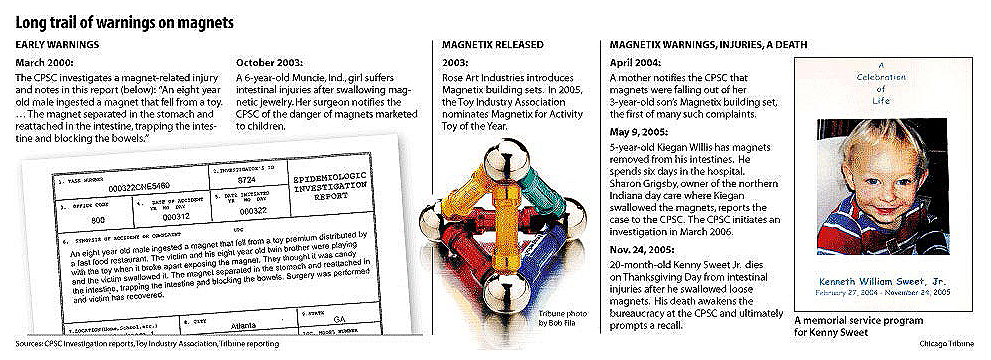
CPSC investigators in 2000 and again in 2003 documented cases of children suffering intestinal injuries after swallowing magnets from other products.
The CPSC didn't act, though, even as toymakers' use of such magnets skyrocketed. Nor did the agency respond when parents and caregivers complained that magnets were falling out of Magnetix toys. It didn't listen when Grigsby warned that a boy had been severely injured and that Magnetix could kill.
The agency didn't take action until after Kenny Sweet died.
"If they would have taken me seriously," Grigsby said, "that little boy would be alive."
A hidden 'gunshot wound'
What's so insidious about a small-magnet injury is that initially it seems like a stomach bug. All of the parents interviewed for this report said they -- and some of their doctors -- thought their children had a stomach virus. Yet if kids injured by magnets don't get surgery quickly enough, they can die.
The threat of such injuries has soared in recent years. That's because the magnets, made of neodymium iron boron, have become more affordable, popping up in all sorts of children's toys, including dolls, building sets, action figures, puzzles and games. These magnets are exponentially more powerful than the larger, rubbery variety used for decades in refrigerator magnets.
Once they fall out, these strong magnets tantalize youngsters. Some children who ingested them thought they were candy. When asked why he swallowed the Magnetix magnets at Grigsby's Indiana preschool, 5-year-old Kiegan Willis told his mom: "I was hungry."
Youngsters put just about everything in their mouths. It isn't aberrant behavior; it's how they explore the world. The tendency tapers off at age 3, but the CPSC's own studies have found that children of all ages put things in their mouths that they shouldn't.
Parents are petrified of small parts around young children because kids so easily can choke on them. When children swallow a choking hazard, a parent knows right away. The child gags and ultimately turns blue. If a child is sucking on candy or eating popcorn, caregivers often supervise them more closely.
But tiny, powerful magnets are a stealthy hazard. Parents aren't expecting them to come out of a toy, so they're not watching for them. Children can swallow them easily; because the kids don't choke, there is no immediate sign that anything is wrong. And youngsters who have been told not to put things in their mouths aren't likely to admit they've swallowed a piece of a toy.
To make matters worse, the magnets are so small that they blend in with carpet and stick to metal chair legs, harder to spot from a caregiver's vantage point but within easy reach of a child playing on the floor.
Even some doctors who saw the magnets on children's X-rays didn't understand the hazards. They sent children home, expecting the magnets to be discharged in a bowel movement. But often that doesn't happen.
"Once the blood supply is cut off, the clock is ticking, and over the next several hours without blood supply, the bowel starts to die," said Dr. Mark McCollum, the attending pediatric surgeon at Akron Children's Hospital who last fall saved the life of a 6-year-old boy who had swallowed loose Magnetix magnets.
If magnets cut holes in intestinal walls, deadly bacteria can spill into the abdominal cavity. As McCollum said, "It's essentially a gunshot wound or a stab wound."
Even before Grigsby called with her warning, the CPSC had learned through two of its own investigations that powerful magnets could damage children's bowels. In 2000, an 8-year-old Atlanta boy had to undergo intestinal surgery after he swallowed small magnets that fell out of a broken fast-food meal toy. The child spent 10 days in the hospital.
Then in October 2003, a 6-year-old Muncie, Ind., girl suffered intestinal trauma after swallowing powerful magnetic jewelry she got at the state fair. The child put the jewelry in her mouth to mimic a pierced tongue.
The girl's surgeon alerted the CPSC a month later to expect more of these types of injuries if products with such magnets were marketed to children, according to CPSC records.
That same year, Rose Art Industries launched Magnetix, labeling the building sets safe for children as young as 3 years old.
Over the next four years, consumers complained to the CPSC that small magnets were falling out of the toys. As early as 2004, a Lewisville, N.C., grandmother warned the agency that "a small child could easily swallow" these loose magnets.
A Highlands Ranch, Colo., mother told a CPSC investigator in February 2005 that Magnetix toys were "particularly dangerous" because some magnets had fallen out and she worried that her 3-year-old son might use his teeth to try separating the loose magnets from each other.
Three different consumers were so concerned that such magnets could hurt children that they sent pieces of their defective Magnetix toys to the CPSC before Grigsby alerted the agency of Kiegan's intestinal injuries.
Parents shared their concerns with the toys' manufacturer as well. Consumers repeatedly told Rose Art that magnets were coming loose from Magnetix pieces. Before a rival company, Mega Brands, bought Rose Art in July 2005, Rose Art executives disclosed those complaints to its soon-to-be parent company, court records show.
Shortly after the sale closed, the CPSC sent Grigsby's complaint to Mega Brands' Rose Art division president. In a form letter accompanying the Grigsby report, the CPSC wrote that it forwards these types of complaints to manufacturers "because they often provide an early warning of potential safety problems."
In a written response to questions from the Tribune, Mega Brands said it was unaware of the extent of the problem and didn't know that swallowed magnets could injure children until it learned of Kenny's death.
Consumers told the CPSC that the company's Rose Art division downplayed the hazard.
In October 2005 parents in Highland, Ill., just east of St. Louis, told a Rose Art customer service representative that a magnet popped out of their 4-year-old son's Magnetix toy as he opened the box for the first time. They recounted the phone conversation in a complaint to the CPSC, recalling how the Rose Art representative reminded them "that if a child did swallow one, they are nontoxic."
"That did very little to reassure me," one of the boy's parents wrote.
If only she knew
Penny Sweet bought two boxes of Magnetix sets at her local supermarket in June 2005. She didn't know that parents around the country had warned the CPSC and Rose Art about magnets falling out of the toys.
She didn't know that by then, at least two children had been hospitalized for intestinal injuries they suffered after swallowing loose magnets from Magnetix. What Sweet did know was that her son Ben would like the toy.
During the time the Magnetix sets sat in storage in the Sweet home before Ben's 10th birthday, William Finley, a 4-year-old California boy, had emergency surgery to repair life-threatening intestinal damage linked to Magnetix.
Sweet was unaware of that, too, just as she didn't know that Sharon Grigsby had pleaded with the CPSC to recall Magnetix.
She couldn't have known, because neither the government nor Rose Art or its new owners, Mega Brands, told consumers there were any problems with Magnetix.
Ken and Penny Sweet are experienced parents who have surrounded themselves with children. A blended family with six kids living under one roof and another stepsister who would visit, the Sweets had children ranging in age from toddler to teenager. Penny ran a day-care service out of their home, typically caring for another five youngsters in addition to her two preschoolers.
The Sweets settled a lawsuit they filed against the maker of Magnetix and declined to be interviewed for this article. But CPSC files, medical records and online memorials provide a picture of their family and the actions that preceded Kenny's death.
When Penny gave the Magnetix toys to Ben on his birthday that November, she recognized the plastic pieces posed a choking hazard to young children. So Kenny -- at 20 months old, the baby of the family -- was not allowed near the Magnetix sets and, whenever possible, was moved to another room when his older siblings played with them.
In addition, the Sweets set family rules about Magnetix: You could play with them only in the family room. The pieces always had to go back in the plastic container with the lid shut tightly.
In the 10 days their children played with the Magnetix toys in November 2005, Ken and Penny Sweet didn't find any stray, brightly colored plastic pieces.
Not knowing the history of problems with Magnetix, the Sweets were looking for the wrong thing.
The tiny agency that shrank
Talk to people who work at the Consumer Product Safety Commission and at some point you're likely to hear the same refrain.
It goes like this: Apologetic sigh. Pause. "We're a small agency."
They're right. The U.S. government spends twice as much on the National Endowment for the Arts as it does on the agency charged with policing most consumer products. At just $62 million, the CPSC's budget is so small in Washington terms that one congressional aide described it as a "rounding error."
Last May, Hal Stratton, the CPSC chairman at the time, joked with manufacturers that the commission's 1950s-era laboratory in suburban Washington is so old that if the agency didn't get money to renovate it soon, "We're going to start putting Dr. Strangelove posters up."
Stratton resigned last summer. In March, President Bush nominated Michael Baroody, a top lobbyist for the National Association of Manufacturers, to head the commission. Consumer groups complained that Baroody has lobbied on behalf of the very manufacturers he would regulate.
Joan Claybrook, president of Public Citizen and a former head of the National Highway Traffic Safety Administration, charged that Baroody "has spent the past decade lobbying to undermine consumer rights."
Baroody's appointment awaits Senate confirmation. He declined to comment through the manufacturers' trade group spokesman, who said Baroody would be "an advocate for product safety."
The CPSC already has a cozy relationship with the companies it regulates. Agency staff and commissioners have taken work trips paid for by the industries they are charged with monitoring.
Reading CPSC travel records is like thumbing through a Who's Who of trade groups: associations for makers of electrical products, home appliances, gas appliances, juvenile products. All of them paid for CPSC staff or commissioners to travel to conferences and events around the country. In the past 3 1/2 years the Toy Industry Association alone sponsored numerous trips, including several to China, for nine different CPSC officials.
In defending such trips, the agency said it follows "strict rules" governing what it calls "gift travel" and that CPSC General Counsel Page Faulk's office evaluates all funding for them. Records show Faulk herself took a trip to China at the expense of a cigarette lighter trade group for a seminar and to tour factories.
"It is inaccurate and irresponsible to characterize the relationship the CPSC has with the industries it regulates as 'cozy,' " agency spokeswoman Julie Vallese said in a written statement.
The agency's woes date back decades. The Reagan administration tried to abolish the CPSC, settling instead for budgets cuts that trimmed its staff by more than a third over two years. The number of employees has dropped steadily since then under both Republican and Democratic presidents. The CPSC's current staff of about 400 is nearly 60 percent less than what it was in 1980.
"It's painful to watch," said Robert Adler, a management professor at the University of North Carolina at Chapel Hill who worked at the CPSC until the early 1980s and has studied the agency since then. "Most of the staff are extraordinarily committed and competent. They just get overwhelmed."
The agency said in a written statement that "in terms of lives saved, the CPSC delivers extraordinary value to the American people." Bush's budget office, the CPSC noted, gave the agency a top rating.
Even so, Kenny Sweet's death wasn't the first linked to a flawed response by the federal agency. The CPSC was so concerned about deadly playpens that it issued seven recall alerts in the 1990s. The top rails of the playpens collapsed, suffocating children who were trapped.
Beginning in 1996, consumers repeatedly told the CPSC that the top railing of a different style of playpen -- one that hadn't been recalled -- was collapsing, posing the same suffocation hazard.
The commission didn't recall those Cosco playpens until after a baby died in June 2001, more than five years after the first warning. An 11-month-old Ohio boy suffocated when his grandparents' Cosco playpen collapsed on him.
In addition, the CPSC failed to act promptly on years of warnings about a Rose Art soapmaking kit that severely burned children. An attorney implored the CPSC's top safety enforcer at a conference, sent him internal company documents and outlined the serious injuries of seven children. Still, the CPSC waited another 1 1/2 years to recall the toy -- allowing another two children to suffer severe burns.
One of the reasons the agency fails to spot such hazards quickly is that it doesn't investigate the vast majority of the complaints pouring in from consumers, retailers, coroners and media outlets. For instance, of the 360,374 injury reports that arrived in 2005 from hospital emergency rooms, the CPSC assigned less than 1 percent for a more in-depth investigation.
'We trust God took him quickly'
At 2 a.m. the day before Thanksgiving, 2005, Kenny Sweet woke up and whimpered to his parents, apparently suffering from a stomachache. They soothed him back to sleep several times.
Kenny refused to eat breakfast that morning, though he played with his friends at his mom's day care. When he ate a snack, he vomited.
His dad had a stomach bug the prior week, and Kenny's parents thought the toddler had caught it.
Kenny took a three-hour nap in the afternoon and threw up again. Later, though, his mom thought he seemed better, and he appeared to improve even more as the evening went on. The toddler was able to drink fluids without getting sick before he went to bed that night.
Very early the morning of Thanksgiving, Kenny vomited again, then fell back asleep. At bath time that morning, Kenny's parents noticed he had red blotchy patches on his arms that faded during the bath. He threw up more than once and ate only Jell-O and drank 7Up during the Thanksgiving meal that afternoon, resting in a beanbag chair next to the dining-room table.
His parents still thought he had the stomach bug and gave him some medicine for constipation. He never had a fever.
Later that afternoon, Kenny's mom worried he might be getting dehydrated, so she dashed to the drugstore to pick up some rehydrating drink. While Kenny's dad bathed him again, he noticed those red blotches on his son's arms returned, and his feet and hands had a bluish tint, all of which faded once Kenny was in the tub.
When Kenny's father offered him a drink of water, the toddler gulped down a third of the bottle. Immediately, Kenny's eyes rolled back in his head and his abdomen ballooned.
Ken Sweet Sr. quickly wrapped his son in towels, just as Penny returned from the drugstore. He told her something was seriously wrong. Kenny seemed to be moving in and out of consciousness. His breathing was shallow. Penny noticed that Kenny's fingernail beds were bluish, and the blotches on his arms returned.
They rushed their son to the emergency room, where doctors immediately began treating him. But several minutes after his arrival, Kenny lost consciousness.
For more than an hour, doctors worked to revive him with chest compressions, drugs and oxygen. At times they'd see a heart rhythm, but then they'd lose the pulse. "Finally after approximately 40 minutes of CPR, we realized that our efforts were futile," a doctor wrote on his chart.
Kenneth William Sweet Jr. was pronounced dead at 5:27 p.m. that Thanksgiving Day. "We had a few hours to hold our precious angel before the coroner came to take him," his parents would later write. "We trust God took him quickly to end his suffering."
Letter to a son
When the Sweets went home that night, they didn't know what killed their son.
Within days, the medical examiner found that approximately nine tiny magnets had pinched together loops of Kenny's small intestines. The magnets strangled the intestinal blood supply, causing a large section of his bowels to die. That triggered gangrene.
Ken and Penny Sweet ultimately found loose Magnetix magnets in the family room, camouflaged in the off-white, mottled pile of the carpet. They even discovered some stuck to the underside of the vacuum cleaner.
Not long after Kenny's death, a top executive at Rose Art's parent company called the Sweets to offer his condolences. Vic Bertrand, chief operating officer at Mega Brands, assured the Sweets that this was the first time in the company's history that a child had died or even suffered a serious injury from a Mega Brands toy, according to the company.
That wasn't true.
Before Kenny's death, at least three children had suffered life-threatening intestinal injuries from swallowing loose Magnetix magnets, and word of two of those injuries reached Mega Brands' Rose Art division before Kenny Sweet died.
In late July 2005 the agency sent to the division the complaint filed by Indiana preschool operator Sharon Grigsby, who detailed Kiegan Willis' serious injury from Magnetix. Mega Brands said its Rose Art division never forwarded the complaint to corporate headquarters.
Just three weeks before Kenny died, the division signed for a certified letter alerting the company that William Finley, the 4-year-old California boy, had been injured by a Magnetix toy. In a written statement, Mega Brands said that letter stated that William swallowed only one magnet and didn't describe the nature of the boy's injuries. "It is grossly inaccurate to suggest that this letter should have raised a flag," the company said.
Had Mega Brands investigated, it would have discovered that three loose Magnetix magnets cut a hole in William's bowels, allowing deadly bacteria to spill into the child's abdomen. Emergency surgery saved him.
A family friend of the Sweets wrote to the CPSC about two weeks after Kenny's death, pleading for action. "It is scary enough," read part of the friend's letter. "I want to make sure it is addressed."
Ken Sweet wrote a letter of a different sort. His was to Kenny Jr.
"Your days were spent teaching me how much joy existed in our world as every new experience was made more special because you were part of it," he wrote.
"We would walk the yard together and touch and smell the many beautiful flowers in the spring and summer. If I put my coat on to run an errand, you would quickly grab your shoes and meet me at the front door.
" ... Today for me the sun doesn't shine as bright and the future holds less excitement because you are not here to share it with."
© 2007 Chicago Tribune
By Patricia Callahan
Tribune staff reporter
Part 2 of 2: The death of Kenny Sweet Jr. finally prompted government regulators to take a hard look at a popular magnetic toy. But what followed was neither quick nor effective. More children have been hurt, and potentially hazardous versions of Magnetix remain on shelves.
Inside a gray government cubicle littered with colorful construction toys, Jonathan Midgett played with pieces from a Magnetix set, one of the year's hottest sellers.
Midgett connected and disconnected them as a child would. Remembering that day, the self-described "toy scientist" at the U.S. Consumer Product Safety Commission says he could feel the powerful attraction and repulsion of the embedded magnets. He quickly understood why the toy was so popular.
To a child, the magnets behave like they're alive.
Midgett knew they could also be deadly.
He could see that it wouldn't take much for the tiny magnets to break loose, the way they had several weeks earlier in the suburban Seattle home of the Sweet family.
Twenty-month-old Kenny Sweet Jr. died on Thanksgiving Day 2005 after swallowing loose magnets from his older brother's broken Magnetix toys. They connected inside Kenny's intestines, strangling his bowels.
Parents and caregivers had warned the government of that very danger, but the safety commission failed to act.
In the weeks after Kenny's death, the alarm was finally sounding inside the agency's ranks. "I thought it was a defective product," Midgett said, "and should be recalled."
What followed was neither decisive nor swift, but an illustration of how weakly most children's products are regulated in America.
The commission did not sweep Magnetix off store shelves. It did what the law requires: The commission first accommodated the toy's maker, negotiating the wording of the news release meant to warn parents. The resulting voluntary recall was so confusing that consumers had no way of knowing whether they were buying a dangerous toy.
The federal government's influence was even weaker during the next step, when new manufacturing standards were written in an attempt to ensure that such toys couldn't harm children. At that point, regulators became just another voice in a debate controlled by the toymakers themselves.
This flawed system put many children at grave risk. In all, more than two dozen kids suffered life-threatening intestinal injuries after swallowing magnetic toy pieces. At least 15 of those followed Kenny's death.
After months of inquiries from the Tribune, the Consumer Product Safety Commission in April expanded its recall of Magnetix and admitted it knew of at least 1,500 cases of the toys shedding loose magnets. The new recall covers another 4 million boxes — potentially hazardous toys that were allowed on the market for more than a year because the original recall was botched.
But the second recall has proved equally confusing. The Tribune as recently as Saturday bought Magnetix toys that should have been removed from shelves.
And over the weekend, some major retailers froze sales of Magnetix building sets, responding to the Tribune's investigation.
Weighing every word
It was around Christmas 2005 when Jonathan Midgett first recommended that Magnetix be recalled. Had the agency's top managers done so, the alert could have warned thousands of families to the potential danger of toys given during the holidays.
The Booke family in Oak Harbor, Wash., thought Magnetix would be perfect for 4-year-old Kyle.
His grandmother had carefully considered what to get him that year. When she asked Kyle's mother about Magnetix, his mom responded enthusiastically. Sure, she said, her son would love them. And on Christmas the adults watched when Kyle opened his Magnetix with glee.
As Kyle was playing with his new toys, federal regulators began examining whether Magnetix were dangerous. The staff of the Consumer Product Safety Commission, or CPSC, first met formally to discuss the possibility of a recall more than two months after Midgett's recommendation.
Kenny Sweet's death framed the discussion. One of Midgett's colleagues noted that Kenny was younger than the toy's recommended minimum age of 3, Midgett recalled. Why did such a young child have access to the magnets, and why didn't the child's parents see him swallow them?
Parents and older siblings aren't expecting magnets to fall out, Midgett answered, so they're not looking for them. The tiny magnets can get lost in carpeting, where others miss them but younger children find them.
At the end of the meeting, "the vote was 'yes, it's a defective product, yes, we'll proceed with a recall,' " said Midgett, whose doctoral work focused on human development.
But the CPSC couldn't simply force a recall. The agency has to go through a lengthy court process to do so. Instead the safety commission tries to persuade companies to recall items voluntarily.
Federal law gives companies significant control over any information the CPSC releases about a product, including recall alerts.
In fact, the agency declined in a written statement to answer most of the Tribune's questions about Magnetix, citing a federal law that in effect protects companies from bad publicity.
With few exceptions, the agency has to notify a manufacturer before it says anything negative about a brand-name product. If manufacturers don't like what the CPSC plans to disclose, they can take the agency to federal court.
"Half of my day is negotiating press releases," Catherine Cumberland, a senior officer in the CPSC division that oversees recalls, told manufacturers at a trade show last year. "Many times we're negotiating every single word of a press release."
While the agency hammered out an agreement with the maker of Magnetix in March last year, four more children were treated in hospitals for Magnetix injuries. Kyle Booke was one of them.
Those Magnetix his grandmother bought him for Christmas broke open. The 4-year-old swallowed some of the magnets, which tore through his bowels, spilling deadly bacteria from the boy's waste into his abdomen.
That triggered such a massive infection that doctors at a Seattle hospital didn't fully close the wound after repairing the holes. Instead a vacuum sucked infected material out of the boy's abdomen as he healed.
For three weeks, his mother lived at the hospital.
"I was scared every day," Mechelle Booke recalled. "His body was completely swollen. He didn't even look like himself. There were tubes sticking out of him everywhere."
Kyle, who seemed to be recovering, returned home, but a few days later he was vomiting again.
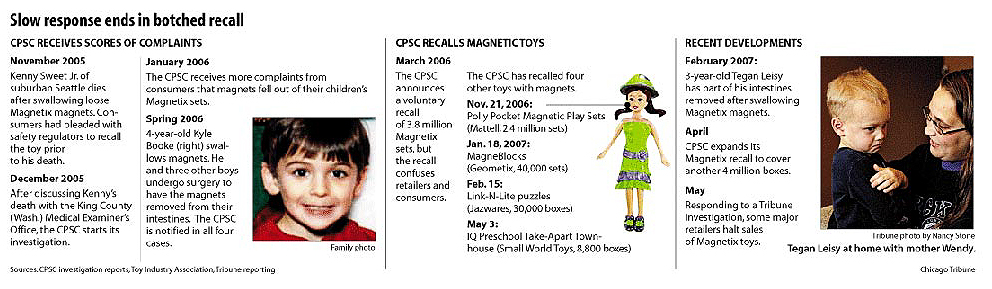
Doctors readmitted the child. That's when his mother spotted the news on a hospital TV: The CPSC was recalling 3.8 million Magnetix toys.
The recall came on March 31, 2006, four months after Kenny Sweet's death. The manufacturer already had raised the minimum recommended age for the toy to 6.
Still, the toy would remain on store shelves and in homes. More children would get hurt.
Confusion in stores
The recall should have sent a clear message to parents about which toys were safe to buy. But it did not.
Mega Brands, which bought Magnetix-maker Rose Art in July 2005, told federal regulators during recall negotiations that it began improving Magnetix toys with more glue and factory inspections in late December 2005, shortly after its executives learned of Kenny Sweet's death.
Because Mega Brands assured the CPSC that stores were selling only the improved versions, the government and the toymaker told consumers that all Magnetix toys on store shelves at the time weren't covered by the recall.
The CPSC, however, did not perform tests to determine whether the improvements made the toy safe. "We take the company at their word until we prove otherwise," Julie Vallese, a CPSC spokeswoman, explained in an interview.
This made for a confusing recall because the Magnetix boxes had no markings to let consumers know the items being sold were different from the defective versions.
Alan Schoem, former head of enforcement for the CPSC who left in September 2004, said the agency's alert on the toy seemed like a "non-recall recall."
"Usually there's a way of distinguishing the new product on a store shelf," Schoem explained. When he oversaw the division, "If you couldn't differentiate one from the other, we would take the position that you had to recall everything because you couldn't tell which was good and which was bad."
Even retailers were perplexed. The Tribune bought a recalled version of Magnetix from Best Buy online two months after the recall. Kelly Groehler, a Best Buy spokeswoman, initially said the toy hadn't been formally recalled.
Mega Brands fed that confusion. In a news release announcing the recall, the company said, "There is no required action for retailers."
But some retailers, including Best Buy's online store, still had the older versions of the toys in their warehouses. When the Tribune explained to Best Buy that selling such a recalled toy violated Illinois law, Groehler said, "This is not representative of how we like to do business."
The chain no longer sells Magnetix, she added.
Asked why Mega Brands hadn't told Best Buy to pull the recalled version from its shelves, Mega Brands consultant Alex Radmanovich was incredulous. "How many retailers are there in the United States? It would be a massive job to track it all down," he said.
Last summer, Mega Brands executives told Wall Street analysts that they received only 12,000 requests for replacement toys in the initial recall's first four months, typically the period when most customers respond. That's a tiny sliver of the 3.8 million toys sold before that recall.
The company told the Tribune its engineers have continued to tweak the design of the toy: reinforcing the welding, using a more impact-resistant plastic and adding a lip to prevent magnets from slipping out.
Mega Brands also included a safety bulletin to parents inside boxes and added a 11/2- by 1/2-inch label. "CAUTION," the label reads, "Do not ingest or inhale magnets. Attraction of magnets in the body may cause serious injury and require immediate medical care."
Yet the threat continues because old versions remain in people's homes and on some store shelves. Last summer, for instance, a Gurnee boy, D.J. Hyman, had to undergo surgery for life-threatening intestinal injuries after swallowing Magnetix magnets.
The toy's dangers have even spawned a blog, "Magnets Can Kill." Its author, Shawn Thornsberry, whose youngest son attended a day care once run by Kenny Sweet's mom, was so troubled by the toddler's death that she became an amateur quality-control cop.
Filming her own children playing with a variety of Magnetix toys, she has documented numerous cases of them failing. In the latest incident, she said, magnets fell out of a Sir Lancelot Magna-Man action figure she bought in mid-February.
Two of her children noticed that a magnet fell out of the neck of the action figure within minutes of opening the package.
Fighting for change
Owen Howman, a 6-year-old Ohio boy, lay in a hospital bed in Akron recovering from intestinal surgery. Loose Magnetix magnets had pinched the 1st grader's intestines and cut holes in his bowels.
He had survived, but he was in pain. His mother, Ange Erickson, remembers how frightening those days at the hospital were last fall. Owen screamed about "hot fire" every time he had to go to the bathroom.
He quickly tired of the Popsicles and Gatorade at mealtimes and longed for solid food. "He watched every food commercial on TV," Erickson said. "That broke your heart."
As Owen's family worried about the health of their boy, the government and manufacturers were engaged in another set of extended meetings that seemed to be going nowhere.
With the recall in place, the next task was to prevent additional injuries by setting new standards for making toys with magnets.
At this vital juncture, federal law reduced regulators to being only bit players.
Amendments passed during the Reagan administration bar the CPSC from issuing mandatory safety rules unless it can prove that voluntary ones won't cut the risk of injury or that most manufacturers aren't following the voluntary measures.
The result: The loudest voices in rewriting safety rules for toys belong to the toymakers themselves.
Their largest trade group, the Toy Industry Association, controls the process of revising voluntary toy safety standards. Joan Lawrence, a trade group vice president, heads the toy safety standards committee and controls its agenda.
Others involved in the process included the trade group's attorney, who had negotiated the initial Magnetix recall for Mega Brands, and several executives from Mattel.
That toy giant recalled millions of boxes of Polly Pocket dolls last year after 170 complaints about loose magnets and three reported cases of children suffering serious intestinal injuries.
People seeking to toughen the standards — consumer advocates, physicians, even government regulators — must plead their case to the makers of these products.
Those seeking changes in magnetic toys included CPSC scientist Midgett, blogger Thornsberry and Nancy Cowles, executive director of Kids In Danger, a Chicago-based non-profit founded by two University of Chicago professors after a son died when a recalled portable crib collapsed around his neck in 1998.
At every step, the three faced a dilemma. The harder they pushed for tougher safety rules amid opposition from toymakers, the longer it would take to get any changes. Because voluntary safety guidelines are built on consensus, resistance from manufacturers can hold up new standards for years.
A Tribune reporter received permission to listen to a series of conference calls as the debate raged among manufacturers, consumer advocates and government staff. Toymakers argued that they should be allowed to sell toys that break, shedding powerful magnets, as long as their boxes included a warning about intestinal injuries. The manufacturers also pushed for tests so weak that Magnetix toys prone to breaking would pass.
Midgett and others pushed back. "It's not OK to market a product that drops insidious little hazards in the shag carpeting all over the house," Midgett told the toymakers.
Ultimately, after months of haggling, the toymakers heeded some of the concerns of Midgett and the consumer advocates. The final standard specifies that manufacturers must test toys in a way that mimics play. If magnets fall out, the toy fails the standard.
But the testing is subjective; toymakers and the private labs they hire get to decide how many times to attach and detach magnetic pieces. There is no minimum.
And there is a loophole. The new standard does not require a warning on magnetic toys containing pieces too big for a child to swallow. Parents wouldn't know that the magnets inside these toys represent a hidden danger.
Midgett and the consumer advocates on the standards group compromised. Even with a new standard, they worry whether children will still be vulnerable.
"It's that tension of us trying to make the safety standard as strong as possible and them trying to make it as weak as possible," Cowles said.
Other children's advocates also were concerned.
The proposed standard raised alarms at the American Academy of Pediatrics.
The academy, which represents 60,000 pediatricians, urged the standards group to prohibit the sale of all toys with magnetic pieces small enough to be swallowed. Under that rule, which the toymakers rejected, Magnetix, other magnetic building sets and some Polly Pocket doll toys wouldn't be allowed.
Faced with the same standoff as Midgett and the consumer advocates, the pediatricians group agreed to withdraw its negative vote as long as the committee vowed to revisit the standard within a year.
"The AAP does not want the standard, even given its weaknesses, to be delayed, resulting in more children being killed or injured," the pediatricians wrote.
The CPSC's Midgett worries that the subjective tests allowed under the new standard won't catch all toys likely to shed magnets during play. To weed out toys likely to break, Midgett said, his colleagues have invented a testing contraption that repeatedly attaches and detaches magnetic toy pieces.
He hopes the machine, still a prototype, will yield a standardized test that can predict which toys will break and which ones won't.
"The question is whether or not the industry will go along with it," Midgett said. Until then, he added, the new standard "is better than nothing."
CPSC spokeswoman Vallese defended the agency's record on Magnetix by stating that it is "dedicating significant resources to address this emerging hazard, and has brought it to the attention of the safety community around the world."
The new safety standards are expected to go into effect in coming weeks.
A new recall, still flawed
Magnetix toys can still pose a danger.
In February, Magnetix magnets ripped holes in the intestines of Tegan Leisy, a 3-year-old Colorado boy. Doctors had to remove about 8 inches of the child's intestines.
Tegan's 5-year-old brother received four sets of Magnetix as gifts last year. All the sets were purchased after the March 2006 recall, according to Paul Komyatte, an attorney for the family.
The Leisys allege that some of the Magnetix toys were the old versions that shouldn't have been sold after the recall, while others were a newer version, court records show. Magnets fell out of both, according to Komyatte.
The CPSC now acknowledges the lingering danger. Last month, after the Tribune questioned officials about the initial recall, the agency expanded it to cover another 4 million boxes of Magnetix toys.
This time the CPSC told consumers what to look for to determine which versions are safe: boxes labeled for ages 6 and older that carry a tiny caution label about the risk of internal injuries from swallowed magnets.
But the government sent another mixed message. In its recall alert, the agency told consumers that Mega Brands had assured safety regulators that all Magnetix building sets on store shelves were the newest, improved versions.
"These products are not included in the recall," the CPSC said.
The agency made these assurances despite the fact that its own investigators found older, potentially hazardous versions of the toys on store shelves the day before the CPSC announcement, Vallese said. But deleting that paragraph from the recall alert would have required further negotiation with Mega Brands, she added, and the agency didn't want to wait.
Mega Brands' letter to retailers further clouded the matter.
"Magnetix products currently at retail are NOT affected by this program," the letter said. "… This effort is focused on old products in the household."
The agency, however, strongly disputes that view. After learning what Mega Brands had told retailers, the CPSC bypassed the company and e-mailed retailers directly. It asked them to make sure all Magnetix boxes being sold included the caution label about internal injuries.
Still, that message was lost on many stores, and the recall failed to accomplish its central goal: keeping potentially dangerous toys out of consumers' homes.
After these announcements, the Tribune was able to buy the recalled versions at nearly every store it visited, including national chains and online merchants.
One box the Tribune purchased last month at a Niles Wal-Mart was the oldest version of the toy, the kind the company made before Magnetix killed Kenny Sweet.
© 2007 Chicago Tribune
By Patricia Callahan
Tribune staff reporter
Responding to a Tribune investigation, some major retailers over the weekend suspended sales of Magnetix toys linked to one death and 27 intestinal injuries.
The Tribune had bought recalled versions of the popular toys from Toys "R" Us, eToys, Amazon.com, Walgreens and Wal-Mart in recent weeks. It is against Illinois law to sell recalled toys.
Toys "R" Us Inc. said it was halting Internet sales and clearing store shelves of the magnetic building sets. Online retailers Amazon, eToys and KBtoys.com also stopped selling the toys and said they planned to send a warning about internal injuries to customers who had bought them.
At issue is a confusing recall in which government regulators and the toy's manufacturer gave conflicting instructions on which versions of Magnetix were hazardous. The retailers decided to halt sales until the government and the company can clarify which boxes are safe.
"We quarantined all items," said Sheliah Gilliland, a spokeswoman for eToys Direct Inc., which operates eToys.com and KBtoys.com.
The U.S. Consumer Product Safety Commission, or CPSC, originally recalled 3.8 million boxes of Magnetix in March 2006. After repeated inquiries from the Tribune, the agency expanded that recall in April 2007 to cover another 4 million boxes.
During both recalls, the CPSC allowed retailers to sell certain Magnetix toys because the manufacturer, Mega Brands, said it had improved them to ensure that embedded magnets would not come loose. When swallowed, the powerful magnets—not much bigger than baby aspirin—can connect in the intestines and tear through a child's bowels.
The CPSC told the Tribune that only boxes preprinted with a warning to customers about the danger of internal injuries are excluded from the recall. That preprinted caution label, the CPSC said, signifies that the toys inside are the newest, improved versions of Magnetix.
But Mega Brands gave retailers conflicting information.
The boxes the Tribune purchased did not have the caution label, including one at a Niles Wal-Mart late last month. A Wal-Mart spokeswoman said, "We are looking into the facts at the specific store, but we always instruct our stores to remove recalled products."
The Tribune gave Walgreen Co. the address of the Park Ridge store selling the recalled toys. Walgreen said it was investigating.
A spokeswoman on Friday said she called the store manager, who insisted that all Magnetix toys on the shelf carried the caution label about internal injuries.
The Tribune returned to the store Saturday. None of the boxes on the shelves carried such a label.
© 2007 Chicago Tribune
By Maurice Possley
Tribune staff reporter
Federal regulators recalled about 1 million cribs Friday because the drop rail on some of the nation's best-selling models can detach from the crib's frame, creating a dangerous gap that has led to the deaths of at least three children.
After inquiries from the Tribune for an investigation of Simplicity Inc. cribs, the Consumer Product Safety Commission announced the recall of cribs sold under both the Simplicity and Graco names. Covering all cribs made by Simplicity from 1998 through May 2007, it is the largest recall of full-size cribs since the safety commission was created in the 1970s.
"We want parents to know," CPSC spokesman Scott Wolfson said in an interview. "We do not want your child in that crib tonight."
The Tribune's reporting had found numerous complaints about the design of a popular Simplicity crib, the Aspen 3 in 1, documenting the failure of the federal watchdog agency to fully investigate the deadly failure of such a crib in 2005. Over the last week, the Tribune shared its findings with Simplicity and the safety commission, seeking comment.
The response was the massive recall. It includes the Aspen 3 in 1 -- Simplicity's most popular crib during the time the company sold 600,000 of them from 2002 to 2005.
Though all the cribs covered by the recall were made in China, the CPSC said it was Simplicity's flawed design and hardware that were responsible for the problem, which the agency said led to seven other non-fatal cases of infants being trapped and 55 other complaints of drop-rail problems.
The design flaw allowed caregivers to unintentionally install the drop rail upside down, weakening the hardware and causing the rail to separate from the frame. The three infants who died slipped through the resulting gap, became trapped and asphyxiated.
Simplicity President Ken Waldman said the company redesigned its crib hardware two years ago as a result of consumer complaints. But he would not say why the recall did not occur earlier.
"We analyzed the situation, and we needed to make a decision," he said in an interview.
The company is not offering consumers a replacement crib. Those who contact Simplicity can obtain a repair kit with the new hardware intended to keep the rail from separating. Asked about the decision to replace hardware instead of the cribs in their entirety, Waldman said: "Working with the CPSC, we found the best remedy was to send new, updated hardware."
But a leading child-product safety advocate criticized the decision to leave parents responsible for making the fix themselves.
"Given Simplicity's track record of four crib recalls in a little [over] two years, parents may want to take other measures such as discontinuing the use of the crib," said Nancy Cowles, executive director of Kids In Danger, which was created after a Chicago child died in a portable crib that collapsed and strangled him. "We would urge Simplicity to reimburse any parents who would feel safer returning the crib."
Waldman said consumers could expect to receive the replacement kit "within four weeks."
Cowles noted that such a recall leaves parents with a difficult decision.
"If their crib is one of the unsafe ones, they have a dilemma of where to put their baby to sleep tonight," she said. "Sleeping on other surfaces such as adult beds or sofas or chairs is too risky. We would suggest if they have a portable crib or play yard they use when traveling, that might be the best solution until they can get their crib repaired or replaced."
Crib retrieved, long after death
The CPSC said it is aware of two deaths in Simplicity-manufactured cribs with the older-style hardware where the drop rail was installed upside down. A Tribune investigation determined the identity of those two babies: Liam Johns, a 9-month-old from Citrus Heights, Calif., died in April 2005. Edward Millwood of Woodstock, Ga., was 6 months old when he died in November 2006. Neither the agency nor the company would disclose the name of the third child who died when the drop rail separated from the crib.
More than two years after Liam's death, following the Tribune's inquiries, the CPSC sent an investigator this week to finally retrieve the crib in which he died and examine its flaws. Three days later, the agency announced the recall.
Waldman said the Tribune's investigation did not prompt the recall. He said the company speaks weekly with CPSC, "trying to make our products safer."
He declined to speak about any of the deaths. "Parents deserve their own privacy," he said, "out of respect for them."
The Johns family settled a lawsuit with Simplicity for an undisclosed sum. Charles Kelly, the San Francisco attorney who represented the family in the suit, said that while "we are pleased with the recall, it is inexcusable that it took over two years and three deaths before CPSC acknowledged the risk posed by the drop side.
"Congress must give CPSC the necessary funding so that it can move faster to protect our nation's children."
Friday's recall was just the latest in a series of such actions resulting from revelations about dangerous consumer products. Senators who have been pushing for improvements in how the CPSC does its job said the crib recall was further proof that the agency needed more vigorous enforcement and less influence by industry on the agency's investigations.
"When parents put their children to bed at night, they trust that the crib they're using will be the safest place for them, outside of their arms," said Sen. Dick Durbin (D-Ill.). "When you look at the series of recalls of children's products over the last few months, one thing becomes clear: Greater steps need to be taken to test and certify the safety of products designed for children."
The cause of the latest crib recall was flawed hardware intended to hold the drop rail to the frame of the crib. In addition to Liam and Edward's deaths, the CPSC is investigating the death of the 1-year-old child who was in a Simplicity crib with the newer-style hardware but with the drop rail installed upside down.
The 'crib swallowed him'
A fourth child, 19-month-old Anthony Hutchins of Myrtle Creek, Ore., died in January 2006 when the mattress supports on his Aspen 3 in 1 collapsed. His mother told police that the "crib swallowed him."
The CPSC had recalled 104,000 of those cribs in December 2005 because of complaints about the mattress supports.
Friday's recall was the largest ever in the U.S. for full-size cribs. In 1997, Evenflo recalled 1.2 million smaller, portable cribs.
The Simplicity crib models covered by Friday's recall include: Aspen 3 in 1, Aspen 4 in 1, Nursery-in-a-Box, Crib N Changer Combo, Chelsea and Pooh 4 in 1. The recall also involves Simplicity cribs that used the Graco logo: Aspen 3 in 1, Ultra 3 in 1, Ultra 4 in 1, Ultra 5 in 1, Whitney and Trio.
The cribs have one of the following model numbers: 4600, 4605, 4705, 5000, 8000, 8324, 8800, 8740, 8910, 8994, 8050, 8750, 8760 and 8996. The numbers can be found on the envelope attached to the mattress support and on the label attached to the headboard.
The cribs were sold in department stores, children's stores and mass merchandisers nationwide from January 1998 through May 2007 for $100 to $300.
Millie Nichols, 32, of Portland, Tenn., purchased an Aspen 3 in 1 crib in 2004 for her daughter. Terrified after the mattress supports fell and the baby dropped through to a pile of clothes underneath, she complained to the CPSC and Simplicity and received a new metal mattress support.
Earlier this month, contacted by the Tribune, Nichols said she was using the crib for her 12-month-old daughter, Jasmine. Asked if she had any problems with the crib, she said: "The mattress is fine. The drop rail falls down, though. Sometimes one end doesn't catch."
Told of Liam's death and other complaints about the drop rail, she said she was going to stop using the crib immediately.
"I don't care if they offer me a steel reinforcement and bless it with holy water," she said, "my child is not getting in this crib again."
Nichols said Friday that her husband had dismantled it.
"My baby is sleeping in the playpen. We don't feel safe with that crib," she said. "I want a new crib, and I want that one to go into the trash."
© 2007 Chicago Tribune
By Maurice Possley
Tribune staff reporter
Photographs taken of Liam Johns' crib by the Sacramento County Coroner's Office clearly show where it came apart.
The drop rail had detached from its plastic track, creating a gap through which the 9-month-old boy slipped feet-first. Instead of falling to the floor, Liam got his head stuck between the rail and the mattress. Trapped in a hanging position, the boy asphyxiated.
Liam's April 2005 death prompted an investigation by a federal watchdog agency and a family lawsuit against the crib's manufacturer, Simplicity Inc.
But the company and the Consumer Product Safety Commission didn't warn parents across the country about the potentially fatal flaw in Simplicity cribs--not after Liam suffocated, not after more complaints about the crib rails and not after two more infants died.
Once the Tribune began questioning the company and the agency this month, a massive recall of Simplicity cribs followed.
On Friday, the CPSC took action on 1 million cribs, including the model that the Johns family used for Liam. It is the largest recall of full-size cribs in the agency's history.
In its Hidden Hazards series, the Tribune has documented how the understaffed and sluggish CPSC fails to protect children from dangers in toys and other products. The paper's examination of Simplicity's popular cribs underscores that, even in the aftermath of a child's death, the agency can fall short in its watchdog role, leaving children vulnerable to a documented hazard.
Interviews and records show that the federal investigator assigned to Liam's death failed to inspect the crib in his initial inquiry and didn't track down the model or manufacturer.
"We get so many cases," the investigator, Michael Ng, said in aninterview this month. "Once I do a report, I send it in and that's it. I go to the next case. We could spend more time, but we are under the gun. We have to move on."
Only last week, after inquiries by the Tribune, did Ng return to Californiato find the crib. It had first been held as evidence by sheriff's police and later was put in storage by a lawyer retained by the family.
Even with the recall, it remained unclear why it took so long to address theproblem. The CPSC often gets bogged down in negotiations with companies over recalls because federal law limits its powers and its ability to disclose details of its investigations into dangerous products.
Nancy Cowles, a child-product safety advocate and executive director of Kids In Danger, called for congressional hearings to look into the delay. "Was it because the CPSC has no power and the company was able to stall?" she asked.
When first presented with the Tribune findings this month, Julie Vallese, spokeswoman for the CPSC, said the agency could not comment about Simplicity. "We have more than one investigation open, and that's why I can't answer any questions,"she said.
In announcing the recall Friday, the CPSC blamed a flawed crib design and hardware that allowed parents to install the drop rails upside down, which can cause the rail to detach from the frame. The agency said it was aware of seven non-fatal cases of infants being trapped and 55 other cases of drop-rail problems.
It also linked the Simplicity cribs to three deaths but did not release the names of those children or the dates of the fatal accidents.
One of those children was Liam Johns, records show. Another was 6-month-oldEdward Millwood, who died in November 2006 in Georgia. The third was 8-month-oldRoyale Arceneaux, who died in February in Houston. All three children fell betweenthe mattress and a separated drop rail.
The drop rails in those deaths had been installed upside down. But the agencyalso found two incidents in which correctly installed drop rails failed to workproperly.
Ken Waldman, president of Simplicity Inc., said in an interview Friday thatthe company makes safe products and works closely with the CPSC to fix any problems.He would not say why the recall did not occur earlier.
"This is the thing to do and that's why we decided to do it now,"he said.
The Aspen 3 in 1, once Simplicity's best-selling crib, accounted for the bulkof the recall. About 600,000 of those models, which are no longer made, wererecalled.
It was the same one the Johns family chose for Liam.
Reached at her home in Northern California, Nicola Johns, Liam's mother, began to weep when she learned about the recall.
"I feel like there is a stone or weight off my chest," she said."So many kids' lives can be potentially saved because they took the right action finally.
"Nothing will bring Liam back, but if this saves one baby's life, it will mean so much to me."
Haven or danger?
A baby's crib is supposed to be the safest place in the home. It's considered a haven, the one place where the parents of a child, whether a newborn or a wriggling infant learning to roll over, can leave their babies for hours at a time without worry of harm.
That's why parents were so upset and contacted the CPSC when they began to notice problems with the drop rails on their Aspen 3 in 1 cribs. That model had features allowing it to be converted into a toddler bed and later a regularbed as a child grew.
According to records obtained from the agency through the federal Freedom of Information Act, the first complaint to the CPSC about a drop-rail problem with the crib came in July 2003 from a woman in Meridian, Miss. It involved the rail suddenly falling down, but not separating from the crib.
A CPSC investigator tried to find the crib in December, five months later. By then the woman had returned it to the store for a refund. The crib was gone, according to a copy of the investigator's report.
The investigator then called Simplicity. "During our conversation, the customer service representative for Simplicity indicated that the manufacturer is aware of some issues with drop sides of this model crib. He said that all cases of which [the company] is aware have involved improper assembly of the drop side by the consumer," the report said.
Then, in February 2004, a mother complained about a more serious drop-rail issue: separation from the crib. Julie Heath, who was living with her husband at the Ft. Stewart, Ga., Army base, reported to the CPSC that an hour after she put her 5-month-old daughter into the crib, she came into the nursery and found that one end of the drop rail had come loose. She said she also contacted Simplicity.
"I called the company, and they said it was no big deal," Heath said in an interview. "They said there were no problems with it. I thought it was scary and wondered if there were any kids who were hurt that they weren't telling us about."
Heath said she ultimately got rid of the crib and instructed her husband to put it into a trash bin in separate pieces. "I see them [Simplicity cribs]a lot at yard sales on the base," she explained. "I was worried if we just left it out that someone would pick it up and some baby would die."
Many of the parents who complained about their Simplicity cribs weren't worried just about their own children. They also wanted action to avert tragedy for other families.
The drop rail on the Aspen 3 in 1 owned by Christina Zimmerman of Bloomington, Ind., separated from the headboard of the crib the day after New Year's 2005. The thought that her son could have fallen through the resulting gap terrified her, and she contacted the CPSC.
"It had a huge gap," Zimmerman said. "I thought my son could fall through or get his head stuck in there."
She said she returned it to the store where she purchased it. "I stressed to them--I don't know how the procedure works, but these need to be removed from the shelf. I thought it should be taken off the market."
Zimmerman said she was saddened, but not surprised, to hear of Liam's death.
"I have five children," she said. "I was just afraid something like that was going to happen. You don't think just about your child. "Asa mother, I don't want anyone to lose their child like that. I can't imagine how [Liam's] parents feel."
Feds miss link to flawed crib
Nicola Johns put her son Liam to bed about 8 p.m. on April 11, 2005, in their apartment in Citrus Heights, Calif.
She last checked on him about five hours later, just before she and her husband, Chad, went to bed. She was roused by her 2-year-old son, Logan, around 6:30a.m. and got up to make breakfast.
"I went in to check on Liam and I couldn't see him at first," shesaid. "When I walked closer, I could see he was hanging. I lifted him up by his arms. He wasn't breathing."
Paramedics worked on the boy, but he was pronounced dead at a nearby hospital.
According to police reports and a lawsuit filed by the family, sometime in the early-morning hours, one end of the drop rail on Liam's crib had come off its track.
Liam, who could sit up with pillows behind him and was just learning to rollover, either rolled or slid feet-first into the opening. His head was caught between the rail and the mattress.
A coroner's office investigator photographed the crib and notified the CPSC. Sheriff's police impounded the crib while they conducted a death investigation. Child welfare authorities temporarily removed the Johns' other son from the parents' care while they investigated.
The CPSC dispatched investigator Ng. When he went to the sheriff's police, he was told the crib was in the evidence room and couldn't be examined whilethe investigation was pending, according to his report.
Ng noted in his report that the coroner's investigator had failed to record the correct model number of the crib but did record the Graco brand name. Mistakenly believing that Graco had manufactured the crib--it was made by Simplicity under the Graco brand name--Ng went to Graco's Web site.
"A search of... www.gracobaby.com did not reveal any models similar to the crib involved in the incident," Ng's report stated. A superior review edit on July 29, 2005, and in the box calling for a model number put "UNKNOWN."
Three days later, after sheriff's police determined that Liam's death was an accident, the crib was released to the family.
In an interview, Ng acknowledged he did not follow up to try to determine the crib model.
Asked if he would have gone back to find the crib if a supervisor had requested, he said: "Well, that's possible. But that didn't happen."
As a result, Liam's death was not linked to the Aspen 3 in 1.
Charles Kelly, a San Francisco product liability attorney, filed a lawsuit on behalf of the family, alleging the crib was to blame. "The dangers of the crib included the risk of the drop side becoming loose from the plastic track," the lawsuit read in part.
The suit was settled out of court earlier this year. As part of the agreement, Kelly said, lawyers for Simplicity required that the terms be sealed.
Complaints pile up
After Liam's death, more consumers filed complaints with the CPSC about problems with the drop rails on their Aspen 3 in 1 cribs.
Lisa Smith of Sherwood, Ark., told the agency in October 2005 that her 10-month-old daughter had fallen to the floor between the drop rail and the mattress after the rail detached.
"I was out of the room for about 40 minutes and I heard a thud,"Smith said in an interview. "She was screaming. My child rolled againstit and rolled right on through."
Smith said she tried to contact Simplicity, but the company never returned her calls. "I stopped using the crib," she said. "It was dangerous, and it could have killed my child."
The CPSC sent out an investigator. Smith said she told him, "A child could have been suffocated."
A year later, the Millwood family in Georgia had no idea a crib could pose such a danger.
On Nov. 19, 2006, Robert and Amanda Millwood went out to celebrate their one-year wedding anniversary and dropped off their 6-month-old son, Edward, at his aunt and uncle's home in Woodstock, Ga.
The aunt put the boy to bed in a Simplicity Nursery-in-a-Box crib. It was a new crib purchased six months earlier, and her husband had put it together.
She would later tell police that Edward fussed for a while but eventually fell asleep in the crib. She left the nursery door open just in case the boy cried out during the night.
At 6:45 a.m., she got up to check on Edward and found him hanging by his head between the drop rail and the mattress.
The drop rail, which had been installed upside down, cracked open at a joint and separated far enough from the crib that the baby slipped through feet-first and suffocated.
This past February, 8-month-old Royale Arceneaux was found suffocated between an improperly installed drop rail on a Crib N Changer Combo in Houston.
"The parents had no idea it was installed upside down," said MarkWeycer, a lawyer for the family. "That was a death sentence for their child."
The Millwood and Arceneaux families both filed lawsuits against Simplicity.
On Saturday, CPSC spokesman Scott Wolfson said the agency was reinvestigating Liam's death and would open an investigation into a fourth death in a Simplicity crib just this past Wednesday.
Two-year-old Serenity Bergey was asphyxiated in Boca Raton, Fla., in a Crib N Changer Combo. The child's mother, Connie Bergey, said drop-rail hardware had broken and the rail was being held by duct tape.
"CPSC is deeply saddened by each one of the deaths involving children in Simplicity cribs, including the tragic death of Serenity Bergey just last week," Wolfson said.
The CPSC issued Friday's recall with a strong sense of urgency. Wolfson stated bluntly that parents should keep their children out of the cribs until they are examined for flaws or fixed.
Cowles, the consumer advocate, also emphasized the high stakes in such a recall."We don't want another baby to be harmed," she said.
She was left to wonder, however, why it took so long for the cribs to be recalled, dating back to Liam Johns' 2005 death.
"Two-and-a-half years is not acceptable," she said. "There is no room for tolerance in the safety of a crib."
Tribune staff reporter Patricia Callahan contributed to this report.
© 2007 Chicago Tribune
By Ted Gregory and Sam Roe
Tribune staff reporters
Many Chicago-area stores are routinely selling lead-tainted toys, including items with levels more than 10 times government safety limits, testing by the Tribune shows.
In one of the most comprehensive inquiries into lead in children's products, the Tribune tested about 800 toys and other items sold in shops, department stores, supermarkets, discount outlets and on the Internet.
Those tests found that a dozen items violated the federal safety limit. An additional nine exceeded much stricter state standards, including a popular Ty Girlz doll bought at a shop in Naperville as well as an award-winning Baby Einstein block purchased online.
The findings suggest that, despite a flurry of recalls and legislative attention, the problem of lead in toys may be more widespread than previously documented and that testing by manufacturers fails to protect consumers.
Retailers and manufacturers pulled the majority of the tainted products from shelves after being notified of the results by the Tribune. The Walgreens drugstore chain last month removed certain Christmas figurines from its 6,000 locations nationwide. Party City withdrew toy drums, novelty earrings and skull rings from its 500 stores. The Field Museum stopped selling some ceramic whistles and painted toy animals.
The U.S. Consumer Product Safety Commission said it believes the Tribune's testing of lead in toys is the largest undertaken outside the agency. The newspaper's study, which replicated the steps used by government regulators, also is among the most sophisticated efforts to check for lead in children's products.
Asked about the findings, the spokeswoman for the safety commission, Julie Vallese, said it "always welcomes credible information to be reported to the agency so that we could follow up to determine if in fact toys, based on our own scientific testing, are in violation of the law."
A soft, dense metal, lead can accumulate in the body and cause learning and developmental delays in children. Lead-based paint in old homes remains the most common risk. But lead in children's products has been an increasing concern, with 29 recalls in October alone, the highest monthly total since the safety commission was founded in the 1970s.
Regulators stress that none of the recently recalled products has been linked to illnesses. In Chicago, for instance, lead prevention officials say they have yet to trace a single poisoning case to a child ingesting lead in toys.
And the Tribune's testing turned up some encouraging results. When the newspaper checked the most heavily promoted Christmas toys at Wal-Mart and Toys "R" Us, it didn't find hazardous levels of lead in any of them—from a "Spider-Man 3" action figure to a Kid-Tough Digital Camera.
These tests of single items are no guarantee that entire lines of products are safe, given that even within the same factory, materials and standards can vary.
The testing did find lead-tainted toys throughout the Chicago area, from Barrington to Hyde Park, from Downers Grove to the Magnificent Mile. The vast majority were made in China.
The results countered a popular belief that upscale boutiques offer better protection from the hazard than chain retail outlets. More than one-third of the tainted items found by the Tribune were sold in small stores.
The testing also underscores the perils facing parents as they try to make safe choices for their children.
Anxious buyers, anxious stores
The rising anxiety over lead-tainted toys played out a few weeks ago at Toys Et Cetera in Hyde Park, where a menacing-looking plastic Godzilla greeted shoppers.
Yellow paint on the 14-inch-tall monster showed a high lead content in a readout from a hand-held scanner operated by a Tribune reporter. A more scientific follow-up test at the University of Iowa Hygienic Laboratory found that the paint on the Godzilla's back contained 4,500 parts per million of lead, more than seven times the federal and state legal limit of 600 parts per million.
Nancy Stanek, owner of the four Toys Et Cetera shops in the Chicago area, didn't wait for the lab report. When the hand-held scanner showed the toy contained elevated levels of lead, she immediately pulled it and three copies off the floor of the Hyde Park store and ordered her other three stores to yank Godzilla too.
A veteran of 31 years in toy retailing, Stanek said the federal recalls and the Tribune's findings have left her concerned.
"It's just one more thing you've got to think about when you're out there looking for toys," she said. "You're much more cognizant of country of origin, what companies are doing more testing, and whatnot."
Stanek noted that it would be impractical for her to hire a laboratory to test every item in her stores. She wants manufacturers, suppliers and the federal government to be more vigilant. While Washington has recently focused more on consumer product safety, for decades Congress and presidents from both parties have given the safety commission limited resources.
"On the one hand, we have anxious consumers; we have anxious retailers; we have anxious manufacturers," she said. "But we have a government that doesn't seem to be anywhere near as anxious as we are."
The distributor of the plastic Godzilla, The Toysmith Group, imports about 2,000 of the toys every year from China, said William Smith, president of the Auburn, Wash.-based company. After the Tribune notified the company of its lab results, Toysmith also tested its Godzillas. Those results from private labs showed lead levels well under the safety limit.
Toysmith attorney John Ryan disputed the Tribune's findings, adding that earlier tests the company performed on the toy also showed it was not tainted. "I don't know what more we could have done to be certain that we are only selling safe products," he said.
Given the nature of toy manufacturing, it's possible for two toys made by the same company to yield different lab results. In fact, when the Tribune scanned a bag of small plastic animal toys, some showed elevated levels of lead and others did not.
Toymakers often rely on a tangled web of lightly regulated contractors in China that may use different paints at different times. The Tribune found that sometimes lead levels varied from color to color even on an individual toy. Yellow and red, for instance, typically test higher than other colors because lead is a cheap, durable pigment for those colors.
In all, the Tribune found 11 painted toys that exceeded lead safety limits.
Popular toys fail test
Baby Einstein markets its products as a way to give children a head start. Its Discover & Play Color Blocks, made with cloth and foam, have received an Oppenheim Toy Portfolio award and other honors.
But the Tribune testing found that the blocks could pose a hazard to children. A vinyl-like duck on the yellow block in the set contained 13,000 parts per million of lead. Under Illinois law, that amount is more than 20 times the legal safety limit.
Federal rules and guidelines are more complex.
While the U.S. bans toys containing lead paint, no federal law specifically covers lead in vinyl products. For vinyl, in which lead is sometimes used to enhance durability, the U.S. acts only if the lead content is high, the metal can leach out and regulators conclude that a child likely would handle the toy long enough to cause harm. Rarely has a vinyl product been recalled.
In Illinois, the law is much simpler: A toy is banned if it contains more than 600 parts per million of lead, regardless of what the product is made of or whether any lead is likely to seep out. That makes the rules in Illinois, along with those in California, the strictest in the nation.
The Tribune found four vinyl-like products that contained lead exceeding the state limit, including the yellow Baby Einstein block. An additional test done for the Tribune showed that lead on the block's duck could seep out if ingested by a child. That would trigger further review of the product by the federal safety commission, based on its past practices.
Baby Einstein is a subsidiary of the Walt Disney Co., and the blocks' distributor, Kids II Inc., pays Disney to use the Baby Einstein name. Kids II said it has tested the yellow blocks multiple times in recent years and has found no problems. The firm provided the Tribune one lab report, which the company said showed no hazard.
"We realize that the current attention to toy safety may require new discussions and perhaps new industry approaches to testing, quality control and manufacturing," said Jeff Cornelison, Kids II's senior vice president of sales and marketing. "Kids II will always remain part of those discussions to ensure that our industry continues to provide safe, quality products for children and their families."
A Disney spokesman said it requires companies using Disney-owned names to adhere to all government safety regulations.
Kids II recalled about 35,000 of the blocks sold this summer because of high lead levels. But the company recalled the set because of its painted blue block—not the yellow one. The blocks the Tribune bought were not covered by the recall.
Banned in Illinois
Ty Inc. is best-known for its Beanie Babies. Another one of the Westmont-based company's popular products is its Ty Girlz line of dolls, including Jammin' Jenna. The Tribune found that the red vinyl shoes on three Jammin' Jenna dolls contained an average of 1,980 parts per million of lead.
Unlike the case of the Baby Einstein block, further testing showed none of the lead would leach out of the dolls. In the eyes of federal regulators, that would make the toy safe. But under Illinois law, the toy would be banned.
"Ty takes every precaution to ensure that our products are safe for children," said Scott Wehrs, Ty's chief operating officer. "We consider this our highest priority."
He provided the Tribune with two pages of a six-page lab report from June that he said showed Jammin' Jenna complies with federal safety standards. Wehrs also said the company retested the doll after the Tribune informed him of its results. That second test revealed no U.S. violations, Wehrs added, but he would not share the lab report.
Ty Inc. said the doll did not violate state rules because Illinois' lead law "makes only passing reference to lead in toys."
But Cara Smith, deputy chief of staff for Illinois Atty. Gen. Lisa Madigan, said Ty is incorrect. The Illinois law specifically prohibits high amounts of lead in toys.
Ty Inc. also said it is not violating state law because federal rules supersede it. But Smith said that because there is no federal law specifically covering lead in vinyl products, Illinois law applies.
Finally, Ty Inc. noted that the Tribune's own tests showed that detectable amounts of lead did not seep out of the Jammin' Jenna doll.
The state official said that does not matter. What matters, Smith said, is whether high amounts of lead are detected on or inside the toy.
In the case of another vinyl-like product, ALEX's Desk To Go, the toymaker said it meets federal safety guidelines. Results from the Iowa lab found that the product contained 2,800 parts per million of lead, nearly five times Illinois' legal limit but not in violation of the federal guidelines.
ALEX attorney Rick Locker criticized the Iowa lab the Tribune used for its initial test, saying one of its methods conflicts with procedures used by U.S. regulators. But the lab is accredited, and its method is valid, the U.S. safety commission said.
OgoSport LLC,the New York-based manufacturer of a sports disk that showed high lead levels in the Tribune tests, also said its inflatable yellow disk is safe because harmful amounts of lead do not leach out.
"That product and all of our other award-winning products have been rigorously tested and have exceeded the nationally and internationally recognized standards for product safety," said OgoSport Vice President Kevin Williams.
The Tribune scanned several OgoSport disks, and only the yellow inflatable disk indicated high lead content. The newspaper sent that item to the Iowa laboratory, which found the disk contained 16,000 parts per million, 27 times the state-mandated limit. A second test, done at Scientific Control Laboratories in Chicago, indicated the lead could escape from the toy if parts of it were swallowed; those results could trigger the further review by the safety commission.
A tougher federal standard for vinyl and other materials may be on the way.
Vallese, the federal safety commission spokeswoman, said the agency would rather have one U.S. law for lead in toys as opposed to the current patchwork of federal and state rules. She said the agency's technical staff is assisting Congress on a proposed law that would be stronger than Illinois', dropping the national limit to 300 parts per million regardless of what a toy is made of and whether the lead could leach out.
Holiday items yanked
Every fall, millions of holiday knickknacks flood stores. Even before the Halloween buckets, masks and decorations come down, Christmas ornaments, figurines and stocking stuffers go up.
In the Tribune testing, holiday items accounted for a large percentage of the products showing high lead levels.
"The seasonal products category has really been overlooked," said Jeff Weidenhamer, a chemist at Ashland University in Ohio whose testing has prompted recalls of Halloween items.
Testing by the Tribune found six holiday items with high amounts of lead, including a Christmas figurine sold at Walgreens, the nation's largest drugstore chain. The red paint on the figurine—a snowman and penguin on a seesaw—tested at 4,900 parts per million of lead, more than eight times the legal limit.
When the Tribune notified the Deerfield-based company, the chain pulled the item nationwide.
Company spokeswoman Carol Hively said Walgreens believes the item is not technically a toy and therefore not subject to lead safety rules. But, she said, "a child might think they kind of look like a toy or for the holidays they might be displayed in the reach of a child, so... we pulled them. We just wanted to do the right thing."
Under Illinois and federal law, lead paint is banned in children's products but not in the vast majority of items marketed to adults. Where holiday items fit in this mix is open to interpretation.
The federal safety commission generally views Halloween items as children's products, but Christmas figurines fall into a gray area.
In recent weeks, the agency has announced the recall of several Halloween products for high levels of lead, including fake teeth and a Frankenstein cup, both of which were brought to regulators' attention by Weidenhamer.
All of the tainted holiday items the Tribune found were manufactured in China, including two Halloween necklaces. The importer of the necklaces, Mark Dillon, owner of Dillon Importing of Oklahoma City, said he would no longer sell those items.
Dillon said he frequently travels to trade shows in China, Taiwan and Hong Kong to buy seasonal items from middlemen. Often he is unsure who makes the toys, which he said is common in his business.
He said he has considered hiring a U.S. lab to test his products. In the past, importers have put their trust in lab reports provided by foreign manufacturers.
"But whether that is falsified," Dillon said, "you never know."
© 2007 Chicago Tribune
By Maurice Possley and Michael Oneal
Tribune staff reporters
The makers of a Thomas & Friends spinning top on Wednesday initiated a voluntary recall of the product, prompted by a Tribune test that found a painted wooden knob on one of the toys contained 40 times the legal limit for lead.
The toymaker, Schylling Associates, of Rowley, Mass., said the recall would cover 24,000 Chinese-made tops shipped by the company between June 2001 and July 2002.
The company also revealed that its own records show it knew about the problem five years ago. But instead of recalling the tops, a Schylling executive said, the company changed the design to a plastic knob.
In researching its records after inquiries from the Tribune, Jim Leonard, the company's chief operating officer, said Schylling found a June 2002 test report showing that the Thomas & Friends top contained lead paint on its wooden knob. That led the company a month later to make the switch to plastic.
Asked why the company did not recall the toy at that time, Leonard said, "I can't answer that. ... I had just started here."
Schylling also is investigating whether lead contaminated two more of its products, a similar toy called a Circus Top and a number of metal pails that featured wooden handles, Leonard said. "It's very clear we have a product we sold that had lead in it," he said. "It's not something we intended or wanted to have happen. We're very frustrated by that."
The company is the latest toymaker forced to recall lead-tainted products made in China. The number of Schylling toys affected is far smaller than the recent lead-related recalls of nearly 1 million Fisher-Price toys and 1.5 million Thomas & Friends wooden railway toys. But the Schylling case illustrates how the government's reliance on companies to police themselves can leave consumers unwittingly vulnerable to unsafe products.
It also shows how even tainted toys that haven't been shipped in years can remain in circulation through the retail bazaar that flourishes on the Internet. In the case of the Thomas top, the Tribune was able to purchase it online through eBay.
One of the most common hazards is lead, a toxic metal banned in most products in the U.S. three decades ago but still a frequently used raw material in factories overseas. It can cause brain damage if ingested by children, lowering IQs and causing developmental delays. The Centers for Disease Control and Prevention says there is no safe level of lead exposure for children and recommends that all children be screened once a year, especially those who are 6 months to 6 years old.
The Tribune recently had the Schylling top tested by the Hygienic Laboratory of the University of Iowa as part of a broader examination of the hazards hidden among popular children's products.
A spokesman for the Consumer Product Safety Commission, Scott Wolfson, would not comment on the Schylling recall. In general, though, Wolfson said companies that discover they have tainted products have a legal obligation to report it immediately to the agency.
When informed of the Tribune test results on his company's Thomas & Friends top, Schylling Chief Executive David Schylling said earlier this week that he was "amazed" at the finding.
But one of Schylling's former customers, a Houston man who operates an online toy store called Retro Toys, said he had complained to Schylling officials for many months that some Thomas tops as well as pails and Circus Tops had handles covered with lead paint.
Gary Giddings, owner of Retro Toys, told the Tribune in an e-mail that his firm had filed a complaint with the CPSC last year for lead paint in Schylling products. He said he had done his own tests using swabs, which sometimes falsely indicate the presence of lead.
Wolfson would not comment on whether Giddings had sent the agency such a complaint.
Leonard said Giddings had never complained about lead paint on any items and that Retro Toys had a combative relationship with Schylling. But Leonard held out the possibility that Schylling also would have to recall the metal pails because of tainted wooden handles. "I think we had a problem with those," he said.
The company has "been aware for a long time that there can be issues with paint, specifically related to heavy metals and toxicity," he said. "And so we test for that. We test five samples in a shipment and a sample of the wet paint. It is never our intention to ship a product with a known test failure report."
In the wake of the earlier lead paint disclosures in the industry, Schylling increased the testing of its products, Leonard said. He also said the company is planning to use a third-party testing company to perform tests during production.
"We work very hard to get this right, and it's been very difficult for us," he said, contending that "the real issue is that the Chinese are allowed to make lead paint."
Leonard acknowledged, though, that it becomes an American company's concern as soon as the products test positive for lead, as the Thomas & Friends top did in 2002. "It clearly is our problem," he said.
The Tribune purchased the Thomas & Friends top on eBay from a seller in Virginia and sent it to the University of Iowa lab for testing. Teresa Bowman, a chemist at the Iowa lab who helped conduct the testing, said it showed a lead content of 2.4 percent -- 40 times higher than the federal limit of 0.06 percent.
"That is very high, and that knob is the part of the toy that will probably go into a child's mouth," Bowman told the Tribune. "The chemist repeated the test and got the same answer."
Without an official recall, parents should take the product away from children and look for more information in the coming weeks, according to a government safety expert. Once a recall process is initiated, as happened Wednesday, it can take three weeks for a detailed recall notice. The CPSC Web site (CPSC.gov) provides information on recalls.
The woman who sold the toy on eBay was stunned when she learned the test results. "Oh, my gosh," she said when contacted by the newspaper. "I have three children and they've all played with it. I can't believe it." She said her son, who just turned 8, had outgrown his fondness for Thomas toys, so she was selling them on the online auction site.
Schylling is the only company that is licensed to sell the Thomas & Friends spinning tops. David Schylling said the company has been selling the tops for about 10 years and that for about a year the tops were sold with wooden knobs painted red.
He said that the company was aware that there were problems with lead paint being used on the knobs. "We have rejected shipments that tested positive. And they've remade the goods and they've used different paint and they've been accepted," Schylling said.
"The contamination can come from all sorts of sources. I don't know if they are consciously putting lead in the paint, but somewhere along the line they are getting contaminated. Clearly, wood is a problem area."
A spokesman for HIT Entertainment, the London-based company that licenses the Thomas & Friends brand to companies such as Schylling, said no officials would be available for comment. When told about the Tribune's findings, the spokesman provided a statement saying HIT "requires that its licensees manufacture to meet the highest standards of quality and safety and all of our contracts contain detailed provisions designed to ensure compliance."
© 2007 Chicago Tribune
Experts say latest unsafe imports point to need for systemic reforms in both nations
By Evan Osnos, Michael Oneal and Maurice Possley
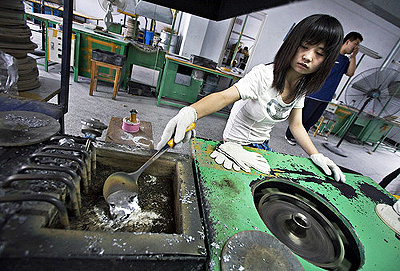
At a CJ Accessories factory in China, a worker on the production line spoons out metal. Despite a U.S. recall, children's jewelry made at CJ Accessories still contains lead and could be sold to multiple companies under different brand names. (Photo for the Tribune by Doug Kanter)
QINGDAO, China; Brightly colored children's bracelets and necklaces line the display case of a Chinese manufacturer in this factory town. Adorned with mini school buses, sandals and other charms, the jewelry sits ready to be sold to foreign and domestic buyers. It also contains lead.
While the U.S. government in July issued a recall for similar items, branded as Essentials for Kids, officials at the factory said they knew nothing of it. And because the CJ Accessories factory sells the jewelry to different companies with different brands, identical lead-tainted products could be on store shelves under other names.
The scene illustrated just one of many factors that undermine efforts to prevent unsafe goods from reaching U.S. shores, even after a dangerous product has been identified.
Three decades after the federal government significantly toughened regulations on lead in children's products, American companies have yet to find a way to successfully screen the flood of imported products for the toxic metal.
The federal watchdog charged with ensuring they do so is overwhelmed and often ineffective. And the growing list of lead recalls of children's products underscores how the metal, slathered on with paint or mixed in with other raw materials, is more pervasive than many American consumers ever imagined.
Mattel Inc. sent parents scurrying for the toy box last week with the recall of nearly 1 million Fisher-Price-brand Elmo, Big Bird and Dora products. Before that it was 1.5 million Thomas & Friends wooden railway cars. And not long before that, it was 2,000 pieces of Land of Nod children's furniture, as well as hundreds of cribs and about 3,000 toy-storage chests from Delta Enterprise Corp., which calls itself the nation's largest seller of cribs.
But the recall by toy giant Mattel raised the issue to a new and unsettling level, in part because of the company's good reputation for quality control. It remains unclear how lead found its way into Mattel's popular toys. And that is causing both fear and frustration from playrooms to boardrooms.
"I don't think we understand yet what needs to be done," said Carter Keithley, president of the Toy Industry Association.
The number of product recalls for lead is growing as imports surge, especially from China. A Tribune analysis of data from the Consumer Product Safety Commission, which oversees such recalls, shows that while there have been 135 recalls for lead content since 1977, a total of 70 of them, or 52 percent, have occurred since January 2004. Of those, 46 were for lead metal and 24 were for lead paint.
One study by chemists at Ashland University in Ohio tested Chinese-made jewelry from 10 retail chains and discovered that the average lead content far exceeded the federal limit.
The question arises: Are more products being made with lead or are consumers, companies and regulators simply looking more closely? That is difficult to answer, but some experts believe it is mainly a result of the increased scrutiny prompted by a huge jewelry recall in July 2004. The safety commission recalled 150 million pieces of children's jewelry imported from India and sold in vending machines.
"The activists have sunk their teeth into this one, and the CPSC has responded to the pressure," said Christian Warren, historian at the New York Academy of Medicine and author of a book on the history of lead poisoning. "We are more vigilant... The question is how to get primary prevention. How do we beef up surveillance? That's a thorny question where it's so easy to change the manufacturing process on the fly."
How the system breaks down
The countries where America's toys are made also are places where paint often still contains dangerously high levels of lead.
Scott Clark, a University of Cincinnati environmental health professor, and his research team tested a variety of brands of paints from China, Malaysia and India, and found that more than 75 percent of the samples had lead levels exceeding U.S. regulations. Lead is added to paint to make it lustrous and durable. Because of lax manufacturing and safety standards in overseas plants, it sometimes is applied to toys imported into the U.S.
In countries where products are made for consumption in the U.S. and the developing world, lead can easily bleed over from one batch of products to the other, according to Warren. It might be as simple as a worker not cleaning out a production vessel thoroughly enough between batches.
The system breaks down in other ways as well.
The Consumer Product Safety Commission has trouble even contacting foreign factories to let them know their products are recalled. Typically, the agency sends letters in English and Chinese or e-mail to the foreign factory. But CPSC spokeswoman Julie Vallese said the agency sometimes can't find companies' contact information.
Further, the agency takes no steps to track how many manufacturers it reaches successfully or whether foreign factories continue to export the goods to the U.S.
Rare visits by a reporter to two Chinese factories that produced recalled jewelry found no evidence that U.S. recalls made an impact.
"We haven't received any information. I would know about it," said Li Huanpeng, manager of the Weiyi Metal Ornament factory in the southeastern city of Dongguan, which produced some of the 100,000 pieces of children's jewelry recalled by Ohio-based Tween Brands in May.
Weiyi Metal disputed the Tween Brands and safety commission finding that the products in question contained lead. Li, the manager, said they do not ship products containing lead to the U.S.
Inside Weiyi's showroom, the company still prominently displays goods similar to the ones in the recall, including shiny pendants and bracelets emblazoned with the stars of Disney's made-for-TV hit "High School Musical."
The recalled trinkets, which had been selling at Limited Too and Justice stores for $2 to $10, were found to carry doses of lead "toxic if ingested by young children," according to the CPSC notice.
Tween Brands said it no longer uses the factory.
"We detected the problem ourselves through our own independent testing, but there are innumerable mom-and-pop shops who might still have goods like these on their shelves," said Bob Atkinson, vice president of investor relations for Tween Brands.
Another problem for consumers is that, although one might expect a U.S. importer to alert its Chinese manufacturer in case of a recall, that doesn't always happen.
For instance, Future Industries of Cliffwood Beach, N.J., and the safety commission last month jointly recalled 20,000 items made by CJ Accessories because of high lead content. But Future Industries owner Morey Serouya said he did not need to alert the Chinese manufacturer because while the product violated U.S. regulations on lead, it did not violate their contract, which had not specified limits on lead.
Serouya, who said he has stopped using CJ Accessories, wondered whether the same items are being sold in the U.S. and abroad despite the recall because numerous American companies might buy from the same overseas factory. "There are probably 10 or 15 importers in the U.S. that might have bought the same product from the same place [and then] marketed it with different packaging," he said.
Vallese said the safety commission is trying to tighten the recall system and needs more help from China and other governments to police factories found to be making unsafe goods. "There is a responsibility on their end to address those issues that are happening within their borders," she said.
But critics say the safety commission has failed to take steps that could prevent recalled goods from returning to the market. For instance, the commission typically does not disclose the names of factories when an American manufacturer's goods are recalled.
Vallese said that if there is a request to publicly release a name, the companies have 30 days to file an objection -- and most object, primarily for competitive reasons. The names are submitted to the CPSC, but on a confidential basis, she said. With last week's Mattel recall, she said the company provided the name of the manufacturer but, "as the CPSC has an open and active investigation, that information is not available to the public."
Such secrecy protects manufacturers instead of consumers, said Illinois Atty. Gen. Lisa Madigan, whose office has investigated dangerous children's products. Publicizing the names of offending factories could help U.S. companies avoid a manufacturer with a history of recalls, she said.
"The CPSC has to do a better job of making sure that U.S. retailers and importers and distributors know that, 'Look, there is a problem at this manufacturer, make sure that you don't have a problem there,'" Madigan said. "It's basic. It's common sense."
'Still a missing piece'
Democrats in Congress, led by Sen. Dick Durbin (D-Ill.), have introduced legislation aimed at bolstering the CPSC's enforcement powers and resources. But Durbin acknowledged that government regulation is not the complete answer.
"I have a friend, a major businessman who imports from China," Durbin said in a telephone interview Friday. "I asked him how he handled this, and he said, 'First, do your best to know who you are dealing with. But with all the safeguards, you will never know if that vat of paint has lead in it until it is too late.'"
Keithley said the toy association "very much supports" the efforts on Capitol Hill and wants to help develop industry protocols for the frequency and intensity of product testing.
But he also said with dismay that Mattel already was doing much of what Durbin is proposing and was well ahead of most companies in terms of testing, certifying and labeling products coming from China.
"I suspect what we're learning is that there's still a missing piece" when it comes to defining what needs to be done to protect U.S. consumers, Keithley said.
Experts in both lead poisoning and manufacturing advocate increased testing and inspections of suppliers' factories. "What is most needed is better diligence on suppliers and subsuppliers, including... surprise audits or inspections by qualified people who know the environment in China, the tricks that are played," Dane Chamorro, regional director in Shanghai of Control Risks, a global consulting company, wrote in an e-mail.
He said it is not uncommon for suppliers to provide excellent samples of raw materials to obtain a contract, but then to later substitute substandard materials to increase profit margins. "Once they rope you in, they can cut back," he wrote. "And a lot of Chinese companies will do anything to cut costs."
Similar problems extend deep into the Chinese supply chain, where it can become even harder to monitor quality.
Spencer Hutchens, a risk-management expert at RAM Consulting, a unit of global testing company Intertek Group PLC, said suppliers often have little patience for or knowledge of U.S. regulations. "I think the basic problem in China is an inability to develop good manufacturing processes and adhere to them," Hutchens said.
In the U.S., the economics are driven by constant pressure for low prices.
"A lot of people don't realize the price of toys has gone down probably 100-fold," said Conrad Winkler, a principal in the Chicago office of consulting firm Booz Allen Hamilton. "That creates cheap toys but also pressure to use cheaper raw materials like lead paint."
Some experts now predict that the embarrassing recalls will create new pressures -- this time for better oversight. The cost of recalls and adverse consumer reaction could force the industry to police itself more vigilantly.
In late 2006, The Land of Nod, based in Northbrook, Ill., announced a voluntary recall of 2,000 pieces of Mexican-made children's furniture because they were covered in lead paint.
The company has declined to name the maker of that furniture. But it did say in a statement that it is no longer buying products from the manufacturer.
Because of this recall, the company said, it has stepped up quality control. For instance, "products are tested for lead before each initial order ships."
In an effort to pressure vendors into paying more attention, Illinois and California have passed laws that penalize anyone who manufactures, ships or sells lead-tainted children's jewelry. The Illinois law goes into effect in January. The safety commission has proposed a similar regulation nationwide, but it has not yet been approved.
Rumors of tougher enforcement have started to filter back to CJ Accessories, one of scores of small Korean-owned costume-jewelry makers in Qingdao, on China's coast. The factory, formerly known as Choice Inc., has 130 workers and sends 90 percent of its products to the U.S., said deputy manager Cho Jung Yeon.
On a recent afternoon, teams of young women sat hunched over tables, producing the same small silver-colored snowman earrings that had been recalled by Future Industries. Cho said the factory makes the snowman earrings the same way it did before the recall, using a range of metals including lead. The factory can produce unleaded jewelry if a customer requests, he added.
If the U.S. clamps down, Cho said, his company will focus on sending products to other countries.
"Our new target [markets] are Mexico and Brazil," he said.
© 2007 Chicago Tribune
They're meant to protect our most precious cargo, but limited oversight and testing leave potential dangers
By Patricia Callahan
Tribune staff reporter
Most parents never noticed the plastic notch in the popular Cosco Touriva child car seat unless they peeked beneath the cloth cover.
But an Oregon trauma nurse found it while trying to figure out what caused an 18-month-old girl's skull fracture in a low-speed crash. She warned the company of the potential hazard of a small head hitting the edge of this hard, hidden indentation. A Texas family made a similar link, suing the manufacturer after their daughter suffered brain damage in a crash.
Eventually, one of the company's own engineers would label the indentation a "child safety concern."
Yet Dorel Industries sold hundreds of thousands of Tourivas before removing the notch from all versions of the seat in 2005, five years after the nurse alerted the company. Among those buyers were at least two more families who now allege the notch injured or killed their children during crashes.
A Tribune examination of child car seats in America shows how the vital task of making a safe product can clash with the realities of the marketplace.
Car-seat makers enjoy a rare advantage among companies. Theirs is the one children's product every parent, by law, must use. And many parents assume all seats are equally safe, so they choose based on what fits their budget or matches their car's interior.
But the willingness of some executives to dismiss warnings about potential hazards means parents can buy a car seat without knowing all the risks. At the same time, regulators have left consumers in the dark by failing to develop safety ratings for seats or significantly toughen crash tests.
As a result, the device designed to protect the most vulnerable passengers in a car is tested by the government in fewer crash scenarios than the car itself or its seat belts.
Regulation of car-seat manufacturers largely boils down to self-reporting. A car seat can break into pieces during crash tests, the Tribune found, and its maker doesn't have to report those results if the tests fell outside the narrow parameters of the government standard.
By examining the test reports of some of the largest car-seat makers, internal company documents, depositions and public records, the paper gained rare insight into the inner workings of the industry--and to decisions that can compromise safety.
An e-mail in the files of Dorel, the largest manufacturer of car seats in the U.S., shows that a marketer once asked a colleague why their company continued to recommend a particular model despite concerns it was a danger to smaller children. "Why?" he responded. "It still sells."
Car seats save lives, and their widespread use is rightly considered a public safety triumph. Motor-vehicle accidents are the leading cause of death for young children, and the federal government estimates that buckling kids into proper child restraints cuts deaths and serious injuries in half. Even the best-designed seats, though, can't always save a child in the worst wreck.
"No product is more effective at reducing fatalities and injuries to children," according to the Juvenile Product Manufacturers Association, a trade group.
At Dorel's car-seat factory in Columbus, Ind., letters from families who credit the firm's seats with saving their children's lives cover a wall.
"The company is not motivated by trying to make a dollar at the expense of safety," said Dorel General Counsel Bruce Weisenthal. Dorel says none of the models mentioned in this article was flawed and that the notch it was warned about never posed a safety hazard.
In 2005, 236 children died and roughly 33,000 were injured while strapped into their safety seats during crashes. It's impossible to say how many children's deaths were due to the seats failing: The first responders to crashes often don't try to determine if a car seat malfunctioned when a child is killed or severely injured.
The head of the National Highway Traffic Safety Administration, which regulates car seats, stressed that they are a very effective product but that testing needs to be improved. Nicole Nason, who has two children in car seats, said she is committed to adding side-impact tests for car seats and would like to see the speed of frontal crash tests increased from 30 to 35 miles per hour.
"The companies will resist mightily," she said, "but that doesn't mean we shouldn't do it."
One of Nason's predecessors, Dr. Ricardo Martinez, has been especially critical of car-seat makers. "It was very clear that the culture in that industry was to meet the standard, not to exceed" it, said Martinez, NHTSA's administrator under President Bill Clinton.
Martinez noted that the federal standard for car seats is so narrowly defined that seats passing the toughest of the tests--simulating a front-end collision at 30 miles per hour--can have serious problems at just a few miles an hour more and yet still meet the standard. "We had seats where, if you turned [the test sled] up 5 miles an hour, the seat would disintegrate,'' he said.
Some car-seat makers don't even like the word "safety" to describe their product. In the early 1990s, when federal regulators proposed changing the term for car seats from "child restraint systems" to "child safety seats," some manufacturers protested.
Worried about possible lawsuits and the potential to "erroneously increase consumer expectations," an attorney for car seat giant Evenflo Co. wrote to regulators: "It is unfair to create the impression that such devices provide safety."
Based on such comments, the agency decided not to change the name.
'A right to know'
Strip away the fabric covers, and nearly all child car seats are plastic shells. Those shells, combined with the straps or shields that restrain children, are designed to redistribute the forces of a crash to protect kids.
Parents might assume car seats offer protection in all kinds of accidents, but the seats must only meet a standard for head-on crashes.
To check compliance, NHTSA each year tests about 100 models it buys off store shelves. While the government tests new vehicles in side-impact, head-on and rollover scenarios, it only subjects child car seats to frontal tests under laboratory-controlled conditions. Yet side-impact collisions are especially dangerous for children because studies show such crashes are more likely to result in dire injuries at lower speeds than head-on collisions.
Defending current regulations and practices, the juvenile products trade group says the crash test is more severe than 98 percent of real-life frontal accidents in the U.S. But concerns date back nearly a decade that meeting the government standard is not enough.
In a 1999 letter criticizing car-seat manufacturers, Martinez, the NHTSA administrator at the time, wrote: "With the safety of our nation's children at issue, mere compliance with the minimum requirements of the standard is not enough."
To spur manufacturers to go beyond the minimum and make safer seats, Martinez argued that the government should rate child seats the way it rates the safety of cars and trucks. That, he said, would persuade makers to invest in improving their products because some consumers would pay more for a highly rated car seat.
In 2005, long after Martinez had left NHTSA, the agency announced it wouldn't implement such a rating system, in part because it was hard to draw meaningful comparisons for consumers. For instance, when NHTSA put child restraints in the back seats of new cars in crash tests, the agency found it difficult to sort out whether the performance differences were due to the car seats or the vehicles.
NHTSA said more research was needed, and the agency continues to consider such a safety rating system. "Parents should have a right to know how well the seats were made," Martinez said in a recent interview. Speaking generally about the industry, Martinez said some car-seat makers withheld unfavorable tests from the government. "What we found was that they'd run multiple tests. And the ones that passed they'd submit, and the ones that didn't they wouldn't submit. That's no way to guarantee safety."
Companies, he argued, "need to submit everything, not just their successes. We need to know about the failures too. There needs to be transparency."
Breaking into pieces
When Evenflo sought a recall of its On My Way infant seat in the summer of 1995, the company made a disclosure: Four of its own tests showed that children could cut or pinch themselves if they reached under the seat pad and touched a crack in the plastic shell.
Evenflo notified the government. It offered a free remedy to any customer who wanted to reinforce one of the nearly 200,000 seats it had sold.
But other tests in the company files stayed private. Those tests showed cracks far more troubling. In some, the plastic hooks that secured the On My Way to the seat belt broke into pieces, allowing the seat to fly off the testing bench with the baby-size dummy strapped in, according to footage Evenflo disclosed during litigation.
The company was not required to inform the government of those results because those tests were done on prototypes or on seats, Evenflo said, that were "evaluated under conditions different than those required" by the federal standard.
A court deposition from Evenflo's director of product safety, research and development, however, illustrated how the self-policing of child safety seats can keep regulators and consumers ill-informed about potential hazards.
"We were aware that in certain tests you could break the seat and it could actually come out from under the seat belt," the safety director, Randolph Kiser, said in the deposition taken for a lawsuit filed by a Montana family.
He dismissed the significance of some of the tests. One was performed at 30.8 miles per hour, Kiser said; the U.S. standard is 30 miles per hour. In some, Kiser said, the seats were reclined 10 to 12 degrees farther than in Evenflo's usual tests. In others, labs applied the Canadian safety standard, which is slightly different from the U.S. version.
Kiser was questioned by Evan Douthit, an attorney representing the family of 4-month-old Tyler Malcolm, who died in a 2000 highway accident in which his car seat broke loose from a seat belt and flew out of the vehicle. That seat was the On My Way, model 207, which was the next-generation version of the model 206, the one Evenflo had recalled as a pinch hazard.
Douthit asked Kiser: "Aren't the parents entitled to be told what the true risks are to the child so they can make the decision whether or not they want to use the seat with their child?"
Kiser responded that Evenflo told consumers "there's a crack" and that the flaw meant the seat didn't comply with federal requirements. "There's a million different things that could happen," he explained. "We can't possibly envision all of them."
The company denies the Malcolms' claim that its product is responsible for Tyler's death. Noting that he died in the later-model 207 On My Way, Evenflo said that model never failed any of the more than 300 tests performed under U.S. and Canadian standards at independent labs in the seven years it made the seat.
"We stand by the integrity and performance of the product," wrote Evenflo General Counsel Thomas Sparno.
Douthit, however, said test results that Evenflo has turned over showed that the model 207 seats cracked in a similar area, near the belt guides, as recently as 2001. It's unclear under what conditions those tests were performed.
The Malcolms' lawsuit is scheduled to go to trial this week, the seventh anniversary of the crash.
Because it sells
Even when seats fail NHTSA's own safety tests, the agency doesn't always take those models off the market. From 2003 through 2005, NHTSA did not recall seven of the 10 child safety seats that failed its crash tests.
Manufacturers are able to avoid recalls if they can convince the government that the failed tests don't match the companies' own results and are close enough to meet the standard.
In March 2005, for instance, Dorel's popular Eddie Bauer 3-in-1 and a related seat called the Cosco Alpha Omega 5-point allowed the head of a dummy proportioned like a 3-year-old to whip about an inch too far forward during NHTSA crash testing. Excessive forward movement can cause nerves in the spine to snap and lead to paralysis, or the child's head can hit something in the car, leading to head or spinal injuries.
Dorel attorneys said NHTSA performed the tests incorrectly. The agency denied that claim but said that after it reviewed Dorel's test results and complaint data, it concluded there wasn't a safety problem.
In a written statement, NHTSA said it is unaware of any safety issues that consumers had with any of the seats it chose not to recall after test failures. But five months after the Eddie Bauer 3-in-1 failed the agency's tests, the family of a Missouri child alleged that their 1-year-old daughter, Hailey Schmidt, became a quadriplegic when her head snapped too far forward in a January 2005 head-on crash involving an Eddie Bauer seat.
Dorel said it reported the Schmidt case to NHTSA later that year.
The company settled a lawsuit with Hailey's parents without admitting fault. Stores continue to sell versions of that seat and the related Alpha Omega. Explaining why the company settles such cases, Weisenthal, Dorel's general counsel, said it weighs the risks of lawsuits given the various liability laws around the country and sometimes settles "even if your product is 100 percent beyond reproach."
"The person in the lawsuit who is the most sympathetic,'' he added, "is the child."
One of the most controversial seat designs in the last two decades--one that led to numerous lawsuits as well as warnings from public health advocates--was the shield booster. The design fitted a child's abdomen between the car's seat back and a plastic shield but provided little upper-body restraint for smaller children.
While the car seat passed the U.S. government-mandated safety tests, smaller children were ejected in real-world crashes. Some children who weren't thrown from the seat were disabled in collisions when their spines stretched too far as their upper bodies curled over the shield.
Dorel has settled dozens of shield-booster lawsuits without admitting fault, according to Doug Gentile, a Kansas City attorney who has represented plaintiffs in three such suits. One of Gentile's Dorel shield-booster cases settled for $13 million, court records show.
Dorel sold the same shield booster with different warnings in two countries: It told Canadians the seat was safe only for children over 40 pounds while it x told U.S. consumers the seat was safe for children as light as 30 x pounds.
Attorneys for the company said Dorel was following Canadian government requirements and never believed the Cosco seat was unsafe for small children. They also point to an analysis done by a Dorel consultant who concluded that there were far fewer deaths from Dorel shield boosters than would be expected given the model's popularity.
But the American Academy of Pediatrics, which for years had raised concerns about shield boosters, unequivocally told parents in 1996 not to use them for children under 40 pounds.
By then, most other manufacturers of shield boosters had stopped making them. But Dorel launched a new model, the Grand Explorer. With little competition from comparably priced seats--the Grand Explorer cost less than $20 on sale at some big-box stores--Dorel sold more than 10 million shield boosters between 1985 and 2004, when it stopped making them.
Three years after the pediatricians' warning, a Dorel marketing executive was preparing for a presentation at a child safety seat conference.
"Why do we continue to recommend the Explorer, in particular, for children under 40 pounds?" she asked a Dorel product manager in an e-mail disclosed during a lawsuit. "Why wouldn't a 35-pound child be in a convertible car seat or a high back booster?" Those types of seats offer more upper-body protection.
"Why?" the product manager responded. "It still sells."
He added, "For the price, it is still an excellent product."
'A child safety concern'
An Oregon car crash in the spring of 2000 barely damaged the vehicles involved. No one was hurt during the broadside collision. No one except an 18-month-old girl. She suffered a skull fracture and bleeding in her brain even though the speed of the crash, according to a court deposition, was estimated at just 10 miles an hour.
The girl was airlifted to Emanuel Hospital in Portland, where the hospital's child safety seat coordinator, Diane Janzen, was stunned. How, the trauma nurse asked herself, could the toddler suffer such severe head injuries when she was properly strapped into her Cosco Touriva car seat?
Janzen decided to do some sleuthing.
Pulling back the fabric of the seat to reveal the plastic shell underneath, she found cutouts--2-inch-by-361/27-inch U-shaped notches with rigid plastic edges--on what normally would be the smooth plastic sides of the seat at the same level as the child's head.
After the girl recovered, Janzen asked the toddler's parents to place the girl, with bandages still on her head, in the seat. The rigid notch, Janzen concluded, was precisely where the girl's head hit the side of the seat. She snapped photos.
What followed Janzen's discovery reveals how the nation's largest car-seat maker reacted to warnings about safety flaws--even when those alarms came from inside the company.
The notch served no purpose in the model used by the Oregon family. It did in another model, and car-seat makers save money by using the same shell for multiple seat styles.
Photos in hand, Janzen explained her concerns about the notch to a senior engineer and a marketer at Dorel during a June 2000 car-seat conference in Texas. She suggested that Dorel eliminate the cutout or at least cover it with the kind of foam that lines bike helmets.
During a question-and-answer session at a workshop that same day, Janzen again raised her concerns about the Touriva notch. Richard Glover, the senior Dorel engineer, "said something to the effect of I was just a nurse and he was an engineer," Janzen recalled in a deposition as part of a lawsuit, "… and actually furthermore, he said, 'This is only one child.'."
Glover two months earlier had testified in a lawsuit in which a Texas family alleged that their daughter suffered brain damage after hitting her head on the notch of a Touriva.
Janzen followed up with a letter to Dorel's top car-seat executive--describing the Oregon toddler's injuries, the notch and Glover's response--and told the company she no longer would purchase Cosco seats for needy patients in her network of hospitals, according to her testimony.
She said no one from Dorel ever contacted her.
Glover did not return phone calls seeking comment. He said under oath in a different case that he did not believe the notch was a safety hazard but took Janzen's complaint seriously. The company began investigating ways to make the sides of the Touriva smooth, Glover testified.
The following year Dorel hired an engineering consultant to design a plastic cover for the notch. That consultant said under oath that a senior Dorel engineer told him the company wanted to cover the cutout because it could cause head injuries.
But Dorel never used that design, which would have cost the company 24 cents per seat, according to court depositions. The plastic notch cover wouldn't work because it popped off during crash tests, Glover said in his deposition.
Pressure to make the change continued to build. According to minutes from an April 2002 Dorel meeting, the product standards chief for its car-seat division said eliminating the notch "has to happen."
In September of that year, a Dorel engineer described the notch as "a child safety concern" in a document sent to at least one company vice president.
The Touriva was such a popular seat that three molds at Dorel's Indiana factory produced shells simultaneously. In 2001 alone, Dorel racked up nearly $25 million in Touriva sales. In order to fix all three Touriva molds at the same time, Dorel would have had to halt Touriva production for about eight weeks--a loss of roughly $4 million in sales, according to the deposition of a company engineer.
Instead, beginning in 2003, Dorel began changing the molds piecemeal. While it eliminated the notch from one mold, the factory's two other molds continued to make seats with the cutouts.
A Dorel engineer in 2003 expressed frustration with how Dorel management was making him change one mold at a time. "The more shells we have both ways, the more questions will be asked why some and not others," the engineer wrote in a memo.
As late as 2005, Dorel still made Tourivas with the hidden notches.
According to Weisenthal, the company's general counsel, the Dorel employees who raised questions about the cutout did not believe the notch was a safety concern. Rather, they were worried that plaintiffs' lawyers could use the existence of the notch to extract money from Dorel, he said, adding that the company eliminated the notch to "take a story off the table."
One such story unfolded in Kansas in 2002. In June of that year, Nubia Cardenas went to a Wal-Mart and bought a Touriva--a seat manufactured after Janzen warned Dorel about her patient's head injury, after the engineering consultant designed a cover for the notch and after a company executive said eliminating the notch had to happen.
Leeyiceth Reyna, Cardenas' 16-month-old daughter, suffered severe brain damage and other injuries during an October 2002 side-impact crash in Garden City, Kan. The family alleged that her head hit the hard plastic area around the notch, leaving her blind and unable to walk. Now 6 years old, Leeyiceth--who goes by Lily--depends on a feeding tube for sustenance.
Before the accident, she was learning both English and Spanish. Now her speech is limited to goo-goos and gah-gahs. "It's pretty much like taking care of a baby," said her mother, "except she's big." An expert hired by Dorel in Lily's case concluded that the child's seat was improperly installed and the accident severe. He ran crash tests that concluded the Touriva performed better than a seat touted by an expert on Lily's side.
Still, Dorel settled her case and another notch case for confidential amounts without admitting fault. "When millions of units of a particular product are in use over many years, and you have only a small handful of reported injuries, you must ask yourselves whether those injuries should be attributed to the design of the unit or to the unique circumstances of the accident," Wally Greenough, a Chicago attorney hired by Dorel, said in an e-mail.
On a recent morning, as Lily's kindergarten classmates sang a song about the days of the week, Lily rocked back and forth but remained silent.
Occasionally she turned her head sideways as if glancing at visitors to the classroom, her eyes vacant.
Tribune staff reporters Maurice Possley and Steve Mills contributed to this report.
© 2007 Chicago Tribune
By Maurice Possley
Tribune staff reporter
The federal government brands magnets in toys a deadly hazard to children because the tiny, powerful objects can fall out and cause serious, even fatal, internal injuries when swallowed.
Yet the Consumer Product Safety Commission has not taken steps to regulate even more powerful magnets when they are sold in loose form as backings on children's earrings, the Tribune has found.
The earrings consist of a small decorative part -- such as a cupcake, a faux diamond, a dolphin -- with a magnet inside. They are held in place by putting a loose magnet behind the earlobe.
Independent tests of more than a dozen magnetic earrings done for the Tribune showed that the earring magnets all were at least as powerful as magnets found inside toys that have caused the death of one child and scores of other injuries. Some of the magnetic earrings were more than five times more powerful.
But because the earrings are not considered toys, new regulations for magnets do not apply. If they did, the jewelry could not be legally sold, according to a CPSC spokesman, Scott Wolfson.
The Tribune found reports of more than two dozen instances in the U.S. and Europe in recent years where magnets from earrings have been swallowed, aspirated into the lungs or become stuck together on either side of a child's nose cartilage. Those youngsters had used the earrings to mimic nose, tongue and even navel piercings.
Most of these injuries did not result in hospitalizations. But, given the precedent of serious injuries caused by magnets in toys, some leading physicians are wondering why the CPSC is not taking action anyway.
"It's clear what the risks of magnets are," said Dr. Garry Gardner, a physician from suburban Darien who is chairman of the American Academy of Pediatrics' committee on injury, violence and poison prevention. "I don't care whether they call it a toy or not, these are still a risk. Any magnet that can be aspirated or swallowed is dangerous."
But the CPSC says it has not received enough reports of injuries linked to magnets in jewelry to warrant further action at this time. The agency's national injury database shows there were seven such incidents from 2002 to 2004 and none in the following two years. (Data for 2007 are unavailable.) One incident in 2003 required the child, a 2-year-old boy, to be hospitalized.
"The number of incidents compared to the number of products is very low," said Julie Vallese, spokeswoman for the CPSC. "The known risk has not risen to a substantial product hazard."
But even a toy industry official expressed concern about the jewelry.
"We should not have to wait for catastrophic incidents to address it," said Arthur Kazianis, vice president of quality assurance for Hasbro Inc. and the head of a private panel that is developing standards for magnets in toys.
For years the CPSC had received reports of children injured after swallowing magnets that fell out of toys, but not until a child died in 2005 after ingesting magnets from a Magnetix building set did the agency move to recall the product and push for tougher standards. Following a Tribune investigation of Magnetix and the agency's slow response, published in May, the CPSC expanded its recall and in August added magnets as No. 1 on its list of top five "home hazards." Its news release noted that such magnets "can be very small and powerful making them popular in toys, building sets, and jewelry." But that's as far as the agency has gone to address magnetic jewelry.
In that release, the CPSC also noted that injuries from ingesting magnets are "hard to diagnose. Parents and physicians may think that the materials will pass through the child without consequence, but magnets can attract in the body and twist or pinch the intestines, causing holes, blockages, infection, and death, if not treated properly and promptly."
Doctor: 'It is a hazard'
Dr. Marsha Kay, a pediatric gastroenterologist at The Cleveland Clinic who has written about the dangers of magnets, said she considers magnetic earrings to be as big a threat to child safety as magnets in toys.
"These things are marketed for kids, and it is a hazard," she said. "How many kids have to get hurt before someone pays attention to it?"
Just as with magnetic toys, Kay said, a danger is that older children will play with the product and leave behind magnets that younger children can swallow.
A new industry standard taking effect next month calls for warning labels on toys that include magnets and are small enough to be swallowed. Already, many magnetic toys include warnings about the danger of internal injuries. In addition, the new standard requires all toys with magnets to undergo tests to ensure the magnets won't fall out with regular use.
The new standard does not apply to magnetic jewelry, even if it is marketed to children.
"Magnetic jewelry has come up and we have talked about it, but our commission is focused on toys," Kazianis said. "A toy has play value. A piece of jewelry does not. It appears to fall through the cracks.
"It's possible that the jewelry industry could follow our standards for toys," he added. "I have repeatedly stated we need to figure out a way to communicate to them."
Michael Gale, spokesman for the Fashion Jewelry Trade Association, said he did not believe magnetic jewelry is dangerous.
"Anything that could affect the safety of children is a concern to the fashion jewelry industry," he said. "I am not aware of any cases of magnets associated with jewelry" causing any injuries.
The new magnetic toy standard applies to magnets that have a "flux index," the measure of its power, of 50 and higher.
The Tribune asked Joe DiMarco, an engineering physicist at the Fermi National Accelerator Laboratory in Batavia, to test the magnetic earrings as well as the type of Magnetix toys blamed for the death of Kenny Sweet on Thanksgiving Day 2005.
The tests showed the magnets from a Magnetix toy had a flux index of just above 50. The tests of the magnetic earrings showed a flux index on all of them above 50, and most were above 100 -- more than twice as powerful as the Magnetix.
Magnetic earrings sold by Schylling, a Massachusetts toy firm, had a flux index of more than 100, the Fermi tests found. The magnetic earrings carry a choking warning for children under age 3, but no other warnings. The earring packaging states that they are for ages "5+."
Schylling did not return telephone calls.
Earrings sold by Claire's also tested well above the toy standard of 50 and in one case was more than five times higher than the toy standard. Claire's did not return calls seeking comment.
DiMarco noted that the flux index increases when more than two magnets get stuck together. "If you combine more than a couple of these together, you could easily get something much worse."
One brand, Magna Stud, sold by BeWild.com, carries a warning against use by anyone under age 13 and warns specifically that the jewelry poses "an inhalation and aspiration hazard. ...Keep out of reach of infants." The jewelry also warns against wearing more than one magnet in the nose.
Brian Cohen, owner of BeWild.com, said he had never noticed the warning until the Tribune brought it to his attention. "Somebody wanted to make sure nobody got injured," he said. "Anything small like this should be kept away from kids, and magnets make it worse."
Complaints to the CPSC about magnetic jewelry include one incident that sent a 2-yar-old boy to the hospital after swallowing a magnetic earring. Other incidents involved boys and girls ranging from 8 to 13 years old. One 13-year-old boy used magnet jewelry to mimic a tongue piercing and swallowed the magnet. A 13-year-old girl "sniffed magnet earring backs into nose," according to the agency's database.
Dangerous inside nose
Dr. Anthony Magit, a pediatric otolaryngologist in California, described how quickly a child can be injured.
"The magnets are fairly strong and instead of just holding the earrings on the outside of both sides of the nose, they pull together and get embedded in the septum and they can't get them out," he said. "It can happen in a day. The magnets burrow into the septum and cannot be pulled apart. They are so strong, you have to take them to the hospital to get them removed.
"There needs to be a warning."
The CPSC was informed earlier this year of the medical community's concerns about magnets -- in toys as well as jewelry -- when Dr. Alan Oestreich, a pediatric radiologist at Cincinnati Children's Hospital Medical Center, addressed an agency symposium.
"I emphasized that it was not just magnetic toys, but magnets in jewelry," he said in an interview. "I think people should be informed that this is a danger."
Doctors aren't the only ones pressing the CPSC to take further action. When U.S. PIRG, a federation of state public-interest research groups, issued its 2007 toy safety report in November, some magnetic earrings were on its list of dangerous products.
"Our contention is that magnetic jewelry poses the same hazard to children as magnetic toys," said Edmund Mierzwinski, consumer program director and author of the report. "Just because something is not a toy does not mean it's not a hazard. If it's cheap children's jewelry, it's a hazard."
That also is the conclusion of at least one retailer. In the pre-Christmas rush in 2006, Diana Nelson, owner of Kazoo & Co., a Denver toy store, enthusiastically sold magnetic jewelry, telling an industry publication that magnetic earrings were a top-selling item.
A year later, after becoming aware of the dangers of magnets in toys, Nelson has concluded that magnetic jewelry should not be sold to children.
"We sold a lot of them, but when we sold out, I decided I wouldn't order them again," she said in a recent interview. "They shouldn't be anywhere near little ones."
© 2007 Chicago Tribune