Newsday, by Staff
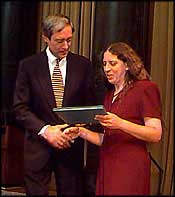
Columbia University President, George Rupp (left), presents Miriam Pawel with the 1997 Pulitzer Prize for Spot News Reporting.
Winning Work
Coast Guard says no survivors are found
By Philip Dioniato
A TWA jetliner bound for Paris with 229 people aboard exploded in midair last night just after taking off from Kennedy Airport and plunged into the Atlantic Ocean south of Moriches Inlet, and the Coast Guard said no survivors had been found.
Trans World Airlines Flight 800 had climbed to approximately 13,800 feet when federal aviation officials lost radar contact with the Boeing 747-100 about 8:45 p.m., just as witnesses on the South Shore reported seeing a bright fireball light up the darkening sky.
I looked at the bay and saw a reflection on the water, then I looked up and I saw a big orange fire ball falling into the ocean, said Robert Siriani, who was outside his parents' home in Mastic Beach. I'd say it was one hundred feet wide and a couple of hundred feet long, the whole thing was flames, the flames were so bright I didn't see anything else.
The flaming wreckage then plummeted into the dark waters about 9 1/2 miles south of the Suffolk shore, triggering a massive search over five square miles of debris in the open ocean.
Bodies are being recovered. There are no signs of survivors at all, said Chief Petty Officer John Chindblom of the Coast Guard office in Moriches. Professional and volunteer rescuers found mostly body parts strewn among the torn seat cushions and mangled metal.
At the Coast Guard base in East Moriches, rescue workers -- armed with latex gloves and body bags -- began bringing in the bodies of the dead. A police official said that a boat with about 20 bodies sat outside the inlet, which was too narrow for it to enter. Workers transferred the bodies -- many of which were burned and not whole -- into smaller boats, which brought the dead to the shore.
At Kennedy Airport, frantic family members were scrambling for information and searching for solace. Jose Fermin of Brooklyn was running around, trying to find out if there was any chance his brother, Alberto, might be alive.My mother wanted to come with me, he said. She's crying and crying.
Alberto Fermin of Manhattan had been working two jobs, saving money for his long-dreamed-of vacation to France as a 28th birthday present to himself.I didn't see him very often because he was working almost seven days a week, said his sister, Maria, while waiting for news at her mother's Brooklyn home. He had been saving money for this vacation.
The cause of the crash was still not known last night, and officials cautioned against jumping to conclusions. Speculation focused on the possibility of a terrorist attack two days before the opening of the Olympic Games in Atlanta.
A top Clinton administration official said late last night that no warnings were received from any group, and there is no evidence at this point that the attack was from a terrorist bomb. But James Kallstrom of the Federal Bureau of Investigation's New York office announced at 1:25 a.m. that the bureau is taking over the investigation under the aegis of its joint terrorism task force with the New York Police Department.
Sources familiar with the investigation said agents are poring over the passenger manifest to see if there were any suspicious people or potential terrorist targets on the plane, and questioning pilots who were flying nearby at the time. In addition, agents were contacting informants -- everybody we know -- around the world to see if they have any information on threats against TWA or U.S. citizens.
In addition, U.S. Transportation Secretary Frederico Pena and FAA Administrator David Hinson are expected to arrive at Long Island-MacArthur Airport in Islip this morning at 7 to help withthe investigation. And the federal Bureau of Alcohol, Tobacco and Firearms, which has expertise in explosives, was sending agents to help in the investigation, said John Pitta, the head of the ATF Long Island office.
Officials with the Federal Aviation Administration said the plane had arrived in New York from Athens as Flight 881 about three hours before it left for Paris. The plane was a 747-100, which has been flying since the 1970s and is the oldest series of the model flying, according to officials.
TWA said the plane was bound for Charles de Gaulle Airport outside Paris with 212 passengers, 14 flight attendants and three pilots. The passengers included some who had been scheduled to leave for Rome on an earlier flight that had been canceled.
Avrohom Hakeller of Crown Heights, Brooklyn, came to Kennedy Airport because his friend, Joseph Cohen, was on the flight.
I was driving in the car and then over the radio I heard the news, Hakeller said. My reaction when they said the flight number was that I was just shocked.
Cohen, 29, of Flatbush, was a science student who was traveling to Paris on vacation until September, Hakeller said.
Kennedy officials brought the families of relatives on a bus into the Ambassador Club in Terminal 5 to talk to TWA officials and chaplains.
James Devine, the Kennedy airport chaplain, said the airline was putting the families at a hotel overnight but was not able to tell them whether their friends and relatives were on board. They haven't told them anything as yet, he said shortly after midnight.
Rabbi Alvin Poplack, the Jewish chaplain at the airport, said, Some were in really bad shape, but others were hopeful. You can imagine what kind of questions they're asking.
Robert Wingate, spokesman for the American Red Cross, said the agency has mental health counselors coming in from around the country. Some were already talking to the 40 to 50 family members at the terminal last night and early this morning.
Information available to families and friends in France, where the flight was due to arrive at 8:15 a.m. local time, was sketchy. But the airline later set up an information center at the French airport, north of Paris.
The extensive search began immediately after the first reports of the explosion. State Air National Guard aircraft on maneuvers off of Moriches Inlet spotted the explosion, and the Coast Guard immediately launched a search that grew to 40 to 50 boats, including some pleasure craft, as well as six helicopters.
Other agencies also responded, including a New York City Police Department helicopter and the Air National Guard. About six Suffolk County Police boats were also searching the area. Coast Guard Lt. John Heller just after midnight said that four other large cutters that had been on fisheries patrol off New England were en route along with additional small patrol boats from the Long Island stations.
We've recovered bodies and debris but not survivors, Heller said. He said crews of the helicopters were using night-vision goggles to help spot bodies or debris. The winds and visibility are good for a search, Heller said.
In East Moriches, the hundreds of tense rescuers began turning their attention to finding enough refrigerated trucks to hold the mounting number of corpses.
The initial morgue was set up in East Moriches but was scheduled to be moved to Hangar B at the Air National Guard base in Westhampton. Coast Guard officials said that any survivor in the water could last more than 12 hours before hypothermia would set in.
Whatever this explosion was, the debris was what you would pick up with a sink strainer, said Capt. Chris Baur, a helicopter pilot with the Air National Guard's 106th Rescue Wing in Westhampton who was on a training mission, saw the explosion directly in front of him and was the first rescue person to arrive.
Heller said a C-130 patrol plane would join the search at first light. The Coast Guard had set up security zones to keep unofficial aircraft and vessels away from the search area.
Suffolk officials sent deputy sheriffs, town and village police and military personnel in 30 to 40 four-wheel-drive vehicles intended to patrol the beach near the crash site today to discourage sightseers and to watch for bodies. Suffolk also sent flood maps to the command center so workers can figure where the tides are most likely to wash bodies up.
Everything is part of a potential crime scene, said Suffolk County Executive Robert Gaffney. I'd hate to think that anyone might pick up a piece of evidence.
National, state and local officials responded with reassurances of an ongoing search. The president was informed about the reports we were getting shortly before 10 p.m., White House spokesman Mike McCurry said. He is deeply concerned.
State officials said the State Police and the state Emergency Management Office had also been activated to respond to the crash and Gov. George Pataki, who was in New York City yesterday, was staying in touch with emergency officials and would be going to the scene today.
New York City Mayor Rudolph Giuliani said, "The mood at the rescue site is very serious and very somber. They have recovered bodies and they are bringing them back to shore."
The explosion startled many onlookers, who were unsure what to make of the small flash of light, followed by a large explosion and then a trail of flame plunging to the sea. But a former National Transportation Safety Board official said the sequence may not be meaningful.
The official, Ira Furman, said the fireball cited by witnesses could just be an engine flameout that followed another problem -- a symptom, not a cause, he said. Such an explosion could also have ignited the aircraft's fuel but would still give no clue to the initial problem with the airplane.
Of a bomb or mid-air collision, he said, I don't believe either is the first thing to come to mind.
About the Plane:
Manufacturer: Boeing
Wing span: 195 ft. 8 in.
Length: 231 ft. 10 in.
Max. seating: 490
Cruising speed: 589 mph.
Hotline for Information: A toll-free number has been released for relatives seeking information about passengers on TWA Flight 800. It is (800) 438-9892.
This story was reported by Deborah Barfield, Bill Bleyer, Rick Brand, Tom Demoretcky, Emi Endo, Martin Evans, Mitchell Freedman, Isaac Guzman, Robert E. Kessler, Jessica Kowal, Bill Mason, Molly McCarthy, Nora McCarthy, Phil Mintz, Samson Mulugeta, Soraya Sarhaddi Nelson, Joe Queen, Jordan Rau, Mike Santangelo, Lauren Terrazzano, Robin Topping, Steve Wick and Ellen Yan, and written by Liam Pleven.
© 1996, Newsday
Probers focus on possibility of bomb or missile; toll at 230
By Newsday Staff
The swiftness of the jumbo jet's mid-air destruction, the broad swath of the Atlantic Ocean littered by debris and the absence of an emergency call for help has led investigators to focus on the possibility that TWA Flight 800 was knocked from the sky by terrorists.
Even as they cautioned against premature conclusions, federal, state and local investigators were exploring every scenario from whether a bomb exploded in the plane to whether a missile fired from the ground picked it from the air. If confirmed, it would be the deadliest terrorist attack in American territory ever.
But the prospect of a catastrophic mechanical failure also remained. Evidence culled from the gruesome retrieval of more than 100 bodies and wreckage from the waters off the South Shore also puzzled investigators because initial inspections turned up no telltale signs of shrapnel or powder.
All that was clear was that all 230 people on board the Boeing 747 bound for Paris perished in the explosion or by drowning in the water below, spreading grief among friends and family across at least two continents.
"It's just a senseless waste of two people," said Richard Hammer of Long Beach, whose wife, Beverly, 59, and daughter, Tracy Anne, 29, were on the flight. "You can't make sense out of it. You take two people at the top of their game and literally wipe them out. I'm stunned."
Stunned too were officials at all levels of government. For part of the day, the National Transportation Safety Board and the Federal Bureau of Investigation struggled for control of the case, and New York City Mayor Rudolph Giuliani wrangled with TWA officials. Gov. George Pataki flew over the crash site and later hugged victims' families, then said, "It's the worst thing I've ever seen."
On a placid summer sea, meanwhile, a small navy of boats dispatched by federal and local authorities continued throughout the day and into the night the grisly task of filtering the wreckage and human remains still floating in the water.
As debris drifted slowly east with the current, divers had to pick through everything from a red TWA flight bag to a child's purple backpack emblazoned with Barney the Dinosaur. Investigators were using radio waves to seek the plane's "black box," which could indicate if an explosion ignited the fireball.
The Coast Guard was able to recover plane debris ranging from hundreds of small parts to a 30-foot piece of the wing, which could prove critical, officials and aviation experts said, because the markings on the metal could confirm whether the plane was blown up, and if so, with what type of bomb.
The pieces were being brought to the former Grumman facility in Calverton for examination. Experts who helped collect evidence after a ValuJet plane went down in the Everglades May 11 and after a Pan Am flight was blown up over Lockerbie, Scotland, in December, 1988, were brought in to help with the search.
Government officials, both civil and criminal, said they were seriously examining the possibility that a missile struck the plane, because of an apparent blip on the screen before the explosion. The blip, if not a meaningless shadow, could conform to what some investigators said were accounts of a flash rising from the surface before the blast.
But electronic clutter on the tapes is making a determination difficult, the officials said. And the plane was believed to be outside the range of most shoulder-launched missiles. As one intelligence official said, "We can't rule anything out at this point. But the missile wouldn't be all the way up there on the probability list."
White House press secretary Mike McCurry said investigators were "trying to clarify any abnormalities" that turned up on radar screens. Asked about speculation on a missile, McCurry replied, "There's no American official with half a brain who ought to be speculating on anything of that nature. There's no concrete information that would lead any of us in the United States government to draw that kind of conclusion."
Officials were also quick to caution that the circumstantial evidence of an attack does not rule out a mechanical failure. In both 1991 and 1992, an early model 747 jet had crashed shortly after take-off when an in-board engine fell off the plane and then tore off the outboard engine on the same wing.
"I wouldn't be surprised if it turns out this has been a horrible accident," one source familiar with the investigation at the site said. But sources conceded that they may not have recovered those parts of the plane or the bodies that could show blast damage.
In the absence of explanations, theories abounded. One focused on a fax sent Wednesday to an Arabic language newspaper in Beirut warning of an attack. State Department and CIA officials confirmed they had received copies of the fax Thursday.
The message said "tomorrow morning we will strike the Americans in a way they do not expect and it will be very surprising to them," according to one official. A counterterrorism source familiar with the fax said that it was sent at 11 a.m. New York time Wednesday, more than nine hours before the bombing. But a CIA source said that the agency "does not attach too much significance" to the fax.
Another key sign that investigators were looking at Thursday was whether the metal in the wreckage was twisted outward, which would suggest an explosion like one caused by a bomb from inside the plane, or twisted inward, which might suggest that an engine or a missile had exploded outside.
"If there was an explosion, there will be very specific, telltale signs by the way it explodes, the damage to the airplane, and the residue left," said Dick Stone, who heads the Virginia-based International Society of Air Safety Investigators.
Recovering bodies also remained a top priority. By last night, remains of 140 of the 230 people TWA officials said were on the flight had been fished from the water. The bodies were placed on Coast Guard cutters whose decks were stained with blood, then brought by smaller boats to a makeshift morgue at the command center in East Moriches.
The remains were often badly burned and mangled beyond recognition. One was just a charred torso with no arms, legs or head, another's clothes and hair were burned off, and a third was a woman still wearing a black dress and a gold necklace.
"I was telling the guys these aren't people anymore, they're just bodies. The people are gone," said John Rich, 28, a Coast Guard petty officer. "Some of the guys out here are pretty young, 19 or 20 years old, and they've never seen anything like this. I told them to just mentally block it out. They handled it pretty well. But I'm sure when it's all over, that's when it's really going to hit them."
When the bodies first arrived at the morgue, investigators opened each body bag only long enough to take photographs and note identifying characteristics or jewelry before they were moved to refrigerated trucks.
Officials said X-rays will be taken of each body to search for shrapnel or other evidence of a bomb. "We're looking for things like that, missiles or projectiles that are embedded in a body," said Dr. Charles V. Wetli, the chief medical examiner for Suffolk County.
But Wetli said the first 20 autopsies turned up no evidence of any kind of explosive, nor any powder residue. Some of the victims had drowned, he added, though they were believed to be unconscious when they hit the water.
Yet many more corpses still remained in the ocean late Thursday, and divers and emergency workers on the boats described the search in waters 120 feet deep and about 10 miles from shore as gut-wrenching.
"It's a grim task," said Raymond Tremer, a diver with the New York City Fire Department team at the scene. "We aren't sure what we are going to find. We suspect that the passengers are seat-belted into the fuselage. It's a difficult situation because you have to enter the fuselage. There are cable and wires there."
By evening, there were also scattered reports that sharks might be in the area, and the search is likely to get harder still as clear skies are replaced by thunderstorms and showers today.
For the families awaiting what seemed almost inevitably negative news Thursday, the day was worse still. After a restless night during which top TWA officials were hard to find at Kennedy, the families sought news at daybreak.
But for hours, TWA refused to release the full list of people on the plane. The airline revised the number of people said to be on the plane twice during the day before settling on the figure of 230, including 212 passengers, 14 flight attendants and four crew members in the cockpit.
Mark Abels, a TWA spokesman, said the airline wanted to notify all the families before releasing the list. But even after relatives gathered at the Ramada Inn near Kennedy Thursday afternoon, no list was released, and Giuliani engaged in a nose-to-nose shouting match with one TWA official about the delay.
Frank Capozza, a New Jersey man waiting at Kennedy who had put an 11-year-old French exchange student on the plane Wednesday night, erupted at the wait. Capozza, who wanted someone to call the child's parents in France, walked over to another TWA employee standing nearby and said, "This is wholly out of control. Don't you have a system? You have people here that don't know anything. Talk about a low-rent airline."
Although TWA released the list at 8:24 p.m., the clash raised anew questions over whether airlines - which face liability and public relations threats after an air disaster - are equipped to deal with families after plane crashes or whether government entities should assume control. But TWA officials defended their handling of the incident.
"Like ... [Giuliani], we regret that the notification process took so long," said Abels.
During the day, most family members and friends at Kennedy and elsewhere were more subdued. Many concluded that almost everybody expected to be on the flight - people such as Eric and Virginia Holst of Manorville, who were headed to a family wedding in France, and Jacques and Connie Charbonnier, married flight attendants happy to work the same flight - must have perished.
And TWA did release the names of the cockpit crew early in the day. The airline identified the four men as the pilot, including Capt. Steven Snyder, 57, of Stratford, Conn., who had been with TWA since 1964.
Friends said Snyder was a "master pilot" who had just paid for a complete overhaul of his own single-engine Cessna.
"He called it his pet," said Stanley Loban, a fellow small-plane flier. "He got more of a kick out of the little one than the big one."
A small number of families unexpectedly heard good news Thursday. On Wednesday night, Jose Fermin was running frantically through Kennedy, saying that his mother was "crying and crying" because his brother, Alberto, of Brooklyn, was booked on Flight 800, headed for a French vacation. Thursday, however, the Fermins were euphoric after learning Alberto had taken a Tower Air flight to Paris instead.
Eileen Remce of Appleton, Wisc., was also marveling at her good fortune. Her connecting flight from Chicago had been delayed, and even though she arrived at Kennedy about 15 minutes before Flight 800 departed, officials refused to seat her.
"I guess I cheated the grim reaper," said Remce, who called her family, and told her younger daughter that she had missed the plane. But Remce nonetheless planned to get another TWA flight to Paris last night. "Is that stupid or what?" she said.
As the day wore on Thursday, officials and experts increasingly devoted attention to the possibility that the explosion on the plane was caused by a bomb.
The practical reason for arriving at that conclusion was the fact that Flight 800 disappeared from FAA screens suddenly and without warning, according to officials close to the case. Even in the ValuJet crash, the crew had time to transmit calls for emergency aid.
"Either something happened quickly, like the wing tore off and exploded - which has never happened - or a device went off ... airplanes do not blow up suddenly in flight," said one official.
Many other explanations were dismissed by aviation experts. Weather was not a factor, because the skies were clear. As it climbed to about 13,800 feet, there were no mountains or other physical barriers the plane could have struck. And a collision with another plane would be unlikely, considering the sophisticated navigation equipment on planes.
Nor did the plane's crew indicate any problem to the three traffic control centers that handled the flight between the time it left the runway and it disappeared from the screens of controllers in Nashua, N.H. "When a controller sees [an airplane] disappear on the screen, you know either you have a radar problem or you have a disaster on your hands," said an FAA spokesman.
If terrorists did down Wednesday's flight, it would not be the first such attack on a plane within American territory, with previous episodes dating back to 1933, when seven people died after a bomb exploded on a plane in Palm Springs, Calif.
But if terrorists are responsible, they caused more deaths than any other such attack within U.S. territory. The terrorist act currently considered the nation's deadliest was last year's Oklahoma City blast, which killed 169.
This story was reported by Michael Arena, Al Baker, Deborah Barfield, Bill Bleyer, Emi Endo, Martin C. Evans, Ford Fessenden, Ken Fireman, Andrew Friedman, Mitchell Freedman, Craig Gordon, Katti Gray, Isaac Guzman, Joe Haberstroh, Carol Hernandez, Glenn Kessler, Robert E. Kessler, Jessica Kowal, Earl Lane, Jerry Markon, Molly McCarthy, Nora McCarthy, Phil Mintz, Geoffrey Mohan, Elizabeth Moore, Samson Mulugeta, Soraya Sarhaddi Nelson, Shirley E. Perlman, Joseph W. Queen, Jordan Rau, Knute Royce, Sidney C. Schaer, Gaylord Shaw, Michael Slackman, Patrick J. Sloyan, Andrew Smith, Lauren Terrazzano, James Toedtman, Robin Topping, Beth Whitehouse, Steve Wick, Olivia Winslow and Ellen Yan. It was written by Liam Pleven.
© 1996, Newsday
Private Hopes Shattered in a Public Death
By Newsday Staff
Beverly Hammer was terrified of flying, but overcame her fear to join her daughter, Tracy Anne, on a "mother-daughter bonding trip'' to Tours.
Jacques and Connie Charbonnier shared their lives as flight attendants and tried to work the New York-Paris route as often as possible.
Vera Feeney was taking her only child, Dierdre, with her on what she said would be the last of her annual pilgrimages to Ireland to visit her terminally ill mother. She planned a detour to Paris first.
Eric and Virginia Holst, married six years, were off to a family wedding.
And producer Jack O'Hara had a pink slip in hand, en route to covering the finale of the Tour de France bicycle race for the last time as an ABC Sports executive producer. O'Hara hated flying and traveled by car or train whenever possible. His wife, Jane, and daughter, Caitlin, took the flight with him.
They are names on the manifest of TWA Flight 800 to Paris, strangers who came together in the broad fuselage of a 747 arcing toward France, full of private thoughts, private hopes, all shattered by a wrenching public death.
At the departure gate in Kennedy, Beverly Hammer's eyes were bright with pride in having passed her stockbroker's exam little more than a week ago. The 59-year-old mother had visions of touring medieval castles while her daughter, Tracy Anne, a 29-year-old doctoral student at Michigan State University in East Lansing, was looking forward to presenting a veterinary-science paper in Tours.
"Everything was perfect," said an exhausted Richard Hammer, standing by the telephone in the living room of his Long Beach condominium and talking about the wife and daughter he lost in Wednesday night's fiery crash off Long Island's South Shore.
"The trip was in the planning stages for four months. It was planned right down to the last detail," said Hammer, an advertising sales consultant. "The ironic thing is, I said to Tracy, 'With my schedule being loose, maybe I can move something around and we could all do the trip together.' She said, 'But you're not invited, Dad. This is a mother-daughter thing.' "
Mother and daughter were high achievers, with restless intellects and voracious reading appetites. Tracy Anne had a lifelong love of horses and would have finished double doctorates in veterinary science and microbiology in May.
"She had tried to get her mother to fly several times," said Hammer. "Beverly had been terrified of flying her whole life. Not just scared, terrified."
When the Hammers went to their vacation home in Naples, Fla., they drove the 1,375 miles. When Richard Hammer won an all-expenses-paid trip to the Canary Islands, he took it in cash instead. When Beverly got her passport to accompany him on a business trip to Madrid five years ago, she balked at the last minute.
But Beverly got over her phobia with the persuasion of Tracy, whom Hammer described as a replica of the strong-willed TV character Murphy Brown.
* * *
Jacques and Connie Charbonnier of Northport met as flight attendants 21 years ago, fell in love, and worked the New York-to-Paris route as often as five times a month, a former TWA attendant and friend recalled yesterday.
Their love was obvious to passengers and crew members, said Annbeth Reyman of Roslyn. "They almost only flew to Paris," she added. "That was their route, Flight 800."
Jacques, 65, who managed the cabin attendants, and Connie, 49, one of his crew, loved to work flights together - they met working on a flight 21 years ago, other friends said.
"They had what I would call an ideal relationship, they came from love. They were very positive, very passionate about life. They were the world to each other and it was evident in everything they did," said Reyman.
Connie also had another love: watercolor painting, which she displayed at the Lamantia Gallery on Main Street in Northport. She was a frequent visitor; each month she'd offer something new she had painted for display, a stunned gallery staffer said yesterday.
* * *
Going to Ireland was an annual journey for Vera Feeney, 56, a home-care nurse from New Hyde Park. Her husband, John, who has worked in TWA's baggage department for 42 years, stopped accompanying his wife five years ago, when his parents died there.
But 17-year-old Dierdre Feeney, who graduated with honors from Kellenberg Memorial High School in Uniondale last month, gladly accompanied her mother.
Brian O'Hara, a friend, woke John Feeney with word of the crash late Wednesday.
"When he heard the news, he didn't want to talk to anybody," said O'Hara. "He got up and got dressed and went and sat in the living room. I sat with him and watched the news. We haven't discussed much."
* * *
Eric and Virginia Holst of Manorville were in their early 30s, married six years, and eager to attend the wedding of Eric's brother Troy in France.
Eric, 32, was a dentist, and proudly displayed his soft spot for children in a Yellow Pages ad for his dental partnership, Moriches Dental Associates: "We love children." Virginia, 31, ran a merchandise distribution business from their home at Hampton Vista Condominiums.
"They were just a wonderful, loving, caring couple," said Vivian Kramer, a neighbor. "I lost my husband two years ago and there are just certain people who are there for you. And that's the way she was."
Luz Mari Pelaez, mother of Virgina Holst, said the couple were going to Paris for about 10 days.
By coincidence, Rosemary Everett, manager of an office next to Eric Holst's, was out on a boat with her husband near the site and saw the smoke. She didn't know it was a plane crash until she saw the 11 p.m. news. She didn't know it was a man she saw every day until yesterday morning.
"I thought, 'Oh, my God, this is a real person. One of those bodies they're talking about, this is a real person and you're never going to see him again.'"
* * *
As executive producer of ABC Sports, Jack O'Hara journeyed far and wide to supervise the network's telecasts of "Monday Night Football," "Wide World of Sports," the Kentucky Derby and college football games. But he made no attempt to disguise his dislike for air travel.
"You're on planes all the time in this business, but more than anyone else I know, he was fearful of flying," ABC Sports spokesman Mark Mandel said yesterday. "Jack went out of his way to drive or take a train whenever he could."
On Wednesday night, O'Hara, 39, boarded TWA Flight 800 en route to Paris to oversee the production of the final stage of the Tour de France for this weekend's "Wide World of Sports" show. His wife, Janet, and 14-year-old daughter, Caitlin, accompanied him. Their twin 12-year-old sons, Matthew and Brian, stayed in upstate Irvington in the care of Jack's parents.
The assignment was to be O'Hara's final one for the network after 14 years: he and Dennis Lewin, a senior vice president of ABC Sports for 30 years, were fired Tuesday by former ESPN President Steve Bornstein, who assumed control of ABC Sports in April.
"He and Janet had planned to take this trip for a while. He was combining it as business and a vacation," said Larry Kamm, a longtime friend and former ABC colleague who spoke with O'Hara by phone Wednesday.
"I had called to offer some support because I heard about the situation at ABC," Kamm said from Atlanta yesterday, where he is coordinating director for Turner Sports. "Jack was upbeat. He said, 'You know something Larry? Janet and I are going to Paris. Twenty-four hours from now we're going to be sitting on a boulevard drinking a very expensive French wine. He said we'd talk when they got back."
* * *
A combination of work and family obligations kept Brooklyn State Supreme Court Justice Michael Pesce off TWA Flight 800, but sadly his fiance and her mother went ahead with their plans and were among those on the doomed flight, according to a friend.
"He delayed his departure for a week for a combination of work and family," said Tom McMahon, a friend of the judge. After Pesce heard television news reports about the explosion, McMahon said, the judge spent Wednesday night and yesterday trying to confirm whether his fiance, Bonnie Wolters, 44, of Brooklyn, and her mother, Betty, were on the plane.
"We got official word from police department sources and New York State officials. How do you take something like this? He's in shock, very upset, [and] reflecting," said McMahon.
* * *
Luke Capozza, 14, tried to savor every last moment with Ludovic Chaunce, an 11-year-old French exchange student who was headed home on Flight 800. At the gate, a flight attendant had to separate the two, who had become fast friends during the past two years of summer exchanges.
"He invited me to stay with him next year," said Luke, of Mendham Township, N.J., who went with his father to the Ramada Inn at Kennedy Airport after the crash. "We were going to send mail back and forth. He shared any secret with me. We were like brothers. He was a real good friend."
Ludovic liked pistachio-flavored ice cream and American sports, Luke recalled. "He really liked baseball and basketball, and always said Michael Jordan was the best. He loved the Bulls."
* * *
Dan and Stephanie Gaetke, both 32, of Kansas City, Mo., were traveling to France with Stephanie's cousins, Brenna and Chrisha Siebert.
Married for about six years, the Gaetkes made good friends when they settled into their neighborhood three years ago, helping their neighbors by baby-sitting, watching pets and offering gardening advice.
"They were just the dearest neighbors you could hope to have," said Judy Spaar, who lived near the Gaetkes in Kansas City. Neighbors said Dan Gaetke taught art at an elementary school, and the couple ran a landscaping business called Earthworks.
"Their yard is like a park," Spaar said, describing the well-tended flowers and the Japanese goldfish pond with lily pads and fountains.
Another neighbor, Paula Sterner, said, "They were really excited about the trip - most excited about seeing the gardens and landscaping in France."
Sisters Chrisha Siebert, 28, and Brenna Siebert, 25, who were traveling with the Gaetkes, planned to hit Paris with brio. "They were going to tour as much of France as they could," said Lynn Peters, a close family friend.
Theater was the motivating force in Chrisha's life. A technical director for Rockhurst College in Kansas City, she designed the sets for their theater and musical productions for the past two years.
Brenna, an assistant at the West Side Veterinary Clinic in Jefferson City, recently bought a house in Holts Summit, Mo., where she lived with her two dogs.
* * *
Kyle and Amy Miller, of Andreas, Pa., were going to visit a friend Amy met as a college exchange student in France.
Although TWA officials had not confirmed that the Millers were aboard the flight by yesterday afternoon, "We're sure they were on it," said Todd Miller, Kyle's brother.
Kyle, 30, was the "family clown," Todd Miller said.
Amy, 29, "will be remembered as the exact opposite of him - very professional, very meticulous," he said. The couple, married five years, "complemented one another very well."
Kyle Miller, who enjoyed woodwork and fixing up old houses, worked in his family's hardware store as well as their plumbing and electrical business. Amy Miller was the secretary for the hardware store.
"We as family members have placed our faith and hope in Jesus Christ and know that Kyle and Amy are in his presence," Todd Miller read from a prepared statement yesterday. "We know God will see us through this tragedy."
* * *
Stevenson, Ala., is a close-knit town of just over 2,000 people, and the loss of five hit hard - Brenda Privette; her son, Thomas Weatherby; Michael Scott; his wife, Barbara; and their 13-year-old son, Joseph.
"The initial shock is beginning to wear off and the reality beginning to set in," said Bettye Jackson, city clerk in Stevenson. "In Stevenson everybody is related by either kinship or friendship. It's a close-knit town. Both Brenda Privette's family and Michael Scott's family have lived in the area for a number of years.
"But now for Michael Scott's elderly mother - her whole family is gone."
* * *
Luc Bossuyt, 52, the director of international technology in the medicines division for Bristol-Myers Squibb, was traveling on business.
Bossuyt, who has two adult sons, lived with his wife, Myriam, in Trumbull, Conn. His eldest son, Stephen, 27, of El Paso, Calif., was flying in to be with the family. His other son, Francis, 26, is studying rain forests in Peru, where officials with the pharmaceutical company were trying to contact him.
"It's dreadful," said Alison Olivieri, a family friend. "He traveled a lot but you never expect this. He traveled all over the world."
* * *
Flight attendant Paula Carven of Bel Air, Md., also traveled all over the world. On Wednesday, she was on Flight 800 as a passenger with her 9-year-old son, Jay.
"This was a special trip for her son," said Jean Gregonis, who lives across the street from the Bel Air home Carven shared with her son, mother, Ann Carven, and brother, Sean Carven.
Gregonis said Carven was traveling with her friend, another flight attendent, who was bringing her two children.
"I was shocked. She had a lot of friends here," said Gregonis, a neighbor who has known Carven for 16 years. "It's hard to believe, but it will sink in eventually. It's been a very trying day."
* * *
Tenafly, N.J., lost a resident in the Pan Am Flight 103 blown up over Lockerbie, Scotland, in 1988. Now it has lost two more to an air crash: Robert and Elizabeth Miller.
"My children told me when I got home that they were passengers," said neighbor Donna Sack, whose comments were punctuated with sobs. "They saw it on the news. I'm still in shock, I can't really relate to it personally. These are the first tears I've shed over it. We've been neighbors for 20 years."
The Millers have a daughter, Kristina, but Sack said she hadn't talked to her yet.
Elizabeth, known as Betty, was a teacher and Bob was active in local government, said Sack.
"We all have to rethink the values we hold and where we intend to travel. I went to London in February and was a block away when a bomb went off there. I didn't think about the reality of it until the next day when we saw the police lines."
This story was reported by Carol Eisenberg, Emi Endo, Martin C. Evans, Carol Hernandez, Soraya Sarhaddi Nelson, Ching-Ching Ni, Stuart Vincent, Olivia Winslow, Steve Zipay, Jennifer Ackerman, Dexter Chambers and Tara Siegel. It was written by Geoffrey Mohan.
© 1996, Newsday
By Deborah Barfield and Chau Lam
Staff Writers
Only days ago, TWA Capt. Steven Snyder stopped by a small airport in Bridgeport to check on the single-engine plane he loved to fly over the Conneticut countryside.
"He called it his pet," corporate pilot Stanley Logan, one of Snyder's flying buddies for 15 years, said Thursday at the airport. "It was his pride and joy. He got more of a kick out of flying the small one than the big one."
Snyder was a captain aboard the TWA turbo jumbo jet that exploded and crashed off Long Island Wednesday, killing him and 229 others aboard the flight.
News of Snyder's death shocked the community of Stratford, where he lived. "The first thing on my mind was I hope it's not Steve," said Selma Baker, a neighbor of 14 years. "We all will miss him very much. It's been a shock because we saw him pick up the mail a couple of days ago."
Snyder, 57, was one of two veteran captains on Flight 800 headed to Paris. Others in the cockpit were Capt. Ralph Kevorkian of Garden Grove, Calif., flight engineer Richard Campbell of Ridgefield, Conn., and flight engineer Oliver Krick of St. Louis.
Friends and neighbors describe Snyder, who was divorced and lived by himself at Oronoque Village, as a quiet "gentleman" who liked to golf and loved to fly his Cessna, which he had completely refurbished nearly a year and a half ago.
The plane, which sits at a local airport, had a new paint job, new avionics, a new engine and new interior, Logan said.
When Snyder wasn't flying TWA planes to Europe, he was checking his plane or flying it across the state, Logan said. "He loved TWA and he loved to fly."
When he wasn't flying, he could be found on the golf course at the Oronoque Country Club. Proshop manager Dawn Kusznir remembers him with pipe in hand leaning across the glass at the pro shop.
"I was terrified of flying. He would reassure me about how safe the planes were. He said he was never afraid," Kusznir said. "He said these planes were so well taken care of ... He would say, `I wouldn't be flying if I thought something was wrong with my plane."'
Snyder had more than 30 years with TWA, where he logged more than 17,263 flight hours. As captain he had logged 2,821 hours.
Although quiet, Snyder won over people with his friendly and pleasant manner, friends said.
John Korolyshun, a golf pro at the country club, recalled Snyder joking about his golf game. "He hit two balls in the water on the third hole and did not hit the green," Korolynshun remembered. "He told me he can control a plane better than he can control a golf ball."
Campbell, the flight engineer also from Connecticut, leaves behind a wife, Margie, who is a schoolteacher, and two sons.
"He always had a smile and a good word," said William Mayr, a family friend and pilot for TWA. "He was a super nice guy. He's really going to be truly missed."
Campbell, a former Air Force pilot, was hired in 1966 at TWA and had 18,527 flight hours. "He was a dedicated professional pilot ... And he loved flying," Mayr said. "This is not a job you do because it's a job, you do because you love it."
Michael Arena contributed to this story.
© 1996, Newsday
Those Who Died
Here is an unofficial list of those aboard TWA Flight 800:
Beverly Hammer, Long Beach
Traci Hammer, Long Beach
Ghassan Haurani, Grosse Point Shores, Mich.
Nina Haurani, Grosse Point Shores, Mich
Rance Hettler, 18, Montoursville, Pa.
Eric Holst, Manorville
Virginia Holst, Manorville
Susanne Jensen, no hometown
Courtney Johns, 18, Clarkston, Mich.
Jed Johnson, New York
Amanda Karshner, Montoursville, Pa.
Andrew H. Krukar, 40, Bridgewater, Conn.
Jane Labys, Morgantown, W. Va.
Ana Leim, Mill Valley, Calif.
Jodi Loudenslager, Montoursville, Pa.
Pam Lychner, 37, Houston
Shannon Lychner, 10, Houston
Katie Lychner, 8, Houston
Dalila Lucien, no hometown
Robert Miller, Tenafly, N.J.
Betty Miller, Tenafly, N.J.
Amy Miller, 29, Tamaqua, Pa.
Kyle Miller, 29, Tamaqua, Pa.
Gati Notes, 29, Manhattan
Jack O'Hara, 39, Irvington
Janet O'Hara, Irvington
Caitlin O'Hara, 13, Irvington
Rebecca Jane Olsen, 20, Macon, Ga.
Brenda Privette, Stevenson, Ala.
Judy Rupert, Montoursville, Pa.
Michael Scott, Stevenson, Ala.
Barbara Scott, Stevenson, Ala.
Joseph Scott, 13, Stevenson, Ala.
Anna Maria Shorter, no hometown
Brenna Siebert, 25, Jefferson City, Mo.
Chrisha Siebert, 28, Jefferson City, Mo.
Thomas Weatherby, 13, Stevenson, Ala.
Bonnie Wolters, 44, Brooklyn
Betty Wolters, no hometown listed
EUROPEAN VICTIMS
Mirko Bottaroni, Fano, Italy
Monica Omiccioli, Fano, Italy
Salvatore Mazzola, 36, Palermo, Italy
Giuseppe Mercurio, 29, Palo del Colle, Italy
Anna d'Alessandro, 25, Palo del Colle, Italy
Pietro di'Iorio, 41, Prato, Italy
Christine Baily di'Iorio, 46, Prato, Italy
Mauro Tofani, 46, Prato, Italy
Avishai Meshulam, Tel Aviv
OTHER VICTIMS
This is a list of names provided by TWA of those aboard Flight 800:
Christian Alex, no hometown listed
Svein Amlund, no hometown
Seana Anderson, no hometown
Daniel Baszczewski, no hometown
Charles Beatty, no hometown
Joan Benjamin, no hometown
Line Berthe, no hometown
Maurice Berthe, no hometown
Nicholas Bluestone, Pound Ridge
Leonie Bouhs, no hometown
Jordan Bower, no hometown
Michel Breistroff, no hometown
Daniel Caillaud, no hometown
Anthony Caillaud, no hometown
Jacques Cayrol, no hometown
Jenny Chaillou, no hometown
Monique Chemtob, no hometown
Monica Cox, no hometown
Pamela Crandell, no hometown
Daniel Creamades, no hometown
Marcel Dadi, no hometown
Francois Darley, no hometown
Cybele Deboisredon, Bordeaux, France.
Sylvain Delange, no hometown
Judith Delouvrier, no hometown
Dominiques Dhuimieres, no hometown
Guy Dupont, no hometown
Larkyn Dwyer, no hometown
Marie Ellison, no hometown
Clara Ersoz, no hometown
Namik Ersoz, no hometown
Alexandre Estival, no hometown
Mr. (no first name provided) Ferrat, no hometown
Rod Foster, no hometown
Didier Fouldon, no hometown
Carol Fry, no hometown
Rosaria Furlano, no hometown
Claire Gallagher, no hometown
Jean Paul Galland, no hometown
Steven Graham, no hometown
Renee Greene, no hometown
Donna Griffith, no hometown
Julia Grimm, no hometown
Cyril Grivet, Menlo Park, Calif.
Anne Gustin, no hometown
Lars Groenbakken Hansen, no hometown
Lawrence Harris, no hometown
Sandra Hazelton, no hometown
Susan Hill, no hometown
Jean Pierre Hocharo, no hometown
David Hogan, no hometown
J. Hurd, no hometown
Jacquesmot Benoit, no hometown
Mr. L. Johnson, no hometown
Mrs. E. Johnson, no hometown
Romana Jones, no hometown
Margot Krikhan, no hometown
Patricia Kwiat, no hometown
Kimberly Kwiat, no hometown
Antoine Lacailledesse, no hometown
Alain LaForge, no hometown
Yvon Lamour, no hometown
Britta Lohan, no hometown
Patricia Loo, no hometown
Francois Manchuelle, no hometown
Etienne Maresq, no hometown
Nicholas, Maresq, no hometown
Betty Ruth Martin, Belleville, Ill.
Rodolphe Merieux, no hometown
Joan Miller, Fairfield, Conn.
Pascal Michel, no hometown
Angela Murta, New York City
Cheryl Nibert, no hometown
Alan Orman, no hometown
Ingrid Paquet, no hometown
Hughuette Paquet, no hometown
Serge Pares, no hometown
Judy Penzer, no hometown
Marion Percy, Tuckahoe
Peggy Price, no hometown
Dennis Price, no hometown
Rico Puhlmann, no hometown
Elizabeth Puichaud, Paris
Jacqueline Remy, no hometown
Kirk Rhein, no hometown
Brent Richey, no hometown
Annelyse Richter, no hometown
Noemie Richter, no hometown
Celine Rio, no hometown
Kimberly Rogers, no hometown
Yon Rojany, Studio City, Calif.
Barbara Romangna, no hometown
Katrina Rose, no hometown
Candace Silverman, no hometown
Etta Silverman, no hometown
Gene Silverman, no hometown
Jamie Silverman, no hometown
K. Miss Skjold, no hometown
Bill Story, no hometown
Carine Straus, no hometown
Lydie Teang, no hometown
Rachana Teang, no hometown
Josette Thiery, no hometown
Larissa Uzupix, no hometown
Lois Vanepps, no hometown
Jacquelin Watson, no hometown
Jill Watson, no hometown
Monica Weaver, no hometown
Ruben Windmiller, no hometown
Eleanor Wolfson, no hometown
Wendy Wolfson, no hometown
Judith Yee, no hometown
Jean Zara, no hometown
CREW MEMBERS (Names provided by TWA)
Richard Campbell, Ridgefield, Conn.
Paula Carven, Bel Air, Md.
Jay Carven, 9, Bel Air, Md.
Jacques Charbonnier, Northport
Connie Charbonnier, Northport
Warren Dodge, 49, Ashland, Mass.
Capt. Ralph Kevorkian, Garden Grove, Calif.
Oliver Krick, St. Louis area.
Gideon B. Miller, 57, Sarasota, Fla.
Debra Collins Di Luccio, 47, Agropoli, Italy (formerly of Athens, Ga.)
Capt. Steve Snyder, Stratford, Conn.
Rick Verhaeghe, Goldsboro, N.C.
Dan Callas, 22, Philadelphia, Pa.
Janet Christopher, 48, Stamford Heights, Pa.
Arlene Johnsen, Grand Junction, Colo.
Ray Lang, 51, Massapequa
Maureen Lockhart, 49, Kansas City, Mo.
Sandra Mead, 42, Camano Island, Wash.
Grace Melotin, 48, Corona
Marit Rhoads, 48, Belleville, Wash.
Mike Schuldt, 51, Safety Harbor, Fla.
Melinda Torche, 47, Irvine, Calif.
Jill Ziemkiewicz, 24, Rutherford, N.J.
Lani Warren, San Diego County, Calif.
Sandra Aikens-Bellamy, 49, St. Albans
Rosie Braman, 47, Hoboken, N.J.
Daryl Edwards, Jersey City, N.J.
Joanne Griffith, 39, Brooklyn
James Hull, 46, Southampton, Pa.
Lonnie Ingenhuett, 43, Scottsdale, Ariz.
Barbara Kwan, 40, Scottsdale, Ariz.
Elaine Loffredo, 50, Glastonbury, Conn.
Eli Luevano, 42, Albuquerque, N.M.
Pamela McPherson, 45, Atlanta, Ga.
Olivia Simmons, 50, Orange, N.J.
D.A. Eshleman, 35, Aurora, Colo.
© 1996, Newsday
By Jordan Rau
Staff Writer
The investigation of TWA Flight 800's violent destruction almost immediately took a different tack from probes of most other airliner crashes, as the possibility of a terrorist attack led federal law enforcement officials to assume an unusually early and prominent role in the inquiry.
Usually, the National Transportation Safety Board launches crash inquiries on its own, following a practiced investigative method and hands over the investigative lead only if its staff finds evidence of tampering, air safety experts said.
But less than 24 hours after the Paris-bound airliner crashed, a task force on terrorism run jointly by the Federal Bureau of Investigation and the New York City Police Department announced it would "assume leadership of the investigation into the circumstances surrounding the possible explosion." The faxed statement was sent to news media shortly after 3 p.m. Thursday even as the safety board's lead investigator, Robert Francis, was telling reporters in East Moriches that there was no evidence of criminal involvement and that the NTSB was in charge.
Air-safety experts say the NTSB usually has sole authority in crash inquiries. "Until there's evidence of foul play, NTSB is in charge of the investigation," said Charles O. Miller, a former director of the NTSB aviation safety bureau who has worked as an international safety consultant for the past two decades.
The bureaucratic boundary remained confusing thoughout the day. At a news conference Thursday afternoon, Gov. George Pataki declared that the FBI was treating the accident area as a potential crime scene -- prompting Francis to return before reporters and re-emphasize that his board was in charge of the investigation.
Early in the day, observers at the crash scene said evidence was being deposited within a few feet of a Red Cross lunch truck, and people involved in the rescue were eating bagels and cream cheese where evidence was being tagged. The FBI roped the area off about 3:30 p.m. and declared it a hazardous-waste area, requiring anyone who entered to be wearing protective gear.
FBI officials said the two agencies would continue to cooperate on parallel investigations. While safety board officials are determining the physical causes of the crash, the FBI's investigation will focus on catching the people responsible for the destruction of the plane -- if it is determined that the explosion was planned. Unlike the NTSB, law enforcement officials view the remains of the plane as evidence that needs to be preserved for a criminal trial, not just clues to solve the puzzling end of TWA Flight 800.
Airline safety experts said the NTSB would pursue its investigation into the crash by creating a series of teams, made up of its own staff as well as experts from all fields in the airline business: investigators from the pilots union, the airline and the manufacturers of the plane and the engine.
One team typically looks at what happened to the plane's body. A bomb explosion, experts said, leaves an imprint and chemical residue that are easy to identify.
Another team is in charge of the engines, while a third team examines the flight and tries to recreate the path of the airplane before it crashed. Another team focuses on "human factors," any errors that may have been made by pilots or controllers; still another team reviews the "black box" flight data and cockpit voice recorders. Others interview witnesses, flight controllers and survivors, when there are any.
The Flight 800 investigators are using a hangar at the former Navy airfield at Calverton to put together the wreckage of the plane piece-by-piece to see where an explosion or malfunction might have occurred.
The entire investigation can last months and will end with a public hearing, typically about nine months later and a written report intended to identify a primary cause and contributing factors.
Experts said the investigators usually can conclude within a few weeks what caused a crash, but members of the team are barred from speaking publicly about their investigation until the report is concluded.
Robin Topping and Michael Slackman contributed to this story.
© 1996, Newsday
By Earl Lane
Washington Bureau
Washington -- If TWA Flight 800 was blown out of the skies by a terrorist bomb, investigators have a good shot at finding the evidence to prove it, experts said Thursday.
Along with recovering victims' bodies, collecting as much plane debris as possible is a priority. The wreckage can be painstakingly pieced together in a rough reconstruction of the shattered plane.
Investigators will look for tell-tale signs that an explosive was detonated aboard the aircraft, where it was located and what chemicals were used. Their methods have paid off in the past, including identification of the suitcase with the bomb that brought down Pan Am Flight 103 over Lockerbie, Scotland, in 1988.
Probers will be looking for evidence of a blast that took place inside the fuselage and splayed metal outward, according to Richard Stone, president of the International Society of Air Safety Investigators.
"You can determine what kind of catastrophic event took place that caused the structure to deform,'' Stone said. Probers will be looking for pieces of the TWA 747's cargo hold and pieces of luggage that might have contained a bomb. But the evidence might also be in the passenger cab in, particularly if a suicide terrorist had a strap-on bomb that eluded detection. Chemical by-products from the explosion or unexploded blasting material can be analyzed to determine the identity of the explosive. "Even if it's just a smudge [of residue], any explosive has constituents which are unique to that explosive,'' said Seymour Himmel, an aerospace consultant and NASA safety adviser.
Analytical methods that sort chemicals by size and mass are capable of identifying concentrations as small as a few parts per billion. While seawater and jet fuel can complicate detection, explosive residues cling to metal and do not tend to dissolve in water, one specialist said.
Pathologists also will be looking for slivers of metal or other shrapnel imbedded in the bodies of passengers who sat close to a blast's place of origin, Stone said. The bodies also will be examined for chemical residues linked to explosives.
The cockpit voice recorder, if recovered, also can provide clues. Investigators may be able to hear the sound of an explosion and even analyze the sound waves for hints on the power of the bomb, Stone said.
Despite such investigative methods, "a lot depends on luck, whether you pick up that right piece of metal,'' a federal explosives investigator said. The probe often takes longer than expected and is "a journey rather than going for the bull's- eye,'' he said.
© 1996, Newsday
By Phil Mintz
Staff Writer
The 25-year-old Boeing 747 that blew up off Long Island Wednesday evening had "routine'' repairs to an engine cable and a cockpit indicator light during its three-hour turnaround at Kennedy Airport after a flight from Athens, an investigator said yesterday.
"Really routine stuff,'' said the federal investigator, who declined to be identified. "They weren't problems that would make a plane blow up.''
According to records from the Federal Aviation Administration going back seven years, the Boeing 747-100 had no history of unusual maintenance problems. Mark Abels, a TWA spokesman, said at a news conference yesterday there had been no operational problems with the plane outside the norm.
The plane was originally delivered to Eastern Airlines on Oct. 27, 1971, and was transferred to TWA four days later according to Avmark Inc., in Lolo, Mont., a firm that tracks airplane registrations. In December, 1975, the plane was sold to the Iranian Air Force, but was never delivered to that country and sat on the ground for a year. TWA repurchased the plane in December, 1976.
The airplane is one of the older 747s in service and was the 153rd of the model to roll off Boeing's assembly line in Seattle. Since then, more than 900 747s have been built, and most of the early-model planes are still in service. At the time of the crash, TWA had 10 747s, operating nine at any given time, according to Avitas, an aviation consulting firm.
From January, 1989, through the beginning of this month, TWA reported to the Federal Aviation Administration the repair of 42 maintenance problems on the craft that crashed, ranging from an emergency exit light that wasn't functioning to two instances of engine problems during flight.
The number of incident reports for the plane that crashed was not high, a spot check of other Boeing 747s in TWA's fleet indicated.
Joseph W. Queen contributed to this story.
© 1996, Newsday
OFFICIALS conducting the search of the crash site are asking the public to stay away from area beaches - particularly Smith Point County Park - and to avoid boating near the area of the Atlantic Ocean off Moriches Inlet where the search is being done.
No beaches are officially closed, however. The only official road closing, according to Suffolk County police, is Atlantic Avenue in East Mor Hiches, south of Montauk Highway.
Officials warn boaters and beachcombers who find debris from the crash or other possible evi dence not to touch the material. Anyone finding possible evidence is asked to immediately call 911.
* * *
United Way said that it has set up a Hotline Number for Concerned New Yorkers to call if that want to make a donation to the United Way of New York City TWA Family Member Fund or to volunteer their time: 1-800-UNITEWA (864-8392)
Checks can be sent to:
TWA Family Member Fund
United Way of New York City
99 Park Ave.
New York, N.Y. 10016
© 1996, Newsday
By Sidney C. Schaer and Ellen Yan
Staff Writers
There was a business-like grimness about the Suffolk Medical Examiner's Office yesterday, the kind that follows refrigerated trucks full of bodies.
With long-tested methods, including a borrowed digitized X-ray machine for quicker dental identifications and a line of pathologists autopsying plane passengers on stainless steel tables, forensic experts began the task of identifying the bodies and mutilated parts from Wednesday's fiery crash of TWA Flight 800.
"We have a large amount of what appears to be virtually heavy blunt force, some drownings and also postmortem burns," Dr. Charles Wetli, Suffolk's medical examiner, said between autopsies. "Once we see the injury pattern, we will have a better idea of the cause of the death. We look for certain patterns on how to develop an answer for what appears to be a large jigsaw puzzle."
Victims' fingers will be shriveled after hours in ocean water, making it harder to get good fingerprints. Their teeth, the most durable part of the body, may be blackened by fire, requiring dental experts to clean them before comparing them to records. Preliminary results indicate death for some was "close to instantaneous," Wetli said. He said he believed those who drowned were unconscious when they died.
Identifying the human remains of the TWA crash will in several ways be a much easier task than the recent ValuJet crash in Florida waters, forensic experts said. In Florida, the water temperature rose to about 100 degrees, speeding up decomposition, unlike the ocean off Suffolk's South Shore, which has been about 65 degrees. "If you recover most of the body parts, you can identify most of the bodies," Ray Blakemey, director of operations at the Oklahoma State Medical Examiner's Office, said in a telephone interview. The office identified each of the 168 dead victims in the 1995 Oklahoma City explosion.
Moreover, most of the 140 bodies recovered off Long Island by late yesterday afternoon have been largely intact.
Wetli and his team worked into the night yesterday, bringing in the bodies one by one from huge trucks backed up to the loading docks. First, each one is weighed. Then each was wheeled to the photo room, where cameras record the condition of the body. In an intelligence room, literally wallpapered with data and X-ray information, each body is numbered. The forensic experts keep trying to build up an intelligence record so they can make an exact identification. Finally, the body is placed onto a steel table, where an autopsy records in detail the characteristics of the person and the injuries. A full autopsy takes about two hours.
Forensic and criminal investigators have been trying to determine what caused the jet to explode.
"I believe the dead giveth us tales," William Maples, a forensic anthropologist who investigated the ValuJet crash, said from his office at the University of Florida. "If you don't ask, you don't get tales. Comparing the seating plan and what happened to that identified body, you can find out the exact placement of the explosive device or part and really reconstruct the events of those last few minutes."
Basic rules guide forensic experts in the chaos following disaster as their key tools become X-ray machines, fingerprints and comparisons of body part sizes with bodies.
After the Oklahoma City explosion, the Oklahoma state medical examiner set up stations in the morgue in a sort of assembly line compelled by the number of fatalities. Each focused on a different subject. One station collected the clothes, jewelry and personal items found with each body. At another station, specialists fingerprinted the remains, sometimes peeling off the skin to get good prints. Dental experts sat hunched at another station, using toothbrushes to clean dental remains.
But throughout it all, one person stood by each victim through all the stations. "That escort takes it from station to station," Blakemey said. "That way, you don't lose bodies and you don't lose paperwork."
The clues to a person's identity lie not just in the fingers but also in the teeth and tissue. Each set of fillings, gaps and tooth shapes helps experts make identifications. DNA tests are usually a last resort, when only "atomized" remains have been recovered. Those tests sometimes take up to two months.
But sometimes, teeth and DNA tests may be all but useless without data such as dental records for comparison. In the TWA plane, which was headed for Paris, some of the passengers may have been French nationals, making record collection harder.
"You get a bachelor who isn't in close contact withhis family, and people just don't know he's getting on the plane to Paris," said forensic anthropologist Thomas Holland of the U.S. Army Central Identification Lab, whose job is to identify the remains of those killed in war or in military accidents. "I would be surprised if everybody is identified because there are going to be some people you don't have records on."
By yesterday afternoon, the Suffolk County pathologists had finished about 20 autopsies but had not made any definite identifications.
"With a bit of luck," Wetli said, "it will all be completed by the end of the weekend."
© 1996, Newsday
By Phil Mintz and Lauren Terrazzano
Staff Writers
The ambulances were lined up outside the Coast Guard station in Moriches, but they waited in vain.
They were among the scores of rescue vehicles that converged on eastern Long Island last night after the TWA plane went down. But it wasn't long before grim-faced workers realized they were there to recover bodies, not survivors.
"It's absolute chaos," said John Tew, an EMT with the Bellport Volunteer Ambulance Corps. "At this point it's not a search, it's a recovery."
At the Suffolk County Morgue in Hauppauge, workers were getting ready to go down to the temporary morgue being set up in East Moriches to handle bodies from the crash.
Physician Assistant Dennis Kozik, one of the morgue workers charged with "bagging and tagging" the bodies, said, "I hope there are no kids among them. There's no way you could build immunity for that."
And a grim task clearly was ahead, based on the reports of searchers who had been to crash site. For example, Capt. Chris Baur, a helicopter pilot with the 102nd Rescue Wing, described with emotion how a routine training flight turned into a close-in view of tragedy.
"The first body I that saw was intact, a male wearing blue jeans, face down," Baur said last night from the Air National Guard station at Westhampton Beach. The helicopter hovered 20 feet above the crash scene. "Then, all of sudden, at least 20 to 30 bodies in different states of configuration. A lot of people without heads. We marked them in the area. I picked up two."
Every major roadway leading to the Coast Guard station was blocked off by police and emergency services who were diverting traffic to alternate routes to speed the flow of emergency vehicles to and from the compound.
At the East Moriches fire house, the parking lot was filled last night with about 30 police cars, an Emergency Services van and other equipment. A fire engine with big floodlights in the back of the firehouse was lighting the scene.
At the Suffolk County Emergency Operations Center in Yaphank, Hauppauge firefighters who were at the nearby training center on an exercise were staffing a bank of telephones, answering calls.
Another indication of the scope of the tragedy came when officials at the center collected four or five sets of local flood maps and sent a driver off into the night to deliver them to rescue workers along the shore.
The maps were to be used to figure out the most likely place to find bodies as the tide washed them ashore.
Outside the Coast Guard base in East Moriches, three Long Island priests sat on a concrete slab amid dozens of hustling rescue workers and Coast Guard officials organizing for a rescue mission. The priests said they were waiting to counsel the workers.
For one, the Rev. William Donovan of Huntington's Seminary of Immaculate Conception, this was his second plane tragedy. He also stood vigil at the 1990 Avianca crash in Cove Neck.
"I think when there's a tragedy people reach down for a spot inside themselves and want to do good to people around them," he said. "There's a feeling here at everyone here wanted to deal with survivors and use their rescue skills. But as time goes on there is sense there will be tragedy only."
Al Baker, Rick Brand, John Cornell Jr., Jessica Kowal, Samson Mulugeta and Mitchell Freedman contributed to this story.
© 1996, Newsday
By Andrew Smith
Staff Writer
Numb family members of TWA Flight 800 passengers waited at least 18 hours for the airline to confirm that their loved ones had died in Wednesday's crash -- and many waited hours more.
The agonizing lack of information, along with the unavailability of top TWA management early Thursday, was "outrageous and callous," said New York City Mayor Rudolph Giuliani, who tried personally to comfort and inform relatives at the JFK Ramada Inn.
Company officials said the delay was due to their need to ensure accuracy of the passenger list, and said last evening that they were close to reaching the end of notifying all families. Mark Abels, a TWA vice president, said, "Like him [Giuliani], we regret that the notification process took so long."
But it was a performance all too typical for an American airline, according to some who have been through the process.
"It's a major conflict of interest to have an airline in control of informing family members," said Douglas Smith, president of the National Air Disaster Alliance. His daughter, Alison, was killed in the October, 1994, crash of American Eagle Flight 4184 in Indiana.
By midafternoon Thursday, Richard Hammer of Long Beach had received no official word about the fate of his wife, Beverly, 59, and daughter, Tracy, 29, even though he saw them get on Flight 800 at Kennedy. His phone rang all day long with calls from friends and family, but not from TWA.
"I know they were on there even though TWA hasn't told me, because I put them on there," he told one friend who called. "They haven't contacted me at all." Hammer was up all night trying to call TWA's toll-free phone number, but he couldn't get through until 6 a.m. Then he was on hold for half an hour. "All they did was take my name and phone number, and tell me when they release the passenger list, they'll call me," Hammer said. "I don't know what to expect. I don't have a clue."
The airline finally called at 4:30 p.m.
"They confirmed what I already knew," Hammer said. "They've mishandled it so far. They're in a very deep hole so far."
His experience was typical and inexcusable, Smith said. An airline should be prepared to have enough lines to handle a heavy load of callers.
"When you call that 800 number, there's an expectation that you'll get information," Smith said.
Giuliani blamed TWA for failing to release the passenger list and was particularly irked that Michael Kelly, a TWA vice president, left Kennedy Airport to get some sleep at 2 a.m. He mentioned his complaints to President Bill Clinton in a morning phone call.
"It's a shame that the upper management has abandoned the families and employees," Giuliani said. "I was told Mr. Kelly went home to get some rest because he'd have a hard day . . . Other people are going to have a much tougher time. It's the most callous reaction to a tragedy I've ever seen."
Later, Giuliani and more than a dozen distraught family members berated TWA officials for their inability to comfort or inform the people gathered at the Ramada Inn. Johanna Clark, a member of the airline's trauma team, nervously tried to appease Giuliani when he demanded the release of the passenger list at about 1:40 p.m.
"We've been told for an hour the list was ready," she told the mayor, appearing to share his frustration. Giuliani leaned his face right in front of Clark's and told her, "I've been told for 18 hours the list was ready."
A bill is being drafted in Congress that would require prompt personal notification to next of kin and would mandate that any toll-free phone lines have enough capacity to handle incoming calls.
Pete Bowles, Carol Eisenberg, Isaac Guzman, Nora McCarthy, Ching-Ching Ni, Michael Slackman and Liz Willen contributed to this story.
© 1996, Newsday
By Martin C. Evans, Al Baker and Michael Slackman
Staff Writers
Shortly after a State Police boat unloaded its grim cargo of 17 body bags, a medical examiner turned to one of the black plastic pods and zippered it open.
Inside, the body of a girl lay wet and still.
The sight left a rescue worker who watched from nearby shaking with emotion, and another worker tried to console him.
"Remember, it's just the shells of their souls," he said softly. As hopes that a single survivor might be found faded in the dawn light, rescue workers Thursday set upon the grisly task of recovering and identifying the bodies of the 230 passengers and crew that had roared into the dusk sky 12 hours earlier aboard TWA Flight 800.
The recovery effort - which began immediately after the wide-bodied jet exploded at nightfall Wednesday 13,800 feet above and 10 miles south of Moriches Inlet - exacted a heavy toll on rescuers who hurried to the scene in a desperate race to find survivors, only to encounter one floating corpse after another.
"You think you'd be hardened by this," said Regan Kelly, an emergency medical technician with the Mamaroneck Fire Department in Westchester County, who said his resolve was tested when the "first few boatloads" of bodies included those of children and teenagers.
"A lot of them were burned, and some were pretty badly mutilated," Kelly said. "It was very sobering."
Although investigators said the identities of a few of the victims could be determined as early as Thursday, the explosion, crash and fire left many of the bodies unrecognizable, meaning it could take days or weeks before all of the passengers are identified.
Investigators say victims also will be examined for evidence of a pre-crash explosion, including an X-ray search for bomb fragments and chemical tests for explosives.
"If there was a bomb, and this is strictly hypothetical, the bomb fragments would be in the bodies, the bodies themselves would be holding clues," said Suffolk Police Commissioner Peter Cosgrove. "We're also looking for evidence of accelerants in the bodies."
Crew members on Coast Guard cutters, confronted with scores of floating dead, used 15-foot grappling poles to snare corpses from where they bobbed in a becalmed sea littered with luggage, toys, aircraft parts and the oily residue of jet fuel.
"We pulled at least 14 bodies aboard," said Ron Prokop, a supervisor at the East Moriches Coast Guard Station - which coordinated the search.
As bodies were brought aboard, decks and equipment became smeared with blood, which crew memebers washed away with bleach.
Coast Guard rescue boats began returning ashore at the East Moriches station about 1:45 a.m. Thursday, bringing body parts with them, including a limbless torso charred beyond recognition and the intact body of a woman wearing a black dress and a gold chain.
By morning, more than 100 bodies had been placed in black plastic body bags and carried by emergency workers in white jumpsuits and surgical gloves to a temporary morgue in a Coast Guard boat warehouse near the water's edge.
New York City police officer John Hallaran spent all night combing the waters in a 36-foot police launch, helping to recover the bodies of two women and three men.
Even the sight of personal effects - traces of lives he never knew but would be forever connected with - left him melancholy, he said.
"I just have to do this so families can have some closure."
Lauren Terrazzano contributed to this story.
© 1996, Newsday
By Ken Moritsugu
Staff Correspondent
Montoursville, Pa. -- They knew them as the girl who spilled the fries in the car. Knew them as the boy who shot baskets and lighted the candles at church. Knew them as the girl who wrote poetry and played the piano.
In this small central Pennsylvania town they knew them all, knew them as the kids who sold them pizza or a hoagie or washed their cars to raise the money for a trip to France - a trip that ended in tragedy, when TWA Flight 800 exploded, taking the lives of 21 people from this tight-knit community.
"Everybody knows everybody," said Ron Paulhamus, a print shop owner.
And now everybody grieves. Sixteen dead high school students, five dead adults. Twenty-one dead friends.
"There will be very few people not affected by it," said Paulhamus, whose 16-year-old son, Ross, attends the local high school.
Ross's mother, Ginger, said her son is devastated. "These are kids he grew up with and he's known and pals around with everyday ... Everybody you know has either a friend or a family who's been affected."
Ginger and Ron Paulhamus attended a hastily called noontime prayer vigil with other community residents at Bethany Lutheran Church for members of the high school French club and their adult chaperones who boarded the fatal TWA flight to Paris Wednesday night for a 10-day trip during summer break. Some victims were high school athletes. Others, musicians. One was an acolyte at the Methodist church.
They left behind sisters and brothers, girlfriends, boyfriends and best friends.
The crash was like a knife through the heart of this central Pennsylvania community of about 5,000.
"I'm still shaking," Michelle Follmer, 19, told friends outside the high school late Thursday morning.
"Brock lost his girlfriend," Josh Lewis, 17, told her, speaking about a mutual friend.
Follmer already knew: "She was in my car Tuesday night. She spilled her fries all over my seat," Follmer said, forcing a laugh.
They were talking about Michelle Bohlin, 16, a swimmer who had just finished her sophomore year. They recalled how excited Michelle had been about the trip. And the others: Jody Loudenslager, a distance runner on the girl's track team. There was Rance Hettler, the church acolyte and a basketball player and Wendy Wolfson, who played the piano and wrote poetry. The airline had not released their names, but several residents and friends identified people they knew who had taken the trip.
And then there were the adults: Judith Rupert, a secretary at the school practically since she graduated in 1961. Rupert was asked to join an overseas school trip for the first time after enthusiastically helping so many classes with fund raisers; French teacher Debbie Dickey and her husband, Douglas, a salesman. The couple left behind two children, ages 5 and 7; two others include a former school board member and a mother of one of the students on the trip.
BrenDena Trick, 27, an assistant girls track coach at the high school and a 1987 graduate, heard the news on the radio as she and her husband drove to work. "I just couldn't talk, I felt like someone punched me in the stomach," said Trick. "We went on to work," she continued. "We were just a wreck. We were in tears."
By the afternoon, a somber mood had descended on this community, just east of Williamsport, where many residents work. There was a holding out of hope, with many of the bodies not yet identified, of someone miraculously surviving the crash. There was disbelief. And there was shock.
Experts said it was a lull before the full outpouring of grief that will undoubtably come.
"It's been eerily quiet in there," said Dan Chandler, the high school principal. "You almost think too quiet. It's early in the process, we're told, and I think there will be much more grieving later."
"We really didn't believe that all was lost," said Gary Hettler, whose younger brother, Rance, was aboard the plane. "We never really gave up hope and we still haven't given up hope yet." As of Thursday afternoon, Hettler said his parents still had not received the official confirmation from the airline that Rance had been killed. "I just couldn't believe it happened to such a perfect role model student as my brother. He was the epitome of a role model."
At the high school, which has 800 students for grades 9 to 12, counselors talked to grieving students and adults as the media hovered outside. The flag was at half staff, and students tied red and white ribbons and blue and gold ribbons around the flagpole and nearby signposts. A few bouquets of flowers were left outside the entrance.
Downtown, walking distance away in this compact community, the mood also was subdued. At Turkey Hill Minit Markets, a gas station and convenience store, clerks said that they had bought a sympathy card for their manager, who had a niece on the plane. One customer said his cousin was a passenger. And a worker from the tire shop across the street said his friend's wife also was aboard. "I don't know anybody in this town who isn't thinking about it," said Tanya Kelley, one of the clerks.
The students were described almost universally as an outgoing, fun-loving crowd, the types who never hesitated to raise their hands to volunteer for this or that project. The trip cost $1,200 to $1,500 per person, Chandler estimated, and the students paid for it with their fund-raising and family contributions. None of the money came from the school.
"They are an amazing combination of talent," Chandler said. "We look at them as real leaders, both in our school and in our community."
Fourteen of them were still in high school, and two had already graduated. The French Club tries to take a trip to France every three or four years, so each student has a chance to go during his or her high school career.
The community pulled together for the victims and their families. Clergy planned to hold another prayer vigil in the high school gymnasium last night. A local bank offered to set up a relief fund and a memorial fund. Local hospitals sent psychotherapists to the school to work as counselors.
The crash followed an unusual number of tragedies for the community this year. A January flood caused $1.5-million in damage and took eight lives in the surrounding county. One high school student dropped out and committed suicide. Another died in a car crash on an icy night. And a third-grade student was killed by a school bus.
"Stuff don't happen just in the big towns," said Josh Lewis, a 17-year-old student. "It happens in Montoursville."
Olivia Winslow contributed to this story.
© 1996, Newsday
By Matthew McAllester
Staff Correspondent
PARIS-- The elderly lady in the charcoal gray suit gazed up at the airport monitor in Charles de Gaulle Airport, wondering why the screen announced that TWA Flight 800 that should be landing had been canceled.
She was puzzled but not scared until an official quickly came over and led her to a trauma center set up for those meeting the New York flight that went down into the waters off Long Island.
The arrivals gate at Terminal One is usually a scene of happiness, where every day thousands of people walk through the automatic frosted glass doors with expectant faces that are met by the smiles of waiting friends and relatives. Yesterday, it was turned into the site of horror for about 30 people who came to meet the passengers of Flight 800. None of the 230 passengers and crew pushed trollies through the doors. None felt the excitement of reaching a new country. None felt the comfort of arriving home. Relatives had no one to meet.
"Help us," called out a teenaged girl in jeans and a black T-shirt after throwing herself for comfort into the arms of a woman who appeared to be her mother. Others cried as they entered the futuristic concrete building, having heard the news on breakfast radio shows as they drove to the airport.
Still more moved in stunned silence as police fixed red adhesive labels to their lapels and handbags as identification tags and led them to an enclosed lounge where a team of about 100 counsellors and medical experts stood by to provide care.
Gilbert Dennemont, a TWA spokesman, said that most of the people who turned up at the airport at around 8 a.m. yesterday were French and that a few were American. "Every family member has been assigned a trauma team specialist," he said.
As the day wore on the distraught family members came and went from the trauma center, their faces blotchy from crying. Michel Clerel, chief physician for the Paris Air ports, said that some relatives had held out hope during the early part of the day that their loved ones might still be alive.
"We have to put them in a mental state of waiting ... before eventually confirming to them the loss of a loved one," he said. "We get them to talk and discuss their feelings with specialists then we leave them alone for 10 or 15 minutes and we speak to them again."
At the airport one man was living a nightmare of doubt. "It's a brother of ours," said Jean-Claude Bindikou. "He was supposed to be on a two o'clock flight from New York but we're told he might have been on the eight o'clock flight."
As relatives wrestled with their grief French government officials visited the trauma center, which was closely guarded by police.
French President Jacques Chirac, on a visit to Africa, sent President Bill Clinton a message of sympathy saying he was "deeply shocked and dismayed."
And French Prime Minister Alain Juppe said he was saddened by a tragedy that "is even more horrible as it occurs a few days before the opening of the Olympic Games. But at this moment we cannot yet say if it was an attack."
But the focus in Paris yesterday was on those affected by the tragedy.
By the evening all of the 30 friends and family members had left the airport, which returned to its normal business. Children laughed as they chased each other around the check-in lines. The circular building with its trademark crisscross automatic walkways was bustling with people from all over the world as they crossed paths on their way to their destinations.
One American man stood talking to a friend on a payphone. The man had been traveling for more than 24 hours and had not heard the news.
"I'm shocked," said J. Schroeder, 28, a law student from Portland, Ore., on his way to an old college friend's wedding in Paris. "I just heard from friends."
Especially upsetting to Schroeder, a graduate of the University of Pennsylvania, was the thought that nearly 20 students from the area were killed in the crash. "That gets a little close to home," he said.
Schroeder may have had a near-miss himself. A storm in Chicago, where he was making a connection from Portland caused some airlines to exchange seats on flights. He missed a plane to Paris by 20 minutes, ending up in Frankfurt. He wondered if that saved his life.
"There are only so many flights to Paris," he said. "I suppose I should ring the folks."
Special correspondents Eric Nagourney and Julian Nundy contributed to this story.
© 1996, Newsday
By Paul Vitello
Staff Writer
In an Islandia hotel, a psychiatrist wearing a lapel pin with the words "crisis team" on it wore an uneasy expression as he waited for the arrival of the families of the victims of TWA Flight 800 Thursday. What will you tell them? he was asked. "I can't imagine anything worse than this," he replied. Are you nervous about meeting them? "Yeah. Yeah, I am."
At Westhampton Beach, children chased one another in the surf while their parents sat on folding chairs, staring with the same uneasy expression into the haze that was all that separated their summer day from the tragedy in the waters beyond. "I don't like looking at the water today," said a mother, "but I have to watch the kids."
At the morgue in Hauppauge, a rabbi sat waiting, too. He recited the Psalms of the Old Testament to help soothe the souls of the dead, he said.
What do you do when you finish the 150 Psalms? he was asked. "Then I start over again," he said.
In the faces of all the people who helped, or tried, or just wanted to help - from the Coast Guardsmen to the governor to the clergymen to the people at the beach nearby in the middle of their lives -- there were signs of vacancy, impotence and shock Thursday in the wake of this disaster.
And what else could they show?
The governor thanked the Coast Guard, the Suffolk and Nassau county governments, New York City and the State Police for their efforts in responding to the crash of the plane with 230 people on board. The mayor said it was "wonderful" how well the web of helping had worked.
What else could they say? This was an unmitigated disaster, and we are beyond knowing what to do. Politicians don't say that. Just as well.
All that anyone could do was collect the remains and the possessions of the dead and treat them with utmost respect, which they did. They collected bodies and limbs, shoes and shaving kits. They took in a bundle of letters bound with a thick rubber band. They retrieved a white teddy bear, a woman's brown leather coat, a book of poetry, a postcard with German writing on it, a framed picture of a small black dog -- like punctuation points with no words to connect them anymore.
A TWA vice president recited useless numbers: The captain had flown 18,791 hours as a pilot for TWA, 5,471 of them as the pilot of 747s. The plane left the gate at 8:02 p.m. It left the runway at 8:19. It dropped from the radar at 8:48. Flight 800's total number of non-routine transmissions: zero.
The waters off East Moriches were calm Thursday. Floating objects log-jammed together in clumps on the surface, though the "debris stream," as the helicopter pilots and Coast Guardsmen called it, steadily expanded throughout the day.
"There were empty life vests floating, and some people . . . " said a helicopter pilot employed by a local TV station, interviewed in the coffee shop at Gabreski Airport in Westhampton. He ate a cheeseburger and a slice of watermelon while taking a break before returning to the air.
On the sand at Westhampton Beach, a man sunbathing looked up from beneath his umbrella. A business associate's niece had been on Flight 800, he said. She and her husband were accompanying two young French exchange students back to Paris.
"They left their own two children, 5 and 7, with her father in Atlanta," said the man, who identified himself as Robert Friess of Stony Brook. "I'll tell you what they should do."
Nearby, at the lifeguard station, some people were arguing about whether the blood in the water off shore would attract sharks.
"They should find the people who did this, and kill them. And if it happens again, find those responsible and kill them, too. And keep killing them until they get the point."
How do we know someone did this?
"Find them," he said. "And kill them."
He wore the same expression as all the others Thursday -- that same uneasy, shocked, vacant expression.
© 1996, Newsday
One big shrug
By Ellis Henican
For 16 hours yesterday, that was the response from the people who run TWA.
Their 747 had gone down in the Atlantic. With it went 230 lives. The questions from the relatives were both desperate and sad.
"Were my children on that plane?"
"Is there any chance my mother is alive?"
"Has the time come to give up all hope?''
And where were the people who run TWA? They ran off, and they hid.
"We're now 15 hours after the crash, and the parents have not been notified by a TWA representative," fumed Frank Capozzi. He and his wife had put their 11-year exchange student on the Paris flight. Now, they were waiting for some kind of word at the Kennedy Airport Ramada.
Waiting and waiting and waiting.
"They don't have tickets for these people yet," Capozzi said. "They don't have flights confirmed. It's just been chaos. We have been treated very poorly. Backs have been turned on us by the people at TWA. And I think they need to be brought to task . . . If you wanted to get in touch with a TWA representative with some authority, with some knowledge about what's going on, it's very, very difficult."
This will be the end of TWA, a once-great airline built by Howard Hughes.
These grieving families would have had an easier time arranging a dinner date with the late billionaire - than getting a crumb of straight information out of today's TWA.
When it comes to "elusive," Hughes had nothing on these guys.
At noon yesterday, Jeffrey Erickson, the airline's sniff-necked CEO, finally walked across the concrete of Kennedy Airport's Hangar 14. He stopped behind a podium, and he began to speak.
He probably shouldn't have bothered.
"This is a personal tragedy for all of us," the CEO said in a smarmy, melodramatic tone.
And that was pretty much that.
Thirty seconds later, the man was marching off.
He would not answer a single question. He would not release a reliable passenger list. He would not take responsibility for anything.
For all the respect he showed these grieving families, CEO Erickson should be out of the airline business by 6 o'clock tonight.
In the annals of bad corporate relations, there is Union Carbide, the poisoner of Bhopal. There is Exxon, whose tanker soiled Valdez.
And now, there is TWA, an airline that had a terrible accident - and responded with a shrug.
Mayor Giuliani spoke for all New Yorkers when he went berzerk about this yesterday. Here it was, hours and hours after the crash, and still no passenger list.
"There are mothers, fathers, brothers and sisters who are in there waiting and wondering," he complained in the heat of the Ramada parking lot. "The delay is being caused by TWA management at the top, and it is outrageous."
An outrage compounded by what now appears to be a lie.
When confronted about the unconscionable delay, Erickson and his lieutenants claimed the National Transportation Safety Board had insisted the manifest be kept under wraps.
"Not true," NTSB chairman Jim Hall told Giuliani in a telephone call.
"Not true."
After Erickson skunked away from the hangar, he left behind his hapless PR man. Mark Abels, this fellow is named. And he made matters only worse.
"We're sorry the mayor's disappointed," he sniffed. "We agree wholeheartedly with him that we wish would could do it faster. But we are a little more interested in doing it right."
So this is doing it right?
Keeping families in the dark?
Refusing to answer questions?
Lying about what federal safety officials demand?
All of this left the victim's families dangling needlessly. It made things that much harder for the volunteer psychiatrists who turned out to help.
"The absense of closure adds to the emotional toll on the families," said an exhausted-sounding Paul Ofman, mental-health director for the American Red Cross. "The longer people wait for information, the longer there are questions that are unanswered, the emotional toll is all the greater.
"I think what we're doing right now is just trying to provide as much information and clarity as we can," said Dr. Alan Manevitz, a staff psychiatrist at New York Hospital who had also been up all night been counseling family members.
But with TWA's big shrug, that hadn't proved easy to do.
"Each person in here is suffering such a personal tragedy," Manevitz said. "We're dealing with it as best we can."
© 1996, Newsday
By Jimmy Breslin
Staff Columnist
The brother, Jose, ran through the airport shrieking for Alberto Fermin, who was flying to Paris. Jose gave everybody his name and shouted in all the rooms he went into.
The mother was home on her bed in the dark front room of the ground floor apartment at 208 Barbey Street in East New York. All through the long mean night she wept for her son.
When a news photographer asked to borrow a picture of her son, she shook her head and threw her hands to make him go away.
"Please leave her alone," somebody said. "Her son might be dead."
Alberto Fermin was 28 and he had worked in a clothing store on Columbus Avenue in Manhattan and saved his money so he could fly to Paris for the first time in his life.
The manager of the store was up all night at a computer trying to find the name in the crash news.
He came from Barbey Street in East New York, which is in the 75th Precinct and for the last many years has been the center of violence in the city. Thursday, they talked about how Alberto got through all the years in East New York only to be blown up on his way to the splendors of Paris. "He is the second one from here who went this way," a woman said. "There was a Marine boy from down the street who stopped to help somebody and he was hit by a hit-run. He died. They never find the one did it."
Barbey Street runs through East New York to its end, where the streets plunge into weeds and marshes that end at Jamaica Bay and across from it, the ocean where off to the left, many miles off but not that many really, the bodies from the TWA plane floated through the night and into the first light of the morning and then the hot day on the calm surface, with shoes and seat cushions around them.
The mother thought that Alberto was in this ocean.
"Crying all night," a woman on the front steps said.
"Crying all night," another said.
And the mother sat on the bed with her hands to her face and stared at the dimness and waited for the moment when her son Alberto would pick himself up from the water, as if it were a wood floor, and come walking to her, smiling and young and proud. Walking right off the ocean and into her arms in this room. Only she knew this.
Into the frame house the others came, these members of the big wide Dominican family. They went past the mother's bed in the front room and pushed through a dark narrow hallway to a back room which became so crowded that there was no room for seats. There was another son, Jose, and a chubby guy, Star Cartadena.
"She cannot talk," they said of the mother.
When somebody tried to look in on her, a heavy young woman in a pink T-shirt held a hand out and pushed.
Thursday morning, the woman from upstairs and Annette Evanson, who lives across the street, stood in the heat and talked about a prayer service in her mother's house.
"She has a leg that she can't move about," the woman from upstairs said.
"They are coming to pray in her house," Evanson said. "Reverend Taylor will come and have a prayer service."
Barbey Street was so far from Paris. At the corner, el tracks the color of mustard had sun coming through down to the street in patterns. Under the el, bodegas were at each corner.
"How have things been?" a young guy on the street named David was asked. He was 24 and had his hair in short braids.
"There's been no shooting?" he was asked.
"Nothing on this block. This block's quiet. Oh, I got shot on the next block. I got shot in the back and the leg. I know it was mistaken identity. They didn't want me."
In the house the mother held the phone.
"He is alive!" she shrieked in Spanish.
"Alive!" one of the women around the bed said.
The mother sat up in bed in the dimness and saw her son rising from the ocean. She called out to her son Alberto.
Outside in the street somebody shrugged. "I don't know what happened inside, but I don't believe he is alive," he said.
International tragedy did not stop the life of the street. Now a woman double parked her car and went inside the house. An unmarked police car with license D939WK came along and one cop said they were going to ticket the double-parked car. David said something about the plane crash and the cop said something about locking him up and now Evanson yelled and the cop said, "EFF you," as the unmarked car drove off and the chubby guy, Cartedena, came running out of the house, shouting to the streets.
"He is alive. She received a call."
"No."
"Yes, I am sure."
"Who says so?"
"She does."
"Then he is alive," Evanson said. She ran across to the Fermin house and then came out in tears.
"We got to barbecue later!"
The woman she spoke to was in tears.
"We goin' thank God," Evanson said.
"I don't know what happened," somebody said. "I don't know how he could be alive."
Later, the manager of Alberto's store on Columbus Avenue said he had spoken to Alberto's roommate and that he was alive. Then Alberto himself called his mother on Barbey Street.
Nobody knew what plane Alberto took or why he wasn't on the TWA flight, but what he had done was to get another flight on another airline without bothering to tell anybody. They all thought he was dead in the water. The reason nobody heard from him right away was that he went shopping Thursday in Paris. But these are only facts. His mother knows there was something more powerful than such a simple explanation. All day, the only two people to know he was alive were Alberto and his mother, who knew he would get up from the water and come home.
© 1996, Newsday
By Ford Fessenden
Staff Writer
Despite its financial difficulties, TWA has compiled an exemplary safety record over the past three decades, but it has had a star-crossed history of being victimized by foreign terrorists.
TWA's history as a major overseas carrier has made it a repeated target of foreign terrorism, often focused around Athens. The plane that crashed Wednesday had flown in from Athens just hours before.
But the St. Louis-based airline hasn't had a fatal accident that wasn't related to terrorism since 1974, the year a TWA Boeing jet crashed in Virginia, killing all 92 people aboard.
The airline ranked as the sixth-safest major carrier in the world over the past 10 years in a Newsday study of aviation safety, which calculated the number of flights without a fatal accident.
"TWA has had an excellent safety record," said Arnold Barnett, professor of statistics at Massachusetts Institute of Technology and an expert on aviation safety. "It's not a record that's demonstrably superior to other American carriers, but it's very good."
The airline is smaller than most other major American carriers, flying only 283,000 flights in the 12 months ending in April, a third the number operated by USAir, United, American and Delta airlines. Its fleet is also the oldest, with planes that average nearly 20 years old. And it has had financial difficulty as well, having been in bankruptcy twice in recent years. But experts say its aging fleet and financial difficulty have not seemed to compromise its safety commitments. "There's nothing to suggest problems in the way it maintains its planes and trains its pilots," Barnett said.
"I don't think they cut corners," said Paul Czysz, professor of aerospace and mechanical engineering at Parks College in St. Louis. "They can't afford to. They know the age of the fleet."
Newsday's ranking of U.S. airline safety since 1985, which does not include terrorist incidents, shows TWA ranks fifth among the nine major carriers, with an average of 3.8 million flights without a fatal accident. American, with one accident in 9.5 million flights since 1985, ranks at the top of the list.
Among all the world airlines, only American, Delta, Continental, Lufthansa and SAS had better records in avoiding fatal accidents, according to Newsday's ranking of international aviation last year.
But the airline has repeatedly been a target. In 1974, a bomb in the cargo bay of a TWA Boeing 707 went off as the plane was approaching Athens, sending 88 people to their deaths.
Eleven years later, a TWA flight from Athens to Rome was hijacked by Lebanese Shiite Muslims, who killed a U.S. serviceman before releasing hostages in Beirut. And in 1986, a bomb in the passenger compartment of a TWA Boeing 727 landing at Athens blew a hole in the fuselage, and four people fell to their deaths.
© 1996, Newsday
By Alan J. Wax
Staff Writer
Many airline passengers admitted they were apprehensive Thursday, but few seemed willing to change their travel plans in the wake of the TWA crash or other recent incidents.
"I'm nervous, but what do you do eight hours before you're scheduled to leave?" asked Debbie Virag of Woodbridge, N.J., a vacationer arriving at Kennedy Airport for a flight to the Dominican Republic.
Travel agents in the metropolitan area and across the country said customers continued to book flights. "Nobody's called or canceled or anything like that. They're just booking tickets," said Kathy Matheis at Sayville Travel Agency Inc.
"We have not seen any changes in travel plans," said Betsy Day, a spokeswoman for Minneapolis-based Carlson Wagonlit Travel, one of the nation's largest agencies.
But industry experts and some agents said the stick-with-it plans could change, depending on the outcome of the TWA investigation. They noted that the bombing of Pan Am Flight 103 in 1988 reduced passenger loads for six months -- and "not just on Pan Am," said Lee Howard, an airline consultant.
Experts said the TWA crash, taken together with other recent incidents such as the ValuJet crash near Miami in May and the deaths earlier this month of two Delta passengers in a bizarre accident in Pensacola, Fla., could scare off some leisure travelers.
But the ValuJet accident alone, even with the questions it raised about safety on cut-rate carriers, didn't appear to have much impact. Airline load factors -- the percentage of available seats actually sold -- reached an all-time high of 79.5 percent in June.
One reason may be that many leisure travelers tend to use prepaid tickets that are nonrefundable. "By mid to late July, an awful lot of people have prepaid their arrangements, made their plans and have a lot of money and emotional capital invested in their trips," said Ed Perkins, editor of Consumer Reports Travel Newsletter.
That appeared to be the case Thursday at TWA's international terminal at Kennedy, where passengers waited to board flights. Several said their travel plans had been made months ago. "The likelihood of it happening twice in a row is very slim," said Richard Warner, of New Jersey.
While travelers might not be changing their plans, many were asking travel agents more questions about the safety of the airlines and the aircraft on which they are flying, said Melissa Abernathy, a spokeswoman for American Express Travel Related Services.
And there were a few who were truly spooked. Mark Arkind, a Hicksville computer consultant, had planned to vacation in Europe next month but was thinking about other destinations.
"I'm not going to fly," he said. "There have been too many air mishaps."
Staff writers Andrew Friedman and Tom Incantalupo contributed to this story.
© 1996, Newsday
By Elaine Povich, Matthew Cox, Joe Queen and Scott Fallon
Staff Writers
In the more than seven years since Pan Am Flight 103 was blown out of the Scottish skies by a terrorist's bomb, U.S. aviation officials have adopted a wide array of security measures to prevent a repetition of that tragedy.
But most federal officials acknowledge that progress has been slow and spotty - and some critics charge that there has been no progress at all.
"The airport safety as it relates to international flights is terribly lacking," said Sen. Alfonse D'Amato (R-N.Y.) yesterday as he emerged from a previously scheduled briefing with federal aviation officials about airport security. "It presents no challenge to international terrorists to put bombs on a plane. That was a fact then [before the Pan Am bombing], it is a fact now ... It's not any harder at all."
Federal aviation officials can point to a variety of measures that have been implemented since the Pan Am tragedy, in which 270 people died.
Baggage on international flights is now routinely X-rayed, and passengers on such flights are questioned to screen for possible tampering with luggage. Travelers on all flights are supposed to be required to show picture IDs. Parking has been restricted at some terminals to forestall possible car bombings. At times, curbside baggage check-in has been suspended, and those without tickets have been barred from gate areas. Some terminals, such as Denver's new airport, have installed sophisticated electronic-and-computer-guided systems to control access to secure areas.
But the degree to which these measures have actually improved security is the subject of intense debate. For example, X-raying every bag on a flight is of little value if the X-ray machine cannot detect explosives - and that's exactly what was revealed in a 1994 test by the Federal Aviation Administration.
The test, conducted at four major U.S. airports, found that conventional X-ray machines have "a low probability of detecting a moderately sophisticated explosive device," according to a recent report by the congressional General Accounting Office.
Spurred by the recommendations of a presidential commission, the FAA has sought for years to find a new machine that could detect the presence of non-metallic explosives. It thought the search had ended in the late 1980s with the development of the thermal neutron analyzer, which screens baggage for the presence of nitrogen, a key ingredient in most bombs. The device was tested at six U.S. airports - including the TWA terminal at Kennedy Airport from 1989 to 1991 - and performed according to its design specifications.
But the machine was designed to detect bombs weighing 2.5 kilograms - 5.5 pounds - or more. Experts believe the Pan Am catastrophe was caused by a bomb weighing as little as 300 grams, or two-thirds of a pound. When the machine was asked to detect bombs that small, its performance plummeted. The FAA has shelved the device and is now seeking ways to adapt conventional X-ray machines or other technologies to detect explosives.
One expert in airline security believes the government's whole approach is flawed. Isaac Yeffet, who headed the legendary security operation of the Israeli airline El Al from 1978 to 1984, believes U.S. airlines and regulators rely too much on technology and too little on training of security personnel.
"Once you rely on machines, you are the loser," said Yeffet, now a Manhattan-based security consultant. "You deal with sophisticated terrorists today. The only way to stop the terrorist on the ground is to have security people that are well-educated, that know at least two languages and know how to question passengers."
Yeffet stressed the importance of baggage matching, a process by which every checked bag is matched with a passenger and removed if the passenger fails to board. U.S. airlines do this on all international flights, but not on domestic ones. The GAO report said that some FAA officials believe baggage matching should be extended to domestic flights, but that others disagree because they say the practice would be prohibitively expensive.
Other critics have questioned the competence of security personnel at U.S. airports. Mary Schiavo, who recently resigned as inspector general of the Transportation Department amid bitter criticism of her agency, yesterday said her staffers recently conducted tests at several airports - which she declined to name - and were able to penetrate security. "My staff was able to literally get out on the tarmac, get on planes, get in cockpits and witness a number of test devices go through security," Schiavo told ABC's "Good Morning America." "We found that a lot of it was just plain lax attitude."
Officials for the Port Authority, which runs all three major New York City airports, refused to comment yesterday on whether they were beefing up security in the wake of the TWA crash. A spokesman would say only that the authority was continuing to comply with FAA security standards at all of those airports.
While the debate rages, in Washington and elsewhere, about how best to protect passengers, the problem is only expected to grow larger. The number of bomb threats against U.S. aircraft and airports has risen steadily and sharply in recent years, according to FAA records - from 403 in 1993 to 673 last year.
And while the vast majority of those threats proved to be idle, federal intelligence agencies have warned that this may change. "The terrorism threat within the United States is increasing," the GAO said in its report, which was issued in March in response to inquiries from D'Amato and two other members of Congress. "Although no specific aviation threat is known, experts believe that aviation is likely to remain an attractive target for terrorists."
© 1996, Newsday
By Tom Incantalupo
Staff Writer
Its strongest asset, a name known throughout the world, might indirectly but no less ironically push TWA closer to the financial brink on which it has been teetering for four decades, experts said Thursday.
With a logo that, to international air travelers, is as recognizable a symbol of America as the Washington Monument, TWA is a logical target for terrorists seeking to strike against the United States -- if indeed that proves to be the case.
By frightening prospective customers more than a mechanically caused crash, industry observers say, a bombing could do what airline deregulation, fare wars, two bankruptcies, labor trouble, crushing debt and an aged fleet could not do -- destroy TWA. The bombing of a Pan American World Airways plane over Lockerbie, Scotland, in 1988 was one of the final blows that contributed to the death of that airline, another American icon.
"It is, of course, going to hurt them," said Lee Howard, president of Airline Economics International Inc., a consultancy based near Atlanta, noting that TWA already is in a weakened condition, as was Pan Am.
He predicted the disaster would severely affect international flying, particularly pleasure trips. And TWA's low fares make it heavily dependent on leisure travel, particularly international travel, which normally is the most lucrative for an airline.
But, Howard noted, experts have been wrong before about TWA; some predicted it would not survive last winter. And, despite one of the airline industry's more tumultuous histories, the airline that traces its roots almost to the industry's beginnings in the 1920s remains the United States' seventh largest.
And, at least until Wednesday night, its financial health had been improving.
The St. Louis-based airline remains a major employer in the New York area, where it once was based. While up-to-date figures were unavailable Thursday, the airline had about 6,200 of its 23,000 employees based in the New York area a year ago.
Whatever its effects, the crash will at least be another bump for the airline whose name has been at one time or another preceded by the descriptives "troubled" and "struggling" since the 1950s, when reclusive billionaire Howard Hughes, who controlled it, ordered 76 new planes and saddled it with huge debt. But it was deregulation in the late 1970s and the new competition and fare wars that brought trouble.
It was ripe for takeover in the 1980s and corporate raider Carl Icahn took control of it in 1986. Icahn transferred control of the considerably shrunken airline back to employees and creditors. In return for their 45 percent stake, employees gave the second round of givebacks in six years. In 1994, they gave more -- and reduced their stake to 30 percent in return for debt forgiveness from creditors. In the midst of all that, there were two Chapter 11 bankruptcy filings.
But in February, it announced plans to buy 20 new 757s to replace some of its 186 aircraft. On Wednesday, hours before the crash, it had reported a $25 million profit for the second quarter, more than quadruple the level a year earlier. TWA seemed on its way to making its first yearly profit since 1991, says Aaron Taylor, market research manager for Avitas Aviation, a consulting firm in Reston, Va. The current quarter, the third, normally is its most profitable. "They were not out of the woods," he said, "but they were definitely getting their house in order for the first time in a long time."
But, he said, given its dependence on leisure travel across the Atlantic to Europe, which is heaviest in the summer, the disaster Wednesday night could not have come at a worse time for TWA.
© 1996, Newsday
By Mohamad Bazzi
Staff Writer
Queens College student Alan Van Capelle was looking forward to meeting President Bill Clinton Thursday, but little did he know that in the wake of the TWA plane crash, he would see the president expressing unguarded emotions.
"He was very sullen. It looked like he had tears in his eyes," Van Capelle said in a phone interview after the meeting. "He was visibly shaken up by what had happened."
Van Capelle, 21, of Commack, was one of 10 people who met with Clinton at the White House Thursday morning. It was one of a series of "coffee chats" organized by Clinton's campaign committee.
The meeting took place between 9 and 11 a.m., before Clinton held his first press conference about the plane crash. As a result, Van Capelle saw a rare side of the president -- his raw emotional response to a tragedy.
As soon as he arrived at the White House at 8 a.m. for security clearances, Van Capelle said he felt a sense of urgency. The group was led by campaign staffers to the dining room in the president's private residence, where they waited for about 15 minutes for Clinton to arrive.
"He walked into the room, and we all stood up," Van Capelle said. "He then shook hands and took pictures with everyone."
As they were sitting down, Van Capelle said, someone in the group told Clinton: "What a way to start the day." The president responded curtly: "It's all part of the job."
Clinton began the meeting by asking the visitors to keep the families of the crash victims in their prayers. He then gave an update on the status of the crash, saying that there were preliminary indications of an explosive device, according to Van Capelle.
After about 10 minutes, the discussion shifted to other topics such as education, social spending and anti-crime legislation. The meeting, which was attended by some of Clinton's campaign staff, also focused on his re-election effort. "He didn't harp on the crash. He just looked shaken," Van Capelle said. White House Chief of Staff Leon Panetta interrupted the meeting to give Clinton some briefing papers on the crash, according to Van Capelle.
"As the meeting went on, he felt more comfortable," Van Capelle said. "But you could tell that he had other things on his mind."
© 1996, Newsday
By John Jeansonne
Staff Writer
ATLANTA -- Olympic officials Thursday agreed that Wednesday night's TWA explosion had cast a pall over the carefree festival planned for today's opening ceremonies here, but repeated their conviction that the Atlanta Games, which will run through Aug. 4, are secure.
Even if the crash was a result of terrorist activity -- a conclusion authorities have not drawn yet - International Olympic Committee (IOC) general director Francois Carrard said that local organizers, the city and the state "are doing a very good job" with security. "And we trust them."
The Atlanta Olympics is the largest, most expensive peacetime security operaton in American history and has a $303-million budget, $227 million of which will be paid for by the federal government. In addition, the Olympics has a security force of 30,000. That is three times the number of athletes, from 197 nations, who will participate in the Games.
"We have been told there was absolutely no connection between this awful tragedy and the Olympic Games," said Carrard, second-in-command at the IOC. "... We are confident that we are in the best absolute hands in regard to security."
IOC president Juan Antonio Samaranch sent a brief letter to President Bill Clinton expressing "deepest sympathy" to the "American people and the bereaved families," and Carrard echoed those remarks in an afternoon news conference.
"I'm sorry to say that Olympics, sadly, is accustomed to live in the world as it is," Carrard said. "That means, we live in a world where there are conflicts, dramas, accidents, terrorism here and there. But to relate both things is a total speculation."
Both the Atlanta Committee for the Olympic Games and Atlanta Police Chief Beverly Harvard issued statements saying they would continue to "monitor the situation." Harvard said security at Atlanta's Hartsfield Airport "has been enhanced for some time in preparation for the Summer Olympic Games." Clinton is due to arrive here at noon today to address the U.S. team. As head of state of the host nation. Clinton is scheduled to attend tonight's ceremonies and officially open the Games.
Atlanta has taken extraordinary security measures, including having frogmen patrol the waters of the Olympic rowing competition, welding shut of manhole covers throughout the city and using advanced technology such as the "hand geometry" identification system used to make credentials for athletes and VIPs. A Long Island company, Symbol Technologies Inc., has loaned 500 hand-geometry scanners to be used during the Games.
"We have taken an unbelievable number of precautions in planning for these Games," said Atlanta Mayor Bill Campbell, "so I have no doubt they will be safe. In fact, I believe Atlanta will be the safest place on the globe for the duration of the Games."
There was a report that a woman was allowed to enter Wednesday night's opening ceremonies rehearsal with a firearm in her purse. Officials, however, would not confirm it, Carrard said: "The fact that there are these reports is good. It means information is circulating and will be checked out. Nothing is perfect in the world. Perfect security could lead to freezing of movement."
Athletes Thursday said they felt safe. But some expressed anger at the possibility the Games would be used by terrorists for the world stage that the Olympics provides. "It's a shame that a few individuals in the world cause problems and disrupt the peace we're trying to have here," swimmer Jon Olsen said .
Since the 1972 Munich Olympics, when Palestinian terrorists murdered 11 members of the Israeli Olympic delegation, security at the Games has been intense and world events have added a sense of unease to the ever-growing Olympics. The last time the Olympics was staged in the United States, with the 1984 Los Angeles Games, there were Cold War concerns, even when the Soviets boycotted.
"It's really sad that sick, coward terrorists out there are forcing the biggest, best sporting event in the world to have more security than some wars," volleyball player Karch Kiraly said.
Mike Unger, Michael Dobie and Mark Herrmann contributed to this story.
© 1996, Newsday
By Rita Ciolli
Staff Writer
For more than a day, the world has seen dramatic television footage live from Moriches Inlet, but amid the floating debris and personal items there have been no images of the worst of the crash: the bodies.
WNBC News Director Paula Walker told the pilots of Chopper4, whose state-of-the-art cameras provided the most gripping images of the fiery wreckage on Wednesday, not to zoom in on any of the human remains floating in the ocean.
"I told them, 'Don't go too close,"' said Walker, who described the images as "very sad and disturbing." She also put out an electronic message to all her producers instructing them not to broadcast any pictures of bodies. "We don't need to show everything we've got to tell the story," said Walker.
Both WNBC Channel 4 and Cablevision's News12 also had footage from staff members who had joined the flotilla of private rescue boats in the dark hours after the crash.
"Our cameraman shot 40 minutes of video, but only four minutes made it on the air," said Janet Alshouse, assistant news director of News12. "It was very gruesome and disturbing; there was no purpose to airing it," she said.
The frantic rescue effort and its location also turned some reporters into participants. WNBC's crime reporter John Miller had taken a day off when he was paged by his office. He rushed to his 24-foot Boston Whaler at a marina on Shinnecock Inlet, but realized he was still a novice at navigation. Just then, Tony Villareale, the owner of Hampton Watercraft and Marine, arrived in response to a Coast Guard call for private rescue craft and joined him. Miller also took his home video camera along.
"I got a couple of shots of other boats spotting bodies and pulling them in," said Miller, who was also filing live audio reports to Chopper4.
But then he also had to put his camera down. "When we spotted bodies, we left to get the county police boat. At another time, we would shine our lights for someone else pulling in bodies."
"It was kind of like wearing three or four hats at once," said Miller, who had also served as New York City deputy police commissioner. "This wasn't my first plane crash or even a plane crash in the water. And I saw a lot of bodies with the police department. But this included some sights that will show up in a couple of nightmares, I am sure. I saw things I never saw before." Little of his graphic video was televised.
Local News12 had the first live report from the scene Wednesday when it went on at 10:15 from inside the gates of the Coast Guard station. "When we first heard of a plane crash, we sent a truck immediately. They called us and said it is a very, very, very big plane," Alshouse said as she described the beginning of News12's live coverage throughout the night with reports from the scene. Most of the New York City-based stations stopped their live reports during Thursday's early morning hours.
And city stations' recent practice of basing reporters and crews on Long Island also paid off with fast, aggressive coverage.
WABC Channel 7 reporter N.J. Burkett and a news van pulled into the Air National Guard headquarters at Gabreski Airport. "It was literally two minutes to eleven," he said. "I climbed up on top of the truck and went live."
During one of his live broadcasts, the crews of a National Guard C-130 plane and helicopter who had been practicing a routine night refueling landed. The pilots turned out to be witnesses to the explosion and told of the fireball and swooping down to 100 feet to see clusters of bodies in the water and no signs of life.
"It was the first actual description of what it was like out there," said Burkett. "They described the bodies in the water."
© 1996, Newsday
'Help Us'
Appeal to witnesses to call in; weather stalls search
By Newsday Staff Writers
High winds and eight-foot seas shrouded the telltale remnants of TWA Flight 800 from investigators yesterday, as frustrated federal officials scoured fuzzy radar images for evidence of a missile attack and issued an unusual appeal for eyewitness accounts of the final, fiery seconds of the ill-fated flight.
On a day in which victims' families continued to pour into New York in hopes of recovering remains of the 230 victims, bad weather stalled the search for bodies and evidence at the crash site, 10 miles off the coast of East Moriches. Six- to eight-foot ocean swells kept nearly 40 scuba divers on several vessels from descending 120 feet to search for the jet's two "black boxes'' and what sonar indicated could be a major piece of fuselage, which is still leaking fuel.
"We have the equipment here. We have a plan and the weather is not cooperating. We hope that the weather gets better tomorrow,'' said Robert Francis, who heads the National Transportation Safety Board team investigating the disaster.
Investigators said that the painstaking investigation, after two full days, had yielded only vague clues.
We have a lot of things that look like accidents, a lot of things that look like terrorism,'' said James Kallstrom, head of the FBI's New York office. But he said that while there was not a "critical mass'' of evidence to indicate a cause, "it's not normal'' for a jetliner to explode in mid-air due to any mechanical malfunction.
Federal sources said the lack of other viable explanations points to sabotage. "You still can't rule out any explanation, but it's pointing more and more in the direction of an explosive device,'' said a Clinton administration official familiar with the federal investigation.
Just minutes after it departed Kennedy Airport on Wednesday night, TWA Flight 800, bound for Paris, exploded into a fireball and fell into the ocean in a shower of burning debris. There were no survivors.
Based on an analysis of radar tapes, the Federal Aviation Administration was able to discount the possibility that a blip that seemed to appear on radar just before the plane exploded could have been another aircraft.
Yet, sources said, the radar used by the FAA may not be sensitive enough to pick up a missile fired from the ground, which left open the possibility that a terrorist either on shore or on the water could have fired a a surface-to-air missile at the plane.
FBI agents have been walking door-to-door in East Moriches seeking witnesses, one of whom reported seeing an object consistent with a "launch pad projectile" moving upward in the direction of the TWA jet, according to one source close to the investigation.
The FBI also issued a public appeal for eyewitness information through a toll-free number. Kallstrom invited calls from anyone in Suffolk who witnessed "events in the sky, events of things falling out of the sky, anything they think could be worthy." He said the agency was prepared to sort through thousands of calls.
The number is 1-888-245-4636. Kallstrom also said people could send in information through electronic mail to the address [email protected].
Kallstrom said the FBI had received thousands of calls to the hotline as of last night, and that the bureau was looking for information not only about what people saw in the sky, but also what they saw on the ground.
"Did they walk down the road and see something that doesn't belong?" Kallstrom said.
Flight 800 was at 13,700 feet and climbing when it exploded, which would have put it near the range of a number of portable missiles available on the international arms market, including a Russian-made missile called the SA18 or `"Igla," which has a range of 15,000 feet, and the Chinese HN-5 surface-to-air missile, with a range of 13,200 feet. And a weapons specialist familiar with the missiles said the actual range is as much as 25 percent further.
But many investigators have serious doubts about the likelihood of that sabotage scenario, according to sources familiar with the probe. A shoulder-fired missile that could be launched without being observed would not have the explosive power to shoot down a Boeing 747 without an incredibly lucky shot, such as a direct hit on a fuel tank, they said.
Autopsies of victims also provided no conclusive information yesterday. No shrapnel or other evidence pointing to a bombing was found during autopsies of the first 20 recovered bodies, said Charles Wetli, Suffolk's chief medical examiner. He said that as many as 50 of the 100 bodies recovered so far would be autopsied by last night. He said an earlier total of 140 had been a typographical error.
By early evening, Wetli said that five of the bodies had been positively identified, and many others were tentatively identified yesterday. He identified only one - Courtney Johns, 18, of Clarksville, Mich., who was on her way to be an exchange student in France, was identified through fingerprints. Wetli said he would not identify others until their families were notified.
Francis said that less than 1 percent of the Boeing 747 has been recovered and that so far none of the parts has yielded clues to what caused the plane to explode. The parts are being scanned for evidence of metals and chemical residue linked to explosives, such as nitrates.
The pieces were brought to the 300,000-square-foot Hangar 6 of the former Grumman plant in Calverton where the plane will be pieced together. Throughout the day, trucks arrived carrying pieces of the plane up to 15 to 20 feet long, including parts of at least one wing. One of the pieces bore a painted American flag.
If people find debris, Francis said they should call the local police or 516-399-9421 or 516-399-9422.
The search of the widely scattered, submerged wreckage might be stalled again today because of bad weather, according to the National Weather Service. Six-foot waves are expected, the weather service said.
Investigators are particularly anxious to recover the two flight recorders, or "black boxes." One records mechanical problems, and the other is a voice recorder in the cockpit. The cockpit recorder might show whether the crew was aware of a problem, and could reveal the sound of the explosion. "The sound is important because it can help you tell whether it was a bomb," the NTSB official said.
In order to find the black box, officials deployed a New York City police boat equipped with a device called a "pinger," a six-foot-long cylinder attached to a rod of almost equal length that picks up signals emitted by the black boxes.
The pinger is dragged behind a boat by a person standing on the stern who dangles it into the water. But waves of six to eight feet made that tactic impractical.
Another police boat, meanwhile, used sonar equipment that scans the ocean floor. The sonar was able to pinpoint what appeared to be at least one large segment of the jet lying about 120 feet beneath the surface, but again the rough sea prevented divers from trying to retrieve it.
"They did find a spike on the sonar close to the scene but it was so rough out there the people on the boat were getting sick," Francis said. "The divers did not go into the water because it was so rough."
Family members gathering in New York yesterday were told by NTSB and TWA officials that it was possible that some of the 130 missing victims would never be found. Some of the victims are believed to be trapped in pieces of the fuselage on the ocean floor, but others may have been scattered over a wide area as the jet disintegrated.
"To be honest, it is likely that not all the victims will be recovered, but we'll continue to search for as long as it takes," Peter Goelz, the NTSB's director of government affairs, told the families at the JFK Ramada Plaza Hotel near Kennedy. The families were asked to provide identifying physical characteristics such as whether a victim had scars, tattoos or was circumcised.
Without more evidence recovered from the site to analyze, NTSB investigators worked on drafting plausible scenarios under which a mechanical problem could have caused the fiery explosion described by witnesses.
Aeronautical experts, meanwhile, said that it was almost impossible to envision a mechanical failure that could have caused a sudden, catastrophic explosion of the Boeing 747.
"I can't think of any [mechanical] system on that airplane that would blow it up that fast," said Jerry Grey of the American Institute of Aeronautics and Astronautics. "I can't think of anything but a bomb."
Sources familiar with the probe said investigators had confirmed there was no hint of a problem in radio transmissions between the pilots and air traffic controllers in Nashua, N.H.
Flight 800 was handed over to Nashua from the TRACON center in Westbury shortly before the crash. In the only conversation that followed, Nashua gave the plane clearance to climb from 13,000 to 15,000 feet and the pilots acknowledged the message, the sources said. Moments later, the plane disappeared from the radar screen.
Federal officials continued to downplay the significance of a threat that was faxed to a Beirut newspaper hours before the explosion, though the message warned of an attack against American interests in the "morning." Morning in Lebanon occurs at roughly the same time as evening in New York.
The FBI was also looking for clues in Athens, Greece, the city from which the TWA plane had arrived before heading for Paris, sources said. Athens has been connected to two previous terrorist attacks on the airline. In 1974, a TWA 707 was blown up over the Ionian Sea near Athens. And in 1986, a bomb blew a hole in the side of a TWA 727, as it was landing in Athens.
As the investigation continued, the hotel where the safety board is based during its probe was evacuated for two hours yesterday because of a telephoned bomb threat.
Suffolk police officials say that several hundred guests were evacuated from the Smithtown Sheraton in Hauppauge shortly after 2 p.m. while emergency services personnel and police dogs searched the building and found it safe. The threat, according to police, came in on the NTSB temporary switchboard set up at the hotel.
This story was reported by Sylvia Adcock, Michael Arena, Al Baker, Deborah Barfield, Mohamed Bazzi, Bill Bleyer, Pete Bowles, Mae Cheng, Scott Fallon, Ford Fessenden, Mitchell Freedman, Josh Friedman, Katti Gray, Joe Haberstroh, Beth Holland, Glenn Kessler, Robert E. Kessler, Molly McCarthy, Ching-Ching Ni, Shirley E. Perlman, Monty Phan, Liam Pleven, Robert Polner, Jaymes Powell, Joseph W. Queen, Margaret Ramirez, Jordan Rau, Graham Rayman, Knut Royce, Sidney C. Schaer, Gaylord Shaw, Patrick J. Sloyan, James Toedtman, Beth Whitehouse, Liz Willen and Harry Yoon. It was written by William B. Falk.
© 1996, Newsday
By Deborah Barfield, Lauren Terrazzano and Samson Mulugeta
Staff Writers
John Feeney is left with a silent house in New Hyde Park, a half-eaten roast in the refrigerator, and the knowledge that he will never again sit with his wife and teenage daughter for their 5 p.m. dinner.
In North Massapequa, Ray Lang's perfectly kept garden, with its trimmed hedges and gingerly planted flowers, now sits as a stark reminder to family and friends that the 51-year-old TWA flight attendant isn't coming back.
And in a quiet Pittsburgh suburb, a Victorian home that Lawrence native Judy Penzer renovated sits empty, never to be enjoyed by the muralist who was en route to Paris to celebrate the completion of her dream home.
As family members, friends and a nation continued to mourn the 230 people killed Wednesday night after TWA Flight 800 exploded off the South Shore of Long Island, they are also trying to deal with the sad legacy of what the victims left behind. At least 10 of the passengers were from Long Island, and Friday, relatives, friends and anyone touched by their lives began to deal with a future without them.
* * *
It started like any ordinary day. Ray Lang, 51, of North Massapequa, had stopped to buy his mother, Mildred, a strawberry rhubarb pie.
He munched on a turkey sandwich for lunch and headed to work as a TWA flight attendant way before he was supposed to arrive at JFK airport.
"He was always there four or five hours early," said Ray's only sibling, Ted. "He used to hang around the hangar and talk to people."
Lang, who had a passion for travel, was excited about his Paris trip. He was assigned to first class, where, his family said, he could perform the "Ray Lang Show," smiling, chatting and serving up fine wines and warm breads.
Also on board was a close friend, Melinda Torche of Irvine, Calif., another flight attendant.
"He used to say, 'They are going to pay me to do this? Wow,'" recalled his sister-in-law, Carol. For Lang, who served in the Army and spent years building houses, his love for travel began decades ago after a three-month backpacking trip through Europe.
But while he longed for flights to Europe, the 6-foot, 1-inch man with blondish hair, pressed for assignments on the wide-body and higher ceilings of the 747 so he could better manuever.
"His saying was, 'If it ain't a Boeing, I ain't going,'" laughed Lang's niece and goddaughter, Wendy Lang, 27, also a TWA flight attendant.
Friday, Ray was supposed to return home from Paris. Instead, friends and neighbors stopped by to remember the outgoing Farmingdale High School graduate.
They recalled his days in a doo-wop group, singing in a candy store parking lot and hosting taco parties where he would gobble up the food.
Lang, who was single, also gobbled up two to three books a week on American history and hungered for crossword puzzles and Jeopardy.
When Lang wasn't busy reading, he and his mother carefully tended the flower and vegetable garden surrounding the family home they lived in for more than 30 years.
There are red, pink and peach roses. Lobelia Blues and marigolds. Recently, Lang planted dahlias.
Days before the Paris trip, Lang carefully clipped the hedges in front and checked the flowers. He made routine rounds, pulling up in his white Dodge convertible in front of the local cleaners.
"I was having a tough day, everybody was complaining," recalled Tom Martingale, owner of Broadway Cleaners. "He walked in the door and told me what a good job I do. That helped."
Lang's white linen jacket still hangs in Martingale's shop.
The Dodge sits in the family driveway.
Up until his trip, Ted Lang had been planning to go with his brother to Cairo. Ray's niece, Wendy Lang, said she, instead, may take her father. "It would be a nice thing to do in rememberance of him."
* * *
John Feeney was watching the news Wednesday night when he heard there was a plane down. Just hours before, he had put his wife and daughter in a cab because his wife, Vera, insisted he shouldn't drive back from the airport in the dark.
"I said, 'have a good holiday, a nice trip' when they kissed me goodbye," Feeney said. "I can still see them waving to me from the cab." His wife left a cooked roast beef in the refrigerator for her husband, fearing he wouldn't eat properly while they were away.
"I said goodbye to them, thinking they would be back to me in three weeks," Feeney, 55, said Friday, speaking of his 53-year-old wife and daughter, Deirdre, 17, who died in Wednesday's crash.
Both mother and daughter had planned a brief sightseeing trip in Paris -- a high school graduation present for Deirdre -- before going on to Roscommon, Ireland, where they would visit Vera's elderly parents. They had made the trip every year with special airline passes from John, a TWA ramp attendant. He said his wife and daughter had tried to get on Tuesday's flight, but it was booked, forcing them to take TWA Flight 800 Wednesday night. Deirdre, an avid soccer player and honor student at Kellenberg Memorial High School, in Uniondale, was trying to convince her mother to visit some French soccer stadiums, he said.
Sitting in a neat living room, among his daughter's prom and graduation pictures, porcelain figurines his wife collected and pillows she had knit, Feeney said he was trying to cope with deaths he refused to believe were real, until Thursday. Now he's trying to deal with having lost what he said Friday was his whole life.
"I'm trying to take things day to day, but as soon as I lay my head on the pillow at night, it comes back to me," said Feeney. "It's the silence that's hard. It's so quiet without them."
Deirdre, an honor student who had just received a full scholarship to Mount Saint Vincent College in the Bronx, loved to play soccer, Feeney said. It was her mother who drove her to practices and to games, where she would stay and watch her daughter perfect her defense moves , he said. "They did everything together, even telling me what to do," Feeney said. "I called them the two bosses. I just have to believe they're watching over me right now."
* * *
Muralist Judy Penzer was in love with Paris.
At 16, she had traveled to the City of Light to pursue a career as a painter and fashion designer.
So when her architect and friend, Jill Watson, 32, suggested a little vacation in Paris after months of work on Penzer's house, the former Lawrence resident jumped at the chance.
A day before her flight, Penzer, 49, who moved to Pittsburgh two years ago, called her brother Richard in Lawrence, excited about her upcoming trip.
"They just decided to bum around looking at castles for a while," said Richard Penzer. "They both loved architecture, art and design."
Judy Penzer had found her dream house in a Pittsburgh neighborhood called Shadyside, its red neon "X" over the door and a metal chimney running up the front making it stand out among the row houses. Penzer had asked Watson to design it, said Jackie Penzer, her sister in-law.
Fielding more than a hundred telephone calls at this home Friday, Richard Penzer marveled at the number of lives his sister had touched. "A hundred Pittsburghers, from the mayor down, have been calling," Richard Penzer said.
In just two years, Judy Penzer had become a very visible part of Pittsburgh. It was hard not to notice her giant murals that adorned downtown buildings. One 15-story painting depicts sports legends Mario Lemieux, Roberto Clemente, Joe Greene, Jack Lambert and Bill Mazeroski.
Despite her privileged upbringing, Judy Penzer rooted for the underdog, her brother said.
"How do you sum up a person's life?" Penzer said. "Judy led a vibrant life, kept to her morals and her vision of life. She could have lived another 20, 30, 40 years but she lived the best she could until 49."
Pete Bowles contributed to this story.
© 1996, Newsday
By Phil Mintz
Staff Writer
For more than eight hours after USAir Flight 427 crashed outside Pittsburgh in September, 1994, Janine Katonah heard nothing from the airline even though she knew that her husband, Joel Thompson, had been on the plane.
"I took him to the airport. I knew from the television set that there were no survivors," Katonah, of Oak Park, Ill., recalled yesterday.
Finally, at 2:30 a.m., the airline called.
Complaints about the way airlines have notified next-of-kin have surfaced after almost every major air disaster, including the ValuJet crash in the Florida Everglades in May and this week's explosion of TWA Flight 800 - in which New York City Mayor Rudolph Giuliani publicly chastised the airline for what he called its insensitivity.
"It's our position that the airlines shouldn't be acting as the family advocate. They're in a position of damage control and cost control for themselves," said Johanna Maas of Pittsburgh, a board member of Families of Pan Am 103/Lockerbie. Maas' brother died when a terrorist bomb blew up the plane over Scotland in 1988.
The industry says it's doing the best it can under difficult circumstances.
The Air Transport Association, which represents major domestic carriers, says most people believe that airlines can produce a usable passenger list by pushing a single button.
But the list must be verified by matching it against ticket coupons collected from passengers. This is sometimes complicated by such things as misspelled names, passengers using maiden or married names and tickets that have been given to someone other than the purchaser, the association says. "To release an unchecked manifest runs the very real risk of subjecting a family to misinformation, which would create its own anguish,'' Robert Warren, the group's general counsel, said at a congressional hearing last month.
Some critics are calling for the government or another third party, such as the American Red Cross, to take over the job of notifying families. But the airlines contend that would only complicate the process.
The House Committee on Transportation and Infrastructure is preparing a bill that would require the National Transportation Safety Board to appoint a family advocate to be the government's liaison with families and mandate the board to brief family members on the investigation.
The bill, expected to be introduced next month, would also require that the airline notify next-of-kin using people trained in handling disaster victims.
© 1996, Newsday
By Ching-Ching Ni and Beth Whitehouse
Staff Writers
Judy Lychner Teller had little to be thankful for yesterday, after losing her sister-in-law and two nieces in the crash of TWA Flight 800.
But as horrible as the past two days have been, she said she was grateful for the team of counselors at the Ramada Inn near Kennedy Airport.
"The counselors were phenomenal," said Teller, who is from the Houston area. "They do our laundry. They ran our errands. They cried with us. They hugged us. They do everything anyone could ask."
That's the idea, said Amy Zweiman, one of about 50 mental health workers from the American Red Cross and the American Psychological Association at the hotel. Others counseled rescue workers near the crash site.
"We are there to be there for them, to listen, to talk, to cry to, to verbalize the frustration," Zweiman said. Even carrying suitcases and finding telephones gives relatives the sense that they are not alone in a bleak world.
Most family members are still dealing with the shock of the crash, mental health experts said. The process of grieving likely will be delayed not only by the suddenness of their loved ones' deaths, but by the public nature of it.
Rescue workers, exposed for days to hideous carnage and the poignant debris of human life, have other concerns. In the adrenalized rush of rescue work, emotions are set aside, but they can return with powerful force weeks or even years later, experts said.
The best way to short-circuit problems caused by post-traumatic stress disorder - anxiety, anger, depression - is to talk, said Sadie Hofstein, executive director of the Nassau Mental Health Association. A good counselor will emphasize the importance of the work rescuers just did, and then encourage them to talk.
"If you internalize your anguish, it's going to come out in strange ways,'' said Hofstein, who has been involved in crisis counseling efforts ranging from the liberation of the Bergen-Belsen concentration camp to the Long Island Rail Road massacre.
This is not easy work, even for professionals. Alan Meisel, a psychiatrist at Central Islip Psychiatric Center, said he was nervous about counseling the families because he had never been in a situation like this before. Indeed, Martin Stecher, the medical director at Central Islip, said he expected to break down and cry after speaking to the families. "You hear people baring their souls,'' Stecher said. "It will be hard to maintain any semblance of control. You'll want to sit down and hug them and cry with them.''
Counseling is available for counselors, too, Zweiman said.
Mae Cheng, Craig Gordon, Isaac Guzman and Andrew Smith contributed to this story.
© 1996, Newsday
By Matt McAllester
Staff Writer
GARANCIERES, France -- When Ludovic Chanson and Luke Sargent met during a student-exchange program, each gained a soulmate from a different continent.
"They shared something special,'' Frank Capozza, Luke's father, said by telephone from Mendham, N.J., yesterday. "I believe that they were both extraordinarily sensitive young kids. There was a common feeling of love between them.''
The boys have traveled back and forth to visit each other, with Ludovic spending time this summer with Luke.
"Ludovic went there on holiday this time because they had continued to write....," said Francois Arlot, deputy mayor of this idyllic village that has been stunned by the 12-year-old boy's death on TWA Flight 800 Wednesday night, as he was returning home.
France is mourning 42 victims of the explosion over the Atlantic Ocean. People here in Garancieres are especially mourning one boy, the youngest of three siblings.
Capozza said that Luke, 14, had visited France once and was planning to return next summer to Ludovic's house, which lies surrounded by corn fields and other quiet, ancient farmhouses in this village 30 miles to the west of Paris. Ludovic had enjoyed visiting the United States so much early last year that he couldn't wait to return, said Arlot, who started the exchange program four years ago.
Now two homes, two communities and two countries are twinned in grief.
The Chansons are a large family, and Ludovic's parents and older brother and sister are surrounded now by a large cast of grandparents, aunts, uncles and cousins. Two police officers are stationed at the end of their long driveway, making sure that only close friends and relatives see the grieving family.
"I am close to Nicole, [Ludovic's mother] and it's very difficult because you want to help her, but you can't do much because it's so terrible to lose a 12-year-old child,'' said Francoise Baudry, a family friend. "You feel like you can't help as you would like to. So it's frustrating, but we share the horror of this. The people in the village are behind the family.''
That's the way it is in Garancieres. The people here know each other and look out for each other. It's a place of innocence: a teenage girl strolled down a deserted street yesterday, stuck out her thumb and hitched a lift to the next hamlet without worrying for her safety.
In the meeting room of the cool but sun-drenched village hall, Arlot recalled that it had been difficult at first to persuade his fellow villagers to send a whole class of students to live with American families for a while. "At first, we had to convince a lot of families,'' he said. "Actually, my daughter and Ludovic's brother were in the first class to go to the U.S.'' four years ago.
Arlot's pioneering spirit opened up a whole new world to Ludovic, a fanatic basketball fan.
"When he got on that plane, you couldn't tell what country he was from," Capozza said. "He had Dennis Rodman shoes, a Michael Jordan shirt and a Nike hat. You name it, he had it.''
Now Ludovic's parents, officially notified of their son's death late Thursday, wait to find out if their youngest child's body has been recovered from the Atlantic. And they wait to find out if he was the victim of an accident or a crime.
"They don't talk about it,'' Arlot said, "but we think they believe it's terrorism. We think so, too."
© 1996, Newsday
By Craig Gordon and Jerry Markon
Staff Writers
FBI investigators Friday issued an appeal to anyone who witnessed the crash to come forward, and Bednar hopes he can offer them something useful.
"I figure the more stories they get that match up as the same, the better chance they have of going in the right direction," Bednar said.
Bednar was surfing off Smith Point Park with two friends on Wednesday evening when the speck of light arcing gently to earth caught his eye. He watched the glint grow to a ball of flame and fall toward the ocean.
"I've heard one hundred reports probably on the news of people calling in and saying what they saw, but there were only five or ten people I heard say in the exact detail what I had seen," Bednar said.
Now, he says, "I've been going over in my head what I saw. I'm not really listening to them."
Sven Faret, 46, of Plainview, who witnessed the crash while flying his plane, was interviewed by the FBI Thursday morning after agents tracked him down as he was being wisked by limousine to an interview on the "Today" show. He later called the FBI when he remembered a detail he had overlooked. "I saw a little pin flash on the ground. Didn't think twice about it. Just a very casual thing," he said.
Jason Fontana, a summer cook at John Scott's Raw Bar in Westhampton Beach, said two FBI agents interviewed him at the restaurant Thursday night and asked him simply to describe what he saw. "It almost looked like a sunset setting on the wrong side," a big orange flame on the water with white smoke billowing out of it, said Fontana, a Waldwick, N.J., resident living in Hampton Bays this summer.
The agents also asked Fontana -- who just graduated from Siena College in Albany and will attend Yale Medical School this fall -- about his background.
It was the only other question they asked him.
© 1996, Newsday
The Clues Investigators Will Be Looking For
By Matthew Cox
Staff Writer
They explode in an instant, leaving behind twisted metal, broken hearts and unanswered questions.
But a bomb that destroys an airplane also leaves behind clues, silent evidence as compelling as a fingerprint on a murder weapon. If a bomb brought down TWA Flight 800, experts say, the bomber's fingerprints are out there, perhaps waiting to be discovered on the ocean floor.
"The entire area around there has to be combed to see if there are any pieces that are missing. You want to find as much stuff as possible," said Daniel Slowick, who runs a firm based in Palmer, Mass., that investigates fires and explosions. "But in the end," he said, "the work facing investigators will be a lot like assembling pieces of a jigsaw puzzle."
In a disaster that bears some resemblance to Flight 800, an Air India plane traveling from Canada to London disappeared from radar off the coast of Ireland in June, 1985, killing all 329 people on board. Wreckage settled to a depth of about 6,700 feet.
Searchers using deep-sea diving vehicles eventually retrieved enough pieces of aircraft for investigators to conclude it had been downed by a bomb. The fuselage in the vicinity of the forward cargo hold been punctured by small holes, the petals of which curled outward until they made circles.
That and other evidence, including damage to the plane's right wing caused by flying debris, "directly points to ... a bomb in the forward cargo hold," the Indian panel that investigated the disaster concluded. Investigators blamed the attack on Sikh extremists.
A bomb also creates a pressure wave that travels outward in all directions. As the wave comes into contact with dust or other small particles, it gives them a high-speed ride, ending in the blink of an eye when the particles become imbedded in a nearby object or person.
When an aircraft fuselage is exposed to a pressure wave fueled by high explosives, its metal surface will develop such pitting, Slowick said. Invisible to the naked eye, the damage is detectable by microscope.
Only a bomb fueled by high explosives can produce a signature like that, experts say. That allows investigators to distinguish between a bomb and, for example, an exploding gas canister. Other clues can be found through chemical analysis, said Frank Fleming, a partner in the Manhattan-based law firm of Kreindler & Kreindler, which represented many of the relatives of the 1988 Pan Am bombing over Lockerbie, Scotland.
"When you look at residues on metal, you might be able to find traces [of a high explosive] ... and say, 'Aha, this has the chemical composition that we only see in dynamite, or plastic explosive, or whatever.' " Fleming said. Metal fragments closer to the source of the explosions will have more tears or bends than those further away. "The investigators will look for this deformation on the metal," Fleming said. From that, "they'll be able to determine where on the plane the explosion took place."
In Lockerbie, it took investigators seven days to announce they had found conclusive evidence of a bomb. Ultimately their painstaking search of 845 square miles of Scottish countryside yielded more than 10,000 items, including a vital clue: a green sliver of circuit board embedded in a shirt packed inside the suitcase that contained the bomb.
The board was part of a bomb timer. Markings on the board led investigators to the Swiss firm that had manufactured it for Libya. The evidence led the United States and Britain to accuse two Libyans of planting the bomb.
© 1996, Newsday
By Paul Vitello
Staff Writer
It has become stock live footage from the scene of every recent American disaster, whether a raging brush fire or the spread of breast cancer or the crash of an airplane offshore: Politicians standing before the microphones, talking, talking, talking.
"I'm in charge here," they seem to be saying, if never in those words. "Not to worry. I'm taking care of this."
Gov. George Pataki did this straightforwardly and lengthily in the aftermath of the crash of TWA Flight 800. New York Mayor Rudolph Giuliani did it emotionally and brilliantly. President Bill Clinton did it with pain in his heart and Sen. Alfonse D'Amato did it by hook-up from Washington. Rep. Michael Forbes did it with the clumsiness of a novice but enough tenacity to keep his grip on the mike when told by the National Transportation Safety Board to let go.
Even Lt. Gov. Betsy McCaughey tried to give of herself -- granting a radio interview on the morning after the crash in order to criticize the FAA. Nassau County Executive Thomas Gulotta, Suffolk Executive Robert Gaffney, Suffolk Legis. Fred Towle all were seen on TV. Even Bruce Blakeman, majority leader of the Nassau County Legislature in far-away Mineola, issued a press release proposing beefed up security at the airport.
There are two popular ways to view the motives of the politicians in all this, both of them more or less supportable:
Politicians are curs. They have no role in putting out fires, tracking down bombers or curing cancer. But they will do anything to get attention, especially worldwide attention, even standing on the smoldering ruins of other people's lives.
Politicians have an important role to play in public disasters -- to show their faces, to advocate public calm and to personally intervene on behalf of victims who might otherwise be steamrollered by bureaucrats and airline vice presidents. This is what we pay them for.
One could argue either case. But there is a third way to see it, which is more of a hunch than an ironclad view: It probably doesn't matter what a politician's motives are for stepping up to the mike -- if at the same time he steps into the lives of the people affected by a disaster.
Politicians probably need to step into disasters more often. They ought to see other people's lives at the worst of times at least once a week. There ought to be a statutory requirement, in fact, that for every hour they spend under crystal chandeliers in the company of $1,000-a-head campaign contributors, they spend 10 hours with a family that has lost someone in a plane crash, or in a workplace accident, or to drugs, or some other form of tragedy in which government might have or could make a difference.
When Pataki entered the Ramada Inn at Kennedy Airport, where the families of Flight 800 victims were gathered on Thursday, he took a step toward meeting this quota.
In a banquet room, he touched and shook hands and embraced every one of them, repeating over and over his condolences and his offer of help. "Call us," he said, according to Newsday reporter Michael Slackman, who accompanied him. "Call us if there's anything you need."
He did not mention that he has a daughter, Allison, who is 12, and who is in the French Club at her school, and who recently flew to Montreal with her fellow club members -- just as the members of the Montoursville, Pa., High School French Club were flying to Paris on TWA Flight 800 -- though it seemed to be just beneath the surface of his gubernatorial handshake.
At one point, a man in blue jeans and a salt-and-pepper beard stood up to receive the governor's outstretched hand and then suddenly fell to sobbing in the governor's arms. The governor held him.
At the same time, in the same room, Giuliani was jawboning a TWA official, demanding the long-delayed release of the passenger list. Even from across the room, Slackman said, Giuliani looked furiously angry, like a man who had somehow stepped out of his role as the mayor of New York and stepped into the shoes of a grief-stricken father.
"We are human beings too, and we want to do something, just like everybody else," said Forbes, who has met with three families in his district who lost relatives in the crash. He describes as "heartbreaking," the conversations in which those constituents have told him about the hopes and dreams and personalities of their lost loved ones.
After what he described as an "emotionally turbulent" decision-making process over whether or not to return home to the district when he heard about the crash, Forbes drove overnight from Washington to be briefed by the Coast Guard in East Moriches early Thursday morning.
After the briefing, the first-term congressman from Quogue stepped outside to face the largest mass of world media he had ever seen in his life; and that is when he got into trouble -- telling the reporters that a black box from Flight 800 had been "located." The NTSB said Forbes was wrong. Forbes has stuck by his story.
Even Friday he said, "I've since had that information confirmed by two highly placed people in Washington." Whatever.
You will see Forbes, Pataki, Giuliani and the others in front of the cameras again. They will look more or less the same.
But if they have done their jobs well, they will be different people than they were before the crash of Flight 800, and better ones.
© 1996, Newsday
By Robert Polner
Staff Writer
Mayor Rudolph Giuliani was never far from center stage Friday, repeatedly seeking to champion the family members of TWA Flight 800's victims.
And for the second day in a row, the mayor attacked the response of airline executives to the crash, accusing them of withholding information and lying to the families who lost loved ones.
In appearances at Kennedy Airport and a nearby hotel, the mayor was particularly upset by a TWA report that families had been notified by noon by Thursday, 15 hours after the crash.
"That's totally false," Giuliani declared, surrounded by city authorities who were assisting the federally led disaster response. "They hadn't even compiled a list by noon, or even by 4 p.m."
The mayor's vitriolic attacks on TWA drew support from the families of victims in other crashes, who have been frustrated with airline industry indifference. In addition, more than 300 phone calls came from around the country, said mayoral spokesman Jack Deacy -- who said some supported the mayor while others were outraged at his interference.
In its own defense, TWA spokesman Mark Abels said the airline began formal notification of next-of-kin at 8 a.m. Thursday at the request of federal investigators. This followed a painstaking process of confirming the passenger list. Knowing with enough certainty to tell a family requires matching tickets collected with the names on the manifest, a time-consuming process, he said.
"We are certainly sorry that Mayor Giuliani has been disappointed," said Abels. "These things take time, and we do them according to the advice of the National Transportation Safety Board."
But the mayor insisted on giving advice to the airlines: "Tell the truth."
"If my public information office or the governor's office or the president's office put out information like that, you would all be going crazy," the mayor said.
Giuliani's attacks eclipsed the firm, but more soft-spoken, assurances from Gov. George Pataki that the crash would be investigated and all victims aided. Some of the mayor's critics said he was running the risk of robbing the spotlight from the families and the search for answers, which might engender resentment.
"At this point the focus has to be on the victims and the broader ramifications -- not the publicity," said Manhattan Borough President Ruth Messinger, an expected candidate for mayor.
But Paul Ofman, a psychologist who counseled Friday for the Red Cross, said strong advocacy can help the healing process to begin. "Disaster victims who have needs they feel are not being addressed feel comforted and supported by advocacy for their needs," he said.
Liz Willen contributed to this story.
© 1996, Newsday
By Jerry Markon and Jessica Kowal
Staff Writers
Clutching a suitcase borrowed from her mother in one hand and extra cash accepted from her father in the other, Laura Cancellieri waited at Long Island-MacArthur Airport yesterday to take the second plane trip of her life.
On her way to Washington, D.C., for a weekend vacation, the 21-year-old graduate student from Huntington also carried with her tangled emotions about what the destruction of TWA Flight 800 meant to her safe Long Island world.
"Because it was here, your mind goes crazy," Cancellieri said at the Islip airport. "You think about your family, your friends. You don't think a plane would ever fall in your backyard ... You don't think these things happen here."
Nearly 48 hours after the 747 jetliner exploded and crashed in the Atlantic Ocean south of East Moriches, Long Islanders passionately expressed their views about about Wednesday's still-mysterious incident. Along with the sadness and anger over the deaths of 230 people, their overwhelming feeling was of their own vulnerability.
"Wouldn't you feel more vulnerable if there was a mugger on your block than in Des Moines, Iowa?" asked Raymond Verini, 77, of Dix Hills, who was picking up his sister at the airport. "If it's close, you feel more vulnerable."
"My son is in Bosnia..." said Frank Haden, 56, of Farmingville, who stopped by the local post office. "Now I'm worrying about my family here."
That expression of innocence lost was also heard from members of the Exchange Ambulance Corps of the Islips, who watched federal authorities bag and tag debris at the Coast Guard Station in East Moriches.
To Kerry Flanagan, it was the end of normalcy on Long Island, or "East Cupcake," as one of her teachers used to call it.
"America has always been protected. We have these two oceans on either side of us, and you always feel safe and non-threatened," said ambulance volunteer Flanagan, 30, who stood outside the corps' blue and white ambulance.
If the TWA flight was bombed, like the World Trade Center and the Oklahoma City federal building, Flanagan said, "each little thing shakes your security. You are less and less secure."
Jim Passano, the 30-year-old chief of the corps, echoed that worry: "If you can't feel safe in your own country, then where can feel safe?"
The question of terrorism was also on the mind of Linda Duchin, who looked, but said she didn't feel, calm as she strolled out of Lord & Taylor in Manhasset with a jar of moisturizer.
Since the crash, "I feel like every time I turn my head, I have to wonder who is behind me," said Duchin, 56, a former travel agent. "You could be walking along the streets of Long Island next to a terrorist."
Norma Bodnar of Orange, Va., who also was shopping in Manhasset, agreed. "I just feel like they're going to target a lot more places. This is just the beginning," said Bodnar, 71, a former Westbury resident who was visiting her daughter, Barbara.
Many people said they would feel better if the plane had been downed by mechanical failure, but several also said a crash of any kind made them worry about air safety in general.
"If it's an accident, it will ease my mind a little bit, but then why don't the airlines have more checks?," asked Haden. "A lot of these planes are old, and they should be checked more often than they are."
"I've been planning to go to Florida for months," but won't be getting on a plane now, said Genevieve Willock, 29, of East Hampton. "My life is more important than what's out there. I don't think it's worth it."
For others, the crash brought a sense of helplessness.
"I just wish there was something I could do, other than just writing a check and putting it in the mail," said Amy Cott, 34, an administrative assistant at Community Reformed Church in Manhasset. "I wanted to go down to the crash site to help, but I thought I'd just get in the way."
Her voice breaking and her temple resting on her right hand, Cott said, "You hear about death and destruction all the time, but for some reason this one just kicked me right in the gut. Those people didn't have a chance."
Still others were doing their best to avoid new information about the plane after the first day.
At Dino & Co. Hair Salon in Manhasset, customers have talked about little but the crash, but the salon's television set - tuned to nonstop news reports on Thursday - was now tuned to VH-1. "You have to get away from it for a little while," said owner Dino Rizzuti, 52. "Otherwise, you can't get back to work ... You have to get on with your life."
Roosevelt resident George Eatman, 51,took a more fatalistic view as he sat on an upside-down milk crate outside the Quick Pick Food Market. "It was a sad thing, but what can you say about tragedy?"
At Citarelli's Market in Eastport, owner Larry Citarelli posted a message on a bulletin board outside the store: "God Bless TWA 800." Citarelli, 56, said the plane's destruction should be a "wake-up call" for America to be more stringent with immigrants and criminals. "Personally, I think this country has got to get its house in order," Citarelli said. "...It's time to do something. When you say yes to everybody, it's bad for the world."
But some were not focused on terrorism, politics, or even their next plane trip.
Buttering bagels inside the market, Amber DiGangi, 19, had hardly looked at news coverage because of work. But she had been praying for the victims. "Make sure that they're good now, that they're OK now," DiGangi said she had prayed. "Try to help the families."
Al Baker contributed to this story.
© 1996, Newsday
By Celeste Hadrick and Pete Bowles
Staff Writers
At Kennedy Airport's International Terminal, longtime employees who are usually greeted with a wave and a nod weren't admitted yesterday unless they showed their identification cards.
At the Port Authority headquarters at the airport, a warning was repeatedly broadcast over the public address system that workers whose ID cards had expired would not be granted access.
And at the airport hotel, security guards carefully checked room passes before allowing anyone to enter.
All were visible signs of the stepped-up security at JFK following the crash of TWA Flight 800 - even though the disaster's cause is officially undetermined.
Officials were reluctant to reveal any other, less obvious safety measures. John Kampfe, spokesman for the Port Authority of New York, which manages JFK, LaGuardia and Newark airports, said, "We're pretty much doing the same thing that everybody else is doing from the president on down -- we're not talking about security. If we did, there would be no security.''
Airline officials said that they had been operating under tight security even before the crash.
Paul Turk, a spokesman for USAir, said, "The entire air travel system has been on an enhanced footing for months now. We are complying with FAA requirements, and if those change we will comply.''
Marta Laughlin, a spokeswoman for Northwest Airlines, said her company has "been in an increased level of safety at all of the airport terminals, including JFK, since last year, with multiple forms of identification checks and baggage questions.''
American Airlines acknowledged it had toughened security measures at Kennedy but declined to talk specifics. Kimberly King of Delta Airlines said, "The only thing we can confirm is that our security procedures at JFK exceed all federal requirements.''
Outside the International Terminal, security guard Pierre Louis Yves was stopping everybody attempting to enter the building and asking to see their tickets.
"I'm just doing my job," Yves said.
Inside, Ronald Armogan said he didn't believe anyone could stop a determined bomber - but showed a healthy respect for the efficiency of the security system at Kennedy.
On a previous flight, he said, security people had opened a bag of his because, with an X-ray machine, they had spotted a battery inside a toy in his luggage. "I brought a lot of toys this time, but I made sure I removed all the batteries because of what I experienced before,'' Armogan said.
Dexter Chambers contributed to this report.
© 1996, Newsday
Glare of the Attention on East Moriches
By Joe Haberstroh
Staff Writer
Carol Saft slapped a newspaper on the counter Friday in Sherrie's Stationery Shop in East Moriches.
"It's pretty depressing, isn't it?" she said to Sherrie Chornoma, the deeply tanned, wise-cracking businesswoman whose cluttered variety store has become a local institution in her 21 years on Main Street.
"Yep. It's throw-up time," Chornoma told Saft, using a favorite of her earthy coversational phrases to describe the strange atmosphere that has enveloped this South Shore hamlet since Wednesday night's offshore crash of TWA Flight 800. "It's still horrible around here."
East Moriches is this year's Lockerbie, this year's Oklahoma City -- the rarely-in-the-news community suddenly thrust into the spotlight that attends such mega-events.
The crash's impact on East Moriches goes beyond the once unimaginable traffic jam at Main Street and Atlantic Avenue, brought about as official vehicles and media trucks make their way to the nearby U.S. Coast Guard station where the search and recovery operation is headquartered.
"Nobody can get anywhere around here," said Joan Kaime. "It took me two days to pick up my mail, because I was never able to get a parking spot on Main Street."
The accident's ripple effect also transcends the brisk business at the local delis, or at Sherrie's, where she cannot stock enough daily newspapers.
"Everyone is walking around in a state of shock," said Ralph Stears, who has owned a barber shop on Main Street for 33 years. "Who ever heard of us? But now, people may remember that East Moriches is where the big accident happened."
East Moriches is home to about 4,000 people and is situated along the Montauk Highway between bustling Center Moriches and Eastport, which people around here have noticed is beginning to bustle with weekenders' money. Chornoma says that makes quiet East Moriches "the little town that is lost out here somewhere."
But for now, East Moriches has been found. A dozen towering satellite trucks from New York, New Jersy and New England are parked at the waterside terminus of Atlantic Avenue, next to the Windswept Marina. More than 100 media cars and trucks are parked on a nearby baseball field, where a shuttle bus moves reporters back and forth to the Coast Guard command center.
It didn't take long for one resident along Atlantic Avenue to grow weary of the invasion. "PLEASE NO PARKING, NO INTERVIEWS, NO PHONE ACCESS," reads a 2-by-4-foot sign tacked to a tree on the property. "Thank you for respecting our privacy."
For many local people who attend St. John the Evangelist Roman Catholic Church, whose parish includes East Moriches, the tragedy has hit uncomfortably close to home. Virginia Holst, who died aboard the jetliner with her husband, Eric, attended St. John's, and the couple would have celebrated their sixth wedding aniversary Sunday.
Marie Frederick, a St. John's parish member and East Moriches resident who teaches physical education at Dayton Avenue School in Manorville, had Virginia Holst in her classes for six years. Frederick attended a packed memorial mass Thursday night for the Holsts at St. John's.
"This thing has been very big and bad here in East Moriches," Frederick said. "It really reminds me of the [Suffolk] fires last year. I can't concentrate on anything."
Like his wife, Jim Frederick expresses some uneasiness about the TWA tragedy pushing East Moriches into international headlines.
"The whole world is our backyard," he said. "I just hopes it's a good picture, because it's a good town."
Molly McCarthy contributed to this story.
© 1996, Newsday
By Jaymes Powell
Staff Writer
While some Muslims in New York have expressed concern for the families and friends of TWA Flight 800 victims, they said they are hoping that Americans don't jump to conclusions and blame the Islamic community.
"We offer our heart-felt condolences to the family and loved ones of the victims," said Dr. Shaik Ubaid, of the Islamic Circle of North America based in Jamaica, a non-profit Muslim organization that says its purpose is to educate the public about Islam.
Contrary to President Bill Clinton's statements urging people not to speculate on the cause of the disaster, many have begun to do just that. The day after the crash, numerous news accounts featured anti-terrorim experts, many of whom cited Middle Eastern terrorists as the prime suspects.
"Nothing has been established, so we shouldn't jump to conclusions," said Ubaid, one of several Muslim leaders who fear that the public is jumping to the conclusion that the jumbo jet exploded Wednesday evening because of a terrorist bomb, and that the terrorist is Muslim.
Muslim leaders also fear that this speculation will lead to a backlash against the Muslim community as it did in Oklahoma, where Muslim families were harassed before it became known that the suspects in the bombing of the federal building were American.
"That would be a tragedy of America being uneducated. To apply guilt by association is wrong. To blame the Muslim community is wrong," said Dr. M.T. Mehdi, of the Arab-American Relations Committee.
The fear that many Muslims have of being the target of public outrage is not unfounded - or unprecedented. In the hours following last year's Oklahoma City bombing, Middle Eastern terrorists were the chief suspects. "Muslims were accused of the bombing before we got all the facts, just like now," Ubaid said. "This time I hope their are no hate crimes."
© 1996, Newsday