Los Angeles Times, by Staff
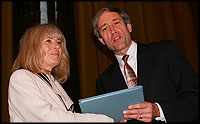
Carol Stogsdill of the Los Angeles Times accepts the 1995 Pulitzer Prize from Columbia University President George Rupp, on behalf of the Los Angeles Times staff.
Winning Work
L.A. area freeways buckle, buildings topple
By Tracey Kaplan and Greg Krikorian
Disaster: Epicenter is in Northridge, where three-story apartment complexpancakes. Ruptured gas lines erupt in fire in strongest temblor in city's modern history.
A deadly magnitude 6.6 earthquake--the strongest in modern Los Angeles history--ripped through the pre-dawn darkness Monday, awakening Southern California with a violent convulsion that flattened freeways, sandwiched buildings, ruptured pipelines and left emergency crews searching desperately for bodies trapped under the rubble.
The 10-second temblor, which was not the long-dreaded Big One but erupted so fiercely that it initially seemed every bit as intense, was blamed for at least 33 deaths--nearly half of which occurred when a three-floor apartment complex near the epicenter in Northridge collapsed into two stories.
Triggered by a fault that squeezed the northern San Fernando Valley between two mountain ranges like a vise, the 4:31 a.m. earthquake swamped hospitals with hundreds of injured victims and left thousands more homeless as fires, floods and landslides dotted a landscape that has been visited by destruction with disturbing regularity.
The major developments:
- The death toll continued to grow throughout the day. Fifteen bodies were discovered under the rubble of what had been the Northridge Meadows apartments. Other victims of the quake included a Los Angeles police officer who drove his motorcycle off a sheared-off freeway, a Skid Row resident who may have hurled himself out the sixth-floor window of a Downtown hotel and a Rancho Cucamonga mother who slipped on a toy as she raced to check on her child, striking her head on the crib.
- In a painstaking rescue, firefighters worked more than seven hours to save a critically injured maintenance worker who was trapped under 20 tons of concrete that crumbled at the Northridge Fashion Center's parking structure.
- Highways across Los Angeles County buckled and crumpled, wiping out major commuter thoroughfares and ensuring that life in this car-dependent region will be disrupted for months. Hardest hit was the Santa Monica Freeway, the nation's busiest, which caved in at the overcrossing of La Cienega Boulevard, and the Antelope Valley Freeway, which collapsed at its junction with the Golden State Freeway in the Newhall pass.
- Ruptured gas lines and propane tanks sent fiery balls bursting through asphalt roads, engulfing up to 100 mobile homes at three San Fernando Valley trailer parks. Meanwhile, a broken water main on Balboa Boulevard shattered 100 square feet of pavement, turning the street into a geyser.
- The temblor, felt as far as Oregon and the Mexican border, left tens of thousands of residents without power, gas or phone service. In the historic Ventura County community of Fillmore, where brick facades had undergone extensive earthquake renovation in recent years, virtually every downtown business was damaged.
- Late in the day, Mayor Richard Riordan initiated a citywide curfew, making it illegal for people to remain on the streets between dusk and dawn. President Clinton pledged immediate federal assistance while the National Guard was mobilized to prevent looting in blacked-out neighborhoods. Gov. Pete Wison, touring the area in a helicopter, said: "You begin to wonder how much Angelenos are expected to take."
- Insurance Commissioner John Garamendi, touring areas hit hardest by the earthquake, predicted that local authorities will proclaim many older apartments uninhabitable. He said thousands or tens of thousands of Los Angeles residents may be made homeless.
Had the quake not struck on a holiday, or if it had begun a few hours later, seismologists fear, the damage would have been far more devastating. Even so, Southern California seemed to shudder to a terrifying halt Monday, a day of frantic waiting, dramatic rescues, empty highways and fraying nerves.
"It was a 6.5 on the 'Richter scale,' but a 10 on my fear scale," said Nick Stevens, 40, an Australian tourist staying at the Hollywood Downtowner Motel. "We had been planning to go to Universal Studios, where they have the earthquake ride. Now we won't have to bother."
'It Was Unreal'
Across the smoky expanses near the quake's epicenter, the scene was nearly apocalyptic. Buildings were left in crumpled heaps. Balls of fire tore through mobile home parks. Geysers gushed out of asphalt streets. For the first time in Los Angeles' history, officials said, all the city's lights went out at once.
After touring his northwest Valley district, which suffered some of the most severe damage, Councilman Hal Bernson said: "If you saw Northridge Fashion Center or Balboa Boulevard, you'd think you were in Beirut."
At least six people fell victim to quake-induced heart attacks. The rest were killed by the temblor and the chaos it induced. A 25-year-old Sherman Oaks man was electrocuted, a 92-year-old Northridge woman died when her trailer burned, a 4-year-old child was crushed by the wreckage of her collapsing home and a veteran LAPD traffic officer plummeted from a freeway overpass when his motorcycle skidded out of control on a buckled swath of the Antelope Valley Freeway.
"His lights were still flashing and he just came tumbling down," said Andy Jimenez, 33, of Santa Clarita, who watched as Officer Clarence Wayne Dean, 46, plunged off the end of a destroyed bridge to the pavement 30 feet below. "It was unreal."
The quake struck with such sudden force that many residents stumbled around dazed in the darkness, groping for shoes, eyeglasses, aflashlight.
At the Park Regency apartment complex in Canoga Park, a two-story apartment building collapsed and crushed a row of 20 cars parked underneath. Rita Cuezada, 20, and her 5-month-old daughter fell through their second-floor apartment to a vacant unit below.
"My body weight fell on her three or four times," Cuezada said. "I thought she was going to die. I was just praying to God. I thought I was just going to be holding her dead body when it was over."
In some areas, the earthquake set off a series of other destructive disasters, bursting water mains, touching off fires and sending rocks and mud sliding.
Near Chatsworth, a Southern Pacific train derailed and one of 16 cars carrying sulfuric acid spilled its load. Los Angeles International Airport was forced to temporarily suspend flights. Mobile home parks, with their lightweight construction and often-crowded layouts, proved particularly vulnerable to fires.
At the Tahitian Mobile Park in Sylmar, firefighters watched helplessly as 65 mobile homes went up in flames. Gilbert Neuvenhein was jarred from his sleep by the earthquake and watched helplessly as fires crept near his trailer.
"I woke up. There was a rumbling. The next thing I knew I was trying to reach the door," he said. "I was frantically trying to open it, but it was stuck. I didn't have my glasses and I was practically blind without them."
As flames engulfed the trailers, ammunition stored in one of them began to explode. "I had never seen such a war zone," said Keith Bedard, a 32-year-old communication technician.
All along Ventura Boulevard, meanwhile, firefighters and Southern California Gas Co. workers were hurrying to plug leaky gas mains. About 7 a.m. a fire crew saw a major leak at Ventura Boulevard and Laurel Grove and urged bystanders to move on: "You'll be toast if this thing goes up," a firefighter said.
In Pacoima, thousands of gallons of crude oil spilled into Wolfskill Street east of Laurel Canyon Boulevard when a 10-inch pipeline burst. Soon after, the oil ignited, sending parallel walls of flame racing down the block. The flames consumed two houses and at least 10 cars and scorched dozens of trees along the street. Residents frantically used garden hoses to spray down cars and shake roofs. Several rooftops were burned.
"It just looked like an inferno," resident Luisa Grimaldo said. "It came just shoosh down both sides. It all just exploded."
Although the worst damage was in the Valley, other communities were also struggling to dig out from the wreckage.
On the Santa Monica Freeway, seven massive pillars that suspended the freeway over Fairfax Avenue collapsed. The concrete cylinders broke into pieces ranging in size from boulder-like chunks to grains of sand. Their iron reinforcing bars loomed like immense, distended bird cages.
Several buildings in Santa Monica collapsed, others suffered major damage and 12 fires and dozens of gas leaks were reported. In all, 75 buildings were deemed unsafe for habitation by midafternoon--including two large hotels, the Pacific Shores and Holiday Inn Bayview Plaza.
Ignoring the yellow "caution" tape ringing the Sea Castle, a large 70-year-old waterfront apartment building, residents scurried back and forth into the structure to grab whatever belongings they could carry. By 9 a.m the parking lot looked ready for a garage sale as residents tried to cram television sets, microwave ovens and mattresses into their cars.
At Angelo Drive and Mossy Rock Circle on the Westside, the Cooper family sat on their front lawn with their children, Harrison, 4, and Jennifer, 1, as they made plans to go to a hotel. The vigorous shaking had caused the front of their house to collapse. As the quake hit, Michelle Cooper rushed in to pick her daughter up from her crib, where she discovered the baby had stopped breathing.
"I said, 'She's dead, she's dead," Cooper said. "My husband revived her with mouth-to-mouth resuscitation. He said she had something called fright reaction. Usually, I'm OK after an earthquake, but I was shaking because I thought she was dead."
In Ventura County, the cities of Simi Valley and Fillmore suffered the most serious damage.
At one Fillmore variety store, mannequins were thrown through a plate-glass window and landed in a gruesome pile on the sidewalk. At the Central Market, owner Harnek Sing Behniwal stared at the broken windows, fallen beams and strewn groceries.
"I just don't know what to do," he said. "This store was a diamond."
City officials were particularly upset because the area had recently undergone extensive renovation. "Just when we've rebuilt it, we've had to declare it a disaster area," Fillmore City Manager Roy Payne said.
In Simi Valley, across the street from Simi Valley Adventist Hospital, Ted N. Chaffee,a dentist, was perturbed by the earthquake's seemingly precise aim. Only one of his office windows shattered--the one above his most expensive piece of equipment, a $50,000 dental imaging system.
'Come Down and Pray'
Throughout Los Angeles, there were tales of courage--of strangers helping strangers because, as one man said, "it seemed like the right thing to do." By day's end, many people owed their lives to that spirit. And many more had been touched by it, as they watched the progress of several daring rescue missions live on television.
Salvador Pena's story was one of the hopeful ones--a testament to the power of hard work, teamwork and spiritual faith.
Caught during his pre-dawn shift driving a street sweeper along the bottom floor of a three-tier parking garage at the Northridge Fashion Center, Pena talked with rescue workers for more than seven hours as they blasted through slabs of concrete to extricate him.
Firefighters had little trouble locating him because of his loud cries for help, which they could hear even through the mountain of rubble. To reach Pena, rescue workers used jackhammers to drill through two layers of concrete. Then they inserted air bags and wooden blocks to lift a concrete beam off his limbs, giving him oxygen as they worked. Once they cut him out of his vehicle, they carried him on a backboard through eight feet of rubble.
Throughout the ordeal, paramedics remained at Pena's side beneath the parking deck. "He was in a lot of pain and he kept saying, 'Come down and pray with me, come down and pray,'" said Rey Lavalle, a Los Angeles city firefighter, who spoke with Pena in Spanish.
When a helicopter finally airlifted Pena from the busy mall's rubble-strewn parking lot and headed to UCLA Medical Center, onlookers cheered and applauded. Late Monday, he was in serious condition with crushed legs and a partially dislocated spine.
"I almost cried--I was elated, we all were," Capt. Jim Vandell of the Los Angeles City Fire Department said.
Meanwhile, at the Northridge Meadows apartments, firefighters and urban search and rescue squads hunted frantically for survivors of the collapse that took more lives than any other. The three-story complex had folded in on itself, pulverizing many of the first-floor units. All day, rescuers worked tirelessly.
They were right to hope. At one point, as firefighters tramped through the demolished building pounding on floors and calling out to survivors, they heard a man cry out.
Using diamond-bladed saws to chew through concrete and wood, they finally reached the collapsed first floor that had become a tomb. Alan Hemsath, 37, "was just face down--pinned by the whole building," rescue worker Doug Rogers said. But 90 minutes later, Hemsath--conscious and in stable condition--was freed, prompting applause from onlookers and journalists.
The search continued until nightfall, with rescue workers utilizing sonar equipment sensitive enough to detect even the shallowest breath amid the rubble. Those who had died were left inside the building so rescuers could concentrate on extricating survivors.
'A Tidal Wave' of Injuries
The quake took its toll on the young and old, hundreds of whom flooded emergency rooms with maladies ranging from cuts and bruises to heart attacks.
"We've seen heart attacks, dislocated bones, lacerations. A lot of blood," said Toni Regalado, an emergency room admissions officer at Holy Cross Medical Center in Sylmar.
In Los Angeles, Cedars-Sinai Medical Center was receiving "a tidal wave of walking wounded," spokesman Ron Wise said.
Hospital officials said most of the injuries were caused by people scrambling to protect themselves after the quake struck. Health workers said many cuts, bruises and broken bones resulted when people, in their need to find safety, fell, cut themselves on broken glass, or ran into something in the dark.
In some hospitals, doctors and nurses moved past fallen plaster and broken windows to practice their trade in near-battlefield conditions. Broken water pipes flooded floors, backup generators took over during electrical outages. Ham radios covered for dead telephones.
Henry Mayo Newhall Memorial Hospital in Valencia treated more than 300 people, mostly for cuts and broken bones. The hospital was so jammed that some patients had to wait for up to four hours. People were being stitched up on stretchers in the hall.
The doctors at Henry Mayo were slightly red-eyed. Iodine was on the floor, spilled off wounds where it had been liberally applied.
"People are running on adrenaline," said Henry Mayo Administrator Duffy Watson. "We are overwhelmed. We need to get our staff rested."
At the Granada Hills Community Hospital, doctors, nurses and volunteers operated a makeshift emergency room in the shadow of the Kaiser Permanente clinic and office building which collapsed next door.
With heads bandaged and blackened blotted blood dried around their cuts, quake victims sat in the sun waiting. Meanwhile, a cadre of workers applied temporary bandages and tried to ease their pain.
Brian Wills, 23, of Canoga Park was among those waiting. He suffered a deep cut on his shoulder climbing out his first-floor apartment window. "I jumped out and started running down the street. . . . I definitely panicked," he said.
An unprecedented 600 to 700 patients were evacuated from earthquake-damaged hospitals. Metropolitan Transportation Authority buses and helicopters were pressed into duty to shuttle patients out of the crippled hospitals.
The largest evacuation occurred at Olive View Medical Center, where all the patients in the 377-bed hospital were transferred because of serious water damage, gas leaks and power outages. The hospital was built on the same site where another county hospital was destroyed in the 1971 Sylmar earthquake.
Dozens of other hospitals in the area also suffered enough damage to force evacuations or to prompt officials to move patients in large numbers from one floor to another.
Among the hospitals forced to close were Holy Cross Hospital Medical Center in Sylmar and the Sepulveda Veterans Administration Hospital in North Hills.
But it was not all tragedy.
A Torrance woman was in the final moments of giving birth early Monday when her room at Torrance Memorial Medical Center began shaking.
Wendy Gonzales, 37, gripped her husband's hand hard as the walls shook, medical supplies clattered to the floor and her daughter's head began to emerge from the birth canal.
"It all happened at the same time," said her husband, Eddie Gonzales, 35. "Everything started shaking, things started falling. . . . I heard a lot of rattling going on, and a lot of screaming."
Courtney Gonzales, 7 pounds, 6 1/2 ounces, was born at Torrance Memorial Medical Center at 4:45 a.m.
'Holding My Heart'
Farther from the epicenter, where the shaking was less severe, emotional trauma eclipsed physical danger. The quake left people disoriented, bewildered and, in the case of one young man, literally dazed.
John Bryce, 16, was hit in the head by a 32-inch television as he slept on the floor of a friend's Simi Valley home.
"It just fell on my head and knocked me out," Bryce said as he waited for a gash above his nose to be stitched. "When I woke up, there was a television in my lap."
But with humor, creativity and a little homespun philosophy, people set about trying to cope. Life would go on, they said. And maybe next time they'd be a little better prepared.
"I never liked the bathroom anyway," said a 38-year-old Sherman Oaks banker after a neighbor's chimney toppled into his bidet.
Jon Lalanne, a 32-year-old bartender in Malibu, is now calling his apartment on Las Flores Canyon Road simply "the disaster capital of the world."
"My whole apartment building was doing the hula," he said, demonstrating with his hand the undulating motion he saw and felt. His biggest complaint, however, was gastronomical, not geological.
"I'm dying for a cup of coffee, man, and there's none to be had," he said.
Many people sought comfort in numbers. In Santa Monica, residents transformed the median of San Vicente Boulevard from its usual function--a jogging path--to a makeshift meeting place and parking lot. From 7th Street to the ocean, the grassy strip resembled a pre-dawn block party as apartment dwellers--some still in robes, others wrapped in blankets--gathered to compare jolt notes. Fearful that underground garages would collapse, some people left their cars in the median as well.
Necessity also brought people together. In Malibu, people waited in line to buy bottled water, Rice Krispies, London broil--whatever was available. In eastern Ventura County, lines at hardware and general supply stores stretched out the door as jittery residents stocked up on flashlights, batteries, and repair materials for broken pipes and generators.
"Someone came by my house and said Sears was open, and it's a good thing," Dirk White, 36, a Thousand Oaks resident, said as he waited to buy repair materials at Sears department store. "My hot water heater busted. Where (else) do you get parts for that at a time like this?"
Joan Tang of Camarillo was standing in a similarly lengthy line to buy a better radio than the small transistor model she had at home. The earthquake had scared her, she said, and had taught her a lesson.
"It took me three hours to calm down," Tang said. "I need to be prepared. It took an earthquake like this to finally admit it. I was holding onto my heart."
Sleeping Under the Stars
Haunted by memories of what the previous night had brought, a nervous city greeted Monday's sunset with one eye open. As the ground rolled and rocked with aftershocks--86 of them in the first 17 hours after the quake--it was difficult to believe the truth: that the worst was most likely over.
Floods, fires, riots--Los Angeles had survived them all. But this felt more fundamentally unsettling than anything that had come before. So, while curfews were put in place to make neighborhoods relatively free from crime, no one was taking their safety for granted.
Long before nightfall, the displaced and the distressed flocked to shelters or the streets, planning to sleep on gymnasium floors or back seats of family sedans. Many simply camped out in their yards.
In Koreatown and Pico-Union, where many residents spent the day on porches and lawns, there were no plans to return indoors after dark. "We're going to sleep outside tonight," said Pilar Canela, 10, who lives with his family in a Koreatown apartment. "It's kind of dangerous to do that, but we're more scared of another earthquake."
In the Santa Clarita Valley, about 150 people gathered on the green cots at a Red Cross evacuation center set up in the gloomy, unlighted gymnasium of Henry Newhall Park. Most had been evacuated from the Orchard Arms Senior Complex, a residential development that developed a gas leak.
Outside, the scene was almost festive as about 500 Latino families set up camp with tents and barbecues. Ricardo Provincia, 23, set up three tents to house the 14 members of his extended family through the night.
"There are cracks all over our apartment, which is on the second story," Provincia said. "It's scary in there. We thought we'd be a lot safer here, tonight."
For some, like Poppy Weisberg, sleep would be difficult anywhere. Weisberg, 79, was among 150 people who sought shelter at Sylmar High School, where the Red Cross had set up a shelter. She sat in a flowered nightgown on a borrowed cot and recounted how she had come to be there.
Weisberg had narrowly escaped injury when her mobile home in the Los Olivos mobile home park burned. If not for her neighbors, who pulled her through her mobile home's front door, she might not have survived, she said.
"You could hear the gas and I kept yelling, 'Turn off my gas!' " she said.
But it was too late. After her mobile home and others went up in flames, she returned to see what was left.
"It took a lot for me to go back and see what the damage was," she said, choking back tears.
QUAKE COVERAGE
- IMMIGRANTS' TERROR: Falling bricks, shattering glass and haunting memories sent many residents of the city's crowded immigrant neighborhoods into the streets. For thousands of them, at least one of the old country's terrors had come to join them in the new.
- AT THE EPICENTER: Northridge was the scene of more than half the fatalities, wholesale devastation and several miracle rescues.
- ECONOMIC IMPACT: The earthquake dealt a blow to the Southland's already struggling economy.
© 1994, Los Angeles Times
By Nora Zamichow and Ralph Frammolino
Transportation: Several freeway sections are shut. Golden State, Santa Monica routes are heavily damaged.
The 10-second earthquake that rocked Southern California early Monday will create a commuting nightmare for months to come, officials said.
Portions of one local highway and six freeways--including the Golden State and the Santa Monica--were closed after the quake flattened overpasses and buckled swaths of asphalt. The two major routes out of the Santa Clarita Valley were severely damaged, virtually isolating the area.
Caltrans officials said they are uncertain how long the roads will remain closed. But they estimated that some sections will be shut for 12 to 18 months, including a stretch of the Santa Monica Freeway, the nation's busiest highway. That closure will force the detour of about 300,000 cars a day.
"We've got some major problems--people are going to be using city streets for a period of time," said Ken Nelson, a deputy district director of the local Caltrans office. "It is certainly not going to be business as usual. . . . People are going to have to use alternative modes of transportation for a long time."
Do not drive today, officials advised, unless you must. For those with no alternative, allow extra time for your commute, take a detailed map and listen to the radio because aftershocks may cause more closures.
Monday's earthquake collapsed a bridge on the Golden State Freeway near Sylmar and ruptured a part of the Antelope Valley Freeway (California 14)--the main roads between Los Angeles and the Santa Clarita Valley, a suburb of about 130,000 people. Many, if not most of the residents of this growing area on the edge of the desert work in Los Angeles.
The major route now linking the two communities is four-lane Sierra Highway. The California Highway Patrol began escorting motorists along a five-mile stretch of the road Monday afternoon, between the Old Road and San Fernando Road. That service will continue until congestion is alleviated, said CHP Sgt. Ernie Garcia.
"This valley, in a disaster, is isolated--all 130,000 of us," said Gail Fox, spokeswoman for the city of Santa Clarita. "And what will happen with commuters? I don't even want to think about that. There's all of our commuters, plus the others from the 150,000 people living in the Antelope Valley."
Los Angeles Mayor Richard Riordan asked City Councilman Richard Alatorre, chairman of the Metropolitan Transportation Authority, to seek ways to add extra bus lines to help move commuters around the closed freeways. But no decisions were made about this proposal by Monday evening.
Riordan said the closure of the Golden State Freeway poses special problems because there are no reasonable alternate routes. He said one possibility is to permit commuters to park their cars on the collapsed freeway and walk to nearby buses that could ferry them to Los Angeles.
"We might need to borrow buses from other jurisdictions," Riordan said.
Across Los Angeles, motorists braced for what they feared could be a staggering commute.
"It's going to be tough," said Jeff Peltola, a Valencia resident and mechanical engineer for the Los Angeles Department of Water and Power. "I'm sure if I leave at 5:30 a.m. it will be easier, but it's going to be tough coming home too."
Brent White said his usual commute is 45 minutes each way between Santa Clarita and his job as a computer programmer in Woodland Hills. If driving during rush hour is too taxing, White said he might take more dramatic steps.
"Maybe I'll talk to my boss and work a staggered shift, come in at noon, work until 8 or 9 in the evening," he said. "That actually is a possibility."
While White does not consider public transportation an option, it will be for many others.
With only a few exceptions in areas nearest the quake epicenter, MTA bus service was not disrupted Monday--and is expected to run on its full schedule today. On the 22-mile Blue Line, between Long Beach to Downtown Los Angeles, service was slowed or halted for about six hours. Full service, at 12-minute intervals, was restored by midmorning Monday.
But Amtrak and Metrolink trains, the above-ground commuter lines that feed into Union Station, were canceled Monday. Pending inspection of about 300 miles of track, Metrolink and Amtrak trains may resume regular service this morning.
Metrolink plans to operate its Santa Clarita line, which runs between Santa Clarita and Union Station via Burbank and Glendale, as well as its San Juan Capistrano-Los Angeles trains. Spokesman Peter Hildago, however, said officials do not plan today to run trains to Chatsworth, Simi Valley and Moorpark.
Metrolink will add cars to the Santa Clarita line, Hidalgo said, and will honor transit passes from Antelope Valley and Santa Clarita bus lines, at least until Friday.
Officials with the Los Angeles Department of Transportation and the CHP devised several recommended detours for beleaguered commuters:
- The Santa Monica Freeway (I-10) is closed between Centinela Avenue and La Brea Avenue because three overpasses crumbled, causing enormous slabs to move. Westbound traffic should head north at La Brea to Pico Boulevard, and west to Sepulveda Boulevard to reach the San Diego Freeway--or continue west on Pico to Centinela to return to the Santa Monica Freeway. Also, Washington Boulevard and Adams Boulevard may be used as alternate detour routes.
- Eastbound traffic will be diverted at Centinela, directed east on Pico to La Brea to return to the Santa Monica Freeway.
- The Golden State Freeway (I-5) is closed between Lyons Avenue and Roxford Street. Southbound traffic will be diverted at Lyons, directed east to San Fernando Road, south to Sierra Highway, under the I-5 and California 14 interchange, south on San Fernando Road and Sepulveda Boulevard to return to Golden State at Roxford Street.
- Northbound traffic will be diverted at Roxford, routed east to San Fernando Road, north to Sierra Highway, west to Lyons to return to Golden State Freeway.
- The Simi Valley Freeway (California 118) is closed between Tampa Avenue and the Foothill Freeway. Eastbound traffic will be diverted at Tampa Avenue, directed south to Devonshire Street, south on Arleta Avenue, east on Van Nuys Boulevard to return to the Foothill Freeway.
- Westbound traffic will use Van Nuys Boulevard, north on Arleta Avenue, west on Devonshire Street, continue to Hayvenhurst Avenue, north to the Simi Valley Freeway.
Here's a list of other closures:
- The northbound San Diego Freeway is closed at Devonshire because of freeway buckling. Southbound lanes are closed at Rinaldi Street.
- The southbound Antelope Valley Freeway is closed at San Fernando Road (before the I-5 interchange) because of structural damage.
© 1994, Los Angeles Times
By Virginia Ellis and David Ferrel
With sobering force, Monday's earthquake devastated much of Southern California's massive roadway system, causing officials to begin reassessing a $1.5-billion reinforcement program designed to prevent the state's highways from buckling under seismic stress.
The magnitude 6.6 quake caught state highway engineers in the midst of a costly program to reinforce or retrofit key freeway bridges and interchanges that were considered vulnerable to large temblors.
Despite that program, portions of six freeways were closed because of structural damage. The hardest hit were two of the region's busiest routes: the Santa Monica Freeway near La Cienega Boulevard, where an elevated portion of roadway buckled onto the street below, and the Golden State Freeway, which was closed by the collapse of an Antelope Valley Freeway overpass. The collapses caused sections of all three freeways to be shut down.
Parts of the Santa Monica Freeway are expected to remain out of service for a year to 18 months.
"We had what you would call a catastrophic collapse" of those highways, said Jim Drago of the California Department of Transportation in Sacramento. "This was a surprise. Obviously the structures did not have sufficient strength to ride out the forces they were hit with today."
Drago noted that most portions of the roadway system that were reinforced came through intact, underscoring the importance of the retrofitting program launched after the 1971 Sylmar quake, which toppled freeway overpasses. But the widespread destruction of freeway bridges and overcrossings Monday was a source of consternation among state leaders who thought that the most vulnerable roadways had already been shored up.
Caltrans Director Jim Van Loben Sels said the segments of the Santa Monica Freeway that collapsed at La Cienega Boulevard and Fairfax Avenue were to have been retrofitted this spring.
"We had our bridges rated by risk and we had completed our high-risk ones, and we were just moving on to medium risk," he said. "In some sense, our program performed well, but not well enough. We didn't get them all."
The failure of vital traffic arteries will spark a renewed effort by Caltrans to evaluate highways that may be in need of reinforcement, using data from Monday's quake to refine their seismic safety engineering, officials said.
Gov. Pete Wilson, asked whether a special inquiry into the retrofitting effort might be warranted, said: "I don't think it would be appropriate. I think what we are more interested in doing now is repairing damage, making people safe.
"But if an inquiry is in order . . . let it proceed."
Sen. Dianne Feinstein (D-Calif.) said she hoped the state would look into the progress of the retrofitting program on the theory that all freeways should be able to withstand a moderate-size quake similar to Monday's.
A key question facing highway officials was why some of the crippled roadways, such as the Santa Monica and Golden State freeways were considered a relatively low priority, since they failed under far less force than might have been expected if the Big One had struck.
Recalling the collapse of Oakland's Nimitz Freeway in 1989, Feinstein noted that highway officials are still learning about the inexact science of determining how roadways will respond to shaking and bending in an earthquake.
"We need to really upgrade our state-of-the-art preparedness and construction in earthquake zones, particularly freeway construction," she said. "That's where you have the largest loss of life."
Monday's quake caused no fatalities on the Santa Monica Freeway, the nation's busiest. But three different overpasses on the route partially buckled, causing enormous concrete slabs to move and crumble. Observers described its undulations as a horrific pre-dawn spectacle.
"When I came outside, the freeway was dancing up and down," said Lacy Loeb, who lives a block from the freeway. "The whole structure mushroomed one second and then dropped the next."
Overpasses at Fairfax Avenue and at Venice and La Cienega boulevards suffered severe damage. At Fairfax, the freeway shifted so that a four-foot wall of concrete rose up in the middle of the traffic lanes. At Venice, the support structures underneath the freeway were crushed by the falling concrete, exposing twisted steel supports.
Caltrans workers at the scene estimated that the overpasses would have to be torn down and rebuilt.
In a 1982 assessment by the state Division of Mines and Geology, the ground near the point of the collapse was identified as being prone to liquefaction--the breakdown of water-saturated soil when subjected to shaking.
But that section of the Santa Monica Freeway was given a lower priority for retrofitting than other projects because the freeway overpasses already had multiple support columns, said Caltech professor Wilfred Iwan, head of the California Seismic Safety Commission.
The damaged stretch of the freeway happened to be one of the next in line for being shored up, according to Jim Roberts, chief of Caltrans' retrofitting program. The $3.7-million job was to have gone to bid next month, and was scheduled to take about a year, he said.
Steel jackets that would have been installed around the concrete supports most likely would have prevented the collapse, Roberts said. "From the pictures, it looks like the columns just shattered," he said.
Transportation officials said some ramps adjacent to the collapsed roadway withstood the quake because they already had been retrofitted.
Near Santa Clarita, where the Golden State and Antelope Valley freeways merge in a towering concrete maze, cars were scattered Monday at two places where the road abruptly ended.
One big-rig truck had jackknifed just before a precipice that was formed when the quake split the road in two. The huge highways were scarred with cracks, and chunks of concrete from upper levels of the interchange had collapsed and crashed to the roads below.
That freeway junction was also scheduled for retrofitting, but the work had not yet been done, Caltrans officials said. "We didn't consider (the overpasses) quite this vulnerable," Roberts said. "We thought we had time."
Caltrans officials acknowledged that they erred in a decision not to retrofit bridges along the Simi Valley Freeway (California 118) in the San Fernando Valley. Those bridges also collapsed.
An evaluation of the bridges, constructed five years after the 1971 Sylmar temblor, convinced engineers that they were strong enough to withstand a severe quake, officials said.
Monday's quake was apparently centered on an unmapped fault in the San Fernando Valley, said Roberts, who said the discovery will add to the work of highway engineers.
"Now we'll have to re-evaluate a whole lot of bridges close to this new fault," he said. "That means we have to go back and rescreen several hundred bridges that are within a certain distance of this new fault line."
In addition to that work, Caltrans engineers will be examining all freeway bridges and overpasses within a 50-mile radius of the quake's epicenter for any sign of damage, officials said. An investigative team of engineers and seismic experts will conduct a detailed analysis to determine what happened to each of the damaged bridges.
Retrofitting has been the state's way of bolstering existing freeways--especially those built before the 1971 Sylmar quake--to withstand the sharp movements of California's fragmented crust.
The program took on increased urgency after the Whittier Narrows quake in October, 1987. That magnitude 5.9 temblor threatened to bring down a major interchange connecting the San Gabriel River Freeway and the Santa Ana Freeway between Santa Fe Springs and Downey.
Subsequently, Caltrans began accelerating its efforts to reinforce freeway bridges, but the task is daunting. There are about 12,000 freeway bridges in the state, and engineers had to evaluate the soundness of those bridges before establishing a priority list.
The 1989 Loma Prieta quake near Santa Cruz gave further impetus to the program because of the 43 lives lost in the collapses of the double-decked Nimitz Freeway in Oakland and a portion of the San Francisco-Oakland Bay Bridge. Since then, two-thirds of the retrofitting work has been done in the Los Angeles Basin. "I always felt that the next one would come in L.A.," Roberts said.
Before Monday's quake, most major interchanges in the Los Angeles area had been reinforced or were in the process of being retrofitted, Caltrans officials said. Often, that bolstering involves wrapping the concrete columns that support freeway bridges with steel jackets. Or in some cases, the base of the columns and the edge of longer bridge spans are enlarged to provide additional support.
Roberts cited the critical interchange of the San Diego and Santa Monica freeways as one that may have been spared by retrofitting from serious damage or collapse.
"This earthquake shows that what we've been doing works," he said.
Iwan of Caltech said, "There's always a question (whether) we could do things faster. Basically, if we had more money we could progress at a lot faster pace, but there are a lot of things that compete for the same dollars. We have social problems and a lot of other problems that society wants taken care of."
George W. Housner, a worldwide authority on earthquake engineering, said he suspected that every building, road or bridge that failed Monday either was not constructed in accordance with seismic codes or had not been retrofitted after the 1989 Loma Prieta quake.
"My guess is that when all the information comes in, we'll say, 'Yes, they should have come down,' " said Housner, who chaired a state panel that investigated and made recommendations following the Northern California quake.
© 1994, Los Angeles Times
By Robert Lee Hotz and Kenneth Reich
The earthquake that convulsed the San Fernando Valley early Monday demonstrated as brutally as possible the danger posed by a complex web of deeply buried thrust faults underlying the Los Angeles Basin.
Seismologists said Monday that dozens of such faults underlay the basin, many unmapped and unknown until they abruptly announce their presence with a powerful shudder. Although they may lack the capacity to generate the devastating force of the Big One, these faults can cause severe injury and widespread property damage.
"There are so many (faults) that can produce stress of this magnitude," said Hiroo Kanamori, director of the Caltech Seismological Laboratory. "We have to be prepared for this sort of thing."
Monday's 6.6 quake, the strongest in the basin's modern history, was powerful enough to raise parts of Northridge, the Northridge hills and the Santa Susana Mountains "a foot or two," while areas of the northeast Valley south of the city of San Fernando slumped an equal amount, said Lucille M. Jones, a seismologist at the Pasadena field office of the U.S. Geological Survey.
Movement on the fault may have been as much as two yards on each side, several seismologists said.
Any of the other short, thrust faults hidden under the basin could produce the same kind of strong, jarring upward motion. A thrust fault, unlike the more common horizontal strike-slip fault, moves vertically.
Within hours of the frightening, early morning jolt, scientists from around the state headed for Southern California to study the Northridge earthquake, and portable seismographs were installed through the quake area.
As they carefully evaluated their seismic charts and the results of preliminary aerial surveys, scientists started to construct a rational frame of facts and measurements around Monday morning's long seconds of tumult.
By late afternoon, scientists had yet to determine which fault was responsible for the damage. They hoped that the pattern of aftershocks would help them locate it more precisely and give a clearer insight into the stresses that underpin the region.
Monday's quake lasted no more than 10 seconds at its source, with up to an additional 20 seconds of reverberations elsewhere. That was followed by more than 86 noticeable aftershocks, including three of at least 5.0 in magnitude by Monday night. The strongest was a 5.3 jolt.
Aftershocks are expected to continue with some decreasing frequency through the coming months, scientists said. The chance of an aftershock of more than 5.5 in magnitude in the weeks ahead is 1-in-4; and for an aftershock of 6.0 or more in the coming year is 1-in-10, they said.
"The fault is still uncertain," said Pat Jorgenson, spokeswoman for the Geological Survey office in Menlo Park. "Anybody who's going on a limb and identifying a fault is not being cautious."
The quake occurred on what Jones, Kate Hutton of Caltech and other scientists initially said was an unnamed, virtually unknown fault on a plane shallowly dipping toward the Santa Monica Mountains.
They believe that the fault probably intersects with the Elysian Park Fault belt, which extends about 50 miles from Whittier all the way to the ocean near Point Dume. That fault generated the powerful Whittier Narrows thrust quake of Oct. 1, 1987.
But one of Caltech's most prominent seismologists, Kerry Sieh, said late Monday afternoon that there is at least a chance that the quake occurred on the Elysian Park Fault itself. The fault intersects with two others near Reseda and Roscoe boulevards, about a mile south of Cal State Northridge, which was severely damaged Monday. Those two faults, called the Devonshire and the Frew, had been mapped years ago by oil company geologists.
The quake could have begun on any of the three, Sieh said. Not until the aftershock pattern is further studied will scientists know which.
Jones and Hutton noted that almost all of the aftershocks occurred well north of the Elysian Park Fault (sometimes also known as the Santa Monica Mountain Thrust Fault). The two scientists continued to favor one of the lateral faults, probably the Frew.
Jim Mori, director of the Pasadena field office of the USGS, said the quake was on "an east-west trending thrust fault with the aftershocks to the north." Based on this, he said the Elysian Park Fault was not directly involved. A helicopter flight by Sieh and another Caltech seismologist, James Dolan, Monday morning showed no indication of a ground rupture from the quake. This was also the case with the magnitude 5.9 Whittier Narrows temblor and is the trademark of a deeply buried fault.
After Whittier Narrows, some scientists said the quake danger in the Los Angeles Basin had been underestimated. There may have been some past quakes that were unknown, they explained, because they did not break the surface.
Seismologists at Caltech and the USGS said they were certain that the Northridge quake was not a foreshock of a great quake on the San Andreas Fault, at least 25 miles away. The quake was believed to have done nothing to relieve pressure on the San Andreas, but did nothing to add to it either, earthquake experts said.
Tom Henyey, director of the Southern California Earthquake Center at USC, met with USGS scientists in Pasadena to develop a request for federal funds to study the temblor, a USC spokesman said.
DESTRUCTION FROM BELOW
The earthquake that snapped Southland homes and highways like plastic toys is thought to have been triggered by one of three faults some nine miles beneath the surface.
The Facts
Time: 4:31 a.m.
Magnitude: 6.6, with aftershocks above 4.5
Duration: approximately 30 seconds
Epicenter: San Fernando Valley, one mile south of Cal State Northridge
Moving mountains: Monday's quake pushed the Santa Monica and San Gabriel mountain ranges higher and closer together, making the San Fernando Valley slightly narrower. Geologists will determine the extent of the movement within the next few days.
Impact on San Andreas: The quake is said to have done nothing to relieve pressure or trigger activity along the nearby San Andreas Fault.
Ranking the Big Ones
Here's how the Northridge quake compares to other major quakes in California and Mexico:
1906 San Francisco: 8.3
1985 Mexico City: 8.1
1992 Landers: 7.6
1989 Loma Prieta(San Francisco): 7.1
1992 Big Bear: 6.7
1971 Sylmar: 6.4
Quake's Starting Point
Believed to have occurred along one of three faults that run, like spokes of a wheel, from the epicenter.
The Elysian Park fold and thrust belt is believed to be part of a network of deep-seated faults. The Elysian Park system produced the 5.9 Whittier Narrows quake in 1987.
© 1994, Los Angeles Times
By Ann W. O'Neill and Henry Chu
Epicenter: Residents are trapped and killed as 40 units on the first floor of a three -story Northridge complex are flattened. Rescuers with dogs comb rubble for survivors.
At the place the huge temblor took its greatest toll, the woman stood vigil by an oak tree, peering into the rubble of what had been her home.
For four hours, Hyun Sook Lee stood by the Northridge Meadows apartments, where as many as 40 first-floor apartments collapsed under the weight of the two floors above, killing at least 15 people early Monday morning when the earthquake hit. What had once been a courtyard with waterfalls and streams was now sandwiched into a subterranean void less than a foot high. Cars parked in an underground garage were flattened. Stairways and a catwalk collapsed.
Lee, a nurse, stood and looked for some sign that her husband and 14-year-old son would somehow emerge, that the searchers would find them under that mountain of debris.
She had managed to crawl out of her first-floor apartment. So had her other son, Jason, though his leg had been broken as the apartment collapsed. But her husband, Phil Soom, 47, and her son Howard--home on a visit from boarding school--had not made it out in the minutes after the earthquake.
At 8:30 a.m., paramedic Dave Thompson approached Lee.
"Ma'am, listen to me. Your son, how old is your son?" he asked. "This son is dead, ma'am. He is dead."
Lee dissolved into tears, her shoulders racked by sobs. An hour later, Thompson again brought the worst of news. He told her that her husband was also dead, that there was no way he could have survived.
All of those who died in the apartment complex at 9565 Reseda Blvd. lived on the first floor, which was destroyed in a matter of seconds. In the hours immediately after the earthquake, it became clear that this 160-unit structure would become a focal point of the tragedy that stretched throughout Los Angeles.
Residents who survived would tell of the panic, the screams and the small acts of heroism in the minutes after the quake. And they would also tell of seeing in the debris the bodies of victims who could no longer be helped.
One of those survivors was Kym Cohen, whose apartment was on the third floor. She said the earthquake gave a huge jolt and then everything began to shake violently. The temblor was twisting the building, plunging upper story apartments downward. Cohen's whole apartment began to plummet, like some horrible ride.
"We could not get out of bed, the apartment was on a slant," she said. "We could not get out because the doors were jammed."
Panic set in as they searched for a way to escape what in seconds had become a prison. Cohen said her boyfriend finally freed them by prying open the door with a crowbar. But when they got out of their apartment, they heard the chilling sounds of agony and desperation and then, worst of all, silence.
"All we could hear were people yelling, 'Help me, please, help me! I can't get out!' " she said. "I heard a lot of screaming and crying when it first happened. Then a lot of silence. The silence scared me more than anything."
Bryan Watson, 30, clad only in pants and a jacket he had grabbed on the way out of his third-floor apartment, also pried open his door with a crowbar. "We walked uphill to the hallway after it collapsed," he said.
"It felt like Godzilla had picked our building up, shook it, couldn't find a toy and threw it back down on the ground," said Watson, a computer consultant who has lived in the complex for a year.
In another apartment, Eric Pearson, an emergency medical technician, escaped from his apartment and began throwing emergency fire hoses to people who could not make their way from the top of the wrecked building. But even those who found safety in the courtyard remained panicky as the initial jolt gave way to powerful aftershocks.
Trapped in darkness, some residents became hysterical until passing Los Angeles police officers pried open one of the gates. Pearson, meanwhile, kept working.
"I lost one person," Pearson said. "There was a little old lady in the back. Two beams fell on her. I told her to hold on, I'd be right back with a ladder. By the time I got back, she'd passed away."
As darkness turned to the first light of dawn Monday, it became clear just what had happened in the night. In the temblor, the building had lurched the six feet to one side and collapsed the first floor.
"You make a house of cards, you push it, it tilts. That's what happened here," said Bob DeFeo, a battalion chief for the Los Angeles City Fire Department.
The search for survivors began in earnest as the sun came up.
© 1994, Los Angeles Times
By Patrick Lee
The earthquake sent shock waves through Southern California's business community Monday, crippling transportation and communications, damaging factories and idling thousand of workers.
Companies in the San Fernando Valley were hit hardest by the magnitude 6.6 quake, with many firms forced to close because of damage or lack of phones and electricity. Some of the hardest hit:
- Rockwell International Corp.'s Rocketdyne division in Canoga Park, where the firm assembles rocket and space shuttle engines, was shut down after the plant suffered broken water pipes, shattered windows and buckled floor tiles.
- Lockheed Corp., with 5,000 Los Angeles-area employees, said it would keep its Burbank "Skunk Works" plant closed today because of water and other damage. Hughes Aircraft Co. plants in Canoga Park and Malibu also remain closed, affecting about 2,000 employees.
- Oil giant Atlantic Richfield Co. reported that one of its Four Corners oil pipelines ruptured in at least four places in the San Fernando and Santa Clarita Valleys and near Pyramid Lake in the Grapevine.
- Arco and several other oil companies shut down their oil pipelines as a precautionary measure while inspecting for leaks. Oil companies were also assessing damage to service stations near the epicenter, many of which were damaged and not expected to be open for a while.
- The 20th Century Insurance headquarters building in Woodland Hills was closed Monday after the earthquake left the 11-story building looking like a bomb had exploded inside. Roughly 100 panes of glass were blown out, beige drapes hung out the windows like unmade bedsheets and the phones, elevators and electricity were out. Phone calls by worried policy holders were being forwarded to 20th Century's emergency center in Monrovia, plus seven other offices.
- The quake caused undetermined damage to Great Western Bank's sprawling 12-building headquarters complex in Chatsworth, home to some 3,000 employees.
Beyond the Valley, the effects of the quake were widespread, mitigated only because many firms were closed for the Martin Luther King Jr. holiday. Other businesses--including grocery stores--stayed open despite damage and lack of electricity to meet the needs of rattled homeowners.
A city-wide dusk-to-dawn curfew was sure to put a crimp in the commerce at bars, restaurants and stores dependent on evening traffic, many still struggling with the region's persistent recession.
Power to the entire city of Los Angeles was interrupted by the quake, with electricity being restored only gradually during the course of the day, the Department of Water and Power reported. Several large companies used emergency generators.
The Pacific Stock Exchange opened on time Monday morning. On the trading floor, activity was subdued amid the clutter of paper and beneath the green crawl of stock quotes.
The DWP also reported that a main water trunk line ruptured in Northridge, lowering water pressure in the San Fernando Valley and depriving some areas of water entirely.
Outside the city, Southern California Edison Co. reported that industrial, commercial and other customers went without power mainly in Ventura and Santa Barbara counties and in the Northern San Fernando Valley.
Pacific Bell reported that all switches--the building-sized equipment that connects telephone calls--were operating and processing calls.
GTE California, meanwhile, said its network was damaged, with several switching offices operating on backup generators due to the loss of power.
The quake also disrupted vital transportation links to businesses. Los Angeles International Airport was closed for several hours after the quake. American Airlines and others diverted or canceled inbound and outbound flights.
The collapse and closure of portions of the Santa Monica freeway, the nation's busiest, and the Golden State freeway, the state's major north-south conduit, have left many trucking companies scrambling for alternate routes.
Trucking companies said the quake had a heavy impact on pick-ups and deliveries in Southern California Monday, but most said they expected to be able to reroute deliveries around freeway blockages in the next several days to prevent any serious shortages of goods.
Gary Frantz, spokesman for a major interstate hauler, Consolidated Freightways, said freight terminals were operating at about 50% of capacity in Pasadena and Los Angeles, mainly because many employees were not able to get to work.
Meanwhile, Michael Martin, spokesman for Santa Fe Pacific Railways, which operates the Santa Fe and Southern Pacific tracks in Southern California, said trains were halted for up to five hours after the quake while track was inspected. Damage was minimal.
Editorial and administrative offices of the Daily News of Los Angeles in Woodland Hills sustained severe structural damage, including collapsed ceilings, broken water pipes and possible gas leaks, said Editor Bob Burdick. The paper's printing plant in Santa Clarita was also out of service.
The newspaper was published with the help of the Copley Newspapers offices in Santa Monica and Torrance. The Daily News managed to produce 250,000 copies of a special, ad-free 12-page paper. It was unclear when the Daily News could return to its own plant, Burdick said.
The Los Angeles Times also suffered disrupted operations from the quake. Its suburban San Fernando Valley presses and newsroom were closed by the quake, said spokeswoman Laura Morgan. Workers returned to the building Monday afternoon to clean up and assess the damage.
Printing plants near downtown and in Orange County were not damaged and the Times planned full Metro and San Fernando Valley editions for Tuesday, she said. The Times has a daily circulation of about 1.1 million.
Retailers were among the biggest losers, especially in the San Fernando Valley.
At least two major shopping centers--Topanga Plaza in Canoga Park and the Northridge Fashion Center--sustained major structural damage and were expected to remain closed for days. On the West Side, the Beverly Center was cordoned off.
At Topanga Plaza, chunks of brick and masonry had crumbled from the facades of the Nordstrom, Broadway and Robinsons-May stores.
At the Northridge mall, large portions of a three-story parking garage collapsed. At the mall's Bullock's department store, the roof fell in and large portions of the decorative facade peeled away.
Nordstrom reported that four of its Los Angeles County department stores were closed Monday as a result of the quake.
Two Bullock's department stores will remain closed indefinitely, a spokeswoman said. Three other Bullock's stores--Beverly Center, Century City and Woodland Hills--sustained water and merchandise damage and will remain closed today.
Eleven Broadway department stores in the San Fernando Valley and elsewhere were closed and being inspected for structural damage.
Big supermarket chains said a number of stores will remain closed due to heavy structural damage. In general, the supermarkets' biggest problems were power outages and the avalanches of cans, jars and boxes knocked off shelves.
Some supermarket chains, such as Lucky's, donated food, emergency supplies and bottled water to Red Cross and Salvation Army relief centers.
Separately, a Wells Fargo Bank spokeswoman said more than 200 of bank's ATMs were down early Monday, but most were working by the afternoon.
First Interstate Bank said the quake caused extensive damage to its Simi Valley credit-card processing center, forcing its closure and the temporary relocation of 500 employees to downtown Los Angeles.
Meanwhile, Foodmaker, the San Diego-based operator of Jack in the Box fast food restaurants, said 80 of its 310 Southern California outlets were closed Monday afternoon, due mainly to the "absence of potable water and electricity," spokeswoman Sherry Zizzi said.
At least in Hollywood, the workday was relatively unaffected, since most of the entertainment industry was taking the day off anyway. Some people still made it into work, among them billionaire Rupert Murdoch, who controls Twentieth Century Fox. But work stopped on some television shows, notably "NYPD Blue" and "Picket Fences."
About 1:30 p.m., Jerry and Susan Mailer stood outside the closed office of their Studio City realtor.
The couple had a 2 p.m. appointment to make a new, $215,000 offer on a house, after the seller rejected their original $209,000 offer on Saturday.
"We tried to call our agent, but we couldn't reach her because the phones were down," said Jerry Mailer, a beverage distributor. "Now we're here to tell her to forget it--we aren't going to buy anything for a while."
Times staff writers James Bates, Martha Groves, Greg Johnson, Chris Kraul, David W. Myers, David Olmos, Scott Paltrow, Jesus Sanchez, Stuart Silverstein, Barry Stavro and Jonathan Weber contributed to this report.
© 1994, Los Angeles Times
By Sheryl Stolberg and Glenn F. Bunting
Emotional toll: For many, home no longer seems safe. Some find comfort in loved ones. Others consider leaving.
Curled up like a frightened baby, Elsie Thull lay on the floor of an elevator in the 21-story New Otani Hotel in Downtown Los Angeles and prayed. Everything was black, except for the incessant blinking of the floor numbers, and the contraption was rattling in the throes of an earthquake that was about to bring the region to its knees.
She was trapped.
She fumbled for the emergency telephone. Hotel officials put her husband, Ted, on the line. In quiet tones, the retired airline pilot tried to calm his wife, hoping to reassure her, failing miserably. "Ted!" she cried. "Get me out of here! Get me out of here!"
Elsie Thull's terror--10 seconds of sheer panic shared by millions--stretched to nearly an hour before help arrived. And the 56-year-old Ohio woman, who had escaped the freezing cold that gripped much of the nation for a weekend trip to Southern California's famed winter warmth, was left with an impression unlikely to change.
"I don't like Los Angeles," she declared once she was out.
There is a joke going around the region these days, ever since the wildfires of this past fall: Los Angeles has four seasons--fire, flood, earthquake and drought. It is black humor, but on Monday it wasn't so funny anymore. People are tired, here in sunny Southern California. Nature has provided a land of great beauty but a land that can be cruel as well.
Nerves are frayed and jangled. Residents are frightened of the roar of an Earth that shifts without warning underneath them and of things that crash in the night in houses far removed from Ground Zero. People are worried about what is coming next. And Monday's 6.6 shaker, which leveled freeways, touched off at least 30 fires and claimed more than 30 lives, wasn't even the Big One. For many, that is the scariest notion of all.
Los Angeles County Tax Assessor Kenneth Hahn told a radio announcer, only half in jest, that he is now waiting for "a plague of locusts." Said Gov. Pete Wilson, looking down on the devastation from a helicopter: "You begin to wonder how much Angelenos are expected to take."
"I just don't know if it's worth it anymore," sighed David Whitener, a 30-year-old court reporter as he tried, in vain, to buy coffee at a McDonald's on La Brea Avenue that had no hot food and no hot water. "I just don't know if it's worth it, with the economic situation here and the fires and earthquakes, and...," Whitener paused for a moment. "What else bad happens here?"
"Riots," answered his companion, Jimmy Grape.
"Yes, riots," Whitener repeated wearily. "On the news, they've been telling us that this will be a test of our preparedness. Is this a precursor to the Big One that will come any minute?"
Radios crackled all day, the sign of a true disaster. There were pronouncements from politicians, advisories from the agencies that bring the city its water and power and gas, declarations of disaster zones and the like. There was talk from seismologists, news conferences laced with all-too-familiar earthquake jargon of "transportation arteries" and "crumbling infrastructures" and "damage assessment surveys."
This took care of the immediate need, the physical damage. Caring for the psychic damage will be far more complex.
Earthquakes are different from wildfires and floods. Most people watched those catastrophes from a distance, a drama that unfolded on television. But almost everyone who lives in Southern California felt Monday's mighty quake. Nobody could be a bystander.
"No one," said psychologist Robert T. Scott, a consultant for the American Red Cross, "could walk away from this one saying, 'No, that didn't affect me.' "
Earthquakes, Scott noted, cannot be predicted. They are not a function of the weather. Nobody knows they are coming. This "sends a scary message through our primordial survival mechanism. We get jolted out of bed and everything goes into high alert. Flashing lights, crashing glass. It really charges us up. That is why earthquakes carry such emotional power."
Home--the last safe place in a city that is scary enough already--no longer feels safe.
So people seek safety, and comfort, in one another. In the span of 10 seconds Monday morning, this city of cars became a pedestrian town. In the dark before dawn, people were out in the streets, checking on neighbors, swapping stories, simply being together. In a metropolis as diverse as this one, with its recent history of racial tensions, some found a blessing in that.
"I think it unites us as people," said Linda Toliver, owner of a neon shop in Hollywood that suffered little damage. "We're not all these differences anymore. All of a sudden, we're all affected. . . ."
In a place where so many people come from someplace else, inevitably there was talk of going back home. Sometimes such comments are flippant. Not this time. Many of these transplants sounded serious, motivated by real fear and a longing to be with the people most important in life: close family and good friends.
Salina Sordrager is a native of Holland, now living in Hollywood and looking for a job in interior design. "Oh, God, I don't want to be here," she whispered to her boyfriend as they huddled in the doorway of his rattling North Hollywood apartment.
Later, after a telephone call to her parents and brother, she said what was really going through her mind: "I've got to get back to Europe. I don't want to be here when the Big One hits."
On Melrose Avenue, a man stumbled into the tony Ciao Bella eatery shortly after noon, only to be told the place was closed for lack of electricity and water. "I'm from New York and I'm going back," he declared.
Another former New Yorker, Diane Kelly of Van Nuys, is also ready to go. "Everything was flying all over," she said. "I felt glass on top of me. I grabbed my daughter, Amber, and I said, 'Dear God let us live through this and we're going back to New York.' "
As he waited in line for a Mid-City Vons supermarket to open Monday morning, Henry Turnispeed swore this was the last quake he would live through in the West. His brand-new television set--price tag $800--had flown off its stand and didn't work. For him, that was the last straw.
"Soon as I money up, I'm gone," he said. "I think I'm going back to Chicago. It's much easier for me to deal with below-zero weather than looking up and seeing a television dancing on the ceiling."
People in Southern California often tell friends in other places that they get used to earthquakes. It's a white lie. No one ever does.
Dale Huckfelt can testify to that. He owns a furniture store in historic uptown Whittier, where a 5.9 temblor cut a massive swath of destruction in 1987, leveling dozens of buildings. Right after the Earth shifted Monday, Huckfelt jumped into his car and drove to his shop. It had been spared.
"You can't imagine the destruction that was here in 1987," he said. "I just prayed it wouldn't happen again."
For Christina Nichols of Granada Hills, earthquake memories are far more haunting. Her mother was killed in the 1971 Sylmar quake. Nichols was asleep on a sofa when Monday's quake jolted her awake. She watched in horror as the ceiling buckled above her and her belongings flew about the house. Her heart raced, and all she could think about was her mother.
"It freaks you out, because you think: Am I going to die the way my mother did?" she said. "Am I going to leave kids behind too?"
The Northridge quake--as it was dubbed Monday--will take its own place in local history, beside Sierra Madre and Whittier and Sylmar. And for the rest of their lives, people like Ida Vasquez will be telling stories about it.
"I was going 40 miles an hour and all of a sudden I couldn't steer my car anymore," said Vasquez, who had just dropped her son off at his job in Oxnard. "I thought I had a flat, but then I saw the lights from Point Mugu going off and on, and the radio started getting staticky. . . . I started to say the 'Our Father' because I thought it as the end of the world. I thought it was a nuclear bomb."
By nightfall Monday, that kind of initial panic seemed to give way to a feeling of weariness. Aftershocks continued to roll through the region--a phenomenon seismologists say will continue for several weeks, albeit with decreasing frequency. Fires continued. Residents began to realize that, with several crucial freeways severely damaged, getting around will be difficult for months.
Southern California, many said, has suffered more than its fair share.
"There's never a moment of rest," exclaimed one Altadena homeowner, whose neighborhood was burned out in the fires. "Can't I just catch up with my life?"
© 1994, Los Angeles Times
By Craig Turner and Richard E. Meyer
HISTORY: The city that crumpled under a 6.5 quake in 1971 remembers well the terror that came when the earth gave way. On Monday, it seemed like it was cursed.
Beate Heuss had nearly conquered her fear when she felt it again.
That's why it was so terrifying. It was happening again. She and her husband, David, were in bed, like the last time. In a mobile home, just like the last time. It was, in fact, the same mobile home, at the same trailer park.
"This one felt much worse," she said afterward, calm but able to remember every tremor, then the shaking, then the violence. "It was much harder, a hard jolt. The '71 one swayed a little." But this one did not sway. It simply slammed David and Beate Heuss and their community. Again.
Sylmar does not look cursed. It is just half an hour from the heart of Los Angeles, but rural enough for corrals.
But at 4:31 a.m. Monday, in the quiet darkness, ruin struck with thunder and vengeance--for a second time. It trampled Sylmar and its peace of mind, and when the shaking finally stopped, roads had crumbled, structures had collapsed and homes had been destroyed--for a second time.
Sylmar, where a 6.5 earthquake killed 58 people in 1971, was suffering once more Monday. To some, it seemed like a curse. To others, the curse was like a prayer.
Nobody was killed this time, but scores were injured. More than 50 people were treated at a makeshift, outdoor emergency room at Olive View Medical Center, which was destroyed in 1971 and rebuilt, smaller and better prepared.
Indeed, in some ways, much of the rest of Sylmar was more prepared too. But in other ways, it was simply impossible to get ready.
"I was just getting to the point, personally, where I was getting over being afraid of going under overpasses," Beate Heuss said. But she was hardly prepared to lose her home.
This time the mobile home, at the Tahitian Mobile Home Park, where the Heusses had lived since the Sylmar earthquake, burned to the ground.
David and Beate Heuss, 54 and 51, lost everything.
They fled with her purse and the clothes on their backs. "Now everything is gone," she said. That included many of the things they had accumulated during the years that her husband had worked as a quality assurance inspector at Southern California defense plants.
They will leave. Heuss retired not long ago, and he and his wife were planning to move to the Reno area anyway. Beate Heuss was able to smile a bit at the irony. They would go for certain now; there wasn't much to keep them here.
This time, in fact, the quake was worse--a 6.6. But its epicenter was south of Sylmar, in Northridge. Nonetheless, much of the damage in Sylmar was the same. Freeways were ravaged. Railroad tracks were twisted. Trains were derailed. Fires raged in Sylmar homes.
First the homes rose, then fell, and their foundations--little more than jacks under some of the house trailers--punched up through the floors. Furniture flew, and broken gas lines hissed. The gas caught fire, destroying up to 150 homes, by Fire Department estimate, in three Sylmar trailer parks.
Clinton Stone, 30, a Tahitian Park resident, lived in Glendale in 1971. He remembers looking out a window and watching buildings shake. But this time, he said, "it was like the Jolly Green Giant sat down on us."
This time, clouds of dust rose and obscured the chaparral on the foothills. And this time, there were more people to feel the quake. Sylmar has grown--by a third in the last decade. A census last year counted 59,996 people.
Many of them had come from places where there are no earthquakes--or at least smaller ones.
Mya Dobson, 23, an insurance claims adjuster from Oakland, was staying at a hotel in the San Fernando Valley when the quake hit. Dobson said it felt bigger than the Loma Prieta quake that struck her hometown more than four years ago.
"In Oakland," she said, "it was like one big hard bang. . . . Today it was long and hard and wouldn't stop."
Dobson, a friend and several others spent much of the day at Veterans Memorial Park in Sylmar. In 1971, it was the site of a Veterans Administration Hospital. Two major buildings at the hospital collapsed in that quake, killing 49 patients and employees.
The hospital was never rebuilt.
In its place is a park placed against the foothills that looks out over the Valley. Teresa Mesa, 30, sat in the shade of a tree, figuring it was better to picnic than go home where windows might still be shattered by aftershocks.
Sal Rodas, manager of the Red Cross shelter established at Sylmar High School, estimated that more than 300 people had stopped by for first aid, food or other assistance. He said 150 people or more might stay the night, although dozens chose to sleep on cots under the stars rather than inside the school gymnasium. Lasagna was served, courtesy of the L.A. Unified School District Food Services Division and Pango-Pango Motion Picture Location Catering, which volunteered a truck.
As night fell, scores of people in Sylmar took to their yards. They barbecued dinner. Some gathered belongings about them. Dorothy and Don Miller were in their back yard amid stacks of unbroken china and stemware rescued from their dining room.
They were veterans of the 1971 quake. Dorothy Miller, puffing on cigarette on the patio, said they had no plans to move. "But you never really get used to it," her husband said from his spot on a blanket on the lawn.
Dorothy Miller, a senior supervisor at the Sierracin Corp., was at work during the 1971 temblor. "We make windshields for airplanes. There was glass flying everywhere. In fact, I thought it was an explosion."
This time, she and her husband were at home. They had set the alarm for 3 a.m., because Dorothy was headed for work early. It was just as well because when they took a look at their bedroom after the quake, two mirrors, a dresser and a tall set of shelves had toppled onto the bed.
At Olive View Medical Center, two buildings collapsed in 1971, and three people died, including two patients on life-support systems that failed when auxiliary generators did not start. The third was an ambulance driver who was crushed by a falling wall.
Olive View was an 888-bed hospital then. It had only been open a month when the quake hit. Because of extensive damage, the hospital was rebuilt, with attention to strengthening it against any future quake. But it was much smaller. Now it has a capacity of 377 patients.
There were about 300 in the hospital before dawn Monday, said Mario Sewell, an assistant administrator. Half were transferred or discharged, and the hospital does not expect to take any new patients for at least 48 hours.
Sewell said the hospital had water damage, broken tiles and loss of power. A few members of the staff suffered minor injuries, he said, but none of its patients was hurt.
Cherry Uyeda was assistant personnel officer at the hospital in 1971; now she is director of public relations. What would she say to someone who thought Sylmar was a hard-luck place?
"I don't go along with those who say it's a hard-luck city. It's a beautiful city in a beautiful setting. Olive View has always had its facility here, and I'd hate to see us move.... We've had problems, fires and now two earthquakes.
"But we've always come through."
© 1994, Los Angeles Times
From Simple to Supreme
By Maria L. La Ganga
Response: Angelenos rise to the disastrous occasion with kindness and extreme courage. The heroes vary from firefighters rescuing a worker trapped beneath tons of rubble to a man offering comforting spirits on a street corner.
They cannot be weighed on the same scales, these varied acts of valor.
As freeways crashed and walls fell and fires blazed, Southern Californians showed their mettle Monday in many ways.
There were gestures grand and breathtaking, such as the firefighters who risked their lives to save a man crushed beneath 20 tons of Northridge Fashion Center concrete--saviors whose tools were the jackhammer and prayer.
Several unemployed medical workers, rolled out of bed by the temblor, rushed to Holy Cross Hospital in Mission Hills to bandage what wounds they could as the hospital evacuated its patients. "I'm certified (in emergency medicine) . . . Why stand around and pick my nose?" asked an insouciant Charles Miseroy. He was born in the hospital 22 years ago.
And small but no less striking actions abounded: Moments after the 4:31 a.m. quake, one man standing at 7th Street and San Vicente Boulevard in Santa Monica doled out his own kind of consolation in the form of free shots of Courvoisier.
Upstairs in one West L.A. apartment building, a man who had never so much as made eye contact with other residents went knocking on doors before dawn, using his powerful flashlight to escort his frightened neighbors to safety through darkened corridors.
From the crumpled roadways to the glass-strewn places of commerce, some Angelenos were remarkably patient and civil--observing, for once, the rules of a four-way stop at darkened intersections. In fact, people were seen stopping more readily at no lights than they often do at red ones, and urging "the other guy" to please, go ahead.
Neighbors who may have known one another only by the numbers on their addresses became chatty, even solicitous. In Eagle Rock, members of a neighborhood watch group went door to door, inquiring whether everyone inside was all right.
And at the Marriott Hotel in the Warner Center, two newlyweds still managed to celebrate their wedding night. "We did it. We're sorry. The earth moved," said the bridegroom, Jay Peterman, 28, of Calabasas.
But for courage in its classic sense, all eyes turned to Los Angeles' original suburbs--the San Fernando Valley. There, firefighters and civilians together did their best to save people they may never have met.
Braving aftershocks that rocked a collapsed and sagging parking structure, firefighters danced a seven-hour rescue waltz--working for a while and then backing off during aftershocks--to save a maintenance worker trapped at the Northridge Fashion Center, near the epicenter of Monday's 6.6 earthquake.
Salvador Pena, whose protracted ordeal made his perhaps the most celebrated rescue, was caught during his pre-dawn shift as he drove a street sweeper along the bottom floor of a three-tier parking garage. By dawn and through the day, the critically injured man talked with rescue workers as they blasted painstakingly through huge slabs of concrete to extricate him.
First came the delicate drilling through two layers of concrete; through those holes, workers fed him oxygen, inserted air bags and wood blocks to lift a concrete beam off his limbs. At last, rescuers cut Pena out of his bulky sweeper and carried him on a backboard through eight feet of rubble to a waiting helicopter. Onlookers cheered and applauded as the rescue aircraft lifted off for UCLA Medical Center.
"I almost cried. I was elated; we all were," said Capt. Jim Vandell of the Los Angeles City Fire Department.
Throughout the ordeal, paramedics remained at Pena's side. "He was in a lot of pain and he kept saying, 'Come down and pray with me, come down and pray,' " said Rey Lavalle , a firefighter, who comforted Pena in Spanish.
"He was absolutely scared stiff and so were we," said Firefighter Kurt Fasmer.
Pena, whose age was unknown, was in critical condition Monday night with crushed legs and a partially dislocated spine, said hospital officials.
At 23, Charlie Radcliffe was one of the youngest residents of the Fillmore mobile home park, where he had moved from Arkansas to enroll at Ventura College.
When the quake hit, Radcliffe thought it was just a strong gust of wind. But when he heard a gas line explode, he knew it was more.
His first thought was for his neighbors, most of them over 65. Radcliffe raced out of his trailer and through the park, kicking in buckled doors, braving flames and pulling more than a dozen senior citizens to safety--in one instance, shortly before a woman's mobile home burned to the ground.
"I knew a lot of them would not be able to see without their glasses and I knew they would be shaken up," Radcliffe said. "I just wanted to make sure everyone got out OK . . . It all happened so quick. I didn't really even think about it. It just seemed like the right thing to do."
At a Target store in Santa Clarita, as at other stores throughout the Southland, the right thing to do was handing out emergency supplies, free. Employees worked without electricity, without interior walls--even without ceiling tiles.
"We've got batteries, we've got flashlights, we've got propane, we've got bottled water," said Target employee Jane Delfavero. "These are things that people need, and people are grateful for. We had one lady who needed formula and a diaper. Someone crawled back there in the dark and got it for her."
Gratitude and grave concern made one white-haired Japanese American woman--using her metal cane and a set of bus numbers someone else wrote down for her--travel from her Little Tokyo apartment to check on her old neighbors at the Keiro Nursing Home in Lincoln Heights.
She wouldn't give her name, and of her age, she would say only that she is over 80. She did not want to boast, she said--not like some folks who say, "I'm 90!"
She feared she would find her old neighbors disoriented, rocking alone in their beds. She wanted, she said simply, to make them feel better. "The nurses were working so hard," is how she explained her call, in courtly, courteous Japanese.
"I thought I should say we appreciate that and we're concerned about everybody there."
Six-and-a-half months pregnant, Emily Nathlich of Bellevue, Wash., was staying at the Los Angeles Hilton Hotel in Downtown. Nathlich, 25, and her mother, Susan Scott, 51, were sharing a room on the hotel's 15th floor when the quake struck.
Barefoot and wrapped in white blankets over their nightclothes, the two women hiked down 15 flights of stairs to the lobby. At each landing, they shouted out, asking whether anyone needed help. Eventually, they persuaded a few others to join their downstairs march.
"People were real quiet, holding hands, showing care for each other," recalled Scott, still wrapped in her blanket a few hours later as sunlight began crowding out the dark.
But not all acts of heroism ended so happily.
At Northridge Meadows Apartments, Erik Pearson climbed to safety and then helped several neighbors escape from the collapsed building. But for all of his success, the only thing he could talk about Monday morning was his one failure.
"I lost one person," Pearson said, shaking his head ruefully. "There was a little old lady in the back. Two beams fell on her. I told her to hold on, I'd be right back with a ladder. By the time I got back, she'd passed away."
© 1994, Los Angeles Times
By Vicki Torres and John Johnson
VICTIMS: Collapsed apartment building claimed at least 15. A buckled freeway killed another. Many died at the epicenter, but one was 102 miles away.
It was, as always, the most fickle of catastrophes, bestowing death with nature's cold caprice: Fifteen from a stucco Northridge apartment building. Two from a million-dollar home in Sherman Oaks. One from Skid Row. One from the ranks of the Los Angeles police.
Elizabeth Ann Brace, mother of two, was in her home in Rancho Cucamonga, 102 miles from the epicenter of Monday's Northridge quake. Death found her anyway. When she ran to check the baby, officials said, she apparently tripped on a toy, fell and dashed her skull against her child's crib. Her husband, a gray-haired, bespectacled man, was in the next room checking on their 5-year-old son. By Monday afternoon, he said, he still had not mustered the courage to tell his children their mother is gone.
Brace's death was the most distant, but it was by no means the only one. By nightfall, the death toll from the 6.6 magnitude earthquake had reached an unofficial count of 33. At least six were victims of heart attacks. The others were casualties of chaos and its aftermath.
- In the stucco-and-steel rubble that had been the Northridge Meadows apartment complex on Reseda Boulevard, firefighters had found 15 bodies by late Monday, all from the flattened first floor. Survivors said the three-story building began to collapse when the first jolts of the quake knocked out the ground-floor pilings that supported the parking garage.
- As the earth rolled, they said, the middle floors collapsed as if they were a house of cards. First, witnesses said, the air was filled with screams. Then it was suffused with silence. Among the youngest victims was a 14-year-old boy, Howard Lee, who had left his boarding school to visit his parents.
- On the pitch-black overpass where the Antelope Valley Freeway segues into the Golden State; an LAPD motorcycle officer plunged to his death when his vehicle catapulted over a gaping hole in the buckled asphalt. Witnesses watched, horrified, as Clarence Wayne Dean, 46, of Lancaster, a 26-year veteran of the force, flew off the edge of the bridge and plummeted 40 feet to the pavement below.
- "His lights were still flashing and he just came tumbling down," said Andy Jimenez, 33, of Santa Clarita. "It was unreal."
- LAPD Lt. John Dunkin said Dean apparently did not realize in the dark that the freeway had collapsed, and he was unable to stop in time. Dean, assigned to the Valley Traffic Division, is survived by a 26-year-old son, Dunkin said.
- In Room 610 of a Skid Row flophouse, a mentally ill former convict died without a witness to say whether it was an accident or a suicide. Jose Hernandez either fell or jumped from his open window when the Frontier Hotel at Main and 5th streets began to sway. Authorities did not discover his body until about 15 minutes later, when security guards began to evacuate the establishment.
- Police said it appeared that Hernandez, a transient in his 40s, was taken by surprise when the building began to shudder and that he fell accidentally. But the manager of the hotel, where he had stayed off and on since November, said Hernandez's parole officer had described him as unstable; he speculated that the man had "panicked and jumped."
- On a canyontop cul-de-sac in Sherman Oaks, on a street known for its breathtaking views, Mark Yupp, a 31-year-old entertainment industry executive, and his 32-year-old fiancee, Kerry, were found dead in what was left of their downstairs bedroom. Police said the two were apparently asleep when the quake uprooted their hillside home. Beams and wiring, furniture and concrete were scattered for more than 100 yards down the slope from the house's foundation, punctuated in two spots by the wreckage of their cars, a BMW and a Porsche.
- More than a dozen neighbors, barefoot and shivering, tried to rescue the couple, digging frantically with their hands. But when aftershocks hit, they said, they were forced to run to safety. Only the couple's whimpering puppy survived.
- "Someone yelled up the street in the darkness, 'Dial 911! The house here went down the hill, the cars, everything!' " said Chuck Mitchell, 53, a retired sheriff's deputy who was staying in a nearby house. "We all ran down there with our flashlights, but we couldn't see anything. The house was totally gone."
- Nearby, in the 3600 block of Beverly Ridge Drive, another mountainview home was knocked off its stilts and down the side of a canyon, trapping and killing a 4-year-old girl. Bert Lockwood, a neighbor whose own home sustained considerable damage, said it took firefighters about two hours to scramble down the hill and cut through the debris with chainsaws to free the home's owners, Stas Vigil and Nancy Tyere. But it was not until midmorning, he said, that rescue workers were able to locate their daughter, Amy. Lockwood said he watched sadly as the workers wrapped the little body in a blanket and took her away. "You could look down the hill and see teddy bears and pink blankets," he said.
- The child was the youngest known casualty late Monday, authorities said, but they warned that the toll probably will rise.
- Emergency workers said Monday that it will take as long as two weeks to clear the debris from the spot where the Antelope Valley Freeway collapsed onto the Golden State and to unearth any vehicles that might have been crushed there. And several of those injured at Northridge Meadows remained in critical condition Monday night.
Meanwhile, as night fell, coroner's investigators continued to increase the death toll: a Chatsworth man who was fatally struck on the head by a falling object inside his mobile home. A 45-year-old man in the Fairfax area who also suffered a fatal head injury. A 92-year-old woman who died in a trailer fire in Northridge. And a 25-year-old Sherman Oaks man who was electrocuted when he touched a wire.
As coroners' investigators struggled to identify the dead, survivors grappled with the devastation of sudden loss.
"I have a hard time explaining how she fell so hard," said Brace's stricken husband, Thomas, 49, standing red-eyed in the pastel living room of their four-bedroom Rancho Cucamonga home. Surrounded by a litter of Aladdin coloring books and baby toys, Brace seemed stunned as he recounted the particulars of their life.
He and Elizabeth, he said, had married late and had moved from Lomita to the Inland Empire because they could afford a bigger home and she could afford to become a full-time homemaker and mom.
"Everything was exactly as we had planned it," he said. "Except we didn't plan this morning."
They were in bed, he said, when they felt the jolt. They waited a moment before rising to check on the children. He went to their daughter's room while she ran to check on their son, 17 months. He heard a thump, he said, and found his wife unconscious near the crib.
San Bernardino County Coroner's Deputy Monika Padilla said an autopsy is pending, "but from the looks of things, it looked like she just hit the crib the wrong way--like it was just one of those freak accidents."
Her husband was at a loss for words. Asked to describe his wife, he looked blankly at a reporter.
"I loved her very much," was all he could say.
The Toll
A magnitude 6.6 earthquake, centered in Northridge, struck at 4:31 a.m. Monday. Officials reported the following:
- DAMAGE: Sections of several freeways and highways were closed after suffering major damage. Utility service was disrupted for hundreds of thousands of people. Damage to homes and businesses was reported as far north as Fillmore and as far south as Anaheim.
- DEATHS: At least 33 deaths were reported, 15 at the Northridge Meadows apartments. Hundreds of people throughout the area were injured.
- CURFEW: Mayor Richard Riordan declared a citywide curfew, making it illegal for people to remain on the streets between dusk and dawn.
© 1994, Los Angeles Times
(This photo essay will be re-uploaded to meet contemporary resolution standards as the new pulitzer.org continues to evolve.)
(This photo essay will be re-uploaded to meet contemporary resolution standards as the new pulitzer.org continues to evolve.)