The New York Times, by Robert D. McFadden
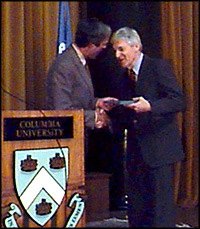
Robert D. McFadden accepts the 1996 Pulitzer Prize in Spot News Reporting from George Rupp, Columbia University President.
Winning Work
By Robert D. McFadden
The gracefully arched, 19th-century aviary at the Bronx Zoo -- home to a colony of 100 South American sea birds and a landmark to generations of New Yorkers and visitors -- collapsed in a gust of wind under the weight of a foot of snow during Saturday's storm, and dozens of rare, exotic gulls and terns flew away, zoo officials said yesterday.
No people were in the aviary at the north end of the zoo near Fordham Road when the huge cage of torn, twisted wire mesh crashed down on a coastal habitat of rock outcroppings, murky pools, pebble beaches and island nesting nooks at 10:45 A.M. No birds were killed and only one was known to have been injured.
And many birds were trapped under the tangle of wire and saved, officials said.
Ten flightless Magellanic penguins waddled into their rookeries, guanay cormorants and other survivors, including an oystercatcher, took cover in nesting cavities. Zoo keepers quickly rushed in with nets, trying to minimize the loss.
But at least 33 birds -- 8 Grey gulls, 12 Andean gulls, one band-tail gull and 12 Inca terns -- escaped and were carried away on high winds from the small artificial realm where they had been hatched, fed and protected into a harsh world where they may have to compete with city sea gulls, crows and other toughs of the air.
"It's a very sad day," Dr. Donald Bruning, the zoo's curator of birds, said in an interview yesterday. "The aviary was beautiful and has been around for almost a century. And the birds would be very difficult to replace. The Inca terns were by far the largest breeding colony in North America, and we've lost almost half of them."
Zoo officials asked bird-watchers and the public to be on the lookout for the escaped birds, whose native habitats are the coasts of Peru and Chile, and issued descriptions and other advice about how to spot, capture and report them. To avoid being swamped by calls from everyone who sees a nonexotic gull or a tern, the zoo issued a list of "bird rehabilitators," licensed experts in aiding wildlife, to serve as intermediaries.
But Dr. Bruning said the chances of recovering the birds seemed slim. He noted that high winds, which gusted up to 50 miles an hour, could have carried them by late yesterday across most of the New York metropolitan area and New Jersey, and that the likelihood of finding and recapturing them appeared to be as dubious as their chances of survival in the urban wild.
"Most of them were hatched and raised in the aviary and have no experience outside," he said. "The cold will not bother them, but it will not be easy for them to find food. They will have to compete with local gulls and other birds, and this is not the best time of the year for trying to find food."
Since the flyaways were accustomed to shelter and regular feedings of fish, Dr. Bruning said the best hope for their recovery was that some had resisted the high winds and taken shelter nearby and would return in search of a meal.
"They know food is available and would come back to that," Dr. Bruning said. "We're hoping that when they get hungry and can't find a supply of fish, they may start looking to come back to the cage -- that is, if the wind hasn't blown them too far away. If they find themselves in a completely strange area, they won't know how to find their way back."
Pans of smeltlike capelin and other small fish were put out at the aviary wreckage yesterday to lure any nearby fugitives back, but the only taker seen was a strutting crow.
The structure that collapsed, known as the Harry de Jur Aviary, was built in 1899, three years after the founding of the New York Zoological Society. It was one of the first animal shelters built at the Bronx Zoo, then still in the midst of farms and now a 265-acre tract of hilly parkland bounded by Fordham Road, Southern Boulevard, East 180th Street and the Bronx River Parkway.
The aviary was unique at the time -- a huge cage topped with an arch of wire mesh 80 feet high, 150 feet long and 90 feet wide -- where birds could fly about in a habitat that simulated nature's, and where people could enter through double wire doors and walk unobtrusively among them.
In the early 1980's, Dr. Bruning said, the aviary was remodeled and a new wire mesh arch was installed, along with a redesigned interior habitat. But the pipelike supports for the arch were not replaced, and after the collapse many of these pipes -- 96 years old -- were found to be rusted where they joined the wire mesh of the arch, about 15 feet above the foundation, Dr. Bruning said.
"You could see the rust once it broke off," he said. "All of the pipes broke at the same joint all the way around the cage."
Saturday's snow was wet and heavy, Dr. Bruning noted, and when it ended at midmorning the foot of snow that spread over the arch must have weighed many tons. It became even heavier as sleet and rain began falling and were absorbed into the snow. But it was not mere weight that brought the aviary down, he said.
"Apparently there was a strong gust of wind that caught the whole structure like a sail," he said. "The entire cage collapsed on the interior. All the arch members broke apart and separated. There were cables that went across for support and they came down too. It was a mass of twisted and torn mesh, and there were gaps in it -- very large holes where some of the birds escaped."
The only immediate casualty of the collapse was a cormorant that sustained a slight cut. Many of the birds were trapped under the mesh. Some took refuge in their nesting areas, others were saved by keepers, who were next door in the Aquatic Bird House and rushed out with nets after hearing the roar. Survivors were taken to other bird shelters at the zoo.
Zoo officials asked bird-watchers and the public for help in finding the escapees, and they provided brief descriptions:
Inca tern adult has a dark blue-gray body, white mustache, red bill and feet and is 14 to 17 inches long, while the juvenile has a black bill and feet and no mustache.
Andean gull has a white head with crescent black earmarks, light gray upper body with white underparts and a 22-inch length.
Grey gull is uniformly slate gray with black bill, faint eye rings and is 19 to 20 inches long.
Band-tail gull is white with yellow bill and feet, a white body and black wings.
All but the band-tail and some of the Andean gulls have leg bands. Zoo officials asked anyone who spots one of these birds to contact the zoo or one of the bird rehabilitators whose names and numbers it made public. They noted that it was unlikely that anyone could catch one of the birds. But if a bird is caught, it should not be taken indoors, but kept in a well-ventilated cardboard box. The birds are not dangerous, but can bite if grabbed.
Dr. Bruning said he hoped the aviary would be rebuilt, especially in time for the zoo's centennial next year. He noted that it might cost several hundred thousand dollars and that there was little money for such a project at a time of tight budgets. But he called it an important facet of the zoo.
"It is tragic to lose this beautiful landmark aviary," the curator said. "Our main concern now is for those birds that flew or were blown away."
The Bronx Zoo asked anyone who spots one of the missing birds to report to the zoo or one of the bird rehabilitators listed below. Rehabilitators are trained to rescue and aid injured wildlife and are licensed by the state Department of Environmental Conservation.
WHERE TO REPORT SIGHTINGS
THE BRONX Call the zoo at (718) 220-5153, Monday through Friday, 10 a.m. to 4 p.m. Calls will be taken by Friends of Wildlife volunteers. On Saturdays and Sundays, the volunteers may be reached at (718) 220-5100.
MANHATTAN Tesa Sallenave (212) 689-3039.
BROOKLYN AND QUEENS Jo Arnone and Eugenie Simon (718) 441-9281.
WESTCHESTER COUNTY Carolyn Lutz (914) 969-7613.
LONG ISLAND Volunteers for Wildlife (516) 423-0982.
NEW JERSEY Avian Rehab Center (609) 390-7499.
© 1995, The News York Times
By Robert D. McFadden
"We are waging all-out war to put these people out of business," Mr. O'Neill said.
Heavily armed police officers and agents of the American Society for the Prevention of Cruelty to Animals crashed into an old movie theater in the Bronx late Saturday night, seized 296 people and scores of caged and bloody roosters and shut down what had been billed as a national championship cockfight.
The raid -- the largest in the 129-year history of the A.S.P.C.A. -- followed two months of undercover investigations that tracked preparations for an event that the authorities said had kicked off the 1995 cockfighting season in New York City and brought hundreds of spectators and fighting cocks from all over New York State, as well as New Jersey, Pennsylvania, Virginia and Puerto Rico.
It provided a window on a largely secret world in which birds are crossbred for aggressiveness, raised on steroids, fitted with razor-sharp spurs, injected with PCP, or angel dust, to deaden pain, and set in a ring to slash one another to death while spectators bet thousands on their favorites and roar for blood.
Saturday night's raid, which began about 11:30 P.M., involved more than a dozen A.S.P.C.A. agents and 30 members of the New York Police Department's Bronx Task Force and the 48th Precinct's anticrime unit.
The raid at 1000 Morris Avenue, near East 165th Street in Morrisania, also offered a rare glimpse into a cockfight venue: a converted theater, nearly the size of a football field, where a fighting pit and bleachers in-the-round had been built, along with a labyrinth of false walls designed to be pulled together in case of a raid to make it seem as if a boxing match was under way. A phony boxing ring was even installed.
The authorities said the operation had cameras and lookouts, guard dogs patrolling the premises, escape routes over roofs and tunnels to the street and an adjacent pool hall, and indoor parking for hundreds of cars. They said they also found a full bar for patrons, metal and wooden cages for contestant birds, a sawdust-covered, 24-foot octagonal ring -- even a two-foot silver trophy inscribed, "Fastest Fighting Cock, The Bronx, N.Y., March 25, 1995."
"This was the most sophisticated place we've ever raided," John Foran, the chief administrative officer of the A.S.P.C.A. said in an interview yesterday as law-enforcement officials continued the lengthy process of charging suspects and classifying evidence, from cash to birds and cockfighting paraphernalia.
Mr. Foran said seven suspects were charged as organizers with two felonies each -- cruelty to animals and participating in animal fights -- and face up to four years in prison if convicted. These suspects, part of a group suspected of organizing most of the cockfights across the metropolitan area, were said to have acted as ring judge, bookmaker, lookouts and barmaids.
He said 289 spectators, who had paid $20 each for admission, were charged with misdemeanor counts of cruelty to animals and participating in animal fights, each carrying no more than a year in jail. Most were held overnight in the theater and were released after being given summonses for court dates.
Robert O'Neill, chief of law enforcement for the A.S.P.C.A., identified the main organizer of the cockfights and the theater owner as Angel Luis Benitez of 762 Union Avenue in the Bronx. He was taken into custody on a street near his home yesterday and charged with the two felony counts, Mr. O'Neill said.
Mr. Foran said that cockfight promoters have crossbred birds with pheasants for aggressiveness, given them steroids to build muscle, fixed razor-sharp spurs to their claws and injected them with PCP to ease pain and prolong their fights, which typically run up to 10 minutes and invariably leave one or both contestants dead or fatally injured.
Cockfighting, experts say, may date back 3,000 years to Asia; it spread across India to Europe and was brought by English colonists to the New World and the Caribbean, where it put down deep roots in the Hispanic culture but has long been denounced as cruel.
"Most of civilization has come to realize this cruelty is no longer acceptable," Mr. Foran said. "These animals experience a great deal of pain. They literally rip each other apart. It's a blood sport and a barbaric practice that has to be brought to an end."
Neighbors around the raided theater said yesterday that cockfights had been going on for several years. "They would honk their horns three times and the gate would roll up," one woman said.
Others told of ugliness in the streets on the mornings after a cockfight. "The roosters would be just lying in the street," a man who asked to remain anonymous said. "Forget it, lots of roosters dead with blades between their feet. Some were still alive. A guy would bring them out in bags."
Mr. Foran, who accompanied the raiders, said the invasion began quietly. "We took out two lookouts at the door -- grabbed them, put them on the ground and handcuffed them," he said. "Then, emergency service police officers with machine guns and bulletproof vests went in first."
Though the raiders moved swiftly up a flight of stairs and into the ring, the organizers had already begun to pull the false walls into place when the officers and agents burst in.
"We rushed into the ring area and ordered everybody down on the floor," Mr. Foran said. "There was no resistance, no shooting, no violence. Some of them tried to flee. We found some hiding under the bleachers or in a dropped ceiling, but some of them got away."
The raiders found 20 birds already dead from the night's action, but 90 more were found in metal or wooden cages, or in the traditional pillowcase-like bags that are used to keep the cocks in the dark and relatively docile. The birds, some with values of $1,000 to $10,000, are to be destroyed humanely by the A.S.P.C.A.
"We hate to have to put down any living creature, but these birds have been trained to be so violent that we simply have no other choice," Mr. O'Neill said.
Mr. Foran said Saturday night's raid had been timed to coincide with the start of the March-to-August cockfighting season in New York, which ends with the molting season in which cocks' blood flows into quills, making them highly vulnerable and unable to fight.
He and Mr. O'Neill said that the raid had extracted a heavy toll on the cockfighting business in the metropolitan area. Since last June, the A.S.P.C.A. has seized 1,550 fighting birds -- half the estimated total in circulation -- and arrested 240 suspects. "We are waging all-out war to put these people out of business," Mr. O'Neill said.
© 1995, The New York Times
By Robert D. McFadden
"But we were together," she said. "Rachel and I kept together like two fallen birds."
On Saturday night, at the Brooklyn intersection she crossed on her way home every evening after twilight, Rachel Neufeld went down under the right front wheel of a city bus and was crushed to death. She was 70 years old, and a woman unknown in a city where fame and riches are the ordinary measure of a life.
The details of the accident at Avenue J and Bay Parkway in Midwood were hazy and under investigation, the police and the Transit Authority said, though the driver was on probation for reasons that were unclear yesterday, so no one was able to say precisely how or why Mrs. Neufeld had been killed.
But after her funeral at a Jewish chapel in Borough Park yesterday, as her family sat shiva at her apartment at 1134 East Second Street, two blocks from the accident scene, her sister, Anna Klein, choked back tears and said some of the things that needed to be said about a small graceful woman of the 20th Century.
She was an intelligent, courageous woman, Mrs. Klein said, and had come halfway around the world since the 1920's from their village in Czechoslovakia.
It was a journey that had taken her to the Nazi death camp at Auschwitz, where she lost everyone but her sister, to Bremerhaven where she made German bombs in a cavern while Allied bombs shook the earth, to a Saxony woods where she ate grass and leaves and waited for liberation, to postwar transit camps in Budapest and Vienna, to Jerusalem and finally to New York.
She had survived the Holocaust, married, given birth to a son and daughter. She had worked at job after job -- sweatshops, day care centers, kitchens and offices -- to send her children to college, to see them settled, one as a banker and the other as a school principal. And she had somehow retained her faith and an appreciation for the world at her fingertips.
"We walked together on Ocean Parkway -- it was Shabbat," Mrs. Klein said of her last day with her sister. "It was cloudy. I like this kind of day. But she said, 'Oh, what a lot of lovely flowers.' I am very cynical about flowers. None of them are related to me. She was angry with me. 'You don't have a sense of beauty,' she said. She enjoyed every leaf, every blade of grass.
"And now," she added, the accents of her East European childhood still husky in her throat, "I am devastated. I don't know where to put myself, or how I will get up in the morning."
She was born Rachel Zhwartz on Feb. 3, 1925, in what was then known as Sevlus, a town of 14,000 -- including 4,000 Jews -- in southwest Czechoslovakia. She had an older sister, Gabriella, who had been born in 1922. Her younger sister, Anna, was born in 1926. Their family had been in the wine business for many years and the three sisters lived in a big house on the main street with their mother, Ilona, and father, Martin, who was secretary to the Jewish community.
Mrs. Klein remembered the day the Nazis arrived: March 19, 1944.
"There was no time to hide," she said. "They came in with their tanks. There was no time. They had guns and we were taken away. They took all the Jews in town and put us into a ghetto in the poorest part of town. We had nothing but the clothes on our backs. We were in a room with 32 people packed on the floor, and we were kept there for two months until May.
"Then they took us to Auschwitz -- in a railroad train, in cattle cars. It was horrible: it was the three of us and our parents and, by then, my sister, Gabriella, had a baby 13 months old."
When they arrived at the infamous arch, "Arbeit Macht Frei" (Work Makes You Free), Rachel and Anna were separated from the other members of the family. "We, the two of us, were sent to the shaving of the hair, and then to the barracks," Mrs. Klein said. "We never saw our family again.
She remembered the torments in the barracks -- the terrible conditions, the forced labor and the waiting; the only consolation was that the sisters, Anna and Rachel, were together. "We were waiting for our turn," she said, "but our time didn't come. They demanded labor and we were chosen."
In August, in an extraordinary reprieve apparently made possible by the Nazis' need for slave labor in the production of war materiel, Mrs. Klein said she and Rachel were sent to northern Germany, to a cavernous underground plant near Bremerhaven, where they helped construct bombs for the Luftwaffe. She told of terrifying days and nights working on bombs while the earth shook from explosions as Allied bombers roared overhead.
"But we were together," she said. "Rachel and I kept together like two fallen birds."
Through autumn, winter and into the spring of 1945, the Allied bombing grew heavier. Then April arrived. "Two days before the end, there were 40 percent casualties," she said. "The Germans took us out then from where we worked. They wanted us as security when the liberators came. But it never worked out. They got scared and ran. We were left in the middle of the woods. We ate grass and finally the Britsh came and took us out."
After the war, they wanted to go to Israel, but found themselves in the limbo of a transit camp in Budapest, where they both stayed for four years and were married -- Rachel in 1946 to Zev Neufeld, a Hungarian 20 years her senior, who had lost his first wife and a daughter at Auschwitz, and Anna in 1948 to Samuel Klein. The two couples were inseparable and in 1949 they went to live in the newly independent State of Israel, settling in Jerusalem.
Mrs. Neufeld's first child, Chaya, was born that year, and her son, Shimshon, was born in 1955, Mrs. Klein said. A decade later, she said, they all agreed to move to America, but there were immigration quotas and it could not be done quickly or easily.
"Sam and I came first in 1959 through a transit camp in Vienna," she said. "We were on the quota. Rachel and her family came in 1960. We arranged it through a friend who vouched for them. There were immigration restrictions, and these friends had property and a business and said they would not be a burden on the state."
Mr. Neufeld did "manual work, hard work, anything he could find" and later became a bookkeeper and a rabbi who sometimes helped supervise the production of kosher food, she said. Meanwhile, her sister, too, went to work to help raise the family, laboring in what she called sweatshops and taking jobs in day care, cooking and office work.
"She always worked," Mrs. Klein said. "They saved and saved to raise their children and send them to college." Chaya and Shimshon both attended Brooklyn College, and Chaya went to graduate school at Hofstra University, receiving two master's degrees.
Shimshon became a foreign exchange broker for Chemical Bank and lives in Brooklyn with his wife, Olivia Gross-Neufeld, a lawyer, and their two children, she said. Chaya became the principal of an elementary school in New Jersey. She lives in Morganville, N.J., with her husband, Thomas Friedman, a writer and professor of English who commutes to Syracuse University, and their two children.
"She was so proud of her children," Mrs. Klein said of her sister. "Children -- if everybody would be like them, it would be a good world."
Mrs. Neufeld stopped working five years ago, when she was 65, but never gave up her daily 20-minute walks to the home of her sister at 1233 East Ninth Street. After Mrs. Klein's husband died two years ago, her sister's love and quiet courage were crucial, she said. They often strolled in the neighborhood in the late afternoon or early evening, talking quitely in the dusk.
"She could look into my heart," Mrs. Klein said. She recalled her sister as small, 5 feet 2 inches tall, with dark brown eyes and a good sense of humor, an intelligence and wit that a hard tragic life had not trampled.
The police said the accident occurred at 9:30 P.M. Saturday as Mrs. Neufeld was crossing Avenue J from north to south. They said a city bus driven by James Greene, 28, struck and killed her instantly as it turned south onto Bay Parkway. While the incident was under investigation, the police called it an apparent accident.
"After all we had been through, we held onto each other for dear life," Mrs. Klein said. "I come from a family -- my father, mother, Gabriella, Marta her baby -- they all died the most awful violent deaths. I am the only survivor of that family. The tragedy is indescribable. And I don't know why, but I can't cry."
© 1995, The New York Times
By Robert D. McFadden
On the Avenue, they strolled in and out in the Florentine-gold sunlight like people in a song, sweeping picture brims and straw boaters, chapeaux ribboned and plumed, toques, berets, top hats and Panamas -- a passing parade of creamy parfait color for spring: lemon-lime, strawberry-orange, cranberry-rose.
It was a nearly perfect Easter, a day without brass bands or beery pomp, a day to step into the rotogravure and notice a woman's windblown hair or the geography of an old man's face. The sky was cloudless, as blue as an amateur's painting, and a chilly wind seemed to justify the new spring coat, the white gloves, the face uplifted to a warming sun streaming between the skyscrapers.
It was a day for Easter services and across the region. At dawn, 250 people gathered under the Unisphere in Flushing Meadows-Corona Park in Queens, for sunrise prayers sponsored by the Council of Korean Churches of Greater New York. At St. Vartan Armenian Cathedral in Manhattan, a flight of 12 doves was released, a symbol of Christ's dispatching of His apostles into the world.
But it was on Fifth Avenue yesterday, especially at St. Patrick's Cathedral, that the traditional crowds silently parading in Easter bonnets spoke of all New York: the broad-brimmed haute of Park Avenue, the brash tiara of Broadway, the cloche flair of Madison Avenue, the homburg hope of Flatbush.
"Thirty years ago, I remember families coming out in hats and spring coats," said Aurora Cahinhinan, 50, who grew up in town and looked forward every year to the Easter Parade. Yesterday, she wore what she called a Woolworth special -- a coronet decorated with ribbons, flowers and plastic eggs.
"You stick it together and hope for the best," she said.
© 1995, The New York Times
A Life of Solitude and Obsessions
By Robert D. McFadden
On the afternoon of March 31, less than three weeks before the Oklahoma City bombing, an old rust-bucket Pontiac drew up at the Imperial Motel on Route 66 in Kingman, Ariz., and Timothy James McVeigh got out and strode into the office to rent a room. It was easy to mistake him for a soldier.
He wore camouflage fatigues and black Army boots and carried a green duffel bag. There was a parade-ground discipline in his clean-cut appearance, in the lean stony face and crew cut. His manner resonated with military courtesy. And when he registered, he listed his address as Fort Riley, Kan.
For the next 12 days, he remained in his room, emerging only for occasional meals and once to pay his bill. He had no visitors, made no phone calls. Beyond mussing the covers of his king-size bed, he barely disturbed the furnishings. No one heard his television. His car never moved from its place outside.
Day after day, there was only a silence behind the drawn blinds and the locked door. "That's the funny thing," Helmut Hofer, the motel's owner, remembered. "He didn't go out. He didn't make phone calls. He didn't do anything. He just sat up there and brooded."
He had always been a brooder, this intense young man from upstate New York who loved guns and danger and isolation, who saw himself as a new frontiersman in a nation that had lost its values, a hard realist where others were blind to corruption and conspiracies, especially in Government.
On April 12, he left the motel.
On April 17, he rented a truck in Kansas.
On April 19, it blew up in Oklahoma City.
Two weeks after the nation's worst terrorist bombing, Mr. McVeigh, 27, who was picked up in a nearby town and is the only person charged thus far in the case, calls himself a "prisoner of war," refuses to answer investigators' questions and remains an enigma, as silent in his cell as he was at the motel, or, for that matter, in his barracks in the Army or the apartments he shared.
But interviews with dozens of people who knew him before, during and after his military service from 1988 to the end of 1991 have begun to shape a clearer picture of Mr. McVeigh, who by all accounts was obsessed with guns, apparently disliked black people, and embraced the solitude of his pillow night after night.
The interviews have also begun to fill in crucial gaps in his transformation from troubled upstate teen-ager to central figure in the bombing -- a descent into the maelstrom that may have hinged on an Army career in which he tried to be the perfect soldier, but saw his cherished hope of becoming a Green Beret shattered by psychological tests. It was apparently a blow so crushing that he quit the Army and went into a psychic tailspin.
The interviews suggest that Mr. McVeigh, never an outgoing man, became increasingly isolated in his three years and seven months in the Army, retreating into a spit-and-polish persona that did not admit nights away from the barracks or close friendships, even though he was in a "Cohort" unit that kept nearly all the personnel together from basic training through discharge.
They also detail a strange and uncommunicative personality who gave dirty assignments to black subordinates, who spoke of blacks as inferior and used the term "nigger" in unguarded moments, who kept a dozen guns hidden in his house and car and cleaned and fired them regularly, who subscribed to survivalist magazines and other right-wing literature and often seemed coldly robotic.
"He was real different," said Todd A. Regier, a 29-year-old Topeka, Kan., plumber who served with Mr. McVeigh. "Kind of cold. He wasn't enemies with anyone. He was kind of almost like a robot. He never had a date when I knew him in the Army. I never saw him at a club. I never saw him drinking. He never had good friends. He was a robot. Everything was for a purpose."
The interviews indicate that Mr. McVeigh tried to be the perfect soldier, working longer and harder than anyone else, winning quicker promotions, even re-enlisting just before the Persian Gulf war, in which he killed Iraqis as the gunner aboard a Bradley fighting vehicle in the thick of action at the Kuwaiti border.
Military officials say Mr. McVeigh got the Bronze Star, not for valor but for service aboard his Bradley, which laid down barrages of covering fire to protect other units in some of the heaviest ground fighting of Operation Desert Storm.
It was his dream to join the Special Forces, the elite Green Berets, and he returned from the war early for training. But he left on the second day of a 21-day assessment period, and military officials said that preliminary psychological screening had shown him to be unfit. The death of this dream appears to have been a major turning point for a man who had dedicated himself to the service.
Apparently unable to face the failure, he told of washing out because of a leg injury, and when a reduction-in-forces order came down later in the year, he took an early discharge -- evidently disillusioned with an Army that had been his refuge and his future.
After the discharge on Dec. 31, 1991, he drifted from job to job and state to state and seemed to deteriorate mentally and physically. People who met him recall an increasingly unstable man who wavered between gloomy silences and a hair-trigger temper, who lost so much weight he seemed anorexic, and who could follow simple orders but could not handle pressure or take independent action.
And acquaintances say the Army's place was gradually taken in his obsessive mind by a growing belief -- shared by thousands in paramilitary groups and by many opponents of gun control across the country -- that the Federal Government was conspiring to disarm and enslave the American people, and might have to be stopped by patriots using any means necessary.
While there was no firm evidence that Mr. McVeigh belonged to any organized right-wing paramilitary or survivalist groups, there was considerable evidence that he sympathized with and espoused their beliefs. He voiced their ideas in conversations, he wrote letters expressing them, he read their literature and attended their meetings. And he lived, worked and traded weapons in areas where the paramilitary groups enjoy considerable support, according to numerous interviews.
The interviews, with relatives, comrades in arms, law-enforcement officers and others, were conducted by reporters for The New York Times who, in search of information, have traveled to Oklahoma, Kansas, Arizona, Michigan and New York, plus Alabama, California, Florida, Georgia, Illinois, Indiana, Maryland, Minnesota, Missouri, Nevada, South Dakota, Texas, West Virginia, Washington and Wisconsin.
By early 1992, Mr. McVeigh was writing letters to newspapers, complaining of crime, taxes and political corruption, and warning: "Do we have to shed blood to reform the current system? I hope it doesn't come to that. But it might." A year later, his anger found a focus in the Federal siege of the Branch Davidian compound near Waco, Tex., which ended in fiery death for the cult leader, David Koresh, and some 80 followers on April 19, 1993.
That date -- April 19, 1993, which became a symbol of Federal tyranny to right-wing militia groups -- figured in the Oklahoma City bombing, investigators say. It was the date Mr. McVeigh had printed on a phony driver's license he used to rent the truck that carried the explosives. And the devastating blast was set off on the second anniversary of the deaths in Waco.
In School Days, Outgoing Boy Turns Inward
In Pendleton, N.Y., the Buffalo suburb where he was born in 1968 and grew up, people remembered that Tim McVeigh seemed to undergo a change at about the age of 16, after his mother, Mildred, divorced his father, William, and moved to Florida with one of the boy's two sisters.
Tim, who had been an outgoing boy in childhood, turned inward, becoming a quiet youth who kept to himself. In nearby Lockport, where he went to Star Point Central High School, he stood apart from others. If they were boisterous, he might smile on the periphery. If they huddled to gossip, he would hover with his veneer of interest and his silent distrust.
"I don't think he had any really close friends," said Lynn Bishop, a classmate. "He was always the one just outside the crowd. If five or ten people were hanging out, he was always on the outside trying to fit in. No one disliked him. No one ever talked about him. I knew him, but I didn't know the faintest thing about him."
Charles Brennan, another classmate, recalled a distant youth who seemed to be friends with everyone and no one. "He hung out with a lot of varieties, honor students, different friends," he said. "He was the type of person who hung out with everyone."
After graduating from high school, Mr. McVeigh took a job as a security guard with an armored car company, Burke Armor Inc., now known as Armored Services of America, working out of a depot in Cheektowaga, near Buffalo, and delivering money to and from banks and stores. Jeff Camp was his partner for eight months in 1987 and 1988.
After a few months on the job, he said, Mr. McVeigh, who had often talked about guns and had a licensed handgun for work, came in one day with a sawed-off shotgun and bandoliers slung in an "X" over his chest. "He came to work looking like Rambo," Mr. Camp recalled. "It looked like World War III." A supervisor refused to let him go out on the truck, and Mr. McVeigh was angry.
"He used to bring in two or three guns that he carried all the time," Mr. Camp said. "He had a .45 and a .38. He had a Desert Eagle. That thing was huge." He was also intense. "He ate a lot. I don't know if it was nervousness. Sometimes he could be quiet. Some days he was hyper, some days he wouldn't say a word."
In early 1988, Mr. McVeigh and David A. Darlak, a friend who lived in North Tonawanda, N.Y., bought a 10-acre property in a sparsely settled area of dairy farms and wooded hills north of Olean, in Cattaraugus County. They paid $7,000 and used it as a shooting range.
Robert Morgan, who lives nearby, said his father once called the state police to complain about all the gunfire. "My dad turned him in," he said. "One day it sounded like a war out there. Sometimes he'd come down during the week, sometimes the weekend. He had on hunting clothes. Camouflage."
Mr. Darlak finally lost interest in the firing range, but not Mr. McVeigh. But the shooting stopped anyway in the spring of 1988, when Mr. McVeigh joined the Army. A high school classmate, Keith Maurer, was surprised at the move. "I couldn't see him joining the military," he said. "He had a lot of options. He was very smart. I didn't see the military as the one he needed to take."
But a relative of Mr. Darlak, who asked not to be identified, recalled that Mr. McVeigh had grown increasingly restive. "He was just a hyper kind of kid," the man said. "He was a high-strung person, a wound-up person, a kind of intense person."
In the Army, Dedicated Soldier, On Duty and Off
On May 24, 1988, Mr. McVeigh went to Buffalo and enlisted for a three-year hitch in the Army. That same day, Terry Lynn Nichols enlisted in Detroit. They and about 300 others who joined up around the country were sent to Fort Benning, Ga., where they assembled on May 30 as a basic training unit: Echo Company, 4th Battalion, 36th Infantry Regiment, 2d Training Brigade.
It was a Cohort unit, an acronym for Cohesion Operational Readiness and Training, most of whose members remained together for three years of military service. The idea, begun by the Army in 1980, was to give the troops a chance to develop bonded relationships and improve the unit's stability and readiness.
In battle, the Army had found, too many lone green replacements had been killed in their first confused hours of fighting. So instead of sending a lone replacement for a casualty in a front-line unit, the Cohort would, in theory, be sent as a skilled team to replace a whole unit. But in practice many commanders found that Cohort members simply got sick of one another over three years, and that the units had more suicides and members absent without leave.
At Fort Benning, Mr. McVeigh and Mr. Nichols became acquainted almost immediately and soon became inseparable, said Robin Littleton, a member of the unit. "Terry and Tim in boot camp went together like magnets," he said, noting that both knew weapons and shared many views.
After three months of basic and advanced training -- heavy conditioning and marching, learning the discipline of barracks and post life, developing skills in weapons-handling, field tactics and other military subjects -- the unit was sent in late August to Fort Riley, where it was divided into two companies.
Mr. McVeigh was assigned to Charlie Company and Mr. Nichols to Bravo Company, both of the 2d Battalion, 16th Infantry Regiment of the First Infantry Division. While Mr. McVeigh and Mr. Nichols had been close in basic training, they were less so after being separated at Fort Riley, according to men who served with them, and in the spring of 1989 Mr. Nichols was discharged because of a family emergency that has not been publicly explained by military authorities.
The 2d Battalion was a mechanized infantry unit outfitted with Bradley fighting vehicles, which are armored, run on tracks and are designed to attack like a tank and carry troops into battle. Each has a 25-millimeter cannon, a missile-firing system, a 7.62-millimeter machine gun and space in the back for assault troops. The crew are a commander, a driver, a gunner and seven or more infantrymen. Mr. McVeigh became the gunner on one of four Bradley vehicles in Charlie Company's First Platoon.
Marion (Fritz) Curnutte, of Ceredo, W.Va., an infantryman in Mr. McVeigh's vehicle, remembered him as a supremely dedicated soldier. "He played the military 24 hours a day, seven days a week," Mr. Curnutte said. "All of us thought it was silly. When they'd call for down time, we'd rest, and he'd throw on a ruck sack and walk around the post with it."
Mr. Regier, an infantryman on Mr. McVeigh's Bradley, also recalled a ramrod trooper. "As far as soldiering, he never did anything wrong," Mr. Regier said. "He was always on time. He never got into trouble. He was perfect. I thought he would stay in the Army all his life. He was always volunteering for stuff that the rest of us wouldn't want to do, guard duties, classes on the weekend."
Robert Handa, another member of the unit, said: "He kept to himself, he was a dedicated soldier. He loved being a soldier. I didn't. So after duty hours he'd stay in the barracks while everyone else took off, go out to town. I never saw him go anywhere. He always had a highly pressed uniform."
In the barracks, Mr. Regier said, Mr. McVeigh had no close friends, though he sometimes associated with Roger Barnett, who read Mr. McVeigh's Soldier of Fortune magazines. Mr. Regier recalled that Mr. McVeigh also subscribed to "all the survivalist and gun magazines," and talked often about guns.
Mr. Barnett said Mr. McVeigh read futuristic novels about World War III and a nuclear holocaust and "The Turner Diaries," whose racist and anti-Semitic plot involves a war on a United States government that has taken away citizens' guns, a book some call the bible of the extremist right.
Mr. Regier said Mr. McVeigh had a television and a videocassette recorder and watched movies. He went bowling occasionally, but did not go drinking with other troopers, and never had a date.
"He was very shy of women -- almost embarrassed," said Sheffield A. Anderson, who was a trooper in Mr. McVeigh's vehicle and is now an officer with the Florida Department of Corrections. "It didn't seem he was gay. He was just awkward."
Instead of going out, he saved his pay while others were spending theirs and then lent them money at high rates of interest. "He used to loan money out to everyone all the time," Mr. Regier said. "He had a booklet and he charged interest, 10 or 15 percent."
"He was very cheap with money, very tight," Mr. Anderson said. "If he loaned you money you could expect to pay some interest" -- $5 for a $10 weekend loan, for example, he said.
In the fall of 1990, about four months before Desert Storm, Mr. McVeigh was promoted to sergeant, well before any others made the rank. "It was unusual to have sergeant stripes so soon," Mr. Regier said. "The rest of us in the Cohort were specialists," a non-supervisory rank similar to corporal.
Soon, the new sergeant was issuing orders, and as Mr. Regier and others recall it, he began assigning dirty work -- sweeping out the motor pool, for example -- to the four or five black specialists in the 32-member platoon. It was work that ordinarily would have gone to privates.
"It was well known, pretty much throughout the platoon, that he was making the black specialists do that work," Mr. Regier said. "He was a racist. When he talked he'd mention those words, like nigger. You pretty much knew he was a racist." The black soldiers complained to a company commander and, as Mr. Regier recalled, Sergeant McVeigh was reprimanded. It was the only time he ever got into trouble, he said.
Mr. Regier also said Sergeant McVeigh and a black sergeant and fellow squad leader, Anthony K. Thigpen, did not get along. "There was a lot of bad blood between them," he said. "They hated each other. They kept at a distance from each other. I remember they yelled at each other quite a bit." The disputes, he said, were over such things as assignments of platoon duties, and they may have even argued over giving "dirty details" to blacks.
Mr. Thigpen, who lives in a Minneapolis suburb and calls himself a born-again Christian, said that Sergeant McVeigh was not openly hostile to blacks, but he said Mr. McVeigh "demonstrated his prejudice" through an unwillingness to work with black troops or to inquire about the well-being of black soldiers under his command.
He said the platoon was racially polarized, with blacks and whites working together but otherwise having little to do with one another. Mr. McVeigh was a factor in the polarization. "If we had a company function that was inclusive for all nationalities, McVeigh wasn't too enthused," Mr. Thigpen said. "If it came down to all of us sitting down conversing with one another, McVeigh wasn't in that crowd if there were African-Americans there."
He also said Mr. McVeigh seemed obsessed with a feeling that others were getting rewards or privileges -- anything from a hot meal to a good assignment -- that he, as the platoon's best soldier, was not getting.
"Charlie Company as a whole had a problem with race," said Capt. Terry A. Guild, 28, who served briefly as Mr. McVeigh's platoon commander in Charlie Company after the gulf war.
"There was graffiti on the walls of the barracks' bathroom: 'Nigger' or 'Honky, Get Out,' " said Captain Guild, who was a Charlie Company second lieutentant at the time. "They were mild incidents. If a problem was identified, a leader in Charlie Company wouldn't let it happen if he saw it. But it was definitely a problem in the company. And his platoon had some of the most serious race problems. It was pretty bad."
Late in 1990, with half his three-year enlistment remaining, Sergeant McVeigh again showed his gung-ho attitude by re-enlisting for four years. Mr. Anderson recalls chatting with him about his reasons.
"He said he had always wanted a job where he could retire at an early age," Mr. Anderson said. "He seemed as if he were a career guy, all the way. He still had a future with the system in mind. He was career conscious. He was well on his way to what I thought was a brilliant military career."
In Wartime, Honor of Taking The First Shot
Sergeant McVeigh and his company went to the Persian Gulf in January 1991. He was "definitely excited about going to Desert Storm," Mr. Regier recalled. "He was a perfect gunner. He was the best gunner we had." The war was to be the high point of Sergeant McVeigh's military experience.
In the first few weeks of the war, the crews of the Bradley fighting vehicles, along with tank crews and other ground forces, did little more than sit in the Saudi Arabian desert as American fighter planes and bombers attacked Iraqi defenses.
In these weeks, Sergeant Thigpen recalled, most troops wrote letters, played cards or chatted to relieve the boredom. But not Sergeant McVeigh, who spent his time cleaning his 25-millimeter cannon or his M-16 assault rifle. But when the time for invasion by the ground forces finally arrived, and on the eve of what was to be a 100-hour battle, Sergeant McVeigh was uncharacteristically frank.
"The night before the ground war kicked off, he was saying he was scared because we were going to be part of the first wave," Mr. Anderson said. "He was scared we weren't going to come out of it. Maybe we would get shot, blown up. It wasn't cowardly. He was just concerned. I was feeling the same way, but most people didn't express it."
The 2d Battalion of the 16th Infantry Regiment was one of the point units that made the initial drive into Kuwait when the invasion began, according to officers familiar with the operation. It was to punch a hole roughly three miles wide in Iraqi defenses -- a line of trenches supported by armored units and artillery -- and to roll up the trench line to allow American forces to flood through.
Sergeant McVeigh's platoon, however, was detached from the rest of Charlie Company, and went with the "Ironhorse" tank company that protected the units clearing the trench line. In attacking enemy bunkers and gathering up Iraqi prisoners, First Platoon fired on and took fire, but was not in the thick of the action like the other platoons in Charlie Company.
In Charlie Company's operation, tanks and trucks equipped with plows would follow up the Bradleys, burying the enemy, dead or alive, in their own trenches. The purpose of this controversial tactic was to create a smooth crossing point for the invasion forces and to avoid the need for infantrymen to jump out of the Bradleys and shoot it out with Iraqis in the trenches, conceivably even engaging in bayonet or hand-to-hand combat.
Mr. Barnett recalls that their unit did a lot of shooting at dug-in positions. After opening fire, he said, Iraqis surrendered, practically naked, looking for water and food. He said that Mr. McVeigh never expressed any desire to kill troops who were surrendering and never seemed bloodthirsty in any way.
"Pretty much, we swung around the front-line troops and hit anybody who was dug in," Mr. Barnett said of the unit. "We went into their back door. Once they had got hit head on, and then got hit from the rear by us, they pretty much gave up.
"We all did a lot of shooting when we came up on an obstacle. We did a lot of raking fire."
At one point, as Sergeant McVeigh's Bradley approached the Iraqi trench line, an enemy vehicle was spotted about 500 yards away. "Everyone wanted to shoot it," Mr. Thigpen recalled. "You know, first round, down range. McVeigh was, of course, the lieutenant's gunner so he received the opportunity to shoot the first round. I mean, he was just thrilled."
His cannon shot was a direct hit and no one thought it was luck, Mr. Thigpen said. Other troops recalled how the Bradleys plunged toward the trench lines, firing at targets hundreds of meters away, and then turned along the trench lines, cutting down Iraqi soldiers at closer ranges. Sergeant McVeigh, who had medals for marksmanship, later bragged of hitting an enemy trooper a half-mile away.
"He was telling me how accurate the 25-millimeter cannon was," said Kerry Kling, of Tuscaloosa, Ala., who joined Mr. McVeigh's platoon after the war. "He said when they were invading Iraq, he saw an Iraqi soldier coming out of a bunker and that when the first round hit his head, it exploded. He was proud of that one shot. It was over 1,100 meters and shooting a guy in the head from that distance is impressive."
After the 100-hour war, a cease-fire was declared and Sergeant McVeigh's unit was one of those assigned to guard General H. Norman Schwarzkopf, the American commander of Desert Storm. It was quiet duty, some of the troops recalled, and an anti-climax after the fighting.
The 2d Battalion did not return to its post at Fort Riley until May, but Sergeant McVeigh was allowed to leave Saudi Arabia on March 28 for what he thought would be the fulfillment of a dream -- to begin training for the Green Berets.
He arrived at the Army Special Forces headquarters at Fort Bragg, N.C., in early April for what was to be a 21-day assessment and selection course designed to test candidates mentally, physically and psychologically for service in the Green Berets. It is a rigorous course; last year the washout rate was 57 percent.
Sergeant McVeigh went through a variety of physical tests, which included a 90-minute march with a 45-pound pack, a two-mile run, as many push-ups and sit-ups as he could do in two minutes and a 50-meter swim while wearing his battle fatigues and combat boots. He passed these tests with ease.
But he failed a psychological test. He withdrew after the second day of the 21-day assessment period.
It was a crushing blow to a man who had given everything he had to the Army.
"Everybody knew he was highly upset," Mr. Thigpen said. "We never knew the reason why he didn't make it. We figured, you don't make it, you don't make it. But he was definitely angry. He was upset, very upset."
He told other members of his unit that he had washed out because of an injury to his ankle or leg. "He wanted to be in the Special Forces," Mr. Curnutte said. "He had a tryout with them. He did their test. I believe he hurt his ankle and he didn't get accepted. I think maybe he felt that he should have. I can recall they didn't give him a second chance."
Captain Guild also remembers Mr. McVeigh's setback. "He became disgruntled after he didn't make it," he said. "It might have been the first time he ever failed at anything in the Army."
Off the Post, Renting Houses, Storing Weapons
Back at Fort Riley, Sergeant McVeigh resumed his spit-and-polish soldiering, but some troops in the barracks noticed increasingly strange things about him. For one thing, he always carried a gun then.
"He was fanatical and loved to collect guns, and he always had a gun with him," Mr. Kling said. "He was a calm, laid-back person. But he felt strongly about the right to bear arms and protecting the Second Amendment -- he was fanatical about that."
Mr. Anderson said Mr. McVeigh had talked about distrusting the Government and having or planning a bunker or shelter loaded with food, ammunition and weapons on the property he owned near Olean, N.Y. "He was going to be ready if the Apocalypse hit," he said.
During the late spring of 1991, apparently chafed by life in the barracks, Sergeant McVeigh rented a three-bedroom, light brown house with aluminum awnings 27 miles away in Herington, Kan., with two members of his unit, Cpl. John Edward Kelso and Sgt. Rick Cerney. The house, at 404 North Eighth Street, belonged to Corporal Kelso's mother.
The arrangement lasted through the summer but was not a comfortable one for Sergeant McVeigh.
"He said they got into his business too much," said Sgt. Royal L. Witcher, who had served as an infantryman and the assistant gunner in Mr. McVeigh's vehicle in the gulf war. He said that in late September 1991, Sergeant McVeigh asked if he could move into a house that Sergeant Witcher was renting. Sergeant Witcher was planning to be married in early 1992, but agreed to share the place in the interim.
It was a yellow, two-story frame house at 502 South Broadway in Herington. The rent was $285 a month. Sergeant McVeigh took the larger of the two upstairs bedrooms, hauled in a box-spring bed that he covered with olive drab Army blankets and hung a camouflage poncho over the window.
Sergeant Witcher said they never went into each other's rooms. "It was pretty much an unwritten rule and I think we both knew it," the sergeant said in a telephone interview from Macedonia, where he is presently assigned to the United Nations peacekeeping forces.
He said Sergeant McVeigh kept at least 10 guns in the house. "They weren't exposed, they were hidden," he said. "He had a couple in the kitchen, a couple in the living room under the couch. I think there was one in the bathroom, behind the towels. As you go up the steps there was a little ledge and he kept one in there, a .38 revolver."
Why did he keep the guns? "He never really said and I never really asked," Sergeant Witcher said. "We really never got into each other's business. I trusted him. There had been a couple of robberies and whatnot in Herington. I didn't think anything about it."
Sergeant McVeigh had two more guns in his car -- one under the seat and one in the glove compartment, Sergeant Witcher said. "I guess for the same reason he had guns strewn all over the house," he said when asked why. "I don't know if he was paranoid or what. Or maybe he had some friends that were after him. I don't know."
The only gun he saw Sergeant McVeigh wear in a shoulder holster was a 9-millimeter Glock 19 that he had bought from a mail-order company. He usually bought his guns from local gunsmiths, Sergeant Witcher said. They included a stainless steel snub-nosed .38-caliber revolver, a blue steel .357 Magnum, a couple of .22-caliber pistols and a .45-caliber handgun.
Sergeant McVeigh had owned guns at Fort Riley, but had not been allowed to keep them in the barracks. He kept "guns and other things" in a storage locker in nearby Junction City, said Mr. Barnett, who shared his interest in guns. Sergeant McVeigh occasionally sold guns to other soldiers, said Mr. Barnett, who bought a Grizzly Windmag .357 from him.
Mr. Barnett said Sergeant McVeigh had also kept a shotgun at the home of a sergeant who lived off post.
Sergeant McVeigh took apart and cleaned all his weapons twice a week, Sergeant Witcher said. He said he would come home and find Sergeant McVeigh sitting on the beige, wall-to-wall living room carpet, surrounded by gun parts, rags and oil cans. Every weekend, the sergeant took his weapons out to a lake to shoot.
Sometimes, Sergeant McVeigh cooked pasta and meatballs. Occasionally, he and Sergeant Witcher went to movies or to fast-food joints together. "He never dated that I knew of," Sergeant Witcher said, "probably because of the way he was. He was shy, not talkative, couldn't express himself."
Sergeant Witcher said he and Sergeant McVeigh sometimes had quiet conversations. "He was a very racist person," Sergeant Witcher said. "He had very strong views against, like, political things, like that."
How did he regard black people? "I think inferior," Sergeant Witcher said. "Not as smart as us, I guess." He said that he did not share Mr. McVeigh's views and that his housemate had known this. "He pretty much knew my views and he didn't talk too much about it around me," he said.
Sergeant McVeigh read The Wichita Eagle and Stars & Stripes, the daily newspaper circulated at Fort Riley, and found something in them every day to form the basis of a complaint against the Government, Sergeant Witcher said.
"I don't know if there's such a word, but he was ill-political," he said. "There was at least one thing in each paper he read each day that the Government had something to do with that he took issue with. Like gays in the military. The Government getting involved in things he didn't really think it needed to be involved in, things dealing with weapons, like raids."
Sergeant Witcher said Sergeant McVeigh had belonged to the National Rifle Association, but when the organization seemed to be taking a softer position on the banning of assault rifles, he wrote an angry letter dropping out of the organization and canceling his subscription to the N.R.A. magazine.
James Ives, another sergeant in the infantry unit, recalled talk in the barracks that in the final months of 1991 Mr. McVeigh was becoming involvedwith off-post political groups with strong anti-Government views, but Mr. Witcher said he knew nothing of any such activity.
The Kansas Bureau of Investigation reported some years ago on intense right-wing political activity that had attracted Fort Riley soldiers to off-post meetings, but it was unclear if these were operating as Mr. McVeigh's Army service drew to a close.
The Witcher-McVeigh household broke up early in 1992. Mr. Witcher got married and Mr. McVeigh opted for an early discharge when the Army cut its forces. He never explained the decision to any Army acquaintances, just as he never again spoke of his bitter disappointment at washing out of the Special Forces. But many were astonished to learn that the company's best soldier had quit.
In Civilian Life, A Rage Grows And Boils Out
Sergeant McVeigh changed dramatically after leaving the service. Some who remember him in 1992 said he underwent a sharp mental and physical deterioration, became less confident, more insular, was able to follow orders but unable to perform any work involving pressure or initiative. And while he was dead silent most of the time, they said, aggression and a growing rage lurked just below the surface and sometimes came boiling out.
He returned to the Buffalo-Niagara Falls area and to security work, joined the New York National Guard at Tonawanda, and wrote two letters to the editor that were published in The Lockport Union-Sun & Journal in Lockport, N.Y.
One letter complained of crime, taxes and politicians being "out of control," and warned that bloodshed might be required to bring about reforms. The other spoke of man as "a hunter, a predator," and defended the "humane" killing of animals in the wild, as opposed to raising them for slaughter.
The administrator of his National Guard unit, Staff Sgt. Thomas V. Kazmierczak, said he did not get to know Mr. McVeigh, who attended weekend drills for four months, mostly simulating the firing of small missiles for the $150-a-month pay, and then quit in May. He said he had recently been given a promotion in his full-time job.
Lynda Haner-Mele, a former supervisor for Burns International Security Services in Kenmore, N.Y., managed a contingent of 60 security officers that included Mr. McVeigh at the Niagara Falls Convention Center. He was with the company for about a year, starting in 1992 as a Burns guard at a company in Cheektowaga and working overtime at the convention center in Niagara Falls.
Mrs. Haner-Mele called him "Timmy" because he seemed more of a boy than a man. He weighed only about 150 pounds and seemed anorexic. "He seemed almost lost, like he hadn't really grown up yet," she said.
Though she met him shortly after his discharge, he never mentioned, and she never knew, that he had been in the Army. "He didn't really carry himself like he came out of the military," she said. "He didn't stand tall with his shoulders back. He was kind of slumped over." She recalled him as silent, expressionless, with lightless eyes, but subject to explosive fits of temper.
"That guy did not have an expression 99 percent of the time," she said. "He was cold. He didn't want to have to deal with people or pressure. Timmy was a good guard, always there prompt, clean and neat. His only quirk was that he couldn't deal with people. If someone didn't cooperate with him, he would start yelling at them, become verbally aggressive. He could be set off easily. He was quiet, but it didn't take much."
She said she did not believe he could have planned and executed the Oklahoma bombing alone. "Timmy just wasn't the type of person who could initiate action," she said. "He was very good if you said, 'Tim, watch this door -- don't let anyone through.' The Tim I knew couldn't have masterminded something like this and carried it out himself. It would have had to have been someone who said: 'Tim, this is what you do. You drive the truck . . . ' "
Mr. McVeigh abruptly quit his security job and moved from Lockport to Kingman, Ariz., in early 1993. There, he is believed to have moved in with an Army acquaintance, Michael Fortier, who lived in a trailer park on the northeastern edge of town.
After the fiery end of the Davidians near Waco in April 1993, Mr. McVeigh was said by Federal investigators to have visited the site and to have come away with a profound anger against the Federal Government. A number of right-wing groups in the Kingman area share that view, but there is no record of Mr. McVeigh's having joined them or participated in their activities.
In May, he gave Mr. Fortier's address as his residence on an application to rent a private mail box. Investigators say Mr. McVeigh lived in a trailer park in Kingman until the fall, when he quit his job and went to Michigan to join another Army friend, Terry Nichols.
They stayed for a time in Decker, on a farm owned by Mr. Nichols's brother, James. Neighbors said the three attended meetings of the Michigan Militia, one of the more militant of the paramilitary groups that have sprung up around the country in recent years. Since Mr. McVeigh's arrest, the Nichols brothers have also been taken into custody as material witnesses in the Oklahoma bombing and have been charged with conspiring with Mr. McVeigh to build bombs in Michigan.
Mr. McVeigh returned early last year to Kingman, and with an introduction by Mr. Fortier, is known to have got a job at a Tru-Value hardware store, where he moved lumber for two or three months. But he quit without explanation and has since traveled to Michigan, New York and other states, always returning to Arizona, where right-wing groups have used the desert to test explosives and stoked the fires of public anger at the Federal Government.
In New York, a relative of David Darlak, co-owner of the shooting property Mr. McVeigh had sold in 1992, saw him in the Lockport area after the 1994 elections. "He brought it up," the man said. "Something about the Government, that something had to be done. He had slowly deteriorated and turned into a paranoid person. He got stranger and stranger, more intense. He was a troubled person."
Last January, Mr. McVeigh was seen at a Michigan Militia meeting in Jackson, Mich., where speakers talked of a need to take action against the Bureau of Alcohol, Tobacco and Firearms, one of the main Federal agencies in the Waco incident and one of the agencies housed in the Federal Building in Oklahoma City.
In early February, Mr. McVeigh stayed for five days at the Hill Top Motel in Kingman. He checked out on Feb. 17 and disappeared for a few weeks. During this time, his mail at the drop he had rented was picked up by Mr. Fortier and a man resembling the sketch of the bomb suspect John Doe No. 2.
Then on March 31, Mr. McVeigh drew up at the Imperial Motel in Kingman in a rusty green 1983 Pontiac and took a $20-a-night room in his own name, but giving a Fort Riley address. "I thought he was in the Reserves because of the way he came in here all dressed up in his camouflage and black boots," said the owner, Mr. Hofer.
For 12 days, he kept his solitary vigil, silently brooding, perhaps awaiting some word, perhaps drifting back over the years of isolation and rejection and dashed hopes: Pendleton, Lockport, Fort Benning, Fort Riley, the Persian Gulf, Fort Bragg, Herington, Decker, Kingman.
Then, he checked out and drove east.
© 1995, The New York Times
By Robert D. McFadden
Unveiling an apparent motive and a possible way out of his murderous ways, a serial mail bomber has delivered to The New York Times and The Washington Post a 35,000-word manifesto calling for revolution against what he says is a corrupt industrial-technological society controlled by a shadowy international elite of government and corporate figures seeking to subvert human freedom.
The self-described anarchist, in a series of accompanying letters, said that if his full manuscript was published by one of the newspapers within three months, and if that paper printed three annual follow-up messages, he would stop trying to kill people. But the bomber, who threatened to blow up a plane this week, did not pledge to stop property destruction in his 17-year campaign of postal terrorism.
The documents were contained in parcels received by The Times on Wednesday and The Post yesterday and were turned over to the Federal Bureau of Investigation. After examination and laboratory tests, the bureau said the manuscripts were apparently authentic writings of the terrorist who has killed 3 people and wounded 22 others with 16 mail bombs since 1978. The series of crimes has come to be known by the F.B.I. code name for the case, Unabom.
The killer, in a letter to The Times in April, said he wanted to tell his story and was working on an article of 29,000 to 37,000 words "that we want to have published" in The Times or in Time or Newsweek magazines. He said he would end his killing if his publication terms were met. The documents received this week apparently were a follow-up to that letter.
The Times and The Post, in separate statements yesterday, said they were considering whether to publish the manifesto, a 62-page, single-spaced document that often reads like a closely reasoned scholarly tract, touching on politics, history, sociology and science as it posits a cataclysmic struggle between freedom and technology. If published, the document would fill about seven pages of The Times.
The manifesto sketches a nightmarish vision of a deteriorating society and a future in which the human race is at the mercy of intelligent machines created by computer scientists. He urges a revolution in which factories would be destroyed, technical books burned and leaders overthrown. Out of the chaos, he expresses the hope that a return to "wild nature" might prevail.
The document, mixing revolutionary rhetoric and back-to-nature sentiments in a blend that might have come from Trotsky or Thoreau, laments increasingly overcrowded cities, the rapidity of social change and the "breakdown" of traditional values; rails against leftists and conservatives, and seems to add definition to the terrorist, about whom little is known.
The bomber, whom the F.B.I. believes is a man but who generally refers to himself as "us" or "we," claims to represent a terrorist group that he calls FC. But he is believed to be a loner who lives somewhere in the area of Sacramento, Calif.
In a series of accompanying letters that were delivered to The Times and are in the possession of the F.B.I. -- letters addressed to The Times, to Scientific American magazine and to Bob Guccione, the publisher of Penthouse magazine -- the bomber twitted the F.B.I. as "surprisingly incompetent." He scoffed at journalistic inaccuracies in reporting his exploits and claimed that his recent killing of a California lobbyist was not inspired by the terrorist bombing in Oklahoma City.
In addition, describing himself as "angry," the bomber appeared to be summing up the motivations and emotions of 17 years of violence and death, and, in a kind of epiphany, offered himself and the nation a way out of the killing.
Even so, he did not promise to end his campaign of terrorist bombings completely if his manuscript were published by The Times or The Post.
Distinguishing between terrorism, which he said was intended to cause death or injury, and sabotage, intended to destroy property, he reserved what he called the right to engage in sabotage even if the manuscript were published by one of what he called the "respectable" newspapers.
In his letter to Mr. Guccione, the bomber said The Times and The Post were being given "first claim on the right to publish," and that if both refused, Penthouse would be given publication rights thereafter, but on terms that might add one more death to his string and therefore increase pressure on the newspapers to publish the document.
"To increase our chances of getting our stuff published in some 'respectable' periodical we have to offer less in exchange for publication in Penthouse," he wrote. "We promise to desist permanently from terrorism, EXCEPT that we reserve the right to plant one (and only one) bomb intended to kill, AFTER our manuscript has been published."
Arthur O. Sulzberger Jr., publisher of The Times, said in a statement yesterday that the newspaper was considering whether to publish the manifesto. "The manuscript is long and we're just starting to look at it closely and study our options," he said. "There seems to be an implicit promise that bombs will not be sent while we're considering the document."
Mr. Sulzberger added: "We will act responsibly and not rashly, knowing that lives could be at stake. It seems we've been given three months to think the issues through. One issue that we find especially troubling is the demand that we not only publish the initial document but then open our pages for annual follow-ups over the next three years. Such a commitment is not easily made."
In Washington, Donald E. Graham, publisher of The Post, said: "The Post takes this communication very seriously. We are considering how to respond, and we are consulting with law enforcement officials."
Yesterday's developments came in a bizarre week in which the bomber, who had never previously issued warnings, first sent a letter to The San Francisco Chronicle threatening to blow up an airliner out of Los Angeles International Airport before the Fourth of July, and then -- in a brief message included in the package of documents sent to The Times -- called the threat a prank.
"Since the public has a short memory we decided to play one last prank to remind them who we are," he said. "But, no, we haven't tried to plant a bomb on an airliner (recently)."
The F.B.I. said the messages to The Chronicle and The Times were both the work of the bomber.
Prank or not, the threat prompted tightened security at California airports, delaying many flights and disrupting mail deliveries throughout much of the state on Wednesday. Yesterday, as travelers prepared to depart for the long Fourth of July weekend, tension was still evident among passengers at airports in Los Angeles, San Francisco and elsewhere in California.
While airlines reported normal service and no drop in the number of passengers, it was not a typical day. Some passengers were interrogated. Luggage was carefully scanned with X-rays. Extra police and security officers patrolled terminals. Postal authorities maintained a close watch over packages big enough to contain a bomb.
And Jim R. Freeman, the San Francisco special F.B.I. agent in charge of the Unabom case -- a code name adopted because the early targets were people associated with universities and airlines -- said all the precautions were justified.
"The F.B.I. reiterates that based on the Unabomer's prior history of violence, and specifically violent acts directed against airline passengers, the F.B.I. is continuing to take the threat as stated in the letter to The San Francisco Chronicle very seriously," Mr. Freeman said.
The Chronicle building in San Francisco was evacuated for an hour yesterday after someone noticed an unattended toolbox outside. A three-block area was cordoned off, while police closed in, but the toolbox turned out to be harmless.
While the bomber's lengthy manifesto outlined his complaints against society and his apparent aims, the letters that accompanied it were in some respects more pithy, particularly as they touched on the F.B.I., which has been unable to trace him.
"For an organization that pretends to be the world's greatest law-enforcement agency, the F.B.I. seems surprisingly incompetent," he asserted in the letter to The Times. "They can't even get elementary facts straight. Many news reports based on information provided by the F.B.I. are incorrect and even contradict each other."
Contrary to published reports, he said, the bomb that killed the lobbyist, Gilbert Murray, in April was not a pipe bomb and was set off by "a home made detonating cap." He also complained that the name on the address label was are consulting with law enforcement officials."
Yesterday's developments came in a bizarre week in which the bomber, who had never previously issued warnings, first sent a letter to The San Francisco Chronicle threatening to blow up an airliner out of Los Angeles International Airport before the Fourth of July, and then -- in a brief message included in the package of documents sent to The Times -- called the threat a prank.
"Since the public has a short memory we decided to play one last prank to remind them who we are," he said. "But, no, we haven't tried to plant a bomb on an airliner (recently)."
The F.B.I. said the messages to The Chronicle and The Times were both the work of the bomber.
Prank or not, the threat prompted tightened security at California airports, delaying many flights and disrupting mail deliveries throughout much of the state on Wednesday. Yesterday, as travelers prepared to depart for the long Fourth of July weekend, tension was still evident among passengers at airports in Los Angeles, San Francisco and elsewhere in California.
While airlines reported normal service and no drop in the number of passengers, it was not a typical day. Some passengers were interrogated. Luggage was carefully scanned with X-rays. Extra police and security officers patrolled terminals. Postal authorities maintained a close watch over packages big enough to contain a bomb.
And Jim R. Freeman, the San Francisco special F.B.I. agent in charge of the Unabom case -- a code name adopted because the early targets were people associated with universities and airlines -- said all the precautions were justified.
"The F.B.I. reiterates that based on the Unabomer's prior history of violence, and specifically violent acts directed against airline passengers, the F.B.I. is continuing to take the threat as stated in the letter to The San Francisco Chronicle very seriously," Mr. Freeman said.
The Chronicle building in San Francisco was evacuated for an hour yesterday after someone noticed an unattended toolbox outside. A three-block area was cordoned off, while police closed in, but the toolbox turned out to be harmless.
While the bomber's lengthy manifesto outlined his complaints against society and his apparent aims, the letters that accompanied it were in some respects more pithy, particularly as they touched on the F.B.I., which has been unable to trace him.
"For an organization that pretends to be the world's greatest law-enforcement agency, the F.B.I. seems surprisingly incompetent," he asserted in the letter to The Times. "They can't even get elementary facts straight. Many news reports based on information provided by the F.B.I. are incorrect and even contradict each other."
Contrary to published reports, he said, the bomb that killed the lobbyist, Gilbert Murray, in April was not a pipe bomb and was set off by "a home made detonating cap." He also complained that the name on the address label was
Limit on Parcels
LOS ANGELES, June 29 -- In the aftermath of the threat to blow up a Los Angeles flight, the Postal Service today said it would refuse to accept parcels flown into California or mailed from the state if they weighed more than 12 ounces and were sent by anyone other than a known shipper.
The only other time the service instituted a similar measure was during the Persian Gulf war.
To stop the flow of parcels into California's mail drops, the Postal Service has put notices on collection boxes telling people to send their packages either parcel post or through international surface mail, neither of which use airlines.
Packages left in collection boxes will be returned to the sender, said David Mazer, a spokesman for the Postal Service. Parcels from known shippers -- like Sears and L. L. Bean -- are still being accepted by the post office but are not being sent on commercial airliners.
Postal officials said the policy would affect about 30 percent of the 400,000 parcels usually mailed daily in California. The policy will continue indefinitely.
Postal authorities said that by tomorrow they expected to clear all of the hundreds of thousands of packages that have piled up over the past two days as they checked for suspicious markings, odors and wires.
© 1995, The New York Times
The state's worst ground fire in decades -- a vast arc of windblown flames that boiled in 40-foot walls, scorched miles of pine woods and burned a dozen homes and other property -- raged for a second day in Suffolk County yesterday. But last night its threat to a South Shore resort community appeared to ease, and officials said it might be brought under control today.
The fire, which posed Herculean hardships for weary firefighters, also raised a testy political issue between state authorities who anticipated airborne tankers to fight the flames and Federal officials who failed to fulfill a promise to deliver them yesterday. And police investigators raised another specter, saying that an arsonist may have been behind the blaze.
The fire remained out of control, with new flareups on the perimeter of the 12-square-mile blaze. But there were no reports of deaths or major injuries, no more homes or businesses were lost, and after a day of ground and air attacks on the flames, the huge clouds of smoke billowing on the horizon began to diminish and officials began to express hope that, with luck, the worst might be over.
"Everything looks much, much better," Gov. George E. Pataki said shortly after 6 P.M. as he returned to a command post from a helicopter flight over a 7,000-acre moonscape of scorched earth ringed by darkening fires. "What a difference a day makes. I'm now convinced that we will be getting the fire under control. The winds have died down and that's a great help.''
Senator Alfonse M. D'Amato called the situation "a dramatic change from yesterday." He had accompanied the Governor throughout a day of high drama on the edge of a conflagration roaring through woodlands as dry as a tinderbox, whipped by winds that peaked at 25 miles an hour and gradually diminished.
Col. Ed Jacobi, Superintendent of the New York State Forest Rangers, agreed that the situation had improved dramatically. There were still brush and woods in the fire's path and the flames were not yet contained, he said, but added that firefighters planned an all-out assault beginning early this morning in the hope that the fire would be brought under control today.
By 1 A.M. today, the winds had ebbed to a near calm and a cool damp air had settled in over the Pine Barrens, aiding firefighters who continued to work through the night, clearing fire breaks and raking and dousing embers.
Even as the dangers faded, an inquiry into the fire's cause intensified. Detective Sgt. Robert Flood of the Suffolk County police said the authorities were investigating the possibility of arson and had recovered "physical evidence" near the place where the fire broke out on Thursday afternoon: pine woods south of the eastern campus of Suffolk County Community College in Westhampton.
Investigators, he said, had found evidence of three fires in the area about the same time. A fire earlier in the week that destroyed 3,500 acres of Pine Barrens at Rocky Point, 20 miles to the northwest, was also under investigation as suspicious.
Yesterday was a day of perils and measurable success for 2,000 volunteers from 174 fire companies across Long Island. With paramilitary tactics and, often, the unsung heroics of an epic battlefield, they plowed firebreaks, raced to flareups to save endangered houses in Westhampton and held a critical line at Montauk Highway to protect businesses and homes in Westhampton Beach.
To firefighters, it was a day to remember: walls of orange flame as tall as a four-story building bearing down on them, roaring winds of a kind that really big fires generate on their own, dark smoke that blotted out the world and made it impossible to breathe, a fire of awesome magnitude and power.
Mike Hoda, a volunteer firefighter in nearby Speonk and a man not used to confessing fear, recalled the inferno he had confronted. "I've been to some brush fires," he said, his soot-streaked face dripping with sweat. "This is the only one that really scared me, the unbelievable strength of it."
But it was also a day of confusion for political leaders and bureaucrats behind the lines. The trouble began when it became apparent that four C-130 airborne tankers that had been promised by President Clinton and officials of the Federal Emergency Management Agency were not coming from Minnesota.
The tankers had been mentioned all day by the Governor, Senator D'Amato and other state and local officials at the scene as the big weapons they could count on to break the grip of the devastating fire. Each tanker is capable of dropping up to 5,000 gallons of water on the fire.
But as the hours passed, and the airborne fighting was limited to six helicopters chopping through billowing smoke from a nearby lake to attack the blaze with 200-gallon water bombs, the Federal promises of big tankers remained unfilled.
The Governor said he called President Clinton about 1 A.M. and received pledges of total cooperation. But at 2 P.M., he said, he learned that the planes were not coming. Mr. Pataki's disappointment was open, almost palpable, and it appeared for a time that the spirit of common cause that usually crosses political lines in a disaster had been tarnished.
Later, James Lyons, the Under Secretary of Agriculture, who was sent by the President, said there had been a bureaucratic mix-up. "Due to mistakes in process, they didn't get here on time," he said. "We don't know exactly what the mistake was."
Then, the Governor was told that two tankers -- not four -- were on the way after all, and would arrive overnight, in time to be put in the air against the fire today. But by then, firefighters had made progress by dropping water from helicopters, and Mr. Pataki and Senator D'Amato were more upbeat and seemed less anxious to cross swords with the President and Federal bureaucrats.
"Everybody wants me to point the finger at the Federal Government," Mr. Pataki said. "I'm not. We hoped they would be here. They are not."
Senator D'Amato also refused to be drawn into criticism. "There was a goof-up," he said. "They're big enough to admit it. This is not a time to nit-pick."
The fire, after breaking out on Thursday, had leaped highways and railroad tracks, threatened the Suffolk County Airport and forced 600 residents of Westhampton, Westhampton Beach and Speonk to evacuate homes and businesses. Streets were jammed at times with people fleeing with clothes, pets and other possessions.
And while firefighters had notable successes protecting scores of homes and other property, the flames burned 12 houses and a lumberyard and other businesses, and scorched the brick Westhampton station of the Long Island Rail Road. Traffic on the railroad and on the area's highways was disrupted. Yesterday, as firefighters waged a ground war on the perimeter with hoses, shovels and picks, and helicopters with 200-gallon buckets ferried water from nearby Wildwood Lake, the worst fears -- that the flames would invade the more heavily populated areas of Westhampton Beach -- were not realized.
Hospitals in the area reported treating 46 people, nearly all of them firefighters who had suffered smoke inhalation.
Many of the 600 people who had been evacuated to high schools in Eastport and Hampton Bays returned to their homes yesterday -- a few eluding police blockades to reach homes on Depot Street or Station Road, near the Westhampton rail station, that had been destroyed or gutted by the flames. Most found homes intact.
There were a thousand worries, though. At one point, officials expressed concern that helicopters crisscrossing the area through the smoke might be in danger of midair collisions.
The Suffolk County Executive, Robert J. Gaffney, urged residents throughout the area to minimize the use of cellular phones and water to avoid interfering with the firefighters' efforts. He said the fire had burned an area six miles long and two miles wide, bounded roughly by Montauk Highway on the south, the Suffolk County Airport on the east, Speonk on the west and the Sunrise Highway and other roads on the north
Long Island Rail Road service was shut down east of Shirley and was expected to remain closed through the weekend, according to a spokesman, Jim Dolan. Many local roads, including part of the Sunrise Highway, also remained closed.
Mr. Gaffney urged people heading for the Hamptons this weekend not to cancel their plans because of the fire. He said there were no problems east of Westhampton, and noted that drivers could use the Long Island Expressway to Riverhead and then head for either fork on the island.
A tour of parts of the burned area yesterday revealed a strange landscape where green woods had become charred pines standing like blackened sticks. Flames continued to lick at underbrush. Here and there, firefighters made their way through the stricken, eerily smoking realms.
At one point, Governor Pataki watched a group of firefighters hose down a house and beat back approaching flames. As the fire turned away, they began to whoop joyously, and the Governor waded into the smoking woods to pound the volunteers on the back.
"Great, great job!" he shouted.
Later, at a news briefing, he said: "It's one thing to see it from the sky. It's another thing to see the incredible bravery of the volunteer firefighters out there, risking their lives to protect us."
© 1995, The New York Times
By Robert D. McFadden
They were both adventurers, passionate for flying. They had spent much of their lives roaming the world aloft: in fighter planes and transports and commercial airliners, in helicopters and even trainers and seaplanes. One had been shot down in battle and had been a jungle fighter in Southeast Asia; the other had become a senior pilot for Trans World Airlines.
But in recent years, John Stuart-Jervis, 68, a British-born naturalized American, and Alan Fraenckel, 55, who grew up near Schenectady, N.Y., found a new road through the skies -- in the whimsical wanderlust of sport balloons, soaring wherever the wind took them, over mountains and seas, across deserts and international borders, from Asia and Australia to Europe and North America.
They met at a cocktail party six years ago in St. Croix, in the United States Virgin Islands, where both had homes, and, friends said, quickly saw the flier in each other: the casual talk of parachute jumps, ditching at sea, the long hours at the controls with hundreds back in the cabin. And, having a mutual interest in ballooning, they soon became friends and sometimes a gondola team.
"They ballooned together many times," said Mr. Fraenckel's cousin, Rebecca Dale. "Alan went up every chance he got. When he wasn't in the air, he was on the phone talking about it. The word is passion."
Last week, the ballooning world's most prestigious distance competition took them from the Swiss Alps, across the skies of Europe, into Belarus, the former Soviet republic east of Poland. As they drifted there at 7,200 feet on Tuesday, tragedy struck -- a Belarussian helicopter gunship fired a missile that exploded their 75-foot hydrogen-filled balloon and killed the two men.
The Belarussian Government said nothing for 24 hours, then argued that the victims and two other teams in the Gordon Bennett Balloon Race that had been forced down by military aircraft had illegally approached a Belarussian air base and missile-launching site and had ignored warnings by radio and gunfire.
After rebukes from the White House and the State Department and a chorus of outrage from balloon enthusiasts who said that the unarmed victims apparently had no working radio and that race organizers had obtained Belarussian airspace permits, Belarus expressed regret and began an inquiry.
Relatives and friends remembered the victims as adventurers who had spent much of their lives in the air, often on danger's edge, Mr. Fraenckel as a pilot for the Navy in the 1960's and for T.W.A. in the last 27 years, and Mr. Stuart-Jervis as a Royal Navy flier who had been shot down in the Suez crisis and who had island-hopped for his own small Caribbean airline and was at home at the controls of seaplanes, helicopters, trainers and transports.
"He was always pushing the envelope," Caroline Stuart-Jervis said of her husband. "A few years ago at a party, someone talked about parachuting. He had never done it before, but the next day he jumped from 10,000 feet. He never passed up an opportunity for adventure."
Mrs. Stuart-Jervis, who has commuted for several years between St. Croix and Naples, Fla., where she sells real estate, said her husband had grown up in Harwich, England. During World War II, at 15, he lied about his age, joined the Royal Navy and saw action in the North Atlantic and the Far East, she said.
In 1951, still in the navy, he took flight training under American auspices at Corpus Christi, Tex., and Pensacola, Fla., and earned a commission. As an aircraft carrier fighter pilot in the Suez Canal crisis in 1956, he was shot down over the Mediterranean but was picked up by a French cruiser.
After their marriage in 1959, he went to California in a military exchange program with the United States Marines and "switched to helicopters because he was intrigued by jungle warfare," his wife said, adding: "He spent the rest of his naval career in fatigues -- in the jungles of Malaya and Borneo, fighting the Communists. He lived in the jungle for nine months in 1965."
He retired from the Royal Navy in 1968 and with his wife moved to New York, where he worked for the British Trade Development office. But a year later, Mrs. Stuart-Jervis said, the couple "discovered the island of St. Croix and liked it so much we stayed." Besides, she said, he could not stay away from aircraft for long.
Charles F. Blair Jr., a former Pan American pilot who had been the original test pilot for Sikorsky flying boats, and his wife, the actress Maureen O'Hara, were just starting a seaplane service in the Virgin Islands, Antilles Air Boats, and Mr. Stuart-Jervis became a pilot for the operation, his wife said.
In the late 1970's, she said, he began his own service, Coral Air, carrying cargo and passengers in the Caribbean. "He also had a real estate appraisal business, but didn't pay much attention to it," she said. The businesses made little money, but he became an American citizen to own them legally, she said. He also made a living teaching hundreds to fly in rented or private planes.
"His adventures never stopped," Mrs. Stuart-Jervis said. "About six years ago, he got into balloons. He met two people at a cocktail party who happened to own a balloon. That intrigued him. Next he was in South Dakota, learning how to fly one. He met Alan shortly thereafter and started competing in races."
Mr. Fraenckel, who had a home in Charlton, N.Y., near Schenectady, as well as in St. Croix, attended public schools in Scotia, N.Y., and graduated from the State University of New York at Morrisville in 1962, his cousin, Ms. Dale, said. He then joined the Navy, she said, and in the next five years became a pilot, mainly flying military transport planes.
Leaving the Navy in 1967, he joined T.W.A. as a pilot and for the last 27 years flew jetliners, mainly in trans-Atlantic service between Kennedy Airport and points in Europe.
Ms. Dale said Mr. Fraenckel became interested in balloons in 1983. "It was another way to fly," she said. His first passion was hot-air balloons, but he eventually became an enthusiast of gas ballooning, she said. While both kinds of balloons are carried by and largely subject to the wind, hot-air balloons rise on air heated with propane gas and have a more limited range than gas-filled balloons, which rise on lighter-than-air hydrogen or helium and can remain aloft for days or even weeks.
While balloon events are often called races, hot-air balloon competition involves accurate landings, while gas balloon events have more to do with distance covered. "Gas ballooning is a different ball game," she said. "There are not very many gas balloon pilots in the world."
For some, the cost of the gas is a factor. Helium, not flammable and more expensive, is widely used in the United States, while hydrogen, which is flammable and cheaper, is more widely used in Europe, Ms. Dale said.
Mr. Fraenckel, who was not married, had ballooning adventures in many lands. "He flew across Australia in a hot-air balloon for Australia's Bicentennial in 1988," Ms. Dale said. "He flew in Japan many times." For years he also entered the race named for James Gordon Bennett, publisher of the old New York Herald. He placed third in last year's event, held in the United States.
The competition, which began in 1906 and starts each year in the homeland of the previous year's winner, is for distance alone and often takes entrants over water or rugged terrain or into other dangers. In a 1923 race, five balloonists were killed by lightning; in the 1983 race two were killed.
For this year's race, Mr. Fraenckel and Mr. Stuart-Jervis formed a team, with Mr. Fraenckel as pilot and Mr. Stuart-Jervis as co-pilot.
"We had just come back from a three-week holiday in France," Mrs. Stuart-Jervis said. "He spent two nights with me. He was excited and thrilled. He knew it was a dangerous race." While there was danger, Ms. Dale agreed, Mr. Fraenckel "made no big deal of it -- he was always extremely careful.''
The race, with 17 balloons, left Wil, Switzerland, on Sept. 9. Mr. Fraenckel's brother, Victor, served as ground crew, preparing the craft for launch, then following it across country in a car. But his car broke down in Poland and the balloon continued on alone into Belarus.
Then, three days out, the D-Caribbean, as the crew called it -- a skin of nylon filled with 35,000 cubic feet of highly flammable hydrogen -- fell from the sky in flames into a forest nearly a mile and a half below.
"We'd like to know why it happened, how it happened," Ms. Dale said on behalf of her family. "But we're still too numb to feel bitterness or anger."
And Mrs. Stuart-Jervis said of her husband: "He died doing exactly what he loved best. He was terrified of getting old and having to retire in Florida."
© 1995, The New York Times
By Robert D. McFadden
"But the damage from this drought is going to be felt for a long time to come."
After months of deepening drought in New York, New Jersey and Connecticut, a soaking, drenching, cooling rain fell for 12 hours yesterday -- 1 to 2 inches in most areas -- bringing nourishment to wilting vegetation, a trickle of hope for sunken reservoirs and welcome relief from a monotonous skein of sunbaked days.
Like approaching autumn, the rain was hardly big news. But there had been less than a quarter of an inch of it in the region since Aug. 1 and yesterday's steady rain, while no deluge, loosened the hardscrabble landscape, left clumps of trees gleaming like emeralds, lightened the mood for rainy-day stay-at-homes and made some who ventured out feel like singing in the rain.
"I love the rain," Becky Jardin, wrapped in a raincoat, gushed as she gazed up into the drizzle at Fulton Mall and John Street in Brooklyn. "I have my suit, my boots -- no problem. I love walking in the rain. It's a nice day, cool, not hot like the last couple of weeks. It's just perfect."
Her friend in a yellow rain slicker, Jennifer Clemente, agreed, adding: "I started out this morning when it was pouring. Everybody was sleeping. I put on my boots and hood. I love it."
In Trumbull, Conn., Katherine Christjaner recalled another of life's small joys: being awakened on a Sunday morning by the pitter-patter of raindrops overhead. "It's been such a long time," she said, "since I felt that cozy, safe feeling of rain falling on the roof."
The rain brought a sharp change of hue and tempo to a New York City that has seen a succession of still, golden days under a burning sun. Yesterday, the wind drove the clouds in dark flocks over midtown, over Brighton Beach and Jamaica, and the city became a canvas of gray buildings and gray streets.
For some, it was a day to curl up with a novel or listen to Billie Holliday blues by a streaming window. For others, it was a day to stroll down to the harbor to watch the gulls argue and the mists drift like gunsmoke. At the 79th Street Boat Basin on the Hudson, sailboat masts rocked with metronome rhythms and the only sounds were the clang of rigging and the wash of waves. There were no crowds, even in Times Square, where a handful of tourists and denizens wandered under the darkened marquees, past empty sidewalk cafes and neon signs winking allure at no one.
The National Weather Service said the rain began falling over the region shortly after midnight and went on steadily all through the morning, moving from southwest to northeast. By early afternoon, it had tapered off to a quiet drizzle but had left 1.06 inches in Central Park and up to 2 inches in parts of New Jersey, Connecticut and Long Island.
It was unclear how much rain fell over the New York City reservoirs upstate, said Natalie Milner, a spokeswoman for the city's Department of Environmental Protection, who noted that the reservoirs were down to 56.8 percent of their capacity by Friday, far below the 78.1 percent that is normal for the date.
"Any rain will help," Ms. Milner said, "but one rain will not immediately relieve the situation." City officials said last week that it would take 15 to 20 inches of rain to restore the reservoirs to normal levels.
In New Jersey, well over an inch of rain fell in most sections, bringing September precipitation up to near-normal levels. But the weather service in Trenton said it would take six more one-inch rainfalls to make up for the rain deficit that has built up over the last year.
Much of New Jersey was placed under a drought warning Friday by the Delaware River Basin Commission. The warning, covering 7 million people in four states, including 1.7 million in New Jersey, seeks voluntary water conservation. On Wednesday, Gov. Christine Todd Whitman declared a drought emergency, imposing mandatory water restrictions on 3 million people in seven northern counties.
In Connecticut, yesterday's rain raised the spirits of many, especially professional and private gardeners. "I'm cold and wet but happy for the first time in months," Marino Cicconi, who works at the Twombly Nursery in Monroe, said. "I have a feeling the worst may be over."
But Scott Jamison, the owner of Oliver Nurseries in Fairfield, who says the drought is the worst he has seen in 22 years, had mixed feelings. "Seeing the rain today is wonderful," he said. "But I hope it comes back on Tuesday or Wednesday because we need a lot of it."
Pamela Weil, a Westport gardener and editor of Connecticut Gardener, a newsletter, said yesterday was only a good beginning. "I was thrilled to see the rain, especially because it's the kind that's slow and steady and really has an impact on the soil," she said. "But the damage from this drought is going to be felt for a long time to come."
But Bob McElhearn, a National Weather Service meteorologist on Long Island, held out little hope for another downpour in the next few days. His forecast called for more sunny weather today, tomorrow and Wednesday. There appeared to be no more rain in the outlook before Thursday, he said, and even then only a chance of showers.
Not everyone welcomed the rain yesterday. Todd Grant, a 37-year-old writer/waiter who lost his apartment this month and has been homeless in Manhattan, smiled wryly when asked about the weather. He had slept under a scaffolding on East Sixth Street between Avenues C and D during the rain, he said.
"In the 10 days I have been doing this, it's been so warm and beautiful," Mr. Grant recalled. "I forgot how inclement weather was going to affect me."
© 1995, The New York Times
THE POPE'S VISIT: THE OVERVIEW
By Robert D. McFadden
It was the largest event of the Pope's historic but exhausting four-day visit to the New York area, and for many it was an emotional crescendo and perhaps a farewell on what could be a last sojourn in America by a 75-year-old Pontiff widely regarded as in the twilight of his papacy.
On a kaleidoscopic day of solemn rituals, extravagant pageantry and great jubilation, more than 125,000 people formed his congregation on the 50-acre Great Lawn in the middle of the park, while thousands more watched on gigantic video screens in a meadow a mile to the north and millions witnessed it on television.
"Good morning!" the Pope said, looking out over a sea of faces.
"Good morning!" the crowd replied, like children in class.
"No rain, no sun," the Pope added. "Thanks be to God."
And as camera flashbulbs sparkled and the crowd roared its appreciation, tens of thousands of voices began chanting, over and over: "John Paul II, we love you!"
The rousing enthusiasm continued throughout a Mass in which the Pope, in a homily, exhorted the faithful, and young people in particular, to care for the poor, the hungry, the homeless and people with AIDS, and to spread religious ideals in a world moving toward the third Christian millennium.
In a contrasting hour of serenity later, the Pope recited the Rosary with more than 3,000 invited guests at St. Patrick's Cathedral at midafternoon.
There was a surprise for the waiting crowd when he came out. Instead of stepping into his Popemobile to go to the Vatican Mission on 39th Street for another ceremony, he decided to take a walk around the block.
"He's walking! He's walking!" someone cried.
The crowd of 6,000, having hoped for no more than a glimpse, suddenly roared and surged. A few people touched the Pope before scrambling police officers and Secret Service agents formed a protective ring, but it was all harmless stuff, and the Pope made his way down Fifth Avenue and east on 50th Street to Madison Avenue, where he entered the residence of John Cardinal O'Connor.
Still later at the Cardinal's residence, he dined with Catholic bishops and met informally with dozens of leaders of other faiths, Christian, Muslim and Jew, on his last evening in the city before going on this morning to Baltimore for a day of ceremonies and appearances. He returns to Rome tonight.
But it was the Mass in Central Park that was the centerpiece of a day of devotion that many had awaited for weeks with the trepidation of a fantasy, and it unfolded on a morning of ethereal beauty, with gray mists moving in veils over park woodlands touched by russet and yellow-gold, and treetops swaying like waves rolling on a green sea.
The high domes and pinnacles of a cathedral had to be imagined; there were no echoing arches in transept and nave to resonate with the organ music and the soaring voices of operatic soloists and four massed choirs. And while the park was an artist's palette of October colors, the overcast skies wept from time to time and the ground was muddy from days of rain.
But all that hardly mattered. The crowds had come to see and hear the Pope, and it made little difference that only a few thousand had seats up close, that for most he was just a tiny gold-and-white figure on a huge distant altar. They were not disappointed.
"After God comes the Pope," Isabel Zuniga, 55, of Staten Island, said in a comment typical of the adoration with which many spoke. "He has an aura of sanctity. New York needs a visit from the Pope right now. We're living in a time of Sodom and Gomorrah."
Luz Aviles, 45, had tears in her eyes when she arrived from the Bronx and felt the presence of the Pope. "I'm very emotional," she acknowledged. "It's such strong emotion. He represents God on earth."
They arrived early, many before dawn, huddled on blankets and stood for hours on a rain-soaked field of mud and puddles -- a field laid with a gold carpet in the shape of a cross -- as Roberta Flack, Natalie Cole, the Boys Choir of Harlem and others gave a sunrise concert and hawkers sold papal T-shirts, pictures, buttons, commemorative crosses and other souvenirs.
The crowd was vast, but the numbers were elusive, as estimates are likely to be. The Archdiocese of New York said 118,000 tickets had been distributed for attendance on the Great Lawn and said thousands more were in the park. The police estimated more than 125,000 on the lawn, and there were at least 5,000 in the North Meadow. It was hard to say how many more were on the periphery.
In any case, they cheered wildly, chanted their love, snapped pictures and waved flags as the Pope arrived shortly after 9 A.M. and circled the field in his Popemobile, and then joined him in prayer and song in a two-and-a-half-hour Mass that blended liturgy, oratory and music in a solemn and festive occasion.
The crowds listened attentively as the Pope focused in his homily on young people, as he had in Denver in 1993 and in Manila last January. He exhorted them to stand up for marriage and family; to aid the poor, the hungry and the homeless; to visit the sick, including victims of AIDS; to oppose abortion, violence and pornography, and to spread Christianity in a world approaching the third millennium.
"Stand up for marriage and family life!" the Pope said. "Stand up for purity." Clad in gold-trimmed miter and vestments, he spoke from a majestic altar draped with papal flags of purple and gold and brilliantly illuminated with hundreds of spotlights. "Resist the pressures and temptations of a world that too often tries to ignore a most fundamental truth: that every life is a gift from God."
As he had in earlier masses at Giants Stadium and Aqueduct Race Track, the Pope spoke in English and Spanish. But this was not a political address. He did not reiterate his call at the United Nations for rich countries to help poorer nations, and his admonitions to America to preserve its openness to immigrants and its social support for the poor were not repeated.
In the most sacred moments of a Mass concelebrated by Cardinal O'Connor and other American cardinals, as well as bishops and priests from the 10-county Archdiocese of New York, many in the crowd cried with joy as the Pope consecrated bread and wine and distributed the Eucharist to about 40 people. Thousands of others received Holy Communion from priests who fanned out into the crowd as the opera star Placido Domingo sang.
After days of exhausting activity that had taken him from a magnificent, half-forgotten cathedral in Newark to the United Nations, from private meetings with President Clinton and many political and religious leaders to outdoor Masses for vast crowds, the 75-year-old Pope looked tired as he performed the rites and read his homily.
He spoke slowly, sat often and moved with the careful step of an aging man. But he lifted the Host and made the Sign of the Cross with the fluid practiced gestures of a parish priest, and there was strength yet in the deep voice and the proud shy assessing eyes. Many spoke of being in his presence as a once-in-a-lifetime opportunity, not least because some thought he might not return.
"I cried very, very much yesterday, when I saw him on TV," Bernarda Bonilla, 56, said as she clasped her hands to pray with the Pontiff. "But today I'm too happy to cry. There is something so special about him."
Security surrounding the Mass was tight but generally discreet. Thousands of police officers guarded the park and the gates of a picket fence encircling the Great Lawn. They allowed in only those with tickets, and many were unable to get in. Others retreated to bleachers north of the lawn, climbed trees or sought other vantage points on park trails. Plainclothes officers circulated in the crowd.
A 44-year-old Queens man, Robert Blue, was taken to Lenox Hill Hospital for psychiatric observation after he tried to enter the park without a ticket about 8 A.M. to give the Pope a nonthreatening letter, the police said. No other incidents were reported at the Mass.
But two hours later, more than 1,000 members of Catholic dissident groups and women's and gay rights organizations staged a march up Eighth Avenue from 42d Street to Columbus Circle to protest the church's positions on abortion, birth control, homosexuality and other matters. The marchers were led by Gloria Steinem, the feminist author, and the actress Olympia Dukakis.
The police said 10 people were arrested -- 4 in the march and 6 who had unfurled a banner from a sixth-floor balcony at Saks Fifth Avenue, overlooking St. Patrick's Cathedral. The banner proclaimed, "Condoms Save Lives." The Pope was in the cathedral and did not see the banner.
Traffic on all the major thoroughfares surrounding the Park -- Fifth Avenue, Central Park West, and many of the side streets leading to the park -- was cut off throughout the morning. Scores of school buses and chartered buses lined Central Park West and Fifth Avenue, as crowds arrived in a morning mist with blankets, cameras, umbrellas, bags of fruit, bagels and coffee.
Like other services the Pope had led in recent days, yesterday's Mass, though conducted in English, also celebrated America's diversity with readings in Italian, German, Gaelic, Spanish, Polish, Chinese, Slovak, Ukrainian, Korean, Creole and Japanese.
In an extraordinary moment during his homily, the Pope spoke of a Polish version of "Silent Night" that he had sung as a young man. In a trembling baritone, he began to sing: "In the silence of the night, a voice is heard: Get up, shepherds, God is born for you! Hurry to Bethlehem to meet the Lord."
There was applause as he went on: "If I speak of Christmas, it is because in less than five years we shall reach the end of the second millennium, 2,000 years since the birth of Christ on that first Christmas night in Bethlehem."
He said Cardinal O'Connor had proclaimed 1996 "a year of evangelization," for "the teaching and the love of Christ to all who will listen, especially to those who, for some reason, may have wandered away or been alienated from the Church." It was one more reference to disaffection among American Catholics to Church teachings against divorce and birth control and on the role of women in religious life and other matters.
It was a day of music as well as liturgy -- the Kyrie Eleison, the Gloria, the Alleluia, the Ave Maria and the thundering Doxology -- and it swelled over the park and out into the city in great sweet gales from the New York Archdiocesan Children's Choir, the United States Coast Guard Choir, the West Point Cadet Choir and the Boy's Choir of Harlem, with solos by Kathy Triccoli and Jon Secada as well as Mr. Domingo, Ms. Flack and Ms. Cole.
The altar at the south end of the lawn was huge, perhaps 100 feet across. From a distance, it appeared to be the kind of stage that impresarios set up for rock concerts or evangelists for revival meetings. But this altar had been constructed of marble and wood from Europe, Africa, the Caribbean and North and South America, and contained relics of saints from many lands.
After the departure of the crowds, the Great Lawn seemed a bad pun, for it was a torn, gouged sea of mud. But the ecological damage was negligible. Starting this week, bulldozers are to roll across the field to begin a two-year, $18 million restoration that had been planned long before the Pope's trip.
The Pope's meetings with leaders of other faiths were described as more symbolic than substantive. A Christian group of about 25 included the Rev. Pat Robertson, founder of the Christian Broadcasting Network, and Charles L. Colson, a Watergate scandal figure who directs Prison Fellowship Ministries.
A meeting with 24 Jewish leaders was set for well after their Sabbath ended at sundown. After centuries of distrust, Jewish-Vatican relations have sharply improved in recent years. The Vatican established full diplomatic ties with Israel last year, and the Pope told Jewish leaders at the meeting that he hoped to travel to Jerusalem some day.
As the Pope's visit drew to a close, church officials pronounced it a success. They said the Pope had conveyed important messages to the world, to America and to American Catholics and had reasserted his moral visions. He encountered enthusiastic crowds everywhere he went, and minimal protests.
Some Vatican observers question the value of the Pope's global travels, contending they are spectacular but expensive, leave few lasting results and in an age of entertainment extravaganzas seem to be little more than the religious equivalent of rock concerts.
But others praise the Pope for making arduous journeys, and many theologians say the trips have become a central feature of John Paul's papacy, enabling him to reassert Roman Catholic orthodoxy around the world and giving him, and his Church, the moral high ground in speaking for peace and the world's poor.
© 1995, The New York Times
DEATH ON 125TH STREET: THE SCENE
By Robert D. McFadden
It was just after 10 o'clock and Harlem had begun like an orchestra to tune up for another great performance. Traffic rumbled. Stores were open. Sidewalk vendors were out. And people moved briskly in the cold December morning, headed for work or shops or favorite haunts, carrying bags like responsibilities.
Across from the famed Apollo Theater, on the southeast corner of 125th Street and Frederick Douglass Boulevard, the gunman appeared out of nowhere at Freddie's Fashion Mart, a white-owned business that for months had been picketed and boycotted over a plan to expand that meant the eviction of a black-owned record shop next door. Feelings had run high. There had been threats.
The gunman was black, about 35 years old and 6 feet tall, and the police said he had on at least one occasion joined in picketing the store -- protests at which the police said another demonstrator had been heard 10 days ago threatening to "burn and loot the Jews." Freddie's is owned by Fred Harari, who is Jewish.
Witnesses said the gunman had the tense, quick movements of a man on a deadly mission. He carried a revolver in one hand, and in the other, a bag holding a white container of a flammable liquid, the police said.
Somehow, someone noted that it was just 10:12 A.M. when the gunman strode into Freddie's, a store at 272 West 125th Street, two doors from the corner in a two-story tan building that, on its second floor, houses the property's owner, the United House of Prayer.
The gunman immediately began shouting and waving his weapon.
"It's on now!" he screamed, some witnesses recalled. "Everybody gets out." Others said he had ordered only black customers out -- except for a security guard, no blacks were employed by the store -- and there were several versions of the words he used.
"He was yelling wildly for everyone to get out," said Louis R. Anemone, the Chief of Department of the New York City Police.
Then the gunman fired at least one shot. It was unclear if anyone was hit.
About 15 people were in the store at the time: employees, customers and construction workers hammering and sawing in the store's expansion remodeling. Some were in the basement salesroom, while others were on the ground level. But all were trapped on the wrong side of a shrieking man who swiftly opened his bag, took out the white container and began splashing the flammable liquid over piles of clothing on tables and racks, according to the police and witnesses.
In his haste, he must have splashed some of the liquid on himself. "His clothing reeked of accelerant," Police Commissioner William J. Bratton said.
Survivors said the events were like those in a dream: fearful yet fascinating, disjointed but inexorable, as if the store where Luz Ramos, Carlotta Herring, Garnette Ramantar and others worked had somehow turned lunatic.
In the initial confusion, several people ran out the door, witnesses said, while others retreated toward the back.
The gunman apparently began setting fires around the store.
Four trapped men tried to run out and were shot. A 23-year-old construction worker was hit near the spine and his spleen was shattered. A man in his 20's was hit in the abdomen by a bullet that slashed his bladder and colon. A middle-age man was hit by a shot that narrowly missed his heart. Another man suffered a graze wound of the head. Three of them staggered out, despite their wounds.
Outside, meantime, a passerby who had seen the gunman go in alerted two 28th Precinct police officers passing on foot patrol. One officer entered the store and was fired upon by the gunman and pinned down. His partner outside radioed for reinforcements, and soon 125th Street was filled with the wailing sirens and flashing lights of police cars, emergency service units and fire engines.
Two officers from the 25th Precinct crept carefully up to the store, crawled in and pulled their trapped comrade and one of the wounded civilians to safety. Three of the wounded men were rushed to St. Luke's Hospital Center; the fourth was taken to Harlem Hospital.
The fire in the store, meantime, was growing quickly. Feeding on stacks of clothing, the flames leaped and spread. Fabrics glowed and shriveled in their racks and piles. Sparks leaped into more flames. Tables caught fire, then the stairway to the basement. Dense smoke billowed through the store.
From a third-floor window across the street, Thomas Pierre, a voter-registration worker, saw the inside of the store suddenly engulfed. There was a burst of flames, he said, and "just like that the whole place went up."
Because of the gunshots and the intensity of the flames, firefighters had to fight the fire from outside, and police officers and other emergency workers were prevented for more than an hour from entering the building.
When firefighters and the police finally entered shortly after noon, they found four bodies on the ground floor at the back. One was believed to be that of the assailant. He had been shot in the chest, and the police, who said they had not fired any shots in the episode, called it an apparently self-inflicted wound. It was unclear who he was, though the police said he had been among the protesters at recent demonstrations at the store.
Beside his body was a revolver, and nearby, the container that had held the flammable liquid. The bodies of three women were also nearby.
In the basement, officials found four more bodies -- two women and two men -- all huddled at the back.
The gunman's seven victims were all believed to be employees of the store. The police and fire officials said they believed all seven had died of inhaling the noxious poisons in the fire's smoke. It was unclear if any of them had been shot, officials said. The bodies were all taken to the Medical Examiner's office for autopsies to determine precise causes of death.
Meantime, police investigators and fire officials began the laborious task of collecting evidence and attempting to explain the reasons for the mass murder.
"We will, over the next several days, be literally going through this very severely damaged building to recover whatever evidence we can," Mayor Rudolph W. Giuliani said at a news conference.
Throughout the afternoon, sobbing, confused relatives and friends of those who had been caught up in the incident -- people killed or wounded or perhaps just missing in the confusion -- gathered at the 28th Precinct on Eighth Avenue at 122d Street. As terrible uncertainty went on hour after hour, many could not contain their emotions. They banged on the walls with their fists, stomped their feet and screamed their anguish.
"My baby, my baby," one woman wailed. "Don't tell me I can't have my baby."
Later, two vans brought them downtown to the morgue to view the dead. For their loved ones, there was a kind of inevitability about it all, like the climax of a tragedy. One could see it coming, but there was nothing anyone could do.
HOW IT HAPPENED: A Gunman and a Fire Leave 8 Dead
Police and fire officials gave this account of events on 125th. About 10 A.M. a gunman enters Freddie's screaming at people to get out and begins firing. Then...
Two police officers on foot patrol nearby are told by a passer-by that a man is inside Freddie's with a gun. It is 10:12 A.M. One officer goes into the store.
The gunman fires several shots, preventing the officer from leaving. A body the police say is the gunman's is later found near the rear of the store.
Meanwhile, the second officer calls for backup.
Backup police officers arrive shortly thereafter, enter the store and retrieve the officer and one other person.
During the confusion, some other people escape from the store.
Suddenly, a burst of flames from inside engulfs the building. Firefighters are initially prevented from entering the building by the police because of the danger of gunfire.
Putting Out the Fire
10:22 -- Fire Department receives a report of a building fire.
10:28 -- First firefighters arrive on the scene.
12:07 -- Fire is brought under control.
The Victims
Four dead bodies, including the gunman, are found on the ground floor and four in the basement. Four others are wounded by gunshots.
© 1995, The New York Times
Biography
Robert D. McFadden, a senior writer for The New York Times, has covered many of New York's major news stories in his more than 30 years as a reporter and rewrite man. His byline appears regularly over articles on plane crashes, hurricanes, strikes, blackouts, government affairs, health, crime, transportation, politics, education, the environment, the mass media and a wide array of other subjects.
Besides the Oklahoma City bombing, Mr. McFadden has covered the 1977 blackout in the New York region (during which he wrote by candlelight in a darkened newsroom); the 1986 suicide of the Queens Borough President, Donald Manes, which touched off New York's biggest scandal of the 1980's, and the case of Tawana Brawley, a black upstate New York teen-ager whose 1987 charges of rape inflamed racial tensions before being exposed as a hoax.
Mr. McFadden is co-author of two books: No Hiding Place (Times Books, 1981), an account of the 444-day Iranian hostage crisis, and Outrage: The Story Behind the Tawana Brawley Hoax (Bantam, 1990).
Winner of 17 major journalism awards and 8 New York Times Publisher's Awards, Mr. McFadden has long been the anchor of The Times's rewrite bank. He was named a senior writer in January 1990.
Mr. McFadden was born in Milwaukee on Feb. 11, 1937, and was raised in Chicago and Cumberland, WI. He worked his way through college, holding several reporting jobs before graduating in 1960 from the University of Wisconsin with a B.S. in journalism.
He was a reporter for The Wisconsin Rapids Daily Tribune in 1957 and 1958, The Wisconsin State Journal in Madison in 1958 and 1959, and, after graduating from college, for The Cincinnati Enquirer in 1960. Mr. McFadden joined The Times in May 1961 as a copy boy and was promoted to reporter a year later. After five years as a police and general assignment reporter, he became a rewrite man in 1967.
His many awards include the New York Press Club's Byline Award for spot news reporting in 1973, 1974, 1980, 1987 and 1989; the New York Newspaper Guild's Page One Award for local reporting; the Peter Kihss Award of the New York Society of Silurians, and the University of Wisconsin Chancellor's Award for Distinguished Service to Journalism and Mass Communication.
Mr. McFadden, a chess aficionado, lives in Manhattan with his wife, Judith, and son, Nolan. He is a governor of the New York Society of Silurians.