Photography Staff of Reuters
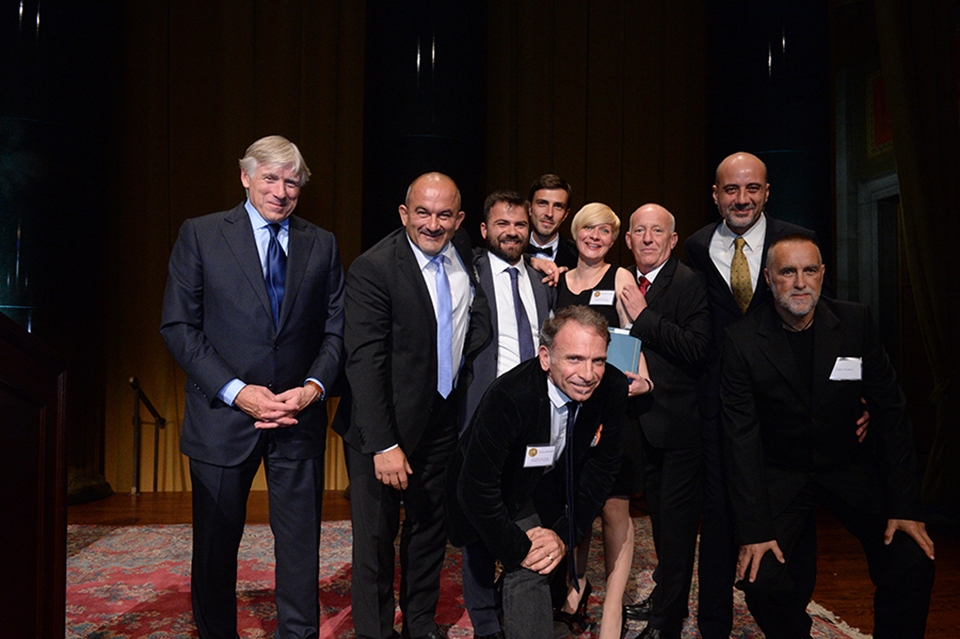
Columbia University President Lee C. Bollinger (left) presents a 2016 Breaking News Photography Prize to the Reuters Photo Staff.
Winning Work
To the judges:
The migrants came shivering in dinghies, scrambling over stones, tramping through fields and crawling beneath razor-wire. On the way they were rescued, rained on, crushed, blockaded and beaten. Almost 900,000 came through Turkey, many starting out on inflatable boats for the Mediterranean crossing into Greece. Half a million were Syrians risking the epic journey to escape war.
It’s possible to reach Europe through North Africa and Italy. But the route via Turkey and Greece is safer than the desert and involves a shorter sea crossing, which is why thousands of families made that trek last year. Along the way, a team of Reuters photographers, working in relay, captured and transmitted their incredible stories.
Traditionally, refugees are the subject of pity. The Reuters images, used in newspapers and on websites around the globe, conveyed the people’s courage, dignity, hope and determination.
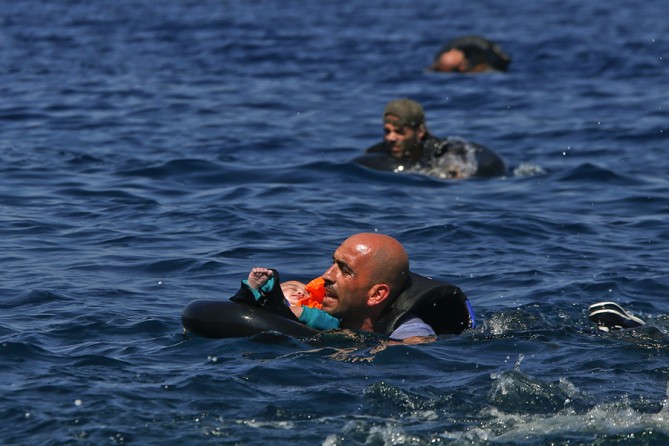
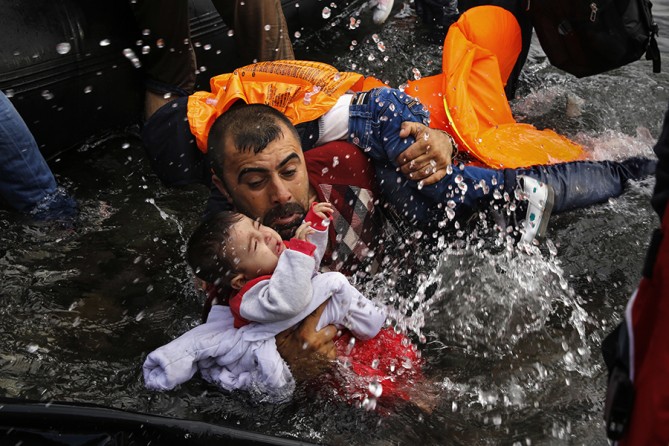
In one image, the sun rises over a boat crossing the waters off Turkey. Its outboard engine has just failed. In another, the group’s dinghy has deflated about 100 yards from the shore, ditching the father of a small child, who balances the baby on a life tube as he flounders to safety. In a third, a father stumbles in the water, struggling to keep his drenched baby’s head from going under.
The journalistic challenges of such a story are immense. Photographers cannot ignore distress, but neither can they be aid workers. As they record lives stripped of privacy, they must not intrude. If asked for directions they can help, but they should not offer transport.
“Photographing the migrants was the ultimate test of staying out of the story,” says Reuters photographer Bernadett Szabo. “There is no way to shake the emotional impact.... You have to let the story wash through you to remain human.”
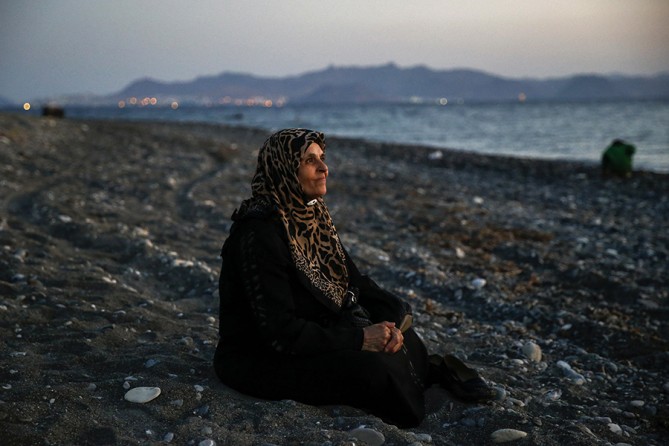
For the travelers, it was a voyage into the unknown. In one image, an elderly Palestinian woman sits on a beach in the Greek island of Kos after landing with her family. She had accepted a small sweet, a traditional gesture of hospitality, and exchanged small talk in broken English and Arabic with photographer Yannis Behrakis. Her smile radiated tranquility. She signaled that she was blind.
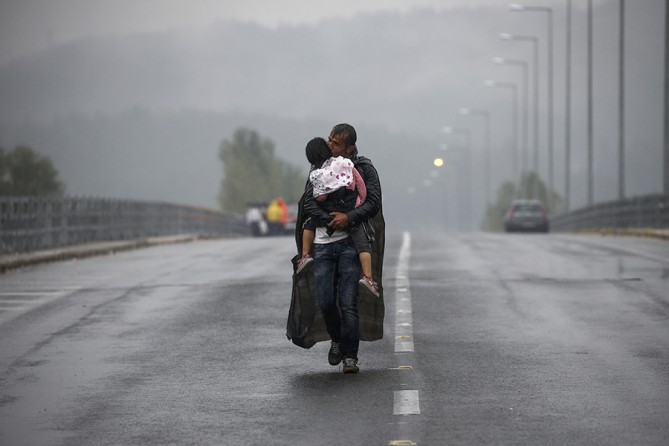
As the travelers headed north, an image shot in a rainstorm shows how the climate – and the welcome - cooled. In the picture, a Syrian father walks down the middle of a road towards the camera. He has made himself a cape from a black plastic garbage bag and his sodden arms are wrapped around his young daughter, whom he carries through the rain. At the point we see him, he is kissing the child on the cheek.
“He looked very proud,” says the photographer Behrakis. “People ask me, ‘Why doesn’t he go on the sidewalk?’” The picture triggered a fundraising campaign on social media.
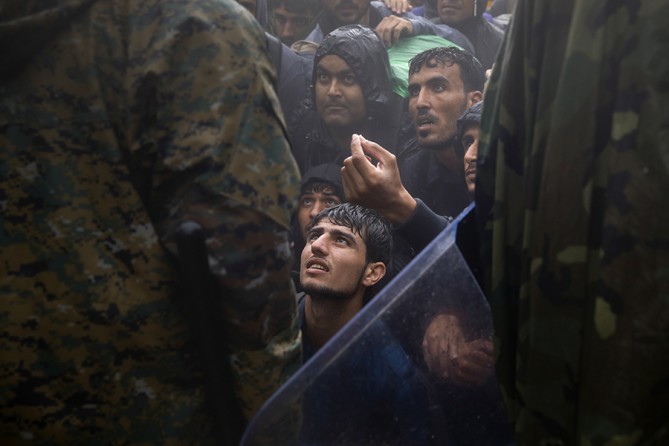
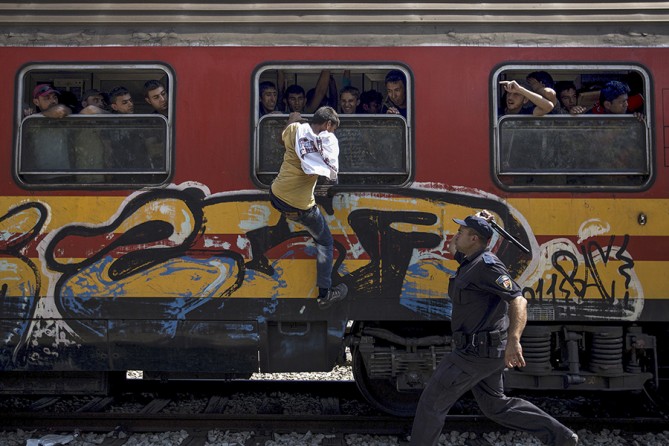
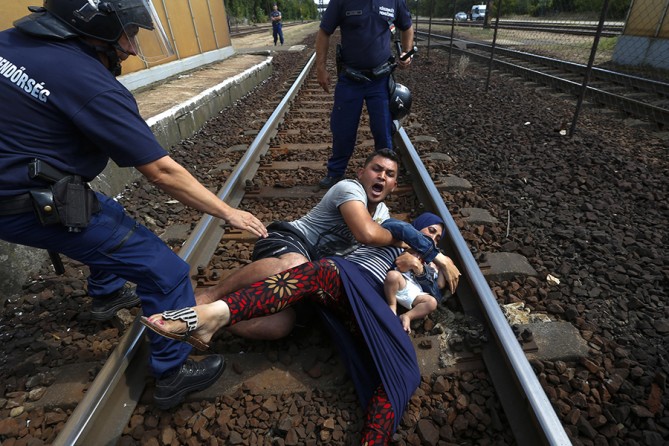
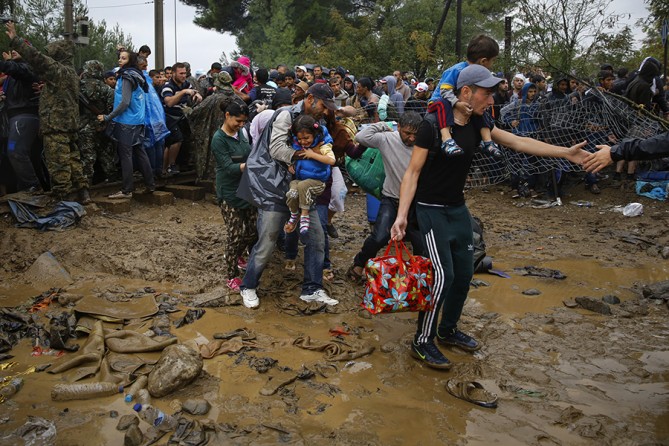
Pushed back, pleading with soldiers, or beaten with truncheons as they tried to vault on to overcrowded trains, the young men in the groups took their chances. But families had less flexibility. They slithered through muddy border crossings, picked their way over abandoned clothing and footwear and stumbled on rail tracks towards Hungary.
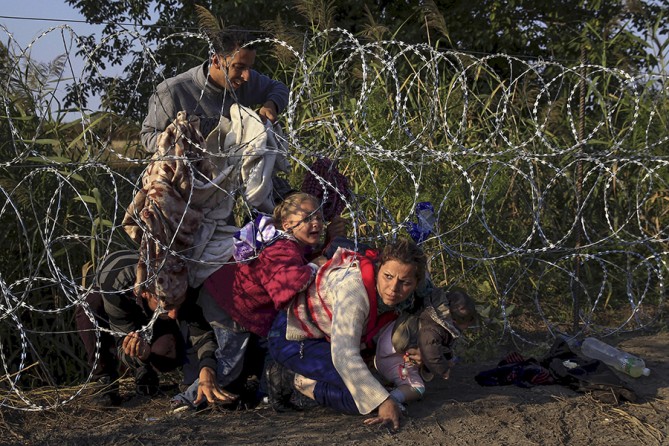
There, they were not welcome. One of the most powerful images shows a family climbing into Hungary through coils of razor-wire. After a long wait watching police at the Serbian border, the family is making a run for it. One of the men uses a blanket to protect his hands as he lifts the spiky wire. The mother crawls underneath it, her baby under her arm, the child’s pacifier in one hand and her terrified daughter clinging to her back. She looks out defiantly for guards. As soon as they were through, the family vanished into the woods.
Some argued that barriers like these were forcing people into desperate acts. In September Chancellor Angela Merkel announced that Germany would relax the immigration rules on humanitarian grounds.
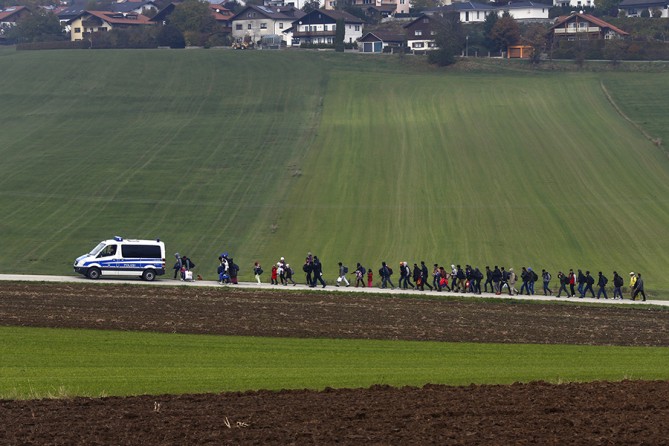
A month later, Reuters captured a cluster of migrant families marching behind a German police van through neat green fields near the Austrian border. On the final stretch of their journey, the figures walk with straight backs and long strides. They stick to the pavement, mirroring the order and peace around them – a peace which is finally within reach.
This historic journey has been cast as a test of unity for Europe. While it is certainly that, it is also - and more importantly - the desperate escape of more than a million people. To depict that flight with humanity and respect calls for photojournalism of the highest order. I am proud to nominate the work for a Pulitzer Prize in breaking news photography.
Sincerely,
Stephen J. Adler
Editor-in-Chief
Reuters
Winning Work
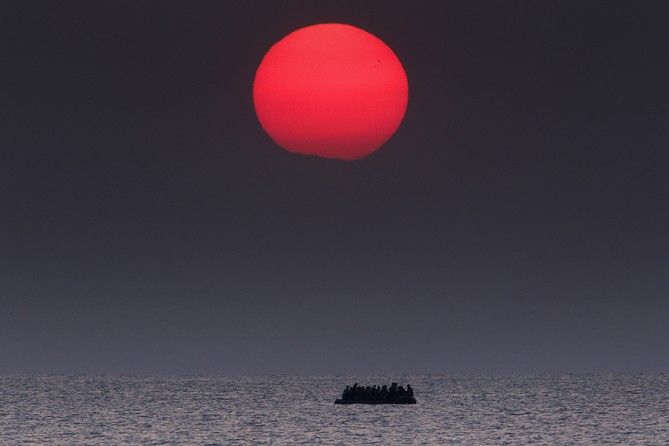
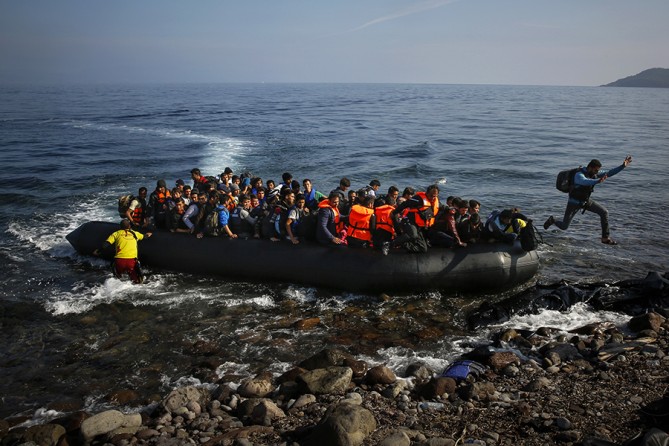
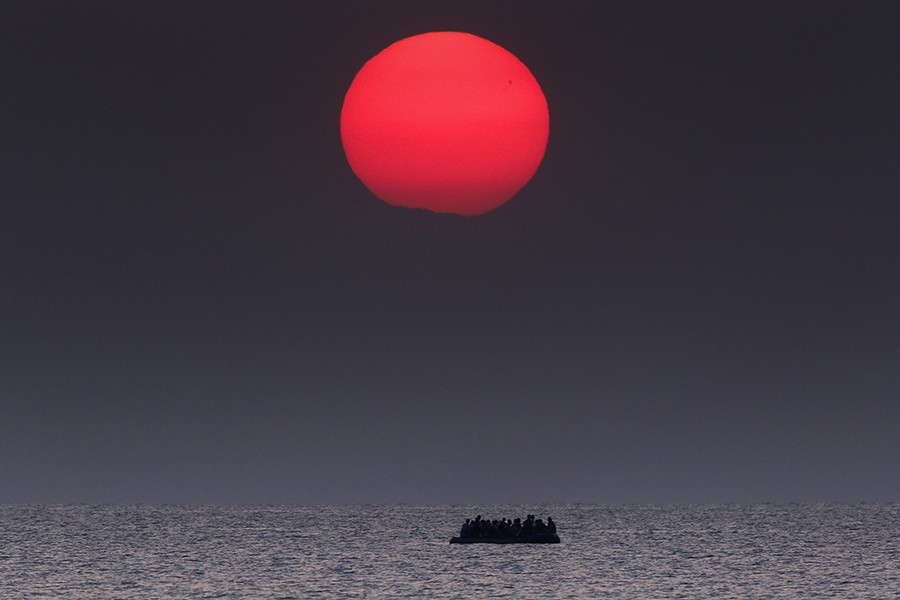
A overcrowded inflatable boat with Syrian refugees drifts in the Aegean sea between Turkey and Greece after its motor broke down off the Greek island of Kos. In 2015 over a million people sought asylum in Europe after departing their war torn and strife addled countries. They crossed in haphazard boats and inflatable dinghies with hundreds perishing at sea (Yannis Behrakis, Thomson Reuters - August 11, 2015).
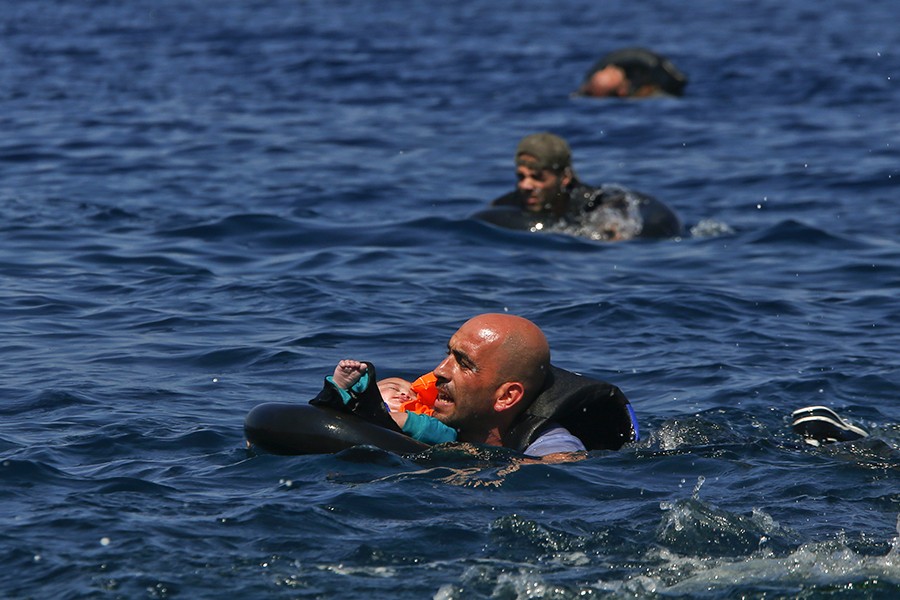
A Syrian refugee holding a baby in a life tube swims towards the shore after their dinghy deflated some 100m away before reaching the Greek island of Lesbos (Alkis Konstantinidis, Thomson Reuters - September 13, 2015).
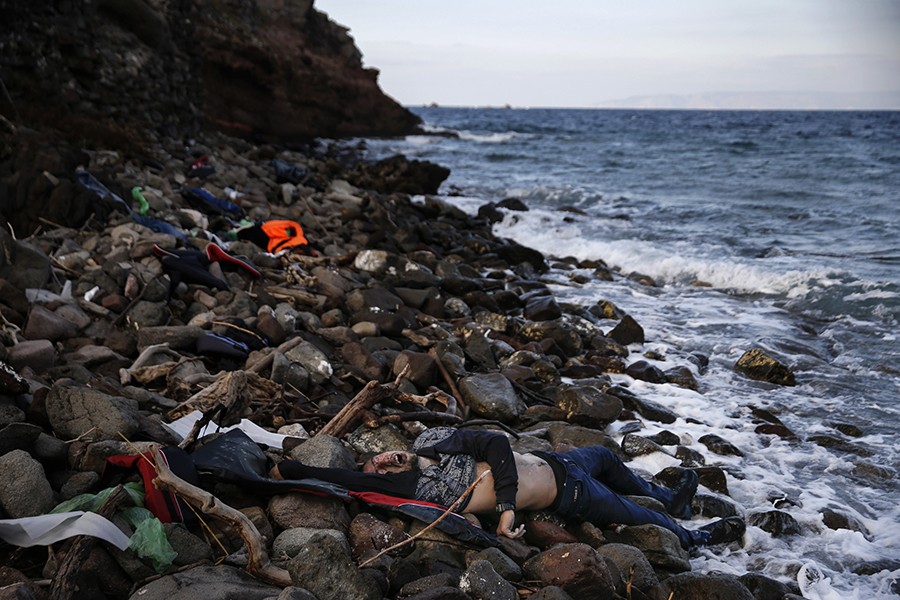
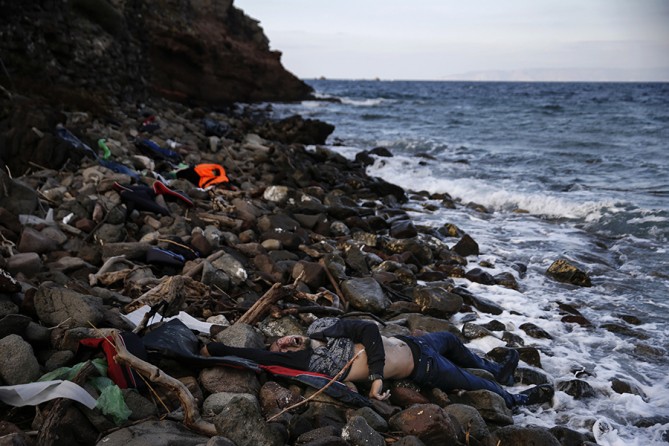
The body of an unidentified migrant is seen on a beach after being washed ashore, on the Greek island of Lesbos. (Alkis Konstantinidis, Thomson Reuters - November 7, 2015).
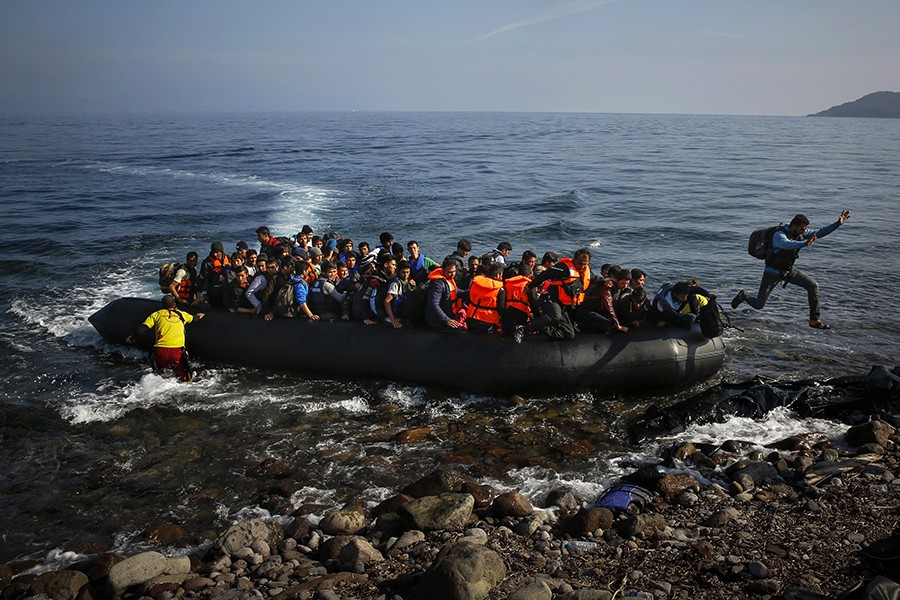
An Afghan migrant jumps off an overcrowded raft onto a beach at the Greek island of Lesbos (Yannis Behrakis, Thomson Reuters - October 19, 2015).
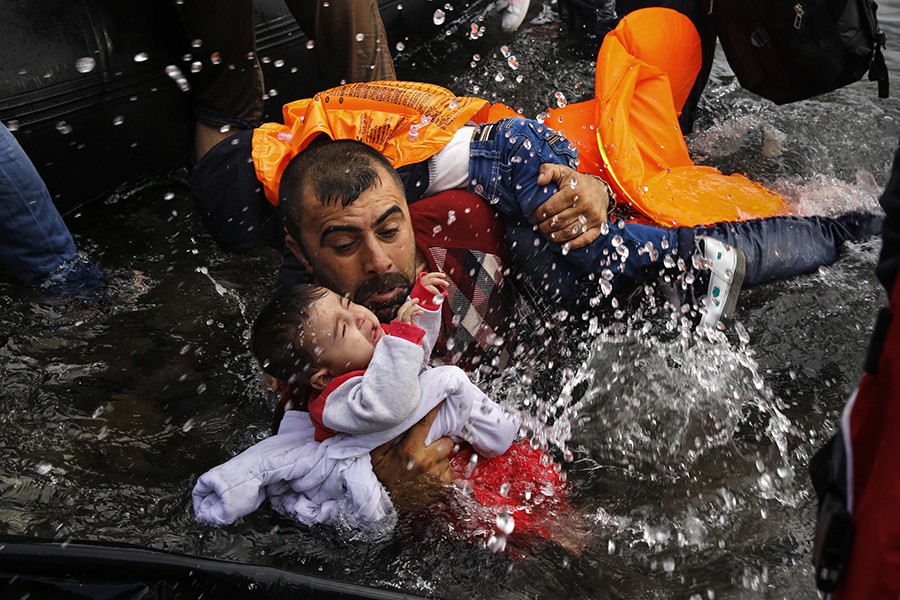
A Syrian refugee holds onto his children as he struggles to walk off a dinghy on the Greek island of Lesbos, after crossing a part of the Aegean Sea from Turkey to Lesbos (Yannis Behrakis, Thomson Reuters - September 24, 2015).
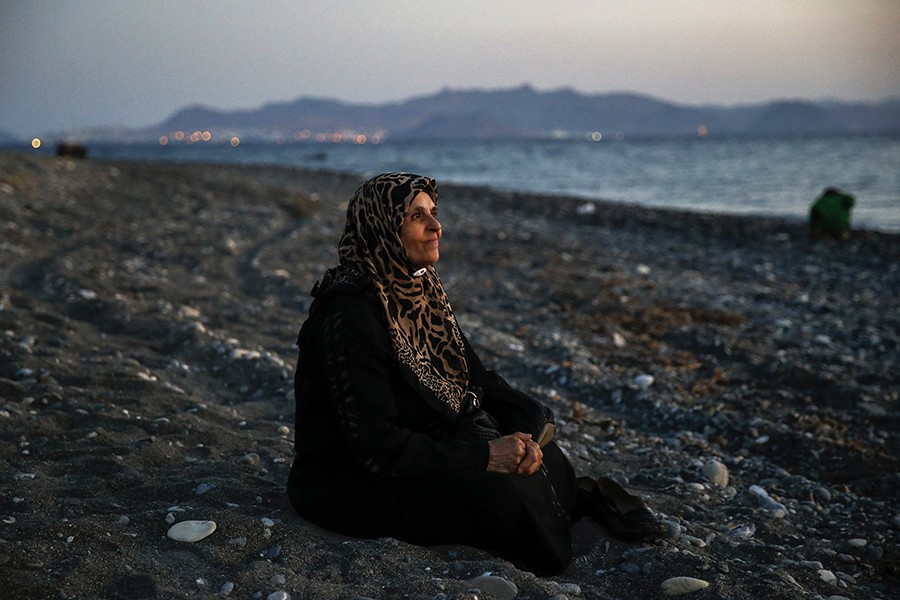
Amoun, 70, a blind Palestinian refugee who lived in the town of Aleppo in Syria, rests on a beach moments after arriving along with another forty on a dinghy in the Greek island of Kos, crossing a part of the Aegean Sea from Turkey to Greece (Yannis Behrakis, Thomson Reuters - August 12, 2015).
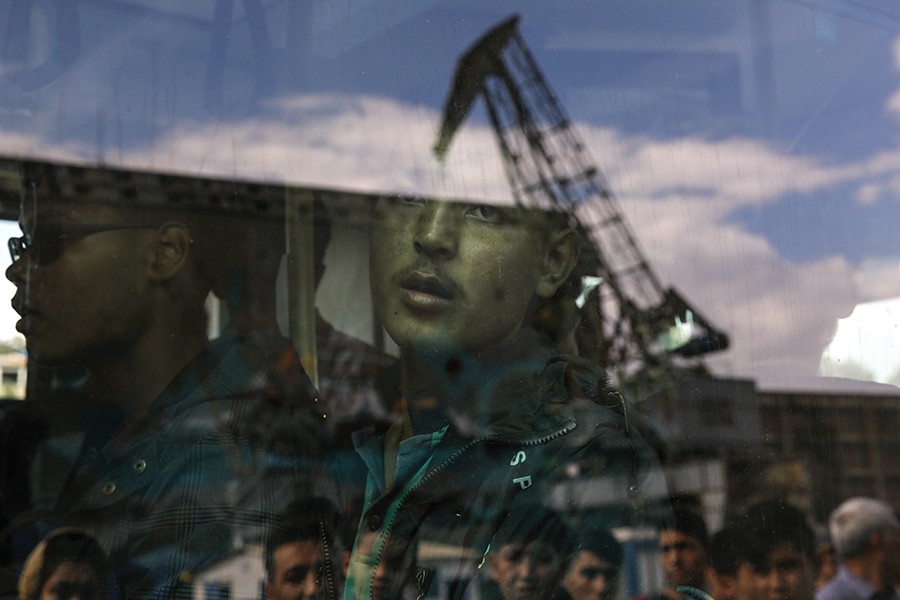
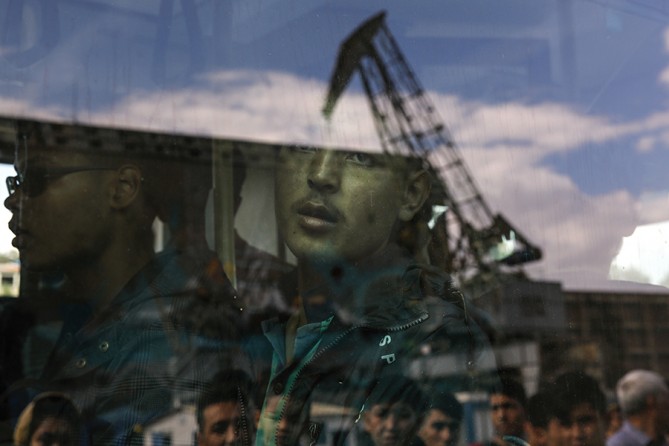
An Afghan migrant is seen inside a bus following his arrival by the Eleftherios Venizelos passenger ferry with over 2,500 migrants and refugees from the island of Lesbos at the port of Piraeus, near Athens, Greece (Yannis Behrakis, Thomson Reuters - October 8, 2015).
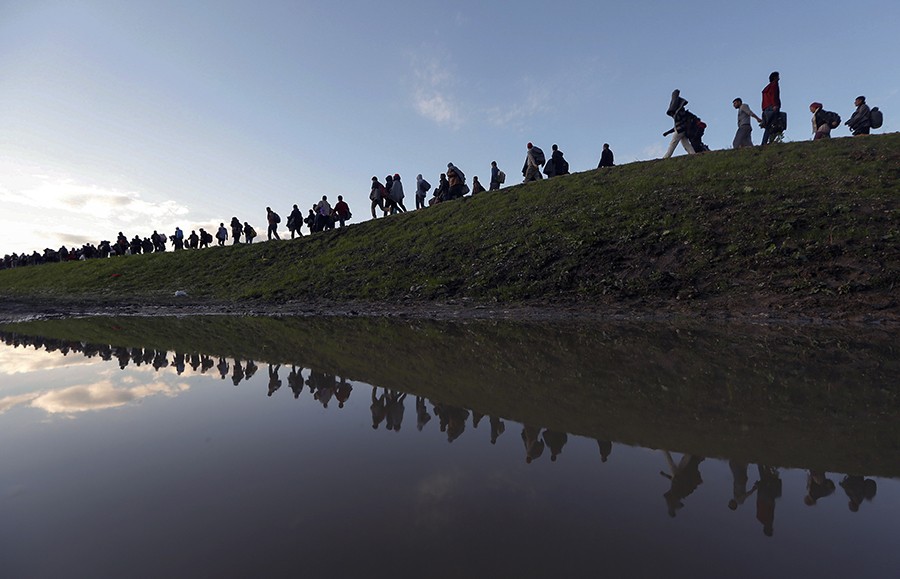
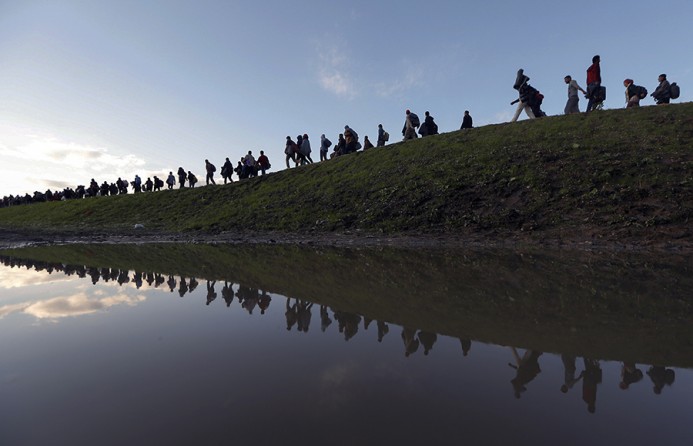
Migrants make their way on foot on the outskirts of Brezice, Slovenia. Slovenia's interior ministry raised the possibility on Tuesday of setting up physical barriers along its southeastern border if the numbers of migrants increased (Srdjan Zivulovic, Thomson Reuters - October 20, 2015).
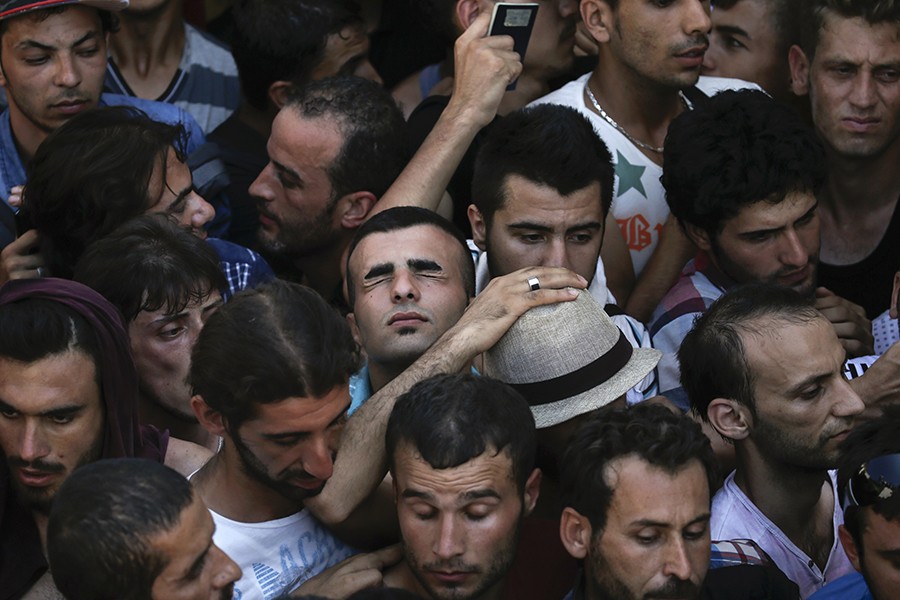
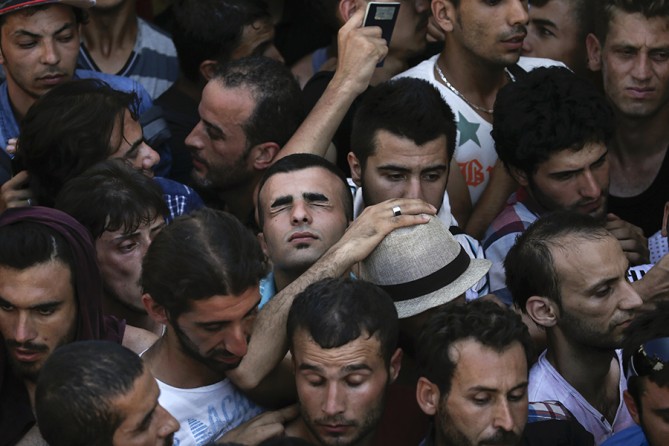
Syrian refugee tries to catch his breath as he stands in a crowded line to get registered in the national stadium of the Greek island of Kos (Alkis Konstantinidis, Thomson Reuters - August 12, 2015).
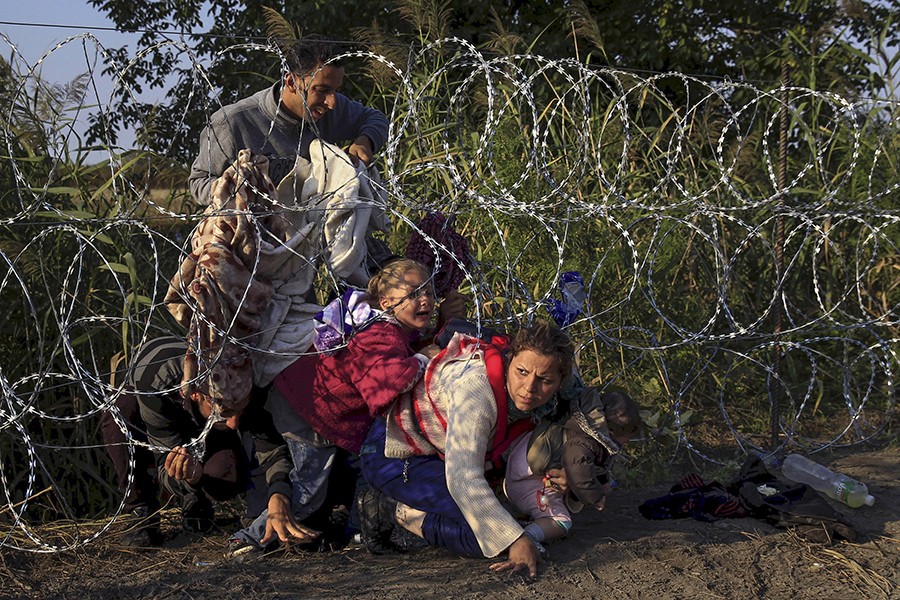
Syrian migrants cross under a fence as they enter Hungary at the border with Serbia, near Roszke (Bernadett Szabo, Thomson Reuters - August 27, 2015).
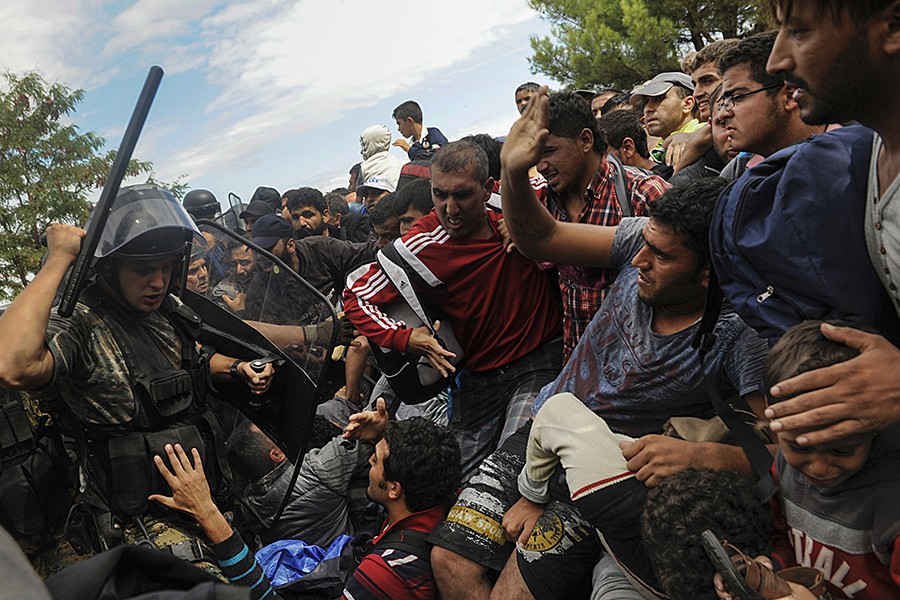
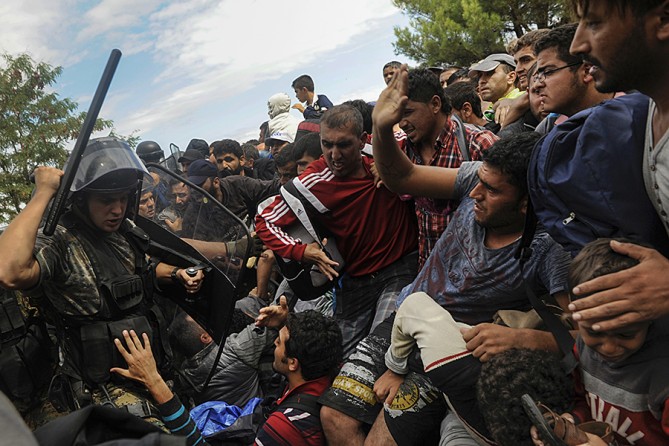
A Macedonian police officer raises his baton towards migrants to stop them from entering into Macedonia at Greece's border near the village of Idomeni, Greece (Alexandros Avramidis, Thomson Reuters - August 22, 2015).
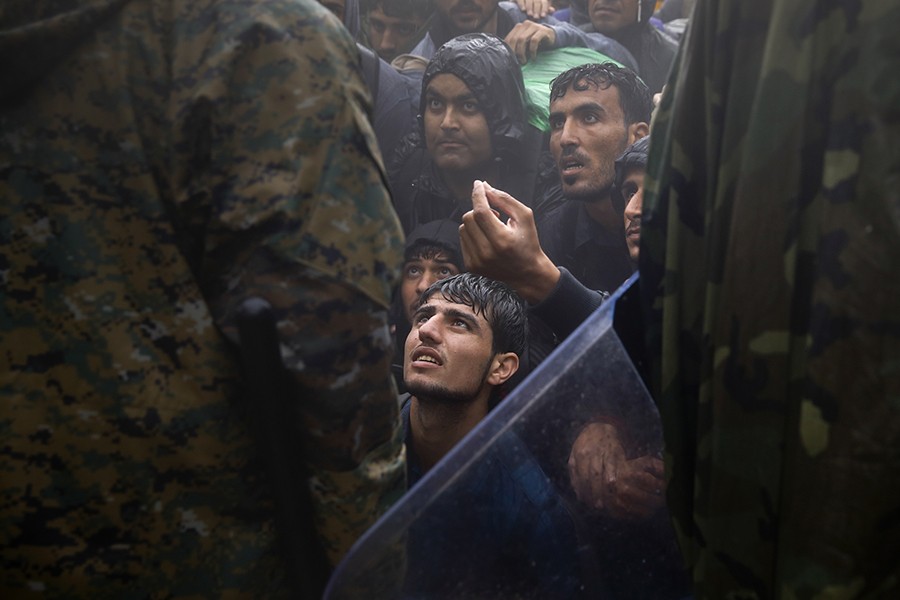
Migrants and refugees beg Macedonian policemen to allow passage to cross the border from Greece into Macedonia during a rainstorm, near the Greek village of Idomeni (Yannis Behrakis, Thomson Reuters - September 10, 2015).
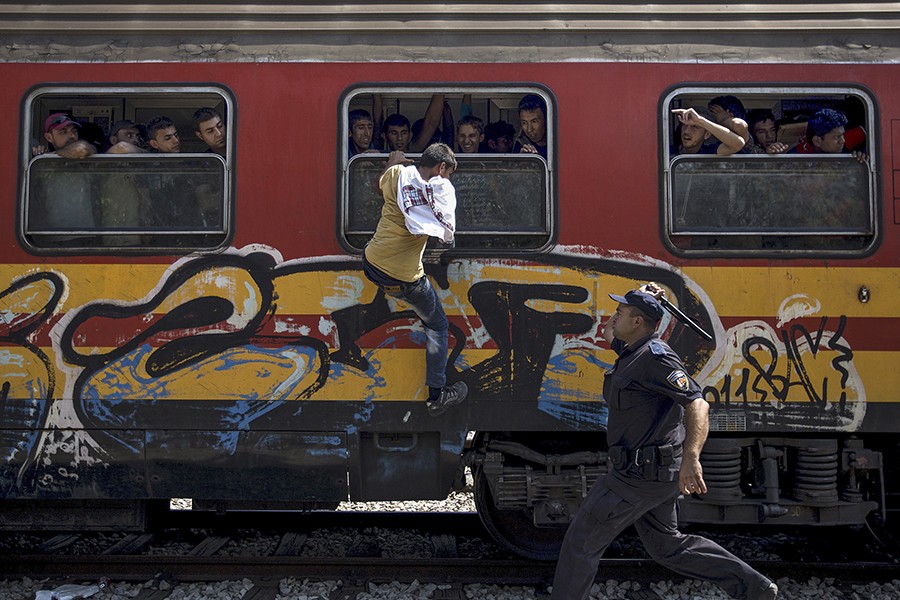
A policeman tries to stop a migrant from boarding a train through a window at Gevgelija train station in Macedonia, close to the border with Greece (Stoyan Nenov, Thomson Reuters - August 15, 2015).
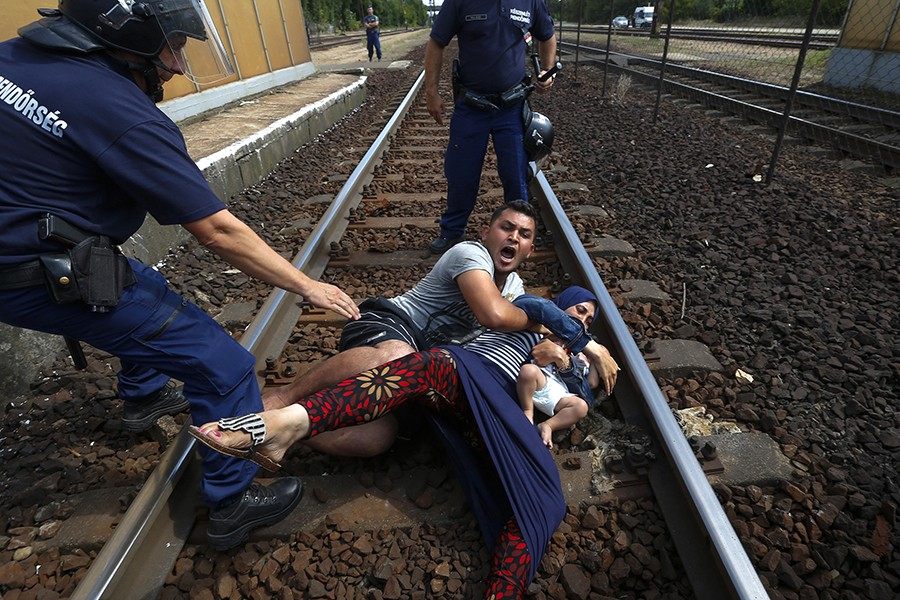
Hungarian policemen stand over a family of immigrants who threw themselves onto the track before they were detained at a railway station in the town of Bicske, Hungary (Laszlo Balogh, Thomson Reuters - September 3, 2015).
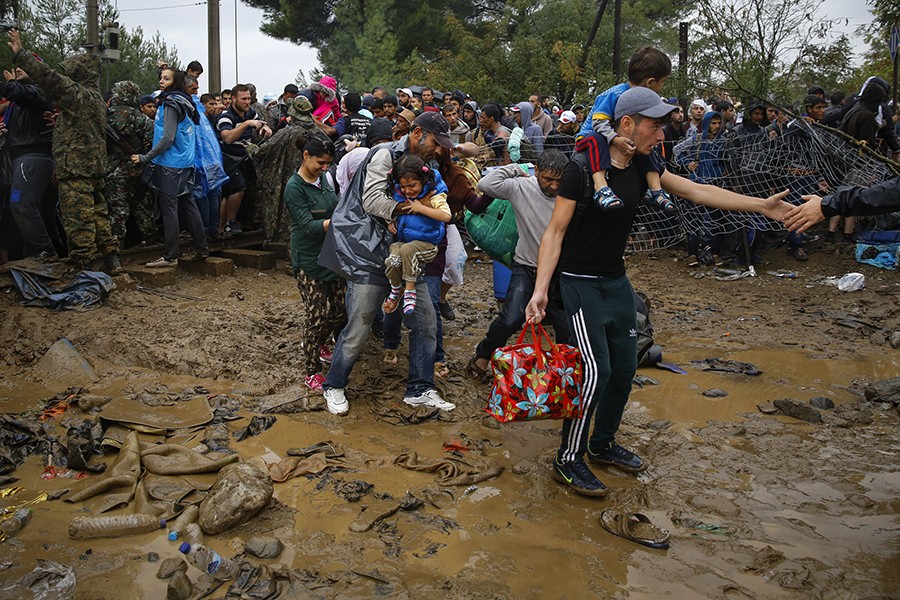
Syrian refugees walk through the mud as they cross the border from Greece into Macedonia, near the Greek village of Idomeni (Yannis Behrakis, Thomson Reuters - September 10, 2015).
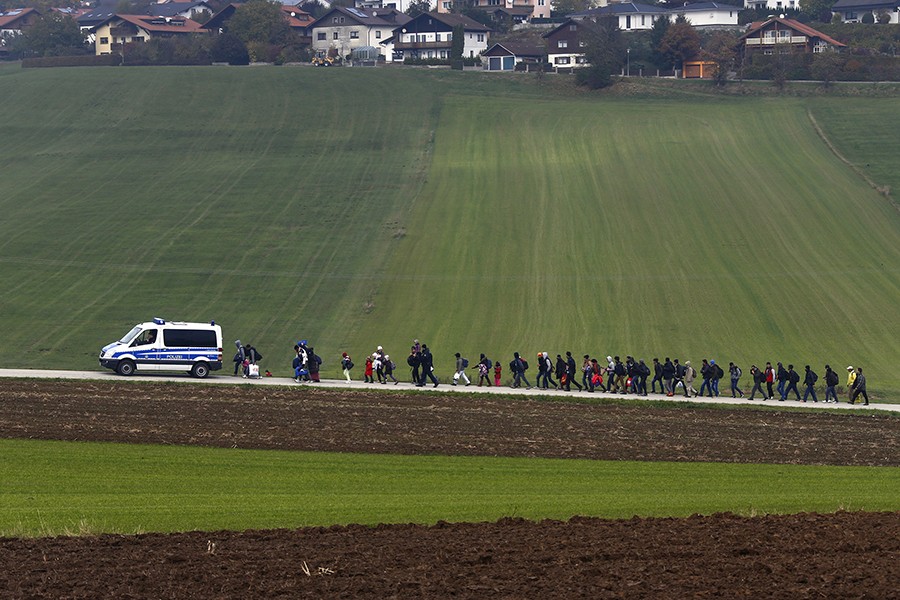
Immigrants are escorted by German police to a registration centre, after crossing the Austrian-German border in Wegscheid near Passau, Germany (Michael Dalder, Thomson Reuters - October 20, 2015).
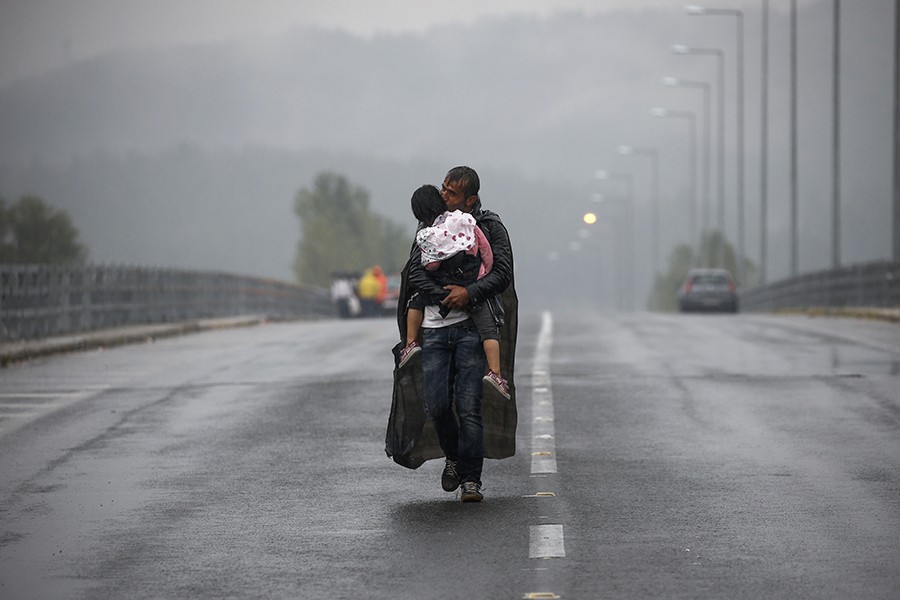
Syrian refugee kisses his daughter as he walks through a rainstorm towards Greece's border with Macedonia, near the Greek village of Idomeni (Yannis Behrakis, Thomson Reuters - September 10, 2015).