Concerto for Flute, Strings and Percussion is presented in a 2000 recording on Bridge Records by the Westchester Philharmonic (conducted by Mark Mandarano) with Paul Lustig Dunkel on flute.
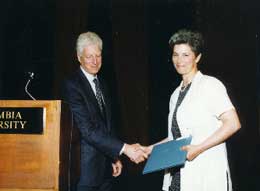
Columbia University Provost Jonathan R. Cole presents Melinda Wagner with the 1999 Pulitzer Prize in Music.
Concerto for Flute, Strings and Percussion is presented in a 2000 recording on Bridge Records by the Westchester Philharmonic (conducted by Mark Mandarano) with Paul Lustig Dunkel on flute.
Melinda Wagner, born in Philadelphia, received her graduate degrees from the University of Chicago and the University of Pennsylvania where she studied with Richard Wernick, George Crumb, Shulamit Ran, and Jay Reise.
Ms. Wagner's orchestral, chamber, and vocal works have been performed by such ensembles as the Chicago Symphony Orchestra, Denver Symphony Orchestra, American Composers Orchestra, National Orchestra of Colombia, New York New Music Ensemble, the Syracuse Society for New Music, the Contemporary Chamber Players, and Orchestra 2001. She is the recipient of numerous honors, including a Guggenheim Memorial Foundation Fellowship, grants from the Illinois Arts Council, three ASCAP Young Composer awards, and resident fellowships from the MacDowell Colony and Yaddo. She has received commissions from the Ernst and Young Emerging Composers Fund for the Chicago Symphony Orchestra, the Sylvia and Danny Kaye Playhouse, the New York New Music Ensemble, and the Syracuse Society for New Music. Falling Angels, commissioned by the Chicago Symphony and premiered in 1993, was performed there again in 1996 under the AT&T American Encore Program. Current projects include works for the American Brass Quintet and the New York New Music Ensemble.
Melinda Wagner has taught at the University of Pennsylvania, Swarthmore College, Syracuse University, and Hunter College. She lives in Mount Vernon, New York, with her husband, percussionist James Saporito, and son, Benjamin.