Lilacs was commissioned and premiered by the Boston Symphony Orchestra (conducted by Seiji Ozawa) featuring soprano Faye Robinson. The first movement is presented here in a 2000 recording (released in 2005 by Summit Records) by the Arizona State University Symphony Orchestra with Robinson.
For distinguished musical composition by an American in any of the larger forms including chamber, orchestral, choral, opera, song, dance, or other forms of musical theatre, which has had its first performance in the United States during the year, Three thousand dollars ($3,000).
Lilacs, for voice and orchestra, by George Walker
Premiered on February 1, 1996, in Boston by the Boston Symphony Orchestra, and was commissioned by that orchestra.
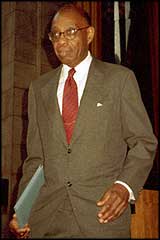
Winning Work
Biography
George Walker was born in Washington, D.C. in 1922. He began the study of piano at age five. He gave his first public recital at Howard University when he was fourteen and was admitted to Oberlin College. Upon graduating from Oberlin at age eighteen with a major in piano and a minor in organ, he was admitted to the Curtis Institute of Music where he was a pupil of Rudolf Serkin and Rosario Scalero, teacher of Samuel Barber and Gian-Carlo Menotti.
In 1945, he made his acclaimed New York recital debut in Town Hall which was followed two weeks later by a debut performance with the Philadelphia Orchestra under Eugene Ormandy in the Third Piano Concerto of Rachmaninoff. Under the aegis of National Concert Artists and Columbia Artists Management, he toured the United States and Europe. In 1956, he received a Doctor of Musical Arts Degree from the Eastman School of Music and returned to Europe on Fulbright and John Hay Whitney Fellowships to study in Paris with Nadia Boulanger.
In 1961, he accepted academic appointments at Smith College and the University of Colorado. In 1969, he was appointed Professor of Music at Rutgers University where he became Chairman of the Music Department and a Distinguished Professor. He also taught at the Peabody Institute of Johns Hopkins University and in 1975, he was appointed the first Distinguished Minority Chair at the University of Delaware. He retired from Rutgers University as Professor Emeritus in 1992.
George Walker has been the recipient of two Guggenheim Fellowships and two Rockefeller Foundation Fellowships, several MacDowell Colony and Yaddo Fellowships, five National Endowment for the Arts Awards, research grants from Smith College, the University of Colorado and Rutgers University. He won the Harvey Gaul Prize in 1963. Other awards were received from the Curtis Institute of Music (New York Town Hall Recital), the American Academy and Institute of Arts and Letters, Lafayette College and Oberlin College (Honorary Doctorates), and the Koussevitsky Foundation.
He has published over seventy works that include two overtures, two Sinfonias, concertos for cello, violin, trombone, Variations for Orchestra, two string quartets, two sonatas for violin and piano, four piano sonatas, sonatas for cello and piano and viola and piano, a brass quintet, Perimeters for clarinet and piano, Five Fancies for clarinet and piano four hands, a Mass for four soloists, chorus and orchestra, a Cantata for Boys Choir and orchestra,numerous songs and choral works, organ pieces, works for chamber orchestra (Serenata and Orpheus), a piano trio and the Address for Orchestra.
His music has been recorded by CBS, Desto, Mercury, Orion, GM, C.R.I., Mastersound, Serenus, Da Camera Magna, BIS and Albany Records. He has been commissioned by the New York Philharmonic Symphony Orchestra (Cello Concerto), the Cleveland Orchestra (Dialogus for Cello and Orchestra),the Boston Symphony (Lilacs for Voice and Orchestra), the Boys Choir of Harlem (Cantata), the Philharmonia Virtuosi (Violin Concerto), the Cleveland Chamber Symphony (Orpheus), the Eastman School of Music (An Eastman Overture), the Kennedy Center for the Performing Arts (Sonata for Violin and Piano no. 2), the Washington Performing Arts Society (Piano Sonata no. 3 ) and many other ensembles. His works have been performed by virtually every important orchestra in this country and in England.
Finalists
Nominated as finalists in Music in 1996:
Elliott Carter
Premiered on October 15, 1995, in Birmingham, Ala., by the BBC Symphony Orchestra.
Peter Lieberson
Premiered on May 28, 1995, at the Spoleto Festival in Charleston, S.C.
The Jury
The Jury
Richard Wernick(chair )*
composer, conductor, Magnin Professor of Humanities
David N. Baker
composer, distinguished professor of music
Leslie Bassett*
composer, Albert A. Stanley Distinguished University Professor of Music
Mario Davidovsky*
composer, Fanny Peabody Mason Professor of Music
David Hamilton
doctoral faculty
Winners in Music
Morton Gould
Premiered on March 10, 1994, by the National Symphony Orchestra at The John F. Kennedy Center, Washington, D.C..
Gunther Schuller
Premiered on December 2, 1993, in Louisville, Ky. Performed and commissioned by The Louisville Orchestra.
Christopher Rouse
Premiered December 30, 1992, in New York by the New York Philharmonic.
Wayne Peterson
Premiered on October 17, 1991, by the San Francisco Symphony.
1996 Prize Winners
Herb Caen
For his extraordinary and continuing contribution as a voice and conscience of his city.
Bob Keeler
For his detailed portrait of a progressive local Catholic parish and its parishioners.
E.R. Shipp
For her penetrating columns on race, welfare and other social issues.