Houston Chronicle, by Lisa Falkenberg

Mike Pride, Pulitzer Prize Administrator (left), and Lee C. Bollinger, President of Columbia University (center), present the 2015 Commentary Prize to Lisa Falkenberg.
Winning Work
By Lisa Falkenberg
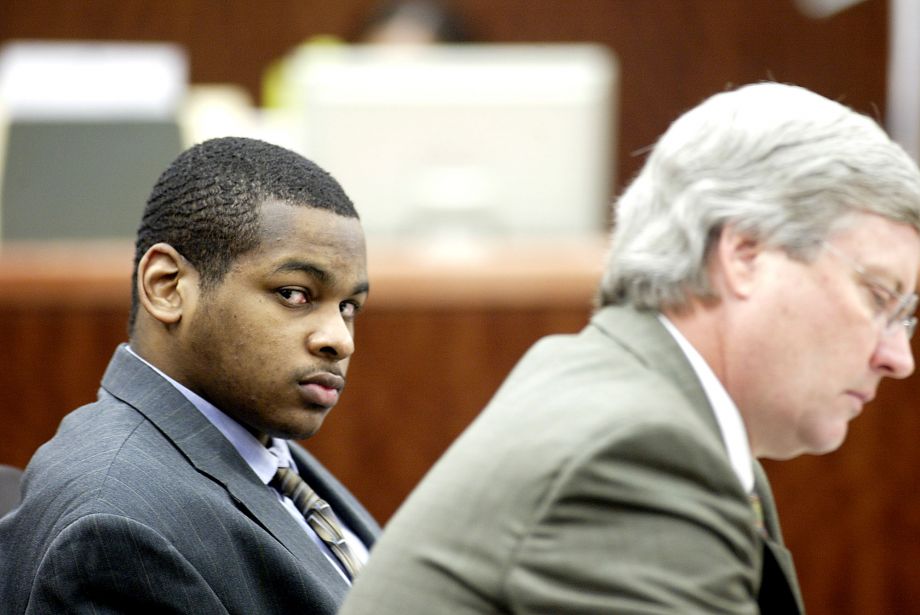
New evidence has come to light in the case of Alfred Dewayne Brown, left, with defense lawyer Robert Morrow at trial in 2005. (Houston Chronicle)
The Harris County prosecutor stood before 12 jurors, pleading with them to kill Alfred Dewayne Brown.
And for a while, the 23-year-old Brown sat and listened - just as he had for days to lawyers and experts and witnesses calling him a murderer capable of a brazen, callous crime: shooting Charles R. Clark, a veteran Houston police officer on the verge of retirement who was just trying to stop a three-man burglary when his aging pistol jammed. The store's clerk, Alfredia Jones, was also killed, just days after returning from maternity leave.
Finally, Brown raised his hand in court like a pupil in class and jumped to his feet, according to Chronicle archives, blurting out the message he'd been telling officials all along.
"Excuse me. I didn't rob nobody. I didn't shoot nobody," he said in a shaky voice. "I didn't do this crime, man."
Judge Mark Kent Ellis told him he'd have to stay silent if he wanted to stay. And he did. Stone silent. Even days later as the jury, in the presence of extra bailiffs, sentenced him to death.
That was in October 2005. Brown went to death row. He kept claiming he was innocent, that he was at his girlfriend's apartment that morning when some guys he knew from the neighborhood tried to rob a check-cashing store and ended up committing murder instead.
It didn't matter. On death row, claiming innocence is a pastime. And Brown wasn't one of those celebrity Texas death row guys. He was a nobody. He was the illiterate son of poison streets whose early neglect may have contributed to the fact that his IQ, according to trial testimony, falls just short of the standard for mental retardation. He soundly lost his direct appeal.
Finally, in 2007, one of those big do-gooder law firms, Pittsburgh-based K&L Gates LLP, decided to take Brown's case.
Among other things, attorneys honed in on Brown's alibi: He claimed he had made a phone call on that fateful morning of April 3, 2003 from his girlfriend's apartment to another land line where she was working as a home health aide. He said he called around 10 a.m. - the same time prosecutors told jurors Brown was at an apartment complex with the other perpetrators, washing up, changing clothes and watching news coverage of the murders.
Search for phone logs
At trial, Brown's attorneys presented no evidence to back up his claim. Brown's new attorneys looked everywhere for phone records. District attorneys said they didn't have them. The phone company said they'd been destroyed.
The search went on. For six years.
Then, last spring, Brown's attorneys got word from Lynn Hardaway, chief of the DA's post-conviction writs division, that a homicide investigator in the case had found some old records while cleaning out his garage.
In the stack was a phone log apparently provided by the U.S. Marshal's Service in April 2003 that showed a call from the girlfriend's home number was made to her work at about the time Brown said it was - 10:08 a.m.
Mike Anderson, district attorney at the time, quickly agreed to a new trial on the grounds that Brown's due process rights had been violated. Prosecutors are bound by a court decision known as "Brady" to turn over material evidence that can help the defense.
The DA's office admitted to an egregious error but maintained in court papers that the failure to disclose the documents "was inadvertent and not in bad faith."
"I think there were a lot of records, and this got overlooked," said Hardaway, who still believes Brown is guilty. "It was one piece of paper."
'Please hurry'
But an innocent oversight is doubtful when you consider another document in the garage stack - one that shows one of the prosecutors had requested the records, apparently soon after Brown's girlfriend told the grand jury about the phone call. The girlfriend ended up testifying against Brown in trial but has since recanted, saying she was pressured to lie, according to court records.
In a May 28 hearing, Judge Ellis seemed moved by the new evidence and signed an order for a new trial. He asked the appeals court in Austin to act just as swiftly.
"For you guys and gals on the Court of Criminal Appeals, I'm signing this because I agree with it," the judge said. "I believe that the circumstances in which we find ourselves at this time merit a new trial in Mr. Brown's case and I hope that you will ... as soon as practical afford us the opportunity to retry the case."
He closed: "So, please hurry. Okay?"
All the appeals court had to do is rubber-stamp the order. It could have simply written the letters "O" and "K." Yet, after nearly a year, the court has done nothing.
The delay has puzzled even Judge Ellis: "I wish I knew," he said when I asked what was taking so long. "They move in mysterious ways in Austin."
Even those whom fate has dealt the cruelest hand are entitled to a fair trial. How long is a man who very well could be innocent supposed to sit still and silent on death row while the ladies and gentlemen in black robes take their sweet time dallying over his fate?
By Lisa Falkenberg
"Sir, I don't know anything else," the young mother of three told a Harris County prosecutor on an April morning in 2003.
But the prosecutor, Dan Rizzo, didn't believe her. And neither did the Harris County grand jury listening to her testimony.
They seemed convinced that Ericka Jean Dockery's boyfriend of six months, Alfred Dewayne Brown, had murdered veteran Houston police officer Charles R. Clark during a three-man burglary of a check-cashing place, and they didn't seem to be willing to believe Dockery's testimony that he was at her house the morning of the murder.
"If we find out that you're not telling the truth, we're coming after you," one grand juror tells Dockery.
"You won't be able to get a job flipping burgers," says another.
Dockery tells the group that if she believed Brown actually killed people, she'd turn him in herself: "If he did it, he deserves to get whatever is coming to him. Truly," she says.
In May, I reported that a land-line phone record supporting Brown's contention that he called Dockery that morning from her apartment phone had mysteriously turned up in a homicide detective's garage, more than seven years after he was convicted and sentenced to death. The Harris County District Attorney's Office maintained Rizzo, now retired, must have inadvertently lost the record, and agreed to a new trial. The Texas Court of Criminal Appeals inexplicably has sat on the case for more than a year.
Initially, Dockery's story meshed with Brown's. She told grand jurors he was indeed asleep on her couch at the early morning hour when prosecutors believed he was scouting venues. Dockery also confirmed the land-line call to her workplace - made at the same time prosecutors placed Brown at an apartment complex with suspects, changing clothes and watching TV news coverage of the crime.
Neither the prosecutor nor the grand jury would take Dockery's "truth" for an answer.
The young woman, a home health aide who made Subway sandwiches by night, had no attorney. No experience dealing with authorities. No criminal history aside from traffic tickets.
She caved. At Brown's capital murder trial in October 2005, Dockery was a key prosecution witness, helping seal her boyfriend's death sentence by telling the court that when she asked him if he did it, he had confessed, saying, " 'I was there. I was there.' "
How she got from one point to another would be hard to imagine. But thanks to a formerly confidential document in Brown's court file, we don't have to imagine.
Part of public record
In a rare, disturbing glimpse into the shrouded world of the Texas grand jury system, we can read with our own eyes the beginnings of the young woman's tortured evolution.
Appellate attorneys were so outraged by a 146-page transcript of Dockery's testimony before the 208th Harris County grand jury on April 21, 2003, that they entered it into the public record for judges to review.
In it, grand jurors don't just inquire. They interrogate. They intimidate. They appear to abandon their duty to serve as a check on overzealous government prosecution and instead join the team.
"Unbelievable," veteran criminal defense attorney Pat McCann said after I asked him to read the document. "When she went in there, Mr. Brown had an alibi. When they were finished browbeating her with her children, he didn't. That's the single biggest misuse and abuse of the grand jury system I have ever seen."
Rizzo and Lynn Hardaway with the DA's office declined comment, citing a state law that keeps grand jury proceedings secret.
At first, the fact that Dockery seemed to be "a good, nice, hard-working lady," in the words of one grand juror, gave her credibility with the group. But jurors soon seized on her vulnerabilities and fear.
"Hey, Dan," the foreman calls to the prosecutor. "What are the punishments for perjury and aggravated perjury?"
"It's up to 10 years," Rizzo responds.
"In prison. OK," the foreman says.
"Oh no," says another grand juror as if on cue, echoing other commentary that reads at times like a Greek chorus.
Every word challenged
"I'm just trying to answer all your questions to the best of my ability," Dockery says.
A bit later, a female juror asks pointedly: "What are you protecting him from?"
"I'm not protecting him from anything. No ma'am. I wouldn't dare do that," Dockery eventually responds. As Rizzo and the grand jurors parse Dockery's every word and challenge each statement, she complains they're confusing her.
"No, we're not confusing you," a grand juror says. "We just want to find out the truth."
Although Dockery says repeatedly that she knew it was Brown on her couch that morning, the foreman tries to get her to subscribe to an implausible theory that it was somebody else on her couch.
She doesn't budge. The group takes a break - one of several.
When the grand jury returns, the foreman says the members are not convinced by Dockery's story and "wanted to express our concern" for her children if she doesn't come clean.
"That's why we're really pulling this testimony," the foreman tells her.
The foreman adds that if the evidence shows she's perjuring herself "then you know the kids are going to be taken by Child Protective Services, and you're going to the penitentiary and you won't see your kids for a long time."
'Think about your kids'
Rizzo goes on to accuse Dockery of misleading the grand jury. Then, after being told again and again to think about her children, Dockery changes her story a bit. She says Brown was not at the house when she left for work.
"No, no, no," she finally blurts out.
"One minute, Ericka," a grand juror says a bit later, apparently sensing an opportunity. "He wasn't in the house when you put your kids on the bus either, was (he)?"
"I'm trying to remember," she says.
"Think about your kids, darling," a grand juror says.
"I'm trying to remember," Dockery says.
"That's what we're concerned about here, is your kids," the foreman says.
"He was not at the house," a grand juror urges.
"We're as much concerned about your kids as you are," the foreman says. "So, tell the truth."
"He was not in the house when you put your kids on the bus, was he?" a grand juror says.
"Tell the truth, girl."
"Yes," Dockery says finally. "He was there."
A bit later, Dockery acquiesces on that point, saying that Brown was not in her house earlier that morning, either.
Pivotal phone call
There's a long break. Whatever happened during that time must have been profound. Dockery comes back in and tells yet another, completely different, story - that she left her house far earlier than she'd said previously, to rekindle a relationship with an old lover, and therefore doesn't know what time Brown left.
Rizzo, his patience seemingly wearing thin, suggests again he doesn't believe her story. "I think that you're up to your neck involved in this deal," he says.
He is intent on getting Dockery to admit she made a call to one of the suspects, as he says records show.
"I never called. I never called," she says.
"Girl, you just made a big mistake," a grand juror says.
One of them advises her to get an attorney.
"We're done," Rizzo announces.
And although Dockery had never been implicated in the crime, a grand juror closes out Dockery's testimony by leveling the harshest, most intimidating allegation yet.
"I think she was with him at the check cashing place."
Months later, Dockery found herself in jail charged with perjury for allegedly lying about what time she last saw Brown the day of the murder and whether she called another suspect. She faced bail she couldn't pay and, apparently, one cruel choice - stay locked up away from her children, or tell them what they wanted to hear.
By Lisa Falkenberg
For 120 days, Ericka Dockery sat in a Harris County jail cell on Baker Street, a place she would later describe as hellish, "nasty," full of fights, "unclean women," and a world away from the most important part of her life - her three children.
Dockery had a choice: Stay locked up, or tell authorities the story they wanted to hear so they could prosecute her boyfriend for capital murder.
Nearly seven weeks in, Dockery chose the latter.
On Oct. 9, 2003, she dictated a jailhouse letter, a desperate plea to state district Judge Mark Kent Ellis, asking him to consider her children, then ages 11, 8 and 6, and vowing to be "a productive mother and citizen if allowed to go home."
"The time here without them is almost unbearable," she wrote in the letter, obtained from Alfred Dewayne Brown's court file.
As I recounted in Thursday's column, Dockery was a home health aide who had worked nights making Subway sandwiches when she found herself charged with three counts of felony aggravated perjury - allegedly for lying to grand jurors after they pressured her to change her story in a 2003 cop-killing case.
Dockery had testified to the grand jury that her then-boyfriend, Brown, was at her apartment when prosecutors believed he was with guys he knew from the neighborhood, scouting venues for a burglary that would lead to the murder of Houston police officer Charles R. Clark.
Dockery also testified that Brown made a landline call to her workplace around the time of the crime, a contention that would have supported his alibi but was never supported with evidence at trial. It wasn't until more than seven years after Brown's 2005 conviction and death sentence that a phone record documenting the landline call turned up in a detective's garage. Last year, the judge agreed to a new trial, but the state's highest criminal court has been dallying for over a year on whether to allow it.
Back in 2003, the lead Harris County prosecutor, Dan Rizzo, believed early on that Brown was the murderer, and the grand jury apparently agreed. A transcript of the secret proceedings details how the group intimidated Dockery into changing her story by threatening to take away her children and send her to prison.
She did change her story, but Rizzo saw to it that she was charged with perjury anyway - perhaps to compel her cooperation, perhaps to help discredit her with the jury if she ever tried to defend Brown again.
Guilty of 'loving my children'
Another grand jury indicted her, in part for testifying that the last time she saw Brown on the morning of the murder was 8:30 a.m., when she later said it was 6:50 a.m. And in part for denying she had made a phone call to another of the murder suspects when phone records showed that she had.
Why Dockery would deny making the phone call to an acquaintance of her boyfriend's, if in fact she did, is still a mystery to me. She may have lied out of fear, or perhaps she forgot the call or didn't realize she had miss-dialed. Whatever the reason, it gave Rizzo rope to bind her.
Bail was set at $5,000 for each count and wasn't lowered, even though Dockery wasn't much of a flight risk - she had local ties, a steady job, and no criminal record beyond traffic tickets and children.
Dockery couldn't pay it. So, she appealed to Judge Ellis, and confessed her guilt of aggravated perjury.
"At the time I appeared in front of the grand jury I answered their questions to the best of my belief and knowledge," Dockery wrote, adding that she didn't know at the time that Brown was not at her apartment. "He (Brown) asked me to lie and tell anyone who asked that he was in fact at my home when in fact he was not."
She claimed that Brown's brother had threatened to kill her and her children if she gave any statement conflicting with Brown's.
"Out of fear for the safety of my children, I remained silent," she wrote the judge.
She gave details about the crime that she said she had gleaned from others, and reiterated her plea for leniency.
"Again your honor, I just want to say that I am guilty of aggravated perjury and of loving my children more than anything else in the world and would do whatever necessary to protective (sic) them and keep them safe from harm," she wrote.
Under prosecution's thumb
"Whatever necessary" apparently meant cooperating with the prosecutors and becoming their key witness.
Among conditions of Dockery's release from jail, she agreed to a 10 p.m. curfew, drug testing twice a month and to wear an ankle monitor. The last one made sure she stuck around. But it wasn't enough.
To make sure she stuck to her story, Dockery was required to call a homicide detective once a week.
Two criminal defense attorneys told me they'd never heard of such a thing. Rizzo, the prosecutor, defended the requirement for a witness who was expected to give important testimony at trial.
"That's fairly typical for someone we're not sure is going to be there, to just keep in contact so you don't have to go looking for them again," he said, adding that he believed the calls to the homicide detective came only after Dockery gave a sworn statement on her version of events.
Randall Ayers, who was Dockery's court-appointed defense attorney at the time, said the intent of the provision was clear, but it was one to which his client readily agreed.
"Obviously, I think their goal was to keep her under their thumb," Ayers said. "Of course I was concerned but there's nothing I could really do. The judge required it. It was just how it was."
Dockery held up her end of the bargain.
She testified at Brown's capital murder trial in October 2005 that, once, when she asked if he had done it, he told her "I was there. I was there."
It was the first time Dockery had ever mentioned that statement, according to Brown's appeal.
A persuasive visitor
After Brown's conviction and death sentence, Dockery tried to get on with her life. In November 2005, she was granted two years community supervision. And in 2007, Judge Ellis ended her supervision early and she avoided a conviction through deferred adjudication.
Years later, when an investigator for Brown's appellate attorneys came knocking on her door, hoping she would help lead them to the truth, Dockery turned the woman away and ordered her off the lawn.
Then one day they sent someone else, a capital murder exoneree who had survived his own tortured journey through the criminal justice system.
"Look, sister," Anthony Graves told her before she could close the door. "I just want to tell you what happened to me."
And she let him in.
By Lisa Falkenberg
Anthony Graves might have been the only person in the world who could get Ericka Dockery to open the door - the door to her Houston home, the door to a painful past she no doubt wanted to put behind her.
For years, Dockery had eluded appellate attorneys for death row inmate Alfred Dewayne Brown who wanted to question her about why she went from bolstering her ex-boyfriend's alibi to testifying against him at his 2005 cop-killing trial.
When the legal team did find her, she wouldn't talk. So, an investigator reached out to Graves, who had only one year earlier been freed after 18 years behind bars following a wrongful 1994 conviction for the murder of a Somerville grandmother, her daughter and four children.
Graves agreed to help when he learned that the capital murder case bore a similarity to his own: Graves' strongest alibi witnesses, Yolanda Mathis, a friend with whom he'd stayed up talking the night of the murders, refused to testify after being threatened with a capital murder charge by authorities as well.
In an interview in May, Graves said he shared his story with Dockery one day in August 2011 after the then-36-year-old mother of three let him and an investigator into her living room.
"The next thing I know, she was telling us everything," Graves said.
He said Dockery recounted how she'd been threatened into testifying against Brown, how she'd been jailed away from her three children on perjury charges after being accused of lying to a grand jury, how upon her release she was forced to wear an ankle monitor.
In previous columns, I reported how Dockery initially backed up her ex-boyfriend's claim that he'd been at her apartment around the time Brown was accused of murdering Houston Police Officer Charles R. Clark during a three-man robbery of a check-cashing place. She testified he made a land line call from the apartment to Dockery at her workplace, which should have bolstered his alibi.
But a phone record documenting that land line call was never revealed at trial, even though Harris County lead prosecutor Dan Rizzo had obtained it. It only surfaced seven years later in a homicide detective's garage. The discovery led the Harris County District Attorney's Office and trial Judge Mark Kent Ellis to quickly agree to a new trial, but the Texas Court of Criminal Appeals has yet to rule more than a year later, leaving Brown marking time on death row.
"When I asked her 'was Alfred Brown innocent,'" Graves recalled, "she told me about the phone call. She told me he didn't do anything."
That was quite a different story than the last one Dockery had told at Brown's trial, when she testified that Brown confessed to being at the murder scene. As I've reported, her trial testimony came only after Dockery went before a grand jury that threatened to take her children and lock her up if she didn't change her story.
Feeling threatened
Graves said Dockery's experience happens all too often among witnesses who can't afford attorneys, have little experience with the criminal justice system, and are easily intimidated by authorities who wield great power. He said his Graves Foundation is looking at ways to help raise money to provide key witnesses with legal representation in certain cases.
"I just think it's so important," Graves said. "That's a major breakdown. They don't have to go and threaten the suspect anymore. They go to the witnesses."
Graves' visit apparently made an impression on Dockery. She later agreed to meet with Brown's appellate attorneys and to give a sworn statement recanting much of her key trial testimony.
In the November 2011 statement, Dockery says Brown never told her to lie to the grand jury and he never confessed he was at the crime scene.
"Dewayne always denied his involvement in the offense," Dockery states.
Dockery says she specifically remembers Brown's call to her workplace around the time of the murder, and that the caller ID showed it was coming from her home. Then Dockery levels serious accusations against Rizzo, the former assistant district attorney, accusing him of intimidating her off-the-record in a room alone during the grand jury session.
"Rizzo told me that he did not believe me, that I was not a good person, that he was going to take my children away by calling Child Protective Services, and that I was going to go to jail for a long time," she says. "I felt very threatened by ADA Rizzo throughout this whole case."
Dockery's claims
She says Rizzo threatened her by saying that he was going to make her a "co-defendant in the murder case, and I would never see my children again. At that moment, I was very scared and threatened by Mr. Rizzo. These threats are why I gave the testimony I did."
Rizzo, who is now retired, adamantly denies Dockery's claims, saying he was firm and zealous only within the bounds of the law.
Recantation
"I don't know why she recanted," said Rizzo, who still believes Brown is guilty. "The things she said about me were not true. They were the farthest thing from the truth. I was offended by those things."
I asked Rizzo about others who have since recanted testimony fingering Brown, including an alleged accomplice who also was convicted of capital murder and two women who said they felt pressured into their statements. One of them basically accused Rizzo of putting words in her mouth.
"Recanting happens," he said. "It happens for a lot of reasons."
Lynn Hardaway, chief of the DA's post-conviction writs division, who also believes Brown is guilty, speculates that Dockery may be acting on residual feelings for Brown and says that sometimes in death cases witnesses recant to help the inmate avoid execution.
"She has told several different stories," Hardaway says of Dockery, "but what I ultimately believe is what she testified at trial."
Dockery hasn't responded to my attempts to reach her. But I have to wonder why a hard-working mother with no criminal record beyond traffic tickets who seems to have wanted desperately to move on with her life would now vouch for a convicted cop-killer if she didn't really believe he was innocent.
Randall Ayers, the appointed attorney who defended Dockery in the perjury cases, was similarly perplexed when attorneys notified him of Dockery's recantation.
Moving on
"I was like 'Really?'" Ayers said. "I told the defense attorney and the prosecutor both 'Wow, I'm really surprised' because, you know, when it was all said and done, she had a new guy in her life ... and she was moving away somewhere, and I thought, well, good for her, she's moving on."
But maybe, just maybe, there's no moving on from the truth.
Maybe it has a way of finding you.
By Lisa Falkenberg
We can't hear his voice as he browbeats the mother of three within the secret confines of the grand jury room. We can't see his face as he dogs her to stop supporting her boyfriend's alibi in a cop-killing case.
But we know when the grand jury foreman is talking.
We know because the 146-page transcript notes it in all capital letters. And we know by his words.
He's the one who calls out to the Harris County prosecutor with the familiarity of a guy asking a buddy to pass a beer, "Hey Dan, what are the punishments for perjury and aggravated perjury?"
He's the one who tells the 27-year-old witness, Ericka Dockery, that if she perjures herself, "then you know the kids are going to be taken by Child Protective Services, and you're going to the penitentiary and you won't see your kids for a long time."
He's the one who tries to get Dockery to subscribe to the implausible theory that it was someone else - not her boyfriend, Alfred Dewayne Brown - sleeping on her couch just before the murder at a check cashing store, even though she insisted again and again she knew it was Brown by his build, his tennis shoes, and the color of the shirt she bought him.
Understandably, the cold-blooded murder of a police officer rouses strong emotions. Dockery was questioned only 18 days after veteran Houston Police Officer Charles R. Clark was gunned down in April of 2003 trying to stop a three-man burglary at a check-cashing store. Clark was 45, on the brink of retirement, and married. Officers had worked throughout the night to hunt down his killer. The loss was fresh.
But if the foreman seems a little too passionate to be impartial, a little too invested to fairly lead a grand jury investigating an officer's murder, maybe it's because he was.
The foreman, records reveal, was himself a veteran Houston police officer.
Records obtained through a Texas Public Information Act request show that Senior Police Officer James Koteras, sworn in in July of 1972, led an investigation into the death of his own colleague.
A confidential grand jury record released by state district Judge Denise Collins shows that Koteras identified his occupation in 2003 as "Retired-Houston Police Officer." But police and city payroll records and officials confirm that Koteras was an active-duty officer in HPD's auto theft division until his retirement in March 2008.
Deck was stacked
Technically, Koteras is still on the city payroll today, receiving compensation for time he accrued as an officer. The date discrepancy is not necessarily Koteras' fault, as his occupation may have been updated in a subsequent grand jury service.
Regardless, Dockery didn't stand a chance against a deck that stacked.
The blatant conflict is stunning even in a county known for its cozy, pick-a-pal grand jury system stocked with police- and prosecution-friendly elites. Any naïve notion that the grand jury would act as a check on overzealous prosecution withered when Koteras failed to recuse himself.
"I would personally recuse myself," HPD Chief Charles McClelland said Thursday when I asked what he'd do in a similar situation, "because of just the air or the perception of what the community may feel. But that's me personally."
Judge Collins, who impaneled the grand jury, seems as disturbed as anybody at reports of the harshness with which grand jurors interrogated Dockery.
"It's terrible, it's terrible," the judge told me. "That shouldn't have happened. I hope that was an aberration. No, grand jurors do not work for the state."
Still, she stands by her decision to appoint a law enforcement officer to the body, noting that she also appoints defense attorneys as well.
"I just don't think you should just eliminate people because of what they do," she said. "They're a citizen as well."
I don't disagree with her on that. And I also don't blame her for Koteras' role in Brown's case. The judge had no direct oversight over which cases he handled or how he handled them. She isn't the one who assigned a grand jury led by a cop to a cop-killing case.
That was the decision of Dan Rizzo, former Harris County assistant district attorney who served as lead prosecutor.
His choice of Koteras "would scream conflict of interest to nearly all reasonable people," says University of Houston law professor David R. Dow. "The DA's office is full of reasonable people. So the only logical conclusion is that they just didn't care about this conflict."
When I asked Rizzo about the conflict he drew a blank.
"It's one of those things that I just don't remember," he said. But he added: "That alone would not cause me to say a grand jury was not an objective grand jury."
Rizzo, now retired, was a seasoned prosecutor in 2003. He had easy access to the same type of form I obtained in which Koteras listed his occupation. He had to have known about the conflict. And in truth, he would have welcomed the advantage.
Not that he needed it over a group of largely black suspects from a bad part of town. Dockery worked as a home health aide and made Subway sandwiches at night. She had no one to advise her with the grand jury. Lawyers aren't allowed inside, but she didn't even have one waiting in the hall.
Testimony sealed case
Rizzo's initial selection of Koteras' grand jury worked out well for his case. After the group threatened Dockery, she changed her story. She was charged with perjury anyway for good measure, locked up away from her children until she agreed to become the prosecution's key witness against Brown.
Her testimony helped seal Brown's conviction and death sentence in 2005. That could have been the end of the story if a phone record supporting Brown's alibi that he was at Dockery's apartment around the time of the murder hadn't surfaced last year in a homicide detective's garage. The district attorney's office and the trial judge quickly agreed to a new trial, but the Texas Criminal Court of Appeals has yet to rule on the case more than a year later.
Koteras has not responded to my attempts to reach him. I haven't been able to ask him why he didn't simply recuse himself from the proceeding and allow the rest of the quorum to hear Brown's case.
Three other grand jurors who served on the 2003 panel said their faded memories didn't recall any undue pressure on Dockery, or any perceived bias from the police officer acting as foreman.
"We talked about it and all," grand juror MaryAnna Montalbano said about Koteras' occupation. "If it affected him and he served any way, that's not good." But she didn't recall him acting unfairly.
Another grand juror, Richard Alan Ogle, who teaches writing at UH-Downtown, said having a police officer on a grand jury "probably does influence some cases." But whether it had an impact on this one, he couldn't remember.
Ogle remembered feeling that Dockery's testimony "didn't sound right" and that "her body language, the way she talked, some inconsistencies in what she said" raised suspicions.
Justice wasn't reason
Most telling, though, was my interview with grand juror Randy Russell, a recent president of the 100 Club, the nonprofit that helps support dependents of peace officers and firefighters who die in the line of duty.
When I started describing the case to jog his memory, Russell insisted I had the wrong guy.
"It definitely wasn't me. And I'll tell you why," he said. "We had an HPD sergeant (sic) who was the foreman of our panel and we did not hear any cases involving police officers."
I read him the names of the other grand jurors, including Koteras', and it all started coming back. He then assured me that, despite the fact that an officer was at the helm, the panel was independent and "it wasn't a rubber stamp kind of thing."
Still, one thing continued to stump him.
"I don't know why we heard that case," he said.
I don't know why, either. But I have an idea. And the reason wasn't justice. It was the farthest thing from it.
In addition to intimidation, threats and imprisonment, a grand jury led by a cop was another powerful weapon for a prosecutor determined to get justice for a fallen officer. But it was a blunt instrument used against a person who couldn't fight back.
By Lisa Falkenberg
Secrecy is essential for grand juries. No argument here.
In the right hands, the confidential cocoon of the grand jury room can be a refuge for the truth. In the wrong hands, it can be a dark place to conceal it.
We the people of Texas have only one window into the shrouded system, one tool to ensure judges are empaneling fair, diverse grand juries and aren't filling them with country club pals, active duty cops, and mostly white elites. We have their names.
Texas law and Texas attorney general opinions say citizens get to know in whose hands we're entrusting the broad powers to investigate, subpoena and indict.
A name isn't much. But it's something. And now, in Harris County, we don't even have that.
Since January 2012, all 22 of our criminal court judges have begun quietly, unilaterally, signing orders to seal the names of grand jurors, according to newly obtained records. They're doing it not just while the juror is serving, but indefinitely.
"We have filed our motions and we have sealed them and, quite frankly, that hasn't been challenged," state district Judge Denise Collins said.
Well, judge, I'm no lawyer, but consider this your first challenge. I don't have time to visit 22 courts and wait to be called upon 22 times to make the same argument. So I'll say it here.
Sealing public information is wrong. By some stretch of judicial discretion, it may be legal - that's to be determined. But it violates the spirit of the law, and the public's trust in the folks in black robes to fairly administer justice.
Texas law requires grand jurors to be empaneled in open court - for a reason. The public deserves a chance to look the panel over, assess qualifications and point out possible conflicts.
The sealing of the names is even more troubling in a county where many judges still use the antiquated "pick-a-pal" system to select grand jurors that's been banned in federal courts and found vulnerable to abuse by the U.S. Supreme Court.
Who would know?
It's even more vulnerable now.
With the names under seal, judges could empanel entire grand juries of cops. Judges could choose never to empanel another woman, or another African American. And we wouldn't know.
So, what compelling reason would our honorable arbiters of justice have for hobbling the public's only check on grand jurors? Are grand jurors enduring an epidemic of death threats? Are they demanding in unison their names be hidden?
Not so much.
Of the 22 judges I called, seven responded by deadline. Judge Collins was the only one whose privacy was born of a real-life example: Some of her grand jurors got calls at their homes and information packets from defense attorneys.
"And that makes them feel vulnerable," she said. "They shouldn't be compromised that way."
Judge Susan Brown, speaking personally and not in her capacity as administrative judge, said it's an issue of safety and security. Asked for examples of safety concerns, she offered a hypothetical.
"What if Joe Smith is the relative of a capital murder defendant who wants to know who indicted him and then there's harm?" she said. "I think there has to be some gatekeeping."
Brown said judges have a responsibility to protect jurors unless there's "a good reason" to release their names.
What's a good reason?
But what's a good reason? Is there ever a "good reason" for a judge who doesn't want us to know he's empaneling a bunch of her pals?
"I can't answer that," Brown said, refusing to entertain a hypothetical.
Surprisingly, several judges seemed unaware they were sealing names.
"I had no idea I was doing that," said Judge Ruben Guerrero. "Have I been doing that?"
Judge Marc Carter asked his clerk about it. When she confirmed he'd signed the order, he was momentarily at a loss to explain.
A 'standard order'
"I have the dumbest answer on the planet," Carter said candidly. "That's the way I thought it was always done. It's not something I've ever given any second thought to."
In the judges' defense, a lot of paper crosses their desks. And this particular sheet of paper has become a "standard order" presented by the district clerk's office when judges empanel grand juries. Exactly how it began is a mystery.
Several judges, after hearing my protestations, said they sympathized with the open government argument. A few are entertaining my requests for the sealed records. One has already handed them over free of charge.
Only one judge - Brad Hart - said he'll stop sealing. After doing his own homework, he decided transparency trumped his concerns about privacy.
"I do think we have to do whatever we can do to make sure the system and the process runs like it should and people can have as much faith in it as they can," he said.
What a simple democratic notion - one that criminologist Larry Karson puts more bluntly: "Release it all. This isn't Russia. You don't use the court system as the secret police."
Hand them over
Karson is the instructor at the University of Houston Downtown whose 2006 paper revealed a systemic effort in Harris County to keep Hispanics out of grand jury leadership roles and also found more than half the "commissioners" judges chose to select grand jurors had ties to the criminal justice system. Karson also found out that some appointees were serving more frequently than the law allowed, and that one judge had appointed four grand jurors from his own church.
How did Karson find this out? Back then, grand jury names were public record.
With all due respect, Your Honors, stop sealing public information and hand over the records. They belong to us, the people who elected you.
By Lisa Falkenberg
Let's face it. Potential innocence isn't the only thing Harris County District Attorney Devon Anderson is considering as she decides whether to retry Alfred Dewayne Brown for the slaying of a Houston police officer.
She's got a dead cop on her hands, Charles R. Clark, a 20-year veteran, beloved husband and brother, who was gunned down as he tried to stop a three-man robbery of an ACE check-cashing place in April 2003.
Somebody must pay.
I'm sure Anderson would prefer that a guilty person pay. But in the absence of another suspect, the district attorney may feel pressure - from the public, from law enforcement, from the victim's family, from political advisers - to go after Brown a second time, even though the state's case against him has unraveled to mere shreds.
Last month, an appellate court threw out Brown's conviction and death sentence because the DA's office withheld key evidence at trial that supports Brown's contention that he was home the morning of the robbery No physical evidence ever tied Brown to the crime. Nearly every witness who fingered him has recanted.
But what if there were another suspect, a legitimate suspect that mounting evidence suggested could have committed the crime instead of Brown? Wouldn't we expect the district attorney to take a hard look before pursuing another weak case against Brown?
Of course. And records show there is such a suspect. His name is Jero Dorty. And the district attorney's office has been aware of his potential role in Clark's death for at least seven years.
In 2007, Brown's writ attorneys with the firm K&L Gates named Dorty as a "critical suspect" and spent nearly 10 pages of an appeal laying out the reasons why. In 2008, Brown's attorneys filed an emergency motion to test Dorty's DNA. But prosecutors dragged their feet.
By late 2010, the law firm had amassed more evidence - phone records, witness statements and a sworn affidavit from one of the other men convicted in the 2003 crime - that led them to declare Dorty "the true perpetrator" in court papers. Attorneys sat down with Assistant District Attorney Inger Hampton to lay it all out in December 2010, according to recently obtained correspondence.
Another homicide
By then, though, Dorty had already been charged in another homicide, apparently resulting from a drug deal gone bad. Brown's attorneys felt the new charge bolstered their case and urged prosecutors to take evidence linking Dorty to Clark's death seriously.
"Mr. Dorty is a dangerous individual, with a record of using firearms to rob, harm and kill people," Brown's attorney wrote in a November 2010 letter to Hampton and other prosecutors. "Defense counsel has steadfastly asserted that Mr. Dorty, and not Mr. Brown, was responsible for the crimes committed on April 3, 2003."
Dorty's trial for the March 2009 drug deal killing ended in a hung jury. He pleaded guilty last year to felony possession of a weapon. Now 33, he is serving a 10-year prison sentence.
It's not clear how closely the DA's office investigated Dorty in the Clark case. Hampton and other prosecutors did not return messages. The DA's spokesman said the office wouldn't comment on a "pending" case.
Tyrone Moncriffe, who defended Dorty in the drug-related homicide, said the DA's office contacted him at some point about the Clark case, but he didn't remember when, and he wouldn't provide details.
"They did make an effort to look into it," Moncriffe said.
Mother's love vs. evidence
Dorty's mother strongly defended her son: "I can surely say that my son wasn't involved with that," Rita Dorty, said in a phone interview.
"Whatever it takes for Mr. Brown to save his neck, that's his business," the Houston retiree said. "Mr. Brown could put my name in it, but that doesn't mean I'm in it."
Dorty may have an air-tight alibi that I'm unaware of. But the evidence against him is certainly more powerful than anything the state has against Brown.
Only one month before officer Clark was killed trying to stop an armed robbery, Dorty was involved in a separate armed robbery, a crime for which he would be sentenced to five years in prison. Brown had no record of robbery.
The other two men convicted in the robbery that led to Clark's death are Elijah Joubert, on death row for killing ACE clerk Alfredia Jones, and Dashan Glaspie, who testified against Brown and pleaded to a lesser charge. Both were known associates of Dorty's, and according to jailhouse correspondence, Glaspie was a close friend.
Phone records show the three talked several times throughout the day Clark was killed, before and after the robbery, but not during it, perhaps because they were together.
Later that night, Dorty exchanged calls with a phone number in Galveston, where one witness said the perpetrators traveled to drop the weapon used in the robbery off a bridge.
Brown's lawyers also obtained three sworn statements from witnesses, including two who said they had mistakenly identified Brown, rather than Dorty, in connection with the officer's death because the two looked alike.
Joubert himself implicated Dorty as the third perpetrator, Brown's attorneys wrote.
"Alfred Dewayne Brown was not involved in any way with the incident on April 3, 2003, nor present at the ACE check cashing store," Joubert wrote in an affidavit. Brown's lawyers said Joubert told them he and Glaspie had covered for Dorty because they had a strong friendship. Brown just knew them from an apartment complex where he hung out and once lived.
Responsibility to truth
The most chilling evidence against Dorty came early on, in May of 2003, when Brown received a letter while in custody from someone nicknamed "Smooth," identified by Brown's attorneys as Jesse Coleman.
Coleman claimed to have been to Dorty's house recently to buy weed, and relayed explicit details he claimed Dorty shared with him about Clark's death - things that only someone involved would know. Dorty, according to Coleman, knew that one witness, a furniture store employee, was smoking a cigarette. He knew whose homes the perpetrators had visited after the crime as well as the exact sequence of events that day, as corroborated later by witnesses.
In the letter, Coleman quotes Dorty as saying during their visit, "I thought them boys was going to give me up."
Coleman ends by telling Brown: "That wasn't nothing but one big setup for you."
Coleman himself was slain on a Houston street corner last year.
It seems that many people failed Brown in this case - from defense attorneys to prosecutors to savvy criminal acquaintances who sought to save their own skins. And many people failed Clark, whose friends and family believed the DA's office brought the right man to justice in 2005 for the veteran police officer's death.
Prosecutors' old mistakes may have sent an innocent man to death row and left the real killer free to kill again.
Anderson wasn't responsible for those mistakes. But as the current district attorney, she has a responsibility to correct rather than perpetuate them.
Subjecting Brown to another trial would be a waste of time, precious time that could be spent pursuing the real killer and seeking overdue justice for a fallen hero that is long overdue.
By Lisa Falkenberg
The wife's voice quivers. Her desperation is clear. The call to 911 is her last-ditch plea to save her husband, and maybe even her family.
For days, her husband, Kemal Yazar, a 43-year-old rug importer and loving, devoted father to their three young children in Seabrook, had been acting erratically. He refused to eat or sleep. He talked of apocalypse. He talked of President Barack Obama being the anti-Christ.
"My husband is disconnected from reality," Marlene Yazar is heard telling the operator from her mother's house in Katy, just before noon on Dec. 30, 2012. "He's just talking crazy things, like the world is going to end. And he's been like this for two or three days now."
The operator pounds her with questions and she answers them. No, he doesn't have a weapon, she says, but yes he could become violent if he thinks officers are coming to attack him.
Help is on the way, the operator says. A paramedic is first on the scene, but he quickly retreats after Kemal yells and throws a Bible at his back.
Harris County Deputy Brady Pullen arrives at 12:17 p.m., followed by another deputy. From here, accounts vary, but it's clear there's a struggle between Pullen and Kemal that leads the officers to draw Tasers and guns.
In less than 10 minutes, the delusional man is shot several times. He is pronounced dead an hour later at a Katy hospital.
The family is devastated. Marlene loses her soul mate and the family's sole provider. Her children, ages 10, 6 and 2, lose their daddy. Then it got worse.
One of the deputies who was sent to protect the family decided to serve them instead - with a lawsuit.
Pullen, who according to an investigator's report, suffered "superficial wounds" during the incident, accused family members of "negligence and recklessness" for not fully warning him of the "violent threat" Kemal posed.
He also faults the caller for not telling the operator that Kemal, who had no criminal record or history of mental illness, recently had begun experimenting with a hallucinogen known as "DMT" he bought on the Internet. His wife later told investigators Kemal mixed the compound, known to be used in shamanic rituals in the Amazon, with tea, and on at least one occasion, marijuana.
Seeking damages
Pullen says he suffered a broken nose, needed surgery that required him to miss work, and had a concussion which affected his memory of the events. The deputy is seeking at least $100,000 in damages, including medical expenses, mental anguish, pain and suffering and loss of past earning capacity. The first hearing in the case is set for April 14 in Judge Patricia Kerrigan's court.
Oddly, the deputy didn't sue Kemal's wife, who placed the call, but her mother, Carmina Figueroa, whose name was on the home insurance policy. Figueroa wasn't home at the time. She was at work at the meat department of a Houston H-E-B, wrapping steaks and taking customer orders like she's done for 20 years. She says she wasn't even aware anyone called 911 until her son-in-law was already dead.
Compounds tragedy
In a recent interview, Figueroa said the lawsuit only compounds the tragedy, which has already taken so much from the family, including a home left riddled with bullet holes and bloodstains where she couldn't bear to live in anymore.
"The first thing I thought is this man is crazy," Figueroa said about the deputy. "Not only is he destroying our lives, but he's suing me."
Her Houston-based attorney, Dean Blumrosen was so appalled by the lawsuit he agreed to represent Figueroa for no fee. He has asked a court for sanctions against attorney Mark Long of New Braunfels for even filing the "groundless" claim. He recently sent Long a letter vowing to give up his law license if the deputy prevails in a case he says is offensive not only to a grieving family, but every law enforcement officer whose job entails inherent risk.
Long, a former Austin police officer, offered no apologies.
"I'm actually offended that people would think that police officers don't have civil rights to use civil law on their behalf. Everyone else does," he said. "If this case brings an awareness that people need to be completely, utterly honest with 911, and if people become aware that police officers have rights just like everybody else, I'm happy. Whatever else people think about me, I could care less."
Long said he and his client have no intentions of trying to bilk Kemal's mother-in-law. He says she should have just forwarded his letter about the deputy's claim to her insurance company rather than waiting for a lawsuit to be filed and then finding an outside lawyer to fight it.
In other words, she should have just accepted the insult to injury. I don't think so.
Warned 911 operator
This lawsuit is disturbing, not just because of its callousness, but because of the message it sends. Sheriff Adrian Garcia has refused to comment on the pending litigation. But he and others in his department ought to be concerned about the chilling effect it could have on citizens who may hesitate to call 911 for fear of getting sued.
Besides that, much of Pullen's case just doesn't add up. His lawyer's theory is that Marlene somehow "sugar-coated" the situation to the 911 operator, playing down her husband's potential for violence and omitting his drug use so that authorities would take him to a hospital instead of jail.
There's no evidence of that. Marlene told the 911 operator her husband could get violent. The operator didn't ask about drug use. And Marlene told me she didn't think to mention it because, as far as she knew, it had been weeks since Kemal used DMT.
"I didn't even know that's what it was," she told me, explaining she thought he was more than likely possessed.
As for her mother, who is the one being sued, Pullen's attorney says she had a duty to make the premises safe: "She can't just turn a blind eye to what's going on in her home and leave." But Figueroa says she had no knowledge of her son-in-law's violent state, or the 911 call.
In Texas, our law limits police and firefighters' right to sue in such cases, reasoning that they assume the inherent risk of their jobs when responding to emergency situations. The only exception is if someone is grossly negligent or intentionally tries to mislead the officer about danger.
To prove his case, Pullen needs to show that Figueroa knew about a danger that the deputy wasn't warned about. The truth is, Pullen got plenty of warning. Marlene warned in the 911 call. A call slip advised of a male who could get violent.
Then there's the paramedic, Percy Spradlin, who had the Bible thrown at his back. In his sworn statement, the paramedic, a field training officer with the Cy-Fair Volunteer Fire Department, says he requested a deputy to respond "priority 1" to the situation and instructed his partner to tell dispatch they were pulling out due "to an extremely violent patient." Most importantly, Spradlin states that he talked to Pullen before he entered the house, explaining "what had happened and that we had retreated from the scene for our safety."
It's true that Pullen faced a dangerous situation when he entered Figueroa's red brick home on that December afternoon. I don't know whether his use of force was warranted. The family says it wasn't, but Pullen, a peace officer for about 15 years, maintained in his statement that Kemal had tried to take his gun. A grand jury late last year declined to indict him or another deputy in the death.
What's not in dispute is that a citizen's call for help ended tragically. Now the family's loss has been made more tragic by a deputy's greed.
In this litigious culture, the definition of frivolity is ever expanding. We're almost numb to callous money-grabs.
But we expect more from people we hold up as heroes. We revere first responders because they risk their lives for ours, they run toward danger while we run away.
True heroes, though, possess a virtue as vital as their bravery. It is called decency.
By Lisa Falkenberg
Maria came to clean the house on Saturday, just as she had several times before.
She came to change the sheets, to unearth lost shoes, to scrub dried food off the stove burners, to make the bathtub shine.
She wore the same blue janitor’s smock that must be left over from years of cleaning office buildings. Her curly dark hair was pulled back in the same tight ponytail. She brought the same plastic basket of rags. The same wide smile.
But there was a lightness in her eyes I hadn’t seen before. We talked more than we ever had - she, while scrubbing the floors and me while folding the kids’ clothes on the couch and occasionally seeking Spanish assistance from the Google Translate app. We talked children, holidays, tamales.
And for the first time, I brought up the future.
When and where would she apply? How long would it take? What does it mean for her family?
“The fear, for me, it continues, “ she told me. “I want to see if the announcement will become reality.”
Before this week, I had never asked the question, as I had when we were hiring a full-time nanny years back: do you have papers? In Maria’s case, it didn’t really matter. She comes every couple of weeks. We pay her cash.
Maria never brought it up, either, although her broken English offered a clue.
A friend had told me about her, how she was friendly, hard-working and looking for more houses to clean because she desperately wanted to quit her low-paying job cleaning offices at night so she could be home when her children got home from school and help them with their homework.
We’d been trying to make do without outside help, but with both my husband and me working long hours, the dust was collecting, as were the fights over housework. We needed Maria. Maria needed us. This week, she told me, with a smile, that she quit the office-cleaning job.
Watching President Barack Obama’s speech the other night, I thought about her and others I know who could benefit from a plan to let them come out of the shadows and “get right with the law.”
The next morning, I texted Maria and asked gently whether Obama’s announcement applied to her.
American children
Yes, she replied. She came to Texas 13 years ago from Michoacan. In the living room of a two bedroom apartment on the southeast side that she shares with her children, her sister and her niece, she had watched Obama’s speech with her 9-year-old daughter and her 11-year-old son - both born in Houston.
“You cannot imagine my son and daughter, how excited and happy they were," she said. “My son said, ‘Mama, now you can study and get a better job.’"
She dreams of being a nurse, but she knows she’ll have to improve her English first.
I was elated for her and her family and quickly texted a family member who had recently stayed at our house and met Maria. The family member, who shall remain nameless, is a Fox News devotee, but one with a big heart. “I know you guys may be upset about Obama’s announcement last night, “ I wrote. “But I just wanted you to know that Maria, the woman who cleans my house, will finally be able to get papers!”
“Well good for her, “ read the reply. “But they should have secured the border first!!”
For some people, the heart is no match for the trite slogans of fearmongers.
Yes, we should secure the border - whatever that means. Billions of dollars of fencing and militarization and technology to secure an imagined border that God fashioned as penetrable.
Yes, we should protect ourselves as best we can, but let us not set the pompous, unattainable goal of sealing God’s creation like a Ziploc bag.
By Lisa Falkenberg
Braving the chill and drizzle, a nearly 80-year-old woman in a wheelchair rolls into the Texas Department of Public Safety building on U.S. 290 on a recent morning, her stiff upper lip softened only by the presence of an oxygen tube.
She’s got her favorite cartoon character, the resilient Tigger, on her sweatshirt, two daughters by her side, and a fat brown envelope that should settle things, once and for all.
They say the third time is the charm. For Laura Troth, it better be.
She doesn’t know how many more times she can get her daughters to wheel her into the DPS office so she can get a state identification card that would allow her to comply with the newly implemented voter ID law.
Both times she tried, she was told there was something else, another document, another piece of proof she needed to convince the clerks that she’s the woman pictured in her expired Texas driver’s license.
“I just don’t understand why they’re trying to keep me from voting, “ says Troth, a former licensed vocational nurse who considers herself an independent. “To me, they’re taking my rights away.”
The feisty mother of seven - grandmother and great-grandmother to many more - doesn’t take kindly to such things. Her ordeal started last year, when Troth says she was turned away from her voting precinct because she had only her voter registration card, not a photo ID.
Determined to vote, Troth says she had a friend of the family drive her to the DPS office that day to get a Texas ID. She presented the woman at the front desk with various forms of identification - her old driver’s license, her Social Security and Medicare cards - but was told she needed her birth certificate.
The woman was short and rude, Troth says: “I was old and she was disrespectful.”
Barely existent fraud
The Texas Legislature, in its infinite wisdom, decided to protect the citizens of Texas from barely existent voter fraud by requiring everybody to show photo ID before voting. In 2006, Texas Attorney General Greg Abbott launched an investigation into the "epidemic" of voter fraud found little by 2008: 26 cases to prosecute, two-thirds involving technical violations, and none that would have been affected by voter ID requirements.
After a lengthy court battle, voter ID is now the law of the land. And Troth set out to comply.
She says she contacted the state of Nebraska to see about getting a birth certificate. But before she could complete the process, she came across the original document "by the grace of God" in January.
No good answer
Last week, Troth asked her daughter, Andrea DeLeon, to take her back to the DPS office.
Troth says the same "rude" woman was at the front desk and, this time, the woman told her the birth certificate wasn't good enough because the name on it differed from her married name.
"I told them I didn't get married out of the womb," Troth says.
The elderly widow was instructed to come back with her marriage license. And not only that. Because she lives with her other daughter, Alana Troth, that daughter would have to come in person to verify her mother's residency.
"I was mad as hell," Troth says. She got on the phone, calling DPS, Gov. Rick Perry, and finally, state Sen. John Whitmire, D-Houston. She gave him an earful about the wrongheadedness of a law that sets up roadblocks for older folks to vote. Once the veteran Democrat explained he'd voted against voter ID, he encouraged Troth to vote by mail. No photo ID is required for that form of voting. "Answer me this," Troth told me, "If you have to have all this proof to vote in person, why can anybody just vote by mail?" I didn't have a good answer.
She's got documents
She followed Whitmire's advice, begrudgingly. She likes voting in person, likes the experience. She meets nice people. It's a reason to go out.
So, she decided to try one more time for the state ID. Earlier this week, I tagged along.
Mid-morning, there is already an L-shaped line nearly out the door of people fiddling with phones or staring vacantly. Troth is able to bypass it because of her wheelchair.
At the front, Troth begins slapping documents and cards on counter: birth certificate, marriage license, voter registration, AARP card. She even brought a subscription Reader's Digest, still in the plastic.
This time, the woman at the counter is patient and helpful. She assures Troth that she's got everything she needs.
A look of pride
When her number is called, Troth's daughter wheels to the back. She finishes the paperwork and even manages a slight smile in the photo. Moments later, she hands me her temporary ID. There's a look of pride on her face, but also a hint of unfinished business.
The manager soon joins Troth and her daughters. They recount their story and the manager apologizes and promises an investigation.
Troth's tale ended well. But I have to wonder how many don't. How many Texans don't have the moxie or the piss-and-vinegar tenacity to keep coming back? How many don't have anyone to take them?
"This isn't just me," Troth says. "This is everybody. There's other people, I'm sure, other senior citizens, who are being denied the right to go vote or have to vote by mail. And it's not right."
To the Pulitzer judges:
It was a sordid case of injustice, the kind the rest of America has sadly come to identify with criminal justice in Texas: a young illiterate black man sat on death row, fingered by an unscrupulous prosecutor with the help of a biased grand jury for a murder he didn't commit.
But there's another, more complex side to criminal justice in Texas that America would also soon discover, through the eyes and metro columns of Lisa Falkenberg.
She's a sixth generation Texan, the daughter of a truck driver from a small town outside San Antonio, and to feel her outrage at injustice is to understand something important about the big, wide-open, fiercely individualistic state she proudly calls home.
The first column she wrote about the wrongful conviction of Alfred Dewayne Brown was jaw-dropping: eight years after Brown was convicted by a Harris County court for killing a Houston police officer during the burglary of a check-cashing store, a homicide detective cleaning out his garage found a telephone record confirming Brown's alibi and making a strong case for his innocence. He had in fact called his girlfriend at work from her apartment the morning of the crime, as he had always insisted. Along with the phone record: a document showing a prosecutor had requested the record shortly after Brown's girlfriend had told a grand jury about the call.
Radley Balko of The Washington Post called her column "eye-opening" and went on over the summer to chronicle her trail of disclosures, each more outrageous than the last:
First that Brown's girlfriend had been brow-beaten by a prosecutor and grand jurors and eventually jailed for perjury after she refused to completely disavow her claim that Brown had been in her apartment around the time prosecutors claimed he was preparing for robbery.
Then, that she had recanted her testimony and in a sworn statement, accused a prosecutor of threatening to take her children away if she did not cooperate.
And then, in a stunning revelation that was unknown even to Brown's team of appellate attorneys, Falkenberg reported that the foreman of the grand jury that initially investigated Brown and threatened his girlfriend was himself an active-duty Houston police officer. Balko called it "a pretty explosive detail."
The judge who had empaneled the grand jury went quite a bit further than that in describing the grand jury's handling of the case: "It's terrible, it's terrible," she told Falkenberg. "That shouldn't have happened. I hope that was an aberration. No, grand jurors do not work for the state."
A policeman leading a grand jury weighing a murder charge in the shooting of his longtime colleague was but the ultimate consequence of a system in which those with ties to law enforcement are routinely selected to serve, as Falkenberg had now brilliantly demonstrated. "The blatant conflict is stunning even in a county known for its cozy, pick-a-pal grand jury system stocked with police- and prosecution-friendly elites," she wrote.
Indeed, Falkenberg invoked her own very personal sense of right and wrong in a subsequent column in which she revealed that all 22 criminal court judges in Harris County had for the past year and a half been sealing all grand jurors names, which, in effect prntected them from all accountability: "We the people of Texas have only one window into the shrouded system, one tool to ensure judges are empaneling fair, diverse grand juries and aren't filling them with country club pals, active duty cops, and mostly white elites. We have their names."
When Falkenberg had finally finished writing columns nn the Brown case that stretched from May to December, all those concerned had felt the heat of her repnrting like an August day in Houston: Texas' highest crimlnal court tank the rare step of overturning Brawn's connviction and his death sentence; some Harris County judges vowed tn stop sealing the names of grand jurors after term; the Harris County criminal defense bar had called for an investigation of Brawn's case, and lawmakers, including the chairman of the state Senate committee on criminal justice, had introduced legislation banning the pick-a-pal option for grand jury selection.
Thanks to Lisa Falkenberg and her impassinned columns on the Brown case and the other great social issues facing the nation's fastest growing state - immigration, voting rights and police shootings, among them - the rest of America now knows there's more tn justice in Texas than tainted grand juries and wrongfully convicted men on death row, which is why we are very proud to nominate her for the Pulitzer Prize in Commentary.
Biography

Lisa Falkenberg is a metro columnist at the Houston Chronicle. She was born and raised in the small South Texas town of Seguin, near San Antonio, the daughter of a truck driver and a homemaker. She was the first in her family to go to college and graduated with a journalism degree from the University of Texas at Austin in 2000.
Her love of journalism was born at her high school newspaper and, while in college, she worked at several state capitol bureaus, including Scripps Howard and The Associated Press. She joined the AP’s Dallas bureau in 2001, eventually becoming a regional writer covering Dallas and East Texas. She covered the Columbia shuttle disaster, the deadly BP refinery explosion in Texas City and anchored national congressional and senate races. In 2004, Falkenberg was named Texas AP Writer of the Year. Her coverage of a mother who severed her baby’s arms earned a first place news reporting award from the Association for Women Journalists Dallas-Fort Worth chapter in 2005.
That same year, Falkenberg joined the Houston Chronicle’s Austin bureau as a state correspondent covering everything from legislative politics to hurricanes Katrina and Rita. In 2007, at age 28, Falkenberg was named a Houston-based metro columnist. She has earned several local and state journalism awards for her column-writing, and was named the Chronicle’s Commentator of the Year in 2009. Community groups that have recognized her work on social issues include Houston’s Coalition for the Homeless, The Houston Peace and Justice Center and the local chapter of the Council of Jewish Women. She was a finalist in the Pulitzer commentary category in 2014.
Falkenberg and her husband are the proud parents of two young daughters, ages 5 and 2.