
Become Ocean, a Seattle Symphony commission inspired by the stunning waters of the Pacific Northwest.
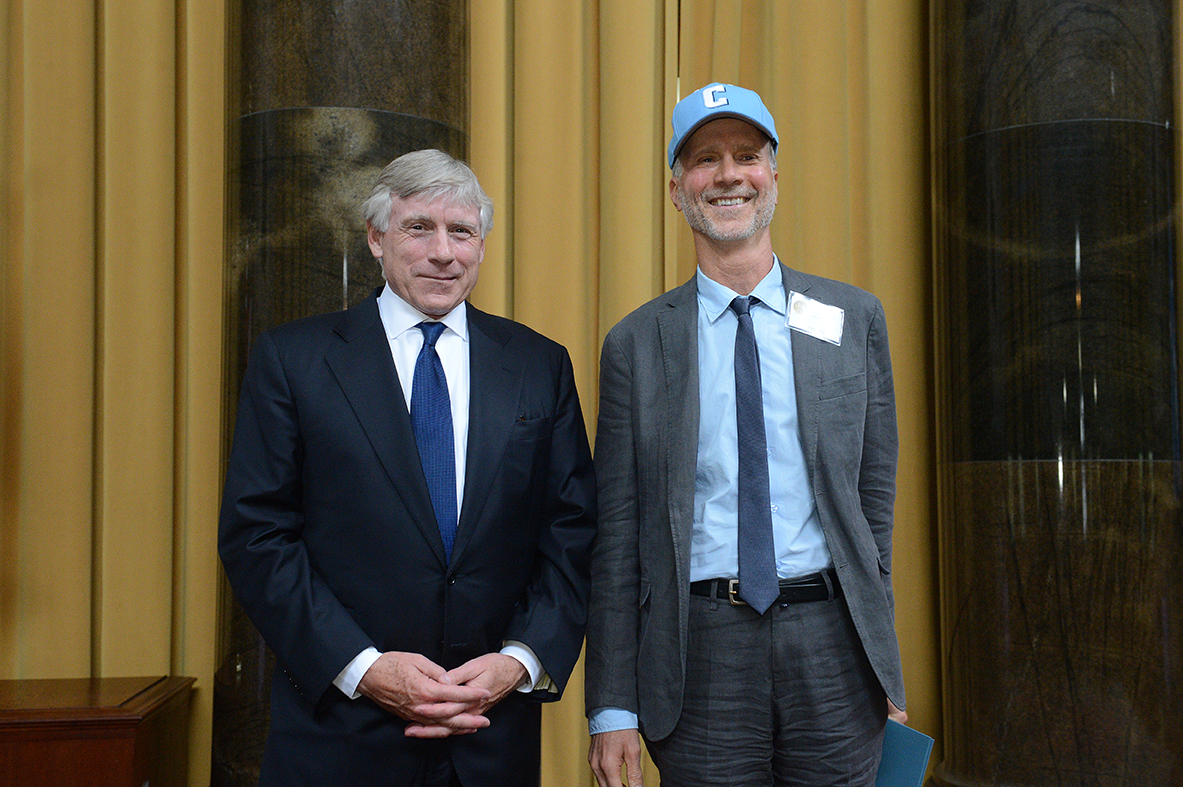
Lee C. Bollinger, President of Columbia University (left), presents the 2014 Music Prize to John Luther Adams.
Become Ocean, a Seattle Symphony commission inspired by the stunning waters of the Pacific Northwest.
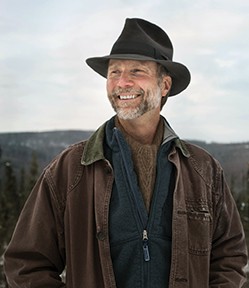
John Luther Adams has been called “one of the most original musical thinkers of the new century” (Alex Ross, The New Yorker).
Adams composes for orchestra, chamber ensembles, percussion and electronic media. His music is recorded on Cantaloupe, Cold Blue, New World, Mode and New Albion. Inuksuit, for up to 99 percussionists, is regularly performed all over the world.
About his work, Adams writes: "As a composer it’s my belief that music can contribute to the awakening of our ecological understanding. By deepening our awareness of our connections to the earth, music can provide a sounding model for the renewal of human consciousness and culture."
A recipient of the Heinz Award for his contributions to raising environmental awareness, Adams has also received the Nemmers Prize from Northwestern University, the Distinguished Artist Award from the Rasmuson Foundation, and fellowships from United States Artists, the National Endowment for the Arts, and the Foundation for Contemporary Arts.
Adams is the author of the book Winter Music (Wesleyan 2004). His sound and light environment The Place Where You Go to Listen at the University of Alaska Museum of the North is the subject of his second book (Wesleyan 2009). The Farthest Place is a collection of essays about his music, written by prominent musicians and scholars (University Press of New England 2011).
Adams has taught at Harvard University, the Oberlin Conservatory, Bennington College and the University of Alaska. He has been composer in residence with the Anchorage Symphony, Anchorage Opera, Fairbanks Symphony, Arctic Chamber Orchestra, and the Alaska Public Radio Network, and has served as president of the American Music Center.
Born in 1953, Adams grew up in the southeastern U.S. and in the suburbs of New York City. He studied composition with James Tenney and Leonard Stein at the California Institute of the Arts, where he was in the first graduating class (BFA 1973). In the mid 1970s he became active in the campaign for the Alaska National Interest Lands Conservation Act, and subsequently served as executive director of the Northern Alaska Environmental Center.