
For distinguished musical composition by an American that has had its first performance or recording in the United States during the year, Ten thousand dollars ($10,000).

Madame White Snake, by Zhou Long (Oxford University Press)

Premiered on February 26, 2010 by Opera Boston at the Cutler Majestic Theatre, a deeply expressive opera that draws on a Chinese folk tale to blend the musical traditions of the East and the West. Libretto by Cerise Lim Jacobs (Oxford University Press).
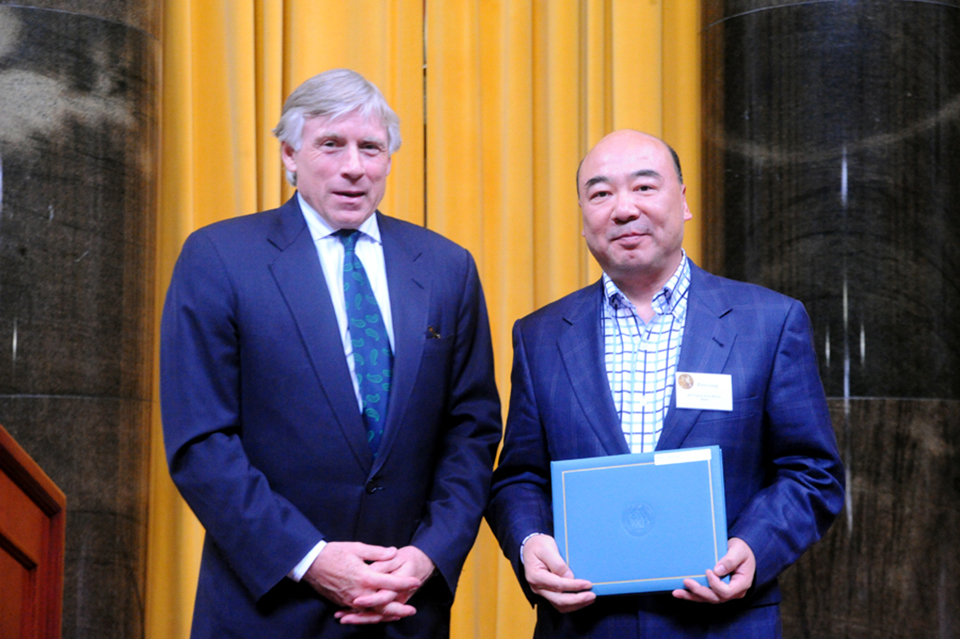
Lee Bollinger and Zhou Long

Lee C. Bollinger, President of Columbia University (left), presents the 2011 Music prize to Zhou Long.

Winning Work

Madame White Snake


Madame White Snake, a classical transformation myth, is the story of a powerful white snake demon who transforms into a beautiful woman so as to experience love. She meets her true love, Xu Xian, at the Broken Bridge on the West Lake in Hangzhou and marries him. So widely celebrated is their love that a curious Abbot investigates. He sees right through her human form to the snake. When the Abbot learns that Madame White Snake is pregnant, he is horrified by what he considers a violation of all of the traditional taboos of race and religion, the divine and the profane. He decides to intervene and he confronts her husband. Not surprisingly, disaster strikes. Madame White Snake is betrayed by her husband and in the moment of betrayal, she is tragically transformed back into a snake.

In its long journey through the centuries, this simple myth has become an icon in the hearts and minds of the Chinese people. The deadly white snake demon gives up her immortal existence to assume human form in the pursuit of the most human of all emotions – love. She holds love dearly for one moment; and then love is lost forever. A powerful metaphor for each individual’s struggle to dream, the myth has spoken deeply to all who have dared to dream. The question of what it means to be truly human is always timely and each generation answers this question in its own voice.

-- from madamewhitesnake.org
Biography

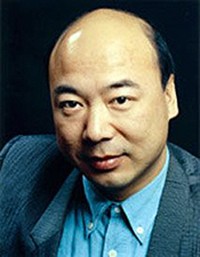
Zhou Long (b. July 8, 1953, Beijing) is internationally recognized for creating a unique body of music that brings together the aesthetic concepts and musical elements of East and West. Deeply grounded in the entire spectrum of his Chinese heritage, including folk, philosophical, and spiritual ideals, he is a pioneer in transferring the idiomatic sounds and techniques of ancient Chinese musical traditions to modern Western instruments and ensembles. His creative vision has resulted in a new music that stretches Western instruments eastward and Chinese instruments westward, achieving an exciting and fertile common ground.

Zhou Long was born into an artistic family and began piano lessons at an early age. During the Cultural Revolution, he was sent to a rural state farm, where the bleak landscape with roaring winds and ferocious wild fires made a profound and lasting impression. He resumed his musical training in 1973, studying composition, music theory, and conducting, as well as Chinese traditional music. In 1977, he enrolled in the first composition class at the reopened Central Conservatory of Music in Beijing. Following graduation in 1983, he was appointed composer-in-residence with the National Broadcasting Symphony Orchestra of China. Zhou Long travelled to the United States in 1985 under a fellowship to attend Columbia University, where he studied with Chou Wen-Chung, Mario Davidovsky, and George Edwards, receiving a Doctor of Musical Arts degree in 1993. After more than a decade as music director of Music from China in New York City, he received ASCAP’s prestigious Adventurous Programming Award in 1999.

He has been the recipient of commissions from the Koussevitzky Music Foundation in the Library of Congress, the Fromm Music Foundation at Harvard University, Chamber Music America, and the New York State Council on the Arts. Among the ensembles who have commissioned works from him, are the Bavarian Orchestra (Poems from Tang), the Tokyo Philharmonic (The Future of Fire), the New Music Consort (The Ineffable), the Pittsburgh New Music Ensemble (Soul and Tian Ling), the Peabody Trio (Spirit of Chimes), and the Kronos, Shanghai, Ciompi, and Chester string quartets (Poems from Tang). In February 2010, his pioneering cross-cultural opera, Madam White Snake, which was premiered by Opera Boston, received great critical acclaim. It was given a second performance in Beijing on the 27-October 2010 by the Bejing Philharmonic Orchestra.

A United States citizen since 1999, Zhou Long is married to the composer-violinist Chen Yi. It should be noted that Zhou is his family name and Long is his personal name, and thus he should be referred to as Mr. Zhou or Dr. Zhou.

Finalists

Nominated as finalists in Music in 2011:

Fred Lerdahl

Premiered on November 19, 2010 at Miller Theatre, Columbia University, a consistently original concerto that sustains an extraordinary level of sensuous invention as it evolves from one moment to the next.

Ricardo Zohn-Muldoon

Recording released in June, 2010 by Bridge Records, an ambitious cantata that translates into music an influential work of Latin American literature, giving voice to two cultures that intersect within the term "America."

The Jury

Anne Midgette

classical music critic

Delta David Gier(chair )

music director

George Lewis

composer, professor of American music

Paul Moravec*

composer, University Professor

William Banfield

composer

Winners in Music

Jennifer Higdon

Premiered on February 6, 2009, in Indianapolis, IN, a deeply engaging piece that combines flowing lyricism with dazzling virtuosity (Lawdon Press).

Steve Reich

A major work that displays an ability to channel an initial burst of energy into a large-scale musical event, built with masterful control and consistently intriguing to the ear.

David Lang

Co-commissioned by the Carnegie Hall Corporation and The Perth Theater and Concert Hall, and premiered October 25, 2007 in Zankel Hall at Carnegie Hall, New York City (G. Schirmer, Inc.).

2011 Prize Winners

Jennifer Egan

An inventive investigation of growing up and growing old in the digital age, displaying a big-hearted curiosity about cultural change at warp speed.

Ron Chernow

A sweeping, authoritative portrait of an iconic leader learning to master his private feelings in order to fulfill his public duties.

Kay Ryan

A body of work spanning 45 years, witty, rebellious and yet tender, a treasure trove of an iconoclastic and joyful mind.